EP2281446A1 - Seedless tomatoes and method for making the same - Google Patents
Seedless tomatoes and method for making the same Download PDFInfo
- Publication number
- EP2281446A1 EP2281446A1 EP20100012146 EP10012146A EP2281446A1 EP 2281446 A1 EP2281446 A1 EP 2281446A1 EP 20100012146 EP20100012146 EP 20100012146 EP 10012146 A EP10012146 A EP 10012146A EP 2281446 A1 EP2281446 A1 EP 2281446A1
- Authority
- EP
- European Patent Office
- Prior art keywords
- seedless
- tomato
- tomatoes
- pat
- parthenocarpic
- Prior art date
- Legal status (The legal status is an assumption and is not a legal conclusion. Google has not performed a legal analysis and makes no representation as to the accuracy of the status listed.)
- Withdrawn
Links
Images
Classifications
-
- A—HUMAN NECESSITIES
- A01—AGRICULTURE; FORESTRY; ANIMAL HUSBANDRY; HUNTING; TRAPPING; FISHING
- A01H—NEW PLANTS OR NON-TRANSGENIC PROCESSES FOR OBTAINING THEM; PLANT REPRODUCTION BY TISSUE CULTURE TECHNIQUES
- A01H5/00—Angiosperms, i.e. flowering plants, characterised by their plant parts; Angiosperms characterised otherwise than by their botanic taxonomy
- A01H5/08—Fruits
Definitions
- the present invention involves seedless tomatoes and a method of producing said tomatoes.
- Parthenocarpy is the production of fruit without fertilization. Certain environmental conditions favor parthenocarpy such as high or low temperatures day or night, low light intensity, and high humidity. Parthenocarpy may be induced artificially or may occur naturally. In induced parthenocarpy, various growth regulators can be used to facilitate fruit setting. For example, auxins are commonly applied to facilitate fruit setting in tomato (Lycopersicon esculentum) grown during winter-spring on the Mediterranean coast.
- Natural or genetic parthenocarpy may be obligate or facultative.
- Obligative parthenocarpy results from genetic sterility, arises without any external stimulation, and requires a vegetative method of propagation.
- Obligative parthenocarpy is found in such fruits as the banana and pineapples A.N. Lukyancriko, "Parthenocarpy in Tomato," Monographs on Theoretical and Applied Genetics 14, pgs. 167-177 (1991 ). Facultative parthenocarpy is found in tomato and other species in which the processes of pollination and fertilization depend on narrow environmental limits. Id. In facultative parthenocarpy, seeded or seedless fruits are produced in response to environmental stimuli. Id .
- parthenocarpic tomato line "Severianin” from the Gribovskja Experimental Vegetable Station near Moscow, Russia was found to have the remarkable ability to produce seedless or seeded fruits of similar weight depending on the environmental conditions.
- Splittstoesser, Walter E. "Temperature influences Parthenocarpic Fruit Production in Tomato", Proc. Plant Growth Regal. Soc. Am (1988 ).
- Parthenocarpy is known to be controlled genetically by one or more recessive genes. Many recessive genes controlling parthenocarpy are known. These genes are pat, pat-2, pat-3. pat-4, and pat-5.
- a short anther (sha) allele has also been found to produce parthenocarpic fruits.
- a seed development suppressor (sds) allele has also been found which produces normal fruit without seeds or only with a little quantity of very small seeds.
- parthenocarpic fruit tends to be smaller in size than normal fruit.
- acidity tends to be lower in parthenocarpic fruit, which has an adverse effect on flavor.
- parthenocarpic fruit, especially tomatoes frequently suffer from various malformations such as puffiness when produced under low temperature conditions.
- a substantially seedless tomato is not presently commercially available.
- a need for such a tomato exists, in particular, such a tomato of good quality especially for individuals on strict dietary restrictions who cannot eat food products containing seeds.
- individuals recovering from surgery to repair a ruptured portion of their gastrointestinal tract typically cannot eat foods that contain seeds.
- the problem is that these seeds may become trapped in the sutures in the repaired area of the gastrointestinal tract and thereby impair the healing process. If the wall of the gastrointestinal tract does not adequately heal, a further rupture could occur.
- substantially seedless tomatoes would be beneficial in the food preparation and process products industries.
- completely seedless tomatoes would make the preparation of certain products such as tomato sauce and tomato paste more efficient and less costly because the seeds would not need to be removed prior to processing.
- one object of the present invention is to provide a substantially seedless parthenocarpic tomato that exhibits good quality.
- a second object of the present invention is to provide a method for producing said seedless tomatoes.
- the present invention involves tomatoes ( Lycopersicon esculentum ) that are substantially seedless.
- the tomatoes of the present invention are about 100% seedless.
- the seedless tomatoes of the present invention are made by crossing a tomato plant (Lycopersicon esculentum) containing at least one parthenocarpic gene as the male parent with a male sterile tomato plant (Lycopersicon esculentum) containing at least one parthenocarpic gene as the female parent.
- the male and female parental lines may contain any parthenocarpic gene such as pat, pat-2, pat-3, pat-4, and pat-5, sha, and sds.
- the parthenocarpic gene(s) in the male and female parental lines should be identical in order to insure the production of the seedless tomatoes of the present invention.
- the seedless tomatoes of the present invention retain the size of fruit of the parent lines, and therefore a means is provided for obtaining seedless tomatoes of commercially acceptable size.
- the seedless tomatoes of the present invention also have good flavor (sugar and acid balance) and do not exhibit any malformations such as puffiness.
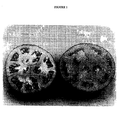
- Figure 1 is a black and white photograph of cut halves from two different tomatoes.
- Figure 1A is a tomato half from a normal seeded tomato.
- Figure 1B is a tomato half of the seedless tomato of the present invention.
- the present invention involves seedless tomatoes ( Lycopersicon esculentum) and a method of producing seedless tomatoes.
- seedless tomato refers to a tomato that does not contain any fertilized mature seeds. While the tomatoes of the present invention do not contain any fertilized mature seeds, the tomatoes may contain unfertilized ovaries, which are small and white in color. These unfertilized ovaries are not considered to be true seeds.
- the seedless tomatoes of the present invention are substantially seedless.
- substantially seedless means that the tomato is at least 90% seedless.
- the seedless tomatoes of the present invention are about 95% to about 99% seedless, most preferably, the tomatoes of the present invention are about 100% seedless.
- the seedless tomatoes of the present invention are prepared by crossing a tomato plant (Lycopersicon esculentum) containing at least one parthenocarpic gene as the male parent with a male sterile tomato plant (Lycopersicon esculentum) containing at least one parthenocarpic gene as the female parent.
- the male and female plants crossed to produce the seedless tomatoes of the present invention should each be homozygous for the parthenocarpic gene(s) and contain identical parthenocarpic genes.
- the male and female parental lines employed to produce the seedless tomatoes of the present invention must contain at least one parthenocarpic gene.
- the parental lines may contain any parthenocarpic gene such as pat, pat-2, pat-3, pat-4, pat-5, sha, sds, etc.
- the male and female parental lines used in the hybridization should preferably contain the identical parthenocarpic genes. For example, if the male parental line contains the pat gene, the female parental line should also contain the pat gene.
- Gold Nuggett, Oregon Spring. Oregon Star. Oregon Pride and Siletz are commercially available from Territorial Seed Co., P.O. Box 157. Cottage Grove, OR 97424. Gold Nuggett and Oregon Spring are also available from Johnny's Selected Seeds, Foss Hill Road, Albion, ME 04910-9731 and Nichol's Garden Nursery, 1190 North Pacific Highway, Albany, Oregon 97321. Santiam and Oregon Star are also commercially available from Nichol's Garden Nursery in Albany, Oregon.
- parthenocarpic genes from homozygous tomato lines may be transferred to tomato lines having commercially desirable characteristics by backcrossing.
- the homozygous tomato line containing the parthenocarpic genes is used as the donor parent and the tomato line having commercially desirable characteristics is used as the recurrent parent.
- the resulting F 1 progeny is self-pollinated.
- the F 2 progeny are then grown out and only those progeny which have seedless fruits combined with the maximum desirable horticultural traits are selected. These selections are then either selfed down further to fix desirable horticultural traits while retaining the parthenocarpic gene, or further backcrossing with the recurrent parent is employed until satisfactory F 2 segregates are recovered.
- the tomato line may now be used as the male parental line in the crossings of the present invention.
- the female parental line used to make the seedless tomatoes of the present invention contains at least one parthenocarpic gene and also exhibits male sterility.
- the parental line may be cytoplasmically or genetically male sterile.
- a plant is "male sterile” if it either produces no pollen or non-viable pollen. Self-fertilization is eliminated in male sterile plants.
- Male sterile plants allow a breeder to produce hybrid seed more economically by controlling cross-fertilization in the flower of a plant. Cross-fertilization can be controlled by preventing the female parent front self-fertilizing. Once rendered male sterile, the plant may then be hybridized with a gene donor plant possessing the desired characteristics.
- the male sterile female tomato plant is hybridized with a male fertile male tomato plant that contains at least one identical parthenocarpic gene pair.
- cytoplasmic male sterility One way to effectuate male sterility is through the use of cytoplasmic male sterility.
- CMS cytoplasmic male sterility
- Two common cytoplasmic male sterilities in plants are Ogura male sterile cytoplasm of Raphanus sativus and polima male sterile cytoplasm of Brassicas napus.
- Other cytoplasmic male sterilities and methods for making said sterility are also well known in the art and available for use in this invention.
- European patent application 363 819 Al describes a method of producing male-sterile tomato plants by fusing tomato protoplasts that contain inactivated cytoplasmic elements with Solanum protoplasts that contain inactivated nuclear elements to obtain fusion products that can be regenerated into male sterile tomato plants.
- cytoplasmic male sterility can be transmitted by crossing.
- the female (egg) parent contributes the cytoplasm, therefore, crossing to CMS females produces CMS progeny.
- the nuclear genes are heterozygous. Therefore, six to eight generations of backcrossing are required to produce a CMS breeding line that is homozygous for horticulturally desirable nuclear characters.
- cytoplasmic male sterile tomato lines can be produced by protoplast fusion.
- a protoplast from a plant having commercially desirable traits may be fused with a protoplast from a CMS line to produce male sterile plants.
- protoplasts for fusion may be obtained by conventional enzymatic techniques.
- the enzymatic isolation of protoplasts can be performed using a two-step (or sequential) or a one-step method.
- plant tissue is first treated with a macerozyme or pectinase which separates the cells by degrading the middle lamella.
- the freed cells are then treated with cellulase, which releases the protoplasts.
- the cells are exposed to the different enzymes for shorter periods than are used in the one-step method.
- the tissue is subjected to a mixture of enzymes, including macerozyme and cellulase.
- protoplasts Because protoplasts are negatively charged, they will not spontaneously fuse. Therefore, fusion of the protoplasts must be induced. Fusion of the protoplasts can be induced chemically, by treating the protoplasts with high levels of calcium at a high pH, or by employing polyethylene glycol. Additionally, electrical methods can also be used to induce protoplast fusion, such as the electric field pulse technique disclosed by Vienken et al. Physiol. Plant 53:64 (1981 ), herein incorporated by reference.
- the nuclear material of one of the protoplasts Prior to the fusion, the nuclear material of one of the protoplasts, such as a protoplast from the CMS line, is either removed or inactivated in order to insure that the protoplast donates only the cytoplasm.
- the inactivation of the nuclear material can be accomplished by irradiation using gamma, UV, or X-rays.
- the genetic material in the cytoplasm is inactivated prior to fusion so that the protoplast only donates the nuclear material.
- the inactivation of the cytoplasmic material can be accomplished chemically, by exposing the protoplasts to a compound, such as iodoacetic acid or Rhodamine 6-G. Generally, these compounds block the replication or disrupt the mitochondrial DNA.
- the protoplasts are fused, they are cultivated in an appropriate culture medium comprising a well-balanced nutrient supply for protoplast growth and calli formation.
- the medium contains micro- and macro-elements, vitamins, amino acids and small amounts of carbohydrates, e.g., various sugars such as glucose.
- the culture medium also comprises plant hormones (auxins and cytokines) which are able to regulate cell division and shoot regeneration. Cytoplasmically male sterile plants are then regenerated.
- Any male sterile tomato plant can be used in this invention.
- cytoplasmically male sterile tomato plants produced according to the method described in European patent, 363 819 Al , herein incorporated by reference, can be used in this invention.
- the male sterile tomato plants used as the female parental line must also contain at least one parthenocarpic gene which is identical to the parthenocarpic gene contained in the male parental line.
- the female parental line may be prepared by backcrossing tomato lines homozygous for at least one of the parthenocarpic genes with the male sterile tomato plants. This backcrossing strategy differs from male inbred development in that it involves straight backcrossing of the parthenocarpic inbred to the CMS female since no self-pollination is possible, the horticulturally acceptable parthenocarpic line acts as the maintainer of the CMS female line. The backcrossing is continued until the CMS tomato line is homozygous for the parthenocarpic gene. Homozygosity is achieved once 100% of the plant population sets parthenocarpic fruit.
- the seedless tomatoes of the present invention are obtained by hybridization of the male parental line with the female parental line.
- the resulting progeny are about 90% seedless preferably about 95% to about 99% seedless and most preferably 100% seedless. It should be noted, however, that if a pollinator such as a bee, pollinates the female parental line with pollen from a fertile line that does not contain at least one identical parthenocarpic gene as in the female parental line, then the progeny will not be about 90% seedless.
- the present invention also relates to a method of making a hybrid Lycopersicon esculentum, the method comprising the steps of crossing a Lycopersicon esculentum plant containing at least one parthenocarpic gene as the male parent with a cytoplasmically male sterile Lycopersicon esculentum plant containing at least one parthenocarpic gene as the female parent produce a Lycopersicon esculentum.
- the hybrid plant provides a fruit (Lycopersicon esculentum) that is male sterile.
- the hybrid plants should be grown under a photoperiod of thirteen (13) hours or greater.
- cytoplasmic male sterility when cytoplasmic male sterility is employed in plants, a restorer gene must be transferred from the male pollinator in order to ensure adequate fertility in the F 1 offspring. More specifically, the function of the restorer gene is to restore fertility in the hybrid thereby allowing for fruit set.
- cytoplasmic male sterile Lycopersicor By using a parthenocarpic gene in the male parent, cytoplasmic male sterile Lycopersicor, esculentum hybrids can be made that do not require a restorer gene from the male parent.
- a restorer gene is not required because the parthenocarpic gene expands the ovary, making fruit even though the fruit does not contain any seeds.
- FIG. 1 shows a black and white photograph of halves from two different tomatoes.
- Figure 1A shows a tomato half from a normal seeded commercial tomato.
- Figure 1B shows a tomato half from a seedless tomato produced by the method of the present invention. As can be seen in these photographs, the tomato half in Figure 1B has more flesh than the tomato half in Figure 1A . Therefore, the seedless tomatoes of the present invention often contain more flesh than conventional tomatoes.
- the seedless tomatoes of the present invention exhibit a good sugar and acid balance which provided the tomato with a good flavor. Also, the seedless tomatoes of the present invention exhibit a higher sugar content than most conventional tomatoes.
- the elevated sugar levels of the present invention are believed to relate to the fact that there are no seeds acting as a "sink", which normally assimilates free sugars present in the gel.
- the term "sink” is used in connection with plants to refer to a part of a plant that preferentially receives more photosynthate (sucrose) than other plant parts. Seeds constitute the dominate “sink” on plants because they represent the next generation or offspring of the plant. Plants that bear seeds contain a genetic makeup that codes for preferential translocation of sucrose to developing seeds, particularly under stress. With the parthenocarpic tomatoes of the present invention, it appears that the unfertilized, small ovules are not able to absorb the sugars translocated into the ovary, thus resulting in free sugars left for the enjoyment of the consumer.
- the seedless tomatoes of the present invention do not exhibit any malformations, such as puffiness and exhibit a commercially acceptable size.
- the seedless tomato of the present invention slice better than conventional tomatoes, due to the smaller locular gel areas.
- This example describes the development of the seedless tomato 96 FH 241 according to the method of the present invention.
- CMS VFN8 cytoplasmically male sterile tomato plant
- Det. Parth 1 a tomato plant called "Det. Parth 1” using traditional cross hybridization techniques.
- CMS VFN8 is a proprietary cytoplasmically male sterile tomato plant obtained from Tokita Seed Co.. Ltd, Tokyo, Japan. Seeds of the hybrid parent VFN8, a Petoseed inbred line with resistance to Verticillium dahliae race 1.
- VFN8 Fusarium oxysporum race 1, and the root knot nematode Meloidogyne incognita, were used as the nuclear donor parent in a protoplast fusion experiment wherein the mitochondria of cytoplasmicallymale sterile Solanum acaule was substituted for the mitochondria of male-fertile Lycopersicon esculentum, "VFN8.
- the plant type of VFN8 is a vigorous determinate, and fruit size is large-extra large (200-250 grams), with good flavor.
- Det. Parth 1 is a determinate parthenocarpic tomato plant which is a proprietary inbred line of Seminis Vegetable Seeds, Inc., the assignee of the present invention. Det. Parth 1 contains the pat-2 parthenocarpic gene. Det. Parth 1 is a determinate bush tomato with large-extra large (200-250 gram) fruit. The fruit have green-shoulders and have excellent flavor due to ample acidity and high sugar content.
- CMS VFN8/Det. Parth 1* 4 were homozygous for the pat-2 gene.
- CMS VFN8/Det. Parth 1* 4 plants were used as the female parent in a cross to develop the seedless tomato 96 FH 241. Seeds of CMS VFN8/Det.
- Parth 1* 4 plants have been deposited with the American Type Culture Collection (ATCC), 12301 Parklawn Drive, Rockville, Maryland 20852 on October 13, 1997 and assigned ATCC Deposit Number 209361. This deposit was made in compliance with the Budapest Treaty requirements that the duration of the deposit should be for thirty (30) years from the date of deposit or for five (5) years after the last request for the deposit at the depository or for the enforceable life of a U.S. Patent that matures from this application, whichever is longer. Seeds of CMS VFN8/Det. Parth 1* 4 plants will be replenished should it become non-viable at the depository.
- ATCC American Type Culture Collection
- Seeds of the F 6 have been deposited with the American Type Culture Collection, 12301 Parklawn Drive, Rockville, Maryland 20852 on October 13, 1997 and assigned ATCC Deposit Number 209360. This deposit was made in compliance with the Budapest Treaty requirements that the duration of the deposit should be for thirty (30) years from the date of deposit or for five (5) years after the last request for the deposit at the depository or for the enforceable life of a U.S. Patent that matures from this application, whichever is longer. Seeds of F 6 ('Delicious'/33*) plants will be replenished should it become non-viable at the depository.
- CMS VFN8/Det. Parth 1* 4 was crossed as the female parent with F 6 ('Delicious'/33*) as the male parent using traditional cross hybridization techniques. The resulting seed was collected and then planted. The resulting tomato, 96 FH 241, was 100% seedless.
- Shady Lady is a commercial variety with a fairly compact determinate vine and generally large fruit size (180-220g).
- 96 FH 241 is a seedless hybrid tomato produced by the method of the present invention. Samples from each of these tomatoes were homogenized individually in a standard food blender until a smooth consistency was achieved. Tomato serum from each sample of puree was obtained by centrifuging at 4°C in a Beckman GS-6R centrifuge at 1000 x g for 15 minutes.
- the sugar content of the serum was determined using a model RFM91 refractometer (Bellingham & Stanley). The refractometer was calibrated with water and 10°Brix glucose solution. The sugar content is expressed in °Brix (% sugar (wt/wt)). The sugar content for the two tomatoes is shown in the table below.
- Titratable acidity was measured using a Mettler D67 autotitrator. An endpoint of pH 8.2 and a D.1000 N sodium hydroxide (VWR) titrant was used. The titratable acidity is expressed in millimoles H*/100 grams serum.
Landscapes
- Life Sciences & Earth Sciences (AREA)
- Health & Medical Sciences (AREA)
- Physiology (AREA)
- Botany (AREA)
- Developmental Biology & Embryology (AREA)
- Environmental Sciences (AREA)
- Breeding Of Plants And Reproduction By Means Of Culturing (AREA)
Applications Claiming Priority (2)
| Application Number | Priority Date | Filing Date | Title |
|---|---|---|---|
| US08/957,867 US6060648A (en) | 1997-10-27 | 1997-10-27 | Seedless tomatoes and method for making the same |
| EP98955075A EP1026942A4 (en) | 1997-10-27 | 1998-10-23 | Seedless tomatoes and method for making the same |
Related Parent Applications (1)
| Application Number | Title | Priority Date | Filing Date |
|---|---|---|---|
| EP98955075.1 Division | 1998-10-23 |
Publications (1)
| Publication Number | Publication Date |
|---|---|
| EP2281446A1 true EP2281446A1 (en) | 2011-02-09 |
Family
ID=25500265
Family Applications (2)
| Application Number | Title | Priority Date | Filing Date |
|---|---|---|---|
| EP20100012146 Withdrawn EP2281446A1 (en) | 1997-10-27 | 1998-10-23 | Seedless tomatoes and method for making the same |
| EP98955075A Withdrawn EP1026942A4 (en) | 1997-10-27 | 1998-10-23 | Seedless tomatoes and method for making the same |
Family Applications After (1)
| Application Number | Title | Priority Date | Filing Date |
|---|---|---|---|
| EP98955075A Withdrawn EP1026942A4 (en) | 1997-10-27 | 1998-10-23 | Seedless tomatoes and method for making the same |
Country Status (12)
| Country | Link |
|---|---|
| US (1) | US6060648A (https=) |
| EP (2) | EP2281446A1 (https=) |
| JP (2) | JP4964363B2 (https=) |
| KR (1) | KR100579465B1 (https=) |
| CN (1) | CN1191010C (https=) |
| AU (1) | AU747873B2 (https=) |
| BR (1) | BR9814103A (https=) |
| IL (2) | IL135587A0 (https=) |
| JO (1) | JO2081B1 (https=) |
| TR (1) | TR200001129T2 (https=) |
| WO (1) | WO1999021411A1 (https=) |
| ZA (1) | ZA989785B (https=) |
Families Citing this family (34)
| Publication number | Priority date | Publication date | Assignee | Title |
|---|---|---|---|---|
| US20030217391A1 (en) * | 1996-12-06 | 2003-11-20 | Western Seed Espana | Seedless tomato |
| US6818545B2 (en) | 2001-03-05 | 2004-11-16 | Megic Corporation | Low fabrication cost, fine pitch and high reliability solder bump |
| EP1428425A1 (en) * | 2002-12-10 | 2004-06-16 | Western Seed Espana | Seedless tomato |
| US20040210962A1 (en) * | 2003-03-20 | 2004-10-21 | The Board Of Regents Of The University Of Nebraska | Implementation of a mitochondrial mutator |
| EP1992218A1 (en) * | 2007-05-18 | 2008-11-19 | De Ruiter Seeds R&D B.V. | Parthenocarpic genetic elements derived from S. habrochaites |
| EP2583548A1 (en) | 2007-07-05 | 2013-04-24 | Western Seed International B.V. | Parthenocarpy genes in tomato |
| WO2010101274A1 (ja) * | 2009-03-05 | 2010-09-10 | 横浜植木株式会社 | 無核のカプシクム・アンヌームおよびその作出方法 |
| ES3050160T3 (en) * | 2009-06-22 | 2025-12-19 | Rijk Zwaan Zaadteelt En Zaadhandel Bv | Fertilisation independent fruit formation in tomato |
| US8247662B2 (en) | 2009-08-17 | 2012-08-21 | Seminis Vegetable Seeds, Inc. | Tomato line FIR 128-1032 |
| NL2005908C2 (en) | 2010-12-22 | 2012-06-28 | Rijk Zwaan Zaadteelt En Zaadhandel Bv | Fruit formation in the absence of fertilisation. |
| EP2782440B1 (en) | 2011-11-22 | 2026-04-08 | Seminis Vegetable Seeds, Inc. | Seedless pepper plants |
| CN102668977A (zh) * | 2012-06-12 | 2012-09-19 | 重庆市农业科学院 | 一种培育无籽茄子品种的方法 |
| US20190194684A1 (en) * | 2012-07-31 | 2019-06-27 | Incorporated Adminstrative Agency Natl. Agriculture And Food Research Org. | Parthenocarpy regulation gene and use thereof |
| KR102308873B1 (ko) * | 2014-01-17 | 2021-10-01 | 고쿠리츠겐큐가이하츠호징 노우교 · 쇼쿠힝 산교기쥬츠 소고겐큐기코 | 단위결과 제어 유전자 및 그 이용 |
| CN104145697A (zh) * | 2014-08-28 | 2014-11-19 | 太仓市丰缘农场专业合作社 | 一种无仔西红柿的种植方法 |
| WO2017022859A1 (ja) * | 2015-08-06 | 2017-02-09 | 国立大学法人筑波大学 | 変異型サイクリンF-box遺伝子を有する植物 |
| US10448589B2 (en) | 2015-12-23 | 2019-10-22 | Nunhems B.V. | Tomato variety NUN 09168 TOF |
| US10448590B2 (en) | 2016-12-20 | 2019-10-22 | Nunhems B.V. | Tomato variety NUN 00261 TOP |
| US20180206428A1 (en) | 2017-06-08 | 2018-07-26 | Nunhems B.V. | Tomato variety nun 00277 top |
| CN107254478B (zh) * | 2017-06-23 | 2020-07-10 | 山西大学 | 番茄sllcd基因及其应用 |
| US20190141940A1 (en) | 2018-01-12 | 2019-05-16 | Nunhems B.V. | Tomato variety nun 00292 top |
| US10750710B2 (en) | 2018-05-23 | 2020-08-25 | Nunhems B.V. | Tomato variety NUN 09220 TOF |
| US11109560B2 (en) | 2018-11-21 | 2021-09-07 | Nunhems B.V. | Tomato variety NUN 09247 TOF |
| US20200100450A1 (en) | 2018-11-21 | 2020-04-02 | Nunhems B.V. | Tomato variety nun 09225 tof |
| JP7578597B2 (ja) | 2018-12-13 | 2024-11-06 | ヌンヘムス、ベスローテン、フェンノートシャップ | 偽単為結果性の果実形成が可能なナス科植物 |
| US11363793B2 (en) | 2019-04-12 | 2022-06-21 | Nunhems B.V. | Tomato variety NUN 01502 TOF |
| US11382303B2 (en) | 2019-04-17 | 2022-07-12 | Nunhems B.V. | Tomato variety NUN 05510 TOF |
| WO2021040011A1 (ja) | 2019-08-30 | 2021-03-04 | 国立大学法人筑波大学 | 高温耐性、高収量性および単為結果性を示す果実類植物 |
| US11350602B2 (en) | 2019-11-26 | 2022-06-07 | Nunhems B.V. | Tomato variety NUN 09272 TOF |
| US11369078B2 (en) | 2020-01-28 | 2022-06-28 | Nunhems B.V. | Tomato variety NUN 00311 TOP |
| US11980159B2 (en) | 2020-12-14 | 2024-05-14 | Nunhems B.V. | Tomato variety NUN 09282 TOF |
| US11937566B2 (en) | 2020-12-17 | 2024-03-26 | Nunhems B.V. | Tomato variety NUN 00321 TOP |
| US11930779B2 (en) | 2020-12-17 | 2024-03-19 | Nunhems B.V. | Tomato variety NUN 00316 TOP |
| US12588645B2 (en) | 2022-09-28 | 2026-03-31 | Nunhems B.V. | Tomato variety NUN 09400 TOF |
Citations (1)
| Publication number | Priority date | Publication date | Assignee | Title |
|---|---|---|---|---|
| EP0363819A1 (en) | 1988-10-08 | 1990-04-18 | Nichirei Corporation | Method for producing male-sterile tomato plants |
Family Cites Families (4)
| Publication number | Priority date | Publication date | Assignee | Title |
|---|---|---|---|---|
| US4009020A (en) * | 1975-05-06 | 1977-02-22 | Amchem Products, Inc. | Method of regulating plant growth |
| JP3386292B2 (ja) * | 1995-07-25 | 2003-03-17 | 株式会社ニチレイ | 稔性を回復させたf1トマト植物の作出方法 |
| JP3532707B2 (ja) * | 1996-10-07 | 2004-05-31 | 株式会社ニチレイ | 細胞質雄性不稔を引き起こす機能を有するミトコンドリア遺伝子 |
| JP3532708B2 (ja) * | 1996-10-07 | 2004-05-31 | 株式会社ニチレイ | 葯欠損型の細胞質雄性不稔を引き起こす機能を有するミトコンドリア遺伝子 |
-
1997
- 1997-10-27 US US08/957,867 patent/US6060648A/en not_active Expired - Lifetime
-
1998
- 1998-10-23 BR BR9814103-1A patent/BR9814103A/pt not_active Application Discontinuation
- 1998-10-23 EP EP20100012146 patent/EP2281446A1/en not_active Withdrawn
- 1998-10-23 JP JP2000517590A patent/JP4964363B2/ja not_active Expired - Lifetime
- 1998-10-23 KR KR1020007004479A patent/KR100579465B1/ko not_active Expired - Lifetime
- 1998-10-23 WO PCT/US1998/022474 patent/WO1999021411A1/en not_active Ceased
- 1998-10-23 IL IL13558798A patent/IL135587A0/xx active IP Right Grant
- 1998-10-23 CN CNB988105942A patent/CN1191010C/zh not_active Expired - Lifetime
- 1998-10-23 AU AU11966/99A patent/AU747873B2/en not_active Expired
- 1998-10-23 EP EP98955075A patent/EP1026942A4/en not_active Withdrawn
- 1998-10-23 TR TR2000/01129T patent/TR200001129T2/xx unknown
- 1998-10-27 ZA ZA9809785A patent/ZA989785B/xx unknown
- 1998-10-27 JO JO19982081A patent/JO2081B1/en active
-
2000
- 2000-04-11 IL IL135587A patent/IL135587A/en not_active IP Right Cessation
-
2010
- 2010-09-27 JP JP2010215739A patent/JP2011045373A/ja active Pending
Patent Citations (1)
| Publication number | Priority date | Publication date | Assignee | Title |
|---|---|---|---|---|
| EP0363819A1 (en) | 1988-10-08 | 1990-04-18 | Nichirei Corporation | Method for producing male-sterile tomato plants |
Non-Patent Citations (12)
| Title |
|---|
| A.N. LUKYANCRIKO: "Parthenocarpy in Tomato", MONOGRAPHS ON THEORETICAL AND APPLIED GENETICS, vol. 14, 1991, pages 167 - 177 |
| A.N. LUKYANENKO: "Parthenocarpy in Tomato", MONOGRAPHS ON THEORETICAL AND APPLIED GENETICS, vol. 14, 1991, pages 167 - 177 |
| BAGGETT, J.R. ET AL., HORTSCI, vol. 13, no. 5, October 1978 (1978-10-01), pages 598 |
| BAGGETT, J.R. ET AL.: "Hortiscience, Alexandria, Va.: American Society for Horticultural", SCIENCE, vol. 20, no. 5, October 1985 (1985-10-01), pages 957 - 958 |
| BAGGETT. J.R. ET AL., HORTSCI, vol. 13, no. 5, October 1978 (1978-10-01), pages 599 |
| BAGGETT. J.R. ET AL.: "Hortiscience, Alexandria American Society for Horticultural", SCIENCE, vol. 17, no. 6, December 1982 (1982-12-01), pages 984 - 985 |
| CASAS DIAZ A V ET AL: "EFFECTS OF PARTHENOCARPY ON FRUIT QUALITY IN TOMATO", JOURNAL OF THE AMERICAN SOCIETY FOR HORTICULTURAL SCIENCE, AMERICAN SOCIETY FOR HORTICULTURAL SCIENCE, ALEXANDRIA, VA, US, vol. 112, no. 4, 1 January 1987 (1987-01-01), pages 634 - 637, XP002916036, ISSN: 0003-1062 * |
| GEORGIEV CH.: "Resuls from the Investigations on Genetic Parthenocarpy in Tomatoes in Bulgaria", A NEW ERA IN TOMATO BREEDING. SYNOPSES. MEETING, 22 May 1984 (1984-05-22), pages A,22 - 36, XP002043985 * |
| GEORGIEV H ET AL: "Breeding of Seedless Tomatoes", EUCARPIA TOMATO. PROCEEDINGS OF THE EUCARPIA MEETING ON TOMATO GENETICS AND BREEDING, March 1990 (1990-03-01), pages 153 - 155, XP002043984 * |
| UPOV ED - UPOV: "EXPLANATORY NOTES ON THE DEFINITION OF VARIETY UNDER THE 1991 ACT OF THE UPOV CONVENTION", INTERNET CITATION, 21 October 2010 (2010-10-21), pages 1 - 5, XP002680170, Retrieved from the Internet <URL:http://www.upov.int/export/sites/upov/en/publications/pdf/upov_exn_var_1.pdf> [retrieved on 20120717] * |
| VIENKEN ET AL., PHYSIOL. PLANT, vol. 53, 1981, pages 64 |
| WALTER E.: "Temperature influences Parthenocarpic Fruit Production in Tomato", PROC. PLANT GROWTH REGAL. SOC. AM, 1988 |
Also Published As
| Publication number | Publication date |
|---|---|
| IL135587A0 (en) | 2001-05-20 |
| IL135587A (en) | 2008-11-26 |
| US6060648A (en) | 2000-05-09 |
| CN1277539A (zh) | 2000-12-20 |
| WO1999021411A1 (en) | 1999-05-06 |
| ZA989785B (en) | 2000-04-28 |
| CN1191010C (zh) | 2005-03-02 |
| KR20010031447A (ko) | 2001-04-16 |
| JO2081B1 (en) | 2000-05-21 |
| EP1026942A4 (en) | 2007-10-17 |
| KR100579465B1 (ko) | 2006-05-15 |
| JP2001520863A (ja) | 2001-11-06 |
| JP4964363B2 (ja) | 2012-06-27 |
| EP1026942A1 (en) | 2000-08-16 |
| JP2011045373A (ja) | 2011-03-10 |
| AU1196699A (en) | 1999-05-17 |
| TR200001129T2 (tr) | 2001-01-22 |
| AU747873B2 (en) | 2002-05-23 |
| BR9814103A (pt) | 2000-10-03 |
Similar Documents
| Publication | Publication Date | Title |
|---|---|---|
| AU747873B2 (en) | Seedless tomatoes and method for making the same | |
| US9924653B2 (en) | Increasing the number of grain bearing ears of maize | |
| Smith | Sugarbeet | |
| Gradziel | Interspecific hybridizations and subsequent gene introgression within Prunus subgenus Amygdalus | |
| CN101500404B (zh) | 低刺激性长日洋葱 | |
| KR950014512B1 (ko) | 다년생 웅성 불임벼를 이용한 잡종 벼 생산방법 | |
| AU2005201854B2 (en) | Broccoli type adapted for ease of harvest | |
| WO2001022805A1 (en) | Stable cytoplasmic male sterile brassica campestris plant which contain 'polima' cytoplasm and method for obtaining such plants | |
| MXPA00003740A (en) | Seedless tomatoes and method for making the same | |
| M’Ribu et al. | Fertility of doubled monoploids of Solanum phureja | |
| GB2429462A (en) | Male sterile swede plants and F1 hybrids | |
| Carter Jr et al. | An Efficient method for Transferring Genetic Male Sterility to Soybean Lines 1 | |
| Cameron et al. | Breeding and development | |
| EP0361124A1 (en) | Plant breeding | |
| EP1465475B1 (en) | Orobanche resistant sunflowers | |
| Singh et al. | Breeding Root Vegetables for enhancing nutritional quality | |
| Stevenson et al. | Studies in Interspecific Crossing with Melilotus and in Intergeneric Crossing with Melilotus Medicago and Trigonella | |
| Zhiyuan et al. | Preliminary study on the inheritance of male sterility in cabbage line 79–399–438 | |
| US9018455B1 (en) | Soybean variety ‘G04-1618RR’ | |
| Singh et al. | Development of hybrids and hybrid seed production of cole crops (Brassica oleracea L.) | |
| Verma et al. | An Overview of Hybrid Khol Rabi Breeding | |
| WO2005112610A2 (en) | Broccoli type adapted for ease of harvest | |
| THOMPSON et al. | Plant Breeding Institute, Maris Lane, Trumpington, CAMBRIDGE | |
| Amponsah | STUDIES IN NATURAL POLLINATION OF COCOA IN GHANA | |
| McDonald et al. | Flowering and Seed Set |
Legal Events
| Date | Code | Title | Description |
|---|---|---|---|
| PUAI | Public reference made under article 153(3) epc to a published international application that has entered the european phase |
Free format text: ORIGINAL CODE: 0009012 |
|
| AC | Divisional application: reference to earlier application |
Ref document number: 1026942 Country of ref document: EP Kind code of ref document: P |
|
| AK | Designated contracting states |
Kind code of ref document: A1 Designated state(s): DE ES FR GB IT NL PT |
|
| 17P | Request for examination filed |
Effective date: 20110809 |
|
| RAP1 | Party data changed (applicant data changed or rights of an application transferred) |
Owner name: SEMINIS VEGETABLE SEEDS, INC. |
|
| 17Q | First examination report despatched |
Effective date: 20150513 |
|
| STAA | Information on the status of an ep patent application or granted ep patent |
Free format text: STATUS: THE APPLICATION IS DEEMED TO BE WITHDRAWN |
|
| 18D | Application deemed to be withdrawn |
Effective date: 20150924 |