EP2280405A1 - Gehäuse, insbesondere für einen elektronischen Schlüssel - Google Patents
Gehäuse, insbesondere für einen elektronischen Schlüssel Download PDFInfo
- Publication number
- EP2280405A1 EP2280405A1 EP10007769A EP10007769A EP2280405A1 EP 2280405 A1 EP2280405 A1 EP 2280405A1 EP 10007769 A EP10007769 A EP 10007769A EP 10007769 A EP10007769 A EP 10007769A EP 2280405 A1 EP2280405 A1 EP 2280405A1
- Authority
- EP
- European Patent Office
- Prior art keywords
- housing element
- housing
- laser
- carrier part
- visible surface
- Prior art date
- Legal status (The legal status is an assumption and is not a legal conclusion. Google has not performed a legal analysis and makes no representation as to the accuracy of the status listed.)
- Granted
Links
Images



Classifications
-
- G—PHYSICS
- G07—CHECKING-DEVICES
- G07C—TIME OR ATTENDANCE REGISTERS; REGISTERING OR INDICATING THE WORKING OF MACHINES; GENERATING RANDOM NUMBERS; VOTING OR LOTTERY APPARATUS; ARRANGEMENTS, SYSTEMS OR APPARATUS FOR CHECKING NOT PROVIDED FOR ELSEWHERE
- G07C9/00—Individual registration on entry or exit
- G07C9/00174—Electronically operated locks; Circuits therefor; Nonmechanical keys therefor, e.g. passive or active electrical keys or other data carriers without mechanical keys
- G07C9/00944—Details of construction or manufacture
-
- B—PERFORMING OPERATIONS; TRANSPORTING
- B29—WORKING OF PLASTICS; WORKING OF SUBSTANCES IN A PLASTIC STATE IN GENERAL
- B29C—SHAPING OR JOINING OF PLASTICS; SHAPING OF MATERIAL IN A PLASTIC STATE, NOT OTHERWISE PROVIDED FOR; AFTER-TREATMENT OF THE SHAPED PRODUCTS, e.g. REPAIRING
- B29C65/00—Joining or sealing of preformed parts, e.g. welding of plastics materials; Apparatus therefor
- B29C65/02—Joining or sealing of preformed parts, e.g. welding of plastics materials; Apparatus therefor by heating, with or without pressure
- B29C65/14—Joining or sealing of preformed parts, e.g. welding of plastics materials; Apparatus therefor by heating, with or without pressure using wave energy, i.e. electromagnetic radiation, or particle radiation
- B29C65/16—Laser beams
- B29C65/1629—Laser beams characterised by the way of heating the interface
- B29C65/1635—Laser beams characterised by the way of heating the interface at least passing through one of the parts to be joined, i.e. laser transmission welding
-
- B—PERFORMING OPERATIONS; TRANSPORTING
- B29—WORKING OF PLASTICS; WORKING OF SUBSTANCES IN A PLASTIC STATE IN GENERAL
- B29C—SHAPING OR JOINING OF PLASTICS; SHAPING OF MATERIAL IN A PLASTIC STATE, NOT OTHERWISE PROVIDED FOR; AFTER-TREATMENT OF THE SHAPED PRODUCTS, e.g. REPAIRING
- B29C65/00—Joining or sealing of preformed parts, e.g. welding of plastics materials; Apparatus therefor
- B29C65/02—Joining or sealing of preformed parts, e.g. welding of plastics materials; Apparatus therefor by heating, with or without pressure
- B29C65/14—Joining or sealing of preformed parts, e.g. welding of plastics materials; Apparatus therefor by heating, with or without pressure using wave energy, i.e. electromagnetic radiation, or particle radiation
- B29C65/16—Laser beams
- B29C65/1677—Laser beams making use of an absorber or impact modifier
-
- B—PERFORMING OPERATIONS; TRANSPORTING
- B29—WORKING OF PLASTICS; WORKING OF SUBSTANCES IN A PLASTIC STATE IN GENERAL
- B29C—SHAPING OR JOINING OF PLASTICS; SHAPING OF MATERIAL IN A PLASTIC STATE, NOT OTHERWISE PROVIDED FOR; AFTER-TREATMENT OF THE SHAPED PRODUCTS, e.g. REPAIRING
- B29C66/00—General aspects of processes or apparatus for joining preformed parts
- B29C66/01—General aspects dealing with the joint area or with the area to be joined
- B29C66/05—Particular design of joint configurations
- B29C66/10—Particular design of joint configurations particular design of the joint cross-sections
- B29C66/11—Joint cross-sections comprising a single joint-segment, i.e. one of the parts to be joined comprising a single joint-segment in the joint cross-section
- B29C66/112—Single lapped joints
- B29C66/1122—Single lap to lap joints, i.e. overlap joints
-
- B—PERFORMING OPERATIONS; TRANSPORTING
- B29—WORKING OF PLASTICS; WORKING OF SUBSTANCES IN A PLASTIC STATE IN GENERAL
- B29C—SHAPING OR JOINING OF PLASTICS; SHAPING OF MATERIAL IN A PLASTIC STATE, NOT OTHERWISE PROVIDED FOR; AFTER-TREATMENT OF THE SHAPED PRODUCTS, e.g. REPAIRING
- B29C66/00—General aspects of processes or apparatus for joining preformed parts
- B29C66/50—General aspects of joining tubular articles; General aspects of joining long products, i.e. bars or profiled elements; General aspects of joining single elements to tubular articles, hollow articles or bars; General aspects of joining several hollow-preforms to form hollow or tubular articles
- B29C66/51—Joining tubular articles, profiled elements or bars; Joining single elements to tubular articles, hollow articles or bars; Joining several hollow-preforms to form hollow or tubular articles
- B29C66/53—Joining single elements to tubular articles, hollow articles or bars
- B29C66/534—Joining single elements to open ends of tubular or hollow articles or to the ends of bars
- B29C66/5344—Joining single elements to open ends of tubular or hollow articles or to the ends of bars said single elements being substantially annular, i.e. of finite length, e.g. joining flanges to tube ends
-
- B—PERFORMING OPERATIONS; TRANSPORTING
- B29—WORKING OF PLASTICS; WORKING OF SUBSTANCES IN A PLASTIC STATE IN GENERAL
- B29C—SHAPING OR JOINING OF PLASTICS; SHAPING OF MATERIAL IN A PLASTIC STATE, NOT OTHERWISE PROVIDED FOR; AFTER-TREATMENT OF THE SHAPED PRODUCTS, e.g. REPAIRING
- B29C66/00—General aspects of processes or apparatus for joining preformed parts
- B29C66/50—General aspects of joining tubular articles; General aspects of joining long products, i.e. bars or profiled elements; General aspects of joining single elements to tubular articles, hollow articles or bars; General aspects of joining several hollow-preforms to form hollow or tubular articles
- B29C66/51—Joining tubular articles, profiled elements or bars; Joining single elements to tubular articles, hollow articles or bars; Joining several hollow-preforms to form hollow or tubular articles
- B29C66/53—Joining single elements to tubular articles, hollow articles or bars
- B29C66/534—Joining single elements to open ends of tubular or hollow articles or to the ends of bars
- B29C66/5346—Joining single elements to open ends of tubular or hollow articles or to the ends of bars said single elements being substantially flat
-
- B—PERFORMING OPERATIONS; TRANSPORTING
- B29—WORKING OF PLASTICS; WORKING OF SUBSTANCES IN A PLASTIC STATE IN GENERAL
- B29C—SHAPING OR JOINING OF PLASTICS; SHAPING OF MATERIAL IN A PLASTIC STATE, NOT OTHERWISE PROVIDED FOR; AFTER-TREATMENT OF THE SHAPED PRODUCTS, e.g. REPAIRING
- B29C66/00—General aspects of processes or apparatus for joining preformed parts
- B29C66/70—General aspects of processes or apparatus for joining preformed parts characterised by the composition, physical properties or the structure of the material of the parts to be joined; Joining with non-plastics material
- B29C66/73—General aspects of processes or apparatus for joining preformed parts characterised by the composition, physical properties or the structure of the material of the parts to be joined; Joining with non-plastics material characterised by the intensive physical properties of the material of the parts to be joined, by the optical properties of the material of the parts to be joined, by the extensive physical properties of the parts to be joined, by the state of the material of the parts to be joined or by the material of the parts to be joined being a thermoplastic or a thermoset
- B29C66/731—General aspects of processes or apparatus for joining preformed parts characterised by the composition, physical properties or the structure of the material of the parts to be joined; Joining with non-plastics material characterised by the intensive physical properties of the material of the parts to be joined, by the optical properties of the material of the parts to be joined, by the extensive physical properties of the parts to be joined, by the state of the material of the parts to be joined or by the material of the parts to be joined being a thermoplastic or a thermoset characterised by the intensive physical properties of the material of the parts to be joined
- B29C66/7316—Surface properties
- B29C66/73161—Roughness or rugosity
-
- B—PERFORMING OPERATIONS; TRANSPORTING
- B29—WORKING OF PLASTICS; WORKING OF SUBSTANCES IN A PLASTIC STATE IN GENERAL
- B29C—SHAPING OR JOINING OF PLASTICS; SHAPING OF MATERIAL IN A PLASTIC STATE, NOT OTHERWISE PROVIDED FOR; AFTER-TREATMENT OF THE SHAPED PRODUCTS, e.g. REPAIRING
- B29C66/00—General aspects of processes or apparatus for joining preformed parts
- B29C66/70—General aspects of processes or apparatus for joining preformed parts characterised by the composition, physical properties or the structure of the material of the parts to be joined; Joining with non-plastics material
- B29C66/73—General aspects of processes or apparatus for joining preformed parts characterised by the composition, physical properties or the structure of the material of the parts to be joined; Joining with non-plastics material characterised by the intensive physical properties of the material of the parts to be joined, by the optical properties of the material of the parts to be joined, by the extensive physical properties of the parts to be joined, by the state of the material of the parts to be joined or by the material of the parts to be joined being a thermoplastic or a thermoset
- B29C66/739—General aspects of processes or apparatus for joining preformed parts characterised by the composition, physical properties or the structure of the material of the parts to be joined; Joining with non-plastics material characterised by the intensive physical properties of the material of the parts to be joined, by the optical properties of the material of the parts to be joined, by the extensive physical properties of the parts to be joined, by the state of the material of the parts to be joined or by the material of the parts to be joined being a thermoplastic or a thermoset characterised by the material of the parts to be joined being a thermoplastic or a thermoset
- B29C66/7392—General aspects of processes or apparatus for joining preformed parts characterised by the composition, physical properties or the structure of the material of the parts to be joined; Joining with non-plastics material characterised by the intensive physical properties of the material of the parts to be joined, by the optical properties of the material of the parts to be joined, by the extensive physical properties of the parts to be joined, by the state of the material of the parts to be joined or by the material of the parts to be joined being a thermoplastic or a thermoset characterised by the material of the parts to be joined being a thermoplastic or a thermoset characterised by the material of at least one of the parts being a thermoplastic
- B29C66/73921—General aspects of processes or apparatus for joining preformed parts characterised by the composition, physical properties or the structure of the material of the parts to be joined; Joining with non-plastics material characterised by the intensive physical properties of the material of the parts to be joined, by the optical properties of the material of the parts to be joined, by the extensive physical properties of the parts to be joined, by the state of the material of the parts to be joined or by the material of the parts to be joined being a thermoplastic or a thermoset characterised by the material of the parts to be joined being a thermoplastic or a thermoset characterised by the material of at least one of the parts being a thermoplastic characterised by the materials of both parts being thermoplastics
-
- B—PERFORMING OPERATIONS; TRANSPORTING
- B29—WORKING OF PLASTICS; WORKING OF SUBSTANCES IN A PLASTIC STATE IN GENERAL
- B29C—SHAPING OR JOINING OF PLASTICS; SHAPING OF MATERIAL IN A PLASTIC STATE, NOT OTHERWISE PROVIDED FOR; AFTER-TREATMENT OF THE SHAPED PRODUCTS, e.g. REPAIRING
- B29C35/00—Heating, cooling or curing, e.g. crosslinking or vulcanising; Apparatus therefor
- B29C35/02—Heating or curing, e.g. crosslinking or vulcanizing during moulding, e.g. in a mould
- B29C35/08—Heating or curing, e.g. crosslinking or vulcanizing during moulding, e.g. in a mould by wave energy or particle radiation
- B29C35/0805—Heating or curing, e.g. crosslinking or vulcanizing during moulding, e.g. in a mould by wave energy or particle radiation using electromagnetic radiation
- B29C2035/0822—Heating or curing, e.g. crosslinking or vulcanizing during moulding, e.g. in a mould by wave energy or particle radiation using electromagnetic radiation using IR radiation
-
- B—PERFORMING OPERATIONS; TRANSPORTING
- B29—WORKING OF PLASTICS; WORKING OF SUBSTANCES IN A PLASTIC STATE IN GENERAL
- B29C—SHAPING OR JOINING OF PLASTICS; SHAPING OF MATERIAL IN A PLASTIC STATE, NOT OTHERWISE PROVIDED FOR; AFTER-TREATMENT OF THE SHAPED PRODUCTS, e.g. REPAIRING
- B29C65/00—Joining or sealing of preformed parts, e.g. welding of plastics materials; Apparatus therefor
- B29C65/02—Joining or sealing of preformed parts, e.g. welding of plastics materials; Apparatus therefor by heating, with or without pressure
- B29C65/14—Joining or sealing of preformed parts, e.g. welding of plastics materials; Apparatus therefor by heating, with or without pressure using wave energy, i.e. electromagnetic radiation, or particle radiation
- B29C65/16—Laser beams
- B29C65/1603—Laser beams characterised by the type of electromagnetic radiation
- B29C65/1612—Infrared [IR] radiation, e.g. by infrared lasers
-
- B—PERFORMING OPERATIONS; TRANSPORTING
- B29—WORKING OF PLASTICS; WORKING OF SUBSTANCES IN A PLASTIC STATE IN GENERAL
- B29C—SHAPING OR JOINING OF PLASTICS; SHAPING OF MATERIAL IN A PLASTIC STATE, NOT OTHERWISE PROVIDED FOR; AFTER-TREATMENT OF THE SHAPED PRODUCTS, e.g. REPAIRING
- B29C66/00—General aspects of processes or apparatus for joining preformed parts
- B29C66/01—General aspects dealing with the joint area or with the area to be joined
- B29C66/05—Particular design of joint configurations
- B29C66/20—Particular design of joint configurations particular design of the joint lines, e.g. of the weld lines
- B29C66/24—Particular design of joint configurations particular design of the joint lines, e.g. of the weld lines said joint lines being closed or non-straight
-
- B—PERFORMING OPERATIONS; TRANSPORTING
- B29—WORKING OF PLASTICS; WORKING OF SUBSTANCES IN A PLASTIC STATE IN GENERAL
- B29C—SHAPING OR JOINING OF PLASTICS; SHAPING OF MATERIAL IN A PLASTIC STATE, NOT OTHERWISE PROVIDED FOR; AFTER-TREATMENT OF THE SHAPED PRODUCTS, e.g. REPAIRING
- B29C66/00—General aspects of processes or apparatus for joining preformed parts
- B29C66/70—General aspects of processes or apparatus for joining preformed parts characterised by the composition, physical properties or the structure of the material of the parts to be joined; Joining with non-plastics material
- B29C66/71—General aspects of processes or apparatus for joining preformed parts characterised by the composition, physical properties or the structure of the material of the parts to be joined; Joining with non-plastics material characterised by the composition of the plastics material of the parts to be joined
-
- B—PERFORMING OPERATIONS; TRANSPORTING
- B29—WORKING OF PLASTICS; WORKING OF SUBSTANCES IN A PLASTIC STATE IN GENERAL
- B29C—SHAPING OR JOINING OF PLASTICS; SHAPING OF MATERIAL IN A PLASTIC STATE, NOT OTHERWISE PROVIDED FOR; AFTER-TREATMENT OF THE SHAPED PRODUCTS, e.g. REPAIRING
- B29C66/00—General aspects of processes or apparatus for joining preformed parts
- B29C66/70—General aspects of processes or apparatus for joining preformed parts characterised by the composition, physical properties or the structure of the material of the parts to be joined; Joining with non-plastics material
- B29C66/72—General aspects of processes or apparatus for joining preformed parts characterised by the composition, physical properties or the structure of the material of the parts to be joined; Joining with non-plastics material characterised by the structure of the material of the parts to be joined
- B29C66/723—General aspects of processes or apparatus for joining preformed parts characterised by the composition, physical properties or the structure of the material of the parts to be joined; Joining with non-plastics material characterised by the structure of the material of the parts to be joined being multi-layered
-
- B—PERFORMING OPERATIONS; TRANSPORTING
- B29—WORKING OF PLASTICS; WORKING OF SUBSTANCES IN A PLASTIC STATE IN GENERAL
- B29C—SHAPING OR JOINING OF PLASTICS; SHAPING OF MATERIAL IN A PLASTIC STATE, NOT OTHERWISE PROVIDED FOR; AFTER-TREATMENT OF THE SHAPED PRODUCTS, e.g. REPAIRING
- B29C66/00—General aspects of processes or apparatus for joining preformed parts
- B29C66/70—General aspects of processes or apparatus for joining preformed parts characterised by the composition, physical properties or the structure of the material of the parts to be joined; Joining with non-plastics material
- B29C66/73—General aspects of processes or apparatus for joining preformed parts characterised by the composition, physical properties or the structure of the material of the parts to be joined; Joining with non-plastics material characterised by the intensive physical properties of the material of the parts to be joined, by the optical properties of the material of the parts to be joined, by the extensive physical properties of the parts to be joined, by the state of the material of the parts to be joined or by the material of the parts to be joined being a thermoplastic or a thermoset
- B29C66/733—General aspects of processes or apparatus for joining preformed parts characterised by the composition, physical properties or the structure of the material of the parts to be joined; Joining with non-plastics material characterised by the intensive physical properties of the material of the parts to be joined, by the optical properties of the material of the parts to be joined, by the extensive physical properties of the parts to be joined, by the state of the material of the parts to be joined or by the material of the parts to be joined being a thermoplastic or a thermoset characterised by the optical properties of the material of the parts to be joined, e.g. fluorescence, phosphorescence
- B29C66/7332—General aspects of processes or apparatus for joining preformed parts characterised by the composition, physical properties or the structure of the material of the parts to be joined; Joining with non-plastics material characterised by the intensive physical properties of the material of the parts to be joined, by the optical properties of the material of the parts to be joined, by the extensive physical properties of the parts to be joined, by the state of the material of the parts to be joined or by the material of the parts to be joined being a thermoplastic or a thermoset characterised by the optical properties of the material of the parts to be joined, e.g. fluorescence, phosphorescence at least one of the parts to be joined being coloured
-
- B—PERFORMING OPERATIONS; TRANSPORTING
- B29—WORKING OF PLASTICS; WORKING OF SUBSTANCES IN A PLASTIC STATE IN GENERAL
- B29K—INDEXING SCHEME ASSOCIATED WITH SUBCLASSES B29B, B29C OR B29D, RELATING TO MOULDING MATERIALS OR TO MATERIALS FOR MOULDS, REINFORCEMENTS, FILLERS OR PREFORMED PARTS, e.g. INSERTS
- B29K2077/00—Use of PA, i.e. polyamides, e.g. polyesteramides or derivatives thereof, as moulding material
-
- B—PERFORMING OPERATIONS; TRANSPORTING
- B29—WORKING OF PLASTICS; WORKING OF SUBSTANCES IN A PLASTIC STATE IN GENERAL
- B29K—INDEXING SCHEME ASSOCIATED WITH SUBCLASSES B29B, B29C OR B29D, RELATING TO MOULDING MATERIALS OR TO MATERIALS FOR MOULDS, REINFORCEMENTS, FILLERS OR PREFORMED PARTS, e.g. INSERTS
- B29K2101/00—Use of unspecified macromolecular compounds as moulding material
- B29K2101/12—Thermoplastic materials
-
- B—PERFORMING OPERATIONS; TRANSPORTING
- B29—WORKING OF PLASTICS; WORKING OF SUBSTANCES IN A PLASTIC STATE IN GENERAL
- B29K—INDEXING SCHEME ASSOCIATED WITH SUBCLASSES B29B, B29C OR B29D, RELATING TO MOULDING MATERIALS OR TO MATERIALS FOR MOULDS, REINFORCEMENTS, FILLERS OR PREFORMED PARTS, e.g. INSERTS
- B29K2995/00—Properties of moulding materials, reinforcements, fillers, preformed parts or moulds
- B29K2995/0018—Properties of moulding materials, reinforcements, fillers, preformed parts or moulds having particular optical properties, e.g. fluorescent or phosphorescent
- B29K2995/002—Coloured
-
- B—PERFORMING OPERATIONS; TRANSPORTING
- B29—WORKING OF PLASTICS; WORKING OF SUBSTANCES IN A PLASTIC STATE IN GENERAL
- B29K—INDEXING SCHEME ASSOCIATED WITH SUBCLASSES B29B, B29C OR B29D, RELATING TO MOULDING MATERIALS OR TO MATERIALS FOR MOULDS, REINFORCEMENTS, FILLERS OR PREFORMED PARTS, e.g. INSERTS
- B29K2995/00—Properties of moulding materials, reinforcements, fillers, preformed parts or moulds
- B29K2995/0018—Properties of moulding materials, reinforcements, fillers, preformed parts or moulds having particular optical properties, e.g. fluorescent or phosphorescent
- B29K2995/0026—Transparent
- B29K2995/0027—Transparent for light outside the visible spectrum
-
- B—PERFORMING OPERATIONS; TRANSPORTING
- B29—WORKING OF PLASTICS; WORKING OF SUBSTANCES IN A PLASTIC STATE IN GENERAL
- B29L—INDEXING SCHEME ASSOCIATED WITH SUBCLASS B29C, RELATING TO PARTICULAR ARTICLES
- B29L2009/00—Layered products
-
- B—PERFORMING OPERATIONS; TRANSPORTING
- B29—WORKING OF PLASTICS; WORKING OF SUBSTANCES IN A PLASTIC STATE IN GENERAL
- B29L—INDEXING SCHEME ASSOCIATED WITH SUBCLASS B29C, RELATING TO PARTICULAR ARTICLES
- B29L2031/00—Other particular articles
- B29L2031/30—Vehicles, e.g. ships or aircraft, or body parts thereof
- B29L2031/3055—Cars
- B29L2031/3061—Number plates
-
- B—PERFORMING OPERATIONS; TRANSPORTING
- B29—WORKING OF PLASTICS; WORKING OF SUBSTANCES IN A PLASTIC STATE IN GENERAL
- B29L—INDEXING SCHEME ASSOCIATED WITH SUBCLASS B29C, RELATING TO PARTICULAR ARTICLES
- B29L2031/00—Other particular articles
- B29L2031/34—Electrical apparatus, e.g. sparking plugs or parts thereof
- B29L2031/3481—Housings or casings incorporating or embedding electric or electronic elements
-
- H—ELECTRICITY
- H01—ELECTRIC ELEMENTS
- H01H—ELECTRIC SWITCHES; RELAYS; SELECTORS; EMERGENCY PROTECTIVE DEVICES
- H01H2223/00—Casings
- H01H2223/038—Casings transparent
-
- H—ELECTRICITY
- H01—ELECTRIC ELEMENTS
- H01H—ELECTRIC SWITCHES; RELAYS; SELECTORS; EMERGENCY PROTECTIVE DEVICES
- H01H2223/00—Casings
- H01H2223/04—Casings portable; hand held
-
- H—ELECTRICITY
- H01—ELECTRIC ELEMENTS
- H01H—ELECTRIC SWITCHES; RELAYS; SELECTORS; EMERGENCY PROTECTIVE DEVICES
- H01H2229/00—Manufacturing
- H01H2229/02—Laser
-
- H—ELECTRICITY
- H01—ELECTRIC ELEMENTS
- H01H—ELECTRIC SWITCHES; RELAYS; SELECTORS; EMERGENCY PROTECTIVE DEVICES
- H01H9/00—Details of switching devices, not covered by groups H01H1/00 - H01H7/00
- H01H9/02—Bases, casings, or covers
- H01H9/0214—Hand-held casings
- H01H9/0235—Hand-held casings specially adapted for remote control, e.g. of audio or video apparatus
Definitions
- the invention relates to a housing according to the preamble of patent claim 1 and a method according to the preamble of claim 7 for producing such a housing.
- Such housings are used in particular for an electronic key, an identification (ID) sensor or the like of a locking system in a motor vehicle or an automobile.
- ID identification
- Automotive locking systems are often equipped with an electronic key to enhance user comfort. After appropriate operation by the user code between the key and a control unit in the motor vehicle, for example via electromagnetic waves, exchanged so that after positive evaluation of the code, the doors, the boot lid o. The like. Of the motor vehicle remote controllable ent and / or locked As well as other functions are triggered, Furthermore, the electronic key in addition to the access authorization to the motor vehicle also allow the Fahl entitlement for the motor vehicle.
- Such an electronic key has a housing which comprises a carrier part and a housing element arranged on the carrier part.
- the housing torque which may be configured in the manner of a diaphragm, has a visible surface.
- the housing element and / or the support part made of plastic, in particular of a thermoplastic material, wherein the housing element and / or the carrier part are produced for example by means of injection molding. Frequently, however, such a housing lacks a certain value appearance.
- the invention has for its object to increase the perceived value of such a case, in particular, the known key is only by external changes for a higher-value vehicle, such as a vehicle of the upper class, "embellished" or upgraded.
- the housing element When erfinduagsdorfen housing, at least the visible surface of the housing element has a largely vanishing roughness. With the help of this measure, the housing element is designed high gloss and the housing thus offers, although in cost-effective manner made of plastic, a high perceived value. Further embodiments of the invention are the subject of the dependent claims.
- the housing element can be coated with a clear coat at least on the visible surface.
- a scratch-resistant design of at least the visible surface is achieved. This measure counteracts wear on the visible surface of the housing. As a result, the electronic key keeps its high-quality appearance even after prolonged use.
- the housing element is secured by welding on the support member in a further embodiment.
- the welding takes place by means of laser welding, in that the housing element is irradiated by the laser beams for fastening to the underlying carrier part.
- the housing element can be made of a laser-transparent plastic binder.
- the carrier part may consist of a reader-absorbing plastic.
- a colored housing is desired, so that the plastic for the housing element and / or for the support member is colored with a corresponding color additive. Due to the high quality appearance, a black housing is often desired, so that the plastic for the Denzouseelement and for the support part is dyed black.
- Low-cost lasers for plastic laser welding work primarily in the infrared (IR) spectral range.
- the plastic for the housing element black-IR transparent for the irradiation of the laser and the plastic for the support part black-IR-absorbing inked for the laser radiation.
- the clearcoat for the housing element is a clearcoat curing by means of Ultavioleft (UV) adhesion.
- the housing element made of plastic is sprayed in an injection mold. So that the visible surface of the housing element has at most a slight roughness, and thus a smooth visible surface, the injection mold for the housing element is polished to a high gloss at least in the area assigned to the visible surface. Then, the housing element can then be coated with a clearcoat, at least on the visible surface. for example, consists of a primer and a topcoat, to be painted. If desired, after the visible surface of the housing member is painted, the clearcoat may be cured by means of ultraviolet (UV) rays when a corresponding UV-curable clearcoat is used to increase its resistance to wear.
- UV ultraviolet
- the housing element can be fastened to the carrier part by means of laser transmission welding.
- the laser radiation substantially penetrates the housing element and is essentially absorbed in the carrier part.
- the plastic for the Housing element colored largely transparent to the radiation of the laser and the plastic for the support member is largely absorbed by the laser radiation dyed.
- the laser radiation may be an Infmot (IR) laser beam for which low cost lasers are available. If the housing is to have a black color, then the plastic for the housing element is black-IR-tmnsparcht colored for the irradiation of the laser and / or the plastic for the carrier part achwatz-IR absorbing for the laser radiation,
- the housing element is coated with the clearcoat prior to welding.
- the clearcoat it is furthermore appropriate for the clearcoat to be substantially transparent to the laser radiation.
- the base material of the housing element that penetrates through the laser light and the clearcoat material which is permeable to laser light then make it possible to weld the housing element onto the support part.
- the panels are welded onto the key housing by laser welding.
- the false ceiling housing is a laser light-opaque material.
- the panels are made with laser light-permeable material. So far, the visible surface of the panels on a grain, for example, K31 corresponding to a normal standard surface.
- the aperture tools are polished to a high gloss, the parts are hosed down and then painted with a UV-curing clearcoat.
- the laser light-permeable base material of the diaphragms and the laser-transparent clearcoat make it possible to weld these diaphragms onto the key housing.
- the laser welding of such painted panels on a housing of an ID transmitter in the manner of a key thus creates a visually high-quality and scratch-resistant key.
- optically high-quality and scratch-resistant surfaces can be fixed by means of a Sch spavorfahrens on a housing or other parts.
- glossy surfaces lasered reliably by both the paint and the base substrate of the panels. It is ensured that no damage to the high-gloss surface occur during welding, which reduces the committee in the manufacture of the housing.
- Fig. 1 is a key 1, namely to see an electronic key for a locking system of a motor vehicle.
- the key 1 has a housing 2, which comprises a support part 3 and a housing element 4 arranged on the support part 3, in the manner of a diaphragm.
- the housing 2 has both on the upper side such a housing element 4 and on the underside of a similar housing element 4 ', as can be seen from Fig. 2 recognizes.
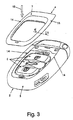
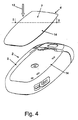
- the support part 3 for the user's eye is largely covered by the housing elements 4, 4 'and only partial areas are visible, the housing elements 4, 4' have a large visible surface 7 (see FIG Fig. 3 or Fig. 4 ) on.
- the housing 2 further key-like actuators 5 are arranged, which serve for opening and / or closing the Monegelung for the car doors, the boot lid o. The like. In the manner of a remote control. Furthermore, the housing 2 still has one removable closure 6, for example, to allow replacement of the battery of the key 1.
- the housing element 4, 4 'and the support part 3 are made of plastic, namely of a thermoplastic material.
- these may be made of polyamide, as in Fig. 5 is shown by the plastic layer 9.
- the surface 8 of the housing element 4, 4 'located within the housing 2 and therefore invisible, has a standard roughness, as in FIG Fig. 5 is shown by a "wavy" line, the visible surface 7 has a vanishing roughness, as shown here with a straight line.
- the clearcoat 10 may in turn be composed of a primer 11 and a topcoat 12 with regard to the adhesion to the plastic layer 9. With the help of these measures, the housing element 4, 4 'on the visible surface 7 is thus designed high gloss and scratch resistant.
- the housing element 4,4 ' is fixed by welding on the support part 3, whereby a high-quality and attractive connection is ensured.
- the laser welding of plastics has proven.
- the housing element 4, 4 ' consists of a laser-transparent plastic, in particular therefore a laser-transparent polyamide, and the carrier part 3 made of a laser-absorbing plastic, in particular therefore a laser-absorbing polyamide.
- IR infrared
- a black housing 2 for the key 1 is often desired.
- the plastic for the housing element 4, 4 ' by means of a corresponding color additive black, and in particular black IR transparent for the radiation of the laser colored.
- the plastic for the support part 3 is also black by means of a further color additive, but for this purpose in particular black-IR absorbing for the laser radiation, dyed.
- the clearcoat 10 for the housing element 4, 4 ' it is preferable to use a clearcoat 10 curing by means of ultraviolet (UV) radiation.
- UV radiation ultraviolet
- Such a clearcoat 10 offers high wear resistance for the housing 2, in particular for the Visual surface 7, which is in frequent use as a key 1 for a Kraftfabrzeug.
- the clearcoat 10 is chosen so that its base substrate for the particular type of plastic used of the housing element 4, 4 'is suitable, in the present case therefore suitable for polyamide and has good adhesion to polyamide.
- the base substrate for the clearcoat 10 in view of a good Lasorlicht permeability for the laser radiation used in each case for laser welding, in this case to choose IR radiation.
- the housing member 4, 4 'and the support member 3 are manufactured by injection molding of thermoplastic material in a corresponding injection mold as individual parts. Unlike in the past, however, the injection molding tool for the housing element 4, 4 'is polished to a high gloss at least in the area assigned to the visible surface 7. This ensures a smooth viewing surface 7 with the desired vanishing roughness.
- the housing element 4, 4' is subsequently painted, at least on the visible surface 7, with the clearcoat 10. After coating the visible surface 7 of the housing element 4, 4 ', the clearcoat is then cured by means of ultraviolet (UV) radiation.
- UV ultraviolet
- the Gepatiuseolement 4, 4 'attached to the support member 3 by means of laser transmission welding, as in the Fig. 3 and 4 is shown.
- the plastic for the housing element 4, 4 ' is colored black (IR) transparent for the irradiation of the laser 13
- the plastic for the carrier part 3 is colored black (IR) for the laser radiation 13.
- the laser radiation 13 located in the infrared (IR) -spectrum thus penetrates substantially the Lamerliehtdurehlhafte base material of the aperture 4, 4 'as well as the laser light-transmissive clear coat 10 and is substantially absorbed in the support member 3, which in the support member 3 for the corresponding heating and welding of the diaphragm 4,4 'with the support member 3 leads, so that the housing member 4, 4' at its non-visible surface 8 is firmly bonded to the support member 3, the welding takes place by guiding the laser beams 13 along a desired laser welding contour 14.
Landscapes
- Engineering & Computer Science (AREA)
- Mechanical Engineering (AREA)
- Physics & Mathematics (AREA)
- Optics & Photonics (AREA)
- Health & Medical Sciences (AREA)
- Electromagnetism (AREA)
- Toxicology (AREA)
- Manufacturing & Machinery (AREA)
- General Physics & Mathematics (AREA)
- Lining Or Joining Of Plastics Or The Like (AREA)
- Lock And Its Accessories (AREA)
- Application Of Or Painting With Fluid Materials (AREA)
Abstract
Description
- Die Erfindung betrifft ein Gehäuse nach dem Oberbegriff des Patentanspruchs 1 sowie ein Verfahren nach dem Oberbegriff des Patentanspruchs 7 zur Herstellung eines derartigen Gehäuses.
- Solche Gehäuse werden insbesondere für einen elektronischen Schlüssel, einen Idmtifikatiom(ID)-Geber o. dgl. eines Schließsystems in einem Kraftfahrzeug oder einem Automobil verwendet.
- Schließsysteme für Kraftfahrzeuge sind zur Steigerung des Komforts für den Benutzer oft mit einem elektronischen Schlüssel ausgestattet. Nach entsprechender Betätigung durch den Benutzer wird zwischen dem Schlüssel und einem Steuergerät im Kraftfahrzeug ein Code, beispielsweise über elektromagnetische Wellen, ausgatauscht, so daß nach positiver Auswertung des Codes die Türen, der Kofferraumdeckel o. dgl. des Kraftfahrzeugs fernbedienbar ent- und/oder verriegelt sowie sonstige Funktionen ausgelöst werden, Desweiteren kann der elektronische Schlüssel neben der Zugangsberechtigung zum Kraftfahrzeug auch die Fahlberechtigung für das Kraftfahrzeug ermöglichen.
- Ein derartiger elektronischer Schlüssel besitzt ein Gehäuse, das ein Trägerteil und ein am Trägerteil angeordnetes Gehäuseelement umfasst. Das Gehäuseeloment, das in der Art einer Blende ausgestaltet sein kann, weist eine sichtbare Oberfläche auf. In vielen Fällen bestehen aus Kostengründen das Gehäuseelement und/oder das Trägerteil aus Kunststoff, insbesondere aus einem thermoplastischen Kunststoff, wobei das Gehäuseelement und/oder das Trägerteil beispielsweise mittels Spritzgießen hergestellt werden. Häufig fehlt es einem solchen Gehäuse jedoch an einer gewissen Wertanmutung.
- Der Erfindung liegt die Aufgabe zugrunde, die Wertanmutung für ein solches Gehäuse zu erhöhen, insbesondere soll der bekannte Schlüssel lediglich durch äußerliche Änderungen für ein höherwertiges Fahrzeug, wie ein Fahrzeug der Oberklasse, "verschönert" bzw. aufgewertet werden.
- Diese Aufgabe wird bei einem gattungsgemäßen Gehäuse durch die kennzeichnenden Merkmale des Anspruchs 1 gelöst, Ein Verfahren zur Herstellung eines solchen Gehäuses ist durch die Merkmale des Anspruchs 7 gegeben.
- Beim erfinduagsgemäßen Gehäuse weist zumindest die sichtbare Oberfläche des Gehäuseelements eine weitgehend verschwindende Rauhigkeit auf. Mit Hilfe dieser Maßnahme ist das Gehäuseelement hochglänzend ausgestaltet und das Gehäuse bietet somit, obwohl in kosteugüntiger Weise aus Kunststoff bestehend, eine hohe Wertanmutung. Weitere Ausgestaltungen der Erfindung sind Gegenstand der Unteransprüche.
- Bevorzugterweise kann desweiteren das Gehäuseelement zumindest an der sichtbaren Oberfläche mit einem Klarlack beschichtet sein. Dadurch wird vor allem eine kratzfeste Ausgestaltung von zumindest der sichtbaren Oberfläche erzielt. Diese Maßnahme wirkt einem Verschleiß der Sichtoberfläche des Gehäuses entgegen. Dadurch bewahrt der elektronische Schlüssel sein hochwertiges Aussehen auch nach längerem Gebrauch.
- Damit keine sichtbaren Befestigungselemente am Gehäuse vorhanden sind, womit die Wertanmutung zusätzlich erhöht ist, ist in weiterer Ausgestaltung das Gehäuseelement durch Schweißen auf dem Trägerteil befestigt. Zweckmäßigerweise erfolgt das Verschweißen mittels Laserschweißen, indem das Gehäuseelement von den Laserstrahlen zur Befestigung auf dem darunterliegenden Trägerteil durchstrahlt wird, Hierfür kann das Gehäuseelement aus einem lasertransparenten Kunststoffbastehen. Desweiteren kann das Trägerteil aus einem leserabsorbierenden Kunststoff bestehen. Dadurch können beim Verschweißen die Laserstrahlen das Gehäuseelement weitgehend durchdringen und werden im Trägerteil weitgehend absorbiert, womit das Gehäuseelement an dessen nichtsichtbarer Oberfläche mit dem Trägerteil in prozeßsicherer Art und Weise stoffschlüssig verbunden ist,
- In vielen Verwendungsfälien ist ein farbiges Gehäuse gewünscht, so daß der Kunststoff für das Gehäuseelement und/oder für das Trägerteil mit einem entsprechenden Farbadditiv eingefärbt ist. Aufgrund der hochwertigen Erscheinung ist häufig ein schwarzes Gehäuse gewünscht, so daß der Kunststoff für das Dehäuseelement sowie für das Trägerteil schwarz eingefärbt ist. Kostengünstige Laser für das Kunststoff-Lasmehweißen arbeiten vor allem im Inftarot(IR)-Spektralbereich. In diesem Fall ist der Kunststoff für das Gehäuseelement schwarz-IR-transparent für die Durchstrahlung des Lasers sowie der Kunststoff für das Trägerteil schwarz-IR-absorbierend für die Laserstrahlung eingefärbt. Zwecks Unempfindlichkeit gegen Abnutzungen bietet es sich an, daß es sich bei dem Klarlack für das Gehäuseelement um einem mittels Ultavioleft(UV)-Sh-aNung aushärtenden Klarlack handelt.
- Zur Herstellung eines solchen Gehäuses, insbesondere für einen elektronischen Schlüssel eines Kraftfahrzeug-Schließsystems, wird das aus Kunststoff bestehende Gehäuseelement in einem Spritzgießwerkzeug abgespritzt. Damit die sichtbare Oberfläche des Gehäuseelements eine allenfalls geringfügige Rauhigkeit, und damit eine glatte Sichtoberfläche aufweist, ist das Spritzgießwerkzeug für das Gehäuseelement zumindest in dem der sichtbaren Oberfläche zugeordneten Bereich auf Hochglanz poliert, Anschließend kann dann das Gehäuseelement zumindest an der sichtbaren Oberfläche mit einem Klarlack, der beispielsweise aus einem Grundierlack sowie einem Decklack besteht, lackiert werden. Falls gewünscht, kann der Klarlack nach Lackieren der sichtbaren Oberfläche des Gehäuseelements mittels Ultraviolett(UV)-Strahlen ausgehärtet werden, wenn ein entsprechender UV-härtbarer Klarlack verwendet wird, um dessen Festigkeit gegen Abnutzung zu erhöhen.
- In weiterer Ausgestaltung des Herstellvertahrens kann das Gehäuseelement am Trägerteil mittels Laserdurchstrahlschweißen befestigt werden. Hierbei durchdringt beim Verschweißen die Laserstrahlung im wesentlichen das Gehäuseelement und wird im wesentlichen im Trägerteil absorbiert. Zweckmäßigerweise ist hierfür der Kunststoff für das Gehäuseelement weitgehend transparent für die Durchstrahlung des Lasers eingefärbt und der Kunststoff für das Trägerteil ist weitgehend absorbierend für die Laserstrahlung eingefärbt. Bei der Laserstrahlung kann es sich um eine Infmot(IR)-Lasastrahluu handeln, für die kostengünstige Laser verfügbar sind. Soll das Gehäuse eine schwarze Farbe besitzen, so ist hierzu der Kunststoff für das Gehäuseelement schwarz-IR-tmnsparcht für die Durchstrahlung des Lasers und/oder der Kunststoff für das Trägerteil achwatz-IR-absorbierend für die Laserstrahlung eingefärbt,
- Zweckmäßigerweise wird der einfachen Herstellbarkeit halber das Gehäuseelement vor dem Verschweißen mit dem Klarlack beschichtet. In diesem Fall bietet es sich weiterhin an, daß der Klarlack im wesentlichen transparent für die Laserstrahlung ist Das Laserlichtdurchäsaige Grundmaterial des Gehäuseelements sowie der Laserlichtdurohlässige Klarlack ermöglicht es dann, das Gehäuseelement auf das Trägerteil zu schweißen. Somit gelingt es, einen optisch hochwertigen und kratzfesten Schlüssel herzustellen.
- Für eine besonders bevorzugte Ausgestaltung ist nachfolgendes festzustellen.
Beim Schlüssel werden die Blenden über Laserschweißen auf das Schlüssetgehäuse aufgeschweißt. Das Sehlüssclgehäuse ist ein Laserlicht-undurchlässiges Material. Die Blenden sind mit Laserlicht-durchlässigem Material ausgeführt. Bisher weist die sichtbare Oberfläche der Blenden eine Narbung, beispielsweise K31 entsprechend einer normalen Standardoberfläche auf. Nunmehr sind die Blendenwackzeuge auf Hochglanz poliert, Die Teile werden abgespritzt und anschließend mit einem UV-aushärtenden Klarlack lackiert. Durch das Laserlicht-durchlässige Grundmaterial der Blenden und durch den Laserlichtdurchlässigen Klarlack ist es möglich, diese Blenden auf das Schlüsselgehäuse zu schweißen. Das Laserschweißen solcher lackierter Blenden auf ein Gehäuse eines ID-Gebers in der Art eines Schlüssel schafft somit einen optisch hochwertigen und kratzfesten Schlüssel. - Die mit der Erfindung erzielten Vorteile bestehen insbesondere darin, daß optisch hochwertige und kratzfeste Oberflächen mittels eines Schweißvorfahrens auf einem Gehäuse oder sonstigen Teilen befestigt werden können. Dabei werden die Hochglanzoberflächen sowohl durch den Lack als auch das Grundsubstrat der Blenden in zuverlässiger Weise gelasert. Dabei ist sichergestellt, daß beim Verschweißen keine Beschädigungen der Hochglanzoberfläche auftreten, was den Ausschuß bei der Herstellung des Gehäuses verringert.
- Ein Auaführungsbeispiel der Erfindung mit verschiedenen Weiterbildungen und Ausgestaltungen ist in den Zeichnungen dargestellt und wird im folgenden näher beschrieben. Es zeigen
- Fig. 1
- einen elektronische Schlüssel in perspektivischer Ansicht von der Oberseite gesehen,
- Fig. 2
- den Schlüssel aus
Fig. 1 von der Unterseite gesehen, - Fig. 3
- Einzelteile des Schlüssels bei der Herstellung von der Oberseite gesehen,
- Fig. 4
- Einzelteile des Schlüssels bei der Herstellung von der Unterseite gesehen und
- Fig. 5
- einen Schnitt entlang der Linie 5-5 in
Fig. 3 bzw.Fig. 4 . - In
Fig. 1 ist ein Schlüssel 1, und zwar ein elektronischer Schlüssel für ein Schließsystem eines Kraftfahrzeugs zu sehen. Der Schlüssel 1 besitzt ein Gehäuse 2, das ein Trägerteil 3 und ein am Trägerteil 3 angeordnetes Gehäuseelement 4 in der Art einer Blende umfaßt. Vorliegend besitzt das Gehäuse 2 sowohl an der Oberseite ein solches Gehäuseelement 4 als auch an der Unterseite ein ebensolches Gehäuseelement 4', wie man anhand vonFig. 2 erkennt. Während das Trägerteil 3 für das Auge des Benutzers weitgehend durch die Gehäuseelemente 4, 4' verdeckt ist und lediglich Teilbereiche zu sehen sind, weisen die Gehäuselemente 4,4' eine große sichtbare Oberfläche 7 (sieheFig. 3 oderFig. 4 ) auf. Am Gehäuse 2 sind weiterhin tastenartige Betätigungsorgane 5 angeordnet, die zum Öffnen und/oder Schließen der Zentralvemegelung für die Autotüren, den Kofferraumdeckel o. dgl. in der Art einer Fernbedienung dienen. Desweiteren weist das Gehäuse 2 noch einen abnehmbaren Verschluß 6 auf, um beispielsweise ein Auswechseln der Batterie des Schlüssels 1 zu gestatten. - Das Gehäuseelement 4, 4' und das Trägerteil 3 bestehen aus Kunststoff, und zwar aus einem thermoplastischen Kunststoff. Beispielsweise können diese aus Polyamid hergestellt sein, wie in
Fig. 5 anhand der Kunststoffschicht 9 dargestellt ist. Wähnend die innerhalb des Gehäuses 2 befindliche und daher nichtsichtbare Oberfläche 8 des Gehäuseelements 4, 4' eine übliche Rauhigkeit aufweist, wie inFig. 5 anhand einer "welligen" Linie dargestellt ist, weist die sichtbare Oberfläche 7 eine verschwindende Rauhigkeit auf, wie hier mit einer geraden Linie dargestellt ist. Wie weiter inFig. 5 gezeigt ist, ist das Gehäuseelement 4,4' zusätzlich mit einem Klarlack 10 beschichtet. Der Klarlack 10 kann sich in Hinblick auf die Haftfestigkeit an der Kunststoffschicht 9 wiederum aus einer Grundierung 11 sowie einem Decklack 12 zusammensetzen. Mit Hilfe dieser Maßnahmen ist somit das Gehäuseelement 4, 4' an der sichtbaren Oberfläche 7 hochglänzend sowie kratzfest ausgestaltet. - Das Gehäuseelement 4,4' ist durch Schweißen auf dem Trägerteil 3 befestigt, womit eine hochwertige und auch ansprechende Verbindung gewährleistet ist. Als besonders zweckmäßig hat sich hierfür das Laserschweißen von Kunststoffen erwiesen. Zu diesem Zweck besteht das Gehäuseelement 4,4' aus einem lasertransparenten Kunststoff, insbesondere also einem lasertransparenten Polyamid, und das Trägerteil 3 aus einem laserabsorbierenden Kunststoff, insbesondere also einem laserabsorbierenden Polyamid. Als Laserstrahlung für das Verschweißen von Kunststoffteilen haben sich Infrarot(IR)-Laser bewährt. Aus Designgründen ist häufig ein schwarzes Gehäuse 2 für den Schlüssel 1 gewünscht. In diesem Fall ist der Kunststoff für das Gehäuseelement 4, 4' mittels eines entsprechenden Farbadditivs schwarz, und zwar insbesondere schwarz-IR-transparent für die Durchstrahlung des Lasers, eingefärbt. Der Kunststoff für das Trägerteil 3 ist mittels eines weiteren Farbadditivs ebenfalls schwarz, jedoch hierzu insbesondere schwarz-IR-absorbierend für die Laserstrahlung, eingefärbt.
- Bei dem Klarlack 10 für das Gehäuseelement 4, 4' ist es bevorzugt, einen mittels Ultraviolatt(UV)-Strahlung aushärtenden Klarlack 10 zu verwenden. Ein solcher Klarlack 10 bietet ein hohe Verschleißfestigkeit für das Gehäuse 2, insbesondere also für die Sichtoberfläche 7, das als Schlüssel 1 für ein Kraftfabrzeug in häufigem Gebrauch ist. Dabei ist der Klarlack 10 so gewählt, daß dessen Grundsubstrat für die jeweilig verwendete Kunststoffsorte des Gehäuseelements 4, 4' geeignet ist, vorliegend also für Polyamid geeignet ist und eine gute Haftung auf Polyamid aufweist. Ebenso ist das Grundsubstrat für den Klarlack 10 im Hinblick auf eine gute Lasorlicht-Durchlässigkeit für die jeweils zum Laserschweißen verwendete Laserstrahlung, hier also IR-Strahlung, zu wählen.
- Nachfolgend soll noch das Herstellverfahren für das Gehäuse 2 näher beschrieben werden
- Zunächst werden das Gehäuseelement 4, 4' und das Trägerteil 3 mittels Spritzgießen von thermoplastischen Kunststoff in einem entsprechenden Spritzgießwerkzeug als Einzelteile hergestellt. Anders als bisher ist jedoch das Spritzgießwerkzeug für das Gehäuseelement 4, 4' zumindest in dem der sichtbaren Oberfläche 7 zugeordneten Bereich auf Hochglanz poliert. Dadurch ist eine glatte Sichtoberfläche 7 mit der gewünschten verschwindenden Rauhigkeit gewährleistet. Nach dem Abspritzen des Gehäuseelements 4, 4' im Spritzgießwerkzeug wird das Gehäuseelement 4,4' anschließend zumindest an der sichtbaren Oberfläche 7 mit dem Klarlack 10 lackiert. Nach Lackieren der sichtbaren Oberfläche 7 des Gehäuseelements 4, 4' wird der Klarlack dann mittels Ultraviolett(UV)-Strahlen ausgehärtet.
- Danach wird das Gehäuseolement 4, 4' am Trägerteil 3 mittels Laserdurchstrahlschweißen befestigt, wie in den
Fig. 3 und4 gezeigt ist. Wie bereits erwähnt ist der Kunststoff für das Gehäuseelement 4, 4' schwarz-(IR-)transparent für die Durchstrahlung des Lasers 13 eingefärbt und der Kunststoff für das Trägerteil 3 ist schwarz-(IR-)absorbierend für die Laserstrahlung 13 eingefärbt. Die im Infrarot(IR)-Spektmm befindliche Laserstrahlung 13 durchdringt somit im wesentlichen das Lamerliehtdurehlässige Grundmaterial der Blenden 4, 4' ebenso wie den Laserlichtdurchlässigen Klarlack 10 und wird im Trägerteil 3 im wesentlichen absorbiert, was im Trägerteil 3 zur entsprechenden Erwärmung und Verschweißung der Blende 4,4' mit dem Trägerteil 3 führt, derart daß das Gehäuseelement 4, 4' an dessen nichtsichtbarer Oberfläche 8 mit dem Trägerteil 3 stoffschlüssig verbunden ist Die Verschweißung erfolgt dabei durch Führung der Laserstrahlen 13 entlang einer gewünschten Laserschweißkontur 14. Zweckmäßiger wird die Laserschweißnaht 14 entlang des Randes am Umfang der Blenden 4, 4' gewählt. Mit Hilfe dieses Verfahrens ist es möglich, die Blenden 4, 4' auf das Gehäuse 2 des Schlüssels 1 zu schweißen, wobei das Innere des Gehäuses 2 an den Blenden 4, 4' weitgehend gegen die Umgebung abgedichtet ist, und dabei einen optisch hochwertigen sowie kratzfesten Schlüssel 1 herzustellen. - Die Erfindung ist nicht auf das beschriebene und dargestellte Austührungsbeispiel beschränkt, Sie umfaßt vielmehr auch alle fachmännischen Weiterbildungen im Rahmen der durch die Patentansprüche definierten Erfindung. So kann ein solcher Schlüssel nicht nur bei Kraftfahrzeugen, sondern auch bei beliebigen Schließsystemen, beispielsweise in der Gebäudetechnik, Verwendung finden. Desweiteren kann ein erfindutigsgemäßes Gehäuse nicht nur für ein Schlüssolgehäuse sondern auch für sonstige Gehäuse mit hochwertiger Anmutung, beispielsweise solchen von Fernbedienungen für Fernseh- und/oder Audiogeräten, von Mobiltelefonen o. dgl. Verwendung finden. Schließlich können nicht nur die Blende sondern auch das Trägerteil an der Sichtfläche hochglänzend ausgestaltet sein, um somit ein vollständig hochglänzendes Gehäuse zu schaffen.
-
- 1:
- Schlüssel
- 2:
- Gehäuse
- 3:
- Trägerteil
- 4,4':
- Gehäusaelement / Blende
- 5:
- Betätigungsorgan
- 6:
- Verschluß
- 7:
- sichtbare Oberfläche (von Gehäuseelement) / Sichtoberfläche
- 8:
- nichtsichtbare Oberfläche (von Gehäuseelement)
- 9:
- Kunststoffschicht
- 10:
- Klarlack
- 11:
- Grundierung / Grundierlack
- 12:
- Decklack
- 13:
- Durchstrahlung Laser / Laserstrahlung
- 14:
- Laserschweißkontur / Laserschweißnaht
Claims (9)
- Gehäuse, insbesondere für einen elektronischen Schlüssel (1) eines Schließsystems eines Kraftfahrzeugs, umfassend ein Trägerteil (3) und ein am Trägerteil (3) angeordnetes, eine sichtbare Oberfläche (7) aufweisendes Gehäuseelement (4, 4'), insbesondere in der Art einer Blende, wobei das Gehäuseelement (4, 4') und das Trägerteil (3) aus Kunststoff, insbesondere aus thermoplastischem Kunststoff, bestehen, dadurch gekennzeichnet, daß zumindest die sichtbare Oberfläche (7) des Gehäuseelements (4, 4') eine weitgehend verschwindende Rauhigkeit aufweist, derart daß das Gehäuseelement (4, 4') hochglänzend ausgestaltet ist
- Gehäuse nach Anspruch 1, dadurch gekennzeichnet, daß das Gehäuseelement (4,4') zumindest an der sichtbaren Oberfläche (7) mit einem Klarlack (10) beschichtet ist, insbesondere derart daß zumindest die sichtbare Oberfläche (7) kratzfest ausgestaltet ist.
- Gehäuse nach Anspruch 1 oder 2, dadurch gekennzeichnet, daß das Gehäuseelement (4, 4') durch Schweißen, insbesondere mittels Laserschweißen, auf dem Trägerteil (3) befestigt ist, daß vorzugsweise das Gehäuseelement (4, 4') aus einem lasertransparenten Kunstatoff besteht, und daß weiter vorzugsweise das Trägerteil (3) aus einem laserabsorbierenden Kunststoff besteht, wobei insbesondere beim Verschweißen die Laserstrahlen das Gehäuseelement (4, 4') weitgehend durchdringen und im Trägerteil (3) weitgehend absorbiert werden, derart daß das Gehäuseelement (4, 4') an dessen nichtsichtbarer Oberfläche (8) mit dem Trägerteil (3) stoffschlüssig verbunden ist.
- Gehäuse nach Anspruch 1, 2 oder 3, dadurch gekennzeichnet, daß der Kunststoff für das Gehäuseelement (4, 4') mit einem Farbadditiv, vorzugsweise schwarz, insbesondere schwarz-IR-transparent für die Durchstrahlung des Lasers (13), eingefärbt ist
- Gehäuse nach einem der Ansprüche 1 bis 4, dadurch gekennzeichnet, daß der Kunststoff für das Trägerteil (3) mit einem Farbadditiv, vorzugsweise schwarz, insbesondere schwarz-IR-abaorbierend für die Laserstrahlung (13), eingefärbt ist.
- Gehäuse nach einem der Ansprüche 1 bis 5, dadurch gekennzeichnet, daß es sich bei dem Klarlack (10) für das Gehäuseelement (3) um einen mittels Ultraviolett(UV)-Strahlung aushärtenden Klarlack handelt.
- Verfahren zur Herstellung eines Gehäuses (2), insbesondere für einen elektronischen Schlüssel (1) eines Schließsystems eines Kraftfahrzeugs, wobei das Gehäuse (2) ein Trägerteil (3) und ein am Trägerteil (3) befestigtes, eine sichtbare Oberfläche (7) aufweisendes Gehäuseelement (4, 4'), insbesondere in der Art einer Blende, umfaßt, wobei das Gehäuseelement (4, 4') und/oder das Trägerteil (3) aus Kunststoff, insbesondere aus thermoplastischem Kunststoff, bestehen, und wobei das Gehäuseelement (4, 4') und/oder das Trägerteil (3) mittels Spritzgießen hergestellt werden, dadurch gekennzeichnet, daß das Spritzgießwerkzeug für das Gehäuseelement (4, 4') zumindest für die sichtbare Oberfläche (7) auf Hochglanz poliert ist, daß das Gehäuseelement (4,4') im Spritzgießwerkzeug mit einer glatten Sichtoberfläche (7) abgespritzt wird, und daß vorzugsweise das Gehäuseelement (4, 4') zumindest an der sichtbaren Oberfläche (7) mit einem Klarlack (10) lackiert wird.
- Verfahren zur Herstellung eines Gehäuses (2) nach Anspruch 7, dadurch gekennzeichnet, daß das Gehäuseelement (4, 4') am Trägerteil (3) mittels Laserdurchstrahlschweißen befestigt wird, insbesondere indem beim Verschweißen die Laserstrahlung (13) das Gehäuseelement (4, 4') im wesentlichen durchdringt und im Trägerteil (3) im wesentlichen absorbiert wird, daß vorzugsweise es sich bei der Laserstrahlung (13) um eine Inftarot(IR)-Laserstrahlung handelt, daß weiter vorzugsweise der Kunststoff für das Gehäuseelement (4, 4') weitgehend transparent, insbesondere schwarz-(IR-)transparent, für die Durchstrahlung des Lasers (13) eingefärbt ist, und daß noch weiter vorzugsweise der Kunststoff für das Trägerteil (3) weitgehend absorbierend, insbesondere schwarz-(IR-)absorbierend für die Laserstrahlung (13) eingefärbt ist.
- Verfahren zur Herstellung eines Gehäuses (2) nach Anspruch 7 oder 8, dadurch gekennzeichnet, daß der Klarlack (10) nach Lackieren der sichtbaren Oberfläche (7) des Geh1useelements (4, 4') mittels Ultaviolett(UV)-Strahlen ausgehärtet wird, daß vorzugsweise das Gehäuseelement (4, 4') vor dem Verchweißen mit dem Klarlack (10) beschichtet wird, und daß weiter vorzugsweise der Klarlack (10), der insbesondere aus einem Grundierlack sowie einem Decklack besteht, im wesentlichen transparent für die Laserstrahlung (13) ist.
Applications Claiming Priority (1)
| Application Number | Priority Date | Filing Date | Title |
|---|---|---|---|
| DE102009034998 | 2009-07-28 |
Publications (2)
| Publication Number | Publication Date |
|---|---|
| EP2280405A1 true EP2280405A1 (de) | 2011-02-02 |
| EP2280405B1 EP2280405B1 (de) | 2017-05-24 |
Family
ID=43063243
Family Applications (1)
| Application Number | Title | Priority Date | Filing Date |
|---|---|---|---|
| EP10007769.2A Active EP2280405B1 (de) | 2009-07-28 | 2010-07-27 | Verfahren zur Herstellung eines Gehäuses, insbesondere für einen elektronischen Schlüssel |
Country Status (2)
| Country | Link |
|---|---|
| EP (1) | EP2280405B1 (de) |
| DE (1) | DE102010032165A1 (de) |
Cited By (3)
| Publication number | Priority date | Publication date | Assignee | Title |
|---|---|---|---|---|
| GB2490402A (en) * | 2011-04-29 | 2012-10-31 | Gm Global Tech Operations Inc | Key having a body with inner and outer housing |
| EP2911168A1 (de) * | 2014-02-19 | 2015-08-26 | Huf Hülsbeck & Fürst GmbH & Co. KG | ID-Geber für ein Zugangskontrollsystem |
| US11682252B1 (en) | 2022-09-13 | 2023-06-20 | Edward F. Nuccio | Vehicle safe with remote access control |
Families Citing this family (1)
| Publication number | Priority date | Publication date | Assignee | Title |
|---|---|---|---|---|
| DE102017101268A1 (de) | 2017-01-24 | 2018-07-26 | HELLA GmbH & Co. KGaA | Ausbildung einer Fügestelle zur Ausführung eines Laserstrahlschweißens von zwei Bauteilen aus Kunststoff |
Citations (6)
| Publication number | Priority date | Publication date | Assignee | Title |
|---|---|---|---|---|
| WO2002057353A2 (en) * | 2000-11-13 | 2002-07-25 | E.I. Dupont De Nemours And Company | Fabricated resin products for laser we4lding and including transmitting and absorbing black colorants, and colored resin compositions therefor |
| EP1762368A1 (de) * | 2005-09-01 | 2007-03-14 | Orient Chemical Industries, Ltd. | Laserdurchlässige farbige Harzzusammensetzung und diesbezügliche Technik |
| EP1847970A2 (de) * | 2006-04-19 | 2007-10-24 | Marquardt GmbH | Gehäuse, insbesondere für einen elektronischen Schlüssel |
| EP1863048A2 (de) * | 2006-03-22 | 2007-12-05 | Kabushiki Kaisha Tokai-Rika-Denki-Seisakusho | Tragbare Vorrichtung |
| DE102007040295A1 (de) * | 2007-08-24 | 2009-02-26 | Huf Hülsbeck & Fürst Gmbh & Co. Kg | Mobiler Identifikationsgeber |
| DE102009038304A1 (de) * | 2008-08-30 | 2010-03-04 | Marquardt Gmbh | Gehäuse, insbesondere für einen elektronischen Schlüssel |
-
2010
- 2010-07-23 DE DE102010032165A patent/DE102010032165A1/de not_active Withdrawn
- 2010-07-27 EP EP10007769.2A patent/EP2280405B1/de active Active
Patent Citations (6)
| Publication number | Priority date | Publication date | Assignee | Title |
|---|---|---|---|---|
| WO2002057353A2 (en) * | 2000-11-13 | 2002-07-25 | E.I. Dupont De Nemours And Company | Fabricated resin products for laser we4lding and including transmitting and absorbing black colorants, and colored resin compositions therefor |
| EP1762368A1 (de) * | 2005-09-01 | 2007-03-14 | Orient Chemical Industries, Ltd. | Laserdurchlässige farbige Harzzusammensetzung und diesbezügliche Technik |
| EP1863048A2 (de) * | 2006-03-22 | 2007-12-05 | Kabushiki Kaisha Tokai-Rika-Denki-Seisakusho | Tragbare Vorrichtung |
| EP1847970A2 (de) * | 2006-04-19 | 2007-10-24 | Marquardt GmbH | Gehäuse, insbesondere für einen elektronischen Schlüssel |
| DE102007040295A1 (de) * | 2007-08-24 | 2009-02-26 | Huf Hülsbeck & Fürst Gmbh & Co. Kg | Mobiler Identifikationsgeber |
| DE102009038304A1 (de) * | 2008-08-30 | 2010-03-04 | Marquardt Gmbh | Gehäuse, insbesondere für einen elektronischen Schlüssel |
Cited By (4)
| Publication number | Priority date | Publication date | Assignee | Title |
|---|---|---|---|---|
| GB2490402A (en) * | 2011-04-29 | 2012-10-31 | Gm Global Tech Operations Inc | Key having a body with inner and outer housing |
| GB2490402B (en) * | 2011-04-29 | 2016-12-21 | Gm Global Tech Operations Llc | key and motor vehicle equipped therewith |
| EP2911168A1 (de) * | 2014-02-19 | 2015-08-26 | Huf Hülsbeck & Fürst GmbH & Co. KG | ID-Geber für ein Zugangskontrollsystem |
| US11682252B1 (en) | 2022-09-13 | 2023-06-20 | Edward F. Nuccio | Vehicle safe with remote access control |
Also Published As
| Publication number | Publication date |
|---|---|
| EP2280405B1 (de) | 2017-05-24 |
| DE102010032165A1 (de) | 2011-02-03 |
Similar Documents
| Publication | Publication Date | Title |
|---|---|---|
| EP3169502B1 (de) | Verfahren zur herstellung eines kunststoff-fahrzeuganbauteils | |
| DE60130413T2 (de) | Fahrzeugharzfenster mit einem integrierten Randbereich | |
| DE102012211951A1 (de) | Zierteil für Kraftfahrzeuge und Verfahren zu seiner Herstellung | |
| DE19842456A1 (de) | Formgegenstände aus Kunstharz | |
| EP3074299A1 (de) | Verfahren zur herstellung eines aussenverkleidungsteils für ein bewegbares karosserieteil sowie ein entsprechendes aussenverkleidungsteil mit verstärkung durch hinterspritzen von fasern verstärketen kunststoff | |
| WO2017215840A1 (de) | Verfahren zur herstellung eines kunststoff-fahrzeuganbauteils | |
| DE102006047950B4 (de) | Verfahren zur Herstellung von Bauteilen mit Furnier-Folien-Verbund | |
| EP2280405B1 (de) | Verfahren zur Herstellung eines Gehäuses, insbesondere für einen elektronischen Schlüssel | |
| EP4143058A1 (de) | Innenverkleidungsteil für ein kraftfahrzeug | |
| DE102009032815A1 (de) | Lackfolienprodukt, ein mit dem Lackfolienprodukt beschichtetes Trägerelement mit eingebettetem Objekt und Herstellungsverfahren | |
| WO2006066719A2 (de) | Kunststoff-formteil und verfahren zu dessen herstellung | |
| DE102009022667B4 (de) | Fahrzeugschlüssel mit Betätigungselement und Verfahren zur Herstellung desselben | |
| EP4344949B1 (de) | Beleuchtungssystem für ein aussenverkleidungsteil eines kraftfahrzeugs | |
| WO2016096362A1 (de) | Polymere scheibe mit anextrudiertem dichtungsprofil | |
| DE102008022224A1 (de) | Verfahren zum Herstellen eines Kunststoffformteils mit einer Lackbeschichtung | |
| EP1725443B1 (de) | Fahrzeug folienbauteil und verfahren zu dessen herstellung | |
| DE19703505A1 (de) | Farbiges Karosserieteil | |
| EP1743756A1 (de) | Verfahren zur Herstellung eines Verbundbauteils | |
| EP1847970A2 (de) | Gehäuse, insbesondere für einen elektronischen Schlüssel | |
| DE10351527A1 (de) | Radom für ein Abstandswarnradar | |
| DE102020108324A1 (de) | Abdeckpanel für eine Frontseite eines Fahrzeugs | |
| EP4019337A1 (de) | Aussenverkleidungsteil für den frontbereicht eines kraftfahrzeugs und verfahren zur herstellung eines aussenverkleidungsteils | |
| EP2529609B1 (de) | Mobiler identifikationsgeber | |
| EP4578623B1 (de) | Verfahren zur herstellung eines partiell durchleuchtbaren aussenverkleidungsteils für ein fahrzeug | |
| DE102020134162A1 (de) | Bauteil zum Einbau in ein Kraftfahrzeug |
Legal Events
| Date | Code | Title | Description |
|---|---|---|---|
| PUAI | Public reference made under article 153(3) epc to a published international application that has entered the european phase |
Free format text: ORIGINAL CODE: 0009012 |
|
| AK | Designated contracting states |
Kind code of ref document: A1 Designated state(s): AL AT BE BG CH CY CZ DE DK EE ES FI FR GB GR HR HU IE IS IT LI LT LU LV MC MK MT NL NO PL PT RO SE SI SK SM TR |
|
| AX | Request for extension of the european patent |
Extension state: BA ME RS |
|
| 17P | Request for examination filed |
Effective date: 20110714 |
|
| 17Q | First examination report despatched |
Effective date: 20130204 |
|
| GRAP | Despatch of communication of intention to grant a patent |
Free format text: ORIGINAL CODE: EPIDOSNIGR1 |
|
| STAA | Information on the status of an ep patent application or granted ep patent |
Free format text: STATUS: GRANT OF PATENT IS INTENDED |
|
| INTG | Intention to grant announced |
Effective date: 20161221 |
|
| GRAS | Grant fee paid |
Free format text: ORIGINAL CODE: EPIDOSNIGR3 |
|
| GRAA | (expected) grant |
Free format text: ORIGINAL CODE: 0009210 |
|
| STAA | Information on the status of an ep patent application or granted ep patent |
Free format text: STATUS: THE PATENT HAS BEEN GRANTED |
|
| AK | Designated contracting states |
Kind code of ref document: B1 Designated state(s): AL AT BE BG CH CY CZ DE DK EE ES FI FR GB GR HR HU IE IS IT LI LT LU LV MC MK MT NL NO PL PT RO SE SI SK SM TR |
|
| REG | Reference to a national code |
Ref country code: GB Ref legal event code: FG4D Free format text: NOT ENGLISH |
|
| REG | Reference to a national code |
Ref country code: CH Ref legal event code: EP |
|
| REG | Reference to a national code |
Ref country code: IE Ref legal event code: FG4D Free format text: LANGUAGE OF EP DOCUMENT: GERMAN |
|
| REG | Reference to a national code |
Ref country code: AT Ref legal event code: REF Ref document number: 896375 Country of ref document: AT Kind code of ref document: T Effective date: 20170615 |
|
| REG | Reference to a national code |
Ref country code: DE Ref legal event code: R096 Ref document number: 502010013642 Country of ref document: DE |
|
| REG | Reference to a national code |
Ref country code: FR Ref legal event code: PLFP Year of fee payment: 8 |
|
| REG | Reference to a national code |
Ref country code: NL Ref legal event code: MP Effective date: 20170524 |
|
| REG | Reference to a national code |
Ref country code: LT Ref legal event code: MG4D |
|
| PG25 | Lapsed in a contracting state [announced via postgrant information from national office to epo] |
Ref country code: GR Free format text: LAPSE BECAUSE OF FAILURE TO SUBMIT A TRANSLATION OF THE DESCRIPTION OR TO PAY THE FEE WITHIN THE PRESCRIBED TIME-LIMIT Effective date: 20170825 Ref country code: ES Free format text: LAPSE BECAUSE OF FAILURE TO SUBMIT A TRANSLATION OF THE DESCRIPTION OR TO PAY THE FEE WITHIN THE PRESCRIBED TIME-LIMIT Effective date: 20170524 Ref country code: LT Free format text: LAPSE BECAUSE OF FAILURE TO SUBMIT A TRANSLATION OF THE DESCRIPTION OR TO PAY THE FEE WITHIN THE PRESCRIBED TIME-LIMIT Effective date: 20170524 Ref country code: NO Free format text: LAPSE BECAUSE OF FAILURE TO SUBMIT A TRANSLATION OF THE DESCRIPTION OR TO PAY THE FEE WITHIN THE PRESCRIBED TIME-LIMIT Effective date: 20170824 Ref country code: HR Free format text: LAPSE BECAUSE OF FAILURE TO SUBMIT A TRANSLATION OF THE DESCRIPTION OR TO PAY THE FEE WITHIN THE PRESCRIBED TIME-LIMIT Effective date: 20170524 Ref country code: FI Free format text: LAPSE BECAUSE OF FAILURE TO SUBMIT A TRANSLATION OF THE DESCRIPTION OR TO PAY THE FEE WITHIN THE PRESCRIBED TIME-LIMIT Effective date: 20170524 |
|
| PG25 | Lapsed in a contracting state [announced via postgrant information from national office to epo] |
Ref country code: LV Free format text: LAPSE BECAUSE OF FAILURE TO SUBMIT A TRANSLATION OF THE DESCRIPTION OR TO PAY THE FEE WITHIN THE PRESCRIBED TIME-LIMIT Effective date: 20170524 Ref country code: IS Free format text: LAPSE BECAUSE OF FAILURE TO SUBMIT A TRANSLATION OF THE DESCRIPTION OR TO PAY THE FEE WITHIN THE PRESCRIBED TIME-LIMIT Effective date: 20170924 Ref country code: SE Free format text: LAPSE BECAUSE OF FAILURE TO SUBMIT A TRANSLATION OF THE DESCRIPTION OR TO PAY THE FEE WITHIN THE PRESCRIBED TIME-LIMIT Effective date: 20170524 Ref country code: NL Free format text: LAPSE BECAUSE OF FAILURE TO SUBMIT A TRANSLATION OF THE DESCRIPTION OR TO PAY THE FEE WITHIN THE PRESCRIBED TIME-LIMIT Effective date: 20170524 Ref country code: BG Free format text: LAPSE BECAUSE OF FAILURE TO SUBMIT A TRANSLATION OF THE DESCRIPTION OR TO PAY THE FEE WITHIN THE PRESCRIBED TIME-LIMIT Effective date: 20170824 |
|
| PG25 | Lapsed in a contracting state [announced via postgrant information from national office to epo] |
Ref country code: RO Free format text: LAPSE BECAUSE OF FAILURE TO SUBMIT A TRANSLATION OF THE DESCRIPTION OR TO PAY THE FEE WITHIN THE PRESCRIBED TIME-LIMIT Effective date: 20170524 Ref country code: DK Free format text: LAPSE BECAUSE OF FAILURE TO SUBMIT A TRANSLATION OF THE DESCRIPTION OR TO PAY THE FEE WITHIN THE PRESCRIBED TIME-LIMIT Effective date: 20170524 Ref country code: CZ Free format text: LAPSE BECAUSE OF FAILURE TO SUBMIT A TRANSLATION OF THE DESCRIPTION OR TO PAY THE FEE WITHIN THE PRESCRIBED TIME-LIMIT Effective date: 20170524 Ref country code: SK Free format text: LAPSE BECAUSE OF FAILURE TO SUBMIT A TRANSLATION OF THE DESCRIPTION OR TO PAY THE FEE WITHIN THE PRESCRIBED TIME-LIMIT Effective date: 20170524 Ref country code: EE Free format text: LAPSE BECAUSE OF FAILURE TO SUBMIT A TRANSLATION OF THE DESCRIPTION OR TO PAY THE FEE WITHIN THE PRESCRIBED TIME-LIMIT Effective date: 20170524 |
|
| REG | Reference to a national code |
Ref country code: DE Ref legal event code: R097 Ref document number: 502010013642 Country of ref document: DE |
|
| PG25 | Lapsed in a contracting state [announced via postgrant information from national office to epo] |
Ref country code: SM Free format text: LAPSE BECAUSE OF FAILURE TO SUBMIT A TRANSLATION OF THE DESCRIPTION OR TO PAY THE FEE WITHIN THE PRESCRIBED TIME-LIMIT Effective date: 20170524 Ref country code: IT Free format text: LAPSE BECAUSE OF FAILURE TO SUBMIT A TRANSLATION OF THE DESCRIPTION OR TO PAY THE FEE WITHIN THE PRESCRIBED TIME-LIMIT Effective date: 20170524 Ref country code: PL Free format text: LAPSE BECAUSE OF FAILURE TO SUBMIT A TRANSLATION OF THE DESCRIPTION OR TO PAY THE FEE WITHIN THE PRESCRIBED TIME-LIMIT Effective date: 20170524 |
|
| REG | Reference to a national code |
Ref country code: CH Ref legal event code: PL |
|
| PLBE | No opposition filed within time limit |
Free format text: ORIGINAL CODE: 0009261 |
|
| STAA | Information on the status of an ep patent application or granted ep patent |
Free format text: STATUS: NO OPPOSITION FILED WITHIN TIME LIMIT |
|
| REG | Reference to a national code |
Ref country code: IE Ref legal event code: MM4A |
|
| PG25 | Lapsed in a contracting state [announced via postgrant information from national office to epo] |
Ref country code: IE Free format text: LAPSE BECAUSE OF NON-PAYMENT OF DUE FEES Effective date: 20170727 Ref country code: CH Free format text: LAPSE BECAUSE OF NON-PAYMENT OF DUE FEES Effective date: 20170731 Ref country code: LI Free format text: LAPSE BECAUSE OF NON-PAYMENT OF DUE FEES Effective date: 20170731 |
|
| 26N | No opposition filed |
Effective date: 20180227 |
|
| PG25 | Lapsed in a contracting state [announced via postgrant information from national office to epo] |
Ref country code: SI Free format text: LAPSE BECAUSE OF FAILURE TO SUBMIT A TRANSLATION OF THE DESCRIPTION OR TO PAY THE FEE WITHIN THE PRESCRIBED TIME-LIMIT Effective date: 20170524 |
|
| REG | Reference to a national code |
Ref country code: BE Ref legal event code: MM Effective date: 20170731 |
|
| PG25 | Lapsed in a contracting state [announced via postgrant information from national office to epo] |
Ref country code: LU Free format text: LAPSE BECAUSE OF NON-PAYMENT OF DUE FEES Effective date: 20170727 |
|
| REG | Reference to a national code |
Ref country code: FR Ref legal event code: PLFP Year of fee payment: 9 |
|
| PG25 | Lapsed in a contracting state [announced via postgrant information from national office to epo] |
Ref country code: BE Free format text: LAPSE BECAUSE OF NON-PAYMENT OF DUE FEES Effective date: 20170731 |
|
| REG | Reference to a national code |
Ref country code: AT Ref legal event code: MM01 Ref document number: 896375 Country of ref document: AT Kind code of ref document: T Effective date: 20170727 |
|
| PG25 | Lapsed in a contracting state [announced via postgrant information from national office to epo] |
Ref country code: MT Free format text: LAPSE BECAUSE OF FAILURE TO SUBMIT A TRANSLATION OF THE DESCRIPTION OR TO PAY THE FEE WITHIN THE PRESCRIBED TIME-LIMIT Effective date: 20170524 |
|
| PG25 | Lapsed in a contracting state [announced via postgrant information from national office to epo] |
Ref country code: AT Free format text: LAPSE BECAUSE OF NON-PAYMENT OF DUE FEES Effective date: 20170727 |
|
| PG25 | Lapsed in a contracting state [announced via postgrant information from national office to epo] |
Ref country code: MC Free format text: LAPSE BECAUSE OF FAILURE TO SUBMIT A TRANSLATION OF THE DESCRIPTION OR TO PAY THE FEE WITHIN THE PRESCRIBED TIME-LIMIT Effective date: 20170524 Ref country code: HU Free format text: LAPSE BECAUSE OF FAILURE TO SUBMIT A TRANSLATION OF THE DESCRIPTION OR TO PAY THE FEE WITHIN THE PRESCRIBED TIME-LIMIT; INVALID AB INITIO Effective date: 20100727 |
|
| PG25 | Lapsed in a contracting state [announced via postgrant information from national office to epo] |
Ref country code: CY Free format text: LAPSE BECAUSE OF NON-PAYMENT OF DUE FEES Effective date: 20170524 |
|
| PG25 | Lapsed in a contracting state [announced via postgrant information from national office to epo] |
Ref country code: MK Free format text: LAPSE BECAUSE OF FAILURE TO SUBMIT A TRANSLATION OF THE DESCRIPTION OR TO PAY THE FEE WITHIN THE PRESCRIBED TIME-LIMIT Effective date: 20170524 |
|
| PG25 | Lapsed in a contracting state [announced via postgrant information from national office to epo] |
Ref country code: TR Free format text: LAPSE BECAUSE OF FAILURE TO SUBMIT A TRANSLATION OF THE DESCRIPTION OR TO PAY THE FEE WITHIN THE PRESCRIBED TIME-LIMIT Effective date: 20170524 |
|
| PG25 | Lapsed in a contracting state [announced via postgrant information from national office to epo] |
Ref country code: PT Free format text: LAPSE BECAUSE OF FAILURE TO SUBMIT A TRANSLATION OF THE DESCRIPTION OR TO PAY THE FEE WITHIN THE PRESCRIBED TIME-LIMIT Effective date: 20170524 |
|
| PG25 | Lapsed in a contracting state [announced via postgrant information from national office to epo] |
Ref country code: AL Free format text: LAPSE BECAUSE OF FAILURE TO SUBMIT A TRANSLATION OF THE DESCRIPTION OR TO PAY THE FEE WITHIN THE PRESCRIBED TIME-LIMIT Effective date: 20170524 |
|
| REG | Reference to a national code |
Ref country code: DE Ref legal event code: R082 Ref document number: 502010013642 Country of ref document: DE Representative=s name: PATENTANWAELTE STAEGER & SPERLING PARTNERSCHAF, DE |
|
| P01 | Opt-out of the competence of the unified patent court (upc) registered |
Effective date: 20230522 |
|
| PGFP | Annual fee paid to national office [announced via postgrant information from national office to epo] |
Ref country code: DE Payment date: 20250722 Year of fee payment: 16 |
|
| PGFP | Annual fee paid to national office [announced via postgrant information from national office to epo] |
Ref country code: GB Payment date: 20250724 Year of fee payment: 16 |
|
| PGFP | Annual fee paid to national office [announced via postgrant information from national office to epo] |
Ref country code: FR Payment date: 20250723 Year of fee payment: 16 |