EP2275202A1 - Carbonyl compound remover - Google Patents
Carbonyl compound remover Download PDFInfo
- Publication number
- EP2275202A1 EP2275202A1 EP09719157A EP09719157A EP2275202A1 EP 2275202 A1 EP2275202 A1 EP 2275202A1 EP 09719157 A EP09719157 A EP 09719157A EP 09719157 A EP09719157 A EP 09719157A EP 2275202 A1 EP2275202 A1 EP 2275202A1
- Authority
- EP
- European Patent Office
- Prior art keywords
- infusion
- carbonyl compound
- group
- formula
- remover
- Prior art date
- Legal status (The legal status is an assumption and is not a legal conclusion. Google has not performed a legal analysis and makes no representation as to the accuracy of the status listed.)
- Withdrawn
Links
- 150000001728 carbonyl compounds Chemical class 0.000 title claims abstract description 54
- 238000001802 infusion Methods 0.000 claims abstract description 77
- 239000011347 resin Substances 0.000 claims abstract description 77
- 229920005989 resin Polymers 0.000 claims abstract description 77
- 239000004721 Polyphenylene oxide Substances 0.000 claims abstract description 57
- 229920000570 polyether Polymers 0.000 claims abstract description 57
- 238000000034 method Methods 0.000 claims abstract description 15
- 239000004480 active ingredient Substances 0.000 claims abstract description 7
- 238000003860 storage Methods 0.000 claims abstract description 7
- 230000001954 sterilising effect Effects 0.000 claims abstract description 5
- 238000004659 sterilization and disinfection Methods 0.000 claims abstract description 5
- 125000000217 alkyl group Chemical group 0.000 claims abstract description 4
- 125000004432 carbon atom Chemical group C* 0.000 claims abstract description 4
- 125000004435 hydrogen atom Chemical group [H]* 0.000 claims abstract description 4
- 238000006243 chemical reaction Methods 0.000 abstract description 39
- 239000000203 mixture Substances 0.000 abstract description 16
- 150000001413 amino acids Chemical class 0.000 abstract description 15
- ZMXDDKWLCZADIW-UHFFFAOYSA-N N,N-Dimethylformamide Chemical compound CN(C)C=O ZMXDDKWLCZADIW-UHFFFAOYSA-N 0.000 description 36
- 239000002904 solvent Substances 0.000 description 32
- YMWUJEATGCHHMB-UHFFFAOYSA-N Dichloromethane Chemical compound ClCCl YMWUJEATGCHHMB-UHFFFAOYSA-N 0.000 description 30
- -1 t-butoxycarbonyl group Chemical group 0.000 description 23
- 150000001875 compounds Chemical class 0.000 description 20
- 125000003277 amino group Chemical group 0.000 description 17
- 125000004202 aminomethyl group Chemical group [H]N([H])C([H])([H])* 0.000 description 17
- 229940024606 amino acid Drugs 0.000 description 14
- 235000001014 amino acid Nutrition 0.000 description 14
- 239000000243 solution Substances 0.000 description 13
- 125000006239 protecting group Chemical group 0.000 description 12
- 238000009833 condensation Methods 0.000 description 11
- 239000003795 chemical substances by application Substances 0.000 description 10
- 239000000047 product Substances 0.000 description 10
- UHOVQNZJYSORNB-UHFFFAOYSA-N Benzene Chemical compound C1=CC=CC=C1 UHOVQNZJYSORNB-UHFFFAOYSA-N 0.000 description 9
- YXFVVABEGXRONW-UHFFFAOYSA-N Toluene Chemical compound CC1=CC=CC=C1 YXFVVABEGXRONW-UHFFFAOYSA-N 0.000 description 9
- 238000002329 infrared spectrum Methods 0.000 description 8
- NAWXUBYGYWOOIX-SFHVURJKSA-N (2s)-2-[[4-[2-(2,4-diaminoquinazolin-6-yl)ethyl]benzoyl]amino]-4-methylidenepentanedioic acid Chemical compound C1=CC2=NC(N)=NC(N)=C2C=C1CCC1=CC=C(C(=O)N[C@@H](CC(=C)C(O)=O)C(O)=O)C=C1 NAWXUBYGYWOOIX-SFHVURJKSA-N 0.000 description 7
- 125000002344 aminooxy group Chemical group [H]N([H])O[*] 0.000 description 7
- 239000007858 starting material Substances 0.000 description 7
- RTZKZFJDLAIYFH-UHFFFAOYSA-N Diethyl ether Chemical compound CCOCC RTZKZFJDLAIYFH-UHFFFAOYSA-N 0.000 description 6
- XTHFKEDIFFGKHM-UHFFFAOYSA-N Dimethoxyethane Chemical compound COCCOC XTHFKEDIFFGKHM-UHFFFAOYSA-N 0.000 description 6
- VEXZGXHMUGYJMC-UHFFFAOYSA-N Hydrochloric acid Chemical compound Cl VEXZGXHMUGYJMC-UHFFFAOYSA-N 0.000 description 6
- IMNFDUFMRHMDMM-UHFFFAOYSA-N N-Heptane Chemical compound CCCCCCC IMNFDUFMRHMDMM-UHFFFAOYSA-N 0.000 description 6
- WYURNTSHIVDZCO-UHFFFAOYSA-N Tetrahydrofuran Chemical compound C1CCOC1 WYURNTSHIVDZCO-UHFFFAOYSA-N 0.000 description 6
- 230000005494 condensation Effects 0.000 description 6
- 229920000642 polymer Polymers 0.000 description 6
- 230000035484 reaction time Effects 0.000 description 6
- 239000000126 substance Substances 0.000 description 6
- AVXURJPOCDRRFD-UHFFFAOYSA-N Hydroxylamine Chemical compound ON AVXURJPOCDRRFD-UHFFFAOYSA-N 0.000 description 5
- LYCAIKOWRPUZTN-UHFFFAOYSA-N ethylene glycol Natural products OCCO LYCAIKOWRPUZTN-UHFFFAOYSA-N 0.000 description 5
- WGCNASOHLSPBMP-UHFFFAOYSA-N hydroxyacetaldehyde Natural products OCC=O WGCNASOHLSPBMP-UHFFFAOYSA-N 0.000 description 5
- MTCFGRXMJLQNBG-REOHCLBHSA-N (2S)-2-Amino-3-hydroxypropansäure Chemical compound OC[C@H](N)C(O)=O MTCFGRXMJLQNBG-REOHCLBHSA-N 0.000 description 4
- OZAIFHULBGXAKX-UHFFFAOYSA-N 2-(2-cyanopropan-2-yldiazenyl)-2-methylpropanenitrile Chemical compound N#CC(C)(C)N=NC(C)(C)C#N OZAIFHULBGXAKX-UHFFFAOYSA-N 0.000 description 4
- HEDRZPFGACZZDS-UHFFFAOYSA-N Chloroform Chemical compound ClC(Cl)Cl HEDRZPFGACZZDS-UHFFFAOYSA-N 0.000 description 4
- DHMQDGOQFOQNFH-UHFFFAOYSA-N Glycine Chemical compound NCC(O)=O DHMQDGOQFOQNFH-UHFFFAOYSA-N 0.000 description 4
- XUJNEKJLAYXESH-REOHCLBHSA-N L-Cysteine Chemical compound SC[C@H](N)C(O)=O XUJNEKJLAYXESH-REOHCLBHSA-N 0.000 description 4
- WHUUTDBJXJRKMK-VKHMYHEASA-N L-glutamic acid Chemical compound OC(=O)[C@@H](N)CCC(O)=O WHUUTDBJXJRKMK-VKHMYHEASA-N 0.000 description 4
- HNDVDQJCIGZPNO-YFKPBYRVSA-N L-histidine Chemical compound OC(=O)[C@@H](N)CC1=CN=CN1 HNDVDQJCIGZPNO-YFKPBYRVSA-N 0.000 description 4
- ROHFNLRQFUQHCH-YFKPBYRVSA-N L-leucine Chemical compound CC(C)C[C@H](N)C(O)=O ROHFNLRQFUQHCH-YFKPBYRVSA-N 0.000 description 4
- AYFVYJQAPQTCCC-GBXIJSLDSA-N L-threonine Chemical compound C[C@@H](O)[C@H](N)C(O)=O AYFVYJQAPQTCCC-GBXIJSLDSA-N 0.000 description 4
- OUYCCCASQSFEME-QMMMGPOBSA-N L-tyrosine Chemical compound OC(=O)[C@@H](N)CC1=CC=C(O)C=C1 OUYCCCASQSFEME-QMMMGPOBSA-N 0.000 description 4
- KZSNJWFQEVHDMF-BYPYZUCNSA-N L-valine Chemical compound CC(C)[C@H](N)C(O)=O KZSNJWFQEVHDMF-BYPYZUCNSA-N 0.000 description 4
- OFBQJSOFQDEBGM-UHFFFAOYSA-N Pentane Chemical compound CCCCC OFBQJSOFQDEBGM-UHFFFAOYSA-N 0.000 description 4
- DTQVDTLACAAQTR-UHFFFAOYSA-N Trifluoroacetic acid Chemical compound OC(=O)C(F)(F)F DTQVDTLACAAQTR-UHFFFAOYSA-N 0.000 description 4
- 239000002253 acid Substances 0.000 description 4
- 239000007864 aqueous solution Substances 0.000 description 4
- JHIVVAPYMSGYDF-UHFFFAOYSA-N cyclohexanone Chemical compound O=C1CCCCC1 JHIVVAPYMSGYDF-UHFFFAOYSA-N 0.000 description 4
- 239000012046 mixed solvent Substances 0.000 description 4
- 238000002156 mixing Methods 0.000 description 4
- VLKZOEOYAKHREP-UHFFFAOYSA-N n-Hexane Chemical compound CCCCCC VLKZOEOYAKHREP-UHFFFAOYSA-N 0.000 description 4
- VZGDMQKNWNREIO-UHFFFAOYSA-N tetrachloromethane Chemical compound ClC(Cl)(Cl)Cl VZGDMQKNWNREIO-UHFFFAOYSA-N 0.000 description 4
- 229920002554 vinyl polymer Polymers 0.000 description 4
- QTBSBXVTEAMEQO-UHFFFAOYSA-N Acetic acid Chemical compound CC(O)=O QTBSBXVTEAMEQO-UHFFFAOYSA-N 0.000 description 3
- WFDIJRYMOXRFFG-UHFFFAOYSA-N Acetic anhydride Chemical compound CC(=O)OC(C)=O WFDIJRYMOXRFFG-UHFFFAOYSA-N 0.000 description 3
- CSCPPACGZOOCGX-UHFFFAOYSA-N Acetone Chemical compound CC(C)=O CSCPPACGZOOCGX-UHFFFAOYSA-N 0.000 description 3
- 0 CCCO*=CCN Chemical compound CCCO*=CCN 0.000 description 3
- WQZGKKKJIJFFOK-GASJEMHNSA-N Glucose Natural products OC[C@H]1OC(O)[C@H](O)[C@@H](O)[C@@H]1O WQZGKKKJIJFFOK-GASJEMHNSA-N 0.000 description 3
- PEDCQBHIVMGVHV-UHFFFAOYSA-N Glycerine Chemical compound OCC(O)CO PEDCQBHIVMGVHV-UHFFFAOYSA-N 0.000 description 3
- FXHOOIRPVKKKFG-UHFFFAOYSA-N N,N-Dimethylacetamide Chemical compound CN(C)C(C)=O FXHOOIRPVKKKFG-UHFFFAOYSA-N 0.000 description 3
- SECXISVLQFMRJM-UHFFFAOYSA-N N-Methylpyrrolidone Chemical compound CN1CCCC1=O SECXISVLQFMRJM-UHFFFAOYSA-N 0.000 description 3
- CTQNGGLPUBDAKN-UHFFFAOYSA-N O-Xylene Chemical compound CC1=CC=CC=C1C CTQNGGLPUBDAKN-UHFFFAOYSA-N 0.000 description 3
- HEMHJVSKTPXQMS-UHFFFAOYSA-M Sodium hydroxide Chemical compound [OH-].[Na+] HEMHJVSKTPXQMS-UHFFFAOYSA-M 0.000 description 3
- ZMANZCXQSJIPKH-UHFFFAOYSA-N Triethylamine Chemical compound CCN(CC)CC ZMANZCXQSJIPKH-UHFFFAOYSA-N 0.000 description 3
- 150000001408 amides Chemical class 0.000 description 3
- 150000004945 aromatic hydrocarbons Chemical class 0.000 description 3
- KRKNYBCHXYNGOX-UHFFFAOYSA-N citric acid Chemical compound OC(=O)CC(O)(C(O)=O)CC(O)=O KRKNYBCHXYNGOX-UHFFFAOYSA-N 0.000 description 3
- 239000003792 electrolyte Substances 0.000 description 3
- 239000004210 ether based solvent Substances 0.000 description 3
- 238000011049 filling Methods 0.000 description 3
- 239000008103 glucose Substances 0.000 description 3
- 238000000746 purification Methods 0.000 description 3
- YLQBMQCUIZJEEH-UHFFFAOYSA-N tetrahydrofuran Natural products C=1C=COC=1 YLQBMQCUIZJEEH-UHFFFAOYSA-N 0.000 description 3
- 239000008096 xylene Substances 0.000 description 3
- GHOKWGTUZJEAQD-ZETCQYMHSA-N (D)-(+)-Pantothenic acid Chemical compound OCC(C)(C)[C@@H](O)C(=O)NCCC(O)=O GHOKWGTUZJEAQD-ZETCQYMHSA-N 0.000 description 2
- GVJHHUAWPYXKBD-UHFFFAOYSA-N (±)-α-Tocopherol Chemical compound OC1=C(C)C(C)=C2OC(CCCC(C)CCCC(C)CCCC(C)C)(C)CCC2=C1C GVJHHUAWPYXKBD-UHFFFAOYSA-N 0.000 description 2
- WSLDOOZREJYCGB-UHFFFAOYSA-N 1,2-Dichloroethane Chemical compound ClCCCl WSLDOOZREJYCGB-UHFFFAOYSA-N 0.000 description 2
- CIWBSHSKHKDKBQ-JLAZNSOCSA-N Ascorbic acid Chemical compound OC[C@H](O)[C@H]1OC(=O)C(O)=C1O CIWBSHSKHKDKBQ-JLAZNSOCSA-N 0.000 description 2
- 239000004342 Benzoyl peroxide Substances 0.000 description 2
- OMPJBNCRMGITSC-UHFFFAOYSA-N Benzoylperoxide Chemical compound C=1C=CC=CC=1C(=O)OOC(=O)C1=CC=CC=C1 OMPJBNCRMGITSC-UHFFFAOYSA-N 0.000 description 2
- CURLTUGMZLYLDI-UHFFFAOYSA-N Carbon dioxide Chemical compound O=C=O CURLTUGMZLYLDI-UHFFFAOYSA-N 0.000 description 2
- RGSFGYAAUTVSQA-UHFFFAOYSA-N Cyclopentane Chemical compound C1CCCC1 RGSFGYAAUTVSQA-UHFFFAOYSA-N 0.000 description 2
- CKLJMWTZIZZHCS-UHFFFAOYSA-N D-OH-Asp Natural products OC(=O)C(N)CC(O)=O CKLJMWTZIZZHCS-UHFFFAOYSA-N 0.000 description 2
- QNAYBMKLOCPYGJ-UHFFFAOYSA-N D-alpha-Ala Natural products CC([NH3+])C([O-])=O QNAYBMKLOCPYGJ-UHFFFAOYSA-N 0.000 description 2
- ZAFNJMIOTHYJRJ-UHFFFAOYSA-N Diisopropyl ether Chemical compound CC(C)OC(C)C ZAFNJMIOTHYJRJ-UHFFFAOYSA-N 0.000 description 2
- IAZDPXIOMUYVGZ-UHFFFAOYSA-N Dimethylsulphoxide Chemical compound CS(C)=O IAZDPXIOMUYVGZ-UHFFFAOYSA-N 0.000 description 2
- 239000004471 Glycine Substances 0.000 description 2
- QNAYBMKLOCPYGJ-UWTATZPHSA-N L-Alanine Natural products C[C@@H](N)C(O)=O QNAYBMKLOCPYGJ-UWTATZPHSA-N 0.000 description 2
- CKLJMWTZIZZHCS-UWTATZPHSA-N L-Aspartic acid Natural products OC(=O)[C@H](N)CC(O)=O CKLJMWTZIZZHCS-UWTATZPHSA-N 0.000 description 2
- FFEARJCKVFRZRR-UHFFFAOYSA-N L-Methionine Natural products CSCCC(N)C(O)=O FFEARJCKVFRZRR-UHFFFAOYSA-N 0.000 description 2
- QNAYBMKLOCPYGJ-REOHCLBHSA-N L-alanine Chemical compound C[C@H](N)C(O)=O QNAYBMKLOCPYGJ-REOHCLBHSA-N 0.000 description 2
- ODKSFYDXXFIFQN-BYPYZUCNSA-N L-arginine Chemical compound OC(=O)[C@@H](N)CCCN=C(N)N ODKSFYDXXFIFQN-BYPYZUCNSA-N 0.000 description 2
- 229930064664 L-arginine Natural products 0.000 description 2
- 235000014852 L-arginine Nutrition 0.000 description 2
- CKLJMWTZIZZHCS-REOHCLBHSA-N L-aspartic acid Chemical compound OC(=O)[C@@H](N)CC(O)=O CKLJMWTZIZZHCS-REOHCLBHSA-N 0.000 description 2
- 239000004201 L-cysteine Substances 0.000 description 2
- 235000013878 L-cysteine Nutrition 0.000 description 2
- AGPKZVBTJJNPAG-WHFBIAKZSA-N L-isoleucine Chemical compound CC[C@H](C)[C@H](N)C(O)=O AGPKZVBTJJNPAG-WHFBIAKZSA-N 0.000 description 2
- 229930182844 L-isoleucine Natural products 0.000 description 2
- 239000004395 L-leucine Substances 0.000 description 2
- 235000019454 L-leucine Nutrition 0.000 description 2
- KDXKERNSBIXSRK-YFKPBYRVSA-N L-lysine Chemical compound NCCCC[C@H](N)C(O)=O KDXKERNSBIXSRK-YFKPBYRVSA-N 0.000 description 2
- FFEARJCKVFRZRR-BYPYZUCNSA-N L-methionine Chemical compound CSCC[C@H](N)C(O)=O FFEARJCKVFRZRR-BYPYZUCNSA-N 0.000 description 2
- 229930195722 L-methionine Natural products 0.000 description 2
- COLNVLDHVKWLRT-QMMMGPOBSA-N L-phenylalanine Chemical compound OC(=O)[C@@H](N)CC1=CC=CC=C1 COLNVLDHVKWLRT-QMMMGPOBSA-N 0.000 description 2
- QIVBCDIJIAJPQS-VIFPVBQESA-N L-tryptophane Chemical compound C1=CC=C2C(C[C@H](N)C(O)=O)=CNC2=C1 QIVBCDIJIAJPQS-VIFPVBQESA-N 0.000 description 2
- CSNNHWWHGAXBCP-UHFFFAOYSA-L Magnesium sulfate Chemical compound [Mg+2].[O-][S+2]([O-])([O-])[O-] CSNNHWWHGAXBCP-UHFFFAOYSA-L 0.000 description 2
- NTIZESTWPVYFNL-UHFFFAOYSA-N Methyl isobutyl ketone Chemical compound CC(C)CC(C)=O NTIZESTWPVYFNL-UHFFFAOYSA-N 0.000 description 2
- UIHCLUNTQKBZGK-UHFFFAOYSA-N Methyl isobutyl ketone Natural products CCC(C)C(C)=O UIHCLUNTQKBZGK-UHFFFAOYSA-N 0.000 description 2
- JGFZNNIVVJXRND-UHFFFAOYSA-N N,N-Diisopropylethylamine (DIPEA) Chemical compound CCN(C(C)C)C(C)C JGFZNNIVVJXRND-UHFFFAOYSA-N 0.000 description 2
- PVNIIMVLHYAWGP-UHFFFAOYSA-N Niacin Chemical compound OC(=O)C1=CC=CN=C1 PVNIIMVLHYAWGP-UHFFFAOYSA-N 0.000 description 2
- JUJWROOIHBZHMG-UHFFFAOYSA-N Pyridine Chemical compound C1=CC=NC=C1 JUJWROOIHBZHMG-UHFFFAOYSA-N 0.000 description 2
- FAPWRFPIFSIZLT-UHFFFAOYSA-M Sodium chloride Chemical compound [Na+].[Cl-] FAPWRFPIFSIZLT-UHFFFAOYSA-M 0.000 description 2
- QAOWNCQODCNURD-UHFFFAOYSA-N Sulfuric acid Chemical compound OS(O)(=O)=O QAOWNCQODCNURD-UHFFFAOYSA-N 0.000 description 2
- 239000004473 Threonine Substances 0.000 description 2
- 229960003767 alanine Drugs 0.000 description 2
- 150000001338 aliphatic hydrocarbons Chemical class 0.000 description 2
- 229960005261 aspartic acid Drugs 0.000 description 2
- 235000019400 benzoyl peroxide Nutrition 0.000 description 2
- 125000003178 carboxy group Chemical group [H]OC(*)=O 0.000 description 2
- 230000000052 comparative effect Effects 0.000 description 2
- 238000004132 cross linking Methods 0.000 description 2
- 125000004093 cyano group Chemical group *C#N 0.000 description 2
- 229960002433 cysteine Drugs 0.000 description 2
- 230000018044 dehydration Effects 0.000 description 2
- 238000006297 dehydration reaction Methods 0.000 description 2
- QEWYKACRFQMRMB-UHFFFAOYSA-N fluoroacetic acid Chemical compound OC(=O)CF QEWYKACRFQMRMB-UHFFFAOYSA-N 0.000 description 2
- OVBPIULPVIDEAO-LBPRGKRZSA-N folic acid Chemical compound C=1N=C2NC(N)=NC(=O)C2=NC=1CNC1=CC=C(C(=O)N[C@@H](CCC(O)=O)C(O)=O)C=C1 OVBPIULPVIDEAO-LBPRGKRZSA-N 0.000 description 2
- 229960002989 glutamic acid Drugs 0.000 description 2
- 150000008282 halocarbons Chemical class 0.000 description 2
- GNOIPBMMFNIUFM-UHFFFAOYSA-N hexamethylphosphoric triamide Chemical compound CN(C)P(=O)(N(C)C)N(C)C GNOIPBMMFNIUFM-UHFFFAOYSA-N 0.000 description 2
- 229960002885 histidine Drugs 0.000 description 2
- 238000002955 isolation Methods 0.000 description 2
- 229960000310 isoleucine Drugs 0.000 description 2
- 239000005453 ketone based solvent Substances 0.000 description 2
- 229960003136 leucine Drugs 0.000 description 2
- 239000002960 lipid emulsion Substances 0.000 description 2
- 229960004452 methionine Drugs 0.000 description 2
- 239000002245 particle Substances 0.000 description 2
- 150000003839 salts Chemical class 0.000 description 2
- 229960001153 serine Drugs 0.000 description 2
- CDBYLPFSWZWCQE-UHFFFAOYSA-L sodium carbonate Substances [Na+].[Na+].[O-]C([O-])=O CDBYLPFSWZWCQE-UHFFFAOYSA-L 0.000 description 2
- 238000003756 stirring Methods 0.000 description 2
- 229960002898 threonine Drugs 0.000 description 2
- 238000002834 transmittance Methods 0.000 description 2
- ZGYICYBLPGRURT-UHFFFAOYSA-N tri(propan-2-yl)silicon Chemical compound CC(C)[Si](C(C)C)C(C)C ZGYICYBLPGRURT-UHFFFAOYSA-N 0.000 description 2
- 229960004441 tyrosine Drugs 0.000 description 2
- 229960004295 valine Drugs 0.000 description 2
- 229930003231 vitamin Natural products 0.000 description 2
- 235000013343 vitamin Nutrition 0.000 description 2
- 239000011782 vitamin Substances 0.000 description 2
- 229940088594 vitamin Drugs 0.000 description 2
- XLYOFNOQVPJJNP-UHFFFAOYSA-N water Substances O XLYOFNOQVPJJNP-UHFFFAOYSA-N 0.000 description 2
- HDTRYLNUVZCQOY-UHFFFAOYSA-N α-D-glucopyranosyl-α-D-glucopyranoside Natural products OC1C(O)C(O)C(CO)OC1OC1C(O)C(O)C(O)C(CO)O1 HDTRYLNUVZCQOY-UHFFFAOYSA-N 0.000 description 1
- YBJHBAHKTGYVGT-ZKWXMUAHSA-N (+)-Biotin Chemical compound N1C(=O)N[C@@H]2[C@H](CCCCC(=O)O)SC[C@@H]21 YBJHBAHKTGYVGT-ZKWXMUAHSA-N 0.000 description 1
- NQRKYASMKDDGHT-UHFFFAOYSA-N (aminooxy)acetic acid Chemical compound NOCC(O)=O NQRKYASMKDDGHT-UHFFFAOYSA-N 0.000 description 1
- ODIGIKRIUKFKHP-UHFFFAOYSA-N (n-propan-2-yloxycarbonylanilino) acetate Chemical compound CC(C)OC(=O)N(OC(C)=O)C1=CC=CC=C1 ODIGIKRIUKFKHP-UHFFFAOYSA-N 0.000 description 1
- XXJGBENTLXFVFI-UHFFFAOYSA-N 1-amino-methylene Chemical compound N[CH2] XXJGBENTLXFVFI-UHFFFAOYSA-N 0.000 description 1
- FQKFPGMGQXQHLP-UHFFFAOYSA-N 1-hydroxytriazole Chemical class ON1C=CN=N1 FQKFPGMGQXQHLP-UHFFFAOYSA-N 0.000 description 1
- OWEGMIWEEQEYGQ-UHFFFAOYSA-N 100676-05-9 Natural products OC1C(O)C(O)C(CO)OC1OCC1C(O)C(O)C(O)C(OC2C(OC(O)C(O)C2O)CO)O1 OWEGMIWEEQEYGQ-UHFFFAOYSA-N 0.000 description 1
- FPIPGXGPPPQFEQ-UHFFFAOYSA-N 13-cis retinol Natural products OCC=C(C)C=CC=C(C)C=CC1=C(C)CCCC1(C)C FPIPGXGPPPQFEQ-UHFFFAOYSA-N 0.000 description 1
- QBXODCKYUZNZCY-UHFFFAOYSA-N 2-[(2-methylpropan-2-yl)oxycarbonylamino]oxyacetic acid Chemical compound CC(C)(C)OC(=O)NOCC(O)=O QBXODCKYUZNZCY-UHFFFAOYSA-N 0.000 description 1
- QDGAVODICPCDMU-UHFFFAOYSA-N 2-amino-3-[3-[bis(2-chloroethyl)amino]phenyl]propanoic acid Chemical compound OC(=O)C(N)CC1=CC=CC(N(CCCl)CCCl)=C1 QDGAVODICPCDMU-UHFFFAOYSA-N 0.000 description 1
- CYDQOEWLBCCFJZ-UHFFFAOYSA-N 4-(4-fluorophenyl)oxane-4-carboxylic acid Chemical compound C=1C=C(F)C=CC=1C1(C(=O)O)CCOCC1 CYDQOEWLBCCFJZ-UHFFFAOYSA-N 0.000 description 1
- XVMSFILGAMDHEY-UHFFFAOYSA-N 6-(4-aminophenyl)sulfonylpyridin-3-amine Chemical compound C1=CC(N)=CC=C1S(=O)(=O)C1=CC=C(N)C=N1 XVMSFILGAMDHEY-UHFFFAOYSA-N 0.000 description 1
- TZCYLJGNWDVJRA-UHFFFAOYSA-N 6-chloro-1-hydroxybenzotriazole Chemical compound C1=C(Cl)C=C2N(O)N=NC2=C1 TZCYLJGNWDVJRA-UHFFFAOYSA-N 0.000 description 1
- 241000894006 Bacteria Species 0.000 description 1
- 239000004215 Carbon black (E152) Substances 0.000 description 1
- GHOKWGTUZJEAQD-UHFFFAOYSA-N Chick antidermatitis factor Natural products OCC(C)(C)C(O)C(=O)NCCC(O)=O GHOKWGTUZJEAQD-UHFFFAOYSA-N 0.000 description 1
- RYGMFSIKBFXOCR-UHFFFAOYSA-N Copper Chemical class [Cu] RYGMFSIKBFXOCR-UHFFFAOYSA-N 0.000 description 1
- XDTMQSROBMDMFD-UHFFFAOYSA-N Cyclohexane Chemical compound C1CCCCC1 XDTMQSROBMDMFD-UHFFFAOYSA-N 0.000 description 1
- FBPFZTCFMRRESA-FSIIMWSLSA-N D-Glucitol Natural products OC[C@H](O)[C@H](O)[C@@H](O)[C@H](O)CO FBPFZTCFMRRESA-FSIIMWSLSA-N 0.000 description 1
- ZZZCUOFIHGPKAK-UHFFFAOYSA-N D-erythro-ascorbic acid Natural products OCC1OC(=O)C(O)=C1O ZZZCUOFIHGPKAK-UHFFFAOYSA-N 0.000 description 1
- FBPFZTCFMRRESA-JGWLITMVSA-N D-glucitol Chemical compound OC[C@H](O)[C@@H](O)[C@H](O)[C@H](O)CO FBPFZTCFMRRESA-JGWLITMVSA-N 0.000 description 1
- 229930091371 Fructose Natural products 0.000 description 1
- 239000005715 Fructose Substances 0.000 description 1
- RFSUNEUAIZKAJO-ARQDHWQXSA-N Fructose Chemical compound OC[C@H]1O[C@](O)(CO)[C@@H](O)[C@@H]1O RFSUNEUAIZKAJO-ARQDHWQXSA-N 0.000 description 1
- 235000019766 L-Lysine Nutrition 0.000 description 1
- ONIBWKKTOPOVIA-BYPYZUCNSA-N L-Proline Chemical compound OC(=O)[C@@H]1CCCN1 ONIBWKKTOPOVIA-BYPYZUCNSA-N 0.000 description 1
- BVHLGVCQOALMSV-JEDNCBNOSA-N L-lysine hydrochloride Chemical compound Cl.NCCCC[C@H](N)C(O)=O BVHLGVCQOALMSV-JEDNCBNOSA-N 0.000 description 1
- 229930182821 L-proline Natural products 0.000 description 1
- 239000004472 Lysine Substances 0.000 description 1
- GUBGYTABKSRVRQ-PICCSMPSSA-N Maltose Natural products O[C@@H]1[C@@H](O)[C@H](O)[C@@H](CO)O[C@@H]1O[C@@H]1[C@@H](CO)OC(O)[C@H](O)[C@H]1O GUBGYTABKSRVRQ-PICCSMPSSA-N 0.000 description 1
- SOWBFZRMHSNYGE-UHFFFAOYSA-N Monoamide-Oxalic acid Natural products NC(=O)C(O)=O SOWBFZRMHSNYGE-UHFFFAOYSA-N 0.000 description 1
- OVBPIULPVIDEAO-UHFFFAOYSA-N N-Pteroyl-L-glutaminsaeure Natural products C=1N=C2NC(N)=NC(=O)C2=NC=1CNC1=CC=C(C(=O)NC(CCC(O)=O)C(O)=O)C=C1 OVBPIULPVIDEAO-UHFFFAOYSA-N 0.000 description 1
- 239000004698 Polyethylene Substances 0.000 description 1
- 239000004743 Polypropylene Substances 0.000 description 1
- AUNGANRZJHBGPY-SCRDCRAPSA-N Riboflavin Chemical compound OC[C@@H](O)[C@@H](O)[C@@H](O)CN1C=2C=C(C)C(C)=CC=2N=C2C1=NC(=O)NC2=O AUNGANRZJHBGPY-SCRDCRAPSA-N 0.000 description 1
- BUGBHKTXTAQXES-UHFFFAOYSA-N Selenium Chemical class [Se] BUGBHKTXTAQXES-UHFFFAOYSA-N 0.000 description 1
- NINIDFKCEFEMDL-UHFFFAOYSA-N Sulfur Chemical compound [S] NINIDFKCEFEMDL-UHFFFAOYSA-N 0.000 description 1
- HDTRYLNUVZCQOY-WSWWMNSNSA-N Trehalose Natural products O[C@@H]1[C@@H](O)[C@@H](O)[C@@H](CO)O[C@@H]1O[C@@H]1[C@H](O)[C@@H](O)[C@@H](O)[C@@H](CO)O1 HDTRYLNUVZCQOY-WSWWMNSNSA-N 0.000 description 1
- FPIPGXGPPPQFEQ-BOOMUCAASA-N Vitamin A Natural products OC/C=C(/C)\C=C\C=C(\C)/C=C/C1=C(C)CCCC1(C)C FPIPGXGPPPQFEQ-BOOMUCAASA-N 0.000 description 1
- 229930003756 Vitamin B7 Natural products 0.000 description 1
- 229930003268 Vitamin C Natural products 0.000 description 1
- 229930003316 Vitamin D Natural products 0.000 description 1
- QYSXJUFSXHHAJI-XFEUOLMDSA-N Vitamin D3 Natural products C1(/[C@@H]2CC[C@@H]([C@]2(CCC1)C)[C@H](C)CCCC(C)C)=C/C=C1\C[C@@H](O)CCC1=C QYSXJUFSXHHAJI-XFEUOLMDSA-N 0.000 description 1
- 229930003427 Vitamin E Natural products 0.000 description 1
- 229930003448 Vitamin K Natural products 0.000 description 1
- HCHKCACWOHOZIP-UHFFFAOYSA-N Zinc Chemical class [Zn] HCHKCACWOHOZIP-UHFFFAOYSA-N 0.000 description 1
- 238000002835 absorbance Methods 0.000 description 1
- 238000010521 absorption reaction Methods 0.000 description 1
- BLAKAEFIFWAFGH-UHFFFAOYSA-N acetyl acetate;pyridine Chemical compound C1=CC=NC=C1.CC(=O)OC(C)=O BLAKAEFIFWAFGH-UHFFFAOYSA-N 0.000 description 1
- 239000005456 alcohol based solvent Substances 0.000 description 1
- FPIPGXGPPPQFEQ-OVSJKPMPSA-N all-trans-retinol Chemical compound OC\C=C(/C)\C=C\C=C(/C)\C=C\C1=C(C)CCCC1(C)C FPIPGXGPPPQFEQ-OVSJKPMPSA-N 0.000 description 1
- HDTRYLNUVZCQOY-LIZSDCNHSA-N alpha,alpha-trehalose Chemical compound O[C@@H]1[C@@H](O)[C@H](O)[C@@H](CO)O[C@@H]1O[C@@H]1[C@H](O)[C@@H](O)[C@H](O)[C@@H](CO)O1 HDTRYLNUVZCQOY-LIZSDCNHSA-N 0.000 description 1
- 125000003368 amide group Chemical group 0.000 description 1
- WQZGKKKJIJFFOK-VFUOTHLCSA-N beta-D-glucose Chemical compound OC[C@H]1O[C@@H](O)[C@H](O)[C@@H](O)[C@@H]1O WQZGKKKJIJFFOK-VFUOTHLCSA-N 0.000 description 1
- GUBGYTABKSRVRQ-QUYVBRFLSA-N beta-maltose Chemical compound OC[C@H]1O[C@H](O[C@H]2[C@H](O)[C@@H](O)[C@H](O)O[C@@H]2CO)[C@H](O)[C@@H](O)[C@@H]1O GUBGYTABKSRVRQ-QUYVBRFLSA-N 0.000 description 1
- 239000004227 calcium gluconate Substances 0.000 description 1
- 235000013927 calcium gluconate Nutrition 0.000 description 1
- 229960004494 calcium gluconate Drugs 0.000 description 1
- NEEHYRZPVYRGPP-UHFFFAOYSA-L calcium;2,3,4,5,6-pentahydroxyhexanoate Chemical compound [Ca+2].OCC(O)C(O)C(O)C(O)C([O-])=O.OCC(O)C(O)C(O)C(O)C([O-])=O NEEHYRZPVYRGPP-UHFFFAOYSA-L 0.000 description 1
- 125000003917 carbamoyl group Chemical group [H]N([H])C(*)=O 0.000 description 1
- 150000001718 carbodiimides Chemical class 0.000 description 1
- 239000001569 carbon dioxide Substances 0.000 description 1
- 229910002092 carbon dioxide Inorganic materials 0.000 description 1
- 239000007795 chemical reaction product Substances 0.000 description 1
- 208000020832 chronic kidney disease Diseases 0.000 description 1
- 208000022831 chronic renal failure syndrome Diseases 0.000 description 1
- AGVAZMGAQJOSFJ-WZHZPDAFSA-M cobalt(2+);[(2r,3s,4r,5s)-5-(5,6-dimethylbenzimidazol-1-yl)-4-hydroxy-2-(hydroxymethyl)oxolan-3-yl] [(2r)-1-[3-[(1r,2r,3r,4z,7s,9z,12s,13s,14z,17s,18s,19r)-2,13,18-tris(2-amino-2-oxoethyl)-7,12,17-tris(3-amino-3-oxopropyl)-3,5,8,8,13,15,18,19-octamethyl-2 Chemical compound [Co+2].N#[C-].[N-]([C@@H]1[C@H](CC(N)=O)[C@@]2(C)CCC(=O)NC[C@@H](C)OP(O)(=O)O[C@H]3[C@H]([C@H](O[C@@H]3CO)N3C4=CC(C)=C(C)C=C4N=C3)O)\C2=C(C)/C([C@H](C\2(C)C)CCC(N)=O)=N/C/2=C\C([C@H]([C@@]/2(CC(N)=O)C)CCC(N)=O)=N\C\2=C(C)/C2=N[C@]1(C)[C@@](C)(CC(N)=O)[C@@H]2CCC(N)=O AGVAZMGAQJOSFJ-WZHZPDAFSA-M 0.000 description 1
- 238000004040 coloring Methods 0.000 description 1
- 239000012611 container material Substances 0.000 description 1
- 229910052802 copper Inorganic materials 0.000 description 1
- 239000010949 copper Chemical class 0.000 description 1
- HPXRVTGHNJAIIH-UHFFFAOYSA-N cyclohexanol Chemical compound OC1CCCCC1 HPXRVTGHNJAIIH-UHFFFAOYSA-N 0.000 description 1
- XCIXKGXIYUWCLL-UHFFFAOYSA-N cyclopentanol Chemical compound OC1CCCC1 XCIXKGXIYUWCLL-UHFFFAOYSA-N 0.000 description 1
- 230000006866 deterioration Effects 0.000 description 1
- MQUBEBJFHBANKV-UHFFFAOYSA-N di(propan-2-yl)silicon Chemical compound CC(C)[Si]C(C)C MQUBEBJFHBANKV-UHFFFAOYSA-N 0.000 description 1
- 238000000502 dialysis Methods 0.000 description 1
- 235000005911 diet Nutrition 0.000 description 1
- 230000037213 diet Effects 0.000 description 1
- 230000001079 digestive effect Effects 0.000 description 1
- MKRTXPORKIRPDG-UHFFFAOYSA-N diphenylphosphoryl azide Chemical compound C=1C=CC=CC=1P(=O)(N=[N+]=[N-])C1=CC=CC=C1 MKRTXPORKIRPDG-UHFFFAOYSA-N 0.000 description 1
- ZPWVASYFFYYZEW-UHFFFAOYSA-L dipotassium hydrogen phosphate Chemical compound [K+].[K+].OP([O-])([O-])=O ZPWVASYFFYYZEW-UHFFFAOYSA-L 0.000 description 1
- 229910000396 dipotassium phosphate Inorganic materials 0.000 description 1
- 235000019797 dipotassium phosphate Nutrition 0.000 description 1
- 201000010099 disease Diseases 0.000 description 1
- 208000037265 diseases, disorders, signs and symptoms Diseases 0.000 description 1
- 230000000694 effects Effects 0.000 description 1
- 239000000839 emulsion Substances 0.000 description 1
- 238000005516 engineering process Methods 0.000 description 1
- 235000020776 essential amino acid Nutrition 0.000 description 1
- 239000003797 essential amino acid Substances 0.000 description 1
- LCFXLZAXGXOXAP-UHFFFAOYSA-N ethyl 2-cyano-2-hydroxyiminoacetate Chemical compound CCOC(=O)C(=NO)C#N LCFXLZAXGXOXAP-UHFFFAOYSA-N 0.000 description 1
- 125000001495 ethyl group Chemical group [H]C([H])([H])C([H])([H])* 0.000 description 1
- 238000011156 evaluation Methods 0.000 description 1
- 239000000835 fiber Substances 0.000 description 1
- 239000000706 filtrate Substances 0.000 description 1
- 229960000304 folic acid Drugs 0.000 description 1
- 235000019152 folic acid Nutrition 0.000 description 1
- 239000011724 folic acid Substances 0.000 description 1
- WIGCFUFOHFEKBI-UHFFFAOYSA-N gamma-tocopherol Natural products CC(C)CCCC(C)CCCC(C)CCCC1CCC2C(C)C(O)C(C)C(C)C2O1 WIGCFUFOHFEKBI-UHFFFAOYSA-N 0.000 description 1
- 239000007789 gas Substances 0.000 description 1
- 210000001035 gastrointestinal tract Anatomy 0.000 description 1
- 229960002449 glycine Drugs 0.000 description 1
- 125000005843 halogen group Chemical group 0.000 description 1
- 238000010438 heat treatment Methods 0.000 description 1
- DMEGYFMYUHOHGS-UHFFFAOYSA-N heptamethylene Natural products C1CCCCCC1 DMEGYFMYUHOHGS-UHFFFAOYSA-N 0.000 description 1
- 229930195733 hydrocarbon Natural products 0.000 description 1
- 150000003949 imides Chemical class 0.000 description 1
- 239000008235 industrial water Substances 0.000 description 1
- 239000003999 initiator Substances 0.000 description 1
- 150000007529 inorganic bases Chemical class 0.000 description 1
- 229910052500 inorganic mineral Inorganic materials 0.000 description 1
- 125000001449 isopropyl group Chemical group [H]C([H])([H])C([H])(*)C([H])([H])[H] 0.000 description 1
- 235000021056 liquid food Nutrition 0.000 description 1
- 239000010808 liquid waste Substances 0.000 description 1
- 231100000053 low toxicity Toxicity 0.000 description 1
- 229960003646 lysine Drugs 0.000 description 1
- 229960005337 lysine hydrochloride Drugs 0.000 description 1
- 229910052943 magnesium sulfate Inorganic materials 0.000 description 1
- 235000019341 magnesium sulphate Nutrition 0.000 description 1
- 238000004519 manufacturing process Methods 0.000 description 1
- 239000011159 matrix material Substances 0.000 description 1
- 239000012528 membrane Substances 0.000 description 1
- 229910052751 metal Inorganic materials 0.000 description 1
- 239000002184 metal Substances 0.000 description 1
- 150000002739 metals Chemical class 0.000 description 1
- 125000002496 methyl group Chemical group [H]C([H])([H])* 0.000 description 1
- 239000011707 mineral Substances 0.000 description 1
- 235000010755 mineral Nutrition 0.000 description 1
- 150000007522 mineralic acids Chemical class 0.000 description 1
- 238000000465 moulding Methods 0.000 description 1
- 125000004108 n-butyl group Chemical group [H]C([H])([H])C([H])([H])C([H])([H])C([H])([H])* 0.000 description 1
- 125000004123 n-propyl group Chemical group [H]C([H])([H])C([H])([H])C([H])([H])* 0.000 description 1
- 235000001968 nicotinic acid Nutrition 0.000 description 1
- 229960003512 nicotinic acid Drugs 0.000 description 1
- 239000011664 nicotinic acid Substances 0.000 description 1
- LYGJENNIWJXYER-UHFFFAOYSA-N nitromethane Chemical compound C[N+]([O-])=O LYGJENNIWJXYER-UHFFFAOYSA-N 0.000 description 1
- 235000015097 nutrients Nutrition 0.000 description 1
- 235000021542 oral nutrition Nutrition 0.000 description 1
- 150000007524 organic acids Chemical class 0.000 description 1
- 150000007530 organic bases Chemical class 0.000 description 1
- 239000003960 organic solvent Substances 0.000 description 1
- 239000003002 pH adjusting agent Substances 0.000 description 1
- 229940055726 pantothenic acid Drugs 0.000 description 1
- 235000019161 pantothenic acid Nutrition 0.000 description 1
- 239000011713 pantothenic acid Substances 0.000 description 1
- 239000003444 phase transfer catalyst Substances 0.000 description 1
- 229960005190 phenylalanine Drugs 0.000 description 1
- XYFCBTPGUUZFHI-UHFFFAOYSA-O phosphonium Chemical compound [PH4+] XYFCBTPGUUZFHI-UHFFFAOYSA-O 0.000 description 1
- SHUZOJHMOBOZST-UHFFFAOYSA-N phylloquinone Natural products CC(C)CCCCC(C)CCC(C)CCCC(=CCC1=C(C)C(=O)c2ccccc2C1=O)C SHUZOJHMOBOZST-UHFFFAOYSA-N 0.000 description 1
- 229920000573 polyethylene Polymers 0.000 description 1
- 229920000098 polyolefin Polymers 0.000 description 1
- 229920001155 polypropylene Polymers 0.000 description 1
- 239000011148 porous material Substances 0.000 description 1
- LWIHDJKSTIGBAC-UHFFFAOYSA-K potassium phosphate Substances [K+].[K+].[K+].[O-]P([O-])([O-])=O LWIHDJKSTIGBAC-UHFFFAOYSA-K 0.000 description 1
- 230000002265 prevention Effects 0.000 description 1
- 229960002429 proline Drugs 0.000 description 1
- UMJSCPRVCHMLSP-UHFFFAOYSA-N pyridine Natural products COC1=CC=CN=C1 UMJSCPRVCHMLSP-UHFFFAOYSA-N 0.000 description 1
- ZUFQODAHGAHPFQ-UHFFFAOYSA-N pyridoxine hydrochloride Chemical compound Cl.CC1=NC=C(CO)C(CO)=C1O ZUFQODAHGAHPFQ-UHFFFAOYSA-N 0.000 description 1
- 150000003254 radicals Chemical class 0.000 description 1
- 238000006722 reduction reaction Methods 0.000 description 1
- 229910052711 selenium Chemical class 0.000 description 1
- 239000011669 selenium Chemical class 0.000 description 1
- 229910000077 silane Inorganic materials 0.000 description 1
- IFGCUJZIWBUILZ-UHFFFAOYSA-N sodium 2-[[2-[[hydroxy-(3,4,5-trihydroxy-6-methyloxan-2-yl)oxyphosphoryl]amino]-4-methylpentanoyl]amino]-3-(1H-indol-3-yl)propanoic acid Chemical compound [Na+].C=1NC2=CC=CC=C2C=1CC(C(O)=O)NC(=O)C(CC(C)C)NP(O)(=O)OC1OC(C)C(O)C(O)C1O IFGCUJZIWBUILZ-UHFFFAOYSA-N 0.000 description 1
- 229910000029 sodium carbonate Inorganic materials 0.000 description 1
- 239000011780 sodium chloride Substances 0.000 description 1
- 239000001540 sodium lactate Substances 0.000 description 1
- 235000011088 sodium lactate Nutrition 0.000 description 1
- 229940005581 sodium lactate Drugs 0.000 description 1
- 239000000600 sorbitol Substances 0.000 description 1
- WPLOVIFNBMNBPD-ATHMIXSHSA-N subtilin Chemical compound CC1SCC(NC2=O)C(=O)NC(CC(N)=O)C(=O)NC(C(=O)NC(CCCCN)C(=O)NC(C(C)CC)C(=O)NC(=C)C(=O)NC(CCCCN)C(O)=O)CSC(C)C2NC(=O)C(CC(C)C)NC(=O)C1NC(=O)C(CCC(N)=O)NC(=O)C(CC(C)C)NC(=O)C(NC(=O)C1NC(=O)C(=C/C)/NC(=O)C(CCC(N)=O)NC(=O)C(CC(C)C)NC(=O)C(C)NC(=O)CNC(=O)C(NC(=O)C(NC(=O)C2NC(=O)CNC(=O)C3CCCN3C(=O)C(NC(=O)C3NC(=O)C(CC(C)C)NC(=O)C(=C)NC(=O)C(CCC(O)=O)NC(=O)C(NC(=O)C(CCCCN)NC(=O)C(N)CC=4C5=CC=CC=C5NC=4)CSC3)C(C)SC2)C(C)C)C(C)SC1)CC1=CC=CC=C1 WPLOVIFNBMNBPD-ATHMIXSHSA-N 0.000 description 1
- 229910052717 sulfur Inorganic materials 0.000 description 1
- 239000011593 sulfur Substances 0.000 description 1
- 208000024891 symptom Diseases 0.000 description 1
- 230000002194 synthesizing effect Effects 0.000 description 1
- JRMUNVKIHCOMHV-UHFFFAOYSA-M tetrabutylammonium bromide Chemical compound [Br-].CCCC[N+](CCCC)(CCCC)CCCC JRMUNVKIHCOMHV-UHFFFAOYSA-M 0.000 description 1
- DPJRMOMPQZCRJU-UHFFFAOYSA-M thiamine hydrochloride Chemical compound Cl.[Cl-].CC1=C(CCO)SC=[N+]1CC1=CN=C(C)N=C1N DPJRMOMPQZCRJU-UHFFFAOYSA-M 0.000 description 1
- 150000003918 triazines Chemical class 0.000 description 1
- 229960004799 tryptophan Drugs 0.000 description 1
- 125000005500 uronium group Chemical group 0.000 description 1
- 235000015112 vegetable and seed oil Nutrition 0.000 description 1
- 239000008158 vegetable oil Substances 0.000 description 1
- 235000019155 vitamin A Nutrition 0.000 description 1
- 239000011719 vitamin A Substances 0.000 description 1
- 239000011691 vitamin B1 Substances 0.000 description 1
- 239000011715 vitamin B12 Substances 0.000 description 1
- 239000011716 vitamin B2 Substances 0.000 description 1
- 239000011726 vitamin B6 Substances 0.000 description 1
- 239000011735 vitamin B7 Substances 0.000 description 1
- 235000011912 vitamin B7 Nutrition 0.000 description 1
- 235000019154 vitamin C Nutrition 0.000 description 1
- 239000011718 vitamin C Substances 0.000 description 1
- 235000019166 vitamin D Nutrition 0.000 description 1
- 239000011710 vitamin D Substances 0.000 description 1
- 150000003710 vitamin D derivatives Chemical class 0.000 description 1
- 235000019165 vitamin E Nutrition 0.000 description 1
- 239000011709 vitamin E Substances 0.000 description 1
- 229940046009 vitamin E Drugs 0.000 description 1
- 235000019168 vitamin K Nutrition 0.000 description 1
- 239000011712 vitamin K Substances 0.000 description 1
- 150000003721 vitamin K derivatives Chemical class 0.000 description 1
- 229940045997 vitamin a Drugs 0.000 description 1
- 229940046008 vitamin d Drugs 0.000 description 1
- 150000003722 vitamin derivatives Chemical class 0.000 description 1
- 229940046010 vitamin k Drugs 0.000 description 1
- 239000011701 zinc Substances 0.000 description 1
- 229910052725 zinc Inorganic materials 0.000 description 1
- NWONKYPBYAMBJT-UHFFFAOYSA-L zinc sulfate Chemical compound [Zn+2].[O-]S([O-])(=O)=O NWONKYPBYAMBJT-UHFFFAOYSA-L 0.000 description 1
- 229960001763 zinc sulfate Drugs 0.000 description 1
- 229910000368 zinc sulfate Inorganic materials 0.000 description 1
Images

Classifications
-
- B—PERFORMING OPERATIONS; TRANSPORTING
- B01—PHYSICAL OR CHEMICAL PROCESSES OR APPARATUS IN GENERAL
- B01J—CHEMICAL OR PHYSICAL PROCESSES, e.g. CATALYSIS OR COLLOID CHEMISTRY; THEIR RELEVANT APPARATUS
- B01J20/00—Solid sorbent compositions or filter aid compositions; Sorbents for chromatography; Processes for preparing, regenerating or reactivating thereof
- B01J20/22—Solid sorbent compositions or filter aid compositions; Sorbents for chromatography; Processes for preparing, regenerating or reactivating thereof comprising organic material
- B01J20/26—Synthetic macromolecular compounds
-
- B—PERFORMING OPERATIONS; TRANSPORTING
- B01—PHYSICAL OR CHEMICAL PROCESSES OR APPARATUS IN GENERAL
- B01J—CHEMICAL OR PHYSICAL PROCESSES, e.g. CATALYSIS OR COLLOID CHEMISTRY; THEIR RELEVANT APPARATUS
- B01J20/00—Solid sorbent compositions or filter aid compositions; Sorbents for chromatography; Processes for preparing, regenerating or reactivating thereof
- B01J20/22—Solid sorbent compositions or filter aid compositions; Sorbents for chromatography; Processes for preparing, regenerating or reactivating thereof comprising organic material
- B01J20/26—Synthetic macromolecular compounds
- B01J20/262—Synthetic macromolecular compounds obtained otherwise than by reactions only involving carbon to carbon unsaturated bonds, e.g. obtained by polycondensation
-
- B—PERFORMING OPERATIONS; TRANSPORTING
- B01—PHYSICAL OR CHEMICAL PROCESSES OR APPARATUS IN GENERAL
- B01J—CHEMICAL OR PHYSICAL PROCESSES, e.g. CATALYSIS OR COLLOID CHEMISTRY; THEIR RELEVANT APPARATUS
- B01J20/00—Solid sorbent compositions or filter aid compositions; Sorbents for chromatography; Processes for preparing, regenerating or reactivating thereof
- B01J20/22—Solid sorbent compositions or filter aid compositions; Sorbents for chromatography; Processes for preparing, regenerating or reactivating thereof comprising organic material
- B01J20/26—Synthetic macromolecular compounds
- B01J20/265—Synthetic macromolecular compounds modified or post-treated polymers
- B01J20/267—Cross-linked polymers
-
- C—CHEMISTRY; METALLURGY
- C08—ORGANIC MACROMOLECULAR COMPOUNDS; THEIR PREPARATION OR CHEMICAL WORKING-UP; COMPOSITIONS BASED THEREON
- C08G—MACROMOLECULAR COMPOUNDS OBTAINED OTHERWISE THAN BY REACTIONS ONLY INVOLVING UNSATURATED CARBON-TO-CARBON BONDS
- C08G65/00—Macromolecular compounds obtained by reactions forming an ether link in the main chain of the macromolecule
- C08G65/02—Macromolecular compounds obtained by reactions forming an ether link in the main chain of the macromolecule from cyclic ethers by opening of the heterocyclic ring
- C08G65/32—Polymers modified by chemical after-treatment
- C08G65/329—Polymers modified by chemical after-treatment with organic compounds
- C08G65/331—Polymers modified by chemical after-treatment with organic compounds containing oxygen
- C08G65/332—Polymers modified by chemical after-treatment with organic compounds containing oxygen containing carboxyl groups, or halides, or esters thereof
- C08G65/3322—Polymers modified by chemical after-treatment with organic compounds containing oxygen containing carboxyl groups, or halides, or esters thereof acyclic
-
- C—CHEMISTRY; METALLURGY
- C08—ORGANIC MACROMOLECULAR COMPOUNDS; THEIR PREPARATION OR CHEMICAL WORKING-UP; COMPOSITIONS BASED THEREON
- C08G—MACROMOLECULAR COMPOUNDS OBTAINED OTHERWISE THAN BY REACTIONS ONLY INVOLVING UNSATURATED CARBON-TO-CARBON BONDS
- C08G65/00—Macromolecular compounds obtained by reactions forming an ether link in the main chain of the macromolecule
- C08G65/02—Macromolecular compounds obtained by reactions forming an ether link in the main chain of the macromolecule from cyclic ethers by opening of the heterocyclic ring
- C08G65/32—Polymers modified by chemical after-treatment
- C08G65/329—Polymers modified by chemical after-treatment with organic compounds
- C08G65/333—Polymers modified by chemical after-treatment with organic compounds containing nitrogen
- C08G65/33303—Polymers modified by chemical after-treatment with organic compounds containing nitrogen containing amino group
- C08G65/33306—Polymers modified by chemical after-treatment with organic compounds containing nitrogen containing amino group acyclic
-
- C—CHEMISTRY; METALLURGY
- C08—ORGANIC MACROMOLECULAR COMPOUNDS; THEIR PREPARATION OR CHEMICAL WORKING-UP; COMPOSITIONS BASED THEREON
- C08G—MACROMOLECULAR COMPOUNDS OBTAINED OTHERWISE THAN BY REACTIONS ONLY INVOLVING UNSATURATED CARBON-TO-CARBON BONDS
- C08G65/00—Macromolecular compounds obtained by reactions forming an ether link in the main chain of the macromolecule
- C08G65/02—Macromolecular compounds obtained by reactions forming an ether link in the main chain of the macromolecule from cyclic ethers by opening of the heterocyclic ring
- C08G65/32—Polymers modified by chemical after-treatment
- C08G65/329—Polymers modified by chemical after-treatment with organic compounds
- C08G65/333—Polymers modified by chemical after-treatment with organic compounds containing nitrogen
- C08G65/3332—Polymers modified by chemical after-treatment with organic compounds containing nitrogen containing carboxamide group
- C08G65/33324—Polymers modified by chemical after-treatment with organic compounds containing nitrogen containing carboxamide group acyclic
-
- C—CHEMISTRY; METALLURGY
- C08—ORGANIC MACROMOLECULAR COMPOUNDS; THEIR PREPARATION OR CHEMICAL WORKING-UP; COMPOSITIONS BASED THEREON
- C08G—MACROMOLECULAR COMPOUNDS OBTAINED OTHERWISE THAN BY REACTIONS ONLY INVOLVING UNSATURATED CARBON-TO-CARBON BONDS
- C08G65/00—Macromolecular compounds obtained by reactions forming an ether link in the main chain of the macromolecule
- C08G65/02—Macromolecular compounds obtained by reactions forming an ether link in the main chain of the macromolecule from cyclic ethers by opening of the heterocyclic ring
- C08G65/32—Polymers modified by chemical after-treatment
- C08G65/329—Polymers modified by chemical after-treatment with organic compounds
- C08G65/333—Polymers modified by chemical after-treatment with organic compounds containing nitrogen
- C08G65/33396—Polymers modified by chemical after-treatment with organic compounds containing nitrogen having oxygen in addition to nitrogen
-
- C—CHEMISTRY; METALLURGY
- C08—ORGANIC MACROMOLECULAR COMPOUNDS; THEIR PREPARATION OR CHEMICAL WORKING-UP; COMPOSITIONS BASED THEREON
- C08G—MACROMOLECULAR COMPOUNDS OBTAINED OTHERWISE THAN BY REACTIONS ONLY INVOLVING UNSATURATED CARBON-TO-CARBON BONDS
- C08G65/00—Macromolecular compounds obtained by reactions forming an ether link in the main chain of the macromolecule
- C08G65/02—Macromolecular compounds obtained by reactions forming an ether link in the main chain of the macromolecule from cyclic ethers by opening of the heterocyclic ring
- C08G65/32—Polymers modified by chemical after-treatment
- C08G65/329—Polymers modified by chemical after-treatment with organic compounds
- C08G65/337—Polymers modified by chemical after-treatment with organic compounds containing other elements
-
- C—CHEMISTRY; METALLURGY
- C08—ORGANIC MACROMOLECULAR COMPOUNDS; THEIR PREPARATION OR CHEMICAL WORKING-UP; COMPOSITIONS BASED THEREON
- C08L—COMPOSITIONS OF MACROMOLECULAR COMPOUNDS
- C08L71/00—Compositions of polyethers obtained by reactions forming an ether link in the main chain; Compositions of derivatives of such polymers
- C08L71/02—Polyalkylene oxides
-
- C—CHEMISTRY; METALLURGY
- C08—ORGANIC MACROMOLECULAR COMPOUNDS; THEIR PREPARATION OR CHEMICAL WORKING-UP; COMPOSITIONS BASED THEREON
- C08G—MACROMOLECULAR COMPOUNDS OBTAINED OTHERWISE THAN BY REACTIONS ONLY INVOLVING UNSATURATED CARBON-TO-CARBON BONDS
- C08G2650/00—Macromolecular compounds obtained by reactions forming an ether link in the main chain of the macromolecule
- C08G2650/28—Macromolecular compounds obtained by reactions forming an ether link in the main chain of the macromolecule characterised by the polymer type
- C08G2650/50—Macromolecular compounds obtained by reactions forming an ether link in the main chain of the macromolecule characterised by the polymer type containing nitrogen, e.g. polyetheramines or Jeffamines(r)
Definitions
- the present invention relates to a carbonyl compound remover that includes a polyether resin that includes aminooxy group(s) at its molecular end(s) as an active ingredient, a method of preventing coloration of an infusion using the carbonyl compound remover, and a crosslinked polyether resin that includes aminooxy group(s) at its molecular end(s).
- an infusion is transvenously administered in order to save the life of a patient.
- a sugar infusion that contains a reducing sugar and the like, an amino acid infusion that contains an essential amino acid and the like, an electrolyte infusion that contains minerals, a fat emulsion that contains a vegetable oil emulsion and the like, a vitamin mixture, and the like are commercially available. These infusions are appropriately mixed and used depending on the symptom of a patient and the like.
- Patent Documents 1 and 2 disclose a method that utilizes a container in which two chambers are formed by an isolation means, wherein a first chamber contains a sugar infusion, and a second chamber contains an amino acid infusion.
- the container is sterilized and stored in this state.
- the isolation means is removed before use so that the sugar infusion and the amino acid infusion are mixed to obtain a high-calorie nutrient infusion that contains sugar, amino acids, and the like.
- Patent Document 3 technology exists that prevents a deterioration in sugar membrane function by adding a carbonyl compound remover to a sugar infusion to remove decomposed products of glucose contained in the sugar infusion.
- An object of the present invention is to provide a carbonyl compound remover that suppresses a Maillard reaction in a mixture of an amino acid infusion and a sugar infusion to effectively prevent coloration due to a Maillard reaction, a method of preventing coloration of an infusion using the remover, and a crosslinked polyether resin that includes aminooxy group(s) at its molecular end(s).
- the inventors of the present invention reacted a crosslinked polyether resin shown by the following formula (a) that includes an aminomethyl group at its molecular end with aminooxyacetic acid in which the amino group is protected by a t-butoxycarbonyl group (“Boc”) (Boc-NHOCH 2 COOH), and deprotected the resulting product to synthesize a crosslinked polyether resin that includes aminooxy group(s) at its molecular end(s) (refer to (A)).
- n3 is the same as defined below.
- the inventors found that coloration of a mixture of an amino acid infusion and a sugar infusion can be reliably prevented (i.e., coloring reactions in an aqueous solution can be efficiently suppressed) by causing the resulting hydrophilic crosslinked polyether resin to come in contact with the mixture. The inventors generalized this finding to complete the present invention.
- a carbonyl compound remover comprising at least one polyether resin that includes a unit shown by any of the following formulas (I) to (IV) as an active ingredient.
- A represents a unit shown by the following formula (A1) or (A2), or a combination of the units shown by the formulas (A1) and (A2),
- n1 and n2 are individually integers from 1 to 100, R represents a hydrogen atom or an alkyl group having 1 to 6 carbon atoms, and Q represents a group shown by CH 2 ONH 2 .
- a method of preventing coloration of an infusion comprising causing the carbonyl compound remover according to the present invention to come in contact with an infusion that may produce and accumulate a carbonyl compound during heat sterilization or storage, or an infusion that contains a carbonyl compound.
- a crosslinked polyether resin comprising a unit shown by the following formula (I-1) or (II-1),
- n3 and n4 are individually integers from 1 to 100, and Q represents a group shown by CH 2 ONH 2 .
- the crosslinked polyether resin that includes a unit shown by the formula (I-1) or (II-1) is a novel substance.
- the carbonyl compound remover according to the present invention can suppress a Maillard reaction in a mixture of an amino acid infusion and a sugar infusion to effectively prevent coloration due to a Maillard reaction.
- the method of preventing coloration of an infusion according to the present invention can simply and reliably suppress a Maillard reaction in a mixture of an amino acid infusion and a sugar infusion. Since the novel crosslinked polyether resin according to the present invention has a crosslinked structure and includes an aminooxy group bonded to the polymer main chain via an amide bond at its molecular end, the crosslinked polyether resin according to the present invention is chemically stable, and can advantageously suppress a Maillard reaction.
- the carbonyl compound remover according to the first aspect of the present invention includes at least one polyether resin that includes a unit shown by any of the formulas (I) to (IV) as an active ingredient.
- A represents a unit shown by the formula (A1) or (A2), or a combination of the units shown by the formulas (A1) and (A2).
- Examples of a combination of the units shown by the formulas (A1) and (A2) include, but are not limited to, units shown by the following formulas (A3) to (A6),
- n1 to n14 are individually integers from 1 to 100.
- the unit shown by the formula (A1) is particularly preferable.
- Q represents a group shown by CH 2 ONH 2 .
- R in the formula (IV) represents a hydrogen atom or an alkyl group having 1 to 6 carbon atoms (e.g., methyl group, ethyl group, n-propyl group, isopropyl group, or n-butyl group).
- the polyether resin including a unit shown by any of the formulas (I) to (IV) has a hydrophilic polyether skeleton (e.g., the units shown by the formulas (A1) to (A6)) as a main chain, and has a group (Q) shown by CH 2 ONH 2 at its molecular end.
- a hydrophilic polyether skeleton e.g., the units shown by the formulas (A1) to (A6)
- the polyether resins shown by the formulas (I) to (IV) are preferable due to an excellent carbonyl compound removing capability and chemical stability, with the crosslinked polyether resin shown by the formula (I) being particularly preferable.
- the polyether resins shown by the formulas (I) and (II) are novel substances.
- the polyether resin that includes a unit shown by any of the formulas (I) to (IV) may be produced as follows.
- the polymer shown by the formula (1) is shown by any of the following formulas (i) to (iii),
- the partial structure shown by the above formula is a site in which units shown by the following formula (i-a) or units shown by the following formula (ii-a) are crosslinked.
- a polyether resin shown by the formula (1) that includes an aminomethyl group (-CH 2 NH 2 ) at its molecular end is reacted with an N-substituted aminooxyacetic acid shown by the formula (2): GNHOCH 2 COOH (wherein G represents a protecting group for the amino group) in the presence of a dehydration-condensation agent to obtain a polyether resin shown by the formula (3) (hereinafter may be referred to as "polyether resin (3)").
- the protecting group G for the amino group is then eliminated (i.e., the amino group is deprotected) to obtain the target polyether resin shown by the formula (4) (hereinafter may be referred to as "polyether resin (4)").
- dehydration-condensation agent examples include, but are not limited to, a dehydration-condensation agent that may be used when synthesizing a compound that includes an amide bond (CONH) by condensing an amino group of an amino group-containing compound and a carboxyl group of a carboxyl group-containing compound.
- CONH an amide bond
- the dehydration-condensation agent examples include a carbodiimide condensation agent, a uronium condensation agent, a phosphonium condensation agent, diphenylphosphoryl azide, a combination of such a condensation agent and a condensation aid (dehydration aid), and the like.
- the condensation aid (dehydration aid) include N-hydroxypolycarboxylic imides, N-hydroxytriazoles, triazines, ethyl 2-hydroxyimino-2-cyanoacetate, and the like.
- the reaction may be carried out in an appropriate solvent.
- the solvent is not particularly limited insofar as the solvent is inert to the reaction.
- the solvent include amide solvents such as N,N-dimethylformamide, N,N-dimethylacetamide, N-methylpyrrolidone, and hexamethylphosphoric triamide; ether solvents such as diethyl ether, diisopropyl ether, tetrahydrofuran, and 1,2-dimethoxyethane; ketone solvents such as acetone, methyl isobutyl ketone, and cyclohexanone; halogenated hydrocarbon solvents such as dichloromethane, chloroform, carbon tetrachloride, and 1,2-dichloroethane; aromatic hydrocarbon solvents such as benzene, toluene, and xylene; aliphatic hydrocarbon solvents such as n-pentane, n-hexane, and n-h
- the reaction temperature is normally -10 to +100°C, and preferably 0 to 50°C.
- the reaction time is normally several tens of minutes to several tens of hours. The reaction time varies depending on the reaction scale.
- G represents a protecting group for the amino group, such as a t-butoxycarbonyl (Boc) group.
- the product After completion of the reaction, the product is subjected to a post-treatment normally used in organic chemistry, and is optionally isolated by purification to obtain the polyether resin (3).
- a post-treatment normally used in organic chemistry normally used in organic chemistry, and is optionally isolated by purification to obtain the polyether resin (3).
- an acid described later may be added to the reaction solution of the polyether resin shown by the formula (1) and the N-substituted aminooxyacetic acid shown by the formula (2), and the amino group may be deprotected to obtain the target polyether resin (4) without isolating the polyether resin (3).
- acylating agent e.g., acetic anhydride-pyridine
- the protecting group G for the amino group of the resulting polyether resin (3) is then eliminated (i.e., the amino group is deprotected).
- the protecting group G may be eliminated by a conventionally known method depending on the type of the protecting group G.
- the protecting group G may be eliminated using an acid such as hydrochloric acid, sulfuric acid, or fluoroacetic acid; a combination of a strong acid (e.g., trifluoroacetic acid) and a silane compound (e.g., diisopropylsilane or triisopropylsilane); or the like.
- the acid is normally used in an amount of 2 to 20 mol based on 1 mol of the polyether resin (3).
- the protecting group G may be eliminated in an appropriate solvent.
- the solvent is not particularly limited insofar as the solvent is inert to the reaction.
- the solvent include amide solvents such as N,N-dimethylformamide, N,N-dimethylacetamide, N-methylpyrrolidone, and hexamethylphosphoric triamide; ether solvents such as diethyl ether, diisopropyl ether, tetrahydrofuran, and 1,2-dimethoxyethane; ketone solvents such as methyl isobutyl ketone and cyclohexanone; halogenated hydrocarbon solvents such as dichloromethane, chloroform, carbon tetrachloride, and 1,2-dichloroethane; aromatic hydrocarbon solvents such as benzene, toluene, and xylene; aliphatic hydrocarbon solvents such as n-pentane, n-hexane, and n-heptane;
- the reaction temperature employed when eliminating the protecting group G is normally -10 to +100°C, and preferably 0 to 50°C.
- the reaction time is normally several tens of minutes to several tens of hours. The reaction time varies depending on the reaction scale.
- the product After completion of the reaction, the product is subjected to a post-treatment normally used in organic chemistry, and is optionally isolated by purification to obtain the polyether resin (4).
- the polyether resin that includes the unit shown by the formula (IV) may be produced as follows.
- a and R are the same as defined above.
- a polyether resin shown by the formula (5) that includes an aminomethyl group (-CH 2 NH 2 ) at its molecular end is reacted with an N-substituted aminooxyacetic acid shown by the formula (2): GNHOCH 2 COOH (wherein G represents a protecting group for the amino group) in the presence of a dehydration-condensation agent to obtain a polyether resin shown by the formula (6).
- the protecting group G for the amino group is then eliminated (i.e., the amino group is deprotected) to obtain the target polyether resin shown by the formula (IV).
- the above reactions may be carried out in the same manner as the reactions for obtaining the polyether resin (4) from the polyether resin (1).
- the product After completion of the reaction, the product is subjected to a post-treatment normally used in organic chemistry, and is optionally isolated by purification to obtain the target polyether resin.
- polyether resin shown by the formula (i) may be produced as follows (see JP-T-2007-501296 , for example).
- A is the same as defined above, X represents a halogen atom, and Z represents an aminomethyl group (CH 2 NH 2 ) or a group from which an aminomethyl group can be derived.
- a glycol compound shown by the formula (7) is reacted with a vinyl compound shown by the formula (8) to obtain a compound shown by the formula (9).
- the compound shown by the formula (9) is crosslinked to obtain a compound shown by the formula (10).
- the group shown by Z i.e., a group from which an aminomethyl group can be derived
- the compound shown by the formula (10) is converted into an aminomethyl group to obtain the compound shown by the formula (i).
- the compound shown by the formula (10) is the compound shown by the formula (i).
- glycol compound shown by the formula (7) is reacted with the vinyl compound shown by the formula (8) to obtain the compound shown by the formula (9).
- the glycol compound shown by the formula (7) may be reacted with the vinyl compound shown by the formula (8) in an appropriate solvent in the presence of a base.
- the vinyl compound shown by the formula (8) is normally used in an amount of 2 to 5 mol based on 1 mol of the glycol compound shown by the formula (7).
- the base examples include inorganic bases such as sodium hydroxide and sodium carbonate; and organic bases such as triethylamine and pyridine.
- the base is normally used in an amount of 2 to 5 mol based on 1 mol of the glycol compound shown by the formula (7).
- the solvent is not particularly limited insofar as the solvent is inert to the reaction.
- the solvent include ether solvents such as tetrahydrofuran and 1,2-dimethoxyethane; amide solvents such as N,N-dimethylformamide, N,N-dimethylacetamide, and N-methylpyrrolidone; sulfur-containing solvents such as dimethyl sulfoxide; and the like.
- the reaction may be carried out in a two-phase solvent of an organic solvent and water (e.g., a mixed solvent of methylene chloride and water). In this case, it is preferable to carry out the reaction in the presence of a phase transfer catalyst such as tetrabutylammonium bromide.
- the reaction smoothly proceeds at 0 to 100°C.
- the reaction time is several minutes to several tens of hours.
- the product is subjected to a post-treatment normally used in organic chemistry, and is optionally purified to obtain the target compound shown by the formula (9).
- the compound shown by the formula (9) is then crosslinked to obtain the compound shown by the formula (10).
- the compound shown by the formula (9) may be crosslinked by heating the compound shown by formula (9) to a given temperature in the presence of a radical initiator (e.g., benzoyl peroxide (BPO) or azobisisobutyronitrile (AIBN)) for example.
- a radical initiator e.g., benzoyl peroxide (BPO) or azobisisobutyronitrile (AIBN)
- the crosslinking reaction may be carried out in an appropriate solvent.
- the solvent is not particularly limited insofar as the solvent is inert to the reaction.
- the solvent include aromatic hydrocarbon solvents such as benzene, toluene, and xylene; alicyclic hydrocarbon solvents such as cyclopentane and cyclohexane; alcohol solvents such as cyclopentanol and cyclohexanol; and a mixed solvent consisting of two or more of these solvents.
- the crosslinking reaction smoothly proceeds at 50 to 150°C.
- the reaction time is normally several minutes to several tens of hours.
- the product is subjected to a post-treatment normally used in organic chemistry, and is optionally purified to obtain the target compound shown by the formula (10).
- Examples of the group shown by Z i.e., a group from which an aminomethyl group can be derived
- Examples of the group shown by Z include an amide group (CONH 2 ), a cyano group (CN), a nitromethyl group (CH 2 NO 2 ), and the like.
- An aminomethyl group can be derived from these groups by a known reduction reaction.
- the method of producing the crosslinked polyether resin shown by the formula (i) has been described above.
- the crosslinked polyether resin shown by the formula (ii) may be produced in the same manner as the crosslinked polyether resin shown by the formula (i).
- polyether resins shown by the formulas (iii) and (5) are known substances, and may be produced by a known method (see JP-A-7-196925 , for example). A commercially available product may be directly used.
- the carbonyl compound remover according to the present invention includes at least one polyether resin that includes a unit shown by any of the formulas (I) to (IV) as an active ingredient.
- the carbonyl compound remover according to the present invention includes the polyether resin that includes an aminooxy group (ONH 2 ) at the end of the polymer main chain having a polyether structure as an active ingredient, the carbonyl compound remover exhibits an excellent carbonyl compound removing capability. Since the aminooxy group is bonded to the polymer main chain via an amide bond, the carbonyl compound remover is rarely hydrolyzed, and has low toxicity (i.e., it is safe).
- the form of the carbonyl compound remover is not particularly limited.
- the carbonyl compound remover may be produced by forming one or more polyether resins that include a unit shown by any of the formulas (I) to (IV) in the form of particles, a film, a sheet, or the like.
- the carbonyl compound remover according to the present invention is useful for removing a carbonyl compound contained in an infusion that contains a sugar and an amino acid, a sugar infusion, a peritoneal dialysate, a liquid food, a liquor, and the like; purifying an organic chemical that contains a carbonyl compound; purifying industrial water and industrial liquid waste; and the like.
- the method of preventing coloration of an infusion according to the second aspect of the present invention includes causing the above carbonyl compound remover to come in contact with an infusion that may produce and accumulate a carbonyl compound during heat sterilization or storage, or an infusion that contains a carbonyl compound.
- the infusion as an object in the method of the present invention is not particularly limited insofar as the infusion may produce and accumulate a carbonyl compound during heat sterilization or storage, or contains a carbonyl compound.
- the infusion is preferably a mixture of an amino acid infusion and a sugar infusion that is easily colored due to a Maillard reaction.
- amino acid infusion examples include an aqueous solution that includes an electrolyte and at least one amino acid selected from the group consisting of L-isoleucine, L-leucine, L-lysine, L-methionine, L-phenylalanine, L-threonine, L-tryptophan, L-valine, L-alanine, L-arginine, L-aspartic acid, L-glutamic acid, L-histidine, L-proline, L-serine, L-tyrosine, glycine, and L-cysteine (see JP-A-2001-79064 and JP-A-2007-56013 , for example).
- amino acid selected from the group consisting of L-isoleucine, L-leucine, L-lysine, L-methionine, L-phenylalanine, L-threonine, L-tryptophan, L-valine, L-alanine, L-arginine, L-as
- the sugar infusion may include a reducing sugar (e.g., glucose, fructose, or maltose) or a nonreducing sugar (e.g., trehalose, xylytol, sorbitol, or glycerol) (see JP-A-2001-79064 , for example).
- a reducing sugar e.g., glucose, fructose, or maltose
- a nonreducing sugar e.g., trehalose, xylytol, sorbitol, or glycerol
- the infusion may also include vitamins such as vitamin B 1, vitamin B 2 , vitamin B 6 , vitamin B 12 , vitamin C, vitamin A, vitamin D, vitamin E, vitamin K, vitamin H, folic acid, pantothenic acid, and nicotinic acid; trace metals such as inorganic salts and organic salts of zinc, copper, and selenium that become insufficient in chronic renal failure dialysis patients; a pH adjusting agent such as an inorganic acid (e.g., hydrochloric acid), an organic acid (e.g., acetic acid or citric acid), or a gas (e.g., carbon dioxide); and the like.
- vitamins such as vitamin B 1, vitamin B 2 , vitamin B 6 , vitamin B 12 , vitamin C, vitamin A, vitamin D, vitamin E, vitamin K, vitamin H, folic acid, pantothenic acid, and nicotinic acid
- trace metals such as inorganic salts and organic salts of zinc, copper, and selenium that become insufficient in chronic renal failure
- the carbonyl compound remover according to the present invention may be caused to come in contact with the infusion by an arbitrary method insofar as the remover is caused to come in contact with an infusion that contains a carbonyl compound (e.g., a medical sugar infusion that has been sterilized using high-pressure steam) to remove the carbonyl compound from the infusion.
- a carbonyl compound e.g., a medical sugar infusion that has been sterilized using high-pressure steam
- the remover may be caused to come in contact with an infusion that contains a carbonyl compound by (1) adding an infusion that contains a carbonyl compound (e.g., a medical sugar infusion that has been sterilized using high-pressure steam) to a container (e.g., infusion bag) that contains the remover, and trapping the carbonyl compound, (2) charging a column with the remover in the form of particles, a film, fibers, or the like, and passing or circulating an infusion that contains a carbonyl compound through the column, (3) molding the remover in the shape of a film or a sheet, and filling a container formed of the molded product with an infusion that contains a carbonyl compound, or (4) forming a layer of the remover on the surface of a film or a sheet formed of a polymer (e.g., polyolefin such as polyethylene or polypropylene) (i.e., infusion container material), producing an infusion container so that the layer of the remover is positioned
- the infusion that has been treated with the remover may be stored in a separate container or the like, if necessary.
- a carbonyl compound that is produced and accumulated during storage may be trapped by placing the remover in the storage container.
- the remover may be used in an appropriate amount depending on the type of infusion, the amount of infusion, the carbonyl compound content in the infusion, the removal rate and the removal speed achieved by the remover, and the temperature during treatment.
- a carbonyl compound removing apparatus when producing a carbonyl compound removing apparatus by filling a column with the remover, and circulating an infusion through the carbonyl compound removing apparatus immediately before introducing the infusion into a human body, it is preferable to achieve a sufficient carbonyl compound removing capability from the viewpoint of reducing the size of the removing apparatus.
- a compound contained in a sugar solution may be removed by causing the remover to come in contact with the sugar solution to purify the sugar solution.
- the remover is preferably used in an amount (weight basis) of 1/1000 to 1, and more preferably 1/100 to 1/10, relative to the amount of infusion.
- n is an integer from 1 to 100.
- a syringe (50 ml) with a frit was charged with 0.97 g of a resin having a structure shown by the formula (i-1) and including an aminomethyl group at its molecular end ("Aminomethyl-ChemMatrix Resin", 35-100 mesh, 0.62 mmol/g, manufactured by Matrix Innovation).
- the resin was washed three times with 20 ml of N,N-dimethylformamide (DMF), and swollen with 30 ml of DMF over one hour. DMF was then removed.
- DMF N,N-dimethylformamide
- a solution prepared by dissolving 0.5 ml of acetic anhydride and 0.5 ml of pyridine in 30 ml of DMF was added to the syringe. After shaking the syringe for 30 minutes, the mixture was washed successiveively with 20 ml of DMF for one minute (three times), 20 ml of dichloromethane for one minute (three times), 20 ml of DMF for one minute (three times), and 20 ml of dichloromethane for one minute (three times), and dried under reduced pressure.
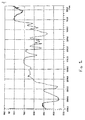
- FIGS. 1 and 2 show the IR spectra.
- the horizontal axis indicates wave number (cm -1 ), and the vertical axis indicates absorbance.
- FIG. 1 shows the IR spectrum of the resin (starting material) having a structure shown by the formula (i-1) and including an aminomethyl group at its molecular end.
- FIG. 2 shows the IR spectrum of the crosslinked polyether resin having a structure shown by the formula (I-1).
- FIG. 1 i.e., the IR spectrum of the starting material
- a broad peak is observed around 1650 to 1700 cm -1 (absorption maximum).
- the shape of the peak shown in FIG. 2 i.e., the IR spectrum of the reaction product
- This is considered to be because the amino group (NH 2 group) of the starting material changed into NHC( O)CH 2 -O-NH 2 .
- a first layer solution glucose: 37.499 g, sodium chloride: 0.399g, sodium lactate: 1.145 g, calcium gluconate: 0.560 g, magnesium sulfate: 0.312 g, and zinc sulfate: 0.700 mg were contained in 350 ml of an aqueous solution
- a second layer solution L-leucine: 2.100 g, L-isoleucine: 1.200 g, L-valine: 1.200 g, lysine hydrochloride: 1.965 g (L-lysine: 1.573 g)
Landscapes
- Chemical & Material Sciences (AREA)
- Chemical Kinetics & Catalysis (AREA)
- Organic Chemistry (AREA)
- Health & Medical Sciences (AREA)
- Medicinal Chemistry (AREA)
- Polymers & Plastics (AREA)
- General Chemical & Material Sciences (AREA)
- Analytical Chemistry (AREA)
- Polyethers (AREA)
- Solid-Sorbent Or Filter-Aiding Compositions (AREA)
Abstract
A carbonyl compound remover comprising at least one polyether resin that includes a unit shown by any of the formulas (I) to (IV) as an active ingredient, a method of preventing coloration of an infusion comprising causing the carbonyl compound remover to come in contact with an infusion that may produce and accumulate a carbonyl compound during heat sterilization or storage, or an infusion that contains a carbonyl compound, and a novel crosslinked polyether resin are disclosed. The carbonyl compound remover that may suppress a Maillard reaction in a mixture of an amino acid infusion and a sugar infusion or the like to effectively prevent coloration due to a Maillard reaction, the method of preventing coloration of an infusion by using the remover, and the novel crosslinked polyether resin are offered in the present invention.
In the formulas, n1 and n2 represent integers from 1 to 100, A represents a unit (A1) or (A2), or a combination of the (A1) and (A2), R represents a hydrogen atom or an alkyl group having 1 to 6 carbon atoms, and Q represents a group shown by CH2ONH2.
Description
- The present invention relates to a carbonyl compound remover that includes a polyether resin that includes aminooxy group(s) at its molecular end(s) as an active ingredient, a method of preventing coloration of an infusion using the carbonyl compound remover, and a crosslinked polyether resin that includes aminooxy group(s) at its molecular end(s).
- When oral nutrition or tube feeding is impossible or insufficient, or the digestive function of a patient has significantly deteriorated, or passage of diet through the digestive tract causes progression of a disease, an infusion is transvenously administered in order to save the life of a patient.
- For example, a sugar infusion that contains a reducing sugar and the like, an amino acid infusion that contains an essential amino acid and the like, an electrolyte infusion that contains minerals, a fat emulsion that contains a vegetable oil emulsion and the like, a vitamin mixture, and the like are commercially available. These infusions are appropriately mixed and used depending on the symptom of a patient and the like.
- However, since the sugar infusion, the amino acid infusion, the electrolyte infusion, and the fat emulsion are stable under different conditions, various problems may occur when mixing these infusions. For example, when mixing the amino acid infusion with the sugar infusion, and heat-sterilizing the mixture, coloration occurs to a large extent due to a Maillard reaction.
- In order to solve these problems,
Patent Documents 1 and 2 disclose a method that utilizes a container in which two chambers are formed by an isolation means, wherein a first chamber contains a sugar infusion, and a second chamber contains an amino acid infusion. The container is sterilized and stored in this state. The isolation means is removed before use so that the sugar infusion and the amino acid infusion are mixed to obtain a high-calorie nutrient infusion that contains sugar, amino acids, and the like.
However, it is troublesome to perform the above mixing operation before use, and the infusion may be infected with bacteria during the mixing operation. - On the other hand, technology exists that prevents a deterioration in sugar membrane function by adding a carbonyl compound remover to a sugar infusion to remove decomposed products of glucose contained in the sugar infusion (Patent Document 3).
-
- Patent Document 1:
JP-A-5-31151 - Patent Document 2:
JP-A-5-32540 - Patent Document 3:
WO00/10606 - The present invention was conceived in view of the above problems. An object of the present invention is to provide a carbonyl compound remover that suppresses a Maillard reaction in a mixture of an amino acid infusion and a sugar infusion to effectively prevent coloration due to a Maillard reaction, a method of preventing coloration of an infusion using the remover, and a crosslinked polyether resin that includes aminooxy group(s) at its molecular end(s).
- The inventors of the present invention reacted a crosslinked polyether resin shown by the following formula (a) that includes an aminomethyl group at its molecular end with aminooxyacetic acid in which the amino group is protected by a t-butoxycarbonyl group ("Boc") (Boc-NHOCH2COOH), and deprotected the resulting product to synthesize a crosslinked polyether resin that includes aminooxy group(s) at its molecular end(s) (refer to (A)).
-

- In the above formula, n3 is the same as defined below. The inventors found that coloration of a mixture of an amino acid infusion and a sugar infusion can be reliably prevented (i.e., coloring reactions in an aqueous solution can be efficiently suppressed) by causing the resulting hydrophilic crosslinked polyether resin to come in contact with the mixture. The inventors generalized this finding to complete the present invention.
- According to a first aspect of the present invention, there is provided a carbonyl compound remover comprising at least one polyether resin that includes a unit shown by any of the following formulas (I) to (IV) as an active ingredient.
-

- In the above formulas, A represents a unit shown by the following formula (A1) or (A2), or a combination of the units shown by the formulas (A1) and (A2),
-

- wherein n1 and n2 are individually integers from 1 to 100, R represents a hydrogen atom or an alkyl group having 1 to 6 carbon atoms, and Q represents a group shown by CH2ONH2.
According to a second aspect of the present invention, there is provided a method of preventing coloration of an infusion comprising causing the carbonyl compound remover according to the present invention to come in contact with an infusion that may produce and accumulate a carbonyl compound during heat sterilization or storage, or an infusion that contains a carbonyl compound.
According to a third aspect of the present invention, there is provided a crosslinked polyether resin comprising a unit shown by the following formula (I-1) or (II-1), -


- wherein n3 and n4 are individually integers from 1 to 100, and Q represents a group shown by CH2ONH2.
The crosslinked polyether resin that includes a unit shown by the formula (I-1) or (II-1) is a novel substance. - The carbonyl compound remover according to the present invention can suppress a Maillard reaction in a mixture of an amino acid infusion and a sugar infusion to effectively prevent coloration due to a Maillard reaction.
The method of preventing coloration of an infusion according to the present invention can simply and reliably suppress a Maillard reaction in a mixture of an amino acid infusion and a sugar infusion.
Since the novel crosslinked polyether resin according to the present invention has a crosslinked structure and includes an aminooxy group bonded to the polymer main chain via an amide bond at its molecular end, the crosslinked polyether resin according to the present invention is chemically stable, and can advantageously suppress a Maillard reaction. -
-
FIG. 1 shows an IR spectrum of a resin having a structure shown by the formula (i-1) and including an aminomethyl group at its molecular end. -
FIG. 2 shows an IR spectrum of a crosslinked polyether resin having a structure shown by the formula (I-1). - The carbonyl compound remover according to the first aspect of the present invention includes at least one polyether resin that includes a unit shown by any of the formulas (I) to (IV) as an active ingredient.
- In the formulas (I) to (IV), A represents a unit shown by the formula (A1) or (A2), or a combination of the units shown by the formulas (A1) and (A2).
Examples of a combination of the units shown by the formulas (A1) and (A2) include, but are not limited to, units shown by the following formulas (A3) to (A6), -

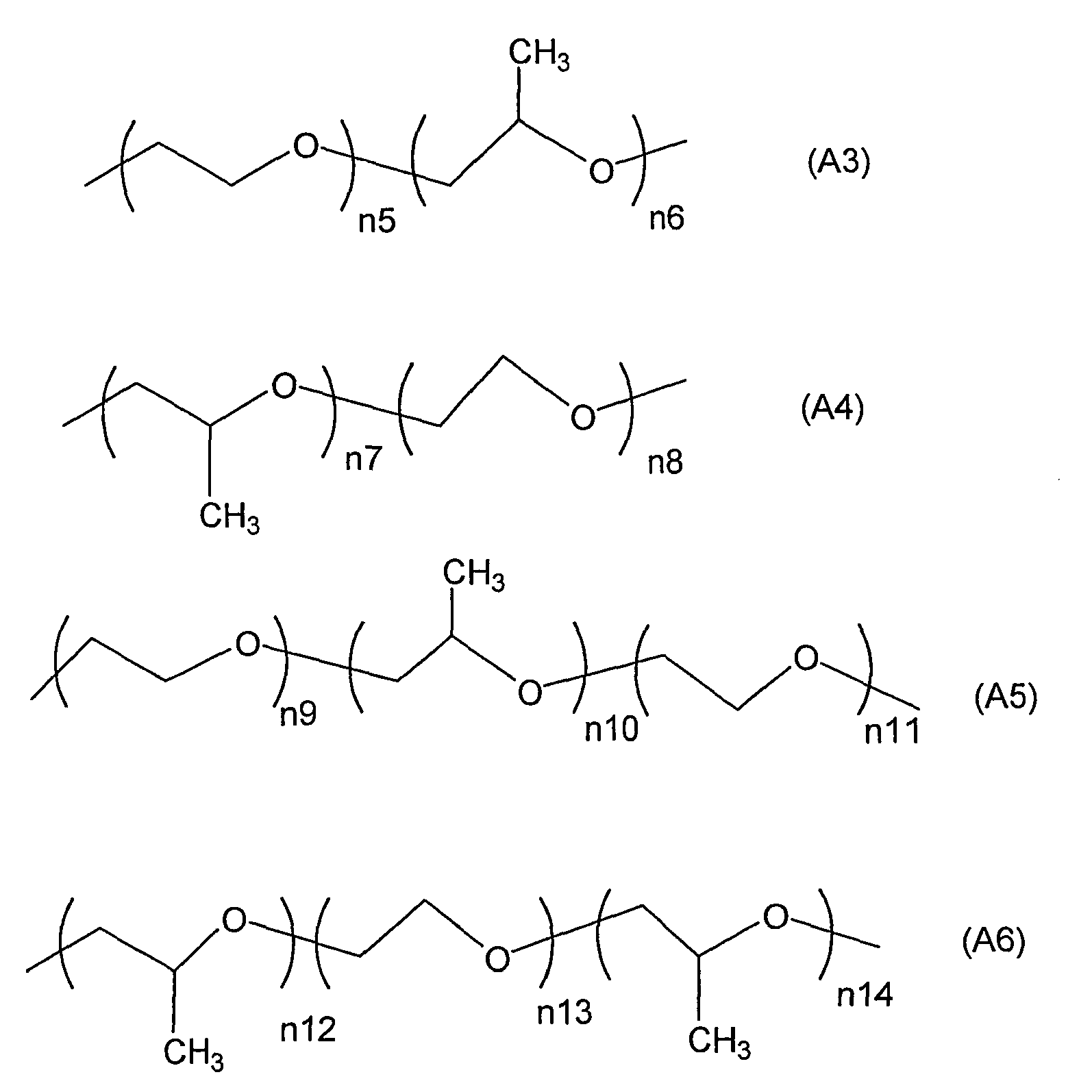
- wherein n1 to n14 are individually integers from 1 to 100.
Among these, the unit shown by the formula (A1) is particularly preferable.
Q represents a group shown by CH2ONH2. - R in the formula (IV) represents a hydrogen atom or an alkyl group having 1 to 6 carbon atoms (e.g., methyl group, ethyl group, n-propyl group, isopropyl group, or n-butyl group).
- It is common at the point which the polyether resin including a unit shown by any of the formulas (I) to (IV) has a hydrophilic polyether skeleton (e.g., the units shown by the formulas (A1) to (A6)) as a main chain, and has a group (Q) shown by CH2ONH2 at its molecular end.
- Among the polyether resins shown by the formulas (I) to (IV), the polyether resins shown by the formulas (I) and (II) that have a crosslinked structure are preferable due to an excellent carbonyl compound removing capability and chemical stability, with the crosslinked polyether resin shown by the formula (I) being particularly preferable. Note that the polyether resins shown by the formulas (I) and (II) are novel substances.
- The polyether resin that includes a unit shown by any of the formulas (I) to (IV) may be produced as follows.
-

- The polymer shown by the formula (1) is shown by any of the following formulas (i) to (iii),
-


- wherein A is the same as defined above.
-

- The partial structure shown by the above formula is a site in which units shown by the following formula (i-a) or units shown by the following formula (ii-a) are crosslinked.
-

- Specifically, a polyether resin shown by the formula (1) that includes an aminomethyl group (-CH2NH2) at its molecular end is reacted with an N-substituted aminooxyacetic acid shown by the formula (2): GNHOCH2COOH (wherein G represents a protecting group for the amino group) in the presence of a dehydration-condensation agent to obtain a polyether resin shown by the formula (3) (hereinafter may be referred to as "polyether resin (3)"). The protecting group G for the amino group is then eliminated (i.e., the amino group is deprotected) to obtain the target polyether resin shown by the formula (4) (hereinafter may be referred to as "polyether resin (4)").
- Examples of the dehydration-condensation agent include, but are not limited to, a dehydration-condensation agent that may be used when synthesizing a compound that includes an amide bond (CONH) by condensing an amino group of an amino group-containing compound and a carboxyl group of a carboxyl group-containing compound.
- Specific examples of the dehydration-condensation agent include a carbodiimide condensation agent, a uronium condensation agent, a phosphonium condensation agent, diphenylphosphoryl azide, a combination of such a condensation agent and a condensation aid (dehydration aid), and the like.
Examples of the condensation aid (dehydration aid) include N-hydroxypolycarboxylic imides, N-hydroxytriazoles, triazines, ethyl 2-hydroxyimino-2-cyanoacetate, and the like. - The reaction may be carried out in an appropriate solvent. The solvent is not particularly limited insofar as the solvent is inert to the reaction. Examples of the solvent include amide solvents such as N,N-dimethylformamide, N,N-dimethylacetamide, N-methylpyrrolidone, and hexamethylphosphoric triamide; ether solvents such as diethyl ether, diisopropyl ether, tetrahydrofuran, and 1,2-dimethoxyethane; ketone solvents such as acetone, methyl isobutyl ketone, and cyclohexanone; halogenated hydrocarbon solvents such as dichloromethane, chloroform, carbon tetrachloride, and 1,2-dichloroethane; aromatic hydrocarbon solvents such as benzene, toluene, and xylene; aliphatic hydrocarbon solvents such as n-pentane, n-hexane, and n-heptane; and a mixed solvent consisting of two or more of these solvents.
- The reaction temperature is normally -10 to +100°C, and preferably 0 to 50°C. The reaction time is normally several tens of minutes to several tens of hours. The reaction time varies depending on the reaction scale.
- In the N-substituted aminooxyacetic acid shown by the formula (2): GNHOCH2COOH, G represents a protecting group for the amino group, such as a t-butoxycarbonyl (Boc) group.
- After completion of the reaction, the product is subjected to a post-treatment normally used in organic chemistry, and is optionally isolated by purification to obtain the polyether resin (3).
Note that an acid described later may be added to the reaction solution of the polyether resin shown by the formula (1) and the N-substituted aminooxyacetic acid shown by the formula (2), and the amino group may be deprotected to obtain the target polyether resin (4) without isolating the polyether resin (3). - If unreacted amino groups remain after the above reaction, a carbonyl compound may not be advantageously removed. Therefore, it is preferable to completely acylate remaining amino groups after completion of the reaction between the polyether resin shown by the formula (1) and the N-substituted aminooxyacetic acid shown by the formula (2) by adding an acylating agent (e.g., acetic anhydride-pyridine) to the reaction solution before deprotecting the amino group.
- The protecting group G for the amino group of the resulting polyether resin (3) is then eliminated (i.e., the amino group is deprotected).
The protecting group G may be eliminated by a conventionally known method depending on the type of the protecting group G. For example, when the protecting group G is Boc, the protecting group G may be eliminated using an acid such as hydrochloric acid, sulfuric acid, or fluoroacetic acid; a combination of a strong acid (e.g., trifluoroacetic acid) and a silane compound (e.g., diisopropylsilane or triisopropylsilane); or the like. The acid is normally used in an amount of 2 to 20 mol based on 1 mol of the polyether resin (3). - The protecting group G may be eliminated in an appropriate solvent. The solvent is not particularly limited insofar as the solvent is inert to the reaction. Examples of the solvent include amide solvents such as N,N-dimethylformamide, N,N-dimethylacetamide, N-methylpyrrolidone, and hexamethylphosphoric triamide; ether solvents such as diethyl ether, diisopropyl ether, tetrahydrofuran, and 1,2-dimethoxyethane; ketone solvents such as methyl isobutyl ketone and cyclohexanone; halogenated hydrocarbon solvents such as dichloromethane, chloroform, carbon tetrachloride, and 1,2-dichloroethane; aromatic hydrocarbon solvents such as benzene, toluene, and xylene; aliphatic hydrocarbon solvents such as n-pentane, n-hexane, and n-heptane; and a mixed solvent consisting of two or more of these solvents.
- The reaction temperature employed when eliminating the protecting group G is normally -10 to +100°C, and preferably 0 to 50°C. The reaction time is normally several tens of minutes to several tens of hours. The reaction time varies depending on the reaction scale.
- After completion of the reaction, the product is subjected to a post-treatment normally used in organic chemistry, and is optionally isolated by purification to obtain the polyether resin (4).
- The polyether resin that includes the unit shown by the formula (IV) may be produced as follows.
-


- In the above reaction scheme, A and R are the same as defined above.
Specifically, a polyether resin shown by the formula (5) that includes an aminomethyl group (-CH2NH2) at its molecular end is reacted with an N-substituted aminooxyacetic acid shown by the formula (2): GNHOCH2COOH (wherein G represents a protecting group for the amino group) in the presence of a dehydration-condensation agent to obtain a polyether resin shown by the formula (6). The protecting group G for the amino group is then eliminated (i.e., the amino group is deprotected) to obtain the target polyether resin shown by the formula (IV). - The above reactions may be carried out in the same manner as the reactions for obtaining the polyether resin (4) from the polyether resin (1).
- After completion of the reaction, the product is subjected to a post-treatment normally used in organic chemistry, and is optionally isolated by purification to obtain the target polyether resin.
- Many of the polymers (i.e., starting material) shown by the formula (1) are known substances, and may be produced by a known method. A commercially available product may be directly used as the starting material.
- For example, the polyether resin shown by the formula (i) may be produced as follows (see
JP-T-2007-501296 -

- In the above reaction scheme, A is the same as defined above, X represents a halogen atom, and Z represents an aminomethyl group (CH2NH2) or a group from which an aminomethyl group can be derived.
- Specifically, a glycol compound shown by the formula (7) is reacted with a vinyl compound shown by the formula (8) to obtain a compound shown by the formula (9). The compound shown by the formula (9) is crosslinked to obtain a compound shown by the formula (10). The group shown by Z (i.e., a group from which an aminomethyl group can be derived) of the compound shown by the formula (10) is converted into an aminomethyl group to obtain the compound shown by the formula (i). When the group shown by Z in the formula (10) is an aminomethyl group, the compound shown by the formula (10) is the compound shown by the formula (i). The details are described below.
- The glycol compound shown by the formula (7) is reacted with the vinyl compound shown by the formula (8) to obtain the compound shown by the formula (9).
- The glycol compound shown by the formula (7) may be reacted with the vinyl compound shown by the formula (8) in an appropriate solvent in the presence of a base.
The vinyl compound shown by the formula (8) is normally used in an amount of 2 to 5 mol based on 1 mol of the glycol compound shown by the formula (7). - Examples of the base include inorganic bases such as sodium hydroxide and sodium carbonate; and organic bases such as triethylamine and pyridine. The base is normally used in an amount of 2 to 5 mol based on 1 mol of the glycol compound shown by the formula (7).
- The solvent is not particularly limited insofar as the solvent is inert to the reaction. Examples of the solvent include ether solvents such as tetrahydrofuran and 1,2-dimethoxyethane; amide solvents such as N,N-dimethylformamide, N,N-dimethylacetamide, and N-methylpyrrolidone; sulfur-containing solvents such as dimethyl sulfoxide; and the like. The reaction may be carried out in a two-phase solvent of an organic solvent and water (e.g., a mixed solvent of methylene chloride and water). In this case, it is preferable to carry out the reaction in the presence of a phase transfer catalyst such as tetrabutylammonium bromide.
- The reaction smoothly proceeds at 0 to 100°C.
The reaction time is several minutes to several tens of hours.
After completion of the reaction, the product is subjected to a post-treatment normally used in organic chemistry, and is optionally purified to obtain the target compound shown by the formula (9). - The compound shown by the formula (9) is then crosslinked to obtain the compound shown by the formula (10).
The compound shown by the formula (9) may be crosslinked by heating the compound shown by formula (9) to a given temperature in the presence of a radical initiator (e.g., benzoyl peroxide (BPO) or azobisisobutyronitrile (AIBN)) for example. - The crosslinking reaction may be carried out in an appropriate solvent. The solvent is not particularly limited insofar as the solvent is inert to the reaction. Examples of the solvent include aromatic hydrocarbon solvents such as benzene, toluene, and xylene; alicyclic hydrocarbon solvents such as cyclopentane and cyclohexane; alcohol solvents such as cyclopentanol and cyclohexanol; and a mixed solvent consisting of two or more of these solvents.
- The crosslinking reaction smoothly proceeds at 50 to 150°C. The reaction time is normally several minutes to several tens of hours.
After completion of the reaction, the product is subjected to a post-treatment normally used in organic chemistry, and is optionally purified to obtain the target compound shown by the formula (10). - The group shown by Z (i.e., a group from which an aminomethyl group can be derived) of the compound shown by the formula (10) is then converted into an aminomethyl group to obtain the compound shown by the formula (i).
- Examples of the group shown by Z (i.e., a group from which an aminomethyl group can be derived) include an amide group (CONH2), a cyano group (CN), a nitromethyl group (CH2NO2), and the like. An aminomethyl group can be derived from these groups by a known reduction reaction.
- The method of producing the crosslinked polyether resin shown by the formula (i) has been described above. The crosslinked polyether resin shown by the formula (ii) may be produced in the same manner as the crosslinked polyether resin shown by the formula (i).
- Many of the polyether resins shown by the formulas (iii) and (5) are known substances, and may be produced by a known method (see
JP-A-7-196925 - The carbonyl compound remover according to the present invention includes at least one polyether resin that includes a unit shown by any of the formulas (I) to (IV) as an active ingredient.
- Since the carbonyl compound remover according to the present invention includes the polyether resin that includes an aminooxy group (ONH2) at the end of the polymer main chain having a polyether structure as an active ingredient, the carbonyl compound remover exhibits an excellent carbonyl compound removing capability. Since the aminooxy group is bonded to the polymer main chain via an amide bond, the carbonyl compound remover is rarely hydrolyzed, and has low toxicity (i.e., it is safe).
- The form of the carbonyl compound remover is not particularly limited. For example, the carbonyl compound remover may be produced by forming one or more polyether resins that include a unit shown by any of the formulas (I) to (IV) in the form of particles, a film, a sheet, or the like.
- The carbonyl compound remover according to the present invention is useful for removing a carbonyl compound contained in an infusion that contains a sugar and an amino acid, a sugar infusion, a peritoneal dialysate, a liquid food, a liquor, and the like; purifying an organic chemical that contains a carbonyl compound; purifying industrial water and industrial liquid waste; and the like.
- 2) The method of preventing coloration of an infusion according to the second aspect of the present invention includes causing the above carbonyl compound remover to come in contact with an infusion that may produce and accumulate a carbonyl compound during heat sterilization or storage, or an infusion that contains a carbonyl compound.
- The infusion as an object in the method of the present invention is not particularly limited insofar as the infusion may produce and accumulate a carbonyl compound during heat sterilization or storage, or contains a carbonyl compound. The infusion is preferably a mixture of an amino acid infusion and a sugar infusion that is easily colored due to a Maillard reaction.
- Examples of the amino acid infusion include an aqueous solution that includes an electrolyte and at least one amino acid selected from the group consisting of L-isoleucine, L-leucine, L-lysine, L-methionine, L-phenylalanine, L-threonine, L-tryptophan, L-valine, L-alanine, L-arginine, L-aspartic acid, L-glutamic acid, L-histidine, L-proline, L-serine, L-tyrosine, glycine, and L-cysteine (see
JP-A-2001-79064 JP-A-2007-56013 - The sugar infusion may include a reducing sugar (e.g., glucose, fructose, or maltose) or a nonreducing sugar (e.g., trehalose, xylytol, sorbitol, or glycerol) (see
JP-A-2001-79064 - The infusion may also include vitamins such as vitamin B1, vitamin B2, vitamin B6, vitamin B12, vitamin C, vitamin A, vitamin D, vitamin E, vitamin K, vitamin H, folic acid, pantothenic acid, and nicotinic acid; trace metals such as inorganic salts and organic salts of zinc, copper, and selenium that become insufficient in chronic renal failure dialysis patients; a pH adjusting agent such as an inorganic acid (e.g., hydrochloric acid), an organic acid (e.g., acetic acid or citric acid), or a gas (e.g., carbon dioxide); and the like.
- The carbonyl compound remover according to the present invention (hereinafter may be referred to as "remover") may be caused to come in contact with the infusion by an arbitrary method insofar as the remover is caused to come in contact with an infusion that contains a carbonyl compound (e.g., a medical sugar infusion that has been sterilized using high-pressure steam) to remove the carbonyl compound from the infusion. The expression "contact" here means that the remover is caused to come into direct contact with an infusion that contains a carbonyl compound.
- The remover may be caused to come in contact with an infusion that contains a carbonyl compound by (1) adding an infusion that contains a carbonyl compound (e.g., a medical sugar infusion that has been sterilized using high-pressure steam) to a container (e.g., infusion bag) that contains the remover, and trapping the carbonyl compound, (2) charging a column with the remover in the form of particles, a film, fibers, or the like, and passing or circulating an infusion that contains a carbonyl compound through the column, (3) molding the remover in the shape of a film or a sheet, and filling a container formed of the molded product with an infusion that contains a carbonyl compound, or (4) forming a layer of the remover on the surface of a film or a sheet formed of a polymer (e.g., polyolefin such as polyethylene or polypropylene) (i.e., infusion container material), producing an infusion container so that the layer of the remover is positioned on the inner side, and filling the container with an infusion that contains a carbonyl compound, for example.
- The infusion that has been treated with the remover may be stored in a separate container or the like, if necessary. In this case, a carbonyl compound that is produced and accumulated during storage may be trapped by placing the remover in the storage container.
- The remover may be used in an appropriate amount depending on the type of infusion, the amount of infusion, the carbonyl compound content in the infusion, the removal rate and the removal speed achieved by the remover, and the temperature during treatment. For example, when producing a carbonyl compound removing apparatus by filling a column with the remover, and circulating an infusion through the carbonyl compound removing apparatus immediately before introducing the infusion into a human body, it is preferable to achieve a sufficient carbonyl compound removing capability from the viewpoint of reducing the size of the removing apparatus.
- Since the remover has a high capability of removing a carbonyl compound contained in a sugar solution (e.g., peritoneal dialysate or infusion), a compound contained in a sugar solution may be removed by causing the remover to come in contact with the sugar solution to purify the sugar solution.
- The remover is preferably used in an amount (weight basis) of 1/1000 to 1, and more preferably 1/100 to 1/10, relative to the amount of infusion.
- The present invention is further described below by way of examples. Note that the present invention is not limited to the following examples.
-

- In the above reaction scheme, n is an integer from 1 to 100.
A syringe (50 ml) with a frit was charged with 0.97 g of a resin having a structure shown by the formula (i-1) and including an aminomethyl group at its molecular end ("Aminomethyl-ChemMatrix Resin", 35-100 mesh, 0.62 mmol/g, manufactured by Matrix Innovation). The resin was washed three times with 20 ml of N,N-dimethylformamide (DMF), and swollen with 30 ml of DMF over one hour. DMF was then removed. - 344 mg (1.8 mmol) of N-Boc-aminooxyacetic acid, 745 mg (1.8 mmol) of O-(6-chlorobenzotriazol-1-yl), 305 mg (1.8 mmol) of 6-chloro-1-hydroxybenzotriazole, and 450 mg (3.6 mmol) of diisopropylethylamine were dissolved in 30 ml of DMF. The solution was added to the syringe. After shaking the syringe for two hours, the mixture was washed succesively with 20 ml of DMF for one minute (three times), 20 ml of dichloromethane for one minute (three times), and 20 ml of DMF for one minute (three times).
- A solution prepared by dissolving 0.5 ml of acetic anhydride and 0.5 ml of pyridine in 30 ml of DMF was added to the syringe. After shaking the syringe for 30 minutes, the mixture was washed succesively with 20 ml of DMF for one minute (three times), 20 ml of dichloromethane for one minute (three times), 20 ml of DMF for one minute (three times), and 20 ml of dichloromethane for one minute (three times), and dried under reduced pressure.
- After the addition of a mixture of 14.25 ml of trifluoroacetic acid and 0.75 ml of triisopropylsilane, the syringe was shaken for one and a half hours. The mixture was then washed succesively with 20 ml of dichloromethane for one minute (three times), 20 ml of DMF for one minute (three times), 20 ml of dichloromethane for one minute (three times), 20 ml of DMF for one minute (three times), 20 ml of dichloromethane for one minute (three times), 20 ml of DMF for one minute (three times), and 20 ml of dichloromethane for one minute (three times), and dried under reduced pressure to obtain a crosslinked polyether resin having a structure shown by the formula (I-1).
- The IR spectra of the resin (starting material) having a structure shown by the formula (i-1) and including an aminomethyl group at its molecular end, and the crosslinked polyether resin having a structure shown by the formula (I-1) were measured.
FIGS. 1 and2 show the IR spectra. InFIGS. 1 and2 , the horizontal axis indicates wave number (cm-1), and the vertical axis indicates absorbance.
FIG. 1 shows the IR spectrum of the resin (starting material) having a structure shown by the formula (i-1) and including an aminomethyl group at its molecular end.FIG. 2 shows the IR spectrum of the crosslinked polyether resin having a structure shown by the formula (I-1). - In
FIG. 1 (i.e., the IR spectrum of the starting material), a broad peak is observed around 1650 to 1700 cm-1 (absorption maximum). The shape of the peak shown inFIG. 2 (i.e., the IR spectrum of the reaction product) differs from that of the peak shown inFIG. 1 . This is considered to be because the amino group (NH2 group) of the starting material changed into NHC(=O)CH2-O-NH2. - 2.1 ml of a first layer solution (glucose: 37.499 g, sodium chloride: 0.399g, sodium lactate: 1.145 g, calcium gluconate: 0.560 g, magnesium sulfate: 0.312 g, and zinc sulfate: 0.700 mg were contained in 350 ml of an aqueous solution) was mixed with 0.9 ml of a second layer solution (L-leucine: 2.100 g, L-isoleucine: 1.200 g, L-valine: 1.200 g, lysine hydrochloride: 1.965 g (L-lysine: 1.573 g), L-threonine: 0.855 g, L-tryptophan: 0.300g, L-methionine: 0.855 g, L-phenylalanine: 1.050 g, L-cysteine: 0.150 g, L-tyrosine: 0.075 g, L-arginine: 1.575 g, L-histidine: 0.750 g, L-alanine: 1.200 g, L-purorinn: 0.750 g, L-serine: 0.450 g, glycine: 0.885 g, L-aspartic acid: 0.150 g, L-glutamic acid: 0.150 g, and dipotassium phosphate: 0.870 g were contained in 50 ml of an aqueous solution). The pH of the mixture was adjusted to 5.5 using concentrated hydrochloric acid.
- After the addition of 50 mg of the hydroxyamine-containing resin to the mixture, the container was sealed. The mixture was heated at 105°C for one and a half hour with stirring. The resulting solution was filtered through a filter ("Chromatodisc 25A" manufactured by GL Sciences Inc., pore size: 0.455 µm). The transmittance (420 nm) of 100 microliters of the filtrate was measured using a 96-well plate.
In Comparative Example 1, an operation was performed in the same manner as described above, except that the hydroxyamine-containing resin was not added.
The results are shown in Table 1. In Table 1,Resin 1 is the hydroxyamine-containing resin, and Resin 2 is the resin (starting material) having a structure shown by the formula (i-1) and including an aminomethyl group at its molecular end. -
TABLE 1 Example 1 Comparative Example 1 Transmittance (420 nm) (%) Amount (mg) of Resin 1Amount (mg) of Resin 2 100 - 80.5 50 - 83.6 - 100 50.1 - 50 49.8 - - 70.0 - As shown in Table 1, coloration was suppressed by adding
Resin 1. On the other hand, coloration was promoted by adding Resin 2.
Not only the solution but also the resin turned brown when the Resin 2 was added and the solution was heated with stirring. On the other hand, in the case of theResin 1, coloration of the resin was not observed
Claims (3)
- A carbonyl compound remover comprising at least one polyether resin that includes a unit shown by any of the formulas (I) to (IV) as an active ingredient,


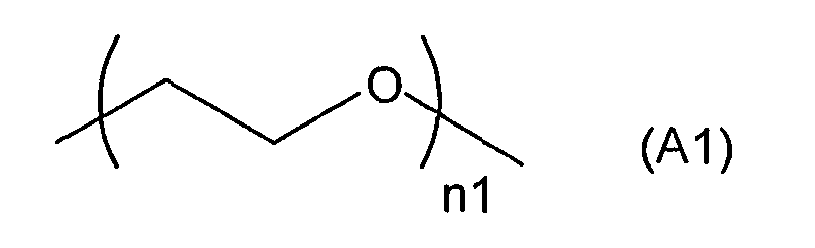

- A method of preventing coloration of an infusion comprising causing the carbonyl compound remover according to claim 1 to come in contact with an infusion that may produce and accumulate a carbonyl compound during heat sterilization or storage, or an infusion that contains a carbonyl compound.
- A crosslinked polyether resin comprising a unit shown by the following formula(I-1) or (II-1),


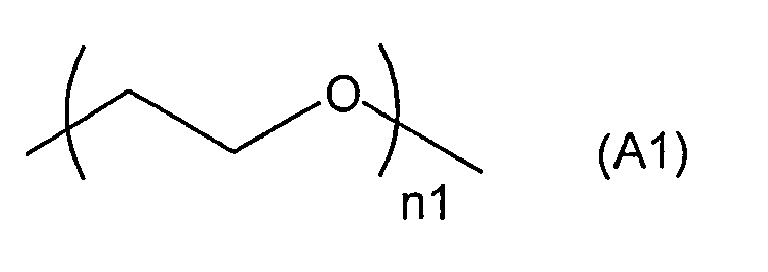

Applications Claiming Priority (2)
| Application Number | Priority Date | Filing Date | Title |
|---|---|---|---|
| JP2008063814 | 2008-03-13 | ||
| PCT/JP2009/054672 WO2009113578A1 (en) | 2008-03-13 | 2009-03-11 | Carbonyl compound remover |
Publications (1)
| Publication Number | Publication Date |
|---|---|
| EP2275202A1 true EP2275202A1 (en) | 2011-01-19 |
Family
ID=41065239
Family Applications (1)
| Application Number | Title | Priority Date | Filing Date |
|---|---|---|---|
| EP09719157A Withdrawn EP2275202A1 (en) | 2008-03-13 | 2009-03-11 | Carbonyl compound remover |
Country Status (4)
| Country | Link |
|---|---|
| US (1) | US20110065808A1 (en) |
| EP (1) | EP2275202A1 (en) |
| JP (1) | JPWO2009113578A1 (en) |
| WO (1) | WO2009113578A1 (en) |
Families Citing this family (2)
| Publication number | Priority date | Publication date | Assignee | Title |
|---|---|---|---|---|
| EP2994123B1 (en) | 2013-05-08 | 2020-04-08 | Gambro Lundia AB | Dialysis formulation |
| CN107868243B (en) * | 2017-12-11 | 2020-10-23 | 江苏苏博特新材料股份有限公司 | Preparation method of amino acid-derivatized phosphorous acid water reducing agent |
Family Cites Families (12)
| Publication number | Priority date | Publication date | Assignee | Title |
|---|---|---|---|---|
| JP3456536B2 (en) | 1991-07-26 | 2003-10-14 | 三菱ウェルファーマ株式会社 | Infusion preparation |
| JP3364932B2 (en) | 1991-07-26 | 2003-01-08 | 三菱ウェルファーマ株式会社 | Infusion container |
| JPH06166621A (en) * | 1992-12-01 | 1994-06-14 | Kyowa Hakko Kogyo Co Ltd | Amino acid transfusion prevention method |
| NO934477L (en) | 1992-12-09 | 1994-06-10 | Ortho Pharma Corp | PEG hydrazone and PEG oxime-binding reagents and protein derivatives thereof |
| EP0788375A2 (en) * | 1994-11-09 | 1997-08-13 | Robin Ewart Offord | Functionalized polymers for site-specific attachment |
| CA2339879C (en) * | 1998-08-24 | 2011-11-15 | Toshio Miyata | Carbonyl-stress improving agent and peritoneal dialysate |
| JP2006305345A (en) * | 1998-08-24 | 2006-11-09 | Kurokawa Kiyoshi | Carbonyl stress improving agent and peritoneal dialysis solution |
| JP2001079064A (en) | 1999-09-10 | 2001-03-27 | Welfide Corp | Infusion container |
| JP2005006608A (en) * | 2003-06-23 | 2005-01-13 | Sadaji Yokoyama | Method for suppressing coloring |
| CA2534616C (en) * | 2003-08-04 | 2012-09-04 | Matrix Innovation Inc. | New polyether based monomers and highly cross-linked amphiphile resins |
| JP2007056013A (en) | 2005-07-29 | 2007-03-08 | Ajinomoto Co Inc | Supplementary liquid for dialysis |
| JP2007151612A (en) * | 2005-11-30 | 2007-06-21 | Kuraray Co Ltd | Carbonyl compound removal material for sugar solution treatment |
-
2009
- 2009-03-11 WO PCT/JP2009/054672 patent/WO2009113578A1/en not_active Ceased
- 2009-03-11 JP JP2010502850A patent/JPWO2009113578A1/en active Pending
- 2009-03-11 EP EP09719157A patent/EP2275202A1/en not_active Withdrawn
-
2010
- 2010-09-13 US US12/880,434 patent/US20110065808A1/en not_active Abandoned
Non-Patent Citations (1)
| Title |
|---|
| See references of WO2009113578A1 * |
Also Published As
| Publication number | Publication date |
|---|---|
| US20110065808A1 (en) | 2011-03-17 |
| JPWO2009113578A1 (en) | 2011-07-21 |
| WO2009113578A1 (en) | 2009-09-17 |
Similar Documents
| Publication | Publication Date | Title |
|---|---|---|
| RU2606624C2 (en) | Obtaining n-protected bis-3,6-(4-aminoalkyl)-2,5-diketopiperazine | |
| CN1134486C (en) | Antiviral dendrimers | |
| US20180117168A1 (en) | Cyclodextrin-based polymers for therapeutic delivery | |
| CN110804175B (en) | Antibacterial polyamino acid derivative or copolymer with alternating structure and preparation method thereof | |
| JP5000512B2 (en) | Polymer derivatives of cytidine antimetabolites | |
| CN1191064C (en) | Pharmaceutical composition containing phenylacetylglutamine, phenylacetylisoglutamine and/or derivatives thereof | |
| HK1040052A1 (en) | Drug composites | |
| CN1246039C (en) | Moxifloxacin/Sodium Chloride Formulation | |
| TWI480070B (en) | Conformations of divergent peptides with mineral binding affinity | |
| CA2816997A1 (en) | Novel polymer derivative of cytidine metabolic antagonist | |
| JPH0222327A (en) | Polymer consisting citric acid and diamine, and its production and use | |
| CN1676525A (en) | Hydrophilic polymer-thunder good vine extract binding substance and its medicinal composition | |
| US20110065808A1 (en) | Carbonyl compound remover | |
| CN100494223C (en) | Synthesis method of chitosan nucleophilic NO donor modified by quaternary ammonium salt | |
| US20100093973A1 (en) | Poly(amino acid) compound having inhibitory activity on absorption of phosphorus and phosphorus absorption inhibitor | |
| CA2792598C (en) | Improved cysteine-based prodrugs useful in the treatment of schizophrenia | |
| TW201737946A (en) | Drug-conjugated block copolymer, block copolymer, and method for producing drug-conjugated block copolymer | |
| CN106580920B (en) | Intelligent insulin delivery system with strong salt tolerance and preparation process | |
| CN109942760B (en) | 3, 4-dihydrothioferrocene pyrimidine-2-one polymer and preparation method and application thereof | |
| CN102657606B (en) | Lipoic acid injection for intravenous administration | |
| CA2658633C (en) | Chiral compounds substituted with phosphonic acid ester functions or phosphonic acid functions | |
| JPH0334960A (en) | Acylamino carboxylic acid derivative, its manufacture and drug and dietetic drug contain- ing said derivative | |
| CN1611524A (en) | Polyethylene glycol amino acid N-internal ring carbonyl anhydride active derivatives, and medicinal bonding compound and gel thereof | |
| CN1747988A (en) | Multifunctional dendritic and hyperbranched polymers as drug and gene delivery systems | |
| CN1206211C (en) | Process method for synthesizing medical biodegradable materials with biomimetic organic guanidine salt catalyst |
Legal Events
| Date | Code | Title | Description |
|---|---|---|---|
| PUAI | Public reference made under article 153(3) epc to a published international application that has entered the european phase |
Free format text: ORIGINAL CODE: 0009012 |
|
| PUAI | Public reference made under article 153(3) epc to a published international application that has entered the european phase |
Free format text: ORIGINAL CODE: 0009012 |
|
| 17P | Request for examination filed |
Effective date: 20101004 |
|
| AK | Designated contracting states |
Kind code of ref document: A1 Designated state(s): AT BE BG CH CY CZ DE DK EE ES FI FR GB GR HR HU IE IS IT LI LT LU LV MC MK MT NL NO PL PT RO SE SI SK TR |
|
| AX | Request for extension of the european patent |
Extension state: AL BA RS |
|
| STAA | Information on the status of an ep patent application or granted ep patent |
Free format text: STATUS: THE APPLICATION HAS BEEN WITHDRAWN |
|
| 18W | Application withdrawn |
Effective date: 20121004 |