EP2270646A1 - Informationsverarbeitungsvorrichtung, die Informationen über Bildverarbeitungsaufträge in einem Datenserver registriert, Verfahren zu deren Steuerung und Programm - Google Patents
Informationsverarbeitungsvorrichtung, die Informationen über Bildverarbeitungsaufträge in einem Datenserver registriert, Verfahren zu deren Steuerung und Programm Download PDFInfo
- Publication number
- EP2270646A1 EP2270646A1 EP10166679A EP10166679A EP2270646A1 EP 2270646 A1 EP2270646 A1 EP 2270646A1 EP 10166679 A EP10166679 A EP 10166679A EP 10166679 A EP10166679 A EP 10166679A EP 2270646 A1 EP2270646 A1 EP 2270646A1
- Authority
- EP
- European Patent Office
- Prior art keywords
- information
- job
- data server
- content
- data
- Prior art date
- Legal status (The legal status is an assumption and is not a legal conclusion. Google has not performed a legal analysis and makes no representation as to the accuracy of the status listed.)
- Withdrawn
Links
Images




Classifications
-
- G—PHYSICS
- G06—COMPUTING OR CALCULATING; COUNTING
- G06F—ELECTRIC DIGITAL DATA PROCESSING
- G06F3/00—Input arrangements for transferring data to be processed into a form capable of being handled by the computer; Output arrangements for transferring data from processing unit to output unit, e.g. interface arrangements
- G06F3/12—Digital output to print unit, e.g. line printer, chain printer
- G06F3/1201—Dedicated interfaces to print systems
- G06F3/1202—Dedicated interfaces to print systems specifically adapted to achieve a particular effect
- G06F3/1203—Improving or facilitating administration, e.g. print management
-
- G—PHYSICS
- G06—COMPUTING OR CALCULATING; COUNTING
- G06F—ELECTRIC DIGITAL DATA PROCESSING
- G06F3/00—Input arrangements for transferring data to be processed into a form capable of being handled by the computer; Output arrangements for transferring data from processing unit to output unit, e.g. interface arrangements
- G06F3/12—Digital output to print unit, e.g. line printer, chain printer
- G06F3/1201—Dedicated interfaces to print systems
- G06F3/1223—Dedicated interfaces to print systems specifically adapted to use a particular technique
- G06F3/1237—Print job management
- G06F3/1273—Print job history, e.g. logging, accounting, tracking
-
- H—ELECTRICITY
- H04—ELECTRIC COMMUNICATION TECHNIQUE
- H04N—PICTORIAL COMMUNICATION, e.g. TELEVISION
- H04N1/00—Scanning, transmission or reproduction of documents or the like, e.g. facsimile transmission; Details thereof
- H04N1/00127—Connection or combination of a still picture apparatus with another apparatus, e.g. for storage, processing or transmission of still picture signals or of information associated with a still picture
- H04N1/00204—Connection or combination of a still picture apparatus with another apparatus, e.g. for storage, processing or transmission of still picture signals or of information associated with a still picture with a digital computer or a digital computer system, e.g. an internet server
- H04N1/00244—Connection or combination of a still picture apparatus with another apparatus, e.g. for storage, processing or transmission of still picture signals or of information associated with a still picture with a digital computer or a digital computer system, e.g. an internet server with a server, e.g. an internet server
-
- H—ELECTRICITY
- H04—ELECTRIC COMMUNICATION TECHNIQUE
- H04N—PICTORIAL COMMUNICATION, e.g. TELEVISION
- H04N1/00—Scanning, transmission or reproduction of documents or the like, e.g. facsimile transmission; Details thereof
- H04N1/00127—Connection or combination of a still picture apparatus with another apparatus, e.g. for storage, processing or transmission of still picture signals or of information associated with a still picture
- H04N1/00344—Connection or combination of a still picture apparatus with another apparatus, e.g. for storage, processing or transmission of still picture signals or of information associated with a still picture with a management, maintenance, service or repair apparatus
-
- H—ELECTRICITY
- H04—ELECTRIC COMMUNICATION TECHNIQUE
- H04N—PICTORIAL COMMUNICATION, e.g. TELEVISION
- H04N1/00—Scanning, transmission or reproduction of documents or the like, e.g. facsimile transmission; Details thereof
- H04N1/00838—Preventing unauthorised reproduction
- H04N1/00856—Preventive measures
-
- H—ELECTRICITY
- H04—ELECTRIC COMMUNICATION TECHNIQUE
- H04N—PICTORIAL COMMUNICATION, e.g. TELEVISION
- H04N1/00—Scanning, transmission or reproduction of documents or the like, e.g. facsimile transmission; Details thereof
- H04N1/00838—Preventing unauthorised reproduction
- H04N1/00856—Preventive measures
- H04N1/00877—Recording information, e.g. details of the job
-
- H—ELECTRICITY
- H04—ELECTRIC COMMUNICATION TECHNIQUE
- H04N—PICTORIAL COMMUNICATION, e.g. TELEVISION
- H04N1/00—Scanning, transmission or reproduction of documents or the like, e.g. facsimile transmission; Details thereof
- H04N1/32—Circuits or arrangements for control or supervision between transmitter and receiver or between image input and image output device, e.g. between a still-image camera and its memory or between a still-image camera and a printer device
- H04N1/32101—Display, printing, storage or transmission of additional information, e.g. ID code, date and time or title
- H04N1/32106—Display, printing, storage or transmission of additional information, e.g. ID code, date and time or title separate from the image data, e.g. in a different computer file
- H04N1/32122—Display, printing, storage or transmission of additional information, e.g. ID code, date and time or title separate from the image data, e.g. in a different computer file in a separate device, e.g. in a memory or on a display separate from image data
-
- H—ELECTRICITY
- H04—ELECTRIC COMMUNICATION TECHNIQUE
- H04N—PICTORIAL COMMUNICATION, e.g. TELEVISION
- H04N2201/00—Indexing scheme relating to scanning, transmission or reproduction of documents or the like, and to details thereof
- H04N2201/32—Circuits or arrangements for control or supervision between transmitter and receiver or between image input and image output device, e.g. between a still-image camera and its memory or between a still-image camera and a printer device
- H04N2201/3201—Display, printing, storage or transmission of additional information, e.g. ID code, date and time or title
- H04N2201/3202—Display, printing, storage or transmission of additional information, e.g. ID code, date and time or title of communication or activity log or report
Definitions
- the present invention relates to an information processing apparatus that registers job information and content information on a job executed by an image processing apparatus, in a data server, and a method of controlling the information processing apparatus.
- a job record audit system that acquires job information and content information on jobs, such as copy jobs, facsimile transmission/ reception jobs, and print jobs, which are executed by devices, such as printers, scanners, and multifunction peripherals (MFPs), on a job-by-job basis, and stores the job information and content information as a log, in a data server, for centralized management of log information (job records).
- jobs such as copy jobs, facsimile transmission/ reception jobs, and print jobs
- jobs which are executed by devices, such as printers, scanners, and multifunction peripherals (MFPs)
- MFPs multifunction peripherals
- the device collects job information and content information as log records, on a job-by-job basis, i.e. for each of copy jobs, facsimile transmission/ reception jobs, print jobs, etc., and sends the collected information to the data server.
- An administrator uses the job record audit system to search the job information and content information accumulated in the data server, using a keyword or an image, to thereby refer to log information associated with jobs the user caused the device to execute. This enables the administrator to audit whether or not the user properly uses the device.
- the present invention provides an information processing apparatus which enables a reduction in the capacity of a data server, a method of controlling the same, and a storage medium storing a program for causing a computer to execute the method.
- a computer-executable program for causing a computer to execute a method of controlling an information processing apparatus as specified in claim 8.
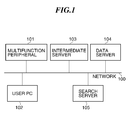
- FIG. 1 is a schematic block diagram of a job record audit system including an information processing apparatus according to a first embodiment of the present invention.
- FIG. 2 is a block diagram of the hardware configuration of the information processing apparatus appearing in FIG. 1 .
- FIG. 3 is a block diagram of the hardware configuration of a multifunction peripheral appearing in FIG. 1 .
- FIG. 4 is a diagram useful in explaining the flow of job information and content information transmitted from the multifunction peripheral to an intermediate server.
- FIG. 5 is a schematic diagram showing the configuration of functional components that operate during registration of job information and content information.
- FIG. 6 is a diagram of a list of processing contents to be executed by a registration processing determination section appearing in FIG. 5 .
- FIG. 7 is a diagram showing the contents of archive control information appearing in FIG. 5 .
- FIG. 8 is a flowchart of a job record registration process executed by the job record audit system in FIG. 1 .
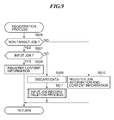
- FIG. 9 is a flowchart showing details of a registration process in FIG. 8 .
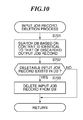
- FIG. 10 is a flowchart showing details of an input job record deletion process in FIG. 9 .
- FIG. 11 is a schematic diagram showing the configuration of functional components that operate during search of job information and content information.
- FIG. 12 is a flowchart of a job record registration process executed by a job record audit system including an information processing apparatus according to a second embodiment of the present invention.
- FIG. 1 is a schematic block diagram of a job record audit system including an information processing apparatus according to a first embodiment of the present invention.
- the job record audit system includes a multifunction peripheral (MFP) 101 as an example of an image processing apparatus, a user PC 102, an intermediate server 103, a data server 104, and a search server 105, all of which are interconnected via a network 100.
- the network 100 is a LAN (Local Area Network) operated within an office or a WAN (Wide Area Network) operated in a wide area over the Internet.
- the job record audit system comprises the network 100, and various kinds of devices including MFPs, PCs (personal computers), and servers, each connected to the network 100.
- the MFP 101 is provided with an agent function.
- the agent function is used to acquire job information and content information from a job, such as a copy job or a facsimile transmission job, which is executed by the MFP 101 according to a user operation, and send the acquired information to the intermediate server 103.
- Job information is attribute information associated with a job which the user causes a device or a PC to execute.
- the job attribute information includes the type of a job (job type), the user ID of a user who gives an instruction for executing the job, job start date and time, and the name of an apparatus that executed the job.
- image data is intended to mean image data and text data which are input (or output) along with execution of a job.
- Image feature value data extracted from the image data can be contained in the content information.
- Image feature value data comprises values that characterize an associated image, more specifically, values respectively indicative of a luminance information item, a color information item, an edge information item, and a value obtained from the respective values of these information items using a predetermined algorithm.
- the image feature value data is used when conducting a search for an image.
- the user PC 102 has a printer driver that functions during a print process executed by application software.
- the user PC 102 also incorporates add-on software that expands the function of the printer driver.
- the add-on software acquires job information and content information concerning print data which are to be transmitted from the user PC 102 to the MFP 101.
- the job information and the content information acquired by the user PC 102 are transferred to the intermediate server 103 by agent software for the PC.
- the agent software may be installed in the user PC 102, or alternatively be installed in a print server, not shown, set up on the network 100.
- the intermediate server 103 receives the job information and the content information transferred from the MFP 101 and the user PC 102, via the network 100.
- the intermediate server 103 performs data conversion processing on the received job information and content information, and data registration processing on the same for data registration in the data server 104.
- the data conversion processing includes image resolution conversion, data compression, data format conversion, text extraction by an OCR (Optical Character Reader), and extraction of image feature values for use in a search of an image.
- the intermediate server 103 registers data in the data server 104 using an ODBC (Open Database Connectivity) provider or another type of data provider.
- ODBC Open Database Connectivity
- the data server 104 is provided with a large-capacity storage formed by one or more HDDs (hard disk drives) on which a database (DB) is constructed.
- the database comprises one or more data tables having respective application-specific structures.
- the database is managed by a database management system (DBMS) operating on the data server 104 such that data consistency is guaranteed during registration, update, and search of data.
- DBMS database management system
- the job information and the content information stored in the data server 104 can be referred to, using the search server 105.
- the search server 105 is constructed by a Web application, and a user accesses the search server 105 using a Web browser.
- the search server 105 executes search processing based on the query.
- the result of the search is displayed on the Web browser used by the user for browsing, via the search server 105.
- the intermediate server 103, the data server 104, and the research server 105 are constructed by respective different information processing apparatuses, all of these or one or two of them may be integrated in one information processing apparatus.
- FIG. 2 is a block diagram of the hardware configuration of an information processing apparatus (PC or server) as a component of the job record audit system in FIG. 1 .
- a CPU 201 performs arithmetic operations for various kinds of data processing concerning acquisition of job records and for search, and provides control of components connected to a bus 208.
- a ROM 202 is a memory used exclusively for reading data stored therein. The ROM 202 stores basic control programs.
- a RAM 203 is a memory used for reading data therefrom and writing data therein. The RAM 203 is used for execution of various arithmetic operations by the CPU 201 and temporarily storing data.
- An external storage device 206 is used as a temporary storage area for storing a system program of an operating system (OS) of the information processing apparatus, programs for the job record audit system, and currently processed data.
- the external storage device 206 takes more time for data input/output than the RAM 203 does, but is capable of storing a larger amount of data.
- the external storage device 206 is generally implemented by a magnetic storage device (HDD), but it may be a device configured to receive therein an external medium, such as a CD-ROM, a DVD-ROM, or a memory card, which is inserted therein, for data reading and recording.
- An input device 204 is used to input characters and data to the information processing apparatus.
- the input device 204 comprises a keyboard and a mouse, neither of which is shown.
- a display device 205 is provided for displaying results of processing executed by the information processing apparatus.
- the display device 205 is implemented e.g. by a CRT or a liquid crystal monitor.
- a communication device 207 is connected to the LAN, and is used to perform TCP/IP data communication with other information processing apparatuses.
- FIG. 3 is a block diagram of the hardware configuration of a device (MFP 101) as a component of the job record audit system in FIG. 1 .
- a controller unit 2000 is connected to a scanner 2070 as an image input device and a printer 2095 as an image output device. Further, the controller unit 2000 is connected to a LAN 2011 and a public communication line (WAN) 2051, for inputting/outputting image information and device information.
- the LAN 2011 and the public communication line 2051 correspond to the network 100 in FIG. 1 .
- a CPU 2001 executes various kinds of data processing concerning the acquisition of job records, and performs overall control of the system.
- a RAM 2002 is a system work memory used for operation of the CPU 2001, and also functions as an image memory for temporarily storing image data.
- a ROM 2003 is a boot ROM that stores a boot program for the system.
- An HDD (hard disk drive) 2004 stores system software and image data.
- An operating section interface (I/F) 2006 provides interface with an operating section (UI) 2012 having a touch panel.
- the operating section interface 2006 outputs data to the operating section 2012 so as to cause the data to be displayed thereon.
- the operating section interface 2006 also transfers information input by a user of the present system via the operating section 2012 to the CPU 2001.
- a network interface (I/F) 2010 is connected to the LAN 2011, for input and output of information.
- a modem 2050 is connected to the public communication line 2051, for input and output of information.
- the above-mentioned devices are connected to a system bus 2007.
- An image bus interface (I/F) 2005 is a bus bridge that connects the system bus 2007 to an image bus 2008 for high-speed transfer of image data, and performs data structure conversion.
- the image bus 2008 is implemented e.g. by a PCI bus or an IEEE 1394.
- a raster image processor (RIP) 2060 rasterizes a PDL code into a bitmap image.
- a device interface (I/F) section 2020 connects the scanner 2070 and the printer 2095 as image input and output devices to the controller unit 2000, and performs synchronous-to-asynchronous or asynchronous-to-synchronous conversion of image data.
- a scanner image processing section 2080 corrects, manipulates, and edits input image data.
- a printer image processing section 2090 performs correction, resolution conversion, etc. of image data for printout.
- An image rotation section 2030 rotates image data.
- An image compression section 2040 compresses multi-valued image data into JPEG data, and binary image data into JBIG, MMR, or MH-formatted data, as well as performs expansion of compressed data.
- FIG. 4 is a diagram useful in explaining the flow of job information and content information generated during execution of a job by the MFP 101 and transmitted therefrom to the intermediate server 103.
- the illustrated example shows a case where a facsimile transmission execution operation 901 is performed as a user operation in the MFP 101. Further, it is assumed that operations appearing in FIG. 4 are achieved by reading a control program e.g. from the ROM 2003 and executing the control program by the CPU 2001 of the MFP 101.
- the MFP 101 recognizes a facsimile transmission instruction issued by user operation, as a combination of a scan job for acquiring image data by scanning an original by the scanner 2070 and a facsimile transmission job for facsimile transmission of the acquired image data by the modem 2050.
- Job types are defined according to jobs that can be executed by the MFP 101. For example, the job type of a job for sending scanned image data by e-mail is defined as "email-send".
- the MFP 101 During execution of the scan job, the MFP 101 generates a job record 902 related to scanning (hereinafter also referred to as “the scan job-associated job record”).
- the scan job in the example in FIG. 4 will be referred to as "send-scan”.
- the "send-scan” is a job for inputting data to the MFP 101, and therefore it is classified as an input job.
- the MFP 101 during execution of the facsimile transmission job, the MFP 101 generates a job record 907 related to facsimile transmission (hereinafter also referred to as "the facsimile transmission job-associated job record").
- the facsimile transmission job in the example in FIG. 4 will be referred to as "fax-scan”.
- the "fax-scan” is a job for outputting data from the MFP 101, and therefore it is classified as an output job.
- the MFP 101 even when the user carries out a single operation (e.g. the facsimile transmission execution operation 901), the MFP 101 sometimes internally divides the single operation into a plurality of jobs of different types, for execution.
- the job records 902 and 907 are audit information items stored in the data server 104 afterwards and used for audit purposes.
- the job records 902 and 907 related to the respective jobs executed by the MFP 101 are generated by the MFP 101 and are then temporarily stored in the HDD 2004 of the MFP 101. Thereafter, the job records 902 and 907 are sent to the intermediate server 103 in predetermined timing, using the agent function operating on the MFP 101.
- the scan job-associated job record 902 comprises job information 903 related to the attributes of the scan job and content information 905 which is data representing an image obtained by scanning.
- the job information 903 contains attribute information 904 associated with the scan job, such as a content ID "1234" for identifying the content information 905, the job type "send-scan", a user name, and a job start date and time.
- the content information 905 contains the content ID "1234", image data, and text data, as denoted by reference numeral 906 in FIG. 4 .
- the job information 903 and the content information 905 constituting the job record 902 are associated with each other by the content ID.
- the content ID "1234" is stored in each of the job information 903 and the content information 905.
- the content ID stored in the content information 905 may be contained not in the content 906 of the content information 905, but in a file name (not shown) of a data file (not shown) thereof.
- the facsimile transmission job-associated job record 907 comprises job information 908 related to the attributes of the facsimile transmission job.
- Image data for facsimile transmission is the same as contained in the content information 905 of the job record 902, and hence content information 909 of the job record 907 has no entity (actual content).
- a content ID contained in the job information 908 constituting the job record 907 stores the same value as that of the content ID in the content information 905 acquired as the job record 902.
- Attribute information 910 of the job information 908 store the content ID "1234".
- the value "1234" of the content ID is identical to that of the content ID of the job record 902, which means that the content information 909 of the facsimile transmission job-associated job record 907 is identical to the content information 905 of the job record 902 related to the scan job.
- the MFP 101 When the facsimile transmission execution operation 901 is performed by the user, the MFP 101 generates the scan job-associated job record 902 as an input job and the facsimile transmission job-associated job record 907 as an output job.
- job records (log information items) are sent to the intermediate server 103 by the agent function operating on the MFP 101 (911 and 912).
- the job records 902 and 907 are stored and managed as respective different job records in the data server 104.
- the facsimile transmission job-associated job record 907 When the data server 104 is searched by the search server 105 for the facsimile transmission job-associated job record 907, the facsimile transmission job-associated job record 907 registered as an output job is hit. At this time, the content 910 of the job information 908 contained in the facsimile transmission job-associated job record 907 is displayed as a search result. The content information 909 of the job record 907 has no entity, and hence the content 906 of the content information 905 contained in the scan job-associated job record 902 is displayed.
- the other input jobs than the scan job include a job for executing a scanning operation and then storing scanned data in a box in the MFP 101 and a job for executing network printing according to an instruction issued from the user PC 102 and then also storing data used for the network printing in a box.
- the other output jobs than the facsimile transmission job include a job for sending data to an external device by e-mail and a job for sending data to a file server. Both of these output jobs are link jobs.
- FIG. 5 is a schematic diagram showing the configuration of functional components that operate during data registration of job information and content information.
- the intermediate server 103 comprises an image processing section 301, a registration processing determination section 302, a job information and content information registration section 304, and a content information registration section 305, each of which operates as a functional component for realizing a data registration function.
- These functional components are software modules operating on the intermediate server 103.
- the image processing section 301 performs image processing on content information received from the MFP 101.
- the image processing includes resolution conversion, data compression, and data format conversion. Further, the image processing section 301 is provided with a function of extracting image feature value data for quantitatively defining features of an image. This function is provided so as to conduct a search for an image (an image search) using image feature values.
- Content information to be registered in the data server 104 via the job information and content information registration section 304 or the content information registration section 305 can contain image feature value data.
- the image feature value data is stored as feature value information in a feature value information table 311 in the data server 104.
- the registration processing determination section 302 identifies a job type (e.g. "send-scan") based on the content of job information received from the MFP 101, and switches between the functional components used for executing a data registration process for registering the job information and associated content information in the data server 104.
- the job information contains the attribute information 904 accompanying the job.
- the attribute information 904 includes the content ID, the job type, the user name, and the job start date and time, as described hereinabove.
- the job type is a keyword for identifying the type of a job issued by the user via the MFP 101. For example, when the user carries out the facsimile transmission execution operation 901 by the MFP 101, the two jobs, i.e.
- the job “send-scan” as a data scan job and the job “fax-send” as a facsimile transmission job are generated. Further, when the print process is executed from an application of the user PC 102, a job type called "print" is generated.
- the content information contains image data and text data generated by the MFP 101 or the user PC 102.
- the text data may be generated by the MFP 101 or the user PC 102 or by executing OCR processing by the image processing section 301 of the intermediate server 103.
- the job information and the content information are associated with each other as objects processed for a network session.
- the job information and the content information are associated with each other by being stored in the same folder.
- Archive control information 303 in the intermediate server 103 is a rewritable file in which types of information to be registered in the data server 104 are defined.
- the registration processing determination section 302 refers to a job type identified by the received job information and the archive control information 303, and causes either the job information and content information registration section 304 or the content information registration section 305 to execute the data registration process.
- the job information and content information registration section 304 and the content information registration section 305 are illustrated as different software modules by way of example, they may be integrated in one software module.
- the archive control information 303 is formed as an external file used in a program for realizing the function of the registration processing determination section 302, so that a determination criteria for processing can be changed simply by rewriting a new content into the file.
- the contents of the archive control information 303 are stored in a system table (system information table 310) provided in the data server 104 for storing system information.
- system information table 310 system information table 310
- the archive control information 303 is read out from the system information table 310 and written in the intermediate server 103.
- the archive control information 303 stored in the intermediate server 103 is also updated.
- the registration processing determination section 302 reads out the archive control information 303 for each job information registration process, not from the data server 104, but from the file in the intermediate server 103, which makes it possible to perform data registration without lowering the processing efficiency.
- the data registration process is classified into two types: a first registration process executed by the job information and content information registration section 304 and a second registration process executed by the content information registration section 305.
- first registration process job information and associated content information are both registered in the data server 104.
- the second registration process only the content information is registered.
- a job information table 306 is a database table storing job information.
- a content management table 307 is a database table for managing IDs unique to respective job information items and IDs unique to respective content information items so as to associate the job information items with the respective content information items.
- a text information table 308 is a database table for managing text information.
- An image information table 309 is a database table for managing image information. The text information and the image information are subsets of the content information.
- Text information is text (character)-based data in content information.
- Text data is obtained, using the OCR function of the image processing section 301, from image data acquired by the MFP 101, or directly obtained from the printer driver of the user PC 102. Further, when a job, such as e-mail transmission, is executed by the MFP 101, text data is obtained from character data of the body of an e-mail. These text (character) data obtained as mentioned are generically referred to as text information.
- image information is image-related data in content information.
- Image information is obtained by the MFP 101 scanning an original or from the printer driver of the user PC 102.
- An optimal data format of image information is selected from JPEG, JBIG, TIFF, etc. according to a process to be executed by the apparatus.
- the job information and content information registration section 304 performs data analysis on job information, and stores data of job attribute information and an associated job information ID in respective predetermined fields of the job information table 306.
- content information an ID (content ID) for uniquely identifying a text data item and an image data item and a job information ID for uniquely identifying a job information item are stored in the content management table 307.
- the text data is stored in the text information table 308 together with the content ID.
- the image data is stored in the image information table 309 together with the content ID.
- the job information and the content information are stored in respective predetermined fields of the same content management table 307, for association between them.
- the content information registration section 305 accesses the content management table 307, the text information table 308, and the image information table 309, and registers only content information.
- the job information and content information registration section 304 not only performs the same processing as performed by the content information registration section 305, but also accesses the job information table 306, and registers job information therein.
- a job information item is identified by an associated job information ID in the job information table 306.
- content information associated with the job information a text data item is identified by an associated content ID in the text information table 308, and an image data item is identified by an associated content ID in the image information table 309.
- the job information ID and the content ID are associated with each other by the content management table 307.
- the content information registration section 305 registers content information associated with a job executed by the MFP 101, but not job information.
- the content information registered in the data server 104 by the content information registration section 305 is used to be referred to from job information associated with another job executed by the MFP 101 using the same content.
- the content information registration section 305 stores the content ID contained in the job information and the entity (image information and text information) of the content information in the content management table 307, the text information table 308, and the image information table 309. At this time, the job information ID in the content management table 307 remains null without being changed.
- FIG. 6 is a diagram of a list of processing contents to be executed by the registration processing determination section 302 appearing in FIG. 5 .
- a processing content to be executed by the registration processing determination section 302 is determined based on the archive control information 303 read out from the system information table 310 in the data server 104 and stored in the intermediate server 103. Processing contents are roughly divided into registration target jobs 401 and non-registration target jobs 402.
- a registration target job 401 is a job designated by an auditor of the present system as an object to be registered, whereas a non-registration target job 402 is a job not designated by the auditor of the present system as an object to be registered. Registration of the registration target job 401 is performed by the job information and content information registration section 304.
- a processing content to be executed at a later stage than the registration processing determination section 302 depends on a job type contained in the job information.
- the job type is an input job (e.g. "send-scan") as denoted by reference numeral 403
- the job is executed by the content information registration section 305. This is because the non-registration target job 402 does not require job information, and it suffices to register only content information.
- FIG. 7 is a diagram showing the contents of the archive control information 303 appearing in FIG. 5 .
- the archive control information 303 stores, as a set of setting information items, the job type of an input job, the job type of an output job associated with the input job, and a setting value for identifying whether or not jobs of these job types are objects to be archived.
- the job type "fax-send" of the facsimile transmission job is set as a registration target job (job to be registered).
- the content information on the input job "send-scan" associated with the output job is also set to be registered so as to enable the content information to be referred to from the job record of the output job "fax-send”.
- an output job "email-send” is a non-registration target job.
- FIG. 8 is a flowchart of a job record registration process executed by the job record audit system in FIG. 1 .
- data acquisition in a step S501 and data transmission in a step S502 are executed by the agent function of the MFP 101 or the user PC 102.
- the agent function acquires job information and content information on an accepted job.
- the MFP 101 sends the acquired job information and content information to the intermediate server 103.
- Steps S503 to S505 are executed by the intermediate server 103.
- the intermediate server 103 (the CPU 201) receives the job information and the content information from the MFP 101.
- the intermediate server 103 (the CPU 201) receives the job information and the content information from the MFP 101.
- the image processing section 301 in the intermediate server 103 performs image processing, such as resolution conversion, data compression, and data format conversion, on the received content information.
- the registration processing determination section 302, the job information and content information registration section 304, and the content information registration section 305 in FIG. 5 execute the above-mentioned data registration process.
- the data registration process executed in the step S505 will be described in detail with reference to FIG. 9 .
- FIG. 9 is a flowchart showing details of the registration process in the step S505 in FIG. 8 .
- the registration processing determination section 302 refers to information indicative of a job type, which is contained in the job information, and the archive control information 303 to thereby determine whether or not the job information and the content information are on a non-registration target job (step S506). If it is determined that the job information and the content information are on a registration target job (NO to the step S506), the job information and content information registration section 304 registers these data items in the data server 104 (step S510), and then the process returns.
- step S506 it is determined whether or not the job type contained in the job information is an input job (step S507). If the job type contained in the job information is an input job (YES to the step S507), the content information registration section 305 registers only the content information in the data server 104 (step S508). In other words, in the step S508, the job information is not registered in the data server 104.
- step S507 if the job type contained in the job information is not an input job (NO to the step S507), the data is discarded without execution of the data registration process (step S509), and then the process proceeds to a step S511.
- step S511 since the job record received by the intermediate server 103 is on an output job set as a non-registration target job, content information on an input job associated with the output job, which has already been registered, is deleted (input job record deletion process).
- the input job record deletion process executed in the step S511 will be described hereinafter with reference to FIG. 10 .
- a job record associated with a job (input job) whose content information is likely to be referred to from an associated output job is registered in the data server 104 even if the job is set as a non-registration target job, i.e. a job that is not to be registered in the data server 104.
- an output job such as the facsimile transmission job, which is set for registration
- job information associated therewith is not registered, so that it is possible to reduce the storage capacity of the data server 104.
- FIG. 10 is a flowchart showing details of the input job record deletion process in the step S511 in FIG. 9 .
- a step S701 the data server 104 is searched for a content data item having the same content ID as that of the job record of the output job discarded in the step S509. This search may be performed directly by the intermediate server 103 or alternatively using the search server 105.
- deletable content information on an input job is intended to mean a job record of an input job which was registered in the data server 104 because of its possibility of being linked from an output job which is a registration target but was determined not to be linked from an output job which is a registration target.
- a job which has a possibility of being linked from “send-scan” is either “fax-send” or "email-send".
- the content information on the input job "send-scan”, which has a possibility of being linked from the registration target output job "fax-send”, is registered in the data server 104.
- the output job "email-send” is received at the intermediate server as an output job linked to the content information on the input job "send-scan” (i.e. as an output job having the same content ID)
- FIG. 11 is a schematic diagram showing the configuration of functional components that operate during search of job information and content information.
- the search server 105 comprises a display section 601, a query processing section 602, and an image search processing section 603, as functional components for realizing a search process.
- These functional components are software modules that operate on the search server 105.
- the search process is executed when job information and content information stored in the data server 104 are to be referred to.
- the auditor designates a search key associated with the job information and the content information and then searches the job information and the content information registered in the data server 104.
- the auditor performs an audit by referring to hit job information and content information.
- search process it is possible to conduct a search using job attributes on job information, and conduct a full-text search or an image search on content information. Furthermore, a combination of these searches can be conducted, which makes it possible to improve user friendliness for audit of job information and content information.
- the search of job information is executed on indices associated with respective values stored in the job information table 306.
- the search of text data is executed on indices associated with respective values stored in the text information table 308.
- the search of image data is executed on image feature value data (feature value information) stored in the feature value information table 311 in FIG. 5 .
- a job information item hit in the search process is identified by a job information ID.
- a text data item and an image data item are identified by a content ID.
- the content management table 307 stores job information IDs and content IDs in proper association therebetween. Therefore, by looking up the job information table 306 using a content ID, it is possible to obtain information on a job that generated a content information item associated with the content ID.
- the display section 601 is a functional module for generating a user interface for a search application.
- the display section 601 is provided with an interface for inputting a search condition, which enables the user to designate an attribute query, a full-text query, an image query, or a combination of these logical conditions.
- the display section 601 is also provided with a function of displaying search results. Search results are displayed on a screen on a job-by-job basis in a list form or in a thumbnail form. Further, the display section 601 is provided with a function of displaying job information and content information. For example, the user name of a user who designated a job, a job start date and time, the name of an apparatus which executed the job, and so forth are displayed as job information on the display section 601. As content information, text information contained in an image and the image itself are displayed on the display section 601.
- the query processing section 602 is a functional module for converting search conditions designated via the display section 601 into an SQL query and making a query to the data server 104. Further, the query processing section 602 is provided with a function of receiving a result of processing executed by the data server 104 and sending the processing result to the display section 601.
- the input job is hit in the search process only when an output job that refers to the content information has been registered in the data server 104.
- no output job that refers to the content information has been registered in the data server 104, it is judged that no job has been hit, and the result is normally processed.
- a content information item is always registered in association with a job information item. For this reason, whenever a content information item is hit in the search process, a job information item associated with the content information item can be acquired as a search result.
- the content information registration section 305 produces a state in which only a content information item is registered but a job information item is not. When such a search is conducted as will cause the content information item to be hit, an event occurs in which the content information item is hit, but there is no associated job to be displayed.
- the query processing section 602 even when the query processing section 602 cannot acquire any job record, it is not judged as an error. In a case where a content information item is hit, but no associated job information item is found, the query processing section 602 operates to acquire another job information item hit by search. The job information item acquired by the query processing section 602 in the search process is transferred to the display section 601 and is displayed on the screen.
- the query processing section 602 conducts a search on job information by referring to the indexes on the values stored in the job information table 306, whereas it conducts a full-text search on text data by referring to the indexes on the values stored in the text information table 308.
- the query processing section 602 conducts a search on image data based on image feature value data (feature value information) stored in the feature value information table 311 in FIG. 5 .
- Image search processing requires calculation of a degree of similarity concerning image feature values using the image search processing section 603.
- the query processing section 602 accesses the image search processing section 603 to thereby execute a sequence of image search processing involving the similarity calculation.
- the query processing section 602 and the image search processing section 603 cooperates with each other.
- a job record associated with a specific job type is set to be an object to be registered in the data server, and content information on an input job, which has turned out to be unnecessary, is deleted. This makes it possible to prevent unnecessary data from continuing to be registered in the data server, which contributes to reduction of the storage capacity of the data server.
- the second embodiment is identical to the first embodiment in the configuration shown in FIGS. 1 to 8 , and therefore description thereof is omitted, while denoting the same elements by the same reference numerals, respectively.
- the following description is given of points different from the first embodiment.
- FIG. 12 is a flowchart a job record registration process executed by a job record audit system including an information processing apparatus according to the second embodiment.
- This job record registration process is identical to the process described hereinabove with reference to FIG. 8 , and the registration process in the step S505 corresponds to the process in FIG. 12 .
- steps S1006 to S1010 in FIG. 12 correspond to the steps S506 to S510 in FIG. 9 , but differently from the first embodiment, in the second embodiment, the process (input job record deletion process) executed in the step S511 in FIG. 9 is not included in the process shown in FIG. 12 .
- deletion of a job record is performed by the data server 104.
- Job records of jobs executed by the MFP 101 are each subjected to the job record registration process in FIG. 8 in the intermediate server 103 and are eventually accumulated in the data server 104.
- the data server 104 executes a job record deletion process in predetermined timing (e.g. at 0 o'clock every day).
- This job records deletion process corresponds to the input job record deletion process in FIG. 10 .
- a deletable job record stored in the data server 104 is searched for based on the archive control information 303 stored in the data server 104, and when a deletable job record is found, it is deleted.
- the intermediate server 103 is not used to delete job records, and therefore the intermediate server 103 can be dedicated to job record registration processing, which makes it possible to improve the throughput of the job record registration.
- the system is configured such that the intermediate server 103, the data server 104, and the search server 105 are separately provided independent of each other, this is not limitative, but the system may be configured as an information processing apparatus integrating the three servers.
- aspects of the present invention can also be realized by a computer of a system or apparatus (or devices such as a CPU or MPU) that reads out and executes a program recorded on a memory device to perform the functions of the above-described embodiments, and by a method, the steps of which are performed by a computer of a system or apparatus by, for example, reading out and executing a program recorded on a memory device to perform the functions of the above-described embodiments.
- the program is provided to the computer for example via a network or from a recording medium of various types serving as the memory device (e.g., computer-readable medium).
Landscapes
- Engineering & Computer Science (AREA)
- Multimedia (AREA)
- Signal Processing (AREA)
- General Engineering & Computer Science (AREA)
- Theoretical Computer Science (AREA)
- General Physics & Mathematics (AREA)
- Physics & Mathematics (AREA)
- Human Computer Interaction (AREA)
- Computer Security & Cryptography (AREA)
- Computing Systems (AREA)
- Facsimiles In General (AREA)
- Storage Device Security (AREA)
- Debugging And Monitoring (AREA)
Applications Claiming Priority (1)
| Application Number | Priority Date | Filing Date | Title |
|---|---|---|---|
| JP2009149794A JP5383344B2 (ja) | 2009-06-24 | 2009-06-24 | 情報処理装置及び情報処理装置の制御方法、並びにプログラム |
Publications (1)
| Publication Number | Publication Date |
|---|---|
| EP2270646A1 true EP2270646A1 (de) | 2011-01-05 |
Family
ID=42668119
Family Applications (1)
| Application Number | Title | Priority Date | Filing Date |
|---|---|---|---|
| EP10166679A Withdrawn EP2270646A1 (de) | 2009-06-24 | 2010-06-21 | Informationsverarbeitungsvorrichtung, die Informationen über Bildverarbeitungsaufträge in einem Datenserver registriert, Verfahren zu deren Steuerung und Programm |
Country Status (5)
| Country | Link |
|---|---|
| US (1) | US8589526B2 (de) |
| EP (1) | EP2270646A1 (de) |
| JP (1) | JP5383344B2 (de) |
| KR (1) | KR101346677B1 (de) |
| CN (1) | CN101931729A (de) |
Cited By (1)
| Publication number | Priority date | Publication date | Assignee | Title |
|---|---|---|---|---|
| KR101346677B1 (ko) | 2009-06-24 | 2014-01-02 | 캐논 가부시끼가이샤 | 데이터 서버에 화상 처리 잡에 관한 정보를 등록하는 정보처리장치, 그 제어방법, 및 기억 매체 |
Families Citing this family (9)
| Publication number | Priority date | Publication date | Assignee | Title |
|---|---|---|---|---|
| JP5671983B2 (ja) * | 2010-12-02 | 2015-02-18 | 株式会社リコー | 情報処理装置、機器管理システム、情報処理方法、及び情報処理プログラム |
| JP5778521B2 (ja) * | 2011-08-15 | 2015-09-16 | フェリカネットワークス株式会社 | 情報処理装置、情報処理方法、プログラム、および情報処理システム |
| US10277778B2 (en) | 2014-06-24 | 2019-04-30 | Ec Data Systems Inc. | Audit logging for a secure, scalable and flexible internet fax architecture |
| US20170034098A1 (en) * | 2015-07-27 | 2017-02-02 | Kabushiki Kaisha Toshiba | Communication apparatus and received data analysis method |
| JP2017061079A (ja) * | 2015-09-24 | 2017-03-30 | キヤノン株式会社 | 画像形成装置、及びその制御方法 |
| JP6723733B2 (ja) | 2015-11-28 | 2020-07-15 | キヤノン株式会社 | 制御装置、管理システム、制御方法、およびプログラム |
| JP6911343B2 (ja) * | 2016-12-13 | 2021-07-28 | 株式会社リコー | 情報処理装置、ログ管理方法及びプログラム |
| JP2019062455A (ja) * | 2017-09-27 | 2019-04-18 | キヤノン株式会社 | 画像形成装置及びその制御方法、並びにプログラム |
| JP2024074313A (ja) * | 2022-11-21 | 2024-05-31 | キヤノン株式会社 | 画像形成装置および画像形成装置の制御方法に関する |
Citations (5)
| Publication number | Priority date | Publication date | Assignee | Title |
|---|---|---|---|---|
| JPH05290087A (ja) | 1992-04-13 | 1993-11-05 | Nec Corp | ジョブ情報表示方式 |
| US20060074840A1 (en) * | 2004-09-24 | 2006-04-06 | Toshiba Corporation | System and method for tracking print job status |
| EP1727349A2 (de) * | 2005-05-24 | 2006-11-29 | Canon Kabushiki Kaisha | Aufzeichnung von Betriebsablaufdaten von Eingabe- und Ausgabejobs einer Bildverarbeitungsvorrichtung |
| US20080133560A1 (en) * | 2006-11-30 | 2008-06-05 | Sharp Laboratories Of America, Inc. | Job auditing systems and methods for direct imaging of documents |
| US20090119550A1 (en) * | 2007-11-06 | 2009-05-07 | Canon Kabushiki Kaisha | Image forming apparatus and analysis method |
Family Cites Families (7)
| Publication number | Priority date | Publication date | Assignee | Title |
|---|---|---|---|---|
| JP2006041764A (ja) * | 2004-07-23 | 2006-02-09 | Ricoh Co Ltd | ログ記録装置、ログ記録プログラムおよび記録媒体 |
| US8171404B2 (en) * | 2004-10-08 | 2012-05-01 | Sharp Laboratories Of America, Inc. | Methods and systems for disassembly and reassembly of examination documents |
| JP4810331B2 (ja) * | 2006-06-29 | 2011-11-09 | キヤノン株式会社 | 画像出力装置、画像出力装置の制御方法及びプログラム、並びに管理システム |
| JP5004709B2 (ja) * | 2007-07-27 | 2012-08-22 | 株式会社リコー | 画像処理装置、システム、プログラムおよび記録媒体 |
| JP5543060B2 (ja) * | 2007-10-23 | 2014-07-09 | キヤノン株式会社 | ジョブ処理システム及びジョブ処理方法、記憶媒体及びプログラム |
| JP5679624B2 (ja) * | 2008-07-01 | 2015-03-04 | キヤノン株式会社 | 印刷装置及びその制御方法とプログラム |
| JP5383344B2 (ja) | 2009-06-24 | 2014-01-08 | キヤノン株式会社 | 情報処理装置及び情報処理装置の制御方法、並びにプログラム |
-
2009
- 2009-06-24 JP JP2009149794A patent/JP5383344B2/ja not_active Expired - Fee Related
-
2010
- 2010-06-18 US US12/818,499 patent/US8589526B2/en not_active Expired - Fee Related
- 2010-06-21 EP EP10166679A patent/EP2270646A1/de not_active Withdrawn
- 2010-06-23 KR KR1020100059473A patent/KR101346677B1/ko not_active Expired - Fee Related
- 2010-06-24 CN CN2010102130336A patent/CN101931729A/zh active Pending
Patent Citations (6)
| Publication number | Priority date | Publication date | Assignee | Title |
|---|---|---|---|---|
| JPH05290087A (ja) | 1992-04-13 | 1993-11-05 | Nec Corp | ジョブ情報表示方式 |
| US20060074840A1 (en) * | 2004-09-24 | 2006-04-06 | Toshiba Corporation | System and method for tracking print job status |
| EP1727349A2 (de) * | 2005-05-24 | 2006-11-29 | Canon Kabushiki Kaisha | Aufzeichnung von Betriebsablaufdaten von Eingabe- und Ausgabejobs einer Bildverarbeitungsvorrichtung |
| JP2006330939A (ja) | 2005-05-24 | 2006-12-07 | Canon Inc | 画像処理装置及び方法 |
| US20080133560A1 (en) * | 2006-11-30 | 2008-06-05 | Sharp Laboratories Of America, Inc. | Job auditing systems and methods for direct imaging of documents |
| US20090119550A1 (en) * | 2007-11-06 | 2009-05-07 | Canon Kabushiki Kaisha | Image forming apparatus and analysis method |
Cited By (1)
| Publication number | Priority date | Publication date | Assignee | Title |
|---|---|---|---|---|
| KR101346677B1 (ko) | 2009-06-24 | 2014-01-02 | 캐논 가부시끼가이샤 | 데이터 서버에 화상 처리 잡에 관한 정보를 등록하는 정보처리장치, 그 제어방법, 및 기억 매체 |
Also Published As
| Publication number | Publication date |
|---|---|
| US20100332636A1 (en) | 2010-12-30 |
| US8589526B2 (en) | 2013-11-19 |
| KR101346677B1 (ko) | 2014-01-02 |
| KR20100138815A (ko) | 2010-12-31 |
| JP2011008398A (ja) | 2011-01-13 |
| CN101931729A (zh) | 2010-12-29 |
| JP5383344B2 (ja) | 2014-01-08 |
Similar Documents
| Publication | Publication Date | Title |
|---|---|---|
| US8589526B2 (en) | Information processing apparatus that registers information on image processing job in data server, method of controlling the same, and storage medium | |
| US8326090B2 (en) | Search apparatus and search method | |
| US7930292B2 (en) | Information processing apparatus and control method thereof | |
| US8593661B2 (en) | Image output apparatus including transmission units, image output apparatus control method, program, electronic document management system | |
| US9026564B2 (en) | Document processing system and control method thereof, program, and storage medium | |
| US8166382B2 (en) | Data processing apparatus, method of registering electronic document, and computer program | |
| US20100079781A1 (en) | Document processing system and control method thereof, program, and storage medium | |
| US8310711B2 (en) | Output device and its control method for managing and reusing a job history | |
| JP5660100B2 (ja) | 文書管理サーバ、文書管理サーバの制御方法、およびそのプログラム、文書管理システム、文書管理システムの制御方法、およびそのプログラム | |
| JP2006185153A (ja) | セキュリティ情報推定装置、セキュリティ情報推定方法、セキュリティ情報推定プログラム及び記録媒体 | |
| JP5750007B2 (ja) | 情報処理装置及び情報処理方法 | |
| JP5371611B2 (ja) | データ処理システム、サーバ、サーバの制御方法、及びプログラム | |
| US9489380B2 (en) | Methods and apparatus for management of unconsciously captured documents | |
| US20070206215A1 (en) | Print Control System, Print Attribute Information Management Server, Print Controller, Print Control Method, Recording Medium, And Data Signal | |
| KR100923368B1 (ko) | 네트워크 프린터 시스템의 프린터 사용관리장치 및 그 방법 | |
| JP2005050018A (ja) | 文書ファイル管理装置及びデータ構造 | |
| JP2011139363A (ja) | 画像形成装置、情報処理装置、データ処理サーバ及び情報処理方法 | |
| JP4329811B2 (ja) | 画像処理装置、画像処理システム、画像処理装置におけるデータの管理方法、およびコンピュータプログラム | |
| US20110032572A1 (en) | Job history data inspection system | |
| JP2023119138A (ja) | 管理システム、管理方法、画像処理装置、画像処理方法及びプログラム | |
| US8422075B2 (en) | Information updating apparatus, image history inspection apparatus, information updating method, and storage medium | |
| JP2005050017A (ja) | 文書ファイル管理装置、文書ファイル管理方法及びデータ構造 | |
| US20240176558A1 (en) | Image forming apparatus and control method | |
| JP4301042B2 (ja) | ドキュメント編集装置、画像形成装置、ドキュメント編集方法、およびコンピュータプログラム | |
| JP2013183300A (ja) | ジョブ履歴監査システム、及びその制御方法、並びにプログラム |
Legal Events
| Date | Code | Title | Description |
|---|---|---|---|
| PUAI | Public reference made under article 153(3) epc to a published international application that has entered the european phase |
Free format text: ORIGINAL CODE: 0009012 |
|
| AK | Designated contracting states |
Kind code of ref document: A1 Designated state(s): AL AT BE BG CH CY CZ DE DK EE ES FI FR GB GR HR HU IE IS IT LI LT LU LV MC MK MT NL NO PL PT RO SE SI SK SM TR |
|
| AX | Request for extension of the european patent |
Extension state: BA ME RS |
|
| 17P | Request for examination filed |
Effective date: 20110705 |
|
| 17Q | First examination report despatched |
Effective date: 20130502 |
|
| STAA | Information on the status of an ep patent application or granted ep patent |
Free format text: STATUS: THE APPLICATION HAS BEEN WITHDRAWN |
|
| 18W | Application withdrawn |
Effective date: 20150723 |