EP2264580A2 - Verfahren und Vorrichtung zur Verarbeitung von Bewegungsdaten - Google Patents
Verfahren und Vorrichtung zur Verarbeitung von Bewegungsdaten Download PDFInfo
- Publication number
- EP2264580A2 EP2264580A2 EP10164849A EP10164849A EP2264580A2 EP 2264580 A2 EP2264580 A2 EP 2264580A2 EP 10164849 A EP10164849 A EP 10164849A EP 10164849 A EP10164849 A EP 10164849A EP 2264580 A2 EP2264580 A2 EP 2264580A2
- Authority
- EP
- European Patent Office
- Prior art keywords
- motion data
- moving velocity
- motion
- filtering coefficient
- lpf
- Prior art date
- Legal status (The legal status is an assumption and is not a legal conclusion. Google has not performed a legal analysis and makes no representation as to the accuracy of the status listed.)
- Withdrawn
Links
Images





Classifications
-
- G—PHYSICS
- G06—COMPUTING OR CALCULATING; COUNTING
- G06F—ELECTRIC DIGITAL DATA PROCESSING
- G06F3/00—Input arrangements for transferring data to be processed into a form capable of being handled by the computer; Output arrangements for transferring data from processing unit to output unit, e.g. interface arrangements
- G06F3/01—Input arrangements or combined input and output arrangements for interaction between user and computer
- G06F3/03—Arrangements for converting the position or the displacement of a member into a coded form
- G06F3/033—Pointing devices displaced or positioned by the user, e.g. mice, trackballs, pens or joysticks; Accessories therefor
- G06F3/038—Control and interface arrangements therefor, e.g. drivers or device-embedded control circuitry
-
- G—PHYSICS
- G06—COMPUTING OR CALCULATING; COUNTING
- G06F—ELECTRIC DIGITAL DATA PROCESSING
- G06F3/00—Input arrangements for transferring data to be processed into a form capable of being handled by the computer; Output arrangements for transferring data from processing unit to output unit, e.g. interface arrangements
- G06F3/01—Input arrangements or combined input and output arrangements for interaction between user and computer
- G06F3/03—Arrangements for converting the position or the displacement of a member into a coded form
- G06F3/033—Pointing devices displaced or positioned by the user, e.g. mice, trackballs, pens or joysticks; Accessories therefor
- G06F3/0346—Pointing devices displaced or positioned by the user, e.g. mice, trackballs, pens or joysticks; Accessories therefor with detection of the device orientation or free movement in a three-dimensional [3D] space, e.g. 3D mice, 6-DOF [six degrees of freedom] pointers using gyroscopes, accelerometers or tilt-sensors
-
- G—PHYSICS
- G06—COMPUTING OR CALCULATING; COUNTING
- G06F—ELECTRIC DIGITAL DATA PROCESSING
- G06F3/00—Input arrangements for transferring data to be processed into a form capable of being handled by the computer; Output arrangements for transferring data from processing unit to output unit, e.g. interface arrangements
- G06F3/01—Input arrangements or combined input and output arrangements for interaction between user and computer
- G06F3/048—Interaction techniques based on graphical user interfaces [GUI]
- G06F3/0481—Interaction techniques based on graphical user interfaces [GUI] based on specific properties of the displayed interaction object or a metaphor-based environment, e.g. interaction with desktop elements like windows or icons, or assisted by a cursor's changing behaviour or appearance
Definitions
- Apparatuses and methods consistent with the present invention relate to a an apparatus and methods for processing motion data.
- 3D input devices are used to sense movement such as panning or tilting or to control movement of a pointer in a graphical user interface (GUI) environment of corresponding devices such as a mouse.
- GUI graphical user interface
- a device for controlling movement of a GUI pointer through user's movement in space is referred to as a space pointing device.
- a space pointing device may be independently used without a supporting means in 3D space.
- a space pointing device is affected by vibration of a user's hand.
- a low pass filter LPF is generally used.
- the cutoff frequency of LPF is set to be low in order to reduce effect induced by vibration of a user's hand using the LPF.
- the filtering coefficient ⁇ 0 which serves as a constant should be set to be a small value.
- FIGS. 1A and 1B illustrate such a problem.
- FIG. 1B is an enlarged view of Section A illustrated in FIG. 1A .
- filtered data dotted line
- FIG. 1B the effect induced by vibration of a user's hand is reduced within section S of slow movement, but time delay appears within sections f1 and f2 of fast movement.
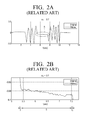
- the cutoff frequency of LPF is set to be high in order to minimize time delay, and the filtering coefficient ⁇ 0 of Numerical Formula 1 should be set to be large in order to achieve it.
- FIGS. 2A and 2B illustrate such a problem.
- FIG. 2B is an enlarged view of Section B illustrated in FIG. 2A .
- the time delay is reduced within sections f1 and f2 of fast movement, but the noise induced by vibration of a user's hand still appears within section S of slow movement.
- Exemplary embodiments of the present invention aim to address at least the above problems and/or disadvantages and other disadvantages not described above. Also, the present invention is not required to overcome the disadvantages described above, and an exemplary embodiment of the present invention may not overcome any of the problems described above.
- An aspect of the present invention provides a method for setting a filtering coefficient based on motion data and performing low pass filtering (LPF) on the motion data and an apparatus using the same so that both time excessive delay induced by fast movement and vibration of a user's hand induced by slow movement may be improved.
- LPF low pass filtering
- an electronic apparatus including a sensor which senses movement; a calculation unit which calculates motion data according to an output of the sensor; a setting unit which sets a filtering coefficient according to the motion data calculated by the calculation unit; a low pass filter (LPF) which performs low pass filtering on the motion data calculated by the calculation unit according to the filtering coefficient set by the setting unit; and a processor which processes the motion data filtered by the LPF.
- a sensor which senses movement
- a calculation unit which calculates motion data according to an output of the sensor
- a setting unit which sets a filtering coefficient according to the motion data calculated by the calculation unit
- LPF low pass filter
- the setting unit may calculate moving velocity according to the motion data calculated by the calculation unit, and set the filtering coefficient to adjust a cutoff frequency of the LPF according to the moving velocity.
- the setting unit may set the filtering coefficient to increase the cutoff frequency of the LPF.
- the setting unit may set the filtering coefficient to decrease the cutoff frequency of the LPF.
- the motion data calculated by the calculation unit may include at least one of position data and velocity data which is changed according to the movement sensed by the sensor.
- the setting unit may calculate moving velocity using the position data within a time interval including at least one of a current time and previous times.
- the setting unit may calculate the moving velocity using the velocity data within a time interval including at least one of a current time and previous times.
- the movement may include at least one of 1) a movement of the electronic apparatus caused by a user, 2) a movement of the electronic apparatus caused by external force, and 3) a movement of the electronic apparatus caused by an internal force.
- the processor may further perform one of 1) an operation to decide a location of a pointer to be displayed on a display according to the motion data filtered by the LPF, 2) an operation to transfer the motion data filtered by the LPF to an external device, and 3) an operation to control other elements according to the motion data filtered by the LPF.
- a method for processing motion data including sensing movement; calculating motion data according to the sensed movement; setting a filtering coefficient according to the calculated motion data; performing low pass filtering on the calculated motion data according to the set filtering coefficient; and processing the filtered motion data.
- the operation of setting may include calculating moving velocity according to the calculated motion data; and setting the filtering coefficient to adjust a cutoff frequency according to the moving velocity.
- the operation of setting may set the filtering coefficient to increase the cutoff frequency.
- the operation of setting may set the filtering coefficient to decrease the cutoff frequency.
- the movement may comprise at least one of 1) movement of the electronic device caused by a user, 2) movement of the electronic device caused by an external force, and 3) movement of the electronic device caused by an internal force.
- the operation of processing may perform one of 1) operation to decide location of a pointer to be displayed on a display according to the filtered motion data, 2) operation to transfer the filtered motion data to an external device, and 3) operation to control other element according to the filtered motion data, and process the filtered motion data.
- a filtering apparatus including a setting unit which sets a filtering coefficient according to motion data; and a low pass filter (LPF) which performs low pass filtering on the motion data according to the filtering coefficient set by the setting unit.
- LPF low pass filter
- a computer-readable recording medium recording thereon a program for: setting a filtering coefficient according to motion data; and performing low pass filtering on the motion data according to the set filtering coefficient.
- a display system including a remote control and a display device, wherein the remote control has a sensor which senses movement; a calculation unit which calculates motion data according to an output of the sensor; a setting unit which sets a filtering coefficient according to the motion data calculated by the calculation unit; a low pass filter (LPF) which performs low pass filtering on the motion data calculated by the calculation unit according to the filtering coefficient set by the setting unit; and a transmitter which transmits the filtered motion data; wherein the display device has a receiver which receives the filtered motion data transmitted by the remote control; a processor which processes the motion data received by the receiver; and a display which displays images according to the processed motion data.
- the remote control has a sensor which senses movement; a calculation unit which calculates motion data according to an output of the sensor; a setting unit which sets a filtering coefficient according to the motion data calculated by the calculation unit; a low pass filter (LPF) which performs low pass filtering on the motion data calculated by the calculation unit according to the filtering coefficient set by
- a display device having: a receiver which receives motion data which has been low pass filtered according to a filtering coefficient based on a sensed motion; a processor which processes the motion data received by the receiver; and a display which displays images according to the processed motion data.
- an electronic device including a sensor which senses movement; a calculator which calculates motion data based on an output from the sensor; and a motion processor which adjusts a degree of removing movements unintended by a user according to a moving velocity calculated based on the motion data.
- the motion processor may adjust the degree of removing movements unintended by a user so that the faster the moving velocity becomes, the lower the degree of removing movements unintended by a user becomes.
- the motion processor may include a setting unit which sets a filtering coefficient to adjust the degree of removing movements unintended by a user according to the moving velocity; a low pass filter (LPF) which performs low pass filtering on the motion data calculated by the calculator according to the filtering coefficient set by the setting unit; and a processor which processes the motion data filtered by the LPF.
- a setting unit which sets a filtering coefficient to adjust the degree of removing movements unintended by a user according to the moving velocity
- LPF low pass filter
- the setting unit may set the filtering coefficient to be high if the moving velocity is high so that the faster the moving velocity becomes, the lower the degree of removing movements unintended by a user becomes.
- a motion data processing method including sensing movement; calculating motion data based on an output from a sensor; and motion-processing to adjust a degree of removing movements unintended by a user according to a moving velocity calculated based on the motion data.
- the motion-processing may adjust the degree of removing movements unintended by a user so that the faster the moving velocity becomes, the lower the degree of removing movements unintended by a user becomes.
- the motion-processing may include setting a filtering coefficient to adjust the degree of removing movements unintended by a user according to the moving velocity; performing low pass filtering on the calculated motion data according to the set filtering coefficient; and processing the filtered motion data.
- the setting may set the filtering coefficient to be high if the moving velocity is high so that the faster the moving velocity becomes, the lower the degree of removing movements unintended by a user becomes.
- an electronic device including a sensor which senses movement; a calculator which calculates motion data based on an output from the sensor; and a motion processor which adjusts a sensitivity in sensing movements according to a moving velocity calculated based on the motion data.
- the motion processor may adjust the sensitivity in sensing movements so that the faster the moving velocity becomes, the higher the sensitivity in sensing movements becomes.
- the motion processor may include a setting unit which sets a filtering coefficient to adjust the sensitivity in sensing movements according to the moving velocity; a low pass filter (LPF) which performs low pass filtering on the motion data calculated by the calculator according to the filtering coefficient set by the setting unit; and a processor which processes the motion data filtered by the LPF.
- LPF low pass filter
- the setting unit may set the filtering coefficient to be high if the moving velocity is high so that the faster the moving velocity becomes, the higher the sensitivity in sensing movements becomes.
- a display system including a remote controller which senses movements and outputs motion data of the sensed movements; and a display apparatus which adjusts a degree of removing movements unintended by a user according to a moving velocity calculated based on the motion data output from the remote controller.
- the display apparatus may adjust the degree of removing movements unintended by a user so that the faster the moving velocity becomes, the lower the degree of removing movements unintended by a user becomes.
- a display system including a remote controller which senses movements and outputs motion data of the sensed movements; and a display apparatus which adjusts a sensitivity in sensing movements according to a moving velocity calculated based on the motion data output from the remote controller.
- the display apparatus may adjust the sensitivity in sensing movements so that the faster the moving velocity becomes, the higher the sensitivity in sensing movements becomes.
- FIG. 3 is a block diagram illustrating a space pointing device according to an exemplary embodiment of the present invention.
- the space pointing device represents a pointing device of which location should be moved by a user in space in order for the user to move the location of a pointer on a display of an apparatus.
- the space pointing device comprises a sensor 110, a motion calculator 120, a filtering coefficient setting unit 130, a low pass filter (LPF) 140, and a processor 150.
- a motion processor 160 comprises the filtering coefficient setting unit 130, the LPF 140, and the processor 150.
- the sensor 110 senses movement of the space pointing device corresponding to user's movement.
- the sensor 110 senses 1) movement on the first axis if the movement of the space pointing device is in one dimension, 2) movement on the first and second axes if the movement of the space pointing device is in two dimensions, and 3) movement on the first, second, and third axes if the movement of the space pointing device is in three dimensions.
- the motion calculator 120 generates data based on the output from the sensor 110. That is, the motion calculator 120 calculates motion data based on the movement sensed by the sensor 110. Specifically, 1) if the movement of the space pointing device is in one dimension, the motion calculator 120 calculates motion data on the first axis based on the movement on the first axis sensed by the sensor 110, 2) if the movement of the space pointing device is in two dimensions, 2-1) the motion calculator 120 calculates motion data on the first axis based on the movement on the first axis sensed by the sensor 110, and 2-2) the motion calculator 120 calculates motion data on the second axis based on the movement on the second axis sensed by the sensor 110, and 3) if the movement of the space pointing device is in three dimensions, 3-1) the motion calculator 120 calculates motion data on the first axis based on the movement on the first axis sensed by the sensor 110, 3-2) the motion calculator 120 calculates motion data on the second axis based on the movement on the
- the motion processor 160 removes noises from motion data by performing filtering on the motion data.
- the noise refers movement unintended by a user.
- the representative noise induced by a user's movement may be vibration by a user's hand.
- the noise induced by a user's movement has a higher frequency than that of movement intended by a user. Therefore, the motion processor 160 may remove the noise having a high frequency using low pass filtering.
- the motion processor 160 may adjust the degree of removing noise from the motion data by setting a filtering coefficient differently according to a moving velocity calculated based on the motion data. Accordingly, the motion processor 160 may adjust the degree of removing the movements unintended by a user according to the moving velocity. This may mean that the motion processor 160 adjusts the sensitivity in sensing movements according to the moving velocity. This is because the higher the degree of removing noise is, the lower the sensitivity in sensing movements is.
- the motion processor 160 adjusts the degree of removing noise so that the faster the moving velocity becomes, the lower the degree of removing noise becomes. That is, if the moving velocity increases, the motion processor 160 may adjust the degree of removing movements unintended by a user to be low and the sensitivity in sensing movements to be high.
- the above operation of processing motion data of the motion processor 160 is performed by the filtering coefficient setting unit 130, the LPF 140, and the processor 150, which will be explained below in detail.
- the LPF 140 performs low pass filtering on motion data calculated by the motion calculator 120.
- the LPF 140 performs low pass filtering in a different manner according to a type of movement. Specifically, the LPF 140 performs 1) low pass filtering on motion data on the first axis calculated by the motion calculator 120 if the movement of the space pointing device is in one dimension, 2) low pass filtering on motion data on the first and second axes calculated by the motion calculator 120 if the movement of the space pointing device is in two dimensions, and 3) low pass filtering on motion data on the first, second, and third axes calculated by the motion calculator 120 if the movement of the space pointing device is in three dimensions.
- the processor 150 transfers motion data [ y ( k )] filtered by the LPF 140 to the main body (not shown) of the apparatus according to an exemplary embodiment of the present invention.
- the filtered motion data [ y ( k )] transferred from the processor 150 to the main body differ according to a type of movement. Specifically, the motion data transferred from the processor 150 to the main body represent 1) filtered motion data of the first axis if the movement of the space pointing device is in one dimension, 2) filtered motion data of the first and second axes if the movement of the space pointing device is in two dimensions, and 3) filtered motion data of the first, second and third axes if the movement of the space pointing device is in three dimensions.
- the main body estimates location of the pointer based on the filtered motion data [ y ( k )] transferred from the processor 150, and moves the pointer to the estimated location.
- the filtering coefficient setting unit 130 sets the filtering coefficient [ ⁇ ( k )] of the LPF 140. That is, the LPF 140 filters the motion data [ x ( k )] according to the filtering coefficient [ ⁇ ( k )] set by the filtering coefficient setting unit 130.
- the filtering coefficient setting unit 130 may set a filtering coefficient [ ⁇ ( k )]to adjust the degree of removing movements unintended by a user (that is, the sensitivity in sensing movements) according to a moving velocity. Specifically, if the moving velocity increases, the filtering coefficient setting unit 130 sets a filtering coefficient to be high so that the faster the moving velocity becomes, the lower the degree of removing movements unintended by a user becomes (that is, the higher the sensitivity in sensing movements becomes).
- the filtering coefficient setting unit 130 uses the motion data [ x ( k )] calculated by the motion calculator 120 in order to set the filtering coefficient [ ⁇ ( k )].
- the method for the filtering coefficient setting unit 130 to set the filtering coefficient [ ⁇ ( k )] will be explained in detail.
- the initial filtering coefficient ( ⁇ 0 ) and the proportional constant (K) may be set according to a specification of the space pointing device.
- the filtering coefficient setting unit 130 calculates the moving velocity [ ⁇ ( x ( k ))] based on the motion data [ x ( k )] calculated by the motion calculator 120 in order to set the filtering coefficient [ ⁇ ( k )].
- the motion data [ x ( k )] calculated by the motion calculation unit 120 may be represented as position data [ p ( k )] or velocity data [ v ( k )].
- position data [ p ( k )] or velocity data [ v ( k )] may be represented as position data [ p ( k )] or velocity data [ v ( k )].
- the filtering coefficient setting unit 130 calculates the moving velocity [ ⁇ ( x ( k ))] using the position data [ p ( k )] in a time interval including at least one of a current time and previous times.
- the standard deviation may alternatively be substituted with the variance.
- the filtering coefficient setting unit 130 calculates the moving velocity [ ⁇ ( x ( k ))] using the velocity data [ v ( k )] in a time interval including at least one of a current time and previous times.
- the average of absolute values may alternatively be substituted with the average.
- the filtering coefficient [ ⁇ ( k )] is proportional to the moving velocity [ ⁇ ( x ( k ))]. Accordingly, if the moving velocity [ ⁇ ( x ( k ))] increases, the filtering coefficient [ ⁇ ( k )] increases, and if the moving velocity [ ⁇ ( x ( k ))] decreases, the filtering coefficient [ ⁇ ( k )] also decreases.
- the cutoff frequency ( f c ) of the LPF 140 is proportional to the filtering coefficient [ ⁇ ( k )]. Accordingly, if the filtering coefficient [ ⁇ ( k )] increases, the cutoff frequency ( f c ) of the LPF 140 increases, and if the filtering coefficient [ ⁇ ( k )] decreases, the cutoff frequency ( f c ) of the LPF 140 also decreases.
- the filtering coefficient setting unit 130 may set the filtering coefficient [ ⁇ ( k )] of the LPF 140 so that i) if the moving velocity [ ⁇ ( x ( k )] increases, the cutoff frequency ( f c ) of the LPF 140 increases and ii ) if the moving velocity [ ⁇ ( x ( k ))] decreases, the cutoff frequency ( f c ) decreases.
- the filtering coefficient setting unit 130 sets the filtering coefficient [ ⁇ ( k )] to adjust the cutoff frequency ( f c ) of the LPF 140 based on the moving velocity [ ⁇ ( x ( k ))] .
- the filtering coefficient [ ⁇ ( k )] is increased, the degree of removing noises is decreased (that is, the degree of removing movements unintended by a user is decreased and the sensitivity in sensing movements is increased), and if the filtering coefficient [ ⁇ ( k )] is decreased, the degree of removing noises is increased (that is, the degree of removing movements unintended by a user is increased and the sensitivity in sensing movements is decreased.
- the filtering coefficient setting unit 130 sets a filtering coefficient in a different manner according to a type of movement.
- the filtering coefficient setting unit 130 sets a filtering coefficient for the motion data on the first axis based on the first axis motion data calculated by the movement calculator 120, 2) if the movement of the space pointing device is in two dimensions, 2-1) the filtering coefficient setting unit 130 sets a filtering coefficient for the motion data on the first axis based on the first axis motion data calculated by the motion calculator 120, and 2-2) the filtering coefficient setting unit 130 sets a filtering coefficient for the motion data on the second axis based on the second axis motion data calculated by the motion calculator 120, and 3) if the movement of the space pointing device is in three dimensions, 3-1) the filtering coefficient setting unit 130 sets a filtering coefficient for the motion data on the first axis based on the first axis motion data calculated by the motion calculator 120, 3-2) the filtering coefficient setting unit 130 sets a filtering coefficient for the motion data on the second axis based on the second axi
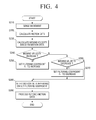
- FIG. 4 is a flowchart provided to explain a filtering method according to an exemplary embodiment of the present invention.
- the sensor 110 senses movement of the space pointing device corresponding to user's movement (S210).
- the motion calculator 120 calculates motion data based on the movement sensed by the sensor 110 (S220).
- the filtering coefficient setting unit 130 calculates moving velocity based on the motion data calculated in operation S220 (S230).
- the moving velocity in operation S230 may be calculated using Numerical Formulas 4 and 5 described above.
- the filtering coefficient setting unit 130 sets the filtering coefficient of the LPF 140 to increase the cutoff frequency ( f c ) of the LPF 140 (S250).
- the filtering coefficient setting unit 130 sets the filtering coefficient of the LPF 140 to decrease the cutoff frequency ( f c ) of the LPF 140 (S270).
- the filtering coefficient in operations S250 and S270 may be set using Numerical Formula 3 described above.
- the LPF 140 performs low pass filtering on the motion data calculated in operation S220 depending on the filtering coefficient set in operation S250 or S270 (S280).
- the low pass filtering in operation S280 may be performed using Numerical Formula 2 described above.
- the processor 150 transfers the motion data filtered in operation S280 to the main body (S290).
- the filtering coefficient setting unit 130 retains the filtering coefficient of the LPF 140 without changing it.
- FIG. 5B is an enlarged view of Section C illustrated in FIG. 5A .
- the noise induced by vibration of a user's hand is reduced within section S in which slow movement occurs, and time delay does not appear within sections f1 and f2 in which fast movement occurs.
- FIG. 6 is a graph illustrating the change of the filtering coefficient [ ⁇ ( k )] when the original motion data (solid lime) illustrated in FIG. 5A are input to the LPF 140.
- the filtering coefficient [ ⁇ ( k )] is increased close to 1 within the section of fast movement, and the filtering coefficient is decreased close to 0.1 within the section of slow movement.
- the space pointing device is used in this exemplary embodiment of the present invention
- the space pointing device is merely an exemplary electronic device to sense user's movement.
- the ideas of the present invention may be applied to other electronic devices, e.g., a remote control, a display device, a display system, etc.
- the exemplary embodiment of the present invention may also be applied.
- the processor 150 transfers the motion data filtered by the LPF 140 to the external apparatus such as the main body, but the processor 150 may perform other operations.
- the processor 150 may decide the location of the pointer displayed on the display based on the motion data filtered by the LPF 140 or control other elements based on the motion data filtered by the LPF 140.
- first order LPF 140 is used in this exemplary embodiment, any other order LPF may also be used.
- the sensor 110 may be an inertial sensor such as an acceleration sensor or a gyro sensor, an optical sensor, an infrared sensor, or an image sensor.
- the filtering apparatus including the filtering coefficient setting unit 130 and the LPF 140 may be used to implement an exemplary embodiment of the present invention.
- the method provided in this exemplary embodiment of the present invention may be implemented as a computer program.
- FIG. 7 shows a broadcast receiving system which comprises a remote controller 200 implemented as a space pointing device and a DTV 300 implemented as a broadcast receiving apparatus.
- the DTV 300 provides a user with a broadcast received over wire or wirelessly through a display D.
- the DTV 300 may provide a user with an external input which is received from an external device connected to the DTV 300 over wire or wirelessly through the display D, and also provide a user with files stored in an internal storage medium or an external storage unit connected to the DTV 300 by reproducing the files.
- the remote controller 200 transfers a user's manipulation to the DTV 300, and then the DTV 300 operates to respond to the user's manipulation, accordingly.
- the remote controller 200 operates as a pointing device, which will be explained below in detail.
- the front of the remote controller 200 may be moved by a user in an upwards or downwards direction, or to the left or right, or in a direction combining two of these directions, such as an upper-leftwards direction. That is, the front of the remote control 200 may be moved in any direction.
- the front of the remote control 200 may be moved while drawing a locus on a virtual plane which is parallel with a screen of the display D.
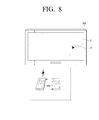
- FIG. 8 shows the case in which the front of the remote controller 200 is moved to the left direction while drawing a locus on a virtual plane which is parallel with the screen of the display D.
- the virtual plane may not be completely parallel with the screen of the display D, and may not be a complete plane. That is, it is practically impossible for the movement of the front of the remote controller 200 by the user to be on a complete plane and completely parallel with the screen of the display D.
- the exemplary embodiment is applicable to the case in which the front of the remote controller 200 moves on an incomplete plane and not completely parallel with the screen of the display D.
- a user may move the front of the remote controller 200 by turning only the user's wrist while the user's arm holding the remote controller 200 is fixed.
- FIG. 9 shows the case in which the front of the remote controller 200 is moved to the left by a user while drawing a curved locus on a virtual hemisphere surface.
- the virtual hemisphere surface, on which the front of the remote controller 200 is moved by rotation of the user's wrist, may be a mathematically incomplete hemisphere surface. That is, it is practically impossible for the front of the remote controller 200 to be moved by rotating the user's wrist while drawing a locus on a mathematically complete hemisphere surface.
- the exemplary embodiment may be applicable to the case in which the front of the remote controller 200 moves not on a mathematically complete hemisphere, but on an incomplete hemisphere surface, while drawing a curved locus.
- a pointer P displayed on the display D may be moved by the user spatially moving the remote controller 200.
- the spatial movement of the front of the remote controller 200 is distinguished from the movement of a mouse for a personal computer (PC), which is moved over a surface.
- PC personal computer
- the pointer P displayed on the display D moves in the same direction as the front of the remote controller 200. For example, i ) if a user moves the front of the remote controller 200 upwards, the pointer P may move upwards, and ii ) if the user moves the front of the remote controller 200 to the upper-left, the pointer P may move to the upper-left.
- the remote controller 200 may operate as a pointing device which is used to move the pointer P on the display D.
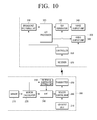
- FIG. 10 is a block diagram illustrating the DTV 300 and the remote controller 200.
- the remote controller 200 includes a sensor 210, a motion calculator 220, a filtering coefficient setting unit 230, and a low pass filter (LPF) 240, a transmitter 250, a remote control unit 260, and a key input unit 270.
- a sensor 210 a motion calculator 220, a filtering coefficient setting unit 230, and a low pass filter (LPF) 240, a transmitter 250, a remote control unit 260, and a key input unit 270.
- LPF low pass filter
- the operations of the sensor 210, the motion calculator 220, the filtering coefficient setting unit 230, and the LPF 240 illustrated in FIG. 10 are identical to those of FIG. 3 , and thus detailed explanation will be omitted.
- the key input unit 270 may include various keys such as a power key, a channel key, a volume key, and a select key.
- the remote control unit 260 transmits the motion data on which low pass filtering is performed by the LPF 240 to the DTV 300 through the transmitter 250.
- the remote control unit 260 transmits information on the key input by a user using the key input unit 270 to the DTV 300 through the transmitter 250.
- the DTV 300 includes a broadcast receiving unit 310, an A/V processor 320, a Graphic User Interface (GUI) generator 330, an image output unit 340, an audio output unit 350, a controller 360, and a receiver 370.
- GUI Graphic User Interface
- the broadcast receiving unit 310 receives a broadcast over wire or wirelessly from a broadcasting station or a satellite, and decodes the received broadcast.
- the A/V processor 320 executes signal processing, such as video decoding, video scaling, and audio decoding, on the broadcast output from the broadcast receiving unit 310. And, the A/V processor 320 transmits an image signal to the GUI generator 330, and an audio signal to the audio output unit 350, respectively.
- signal processing such as video decoding, video scaling, and audio decoding
- the GUI generator 330 generates a GUI to display on the display D, and combines the GUI with the image output from the A/V processor 320.
- the image output unit 340 may display the image having the GUI output from the GUI generator 330 on the display D, or output to an external device connected through an external output terminal (not shown).
- the audio output unit 350 outputs the audio output from the A/V processor 320 via a speaker, or outputs to an external device connected through an external output terminal.
- the controller 360 calculates the location of the pointer P based on the filtered motion data received from the remote controller 200 through the receiver 370, and controls the GUI generator 330 so that the pointer P moves to the calculated location.
- a filtering coefficient is set according to motion data, and low pass filtering is performed on the motion data. Accordingly, both time delay induced by fast movement and noise induced by vibration of a user's hand are resolved.
- a cutoff frequency of an LPF is adaptively changed according to a moving velocity. That is, the noise induced by vibration of a user's hand is minimized during slow movement, and time delay is minimized during fast movement.
- the filtering apparatus according to an exemplary embodiment of the present invention is embodied in a simple structure and thus the performance and cost required to fabricate the apparatus is reduced.
- a display system including a remote control and a display device, wherein the remote control has a sensor which senses movement; a calculation unit which calculates motion data according to an output of the sensor; a setting unit which sets a filtering coefficient according to the motion data calculated by the calculation unit; a low pass filter (LPF) which performs low pass filtering on the motion data calculated by the calculation unit according to the filtering coefficient set by the setting unit; and a transmitter which transmits the filtered motion data; wherein the display device has a receiver which receives the filtered motion data transmitted by the remote control; a processor which processes the motion data received by the receiver; and a display which displays images according to the processed motion data.
- the remote control has a sensor which senses movement; a calculation unit which calculates motion data according to an output of the sensor; a setting unit which sets a filtering coefficient according to the motion data calculated by the calculation unit; a low pass filter (LPF) which performs low pass filtering on the motion data calculated by the calculation unit according to the filtering coefficient set by
- a display device having: a receiver which receives motion data which has been low pass filtered according to a filtering coefficient based on a sensed motion; a processor which processes the motion data received by the receiver; and a display which displays images according to the processed motion data.
- the remote controller 200 processes motion data, but this should not be considered limiting.
- the motion data may be processed by the DTV 300.
- the remote controller 200 senses movements through the sensor 110, and transmits the motion data sensed by the transmitter 250 to the DTV 300. Then, the DTV 300 receives the motion data through the receiver 370.
- the controller 360 of the DTV 300 performs the functions of the motion calculator 220, the filtering coefficient setting unit 230, and the LPF 240 of the remote controller 200.
- the controller 360 of the DTV 300 performs the same functions as those of the remote controller 200 in FIG. 10 and a pointing device in FIG. 3 , and thus detailed explanation will be omitted.
- the DTV 300 adjusts the degree of removing movements unintended by a user (that is, the sensitivity in sensing movements) according to the moving velocity calculated based on the motion data output from the remote controller 200. Specifically, the DTV 300 adjusts the degree of removing movement unintended by a user so that the faster the moving speed of the remote controller 200 becomes, the lower the degree of removing movements unintended by a user becomes (that is, the higher the sensitivity in sensing movements becomes).
Landscapes
- Engineering & Computer Science (AREA)
- General Engineering & Computer Science (AREA)
- Theoretical Computer Science (AREA)
- Human Computer Interaction (AREA)
- Physics & Mathematics (AREA)
- General Physics & Mathematics (AREA)
- Position Input By Displaying (AREA)
Applications Claiming Priority (2)
| Application Number | Priority Date | Filing Date | Title |
|---|---|---|---|
| KR20090051456 | 2009-06-10 | ||
| KR1020100050412A KR20100132909A (ko) | 2009-06-10 | 2010-05-28 | 움직임 데이터를 기초로 필터링 계수를 적응적으로 변경하는 필터링 장치, 필터링 방법 및 이를 이용한 움직임 데이터 처리방법, 장치, 및 시스템 |
Publications (1)
| Publication Number | Publication Date |
|---|---|
| EP2264580A2 true EP2264580A2 (de) | 2010-12-22 |
Family
ID=42357271
Family Applications (1)
| Application Number | Title | Priority Date | Filing Date |
|---|---|---|---|
| EP10164849A Withdrawn EP2264580A2 (de) | 2009-06-10 | 2010-06-03 | Verfahren und Vorrichtung zur Verarbeitung von Bewegungsdaten |
Country Status (2)
| Country | Link |
|---|---|
| US (1) | US20100315334A1 (de) |
| EP (1) | EP2264580A2 (de) |
Cited By (1)
| Publication number | Priority date | Publication date | Assignee | Title |
|---|---|---|---|---|
| WO2016046276A1 (en) * | 2014-09-23 | 2016-03-31 | Fraunhofer Gesellschaft zur Förderung der angewandten Forschung e.V. | Vibration-based trajectory calculation of a freely-guided device |
Families Citing this family (4)
| Publication number | Priority date | Publication date | Assignee | Title |
|---|---|---|---|---|
| US20110063522A1 (en) * | 2009-09-14 | 2011-03-17 | Jeyhan Karaoguz | System and method for generating television screen pointing information using an external receiver |
| KR101694164B1 (ko) * | 2010-09-02 | 2017-01-09 | 엘지전자 주식회사 | 영상표시기기 및 그 동작 방법 |
| US9606364B2 (en) * | 2014-09-12 | 2017-03-28 | Microsoft Technology Licensing, Llc | Stabilizing motion of an interaction ray |
| JP2017211960A (ja) * | 2016-05-27 | 2017-11-30 | 株式会社エクスビジョン | ユーザインターフェース装置およびユーザインターフェースプログラム |
Family Cites Families (5)
| Publication number | Priority date | Publication date | Assignee | Title |
|---|---|---|---|---|
| JPH09325860A (ja) * | 1996-06-04 | 1997-12-16 | Alps Electric Co Ltd | 座標入力装置 |
| SE0003135L (sv) * | 2000-09-04 | 2002-04-16 | Ericsson Telefon Ab L M | En metod och en elektronisk apparat för positionering av en markör på en display |
| KR100792290B1 (ko) * | 2006-06-08 | 2008-01-07 | 삼성전자주식회사 | 지자기센서 및 가속도센서를 구비한 입력 장치, 입력장치의 모션에 따라 커서를 표시하는 디스플레이 장치,이를 이용한 커서 표시 방법 |
| JP5035972B2 (ja) * | 2007-06-13 | 2012-09-26 | 任天堂株式会社 | 情報処理プログラム、情報処理装置、情報処理システムおよび情報処理方法 |
| KR20090034096A (ko) * | 2007-10-02 | 2009-04-07 | 삼성전자주식회사 | 오류 보정 장치, 방법 및 이를 이용한 3차원 포인팅디바이스 |
-
2010
- 2010-06-03 EP EP10164849A patent/EP2264580A2/de not_active Withdrawn
- 2010-06-08 US US12/796,002 patent/US20100315334A1/en not_active Abandoned
Non-Patent Citations (1)
| Title |
|---|
| None |
Cited By (4)
| Publication number | Priority date | Publication date | Assignee | Title |
|---|---|---|---|---|
| WO2016046276A1 (en) * | 2014-09-23 | 2016-03-31 | Fraunhofer Gesellschaft zur Förderung der angewandten Forschung e.V. | Vibration-based trajectory calculation of a freely-guided device |
| CN106716311A (zh) * | 2014-09-23 | 2017-05-24 | 弗劳恩霍夫应用研究促进协会 | 自由导向装置的基于振动的轨迹计算 |
| US10365729B2 (en) | 2014-09-23 | 2019-07-30 | Fraunhofer Gesellschaft zur Förderung der angewandten Forschung e.V. | Vibration-based trajectory calculation of a freely-guided device |
| CN106716311B (zh) * | 2014-09-23 | 2020-02-18 | 弗劳恩霍夫应用研究促进协会 | 自由导向装置的基于振动的轨迹计算 |
Also Published As
| Publication number | Publication date |
|---|---|
| US20100315334A1 (en) | 2010-12-16 |
Similar Documents
| Publication | Publication Date | Title |
|---|---|---|
| EP2633382B1 (de) | Antwort auf den empfang von zoom-befehlen | |
| CN101727220B (zh) | 输入装置、输入方法以及程序 | |
| JP5825631B2 (ja) | 電子装置 | |
| US12321545B2 (en) | Device and method for processing user input | |
| EP2677741A1 (de) | Fernsteuervorrichtung und zugehöriges Steuerverfahren | |
| US20070268246A1 (en) | Electronic equipment with screen pan and zoom functions using motion | |
| CN102279701B (zh) | 图像稳定化装置和图像稳定化方法 | |
| EP2264580A2 (de) | Verfahren und Vorrichtung zur Verarbeitung von Bewegungsdaten | |
| CN105704525B (zh) | 显示设备和显示方法 | |
| KR20170059242A (ko) | 영상 표시 장치 및 그 동작방법 | |
| CN108111750B (zh) | 一种变焦调节方法、移动终端及计算机可读存储介质 | |
| WO2016149873A1 (zh) | 智能交互方法、设备及系统 | |
| KR101791061B1 (ko) | 전자 기기 및 전자 기기의 오디오 재생 방법 | |
| US20190212834A1 (en) | Software gyroscope apparatus | |
| EP3032392B1 (de) | Anzeigeeinheit und anzeigeverfahren | |
| CN116991358A (zh) | 一种控制方法及媒体输出设备 | |
| WO2013164351A1 (en) | Device and method for processing user input | |
| EP2660695B1 (de) | Vorrichtung und verfahren zur verarbeitung von benutzereingaben | |
| JP5659303B1 (ja) | 機器制御方法、機器制御装置、プログラムおよび電子機器 | |
| JP7129897B2 (ja) | 電子機器 | |
| JP2005148661A (ja) | 情報処理装置、および情報処理方法 | |
| KR101289693B1 (ko) | 사용자의 이동을 감지하여 휴대단말기의 영상을 3차원그래픽으로 표시하는 방법 | |
| KR20100132909A (ko) | 움직임 데이터를 기초로 필터링 계수를 적응적으로 변경하는 필터링 장치, 필터링 방법 및 이를 이용한 움직임 데이터 처리방법, 장치, 및 시스템 | |
| KR20150015859A (ko) | 디스플레이 장치 및 그 동작 방법 | |
| HK1189070A (en) | Responding to the receipt of zoom commands |
Legal Events
| Date | Code | Title | Description |
|---|---|---|---|
| PUAI | Public reference made under article 153(3) epc to a published international application that has entered the european phase |
Free format text: ORIGINAL CODE: 0009012 |
|
| AK | Designated contracting states |
Kind code of ref document: A2 Designated state(s): AL AT BE BG CH CY CZ DE DK EE ES FI FR GB GR HR HU IE IS IT LI LT LU LV MC MK MT NL NO PL PT RO SE SI SK SM TR |
|
| AX | Request for extension of the european patent |
Extension state: BA ME RS |
|
| RAP1 | Party data changed (applicant data changed or rights of an application transferred) |
Owner name: SAMSUNG ELECTRONICS CO., LTD. |
|
| STAA | Information on the status of an ep patent application or granted ep patent |
Free format text: STATUS: THE APPLICATION IS DEEMED TO BE WITHDRAWN |
|
| 18D | Application deemed to be withdrawn |
Effective date: 20140103 |