EP2256201A2 - Modulation of eIF4E expression - Google Patents
Modulation of eIF4E expression Download PDFInfo
- Publication number
- EP2256201A2 EP2256201A2 EP10176942A EP10176942A EP2256201A2 EP 2256201 A2 EP2256201 A2 EP 2256201A2 EP 10176942 A EP10176942 A EP 10176942A EP 10176942 A EP10176942 A EP 10176942A EP 2256201 A2 EP2256201 A2 EP 2256201A2
- Authority
- EP
- European Patent Office
- Prior art keywords
- eif4e
- compounds
- rna
- antisense
- oligonucleotide
- Prior art date
- Legal status (The legal status is an assumption and is not a legal conclusion. Google has not performed a legal analysis and makes no representation as to the accuracy of the status listed.)
- Withdrawn
Links
- 230000014509 gene expression Effects 0.000 title claims abstract description 79
- 101001082110 Acanthamoeba polyphaga mimivirus Eukaryotic translation initiation factor 4E homolog Proteins 0.000 title claims abstract description 17
- 101001082109 Danio rerio Eukaryotic translation initiation factor 4E-1B Proteins 0.000 title claims abstract 10
- 150000001875 compounds Chemical class 0.000 claims abstract description 351
- 150000007523 nucleic acids Chemical class 0.000 claims abstract description 112
- 102000039446 nucleic acids Human genes 0.000 claims abstract description 106
- 108020004707 nucleic acids Proteins 0.000 claims abstract description 106
- 239000000203 mixture Substances 0.000 claims abstract description 42
- 208000037265 diseases, disorders, signs and symptoms Diseases 0.000 claims abstract description 31
- 201000010099 disease Diseases 0.000 claims abstract description 20
- 108091034117 Oligonucleotide Proteins 0.000 claims description 244
- 108020005345 3' Untranslated Regions Proteins 0.000 claims description 114
- 206010028980 Neoplasm Diseases 0.000 claims description 77
- 239000002773 nucleotide Substances 0.000 claims description 69
- 125000003729 nucleotide group Chemical group 0.000 claims description 57
- 150000003839 salts Chemical class 0.000 claims description 53
- 235000000346 sugar Nutrition 0.000 claims description 50
- 108091081024 Start codon Proteins 0.000 claims description 27
- RYYWUUFWQRZTIU-UHFFFAOYSA-K thiophosphate Chemical compound [O-]P([O-])([O-])=S RYYWUUFWQRZTIU-UHFFFAOYSA-K 0.000 claims description 26
- 201000011510 cancer Diseases 0.000 claims description 25
- OPTASPLRGRRNAP-UHFFFAOYSA-N cytosine Chemical group NC=1C=CNC(=O)N=1 OPTASPLRGRRNAP-UHFFFAOYSA-N 0.000 claims description 19
- 108020004705 Codon Proteins 0.000 claims description 16
- LRSASMSXMSNRBT-UHFFFAOYSA-N 5-methylcytosine Chemical group CC1=CNC(=O)N=C1N LRSASMSXMSNRBT-UHFFFAOYSA-N 0.000 claims description 12
- 125000001424 substituent group Chemical group 0.000 claims description 12
- 125000002496 methyl group Chemical group [H]C([H])([H])* 0.000 claims description 9
- 229940104302 cytosine Drugs 0.000 claims description 8
- 230000002018 overexpression Effects 0.000 claims description 8
- 206010006187 Breast cancer Diseases 0.000 claims description 7
- 208000026310 Breast neoplasm Diseases 0.000 claims description 7
- 230000033115 angiogenesis Effects 0.000 claims description 7
- 108700026244 Open Reading Frames Proteins 0.000 claims description 6
- 230000001594 aberrant effect Effects 0.000 claims description 5
- 208000005017 glioblastoma Diseases 0.000 claims description 5
- 239000000546 pharmaceutical excipient Substances 0.000 claims description 5
- 206010005003 Bladder cancer Diseases 0.000 claims description 4
- 206010009944 Colon cancer Diseases 0.000 claims description 4
- 108091026898 Leader sequence (mRNA) Proteins 0.000 claims description 4
- 239000003085 diluting agent Substances 0.000 claims description 4
- 230000003463 hyperproliferative effect Effects 0.000 claims description 4
- 108020003589 5' Untranslated Regions Proteins 0.000 claims description 3
- 208000008839 Kidney Neoplasms Diseases 0.000 claims description 3
- 206010058467 Lung neoplasm malignant Diseases 0.000 claims description 3
- 206010033128 Ovarian cancer Diseases 0.000 claims description 3
- 206010061535 Ovarian neoplasm Diseases 0.000 claims description 3
- 206010060862 Prostate cancer Diseases 0.000 claims description 3
- 208000000236 Prostatic Neoplasms Diseases 0.000 claims description 3
- 208000007097 Urinary Bladder Neoplasms Diseases 0.000 claims description 3
- 208000014829 head and neck neoplasm Diseases 0.000 claims description 3
- 208000020816 lung neoplasm Diseases 0.000 claims description 3
- 206010038389 Renal cancer Diseases 0.000 claims description 2
- 108091036066 Three prime untranslated region Proteins 0.000 claims description 2
- 201000010536 head and neck cancer Diseases 0.000 claims description 2
- 201000010982 kidney cancer Diseases 0.000 claims description 2
- 201000005202 lung cancer Diseases 0.000 claims description 2
- 201000005112 urinary bladder cancer Diseases 0.000 claims description 2
- 208000001333 Colorectal Neoplasms Diseases 0.000 claims 1
- 230000000692 anti-sense effect Effects 0.000 abstract description 219
- 238000011282 treatment Methods 0.000 abstract description 89
- 238000000034 method Methods 0.000 abstract description 76
- 238000003745 diagnosis Methods 0.000 abstract 1
- 210000004027 cell Anatomy 0.000 description 245
- 108060002636 Eukaryotic Initiation Factor-4E Proteins 0.000 description 193
- 102000005233 Eukaryotic Initiation Factor-4E Human genes 0.000 description 193
- 229920002477 rna polymer Polymers 0.000 description 175
- JLCPHMBAVCMARE-UHFFFAOYSA-N [3-[[3-[[3-[[3-[[3-[[3-[[3-[[3-[[3-[[3-[[3-[[5-(2-amino-6-oxo-1H-purin-9-yl)-3-[[3-[[3-[[3-[[3-[[3-[[5-(2-amino-6-oxo-1H-purin-9-yl)-3-[[5-(2-amino-6-oxo-1H-purin-9-yl)-3-hydroxyoxolan-2-yl]methoxy-hydroxyphosphoryl]oxyoxolan-2-yl]methoxy-hydroxyphosphoryl]oxy-5-(5-methyl-2,4-dioxopyrimidin-1-yl)oxolan-2-yl]methoxy-hydroxyphosphoryl]oxy-5-(6-aminopurin-9-yl)oxolan-2-yl]methoxy-hydroxyphosphoryl]oxy-5-(6-aminopurin-9-yl)oxolan-2-yl]methoxy-hydroxyphosphoryl]oxy-5-(6-aminopurin-9-yl)oxolan-2-yl]methoxy-hydroxyphosphoryl]oxy-5-(6-aminopurin-9-yl)oxolan-2-yl]methoxy-hydroxyphosphoryl]oxyoxolan-2-yl]methoxy-hydroxyphosphoryl]oxy-5-(5-methyl-2,4-dioxopyrimidin-1-yl)oxolan-2-yl]methoxy-hydroxyphosphoryl]oxy-5-(4-amino-2-oxopyrimidin-1-yl)oxolan-2-yl]methoxy-hydroxyphosphoryl]oxy-5-(5-methyl-2,4-dioxopyrimidin-1-yl)oxolan-2-yl]methoxy-hydroxyphosphoryl]oxy-5-(5-methyl-2,4-dioxopyrimidin-1-yl)oxolan-2-yl]methoxy-hydroxyphosphoryl]oxy-5-(6-aminopurin-9-yl)oxolan-2-yl]methoxy-hydroxyphosphoryl]oxy-5-(6-aminopurin-9-yl)oxolan-2-yl]methoxy-hydroxyphosphoryl]oxy-5-(4-amino-2-oxopyrimidin-1-yl)oxolan-2-yl]methoxy-hydroxyphosphoryl]oxy-5-(4-amino-2-oxopyrimidin-1-yl)oxolan-2-yl]methoxy-hydroxyphosphoryl]oxy-5-(4-amino-2-oxopyrimidin-1-yl)oxolan-2-yl]methoxy-hydroxyphosphoryl]oxy-5-(6-aminopurin-9-yl)oxolan-2-yl]methoxy-hydroxyphosphoryl]oxy-5-(4-amino-2-oxopyrimidin-1-yl)oxolan-2-yl]methyl [5-(6-aminopurin-9-yl)-2-(hydroxymethyl)oxolan-3-yl] hydrogen phosphate Polymers Cc1cn(C2CC(OP(O)(=O)OCC3OC(CC3OP(O)(=O)OCC3OC(CC3O)n3cnc4c3nc(N)[nH]c4=O)n3cnc4c3nc(N)[nH]c4=O)C(COP(O)(=O)OC3CC(OC3COP(O)(=O)OC3CC(OC3COP(O)(=O)OC3CC(OC3COP(O)(=O)OC3CC(OC3COP(O)(=O)OC3CC(OC3COP(O)(=O)OC3CC(OC3COP(O)(=O)OC3CC(OC3COP(O)(=O)OC3CC(OC3COP(O)(=O)OC3CC(OC3COP(O)(=O)OC3CC(OC3COP(O)(=O)OC3CC(OC3COP(O)(=O)OC3CC(OC3COP(O)(=O)OC3CC(OC3COP(O)(=O)OC3CC(OC3COP(O)(=O)OC3CC(OC3COP(O)(=O)OC3CC(OC3COP(O)(=O)OC3CC(OC3CO)n3cnc4c(N)ncnc34)n3ccc(N)nc3=O)n3cnc4c(N)ncnc34)n3ccc(N)nc3=O)n3ccc(N)nc3=O)n3ccc(N)nc3=O)n3cnc4c(N)ncnc34)n3cnc4c(N)ncnc34)n3cc(C)c(=O)[nH]c3=O)n3cc(C)c(=O)[nH]c3=O)n3ccc(N)nc3=O)n3cc(C)c(=O)[nH]c3=O)n3cnc4c3nc(N)[nH]c4=O)n3cnc4c(N)ncnc34)n3cnc4c(N)ncnc34)n3cnc4c(N)ncnc34)n3cnc4c(N)ncnc34)O2)c(=O)[nH]c1=O JLCPHMBAVCMARE-UHFFFAOYSA-N 0.000 description 120
- 241000282414 Homo sapiens Species 0.000 description 110
- 108020004999 messenger RNA Proteins 0.000 description 95
- 108020004459 Small interfering RNA Proteins 0.000 description 92
- ABEXEQSGABRUHS-UHFFFAOYSA-N 16-methylheptadecyl 16-methylheptadecanoate Chemical compound CC(C)CCCCCCCCCCCCCCCOC(=O)CCCCCCCCCCCCCCC(C)C ABEXEQSGABRUHS-UHFFFAOYSA-N 0.000 description 87
- 241000764238 Isis Species 0.000 description 87
- 238000005417 image-selected in vivo spectroscopy Methods 0.000 description 87
- 238000012739 integrated shape imaging system Methods 0.000 description 87
- 239000002777 nucleoside Substances 0.000 description 76
- 102000053602 DNA Human genes 0.000 description 71
- 108020004414 DNA Proteins 0.000 description 71
- 230000000694 effects Effects 0.000 description 65
- 108091032973 (ribonucleotides)n+m Proteins 0.000 description 64
- 102000040650 (ribonucleotides)n+m Human genes 0.000 description 64
- 229910019142 PO4 Inorganic materials 0.000 description 64
- 235000021317 phosphate Nutrition 0.000 description 63
- 239000010452 phosphate Substances 0.000 description 62
- 108090000623 proteins and genes Proteins 0.000 description 58
- -1 antisense compounds Chemical class 0.000 description 56
- PYMYPHUHKUWMLA-LMVFSUKVSA-N Ribose Natural products OC[C@@H](O)[C@@H](O)[C@@H](O)C=O PYMYPHUHKUWMLA-LMVFSUKVSA-N 0.000 description 50
- HMFHBZSHGGEWLO-UHFFFAOYSA-N alpha-D-Furanose-Ribose Natural products OCC1OC(O)C(O)C1O HMFHBZSHGGEWLO-UHFFFAOYSA-N 0.000 description 50
- 125000002467 phosphate group Chemical group [H]OP(=O)(O[H])O[*] 0.000 description 47
- 230000015572 biosynthetic process Effects 0.000 description 42
- 230000000295 complement effect Effects 0.000 description 42
- 238000012986 modification Methods 0.000 description 41
- 239000002585 base Substances 0.000 description 40
- 230000005764 inhibitory process Effects 0.000 description 40
- 230000004048 modification Effects 0.000 description 40
- RWQNBRDOKXIBIV-UHFFFAOYSA-N thymine Chemical compound CC1=CNC(=O)NC1=O RWQNBRDOKXIBIV-UHFFFAOYSA-N 0.000 description 40
- 230000014616 translation Effects 0.000 description 38
- NBIIXXVUZAFLBC-UHFFFAOYSA-K phosphate Chemical compound [O-]P([O-])([O-])=O NBIIXXVUZAFLBC-UHFFFAOYSA-K 0.000 description 37
- 108091081021 Sense strand Proteins 0.000 description 36
- ISAKRJDGNUQOIC-UHFFFAOYSA-N Uracil Chemical compound O=C1C=CNC(=O)N1 ISAKRJDGNUQOIC-UHFFFAOYSA-N 0.000 description 35
- 230000009467 reduction Effects 0.000 description 35
- 230000001965 increasing effect Effects 0.000 description 34
- 125000000956 methoxy group Chemical group [H]C([H])([H])O* 0.000 description 33
- 239000003795 chemical substances by application Substances 0.000 description 31
- 125000003835 nucleoside group Chemical group 0.000 description 31
- 125000000548 ribosyl group Chemical group C1([C@H](O)[C@H](O)[C@H](O1)CO)* 0.000 description 30
- 238000013519 translation Methods 0.000 description 30
- HMFHBZSHGGEWLO-SOOFDHNKSA-N D-ribofuranose Chemical compound OC[C@H]1OC(O)[C@H](O)[C@@H]1O HMFHBZSHGGEWLO-SOOFDHNKSA-N 0.000 description 29
- 150000003833 nucleoside derivatives Chemical class 0.000 description 29
- 239000002609 medium Substances 0.000 description 28
- 101001082055 Homo sapiens Eukaryotic translation initiation factor 4E Proteins 0.000 description 27
- UCSJYZPVAKXKNQ-HZYVHMACSA-N streptomycin Chemical compound CN[C@H]1[C@H](O)[C@@H](O)[C@H](CO)O[C@H]1O[C@@H]1[C@](C=O)(O)[C@H](C)O[C@H]1O[C@@H]1[C@@H](NC(N)=N)[C@H](O)[C@@H](NC(N)=N)[C@H](O)[C@H]1O UCSJYZPVAKXKNQ-HZYVHMACSA-N 0.000 description 26
- 238000004458 analytical method Methods 0.000 description 25
- 239000000523 sample Substances 0.000 description 25
- 238000003752 polymerase chain reaction Methods 0.000 description 24
- 241000699666 Mus <mouse, genus> Species 0.000 description 23
- 239000003814 drug Substances 0.000 description 23
- 238000003786 synthesis reaction Methods 0.000 description 23
- 230000006870 function Effects 0.000 description 22
- 238000009472 formulation Methods 0.000 description 21
- 102000004169 proteins and genes Human genes 0.000 description 21
- 238000003753 real-time PCR Methods 0.000 description 21
- 210000001519 tissue Anatomy 0.000 description 21
- QTBSBXVTEAMEQO-UHFFFAOYSA-N Acetic acid Chemical compound CC(O)=O QTBSBXVTEAMEQO-UHFFFAOYSA-N 0.000 description 20
- 239000000074 antisense oligonucleotide Substances 0.000 description 20
- 238000012230 antisense oligonucleotides Methods 0.000 description 20
- 230000027455 binding Effects 0.000 description 20
- 238000009396 hybridization Methods 0.000 description 20
- 239000002502 liposome Substances 0.000 description 20
- 229940113082 thymine Drugs 0.000 description 20
- 238000012228 RNA interference-mediated gene silencing Methods 0.000 description 19
- 230000009368 gene silencing by RNA Effects 0.000 description 19
- 235000018102 proteins Nutrition 0.000 description 19
- 229940035893 uracil Drugs 0.000 description 19
- 230000002829 reductive effect Effects 0.000 description 18
- 230000014621 translational initiation Effects 0.000 description 18
- 101001082056 Mus musculus Eukaryotic translation initiation factor 4E Proteins 0.000 description 17
- 239000002253 acid Substances 0.000 description 17
- 238000003556 assay Methods 0.000 description 17
- 238000002360 preparation method Methods 0.000 description 17
- 238000011160 research Methods 0.000 description 17
- 239000000975 dye Substances 0.000 description 16
- 125000002887 hydroxy group Chemical group [H]O* 0.000 description 16
- 239000000243 solution Substances 0.000 description 16
- 108020000948 Antisense Oligonucleotides Proteins 0.000 description 15
- 239000006144 Dulbecco’s modified Eagle's medium Substances 0.000 description 15
- 241000699670 Mus sp. Species 0.000 description 15
- 108091093037 Peptide nucleic acid Proteins 0.000 description 15
- FAPWRFPIFSIZLT-UHFFFAOYSA-M Sodium chloride Chemical compound [Na+].[Cl-] FAPWRFPIFSIZLT-UHFFFAOYSA-M 0.000 description 15
- 229940079593 drug Drugs 0.000 description 15
- 239000008194 pharmaceutical composition Substances 0.000 description 15
- 239000000047 product Substances 0.000 description 15
- YIMATHOGWXZHFX-WCTZXXKLSA-N (2r,3r,4r,5r)-5-(hydroxymethyl)-3-(2-methoxyethoxy)oxolane-2,4-diol Chemical compound COCCO[C@H]1[C@H](O)O[C@H](CO)[C@H]1O YIMATHOGWXZHFX-WCTZXXKLSA-N 0.000 description 14
- 102100034343 Integrase Human genes 0.000 description 14
- 239000012091 fetal bovine serum Substances 0.000 description 14
- WQZGKKKJIJFFOK-GASJEMHNSA-N Glucose Natural products OC[C@H]1OC(O)[C@H](O)[C@@H](O)[C@@H]1O WQZGKKKJIJFFOK-GASJEMHNSA-N 0.000 description 13
- 101710203526 Integrase Proteins 0.000 description 13
- 241001465754 Metazoa Species 0.000 description 13
- 239000003623 enhancer Substances 0.000 description 13
- 239000008103 glucose Substances 0.000 description 13
- 230000007246 mechanism Effects 0.000 description 13
- 230000035515 penetration Effects 0.000 description 13
- 241000894007 species Species 0.000 description 13
- 229960005322 streptomycin Drugs 0.000 description 13
- RUDATBOHQWOJDD-UHFFFAOYSA-N (3beta,5beta,7alpha)-3,7-Dihydroxycholan-24-oic acid Natural products OC1CC2CC(O)CCC2(C)C2C1C1CCC(C(CCC(O)=O)C)C1(C)CC2 RUDATBOHQWOJDD-UHFFFAOYSA-N 0.000 description 12
- 239000000872 buffer Substances 0.000 description 12
- 230000001413 cellular effect Effects 0.000 description 12
- 238000003776 cleavage reaction Methods 0.000 description 12
- 230000000875 corresponding effect Effects 0.000 description 12
- 230000001419 dependent effect Effects 0.000 description 12
- 235000014113 dietary fatty acids Nutrition 0.000 description 12
- 229930195729 fatty acid Natural products 0.000 description 12
- 239000000194 fatty acid Substances 0.000 description 12
- 239000012737 fresh medium Substances 0.000 description 12
- 125000000623 heterocyclic group Chemical group 0.000 description 12
- 239000000543 intermediate Substances 0.000 description 12
- 150000008300 phosphoramidites Chemical class 0.000 description 12
- 230000008569 process Effects 0.000 description 12
- 230000007017 scission Effects 0.000 description 12
- 108091003079 Bovine Serum Albumin Proteins 0.000 description 11
- 229930182555 Penicillin Natural products 0.000 description 11
- JGSARLDLIJGVTE-MBNYWOFBSA-N Penicillin G Chemical compound N([C@H]1[C@H]2SC([C@@H](N2C1=O)C(O)=O)(C)C)C(=O)CC1=CC=CC=C1 JGSARLDLIJGVTE-MBNYWOFBSA-N 0.000 description 11
- 208000035475 disorder Diseases 0.000 description 11
- 150000004665 fatty acids Chemical class 0.000 description 11
- 239000000499 gel Substances 0.000 description 11
- UYTPUPDQBNUYGX-UHFFFAOYSA-N guanine Chemical compound O=C1NC(N)=NC2=C1N=CN2 UYTPUPDQBNUYGX-UHFFFAOYSA-N 0.000 description 11
- 239000003112 inhibitor Substances 0.000 description 11
- 239000012528 membrane Substances 0.000 description 11
- 229940049954 penicillin Drugs 0.000 description 11
- 239000011780 sodium chloride Substances 0.000 description 11
- 108010058546 Cyclin D1 Proteins 0.000 description 10
- 102000006311 Cyclin D1 Human genes 0.000 description 10
- 238000000636 Northern blotting Methods 0.000 description 10
- 108010011536 PTEN Phosphohydrolase Proteins 0.000 description 10
- 102000014160 PTEN Phosphohydrolase Human genes 0.000 description 10
- 230000037396 body weight Effects 0.000 description 10
- 230000007423 decrease Effects 0.000 description 10
- 238000005516 engineering process Methods 0.000 description 10
- 238000002474 experimental method Methods 0.000 description 10
- 108020004445 glyceraldehyde-3-phosphate dehydrogenase Proteins 0.000 description 10
- 150000002632 lipids Chemical class 0.000 description 10
- 210000004379 membrane Anatomy 0.000 description 10
- 125000004573 morpholin-4-yl group Chemical group N1(CCOCC1)* 0.000 description 10
- 230000002441 reversible effect Effects 0.000 description 10
- 238000006467 substitution reaction Methods 0.000 description 10
- 239000004094 surface-active agent Substances 0.000 description 10
- LFQSCWFLJHTTHZ-UHFFFAOYSA-N Ethanol Chemical compound CCO LFQSCWFLJHTTHZ-UHFFFAOYSA-N 0.000 description 9
- IQFYYKKMVGJFEH-XLPZGREQSA-N Thymidine Chemical compound O=C1NC(=O)C(C)=CN1[C@@H]1O[C@H](CO)[C@@H](O)C1 IQFYYKKMVGJFEH-XLPZGREQSA-N 0.000 description 9
- UHDGCWIWMRVCDJ-ZAKLUEHWSA-N cytidine Chemical compound O=C1N=C(N)C=CN1[C@H]1[C@H](O)[C@@H](O)[C@H](CO)O1 UHDGCWIWMRVCDJ-ZAKLUEHWSA-N 0.000 description 9
- 239000012894 fetal calf serum Substances 0.000 description 9
- 102000006602 glyceraldehyde-3-phosphate dehydrogenase Human genes 0.000 description 9
- 229910052739 hydrogen Inorganic materials 0.000 description 9
- 239000001257 hydrogen Substances 0.000 description 9
- 210000004185 liver Anatomy 0.000 description 9
- 239000002953 phosphate buffered saline Substances 0.000 description 9
- 150000004713 phosphodiesters Chemical class 0.000 description 9
- 239000013641 positive control Substances 0.000 description 9
- 230000008685 targeting Effects 0.000 description 9
- 239000005450 thionucleoside Substances 0.000 description 9
- 238000001890 transfection Methods 0.000 description 9
- 108020004394 Complementary RNA Proteins 0.000 description 8
- 101710163270 Nuclease Proteins 0.000 description 8
- 108020005038 Terminator Codon Proteins 0.000 description 8
- 125000000217 alkyl group Chemical group 0.000 description 8
- 239000003833 bile salt Substances 0.000 description 8
- 238000006243 chemical reaction Methods 0.000 description 8
- 239000003184 complementary RNA Substances 0.000 description 8
- 230000002596 correlated effect Effects 0.000 description 8
- 238000012136 culture method Methods 0.000 description 8
- 238000010790 dilution Methods 0.000 description 8
- 239000012895 dilution Substances 0.000 description 8
- 238000009826 distribution Methods 0.000 description 8
- 230000012010 growth Effects 0.000 description 8
- 230000003993 interaction Effects 0.000 description 8
- 230000001404 mediated effect Effects 0.000 description 8
- 239000012071 phase Substances 0.000 description 8
- 229910052698 phosphorus Inorganic materials 0.000 description 8
- 230000026731 phosphorylation Effects 0.000 description 8
- 238000006366 phosphorylation reaction Methods 0.000 description 8
- 230000001225 therapeutic effect Effects 0.000 description 8
- XLYOFNOQVPJJNP-UHFFFAOYSA-N water Substances O XLYOFNOQVPJJNP-UHFFFAOYSA-N 0.000 description 8
- 102000004190 Enzymes Human genes 0.000 description 7
- 108090000790 Enzymes Proteins 0.000 description 7
- 108091028043 Nucleic acid sequence Proteins 0.000 description 7
- RYYWUUFWQRZTIU-UHFFFAOYSA-N Thiophosphoric acid Chemical class OP(O)(S)=O RYYWUUFWQRZTIU-UHFFFAOYSA-N 0.000 description 7
- 238000007792 addition Methods 0.000 description 7
- 150000001412 amines Chemical class 0.000 description 7
- 230000004663 cell proliferation Effects 0.000 description 7
- POULHZVOKOAJMA-UHFFFAOYSA-N dodecanoic acid Chemical compound CCCCCCCCCCCC(O)=O POULHZVOKOAJMA-UHFFFAOYSA-N 0.000 description 7
- 239000003937 drug carrier Substances 0.000 description 7
- 238000001727 in vivo Methods 0.000 description 7
- 239000000178 monomer Substances 0.000 description 7
- 150000002905 orthoesters Chemical group 0.000 description 7
- 125000006239 protecting group Chemical group 0.000 description 7
- 238000001243 protein synthesis Methods 0.000 description 7
- 238000012546 transfer Methods 0.000 description 7
- RUDATBOHQWOJDD-UZVSRGJWSA-N ursodeoxycholic acid Chemical compound C([C@H]1C[C@@H]2O)[C@H](O)CC[C@]1(C)[C@@H]1[C@@H]2[C@@H]2CC[C@H]([C@@H](CCC(O)=O)C)[C@@]2(C)CC1 RUDATBOHQWOJDD-UZVSRGJWSA-N 0.000 description 7
- 229960001661 ursodiol Drugs 0.000 description 7
- UHDGCWIWMRVCDJ-UHFFFAOYSA-N 1-beta-D-Xylofuranosyl-NH-Cytosine Natural products O=C1N=C(N)C=CN1C1C(O)C(O)C(CO)O1 UHDGCWIWMRVCDJ-UHFFFAOYSA-N 0.000 description 6
- WEVYAHXRMPXWCK-UHFFFAOYSA-N Acetonitrile Chemical compound CC#N WEVYAHXRMPXWCK-UHFFFAOYSA-N 0.000 description 6
- 229930024421 Adenine Natural products 0.000 description 6
- UHDGCWIWMRVCDJ-PSQAKQOGSA-N Cytidine Natural products O=C1N=C(N)C=CN1[C@@H]1[C@@H](O)[C@@H](O)[C@H](CO)O1 UHDGCWIWMRVCDJ-PSQAKQOGSA-N 0.000 description 6
- GHASVSINZRGABV-UHFFFAOYSA-N Fluorouracil Chemical compound FC1=CNC(=O)NC1=O GHASVSINZRGABV-UHFFFAOYSA-N 0.000 description 6
- NYHBQMYGNKIUIF-UUOKFMHZSA-N Guanosine Chemical compound C1=NC=2C(=O)NC(N)=NC=2N1[C@@H]1O[C@H](CO)[C@@H](O)[C@H]1O NYHBQMYGNKIUIF-UUOKFMHZSA-N 0.000 description 6
- 108700020796 Oncogene Proteins 0.000 description 6
- MUBZPKHOEPUJKR-UHFFFAOYSA-N Oxalic acid Chemical compound OC(=O)C(O)=O MUBZPKHOEPUJKR-UHFFFAOYSA-N 0.000 description 6
- 238000011529 RT qPCR Methods 0.000 description 6
- 229960000643 adenine Drugs 0.000 description 6
- OIRDTQYFTABQOQ-KQYNXXCUSA-N adenosine Chemical compound C1=NC=2C(N)=NC=NC=2N1[C@@H]1O[C@H](CO)[C@@H](O)[C@H]1O OIRDTQYFTABQOQ-KQYNXXCUSA-N 0.000 description 6
- 239000002246 antineoplastic agent Substances 0.000 description 6
- 125000002619 bicyclic group Chemical group 0.000 description 6
- 238000005251 capillar electrophoresis Methods 0.000 description 6
- KRKNYBCHXYNGOX-UHFFFAOYSA-N citric acid Chemical compound OC(=O)CC(O)(C(O)=O)CC(O)=O KRKNYBCHXYNGOX-UHFFFAOYSA-N 0.000 description 6
- GHVNFZFCNZKVNT-UHFFFAOYSA-N decanoic acid Chemical compound CCCCCCCCCC(O)=O GHVNFZFCNZKVNT-UHFFFAOYSA-N 0.000 description 6
- 238000010511 deprotection reaction Methods 0.000 description 6
- 238000013461 design Methods 0.000 description 6
- 229960002949 fluorouracil Drugs 0.000 description 6
- 150000002243 furanoses Chemical group 0.000 description 6
- 238000000338 in vitro Methods 0.000 description 6
- 238000010348 incorporation Methods 0.000 description 6
- 238000011534 incubation Methods 0.000 description 6
- 125000005647 linker group Chemical group 0.000 description 6
- 125000001570 methylene group Chemical group [H]C([H])([*:1])[*:2] 0.000 description 6
- 230000003389 potentiating effect Effects 0.000 description 6
- 238000012216 screening Methods 0.000 description 6
- 239000011734 sodium Substances 0.000 description 6
- 239000007787 solid Substances 0.000 description 6
- 238000013518 transcription Methods 0.000 description 6
- 230000035897 transcription Effects 0.000 description 6
- 238000001262 western blot Methods 0.000 description 6
- QKNYBSVHEMOAJP-UHFFFAOYSA-N 2-amino-2-(hydroxymethyl)propane-1,3-diol;hydron;chloride Chemical compound Cl.OCC(N)(CO)CO QKNYBSVHEMOAJP-UHFFFAOYSA-N 0.000 description 5
- 208000035657 Abasia Diseases 0.000 description 5
- KCXVZYZYPLLWCC-UHFFFAOYSA-N EDTA Chemical compound OC(=O)CN(CC(O)=O)CCN(CC(O)=O)CC(O)=O KCXVZYZYPLLWCC-UHFFFAOYSA-N 0.000 description 5
- 101710126428 Eukaryotic translation initiation factor 4E-2 Proteins 0.000 description 5
- 206010027476 Metastases Diseases 0.000 description 5
- ZMXDDKWLCZADIW-UHFFFAOYSA-N N,N-Dimethylformamide Chemical compound CN(C)C=O ZMXDDKWLCZADIW-UHFFFAOYSA-N 0.000 description 5
- 102000052812 Ornithine decarboxylases Human genes 0.000 description 5
- 108700005126 Ornithine decarboxylases Proteins 0.000 description 5
- 230000009471 action Effects 0.000 description 5
- 230000004913 activation Effects 0.000 description 5
- 235000001014 amino acid Nutrition 0.000 description 5
- 150000001413 amino acids Chemical group 0.000 description 5
- 229940093761 bile salts Drugs 0.000 description 5
- 125000002091 cationic group Chemical group 0.000 description 5
- 229960001091 chenodeoxycholic acid Drugs 0.000 description 5
- RUDATBOHQWOJDD-BSWAIDMHSA-N chenodeoxycholic acid Chemical compound C([C@H]1C[C@H]2O)[C@H](O)CC[C@]1(C)[C@@H]1[C@@H]2[C@@H]2CC[C@H]([C@@H](CCC(O)=O)C)[C@@]2(C)CC1 RUDATBOHQWOJDD-BSWAIDMHSA-N 0.000 description 5
- 238000001514 detection method Methods 0.000 description 5
- 239000000839 emulsion Substances 0.000 description 5
- 230000002708 enhancing effect Effects 0.000 description 5
- 210000002950 fibroblast Anatomy 0.000 description 5
- 230000000670 limiting effect Effects 0.000 description 5
- 238000005259 measurement Methods 0.000 description 5
- 238000012247 phenotypical assay Methods 0.000 description 5
- 125000004437 phosphorous atom Chemical group 0.000 description 5
- 239000013612 plasmid Substances 0.000 description 5
- 229920000768 polyamine Polymers 0.000 description 5
- 229940002612 prodrug Drugs 0.000 description 5
- 239000000651 prodrug Substances 0.000 description 5
- 230000001105 regulatory effect Effects 0.000 description 5
- 210000002966 serum Anatomy 0.000 description 5
- 239000000126 substance Substances 0.000 description 5
- 239000000758 substrate Substances 0.000 description 5
- ABZLKHKQJHEPAX-UHFFFAOYSA-N tetramethylrhodamine Chemical compound C=12C=CC(N(C)C)=CC2=[O+]C2=CC(N(C)C)=CC=C2C=1C1=CC=CC=C1C([O-])=O ABZLKHKQJHEPAX-UHFFFAOYSA-N 0.000 description 5
- JUDOLRSMWHVKGX-UHFFFAOYSA-N 1,1-dioxo-1$l^{6},2-benzodithiol-3-one Chemical compound C1=CC=C2C(=O)SS(=O)(=O)C2=C1 JUDOLRSMWHVKGX-UHFFFAOYSA-N 0.000 description 4
- LUCHPKXVUGJYGU-XLPZGREQSA-N 5-methyl-2'-deoxycytidine Chemical compound O=C1N=C(N)C(C)=CN1[C@@H]1O[C@H](CO)[C@@H](O)C1 LUCHPKXVUGJYGU-XLPZGREQSA-N 0.000 description 4
- PEHVGBZKEYRQSX-UHFFFAOYSA-N 7-deaza-adenine Chemical compound NC1=NC=NC2=C1C=CN2 PEHVGBZKEYRQSX-UHFFFAOYSA-N 0.000 description 4
- ZCYVEMRRCGMTRW-UHFFFAOYSA-N 7553-56-2 Chemical compound [I] ZCYVEMRRCGMTRW-UHFFFAOYSA-N 0.000 description 4
- GFFGJBXGBJISGV-UHFFFAOYSA-N Adenine Chemical compound NC1=NC=NC2=C1N=CN2 GFFGJBXGBJISGV-UHFFFAOYSA-N 0.000 description 4
- VHUUQVKOLVNVRT-UHFFFAOYSA-N Ammonium hydroxide Chemical compound [NH4+].[OH-] VHUUQVKOLVNVRT-UHFFFAOYSA-N 0.000 description 4
- CIWBSHSKHKDKBQ-JLAZNSOCSA-N Ascorbic acid Chemical compound OC[C@H](O)[C@H]1OC(=O)C(O)=C1O CIWBSHSKHKDKBQ-JLAZNSOCSA-N 0.000 description 4
- 108090000994 Catalytic RNA Proteins 0.000 description 4
- 102000053642 Catalytic RNA Human genes 0.000 description 4
- 108020004635 Complementary DNA Proteins 0.000 description 4
- RGHNJXZEOKUKBD-SQOUGZDYSA-N D-gluconic acid Chemical compound OC[C@@H](O)[C@@H](O)[C@H](O)[C@@H](O)C(O)=O RGHNJXZEOKUKBD-SQOUGZDYSA-N 0.000 description 4
- 102100022466 Eukaryotic translation initiation factor 4E-binding protein 1 Human genes 0.000 description 4
- 108050000946 Eukaryotic translation initiation factor 4E-binding protein 1 Proteins 0.000 description 4
- 101710126432 Eukaryotic translation initiation factor 4E1 Proteins 0.000 description 4
- ZHNUHDYFZUAESO-UHFFFAOYSA-N Formamide Chemical compound NC=O ZHNUHDYFZUAESO-UHFFFAOYSA-N 0.000 description 4
- VZCYOOQTPOCHFL-OWOJBTEDSA-N Fumaric acid Chemical compound OC(=O)\C=C\C(O)=O VZCYOOQTPOCHFL-OWOJBTEDSA-N 0.000 description 4
- 241000282412 Homo Species 0.000 description 4
- VEXZGXHMUGYJMC-UHFFFAOYSA-N Hydrochloric acid Chemical compound Cl VEXZGXHMUGYJMC-UHFFFAOYSA-N 0.000 description 4
- DGAQECJNVWCQMB-PUAWFVPOSA-M Ilexoside XXIX Chemical compound C[C@@H]1CC[C@@]2(CC[C@@]3(C(=CC[C@H]4[C@]3(CC[C@@H]5[C@@]4(CC[C@@H](C5(C)C)OS(=O)(=O)[O-])C)C)[C@@H]2[C@]1(C)O)C)C(=O)O[C@H]6[C@@H]([C@H]([C@@H]([C@H](O6)CO)O)O)O.[Na+] DGAQECJNVWCQMB-PUAWFVPOSA-M 0.000 description 4
- FBOZXECLQNJBKD-ZDUSSCGKSA-N L-methotrexate Chemical compound C=1N=C2N=C(N)N=C(N)C2=NC=1CN(C)C1=CC=C(C(=O)N[C@@H](CCC(O)=O)C(O)=O)C=C1 FBOZXECLQNJBKD-ZDUSSCGKSA-N 0.000 description 4
- 102100026299 MAP kinase-interacting serine/threonine-protein kinase 1 Human genes 0.000 description 4
- 101710139011 MAP kinase-interacting serine/threonine-protein kinase 1 Proteins 0.000 description 4
- TWRXJAOTZQYOKJ-UHFFFAOYSA-L Magnesium chloride Chemical compound [Mg+2].[Cl-].[Cl-] TWRXJAOTZQYOKJ-UHFFFAOYSA-L 0.000 description 4
- AFVFQIVMOAPDHO-UHFFFAOYSA-N Methanesulfonic acid Chemical compound CS(O)(=O)=O AFVFQIVMOAPDHO-UHFFFAOYSA-N 0.000 description 4
- BAVYZALUXZFZLV-UHFFFAOYSA-N Methylamine Chemical compound NC BAVYZALUXZFZLV-UHFFFAOYSA-N 0.000 description 4
- 238000005481 NMR spectroscopy Methods 0.000 description 4
- NBIIXXVUZAFLBC-UHFFFAOYSA-N Phosphoric acid Chemical compound OP(O)(O)=O NBIIXXVUZAFLBC-UHFFFAOYSA-N 0.000 description 4
- 108091034057 RNA (poly(A)) Proteins 0.000 description 4
- 102000028391 RNA cap binding Human genes 0.000 description 4
- 230000006819 RNA synthesis Effects 0.000 description 4
- 238000010240 RT-PCR analysis Methods 0.000 description 4
- QAOWNCQODCNURD-UHFFFAOYSA-N Sulfuric acid Chemical compound OS(O)(=O)=O QAOWNCQODCNURD-UHFFFAOYSA-N 0.000 description 4
- RJURFGZVJUQBHK-UHFFFAOYSA-N actinomycin D Natural products CC1OC(=O)C(C(C)C)N(C)C(=O)CN(C)C(=O)C2CCCN2C(=O)C(C(C)C)NC(=O)C1NC(=O)C1=C(N)C(=O)C(C)=C2OC(C(C)=CC=C3C(=O)NC4C(=O)NC(C(N5CCCC5C(=O)N(C)CC(=O)N(C)C(C(C)C)C(=O)OC4C)=O)C(C)C)=C3N=C21 RJURFGZVJUQBHK-UHFFFAOYSA-N 0.000 description 4
- 125000000304 alkynyl group Chemical group 0.000 description 4
- 150000001408 amides Chemical class 0.000 description 4
- 230000003321 amplification Effects 0.000 description 4
- 238000000137 annealing Methods 0.000 description 4
- WPYMKLBDIGXBTP-UHFFFAOYSA-N benzoic acid Chemical compound OC(=O)C1=CC=CC=C1 WPYMKLBDIGXBTP-UHFFFAOYSA-N 0.000 description 4
- 238000001818 capillary gel electrophoresis Methods 0.000 description 4
- 239000002775 capsule Substances 0.000 description 4
- 230000015556 catabolic process Effects 0.000 description 4
- 150000001768 cations Chemical class 0.000 description 4
- 230000022131 cell cycle Effects 0.000 description 4
- 108091092328 cellular RNA Proteins 0.000 description 4
- 230000004700 cellular uptake Effects 0.000 description 4
- 239000002738 chelating agent Substances 0.000 description 4
- 239000003153 chemical reaction reagent Substances 0.000 description 4
- 239000002299 complementary DNA Substances 0.000 description 4
- 229940127089 cytotoxic agent Drugs 0.000 description 4
- 238000006731 degradation reaction Methods 0.000 description 4
- NAGJZTKCGNOGPW-UHFFFAOYSA-K dioxido-sulfanylidene-sulfido-$l^{5}-phosphane Chemical compound [O-]P([O-])([S-])=S NAGJZTKCGNOGPW-UHFFFAOYSA-K 0.000 description 4
- 150000002148 esters Chemical class 0.000 description 4
- 239000003102 growth factor Substances 0.000 description 4
- 239000001963 growth medium Substances 0.000 description 4
- IPCSVZSSVZVIGE-UHFFFAOYSA-N hexadecanoic acid Chemical compound CCCCCCCCCCCCCCCC(O)=O IPCSVZSSVZVIGE-UHFFFAOYSA-N 0.000 description 4
- 230000002401 inhibitory effect Effects 0.000 description 4
- 230000000977 initiatory effect Effects 0.000 description 4
- 229910052740 iodine Inorganic materials 0.000 description 4
- 239000011630 iodine Substances 0.000 description 4
- 239000007788 liquid Substances 0.000 description 4
- 238000011068 loading method Methods 0.000 description 4
- 210000004962 mammalian cell Anatomy 0.000 description 4
- 238000004949 mass spectrometry Methods 0.000 description 4
- 230000009401 metastasis Effects 0.000 description 4
- 229960000485 methotrexate Drugs 0.000 description 4
- 239000003068 molecular probe Substances 0.000 description 4
- 238000003199 nucleic acid amplification method Methods 0.000 description 4
- 238000002515 oligonucleotide synthesis Methods 0.000 description 4
- 230000003647 oxidation Effects 0.000 description 4
- 238000007254 oxidation reaction Methods 0.000 description 4
- 102000002574 p38 Mitogen-Activated Protein Kinases Human genes 0.000 description 4
- 108010068338 p38 Mitogen-Activated Protein Kinases Proteins 0.000 description 4
- 230000003285 pharmacodynamic effect Effects 0.000 description 4
- BASFCYQUMIYNBI-UHFFFAOYSA-N platinum Chemical compound [Pt] BASFCYQUMIYNBI-UHFFFAOYSA-N 0.000 description 4
- 229920001223 polyethylene glycol Polymers 0.000 description 4
- 229920000642 polymer Polymers 0.000 description 4
- SCVFZCLFOSHCOH-UHFFFAOYSA-M potassium acetate Chemical compound [K+].CC([O-])=O SCVFZCLFOSHCOH-UHFFFAOYSA-M 0.000 description 4
- 239000000843 powder Substances 0.000 description 4
- 238000012552 review Methods 0.000 description 4
- 108091092562 ribozyme Proteins 0.000 description 4
- 229910052708 sodium Inorganic materials 0.000 description 4
- 159000000000 sodium salts Chemical class 0.000 description 4
- 238000010561 standard procedure Methods 0.000 description 4
- 239000000725 suspension Substances 0.000 description 4
- 238000012360 testing method Methods 0.000 description 4
- 229940126585 therapeutic drug Drugs 0.000 description 4
- 230000000699 topical effect Effects 0.000 description 4
- VZCYOOQTPOCHFL-UHFFFAOYSA-N trans-butenedioic acid Natural products OC(=O)C=CC(O)=O VZCYOOQTPOCHFL-UHFFFAOYSA-N 0.000 description 4
- 230000009466 transformation Effects 0.000 description 4
- 230000003827 upregulation Effects 0.000 description 4
- KDCGOANMDULRCW-UHFFFAOYSA-N 7H-purine Chemical compound N1=CNC2=NC=NC2=C1 KDCGOANMDULRCW-UHFFFAOYSA-N 0.000 description 3
- WFDIJRYMOXRFFG-UHFFFAOYSA-N Acetic anhydride Chemical compound CC(=O)OC(C)=O WFDIJRYMOXRFFG-UHFFFAOYSA-N 0.000 description 3
- 239000005632 Capric acid (CAS 334-48-5) Substances 0.000 description 3
- 108091026890 Coding region Proteins 0.000 description 3
- 108090000695 Cytokines Proteins 0.000 description 3
- 102000004127 Cytokines Human genes 0.000 description 3
- 101100232687 Drosophila melanogaster eIF4A gene Proteins 0.000 description 3
- 102000002241 Eukaryotic Initiation Factors Human genes 0.000 description 3
- 108010014863 Eukaryotic Initiation Factors Proteins 0.000 description 3
- 101710091919 Eukaryotic translation initiation factor 4G Proteins 0.000 description 3
- 108091060211 Expressed sequence tag Proteins 0.000 description 3
- WSFSSNUMVMOOMR-UHFFFAOYSA-N Formaldehyde Chemical compound O=C WSFSSNUMVMOOMR-UHFFFAOYSA-N 0.000 description 3
- 108091092195 Intron Proteins 0.000 description 3
- 239000005639 Lauric acid Substances 0.000 description 3
- OKKJLVBELUTLKV-UHFFFAOYSA-N Methanol Chemical compound OC OKKJLVBELUTLKV-UHFFFAOYSA-N 0.000 description 3
- 241000699660 Mus musculus Species 0.000 description 3
- 241000283973 Oryctolagus cuniculus Species 0.000 description 3
- OAICVXFJPJFONN-UHFFFAOYSA-N Phosphorus Chemical compound [P] OAICVXFJPJFONN-UHFFFAOYSA-N 0.000 description 3
- 239000002202 Polyethylene glycol Substances 0.000 description 3
- 108010037522 Promyelocytic Leukemia Protein Proteins 0.000 description 3
- 102100026375 Protein PML Human genes 0.000 description 3
- 108010029869 Proto-Oncogene Proteins c-raf Proteins 0.000 description 3
- 102100033479 RAF proto-oncogene serine/threonine-protein kinase Human genes 0.000 description 3
- 108091000106 RNA cap binding Proteins 0.000 description 3
- 238000002123 RNA extraction Methods 0.000 description 3
- 239000012980 RPMI-1640 medium Substances 0.000 description 3
- DBMJMQXJHONAFJ-UHFFFAOYSA-M Sodium laurylsulphate Chemical compound [Na+].CCCCCCCCCCCCOS([O-])(=O)=O DBMJMQXJHONAFJ-UHFFFAOYSA-M 0.000 description 3
- 108010073929 Vascular Endothelial Growth Factor A Proteins 0.000 description 3
- 102000005789 Vascular Endothelial Growth Factors Human genes 0.000 description 3
- 108010019530 Vascular Endothelial Growth Factors Proteins 0.000 description 3
- HMNZFMSWFCAGGW-XPWSMXQVSA-N [3-[hydroxy(2-hydroxyethoxy)phosphoryl]oxy-2-[(e)-octadec-9-enoyl]oxypropyl] (e)-octadec-9-enoate Chemical compound CCCCCCCC\C=C\CCCCCCCC(=O)OCC(COP(O)(=O)OCCO)OC(=O)CCCCCCC\C=C\CCCCCCCC HMNZFMSWFCAGGW-XPWSMXQVSA-N 0.000 description 3
- 239000004480 active ingredient Substances 0.000 description 3
- 125000003342 alkenyl group Chemical group 0.000 description 3
- 230000006907 apoptotic process Effects 0.000 description 3
- 239000003613 bile acid Substances 0.000 description 3
- 238000010804 cDNA synthesis Methods 0.000 description 3
- 229910052799 carbon Inorganic materials 0.000 description 3
- 125000004432 carbon atom Chemical group C* 0.000 description 3
- 239000000969 carrier Substances 0.000 description 3
- 230000010261 cell growth Effects 0.000 description 3
- 210000000038 chest Anatomy 0.000 description 3
- 238000002983 circular dichroism Methods 0.000 description 3
- 210000000805 cytoplasm Anatomy 0.000 description 3
- KXGVEGMKQFWNSR-UHFFFAOYSA-N deoxycholic acid Natural products C1CC2CC(O)CCC2(C)C2C1C1CCC(C(CCC(O)=O)C)C1(C)C(O)C2 KXGVEGMKQFWNSR-UHFFFAOYSA-N 0.000 description 3
- 230000004069 differentiation Effects 0.000 description 3
- KPUWHANPEXNPJT-UHFFFAOYSA-N disiloxane Chemical group [SiH3]O[SiH3] KPUWHANPEXNPJT-UHFFFAOYSA-N 0.000 description 3
- 210000002889 endothelial cell Anatomy 0.000 description 3
- 230000029142 excretion Effects 0.000 description 3
- 229940088597 hormone Drugs 0.000 description 3
- 239000005556 hormone Substances 0.000 description 3
- 238000003119 immunoblot Methods 0.000 description 3
- 238000002844 melting Methods 0.000 description 3
- 230000008018 melting Effects 0.000 description 3
- 230000004060 metabolic process Effects 0.000 description 3
- 229910052751 metal Inorganic materials 0.000 description 3
- 239000002184 metal Substances 0.000 description 3
- 150000002739 metals Chemical class 0.000 description 3
- 150000007522 mineralic acids Chemical class 0.000 description 3
- 238000000329 molecular dynamics simulation Methods 0.000 description 3
- 230000007935 neutral effect Effects 0.000 description 3
- 208000002154 non-small cell lung carcinoma Diseases 0.000 description 3
- 238000011580 nude mouse model Methods 0.000 description 3
- 210000000056 organ Anatomy 0.000 description 3
- 150000007524 organic acids Chemical class 0.000 description 3
- 150000003013 phosphoric acid derivatives Chemical class 0.000 description 3
- 239000011574 phosphorus Substances 0.000 description 3
- 102000040430 polynucleotide Human genes 0.000 description 3
- 108091033319 polynucleotide Proteins 0.000 description 3
- 239000002157 polynucleotide Substances 0.000 description 3
- XJMOSONTPMZWPB-UHFFFAOYSA-M propidium iodide Chemical compound [I-].[I-].C12=CC(N)=CC=C2C2=CC=C(N)C=C2[N+](CCC[N+](C)(CC)CC)=C1C1=CC=CC=C1 XJMOSONTPMZWPB-UHFFFAOYSA-M 0.000 description 3
- 230000004044 response Effects 0.000 description 3
- 230000019491 signal transduction Effects 0.000 description 3
- 230000011664 signaling Effects 0.000 description 3
- FIWQZURFGYXCEO-UHFFFAOYSA-M sodium;decanoate Chemical compound [Na+].CCCCCCCCCC([O-])=O FIWQZURFGYXCEO-UHFFFAOYSA-M 0.000 description 3
- 210000000952 spleen Anatomy 0.000 description 3
- 238000005556 structure-activity relationship Methods 0.000 description 3
- 150000008163 sugars Chemical class 0.000 description 3
- 239000003826 tablet Substances 0.000 description 3
- 238000010200 validation analysis Methods 0.000 description 3
- 230000003442 weekly effect Effects 0.000 description 3
- YBJHBAHKTGYVGT-ZKWXMUAHSA-N (+)-Biotin Chemical compound N1C(=O)N[C@@H]2[C@H](CCCCC(=O)O)SC[C@@H]21 YBJHBAHKTGYVGT-ZKWXMUAHSA-N 0.000 description 2
- BHQCQFFYRZLCQQ-UHFFFAOYSA-N (3alpha,5alpha,7alpha,12alpha)-3,7,12-trihydroxy-cholan-24-oic acid Natural products OC1CC2CC(O)CCC2(C)C2C1C1CCC(C(CCC(O)=O)C)C1(C)C(O)C2 BHQCQFFYRZLCQQ-UHFFFAOYSA-N 0.000 description 2
- IAKHMKGGTNLKSZ-INIZCTEOSA-N (S)-colchicine Chemical compound C1([C@@H](NC(C)=O)CC2)=CC(=O)C(OC)=CC=C1C1=C2C=C(OC)C(OC)=C1OC IAKHMKGGTNLKSZ-INIZCTEOSA-N 0.000 description 2
- BJEPYKJPYRNKOW-REOHCLBHSA-N (S)-malic acid Chemical compound OC(=O)[C@@H](O)CC(O)=O BJEPYKJPYRNKOW-REOHCLBHSA-N 0.000 description 2
- MPCAJMNYNOGXPB-UHFFFAOYSA-N 1,5-anhydrohexitol Chemical class OCC1OCC(O)C(O)C1O MPCAJMNYNOGXPB-UHFFFAOYSA-N 0.000 description 2
- UIYWFOZZIZEEKJ-XVFCMESISA-N 1-[(2r,3r,4r,5r)-3-fluoro-4-hydroxy-5-(hydroxymethyl)oxolan-2-yl]pyrimidine-2,4-dione Chemical compound F[C@@H]1[C@H](O)[C@@H](CO)O[C@H]1N1C(=O)NC(=O)C=C1 UIYWFOZZIZEEKJ-XVFCMESISA-N 0.000 description 2
- RZRNAYUHWVFMIP-KTKRTIGZSA-N 1-oleoylglycerol Chemical compound CCCCCCCC\C=C/CCCCCCCC(=O)OCC(O)CO RZRNAYUHWVFMIP-KTKRTIGZSA-N 0.000 description 2
- KZDCMKVLEYCGQX-UDPGNSCCSA-N 2-(diethylamino)ethyl 4-aminobenzoate;(2s,5r,6r)-3,3-dimethyl-7-oxo-6-[(2-phenylacetyl)amino]-4-thia-1-azabicyclo[3.2.0]heptane-2-carboxylic acid;hydrate Chemical group O.CCN(CC)CCOC(=O)C1=CC=C(N)C=C1.N([C@H]1[C@H]2SC([C@@H](N2C1=O)C(O)=O)(C)C)C(=O)CC1=CC=CC=C1 KZDCMKVLEYCGQX-UDPGNSCCSA-N 0.000 description 2
- HZAXFHJVJLSVMW-UHFFFAOYSA-N 2-Aminoethan-1-ol Chemical compound NCCO HZAXFHJVJLSVMW-UHFFFAOYSA-N 0.000 description 2
- FZWGECJQACGGTI-UHFFFAOYSA-N 2-amino-7-methyl-1,7-dihydro-6H-purin-6-one Chemical compound NC1=NC(O)=C2N(C)C=NC2=N1 FZWGECJQACGGTI-UHFFFAOYSA-N 0.000 description 2
- UXUZARPLRQRNNX-DXTOWSMRSA-N 2-amino-9-[(2r,3r,4r,5r)-3-fluoro-4-hydroxy-5-(hydroxymethyl)oxolan-2-yl]-3h-purin-6-one Chemical compound C1=NC=2C(=O)NC(N)=NC=2N1[C@@H]1O[C@H](CO)[C@@H](O)[C@H]1F UXUZARPLRQRNNX-DXTOWSMRSA-N 0.000 description 2
- ICSNLGPSRYBMBD-UHFFFAOYSA-N 2-aminopyridine Chemical compound NC1=CC=CC=N1 ICSNLGPSRYBMBD-UHFFFAOYSA-N 0.000 description 2
- 125000003903 2-propenyl group Chemical group [H]C([*])([H])C([H])=C([H])[H] 0.000 description 2
- BMYNFMYTOJXKLE-UHFFFAOYSA-N 3-azaniumyl-2-hydroxypropanoate Chemical compound NCC(O)C(O)=O BMYNFMYTOJXKLE-UHFFFAOYSA-N 0.000 description 2
- NVZFZMCNALTPBY-XVFCMESISA-N 4-amino-1-[(2r,3r,4r,5r)-3-fluoro-4-hydroxy-5-(hydroxymethyl)oxolan-2-yl]pyrimidin-2-one Chemical compound O=C1N=C(N)C=CN1[C@H]1[C@H](F)[C@H](O)[C@@H](CO)O1 NVZFZMCNALTPBY-XVFCMESISA-N 0.000 description 2
- LZINOQJQXIEBNN-UHFFFAOYSA-N 4-hydroxybutyl dihydrogen phosphate Chemical compound OCCCCOP(O)(O)=O LZINOQJQXIEBNN-UHFFFAOYSA-N 0.000 description 2
- RYVNIFSIEDRLSJ-UHFFFAOYSA-N 5-(hydroxymethyl)cytosine Chemical compound NC=1NC(=O)N=CC=1CO RYVNIFSIEDRLSJ-UHFFFAOYSA-N 0.000 description 2
- ZAYHVCMSTBRABG-JXOAFFINSA-N 5-methylcytidine Chemical class O=C1N=C(N)C(C)=CN1[C@H]1[C@H](O)[C@H](O)[C@@H](CO)O1 ZAYHVCMSTBRABG-JXOAFFINSA-N 0.000 description 2
- STQGQHZAVUOBTE-UHFFFAOYSA-N 7-Cyan-hept-2t-en-4,6-diinsaeure Natural products C1=2C(O)=C3C(=O)C=4C(OC)=CC=CC=4C(=O)C3=C(O)C=2CC(O)(C(C)=O)CC1OC1CC(N)C(O)C(C)O1 STQGQHZAVUOBTE-UHFFFAOYSA-N 0.000 description 2
- HCGHYQLFMPXSDU-UHFFFAOYSA-N 7-methyladenine Chemical compound C1=NC(N)=C2N(C)C=NC2=N1 HCGHYQLFMPXSDU-UHFFFAOYSA-N 0.000 description 2
- UJOBWOGCFQCDNV-UHFFFAOYSA-N 9H-carbazole Chemical compound C1=CC=C2C3=CC=CC=C3NC2=C1 UJOBWOGCFQCDNV-UHFFFAOYSA-N 0.000 description 2
- MSSXOMSJDRHRMC-UHFFFAOYSA-N 9H-purine-2,6-diamine Chemical compound NC1=NC(N)=C2NC=NC2=N1 MSSXOMSJDRHRMC-UHFFFAOYSA-N 0.000 description 2
- LRFVTYWOQMYALW-UHFFFAOYSA-N 9H-xanthine Chemical compound O=C1NC(=O)NC2=C1NC=N2 LRFVTYWOQMYALW-UHFFFAOYSA-N 0.000 description 2
- 230000035502 ADME Effects 0.000 description 2
- ZKHQWZAMYRWXGA-KQYNXXCUSA-J ATP(4-) Chemical compound C1=NC=2C(N)=NC=NC=2N1[C@@H]1O[C@H](COP([O-])(=O)OP([O-])(=O)OP([O-])([O-])=O)[C@@H](O)[C@H]1O ZKHQWZAMYRWXGA-KQYNXXCUSA-J 0.000 description 2
- 102000007469 Actins Human genes 0.000 description 2
- 108010085238 Actins Proteins 0.000 description 2
- 208000024893 Acute lymphoblastic leukemia Diseases 0.000 description 2
- 208000014697 Acute lymphocytic leukaemia Diseases 0.000 description 2
- ZKHQWZAMYRWXGA-UHFFFAOYSA-N Adenosine triphosphate Natural products C1=NC=2C(N)=NC=NC=2N1C1OC(COP(O)(=O)OP(O)(=O)OP(O)(O)=O)C(O)C1O ZKHQWZAMYRWXGA-UHFFFAOYSA-N 0.000 description 2
- QGZKDVFQNNGYKY-UHFFFAOYSA-N Ammonia Chemical compound N QGZKDVFQNNGYKY-UHFFFAOYSA-N 0.000 description 2
- QGZKDVFQNNGYKY-UHFFFAOYSA-O Ammonium Chemical compound [NH4+] QGZKDVFQNNGYKY-UHFFFAOYSA-O 0.000 description 2
- USFZMSVCRYTOJT-UHFFFAOYSA-N Ammonium acetate Chemical compound N.CC(O)=O USFZMSVCRYTOJT-UHFFFAOYSA-N 0.000 description 2
- 108020005544 Antisense RNA Proteins 0.000 description 2
- BSYNRYMUTXBXSQ-UHFFFAOYSA-N Aspirin Chemical compound CC(=O)OC1=CC=CC=C1C(O)=O BSYNRYMUTXBXSQ-UHFFFAOYSA-N 0.000 description 2
- IJGRMHOSHXDMSA-UHFFFAOYSA-N Atomic nitrogen Chemical compound N#N IJGRMHOSHXDMSA-UHFFFAOYSA-N 0.000 description 2
- 206010004146 Basal cell carcinoma Diseases 0.000 description 2
- 239000005711 Benzoic acid Substances 0.000 description 2
- 239000002126 C01EB10 - Adenosine Substances 0.000 description 2
- 241000244203 Caenorhabditis elegans Species 0.000 description 2
- OYPRJOBELJOOCE-UHFFFAOYSA-N Calcium Chemical compound [Ca] OYPRJOBELJOOCE-UHFFFAOYSA-N 0.000 description 2
- 101710167800 Capsid assembly scaffolding protein Proteins 0.000 description 2
- 201000009030 Carcinoma Diseases 0.000 description 2
- 102000014914 Carrier Proteins Human genes 0.000 description 2
- 239000004380 Cholic acid Substances 0.000 description 2
- MIKUYHXYGGJMLM-GIMIYPNGSA-N Crotonoside Natural products C1=NC2=C(N)NC(=O)N=C2N1[C@H]1O[C@@H](CO)[C@H](O)[C@@H]1O MIKUYHXYGGJMLM-GIMIYPNGSA-N 0.000 description 2
- UHDGCWIWMRVCDJ-CCXZUQQUSA-N Cytarabine Chemical compound O=C1N=C(N)C=CN1[C@H]1[C@@H](O)[C@H](O)[C@@H](CO)O1 UHDGCWIWMRVCDJ-CCXZUQQUSA-N 0.000 description 2
- FBPFZTCFMRRESA-FSIIMWSLSA-N D-Glucitol Natural products OC[C@H](O)[C@H](O)[C@@H](O)[C@H](O)CO FBPFZTCFMRRESA-FSIIMWSLSA-N 0.000 description 2
- FBPFZTCFMRRESA-JGWLITMVSA-N D-glucitol Chemical compound OC[C@H](O)[C@@H](O)[C@H](O)[C@H](O)CO FBPFZTCFMRRESA-JGWLITMVSA-N 0.000 description 2
- RGHNJXZEOKUKBD-UHFFFAOYSA-N D-gluconic acid Natural products OCC(O)C(O)C(O)C(O)C(O)=O RGHNJXZEOKUKBD-UHFFFAOYSA-N 0.000 description 2
- NYHBQMYGNKIUIF-UHFFFAOYSA-N D-guanosine Natural products C1=2NC(N)=NC(=O)C=2N=CN1C1OC(CO)C(O)C1O NYHBQMYGNKIUIF-UHFFFAOYSA-N 0.000 description 2
- 108010014303 DNA-directed DNA polymerase Proteins 0.000 description 2
- 102000016928 DNA-directed DNA polymerase Human genes 0.000 description 2
- 108010092160 Dactinomycin Proteins 0.000 description 2
- FEWJPZIEWOKRBE-JCYAYHJZSA-N Dextrotartaric acid Chemical compound OC(=O)[C@H](O)[C@@H](O)C(O)=O FEWJPZIEWOKRBE-JCYAYHJZSA-N 0.000 description 2
- IAZDPXIOMUYVGZ-UHFFFAOYSA-N Dimethylsulphoxide Chemical compound CS(C)=O IAZDPXIOMUYVGZ-UHFFFAOYSA-N 0.000 description 2
- AOJJSUZBOXZQNB-TZSSRYMLSA-N Doxorubicin Chemical compound O([C@H]1C[C@@](O)(CC=2C(O)=C3C(=O)C=4C=CC=C(C=4C(=O)C3=C(O)C=21)OC)C(=O)CO)[C@H]1C[C@H](N)[C@H](O)[C@H](C)O1 AOJJSUZBOXZQNB-TZSSRYMLSA-N 0.000 description 2
- 238000002965 ELISA Methods 0.000 description 2
- 102100031780 Endonuclease Human genes 0.000 description 2
- 108010042407 Endonucleases Proteins 0.000 description 2
- 241000588724 Escherichia coli Species 0.000 description 2
- 241000206602 Eukaryota Species 0.000 description 2
- 101710091918 Eukaryotic translation initiation factor 4E Proteins 0.000 description 2
- 102100027304 Eukaryotic translation initiation factor 4E Human genes 0.000 description 2
- 102100033399 Eukaryotic translation initiation factor 4E transporter Human genes 0.000 description 2
- 101710163653 Eukaryotic translation initiation factor 4E transporter Proteins 0.000 description 2
- 101710126416 Eukaryotic translation initiation factor 4E-3 Proteins 0.000 description 2
- 102000003974 Fibroblast growth factor 2 Human genes 0.000 description 2
- 108090000379 Fibroblast growth factor 2 Proteins 0.000 description 2
- KRHYYFGTRYWZRS-UHFFFAOYSA-M Fluoride anion Chemical compound [F-] KRHYYFGTRYWZRS-UHFFFAOYSA-M 0.000 description 2
- 102100029974 GTPase HRas Human genes 0.000 description 2
- 101710091881 GTPase HRas Proteins 0.000 description 2
- AEMRFAOFKBGASW-UHFFFAOYSA-N Glycolic acid Chemical compound OCC(O)=O AEMRFAOFKBGASW-UHFFFAOYSA-N 0.000 description 2
- 101001066129 Homo sapiens Glyceraldehyde-3-phosphate dehydrogenase Proteins 0.000 description 2
- MHAJPDPJQMAIIY-UHFFFAOYSA-N Hydrogen peroxide Chemical compound OO MHAJPDPJQMAIIY-UHFFFAOYSA-N 0.000 description 2
- 108060001084 Luciferase Proteins 0.000 description 2
- 239000005089 Luciferase Substances 0.000 description 2
- FYYHWMGAXLPEAU-UHFFFAOYSA-N Magnesium Chemical compound [Mg] FYYHWMGAXLPEAU-UHFFFAOYSA-N 0.000 description 2
- 241001529936 Murinae Species 0.000 description 2
- 101000819572 Mus musculus Glyceraldehyde-3-phosphate dehydrogenase Proteins 0.000 description 2
- 208000033776 Myeloid Acute Leukemia Diseases 0.000 description 2
- NWIBSHFKIJFRCO-WUDYKRTCSA-N Mytomycin Chemical compound C1N2C(C(C(C)=C(N)C3=O)=O)=C3[C@@H](COC(N)=O)[C@@]2(OC)[C@@H]2[C@H]1N2 NWIBSHFKIJFRCO-WUDYKRTCSA-N 0.000 description 2
- PVNIIMVLHYAWGP-UHFFFAOYSA-N Niacin Chemical compound OC(=O)C1=CC=CN=C1 PVNIIMVLHYAWGP-UHFFFAOYSA-N 0.000 description 2
- 208000015914 Non-Hodgkin lymphomas Diseases 0.000 description 2
- 108091005461 Nucleic proteins Proteins 0.000 description 2
- 239000012124 Opti-MEM Substances 0.000 description 2
- 238000012408 PCR amplification Methods 0.000 description 2
- 235000021314 Palmitic acid Nutrition 0.000 description 2
- 102000005877 Peptide Initiation Factors Human genes 0.000 description 2
- 108010044843 Peptide Initiation Factors Proteins 0.000 description 2
- ABLZXFCXXLZCGV-UHFFFAOYSA-N Phosphorous acid Chemical class OP(O)=O ABLZXFCXXLZCGV-UHFFFAOYSA-N 0.000 description 2
- ZLMJMSJWJFRBEC-UHFFFAOYSA-N Potassium Chemical compound [K] ZLMJMSJWJFRBEC-UHFFFAOYSA-N 0.000 description 2
- 208000006664 Precursor Cell Lymphoblastic Leukemia-Lymphoma Diseases 0.000 description 2
- 101710130420 Probable capsid assembly scaffolding protein Proteins 0.000 description 2
- OFOBLEOULBTSOW-UHFFFAOYSA-N Propanedioic acid Natural products OC(=O)CC(O)=O OFOBLEOULBTSOW-UHFFFAOYSA-N 0.000 description 2
- CZPWVGJYEJSRLH-UHFFFAOYSA-N Pyrimidine Chemical compound C1=CN=CN=C1 CZPWVGJYEJSRLH-UHFFFAOYSA-N 0.000 description 2
- 108090000944 RNA Helicases Proteins 0.000 description 2
- 102000004409 RNA Helicases Human genes 0.000 description 2
- 238000013381 RNA quantification Methods 0.000 description 2
- 102000006382 Ribonucleases Human genes 0.000 description 2
- 108010083644 Ribonucleases Proteins 0.000 description 2
- 101710204410 Scaffold protein Proteins 0.000 description 2
- 208000000102 Squamous Cell Carcinoma of Head and Neck Diseases 0.000 description 2
- KDYFGRWQOYBRFD-UHFFFAOYSA-N Succinic acid Natural products OC(=O)CCC(O)=O KDYFGRWQOYBRFD-UHFFFAOYSA-N 0.000 description 2
- NKANXQFJJICGDU-QPLCGJKRSA-N Tamoxifen Chemical compound C=1C=CC=CC=1C(/CC)=C(C=1C=CC(OCCN(C)C)=CC=1)/C1=CC=CC=C1 NKANXQFJJICGDU-QPLCGJKRSA-N 0.000 description 2
- 108010006785 Taq Polymerase Proteins 0.000 description 2
- FEWJPZIEWOKRBE-UHFFFAOYSA-N Tartaric acid Natural products [H+].[H+].[O-]C(=O)C(O)C(O)C([O-])=O FEWJPZIEWOKRBE-UHFFFAOYSA-N 0.000 description 2
- MUMGGOZAMZWBJJ-DYKIIFRCSA-N Testostosterone Chemical compound O=C1CC[C@]2(C)[C@H]3CC[C@](C)([C@H](CC4)O)[C@@H]4[C@@H]3CCC2=C1 MUMGGOZAMZWBJJ-DYKIIFRCSA-N 0.000 description 2
- 108091023045 Untranslated Region Proteins 0.000 description 2
- OIRDTQYFTABQOQ-UHTZMRCNSA-N Vidarabine Chemical compound C1=NC=2C(N)=NC=NC=2N1[C@@H]1O[C@H](CO)[C@@H](O)[C@@H]1O OIRDTQYFTABQOQ-UHTZMRCNSA-N 0.000 description 2
- 238000010521 absorption reaction Methods 0.000 description 2
- 230000035508 accumulation Effects 0.000 description 2
- 238000009825 accumulation Methods 0.000 description 2
- 235000011054 acetic acid Nutrition 0.000 description 2
- 125000002777 acetyl group Chemical group [H]C([H])([H])C(*)=O 0.000 description 2
- DZBUGLKDJFMEHC-UHFFFAOYSA-N acridine Chemical compound C1=CC=CC2=CC3=CC=CC=C3N=C21 DZBUGLKDJFMEHC-UHFFFAOYSA-N 0.000 description 2
- RJURFGZVJUQBHK-IIXSONLDSA-N actinomycin D Chemical compound C[C@H]1OC(=O)[C@H](C(C)C)N(C)C(=O)CN(C)C(=O)[C@@H]2CCCN2C(=O)[C@@H](C(C)C)NC(=O)[C@H]1NC(=O)C1=C(N)C(=O)C(C)=C2OC(C(C)=CC=C3C(=O)N[C@@H]4C(=O)N[C@@H](C(N5CCC[C@H]5C(=O)N(C)CC(=O)N(C)[C@@H](C(C)C)C(=O)O[C@@H]4C)=O)C(C)C)=C3N=C21 RJURFGZVJUQBHK-IIXSONLDSA-N 0.000 description 2
- 125000002015 acyclic group Chemical group 0.000 description 2
- 229960005305 adenosine Drugs 0.000 description 2
- 210000000577 adipose tissue Anatomy 0.000 description 2
- 239000000443 aerosol Substances 0.000 description 2
- 229910052784 alkaline earth metal Inorganic materials 0.000 description 2
- 125000005600 alkyl phosphonate group Chemical group 0.000 description 2
- BJEPYKJPYRNKOW-UHFFFAOYSA-N alpha-hydroxysuccinic acid Natural products OC(=O)C(O)CC(O)=O BJEPYKJPYRNKOW-UHFFFAOYSA-N 0.000 description 2
- 229910000147 aluminium phosphate Inorganic materials 0.000 description 2
- 210000001132 alveolar macrophage Anatomy 0.000 description 2
- 239000000908 ammonium hydroxide Substances 0.000 description 2
- 238000010171 animal model Methods 0.000 description 2
- 239000003242 anti bacterial agent Substances 0.000 description 2
- 235000010323 ascorbic acid Nutrition 0.000 description 2
- 239000011668 ascorbic acid Substances 0.000 description 2
- 229960005070 ascorbic acid Drugs 0.000 description 2
- 235000010233 benzoic acid Nutrition 0.000 description 2
- 108091008324 binding proteins Proteins 0.000 description 2
- 230000004071 biological effect Effects 0.000 description 2
- 201000001531 bladder carcinoma Diseases 0.000 description 2
- 210000001124 body fluid Anatomy 0.000 description 2
- 210000001185 bone marrow Anatomy 0.000 description 2
- 210000004556 brain Anatomy 0.000 description 2
- 210000000481 breast Anatomy 0.000 description 2
- 229910052794 bromium Inorganic materials 0.000 description 2
- KDYFGRWQOYBRFD-NUQCWPJISA-N butanedioic acid Chemical compound O[14C](=O)CC[14C](O)=O KDYFGRWQOYBRFD-NUQCWPJISA-N 0.000 description 2
- 239000011575 calcium Substances 0.000 description 2
- 229910052791 calcium Inorganic materials 0.000 description 2
- 238000004364 calculation method Methods 0.000 description 2
- 125000002837 carbocyclic group Chemical group 0.000 description 2
- 231100000504 carcinogenesis Toxicity 0.000 description 2
- 238000004113 cell culture Methods 0.000 description 2
- 210000003169 central nervous system Anatomy 0.000 description 2
- 238000007385 chemical modification Methods 0.000 description 2
- 239000000460 chlorine Substances 0.000 description 2
- 229910052801 chlorine Inorganic materials 0.000 description 2
- HVYWMOMLDIMFJA-DPAQBDIFSA-N cholesterol Chemical group C1C=C2C[C@@H](O)CC[C@]2(C)[C@@H]2[C@@H]1[C@@H]1CC[C@H]([C@H](C)CCCC(C)C)[C@@]1(C)CC2 HVYWMOMLDIMFJA-DPAQBDIFSA-N 0.000 description 2
- 235000012000 cholesterol Nutrition 0.000 description 2
- 235000019416 cholic acid Nutrition 0.000 description 2
- BHQCQFFYRZLCQQ-OELDTZBJSA-N cholic acid Chemical compound C([C@H]1C[C@H]2O)[C@H](O)CC[C@]1(C)[C@@H]1[C@@H]2[C@@H]2CC[C@H]([C@@H](CCC(O)=O)C)[C@@]2(C)[C@@H](O)C1 BHQCQFFYRZLCQQ-OELDTZBJSA-N 0.000 description 2
- 229960002471 cholic acid Drugs 0.000 description 2
- 229960001231 choline Drugs 0.000 description 2
- OEYIOHPDSNJKLS-UHFFFAOYSA-N choline Chemical compound C[N+](C)(C)CCO OEYIOHPDSNJKLS-UHFFFAOYSA-N 0.000 description 2
- 235000015165 citric acid Nutrition 0.000 description 2
- 230000001276 controlling effect Effects 0.000 description 2
- 229920001577 copolymer Polymers 0.000 description 2
- 230000008878 coupling Effects 0.000 description 2
- 238000010168 coupling process Methods 0.000 description 2
- 238000005859 coupling reaction Methods 0.000 description 2
- 125000000753 cycloalkyl group Chemical group 0.000 description 2
- 125000001995 cyclobutyl group Chemical group [H]C1([H])C([H])([H])C([H])(*)C1([H])[H] 0.000 description 2
- HCAJEUSONLESMK-UHFFFAOYSA-N cyclohexylsulfamic acid Chemical compound OS(=O)(=O)NC1CCCCC1 HCAJEUSONLESMK-UHFFFAOYSA-N 0.000 description 2
- RGWHQCVHVJXOKC-SHYZEUOFSA-J dCTP(4-) Chemical compound O=C1N=C(N)C=CN1[C@@H]1O[C@H](COP([O-])(=O)OP([O-])(=O)OP([O-])([O-])=O)[C@@H](O)C1 RGWHQCVHVJXOKC-SHYZEUOFSA-J 0.000 description 2
- 229960000640 dactinomycin Drugs 0.000 description 2
- STQGQHZAVUOBTE-VGBVRHCVSA-N daunorubicin Chemical compound O([C@H]1C[C@@](O)(CC=2C(O)=C3C(=O)C=4C=CC=C(C=4C(=O)C3=C(O)C=21)OC)C(C)=O)[C@H]1C[C@H](N)[C@H](O)[C@H](C)O1 STQGQHZAVUOBTE-VGBVRHCVSA-N 0.000 description 2
- GHVNFZFCNZKVNT-UHFFFAOYSA-M decanoate Chemical compound CCCCCCCCCC([O-])=O GHVNFZFCNZKVNT-UHFFFAOYSA-M 0.000 description 2
- 230000003247 decreasing effect Effects 0.000 description 2
- 238000012217 deletion Methods 0.000 description 2
- 230000037430 deletion Effects 0.000 description 2
- KXGVEGMKQFWNSR-LLQZFEROSA-N deoxycholic acid Chemical compound C([C@H]1CC2)[C@H](O)CC[C@]1(C)[C@@H]1[C@@H]2[C@@H]2CC[C@H]([C@@H](CCC(O)=O)C)[C@@]2(C)[C@@H](O)C1 KXGVEGMKQFWNSR-LLQZFEROSA-N 0.000 description 2
- 229960003964 deoxycholic acid Drugs 0.000 description 2
- XBDQKXXYIPTUBI-UHFFFAOYSA-N dimethylselenoniopropionate Natural products CCC(O)=O XBDQKXXYIPTUBI-UHFFFAOYSA-N 0.000 description 2
- 230000003292 diminished effect Effects 0.000 description 2
- LOKCTEFSRHRXRJ-UHFFFAOYSA-I dipotassium trisodium dihydrogen phosphate hydrogen phosphate dichloride Chemical compound P(=O)(O)(O)[O-].[K+].P(=O)(O)([O-])[O-].[Na+].[Na+].[Cl-].[K+].[Cl-].[Na+] LOKCTEFSRHRXRJ-UHFFFAOYSA-I 0.000 description 2
- POULHZVOKOAJMA-UHFFFAOYSA-M dodecanoate Chemical compound CCCCCCCCCCCC([O-])=O POULHZVOKOAJMA-UHFFFAOYSA-M 0.000 description 2
- 239000002552 dosage form Substances 0.000 description 2
- 231100000673 dose–response relationship Toxicity 0.000 description 2
- 238000007876 drug discovery Methods 0.000 description 2
- 238000001962 electrophoresis Methods 0.000 description 2
- 238000010828 elution Methods 0.000 description 2
- NPUKDXXFDDZOKR-LLVKDONJSA-N etomidate Chemical class CCOC(=O)C1=CN=CN1[C@H](C)C1=CC=CC=C1 NPUKDXXFDDZOKR-LLVKDONJSA-N 0.000 description 2
- 238000010195 expression analysis Methods 0.000 description 2
- ODKNJVUHOIMIIZ-RRKCRQDMSA-N floxuridine Chemical compound C1[C@H](O)[C@@H](CO)O[C@H]1N1C(=O)NC(=O)C(F)=C1 ODKNJVUHOIMIIZ-RRKCRQDMSA-N 0.000 description 2
- 229960000961 floxuridine Drugs 0.000 description 2
- 238000001943 fluorescence-activated cell sorting Methods 0.000 description 2
- 239000007850 fluorescent dye Substances 0.000 description 2
- 238000002509 fluorescent in situ hybridization Methods 0.000 description 2
- 239000001530 fumaric acid Substances 0.000 description 2
- 235000011087 fumaric acid Nutrition 0.000 description 2
- 230000004927 fusion Effects 0.000 description 2
- 230000030279 gene silencing Effects 0.000 description 2
- 239000000174 gluconic acid Substances 0.000 description 2
- 235000012208 gluconic acid Nutrition 0.000 description 2
- 210000004349 growth plate Anatomy 0.000 description 2
- 229940029575 guanosine Drugs 0.000 description 2
- 229940093915 gynecological organic acid Drugs 0.000 description 2
- 125000001475 halogen functional group Chemical group 0.000 description 2
- 210000003128 head Anatomy 0.000 description 2
- 125000005842 heteroatom Chemical group 0.000 description 2
- 150000002391 heterocyclic compounds Chemical class 0.000 description 2
- 238000004128 high performance liquid chromatography Methods 0.000 description 2
- 102000047486 human GAPDH Human genes 0.000 description 2
- FDGQSTZJBFJUBT-UHFFFAOYSA-N hypoxanthine Chemical compound O=C1NC=NC2=C1NC=N2 FDGQSTZJBFJUBT-UHFFFAOYSA-N 0.000 description 2
- 238000002513 implantation Methods 0.000 description 2
- 230000002779 inactivation Effects 0.000 description 2
- 238000007913 intrathecal administration Methods 0.000 description 2
- 238000001990 intravenous administration Methods 0.000 description 2
- 238000007914 intraventricular administration Methods 0.000 description 2
- SUMDYPCJJOFFON-UHFFFAOYSA-N isethionic acid Chemical compound OCCS(O)(=O)=O SUMDYPCJJOFFON-UHFFFAOYSA-N 0.000 description 2
- TWBYWOBDOCUKOW-UHFFFAOYSA-N isonicotinic acid Chemical compound OC(=O)C1=CC=NC=C1 TWBYWOBDOCUKOW-UHFFFAOYSA-N 0.000 description 2
- 210000002510 keratinocyte Anatomy 0.000 description 2
- 210000003734 kidney Anatomy 0.000 description 2
- JVTAAEKCZFNVCJ-UHFFFAOYSA-N lactic acid Chemical compound CC(O)C(O)=O JVTAAEKCZFNVCJ-UHFFFAOYSA-N 0.000 description 2
- 210000000867 larynx Anatomy 0.000 description 2
- 229940070765 laurate Drugs 0.000 description 2
- 239000006166 lysate Substances 0.000 description 2
- 238000010841 mRNA extraction Methods 0.000 description 2
- 239000011777 magnesium Substances 0.000 description 2
- 229910052749 magnesium Inorganic materials 0.000 description 2
- UEGPKNKPLBYCNK-UHFFFAOYSA-L magnesium acetate Chemical compound [Mg+2].CC([O-])=O.CC([O-])=O UEGPKNKPLBYCNK-UHFFFAOYSA-L 0.000 description 2
- 239000011654 magnesium acetate Substances 0.000 description 2
- 235000011285 magnesium acetate Nutrition 0.000 description 2
- 229940069446 magnesium acetate Drugs 0.000 description 2
- 229910001629 magnesium chloride Inorganic materials 0.000 description 2
- VZCYOOQTPOCHFL-UPHRSURJSA-N maleic acid Chemical compound OC(=O)\C=C/C(O)=O VZCYOOQTPOCHFL-UPHRSURJSA-N 0.000 description 2
- 239000011976 maleic acid Substances 0.000 description 2
- 239000001630 malic acid Substances 0.000 description 2
- 235000011090 malic acid Nutrition 0.000 description 2
- 230000003211 malignant effect Effects 0.000 description 2
- 238000004519 manufacturing process Methods 0.000 description 2
- 239000000463 material Substances 0.000 description 2
- 108010082117 matrigel Proteins 0.000 description 2
- 201000001441 melanoma Diseases 0.000 description 2
- GLVAUDGFNGKCSF-UHFFFAOYSA-N mercaptopurine Chemical compound S=C1NC=NC2=C1NC=N2 GLVAUDGFNGKCSF-UHFFFAOYSA-N 0.000 description 2
- 229940098779 methanesulfonic acid Drugs 0.000 description 2
- YACKEPLHDIMKIO-UHFFFAOYSA-N methylphosphonic acid Chemical group CP(O)(O)=O YACKEPLHDIMKIO-UHFFFAOYSA-N 0.000 description 2
- 239000003226 mitogen Substances 0.000 description 2
- WQEPLUUGTLDZJY-UHFFFAOYSA-N n-Pentadecanoic acid Natural products CCCCCCCCCCCCCCC(O)=O WQEPLUUGTLDZJY-UHFFFAOYSA-N 0.000 description 2
- XTEGVFVZDVNBPF-UHFFFAOYSA-N naphthalene-1,5-disulfonic acid Chemical compound C1=CC=C2C(S(=O)(=O)O)=CC=CC2=C1S(O)(=O)=O XTEGVFVZDVNBPF-UHFFFAOYSA-N 0.000 description 2
- 210000003739 neck Anatomy 0.000 description 2
- 229910052757 nitrogen Inorganic materials 0.000 description 2
- 230000030147 nuclear export Effects 0.000 description 2
- 235000015097 nutrients Nutrition 0.000 description 2
- QIQXTHQIDYTFRH-UHFFFAOYSA-N octadecanoic acid Chemical compound CCCCCCCCCCCCCCCCCC(O)=O QIQXTHQIDYTFRH-UHFFFAOYSA-N 0.000 description 2
- WWZKQHOCKIZLMA-UHFFFAOYSA-N octanoic acid Chemical compound CCCCCCCC(O)=O WWZKQHOCKIZLMA-UHFFFAOYSA-N 0.000 description 2
- ZQPPMHVWECSIRJ-KTKRTIGZSA-N oleic acid Chemical compound CCCCCCCC\C=C/CCCCCCCC(O)=O ZQPPMHVWECSIRJ-KTKRTIGZSA-N 0.000 description 2
- 235000005985 organic acids Nutrition 0.000 description 2
- 235000006408 oxalic acid Nutrition 0.000 description 2
- 238000007911 parenteral administration Methods 0.000 description 2
- 239000002245 particle Substances 0.000 description 2
- RDOWQLZANAYVLL-UHFFFAOYSA-N phenanthridine Chemical compound C1=CC=C2C3=CC=CC=C3C=NC2=C1 RDOWQLZANAYVLL-UHFFFAOYSA-N 0.000 description 2
- 150000002991 phenoxazines Chemical class 0.000 description 2
- 150000003904 phospholipids Chemical class 0.000 description 2
- 229910052697 platinum Inorganic materials 0.000 description 2
- 239000011591 potassium Substances 0.000 description 2
- 229910052700 potassium Inorganic materials 0.000 description 2
- 235000011056 potassium acetate Nutrition 0.000 description 2
- GUUBJKMBDULZTE-UHFFFAOYSA-M potassium;2-[4-(2-hydroxyethyl)piperazin-1-yl]ethanesulfonic acid;hydroxide Chemical compound [OH-].[K+].OCCN1CCN(CCS(O)(=O)=O)CC1 GUUBJKMBDULZTE-UHFFFAOYSA-M 0.000 description 2
- 238000001556 precipitation Methods 0.000 description 2
- 239000002243 precursor Substances 0.000 description 2
- 210000002307 prostate Anatomy 0.000 description 2
- 239000013014 purified material Substances 0.000 description 2
- 150000003212 purines Chemical class 0.000 description 2
- 150000003230 pyrimidines Chemical class 0.000 description 2
- 102000016914 ras Proteins Human genes 0.000 description 2
- 108010014186 ras Proteins Proteins 0.000 description 2
- 230000010076 replication Effects 0.000 description 2
- 201000009410 rhabdomyosarcoma Diseases 0.000 description 2
- 239000002342 ribonucleoside Substances 0.000 description 2
- YGSDEFSMJLZEOE-UHFFFAOYSA-N salicylic acid Chemical compound OC(=O)C1=CC=CC=C1O YGSDEFSMJLZEOE-UHFFFAOYSA-N 0.000 description 2
- 238000003196 serial analysis of gene expression Methods 0.000 description 2
- 125000003808 silyl group Chemical group [H][Si]([H])([H])[*] 0.000 description 2
- 239000004055 small Interfering RNA Substances 0.000 description 2
- IWQPOPSAISBUAH-VOVMJQHHSA-M sodium;2-[[(2z)-2-[(3r,4s,5s,8s,9s,10s,11r,13r,14s,16s)-16-acetyl-3,11-dihydroxy-4,8,10,14-tetramethyl-2,3,4,5,6,7,9,11,12,13,15,16-dodecahydro-1h-cyclopenta[a]phenanthren-17-ylidene]-6-methylheptanoyl]amino]ethanesulfonate Chemical compound [Na+].C1C[C@@H](O)[C@@H](C)[C@@H]2CC[C@]3(C)[C@@]4(C)C[C@H](C(C)=O)/C(=C(C(=O)NCCS([O-])(=O)=O)/CCCC(C)C)[C@@H]4C[C@@H](O)[C@H]3[C@]21C IWQPOPSAISBUAH-VOVMJQHHSA-M 0.000 description 2
- 238000010532 solid phase synthesis reaction Methods 0.000 description 2
- 239000000600 sorbitol Substances 0.000 description 2
- 230000009870 specific binding Effects 0.000 description 2
- ATHGHQPFGPMSJY-UHFFFAOYSA-N spermidine Chemical compound NCCCCNCCCN ATHGHQPFGPMSJY-UHFFFAOYSA-N 0.000 description 2
- PFNFFQXMRSDOHW-UHFFFAOYSA-N spermine Chemical compound NCCCNCCCCNCCCN PFNFFQXMRSDOHW-UHFFFAOYSA-N 0.000 description 2
- 206010041823 squamous cell carcinoma Diseases 0.000 description 2
- 230000000087 stabilizing effect Effects 0.000 description 2
- 239000007858 starting material Substances 0.000 description 2
- 230000035882 stress Effects 0.000 description 2
- 238000005987 sulfurization reaction Methods 0.000 description 2
- 239000000829 suppository Substances 0.000 description 2
- 230000004083 survival effect Effects 0.000 description 2
- 239000011975 tartaric acid Substances 0.000 description 2
- 235000002906 tartaric acid Nutrition 0.000 description 2
- 229940124597 therapeutic agent Drugs 0.000 description 2
- 239000002562 thickening agent Substances 0.000 description 2
- 150000003568 thioethers Chemical class 0.000 description 2
- 239000005451 thionucleotide Substances 0.000 description 2
- WYWHKKSPHMUBEB-UHFFFAOYSA-N tioguanine Chemical compound N1C(N)=NC(=S)C2=C1N=CN2 WYWHKKSPHMUBEB-UHFFFAOYSA-N 0.000 description 2
- JOXIMZWYDAKGHI-UHFFFAOYSA-N toluene-4-sulfonic acid Chemical compound CC1=CC=C(S(O)(=O)=O)C=C1 JOXIMZWYDAKGHI-UHFFFAOYSA-N 0.000 description 2
- 238000011200 topical administration Methods 0.000 description 2
- 230000005945 translocation Effects 0.000 description 2
- 230000032258 transport Effects 0.000 description 2
- HOGVTUZUJGHKPL-HTVVRFAVSA-N triciribine Chemical class C=12C3=NC=NC=1N(C)N=C(N)C2=CN3[C@@H]1O[C@H](CO)[C@@H](O)[C@H]1O HOGVTUZUJGHKPL-HTVVRFAVSA-N 0.000 description 2
- LWIHDJKSTIGBAC-UHFFFAOYSA-K tripotassium phosphate Chemical compound [K+].[K+].[K+].[O-]P([O-])([O-])=O LWIHDJKSTIGBAC-UHFFFAOYSA-K 0.000 description 2
- 208000029729 tumor suppressor gene on chromosome 11 Diseases 0.000 description 2
- 231100000588 tumorigenic Toxicity 0.000 description 2
- 230000000381 tumorigenic effect Effects 0.000 description 2
- 238000011144 upstream manufacturing Methods 0.000 description 2
- 208000010570 urinary bladder carcinoma Diseases 0.000 description 2
- 239000011534 wash buffer Substances 0.000 description 2
- OQQOAWVKVDAJOI-UHFFFAOYSA-N (2-dodecanoyloxy-3-hydroxypropyl) dodecanoate Chemical compound CCCCCCCCCCCC(=O)OCC(CO)OC(=O)CCCCCCCCCCC OQQOAWVKVDAJOI-UHFFFAOYSA-N 0.000 description 1
- QBYIENPQHBMVBV-HFEGYEGKSA-N (2R)-2-hydroxy-2-phenylacetic acid Chemical compound O[C@@H](C(O)=O)c1ccccc1.O[C@@H](C(O)=O)c1ccccc1 QBYIENPQHBMVBV-HFEGYEGKSA-N 0.000 description 1
- XDMZOZLSTQXNMP-JTEKWWFASA-N (2r,3r,4r,5r)-5-(6-aminopurin-9-yl)-4-fluoro-2-(hydroxymethyl)oxolan-3-ol Chemical compound C1=NC=2C(N)=NC=NC=2N1[C@@H]1O[C@H](CO)[C@@H](O)[C@H]1F.C1=NC=2C(N)=NC=NC=2N1[C@@H]1O[C@H](CO)[C@@H](O)[C@H]1F XDMZOZLSTQXNMP-JTEKWWFASA-N 0.000 description 1
- ZGYYPTJWJBEXBC-QYYRPYCUSA-N (2r,3r,4r,5r)-5-(6-aminopurin-9-yl)-4-fluoro-2-(hydroxymethyl)oxolan-3-ol Chemical compound C1=NC=2C(N)=NC=NC=2N1[C@@H]1O[C@H](CO)[C@@H](O)[C@H]1F ZGYYPTJWJBEXBC-QYYRPYCUSA-N 0.000 description 1
- MDKGKXOCJGEUJW-VIFPVBQESA-N (2s)-2-[4-(thiophene-2-carbonyl)phenyl]propanoic acid Chemical compound C1=CC([C@@H](C(O)=O)C)=CC=C1C(=O)C1=CC=CS1 MDKGKXOCJGEUJW-VIFPVBQESA-N 0.000 description 1
- QGVQZRDQPDLHHV-DPAQBDIFSA-N (3s,8s,9s,10r,13r,14s,17r)-10,13-dimethyl-17-[(2r)-6-methylheptan-2-yl]-2,3,4,7,8,9,11,12,14,15,16,17-dodecahydro-1h-cyclopenta[a]phenanthrene-3-thiol Chemical compound C1C=C2C[C@@H](S)CC[C@]2(C)[C@@H]2[C@@H]1[C@@H]1CC[C@H]([C@H](C)CCCC(C)C)[C@@]1(C)CC2 QGVQZRDQPDLHHV-DPAQBDIFSA-N 0.000 description 1
- OMJKFYKNWZZKTK-POHAHGRESA-N (5z)-5-(dimethylaminohydrazinylidene)imidazole-4-carboxamide Chemical compound CN(C)N\N=C1/N=CN=C1C(N)=O OMJKFYKNWZZKTK-POHAHGRESA-N 0.000 description 1
- OYHQOLUKZRVURQ-NTGFUMLPSA-N (9Z,12Z)-9,10,12,13-tetratritiooctadeca-9,12-dienoic acid Chemical compound C(CCCCCCC\C(=C(/C\C(=C(/CCCCC)\[3H])\[3H])\[3H])\[3H])(=O)O OYHQOLUKZRVURQ-NTGFUMLPSA-N 0.000 description 1
- 125000000008 (C1-C10) alkyl group Chemical group 0.000 description 1
- WRIDQFICGBMAFQ-UHFFFAOYSA-N (E)-8-Octadecenoic acid Natural products CCCCCCCCCC=CCCCCCCC(O)=O WRIDQFICGBMAFQ-UHFFFAOYSA-N 0.000 description 1
- UWYVPFMHMJIBHE-OWOJBTEDSA-N (e)-2-hydroxybut-2-enedioic acid Chemical compound OC(=O)\C=C(\O)C(O)=O UWYVPFMHMJIBHE-OWOJBTEDSA-N 0.000 description 1
- WBYWAXJHAXSJNI-VOTSOKGWSA-M .beta-Phenylacrylic acid Natural products [O-]C(=O)\C=C\C1=CC=CC=C1 WBYWAXJHAXSJNI-VOTSOKGWSA-M 0.000 description 1
- UFSCXDAOCAIFOG-UHFFFAOYSA-N 1,10-dihydropyrimido[5,4-b][1,4]benzothiazin-2-one Chemical compound S1C2=CC=CC=C2N=C2C1=CNC(=O)N2 UFSCXDAOCAIFOG-UHFFFAOYSA-N 0.000 description 1
- PTFYZDMJTFMPQW-UHFFFAOYSA-N 1,10-dihydropyrimido[5,4-b][1,4]benzoxazin-2-one Chemical compound O1C2=CC=CC=C2N=C2C1=CNC(=O)N2 PTFYZDMJTFMPQW-UHFFFAOYSA-N 0.000 description 1
- FYADHXFMURLYQI-UHFFFAOYSA-N 1,2,4-triazine Chemical class C1=CN=NC=N1 FYADHXFMURLYQI-UHFFFAOYSA-N 0.000 description 1
- CITHEXJVPOWHKC-UUWRZZSWSA-N 1,2-di-O-myristoyl-sn-glycero-3-phosphocholine Chemical compound CCCCCCCCCCCCCC(=O)OC[C@H](COP([O-])(=O)OCC[N+](C)(C)C)OC(=O)CCCCCCCCCCCCC CITHEXJVPOWHKC-UUWRZZSWSA-N 0.000 description 1
- LRANPJDWHYRCER-UHFFFAOYSA-N 1,2-diazepine Chemical compound N1C=CC=CC=N1 LRANPJDWHYRCER-UHFFFAOYSA-N 0.000 description 1
- FGODUFHTWYYOOB-UHFFFAOYSA-N 1,3-diaminopropan-2-yl dihydrogen phosphate Chemical compound NCC(CN)OP(O)(O)=O FGODUFHTWYYOOB-UHFFFAOYSA-N 0.000 description 1
- TUSDEZXZIZRFGC-UHFFFAOYSA-N 1-O-galloyl-3,6-(R)-HHDP-beta-D-glucose Natural products OC1C(O2)COC(=O)C3=CC(O)=C(O)C(O)=C3C3=C(O)C(O)=C(O)C=C3C(=O)OC1C(O)C2OC(=O)C1=CC(O)=C(O)C(O)=C1 TUSDEZXZIZRFGC-UHFFFAOYSA-N 0.000 description 1
- GMZNBKCNDPRJTL-PRULPYPASA-N 1-[(2r,3r,4r,5r)-3-[2-(dimethylaminooxy)ethoxy]-4-hydroxy-5-(hydroxymethyl)oxolan-2-yl]-5-methylpyrimidine-2,4-dione Chemical compound CN(C)OCCO[C@@H]1[C@H](O)[C@@H](CO)O[C@H]1N1C(=O)NC(=O)C(C)=C1 GMZNBKCNDPRJTL-PRULPYPASA-N 0.000 description 1
- NEVQCHBUJFYGQO-DNRKLUKYSA-N 1-[(2r,3r,4r,5r)-4-hydroxy-5-(hydroxymethyl)-3-(2-methoxyethoxy)oxolan-2-yl]-5-methylpyrimidine-2,4-dione Chemical compound COCCO[C@@H]1[C@H](O)[C@@H](CO)O[C@H]1N1C(=O)NC(=O)C(C)=C1 NEVQCHBUJFYGQO-DNRKLUKYSA-N 0.000 description 1
- WIPCVBQXKBWNRC-PBAMLIMUSA-N 1-[(2r,3r,4r,5r)-5-[[bis(4-methoxyphenyl)-phenylmethoxy]methyl]-4-hydroxy-3-(2-methoxyethoxy)oxolan-2-yl]-5-methylpyrimidine-2,4-dione Chemical compound C([C@@H]1[C@@H](O)[C@H]([C@@H](O1)N1C(NC(=O)C(C)=C1)=O)OCCOC)OC(C=1C=CC(OC)=CC=1)(C=1C=CC(OC)=CC=1)C1=CC=CC=C1 WIPCVBQXKBWNRC-PBAMLIMUSA-N 0.000 description 1
- OYEJRBXHENMLMA-PMHJDTQVSA-N 1-[(2r,3r,4r,5r)-5-[[tert-butyl(diphenyl)silyl]oxymethyl]-4-hydroxy-3-(2-hydroxyethoxy)oxolan-2-yl]-5-methylpyrimidine-2,4-dione Chemical compound O=C1NC(=O)C(C)=CN1[C@H]1[C@H](OCCO)[C@H](O)[C@@H](CO[Si](C=2C=CC=CC=2)(C=2C=CC=CC=2)C(C)(C)C)O1 OYEJRBXHENMLMA-PMHJDTQVSA-N 0.000 description 1
- QPHRQMAYYMYWFW-FJGDRVTGSA-N 1-[(2r,3s,4r,5r)-3-fluoro-3,4-dihydroxy-5-(hydroxymethyl)oxolan-2-yl]pyrimidine-2,4-dione Chemical compound O[C@]1(F)[C@H](O)[C@@H](CO)O[C@H]1N1C(=O)NC(=O)C=C1 QPHRQMAYYMYWFW-FJGDRVTGSA-N 0.000 description 1
- UBTJZUKVKGZHAD-UHFFFAOYSA-N 1-[5-[[bis(4-methoxyphenyl)-phenylmethoxy]methyl]-4-hydroxyoxolan-2-yl]-5-methylpyrimidine-2,4-dione Chemical compound C1=CC(OC)=CC=C1C(C=1C=CC(OC)=CC=1)(C=1C=CC=CC=1)OCC1C(O)CC(N2C(NC(=O)C(C)=C2)=O)O1 UBTJZUKVKGZHAD-UHFFFAOYSA-N 0.000 description 1
- AXTGDCSMTYGJND-UHFFFAOYSA-N 1-dodecylazepan-2-one Chemical compound CCCCCCCCCCCCN1CCCCCC1=O AXTGDCSMTYGJND-UHFFFAOYSA-N 0.000 description 1
- VSNHCAURESNICA-NJFSPNSNSA-N 1-oxidanylurea Chemical compound N[14C](=O)NO VSNHCAURESNICA-NJFSPNSNSA-N 0.000 description 1
- WJFKNYWRSNBZNX-UHFFFAOYSA-N 10H-phenothiazine Chemical compound C1=CC=C2NC3=CC=CC=C3SC2=C1 WJFKNYWRSNBZNX-UHFFFAOYSA-N 0.000 description 1
- TZMSYXZUNZXBOL-UHFFFAOYSA-N 10H-phenoxazine Chemical compound C1=CC=C2NC3=CC=CC=C3OC2=C1 TZMSYXZUNZXBOL-UHFFFAOYSA-N 0.000 description 1
- DBPWSSGDRRHUNT-CEGNMAFCSA-N 17α-hydroxyprogesterone Chemical compound C1CC2=CC(=O)CC[C@]2(C)[C@@H]2[C@@H]1[C@@H]1CC[C@@](C(=O)C)(O)[C@@]1(C)CC2 DBPWSSGDRRHUNT-CEGNMAFCSA-N 0.000 description 1
- 238000005160 1H NMR spectroscopy Methods 0.000 description 1
- UHUHBFMZVCOEOV-UHFFFAOYSA-N 1h-imidazo[4,5-c]pyridin-4-amine Chemical compound NC1=NC=CC2=C1N=CN2 UHUHBFMZVCOEOV-UHFFFAOYSA-N 0.000 description 1
- ZMZGFLUUZLELNE-UHFFFAOYSA-N 2,3,5-triiodobenzoic acid Chemical compound OC(=O)C1=CC(I)=CC(I)=C1I ZMZGFLUUZLELNE-UHFFFAOYSA-N 0.000 description 1
- LDGWQMRUWMSZIU-LQDDAWAPSA-M 2,3-bis[(z)-octadec-9-enoxy]propyl-trimethylazanium;chloride Chemical compound [Cl-].CCCCCCCC\C=C/CCCCCCCCOCC(C[N+](C)(C)C)OCCCCCCCC\C=C/CCCCCCCC LDGWQMRUWMSZIU-LQDDAWAPSA-M 0.000 description 1
- KSXTUUUQYQYKCR-LQDDAWAPSA-M 2,3-bis[[(z)-octadec-9-enoyl]oxy]propyl-trimethylazanium;chloride Chemical compound [Cl-].CCCCCCCC\C=C/CCCCCCCC(=O)OCC(C[N+](C)(C)C)OC(=O)CCCCCCC\C=C/CCCCCCCC KSXTUUUQYQYKCR-LQDDAWAPSA-M 0.000 description 1
- VEPOHXYIFQMVHW-XOZOLZJESA-N 2,3-dihydroxybutanedioic acid (2S,3S)-3,4-dimethyl-2-phenylmorpholine Chemical compound OC(C(O)C(O)=O)C(O)=O.C[C@H]1[C@@H](OCCN1C)c1ccccc1 VEPOHXYIFQMVHW-XOZOLZJESA-N 0.000 description 1
- QSHACTSJHMKXTE-UHFFFAOYSA-N 2-(2-aminopropyl)-7h-purin-6-amine Chemical compound CC(N)CC1=NC(N)=C2NC=NC2=N1 QSHACTSJHMKXTE-UHFFFAOYSA-N 0.000 description 1
- PIINGYXNCHTJTF-UHFFFAOYSA-N 2-(2-azaniumylethylamino)acetate Chemical group NCCNCC(O)=O PIINGYXNCHTJTF-UHFFFAOYSA-N 0.000 description 1
- PBUUPFTVAPUWDE-UGZDLDLSSA-N 2-[[(2S,4S)-2-[bis(2-chloroethyl)amino]-2-oxo-1,3,2lambda5-oxazaphosphinan-4-yl]sulfanyl]ethanesulfonic acid Chemical compound OS(=O)(=O)CCS[C@H]1CCO[P@](=O)(N(CCCl)CCCl)N1 PBUUPFTVAPUWDE-UGZDLDLSSA-N 0.000 description 1
- BRLJKBOXIVONAG-UHFFFAOYSA-N 2-[[5-(dimethylamino)naphthalen-1-yl]sulfonyl-methylamino]acetic acid Chemical compound C1=CC=C2C(N(C)C)=CC=CC2=C1S(=O)(=O)N(C)CC(O)=O BRLJKBOXIVONAG-UHFFFAOYSA-N 0.000 description 1
- JRYMOPZHXMVHTA-DAGMQNCNSA-N 2-amino-7-[(2r,3r,4s,5r)-3,4-dihydroxy-5-(hydroxymethyl)oxolan-2-yl]-1h-pyrrolo[2,3-d]pyrimidin-4-one Chemical compound C1=CC=2C(=O)NC(N)=NC=2N1[C@@H]1O[C@H](CO)[C@@H](O)[C@H]1O JRYMOPZHXMVHTA-DAGMQNCNSA-N 0.000 description 1
- QNIZHKITBISILC-RPKMEZRRSA-N 2-amino-9-[(2r,3r,4s,5r)-3,4-dihydroxy-5-(hydroxymethyl)-2-methyloxolan-2-yl]-3h-purin-6-one Chemical compound C1=NC(C(NC(N)=N2)=O)=C2N1[C@]1(C)O[C@H](CO)[C@@H](O)[C@H]1O QNIZHKITBISILC-RPKMEZRRSA-N 0.000 description 1
- AXAVXPMQTGXXJZ-UHFFFAOYSA-N 2-aminoacetic acid;2-amino-2-(hydroxymethyl)propane-1,3-diol Chemical compound NCC(O)=O.OCC(N)(CO)CO AXAVXPMQTGXXJZ-UHFFFAOYSA-N 0.000 description 1
- WKMPTBDYDNUJLF-UHFFFAOYSA-N 2-fluoroadenine Chemical compound NC1=NC(F)=NC2=C1N=CN2 WKMPTBDYDNUJLF-UHFFFAOYSA-N 0.000 description 1
- 125000004200 2-methoxyethyl group Chemical group [H]C([H])([H])OC([H])([H])C([H])([H])* 0.000 description 1
- XIFVTSIIYVGRHJ-UHFFFAOYSA-N 2-n,2-n,4-n,4-n,6-n-pentamethyl-1,3,5-triazine-2,4,6-triamine Chemical compound CNC1=NC(N(C)C)=NC(N(C)C)=N1 XIFVTSIIYVGRHJ-UHFFFAOYSA-N 0.000 description 1
- PKRSYEPBQPFNRB-UHFFFAOYSA-N 2-phenoxybenzoic acid Chemical compound OC(=O)C1=CC=CC=C1OC1=CC=CC=C1 PKRSYEPBQPFNRB-UHFFFAOYSA-N 0.000 description 1
- WLJVXDMOQOGPHL-PPJXEINESA-N 2-phenylacetic acid Chemical compound O[14C](=O)CC1=CC=CC=C1 WLJVXDMOQOGPHL-PPJXEINESA-N 0.000 description 1
- GXIURPTVHJPJLF-UHFFFAOYSA-N 2-phosphoglyceric acid Chemical compound OCC(C(O)=O)OP(O)(O)=O GXIURPTVHJPJLF-UHFFFAOYSA-N 0.000 description 1
- LQJBNNIYVWPHFW-UHFFFAOYSA-N 20:1omega9c fatty acid Natural products CCCCCCCCCCC=CCCCCCCCC(O)=O LQJBNNIYVWPHFW-UHFFFAOYSA-N 0.000 description 1
- 238000005084 2D-nuclear magnetic resonance Methods 0.000 description 1
- OALHHIHQOFIMEF-UHFFFAOYSA-N 3',6'-dihydroxy-2',4',5',7'-tetraiodo-3h-spiro[2-benzofuran-1,9'-xanthene]-3-one Chemical compound O1C(=O)C2=CC=CC=C2C21C1=CC(I)=C(O)C(I)=C1OC1=C(I)C(O)=C(I)C=C21 OALHHIHQOFIMEF-UHFFFAOYSA-N 0.000 description 1
- OHXPGWPVLFPUSM-KLRNGDHRSA-N 3,7,12-trioxo-5beta-cholanic acid Chemical compound C1CC(=O)C[C@H]2CC(=O)[C@H]3[C@@H]4CC[C@H]([C@@H](CCC(O)=O)C)[C@@]4(C)C(=O)C[C@@H]3[C@]21C OHXPGWPVLFPUSM-KLRNGDHRSA-N 0.000 description 1
- KUQZVISZELWDNZ-UHFFFAOYSA-N 3-aminopropyl dihydrogen phosphate Chemical compound NCCCOP(O)(O)=O KUQZVISZELWDNZ-UHFFFAOYSA-N 0.000 description 1
- HYCSHFLKPSMPGO-UHFFFAOYSA-N 3-hydroxypropyl dihydrogen phosphate Chemical compound OCCCOP(O)(O)=O HYCSHFLKPSMPGO-UHFFFAOYSA-N 0.000 description 1
- ASFAFOSQXBRFMV-LJQANCHMSA-N 3-n-(2-benzyl-1,3-dihydroxypropan-2-yl)-1-n-[(1r)-1-(4-fluorophenyl)ethyl]-5-[methyl(methylsulfonyl)amino]benzene-1,3-dicarboxamide Chemical compound N([C@H](C)C=1C=CC(F)=CC=1)C(=O)C(C=1)=CC(N(C)S(C)(=O)=O)=CC=1C(=O)NC(CO)(CO)CC1=CC=CC=C1 ASFAFOSQXBRFMV-LJQANCHMSA-N 0.000 description 1
- OSJPPGNTCRNQQC-UWTATZPHSA-N 3-phospho-D-glyceric acid Chemical compound OC(=O)[C@H](O)COP(O)(O)=O OSJPPGNTCRNQQC-UWTATZPHSA-N 0.000 description 1
- AOJJSUZBOXZQNB-VTZDEGQISA-N 4'-epidoxorubicin Chemical compound O([C@H]1C[C@@](O)(CC=2C(O)=C3C(=O)C=4C=CC=C(C=4C(=O)C3=C(O)C=21)OC)C(=O)CO)[C@H]1C[C@H](N)[C@@H](O)[C@H](C)O1 AOJJSUZBOXZQNB-VTZDEGQISA-N 0.000 description 1
- WUBBRNOQWQTFEX-UHFFFAOYSA-N 4-aminosalicylic acid Chemical compound NC1=CC=C(C(O)=O)C(O)=C1 WUBBRNOQWQTFEX-UHFFFAOYSA-N 0.000 description 1
- OVONXEQGWXGFJD-UHFFFAOYSA-N 4-sulfanylidene-1h-pyrimidin-2-one Chemical compound SC=1C=CNC(=O)N=1 OVONXEQGWXGFJD-UHFFFAOYSA-N 0.000 description 1
- NMUSYJAQQFHJEW-UHFFFAOYSA-N 5-Azacytidine Natural products O=C1N=C(N)N=CN1C1C(O)C(O)C(CO)O1 NMUSYJAQQFHJEW-UHFFFAOYSA-N 0.000 description 1
- NMUSYJAQQFHJEW-KVTDHHQDSA-N 5-azacytidine Chemical compound O=C1N=C(N)N=CN1[C@H]1[C@H](O)[C@H](O)[C@@H](CO)O1 NMUSYJAQQFHJEW-KVTDHHQDSA-N 0.000 description 1
- ZLAQATDNGLKIEV-UHFFFAOYSA-N 5-methyl-2-sulfanylidene-1h-pyrimidin-4-one Chemical compound CC1=CNC(=S)NC1=O ZLAQATDNGLKIEV-UHFFFAOYSA-N 0.000 description 1
- UJBCLAXPPIDQEE-UHFFFAOYSA-N 5-prop-1-ynyl-1h-pyrimidine-2,4-dione Chemical compound CC#CC1=CNC(=O)NC1=O UJBCLAXPPIDQEE-UHFFFAOYSA-N 0.000 description 1
- KXBCLNRMQPRVTP-UHFFFAOYSA-N 6-amino-1,5-dihydroimidazo[4,5-c]pyridin-4-one Chemical compound O=C1NC(N)=CC2=C1N=CN2 KXBCLNRMQPRVTP-UHFFFAOYSA-N 0.000 description 1
- DCPSTSVLRXOYGS-UHFFFAOYSA-N 6-amino-1h-pyrimidine-2-thione Chemical compound NC1=CC=NC(S)=N1 DCPSTSVLRXOYGS-UHFFFAOYSA-N 0.000 description 1
- QNNARSZPGNJZIX-UHFFFAOYSA-N 6-amino-5-prop-1-ynyl-1h-pyrimidin-2-one Chemical compound CC#CC1=CNC(=O)N=C1N QNNARSZPGNJZIX-UHFFFAOYSA-N 0.000 description 1
- XYVLZAYJHCECPN-UHFFFAOYSA-N 6-aminohexyl phosphate Chemical compound NCCCCCCOP(O)(O)=O XYVLZAYJHCECPN-UHFFFAOYSA-N 0.000 description 1
- XYVLZAYJHCECPN-UHFFFAOYSA-L 6-aminohexyl phosphate Chemical compound NCCCCCCOP([O-])([O-])=O XYVLZAYJHCECPN-UHFFFAOYSA-L 0.000 description 1
- NJBMMMJOXRZENQ-UHFFFAOYSA-N 6H-pyrrolo[2,3-f]quinoline Chemical compound c1cc2ccc3[nH]cccc3c2n1 NJBMMMJOXRZENQ-UHFFFAOYSA-N 0.000 description 1
- VVIAGPKUTFNRDU-UHFFFAOYSA-N 6S-folinic acid Natural products C1NC=2NC(N)=NC(=O)C=2N(C=O)C1CNC1=CC=C(C(=O)NC(CCC(O)=O)C(O)=O)C=C1 VVIAGPKUTFNRDU-UHFFFAOYSA-N 0.000 description 1
- LOSIULRWFAEMFL-UHFFFAOYSA-N 7-deazaguanine Chemical compound O=C1NC(N)=NC2=C1CC=N2 LOSIULRWFAEMFL-UHFFFAOYSA-N 0.000 description 1
- HRYKDUPGBWLLHO-UHFFFAOYSA-N 8-azaadenine Chemical compound NC1=NC=NC2=NNN=C12 HRYKDUPGBWLLHO-UHFFFAOYSA-N 0.000 description 1
- LPXQRXLUHJKZIE-UHFFFAOYSA-N 8-azaguanine Chemical compound NC1=NC(O)=C2NN=NC2=N1 LPXQRXLUHJKZIE-UHFFFAOYSA-N 0.000 description 1
- 229960005508 8-azaguanine Drugs 0.000 description 1
- QSBYPNXLFMSGKH-UHFFFAOYSA-N 9-Heptadecensaeure Natural products CCCCCCCC=CCCCCCCCC(O)=O QSBYPNXLFMSGKH-UHFFFAOYSA-N 0.000 description 1
- NYHBQMYGNKIUIF-FJFJXFQQSA-N 9-beta-D-arabinofuranosylguanine Chemical compound C12=NC(N)=NC(O)=C2N=CN1[C@@H]1O[C@H](CO)[C@@H](O)[C@@H]1O NYHBQMYGNKIUIF-FJFJXFQQSA-N 0.000 description 1
- OYHQOLUKZRVURQ-HZJYTTRNSA-M 9-cis,12-cis-Octadecadienoate Chemical compound CCCCC\C=C/C\C=C/CCCCCCCC([O-])=O OYHQOLUKZRVURQ-HZJYTTRNSA-M 0.000 description 1
- 108091092742 A-DNA Proteins 0.000 description 1
- 208000031261 Acute myeloid leukaemia Diseases 0.000 description 1
- 201000003076 Angiosarcoma Diseases 0.000 description 1
- 108020004491 Antisense DNA Proteins 0.000 description 1
- 206010003571 Astrocytoma Diseases 0.000 description 1
- 208000010839 B-cell chronic lymphocytic leukemia Diseases 0.000 description 1
- 208000032791 BCR-ABL1 positive chronic myelogenous leukemia Diseases 0.000 description 1
- 241000894006 Bacteria Species 0.000 description 1
- DWRXFEITVBNRMK-UHFFFAOYSA-N Beta-D-1-Arabinofuranosylthymine Natural products O=C1NC(=O)C(C)=CN1C1C(O)C(O)C(CO)O1 DWRXFEITVBNRMK-UHFFFAOYSA-N 0.000 description 1
- 108010006654 Bleomycin Proteins 0.000 description 1
- 208000018084 Bone neoplasm Diseases 0.000 description 1
- 241000283690 Bos taurus Species 0.000 description 1
- WKBOTKDWSSQWDR-UHFFFAOYSA-N Bromine atom Chemical compound [Br] WKBOTKDWSSQWDR-UHFFFAOYSA-N 0.000 description 1
- COVZYZSDYWQREU-UHFFFAOYSA-N Busulfan Chemical compound CS(=O)(=O)OCCCCOS(C)(=O)=O COVZYZSDYWQREU-UHFFFAOYSA-N 0.000 description 1
- PIMATTYILRMGLK-YNTCSIOKSA-N C([C@@H]1[C@@H](OP(O)(CCC#N)N(C(C)C)C(C)C)[C@H]([C@@H](O1)N1C2=NC(NC(=O)C(C)C)=NC(OC(=O)N(C=3C=CC=CC=3)C=3C=CC=CC=3)=C2N=C1)OC(=O)CCC)OC(C=1C=CC(OC)=CC=1)(C=1C=CC(OC)=CC=1)C1=CC=CC=C1 Chemical compound C([C@@H]1[C@@H](OP(O)(CCC#N)N(C(C)C)C(C)C)[C@H]([C@@H](O1)N1C2=NC(NC(=O)C(C)C)=NC(OC(=O)N(C=3C=CC=CC=3)C=3C=CC=CC=3)=C2N=C1)OC(=O)CCC)OC(C=1C=CC(OC)=CC=1)(C=1C=CC(OC)=CC=1)C1=CC=CC=C1 PIMATTYILRMGLK-YNTCSIOKSA-N 0.000 description 1
- 238000011740 C57BL/6 mouse Methods 0.000 description 1
- 125000006519 CCH3 Chemical group 0.000 description 1
- 101100072272 Caenorhabditis elegans ife-3 gene Proteins 0.000 description 1
- 101100297347 Caenorhabditis elegans pgl-3 gene Proteins 0.000 description 1
- 241000282472 Canis lupus familiaris Species 0.000 description 1
- 241000283707 Capra Species 0.000 description 1
- 239000005635 Caprylic acid (CAS 124-07-2) Substances 0.000 description 1
- 208000005623 Carcinogenesis Diseases 0.000 description 1
- 229930186147 Cephalosporin Natural products 0.000 description 1
- ZAMOUSCENKQFHK-UHFFFAOYSA-N Chlorine atom Chemical compound [Cl] ZAMOUSCENKQFHK-UHFFFAOYSA-N 0.000 description 1
- JZUFKLXOESDKRF-UHFFFAOYSA-N Chlorothiazide Chemical compound C1=C(Cl)C(S(=O)(=O)N)=CC2=C1NCNS2(=O)=O JZUFKLXOESDKRF-UHFFFAOYSA-N 0.000 description 1
- 208000005243 Chondrosarcoma Diseases 0.000 description 1
- 208000004139 Choroid Plexus Neoplasms Diseases 0.000 description 1
- 208000010833 Chronic myeloid leukaemia Diseases 0.000 description 1
- WBYWAXJHAXSJNI-SREVYHEPSA-N Cinnamic acid Chemical compound OC(=O)\C=C/C1=CC=CC=C1 WBYWAXJHAXSJNI-SREVYHEPSA-N 0.000 description 1
- 206010048832 Colon adenoma Diseases 0.000 description 1
- 239000004971 Cross linker Substances 0.000 description 1
- 238000003591 CyQUANT Cell Proliferation Assay Kit Methods 0.000 description 1
- 102000003903 Cyclin-dependent kinases Human genes 0.000 description 1
- 108090000266 Cyclin-dependent kinases Proteins 0.000 description 1
- CMSMOCZEIVJLDB-UHFFFAOYSA-N Cyclophosphamide Chemical compound ClCCN(CCCl)P1(=O)NCCCO1 CMSMOCZEIVJLDB-UHFFFAOYSA-N 0.000 description 1
- NBSCHQHZLSJFNQ-GASJEMHNSA-N D-Glucose 6-phosphate Chemical compound OC1O[C@H](COP(O)(O)=O)[C@@H](O)[C@H](O)[C@H]1O NBSCHQHZLSJFNQ-GASJEMHNSA-N 0.000 description 1
- DSLZVSRJTYRBFB-LLEIAEIESA-N D-glucaric acid Chemical compound OC(=O)[C@@H](O)[C@@H](O)[C@H](O)[C@@H](O)C(O)=O DSLZVSRJTYRBFB-LLEIAEIESA-N 0.000 description 1
- AEMOLEFTQBMNLQ-AQKNRBDQSA-N D-glucopyranuronic acid Chemical compound OC1O[C@H](C(O)=O)[C@@H](O)[C@H](O)[C@H]1O AEMOLEFTQBMNLQ-AQKNRBDQSA-N 0.000 description 1
- KDXKERNSBIXSRK-RXMQYKEDSA-N D-lysine Chemical compound NCCCC[C@@H](N)C(O)=O KDXKERNSBIXSRK-RXMQYKEDSA-N 0.000 description 1
- 125000000824 D-ribofuranosyl group Chemical group [H]OC([H])([H])[C@@]1([H])OC([H])(*)[C@]([H])(O[H])[C@]1([H])O[H] 0.000 description 1
- 230000005778 DNA damage Effects 0.000 description 1
- 231100000277 DNA damage Toxicity 0.000 description 1
- 239000012625 DNA intercalator Substances 0.000 description 1
- 241000252212 Danio rerio Species 0.000 description 1
- WEAHRLBPCANXCN-UHFFFAOYSA-N Daunomycin Natural products CCC1(O)CC(OC2CC(N)C(O)C(C)O2)c3cc4C(=O)c5c(OC)cccc5C(=O)c4c(O)c3C1 WEAHRLBPCANXCN-UHFFFAOYSA-N 0.000 description 1
- 102000016911 Deoxyribonucleases Human genes 0.000 description 1
- 108010053770 Deoxyribonucleases Proteins 0.000 description 1
- 208000008334 Dermatofibrosarcoma Diseases 0.000 description 1
- 206010057070 Dermatofibrosarcoma protuberans Diseases 0.000 description 1
- 229920002307 Dextran Polymers 0.000 description 1
- XBPCUCUWBYBCDP-UHFFFAOYSA-N Dicyclohexylamine Chemical compound C1CCCCC1NC1CCCCC1 XBPCUCUWBYBCDP-UHFFFAOYSA-N 0.000 description 1
- GZDFHIJNHHMENY-UHFFFAOYSA-N Dimethyl dicarbonate Chemical compound COC(=O)OC(=O)OC GZDFHIJNHHMENY-UHFFFAOYSA-N 0.000 description 1
- 108010093099 Endoribonucleases Proteins 0.000 description 1
- 102000002494 Endoribonucleases Human genes 0.000 description 1
- 241000792859 Enema Species 0.000 description 1
- HTIJFSOGRVMCQR-UHFFFAOYSA-N Epirubicin Natural products COc1cccc2C(=O)c3c(O)c4CC(O)(CC(OC5CC(N)C(=O)C(C)O5)c4c(O)c3C(=O)c12)C(=O)CO HTIJFSOGRVMCQR-UHFFFAOYSA-N 0.000 description 1
- 241000283086 Equidae Species 0.000 description 1
- VGGSQFUCUMXWEO-UHFFFAOYSA-N Ethene Chemical compound C=C VGGSQFUCUMXWEO-UHFFFAOYSA-N 0.000 description 1
- 239000005977 Ethylene Substances 0.000 description 1
- IAYPIBMASNFSPL-UHFFFAOYSA-N Ethylene oxide Chemical compound C1CO1 IAYPIBMASNFSPL-UHFFFAOYSA-N 0.000 description 1
- PIICEJLVQHRZGT-UHFFFAOYSA-N Ethylenediamine Chemical compound NCCN PIICEJLVQHRZGT-UHFFFAOYSA-N 0.000 description 1
- 101710153584 Eukaryotic translation initiation factor 4E type 3 Proteins 0.000 description 1
- 102100029925 Eukaryotic translation initiation factor 4E type 3 Human genes 0.000 description 1
- 101710133325 Eukaryotic translation initiation factor NCBP Proteins 0.000 description 1
- 101710190212 Eukaryotic translation initiation factor isoform 4E Proteins 0.000 description 1
- 101710124729 Eukaryotic translation initiation factor isoform 4E-2 Proteins 0.000 description 1
- 208000006168 Ewing Sarcoma Diseases 0.000 description 1
- 108700024394 Exon Proteins 0.000 description 1
- 108060002716 Exonuclease Proteins 0.000 description 1
- 108010037362 Extracellular Matrix Proteins Proteins 0.000 description 1
- 102000010834 Extracellular Matrix Proteins Human genes 0.000 description 1
- 239000001263 FEMA 3042 Substances 0.000 description 1
- 241000282326 Felis catus Species 0.000 description 1
- MPJKWIXIYCLVCU-UHFFFAOYSA-N Folinic acid Natural products NC1=NC2=C(N(C=O)C(CNc3ccc(cc3)C(=O)NC(CCC(=O)O)CC(=O)O)CN2)C(=O)N1 MPJKWIXIYCLVCU-UHFFFAOYSA-N 0.000 description 1
- 102000003688 G-Protein-Coupled Receptors Human genes 0.000 description 1
- 108090000045 G-Protein-Coupled Receptors Proteins 0.000 description 1
- IAJILQKETJEXLJ-UHFFFAOYSA-N Galacturonsaeure Natural products O=CC(O)C(O)C(O)C(O)C(O)=O IAJILQKETJEXLJ-UHFFFAOYSA-N 0.000 description 1
- 206010017993 Gastrointestinal neoplasms Diseases 0.000 description 1
- VFRROHXSMXFLSN-UHFFFAOYSA-N Glc6P Natural products OP(=O)(O)OCC(O)C(O)C(O)C(O)C=O VFRROHXSMXFLSN-UHFFFAOYSA-N 0.000 description 1
- 201000010915 Glioblastoma multiforme Diseases 0.000 description 1
- WHUUTDBJXJRKMK-UHFFFAOYSA-N Glutamic acid Natural products OC(=O)C(N)CCC(O)=O WHUUTDBJXJRKMK-UHFFFAOYSA-N 0.000 description 1
- 101000867289 Glycine max Hsp70-Hsp90 organizing protein 1 Proteins 0.000 description 1
- 108010035713 Glycodeoxycholic Acid Proteins 0.000 description 1
- WVULKSPCQVQLCU-UHFFFAOYSA-N Glycodeoxycholic acid Natural products C1CC2CC(O)CCC2(C)C2C1C1CCC(C(CCC(=O)NCC(O)=O)C)C1(C)C(O)C2 WVULKSPCQVQLCU-UHFFFAOYSA-N 0.000 description 1
- 229930186217 Glycolipid Natural products 0.000 description 1
- 102000002812 Heat-Shock Proteins Human genes 0.000 description 1
- 108010004889 Heat-Shock Proteins Proteins 0.000 description 1
- 208000001258 Hemangiosarcoma Diseases 0.000 description 1
- HTTJABKRGRZYRN-UHFFFAOYSA-N Heparin Chemical compound OC1C(NC(=O)C)C(O)OC(COS(O)(=O)=O)C1OC1C(OS(O)(=O)=O)C(O)C(OC2C(C(OS(O)(=O)=O)C(OC3C(C(O)C(O)C(O3)C(O)=O)OS(O)(=O)=O)C(CO)O2)NS(O)(=O)=O)C(C(O)=O)O1 HTTJABKRGRZYRN-UHFFFAOYSA-N 0.000 description 1
- 208000017604 Hodgkin disease Diseases 0.000 description 1
- 208000010747 Hodgkins lymphoma Diseases 0.000 description 1
- 101000626125 Homo sapiens Tetranectin Proteins 0.000 description 1
- 241000714260 Human T-lymphotropic virus 1 Species 0.000 description 1
- UGQMRVRMYYASKQ-UHFFFAOYSA-N Hypoxanthine nucleoside Natural products OC1C(O)C(CO)OC1N1C(NC=NC2=O)=C2N=C1 UGQMRVRMYYASKQ-UHFFFAOYSA-N 0.000 description 1
- HEFNNWSXXWATRW-UHFFFAOYSA-N Ibuprofen Chemical compound CC(C)CC1=CC=C(C(C)C(O)=O)C=C1 HEFNNWSXXWATRW-UHFFFAOYSA-N 0.000 description 1
- XDXDZDZNSLXDNA-TZNDIEGXSA-N Idarubicin Chemical compound C1[C@H](N)[C@H](O)[C@H](C)O[C@H]1O[C@@H]1C2=C(O)C(C(=O)C3=CC=CC=C3C3=O)=C3C(O)=C2C[C@@](O)(C(C)=O)C1 XDXDZDZNSLXDNA-TZNDIEGXSA-N 0.000 description 1
- XDXDZDZNSLXDNA-UHFFFAOYSA-N Idarubicin Natural products C1C(N)C(O)C(C)OC1OC1C2=C(O)C(C(=O)C3=CC=CC=C3C3=O)=C3C(O)=C2CC(O)(C(C)=O)C1 XDXDZDZNSLXDNA-UHFFFAOYSA-N 0.000 description 1
- 238000012404 In vitro experiment Methods 0.000 description 1
- 206010061218 Inflammation Diseases 0.000 description 1
- CKLJMWTZIZZHCS-REOHCLBHSA-N L-aspartic acid Chemical compound OC(=O)[C@@H](N)CC(O)=O CKLJMWTZIZZHCS-REOHCLBHSA-N 0.000 description 1
- WHUUTDBJXJRKMK-VKHMYHEASA-N L-glutamic acid Chemical compound OC(=O)[C@@H](N)CCC(O)=O WHUUTDBJXJRKMK-VKHMYHEASA-N 0.000 description 1
- ZDXPYRJPNDTMRX-VKHMYHEASA-N L-glutamine Chemical compound OC(=O)[C@@H](N)CCC(N)=O ZDXPYRJPNDTMRX-VKHMYHEASA-N 0.000 description 1
- 229930182816 L-glutamine Natural products 0.000 description 1
- KDXKERNSBIXSRK-YFKPBYRVSA-N L-lysine Chemical compound NCCCC[C@H](N)C(O)=O KDXKERNSBIXSRK-YFKPBYRVSA-N 0.000 description 1
- FFEARJCKVFRZRR-BYPYZUCNSA-N L-methionine Chemical compound CSCC[C@H](N)C(O)=O FFEARJCKVFRZRR-BYPYZUCNSA-N 0.000 description 1
- 206010023856 Laryngeal squamous cell carcinoma Diseases 0.000 description 1
- 208000031422 Lymphocytic Chronic B-Cell Leukemia Diseases 0.000 description 1
- 206010025323 Lymphomas Diseases 0.000 description 1
- KDXKERNSBIXSRK-UHFFFAOYSA-N Lysine Natural products NCCCCC(N)C(O)=O KDXKERNSBIXSRK-UHFFFAOYSA-N 0.000 description 1
- 239000004472 Lysine Substances 0.000 description 1
- 239000007993 MOPS buffer Substances 0.000 description 1
- 208000006644 Malignant Fibrous Histiocytoma Diseases 0.000 description 1
- 241000124008 Mammalia Species 0.000 description 1
- 208000000172 Medulloblastoma Diseases 0.000 description 1
- 208000002030 Merkel cell carcinoma Diseases 0.000 description 1
- 101150097381 Mtor gene Proteins 0.000 description 1
- 101100198353 Mus musculus Rnasel gene Proteins 0.000 description 1
- 208000033761 Myelogenous Chronic BCR-ABL Positive Leukemia Diseases 0.000 description 1
- PYUSHNKNPOHWEZ-YFKPBYRVSA-N N-formyl-L-methionine Chemical compound CSCC[C@@H](C(O)=O)NC=O PYUSHNKNPOHWEZ-YFKPBYRVSA-N 0.000 description 1
- MBBZMMPHUWSWHV-BDVNFPICSA-N N-methylglucamine Chemical compound CNC[C@H](O)[C@@H](O)[C@H](O)[C@H](O)CO MBBZMMPHUWSWHV-BDVNFPICSA-N 0.000 description 1
- 208000034176 Neoplasms, Germ Cell and Embryonal Diseases 0.000 description 1
- 208000005289 Neoplastic Cell Transformation Diseases 0.000 description 1
- 206010029260 Neuroblastoma Diseases 0.000 description 1
- GRYLNZFGIOXLOG-UHFFFAOYSA-N Nitric acid Chemical compound O[N+]([O-])=O GRYLNZFGIOXLOG-UHFFFAOYSA-N 0.000 description 1
- 239000004677 Nylon Substances 0.000 description 1
- 229910004679 ONO2 Inorganic materials 0.000 description 1
- 208000008589 Obesity Diseases 0.000 description 1
- REYJJPSVUYRZGE-UHFFFAOYSA-N Octadecylamine Chemical compound CCCCCCCCCCCCCCCCCCN REYJJPSVUYRZGE-UHFFFAOYSA-N 0.000 description 1
- 208000007871 Odontogenic Tumors Diseases 0.000 description 1
- 239000005642 Oleic acid Substances 0.000 description 1
- ZQPPMHVWECSIRJ-UHFFFAOYSA-N Oleic acid Natural products CCCCCCCCC=CCCCCCCCC(O)=O ZQPPMHVWECSIRJ-UHFFFAOYSA-N 0.000 description 1
- 208000012247 Oligodendroglial tumor Diseases 0.000 description 1
- 201000010133 Oligodendroglioma Diseases 0.000 description 1
- 108020005187 Oligonucleotide Probes Proteins 0.000 description 1
- 239000012807 PCR reagent Substances 0.000 description 1
- 239000002033 PVDF binder Substances 0.000 description 1
- 229930012538 Paclitaxel Natural products 0.000 description 1
- 241001494479 Pecora Species 0.000 description 1
- 229920002230 Pectic acid Polymers 0.000 description 1
- LRBQNJMCXXYXIU-PPKXGCFTSA-N Penta-digallate-beta-D-glucose Natural products OC1=C(O)C(O)=CC(C(=O)OC=2C(=C(O)C=C(C=2)C(=O)OC[C@@H]2[C@H]([C@H](OC(=O)C=3C=C(OC(=O)C=4C=C(O)C(O)=C(O)C=4)C(O)=C(O)C=3)[C@@H](OC(=O)C=3C=C(OC(=O)C=4C=C(O)C(O)=C(O)C=4)C(O)=C(O)C=3)[C@H](OC(=O)C=3C=C(OC(=O)C=4C=C(O)C(O)=C(O)C=4)C(O)=C(O)C=3)O2)OC(=O)C=2C=C(OC(=O)C=3C=C(O)C(O)=C(O)C=3)C(O)=C(O)C=2)O)=C1 LRBQNJMCXXYXIU-PPKXGCFTSA-N 0.000 description 1
- PCNDJXKNXGMECE-UHFFFAOYSA-N Phenazine Natural products C1=CC=CC2=NC3=CC=CC=C3N=C21 PCNDJXKNXGMECE-UHFFFAOYSA-N 0.000 description 1
- BELBBZDIHDAJOR-UHFFFAOYSA-N Phenolsulfonephthalein Chemical compound C1=CC(O)=CC=C1C1(C=2C=CC(O)=CC=2)C2=CC=CC=C2S(=O)(=O)O1 BELBBZDIHDAJOR-UHFFFAOYSA-N 0.000 description 1
- 108010010677 Phosphodiesterase I Proteins 0.000 description 1
- 102000007982 Phosphoproteins Human genes 0.000 description 1
- 108010089430 Phosphoproteins Proteins 0.000 description 1
- 108091000080 Phosphotransferase Proteins 0.000 description 1
- 208000007641 Pinealoma Diseases 0.000 description 1
- 208000007913 Pituitary Neoplasms Diseases 0.000 description 1
- 229920003171 Poly (ethylene oxide) Polymers 0.000 description 1
- 239000004952 Polyamide Substances 0.000 description 1
- 239000004698 Polyethylene Substances 0.000 description 1
- 108010020346 Polyglutamic Acid Proteins 0.000 description 1
- 206010057846 Primitive neuroectodermal tumour Diseases 0.000 description 1
- 101100244562 Pseudomonas aeruginosa (strain ATCC 15692 / DSM 22644 / CIP 104116 / JCM 14847 / LMG 12228 / 1C / PRS 101 / PAO1) oprD gene Proteins 0.000 description 1
- IWYDHOAUDWTVEP-UHFFFAOYSA-N R-2-phenyl-2-hydroxyacetic acid Natural products OC(=O)C(O)C1=CC=CC=C1 IWYDHOAUDWTVEP-UHFFFAOYSA-N 0.000 description 1
- 239000012083 RIPA buffer Substances 0.000 description 1
- 102000009572 RNA Polymerase II Human genes 0.000 description 1
- 108010009460 RNA Polymerase II Proteins 0.000 description 1
- 230000007022 RNA scission Effects 0.000 description 1
- 108010092799 RNA-directed DNA polymerase Proteins 0.000 description 1
- 239000012979 RPMI medium Substances 0.000 description 1
- 208000006265 Renal cell carcinoma Diseases 0.000 description 1
- 108700008625 Reporter Genes Proteins 0.000 description 1
- 201000000582 Retinoblastoma Diseases 0.000 description 1
- 102000003661 Ribonuclease III Human genes 0.000 description 1
- 108010057163 Ribonuclease III Proteins 0.000 description 1
- 108091028664 Ribonucleotide Proteins 0.000 description 1
- 241000283984 Rodentia Species 0.000 description 1
- 206010039491 Sarcoma Diseases 0.000 description 1
- 238000012300 Sequence Analysis Methods 0.000 description 1
- MTCFGRXMJLQNBG-UHFFFAOYSA-N Serine Natural products OCC(N)C(O)=O MTCFGRXMJLQNBG-UHFFFAOYSA-N 0.000 description 1
- 102100023085 Serine/threonine-protein kinase mTOR Human genes 0.000 description 1
- 235000021355 Stearic acid Nutrition 0.000 description 1
- 101710172711 Structural protein Proteins 0.000 description 1
- 241000282887 Suidae Species 0.000 description 1
- UCKMPCXJQFINFW-UHFFFAOYSA-N Sulphide Chemical compound [S-2] UCKMPCXJQFINFW-UHFFFAOYSA-N 0.000 description 1
- 208000000389 T-cell leukemia Diseases 0.000 description 1
- 208000028530 T-cell lymphoblastic leukemia/lymphoma Diseases 0.000 description 1
- 206010042971 T-cell lymphoma Diseases 0.000 description 1
- 208000027585 T-cell non-Hodgkin lymphoma Diseases 0.000 description 1
- WBWWGRHZICKQGZ-UHFFFAOYSA-N Taurocholic acid Natural products OC1CC2CC(O)CCC2(C)C2C1C1CCC(C(CCC(=O)NCCS(O)(=O)=O)C)C1(C)C(O)C2 WBWWGRHZICKQGZ-UHFFFAOYSA-N 0.000 description 1
- 108091046915 Threose nucleic acid Proteins 0.000 description 1
- 208000015778 Undifferentiated pleomorphic sarcoma Diseases 0.000 description 1
- JXLYSJRDGCGARV-WWYNWVTFSA-N Vinblastine Natural products O=C(O[C@H]1[C@](O)(C(=O)OC)[C@@H]2N(C)c3c(cc(c(OC)c3)[C@]3(C(=O)OC)c4[nH]c5c(c4CCN4C[C@](O)(CC)C[C@H](C3)C4)cccc5)[C@@]32[C@H]2[C@@]1(CC)C=CCN2CC3)C JXLYSJRDGCGARV-WWYNWVTFSA-N 0.000 description 1
- 108020000999 Viral RNA Proteins 0.000 description 1
- 238000002441 X-ray diffraction Methods 0.000 description 1
- RLXCFCYWFYXTON-JTTSDREOSA-N [(3S,8S,9S,10R,13S,14S,17R)-3-hydroxy-10,13-dimethyl-17-[(2R)-6-methylheptan-2-yl]-2,3,4,7,8,9,11,12,14,15,16,17-dodecahydro-1H-cyclopenta[a]phenanthren-16-yl] N-hexylcarbamate Chemical group C1C=C2C[C@@H](O)CC[C@]2(C)[C@@H]2[C@@H]1[C@@H]1CC(OC(=O)NCCCCCC)[C@H]([C@H](C)CCCC(C)C)[C@@]1(C)CC2 RLXCFCYWFYXTON-JTTSDREOSA-N 0.000 description 1
- 238000002835 absorbance Methods 0.000 description 1
- 238000004847 absorption spectroscopy Methods 0.000 description 1
- 150000001242 acetic acid derivatives Chemical class 0.000 description 1
- DPXJVFZANSGRMM-UHFFFAOYSA-N acetic acid;2,3,4,5,6-pentahydroxyhexanal;sodium Chemical compound [Na].CC(O)=O.OCC(O)C(O)C(O)C(O)C=O DPXJVFZANSGRMM-UHFFFAOYSA-N 0.000 description 1
- XVIYCJDWYLJQBG-UHFFFAOYSA-N acetic acid;adamantane Chemical compound CC(O)=O.C1C(C2)CC3CC1CC2C3 XVIYCJDWYLJQBG-UHFFFAOYSA-N 0.000 description 1
- 229960001138 acetylsalicylic acid Drugs 0.000 description 1
- 229960004150 aciclovir Drugs 0.000 description 1
- 238000005903 acid hydrolysis reaction Methods 0.000 description 1
- 150000007513 acids Chemical class 0.000 description 1
- 239000012190 activator Substances 0.000 description 1
- 230000006978 adaptation Effects 0.000 description 1
- 239000000654 additive Substances 0.000 description 1
- 150000003838 adenosines Chemical class 0.000 description 1
- 210000001789 adipocyte Anatomy 0.000 description 1
- 210000004404 adrenal cortex Anatomy 0.000 description 1
- 239000011543 agarose gel Substances 0.000 description 1
- 239000000783 alginic acid Substances 0.000 description 1
- 235000010443 alginic acid Nutrition 0.000 description 1
- 229920000615 alginic acid Polymers 0.000 description 1
- 229960001126 alginic acid Drugs 0.000 description 1
- 150000004781 alginic acids Chemical class 0.000 description 1
- 125000001931 aliphatic group Chemical group 0.000 description 1
- 239000003513 alkali Substances 0.000 description 1
- 150000001447 alkali salts Chemical class 0.000 description 1
- 150000001342 alkaline earth metals Chemical class 0.000 description 1
- 150000001336 alkenes Chemical class 0.000 description 1
- 125000005083 alkoxyalkoxy group Chemical group 0.000 description 1
- 125000002877 alkyl aryl group Chemical group 0.000 description 1
- 102000009899 alpha Karyopherins Human genes 0.000 description 1
- 108010077099 alpha Karyopherins Proteins 0.000 description 1
- 150000001371 alpha-amino acids Chemical class 0.000 description 1
- 235000008206 alpha-amino acids Nutrition 0.000 description 1
- DTOSIQBPPRVQHS-PDBXOOCHSA-N alpha-linolenic acid Chemical compound CC\C=C/C\C=C/C\C=C/CCCCCCCC(O)=O DTOSIQBPPRVQHS-PDBXOOCHSA-N 0.000 description 1
- 235000020661 alpha-linolenic acid Nutrition 0.000 description 1
- 230000004075 alteration Effects 0.000 description 1
- 229960000473 altretamine Drugs 0.000 description 1
- 238000005576 amination reaction Methods 0.000 description 1
- 125000005122 aminoalkylamino group Chemical group 0.000 description 1
- 229960004909 aminosalicylic acid Drugs 0.000 description 1
- 229910021529 ammonia Inorganic materials 0.000 description 1
- XCPGHVQEEXUHNC-UHFFFAOYSA-N amsacrine Chemical compound COC1=CC(NS(C)(=O)=O)=CC=C1NC1=C(C=CC=C2)C2=NC2=CC=CC=C12 XCPGHVQEEXUHNC-UHFFFAOYSA-N 0.000 description 1
- 229960001220 amsacrine Drugs 0.000 description 1
- 230000003322 aneuploid effect Effects 0.000 description 1
- 208000036878 aneuploidy Diseases 0.000 description 1
- 230000002491 angiogenic effect Effects 0.000 description 1
- 210000004102 animal cell Anatomy 0.000 description 1
- 238000005571 anion exchange chromatography Methods 0.000 description 1
- 150000001450 anions Chemical class 0.000 description 1
- PYKYMHQGRFAEBM-UHFFFAOYSA-N anthraquinone Natural products CCC(=O)c1c(O)c2C(=O)C3C(C=CC=C3O)C(=O)c2cc1CC(=O)OC PYKYMHQGRFAEBM-UHFFFAOYSA-N 0.000 description 1
- 150000004056 anthraquinones Chemical class 0.000 description 1
- 230000000844 anti-bacterial effect Effects 0.000 description 1
- 230000003178 anti-diabetic effect Effects 0.000 description 1
- 229940124599 anti-inflammatory drug Drugs 0.000 description 1
- 229940088710 antibiotic agent Drugs 0.000 description 1
- 229940037157 anticorticosteroids Drugs 0.000 description 1
- 239000003472 antidiabetic agent Substances 0.000 description 1
- 229940034982 antineoplastic agent Drugs 0.000 description 1
- 239000003816 antisense DNA Substances 0.000 description 1
- 239000003443 antiviral agent Substances 0.000 description 1
- 210000000436 anus Anatomy 0.000 description 1
- 238000013459 approach Methods 0.000 description 1
- 239000008346 aqueous phase Substances 0.000 description 1
- 239000007864 aqueous solution Substances 0.000 description 1
- 239000007900 aqueous suspension Substances 0.000 description 1
- OIRDTQYFTABQOQ-UHFFFAOYSA-N ara-adenosine Natural products Nc1ncnc2n(cnc12)C1OC(CO)C(O)C1O OIRDTQYFTABQOQ-UHFFFAOYSA-N 0.000 description 1
- JEPAHPFDUXQBAO-FJFJXFQQSA-N arabinofuranosylguanine Chemical compound O[C@H]1[C@H](O)[C@@H](CO)O[C@H]1N1C(NC(=N)N=C2O)=C2N[CH]1 JEPAHPFDUXQBAO-FJFJXFQQSA-N 0.000 description 1
- 125000000637 arginyl group Chemical group N[C@@H](CCCNC(N)=N)C(=O)* 0.000 description 1
- 238000003491 array Methods 0.000 description 1
- 125000003710 aryl alkyl group Chemical group 0.000 description 1
- 150000008378 aryl ethers Chemical class 0.000 description 1
- 235000003704 aspartic acid Nutrition 0.000 description 1
- 238000003149 assay kit Methods 0.000 description 1
- 238000013096 assay test Methods 0.000 description 1
- 229960002756 azacitidine Drugs 0.000 description 1
- 229940125717 barbiturate Drugs 0.000 description 1
- HNYOPLTXPVRDBG-UHFFFAOYSA-N barbituric acid Chemical compound O=C1CC(=O)NC(=O)N1 HNYOPLTXPVRDBG-UHFFFAOYSA-N 0.000 description 1
- 230000037429 base substitution Effects 0.000 description 1
- 238000002869 basic local alignment search tool Methods 0.000 description 1
- JUHORIMYRDESRB-UHFFFAOYSA-N benzathine Chemical compound C=1C=CC=CC=1CNCCNCC1=CC=CC=C1 JUHORIMYRDESRB-UHFFFAOYSA-N 0.000 description 1
- SRSXLGNVWSONIS-UHFFFAOYSA-N benzenesulfonic acid Chemical compound OS(=O)(=O)C1=CC=CC=C1 SRSXLGNVWSONIS-UHFFFAOYSA-N 0.000 description 1
- 229940092714 benzenesulfonic acid Drugs 0.000 description 1
- ZYGHJZDHTFUPRJ-UHFFFAOYSA-N benzo-alpha-pyrone Natural products C1=CC=C2OC(=O)C=CC2=C1 ZYGHJZDHTFUPRJ-UHFFFAOYSA-N 0.000 description 1
- 102000012012 beta Karyopherins Human genes 0.000 description 1
- 108010075890 beta Karyopherins Proteins 0.000 description 1
- IQFYYKKMVGJFEH-UHFFFAOYSA-N beta-L-thymidine Natural products O=C1NC(=O)C(C)=CN1C1OC(CO)C(O)C1 IQFYYKKMVGJFEH-UHFFFAOYSA-N 0.000 description 1
- OQFSQFPPLPISGP-UHFFFAOYSA-N beta-carboxyaspartic acid Natural products OC(=O)C(N)C(C(O)=O)C(O)=O OQFSQFPPLPISGP-UHFFFAOYSA-N 0.000 description 1
- 239000011230 binding agent Substances 0.000 description 1
- 239000000227 bioadhesive Substances 0.000 description 1
- 230000003115 biocidal effect Effects 0.000 description 1
- 230000033228 biological regulation Effects 0.000 description 1
- 239000000090 biomarker Substances 0.000 description 1
- 229960002685 biotin Drugs 0.000 description 1
- 235000020958 biotin Nutrition 0.000 description 1
- 239000011616 biotin Substances 0.000 description 1
- 229960001561 bleomycin Drugs 0.000 description 1
- OYVAGSVQBOHSSS-UAPAGMARSA-O bleomycin A2 Chemical compound N([C@H](C(=O)N[C@H](C)[C@@H](O)[C@H](C)C(=O)N[C@@H]([C@H](O)C)C(=O)NCCC=1SC=C(N=1)C=1SC=C(N=1)C(=O)NCCC[S+](C)C)[C@@H](O[C@H]1[C@H]([C@@H](O)[C@H](O)[C@H](CO)O1)O[C@@H]1[C@H]([C@@H](OC(N)=O)[C@H](O)[C@@H](CO)O1)O)C=1N=CNC=1)C(=O)C1=NC([C@H](CC(N)=O)NC[C@H](N)C(N)=O)=NC(N)=C1C OYVAGSVQBOHSSS-UAPAGMARSA-O 0.000 description 1
- 230000000903 blocking effect Effects 0.000 description 1
- 210000000601 blood cell Anatomy 0.000 description 1
- 239000010839 body fluid Substances 0.000 description 1
- 210000000988 bone and bone Anatomy 0.000 description 1
- 201000008275 breast carcinoma Diseases 0.000 description 1
- GDTBXPJZTBHREO-UHFFFAOYSA-N bromine Substances BrBr GDTBXPJZTBHREO-UHFFFAOYSA-N 0.000 description 1
- 239000007853 buffer solution Substances 0.000 description 1
- 229960002092 busulfan Drugs 0.000 description 1
- 230000036952 cancer formation Effects 0.000 description 1
- 125000001369 canonical nucleoside group Chemical group 0.000 description 1
- 150000001720 carbohydrates Chemical class 0.000 description 1
- BVKZGUZCCUSVTD-UHFFFAOYSA-N carbonic acid Chemical class OC(O)=O BVKZGUZCCUSVTD-UHFFFAOYSA-N 0.000 description 1
- 150000004649 carbonic acid derivatives Chemical class 0.000 description 1
- 239000001768 carboxy methyl cellulose Substances 0.000 description 1
- IVUMCTKHWDRRMH-UHFFFAOYSA-N carprofen Chemical compound C1=CC(Cl)=C[C]2C3=CC=C(C(C(O)=O)C)C=C3N=C21 IVUMCTKHWDRRMH-UHFFFAOYSA-N 0.000 description 1
- 229960003184 carprofen Drugs 0.000 description 1
- 230000003197 catalytic effect Effects 0.000 description 1
- 150000001767 cationic compounds Chemical class 0.000 description 1
- 230000001364 causal effect Effects 0.000 description 1
- 230000025084 cell cycle arrest Effects 0.000 description 1
- 230000024245 cell differentiation Effects 0.000 description 1
- 210000000170 cell membrane Anatomy 0.000 description 1
- 239000013553 cell monolayer Substances 0.000 description 1
- 238000001516 cell proliferation assay Methods 0.000 description 1
- 230000009134 cell regulation Effects 0.000 description 1
- 230000003833 cell viability Effects 0.000 description 1
- 230000030570 cellular localization Effects 0.000 description 1
- 229940124587 cephalosporin Drugs 0.000 description 1
- 150000001780 cephalosporins Chemical class 0.000 description 1
- 210000003679 cervix uteri Anatomy 0.000 description 1
- 230000008859 change Effects 0.000 description 1
- 229940044683 chemotherapy drug Drugs 0.000 description 1
- JCKYGMPEJWAADB-UHFFFAOYSA-N chlorambucil Chemical compound OC(=O)CCCC1=CC=C(N(CCCl)CCCl)C=C1 JCKYGMPEJWAADB-UHFFFAOYSA-N 0.000 description 1
- 229960004630 chlorambucil Drugs 0.000 description 1
- VDANGULDQQJODZ-UHFFFAOYSA-N chloroprocaine Chemical compound CCN(CC)CCOC(=O)C1=CC=C(N)C=C1Cl VDANGULDQQJODZ-UHFFFAOYSA-N 0.000 description 1
- 229960002023 chloroprocaine Drugs 0.000 description 1
- 229960002155 chlorothiazide Drugs 0.000 description 1
- 208000006990 cholangiocarcinoma Diseases 0.000 description 1
- 150000001841 cholesterols Chemical class 0.000 description 1
- 208000032852 chronic lymphocytic leukemia Diseases 0.000 description 1
- 235000013985 cinnamic acid Nutrition 0.000 description 1
- 229930016911 cinnamic acid Natural products 0.000 description 1
- 238000001142 circular dichroism spectrum Methods 0.000 description 1
- DQLATGHUWYMOKM-UHFFFAOYSA-L cisplatin Chemical compound N[Pt](N)(Cl)Cl DQLATGHUWYMOKM-UHFFFAOYSA-L 0.000 description 1
- 229960004316 cisplatin Drugs 0.000 description 1
- HNEGQIOMVPPMNR-IHWYPQMZSA-N citraconic acid Chemical compound OC(=O)C(/C)=C\C(O)=O HNEGQIOMVPPMNR-IHWYPQMZSA-N 0.000 description 1
- 238000010367 cloning Methods 0.000 description 1
- 229960001338 colchicine Drugs 0.000 description 1
- 210000001072 colon Anatomy 0.000 description 1
- 230000004736 colon carcinogenesis Effects 0.000 description 1
- 208000029742 colonic neoplasm Diseases 0.000 description 1
- 238000004440 column chromatography Methods 0.000 description 1
- 238000003340 combinatorial analysis Methods 0.000 description 1
- 230000000052 comparative effect Effects 0.000 description 1
- 230000002860 competitive effect Effects 0.000 description 1
- 230000009850 completed effect Effects 0.000 description 1
- 230000009918 complex formation Effects 0.000 description 1
- 239000008139 complexing agent Substances 0.000 description 1
- 239000002131 composite material Substances 0.000 description 1
- 239000005289 controlled pore glass Substances 0.000 description 1
- 239000012059 conventional drug carrier Substances 0.000 description 1
- 238000007796 conventional method Methods 0.000 description 1
- 239000003246 corticosteroid Substances 0.000 description 1
- 235000001671 coumarin Nutrition 0.000 description 1
- 150000004775 coumarins Chemical class 0.000 description 1
- 239000006071 cream Substances 0.000 description 1
- 238000004132 cross linking Methods 0.000 description 1
- 239000012043 crude product Substances 0.000 description 1
- 210000004748 cultured cell Anatomy 0.000 description 1
- 208000035250 cutaneous malignant susceptibility to 1 melanoma Diseases 0.000 description 1
- 208000017763 cutaneous neuroendocrine carcinoma Diseases 0.000 description 1
- 229960004397 cyclophosphamide Drugs 0.000 description 1
- 229960000684 cytarabine Drugs 0.000 description 1
- 238000004163 cytometry Methods 0.000 description 1
- 230000001086 cytosolic effect Effects 0.000 description 1
- 230000003013 cytotoxicity Effects 0.000 description 1
- 231100000135 cytotoxicity Toxicity 0.000 description 1
- SUYVUBYJARFZHO-RRKCRQDMSA-N dATP Chemical compound C1=NC=2C(N)=NC=NC=2N1[C@H]1C[C@H](O)[C@@H](COP(O)(=O)OP(O)(=O)OP(O)(O)=O)O1 SUYVUBYJARFZHO-RRKCRQDMSA-N 0.000 description 1
- SUYVUBYJARFZHO-UHFFFAOYSA-N dATP Natural products C1=NC=2C(N)=NC=NC=2N1C1CC(O)C(COP(O)(=O)OP(O)(=O)OP(O)(O)=O)O1 SUYVUBYJARFZHO-UHFFFAOYSA-N 0.000 description 1
- HAAZLUGHYHWQIW-KVQBGUIXSA-N dGTP Chemical compound C1=NC=2C(=O)NC(N)=NC=2N1[C@H]1C[C@H](O)[C@@H](COP(O)(=O)OP(O)(=O)OP(O)(O)=O)O1 HAAZLUGHYHWQIW-KVQBGUIXSA-N 0.000 description 1
- 229960003901 dacarbazine Drugs 0.000 description 1
- 108700007153 dansylsarcosine Proteins 0.000 description 1
- 229960000975 daunorubicin Drugs 0.000 description 1
- 238000005947 deacylation reaction Methods 0.000 description 1
- 230000007123 defense Effects 0.000 description 1
- 229960002997 dehydrocholic acid Drugs 0.000 description 1
- 230000003111 delayed effect Effects 0.000 description 1
- 229940124447 delivery agent Drugs 0.000 description 1
- 108700023159 delta Opioid Receptors Proteins 0.000 description 1
- 102000048124 delta Opioid Receptors Human genes 0.000 description 1
- 239000003398 denaturant Substances 0.000 description 1
- 238000004925 denaturation Methods 0.000 description 1
- 230000036425 denaturation Effects 0.000 description 1
- CFCUWKMKBJTWLW-UHFFFAOYSA-N deoliosyl-3C-alpha-L-digitoxosyl-MTM Natural products CC=1C(O)=C2C(O)=C3C(=O)C(OC4OC(C)C(O)C(OC5OC(C)C(O)C(OC6OC(C)C(O)C(C)(O)C6)C5)C4)C(C(OC)C(=O)C(O)C(C)O)CC3=CC2=CC=1OC(OC(C)C1O)CC1OC1CC(O)C(O)C(C)O1 CFCUWKMKBJTWLW-UHFFFAOYSA-N 0.000 description 1
- 229940009976 deoxycholate Drugs 0.000 description 1
- 239000005547 deoxyribonucleotide Substances 0.000 description 1
- 125000002637 deoxyribonucleotide group Chemical group 0.000 description 1
- 239000003599 detergent Substances 0.000 description 1
- 238000011161 development Methods 0.000 description 1
- 230000018109 developmental process Effects 0.000 description 1
- 239000000032 diagnostic agent Substances 0.000 description 1
- 229940039227 diagnostic agent Drugs 0.000 description 1
- ZBCBWPMODOFKDW-UHFFFAOYSA-N diethanolamine Chemical compound OCCNCCO ZBCBWPMODOFKDW-UHFFFAOYSA-N 0.000 description 1
- 229940043237 diethanolamine Drugs 0.000 description 1
- RGLYKWWBQGJZGM-ISLYRVAYSA-N diethylstilbestrol Chemical compound C=1C=C(O)C=CC=1C(/CC)=C(\CC)C1=CC=C(O)C=C1 RGLYKWWBQGJZGM-ISLYRVAYSA-N 0.000 description 1
- 238000009792 diffusion process Methods 0.000 description 1
- 238000007865 diluting Methods 0.000 description 1
- 125000002147 dimethylamino group Chemical group [H]C([H])([H])N(*)C([H])([H])[H] 0.000 description 1
- BPHQZTVXXXJVHI-UHFFFAOYSA-N dimyristoyl phosphatidylglycerol Chemical compound CCCCCCCCCCCCCC(=O)OCC(COP(O)(=O)OCC(O)CO)OC(=O)CCCCCCCCCCCCC BPHQZTVXXXJVHI-UHFFFAOYSA-N 0.000 description 1
- 229960003724 dimyristoylphosphatidylcholine Drugs 0.000 description 1
- 229960005160 dimyristoylphosphatidylglycerol Drugs 0.000 description 1
- MWRBNPKJOOWZPW-CLFAGFIQSA-N dioleoyl phosphatidylethanolamine Chemical compound CCCCCCCC\C=C/CCCCCCCC(=O)OCC(COP(O)(=O)OCCN)OC(=O)CCCCCCC\C=C/CCCCCCCC MWRBNPKJOOWZPW-CLFAGFIQSA-N 0.000 description 1
- 229940042399 direct acting antivirals protease inhibitors Drugs 0.000 description 1
- VUSHQLWDOJFSGF-UHFFFAOYSA-L disodium 3-carboxy-3,5-dihydroxy-5-oxopentanoate chloride Chemical compound [Na+].[Na+].Cl.[O-]C(=O)CC(O)(C(=O)O)CC([O-])=O VUSHQLWDOJFSGF-UHFFFAOYSA-L 0.000 description 1
- 238000006073 displacement reaction Methods 0.000 description 1
- BPHQZTVXXXJVHI-AJQTZOPKSA-N ditetradecanoyl phosphatidylglycerol Chemical compound CCCCCCCCCCCCCC(=O)OC[C@H](COP(O)(=O)OC[C@@H](O)CO)OC(=O)CCCCCCCCCCCCC BPHQZTVXXXJVHI-AJQTZOPKSA-N 0.000 description 1
- NAGJZTKCGNOGPW-UHFFFAOYSA-N dithiophosphoric acid Chemical class OP(O)(S)=S NAGJZTKCGNOGPW-UHFFFAOYSA-N 0.000 description 1
- 230000003828 downregulation Effects 0.000 description 1
- 229960004679 doxorubicin Drugs 0.000 description 1
- 239000006196 drop Substances 0.000 description 1
- 239000013583 drug formulation Substances 0.000 description 1
- 229940126534 drug product Drugs 0.000 description 1
- 229940088679 drug related substance Drugs 0.000 description 1
- 101150114135 eIF4E gene Proteins 0.000 description 1
- 230000009982 effect on human Effects 0.000 description 1
- 230000002500 effect on skin Effects 0.000 description 1
- 230000003028 elevating effect Effects 0.000 description 1
- 230000008030 elimination Effects 0.000 description 1
- 238000003379 elimination reaction Methods 0.000 description 1
- 239000012149 elution buffer Substances 0.000 description 1
- 231100001129 embryonic lethality Toxicity 0.000 description 1
- 210000002257 embryonic structure Anatomy 0.000 description 1
- 239000003995 emulsifying agent Substances 0.000 description 1
- 210000003372 endocrine gland Anatomy 0.000 description 1
- 210000000750 endocrine system Anatomy 0.000 description 1
- 239000007920 enema Substances 0.000 description 1
- 229940079360 enema for constipation Drugs 0.000 description 1
- 238000007824 enzymatic assay Methods 0.000 description 1
- 230000007515 enzymatic degradation Effects 0.000 description 1
- 208000023437 ependymal tumor Diseases 0.000 description 1
- 229960001904 epirubicin Drugs 0.000 description 1
- 210000003238 esophagus Anatomy 0.000 description 1
- ITSGNOIFAJAQHJ-BMFNZSJVSA-N esorubicin Chemical compound O([C@H]1C[C@@](O)(CC=2C(O)=C3C(=O)C=4C=CC=C(C=4C(=O)C3=C(O)C=21)OC)C(=O)CO)[C@H]1C[C@H](N)C[C@H](C)O1 ITSGNOIFAJAQHJ-BMFNZSJVSA-N 0.000 description 1
- 229950002017 esorubicin Drugs 0.000 description 1
- AFAXGSQYZLGZPG-UHFFFAOYSA-N ethanedisulfonic acid Chemical compound OS(=O)(=O)CCS(O)(=O)=O AFAXGSQYZLGZPG-UHFFFAOYSA-N 0.000 description 1
- CCIVGXIOQKPBKL-UHFFFAOYSA-M ethanesulfonate Chemical compound CCS([O-])(=O)=O CCIVGXIOQKPBKL-UHFFFAOYSA-M 0.000 description 1
- RTZKZFJDLAIYFH-UHFFFAOYSA-N ether Substances CCOCC RTZKZFJDLAIYFH-UHFFFAOYSA-N 0.000 description 1
- 125000000816 ethylene group Chemical group [H]C([H])([*:1])C([H])([H])[*:2] 0.000 description 1
- VJJPUSNTGOMMGY-MRVIYFEKSA-N etoposide Chemical compound COC1=C(O)C(OC)=CC([C@@H]2C3=CC=4OCOC=4C=C3[C@@H](O[C@H]3[C@@H]([C@@H](O)[C@@H]4O[C@H](C)OC[C@H]4O3)O)[C@@H]3[C@@H]2C(OC3)=O)=C1 VJJPUSNTGOMMGY-MRVIYFEKSA-N 0.000 description 1
- 238000011156 evaluation Methods 0.000 description 1
- 230000005284 excitation Effects 0.000 description 1
- 210000003020 exocrine pancreas Anatomy 0.000 description 1
- 102000013165 exonuclease Human genes 0.000 description 1
- 210000002744 extracellular matrix Anatomy 0.000 description 1
- 239000000284 extract Substances 0.000 description 1
- 238000000605 extraction Methods 0.000 description 1
- 235000013861 fat-free Nutrition 0.000 description 1
- 230000002349 favourable effect Effects 0.000 description 1
- ZPAKPRAICRBAOD-UHFFFAOYSA-N fenbufen Chemical compound C1=CC(C(=O)CCC(=O)O)=CC=C1C1=CC=CC=C1 ZPAKPRAICRBAOD-UHFFFAOYSA-N 0.000 description 1
- 229960001395 fenbufen Drugs 0.000 description 1
- 239000000835 fiber Substances 0.000 description 1
- 239000000796 flavoring agent Substances 0.000 description 1
- 238000000684 flow cytometry Methods 0.000 description 1
- LPEPZBJOKDYZAD-UHFFFAOYSA-N flufenamic acid Chemical compound OC(=O)C1=CC=CC=C1NC1=CC=CC(C(F)(F)F)=C1 LPEPZBJOKDYZAD-UHFFFAOYSA-N 0.000 description 1
- 229960004369 flufenamic acid Drugs 0.000 description 1
- 239000012530 fluid Substances 0.000 description 1
- 238000001917 fluorescence detection Methods 0.000 description 1
- 229910052731 fluorine Inorganic materials 0.000 description 1
- 125000001153 fluoro group Chemical group F* 0.000 description 1
- 239000006260 foam Substances 0.000 description 1
- 229940014144 folate Drugs 0.000 description 1
- OVBPIULPVIDEAO-LBPRGKRZSA-N folic acid Chemical compound C=1N=C2NC(N)=NC(=O)C2=NC=1CNC1=CC=C(C(=O)N[C@@H](CCC(O)=O)C(O)=O)C=C1 OVBPIULPVIDEAO-LBPRGKRZSA-N 0.000 description 1
- 235000019152 folic acid Nutrition 0.000 description 1
- 239000011724 folic acid Substances 0.000 description 1
- VVIAGPKUTFNRDU-ABLWVSNPSA-N folinic acid Chemical compound C1NC=2NC(N)=NC(=O)C=2N(C=O)C1CNC1=CC=C(C(=O)N[C@@H](CCC(O)=O)C(O)=O)C=C1 VVIAGPKUTFNRDU-ABLWVSNPSA-N 0.000 description 1
- 235000008191 folinic acid Nutrition 0.000 description 1
- 239000011672 folinic acid Substances 0.000 description 1
- 235000013355 food flavoring agent Nutrition 0.000 description 1
- 238000007710 freezing Methods 0.000 description 1
- 125000000524 functional group Chemical group 0.000 description 1
- 125000003843 furanosyl group Chemical group 0.000 description 1
- 210000000232 gallbladder Anatomy 0.000 description 1
- LRBQNJMCXXYXIU-QWKBTXIPSA-N gallotannic acid Chemical compound OC1=C(O)C(O)=CC(C(=O)OC=2C(=C(O)C=C(C=2)C(=O)OC[C@H]2[C@@H]([C@@H](OC(=O)C=3C=C(OC(=O)C=4C=C(O)C(O)=C(O)C=4)C(O)=C(O)C=3)[C@H](OC(=O)C=3C=C(OC(=O)C=4C=C(O)C(O)=C(O)C=4)C(O)=C(O)C=3)[C@@H](OC(=O)C=3C=C(OC(=O)C=4C=C(O)C(O)=C(O)C=4)C(O)=C(O)C=3)O2)OC(=O)C=2C=C(OC(=O)C=3C=C(O)C(O)=C(O)C=3)C(O)=C(O)C=2)O)=C1 LRBQNJMCXXYXIU-QWKBTXIPSA-N 0.000 description 1
- 229960002963 ganciclovir Drugs 0.000 description 1
- 238000001502 gel electrophoresis Methods 0.000 description 1
- SDUQYLNIPVEERB-QPPQHZFASA-N gemcitabine Chemical compound O=C1N=C(N)C=CN1[C@H]1C(F)(F)[C@H](O)[C@@H](CO)O1 SDUQYLNIPVEERB-QPPQHZFASA-N 0.000 description 1
- 229960005277 gemcitabine Drugs 0.000 description 1
- 238000003197 gene knockdown Methods 0.000 description 1
- 238000012226 gene silencing method Methods 0.000 description 1
- 238000001415 gene therapy Methods 0.000 description 1
- 229940097043 glucuronic acid Drugs 0.000 description 1
- 235000013922 glutamic acid Nutrition 0.000 description 1
- 239000004220 glutamic acid Substances 0.000 description 1
- UPWGQKDVAURUGE-UHFFFAOYSA-N glycerine monooleate Natural products CCCCCCCCC=CCCCCCCCC(=O)OC(CO)CO UPWGQKDVAURUGE-UHFFFAOYSA-N 0.000 description 1
- RZRNAYUHWVFMIP-HXUWFJFHSA-N glycerol monolinoleate Natural products CCCCCCCCC=CCCCCCCCC(=O)OC[C@H](O)CO RZRNAYUHWVFMIP-HXUWFJFHSA-N 0.000 description 1
- 125000003976 glyceryl group Chemical group [H]C([*])([H])C(O[H])([H])C(O[H])([H])[H] 0.000 description 1
- WVULKSPCQVQLCU-BUXLTGKBSA-N glycodeoxycholic acid Chemical compound C([C@H]1CC2)[C@H](O)CC[C@]1(C)[C@@H]1[C@@H]2[C@@H]2CC[C@H]([C@@H](CCC(=O)NCC(O)=O)C)[C@@]2(C)[C@@H](O)C1 WVULKSPCQVQLCU-BUXLTGKBSA-N 0.000 description 1
- 125000003827 glycol group Chemical group 0.000 description 1
- 210000002149 gonad Anatomy 0.000 description 1
- 239000008187 granular material Substances 0.000 description 1
- 201000009277 hairy cell leukemia Diseases 0.000 description 1
- 229910052736 halogen Inorganic materials 0.000 description 1
- 201000003911 head and neck carcinoma Diseases 0.000 description 1
- 201000000459 head and neck squamous cell carcinoma Diseases 0.000 description 1
- 230000036541 health Effects 0.000 description 1
- 238000010438 heat treatment Methods 0.000 description 1
- 210000000777 hematopoietic system Anatomy 0.000 description 1
- 229960002897 heparin Drugs 0.000 description 1
- 229920000669 heparin Polymers 0.000 description 1
- 125000000592 heterocycloalkyl group Chemical group 0.000 description 1
- IPCSVZSSVZVIGE-UHFFFAOYSA-M hexadecanoate Chemical compound CCCCCCCCCCCCCCCC([O-])=O IPCSVZSSVZVIGE-UHFFFAOYSA-M 0.000 description 1
- UUVWYPNAQBNQJQ-UHFFFAOYSA-N hexamethylmelamine Chemical compound CN(C)C1=NC(N(C)C)=NC(N(C)C)=N1 UUVWYPNAQBNQJQ-UHFFFAOYSA-N 0.000 description 1
- PHNWGDTYCJFUGZ-UHFFFAOYSA-L hexyl phosphate Chemical compound CCCCCCOP([O-])([O-])=O PHNWGDTYCJFUGZ-UHFFFAOYSA-L 0.000 description 1
- 208000027671 high grade ependymoma Diseases 0.000 description 1
- 210000005260 human cell Anatomy 0.000 description 1
- 150000003840 hydrochlorides Chemical class 0.000 description 1
- 229920001477 hydrophilic polymer Polymers 0.000 description 1
- 230000002209 hydrophobic effect Effects 0.000 description 1
- 229960002899 hydroxyprogesterone Drugs 0.000 description 1
- 229960001680 ibuprofen Drugs 0.000 description 1
- 229960000908 idarubicin Drugs 0.000 description 1
- HOMGKSMUEGBAAB-UHFFFAOYSA-N ifosfamide Chemical compound ClCCNP1(=O)OCCCN1CCCl HOMGKSMUEGBAAB-UHFFFAOYSA-N 0.000 description 1
- 229960001101 ifosfamide Drugs 0.000 description 1
- 238000001114 immunoprecipitation Methods 0.000 description 1
- 238000000099 in vitro assay Methods 0.000 description 1
- 238000005462 in vivo assay Methods 0.000 description 1
- 239000005414 inactive ingredient Substances 0.000 description 1
- 239000000411 inducer Substances 0.000 description 1
- 239000012678 infectious agent Substances 0.000 description 1
- 230000004054 inflammatory process Effects 0.000 description 1
- 238000001802 infusion Methods 0.000 description 1
- 239000003999 initiator Substances 0.000 description 1
- 239000007924 injection Substances 0.000 description 1
- 238000002347 injection Methods 0.000 description 1
- 229910001411 inorganic cation Inorganic materials 0.000 description 1
- 239000000138 intercalating agent Substances 0.000 description 1
- 230000002452 interceptive effect Effects 0.000 description 1
- 238000001361 intraarterial administration Methods 0.000 description 1
- 238000007917 intracranial administration Methods 0.000 description 1
- 238000010255 intramuscular injection Methods 0.000 description 1
- 239000007927 intramuscular injection Substances 0.000 description 1
- 238000007912 intraperitoneal administration Methods 0.000 description 1
- 239000007928 intraperitoneal injection Substances 0.000 description 1
- 238000010253 intravenous injection Methods 0.000 description 1
- 230000009545 invasion Effects 0.000 description 1
- UWKQSNNFCGGAFS-XIFFEERXSA-N irinotecan Chemical compound C1=C2C(CC)=C3CN(C(C4=C([C@@](C(=O)OC4)(O)CC)C=4)=O)C=4C3=NC2=CC=C1OC(=O)N(CC1)CCC1N1CCCCC1 UWKQSNNFCGGAFS-XIFFEERXSA-N 0.000 description 1
- 229960004768 irinotecan Drugs 0.000 description 1
- 238000002955 isolation Methods 0.000 description 1
- QXJSBBXBKPUZAA-UHFFFAOYSA-N isooleic acid Natural products CCCCCCCC=CCCCCCCCCC(O)=O QXJSBBXBKPUZAA-UHFFFAOYSA-N 0.000 description 1
- 125000001449 isopropyl group Chemical group [H]C([H])([H])C([H])(*)C([H])([H])[H] 0.000 description 1
- 238000005304 joining Methods 0.000 description 1
- DKYWVDODHFEZIM-UHFFFAOYSA-N ketoprofen Chemical compound OC(=O)C(C)C1=CC=CC(C(=O)C=2C=CC=CC=2)=C1 DKYWVDODHFEZIM-UHFFFAOYSA-N 0.000 description 1
- 229960000991 ketoprofen Drugs 0.000 description 1
- 210000000244 kidney pelvis Anatomy 0.000 description 1
- 239000004310 lactic acid Substances 0.000 description 1
- 235000014655 lactic acid Nutrition 0.000 description 1
- 230000002045 lasting effect Effects 0.000 description 1
- 229960001691 leucovorin Drugs 0.000 description 1
- 208000032839 leukemia Diseases 0.000 description 1
- 229940049918 linoleate Drugs 0.000 description 1
- 229960004488 linolenic acid Drugs 0.000 description 1
- KQQKGWQCNNTQJW-UHFFFAOYSA-N linolenic acid Natural products CC=CCCC=CCC=CCCCCCCCC(O)=O KQQKGWQCNNTQJW-UHFFFAOYSA-N 0.000 description 1
- 239000008206 lipophilic material Substances 0.000 description 1
- 201000007270 liver cancer Diseases 0.000 description 1
- 208000014018 liver neoplasm Diseases 0.000 description 1
- 230000004807 localization Effects 0.000 description 1
- 239000006210 lotion Substances 0.000 description 1
- 210000004072 lung Anatomy 0.000 description 1
- 201000005296 lung carcinoma Diseases 0.000 description 1
- 201000009546 lung large cell carcinoma Diseases 0.000 description 1
- 208000037841 lung tumor Diseases 0.000 description 1
- 210000001165 lymph node Anatomy 0.000 description 1
- 230000002934 lysing effect Effects 0.000 description 1
- 239000012139 lysis buffer Substances 0.000 description 1
- 229950000547 mafosfamide Drugs 0.000 description 1
- 238000012423 maintenance Methods 0.000 description 1
- 238000009115 maintenance therapy Methods 0.000 description 1
- 230000036210 malignancy Effects 0.000 description 1
- 208000006178 malignant mesothelioma Diseases 0.000 description 1
- 210000001161 mammalian embryo Anatomy 0.000 description 1
- 229960002510 mandelic acid Drugs 0.000 description 1
- 239000003550 marker Substances 0.000 description 1
- 208000000516 mast-cell leukemia Diseases 0.000 description 1
- SGDBTWWWUNNDEQ-LBPRGKRZSA-N melphalan Chemical compound OC(=O)[C@@H](N)CC1=CC=C(N(CCCl)CCCl)C=C1 SGDBTWWWUNNDEQ-LBPRGKRZSA-N 0.000 description 1
- 229960001924 melphalan Drugs 0.000 description 1
- 208000010943 meningeal sarcoma Diseases 0.000 description 1
- 201000003776 meninges sarcoma Diseases 0.000 description 1
- 206010027191 meningioma Diseases 0.000 description 1
- 229960001428 mercaptopurine Drugs 0.000 description 1
- 230000002503 metabolic effect Effects 0.000 description 1
- 239000002207 metabolite Substances 0.000 description 1
- 230000001394 metastastic effect Effects 0.000 description 1
- 206010061289 metastatic neoplasm Diseases 0.000 description 1
- 229930182817 methionine Natural products 0.000 description 1
- WBYWAXJHAXSJNI-UHFFFAOYSA-N methyl p-hydroxycinnamate Natural products OC(=O)C=CC1=CC=CC=C1 WBYWAXJHAXSJNI-UHFFFAOYSA-N 0.000 description 1
- 125000006362 methylene amino carbonyl group Chemical group [H]N(C([*:2])=O)C([H])([H])[*:1] 0.000 description 1
- 239000004530 micro-emulsion Substances 0.000 description 1
- 238000002493 microarray Methods 0.000 description 1
- 239000011859 microparticle Substances 0.000 description 1
- 238000000386 microscopy Methods 0.000 description 1
- 235000013336 milk Nutrition 0.000 description 1
- 239000008267 milk Substances 0.000 description 1
- 210000004080 milk Anatomy 0.000 description 1
- 230000003278 mimic effect Effects 0.000 description 1
- 239000008185 minitablet Substances 0.000 description 1
- CFCUWKMKBJTWLW-BKHRDMLASA-N mithramycin Chemical compound O([C@@H]1C[C@@H](O[C@H](C)[C@H]1O)OC=1C=C2C=C3C[C@H]([C@@H](C(=O)C3=C(O)C2=C(O)C=1C)O[C@@H]1O[C@H](C)[C@@H](O)[C@H](O[C@@H]2O[C@H](C)[C@H](O)[C@H](O[C@@H]3O[C@H](C)[C@@H](O)[C@@](C)(O)C3)C2)C1)[C@H](OC)C(=O)[C@@H](O)[C@@H](C)O)[C@H]1C[C@@H](O)[C@H](O)[C@@H](C)O1 CFCUWKMKBJTWLW-BKHRDMLASA-N 0.000 description 1
- 229960004857 mitomycin Drugs 0.000 description 1
- KKZJGLLVHKMTCM-UHFFFAOYSA-N mitoxantrone Chemical compound O=C1C2=C(O)C=CC(O)=C2C(=O)C2=C1C(NCCNCCO)=CC=C2NCCNCCO KKZJGLLVHKMTCM-UHFFFAOYSA-N 0.000 description 1
- 229960001156 mitoxantrone Drugs 0.000 description 1
- 108091005601 modified peptides Proteins 0.000 description 1
- RZRNAYUHWVFMIP-UHFFFAOYSA-N monoelaidin Natural products CCCCCCCCC=CCCCCCCCC(=O)OCC(O)CO RZRNAYUHWVFMIP-UHFFFAOYSA-N 0.000 description 1
- 229940074096 monoolein Drugs 0.000 description 1
- 150000004712 monophosphates Chemical class 0.000 description 1
- 210000000214 mouth Anatomy 0.000 description 1
- 210000004400 mucous membrane Anatomy 0.000 description 1
- 108700024542 myc Genes Proteins 0.000 description 1
- 229940105132 myristate Drugs 0.000 description 1
- RHCOKFXBQWNMHE-BPGGGUHBSA-N n-[1-[(2r,3r,4r,5r)-3-fluoro-4-hydroxy-5-(hydroxymethyl)oxolan-2-yl]-2-oxopyrimidin-4-yl]benzamide Chemical compound F[C@@H]1[C@H](O)[C@@H](CO)O[C@H]1N1C(=O)N=C(NC(=O)C=2C=CC=CC=2)C=C1 RHCOKFXBQWNMHE-BPGGGUHBSA-N 0.000 description 1
- HLJZTLWDAQVZBU-YAMOITTJSA-N n-[9-[(2r,3r,4r,5r)-3-fluoro-4-hydroxy-5-(hydroxymethyl)oxolan-2-yl]purin-6-yl]benzamide Chemical compound F[C@@H]1[C@H](O)[C@@H](CO)O[C@H]1N1C2=NC=NC(NC(=O)C=3C=CC=CC=3)=C2N=C1 HLJZTLWDAQVZBU-YAMOITTJSA-N 0.000 description 1
- NZDWTKFDAUOODA-MMPOEDRJSA-N n-[9-[(2r,3s,4s,5r)-3,4-dihydroxy-5-(hydroxymethyl)oxolan-2-yl]purin-6-yl]benzamide Chemical compound O[C@H]1[C@H](O)[C@@H](CO)O[C@H]1N1C2=NC=NC(NC(=O)C=3C=CC=CC=3)=C2N=C1 NZDWTKFDAUOODA-MMPOEDRJSA-N 0.000 description 1
- 239000002105 nanoparticle Substances 0.000 description 1
- YZMHQCWXYHARLS-UHFFFAOYSA-N naphthalene-1,2-disulfonic acid Chemical compound C1=CC=CC2=C(S(O)(=O)=O)C(S(=O)(=O)O)=CC=C21 YZMHQCWXYHARLS-UHFFFAOYSA-N 0.000 description 1
- PSZYNBSKGUBXEH-UHFFFAOYSA-N naphthalene-1-sulfonic acid Chemical compound C1=CC=C2C(S(=O)(=O)O)=CC=CC2=C1 PSZYNBSKGUBXEH-UHFFFAOYSA-N 0.000 description 1
- KVBGVZZKJNLNJU-UHFFFAOYSA-N naphthalene-2-sulfonic acid Chemical compound C1=CC=CC2=CC(S(=O)(=O)O)=CC=C21 KVBGVZZKJNLNJU-UHFFFAOYSA-N 0.000 description 1
- 239000006199 nebulizer Substances 0.000 description 1
- 230000014399 negative regulation of angiogenesis Effects 0.000 description 1
- 230000001613 neoplastic effect Effects 0.000 description 1
- 230000010309 neoplastic transformation Effects 0.000 description 1
- 208000007538 neurilemmoma Diseases 0.000 description 1
- 208000014500 neuronal tumor Diseases 0.000 description 1
- 210000000607 neurosecretory system Anatomy 0.000 description 1
- 235000001968 nicotinic acid Nutrition 0.000 description 1
- 239000011664 nicotinic acid Substances 0.000 description 1
- 229960003512 nicotinic acid Drugs 0.000 description 1
- 150000002823 nitrates Chemical class 0.000 description 1
- 229910017604 nitric acid Inorganic materials 0.000 description 1
- 125000001893 nitrooxy group Chemical group [O-][N+](=O)O* 0.000 description 1
- 229940021182 non-steroidal anti-inflammatory drug Drugs 0.000 description 1
- 239000012457 nonaqueous media Substances 0.000 description 1
- 230000009871 nonspecific binding Effects 0.000 description 1
- 231100000252 nontoxic Toxicity 0.000 description 1
- 230000003000 nontoxic effect Effects 0.000 description 1
- 238000007899 nucleic acid hybridization Methods 0.000 description 1
- 230000006849 nucleocytoplasmic transport Effects 0.000 description 1
- 230000005257 nucleotidylation Effects 0.000 description 1
- 229920001778 nylon Polymers 0.000 description 1
- 235000020824 obesity Nutrition 0.000 description 1
- OQCDKBAXFALNLD-UHFFFAOYSA-N octadecanoic acid Natural products CCCCCCCC(C)CCCCCCCCC(O)=O OQCDKBAXFALNLD-UHFFFAOYSA-N 0.000 description 1
- 229960002446 octanoic acid Drugs 0.000 description 1
- 239000002674 ointment Substances 0.000 description 1
- 229940049964 oleate Drugs 0.000 description 1
- 229940124276 oligodeoxyribonucleotide Drugs 0.000 description 1
- 238000006384 oligomerization reaction Methods 0.000 description 1
- 239000002751 oligonucleotide probe Substances 0.000 description 1
- 230000006548 oncogenic transformation Effects 0.000 description 1
- 102000027450 oncoproteins Human genes 0.000 description 1
- 108091008819 oncoproteins Proteins 0.000 description 1
- 150000002894 organic compounds Chemical class 0.000 description 1
- 230000008723 osmotic stress Effects 0.000 description 1
- 201000008968 osteosarcoma Diseases 0.000 description 1
- 238000012261 overproduction Methods 0.000 description 1
- 230000001590 oxidative effect Effects 0.000 description 1
- 230000036542 oxidative stress Effects 0.000 description 1
- 229910052760 oxygen Inorganic materials 0.000 description 1
- 125000004430 oxygen atom Chemical group O* 0.000 description 1
- 229960001592 paclitaxel Drugs 0.000 description 1
- 125000000913 palmityl group Chemical group [H]C([*])([H])C([H])([H])C([H])([H])C([H])([H])C([H])([H])C([H])([H])C([H])([H])C([H])([H])C([H])([H])C([H])([H])C([H])([H])C([H])([H])C([H])([H])C([H])([H])C([H])([H])C([H])([H])[H] 0.000 description 1
- WLJNZVDCPSBLRP-UHFFFAOYSA-N pamoic acid Chemical compound C1=CC=C2C(CC=3C4=CC=CC=C4C=C(C=3O)C(=O)O)=C(O)C(C(O)=O)=CC2=C1 WLJNZVDCPSBLRP-UHFFFAOYSA-N 0.000 description 1
- FJKROLUGYXJWQN-UHFFFAOYSA-N papa-hydroxy-benzoic acid Natural products OC(=O)C1=CC=C(O)C=C1 FJKROLUGYXJWQN-UHFFFAOYSA-N 0.000 description 1
- 230000037361 pathway Effects 0.000 description 1
- QOFFJEBXNKRSPX-ZDUSSCGKSA-N pemetrexed Chemical compound C1=N[C]2NC(N)=NC(=O)C2=C1CCC1=CC=C(C(=O)N[C@@H](CCC(O)=O)C(O)=O)C=C1 QOFFJEBXNKRSPX-ZDUSSCGKSA-N 0.000 description 1
- 229960005079 pemetrexed Drugs 0.000 description 1
- 210000003899 penis Anatomy 0.000 description 1
- ONTNXMBMXUNDBF-UHFFFAOYSA-N pentatriacontane-17,18,19-triol Chemical compound CCCCCCCCCCCCCCCCC(O)C(O)C(O)CCCCCCCCCCCCCCCC ONTNXMBMXUNDBF-UHFFFAOYSA-N 0.000 description 1
- 229960002340 pentostatin Drugs 0.000 description 1
- FPVKHBSQESCIEP-JQCXWYLXSA-N pentostatin Chemical compound C1[C@H](O)[C@@H](CO)O[C@H]1N1C(N=CNC[C@H]2O)=C2N=C1 FPVKHBSQESCIEP-JQCXWYLXSA-N 0.000 description 1
- 239000000137 peptide hydrolase inhibitor Substances 0.000 description 1
- 210000004303 peritoneum Anatomy 0.000 description 1
- 230000035699 permeability Effects 0.000 description 1
- 239000000825 pharmaceutical preparation Substances 0.000 description 1
- 230000000144 pharmacologic effect Effects 0.000 description 1
- 210000003800 pharynx Anatomy 0.000 description 1
- 229960003531 phenolsulfonphthalein Drugs 0.000 description 1
- 229950000688 phenothiazine Drugs 0.000 description 1
- 125000001644 phenoxazinyl group Chemical group C1(=CC=CC=2OC3=CC=CC=C3NC12)* 0.000 description 1
- 229960002895 phenylbutazone Drugs 0.000 description 1
- VYMDGNCVAMGZFE-UHFFFAOYSA-N phenylbutazonum Chemical compound O=C1C(CCCC)C(=O)N(C=2C=CC=CC=2)N1C1=CC=CC=C1 VYMDGNCVAMGZFE-UHFFFAOYSA-N 0.000 description 1
- 150000004633 phorbol derivatives Chemical class 0.000 description 1
- 239000002644 phorbol ester Substances 0.000 description 1
- ACVYVLVWPXVTIT-UHFFFAOYSA-M phosphinate Chemical compound [O-][PH2]=O ACVYVLVWPXVTIT-UHFFFAOYSA-M 0.000 description 1
- UEZVMMHDMIWARA-UHFFFAOYSA-M phosphonate Chemical compound [O-]P(=O)=O UEZVMMHDMIWARA-UHFFFAOYSA-M 0.000 description 1
- XUYJLQHKOGNDPB-UHFFFAOYSA-N phosphonoacetic acid Chemical compound OC(=O)CP(O)(O)=O XUYJLQHKOGNDPB-UHFFFAOYSA-N 0.000 description 1
- 150000008298 phosphoramidates Chemical class 0.000 description 1
- 125000002743 phosphorus functional group Chemical group 0.000 description 1
- 102000020233 phosphotransferase Human genes 0.000 description 1
- 230000000704 physical effect Effects 0.000 description 1
- 230000004962 physiological condition Effects 0.000 description 1
- 229960003171 plicamycin Drugs 0.000 description 1
- 239000002798 polar solvent Substances 0.000 description 1
- 229920002401 polyacrylamide Polymers 0.000 description 1
- 229920002647 polyamide Polymers 0.000 description 1
- 229920000570 polyether Polymers 0.000 description 1
- 239000010318 polygalacturonic acid Substances 0.000 description 1
- 229920002643 polyglutamic acid Polymers 0.000 description 1
- 229920002981 polyvinylidene fluoride Polymers 0.000 description 1
- 230000001124 posttranscriptional effect Effects 0.000 description 1
- 229910000160 potassium phosphate Inorganic materials 0.000 description 1
- 235000011009 potassium phosphates Nutrition 0.000 description 1
- 229960003101 pranoprofen Drugs 0.000 description 1
- 230000001376 precipitating effect Effects 0.000 description 1
- XOFYZVNMUHMLCC-ZPOLXVRWSA-N prednisone Chemical compound O=C1C=C[C@]2(C)[C@H]3C(=O)C[C@](C)([C@@](CC4)(O)C(=O)CO)[C@@H]4[C@@H]3CCC2=C1 XOFYZVNMUHMLCC-ZPOLXVRWSA-N 0.000 description 1
- 229960004618 prednisone Drugs 0.000 description 1
- 230000002265 prevention Effects 0.000 description 1
- 208000029340 primitive neuroectodermal tumor Diseases 0.000 description 1
- MFDFERRIHVXMIY-UHFFFAOYSA-N procaine Chemical compound CCN(CC)CCOC(=O)C1=CC=C(N)C=C1 MFDFERRIHVXMIY-UHFFFAOYSA-N 0.000 description 1
- 229960004919 procaine Drugs 0.000 description 1
- CPTBDICYNRMXFX-UHFFFAOYSA-N procarbazine Chemical compound CNNCC1=CC=C(C(=O)NC(C)C)C=C1 CPTBDICYNRMXFX-UHFFFAOYSA-N 0.000 description 1
- 229960000624 procarbazine Drugs 0.000 description 1
- 238000012545 processing Methods 0.000 description 1
- 230000035755 proliferation Effects 0.000 description 1
- 230000009696 proliferative response Effects 0.000 description 1
- 235000019260 propionic acid Nutrition 0.000 description 1
- 201000001514 prostate carcinoma Diseases 0.000 description 1
- 238000003498 protein array Methods 0.000 description 1
- 235000004252 protein component Nutrition 0.000 description 1
- 230000009145 protein modification Effects 0.000 description 1
- 230000002685 pulmonary effect Effects 0.000 description 1
- 230000000541 pulsatile effect Effects 0.000 description 1
- 238000000746 purification Methods 0.000 description 1
- IGFXRKMLLMBKSA-UHFFFAOYSA-N purine Chemical compound N1=C[N]C2=NC=NC2=C1 IGFXRKMLLMBKSA-UHFFFAOYSA-N 0.000 description 1
- GRJJQCWNZGRKAU-UHFFFAOYSA-N pyridin-1-ium;fluoride Chemical compound F.C1=CC=NC=C1 GRJJQCWNZGRKAU-UHFFFAOYSA-N 0.000 description 1
- UBQKCCHYAOITMY-UHFFFAOYSA-N pyridin-2-ol Chemical compound OC1=CC=CC=N1 UBQKCCHYAOITMY-UHFFFAOYSA-N 0.000 description 1
- RXTQGIIIYVEHBN-UHFFFAOYSA-N pyrimido[4,5-b]indol-2-one Chemical compound C1=CC=CC2=NC3=NC(=O)N=CC3=C21 RXTQGIIIYVEHBN-UHFFFAOYSA-N 0.000 description 1
- SRBUGYKMBLUTIS-UHFFFAOYSA-N pyrrolo[2,3-d]pyrimidin-2-one Chemical compound O=C1N=CC2=CC=NC2=N1 SRBUGYKMBLUTIS-UHFFFAOYSA-N 0.000 description 1
- IUVKMZGDUIUOCP-BTNSXGMBSA-N quinbolone Chemical compound O([C@H]1CC[C@H]2[C@H]3[C@@H]([C@]4(C=CC(=O)C=C4CC3)C)CC[C@@]21C)C1=CCCC1 IUVKMZGDUIUOCP-BTNSXGMBSA-N 0.000 description 1
- 238000001959 radiotherapy Methods 0.000 description 1
- 238000009790 rate-determining step (RDS) Methods 0.000 description 1
- 230000035484 reaction time Effects 0.000 description 1
- 230000008707 rearrangement Effects 0.000 description 1
- 230000007115 recruitment Effects 0.000 description 1
- 210000000664 rectum Anatomy 0.000 description 1
- 230000026267 regulation of growth Effects 0.000 description 1
- 230000009712 regulation of translation Effects 0.000 description 1
- 230000003252 repetitive effect Effects 0.000 description 1
- 125000006853 reporter group Chemical group 0.000 description 1
- 230000001850 reproductive effect Effects 0.000 description 1
- 230000004043 responsiveness Effects 0.000 description 1
- 108091008146 restriction endonucleases Proteins 0.000 description 1
- 239000003161 ribonuclease inhibitor Substances 0.000 description 1
- 239000002336 ribonucleotide Substances 0.000 description 1
- 125000002652 ribonucleotide group Chemical group 0.000 description 1
- 150000003873 salicylate salts Chemical class 0.000 description 1
- 229960004889 salicylic acid Drugs 0.000 description 1
- 239000012723 sample buffer Substances 0.000 description 1
- 206010039667 schwannoma Diseases 0.000 description 1
- 230000035945 sensitivity Effects 0.000 description 1
- 238000012163 sequencing technique Methods 0.000 description 1
- 238000013207 serial dilution Methods 0.000 description 1
- 125000003607 serino group Chemical group [H]N([H])[C@]([H])(C(=O)[*])C(O[H])([H])[H] 0.000 description 1
- 238000007493 shaping process Methods 0.000 description 1
- 230000035939 shock Effects 0.000 description 1
- 210000003491 skin Anatomy 0.000 description 1
- 208000000587 small cell lung carcinoma Diseases 0.000 description 1
- 210000000813 small intestine Anatomy 0.000 description 1
- 235000019812 sodium carboxymethyl cellulose Nutrition 0.000 description 1
- 229920001027 sodium carboxymethylcellulose Polymers 0.000 description 1
- NRHMKIHPTBHXPF-TUJRSCDTSA-M sodium cholate Chemical compound [Na+].C([C@H]1C[C@H]2O)[C@H](O)CC[C@]1(C)[C@@H]1[C@@H]2[C@@H]2CC[C@H]([C@@H](CCC([O-])=O)C)[C@@]2(C)[C@@H](O)C1 NRHMKIHPTBHXPF-TUJRSCDTSA-M 0.000 description 1
- BTURAGWYSMTVOW-UHFFFAOYSA-M sodium dodecanoate Chemical compound [Na+].CCCCCCCCCCCC([O-])=O BTURAGWYSMTVOW-UHFFFAOYSA-M 0.000 description 1
- 238000002415 sodium dodecyl sulfate polyacrylamide gel electrophoresis Methods 0.000 description 1
- OABYVIYXWMZFFJ-ZUHYDKSRSA-M sodium glycocholate Chemical compound [Na+].C([C@H]1C[C@H]2O)[C@H](O)CC[C@]1(C)[C@@H]1[C@@H]2[C@@H]2CC[C@H]([C@@H](CCC(=O)NCC([O-])=O)C)[C@@]2(C)[C@@H](O)C1 OABYVIYXWMZFFJ-ZUHYDKSRSA-M 0.000 description 1
- VMSNAUAEKXEYGP-YEUHZSMFSA-M sodium glycodeoxycholate Chemical compound [Na+].C([C@H]1CC2)[C@H](O)CC[C@]1(C)[C@@H]1[C@@H]2[C@@H]2CC[C@H]([C@@H](CCC(=O)NCC([O-])=O)C)[C@@]2(C)[C@@H](O)C1 VMSNAUAEKXEYGP-YEUHZSMFSA-M 0.000 description 1
- 229940082004 sodium laurate Drugs 0.000 description 1
- 239000001488 sodium phosphate Substances 0.000 description 1
- 229910000162 sodium phosphate Inorganic materials 0.000 description 1
- JAJWGJBVLPIOOH-IZYKLYLVSA-M sodium taurocholate Chemical compound [Na+].C([C@H]1C[C@H]2O)[C@H](O)CC[C@]1(C)[C@@H]1[C@@H]2[C@@H]2CC[C@H]([C@@H](CCC(=O)NCCS([O-])(=O)=O)C)[C@@]2(C)[C@@H](O)C1 JAJWGJBVLPIOOH-IZYKLYLVSA-M 0.000 description 1
- 229940045946 sodium taurodeoxycholate Drugs 0.000 description 1
- WDFRNBJHDMUMBL-OICFXQLMSA-M sodium;(4r)-4-[(3r,5s,7r,8r,9s,10s,13r,14s,17r)-3,7-dihydroxy-10,13-dimethyl-2,3,4,5,6,7,8,9,11,12,14,15,16,17-tetradecahydro-1h-cyclopenta[a]phenanthren-17-yl]pentanoate Chemical compound [Na+].C([C@H]1C[C@H]2O)[C@H](O)CC[C@]1(C)[C@@H]1[C@@H]2[C@@H]2CC[C@H]([C@@H](CCC([O-])=O)C)[C@@]2(C)CC1 WDFRNBJHDMUMBL-OICFXQLMSA-M 0.000 description 1
- FKJIJBSJQSMPTI-CAOXKPNISA-M sodium;(4r)-4-[(5s,8r,9s,10s,13r,14s,17r)-10,13-dimethyl-3,7,12-trioxo-1,2,4,5,6,8,9,11,14,15,16,17-dodecahydrocyclopenta[a]phenanthren-17-yl]pentanoate Chemical compound [Na+].C1CC(=O)C[C@H]2CC(=O)[C@H]3[C@@H]4CC[C@H]([C@@H](CCC([O-])=O)C)[C@@]4(C)C(=O)C[C@@H]3[C@]21C FKJIJBSJQSMPTI-CAOXKPNISA-M 0.000 description 1
- YXHRQQJFKOHLAP-FVCKGWAHSA-M sodium;2-[[(4r)-4-[(3r,5r,8r,9s,10s,12s,13r,14s,17r)-3,12-dihydroxy-10,13-dimethyl-2,3,4,5,6,7,8,9,11,12,14,15,16,17-tetradecahydro-1h-cyclopenta[a]phenanthren-17-yl]pentanoyl]amino]ethanesulfonate Chemical compound [Na+].C([C@H]1CC2)[C@H](O)CC[C@]1(C)[C@@H]1[C@@H]2[C@@H]2CC[C@H]([C@@H](CCC(=O)NCCS([O-])(=O)=O)C)[C@@]2(C)[C@@H](O)C1 YXHRQQJFKOHLAP-FVCKGWAHSA-M 0.000 description 1
- JJICLMJFIKGAAU-UHFFFAOYSA-M sodium;2-amino-9-(1,3-dihydroxypropan-2-yloxymethyl)purin-6-olate Chemical compound [Na+].NC1=NC([O-])=C2N=CN(COC(CO)CO)C2=N1 JJICLMJFIKGAAU-UHFFFAOYSA-M 0.000 description 1
- RMLUKZWYIKEASN-UHFFFAOYSA-M sodium;2-amino-9-(2-hydroxyethoxymethyl)purin-6-olate Chemical compound [Na+].O=C1[N-]C(N)=NC2=C1N=CN2COCCO RMLUKZWYIKEASN-UHFFFAOYSA-M 0.000 description 1
- 210000004872 soft tissue Anatomy 0.000 description 1
- 239000007790 solid phase Substances 0.000 description 1
- 229940063673 spermidine Drugs 0.000 description 1
- 229940063675 spermine Drugs 0.000 description 1
- 108010068698 spleen exonuclease Proteins 0.000 description 1
- 239000007921 spray Substances 0.000 description 1
- 102000009076 src-Family Kinases Human genes 0.000 description 1
- 108010087686 src-Family Kinases Proteins 0.000 description 1
- 230000006641 stabilisation Effects 0.000 description 1
- 238000011105 stabilization Methods 0.000 description 1
- 239000003381 stabilizer Substances 0.000 description 1
- 230000010473 stable expression Effects 0.000 description 1
- 239000008117 stearic acid Substances 0.000 description 1
- 239000008223 sterile water Substances 0.000 description 1
- 150000003431 steroids Chemical class 0.000 description 1
- 230000004936 stimulating effect Effects 0.000 description 1
- 230000000638 stimulation Effects 0.000 description 1
- 210000002784 stomach Anatomy 0.000 description 1
- 238000007920 subcutaneous administration Methods 0.000 description 1
- 239000007929 subcutaneous injection Substances 0.000 description 1
- IIACRCGMVDHOTQ-UHFFFAOYSA-N sulfamic acid Chemical group NS(O)(=O)=O IIACRCGMVDHOTQ-UHFFFAOYSA-N 0.000 description 1
- 125000000446 sulfanediyl group Chemical group *S* 0.000 description 1
- 125000000020 sulfo group Chemical group O=S(=O)([*])O[H] 0.000 description 1
- 150000003456 sulfonamides Chemical group 0.000 description 1
- BDHFUVZGWQCTTF-UHFFFAOYSA-M sulfonate Chemical compound [O-]S(=O)=O BDHFUVZGWQCTTF-UHFFFAOYSA-M 0.000 description 1
- 150000003457 sulfones Chemical group 0.000 description 1
- 150000003462 sulfoxides Chemical class 0.000 description 1
- 229910052717 sulfur Inorganic materials 0.000 description 1
- 230000001629 suppression Effects 0.000 description 1
- 229960004492 suprofen Drugs 0.000 description 1
- 238000013268 sustained release Methods 0.000 description 1
- 239000012730 sustained-release form Substances 0.000 description 1
- 208000024891 symptom Diseases 0.000 description 1
- 235000020357 syrup Nutrition 0.000 description 1
- 239000006188 syrup Substances 0.000 description 1
- 230000009885 systemic effect Effects 0.000 description 1
- 229960001603 tamoxifen Drugs 0.000 description 1
- 235000015523 tannic acid Nutrition 0.000 description 1
- 229940033123 tannic acid Drugs 0.000 description 1
- 229920002258 tannic acid Polymers 0.000 description 1
- WBWWGRHZICKQGZ-GIHLXUJPSA-N taurocholic acid Chemical compound C([C@@H]1C[C@H]2O)[C@@H](O)CC[C@]1(C)[C@@H]1[C@@H]2[C@@H]2CC[C@@H]([C@@H](CCC(=O)NCCS(O)(=O)=O)C)[C@@]2(C)[C@H](O)C1 WBWWGRHZICKQGZ-GIHLXUJPSA-N 0.000 description 1
- AWDRATDZQPNJFN-VAYUFCLWSA-N taurodeoxycholic acid Chemical compound C([C@H]1CC2)[C@H](O)CC[C@]1(C)[C@@H]1[C@@H]2[C@@H]2CC[C@H]([C@@H](CCC(=O)NCCS(O)(=O)=O)C)[C@@]2(C)[C@@H](O)C1 AWDRATDZQPNJFN-VAYUFCLWSA-N 0.000 description 1
- RCINICONZNJXQF-MZXODVADSA-N taxol Chemical compound O([C@@H]1[C@@]2(C[C@@H](C(C)=C(C2(C)C)[C@H](C([C@]2(C)[C@@H](O)C[C@H]3OC[C@]3([C@H]21)OC(C)=O)=O)OC(=O)C)OC(=O)[C@H](O)[C@@H](NC(=O)C=1C=CC=CC=1)C=1C=CC=CC=1)O)C(=O)C1=CC=CC=C1 RCINICONZNJXQF-MZXODVADSA-N 0.000 description 1
- NRUKOCRGYNPUPR-QBPJDGROSA-N teniposide Chemical compound COC1=C(O)C(OC)=CC([C@@H]2C3=CC=4OCOC=4C=C3[C@@H](O[C@H]3[C@@H]([C@@H](O)[C@@H]4O[C@@H](OC[C@H]4O3)C=3SC=CC=3)O)[C@@H]3[C@@H]2C(OC3)=O)=C1 NRUKOCRGYNPUPR-QBPJDGROSA-N 0.000 description 1
- 229960001278 teniposide Drugs 0.000 description 1
- 238000011191 terminal modification Methods 0.000 description 1
- 210000001550 testis Anatomy 0.000 description 1
- 229960003604 testosterone Drugs 0.000 description 1
- TUNFSRHWOTWDNC-UHFFFAOYSA-N tetradecanoic acid Chemical compound CCCCCCCCCCCCCC(O)=O TUNFSRHWOTWDNC-UHFFFAOYSA-N 0.000 description 1
- TUNFSRHWOTWDNC-HKGQFRNVSA-N tetradecanoic acid Chemical compound CCCCCCCCCCCCC[14C](O)=O TUNFSRHWOTWDNC-HKGQFRNVSA-N 0.000 description 1
- 150000003536 tetrazoles Chemical class 0.000 description 1
- 238000002560 therapeutic procedure Methods 0.000 description 1
- ZEMGGZBWXRYJHK-UHFFFAOYSA-N thiouracil Chemical compound O=C1C=CNC(=S)N1 ZEMGGZBWXRYJHK-UHFFFAOYSA-N 0.000 description 1
- 229940104230 thymidine Drugs 0.000 description 1
- 208000008732 thymoma Diseases 0.000 description 1
- 210000001685 thyroid gland Anatomy 0.000 description 1
- 229960003087 tioguanine Drugs 0.000 description 1
- 239000012049 topical pharmaceutical composition Substances 0.000 description 1
- UCFGDBYHRUNTLO-QHCPKHFHSA-N topotecan Chemical compound C1=C(O)C(CN(C)C)=C2C=C(CN3C4=CC5=C(C3=O)COC(=O)[C@]5(O)CC)C4=NC2=C1 UCFGDBYHRUNTLO-QHCPKHFHSA-N 0.000 description 1
- 229960000303 topotecan Drugs 0.000 description 1
- 231100000419 toxicity Toxicity 0.000 description 1
- 230000001988 toxicity Effects 0.000 description 1
- 230000002110 toxicologic effect Effects 0.000 description 1
- 231100000759 toxicological effect Toxicity 0.000 description 1
- 230000009261 transgenic effect Effects 0.000 description 1
- 238000011830 transgenic mouse model Methods 0.000 description 1
- 238000003146 transient transfection Methods 0.000 description 1
- ZMANZCXQSJIPKH-UHFFFAOYSA-O triethylammonium ion Chemical compound CC[NH+](CC)CC ZMANZCXQSJIPKH-UHFFFAOYSA-O 0.000 description 1
- 125000000876 trifluoromethoxy group Chemical group FC(F)(F)O* 0.000 description 1
- 125000002023 trifluoromethyl group Chemical group FC(F)(F)* 0.000 description 1
- UFTFJSFQGQCHQW-UHFFFAOYSA-N triformin Chemical compound O=COCC(OC=O)COC=O UFTFJSFQGQCHQW-UHFFFAOYSA-N 0.000 description 1
- 229960001099 trimetrexate Drugs 0.000 description 1
- NOYPYLRCIDNJJB-UHFFFAOYSA-O trimetrexate Chemical compound COC1=C(OC)C(OC)=CC(NCC=2C(=C3C(N)=[NH+]C(N)=NC3=CC=2)C)=C1 NOYPYLRCIDNJJB-UHFFFAOYSA-O 0.000 description 1
- 239000001226 triphosphate Substances 0.000 description 1
- 235000011178 triphosphate Nutrition 0.000 description 1
- UNXRWKVEANCORM-UHFFFAOYSA-N triphosphoric acid Chemical compound OP(O)(=O)OP(O)(=O)OP(O)(O)=O UNXRWKVEANCORM-UHFFFAOYSA-N 0.000 description 1
- RYFMWSXOAZQYPI-UHFFFAOYSA-K trisodium phosphate Chemical compound [Na+].[Na+].[Na+].[O-]P([O-])([O-])=O RYFMWSXOAZQYPI-UHFFFAOYSA-K 0.000 description 1
- 210000004881 tumor cell Anatomy 0.000 description 1
- 230000004565 tumor cell growth Effects 0.000 description 1
- 230000005740 tumor formation Effects 0.000 description 1
- 125000002948 undecyl group Chemical group [H]C([*])([H])C([H])([H])C([H])([H])C([H])([H])C([H])([H])C([H])([H])C([H])([H])C([H])([H])C([H])([H])C([H])([H])C([H])([H])[H] 0.000 description 1
- 210000000626 ureter Anatomy 0.000 description 1
- 210000003708 urethra Anatomy 0.000 description 1
- 210000003932 urinary bladder Anatomy 0.000 description 1
- 210000001215 vagina Anatomy 0.000 description 1
- 239000003981 vehicle Substances 0.000 description 1
- 229960003636 vidarabine Drugs 0.000 description 1
- 229960003048 vinblastine Drugs 0.000 description 1
- JXLYSJRDGCGARV-XQKSVPLYSA-N vincaleukoblastine Chemical compound C([C@@H](C[C@]1(C(=O)OC)C=2C(=CC3=C([C@]45[C@H]([C@@]([C@H](OC(C)=O)[C@]6(CC)C=CCN([C@H]56)CC4)(O)C(=O)OC)N3C)C=2)OC)C[C@@](C2)(O)CC)N2CCC2=C1NC1=CC=CC=C21 JXLYSJRDGCGARV-XQKSVPLYSA-N 0.000 description 1
- OGWKCGZFUXNPDA-XQKSVPLYSA-N vincristine Chemical compound C([N@]1C[C@@H](C[C@]2(C(=O)OC)C=3C(=CC4=C([C@]56[C@H]([C@@]([C@H](OC(C)=O)[C@]7(CC)C=CCN([C@H]67)CC5)(O)C(=O)OC)N4C=O)C=3)OC)C[C@@](C1)(O)CC)CC1=C2NC2=CC=CC=C12 OGWKCGZFUXNPDA-XQKSVPLYSA-N 0.000 description 1
- 229960004528 vincristine Drugs 0.000 description 1
- OGWKCGZFUXNPDA-UHFFFAOYSA-N vincristine Natural products C1C(CC)(O)CC(CC2(C(=O)OC)C=3C(=CC4=C(C56C(C(C(OC(C)=O)C7(CC)C=CCN(C67)CC5)(O)C(=O)OC)N4C=O)C=3)OC)CN1CCC1=C2NC2=CC=CC=C12 OGWKCGZFUXNPDA-UHFFFAOYSA-N 0.000 description 1
- 230000003612 virological effect Effects 0.000 description 1
- 238000012800 visualization Methods 0.000 description 1
- 210000003905 vulva Anatomy 0.000 description 1
- PJVWKTKQMONHTI-UHFFFAOYSA-N warfarin Chemical compound OC=1C2=CC=CC=C2OC(=O)C=1C(CC(=O)C)C1=CC=CC=C1 PJVWKTKQMONHTI-UHFFFAOYSA-N 0.000 description 1
- 229960005080 warfarin Drugs 0.000 description 1
- 239000002699 waste material Substances 0.000 description 1
- 229940075420 xanthine Drugs 0.000 description 1
Classifications
-
- C—CHEMISTRY; METALLURGY
- C07—ORGANIC CHEMISTRY
- C07H—SUGARS; DERIVATIVES THEREOF; NUCLEOSIDES; NUCLEOTIDES; NUCLEIC ACIDS
- C07H21/00—Compounds containing two or more mononucleotide units having separate phosphate or polyphosphate groups linked by saccharide radicals of nucleoside groups, e.g. nucleic acids
-
- A—HUMAN NECESSITIES
- A61—MEDICAL OR VETERINARY SCIENCE; HYGIENE
- A61P—SPECIFIC THERAPEUTIC ACTIVITY OF CHEMICAL COMPOUNDS OR MEDICINAL PREPARATIONS
- A61P9/00—Drugs for disorders of the cardiovascular system
-
- A—HUMAN NECESSITIES
- A61—MEDICAL OR VETERINARY SCIENCE; HYGIENE
- A61K—PREPARATIONS FOR MEDICAL, DENTAL OR TOILETRY PURPOSES
- A61K31/00—Medicinal preparations containing organic active ingredients
- A61K31/70—Carbohydrates; Sugars; Derivatives thereof
- A61K31/7088—Compounds having three or more nucleosides or nucleotides
- A61K31/713—Double-stranded nucleic acids or oligonucleotides
-
- A—HUMAN NECESSITIES
- A61—MEDICAL OR VETERINARY SCIENCE; HYGIENE
- A61P—SPECIFIC THERAPEUTIC ACTIVITY OF CHEMICAL COMPOUNDS OR MEDICINAL PREPARATIONS
- A61P35/00—Antineoplastic agents
-
- C—CHEMISTRY; METALLURGY
- C12—BIOCHEMISTRY; BEER; SPIRITS; WINE; VINEGAR; MICROBIOLOGY; ENZYMOLOGY; MUTATION OR GENETIC ENGINEERING
- C12N—MICROORGANISMS OR ENZYMES; COMPOSITIONS THEREOF; PROPAGATING, PRESERVING, OR MAINTAINING MICROORGANISMS; MUTATION OR GENETIC ENGINEERING; CULTURE MEDIA
- C12N15/00—Mutation or genetic engineering; DNA or RNA concerning genetic engineering, vectors, e.g. plasmids, or their isolation, preparation or purification; Use of hosts therefor
- C12N15/09—Recombinant DNA-technology
- C12N15/11—DNA or RNA fragments; Modified forms thereof; Non-coding nucleic acids having a biological activity
- C12N15/113—Non-coding nucleic acids modulating the expression of genes, e.g. antisense oligonucleotides; Antisense DNA or RNA; Triplex- forming oligonucleotides; Catalytic nucleic acids, e.g. ribozymes; Nucleic acids used in co-suppression or gene silencing
-
- A—HUMAN NECESSITIES
- A61—MEDICAL OR VETERINARY SCIENCE; HYGIENE
- A61K—PREPARATIONS FOR MEDICAL, DENTAL OR TOILETRY PURPOSES
- A61K38/00—Medicinal preparations containing peptides
-
- C—CHEMISTRY; METALLURGY
- C12—BIOCHEMISTRY; BEER; SPIRITS; WINE; VINEGAR; MICROBIOLOGY; ENZYMOLOGY; MUTATION OR GENETIC ENGINEERING
- C12N—MICROORGANISMS OR ENZYMES; COMPOSITIONS THEREOF; PROPAGATING, PRESERVING, OR MAINTAINING MICROORGANISMS; MUTATION OR GENETIC ENGINEERING; CULTURE MEDIA
- C12N2310/00—Structure or type of the nucleic acid
- C12N2310/10—Type of nucleic acid
- C12N2310/13—Decoys
-
- C—CHEMISTRY; METALLURGY
- C12—BIOCHEMISTRY; BEER; SPIRITS; WINE; VINEGAR; MICROBIOLOGY; ENZYMOLOGY; MUTATION OR GENETIC ENGINEERING
- C12N—MICROORGANISMS OR ENZYMES; COMPOSITIONS THEREOF; PROPAGATING, PRESERVING, OR MAINTAINING MICROORGANISMS; MUTATION OR GENETIC ENGINEERING; CULTURE MEDIA
- C12N2310/00—Structure or type of the nucleic acid
- C12N2310/30—Chemical structure
- C12N2310/31—Chemical structure of the backbone
- C12N2310/315—Phosphorothioates
-
- C—CHEMISTRY; METALLURGY
- C12—BIOCHEMISTRY; BEER; SPIRITS; WINE; VINEGAR; MICROBIOLOGY; ENZYMOLOGY; MUTATION OR GENETIC ENGINEERING
- C12N—MICROORGANISMS OR ENZYMES; COMPOSITIONS THEREOF; PROPAGATING, PRESERVING, OR MAINTAINING MICROORGANISMS; MUTATION OR GENETIC ENGINEERING; CULTURE MEDIA
- C12N2310/00—Structure or type of the nucleic acid
- C12N2310/30—Chemical structure
- C12N2310/31—Chemical structure of the backbone
- C12N2310/318—Chemical structure of the backbone where the PO2 is completely replaced, e.g. MMI or formacetal
- C12N2310/3181—Peptide nucleic acid, PNA
-
- C—CHEMISTRY; METALLURGY
- C12—BIOCHEMISTRY; BEER; SPIRITS; WINE; VINEGAR; MICROBIOLOGY; ENZYMOLOGY; MUTATION OR GENETIC ENGINEERING
- C12N—MICROORGANISMS OR ENZYMES; COMPOSITIONS THEREOF; PROPAGATING, PRESERVING, OR MAINTAINING MICROORGANISMS; MUTATION OR GENETIC ENGINEERING; CULTURE MEDIA
- C12N2310/00—Structure or type of the nucleic acid
- C12N2310/30—Chemical structure
- C12N2310/32—Chemical structure of the sugar
-
- C—CHEMISTRY; METALLURGY
- C12—BIOCHEMISTRY; BEER; SPIRITS; WINE; VINEGAR; MICROBIOLOGY; ENZYMOLOGY; MUTATION OR GENETIC ENGINEERING
- C12N—MICROORGANISMS OR ENZYMES; COMPOSITIONS THEREOF; PROPAGATING, PRESERVING, OR MAINTAINING MICROORGANISMS; MUTATION OR GENETIC ENGINEERING; CULTURE MEDIA
- C12N2310/00—Structure or type of the nucleic acid
- C12N2310/30—Chemical structure
- C12N2310/32—Chemical structure of the sugar
- C12N2310/321—2'-O-R Modification
-
- C—CHEMISTRY; METALLURGY
- C12—BIOCHEMISTRY; BEER; SPIRITS; WINE; VINEGAR; MICROBIOLOGY; ENZYMOLOGY; MUTATION OR GENETIC ENGINEERING
- C12N—MICROORGANISMS OR ENZYMES; COMPOSITIONS THEREOF; PROPAGATING, PRESERVING, OR MAINTAINING MICROORGANISMS; MUTATION OR GENETIC ENGINEERING; CULTURE MEDIA
- C12N2310/00—Structure or type of the nucleic acid
- C12N2310/30—Chemical structure
- C12N2310/32—Chemical structure of the sugar
- C12N2310/322—2'-R Modification
-
- C—CHEMISTRY; METALLURGY
- C12—BIOCHEMISTRY; BEER; SPIRITS; WINE; VINEGAR; MICROBIOLOGY; ENZYMOLOGY; MUTATION OR GENETIC ENGINEERING
- C12N—MICROORGANISMS OR ENZYMES; COMPOSITIONS THEREOF; PROPAGATING, PRESERVING, OR MAINTAINING MICROORGANISMS; MUTATION OR GENETIC ENGINEERING; CULTURE MEDIA
- C12N2310/00—Structure or type of the nucleic acid
- C12N2310/30—Chemical structure
- C12N2310/32—Chemical structure of the sugar
- C12N2310/323—Chemical structure of the sugar modified ring structure
- C12N2310/3231—Chemical structure of the sugar modified ring structure having an additional ring, e.g. LNA, ENA
-
- C—CHEMISTRY; METALLURGY
- C12—BIOCHEMISTRY; BEER; SPIRITS; WINE; VINEGAR; MICROBIOLOGY; ENZYMOLOGY; MUTATION OR GENETIC ENGINEERING
- C12N—MICROORGANISMS OR ENZYMES; COMPOSITIONS THEREOF; PROPAGATING, PRESERVING, OR MAINTAINING MICROORGANISMS; MUTATION OR GENETIC ENGINEERING; CULTURE MEDIA
- C12N2310/00—Structure or type of the nucleic acid
- C12N2310/30—Chemical structure
- C12N2310/33—Chemical structure of the base
- C12N2310/334—Modified C
- C12N2310/3341—5-Methylcytosine
-
- C—CHEMISTRY; METALLURGY
- C12—BIOCHEMISTRY; BEER; SPIRITS; WINE; VINEGAR; MICROBIOLOGY; ENZYMOLOGY; MUTATION OR GENETIC ENGINEERING
- C12N—MICROORGANISMS OR ENZYMES; COMPOSITIONS THEREOF; PROPAGATING, PRESERVING, OR MAINTAINING MICROORGANISMS; MUTATION OR GENETIC ENGINEERING; CULTURE MEDIA
- C12N2310/00—Structure or type of the nucleic acid
- C12N2310/30—Chemical structure
- C12N2310/34—Spatial arrangement of the modifications
- C12N2310/341—Gapmers, i.e. of the type ===---===
-
- C—CHEMISTRY; METALLURGY
- C12—BIOCHEMISTRY; BEER; SPIRITS; WINE; VINEGAR; MICROBIOLOGY; ENZYMOLOGY; MUTATION OR GENETIC ENGINEERING
- C12N—MICROORGANISMS OR ENZYMES; COMPOSITIONS THEREOF; PROPAGATING, PRESERVING, OR MAINTAINING MICROORGANISMS; MUTATION OR GENETIC ENGINEERING; CULTURE MEDIA
- C12N2310/00—Structure or type of the nucleic acid
- C12N2310/30—Chemical structure
- C12N2310/34—Spatial arrangement of the modifications
- C12N2310/346—Spatial arrangement of the modifications having a combination of backbone and sugar modifications
-
- C—CHEMISTRY; METALLURGY
- C12—BIOCHEMISTRY; BEER; SPIRITS; WINE; VINEGAR; MICROBIOLOGY; ENZYMOLOGY; MUTATION OR GENETIC ENGINEERING
- C12N—MICROORGANISMS OR ENZYMES; COMPOSITIONS THEREOF; PROPAGATING, PRESERVING, OR MAINTAINING MICROORGANISMS; MUTATION OR GENETIC ENGINEERING; CULTURE MEDIA
- C12N2310/00—Structure or type of the nucleic acid
- C12N2310/50—Physical structure
- C12N2310/53—Physical structure partially self-complementary or closed
Definitions
- the present invention provides compositions and methods for modulating the expression of eIF4E.
- this invention relates to single- or double-stranded antisense compounds, particularly oligonucleotide compounds, which hybridize with nucleic acid molecules encoding eIF4E. Such compounds are shown herein to modulate the expression of eIF4E.
- Eukaryotic gene expression must be regulated such that cells can rapidly respond to a wide range of different conditions.
- the process of mRNA translation is one step at which gene expression is highly regulated.
- animal cells In response to hormones, growth factors, cytokines and nutrients, animal cells generally activate translation in preparation for the proliferative response.
- the rate of protein synthesis typically decreases under stressful conditions, such as oxidative or osmotic stress, DNA damage or nutrient withdrawal.
- Activation or suppression of mRNA translation occurs within minutes and control over this process is thought to be exerted at the initiation phase of protein synthesis ( Rosenwald et al., Oncogene, 1999, 18, 2507-2517 ; Strudwick and Borden, Differentiation, 2002, 70, 10-22 ).
- eukaryotic initiation factors eukaryotic initiation factors
- eIF4E eukaryotic translation initiation factor 4E
- CBP cap-binding protein
- messenger RNA cap-binding protein was initially isolated as a 25 kDa mRNA cap-binding protein involved in translation ( Rychlik et al., Proc. Natl. Acad. Sci.
- eIF4E present in limiting amounts relative to other initiation factors, is one component of the eIF4F initiation complex, which is also comprised of a scaffold protein eIF4G and the RNA helicase eIF4A.
- eIF4E catalyzes the rate-limiting step of cap-dependent protein synthesis by specifically binding to the 5' terminal 7-methyl GpppX cap structure present on nearly all mature cellular mRNAs, which serves to deliver the mRNAs to the eIF4F complex.
- the eIF4F complex scans from the 5' to the 3' end of the cap, permitting the RNA helicase activity of eIF4A to resolve any secondary structure present in the 5' untranslated region (UTR), thus revealing the translation initiation codon and facilitating ribosome loading onto the mRNA ( Graff et al., Clin. Exp. Metastasis, 2003, 20, 265-273 ; Strudwick et al., Differentiation, 2002, 70, 10-22 ).
- eIF4E availability for incorporation into the eIF4E complex is regulated through phosphorylation as well as through the binding of inhibitory proteins.
- eIF4E is a phosphoprotein that is phosphorylated on serine 209 by the mitogen-activated protein kinase-interacting kinase Mnk1 ( Flynn et al., J. Biol. Chem., 1995, 270, 21684-21688 ; Wang et al., J. Biol. Chem., 1998, 273, 9373-9377 ; and Waskiewicz et al., Embo J., 1997, 16, 1909-1920 ).
- eIF4E Phosphorylation of eIF4E increases its affinity for mRNA caps, thus elevating translation rates ( Waskiewicz et al., Mol. Cell Biol., 1999, 19, 1871-1880 ). Increased phosphorylation of eIF4E by phorbol esters, cell stresses and cytokines involves the p38 mitogen-activated (MAP) kinase and/or Erk signaling pathways, which in turn stimulate Mnk1 activity.
- MAP mitogen-activated
- the 4E-binding proteins 1 and 2 act as effective inhibitors of translation by competing with eIF4G for binding to the dorsal surface of eIF4E ( Ptushkina et al., Embo J., 1999, 18, 4068-4075 ). Phosphorylation of the binding proteins by MTOR causes them to dissociate from eIF4E, allowing eIF4E activity.
- eIF4E is imported into the nucleus through the importin alpha/beta pathway by the nucleoplasmic shuttling protein eIF4E-transporter (4E-T) ( Dostie et al., Embo J., 2000, 19, 3142-3156 ).
- eIF4E can be directly bound by the promyelocytic leukemia protein (PML), an important regulator of mammalian cell growth and apoptosis ( Cohen et al., Embo J., 2001, 20, 4547-4559 ).
- PML through its RING domain, modulates eIF4E activity by greatly reducing its affinity for the 5' cap structure of mRNAs ( Cohen et al., Embo J., 2001, 20, 4547-4559 ).
- eIF4E vascular endothelial growth factor
- ODC ornithine decarboxylase
- cyclin D1 Kevil et al., Int. J. Cancer, 1996, 65, 785-790 ; Rosenwald, Cancer Lett., 1995, 98, 77-82 ; and Shantz et al., Cancer Res., 1994, 54, 2313-2316 ).
- cyclin D1 levels are elevated due to greater transport of cyclin D1 mRNA into the cytoplasm ( Kevil et al., Int. J. Cancer, 1996, 65, 785-790 ; Rosenwald, Cancer Lett., 1995, 98, 77-82 ; Rousseau et al., Proc. Natl. Acad. Sci. USA, 1996, 93, 1065-1070 ).
- eIF4E can also affect mRNA nucleocytoplasmic transport.
- eIF4E function is an essential determinant of overall cell protein synthesis and growth ( De Benedetti et al., Mol. Cell. Biol., 1991, 11, 5435-5445 ). In normal cells, eIF4E is present in limiting amounts, which restricts translation. mRNAs which encode proteins necessary for cell growth and survival typically contain a complex, highly structured 5' UTR, which renders these mRNAs poor substrates for translation. Many of these mRNAs, however, are well translated in the presence of excess eIF4E and are also upregulated by tumors ( Graff and Zimmer, Clin. Exp. Metastasis, 2003, 20, 265-273 ).
- the translation of mRNAs related to cell differentiation may also be enhanced by eIF4E, as increased levels of eIF4E are found in some differentiating cell lines, including epithelial lung tumor cell lines ( Walsh et al., Differentiation, 2003, 71, 126-134 ).
- eIF4E Overexpression of eIF4E has been reported in many human cancers and cancer-derived cell lines and also leads to oncogenic transformation of cells and invasive/metastatic phenotype in animal models. Unlike non-transformed, cultured cells, transformed cell lines express eIF4E independently of the presence of serum growth factors ( Rosenwald, Cancer Lett., 1995, 98, 77-82 ). Excess eIF4E leads to aberrant growth and neoplastic morphology in HeLa cells and also causes tumorigenic transformation in NIH 3T3 and Rat2 fibroblasts, as judged by anchorage-independent growth, formation of transformed foci in culture and tumor formation in nude mice ( De Benedetti et al., Proc. Natl. Acad. Sci.
- the affected cells can proliferate independently of normal growth control mechanisms.
- Enhanced eIF4E phosphorylation is observed in cells transformed with the src tyrosine kinase oncoprotein, suggesting that elevated eIF4E activity, in addition to overexpression, contributes to the loss of growth regulation in transformed cells ( Frederickson et al., Mol. Cell. Biol., 1991, 11, 2896-2900 ).
- eIF4E is found elevated in several human cancers, including but not limited to non-Hodgkin's lymphomas, colon adenomas and carcinomas and larynx, head and neck, prostate, breast and bladder cancers ( Crew et al., Br. J. Cancer, 2000, 82, 161-166 ; Graff et al., Clin. Exp. Metastasis, 2003, 20, 265-273 ; Haydon et al., Cancer, 2000, 88, 2803-2810 ; Kerekatte et al., Int. J. Cancer, 1995, 64, 27-31 ; Rosenwald et al., Oncogene, 1999, 18, 2507-2517 ; Wang et al., Am. J.
- Antisense oligonucleotides equipped with 3'-overhanging nucleotides modulate the binding of eIF4E to 5'-capped oligoribonucleotides ( Baker et al., J. Biol. Chem., 1992, 267, 11495-11499 ).
- eIF4E Introduction into HeLa cells of an episomal vector engineered to express an oligonucleotide complementary to 20 nucleotides in the translation start region of eIF4E reduces levels of eIF4E and concomitantly decreases the rates of cell growth and protein synthesis, demonstrating that eIF4E is required for cell proliferation ( Bommer et al., Cell. Mol. Biol. Res., 1994, 40, 633-641 ; De Benedetti et al., Mol. Cell. Biol., 1991, 11, 5435-5445 ). Levels of eIF4G, the scaffold protein component of the eIF4F complex, are also reduced.
- eIF4E Functional inactivation of eIF4E using a gene-specific 21-nucleotide small interfering RNA targeted to a portion of the coding region of human eIF4E results in a significant reduction of anchorage-independent growth of malignant cholangiocytes, a phenotype associated with transformed cells.
- phosphorylation of eIF4E in malignant cholangiocytes is dependent upon p38 MAP kinase signaling, demonstrating a link between p38 MAP kinase signaling and the regulation of protein synthesis in the process of cholangiocarcinoma growth ( Yamagiwa et al., Hepatology, 2003, 38, 158-166 ).
- U.S. patent 5,646,009 claims and discloses a hybrid vector in which one DNA segment encodes a cap-binding protein consisting of eIF4E, eIF4E factor or a mutant thereof. This patent also discloses a nucleic acid sequence encoding a human eIF4E.
- U.S. patent 6,171,798 is a method for treating cancer in a patient by administering to cancer cells an antisense construct comprising at least 12 nucleotides of a coding sequence of a gene selected from a group containing a human eIF4E, in 3' to 5' orientation with respect to a promotor controlling its expression.
- U.S. patent 6,596,854 claims and discloses isolated nucleic acid molecules encoding variants of human eIF4E, wherein said variants have amino acid substitutions in the regions of amino acids 112 and 114-121, or position 118, or position 119, or position 115 or position 121.
- European patent application 1 033 401 and Japanese patent application 2001269182 claim a purified nucleic acid comprising at least 10 consecutive nucleotides of a sequence selected from a group of EST-related sequences which includes a portion of a nucleic acid molecule encoding human eIF4E. These publications also disclose the preparation and use of antisense constructs and oligonucleotides to be used in gene therapy.
- PCT publications WO 01/96388 and WO 01/96389 disclose and claim isolated polynucleotides comprising a sequence selected from: sequences, complements of sequences, sequences consisting of at least 20 contiguous residues of a sequence, sequences that hybridize to a sequence, or sequences having at least 75% or at least 95% identity to a sequence, provided in the sequence listing, which includes a nucleic acid molecule encoding a human eIF4E.
- This publication also claims a method for the treatment of a cancer in a patient, comprising administering to the patient a composition of the claimed polynucleotides.
- PCT publication WO 03/039443 claims and discloses a method for the preparation of a pharmaceutical composition for the treatment of leukemia characterized in that an antisense oligonucleotide complementary to a polynucleotide encoding a protein corresponding to marker, selected from a group including a human eIF4E nucleic acid molecule, is admixed with pharmaceutical compounds.
- U.S. pre-grant publication 20030087852 discloses a plasmid encoding eIF4E antisense mRNA and cultured mouse cells transfected with this plasmid.
- antisense molecules which may be used to decrease or abrogate the expression of a nucleic acid sequence or protein of the invention, including eIF4E. Also disclosed are a plasmid encoding eIF4E antisense mRNA and cultured rat fibroblasts constitutively expressing this plasmid.
- Antisense technology is an effective means for reducing the expression of specific gene products and has been proven to be uniquely useful in a number of therapeutic, diagnostic, and research applications.
- the present invention provides compositions and methods for modulating eIF4E expression.
- the present invention is directed to oligomeric compounds, such as antisense compounds, and pharmaceutically acceptable salts thereof, which are targeted to a nucleic acid molecule encoding eIF4E and which inhibit the expression of eIF4E.
- the oligomeric compounds may be RNA-like or DNA-like oligomeric compounds, including oligonucleotides.
- the oligomeric compounds may be single-stranded or partially or wholly double-stranded oligomeric compounds, and may be chemically modified or unmodified. Pharmaceutical and other compositions comprising these compounds are also provided.
- methods of screening for modulators of eIF4E and methods of modulating the expression of eIF4E in cells, tissues or animals comprising contacting said cells, tissues or animals with one or more of the compounds or compositions of the invention.
- Methods of treating an animal, particularly a human are also set forth herein. Such methods comprise administering a therapeutically or prophylactically effective amount of one or more of the compounds or compositions of the invention.
- the present invention employs oligomeric compounds, such as antisense compounds, single- or double-stranded oligonucleotides and similar species, for use in modulating the function or effect of nucleic acid molecules encoding eIF4E.
- oligomeric compounds which specifically hybridize with one or more nucleic acid molecules encoding eIF4E.
- target nucleic acid and “nucleic acid molecule encoding eIF4E” have been used for convenience to encompass DNA encoding eIF4E, RNA (including pre-mRNA and mRNA or portions thereof) transcribed from such DNA, and also cDNA derived from such RNA.
- antisense This modulation of function of a target nucleic acid by compounds that hybridize to it is generally referred to as "antisense”.
- the functions of DNA to be interfered with can include replication and transcription.
- Replication and transcription for example, can be from an endogenous cellular template, a vector, a plasmid construct or otherwise.
- the functions of RNA to be interfered with can include functions such as translocation of the RNA to a site of protein translation, translocation of the RNA to sites within the cell which are distant from the site of RNA synthesis, translation of protein from the RNA, and catalytic activity or complex formation involving the RNA which may be engaged in or facilitated by the RNA.
- One result of such interference with target nucleic acid function is modulation of the expression of eIF4E.
- modulation and modulation of expression mean either an increase (stimulation) or a decrease (inhibition) in the amount or levels of a nucleic acid molecule encoding the gene, e.g., DNA or RNA. Inhibition is one form of modulation of expression and mRNA is often a target nucleic acid.
- hybridization means the pairing of substantially complementary strands of oligomeric compounds.
- one mechanism of pairing involves hydrogen bonding, which may be Watson-Crick, Hoogsteen or reversed Hoogsteen hydrogen bonding, between complementary nucleoside or nucleotide bases (nucleobases) of the strands of oligomeric compounds.
- nucleobases complementary nucleoside or nucleotide bases
- adenine and thymine are complementary nucleobases which pair through the formation of hydrogen bonds.
- Hybridization can occur under varying circumstances.
- An antisense compound is "specifically hybridizable" when binding of the compound to the target nucleic acid interferes with the normal function of the target nucleic acid to cause a loss of activity, and there is a sufficient degree of complementarity to avoid non-specific binding of the antisense compound to non-target nucleic acid sequences under conditions in which specific binding is desired, i.e., under physiological conditions in the case of in vivo assays or therapeutic treatment, and under conditions in which assays are performed in the case of in vitro assays.
- stringent hybridization conditions or “stringent conditions” refers to conditions under which a compound of the invention will hybridize to its target sequence, but to a minimal number of other sequences. Stringent conditions are sequence-dependent and will be different in different circumstances and in the context of this invention, "stringent conditions" under which oligomeric compounds hybridize to a target sequence are determined by the nature and composition of the oligomeric compounds and the assays in which they are being investigated.
- stringent hybridization conditions comprise low concentrations ( ⁇ 0.15M) of salts with inorganic cations such as Na++ or K++ (i.e., low ionic strength), temperature higher than 20°-25°C below the Tm of the oligomeric compound:target sequence complex, and the presence of denaturants such as formamide, dimethylformamide, dimethyl sulfoxide, or the detergent sodium dodecyl sulfate (SDS).
- the hybridization rate decreases 1.1% for each 1% formamide.
- An example of a high stringency hybidization condition is 0.1x sodium chloride-sodium citrate buffer (SSC)/0.1% (w/v) SDS at 60°C for 30 minutes.
- “Complementary,” as used herein, refers to the capacity for precise pairing between two nucleobases on one or two oligomeric strands. For example, if a nucleobase at a certain position of an antisense compound is capable of hydrogen bonding with a nucleobase at a certain position of a target nucleic acid, said target nucleic acid being a DNA, RNA, or oligonucleotide molecule, then the position of hydrogen bonding between the oligonucleotide and the target nucleic acid is considered to be a complementary position.
- oligomeric compound and the further DNA, RNA, or oligonucleotide molecule are complementary to each other when a sufficient number of complementary positions in each molecule are occupied by nucleobases which can hydrogen bond with each other.
- nucleobases which can hydrogen bond with each other.
- “specifically hybridizable” and “complementary” are terms which are used to indicate a sufficient degree of precise pairing or complementarity over a sufficient number of nucleobases such that stable and specific binding occurs between the oligomeric compound and a target nucleic acid.
- an oligomeric compound need not be 100% complementary to that of its target nucleic acid to be specifically hybridizable.
- an oligonucleotide may hybridize over one or more segments such that intervening or adjacent segments are not involved in the hybridization event (e.g., a loop structure, mismatch or hairpin structure).
- the oligomeric compounds of the present invention comprise at least about 70%, or at least about 75%, or at least about 80%, or at least about 85%, or at least about 90%, or at least about 95%, or at least about 99% sequence complementarity to a target region within the target nucleic acid sequence to which they are targeted.
- an antisense compound in which 18 of 20 nucleobases of the antisense compound are complementary to a target region, and would therefore specifically hybridize would represent 90 percent complementarity.
- the remaining noncomplementary nucleobases may be clustered or interspersed with complementary nucleobases and need not be contiguous to each other or to complementary nucleobases.
- an antisense compound which is 18 nucleobases in length having 4 (four) noncomplementary nucleobases which are flanked by two regions of complete complementarity with the target nucleic acid would have 77.8% overall complementarity with the target nucleic acid and would thus fall within the scope of the present invention.
- Percent complementarity of an antisense compound with a region of a target nucleic acid can be determined routinely using BLAST programs (basic local alignment search tools) and PowerBLAST programs known in the art ( Altschul et al., J. Mol. Biol., 1990, 215, 403-410 ; Zhang and Madden, Genome Res., 1997, 7, 649-656 ). Percent homology, sequence identity or complementarity, can be determined by, for example, the Gap program (Wisconsin Sequence Analysis Package, Version 8 for Unix, Genetics Computer Group, University Research Park, Madison WI), using default settings, which uses the algorithm of Smith and Waterman (Adv. Appl. Math., 1981, 2, 482-489 ).
- the oligomeric compounds of the present invention also include variants in which a different base is present at one or more of the nucleotide positions in the compound.
- a different base is present at one or more of the nucleotide positions in the compound.
- the first nucleotide is an adenosine
- variants may be produced which contain thymidine, guanosine or cytidine at this position. This may be done at any of the positions of the antisense compound. These compounds are then tested using the methods described herein to determine their ability to inhibit expression of eIF4E mRNA.
- homology, sequence identity or complementarity, between the antisense compound and target is from about 50% to about 60%. In some embodiments, homology, sequence identity or complementarity, is from about 60% to about 70%. In some embodiments, homology, sequence identity or complementarity, is from about 70% to about 80%. In some embodiments, homology, sequence identity or complementarity, is from about 80% to about 90%. In some embodiments, homology, sequence identity or complementarity, is about 90%, about 92%, about 94%, about 95%, about 96%, about 97%, about 98%, about 99% or about 100%.
- oligomeric compound refers to a polymeric structure capable of hybridizing to a region of a nucleic acid molecule. This term includes oligonucleotides, oligonucleosides, oligonucleotide analogs, oligonucleotide mimetics and chimeric combinations of these. Oligomeric compounds are routinely prepared linearly but can be joined or otherwise prepared to be circular and may also include branching. Oligomeric compounds can include double-stranded constructs such as, for example, two strands hybridized to form double-stranded compounds or a single strand with sufficient self complementarity to allow for hybridization and formation of a fully or partially double-stranded compound.
- double-stranded antisense compounds encompass short interfering RNAs (siRNAs).
- siRNA short interfering RNAs
- the term "siRNA” is defined as a double-stranded compound having a first and second strand and comprises a central complementary portion between said first and second strands and terminal portions that are optionally complementary between said first and second strands or with the target mRNA.
- Each strand may be from about 8 to about 80 nucleobases in length, 10 to 50 nucleobases in length, 12 or 13 to 30 nucleobases in length, 12 or 13 to 24 nucleobases in length or 19 to 23 nucleobases in length.
- the central complementary portion may be from about 8 to about 80 nucleobases in length, 10 to 50 nucleobases in length, 12 or 13 to 30 nucleobases in length, 12 or 13 to 24 nucleobases in length or 19 to 23 nucleobases in length.
- the terminal portions can be from 1 to 6 nucleobases in length.
- the siRNAs may also have no terminal portions.
- the two strands of an siRNA can be linked internally leaving free 3' or 5' termini or can be linked to form a continuous hairpin structure or loop.
- the hairpin structure may contain an overhang on either the 5' or 3' terminus producing an extension of single-stranded character.
- double-stranded antisense compounds are canonical siRNAs.
- canonical siRNA is defined as a double-stranded oligomeric compound having a first strand and a second strand each strand being 21 nucleobases in length with the strands being complementary over 19 nucleobases and having on each 3' termini of each strand a deoxy thymidine dimer (dTdT) which in the double-stranded compound acts as a 3' overhang.
- the double-stranded antisense compounds are blunt-ended siRNAs.
- blunt-ended siRNA is defined as an siRNA having no terminal overhangs. That is, at least one end of the double-stranded compound is blunt.
- siRNAs whether canonical or blunt act to elicit dsRNAse enzymes and trigger the recruitment or activation of the RNAi antisense mechanism.
- single-stranded RNAi (ssRNAi) compounds that act via the RNAi antisense mechanism are contemplated.
- double-stranded compounds may include conjugate groups attached to one of the termini, selected nucleobase positions, sugar positions or to one of the internucleoside linkages.
- the two strands can be linked via a non-nucleic acid moiety or linker group.
- dsRNA can take the form of a self-complementary hairpin-type molecule that doubles back on itself to form a duplex.
- the dsRNAs can be fully or partially double-stranded.
- the two strands When formed from two strands, or a single strand that takes the form of a self-complementary hairpin-type molecule doubled back on itself to form a duplex, the two strands (or duplex-forming regions of a single strand) are complementary RNA strands that base pair in Watson-Crick fashion.
- antisense compounds include antisense oligonucleotides, ribozymes, external guide sequence (EGS) oligonucleotides, siRNA compounds, single- or double-stranded RNA interference (RNAi)compounds such as siRNA compounds, and other oligomeric compounds which hybridize to at least a portion of the target nucleic acid and modulate its function.
- they may be DNA, RNA, DNA-like, RNA-like, or mixtures thereof, or may be mimetics of one or more of these.
- These compounds may be single-stranded, double-stranded, circular or hairpin oligomeric compounds and may contain structural elements such as internal or terminal bulges, mismatches or loops.
- Antisense compounds are routinely prepared linearly but can be joined or otherwise prepared to be circular and/or branched.
- Antisense compounds can include constructs such as, for example, two strands hybridized to form a wholly or partially double-stranded compound or a single strand with sufficient self-complementarity to allow for hybridization and formation of a fully or partially double-stranded compound.
- the two strands can be linked internally leaving free 3' or 5' termini or can be linked to form a continuous hairpin structure or loop.
- the hairpin structure may contain an overhang on either the 5' or 3' terminus producing an extension of single stranded character.
- the double stranded compounds optionally can include overhangs on the ends.
- dsRNA can take the form of a self-complementary hairpin-type molecule that doubles back on itself to form a duplex.
- the dsRNAs can be fully or partially double stranded. Specific inhibition of gene expression can be achieved by stable expression of dsRNA hairpins in transgenic cell lines ( Hammond et al., Nat. Rev. Genet., 1991, 2, 110-119 ; Matzke et al., Curr. Opin.
- nucleic acids may be described as "DNA-like” (i.e., generally having one or more 2'-deoxy sugars and, generally, T rather than U bases) or "RNA-like” (i.e., generally having one or more 2'-hydroxyl or 2'-modified sugars and, generally U rather than T bases).
- Nucleic acid helices can adopt more than one type of structure, most commonly the A- and B-forms.
- an antisense compound may contain both A- and B- form regions.
- RNAse H a cellular endonuclease which cleaves the RNA strand of an RNA:DNA duplex.
- RNAse H a cellular endonuclease which cleaves the RNA strand of an RNA:DNA duplex.
- DNA-like regions e.g., 2'-deoxy regions
- RNase H results in cleavage of the RNA target, thereby greatly enhancing the efficiency of oligonucleotide-mediated inhibition of gene expression.
- a dsRNAse has been postulated to be involved in the cleavage of the RNA strand in the RNA:RNA duplex observed in the RNA interference (RNAi) process.
- RNAi RNA interference
- dsRNA double-stranded RNA
- RNA interference The posttranscriptional antisense mechanism defined in Caenorhabditis elegans resulting from exposure to double-stranded RNA (dsRNA) has since been designated RNA interference (RNAi). This term has been generalized to mean antisense-mediated gene silencing involving the introduction of dsRNA leading to the sequence-specific reduction of endogenous targeted mRNA levels ( Fire et al., Nature, 1998, 391, 806-811 ). The RNAi compounds are often referred to as short interfering RNAs or siRNAs.
- RNAi RNA oligomers of antisense polarity of the dsRNAs which are the potent inducers of RNAi
- RNAi compounds i.e., single- or double-stranded RNA or RNA-like compounds
- RNase H-dependent antisense compounds bind to their RNA target by base pairing (i.e., hybridization) and induce site-specific cleavage of the target RNA by specific RNAses; i.e., both work via an antisense mechanism.
- oligonucleotide refers to an oligomer or polymer of ribonucleic acid (RNA) and/or deoxyribonucleic acid (DNA), or a mimetic, chimera, analog or homolog thereof.
- RNA ribonucleic acid
- DNA deoxyribonucleic acid
- oligonucleotides composed of naturally occurring nucleobases, sugars and covalent internucleoside (backbone) linkages as well as oligonucleotides having non-naturally occurring portions which function similarly.
- backbone covalent internucleoside
- modified or substituted oligonucleotides are often desired over native forms because of desirable properties such as, for example, enhanced cellular uptake, enhanced affinity for a target nucleic acid and increased stability in the presence of nucleases.
- the antisense compounds in accordance with this invention can comprise an antisense portion from about 8 to about 80 nucleobases (i.e. from about 8 to about 80 linked nucleosides) in length. This refers to the length of the antisense strand or portion of the antisense compound.
- a single-stranded antisense compound of the invention comprises from 8 to about 80 nucleobases
- a double-stranded antisense compound of the invention (such as a dsRNA, for example) comprises an antisense strand or portion of 8 to about 80 nucleobases in length.
- the antisense compounds of the invention have antisense portions of 10 to 50 nucleobases in length.
- antisense compounds having antisense portions of 10, 11, 12, 13, 14, 15, 16, 17, 18, 19, 20, 21, 22, 23, 24, 25, 26, 27, 28, 29, 30, 31, 32, 33, 34, 35, 36, 37, 38, 39, 40, 41, 42, 43, 44, 45, 46, 47, 48, 49, or 50 nucleobases in length, or any range therewithin.
- the antisense compounds of the invention have antisense portions of 12 or 13 to 30 nucleobases in length.
- antisense compounds of the invention have antisense portions of 12, 13, 14, 15, 16, 17, 18, 19, 20, 21, 22, 23, 24, 25, 26, 27, 28, 29 or 30 nucleobases in length, or any range therewithin.
- the antisense compounds of the invention have antisense portions of 12 or 13 to 24 nucleobases in length.
- One having ordinary skill in the art will appreciate that this embodies antisense compounds having antisense portions of 12, 13, 14, 15, 16, 17, 18, 19, 20, 21, 22, 23 or 24 nucleobases in length, or any range therewithin.
- the antisense compounds of the invention have antisense portions of 19 to 23 nucleobases in length.
- antisense compounds of the invention have antisense portions of 19, 20, 21, 22 or 23 nucleobases in length, or any range therewithin.
- Antisense compounds 8-80 nucleobases in length comprising a stretch of at least eight (8) consecutive nucleobases selected from within the illustrative antisense compounds are considered to be suitable antisense compounds as well.
- Exemplary compounds include oligonucleotide sequences that comprise at least the 8 consecutive nucleobases from the 5'-terminus of one of the illustrative antisense compounds (the remaining nucleobases being a consecutive stretch of the same oligonucleotide beginning immediately upstream of the 5'-terminus of the antisense compound which is specifically hybridizable to the target nucleic acid and continuing until the oligonucleotide contains about 8 to about 80 nucleobases).
- oligonucleotide sequences that comprise at least the 8 consecutive nucleobases from the 3'-terminus of one of the illustrative antisense compounds (the remaining nucleobases being a consecutive stretch of the same oligonucleotide beginning immediately downstream of the 3'-terminus of the antisense compound which is specifically hybridizable to the target nucleic acid and continuing until the oligonucleotide contains about 8 to about 80 nucleobases).
- compounds may be represented by oligonucleotide sequences that comprise at least 8 consecutive nucleobases from an internal portion of the sequence of an illustrative compound, and may extend in either or both directions until the oligonucleotide contains about 8 about 80 nucleobases.
- oligomeric compounds or pharmaceutically acceptable salts thereof of the present invention do not include the nucleobase sequence 5'-AGTCGCCATCTTAGATCGAT-3' (SEQ ID NO:454) or 5'-AGUCGCCAUCUUAGAUCGAU-3' (SEQ ID NO:455).
- oligomeric compounds or pharmaceutically acceptable salts thereof encompassed by the present invention can consist of, consist essentially of, or comprise, the specific nucleotide sequences disclosed herein.
- phrases “consist essentially of,” “consists essentially of,” “consisting essentially of,” or the like when applied to oligomeric compounds or pharmaceutically acceptable salts thereof encompassed by the present invention refer to nucleotide sequences like those disclosed herein, but which contain additional nucleotides (ribonucleotides, deoxyribonucleotides, or analogs or derivatives thereof as discussed herein).
- nucleotides do not materially affect the basic and novel characteristic(s) of these oligomeric compounds or pharmaceutically acceptable salts thereof in modulating, attenuating, or inhibiting eIF4E gene expression or RNA function, including the specific quantitative effects of these molecules, compared to the corresponding parameters of the corresponding oligomeric compounds or pharmaceutically acceptable salts thereof disclosed herein.
- Targeting an oligomeric compound to a particular nucleic acid molecule, in the context of this invention, can be a multistep process. The process usually begins with the identification of a target nucleic acid whose function is to be modulated.
- This target nucleic acid may be, for example, a cellular gene (or mRNA transcribed from the gene) whose expression is associated with a particular disorder or disease state, or a nucleic acid molecule from an infectious agent.
- the target nucleic acid encodes eIF4E.
- the targeting process usually also includes determination of at least one target region, segment, or site within the target nucleic acid for the antisense interaction to occur such that the desired effect, e.g., modulation of expression, will result.
- region is defined as a portion of the target nucleic acid having at least one identifiable structure, function, or characteristic.
- regions of target nucleic acids are segments.
- Segments are defined as smaller or sub-portions of regions within a target nucleic acid.
- Sites as used in the present invention, are defined as positions within a target nucleic acid.
- the translation initiation codon is typically 5'-AUG (in transcribed mRNA molecules; 5'-ATG in the corresponding DNA molecule), the translation initiation codon is also referred to as the "AUG codon,” the “start codon” or the “AUG start codon.”
- a minority of genes have a translation initiation codon having the RNA sequence 5'-GUG, 5'-UUG or 5'-CUG, and 5'-AUA, 5'-ACG and 5'-CUG have been shown to function in vivo.
- translation initiation codon and “start codon” can encompass many codon sequences, even though the initiator amino acid in each instance is typically methionine (in eukaryotes) or formylmethionine (in prokaryotes). It is also known in the art that eukaryotic and prokaryotic genes may have two or more alternative start codons, any one of which may be preferentially utilized for translation initiation in a particular cell type or tissue, or under a particular set of conditions.
- start codon and “translation initiation codon” refer to the codon or codons that are used in vivo to initiate translation of an mRNA transcribed from a gene encoding eIF4E, regardless of the sequence(s) of such codons. It is also known in the art that a translation termination codon (or "stop codon") of a gene may have one of three sequences, i.e., 5'-UAA, 5'-UAG and 5'-UGA (the corresponding DNA sequences are 5'-TAA, 5'-TAG and 5'-TGA, respectively).
- start codon region and “translation initiation codon region” refer to a portion of such an mRNA or gene that encompasses from about 25 to about 50 contiguous nucleotides in either direction (i.e., 5' or 3') from a translation initiation codon.
- stop codon region and “translation termination codon region” refer to a portion of such an mRNA or gene that encompasses from about 25 to about 50 contiguous nucleotides in either direction (i.e., 5' or 3') from a translation termination codon. Consequently, the "start codon region” (or “translation initiation codon region”) and the “stop codon region” (or “translation termination codon region”) are all regions which may be targeted effectively with the antisense compounds of the present invention.
- target regions include the 5' untranslated region (5'UTR), known in the art to refer to the portion of an mRNA in the 5' direction from the translation initiation codon, and thus including nucleotides between the 5' cap site and the translation initiation codon of an mRNA (or corresponding nucleotides on the gene), and the 3' untranslated region (3'UTR), known in the art to refer to the portion of an mRNA in the 3' direction from the translation termination codon, and thus including nucleotides between the translation termination codon and 3' end of an mRNA (or corresponding nucleotides on the gene).
- 5'UTR 5' untranslated region
- 3'UTR 3' untranslated region
- the 5' cap site of an mRNA comprises an N7-methylated guanosine residue joined to the 5'-most residue of the mRNA via a 5'-5' triphosphate linkage.
- the 5' cap region of an mRNA is considered to include the 5' cap structure itself as well as the first 50 nucleotides adjacent to the cap site.
- the 5' cap region is also a target.
- introns regions which are excised from a transcript before it is translated.
- exons regions which are excised from a transcript before it is translated.
- targeting splice sites i.e., intron-exon junctions or exon-intron junctions, may also be particularly useful in situations where aberrant splicing is implicated in disease, or where an overproduction of a particular splice product is implicated in disease. Aberrant fusion junctions due to rearrangements or deletions are also suitable target sites.
- fusion transcripts mRNA transcripts produced via the process of splicing of two (or more) mRNAs from different gene sources are known as "fusion transcripts.” It is also known that introns can be effectively targeted using antisense compounds targeted to, for example, DNA or pre-mRNA. Single-stranded antisense compounds such as oligonucleotide compounds that work via an RNase H mechanism are effective for targeting pre-mRNA.
- RNA transcripts can be produced from the same genomic region of DNA. These alternative transcripts are generally known as "variants.” More specifically, “pre-mRNA variants” are transcripts produced from the same genomic DNA that differ from other transcripts produced from the same genomic DNA in either their start or stop position and contain both intronic and exonic sequence.
- pre-mRNA variants Upon excision of one or more exon or intron regions, or portions thereof during splicing, pre-mRNA variants produce smaller "mRNA variants.” Consequently, mRNA variants are processed pre-mRNA variants and each unique pre-mRNA variant must always produce a unique mRNA variant as a result of splicing. These mRNA variants are also known as "alternative splice variants.” If no splicing of the pre-mRNA variant occurs then the pre-mRNA variant is identical to the mRNA variant.
- variants can be produced through the use of alternative signals to start or stop transcription and that pre-mRNAs and mRNAs can possess more that one start codon or stop codon.
- Variants that originate from a pre-mRNA or mRNA that use alternative start codons are known as "alternative start variants" of that pre-mRNA or mRNA.
- Those transcripts that use an alternative stop codon are known as “alternative stop variants” of that pre-mRNA or mRNA.
- One specific type of alternative stop variant is the "polyA variant” in which the multiple transcripts produced result from the alternative selection of one of the "polyA stop signals" by the transcription machinery, thereby producing transcripts that terminate at unique polyA sites.
- the types of variants described herein are also suitable target nucleic acids.
- suitable target segments are locations on the target nucleic acid to which the suitable oligomeric compounds hybridize.
- suitable target segment is defined as at least an 8-nucleobase portion of a target region to which an active oligomeric compound is targeted. While not wishing to be bound by theory, it is presently believed that these target segments represent portions of the target nucleic acid which are accessible for hybridization.
- suitable target segments While the specific sequences of certain suitable target segments are set forth herein, one of skill in the art will recognize that these serve to illustrate and describe particular embodiments within the scope of the present invention. Additional suitable target segments may be identified by one having ordinary skill. It is not necessary that the "suitable target segment” be identified by this term or included in a "suitable target segment” table, if any.
- Target segments 8-80 nucleobases in length comprising a stretch of at least eight (8) consecutive nucleobases selected from within the illustrative suitable target segments are considered to be suitable for targeting as well.
- Target segments can include DNA or RNA sequences that comprise at least the 8 consecutive nucleobases from the 5'-terminus of one of the illustrative suitable target segments (the remaining nucleobases being a consecutive stretch of the same DNA or RNA beginning immediately upstream of the 5'-terminus of the target segment and continuing until the DNA or RNA contains about 8 to about 80 nucleobases).
- suitable target segments are represented by DNA or RNA sequences that comprise at least the 8 consecutive nucleobases from the 3'-terminus of one of the illustrative suitable target segments (the remaining nucleobases being a consecutive stretch of the same DNA or RNA beginning immediately downstream of the 3'-terminus of the target segment and continuing until the DNA or RNA contains about 8 to about 80 nucleobases).
- suitable oligomeric target segments may be represented by DNA or RNA sequences that comprise at least 8 consecutive nucleobases from an internal portion of the sequence of an illustrative suitable target segments, and may extend in either or both directions until the oligonucleotide contains about 8 about 80 nucleobases.
- oligomeric compounds are chosen which are sufficiently complementary to the target, i.e., hybridize sufficiently well and with sufficient specificity, to give the desired effect.
- the oligomeric compounds may also be targeted to regions of the target nucleobase sequence (e.g., such as those disclosed in Examples below) comprising nucleobases 1-80, 81-160, 161-240, 241-320, 321-400, 401-480, 481-560, 561-640, 641-720, 721-800, 801-880, 881-960, 961-1040, 1041-1120, 1121-1200, 1201-1280, 1281-1360, 1361-1440, 1441-1520, 1521-1600, 1601-1680, 1681-1760, or 1761-1842, or any combination thereof.
- regions of the target nucleobase sequence e.g., such as those disclosed in Examples below
- nucleobase sequence e.g., such as those disclosed in Examples below
- regions of the target nucleobase sequence comprising nucleobases 1-80, 81-160, 161-240, 241-320, 321-400, 401-480, 481-560, 561-640, 641
- the "suitable target segments” identified herein may be employed in a screen for additional compounds that modulate the expression of eIF4E.
- “Modulators” are those compounds that decrease or increase the expression of a nucleic acid molecule encoding eIF4E and which comprise at least an 8-nucleobase portion which is complementary (i.e., antisense) to a suitable target segment.
- the screening method comprises the steps of contacting a suitable target segment of a nucleic acid molecule encoding eIF4E with one or more candidate modulators, and selecting for one or more candidate modulators which decrease or increase the expression of a nucleic acid molecule encoding eIF4E.
- the candidate modulator or modulators are capable of modulating (e.g. either decreasing or increasing) the expression of a nucleic acid molecule encoding eIF4E
- the modulator may then be employed in further investigative studies of the function of eIF4E, or for use as a research, diagnostic, or therapeutic agent in accordance with the present invention.
- sequences which are active as either single- stranded antisense compounds can be used to design double-stranded (e.g. siRNA) antisense compounds and vice versa.
- the suitable target segments of the present invention may be combined with their respective complementary antisense compounds to form stabilized double-stranded (duplexed) compounds.
- double stranded oligomeric compounds moieties have been shown in the art to modulate target expression and regulate translation as well as RNA processing via an antisense mechanism. Moreover, the double-stranded moieties may be subject to chemical modifications ( Fire et al., Nature, 1998, 391, 806-811 ; Timmons and Fire, Nature 1998, 395, 854 ; Timmons et al., Gene, 2001, 263, 103-112 ; Tabara et al., Science, 1998, 282, 430-431 ; Montgomery et al., Proc. Natl. Acad. Sci.
- RNase H-based antisense usually using single-stranded compounds
- siRNA usually using double-stranded compounds
- Optimized siRNA and RNase H-dependent oligomeric compounds behave similarly in terms of potency, maximal effects, specificity and duration of action, and efficiency.
- activity of dsRNA constructs correlated with the activity of RNase H-dependent single-stranded antisense compounds targeted to the same site.
- RNase H-dependent antisense compounds were generally active against target sites in pre-mRNA whereas siRNAs were not. Vickers et al., J. Biol. Chem., 203, 278, 7108 .
- the oligomeric compounds of the present invention can also be applied in the areas of drug discovery and target validation.
- the present invention comprehends the use of the compounds and suitable target segments identified herein in drug discovery efforts to elucidate relationships that exist between eIF4E and a disease state, phenotype, or condition.
- These methods include detecting or modulating eIF4E comprising contacting a sample, tissue, cell, or organism with one or more antisense compounds of the present invention, measuring the nucleic acid or protein level of eIF4E and/or a related phenotypic or chemical endpoint at some time after treatment, and optionally comparing the measured value to a non-treated sample or sample treated with a further compound of the invention.
- These methods can also be performed in parallel or in combination with other experiments to determine the function of unknown genes for the process of target validation or to determine the validity of a particular gene product as a target for treatment or prevention of a particular disease, condition, or phenotype.
- oligomeric compounds of the present invention can be utilized for diagnostics, therapeutics, prophylaxis and as research reagents and kits. Furthermore, oligomeric compounds, which are able to inhibit gene expression with exquisite specificity, are often used by those of ordinary skill to elucidate the function of particular genes or to distinguish between functions of various members of a biological pathway.
- the compounds of the present invention can be used as tools in differential and/or combinatorial analyses to elucidate expression patterns of a portion or the entire complement of genes expressed within cells and tissues.
- expression patterns within cells or tissues treated with one or more compounds are compared to control cells or tissues not treated with compounds and the patterns produced are analyzed for differential levels of gene expression as they pertain, for example, to disease association, signaling pathway, cellular localization, expression level, size, structure or function of the genes examined. These analyses can be performed on stimulated or unstimulated cells and in the presence or absence of other compounds which affect expression patterns.
- Examples of methods of gene expression analysis known in the art include DNA arrays or microarrays ( Brazma et al., FEBS Lett., 2000, 480, 17-24 ; Celis et al., FEBS Lett., 2000, 480, 2-16 ), SAGE (serial analysis of gene expression)( Madden et al., Drug Discov. Today, 2000, 5, 415-425 ), READS (restriction enzyme amplification of digested cDNAs) ( Prashar et al., Methods Enzymol., 1999, 303, 258-72 ), TOGA (total gene expression analysis) ( Sutcliffe et al., Proc. Natl. Acad. Sci. U. S.
- Antisense compounds have been employed as therapeutic moieties in the treatment of disease states in animals, including humans.
- Antisense drugs, including ribozymes have been safely and effectively administered to humans and numerous clinical trials are presently underway. It is thus established that antisense compounds are useful therapeutic modalities that can be configured to be useful in treatment regimes for the treatment of cells, tissues and animals, especially humans.
- Treatment of animals selected from companion, zoo, and farm animals, including, but not limited to, cats, dogs, rodents, horses, cows, sheep, pigs, goats, etc. is contemplated by the present invention.
- an animal such as a human, suspected of having a disease or disorder which can be treated by modulating the expression of eIF4E is treated by administering compounds in accordance with this invention.
- the methods comprise the step of administering to the animal in need of treatment, a therapeutically effective amount of an oligomeric compound that inhibits eIF4E.
- the eIF4E compounds of the present invention effectively inhibit the activity or expression of a nucleic acid encoding eIF4E RNA. Because reduction in eIF4E RNA levels can lead to reduction in eIF4E protein levels as well, reduction in protein expression or levels can also be measured.
- the animal is diagnosed for the disease or disorder prior to treatment.
- the oligomeric compounds modulate the activity or expression of eIF4E mRNA by at least about 10%, by at least about 20%, by at least about 25%, by at least about 30%, by at least about 40%, by at least about 50%, by at least about 60%, by at least about 70%, by at least about 75%, by at least about 80%, by at least about 85%, by at least about 90%, by at least about 95%, by at least about 98%, by at least about 99%, or by 100%.
- the reduction of the expression of eIF4E may be measured in serum, adipose tissue, liver or any other body fluid, tissue or organ of the animal.
- the cells contained within said fluids, tissues or organs being analyzed can contain a nucleic acid molecule encoding eIF4E protein and/or the eIF4E protein itself.
- the compounds of the invention can be utilized in pharmaceutical compositions by adding an effective amount of a compound to a suitable pharmaceutically or physiologically acceptable excipient, diluent or carrier.
- a suitable pharmaceutically or physiologically acceptable excipient diluent or carrier.
- Use of the compounds and methods of the invention may also be useful prophylactically.
- the present invention encompasses the use of the compounds disclosed herein as pharmaceuticals, as well as the use of the presently disclosed compounds for the preparation of medicaments for the treatment of disorders as disclosed herein.
- the compounds of the present invention inhibit the expression of eIF4E. Because these compounds inhibit the effects of eIF4E activation, the compounds are useful in the treatment of disorders related to eIF4E expression. Thus, the compounds of the present invention are antineoplastic agents.
- carcinomas such as neoplasms of the central nervous system: glioblastoma multiforme, astrocytoma, oligodendroglial tumors, ependymal and choroid plexus tumors, pineal tumors, neuronal tumors, medulloblastoma, schwannoma, meningioma, meningeal sarcoma; neoplasms of the eye: basal cell carcinoma, squamous cell carcinoma, melanoma, rhabdomyosarcoma, retinoblastoma; neoplasms of the endocrine glands: pituitary neoplasms, neoplasms of the thyroid, neoplasms of the adrenal cortex, neoplasms of the neuroendocrine system, neoplasms of the gastroenteropancreatic endocrine system, neoplasms of the gonad
- the present invention provides a method for the treatment of susceptible neoplasms comprising administering to a patient in need thereof an effective amount of an isolated single stranded RNA or double stranded RNA oligonucleotide directed to eIF4E.
- the ssRNA or dsRNA oligonucleotide may be modified or unmodified. That is, the present invention provides for the use of an isolated double stranded RNA oligonucleotide targeted to eIF4E, or a pharmaceutical composition thereof, for the treatment of susceptible neoplasms.
- the present invention provides for the use of a compound of an isolated double stranded RNA oligonucleotide in the manufacture of a medicament for inhibiting eIF4E expression or overexpression.
- the present invention provides for the use of an isolated double stranded RNA oligonucleotide targeted to eIF4E in the manufacture of a medicament for the treatment of susceptible neoplasms by means of the method described above.
- the compounds of the present invention are useful for the treatment of hyperproliferative disorders. Specifically, the compounds of the present invention are useful for the treatment of cancer.
- the compounds of the present invention are particularly useful for the treatment of solid tumors.
- the compounds of the present invention are especially useful for the treatment of breast cancer, colon cancer, prostate cancer, lung cancer, liver cancer, bladder cancer, ovarian cancer, renal cancer and glioblastoma.
- the antisense compounds of the present invention are particularly useful for the treatment of solid tumors.
- nucleoside is a base-sugar combination.
- the base portion of the nucleoside is normally a heterocyclic base (sometimes referred to as a "nucleobase” or simply a “base”).
- the two most common classes of such heterocyclic bases are the purines and the pyrimidines.
- Nucleotides are nucleosides that further include a phosphate group covalently linked to the sugar portion of the nucleoside. For those nucleosides that include a pentofuranosyl sugar, the phosphate group can be linked to either the 2', 3' or 5' hydroxyl moiety of the sugar.
- the phosphate groups covalently link adjacent nucleosides to one another to form a linear polymeric compound.
- the respective ends of this linear polymeric compound can be further joined to form a circular compound, however, linear compounds are generally desired.
- linear compounds may have internal nucleobase complementarity and may therefore fold in a manner as to produce a fully or partially double-stranded compound.
- the phosphate groups are commonly referred to as forming the internucleoside backbone of the oligonucleotide.
- the normal linkage or backbone of RNA and DNA is a 3' to 5' phosphodiester linkage.
- oligomeric antisense compounds useful in this invention include oligonucleotides containing modified e.g. non-naturally occurring internucleoside linkages.
- oligonucleotides having modified internucleoside linkages include internucleoside linkages that retain a phosphorus atom and internucleoside linkages that do not have a phosphorus atom.
- modified oligonucleotides that do not have a phosphorus atom in their internucleoside backbone can also be considered to be oligonucleosides.
- Oligomeric compounds of the invention can have one or more modified internucleoside linkages.
- One phosphorus-containing modified internucleoside linkage is the phosphorothioate internucleoside linkage.
- Other modified oligonucleotide backbones containing a phosphorus atom therein include, for example, phosphorothioates, chiral phosphorothioates, phosphorodithioates, phosphotriesters, aminoalkylphosphotriesters, methyl and other alkyl phosphonates including 3'-alkylene phosphonates, 5'-alkylene phosphonates and chiral phosphonates, phosphinates, phosphoramidates including 3'-amino phosphoramidate and aminoalkylphosphoramidates, thionophosphoramidates, thionoalkylphosphonates, thionoalkylphosphotriesters, phosphonoacetate and thiophosphonoacetate (see Sheehan
- Oligonucleotides having inverted polarity comprise a single 3' to 3' linkage at the 3'-most internucleotide linkage i.e. a single inverted nucleoside residue which may be abasic (the nucleobase is missing or has a hydroxyl group in place thereof).
- Various salts, mixed salts and free acid forms are also included.
- N3'-P5'-phosphoramidates have been reported to exhibit both a high affinity towards a complementary RNA strand and nuclease resistance ( Gryaznov et al., J. Am. Chem. Soc., 1994, 116, 3143-3144 ). N3'-P5'-phosphoramidates have been studied with some success in vivo to specifically down regulate the expression of the c-myc gene ( Skorski et al., Proc. Natl. Acad. Sci., 1997, 94, 3966-3971 ; and Faira et al., Nat. Biotechnol., 2001, 19, 40-44 ).
- the MMI type internucleoside linkages are disclosed in the above referenced U.S. patent 5,489,677 .
- Amide internucleoside linkages are disclosed in the above referenced U.S. patent 5,602,240 .
- Some oligonucleotide backbones that do not include a phosphorus atom therein have backbones that are formed by short chain alkyl or cycloalkyl internucleoside linkages, mixed heteroatom and alkyl or cycloalkyl internucleoside linkages, or one or more short chain heteroatomic or heterocyclic internucleoside linkages.
- morpholino linkages formed in part from the sugar portion of a nucleoside
- siloxane backbones sulfide, sulfoxide and sulfone backbones
- formacetyl and thioformacetyl backbones methylene formacetyl and thioformacetyl backbones
- riboacetyl backbones alkene containing backbones; sulfamate backbones; methyleneimino and methylenehydrazino backbones; sulfonate and sulfonamide backbones; amide backbones; and others having mixed N, O, S and CH 2 component parts.
- U.S. patents that teach the preparation of the above oligonucleosides include, but are not limited to, U.S.: 5,034,506 ; 5,166,315 ; 5,185,444 ; 5,214,134 ; 5,216,141 ; 5,235,033 ; 5,264,562 ; 5,264,564 ; 5,405,938 ; 5,434,257 ; 5,466,677 ; 5,470,967 ; 5,489,677 ; 5,541,307 ; 5,561,225 ; 5,596,086 ; 5,602,240 ; 5,610,289 ; 5,602,240 ; 5,608,046 ; 5,610,289 ; 5,618,704 ; 5,623,070 ; 5,663,312 ; 5,633,360 ; 5,677,437 ; 5,792,608 ; 5,646,269 and 5,677,439 , each of which is herein incorporated by reference.
- oligonucleotide mimetics Another group of oligomeric compounds amenable to the present invention includes oligonucleotide mimetics.
- mimetic as it is applied to oligonucleotides is intended to include oligomeric compounds wherein the furanose ring or the furanose ring and the internucleotide linkage are replaced with novel groups, replacement of only the furanose ring is also referred to in the art as being a sugar surrogate.
- the heterocyclic base moiety or a modified heterocyclic base moiety is maintained for hybridization with an appropriate target nucleic acid.
- PNA peptide nucleic acid
- Representative United States patents that teach the preparation of PNA oligomeric compounds include, but are not limited to, U.S.: 5,539,082 ; 5,714,331 ; and 5,719,262 , each of which is herein incorporated by reference.
- PNA compounds can be obtained commercially from Applied Biosystems (Foster City, CA, USA). Numerous modifications to the basic PNA backbone are known in the art; particularly useful are PNA compounds with one or more amino acids conjugated to one or both termini. In particular, 1-8 lysine or arginine residues are useful when conjugated to the end of a PNA molecule.
- oligonucleotide mimetic Another class of oligonucleotide mimetic that has been studied is based on linked morpholino units (morpholino nucleic acid) having heterocyclic bases attached to the morpholino ring.
- a number of linking groups have been reported that link the morpholino monomeric units in a morpholino nucleic acid.
- One class of linking groups have been selected to give a non-ionic oligomeric compound. The non-ionic morpholino-based oligomeric compounds are less likely to have undesired interactions with cellular proteins.
- Morpholino-based oligomeric compounds are non-ionic mimics of oligonucleotides which are less likely to form undesired interactions with cellular proteins ( Braasch et al., Biochemistry, 2002, 41(14), 4503-4510 ). Morpholino-based oligomeric compounds have been studied in zebrafish embryos (see: Genesis, volume 30, issue 3, 2001 and Heasman, J., Dev. Biol., 2002, 243, 209-214 ). Further studies of morpholino-based oligomeric compounds have also been reported (see: Nasevicius et al., Nat. Genet., 2000, 26, 216-220 ; and Lacerra et al., Proc. Natl. Acad.
- Morpholino-based oligomeric compounds are disclosed in U.S. Patent 5,034,506, issued July 23, 1991 .
- the morpholino class of oligomeric compounds have been prepared having a variety of different linking groups joining the monomeric subunits. Linking groups can be varied from chiral to achiral, and from charged to neutral.
- CeNA cyclohexenyl nucleic acids
- the furanose ring normally present in a DNA or RNA molecule is replaced with a cyclohenyl ring.
- CeNA DMT protected phosphoramidite monomers have been prepared and used for oligomeric compound synthesis following classical phosphoramidite chemistry.
- Fully modified CeNA oligomeric compounds and oligonucleotides having specific positions modified with CeNA have been prepared and studied (see Wang et al., J. Am. Chem. Soc., 2000, 122, 8595-8602 ).
- the incorporation of CeNA monomers into a DNA chain increases its stability of a DNA/RNA hybrid.
- CeNA oligoadenylates formed complexes with RNA and DNA complements with similar stability to the native complexes.
- the study of incorporating CeNA structures into natural nucleic acid structures was shown by NMR and circular dichroism to proceed with easy conformational adaptation. Furthermore the incorporation of CeNA into a sequence targeting RNA was stable to serum and able to activate E . coli RNase resulting in cleavage of the target RNA strand.
- a further modification includes bicyclic sugar moieties such as "Locked Nucleic Acids” (LNAs) in which the 2'-hydroxyl group of the ribosyl sugar ring is linked to the 4' carbon atom of the sugar ring thereby forming a 2'-C,4'-C-oxymethylene linkage to form the bicyclic sugar moiety
- LNAs Locked Nucleic Acids
- Patents: 6,268,490 and 6,670,461 The linkage can be a methylene (-CH 2 -) group bridging the 2' oxygen atom and the 4' carbon atom, for which the term LNA is used for the bicyclic moiety; in the case of an ethylene group in this position, the term ENATM is used ( Singh et al., Chem. Commun., 1998, 4, 455-456 ; ENATM: Morita et al., Bioorganic Medicinal Chemistry, 2003, 11, 2211-2226 ).
- LNAs are commercially available from ProLigo (Paris, France and Boulder, CO, USA).
- V-L-LNA An isomer of LNA that has also been studied is V-L-LNA which has been shown to have superior stability against a 3'-exonuclease ( Frieden et al., Nucleic Acids Research, 2003, 21, 6365-6372 ).
- the ⁇ -L-LNAs were incorporated into antisense gapmers and chimeras that showed potent antisense activity.
- LNA has been shown to form exceedingly stable LNA:LNA duplexes ( Koshkin et al., J. Am. Chem. Soc., 1998, 120, 13252-13253 ).
- LNA:LNA hybridization was shown to be the most thermally stable nucleic acid type duplex system, and the RNA-mimicking character of LNA was established at the duplex level.
- Tm +15/+11) toward DNA complements.
- LNAs also form duplexes with complementary DNA, RNA or LNA with high thermal affinities.
- Circular dichroism (CD) spectra show that duplexes involving fully modified LNA (esp. LNA:RNA) structurally resemble an A-form RNA:RNA duplex.
- Nuclear magnetic resonance (NMR) examination of an LNA:DNA duplex confirmed the 3'-endo conformation of an LNA monomer. Recognition of double-stranded DNA has also been demonstrated suggesting strand invasion by LNA. Studies of mismatched sequences show that LNAs obey the Watson-Crick base pairing rules with generally improved selectivity compared to the corresponding unmodified reference strands.
- DNA LNA chimeras have been shown to efficiently inhibit gene expression when targeted to a variety of regions (5'-untranslated region, region of the start codon or coding region) within the luciferase mRNA ( Braasch et al., Nucleic Acids Research, 2002, 30, 5160-5167 ).
- LNA/DNA copolymers were not degraded readily in blood serum and cell extracts. LNA/DNA copolymers exhibited potent antisense activity in assay systems as disparate as G-protein-coupled receptor signaling in living rat brain and detection of reporter genes in Escherichia coli. Lipofectin-mediated efficient delivery of LNA into living human breast cancer cells has also been accomplished.
- LNA monomers adenine, cytosine, guanine, 5-methyl-cytosine, thymine and uracil, along with their oligomerization, and nucleic acid recognition properties have been described ( Koshkin et al., Tetrahedron, 1998, 54, 3607-3630 ). LNAs and preparation thereof are also described in WO 98/39352 and WO 99/14226 .
- threose nucleic acid Another oligonucleotide mimetic amenable to the present invention that has been prepared and studied is threose nucleic acid.
- This oligonucleotide mimetic is based on threose nucleosides instead of ribose nucleosides.
- Initial interest in (3',2')- ⁇ -L-threose nucleic acid (TNA) was directed to the question of whether a DNA polymerase existed that would copy the TNA. It was found that certain DNA polymerases are able to copy limited stretches of a TNA template (reported in C&EN/January 13, 2003 ).
- TNA is capable of antiparallel Watson-Crick base pairing with complementary DNA, RNA and TNA oligonucleotides ( Chaput et al., J. Am. Chem. Soc., 2003, 125, 856-857 ).
- oligonucleotide mimetics have been prepared to include bicyclic and tricyclic nucleoside analogs (see Steffens et al., Helv. Chim. Acta, 1997, 80, 2426-2439 ; Steffens et al., J. Am. Chem. Soc., 1999, 121, 3249-3255 ; Renneberg et al., J. Am. Chem. Soc., 2002, 124, 5993-6002 ; and Renneberg et al., Nucleic Acids Res., 2002, 30, 2751-2757 ).
- modified nucleoside analogs have been oligomerized using the phosphoramidite approach and the resulting oligomeric compounds containing tricyclic nucleoside analogs have shown increased thermal stabilities (Tms) when hybridized to DNA, RNA and itself. Oligomeric compounds containing bicyclic nucleoside analogs have shown thermal stabilities approaching that of DNA duplexes.
- oligonucleotide mimetic is referred to as phosphonomonoester nucleic acids which incorporate a phosphorus group in the backbone.
- This class of olignucleotide mimetic is reported to have useful physical and biological and pharmacological properties in the areas of inhibiting gene expression (antisense oligonucleotides, ribozymes, sense oligonucleotides and triplex-forming oligonucleotides), as probes for the detection of nucleic acids and as auxiliaries for use in molecular biology.
- Further oligonucleotide mimetics amenable to the present invention have been prepared wherein a cyclobutyl ring replaces the naturally occurring furanosyl ring.
- Oligomeric compounds may also contain one or more substituted sugar moieties.
- Suitable compounds can comprise one of the following at the 2' position: OH; F; O-, S-, or N-alkyl; O-, S-, or N-alkenyl; O-, S- or N-alkynyl; or O-alkyl-O-alkyl, wherein the alkyl, alkenyl and alkynyl may be substituted or unsubstituted C 1 to C 10 alkyl or C 2 to C 10 alkenyl and alkynyl.
- oligonucleotides comprise one of the following at the 2' position: C 1 to C 10 lower alkyl, substituted lower alkyl, alkenyl, alkynyl, alkaryl, aralkyl, O-alkaryl or O-aralkyl, SH, SCH 3 , OCN, Cl, Br, CN, CF 3 , OCF 3 , SOCH 3 , SO 2 CH 3 , ONO 2 , NO 2 , N 3 , NH 2 , heterocycloalkyl, heterocycloalkaryl, aminoalkylamino, polyalkylamino, substituted silyl, an RNA cleaving group, a reporter group, an intercalator, a group for improving the pharmacokinetic properties of an oligonucleotide, or a group for improving the pharmacodynamic properties of an oligonucleotide, and other substituents having similar properties.
- One modification includes 2'-methoxyethoxy (2'-O-CH 2 CH 2 OCH 3 , also known as 2'-O-(2-methoxyethyl) or 2'-MOE) ( Martin et al., Helv. Chim. Acta, 1995, 78, 486-504 ) i.e., an alkoxyalkoxy group.
- a further modification includes 2'-dimethylaminooxyethoxy, i.e., a O(CH 2 ) 2 ON(CH 3 ) 2 group, also known as 2'-DMAOE, as described in examples hereinbelow, and 2'-dimethylaminoethoxyethoxy (also known in the art as 2'-O-dimethyl-amino-ethoxy-ethyl or 2'-DMAEOE), i.e., 2'-O-CH 2 -O-CH 2 -N(CH 3 ) 2 , also described in examples hereinbelow.
- 2'-dimethylaminooxyethoxy i.e., a O(CH 2 ) 2 ON(CH 3 ) 2 group
- 2'-DMAOE also known as 2'-DMAOE
- 2'-dimethylaminoethoxyethoxy also known in the art as 2'-O-dimethyl-amino-ethoxy-ethyl or 2'
- the 2'-modification may be in the arabino (up) position or ribo (down) position.
- One 2'-arabino modification is 2'-F.
- Antisense compounds may also have sugar mimetics such as cyclobutyl moieties in place of the pentofuranosyl sugar.
- oligomeric compounds include nucleosides synthetically modified to induce a 3'-endo sugar conformation.
- a nucleoside can incorporate synthetic modifications of the heterocyclic base, the sugar moiety or both to induce a desired 3'-endo sugar conformation.
- These modified nucleosides are used to mimic RNA like nucleosides so that particular properties of an oligomeric compound can be enhanced while maintaining the desirable 3'-endo conformational geometry.
- RNA type duplex A form helix, predominantly 3'-endo
- RNA interference which is supported in part by the fact that duplexes composed of 2'-deoxy-2'-F-nucleosides appears efficient in triggering RNAi response in the C . elegans system.
- Properties that are enhanced by using more stable 3'-endo nucleosides include but are not limited to: modulation of pharmacokinetic properties through modification of protein binding, protein off-rate, absorption and clearance; modulation of nuclease stability as well as chemical stability; modulation of the binding affinity and specificity of the oligomer (affinity and specificity for enzymes as well as for complementary sequences); and increasing efficacy of RNA cleavage.
- the present invention provides oligomeric triggers of RNAi having one or more nucleosides modified in such a way as to favor a C3'-endo type conformation.
- Nucleoside conformation is influenced by various factors including substitution at the 2', 3' or 4'-positions of the pentofuranosyl sugar. Electronegative substituents generally prefer the axial positions, while sterically demanding substituents generally prefer the equatorial positions (Principles of Nucleic Acid Structure, Wolfgang Sanger, 1984, Springer-Verlag.) Modification of the 2' position to favor the 3'-endo conformation can be achieved while maintaining the 2'-OH as a recognition element, as illustrated in Figure 2, below ( Gallo et al., Tetrahedron, 2001, 57, 5707-5713 . Harry-O'kuru et al., J. Org. Chem., 1997, 62(6), 1754-1759 and Tang et al., J. Org. Chem., 1999, 64, 747-754 .)
- preference for the 3'-endo conformation can be achieved by deletion of the 2'-OH as exemplified by 2'deoxy-2'F-nucleosides ( Kawasaki et al., J. Med. Chem., 1993, 36, 831-841 ), which adopts the 3'-endo conformation positioning the electronegative fluorine atom in the axial position.
- Other modifications of the ribose ring for example substitution at the 4'-position to give 4'-F modified nucleosides ( Guillerm et al., Bioorganic and Medicinal Chemistry Letters, 1995, 5, 1455-1460 ; and Owen et al., J. Org.
- oligomeric triggers of RNAi response might be composed of one or more nucleosides modified in such a way that conformation is locked into a C3'-endo type conformation, i.e. Locked Nucleic Acid ( LNA, Singh et al, Chem. Commun., 1998, 4, 455-456 ), and ethylene bridged Nucleic Acids ( ENA, Morita et al, Bioorganic & Medicinal Chemistry Letters, 2002, 12, 73-76 .)
- modified nucleosides and their oligomers can be estimated by various methods such as molecular dynamics calculations, nuclear magnetic resonance spectroscopy and CD measurements. Hence, modifications predicted to induce RNA like conformations, A-form duplex geometry in an oligomeric context, are selected for use in the modified oligonucleotides of the present invention.
- the synthesis of numerous of the modified nucleosides amenable to the present invention are known in the art (see for example, Chemistry of Nucleosides and Nucleotides Vol 1-3, ed. Leroy B. Townsend, 1988, Plenum press. , and the examples section below.)
- RNA and DNA duplexes The terms used to describe the conformational geometry of homoduplex nucleic acids are "A Form” for RNA and "B Form” for DNA.
- the respective conformational geometry for RNA and DNA duplexes was determined from X-ray diffraction analysis of nucleic acid fibers ( Amott and Hukins, Biochem. Biophys. Res.
- RNA:RNA duplexes are more stable and have higher melting temperatures (Tms) than DNA:DNA duplexes ( Sanger et al., Principles of Nucleic Acid Structure, 1984, Springer-Verlag; New York, NY .; Lesnik et al., Biochemistry, 1995, 34, 10807-10815 ; Conte et al., Nucleic Acids Res., 1997, 25, 2627-2634 ).
- Tms melting temperatures
- RNA biases the sugar toward a C3' endo pucker, i.e., also designated as Northern pucker, which causes the duplex to favor the A-form geometry.
- a C3' endo pucker i.e., also designated as Northern pucker
- the 2' hydroxyl groups of RNA can form a network of water mediated hydrogen bonds that help stabilize the RNA duplex ( Egli et al., Biochemistry, 1996, 35, 8489-8494 ).
- deoxy nucleic acids prefer a C2' endo sugar pucker, i.e., also known as Southern pucker, which is thought to impart a less stable B-form geometry ( Sanger, W. (1984) Principles of Nucleic Acid Structure, Springer-Verlag, New York, NY ).
- B-form geometry is inclusive of both C2'-endo pucker and O4'-endo pucker. This is consistent with Berger, et. al., Nucleic Acids Research, 1998, 26, 2473-2480 , who pointed out that in considering the furanose conformations which give rise to B-form duplexes consideration should also be given to a O4'-endo pucker contribution.
- DNA:RNA hybrid duplexes are usually less stable than pure RNA:RNA duplexes, and depending on their sequence may be either more or less stable than DNA:DNA duplexes ( Searle et al., Nucleic Acids Res., 1993, 21, 2051-2056 ).
- the structure of a hybrid duplex is intermediate between A- and B-form geometries, which may result in poor stacking interactions ( Lane et al., Eur. J. Biochem., 1993, 215, 297-306 ; Fedoroff et al., J. Mol. Biol., 1993, 233, 509-523 ; Gonzalez et al., Biochemistry, 1995, 34, 4969-4982 ; Horton et al., J. Mol.
- the stability of the duplex formed between a target RNA and a synthetic sequence is central to therapies such as but not limited to antisense and RNA interference as these mechanisms require the binding of a synthetic oligomer strand to an RNA target strand.
- therapies such as but not limited to antisense and RNA interference as these mechanisms require the binding of a synthetic oligomer strand to an RNA target strand.
- antisense effective inhibition of the mRNA requires that the antisense DNA have a very high binding affinity with the mRNA. Otherwise the desired interaction between the synthetic oligomer strand and target mRNA strand will occur infrequently, resulting in decreased efficacy.
- One routinely used method of modifying the sugar puckering is the substitution of the sugar at the 2'-position with a substituent group that influences the sugar geometry.
- the influence on ring conformation is dependant on the nature of the substituent at the 2'-position.
- a number of different substituents have been studied to determine their sugar puckering effect. For example, 2'-halogens have been studied showing that the 2'-fluoro derivative exhibits the largest population (65%) of the C3'-endo form, and the 2'-iodo exhibits the lowest population (7%).
- the populations of adenosine (2'-OH) versus deoxyadenosine (2'-H) are 36% and 19%, respectively.
- the relative duplex stability can be enhanced by replacement of 2'-OH groups with 2'-F groups thereby increasing the C3'-endo population. It is assumed that the highly polar nature of the 2'-F bond and the extreme preference for C3'-endo puckering may stabilize the stacked conformation in an A-form duplex. Data from UV hypochromicity, circular dichroism, and 1 H NMR also indicate that the degree of stacking decreases as the electronegativity of the halo substituent decreases. Furthermore, steric bulk at the 2'-position of the sugar moiety is better accommodated in an A-form duplex than a B-form duplex.
- a 2'-substituent on the 3'-terminus of a dinucleoside monophosphate is thought to exert a number of effects on the stacking conformation: steric repulsion, furanose puckering preference, electrostatic repulsion, hydrophobic attraction, and hydrogen bonding capabilities. These substituent effects are thought to be determined by the molecular size, electronegativity, and hydrophobicity of the substituent. Melting temperatures of complementary strands is also increased with the 2'-substituted adenosine diphosphates. It is not clear whether the 3'-endo preference of the conformation or the presence of the substituent is responsible for the increased binding. However, greater overlap of adjacent bases (stacking) can be achieved with the 3'-endo conformation.
- Representative 2'-substituent groups amenable to the present invention that give A-form conformational properties (3'-endo) to the resultant duplexes include 2'-O-alkyl, 2'-O-substituted alkyl and 2'-fluoro substituent groups.
- Suitable for the substituent groups are various alkyl and aryl ethers and thioethers, amines and monoalkyl and dialkyl substituted amines. It is further intended that multiple modifications can be made to one or more of the oligomeric compounds of the invention at multiple sites of one or more monomeric subunits (nucleosides are suitable) and or internucleoside linkages to enhance properties such as but not limited to activity in a selected application.
- Oligomeric compounds may also include nucleobase (often referred to in the art as heterocyclic base or simply as “base”) modifications or substitutions.
- nucleobase often referred to in the art as heterocyclic base or simply as “base” modifications or substitutions.
- “unmodified” or “natural” nucleobases include the purine bases adenine (A) and guanine (G), and the pyrimidine bases thymine (T), cytosine (C) and uracil (U).
- Modified nucleobases include other synthetic and natural nucleobases such as 5-methylcytosine (5-me-C), 5-hydroxymethyl cytosine, xanthine, hypoxanthine, 2-aminoadenine, 6-methyl and other alkyl derivatives of adenine and guanine, 2-propyl and other alkyl derivatives of adenine and guanine, 2-thiouracil, 2-thiothymine and 2-thiocytosine, 5-halouracil and cytosine, 5-propynyl (-C ⁇ C-CH 3 ) uracil and cytosine and other alkynyl derivatives of pyrimidine bases, 6-azo uracil, cytosine and thymine, 5-uracil (pseudouracil), 4-thiouracil, 8-halo, 8-amino, 8-thiol, 8-thioalkyl, 8-hydroxyl and other 8-substituted adenines and gu
- nucleobases include tricyclic pyrimidines such as phenoxazine cytidine(1H-pyrimido(5,4-b)(1,4)benzoxazin-2(3H)-one), phenothiazine cytidine (1H-pyrimido(5,4-b)(1,4)benzothiazin-2(3H)-one), G-clamps such as a substituted phenoxazine cytidine (e.g.
- nucleobases may also include those in which the purine or pyrimidine base is replaced with other heterocycles, for example 7-deaza-adenine, 7-deazaguanosine, 2-aminopyridine and 2-pyridone. Further nucleobases include those disclosed in United States Patent No.
- 5-substituted pyrimidines include 5-substituted pyrimidines, 6-azapyrimidines and N-2, N-6 and O-6 substituted purines, including 2-aminopropyladenine, 5-propynyluracil and 5-propynylcytosine.
- 5-methylcytosine substitutions have been shown to increase nucleic acid duplex stability by 0.6-1.2 °C and are presently suitable base substitutions, even more particularly when combined with 2'-O-methoxyethyl sugar modifications.
- Oligomeric compounds of the present invention can also include polycyclic heterocyclic compounds in place of one or more heterocyclic base moieties.
- a number of tricyclic heterocyclic compounds have been previously reported. These compounds are routinely used in antisense applications to increase the binding properties of the modified strand to a target strand. The most studied modifications are targeted to guanosines hence they have been termed G-clamps or cytidine analogs.
- Another modification of the antisense compounds of the invention involves chemically linking to the oligomeric compound one or more moieties or conjugates which enhance the activity, cellular distribution or cellular uptake of the oligonucleotide.
- moieties or conjugates can include conjugate groups covalently bound to functional groups such as primary or secondary hydroxyl groups.
- Conjugate groups of the invention include intercalators, reporter molecules, polyamines, polyamides, polyethylene glycols, polyethers, groups that enhance the pharmacodynamic properties of oligomers, and groups that enhance the pharmacokinetic properties of oligomers.
- Typical conjugate groups include cholesterols, lipids, phospholipids, biotin, phenazine, folate, phenanthridine, anthraquinone, acridine, fluoresceins, rhodamines, coumarins, and dyes.
- Groups that enhance the pharmacodynamic properties include groups that improve uptake, enhance resistance to degradation, and/or strengthen sequence-specific hybridization with the target nucleic acid.
- Groups that enhance the pharmacokinetic properties include groups that improve uptake, distribution, metabolism or excretion of the compounds of the present invention. Representative conjugate groups are disclosed in International Patent Application PCT/US92/09196, filed October 23, 1992 , and U.S.
- Conjugate moieties include but are not limited to lipid moieties such as a cholesterol moiety, cholic acid, a thioether, e.g., hexyl-S-tritylthiol, a thiocholesterol, an aliphatic chain, e.g., dodecandiol or undecyl residues, a phospholipid, e.g., di-hexadecyl-rac-glycerol or triethylammonium 1,2-di-O-hexadecyl-rac-glycero-3-H-phosphonate, a polyamine or a polyethylene glycol chain, or adamantane acetic acid, a palmityl moiety, or an octadecylamine or hexylamino-carbonyl-oxycholesterol moiety.
- lipid moieties such as a cholesterol moiety, cholic acid, a thioether,
- Antisense compounds of the invention may also be conjugated to active drug substances, for example, aspirin, warfarin, phenylbutazone, ibuprofen, suprofen, fenbufen, ketoprofen, ( S )-(+)-pranoprofen, carprofen, dansylsarcosine, 2,3,5-triiodobenzoic acid, flufenamic acid, folinic acid, a benzothiadiazide, chlorothiazide, a diazepine, indomethicin, a barbiturate, a cephalosporin, a ,sulfa drug, an antidiabetic, an antibacterial or an antibiotic. Oligonucleotide-drug conjugates and their preparation are described in United States Patent Application 09/334,130 (filed June 15, 1999 ) which is incorporated herein by reference in its entirety.
- Oligomeric compounds can also be modified to have one or more stabilizing groups that are generally attached to one or both termini of an oligomeric strand to enhance properties such as for example nuclease stability. Included in stabilizing groups are cap structures. By “cap structure or terminal cap moiety” is meant chemical modifications, which have been incorporated at either terminus of oligonucleotides (see for example Wincott et al., WO 97/26270 , incorporated by reference herein. These terminal modifications protect the oligomeric compounds having terminal nucleic acid molecules from exonuclease degradation, and can help in delivery and/or localization within a cell.
- the cap can be present at either the 5'-terminus (5'-cap) or at the 3'-terminus (3'-cap) or can be present on both termini of a single strand, or one or more termini of both strands of a double-stranded compound.
- This cap structure is not to be confused with the inverted methylguanosine "5'cap” present at the 5' end of native mRNA molecules.
- the 5'-cap includes inverted abasic residue (moiety), 4',5'-methylene nucleotide; 1-(beta-D-erythrofuranosyl) nucleotide, 4'-thio nucleotide, carbocyclic nucleotide; 1,5-anhydrohexitol nucleotide; L-nucleotides; alpha-nucleotides; modified base nucleotide; phosphorodithioate linkage; threo-pentofuranosyl nucleotide; acyclic 3',4'-seco nucleotide; acyclic 3,4-dihydroxybutyl nucleotide; acyclic 3,5-dihydroxypentyl riucleotide, 3'-3'-inverted nucleotide moiety; 3'-3'-inverted abasic moiety; 3'-2'-inverted nucleotide moiety;
- 3'-cap structures include, for example 4',5'-methylene nucleotide; 1-(beta-D-erythrofuranosyl) nucleotide; 4'-thio nucleotide, carbocyclic nucleotide; 5'-aminoalkyl phosphate; 1,3-diamino-2-propyl phosphate, 3-aminopropyl phosphate; 6-aminohexyl phosphate; 1,2-aminododecyl phosphate; hydroxypropyl phosphate; 1,5-anhydrohexitol nucleotide; L-nucleotide; alpha-nucleotide; modified base nucleotide; phosphorodithioate; threo-pentofuranosyl nucleotide; acyclic 3',4'-seco nucleotide; 3,4-dihydroxybutyl nucleotide; 3,5-dihydroxypent
- 3' and 5'-stabilizing groups that can be used to cap one or both ends of an oligomeric compound to impart nuclease stability include those disclosed in WO 03/004602 published on January 16, 2003 .
- the present invention also includes antisense compounds which are chimeric compounds.
- "Chimeric” antisense compounds or “chimeras,” in the context of this invention are single-or double-stranded antisense compounds, such as oligonucleotides, which contain two or more chemically distinct regions, each made up of at least one monomer unit, i.e., a nucleotide in the case of an oligonucleotide compound.
- Chimeric antisense oligonucleotides are one form of antisense compound.
- oligonucleotides typically contain at least one region which is modified so as to confer upon the oligonucleotide increased resistance to nuclease degradation, increased cellular uptake, alteration of charge, increased stability and/or increased binding affinity for the target nucleic acid.
- An additional region of the oligonucleotide may serve as a substrate for RNAses or other enzymes.
- RNAse H is a cellular endonuclease which cleaves the RNA strand of an RNA:DNA duplex. Activation of RNase H, therefore, results in cleavage of the RNA target, thereby greatly enhancing the efficiency of oligonucleotide-mediated inhibition of gene expression.
- RNA:RNA hybrids can, in like fashion, be accomplished through the actions of endoribonucleases, such as RNase III or RNAseL which cleaves both cellular and viral RNA. Cleavage products of the RNA target can be routinely detected by gel electrophoresis and, if necessary, associated nucleic acid hybridization techniques known in the art.
- Chimeric antisense compounds of the invention may be formed as composite structures of two or more oligonucleotides, modified oligonucleotides, oligonucleosides and/or oligonucleotide mimetics as described above. Such compounds have also been referred to in the art as hybrids or gapmers.
- the antisense compounds of the invention encompass any pharmaceutically acceptable salts, esters, or salts of such esters, or any other compound which, upon administration to an animal including a human, is capable of providing (directly or indirectly) the biologically active metabolite or residue thereof. Accordingly, for example, the disclosure is also drawn to prodrugs and pharmaceutically acceptable salts of the compounds of the invention, pharmaceutically acceptable salts of such prodrugs, and other bioequivalents.
- prodrug indicates a therapeutic agent that is prepared in an inactive or less active form that is converted to an active form (i.e., drug) within the body or cells thereof by the action of endogenous enzymes or other chemicals and/or conditions.
- prodrug versions of the oligonucleotides of the invention are prepared as SATE ((S-acetyl-2-thioethyl) phosphate) derivatives according to the methods disclosed in WO 93/24510 to Gosselin et al., published December 9, 1993 or in WO 94/26764 to Imbach et al .
- pharmaceutically acceptable salts refers to physiologically and pharmaceutically acceptable salts of the compounds of the invention: i.e., salts that retain the desired biological activity of the parent compound and do not impart undesired toxicological effects thereto.
- Pharmaceutically acceptable base addition salts are formed with metals or amines, such as alkali and alkaline earth metals or organic amines.
- metals used as cations are sodium, potassium, magnesium, calcium, and the like.
- suitable amines are N,N'-dibenzylethylenediamine, chloroprocaine, choline, diethanolamine, dicyclohexylamine, ethylenediamine, N-methylglucamine, and procaine (see, for example, Berge et al., "Pharmaceutical Salts," J. of Pharma Sci., 1977, 66, 1-19 ).
- the base addition salts of said acidic compounds are prepared by contacting the free acid form with a sufficient amount of the desired base to produce the salt in the conventional manner.
- the free acid form may be regenerated by contacting the salt form with an acid and isolating the free acid in the conventional manner.
- the free acid forms differ from their respective salt forms somewhat in certain physical properties such as solubility in polar solvents, but otherwise the salts are equivalent to their respective free acid for purposes of the present invention.
- a "pharmaceutical addition salt” includes a pharmaceutically acceptable salt of an acid form of one of the components of the compositions of the invention. These include organic or inorganic acid salts of the amines.
- Acid salts are the hydrochlorides, acetates, salicylates, nitrates and phosphates.
- Other suitable pharmaceutically acceptable salts are well known to those skilled in the art and include basic salts of a variety of inorganic and organic acids, such as, for example, with inorganic acids, such as for example hydrochloric acid, hydrobromic acid, sulfuric acid or phosphoric acid; with organic carboxylic, sulfonic, sulfo or phospho acids or N-substituted sulfamic acids, for example acetic acid, propionic acid, glycolic acid, succinic acid, maleic acid, hydroxymaleic acid, methylmaleic acid, fumaric acid, malic acid, tartaric acid, lactic acid, oxalic acid, gluconic acid, glucaric acid, glucuronic acid, citric acid, benzoic acid, cinnamic acid, mandelic acid, salicylic acid, 4-aminosalicylic acid,
- Pharmaceutically acceptable salts of compounds may also be prepared with a pharmaceutically acceptable cation.
- Suitable pharmaceutically acceptable cations are well known to those skilled in the art and include alkaline, alkaline earth, ammonium and quaternary ammonium cations. Carbonates or hydrogen carbonates are also possible.
- examples of pharmaceutically acceptable salts include but are not limited to (a) salts formed with cations such as sodium, potassium, ammonium, magnesium, calcium, polyamines such as spermine and spermidine, etc.; (b) acid addition salts formed with inorganic acids, for example hydrochloric acid, hydrobromic acid, sulfuric acid, phosphoric acid, nitric acid and the like; (c) salts formed with organic acids such as, for example, acetic acid, oxalic acid, tartaric acid, succinic acid, maleic acid, fumaric acid, gluconic acid, citric acid, malic acid, ascorbic acid, benzoic acid, tannic acid, palmitic acid, alginic acid, polyglutamic acid, naphthalenesulfonic acid, methanesulfonic acid, p-toluenesulfonic acid, naphthalenedisulfonic acid, polygalacturonic acid,
- the compounds of the invention may also be admixed, encapsulated, conjugated or otherwise associated with other molecules, molecule structures or mixtures of compounds, as for example, liposomes, receptor-targeted molecules, oral, rectal, topical or other formulations, for assisting in uptake, distribution and/or absorption.
- the present invention also includes pharmaceutical compositions and formulations which include the antisense compounds of the invention.
- the pharmaceutical compositions of the present invention may be administered in a number of ways depending upon whether local or systemic treatment is desired and upon the area to be treated. Administration may be topical (including ophthalmic and to mucous membranes including vaginal and rectal delivery), pulmonary, e.g., by inhalation or insufflation of powders or aerosols, including by nebulizer; intratracheal, intranasal, epidermal and transdermal), oral or parenteral.
- Parenteral administration includes intravenous, intraarterial, subcutaneous, intraperitoneal or intramuscular injection or infusion; or intracranial, e.g., intrathecal or intraventricular, administration.
- Oligonucleotides with at least one 2'-O-methoxyethyl modification are believed to be particularly useful for oral administration.
- Penetration enhancers have been found to enhance bioavailability of orally administered oligonucleotides.
- Penetration enhancers include surfactants, bile salts, fatty acids, chelating agents or non-chelating surfactants.
- Capric acid (C10) and/or lauric acid (C12) and their salts are among those shown to be effective fatty acids for enhancing biavailability of oligonucleotides; ursodeoxycholic acid (UDCA) and chenodeoxycholic acid (CDCA) are among those shown to be effective bile salts for enhancing biavailability of oligonucleotides.
- Delayed-release (for example pulsed or pulsatile-release) formulations and sustained-release formulations are also useful for enhancing bioavailability.
- Bioadhesive materials may be added to adhere drug carrier particles to mucosal membranes to enhance uptake.
- compositions and formulations for topical administration may include transdermal patches, ointments, lotions, creams, gels, drops, suppositories, sprays, liquids and powders.
- Conventional pharmaceutical carriers, aqueous, powder or oily bases, thickeners and the like may be necessary or desirable.
- Coated condoms, gloves and the like may also be useful.
- the pharmaceutical formulations of the present invention may be prepared according to conventional techniques well known in the pharmaceutical industry. Such techniques include the step of bringing into association the active ingredients with the pharmaceutical carrier(s) or excipient(s). In general, the formulations are prepared by uniformly and intimately bringing into association the active ingredients with liquid carriers or finely divided solid carriers or both, and then, if necessary, shaping the product.
- compositions of the present invention may be formulated into any of many possible dosage forms such as, but not limited to, tablets, capsules, gel capsules, liquid syrups, soft gels, suppositories, and enemas.
- the compositions of the present invention may also be formulated as suspensions in aqueous, non-aqueous or mixed media.
- Aqueous suspensions may further contain substances which increase the viscosity of the suspension including, for example, sodium carboxymethylcellulose, sorbitol and/or dextran.
- the suspension may also contain stabilizers.
- compositions of the present invention include, but are not limited to, solutions, emulsions, foams and liposome-containing formulations.
- the pharmaceutical compositions and formulations of the present invention may comprise one or more penetration enhancers, carriers, excipients or other active or inactive ingredients.
- Emulsions are typically heterogenous systems of one liquid dispersed in another in the form of droplets usually exceeding 0.1 ⁇ m in diameter. Emulsions may contain additional components in addition to the dispersed phases, and the active drug which may be present as a solution in either the aqueous phase, oily phase or itself as a separate phase. Microemulsions are included as an embodiment of the present invention. Emulsions and their uses are well known in the art and are further described in U.S. Patent 6,287,860 , which is incorporated herein in its entirety.
- Formulations of the present invention include liposomal formulations.
- liposome means a vesicle composed of amphiphilic lipids arranged in a spherical bilayer or bilayers. Liposomes are unilamellar or multilamellar vesicles which have a membrane formed from a lipophilic material and an aqueous interior that contains the composition to be delivered. Cationic liposomes are positively charged liposomes which are believed to interact with negatively charged DNA molecules to form a stable complex. Liposomes that are pH-sensitive or negatively-charged are believed to entrap DNA rather than complex with it. Both cationic and noncationic liposomes have been used to deliver DNA to cells.
- Liposomes also include "sterically stabilized" liposomes, a term which, as used herein, refers to liposomes comprising one or more specialized lipids that, when incorporated into liposomes, result in enhanced circulation lifetimes relative to liposomes lacking such specialized lipids.
- sterically stabilized liposomes are those in which part of the vesicle-forming lipid portion of the liposome comprises one or more glycolipids or is derivatized with one or more hydrophilic polymers, such as a polyethylene glycol (PEG) moiety.
- PEG polyethylene glycol
- compositions of the present invention may also include surfactants.
- surfactants used in drug products, formulations and in emulsions is well known in the art. Surfactants and their uses are further described in U.S. Patent 6,287,860 , which is incorporated herein in its entirety.
- the present invention employs various penetration enhancers to effect the efficient delivery of nucleic acids, particularly oligonucleotides.
- penetration enhancers also enhance the permeability of lipophilic drugs.
- Penetration enhancers may be classified as belonging to one of five broad categories, i.e ., surfactants, fatty acids, bile salts, chelating agents, and non-chelating non-surfactants. Penetration enhancers and their uses are further described in U.S. Patent 6,287,860 , which is incorporated herein in its entirety.
- fatty acids and their derivatives which act as penetration enhancers include, for example, oleic acid, lauric acid (C12), capric acid (C10), myristic acid, palmitic acid, stearic acid, linoleic acid, linolenic acid, dicaprate, tricaprate, recinleate, monoolein (a.k.a.
- Exemplary bile salts include, for example, cholic acid (or its pharmaceutically acceptable sodium salt, sodium cholate), dehydrocholic acid (sodium dehydrocholate), deoxycholic acid (sodium deoxycholate), glucholic acid (sodium glucholate), glycholic acid (sodium glycocholate), glycodeoxycholic acid (sodium glycodeoxycholate), taurocholic acid (sodium taurocholate), taurodeoxycholic acid (sodium taurodeoxy-cholate), chenodeoxycholic acid (sodium chenodeoxy-cholate), ursodeoxycholic acid (UDCA), sodium tauro-24,25-dihydrofusidate (STDHF), sodium glycodihydrofusidate and polyoxyethylene-9-lauryl ether (POE) ( Lee et al., Critical Reviews in Therapeutic Drug Carrier Systems, 1991, page 92 ; Swinyard, Chapter 39 In: Remington's Pharmaceutical Sciences, 18th
- UDCA and CDCA have been used effectively as penetration enhancers for oligonucleotides, and even more effectively when combined.
- formulations are routinely designed according to their intended use, i.e. route of administration.
- Formulations for topical administration include those in which the oligonucleotides of the invention are in admixture with a topical delivery agent such as lipids, liposomes, fatty acids, fatty acid esters, steroids, chelating agents and surfactants.
- a topical delivery agent such as lipids, liposomes, fatty acids, fatty acid esters, steroids, chelating agents and surfactants.
- Lipids and liposomes include neutral (e.g. dioleoylphosphatidyl DOPE ethanolamine, dimyristoylphosphatidyl choline DMPC, distearolyphosphatidyl choline) negative (e.g. dimyristoylphosphatidyl glycerol DMPG) and cationic (e.g. dioleoyltetramethylaminopropyl DOTAP and dioleoylphosphatidyl ethanolamine DOTMA).
- neutral e.g. dio
- oligonucleotides of the invention may be encapsulated within liposomes or may form complexes thereto, in particular to cationic liposomes.
- oligonucleotides may be complexed to lipids, in particular to cationic lipids.
- Fatty acids and esters, pharmaceutically acceptable salts thereof, and their uses are further described in U.S. Patent 6,287,860 , which is incorporated herein in its entirety.
- Topical formulations are described in detail in United States patent application 09/315,298 filed on May 20, 1999 , which is incorporated herein by reference in its entirety.
- compositions and formulations for oral administration include powders or granules, microparticulates, nanoparticulates, suspensions or solutions in water or non-aqueous media, capsules, gel capsules, sachets, tablets or minitablets. Thickeners, flavoring agents, diluents, emulsifiers, dispersing aids or binders may be desirable.
- Oral formulations are those in which oligonucleotides of the invention are administered in conjunction with one or more penetration enhancers surfactants and chelators.
- Surfactants include fatty acids and/or esters or salts thereof, bile acids and/or salts thereof. Bile acids/salts and fatty acids and their uses are further described in U.S.
- Patent 6,287,860 which is incorporated herein in its entirety.
- One combination is the sodium salt of lauric acid, capric acid and UDCA.
- Further penetration enhancers include polyoxyethylene-9-lauryl ether, polyoxyethylene-20-cetyl ether.
- Oligonucleotides of the invention may be delivered orally, in granular form including sprayed dried particles, or complexed to form micro or nanoparticles. Oligonucleotide complexing agents and their uses are further described in U.S. Patent 6,287,860 , which is incorporated herein in its entirety.
- compositions and formulations for parenteral, intrathecal or intraventricular administration may include sterile aqueous solutions which may also contain buffers, diluents and other suitable additives such as, but not limited to, penetration enhancers, carrier compounds and other pharmaceutically acceptable carriers or excipients.
- compositions containing one or more oligomeric compounds and one or more other chemotherapeutic agents which function by a non-antisense mechanism include but are not limited to cancer chemotherapeutic drugs such as daunorubicin, daunomycin, dactinomycin, doxorubicin, epirubicin, idarubicin, esorubicin, bleomycin, mafosfamide, ifosfamide, cytosine arabinoside, bis-chloroethylnitrosurea, busulfan, mitomycin C, actinomycin D, mithramycin, prednisone, hydroxyprogesterone, testosterone, tamoxifen, dacarbazine, procarbazine, hexamethylmelamine, pentamethylmelamine, mitoxantrone, amsacrine, chlorambucil, methylcyclohexylnitrosurea
- cancer chemotherapeutic drugs such as daunorubicin
- chemotherapeutic agents When used with the compounds of the invention, such chemotherapeutic agents may be used individually (e.g ., 5-FU and oligonucleotide), sequentially (e.g ., 5-FU and oligonucleotide for a period of time followed by MTX and oligonucleotide), or in combination with one or more other such chemotherapeutic agents (e.g ., 5-FU, MTX and oligonucleotide, or 5-FU, radiotherapy and oligonucleotide).
- chemotherapeutic agents may be used individually (e.g ., 5-FU and oligonucleotide), sequentially (e.g ., 5-FU and oligonucleotide for a period of time followed by MTX and oligonucleotide), or in combination with one or more other such chemotherapeutic agents (e.g ., 5-FU, MTX and oligonucleotide, or 5-FU,
- Anti-inflammatory drugs including but not limited to nonsteroidal anti-inflammatory drugs and corticosteroids, and antiviral drugs, including but not limited to ribivirin, vidarabine, acyclovir and ganciclovir, may also be combined in compositions of the invention. Combinations of antisense compounds and other non-antisense drugs are also within the scope of this invention. Two or more combined compounds may be used together or sequentially.
- compositions of the invention may contain one or more antisense compounds, particularly oligonucleotides, targeted to a first nucleic acid and one or more additional antisense compounds targeted to a second nucleic acid target.
- compositions of the invention may contain two or more antisense compounds targeted to different regions of the same nucleic acid target. Numerous examples of antisense compounds are known in the art. Two or more combined compounds may be used together or sequentially.
- the term "patient” refers to a mammal that is afflicted with one or more disorders associated with eIF4E expression or overexpression. It will be understood that the most desired patient is a human. It is also understood that this invention relates specifically to the inhibition of mammalian eIF4E expression or overexpression.
- treatment and “treating” are intended to refer to all processes wherein there may be a slowing, interrupting, arresting, controlling, delaying or stopping of the progression of the disorders described herein, but does not necessarily indicate a total elimination of all symptoms.
- the term "effective amount” or “therapeutically effective amount” of a compound of the present invention refers to an amount that is effective in treating or preventing the disorders described herein.
- compositions and their subsequent administration are believed to be within the skill of those in the art. Dosing is dependent on severity and responsiveness of the disease state to be treated, with the course of treatment lasting from several days to several months, or until a cure is effected or a diminution of the disease state is achieved. Optimal dosing schedules can be calculated from measurements of drug accumulation in the body of the patient. Persons of ordinary skill can easily determine optimum dosages, dosing methodologies and repetition rates. Optimum dosages may vary depending on the relative potency of individual oligonucleotides, and can generally be estimated based on EC 50 s found to be effective in in vitro and in vivo animal models.
- dosage is from 0.0001 ⁇ g to 100 g per kg of body weight, and may be given once or more daily, weekly, monthly or yearly, or even once every 2 to 20 years.
- dosage is from 0.0001 ⁇ g to 100 g per kg of body weight, from 0.001 ⁇ g to 10 g per kg of body weight, from 0.01 ⁇ g to 1 g per kg of body weight, from 0.1 ⁇ g to 100 mg per kg of body weight, from 1 ⁇ g to 10 mg per kg of body weight, from 10 ⁇ g to 1 mg per kg of body weight, or from 100 ⁇ g to 500 ⁇ g per kg of body weight, and may be given once or more daily, weekly, monthly or yearly, or even once every 2 to 20 years.
- the dose must be calculated to account for the increased nucleic acid load of the second strand (for compounds comprising two strands) or additional nucleic acid length (for a self-complementary compound).
- Persons of ordinary skill in the art can easily estimate repetition rates for dosing based on measured residence times and concentrations of the drug in bodily fluids or tissues.
- ADME absorbance, distribution, metabolism and excretion
- tissue half life is 1-5 days for first generation antisense drugs (2'-deoxy with phosphorothioate backbone) and 10-28 days for 2'-MOE gapped oligonucleotides with phosphorothioate backbones. Henry et al., Curr. Opin. Invest. Drugs, 2001, 2, 1444-1449 .
- oligonucleotide is administered in maintenance doses, ranging from 0.0001 ⁇ g to 100 g per kg of body weight, once or more daily, to once every 20 years.
- 2'-Deoxy and 2'-methoxy beta-cyanoethyldiisopropyl phosphoramidites were purchased from commercial sources (e.g. Chemgenes, Needham, MA or Glen Research, Inc. Sterling, VA).
- Other 2'-O-alkoxy substituted nucleoside amidites are prepared as described in U.S. Patent 5,506,351 , herein incorporated by reference.
- the standard cycle for unmodified oligonucleotides was utilized, except the wait step after pulse delivery of tetrazole and base was increased to 360 seconds.
- Oligonucleotides containing 5-methyl-2'-deoxycytidine (5-Me-C) nucleotides were synthesized according to published methods ( Sanghvi et. al., Nucleic Acids Research, 1993, 21, 3197-3203 ) using commercially available phosphoramidites (Glen Research, Sterling VA or ChemGenes, Needham, MA).
- 2'-fluoro oligonucleotides were synthesized as described previously ( Kawasaki et, al., J. Med. Chem., 1993, 36, 831-841 ) and U. S. Patent 5,670,633 , herein incorporated by reference. Briefly, the protected nucleoside N6-benzoyl-2'-deoxy-2'-fluoroadenosine was synthesized utilizing commercially available 9-beta-D-arabinofuranosyladenine as starting material and by modifying literature procedures whereby the 2'-alpha-fluoro atom is introduced by a S N 2-displacement of a 2'-beta-trityl group.
- N6-benzoyl-9-beta-D-arabinofuranosyladenine was selectively protected in moderate yield as the 3',5'-ditetrahydropyranyl (THP) intermediate.
- THP 3',5'-ditetrahydropyranyl
- Deprotection of the THP and N6-benzoyl groups was accomplished using standard methodologies and standard methods were used to obtain the 5'-dimethoxytrityl-(DMT) and 5'-DMT-3'-phosphoramidite intermediates.
- TPDS tetraisopropyldisiloxanyl
- 9-beta-D-arabinofuranosylguanine as starting material
- conversion to the intermediate diisobutyrylarabinofuranosylguanosine deprotection of the TPDS group was followed by protection of the hydroxyl group with THP to give diisobutyryl di-THP protected arabinofuranosylguanine.
- Selective O-deacylation and triflation was followed by treatment of the crude product with fluoride, then deprotection of the THP groups. Standard methodologies were used to obtain the 5'-DMT- and 5'-DMT-3'-phosphoramidites.
- Synthesis of 2'-deoxy-2'-fluorouridine was accomplished by the modification of a literature procedure in which 2,2'-anhydro-l-beta-D-arabinofuranosyluracil was treated with 70% hydrogen fluoride-pyridine. Standard procedures were used to obtain the 5'-DMT and 5'-DMT-3'phosphoramidites.
- 2'-deoxy-2'-fluorocytidine was synthesized via amination of 2'-deoxy-2'-fluorouridine, followed by selective protection to give N4-benzoyl-2'-deoxy-2'-fluorocytidine. Standard procedures were used to obtain the 5'-DMT and 5'-DMT-3'phosphoramidites.
- 2'-O-Methoxyethyl-substituted nucleoside amidites are prepared as per the methods of Martin, Helvetica Chimica Acta, 1995, 78, 486-504 .
- Aminooxyethyl and dimethylaminooxyethyl amidites are prepared as per the methods of U.S. patent application no. 6,127,533 which is herein incorporated by reference.
- oligomeric compounds used in accordance with this invention may be conveniently and routinely made through the well-known technique of solid phase synthesis.
- Equipment for such synthesis is sold by several vendors including, for example, Applied Biosystems (Foster City, CA). Any other means for such synthesis known in the art may additionally or alternatively be employed.
- oligonucleotides such as the phosphorothioates and alkylated derivatives.
- Alkyl phosphonate oligonucleotides are prepared as described in U.S. Patent 4,469,863 , herein incorporated by reference.
- 3'-Deoxy-3'-methylene phosphonate oligonucleotides are prepared as described in U.S. Patents 5,610,289 or 5,625,050 , herein incorporated by reference.
- Phosphoramidite oligonucleotides are prepared as described in U.S. Patent, 5,256,775 or U.S. Patent 5,366,878 , herein incorporated by reference.
- Alkylphosphonothioate oligonucleotides are prepared as described in published PCT applications PCT/US94/00902 and PCT/US93/06976 (published as WO 94/17093 and WO 94/02499 , respectively), herein incorporated by reference.
- 3'-Deoxy-3'-amino phosphoramidate oligonucleotides are prepared as described in U.S. Patent 5,476,925 , herein incorporated by reference.
- Phosphotriester oligonucleotides are prepared as described in U.S. Patent 5,023,243 , herein incorporated by reference.
- Borano phosphate oligonucleotides are prepared as described in U.S. Patents 5,130,302 and 5,177,198 , both herein incorporated by reference.
- Formacetal and thioformacetal linked oligonucleosides are prepared as described in U.S. Patents 5,264,562 and 5,264,564 , herein incorporated by reference.
- Ethylene oxide linked oligonucleosides are prepared as described in U.S. Patent 5,223,618 , herein incorporated by reference.
- PNAs Peptide nucleic acids
- PNA Peptide nucleic acids
- RNA synthesis chemistry is based on the selective incorporation of various protecting groups at strategic intermediary reactions.
- a useful class of protecting groups includes silyl ethers.
- bulky silyl ethers are used to protect the 5'-hydroxyl in combination with an acid-labile orthoester protecting group on the 2'-hydroxyl.
- This set of protecting groups is then used with standard solid-phase synthesis technology. It is important to lastly remove the acid labile orthoester protecting group after all other synthetic steps.
- the early use of the silyl protecting groups during synthesis ensures facile removal when desired, without undesired deprotection of 2' hydroxyl.
- RNA oligonucleotides were synthesized.
- RNA oligonucleotides are synthesized in a stepwise fashion. Each nucleotide is added sequentially (3'- to 5'-direction) to a solid support-bound oligonucleotide. The first nucleoside at the 3'-end of the chain is covalently attached to a solid support. The nucleotide precursor, a ribonucleoside phosphoramidite, and activator are added, coupling the second base onto the 5'-end of the first nucleoside. The support is washed and any unreacted 5'-hydroxyl groups are capped with acetic anhydride to yield 5'-acetyl moieties.
- the linkage is then oxidized to the more stable and ultimately desired P(V) linkage.
- the 5'-silyl group is cleaved with fluoride. The cycle is repeated for each subsequent nucleotide.
- the methyl protecting groups on the phosphates are cleaved in 30 minutes utilizing 1 M disodium-2-carbamoyl-2-cyanoethylene-1,1-dithiolate trihydrate (S 2 Na 2 ) in DMF.
- the deprotection solution is washed from the solid support-bound oligonucleotide using water.
- the support is then treated with 40% methylamine in water for 10 minutes at 55 °C. This releases the RNA oligonucleotides into solution, deprotects the exocyclic amines, and modifies the 2'- groups.
- the oligonucleotides can be analyzed by anion exchange HPLC at this stage.
- the 2'-orthoester groups are the last protecting groups to be removed.
- the ethylene glycol monoacetate orthoester protecting group developed by Dharmacon Research, Inc. (Lafayette, CO), is one example of a useful orthoester protecting group which, has the following important properties. It is stable to the conditions of nucleoside phosphoramidite synthesis and oligonucleotide synthesis. However, after oligonucleotide synthesis the oligonucleotide is treated with methylamine which not only cleaves the oligonucleotide from the solid support but also removes the acetyl groups from the orthoesters.
- the resulting 2-ethyl-hydroxyl substituents on the orthoester are less electron withdrawing than the acetylated precursor.
- the modified orthoester becomes more labile to acid-catalyzed hydrolysis. Specifically, the rate of cleavage is approximately 10 times faster after the acetyl groups are removed. Therefore, this orthoester possesses sufficient stability in order to be compatible with oligonucleotide synthesis and yet, when subsequently modified, permits deprotection to be carried out under relatively mild aqueous conditions compatible with the final RNA oligonucleotide product.
- RNA antisense compounds of the present invention can be synthesized by the methods herein or purchased from Dharmacon Research, Inc (Lafayette, CO). Once synthesized, complementary RNA antisense compounds can then be annealed by methods known in the art to form double stranded (duplexed) antisense compounds.
- duplexes can be formed by combining 30 ⁇ l of each of the complementary strands of RNA oligonucleotides (50 uM RNA oligonucleotide solution) and 15 ⁇ l of 5X annealing buffer (100 mM potassium acetate, 30 mM HEPES-KOH pH 7.4, 2 mM magnesium acetate) followed by heating for 1 minute at 90°C, then 1 hour at 37°C.
- 5X annealing buffer 100 mM potassium acetate, 30 mM HEPES-KOH pH 7.4, 2 mM magnesium acetate
- the resulting duplexed antisense compounds can be used in kits, assays, screens, or other methods to investigate the role of a target nucleic acid, or for diagnostic or therapeutic purposes.
- Chimeric oligonucleotides, oligonucleosides or mixed oligonucleotides/oligonucleosides of the invention can be of several different types. These include a first type wherein the "gap" segment of linked nucleosides is positioned between 5' and 3' "wing" segments of linked nucleosides and a second "open end” type wherein the "gap” segment is located at either the 3' or the 5' terminus of the oligomeric compound. Oligonucleotides of the first type are also known in the art as “gapmers” or gapped oligonucleotides. Oligonucleotides of the second type are also known in the art as “hemimers" or "wingmers”.
- Chimeric oligonucleotides having 2'-O-alkyl phosphorothioate and 2'-deoxy phosphorothioate oligonucleotide segments are synthesized using an Applied Biosystems automated DNA synthesizer Model 394, as above. Oligonucleotides are synthesized using the automated synthesizer and 2'-deoxy-5'-dimethoxytrityl-3'-O-phosphoramidite for the DNA portion and 5'-dimethoxytrityl-2'-O-methyl-3'-O-phosphoramidite for the 2'-O-alkyl portion.
- the standard synthesis cycle is modified by incorporating coupling steps with increased reaction times for the 5'-dimethoxytrityl-2'-O-methyl-3'-O-phosphoramidite.
- the fully protected oligonucleotide is cleaved from the support and deprotected in concentrated ammonia (NH 4 OH) for 12-16 hr at 55°C.
- the deprotected oligo is then recovered by an appropriate method (precipitation, column chromatography, volume reduced in vacuo and analyzed spetrophotometrically for yield and for purity by capillary electrophoresis and by mass spectrometry.
- (2'-O-(2-methoxyethyl phosphodiester)--(2'-deoxy phosphorothioate)--(2'-O-(methoxyethyl) phosphodiester) chimeric oligonucleotides are prepared as per the above procedure for the 2'-O-methyl chimeric oligonucleotide with the substitution of 2'-O-(methoxyethyl) amidites for the 2'-O-methyl amidites, oxidation with iodine to generate the phosphodiester internucleotide linkages within the wing portions of the chimeric structures and sulfurization utilizing 3,H-1,2 benzodithiole-3-one 1,1 dioxide (Beaucage Reagent) to generate the phosphorothioate internucleotide linkages for the center gap.
- chimeric oligonucleotides chimeric oligonucleosides and mixed chimeric oligonucleotides/oligonucleosides are synthesized according to United States patent 5,623,065 , herein incorporated by reference.
- Example 5 Design and screening of duplexed antisense compounds targeting eIF4E
- a series of nucleic acid duplexes comprising the antisense compounds of the present invention and their complements can be designed to target eIF4E.
- the nucleobase sequence of the antisense strand of the duplex comprises at least an 8-nucleobase portion of an oligonucleotide in Table 1.
- the ends of the strands may be modified by the addition of one or more natural or modified nucleobases to form an overhang.
- the sense strand of the dsRNA is then designed and synthesized as the complement of the antisense strand and may also contain modifications or additions to either terminus.
- both strands of the dsRNA duplex would be complementary over the central nucleobases, each having overhangs at one or both termini. It is possible for one end of a duplex to be blunt and the other to have overhanging nucleobases.
- the number of overhanging nucleobases is from 1 to 6 on the 3' end of each strand of the duplex. In another embodiment, the number of overhanging nucleobases is from 1 to 6 on the 3' end of only one strand of the duplex. In a further embodiment, the number of overhanging nucleobases is from 1 to 6 on one or both 5' ends of the duplexed strands. In another embodiment, the number of overhanging nucleobases is zero.
- a duplex comprising an antisense strand having the sequence CGAGAGGCGGACGGGACCG (SEQ ID NO:456) and having a two-nucleobase overhang of deoxythymidine(dT) would have the following structure:
- a duplex comprising an antisense strand having the same sequence CGAGAGGCGGACGGGACCG may be prepared with blunt ends (no single stranded overhang) as shown:
- the duplex may be unimolecular or bimolecular, i.e., the sense and antisense strands may be part of the same molecule (which forms a hairpin or other self structure) or two (or even more) separate molecules.
- RNA strands of the duplex can be synthesized by methods disclosed herein or purchased from Dharmacon Research Inc., (Lafayette, CO). Once synthesized, the complementary strands are annealed. The single strands are aliquoted and diluted to a concentration of 50 uM. Once diluted, 30 uL of each strand is combined with 15uL of a 5X solution of annealing buffer. The final concentration of said buffer is 100 mM potassium acetate, 30 mM HEPES-KOH pH 7.4, and 2mM magnesium acetate. The final volume is 75 uL. This solution is incubated for 1 minute at 90°C and then centrifuged for 15 seconds.
- the tube is allowed to sit for 1 hour at 37°C at which time the dsRNA duplexes are used in experimentation.
- the final concentration of the dsRNA duplex is 20 uM.
- This solution can be stored frozen (-20°C) and freeze-thawed up to 5 times.
- duplexed antisense compounds are evaluated for their ability to modulate eIF4E expression.
- duplexed antisense compounds of the invention When cells reached 80% confluency, they are treated with duplexed antisense compounds of the invention. For cells grown in 96-well plates, wells are washed once with 200 ⁇ L OPTI-MEM-1 reduced-serum medium (Gibco BRL) and then treated with 130 ⁇ L of OPTI-MEM-1 containing 12 ⁇ g/mL LIPOFECTIN (Gibco BRL) and the desired duplex antisense compound at a final concentration of 200 nM. After 5 hours of treatment, the medium is replaced with fresh medium. Cells are harvested 16 hours after treatment, at which time RNA is isolated and target reduction measured by RT-PCR.
- OPTI-MEM-1 reduced-serum medium Gibco BRL
- OPTI-MEM-1 containing 12 ⁇ g/mL LIPOFECTIN Gibco BRL
- the oligonucleotides or oligonucleosides are recovered by precipitation out of 1 M NH 4 OAc with >3 volumes of ethanol.
- Synthesized oligonucleotides were analyzed by electrospray mass spectroscopy (molecular weight determination) and by capillary gel electrophoresis and judged to be at least 70% full length material.
- the relative amounts of phosphorothioate and phosphodiester linkages obtained in the synthesis was determined by the ratio of correct molecular weight relative to the -16 amu product (+/-32 +/-48).
- Oligonucleotides were synthesized via solid phase P(III) phosphoramidite chemistry on an automated synthesizer capable of assembling 96 sequences simultaneously in a 96-well format.
- Phosphodiester internucleotide linkages were afforded by oxidation with aqueous iodine.
- Phosphorothioate internucleotide linkages were generated by sulfurization utilizing 3,H-1,2 benzodithiole-3-one 1,1 dioxide (Beaucage Reagent) in anhydrous acetonitrile.
- Standard base-protected beta-cyanoethyl-diiso-propyl phosphoramidites were purchased from commercial vendors (e.g.
- Non-standard nucleosides are synthesized as per standard or patented methods. They are utilized as base protected beta-cyanoethyldiisopropyl phosphoramidites.
- Oligonucleotides were cleaved from support and deprotected with concentrated NH 4 OH at elevated temperature (55-60°C) for 12-16 hours and the released product then dried in vacuo. The dried product was then re-suspended in sterile water to afford a master plate from which all analytical and test plate samples are then diluted utilizing robotic pipettors.
- the concentration of oligonucleotide in each well was assessed by dilution of samples and UV absorption spectroscopy.
- the full-length integrity of the individual products was evaluated by capillary electrophoresis (CE) in either the 96-well format (Beckman P/ACETM MDQ) or, for individually prepared samples, on a commercial CE apparatus (e.g., Beckman P/ACETM 5000, ABI 270). Base and backbone composition was confirmed by mass analysis of the compounds utilizing electrospray-mass spectroscopy. All assay test plates were diluted from the master plate using single and multi-channel robotic pipettors. Plates were judged to be acceptable if at least 85% of the compounds on the plate were at least 85% full length.
- Example 9 Cell culture and oligonucleotide treatment -single stranded antisense compounds
- the effect of antisense compounds on target nucleic acid expression can be tested in any of a variety of cell types provided that the target nucleic acid is present at measurable levels. This can be routinely determined using, for example, PCR or Northern blot analysis. The following cell types are provided for illustrative purposes, but other cell types can be routinely used, provided that the target is expressed in the cell type chosen. This can be readily determined by methods routine in the art, for example Northern blot analysis, ribonuclease protection assays, or RT-PCR.
- the human transitional cell bladder carcinoma cell line T-24 was obtained from the American Type Culture Collection (ATCC) (Manassas, VA). T-24 cells were routinely cultured in complete McCoy's 5A basal media (Invitrogen Corporation, Carlsbad, CA) supplemented with 10% fetal calf serum (Invitrogen Corporation, Carlsbad, CA), penicillin 100 units per mL, and streptomycin 100 micrograms per mL (Invitrogen Corporation, Carlsbad, CA). Cells were routinely passaged by trypsinization and dilution when they reached 90% confluence. Cells were seeded into 96-well plates (Falcon-Primaria #353872) at a density of 7000 cells/well for use in RT-PCR analysis.
- ATCC American Type Culture Collection
- cells may be seeded onto 100 mm or other standard tissue culture plates and treated similarly, using appropriate volumes of medium and oligonucleotide.
- the human lung carcinoma cell line A549 was obtained from the American Type Culture Collection (ATCC) (Manassas, VA). A549 cells were routinely cultured in DMEM basal media (Invitrogen Corporation, Carlsbad, CA) supplemented with 10% fetal calf serum (Invitrogen Corporation, Carlsbad, CA), penicillin 100 units per mL, and streptomycin 100 micrograms per mL (Invitrogen Corporation, Carlsbad, CA). Cells were routinely passaged by trypsinization and dilution when they reached 90% confluence.
- ATCC American Type Culture Collection
- NHDF Human neonatal dermal fibroblast
- HEK Human embryonic keratinocytes
- Clonetics Corporation Walkersville, MD
- HEKs were routinely maintained in Keratinocyte Growth Medium (Clonetics Corporation, Walkersville, MD) formulated as recommended by the supplier.
- Cells were routinely maintained for up to 10 passages as recommended by the supplier.
- the mouse brain endothelial cell line b.END was obtained from Dr. Werner Risau at the Max Plank Instititute (Bad Nauheim, Germany).
- b.END cells were routinely cultured in DMEM, high glucose (Gibco/Life Technologies, Gaithersburg, MD) supplemented with 10% fetal calf serum (Gibco/Life Technologies, Gaithersburg, MD). Cells were routinely passaged by trypsinization and dilution when they reached 90% confluence. Cells were seeded into 96-well plates (Falcon-Primaria #3872) at a density of 3000 cells/well for use in RT-PCR analysis. For Northern blotting or other analyses, cells may be seeded onto 100 mm or other standard tissue culture plates and treated similarly, using appropriate volumes of medium and oligonucleotide.
- the human epitheloid carcinoma cell line HeLa was obtained from the American Tissue Type Culture Collection (Manassas, VA). HeLa cells were routinely cultured in DMEM, high glucose (Invitrogen Corporation, Carlsbad, CA) supplemented with 10% fetal bovine serum (Invitrogen Corporation, Carlsbad, CA). Cells were routinely passaged by trypsinization and dilution when they reached approximately 90% confluence. Cells were seeded into 24-well plates (Falcon-Primaria #3846) at a density of approximately 50,000 cells/well or in 96-well plates at a density of approximately 5,000 cells/well for use in RT-PCR analysis. For Northern blotting or other analyses, cells were harvested when they reached approximately 90% confluence.
- the human glioblastoma U-87 MG cell line was obtained from the American Type Culture Collection (Manassas, VA).
- U-87 MG cells were cultured in DMEM (Invitrogen Life Technologies, Carlsbad, CA) supplemented with 10% fetal bovine serum (Invitrogen Life Technologies, Carlsbad, CA) and antibiotics. Cells were routinely passaged by trypsinization and dilution when they reached appropriate confluence. Cells were seeded into 96-well plates (Falcon-Primaria #3872) at a density of about 10,000 cells/well for use in RT-PCR analysis.
- cells may be seeded onto 100 mm or other standard tissue culture plates and treated similarly, using appropriate volumes of medium and oligonucleotide.
- cells may be seeded onto 100 mm or other standard tissue culture plates and treated similarly, using appropriate volumes of medium and oligonucleotide.
- Mouse MH-S cells were purchased from the American Type Culture Collection (Manassas, VA). The cells were maintained in RPMI 1640 medium containing 10% heat-inactivated fetal calf serum (FCS) (Hyclone Laboratories, Logan, UT). Cells were plated in 96-well plates at a density of 5000 cells/well and grown in DMEM with high glucose, 10% FBS, 1% penicillin/streptomycin.
- FCS heat-inactivated fetal calf serum
- the concentration of oligonucleotide used varies from cell line to cell line. To determine the optimal oligonucleotide concentration for a particular cell line, the cells are treated with a positive control oligonucleotide at a range of concentrations.
- the positive control oligonucleotide is selected from either ISIS 13920 (TCCGTCATCGCTCCTCAGGG, SEQ ID NO:1) which is targeted to human H-ras, or ISIS 18078, ( GTGCG CGCGAGCCCG AAATC , SEQ ID NO:2) which is targeted to human Jun-N-terminal kinase-2 (JNK2).
- Both controls are 2'-O-methoxyethyl gapmers (2'-O-methoxyethyls shown in bold) with a phosphorothioate backbone.
- the positive control oligonucleotide is ISIS 15770, ATGCA TTCTGCCCCC AAGGA , SEQ ID NO:3, a 2'-O-methoxyethyl gapmer (2'-O-methoxyethyls shown in bold) with a phosphorothioate backbone which is targeted to both mouse and rat c-raf.
- the concentration of positive control oligonucleotide that results in 80% inhibition of c-H-ras (for ISIS 13920), JNK2 (for ISIS 18078) or c-raf (for ISIS 15770) mRNA is then utilized as the screening concentration for new oligonucleotides in subsequent experiments for that cell line. If 80% inhibition is not achieved, the lowest concentration of positive control oligonucleotide that results in 60% inhibition of c-H-ras, JNK2 or c-raf mRNA is then utilized as the oligonucleotide screening concentration in subsequent experiments for that cell line. If 60% inhibition is not achieved, that particular cell line is deemed as unsuitable for oligonucleotide transfection experiments.
- concentrations of antisense oligonucleotides used herein are from 50 nM to 300 nM.
- Example 10 Analysis of oligonucleotide inhibition of eIF4E expression
- Antisense modulation of eIF4E expression can be assayed in a variety of ways known in the art.
- eIF4E mRNA levels can be quantitated by, e.g., Northern blot analysis, competitive polymerase chain reaction (PCR), or real-time PCR (RT-PCR).
- Real-time quantitative PCR is presently suitable.
- RNA analysis can be performed on total cellular RNA or poly(A)+ mRNA.
- One method of RNA analysis of the present invention is the use of total cellular RNA as described in other examples herein. Methods of RNA isolation are well known in the art.
- Northern blot analysis is also routine in the art.
- Real-time quantitative (PCR) can be conveniently accomplished using the commercially available ABI PRISMTM 7600, 7700, or 7900 Sequence Detection System, available from PE-Applied Biosystems, Foster City, CA and used according to manufacturer's instructions.
- Protein levels of eIF4E can be quantitated in a variety of ways well known in the art, such as immunoprecipitation, Western blot analysis (immunoblotting), enzyme-linked immunosorbent assay (ELISA) or fluorescence-activated cell sorting (FACS).
- Antibodies directed to eIF4E can be identified and obtained from a variety of sources, such as the MSRS catalog of antibodies (Aerie Corporation, Birmingham, MI), or can be prepared via conventional monoclonal or polyclonal antibody generation methods well known in the art.
- Example 11 Design of phenotypic assays for the use of eIF4E inhibitors
- the compounds are further investigated in one or more phenotypic assays, each having measurable endpoints predictive of efficacy in the treatment of a particular disease state or condition.
- Phenotypic assays, kits and reagents for their use are well known to those skilled in the art and are herein used to investigate the role and/or association of eIF4E in health and disease.
- Representative phenotypic assays which can be purchased from any one of several commercial vendors, include those for determining cell viability, cytotoxicity, proliferation or cell survival (Molecular Probes, Eugene, OR; PerkinElmer, Boston, MA), protein-based assays including enzymatic assays (Panvera, LLC, Madison, WI; BD Biosciences, Franklin Lakes, NJ; Oncogene Research Products, San Diego, CA), cell regulation, signal transduction, inflammation, oxidative processes and apoptosis (Assay Designs Inc., Ann Arbor, MI), triglyceride accumulation (Sigma-Aldrich, St, Louis, MO), angiogenesis assays, tube formation assays, cytokine and hormone assays and metabolic assays (Chemicon International Inc., Temecul
- cells determined to be appropriate for a particular phenotypic assay i.e., MCF-7 cells selected for breast cancer studies; adipocytes for obesity studies
- eIF4E inhibitors identified from the in vitro studies as well as control compounds at optimal concentrations which are determined by the methods described above.
- treated and untreated cells are analyzed by one or more methods specific for the assay to determine phenotypic outcomes and endpoints.
- Phenotypic endpoints include changes in cell morphology over time or treatment dose as well as changes in levels of cellular components such as proteins, lipids, nucleic acids, hormones, saccharides or metals. Measurements of cellular status which include pH, stage of the cell cycle, intake or excretion of biological indicators by the cell, are also endpoints of interest.
- Analysis of the genotype of the cell is also used as an indicator of the efficacy or potency of the eIF4E inhibitors.
- Hallmark genes or those genes suspected to be associated with a specific disease state, condition, or phenotype, are measured in both treated and untreated cells.
- Poly(A)+ mRNA was isolated according to Miura et al., (Clin. Chem., 1996, 42, 1758-1764 ). Other methods for poly(A)+ mRNA isolation are routine in the art. Briefly, for cells grown on 96-well plates, growth medium was removed from the cells and each well was washed with 200 ⁇ L cold PBS. 60 ⁇ L lysis buffer (10 mM Tris-HCl, pH 7.6, 1 mM EDTA, 0.5 M NaCl, 0.5% NP-40, 20 mM vanadyl-ribonucleoside complex) was added to each well, the plate was gently agitated and then incubated at room temperature for five minutes.
- lysis buffer (10 mM Tris-HCl, pH 7.6, 1 mM EDTA, 0.5 M NaCl, 0.5% NP-40, 20 mM vanadyl-ribonucleoside complex
- Cells grown on 100 mm or other standard plates may be treated similarly, using appropriate volumes of all solutions.
- the repetitive pipetting and elution steps may be automated using a QIAGEN Bio-Robot 9604 (Qiagen, Inc., Valencia CA). Essentially, after lysing of the cells on the culture plate, the plate is transferred to the robot deck where the pipetting, DNase treatment and elution steps are carried out.
- Quantitation of eIF4E mRNA levels was accomplished by real-time quantitative PCR using the ABI PRISMTM 7600, 7700, or 7900 Sequence Detection System (PE-Applied Biosystems, Foster City, CA) according to manufacturer's instructions.
- ABI PRISMTM 7600, 7700, or 7900 Sequence Detection System PE-Applied Biosystems, Foster City, CA
- This is a closed-tube, non-gel-based, fluorescence detection system which allows high-throughput quantitation of polymerase chain reaction (PCR) products in real-time.
- PCR polymerase chain reaction
- products in real-time quantitative PCR are quantitated as they accumulate. This is accomplished by including in the PCR reaction an oligonucleotide probe that anneals specifically between the forward and reverse PCR primers, and contains two fluorescent dyes.
- a reporter dye e.g., FAM or JOE, obtained from either PE-Applied Biosystems, Foster City, CA, Operon Technologies Inc., Alameda, CA or Integrated DNA Technologies Inc., Coralville, IA
- a quencher dye e.g., TAMRA, obtained from either PE-Applied Biosystems, Foster City, CA, Operon Technologies Inc., Alameda, CA or Integrated DNA Technologies Inc., Coralville, IA
- TAMRA obtained from either PE-Applied Biosystems, Foster City, CA, Operon Technologies Inc., Alameda, CA or Integrated DNA Technologies Inc., Coralville, IA
- annealing of the probe to the target sequence creates a substrate that can be cleaved by the 5'-exonuclease activity of Taq polymerase.
- cleavage of the probe by Taq polymerase releases the reporter dye from the remainder of the probe (and hence from the quencher moiety) and a sequence-specific fluorescent signal is generated.
- additional reporter dye molecules are cleaved from their respective probes, and the fluorescence intensity is monitored at regular intervals by laser optics built into the ABI PRISMTM Sequence Detection System.
- a series of parallel reactions containing serial dilutions of mRNA from untreated control samples generates a standard curve that is used to quantitate the percent inhibition after antisense oligonucleotide treatment of test samples.
- primer-probe sets specific to the target gene being measured are evaluated for their ability to be "multiplexed" with a GAPDH amplification reaction.
- multiplexing both the target gene and the internal standard gene GAPDH are amplified concurrently in a single sample.
- mRNA isolated from untreated cells is serially diluted. Each dilution is amplified in the presence of primer-probe sets specific for GAPDH only, target gene only ("single-plexing"), or both (multiplexing).
- standard curves of GAPDH and target mRNA signal as a function of dilution are generated from both the single-plexed and multiplexed samples.
- the primer-probe set specific for that target is deemed multiplexable.
- Other methods of PCR are also known in the art.
- PCR reagents were obtained from Invitrogen Corporation, (Carlsbad, CA). RT-PCR reactions were carried out by adding 20 ⁇ L PCR cocktail (2.5x PCR buffer minus MgCl 2 , 6.6 mM MgCl 2 , 375 ⁇ M each of dATP, dCTP, dCTP and dGTP, 375 nM each of forward primer and reverse primer, 125 nM of probe, 4 Units RNAse inhibitor, 1.25 Units PLATINUM® Taq, 5 Units MuLV reverse transcriptase, and 2.5x ROX dye) to 96-well plates containing 30 ⁇ L total RNA solution (20-200 ng).
- PCR cocktail 2.5x PCR buffer minus MgCl 2 , 6.6 mM MgCl 2 , 375 ⁇ M each of dATP, dCTP, dCTP and dGTP, 375 nM each of forward primer and reverse primer, 125 nM of probe, 4 Unit
- the RT reaction was carried out by incubation for 30 minutes at 48°C. Following a 10 minute incubation at 95°C to activate the PLATINUM® Taq, 40 cycles of a two-step PCR protocol were carried out: 95°C for 15 seconds (denaturation) followed by 60°C for 1.5 minutes (annealing/extension).
- Gene target quantities obtained by real time RT-PCR are normalized using either the expression level of GAPDH, a gene whose expression is constant, or by quantifying total RNA using RiboGreen TM (Molecular Probes, Inc. Eugene, OR).
- GAPDH expression is quantified by real time RT-PCR, by being run simultaneously with the target, multiplexing, or separately.
- Total RNA is quantified using RiboGreen TM RNA quantification reagent (Molecular Probes, Inc. Eugene, OR). Methods of RNA quantification by RiboGreen TM are taught in Jones, L.J., et al, (Analytical Biochemistry, 1998, 265, 368-374 ).
- RiboGreen TM working reagent 170 ⁇ L of RiboGreen TM working reagent (RiboGreen TM reagent diluted 1:350 in 10mM Tris-HCl, 1 mM EDTA, pH 7.5) is pipetted into a 96-well plate containing 30 ⁇ L purified, cellular RNA. The plate is read in a CytoFluor 4000 (PE Applied Biosystems) with excitation at 485nm and emission at 530nm.
- CytoFluor 4000 PE Applied Biosystems
- Probes and primers to human eIF4E were designed to hybridize to a human eIF4E sequence, using published sequence information (GenBank accession number M15353.1, incorporated herein as SEQ ID NO: 4).
- SEQ ID NO: 4 published sequence information
- Probes and primers to mouse eIF4E were designed to hybridize to a mouse eIF4E sequence, using published sequence information (GenBank accession number NM_007917.1, incorporated herein as SEQ ID NO:11).
- SEQ ID NO:11 published sequence information
- Example 14 Northern blot analysis of eIF4E mRNA levels
- RNAZOLTM TEL-TEST "B” Inc., Friendswood, TX.
- Total RNA is prepared following manufacturer's recommended protocols. Twenty micrograms of total RNA is fractionated by electrophoresis through 1.2% agarose gels containing 1.1% formaldehyde using a MOPS buffer system (AMRESCO, Inc. Solon, OH). RNA is transferred from the gel to HYBONDTM-N+ nylon membranes (Amersham Pharmacia Biotech, Piscataway, NJ) by overnight capillary transfer using a Northern/Southern Transfer buffer system (TEL-TEST "B” Inc., Friendswood, TX).
- RNA transfer is confirmed by UV visualization.
- Membranes are fixed by UV cross-linking using a STRATALINKERTM UV Crosslinker 2400 (Stratagene, Inc, La Jolla, CA) and then probed using QUICKHYBTM hybridization solution (Stratagene, La Jolla, CA) using manufacturer's recommendations for stringent conditions.
- a human eIF4E specific probe is prepared by PCR using the forward primer TGGCGACTGTCGAACCG (SEQ ID NO:5) and the reverse primer AGATTCCGTTTTCTCCTCTTCTGTAG (SEQ ID NO:6).
- membranes are stripped and probed for human glyceraldehyde-3-phosphate dehydrogenase (GAPDH) RNA (Clontech, Palo Alto, CA).
- GPDH glyceraldehyde-3-phosphate dehydrogenase
- a mouse eIF4E specific probe is prepared by PCR using the forward primer AGGACGGTGGCTGATCACA (SEQ ID NO:12) and the reverse primer TCTCTAGCCAGAAGCGATCGA (SEQ ID NO:13).
- GPDH mouse glyceraldehyde-3-phosphate dehydrogenase
- Hybridized membranes are visualized and quantitated using a PHOSPHORIMAGERTM and IMAGEQUANTTM Software V3.3 (Molecular Dynamics, Sunnyvale, CA). Data are normalized to GAPDH levels in untreated controls.
- Example 15 Antisense inhibition of human eIF4E expression by chimeric phosphorothioate oligonucleotides having 2'-MOE wings and a deoxy gap
- a series of antisense compounds were designed to target different regions of the human eIF4E RNA, using published sequences (GenBank accession number M15353.1, incorporated herein as SEQ ID NO:4). The compounds are shown in Table 1. "Target site” indicates the first (5'-most) nucleotide number on the particular human eIF4E target sequence to which the compound binds.
- All compounds in Table 1 are chimeric oligonucleotides ("gapmers") 20 nucleotides in length, composed of a central "gap" region consisting of ten 2'-deoxynucleotides, which is flanked on both sides (5' and 3' directions) by five-nucleotide "wings".
- the wings are composed of 2'-methoxyethyl (2'-MOE) nucleotides.
- a second series of antisense compounds were designed to target different regions of the mouse eIF4E RNA, using published sequences (GenBank accession number NM_007917.1, incorporated herein as SEQ ID NO:11).
- the compounds are shown in Table 1.
- "Target site” indicates the first (5'-most) nucleotide number on the particular human eIF4E target nucleic acid to which the compound binds.
- All compounds in Table 1 are chimeric oligonucleotides ("gapmers") 20 nucleotides in length, composed of a central "gap" region consisting of ten 2'-deoxynucleotides, which is flanked on both sides (5' and 3' directions) by five-nucleotide "wings".
- the wings are composed of 2'-methoxyethyl (2'-MOE)nucleotides.
- SEQ ID NOs 80, 65, 40, 97 and 105 are also suitable.
- suitable target segments are herein referred to as "suitable target segments” and are therefore suitable for targeting by compounds of the present invention.
- suitable target segments are shown in Table 3. These sequences are shown to contain thymine (T) but one of skill in the art will appreciate that thymine (T) is generally replaced by uracil (U) in RNA sequences.
- the sequences represent the reverse complement of the suitable antisense compounds shown in Table 1.
- “Target site” indicates the first (5'-most) nucleotide number on the particular target nucleic acid to which the oligonucleotide binds. Also shown in Table 3 is the species in which each of the suitable target segments was found.
- Example 16 Antisense inhibition of mouse eIF4E expression by chimeric phosphorothioate oligonucleotides having 2'-MOE wings and a deoxy gap.
- the compounds in Table 1 which are complementary to both human and mouse eIF4E (for example mouse eIF4E GenBank accession number NM_007917.1, incorporated herein as SEQ ID NO:11) were further analyzed for their effect on mouse eIF4E mRNA levels by quantitative real-time PCR as described in other examples herein.
- target site indicates the first (5'-most) nucleotide number on the particular mouse eIF4E target nucleic acid to which the compound binds.
- Data, shown in Table 2 are averages from three experiments in which b.END cells were treated with the antisense oligonucleotides of the present invention.
- the positive control for each datapoint is identified in the table by sequence ID number.
- SEQ ID NOs 105, 40, 97 and 80 are also suitable.
- suitable target segments are herein referred to as "suitable target segments” and are therefore suitable for targeting by compounds of the present invention.
- suitable target segments are shown in Table 3. These sequences are shown to contain thymine (T) but one of skill in the art will appreciate that thymine (T) is generally replaced by uracil (U) in RNA sequences.
- the sequences represent the reverse complement of the suitable antisense compounds shown in Tables 1 and 2.
- “Target site” indicates the first (5'-most) nucleotide number on the particular target nucleic acid to which the oligonucleotide binds. Also shown in Table 3 is the species in which each of the suitable target segments was found.
- antisense compounds include antisense oligonucleotides, ribozymes, external guide sequence (EGS) oligonucleotides, siRNA compounds, single- or double-stranded RNA interference (RNAi) compounds and other oligomeric compounds which hybridize to at least a portion of the target nucleic acid and modulate its function.
- GCS external guide sequence
- siRNA siRNA compounds
- RNAi single- or double-stranded RNA interference
- Example 17 Western blot analysis of eIF4E protein levels
- Western blot analysis may be carried out using standard methods.
- Cells are harvested 16-20 h after oligonucleotide treatment, washed once with PBS, suspended in Laemmli buffer (100 ⁇ l/well), boiled for 5 minutes and loaded on a 16% SDS-PAGE gel. Gels are run for 1.5 hours at 150 V, and transferred to membrane for western blotting.
- Appropriate primary antibody directed to eIF4E is used, with a radiolabeled or fluorescently labeled secondary antibody directed against the primary antibody species. Bands are visualized using a PHOSPHORIMAGERTM (Molecular Dynamics, Sunnyvale CA).
- HeLa cells American Type Culture Collection, Manassas VA
- 1 x 10 6 cells/100 ⁇ l were electroporated with 3.25, 7.5, 15 and 30 ⁇ M oligonucleotide.
- Antisense inhibitors of eIF4E ISIS used were ISIS 183750 (SEQ ID NO: 40 and ISIS 298815 (SEQ ID NO:97).
- Control oligonucleotides used were ISIS 29848 (NNNNNNNNNNNNNNNNNNNNNNNNNNNNNNNNNN; SEQ ID NO:207, wherein N is a mixture of A, C, G and T) and an unrelated control oligonucleotide ISIS 129688 (TTCGCGGCTGGACGATTCAG; SEQ ID NO:208).
- a mock-transfected control was also used.
- Cell proliferation was measured in cells treated with 15 ⁇ M oligonucleotide using the CyQUANT Cell Proliferation Assay Kit (Molecular Probes, Inc., Eugene OR).
- Antisense oligonucleotide inhibitors of human eIF4E ISIS 183750 and ISIS 298815 inhibited cell proliferation after 72 hr by 31 % and 36%, respectively, compared to mock-treated controls. Cells treated with control oligonucleotides proliferated at rates at least as great as that of the mock treated controls.
- eIF4A target mRNA reduction was also measured in this experiment.
- Both ISIS 183750 and ISIS 299815 yielded IC50s of less than 3 ⁇ M (concentration needed to inhibit eIF4E mRNA levels by 50%) and showed 70-80% inhibition at oligonucleotide concentrations of 7.5 ⁇ M and higher.
- Control oligonucleotides 29848 and 129688 yielded a maximum inhibition of 20% (7.5 ⁇ M 129688) but generally gave approximately 10% inhibition at other concentrations.
- U87-MG human glioblastoma cells The effect of antisense inhibition of eIF4E on cell proliferation was also measured in U87-MG human glioblastoma cells.
- U87-MG cells American Type Culture Collection, Manassas VA
- ISIS 183750 SEQ ID NO:40
- ISIS 298815 SEQ ID NO:97
- an unrelated (control) oligonucleotide ISIS 129699 GGATAGAACGCGAAAGCTTG; SEQ ID NO:209 at 7.5 ⁇ M.
- EIF4E target mRNA was measured at 48 hours after start of treatment and was reduced by approximately 31 % by ISIS 183750 and 36% by ISIS 298815 when compared to untreated control. eIF4E mRNA levels were not reduced by control oligonucleotide ISIS 129699 and actually increased slightly.
- HeLa cells were electroporated with 30 ⁇ M antisense oligonucleotide (ISIS 183750 or 299815) or control oligonucleotide (ISIS 29848 or ISIS 129688), or mock transfected.
- the fluorescent DNA intercalator propidium iodide (PI) was used to measure DNA content at 48 hours, using flow cytometry. Results (done in duplicate) are shown in Table 4.
- Angiogenesis is stimulated by numerous factors that promote interaction of endothelial cells with each other and with extracellular matrix molecules, resulting in the formation of capillary tubes. This process can be reproduced in tissue culture by the formation of tube-like structures by endothelial cells. Loss of tube formation in vitro has been correlated with the inhibition of angiogenesis in vivo ( Carmeliet et al., Nature, 2000, 407, 249-257 ; and Zhang et al., Cancer Research, 2002, 62, 2034-42 ), which supports the use of in vitro tube formation as an endpoint for angiogenesis.
- the tube formation assay is performed using an In vitro Angiogenesis Assay Kit (Chemicon International, Temecula, CA), or growth factor reduced Matrigel (BD Biosciences, Bedford, MA). HUVECs were plated at 4000 cells/well in 96-well plates. One day later, cells were transfected with antisense and control oligonucleotides according to standard published procedures ( Monia et al., J. Biol. Chem., 1993, 268(19), 14514-22 ) using 75nM oligonucleotide in lipofectin (Gibco, Grand Island, NY).
- oligonucleotide Eight-week old C57BL6 mice were injected intraperitoneally with oligonucleotide in saline twice weekly for 3 weeks (6 doses total) at an oligonucleotide concentration of 40 mg/kg.
- Compounds used were eIF4E antisense compounds ISIS 183750 (SEQ ID NO:40), ISIS 299815 (SEQ ID NO:97), ISIS 298797 (SEQ ID NO:80) and ISIS 298823 (SEQ ID NO:105). All are cross-species antisense oligonucleotides to both human and mouse eIF4E.
- ISIS 141923 is an unrelated (control) oligonucleotide (CCTTCCCTGAAGGTTCCTCC; SEQ ID NO:211).
- a saline (vehicle) control was also used. Compared to saline control, ISIS 183750 reduced eIF4E mRNA levels in mouse liver to less than 20% of control (over 80% inhibition). ISIS 298815 also reduced eIF4E mRNA levels to approximately 20% of control. ISIS 298797 treatment reduced eIF4E mRNA levels to approximately 30% of control (70% inhibition) and ISIS 298823 treatment reduced eIF4E mRNA levels to approximately 37% of control (63% inhibition). In contrast, treatment with ISIS 141923 did not reduce eIF4E mRNA levels and actually increased them to approximately 140% of saline control.
- EIF4E protein levels in mouse liver were also measured. Compared to saline control, treatment with ISIS 183750, ISIS 299815, ISIS 298797 and ISIS 298823 reduced eIF4E protein levels by 77%, 47%, 50% and 47% respectively; treatment with control oligonucleotide ISIS 141923 reduced eIF4E protein levels by 12%.
- mice treated with any one of the eIF4E antisense compounds showed essentially no changes in liver, spleen or total body weight. There was no significant change in liver enzyme levels (AST/ALT) and liver histology appeared the same as for saline-treated control mice.
- mice Male nude mice were injected subcutaneously in the flank with 5 x 10 6 PC-3 human prostate carcinoma cells (American Type Culture Collection, Manassas VA). Antisense treatment began when the tumors reached a mean size of 100mm 3 , approximately 3 to 3.5 weeks after implantation. Mice were given 50 mg/kg by intravenous injection of antisense to eIF4E, ISIS 183750 (SEQ ID NO:40) or control oligonucleotide ISIS 141923 (SEQ ID NO:211) on the first dose and then 25 mg/kg every Monday, Wednesday and Friday thereafter.
- ISIS 183750 SEQ ID NO:40
- control oligonucleotide ISIS 141923 SEQ ID NO:211
- tumors in mice treated with ISIS 183750 were approximately 450 mm 3 in size, approximately a 50% reduction compared to tumors in mice treated with control, ISIS 141923 (approximately 930 mm 3 . This level of reduction continued until the end of study at day 57.
- Xenografts were also done similarly using MDA-231 human breast cancer cells (American Type Culture Collection, Manassas VA) in female mice.
- MDA-231 human breast cancer cells American Type Culture Collection, Manassas VA
- ISIS 183750 and ISIS 298815 were tested and gave nearly identical reduction in tumor cell growth of 55% and 50%, respectively, compared to saline control.
- eIF4E protein expression was measured in these MDA-231 xenografts by Western blot analysis (using antibody to eIF4E from Pharmingen, San Diego CA) and was found to be reduced by 45% in mice treated with ISIS 183750 (SEQ ID NO:40) and by 39% in mice treated with ISIS 298815 (SEQ ID NO:97), when compared to xenografts in mice treated with an unrelated control oligonucleotide (ISIS 141923, SEQ ID NO:211).
- eIF4E can be phosphorylated in vivo at serine residue 209 of the human sequence.
- the phosphorylated form is often regarded as the active state of the protein, with increased phosphorylation often correlated with upregulation of rates of protein synthesis.
- Western blots using antibody specific for phosphorylated (pS 209 ) eIF4E (BioSource, Camarillo CA) confirmed a decrease in the phosphorylated form of eIF4E after treatment with antisense compounds ISIS 183750 and 298815, but not an antisense control (ISIS 129699).
- Cyclin D1 is an eIF4E target protein and cyclin D1 protein was also found to be reduced in MDA-231 xenografts in mice treated with antisense to eIF4E. Cyclin D1 was reduced by 40% after treatment with ISIS 183750 and by nearly 50% after treatment with ISIS 298815, when compared to cyclin D1 expression in xenografts in mice treated with unrelated control oligonucleotide ISIS 141923.
- eIF-4E sequence Genbank #M15353 was queried for sequences. The G+C content of selected sequences range from 30% to 70%.
- Each of the dsRNA sequences specific to eIF-4E and depicted below contain two deoxythymidine nucleotides at the 3' terminal end of each strand of the RNA oligonucleotide duplex (not shown). Synthesis, duplex formation and purification of gene-specific siRNAs was performed by Dharmacon Research Inc. Three eIF-4E siRNA sequences were selected and tested, and are shown below.:
- a control dsRNA compound also containing two deoxythymidine nucleotides at the 3' terminal end of each strand and complementary to pGL3 Luciferase, was purchased from Dharmacon Research Inc. and used in the assays below.
- LNCaP, PC3, HCT116, MDA-231, MCF-7, T24, and CWR22RV1 cell lines are obtained through ATCC and are grown in RPMI Medium 1640 with L-glutamine, without phenol red (Gibco) containing 10% FBS (Hyclone).
- Mammalian cell lines are plated at 1 X 10 5 cells in 24-well plates, 24 hours prior to transfection.
- Transient transfections are performed using Oligofectamine (Invitrogen). Briefly, individual dsRNAs at a concentration between 5 to 500 nM (final volume) are diluted in OptiMEM (Invitrogen) while a separate solution of OptiMEM and Oligofectamine is incubated at room temperature for 5 min. The two solutions are mixed, followed by a 30-minute room temperature incubation. Serum-containing media is added to the transfection complex for a final volume of 0.5 ml/well. Existing cell media is aspirated and replaced with the transfection complex and incubated for 48-72 h at 37 °C, 5% CO 2 .
- the transfection mixture is gently aspirated, and cells are lysed in 150 ul ice-cold RIPA buffer (50 mM Tris-HCl, pH 7.4, 150 mM NaCl, 1% NP-40, 0.25% Na-deoxycholate, 1 mM EDTA) containing Complete tablet protease inhibitors (Roche Molecular Biochemicals), 1 mM activated Na 3 VO 5 and incubated for 30 minutes at room temperature and stored at -20 °C for 1-24 h. Thirty ⁇ l of thawed lysate is added to 10 ⁇ l 4X NuPage sample buffer (Invitrogen) containing 0.2 M DTT.
- 150 ul ice-cold RIPA buffer 50 mM Tris-HCl, pH 7.4, 150 mM NaCl, 1% NP-40, 0.25% Na-deoxycholate, 1 mM EDTA
- Complete tablet protease inhibitors Roche Molecular Biochemicals
- Blots are washed 3X in PBS and treated with SuperSignal West Pico chemiluminescent substrate (Pierce) for 1 minute. Captured signal is recorded on a Lumi-Imager F1 (Roche Molecular Biochemicals). Bands corresponding to both eIF4E and actin are quantitated using LumiAnalyst software, and eIF4E expression levels are determined after normalizing to actin in order to control for gel loading and transfer.
- each of eIF4E-1, eIF4E-2, and eIF4E-3 inhibited eIF-4E protein levels by greater than 50% at concentrations of less than 50 nM.
- concentrations of less than 5 nM eIF4E-2 inhibited eIF-4E protein levels by greater than 50%.
- concentrations of eIF4E-1 and eIF4E-2 less than 50 nM reduced eIF-4E protein expression by greater than 50%.
- Cells are plated 24 hours prior to transfection at a cell density between 1.5 - 3.0 X 10 3 cells/well in poly-D-lysine coated 96-well plates (Becton Dickinson). Transfections of the eIF-4E and control siRNAs are performed in triplicate at siRNA concentrations ranging from 5 nM to 500 nM. Cells are harvested at 3, 6 and 8 days by addition of propidium iodide (Sigma) at 50 ⁇ g/ml final concentration, followed by a 30 minute room temperature incubation protected from light. Plates are measured pre- and post-freezing on a Victor 2 1420 multi-label counter (Wallac). Corrected sums are obtained by subtracting the pre- from the post-freeze measurements.
- Example 24 Activity of siRNA constructs targeted to eIF4E in HeLa cells
- duplexed oligomeric RNA (dsRNA) compounds shown in Table 5 below were prepared as described in previous examples and evaluated in HeLa cells (American Type Culture Collection, Manassas VA). Culture methods used for HeLa cells are available from the ATCC and may be found, for example, at www.atcc.org. For comparison several single stranded chimeric antisense oligonucleotides were also tested.
- dsRNA duplexed oligomeric RNA
- Cells were plated in 96-well plates at a density of 5000 cells/well and grown in DMEM with high glucose, 10% FBS, 1% penicillin/streptomycin. Wells were washed once with 200 ⁇ L OPTI-MEM-1TM reduced-serum medium (Gibco BRL) and then treated with 130 ⁇ L of OPTI-MEM-1TM containing the desired dsRNA at a concentration of 25 nM and 2.5 ul/ml LIPOFECTIN TM (Gibco BRL) per strand of oligomeric compound. Treatments were done in duplicate. After 4 or 5 hours of treatment, the medium was replaced with fresh medium.
- OPTI-MEM-1TM reduced-serum medium Gibco BRL
- OPTI-MEM-1TM containing the desired dsRNA at a concentration of 25 nM and 2.5 ul/ml LIPOFECTIN TM (Gibco BRL) per strand of oligomeric compound. Treatments were done in duplicate
- RNA was isolated and target reduction measured by RT-PCR as described in previous examples, normalized to Ribogreen.
- Human primer/probe set is SEQ ID NO:5, 6 and 7 used in previous examples.
- the results are shown in Table 5.
- the siRNA constructs shown consist of one antisense strand and one sense strand.
- the antisense strand (AS) is shown first in Table 5 below, followed by the sense strand (S) in the next row.
- P phosphorothioate
- U uracil
- T thymine
- RNA quantitation is by RT-PCR.Where “%inhib” is negative, target RNA was increased. “Target site” indicates the position of the 5'-most nucleotide of the target site on Genbank accession no. M15353.1 to which the compound is specifically hybridizable. "Species” indicates whether the antisense sequence is perfectly complementary to human (h), rat (h), mouse (m) and/or rabbit (rab) eIF4E.
- siRNA oligonucleotide duplexes correlated with the activity of RNase H-dependent oligonucleotides (e.g, MOE gapmers) targeted to the same site, and optimized siRNA and RNase H-dependent oligonucleotides behave similarly in terms of potency, maximal effects, specificity and duration of action and efficiency.
- RNase H-dependent oligonucleotides e.g, MOE gapmers
- the compounds in the above table were also tested for the ability to reduce PTEN RNA levels in HeLa cells. None of the eIF4E-targeted compounds (siRNA or single stranded MOE gapmers) reduced PTEN target RNA levels by more than about 20%.
- the siRNA positive control 335449 construct inhibited PTEN RNA by about 85% and the single stranded MOE gapmer positive control ISIS 116847 inhibited PTEN RNA by about 80%.
- Example 25 Activity of siRNA constructs targeted to eIF4E in MH-S cells
- Mouse MH-S cells were purchased from the American Type Culture Collection (Manassas, VA). The cells were maintained in RPMI 1640 medium containing 10% heat- inactivated fetal calf serum (FCS) (Hyclone Laboratories, Logan, UT). Cells were plated in 96-well plates at a density of 5000 cells/well and grown in DMEM with high glucose, 10% FBS, 1% penicillin/streptomycin.
- FCS heat- inactivated fetal calf serum
- OPTI-MEM-1TM reduced-serum medium Gibco BRL
- QPTI-MEM-1TM reduced-serum medium
- QPTI-MEM-1TM QPTI-MEM-1TM containing the desired dsRNA at a concentration of 20 nM and 2.5 ul/ml LIPOFECTIN TM (Gibco BRL) per strand of oligomeric compound.
- Treatments were done in duplicate. After 4 or 5 hours of treatment, the medium was replaced with fresh medium. Cells were harvested 16 or 18 hours after dsRNA treatment, at which time RNA was isolated and target reduction measured by RT-PCR as described in previous examples.
- the results are shown in Table 6.
- the siRNA constructs shown consist of one antisense strand and one sense strand.
- the antisense strand (AS) is shown first in Table 6 below, followed by the sense strand (S) in the next row.
- P phosphorothioate
- U uracil
- T thymine
- Example 26 Additional siRNA constructs targeted to eIF4E and activity in HeLa cells
- duplexed oligomeric RNA (dsRNA) compounds shown in Table 7 below were prepared as described in previous examples and evaluated in HeLa cells (American Type Culture Collection, Manassas VA). Culture methods used for HeLa cells are available from the ATCC and may be found, for example, at www.atcc.org. For comparison several single stranded chimeric antisense oligonucleotides were also tested.
- dsRNA duplexed oligomeric RNA
- Cells were plated in 96-well plates at a density of 5000 cells/well and grown in DMEM with high glucose, 10% FBS, 1% penicillin/streptomycin. Wells were washed once with 200 ⁇ L OPTI-MEM-1TM reduced-serum medium (Gibco BRL) and then treated with 130 ⁇ L of OPTI-MEM-1TM containing the desired dsRNA at a concentration of 50 nM and 2.5 ul/ml LIPOFECTIN TM (Gibco BRL) per strand of oligomeric compound. Treatments were done in duplicate. After 4 or 5 hours of treatment, the medium was replaced with fresh medium.
- OPTI-MEM-1TM reduced-serum medium Gibco BRL
- OPTI-MEM-1TM containing the desired dsRNA at a concentration of 50 nM and 2.5 ul/ml LIPOFECTIN TM (Gibco BRL) per strand of oligomeric compound. Treatments were done in duplicate
- RNA was harvested 16 or 18 hours after dsRNA treatment, at which time RNA was isolated and target reduction measured by RT-PCR as described in previous examples. The results are shown in Table 7.
- the siRNA constructs shown consist of one antisense strand and one sense strand.
- the antisense strand (AS) is shown first in Table 7 below, followed by the sense strand (S) in the next row.
- P phosphorothioate
- U uracil
- T thymine
- Target site indicates the position of the 5'-most nucleotide of the target site on Genbank accession no. M15353.1 to which the compound is specifically hybridizable.
- Species indicates whether the antisense sequence is perfectly complementary to human (h), rat (h), mouse (m) and/or rabbit (rab) eIF4E.
- Example 27 Activity of siRNA constructs targeted to eIF4E in MH-S cells
- Mouse MH-S cells were purchased from the American Type Culture Collection (Manassas, VA). The cells were maintained in RPMI 1640 medium containing 10% heat- inactivated fetal calf serum (FCS) (Hyclone Laboratories, Logan, UT). Cells were plated in 96-well plates at a density of 5000 cells/well and grown in DMEM with high glucose, 10% FBS, 1% penicillin/streptomycin.
- FCS heat- inactivated fetal calf serum
- OPTI-MEM-1TM reduced-serum medium Gibco BRL
- OPTI-MEM-1TM containing the desired dsRNA at a concentration of 50 nM and 2.5 ul/ml LIPOFECTIN TM (Gibco BRL) per strand of oligomeric compound.
- Treatments were done in duplicate. After 4 or 5 hours of treatment, the medium was replaced with fresh medium.
- Cells were harvested 16 or 18 hours after dsRNA treatment, at which time RNA was isolated and target reduction measured by RT-PCR as described in previous examples. The results are shown in Table 8.
- the siRNA constructs shown consist of one antisense strand and one sense strand.
- the antisense strand is shown ;sense strand, target site, species, chemistry and sequence are as in previous tables. It is understood in the art that, for RNA sequences, U (uracil) generally replaces T (thymine) which is normally found in DNA or DNA-like sequences.
- Target site indicates the position of the 5'-most nucleotide of the target site on Genbank accession no. M15353.1 to which the compound is specifically hybridizable.
- Species indicates whether the antisense sequence is perfectly complementary to human (h), rat (h), mouse (m) and/or rabbit (rab) eIF4E.
- Example 28 Dose response experiment- IC50 of eiF4E siRNA constructs in HeLa cells
- a dose-response experiment was done in HeLa cells using above treatment methods and siRNA concentrations of 0.1 nM, 1.0 nM, 10 nM and 100 nM, and an IC 50 (concentration of compound resulting in 50% inhibition of eIF4E compared to untreated control) was calculated for certain of the above compounds.
- the results are shown in Table 9.
- Antisense strand identity is shown.
- Sense strand, target site, species, chemistry and sequence are as in previous tables.
- siRNA constructs chosen in the previous example were compared to siRNA constructs that have alternating 2'-O-methyl (2'-O-Me or 2'OMe) and 2'-fluoro (2'-F) modifications.
- duplexed oligomeric RNA (dsRNA) compounds shown in Table 10 below were prepared as described in previous examples and evaluated in HeLa cells (American Type Culture Collection, Manassas VA). Culture methods used for HeLa cells are available from the ATCC and may be found, for example, at www.atcc.org. For comparison several single stranded chimeric antisense oligonucleotides were also tested. Cells were plated in 96-well plates at a density of 5000 cells/well and grown in DMEM with high glucose, 10% FBS, 1% penicillin/streptomycin.
- OPTI-MEM-1TM reduced-serum medium Gibco BRL
- OPTI-MEM-1TM containing the desired dsRNA at concentrations of 0.2, 2 and 20 nM and 2.5 ⁇ l/ml LIPOFECTINTM (Gibco BRL) per strand of oligomeric compound.
- Treatments were done in duplicate. After 4 or 5 hours of treatment, the medium was replaced with fresh medium. Cells were harvested 16 or 18 hours after dsRNA treatment, at which time RNA was isolated and target reduction measured by RT-PCR as described in previous examples.
- the results are shown in Table 10.
- the siRNA constructs shown consist of one antisense strand and one sense strand.
- both the sense and antisense strands were modified, with the 5'-most nucleoside on the sense strand being a 2'-F and the 5'-most nucleoside on the antisense strand being a 2'-O-Me, so that the two kinds of modification are out of register in the duplexed molecule.
- the parent compounds are 20mers and the 2'modified compounds shown are 19mers, lacking the base pair corresponding to the 5'most pair of the sense strand (i.e., of the duplex as shown) These are shown in Table 10.
- the alternating 2'-O-methyl/2'-fluoro (2'-OMe/2'F) construct was shown to be comparable to or better than the parent (unmodified RNA) construct in efficacy of eIF4E mRNA reduction . Furthermore, the stability of the modified construct tested was more than 8-fold that of the unmodified compound (details in following example).
- Example 30 Stability of alternating 2'-O-methyl/2'-fluoro siRNA constructs in mouse plasma
- Intact duplex RNA was analyzed from diluted mouse-plasma using an extraction and capillary electrophoresis method similar to those previously described ( Leeds et al., Anal. Biochem., 1996, 235, 36-43 ; Geary et al., Anal. Biochem., 1999, 274, 241-248 ).
- Heparin-treated mouse plasma, from 3-6 month old female Balb/c mice (Charles River Labs) was thawed from - 80 °C and diluted to 25% (v/v) with phosphate buffered saline (140 mM NaCl, 3 mM KCl, 2 mM potassium phosphate, 10 mM sodium phosphate).
- RNA Approximately 10 nmol of pre-annealed siRNA, at a concentration of 100 ⁇ M, was added to the 25% plasma and incubated at 37 °C for 0, 15, 30, 45, 60, 120, 180, 240, 360, and 420 minutes. Aliquots were removed at the indicated time, treated with EDTA to a final concentration of 2 mM, and placed on ice at 0 °C until analyzed by capillary gel electrophoresis (Beckman P/ACE MDQ-UV with eCap DNA Capillary tube). The area of the siRNA duplex peak was measured and used to calculate the percent of intact siRNA remaining. Adenosine triphosphate (ATP) was added at a concentration of 2.5 mM to each injection as an internal calibration standard.
- ATP adenosine triphosphate
- the parent (unmodified) construct is approximately 50% degraded after 30 minutes and nearly gone after 4 hours (completely gone at 6 hours).
- the alternating 2'-O-methyl/2'-fluoro construct remains relatively unchanged and 75% remains even after 6 hours.
- duplexed oligomeric RNA (dsRNA) compounds shown in Table 12 below were prepared as described in previous examples and evaluated in HeLa cells (American Type Culture Collection, Manassas VA). Culture methods used for HeLa cells are available from the ATCC and may be found, for example, at www.atcc.org. Cells were plated in 96-well plates at a density of 5000 cells/well and grown in DMEM with high glucose, 10% FBS, 1% penicillin/streptomycin.
- OPTI-MEM-1TM reduced-serum medium Gibco BRL
- OPTI-MEM-1TM containing the desired dsRNA at a range of concentrations and 2.5 ⁇ l/ml LIPOFECTINTM (Gibco BRL) per strand of oligomeric compound.
- Treatments were done in duplicate. After 4 or 5 hours of treatment, the medium was replaced with fresh medium.
- Cells were harvested 16 or 18 hours after dsRNA treatment, at which time RNA was isolated and target reduction measured by RT-PCR as described in previous examples.
- siRNA duplexes were incubated in 25% heparinized mouse plasma at 37°C and analyzed by capillary gel electrophoresis with an internal reference standard.
- siRNA constructs shown consist of one antisense strand and one sense strand.
- U uracil
- T thymine
- 2'-O-methyl nucleosides are shown in bold; 2'-fluoro are underlined, 4'-thio nucleosides are shown in lower case and unmodified ribose is shown in plain UPPERCASE text.
- 345847_345849 is a 19mer with alternating ribose and 2'OMe nucleosides (out of register) on both strands.
- the 5' most nucleoside of the sense strand is ribose and the 5' most nucleoside of the antisense strand is 2'OMe.
- 351831_351832 is a 19mer with alternating 2'-F and 2'OMe nucleosides (out of register) on both strands.
- the 5' most nucleoside of the sense strand is 2'-F and the 5' most nucleoside of the antisense strand is 2'OMe.
- 352824_342764 is a 19mer with three 4'-thio nucleosides at each terminus of the antisense strand (sense strand is unmodified).
- 352827_342764 is a 19mer with three 4'-thio nucleosides at the 5' terminus of the antisense strand and three 2'-OMe nucleosides at the 3' terminus of the antisense strand (sense strand is unmodified).
- 349890_338935 is a 20mer with mixed 2'-F/2'-OMe modifications of the antisense strand (sense strand is unmodified).
- the antisense strand has 2'-F at positions 1-5, 8, 9, and 12-17 and 2'-OMe at positions 6,7, 10, 11, 18-20 (starting at the 5' end).
- 349891_338939 is a 20mer with mixed 2'-F/2'-OMe modifications of the antisense strand (sense strand is unmodified).
- the antisense strand has 2'-F at positions 1-5, 8, 9, and 12-17 and 2'-OMe at positions 6,7, 10, 11, 18-20 (starting at the 5' end).
- 351097_338952 is a 20mer with mixed 2'-F/2'-OMe modifications of the antisense strand (sense strand is unmodified).
- the antisense strand has 2'-F at positions 1-5, 8, 9, and 12-17 and 2'-OMe at positions 6,7, 10, 11, 18-20 (starting at the 5' end).
- the parent compounds are 20mers and some of the 2'modified compounds shown are 19mers, lacking the base pair corresponding to the 5'most pair of the sense strand (i.e., of the duplex as shown) These are shown in Table 12. 2'-O-methyl nucleosides are shown in bold; 2'-fluoro are underlined, 4'-thio nucleosides are shown in lower case and unmodified ribose is shown in plain UPPERCASE text. Table 12 Additional modifications of eIF4E siRNA and activity - summary Strand Isis No.
- the mixed (block) 2'-O-methyl/2'-fluoro (2'-OMe/2'F) construct 349892_338943 was shown to be comparable to or better than the parent (unmodified RNA) construct in efficacy of eIF4E mRNA reduction.
- the alternating 2'-O-methyl/unmodified construct 345847_345849 construct was tested twice and was also shown to be comparable to or better than the parent (unmodified RNA) construct in efficacy of eIF4E mRNA reduction, with enhanced stability.
- the 4'-thio block modified construct 352824_342764 was less active than the parent but highly stable.
- dsRNA duplexed oligomeric RNA
- Table 13 The duplexed oligomeric RNA (dsRNA) compounds shown in Table 13 below were prepared as described in previous examples and evaluated in HeLa cells (American Type Culture Collection, Manassas VA). Culture methods used for HeLa cells are available from the ATCC and may be found, for example, at www.atcc.org. Cells were plated in 96-well plates at a density of 5000 cells/well and grown in DMEM with high glucose, 10% FBS, 1% penicillin/streptomycin.
- OPTI-MEM-1TM reduced-serum medium Gibco BRL
- OPTI-MEM-1TM containing the desired dsRNA at concentrations of 0.1, 1, 10 and 100 nM and 2.5 ⁇ l/ml LIPOFECTINTM (Gibco BRL) per strand of oligomeric compound.
- Treatments were done in duplicate. After 4 or 5 hours of treatment, the medium was replaced with fresh medium. Cells were harvested 16 or 18 hours after dsRNA treatment, at which time RNA was isolated and target reduction measured by RT-PCR as described in previous examples.
- siRNA duplexes were incubated in 25% heparinized mouse plasma at 37°C and analyzed by capillary gel electrophoresis with an internal reference standard. The results are shown in Table 13.
- P phosphorothioate
- U uracil
- T thymine
- Example 33 Activity of alternating 2'-Ome modified blunt end (no dT overhang) 19mer siRNA in HeLa cells - microwalk around eIF4E_1 (341887)
- duplexed oligomeric RNA (dsRNA) compounds shown in Table 14 below were prepared as described in previous examples and evaluated in HeLa cells (American Type Culture Collection, Manassas VA). Cells were plated in 96-well plates at a density of 5000 cells/well and grown in DMEM with high glucose, 10% FBS, 1% penicillin/streptomycin.
- OPTI-MEM-1TM reduced-serum medium Gibco BRL
- OPTI-MEM-1TM containing the desired dsRNA at a concentration of 0.2, 2 and 20 nM plus 2.5 ⁇ l/ml LIPOFECTINTM (Gibco BRL) per strand of oligomeric compound.
- Treatments were done in duplicate. After 4 or 5 hours of treatment, the medium was replaced with fresh medium. Cells were harvested 16 or 18 hours after dsRNA treatment, at which time RNA was isolated and target reduction measured by RT-PCR as described in previous examples.
- the results are shown in Table 14.
- the siRNA constructs shown consist of one antisense strand and one sense strand.
- the antisense strand (AS) is shown first in Table 14 below, followed by the sense strand (S) in the next row.
- P ribose sugars with phosphate
- U uracil
- T thymine
- 2'-O-methyl nucleosides are shown in bold.
- 346661 is an alternating ribose and 2'-OMe 19mer with phosphate backbone and 5' terminal phosphate. 2'OMe on nucleosides 2, 4, 6, 8, 10, 12, 14, 16 and 18 starting from 5' end.
- 346659 is an alternating ribose and 2'-OMe 19mer with phosphate backbone and 5' terminal phosphate. 2'OMe on nucleosides 1, 3, 5, 7, 9, 11, 13, 15, 17 and 19 starting from 5' end.
- 346665 is an alternating ribose and 2'-OMe 19mer with phosphate backbone and 5' terminal phosphate. 2'OMe on nucleosides 2, 4, 6, 8, 10, 12, 14, 16 and 18 starting from 5' end.
- 346663 is an alternating ribose and 2'-OMe 19mer with phosphate backbone and 5' terminal phosphate. 2'OMe on nucleosides 1, 3, 5, 7, 9, 11, 13, 15, 17 and 19 starting from 5' end.
- 346669 is an alternating ribose and 2'-OMe 19mer with phosphate backbone and 5' terminal phosphate. 2'OMe on nucleosides 2, 4, 6, 8, 10, 12, 14, 16 and 18 starting from 5' end.
- 346667 is an alternating ribose and 2'-OMe 19mer with phosphate backbone and 5' terminal phosphate. 2'OMe on nucleosides 1, 3, 5, 7, 9, 11, 13, 15, 17 and 19 starting from 5' end.
- Table 14 Alternating 2'-O-Me/ribose blunt-ended 19mers microwalk around eIF4E_1 (341887) Strand ISIS # Sequence (5' ⁇ 3') SEQ ID NO % inhib IC50 (nM) AS 338932 AAAACCAGAGUGCCCAUCUG 264 88.6 0.52 S 338957 CAGAUGGGCACUCUGGUUU 265 AS 346658 AAACCAGAGUGCCCAUCUG 329 39.5 ⁇ 112 S 346660 CAGAUGGGCACUCUGGUUU 330 AS 346658 AAACCAGAGUGCCCAUCUG 329 48.9 21.1 S 346661 C A G A U G G G C A C U C U G G U U U U 330 AS 346659
- Example 34 Activity of alternating 2'-Ome modified blunt end 21mer siRNA in HeLa cells -microwalk around eIF4E_1 (341887)
- duplexed oligomeric RNA (dsRNA) compounds shown in Table 15 below were prepared as described in previous examples and evaluated in HeLa cells (American Type Culture Collection, Manassas VA). Culture methods used for HeLa cells are available from the ATCC and may be found, for example, at www.atcc.org. Cells were plated in 96-well plates at a density of 5000 cells/well and grown in DMEM with high glucose, 10% FBS, 1% penicillin/streptomycin.
- OPTI-MEM-1TM reduced-serum medium Gibco BRL
- OPTI-MEM-1TM containing the desired dsRNA at a concentration of 0.2, 2 and 20 nM plus 2.5 ⁇ l/ml LIPOFECTINTM (Gibco BRL) per strand of oligomeric compound.
- Treatments were done in duplicate. After 4 or 5 hours of treatment, the medium was replaced with fresh medium. Cells were harvested 16 or 18 hours after dsRNA treatment, at which time RNA was isolated and target reduction measured by RT-PCR as described in previous examples.
- the results are shown in Table 15.
- the siRNA constructs shown consist of one antisense strand and one sense strand.
- the antisense strand (AS) is shown first in Table 15 below, followed by the sense strand (S) in the next row.
- P ribose sugars with phosphate
- U uracil
- T thymine
- 2'-O-methyl nucleosides are shown in bold.
- 346675 is an alternating ribose and 2'-OMe 21mer with phosphate backbone and 5' terminal phosphate. 2'OMe on nucleosides 1, 3, 5, 7, 9, 11, 13, 15, 17, 19 and 21 starting from 5' end.
- 346677 is an alternating ribose and 2'-OMe 21mer with phosphate backbone and 5' terminal phosphate. 2'OMe on nucleosides 2, 4, 6, 8, 10, 12, 14, 16, 18 and 20 starting from 5' end.
- 346679 is an alternating ribose and 2'-OMe 21mer with phosphate backbone and 5' terminal phosphate. 2'OMe on nucleosides 1, 3, 5, 7,9,11,13,15,17,19 and 21 starting from 5' end.
- 346681 is an alternating ribose and 2'-OMe 21mer with phosphate backbone and 5' terminal phosphate. 2'OMe on nucleosides 2, 4, 6, 8, 10, 12, 14, 16, 18 and 20 starting from 5' end.
- Table 15 Alternating 2'-Ome modified blunt end 21mer siRNA in HeLa cells -microwalk around eIF4E_1 (341887) Strand ISIS # Sequence (5' ⁇ 3') SEQ ID NO % inhib IC50 (nM) AS 338932 AAAACCAGAGUGCCCAUCIJG 264 88.6 0.52 S 338957 CAGAUGGGCACUCUGGUUU 265 AS 346674 AAAACCAGAGUGCCCAUCUGU 335 81.7 0.74 S 346676 ACAGAUGGGCACUCUGGUUU 336 AS 346674 AAAACCAGAGUGCCCAUCUGU 335 82.5 0.43 S 346677 ACAGAUGGGCACUCUGGU UUU 336 AS 346675 AAA ACC A
- duplexed oligomeric RNA (dsRNA) compounds shown in Table 16 below were prepared as described in previous examples and evaluated in HeLa cells (American Type Culture Collection, Manassas VA). Culture methods used for HeLa cells are available from the ATCC and may be found, for example, at www.atcc.org. Cells were plated in 96-well plates at a density of 5000 cells/well and grown in DMEM with high glucose, 10% FBS, 1% penicillin/streptomycin.
- OPTI-MEM-1TM reduced-serum medium Gibco BRL
- OPTI-MEM-1TM containing the desired dsRNA at a concentration of 0.02, 0.2, 2 and 20 nM with 2.5 ⁇ l/ml LIPOFECTINTM (Gibco BRL) per strand of oligomeric compound.
- Treatments were done in duplicate. After 4 or 5 hours of treatment, the medium was replaced with fresh medium. Cells were harvested 16 or 18 hours after dsRNA treatment, at which time RNA was isolated and target reduction measured by RT-PCR as described in previous examples.
- the results are shown in Table 16.
- the siRNA constructs shown consist of one antisense strand and one sense strand.
- the antisense strand (AS) is shown first in Table 16 below, followed by the sense strand (S) in the next row.
- P ribose sugars with phosphate
- U uracil
- T thymine
- 352824 has 4'-thio at nucleosides positions 1, 2, 3, 17, 18 and 19 (i.e., three at each terminus) with ribose at positions 4-16.
- 352819 has 4'-thio nucleosides at positions 1, 2, 3, 4, 16, 17, 18 and 19 (i.e., four at each terminus) with ribose at positions 5-14.
- 352827 has 4'-thio nucleosides at positions 1, 2, 3, and 2'-OMe at positions 17, 18 and 19 with ribose at positions 4-16.
- 352826 has 4'-thio nucleosides at positions 1, 2, 3, 10, 13 and 17-19 with ribose at positions 4-9, 11, 12 and 14-16.
- Example 36 Activity of additional eIF4E siRNAs with 2'-O-methyl modifications- based on 338914 construct
- duplexed oligomeric RNA (dsRNA) compounds shown in Table 17 below were prepared as described in previous examples and evaluated in HeLa cells (American Type Culture Collection, Manassas VA). Culture methods used for HeLa cells are available from the ATCC and may be found, for example, at www.atcc.org. Cells were plated in 96-well plates at a density of 5000 cells/well and grown in DMEM with high glucose, 10% FBS, 1% penicillin/streptomycin.
- OPTI-MEM-1TM reduced-serum medium Gibco BRL
- OPTI-MEM-1TM containing the desired dsRNA at a concentration of 0.5, 5 and 50 nM with 2.5 ⁇ l/ml LIPOFECTINTM (Gibco BRL) per strand of oligomeric compound.
- Treatments were done in duplicate. After 4 or 5 hours of treatment, the medium was replaced with fresh medium. Cells were harvested 16 or 18 hours after dsRNA treatment, at which time RNA was isolated and target reduction measured by RT-PCR as described in previous examples.
- the results are shown in Table 17.
- the siRNA constructs shown consist of one antisense strand and one sense strand.
- the antisense strand (AS) is shown first in Table 17 below, followed by the sense strand (S) in the next row.
- P phosphate
- U uracil
- T thymine
- 2'-O-methyl nucleosides are shown in bold, unmodified ribose nucleosides are in PLAIN UPPERCASE.
- 345840 is a 19mer with alternating ribose and 2'-OMe with phosphate backbone and 5' terminal phosphate. 2'OMe on nucleosides 1, 3, 5, 7, 9, 11, 13, 15, 17 and 19 starting from 5' end.
- 345842 is a 19mer with alternating ribose and 2'-OMe with phosphate backbone and 5' terminal phosphate. 2'OMe on nucleosides 2, 4, 6, 8, 10, 12, 14, 16 and 18 starting from 5' end.
- duplexed oligomeric RNA (dsRNA) compounds shown in Table 18 below were prepared as described in previous examples and evaluated in HeLa cells (American Type Culture Collection, Manassas VA). Culture methods used for HeLa cells are available from the ATCC and may be found, for example, at www.atcc.org. Cells were plated in 96-well plates at a density of 5000 cells/well and grown in DMEM with high glucose, 10% FBS, 1% penicillin/streptomycin.
- OPTI-MEM-1TM reduced-serum medium Gibco BRL
- OPTI-MEM-1TM containing the desired dsRNA at a concentration 0.5, 5 and 50 nM with 2.5 ⁇ l/ml LIPOFECTINTM (Gibco BRL) per strand of oligomeric compound.
- Treatments were done in duplicate. After 4 or 5 hours of treatment, the medium was replaced with fresh medium. Cells were harvested 16 or 18 hours after dsRNA treatment, at which time RNA was isolated and target reduction measured by RT-PCR as described in previous examples.
- the results are shown in Table 18.
- the siRNA constructs shown consist of one antisense strand and one sense strand.
- the antisense strand (AS) is shown first in Table 18 below, followed by the sense strand (S) in the next row.
- P ribose sugars with phosphate
- U uracil
- T thymine
- 2'-O-methyl nucleosides are shown in bold.
- 345731 is a 19mer with alternating ribose and 2'-OMe with phosphate backbone and 5' terminal phosphate. 2'OMe on nucleosides 1, 3, 5, 7, 9, 11, 13, 15, 17 and 19 starting from the 5' end.
- 345733 is a 19mer with alternating ribose and 2'-OMe with phosphate backbone and 5' terminal phosphate. 2'OMe on nucleosides 2, 4, 6, 8, 10, 12, 14, 16 and 18 starting from 5' end.
- 345713 is a 20mer with phosphate backbone and 5' terminal phosphate. Ribose at nucleosides 1-15 and 2'OMe nucleosides at positions 16-20 starting from 5' end.
- 345734 is a 20mer with phosphate backbone and 5' terminal phosphate. Ribose at nucleosides 1 and 20 and 2'OMe nucleosides at positions 2-19 starting from 5' end.
- 345729 is a 20mer with phosphate backbone and 5' terminal phosphate. Ribose at nucleosides 1-5, 7, 8, 10, 11, 13, 14, 16 and 17 and 2'OMe nucleosides at positions 6, 9, 12, 15 and 18-20 starting from 5' end.
- 345730 is a 20mer with phosphate backbone and 5' terminal phosphate. Ribose at nucleosides 1-5, 8, 9, 12, 13, 14, 15, 16 and 17 and 2'OMe nucleosides at positions 6, 7, 10, 11 and 18-20 starting from 5' end.
- Example 38 Additional eIF4E siRNAs with 2'-O-methyl modifications- based on 338927 construct
- duplexed oligomeric RNA (dsRNA) compounds shown in Table 19 below were prepared as described in previous examples and evaluated in HeLa cells (American Type Culture Collection, Manassas VA). Culture methods used for HeLa cells are available from the ATCC and may be found, for example, at www.atcc.org. Cells were plated in 96-well plates at a density of 5000 cells/well and grown in DMEM with high glucose, 10% FBS, 1% penicillin/streptomycin.
- OPTI-MEM-1TM reduced-serum medium Gibco BRL
- OPTI-MEM-1TM containing the desired dsRNA at a concentration 0.5, 5 and 50 nM with 2.5 ⁇ l/ml LIPOFECTINTM (Gibco BRL) per strand of oligomeric compound.
- Treatments were done in duplicate. After 4 or 5 hours of treatment, the medium was replaced with fresh medium. Cells were harvested 16 or 18 hours after dsRNA treatment, at which time RNA was isolated and target reduction measured by RT-PCR as described in previous examples.
- the results are shown in Table 19.
- the siRNA constructs shown consist of one antisense strand and one sense strand.
- the antisense strand (AS) is shown first in Table 19 below, followed by the sense strand (S) in the next row.
- P ribose sugars with phosphate
- U uracil
- T thymine
- 2'-O-methyl nucleosides are shown in bold.
- 345854 is a 19mer with alternating ribose and 2'-OMe with phosphate backbone and 5' terminal phosphate. 2'OMe on nucleosides 1, 3, 5, 7, 9, 11, 13, 15, 17 and 19 starting from the 5' end.
- 345856 is a 19mer with alternating ribose and 2'-OMe with phosphate backbone and 5' terminal phosphate. 2'OMe on nucleosides 2, 4, 6, 8, 10, 12, 14, 16 and 18 starting from 5' end.
- 345851 is a 20mer with phosphate backbone and 5' terminal phosphate. Ribose at nucleosides 1-15 and 2'OMe nucleosides at positions 16-20 starting from 5' end.
- 345857 is a 20mer with phosphate backbone and 5' terminal phosphate. Ribose at nucleosides 1 and 20 and 2'OMe nucleosides at positions 2-19 starting from 5' end.
- 345852 is a 20mer with phosphate backbone and 5' terminal phosphate. Ribose at nucleosides 1-5, 7, 8, 10, 11, 13, 14, 16 and 17 and 2'OMe nucleosides at positions 6, 9, 12, 15 and 18-20 starting from 5' end.
- 345853 is a 20mer with phosphate backbone and 5' terminal phosphate. Ribose at nucleosides 1-5, 8, 9, 12, 13, 14, 15, 16 and 17 and 2'OMe nucleosides at positions 6, 7, 10, 11 and 18-20 starting from 5' end.
- Example 39 Additional eIF4E siRNAs with 2'-O-methyl modifications- based on 338918 construct
- duplexed oligomeric RNA (dsRNA) compounds shown in Table 20 below were prepared as described in previous examples and evaluated in HeLa cells (American Type Culture Collection, Manassas VA). Culture methods used for HeLa cells are available from the ATCC and may be found, for example, at www.atcc.org. Cells were plated in 96-well plates at a density of 5000 cells/well and grown in DMEM with high glucose, 10% FBS, 1% penicillin/streptomycin.
- OPTI-MEM-1TM reduced-serum medium Gibco BRL
- OPTI-MEM-1TM containing the desired dsRNA at a concentration 0.5, 5 and 50 nM with 2.5 ⁇ l/ml LIPOFECTINTM (Gibco BRL) per strand of oligomeric compound.
- Treatments were done in duplicate. After 4 or 5 hours of treatment, the medium was replaced with fresh medium. Cells were harvested 16 or 18 hours after dsRNA treatment, at which time RNA was isolated and target reduction measured by RT-PCR as described in previous examples.
- the results are shown in Table 20.
- the siRNA constructs shown consist of one antisense strand and one sense strand.
- the antisense strand (AS) is shown first in Table 20 below, followed by the sense strand (S) in the next row.
- P ribose sugars with phosphate
- U uracil
- T thymine
- 2'-O-methyl nucleosides are shown in bold.
- 345847 is a 19mer with alternating ribose and 2'-OMe with phosphate backbone and 5' terminal phosphate. 2'OMe on nucleosides 1, 3, 5, 7, 9, 11, 13, 15, 17 and 19 starting from the 5' end.
- 345849 is a 19mer with alternating ribose and 2'-OMe with phosphate backbone and 5' terminal phosphate. 2'OMe on nucleosides 2, 4, 6, 8, 10, 12, 14, 16 and 18 starting from 5' end.
- 345844 is a 20mer with phosphate backbone and 5' terminal phosphate. Ribose at nucleosides 1-15 and 2'OMe nucleosides at positions 16-20 starting from 5' end.
- 345850 is a 20mer with phosphate backbone and 5' terminal phosphate. Ribose at nucleosides 1 and 20 and 2'OMe nucleosides at positions 2-19 starting from 5' end.
- 345845 is a 20mer with phosphate backbone and 5' terminal phosphate. Ribose at nucleosides 1-5, 7, 8, 10, 11, 13, 14, 16 and 17 and 2'OMe nucleosides at positions 6, 9, 12, 15 and 18-20 starting from 5' end.
- 345846 is a 20mer with phosphate backbone and 5' terminal phosphate. Ribose at nucleosides 1-5, 8, 9, 12, 13, 14, 15, 16 and 17 and 2'OMe nucleosides at positions 6, 7, 10, 11 and 18-20 starting from 5' end.
- Example 40 Activity of 4'-thioribose modified and mixed 19mer siRNA in HeLa cells
- duplexed oligomeric RNA (dsRNA) compounds shown in Table 21 below were prepared as described in previous examples and evaluated in HeLa cells (American Type Culture Collection, Manassas VA). Culture methods used for HeLa cells are available from the ATCC and may be found, for example, at www.atcc.org. Cells were plated in 96-well plates at a density of 5000 cells/well and grown in DMEM with high glucose, 10% FBS, 1% penicillin/streptomycin.
- OPTI-MEM-1TM reduced-serum medium Gibco BRL
- OPTI-MEM-1TM containing the desired dsRNA at a concentration of 0.02, 0.2, 2 and 20 nM with 2.5 ⁇ l/ml LIPOFECTINTM (Gibco BRL) per strand of oligomeric compound.
- Treatments were done in duplicate. After 4 or 5 hours of treatment, the medium was replaced with fresh medium. Cells were harvested 16 or 18 hours after dsRNA treatment, at which time RNA was isolated and target reduction measured by RT-PCR as described in previous examples.
- the results are shown in Table 21.
- the siRNA constructs shown consist of one antisense strand and one sense strand.
- the antisense strand (AS) is shown first in Table 21 below, followed by the sense strand (S) in the next row.
- U uracil
- T thymine
- 2'-O-methyl nucleosides are shown in bold. All are 19mers of SEQ ID NO: 301 (antisense strand)/SEQ ID NO: 302 (sense strand).
- 352824 has 4'-thio at nucleosides positions 1, 2, 3, 17, 18 and 19 (i.e., three at each terminus) with ribose at positions 4-16.
- 352819 has 4'-thio nucleosides at positions 1, 2, 3, 4, 16, 17, 18 and 19 (i.e., four at each terminus) with ribose at positions 5-14.
- 352827 has 4'-thio nucleosides at positions 1, 2, 3, and 2'-OMe at positions 17, 18 and 19 with ribose at positions 4-16.
- 352826 has 4'-thio nucleosides at positions 1, 2, 3, 10, 13 and 17-19 with ribose at positions 4-9, 11, 12 and 14-16.
- 352825 has 4'-thio nucleosides at positions 1, 2, 3, 7, 10, 13 and 17-19 with ribose at positions 4, 5, 6, 8, 9, 11, 12 and 14-16.
- 354604 has 4'-thio nucleosides at positions 1, 2, 3, and 2'-OMe at positions 17, 18 and 19 with ribose at positions 4-16.
- Table 21 Activity of 4'-thioribose modified and mixed 19mer siRNA in HeLa cells Strand ISIS # Sequence (5' ⁇ 3') IC50 (nM) AS 342744 UCUUAUCACCUUUAGCUCU 1.4 S 342764 AGAGCUAAAGGUGAUAAGA AS 352824 ucuUAUCACCUUUAGCucu n/a S 342764 AGAGCUAAAGGUGAUAAGA AS 352819 ucuuAUCACCUUUAGcucu n/a S 342764 AGAGCUAAAGGUGAUAAGA AS 352827 ucuUAUCACCUUUAGCUCUCU 3.7 S 342764 AGAGCUAAAGGUGAUAAGA AS 352826 ucuUAUCACcUUuAGCucu
- Example 41 Activity of siRNA constructs targeted to eIF4E in U-87 MG glioblastoma cells
- the modified or unmodified siRNA constructs shown in previous tables are tested for their ability to reduce levels of human eIF4E mRNA in U-87 MG cells using the methods described above.
- the U-87 human glioblastoma cell line is obtained from the ATCC (Rockville Md.) and maintained in Iscove's DMEM medium supplemented with heat-inactivated 10% fetal calf serum. Dose response experiments are performed as described in previous examples to obtain IC50 values.
- Example 42 Additional siRNAs targeted to human eIF4E
- siRNAs were designed to human eIF4E mRNA (Genbank accession no. M15353.1, SEQ ID NO: 4) All are alternating 2'-O-methyl/2'-OH on antisense strand and alternating 2'-OH/2'-O-methyl on sense strand.
- antisense strands are shown in Table 22; sense strands are fully complementary and are not shown.
- Target site refers to the 5'-most position of the target region on the M15353.1 human eIF4E sequence (SEQ ID NO: 4) to which the oligonucleotide is targeted.
- Table 22 Additional siRNAs targeted to human eIF4E Isis# SEQ ID NO Antisense strand 5' ⁇ 3' Target site 357532 339 GCUUUGGUUCAGCUCCCAA 724 357533 340 GGCGAAUGAGACUUCUCUU 806 357534 341 CUUUUCUACUUGAGCCAUU 1564 357535 342 CAUCAUCACUGUAGUCAUC 445 357536 343 UGCUAUCUUAUCACCUUUA 492 357537 344 UCCAUAUUGCUAUCUUAUC 499 357538 345 UCACAGCCAGGCAUUAAAU 269 357539 346 ACCUUUCCUUGUAUACCCU 559 357540 347 UGUAAUUCUUUGAUUGGGA 883 357541 348
- Example 43 Additional antisense compounds targeted to eIF4E
- oligonucleotides were synthesized, all targeted to the 5' cap region of the eIF4E mRNA, i.e, the extreme 5' end of the mRNA adjacent to the 5' cap. These are shown in Table 23. All cytosines are 5-methylcytosines. While not wishing to be bound by theory, fully 2'-MOE oligonucleotides are not believed to be substrates for RNAse H and thus are believed to interfere with protein translation via an occupancy-only or steric hindrance mechanism rather than via degradation of the mRNA target.
- Target site refers to the position on the eIF4E mRNA (SEQ ID NO: 4 or 11 as indicated).
- Table 23 2'-O-methoxyethyl antisense oligonucleotides targeted to the 5' cap region of eIF4E mRNA ISIS # SEQUENCE REGION TARGET SEQ ID NO TARGET SITE SEQ ID NO 335022 GATCGATCTGATCGC 5' UTR 11 1 395 335023 AGATCGATCTGATCG 5' UTR 4 1 396 335024 TAGATCGATCTGATC 5' UTR 4 2 397 335025 TTAGATCGATCTGAT 5' UTR 4 3 398 A series of PNA oligomers was also synthesized which are targeted to the same sites as the oligonucleotides in Table 23.
- PNA antisense oligomers targeted to the 5' cap region of eIF4E mRNA ISIS # SEQUENCE REGION TARGET SEQ ID NO TARGE T SITE SEQ ID NO 333879 GATCGATCTGATCGC 5' UTR 11 1 395 333880 AGATCGATCTGATCG 5' UTR 4 1 396 333881 TAGATCGATCTGATC 5' UTR 4 2 397 333882 TTAGATCGATCTGAT 5' UTR 4 3 398
- duplexed oligomeric RNA (dsRNA) compounds shown in Table 14 below were prepared as described in previous examples and evaluated in HeLa cells (American Type Culture Collection, Manassas VA). Cells were plated in 96-well plates at a density of 5000 cells/well and grown in DMEM with high glucose, 10% FBS, 1% penicillin/streptomycin.
- OPTI-MEM-1TM reduced-serum medium Gibco BRL
- OPTI-MEM-1TM containing the desired dsRNA at a concentration of 0.2, 2 and 20 nM plus 2.5 ⁇ l/ml LIPOFECTINTM (Gibco BRL) per strand of oligomeric compound.
- Treatments were done in duplicate. After 4 or 5 hours of treatment, the medium was replaced with fresh medium. Cells were harvested 16 or 18 hours after dsRNA treatment, at which time RNA was isolated and target reduction measured by RT-PCR as described in previous examples.
- the results are shown in Table 25.
- the siRNA constructs shown consist of one antisense strand and one sense strand.
- the antisense strand (AS) is shown first in Table 25 below, followed by the sense strand (S) in the next row.
- U uracil
- T thymine
- 2'-O-methyl nucleosides are shown in bold.
- LNA nucleosides are in italics.
- 352493 is a 20mer with LNA at positions 6, 9, 12 and 15 (italics), 2'-O-methyl at positions 18-20 (bold) and ribose at remaining positions.
- 352494 is a 20mer with LNA at positions 6, 9, 12 and 15 (italics), 2'-O-methyl at positions 18-20 (bold) and ribose at remaining positions.
- 352495 is a 20mer with LNA at positions 6, 9, 12 and 15 (italics), 2'-O-methyl at positions 18-20 (bold) and ribose at remaining positions.
- 352496 is a 20mer with LNA at positions 6, 9, 12 and 15 (italics), 2'-O-methyl at positions 18-20 (bold) and ribose at remaining positions.
- Table 25 LNA and 2'-OMe modified siRNA Strand ISIS# Construct 5' ⁇ 3' SEQ ID NO IC50 (nM) % inhib AS 338910 UGUCAUAUUCCUGGAUCCUU 220 1.42 72 S 338935 AAGGAUCCAGGAAUAUGACA 221 AS 352493 UGUCA U AU U CC U GG A UC CUU 220 -- 18 S 338935 AAGGAUCCAGGAAUAUGACA 228 AS 338914 UCCUGGAUCCUUCACCAAUG 228 2.29 72 S 338939 CAUUGGUGAAGGAUCCAGGA 229 AS 352494 UCCUGGAUCCUUCACCAAUG 228 -- 9 S 338939 CAUUGGUGAAGGAUCCAGGA 229 AS 338918 UCUUAUCACCUUUAGCUC
- Example 45 Activity of additional siRNAs targeted to human eIF4E
- siRNAs from Table 22 were tested for ability to reduce eIF4E RNA levels in HeLa cells. These compounds were designed to human eIF4E mRNA (Genbank accession no. M15353.1, SEQ ID NO:4). Unless noted, antisense strands are alternating 2'-O-methyl/ribose starting with 2'-O-methyl at position 1 (i.e., odd-numbered positions are 2'-O-methyl and even-numbered positions are ribose) and sense strands are alternating ribose/2'-O-methyl starting with ribose at position 1 (i.e., odd-numbered positions are ribose and even-numbered positions are 2'-O-methyl).
- the ISIS 351831_351832 construct has the same sequence as the 345847_345849 construct but the former is alternating 2'-O-methyl/2'-fluoro (antisense strand has 2'-O-methyl on odd numbered positions and 2'-fluoro on evens; sense strand has 2'F on odd numbered positions and 2'-O-methyl on evens).
- the compounds shown in Table 26 were tested at low dose of 5 nM in HeLa cells as in above examples. The results are shown in Table 26.
- the siRNA constructs shown consist of one antisense strand and one sense strand.
- the antisense strand (AS) is shown first in the table below, followed by the sense strand in the next row. It is understood in the art that, for RNA sequences, U (uracil) generally replaces T (thymine) which is normally found in DNA or DNA-like sequences. Results are shown as percent reduction of eIF4E RNA ("% inhib") in Table 26.
- Target site refers to the 5'-most position of the target region on the M15353.1 human eIF4E sequence (SEQ ID NO: 4) to which the oligonucleotide is targeted.
- Table 26 Activity of additional siRNAs targeted to human eIF4E Strand Isis# Sequence 5' ⁇ 3' SEQ ID NO Target site Target region Note % inhib AS 183750 TGTCATATTCCTGGATCCTT 40 1285 3' UTR MOE gapmer 40 ⁇ 11 S none AS 338918 UCUUAUCACCUUUAGCUCUA 236 486 Coding All ribose 42 ⁇ 8 S 338943 UAGAGCUAAAGGUGAUAAGA 237 All ribose AS 345847 UCUUAUCACCUUUAGCUCU 301 487 Coding 0 S 345849 AGAGCUAAAGGUGAUAAGA 302 AS 351831 UCUUAUCACCUUUAGCUCU 301 487 Coding Alternating 2'-OMe /2'F 42
- Example 46 Single-stranded antisense RNA (asRNA) targeted to eIF4E
- RNA antisense oligonucleotides targeted to human eIF4E SEQ ID NO: 4 were synthesized. All are RNA (ribose sugars) with phosphorothioate backbone linkages throughout and a 5' phosphate cap.
- the human umbilical vein endothilial cell line HuVEC is obtained from the American Type Culture Collection (Manassas, VA). HuVEC cells are routinely cultured in EBM (Clonetics Corporation Walkersville, MD) supplemented with SingleQuots supplements (Clonetics Corporation, Walkersville, MD). Cells are routinely passaged by trypsinization and dilution when they reach 90% confluence and are maintained for up to 15 passages.
- RNA oligonucleotides (30 nM oligonucleotide concentration). Sequences and results of treatment (reduction of eIF4E RNA levels) are shown in Table 27. It is understood in the art that, for RNA sequences, U (uracil) generally replaces T (thymine) which is normally found in DNA or DNA-like sequences. As in above examples, "Target site” refers to the 5'-most position of the target region on the M15353.1 human eIF4E sequence (SEQ ID NO: 4) to which the oligonucleotide is targeted.
- % inhib refers to percent reduction in eIF4E RNA (shown ⁇ standard deviation).
- Table 27 Activity of single-stranded antisense RNA targeted to eIF4E in HuVEC cells Isis # Sequence 5' ⁇ 3' SEQ ID NO: Target site Target region % inhib 347398 UGUCAUAUUCCUGGAUCCUU 220 1285 3' UTR 16 ⁇ 14 347399 GGAGGAAGUCCUAACCUUUC 222 571 Coding 29 ⁇ 16 347400 GGCUUUGGUUCAGCUCCCAA 224 724 3' UTR 18 ⁇ 22 347401 GGCGAAUGAGACUUCUCUUA 226 805 3' UTR 18 ⁇ 4 347402 UCCUGGAUCCUUCACCAAUG 228 1277 3' UTR 59 ⁇ 1 347403 GCUUUUCUACUUGAGCCAUU 230 1564 3' UTR 21 ⁇ 1 347404 ACAUCAUCACUGUAGUCAUC 232
- RNA compounds were able to reduce human eIF4E RNA levels by at least 10%.
- Compounds that reduced eIF4E RNA levels by at least 20%, at least 30%, at least 40% or at least 50% are especially suitable for use as inhibitors of eIF4E expression.
- ISIS 347402 (SEQ ID NO: 228) gave the greatest reduction in eIF4E expression in this experiment. A dose-response analysis of this single-stranded antisense RNA compound was done in HeLa cells using antisense RNA concentrations of 1 nM, 10 nM and 100 nM. ISIS 347402 gave a dose-dependent inhibition of eIF4E expression, with 41% reduction of eIF4E expression at 10 nM and 67% reduction at 100 nM (no effect was observed at 1 nM dose in this experiment).
- Example 47 Activity of double-stranded siRNA compounds with antisense strand sequences corresponding to single stranded antisense RNA compounds
- Double-stranded RNA compounds were prepared as in previous examples.
- the siRNA duplexes were used at a concentration of 25 nM to treat HeLa cells as described in previous siRNA examples. Effect of treatment on eIF4E RNA levels in HeLa cells is as shown in Table 28.
- % inhib refers to percent reduction in eIF4E RNA (shown ⁇ standard deviation). Only the sequence of the antisense strand is shown in Table 28. It is understood in the art that, for RNA sequences, U (uracil) generally replaces T (thymine) which is normally found in DNA or DNA-like sequences.
- Double-stranded RNA antisense compounds whose antisense strands have SEQ ID NO: 220, 222, 224, 226, 228, 230, 232, 234, 236, 238, 240, 242, 244, 246, 248, 250, 252, 254, 256, 260, 262, 264, 266 or 268 gave at least 10% inhibition of eIF4E RNA levels.
- Double-stranded RNA antisense compounds whose antisense strands have SEQ ID NO: 220, 224, 226, 228, 230, 232, 236, 238, 240, 246, 250, 254, 256, 260, 262, 264, or 268 gave at least 50% inhibition of eIF4E RNA levels and are therefore particularly suitable inhibitors of eIF4E expression.
- both single and double-stranded antisense RNA compounds are able to cause inhibition of eIF4E RNA levels.
- Compounds which are active in both single- and double-stranded versions i.e, the active antisense strand with or without a complementary sense strand) are believed to be particularly useful.
Landscapes
- Health & Medical Sciences (AREA)
- Life Sciences & Earth Sciences (AREA)
- Chemical & Material Sciences (AREA)
- Engineering & Computer Science (AREA)
- Genetics & Genomics (AREA)
- Organic Chemistry (AREA)
- Molecular Biology (AREA)
- Biomedical Technology (AREA)
- General Health & Medical Sciences (AREA)
- Bioinformatics & Cheminformatics (AREA)
- Biotechnology (AREA)
- Biochemistry (AREA)
- Zoology (AREA)
- General Engineering & Computer Science (AREA)
- Wood Science & Technology (AREA)
- Medicinal Chemistry (AREA)
- Pharmacology & Pharmacy (AREA)
- Animal Behavior & Ethology (AREA)
- Veterinary Medicine (AREA)
- Public Health (AREA)
- Microbiology (AREA)
- Physics & Mathematics (AREA)
- Biophysics (AREA)
- Plant Pathology (AREA)
- Chemical Kinetics & Catalysis (AREA)
- General Chemical & Material Sciences (AREA)
- Nuclear Medicine, Radiotherapy & Molecular Imaging (AREA)
- Epidemiology (AREA)
- Cardiology (AREA)
- Heart & Thoracic Surgery (AREA)
- Immunology (AREA)
- Proteomics, Peptides & Aminoacids (AREA)
- Pharmaceuticals Containing Other Organic And Inorganic Compounds (AREA)
- Medicines That Contain Protein Lipid Enzymes And Other Medicines (AREA)
- Measuring Or Testing Involving Enzymes Or Micro-Organisms (AREA)
Abstract
Description
- The present invention provides compositions and methods for modulating the expression of eIF4E. In particular, this invention relates to single- or double-stranded antisense compounds, particularly oligonucleotide compounds, which hybridize with nucleic acid molecules encoding eIF4E. Such compounds are shown herein to modulate the expression of eIF4E.
- Eukaryotic gene expression must be regulated such that cells can rapidly respond to a wide range of different conditions. The process of mRNA translation is one step at which gene expression is highly regulated. In response to hormones, growth factors, cytokines and nutrients, animal cells generally activate translation in preparation for the proliferative response. The rate of protein synthesis typically decreases under stressful conditions, such as oxidative or osmotic stress, DNA damage or nutrient withdrawal. Activation or suppression of mRNA translation occurs within minutes and control over this process is thought to be exerted at the initiation phase of protein synthesis (Rosenwald et al., Oncogene, 1999, 18, 2507-2517; Strudwick and Borden, Differentiation, 2002, 70, 10-22).
- Translation initiation necessitates the coordinated activities of several eukaryotic initiation factors (eIFs), proteins which are classically defined by their cytoplasmic location and ability to regulate the initiation phase of protein synthesis. One of these factors, eukaryotic initiation factor 4E (eIF4E) (also known as eukaryotic translation initiation factor 4E, eukaryotic translation initiation factor 4E-like 1 (eIF4EL1), cap-binding protein (CBP) and messenger RNA cap-binding protein) was initially isolated as a 25 kDa mRNA cap-binding protein involved in translation (Rychlik et al., Proc. Natl. Acad. Sci. U S A, 1987, 84, 945-949) and has since become one of the most highly-characterized eIFs. eIF4E, present in limiting amounts relative to other initiation factors, is one component of the eIF4F initiation complex, which is also comprised of a scaffold protein eIF4G and the RNA helicase eIF4A. In the cytoplasm, eIF4E catalyzes the rate-limiting step of cap-dependent protein synthesis by specifically binding to the 5' terminal 7-methyl GpppX cap structure present on nearly all mature cellular mRNAs, which serves to deliver the mRNAs to the eIF4F complex. Once bound, the eIF4F complex scans from the 5' to the 3' end of the cap, permitting the RNA helicase activity of eIF4A to resolve any secondary structure present in the 5' untranslated region (UTR), thus revealing the translation initiation codon and facilitating ribosome loading onto the mRNA (Graff et al., Clin. Exp. Metastasis, 2003, 20, 265-273; Strudwick et al., Differentiation, 2002, 70, 10-22).
- eIF4E availability for incorporation into the eIF4E complex is regulated through phosphorylation as well as through the binding of inhibitory proteins. eIF4E is a phosphoprotein that is phosphorylated on serine 209 by the mitogen-activated protein kinase-interacting kinase Mnk1 (Flynn et al., J. Biol. Chem., 1995, 270, 21684-21688; Wang et al., J. Biol. Chem., 1998, 273, 9373-9377; and Waskiewicz et al., Embo J., 1997, 16, 1909-1920). Phosphorylation of eIF4E increases its affinity for mRNA caps, thus elevating translation rates (Waskiewicz et al., Mol. Cell Biol., 1999, 19, 1871-1880). Increased phosphorylation of eIF4E by phorbol esters, cell stresses and cytokines involves the p38 mitogen-activated (MAP) kinase and/or Erk signaling pathways, which in turn stimulate Mnk1 activity. Other stresses such as heat shock, sorbitol and hydrogen peroxide stimulate p38 MAP kinase and increase Mnk1 activity, however, these stimuli increase the binding of eIF4E to the eIF4E-binding protein 1 (4E-BP1) (Wang et al., J. Biol. Chem., 1998, 273, 9373-9377). Binding of 4E-BP1 to eIF4E blocks the phosphorylation of eIF4E by Mnk1 (Wang et al., J. Biol. Chem., 1998, 273, 9373-9377). The 4E-binding proteins 1 and 2 act as effective inhibitors of translation by competing with eIF4G for binding to the dorsal surface of eIF4E (Ptushkina et al., Embo J., 1999, 18, 4068-4075). Phosphorylation of the binding proteins by MTOR causes them to dissociate from eIF4E, allowing eIF4E activity.
- A growing number of observations suggest that translation factors localize and function in the nucleus, as well as in the cytoplasm. Transcription and translation are traditionally considered to be spatially separated in eukaryotes; however, coupled transcription and translation is observed within the nuclei of mammalian cells (Iborra et al., Science, 2001, 293, 1139-1142). A fraction of eIF4E localizes to the nucleus, suggesting that this translation factor may exhibit some of its control over translation in the nucleus (Lejbkowicz et al., Proc. Natl. Acad. Sci. U S A, 1992, 89, 9612-9616). eIF4E is imported into the nucleus through the importin alpha/beta pathway by the nucleoplasmic shuttling protein eIF4E-transporter (4E-T) (Dostie et al., Embo J., 2000, 19, 3142-3156). In the nucleus, eIF4E can be directly bound by the promyelocytic leukemia protein (PML), an important regulator of mammalian cell growth and apoptosis (Cohen et al., Embo J., 2001, 20, 4547-4559). PML, through its RING domain, modulates eIF4E activity by greatly reducing its affinity for the 5' cap structure of mRNAs (Cohen et al., Embo J., 2001, 20, 4547-4559).
- An excess of eIF4E does not lead to global elevated translation rates, but rather selectively increases the synthesis of proteins encoded by mRNAs that are classified as eIF4E-sensitive, including growth stimulatory proteins such as vascular endothelial growth factor (VEGF), ornithine decarboxylase (ODC) and cyclin D1 (Kevil et al., Int. J. Cancer, 1996, 65, 785-790; Rosenwald, Cancer Lett., 1995, 98, 77-82; and Shantz et al., Cancer Res., 1994, 54, 2313-2316). While ODC and VEGF protein levels are elevated through increased translation initiation, cyclin D1 levels are elevated due to greater transport of cyclin D1 mRNA into the cytoplasm (Kevil et al., Int. J. Cancer, 1996, 65, 785-790; Rosenwald, Cancer Lett., 1995, 98, 77-82; Rousseau et al., Proc. Natl. Acad. Sci. USA, 1996, 93, 1065-1070). Thus, in addition to having a role in translation initiation, eIF4E can also affect mRNA nucleocytoplasmic transport.
- eIF4E function is an essential determinant of overall cell protein synthesis and growth (De Benedetti et al., Mol. Cell. Biol., 1991, 11, 5435-5445). In normal cells, eIF4E is present in limiting amounts, which restricts translation. mRNAs which encode proteins necessary for cell growth and survival typically contain a complex, highly structured 5' UTR, which renders these mRNAs poor substrates for translation. Many of these mRNAs, however, are well translated in the presence of excess eIF4E and are also upregulated by tumors (Graff and Zimmer, Clin. Exp. Metastasis, 2003, 20, 265-273). The translation of mRNAs related to cell differentiation may also be enhanced by eIF4E, as increased levels of eIF4E are found in some differentiating cell lines, including epithelial lung tumor cell lines (Walsh et al., Differentiation, 2003, 71, 126-134).
- Overexpression of eIF4E has been reported in many human cancers and cancer-derived cell lines and also leads to oncogenic transformation of cells and invasive/metastatic phenotype in animal models. Unlike non-transformed, cultured cells, transformed cell lines express eIF4E independently of the presence of serum growth factors (Rosenwald, Cancer Lett., 1995, 98, 77-82). Excess eIF4E leads to aberrant growth and neoplastic morphology in HeLa cells and also causes tumorigenic transformation in NIH 3T3 and Rat2 fibroblasts, as judged by anchorage-independent growth, formation of transformed foci in culture and tumor formation in nude mice (De Benedetti et al., Proc. Natl. Acad. Sci. U S A, 1990, 87, 8212-8216; and Lazaris-Karatzas et al., Nature, 1990, 345, 544-547). Furthermore, neoplastic transformation exhibited by cells overexpressing eIF4E is associated with the increased translation of ODC (Lazaris-Karatzas et al., Nature, 1990, 345, 544-547). Additionally, the elevated nuclear export of cyclin D1 associated with increased eIF4E expression is directly linked to transformation activity (Cohen et al., Embo J., 2001, 20, 4547-4559). These findings demonstrate that when present in excess, eIF4E can increase the expression or nuclear export of growth regulatory mRNAs. As a consequence, the affected cells can proliferate independently of normal growth control mechanisms. Enhanced eIF4E phosphorylation is observed in cells transformed with the src tyrosine kinase oncoprotein, suggesting that elevated eIF4E activity, in addition to overexpression, contributes to the loss of growth regulation in transformed cells (Frederickson et al., Mol. Cell. Biol., 1991, 11, 2896-2900).
- eIF4E is found elevated in several human cancers, including but not limited to non-Hodgkin's lymphomas, colon adenomas and carcinomas and larynx, head and neck, prostate, breast and bladder cancers (Crew et al., Br. J. Cancer, 2000, 82, 161-166; Graff et al., Clin. Exp. Metastasis, 2003, 20, 265-273; Haydon et al., Cancer, 2000, 88, 2803-2810; Kerekatte et al., Int. J. Cancer, 1995, 64, 27-31; Rosenwald et al., Oncogene, 1999, 18, 2507-2517; Wang et al., Am. J. Pathol., 1999, 155, 247-255). Upregulation of eIF4E is an early event in colon carcinogenesis, and is frequently accompanied by an increase in cyclin D1 levels (Rosenwald et al., Oncogene, 1999, 18, 2507-2517). Excess eIF4E is also a reliable predictor of tumor recurrence in head and neck carcinomas, is selectively upregulated in invasive bladder carcinomas and is correlated with poor histological grades and more advanced states of metastasis in laryngeal squamous cell carcinoma (Crew et al., Br. J. Cancer, 2000, 82, 161-166; Liang et al., Laryngoscope, 2003, 113, 1238-1243; and Nathan et al., Oncogene, 1997, 15, 579-584). These findings suggest that elevated levels of eIF4E participate in the advancement as well as initiation of cancer.
- Inhibition of eIF4E expression and activity has been accomplished through the use of antisense mechanisms. Antisense oligonucleotides equipped with 3'-overhanging nucleotides modulate the binding of eIF4E to 5'-capped oligoribonucleotides (Baker et al., J. Biol. Chem., 1992, 267, 11495-11499). Introduction into HeLa cells of an episomal vector engineered to express an oligonucleotide complementary to 20 nucleotides in the translation start region of eIF4E reduces levels of eIF4E and concomitantly decreases the rates of cell growth and protein synthesis, demonstrating that eIF4E is required for cell proliferation (Bommer et al., Cell. Mol. Biol. Res., 1994, 40, 633-641; De Benedetti et al., Mol. Cell. Biol., 1991, 11, 5435-5445). Levels of eIF4G, the scaffold protein component of the eIF4F complex, are also reduced. Despite the diminished levels of translation following inhibition of eIF4E, certain proteins continue to be synthesized, and many of these have been identified as stress-inducible or heat-shock proteins (Joshi-Barve et al., J. Biol. Chem., 1992, 267, 21038-21043). The same vector reduces eIF4E by 50 to 60 percent in rat embryo fibroblasts, which is sufficient to inhibit ras-mediated transformation and tumorigenesis of these cells (Graff et al., Int. J. Cancer, 1995, 60, 255-263; Rinker-Schaeffer et al., Int. J. Cancer, 1993, 55, 841-847). Furthermore, ODC translation and polyamine transport are diminished, an observation that provides a link between ras-induced malignancy, eIF4E activity and polyamine metabolism (Graff et al., Biochem. Biophys. Res. Commun., 1997, 240, 15-20). Stable transformation of a mammary carcinoma line and a head and neck squamous cell carcinoma cell line with the eIF4E antisense vector results in reduction fibroblast growth factor-2 (FGF-2) expression and in inhibition of tumorigenic and angiogenic capacity of the cells in mice, suggesting a causal role for eIF4E in tumor vascularization (DeFatta et al., Laryngoscope, 2000, 110, 928-933; Nathan et al., Oncogene, 1997, 15, 1087-1094).
- Targeted inactivation of a Caenorhabditis elegans homolog of human eIF4E, IFE-3, with small interfering RNA injected into young adult worms leads to embryonic lethality in 100% of the progeny (Keiper et al., J. Biol. Chem., 2000, 275, 10590-10596). Small interfering double-stranded RNA targeted to eIF4E has also revealed that lack of eIF4E regulation participates in cellular transformation. Functional inactivation of eIF4E using a gene-specific 21-nucleotide small interfering RNA targeted to a portion of the coding region of human eIF4E results in a significant reduction of anchorage-independent growth of malignant cholangiocytes, a phenotype associated with transformed cells. In addition, phosphorylation of eIF4E in malignant cholangiocytes is dependent upon p38 MAP kinase signaling, demonstrating a link between p38 MAP kinase signaling and the regulation of protein synthesis in the process of cholangiocarcinoma growth (Yamagiwa et al., Hepatology, 2003, 38, 158-166).
- Further evidence that inhibition of eIF4E activity reduces the tumorigenic potential of cells is seen in breast cancer cells that express a constitutively active form of the eIF4E inhibitor 4EBP-1, which leads to cell cycle arrest associated with downregulation of cyclin D1 and upregulation of the cyclin-dependent kinase p27Kip1 (Jiang et al., Cancer Cell Int., 2003, 3, 2). The overexpression of 4E-BP1 in gastrointestinal cancers, where eIF4E levels are significantly higher than in normal tissue, is correlated with a reduction in distant metastases (Martin et al., Int. J. Biochem. Cell. Biol., 2000, 32, 633-642).
-
U.S. patent 5,646,009 claims and discloses a hybrid vector in which one DNA segment encodes a cap-binding protein consisting of eIF4E, eIF4E factor or a mutant thereof. This patent also discloses a nucleic acid sequence encoding a human eIF4E. - Disclosed in
U.S. patent 6,171,798 is a method for treating cancer in a patient by administering to cancer cells an antisense construct comprising at least 12 nucleotides of a coding sequence of a gene selected from a group containing a human eIF4E, in 3' to 5' orientation with respect to a promotor controlling its expression. -
U.S. patent 6,596,854 claims and discloses isolated nucleic acid molecules encoding variants of human eIF4E, wherein said variants have amino acid substitutions in the regions of amino acids 112 and 114-121, or position 118, or position 119, or position 115 or position 121. - European patent application
1 033 401 and Japanese patent application2001269182 -
PCT publications WO 01/96388 WO 01/96389 -
PCT publication WO 03/039443 -
U.S. pre-grant publication 20030087852 discloses a plasmid encoding eIF4E antisense mRNA and cultured mouse cells transfected with this plasmid. - Disclosed in
U.S. pre-grant publication 20030144190 are antisense molecules which may be used to decrease or abrogate the expression of a nucleic acid sequence or protein of the invention, including eIF4E. Also disclosed are a plasmid encoding eIF4E antisense mRNA and cultured rat fibroblasts constitutively expressing this plasmid. - As a consequence of eIF4E involvement in many diseases, there remains a long felt need for additional agents capable of effectively regulating eIF4E. As such, inhibition is especially important in the treatment of cancer, given that the upregulation of expression of eIF4E is associated with so many different types of cancer.
- Antisense technology is an effective means for reducing the expression of specific gene products and has been proven to be uniquely useful in a number of therapeutic, diagnostic, and research applications. The present invention provides compositions and methods for modulating eIF4E expression.
- The present invention is directed to oligomeric compounds, such as antisense compounds, and pharmaceutically acceptable salts thereof, which are targeted to a nucleic acid molecule encoding eIF4E and which inhibit the expression of eIF4E. The oligomeric compounds may be RNA-like or DNA-like oligomeric compounds, including oligonucleotides. The oligomeric compounds may be single-stranded or partially or wholly double-stranded oligomeric compounds, and may be chemically modified or unmodified. Pharmaceutical and other compositions comprising these compounds are also provided.
- Further provided are methods of screening for modulators of eIF4E and methods of modulating the expression of eIF4E in cells, tissues or animals comprising contacting said cells, tissues or animals with one or more of the compounds or compositions of the invention. Methods of treating an animal, particularly a human are also set forth herein. Such methods comprise administering a therapeutically or prophylactically effective amount of one or more of the compounds or compositions of the invention.
- The present invention employs oligomeric compounds, such as antisense compounds, single- or double-stranded oligonucleotides and similar species, for use in modulating the function or effect of nucleic acid molecules encoding eIF4E. This is accomplished by providing oligomeric compounds which specifically hybridize with one or more nucleic acid molecules encoding eIF4E. As used herein, the terms "target nucleic acid" and "nucleic acid molecule encoding eIF4E" have been used for convenience to encompass DNA encoding eIF4E, RNA (including pre-mRNA and mRNA or portions thereof) transcribed from such DNA, and also cDNA derived from such RNA. This modulation of function of a target nucleic acid by compounds that hybridize to it is generally referred to as "antisense".
- The functions of DNA to be interfered with can include replication and transcription. Replication and transcription, for example, can be from an endogenous cellular template, a vector, a plasmid construct or otherwise. The functions of RNA to be interfered with can include functions such as translocation of the RNA to a site of protein translation, translocation of the RNA to sites within the cell which are distant from the site of RNA synthesis, translation of protein from the RNA, and catalytic activity or complex formation involving the RNA which may be engaged in or facilitated by the RNA. One result of such interference with target nucleic acid function is modulation of the expression of eIF4E. In the context of the present invention, "modulation" and "modulation of expression" mean either an increase (stimulation) or a decrease (inhibition) in the amount or levels of a nucleic acid molecule encoding the gene, e.g., DNA or RNA. Inhibition is one form of modulation of expression and mRNA is often a target nucleic acid.
- In the context of this invention, "hybridization" means the pairing of substantially complementary strands of oligomeric compounds. In the present invention, one mechanism of pairing involves hydrogen bonding, which may be Watson-Crick, Hoogsteen or reversed Hoogsteen hydrogen bonding, between complementary nucleoside or nucleotide bases (nucleobases) of the strands of oligomeric compounds. For example, adenine and thymine are complementary nucleobases which pair through the formation of hydrogen bonds. Hybridization can occur under varying circumstances.
- An antisense compound is "specifically hybridizable" when binding of the compound to the target nucleic acid interferes with the normal function of the target nucleic acid to cause a loss of activity, and there is a sufficient degree of complementarity to avoid non-specific binding of the antisense compound to non-target nucleic acid sequences under conditions in which specific binding is desired, i.e., under physiological conditions in the case of in vivo assays or therapeutic treatment, and under conditions in which assays are performed in the case of in vitro assays.
- In the present invention the phrase "stringent hybridization conditions" or "stringent conditions" refers to conditions under which a compound of the invention will hybridize to its target sequence, but to a minimal number of other sequences. Stringent conditions are sequence-dependent and will be different in different circumstances and in the context of this invention, "stringent conditions" under which oligomeric compounds hybridize to a target sequence are determined by the nature and composition of the oligomeric compounds and the assays in which they are being investigated. In general, stringent hybridization conditions comprise low concentrations (<0.15M) of salts with inorganic cations such as Na++ or K++ (i.e., low ionic strength), temperature higher than 20°-25°C below the Tm of the oligomeric compound:target sequence complex, and the presence of denaturants such as formamide, dimethylformamide, dimethyl sulfoxide, or the detergent sodium dodecyl sulfate (SDS). For example, the hybridization rate decreases 1.1% for each 1% formamide. An example of a high stringency hybidization condition is 0.1x sodium chloride-sodium citrate buffer (SSC)/0.1% (w/v) SDS at 60°C for 30 minutes.
- "Complementary," as used herein, refers to the capacity for precise pairing between two nucleobases on one or two oligomeric strands. For example, if a nucleobase at a certain position of an antisense compound is capable of hydrogen bonding with a nucleobase at a certain position of a target nucleic acid, said target nucleic acid being a DNA, RNA, or oligonucleotide molecule, then the position of hydrogen bonding between the oligonucleotide and the target nucleic acid is considered to be a complementary position. The oligomeric compound and the further DNA, RNA, or oligonucleotide molecule are complementary to each other when a sufficient number of complementary positions in each molecule are occupied by nucleobases which can hydrogen bond with each other. Thus, "specifically hybridizable" and "complementary" are terms which are used to indicate a sufficient degree of precise pairing or complementarity over a sufficient number of nucleobases such that stable and specific binding occurs between the oligomeric compound and a target nucleic acid.
- It is understood in the art that the sequence of an oligomeric compound need not be 100% complementary to that of its target nucleic acid to be specifically hybridizable. Moreover, an oligonucleotide may hybridize over one or more segments such that intervening or adjacent segments are not involved in the hybridization event (e.g., a loop structure, mismatch or hairpin structure). The oligomeric compounds of the present invention comprise at least about 70%, or at least about 75%, or at least about 80%, or at least about 85%, or at least about 90%, or at least about 95%, or at least about 99% sequence complementarity to a target region within the target nucleic acid sequence to which they are targeted. For example, an antisense compound in which 18 of 20 nucleobases of the antisense compound are complementary to a target region, and would therefore specifically hybridize, would represent 90 percent complementarity. In this example, the remaining noncomplementary nucleobases may be clustered or interspersed with complementary nucleobases and need not be contiguous to each other or to complementary nucleobases. As such, an antisense compound which is 18 nucleobases in length having 4 (four) noncomplementary nucleobases which are flanked by two regions of complete complementarity with the target nucleic acid would have 77.8% overall complementarity with the target nucleic acid and would thus fall within the scope of the present invention. Percent complementarity of an antisense compound with a region of a target nucleic acid can be determined routinely using BLAST programs (basic local alignment search tools) and PowerBLAST programs known in the art (Altschul et al., J. Mol. Biol., 1990, 215, 403-410; Zhang and Madden, Genome Res., 1997, 7, 649-656). Percent homology, sequence identity or complementarity, can be determined by, for example, the Gap program (Wisconsin Sequence Analysis Package, Version 8 for Unix, Genetics Computer Group, University Research Park, Madison WI), using default settings, which uses the algorithm of Smith and Waterman (Adv. Appl. Math., 1981, 2, 482-489).
- The oligomeric compounds of the present invention also include variants in which a different base is present at one or more of the nucleotide positions in the compound. For example, if the first nucleotide is an adenosine, variants may be produced which contain thymidine, guanosine or cytidine at this position. This may be done at any of the positions of the antisense compound. These compounds are then tested using the methods described herein to determine their ability to inhibit expression of eIF4E mRNA.
- In some embodiments, homology, sequence identity or complementarity, between the antisense compound and target is from about 50% to about 60%. In some embodiments, homology, sequence identity or complementarity, is from about 60% to about 70%. In some embodiments, homology, sequence identity or complementarity, is from about 70% to about 80%. In some embodiments, homology, sequence identity or complementarity, is from about 80% to about 90%. In some embodiments, homology, sequence identity or complementarity, is about 90%, about 92%, about 94%, about 95%, about 96%, about 97%, about 98%, about 99% or about 100%.
- In the context of the present invention, the term "oligomeric compound" refers to a polymeric structure capable of hybridizing to a region of a nucleic acid molecule. This term includes oligonucleotides, oligonucleosides, oligonucleotide analogs, oligonucleotide mimetics and chimeric combinations of these. Oligomeric compounds are routinely prepared linearly but can be joined or otherwise prepared to be circular and may also include branching. Oligomeric compounds can include double-stranded constructs such as, for example, two strands hybridized to form double-stranded compounds or a single strand with sufficient self complementarity to allow for hybridization and formation of a fully or partially double-stranded compound. In one embodiment of the invention, double-stranded antisense compounds encompass short interfering RNAs (siRNAs). As used herein, the term "siRNA" is defined as a double-stranded compound having a first and second strand and comprises a central complementary portion between said first and second strands and terminal portions that are optionally complementary between said first and second strands or with the target mRNA. Each strand may be from about 8 to about 80 nucleobases in length, 10 to 50 nucleobases in length, 12 or 13 to 30 nucleobases in length, 12 or 13 to 24 nucleobases in length or 19 to 23 nucleobases in length. The central complementary portion may be from about 8 to about 80 nucleobases in length, 10 to 50 nucleobases in length, 12 or 13 to 30 nucleobases in length, 12 or 13 to 24 nucleobases in length or 19 to 23 nucleobases in length. The terminal portions can be from 1 to 6 nucleobases in length. The siRNAs may also have no terminal portions. The two strands of an siRNA can be linked internally leaving free 3' or 5' termini or can be linked to form a continuous hairpin structure or loop. The hairpin structure may contain an overhang on either the 5' or 3' terminus producing an extension of single-stranded character.
- In one embodiment of the invention, double-stranded antisense compounds are canonical siRNAs. As used herein, the term "canonical siRNA" is defined as a double-stranded oligomeric compound having a first strand and a second strand each strand being 21 nucleobases in length with the strands being complementary over 19 nucleobases and having on each 3' termini of each strand a deoxy thymidine dimer (dTdT) which in the double-stranded compound acts as a 3' overhang.
- In another embodiment, the double-stranded antisense compounds are blunt-ended siRNAs. As used herein the term "blunt-ended siRNA" is defined as an siRNA having no terminal overhangs. That is, at least one end of the double-stranded compound is blunt. siRNAs whether canonical or blunt act to elicit dsRNAse enzymes and trigger the recruitment or activation of the RNAi antisense mechanism. In a further embodiment, single-stranded RNAi (ssRNAi) compounds that act via the RNAi antisense mechanism are contemplated.
- Further modifications can be made to the double-stranded compounds and may include conjugate groups attached to one of the termini, selected nucleobase positions, sugar positions or to one of the internucleoside linkages. Alternatively, the two strands can be linked via a non-nucleic acid moiety or linker group. When formed from only one strand, dsRNA can take the form of a self-complementary hairpin-type molecule that doubles back on itself to form a duplex. Thus, the dsRNAs can be fully or partially double-stranded. When formed from two strands, or a single strand that takes the form of a self-complementary hairpin-type molecule doubled back on itself to form a duplex, the two strands (or duplex-forming regions of a single strand) are complementary RNA strands that base pair in Watson-Crick fashion.
- According to the present invention, "antisense compounds" include antisense oligonucleotides, ribozymes, external guide sequence (EGS) oligonucleotides, siRNA compounds, single- or double-stranded RNA interference (RNAi)compounds such as siRNA compounds, and other oligomeric compounds which hybridize to at least a portion of the target nucleic acid and modulate its function. As such, they may be DNA, RNA, DNA-like, RNA-like, or mixtures thereof, or may be mimetics of one or more of these. These compounds may be single-stranded, double-stranded, circular or hairpin oligomeric compounds and may contain structural elements such as internal or terminal bulges, mismatches or loops. Antisense compounds are routinely prepared linearly but can be joined or otherwise prepared to be circular and/or branched. Antisense compounds can include constructs such as, for example, two strands hybridized to form a wholly or partially double-stranded compound or a single strand with sufficient self-complementarity to allow for hybridization and formation of a fully or partially double-stranded compound. The two strands can be linked internally leaving free 3' or 5' termini or can be linked to form a continuous hairpin structure or loop. The hairpin structure may contain an overhang on either the 5' or 3' terminus producing an extension of single stranded character. The double stranded compounds optionally can include overhangs on the ends. Further modifications can include conjugate groups attached to one of the termini, selected nucleobase positions, sugar positions or to one of the internucleoside linkages. Alternatively, the two strands can be linked via a non-nucleic acid moiety or linker group. When formed from only one strand, dsRNA can take the form of a self-complementary hairpin-type molecule that doubles back on itself to form a duplex. Thus, the dsRNAs can be fully or partially double stranded. Specific inhibition of gene expression can be achieved by stable expression of dsRNA hairpins in transgenic cell lines (Hammond et al., Nat. Rev. Genet., 1991, 2, 110-119; Matzke et al., Curr. Opin. Genet. Dev., 2001, 11, 221-227; Sharp, Genes Dev., 2001, 15, 485-490). When formed from two strands, or a single strand that takes the form of a self-complementary hairpin-type molecule doubled back on itself to form a duplex, the two strands (or duplex-forming regions of a single strand) are complementary RNA strands that base pair in Watson-Crick fashion.
- Once introduced to a system, the compounds of the invention may elicit the action of one or more enzymes or structural proteins to effect cleavage or other modification of the target nucleic acid or may work via occupancy-based mechanisms. In general, nucleic acids (including oligonucleotides) may be described as "DNA-like" (i.e., generally having one or more 2'-deoxy sugars and, generally, T rather than U bases) or "RNA-like" (i.e., generally having one or more 2'-hydroxyl or 2'-modified sugars and, generally U rather than T bases). Nucleic acid helices can adopt more than one type of structure, most commonly the A- and B-forms. It is believed that, in general, oligonucleotides which have B-form-like structure are "DNA-like" and those which have A-form-like structure are "RNA-like." In some (chimeric) embodiments, an antisense compound may contain both A- and B- form regions.
- One example of an enzyme that modifies the target nucleic acid is RNAse H, a cellular endonuclease which cleaves the RNA strand of an RNA:DNA duplex. It is known in the art that single-stranded antisense compounds which contain "DNA-like" regions (e.g., 2'-deoxy regions) longer than about 3 or 4 consecutive nucleobases are able to recruit RNAse H. Activation of RNase H, therefore, results in cleavage of the RNA target, thereby greatly enhancing the efficiency of oligonucleotide-mediated inhibition of gene expression. More recently, a dsRNAse has been postulated to be involved in the cleavage of the RNA strand in the RNA:RNA duplex observed in the RNA interference (RNAi) process.
- While one well accepted form of antisense compound is a single-stranded antisense oligonucleotide, in other contexts, double-stranded RNA or analogs thereof are useful. In many species the introduction of double-stranded structures, such as double-stranded RNA (dsRNA) molecules, has been shown to induce potent and specific antisense-mediated reduction of the function of a gene or its associated gene products. This phenomenon occurs in both plants and animals and is believed to have an evolutionary connection to viral defense and transposon silencing (Guo et al., Cell, 1995, 81, 611-620; Montgomery et al., Proc. Natl. Acad. Sci. USA, 1998, 95, 15502-15507). The posttranscriptional antisense mechanism defined in Caenorhabditis elegans resulting from exposure to double-stranded RNA (dsRNA) has since been designated RNA interference (RNAi). This term has been generalized to mean antisense-mediated gene silencing involving the introduction of dsRNA leading to the sequence-specific reduction of endogenous targeted mRNA levels (Fire et al., Nature, 1998, 391, 806-811). The RNAi compounds are often referred to as short interfering RNAs or siRNAs. Recently, it has been shown that it is, in fact, the single-stranded RNA oligomers of antisense polarity of the dsRNAs which are the potent inducers of RNAi (Tijsterman et al., Science, 2002, 295, 694-697). Both RNAi compounds (i.e., single- or double-stranded RNA or RNA-like compounds) and single-stranded RNase H-dependent antisense compounds bind to their RNA target by base pairing (i.e., hybridization) and induce site-specific cleavage of the target RNA by specific RNAses; i.e., both work via an antisense mechanism. Vickers et al., J. Biol. Chem., 2003, 278, 7108-7118.
- In the context of this invention, the term "oligonucleotide" refers to an oligomer or polymer of ribonucleic acid (RNA) and/or deoxyribonucleic acid (DNA), or a mimetic, chimera, analog or homolog thereof. This term includes oligonucleotides composed of naturally occurring nucleobases, sugars and covalent internucleoside (backbone) linkages as well as oligonucleotides having non-naturally occurring portions which function similarly. Such modified or substituted oligonucleotides are often desired over native forms because of desirable properties such as, for example, enhanced cellular uptake, enhanced affinity for a target nucleic acid and increased stability in the presence of nucleases.
- The antisense compounds in accordance with this invention can comprise an antisense portion from about 8 to about 80 nucleobases (i.e. from about 8 to about 80 linked nucleosides) in length. This refers to the length of the antisense strand or portion of the antisense compound. In other words, a single-stranded antisense compound of the invention comprises from 8 to about 80 nucleobases, and a double-stranded antisense compound of the invention (such as a dsRNA, for example) comprises an antisense strand or portion of 8 to about 80 nucleobases in length. One of ordinary skill in the art will appreciate that this comprehends antisense portions of 8, 9, 10, 11, 12, 13, 14, 15, 16, 17, 18, 19, 20, 21, 22, 23, 24, 25, 26, 27, 28, 29, 30, 31, 32, 33, 34, 35, 36, 37, 38, 39, 40, 41, 42, 43, 44, 45, 46, 47, 48, 49, 50, 51, 52, 53, 54, 55, 56, 57, 58, 59, 60, 61, 62, 63, 64, 65, 66, 67, 68, 69, 70, 71, 72, 73, 74, 75, 76, 77, 78, 79, or 80 nucleobases in length, or any range therewithin.
- In one embodiment, the antisense compounds of the invention have antisense portions of 10 to 50 nucleobases in length. One having ordinary skill in the art will appreciate that this embodies antisense compounds having antisense portions of 10, 11, 12, 13, 14, 15, 16, 17, 18, 19, 20, 21, 22, 23, 24, 25, 26, 27, 28, 29, 30, 31, 32, 33, 34, 35, 36, 37, 38, 39, 40, 41, 42, 43, 44, 45, 46, 47, 48, 49, or 50 nucleobases in length, or any range therewithin.
- In one embodiment, the antisense compounds of the invention have antisense portions of 12 or 13 to 30 nucleobases in length. One having ordinary skill in the art will appreciate that this embodies antisense compounds having antisense portions of 12, 13, 14, 15, 16, 17, 18, 19, 20, 21, 22, 23, 24, 25, 26, 27, 28, 29 or 30 nucleobases in length, or any range therewithin.
- In some embodiments, the antisense compounds of the invention have antisense portions of 12 or 13 to 24 nucleobases in length. One having ordinary skill in the art will appreciate that this embodies antisense compounds having antisense portions of 12, 13, 14, 15, 16, 17, 18, 19, 20, 21, 22, 23 or 24 nucleobases in length, or any range therewithin.
- In some embodiments, the antisense compounds of the invention have antisense portions of 19 to 23 nucleobases in length. One having ordinary skill in the art will appreciate that this embodies antisense compounds having antisense portions of 19, 20, 21, 22 or 23 nucleobases in length, or any range therewithin.
- Antisense compounds 8-80 nucleobases in length comprising a stretch of at least eight (8) consecutive nucleobases selected from within the illustrative antisense compounds are considered to be suitable antisense compounds as well.
- Exemplary compounds include oligonucleotide sequences that comprise at least the 8 consecutive nucleobases from the 5'-terminus of one of the illustrative antisense compounds (the remaining nucleobases being a consecutive stretch of the same oligonucleotide beginning immediately upstream of the 5'-terminus of the antisense compound which is specifically hybridizable to the target nucleic acid and continuing until the oligonucleotide contains about 8 to about 80 nucleobases). Other compounds are represented by oligonucleotide sequences that comprise at least the 8 consecutive nucleobases from the 3'-terminus of one of the illustrative antisense compounds (the remaining nucleobases being a consecutive stretch of the same oligonucleotide beginning immediately downstream of the 3'-terminus of the antisense compound which is specifically hybridizable to the target nucleic acid and continuing until the oligonucleotide contains about 8 to about 80 nucleobases). It is also understood that compounds may be represented by oligonucleotide sequences that comprise at least 8 consecutive nucleobases from an internal portion of the sequence of an illustrative compound, and may extend in either or both directions until the oligonucleotide contains about 8 about 80 nucleobases.
- It should be noted that oligomeric compounds or pharmaceutically acceptable salts thereof of the present invention do not include the nucleobase sequence 5'-AGTCGCCATCTTAGATCGAT-3' (SEQ ID NO:454) or 5'-AGUCGCCAUCUUAGAUCGAU-3' (SEQ ID NO:455). Furthermore, oligomeric compounds or pharmaceutically acceptable salts thereof encompassed by the present invention can consist of, consist essentially of, or comprise, the specific nucleotide sequences disclosed herein. The phrases "consist essentially of," "consists essentially of," "consisting essentially of," or the like when applied to oligomeric compounds or pharmaceutically acceptable salts thereof encompassed by the present invention refer to nucleotide sequences like those disclosed herein, but which contain additional nucleotides (ribonucleotides, deoxyribonucleotides, or analogs or derivatives thereof as discussed herein). Such additional nucleotides, however, do not materially affect the basic and novel characteristic(s) of these oligomeric compounds or pharmaceutically acceptable salts thereof in modulating, attenuating, or inhibiting eIF4E gene expression or RNA function, including the specific quantitative effects of these molecules, compared to the corresponding parameters of the corresponding oligomeric compounds or pharmaceutically acceptable salts thereof disclosed herein.
- One having skill in the art armed with the antisense compounds illustrated herein will be able, without undue experimentation, to identify further antisense compounds.
- "Targeting" an oligomeric compound to a particular nucleic acid molecule, in the context of this invention, can be a multistep process. The process usually begins with the identification of a target nucleic acid whose function is to be modulated. This target nucleic acid may be, for example, a cellular gene (or mRNA transcribed from the gene) whose expression is associated with a particular disorder or disease state, or a nucleic acid molecule from an infectious agent. In the present invention, the target nucleic acid encodes eIF4E.
- The targeting process usually also includes determination of at least one target region, segment, or site within the target nucleic acid for the antisense interaction to occur such that the desired effect, e.g., modulation of expression, will result. Within the context of the present invention, the term "region" is defined as a portion of the target nucleic acid having at least one identifiable structure, function, or characteristic. Within regions of target nucleic acids are segments. "Segments" are defined as smaller or sub-portions of regions within a target nucleic acid. "Sites," as used in the present invention, are defined as positions within a target nucleic acid.
- Since, as is known in the art, the translation initiation codon is typically 5'-AUG (in transcribed mRNA molecules; 5'-ATG in the corresponding DNA molecule), the translation initiation codon is also referred to as the "AUG codon," the "start codon" or the "AUG start codon." A minority of genes have a translation initiation codon having the RNA sequence 5'-GUG, 5'-UUG or 5'-CUG, and 5'-AUA, 5'-ACG and 5'-CUG have been shown to function in vivo. Thus, the terms "translation initiation codon" and "start codon" can encompass many codon sequences, even though the initiator amino acid in each instance is typically methionine (in eukaryotes) or formylmethionine (in prokaryotes). It is also known in the art that eukaryotic and prokaryotic genes may have two or more alternative start codons, any one of which may be preferentially utilized for translation initiation in a particular cell type or tissue, or under a particular set of conditions. In the context of the invention, "start codon" and "translation initiation codon" refer to the codon or codons that are used in vivo to initiate translation of an mRNA transcribed from a gene encoding eIF4E, regardless of the sequence(s) of such codons. It is also known in the art that a translation termination codon (or "stop codon") of a gene may have one of three sequences, i.e., 5'-UAA, 5'-UAG and 5'-UGA (the corresponding DNA sequences are 5'-TAA, 5'-TAG and 5'-TGA, respectively).
- The terms "start codon region" and "translation initiation codon region" refer to a portion of such an mRNA or gene that encompasses from about 25 to about 50 contiguous nucleotides in either direction (i.e., 5' or 3') from a translation initiation codon. Similarly, the terms "stop codon region" and "translation termination codon region" refer to a portion of such an mRNA or gene that encompasses from about 25 to about 50 contiguous nucleotides in either direction (i.e., 5' or 3') from a translation termination codon. Consequently, the "start codon region" (or "translation initiation codon region") and the "stop codon region" (or "translation termination codon region") are all regions which may be targeted effectively with the antisense compounds of the present invention.
- The open reading frame (ORF) or "coding region," which is known in the art to refer to the region between the translation initiation codon and the translation termination codon, is also a region which may be targeted effectively. Within the context of the present invention, one region is the intragenic region encompassing the translation initiation or termination codon of the open reading frame (ORF) of a gene.
- Other target regions include the 5' untranslated region (5'UTR), known in the art to refer to the portion of an mRNA in the 5' direction from the translation initiation codon, and thus including nucleotides between the 5' cap site and the translation initiation codon of an mRNA (or corresponding nucleotides on the gene), and the 3' untranslated region (3'UTR), known in the art to refer to the portion of an mRNA in the 3' direction from the translation termination codon, and thus including nucleotides between the translation termination codon and 3' end of an mRNA (or corresponding nucleotides on the gene). The 5' cap site of an mRNA comprises an N7-methylated guanosine residue joined to the 5'-most residue of the mRNA via a 5'-5' triphosphate linkage. The 5' cap region of an mRNA is considered to include the 5' cap structure itself as well as the first 50 nucleotides adjacent to the cap site. The 5' cap region is also a target.
- Although some eukaryotic mRNA transcripts are directly translated, many contain one or more regions, known as "introns," which are excised from a transcript before it is translated. The remaining (and therefore translated) regions are known as "exons" and are spliced together to form a continuous mRNA sequence. Targeting splice sites, i.e., intron-exon junctions or exon-intron junctions, may also be particularly useful in situations where aberrant splicing is implicated in disease, or where an overproduction of a particular splice product is implicated in disease. Aberrant fusion junctions due to rearrangements or deletions are also suitable target sites. mRNA transcripts produced via the process of splicing of two (or more) mRNAs from different gene sources are known as "fusion transcripts." It is also known that introns can be effectively targeted using antisense compounds targeted to, for example, DNA or pre-mRNA. Single-stranded antisense compounds such as oligonucleotide compounds that work via an RNase H mechanism are effective for targeting pre-mRNA.
- It is also known in the art that alternative RNA transcripts can be produced from the same genomic region of DNA. These alternative transcripts are generally known as "variants." More specifically, "pre-mRNA variants" are transcripts produced from the same genomic DNA that differ from other transcripts produced from the same genomic DNA in either their start or stop position and contain both intronic and exonic sequence.
- Upon excision of one or more exon or intron regions, or portions thereof during splicing, pre-mRNA variants produce smaller "mRNA variants." Consequently, mRNA variants are processed pre-mRNA variants and each unique pre-mRNA variant must always produce a unique mRNA variant as a result of splicing. These mRNA variants are also known as "alternative splice variants." If no splicing of the pre-mRNA variant occurs then the pre-mRNA variant is identical to the mRNA variant.
- It is also known in the art that variants can be produced through the use of alternative signals to start or stop transcription and that pre-mRNAs and mRNAs can possess more that one start codon or stop codon. Variants that originate from a pre-mRNA or mRNA that use alternative start codons are known as "alternative start variants" of that pre-mRNA or mRNA. Those transcripts that use an alternative stop codon are known as "alternative stop variants" of that pre-mRNA or mRNA. One specific type of alternative stop variant is the "polyA variant" in which the multiple transcripts produced result from the alternative selection of one of the "polyA stop signals" by the transcription machinery, thereby producing transcripts that terminate at unique polyA sites. Within the context of the invention, the types of variants described herein are also suitable target nucleic acids.
- The locations on the target nucleic acid to which the suitable oligomeric compounds hybridize are hereinbelow referred to as "suitable target segments." As used herein the term "suitable target segment" is defined as at least an 8-nucleobase portion of a target region to which an active oligomeric compound is targeted. While not wishing to be bound by theory, it is presently believed that these target segments represent portions of the target nucleic acid which are accessible for hybridization.
- While the specific sequences of certain suitable target segments are set forth herein, one of skill in the art will recognize that these serve to illustrate and describe particular embodiments within the scope of the present invention. Additional suitable target segments may be identified by one having ordinary skill. It is not necessary that the "suitable target segment" be identified by this term or included in a "suitable target segment" table, if any.
- Target segments 8-80 nucleobases in length comprising a stretch of at least eight (8) consecutive nucleobases selected from within the illustrative suitable target segments are considered to be suitable for targeting as well.
- Target segments can include DNA or RNA sequences that comprise at least the 8 consecutive nucleobases from the 5'-terminus of one of the illustrative suitable target segments (the remaining nucleobases being a consecutive stretch of the same DNA or RNA beginning immediately upstream of the 5'-terminus of the target segment and continuing until the DNA or RNA contains about 8 to about 80 nucleobases). Similarly suitable target segments are represented by DNA or RNA sequences that comprise at least the 8 consecutive nucleobases from the 3'-terminus of one of the illustrative suitable target segments (the remaining nucleobases being a consecutive stretch of the same DNA or RNA beginning immediately downstream of the 3'-terminus of the target segment and continuing until the DNA or RNA contains about 8 to about 80 nucleobases). It is also understood that suitable oligomeric target segments may be represented by DNA or RNA sequences that comprise at least 8 consecutive nucleobases from an internal portion of the sequence of an illustrative suitable target segments, and may extend in either or both directions until the oligonucleotide contains about 8 about 80 nucleobases. One having skill in the art armed with the suitable target segments illustrated herein will be able, without undue experimentation, to identify further suitable target segments.
- Once one or more target regions, segments or sites have been identified, oligomeric compounds are chosen which are sufficiently complementary to the target, i.e., hybridize sufficiently well and with sufficient specificity, to give the desired effect.
- The oligomeric compounds may also be targeted to regions of the target nucleobase sequence (e.g., such as those disclosed in Examples below) comprising nucleobases 1-80, 81-160, 161-240, 241-320, 321-400, 401-480, 481-560, 561-640, 641-720, 721-800, 801-880, 881-960, 961-1040, 1041-1120, 1121-1200, 1201-1280, 1281-1360, 1361-1440, 1441-1520, 1521-1600, 1601-1680, 1681-1760, or 1761-1842, or any combination thereof.
- In a further embodiment, the "suitable target segments" identified herein may be employed in a screen for additional compounds that modulate the expression of eIF4E. "Modulators" are those compounds that decrease or increase the expression of a nucleic acid molecule encoding eIF4E and which comprise at least an 8-nucleobase portion which is complementary (i.e., antisense) to a suitable target segment. The screening method comprises the steps of contacting a suitable target segment of a nucleic acid molecule encoding eIF4E with one or more candidate modulators, and selecting for one or more candidate modulators which decrease or increase the expression of a nucleic acid molecule encoding eIF4E. Once it is shown that the candidate modulator or modulators are capable of modulating (e.g. either decreasing or increasing) the expression of a nucleic acid molecule encoding eIF4E, the modulator may then be employed in further investigative studies of the function of eIF4E, or for use as a research, diagnostic, or therapeutic agent in accordance with the present invention.
- In general, activity of dsRNA constructs correlated with the activity of RNase H-dependent single-stranded antisense compounds targeted to the same site. Vickers et al., J. Biol. Chem., 2003, 278, 7108. Thus sequences which are active as either single- stranded antisense compounds (e.g., RNase H-dependent compounds) can be used to design double-stranded (e.g. siRNA) antisense compounds and vice versa. The suitable target segments of the present invention may be combined with their respective complementary antisense compounds to form stabilized double-stranded (duplexed) compounds. Such double stranded oligomeric compounds moieties have been shown in the art to modulate target expression and regulate translation as well as RNA processing via an antisense mechanism. Moreover, the double-stranded moieties may be subject to chemical modifications (Fire et al., Nature, 1998, 391, 806-811; Timmons and Fire, Nature 1998, 395, 854; Timmons et al., Gene, 2001, 263, 103-112; Tabara et al., Science, 1998, 282, 430-431; Montgomery et al., Proc. Natl. Acad. Sci. USA, 1998, 95, 15502-15507; Tuschl et al., Genes Dev., 1999, 13, 3191-3197; Elbashir et al., Nature, 2001, 411, 494-498; Elbashir et al., Genes Dev. 2001, 15, 188-200). For example, such double-stranded moieties have been shown to inhibit the target by the classical hybridization of antisense strand of the duplex to the target, thereby triggering enzymatic degradation of the target (Tijsterman et al., Science, 2002, 295, 694-697). Both RNase H-based antisense (usually using single-stranded compounds) and siRNA (usually using double-stranded compounds) are antisense mechanisms, typically resulting in loss of target RNA function. Optimized siRNA and RNase H-dependent oligomeric compounds behave similarly in terms of potency, maximal effects, specificity and duration of action, and efficiency. Moreover it has been shown that in general, activity of dsRNA constructs correlated with the activity of RNase H-dependent single-stranded antisense compounds targeted to the same site. One major exception is that RNase H-dependent antisense compounds were generally active against target sites in pre-mRNA whereas siRNAs were not. Vickers et al., J. Biol. Chem., 203, 278, 7108.
- The oligomeric compounds of the present invention can also be applied in the areas of drug discovery and target validation. The present invention comprehends the use of the compounds and suitable target segments identified herein in drug discovery efforts to elucidate relationships that exist between eIF4E and a disease state, phenotype, or condition. These methods include detecting or modulating eIF4E comprising contacting a sample, tissue, cell, or organism with one or more antisense compounds of the present invention, measuring the nucleic acid or protein level of eIF4E and/or a related phenotypic or chemical endpoint at some time after treatment, and optionally comparing the measured value to a non-treated sample or sample treated with a further compound of the invention. These methods can also be performed in parallel or in combination with other experiments to determine the function of unknown genes for the process of target validation or to determine the validity of a particular gene product as a target for treatment or prevention of a particular disease, condition, or phenotype.
- The oligomeric compounds of the present invention can be utilized for diagnostics, therapeutics, prophylaxis and as research reagents and kits. Furthermore, oligomeric compounds, which are able to inhibit gene expression with exquisite specificity, are often used by those of ordinary skill to elucidate the function of particular genes or to distinguish between functions of various members of a biological pathway.
- For use in kits and diagnostics, the compounds of the present invention, either alone or in combination with other compounds or therapeutics, can be used as tools in differential and/or combinatorial analyses to elucidate expression patterns of a portion or the entire complement of genes expressed within cells and tissues.
- As one nonlimiting example, expression patterns within cells or tissues treated with one or more compounds are compared to control cells or tissues not treated with compounds and the patterns produced are analyzed for differential levels of gene expression as they pertain, for example, to disease association, signaling pathway, cellular localization, expression level, size, structure or function of the genes examined. These analyses can be performed on stimulated or unstimulated cells and in the presence or absence of other compounds which affect expression patterns.
- Examples of methods of gene expression analysis known in the art include DNA arrays or microarrays (Brazma et al., FEBS Lett., 2000, 480, 17-24; Celis et al., FEBS Lett., 2000, 480, 2-16), SAGE (serial analysis of gene expression)(Madden et al., Drug Discov. Today, 2000, 5, 415-425), READS (restriction enzyme amplification of digested cDNAs) (Prashar et al., Methods Enzymol., 1999, 303, 258-72), TOGA (total gene expression analysis) (Sutcliffe et al., Proc. Natl. Acad. Sci. U. S. A., 2000, 97, 1976-81), protein arrays and proteomics (Celis et al., FEBS Lett., 2000, 480, 2-16; Jungblut et al., Electrophoresis, 1999, 20, 2100-10), expressed sequence tag (EST) sequencing (Celis et al., FEBS Lett., 2000, 480, 2-16; Larsson et al., J. Biotechnol., 2000, 80, 143-57), subtractive RNA fingerprinting (SuRF) (Fuchs et al., Anal. Biochem., 2000, 286, 91-98; Larson et al., Cytometry, 2000, 41, 203-208), subtractive cloning, differential display (DD) (Jurecic et al., Curr. Opin. Microbiol., 2000, 3, 316-21), comparative genomic hybridization (Carulli et al., J. Cell Biochem. Suppl., 1998, 31, 286-96), FISH (fluorescent in situ hybridization) techniques (Going et al., Eur. J. Cancer, 1999, 35, 1895-904) and mass spectrometry methods (To, Comb. Chem. High Throughput Screen, 2000, 3, 235-41).
- The specificity and sensitivity of antisense is also harnessed by those of skill in the art for therapeutic uses. Antisense compounds have been employed as therapeutic moieties in the treatment of disease states in animals, including humans. Antisense drugs, including ribozymes, have been safely and effectively administered to humans and numerous clinical trials are presently underway. It is thus established that antisense compounds are useful therapeutic modalities that can be configured to be useful in treatment regimes for the treatment of cells, tissues and animals, especially humans. Treatment of animals selected from companion, zoo, and farm animals, including, but not limited to, cats, dogs, rodents, horses, cows, sheep, pigs, goats, etc. is contemplated by the present invention.
- For therapeutics, an animal, such as a human, suspected of having a disease or disorder which can be treated by modulating the expression of eIF4E is treated by administering compounds in accordance with this invention. For example, in one non-limiting embodiment, the methods comprise the step of administering to the animal in need of treatment, a therapeutically effective amount of an oligomeric compound that inhibits eIF4E. The eIF4E compounds of the present invention effectively inhibit the activity or expression of a nucleic acid encoding eIF4E RNA. Because reduction in eIF4E RNA levels can lead to reduction in eIF4E protein levels as well, reduction in protein expression or levels can also be measured. In some embodiments, the animal is diagnosed for the disease or disorder prior to treatment. In one embodiment, the oligomeric compounds modulate the activity or expression of eIF4E mRNA by at least about 10%, by at least about 20%, by at least about 25%, by at least about 30%, by at least about 40%, by at least about 50%, by at least about 60%, by at least about 70%, by at least about 75%, by at least about 80%, by at least about 85%, by at least about 90%, by at least about 95%, by at least about 98%, by at least about 99%, or by 100%.
- For example, the reduction of the expression of eIF4E may be measured in serum, adipose tissue, liver or any other body fluid, tissue or organ of the animal. The cells contained within said fluids, tissues or organs being analyzed can contain a nucleic acid molecule encoding eIF4E protein and/or the eIF4E protein itself.
- The compounds of the invention can be utilized in pharmaceutical compositions by adding an effective amount of a compound to a suitable pharmaceutically or physiologically acceptable excipient, diluent or carrier. Use of the compounds and methods of the invention may also be useful prophylactically. Thus, the present invention encompasses the use of the compounds disclosed herein as pharmaceuticals, as well as the use of the presently disclosed compounds for the preparation of medicaments for the treatment of disorders as disclosed herein.
- The compounds of the present invention inhibit the expression of eIF4E. Because these compounds inhibit the effects of eIF4E activation, the compounds are useful in the treatment of disorders related to eIF4E expression. Thus, the compounds of the present invention are antineoplastic agents.
- The present compounds are believed to be useful in treating carcinomas such as neoplasms of the central nervous system: glioblastoma multiforme, astrocytoma, oligodendroglial tumors, ependymal and choroid plexus tumors, pineal tumors, neuronal tumors, medulloblastoma, schwannoma, meningioma, meningeal sarcoma; neoplasms of the eye: basal cell carcinoma, squamous cell carcinoma, melanoma, rhabdomyosarcoma, retinoblastoma; neoplasms of the endocrine glands: pituitary neoplasms, neoplasms of the thyroid, neoplasms of the adrenal cortex, neoplasms of the neuroendocrine system, neoplasms of the gastroenteropancreatic endocrine system, neoplasms of the gonads; neoplasms of the head and neck: head and neck cancer, oral cavity, pharynx, larynx, odontogenic tumors; neoplasms of the thorax: large cell lung carcinoma, small cell lung carcinoma, non-small cell lung carcinoma, neoplasms of the thorax, malignant mesothelioma, thymomas, primary germ cell tumors of the thorax; neoplasms of the alimentary canal: neoplasms of the esophagus, neoplasms of the stomach, neoplasms of the liver, neoplasms of the gallbladder, neoplasms of the exocrine pancreas, neoplasms of the small intestine, veriform appendix and peritoneum, adneocarcinoma of the colon and rectum, neoplasms of the anus; neoplasms of the genitourinary tract: renal cell carcinoma, neoplasms of the renal pelvis and ureter, neoplasms of the bladder, neoplasms of the urethra, neoplasms of the prostate, neoplasms of the penis, neoplasms of the testis; neoplasms of the female reproductive organs: neoplasms of the vulva and vagina, neoplasms of the cervix, addenocarcinoma of the uterine corpus, ovarian cancer, gynecologic sarcomas; neoplasms of the breast; neoplasms of the skin: basal cell carcinoma, squamous cell carcinoma, dermatofibrosarcoma, Merkel cell tumor; malignant melanoma; neoplasms of the bone and soft tissue: osteogenic sarcoma, malignant fibrous histiocytoma, chondrosarcoma, Ewing's sarcoma, primitive neuroectodermal tumor, angiosarcoma; neoplasms of the hematopoietic system: myelodysplastic sydromes, acute myeloid leukemia, chronic myeloid leukemia, acute lymphocytic leukemia, HTLV-1 and T-cell leukemia/lymphoma, chronic lymphocytic leukemia, hairy cell leukemia, Hodgkin's disease, non-Hodgkin's lymphomas, mast cell leukemia; and neoplasms of children: acute lymphoblastic leukemia, acute myelocytic leukemias, neuroblastoma, bone tumors, rhabdomyosarcoma, lymphomas, renal tumors.
- Thus, in one embodiment, the present invention provides a method for the treatment of susceptible neoplasms comprising administering to a patient in need thereof an effective amount of an isolated single stranded RNA or double stranded RNA oligonucleotide directed to eIF4E. The ssRNA or dsRNA oligonucleotide may be modified or unmodified. That is, the present invention provides for the use of an isolated double stranded RNA oligonucleotide targeted to eIF4E, or a pharmaceutical composition thereof, for the treatment of susceptible neoplasms.
- In another aspect, the present invention provides for the use of a compound of an isolated double stranded RNA oligonucleotide in the manufacture of a medicament for inhibiting eIF4E expression or overexpression. Thus, the present invention provides for the use of an isolated double stranded RNA oligonucleotide targeted to eIF4E in the manufacture of a medicament for the treatment of susceptible neoplasms by means of the method described above.
- The compounds of the present invention are useful for the treatment of hyperproliferative disorders. Specifically, the compounds of the present invention are useful for the treatment of cancer. The compounds of the present invention are particularly useful for the treatment of solid tumors. Thus, the compounds of the present invention are especially useful for the treatment of breast cancer, colon cancer, prostate cancer, lung cancer, liver cancer, bladder cancer, ovarian cancer, renal cancer and glioblastoma. The antisense compounds of the present invention are particularly useful for the treatment of solid tumors.
- As is known in the art, a nucleoside is a base-sugar combination. The base portion of the nucleoside is normally a heterocyclic base (sometimes referred to as a "nucleobase" or simply a "base"). The two most common classes of such heterocyclic bases are the purines and the pyrimidines. Nucleotides are nucleosides that further include a phosphate group covalently linked to the sugar portion of the nucleoside. For those nucleosides that include a pentofuranosyl sugar, the phosphate group can be linked to either the 2', 3' or 5' hydroxyl moiety of the sugar. In forming oligonucleotides, the phosphate groups covalently link adjacent nucleosides to one another to form a linear polymeric compound. In turn, the respective ends of this linear polymeric compound can be further joined to form a circular compound, however, linear compounds are generally desired. In addition, linear compounds may have internal nucleobase complementarity and may therefore fold in a manner as to produce a fully or partially double-stranded compound. Within oligonucleotides, the phosphate groups are commonly referred to as forming the internucleoside backbone of the oligonucleotide. The normal linkage or backbone of RNA and DNA is a 3' to 5' phosphodiester linkage.
- Specific examples of oligomeric antisense compounds useful in this invention include oligonucleotides containing modified e.g. non-naturally occurring internucleoside linkages. As defined in this specification, oligonucleotides having modified internucleoside linkages include internucleoside linkages that retain a phosphorus atom and internucleoside linkages that do not have a phosphorus atom. For the purposes of this specification, and as sometimes referenced in the art, modified oligonucleotides that do not have a phosphorus atom in their internucleoside backbone can also be considered to be oligonucleosides.
- Oligomeric compounds of the invention can have one or more modified internucleoside linkages. One phosphorus-containing modified internucleoside linkage is the phosphorothioate internucleoside linkage. Other modified oligonucleotide backbones containing a phosphorus atom therein include, for example, phosphorothioates, chiral phosphorothioates, phosphorodithioates, phosphotriesters, aminoalkylphosphotriesters, methyl and other alkyl phosphonates including 3'-alkylene phosphonates, 5'-alkylene phosphonates and chiral phosphonates, phosphinates, phosphoramidates including 3'-amino phosphoramidate and aminoalkylphosphoramidates, thionophosphoramidates, thionoalkylphosphonates, thionoalkylphosphotriesters, phosphonoacetate and thiophosphonoacetate (see Sheehan et al., Nucleic Acids Research, 2003, 31(14), 4109-4118 and Dellinger et al., J. Am. Chem. Soc., 2003, 125, 940-950), selenophosphates and boranophosphates having normal 3'-5' linkages, 2'-5' linked analogs of these, and those having inverted polarity wherein one or more internucleotide linkages is a 3' to 3', 5' to 5' or 2' to 2' linkage. Oligonucleotides having inverted polarity comprise a single 3' to 3' linkage at the 3'-most internucleotide linkage i.e. a single inverted nucleoside residue which may be abasic (the nucleobase is missing or has a hydroxyl group in place thereof). Various salts, mixed salts and free acid forms are also included.
- N3'-P5'-phosphoramidates have been reported to exhibit both a high affinity towards a complementary RNA strand and nuclease resistance (Gryaznov et al., J. Am. Chem. Soc., 1994, 116, 3143-3144). N3'-P5'-phosphoramidates have been studied with some success in vivo to specifically down regulate the expression of the c-myc gene (Skorski et al., Proc. Natl. Acad. Sci., 1997, 94, 3966-3971; and Faira et al., Nat. Biotechnol., 2001, 19, 40-44).
- Representative U.S. patents that teach the preparation of the above phosphorus-containing linkages include, but are not limited to,
U.S.: 3,687,808 ;4,469,863 ;4,476,301 ;5,023,243 ;5,177,196 ;5,188,897 ;5,264,423 ;5,276,019 ;5,278,302 ;5,286,717 ;5,321,131 ;5,399,676 ;5,405,939 ;5,453,496 ;5,455,233 ;5,466,677 ;5,476,925 ;5,519,126 ;5,536,821 ;5,541,306 ;5,550,111 ;5,563,253 ;5,571,799 ;5,587,361 ;5,194,599 ;5,565,555 ;5,527,899 ;5,721,218 ;5,672,697 and5,625,050 , each of which is herein incorporated by reference. - In some embodiments of the invention, oligomeric compounds may have one or more phosphorothioate and/or heteroatom internucleoside linkages, in particular -CH2-NH-O-CH2-, - CH2-N(CH3)-O-CH2- (known as a methylene (methylimino) or MMI backbone), -CH2-ON(CH3)-CH2-, -CH2-N(CH3)-N(CH3)-CH2- and -O-N(CH3)-CH2-CH2- (wherein the native phosphodiester internucleotide linkage is represented as -O-P(=O)(OH)-O-CH2-). The MMI type internucleoside linkages are disclosed in the above referenced
U.S. patent 5,489,677 . Amide internucleoside linkages are disclosed in the above referencedU.S. patent 5,602,240 . - Some oligonucleotide backbones that do not include a phosphorus atom therein have backbones that are formed by short chain alkyl or cycloalkyl internucleoside linkages, mixed heteroatom and alkyl or cycloalkyl internucleoside linkages, or one or more short chain heteroatomic or heterocyclic internucleoside linkages. These include those having morpholino linkages (formed in part from the sugar portion of a nucleoside); siloxane backbones; sulfide, sulfoxide and sulfone backbones; formacetyl and thioformacetyl backbones; methylene formacetyl and thioformacetyl backbones; riboacetyl backbones; alkene containing backbones; sulfamate backbones; methyleneimino and methylenehydrazino backbones; sulfonate and sulfonamide backbones; amide backbones; and others having mixed N, O, S and CH2 component parts.
- Representative U.S. patents that teach the preparation of the above oligonucleosides include, but are not limited to,
U.S.: 5,034,506 ;5,166,315 ;5,185,444 ;5,214,134 ;5,216,141 ;5,235,033 ;5,264,562 ;5,264,564 ;5,405,938 ;5,434,257 ;5,466,677 ;5,470,967 ;5,489,677 ;5,541,307 ;5,561,225 ;5,596,086 ;5,602,240 ;5,610,289 ;5,602,240 ;5,608,046 ;5,610,289 ;5,618,704 ;5,623,070 ;5,663,312 ;5,633,360 ;5,677,437 ;5,792,608 ;5,646,269 and5,677,439 , each of which is herein incorporated by reference. - Another group of oligomeric compounds amenable to the present invention includes oligonucleotide mimetics. The term mimetic as it is applied to oligonucleotides is intended to include oligomeric compounds wherein the furanose ring or the furanose ring and the internucleotide linkage are replaced with novel groups, replacement of only the furanose ring is also referred to in the art as being a sugar surrogate. The heterocyclic base moiety or a modified heterocyclic base moiety is maintained for hybridization with an appropriate target nucleic acid.
- One such oligomeric compound, an oligonucleotide mimetic that has been shown to have excellent hybridization properties, is referred to as a peptide nucleic acid (PNA). Nielsen et al., Science, 1991, 254, 1497-1500. PNAs have favorable hybridization properties, high biological stability and are electrostatically neutral molecules. In one recent study PNA compounds were used to correct aberrant splicing in a transgenic mouse model (Sazani et al., Nat. Biotechnol., 2002, 20, 1228-1233). In PNA oligomeric compounds, the sugar-backbone of an oligonucleotide is replaced with an amide containing backbone, in particular an aminoethylglycine backbone. The nucleobases are bound directly or indirectly (-C(=O)-CH2- as shown below) to aza nitrogen atoms of the amide portion of the backbone. Representative United States patents that teach the preparation of PNA oligomeric compounds include, but are not limited to,
U.S.: 5,539,082 ;5,714,331 ; and5,719,262 , each of which is herein incorporated by reference. PNA compounds can be obtained commercially from Applied Biosystems (Foster City, CA, USA). Numerous modifications to the basic PNA backbone are known in the art; particularly useful are PNA compounds with one or more amino acids conjugated to one or both termini. In particular, 1-8 lysine or arginine residues are useful when conjugated to the end of a PNA molecule. - Another class of oligonucleotide mimetic that has been studied is based on linked morpholino units (morpholino nucleic acid) having heterocyclic bases attached to the morpholino ring. A number of linking groups have been reported that link the morpholino monomeric units in a morpholino nucleic acid. One class of linking groups have been selected to give a non-ionic oligomeric compound. The non-ionic morpholino-based oligomeric compounds are less likely to have undesired interactions with cellular proteins. Morpholino-based oligomeric compounds are non-ionic mimics of oligonucleotides which are less likely to form undesired interactions with cellular proteins (Braasch et al., Biochemistry, 2002, 41(14), 4503-4510). Morpholino-based oligomeric compounds have been studied in zebrafish embryos (see: Genesis, volume 30, issue 3, 2001 and Heasman, J., Dev. Biol., 2002, 243, 209-214). Further studies of morpholino-based oligomeric compounds have also been reported (see: Nasevicius et al., Nat. Genet., 2000, 26, 216-220; and Lacerra et al., Proc. Natl. Acad. Sci., 2000, 97, 9591-9596). Morpholino-based oligomeric compounds are disclosed in
U.S. Patent 5,034,506, issued July 23, 1991 . The morpholino class of oligomeric compounds have been prepared having a variety of different linking groups joining the monomeric subunits. Linking groups can be varied from chiral to achiral, and from charged to neutral.U.S. Patent 5,166,315 discloses linkages including -O-P(=O)(N(CH3)2)-O-;US Patent 5,034,506 discloses achiral intermorpholino linkages; andUS Patent 5,185,444 discloses phosphorus containing chiral intermorpholino linkages. - A further class of oligonucleotide mimetic is referred to as cyclohexenyl nucleic acids (CeNA). The furanose ring normally present in a DNA or RNA molecule is replaced with a cyclohenyl ring. CeNA DMT protected phosphoramidite monomers have been prepared and used for oligomeric compound synthesis following classical phosphoramidite chemistry. Fully modified CeNA oligomeric compounds and oligonucleotides having specific positions modified with CeNA have been prepared and studied (see Wang et al., J. Am. Chem. Soc., 2000, 122, 8595-8602). In general the incorporation of CeNA monomers into a DNA chain increases its stability of a DNA/RNA hybrid. CeNA oligoadenylates formed complexes with RNA and DNA complements with similar stability to the native complexes. The study of incorporating CeNA structures into natural nucleic acid structures was shown by NMR and circular dichroism to proceed with easy conformational adaptation. Furthermore the incorporation of CeNA into a sequence targeting RNA was stable to serum and able to activate E. coli RNase resulting in cleavage of the target RNA strand.
- A further modification includes bicyclic sugar moieties such as "Locked Nucleic Acids" (LNAs) in which the 2'-hydroxyl group of the ribosyl sugar ring is linked to the 4' carbon atom of the sugar ring thereby forming a 2'-C,4'-C-oxymethylene linkage to form the bicyclic sugar moiety (reviewed in Elayadi et al., Curr. Opinion Invens. Drugs, 2001, 2, 558-561; Braasch et al., Chem. Biol., 2001, 8 1-7; and Orum et al., Curr. Opinion Mol. Ther., 2001, 3, 239-243; see also
U.S. Patents: 6,268,490 and6,670,461 ). The linkage can be a methylene (-CH2-) group bridging the 2' oxygen atom and the 4' carbon atom, for which the term LNA is used for the bicyclic moiety; in the case of an ethylene group in this position, the term ENA™ is used (Singh et al., Chem. Commun., 1998, 4, 455-456; ENA™: Morita et al., Bioorganic Medicinal Chemistry, 2003, 11, 2211-2226). LNA and other bicyclic sugar analogs display very high duplex thermal stabilities with complementary DNA and RNA (Tm = +3 to +10 C), stability towards 3'-exonucleolytic degradation and good solubility properties. LNAs are commercially available from ProLigo (Paris, France and Boulder, CO, USA). - An isomer of LNA that has also been studied is V-L-LNA which has been shown to have superior stability against a 3'-exonuclease (Frieden et al., Nucleic Acids Research, 2003, 21, 6365-6372). The ∀-L-LNAs were incorporated into antisense gapmers and chimeras that showed potent antisense activity.
- Another similar bicyclic sugar moiety that has been prepared and studied has the bridge going from the 3'-hydroxyl group via a single methylene group to the 4' carbon atom of the sugar ring thereby forming a 3'-C,4'-C-oxymethylene linkage (see
U.S. Patent 6,043,060 ). - The conformations of LNAs determined by 2D NMR spectroscopy have shown that the locked orientation of the LNA nucleotides, both in single-stranded LNA and in duplexes, constrains the phosphate backbone in such a way as to introduce a higher population of the N-type conformation (Petersen et al., J. Mol. Recognit., 2000, 13, 44-53). These conformations are associated with improved stacking of the nucleobases (Wengel et al., Nucleosides Nucleotides, 1999, 18, 1365-1370).
- LNA has been shown to form exceedingly stable LNA:LNA duplexes (Koshkin et al., J. Am. Chem. Soc., 1998, 120, 13252-13253). LNA:LNA hybridization was shown to be the most thermally stable nucleic acid type duplex system, and the RNA-mimicking character of LNA was established at the duplex level. Introduction of 3 LNA monomers (T or A) significantly increased melting points (Tm = +15/+11) toward DNA complements. The universality of LNA-mediated hybridization has been stressed by the formation of exceedingly stable LNA:LNA duplexes. The RNA-mimicking of LNA was reflected with regard to the N-type conformational restriction of the monomers and to the secondary structure of the LNA:RNA duplex.
- LNAs also form duplexes with complementary DNA, RNA or LNA with high thermal affinities. Circular dichroism (CD) spectra show that duplexes involving fully modified LNA (esp. LNA:RNA) structurally resemble an A-form RNA:RNA duplex. Nuclear magnetic resonance (NMR) examination of an LNA:DNA duplex confirmed the 3'-endo conformation of an LNA monomer. Recognition of double-stranded DNA has also been demonstrated suggesting strand invasion by LNA. Studies of mismatched sequences show that LNAs obey the Watson-Crick base pairing rules with generally improved selectivity compared to the corresponding unmodified reference strands. DNA LNA chimeras have been shown to efficiently inhibit gene expression when targeted to a variety of regions (5'-untranslated region, region of the start codon or coding region) within the luciferase mRNA (Braasch et al., Nucleic Acids Research, 2002, 30, 5160-5167).
- Potent and nontoxic antisense oligonucleotides containing LNAs have been described (Wahlestedt et al., Proc. Natl. Acad. Sci. U. S. A., 2000, 97, 5633-5638.) The authors have demonstrated that LNAs confer several desired properties to antisense agents. LNA/DNA copolymers were not degraded readily in blood serum and cell extracts. LNA/DNA copolymers exhibited potent antisense activity in assay systems as disparate as G-protein-coupled receptor signaling in living rat brain and detection of reporter genes in Escherichia coli. Lipofectin-mediated efficient delivery of LNA into living human breast cancer cells has also been accomplished. Further successful in vivo studies involving LNA's have shown knock-down of the rat delta opioid receptor without toxicity (Wahlestedt et al., Proc. Natl. Acad. Sci., 2000, 97, 5633-5638) and in another study showed a blockage of the translation of the large subunit of RNA polymerase II (Fluiter et al., Nucleic Acids Res., 2003, 31, 953-962).
- The synthesis and preparation of the LNA monomers adenine, cytosine, guanine, 5-methyl-cytosine, thymine and uracil, along with their oligomerization, and nucleic acid recognition properties have been described (Koshkin et al., Tetrahedron, 1998, 54, 3607-3630). LNAs and preparation thereof are also described in
WO 98/39352 WO 99/14226 - The first analogs of LNA, phosphorothioate-LNA and 2'-thio-LNAs, have also been prepared (Kumar et al., Bioorg. Med. Chem. Lett., 1998, 8, 2219-2222). Preparation of locked nucleoside analogs containing oligodeoxyribonucleotide duplexes as substrates for nucleic acid polymerases has also been described (
Wengel et al., WO 99/14226 - Another oligonucleotide mimetic amenable to the present invention that has been prepared and studied is threose nucleic acid. This oligonucleotide mimetic is based on threose nucleosides instead of ribose nucleosides. Initial interest in (3',2')-∀-L-threose nucleic acid (TNA) was directed to the question of whether a DNA polymerase existed that would copy the TNA. It was found that certain DNA polymerases are able to copy limited stretches of a TNA template (reported in C&EN/January 13, 2003). In another study it was determined that TNA is capable of antiparallel Watson-Crick base pairing with complementary DNA, RNA and TNA oligonucleotides (Chaput et al., J. Am. Chem. Soc., 2003, 125, 856-857).
- In one study (3',2')-V-L-threose nucleic acid was prepared and compared to the 2' and 3' amidate analogs (Wu et al., Organic Letters, 2002, 4(8), 1279-1282). The amidate analogs were shown to bind to RNA and DNA with comparable strength to that of RNA/DNA.
- Further oligonucleotide mimetics have been prepared to include bicyclic and tricyclic nucleoside analogs (see Steffens et al., Helv. Chim. Acta, 1997, 80, 2426-2439; Steffens et al., J. Am. Chem. Soc., 1999, 121, 3249-3255; Renneberg et al., J. Am. Chem. Soc., 2002, 124, 5993-6002; and Renneberg et al., Nucleic Acids Res., 2002, 30, 2751-2757). These modified nucleoside analogs have been oligomerized using the phosphoramidite approach and the resulting oligomeric compounds containing tricyclic nucleoside analogs have shown increased thermal stabilities (Tms) when hybridized to DNA, RNA and itself. Oligomeric compounds containing bicyclic nucleoside analogs have shown thermal stabilities approaching that of DNA duplexes.
- Another class of oligonucleotide mimetic is referred to as phosphonomonoester nucleic acids which incorporate a phosphorus group in the backbone. This class of olignucleotide mimetic is reported to have useful physical and biological and pharmacological properties in the areas of inhibiting gene expression (antisense oligonucleotides, ribozymes, sense oligonucleotides and triplex-forming oligonucleotides), as probes for the detection of nucleic acids and as auxiliaries for use in molecular biology. Further oligonucleotide mimetics amenable to the present invention have been prepared wherein a cyclobutyl ring replaces the naturally occurring furanosyl ring.
- Oligomeric compounds may also contain one or more substituted sugar moieties. Suitable compounds can comprise one of the following at the 2' position: OH; F; O-, S-, or N-alkyl; O-, S-, or N-alkenyl; O-, S- or N-alkynyl; or O-alkyl-O-alkyl, wherein the alkyl, alkenyl and alkynyl may be substituted or unsubstituted C1 to C10 alkyl or C2 to C10 alkenyl and alkynyl. Particularly suitable are O((CH2)nO)mCH3, O(CH2)nOCH3, O(CH2)nNH2, O(CH2)nCH3, O(CH2)nONH2, and O(CH2)nON((CH2)nCH3)2, where n and m are from 1 to about 10. Other oligonucleotides comprise one of the following at the 2' position: C1 to C10 lower alkyl, substituted lower alkyl, alkenyl, alkynyl, alkaryl, aralkyl, O-alkaryl or O-aralkyl, SH, SCH3, OCN, Cl, Br, CN, CF3, OCF3, SOCH3, SO2CH3, ONO2, NO2, N3, NH2, heterocycloalkyl, heterocycloalkaryl, aminoalkylamino, polyalkylamino, substituted silyl, an RNA cleaving group, a reporter group, an intercalator, a group for improving the pharmacokinetic properties of an oligonucleotide, or a group for improving the pharmacodynamic properties of an oligonucleotide, and other substituents having similar properties. One modification includes 2'-methoxyethoxy (2'-O-CH2CH2OCH3, also known as 2'-O-(2-methoxyethyl) or 2'-MOE) (Martin et al., Helv. Chim. Acta, 1995, 78, 486-504) i.e., an alkoxyalkoxy group. A further modification includes 2'-dimethylaminooxyethoxy, i.e., a O(CH2)2ON(CH3)2 group, also known as 2'-DMAOE, as described in examples hereinbelow, and 2'-dimethylaminoethoxyethoxy (also known in the art as 2'-O-dimethyl-amino-ethoxy-ethyl or 2'-DMAEOE), i.e., 2'-O-CH2-O-CH2-N(CH3)2, also described in examples hereinbelow.
- Other modifications include 2'-methoxy (2'-O-CH3), 2'-aminopropoxy (2'-OCH2CH2CH2NH2), 2'-allyl (2'-CH2-CH=CH2), 2'-O-allyl (2'-O-CH2-CH=CH2) and 2'-fluoro (2'-F). The 2'-modification may be in the arabino (up) position or ribo (down) position. One 2'-arabino modification is 2'-F. Similar modifications may also be made at other positions on the oligonucleotide, particularly the 3' position of the sugar on the 3' terminal nucleotide or in 2'-5' linked oligonucleotides and the 5' position of 5' terminal nucleotide. Antisense compounds may also have sugar mimetics such as cyclobutyl moieties in place of the pentofuranosyl sugar. Representative United States patents that teach the preparation of such modified sugar structures include, but are not limited to,
U.S.: 4,981,957 ;5,118,800 ;5,319,080 ;5,359,044 ;5,393,878 ;5,446,137 ;5,466,786 ;5,514,785 ;5,519,134 ;5,567,811 ;5,576,427 ;5,591,722 ;5,597,909 ;5,610,300 ;5,627,053 ;5,639,873 ;5,646,265 ;5,658,873 ;5,670,633 ;5,792,747 ; and5,700,920 , each of which is herein incorporated by reference in its entirety. - In one aspect of the present invention oligomeric compounds include nucleosides synthetically modified to induce a 3'-endo sugar conformation. A nucleoside can incorporate synthetic modifications of the heterocyclic base, the sugar moiety or both to induce a desired 3'-endo sugar conformation. These modified nucleosides are used to mimic RNA like nucleosides so that particular properties of an oligomeric compound can be enhanced while maintaining the desirable 3'-endo conformational geometry. There is an apparent preference for an RNA type duplex (A form helix, predominantly 3'-endo) as a requirement (e.g. trigger) of RNA interference which is supported in part by the fact that duplexes composed of 2'-deoxy-2'-F-nucleosides appears efficient in triggering RNAi response in the C. elegans system. Properties that are enhanced by using more stable 3'-endo nucleosides include but are not limited to: modulation of pharmacokinetic properties through modification of protein binding, protein off-rate, absorption and clearance; modulation of nuclease stability as well as chemical stability; modulation of the binding affinity and specificity of the oligomer (affinity and specificity for enzymes as well as for complementary sequences); and increasing efficacy of RNA cleavage. The present invention provides oligomeric triggers of RNAi having one or more nucleosides modified in such a way as to favor a C3'-endo type conformation.
- Nucleoside conformation is influenced by various factors including substitution at the 2', 3' or 4'-positions of the pentofuranosyl sugar. Electronegative substituents generally prefer the axial positions, while sterically demanding substituents generally prefer the equatorial positions (Principles of Nucleic Acid Structure, Wolfgang Sanger, 1984, Springer-Verlag.) Modification of the 2' position to favor the 3'-endo conformation can be achieved while maintaining the 2'-OH as a recognition element, as illustrated in Figure 2, below (Gallo et al., Tetrahedron, 2001, 57, 5707-5713. Harry-O'kuru et al., J. Org. Chem., 1997, 62(6), 1754-1759 and Tang et al., J. Org. Chem., 1999, 64, 747-754.)
- Alternatively, preference for the 3'-endo conformation can be achieved by deletion of the 2'-OH as exemplified by 2'deoxy-2'F-nucleosides (Kawasaki et al., J. Med. Chem., 1993, 36, 831-841), which adopts the 3'-endo conformation positioning the electronegative fluorine atom in the axial position. Other modifications of the ribose ring, for example substitution at the 4'-position to give 4'-F modified nucleosides (Guillerm et al., Bioorganic and Medicinal Chemistry Letters, 1995, 5, 1455-1460; and Owen et al., J. Org. Chem., 1976, 41, 3010-3017), or for example modification to yield methanocarba nucleoside analogs (Jacobson et al., J. Med. Chem. Lett., 2000, 43, 2196-2203; and Lee et al., Bioorganic and Medicinal Chemistry Letters, 2001, 11, 1333-1337) also induce preference for the 3'-endo conformation. Along similar lines, oligomeric triggers of RNAi response might be composed of one or more nucleosides modified in such a way that conformation is locked into a C3'-endo type conformation, i.e. Locked Nucleic Acid (LNA, Singh et al, Chem. Commun., 1998, 4, 455-456), and ethylene bridged Nucleic Acids (ENA, Morita et al, Bioorganic & Medicinal Chemistry Letters, 2002, 12, 73-76.)
- One conformation of modified nucleosides and their oligomers can be estimated by various methods such as molecular dynamics calculations, nuclear magnetic resonance spectroscopy and CD measurements. Hence, modifications predicted to induce RNA like conformations, A-form duplex geometry in an oligomeric context, are selected for use in the modified oligonucleotides of the present invention. The synthesis of numerous of the modified nucleosides amenable to the present invention are known in the art (see for example, Chemistry of Nucleosides and Nucleotides Vol 1-3, ed. Leroy B. Townsend, 1988, Plenum press., and the examples section below.)
- The terms used to describe the conformational geometry of homoduplex nucleic acids are "A Form" for RNA and "B Form" for DNA. The respective conformational geometry for RNA and DNA duplexes was determined from X-ray diffraction analysis of nucleic acid fibers (Amott and Hukins, Biochem. Biophys. Res. Comm., 1970, 47, 1504.) In general, RNA:RNA duplexes are more stable and have higher melting temperatures (Tms) than DNA:DNA duplexes (Sanger et al., Principles of Nucleic Acid Structure, 1984, Springer-Verlag; New York, NY.; Lesnik et al., Biochemistry, 1995, 34, 10807-10815; Conte et al., Nucleic Acids Res., 1997, 25, 2627-2634). The increased stability of RNA has been attributed to several structural features, most notably the improved base stacking interactions that result from an A-form geometry (Searle et al., Nucleic Acids Res., 1993, 21, 2051-2056). The presence of the 2' hydroxyl in RNA biases the sugar toward a C3' endo pucker, i.e., also designated as Northern pucker, which causes the duplex to favor the A-form geometry. In addition, the 2' hydroxyl groups of RNA can form a network of water mediated hydrogen bonds that help stabilize the RNA duplex (Egli et al., Biochemistry, 1996, 35, 8489-8494). On the other hand, deoxy nucleic acids prefer a C2' endo sugar pucker, i.e., also known as Southern pucker, which is thought to impart a less stable B-form geometry (Sanger, W. (1984) Principles of Nucleic Acid Structure, Springer-Verlag, New York, NY). As used herein, B-form geometry is inclusive of both C2'-endo pucker and O4'-endo pucker. This is consistent with Berger, et. al., Nucleic Acids Research, 1998, 26, 2473-2480, who pointed out that in considering the furanose conformations which give rise to B-form duplexes consideration should also be given to a O4'-endo pucker contribution.
- DNA:RNA hybrid duplexes, however, are usually less stable than pure RNA:RNA duplexes, and depending on their sequence may be either more or less stable than DNA:DNA duplexes (Searle et al., Nucleic Acids Res., 1993, 21, 2051-2056). The structure of a hybrid duplex is intermediate between A- and B-form geometries, which may result in poor stacking interactions (Lane et al., Eur. J. Biochem., 1993, 215, 297-306; Fedoroff et al., J. Mol. Biol., 1993, 233, 509-523; Gonzalez et al., Biochemistry, 1995, 34, 4969-4982; Horton et al., J. Mol. Biol., 1996, 264, 521-533). The stability of the duplex formed between a target RNA and a synthetic sequence is central to therapies such as but not limited to antisense and RNA interference as these mechanisms require the binding of a synthetic oligomer strand to an RNA target strand. In the case of antisense, effective inhibition of the mRNA requires that the antisense DNA have a very high binding affinity with the mRNA. Otherwise the desired interaction between the synthetic oligomer strand and target mRNA strand will occur infrequently, resulting in decreased efficacy.
- One routinely used method of modifying the sugar puckering is the substitution of the sugar at the 2'-position with a substituent group that influences the sugar geometry. The influence on ring conformation is dependant on the nature of the substituent at the 2'-position. A number of different substituents have been studied to determine their sugar puckering effect. For example, 2'-halogens have been studied showing that the 2'-fluoro derivative exhibits the largest population (65%) of the C3'-endo form, and the 2'-iodo exhibits the lowest population (7%). The populations of adenosine (2'-OH) versus deoxyadenosine (2'-H) are 36% and 19%, respectively. Furthermore, the effect of the 2'-fluoro group of adenosine dimers (2'-deoxy-2'-fluoroadenosine - 2'-deoxy-2'-fluoro-adenosine) is further correlated to the stabilization of the stacked conformation.
- As expected, the relative duplex stability can be enhanced by replacement of 2'-OH groups with 2'-F groups thereby increasing the C3'-endo population. It is assumed that the highly polar nature of the 2'-F bond and the extreme preference for C3'-endo puckering may stabilize the stacked conformation in an A-form duplex. Data from UV hypochromicity, circular dichroism, and 1H NMR also indicate that the degree of stacking decreases as the electronegativity of the halo substituent decreases. Furthermore, steric bulk at the 2'-position of the sugar moiety is better accommodated in an A-form duplex than a B-form duplex. Thus, a 2'-substituent on the 3'-terminus of a dinucleoside monophosphate is thought to exert a number of effects on the stacking conformation: steric repulsion, furanose puckering preference, electrostatic repulsion, hydrophobic attraction, and hydrogen bonding capabilities. These substituent effects are thought to be determined by the molecular size, electronegativity, and hydrophobicity of the substituent. Melting temperatures of complementary strands is also increased with the 2'-substituted adenosine diphosphates. It is not clear whether the 3'-endo preference of the conformation or the presence of the substituent is responsible for the increased binding. However, greater overlap of adjacent bases (stacking) can be achieved with the 3'-endo conformation.
- Increasing the percentage of C3'-endo sugars in a modified oligonucleotide targeted to an RNA target strand should preorganize this strand for binding to RNA. Of the several sugar modifications that have been reported and studied in the literature, the incorporation of electronegative substituents such as 2'-fluoro or 2'-alkoxy shift the sugar conformation towards the 3' endo (northern) pucker conformation. This preorganizes an oligonucleotide that incorporates such modifications to have an A-form conformational geometry. This A-form conformation results in increased binding affinity of the oligonucleotide to a target RNA strand.
- Representative 2'-substituent groups amenable to the present invention that give A-form conformational properties (3'-endo) to the resultant duplexes include 2'-O-alkyl, 2'-O-substituted alkyl and 2'-fluoro substituent groups. Suitable for the substituent groups are various alkyl and aryl ethers and thioethers, amines and monoalkyl and dialkyl substituted amines. It is further intended that multiple modifications can be made to one or more of the oligomeric compounds of the invention at multiple sites of one or more monomeric subunits (nucleosides are suitable) and or internucleoside linkages to enhance properties such as but not limited to activity in a selected application.
- Oligomeric compounds may also include nucleobase (often referred to in the art as heterocyclic base or simply as "base") modifications or substitutions. As used herein, "unmodified" or "natural" nucleobases include the purine bases adenine (A) and guanine (G), and the pyrimidine bases thymine (T), cytosine (C) and uracil (U). Modified nucleobases include other synthetic and natural nucleobases such as 5-methylcytosine (5-me-C), 5-hydroxymethyl cytosine, xanthine, hypoxanthine, 2-aminoadenine, 6-methyl and other alkyl derivatives of adenine and guanine, 2-propyl and other alkyl derivatives of adenine and guanine, 2-thiouracil, 2-thiothymine and 2-thiocytosine, 5-halouracil and cytosine, 5-propynyl (-C≡C-CH3) uracil and cytosine and other alkynyl derivatives of pyrimidine bases, 6-azo uracil, cytosine and thymine, 5-uracil (pseudouracil), 4-thiouracil, 8-halo, 8-amino, 8-thiol, 8-thioalkyl, 8-hydroxyl and other 8-substituted adenines and guanines, 5-halo particularly 5-bromo, 5-trifluoromethyl and other 5-substituted uracils and cytosines, 7-methylguanine and 7-methyladenine, 2-F-adenine, 2-amino-adenine, 8-azaguanine and 8-azaadenine, 7-deazaguanine and 7-deazaadenine and 3-deazaguanine and 3-deazaadenine. Further modified nucleobases include tricyclic pyrimidines such as phenoxazine cytidine(1H-pyrimido(5,4-b)(1,4)benzoxazin-2(3H)-one), phenothiazine cytidine (1H-pyrimido(5,4-b)(1,4)benzothiazin-2(3H)-one), G-clamps such as a substituted phenoxazine cytidine (e.g. 9-(2-aminoethoxy)-H-pyrimido(5,4-b)(1,4)benzoxazin-2(3H)-one), carbazole cytidine (2H-pyrimido(4,5-b)indol-2-one), pyridoindole cytidine (H-pyrido(3',2':4,5)pyrrolo(2,3-d)pyrimidin-2-one). Modified nucleobases may also include those in which the purine or pyrimidine base is replaced with other heterocycles, for example 7-deaza-adenine, 7-deazaguanosine, 2-aminopyridine and 2-pyridone. Further nucleobases include those disclosed in United States Patent No.
3,687,808 , those disclosed in The Concise Encyclopedia Of Polymer Science And Engineering, pages 858-859, Kroschwitz, J.I., ed. John Wiley & Sons, 1990, those disclosed by Englisch et al., Angewandte Chemie, International Edition, 1991, 30, 613, and those disclosed by Sanghvi, Y.S., Chapter 15, Antisense Research and Applications, pages 289-302, Crooke, S.T. and Lebleu, B. , ed., CRC Press, 1993. Certain of these nucleobases are particularly useful for increasing the binding affinity of the compounds of the invention. These include 5-substituted pyrimidines, 6-azapyrimidines and N-2, N-6 and O-6 substituted purines, including 2-aminopropyladenine, 5-propynyluracil and 5-propynylcytosine. 5-methylcytosine substitutions have been shown to increase nucleic acid duplex stability by 0.6-1.2 °C and are presently suitable base substitutions, even more particularly when combined with 2'-O-methoxyethyl sugar modifications. - Representative U.S. patents that teach the preparation of certain of the above noted modified nucleobases as well as other modified nucleobases include, but are not limited to, the above noted
U.S. 3,687,808 , as well asU.S.: 4,845,205 ;5,130,302 ;5,134,066 ;5,175,273 ;5,367,066 ;5,432,272 ;5,457,187 ;5,459,255 ;5,484,908 ;5,502,177 ;5,525,711 ;5,552,540 ;5,587,469 ;5,594,121 ,5,596,091 ;5,614,617 ;5,645,985 ;5,830,653 ;5,763,588 ;6,005,096 ; and5,681,941 , each of which is herein incorporated by reference, andU.S. patent 5,750,692 , which is herein incorporated by reference. - Oligomeric compounds of the present invention can also include polycyclic heterocyclic compounds in place of one or more heterocyclic base moieties. A number of tricyclic heterocyclic compounds have been previously reported. These compounds are routinely used in antisense applications to increase the binding properties of the modified strand to a target strand. The most studied modifications are targeted to guanosines hence they have been termed G-clamps or cytidine analogs. Representative cytosine analogs that make 3 hydrogen bonds with a guanosine in a second strand include 1,3-diazaphenoxazine-2-one (R10 = O, R11 - R14= H) (Kurchavov et al., Nucleosides and Nucleotides, 1997, 16, 1837-1846), 1,3-diazaphenothiazine-2-one (R10= S, R10 - R14= H), (Lin et al, J. Am. Chem. Soc., 1995, 117, 3873-3874) and 6,7,8,9-tetrafluoro-1,3-diazaphenoxazine-2-one (R10 = O, R11 - R14 = F) (Wang et al, Tetrahedron Lett., 1998, 39, 8385-8388). Incorporated into oligonucleotides these base modifications were shown to hybridize with complementary guanine and the latter was also shown to hybridize with adenine and to enhance helical thermal stability by extended stacking interactions (also see U.S. Patent Application entitled "Modified Peptide Nucleic Acids" filed May 24, 2002, Serial number
10/155,920 10/013,295 - Further helix-stabilizing properties have been observed when a cytosine analog/substitute has an aminoethoxy moiety attached to the rigid 1,3-diazaphenoxazine-2-one scaffold (R10 = O, R11 = -O-(CH2)2-NH2, R12-14=H ) (Lin et al, J. Am. Chem. Soc., 1998, 120, 8531-8532). Binding studies demonstrated that a single incorporation could enhance the binding affinity of a model oligonucleotide to its complementary target DNA or RNA with a ΔTm of up to 18° relative to 5-methyl cytosine (dC5me), which is the highest known affinity enhancement for a single modification, yet. On the other hand, the gain in helical stability does not compromise the specificity of the oligonucleotides.
- Further tricyclic heterocyclic compounds and methods of using them that are amenable to use in the present invention are disclosed in
U.S. Patent Serial Number 6,028,183, which issued on May 22, 2000 , andU.S. Patent Serial Number 6,007,992, which issued on December 28, 1999 , the contents of which are incorporated herein in their entirety. - The enhanced binding affinity of the phenoxazine derivatives together with their uncompromised sequence specificity makes them valuable nucleobase analogs for the development of more potent antisense-based drugs. In fact, promising data have been derived from in vitro experiments demonstrating that heptanucleotides containing phenoxazine substitutions are capable to activate RNase H, enhance cellular uptake and exhibit an increased antisense activity (Lin et al, J. Am. Chem. Soc., 1998, 120, 8531-8532). The activity enhancement was even more pronounced in case of G-clamp, as a single substitution was shown to significantly improve the in vitro potency of a 20mer 2'-deoxyphosphorothioate oligonucleotides (Flanagan et al, Proc. Natl. Acad. Sci. USA, 1999, 96, 3513-3518). Nevertheless, to optimize oligonucleotide design and to better understand the impact of these heterocyclic modifications on the biological activity, it is important to evaluate their effect on the nuclease stability of the oligomers.
- Further modified polycyclic heterocyclic compounds useful as heterocyclic bases are disclosed in but not limited to, the above noted
U.S. 3,687,808 , as well asU.S.: 4,845,205 ;5,130,302 ;5,134,066 ;5,175,273 ;5,367,066 ;5,432,272 ;5,434,257 ;5,457,187 ;5,459,255 ;5,484,908 ;5,502,177 ;5,525,711 ;5,552,540 ;5,587,469 ;5,594,121 ,5,596,091 ;5,614,617 ;5,645,985 ;5,646,269 ;5,750,692 ;5,830,653 ;5,763,588 ;6,005,096 ; and5,681,941 , and Unites States Patent Application Serial number09/996,292 filed November 28, 2001 - Another modification of the antisense compounds of the invention involves chemically linking to the oligomeric compound one or more moieties or conjugates which enhance the activity, cellular distribution or cellular uptake of the oligonucleotide. These moieties or conjugates can include conjugate groups covalently bound to functional groups such as primary or secondary hydroxyl groups. Conjugate groups of the invention include intercalators, reporter molecules, polyamines, polyamides, polyethylene glycols, polyethers, groups that enhance the pharmacodynamic properties of oligomers, and groups that enhance the pharmacokinetic properties of oligomers. Typical conjugate groups include cholesterols, lipids, phospholipids, biotin, phenazine, folate, phenanthridine, anthraquinone, acridine, fluoresceins, rhodamines, coumarins, and dyes. Groups that enhance the pharmacodynamic properties, in the context of this invention, include groups that improve uptake, enhance resistance to degradation, and/or strengthen sequence-specific hybridization with the target nucleic acid. Groups that enhance the pharmacokinetic properties, in the context of this invention, include groups that improve uptake, distribution, metabolism or excretion of the compounds of the present invention. Representative conjugate groups are disclosed in International Patent Application
PCT/US92/09196, filed October 23, 1992 U.S. Patent 6,287,860 , the entire disclosure of which are incorporated herein by reference. Conjugate moieties include but are not limited to lipid moieties such as a cholesterol moiety, cholic acid, a thioether, e.g., hexyl-S-tritylthiol, a thiocholesterol, an aliphatic chain, e.g., dodecandiol or undecyl residues, a phospholipid, e.g., di-hexadecyl-rac-glycerol or triethylammonium 1,2-di-O-hexadecyl-rac-glycero-3-H-phosphonate, a polyamine or a polyethylene glycol chain, or adamantane acetic acid, a palmityl moiety, or an octadecylamine or hexylamino-carbonyl-oxycholesterol moiety. Antisense compounds of the invention may also be conjugated to active drug substances, for example, aspirin, warfarin, phenylbutazone, ibuprofen, suprofen, fenbufen, ketoprofen, (S)-(+)-pranoprofen, carprofen, dansylsarcosine, 2,3,5-triiodobenzoic acid, flufenamic acid, folinic acid, a benzothiadiazide, chlorothiazide, a diazepine, indomethicin, a barbiturate, a cephalosporin, a ,sulfa drug, an antidiabetic, an antibacterial or an antibiotic. Oligonucleotide-drug conjugates and their preparation are described in United States Patent Application09/334,130 (filed June 15, 1999 - Representative U.S.. patents that teach the preparation of such oligonucleotide conjugates include, but are not limited to,
U.S.: 4,828,979 ;4,948,882 ;5,218,105 ;5,525,465 ;5,541,313 ;5,545,730 ;5,552,538 ;5,578,717 ,5,580,731 ;5,580,731 ;5,591,584 ;5,109,124 ;5,118,802 ;5,138,045 ;5,414,077 ;5,486,603 ;5,512,439 ;5,578,718 ;5,608,046 ;4,587,044 ;4,605,735 ;4,667,025 ;4,762,779 ;4,789,737 ;4,824,941 ;4,835,263 ;4,876,335 ;4,904,582 ;4,958,013 ;5,082,830 ;5,112,963 ;5,214,136 ;5,082,830 ;5,112,963 ;5,214,136 ;5,245,022 ;5,254,469 ;5,258,506 ;5,262,536 ;5,272,250 ;5,292,873 ;5,317,098 ;5,371,241 ,5,391,723 ;5,416,203 ,5,451,463 ;5,510,475 ;5,512,667 ;5,514,785 ;5,565,552 ;5,567,810 ;5,574,142 ;5,585,481 ;5,587,371 ;5,595,726 ;5,597,696 ;5,599,923 ;5,599,928 and5,688,941 , each of which is herein incorporated by reference. - Oligomeric compounds can also be modified to have one or more stabilizing groups that are generally attached to one or both termini of an oligomeric strand to enhance properties such as for example nuclease stability. Included in stabilizing groups are cap structures. By "cap structure or terminal cap moiety" is meant chemical modifications, which have been incorporated at either terminus of oligonucleotides (see for example
Wincott et al., WO 97/26270 Wincott et al., International PCT publication No. WO 97/26270 - Particularly suitable 3'-cap structures include, for example 4',5'-methylene nucleotide; 1-(beta-D-erythrofuranosyl) nucleotide; 4'-thio nucleotide, carbocyclic nucleotide; 5'-aminoalkyl phosphate; 1,3-diamino-2-propyl phosphate, 3-aminopropyl phosphate; 6-aminohexyl phosphate; 1,2-aminododecyl phosphate; hydroxypropyl phosphate; 1,5-anhydrohexitol nucleotide; L-nucleotide; alpha-nucleotide; modified base nucleotide; phosphorodithioate; threo-pentofuranosyl nucleotide; acyclic 3',4'-seco nucleotide; 3,4-dihydroxybutyl nucleotide; 3,5-dihydroxypentyl nucleotide, 5'-5'-inverted nucleotide moiety; 5'-5'-inverted abasic moiety; 5'-phosphoramidate; 5'-phosphorothioate; 1,4-butanediol phosphate; 5'-amino; bridging and/or non-bridging 5'-phosphoramidate, phosphorothioate and/or phosphorodithioate, bridging or non bridging methylphosphonate and 5'-mercapto moieties (for more details see Beaucage and Tyer, 1993, Tetrahedron 49, 1925; incorporated by reference herein).
- Further 3' and 5'-stabilizing groups that can be used to cap one or both ends of an oligomeric compound to impart nuclease stability include those disclosed in
WO 03/004602 published on January 16, 2003 - It is not necessary for all positions in a given antisense compound to be uniformly modified, and in fact more than one of the aforementioned modifications may be incorporated in a single compound or even within a single nucleoside within an antisense compound.
- The present invention also includes antisense compounds which are chimeric compounds. "Chimeric" antisense compounds or "chimeras," in the context of this invention, are single-or double-stranded antisense compounds, such as oligonucleotides, which contain two or more chemically distinct regions, each made up of at least one monomer unit, i.e., a nucleotide in the case of an oligonucleotide compound. Chimeric antisense oligonucleotides are one form of antisense compound. These oligonucleotides typically contain at least one region which is modified so as to confer upon the oligonucleotide increased resistance to nuclease degradation, increased cellular uptake, alteration of charge, increased stability and/or increased binding affinity for the target nucleic acid. An additional region of the oligonucleotide may serve as a substrate for RNAses or other enzymes. By way of example, RNAse H is a cellular endonuclease which cleaves the RNA strand of an RNA:DNA duplex. Activation of RNase H, therefore, results in cleavage of the RNA target, thereby greatly enhancing the efficiency of oligonucleotide-mediated inhibition of gene expression. The cleavage of RNA:RNA hybrids can, in like fashion, be accomplished through the actions of endoribonucleases, such as RNase III or RNAseL which cleaves both cellular and viral RNA. Cleavage products of the RNA target can be routinely detected by gel electrophoresis and, if necessary, associated nucleic acid hybridization techniques known in the art.
- Chimeric antisense compounds of the invention may be formed as composite structures of two or more oligonucleotides, modified oligonucleotides, oligonucleosides and/or oligonucleotide mimetics as described above. Such compounds have also been referred to in the art as hybrids or gapmers. Representative United States patents that teach the preparation of such hybrid structures include, but are not limited to,
U.S.: 5,013,830 ;5,149,797 ;5,220,007 ;5,256,775 ;5,366,878 ;5,403,711 ;5,491,133 ;5,565,350 ;5,623,065 ;5,652,355 ;5,652,356 ; and5,700,922 , each of which is herein incorporated by reference in its entirety. - The antisense compounds of the invention encompass any pharmaceutically acceptable salts, esters, or salts of such esters, or any other compound which, upon administration to an animal including a human, is capable of providing (directly or indirectly) the biologically active metabolite or residue thereof. Accordingly, for example, the disclosure is also drawn to prodrugs and pharmaceutically acceptable salts of the compounds of the invention, pharmaceutically acceptable salts of such prodrugs, and other bioequivalents.
- The term "prodrug" indicates a therapeutic agent that is prepared in an inactive or less active form that is converted to an active form (i.e., drug) within the body or cells thereof by the action of endogenous enzymes or other chemicals and/or conditions. In particular, prodrug versions of the oligonucleotides of the invention are prepared as SATE ((S-acetyl-2-thioethyl) phosphate) derivatives according to the methods disclosed in
WO 93/24510 to Gosselin et al., published December 9, 1993 WO 94/26764 to Imbach et al - The term "pharmaceutically acceptable salts" refers to physiologically and pharmaceutically acceptable salts of the compounds of the invention: i.e., salts that retain the desired biological activity of the parent compound and do not impart undesired toxicological effects thereto.
- Pharmaceutically acceptable base addition salts are formed with metals or amines, such as alkali and alkaline earth metals or organic amines. Examples of metals used as cations are sodium, potassium, magnesium, calcium, and the like. Examples of suitable amines are N,N'-dibenzylethylenediamine, chloroprocaine, choline, diethanolamine, dicyclohexylamine, ethylenediamine, N-methylglucamine, and procaine (see, for example, Berge et al., "Pharmaceutical Salts," J. of Pharma Sci., 1977, 66, 1-19). The base addition salts of said acidic compounds are prepared by contacting the free acid form with a sufficient amount of the desired base to produce the salt in the conventional manner. The free acid form may be regenerated by contacting the salt form with an acid and isolating the free acid in the conventional manner. The free acid forms differ from their respective salt forms somewhat in certain physical properties such as solubility in polar solvents, but otherwise the salts are equivalent to their respective free acid for purposes of the present invention. As used herein, a "pharmaceutical addition salt" includes a pharmaceutically acceptable salt of an acid form of one of the components of the compositions of the invention. These include organic or inorganic acid salts of the amines. Acid salts are the hydrochlorides, acetates, salicylates, nitrates and phosphates. Other suitable pharmaceutically acceptable salts are well known to those skilled in the art and include basic salts of a variety of inorganic and organic acids, such as, for example, with inorganic acids, such as for example hydrochloric acid, hydrobromic acid, sulfuric acid or phosphoric acid; with organic carboxylic, sulfonic, sulfo or phospho acids or N-substituted sulfamic acids, for example acetic acid, propionic acid, glycolic acid, succinic acid, maleic acid, hydroxymaleic acid, methylmaleic acid, fumaric acid, malic acid, tartaric acid, lactic acid, oxalic acid, gluconic acid, glucaric acid, glucuronic acid, citric acid, benzoic acid, cinnamic acid, mandelic acid, salicylic acid, 4-aminosalicylic acid, 2-phenoxybenzoic acid, 2-acetoxybenzoic acid, embonic acid, nicotinic acid or isonicotinic acid; and with amino acids, such as the 20 alpha-amino acids involved in the synthesis of proteins in nature, for example glutamic acid or aspartic acid, and also with phenylacetic acid, methanesulfonic acid, ethanesulfonic acid, 2-hydroxyethanesulfonic acid, ethane-1,2-disulfonic acid, benzenesulfonic acid, 4-methylbenzenesulfoc acid, naphthalene-2-sulfonic acid, naphthalene-1,5-disulfonic acid, 2- or 3-phosphoglycerate, glucose-6-phosphate, N-cyclohexylsulfamic acid (with the formation of cyclamates), or with other acid organic compounds, such as ascorbic acid. Pharmaceutically acceptable salts of compounds may also be prepared with a pharmaceutically acceptable cation. Suitable pharmaceutically acceptable cations are well known to those skilled in the art and include alkaline, alkaline earth, ammonium and quaternary ammonium cations. Carbonates or hydrogen carbonates are also possible.
- For oligonucleotides, examples of pharmaceutically acceptable salts include but are not limited to (a) salts formed with cations such as sodium, potassium, ammonium, magnesium, calcium, polyamines such as spermine and spermidine, etc.; (b) acid addition salts formed with inorganic acids, for example hydrochloric acid, hydrobromic acid, sulfuric acid, phosphoric acid, nitric acid and the like; (c) salts formed with organic acids such as, for example, acetic acid, oxalic acid, tartaric acid, succinic acid, maleic acid, fumaric acid, gluconic acid, citric acid, malic acid, ascorbic acid, benzoic acid, tannic acid, palmitic acid, alginic acid, polyglutamic acid, naphthalenesulfonic acid, methanesulfonic acid, p-toluenesulfonic acid, naphthalenedisulfonic acid, polygalacturonic acid, and the like; and (d) salts formed from elemental anions such as chlorine, bromine, and iodine. Sodium salts of antisense oligonucleotides are useful and are well accepted for therapeutic administration to humans. In another embodiment, sodium salts of dsRNA compounds are also provided.
- The compounds of the invention may also be admixed, encapsulated, conjugated or otherwise associated with other molecules, molecule structures or mixtures of compounds, as for example, liposomes, receptor-targeted molecules, oral, rectal, topical or other formulations, for assisting in uptake, distribution and/or absorption. Representative United States patents that teach the preparation of such uptake, distribution and/or absorption-assisting formulations include, but are not limited to,
U.S.: 5,108,921 ;5,354,844 ;5,416,016 ;5,459,127 ;5,521,291 ;5,543,158 ;5,547,932 ;5,583,020 ;5,591,721 ;4,426,330 ;4,534,899 ;5,013,556 ;5,108,921 ;5,213,804 ;5,227,170 ;5,264,221 ;5,356,633 ;5,395,619 ;5,416,016 ;5,417,978 ;5,462,854 ;5,469,854 ;5,512,295 ;5,527,528 ;5,534,259 ;5,543,152 ;5,556,948 ;5,580,575 ; and5,595,756 , each of which is herein incorporated by reference. - The present invention also includes pharmaceutical compositions and formulations which include the antisense compounds of the invention. The pharmaceutical compositions of the present invention may be administered in a number of ways depending upon whether local or systemic treatment is desired and upon the area to be treated. Administration may be topical (including ophthalmic and to mucous membranes including vaginal and rectal delivery), pulmonary, e.g., by inhalation or insufflation of powders or aerosols, including by nebulizer; intratracheal, intranasal, epidermal and transdermal), oral or parenteral. Parenteral administration includes intravenous, intraarterial, subcutaneous, intraperitoneal or intramuscular injection or infusion; or intracranial, e.g., intrathecal or intraventricular, administration. Oligonucleotides with at least one 2'-O-methoxyethyl modification are believed to be particularly useful for oral administration. Penetration enhancers have been found to enhance bioavailability of orally administered oligonucleotides. Penetration enhancers include surfactants, bile salts, fatty acids, chelating agents or non-chelating surfactants. Capric acid (C10) and/or lauric acid (C12) and their salts are among those shown to be effective fatty acids for enhancing biavailability of oligonucleotides; ursodeoxycholic acid (UDCA) and chenodeoxycholic acid (CDCA) are among those shown to be effective bile salts for enhancing biavailability of oligonucleotides. Delayed-release (for example pulsed or pulsatile-release) formulations and sustained-release formulations are also useful for enhancing bioavailability. Bioadhesive materials may be added to adhere drug carrier particles to mucosal membranes to enhance uptake.
- Pharmaceutical compositions and formulations for topical administration may include transdermal patches, ointments, lotions, creams, gels, drops, suppositories, sprays, liquids and powders. Conventional pharmaceutical carriers, aqueous, powder or oily bases, thickeners and the like may be necessary or desirable. Coated condoms, gloves and the like may also be useful.
- The pharmaceutical formulations of the present invention, which may conveniently be presented in unit dosage form, may be prepared according to conventional techniques well known in the pharmaceutical industry. Such techniques include the step of bringing into association the active ingredients with the pharmaceutical carrier(s) or excipient(s). In general, the formulations are prepared by uniformly and intimately bringing into association the active ingredients with liquid carriers or finely divided solid carriers or both, and then, if necessary, shaping the product.
- The compositions of the present invention may be formulated into any of many possible dosage forms such as, but not limited to, tablets, capsules, gel capsules, liquid syrups, soft gels, suppositories, and enemas. The compositions of the present invention may also be formulated as suspensions in aqueous, non-aqueous or mixed media. Aqueous suspensions may further contain substances which increase the viscosity of the suspension including, for example, sodium carboxymethylcellulose, sorbitol and/or dextran. The suspension may also contain stabilizers.
- Pharmaceutical compositions of the present invention include, but are not limited to, solutions, emulsions, foams and liposome-containing formulations. The pharmaceutical compositions and formulations of the present invention may comprise one or more penetration enhancers, carriers, excipients or other active or inactive ingredients.
- Emulsions are typically heterogenous systems of one liquid dispersed in another in the form of droplets usually exceeding 0.1 µm in diameter. Emulsions may contain additional components in addition to the dispersed phases, and the active drug which may be present as a solution in either the aqueous phase, oily phase or itself as a separate phase. Microemulsions are included as an embodiment of the present invention. Emulsions and their uses are well known in the art and are further described in
U.S. Patent 6,287,860 , which is incorporated herein in its entirety. - Formulations of the present invention include liposomal formulations. As used in the present invention, the term "liposome" means a vesicle composed of amphiphilic lipids arranged in a spherical bilayer or bilayers. Liposomes are unilamellar or multilamellar vesicles which have a membrane formed from a lipophilic material and an aqueous interior that contains the composition to be delivered. Cationic liposomes are positively charged liposomes which are believed to interact with negatively charged DNA molecules to form a stable complex. Liposomes that are pH-sensitive or negatively-charged are believed to entrap DNA rather than complex with it. Both cationic and noncationic liposomes have been used to deliver DNA to cells.
- Liposomes also include "sterically stabilized" liposomes, a term which, as used herein, refers to liposomes comprising one or more specialized lipids that, when incorporated into liposomes, result in enhanced circulation lifetimes relative to liposomes lacking such specialized lipids. Examples of sterically stabilized liposomes are those in which part of the vesicle-forming lipid portion of the liposome comprises one or more glycolipids or is derivatized with one or more hydrophilic polymers, such as a polyethylene glycol (PEG) moiety. Liposomes and their uses are further described in
U.S. Patent 6,287,860 , which is incorporated herein in its entirety. - The pharmaceutical formulations and compositions of the present invention may also include surfactants. The use of surfactants in drug products, formulations and in emulsions is well known in the art. Surfactants and their uses are further described in
U.S. Patent 6,287,860 , which is incorporated herein in its entirety. - In one embodiment, the present invention employs various penetration enhancers to effect the efficient delivery of nucleic acids, particularly oligonucleotides. In addition to aiding the diffusion of non-lipophilic drugs across cell membranes, penetration enhancers also enhance the permeability of lipophilic drugs. Penetration enhancers may be classified as belonging to one of five broad categories, i.e., surfactants, fatty acids, bile salts, chelating agents, and non-chelating non-surfactants. Penetration enhancers and their uses are further described in
U.S. Patent 6,287,860 , which is incorporated herein in its entirety. Various fatty acids and their derivatives which act as penetration enhancers include, for example, oleic acid, lauric acid (C12), capric acid (C10), myristic acid, palmitic acid, stearic acid, linoleic acid, linolenic acid, dicaprate, tricaprate, recinleate, monoolein (a.k.a. 1-monooleoyl-rac-glycerol), dilaurin, caprylic acid, arichidonic acid, glyceryl 1-monocaprate, 1-dodecylazacycloheptan-2-one, acylcarnitines, acylcholines, mono- and di-glycerides and physiologically acceptable salts thereof (i.e., oleate, laurate, caprate, myristate, palmitate, stearate, linoleate, etc.) (Lee et al., Critical Reviews in Therapeutic Drug Carrier Systems, 1991, 8:2, 91-192; Muranishi, Critical Reviews in Therapeutic Drug Carrier Systems, 1990, 7:1, 1-33; El-Hariri et al., J. Pharm. Pharmacol., 1992, 44, 651-654). Examples of some fatty acids are sodium caprate (C10) and sodium laurate (C12), used singly or in combination at concentrations of 0.5 to 5%. - Exemplary bile salts include, for example, cholic acid (or its pharmaceutically acceptable sodium salt, sodium cholate), dehydrocholic acid (sodium dehydrocholate), deoxycholic acid (sodium deoxycholate), glucholic acid (sodium glucholate), glycholic acid (sodium glycocholate), glycodeoxycholic acid (sodium glycodeoxycholate), taurocholic acid (sodium taurocholate), taurodeoxycholic acid (sodium taurodeoxy-cholate), chenodeoxycholic acid (sodium chenodeoxy-cholate), ursodeoxycholic acid (UDCA), sodium tauro-24,25-dihydrofusidate (STDHF), sodium glycodihydrofusidate and polyoxyethylene-9-lauryl ether (POE) (Lee et al., Critical Reviews in Therapeutic Drug Carrier Systems, 1991, page 92; Swinyard, Chapter 39 In: Remington's Pharmaceutical Sciences, 18th Ed., Gennaro, ed., Mack Publishing Co., Easton, PA, 1990, pages 782-783; Muranishi, Critical Reviews in Therapeutic Drug Carrier Systems, 1990, 7, 1-33; Yamamoto et al., J. Pharm. Exp. Ther., 1992, 263, 25; Yamashita et al., J. Pharm. Sci., 1990, 79, 579-583). UDCA and CDCA have been used effectively as penetration enhancers for oligonucleotides, and even more effectively when combined.
- Complex formulations containing one or more bile salts and one or more fatty acids were even more effective, particularly CDCA (with or without UDCA), in combination with laurate and caprate (
US application serial no. 09/108,673, Teng and Hardee, filed July 1, 1998 - One of skill in the art will recognize that formulations are routinely designed according to their intended use, i.e. route of administration.
- Formulations for topical administration include those in which the oligonucleotides of the invention are in admixture with a topical delivery agent such as lipids, liposomes, fatty acids, fatty acid esters, steroids, chelating agents and surfactants. Lipids and liposomes include neutral (e.g. dioleoylphosphatidyl DOPE ethanolamine, dimyristoylphosphatidyl choline DMPC, distearolyphosphatidyl choline) negative (e.g. dimyristoylphosphatidyl glycerol DMPG) and cationic (e.g. dioleoyltetramethylaminopropyl DOTAP and dioleoylphosphatidyl ethanolamine DOTMA).
- For topical or other administration, oligonucleotides of the invention may be encapsulated within liposomes or may form complexes thereto, in particular to cationic liposomes. Alternatively, oligonucleotides may be complexed to lipids, in particular to cationic lipids. Fatty acids and esters, pharmaceutically acceptable salts thereof, and their uses are further described in
U.S. Patent 6,287,860 , which is incorporated herein in its entirety. Topical formulations are described in detail in United States patent application09/315,298 filed on May 20, 1999 - Compositions and formulations for oral administration include powders or granules, microparticulates, nanoparticulates, suspensions or solutions in water or non-aqueous media, capsules, gel capsules, sachets, tablets or minitablets. Thickeners, flavoring agents, diluents, emulsifiers, dispersing aids or binders may be desirable. Oral formulations are those in which oligonucleotides of the invention are administered in conjunction with one or more penetration enhancers surfactants and chelators. Surfactants include fatty acids and/or esters or salts thereof, bile acids and/or salts thereof. Bile acids/salts and fatty acids and their uses are further described in
U.S. Patent 6,287,860 , which is incorporated herein in its entirety. Also suitable are combinations of penetration enhancers, for example, fatty acids/salts in combination with bile acids/salts. One combination is the sodium salt of lauric acid, capric acid and UDCA. Further penetration enhancers include polyoxyethylene-9-lauryl ether, polyoxyethylene-20-cetyl ether. Oligonucleotides of the invention may be delivered orally, in granular form including sprayed dried particles, or complexed to form micro or nanoparticles. Oligonucleotide complexing agents and their uses are further described inU.S. Patent 6,287,860 , which is incorporated herein in its entirety. Oral formulations for oligonucleotides and their preparation are described in detail in United States applications09/108,673 (filed July 1, 1998 09/315,298 (filed May 20, 1999 10/071,822, filed February 8, 2002 - Compositions and formulations for parenteral, intrathecal or intraventricular administration may include sterile aqueous solutions which may also contain buffers, diluents and other suitable additives such as, but not limited to, penetration enhancers, carrier compounds and other pharmaceutically acceptable carriers or excipients.
- Certain embodiments of the invention provide pharmaceutical compositions containing one or more oligomeric compounds and one or more other chemotherapeutic agents which function by a non-antisense mechanism. Examples of such chemotherapeutic agents include but are not limited to cancer chemotherapeutic drugs such as daunorubicin, daunomycin, dactinomycin, doxorubicin, epirubicin, idarubicin, esorubicin, bleomycin, mafosfamide, ifosfamide, cytosine arabinoside, bis-chloroethylnitrosurea, busulfan, mitomycin C, actinomycin D, mithramycin, prednisone, hydroxyprogesterone, testosterone, tamoxifen, dacarbazine, procarbazine, hexamethylmelamine, pentamethylmelamine, mitoxantrone, amsacrine, chlorambucil, methylcyclohexylnitrosurea, nitrogen mustards, melphalan, cyclophosphamide, 6-mercaptopurine, 6-thioguanine, cytarabine, 5-azacytidine, hydroxyurea, deoxycoformycin, 4-hydroxyperoxycyclophosphoramide, 5-fluorouracil (5-FU), 5-fluorodeoxyuridine (5-FUdR), methotrexate (MTX), colchicine, taxol, vincristine, vinblastine, etoposide (VP-16), trimetrexate, irinotecan, topotecan, gemcitabine, teniposide, cisplatin, pemetrexed and diethylstilbestrol (DES). When used with the compounds of the invention, such chemotherapeutic agents may be used individually (e.g., 5-FU and oligonucleotide), sequentially (e.g., 5-FU and oligonucleotide for a period of time followed by MTX and oligonucleotide), or in combination with one or more other such chemotherapeutic agents (e.g., 5-FU, MTX and oligonucleotide, or 5-FU, radiotherapy and oligonucleotide). Anti-inflammatory drugs, including but not limited to nonsteroidal anti-inflammatory drugs and corticosteroids, and antiviral drugs, including but not limited to ribivirin, vidarabine, acyclovir and ganciclovir, may also be combined in compositions of the invention. Combinations of antisense compounds and other non-antisense drugs are also within the scope of this invention. Two or more combined compounds may be used together or sequentially.
- In another related embodiment, compositions of the invention may contain one or more antisense compounds, particularly oligonucleotides, targeted to a first nucleic acid and one or more additional antisense compounds targeted to a second nucleic acid target. Alternatively, compositions of the invention may contain two or more antisense compounds targeted to different regions of the same nucleic acid target. Numerous examples of antisense compounds are known in the art. Two or more combined compounds may be used together or sequentially.
- As used herein, the term "patient" refers to a mammal that is afflicted with one or more disorders associated with eIF4E expression or overexpression. It will be understood that the most desired patient is a human. It is also understood that this invention relates specifically to the inhibition of mammalian eIF4E expression or overexpression.
- It is recognized that one skilled in the art may affect the disorders associated with eIF4E expression or overexpression by treating a patient presently afflicted with the disorders with an effective amount of a compound of the present invention. Thus, the terms "treatment" and "treating" are intended to refer to all processes wherein there may be a slowing, interrupting, arresting, controlling, delaying or stopping of the progression of the disorders described herein, but does not necessarily indicate a total elimination of all symptoms.
- As used herein, the term "effective amount" or "therapeutically effective amount" of a compound of the present invention refers to an amount that is effective in treating or preventing the disorders described herein.
- The formulation of therapeutic compositions and their subsequent administration (dosing) is believed to be within the skill of those in the art. Dosing is dependent on severity and responsiveness of the disease state to be treated, with the course of treatment lasting from several days to several months, or until a cure is effected or a diminution of the disease state is achieved. Optimal dosing schedules can be calculated from measurements of drug accumulation in the body of the patient. Persons of ordinary skill can easily determine optimum dosages, dosing methodologies and repetition rates. Optimum dosages may vary depending on the relative potency of individual oligonucleotides, and can generally be estimated based on EC50s found to be effective in in vitro and in vivo animal models. In general, dosage is from 0.0001 µg to 100 g per kg of body weight, and may be given once or more daily, weekly, monthly or yearly, or even once every 2 to 20 years. In some embodiments, dosage is from 0.0001 µg to 100 g per kg of body weight, from 0.001 µg to 10 g per kg of body weight, from 0.01 µg to 1 g per kg of body weight, from 0.1 µg to 100 mg per kg of body weight, from 1 µg to 10 mg per kg of body weight, from 10 µg to 1 mg per kg of body weight, or from 100 µg to 500 µg per kg of body weight, and may be given once or more daily, weekly, monthly or yearly, or even once every 2 to 20 years. For double-stranded compounds, the dose must be calculated to account for the increased nucleic acid load of the second strand (for compounds comprising two strands) or additional nucleic acid length (for a self-complementary compound). Persons of ordinary skill in the art can easily estimate repetition rates for dosing based on measured residence times and concentrations of the drug in bodily fluids or tissues.
- Much work has been done on the absorbance, distribution, metabolism and excretion (collectively known as ADME) of oligonucleotides. ADME is sequence independent because all sequences of a given chemistry (e.g., all 2' MOE gapmers with a P=S backbone) have similar physical/chemical properties such as water solubility, molecular weight (approx. 7000) and pKa. Oligonucleotides are eliminated relatively rapidly from plasma (distribution half life approximately 1 hour, distribution complete by 24 hours) by distribution to tissues, primarily but not limited to liver, kidney, spleen and bone marrow. A strong correlation between pharmacokinetics and pharmacodynamics has been demonstrated in tissues including kidney, liver, bone marrow, adipose tissue, spleen, lymph nodes, lung (via aerosol) and central nervous system (given intracerebroventricularly). The tissue half life is 1-5 days for first generation antisense drugs (2'-deoxy with phosphorothioate backbone) and 10-28 days for 2'-MOE gapped oligonucleotides with phosphorothioate backbones. Henry et al., Curr. Opin. Invest. Drugs, 2001, 2, 1444-1449.
- Following successful treatment, it may be desirable to have the patient undergo maintenance therapy to prevent the recurrence of the disease state, wherein the oligonucleotide is administered in maintenance doses, ranging from 0.0001 µg to 100 g per kg of body weight, once or more daily, to once every 20 years.
- While the present invention has been described with specificity in accordance with certain of its embodiments, the following examples serve only to illustrate the invention and are not intended to limit the same. Each of the references, GenBank accession numbers, and the like recited in the present application is incorporated herein by reference in its entirety.
- The following compounds, including amidites and their intermediates were prepared as described in
U.S. Patent 6,426,220 and publishedPCT WO 02/36743 - 2'-Deoxy and 2'-methoxy beta-cyanoethyldiisopropyl phosphoramidites were purchased from commercial sources (e.g. Chemgenes, Needham, MA or Glen Research, Inc. Sterling, VA). Other 2'-O-alkoxy substituted nucleoside amidites are prepared as described in
U.S. Patent 5,506,351 , herein incorporated by reference. For oligonucleotides synthesized using 2'-alkoxy amidites, the standard cycle for unmodified oligonucleotides was utilized, except the wait step after pulse delivery of tetrazole and base was increased to 360 seconds. - Oligonucleotides containing 5-methyl-2'-deoxycytidine (5-Me-C) nucleotides were synthesized according to published methods (Sanghvi et. al., Nucleic Acids Research, 1993, 21, 3197-3203) using commercially available phosphoramidites (Glen Research, Sterling VA or ChemGenes, Needham, MA).
- 2'-fluoro oligonucleotides were synthesized as described previously (Kawasaki et, al., J. Med. Chem., 1993, 36, 831-841) and
U. S. Patent 5,670,633 , herein incorporated by reference. Briefly, the protected nucleoside N6-benzoyl-2'-deoxy-2'-fluoroadenosine was synthesized utilizing commercially available 9-beta-D-arabinofuranosyladenine as starting material and by modifying literature procedures whereby the 2'-alpha-fluoro atom is introduced by a SN2-displacement of a 2'-beta-trityl group. Thus N6-benzoyl-9-beta-D-arabinofuranosyladenine was selectively protected in moderate yield as the 3',5'-ditetrahydropyranyl (THP) intermediate. Deprotection of the THP and N6-benzoyl groups was accomplished using standard methodologies and standard methods were used to obtain the 5'-dimethoxytrityl-(DMT) and 5'-DMT-3'-phosphoramidite intermediates. - The synthesis of 2'-deoxy-2'-fluoroguanosine was accomplished using tetraisopropyldisiloxanyl (TPDS) protected 9-beta-D-arabinofuranosylguanine as starting material, and conversion to the intermediate diisobutyrylarabinofuranosylguanosine. Deprotection of the TPDS group was followed by protection of the hydroxyl group with THP to give diisobutyryl di-THP protected arabinofuranosylguanine. Selective O-deacylation and triflation was followed by treatment of the crude product with fluoride, then deprotection of the THP groups. Standard methodologies were used to obtain the 5'-DMT- and 5'-DMT-3'-phosphoramidites.
- Synthesis of 2'-deoxy-2'-fluorouridine was accomplished by the modification of a literature procedure in which 2,2'-anhydro-l-beta-D-arabinofuranosyluracil was treated with 70% hydrogen fluoride-pyridine. Standard procedures were used to obtain the 5'-DMT and 5'-DMT-3'phosphoramidites.
- 2'-deoxy-2'-fluorocytidine was synthesized via amination of 2'-deoxy-2'-fluorouridine, followed by selective protection to give N4-benzoyl-2'-deoxy-2'-fluorocytidine. Standard procedures were used to obtain the 5'-DMT and 5'-DMT-3'phosphoramidites.
- 2'-O-Methoxyethyl-substituted nucleoside amidites are prepared as per the methods of Martin, Helvetica Chimica Acta, 1995, 78, 486-504.
- Aminooxyethyl and dimethylaminooxyethyl amidites are prepared as per the methods of
U.S. patent application no. 6,127,533 which is herein incorporated by reference. - The oligomeric compounds used in accordance with this invention may be conveniently and routinely made through the well-known technique of solid phase synthesis. Equipment for such synthesis is sold by several vendors including, for example, Applied Biosystems (Foster City, CA). Any other means for such synthesis known in the art may additionally or alternatively be employed. It is well known to use similar techniques to prepare oligonucleotides such as the phosphorothioates and alkylated derivatives.
Oligonucleotides: Unsubstituted and substituted phosphodiester (P=O) oligonucleotides are synthesized on an automated DNA synthesizer (Applied Biosystems model 394) using standard phosphoramidite chemistry with oxidation by iodine. - Phosphorothioates (P=S) are synthesized similar to phosphodiester oligonucleotides with the following exceptions: thiation was effected by utilizing a 10% w/v solution of 3,H-1,2-benzodithiole-3-one 1,1-dioxide in acetonitrile for the oxidation of the phosphite linkages. The thiation reaction step time was increased to 180 sec and preceded by the normal capping step. After cleavage from the CPG column and deblocking in concentrated ammonium hydroxide at 55°C (12-16 hr), the oligonucleotides were recovered by precipitating with >3 volumes of ethanol from a 1 M NH4OAc solution. Phosphinate oligonucleotides are prepared as described in
U.S. Patent 5,508,270 , herein incorporated by reference. - Alkyl phosphonate oligonucleotides are prepared as described in
U.S. Patent 4,469,863 , herein incorporated by reference. - 3'-Deoxy-3'-methylene phosphonate oligonucleotides are prepared as described in
U.S. Patents 5,610,289 or5,625,050 , herein incorporated by reference. - Phosphoramidite oligonucleotides are prepared as described in
U.S. Patent, 5,256,775 orU.S. Patent 5,366,878 , herein incorporated by reference. - Alkylphosphonothioate oligonucleotides are prepared as described in published PCT applications
PCT/US94/00902 PCT/US93/06976 WO 94/17093 WO 94/02499 - 3'-Deoxy-3'-amino phosphoramidate oligonucleotides are prepared as described in
U.S. Patent 5,476,925 , herein incorporated by reference. - Phosphotriester oligonucleotides are prepared as described in
U.S. Patent 5,023,243 , herein incorporated by reference. - Borano phosphate oligonucleotides are prepared as described in
U.S. Patents 5,130,302 and5,177,198 , both herein incorporated by reference. - 4'-thio-containing oligonucleotides are synthesized as described in
U.S. Patent 5,639,873 , the contents of which are herein incorporated by reference in their entirety. - Oligonucleosides: Methylenemethylimino linked oligonucleosides, also identified as MMI linked oligonucleosides, methylenedimethylhydrazo linked oligonucleosides, also identified as MDH linked oligonucleosides, and methylenecarbonylamino linked oligonucleosides, also identified as amide-3 linked oligonucleosides, and methyleneaminocarbonyl linked oligonueleosides, also identified as amide-4 linked oligonucleosides, as well as mixed backbone compounds having, for instance, alternating MMI and P=O or P=S linkages are prepared as described in
U.S. Patents 5,378,825 ,5,386,023 ,5,489,677 ,5,602,240 and5,610,289 , all of which are herein incorporated by reference. - Formacetal and thioformacetal linked oligonucleosides are prepared as described in
U.S. Patents 5,264,562 and5,264,564 , herein incorporated by reference. - Ethylene oxide linked oligonucleosides are prepared as described in
U.S. Patent 5,223,618 , herein incorporated by reference. - Peptide nucleic acids (PNAs) are prepared in accordance with any of the various procedures referred to in Peptide Nucleic Acids (PNA): Synthesis, Properties and Potential Applications, Bioorganic & Medicinal Chemistry, 1996, 4, 5-23. They may also be prepared in accordance with
U.S. Patents 5,539,082 ,5,700,922 , and5,719,262 , herein incorporated by reference. - In general, RNA synthesis chemistry is based on the selective incorporation of various protecting groups at strategic intermediary reactions. Although one of ordinary skill in the art will understand the use of protecting groups in organic synthesis, a useful class of protecting groups includes silyl ethers. In particular bulky silyl ethers are used to protect the 5'-hydroxyl in combination with an acid-labile orthoester protecting group on the 2'-hydroxyl. This set of protecting groups is then used with standard solid-phase synthesis technology. It is important to lastly remove the acid labile orthoester protecting group after all other synthetic steps. Moreover, the early use of the silyl protecting groups during synthesis ensures facile removal when desired, without undesired deprotection of 2' hydroxyl.
- Following this procedure for the sequential protection of the 5'-hydroxyl in combination with protection of the 2'-hydroxyl by protecting groups that are differentially removed and are differentially chemically labile, RNA oligonucleotides were synthesized.
- RNA oligonucleotides are synthesized in a stepwise fashion. Each nucleotide is added sequentially (3'- to 5'-direction) to a solid support-bound oligonucleotide. The first nucleoside at the 3'-end of the chain is covalently attached to a solid support. The nucleotide precursor, a ribonucleoside phosphoramidite, and activator are added, coupling the second base onto the 5'-end of the first nucleoside. The support is washed and any unreacted 5'-hydroxyl groups are capped with acetic anhydride to yield 5'-acetyl moieties. The linkage is then oxidized to the more stable and ultimately desired P(V) linkage. At the end of the nucleotide addition cycle, the 5'-silyl group is cleaved with fluoride. The cycle is repeated for each subsequent nucleotide.
- Following synthesis, the methyl protecting groups on the phosphates are cleaved in 30 minutes utilizing 1 M disodium-2-carbamoyl-2-cyanoethylene-1,1-dithiolate trihydrate (S2Na2) in DMF. The deprotection solution is washed from the solid support-bound oligonucleotide using water. The support is then treated with 40% methylamine in water for 10 minutes at 55 °C. This releases the RNA oligonucleotides into solution, deprotects the exocyclic amines, and modifies the 2'- groups. The oligonucleotides can be analyzed by anion exchange HPLC at this stage.
- The 2'-orthoester groups are the last protecting groups to be removed. The ethylene glycol monoacetate orthoester protecting group developed by Dharmacon Research, Inc. (Lafayette, CO), is one example of a useful orthoester protecting group which, has the following important properties. It is stable to the conditions of nucleoside phosphoramidite synthesis and oligonucleotide synthesis. However, after oligonucleotide synthesis the oligonucleotide is treated with methylamine which not only cleaves the oligonucleotide from the solid support but also removes the acetyl groups from the orthoesters. The resulting 2-ethyl-hydroxyl substituents on the orthoester are less electron withdrawing than the acetylated precursor. As a result, the modified orthoester becomes more labile to acid-catalyzed hydrolysis. Specifically, the rate of cleavage is approximately 10 times faster after the acetyl groups are removed. Therefore, this orthoester possesses sufficient stability in order to be compatible with oligonucleotide synthesis and yet, when subsequently modified, permits deprotection to be carried out under relatively mild aqueous conditions compatible with the final RNA oligonucleotide product.
- Additionally, methods of RNA synthesis are well known in the art (Scaringe, S. A. Ph.D. Thesis, University of Colorado, 1996; Scaringe et al., J. Am. Chem. Soc., 1998, 120, 11820-11821; Matteucci et al., J. Am. Chem. Soc., 1981, 103, 3185-3191; Beaucage et al, Tetrahedron Lett., 1981, 22, 1859-1862; Dahl et al., Acta Chem. Scand., 1990, 44, 639-641; Reddy et al., Tetrahedrom Lett., 1994, 25, 4311-4314; Wincott et al., Nucleic Acids Res., 1995, 23, 2677-2684; Griffin et al., Tetrahedron, 1967, 23, 2301-2313; Griffin et al., Tetrahedron, 1967, 23, 2315-2331).
- RNA antisense compounds (RNA oligonucleotides) of the present invention can be synthesized by the methods herein or purchased from Dharmacon Research, Inc (Lafayette, CO). Once synthesized, complementary RNA antisense compounds can then be annealed by methods known in the art to form double stranded (duplexed) antisense compounds. For example, duplexes can be formed by combining 30 µl of each of the complementary strands of RNA oligonucleotides (50 uM RNA oligonucleotide solution) and 15 µl of 5X annealing buffer (100 mM potassium acetate, 30 mM HEPES-KOH pH 7.4, 2 mM magnesium acetate) followed by heating for 1 minute at 90°C, then 1 hour at 37°C. The resulting duplexed antisense compounds can be used in kits, assays, screens, or other methods to investigate the role of a target nucleic acid, or for diagnostic or therapeutic purposes.
- Chimeric oligonucleotides, oligonucleosides or mixed oligonucleotides/oligonucleosides of the invention can be of several different types. These include a first type wherein the "gap" segment of linked nucleosides is positioned between 5' and 3' "wing" segments of linked nucleosides and a second "open end" type wherein the "gap" segment is located at either the 3' or the 5' terminus of the oligomeric compound. Oligonucleotides of the first type are also known in the art as "gapmers" or gapped oligonucleotides. Oligonucleotides of the second type are also known in the art as "hemimers" or "wingmers".
- Chimeric oligonucleotides having 2'-O-alkyl phosphorothioate and 2'-deoxy phosphorothioate oligonucleotide segments are synthesized using an Applied Biosystems automated DNA synthesizer Model 394, as above. Oligonucleotides are synthesized using the automated synthesizer and 2'-deoxy-5'-dimethoxytrityl-3'-O-phosphoramidite for the DNA portion and 5'-dimethoxytrityl-2'-O-methyl-3'-O-phosphoramidite for the 2'-O-alkyl portion. The standard synthesis cycle is modified by incorporating coupling steps with increased reaction times for the 5'-dimethoxytrityl-2'-O-methyl-3'-O-phosphoramidite. The fully protected oligonucleotide is cleaved from the support and deprotected in concentrated ammonia (NH4OH) for 12-16 hr at 55°C. The deprotected oligo is then recovered by an appropriate method (precipitation, column chromatography, volume reduced in vacuo and analyzed spetrophotometrically for yield and for purity by capillary electrophoresis and by mass spectrometry.
- (2'-O-(2-methoxyethyl))--(2'-deoxy)--(-2'-O-(methoxyethyl)) chimeric phosphorothioate oligonucleotides were prepared as per the procedure above for the 2'-O-methyl chimeric oligonucleotide, with the substitution of 2'-O-(methoxyethyl) amidites for the 2'-O-methyl amidites.
- (2'-O-(2-methoxyethyl phosphodiester)--(2'-deoxy phosphorothioate)--(2'-O-(methoxyethyl) phosphodiester) chimeric oligonucleotides are prepared as per the above procedure for the 2'-O-methyl chimeric oligonucleotide with the substitution of 2'-O-(methoxyethyl) amidites for the 2'-O-methyl amidites, oxidation with iodine to generate the phosphodiester internucleotide linkages within the wing portions of the chimeric structures and sulfurization utilizing 3,H-1,2 benzodithiole-3-one 1,1 dioxide (Beaucage Reagent) to generate the phosphorothioate internucleotide linkages for the center gap.
- Other chimeric oligonucleotides, chimeric oligonucleosides and mixed chimeric oligonucleotides/oligonucleosides are synthesized according to United States patent
5,623,065 , herein incorporated by reference. - In accordance with the present invention, a series of nucleic acid duplexes comprising the antisense compounds of the present invention and their complements can be designed to target eIF4E. The nucleobase sequence of the antisense strand of the duplex comprises at least an 8-nucleobase portion of an oligonucleotide in Table 1. The ends of the strands may be modified by the addition of one or more natural or modified nucleobases to form an overhang. The sense strand of the dsRNA is then designed and synthesized as the complement of the antisense strand and may also contain modifications or additions to either terminus. For example, in one embodiment, both strands of the dsRNA duplex would be complementary over the central nucleobases, each having overhangs at one or both termini. It is possible for one end of a duplex to be blunt and the other to have overhanging nucleobases. In one embodiment, the number of overhanging nucleobases is from 1 to 6 on the 3' end of each strand of the duplex. In another embodiment, the number of overhanging nucleobases is from 1 to 6 on the 3' end of only one strand of the duplex. In a further embodiment, the number of overhanging nucleobases is from 1 to 6 on one or both 5' ends of the duplexed strands. In another embodiment, the number of overhanging nucleobases is zero.
- By way of example, a duplex comprising an antisense strand having the sequence CGAGAGGCGGACGGGACCG (SEQ ID NO:456) and having a two-nucleobase overhang of deoxythymidine(dT) would have the following structure:

- In another embodiment, a duplex comprising an antisense strand having the same sequence CGAGAGGCGGACGGGACCG may be prepared with blunt ends (no single stranded overhang) as shown:The duplex may be unimolecular or bimolecular, i.e., the sense and antisense strands may be part of the same molecule (which forms a hairpin or other self structure) or two (or even more) separate molecules.

- RNA strands of the duplex can be synthesized by methods disclosed herein or purchased from Dharmacon Research Inc., (Lafayette, CO). Once synthesized, the complementary strands are annealed. The single strands are aliquoted and diluted to a concentration of 50 uM. Once diluted, 30 uL of each strand is combined with 15uL of a 5X solution of annealing buffer. The final concentration of said buffer is 100 mM potassium acetate, 30 mM HEPES-KOH pH 7.4, and 2mM magnesium acetate. The final volume is 75 uL. This solution is incubated for 1 minute at 90°C and then centrifuged for 15 seconds. The tube is allowed to sit for 1 hour at 37°C at which time the dsRNA duplexes are used in experimentation. The final concentration of the dsRNA duplex is 20 uM. This solution can be stored frozen (-20°C) and freeze-thawed up to 5 times.
- Once prepared, the duplexed antisense compounds are evaluated for their ability to modulate eIF4E expression.
- When cells reached 80% confluency, they are treated with duplexed antisense compounds of the invention. For cells grown in 96-well plates, wells are washed once with 200 µL OPTI-MEM-1 reduced-serum medium (Gibco BRL) and then treated with 130 µL of OPTI-MEM-1 containing 12 µg/mL LIPOFECTIN (Gibco BRL) and the desired duplex antisense compound at a final concentration of 200 nM. After 5 hours of treatment, the medium is replaced with fresh medium. Cells are harvested 16 hours after treatment, at which time RNA is isolated and target reduction measured by RT-PCR.
- After cleavage from the controlled pore glass solid support and deblocking in concentrated ammonium hydroxide at 55°C for 12-16 hours, the oligonucleotides or oligonucleosides are recovered by precipitation out of 1 M NH4OAc with >3 volumes of ethanol. Synthesized oligonucleotides were analyzed by electrospray mass spectroscopy (molecular weight determination) and by capillary gel electrophoresis and judged to be at least 70% full length material. The relative amounts of phosphorothioate and phosphodiester linkages obtained in the synthesis was determined by the ratio of correct molecular weight relative to the -16 amu product (+/-32 +/-48). For some studies oligonucleotides were purified by HPLC, as described by Chiang et al., J. Biol. Chem. 1991, 266, 18162-18171. Results obtained with HPLC-purified material were similar to those obtained with non-HPLC purified material.
- Oligonucleotides were synthesized via solid phase P(III) phosphoramidite chemistry on an automated synthesizer capable of assembling 96 sequences simultaneously in a 96-well format. Phosphodiester internucleotide linkages were afforded by oxidation with aqueous iodine. Phosphorothioate internucleotide linkages were generated by sulfurization utilizing 3,H-1,2 benzodithiole-3-one 1,1 dioxide (Beaucage Reagent) in anhydrous acetonitrile. Standard base-protected beta-cyanoethyl-diiso-propyl phosphoramidites were purchased from commercial vendors (e.g. PE-Applied Biosystems, Foster City, CA, or Pharmacia, Piscataway, NJ). Non-standard nucleosides are synthesized as per standard or patented methods. They are utilized as base protected beta-cyanoethyldiisopropyl phosphoramidites.
- Oligonucleotides were cleaved from support and deprotected with concentrated NH4OH at elevated temperature (55-60°C) for 12-16 hours and the released product then dried in vacuo. The dried product was then re-suspended in sterile water to afford a master plate from which all analytical and test plate samples are then diluted utilizing robotic pipettors.
- The concentration of oligonucleotide in each well was assessed by dilution of samples and UV absorption spectroscopy. The full-length integrity of the individual products was evaluated by capillary electrophoresis (CE) in either the 96-well format (Beckman P/ACE™ MDQ) or, for individually prepared samples, on a commercial CE apparatus (e.g., Beckman P/ACE™ 5000, ABI 270). Base and backbone composition was confirmed by mass analysis of the compounds utilizing electrospray-mass spectroscopy. All assay test plates were diluted from the master plate using single and multi-channel robotic pipettors. Plates were judged to be acceptable if at least 85% of the compounds on the plate were at least 85% full length.
- The effect of antisense compounds on target nucleic acid expression can be tested in any of a variety of cell types provided that the target nucleic acid is present at measurable levels. This can be routinely determined using, for example, PCR or Northern blot analysis. The following cell types are provided for illustrative purposes, but other cell types can be routinely used, provided that the target is expressed in the cell type chosen. This can be readily determined by methods routine in the art, for example Northern blot analysis, ribonuclease protection assays, or RT-PCR.
- The human transitional cell bladder carcinoma cell line T-24 was obtained from the American Type Culture Collection (ATCC) (Manassas, VA). T-24 cells were routinely cultured in complete McCoy's 5A basal media (Invitrogen Corporation, Carlsbad, CA) supplemented with 10% fetal calf serum (Invitrogen Corporation, Carlsbad, CA), penicillin 100 units per mL, and streptomycin 100 micrograms per mL (Invitrogen Corporation, Carlsbad, CA). Cells were routinely passaged by trypsinization and dilution when they reached 90% confluence. Cells were seeded into 96-well plates (Falcon-Primaria #353872) at a density of 7000 cells/well for use in RT-PCR analysis.
- For Northern blotting or other analysis, cells may be seeded onto 100 mm or other standard tissue culture plates and treated similarly, using appropriate volumes of medium and oligonucleotide.
- The human lung carcinoma cell line A549 was obtained from the American Type Culture Collection (ATCC) (Manassas, VA). A549 cells were routinely cultured in DMEM basal media (Invitrogen Corporation, Carlsbad, CA) supplemented with 10% fetal calf serum (Invitrogen Corporation, Carlsbad, CA), penicillin 100 units per mL, and streptomycin 100 micrograms per mL (Invitrogen Corporation, Carlsbad, CA). Cells were routinely passaged by trypsinization and dilution when they reached 90% confluence.
- Human neonatal dermal fibroblast (NHDF) were obtained from the Clonetics Corporation (Walkersville, MD). NHDFs were routinely maintained in Fibroblast Growth Medium (Clonetics Corporation, Walkersville, MD) supplemented as recommended by the supplier. Cells were maintained for up to 10 passages as recommended by the supplier.
- Human embryonic keratinocytes (HEK) were obtained from the Clonetics Corporation (Walkersville, MD). HEKs were routinely maintained in Keratinocyte Growth Medium (Clonetics Corporation, Walkersville, MD) formulated as recommended by the supplier. Cells were routinely maintained for up to 10 passages as recommended by the supplier.
- The mouse brain endothelial cell line b.END was obtained from Dr. Werner Risau at the Max Plank Instititute (Bad Nauheim, Germany). b.END cells were routinely cultured in DMEM, high glucose (Gibco/Life Technologies, Gaithersburg, MD) supplemented with 10% fetal calf serum (Gibco/Life Technologies, Gaithersburg, MD). Cells were routinely passaged by trypsinization and dilution when they reached 90% confluence. Cells were seeded into 96-well plates (Falcon-Primaria #3872) at a density of 3000 cells/well for use in RT-PCR analysis. For Northern blotting or other analyses, cells may be seeded onto 100 mm or other standard tissue culture plates and treated similarly, using appropriate volumes of medium and oligonucleotide.
- The human epitheloid carcinoma cell line HeLa was obtained from the American Tissue Type Culture Collection (Manassas, VA). HeLa cells were routinely cultured in DMEM, high glucose (Invitrogen Corporation, Carlsbad, CA) supplemented with 10% fetal bovine serum (Invitrogen Corporation, Carlsbad, CA). Cells were routinely passaged by trypsinization and dilution when they reached approximately 90% confluence. Cells were seeded into 24-well plates (Falcon-Primaria #3846) at a density of approximately 50,000 cells/well or in 96-well plates at a density of approximately 5,000 cells/well for use in RT-PCR analysis. For Northern blotting or other analyses, cells were harvested when they reached approximately 90% confluence.
- The human glioblastoma U-87 MG cell line was obtained from the American Type Culture Collection (Manassas, VA). U-87 MG cells were cultured in DMEM (Invitrogen Life Technologies, Carlsbad, CA) supplemented with 10% fetal bovine serum (Invitrogen Life Technologies, Carlsbad, CA) and antibiotics. Cells were routinely passaged by trypsinization and dilution when they reached appropriate confluence. Cells were seeded into 96-well plates (Falcon-Primaria #3872) at a density of about 10,000 cells/well for use in RT-PCR analysis.
- For Northern blotting or other analyses, cells may be seeded onto 100 mm or other standard tissue culture plates and treated similarly, using appropriate volumes of medium and oligonucleotide. For Northern blotting or other analyses, cells may be seeded onto 100 mm or other standard tissue culture plates and treated similarly, using appropriate volumes of medium and oligonucleotide.
- Mouse MH-S cells were purchased from the American Type Culture Collection (Manassas, VA). The cells were maintained in RPMI 1640 medium containing 10% heat-inactivated fetal calf serum (FCS) (Hyclone Laboratories, Logan, UT). Cells were plated in 96-well plates at a density of 5000 cells/well and grown in DMEM with high glucose, 10% FBS, 1% penicillin/streptomycin.
- When cells reached 65-75% confluency, they were treated with oligonucleotide. For cells grown in 96-well plates, wells were washed once with 100 µL OPTI-MEM™-1 reduced-serum medium (Invitrogen Corporation, Carlsbad, CA) and then treated with 130 µL of OPTI-MEM™-1 containing 3.75 µg/mL LIPOFECTIN™ (Invitrogen Corporation, Carlsbad, CA) and the desired concentration of oligonucleotide. Cells are treated and data are obtained in triplicate. After 4-7 hours of treatment at 37°C, the medium was replaced with fresh medium. Cells were harvested 16-24 hours after oligonucleotide treatment.
- The concentration of oligonucleotide used varies from cell line to cell line. To determine the optimal oligonucleotide concentration for a particular cell line, the cells are treated with a positive control oligonucleotide at a range of concentrations. For human cells the positive control oligonucleotide is selected from either ISIS 13920 (TCCGTCATCGCTCCTCAGGG, SEQ ID NO:1) which is targeted to human H-ras, or ISIS 18078, (GTGCGCGCGAGCCCGAAATC, SEQ ID NO:2) which is targeted to human Jun-N-terminal kinase-2 (JNK2). Both controls are 2'-O-methoxyethyl gapmers (2'-O-methoxyethyls shown in bold) with a phosphorothioate backbone. For mouse or rat cells the positive control oligonucleotide is ISIS 15770, ATGCATTCTGCCCCCAAGGA, SEQ ID NO:3, a 2'-O-methoxyethyl gapmer (2'-O-methoxyethyls shown in bold) with a phosphorothioate backbone which is targeted to both mouse and rat c-raf. The concentration of positive control oligonucleotide that results in 80% inhibition of c-H-ras (for ISIS 13920), JNK2 (for ISIS 18078) or c-raf (for ISIS 15770) mRNA is then utilized as the screening concentration for new oligonucleotides in subsequent experiments for that cell line. If 80% inhibition is not achieved, the lowest concentration of positive control oligonucleotide that results in 60% inhibition of c-H-ras, JNK2 or c-raf mRNA is then utilized as the oligonucleotide screening concentration in subsequent experiments for that cell line. If 60% inhibition is not achieved, that particular cell line is deemed as unsuitable for oligonucleotide transfection experiments. The concentrations of antisense oligonucleotides used herein are from 50 nM to 300 nM.
- Antisense modulation of eIF4E expression can be assayed in a variety of ways known in the art. For example, eIF4E mRNA levels can be quantitated by, e.g., Northern blot analysis, competitive polymerase chain reaction (PCR), or real-time PCR (RT-PCR). Real-time quantitative PCR is presently suitable. RNA analysis can be performed on total cellular RNA or poly(A)+ mRNA. One method of RNA analysis of the present invention is the use of total cellular RNA as described in other examples herein. Methods of RNA isolation are well known in the art. Northern blot analysis is also routine in the art. Real-time quantitative (PCR) can be conveniently accomplished using the commercially available ABI PRISM™ 7600, 7700, or 7900 Sequence Detection System, available from PE-Applied Biosystems, Foster City, CA and used according to manufacturer's instructions.
- Protein levels of eIF4E can be quantitated in a variety of ways well known in the art, such as immunoprecipitation, Western blot analysis (immunoblotting), enzyme-linked immunosorbent assay (ELISA) or fluorescence-activated cell sorting (FACS). Antibodies directed to eIF4E can be identified and obtained from a variety of sources, such as the MSRS catalog of antibodies (Aerie Corporation, Birmingham, MI), or can be prepared via conventional monoclonal or polyclonal antibody generation methods well known in the art.
- Once eIF4E inhibitors have been identified by the methods disclosed herein, the compounds are further investigated in one or more phenotypic assays, each having measurable endpoints predictive of efficacy in the treatment of a particular disease state or condition.
- Phenotypic assays, kits and reagents for their use are well known to those skilled in the art and are herein used to investigate the role and/or association of eIF4E in health and disease. Representative phenotypic assays, which can be purchased from any one of several commercial vendors, include those for determining cell viability, cytotoxicity, proliferation or cell survival (Molecular Probes, Eugene, OR; PerkinElmer, Boston, MA), protein-based assays including enzymatic assays (Panvera, LLC, Madison, WI; BD Biosciences, Franklin Lakes, NJ; Oncogene Research Products, San Diego, CA), cell regulation, signal transduction, inflammation, oxidative processes and apoptosis (Assay Designs Inc., Ann Arbor, MI), triglyceride accumulation (Sigma-Aldrich, St, Louis, MO), angiogenesis assays, tube formation assays, cytokine and hormone assays and metabolic assays (Chemicon International Inc., Temecula, CA; Amersham Biosciences, Piscataway, NJ).
- In one non-limiting example, cells determined to be appropriate for a particular phenotypic assay (i.e., MCF-7 cells selected for breast cancer studies; adipocytes for obesity studies) are treated with eIF4E inhibitors identified from the in vitro studies as well as control compounds at optimal concentrations which are determined by the methods described above. At the end of the treatment period, treated and untreated cells are analyzed by one or more methods specific for the assay to determine phenotypic outcomes and endpoints.
- Phenotypic endpoints include changes in cell morphology over time or treatment dose as well as changes in levels of cellular components such as proteins, lipids, nucleic acids, hormones, saccharides or metals. Measurements of cellular status which include pH, stage of the cell cycle, intake or excretion of biological indicators by the cell, are also endpoints of interest.
- Analysis of the genotype of the cell (measurement of the expression of one or more of the genes of the cell) after treatment is also used as an indicator of the efficacy or potency of the eIF4E inhibitors. Hallmark genes, or those genes suspected to be associated with a specific disease state, condition, or phenotype, are measured in both treated and untreated cells.
- Poly(A)+ mRNA was isolated according to Miura et al., (Clin. Chem., 1996, 42, 1758-1764). Other methods for poly(A)+ mRNA isolation are routine in the art. Briefly, for cells grown on 96-well plates, growth medium was removed from the cells and each well was washed with 200 µL cold PBS. 60 µL lysis buffer (10 mM Tris-HCl, pH 7.6, 1 mM EDTA, 0.5 M NaCl, 0.5% NP-40, 20 mM vanadyl-ribonucleoside complex) was added to each well, the plate was gently agitated and then incubated at room temperature for five minutes. 55 µL of lysate was transferred to Oligo d(T) coated 96-well plates (AGCT Inc., Irvine CA). Plates were incubated for 60 minutes at room temperature, washed 3 times with 200 µL of wash buffer (10 mM Tris-HCl pH 7.6, 1 mM EDTA, 0.3 M NaCl). After the final wash, the plate was blotted on paper towels to remove excess wash buffer and then air-dried for 5 minutes. 60 µL of elution buffer (5 mM Tris-HCl pH 7.6), preheated to 70°C, was added to each well, the plate was incubated on a 90°C hot plate for 5 minutes, and the eluate was then transferred to a fresh 96-well plate.
- Cells grown on 100 mm or other standard plates may be treated similarly, using appropriate volumes of all solutions.
- Total RNA was isolated using an RNEASY 96™ kit and buffers purchased from Qiagen Inc. (Valencia, CA) following the manufacturer's recommended procedures. Briefly, for cells grown on 96-well plates, growth medium was removed from the cells and each well was washed with 200 µL cold PBS. 150 µL Buffer RLT was added to each well and the plate vigorously agitated for 20 seconds. 150 µL of 70% ethanol was then added to each well and the contents mixed by pipetting three times up and down. The samples were then transferred to the RNEASY 96™ well plate attached to a QIAVAC™ manifold fitted with a waste collection tray and attached to a vacuum source. Vacuum was applied for 1 minute. 500 µL of Buffer RW1 was added to each well of the RNEASY 96™ plate and incubated for 15 minutes and the vacuum was again applied for 1 minute. An additional 500 µL of Buffer RW1 was added to each well of the RNEASY 96™ plate and the vacuum was applied for 2 minutes. 1 mL of Buffer RPE was then added to each well of the RNEASY 96™ plate and the vacuum applied for a period of 90 seconds. The Buffer RPE wash was then repeated and the vacuum was applied for an additional 3 minutes. The plate was then removed from the QIAVAC™ manifold and blotted dry on paper towels. The plate was then re-attached to the QIAVAC™ manifold fitted with a collection tube rack containing 1.2 mL collection tubes. RNA was then eluted by pipetting 140 µL of RNAse free water into each well, incubating 1 minute, and then applying the vacuum for 3 minutes.
- The repetitive pipetting and elution steps may be automated using a QIAGEN Bio-Robot 9604 (Qiagen, Inc., Valencia CA). Essentially, after lysing of the cells on the culture plate, the plate is transferred to the robot deck where the pipetting, DNase treatment and elution steps are carried out.
- Quantitation of eIF4E mRNA levels was accomplished by real-time quantitative PCR using the ABI PRISM™ 7600, 7700, or 7900 Sequence Detection System (PE-Applied Biosystems, Foster City, CA) according to manufacturer's instructions. This is a closed-tube, non-gel-based, fluorescence detection system which allows high-throughput quantitation of polymerase chain reaction (PCR) products in real-time. As opposed to standard PCR in which amplification products are quantitated after the PCR is completed, products in real-time quantitative PCR are quantitated as they accumulate. This is accomplished by including in the PCR reaction an oligonucleotide probe that anneals specifically between the forward and reverse PCR primers, and contains two fluorescent dyes. A reporter dye (e.g., FAM or JOE, obtained from either PE-Applied Biosystems, Foster City, CA, Operon Technologies Inc., Alameda, CA or Integrated DNA Technologies Inc., Coralville, IA) is attached to the 5' end of the probe and a quencher dye (e.g., TAMRA, obtained from either PE-Applied Biosystems, Foster City, CA, Operon Technologies Inc., Alameda, CA or Integrated DNA Technologies Inc., Coralville, IA) is attached to the 3' end of the probe. When the probe and dyes are intact, reporter dye emission is quenched by the proximity of the 3' quencher dye. During amplification, annealing of the probe to the target sequence creates a substrate that can be cleaved by the 5'-exonuclease activity of Taq polymerase. During the extension phase of the PCR amplification cycle, cleavage of the probe by Taq polymerase releases the reporter dye from the remainder of the probe (and hence from the quencher moiety) and a sequence-specific fluorescent signal is generated. With each cycle, additional reporter dye molecules are cleaved from their respective probes, and the fluorescence intensity is monitored at regular intervals by laser optics built into the ABI PRISM™ Sequence Detection System. In each assay, a series of parallel reactions containing serial dilutions of mRNA from untreated control samples generates a standard curve that is used to quantitate the percent inhibition after antisense oligonucleotide treatment of test samples.
- Prior to quantitative PCR analysis, primer-probe sets specific to the target gene being measured are evaluated for their ability to be "multiplexed" with a GAPDH amplification reaction. In multiplexing, both the target gene and the internal standard gene GAPDH are amplified concurrently in a single sample. In this analysis, mRNA isolated from untreated cells is serially diluted. Each dilution is amplified in the presence of primer-probe sets specific for GAPDH only, target gene only ("single-plexing"), or both (multiplexing). Following PCR amplification, standard curves of GAPDH and target mRNA signal as a function of dilution are generated from both the single-plexed and multiplexed samples. If both the slope and correlation coefficient of the GAPDH and target signals generated from the multiplexed samples fall within 10% of their corresponding values generated from the single-plexed samples, the primer-probe set specific for that target is deemed multiplexable. Other methods of PCR are also known in the art.
- PCR reagents were obtained from Invitrogen Corporation, (Carlsbad, CA). RT-PCR reactions were carried out by adding 20 µL PCR cocktail (2.5x PCR buffer minus MgCl2, 6.6 mM MgCl2, 375 µM each of dATP, dCTP, dCTP and dGTP, 375 nM each of forward primer and reverse primer, 125 nM of probe, 4 Units RNAse inhibitor, 1.25 Units PLATINUM® Taq, 5 Units MuLV reverse transcriptase, and 2.5x ROX dye) to 96-well plates containing 30 µL total RNA solution (20-200 ng). The RT reaction was carried out by incubation for 30 minutes at 48°C. Following a 10 minute incubation at 95°C to activate the PLATINUM® Taq, 40 cycles of a two-step PCR protocol were carried out: 95°C for 15 seconds (denaturation) followed by 60°C for 1.5 minutes (annealing/extension).
- Gene target quantities obtained by real time RT-PCR are normalized using either the expression level of GAPDH, a gene whose expression is constant, or by quantifying total RNA using RiboGreen™ (Molecular Probes, Inc. Eugene, OR). GAPDH expression is quantified by real time RT-PCR, by being run simultaneously with the target, multiplexing, or separately. Total RNA is quantified using RiboGreen™ RNA quantification reagent (Molecular Probes, Inc. Eugene, OR). Methods of RNA quantification by RiboGreen™ are taught in Jones, L.J., et al, (Analytical Biochemistry, 1998, 265, 368-374).
- In this assay, 170 µL of RiboGreen™ working reagent (RiboGreen™ reagent diluted 1:350 in 10mM Tris-HCl, 1 mM EDTA, pH 7.5) is pipetted into a 96-well plate containing 30 µL purified, cellular RNA. The plate is read in a CytoFluor 4000 (PE Applied Biosystems) with excitation at 485nm and emission at 530nm.
- Probes and primers to human eIF4E were designed to hybridize to a human eIF4E sequence, using published sequence information (GenBank accession number M15353.1, incorporated herein as SEQ ID NO: 4). For human eIF4E the PCR primers were:
- forward primer: TGGCGACTGTCGAACCG (SEQ ID NO:5)
- reverse primer: AGATTCCGTTTTCTCCTCTTCTGTAG (SEQ ID NO:6)
- forward primer: GAAGGTGAAGGTCGGAGTC(SEQ ID NO:8)
- reverse primer: GAAGATGGTGATGGGATTTC (SEQ ID NO:9)
- Probes and primers to mouse eIF4E were designed to hybridize to a mouse eIF4E sequence, using published sequence information (GenBank accession number NM_007917.1, incorporated herein as SEQ ID NO:11). For mouse eIF4E the PCR primers were:
- forward primer: AGGACGGTGGCTGATCACA (SEQ ID NO:12)
- reverse primer: TCTCTAGCCAGAAGCGATCGA (SEQ ID NO:13)
- forward primer: GGCAAATTCAACGGCACAGT(SEQ ID NO:15)
- reverse primer: GGGTCTCGCTCCTGGAAGAT(SEQ ID NO:16)
- Eighteen hours after antisense treatment, cell monolayers are washed twice with cold PBS and lysed in 1 mL RNAZOL™ (TEL-TEST "B" Inc., Friendswood, TX). Total RNA is prepared following manufacturer's recommended protocols. Twenty micrograms of total RNA is fractionated by electrophoresis through 1.2% agarose gels containing 1.1% formaldehyde using a MOPS buffer system (AMRESCO, Inc. Solon, OH). RNA is transferred from the gel to HYBOND™-N+ nylon membranes (Amersham Pharmacia Biotech, Piscataway, NJ) by overnight capillary transfer using a Northern/Southern Transfer buffer system (TEL-TEST "B" Inc., Friendswood, TX). RNA transfer is confirmed by UV visualization. Membranes are fixed by UV cross-linking using a STRATALINKER™ UV Crosslinker 2400 (Stratagene, Inc, La Jolla, CA) and then probed using QUICKHYB™ hybridization solution (Stratagene, La Jolla, CA) using manufacturer's recommendations for stringent conditions.
- To detect human eIF4E, a human eIF4E specific probe is prepared by PCR using the forward primer TGGCGACTGTCGAACCG (SEQ ID NO:5) and the reverse primer AGATTCCGTTTTCTCCTCTTCTGTAG (SEQ ID NO:6). To normalize for variations in loading and transfer efficiency membranes are stripped and probed for human glyceraldehyde-3-phosphate dehydrogenase (GAPDH) RNA (Clontech, Palo Alto, CA).
- To detect mouse eIF4E, a mouse eIF4E specific probe is prepared by PCR using the forward primer AGGACGGTGGCTGATCACA (SEQ ID NO:12) and the reverse primer TCTCTAGCCAGAAGCGATCGA (SEQ ID NO:13). To normalize for variations in loading and transfer efficiency membranes are stripped and probed for mouse glyceraldehyde-3-phosphate dehydrogenase (GAPDH) RNA (Clontech, Palo Alto, CA).
- Hybridized membranes are visualized and quantitated using a PHOSPHORIMAGER™ and IMAGEQUANT™ Software V3.3 (Molecular Dynamics, Sunnyvale, CA). Data are normalized to GAPDH levels in untreated controls.
- In accordance with the present invention, a series of antisense compounds were designed to target different regions of the human eIF4E RNA, using published sequences (GenBank accession number M15353.1, incorporated herein as SEQ ID NO:4). The compounds are shown in Table 1. "Target site" indicates the first (5'-most) nucleotide number on the particular human eIF4E target sequence to which the compound binds. All compounds in Table 1 are chimeric oligonucleotides ("gapmers") 20 nucleotides in length, composed of a central "gap" region consisting of ten 2'-deoxynucleotides, which is flanked on both sides (5' and 3' directions) by five-nucleotide "wings". The wings are composed of 2'-methoxyethyl (2'-MOE) nucleotides. The internucleoside (backbone) linkages are phosphorothioate (P=S) throughout the oligonucleotide. All cytidine residues are 5-methylcytidines.
- A second series of antisense compounds were designed to target different regions of the mouse eIF4E RNA, using published sequences (GenBank accession number NM_007917.1, incorporated herein as SEQ ID NO:11). The compounds are shown in Table 1. "Target site" indicates the first (5'-most) nucleotide number on the particular human eIF4E target nucleic acid to which the compound binds. All compounds in Table 1 are chimeric oligonucleotides ("gapmers") 20 nucleotides in length, composed of a central "gap" region consisting of ten 2'-deoxynucleotides, which is flanked on both sides (5' and 3' directions) by five-nucleotide "wings". The wings are composed of 2'-methoxyethyl (2'-MOE)nucleotides. The internucleoside (backbone) linkages are phosphorothioate (P=S) throughout the oligonucleotide. All cytidine residues are 5-methylcytidines.
- As compounds in Table 1 are complementary to both human and mouse eIF4E sequences, the compounds were analyzed for their effect on human eIF4E mRNA levels by quantitative real-time PCR as described in other examples herein. Data are averages from three experiments in which A549 cells were treated with the antisense oligonucleotides of the present invention. The positive control for each datapoint is identified in the table by sequence ID number. If present, "N.D." indicates "no data".
Table 1 Inhibition of human eIF4E mRNA levels by chimeric phosphorothioate oligonucleotides having 2'-MOE wings and a deoxy gap ISIS # REGION TARGET SEQ ID NO TARGET SITE SEQUENCE % INHIB SEQ ID NO CONTROL SEQ ID NO 183728 3'UTR 4 950 aatggtaattctactgaact 42 18 1 183729 3'UTR 4 1191 atattatcaagtagggaaac 0 19 1 183730 Coding 4 513 tttcacattcagtagtccat 73 20 1 183731 Coding 4 600 cgtgggactgataaccaatc 84 21 1 183732 3'UTR 4 1001 atgccaagttgttttctgac 68 22 1 183733 Coding 4 480 cacctttagctctaacatta 81 23 1 183734 Coding 4 643 aacctatttttagtggtgga 76 24 1 183735 3'UTR 4 1156 tagcagccatcagcaagagt 76 25 1 183736 3'UTR 4 1165 attaaaatctagcagccatc 56 26 1 183737 Coding 4 584 aatcactatctttggaggaa 18 27 1 183738 3'UTR 4 1583 tcttaatatgaatgggactg 75 28 1 183739 Stop Codon 4 665 gaaggtgtcttcttaaacaa 78 29 1 183740 Coding 4 604 tctgcgtgggactgataacc 81 30 1 183741 3'UTR 4 703 tctcgattgcttgacgcagt 83 31 1 183742 Coding 4 527 aacagcttctctgttttcac 51 32 1 183743 3'UTR 4 1162 aaaatctagcagccatcagc 75 33 1 183744 Coding 4 112 ggatgtttaatatagtgttc 61 34 1 183745 3'UTR 4 1587 actgtcttaatatgaatggg 45 35 1 183746 3'UTR 4 1800 tcaatttattaaaaattgta 7 36 1 183747 3'UTR 4 1370 ataaatttgtagcaaagctt 53 37 1 183748 3'UTR 4 1092 aaaactgtatgcatcataat 54 38 1 183749 Coding 4 387 aaaagcgatcgaggtcactt 62 39 1 183750 3'UTR 4 1285 tgtcatattcctggatcctt 84 40 1 183751 3'UTR 4 1432 tataatccacaattatgttt 41 41 1 183752 3'UTR 4 1055 tatgcttctgcataaaatgg 55 42 1 183753 Coding 4 631 gtggtggagccgctcttagt 68 43 1 183754 3'UTR 4 1094 agaaaactgtatgcatcata 67 44 1 183755 3'UTR 4 1627 aagacaattcactgtacaca 41 45 1 183756 Start Codon 4 12 cgacagtcgccatcttagat 82 46 1 183757 3'UTR 4 1021 ttttcctgtaaagtatagaa 55 47 1 183758 3'UTR 4 1639 ctagttgtctaaaagacaat 17 48 1 183759 Coding 4 435 tgtagtcatcaaaagattct 42 49 1 183760 3'UTR 4 980 attgtggataggtaaaatct 0 50 1 183761 3'UTR 4 1745 tgctgttcacatggaagaca 65 51 1 183762 3'UTR 4 1768 atcaaactagtgctccaaac 61 52 1 183763 3'UTR 4 758 aaatttaaatgcagtccact 42 53 1 183764 Coding 4 621 cgctcttagtagctgtgtct 66 54 1 298772 5' Cap/ UTR 4 1 atcttagatcgatctgatcg 15 55 1 298773 Start Codon 4 10 acagtcgccatcttagatcg 73 56 1 298774 Coding 4 88 ttagcaacctcctgattaga 82 57 1 298775 Coding 4 94 tctgggttagcaacctcctg 76 58 1 298776 Coding 4 168 gccaagttttgcttttatca 88 59 1 298777 Coding 4 176 gtttgcttgccaagttttgc 72 60 1 298778 Coding 4 211 tcttcaacagtatcaaactt 40 61 1 298779 Coding 4 216 aaaagtcttcaacagtatca 31 62 1 298780 Coding 4 223 agagcccaaaagtcttcaac 55 63 1 298781 Coding 4 244 gacaactggatatggttgta 83 64 1 298782 Coding 4 249 tactagacaactggatatgg 88 65 1 298783 Coding 4 254 taaattactagacaactgga 84 66 1 298784 Coding 4 259 ggcattaaattactagacaa 71 67 1 298785 Coding 4 264 agccaggcattaaattacta 33 68 1 298786 Coding 4 269 gtcacagccaggcattaaat 68 69 1 298787 Coding 4 274 gagtagtcacagccaggcat 74 70 1 298788 Coding 4 279 aaagtgagtagtcacagcca 64 71 1 298789 Coding 4 286 tccttaaaaagtgagtagtc 58 72 1 298790 Coding 4 310 tcttcccacataggctcaat 70 73 1 298791 Coding 4 315 tctcatcttcccacataggc 73 74 1 298792 Coding 4 320 gtttttctcatcttcccaca 79 75 1 298793 Coding 4 424 aaagattctccaataaggca 70 76 1 298794 Coding 4 445 acatcatcactgtagtcatc 87 77 1 298795 Coding 4 472 gctctaacattaacaacagc 84 78 1 298796 Coding 4 486 tcttatcacctttagctcta 84 79 1 298797 Coding 4 491 tgctatcttatcacctttag 91 80 1 298798 Coding 4 499 gtccatattgctatcttatc 82 81 1 298799 Coding 4 505 tcagtagtccatattgctat 78 82 1 298801 Coding 4 553 tccttgtataccctccctat 57 83 1 298802 Coding 4 558 acctttccttgtataccctc 59 84 1 298803 Coding 4 563 tcctaacctttccttgtata 71 85 1 298804 Coding 4 571 ggaggaagtcctaacctttc 86 86 1 298805 Coding 4 592 tgataaccaatcactatctt 66 87 1 298806 Coding 4 613 gtagctgtgtctgcgtggga 56 88 1 298807 Coding 4 634 ttagtggtggagccgctctt 74 89 1 298808 Coding 4 649 acaacaaacctatttttagt 43 90 1 298809 Stop Codon 4 659 gtcttcttaaacaacaaacc 52 91 1 298810 Stop Codon 4 672 atactcagaaggtgtcttct 73 92 1 298811 3'UTR 4 677 tgagaatactcagaaggtgt 70 93 1 298812 3'UTR 4 713 agctcccaaatctcgattgc 84 94 1 298813 3'UTR 4 724 ggctttggttcagctcccaa 79 95 1 298814 3'UTR 4 800 atgagacttctcttatatct 78 96 1 298815 3'UTR 4 805 ggcgaatgagacttctctta 88 97 1 298816 3'UTR 4 812 agacaaaggcgaatgagact 78 98 1 298817 3'UTR 4 817 gtacaagacaaaggcgaatg 78 99 1 298818 3'UTR 4 876 tctttgattgggatagtgga 55 100 1 298819 3'UTR 4 883 ctgtaattctttgattggga 67 101 1 298820 3'UTR 4 1157 ctagcagccatcagcaagag 84 102 1 298821 3'UTR 4 1209 ctgaaatcagaatcactaat 67 103 1 298822 3'UTR 4 1272 gatccttcaccaatgttaca 77 104 1 298823 3'UTR 4 1277 tcctggatccttcaccaatg 88 105 1 298824 3'UTR 4 1356 aagctttgtagttacaaaaa 35 106 1 298825 3'UTR 4 1361 tagcaaagctttgtagttac 72 107 1 298826 3'UTR 4 1376 aaatgcataaatttgtagca 37 108 1 298827 3'UTR 4 1381 gaatgaaatgcataaatttg 36 109 1 298828 3'UTR 4 1386 gatttgaatgaaatgcataa 52 110 1 298829 3'UTR 4 1391 tcactgatttgaatgaaatg 64 111 1 298830 3'UTR 4 1397 catagatcactgatttgaat 61 112 1 298831 3'UTR 4 1466 ctagttaggaatgtaattat 49 113 1 298832 3'UTR 4 1471 taattctagttaggaatgta 55 114 1 298833 3'UTR 4 1480 cagacatactaattctagtt 74 115 1 298834 3'UTR 4 1564 gcttttctacttgagccatt 85 116 1 298835 3'UTR 4 1593 ttgtacactgtcttaatatg 60 117 1 298836 3'UTR 4 1598 cagttttgtacactgtctta 85 118 1 298837 3'UTR 4 1603 atttacagttttgtacactg 74 119 1 298838 3'UTR 4 1614 gtacacattttatttacagt 76 120 1 298839 3'UTR 4 1649 aaggacaaatctagttgtct 46 121 1 298800 Coding 11 514 tttcacactcagtagtccat 34 122 1 - As shown in Table 1, SEQ ID NOs 20, 21, 22, 23, 24, 25, 26, 28, 29, 30, 31, 32, 33, 34, 37, 38, 39, 40, 42, 43, 44, 46, 47, 51, 52, 54, 56, 57, 58, 59, 60, 63, 64, 65, 66, 67, 69, 70, 71, 72, 73, 74, 75, 76, 77, 78, 79, 80, 81, 82, 83, 84, 85, 86, 87, 88, 89, 91, 92, 93, 94, 95, 96, 97, 98, 99, 100, 101, 102, 103, 104, 105, 107, 110, 111, 112, 114, 115, 116, 117, 118, 119, 120 and 122 demonstrated at least 50% inhibition of human eIF4E expression in this assay and are therefore suitable. SEQ ID NOs 80, 65, 40, 97 and 105 are also suitable.
- The target regions to which these suitable sequences are complementary are herein referred to as "suitable target segments" and are therefore suitable for targeting by compounds of the present invention. These suitable target segments are shown in Table 3. These sequences are shown to contain thymine (T) but one of skill in the art will appreciate that thymine (T) is generally replaced by uracil (U) in RNA sequences. The sequences represent the reverse complement of the suitable antisense compounds shown in Table 1. "Target site" indicates the first (5'-most) nucleotide number on the particular target nucleic acid to which the oligonucleotide binds. Also shown in Table 3 is the species in which each of the suitable target segments was found.
- In accordance with the present invention, the compounds in Table 1, which are complementary to both human and mouse eIF4E (for example mouse eIF4E GenBank accession number NM_007917.1, incorporated herein as SEQ ID NO:11) were further analyzed for their effect on mouse eIF4E mRNA levels by quantitative real-time PCR as described in other examples herein. In Table 2, "target site" indicates the first (5'-most) nucleotide number on the particular mouse eIF4E target nucleic acid to which the compound binds. Data, shown in Table 2, are averages from three experiments in which b.END cells were treated with the antisense oligonucleotides of the present invention. The positive control for each datapoint is identified in the table by sequence ID number. If present, "N.D." indicates "no data".
Table 2 Inhibition of mouse eIF4E mRNA levels by chimeric phosphorothioate oligonucleotides having 2'-MOE wings and a deoxy gap ISIS # REGION TARGET SEQ ID NO TARGET SITE SEQUENCE % INHIB SEQ ID NO CONTROL SEQ ID NO 183731 Coding 11 601 cgtgggactgataaccaatc 83 21 1 183733 Coding 11 481 cacctttagctctaacatta 90 23 1 183734 Coding 11 644 aacctatttttagtggtgga 87 24 1 183739 Stop Codon 11 666 gaaggtgtcttcttaaacaa 81 29 1 183740 Coding 11 605 tctgcgtgggactgataacc 87 30 1 183746 3'UTR 11 1764 tcaatttattaaaaattgta 0 36 1 183747 3'UTR 11 1351 ataaatttgtagcaaagctt 62 37 1 183750 3'UTR 11 1267 tgtcatattcctggatcctt 90 40 1 183755 3'UTR 11 1604 aagacaattcactgtacaca 73 45 1 183758 3'UTR 11 1616 ctagttgtctaaaagacaat 43 48 1 298772 Start Codon 11 2 atcttagatcgatctgatcg 47 55 1 298773 Start Codon 11 11 acagtcgccatcttagatcg 67 56 1 298774 Coding 11 89 ttagcaacctcctgattaga 83 57 1 298775 Coding 11 95 tctgggttagcaacctcctg 83 58 1 298776 Coding 11 169 gccaagttttgcttttatca 76 59 1 298777 Coding 11 177 gtttgcttgccaagttttgc 77 60 1 298778 Coding 11 212 tcttcaacagtatcaaactt 59 61 1 298779 Coding 11 217 aaaagtcttcaacagtatca 69 62 1 298780 Coding 11 224 agagcccaaaagtcttcaac 55 63 1 298781 Coding 11 245 gacaactggatatggttgta 82 64 1 298782 Coding 11 250 tactagacaactggatatgg 85 65 1 298783 Coding 11 255 taaattactagacaactgga 78 66 1 298784 Coding 11 260 ggcattaaattactagacaa 81 67 1 298785 Coding 11 265 agccaggcattaaattacta 87 68 1 298786 Coding 11 270 gtcacagccaggcattaaat 87 69 1 298787 Coding 11 275 gagtagtcacagccaggcat 91 70 1 298788 Coding 11 280 aaagtgagtagtcacagcca 91 71 1 298789 Coding 11 287 tccttaaaaagtgagtagtc 83 72 1 298790 Coding 11 311 tcttcccacataggctcaat 71 73 1 298791 Coding 11 316 tctcatcttcccacataggc 90 74 1 298792 Coding 11 321 tttttctcatcttcccaca 83 75 1 298793 Coding 11 425 aaagattctccaataaggca 87 76 1 298794 Coding 11 446 acatcatcactgtagtcatc 86 77 1 298795 Coding 11 473 gctctaacattaacaacagc 80 78 1 298796 Coding 11 487 tcttatcacctttagctcta 90 79 1 298797 Coding 11 492 tgctatcttatcacctttag 87 80 1 298798 Coding 11 500 gtccatattgctatcttatc 89 81 1 298799 Coding 11 506 tcagtagtccatattgctat 87 82 1 298801 Coding 11 554 tccttgtataecctccctat 80 83 1 298802 Coding 11 559 acctttccttgtataccctc 86 84 1 298803 Coding 11 564 tcctaacctttccttgtata 83 85 1 298804 Coding 11 572 ggaggaagtcctaacctttc 88 86 1 298805 Coding 11 593 tgataaccaatcactatctt 77 87 1 298806 Coding 11 614 gtagctgtgtctgcgtggga 87 88 1 298807 Coding 11 635 ttagtggtggagccgctctt 77 89 1 298808 Coding 11 650 acaacaaacctatttttagt 47 90 1 298809 Stop Codon 11 660 gtcttcttaaacaacaaacc 64 91 1 298810 3'UTR 11 673 atactcagaaggtgtcttct 70 92 1 298811 3'UTR 11 678 tgagaatactcagaaggtgt 78 93 1 298812 3'UTR 11 713 agctcccaaatctcgattgc 74 94 1 298813 3'UTR 11 724 gctttggttcagctcccaa 92 95 1 298814 3'UTR 11 796 atgagacttctcttatatct 81 96 1 298815 3'UTR 11 801 ggcgaatgagacttctctta 93 97 1 298816 3'UTR 11 808 agacaaaggcgaatgagact 86 98 1 298817 3'UTR 11 813 gtacaagacaaaggcgaatg 85 99 1 298818 3'UTR 11 878 tctttgattgggatagtgga 86 100 1 298819 3'UTR 11 885 ctgtaattctttgattggga 88 101 1 298820 3'UTR 11 1149 ctagcagccatcagcaagag 87 102 1 298821 3'UTR 11 1200 ctgaaatcagaatcactaat 66 103 1 298822 3'UTR 11 1254 gatccttcaccaatgttaca 90 104 1 298823 3'UTR 11 1259 tcctggatccttcaccaatg 95 105 1 298824 3'UTR 11 1337 aagctttgtagttacaaaaa 72 106 1 298825 3'UTR 11 1342 tagcaaagctttgtagttac 81 107 1 298826 3'UTR 11 1357 aaatgcataaatttgtagca 80 108 1 298827 3'UTR 11 1362 gaatgaaatgcataaatttg 43 109 1 298828 3'UTR 11 1367 gatttgaatgaaatgcataa 49 110 1 298829 3'UTR 11 1372 tcactgatttgaatgaaatg 70 111 1 298830 3'UTR 11 1378 catagatcactgatttgaat 76 112 1 298831 3'UTR 11 1445 ctagttaggaatgtaattat 65 113 1 298832 3'UTR 11 1450 taattctagttaggaatgta 59 114 1 298833 3'UTR 11 1459 cagacatactaattctagtt 82 115 1 298834 3'UTR 11 1541 gcttttctacttgagccatt 87 116 1 298835 3'UTR 11 1570 ttgtacactgtcttaatatg 72 117 1 298836 3'UTR 11 1575 cagttttgtacactgtctta 83 118 1 298837 3'UTR 11 1580 atttacagttttgtacactg 67 119 1 298838 3'UTR 11 1591 gtacacattttatttacagt 79 120 1 298839 3'UTR 11 1626 aaggacaaatctagttgtct 56 121 1 298800 Coding 11 514 tttcacactcagtagtccat 84 122 1 - As shown in Table 2, SEQ ID NOs 21, 23, 24, 29, 30, 40, 45, 57, 58, 59, 60, 64, 65, 66, 67, 68, 69, 70, 71, 72, 73, 74, 75, 76, 77, 78, 79, 80, 81, 82, 83, 84, 85, 86, 87, 88, 89, 92, 93, 94, 95, 96, 97, 98, 99, 100, 101, 102, 104, 105, 106, 107, 108, 111, 112, 115, 116, 117, 118, 120, 122 demonstrated at least 70% inhibition of mouse eIF4E expression in this experiment and is therefore suitable. SEQ ID NOs 105, 40, 97 and 80 are also suitable.
- The target regions to which these suitable sequences are complementary are herein referred to as "suitable target segments" and are therefore suitable for targeting by compounds of the present invention. These suitable target segments are shown in Table 3. These sequences are shown to contain thymine (T) but one of skill in the art will appreciate that thymine (T) is generally replaced by uracil (U) in RNA sequences. The sequences represent the reverse complement of the suitable antisense compounds shown in Tables 1 and 2. "Target site" indicates the first (5'-most) nucleotide number on the particular target nucleic acid to which the oligonucleotide binds. Also shown in Table 3 is the species in which each of the suitable target segments was found.
Table 3 Sequence and position of suitable target segments identified in eIF4E SITE ID TARGET SEQ ID NO TARGET SITE SEQUENCE REV COMP OF SEQ ID ACTIVE IN SEQ ID NO 99068 4 513 atggactactgaatgtgaaa 20 H. sapiens 123 99069 4 600 gattggttatcagtcccacg 21 H. sapiens 124 99070 4 1001 gtcagaaaacaacttggcat 22 H. sapiens 125 99071 4 480 taatgttagagctaaaggtg 23 H. sapiens 126 99072 4 643 tccaccactaaaaataggtt 24 H. sapiens 127 99073 4 1156 actcttgctgatggctgcta 25 H. sapiens 128 99074 4 1165 gatggctgctagattttaat 26 H. sapiens 129 99076 4 1583 cagtcccattcatattaaga 28 H. sapiens 130 99077 4 665 ttgtttaagaagacaccttc 29 H. sapiens 131 99078 4 604 ggttatcagtcccacgcaga 30 H. sapiens 132 99079 4 703 actgcgtcaagcaatcgaga 31 H. sapiens 133 99080 4 527 gtgaaaacagagaagctgtt 32 H. sapiens 134 99081 4 1162 gctgatggctgctagatttt 33 H. sapiens 135 99082 4 112 gaacactatattaaacatcc 34 H. sapiens 136 99085 4 1370 aagctttgctacaaatttat 37 H. sapiens 137 99086 4 1092 attatgatgcatacagtttt 38 H. sapiens 138 99087 4 387 aagtgacctcgatcgctttt 39 H. sapiens 139 99088 4 1285 aaggatccaggaatatgaca 40 H. sapiens 140 99090 4 1055 ccattttatgcagaagcata 42 H. sapiens 141 99091 4 631 actaagagcggctccaccac 43 H. sapiens 142 99092 4 1094 tatgatgcatacagttttct 44 H. sapiens 143 99094 4 12 atctaagatggcgactgtcg 46 H. sapiens 144 99095 4 1021 ttctatactttacaggaaaa 47 H. sapiens 145 99099 4 1745 tgtcttccatgtgaacagca 51 H. sapiens 146 99100 4 1768 gtttggagcactagtttgat 52 H. sapiens 147 99102 4 621 agacacagctactaagagcg 54 H. sapiens 148 214540 4 10 cgatctaagatggcgactgt 56 H. sapiens 149 214541 4 88 tctaatcaggaggttgctaa 57 H. sapiens 150 214542 4 94 caggaggttgctaacccaga 58 H. sapiens 151 214543 4 168 tgataaaagcaaaacttggc 59 H. sapiens 152 214544 4 176 gcaaaacttggcaagcaaac 60 H. sapiens 153 214547 4 223 gttgaagacttttgggctct 63 H. sapiens 154 214548 4 244 tacaaccatatccagttgtc 64 H. sapiens 155 214549 4 249 ccatatccagttgtctagta 65 H. sapiens 156 214550 4 254 tccagttgtctagtaattta 66 H. sapiens 157 214551 4 259 ttgtctagtaatttaatgcc 67 H. sapiens 158 214553 4 269 atttaatgcctggctgtgac 69 H. sapiens 159 214554 4 274 atgcctggctgtgactactc 70 H. sapiens 160 214555 4 279 tggctgtgactactcacttt 71 H. sapiens 161 214556 4 286 gactactcactttttaagga 72 H. sapiens 162 214557 4 310 attgagcctatgtgggaaga 73 H. sapiens 163 214558 4 315 gcctatgtgggaagatgaga 74 H. sapiens 164 214559 4 320 tgtgggaagatgagaaaaac 75 H. sapiens 165 214560 4 424 tgccttattggagaatcttt 76 H. sapiens 166 214561 4 445 gatgactacagtgatgatgt 77 H. sapiens 167 214562 4 472 gctgttgttaatgttagagc 78 H. sapiens 168 214563 4 486 tagagctaaaggtgataaga 79 H. sapiens 169 214564 4 491 ctaaaggtgataagatagca 80 H. sapiens 170 214565 4 499 gataagatagcaatatggac 81 H. sapiens 171 214566 4 505 atagcaatatggactactga 82 H. sapiens 172 214567 4 553 atagggagggtatacaagga 83 H. sapiens 173 214568 4 558 gagggtatacaaggaaaggt 84 H. sapiens 174 214569 4 563 tatacaaggaaaggttagga 85 H. sapiens 175 214570 4 571 gaaaggttaggacttcctcc 86 H. sapiens 176 214571 4 592 aagatagtgattggttatca 87 H. sapiens 177 214572 4 613 tcccacgcagacacagctac 88 H. sapiens 178 214573 4 634 aagagcggctccaccactaa 89 H. sapiens 179 214575 4 659 ggtttgttgtttaagaagac 91 H.sapiens 180 214576 4 672 agaagacaccttctgagtat 92 H. sapiens 181 214577 4 677 acaccttctgagtattctca 93 H. sapiens 182 214578 4 713 gcaatcgagatttgggagct 94 H. sapiens 183 214579 4 724 ttgggagctgaaccaaagcc 95 H. sapiens 184 214580 4 800 agatataagagaagtctcat 96 H. sapiens 185 214581 4 805 taagagaagtctcattcgcc 97 H. sapiens 186 214582 4 812 agtctcattcgcctttgtct 98 H. sapiens 187 214583 4 817 cattcgcctttgtcttgtac 99 H. sapiens 188 214584 4 876 tccactatcccaatcaaaga 100 H. sapiens 189 214585 4 883 tcccaatcaaagaattacag 101 H. sapiens 190 214586 4 1157 ctcttgctgatggctgctag 102 H. sapiens 191 214587 4 1209 attagtgattctgatttcag 103 H. sapiens 192 214588 4 1272 tgtaacattggtgaaggatc 104 H. sapiens 193 214589 4 1277 cattggtgaaggatccagga 105 H. sapiens 194 214591 4 1361 gtaactacaaagctttgcta 107 H. sapiens 195 214594 4 1386 ttatgcatttcattcaaatc 110 H. sapiens 196 214595 4 1391 catttcattcaaatcagtga 111 H. sapiens 197 214596 4 1397 attcaaatcagtgatctatg 112 H. sapiens 198 214598 4 1471 tacattcctaactagaatta 114 H. sapiens 199 214599 4 1480 aactagaattagtatgtctg 115 H. sapiens 200 214600 4 1564 aatggctcaagtagaaaagc 116 H. sapiens 201 214601 4 1593 catattaagacagtgtacaa 117 H. sapiens 202 214602 4 1598 taagacagtgtacaaaactg 118 H. sapiens 203 214603 4 1603 cagtgtacaaaactgtaaat 119 H. sapiens 204 214604 4 1614 actgtaaataaaatgtgtac 120 H. sapiens 205 214433 11 514 atggactactgagtgtgaaa 122 M musculus 206 - As these "suitable target segments" have been found by experimentation to be open to, and accessible for, hybridization with the antisense compounds of the present invention, one of skill in the art will recognize or be able to ascertain, using no more than routine experimentation, further embodiments of the invention that encompass other compounds that specifically hybridize to these suitable target segments and consequently inhibit the expression of eIF4E.
- According to the present invention, antisense compounds include antisense oligonucleotides, ribozymes, external guide sequence (EGS) oligonucleotides, siRNA compounds, single- or double-stranded RNA interference (RNAi) compounds and other oligomeric compounds which hybridize to at least a portion of the target nucleic acid and modulate its function.
- Western blot analysis (immunoblot analysis) may be carried out using standard methods. Cells are harvested 16-20 h after oligonucleotide treatment, washed once with PBS, suspended in Laemmli buffer (100 µl/well), boiled for 5 minutes and loaded on a 16% SDS-PAGE gel. Gels are run for 1.5 hours at 150 V, and transferred to membrane for western blotting. Appropriate primary antibody directed to eIF4E is used, with a radiolabeled or fluorescently labeled secondary antibody directed against the primary antibody species. Bands are visualized using a PHOSPHORIMAGER™ (Molecular Dynamics, Sunnyvale CA).
- HeLa cells (American Type Culture Collection, Manassas VA), 1 x 10⁶ cells/100 µl, were electroporated with 3.25, 7.5, 15 and 30 µM oligonucleotide. Antisense inhibitors of eIF4E ISIS used were ISIS 183750 (SEQ ID NO: 40 and ISIS 298815 (SEQ ID NO:97). Control oligonucleotides used were ISIS 29848 (NNNNNNNNNNNNNNNNNNNN; SEQ ID NO:207, wherein N is a mixture of A, C, G and T) and an unrelated control oligonucleotide ISIS 129688 (TTCGCGGCTGGACGATTCAG; SEQ ID NO:208). A mock-transfected control was also used. Cell proliferation was measured in cells treated with 15 µM oligonucleotide using the CyQUANT Cell Proliferation Assay Kit (Molecular Probes, Inc., Eugene OR). Antisense oligonucleotide inhibitors of human eIF4E ISIS 183750 and ISIS 298815 inhibited cell proliferation after 72 hr by 31 % and 36%, respectively, compared to mock-treated controls. Cells treated with control oligonucleotides proliferated at rates at least as great as that of the mock treated controls.
- eIF4A target mRNA reduction was also measured in this experiment. Both ISIS 183750 and ISIS 299815 yielded IC50s of less than 3 µM (concentration needed to inhibit eIF4E mRNA levels by 50%) and showed 70-80% inhibition at oligonucleotide concentrations of 7.5 µM and higher. Control oligonucleotides 29848 and 129688 yielded a maximum inhibition of 20% (7.5 µM 129688) but generally gave approximately 10% inhibition at other concentrations.
- The effect of antisense inhibition of eIF4E on cell proliferation was also measured in U87-MG human glioblastoma cells. U87-MG cells (American Type Culture Collection, Manassas VA), 1 x 10⁶ cells/100 µl, were electroporated with ISIS 183750 (SEQ ID NO:40) and ISIS 298815 (SEQ ID NO:97) and an unrelated (control) oligonucleotide ISIS 129699 (GGATAGAACGCGAAAGCTTG; SEQ ID NO:209) at 7.5 µM. The two antisense inhibitors of eIF4E, ISIS 183750 and ISIS 298815, reduced U87-MG cell proliferation compared to control (ISIS 129699) by approximately 12% and 10%, respectively, after 96 hours. EIF4E target mRNA was measured at 48 hours after start of treatment and was reduced by approximately 31 % by ISIS 183750 and 36% by ISIS 298815 when compared to untreated control. eIF4E mRNA levels were not reduced by control oligonucleotide ISIS 129699 and actually increased slightly.
- The effect of eIF4E antisense compounds on the cell cycle was examined. HeLa cells were electroporated with 30 µM antisense oligonucleotide (ISIS 183750 or 299815) or control oligonucleotide (ISIS 29848 or ISIS 129688), or mock transfected. The fluorescent DNA intercalator propidium iodide (PI) was used to measure DNA content at 48 hours, using flow cytometry. Results (done in duplicate) are shown in Table 4.
Table 4 Cell cycle profile after antisense treatment Approx. percentage of cells in each phase: Treatment SubG1 G1 S G2M Aneuploid mock 3.0 50.3 30.7 19.0 7.4 29848 2.4 45.8 33.0 21.2 8.2 129688 2.5 44.6 34.3 21.1 10.2 183750 8.3 46.1 32.9 21.0 12.7 298815 5.0 36.8 35.6 27.6 15.2 - Angiogenesis is stimulated by numerous factors that promote interaction of endothelial cells with each other and with extracellular matrix molecules, resulting in the formation of capillary tubes. This process can be reproduced in tissue culture by the formation of tube-like structures by endothelial cells. Loss of tube formation in vitro has been correlated with the inhibition of angiogenesis in vivo (Carmeliet et al., Nature, 2000, 407, 249-257; and Zhang et al., Cancer Research, 2002, 62, 2034-42), which supports the use of in vitro tube formation as an endpoint for angiogenesis.
- The tube formation assay is performed using an In vitro Angiogenesis Assay Kit (Chemicon International, Temecula, CA), or growth factor reduced Matrigel (BD Biosciences, Bedford, MA). HUVECs were plated at 4000 cells/well in 96-well plates. One day later, cells were transfected with antisense and control oligonucleotides according to standard published procedures (Monia et al., J. Biol. Chem., 1993, 268(19), 14514-22) using 75nM oligonucleotide in lipofectin (Gibco, Grand Island, NY). Approximately fifty hours post-transfection, cells were transferred to 96-well plates coated with ECMatrix™ (Chemicon International) or growth factor depleted Matrigel. Under these conditions, untreated HUVECs form tube-like structures. After an overnight incubation at 37°C, treated and untreated cells were inspected by light microscopy. Individual wells were assigned discrete scores from 1 to 5 depending on the extent of tube formation. A score of 1 refers to a well with no tube formation while a score of 5 is given to wells where all cells are forming an extensive tubular network.
- As calculated from the assigned discrete scores, cells treated with antisense inhibitors ISIS 183750 and ISIS 298815 had average tube formation scores of approximately 1.5 and 2.25, respectively. Cells treated with the random control oligonucleotide ISIS 29848 (NNNNNNNNNNNNNNNNNNNN; SEQ ID NO:207, wherein N is a mixture of A, C, G and T) had an average tube formation score of approximately 4.25 and cells treated with ISIS 334163 (TGTTACAGTCTTGTACCCTT; SEQ ID NO:210), a 6-base mismatch of ISIS 183750, had an average tube formation score of approximately 4.5. Thus, tube formation is specifically inhibited by 47-67% by eIF4E antisense oligonucleotides. Antisense inhibitors of eIF4E can, therefore, inhibit angiogenesis.
- Eight-week old C57BL6 mice were injected intraperitoneally with oligonucleotide in saline twice weekly for 3 weeks (6 doses total) at an oligonucleotide concentration of 40 mg/kg. Compounds used were eIF4E antisense compounds ISIS 183750 (SEQ ID NO:40), ISIS 299815 (SEQ ID NO:97), ISIS 298797 (SEQ ID NO:80) and ISIS 298823 (SEQ ID NO:105). All are cross-species antisense oligonucleotides to both human and mouse eIF4E. ISIS 141923 is an unrelated (control) oligonucleotide (CCTTCCCTGAAGGTTCCTCC; SEQ ID NO:211). A saline (vehicle) control was also used. Compared to saline control, ISIS 183750 reduced eIF4E mRNA levels in mouse liver to less than 20% of control (over 80% inhibition). ISIS 298815 also reduced eIF4E mRNA levels to approximately 20% of control. ISIS 298797 treatment reduced eIF4E mRNA levels to approximately 30% of control (70% inhibition) and ISIS 298823 treatment reduced eIF4E mRNA levels to approximately 37% of control (63% inhibition). In contrast, treatment with ISIS 141923 did not reduce eIF4E mRNA levels and actually increased them to approximately 140% of saline control.
- EIF4E protein levels in mouse liver were also measured. Compared to saline control, treatment with ISIS 183750, ISIS 299815, ISIS 298797 and ISIS 298823 reduced eIF4E protein levels by 77%, 47%, 50% and 47% respectively; treatment with control oligonucleotide ISIS 141923 reduced eIF4E protein levels by 12%.
- Mice treated with any one of the eIF4E antisense compounds showed essentially no changes in liver, spleen or total body weight. There was no significant change in liver enzyme levels (AST/ALT) and liver histology appeared the same as for saline-treated control mice.
- Male nude mice were injected subcutaneously in the flank with 5 x 10⁶ PC-3 human prostate carcinoma cells (American Type Culture Collection, Manassas VA). Antisense treatment began when the tumors reached a mean size of 100mm3, approximately 3 to 3.5 weeks after implantation. Mice were given 50 mg/kg by intravenous injection of antisense to eIF4E, ISIS 183750 (SEQ ID NO:40) or control oligonucleotide ISIS 141923 (SEQ ID NO:211) on the first dose and then 25 mg/kg every Monday, Wednesday and Friday thereafter. By day 54 after tumor implantation, tumors in mice treated with ISIS 183750 were approximately 450 mm3 in size, approximately a 50% reduction compared to tumors in mice treated with control, ISIS 141923 (approximately 930 mm3. This level of reduction continued until the end of study at day 57.
- Xenografts were also done similarly using MDA-231 human breast cancer cells (American Type Culture Collection, Manassas VA) in female mice. In this experiment both ISIS 183750 and ISIS 298815 were tested and gave nearly identical reduction in tumor cell growth of 55% and 50%, respectively, compared to saline control. eIF4E protein expression was measured in these MDA-231 xenografts by Western blot analysis (using antibody to eIF4E from Pharmingen, San Diego CA) and was found to be reduced by 45% in mice treated with ISIS 183750 (SEQ ID NO:40) and by 39% in mice treated with ISIS 298815 (SEQ ID NO:97), when compared to xenografts in mice treated with an unrelated control oligonucleotide (ISIS 141923, SEQ ID NO:211).
- eIF4E can be phosphorylated in vivo at serine residue 209 of the human sequence. The phosphorylated form is often regarded as the active state of the protein, with increased phosphorylation often correlated with upregulation of rates of protein synthesis. Western blots using antibody specific for phosphorylated (pS209) eIF4E (BioSource, Camarillo CA) confirmed a decrease in the phosphorylated form of eIF4E after treatment with antisense compounds ISIS 183750 and 298815, but not an antisense control (ISIS 129699).
- Cyclin D1 is an eIF4E target protein and cyclin D1 protein was also found to be reduced in MDA-231 xenografts in mice treated with antisense to eIF4E. Cyclin D1 was reduced by 40% after treatment with ISIS 183750 and by nearly 50% after treatment with ISIS 298815, when compared to cyclin D1 expression in xenografts in mice treated with unrelated control oligonucleotide ISIS 141923.
- In a third similarly conducted xenograft study, female nude mice were injected subcutaneously into the flank with 5 x 10⁶ H460 human non-small-cell lung cancer (NSCLC) cells (American Type Culture Collection, Manassas VA). Intravenous dosing with oligonucleotides began once the tumors reached a mean size of 100 mm3. The antisense treatment schedule began with a single dose of ISIS 141923 or ISIS 183750 at 50 mg/kg followed thereafter by 25 mg/kg every Monday, Wednesday and Friday for a total treatment time of 17 days. At the end of the study, the mean tumor volume of the ISIS 141923 control-treated group was approximately 2000 mm3 vs. 550 mm3 for ISIS 183750 (p < 0.001).
- Human eIF-4E sequence Genbank #M15353 was queried for sequences. The G+C content of selected sequences range from 30% to 70%. Each of the dsRNA sequences specific to eIF-4E and depicted below contain two deoxythymidine nucleotides at the 3' terminal end of each strand of the RNA oligonucleotide duplex (not shown). Synthesis, duplex formation and purification of gene-specific siRNAs was performed by Dharmacon Research Inc. Three eIF-4E siRNA sequences were selected and tested, and are shown below.:
-
- Position in gene sequence: 141-159
- GC content: 53%
- 5' -CAGAUGGGCACUCUGGUUU-3' SEQ ID NO:212
- 3' -GUCUACCCGUGAGACCAAA-5' SEQ ID NO:213
-
- Position in gene sequence: 195-213
- GC content: 63%
- 5' -CCUGCGGCUGAUCUCCAAG-3' SEQ ID NO:214
- 3' -GGACGCCGACUAGAGGUUC-5' SEQ ID NO:215
-
- Position in gene sequence: 1010-1028
- GC content: 37%
- 5' -CAACUUGGCAUUUCUAUAC-3' SEQ ID NO:216
- 3' -GUUGAACCGUAAAGAUAUG-5' SEQ ID NO:217
- A control dsRNA compound, also containing two deoxythymidine nucleotides at the 3' terminal end of each strand and complementary to pGL3 Luciferase, was purchased from Dharmacon Research Inc. and used in the assays below.
-
- 5' -CUUACGCUGAGUACUUCGA-3' SEQ ID NO:218
- 3' -GAAUGCGACUCAUGAAGCU-5' SEQ ID NO:219
- LNCaP, PC3, HCT116, MDA-231, MCF-7, T24, and CWR22RV1 cell lines are obtained through ATCC and are grown in RPMI Medium 1640 with L-glutamine, without phenol red (Gibco) containing 10% FBS (Hyclone).
- Mammalian cell lines are plated at 1 X 10⁵ cells in 24-well plates, 24 hours prior to transfection. Transient transfections are performed using Oligofectamine (Invitrogen). Briefly, individual dsRNAs at a concentration between 5 to 500 nM (final volume) are diluted in OptiMEM (Invitrogen) while a separate solution of OptiMEM and Oligofectamine is incubated at room temperature for 5 min. The two solutions are mixed, followed by a 30-minute room temperature incubation. Serum-containing media is added to the transfection complex for a final volume of 0.5 ml/well. Existing cell media is aspirated and replaced with the transfection complex and incubated for 48-72 h at 37 °C, 5% CO2.
- After 72 hours, the transfection mixture is gently aspirated, and cells are lysed in 150 ul ice-cold RIPA buffer (50 mM Tris-HCl, pH 7.4, 150 mM NaCl, 1% NP-40, 0.25% Na-deoxycholate, 1 mM EDTA) containing Complete tablet protease inhibitors (Roche Molecular Biochemicals), 1 mM activated Na3VO5 and incubated for 30 minutes at room temperature and stored at -20 °C for 1-24 h. Thirty µl of thawed lysate is added to 10 µl 4X NuPage sample buffer (Invitrogen) containing 0.2 M DTT. Samples are heated for 5 minutes at 85 °C and loaded onto 4-20% tris-glycine polyacrylamide gels (Invitrogen). Gels are transferred to Hybond-P PVDF membranes (Amersham Pharmacia Biotech) for 1100 mA H in 1X transfer buffer w/ 20% methanol. Membranes are blocked in PBS containing 5% non-fat milk for 1 hour. Primary antibodies, anti-eIF4E (BD Biosciences) and anti-actin (Sigma) are diluted in blocking buffer at 1:500 and 1:10,000, respectively and incubated 16 hours at 4 °C. Membranes are washed 3X in PBS, followed by anti-mouse secondary antibody (Santa Cruz) incubation for 2 hours at room temperature. Blots are washed 3X in PBS and treated with SuperSignal West Pico chemiluminescent substrate (Pierce) for 1 minute. Captured signal is recorded on a Lumi-Imager F1 (Roche Molecular Biochemicals). Bands corresponding to both eIF4E and actin are quantitated using LumiAnalyst software, and eIF4E expression levels are determined after normalizing to actin in order to control for gel loading and transfer.
- In the LNCaP cell line, each of eIF4E-1, eIF4E-2, and eIF4E-3 inhibited eIF-4E protein levels by greater than 50% at concentrations of less than 50 nM. In the CWR22RV1 cell line, concentrations of less than 5 nM eIF4E-2 inhibited eIF-4E protein levels by greater than 50%. In each of the LNCaP, PC3, HCT116, MDA-231, and MCF-7 cell lines, concentrations of eIF4E-1 and eIF4E-2 less than 50 nM reduced eIF-4E protein expression by greater than 50%.
- Cells are plated 24 hours prior to transfection at a cell density between 1.5 - 3.0 X 10³ cells/well in poly-D-lysine coated 96-well plates (Becton Dickinson). Transfections of the eIF-4E and control siRNAs are performed in triplicate at siRNA concentrations ranging from 5 nM to 500 nM. Cells are harvested at 3, 6 and 8 days by addition of propidium iodide (Sigma) at 50 µg/ml final concentration, followed by a 30 minute room temperature incubation protected from light. Plates are measured pre- and post-freezing on a Victor2 1420 multi-label counter (Wallac). Corrected sums are obtained by subtracting the pre- from the post-freeze measurements.
- In each of the LNCaP, PC3, and MDA-231 cell lines, concentrations of eIF4E-1 and eIF4E-2 less than 50 nM reduced cell proliferation by greater than 50%.
- The duplexed oligomeric RNA (dsRNA) compounds shown in Table 5 below were prepared as described in previous examples and evaluated in HeLa cells (American Type Culture Collection, Manassas VA). Culture methods used for HeLa cells are available from the ATCC and may be found, for example, at www.atcc.org. For comparison several single stranded chimeric antisense oligonucleotides were also tested.
- Cells were plated in 96-well plates at a density of 5000 cells/well and grown in DMEM with high glucose, 10% FBS, 1% penicillin/streptomycin. Wells were washed once with 200 µL OPTI-MEM-1™ reduced-serum medium (Gibco BRL) and then treated with 130 µL of OPTI-MEM-1™ containing the desired dsRNA at a concentration of 25 nM and 2.5 ul/ml LIPOFECTIN™ (Gibco BRL) per strand of oligomeric compound. Treatments were done in duplicate. After 4 or 5 hours of treatment, the medium was replaced with fresh medium. Cells were harvested 16 or 18 hours after dsRNA treatment, at which time RNA was isolated and target reduction measured by RT-PCR as described in previous examples, normalized to Ribogreen. Human primer/probe set is SEQ ID NO:5, 6 and 7 used in previous examples.
- The results are shown in Table 5. The siRNA constructs shown consist of one antisense strand and one sense strand. The antisense strand (AS) is shown first in Table 5 below, followed by the sense strand (S) in the next row. Unless otherwise indicated, all double-stranded constructs are unmodified RNA, i.e., ribose sugars with phosphate (P=O) backbones and 5'-terminal hydroxyl group, and are blunt-ended (no dTdT or other overhang) unless otherwise indicated. Unless otherwise indicated, single-stranded antisense molecules are chimeric gapped oligonucleotides with 2'-MOE at nucleotides 1-5 and 16-20 and 2'-deoxynucleotides at positions 6-15, with phosphorothioate (P=S) backbones and 5-methylcytosines at every C. It is understood in the art that, for RNA sequences, U (uracil) generally replaces T (thymine) which is normally found in DNA or DNA-like sequences.
Table 5 siRNA constructs targeted to eIF4E- activity in HeLa cells Strand ISIS # Sequence (5'→3') SEQ ID NO Target site Target region Species / note % inhib AS 338910 UGUCAUAUUCCUGGAUCCUU 220 1285 3'UTR h/m 80.1 ± 2.8 S 338935 AAGGAUCCAGGAAUAUGACA 221 AS 338911 GGAGGAAGUCCUAACCUUUC 222 571 coding h/m/r 27.5 ±1.4 S 338936 GAAAGGUUAGGACUUCCUCC 223 AS 338912 GGCUUUGGUUCAGCUCCCAA 224 724 3'UTR h/m/r 55.8 ±3.5 S 338937 UUGGGAGCUGAACCAAAGCC 225 AS 338913 GGCGAAUGAGACUUCUCUUA 226 805 3'UTR h/m/r 74.2 ± 0.2 S 338938 UAAGAGAAGUCUCAUUCGCC 227 AS 338914 UCCUGGAUCCUUCACCAAUG 228 1277 3'UTR h/m/r 76.1 ± 1.2 S 338939 CAUUGGUGAAGGAUCCAGGA 229 AS 338915 GCUUUUCUACUUGAGCCAUU 230 1564 3' UTR h/m/r 51.3 ± 1.6 S 338940 AAUGGCUCAAGUAGAAAAGC 231 AS 338916 ACAUCAUCACUGUAGUCAUC 232 445 coding h/m 56.7 ± 0.9 S 338941 GAUGACUACAGUGAUGAUGU 233 AS 338917 CACCUUUAGCUCUAACAUUA 234 480 coding h/m 42.3 ± 2.8 S 338942 UAAUGUUAGAGCUAAAGGUG 235 AS 338918 UCUUAUCACCUUUAGCUCUA 236 486 coding h/m/r 77 ± 2.7 S 338943 UAGAGCUAAAGGUGAUAAGA 237 AS 338919 UGCUAUCUUAUCACCUUUAG 238 491 coding h/m/r 52.4 ± 9 S 338944 CUAAAGGUGAUAAGAUAGCA 239 AS 338920 GUCCAUAUUGCUAUCUUAUC 240 499 coding h/m/r 62.5 ± 4.4 S 338945 GAUAAGAUAGCAAUAUGGAC 241 AS 338921 GCCAAGUUUUGCUUUUAUCA 242 168 coding h/m/r 32.3 ± 12.1 S 338946 UGAUAAAAGCAAAACUUGGC 243 AS 338922 UCUUCAACAGUAUCAAACUU 244 211 coding h/m/r 16.6 ± 0.6 S 338947 AAGUUUGAUACUGUUGAAGA 245 AS 338923 GUCACAGCCAGGCAUUAAAU 246 269 coding h/m/r 65.6 ± 0.3 S 338948 AUUUAAUGCCUGGCUGUGAC 247 AS 338924 UCUCAUCUUCCCACAUAGGC 248 315 coding h/m/r 45 ± 1.3 S 338949 GCCUAUGUGGGAAGAUGAGA 249 AS 338925 ACCUUUCCUUGUAUACCCUC 250 558 coding h/m/r 60.2 ± 4.8 S 338950 GAGGGUAUACAAGGAAAGGU 251 AS 338926 GUAGCUGUGUCUGCGUGGGA 252 613 coding h/m/r 45.4 ± 0.5 S 338951 UCCCACGCAGACACAGCUAC 253 AS 338927 AUACUCAGAAGGUGUCUUCU 254 672 3'UTR h/m/r 83 ± 1.2 S 338952 AGAAGACACCUUCUGAGUAU 255 AS 338928 CUGUAAUUCUUUGAUUGGGA 256 883 3'UTR h/m/r 74 ± 0.2 S 338953 UCCCAAUCAAAGAAUUACAG 257 AS 338929 GAAUGAAAUGCAUAAAUUUG 258 1381 3'UTR h/m/r 5.6 ± 1.4 S 338954 CAAAUUUAUGCAUUUCAUUC 259 AS 338930 UCACUGAUUUGAAUGAAAUG 260 1391 3'UTR h/m/r 62.8 ± 0.7 S 338955 CAUUUCAUUCAAAUCAGUGA 261 AS 338931 AUUUACAGUUUUGUACACUG 262 1603 3'UTR h/m/r 63.8 ± 0.4 S 338956 CAGUGUACAAAACUGUAAAU 263 AS 338932 AAAACCAGAGUGCCCAUCUG 264 141 Coding h 88.2 ± 0.2 S 338957 CAGAUGGGCACUCUGGUUUU 265 AS 338933 ACUUGGAGAUCAGCCGCAGG 266 195 Coding h 42.1 ± 5.7 S 338958 CGUGGGGCUGAUCUCCAAGU 267 AS 338934 AGUAUAGAAAUGCCAAGUUG 268 1010 3'UTR h 69.3 ± 6.6 S 338959 CAACUUGGCAUUUCUAUACU 269 AS 341887 eIF4E_ 1 AAACCAGAGUGCCCAUCUGTT 270 141 Coding H Ribose except 3'dTdT 69.5 ± 4.6 S 341886 CAGAUGGGCACUCUGGUUUTT 271 Ribose except 3'dTdT AS 341889 eIF4E_ 2 CUUGGAGAUCAGCCCCAGGTT 272 195 Coding h Ribose except 3'dTdT 45.5 ± 16 S 341888 CCUGCGGCUGAUCUCCAAGTT 273 Ribose except 3'dTdT AS 341891 eIF4E_ 3 GUAUAGAAAUGCCAAGUUGTT 274 1010 3'UTR h Ribose except 3'dTdT 65 ±14.8 S 341890 CAACUUGGCAUUUCUAUACTT 275 Ribose except 3'dTdT AS 335449 UUUGUCUCUGGUCCUUACUU Control targeted to PTEN 276 -- extra 5' UU; 5' phosph ate 31 ± 4 S 308746 AAGUAAGGACCAGAGACAAA 277 AS 263188 CUUCUGGCAUCCGGUUUAGUU control; 6-mismatch to PTEN 278 -- Ribose except 3'dTdT ; alternat ing P=O/P =S -5.7 ± 8.1 S 263189 CUAAACCGGAUGCCAGAAGUU 279 Ribose except 3'dTdT ; alternat ing P=O/P =S AS 183750 TGTCATATTCCTGGATCCTT 40 1285 3'UTR h/m MOE gapmer 94 ± 0.5 none AS 298815 GGCGAATGAGACTTCTCTTA 97 805 3'UTR h/m/r MOE gapmer 94.1 ± 1.6 S none AS 116847 CTGCTAGCCTCTGGATTTGA control targeted to PTEN 280 -- h/m/r/r ab MOE gapmer -7.2 ± 3.3 S none AS 129686 CGTTATTAACCTCCGTTGAA negative (scrambled) control 281 -- MOE gapmer 8.7 ± 17.6 S none AS 129691 ATGCATACTACGAAAGGCCG negative (scrambled) control 282 -- MOE gapmer 4.9 ± 9.5 S none
"Target site" indicates the position of the 5'-most nucleotide of the target site on Genbank accession no. M15353.1 to which the compound is specifically hybridizable.
"Species" indicates whether the antisense sequence is perfectly complementary to human (h), rat (h), mouse (m) and/or rabbit (rab) eIF4E. - In this screen, the MOE gapmer leads to eIF4E were found to be slightly more active (94% inhibition) than the best siRNA (88% inhibition). Three out of five siRNA constructs at previously identified MOE gapmer lead sites are active. Eight eIF4E siRNA constructs show target reduction of 70% or more, and seven show reduction of 75% or more. This is consistent with the conclusions of Vickers et al. (J. Biol. Chem., 2003, 278, 7108-7118), i.e., in general, activity of siRNA oligonucleotide duplexes correlated with the activity of RNase H-dependent oligonucleotides (e.g, MOE gapmers) targeted to the same site, and optimized siRNA and RNase H-dependent oligonucleotides behave similarly in terms of potency, maximal effects, specificity and duration of action and efficiency.
- The compounds in the above table were also tested for the ability to reduce PTEN RNA levels in HeLa cells. None of the eIF4E-targeted compounds (siRNA or single stranded MOE gapmers) reduced PTEN target RNA levels by more than about 20%. The siRNA positive control 335449 construct inhibited PTEN RNA by about 85% and the single stranded MOE gapmer positive control ISIS 116847 inhibited PTEN RNA by about 80%.
- Nearly all of the siRNA compounds in the previous table are perfectly complementary to both mouse and human eIF4E mRNA. Here they are tested in the mouse MH-S murine alveolar macrophage cell line. Mouse MH-S cells were purchased from the American Type Culture Collection (Manassas, VA). The cells were maintained in RPMI 1640 medium containing 10% heat- inactivated fetal calf serum (FCS) (Hyclone Laboratories, Logan, UT). Cells were plated in 96-well plates at a density of 5000 cells/well and grown in DMEM with high glucose, 10% FBS, 1% penicillin/streptomycin. Wells were washed once with 200 µL OPTI-MEM-1™ reduced-serum medium (Gibco BRL) and then treated with 130 µL of QPTI-MEM-1™ containing the desired dsRNA at a concentration of 20 nM and 2.5 ul/ml LIPOFECTIN™ (Gibco BRL) per strand of oligomeric compound. Treatments were done in duplicate. After 4 or 5 hours of treatment, the medium was replaced with fresh medium. Cells were harvested 16 or 18 hours after dsRNA treatment, at which time RNA was isolated and target reduction measured by RT-PCR as described in previous examples.
- The results are shown in Table 6. The siRNA constructs shown consist of one antisense strand and one sense strand. The antisense strand (AS) is shown first in Table 6 below, followed by the sense strand (S) in the next row. Unless otherwise indicated, all double-stranded constructs are unmodified RNA, i.e., ribose sugars with phosphate (P=O) backbones and 5'-terminal hydroxyl group. Unless otherwise indicated, single-stranded antisense molecules are chimeric gapped oligonucleotides with 2'-MOE at nucleotides 1-5 and 16-20 and 2'-deoxynucleotides at positions 6-15, with phosphorothioate (P=S) backbones and 5-methylcytosines at every C. It is understood in the art that, for RNA sequences, U (uracil) generally replaces T (thymine) which is normally found in DNA or DNA-like sequences.
- Target sites, species, chemistry and sequences are as in previous tables.
Table 6 Activity of eIF4E siRNA constructs in mouse MH-S cells Strand ISIS # % inhib AS 338910 77.3 ± 4.6 S 338935 AS 338911 37.9 ± 0.6 S 338936 AS 338912 67.1 ± 0.3 S 338937 AS 338913 77.3 ± 5.5 S 338938 AS 338914 78.3 ±1.8 S 338939 AS 338915 52.5 ± 1.3 S 338940 AS 338916 66.6 ± 3.2 S 338941 AS 338917 54.8 ± 11.2 S 338942 AS 338918 78.0 ± 2.4 S 338943 AS 338919 59.8 ± 7.4 S 338944 AS 338920 52.4 ± 2.7 S 338945 AS 338921 61.6 ± 0.9 S 338946 AS 338922 44.1 ± 2.1 S 338947 AS 338923 66.8 ± 1.3 S 338948 AS 338924 63.8 ± 2.7 S 338949 AS 338925 65.0 ± 4.4 S 338950 AS 338926 66.7 ± 2.3 S 338951 AS 338927 81.6 ± 0.5 S 338952 AS 338928 69.5 ± 2.4 S 338953 AS 338929 3.0 ± 8.4 S 338954 AS 338930 53.7 ± 0.0 S 338955 AS 338931 58.2 ± 0.6 S 338956 AS 338932 57.5 ± 4.5 S 338957 AS 338933 38.7 ± 26.2 S 338958 AS 338934 21.6 ± 5.3 S 338959 AS 335449 7.4 ± 8.1 S 308746 AS 263188 18.3 ± 3.8 S 263189 AS 183750 84.1 ± 3.5 S none AS 298815 82.6 ± 3.6 S none AS 116847 1.1 ± 4.9 S none AS 129686 14.4 ± 7.4 S none AS 341887 18.7 ± 14.2 S 341886 AS 341889 21.7 ± 6.4 S 341888 AS 341891 11.6 ± 7.2 S 341890 AS 129691 6.3 ± 2.7 S none - An additional gene walk was done to identify additional siRNAs that inhibit eIF4E. Constructs were screened in HeLa cells at a concentration of 50 nM.
- The duplexed oligomeric RNA (dsRNA) compounds shown in Table 7 below were prepared as described in previous examples and evaluated in HeLa cells (American Type Culture Collection, Manassas VA). Culture methods used for HeLa cells are available from the ATCC and may be found, for example, at www.atcc.org. For comparison several single stranded chimeric antisense oligonucleotides were also tested.
- Cells were plated in 96-well plates at a density of 5000 cells/well and grown in DMEM with high glucose, 10% FBS, 1% penicillin/streptomycin. Wells were washed once with 200 µL OPTI-MEM-1™ reduced-serum medium (Gibco BRL) and then treated with 130 µL of OPTI-MEM-1™ containing the desired dsRNA at a concentration of 50 nM and 2.5 ul/ml LIPOFECTIN™ (Gibco BRL) per strand of oligomeric compound. Treatments were done in duplicate. After 4 or 5 hours of treatment, the medium was replaced with fresh medium. Cells were harvested 16 or 18 hours after dsRNA treatment, at which time RNA was isolated and target reduction measured by RT-PCR as described in previous examples.
The results are shown in Table 7. The siRNA constructs shown consist of one antisense strand and one sense strand. The antisense strand (AS) is shown first in Table 7 below, followed by the sense strand (S) in the next row. Unless otherwise indicated, all double-stranded constructs are unmodified RNA, i.e., ribose sugars with phosphate (P=O) backbones and 5'-terminal hydroxyl group. Unless otherwise indicated, single-stranded antisense molecules are chimeric gapped oligonucleotides with 2'-MOE at nucleotides 1-5 and 16-20 and 2'-deoxynucleotides at positions 6-15, with phosphorothioate (P=S) backbones and 5-methylcytosines at every C. It is understood in the art that, for RNA sequences, U (uracil) generally replaces T (thymine) which is normally found in DNA or DNA-like sequences.Table 7 Activity of eIF4E siRNA in HeLa cells Strand ISIS # Sequence SEQ ID NO Target site Target region Species % inhib AS 342735 UUAAAAAACCAGAGUGCCCA 283 145 coding h/m/r 75.7± 5.7 S 342755 UGGGCACUCUGGUUUUUUAA 284 AS 342736 UUUAAAAAACCAGAGUGCCC 285 146 Coding h/m/r 56.6± 8.8 S 342756 GGGCACUCUGGUUUUUUAAA 286 AS 342737 UUUUAAAAAACCAGAGUGCC 287 147 Coding h/m/r 75.4± 1.6 S 342757 GGCACUCUGGUUUUUUAAAA 288 AS 342738 AUUUUUAAAAAACCAGAGUG 289 149 coding h/m/r 50.7± 3.3 S 342758 CACUCUGGUUUUUUAAAAAU 290 AS 342739 AGAGCCCAAAAGUCUUCAAC 291 223 Coding h/m/r 58.0± 7.5 S 342759 GUUGAAGACUUUUGGGCUCU 292 AS 342740 UACUAGACAACUGGAUAUGG 293 249 Coding h/m/r 86.1± 5.3 S 342760 CCAUAUCCAGUUGUCUAGUA 294 AS 342741 GGCAUUAAAUUACUAGACAA 295 259 Coding h/m/r 6.2± 1.8 S 342761 UUGUCUAGUAAUUUAAUGCC 296 AS 342742 AAAGUGAGUAGUCACAGCCA 297 279 Coding h/m/r 89.9± 0.5 S 342762 UGGCUGUGACUACUCACUUU 298 AS 342743 GUUUUUCUCAUCUUCCCACA 299 320 Coding h/m/r 86.1± 5.6 S 342763 UGUGGGAAGAUGAGAAAAAC 300 AS 342744 UCUUAUCACCUUUAGCUCU 301 487 Coding h/m/r 84.3± 2.6 S 342764 AGAGCUAAAGGUGAUAAGA 302 AS 342745 UCCUUGUAUACCCUCCCUAU 303 553 Coding h/m/r 71.6± 9.1 S 342765 AUAGGGAGGGUAUACAAGGA 304 AS 342746 UGAUAACCAAUCACUAUCUU 305 592 Coding h/m/r 88.7± 0.8 S 342766 AAGAUAGUGAUUGGUUAUCA 306 AS 342747 ACAACAAAGCUAUUUUUAGU 307 649 Coding h/m/r 10.8± 1.7 S 342767 ACUAAAAAUAGGUUUGUUGU 308 AS 342748 AUGAGACUUCUCUUAUAUCU 309 800 3'UTR h/m/r 86.3± 0.1 S 342768 AGAUAUAAGAGAAGUCUCAU 310 AS 342749 GUACAAGACAAAGGCGAAUG 311 817 3'UTR h/m/r 81.3± 2.6 S 342769 CAUUCGCCUUUGUCUUGUAC 312 AS 342750 CUAGCAGCCAUCAGCAAGAG 313 1157 3'UTR h/m/r 78.5± 0.6 S 342770 CUCUUGCUGAUGGCUGCUAG 314 AS 342751 UAGCAAAGCUUUGUAGUUAC 315 1361 3'UTR h/m/r 70.5± 3.8 S 342771 GUAACUACAAAGCUUUGCUA 316 AS 342752 CUAGUUAGGAAUGUAAUUAU 317 1466 3'UTR h/m/r 62.1± 0.8 S 342772 AUAAUUACAUUCCUAACUAG 318 AS 342753 UUGUACACUGUCUUAAUAUG 319 1593 3'UTR h/m/r 58.0± 2.8 S 342773 CAUAUUAAGACAGUGUACAA 320 AS 342754 GUACACAUUUUAUUUACAGU 321 1614 3'UTR h/m/r 10.7± 4.3 S 342774 ACUGUAAAUAAAAUGUGUAC 322 AS 338910 UGUCAUAUUCCUGGAUCCUU 220 1285 3'UTR h/m from screen 1 80.2± 2.3 S 338935 AAGGAUCCAGGAAUAUGACA 221 AS 338914 UCCUGGAUCCUUCACCAAUG 228 1277 3'UTR h/m/r from screen 1 79.6± 2.2 S 338939 CAUUGGUGAAGGAUCCAGGA 229 AS 338918 UCUUAUCACCUUUAGCUCUA 236 486 coding h/m/r from screen 1 84.7± 0.0 S 338943 UAGAGCUAAAGGUGAUAAGA 237 AS 338927 AUACUCAGAAGGUGUCUUCU 254 672 3'UTR h/m/r from screen 1 88.6± 8.8 S 338952 AGAAGACACCUUCUGAGUAU 255 AS 338932 AAAACCAGAGUGCCCAUCUG 264 141 Coding h 88.1± 3.6 S 338957 CAGAUGGGCACUCUGGUUUU 265 AS 341887 eIF4E_ 1 AAACCAGAGUGCCCAUCUGU U 270 141 coding h Ribose except 3'dTdT 56.5 S 341886 CAGAUGGGCACUCUGGUUUU U 271 AS 263188 CUUCUGGCAUCCGGUUUAGU U control; 6-mismatch to PTEN 278 -- Ribose except 3'dTdT; alternating P=O/P=S -5.6± 26.0 S 263189 CUAAACCGGAUGCCAGAAGU U 279 AS 335449 UUUGUCUCUGGUCCUUACUU control targeted to PTEN 276 -- extra 3' UU ; 5' phosphate -16.3± 6.1 S 308746 AAGUAAGGACCAGAGACAAA 277 AS 183750 TGTCATATTCCTGGATCCTT 40 1285 3'UTR MOE gapmer h/m 96.2± 0.6 S none AS 129691 ATGCATACTACGAAAGGCCG Negative (scrambled) control 282 -- MOE gapmer 1.7± 7.0 S none AS 116847 CTGCTAGCCTCTGGATTTGA Control targeted to PTEN 280 -- h/m/r/rab MOE gapmer -10.9± 9.7 S none - "Target site" indicates the position of the 5'-most nucleotide of the target site on Genbank accession no. M15353.1 to which the compound is specifically hybridizable. "Species" indicates whether the antisense sequence is perfectly complementary to human (h), rat (h), mouse (m) and/or rabbit (rab) eIF4E.
- Nearly all of the siRNA compounds in the previous table are perfectly complementary to both mouse and human eIF4E mRNA. Here they are tested in the mouse MH-S murine alveolar macrophage cell line. Mouse MH-S cells were purchased from the American Type Culture Collection (Manassas, VA). The cells were maintained in RPMI 1640 medium containing 10% heat- inactivated fetal calf serum (FCS) (Hyclone Laboratories, Logan, UT). Cells were plated in 96-well plates at a density of 5000 cells/well and grown in DMEM with high glucose, 10% FBS, 1% penicillin/streptomycin. Wells were washed once with 200 µL OPTI-MEM-1™ reduced-serum medium (Gibco BRL) and then treated with 130 µL of OPTI-MEM-1™ containing the desired dsRNA at a concentration of 50 nM and 2.5 ul/ml LIPOFECTIN™ (Gibco BRL) per strand of oligomeric compound. Treatments were done in duplicate. After 4 or 5 hours of treatment, the medium was replaced with fresh medium. Cells were harvested 16 or 18 hours after dsRNA treatment, at which time RNA was isolated and target reduction measured by RT-PCR as described in previous examples. The results are shown in Table 8. The siRNA constructs shown consist of one antisense strand and one sense strand. The antisense strand (AS) is shown ;sense strand, target site, species, chemistry and sequence are as in previous tables. It is understood in the art that, for RNA sequences, U (uracil) generally replaces T (thymine) which is normally found in DNA or DNA-like sequences.
- Unless otherwise indicated, all double-stranded constructs are unmodified RNA, i.e., ribose sugars with phosphate (P=O) backbones and 5'-terminal hydroxyl group. Unless otherwise indicated, single-stranded antisense molecules are chimeric gapped oligonucleotides with 2'-MOE at nucleotides 1-5 and 16-20 and 2'-deoxynucleotides at positions 6-15, with phosphorothioate (P=S) backbones and 5-methylcytosines at every C. Antisense strand identity is shown.
Table 8 Activity of eIF4E siRNA constructs in mouse MH-S cells Strand ISIS # % inhib AS 342735 63.1 ± 8.9 AS 342736 57.2 ± 8.0 AS 342737 42.2 ± 5.1 AS 342738 28.6 ± 4.3 AS 342739 23.9 ± 3.5 AS 342740 70.3 ± 9.3 AS 342741 7.2 ± 5.9 AS 342742 68.3 ± 7.3 AS 342743 59.2 ± 8.5 AS 342744 62.7 ± 10.5 AS 342745 58.1 ± 0.8 AS 342746 69.2 ± 5.7 AS 342747 8.8 ± 11.7 AS 342748 70.6 ± 3.1 AS 342749 58.7 ± 0.3 AS 342750 48.3 ± 7.9 AS 342751 32.0 ± 10.0 AS 342752 50.4 ± 3.2 AS 342753 38.5 ± 1.7 AS 342754 -5.2 ± 8.2 AS 338910 60.9 ± 3.2 AS 338914 70.0 ± 14.1 AS 338918 69.0 ± 2.3 AS 338927 71.3 ± 5.3 AS 338932 46.4 ± 12.7 AS 341887
eIF4E_115.6 ± 1.0 AS 263188 6.5 ± 3.6 AS 335449 -5.9 + 4.3 AS 183750 47.8 ± 6.9 AS 129691 -0.1 ± 2.5 AS 116847 1.6 ± 1.2 - "Target site" indicates the position of the 5'-most nucleotide of the target site on Genbank accession no. M15353.1 to which the compound is specifically hybridizable. "Species" indicates whether the antisense sequence is perfectly complementary to human (h), rat (h), mouse (m) and/or rabbit (rab) eIF4E.
- A dose-response experiment was done in HeLa cells using above treatment methods and siRNA concentrations of 0.1 nM, 1.0 nM, 10 nM and 100 nM, and an IC50 (concentration of compound resulting in 50% inhibition of eIF4E compared to untreated control) was calculated for certain of the above compounds. The results are shown in Table 9. Antisense strand identity is shown. Sense strand, target site, species, chemistry and sequence are as in previous tables.
Table 9 IC50s of siRNA compounds in HeLa cells ISIS # Antisense IC50 (nM) 183750 3.0 338910 3.0 338914 1.9 338918 2.9 338927 6.0 338932 0.45 342740 1.3 342742 2.2 342743 6.6 342744 3.0 342746 5.2 342748 3.2 342749 3.6 "338918 construct" Sense: 5' -UAGAGCUAAAGGUGAUAAGA-3' ISIS 338943 (SEQ ID NO:237) AS: 3' -AUCUCGAUUUCCACUAUUCU-5' ISIS 338918 (SEQ ID NO:236) "338910 construct" Sense: 5' -AAGGAUCCAGGAAUAUGACA-3' ISIS 338935 (SEQ ID NO:221) AS: 3' -UUCCUAGGUCCUUAUACUGU-5' ISIS 338910 (SEQ ID NO:220) "338927 construct" Sense: 5' -AGAAGACACCUUCUGAGUAU-3' ISIS 338952 (SEQ ID NO:255) AS: 3' -UCUUCUGUGGAAGACUCAUA-5' ISIS 338927 (SEQ ID NO:254) "338914 construct" Sense: 5' -CAUUGGUGAAGGAUCCAGGA- 3' ISIS 338939 (SEQ ID NO:229) AS: 3' -GUAACCACUUCCUAGGUCCU-5' ISIS 338914 (SEQ ID NO:228) - The four siRNA constructs chosen in the previous example ("parent" constructs) were compared to siRNA constructs that have alternating 2'-O-methyl (2'-O-Me or 2'OMe) and 2'-fluoro (2'-F) modifications.
- The duplexed oligomeric RNA (dsRNA) compounds shown in Table 10 below were prepared as described in previous examples and evaluated in HeLa cells (American Type Culture Collection, Manassas VA). Culture methods used for HeLa cells are available from the ATCC and may be found, for example, at www.atcc.org. For comparison several single stranded chimeric antisense oligonucleotides were also tested. Cells were plated in 96-well plates at a density of 5000 cells/well and grown in DMEM with high glucose, 10% FBS, 1% penicillin/streptomycin. Wells were washed once with 200 µL OPTI-MEM-1™ reduced-serum medium (Gibco BRL) and then treated with 130 µL of OPTI-MEM-1™ containing the desired dsRNA at concentrations of 0.2, 2 and 20 nM and 2.5 µl/ml LIPOFECTIN™ (Gibco BRL) per strand of oligomeric compound. Treatments were done in duplicate. After 4 or 5 hours of treatment, the medium was replaced with fresh medium. Cells were harvested 16 or 18 hours after dsRNA treatment, at which time RNA was isolated and target reduction measured by RT-PCR as described in previous examples.
- The results are shown in Table 10. The siRNA constructs shown consist of one antisense strand and one sense strand. For the alternating 2'-OMe/2'-F modified compounds, both the sense and antisense strands were modified, with the 5'-most nucleoside on the sense strand being a 2'-F and the 5'-most nucleoside on the antisense strand being a 2'-O-Me, so that the two kinds of modification are out of register in the duplexed molecule. It should be noted that the parent compounds are 20mers and the 2'modified compounds shown are 19mers, lacking the base pair corresponding to the 5'most pair of the sense strand (i.e., of the duplex as shown) These are shown in Table 10. 2'-O-methyl nucleosides are shown in bold; 2'-fluoro are underlined. Unmodified ribose is shown in plain UPPERCASE text. It is understood in the art that, for RNA sequences, U (uracil) generally replaces T (thymine) which is normally found in DNA or DNA-like sequences.
Table 10 eIF4E siRNA constructs with alternating 2' -O-Me and 2'-F modifications Strand Isis No. Sequence 5'→3' SEQ ID NO IC50 (nM) % inhib Stability t ½ (h) AS 338918 UCUUAUCACCUUUAGCUCUA 236 1.8 81 0.5 S 338943 UAGAGCUAAAGGUGAUAAGA 237 AS 351831 U C U U A U C A C C U U U A G C U C U 301 1.1 88 > 4 S 351832 A G A G C U A A A G G U G A U A A G A 302 AS 338910 UGUCAUAUUCCUGGAUCCUU 220 1.9 84 S 338935 AAGGAUCCAGGAAUAUGACA 221 AS 351827 U G U C A U A U U C C U G G A U C C U 323 7.3 65 S 351828 A G G A U C C A G G A A U A U G A C A 324 AS 338914 UCCUGGAUCCUUCACCAAUG 228 1.6 81 S 338939 CAUUGGUGAAGGAUCCAGGA 229 AS 351829 U C C U G G A U C C U U C A C C A A U 325 5.8 63 S 351830 A U U G G U G A A G G A U C C A G G A 326 AS 338927 AUACUCAGAAGGUGUCUUCU 254 5.1 82 S 338952 AGAAGACACCUUCUGAGUAU 255 AS 351833 A U A C U C A G A A G G U G U C U U C 327 6.5 61 S 351834 G A A G A C A C C U U C U G A G U A U 328
NORMAL UYPE UPPER CASE = unmodified RNA with phosphate backbone. 2'-O-methyl nucleosides are shown in bold; 2'-fluoro are underlined. - For several of the constructs, the alternating 2'-O-methyl/2'-fluoro (2'-OMe/2'F) construct was shown to be comparable to or better than the parent (unmodified RNA) construct in efficacy of eIF4E mRNA reduction . Furthermore, the stability of the modified construct tested was more than 8-fold that of the unmodified compound (details in following example).
- Intact duplex RNA was analyzed from diluted mouse-plasma using an extraction and capillary electrophoresis method similar to those previously described (Leeds et al., Anal. Biochem., 1996, 235, 36-43; Geary et al., Anal. Biochem., 1999, 274, 241-248). Heparin-treated mouse plasma, from 3-6 month old female Balb/c mice (Charles River Labs) was thawed from - 80 °C and diluted to 25% (v/v) with phosphate buffered saline (140 mM NaCl, 3 mM KCl, 2 mM potassium phosphate, 10 mM sodium phosphate). Approximately 10 nmol of pre-annealed siRNA, at a concentration of 100 µM, was added to the 25% plasma and incubated at 37 °C for 0, 15, 30, 45, 60, 120, 180, 240, 360, and 420 minutes. Aliquots were removed at the indicated time, treated with EDTA to a final concentration of 2 mM, and placed on ice at 0 °C until analyzed by capillary gel electrophoresis (Beckman P/ACE MDQ-UV with eCap DNA Capillary tube). The area of the siRNA duplex peak was measured and used to calculate the percent of intact siRNA remaining. Adenosine triphosphate (ATP) was added at a concentration of 2.5 mM to each injection as an internal calibration standard. A zero time point was taken by diluting siRNA in phosphate buffered saline followed by capillary electrophoresis. Percent intact siRNA was plotted against time, allowing the calculation of a pseudo first-order half-life. Results are shown in Table 11.
Table 11 Stability of alternating 2'-O-methyl/2'-fluoro siRNA constructs in mouse plasma Time (minutes) Construct 0 15 30 45 60 120 180 240 360 338918_338943 76.98 71.33 49.77 40.85 27.86 22.53 14.86 4.18 0 351831_351832 82.42 81.05 79.56 77.64 75.54 75.55 75.56 75.55 75 - The parent (unmodified) construct is approximately 50% degraded after 30 minutes and nearly gone after 4 hours (completely gone at 6 hours). In contrast, the alternating 2'-O-methyl/2'-fluoro construct remains relatively unchanged and 75% remains even after 6 hours.
- Additional siRNA constructs with various modifications were prepared and tested as described in previous examples.
- The duplexed oligomeric RNA (dsRNA) compounds shown in Table 12 below were prepared as described in previous examples and evaluated in HeLa cells (American Type Culture Collection, Manassas VA). Culture methods used for HeLa cells are available from the ATCC and may be found, for example, at www.atcc.org. Cells were plated in 96-well plates at a density of 5000 cells/well and grown in DMEM with high glucose, 10% FBS, 1% penicillin/streptomycin. Wells were washed once with 200 µL OPTI-MEM-1™ reduced-serum medium (Gibco BRL) and then treated with 130 µL of OPTI-MEM-1™ containing the desired dsRNA at a range of concentrations and 2.5 µl/ml LIPOFECTIN™ (Gibco BRL) per strand of oligomeric compound. Treatments were done in duplicate. After 4 or 5 hours of treatment, the medium was replaced with fresh medium. Cells were harvested 16 or 18 hours after dsRNA treatment, at which time RNA was isolated and target reduction measured by RT-PCR as described in previous examples. For stability analysis, siRNA duplexes were incubated in 25% heparinized mouse plasma at 37°C and analyzed by capillary gel electrophoresis with an internal reference standard.
- The results are shown in Table 12. The siRNA constructs shown consist of one antisense strand and one sense strand. Unless otherwise indicated, all double-stranded constructs are unmodified RNA, i.e., ribose sugars with phosphate (P=O) backbones and 5'-terminal hydroxyl group. Unless otherwise indicated, single-stranded antisense molecules are chimeric gapped oligonucleotides with 2'-MOE at nucleotides 1-5 and 16-20 and 2'-deoxynucleotides at positions 6-15, with phosphorothioate (P=S) backbones and 5-methylcytosines at every C. It is understood in the art that, for RNA sequences, U (uracil) generally replaces T (thymine) which is normally found in DNA or DNA-like sequences. 2'-O-methyl nucleosides are shown in bold; 2'-fluoro are underlined, 4'-thio nucleosides are shown in lower case and unmodified ribose is shown in plain UPPERCASE text.
- Compound 338918_338943 is unmodified (ribose, P=O backbone) parent construct. 349892_338943 has 2'F at positions 1-5,8,9, 12-17 and 2'Ome at pos. 6,7, 10, 11, 18-20 of the antisense strand; the sense strand is unmodified (ribose, P=O backbone).
- 345847_345849 is a 19mer with alternating ribose and 2'OMe nucleosides (out of register) on both strands. The 5' most nucleoside of the sense strand is ribose and the 5' most nucleoside of the antisense strand is 2'OMe.
- 351831_351832 is a 19mer with alternating 2'-F and 2'OMe nucleosides (out of register) on both strands. The 5' most nucleoside of the sense strand is 2'-F and the 5' most nucleoside of the antisense strand is 2'OMe.
- 352824_342764 is a 19mer with three 4'-thio nucleosides at each terminus of the antisense strand (sense strand is unmodified).
- 352827_342764 is a 19mer with three 4'-thio nucleosides at the 5' terminus of the antisense strand and three 2'-OMe nucleosides at the 3' terminus of the antisense strand (sense strand is unmodified).
- 349890_338935 is a 20mer with mixed 2'-F/2'-OMe modifications of the antisense strand (sense strand is unmodified). The antisense strand has 2'-F at positions 1-5, 8, 9, and 12-17 and 2'-OMe at positions 6,7, 10, 11, 18-20 (starting at the 5' end).
- 349891_338939 is a 20mer with mixed 2'-F/2'-OMe modifications of the antisense strand (sense strand is unmodified). The antisense strand has 2'-F at positions 1-5, 8, 9, and 12-17 and 2'-OMe at positions 6,7, 10, 11, 18-20 (starting at the 5' end).
- 351097_338952 is a 20mer with mixed 2'-F/2'-OMe modifications of the antisense strand (sense strand is unmodified). The antisense strand has 2'-F at positions 1-5, 8, 9, and 12-17 and 2'-OMe at positions 6,7, 10, 11, 18-20 (starting at the 5' end).
- It should be noted that the parent compounds are 20mers and some of the 2'modified compounds shown are 19mers, lacking the base pair corresponding to the 5'most pair of the sense strand (i.e., of the duplex as shown) These are shown in Table 12. 2'-O-methyl nucleosides are shown in bold; 2'-fluoro are underlined, 4'-thio nucleosides are shown in lower case and unmodified ribose is shown in plain UPPERCASE text.
Table 12 Additional modifications of eIF4E siRNA and activity - summary Strand Isis No. Sequence 5'→3' SEQ ID NO IC50 (nM) % inhib Stability t ½ (h) AS 338918 UCUUAUCACCUUUAGCUCUA 236 1.5 81 0.5 S 338943 UAGAGCUAAAGGUGAUAAGA 237 AS 349892 UCUUA UC AC CU UUAGCU CUA 236 0.4 85 0.3 S 338943 UAGAGCUAAAGGUGAUAAGA 237 AS 345847 UCUUAUCACCUUUAGCUCU 301 2,23 80, 70 > 4 S 345849 AGAGCUAAAGGUGAUAAGA 302 AS 351831 U C U U A U C A C C U U U A G C U C U 301 1.1 88 > 4 S 351832 A G A G C U A A A G G U G A U A A G A 302 AS 352824 ucuUAUCACCUUUAGCucu 301 ∼10 50 > 4 S 342764 AGAGCUAAAGGUGAUAAGA 302 AS 352827 ucuUAUCACCUUUAGCUCU 301 2 82 n.d. S 342764 AGAGCUAAAGGUGAUAAGA 302 AS 349890 UGUCA UA UU CC UGGAUCCUU 220 S 338935 AAGGAUCCAGGAAUAUGACA 221 AS 349891 UCCU GGA UC CU UCACCA AUG 228 S 338939 CAUUGGUGAAGGAUCCAGGA 229 AS 351097 AUACU CA GA AG GUGUCU UCU 254 S 338952 AGAAGACACCUUCUGAGUAU 255
Bold= 2'-O-methyl RNA with phosphate backbone;
Underline = 2'-fluoro RNA with phosphate backbone
Lower case = 4'-thio RNA with phosphate backbone
"% inhib" indicates % reduction of eIF4E RNA in cells treated with siRNA duplex (or other compound as shown) compared to untreated control cells.
2'-O-methyl nucleosides are shown in bold; 2'-fluoro are underlined. - The mixed (block) 2'-O-methyl/2'-fluoro (2'-OMe/2'F) construct 349892_338943 was shown to be comparable to or better than the parent (unmodified RNA) construct in efficacy of eIF4E mRNA reduction.
- The alternating 2'-O-methyl/unmodified construct 345847_345849 construct was tested twice and was also shown to be comparable to or better than the parent (unmodified RNA) construct in efficacy of eIF4E mRNA reduction, with enhanced stability.
- The 4'-thio block modified construct 352824_342764 was less active than the parent but highly stable.
- The 4'-thio/2'-O-methyl construct 352827_342764 was comparable to the parent in efficacy. Stability data has not yet been obtained.
- Additional siRNA constructs were tested in HeLa cells. The duplexed oligomeric RNA (dsRNA) compounds shown in Table 13 below were prepared as described in previous examples and evaluated in HeLa cells (American Type Culture Collection, Manassas VA). Culture methods used for HeLa cells are available from the ATCC and may be found, for example, at www.atcc.org. Cells were plated in 96-well plates at a density of 5000 cells/well and grown in DMEM with high glucose, 10% FBS, 1% penicillin/streptomycin. Wells were washed once with 200 µL OPTI-MEM-1™ reduced-serum medium (Gibco BRL) and then treated with 130 µL of OPTI-MEM-1™ containing the desired dsRNA at concentrations of 0.1, 1, 10 and 100 nM and 2.5 µl/ml LIPOFECTIN™ (Gibco BRL) per strand of oligomeric compound. Treatments were done in duplicate. After 4 or 5 hours of treatment, the medium was replaced with fresh medium. Cells were harvested 16 or 18 hours after dsRNA treatment, at which time RNA was isolated and target reduction measured by RT-PCR as described in previous examples.
- For stability analysis, siRNA duplexes were incubated in 25% heparinized mouse plasma at 37°C and analyzed by capillary gel electrophoresis with an internal reference standard. The results are shown in Table 13. The siRNA constructs shown consist of one antisense strand and one sense strand. Unless otherwise indicated, all double-stranded constructs are unmodified RNA, i.e., ribose sugars with phosphate (P=O) backbones and 5'-terminal hydroxyl group. Unless otherwise indicated, single-stranded antisense molecules are chimeric gapped oligonucleotides with 2'-MOE at nucleotides 1-5 and 16-20 and 2'-deoxynucleotides at positions 6-15, with phosphorothioate (P=S) backbones and 5-methylcytosines at every C. It is understood in the art that, for RNA sequences, U (uracil) generally replaces T (thymine) which is normally found in DNA or DNA-like sequences.
- Compound 338918_338943 is unmodified (ribose, P=O backbone) parent construct. 349892_338943 has 2'F at positions 1-5,8,9, 12-17 and 2'Ome at positions 6,7, 10, 11, 18-20 of the antisense strand; the sense strand is unmodified (ribose, P=O backbone).
- 349896_338943 has 2'F at positions 1-5, ribose at positions 6-15, and 2'Ome at positions 16-20 of the antisense strand, counting from the 5' end of the AS strand; the sense strand is unmodified (ribose, P=O backbone).
- 349894_338935 has 2'F at positions 1-5, ribose at positions 6-15, and 2'Ome at positions 16-20 of the antisense strand, counting from the 5' end of the AS strand; the sense strand is unmodified (ribose, P=O backbone).
- 349895_338939 has 2'F at positions 1-5, ribose at positions 6-15, and 2'Ome at positions 16-20 of the antisense strand, counting from the 5' end of the AS strand; the sense strand is unmodified (ribose, P=O backbone).
- 349897_338952 has 2'F at positions 1-5, ribose at positions 6-15, and 2'Ome at positions 16-20 of the antisense strand, counting from the 5' end of the AS strand; the sense strand is unmodified (ribose, P=O backbone).
- These are shown in Table 13. 2'-O-methyl nucleosides are shown in bold; 2'-fluoro are underlined, 4'-thio nucleosides are shown in lower case and unmodified ribose is shown in plain text. It is understood in the art that, for RNA sequences, U (uracil) generally replaces T (thymine) which is normally found in DNA or DNA-like sequences.
Table 13 Activity of Gapped Modified eIF4E siRNA Strand Isis No. Sequence 5'→3' SEQ ID NO IC50 (nM) % inhib AS 338918 UCUUAUCACCUUUAGCUCUA 236 0.81 86.3 S 338943 UAGAGCUAAAGGUGAUAAGA 237 AS 349892 UCUUA UC AC CU UUAGCU CUA 236 0.36 85.0 S 338943 UAGAGCUAAAGGUGAUAAGA 237 AS 349896 UCUUAUCACCUUUAGCUCUA 236 1.05 84.4 S 338943 UAGAGCUAAAGGUGAUAAGA 237 AS 349894 UGUCA UAUUCCUGGAUCCUU 220 S 338935 AAGGAUCCAGGAAUAUGACA 221 AS 349895 UCCUGGAUCCUUCACCAAUG 228 S 338939 CAUUGGUGAAGGAUCCAGGA 229 AS 349897 AUACUCAGAAGGUGUCUUCU 254 S 338952 AGAAGACACCUUCUGAGUAU 255
Bold= 2'-O-methyl RNA with phosphate backbone;
Underline = 2'-fluoro RNA with phosphate backbone
Lower case = 4'-thio RNA with phosphate backbone
"% inhib" indicates % reduction of eIF4E RNA in cells treated with siRNA duplex (or other compound as shown) compared to untreated control cells.
2'-O-methyl nucleosides are shown in bold; 2'-fluoro are underlined. - The duplexed oligomeric RNA (dsRNA) compounds shown in Table 14 below were prepared as described in previous examples and evaluated in HeLa cells (American Type Culture Collection, Manassas VA). Cells were plated in 96-well plates at a density of 5000 cells/well and grown in DMEM with high glucose, 10% FBS, 1% penicillin/streptomycin. Wells were washed once with 200 µL OPTI-MEM-1™ reduced-serum medium (Gibco BRL) and then treated with 130 µL of OPTI-MEM-1™ containing the desired dsRNA at a concentration of 0.2, 2 and 20 nM plus 2.5 µl/ml LIPOFECTIN™ (Gibco BRL) per strand of oligomeric compound. Treatments were done in duplicate. After 4 or 5 hours of treatment, the medium was replaced with fresh medium. Cells were harvested 16 or 18 hours after dsRNA treatment, at which time RNA was isolated and target reduction measured by RT-PCR as described in previous examples.
- The results are shown in Table 14. The siRNA constructs shown consist of one antisense strand and one sense strand. The antisense strand (AS) is shown first in Table 14 below, followed by the sense strand (S) in the next row. Unless otherwise indicated, all double-stranded constructs are unmodified RNA, i.e., ribose sugars with phosphate (P=O) backbones and 5'-terminal hydroxyl group. It is understood in the art that, for RNA sequences, U (uracil) generally replaces T (thymine) which is normally found in DNA or DNA-like sequences. 2'-O-methyl nucleosides are shown in bold.
- 338932 is an unmodified ribose 20mer with phosphate (P=O) backbone and 5' phosphate, targeted to the site of the eIF4E_1 (341887) 19mer.
- 338957 is an unmodified ribose 20mer with phosphate (P=O) backbone and 5' phosphate.
- 346658 is an unmodified ribose 19mer with phosphate (P=O) backbone and 5' phosphate targeted to the eIF4E_1 (341887) site (no dT)
- 346660 is an unmodified ribose 19mer with phosphate (P=O) backbone and 5' phosphate.
- 346661 is an alternating ribose and 2'-OMe 19mer with phosphate backbone and 5' terminal phosphate. 2'OMe on nucleosides 2, 4, 6, 8, 10, 12, 14, 16 and 18 starting from 5' end.
- 346659 is an alternating ribose and 2'-OMe 19mer with phosphate backbone and 5' terminal phosphate. 2'OMe on nucleosides 1, 3, 5, 7, 9, 11, 13, 15, 17 and 19 starting from 5' end.
- 346662 is an unmodified ribose 19mer with phosphate (P=O) backbone and 5' phosphate.
- 346664 is an unmodified ribose 19mer with phosphate (P=O) backbone and 5' phosphate.
- 346665 is an alternating ribose and 2'-OMe 19mer with phosphate backbone and 5' terminal phosphate. 2'OMe on nucleosides 2, 4, 6, 8, 10, 12, 14, 16 and 18 starting from 5' end.
- 346663 is an alternating ribose and 2'-OMe 19mer with phosphate backbone and 5' terminal phosphate. 2'OMe on nucleosides 1, 3, 5, 7, 9, 11, 13, 15, 17 and 19 starting from 5' end.
- 346666 is an unmodified ribose 19mer with phosphate (P=O) backbone and 5' phosphate.
- 346668 is an unmodified ribose 19mer with phosphate (P=O) backbone and 5' phosphate.
- 346669 is an alternating ribose and 2'-OMe 19mer with phosphate backbone and 5' terminal phosphate. 2'OMe on nucleosides 2, 4, 6, 8, 10, 12, 14, 16 and 18 starting from 5' end.
- 346667 is an alternating ribose and 2'-OMe 19mer with phosphate backbone and 5' terminal phosphate. 2'OMe on nucleosides 1, 3, 5, 7, 9, 11, 13, 15, 17 and 19 starting from 5' end.
Table 14 Alternating 2'-O-Me/ribose blunt-ended 19mers microwalk around eIF4E_1 (341887) Strand ISIS # Sequence (5'→3') SEQ ID NO % inhib IC50 (nM) AS 338932 AAAACCAGAGUGCCCAUCUG 264 88.6 0.52 S 338957 CAGAUGGGCACUCUGGUUUU 265 AS 346658 AAACCAGAGUGCCCAUCUG 329 39.5 ∼112 S 346660 CAGAUGGGCACUCUGGUUU 330 AS 346658 AAACCAGAGUGCCCAUCUG 329 48.9 21.1 S 346661 CAGAUGGGCACUCUGGUUU 330 AS 346659 AAACCAGAGUGCCCAUCUG 329 42.8 ∼72 S 346661 CAGAUGGGCACUCUGGUUU 330 AS 346659 AAACCAGAGUGCCCAUCUG 329 9.0 N/A S 346660 CAGAUGGGCACUCUGGUUU 330 AS 346662 AAAACCAGAGUGCCCAUCU 331 66.2 4.98 S 346664 AGAUGGGCACUCUGGUUUU 332 AS 346662 AAAACCAGAGUGCCCAUCU 331 58.3 6.35 S 346665 AGAUGGGCACUCUGGUUUU 332 AS 346663 AAAACCAGAGUGCCCAUCU 331 76.4 1.25 S 346665 AGAUGGGCACUCUGGUUUU 332 AS 346663 AAAACCAGAGUGCCCAUCU 331 26.6 n/a S 346664 AGAUGGGCACUCUGGUUUU 332 AS 346666 AAAAACCAGAGUGCCCAUC 333 54.2 22.16 S 346668 GAUGGGCACUCUGGUUUUU 334 AS 346666 AAAAACCAGAGUGCCCAUC 333 60.9 5.83 S 346669 GAUGGGCACUCUGGUUUUU 334 AS 346667 AAAAACCAGAGUGCCCAUC 333 16.4 n/a S 346668 GAUGGGCACUCUGGUUUUU 334 AS 346667 AAAAACCAGAGUGCCCAUC 333 62.0 4.65 S 346669 GAUGGGCACUCUGGUUUUU 334 - The duplexed oligomeric RNA (dsRNA) compounds shown in Table 15 below were prepared as described in previous examples and evaluated in HeLa cells (American Type Culture Collection, Manassas VA). Culture methods used for HeLa cells are available from the ATCC and may be found, for example, at www.atcc.org. Cells were plated in 96-well plates at a density of 5000 cells/well and grown in DMEM with high glucose, 10% FBS, 1% penicillin/streptomycin. Wells were washed once with 200 µL OPTI-MEM-1™ reduced-serum medium (Gibco BRL) and then treated with 130 µL of OPTI-MEM-1™ containing the desired dsRNA at a concentration of 0.2, 2 and 20 nM plus 2.5 µl/ml LIPOFECTIN™ (Gibco BRL) per strand of oligomeric compound. Treatments were done in duplicate. After 4 or 5 hours of treatment, the medium was replaced with fresh medium. Cells were harvested 16 or 18 hours after dsRNA treatment, at which time RNA was isolated and target reduction measured by RT-PCR as described in previous examples.
- The results are shown in Table 15. The siRNA constructs shown consist of one antisense strand and one sense strand. The antisense strand (AS) is shown first in Table 15 below, followed by the sense strand (S) in the next row. Unless otherwise indicated, all double-stranded constructs are unmodified RNA, i.e., ribose sugars with phosphate (P=O) backbones and 5'-terminal hydroxyl group. It is understood in the art that, for RNA sequences, U (uracil) generally replaces T (thymine) which is normally found in DNA or DNA-like sequences. 2'-O-methyl nucleosides are shown in bold.
- 338932 is an unmodified ribose 20mer with phosphate (P=O) backbone and 5' terminal phosphate, targeted to the eIF4E_1 site.
- 338957 is an unmodified ribose 20mer with phosphate (P=O) backbone and 5' terminal phosphate.
- 346674 is an unmodified ribose 21mer with phosphate (P=O) backbone and 5' terminal phosphate.
- 346676 is an unmodified ribose 21mer with phosphate (P=O) backbone and 5' terminal phosphate.
- 346675 is an alternating ribose and 2'-OMe 21mer with phosphate backbone and 5' terminal phosphate. 2'OMe on nucleosides 1, 3, 5, 7, 9, 11, 13, 15, 17, 19 and 21 starting from 5' end.
- 346677 is an alternating ribose and 2'-OMe 21mer with phosphate backbone and 5' terminal phosphate. 2'OMe on nucleosides 2, 4, 6, 8, 10, 12, 14, 16, 18 and 20 starting from 5' end.
- 346678 is an unmodified ribose 21mer with phosphate (P=O) backbone and 5' terminal phosphate.
- 346680 is an unmodified ribose 21mer with phosphate (P=O) backbone and 5' terminal phosphate.
- 346679 is an alternating ribose and 2'-OMe 21mer with phosphate backbone and 5' terminal phosphate. 2'OMe on nucleosides 1, 3, 5, 7,9,11,13,15,17,19 and 21 starting from 5' end.
- 346681 is an alternating ribose and 2'-OMe 21mer with phosphate backbone and 5' terminal phosphate. 2'OMe on nucleosides 2, 4, 6, 8, 10, 12, 14, 16, 18 and 20 starting from 5' end.
Table 15 Alternating 2'-Ome modified blunt end 21mer siRNA in HeLa cells -microwalk around eIF4E_1 (341887) Strand ISIS # Sequence (5'→3') SEQ ID NO % inhib IC50 (nM) AS 338932 AAAACCAGAGUGCCCAUCIJG 264 88.6 0.52 S 338957 CAGAUGGGCACUCUGGUUUU 265 AS 346674 AAAACCAGAGUGCCCAUCUGU 335 81.7 0.74 S 346676 ACAGAUGGGCACUCUGGUUUU 336 AS 346674 AAAACCAGAGUGCCCAUCUGU 335 82.5 0.43 S 346677 ACAGAUGGGCACUCUGGUUUU 336 AS 346675 AAAACCAGAGUGCCCAUCUGU 335 69.0 3.44 S 346676 ACAGAUGGGCACUCUGGUUUU 336 AS 346675 AAAACCAGAGUGCCCAUCUGU 335 84.5 0.19 S 346677 ACAGAUGGGCACUCUGGUUUU 336 AS 346678 AAAAACCAGAGUGCCCAUCUG 337 82.5 0.13 S 346680 CAGAUGGGCACUCUGGUUUUU 338 AS 346678 AAAAACCAGAGUGCCCAUCUG 337 83.9 0.66 S 346681 CAGAUGGGCACUCUGGUUUUU 338 AS 346679 AAAAACCAGAGUGCCCAUCUG 337 66.8 2.39 S 346680 CAGAUGGGCACUCUGGUUUUU 338 AS 346679 AAAAACCAGAGUGCCCAUCUG 337 83.0 1.09 S 346681 CAGAUGGGCACUCUGGUUUUU 338 - The duplexed oligomeric RNA (dsRNA) compounds shown in Table 16 below were prepared as described in previous examples and evaluated in HeLa cells (American Type Culture Collection, Manassas VA). Culture methods used for HeLa cells are available from the ATCC and may be found, for example, at www.atcc.org. Cells were plated in 96-well plates at a density of 5000 cells/well and grown in DMEM with high glucose, 10% FBS, 1% penicillin/streptomycin. Wells were washed once with 200 µL OPTI-MEM-1™ reduced-serum medium (Gibco BRL) and then treated with 130 µL of OPTI-MEM-1™ containing the desired dsRNA at a concentration of 0.02, 0.2, 2 and 20 nM with 2.5 µl/ml LIPOFECTIN™ (Gibco BRL) per strand of oligomeric compound. Treatments were done in duplicate. After 4 or 5 hours of treatment, the medium was replaced with fresh medium. Cells were harvested 16 or 18 hours after dsRNA treatment, at which time RNA was isolated and target reduction measured by RT-PCR as described in previous examples.
- The results are shown in Table 16. The siRNA constructs shown consist of one antisense strand and one sense strand. The antisense strand (AS) is shown first in Table 16 below, followed by the sense strand (S) in the next row. Unless otherwise indicated, all double-stranded constructs are unmodified RNA, i.e., ribose sugars with phosphate (P=O) backbones and 5'-terminal hydroxyl group. It is understood in the art that, for RNA sequences, U (uracil) generally replaces T (thymine) which is normally found in DNA or DNA-like sequences. 2'-O-methyl nucleosides are shown in bold, unmodified ribose nucleosides are in PLAIN UPPERCASE and 4' thio are in lower case. All sequences in Table 16 are 19mers of SEQ ID NO: 301 (antisense strand)/SEQ ID NO: 302 (sense strand).
- 342744 is an unmodified ribose 19mer with phosphate (P=O) backbone and 5' terminal phosphate.
- 342764 is an unmodified ribose 19mer with phosphate (P=O) backbone and 5' terminal phosphate.
- 352824 has 4'-thio at nucleosides positions 1, 2, 3, 17, 18 and 19 (i.e., three at each terminus) with ribose at positions 4-16. Backbone is P=O, 5' terminal phosphate.
- 352819 has 4'-thio nucleosides at positions 1, 2, 3, 4, 16, 17, 18 and 19 (i.e., four at each terminus) with ribose at positions 5-14. Backbone is P=O, 5' terminal phosphate.
- 352827 has 4'-thio nucleosides at positions 1, 2, 3, and 2'-OMe at positions 17, 18 and 19 with ribose at positions 4-16. Backbone is P=O, 5' terminal phosphate.
- 352826 has 4'-thio nucleosides at positions 1, 2, 3, 10, 13 and 17-19 with ribose at positions 4-9, 11, 12 and 14-16. Backbone is P=O, 5' terminal phosphate.
- 352825 4'-thio nucleosides at positions 1, 2, 3, 7, 10, 13 and 17-19 with ribose at positions 4, 5, 6, 8, 9, 11, 12 and 14-16. Backbone is P=O, 5' terminal phosphate.
Table 16 Activity of 4'-thioribose modified 19mer siRNA Strand ISIS # Sequence (5'→3') % inhib IC50 (nM) AS 342744 UCUUAUCACCUUUAGCUCU 89.8 0.08 S 342764 AGAGCUAAAGGUGAUAAGA AS 352824 ucuUAUCACCUUUAGCucu 49.3 n/a S 342764 AGAGCUAAAGGUGAUAAGA AS 352819 ucuuAUCACCUUUAGcucu 49.8 n/a S 342764 AGAGCUAAAGGUGAUAAGA AS 352827 ucuUAUCACCUUUAGCUCU 74.4 0.03 S 342764 AGAGCUAAAGGUGAUAAGA AS 352826 ucuUAUCACcUUuAGCucu 31.3 n/a S 342764 AGAGCUAAAGGUGAUAAGA AS 352825 ucuUAUcACcUUuAGCucu 37.5 n/a S 342764 AGAGCUAAAGGUGAUAAGA - The duplexed oligomeric RNA (dsRNA) compounds shown in Table 17 below were prepared as described in previous examples and evaluated in HeLa cells (American Type Culture Collection, Manassas VA). Culture methods used for HeLa cells are available from the ATCC and may be found, for example, at www.atcc.org. Cells were plated in 96-well plates at a density of 5000 cells/well and grown in DMEM with high glucose, 10% FBS, 1% penicillin/streptomycin. Wells were washed once with 200 µL OPTI-MEM-1™ reduced-serum medium (Gibco BRL) and then treated with 130 µL of OPTI-MEM-1™ containing the desired dsRNA at a concentration of 0.5, 5 and 50 nM with 2.5 µl/ml LIPOFECTIN™ (Gibco BRL) per strand of oligomeric compound. Treatments were done in duplicate. After 4 or 5 hours of treatment, the medium was replaced with fresh medium. Cells were harvested 16 or 18 hours after dsRNA treatment, at which time RNA was isolated and target reduction measured by RT-PCR as described in previous examples.
- The results are shown in Table 17. The siRNA constructs shown consist of one antisense strand and one sense strand. The antisense strand (AS) is shown first in Table 17 below, followed by the sense strand (S) in the next row. Unless otherwise indicated, all double-stranded constructs are unmodified RNA, i.e., ribose sugars with phosphate (P=O) backbones and 5'-terminal hydroxyl group. It is understood in the art that, for RNA sequences, U (uracil) generally replaces T (thymine) which is normally found in DNA or DNA-like sequences. 2'-O-methyl nucleosides are shown in bold, unmodified ribose nucleosides are in PLAIN UPPERCASE.
- 338914 is an unmodified ribose 20mer with phosphate (P=O) backbone and 5' terminal phosphate.
- 338939 is an unmodified ribose 20mer with phosphate (P=O) backbone and 5' terminal phosphate.
- 345840 is a 19mer with alternating ribose and 2'-OMe with phosphate backbone and 5' terminal phosphate. 2'OMe on nucleosides 1, 3, 5, 7, 9, 11, 13, 15, 17 and 19 starting from 5' end.
- 345842 is a 19mer with alternating ribose and 2'-OMe with phosphate backbone and 5' terminal phosphate. 2'OMe on nucleosides 2, 4, 6, 8, 10, 12, 14, 16 and 18 starting from 5' end.
- 345735 is a 20mer with phosphate (P=O) backbone and 5' terminal phosphate, with 2'O-Me nucleosides at positions 16-20 and ribose at positions 1-15 starting from 5' end.
- 345843 is a 20mer with phosphate (P=O) backbone and 5' terminal phosphate, with 2'O-Me nucleosides at positions 2-19 and ribose at positions 1 and 20 starting from the 5' end.
- 345838 is a 20mer with phosphate (P=O) backbone and 5' terminal phosphate, with 2'O-Me nucleosides at positions 6, 12, 15 and 18-20 and ribose at positions 1-5, 7-11, 13, 14, 16, 17 and 20 starting from the 5' end.
345839 is a 20mer with phosphate (P=O) backbone and 5' terminal phosphate, with 2'O-Me nucleosides at positions 6, 7, 10, 11, 18-20 and ribose at positions 1-5, 8, 9, and 12-17 starting from the 5' end.Table 17 Activity of additional eIF4E siRNAs with 2'-O-methyl modifications- based on 338914 construct Strand ISIS # Sequence (5'→3') SEQ ID NO % inhib IC50 (nM) AS 338914 UCCUGGAUCCUUCACCAAUG 228 78.3 0.03 S 338939 CAUUGGUGAAGGAUCCAGGA 229 AS 345840 UCCUGGAUCCUUCACCAAU 325 23.9 n/a S 345842 AUUGGUGAAGGAUCCAGGA 326 AS 345735 UCCUGGAUCCUUCACCAAUG 228 77.9 1.4 S 338939 CAUUGGUGAAGGAUCCAGGA 229 AS 345735 UCCUGGAUCCUUCACCAAUG 228 75.5 8.2 S 345843 CAUUGGUGAAGGAUCCAGGA 229 AS 345838 UCCUGGAUCCUUCACCAAUG 228 76.9 0.78 S 338939 CAUUGGUGAAGGAUCCAGGA 229 AS 345838 UCCUGGAUCCUUCACCAAUG 228 64.1 12.31 S 345843 CAUUGGUGAAGGAUCCAGGA 229 AS 345839 UCCUGGAUCCUUCACCAAUG 228 80.3 1.64 S 338939 CAUUGGUGAAGGAUCCAGGA 229 AS 345839 UCCUGGAUCCUUCACCAAUG 228 71.3 12 S 345843 CAUUGGUGAAGGAUCCAGGA 229 - The duplexed oligomeric RNA (dsRNA) compounds shown in Table 18 below were prepared as described in previous examples and evaluated in HeLa cells (American Type Culture Collection, Manassas VA). Culture methods used for HeLa cells are available from the ATCC and may be found, for example, at www.atcc.org. Cells were plated in 96-well plates at a density of 5000 cells/well and grown in DMEM with high glucose, 10% FBS, 1% penicillin/streptomycin. Wells were washed once with 200 µL OPTI-MEM-1™ reduced-serum medium (Gibco BRL) and then treated with 130 µL of OPTI-MEM-1™ containing the desired dsRNA at a concentration 0.5, 5 and 50 nM with 2.5 µl/ml LIPOFECTIN™ (Gibco BRL) per strand of oligomeric compound. Treatments were done in duplicate. After 4 or 5 hours of treatment, the medium was replaced with fresh medium. Cells were harvested 16 or 18 hours after dsRNA treatment, at which time RNA was isolated and target reduction measured by RT-PCR as described in previous examples.
- The results are shown in Table 18. The siRNA constructs shown consist of one antisense strand and one sense strand. The antisense strand (AS) is shown first in Table 18 below, followed by the sense strand (S) in the next row. Unless otherwise indicated, all double-stranded constructs are unmodified RNA, i.e., ribose sugars with phosphate (P=O) backbones and 5'-terminal hydroxyl group. It is understood in the art that, for RNA sequences, U (uracil) generally replaces T (thymine) which is normally found in DNA or DNA-like sequences.. 2'-O-methyl nucleosides are shown in bold.
- 338910 is an unmodified ribose 20mer with phosphate (P=O) backbone and 5' terminal phosphate.
- 338935 is an unmodified ribose 20mer with phosphate (P=O) backbone and 5' terminal phosphate.
- 345731 is a 19mer with alternating ribose and 2'-OMe with phosphate backbone and 5' terminal phosphate. 2'OMe on nucleosides 1, 3, 5, 7, 9, 11, 13, 15, 17 and 19 starting from the 5' end.
- 345733 is a 19mer with alternating ribose and 2'-OMe with phosphate backbone and 5' terminal phosphate. 2'OMe on nucleosides 2, 4, 6, 8, 10, 12, 14, 16 and 18 starting from 5' end.
- 345713 is a 20mer with phosphate backbone and 5' terminal phosphate. Ribose at nucleosides 1-15 and 2'OMe nucleosides at positions 16-20 starting from 5' end.
- 345734 is a 20mer with phosphate backbone and 5' terminal phosphate. Ribose at nucleosides 1 and 20 and 2'OMe nucleosides at positions 2-19 starting from 5' end.
- 345729 is a 20mer with phosphate backbone and 5' terminal phosphate. Ribose at nucleosides 1-5, 7, 8, 10, 11, 13, 14, 16 and 17 and 2'OMe nucleosides at positions 6, 9, 12, 15 and 18-20 starting from 5' end.
- 345730 is a 20mer with phosphate backbone and 5' terminal phosphate. Ribose at nucleosides 1-5, 8, 9, 12, 13, 14, 15, 16 and 17 and 2'OMe nucleosides at positions 6, 7, 10, 11 and 18-20 starting from 5' end.
Table 18 Additional eIF4E siRNAs with 2'-O-methyl modifications-based on 338910 construct Strand ISIS # Sequence (5'→3') SEQ ID NO % inhib IC50 (nM) AS 338910 UGUCAUAUUCCUGGAUCCUU 220 81.5 3.21 S 338935 AAGGAUCCAGGAAUAUGACA 221 AS 345731 UGUCAUAUUCCUGGAUCCU 323 37.4 96.96 S 345733 AGGAUCCAGGAAUAUGACA 324 AS 345713 UGUCAUAUUCCUGGAUCCUU 220 69.4 3.04 S 338935 AAGGAUCCAGGAAUAUGACA 221 AS 345713 UGUCAUAUUCCUGGAUCCUU 220 59.8 44.7 S 345734 AAGGAUCCAGGAAUAUGACA 221 AS 345729 UGUCAUAUUCCUGGAUCCUU 220 68.8 19.42 S 338935 AAGGAUCCAGGAAUAUGACA 221 AS 345729 UGUCAUAUUCCUGGAUCCUU 220 56.0 331 S 345734 AAGGAUCCAGGAAUAUGACA 221 AS 345730 UGUCAUAUUCCUGGAUCCUU 220 78.5 6.24 S 338935 AAGGAUCCAGGAAUAUGACA 221 AS 345730 UGUCAUAUUCCUGGAUCCUU 220 81.8 23.5 S 345734 AAGGAUCCAGGAAUAUGACA 221 - The duplexed oligomeric RNA (dsRNA) compounds shown in Table 19 below were prepared as described in previous examples and evaluated in HeLa cells (American Type Culture Collection, Manassas VA). Culture methods used for HeLa cells are available from the ATCC and may be found, for example, at www.atcc.org. Cells were plated in 96-well plates at a density of 5000 cells/well and grown in DMEM with high glucose, 10% FBS, 1% penicillin/streptomycin. Wells were washed once with 200 µL OPTI-MEM-1™ reduced-serum medium (Gibco BRL) and then treated with 130 µL of OPTI-MEM-1™ containing the desired dsRNA at a concentration 0.5, 5 and 50 nM with 2.5 µl/ml LIPOFECTIN™ (Gibco BRL) per strand of oligomeric compound. Treatments were done in duplicate. After 4 or 5 hours of treatment, the medium was replaced with fresh medium. Cells were harvested 16 or 18 hours after dsRNA treatment, at which time RNA was isolated and target reduction measured by RT-PCR as described in previous examples.
- The results are shown in Table 19. The siRNA constructs shown consist of one antisense strand and one sense strand. The antisense strand (AS) is shown first in Table 19 below, followed by the sense strand (S) in the next row. Unless otherwise indicated, all double-stranded constructs are unmodified RNA, i.e., ribose sugars with phosphate (P=O) backbones and 5'-terminal hydroxyl group It is understood in the art that, for RNA sequences, U (uracil) generally replaces T (thymine) which is normally found in DNA or DNA-like sequences. 2'-O-methyl nucleosides are shown in bold.
- 338927 is an unmodified ribose 20mer with phosphate (P=O) backbone and 5' terminal phosphate.
- 338952 is an unmodified ribose 20mer with phosphate (P=O) backbone and 5' terminal phosphate.
- 345854 is a 19mer with alternating ribose and 2'-OMe with phosphate backbone and 5' terminal phosphate. 2'OMe on nucleosides 1, 3, 5, 7, 9, 11, 13, 15, 17 and 19 starting from the 5' end.
- 345856 is a 19mer with alternating ribose and 2'-OMe with phosphate backbone and 5' terminal phosphate. 2'OMe on nucleosides 2, 4, 6, 8, 10, 12, 14, 16 and 18 starting from 5' end.
- 345851 is a 20mer with phosphate backbone and 5' terminal phosphate. Ribose at nucleosides 1-15 and 2'OMe nucleosides at positions 16-20 starting from 5' end.
- 345857 is a 20mer with phosphate backbone and 5' terminal phosphate. Ribose at nucleosides 1 and 20 and 2'OMe nucleosides at positions 2-19 starting from 5' end.
- 345852 is a 20mer with phosphate backbone and 5' terminal phosphate. Ribose at nucleosides 1-5, 7, 8, 10, 11, 13, 14, 16 and 17 and 2'OMe nucleosides at positions 6, 9, 12, 15 and 18-20 starting from 5' end.
- 345853 is a 20mer with phosphate backbone and 5' terminal phosphate. Ribose at nucleosides 1-5, 8, 9, 12, 13, 14, 15, 16 and 17 and 2'OMe nucleosides at positions 6, 7, 10, 11 and 18-20 starting from 5' end.
Table 19 Additional eIF4E siRNAs with 2'-O-methyl modifications-based on 338927 construct Strand ISIS # Sequence (5'→3') SEQ ID NO % inhib IC50 (nM) AS 338927 AUACUCAGAAGGUGUCUUCU 254 69.7 6.5 S 338952 AGAAGACACCUUCUGAGUAU 255 AS 345854 AUACUCAGAAGGUGUCUUC 327 59.8 20.77 S 345856 GAAGACACCUUCUGAGUAU 328 AS 345851 AUACUCAGAAGGUGUCUUCU 254 70.8 5.43 S 338952 AGAAGACACCUUCUGAGUAU 255 AS 345851 AUACUCAGAAGGUGUCUUCU 254 65.5 24.48 S 345857 AGAAGACACCUUCUGAGUAU 255 AS 345852 AUACUCAGAAGGUGUCUUCU 254 70.0 4.98 S 338952 AGAAGACACCUUCUGAGUAU 255 AS 345852 AUACUCAGAAGGUGUCUUCU 254 69.2 17.04 S 345857 AGAAGACACCUUCUGAGUAU 255 AS 345853 AUACUCAGAAGGUGUCUUCU 254 85.6 2.2 S 338952 AGAAGACACCUUCUGAGUAU 255 AS 345853 AUACUCAGAAGGUGUCUUCU 254 94.9 4.28 S 345857 AGAAGACACCUUCUGAGUAU 255 - The duplexed oligomeric RNA (dsRNA) compounds shown in Table 20 below were prepared as described in previous examples and evaluated in HeLa cells (American Type Culture Collection, Manassas VA). Culture methods used for HeLa cells are available from the ATCC and may be found, for example, at www.atcc.org. Cells were plated in 96-well plates at a density of 5000 cells/well and grown in DMEM with high glucose, 10% FBS, 1% penicillin/streptomycin. Wells were washed once with 200 µL OPTI-MEM-1™ reduced-serum medium (Gibco BRL) and then treated with 130 µL of OPTI-MEM-1™ containing the desired dsRNA at a concentration 0.5, 5 and 50 nM with 2.5 µl/ml LIPOFECTIN™ (Gibco BRL) per strand of oligomeric compound. Treatments were done in duplicate. After 4 or 5 hours of treatment, the medium was replaced with fresh medium. Cells were harvested 16 or 18 hours after dsRNA treatment, at which time RNA was isolated and target reduction measured by RT-PCR as described in previous examples.
- The results are shown in Table 20. The siRNA constructs shown consist of one antisense strand and one sense strand. The antisense strand (AS) is shown first in Table 20 below, followed by the sense strand (S) in the next row. Unless otherwise indicated, all double-stranded constructs are unmodified RNA, i.e., ribose sugars with phosphate (P=O) backbones and 5'-terminal hydroxyl group. It is understood in the art that, for RNA sequences, U (uracil) generally replaces T (thymine) which is normally found in DNA or DNA-like sequences. 2'-O-methyl nucleosides are shown in bold.
- 338918 is an unmodified ribose 20mer with phosphate (P=O) backbone and 5' terminal phosphate.
- 338943 is an unmodified ribose 20mer with phosphate (P=O) backbone and 5' terminal phosphate.
- 345847 is a 19mer with alternating ribose and 2'-OMe with phosphate backbone and 5' terminal phosphate. 2'OMe on nucleosides 1, 3, 5, 7, 9, 11, 13, 15, 17 and 19 starting from the 5' end.
- 345849 is a 19mer with alternating ribose and 2'-OMe with phosphate backbone and 5' terminal phosphate. 2'OMe on nucleosides 2, 4, 6, 8, 10, 12, 14, 16 and 18 starting from 5' end.
- 345844 is a 20mer with phosphate backbone and 5' terminal phosphate. Ribose at nucleosides 1-15 and 2'OMe nucleosides at positions 16-20 starting from 5' end.
- 345850 is a 20mer with phosphate backbone and 5' terminal phosphate. Ribose at nucleosides 1 and 20 and 2'OMe nucleosides at positions 2-19 starting from 5' end.
- 345845 is a 20mer with phosphate backbone and 5' terminal phosphate. Ribose at nucleosides 1-5, 7, 8, 10, 11, 13, 14, 16 and 17 and 2'OMe nucleosides at positions 6, 9, 12, 15 and 18-20 starting from 5' end.
- 345846 is a 20mer with phosphate backbone and 5' terminal phosphate. Ribose at nucleosides 1-5, 8, 9, 12, 13, 14, 15, 16 and 17 and 2'OMe nucleosides at positions 6, 7, 10, 11 and 18-20 starting from 5' end.
Table 20 Additional eIF4E siRNAs with 2'-O-methyl modifications-based on 338918 construct Strand ISIS # Sequence (5'→3') SEQ ID NO % inhib IC50 (nM) AS 338918 UCUUAUCACCUUUAGCUCUA 236 77.9 4.92 S 338943 UAGAGCUAAAGGUGAUAAGA 237 AS 345847 UCUUAUCACCUUUAGCUCU 301 69.3 23.39 S 345849 AGAGCUAAAGGUGAUAAGA 302 AS 345844 UCUUAUCACCUUUAGCUCUA 236 67.2 17.7 S 338943 UAGAGCUAAAGGUGAUAAGA 237 AS 345844 UCUUAUCACCUUUAGCUCUA 236 83.0 8.85 S 345850 UAGAGCUAAAGGUGAUAAGA 237 AS 345845 UCUUAUCACCUUUAGCUCUA 236 30.9 n/a S 338943 UAGAGCUAAAGGUGAUAAGA 237 AS 345845 UCUUAUCACCUUUAGCUCUA 236 61.5 48.22 S 345850 UAGAGCUAAAGGUGAUAAGA 237 AS 345846 UCUUAUCACCUUUAGCUCUA 236 79.6 9.6 S 338943 UAGAGCUAAAGGUGAUAAGA 237 AS 345846 UCUUAUCACCUUUAGCUCUA 236 89.6 4.77 S 345850 UAGAGCUAAAGGUGAUAAGA 237 - The duplexed oligomeric RNA (dsRNA) compounds shown in Table 21 below were prepared as described in previous examples and evaluated in HeLa cells (American Type Culture Collection, Manassas VA). Culture methods used for HeLa cells are available from the ATCC and may be found, for example, at www.atcc.org. Cells were plated in 96-well plates at a density of 5000 cells/well and grown in DMEM with high glucose, 10% FBS, 1% penicillin/streptomycin. Wells were washed once with 200 µL OPTI-MEM-1™ reduced-serum medium (Gibco BRL) and then treated with 130 µL of OPTI-MEM-1™ containing the desired dsRNA at a concentration of 0.02, 0.2, 2 and 20 nM with 2.5 µl/ml LIPOFECTIN™ (Gibco BRL) per strand of oligomeric compound. Treatments were done in duplicate. After 4 or 5 hours of treatment, the medium was replaced with fresh medium. Cells were harvested 16 or 18 hours after dsRNA treatment, at which time RNA was isolated and target reduction measured by RT-PCR as described in previous examples.
- The results are shown in Table 21. The siRNA constructs shown consist of one antisense strand and one sense strand. The antisense strand (AS) is shown first in Table 21 below, followed by the sense strand (S) in the next row. Unless otherwise indicated, all double-stranded constructs are unmodified RNA, i.e., ribose sugars with phosphate (P=O) backbones and 5'-terminal hydroxyl group. It is understood in the art that, for RNA sequences, U (uracil) generally replaces T (thymine) which is normally found in DNA or DNA-like sequences. 2'-O-methyl nucleosides are shown in bold. All are 19mers of SEQ ID NO: 301 (antisense strand)/SEQ ID NO: 302 (sense strand).
- 342744 is an unmodified ribose 19mer with phosphate (P=O) backbone and 5' terminal phosphate.
- 342764 is an unmodified ribose 19mer with phosphate (P=O) backbone and 5' terminal phosphate.
- 352824 has 4'-thio at nucleosides positions 1, 2, 3, 17, 18 and 19 (i.e., three at each terminus) with ribose at positions 4-16. Backbone is P=O, 5' terminal phosphate.
- 352819 has 4'-thio nucleosides at positions 1, 2, 3, 4, 16, 17, 18 and 19 (i.e., four at each terminus) with ribose at positions 5-14. Backbone is P=O, 5' terminal phosphate.
- 352827 has 4'-thio nucleosides at positions 1, 2, 3, and 2'-OMe at positions 17, 18 and 19 with ribose at positions 4-16. Backbone is P=O, 5' terminal phosphate.
- 352826 has 4'-thio nucleosides at positions 1, 2, 3, 10, 13 and 17-19 with ribose at positions 4-9, 11, 12 and 14-16. Backbone is P=O, 5' terminal phosphate.
- 352825 has 4'-thio nucleosides at positions 1, 2, 3, 7, 10, 13 and 17-19 with ribose at positions 4, 5, 6, 8, 9, 11, 12 and 14-16. Backbone is P=O, 5' terminal phosphate.
- 354604 has 4'-thio nucleosides at positions 1, 2, 3, and 2'-OMe at positions 17, 18 and 19 with ribose at positions 4-16. Backbone is P=O, 5' terminal phosphate.
Table 21 Activity of 4'-thioribose modified and mixed 19mer siRNA in HeLa cells Strand ISIS # Sequence (5'→3') IC50 (nM) AS 342744 UCUUAUCACCUUUAGCUCU 1.4 S 342764 AGAGCUAAAGGUGAUAAGA AS 352824 ucuUAUCACCUUUAGCucu n/a S 342764 AGAGCUAAAGGUGAUAAGA AS 352819 ucuuAUCACCUUUAGcucu n/a S 342764 AGAGCUAAAGGUGAUAAGA AS 352827 ucuUAUCACCUUUAGCUCU 3.7 S 342764 AGAGCUAAAGGUGAUAAGA AS 352826 ucuUAUCACcUUuAGCucu n/a S 342764 AGAGCUAAAGGUGAUAAGA AS 352825 ucuUAUcACcUUuAGCucu n/a S 342764 AGAGCUAAAGGUGAUAAGA AS 354604 ucuUAUCACCUUUAGC UCU 2.7 S 342764 AGAGCUAAAGGUGAUAAGA - The modified or unmodified siRNA constructs shown in previous tables are tested for their ability to reduce levels of human eIF4E mRNA in U-87 MG cells using the methods described above. The U-87 human glioblastoma cell line is obtained from the ATCC (Rockville Md.) and maintained in Iscove's DMEM medium supplemented with heat-inactivated 10% fetal calf serum. Dose response experiments are performed as described in previous examples to obtain IC50 values.
- Additional siRNAs were designed to human eIF4E mRNA (Genbank accession no. M15353.1, SEQ ID NO: 4) All are alternating 2'-O-methyl/2'-OH on antisense strand and alternating 2'-OH/2'-O-methyl on sense strand. The backbone is phosphate (P=O) and the 5' terminus is 5'-OH, although it will be understood that these and other siRNA constructs shownherein may also be synthesized with a 5'-phosphate group.
- The antisense strands are shown in Table 22; sense strands are fully complementary and are not shown.
- "Target site" refers to the 5'-most position of the target region on the M15353.1 human eIF4E sequence (SEQ ID NO: 4) to which the oligonucleotide is targeted.
Table 22 Additional siRNAs targeted to human eIF4E Isis# SEQ ID NO Antisense strand 5'→3' Target site 357532 339 GCUUUGGUUCAGCUCCCAA 724 357533 340 GGCGAAUGAGACUUCUCUU 806 357534 341 CUUUUCUACUUGAGCCAUU 1564 357535 342 CAUCAUCACUGUAGUCAUC 445 357536 343 UGCUAUCUUAUCACCUUUA 492 357537 344 UCCAUAUUGCUAUCUUAUC 499 357538 345 UCACAGCCAGGCAUUAAAU 269 357539 346 ACCUUUCCUUGUAUACCCU 559 357540 347 UGUAAUUCUUUGAUUGGGA 883 357541 348 UCACUGAUUUGAAUGAAAU 1392 357542 349 UUUACAGUUUUGUACACUG 1603 357543 350 UUAAAAAACCAGAGUGCCC 146 357544 351 UUUAAAAAACCAGAGUGCC 147 357545 352 UUUUAAAAAACCAGAGUGC 148 357546 353 AUUUUUAAAAAACCAGAGU 150 357547 354 AGAGCCCAAAAGUCUUCAA 224 357548 355 UACUAGACAACUGGAUAUG 250 357549 356 AAAGUGAGUAGUCACAGCC 280 357550 357 UUUUUCUCAUCUUCCCACA 320 357551 358 UCCUUGUAUACCCUCCCUA 554 357552 359 UGAUAACCAAUCACUAUCU 593 357553 360 AUGAGACUUCUCUUAUAUC 801 357554 361 UACAAGACAAAGGCGAAUG 817 357555 362 UAGCAGCCAUCAGCAAGAG 1157 357556 363 UAGCAAAGCUUUGUAGUUA 1362 357557 364 UAGUUAGGAAUGUAAUUAU 1466 357558 365 UUGUACACUGUCUUAAUAU 1594 346659 329 AAACCAGAGUGCCCAUCUG 141 357559 366 UUAUCACCUUUAGCUCUAA 485 357560 367 UUUAGCUCUAACAUUAACA 477 357561 368 CUUUAGCUCUAACAUUAAC 478 357562 369 CUCUAACAUUAACAACAGC 472 357563 370 UUACUAGACAACUGGAUAU 251 357564 371 CUAGACAACUGGAUAUGGU 248 357565 372 UUAAAUUACUAGACAACUG 256 357566 373 AUUAAAUUACUAGACAACU 257 357567 374 AAAAAGUGAGUAGUCACAG 282 357568 375 UUAAAAAGUGAGUAGUCAC 284 357569 376 UGAGUAGUCACAGCCAGGC 276 357570 377 AAGUGAGUAGUCACAGCCA 279 357571 378 UUUUGCUUUUAUCAUUUUU 163 357572 379 GUUUUGCUUUUAUCAUUUU 164 357573 380 UUUUAUUUACAGUUUUGUA 1608 357574 381 CAUUUUAUUUACAGUUUUG 1610 357575 382 UUAAAAAUUGUAAUAAACA 1793 357576 383 UUUAUUAAAAAUUGUAAUA 1797 357577 384 UUUGUUUUUCUCAUCUUCC 324 357578 385 AAAAAAUUACCAAAGAAUG 1333 357579 386 AAUGAAAUGCAUAAAUUUG 1381 357580 387 AAACUGAAAUCAGAAUCAC 1213 357630 388 UUAAUGUUUAUUCCACCUU 1307 357631 389 UAAAUUUGUAGCAAAGCUU 1370 357632 390 UAAUUCUAGUUAGGAAUGU 1472 357633 391 UAACCAAAGCAAAAUAACC 1543 357634 392 UGUACACAUUUUAUUUACA 1616 357635 393 UAGUUGUCUAAAAGACAAU 1639 357636 394 UCAAUUUAUUAAAAAUUGU 1801 - A set of uniform 2'-O-methoxyethyl (2'-MOE) phosphorothioate oligonucleotides were synthesized, all targeted to the 5' cap region of the eIF4E mRNA, i.e, the extreme 5' end of the mRNA adjacent to the 5' cap. These are shown in Table 23. All cytosines are 5-methylcytosines. While not wishing to be bound by theory, fully 2'-MOE oligonucleotides are not believed to be substrates for RNAse H and thus are believed to interfere with protein translation via an occupancy-only or steric hindrance mechanism rather than via degradation of the mRNA target. "Target site" refers to the position on the eIF4E mRNA (SEQ ID NO: 4 or 11 as indicated).
Table 23 2'-O-methoxyethyl antisense oligonucleotides targeted to the 5' cap region of eIF4E mRNA ISIS # SEQUENCE REGION TARGET SEQ ID NO TARGET SITE SEQ ID NO 335022 GATCGATCTGATCGC 5' UTR 11 1 395 335023 AGATCGATCTGATCG 5' UTR 4 1 396 335024 TAGATCGATCTGATC 5' UTR 4 2 397 335025 TTAGATCGATCTGAT 5' UTR 4 3 398 Table 24 PNA antisense oligomers targeted to the 5' cap region of eIF4E mRNA ISIS # SEQUENCE REGION TARGET SEQ ID NO TARGE T SITE SEQ ID NO 333879 GATCGATCTGATCGC 5' UTR 11 1 395 333880 AGATCGATCTGATCG 5' UTR 4 1 396 333881 TAGATCGATCTGATC 5' UTR 4 2 397 333882 TTAGATCGATCTGAT 5' UTR 4 3 398 - The duplexed oligomeric RNA (dsRNA) compounds shown in Table 14 below were prepared as described in previous examples and evaluated in HeLa cells (American Type Culture Collection, Manassas VA). Cells were plated in 96-well plates at a density of 5000 cells/well and grown in DMEM with high glucose, 10% FBS, 1% penicillin/streptomycin. Wells were washed once with 200 µL OPTI-MEM-1™ reduced-serum medium (Gibco BRL) and then treated with 130 µL of OPTI-MEM-1™ containing the desired dsRNA at a concentration of 0.2, 2 and 20 nM plus 2.5 µl/ml LIPOFECTIN™ (Gibco BRL) per strand of oligomeric compound. Treatments were done in duplicate. After 4 or 5 hours of treatment, the medium was replaced with fresh medium. Cells were harvested 16 or 18 hours after dsRNA treatment, at which time RNA was isolated and target reduction measured by RT-PCR as described in previous examples.
- The results are shown in Table 25. The siRNA constructs shown consist of one antisense strand and one sense strand. The antisense strand (AS) is shown first in Table 25 below, followed by the sense strand (S) in the next row. Unless otherwise indicated, all double-stranded constructs are unmodified RNA, i.e., ribose sugars with phosphate (P=O) backbones and 5'-terminal hydroxyl group. It is understood in the art that, for RNA sequences, U (uracil) generally replaces T (thymine) which is normally found in DNA or DNA-like sequences. 2'-O-methyl nucleosides are shown in bold. LNA nucleosides are in italics.
- 338910 is an unmodified ribose 20mer with phosphate (P=O) backbone and 5' terminal phosphate.
- 338935 is an unmodified ribose 20mer with phosphate (P=O) backbone and 5' terminal phosphate.
- 352493 is a 20mer with LNA at positions 6, 9, 12 and 15 (italics), 2'-O-methyl at positions 18-20 (bold) and ribose at remaining positions.
- 338914 is an unmodified ribose 20mer with phosphate (P=O) backbone and 5' terminal phosphate.
- 338939 is an unmodified ribose 20mer with phosphate (P=O) backbone and 5' terminal phosphate.
- 352494 is a 20mer with LNA at positions 6, 9, 12 and 15 (italics), 2'-O-methyl at positions 18-20 (bold) and ribose at remaining positions.
- 338918 is an unmodified ribose 20mer with phosphate (P=O) backbone and 5' terminal phosphate.
- 338943 is an unmodified ribose 20mer with phosphate (P=O) backbone and 5' terminal phosphate.
- 352495 is a 20mer with LNA at positions 6, 9, 12 and 15 (italics), 2'-O-methyl at positions 18-20 (bold) and ribose at remaining positions.
- 338927 is an unmodified ribose 20mer with phosphate (P=O) backbone and 5' terminal phosphate.
- 338952 is an unmodified ribose 20mer with phosphate (P=O) backbone and 5' terminal phosphate.
- 352496 is a 20mer with LNA at positions 6, 9, 12 and 15 (italics), 2'-O-methyl at positions 18-20 (bold) and ribose at remaining positions.
Table 25 LNA and 2'-OMe modified siRNA Strand ISIS# Construct 5'→3' SEQ ID NO IC50 (nM) % inhib AS 338910 UGUCAUAUUCCUGGAUCCUU 220 1.42 72 S 338935 AAGGAUCCAGGAAUAUGACA 221 AS 352493 UGUCAUAUUCCUGGAUCCUU 220 -- 18 S 338935 AAGGAUCCAGGAAUAUGACA 228 AS 338914 UCCUGGAUCCUUCACCAAUG 228 2.29 72 S 338939 CAUUGGUGAAGGAUCCAGGA 229 AS 352494 UCCUGGAUCCUUCACCAAUG 228 -- 9 S 338939 CAUUGGUGAAGGAUCCAGGA 229 AS 338918 UCUUAUCACCUUUAGCUCUA 236 1.96 66 S 338943 UAGAGCUAAAGGUGAUAAGA 237 AS 352495 UCUUAUCACCUUUAGCUCUA 236 -- 13 S 338943 UAGAGCUAAAGGUGAUAAGA 237 AS 338927 AUACUCAGAAGGUGUCUUCU 254 5.78 62 S 338952 AGAAGACACCUUCUGAGUAU 255 AS 352496 AUACUCAGAAGGUGUCUUCU 254 -- 25 S 338952 AGAAGACACCUUCUGAGUAU 255 - siRNAs from Table 22 were tested for ability to reduce eIF4E RNA levels in HeLa cells. These compounds were designed to human eIF4E mRNA (Genbank accession no. M15353.1, SEQ ID NO:4). Unless noted, antisense strands are alternating 2'-O-methyl/ribose starting with 2'-O-methyl at position 1 (i.e., odd-numbered positions are 2'-O-methyl and even-numbered positions are ribose) and sense strands are alternating ribose/2'-O-methyl starting with ribose at position 1 (i.e., odd-numbered positions are ribose and even-numbered positions are 2'-O-methyl). The backbone is phosphate (P=O) and the 5' terminus is 5'-OH, although it will be understood that these and other siRNA constructs shown herein may also be synthesized with a 5'-phosphate group. Note that the ISIS 351831_351832 construct has the same sequence as the 345847_345849 construct but the former is alternating 2'-O-methyl/2'-fluoro (antisense strand has 2'-O-methyl on odd numbered positions and 2'-fluoro on evens; sense strand has 2'F on odd numbered positions and 2'-O-methyl on evens).
- The compounds shown in Table 26 were tested at low dose of 5 nM in HeLa cells as in above examples. The results are shown in Table 26. The siRNA constructs shown consist of one antisense strand and one sense strand. The antisense strand (AS) is shown first in the table below, followed by the sense strand in the next row. It is understood in the art that, for RNA sequences, U (uracil) generally replaces T (thymine) which is normally found in DNA or DNA-like sequences. Results are shown as percent reduction of eIF4E RNA ("% inhib") in Table 26. "Target site" refers to the 5'-most position of the target region on the M15353.1 human eIF4E sequence (SEQ ID NO: 4) to which the oligonucleotide is targeted.
Table 26 Activity of additional siRNAs targeted to human eIF4E Strand Isis# Sequence 5'→3' SEQ ID NO Target site Target region Note % inhib AS 183750 TGTCATATTCCTGGATCCTT 40 1285 3' UTR MOE gapmer 40 ± 11 S none AS 338918 UCUUAUCACCUUUAGCUCUA 236 486 Coding All ribose 42 ± 8 S 338943 UAGAGCUAAAGGUGAUAAGA 237 All ribose AS 345847 UCUUAUCACCUUUAGCUCU 301 487 Coding 0 S 345849 AGAGCUAAAGGUGAUAAGA 302 AS 351831 UCUUAUCACCUUUAGCUCU 301 487 Coding Alternating 2'-OMe /2'F 42 ± 28 S 351832 AGAGCUAAAGGUGAUAAGA 302 Alternating 2'F/2'-OMe AS 357532 GCUUUGGUUCAGCUCCCAA 339 724 3' UTR 0 S 357581 UUGGGAGCUGAACCAAAGC 399 AS 357533 GGCGAAUGAGACUUCUCUU 340 806 3' UTR 4 ± 17 S 357582 AAGAGAAGUCUCAUUCGCC 400 AS 357534 CUUUUCUACUUGAGCCAUU 341 1564 3' UTR 0 S 357583 AAUGGCUCAAGUAGAAAAG 401 AS 357535 CAUCAUCACUGUAGUCAUC 342 445 Coding 0 S 357584 GAUGACUACAGUGAUGAUG 402 AS 357536 UGCUAUCUUAUCACCUUUA 343 492 Coding 27 ± 41 S 357585 UAAAGGUGAUAAGAUAGCA 403 AS 357537 UCCAUAUUGCUAUCUUAUC 344 499 Coding 0 S 357586 GAUAAGAUAGCAAUAUGGA 404 AS 357538 UCACAGCCAGGCAUUAAAU 345 269 Coding 0 S 357587 AUUUAAUGCCUGGCUGUGA 405 AS 357539 ACCUUUCCUUGUAUACCCU 346 559 Coding 0 S 357588 AGGGUAUACAAGGAAAGGU 406 AS 357540 UGUAAUUCUUUGAUUGGGA 347 883 3' UTR 24 ± 5 S 357589 UCCCAAUCAAAGAAUUACA 407 AS 357541 UCACUGAUUUGAAUGAAAU 348 1392 3' UTR 1 ± 5 S 357590 AUUUCAUUCAAAUCAGUGA 408 AS 357542 UUUACAGUUUUGUACACUG 349 1603 3' UTR 0 S 357591 CAGUGUACAAAACUGUAAA 409 AS 357543 UUAAAAAACCAGAGUGCCC 350 146 Coding 4 ± 9 S 357592 GGGCACUCUGGUUUUUUAA 410 AS 357544 UUUAAAAAACCAGAGUGCC 351 147 Coding 7 ± 29 S 357593 GGCACUCUGGUUUUUUAAA 411 AS 357545 UUUUAAAAAACCAGAGUGC 352 148 Coding 7 ± 11 S 357594 GCACUCUGGUUUUUUAAAA 412 AS 357546 AUUUUUAAAAAACCAGAGU 353 150 Coding 0 S 357595 ACUCUGGUUUUUUAAAAAU 413 AS 357547 AGAGCCCAAAAGUCUUCAA 354 224 Coding 0 S 357596 UUGAAGACUUUUGGGCUCU 414 AS 357548 UACUAGACAACUGGAUAUG 355 250 Coding 30 ± 4 S 357597 CAUAUCCAGUUGUCUAGUA 415 AS 357549 AAAGUGAGUAGUCACAGCC 356 280 Coding 0 S 357598 GGCUGUGACUACUCACUUU 416 AS 357550 UUUUUCUCAUCUUCCCACA 357 320 Coding 0 S 357599 UGUGGGAAGAUGAGAAAAA 417 AS 357551 UCCUUGUAUACCCUCCCUA 358 554 Coding 0 S 357600 UAGGGAGGGUAUACAAGGA 418 AS 357552 UGAUAACCAAUCACUAUCU 359 593 Coding 38 ± 6 S 357601 AGAUAGUGAUUGGUUAUCA 419 AS 357553 AUGAGACUUCUCUUAUAUC 360 801 3' UTR 10 ± 12 S 357602 GAUAUAAGAGAAGUCUCAU 420 AS 357554 UACAAGACAAAGGCGAAUG 361 817 3' UTR 26 ± 8 S 357603 CAUUCGCCUUUGUCUUGUA 421 AS 357555 UAGCAGCCAUCAGCAAGAG 362 1157 3' UTR 0 S 357604 CUCUUGCUGAUGGCUGCUA 422 AS 357556 UAGCAAAGCUUUGUAGUUA 363 1362 3' UTR 13 ± 5 S 357605 UAACUACAAAGCUUUGCUA 423 AS 357557 UAGUUAGGAAUGUAAUUAU 364 1466 3' UTR 16 ± 3 S 357606 AUAAUUACAUUCCUAACUA 424 AS 357558 UUGUACACUGUCUUAAUAU 365 1594 3' UTR 21 ± 15 S 357607 AUAUUAAGACAGUGUACAA 425 AS 357559 UUAUCACCUUUAGCUCUAA 366 485 Coding 0 S 357608 UUAGAGCUAAAGGUGAUAA 426 AS 357560 UUUAGCUCUAACAUUAACA 367 477 Coding 48 ± 12 S 357609 UGUUAAUGUUAGAGCUAAA 427 AS 357561 CUUUAGCUCUAACAUUAAC 368 478 Coding 0 S 357610 GUUAAUGUUAGAGCUAAAG 428 AS 357562 CUCUAACAUUAACAACAGC 369 472 Coding 4 ± 31 S 357611 GCUGUUGUUAAUGUUAGAG 429 AS 357563 UUACUAGACAACUGGAUAU 370 251 Coding 55 ± 18 S 357612 AUAUCCAGUUGUCUAGUAA 430 AS 357564 CUAGACAACUGGAUAUGGU 371 248 Coding 0 S 357613 ACCAUAUCCAGUUGUCUAG 431 AS 357565 UUAAAUUACUAGACAACUG 372 256 Coding 20 ± 13 S 357614 CAGUUGUCUAGUAAUUUAA 432 AS 357566 AUUAAAUUACUAGACAACU 373 257 Coding 20 ± 12 S 357615 AGUUGUCUAGUAAUUUAAU 433 AS 357567 AAAAAGUGAGUAGUCACAG 374 282 Coding 35 ± 20 S 357616 CUGUGACUACUCACUUUUU 434 AS 357568 UUAAAAAGUGAGUAGUCAC 375 284 Coding 51 ± 4 S 357617 GUGACUACUCACUUUUUAA 435 AS 357569 UGAGUAGUCACAGCCAGGC 376 276 Coding 21 ± 6 S 357618 GCCUGGCUGUGACUACUCA 436 AS 357570 AAGUGAGUAGUCACAGCCA 377 279 Coding 0 S 357619 UGGCUGUGACUACUCACUU 437 AS 357571 UUUUGCUUUUAUCAUUUUU 378 163 Coding 0 S 357620 AAAAAUGAUAAAAGCAAAA 438 AS 357572 GUUUUGCUUUUAUCAUUUU 379 164 Coding 0 S 357621 AAAAUGAUAAAAGCAAAAC 439 AS 357573 UUUUAUUUACAGUUUUGUA 380 1608 3' UTR 2 ± 3 S 357622 UACAAAACUGUAAAUAAAA 440 AS 357574 CAUUUUAUUUACAGUUUUG 381 1610 3' UTR 0 S 357623 CAAAACUGUAAAUAAAAUG 441 AS 357575 UUAAAAAUUGUAAUAAACA 382 1793 3' UTR 7 ± 5 S 357624 UGUUUAUUACAAUUUUUAA 442 AS 357576 UUUAUUAAAAAUUGUAAUA 383 1797 3' UTR 0 S 357625 UAUUACAAUUUUUAAUAAA 443 AS 357577 UUUGUUUUUCUCAUCUUCC 384 324 Coding 34 ± 3 S 357626 GGAAGAUGAGAAAAACAAA 444 AS 357578 AAAAAAUUACCAAAGAAUG 385 1333 3' UTR 0 S 357627 CAUUCUUUGGUAAUUUUUU 445 AS 357579 AAUGAAAUGCAUAAAUUUG 386 1381 3' UTR 0 S 357628 CAAAUUUAUGCAUUUCAUU 446 AS 357580 AAACUGAAAUCAGAAUCAC 387 1213 3' UTR 56 ± 14 S 357629 GUGAUUCUGAUUUCAGUUU 447 AS 357631 UAAAUUUGUAGCAAAGCUU 389 1370 3' UTR 0 S 358638 UUGUCCUCAACCAUGGUCAG 448 AS 357632 UAAUUCUAGUUAGGAAUGU 390 1472 3' UTR 4 ± 9 S 357639 CUGCCCUAGGCUGGCAGGGC 449 AS 357633 UAACCAAAGCAAAAUAACC 391 1543 3' UTR 13 S 357640 UUGGCAUGGAGGUGGGAGAG 450 AS 357634 UGUACACAUUUUAUUUACA 392 1616 3' UTR 0 S 357641 GGCAUUCCAAAACAUUCUUU 451 AS 357635 UAGUUGUCUAAAAGACAAU 393 1639 3' UTR 0 S 357642 UGCGCCCUCAGGAGUUCCGG 452 AS 357636 UCAAUUUAUUAAAAAUUGU 394 1801 3' UTR 0 S 357643 AUUGUCACAGGGUCUCACAG 453 - A series of single-stranded RNA antisense oligonucleotides targeted to human eIF4E (SEQ ID NO: 4) were synthesized. All are RNA (ribose sugars) with phosphorothioate backbone linkages throughout and a 5' phosphate cap. The human umbilical vein endothilial cell line HuVEC is obtained from the American Type Culture Collection (Manassas, VA). HuVEC cells are routinely cultured in EBM (Clonetics Corporation Walkersville, MD) supplemented with SingleQuots supplements (Clonetics Corporation, Walkersville, MD). Cells are routinely passaged by trypsinization and dilution when they reach 90% confluence and are maintained for up to 15 passages. Cells are seeded into 96-well plates (Falcon-Primaria #3872) at a density of 10000 cells/ well for treatment with RNA oligonucleotides (30 nM oligonucleotide concentration). Sequences and results of treatment (reduction of eIF4E RNA levels) are shown in Table 27. It is understood in the art that, for RNA sequences, U (uracil) generally replaces T (thymine) which is normally found in DNA or DNA-like sequences. As in above examples, "Target site" refers to the 5'-most position of the target region on the M15353.1 human eIF4E sequence (SEQ ID NO: 4) to which the oligonucleotide is targeted. "% inhib" refers to percent reduction in eIF4E RNA (shown ± standard deviation).
Table 27 Activity of single-stranded antisense RNA targeted to eIF4E in HuVEC cells Isis # Sequence 5'→3' SEQ ID NO: Target site Target region % inhib 347398 UGUCAUAUUCCUGGAUCCUU 220 1285 3' UTR 16 ± 14 347399 GGAGGAAGUCCUAACCUUUC 222 571 Coding 29 ± 16 347400 GGCUUUGGUUCAGCUCCCAA 224 724 3' UTR 18 ± 22 347401 GGCGAAUGAGACUUCUCUUA 226 805 3' UTR 18 ± 4 347402 UCCUGGAUCCUUCACCAAUG 228 1277 3' UTR 59 ± 1 347403 GCUUUUCUACUUGAGCCAUU 230 1564 3' UTR 21 ± 1 347404 ACAUCAUCACUGUAGUCAUC 232 445 Coding 24 ± 1 347405 CACCUUUAGCUCUAACAUUA 234 480 Coding 22 ± 3 347406 UCUUAUCACCUUUAGCUCUA 236 486 Coding 27 ± 4 347407 UGCUAUCUUAUCACCUUUAG 238 491 Coding 24 ± 3 347408 GUCCAUAUUGCUAUCUUAUC 240 499 Coding 26 ± 7 347409 GCCAAGUUUUGCUUUUAUCA 242 168 Coding 24 ± 6 347410 UCUUCAACAGUAUCAAACUU 244 211 Coding 11 ± 9 347411 GUCACAGCCAGGCAUUAAAU 246 269 Coding 48 ± 11 347412 UCUCAUCUUCCCACAUAGGC 148 315 Coding 17 ± 10 347413 ACCUUUCCUUGUAUACCCUC 250 558 Coding 17 ± 2 347414 GUAGCUGUGUCUGCGUGGGA 252 613 Coding 43 ± 5 347415 AUACUCAGAAGGUGUCUUCU 254 672 Stop 12 ± 10 347416 CUGUAAUUCUUUGAUUGGGA 256 883 3' UTR 27 ± 2 347417 GAAUGAAAUGCAUAAAUUUG 258 1381 3' UTR 22 ± 8 347418 UCACUGAUUUGAAUGAAAUG 260 1391 3' UTR 22 ± 7 347419 AUUUACAGUUUUGUACACUG 262 1603 3' UTR 11 ± 20 347420 AAAACCAGAGUGCCCAUCUG 264 141 Coding 33 ± 7 347421 ACUUGGAGAUCAGCCGCAGG 266 195 Coding 31 ± 2 - As shown in the table above, all of the single-stranded antisense RNA compounds were able to reduce human eIF4E RNA levels by at least 10%. Compounds that reduced eIF4E RNA levels by at least 20%, at least 30%, at least 40% or at least 50% are especially suitable for use as inhibitors of eIF4E expression.
- ISIS 347402 (SEQ ID NO: 228) gave the greatest reduction in eIF4E expression in this experiment. A dose-response analysis of this single-stranded antisense RNA compound was done in HeLa cells using antisense RNA concentrations of 1 nM, 10 nM and 100 nM. ISIS 347402 gave a dose-dependent inhibition of eIF4E expression, with 41% reduction of eIF4E expression at 10 nM and 67% reduction at 100 nM (no effect was observed at 1 nM dose in this experiment).
- Double-stranded RNA compounds were prepared as in previous examples. The antisense strands of the duplexes are identical in sequence to the single-stranded antisense RNA compounds used in the previous example, but were made with a phosphodiester (P=O) backbone. The sense strand is fully complementary to the antisense strand (thus forming a blunt ended 20mer duplex) and also has a P=O backbone. Both strands are unmodified RNA. The siRNA duplexes were used at a concentration of 25 nM to treat HeLa cells as described in previous siRNA examples. Effect of treatment on eIF4E RNA levels in HeLa cells is as shown in Table 28. "% inhib" refers to percent reduction in eIF4E RNA (shown ± standard deviation). Only the sequence of the antisense strand is shown in Table 28. It is understood in the art that, for RNA sequences, U (uracil) generally replaces T (thymine) which is normally found in DNA or DNA-like sequences.
Table 28 Activity of double-stranded siRNA compounds corresponding to single stranded antisense RNA compounds Sequence (antisense strand) SEQ ID NO % inhib UGUCAUAUUCCUGGAUCCUU 220 80 ± 3 GGAGGAAGUCCUAACCUUUC 222 28 ± 1 GGCUUUGGUUCAGCUCCCAA 224 56 ± 4 GGCGAAUGAGACUUCUCUUA 226 74 ± 0 UCCUGGAUCCUUCACCAAUG 228 76 ± 1 GCUUUUCUACUUGAGCCAUU 230 51 ± 2 ACAUCAUCACUGUAGUCAUC 232 57 ± 1 CACCUUUAGCUCUAACAUUA 234 42 ± 3 UCUUAUCACCUUUAGCUCUA 236 77 ± 3 UGCUAUCUUAUCACCUUUAG 238 52 ± 9 GUCCAUAUUGCUAUCUUAUC 240 62 ± 4 GCCAAGUUUUGCUUUUAUCA 242 32 ± 12 UCUUCAACAGUAUCAAACUU 244 17 ± 1 GUCACAGCCAGGCAUUAAAU 246 66 ± 0 UCUCAUCUUCCCACAUAGGC 248 45 ± 1 ACCUUUCCUUGUAUACCCUC 250 60 ± 5 GUAGCUGUGUCUGCGUGGGA 252 45 ± 1 AUACUCAGAAGGUGUCUUCU 254 83 ± 1 CUGUAAUUCUUUGAUUGGGA 256 74 ± 0 GAAUGAAAUGCAUAAAUUUG 258 6 ± 1 UCACUGAUUUGAAUGAAAUG 260 63 ± 1 AUUUACAGUUUUGUACACUG 262 64 ± 0 AAAACCAGAGUGCCCAUCUG 264 88 ± 0 ACUUGGAGAUCAGCCGCAGG 266 42 ± 6 AGUAUAGAAAUGCCAAGUUG 268 69 ± 7 - Double-stranded RNA antisense compounds whose antisense strands have SEQ ID NO: 220, 222, 224, 226, 228, 230, 232, 234, 236, 238, 240, 242, 244, 246, 248, 250, 252, 254, 256, 260, 262, 264, 266 or 268 gave at least 10% inhibition of eIF4E RNA levels. Double-stranded RNA antisense compounds whose antisense strands have SEQ ID NO: 220, 224, 226, 228, 230, 232, 236, 238, 240, 246, 250, 254, 256, 260, 262, 264, or 268 gave at least 50% inhibition of eIF4E RNA levels and are therefore particularly suitable inhibitors of eIF4E expression.
- Thus both single and double-stranded antisense RNA compounds are able to cause inhibition of eIF4E RNA levels. Compounds which are active in both single- and double-stranded versions (i.e, the active antisense strand with or without a complementary sense strand) are believed to be particularly useful.
- Various modifications of the invention, in addition to those described herein, will be apparent to those skilled in the art from the foregoing description. Such modifications are also intended to fall within the scope of the appended claims. Each reference (including, but not limited to, journal articles, U.S. and non-U.S. patents, patent application publications, international patent application publications, gene bank accession numbers, and the like) cited in the present application is incorporated herein by reference in its entirety.
U.S. provisional application Serial No. 60/504,110 filed September 18, 2004 U.S. provisional application Serial No. 60/576,534 filed June 3, 2004 -
- 1. An antisense oligonucleotide comprising a nucleotide sequence selected from the group consisting of SEQ ID NO: 40 and SEQ ID NO: 97, or a pharmaceutically acceptable salt thereof.
- 2. The antisense oligonucleotide or pharmaceutically acceptable salt thereof of claim 1, which consists of 20 to 30 nucleotides.
- 3. The antisense oligonucleotide or pharmaceutically acceptable salt thereof of claim 1 or 2, having at least one chemically modified sugar moiety, internucleoside linkage, or nucleobase.
- 4. The antisense oligonucleotide or pharmaceutically acceptable salt thereof of anyone of claims 1-3, having at least one 2'-O-methoxyethyl sugar moiety.
- 5. The antisense oligonucleotide or pharmaceutically acceptable salt thereof of anyone of claims 1-4, having at least one phosphorothioate internucleoside linkage.
- 6. The antisense oligonucleotide or pharmaceutically acceptable salt thereof of anyone of claims 1-5, wherein at least one cytosine is a 5-methylcytosine.
- 7. The antisense oligonucleotide or pharmaceutically acceptable salt thereof of anyone of claims 1-6, wherein every internucleoside linkage is a phosphorothioate linkage, nucleotides 1-5 and 16-20 reading from the 5' end to the 3' end comprise a 2'-O-methoxyethyl sugar, nucleotides 6-15 are 2'-deoxynucleotides, and every cytosine residue is a 5-methylcytosine.
- 8. The antisense oligonucleotide or pharmaceutically acceptable salt thereof of anyone of claims 1-7, which is in the form of a sodium salt.
- 9. An antisense oligonucleotide, consisting of SEQ ID NO:40 or SEQ ID NO: 97, wherein every internucleoside linkage is a phosphorothioate linkage, nucleotides 1-5 and 16-20 reading from the 5' end to the 3' end comprise a 2' -O-methoxyethyl sugar, nucleotides 6-15 are 2'-deoxynucleotides, every cytosine residue is a 5-methylcytosine, and which is in the form of a sodium salt.
- 10. A pharmaceutical or veterinary composition, comprising said antisense oligonucleotide or pharmaceutically acceptable salt thereof of anyone of claims 1-9, and a pharmaceutically or physiologically acceptable carrier, diluent, or excipient.
- 11. A pharmaceutical or veterinary composition, comprising said antisense oligonucleotide or pharmaceutically acceptable salt thereof of anyone of claims 1-9, one or more other chemotherapeutic agent which functions by a non-antisense mechanism, and a pharmaceutically or physiologically acceptable carrier, diluent, or excipient.
- 12. The pharmaceutical or veterinary composition of claim 11, wherein said one or more other chemotherapeutic agent which functions by a non-antisense mechanism is selected from the group consisting of daunorubicin, daunomycin, dactinomycin, doxorubicin, epirubicin, idarubicin, esorubicin, bleomycin, mafosfamide, ifosfamide, cytosine arabinoside, bis-chloroethylnitrosurea, busulfan, mitomycin C, actinomycin D, mithramycin, prednisone, hydroxyprogesterone, testosterone, tamoxifen, dacarbazine, procarbazine, hexamethylmelamine, pentamethylmelamine, mitoxantrone, amsacrine, chlorambucil, methylcyclohexylnitrosurea, nitrogen mustards, melphalan, cyclophosphamide, 6-mercaptopurine, 6-thioguanine, cytarabine, 5-azacytidine, hydroxyurea, deoxycoformycin, 4-hydroxyperoxycyclophosphoramide, 5-fluorouracil, 5-fluorodeoxyuridine, methotrexate, colchicine, taxol, vincristine, vinblastine, etoposide (VP-16), trimetrexate, irinotecan, topotecan, gemcitabine, teniposide, cisplatin, pemetrexed, and diethylstilbestrol.
- 13. An antisense oligonucleotide or pharmaceutically acceptable salt thereof of anyone of claims 1-9 for use as a medicament.
- 14. Use of an antisense oligonucleotide or pharmaceutically acceptable salt thereof of anyone of claims 1-9 for the manufacture of a medicament for the treatment of a condition or disease associated with eIF4E expression or overexpression in a mammal.
- 15. The use of claim 14, wherein said condition or disease is a hyperproliferative condition or disease.
- 16. The use of claim 15, wherein said hyperproliferative condition or disease is a susceptible cancer, tumor, or condition characterized by aberrant angiogenesis.
- 17. The use of claim 16, wherein said hyperproliferative condition or disease associated with eIF4E expression or overexpression is selected from the group consisting of breast cancer, head and neck cancer, colorectal cancer, prostate cancer, lung cancer, bladder cancer, ovarian cancer, renal cancer, and glioblastoma.
- 18. The use of anyone of claims 14-17, wherein said mammal is a human.
- 19. An oligomeric compound or pharmaceutically acceptable salt thereof, which: is 8 to 80 nucleobases in length; has an antisense portion 8 to 80 nucleobases in length; is targeted to a nucleic acid molecule encoding eIF4E; and which modulates the expression of eIF4E, with the proviso that said oligomeric compound or pharmaceutically acceptable salt thereof does not include the nucleobase sequence 5'-AGTCGCCATCTTAGATCGAT-3' or 5'-AGUCGCCAUCUUAGAUCGAU-3', and
wherein when said modulation is an inhibition of expression of eIF4E, the extent of said inhibition is at least about 50%. - 20. The oligomeric compound or pharmaceutically acceptable salt thereof of claim 19, which is 19 to 23 nucleobases in length, and wherein said antisense portion is 19 to 23 nucleobases in length.
- 21. The oligomeric compound or pharmaceutically acceptable salt thereof of claim 19 or 20, which comprises an oligonucleotide.
- 22. The oligomeric compound or pharmaceutically acceptable salt thereof of anyone of claims 19-21, which comprises a chimeric oligonucleotide.
- 23. The oligomeric compound or pharmaceutically acceptable salt thereof of anyone of claims 19-22, which is single-stranded.
- 24. The oligomeric compound or pharmaceutically acceptable salt thereof of anyone of claims 19-22, which is fully or partially double-stranded.
- 25. The oligomeric compound or pharmaceutically acceptable salt thereof of anyone of claims 19-24, comprising an antisense nucleic acid molecule that specifically hybridizes with a 5'-untranslated region, start region, coding region, stop region or 3'-untranslated region of said nucleic acid molecule encoding eIF4E.
- 26. The oligomeric compound or pharmaceutically acceptable salt thereof of anyone of claims 19-25, comprising an oligonucleotide having at least one chemically modified internucleoside linkage, sugar moiety, or nucleobase.
- 27. The oligomeric compound or pharmaceutically acceptable salt thereof of claim 26, comprising an oligonucleotide wherein said chemically modified internucleoside linkage is a phosphorothioate linkage.
- 28. The oligomeric compound or pharmaceutically acceptable salt thereof of claim 26, comprising an oligonucleotide wherein said chemically modified sugar moiety has a 2'-O-methoxyethyl substituent.
- 29. The oligomeric compound or pharmaceutically acceptable salt thereof of claim 26, comprising an oligonucleotide wherein said chemically modified sugar moiety has a 2'-O- methyl, 2'-fluoro, or 4'-thio substituent.
- 30. The oligomeric compound or pharmaceutically acceptable salt thereof of claim 26, comprising an oligonucleotide wherein said chemically modified nucleobase is cytosine, wherein said cytosine has a methyl substituent at the 5-position.
- 31. The oligomeric compound or pharmaceutically acceptable salt thereof of anyone of claims 19-23 or 25-30, comprising a single-stranded 20 nucleobase oligonucleotide wherein every internucleoside linkage is a phosphorothioate linkage, nucleotides 1-5 and 16-20 reading from the 5' end to the 3' end comprise a 2'-O-methoxyethyl sugar, nucleotides 6-15 are 2'-deoxynucleotides, and every cytosine residue is a 5-methyl-cytosine.
- 32. The oligomeric compound or pharmaceutically acceptable salt thereof of anyone of claims 19-30, comprising at least one peptide-nucleic acid moiety.
- 33. The oligomeric compound or pharmaceutically acceptable salt thereof of anyone of claims 19-30, comprising at least one locked nucleic acid moiety.
- 34. The compound of anyone of claims 19-30 which is an siRNA compound wherein at least one end of said compound is blunt.
- 35. The compound of anyone of claims 19-30 which is an siRNA compound wherein at least one strand of said compound comprises one or more overhanging nucleosides.
- 36. The compound of claim 35 wherein the number of overhanging nucleosides is from one to six.
- 37. The compound of claim 35 wherein the overhanging nucleoside or nucleosides are deoxythymidine (dT) nucleosides.
- 38. The oligomeric compound or pharmaceutically acceptable salt thereof of anyone of claims 19-37, which is in the form of a sodium salt.
- 39. The oligomeric compound or pharmaceutically acceptable salt thereof of anyone of claims 19-38, having at least about 95% complementarity with said nucleic acid molecule encoding eIF4E.
- 40. The oligomeric compound or pharmaceutically acceptable salt thereof of anyone of claims 19-39, which comprises at least an 8-nucleobase portion of SEQ ID NO: 20, 21, 22, 23, 24, 25, 26, 28, 29, 30, 31, 32, 33, 34, 37, 38, 39, 40, 42, 43, 44, 45, 46, 47, 51, 52, 54, 56, 57, 58, 59, 60, 63, 64, 65, 66, 67, 69, 70, 71, 72, 73, 74, 75, 76, 77, 78, 79, 80, 81, 82, 83, 84, 85, 86, 87, 88, 89, 91, 92, 93, 94, 95, 96, 97, 98, 99, 100, 101, 102, 103, 104, 105, 106, 107, 108, 110, 111, 112, 114, 115, 116, 117, 118, 119, 120, or 122.
- 41. The oligomeric compound or pharmaceutically acceptable salt thereof of anyone of claims 19-39, which comprises a nucleotide sequence selected from the group consisting of SEQ ID NOs: 20, 21, 22, 23, 24, 25, 26, 28, 29, 30, 31, 32, 33, 34, 37, 38, 39, 40, 42, 43, 44, 45, 46, 47, 51, 52, 54, 56, 57, 58, 59, 60, 63, 64, 65, 66, 67, 69, 70, 71, 72, 73, 74, 75, 76, 77, 78, 79, 80, 81, 82, 83, 84, 85, 86, 87, 88, 89, 91, 92, 93, 94, 95, 96, 97, 98, 99, 100, 101, 102, 103, 104, 105, 106, 107, 108, 110, 111, 112, 114, 115, 116, 117, 118, 119, 120, and 122.
- 42. The oligomeric compound or pharmaceutically acceptable salt thereof of claim 40 or 41, wherein every internucleoside linkage is a phosphorothioate linkage.
- 43. The oligomeric compound or pharmaceutically acceptable salt thereof of claim 40 or 41, wherein nucleotides 1-5 and 16-20 reading from the 5' end to the 3' end comprise a 2'-O-methoxyethyl sugar, and nucleotides 6-15 are 2'-deoxynucleotides.
- 44. The oligomeric compound or pharmaceutically acceptable salt thereof of claim 40 or 41, wherein every cytosine residue is a 5-methylcytosine residue.
- 45. The oligomeric compound or pharmaceutically acceptable salt thereof of claim 41, comprising SEQ ID NO: 40 or SEQ ID NO: 97.
- 46. The oligomeric compound or pharmaceutically acceptable salt thereof of anyone of claims 40-45, wherein every internucleoside linkage is a phosphorothioate linkage, nucleotides 1-5 and 16-20 reading from the 5' end to the 3' end comprise a 2'-O-methoxyethyl sugar, nucleotides 6-15 are 2'-deoxynucleotides, and every cytosine residue is a 5-methylcytosine.
- 47. The compound of anyone of claims 19-39 or 42 wherein the antisense strand of said compound comprises at least an 8-nucleobase portion of SEQ ID NO: 213, 215, 217, 220, 222, 224, 226, 228, 230, 232, 234, 236, 238, 240, 242, 244, 246, 248, 250, 252, 254, 256, 260, 262, 264, 266, 268, 270, 272, 274, 283, 285, 287, 289, 291, 293, 297, 299, 301, 303, 305, 307, 309, 311, 313, 315, 317, 319, 321, 323, 325, 327, 329, 331, 333, 335 or 337.
- 48. The compound of anyone of claims 19-39 or 42 wherein the antisense strand of said compound comprises SEQ ID NO: 213, 215, 217, 220, 222, 224, 226, 228, 230, 232, 234, 236, 238, 240, 242, 244, 246, 248, 250, 252, 254, 256, 260, 262, 264, 266, 268, 270, 272, 274, 283, 285, 287, 289, 291, 293, 297, 299, 301, 303, 305, 307, 309, 311, 313, 315, 317, 319, 321, 323, 325, 327, 329, 331, 333, 335 or 337.
- 49. The compound of anyone of claims 19-39 or 42 wherein the antisense strand of said compound comprises at least an 8-nucleobase portion of one of SEQ ID NO 339-394.
- 50. The oligomeric compound or pharmaceutically acceptable salt thereof of anyone of claims 40-49, which is in the form of a sodium salt.
- 51. A pharmaceutical or veterinary composition, comprising an oligomeric compound or pharmaceutically acceptable salt thereof of anyone of claims 19-50, and a pharmaceutically or physiologically acceptable carrier, excipient, or diluent.
- 52. A method of inhibiting the expression of eIF4E in a cell, tissue, or organ, comprising contacting said cell, tissue, or organ and an effective amount of said oligomeric compound or pharmaceutically acceptable salt thereof of anyone of claims 19-50 so that expression of eIF4E is inhibited.
- 53. A method of decreasing proliferation of a cell in which eIF4E is expressed, comprising contacting said cell and an effective amount of said oligomeric compound or pharmaceutically acceptable salt thereof of anyone of claims 19-50 so that proliferation of said cell is inhibited.
- 54. A method of preventing or treating a condition or disease associated with eIF4E expression or overexpression, comprising administering to a patient an effective amount of an oligomeric compound or pharmaceutically acceptable salt thereof of any one of claims 19-50.
- 55. The method of claim 54, wherein said condition or disease is a hyperproliferative condition or disease.
- 56. The method of claim 55, wherein said hyperproliferative condition or disease is a susceptible cancer, tumor, or condition characterized by aberrant or unwanted angiogenesis.
- 57. The method of claim 55, wherein said hyperproliferative condition or disease associated with eIF4E expression or overexpression is selected from the group consisting of breast cancer, head and neck cancer, colorectal cancer, prostate cancer, lung cancer, bladder cancer, ovarian cancer, renal cancer, and glioblastoma.
- 58. A method of preventing or decreasing angiogenesis, comprising administering to a patient an effective amount of an oligomeric compound or pharmaceutically acceptable salt thereof of anyone of claims 19-50.
- 59. A method of preventing or decreasing tumor growth in a patient comprising administering to a patient an effective amount of an oligomeric compound or pharmaceutically acceptable salt thereof of anyone of claims 19-50.
- 60. The method of anyone of claims 54-59, wherein said patient is a mammal.
- 61. The method of anyone of claims 54-59 wherein said patient is a human.
- 62. An antisense oligonucleotide, comprising a nucleotide sequence selected from the group consisting of SEQ ID NO: 40 and SEQ ID NO: 97, wherein every internucleoside linkage is a phosphorothioate linkage, nucleotides 1- 5 and 16-20 reading from the 5' end to the 3' end comprise a 2'-O-methoxyethyl sugar, nucleotides 6-15 are 2'-deoxynucleotides, every cytosine residue is a 5-methylcytosine, and which is in the form of a sodium salt.
- 63. A pharmaceutical or veterinary composition, comprising said antisense oligonucleotide of claim 62, and a pharmaceutically or physiologically acceptable carrier, excipient, or diluent.
- 64. A method of preventing or treating a condition associated with eIF4E expression or overexpression, comprising administering to a patient an effective amount of an oligonucleotide of claim 62.
- 65. The method of claim 64, wherein said condition associated with eIF4E expression or overexpression is selected from the group consisting of breast cancer, head and neck cancer, colon cancer, prostate cancer, lung cancer, bladder cancer, ovarian cancer, renal cancer, and glioblastoma.
- 66. A method of decreasing angiogenesis, comprising administering to a patient an effective amount of an oligomeric compound or pharmaceutically acceptable salt thereof of claim 62.
- 67. A method of inhibiting the expression of eIF4E in a cell, tissue, or organ, comprising contacting said cell, tissue, or organ and an effective amount of said oligomeric compound or pharmaceutically acceptable salt thereof of claim 62, and, inhibiting expression of eIF4E.
- 68. Use of an oligomeric compound or pharmaceutically acceptable, salt thereof of anyone of claims 19-50, or an antisense oligonucleotide of claim 62, for the manufacture of a medicament for the prevention or treatment of a condition associated with eIF4E expression or overexpression.
- 69. The compound of claim 19 wherein said compound comprises an antisense nucleic acid molecule that is specifically hybridizable with a 5'-cap region of the nucleic acid molecule encoding eIF4E.
- 70. The compound of claim 69 which is a single-stranded compound having at least one PNA or 2'-O-methoxyethyl moiety.
- 71. The compound of claim 70 which is uniformly PNA or uniformly 2'-O- methoxyethyl.
- 72. The compound of claim 69 comprising at least an 8-nucleobase portion of SEQ ID NO: 395, 396, 397 or 398.


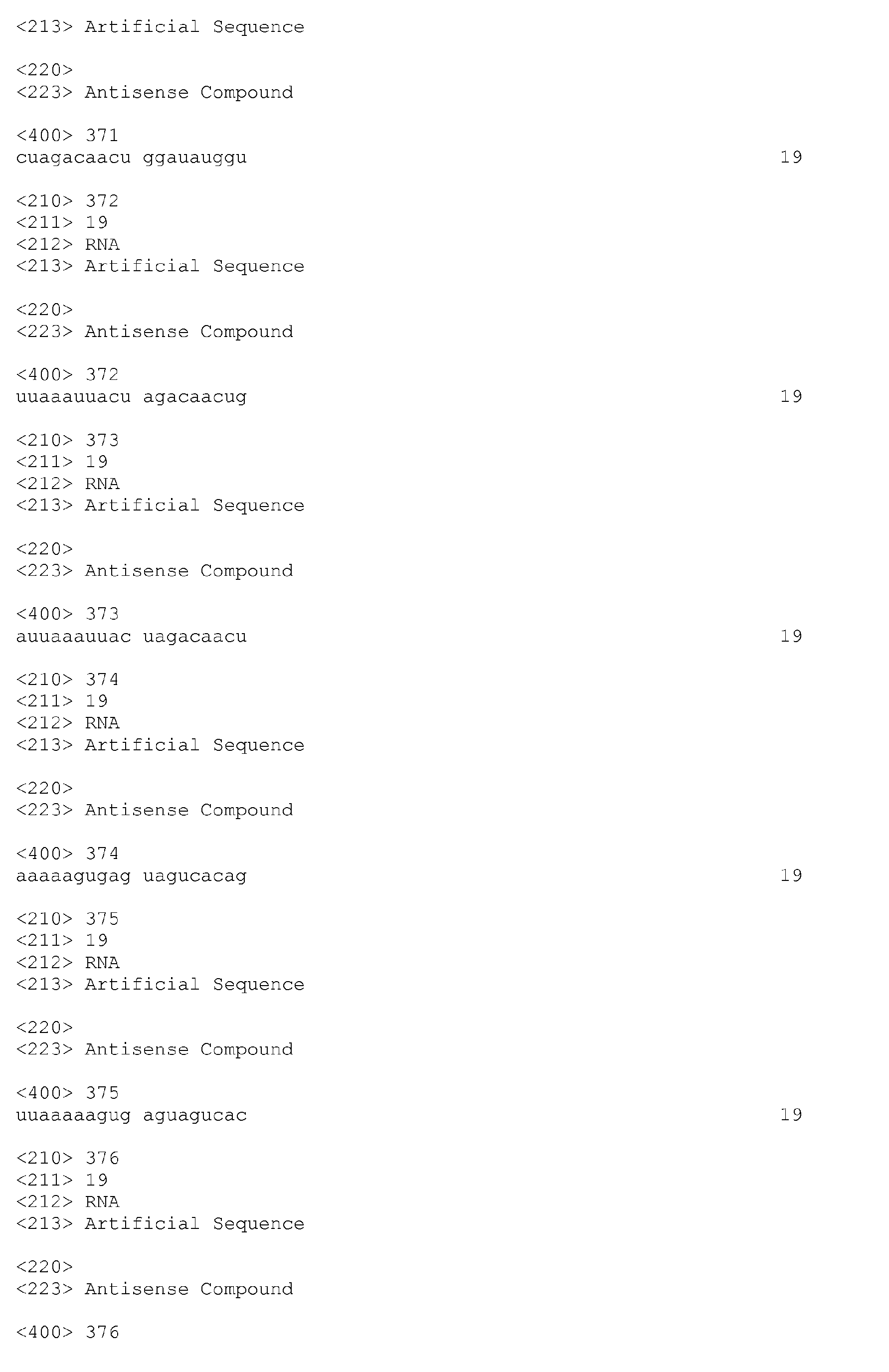


Claims (13)
- An oligomeric compound 8 to 80 nucleobases in length targeted to a nucleic acid molecule encoding eIF4E, or a pharmaceutically acceptable salt thereof, wherein:(i) the compound is targeted to the 5' untranslated region (5' UTR), the start codon region, the coding region, the stop codon region, or the 3' untranslated region (3' UTR) of a nucleic acid molecule encoding eIF4E; or(ii) the compound is targeted to an intron, an intron-exon junction or an exon-intron junction of a nucleic acid molecule encoding eIF4E,and wherein the compound inhibits the expression of eIF4E.
- The oligomeric compound or pharmaceutically acceptable salt thereof of claim 1, which is 19 to 23 nucleobases in length.
- The oligomeric compound or pharmaceutically acceptable salt thereof of claim 1 or 2, which comprises an oligonucleotide.
- The oligomeric compound or pharmaceutically acceptable salt thereof of any one of claims 1-3, which comprises a chimeric oligonucleotide.
- The oligomeric compound or pharmaceutically acceptable salt thereof of any one of claims 1-4, which is single-stranded.
- The oligomeric compound or pharmaceutically acceptable salt thereof of any one of claims 1-4, which is fully or partially double-stranded.
- The oligomeric compound or pharmaceutically acceptable salt thereof of any one of claims 1-6, comprising an oligonucleotide having at least one chemically modified internucleoside linkage, sugar moiety, or nucleobase.
- The oligomeric compound or pharmaceutically acceptable salt thereof of claim 7, comprising an oligonucleotide wherein:(i) said chemically modified internucleoside linkage is a phosphorothioate linkage;(ii) said chemically modified sugar moiety has a 2'-O-methoxyethyl substituent;(iii) said chemically modified sugar moiety has a 2'-O-methyl, 2'-fluoro, or 4'-thio substituent; or(iv) said chemically modified nucleobase is cytosine, wherein said cytosine has a methyl substituent at the 5-position.
- The oligomeric compound or pharmaceutically acceptable salt thereof of claim 7 or 8, wherein:(i) every internucleoside linkage is a phosphorothioate linkage;(ii) nucleotides 1-5 and 16-20 reading from the 5' end to the 3' end comprise a 2'-O-methoxyethyl sugar, and nucleotides 6-15 are 2'-deoxynucleotides; and/or(iii) every cytosine residue is a 5-methylcytosine residue.
- The oligomeric compound or pharmaceutically acceptable salt thereof of any preceding claim, comprising a single-stranded 20 nucleobase oligonucleotide wherein every internucleoside linkage is a phosphorothioate linkage, nucleotides 1-5 and 16-20 reading from the 5' end to the 3' end comprise a 2'-O-methoxyethyl sugar, nucleotides 6-15 are 2'-deoxynucleotides, and every cytosine residue is a 5-methylcytosine.
- A pharmaceutical or veterinary composition, comprising an oligomeric compound or pharmaceutically acceptable salt thereof of any one of claims 1-10, and a pharmaceutically or physiologically acceptable carrier, excipient, or diluent.
- An oligomeric compound according to any of claims 1-10, for use in treating a hyperproliferative condition or disease.
- The compound of claim 12, wherein:(i) said hyperproliferative condition or disease is a susceptible cancer, tumor, or condition characterized by aberrant or unwanted angiogenesis; or(ii) said hyperproliferative condition or disease associated with eIF4E expression or overexpression is selected from the group consisting of breast cancer, head and neck cancer, colorectal cancer, prostate cancer, lung cancer, bladder cancer, ovarian cancer, renal cancer, and glioblastoma.
Applications Claiming Priority (4)
| Application Number | Priority Date | Filing Date | Title |
|---|---|---|---|
| US50411003P | 2003-09-18 | 2003-09-18 | |
| US57653404P | 2004-06-03 | 2004-06-03 | |
| EP09150172A EP2182063A3 (en) | 2003-09-18 | 2004-09-17 | Modulation of EIF4E expression |
| EP04784326A EP1668130A2 (en) | 2003-09-18 | 2004-09-17 | Modulation of eif4e expression |
Related Parent Applications (2)
| Application Number | Title | Priority Date | Filing Date |
|---|---|---|---|
| EP04784326.3 Division | 2004-09-17 | ||
| EP09150172.6 Division | 2009-01-07 |
Publications (2)
| Publication Number | Publication Date |
|---|---|
| EP2256201A2 true EP2256201A2 (en) | 2010-12-01 |
| EP2256201A3 EP2256201A3 (en) | 2012-07-04 |
Family
ID=34381100
Family Applications (4)
| Application Number | Title | Priority Date | Filing Date |
|---|---|---|---|
| EP10176942A Withdrawn EP2256201A3 (en) | 2003-09-18 | 2004-09-17 | Modulation of eIF4E expression |
| EP09150172A Withdrawn EP2182063A3 (en) | 2003-09-18 | 2004-09-17 | Modulation of EIF4E expression |
| EP04784326A Withdrawn EP1668130A2 (en) | 2003-09-18 | 2004-09-17 | Modulation of eif4e expression |
| EP10176928A Withdrawn EP2256200A3 (en) | 2003-09-18 | 2004-09-17 | Modulation of eIF4E expression |
Family Applications After (3)
| Application Number | Title | Priority Date | Filing Date |
|---|---|---|---|
| EP09150172A Withdrawn EP2182063A3 (en) | 2003-09-18 | 2004-09-17 | Modulation of EIF4E expression |
| EP04784326A Withdrawn EP1668130A2 (en) | 2003-09-18 | 2004-09-17 | Modulation of eif4e expression |
| EP10176928A Withdrawn EP2256200A3 (en) | 2003-09-18 | 2004-09-17 | Modulation of eIF4E expression |
Country Status (19)
| Country | Link |
|---|---|
| US (5) | US7425544B2 (en) |
| EP (4) | EP2256201A3 (en) |
| JP (1) | JP4672664B2 (en) |
| KR (1) | KR100750788B1 (en) |
| CN (1) | CN100558893C (en) |
| AR (1) | AR045937A1 (en) |
| AU (1) | AU2004274942B2 (en) |
| BR (1) | BRPI0413930A (en) |
| CA (1) | CA2539181A1 (en) |
| EA (1) | EA009670B1 (en) |
| EC (1) | ECSP066421A (en) |
| IL (2) | IL173707A0 (en) |
| MA (1) | MA28264A1 (en) |
| NO (1) | NO20061673L (en) |
| NZ (2) | NZ545134A (en) |
| PE (1) | PE20050469A1 (en) |
| SG (1) | SG146682A1 (en) |
| TW (1) | TW200519202A (en) |
| WO (1) | WO2005028628A2 (en) |
Families Citing this family (115)
| Publication number | Priority date | Publication date | Assignee | Title |
|---|---|---|---|---|
| CN103301475B (en) | 2005-12-28 | 2016-08-03 | 斯克里普斯研究所 | Method that pharmaceutical composition and expression vector and regulator gene are expressed and the application of nucleic acid molecules |
| DK2092065T4 (en) * | 2006-10-18 | 2019-10-21 | Ionis Pharmaceuticals Inc | The antisense compounds |
| AU2007323469B2 (en) * | 2006-11-23 | 2014-07-24 | Guangdong Maijinjia Biotechnology Co., Ltd | Oligonucleotides for modulating target RNA activity |
| US8318496B2 (en) * | 2007-10-04 | 2012-11-27 | Isis Pharmaceuticals, Inc. | Compounds and methods for improving cellular uptake of oligomeric compounds |
| US8426378B2 (en) | 2008-03-21 | 2013-04-23 | Isis Pharmaceuticals, Inc. | Oligomeric compounds comprising tricyclic nucelosides and methods for their use |
| WO2010008562A2 (en) | 2008-07-16 | 2010-01-21 | Recombinetics | Methods and materials for producing transgenic animals |
| CA2739464C (en) | 2008-10-03 | 2020-03-31 | Curna, Inc. | Treatment of apolipoprotein-a1 related diseases by inhibition of natural antisense transcript to apolipoprotein-a1 |
| CA2744031A1 (en) * | 2008-11-21 | 2010-05-27 | Isis Pharmaceuticals, Inc. | Anticancer combination comprising docetaxel and an antisense oligonucleotide |
| EP2373308A2 (en) * | 2008-11-21 | 2011-10-12 | Isis Pharmaceuticals, Inc. | Combination therapy for the treatment of cancer |
| RU2569182C2 (en) | 2008-12-04 | 2015-11-20 | КьюРНА,Инк.,US | Treating diseases associated with vascular endothelial growth factor (vegf) by suppression of natural antisense vegf transcript |
| KR101829469B1 (en) | 2008-12-04 | 2018-03-30 | 큐알엔에이, 인크. | Treatment of erythropoietin (epo) related diseases by inhibition of natural antisense transcript to epo |
| KR101866152B1 (en) | 2008-12-04 | 2018-06-08 | 큐알엔에이, 인크. | Treatment of tumor suppressor gene related diseases by inhibition of natural antisense transcript to the gene |
| KR101682735B1 (en) | 2009-02-12 | 2016-12-06 | 큐알엔에이, 인크. | Treatment of brain derived neurotrophic factor (bdnf) related diseases by inhibition of natural antisense transcript to bdnf |
| MX2011009751A (en) | 2009-03-16 | 2011-09-29 | Opko Curna Llc | Treatment of nuclear factor (erythroid-derived 2)-like 2 (nrf2) related diseases by inhibition of natural antisense transcript to nrf2. |
| JP5904935B2 (en) | 2009-03-17 | 2016-04-20 | クルナ・インコーポレーテッド | Treatment of DLK1-related diseases by suppression of natural antisense transcripts against Delta-like 1 homolog (DLK1) |
| CN102459596B (en) | 2009-05-06 | 2016-09-07 | 库尔纳公司 | Treatment of Lipid Transport and Metabolism Gene-Associated Diseases by Inhibition of Natural Antisense Transcripts Targeting Lipid Transport and Metabolism Genes |
| JP6250930B2 (en) | 2009-05-06 | 2017-12-20 | クルナ・インコーポレーテッド | Treatment of TTP-related diseases by suppression of natural antisense transcripts against tristetraproline (TTP) |
| CA2761248C (en) | 2009-05-08 | 2023-03-14 | Joseph Collard | Treatment of dystrophin family related diseases by inhibition of natural antisense transcript to dmd family |
| JP5922017B2 (en) | 2009-05-18 | 2016-05-24 | クルナ・インコーポレーテッド | Treatment of reprogramming factor-related diseases by suppression of natural antisense transcripts against the reprogramming factor |
| EP2432882B1 (en) | 2009-05-22 | 2019-12-25 | CuRNA, Inc. | TREATMENT OF TRANSCRIPTION FACTOR E3 (TFE3) and INSULIN RECEPTOR SUBSTRATE 2 (IRS2) RELATED DISEASES BY INHIBITION OF NATURAL ANTISENSE TRANSCRIPT TO TFE3 |
| WO2010138806A2 (en) | 2009-05-28 | 2010-12-02 | Curna, Inc. | Treatment of antiviral gene related diseases by inhibition of natural antisense transcript to an antiviral gene |
| JP5944311B2 (en) | 2009-06-16 | 2016-07-05 | クルナ・インコーポレーテッド | Treatment of collagen gene-related diseases by suppression of natural antisense transcripts against collagen genes |
| JP6128846B2 (en) | 2009-06-16 | 2017-05-17 | クルナ・インコーポレーテッド | Treatment of PON1 gene-related diseases by suppression of natural antisense transcripts against paraoxonase (PON1) |
| EP2446036B1 (en) | 2009-06-24 | 2017-03-01 | CuRNA, Inc. | Treatment of tumor necrosis factor receptor 2 (tnfr2) related diseases by inhibition of natural antisense transcript to tnfr2 |
| US8921330B2 (en) | 2009-06-26 | 2014-12-30 | Curna, Inc. | Treatment of down syndrome gene related diseases by inhibition of natural antisense transcript to a down syndrome gene |
| WO2011011700A2 (en) | 2009-07-24 | 2011-01-27 | Curna, Inc. | Treatment of sirtuin (sirt) related diseases by inhibition of natural antisense transcript to a sirtuin (sirt) |
| ES2585360T3 (en) | 2009-08-05 | 2016-10-05 | Curna, Inc. | Treatment of diseases related to an insulin gene (INS) by inhibition of natural antisense transcription in an insulin gene (INS) |
| JP6189594B2 (en) | 2009-08-11 | 2017-08-30 | クルナ・インコーポレーテッド | Treatment of adiponectin (ADIPOQ) -related diseases by suppression of natural antisense transcripts against adiponectin (ADIPOQ) |
| CN102482670B (en) | 2009-08-21 | 2018-06-15 | 库尔纳公司 | Treatment of CHIP-associated diseases by inhibiting the natural antisense transcript of 'C-terminus of HSP70-interacting protein' (CHIP) |
| KR101892760B1 (en) | 2009-08-25 | 2018-08-28 | 큐알엔에이, 인크. | Treatment of 'iq motif containing gtpase activating protein' (iqgap) related diseases by inhibition of natural antisense transcript to iqgap |
| CN101671669B (en) * | 2009-08-27 | 2012-05-02 | 浙江大学 | A liver cancer targeting gene expression element AE and its application |
| ES2664591T3 (en) | 2009-09-25 | 2018-04-20 | Curna, Inc. | Treatment of phylagrin-related diseases (flg) by modulating the expression and activity of the FLG gene |
| US20150025122A1 (en) | 2009-10-12 | 2015-01-22 | Larry J. Smith | Methods and Compositions for Modulating Gene Expression Using Oligonucleotide Based Drugs Administered in vivo or in vitro |
| CN102712927B (en) | 2009-12-16 | 2017-12-01 | 库尔纳公司 | Treatment of MBTPS1-associated diseases by inhibiting natural antisense transcripts of the membrane-bound transcription factor peptidase, site 1 (MBTPS1) |
| KR101891352B1 (en) | 2009-12-23 | 2018-08-24 | 큐알엔에이, 인크. | Treatment of hepatocyte growth factor (hgf) related diseases by inhibition of natural antisense transcript to hgf |
| JP6031356B2 (en) | 2009-12-23 | 2016-11-24 | カッパーアールエヌエー,インコーポレイテッド | Treatment of uncoupling protein 2 (UCP2) -related diseases by inhibition of natural antisense transcripts against UCP2. |
| KR101838305B1 (en) | 2009-12-29 | 2018-03-13 | 큐알엔에이, 인크. | Treatment of nuclear respiratory factor 1 (nrf1) related diseases by inhibition of natural antisense transcript to nrf1 |
| CA2785177C (en) | 2009-12-29 | 2019-09-24 | Curna, Inc. | Treatment of tumor protein 63 (p63) related diseases by inhibition of natural antisense transcript to p63 |
| CN102791862B (en) | 2009-12-31 | 2017-04-05 | 库尔纳公司 | Treatment of IRS2-associated diseases by inhibiting natural antisense transcripts of insulin receptor substrate 2 (IRS2) and transcription factor E3 (TFE3) |
| JP5886757B2 (en) | 2010-01-04 | 2016-03-16 | カッパーアールエヌエー,インコーポレイテッド | Treatment of interferon regulatory factor 8 (IRF8) related diseases by inhibition of natural antisense transcripts against interferon regulatory factor 8 (IRF8) |
| EP2521785B1 (en) | 2010-01-06 | 2022-03-09 | CuRNA, Inc. | Inhibition of natural antisense transcript to a pancreatic developmental gene for use in a treatment of pancreatic developmental gene related diseases |
| JP6027893B2 (en) | 2010-01-11 | 2016-11-16 | カッパーアールエヌエー,インコーポレイテッド | Treatment of sex hormone binding globulin (SHBG) related diseases by inhibition of natural antisense transcripts against sex hormone binding globulin (SHBG) |
| EP2529015B1 (en) | 2010-01-25 | 2017-11-15 | CuRNA, Inc. | Treatment of rnase h1 related diseases by inhibition of natural antisense transcript to rnase h1 |
| KR101838308B1 (en) | 2010-02-22 | 2018-03-13 | 큐알엔에이, 인크. | Treatment of pyrroline-5-carboxylate reductase 1 (pycr1) related diseases by inhibition of natural antisense transcript to pycr1 |
| EP2539356A4 (en) * | 2010-02-26 | 2014-03-05 | Isis Pharmaceuticals Inc | MODULATION OF SMAD3 EXPRESSION |
| US9095504B2 (en) * | 2010-03-24 | 2015-08-04 | Rxi Pharmaceuticals Corporation | RNA interference in ocular indications |
| CA2795145C (en) | 2010-04-02 | 2019-01-22 | Curna, Inc. | Treatment of colony-stimulating factor 3 (csf3) related diseases by inhibition of natural antisense transcript to csf3 |
| TWI644675B (en) | 2010-04-09 | 2018-12-21 | 可娜公司 | Treatment of fibroblast growth factor 21 (fgf21) related diseases by inhibition of natural antisense transcript to fgf21 |
| SG184860A1 (en) * | 2010-04-27 | 2012-11-29 | Agency Science Tech & Res | Eif4e binding peptides |
| RU2693462C2 (en) | 2010-05-03 | 2019-07-03 | Курна, Инк. | Treatment of sirtuin (sirt) related diseases by inhibition of natural antisense transcript to sirtuin (sirt) |
| TWI531370B (en) | 2010-05-14 | 2016-05-01 | 可娜公司 | Treatment of PAR4-related diseases by inhibiting PAR4 natural anti-strand transcript |
| EP2576783B1 (en) | 2010-05-26 | 2017-11-29 | CuRNA, Inc. | Treatment of atonal homolog 1 (atoh1) related diseases by inhibition of natural antisense transcript to atoh1 |
| EP2576784B1 (en) | 2010-05-26 | 2017-11-15 | CuRNA, Inc. | Treatment of methionine sulfoxide reductase a (msra) related diseases by inhibition of natural antisense transcript to msra |
| SG186229A1 (en) * | 2010-06-07 | 2013-01-30 | Novomedix Llc | Furanyl compounds and the use thereof |
| KR102008708B1 (en) | 2010-06-23 | 2019-08-08 | 큐알엔에이, 인크. | Treatment of sodium channel voltage-gated, alpha subunit (scna) related diseases by inhibition of natural abtisense transcript to scna |
| CN101914536B (en) * | 2010-07-09 | 2011-11-16 | 四川大学 | Locked nucleic acid ribozyme of targeted serine-threonine protein kinase aurora kinase A and application thereof |
| CA2805318A1 (en) | 2010-07-14 | 2012-01-19 | Curna, Inc. | Treatment of discs large homolog (dlg) related diseases by inhibition of natural antisense transcript to dlg |
| EP2412724A1 (en) | 2010-07-29 | 2012-02-01 | Centre National de la Recherche Scientifique (C.N.R.S) | Regulation of Glypican 4 activity to modulate the fate of stem cells and uses thereof |
| WO2012027206A1 (en) * | 2010-08-24 | 2012-03-01 | Merck Sharp & Dohme Corp. | SINGLE-STRANDED RNAi AGENTS CONTAINING AN INTERNAL, NON-NUCLEIC ACID SPACER |
| ES2640755T3 (en) | 2010-10-06 | 2017-11-06 | Curna, Inc. | Treatment of diseases related to Sialidase 4 (neu4) by inhibition of the natural antisense transcript to the neu4 gene |
| US9222088B2 (en) | 2010-10-22 | 2015-12-29 | Curna, Inc. | Treatment of alpha-L-iduronidase (IDUA) related diseases by inhibition of natural antisense transcript to IDUA |
| WO2012058462A2 (en) * | 2010-10-29 | 2012-05-03 | Isis Pharmaceuticals, Inc. | Combination therapy for the treatment of cancer |
| US10000752B2 (en) | 2010-11-18 | 2018-06-19 | Curna, Inc. | Antagonat compositions and methods of use |
| EP2643463B1 (en) | 2010-11-23 | 2017-09-27 | CuRNA, Inc. | Treatment of nanog related diseases by inhibition of natural antisense transcript to nanog |
| EP3467109A1 (en) | 2011-02-08 | 2019-04-10 | Ionis Pharmaceuticals, Inc. | Oligomeric compounds comprising bicyclic nucleotides and uses thereof |
| JP6188686B2 (en) | 2011-06-09 | 2017-08-30 | カッパーアールエヌエー,インコーポレイテッド | Treatment of FXN-related diseases by inhibition of natural antisense transcripts to frataxin (FXN) |
| EP2742056B2 (en) | 2011-08-11 | 2020-06-10 | Ionis Pharmaceuticals, Inc. | Selective antisense compounds and uses thereof |
| BR112014005234A2 (en) | 2011-09-06 | 2017-04-11 | Curna Inc | treatment of diseases related to voltage-dependent sodium channel alpha subunits (scnxa) with small molecules |
| CA2752008A1 (en) | 2011-09-13 | 2013-03-13 | Universite De Montreal | Combination therapy using ribavirin as elf4e inhibitor |
| WO2013089283A1 (en) | 2011-12-16 | 2013-06-20 | National University Corporation Tokyo Medical And Dental University | Chimeric double-stranded nucleic acid |
| SG10201610936RA (en) | 2011-12-22 | 2017-02-27 | Alios Biopharma Inc | Substituted nucleosides, nucleotides and analogs thereof |
| HUE040179T2 (en) | 2012-03-15 | 2019-02-28 | Curna Inc | Treatment of brain derived neurotrophic factor (bdnf) related diseases by inhibition of natural antisense transcript to bdnf |
| US9441007B2 (en) | 2012-03-21 | 2016-09-13 | Alios Biopharma, Inc. | Substituted nucleosides, nucleotides and analogs thereof |
| USRE48171E1 (en) | 2012-03-21 | 2020-08-25 | Janssen Biopharma, Inc. | Substituted nucleosides, nucleotides and analogs thereof |
| WO2013159108A2 (en) | 2012-04-20 | 2013-10-24 | Isis Pharmaceuticals, Inc. | Oligomeric compounds comprising bicyclic nucleotides and uses thereof |
| WO2014022357A1 (en) * | 2012-07-30 | 2014-02-06 | Isis Pharmaceuticals, Inc. | Combination therapy for the treatment of cancer |
| EP2906699A4 (en) | 2012-10-11 | 2016-06-08 | Ionis Pharmaceuticals Inc | Oligomeric compounds comprising bicyclic nucleosides and uses thereof |
| US9822418B2 (en) | 2013-04-22 | 2017-11-21 | Icahn School Of Medicine At Mount Sinai | Mutations in PDGFRB and NOTCH3 as causes of autosomal dominant infantile myofibromatosis |
| US20140323543A1 (en) * | 2013-04-25 | 2014-10-30 | Jeremy Richard Graff | Treatment of Prostate Cancer with eIF4E Antisense Compounds |
| PE20152002A1 (en) | 2013-05-01 | 2016-01-21 | Isis Pharmaceuticals Inc | COMPOSITIONS AND METHODS TO MODULATE THE EXPRESSION OF TTR AND VHB |
| US20150050738A1 (en) * | 2013-08-16 | 2015-02-19 | Rana Therapeutics, Inc. | Compositions and methods for modulating rna |
| WO2015179693A1 (en) | 2014-05-22 | 2015-11-26 | Isis Pharmaceuticals, Inc. | Conjugated antisense compounds and their use |
| CN107250362B (en) | 2014-11-17 | 2021-10-22 | 阿尔尼拉姆医药品有限公司 | Apolipoprotein C3 (APOC3) iRNA compositions and methods of use |
| KR102254728B1 (en) | 2014-12-23 | 2021-05-24 | 인제대학교 산학협력단 | Composition for Reducing Cell Proliferation Comprising Clast4 |
| EP3256591A4 (en) | 2015-02-13 | 2018-08-08 | Translate Bio Ma, Inc. | Hybrid oligonucleotides and uses thereof |
| WO2016161388A1 (en) | 2015-04-03 | 2016-10-06 | University Of Massachusetts | Fully stabilized asymmetric sirna |
| EP3334499A4 (en) | 2015-08-14 | 2019-04-17 | University of Massachusetts | BIOACTIVE CONJUGATES FOR THE ADMINISTRATION OF OLIGONUCLEOTIDES |
| US12318489B2 (en) | 2015-10-26 | 2025-06-03 | Translate Bio Ma, Inc. | Nanoparticle formulations for delivery of nucleic acid complexes |
| US11273151B2 (en) | 2015-11-04 | 2022-03-15 | Icahn School Of Medicine At Mount Sinai | Methods of treating tumors and cancer, and identifying candidate subjects for such treatment |
| CN108699556B (en) * | 2015-11-16 | 2023-02-17 | 奥利克斯医药有限公司 | Treatment of age-related macular degeneration using RNA complexes targeting MYD88 or TLR3 |
| US10478503B2 (en) | 2016-01-31 | 2019-11-19 | University Of Massachusetts | Branched oligonucleotides |
| US11246868B2 (en) | 2016-04-26 | 2022-02-15 | Icahn School Of Medicine At Mount Sinai | Treatment of hippo pathway mutant tumors and methods of identifying subjects as candidates for treatment |
| WO2018031933A2 (en) | 2016-08-12 | 2018-02-15 | University Of Massachusetts | Conjugated oligonucleotides |
| EP3500581A4 (en) * | 2016-08-17 | 2021-10-06 | Solstice Biologics, Ltd. | POLYNUCLEOTID CONSTRUCTIONS |
| CN107164379B (en) * | 2016-08-18 | 2020-06-02 | 广州市锐博生物科技有限公司 | Oligonucleic acid molecule for inhibiting VEGFA target gene mRNA expression and its complete set of compositions |
| WO2018057837A1 (en) * | 2016-09-23 | 2018-03-29 | Ionis Pharmaceuticals, Inc. | Gene therapy and targeted delivery of conjugated compounds |
| KR20190065341A (en) | 2016-10-06 | 2019-06-11 | 아이오니스 파마수티컬즈, 인코포레이티드 | Method of joining oligomeric compounds |
| US20190338286A1 (en) * | 2017-01-13 | 2019-11-07 | Roche Innovation Center Copenhagen A/S | Antisense oligonucleotides for modulating rel expression |
| CN110799647A (en) | 2017-06-23 | 2020-02-14 | 马萨诸塞大学 | Two-tailed self-delivery SIRNA and related methods |
| EP3645546A4 (en) | 2017-06-30 | 2021-12-01 | Solstice Biologics, Ltd. | CHIRAL PHOSPHORAMIDITE AIDS AND METHOD FOR THEIR USE |
| JP2021526858A (en) * | 2018-06-08 | 2021-10-11 | ロックアネイビオ, インコーポレイテッド | RNA-targeted fusion protein composition and usage |
| KR102847197B1 (en) | 2018-06-18 | 2025-08-20 | 유니버시티 오브 로체스터 | How to treat schizophrenia and other neuropsychiatric disorders |
| EP3840759A4 (en) | 2018-08-23 | 2022-06-01 | University Of Massachusetts | FULLY STABILIZED O-METHYL RICH OLIGONUCLEOTIDES |
| CN113728103B (en) | 2018-12-11 | 2025-02-28 | 罗切斯特大学 | Methods of treating schizophrenia and other neuropsychiatric disorders |
| JP2021008453A (en) | 2019-07-02 | 2021-01-28 | エフェクター・セラピューティクス,インコーポレーテッド | Translation inhibitor and use thereof |
| US20220267737A1 (en) | 2019-07-18 | 2022-08-25 | University Of Rochester | Cell-type selective immunoprotection of cells |
| KR20220047989A (en) | 2019-08-09 | 2022-04-19 | 유니버시티 오브 매사추세츠 | Chemically modified oligonucleotides targeting SNPs |
| CN110283906A (en) * | 2019-08-12 | 2019-09-27 | 徐州医科大学 | Human early atherosclerosis detection molecular markers and their application |
| CA3126070A1 (en) * | 2019-09-03 | 2021-03-11 | Sovargen Co., Ltd. | Composition for diagnosing or treating conditions associated with increased elf4e activity comprising elf4e inhibitor |
| US12365894B2 (en) | 2019-09-16 | 2025-07-22 | University Of Massachusetts | Branched lipid conjugates of siRNA for specific tissue delivery |
| JP7735288B2 (en) | 2020-02-18 | 2025-09-08 | アルナイラム ファーマシューティカルズ, インコーポレイテッド | Apolipoprotein C3 (APOC3) iRNA Compositions and Methods of Use Thereof |
| JP2023522957A (en) * | 2020-04-21 | 2023-06-01 | フラッグシップ パイオニアリング, インコーポレイテッド | BIFUNCTIONAL MOLECULES AND METHODS OF USE THEREOF |
| US12534724B2 (en) | 2020-05-26 | 2026-01-27 | University Of Massachusetts | Synthetic oligonucleotides having regions of block and cluster modifications |
| IL309334A (en) | 2021-06-23 | 2024-02-01 | Univ Massachusetts | Optimized anti-flt1 oligonucleotide compounds for treatment of preeclampsia and other angiogenic disorders |
| CN114875065B (en) * | 2022-05-06 | 2023-10-27 | 广东医科大学 | Design and application of eIF4E/c-Myc gene positive feedback loop self-control shRNA silencing vector |
Citations (205)
| Publication number | Priority date | Publication date | Assignee | Title |
|---|---|---|---|---|
| US1329501A (en) | 1919-06-24 | 1920-02-03 | Franklin W Britton | Rotary router and boring mechanism |
| US3687808A (en) | 1969-08-14 | 1972-08-29 | Univ Leland Stanford Junior | Synthetic polynucleotides |
| US4426330A (en) | 1981-07-20 | 1984-01-17 | Lipid Specialties, Inc. | Synthetic phospholipid compounds |
| US4469863A (en) | 1980-11-12 | 1984-09-04 | Ts O Paul O P | Nonionic nucleic acid alkyl and aryl phosphonates and processes for manufacture and use thereof |
| US4476301A (en) | 1982-04-29 | 1984-10-09 | Centre National De La Recherche Scientifique | Oligonucleotides, a process for preparing the same and their application as mediators of the action of interferon |
| US4534899A (en) | 1981-07-20 | 1985-08-13 | Lipid Specialties, Inc. | Synthetic phospholipid compounds |
| US4587044A (en) | 1983-09-01 | 1986-05-06 | The Johns Hopkins University | Linkage of proteins to nucleic acids |
| US4605735A (en) | 1983-02-14 | 1986-08-12 | Wakunaga Seiyaku Kabushiki Kaisha | Oligonucleotide derivatives |
| US4667025A (en) | 1982-08-09 | 1987-05-19 | Wakunaga Seiyaku Kabushiki Kaisha | Oligonucleotide derivatives |
| US4762779A (en) | 1985-06-13 | 1988-08-09 | Amgen Inc. | Compositions and methods for functionalizing nucleic acids |
| US4824941A (en) | 1983-03-10 | 1989-04-25 | Julian Gordon | Specific antibody to the native form of 2'5'-oligonucleotides, the method of preparation and the use as reagents in immunoassays or for binding 2'5'-oligonucleotides in biological systems |
| US4828979A (en) | 1984-11-08 | 1989-05-09 | Life Technologies, Inc. | Nucleotide analogs for nucleic acid labeling and detection |
| US4835263A (en) | 1983-01-27 | 1989-05-30 | Centre National De La Recherche Scientifique | Novel compounds containing an oligonucleotide sequence bonded to an intercalating agent, a process for their synthesis and their use |
| US4845205A (en) | 1985-01-08 | 1989-07-04 | Institut Pasteur | 2,N6 -disubstituted and 2,N6 -trisubstituted adenosine-3'-phosphoramidites |
| US4876335A (en) | 1986-06-30 | 1989-10-24 | Wakunaga Seiyaku Kabushiki Kaisha | Poly-labelled oligonucleotide derivative |
| US4904582A (en) | 1987-06-11 | 1990-02-27 | Synthetic Genetics | Novel amphiphilic nucleic acid conjugates |
| US4948882A (en) | 1983-02-22 | 1990-08-14 | Syngene, Inc. | Single-stranded labelled oligonucleotides, reactive monomers and methods of synthesis |
| US4958013A (en) | 1989-06-06 | 1990-09-18 | Northwestern University | Cholesteryl modified oligonucleotides |
| US4981957A (en) | 1984-07-19 | 1991-01-01 | Centre National De La Recherche Scientifique | Oligonucleotides with modified phosphate and modified carbohydrate moieties at the respective chain termini |
| US5013830A (en) | 1986-09-08 | 1991-05-07 | Ajinomoto Co., Inc. | Compounds for the cleavage at a specific position of RNA, oligomers employed for the formation of said compounds, and starting materials for the synthesis of said oligomers |
| US5013556A (en) | 1989-10-20 | 1991-05-07 | Liposome Technology, Inc. | Liposomes with enhanced circulation time |
| US5023243A (en) | 1981-10-23 | 1991-06-11 | Molecular Biosystems, Inc. | Oligonucleotide therapeutic agent and method of making same |
| US5034506A (en) | 1985-03-15 | 1991-07-23 | Anti-Gene Development Group | Uncharged morpholino-based polymers having achiral intersubunit linkages |
| US5082830A (en) | 1988-02-26 | 1992-01-21 | Enzo Biochem, Inc. | End labeled nucleotide probe |
| US5108921A (en) | 1989-04-03 | 1992-04-28 | Purdue Research Foundation | Method for enhanced transmembrane transport of exogenous molecules |
| US5109124A (en) | 1988-06-01 | 1992-04-28 | Biogen, Inc. | Nucleic acid probe linked to a label having a terminal cysteine |
| US5112963A (en) | 1987-11-12 | 1992-05-12 | Max-Planck-Gesellschaft Zur Foerderung Der Wissenschaften E.V. | Modified oligonucleotides |
| US5118800A (en) | 1983-12-20 | 1992-06-02 | California Institute Of Technology | Oligonucleotides possessing a primary amino group in the terminal nucleotide |
| US5118802A (en) | 1983-12-20 | 1992-06-02 | California Institute Of Technology | DNA-reporter conjugates linked via the 2' or 5'-primary amino group of the 5'-terminal nucleoside |
| US5130302A (en) | 1989-12-20 | 1992-07-14 | Boron Bilogicals, Inc. | Boronated nucleoside, nucleotide and oligonucleotide compounds, compositions and methods for using same |
| US5134066A (en) | 1989-08-29 | 1992-07-28 | Monsanto Company | Improved probes using nucleosides containing 3-dezauracil analogs |
| US5138045A (en) | 1990-07-27 | 1992-08-11 | Isis Pharmaceuticals | Polyamine conjugated oligonucleotides |
| US5149797A (en) | 1990-02-15 | 1992-09-22 | The Worcester Foundation For Experimental Biology | Method of site-specific alteration of rna and production of encoded polypeptides |
| US5166315A (en) | 1989-12-20 | 1992-11-24 | Anti-Gene Development Group | Sequence-specific binding polymers for duplex nucleic acids |
| US5175273A (en) | 1988-07-01 | 1992-12-29 | Genentech, Inc. | Nucleic acid intercalating agents |
| US5177196A (en) | 1990-08-16 | 1993-01-05 | Microprobe Corporation | Oligo (α-arabinofuranosyl nucleotides) and α-arabinofuranosyl precursors thereof |
| US5177198A (en) | 1989-11-30 | 1993-01-05 | University Of N.C. At Chapel Hill | Process for preparing oligoribonucleoside and oligodeoxyribonucleoside boranophosphates |
| US5185444A (en) | 1985-03-15 | 1993-02-09 | Anti-Gene Deveopment Group | Uncharged morpolino-based polymers having phosphorous containing chiral intersubunit linkages |
| US5188897A (en) | 1987-10-22 | 1993-02-23 | Temple University Of The Commonwealth System Of Higher Education | Encapsulated 2',5'-phosphorothioate oligoadenylates |
| US5194599A (en) | 1988-09-23 | 1993-03-16 | Gilead Sciences, Inc. | Hydrogen phosphonodithioate compositions |
| US5214134A (en) | 1990-09-12 | 1993-05-25 | Sterling Winthrop Inc. | Process of linking nucleosides with a siloxane bridge |
| US5214136A (en) | 1990-02-20 | 1993-05-25 | Gilead Sciences, Inc. | Anthraquinone-derivatives oligonucleotides |
| US5216141A (en) | 1988-06-06 | 1993-06-01 | Benner Steven A | Oligonucleotide analogs containing sulfur linkages |
| US5218105A (en) | 1990-07-27 | 1993-06-08 | Isis Pharmaceuticals | Polyamine conjugated oligonucleotides |
| US5220007A (en) | 1990-02-15 | 1993-06-15 | The Worcester Foundation For Experimental Biology | Method of site-specific alteration of RNA and production of encoded polypeptides |
| US5223618A (en) | 1990-08-13 | 1993-06-29 | Isis Pharmaceuticals, Inc. | 4'-desmethyl nucleoside analog compounds |
| US5227170A (en) | 1989-06-22 | 1993-07-13 | Vestar, Inc. | Encapsulation process |
| US5235033A (en) | 1985-03-15 | 1993-08-10 | Anti-Gene Development Group | Alpha-morpholino ribonucleoside derivatives and polymers thereof |
| US5245022A (en) | 1990-08-03 | 1993-09-14 | Sterling Drug, Inc. | Exonuclease resistant terminally substituted oligonucleotides |
| US5254469A (en) | 1989-09-12 | 1993-10-19 | Eastman Kodak Company | Oligonucleotide-enzyme conjugate that can be used as a probe in hybridization assays and polymerase chain reaction procedures |
| US5256775A (en) | 1989-06-05 | 1993-10-26 | Gilead Sciences, Inc. | Exonuclease-resistant oligonucleotides |
| US5258506A (en) | 1984-10-16 | 1993-11-02 | Chiron Corporation | Photolabile reagents for incorporation into oligonucleotide chains |
| US5262536A (en) | 1988-09-15 | 1993-11-16 | E. I. Du Pont De Nemours And Company | Reagents for the preparation of 5'-tagged oligonucleotides |
| US5264423A (en) | 1987-03-25 | 1993-11-23 | The United States Of America As Represented By The Department Of Health And Human Services | Inhibitors for replication of retroviruses and for the expression of oncogene products |
| US5264564A (en) | 1989-10-24 | 1993-11-23 | Gilead Sciences | Oligonucleotide analogs with novel linkages |
| US5264562A (en) | 1989-10-24 | 1993-11-23 | Gilead Sciences, Inc. | Oligonucleotide analogs with novel linkages |
| US5264221A (en) | 1991-05-23 | 1993-11-23 | Mitsubishi Kasei Corporation | Drug-containing protein-bonded liposome |
| WO1993024510A1 (en) | 1992-05-25 | 1993-12-09 | Centre National De La Recherche Scientifique (Cnrs) | Phosphotriester-type biologically active compounds |
| US5272250A (en) | 1992-07-10 | 1993-12-21 | Spielvogel Bernard F | Boronated phosphoramidate compounds |
| US5276019A (en) | 1987-03-25 | 1994-01-04 | The United States Of America As Represented By The Department Of Health And Human Services | Inhibitors for replication of retroviruses and for the expression of oncogene products |
| US5278302A (en) | 1988-05-26 | 1994-01-11 | University Patents, Inc. | Polynucleotide phosphorodithioates |
| WO1994002499A1 (en) | 1992-07-27 | 1994-02-03 | Hybridon, Inc. | Oligonucleotide alkylphosphonothioates |
| US5292873A (en) | 1989-11-29 | 1994-03-08 | The Research Foundation Of State University Of New York | Nucleic acids labeled with naphthoquinone probe |
| US5317098A (en) | 1986-03-17 | 1994-05-31 | Hiroaki Shizuya | Non-radioisotope tagging of fragments |
| US5319080A (en) | 1991-10-17 | 1994-06-07 | Ciba-Geigy Corporation | Bicyclic nucleosides, oligonucleotides, process for their preparation and intermediates |
| US5321131A (en) | 1990-03-08 | 1994-06-14 | Hybridon, Inc. | Site-specific functionalization of oligodeoxynucleotides for non-radioactive labelling |
| WO1994017093A1 (en) | 1993-01-25 | 1994-08-04 | Hybridon, Inc. | Oligonucleotide alkylphosphonates and alkylphosphonothioates |
| US5354844A (en) | 1989-03-16 | 1994-10-11 | Boehringer Ingelheim International Gmbh | Protein-polycation conjugates |
| US5356633A (en) | 1989-10-20 | 1994-10-18 | Liposome Technology, Inc. | Method of treatment of inflamed tissues |
| US5359044A (en) | 1991-12-13 | 1994-10-25 | Isis Pharmaceuticals | Cyclobutyl oligonucleotide surrogates |
| US5367066A (en) | 1984-10-16 | 1994-11-22 | Chiron Corporation | Oligonucleotides with selectably cleavable and/or abasic sites |
| WO1994026764A1 (en) | 1993-05-12 | 1994-11-24 | Centre National De La Recherche Scientifique (Cnrs) | Triester phosphorothioate oligonucleotides and method of preparation |
| US5371241A (en) | 1991-07-19 | 1994-12-06 | Pharmacia P-L Biochemicals Inc. | Fluorescein labelled phosphoramidites |
| US5378825A (en) | 1990-07-27 | 1995-01-03 | Isis Pharmaceuticals, Inc. | Backbone modified oligonucleotide analogs |
| US5386023A (en) | 1990-07-27 | 1995-01-31 | Isis Pharmaceuticals | Backbone modified oligonucleotide analogs and preparation thereof through reductive coupling |
| US5391723A (en) | 1989-05-31 | 1995-02-21 | Neorx Corporation | Oligonucleotide conjugates |
| US5395619A (en) | 1993-03-03 | 1995-03-07 | Liposome Technology, Inc. | Lipid-polymer conjugates and liposomes |
| US5399676A (en) | 1989-10-23 | 1995-03-21 | Gilead Sciences | Oligonucleotides with inverted polarity |
| US5403711A (en) | 1987-11-30 | 1995-04-04 | University Of Iowa Research Foundation | Nucleic acid hybridization and amplification method for detection of specific sequences in which a complementary labeled nucleic acid probe is cleaved |
| US5405939A (en) | 1987-10-22 | 1995-04-11 | Temple University Of The Commonwealth System Of Higher Education | 2',5'-phosphorothioate oligoadenylates and their covalent conjugates with polylysine |
| US5405938A (en) | 1989-12-20 | 1995-04-11 | Anti-Gene Development Group | Sequence-specific binding polymers for duplex nucleic acids |
| US5414077A (en) | 1990-02-20 | 1995-05-09 | Gilead Sciences | Non-nucleoside linkers for convenient attachment of labels to oligonucleotides using standard synthetic methods |
| US5417978A (en) | 1993-07-29 | 1995-05-23 | Board Of Regents, The University Of Texas System | Liposomal antisense methyl phosphonate oligonucleotides and methods for their preparation and use |
| US5432272A (en) | 1990-10-09 | 1995-07-11 | Benner; Steven A. | Method for incorporating into a DNA or RNA oligonucleotide using nucleotides bearing heterocyclic bases |
| US5434257A (en) | 1992-06-01 | 1995-07-18 | Gilead Sciences, Inc. | Binding compentent oligomers containing unsaturated 3',5' and 2',5' linkages |
| US5446137A (en) | 1993-12-09 | 1995-08-29 | Syntex (U.S.A.) Inc. | Oligonucleotides containing 4'-substituted nucleotides |
| US5451463A (en) | 1989-08-28 | 1995-09-19 | Clontech Laboratories, Inc. | Non-nucleoside 1,3-diol reagents for labeling synthetic oligonucleotides |
| US5457187A (en) | 1993-12-08 | 1995-10-10 | Board Of Regents University Of Nebraska | Oligonucleotides containing 5-fluorouracil |
| US5459127A (en) | 1990-04-19 | 1995-10-17 | Vical, Inc. | Cationic lipids for intracellular delivery of biologically active molecules |
| US5459255A (en) | 1990-01-11 | 1995-10-17 | Isis Pharmaceuticals, Inc. | N-2 substituted purines |
| US5462854A (en) | 1993-04-19 | 1995-10-31 | Beckman Instruments, Inc. | Inverse linkage oligonucleotides for chemical and enzymatic processes |
| US5466786A (en) | 1989-10-24 | 1995-11-14 | Gilead Sciences | 2'modified nucleoside and nucleotide compounds |
| US5466677A (en) | 1993-03-06 | 1995-11-14 | Ciba-Geigy Corporation | Dinucleoside phosphinates and their pharmaceutical compositions |
| US5470967A (en) | 1990-04-10 | 1995-11-28 | The Dupont Merck Pharmaceutical Company | Oligonucleotide analogs with sulfamate linkages |
| US5469854A (en) | 1989-12-22 | 1995-11-28 | Imarx Pharmaceutical Corp. | Methods of preparing gas-filled liposomes |
| US5476925A (en) | 1993-02-01 | 1995-12-19 | Northwestern University | Oligodeoxyribonucleotides including 3'-aminonucleoside-phosphoramidate linkages and terminal 3'-amino groups |
| US5484908A (en) | 1991-11-26 | 1996-01-16 | Gilead Sciences, Inc. | Oligonucleotides containing 5-propynyl pyrimidines |
| US5486603A (en) | 1990-01-08 | 1996-01-23 | Gilead Sciences, Inc. | Oligonucleotide having enhanced binding affinity |
| US5489677A (en) | 1990-07-27 | 1996-02-06 | Isis Pharmaceuticals, Inc. | Oligonucleoside linkages containing adjacent oxygen and nitrogen atoms |
| US5491133A (en) | 1987-11-30 | 1996-02-13 | University Of Iowa Research Foundation | Methods for blocking the expression of specifically targeted genes |
| US5502177A (en) | 1993-09-17 | 1996-03-26 | Gilead Sciences, Inc. | Pyrimidine derivatives for labeled binding partners |
| US5506351A (en) | 1992-07-23 | 1996-04-09 | Isis Pharmaceuticals | Process for the preparation of 2'-O-alkyl guanosine and related compounds |
| US5508270A (en) | 1993-03-06 | 1996-04-16 | Ciba-Geigy Corporation | Nucleoside phosphinate compounds and compositions |
| US5510475A (en) | 1990-11-08 | 1996-04-23 | Hybridon, Inc. | Oligonucleotide multiple reporter precursors |
| US5512439A (en) | 1988-11-21 | 1996-04-30 | Dynal As | Oligonucleotide-linked magnetic particles and uses thereof |
| US5512295A (en) | 1994-11-10 | 1996-04-30 | The Board Of Trustees Of The Leland Stanford Junior University | Synthetic liposomes for enhanced uptake and delivery |
| US5512667A (en) | 1990-08-28 | 1996-04-30 | Reed; Michael W. | Trifunctional intermediates for preparing 3'-tailed oligonucleotides |
| US5514785A (en) | 1990-05-11 | 1996-05-07 | Becton Dickinson And Company | Solid supports for nucleic acid hybridization assays |
| US5519134A (en) | 1994-01-11 | 1996-05-21 | Isis Pharmaceuticals, Inc. | Pyrrolidine-containing monomers and oligomers |
| US5519126A (en) | 1988-03-25 | 1996-05-21 | University Of Virginia Alumni Patents Foundation | Oligonucleotide N-alkylphosphoramidates |
| US5521291A (en) | 1991-09-30 | 1996-05-28 | Boehringer Ingelheim International, Gmbh | Conjugates for introducing nucleic acid into higher eucaryotic cells |
| US5525711A (en) | 1994-05-18 | 1996-06-11 | The United States Of America As Represented By The Secretary Of The Department Of Health And Human Services | Pteridine nucleotide analogs as fluorescent DNA probes |
| US5525465A (en) | 1987-10-28 | 1996-06-11 | Howard Florey Institute Of Experimental Physiology And Medicine | Oligonucleotide-polyamide conjugates and methods of production and applications of the same |
| US5527528A (en) | 1989-10-20 | 1996-06-18 | Sequus Pharmaceuticals, Inc. | Solid-tumor treatment method |
| US5534259A (en) | 1993-07-08 | 1996-07-09 | Liposome Technology, Inc. | Polymer compound and coated particle composition |
| US5539082A (en) | 1993-04-26 | 1996-07-23 | Nielsen; Peter E. | Peptide nucleic acids |
| US5541307A (en) | 1990-07-27 | 1996-07-30 | Isis Pharmaceuticals, Inc. | Backbone modified oligonucleotide analogs and solid phase synthesis thereof |
| US5543152A (en) | 1994-06-20 | 1996-08-06 | Inex Pharmaceuticals Corporation | Sphingosomes for enhanced drug delivery |
| US5543158A (en) | 1993-07-23 | 1996-08-06 | Massachusetts Institute Of Technology | Biodegradable injectable nanoparticles |
| US5545730A (en) | 1984-10-16 | 1996-08-13 | Chiron Corporation | Multifunctional nucleic acid monomer |
| US5547932A (en) | 1991-09-30 | 1996-08-20 | Boehringer Ingelheim International Gmbh | Composition for introducing nucleic acid complexes into higher eucaryotic cells |
| US5550111A (en) | 1984-07-11 | 1996-08-27 | Temple University-Of The Commonwealth System Of Higher Education | Dual action 2',5'-oligoadenylate antiviral derivatives and uses thereof |
| US5552540A (en) | 1987-06-24 | 1996-09-03 | Howard Florey Institute Of Experimental Physiology And Medicine | Nucleoside derivatives |
| US5556948A (en) | 1993-01-22 | 1996-09-17 | Mitsubishi Chemical Corporation | Phospholipid derivatized with PEG bifunctional linker and liposome containing it |
| US5561225A (en) | 1990-09-19 | 1996-10-01 | Southern Research Institute | Polynucleotide analogs containing sulfonate and sulfonamide internucleoside linkages |
| US5565552A (en) | 1992-01-21 | 1996-10-15 | Pharmacyclics, Inc. | Method of expanded porphyrin-oligonucleotide conjugate synthesis |
| US5565350A (en) | 1993-12-09 | 1996-10-15 | Thomas Jefferson University | Compounds and methods for site directed mutations in eukaryotic cells |
| US5567811A (en) | 1990-05-03 | 1996-10-22 | Amersham International Plc | Phosphoramidite derivatives, their preparation and the use thereof in the incorporation of reporter groups on synthetic oligonucleotides |
| US5571799A (en) | 1991-08-12 | 1996-11-05 | Basco, Ltd. | (2'-5') oligoadenylate analogues useful as inhibitors of host-v5.-graft response |
| US5574142A (en) | 1992-12-15 | 1996-11-12 | Microprobe Corporation | Peptide linkers for improved oligonucleotide delivery |
| US5576427A (en) | 1993-03-30 | 1996-11-19 | Sterling Winthrop, Inc. | Acyclic nucleoside analogs and oligonucleotide sequences containing them |
| US5578718A (en) | 1990-01-11 | 1996-11-26 | Isis Pharmaceuticals, Inc. | Thiol-derivatized nucleosides |
| US5580575A (en) | 1989-12-22 | 1996-12-03 | Imarx Pharmaceutical Corp. | Therapeutic drug delivery systems |
| US5580731A (en) | 1994-08-25 | 1996-12-03 | Chiron Corporation | N-4 modified pyrimidine deoxynucleotides and oligonucleotide probes synthesized therewith |
| US5583020A (en) | 1992-11-24 | 1996-12-10 | Ribozyme Pharmaceuticals, Inc. | Permeability enhancers for negatively charged polynucleotides |
| US5585481A (en) | 1987-09-21 | 1996-12-17 | Gen-Probe Incorporated | Linking reagents for nucleotide probes |
| US5587371A (en) | 1992-01-21 | 1996-12-24 | Pharmacyclics, Inc. | Texaphyrin-oligonucleotide conjugates |
| US5587361A (en) | 1991-10-15 | 1996-12-24 | Isis Pharmaceuticals, Inc. | Oligonucleotides having phosphorothioate linkages of high chiral purity |
| US5591722A (en) | 1989-09-15 | 1997-01-07 | Southern Research Institute | 2'-deoxy-4'-thioribonucleosides and their antiviral activity |
| US5591721A (en) | 1994-10-25 | 1997-01-07 | Hybridon, Inc. | Method of down-regulating gene expression |
| US5594121A (en) | 1991-11-07 | 1997-01-14 | Gilead Sciences, Inc. | Enhanced triple-helix and double-helix formation with oligomers containing modified purines |
| US5596086A (en) | 1990-09-20 | 1997-01-21 | Gilead Sciences, Inc. | Modified internucleoside linkages having one nitrogen and two carbon atoms |
| US5595726A (en) | 1992-01-21 | 1997-01-21 | Pharmacyclics, Inc. | Chromophore probe for detection of nucleic acid |
| US5596091A (en) | 1994-03-18 | 1997-01-21 | The Regents Of The University Of California | Antisense oligonucleotides comprising 5-aminoalkyl pyrimidine nucleotides |
| US5595756A (en) | 1993-12-22 | 1997-01-21 | Inex Pharmaceuticals Corporation | Liposomal compositions for enhanced retention of bioactive agents |
| US5597696A (en) | 1994-07-18 | 1997-01-28 | Becton Dickinson And Company | Covalent cyanine dye oligonucleotide conjugates |
| US5597909A (en) | 1994-08-25 | 1997-01-28 | Chiron Corporation | Polynucleotide reagents containing modified deoxyribose moieties, and associated methods of synthesis and use |
| US5599923A (en) | 1989-03-06 | 1997-02-04 | Board Of Regents, University Of Tx | Texaphyrin metal complexes having improved functionalization |
| US5602240A (en) | 1990-07-27 | 1997-02-11 | Ciba Geigy Ag. | Backbone modified oligonucleotide analogs |
| US5608046A (en) | 1990-07-27 | 1997-03-04 | Isis Pharmaceuticals, Inc. | Conjugated 4'-desmethyl nucleoside analog compounds |
| US5610289A (en) | 1990-07-27 | 1997-03-11 | Isis Pharmaceuticals, Inc. | Backbone modified oligonucleotide analogues |
| US5610300A (en) | 1992-07-01 | 1997-03-11 | Ciba-Geigy Corporation | Carbocyclic nucleosides containing bicyclic rings, oligonucleotides therefrom, process for their preparation, their use and intermediates |
| US5614617A (en) | 1990-07-27 | 1997-03-25 | Isis Pharmaceuticals, Inc. | Nuclease resistant, pyrimidine modified oligonucleotides that detect and modulate gene expression |
| US5618704A (en) | 1990-07-27 | 1997-04-08 | Isis Pharmacueticals, Inc. | Backbone-modified oligonucleotide analogs and preparation thereof through radical coupling |
| US5623065A (en) | 1990-08-13 | 1997-04-22 | Isis Pharmaceuticals, Inc. | Gapped 2' modified oligonucleotides |
| US5623070A (en) | 1990-07-27 | 1997-04-22 | Isis Pharmaceuticals, Inc. | Heteroatomic oligonucleoside linkages |
| US5625050A (en) | 1994-03-31 | 1997-04-29 | Amgen Inc. | Modified oligonucleotides and intermediates useful in nucleic acid therapeutics |
| US5627053A (en) | 1994-03-29 | 1997-05-06 | Ribozyme Pharmaceuticals, Inc. | 2'deoxy-2'-alkylnucleotide containing nucleic acid |
| US5633360A (en) | 1992-04-14 | 1997-05-27 | Gilead Sciences, Inc. | Oligonucleotide analogs capable of passive cell membrane permeation |
| US5639873A (en) | 1992-02-05 | 1997-06-17 | Centre National De La Recherche Scientifique (Cnrs) | Oligothionucleotides |
| US5645985A (en) | 1991-11-26 | 1997-07-08 | Gilead Sciences, Inc. | Enhanced triple-helix and double-helix formation with oligomers containing modified pyrimidines |
| US5646269A (en) | 1994-04-28 | 1997-07-08 | Gilead Sciences, Inc. | Method for oligonucleotide analog synthesis |
| US5646265A (en) | 1990-01-11 | 1997-07-08 | Isis Pharmceuticals, Inc. | Process for the preparation of 2'-O-alkyl purine phosphoramidites |
| US5646009A (en) | 1990-09-10 | 1997-07-08 | The University Of Kentucky Research Foundation | Hybrid vector and method resulting in protein overproduction by eukaryotic cells |
| WO1997026270A2 (en) | 1996-01-16 | 1997-07-24 | Ribozyme Pharmaceuticals, Inc. | Synthesis of methoxy nucleosides and enzymatic nucleic acid molecules |
| US5652356A (en) | 1995-08-17 | 1997-07-29 | Hybridon, Inc. | Inverted chimeric and hybrid oligonucleotides |
| US5652355A (en) | 1992-07-23 | 1997-07-29 | Worcester Foundation For Experimental Biology | Hybrid oligonucleotide phosphorothioates |
| US5658873A (en) | 1993-04-10 | 1997-08-19 | Degussa Aktiengesellschaft | Coated sodium percarbonate particles, a process for their production and detergent, cleaning and bleaching compositions containing them |
| US5663312A (en) | 1993-03-31 | 1997-09-02 | Sanofi | Oligonucleotide dimers with amide linkages replacing phosphodiester linkages |
| US5670633A (en) | 1990-01-11 | 1997-09-23 | Isis Pharmaceuticals, Inc. | Sugar modified oligonucleotides that detect and modulate gene expression |
| US5672697A (en) | 1991-02-08 | 1997-09-30 | Gilead Sciences, Inc. | Nucleoside 5'-methylene phosphonates |
| US5677439A (en) | 1990-08-03 | 1997-10-14 | Sanofi | Oligonucleotide analogues containing phosphate diester linkage substitutes, compositions thereof, and precursor dinucleotide analogues |
| US5677437A (en) | 1990-07-27 | 1997-10-14 | Isis Pharmaceuticals, Inc. | Heteroatomic oligonucleoside linkages |
| US5681941A (en) | 1990-01-11 | 1997-10-28 | Isis Pharmaceuticals, Inc. | Substituted purines and oligonucleotide cross-linking |
| US5688941A (en) | 1990-07-27 | 1997-11-18 | Isis Pharmaceuticals, Inc. | Methods of making conjugated 4' desmethyl nucleoside analog compounds |
| US5700922A (en) | 1991-12-24 | 1997-12-23 | Isis Pharmaceuticals, Inc. | PNA-DNA-PNA chimeric macromolecules |
| US5714331A (en) | 1991-05-24 | 1998-02-03 | Buchardt, Deceased; Ole | Peptide nucleic acids having enhanced binding affinity, sequence specificity and solubility |
| US5719262A (en) | 1993-11-22 | 1998-02-17 | Buchardt, Deceased; Ole | Peptide nucleic acids having amino acid side chains |
| US5721218A (en) | 1989-10-23 | 1998-02-24 | Gilead Sciences, Inc. | Oligonucleotides with inverted polarity |
| US5750692A (en) | 1990-01-11 | 1998-05-12 | Isis Pharmaceuticals, Inc. | Synthesis of 3-deazapurines |
| US5792608A (en) | 1991-12-12 | 1998-08-11 | Gilead Sciences, Inc. | Nuclease stable and binding competent oligomers and methods for their use |
| US5792747A (en) | 1995-01-24 | 1998-08-11 | The Administrators Of The Tulane Educational Fund | Highly potent agonists of growth hormone releasing hormone |
| WO1998039352A1 (en) | 1997-03-07 | 1998-09-11 | Takeshi Imanishi | Novel bicyclonucleoside and oligonucleotide analogues |
| US5830653A (en) | 1991-11-26 | 1998-11-03 | Gilead Sciences, Inc. | Methods of using oligomers containing modified pyrimidines |
| WO1999014226A2 (en) | 1997-09-12 | 1999-03-25 | Exiqon A/S | Bi- and tri-cyclic nucleoside, nucleotide and oligonucleotide analogues |
| US6007992A (en) | 1997-11-10 | 1999-12-28 | Gilead Sciences, Inc. | Pyrimidine derivatives for labeled binding partners |
| US6028183A (en) | 1997-11-07 | 2000-02-22 | Gilead Sciences, Inc. | Pyrimidine derivatives and oligonucleotides containing same |
| US6043060A (en) | 1996-11-18 | 2000-03-28 | Imanishi; Takeshi | Nucleotide analogues |
| EP1033401A2 (en) | 1999-02-26 | 2000-09-06 | Genset | Expressed sequence tags and encoded human proteins |
| US6127533A (en) | 1997-02-14 | 2000-10-03 | Isis Pharmaceuticals, Inc. | 2'-O-aminooxy-modified oligonucleotides |
| US6171798B1 (en) | 1998-03-27 | 2001-01-09 | Affymetrix, Inc. | P53-regulated genes |
| US6287860B1 (en) | 2000-01-20 | 2001-09-11 | Isis Pharmaceuticals, Inc. | Antisense inhibition of MEKK2 expression |
| WO2001096389A2 (en) | 2000-06-09 | 2001-12-20 | Corixa Corporation | Compositions and methods for the therapy and diagnosis of colon cancer |
| WO2001096388A2 (en) | 2000-06-09 | 2001-12-20 | Corixa Corporation | Compositions and methods for the therapy and diagnosis of colon cancer |
| WO2002036743A2 (en) | 2000-10-30 | 2002-05-10 | Isis Pharmaceuticals, Inc. | Antisense modulation of calreticulin expression |
| WO2003004602A2 (en) | 2001-07-03 | 2003-01-16 | Isis Pharmaceuticals, Inc. | Nuclease resistant chimeric oligonucleotides |
| US20030087852A1 (en) | 2001-07-26 | 2003-05-08 | Debenedetti Arrigo | Cancer gene therapy based on translational control of a suicide gene |
| WO2003039443A2 (en) | 2001-11-05 | 2003-05-15 | Deutsches Krebsforschungszentrum | Novel genetic markers for leukemias |
| US6596854B2 (en) | 1996-12-20 | 2003-07-22 | Emory University | Isolated nucleic acid molecule encoding a variant human eukaryotic Intiation Factor 4E protein |
| US20030144190A1 (en) | 1999-12-02 | 2003-07-31 | Nahum Sonenberg | Method of modulating and antiapoptotic and antiapoptotic pathways in cells |
| US6670461B1 (en) | 1997-09-12 | 2003-12-30 | Exiqon A/S | Oligonucleotide analogues |
| US7182202B2 (en) | 2005-05-31 | 2007-02-27 | Franz Grimme Landmaschinenfabrik Gmbh & Co. Kg | Conveying device for bulk material |
| US9209196B2 (en) | 2011-11-30 | 2015-12-08 | Sharp Kabushiki Kaisha | Memory circuit, method of driving the same, nonvolatile storage device using the same, and liquid crystal display device |
| US9315298B2 (en) | 2011-08-25 | 2016-04-19 | Db Equipment As | Accessory bag having reinforced sidewalls and variable length |
| US10867398B2 (en) | 2017-11-21 | 2020-12-15 | Reliance Core Consulting LLC | Methods, systems, apparatuses and devices for facilitating motion analysis in an environment |
Family Cites Families (40)
| Publication number | Priority date | Publication date | Assignee | Title |
|---|---|---|---|---|
| US228597A (en) * | 1880-06-08 | Flexible band for bending wood | ||
| US318440A (en) * | 1885-05-19 | Fence-lock | ||
| US53519A (en) * | 1866-03-27 | Improved bed-bottom | ||
| US1329502A (en) | 1914-05-26 | 1920-02-03 | First Trust & Savings Company | Ironing-machine |
| DE3430108C2 (en) * | 1984-08-16 | 1987-03-12 | Dynamit Nobel Ag, 5210 Troisdorf | Process for producing closed-cell foamed moldings from cross-linked polyolefins |
| US6582908B2 (en) * | 1990-12-06 | 2003-06-24 | Affymetrix, Inc. | Oligonucleotides |
| US5801154A (en) * | 1993-10-18 | 1998-09-01 | Isis Pharmaceuticals, Inc. | Antisense oligonucleotide modulation of multidrug resistance-associated protein |
| US5932680A (en) * | 1993-11-16 | 1999-08-03 | Henkel Kommanditgesellschaft Auf Aktien | Moisture-curing polyurethane hot-melt adhesive |
| EP0679501A1 (en) * | 1994-03-14 | 1995-11-02 | YMOS AKTIENGESELLSCHAFT Industrieprodukte | Composite material with foamable core |
| US5575526A (en) * | 1994-05-19 | 1996-11-19 | Novamax Technologies, Inc. | Composite laminate beam for radiator support |
| US5755486A (en) * | 1995-05-23 | 1998-05-26 | Novamax Technologies Holdings, Inc. | Composite structural reinforcement member |
| US5898031A (en) * | 1996-06-06 | 1999-04-27 | Isis Pharmaceuticals, Inc. | Oligoribonucleotides for cleaving RNA |
| DE19856255C1 (en) * | 1998-03-20 | 2000-01-20 | Moeller Plast Gmbh | Hollow profile with internal reinforcement |
| US20030203862A1 (en) * | 1998-03-26 | 2003-10-30 | Miraglia Loren J. | Antisense modulation of MDM2 expression |
| US20030228597A1 (en) | 1998-04-13 | 2003-12-11 | Cowsert Lex M. | Identification of genetic targets for modulation by oligonucleotides and generation of oligonucleotides for gene modulation |
| US6335194B1 (en) * | 1998-09-29 | 2002-01-01 | Isis Pharmaceuticals, Inc. | Antisense modulation of survivin expression |
| US6131897A (en) * | 1999-03-16 | 2000-10-17 | L & L Products, Inc. | Structural reinforcements |
| US5998148A (en) * | 1999-04-08 | 1999-12-07 | Isis Pharmaceuticals Inc. | Antisense modulation of microtubule-associated protein 4 expression |
| US6199940B1 (en) * | 2000-01-31 | 2001-03-13 | Sika Corporation | Tubular structural reinforcing member with thermally expansible foaming material |
| US6277640B1 (en) * | 2000-07-31 | 2001-08-21 | Isis Pharmaceuticals, Inc. | Antisense modulation of Her-3 expression |
| KR100909681B1 (en) * | 2000-12-01 | 2009-07-29 | 막스-플랑크-게젤샤프트 츄어 푀르더룽 데어 비쎈샤프텐 에.파우. | Small RNA molecules that mediate JR interference |
| FR2826621B1 (en) * | 2001-07-02 | 2003-09-26 | Hutchinson | SOUND INSULATION DEVICE FOR MOUNTING IN A TUBULAR PART, PARTICULARLY FOR AN AUTOMOTIVE BODY PART |
| US6846559B2 (en) * | 2002-04-01 | 2005-01-25 | L&L Products, Inc. | Activatable material |
| US7077460B2 (en) * | 2002-04-30 | 2006-07-18 | L&L Products, Inc. | Reinforcement system utilizing a hollow carrier |
| FR2841848B1 (en) * | 2002-07-03 | 2005-02-11 | Joint Francais | ASSEMBLY OF ACOUSTIC INSULATION FOR MOUNTING INTO A TUBULAR PIECE AND TUBULAR PIECE EQUIPPED WITH SUCH ASSEMBLIES, IN PARTICULAR A MOTOR PIECE |
| US7250496B2 (en) * | 2002-11-14 | 2007-07-31 | Rosetta Genomics Ltd. | Bioinformatically detectable group of novel regulatory genes and uses thereof |
| US8090542B2 (en) | 2002-11-14 | 2012-01-03 | Dharmacon Inc. | Functional and hyperfunctional siRNA |
| JP4233018B2 (en) * | 2003-01-17 | 2009-03-04 | 本田技研工業株式会社 | Manufacturing method of closed cross-section structure filled with foam |
| US20040177580A1 (en) * | 2003-03-10 | 2004-09-16 | Innovative Construction Technologies, Inc. | Reinforced foam articles |
| WO2004113496A2 (en) * | 2003-06-20 | 2004-12-29 | Isis Pharmaceuticals, Inc. | Double stranded compositions comprising a 3’-endo modified strand for use in gene modulation |
| US7199165B2 (en) * | 2003-06-26 | 2007-04-03 | L & L Products, Inc. | Expandable material |
| US7469459B2 (en) * | 2003-09-18 | 2008-12-30 | Zephyros, Inc. | System and method employing a porous container for sealing, baffling or reinforcing |
| EP1766052A4 (en) * | 2004-06-03 | 2009-12-16 | Isis Pharmaceuticals Inc | CHIMERIC OLIGOMER COMPOSITIONS WITH CAP |
| CA2569419A1 (en) * | 2004-06-03 | 2005-12-22 | Isis Pharmaceuticals, Inc. | Double strand compositions comprising differentially modified strands for use in gene modulation |
| US7621373B2 (en) * | 2004-12-15 | 2009-11-24 | Sika Technology Ag | Acoustic drain |
| GB0506404D0 (en) * | 2005-03-30 | 2005-05-04 | L & L Products Inc | Improvements in or relating to components |
| US7494179B2 (en) * | 2005-04-26 | 2009-02-24 | Zephyros, Inc. | Member for baffling, reinforcement or sealing |
| US7503620B2 (en) * | 2005-05-12 | 2009-03-17 | Zephyros, Inc. | Structural reinforcement member and method of use therefor |
| US7597382B2 (en) * | 2005-06-07 | 2009-10-06 | Zephyros, Inc. | Noise reduction member and system |
| US20070149040A1 (en) * | 2005-12-23 | 2007-06-28 | L&L Products, Inc. | Electrical/pneumatic cable lockout device |
-
2004
- 2004-09-17 NZ NZ545134A patent/NZ545134A/en not_active IP Right Cessation
- 2004-09-17 JP JP2006527039A patent/JP4672664B2/en not_active Expired - Fee Related
- 2004-09-17 BR BRPI0413930-5A patent/BRPI0413930A/en not_active IP Right Cessation
- 2004-09-17 EP EP10176942A patent/EP2256201A3/en not_active Withdrawn
- 2004-09-17 WO PCT/US2004/030436 patent/WO2005028628A2/en not_active Ceased
- 2004-09-17 EP EP09150172A patent/EP2182063A3/en not_active Withdrawn
- 2004-09-17 EP EP04784326A patent/EP1668130A2/en not_active Withdrawn
- 2004-09-17 CN CNB2004800269169A patent/CN100558893C/en not_active Expired - Fee Related
- 2004-09-17 AR ARP040103360A patent/AR045937A1/en unknown
- 2004-09-17 NZ NZ576775A patent/NZ576775A/en not_active IP Right Cessation
- 2004-09-17 TW TW093128289A patent/TW200519202A/en unknown
- 2004-09-17 PE PE2004000910A patent/PE20050469A1/en not_active Application Discontinuation
- 2004-09-17 AU AU2004274942A patent/AU2004274942B2/en not_active Ceased
- 2004-09-17 KR KR1020067005449A patent/KR100750788B1/en not_active Expired - Fee Related
- 2004-09-17 SG SG200807149-0A patent/SG146682A1/en unknown
- 2004-09-17 CA CA002539181A patent/CA2539181A1/en not_active Abandoned
- 2004-09-17 EP EP10176928A patent/EP2256200A3/en not_active Withdrawn
- 2004-09-17 EA EA200600591A patent/EA009670B1/en not_active IP Right Cessation
- 2004-09-17 US US10/571,339 patent/US7425544B2/en not_active Expired - Fee Related
-
2006
- 2006-02-13 IL IL173707A patent/IL173707A0/en not_active IP Right Cessation
- 2006-03-14 EC EC2006006421A patent/ECSP066421A/en unknown
- 2006-04-10 MA MA28929A patent/MA28264A1/en unknown
- 2006-04-12 NO NO20061673A patent/NO20061673L/en not_active Application Discontinuation
-
2008
- 2008-08-01 US US12/184,379 patent/US7601700B2/en not_active Expired - Fee Related
-
2009
- 2009-08-31 US US12/550,479 patent/US20100130589A1/en not_active Abandoned
-
2012
- 2012-06-07 IL IL220263A patent/IL220263A0/en unknown
- 2012-07-13 US US13/548,784 patent/US8410074B2/en not_active Expired - Fee Related
-
2013
- 2013-02-28 US US13/780,955 patent/US20130178513A1/en not_active Abandoned
Patent Citations (234)
| Publication number | Priority date | Publication date | Assignee | Title |
|---|---|---|---|---|
| US1329501A (en) | 1919-06-24 | 1920-02-03 | Franklin W Britton | Rotary router and boring mechanism |
| US3687808A (en) | 1969-08-14 | 1972-08-29 | Univ Leland Stanford Junior | Synthetic polynucleotides |
| US4469863A (en) | 1980-11-12 | 1984-09-04 | Ts O Paul O P | Nonionic nucleic acid alkyl and aryl phosphonates and processes for manufacture and use thereof |
| US4426330A (en) | 1981-07-20 | 1984-01-17 | Lipid Specialties, Inc. | Synthetic phospholipid compounds |
| US4534899A (en) | 1981-07-20 | 1985-08-13 | Lipid Specialties, Inc. | Synthetic phospholipid compounds |
| US5023243A (en) | 1981-10-23 | 1991-06-11 | Molecular Biosystems, Inc. | Oligonucleotide therapeutic agent and method of making same |
| US4476301A (en) | 1982-04-29 | 1984-10-09 | Centre National De La Recherche Scientifique | Oligonucleotides, a process for preparing the same and their application as mediators of the action of interferon |
| US4667025A (en) | 1982-08-09 | 1987-05-19 | Wakunaga Seiyaku Kabushiki Kaisha | Oligonucleotide derivatives |
| US4789737A (en) | 1982-08-09 | 1988-12-06 | Wakunaga Seiyaku Kabushiki Kaisha | Oligonucleotide derivatives and production thereof |
| US4835263A (en) | 1983-01-27 | 1989-05-30 | Centre National De La Recherche Scientifique | Novel compounds containing an oligonucleotide sequence bonded to an intercalating agent, a process for their synthesis and their use |
| US4605735A (en) | 1983-02-14 | 1986-08-12 | Wakunaga Seiyaku Kabushiki Kaisha | Oligonucleotide derivatives |
| US5541313A (en) | 1983-02-22 | 1996-07-30 | Molecular Biosystems, Inc. | Single-stranded labelled oligonucleotides of preselected sequence |
| US4948882A (en) | 1983-02-22 | 1990-08-14 | Syngene, Inc. | Single-stranded labelled oligonucleotides, reactive monomers and methods of synthesis |
| US4824941A (en) | 1983-03-10 | 1989-04-25 | Julian Gordon | Specific antibody to the native form of 2'5'-oligonucleotides, the method of preparation and the use as reagents in immunoassays or for binding 2'5'-oligonucleotides in biological systems |
| US4587044A (en) | 1983-09-01 | 1986-05-06 | The Johns Hopkins University | Linkage of proteins to nucleic acids |
| US5118802A (en) | 1983-12-20 | 1992-06-02 | California Institute Of Technology | DNA-reporter conjugates linked via the 2' or 5'-primary amino group of the 5'-terminal nucleoside |
| US5118800A (en) | 1983-12-20 | 1992-06-02 | California Institute Of Technology | Oligonucleotides possessing a primary amino group in the terminal nucleotide |
| US5550111A (en) | 1984-07-11 | 1996-08-27 | Temple University-Of The Commonwealth System Of Higher Education | Dual action 2',5'-oligoadenylate antiviral derivatives and uses thereof |
| US4981957A (en) | 1984-07-19 | 1991-01-01 | Centre National De La Recherche Scientifique | Oligonucleotides with modified phosphate and modified carbohydrate moieties at the respective chain termini |
| US5552538A (en) | 1984-10-16 | 1996-09-03 | Chiron Corporation | Oligonucleotides with cleavable sites |
| US5367066A (en) | 1984-10-16 | 1994-11-22 | Chiron Corporation | Oligonucleotides with selectably cleavable and/or abasic sites |
| US5545730A (en) | 1984-10-16 | 1996-08-13 | Chiron Corporation | Multifunctional nucleic acid monomer |
| US5578717A (en) | 1984-10-16 | 1996-11-26 | Chiron Corporation | Nucleotides for introducing selectably cleavable and/or abasic sites into oligonucleotides |
| US5258506A (en) | 1984-10-16 | 1993-11-02 | Chiron Corporation | Photolabile reagents for incorporation into oligonucleotide chains |
| US4828979A (en) | 1984-11-08 | 1989-05-09 | Life Technologies, Inc. | Nucleotide analogs for nucleic acid labeling and detection |
| US4845205A (en) | 1985-01-08 | 1989-07-04 | Institut Pasteur | 2,N6 -disubstituted and 2,N6 -trisubstituted adenosine-3'-phosphoramidites |
| US5185444A (en) | 1985-03-15 | 1993-02-09 | Anti-Gene Deveopment Group | Uncharged morpolino-based polymers having phosphorous containing chiral intersubunit linkages |
| US5034506A (en) | 1985-03-15 | 1991-07-23 | Anti-Gene Development Group | Uncharged morpholino-based polymers having achiral intersubunit linkages |
| US5235033A (en) | 1985-03-15 | 1993-08-10 | Anti-Gene Development Group | Alpha-morpholino ribonucleoside derivatives and polymers thereof |
| US4762779A (en) | 1985-06-13 | 1988-08-09 | Amgen Inc. | Compositions and methods for functionalizing nucleic acids |
| US5317098A (en) | 1986-03-17 | 1994-05-31 | Hiroaki Shizuya | Non-radioisotope tagging of fragments |
| US4876335A (en) | 1986-06-30 | 1989-10-24 | Wakunaga Seiyaku Kabushiki Kaisha | Poly-labelled oligonucleotide derivative |
| US5013830A (en) | 1986-09-08 | 1991-05-07 | Ajinomoto Co., Inc. | Compounds for the cleavage at a specific position of RNA, oligomers employed for the formation of said compounds, and starting materials for the synthesis of said oligomers |
| US5276019A (en) | 1987-03-25 | 1994-01-04 | The United States Of America As Represented By The Department Of Health And Human Services | Inhibitors for replication of retroviruses and for the expression of oncogene products |
| US5264423A (en) | 1987-03-25 | 1993-11-23 | The United States Of America As Represented By The Department Of Health And Human Services | Inhibitors for replication of retroviruses and for the expression of oncogene products |
| US5286717A (en) | 1987-03-25 | 1994-02-15 | The United States Of America As Represented By The Department Of Health And Human Services | Inhibitors for replication of retroviruses and for the expression of oncogene products |
| US4904582A (en) | 1987-06-11 | 1990-02-27 | Synthetic Genetics | Novel amphiphilic nucleic acid conjugates |
| US5552540A (en) | 1987-06-24 | 1996-09-03 | Howard Florey Institute Of Experimental Physiology And Medicine | Nucleoside derivatives |
| US5585481A (en) | 1987-09-21 | 1996-12-17 | Gen-Probe Incorporated | Linking reagents for nucleotide probes |
| US5188897A (en) | 1987-10-22 | 1993-02-23 | Temple University Of The Commonwealth System Of Higher Education | Encapsulated 2',5'-phosphorothioate oligoadenylates |
| US5405939A (en) | 1987-10-22 | 1995-04-11 | Temple University Of The Commonwealth System Of Higher Education | 2',5'-phosphorothioate oligoadenylates and their covalent conjugates with polylysine |
| US5525465A (en) | 1987-10-28 | 1996-06-11 | Howard Florey Institute Of Experimental Physiology And Medicine | Oligonucleotide-polyamide conjugates and methods of production and applications of the same |
| US5112963A (en) | 1987-11-12 | 1992-05-12 | Max-Planck-Gesellschaft Zur Foerderung Der Wissenschaften E.V. | Modified oligonucleotides |
| US5491133A (en) | 1987-11-30 | 1996-02-13 | University Of Iowa Research Foundation | Methods for blocking the expression of specifically targeted genes |
| US5403711A (en) | 1987-11-30 | 1995-04-04 | University Of Iowa Research Foundation | Nucleic acid hybridization and amplification method for detection of specific sequences in which a complementary labeled nucleic acid probe is cleaved |
| US5082830A (en) | 1988-02-26 | 1992-01-21 | Enzo Biochem, Inc. | End labeled nucleotide probe |
| US5519126A (en) | 1988-03-25 | 1996-05-21 | University Of Virginia Alumni Patents Foundation | Oligonucleotide N-alkylphosphoramidates |
| US5453496A (en) | 1988-05-26 | 1995-09-26 | University Patents, Inc. | Polynucleotide phosphorodithioate |
| US5278302A (en) | 1988-05-26 | 1994-01-11 | University Patents, Inc. | Polynucleotide phosphorodithioates |
| US5109124A (en) | 1988-06-01 | 1992-04-28 | Biogen, Inc. | Nucleic acid probe linked to a label having a terminal cysteine |
| US5216141A (en) | 1988-06-06 | 1993-06-01 | Benner Steven A | Oligonucleotide analogs containing sulfur linkages |
| US5175273A (en) | 1988-07-01 | 1992-12-29 | Genentech, Inc. | Nucleic acid intercalating agents |
| US5262536A (en) | 1988-09-15 | 1993-11-16 | E. I. Du Pont De Nemours And Company | Reagents for the preparation of 5'-tagged oligonucleotides |
| US5194599A (en) | 1988-09-23 | 1993-03-16 | Gilead Sciences, Inc. | Hydrogen phosphonodithioate compositions |
| US5565555A (en) | 1988-09-23 | 1996-10-15 | Gilead Sciences, Inc. | Nucleoside hydrogen phosphonodithioate diesters and activated phosphonodithioate analogues |
| US5512439A (en) | 1988-11-21 | 1996-04-30 | Dynal As | Oligonucleotide-linked magnetic particles and uses thereof |
| US5599923A (en) | 1989-03-06 | 1997-02-04 | Board Of Regents, University Of Tx | Texaphyrin metal complexes having improved functionalization |
| US5354844A (en) | 1989-03-16 | 1994-10-11 | Boehringer Ingelheim International Gmbh | Protein-polycation conjugates |
| US5416016A (en) | 1989-04-03 | 1995-05-16 | Purdue Research Foundation | Method for enhancing transmembrane transport of exogenous molecules |
| US5108921A (en) | 1989-04-03 | 1992-04-28 | Purdue Research Foundation | Method for enhanced transmembrane transport of exogenous molecules |
| US5391723A (en) | 1989-05-31 | 1995-02-21 | Neorx Corporation | Oligonucleotide conjugates |
| US5256775A (en) | 1989-06-05 | 1993-10-26 | Gilead Sciences, Inc. | Exonuclease-resistant oligonucleotides |
| US5416203A (en) | 1989-06-06 | 1995-05-16 | Northwestern University | Steroid modified oligonucleotides |
| US4958013A (en) | 1989-06-06 | 1990-09-18 | Northwestern University | Cholesteryl modified oligonucleotides |
| US5227170A (en) | 1989-06-22 | 1993-07-13 | Vestar, Inc. | Encapsulation process |
| US5451463A (en) | 1989-08-28 | 1995-09-19 | Clontech Laboratories, Inc. | Non-nucleoside 1,3-diol reagents for labeling synthetic oligonucleotides |
| US5134066A (en) | 1989-08-29 | 1992-07-28 | Monsanto Company | Improved probes using nucleosides containing 3-dezauracil analogs |
| US5254469A (en) | 1989-09-12 | 1993-10-19 | Eastman Kodak Company | Oligonucleotide-enzyme conjugate that can be used as a probe in hybridization assays and polymerase chain reaction procedures |
| US5591722A (en) | 1989-09-15 | 1997-01-07 | Southern Research Institute | 2'-deoxy-4'-thioribonucleosides and their antiviral activity |
| US5356633A (en) | 1989-10-20 | 1994-10-18 | Liposome Technology, Inc. | Method of treatment of inflamed tissues |
| US5013556A (en) | 1989-10-20 | 1991-05-07 | Liposome Technology, Inc. | Liposomes with enhanced circulation time |
| US5527528A (en) | 1989-10-20 | 1996-06-18 | Sequus Pharmaceuticals, Inc. | Solid-tumor treatment method |
| US5213804A (en) | 1989-10-20 | 1993-05-25 | Liposome Technology, Inc. | Solid tumor treatment method and composition |
| US5527899A (en) | 1989-10-23 | 1996-06-18 | Gilead Sciences, Inc. | Oligonucleotides with inverted polarity |
| US5721218A (en) | 1989-10-23 | 1998-02-24 | Gilead Sciences, Inc. | Oligonucleotides with inverted polarity |
| US5399676A (en) | 1989-10-23 | 1995-03-21 | Gilead Sciences | Oligonucleotides with inverted polarity |
| US5466786B1 (en) | 1989-10-24 | 1998-04-07 | Gilead Sciences | 2' Modified nucleoside and nucleotide compounds |
| US5466786A (en) | 1989-10-24 | 1995-11-14 | Gilead Sciences | 2'modified nucleoside and nucleotide compounds |
| US5264564A (en) | 1989-10-24 | 1993-11-23 | Gilead Sciences | Oligonucleotide analogs with novel linkages |
| US5264562A (en) | 1989-10-24 | 1993-11-23 | Gilead Sciences, Inc. | Oligonucleotide analogs with novel linkages |
| US5292873A (en) | 1989-11-29 | 1994-03-08 | The Research Foundation Of State University Of New York | Nucleic acids labeled with naphthoquinone probe |
| US5455233A (en) | 1989-11-30 | 1995-10-03 | University Of North Carolina | Oligoribonucleoside and oligodeoxyribonucleoside boranophosphates |
| US5177198A (en) | 1989-11-30 | 1993-01-05 | University Of N.C. At Chapel Hill | Process for preparing oligoribonucleoside and oligodeoxyribonucleoside boranophosphates |
| US5130302A (en) | 1989-12-20 | 1992-07-14 | Boron Bilogicals, Inc. | Boronated nucleoside, nucleotide and oligonucleotide compounds, compositions and methods for using same |
| US5166315A (en) | 1989-12-20 | 1992-11-24 | Anti-Gene Development Group | Sequence-specific binding polymers for duplex nucleic acids |
| US5405938A (en) | 1989-12-20 | 1995-04-11 | Anti-Gene Development Group | Sequence-specific binding polymers for duplex nucleic acids |
| US5469854A (en) | 1989-12-22 | 1995-11-28 | Imarx Pharmaceutical Corp. | Methods of preparing gas-filled liposomes |
| US5580575A (en) | 1989-12-22 | 1996-12-03 | Imarx Pharmaceutical Corp. | Therapeutic drug delivery systems |
| US5486603A (en) | 1990-01-08 | 1996-01-23 | Gilead Sciences, Inc. | Oligonucleotide having enhanced binding affinity |
| US5681941A (en) | 1990-01-11 | 1997-10-28 | Isis Pharmaceuticals, Inc. | Substituted purines and oligonucleotide cross-linking |
| US5587469A (en) | 1990-01-11 | 1996-12-24 | Isis Pharmaceuticals, Inc. | Oligonucleotides containing N-2 substituted purines |
| US5646265A (en) | 1990-01-11 | 1997-07-08 | Isis Pharmceuticals, Inc. | Process for the preparation of 2'-O-alkyl purine phosphoramidites |
| US5670633A (en) | 1990-01-11 | 1997-09-23 | Isis Pharmaceuticals, Inc. | Sugar modified oligonucleotides that detect and modulate gene expression |
| US5750692A (en) | 1990-01-11 | 1998-05-12 | Isis Pharmaceuticals, Inc. | Synthesis of 3-deazapurines |
| US5459255A (en) | 1990-01-11 | 1995-10-17 | Isis Pharmaceuticals, Inc. | N-2 substituted purines |
| US5578718A (en) | 1990-01-11 | 1996-11-26 | Isis Pharmaceuticals, Inc. | Thiol-derivatized nucleosides |
| US5149797A (en) | 1990-02-15 | 1992-09-22 | The Worcester Foundation For Experimental Biology | Method of site-specific alteration of rna and production of encoded polypeptides |
| US5366878A (en) | 1990-02-15 | 1994-11-22 | The Worcester Foundation For Experimental Biology | Method of site-specific alteration of RNA and production of encoded polypeptides |
| US5220007A (en) | 1990-02-15 | 1993-06-15 | The Worcester Foundation For Experimental Biology | Method of site-specific alteration of RNA and production of encoded polypeptides |
| US5414077A (en) | 1990-02-20 | 1995-05-09 | Gilead Sciences | Non-nucleoside linkers for convenient attachment of labels to oligonucleotides using standard synthetic methods |
| US5214136A (en) | 1990-02-20 | 1993-05-25 | Gilead Sciences, Inc. | Anthraquinone-derivatives oligonucleotides |
| US5563253A (en) | 1990-03-08 | 1996-10-08 | Worcester Foundation For Biomedical Research | Linear aminoalkylphosphoramidate oligonucleotide derivatives |
| US5541306A (en) | 1990-03-08 | 1996-07-30 | Worcester Foundation For Biomedical Research | Aminoalkylphosphotriester oligonucleotide derivatives |
| US5536821A (en) | 1990-03-08 | 1996-07-16 | Worcester Foundation For Biomedical Research | Aminoalkylphosphorothioamidate oligonucleotide deratives |
| US5321131A (en) | 1990-03-08 | 1994-06-14 | Hybridon, Inc. | Site-specific functionalization of oligodeoxynucleotides for non-radioactive labelling |
| US5470967A (en) | 1990-04-10 | 1995-11-28 | The Dupont Merck Pharmaceutical Company | Oligonucleotide analogs with sulfamate linkages |
| US5459127A (en) | 1990-04-19 | 1995-10-17 | Vical, Inc. | Cationic lipids for intracellular delivery of biologically active molecules |
| US5567811A (en) | 1990-05-03 | 1996-10-22 | Amersham International Plc | Phosphoramidite derivatives, their preparation and the use thereof in the incorporation of reporter groups on synthetic oligonucleotides |
| US5514785A (en) | 1990-05-11 | 1996-05-07 | Becton Dickinson And Company | Solid supports for nucleic acid hybridization assays |
| US5688941A (en) | 1990-07-27 | 1997-11-18 | Isis Pharmaceuticals, Inc. | Methods of making conjugated 4' desmethyl nucleoside analog compounds |
| US5623070A (en) | 1990-07-27 | 1997-04-22 | Isis Pharmaceuticals, Inc. | Heteroatomic oligonucleoside linkages |
| US5614617A (en) | 1990-07-27 | 1997-03-25 | Isis Pharmaceuticals, Inc. | Nuclease resistant, pyrimidine modified oligonucleotides that detect and modulate gene expression |
| US5541307A (en) | 1990-07-27 | 1996-07-30 | Isis Pharmaceuticals, Inc. | Backbone modified oligonucleotide analogs and solid phase synthesis thereof |
| US5618704A (en) | 1990-07-27 | 1997-04-08 | Isis Pharmacueticals, Inc. | Backbone-modified oligonucleotide analogs and preparation thereof through radical coupling |
| US5489677A (en) | 1990-07-27 | 1996-02-06 | Isis Pharmaceuticals, Inc. | Oligonucleoside linkages containing adjacent oxygen and nitrogen atoms |
| US5218105A (en) | 1990-07-27 | 1993-06-08 | Isis Pharmaceuticals | Polyamine conjugated oligonucleotides |
| US5378825A (en) | 1990-07-27 | 1995-01-03 | Isis Pharmaceuticals, Inc. | Backbone modified oligonucleotide analogs |
| US5610289A (en) | 1990-07-27 | 1997-03-11 | Isis Pharmaceuticals, Inc. | Backbone modified oligonucleotide analogues |
| US5677437A (en) | 1990-07-27 | 1997-10-14 | Isis Pharmaceuticals, Inc. | Heteroatomic oligonucleoside linkages |
| US5138045A (en) | 1990-07-27 | 1992-08-11 | Isis Pharmaceuticals | Polyamine conjugated oligonucleotides |
| US5602240A (en) | 1990-07-27 | 1997-02-11 | Ciba Geigy Ag. | Backbone modified oligonucleotide analogs |
| US5608046A (en) | 1990-07-27 | 1997-03-04 | Isis Pharmaceuticals, Inc. | Conjugated 4'-desmethyl nucleoside analog compounds |
| US5386023A (en) | 1990-07-27 | 1995-01-31 | Isis Pharmaceuticals | Backbone modified oligonucleotide analogs and preparation thereof through reductive coupling |
| US5677439A (en) | 1990-08-03 | 1997-10-14 | Sanofi | Oligonucleotide analogues containing phosphate diester linkage substitutes, compositions thereof, and precursor dinucleotide analogues |
| US5567810A (en) | 1990-08-03 | 1996-10-22 | Sterling Drug, Inc. | Nuclease resistant compounds |
| US5245022A (en) | 1990-08-03 | 1993-09-14 | Sterling Drug, Inc. | Exonuclease resistant terminally substituted oligonucleotides |
| US5223618A (en) | 1990-08-13 | 1993-06-29 | Isis Pharmaceuticals, Inc. | 4'-desmethyl nucleoside analog compounds |
| US5623065A (en) | 1990-08-13 | 1997-04-22 | Isis Pharmaceuticals, Inc. | Gapped 2' modified oligonucleotides |
| US5177196A (en) | 1990-08-16 | 1993-01-05 | Microprobe Corporation | Oligo (α-arabinofuranosyl nucleotides) and α-arabinofuranosyl precursors thereof |
| US5512667A (en) | 1990-08-28 | 1996-04-30 | Reed; Michael W. | Trifunctional intermediates for preparing 3'-tailed oligonucleotides |
| US5646009A (en) | 1990-09-10 | 1997-07-08 | The University Of Kentucky Research Foundation | Hybrid vector and method resulting in protein overproduction by eukaryotic cells |
| US5214134A (en) | 1990-09-12 | 1993-05-25 | Sterling Winthrop Inc. | Process of linking nucleosides with a siloxane bridge |
| US5561225A (en) | 1990-09-19 | 1996-10-01 | Southern Research Institute | Polynucleotide analogs containing sulfonate and sulfonamide internucleoside linkages |
| US5596086A (en) | 1990-09-20 | 1997-01-21 | Gilead Sciences, Inc. | Modified internucleoside linkages having one nitrogen and two carbon atoms |
| US5432272A (en) | 1990-10-09 | 1995-07-11 | Benner; Steven A. | Method for incorporating into a DNA or RNA oligonucleotide using nucleotides bearing heterocyclic bases |
| US5510475A (en) | 1990-11-08 | 1996-04-23 | Hybridon, Inc. | Oligonucleotide multiple reporter precursors |
| US5672697A (en) | 1991-02-08 | 1997-09-30 | Gilead Sciences, Inc. | Nucleoside 5'-methylene phosphonates |
| US5264221A (en) | 1991-05-23 | 1993-11-23 | Mitsubishi Kasei Corporation | Drug-containing protein-bonded liposome |
| US5714331A (en) | 1991-05-24 | 1998-02-03 | Buchardt, Deceased; Ole | Peptide nucleic acids having enhanced binding affinity, sequence specificity and solubility |
| US5371241A (en) | 1991-07-19 | 1994-12-06 | Pharmacia P-L Biochemicals Inc. | Fluorescein labelled phosphoramidites |
| US5571799A (en) | 1991-08-12 | 1996-11-05 | Basco, Ltd. | (2'-5') oligoadenylate analogues useful as inhibitors of host-v5.-graft response |
| US5521291A (en) | 1991-09-30 | 1996-05-28 | Boehringer Ingelheim International, Gmbh | Conjugates for introducing nucleic acid into higher eucaryotic cells |
| US5547932A (en) | 1991-09-30 | 1996-08-20 | Boehringer Ingelheim International Gmbh | Composition for introducing nucleic acid complexes into higher eucaryotic cells |
| US5587361A (en) | 1991-10-15 | 1996-12-24 | Isis Pharmaceuticals, Inc. | Oligonucleotides having phosphorothioate linkages of high chiral purity |
| US5393878A (en) | 1991-10-17 | 1995-02-28 | Ciba-Geigy Corporation | Bicyclic nucleosides, oligonucleotides, process for their preparation and intermediates |
| US5319080A (en) | 1991-10-17 | 1994-06-07 | Ciba-Geigy Corporation | Bicyclic nucleosides, oligonucleotides, process for their preparation and intermediates |
| US5594121A (en) | 1991-11-07 | 1997-01-14 | Gilead Sciences, Inc. | Enhanced triple-helix and double-helix formation with oligomers containing modified purines |
| US5645985A (en) | 1991-11-26 | 1997-07-08 | Gilead Sciences, Inc. | Enhanced triple-helix and double-helix formation with oligomers containing modified pyrimidines |
| US5830653A (en) | 1991-11-26 | 1998-11-03 | Gilead Sciences, Inc. | Methods of using oligomers containing modified pyrimidines |
| US5484908A (en) | 1991-11-26 | 1996-01-16 | Gilead Sciences, Inc. | Oligonucleotides containing 5-propynyl pyrimidines |
| US5792608A (en) | 1991-12-12 | 1998-08-11 | Gilead Sciences, Inc. | Nuclease stable and binding competent oligomers and methods for their use |
| US5359044A (en) | 1991-12-13 | 1994-10-25 | Isis Pharmaceuticals | Cyclobutyl oligonucleotide surrogates |
| US5700922A (en) | 1991-12-24 | 1997-12-23 | Isis Pharmaceuticals, Inc. | PNA-DNA-PNA chimeric macromolecules |
| US5565552A (en) | 1992-01-21 | 1996-10-15 | Pharmacyclics, Inc. | Method of expanded porphyrin-oligonucleotide conjugate synthesis |
| US5587371A (en) | 1992-01-21 | 1996-12-24 | Pharmacyclics, Inc. | Texaphyrin-oligonucleotide conjugates |
| US5595726A (en) | 1992-01-21 | 1997-01-21 | Pharmacyclics, Inc. | Chromophore probe for detection of nucleic acid |
| US5639873A (en) | 1992-02-05 | 1997-06-17 | Centre National De La Recherche Scientifique (Cnrs) | Oligothionucleotides |
| US5633360A (en) | 1992-04-14 | 1997-05-27 | Gilead Sciences, Inc. | Oligonucleotide analogs capable of passive cell membrane permeation |
| WO1993024510A1 (en) | 1992-05-25 | 1993-12-09 | Centre National De La Recherche Scientifique (Cnrs) | Phosphotriester-type biologically active compounds |
| US5434257A (en) | 1992-06-01 | 1995-07-18 | Gilead Sciences, Inc. | Binding compentent oligomers containing unsaturated 3',5' and 2',5' linkages |
| US5700920A (en) | 1992-07-01 | 1997-12-23 | Novartis Corporation | Carbocyclic nucleosides containing bicyclic rings, oligonucleotides therefrom, process for their preparation, their use and intermediates |
| US5610300A (en) | 1992-07-01 | 1997-03-11 | Ciba-Geigy Corporation | Carbocyclic nucleosides containing bicyclic rings, oligonucleotides therefrom, process for their preparation, their use and intermediates |
| US5272250A (en) | 1992-07-10 | 1993-12-21 | Spielvogel Bernard F | Boronated phosphoramidate compounds |
| US5506351A (en) | 1992-07-23 | 1996-04-09 | Isis Pharmaceuticals | Process for the preparation of 2'-O-alkyl guanosine and related compounds |
| US5652355A (en) | 1992-07-23 | 1997-07-29 | Worcester Foundation For Experimental Biology | Hybrid oligonucleotide phosphorothioates |
| WO1994002499A1 (en) | 1992-07-27 | 1994-02-03 | Hybridon, Inc. | Oligonucleotide alkylphosphonothioates |
| US5583020A (en) | 1992-11-24 | 1996-12-10 | Ribozyme Pharmaceuticals, Inc. | Permeability enhancers for negatively charged polynucleotides |
| US5574142A (en) | 1992-12-15 | 1996-11-12 | Microprobe Corporation | Peptide linkers for improved oligonucleotide delivery |
| US5556948A (en) | 1993-01-22 | 1996-09-17 | Mitsubishi Chemical Corporation | Phospholipid derivatized with PEG bifunctional linker and liposome containing it |
| WO1994017093A1 (en) | 1993-01-25 | 1994-08-04 | Hybridon, Inc. | Oligonucleotide alkylphosphonates and alkylphosphonothioates |
| US5476925A (en) | 1993-02-01 | 1995-12-19 | Northwestern University | Oligodeoxyribonucleotides including 3'-aminonucleoside-phosphoramidate linkages and terminal 3'-amino groups |
| US5395619A (en) | 1993-03-03 | 1995-03-07 | Liposome Technology, Inc. | Lipid-polymer conjugates and liposomes |
| US5508270A (en) | 1993-03-06 | 1996-04-16 | Ciba-Geigy Corporation | Nucleoside phosphinate compounds and compositions |
| US5466677A (en) | 1993-03-06 | 1995-11-14 | Ciba-Geigy Corporation | Dinucleoside phosphinates and their pharmaceutical compositions |
| US5576427A (en) | 1993-03-30 | 1996-11-19 | Sterling Winthrop, Inc. | Acyclic nucleoside analogs and oligonucleotide sequences containing them |
| US5663312A (en) | 1993-03-31 | 1997-09-02 | Sanofi | Oligonucleotide dimers with amide linkages replacing phosphodiester linkages |
| US5658873A (en) | 1993-04-10 | 1997-08-19 | Degussa Aktiengesellschaft | Coated sodium percarbonate particles, a process for their production and detergent, cleaning and bleaching compositions containing them |
| US5462854A (en) | 1993-04-19 | 1995-10-31 | Beckman Instruments, Inc. | Inverse linkage oligonucleotides for chemical and enzymatic processes |
| US5539082A (en) | 1993-04-26 | 1996-07-23 | Nielsen; Peter E. | Peptide nucleic acids |
| WO1994026764A1 (en) | 1993-05-12 | 1994-11-24 | Centre National De La Recherche Scientifique (Cnrs) | Triester phosphorothioate oligonucleotides and method of preparation |
| US5534259A (en) | 1993-07-08 | 1996-07-09 | Liposome Technology, Inc. | Polymer compound and coated particle composition |
| US5543158A (en) | 1993-07-23 | 1996-08-06 | Massachusetts Institute Of Technology | Biodegradable injectable nanoparticles |
| US5417978A (en) | 1993-07-29 | 1995-05-23 | Board Of Regents, The University Of Texas System | Liposomal antisense methyl phosphonate oligonucleotides and methods for their preparation and use |
| US5763588A (en) | 1993-09-17 | 1998-06-09 | Gilead Sciences, Inc. | Pyrimidine derivatives for labeled binding partners |
| US6005096A (en) | 1993-09-17 | 1999-12-21 | Gilead Sciences, Inc. | Pyrimidine derivatives |
| US5502177A (en) | 1993-09-17 | 1996-03-26 | Gilead Sciences, Inc. | Pyrimidine derivatives for labeled binding partners |
| US5719262A (en) | 1993-11-22 | 1998-02-17 | Buchardt, Deceased; Ole | Peptide nucleic acids having amino acid side chains |
| US5457187A (en) | 1993-12-08 | 1995-10-10 | Board Of Regents University Of Nebraska | Oligonucleotides containing 5-fluorouracil |
| US5565350A (en) | 1993-12-09 | 1996-10-15 | Thomas Jefferson University | Compounds and methods for site directed mutations in eukaryotic cells |
| US5446137B1 (en) | 1993-12-09 | 1998-10-06 | Behringwerke Ag | Oligonucleotides containing 4'-substituted nucleotides |
| US5446137A (en) | 1993-12-09 | 1995-08-29 | Syntex (U.S.A.) Inc. | Oligonucleotides containing 4'-substituted nucleotides |
| US5595756A (en) | 1993-12-22 | 1997-01-21 | Inex Pharmaceuticals Corporation | Liposomal compositions for enhanced retention of bioactive agents |
| US5519134A (en) | 1994-01-11 | 1996-05-21 | Isis Pharmaceuticals, Inc. | Pyrrolidine-containing monomers and oligomers |
| US5599928A (en) | 1994-02-15 | 1997-02-04 | Pharmacyclics, Inc. | Texaphyrin compounds having improved functionalization |
| US5596091A (en) | 1994-03-18 | 1997-01-21 | The Regents Of The University Of California | Antisense oligonucleotides comprising 5-aminoalkyl pyrimidine nucleotides |
| US5627053A (en) | 1994-03-29 | 1997-05-06 | Ribozyme Pharmaceuticals, Inc. | 2'deoxy-2'-alkylnucleotide containing nucleic acid |
| US5625050A (en) | 1994-03-31 | 1997-04-29 | Amgen Inc. | Modified oligonucleotides and intermediates useful in nucleic acid therapeutics |
| US5646269A (en) | 1994-04-28 | 1997-07-08 | Gilead Sciences, Inc. | Method for oligonucleotide analog synthesis |
| US5525711A (en) | 1994-05-18 | 1996-06-11 | The United States Of America As Represented By The Secretary Of The Department Of Health And Human Services | Pteridine nucleotide analogs as fluorescent DNA probes |
| US5543152A (en) | 1994-06-20 | 1996-08-06 | Inex Pharmaceuticals Corporation | Sphingosomes for enhanced drug delivery |
| US5597696A (en) | 1994-07-18 | 1997-01-28 | Becton Dickinson And Company | Covalent cyanine dye oligonucleotide conjugates |
| US5597909A (en) | 1994-08-25 | 1997-01-28 | Chiron Corporation | Polynucleotide reagents containing modified deoxyribose moieties, and associated methods of synthesis and use |
| US5580731A (en) | 1994-08-25 | 1996-12-03 | Chiron Corporation | N-4 modified pyrimidine deoxynucleotides and oligonucleotide probes synthesized therewith |
| US5591584A (en) | 1994-08-25 | 1997-01-07 | Chiron Corporation | N-4 modified pyrimidine deoxynucleotides and oligonucleotide probes synthesized therewith |
| US5591721A (en) | 1994-10-25 | 1997-01-07 | Hybridon, Inc. | Method of down-regulating gene expression |
| US5512295A (en) | 1994-11-10 | 1996-04-30 | The Board Of Trustees Of The Leland Stanford Junior University | Synthetic liposomes for enhanced uptake and delivery |
| US5792747A (en) | 1995-01-24 | 1998-08-11 | The Administrators Of The Tulane Educational Fund | Highly potent agonists of growth hormone releasing hormone |
| US5652356A (en) | 1995-08-17 | 1997-07-29 | Hybridon, Inc. | Inverted chimeric and hybrid oligonucleotides |
| WO1997026270A2 (en) | 1996-01-16 | 1997-07-24 | Ribozyme Pharmaceuticals, Inc. | Synthesis of methoxy nucleosides and enzymatic nucleic acid molecules |
| US6043060A (en) | 1996-11-18 | 2000-03-28 | Imanishi; Takeshi | Nucleotide analogues |
| US6596854B2 (en) | 1996-12-20 | 2003-07-22 | Emory University | Isolated nucleic acid molecule encoding a variant human eukaryotic Intiation Factor 4E protein |
| US6127533A (en) | 1997-02-14 | 2000-10-03 | Isis Pharmaceuticals, Inc. | 2'-O-aminooxy-modified oligonucleotides |
| WO1998039352A1 (en) | 1997-03-07 | 1998-09-11 | Takeshi Imanishi | Novel bicyclonucleoside and oligonucleotide analogues |
| US6268490B1 (en) | 1997-03-07 | 2001-07-31 | Takeshi Imanishi | Bicyclonucleoside and oligonucleotide analogues |
| WO1999014226A2 (en) | 1997-09-12 | 1999-03-25 | Exiqon A/S | Bi- and tri-cyclic nucleoside, nucleotide and oligonucleotide analogues |
| US6670461B1 (en) | 1997-09-12 | 2003-12-30 | Exiqon A/S | Oligonucleotide analogues |
| US6028183A (en) | 1997-11-07 | 2000-02-22 | Gilead Sciences, Inc. | Pyrimidine derivatives and oligonucleotides containing same |
| US6007992A (en) | 1997-11-10 | 1999-12-28 | Gilead Sciences, Inc. | Pyrimidine derivatives for labeled binding partners |
| US6171798B1 (en) | 1998-03-27 | 2001-01-09 | Affymetrix, Inc. | P53-regulated genes |
| JP2001269182A (en) | 1999-02-26 | 2001-10-02 | Genset | Sequence tag and coded human protein |
| EP1033401A2 (en) | 1999-02-26 | 2000-09-06 | Genset | Expressed sequence tags and encoded human proteins |
| US20030144190A1 (en) | 1999-12-02 | 2003-07-31 | Nahum Sonenberg | Method of modulating and antiapoptotic and antiapoptotic pathways in cells |
| US6287860B1 (en) | 2000-01-20 | 2001-09-11 | Isis Pharmaceuticals, Inc. | Antisense inhibition of MEKK2 expression |
| WO2001096388A2 (en) | 2000-06-09 | 2001-12-20 | Corixa Corporation | Compositions and methods for the therapy and diagnosis of colon cancer |
| WO2001096389A2 (en) | 2000-06-09 | 2001-12-20 | Corixa Corporation | Compositions and methods for the therapy and diagnosis of colon cancer |
| US6426220B1 (en) | 2000-10-30 | 2002-07-30 | Isis Pharmaceuticals, Inc. | Antisense modulation of calreticulin expression |
| WO2002036743A2 (en) | 2000-10-30 | 2002-05-10 | Isis Pharmaceuticals, Inc. | Antisense modulation of calreticulin expression |
| WO2003004602A2 (en) | 2001-07-03 | 2003-01-16 | Isis Pharmaceuticals, Inc. | Nuclease resistant chimeric oligonucleotides |
| US20030087852A1 (en) | 2001-07-26 | 2003-05-08 | Debenedetti Arrigo | Cancer gene therapy based on translational control of a suicide gene |
| WO2003039443A2 (en) | 2001-11-05 | 2003-05-15 | Deutsches Krebsforschungszentrum | Novel genetic markers for leukemias |
| US7182202B2 (en) | 2005-05-31 | 2007-02-27 | Franz Grimme Landmaschinenfabrik Gmbh & Co. Kg | Conveying device for bulk material |
| US9315298B2 (en) | 2011-08-25 | 2016-04-19 | Db Equipment As | Accessory bag having reinforced sidewalls and variable length |
| US9209196B2 (en) | 2011-11-30 | 2015-12-08 | Sharp Kabushiki Kaisha | Memory circuit, method of driving the same, nonvolatile storage device using the same, and liquid crystal display device |
| US10867398B2 (en) | 2017-11-21 | 2020-12-15 | Reliance Core Consulting LLC | Methods, systems, apparatuses and devices for facilitating motion analysis in an environment |
Non-Patent Citations (170)
| Title |
|---|
| "Peptide Nucleic Acids (PNA): Synthesis, Properties and Potential Applications", BIOORGANIC & MEDICINAL CHEMISTRY, vol. 4, 1996, pages 5 - 23 |
| ALTSCHUL ET AL., J. MOL. BIOL., vol. 215, 1990, pages 403 - 410 |
| AMOTT; HUKINS, BIOCHEM. BIOPHYS. RES. COMM., vol. 47, 1970, pages 1504 |
| BAKER ET AL., J. BIOL. CHEM., vol. 267, 1992, pages 11495 - 11499 |
| BEAUCAGE ET AL., TETRAHEDRON LETT., vol. 22, 1981, pages 1859 - 1862 |
| BEAUCAGE; TYER, TETRAHEDRON, vol. 49, 1993, pages 1925 |
| BERGE ET AL.: "Pharmaceutical Salts", J. OF PHARMA SCI., vol. 66, 1977, pages 1 - 19 |
| BERGER, NUCLEIC ACIDS RESEARCH, vol. 26, 1998, pages 2473 - 2480 |
| BOMMER ET AL., CELL. MOL. BIOL. RES., vol. 40, 1994, pages 633 - 641 |
| BRAASCH ET AL., BIOCHEMISTRY, vol. 41, no. 14, 2002, pages 4503 - 4510 |
| BRAASCH ET AL., CHEM. BIOL., vol. 8, 2001, pages 1 - 7 |
| BRAASCH ET AL., NUCLEIC ACIDS RESEARCH, vol. 30, 2002, pages 5160 - 5167 |
| BRAZMA ET AL., FEBS LETT., vol. 480, 2000, pages 17 - 24 |
| CARMELIET ET AL., NATURE, vol. 407, 2000, pages 249 - 257 |
| CARULLI ET AL., J. CELL BIOCHEM., vol. 31, 1998, pages 286 - 96 |
| CELIS ET AL., FEBS LETT., vol. 480, 2000, pages 2 - 16 |
| CHAPUT ET AL., J. AM. CHEM. SOC., vol. 125, 2003, pages 856 - 857 |
| CHIANG ET AL., J. BIOL. CHEM., vol. 266, 1991, pages 18162 - 18171 |
| COHEN ET AL., EMBO J., vol. 20, 2001, pages 4547 - 4559 |
| CONTE ET AL., NUCLEIC ACIDS RES., vol. 25, 1997, pages 2627 - 2634 |
| CREW ET AL., BR. J. CANCER, vol. 82, 2000, pages 161 - 166 |
| DAHL ET AL., ACTA CHEM. SCAND., vol. 44, 1990, pages 639 - 641 |
| DE BENEDETTI ET AL., MOL. CELL. BIOL., vol. 11, 1991, pages 5435 - 5445 |
| DE BENEDETTI ET AL., PROC. NATL. ACAD. SCI. USA, vol. 87, 1990, pages 8212 - 8216 |
| DEFATTA ET AL., LARYNGOSCOPE, vol. 110, 2000, pages 928 - 933 |
| DELLINGER ET AL., J. AM. CHEM. SOC., vol. 125, 2003, pages 940 - 950 |
| DOSTIE ET AL., EMBO J., vol. 19, 2000, pages 3142 - 3156 |
| EGLI ET AL., BIOCHEMISTRY, vol. 35, 1996, pages 8489 - 8494 |
| ELAYADI ET AL., CURR. OPINION INVENS. DRUGS, vol. 2, 2001, pages 558 - 561 |
| ELBASHIR ET AL., GENES DEV., vol. 15, 2001, pages 188 - 200 |
| ELBASHIR ET AL., NATURE, vol. 411, 2001, pages 494 - 498 |
| EL-HARIRI ET AL., J. PHARM. PHARMACOL., vol. 44, no. 65, 1992, pages 1 - 654 |
| ENGLISCH ET AL.: "Angewandte Chemie", vol. 30, 1991, pages: 613 |
| FAIRA ET AL., NAT. BIOTECHNOL., vol. 19, 2001, pages 40 - 44 |
| FEDOROFF ET AL., J. MOL. BIOL, vol. 233, 1993, pages 509 - 523 |
| FIRE ET AL., NATURE, vol. 391, 1998, pages 806 - 811 |
| FLANAGAN ET AL., PROC. NATL. ACAD. SCI. USA, vol. 96, 1999, pages 3513 - 3518 |
| FLUITER ET AL., NUCLEIC ACIDS RES., vol. 31, 2003, pages 953 - 962 |
| FLYNN ET AL., J. BIOL. CHEM., vol. 270, 1995, pages 21684 - 21688 |
| FREDERICKSON ET AL., MOL. CELL. BIOL., vol. 11, 1991, pages 2896 - 2900 |
| FRIEDEN ET AL., NUCLEIC ACIDS RESEARCH, vol. 21, 2003, pages 6365 - 6372 |
| FUCHS ET AL., ANAL. BIOCHEM., vol. 286, 2000, pages 91 - 98 |
| GALLO ET AL., TETRAHEDRON, vol. 57, 2001, pages 5707 - 5713 |
| GEARY ET AL., ANAL. BIOCHEM., vol. 274, 1999, pages 241 - 248 |
| GENESIS, vol. 30, no. 3, 2001 |
| GOING ET AL., EUR. J. CANCER, vol. 35, 1999, pages 1895 - 904 |
| GONZALEZ ET AL., BIOCHEMISTRY, vol. 34, 1995, pages 4969 - 4982 |
| GRAFF ET AL., BIOCHEM. BIOPHYS. RES. COMMUN., vol. 240, 1997, pages 15 - 20 |
| GRAFF ET AL., CLIN. EXP. METASTASIS, vol. 20, 2003, pages 265 - 273 |
| GRAFF ET AL., INT. J. CANCER, vol. 60, 1995, pages 255 - 263 |
| GRAFF; ZIMMER, CLIN. EXP. METASTASIS, vol. 20, 2003, pages 265 - 273 |
| GRIFFIN ET AL., TETRAHEDRON, vol. 23, 1967, pages 2301 - 2313 |
| GRIFFIN ET AL., TETRAHEDRON, vol. 23, 1967, pages 2315 - 2331 |
| GRYAZNOV ET AL., J. AM. CHEM. SOC., vol. 116, 1994, pages 3143 - 3144 |
| GUILLERM ET AL., BIOORGANIC AND MEDICINAL CHEMISTRY LETTERS, vol. 5, 1995, pages 1455 - 1460 |
| GUO ET AL., CELL, vol. 81, 1995, pages 611 - 620 |
| HAMMOND ET AL., NAT. REV. GENET., vol. 2, 1991, pages 110 - 119 |
| HARRY-O'KURU ET AL., J. ORG. CHEM., vol. 62, no. 6, 1997, pages 1754 - 1759 |
| HAYDON ET AL., CANCER, vol. 88, 2000, pages 2803 - 2810 |
| HEASMAN, J., DEV. BIOL., vol. 243, 2002, pages 209 - 214 |
| HENRY ET AL., CURR. OPIN. INVEST. DRUGS, vol. 2, 2001, pages 1444 - 1449 |
| HORTON ET AL., J. MOL. BIOL., vol. 264, 1996, pages 521 - 533 |
| IBORRA ET AL., SCIENCE, vol. 293, 2001, pages 1139 - 1142 |
| JACOBSON ET AL., J. MED. CHEM. LETT., vol. 43, 2000, pages 2196 - 2203 |
| JIANG ET AL., CANCER CELL INT., vol. 3, 2003, pages 2 |
| JONES, L.J. ET AL., ANALYTICAL BIOCHEMISTRY, vol. 265, 1998, pages 368 - 374 |
| JOSHI-BARVE ET AL., J. BIOL. CHEM., vol. 267, 1992, pages 21038 - 21043 |
| JUNGBLUT ET AL., ELECTROPHORESIS, vol. 20, 1999, pages 2100 - 10 |
| JURECIC ET AL., CURR. OPIN. MICROBIOL., vol. 3, 2000, pages 316 - 21 |
| KAWASAKI ET AL., J. MED. CHEM., vol. 36, 1993, pages 831 - 841 |
| KAWASAKI, J. MED. CHEM., vol. 36, 1993, pages 831 - 841 |
| KEIPER ET AL., J. BIOL. CHEM., vol. 275, 2000, pages 10590 - 10596 |
| KEREKATTE ET AL., INT. J. CANCER, vol. 64, 1995, pages 27 - 31 |
| KEVIL ET AL., INT. J. CANCER, vol. 65, 1996, pages 785 - 790 |
| KOSHKIN ET AL., J. AM. CHEM. SOC., vol. 120, 1998, pages 13252 - 13253 |
| KOSHKIN ET AL., TETRAHEDRON, vol. 54, 1998, pages 3607 - 3630 |
| KROSCHWITZ, J.I.: "The Concise Encyclopedia Of Polymer Science And Engineering", 1990, JOHN WILEY & SONS, pages: 858 - 859 |
| KUMAR ET AL., BIOORG. MED. CHEM. LETT., vol. 8, 1998, pages 2219 - 2222 |
| KURCHAVOV ET AL., NUCLEOSIDES AND NUCLEOTIDES, vol. 16, 1997, pages 1837 - 1846 |
| LACERRA ET AL., PROC. NATL. ACAD. SCI., vol. 97, 2000, pages 9591 - 9596 |
| LANE ET AL., EUR. J. BIOCHEM., vol. 215, 1993, pages 297 - 306 |
| LARSON ET AL., CYTOMETRY, vol. 41, 2000, pages 203 - 208 |
| LARSSON ET AL., J. BIOTECHNOL., vol. 80, 2000, pages 143 - 57 |
| LAZARIS-KARATZAS ET AL., NATURE, vol. 345, 1990, pages 544 - 547 |
| LEE ET AL., BIOORGANIC AND MEDICINAL CHEMISTRY LETTERS, vol. 11, 2001, pages 1333 - 1337 |
| LEE ET AL., CRITICAL REVIEWS IN THERAPEUTIC DRUG CARRIER SYSTEMS, 1991, pages 92 |
| LEE ET AL., CRITICAL REVIEWS IN THERAPEUTIC DRUG CARRIER SYSTEMS, vol. 8, no. 2, 1991, pages 91 - 192 |
| LEEDS ET AL., ANAL. BIOCHEM., vol. 235, 1996, pages 36 - 43 |
| LEJBKOWICZ ET AL., PROC. NATL. ACAD. SCI. U S A, vol. 89, 1992, pages 9612 - 9616 |
| LEROY B.: "Chemistry of Nucleosides and Nucleotides", vol. 1-3, 1988, PLENUM PRESS |
| LESNIK ET AL., BIOCHEMISTRY, vol. 34, 1995, pages 10807 - 10815 |
| LIANG ET AL., LARYNGOSCOPE, vol. 113, 2003, pages 1238 - 1243 |
| LIN ET AL., J. AM. CHEM. SOC., vol. 117, 1995, pages 3873 - 3874 |
| LIN ET AL., J. AM. CHEM. SOC., vol. 120, 1998, pages 8531 - 8532 |
| MARTIN ET AL., HELV. CHIM. ACTA, vol. 78, 1995, pages 486 - 504 |
| MARTIN ET AL., INT. J. BIOCHEM. CELL. BIOL., vol. 32, 2000, pages 633 - 642 |
| MARTIN, HELVETICA CHIMICA ACTA, vol. 78, 1995, pages 486 - 504 |
| MATTEUCCI ET AL., J. AM. CHEM. SOC., vol. 103, 1981, pages 3185 - 3191 |
| MATZKE ET AL., CURR. OPIN. GENET. DEV., vol. 11, 2001, pages 221 - 227 |
| MIURA ET AL., CLIN. CHEM., vol. 42, 1996, pages 1758 - 1764 |
| MONIA ET AL., J. BIOL. CHEM., vol. 268, no. 19, 1993, pages 14514 - 22 |
| MONTGOMERY ET AL., PROC. NATL. ACAD. SCI. USA, vol. 95, 1998, pages 15502 - 15507 |
| MORITA ET AL., BIOORGANIC & MEDICINAL CHEMISTRY LETTERS, vol. 12, 2002, pages 73 - 76 |
| MORITA ET AL., BIOORGANIC MEDICINAL CHEMISTRY, vol. 11, 2003, pages 2211 - 2226 |
| MURANISHI, CRITICAL REVIEWS IN THERAPEUTIC DRUG CARRIER SYSTEMS, vol. 7, 1990, pages 1 - 33 |
| MURANISHI, CRITICAL REVIEWS IN THERAPEUTIC DRUG CARRIER SYSTEMS, vol. 7, no. 1, 1990, pages 1 - 33 |
| NASEVICIUS ET AL., NAT. GENET., vol. 26, 2000, pages 216 - 220 |
| NATHAN ET AL., ONCOGENE, vol. 15, 1997, pages 1087 - 1094 |
| NATHAN ET AL., ONCOGENE, vol. 15, 1997, pages 579 - 584 |
| NIELSEN ET AL., SCIENCE, vol. 254, 1991, pages 1497 - 1500 |
| ORUM ET AL., CURR. OPINION MOL. THER., vol. 3, 2001, pages 239 - 243 |
| OWEN ET AL., J. ORG. CHEM., vol. 41, 1976, pages 3010 - 3017 |
| PETERSEN ET AL., J. MOL. RECOGNIT., vol. 13, 2000, pages 44 - 53 |
| PRASHAR ET AL., METHODS ENZYMOL., vol. 303, 1999, pages 258 - 72 |
| PTUSHKINA ET AL., EMBO J., vol. 18, 1999, pages 4068 - 4075 |
| REDDY ET AL., TETRAHEDROM LETT., vol. 25, 1994, pages 4311 - 4314 |
| RENNEBERG ET AL., J. AM. CHEM. SOC., vol. 124, 2002, pages 5993 - 6002 |
| RENNEBERG ET AL., NUCLEIC ACIDS RES., vol. 30, 2002, pages 2751 - 2757 |
| RINKER-SCHAEFFER ET AL., INT. J. CANCER, vol. 55, 1993, pages 841 - 847 |
| ROSENWALD ET AL., ONCOGENE, vol. 18, 1999, pages 2507 - 2517 |
| ROSENWALD, CANCER LETT., vol. 98, 1995, pages 77 - 82 |
| ROUSSEAU ET AL., PROC. NATL. ACAD. SCI. USA, vol. 93, 1996, pages 1065 - 1070 |
| RYCHLIK ET AL., PROC. NATL. ACAD. SCI. U S A, vol. 84, 1987, pages 945 - 949 |
| SANGER ET AL.: "Principles of Nucleic Acid Structure", 1984, SPRINGER-VERLAG |
| SANGER, W.: "Principles of Nucleic Acid Structure", 1984, SPRINGER-VERLAG |
| SANGHVI, NUCLEIC ACIDS RESEARCH, vol. 21, 1993, pages 3197 - 3203 |
| SANGHVI, Y.S.: "Antisense Research and Applications", 1993, CRC PRESS, pages: 289 - 302 |
| SAZANI ET AL., NAT. BIOTECHNOL., vol. 20, 2002, pages 1228 - 1233 |
| SCARINGE ET AL., J. AM. CHEM. SOC., vol. 120, 1998, pages 11820 - 11821 |
| SCARINGE, S. A., PH.D. THESIS, 1996 |
| SEARLE ET AL., NUCLEIC ACIDS RES., vol. 21, 1993, pages 2051 - 2056 |
| SHANTZ ET AL., CANCER RES., vol. 54, 1994, pages 2313 - 2316 |
| SHARP, GENES DEV., vol. 15, 2001, pages 485 - 490 |
| SHEEHAN ET AL., NUCLEIC ACIDS RESEARCH, vol. 31, no. 14, 2003, pages 4109 - 4118 |
| SINGH ET AL., CHEM. COMMUN., vol. 4, 1998, pages 455 - 456 |
| SINGH ET AL., J. ORG. CHEM., vol. 63, 1998, pages 10035 - 10039 |
| SKORSKI ET AL., PROC. NATL. ACAD. SCI., vol. 94, 1997, pages 3966 - 3971 |
| SMITH; WATERMAN, ADV. APPL. MATH., vol. 2, 1981, pages 482 - 489 |
| STEFFENS ET AL., HELV. CHIM. ACTA, vol. 80, 1997, pages 2426 - 2439 |
| STEFFENS ET AL., J. AM. CHEM. SOC., vol. 121, 1999, pages 3249 - 3255 |
| STRUDWICK ET AL., DIFFERENTIATION, vol. 70, 2002, pages 10 - 22 |
| STRUDWICK; BORDEN, DIFFERENTIATION, vol. 70, 2002, pages 10 - 22 |
| SUTCLIFFE ET AL., PROC. NATL. ACAD. SCI. U. S. A., vol. 97, 2000, pages 1976 - 81 |
| SWINYARD: "Remington's Pharmaceutical Sciences, 18th Ed.,", 1990, MACK PUBLISHING CO., pages: 782 - 783 |
| TABARA ET AL., SCIENCE, vol. 282, 1998, pages 430 - 431 |
| TANG ET AL., J. ORG. CHEM., vol. 64, 1999, pages 747 - 754 |
| TIJSTERMAN ET AL., SCIENCE, vol. 295, 2002, pages 694 - 697 |
| TIMMONS ET AL., GENE, vol. 263, 2001, pages 103 - 112 |
| TIMMONS; FIRE, NATURE, vol. 395, 1998, pages 854 |
| TO, COMB. CHEM. HIGH THROUGHPUT SCREEN, vol. 3, 2000, pages 235 - 41 |
| TUSCHL ET AL., GENES DEV., vol. 13, 1999, pages 3191 - 3197 |
| VICKERS ET AL., J. BIOL. CHEM., vol. 203, 278, pages 7108 |
| VICKERS ET AL., J. BIOL. CHEM., vol. 278, 2003, pages 7108 - 7118 |
| WAHLESTEDT ET AL., PROC. NATL. ACAD. SCI. U. S. A., vol. 97, 2000, pages 5633 - 5638 |
| WAHLESTEDT ET AL., PROC. NATL. ACAD. SCI., vol. 97, 2000, pages 5633 - 5638 |
| WALSH ET AL., DIFFERENTIATION, vol. 71, 2003, pages 126 - 134 |
| WANG ET AL., AM. J. PATHOL., vol. 155, 1999, pages 247 - 255 |
| WANG ET AL., J. AM. CHEM. SOC., vol. 122, 2000, pages 8595 - 8602 |
| WANG ET AL., J. BIOL. CHEM., vol. 273, 1998, pages 9373 - 9377 |
| WANG ET AL., TETRAHEDRON LETT., vol. 39, 1998, pages 8385 - 8388 |
| WASKIEWICZ ET AL., EMBO J., vol. 16, 1997, pages 1909 - 1920 |
| WASKIEWICZ ET AL., MOL. CELL BIOL., vol. 19, 1999, pages 1871 - 1880 |
| WENGEL ET AL., NUCLEOSIDES NUCLEOTIDES, vol. 18, 1999, pages 1365 - 1370 |
| WINCOTT ET AL., NUCLEIC ACIDS RES., vol. 23, 1995, pages 2677 - 2684 |
| WU ET AL., ORGANIC LETTERS, vol. 4, no. 8, 2002, pages 1279 - 1282 |
| YAMAGIWA ET AL., HEPATOLOGY, vol. 38, 2003, pages 158 - 166 |
| YAMAMOTO ET AL., J. PHARM. EXP. THER., vol. 263, 1992, pages 25 |
| YAMASHITA ET AL., J. PHARM. SCI., vol. 79, 1990, pages 579 - 583 |
| ZHANG ET AL., CANCER RESEARCH, vol. 62, 2002, pages 2034 - 42 |
| ZHANG; MADDEN, GENOME RES., vol. 7, 1997, pages 649 - 656 |
Also Published As
Similar Documents
| Publication | Publication Date | Title |
|---|---|---|
| AU2004274942B2 (en) | Modulation of eIF4E expression | |
| JP4579911B2 (en) | Regulation of survivin expression | |
| EP1765074B1 (en) | POSITIONALLY MODIFIED siRNA CONSTRUCTS | |
| WO2006026485A2 (en) | Modulation of hif1-beta expression | |
| AU2004320622B2 (en) | Chimeric gapped oligomeric compositions | |
| CA2504720C (en) | Chimeric oligomeric compounds and their use in gene modulation | |
| WO2004044134A2 (en) | Phosphorous-linked oligomeric compounds and their use in gene modulation | |
| EP2023938A2 (en) | Modulation of chrebp expression | |
| WO2008011473A2 (en) | Compositions and their uses directed to hbxip | |
| AU2011203091B2 (en) | Chimeric oligomeric compounds and their use in gene modulation | |
| HK1150629A (en) | Modulation of eif4e expression | |
| HK1150624A (en) | Modulation of eif4e expression | |
| ZA200602273B (en) | Modulation of elF4E expression | |
| WO2006034321A2 (en) | Oligomeric compounds effecting drosha-mediated cleavage | |
| MXPA06003133A (en) | Modulation of eif4e expression | |
| CA2756586A1 (en) | Modulation of survivin expression | |
| MXPA05013065A (en) | Modulation of survivin expression |
Legal Events
| Date | Code | Title | Description |
|---|---|---|---|
| PUAI | Public reference made under article 153(3) epc to a published international application that has entered the european phase |
Free format text: ORIGINAL CODE: 0009012 |
|
| AC | Divisional application: reference to earlier application |
Ref document number: 1668130 Country of ref document: EP Kind code of ref document: P Ref document number: 2182063 Country of ref document: EP Kind code of ref document: P |
|
| AK | Designated contracting states |
Kind code of ref document: A2 Designated state(s): AT BE BG CH CY CZ DE DK EE ES FI FR GB GR HU IE IT LI LU MC NL PL PT RO SE SI SK TR |
|
| AX | Request for extension of the european patent |
Extension state: AL HR LT LV MK |
|
| RIN1 | Information on inventor provided before grant (corrected) |
Inventor name: DOBIE, KENNETH Inventor name: SWAYZE, ERIC Inventor name: BHAT, BALKRISHEN Inventor name: KONICEK, BRUCE Inventor name: GRAFF, JEREMY Inventor name: FREIER, SUSAN Inventor name: MARCUSSON, ERIC G. |
|
| RAP1 | Party data changed (applicant data changed or rights of an application transferred) |
Owner name: ISIS PHARMACEUTICALS, INC. |
|
| REG | Reference to a national code |
Ref country code: HK Ref legal event code: DE Ref document number: 1150629 Country of ref document: HK |
|
| RIC1 | Information provided on ipc code assigned before grant |
Ipc: A61P 9/00 20060101ALN20120228BHEP Ipc: A61P 35/00 20060101ALN20120228BHEP Ipc: C12N 15/113 20100101AFI20120228BHEP Ipc: A61K 31/713 20060101ALI20120228BHEP |
|
| PUAL | Search report despatched |
Free format text: ORIGINAL CODE: 0009013 |
|
| AK | Designated contracting states |
Kind code of ref document: A3 Designated state(s): AT BE BG CH CY CZ DE DK EE ES FI FR GB GR HU IE IT LI LU MC NL PL PT RO SE SI SK TR |
|
| AX | Request for extension of the european patent |
Extension state: AL HR LT LV MK |
|
| RIC1 | Information provided on ipc code assigned before grant |
Ipc: A61P 35/00 20060101ALN20120531BHEP Ipc: C12N 15/113 20100101AFI20120531BHEP Ipc: A61P 9/00 20060101ALN20120531BHEP Ipc: A61K 31/713 20060101ALI20120531BHEP |
|
| 17P | Request for examination filed |
Effective date: 20130104 |
|
| STAA | Information on the status of an ep patent application or granted ep patent |
Free format text: STATUS: THE APPLICATION HAS BEEN WITHDRAWN |
|
| 18W | Application withdrawn |
Effective date: 20150113 |
|
| REG | Reference to a national code |
Ref country code: HK Ref legal event code: WD Ref document number: 1150629 Country of ref document: HK |