EP2251386A1 - Pyrazolone bisazo dyes - Google Patents
Pyrazolone bisazo dyes Download PDFInfo
- Publication number
- EP2251386A1 EP2251386A1 EP09160240A EP09160240A EP2251386A1 EP 2251386 A1 EP2251386 A1 EP 2251386A1 EP 09160240 A EP09160240 A EP 09160240A EP 09160240 A EP09160240 A EP 09160240A EP 2251386 A1 EP2251386 A1 EP 2251386A1
- Authority
- EP
- European Patent Office
- Prior art keywords
- group
- signifies
- substituted
- alkyl group
- unsubstituted
- Prior art date
- Legal status (The legal status is an assumption and is not a legal conclusion. Google has not performed a legal analysis and makes no representation as to the accuracy of the status listed.)
- Withdrawn
Links
- XFYKPHWHOSJPCR-UHFFFAOYSA-N CCC(CC)C(c(cc1)cc(C)c1N)c(cc1C)cc(C(C(CC)CC)O)c1N Chemical compound CCC(CC)C(c(cc1)cc(C)c1N)c(cc1C)cc(C(C(CC)CC)O)c1N XFYKPHWHOSJPCR-UHFFFAOYSA-N 0.000 description 1
- VMPITZXILSNTON-UHFFFAOYSA-N COc(cccc1)c1N Chemical compound COc(cccc1)c1N VMPITZXILSNTON-UHFFFAOYSA-N 0.000 description 1
- IJQAAZIJODFQMS-UHFFFAOYSA-N Cc(c(N)c1O)n[n]1-c(cc1)ccc1S(O)(=O)=O Chemical compound Cc(c(N)c1O)n[n]1-c(cc1)ccc1S(O)(=O)=O IJQAAZIJODFQMS-UHFFFAOYSA-N 0.000 description 1
- OXBINBCKEIZRDD-UHFFFAOYSA-N Cc(c(N)c1O)n[n]1-c1ccccc1S(O)(=O)=O Chemical compound Cc(c(N)c1O)n[n]1-c1ccccc1S(O)(=O)=O OXBINBCKEIZRDD-UHFFFAOYSA-N 0.000 description 1
- RQCYWGBUFRPHJH-UHFFFAOYSA-N Cc(cc1O)n[n]1-c(cc1)ccc1S(O)(=O)=O Chemical compound Cc(cc1O)n[n]1-c(cc1)ccc1S(O)(=O)=O RQCYWGBUFRPHJH-UHFFFAOYSA-N 0.000 description 1
- LWXSMXNBCIOOGU-UHFFFAOYSA-N Nc1ccc(C(c2ccccc2)c(cc2)cc(C(c3ccccc3)O)c2N)cc1 Chemical compound Nc1ccc(C(c2ccccc2)c(cc2)cc(C(c3ccccc3)O)c2N)cc1 LWXSMXNBCIOOGU-UHFFFAOYSA-N 0.000 description 1
Classifications
-
- C—CHEMISTRY; METALLURGY
- C09—DYES; PAINTS; POLISHES; NATURAL RESINS; ADHESIVES; COMPOSITIONS NOT OTHERWISE PROVIDED FOR; APPLICATIONS OF MATERIALS NOT OTHERWISE PROVIDED FOR
- C09B—ORGANIC DYES OR CLOSELY-RELATED COMPOUNDS FOR PRODUCING DYES, e.g. PIGMENTS; MORDANTS; LAKES
- C09B35/00—Disazo and polyazo dyes of the type A<-D->B prepared by diazotising and coupling
- C09B35/02—Disazo dyes
- C09B35/021—Disazo dyes characterised by two coupling components of the same type
- C09B35/03—Disazo dyes characterised by two coupling components of the same type in which the coupling component is a heterocyclic compound
-
- C—CHEMISTRY; METALLURGY
- C09—DYES; PAINTS; POLISHES; NATURAL RESINS; ADHESIVES; COMPOSITIONS NOT OTHERWISE PROVIDED FOR; APPLICATIONS OF MATERIALS NOT OTHERWISE PROVIDED FOR
- C09B—ORGANIC DYES OR CLOSELY-RELATED COMPOUNDS FOR PRODUCING DYES, e.g. PIGMENTS; MORDANTS; LAKES
- C09B35/00—Disazo and polyazo dyes of the type A<-D->B prepared by diazotising and coupling
- C09B35/02—Disazo dyes
- C09B35/039—Disazo dyes characterised by the tetrazo component
- C09B35/205—Disazo dyes characterised by the tetrazo component the tetrazo component being a derivative of a diaryl- or triaryl- alkane or-alkene
- C09B35/21—Disazo dyes characterised by the tetrazo component the tetrazo component being a derivative of a diaryl- or triaryl- alkane or-alkene of diarylmethane or triarylmethane
Definitions
- the invention relates to novel acid dyes, a process for their preparation and their use for dyeing organic substrates.
- Acid dyes are known and dyes with bridging members are known as well. However, there is still a need for acid dyes with improved properties.
- the sum of carbon atoms of R 9 and R 10 together is at least 4 carbon atoms, more preferred R 5 and R 6 have together at least 5 carbon atoms. Even more preferred, the sum of carbon atoms of R 5 and R 6 together is 5 or 6 or 7 or 8 or 9 carbon atoms.
- the preferred compounds of formula (I) bear at least one anionic substituent, preferably 1 or 2 or 3 anionic substituents, of which 2 anionic substituents are very particularly preferred.
- the at least one anionic substituent are part of the substituents R 1 , R 2 , R 3 , R 4 or R 5 or the at least one anionic substituent are selected from R 1 , R 2 , R 3 , R 4 or R 5 .
- R 6 R 7 , R 8 , R 9 or R 10 do not signify -SO 3 H nor do R 6 , R 7 , R 8 , R 9 or R 10 bear any - SO 3 H group.
- the at least one anionic substituent in the compounds of formula (I) are located by preference in one of the substituents R 1 and/or R 3 , more preferred, the at least one anionic substituent is located in one of the substituents R 2 . Located by preference in one of the substituents may also mean that this substituent is the anionic group.
- Preferred anionic substituents are carboxyl and/or sulpho groups, and sulpho groups are particularly preferred.
- the preferred substituents of the substituted C 1 to C 4 alkyl groups are selected from the following substituents -OH, -O(C 1 to C 4 - Alkyl), -SO 3 H, -COOH, -NH(C 1 to C 4 - Alkyl).
- the more preferred substituents of the substituted C 1 to C 4 alkyl groups are selected from the following substituents -OH, -O(C 1 to C 4 - Alkyl), -SO 3 H, -COOH, -NH(C 1 to C 4 - Alkyl).
- the alkyl groups groups are branched or linear.
- alkyl groups are methyl, ethyl, propyl, iso-proply, butyl, iso-butyl (2-Methylpropyl), pentyl, iso-pentyl (3-Methylbutyl, hexyl, heptyl, octyl, or nonyl.
- the preferred substituents of the substituted C 1 to C 4 alkoxy group are selected from the following substituents -OH, -O(C 1 to C 4 - Alkyl), -SO 3 H, -COOH, -NH(C 1 to C 4 - Alkyl).
- the the alkoxy groups are branched or linear.
- Preferred substituents of the substituted aryl groups are selected from the following substituents -OH, -O(C 1 to C 4 - Alkyl), -SO 3 H, substituted C 1 to C 4 alkyl groups, unsubstituted alkyl groups, a substituted C 1 to C 4 alkoxy group and an unsubstituted C 1 to C 4 alkoxy group.
- the preferred aryl groups phenyl groups.
- the aryl groups are not further substituted or are substituted by a methyl group.
- the preferred group R 10 signifies an unsubstituted C 1 to C 9 alkyl group, preferably -CH 3 , -(CH 2 CH(CH 3 ) 2 ), -(CH(CH 2 CH 3 ) 2 ) or -C(CH 2 CH 3 )(CH 2 CH 2 CH 2 CH 3 )- or an unsubstituted phenyl group or R 10 signifies a substituted phenyl preferably a para-tolyl group.
- the preferred group R 9 signifies H.
- the present invention further provides a process for the preparation of compounds of formula (I) comprising reacting the bis-diazonium salt of a di-amine of formula (II), with two equivalents compound of formula (III) in which R 1 , R 2 , R 3 , R 4 , R 5, R 6 , R 7 , R 8 , R 9 and R 10 are defined as above defined.
- Diazotisation and coupling may be effected in accordance with conventional methods.
- the coupling reaction advantageously is carried out in an aqueous reaction medium in a temperature range of from 0 - 60°C, preferably at 0- 40°C, more preferred at 0 - 10°C, even more preferred at 0 - 5°C and in a pH range of from 2 to 9, preferably at pH 3 to 6. All temperatures are given in degrees Celsius.
- reaction mixtures comprising compounds of formula (I) thus obtained may be converted into stable liquid formulations with improved long term stability by desalting by ultra filtration.
- novel amines according to the formula (II) may be prepared according the methods disclosed in DE399149 ; DE505475 ; DE1220863 ; DE1793020 ( GB1129306 ), DE3226889 , DE4014847 , thus starting form aldehydes (when R 5 is H and R 6 is different from H) of the formula by reacting at elevated temperature and elevated pressure under acidic condition with two equivalents of an aromatic amine of the formula forming the di-amine of the formula (II)
- the reaction mixture is heated in a closed autoclave at 120°C-250°C, preferably 140°C-200°C, more preferably 140°C to 150°C the reaction mixture is kept at this temperature for 3-8 hours, preferably for 4-5 hours.
- the elevated temperature leads in this closed autoclave to the elevated pressure.
- the synthesis may be performed in the melt of the aminocompound-hydrochloride adding the aldehyde at elevated temperature 200 to 250°C and the pressure is atmospheric pressure.
- the dyes of the formula (I) can be isolated from the reaction medium by conventional processes, for example by salting out with an alkali metal salt, filtering and drying, if appropriate under reduced pressure and at elevated temperature.
- the dyes of the formula (I) can be obtained as free acid, as salt or as mixed salt which contains for example one or more cations selected from alkali metal ions, for example the sodium ion, or an ammonium ion or alkylammonium cation, for example mono-, di- or trimethyl- or -ethylammonium cations.
- the dye can be converted by conventional techniques from the free acid into a salt or into a mixed salt or vice versa or from one salt form into another. If desired, the dyes can be further purified by diafiltration, in which case unwanted salts and synthesis by-products are separated from the crude anionic dye.
- the removal of unwanted salts and synthesis by-products and partial removal of water from the crude dye solution is carried out by means of a semipermeable membrane by applying a pressure whereby the dye is obtained without the unwanted salts and synthesis by-products as a solution and if necessary as a solid body in a conventional manner.
- the dyes of the formula (I) and their salts are particularly suitable for dyeing or printing fibrous material consisting of natural or synthetic polyamides in yellow to greenish yellow shades.
- the dyes of the formula (I) and their salts are suitable for producing Inkjet printing inks and for using these Inkjet printing inks to print fibrous material which consists of natural or synthetic polyamides or cellulose (paper for example).
- the invention accordingly provides from another aspect for the use of the dyes of the formula (I), their salts and mixtures for dyeing and/or printing fibrous materials consisting of natural or synthetic polyamides.
- a further aspect is the production of Inkjet printing inks and their use for printing fibrous materials consisting of natural or synthetic polyamides.
- Dyeing is carried out as per known processes, see for example the dyeing processes described in Ullmanns Encyklopädie der ischen Chemie, 4th Edition, 1982, Volume 22, pages 658-673 or in the book by M. Peter and H.K. Rouette, Kunststoffn der Textilveredlung, 13th Edition, 1989, pages 535-556 and 566-574 . Preference is given to dyeing in the exhaust process at a temperature of 30 to 140°C, more preferably 80 to 120°C and most preferably at a temperature of 80 to 100°C, and at a liquor ratio in the range from 3:1 1 to 40:1.
- the substrate to be dyed can be present in the form of yarn, woven fabric, loop-formingly knitted fabric or carpet for example. Fully fashioned dyeings are even permanently possible on delicate substrates, examples being lambswool, cashmere, alpaca and mohair.
- the dyes of the invention are particularly useful for dyeing fine-denier fibres (microfibres).
- the dyes according to the present invention and their salts are highly compatible with known acid dyes. Accordingly, the dyes of the formula (I), their salts or mixtures can be used alone in a dyeing or printing process or else as a component in a combination shade dyeing or printing composition together with other acid dyes of the same class, i.e. with acid dyes possessing comparable dyeing properties, such as for example fastness properties and exhaustion rates from the dyebath onto the substrate.
- the dyes of the present invention can be used in particular together with certain other dyes having suitable chromophores. The ratio in which the dyes are present in a combination shade dyeing or printing composition is dictated by the hue to be obtained.
- novel dyes of the formula (I), as stated above, are very useful for dyeing natural and synthetic polyamides, i.e. wool, silk and all nylon types, on each of which dyeings having a high fastness level, especially good light fastness and good wet fastnesses (washing, alkaline perspiration) are obtained.
- the dyes of the formula (I) and their salts have a high rate of exhaustion.
- the ability of the dyes of the formula (I) and their salt to build up is likewise very good.
- On-tone dyeings on the identified substrates are of outstanding quality. All dyeings moreover have a constant hue under artificial light. Furthermore, the fastness to decating and boiling is good.
- novel dyes are metal free and provide very level dyeings.
- the compounds according to the invention can be used as an individual dye or else, owing to their good compatibility, as a combination element with other dyes of the same class having comparable dyeing properties, for example with regard to general fastnesses, exhaustion value, etc.
- the combination shade dyeings obtained have similar fastnesses to dyeings with the individual dye.
- the invention's dyes of the formula (I) can also be used as yellow components in trichromatic dyeing or printing.
- Trichromatic dyeing or printing can utilize all customary and known dyeing and printing processes, such as for example the continuous process, exhaustion process, foam dyeing process and Ink-Jet process.
- composition of the individual dye components in the trichromatic dye mixture used in the process of the invention depends on the desired hue.
- a brown hue for example preferably utilizes 20 - 40% by weight of-the invention's yellow component, 40 - 60% by weight of an orange or red component and 10 - 20% by weight of a blue component.
- the yellow component as described above, can consist of a single component or of a mixture of different orange individual components conforming to the formula (I). Preference is given to double and triple combinations.
- red and/or blue components are described in W02002/46318 or WO99/51681 respectively.
- aniline hydrochloride 130 g (1mol) of aniline hydrochloride are melted in a 0,5-1 reaction vessel under nitrogen at 220°C and 100 g (1 mol) of 2-Ethylbutyraldehyde is slowly added thereto while stirring over a period of 4 hour.
- the temperature of the melt falls from initially ca. 200 °C to 185°C because of the reflux.
- the temperature is kept for one hour at 185°C and the hot melt is poured on a mixture of 1,6 kg ice and 1,05 kg of sodium hydroxide solution (30%).
- the organic layer is separated and washed free from salt with demineralised water.
- the dyestuff can be isolated by concentration under vacuum or by precipitation in aceton/alcohol.
- the reaction mixture however can be used directly for dyeing without isolation the product.
- the dyestuff of formula (5) has surprisingly very high solubility in water and gives yellow dyeings with very good fastness properties.
- the dyestuff can be isolated by concentration under vacuum or by precipitation in aceton/alcohol.
- the reaction mixture however can be used directly for dyeing without isolation the product.
- the dyestuff of formula (6) has very high solubility in water and gives yellow dyeings with surprisingly very good fastness properties.
- Table 2 synthesis of the dyesstuff with the amines from Table 1 The following compounds shown in the table 2 were synthesized according to the example 23 or 24 using the amine diazo component and reacted with coupling component wherein a compound of the following formula was obtained: ⁇ max (lambda max) is indicated in nm (nano meters; measured in 1% acetic acid solution).
- a dyebath at 40°C consisting of 2000 parts of water, 1 part of a weakly cation-active levelling agent which is based on an ethoxylated aminopropyl fatty acid amide and which has affinity for dye, 0.25 part of the dye of Preparation Example 23 and adjusted to pH 5 with 1-2 parts of 40% acetic acid is entered with 100 parts of nylon-6 fabric. After 10 minutes at 40°C, the dyebath is heated to 98°C at a rate of 1°C per minute and then left at the boil for 45-60 minutes. Thereafter it is cooled down to 70°C over 15 minutes. The dyeing is removed from the bath, rinsed with hot and then with cold water and dried. The result obtained is a yellow polyamide dyeing possessing good light and wet fastnesses.
- a dyebath at 40°C consisting of 2000 parts of water, 1 part of a weakly cation-active levelling agent which is based on an ethoxylated aminopropyl fatty acid amide and which has affinity for dye, 0.3 part of the dye of Preparation Example 23 and adjusted to pH 5.5 with 1-2 parts of 40% acetic acid is entered with 100 parts of nylon-6,6 fabric. After 10 minutes at 40°C, the dyebath is heated to 120°C at a rate of 1.5°C per minute and then left at this temperature for 15-25 minutes. Thereafter it is cooled down to 70°C over 25 minutes. The dyeing is removed from the dyebath, rinsed with hot and then with cold water and dried. The result obtained is a yellow polyamide dyeing with good levelness and having good light and wet fastnesses.
- a dyebath at 40°C consisting of 4000 parts of water, 1 part of a weakly amphoteric levelling agent which is based on a sulphated, ethoxylated fatty acid amide and which has affinity for dye, 0.4 part of the dye of Preparation Example 23 and adjusted to pH 5 with 1-2 parts of 40% acetic acid is entered with 100 parts of wool fabric.
- the dyebath is heated to boiling at a rate of 1°C per minute and then left at the boil for 40-60 minutes. Thereafter it is cooled down to 70°C over 20 minutes. The dyeing is removed from the bath, rinsed with hot and then with cold water and dried. The result obtained is a yellow wool dyeing possessing good light and wet fastnesses.
- 100 parts of a woven nylon-6 material are padded with a 50°C liquor consisting of 40 parts of the dye of Preparation Example 23, 100 parts of urea, 20 parts of a nonionic solubilizer based on butyldiglycol, 15-20 parts of acetic acid (to adjust the pH to 4), 10 parts of a weakly cation-active levelling agent which is based on an ethoxylated aminopropyl fatty acid amide and has affinity for dye, and 810-815 parts of water (to make up to 1000 parts of padding liquor).
- the material thus impregnated is rolled up and left to dwell in a steaming chamber under saturated steam conditions at 85-98°C for 3-6 hours for fixation.
- the dyeing is then rinsed with hot and cold water and dried.
- the result obtained is a yellow nylon dyeing having good levelness in the piece and good light and wet fastnesses.
- a textile cut pile sheet material composed of nylon-6 and having a synthetic base fabric is padded with a liquor containing per 1000 parts 1 part of dye of Preparation Example 23 4 parts of a commercially available thickener based on carob flour ether 2 parts of a nonionic ethylene oxide adduct of a higher alkylphenol 1 part of 60% acetic acid.
- a paste which per 1000 parts contains the following components: 20 parts of commercially available alkoxylated fatty alkylamine (displace product) 20 parts of a commercially available thickener based on carob flour ether.
- the print is fixed for 6 minutes in saturated steam at 100°C, rinsed and dried.
- the result obtained is a level-coloured cover material having a yellow and white pattern.
- 100 parts of a chrome-tanned and synthetically retanned shave-moist grain leather are dyed for 30 minutes in a bath of 300 parts of water and 2 parts of the dye of Preparation Example 23 at 55°C.
- the leather is fatliquored for 45 minutes. It is then acidified with 8.5% formic acid and milled for 10 minutes (final pH in the bath 3.5-4.0).
- the leather is then rinsed, allowed to drip dry and finished as usual.
- the result obtained is a leather dyed in a level clear orange hue with good fastnesses.
- Use Example G can also be carried out with dyes 24 to 42 with similar results.
- a dyebath consisting of 1000 parts of water, 80 parts of calcined Glauber salt, 1 part of sodium nitrobenzene-3-sulphonate and 1 part of dye from Example 23 is heated to 80°C in the course of 10 minutes. Then, 100 parts of mercerized cotton are added. This is followed by dyeing at 80°C for 5 minutes and then heating to 95°C in the course of 15 minutes. After 10 minutes at 95°C, 3 parts of sodium carbonate are added, followed by a further 7 parts of sodium carbonate after 20 minutes and another 10 parts of sodium carbonate after 30 minutes at 95°C. Dyeing is subsequently continued at 95°C for 60 minutes. The dyed material is then removed from the dyebath and rinsed in running demineralized water for 3 minutes.
Landscapes
- Chemical & Material Sciences (AREA)
- Organic Chemistry (AREA)
- Coloring (AREA)
Abstract
Acid dyes, a process for their preparation and their use for dyeing organic substrates of the general formula (I)
wherein the substituents have the meaning as indicated in the claims.
Description
- The invention relates to novel acid dyes, a process for their preparation and their use for dyeing organic substrates.
- Acid dyes are known and dyes with bridging members are known as well. However, there is still a need for acid dyes with improved properties.
- According to the invention there are provided compounds of formula (I)

- R1
- signifies H, a sulpho group or halogen,
- R2
- signifies H or a sulpho group,
- R3
- signifies H, a sulpho group or halogen
- R4
- signifies H, a sulpho group or halogen,
- R5
- signifies H, a substituted C1 to C4 alkyl group or an unsubstituted C1 to C4 alkyl group or halogen,
- R6
- signifies an C1 to C4 alkyl group, a carboxy group or a carbo C1 to C4 alkoxy group ,
- R7
- signifies H, a sulpho group, a substituted C1 to C4 alkyl group or an unsubstituted C1 to C4 alkyl group, a substituted C1 to C4 alkoxy group or an unsubstituted C1 to C4 alkoxy group,
- R8
- signifies H, a substituted C1 to C4 alkyl group or an unsubstituted C1 to C4 alkyl group, a substituted C1 to C4 alkoxy group or an unsubstituted C1 to C4 alkoxy group,
- R9
- signifies H,
- R10
- signifies a substituted C1 to C9 alkyl group or an unsubstituted C1 to C9 alkyl group, an unsubstituted aryl group or a substituted aryl group,
- By preference, the sum of carbon atoms of R9 and R10 together is at least 4 carbon atoms, more preferred R5 and R6 have together at least 5 carbon atoms. Even more preferred, the sum of carbon atoms of R5 and R6 together is 5 or 6 or 7 or 8 or 9 carbon atoms.
- The preferred compounds of formula (I) bear at least one anionic substituent, preferably 1 or 2 or 3 anionic substituents, of which 2 anionic substituents are very particularly preferred. Preferably the at least one anionic substituent are part of the substituents R1, R2, R3, R4 or R5 or the at least one anionic substituent are selected from R1, R2, R3, R4 or R5. This means that preferably R6 R7, R8, R9 or R10 do not signify -SO3H nor do R6, R7, R8, R9 or R10 bear any - SO3H group.
- The at least one anionic substituent in the compounds of formula (I) are located by preference in one of the substituents R1 and/or R3, more preferred, the at least one anionic substituent is located in one of the substituents R2. Located by preference in one of the substituents may also mean that this substituent is the anionic group.
- Preferred anionic substituents are carboxyl and/or sulpho groups, and sulpho groups are particularly preferred.
- The preferred substituents of the substituted C1 to C4 alkyl groups are selected from the following substituents -OH, -O(C1 to C4 - Alkyl), -SO3H, -COOH, -NH(C1 to C4 - Alkyl). The more preferred substituents of the substituted C1 to C4 alkyl groups are selected from the following substituents -OH, -O(C1 to C4 - Alkyl), -SO3H, -COOH, -NH(C1 to C4 - Alkyl). The alkyl groups groups are branched or linear. The most preferred alkyl groups are methyl, ethyl, propyl, iso-proply, butyl, iso-butyl (2-Methylpropyl), pentyl, iso-pentyl (3-Methylbutyl, hexyl, heptyl, octyl, or nonyl.
- The preferred substituents of the substituted C1 to C4 alkoxy group are selected from the following substituents -OH, -O(C1 to C4 - Alkyl), -SO3H, -COOH, -NH(C1 to C4 - Alkyl). The the alkoxy groups are branched or linear.
- Preferred substituents of the substituted aryl groups are selected from the following substituents -OH, -O(C1 to C4 - Alkyl), -SO3H, substituted C1 to C4 alkyl groups, unsubstituted alkyl groups, a substituted C1 to C4 alkoxy group and an unsubstituted C1 to C4 alkoxy group. The preferred aryl groups phenyl groups. Preferably the aryl groups are not further substituted or are substituted by a methyl group.
- In preferred compounds of the general formula (I)
- R1
- signifies chlorine,
- R2
- signifies H or a sulpho group,
- R3
- signifies H or a sulpho group,
- R4
- signifies a sulpho group or chlorine,
- R5
- signifies H, methyl or chlorine,
- R6
- signifies C1 to C4 alkyl group, -COOCH3, -COOCH2CH3,
- R7
- signify H, a sulpho group, a substituted C1 to C4 alkyl group or an unsubstituted C1 to C4 alkyl group, a substituted C1 to C4 alkoxy group or an unsubstituted C1 to C4 alkoxy group,
- R8
- signifies H, a substituted C1 to C4 alkyl group or an unsubstituted C1 to C4 alkyl group, a substituted C1 to C4 alkoxy group or an unsubstituted C1 to C4 alkoxy group,
- B
- signifies a group with the formula -SO2-, -NH-CO-NH-, -CR9R10-, wherein
- R9
- signifies H, an unsubstituted C1 to C9 alkyl group, preferably H or -CH3,
- R10
- signifies a substituted C1 to C9 alkyl group or an unsubstituted C1 to C9 alkyl group, an unsubstituted aryl group or a substituted aryl group or R9 and R10 form together a five or six membered cyclo aliphatic ring, wherein the five or six membered rings are substituted by a C1 to C4 alkyl group or the five or six membered rings are not further substituted.
- In even more preferred compounds of the general formula (I)
- R1
- signifies chlorine,
- R2
- signifies H or a sulpho group,
- R3
- signifies H or a sulpho group,
- R4
- signifies a sulpho group or chlorine,
- R5
- signifies H,
- R6
- signifies a methyl or ethyl group, -COOCH3, -COOCH2CH3,
- R7
- signify H, a sulpho group, a substituted C1 to C2 alkyl group or an unsubstituted C1 to C2 alkyl group, a substituted C1 to C2 alkoxy group or an unsubstituted C1 to C2 alkoxy group,
- R8
- signifies H, a substituted C1 to C2 alkyl group or an unsubstituted C1 to C2 alkyl group, a substituted C1 to C2 alkoxy group or an unsubstituted C1 to C2 alkoxy group,
- B
- signifies a group with the formula -SO2-, -NH-CO-NH-, -CR9R10-, wherein
- R9
- signifies H, an unsubstituted C1 to C9 alkyl group, preferably H or -CH3,
- R10
- signifies a substituted C1 to C9 alkyl group or an unsubstituted C1 to C9 alkyl group, an unsubstituted aryl group or a substituted aryl group or R9 and R10 form together a five or six membered cyclo aliphatic ring, wherein the five or six membered rings are substituted by a C1 to C4 alkyl group or the five or six membered rings are not further substituted.
- In the most preferred compounds of the general formula (I)
- R1
- signifies chlorine,
- R2
- signifies H,
- R3
- signifies H or a sulpho group,
- R4
- signifies a sulpho group or chlorine,
- R5
- signifies H,
- R6
- signifies a methyl group,
- R7
- signify H, a sulpho group, a substituted C1 to C2 alkyl group or an unsubstituted C1 to C2 alkyl group, a substituted C1 to C2 alkoxy group or an unsubstituted C1 to C2 alkoxy group,
- R8
- signifies H, a substituted C1 to C2 alkyl group or an unsubstituted C1 to C2 alkyl group, a substituted C1 to C2 alkoxy group or an unsubstituted C1 to C2 alkoxy group,
- B
- signifies a group with the formula -SO2-, -NH-CO-NH-, -CR9R10- of which the moiety -CR9R10- is the preferred bridging member, wherein
- R9
- signifies H,
- R10
- signifies a substituted C1 to C9 alkyl group or an unsubstituted C1 to C9 alkyl group, an unsubstituted phenyl group or a substituted phenyl group or R8 and R9 form together a six membered cyclo aliphatic ring, wherein the six membered rings a are not further substituted.
- The preferred group R10 signifies an unsubstituted C1 to C9 alkyl group, preferably -CH3, -(CH2CH(CH3)2), -(CH(CH2CH3)2) or -C(CH2CH3)(CH2CH2CH2CH3)- or an unsubstituted phenyl group or R10 signifies a substituted phenyl preferably a para-tolyl group. The preferred group R9 signifies H.
- The present invention further provides a process for the preparation of compounds of formula (I) comprising reacting the bis-diazonium salt of a di-amine of formula (II),
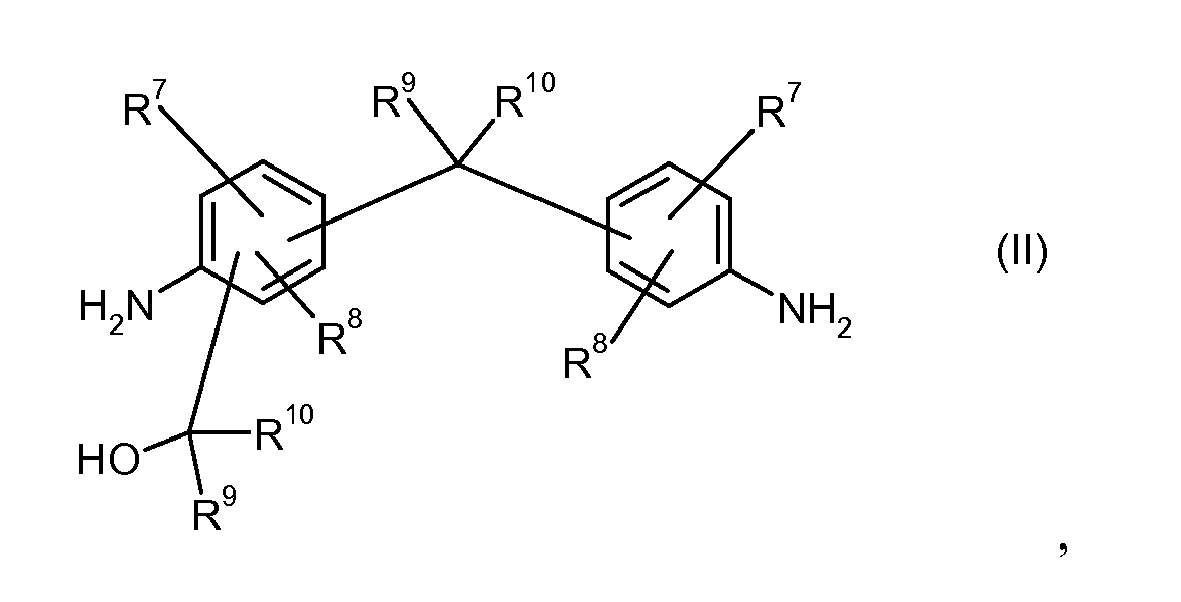

- Diazotisation and coupling may be effected in accordance with conventional methods. The coupling reaction advantageously is carried out in an aqueous reaction medium in a temperature range of from 0 - 60°C, preferably at 0- 40°C, more preferred at 0 - 10°C, even more preferred at 0 - 5°C and in a pH range of from 2 to 9, preferably at pH 3 to 6. All temperatures are given in degrees Celsius.
- The reaction mixtures comprising compounds of formula (I) thus obtained may be converted into stable liquid formulations with improved long term stability by desalting by ultra filtration.
- The compounds of formula (I) thus obtained may be isolated in accordance with known methods.
- However, novel amines according to the formula (II) may be prepared according the methods disclosed in
DE399149 ;DE505475 ;DE1220863 ;DE1793020 (GB1129306 DE3226889 ,DE4014847 , thus starting form aldehydes (when R5 is H and R6 is different from H) of the formula


- The reaction mixture is heated in a closed autoclave at 120°C-250°C, preferably 140°C-200°C, more preferably 140°C to 150°C the reaction mixture is kept at this temperature for 3-8 hours, preferably for 4-5 hours. The elevated temperature leads in this closed autoclave to the elevated pressure. Alternatively the synthesis may be performed in the melt of the aminocompound-hydrochloride adding the aldehyde at elevated temperature 200 to 250°C and the pressure is atmospheric pressure.
- The dyes of the formula (I) can be isolated from the reaction medium by conventional processes, for example by salting out with an alkali metal salt, filtering and drying, if appropriate under reduced pressure and at elevated temperature.
- Depending on the reaction and/or isolation conditions, the dyes of the formula (I) can be obtained as free acid, as salt or as mixed salt which contains for example one or more cations selected from alkali metal ions, for example the sodium ion, or an ammonium ion or alkylammonium cation, for example mono-, di- or trimethyl- or -ethylammonium cations. The dye can be converted by conventional techniques from the free acid into a salt or into a mixed salt or vice versa or from one salt form into another. If desired, the dyes can be further purified by diafiltration, in which case unwanted salts and synthesis by-products are separated from the crude anionic dye.
- The removal of unwanted salts and synthesis by-products and partial removal of water from the crude dye solution is carried out by means of a semipermeable membrane by applying a pressure whereby the dye is obtained without the unwanted salts and synthesis by-products as a solution and if necessary as a solid body in a conventional manner.
- The dyes of the formula (I) and their salts are particularly suitable for dyeing or printing fibrous material consisting of natural or synthetic polyamides in yellow to greenish yellow shades. The dyes of the formula (I) and their salts are suitable for producing Inkjet printing inks and for using these Inkjet printing inks to print fibrous material which consists of natural or synthetic polyamides or cellulose (paper for example).
- The invention accordingly provides from another aspect for the use of the dyes of the formula (I), their salts and mixtures for dyeing and/or printing fibrous materials consisting of natural or synthetic polyamides. A further aspect is the production of Inkjet printing inks and their use for printing fibrous materials consisting of natural or synthetic polyamides.
- Dyeing is carried out as per known processes, see for example the dyeing processes described in Ullmanns Encyklopädie der technischen Chemie, 4th Edition, 1982, Volume 22, pages 658-673 or in the book by M. Peter and H.K. Rouette, Grundlagen der Textilveredlung, 13th Edition, 1989, pages 535-556 and 566-574. Preference is given to dyeing in the exhaust process at a temperature of 30 to 140°C, more preferably 80 to 120°C and most preferably at a temperature of 80 to 100°C, and at a liquor ratio in the range from 3:1 1 to 40:1.
- The substrate to be dyed can be present in the form of yarn, woven fabric, loop-formingly knitted fabric or carpet for example. Fully fashioned dyeings are even permanently possible on delicate substrates, examples being lambswool, cashmere, alpaca and mohair. The dyes of the invention are particularly useful for dyeing fine-denier fibres (microfibres).
- The dyes according to the present invention and their salts are highly compatible with known acid dyes. Accordingly, the dyes of the formula (I), their salts or mixtures can be used alone in a dyeing or printing process or else as a component in a combination shade dyeing or printing composition together with other acid dyes of the same class, i.e. with acid dyes possessing comparable dyeing properties, such as for example fastness properties and exhaustion rates from the dyebath onto the substrate. The dyes of the present invention can be used in particular together with certain other dyes having suitable chromophores. The ratio in which the dyes are present in a combination shade dyeing or printing composition is dictated by the hue to be obtained.
- The novel dyes of the formula (I), as stated above, are very useful for dyeing natural and synthetic polyamides, i.e. wool, silk and all nylon types, on each of which dyeings having a high fastness level, especially good light fastness and good wet fastnesses (washing, alkaline perspiration) are obtained. The dyes of the formula (I) and their salts have a high rate of exhaustion. The ability of the dyes of the formula (I) and their salt to build up is likewise very good. On-tone dyeings on the identified substrates are of outstanding quality. All dyeings moreover have a constant hue under artificial light. Furthermore, the fastness to decating and boiling is good.
- One decisive advantage of the novel dyes is that they are metal free and provide very level dyeings.
- The compounds according to the invention can be used as an individual dye or else, owing to their good compatibility, as a combination element with other dyes of the same class having comparable dyeing properties, for example with regard to general fastnesses, exhaustion value, etc. The combination shade dyeings obtained have similar fastnesses to dyeings with the individual dye.
- The invention's dyes of the formula (I) can also be used as yellow components in trichromatic dyeing or printing. Trichromatic dyeing or printing can utilize all customary and known dyeing and printing processes, such as for example the continuous process, exhaustion process, foam dyeing process and Ink-Jet process.
- The composition of the individual dye components in the trichromatic dye mixture used in the process of the invention depends on the desired hue. A brown hue for example preferably utilizes 20 - 40% by weight of-the invention's yellow component, 40 - 60% by weight of an orange or red component and 10 - 20% by weight of a blue component.
- The yellow component, as described above, can consist of a single component or of a mixture of different orange individual components conforming to the formula (I). Preference is given to double and triple combinations.
- Particularly preferred red and/or blue components are described in
W02002/46318 WO99/51681 - The following examples further serve to illustrate the invention. In the Examples all parts and all percentages are by weight or volume, and the temperatures given are in degrees Celsius, unless indicated to the contrary.
- 106 g benzaldehyde (1 mol), 123 g o-anisidine (1 mol), 115 g hydrochloric acid (ca. 30%) and 300 ml water were heated in an autoclave at 140°C for 6 hours.
- The reaction mixture was poured on 1 kg ice and 135 g sodium hydroxide solution (30%). The organic layer was separated and the excess of o-anisidine separated with toluene. The residue was re-crystallized from toluene and the press cake washed with cold alcohol. A compound of the formula (1) was obtained:

- 130 g (1mol) of aniline hydrochloride are melted in a 0,5-1 reaction vessel under nitrogen at 220°C and 100 g (1 mol) of 2-Ethylbutyraldehyde is slowly added thereto while stirring over a period of 4 hour.
- The temperature of the melt falls from initially ca. 200 °C to 185°C because of the reflux.
- The temperature is kept for one hour at 185°C and the hot melt is poured on a mixture of 1,6 kg ice and 1,05 kg of sodium hydroxide solution (30%).
- The organic layer is separated and washed free from salt with demineralised water.
- The residue was re-crystallized from toluene and the press cake is washed with cold ethanol. A compound of the formula (2) was obtained:

Table 1: Synthesis of the amines starting with aldehydes 
Nr. 
R9 R10 3 
H CH2CH2CH2CH3 4 
H CH2CH(CH3)2 5 
H CH(CH3)CH2CH3 6 
H CH(CH3)CH2CH2CH3 7 
H (CH2)5CH3 8 
H (CH2)4CH3 9 
H CH(CH2CH3)(CH2)3CH3 10 
H (CH2)6CH3 11 
H (CH2)7CH3 12 
H (CH2)8CH3 13 
H CH2-Ph 14 
H Ph 15 
H 4-Ph-CH3 16 
H 4- Ph-CH(CH3)2 17 
H 4- Ph-t-Bu 18 
H CH2CH(CH3)2 19 
H CH(CH2CH3)2 20 
H Phenyl 21 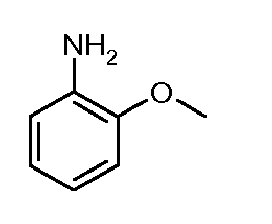
H CH(CH2CH3)2 22 
H CH(CH2CH3)(CH2)3CH3 - 36,8 Parts (0,1 mol) of amine-example 2 are diazotised according to known methods with 13,8 parts (0,2 mol) of sodium nitrite at 0-5°C in 200 parts of water and 60 parts of hydrochloric acid (ca. 30%) .
- 57,8 parts (0.2 mol) of a compound of the formula


- The dyestuff can be isolated by concentration under vacuum or by precipitation in aceton/alcohol.
- The reaction mixture however can be used directly for dyeing without isolation the product. The dyestuff of formula (5) has surprisingly very high solubility in water and gives yellow dyeings with very good fastness properties.
- 44,0 Parts (0,1 mol) of amine-example 1 are diazotised according to known methods with 13,8 parts (0,2 mol) of sodium nitrite at 0-5°C in 200 parts of water and 60 parts of hydrochloric acid (ca. 30%) .
- 50,8 parts (0,2 mol) of a compound of the formula


- The dyestuff can be isolated by concentration under vacuum or by precipitation in aceton/alcohol.
- The reaction mixture however can be used directly for dyeing without isolation the product. The dyestuff of formula (6) has very high solubility in water and gives yellow dyeings with surprisingly very good fastness properties.
Table 2: synthesis of the dyesstuff with the amines from Table 1 The following compounds shown in the table 2 were synthesized according to the example 23 or 24 using the amine 
diazo component and reacted with coupling component 
wherein a compound of the following formula was obtained: 
λ max (lambda max) is indicated in nm (nano meters; measured in 1% acetic acid solution). Dye-stuff-nr. Diamine Bridge -nr. Coupling component λ max 25 
3 
443 26 
4 
443 27 
5 
441 28 
6 
440 29 
7 
439 30 
8 
438 31 
9 
436 32 
10 
439 33 
11 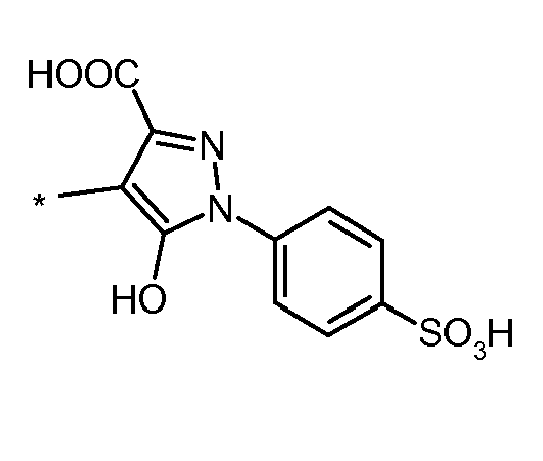
440 34 
12 
444 35 
13 
449 36 
14 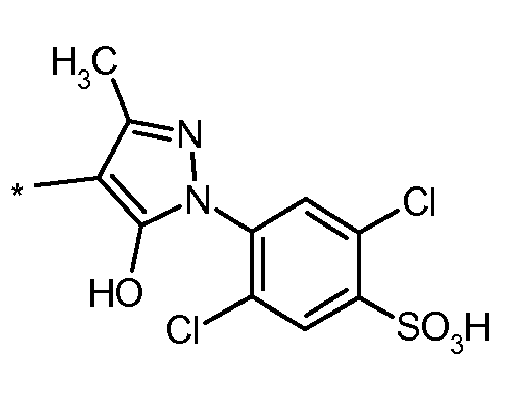
448 37 
15 
446 38 
16 
447 39 
19 
440 40 
20 
444 41 
21 
473 42 
22 
470 - A dyebath at 40°C, consisting of 2000 parts of water, 1 part of a weakly cation-active levelling agent which is based on an ethoxylated aminopropyl fatty acid amide and which has affinity for dye, 0.25 part of the dye of Preparation Example 23 and adjusted to pH 5 with 1-2 parts of 40% acetic acid is entered with 100 parts of nylon-6 fabric. After 10 minutes at 40°C, the dyebath is heated to 98°C at a rate of 1°C per minute and then left at the boil for 45-60 minutes. Thereafter it is cooled down to 70°C over 15 minutes. The dyeing is removed from the bath, rinsed with hot and then with cold water and dried. The result obtained is a yellow polyamide dyeing possessing good light and wet fastnesses.
- A dyebath at 40°C, consisting of 2000 parts of water, 1 part of a weakly cation-active levelling agent which is based on an ethoxylated aminopropyl fatty acid amide and which has affinity for dye, 0.3 part of the dye of Preparation Example 23 and adjusted to pH 5.5 with 1-2 parts of 40% acetic acid is entered with 100 parts of nylon-6,6 fabric. After 10 minutes at 40°C, the dyebath is heated to 120°C at a rate of 1.5°C per minute and then left at this temperature for 15-25 minutes. Thereafter it is cooled down to 70°C over 25 minutes. The dyeing is removed from the dyebath, rinsed with hot and then with cold water and dried. The result obtained is a yellow polyamide dyeing with good levelness and having good light and wet fastnesses.
- A dyebath at 40°C, consisting of 4000 parts of water, 1 part of a weakly amphoteric levelling agent which is based on a sulphated, ethoxylated fatty acid amide and which has affinity for dye, 0.4 part of the dye of Preparation Example 23 and adjusted to pH 5 with 1-2 parts of 40% acetic acid is entered with 100 parts of wool fabric. After 10 minutes at 40°C, the dyebath is heated to boiling at a rate of 1°C per minute and then left at the boil for 40-60 minutes. Thereafter it is cooled down to 70°C over 20 minutes. The dyeing is removed from the bath, rinsed with hot and then with cold water and dried. The result obtained is a yellow wool dyeing possessing good light and wet fastnesses.
- 100 parts of a woven nylon-6 material are padded with a 50°C liquor consisting of
40 parts of the dye of Preparation Example 23, 100 parts of urea, 20 parts of a nonionic solubilizer based on butyldiglycol, 15-20 parts of acetic acid (to adjust the pH to 4), 10 parts of a weakly cation-active levelling agent which is based on an ethoxylated aminopropyl fatty acid amide and has affinity for dye, and 810-815 parts of water (to make up to 1000 parts of padding liquor). - The material thus impregnated is rolled up and left to dwell in a steaming chamber under saturated steam conditions at 85-98°C for 3-6 hours for fixation. The dyeing is then rinsed with hot and cold water and dried. The result obtained is a yellow nylon dyeing having good levelness in the piece and good light and wet fastnesses.
- A textile cut pile sheet material composed of nylon-6 and having a synthetic base fabric is padded with a liquor containing per 1000 parts
1 part of dye of Preparation Example 23 4 parts of a commercially available thickener based on carob flour ether 2 parts of a nonionic ethylene oxide adduct of a higher alkylphenol 1 part of 60% acetic acid. - This is followed by printing with a paste which per 1000 parts contains the following components:
20 parts of commercially available alkoxylated fatty alkylamine (displace product) 20 parts of a commercially available thickener based on carob flour ether. - The print is fixed for 6 minutes in saturated steam at 100°C, rinsed and dried. The result obtained is a level-coloured cover material having a yellow and white pattern.
- 100 parts of a chrome-tanned and synthetically retanned shave-moist grain leather are dyed for 30 minutes in a bath of 300 parts of water and 2 parts of the dye of Preparation Example 23 at 55°C. After addition of 4 parts of a 60% emulsion of a sulphited fish oil, the leather is fatliquored for 45 minutes. It is then acidified with 8.5% formic acid and milled for 10 minutes (final pH in the bath 3.5-4.0). The leather is then rinsed, allowed to drip dry and finished as usual. The result obtained is a leather dyed in a level clear orange hue with good fastnesses.
- Use Examples A to F can also be carried out with dyes 24 to 42 with similar results.
- 3 parts of the dye of Preparation Example 23 are dissolved in 82 parts of demineralized water and 15 parts of diethylene glycol at 60°C. Cooling down to room temperature gives an orange printing ink which is very highly suitable for ink jet printing on paper or polyamide and wool textiles.
- Use Example G can also be carried out with dyes 24 to 42 with similar results.
- A dyebath consisting of 1000 parts of water, 80 parts of calcined Glauber salt, 1 part of sodium nitrobenzene-3-sulphonate and 1 part of dye from Example 23 is heated to 80°C in the course of 10 minutes. Then, 100 parts of mercerized cotton are added. This is followed by dyeing at 80°C for 5 minutes and then heating to 95°C in the course of 15 minutes. After 10 minutes at 95°C, 3 parts of sodium carbonate are added, followed by a further 7 parts of sodium carbonate after 20 minutes and another 10 parts of sodium carbonate after 30 minutes at 95°C. Dyeing is subsequently continued at 95°C for 60 minutes. The dyed material is then removed from the dyebath and rinsed in running demineralized water for 3 minutes. This is followed by two washes for 10 minutes in 5000 parts of boiling demineralized water at a time and subsequent rinsing in running demineralized water at 60°C for 3 minutes and with cold tap water for one minute. Drying leaves a brilliant yellow cotton dyeing having good fastnesses.
- 0.2 part of the dye of Preparation Example 23 is dissolved in 100 parts of hot water and the solution is cooled down to room temperature. This solution is added to 100 parts of chemically bleached sulphite pulp beaten in 2000 parts of water in a Hollander. After 15 minutes of commixing the stuff is sized with resin size and aluminium sulphate in a conventional manner. Paper produced from this stuff has a yellow shade with good wet fastnesses.
- Use Examples H and I can also be carried out with dyes 24 to 42 with similar results.
Claims (8)
- Compounds of the general formula (I)
 R1 signifies H, a sulpho group or halogen,R2 signifies H or a sulpho group,R3 signifies H, a sulpho group or halogenR4 signifies H, a sulpho group or halogen,R5 signifies H, a substituted C1 to C4 alkyl group or an unsubstituted C1 to C4 alkyl group or halogen,R6 signifies an C1 to C4 alkyl group, a carboxy group or a carbo C1 to C4 alkoxy group ,R7 signify H, a sulpho group, a substituted C1 to C4 alkyl group or an unsubstituted C1 to C4 alkyl group, a substituted C1 to C4 alkoxy group or an unsubstituted C1 to C4 alkoxy group,R8 signifies H, a substituted C1 to C4 alkyl group or an unsubstituted C1 to C4 alkyl group, a substituted C1 to C4 alkoxy group or an unsubstituted C1 to C4 alkoxy group,B signifies a group with the formula -SO2-, -NH-CO-NH-, -CR9R10-, whereinR9 signifies H, substituted C1 to C9 alkyl group or an unsubstituted C1 to C9 alkyl group,R10 signifies a substituted C1 to C9 alkyl group or an unsubstituted C1 to C9 alkyl group, an unsubstituted aryl group or a substituted aryl group or R9 and R10 form together a five or six membered cyclo aliphatic ring, wherein the five or six membered rings are substituted by a C1 to C4 alkyl group or the five or six membered rings are not further substituted.
 - Compounds according to claim 1 characterized in that the compounds of formula (I) bear at least one anionic substituent
- Compounds according to claim 2 characterized in thatR1 signifies chlorine,R2 signifies H or a sulpho group,R3 signifies H or a sulpho group,R4 signifies a sulpho group or chlorine,R5 signifies H, methyl or chlorine,R6 signifies C1 to C4 alkyl group, -COOCH3, -COOCH2CH3,R7 signify H, a sulpho group, a substituted C1 to C4 alkyl group or an unsubstituted C1 to C4 alkyl group, a substituted C1 to C4 alkoxy group or an unsubstituted C1 to C4 alkoxy group,R8 signifies H, a substituted C1 to C4 alkyl group or an unsubstituted C1 to C4 alkyl group, a substituted C1 to C4 alkoxy group or an unsubstituted C1 to C4 alkoxy group,B signifies a group with the formula -SO2-, -NH-CO-NH-, -CR9R10-, whereinR9 signifies H, an unsubstituted C1 to C9 alkyl group, preferably H or -CH3,R10 signifies a substituted C1 to C9 alkyl group or an unsubstituted C1 to C9 alkyl group, an unsubstituted aryl group or a substituted aryl group or R9 and R10 form together a five or six membered cyclo aliphatic ring, wherein the five or six membered rings are substituted by a C1 to C4 alkyl group or the five or six membered rings are not further substituted.
- Compounds according to claim 3 characterized in thatR1 signifies chlorine,R2 signifies H or a sulpho group,R3 signifies H or a sulpho group,R4 signifies a sulpho group or chlorine,R5 signifies H,R6 signifies a methyl or ethyl group, -COOCH3, -COOCH2CH3,R7 signify H, a sulpho group, a substituted C1 to C2 alkyl group or an unsubstituted C1 to C2 alkyl group, a substituted C1 to C2 alkoxy group or an unsubstituted C1 to C2 alkoxy group,R8 signifies H, a substituted C1 to C2 alkyl group or an unsubstituted C1 to C2 alkyl group, a substituted C1 to C2 alkoxy group or an unsubstituted C1 to C2 alkoxy group,B signifies a group with the formula -SO2-, -NH-CO-NH-, -CR9R10-, whereinR9 signifies H, an unsubstituted C1 to C9 alkyl group, preferably H or -CH3,R10 signifies a substituted C1 to C9 alkyl group or an unsubstituted C1 to C9 alkyl group, an unsubstituted aryl group or a substituted aryl group or R9 and R10 form together a five or six membered cyclo aliphatic ring, wherein the five or six membered rings are substituted by a C1 to C4 alkyl group or the five or six membered rings are not further substituted.
- Process for preparing compounds of the formula (I) according to Claim 1, characterized in that both the amine functions of the compounds of the formula (II)


- Use of the compounds of the formula (I) according to Claim 1 for dyeing and/or printing organic substrates.
- Use of compounds of formula (I) according to Claim 1 for dyeing and/or printing wool, silk and synthetic polyamides.
- Use of compounds of formula (I) according to Claim 1 for preparing printing inks for the InkJet process.
Priority Applications (1)
| Application Number | Priority Date | Filing Date | Title |
|---|---|---|---|
| EP09160240A EP2251386A1 (en) | 2009-05-14 | 2009-05-14 | Pyrazolone bisazo dyes |
Applications Claiming Priority (1)
| Application Number | Priority Date | Filing Date | Title |
|---|---|---|---|
| EP09160240A EP2251386A1 (en) | 2009-05-14 | 2009-05-14 | Pyrazolone bisazo dyes |
Publications (1)
| Publication Number | Publication Date |
|---|---|
| EP2251386A1 true EP2251386A1 (en) | 2010-11-17 |
Family
ID=41165121
Family Applications (1)
| Application Number | Title | Priority Date | Filing Date |
|---|---|---|---|
| EP09160240A Withdrawn EP2251386A1 (en) | 2009-05-14 | 2009-05-14 | Pyrazolone bisazo dyes |
Country Status (1)
| Country | Link |
|---|---|
| EP (1) | EP2251386A1 (en) |
Cited By (1)
| Publication number | Priority date | Publication date | Assignee | Title |
|---|---|---|---|---|
| US20140186775A1 (en) * | 2012-12-28 | 2014-07-03 | Bum-Jin LEE | Monomer for hardmask composition and hardmask composition including the monomer and method of forming patterns using the hardmask composition |
Citations (14)
| Publication number | Priority date | Publication date | Assignee | Title |
|---|---|---|---|---|
| DE399149C (en) | 1922-09-30 | 1924-07-23 | Hoechst Ag | Process for the preparation of diaminodiaryldialkylmethanes |
| DE417032C (en) * | 1922-11-11 | 1925-08-05 | Hoechst Ag | Process for the preparation of acidic disazo dyes |
| DE505475C (en) | 1927-09-23 | 1930-08-18 | I G Farbenindustrie Akt Ges | Process for the separation of condensation products from aromatic bases and hydroaromatic ring ketones of the cyclohexanone series |
| DE1220863B (en) | 1964-11-04 | 1966-07-14 | Bayer Ag | Process for the preparation of 4,4'-diaminodiarylalkanes |
| DE1793020A1 (en) | 1967-07-24 | 1972-02-03 | Rhodiaceta | Process for the production of aromatic diamines |
| DE2540171A1 (en) * | 1975-09-10 | 1977-03-24 | Basf Ag | Soluble disazo dyes from (1,1)-bis amino-phenyl cyclohexane - for colouring polyamides and paper |
| DE3226889A1 (en) | 1982-07-17 | 1984-01-19 | Basf Ag, 6700 Ludwigshafen | METHOD FOR PRODUCING BIS (AMINOCYCLOHEXYL) DIALKYLMETHANES |
| JPS59101607A (en) * | 1982-12-02 | 1984-06-12 | Fuji Photo Film Co Ltd | Color image pickup device |
| EP0449650A2 (en) * | 1990-03-29 | 1991-10-02 | Hoechst Celanese Corporation | Azo dyes having improved solubility in organic solvent |
| DE4014847A1 (en) | 1990-05-09 | 1991-11-14 | Bayer Ag | New 1,1-bis-aminophenyl-cyclo:alkane(s) - useful as starting materials for prodn. of polyamide(s), polyurea(s), polyurethane-urea(s), epoxide-di:amine addn. prods. etc. |
| WO1999051681A1 (en) | 1998-04-03 | 1999-10-14 | Clariant Finance (Bvi) Limited | Triphendioxazine dyestuffs for dyeing organic substrates |
| WO2002046318A1 (en) | 2000-12-05 | 2002-06-13 | Clariant Finance (Bvi) Limited | Trichromatic dyeing process |
| WO2008012322A1 (en) * | 2006-07-28 | 2008-01-31 | Clariant International Ltd | Basic bisazo compounds |
| EP2085428A1 (en) * | 2008-01-24 | 2009-08-05 | Clariant International Ltd. | Basic bisazo compounds |
-
2009
- 2009-05-14 EP EP09160240A patent/EP2251386A1/en not_active Withdrawn
Patent Citations (15)
| Publication number | Priority date | Publication date | Assignee | Title |
|---|---|---|---|---|
| DE399149C (en) | 1922-09-30 | 1924-07-23 | Hoechst Ag | Process for the preparation of diaminodiaryldialkylmethanes |
| DE417032C (en) * | 1922-11-11 | 1925-08-05 | Hoechst Ag | Process for the preparation of acidic disazo dyes |
| DE505475C (en) | 1927-09-23 | 1930-08-18 | I G Farbenindustrie Akt Ges | Process for the separation of condensation products from aromatic bases and hydroaromatic ring ketones of the cyclohexanone series |
| DE1220863B (en) | 1964-11-04 | 1966-07-14 | Bayer Ag | Process for the preparation of 4,4'-diaminodiarylalkanes |
| GB1129306A (en) | 1964-11-04 | 1968-10-02 | Bayer Ag | A process for the production of 4,4'-diaminodiaryl alkanes |
| DE1793020A1 (en) | 1967-07-24 | 1972-02-03 | Rhodiaceta | Process for the production of aromatic diamines |
| DE2540171A1 (en) * | 1975-09-10 | 1977-03-24 | Basf Ag | Soluble disazo dyes from (1,1)-bis amino-phenyl cyclohexane - for colouring polyamides and paper |
| DE3226889A1 (en) | 1982-07-17 | 1984-01-19 | Basf Ag, 6700 Ludwigshafen | METHOD FOR PRODUCING BIS (AMINOCYCLOHEXYL) DIALKYLMETHANES |
| JPS59101607A (en) * | 1982-12-02 | 1984-06-12 | Fuji Photo Film Co Ltd | Color image pickup device |
| EP0449650A2 (en) * | 1990-03-29 | 1991-10-02 | Hoechst Celanese Corporation | Azo dyes having improved solubility in organic solvent |
| DE4014847A1 (en) | 1990-05-09 | 1991-11-14 | Bayer Ag | New 1,1-bis-aminophenyl-cyclo:alkane(s) - useful as starting materials for prodn. of polyamide(s), polyurea(s), polyurethane-urea(s), epoxide-di:amine addn. prods. etc. |
| WO1999051681A1 (en) | 1998-04-03 | 1999-10-14 | Clariant Finance (Bvi) Limited | Triphendioxazine dyestuffs for dyeing organic substrates |
| WO2002046318A1 (en) | 2000-12-05 | 2002-06-13 | Clariant Finance (Bvi) Limited | Trichromatic dyeing process |
| WO2008012322A1 (en) * | 2006-07-28 | 2008-01-31 | Clariant International Ltd | Basic bisazo compounds |
| EP2085428A1 (en) * | 2008-01-24 | 2009-08-05 | Clariant International Ltd. | Basic bisazo compounds |
Non-Patent Citations (2)
| Title |
|---|
| "Ullmanns Encyklopadie der technischen Chemie", vol. 22, 1982, pages: 658 - 673 |
| M. PETER; H.K. ROUETTE: "Grundlagen der Textilveredlung", 1989, pages: 535 - 556 |
Cited By (4)
| Publication number | Priority date | Publication date | Assignee | Title |
|---|---|---|---|---|
| US20140186775A1 (en) * | 2012-12-28 | 2014-07-03 | Bum-Jin LEE | Monomer for hardmask composition and hardmask composition including the monomer and method of forming patterns using the hardmask composition |
| CN103910610A (en) * | 2012-12-28 | 2014-07-09 | 第一毛织株式会社 | Monomer for hardmask composition and hardmask composition including the monomer and method of forming patterns using the hardmask composition |
| US9158201B2 (en) * | 2012-12-28 | 2015-10-13 | Cheil Industries, Inc. | Monomer for hardmask composition and hardmask composition including the monomer and method of forming patterns using the hardmask composition |
| CN103910610B (en) * | 2012-12-28 | 2016-08-24 | 第一毛织株式会社 | The monomer of hard mask compositions, hard mask compositions and the method forming pattern |
Similar Documents
| Publication | Publication Date | Title |
|---|---|---|
| EP2307509B1 (en) | Use of acid dyes | |
| EP2324080B1 (en) | Acid dyes | |
| EP2429989B1 (en) | Bisazo compounds | |
| EP2258685B1 (en) | Bisazo compounds | |
| EP2251387B1 (en) | Acidic azo dyes | |
| EP2307508B1 (en) | Acid dyes | |
| EP2430099B1 (en) | Organic compounds | |
| EP2251386A1 (en) | Pyrazolone bisazo dyes | |
| EP2584008B1 (en) | Trisazo acid dyes based on naphtholes | |
| EP2584007B1 (en) | Trisazo acid dyes based on pyridones | |
| EP2258683A1 (en) | Bisazo compounds | |
| EP2251321A1 (en) | Monoazo compounds | |
| EP2251385A1 (en) | Pyrazolone bisazo dyes | |
| EP2251381A1 (en) | Monoazo compounds | |
| EP2251322A1 (en) | Bisazo compounds | |
| EP2251382A1 (en) | Monoazo compounds | |
| EP2258684A1 (en) | Monoazo compounds | |
| EP2258686A1 (en) | Monoazo compounds | |
| EP2251384A1 (en) | Pyrazolone monoazo dyes | |
| EP2251388A1 (en) | Organic compounds |
Legal Events
| Date | Code | Title | Description |
|---|---|---|---|
| PUAI | Public reference made under article 153(3) epc to a published international application that has entered the european phase |
Free format text: ORIGINAL CODE: 0009012 |
|
| AK | Designated contracting states |
Kind code of ref document: A1 Designated state(s): AT BE BG CH CY CZ DE DK EE ES FI FR GB GR HR HU IE IS IT LI LT LU LV MC MK MT NL NO PL PT RO SE SI SK TR |
|
| AX | Request for extension of the european patent |
Extension state: AL BA RS |
|
| STAA | Information on the status of an ep patent application or granted ep patent |
Free format text: STATUS: THE APPLICATION HAS BEEN WITHDRAWN |
|
| 18W | Application withdrawn |
Effective date: 20101113 |