EP2241640B1 - Nukleinsäurebindungsprotein-testverfahren und -kit - Google Patents
Nukleinsäurebindungsprotein-testverfahren und -kit Download PDFInfo
- Publication number
- EP2241640B1 EP2241640B1 EP09704882.1A EP09704882A EP2241640B1 EP 2241640 B1 EP2241640 B1 EP 2241640B1 EP 09704882 A EP09704882 A EP 09704882A EP 2241640 B1 EP2241640 B1 EP 2241640B1
- Authority
- EP
- European Patent Office
- Prior art keywords
- nucleic acid
- nucleotide sequence
- sequence
- moiety
- terminal
- Prior art date
- Legal status (The legal status is an assumption and is not a legal conclusion. Google has not performed a legal analysis and makes no representation as to the accuracy of the status listed.)
- Not-in-force
Links
Images





Classifications
-
- C—CHEMISTRY; METALLURGY
- C12—BIOCHEMISTRY; BEER; SPIRITS; WINE; VINEGAR; MICROBIOLOGY; ENZYMOLOGY; MUTATION OR GENETIC ENGINEERING
- C12Q—MEASURING OR TESTING PROCESSES INVOLVING ENZYMES, NUCLEIC ACIDS OR MICROORGANISMS; COMPOSITIONS OR TEST PAPERS THEREFOR; PROCESSES OF PREPARING SUCH COMPOSITIONS; CONDITION-RESPONSIVE CONTROL IN MICROBIOLOGICAL OR ENZYMOLOGICAL PROCESSES
- C12Q1/00—Measuring or testing processes involving enzymes, nucleic acids or microorganisms; Compositions therefor; Processes of preparing such compositions
- C12Q1/68—Measuring or testing processes involving enzymes, nucleic acids or microorganisms; Compositions therefor; Processes of preparing such compositions involving nucleic acids
- C12Q1/6813—Hybridisation assays
- C12Q1/6816—Hybridisation assays characterised by the detection means
- C12Q1/6818—Hybridisation assays characterised by the detection means involving interaction of two or more labels, e.g. resonant energy transfer
-
- C—CHEMISTRY; METALLURGY
- C12—BIOCHEMISTRY; BEER; SPIRITS; WINE; VINEGAR; MICROBIOLOGY; ENZYMOLOGY; MUTATION OR GENETIC ENGINEERING
- C12N—MICROORGANISMS OR ENZYMES; COMPOSITIONS THEREOF; PROPAGATING, PRESERVING, OR MAINTAINING MICROORGANISMS; MUTATION OR GENETIC ENGINEERING; CULTURE MEDIA
- C12N15/00—Mutation or genetic engineering; DNA or RNA concerning genetic engineering, vectors, e.g. plasmids, or their isolation, preparation or purification; Use of hosts therefor
- C12N15/09—Recombinant DNA-technology
- C12N15/10—Processes for the isolation, preparation or purification of DNA or RNA
- C12N15/1034—Isolating an individual clone by screening libraries
-
- G—PHYSICS
- G01—MEASURING; TESTING
- G01N—INVESTIGATING OR ANALYSING MATERIALS BY DETERMINING THEIR CHEMICAL OR PHYSICAL PROPERTIES
- G01N33/00—Investigating or analysing materials by specific methods not covered by groups G01N1/00 - G01N31/00
- G01N33/48—Biological material, e.g. blood, urine; Haemocytometers
- G01N33/50—Chemical analysis of biological material, e.g. blood, urine; Testing involving biospecific ligand binding methods; Immunological testing
- G01N33/53—Immunoassay; Biospecific binding assay; Materials therefor
- G01N33/5308—Immunoassay; Biospecific binding assay; Materials therefor for analytes not provided for elsewhere, e.g. nucleic acids, uric acid, worms, mites
Definitions
- the present invention relates to a method and a kit of detecting a nucleic acid binding protein.
- the present invention also relates to a method of screening for a binding inhibitor or promoter for a nucleic acid binding protein.
- Nucleic acid binding proteins are molecules responsible for very important intracellular functions, such as transcription factors, chromosome structural proteins, DNA repair enzymes, enzymes involved in RNA processing, and polymerases. Behavior analysis on the nucleic acid binding proteins is thought to have profound implications for understanding life activities. Moreover, the nucleic acid binding proteins have received increasing attention as targets of development of pharmaceutical agents, functional foods, or the like, because of their important functions.
- gel shift or footprinting assay is used in the detection of nucleic acid binding proteins.
- these methods involve electrophoresis and therefore have the problems of time-consuming and complicated procedures.
- a homogeneous method of detecting a nucleic acid binding protein using two types of DNA probes that bind only to nucleic acids bound to the proteins ( U.S. Patent No. 6,544,746 ; and Heyduk, T., et al. (2002) Nat. Biotechnol. 20 (2) 171-176 ) has the problems of complicated design of DNA probes and its limited applicability to a DNA binding protein capable of binding to sequences at two distant locations ( Wang, J., et al. (2005) Nucleic Acids Res. 33 (2) e23 ; and Jantz, D., et al. (2002) Nat. Biotechnol. 20 (2) 126-127 ).
- Non-Patent Document 2 A method of detecting a nucleic acid binding protein using exonuclease III (Non-Patent Document 2) has the difficulty in detecting a weakly bound nucleic acid binding protein and requires taking into consideration the influence of a drug on exonuclease III activity when used in the screening of drugs such as pharmaceutical agents. This method further has the problems of inability to screen for drugs susceptible to the activity of proteins related to exonuclease III.
- a method of detecting a nucleic acid binding protein using fluorescence correlation spectroscopy detects a difference in size between a nucleic acid alone and a complex of the nucleic acid bound to the nucleic acid binding protein.
- This method has the problem that a sufficient signal/noise ratio is not obtained from small nucleic acid binding proteins.
- this method requires specialized equipment and therefore has the problems associated with general versatility.
- nucleic acid duplex consisting of two fully complementary nucleic acid strands is very stable. Such nucleic acid duplexes neither interact with each other nor are structurally changed. However, nucleic acid duplexes having a single-stranded moiety at their termini are known to bind to each other via these single-stranded moieties to cause structural change. The present inventors have found that such structural change between nucleic acid duplexes is inhibited by the binding of a nucleic acid binding protein. The present invention is based on this finding.
- An object of the present invention is to provide a method of detecting binding between a nucleic acid and a nucleic acid binding protein and a method of screening for a binding inhibitor or promoter for a nucleic acid binding protein.
- a method of detecting binding between a nucleic acid and a nucleic acid binding protein comprising determining the degree of structural change in a nucleic acid complex having at least two nucleic acid duplex moieties (hereinafter, referred to as a "detection method according to the present invention").
- a method of screening for a binding inhibitor or promoter for a nucleic acid binding protein comprising performing the detection method according to the present invention in the presence of and in the absence of a test substance (hereinafter, referred to as a "screening method according to the present invention").
- kits comprising a nucleic acid duplex A and a nucleic acid duplex B capable of binding to each other at their terminal sequences or a kit comprising an integrated nucleic acid complex E or an integrated nucleic acid complex F (hereinafter, referred to as a "kit according to the present invention").
- the present invention is advantageous in that it eliminates the need for electrophoresis, achieves homogeneous assay using general-purpose equipment, eliminates the need for enzymes such as exonuclease III, and eliminates the need for fluorescence introduction or unnatural structures (e.g., nick) in protein binding sites.
- the present invention is also advantageous in that it is widely applicable to general DNA binding proteins including DNA binding proteins having a DNA binding motif, for example, loop, leucine zipper, or Zn finger.
- the present invention is further advantageous in that it can screen for an inhibitor or promoter targeting nucleic acid binding proteins that are difficult to evaluate by reporter assay (e.g., structural proteins such as telomere binding proteins).
- reporter assay e.g., structural proteins such as telomere binding proteins
- nucleic acid examples include not only DNA and RNA but modified nucleic acids and nucleic acid analogs (e.g., peptide nucleic acid (PNA) and locked nucleic acid (LNA)).
- PNA peptide nucleic acid
- LNA locked nucleic acid
- the nucleic acid is preferably DNA.
- nucleic acid duplex means two nucleic acid molecules bound to each other as complementary strands.
- a "single-stranded nucleic acid” means a nucleic acid molecule that is not bound as a complementary stand to another nucleic acid molecule.
- a nucleic acid molecule having a double-stranded moiety as a result of hybridization of a portion of the nucleic acid molecule to within the nucleic acid molecule is also included in the "single-stranded nucleic acid".
- the single-stranded nucleic acid may be bound in series with another single-stranded nucleic acid either directly or via an additional sequence (e.g., a linker sequence) or the like.
- the term “complementary” means that a hydrogen bond is formed between bases constituting sequences and specifically means that adenine is paired with thymine; thymine is paired with adenine; guanine is paired with cytosine; and cytosine is paired with guanine.
- the term “complementarity” means the ratio of complementary base pairs between sequences to be compared. All the numeric values of "complementarity" shown in the present specification need only to be numeric values calculated as homology between the complementary strands of one nucleotide sequence and another nucleotide sequence using a homology search program generally known by those skilled in the art. These numeric values of complementarity can be calculated easily using default (initial setting) parameters in, for example, FASTA or BLAST.
- hybridizing means hybridizing to a target nucleic acid under stringent conditions and not hybridizing to nucleic acids other than the target.
- a nucleic acid capable of hybridizing to the nucleotide sequence of the target nucleic acid under stringent conditions include nucleic acids consisting of a nucleotide sequence having 70% or higher, preferably 80% or higher, more preferably 90% or higher, most preferably 95% or higher complementarity to the nucleotide sequence of the target nucleic acid.
- the stringent conditions can be determined appropriately by those skilled in the art ( Molecular Cloning 2nd edition, Cold Spring Harbor Laboratory (1989 )) and refer to, for example, conditions involving a salt concentration of 0.1 mM to 3 M and a temperature of 10 to 80°C, preferably conditions involving a salt concentration of 1 mM to 1 M and a temperature of 20 to 70°C.
- the number of "contiguous" nucleotides is not particularly limited as long as each nucleotide sequence can bind (preferably, hybridize) to a nucleotide sequence corresponding thereto.
- the ratio of a nucleotide sequence consisting of the contiguous nucleotides to each nucleotide sequence is preferably 15% or higher, more preferably 20% or higher, further preferably 25% or higher, particularly preferably 30% or higher.
- a "Tm value” means a temperature at which 50% of two single-stranded nucleic acids to be compared form a double strand under reaction conditions where the method of the present invention is performed (these conditions are specified based on e.g., nucleic acid concentration, salt concentration, and pH).
- the Tm value can be calculated using, for example, change in ultraviolet absorption caused by temperature change, double-stranded DNA detecting reagents such as SYBR Green I, or change in fluorescence value in fluorescence energy transfer. More conveniently, it can be calculated using algorithm known in the art (e.g., Markham NR and Zuker M (2005) Nucleic Acids Research 33, W577-W581 ).
- a mismatch means a base pair other than adenine/thymine and guanine/cytosine base pairs or a state free from corresponding bases (bulge).
- a method of detecting binding between a nucleic acid and a nucleic acid binding protein comprising determining the degree of structural change in a nucleic acid complex having at least two nucleic acid duplex moieties.
- the "structural change” is preferably nucleotide strand exchange between the nucleic acid duplexes in the nucleic acid complex.
- the nucleotide strand exchange between the nucleic acid duplexes means replacement of a strand complementary to each nucleotide strand forming one nucleic acid duplex with a nucleotide strand forming the other nucleic acid duplex.
- the nucleotide strand exchange between the nucleic acid duplexes may be irreversible or reversible and is based on the structure of the nucleic acid complex used.
- nucleic acid complex having at least two nucleic acid duplex moieties examples include a complex comprising the two nucleic acid duplexes bound to each other at their terminal sequences (nucleic acid duplex complex; first aspect) and a complex comprising the two nucleic acid duplex moieties to cause strand exchange reversibly (integrated nucleic acid complex; second aspect).
- nucleic acid complex of the first aspect and the nucleic acid complex of the second aspect will be described below.
- the method comprising determining the degree of structural change in the complex comprising the two nucleic acid duplexes (nucleic acid duplex A and nucleic acid duplex B) bound to each other at their terminal sequences (nucleic acid duplex complex).
- the nucleic acid duplex A is a nucleic acid duplex that consists of two single-stranded nucleic acids, i.e., a nucleic acid A1 and a nucleic acid A2 and is capable of binding at its terminal sequence to the nucleic acid duplex B.
- the nucleic acid duplex B is a nucleic acid duplex that consists of two single-stranded nucleic acids, i.e., a nucleic acid B1 and a nucleic acid B2 and is capable of binding at its terminal sequence to the nucleic acid duplex A.
- the nucleic acid A1, the nucleic acid A2, the nucleic acid B1, and the nucleic acid B2 can respectively be designed as follows:
- the nucleic acid A1 is first designed based on the nucleic acid binding protein of interest. Then, the nucleic acid A2, the nucleic acid B1, and the nucleic acid B2 can be designed in order based on the nucleic acid A1.
- the nucleic acid A1, the nucleic acid A2, the nucleic acid B1, and the nucleic acid B2 can be designed in such a way that nucleotide strand exchange between the nucleic acid duplexes in the nucleic acid duplex complex occurs irreversibly.
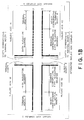
- nucleic acid A1 One aspect of the specific structures of the nucleic acid A1, the nucleic acid A2, the nucleic acid B1, and the nucleic acid B2 is shown in Figure 1A .
- the first to fourth nucleotide sequences (polynucleotides) and the sequences corresponding thereto (polynucleotides) are not particularly limited as long as the nucleic acid duplex A and the nucleic acid duplex B can respectively be formed. These sequences can be selected from optional sequences.
- the first nucleotide sequence in the nucleic acid A1 can be selected as a sequence that binds (preferably, hybridizes) to the sequence corresponding to the first nucleotide sequence in the nucleic acid A2.
- the fourth nucleotide sequence in the nucleic acid B1 can be selected as a sequence that binds (preferably, hybridizes) to the sequence corresponding to the fourth nucleotide sequence in the nucleic acid B2.
- the first nucleotide sequence can be selected in such a way that it has 70% or higher, preferably 80% or higher, more preferably 90% or higher, particularly preferably 95% or higher complementarity to the sequence corresponding to the first nucleotide sequence.
- the fourth nucleotide sequence can be selected in such a way that it has 70% or higher, more preferably 80% or higher, particularly preferably 90% or higher, most preferably 95% or higher complementarity to the sequence corresponding to the fourth nucleotide sequence.
- sequence having 70% or higher complementarity to each nucleotide sequence is preferably a sequence complementary to the nucleotide sequence. As described later, a mismatch may be introduced therein for the purpose of improving detection sensitivity.
- the first nucleotide sequence can be selected in such a way that it comprises at least 5, preferably at least 10, more preferably at least 15, further preferably at least 20, particularly preferably at least 25 contiguous nucleotides of a sequence complementary to the sequence corresponding to the first nucleotide sequence.
- the sequence corresponding to the first nucleotide sequence can be selected in such a way that it comprises at least 5, preferably at least 10, more preferably at least 15, further preferably at least 20, particularly preferably at least 25 contiguous nucleotides of a sequence complementary to the first nucleotide sequence.
- the fourth nucleotide sequence can be selected in such a way that it comprises at least 5, preferably at least 10, more preferably at least 15, further preferably at least 20, particularly preferably at least 25 contiguous nucleotides of a sequence complementary to the sequence corresponding to the fourth nucleotide sequence.
- the sequence corresponding to the fourth nucleotide sequence can be selected in such a way that it comprises at least 5, preferably at least 10, more preferably at least 15, further preferably at least 20, particularly preferably at least 25 contiguous nucleotides of a sequence complementary to the fourth nucleotide sequence.
- the first nucleotide sequence can be selected in such a way that the Tm value between the first nucleotide sequence and the sequence corresponding to the first nucleotide sequence is 5°C or more, preferably 10°C or more, more preferably 15°C or more, further preferably 20°C or more, higher than the reaction temperature.
- the fourth nucleotide sequence can be selected in such a way that the Tm value between the fourth nucleotide sequence and the sequence corresponding to the fourth nucleotide sequence is 5°C or more, preferably 10°C or more, more preferably 15°C or more, further preferably 20°C or more, higher than the reaction temperature.
- the first to fourth nucleotide sequences and the sequences corresponding thereto are not particularly limited as long as the nucleic acid duplex A and the nucleic acid duplex B can form a nucleic acid duplex complex. These sequences can be selected from optional sequences.
- the second nucleotide sequence in the nucleic acid duplex A can be selected as a sequence that binds (preferably, hybridizes) to the sequence corresponding to the second nucleotide sequence in the nucleic acid duplex B but does not bind (preferably, hybridize) to the third nucleotide sequence in the nucleic acid duplex A, the sequence corresponding to the third nucleotide sequence in the nucleic acid duplex B, or second nucleotide sequences in other nucleic acid duplexes A.
- the third nucleotide sequence in the nucleic acid duplex A can be selected as a sequence that binds (preferably, hybridizes) to the sequence corresponding to the third nucleotide sequence in the nucleic acid duplex B but does not bind (preferably, hybridize) to the second nucleotide sequence in the nucleic acid duplex A, the sequence corresponding to the second nucleotide sequence in the nucleic acid duplex B, or third nucleotide sequences in other nucleic acid duplexes A.
- the second nucleotide sequence and the third nucleotide sequence in the nucleic acid duplex A as well as the sequence corresponding to the second nucleotide sequence and the sequence corresponding to the third nucleotide sequence in the nucleic acid duplex B can respectively be selected as a sequence that does not bind (preferably, hybridize) to within the nucleic acid molecule.
- the second nucleotide sequence can be selected in such a way that it has 70% or higher, preferably 80% or higher, more preferably 90% or higher, particularly preferably 95% or higher complementarity to the sequence corresponding to the second nucleotide sequence.
- the second nucleotide sequence can be selected in such a way that it has complementarity lower than 50%, more preferably lower than 30%, to each of the third nucleotide sequence and the sequence corresponding to the third nucleotide sequence.
- sequence corresponding to the second nucleotide sequence can be selected in such a way that it has complementarity lower than 50%, more preferably lower than 30%, to each of the third nucleotide sequence and the sequence corresponding to the third nucleotide sequence.
- the third nucleotide sequence can be selected in such a way that it has 70% or higher, more preferably 80% or higher, particularly preferably 90% or higher, most preferably 95% or higher complementarity to the sequence corresponding to the third nucleotide sequence.
- the third nucleotide sequence can be selected in such a way that it has complementarity lower than 50%, more preferably lower than 30%, to each of the second nucleotide sequence and the sequence corresponding to the second nucleotide sequence.
- sequence corresponding to the third nucleotide sequence can be selected in such a way that it has complementarity lower than 50%, more preferably lower than 30%, to each of the second nucleotide sequence and the sequence corresponding to the second nucleotide sequence.
- sequence having 70% or higher complementarity to each nucleotide sequence is preferably a sequence complementary to the nucleotide sequence. As described later, a mismatch may be introduced therein for the purpose of improving detection sensitivity.
- the second nucleotide sequence can be selected in such a way that it comprises at least 5, preferably at least 10, more preferably at least 15, further preferably at least 20 contiguous nucleotides of a sequence complementary to the sequence corresponding to the second nucleotide sequence.
- the sequence corresponding to the second nucleotide sequence can be selected in such a way that it comprises at least 5, preferably at least 10, more preferably at least 15, further preferably at least 20 contiguous nucleotides of a sequence complementary to the second nucleotide sequence.
- the second nucleotide sequence may contain contiguous nucleotides of a sequence complementary to the third nucleotide sequence and/or the sequence corresponding to the third nucleotide sequence.
- the sequence corresponding to the second nucleotide sequence may contain contiguous nucleotides of a sequence complementary to the third nucleotide sequence and/or the sequence corresponding to the third nucleotide sequence. However, the number of the nucleotides is 4 at the maximum, preferably 3 or less.
- the third nucleotide sequence may contain contiguous nucleotides of a sequence complementary to the second nucleotide sequence and/or the sequence corresponding to the second nucleotide sequence.
- the sequence corresponding to the third nucleotide sequence may contain contiguous nucleotides of a sequence complementary to the second nucleotide sequence and/or the sequence corresponding to the second nucleotide sequence. However, the number of the nucleotides is 4 at the maximum, preferably 3 or less.
- the third nucleotide sequence can be selected in such a way that it comprises at least 5, preferably at least 10, more preferably at least 15, further preferably at least 20 contiguous nucleotides of a sequence complementary to the sequence corresponding to the third nucleotide sequence.
- the sequence corresponding to the third nucleotide sequence can be selected in such a way that it comprises at least 5, preferably at least 10, more preferably at least 15, further preferably at least 20 contiguous nucleotides of a sequence complementary to the third nucleotide sequence.
- the third nucleotide sequence may contain contiguous nucleotides of a sequence complementary to the second nucleotide sequence and/or the sequence corresponding to the second nucleotide sequence.
- the sequence corresponding to the third nucleotide sequence may contain contiguous nucleotides of a sequence complementary to the second nucleotide sequence and/or the sequence corresponding to the second nucleotide sequence. However, the number of the nucleotides is 4 at the maximum, preferably 3 or less.
- the second nucleotide sequence may contain contiguous nucleotides of a sequence complementary to the third nucleotide sequence and/or the sequence corresponding to the third nucleotide sequence.
- the sequence corresponding to the second nucleotide sequence may contain contiguous nucleotides of a sequence complementary to the third nucleotide sequence and/or the sequence corresponding to the third nucleotide sequence. However, the number of the nucleotides is 4 at the maximum, preferably 3 or less.
- the second nucleotide sequence can be selected in such a way that the Tm value between the second nucleotide sequence and the sequence corresponding to the second nucleotide sequence is 5°C or more, preferably 10°C or more, more preferably 15°C or more, further preferably 20°C or more, higher than the reaction temperature.
- the second nucleotide sequence can be selected in such a way that the Tm value between the second nucleotide sequence and each of the third nucleotide sequence and the sequence corresponding to the third nucleotide sequence is 5°C or more, preferably 10°C or more, more preferably 15°C or more, further preferably 20°C or more, lower than the reaction temperature.
- sequence corresponding to the second nucleotide sequence can be selected in such a way that the Tm value between the sequence corresponding to the second nucleotide sequence and each of the third nucleotide sequence and the sequence corresponding to the third nucleotide sequence is 5°C or more, preferably 10°C or more, more preferably 15°C or more, further preferably 20°C or more, lower than the reaction temperature.
- the third nucleotide sequence can be selected in such a way that the Tm value between the third nucleotide sequence and the sequence corresponding to the third nucleotide sequence is 5°C or more, preferably 10°C or more, more preferably 15°C or more, further preferably 20°C or more, higher than the reaction temperature.
- the third nucleotide sequence can be selected in such a way that the Tm value between the third nucleotide sequence and each of the second nucleotide sequence and the sequence corresponding to the second nucleotide sequence is 5°C or more, preferably 10°C or more, more preferably 15°C or more, further preferably 20°C or more, lower than the reaction temperature.
- sequence corresponding to the third nucleotide sequence can be selected in such a way that the Tm value between the sequence corresponding to the third nucleotide sequence and each of the second nucleotide sequence and the sequence corresponding to the second nucleotide sequence is 5°C or more, preferably 10°C or more, more preferably 15°C or more, further preferably 20°C or more, lower than the reaction temperature.
- the first to fourth nucleotide sequences and the sequences corresponding thereto are not particularly limited as long as structural change occurs to form a nucleic acid duplex C and a nucleic acid duplex D from the nucleic acid duplex A and the nucleic acid duplex B.
- These sequences can be selected from optional sequences.
- the first nucleotide sequence in the nucleic acid A1 can be selected as a sequence that binds (preferably, hybridizes) to the fourth nucleotide sequence in the nucleic acid B1.
- sequence corresponding to the first nucleotide sequence in the nucleic acid A2 can be selected as a sequence that binds (preferably, hybridizes) to the sequence corresponding to the fourth nucleotide sequence in the nucleic acid B2.
- the first nucleotide sequence can be selected in such a way that it has 70% or higher, preferably 80% or higher, more preferably 90% or higher, particularly preferably 95% or higher complementarity to the fourth nucleotide sequence.
- the sequence corresponding to the first nucleotide sequence can be selected in such a way that it has 70% or higher, more preferably 80% or higher, particularly preferably 90% or higher, most preferably 95% or higher complementarity to the sequence corresponding to the fourth nucleotide sequence.
- sequence having 70% or higher complementarity to each nucleotide sequence is preferably a sequence complementary to the nucleotide sequence. As described later, a mismatch may be introduced therein for the purpose of improving detection sensitivity.
- the first nucleotide sequence can be selected in such a way that it comprises at least 10, preferably at least 15, more preferably at least 20, further preferably at least 25 contiguous nucleotides of a sequence complementary to the fourth nucleotide sequence.
- the fourth nucleotide sequence can be selected in such a way that it comprises at least 10, preferably at least 15, more preferably at least 20, further preferably at least 25 contiguous nucleotides of a sequence complementary to the first nucleotide sequence.
- the sequence corresponding to the first nucleotide sequence can be selected in such a way that it comprises at least 10, preferably at least 15, more preferably at least 20, further preferably at least 25 contiguous nucleotides of a sequence complementary to the sequence corresponding to the fourth nucleotide sequence.
- the sequence corresponding to the fourth nucleotide sequence can be selected in such a way that it comprises at least 10, preferably at least 15, more preferably at least 20, further preferably at least 25 contiguous nucleotides of a sequence complementary to the sequence corresponding to the first nucleotide sequence.
- the first nucleotide sequence can be selected in such a way that the Tm value between the first nucleotide sequence and the fourth nucleotide sequence is 5°C or more, preferably 10°C or more, more preferably 15°C or more, further preferably 20°C or more, higher than the reaction temperature.
- the sequence corresponding to the first nucleotide sequence can be selected in such a way that the Tm value between the sequence corresponding to the first nucleotide sequence and the sequence corresponding to the fourth nucleotide sequence is 5°C or more, preferably 10°C or more, more preferably 15°C or more, further preferably 20°C or more, higher than the reaction temperature.
- the second nucleotide sequence and the third nucleotide sequence as the terminal sequences of the nucleic acid duplex A may both be positioned at one end of the nucleic acid duplex A or may respectively be positioned at both ends thereof.
- the sequence corresponding to the second nucleotide sequence and the sequence corresponding to the third nucleotide sequence as the terminal sequences of the nucleic acid duplex B may both be positioned at one end of the nucleic acid duplex B or may respectively be positioned at both ends thereof.
- the second nucleotide sequence and the third nucleotide sequence as the terminal sequences of the nucleic acid duplex A may both be positioned at one end of the nucleic acid duplex A; and the sequence corresponding to the second nucleotide sequence and the sequence corresponding to the third nucleotide sequence as the terminal sequences of the nucleic acid duplex B may both be positioned at one end of the nucleic acid duplex B.
- the base pair length of the duplex moiety (moiety in which the first nucleotide sequence is paired with the sequence corresponding to the first nucleotide sequence) in the nucleic acid duplex A is not particularly limited unless structural change to form a nucleic acid duplex C and a nucleic acid duplex D is inhibited.
- the base pair length can be set to, for example, 5 base pairs to 1000 base pairs and is preferably 10 base pairs to 100 base pairs, more preferably 15 base pairs to 50 base pairs.
- the base pair length of the duplex moiety (moiety in which the fourth nucleotide sequence is paired with the sequence corresponding to the fourth nucleotide sequence) in the nucleic acid duplex B is not particularly limited unless structural change to form a nucleic acid duplex C and a nucleic acid duplex D is inhibited.
- the base pair length can be set to, for example, 5 base pairs to 1000 base pairs and is preferably 10 base pairs to 100 base pairs, more preferably 15 base pairs to 50 base pairs.
- the base length of each single-stranded moiety (the second nucleotide sequence and the third nucleotide sequence) in the nucleic acid duplex A is not particularly limited as long as the nucleic acid duplex complex of the present invention can be formed.
- the base length can be set to, for example, 3 bases to 1000 bases and is preferably 5 bases to 100 bases, more preferably 10 bases to 30 bases.
- the base length of each single-stranded moiety (the sequence corresponding to the second nucleotide sequence and the sequence corresponding to the third nucleotide sequence) in the nucleic acid duplex B is not particularly limited as long as the nucleic acid duplex complex of the present invention can be formed.
- the base length can be set to, for example, 3 bases to 1000 bases and is preferably 5 bases to 100 bases, more preferably 10 bases to 30 bases.
- At least one of the nucleic acid duplex A and the nucleic acid duplex B has a site to which the nucleic acid binding protein binds.
- the site to which the nucleic acid binding protein binds is at least one type of protein binding site existing at at least one location selected from the duplex moieties and the single-stranded moieties of the nucleic acid duplex A and/or the nucleic acid duplex B and the branch moieties of the nucleic acid duplex complex and is preferably located in the duplex moiety.
- the protein binding site comprises the sequence recognized thereby and its surrounding sequence.
- the binding pattern of the nucleic acid duplex complex is not particularly limited as long as the nucleic acid duplex A and the nucleic acid duplex B are bound to each other at their terminal sequences and structural change such as nucleotide strand exchange occurs.
- the binding can be performed by hybridization.
- the nucleic acid duplex A and the nucleic acid duplex B are preferably prepared in such a way that the 3'-terminal sequence (second nucleotide sequence) of the nucleic acid duplex A binds to the 5'-terminal sequence (sequence corresponding to the second nucleotide sequence) of the nucleic acid duplex B and/or the 5'-terminal sequence (third nucleotide sequence) of the nucleic acid duplex A binds to the 3'-terminal sequence (sequence corresponding to the third nucleotide sequence) of the nucleic acid duplex B.
- the nucleic acid duplex A and the nucleic acid duplex B are designed in such a way that the 3'-terminal sequence of the nucleic acid duplex A hybridizes to the 5'-terminal sequence of the nucleic acid duplex B and/or the 5'-terminal sequence of the nucleic acid duplex A hybridizes to the 3'-terminal sequence of the nucleic acid duplex B.
- the nucleic acid duplex A and the nucleic acid duplex B are preferably prepared in such a way that the nucleic acid duplex C and the nucleic acid duplex D do not bind to each other.
- the nucleic acid duplex A and the nucleic acid duplex B are designed in such a way that a single-stranded sequence derived from the nucleic acid A1 and the nucleic acid B1 bound with each other does not hybridize to a single-stranded sequence derived from the nucleic acid A2 and the nucleic acid B2 bound with each other.
- the detection method according to the present invention wherein the complementarity between the first nucleotide sequence and the fourth nucleotide sequence is 70% or higher and/or the complementarity between the sequence corresponding to the first nucleotide sequence and the sequence corresponding to the fourth nucleotide sequence is 70% or higher; and/or the complementarity between the second nucleotide sequence and the third nucleotide sequence, the complementarity between the second nucleotide sequence and the sequence corresponding to the third nucleotide sequence, the complementarity between the sequence corresponding to the second nucleotide sequence and the third nucleotide sequence, and the complementarity between the sequence corresponding to the second nucleotide sequence and the sequence corresponding to the third nucleotide sequence are respectively lower than 50%.
- the detection method wherein the first nucleotide sequence comprises at least 10 contiguous nucleotides of a sequence complementary to the fourth nucleotide sequence or the fourth nucleotide sequence comprises at least 10 contiguous nucleotides of a sequence complementary to the first nucleotide sequence, and/or the sequence corresponding to the first nucleotide sequence comprises at least 10 contiguous nucleotides of a sequence complementary to the sequence corresponding to the fourth nucleotide sequence or the sequence corresponding to the fourth nucleotide sequence comprises at least 10 contiguous nucleotides of a sequence complementary to the sequence corresponding to the first nucleotide sequence; and/or when the second nucleotide sequence contains contiguous nucleotides of a sequence complementary to the third nucleotide sequence, the number of the nucleotides is 4 at the maximum; when the second nucleotide sequence contains contiguous nucleotides
- the detection method according to the present invention wherein the Tm value between the first nucleotide sequence and the fourth nucleotide sequence and/or the Tm value between the sequence corresponding to the first nucleotide sequence and the sequence corresponding to the fourth nucleotide sequence are 5°C or more higher than the reaction temperature; and/or the Tm value between the second nucleotide sequence and the third nucleotide sequence, the Tm value between the second nucleotide sequence and the sequence corresponding to the third nucleotide sequence, the Tm value between the sequence corresponding to the second nucleotide sequence and the third nucleotide sequence, and the Tm value between the sequence corresponding to the second nucleotide sequence and the sequence corresponding to the third nucleotide sequence are respectively 5°C or more lower than the reaction temperature.
- the method comprising determining the degree of structural change in the complex comprising the two nucleic acid duplex moieties to cause strand exchange reversibly (integrated nucleic acid complex E or integrated nucleic acid complex F).
- the integrated nucleic acid complex E comprises a nucleic acid complex G having a nucleic acid duplex moiety and a nucleic acid complex H having a nucleic acid duplex moiety.
- the nucleic acid complex G is a nucleic acid complex that comprises two single-stranded nucleic acid-containing nucleic acids, i.e., a nucleic acid G1 and a nucleic acid G2 and is capable of binding at its terminal sequence to the nucleic acid complex H.
- the nucleic acid complex H is a nucleic acid complex that comprises two single-stranded nucleic acid-containing nucleic acids, i.e., a nucleic acid H1 and a nucleic acid H2 and is capable of binding at its terminal sequence to the nucleic acid complex G.
- the integrated nucleic acid complex F comprises a nucleic acid complex I having a nucleic acid duplex moiety and a nucleic acid complex J having a nucleic acid duplex moiety.
- the nucleic acid complex I is a nucleic acid complex that comprises two single-stranded nucleic acid-containing nucleic acids, i.e., the nucleic acid G1 and the nucleic acid H1 and is capable of binding at its terminal sequence to the nucleic acid complex J.
- the nucleic acid complex J is a nucleic acid complex that comprises two single-stranded nucleic acid-containing nucleic acids, i.e., the nucleic acid G2 and the nucleic acid H2 and is capable of binding at its terminal sequence to the nucleic acid complex I.
- the integrated nucleic acid complex E is converted through strand exchange reaction between the nucleic acid complex G and the nucleic acid complex H to a new integrated nucleic acid complex F comprising the nucleic acid complex I and the nucleic acid complex J.
- the integrated nucleic acid complex F is also converted through strand exchange reaction between the nucleic acid complex I and the nucleic acid complex J to a new integrated nucleic acid complex E comprising the nucleic acid complex G and the nucleic acid complex H.
- Such structural change between the integrated nucleic acid complex E and the integrated nucleic acid complex F is reversibly repeated.
- the nucleic acid G1, the nucleic acid G2, the nucleic acid H1, and the nucleic acid H2 can respectively be designed as follows:
- the nucleic acid G1 is first designed based on the nucleic acid binding protein of interest. Then, the nucleic acid G2, the nucleic acid H2, and the nucleic acid H1 can be designed in order based on the nucleic acid G1.
- the nucleic acid G1, the nucleic acid G2, the nucleic acid H1, and the nucleic acid H2 are designed in such a way that integrated nucleic acid complexes consisting of the nucleic acid G1, the nucleic acid G2, the nucleic acid H1, and the nucleic acid H2 repeat reversible structural change through strand exchange reaction.
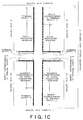
- nucleic acid G1 One aspect of the specific structures of the nucleic acid G1, the nucleic acid G2, the nucleic acid H1, and the nucleic acid H2 is shown in Figs. 1B (one aspect of the specific structure of the integrated nucleic acid complex E) and 1C (one aspect of the specific structure of the integrated nucleic acid complex F).
- terminal moieties for stopping the progress of strand exchange and reversing its direction can respectively be added to both ends of each sequence to undergo strand exchange (the fifth nucleotide sequence, the sequence corresponding to the fifth nucleotide sequence, the sixth nucleotide sequence, and the sequence corresponding to the sixth nucleotide sequence) in the nucleic acid G1, the nucleic acid G2, the nucleic acid H1, and the nucleic acid H2.
- terminal moieties are not particularly limited as long as they can stop the progress of strand exchange between two duplex moieties and reverse its direction.
- the terminal moieties may be polynucleotides. Alternatively, they may be linkers that link the termini of two nucleotide strands to undergo strand exchange (e.g., alkyl chains bound via phosphodiester bonds to the termini of two nucleotide strands to undergo strand exchange) or may be polynucleotides comprising such a linker introduced at its very end.
- the terminal moieties are preferably polynucleotides.
- terminal moieties are polynucleotides.
- the nucleic acid G1, the nucleic acid G2, the nucleic acid H1, and the nucleic acid G2 can respectively be provided as a single-stranded nucleic acid.
- the reversible structural change between the integrated nucleic acid complex E and the integrated nucleic acid complex F occurs as follows: first, (1) strand exchange to form a nucleic acid duplex consisting of the fifth nucleotide sequence and the sequence corresponding to the fifth nucleotide sequence is performed in the 5' ⁇ 3' direction of the fifth nucleotide sequence and stopped at the 3' terminus of the fifth nucleotide sequence and/or strand exchange to form a nucleic acid duplex consisting of the sixth nucleotide sequence and the sequence corresponding to the sixth nucleotide sequence is performed in the 3' ⁇ 5' direction of the sixth nucleotide sequence and stopped at the 5' terminus of the sixth nucleotide sequence (i.e., the integrated nucleic acid complex E is formed); and then, the directions of these strand exchanges are changed.
- (2) strand exchange to form a nucleic acid duplex consisting of the fifth nucleotide sequence and the sixth nucleotide sequence proceeds in the 3' ⁇ 5' direction of the fifth nucleotide sequence and/or strand exchange to form a nucleic acid duplex consisting of the sequence corresponding to the fifth nucleotide sequence and the sequence corresponding to the sixth nucleotide sequence proceeds in the 5' ⁇ 3' direction of the sequence corresponding to the fifth nucleotide sequence.
- the strand exchange to form a nucleic acid duplex consisting of the fifth nucleotide sequence and the sixth nucleotide sequence is performed in the 3' ⁇ 5' direction of the fifth nucleotide sequence and stopped at the 5' terminus of the fifth nucleotide sequence and/or the strand exchange to form a nucleic acid duplex consisting of the sequence corresponding to the fifth nucleotide sequence and the sequence corresponding to the sixth nucleotide sequence is performed in the 5' ⁇ 3' direction of the sequence corresponding to the fifth nucleotide sequence and stopped at the 3' terminus of the sequence corresponding to the fifth nucleotide sequence (i.e., the integrated nucleic acid complex F is formed); and then, the directions of these strand exchanges are changed.
- the strand exchange to form a nucleic acid duplex consisting of the fifth nucleotide sequence and the sequence corresponding to the fifth nucleotide sequence proceeds in the 5' ⁇ 3' direction of the fifth nucleotide sequence and/or the strand exchange to form a nucleic acid duplex consisting of the sixth nucleotide sequence and the sequence corresponding to the sixth nucleotide sequence proceeds in the 3' ⁇ 5' direction of the sixth nucleotide sequence.
- the processes (1) to (4) are repeated.
- the terminal moieties can be designed in such a way that:
- the terminal moieties can be designed in such a way that the highly stable base pair group formed between the 5'-terminal nucleotide sequence of the terminal moiety 1 and the 3'-terminal nucleotide sequence of the moiety corresponding to the terminal moiety 1 and between the 3'-terminal nucleotide sequence of the terminal moiety 2 and the 5'-terminal nucleotide sequence of the moiety corresponding to the terminal moiety 2 is more thermodynamically stable than a low stable base pair group between the 5'-terminal nucleotide sequence of the terminal moiety 1 and the 3'-terminal nucleotide sequence of the terminal moiety 2 and between the 3'-terminal nucleotide sequence of the moiety corresponding to the terminal moiety 1 and the 5'-terminal nucleotide sequence of the moiety corresponding to the terminal moiety 2.
- the terminal moieties can be designed in such a way that:
- the terminal moieties can be designed in such a way that the highly stable base pair group formed between the 3'-terminal nucleotide sequence of the terminal moiety 3 and the 5'-terminal nucleotide sequence of the moiety corresponding to the terminal moiety 3 and between the 5'-terminal nucleotide sequence of the terminal moiety 4 and the 3'-terminal nucleotide sequence of the moiety corresponding to the terminal moiety 4 is more thermodynamically stable than a low stable base pair group between the 3'-terminal nucleotide sequence of the terminal moiety 3 and the 5'-terminal nucleotide sequence of the terminal moiety 4 and between the 5'-terminal nucleotide sequence of the moiety corresponding to the terminal moiety 3 and the 3'-terminal nucleotide sequence of the moiety 4.
- thermodynamic stability can be determined appropriately by those skilled in the art from the base pairs used.
- the "low stable base pair group” means, in a duplex, corresponding moieties to be paired that do not form complementary strands because they contain a base pair unable to pair up due to thermodynamic instability.
- the "highly stable base pair group” (base pair group H) is not particularly limited as long as it is more thermodynamically stable than the "low stable base pair group” (base pair group L).
- the base pair group H can be set to a base pair group having a larger ratio of highly stable GC base pairs and AT base pairs (preferably, a larger ratio of GC base pairs) than that of the base pair group L.
- the base pair group L is not particularly limited as long as it is more thermodynamically unstable than the base pair group H.
- the base pair group L can be set to a base pair group having a larger ratio of low stable GG base pairs, GT base pairs, GA base pairs, TT base pairs, AA base pairs, TC base pairs, AC base pairs, CC base pairs, bulge bases (bases free from bases corresponding thereto) than that of the base pair group H.
- the base pair group L is not particularly limited as long as the progress of strand exchange between two duplex moieties can be stopped.
- the base pair group L can be set to a base pair group consisting of at least 1, preferably 2 to 3, more preferably 4 or more (e.g., 4 to 10 or 4 to the base length of each terminal moiety) bases. More preferably, the base pair group L is a base pair group comprising at least 2 to 4 contiguous base pairs with low stability.
- the base pair group H is not particularly limited as long as the progress of strand exchange between two duplex moieties can be stopped and its direction can be changed.
- the base pair group H can be set to a base pair group consisting of at least 2 or more, preferably 3 or more (e.g., 3 to 10 or 3 to the base length of each terminal moiety) bases. More preferably, the base pair group H is a base pair group comprising at least 2 to 4 contiguous base pairs with high stability.
- nucleotide sequences of the terminal moieties 1 to 4 and the sequences corresponding thereto are not particularly limited as long as the reversible structural change as described above is achieved between the integrated nucleic acid complex E and the integrated nucleic acid complex F. These sequences can be selected from optional sequences.
- the nucleotide sequence of the terminal moiety 1 can be selected as a sequence that binds (preferably, hybridizes) to the nucleotide sequence of the moiety corresponding to the terminal moiety 1.
- the nucleotide sequence of the terminal moiety 2 can be selected as a sequence that binds (preferably, hybridizes) to the nucleotide sequence of the moiety corresponding to the terminal moiety 2.
- the nucleotide sequence of the terminal moiety 3 can be selected as a sequence that binds (preferably, hybridizes) to the nucleotide sequence of the moiety corresponding to the terminal moiety 3.
- the nucleotide sequence of the terminal moiety 4 can be selected as a sequence that binds (preferably, hybridizes) to the nucleotide sequence of the moiety corresponding to the terminal moiety 4.
- the nucleotide sequence of the terminal moiety 1 can be selected in such a way that it has 70% or higher, preferably 80% or higher, more preferably 90% or higher, particularly preferably 95% or higher complementarity to the nucleotide sequence of the moiety corresponding to the terminal moiety 1.
- the nucleotide sequence of the terminal moiety 2 can be selected in such a way that it has 70% or higher, preferably 80% or higher, more preferably 90% or higher, particularly preferably 95% or higher complementarity to the nucleotide sequence of the moiety corresponding to the terminal moiety 2.
- the nucleotide sequence of the terminal moiety 3 can be selected in such a way that it has 70% or higher, preferably 80% or higher, more preferably 90% or higher, particularly preferably 95% or higher complementarity to the nucleotide sequence of the moiety corresponding to the terminal moiety 3.
- the nucleotide sequence of the terminal moiety 4 can be selected in such a way that it has 70% or higher, preferably 80% or higher, more preferably 90% or higher, particularly preferably 95% or higher complementarity to the nucleotide sequence of the moiety corresponding to the terminal moiety 4.
- sequence having 70% or higher complementarity to each nucleotide sequence is preferably a sequence complementary to the nucleotide sequence. As described later, a mismatch may be introduced therein for the purpose of improving detection sensitivity.
- the nucleotide sequence of the terminal moiety 1 can be selected in such a way that it comprises at least 3, preferably at least 5, more preferably at least 7, further preferably at least 10 contiguous nucleotides of a sequence complementary to the nucleotide sequence of the moiety corresponding to the terminal moiety 1.
- the nucleotide sequence of the moiety corresponding to the terminal moiety 1 can be selected in such a way that it comprises at least 3, preferably at least 5, more preferably at least 7, further preferably at least 10 contiguous nucleotides of a sequence complementary to the nucleotide sequence of the terminal moiety 1.
- the nucleotide sequence of the terminal moiety 2 can be selected in such a way that it comprises at least 3, preferably at least 5, more preferably at least 7, further preferably at least 10 contiguous nucleotides of a sequence complementary to the nucleotide sequence of the moiety corresponding to the terminal moiety 2.
- the nucleotide sequence of the moiety corresponding to the terminal moiety 2 can be selected in such a way that it comprises at least 3, preferably at least 5, more preferably at least 7, further preferably at least 10 contiguous nucleotides of a sequence complementary to the nucleotide sequence of the terminal moiety 2.
- the nucleotide sequence of the terminal moiety 3 can be selected in such a way that it comprises at least 3, preferably at least 5, more preferably at least 7, further preferably at least 10 contiguous nucleotides of a sequence complementary to the nucleotide sequence of the moiety corresponding to the terminal moiety 3.
- the nucleotide sequence of the moiety corresponding to the terminal moiety 3 can be selected in such a way that it comprises at least 3, preferably at least 5, more preferably at least 7, further preferably at least 10 contiguous nucleotides of a sequence complementary to the nucleotide sequence of the terminal moiety 3.
- the nucleotide sequence of the terminal moiety 4 can be selected in such a way that it comprises at least 3, preferably at least 5, more preferably at least 7, further preferably at least 10 contiguous nucleotides of a sequence complementary to the nucleotide sequence of the moiety corresponding to the terminal moiety 4.
- the nucleotide sequence of the moiety corresponding to the terminal moiety 4 can be selected in such a way that it comprises at least 3, preferably at least 5, more preferably at least 7, further preferably at least 10 contiguous nucleotides of a sequence complementary to the nucleotide sequence of the terminal moiety 4.
- the nucleotide sequence of the terminal moiety 1 can be selected in such a way that the Tm value between the nucleotide sequence of the terminal moiety 1 and the nucleotide sequence of the moiety corresponding to the terminal moiety 1 is 5°C or more, preferably 10°C or more, more preferably 15°C or more, further preferably 20°C or more, higher than the reaction temperature.
- the nucleotide sequence of the terminal moiety 2 can be selected in such a way that the Tm value between the nucleotide sequence of the terminal moiety 2 and the nucleotide sequence of the moiety corresponding to the terminal moiety 2 is 5°C or more, preferably 10°C or more, more preferably 15°C or more, further preferably 20°C or more, higher than the reaction temperature.
- the nucleotide sequence of the terminal moiety 3 can be selected in such a way that the Tm value between the nucleotide sequence of the terminal moiety 3 and the nucleotide sequence of the moiety corresponding to the terminal moiety 3 is 5°C or more, preferably 10°C or more, more preferably 15°C or more, further preferably 20°C or more, higher than the reaction temperature.
- the nucleotide sequence of the terminal moiety 4 can be selected in such a way that the Tm value between the nucleotide sequence of the terminal moiety 4 and the nucleotide sequence of the moiety corresponding to the terminal moiety 4 is 5°C or more, preferably 10°C or more, more preferably 15°C or more, further preferably 20°C or more, higher than the reaction temperature.
- the base pair length of the nucleotide sequences of the terminal moieties (polynucleotides) 1 to 4 and the nucleotide sequences corresponding thereto in the integrated nucleic acid complex E or the integrated nucleic acid complex F is not particularly limited unless reversible structural change is inhibited. It can be set to, for example, 3 bases to 50 bases and is preferably 5 bases to 30 bases, more preferably 10 bases to 30 bases, even more preferably 10 bases to 20 bases.
- the nucleic acid G1, the nucleic acid G2, the nucleic acid H1, and the nucleic acid H2 are also designed in such a way that only any one of the integrated nucleic acid complex E and the integrated nucleic acid complex F has a site to which the nucleic acid binding protein binds.
- the present invention is based on the finding that structural change between nucleic acid duplexes is inhibited by the binding of a nucleic acid binding protein.
- the protein binding sequence is not varied between before and after strand exchange.
- this protein binding sequence is also contained in the nucleic acid complex I (nucleic acid G1/nucleic acid H1) and the nucleic acid complex J (nucleic acid G2/nucleic acid H2).
- the nucleic acid binding protein binds to both the integrated nucleic acid complex E and the integrated nucleic acid complex F.
- the nucleic acids are designed in such a way that the nucleic acid binding protein binds to only any one of the integrated nucleic acid complexes.
- a variation can be introduced, for example, in the protein binding sequence in such a way that only any one of the integrated nucleic acid complex E and the integrated nucleic acid complex F has a sequence to which the nucleic acid binding protein binds and the other integrated nucleic acid complex does not have a sequence to which the nucleic acid binding protein binds.
- Such a variation can be set to a variation that prevents the nucleic acid binding protein from binding to a binding sequence other than that of the nucleic acid complex of interest.
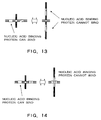
- Figure 13 One aspect of the specific structure thereof is shown in Figure 13 .
- the variation is introduced in the protein binding sites of the nucleic acid G1 nor the nucleic acid G2 in the nucleic acid complex G; and the variation is introduced in both the nucleic acid H1 and the nucleic acid H2 in the nucleic acid complex H.
- the nucleic acid binding protein can bind to the nucleic acid complex G and, according to the circumstances, to the nucleic acid complex H.
- the integrated nucleic acid complex E is structurally changed to form the nucleic acid complex I and the nucleic acid complex J, which in turn have the variation in the nucleic acid H1 and in the nucleic acid H2, respectively. Therefore, the protein cannot bind to the integrated nucleic acid complex F.
- any single-stranded nucleic acid and a strand complementary thereto e.g., the fifth nucleotide sequence/the sequence corresponding to the fifth nucleotide sequence, the sixth nucleotide sequence/the sequence corresponding to the sixth nucleotide sequence, the fifth nucleotide sequence/the sixth nucleotide sequence, or the sequence corresponding to the fifth nucleotide sequence/the sequence corresponding to the sixth nucleotide sequence).
- the variation is introduced preferably in the protein binding sequence, more preferably in a base deeply involved in protein binding in the protein binding sequence.
- the base deeply involved in protein binding in the protein binding sequence is known about each nucleic acid binding protein.
- the base deeply involved in protein binding can also be determined from a protein-nucleic acid complex structure determined by X-ray analysis or the like. Alternatively, it can also be presumed from highly conserved bases searchable from a database such as TFSEARCH (http://mbs.cbrc.jp/research/db/TFSEARCHJ.html).
- the position of the variation can be determined in such a way that it does not inhibit strand exchange and inhibits the binding of the nucleic acid binding protein.
- the variation may be introduced at locations that do not correspond to each other between the complementary strands (i.e., the variation is introduced, at each location, only in a base of one of the strands) or may be introduced at locations that correspond to each other therebetween.
- the variation is introduced at locations that correspond to each other therebetween, a variation resulting in a mismatch or a match can be introduced.
- the variation is preferably introduced at locations that do not correspond to each other between the complementary strands.
- the type of the variation is not particularly limited as long as it can inhibit the binding of the nucleic acid binding protein.
- the type can be determined appropriately according to the nucleic acid binding protein of interest and the sequence recognized thereby. Examples thereof include nucleotide substitution, deletion, and insertion.
- the variation is preferably substitution.
- the number of the variation is not particularly limited as long as it can inhibit the binding of the nucleic acid binding protein.
- the number can be determined appropriately according to the nucleic acid binding protein of interest and the sequence recognized thereby and is, for example, 1 to 10 variations, preferably 1 to 5 variations, more preferably 2 to 5 variations, in one strand.
- the nucleic acid having the introduced variation can be synthesized according to a method known in the art.
- an artificial base that does not bind to the protein may be introduced therein.
- a variation resulting in a structure that does not permit the protein binding can also be introduced in such a way that only any one of the integrated nucleic acid complex E and the integrated nucleic acid complex F has a sequence to which the nucleic acid binding protein binds and the other integrated nucleic acid complex does not have a sequence to which the nucleic acid binding protein binds.
- One aspect of the specific structure thereof is shown in Figure 14 .
- the full protein binding site is present only either before or after strand exchange by introducing a variation that inhibits strand exchange in progress.
- the fifth and sixth nucleotide sequences and the sequences corresponding thereto are not particularly limited as long as reversible structural change is achieved between the integrated nucleic acid complex E and the integrated nucleic acid complex F. These sequences can be selected from optional sequences.
- the fifth nucleotide sequence in the nucleic acid G1 can be selected as a sequence that binds (preferably, hybridizes) to the sequence corresponding to the fifth nucleotide sequence in the nucleic acid G2.
- the sixth nucleotide sequence in the nucleic acid H1 can be selected as a sequence that binds (preferably, hybridizes) to the sequence corresponding to the sixth nucleotide sequence in the nucleic acid H2.
- the fifth nucleotide sequence can be selected in such a way that it has 70% or higher, preferably 80% or higher, more preferably 90% or higher, particularly preferably 95% or higher complementarity to the sequence corresponding to the fifth nucleotide sequence.
- the sixth nucleotide sequence can be selected in such a way that it has 70% or higher, more preferably 80% or higher, particularly preferably 90% or higher, most preferably 95% or higher complementarity to the sequence corresponding to the sixth nucleotide sequence.
- sequence having 70% or higher complementarity to each nucleotide sequence is preferably a sequence complementary to the nucleotide sequence. As described later, a mismatch may be introduced therein for the purpose of improving detection sensitivity.
- the fifth nucleotide sequence can be selected in such a way that it comprises at least 5, preferably at least 10, more preferably at least 15, further preferably at least 20 contiguous nucleotides of a sequence complementary to the sequence corresponding to the fifth nucleotide sequence.
- the sequence corresponding to the fifth nucleotide sequence can be selected in such a way that it comprises at least 5, preferably at least 10, more preferably at least 15, further preferably at least 20 contiguous nucleotides of a sequence complementary to the fifth nucleotide sequence.
- the sixth nucleotide sequence can be selected in such a way that it comprises at least 5, preferably at least 10, more preferably at least 15, further preferably at least 20 contiguous nucleotides of a sequence complementary to the sequence corresponding to the sixth nucleotide sequence.
- the sequence corresponding to the sixth nucleotide sequence can be selected in such a way that it comprises at least 5, preferably at least 10, more preferably at least 15, further preferably at least 20 contiguous nucleotides of a sequence complementary to the sixth nucleotide sequence.
- the fifth nucleotide sequence can be selected in such a way that the Tm value between the fifth nucleotide sequence and the sequence corresponding to the fifth nucleotide sequence is 5°C or more, preferably 10°C or more, more preferably 15°C or more, further preferably 20°C or more, higher than the reaction temperature.
- the sixth nucleotide sequence can be selected in such a way that the Tm value between the sixth nucleotide sequence and the sequence corresponding to the sixth nucleotide sequence is 5°C or more, preferably 10°C or more, more preferably 15°C or more, further preferably 20°C or more, higher than the reaction temperature.
- the fifth nucleotide sequence in the nucleic acid G1 can be selected as a sequence that binds (preferably, hybridizes) to the sixth nucleotide sequence in the nucleic acid H1.
- the sequence corresponding to the fifth nucleotide sequence in the nucleic acid G2 can be selected as a sequence that binds (preferably, hybridizes) to the sequence corresponding to the sixth nucleotide sequence in the nucleic acid G2.
- the fifth nucleotide sequence can be selected in such a way that it has 70% or higher, preferably 80% or higher, more preferably 90% or higher, particularly preferably 95% or higher complementarity to the sixth nucleotide sequence.
- the sequence corresponding to the fifth nucleotide sequence can be selected in such a way that it has 70% or higher, more preferably 80% or higher, particularly preferably 90% or higher, most preferably 95% or higher complementarity to the sequence corresponding to the sixth nucleotide sequence.
- sequence having 70% or higher complementarity to each nucleotide sequence is preferably a sequence complementary to the nucleotide sequence. As described later, a mismatch may be introduced therein for the purpose of improving detection sensitivity.
- the fifth nucleotide sequence can be selected in such a way that it comprises at least 5, preferably at least 10, more preferably at least 15, further preferably at least 20 contiguous nucleotides of a sequence complementary to the sixth nucleotide sequence.
- the sixth nucleotide sequence can be selected in such a way that it comprises at least 5, preferably at least 10, more preferably at least 15, further preferably at least 20 contiguous nucleotides of a sequence complementary to the fifth nucleotide sequence.
- the sequence corresponding to the fifth nucleotide sequence can be selected in such a way that it comprises at least 5, preferably at least 10, more preferably at least 15, further preferably at least 20 contiguous nucleotides of a sequence complementary to the sequence corresponding to the sixth nucleotide sequence.
- the sequence corresponding to the sixth nucleotide sequence can be selected in such a way that it comprises at least 5, preferably at least 10, more preferably at least 15, further preferably at least 20 contiguous nucleotides of a sequence complementary to the sequence corresponding to the fifth nucleotide sequence.
- the fifth nucleotide sequence can be selected in such a way that the Tm value between the fifth nucleotide sequence and the sixth nucleotide sequence is 5°C or more, preferably 10°C or more, more preferably 15°C or more, further preferably 20°C or more, higher than the reaction temperature.
- the sequence corresponding to the fifth nucleotide sequence can be selected in such a way that the Tm value between the sequence corresponding to the fifth nucleotide sequence and the sequence corresponding to the sixth nucleotide sequence is 5°C or more, preferably 10 ° C or more, more preferably 15°C or more, further preferably 20°C or more, higher than the reaction temperature.
- the base pair length of the fifth nucleotide sequence and the sequence corresponding to the fifth nucleotide sequence, and the sixth nucleotide sequence and the sequence corresponding to the sixth nucleotide sequence in the integrated nucleic acid complex E or the integrated nucleic acid complex F is not particularly limited unless reversible structural change is inhibited.
- the base pair length can be set to, for example, 5 base pairs to 100 base pairs and is preferably 8 base pairs to 50 base pairs, more preferably 10 base pairs to 30 base pairs.
- the site to which the nucleic acid binding protein binds is at least one type of protein binding site existing in any of the duplex moieties of the integrated nucleic acid complex E or the integrated nucleic acid complex, or the branch moieties of the integrated nucleic acid complex and is located preferably in the duplex moiety, more preferably in the duplex moiety formed by the fifth nucleotide sequence and the sequence corresponding to the fifth nucleotide sequence and/or the duplex moiety formed by the sixth nucleotide sequence and the sequence corresponding to the sixth nucleotide sequence or in the duplex moiety formed by the fifth nucleotide sequence and the sixth nucleotide sequence and/or the duplex moiety formed by the sequence corresponding to the fifth nucleotide sequence and the sequence corresponding to the sixth nucleotide sequence.
- the protein binding site comprises the sequence recognized thereby and its surrounding sequence.
- the binding pattern of the integrated nucleic acid complex is not particularly limited as long as the nucleic acid G1, the nucleic acid G2, the nucleic acid H1, and the nucleic acid H2 are bound to each other and reversible structural change attributed to strand exchange occurs.
- the binding can be performed by hybridization.
- the integrated nucleic acid complex may be an intramolecular higher-order structure of one nucleic acid strand or may be a multimer consisting of two or more nucleic acid strands.
- the 5' terminus of the nucleic acid G1 and the 3' terminus of the nucleic acid G2 may bind to each other through a phosphodiester bond to form a single strand of the nucleic acid G1 and the nucleic acid G2.
- the 3' terminus of the nucleic acid G1 and the 5' terminus of the nucleic acid H1 may bind to each other through a phosphodiester bond to form a single strand of the nucleic acid G1 and the nucleic acid H1.
- the 3' terminus of the nucleic acid H1 and the 5' terminus of the nucleic acid H2 may bind to each other through a phosphodiester bond to form a single strand of the nucleic acid H1 and the nucleic acid H2.
- the 3' terminus of the nucleic acid H2 and the 5' terminus of the nucleic acid G2 may bind to each other through a phosphodiester bond to form a single strand of the nucleic acid G2 and the nucleic acid H2.
- the integrated nucleic acid complex can assume the following structures:
- the detection method comprising determining the degree of structural change in the integrated nucleic acid complex, wherein the nucleic acid G1 is a single-stranded nucleic acid consisting of a terminal moiety 1, a fifth nucleotide sequence, and a terminal moiety 3, the fifth nucleotide sequence being linked at the 3' terminus to the terminal moiety 1 and at the 5' terminus to the terminal moiety 3, the nucleic acid G2 is a single-stranded nucleic acid consisting of a terminal moiety 2, a sequence corresponding to the fifth nucleotide sequence, and a moiety corresponding to the terminal moiety 3, the sequence corresponding to the fifth nucleotide sequence being linked at the 5' terminus to the terminal moiety 2 and at the 3' terminus to the moiety corresponding to the terminal moiety 3, the nucleic acid H1 is a single-stranded nucleic acid consisting of a moiety corresponding to
- nucleic acid binding protein is not particularly limited as long as it is a protein binding to nucleic acids. Examples thereof include transcription factors, structural proteins, repair enzymes, branch binding proteins, recombinases, polymerases, RNA binding proteins, single-stranded DNA binding proteins, and DNA or RNA cleaving enzymes.
- transcription factors examples include TFIIID, NF ⁇ B, p53, and AP1.
- telomere DNA binding proteins e.g., human TRF1, TRF2, and POT1.
- repair enzymes include mismatch binding proteins, for example, E. coli MutS and human MSH2 and MSH6.
- branch binding proteins examples include E. coli RuvA.
- Examples of the recombinases include E. coli RecA and Yeast Rad51.
- polymerases examples include RNA polymerase and DNA polymerase.
- RNA binding proteins examples include U1 snRNP, U2 snRNP, or U6 snRNP contained in a spliceosome complex, poly A binding proteins, RNA repair enzymes, and RISC complex.
- the single-stranded DNA binding proteins include E. coli SSB and human RPA.
- the single-stranded DNA binding proteins bind to, for example, the single-stranded moiety in at least one of the nucleic acid duplex A and the nucleic acid duplex B and inhibit the formation of a nucleic acid duplex complex.
- DNA or RNA cleaving enzymes examples include restriction enzymes (e.g., EcoRI and HindIII), nicking enzymes, and Dicer.
- restriction enzymes e.g., EcoRI and HindIII
- nicking enzymes e.g., nicking enzymes
- Dicer e.g., Dicer.
- the cleavage of the single or double strands inhibits the formation of a nucleic acid duplex complex and subsequent structural change.
- the nucleic acid binding protein may be used in a purified form or may be used as a cell extract.
- nucleic acid duplex A and the nucleic acid duplex B having a terminal single-stranded moiety bind to each other at their terminal sequences to form a nucleic acid duplex complex, which is subsequently structurally changed to form new nucleic acid duplexes C and D.
- the newly formed nucleic acid duplex C and nucleic acid duplex D neither bind to each other at their terminal sequences nor form a complex.
- a nucleic acid binding protein to the nucleic acid duplex A and/or the nucleic acid duplex B, such formation of a nucleic acid duplex complex and the subsequent formation of new nucleic acid duplexes are inhibited.
- binding between a nucleic acid and a nucleic acid binding protein can be detected using the degree of structural change in the nucleic acid duplex complex as an index, specifically, using an amount of the nucleic acid duplex and/or the nucleic acid duplex complex as an index.
- the binding between a nucleic acid and a nucleic acid binding protein can be detected by performing the followings:
- the degree of structural change in the nucleic acid duplex complex can be determined by measuring an amount of a nucleic acid duplex consisting of the nucleic acid A1 and the nucleic acid B1 (nucleic acid duplex C) and/or a nucleic acid duplex consisting of the nucleic acid A2 and the nucleic acid B2 (nucleic acid duplex D).
- the detection method may further comprise comparing the measured amount with an amount of the nucleic acid duplex C and/or the nucleic acid duplex D measured in the absence of the nucleic acid binding protein. In this case, when the amount of the nucleic acid duplex C and/or the nucleic acid duplex D formed in the presence of the nucleic acid binding protein is lower than that in the absence of the nucleic acid binding protein, the nucleic acid binding protein can be determined to bind to the nucleic acid.
- the degree of structural change in the nucleic acid duplex complex can also be determined by measuring an amount of the nucleic acid duplex A and/or the nucleic acid duplex B.
- the detection method may further comprise comparing the measured amount with an amount of the nucleic acid duplex A and/or the nucleic acid duplex B measured in the absence of the nucleic acid binding protein. In this case, when the amount of the nucleic acid duplex A and/or the nucleic acid duplex B in the presence of the nucleic acid binding protein is higher than that in the absence of the nucleic acid binding protein, the nucleic acid binding protein can be determined to bind to the nucleic acid.
- the "amount of the nucleic acid duplex A and/or the nucleic acid duplex B” also encompasses an amount of the nucleic acid duplex A and/or the nucleic acid duplex B in the nucleic acid duplex complex.
- the "contacting" may be performed by simultaneously mixing all the nucleic acid duplex A, the nucleic acid binding protein, and the nucleic acid duplex B or by mixing the nucleic acid duplex A and the nucleic acid binding protein and then adding the nucleic acid duplex B to the mixture.
- structural change efficiency can be enhanced by preparing any one of the nucleic acid duplex A and the nucleic acid duplex B in excess of the other nucleic acid duplex. Moreover, structural change with sufficient efficiency can be caused even in equal amounts of these nucleic acid duplexes by selecting appropriate sequences that do not inhibit the occurrence of structural change.
- the integrated nucleic acid complex E is a nucleic acid complex formed by the nucleic acid complex G and the nucleic acid complex H bound to each other.
- the integrated nucleic acid complex F is a nucleic acid complex formed by the nucleic acid complex I and the nucleic acid complex J bound to each other.
- the integrated nucleic acid complex E is converted through strand exchange reaction between the nucleic acid complex G and the nucleic acid complex H to a new integrated nucleic acid complex F consisting of the nucleic acid complex I and the nucleic acid complex J.
- the integrated nucleic acid complex F is also converted through strand exchange reaction between the nucleic acid complex I and the nucleic acid complex J to a new integrated nucleic acid complex E consisting of the nucleic acid complex G and the nucleic acid complex H.
- a new integrated nucleic acid complex E consisting of the nucleic acid complex G and the nucleic acid complex H.
- Such structural change between the integrated nucleic acid complex E and the integrated nucleic acid complex F is reversibly repeated.
- upon binding of a nucleic acid binding protein to any of the nucleic acid complex G, the nucleic acid complex H, the nucleic acid complex I, and the nucleic acid complex J such reversible structural change is inhibited to stabilize the structure of either the integrated nucleic acid complex E or the integrated nucleic acid complex F.
- labels are used which allow the integrated nucleic acid complex E and the integrated nucleic acid complex F to show different values (e.g., the nucleic acid G1 and the nucleic acid G2, the nucleic acid G1 and the nucleic acid H1, the nucleic acid G1 and the nucleic acid H2, the nucleic acid G2 and the nucleic acid H1, the nucleic acid G2 and the nucleic acid H2, or the nucleic acid H1 and the nucleic acid H2 are fluorescently labeled or quenching-labeled, respectively).
- the values of the labels are also stabilized (i.e., the values of the labels are increased or decreased) with the stabilization of the structure.
- binding between a nucleic acid and a nucleic acid binding protein can be detected using the degree of structural change in the integrated nucleic acid complex as an index, specifically, using an amount of the integrated nucleic acid complex E or the integrated nucleic acid complex F as an index.
- One aspect of the detection of the second aspect is shown in Figure 12 .
- the binding between a nucleic acid and a nucleic acid binding protein can be detected by performing the followings:
- the degree of structural change in the nucleic acid complex can be determined by measuring an amount of the integrated nucleic acid complex of interest.
- the amount of the nucleic acid binding protein bound to the nucleic acid can be determined from the amount of the integrated nucleic acid complex E.
- the nucleic acid complexes are designed in such a way that the nucleic acid binding protein binds to nucleic acid complex I or the nucleic acid complex J, the amount of the nucleic acid binding protein bound to the nucleic acid can be determined from the amount of the integrated nucleic acid complex F.
- the "contacting" can be performed by simultaneously mixing the integrated nucleic acid complex F or the integrated nucleic acid complex G with the nucleic acid binding protein.
- the detection method of the second aspect according to the present invention needs only to mix the nucleic acid complexes prepared in advance with the protein and is therefore advantageous in that improvement in operability can be expected, such as a decreased number of operation steps and reduction in operation mistake attributed to complication.
- the nucleic acid binding protein may be contacted together with its effector molecule (protein).
- the binding potential between the nucleic acid and the nucleic acid binding protein can also be calculated from the amount of the obtained nucleic acid formed.
- an unknown sequence to which a nucleic acid binding protein binds can be determined by determining whether or not the protein can bind to a particular sequence using the detection method of the present invention.
- an unknown nucleic acid binding protein that binds to a binding sequence of interest can be identified by determining whether or not a test protein can bind to the sequence of interest using the detection method of the present invention.
- the structural change is not a reaction that requires a catalyst (e.g., structural change in the first aspect occurs upon contact of nucleic acid duplexes of which terminal single-stranded moieties are capable of binding to each other).
- the reaction can also be promoted using a catalyst such as E. coli RuvB proteins.
- the detection method according to the present invention may be performed in the presence of a substance that promotes hybridization (e.g., polyethylene glycol or dextran sulfate). Moreover, the detection method according to the present invention may be performed in the presence of a substance that has the effect of preventing protein or DNA adsorption or protecting proteins or DNA (e.g., bovine serum albumin or DNA irrelevant thereto).
- a substance that promotes hybridization e.g., polyethylene glycol or dextran sulfate
- a substance that has the effect of preventing protein or DNA adsorption or protecting proteins or DNA e.g., bovine serum albumin or DNA irrelevant thereto.
- the detection method according to the present invention can be performed at a temperature suitable for the nucleic acid binding protein used.
- DNA binding proteins can be detected at 20°C to 30°C.
- Thermophilic proteins can be detected at a higher temperature.
- any method of measuring an amount of the nucleic acid duplex, the nucleic acid duplex complex, or the nucleic acid complex can be used as long as it is the principle or a method known by those skilled in the art. Examples thereof include methods using radioactive labeling, fluorescent labeling, electrophoresis, or fluorescence resonance energy transfer.
- the amount of the nucleic acid duplex, the nucleic acid duplex complex, or the nucleic acid complex can be measured preferably by a method using fluorescent labeling or fluorescence resonance energy transfer, more preferably by a method using fluorescence resonance energy transfer that achieves assay without the need of washing procedures (for removing excessive labels) or electrophoresis.
- the nucleic acid A1 can be labeled at the 5' terminus with a fluorescent material, while the nucleic acid B1 can be labeled at the 3' terminus with a material quenching the fluorescence of the fluorescent material.
- fluorescence from the nucleic acid A1 is emitted in the nucleic acid duplex A formed thereby and is however quenched by the label of the nucleic acid B1 in the nucleic acid duplex C newly formed through the hybridization of the nucleic acid A1 to the nucleic acid B1. Therefore, the amount of the nucleic acid duplex A can be measured easily by measuring the fluorescence value.
- the nucleic acid A1 can be labeled at the 5' terminus with a fluorescent material
- the nucleic acid A2 can be labeled at the 3' terminus with a material capable of quenching the fluorescence of the fluorescent material.
- fluorescence from the nucleic acid A1 is quenched in the nucleic acid duplex A formed thereby and can however be emitted in the nucleic acid duplex C newly formed through the hybridization of the nucleic acid A1 to the nucleic acid B1. Therefore, the amount of the nucleic acid duplex C can be measured by measuring the fluorescence value.
- nucleic acid A1, the nucleic acid A2, the nucleic acid B1, and the nucleic acid B2 may be labeled.
- the position of each label may be within the nucleic acid or at the terminus thereof and is preferably at the terminus thereof.
- the fifth nucleotide sequence in the nucleic acid G1 can be labeled at the 3' terminus with a fluorescent material, while the sequence corresponding to the fifth nucleotide sequence in the nucleic acid G2 can be labeled at the 5' terminus with a material quenching the fluorescence of the fluorescent material.
- fluorescence from the nucleic acid G1 is quenched in the nucleic acid complex G formed thereby and is however emitted by the label of the nucleic acid G1 in the nucleic acid complex I formed thereby. Therefore, the amount of the single-stranded nucleic acid complex E or the single-stranded nucleic acid complex F can be measured easily by measuring the fluorescence value.
- the quenching material and the fluorescent material are also interchangeable.
- the fifth nucleotide sequence in the nucleic acid G1 can be labeled at the 3' terminus with a fluorescent material
- the sequence corresponding to the sixth nucleotide sequence in the nucleic acid H2 can be labeled at the 3' terminus with a material capable of quenching the fluorescence of the fluorescent material.
- fluorescence from the nucleic acid G1 is quenched in the nucleic acid complex G formed thereby and can however be emitted in the nucleic acid complex I formed by the nucleic acid G1. Therefore, the amount of the single-stranded nucleic acid complex E or the single-stranded nucleic acid complex F can be measured easily by measuring the fluorescence value.
- the quenching material and the fluorescent material are also interchangeable.
- the fifth nucleotide sequence in the nucleic acid G1 can be labeled at the 5' terminus with a fluorescent material
- the sequence corresponding to the sixth nucleotide sequence in the nucleic acid H2 can be labeled at the 5' terminus with a material capable of quenching the fluorescence of the fluorescent material.
- fluorescence from the nucleic acid G1 can be emitted in the nucleic acid complex G formed thereby and is however quenched in the nucleic acid complex I formed by the nucleic acid G1. Therefore, the amount of the single-stranded nucleic acid complex E or the single-stranded nucleic acid complex F can be measured easily by measuring the fluorescence value.
- the quenching material and the fluorescent material are also interchangeable.
- nucleic acid G1 preferably the fifth nucleotide sequence
- nucleic acid G2 preferably the sequence corresponding to the fifth nucleotide sequence
- nucleic acid H1 preferably the sixth nucleotide sequence
- nucleic acid H2 preferably the sequence corresponding to the sixth nucleotide sequence
- the position of each label may be within the nucleic acid or at the terminus thereof and is preferably a position at which the difference in distance between the positions of the labels is increased between before and after structural change.
- fluorescent label examples include fluorescein, TAMRA, HEX, TET, JOE, Cy5, Cy3, Alexa series (Molecular Probes, Inc.), and green fluorescence protein (GFP).
- the fluorescent label is preferably fluorescein, TAMRA, HEX, TET, JOE, Cy5, Cy3, or Alexa series.
- quenching material examples include DABCYL, TAMRA, and BHQ (Molecular Probes, Inc.).
- the quenching material can be selected appropriately according to the fluorescent material used.
- the fluorescence resonance energy transfer can be used not only as quenching but also as shift in the fluorescence wavelength.
- This fluorescence energy transfer can be measured using a general-purpose apparatus such as a spectrophotofluorometer, a real-time PCR apparatus, or a fluorescence plate reader.
- mismatch introduction potentiates the effect of suppressing strand exchange reaction and improves an S/N ratio is advantageous in that cost can be reduced because assay is achieved using small amounts of proteins in the detection method or screening method according to the present invention.
- this fact is advantageous in that valuable samples can be saved and detailed analysis is achieved because of the widened range of measurement.
- the mismatch is introduced in such a way that the mismatch exists between complementary nucleic acid strands after exchange in strand exchange reaction.
- mismatch base(s) can be introduced alone or in combination, selected from: one or more mismatch bases in the nucleotide sequence (preferably the first nucleotide sequence) of the nucleic acid A1 with respect to the nucleotide sequence of the nucleic acid B1; one or more mismatch bases in the nucleotide sequence (preferably the fourth nucleotide sequence) of the nucleic acid B1 with respect to the nucleotide sequence of the nucleic acid A1; one or more mismatch bases in the nucleotide sequence (preferably the sequence corresponding to the first nucleotide sequence) of the nucleic acid A2 with respect to the nucleotide sequence of the nucleic acid B2; and one or more mismatch bases in the nucleotide sequence (preferably the sequence corresponding to the fourth nucleotide sequence) of the nucleic acid B2 with respect to the nucleotide sequence of the nucleic acid A2.
- the position of mismatch introduction is not particularly limited as well as it is in a sequence to undergo strand exchange and unless it largely deteriorates strand exchange efficiency.
- the position is preferably in a sequence other than the sequence to which a nucleic acid binding protein binds.
- the number of the mismatch is not particularly limited unless it largely deteriorates strand exchange efficiency.
- the number of the mismatch introduced can be the number in which the first nucleotide sequence to the fourth nucleotide sequence, the fourth nucleotide sequence to the first nucleotide sequence, the sequence corresponding to the first nucleotide sequence to the sequence corresponding to the fourth nucleotide sequence, and the sequence corresponding to the fourth nucleotide sequence to the sequence corresponding to the first nucleotide sequence respectively have 90% or higher, preferably 92% or higher, more preferably 95% or higher, even more preferably 98% or higher, particularly preferably 99% or higher complementarity.
- the mismatch forming base(s) can be introduced alone or in combination in any of the nucleic acid A1, the nucleic acid A2, the nucleic acid B1, and the nucleic acid B2 in the nucleic acid duplex complex and are preferably introduced in such a way that the mismatch is formed between the first nucleotide sequence and the fourth nucleotide sequence and/or between the sequence corresponding to the first nucleotide sequence and the sequence corresponding to the fourth nucleotide sequence, more preferably between the first nucleotide sequence and the fourth nucleotide sequence and between the sequence corresponding to the first nucleotide sequence and the sequence corresponding to the fourth nucleotide sequence.
- the mismatch forming base(s) may be introduced at locations that do not correspond to each other between the complementary strands before strand exchange or may be introduced at locations that correspond to each other therebetween.
- the mismatch forming base(s) are preferably introduced at locations that correspond to each other between the complementary strands before strand exchange.
- the mismatch is introduced between the first nucleotide sequence and the fourth nucleotide sequence and between the sequence corresponding to the first nucleotide sequence and the sequence corresponding to the fourth nucleotide sequence; and the number of the mismatch is the number in which the complementarity between the first nucleotide sequence and the fourth nucleotide sequence and the complementarity between the sequence corresponding to the first nucleotide sequence and the sequence corresponding to the fourth nucleotide sequence are respectively 90% or higher, preferably 92% or higher, more preferably 95% or higher, even more preferably 98% or higher, particularly preferably 99% or higher complementarity.
- mismatch base(s) can be introduced alone or in combination, selected from: one or more mismatch bases in the nucleotide sequence (preferably the fifth nucleotide sequence) of the nucleic acid G1 with respect to the nucleotide sequence of the nucleic acid H1 or the nucleotide sequence of the nucleic acid G2; one or more mismatch bases in the nucleotide sequence (preferably the sequence corresponding to the fifth nucleotide sequence) of the nucleic acid G2 with respect to the nucleotide sequence of the nucleic acid H2 or the nucleotide sequence of the nucleic acid G1; one or more mismatch bases in the nucleotide sequence (preferably the sixth nucleotide sequence) of the nucleic acid H1 with respect to the nucleotide sequence of the nucleic acid G1 or the nucleotide sequence of the nucleic acid H2; and one or more mismatch bases in the nucleotide sequence (preferably the sequence corresponding to the sixth
- the position of mismatch introduction is not particularly limited as well as it is in a sequence to undergo strand exchange and unless it largely deteriorates strand exchange efficiency.
- the position is preferably in a sequence other than the sequence to which a nucleic acid binding protein binds.
- the number of the mismatch is not particularly limited unless it largely deteriorates strand exchange efficiency.
- the number of the mismatch introduced can be the number in which the fifth nucleotide sequence to the sixth nucleotide sequence, the sixth nucleotide sequence to the fifth nucleotide sequence, the sequence corresponding to the fifth nucleotide sequence to the sequence corresponding to the sixth nucleotide sequence, the sequence corresponding to the sixth nucleotide sequence to the sequence corresponding to the fifth nucleotide sequence, the fifth nucleotide sequence to the sequence corresponding to the fifth nucleotide sequence, the sequence corresponding to the fifth nucleotide sequence to the fifth nucleotide sequence, the sixth nucleotide sequence to the sequence corresponding to the sixth nucleotide sequence, and the sequence corresponding to the sixth nucleotide sequence to the sixth nucleotide sequence respectively have 90% or higher, preferably 92% or higher, more preferably 95% or higher, even more preferably 98%
- the mismatch forming base(s) can be introduced alone or in combination in any of the nucleic acid G1, the nucleic acid G2, the nucleic acid H1, and the nucleic acid H2 in the nucleic acid complex and are preferably introduced in such a way that the mismatch is formed between the fifth nucleotide sequence and the sixth nucleotide sequence and/or between the sequence corresponding to the fifth nucleotide sequence and the sequence corresponding to the sixth nucleotide sequence, or between the fifth nucleotide sequence and the sequence corresponding to the fifth nucleotide sequence and/or between the sixth nucleotide sequence and the sequence corresponding to the sixth nucleotide sequence, more preferably between the fifth nucleotide sequence and the sixth nucleotide sequence and between the sequence corresponding to the fifth nucleotide sequence and the sequence corresponding to the sixth nucleotide sequence, or between the fifth nucleotide sequence and the sequence corresponding to the fifth nucleotide sequence and between the sixth nucleo
- the mismatch forming base(s) are preferably introduced in such a way that the balance of reversible structural change is tilted toward a protein binding sequence-free integrated nucleic acid complex, of the integrated nucleic acid complex E and the integrated nucleic acid complex F.
- the mismatch forming base(s) are preferably introduced in such a way that the mismatch is formed between the fifth nucleotide sequence and the sequence corresponding to the fifth nucleotide sequence and/or between the sixth nucleotide sequence and the sequence corresponding to the sixth nucleotide sequence.
- the mismatch is introduced between the fifth nucleotide sequence and the sixth nucleotide sequence and between the sequence corresponding to the fifth nucleotide sequence and the sequence corresponding to the sixth nucleotide sequence
- the number of the mismatch is the number in which the complementarity between the fifth nucleotide sequence and the sixth nucleotide sequence and the complementarity between the sequence corresponding to the fifth nucleotide sequence and the sequence corresponding to the sixth nucleotide sequence are respectively 90% or higher, preferably 92% or higher, more preferably 95% or higher, even more preferably 98% or higher, particularly preferably 99% or higher complementarity
- the mismatch is introduced between the fifth nucleotide sequence and the sequence corresponding to the fifth nucleotide sequence and between the sixth nucleotide sequence and the sequence corresponding to the sixth nucleotide sequence, and the number of the mismatch is the number in which the complementarity between the fifth nucleotide sequence and the fifth nu
- the bindings of a plurality of nucleic acid binding proteins to nucleic acids can be detected simultaneously using a plurality of nucleic acid complexes (multiplexed detection).
- the multiplexed detection can enhance the efficiency of screening of an inhibitor or the like for a nucleic acid binding protein. Influence on proteins other than the target is responsible for adverse reaction and must therefore be confirmed to be small at as an early stage as possible. According to the multiplexed detection, the effect of a drug on the target protein is examined, while its influence on other proteins can also be examined.
- the multiplexed detection can also assay binding activities to a plurality of intracellular proteins. Therefore, life phenomena that take place intracellularly can be grasped in more detail. According to the multiplexed detection, more detailed findings can be obtained on nucleic acid binding proteins of which nucleic acid binding activities are known to be changed through posttranslational modification or interaction with other proteins.
- sequences of nucleic acids used in the multiplexed detection method are not particularly limited as long as a plurality of nucleic acid complexes independently cause structural change.
- sequence of each nucleic acid in a reaction system associated with one nucleic acid complex can be designed in such a way that it has influence on neither binding between nucleic acids in other reaction systems nor the structural change in the nucleic acid complex.
- the first to fourth nucleotide sequences and the sequences corresponding thereto in each reaction system as well as the nucleotide sequences of nucleic acids in other reaction systems can be designed as follows:
- the first nucleotide sequence in each reaction system can be selected in such a way that it has 70% or higher, preferably 80% or higher, more preferably 90% or higher, further preferably 95% or higher, particularly preferably 98% or higher complementarity to the sequence corresponding to the first nucleotide sequence.
- the fourth nucleotide sequence in each reaction system can be selected in such a way that it has 70% or higher, more preferably 80% or higher, particularly preferably 90% or higher, further preferably 95% or higher, particularly preferably 98% or higher complementarity to the sequence corresponding to the fourth nucleotide sequence.
- sequence having 70% or higher complementarity to each nucleotide sequence is preferably a sequence complementary to the nucleotide sequence.
- the first nucleotide sequence in each reaction system can be selected in such a way that it comprises at least 5, preferably at least 10, more preferably at least 15, further preferably at least 20, particularly preferably at least 25, most preferably at least 30 contiguous nucleotides of a sequence complementary to the sequence corresponding to the first nucleotide sequence.
- the sequence corresponding to the first nucleotide sequence in each reaction system can be selected in such a way that it comprises at least 5, preferably at least 10, more preferably at least 15, further preferably at least 20, particularly preferably at least 25, most preferably at least 30 contiguous nucleotides of a sequence complementary to the first nucleotide sequence.
- the fourth nucleotide sequence in each reaction system can be selected in such a way that it comprises at least 5, preferably at least 10, more preferably at least 15, further preferably at least 20, particularly preferably at least 25, most preferably at least 30 contiguous nucleotides of a sequence complementary to the sequence corresponding to the fourth nucleotide sequence.
- the sequence corresponding to the fourth nucleotide sequence in each reaction system can be selected in such a way that it comprises at least 5, preferably at least 10, more preferably at least 15, further preferably at least 20, particularly preferably at least 25, most preferably at least 30 contiguous nucleotides of a sequence complementary to the fourth nucleotide sequence.
- the first nucleotide sequence in each reaction system can be selected in such a way that the Tm value between the first nucleotide sequence and the sequence corresponding to the first nucleotide sequence is 5°C or more, preferably 10°C or more, more preferably 15°C or more, further preferably 20°C or more, particularly preferably 25°C or more, higher than the reaction temperature.
- the fourth nucleotide sequence in each reaction system can be selected in such a way that the Tm value between the fourth nucleotide sequence and the sequence corresponding to the fourth nucleotide sequence is 5°C or more, preferably 10°C or more, more preferably 15°C or more, further preferably 20°C or more, particularly preferably 25°C or more, higher than the reaction temperature.
- the second nucleotide sequence in each reaction system can be selected in such a way that it has 70% or higher, preferably 80% or higher, more preferably 90% or higher, further preferably 95% or higher, particularly preferably 98% or higher complementarity to the sequence corresponding to the second nucleotide sequence.
- the second nucleotide sequence in each reaction system can be selected in such a way that it has complementarity lower than 50%, more preferably lower than 30%, particularly preferably lower than 20%, to each of the third nucleotide sequence and the sequence corresponding to the third nucleotide sequence in the same reaction system thereas and the nucleotide sequences of nucleic acids in other reaction systems.
- sequence corresponding to the second nucleotide sequence in each reaction system can be selected in such a way that it has complementarity lower than 50%, more preferably lower than 30%, particularly preferably lower than 20%, to each of the third nucleotide sequence and the sequence corresponding to the third nucleotide sequence and the nucleotide sequences of nucleic acids in other reaction systems.
- the third nucleotide sequence in each reaction system can be selected in such a way that it has 70% or higher, preferably 80% or higher, more preferably 90% or higher, further preferably 95% or higher, particularly preferably 98% or higher complementarity to the sequence corresponding to the third nucleotide sequence.
- the third nucleotide sequence in each reaction system can be selected in such a way that it has complementarity lower than 50%, more preferably lower than 30%, particularly preferably lower than 20%, to each of the second nucleotide sequence and the sequence corresponding to the second nucleotide sequence in the same reaction system thereas and the nucleotide sequences of nucleic acids in other reaction systems.
- sequence corresponding to the third nucleotide sequence in each reaction system can be selected in such a way that it has complementarity lower than 50%, more preferably lower than 30%, particularly preferably lower than 20%, to each of the second nucleotide sequence and the sequence corresponding to the second nucleotide sequence in the same reaction system thereas and the nucleotide sequences of nucleic acids in other reaction systems.
- sequence having 70% or higher complementarity to each nucleotide sequence is preferably a sequence complementary to the nucleotide sequence.
- the second nucleotide sequence in each reaction system can be selected in such a way that it comprises at least 5, preferably at least 10, more preferably at least 15, further preferably at least 20 contiguous nucleotides of a sequence complementary to the sequence corresponding to the second nucleotide sequence.
- the sequence corresponding to the second nucleotide sequence in each reaction system can be selected in such a way that it comprises at least 5, preferably at least 10, more preferably at least 15, further preferably at least 20 contiguous nucleotides of a sequence complementary to the second nucleotide sequence.
- the second nucleotide sequence in each reaction system may contain contiguous nucleotides of a sequence complementary to any of the third nucleotide sequence and the sequence corresponding to the third nucleotide sequence in the same reaction system thereas and the nucleotide sequences of nucleic acids in other reaction systems.
- the number of the nucleotides is 4 at the maximum, preferably 3 or less, more preferably 2 or less.
- sequence corresponding to the second nucleotide sequence in each reaction system may contain contiguous nucleotides of a sequence complementary to any of the third nucleotide sequence and the sequence corresponding to the third nucleotide sequence in the same reaction system thereas and the nucleotide sequences of nucleic acids in other reaction systems.
- the number of the nucleotides is 4 at the maximum, preferably 3 or less, more preferably 2 or less.
- the third nucleotide sequence in each reaction system may contain contiguous nucleotides of a sequence complementary to any of the second nucleotide sequence and the sequence corresponding to the second nucleotide sequence in the same reaction system thereas.
- the number of the nucleotides is 4 at the maximum, preferably 3 or less, more preferably 2 or less.
- the sequence corresponding to the third nucleotide sequence in each reaction system may contain contiguous nucleotides of a sequence complementary to any of the second nucleotide sequence and the sequence corresponding to the second nucleotide sequence in each reaction system.
- the number of the nucleotides is 4 at the maximum, preferably 3 or less, more preferably 2 or less.
- the nucleotide sequences of nucleic acids in other reaction systems may contain contiguous nucleotides of a sequence complementary to any of the second nucleotide sequence and the sequence corresponding to the second nucleotide sequence in each reaction system.
- the number of the nucleotides is 4 at the maximum, preferably 3 or less, more preferably 2 or less.
- the third nucleotide sequence in each reaction system can be selected in such a way that it comprises at least 5, preferably at least 10, more preferably at least 15, further preferably at least 20 contiguous nucleotides of a sequence complementary to the sequence corresponding to the third nucleotide sequence.
- the sequence corresponding to the third nucleotide sequence in each reaction system can be selected in such a way that it comprises at least 5, preferably at least 10, more preferably at least 15, further preferably at least 20 contiguous nucleotides of a sequence complementary to the third nucleotide sequence.
- the third nucleotide sequence in each reaction system may contain contiguous nucleotides of a sequence complementary to any of the second nucleotide sequence and the sequence corresponding to the second nucleotide sequence in the same reaction system thereas and the nucleotide sequences of nucleic acids in other reaction systems.
- the number of the nucleotides is 4 at the maximum, preferably 3 or less, more preferably 2 or less.
- sequence corresponding to the third nucleotide sequence in each reaction system may contain contiguous nucleotides of a sequence complementary to any of the second nucleotide sequence and the sequence corresponding to the second nucleotide sequence in the same reaction system thereas and the nucleotide sequences of nucleic acids in other reaction systems.
- the number of the nucleotides is 4 at the maximum, preferably 3 or less, more preferably 2 or less.
- the second nucleotide sequence in each reaction system may contain contiguous nucleotides of a sequence complementary to any of the third nucleotide sequence and the sequence corresponding to the third nucleotide sequence in the same reaction system thereas.
- the number of the nucleotides is 4 at the maximum, preferably 3 or less, more preferably 2 or less.
- the sequence corresponding to the second nucleotide sequence in each reaction system may contain contiguous nucleotides of a sequence complementary to any of the third nucleotide sequence and the sequence corresponding to the third nucleotide sequence in the same reaction system thereas.
- the number of the nucleotides is 4 at the maximum, preferably 3 or less, more preferably 2 or less.
- nucleotide sequences of nucleic acids in other reaction systems may contain contiguous nucleotides of a sequence complementary to any of the third nucleotide sequence and the sequence corresponding to the third nucleotide sequence in each reaction system.
- the number of the nucleotides is 4 at the maximum, preferably 3 or less, more preferably 2 or less.
- the second nucleotide sequence in each reaction system can be selected in such a way that the Tm value between the second nucleotide sequence and the sequence corresponding to the second nucleotide sequence is 5°C or more, preferably 10°C or more, more preferably 15°C or more, further preferably 20°C or more, particularly preferably 25°C or more, higher than the reaction temperature.
- the second nucleotide sequence in each reaction system can be selected in such a way that the Tm value between the second nucleotide sequence and each of the third nucleotide sequence and the sequence corresponding to the third nucleotide sequence in the same reaction system thereas and the nucleotide sequences of nucleic acids in other reaction systems is 5°C or more, preferably 10°C or more, more preferably 15°C or more, further preferably 20°C or more, particularly preferably 25°C or more, lower than the reaction temperature.
- sequence corresponding to the second nucleotide sequence in each reaction system can be selected in such a way that the Tm value between the sequence corresponding to the second nucleotide sequence and each of the third nucleotide sequence and the sequence corresponding to the third nucleotide sequence in the same reaction system thereas and the nucleotide sequences of nucleic acids in other reaction systems is 5°C or more, preferably 10°C or more, more preferably 15°C or more, further preferably 20°C or more, particularly preferably 25°C or more, lower than the reaction temperature.
- the third nucleotide sequence in each reaction system can be selected in such a way that the Tm value between the third nucleotide sequence and the sequence corresponding to the third nucleotide sequence is 5°C or more, preferably 10°C or more, more preferably 15°C or more, further preferably 20°C or more, particularly preferably 25°C or more, higher than the reaction temperature.
- the third nucleotide sequence in each reaction system can be selected in such a way that the Tm value between the third nucleotide sequence and each of the second nucleotide sequence and the sequence corresponding to the second nucleotide sequence in the same reaction system thereas and the nucleotide sequences of nucleic acids in other reaction systems is 5°C or more, preferably 10°C or more, more preferably 15°C or more, further preferably 20°C or more, particularly preferably 25°C or more, lower than the reaction temperature.
- sequence corresponding to the third nucleotide sequence in each reaction system can be selected in such a way that the Tm value between the sequence corresponding to the third nucleotide sequence and each of the second nucleotide sequence and the sequence corresponding to the second nucleotide sequence in the same reaction system thereas and the nucleotide sequences of nucleic acids in other reaction systems is 5°C or more, preferably 10°C or more, more preferably 15°C or more, further preferably 20°C or more, particularly preferably 25°C or more, lower than the reaction temperature.
- the first nucleotide sequence in each reaction system can be selected in such a way that it has 70% or higher, preferably 80% or higher, more preferably 90% or higher, further preferably 95% or higher, particularly preferably 98% or higher complementarity to the fourth nucleotide sequence in the same reaction system thereas.
- the sequence corresponding to the first nucleotide sequence in each reaction system can be selected in such a way that it has 70% or higher, more preferably 80% or higher, particularly preferably 90% or higher, further preferably 95% or higher, particularly preferably 98% or higher complementarity to the sequence corresponding to the fourth nucleotide sequence in the same reaction system thereas.
- sequence having 70% or higher complementarity to each nucleotide sequence in each reaction system is preferably a sequence complementary to the nucleotide sequence.
- the first nucleotide sequence in each reaction system can be selected in such a way that it comprises at least 5, preferably at least 10, more preferably at least 15, further preferably at least 20, particularly preferably at least 25, most preferably at least 30 contiguous nucleotides of a sequence complementary to the fourth nucleotide sequence in the same reaction system thereas.
- the fourth nucleotide sequence in each reaction system can be selected in such a way that it comprises at least 5, preferably at least 10, more preferably at least 15, further preferably at least 20, particularly preferably at least 25, most preferably at least 30 contiguous nucleotides of a sequence complementary to the first nucleotide sequence in the same reaction system thereas.
- the sequence corresponding to the first nucleotide sequence in each reaction system can be selected in such a way that it comprises at least 5, preferably at least 10, more preferably at least 15, further preferably at least 20, particularly preferably at least 25, most preferably at least 30 contiguous nucleotides of a sequence complementary to the sequence corresponding to the fourth nucleotide sequence in the same reaction system thereas.
- sequence corresponding to the fourth nucleotide sequence in each reaction system can be selected in such a way that it comprises at least 5, preferably at least 10, more preferably at least 15, further preferably at least 20, particularly preferably at least 25, most preferably at least 30 contiguous nucleotides of a sequence complementary to the sequence corresponding to the first nucleotide sequence in the same reaction system thereas.
- the first nucleotide sequence in each reaction system can be selected in such a way that the Tm value between the first nucleotide sequence and the fourth nucleotide sequence in the same reaction system thereas is 5°C or more, preferably 10°C or more, more preferably 15°C or more, further preferably 20°C or more, particularly preferably 25°C or more, higher than the reaction temperature.
- the sequence corresponding to the first nucleotide sequence in each reaction system can be selected in such a way that the Tm value between the sequence corresponding to the first nucleotide sequence and the sequence corresponding to the fourth nucleotide sequence in the same reaction system thereas is 5°C or more, preferably 10°C or more, more preferably 15°C or more, further preferably 20°C or more, particularly preferably 25°C or more, higher than the reaction temperature.
- nucleotide sequences e.g., the fifth nucleotide sequence, the sixth nucleotide sequence, the nucleotide sequences of terminal moieties 1 to 4, and the sequences corresponding thereto
- the nucleotide sequences can be selected appropriately by those skilled in the art.
- Labels used in the multiplexed detection method are not particularly limited as long as the structural change of interest can be differentiated sufficiently from that of other nucleic acid duplex complexes and sufficient fluorescence resonance energy transfer is obtained.
- the labels are preferably a combination of fluorescein (fluorescent material) with DABCYL (quenching material) or a combination of Cy3 (fluorescent material) and BHQ1 (quenching material).
- Sites to which the nucleic acid binding protein binds used in a plurality of reactions, may be binding sites for different proteins or may be different binding sites for the same proteins.
- binding properties of the same proteins to nucleic acids can be determined in more detail by simultaneously assaying the bindings of the proteins to different binding sites.
- a test substance inhibits or promotes the binding of a nucleic acid binding protein to a nucleic acid can be determined by performing the detection method of the present invention in the presence of and in the absence of the test substance and comparing the degree of structural change therebetween.
- the test substance When the amount of the nucleic acid duplex C and/or the nucleic acid duplex D formed in the presence of the test substance is higher than that in the absence of the test substance, the test substance can be determined to be a binding inhibitor for the nucleic acid binding protein. Moreover, when the amount of the nucleic acid duplex A and/or the nucleic acid duplex B in the presence of the test substance is lower than that in the absence of the test substance, the test substance can be determined to be a binding inhibitor for the nucleic acid binding protein.
- the test substance when the amount of the nucleic acid duplex C and/or the nucleic acid duplex D formed in the presence of the test substance is lower than that in the absence of the test substance, the test substance can be determined to be a binding promoter for the nucleic acid binding protein. Moreover, when the amount of the nucleic acid duplex A and/or the nucleic acid duplex B in the presence of the test substance is higher than that in the absence of the test substance, the test substance can be determined to be a binding promoter for the nucleic acid binding protein.
- a test substance inhibits or promotes the binding of a nucleic acid binding protein to a nucleic acid can be determined by performing the detection method of the present invention in the presence of and in the absence of the test substance and comparing therebetween an amount of an integrated nucleic acid complex designed to bind to the nucleic acid binding protein.
- the test substance When the amount of the integrated nucleic acid complex E or the integrated nucleic acid complex F in the presence of the test substance is lower than that in the absence of the test substance, the test substance can be determined to be a binding inhibitor for the nucleic acid binding protein. Moreover, when the amount of the integrated nucleic acid complex E or the integrated nucleic acid complex F in the presence of the test substance is higher than that in the absence of the test substance, the test substance can be determined to be a binding promoter for the nucleic acid binding protein.
- test substance means every candidate substance as an inhibitor or promoter and is preferably a low-molecular-weight compound.
- the screening method according to the present invention can adopt a nucleic acid set that does not bind to the target nucleic acid binding protein, as a negative control for confirming that the test substance acts on the binding of the target nucleic acid binding protein and does not have influence on strand exchange by the nonspecific action on the nucleic acid (Example 5).
- the screening method according to the present invention can further comprise determining the degree of structural change in a nucleic acid complex consisting of nucleic acids that do not bind to a nucleic acid binding protein targeted by the test substance.
- a method of detecting the negative control may be the detection method of the first aspect or the second aspect.
- the detection method of the second aspect may be used for detecting the negative control.
- the detection method of the first aspect may be used for detecting the negative control.
- the same detection method as in the screening of interest is preferably used.
- the screening method according to the present invention is advantageous in that the inhibitory effect of a test substance can be assayed conveniently and rapidly without the use of gel shift assay.
- a detection kit for performing the detection method according to the present invention or the screening method according to the present invention.
- An example of the detection kit according to the present invention includes a detection kit for performing the detection method according to the present invention, specifically, a kit for detecting binding between a nucleic acid and a nucleic acid binding protein, comprising at least a nucleic acid duplex A and a nucleic acid duplex B capable of binding to each other at their terminal sequences. These nucleic acid duplexes may be labeled.
- This detection kit may further contain the nucleic acid binding protein of interest.
- this detection kit detects binding between a nucleic acid and a nucleic acid binding protein by determining the degree of inhibition of structural change in the nucleic acid duplex complex.
- the detection kit can further contain various reagents for determining the degree of inhibition of structural change in the nucleic acid duplex complex, for example, reaction buffers, positive standards, instructions, and/or equipment.
- Another example of the detection kit according to the present invention includes a detection kit for performing the screening method according to the present invention, specifically, a kit for screening for an inhibitor or promoter for a nucleic acid binding protein, comprising at least a nucleic acid duplex A and a nucleic acid duplex B capable of binding to each other at their terminal sequences. These nucleic acid duplexes may be labeled.
- This detection kit may further contain the nucleic acid binding protein of interest.
- this detection kit screens for an inhibitor or promoter for a nucleic acid binding protein by determining the degree of inhibition of structural change in the nucleic acid duplex complex.
- the detection kit can further contain various reagents for determining the degree of inhibition of structural change in the nucleic acid duplex complex, for example, reaction buffers, positive standards, instructions, and/or equipment.
- the detection kit can further contain a nucleic acid duplex or an integrated nucleic acid complex used as a negative control.
- An example of the detection kit according to the present invention includes a detection kit for performing the detection method according to the present invention, specifically, a kit for detecting binding between a nucleic acid and a nucleic acid binding protein, comprising at least an integrated nucleic acid complex E or an integrated nucleic acid complex F.
- This integrated nucleic acid complex may be labeled.
- This detection kit may further contain the nucleic acid binding protein of interest.
- this detection kit detects binding between a nucleic acid and a nucleic acid binding protein by determining the degree of inhibition of structural change in the integrated nucleic acid complex.
- the detection kit can further contain various reagents for determining the degree of inhibition of structural change in the integrated nucleic acid complex, for example, reaction buffers, positive standards, instructions, and/or equipment.
- Another example of the detection kit according to the present invention includes a detection kit for performing the screening method according to the present invention, specifically, a kit for screening for an inhibitor or promoter for a nucleic acid binding protein, comprising at least an integrated nucleic acid complex E or an integrated nucleic acid complex F.
- This integrated nucleic acid complex may be labeled.
- This detection kit may further contain the nucleic acid binding protein of interest.
- this detection kit screens for an inhibitor or promoter for a nucleic acid binding protein by determining the degree of inhibition of structural change in the integrated nucleic acid complex.
- the detection kit can further contain various reagents for determining the degree of inhibition of structural change in the integrated nucleic acid complex, for example, reaction buffers, positive standards, instructions, and/or equipment.
- the detection kit can further contain a nucleic acid duplex or an integrated nucleic acid complex used as a negative control.
- the kit of the second aspect is advantageous in that in addition to improved operability, cost reduction brought about by a decreased number of reagent components can be expected.
- Example 1 Study on amount of NF ⁇ B p50 bound
- a transcription factor NF ⁇ B p50 belongs to the Rel family having a loop structure and has a DNA binding sequence. This transcription factor is known to bind to an NF ⁇ B binding sequence (e.g., 5'-GGGACTTTCC-3').
- a synthetic oligonucleotide NFkB-01-5F labeled at the 5' terminus with 6-FAM and a synthetic oligonucleotide NFkB-14, or a synthetic oligonucleotide NFkB-02-3D labeled at the 3' terminus with DABCYL and a synthetic oligonucleotide NFkB-13 were mixed (20 ⁇ L each) into a duplex forming solution (10 mM HEPES-NaOH (pH 7.9), 50 mM KCI, 30 mM NaCl, 0.1 mM EDTA, 2.5 mM DTT, 10% Glycerol, 0.05% IGEPAL CA-630) and subjected to heat denaturation and annealing to prepare duplexes 01F/14 and 02D/13 having a single-stranded terminus. All the synthetic oligonucleotides were used at a concentration of 20 pmol. In the description below, all labels used were synthesized
- the heat denaturation and annealing were performed under the following temperature conditions:
- NFkB-01-5F 5' AGTTGAG GGGACTTTCO CAGGCGACTCACTATAGG CGGTGTCTCGCTCGC 3' (SEQ ID NO: 1)
- NFkB-02-3D 5' GCGAGOGAGACACCOCC TATAGTGAGTCGCCTG GGAAAGTCCC CTCAACT 3'
- NFkB-13 5' AGTTGAG GGGACTTTCC
- CAGCCGACTCACTATAGG CACCACACCATTOCC 3' SEQ ID NO: 3'
- NFkB-14 5' GGGAATGGTGTGGTOC CTATAGTGAGTCGCCTG GGAAAGTCCC CTCAACT 3' (SEQ ID NO: 4)
- the underlines represent an NF ⁇ B binding sequence.
- the italic types represent a single-stranded sequence in the duplex.
- 0.28 pmol of the duplex 01F/14 and each concentration of recombinant human NF ⁇ B p50 (Promega Corp.) were mixed into 20 ⁇ L of a reaction solution (12 mM HEPES-NaOH pH 7.9, 50 mM KCI, 0.1 mM EDTA, 30.5 mM DTT, 11% glycerol, 0.06% IGEPAL CA-630, 5 mM NaCl, 0.05 mM PMSF, 1 ⁇ M ZnSO 4 ) and reacted at 25°C for 30 minutes. Then, the reaction mixture was left standing on ice for 5 minutes.
- a reaction solution (12 mM HEPES-NaOH pH 7.9, 50 mM KCI, 0.1 mM EDTA, 30.5 mM DTT, 11% glycerol, 0.06% IGEPAL CA-630, 5 mM NaCl, 0.05 mM PMSF, 1 ⁇ M ZnSO 4 .
- 01F/14 emits fluorescence owing to 6-FAM introduced in NFkB-01-5F.
- 01F/14 and 02D/13 are mixed to form, through structural change, new perfect duplexes 01F/02D (NFkB-01-5F and NFkB-02-3D) and 13/14 (NFkB-13 and NFkB-14) in which the fluorescence of 6-FAM is quenched by DABCYL in NFkB-02-3D.
- the structural change is inhibited. This is probably the reason why the fluorescence value is increased depending on the NF ⁇ B p50 concentration.
- Example 2 Influence of decoy oligonucleotide on amount of NF ⁇ B p50 bound
- a synthetic oligonucleotide NFkB-01-5F labeled at the 5' terminus with 6-FAM and a synthetic oligonucleotide NFkB-14-03D labeled at the 3' terminus with DABCYL, or synthetic oligonucleotides NFkB-02 and NFkB-13 were mixed to prepare duplexes 01F/14D and 02/13 having a single-stranded terminus under the same conditions as in Example 1.
- oligonucleotides NFcpt01 and NFcpt02 having an NF ⁇ B binding sequence, or synthetic oligonucleotides APcpt01 and APcpt02 free from an NF ⁇ B binding sequence were mixed to prepare decoy oligonucleotide duplexes NFcpt and APcpt under the same conditions as in Example 1.
- the duplex NFcpt contains an NF ⁇ B binding sequence and therefore inhibits the binding of NF ⁇ B proteins to DNAs having other NF ⁇ B binding sequences.
- the duplex APcpt is free from an NF ⁇ B binding sequence and therefore, does not inhibit the binding of NF ⁇ B proteins to other NF ⁇ B binding sequences.
- NFkB-01-5F 5' AGTTGAG GGGACTTTCO CAGGCGACTCACTATAGG OGGTGTCTOGCTOGC 3' (SEQ ID NO: 5)
- NFkB-02-3D 5' GCGAGCGAGACAOOO OCTATAGTGAGTCGCCTG GGAAAGTOCOO CTCAACT 3'
- NFkB-13 5' AGTTGAG GGGACTTTCO CAGGOGACTCACTATAGG CACCACACCATTOCC 3'
- NFkB-14 5' GGGAATGGTGTGGTO CCTATAGTGAGTCGCCTG GAAAGTOOO CTCAACT
- NFcpt01 GCACTA GGACTTTOC GOCAOG
- NFcpT02 CGTGGC GGAAAGTCCC TAGTGC (SEQ ID NO: 10)
- APcpt01 GGTGTCATGA
- the underlines represent an NF ⁇ B binding sequence.
- the italic types represent a single-stranded sequence in the duplexes 01F/14D and 02/13.
- 01F/14D the fluorescence of 6-FAM introduced in NFkB-01-5F is quenched by DABCYL introduced in NFkB-14-3D.
- 01F/14D and 02/13 are mixed to form, through structural change, new perfect duplexes 01F/02 (NFkB-01-5F and NFkB-02) and 13/14D (NFkB-13 and NFkB-14-3D) in which 6-FAM is sufficiently distant from DABCYL and therefore emits fluorescence ( Figure 3 : the absence of NF ⁇ B p50).
- the structural change is inhibited. Therefore, the fluorescence value is decreased ( Figure 3 : the addition of NF ⁇ B p50).
- NF ⁇ B p50 binding inhibition specific to a decoy oligonucleotide duplex (NFcpt) having an NF ⁇ B binding sequence can be detected by measuring a fluorescence value.
- NFcpt decoy oligonucleotide duplex
- Example 3-1 Binding test on human AP1 proteins
- a transcription factor AP1 (c-jun) has a DNA binding motif having a leucine zipper structure and is known to bind to an AP1 binding sequence (e.g., 5'-TGAGTCA-3').
- Synthetic oligonucleotides AP-01-5C5 and AP-04-3BH, synthetic oligonucleotides AP-02 and AP-03, synthetic oligonucleotides SP1-01-5A5 and SP1-04-3BH3, or synthetic oligonucleotides SP1-02 and SP1-03 were allowed to hybridize to each other to prepare duplexes AP01C/04B, AP02/03, SP01A/04B, and SP02/03 having a single-stranded terminus under the same conditions as in Example 1.
- duplexes AP01C/04B and AP02/03 have an AP1 binding sequence, while the duplexes SP01A/04B and SP02/03 are free from an AP1 binding sequence.
- the underlines represent an AP1 binding sequence.
- the italic types represent a single-stranded sequence in the duplex.
- SP1-01-5A647 5' Alexa647 - GGGATTCGATC GGGGCGGGGC GACGAGC GTGGTTGGGTAAGGG 3' (SEQ ID NO: 17)
- SP1-02 5' CCCTTACCCAACCAC GCTCGTC GCOOOGOCCCO GATCGAATCCC 3' (SEQ ID NO: 18)
- SP1-03 5' GGGATTCGATC GGGGCGGGGC GACGAGC CACCACACCATTOCC 3' (SEQ ID NO: 19)
- SPI-04-3BH3 5' GGGAATGGTGTGGTG GCTCGTC GCCCCGCCCC GATCGAATOCC - BHQ 3' (SEQ ID NO: 20)
- the italic types represent a single-stranded sequence in the duplex.
- the underlines represent an SP1 binding sequence.
- reaction solution 10 mM HEPES-NaOH pH 7.9, 53 mM KCl, 0.17 mM EDTA, 2.6 mM DTT, 12% glycerol, 0.05% IGEPAL CA-630, 1.3 mM Tris-HCl pH 7.5, 0.67 mM MgCl 2 , 33 mM guanidine hydrochloride) and reacted at 25°C for 30 minutes. Then, the reaction mixture was left standing on ice for 5 minutes.
- Example 3 the inhibitory effect of protein binding on structural change was detected based on decrease in fluorescence value in the same way as in Example 2 except that Cy5 or Alexa 647 was used as a fluorescent material instead of 6-FAM of Example 2 and BHQ3 was used as a quenching material instead of DABCYL.
- Example 3-2 Test to detect binding of human SP1 proteins
- a transcription factor SP1 has a DNA binding motif having a Zn finger structure and is known to bind to an SP1 binding sequence (e.g., 5'-GGGGCGGGGC-3').
- reaction solution (10 mM HEPES-NaOH pH 7.9, 53.0 mM KCl, 0.1 mM EDTA, 2.6 mM DTT, 13.0% glycerol, 0.056% IGEPAL CA-630, 0.36 mM MgCl 2 , 303 nM ZnSO 4 , 0.72 mM HEPES-KOH pH 7.5) and reacted at 25°C for 30 minutes. Then, the reaction mixture was left standing on ice for 5 minutes.
- a telomere DNA binding protein TRF2 has a Myb-type DNA binding domain consisting of a C-terminal helix-turn-helix motif and is known to form a telomere structure through the binding to telomere DNA (5'-TTAGGG-3' repeats).
- TRF2 ⁇ B is a recombinant human TRF2 protein deficient in the N-terminal basic domain of TRF2 (N-terminal deletion variant).
- cDNA encoding full-length TRF2 was obtained from cDNA prepared based on mRNA extracted from a human cultured cell line (IHW09084 (obtained from International HLA Workshop)). This cDNA was used as a template in PCR to amplify a DNA region corresponding to residues 45 to 500 of the amino acid sequence. After addition of a histidine tag sequence, the obtained DNA fragment was introduced into pFastBac1 (Invitrogen Corp.) to obtain a bacmid. Insect cells (Sf9 (obtained from Invitrogen Corp.)) were transfected with the bacmid to prepare a virus.
- TRF2 ⁇ B was purified on an Ni-NTA spin column (QIAGEN). The protein concentration was calculated with bovine serum albumin as reference using a protein assay kit ((Bio-Rad Laboratories, Inc.).
- a synthetic oligonucleotide TLM-06 and a synthetic oligonucleotide TLM-01-5C3 labeled at the 5' terminus with Cy3 were mixed to prepare a duplex T01C/06 having a single-stranded terminus under the same conditions as in Example 1.
- the duplex T01C/06 has a TRF2 binding sequence.
- a synthetic oligonucleotide TLM-16 and a synthetic oligonucleotide TLM-13-5C3 labeled at the 5' terminus with Cy3 were mixed to prepare a duplex T13C/16 having a single-stranded terminus under the same conditions as in Example 1.
- the duplex T13C/16 is free from a TRF2 binding sequence.
- a synthetic oligonucleotide TLM-05 and a synthetic oligonucleotide TLM-02-3B1 labeled at the 3' terminus with BHQ1 were mixed to prepare a duplex T02B/05 having a single-stranded terminus under the same conditions as in Example 1.
- the duplex T02B/05 has a TRF2 binding sequence.
- a synthetic oligonucleotide TLM-15 and a synthetic oligonucleotide TLM-14-3B1 labeled at the 3' terminus with BHQ1 were mixed to prepare a duplex T14B/15 having a single-stranded terminus under the same conditions as in Example 1.
- the duplex T14B/15 is free from a TRF2 binding sequence.
- the underlines represent a TRF2 binding sequence.
- the italic types represent a single-stranded sequence in the duplex.
- TLH-13-503 5' Cy3-AGTTGAG TTAGGGTTAGCGTTAGCGTTAGCG CAGG CGGTGTCTCGCTCGC 3' (SEQ ID NO: 25)
- TLH-14-3B1 5' GCGAGCGAGACACCG CCTGCGCTAACGCTAACGCTAACGC TAACTCAACT-BHQ1 3' (SEQ ID NO: 26)
- TLM-15 5' AGTTGAG TTAGGGTTAGCGTTAGCGTTAGGG CAGG CACCACACCATTCCC 3' (SEQ ID NO: 27)
- TLM-16 5' GGGAATGGTGTGGTG CGTG CGCTAACGCTAACGCTAA CTCAACT 3' (SEQ ID NO: 28)
- the underlines represent a TRF2 binding sequence, which however cannot bind to TRF2 due to variations indicated in the shaded areas.
- the italic types represent a single-stranded sequence in the duplex.
- T01C/06 or T13C/16 and 1 ⁇ g of TRF2 ⁇ B were mixed into a reaction solution (10 mM HEPES-NaOH pH 7.9, 150 mM KCI, 0.1 mM EDTA, 5 mM DTT, 10% glycerol, 0.05% IGEPAL CA-630, 20 ⁇ L) and reacted at 25°C for 30 minutes. Then, 100 fmol each of T02B/05 and T14B/15 was added to T01C/06 and T13C/16, respectively, and 50 ⁇ L each of the resulting mixtures was then reacted at 25°C for 60 minutes. The fluorescence value of Cy3 was measured using a fluorescence plate reader Ultra (Tecan Group Ltd.).
- T01C/06 and T02B/05 As a result, in the DNA set (T01C/06 and T02B/05) having a TRF2 binding sequence, T01C/06 and T02B/05 formed a tetramer, which was in turn converted to T01C/02B by complete strand exchange through branch migration. The addition of TRF2 ⁇ B suppressed decrease in fluorescence value caused by this conversion ( Figure 6 ).
- T13C/16 and T14B/15 having a TRF2 binding sequence variant
- T13C/16 and T14B/15 formed a tetramer, which was in turn converted to T13C/14B by complete strand exchange through branch migration.
- the addition of TRF2 ⁇ B did not suppress decrease in fluorescence value caused by this conversion ( Figure 6 ).
- the method of the present invention successfully detected the inhibition of the binding of DNA binding proteins having a typical DNA binding motif loop, leucine zipper, or Zn finger. Moreover, the method of the present invention successfully detected the inhibition of the binding of telomere DNA binding proteins. Thus, it was shown that the present invention is widely applicable to general nucleic acid binding proteins.
- the method according to the present invention is not limited by fluorescent materials used.
- various types of fluorescent materials can be used. Therefore, for example, when a compound serving as a drug emits fluorescence, a fluorescent label that presents no obstacle to the fluorescence of the compound can be selected.
- Example 4 Test to confirm detection sensitivity depending on mismatch introduction
- a synthetic oligonucleotide SP1-05-5C3 labeled at the 5' terminus with Cy3 and a synthetic oligonucleotide SP1-08-3B1 labeled at the 3' terminus with BHQ1 were mixed to prepare a duplex SP05C/08B having a single-stranded terminus under the same conditions as in Example 1.
- synthetic oligonucleotides SP1-06 and SP1-07, synthetic oligonucleotides SP1-21 and SP1-22, or synthetic oligonucleotides SP1-23 and SP1-24 were mixed to prepare duplexes SP06/07, SP22/21, and SP24/23 having a single-stranded terminus under the same conditions as in Example 1. These duplexes have an SP1 binding sequence.
- SP1 oligo DNA SP1-05-5C3 5' Cy3- ATTCGATC GGGGCGGGGC GACGAGC GGGAATGGACAGGTT 3' (SEQ ID NO: 29)
- SP1-08-3B1 5' CGGTCAGAGTAGGCT GCTCGTC GCCCCGCCCC GATCGAAT -BHG1 3'
- SP1-07 5' ATTCGATC GGGGCGGGGC GACGAGC AGGGTACTCTGACCG 3'
- SP1-21 5' ATTGGATC GGGGCGGGGC GCGAGC AGGCTACTCTCTGACCG 3' (SEQ ID NO: 32) SP1-23 : 5' ATTCGATC GGGGCGGGGC GACGAGA AGGCTACTCTCTGACCG 3' (SEQ ID NO: 33)
- SP1-06 5' AACCTGTCCATTCCG GCTCGTC GCCCCGCCCC GATCGAAT
- the underlines represent an SP1 binding sequence.
- the italic types represent a single-stranded sequence in the duplex.
- the shaded areas represent mismatch bases in SP1-21 and SP1-23 with respect to SP1-08-3B1 or mismatch bases in SP1-22 and SP1-24 with respect to SP1-05-5C3.
- SP05C/08B and SP06/07 formed a tetramer, which was in turn converted to SP05C/06 by complete strand exchange through branch migration.
- the addition of SP1 suppressed increase in fluorescence value caused by this conversion ( Figure 7 ).
- the same results were also obtained using SP22/21 or SP24/23 instead of SP06/07 ( Figure 7 ).
- SP05C/08B and SP1-07 formed a trimer, which was in turn converted to a dimer 08B/07 and a monomer SP1-05-5C3 by complete strand exchange through branch migration.
- the addition of SP1 suppressed increase in fluorescence value caused by this conversion ( Figure 7 ).
- the same results were also obtained using SP1-21 or SP1-23 instead of SP1-07 ( Figure 7 ).
- the suppression of the fluorescence value by the addition of the SP1 proteins was confirmed to be much larger in the addition of SP22/21, SP24/23, SP-21, or SP-23 having a mismatch than in the addition of SP06/07 or SP1-07 having no mismatch with respect to SP05C/08B.
- mismatch introduction potentiates the effect of suppressing strand exchange by the addition of SP1 proteins and increases the ratio of a fluorescence value between the non-addition and addition of the proteins.
- a synthetic oligonucleotide NFkB-01-5F labeled at the 5' terminus with fluorescein and a synthetic oligonucleotide NFkB-14-3D labeled at the 3' terminus with DABCYL were mixed to prepare a duplex NF01F/14D having a single-stranded terminus under the same conditions as in Example 1.
- synthetic oligonucleotides NFkB-02 and NFkB-13, synthetic oligonucleotides NFkB-21 and NFkB-26, or synthetic oligonucleotides NFkB-49 and NFkB-50 were mixed to prepare duplexes NF02/13, NF26/21, and NF50/49 having a single-stranded terminus under the same conditions as in Example 1. These duplexes have an NF- ⁇ B binding sequence.
- NF- ⁇ B oligo DNA NFk6-01-5F 5' Fluerescein - AGTTGAG GGGACTTTCC CAGGCGACTCACTATAGG CGGTGTGTCGCTCGC 3' (SEQ ID NO: 37)
- HFkB-14-3D 5' GGGAATGGTGTGGTG CCTATAGTGAGTCGCCTG GGAAAGTCCC CTCAACT- Dabcyl 3'
- NFkB-13 5' AGTTGAG GGGACTTTCC CAGGCGACTCACTATAGG CACCAGACGATTCCC 3'
- NFkB-21 5' AGTTGAG GGGACTTGCC CAGGCGACTCACTATAGG CACCACACCATTCCC 3'
- NFkB-40 5' AGTTGAGG GGACTTTCC CAGGCGACTGACTATAGA CACCACACCATTCCC 3' (SEQ ID NO: 41)
- the underlines represent an NF- ⁇ B binding sequence.
- the italic types represent a single-stranded sequence in the duplex.
- the shaded areas represent mismatch bases in NFkB-21 and NFkB-49 with respect to NFkB-14-3D or mismatch bases in NFkB-26 and NFkB-50 with respect to NFkB-01-5F.
- NF01F/14D and 500 pmol of recombinant human NF- ⁇ B (p50) (Promega Corp.) were mixed into a reaction solution (10 mM HEPES-NaOH pH 7.9, 50 mM KCl, 0.1 mM EDTA, 5 mM DTT, 10% glycerol, 0.05% IGEPAL CA-630, 15 ⁇ L) and reacted at 25°C for 30 minutes.
- 200 fmol of NF02/13, NF26/21, or NF50/49 was added thereto, and 50 ⁇ L of the resulting mixture was then reacted at 37°C for 120 minutes.
- the fluorescence value of fluorescein was measured using a fluorescence plate reader Ultra (Tecan Group Ltd.).
- NF01F/14D and NF02/13 formed a tetramer, which was in turn converted to NF01F/02 by complete strand exchange through branch migration.
- the addition of p50 suppressed increase in fluorescence value caused by this conversion ( Figure 8 ).
- the same results were also obtained using NF26/21 or NF50/49 instead of NF02/13 ( Figure 8 ).
- the addition of the NF- ⁇ B (p50) proteins decreased the fluorescence value by approximately 30% in the combination of NF01F/14D with NF02/13 having no mismatch, whereas it decreased this fluorescence value by 50% or more in the combination of NF01F/14D with NF26/21 or NF50/49 having a mismatch ( Figure 8 ).
- mismatch introduction potentiates the effect of suppressing strand exchange by NF- ⁇ B (p50) proteins and increases the ratio of a fluorescence value between the non-addition and addition of the proteins.
- the screening of an inhibitor or the like for a nucleic acid binding protein requires confirming that a test substance acts on the binding of the target nucleic acid binding protein and does not have influence on strand exchange by the nonspecific action on the nucleic acid.
- study has been conducted on a screening system using a nucleic acid set that does not bind to the target nucleic acid binding protein, as a negative control.
- Aurothioglucose ( Yang et al. FEBS letters 1995, 361, 89-96 ) known to inhibit NF- ⁇ B was used as a test substance. Moreover, a nucleic acid set that does not bind to NF- ⁇ B was used as a negative control.
- a synthetic oligonucleotide NFkB-42 and a synthetic oligonucleotide NFkB-31-5F labeled at the 5' terminus with fluorescein, or a synthetic oligonucleotide NFkB-41 and a synthetic oligonucleotide NFkB-32-3D labeled at the 3' terminus with DABCYL were mixed to prepare duplexes 31F/42 and 32D/41 having a single-stranded terminus under the same conditions as in Example 1.
- the duplexes 31F/42 and 32D/41 have an NF- ⁇ B binding sequence.
- a synthetic oligonucleotide SP1-08 and a synthetic oligonucleotide SP1-05-5C3 labeled at the 5' terminus with Cy3, or a synthetic oligonucleotide SP1-07 and a synthetic oligonucleotide SP1-06-3B1 labeled at the 3' terminus with BHQ1 were mixed to prepare duplexes 05C/08 and 06B/07 having a single-stranded terminus under the same conditions as in Example 1.
- the duplexes 05C/08 and 06B/07 have an SP1 binding sequence.
- NF- ⁇ B oligo DMA NFkB-31-5F 5' Fluorescein - AGTTGAG GGGACTTTCC CAGGC CTCACGCACACCAGC 3' (SEQ ID NO: 45)
- NFk6-32-3D 5' GCTGGTGTGCGTGAG GCCTG GGAAAGTCCC CTCAAGT - Dabeyl 3' (SEQ ID NO: 46)
- NFkB-41 5' AGTTGAG GGGACTTTGC CAGGC AAGACGAGCAAGGAGGG 3' (SEQ ID NO: 47)
- NFkB-42 5' CCCTGGTTGCTCGTCTT GCCTG GGAAAGTCCC CTCAACT 3' (SEQ ID NO: 48)
- the underlines represent an NF- ⁇ B binding sequence.
- the italic types represent a single-stranded sequence in the duplex.
- SP1 oligo DNA SP1-05-5C3: 5' Cy3 - ATTCGATC GGGGCGGGGC GACGAGC GGGAATGGACAGGTT 3' (SEQ ID NO: 49)
- SP1-06-3B1 5' AACCTGTCCATTCCC GCTCGTC GCCCCGCCCC GATCGAAT 3' (SEQ ID NO: 50)
- SP1-07 5' ATTCGATC GGGGCGGGGC GACGAGC ACGCTACTCTCTGACCG 3' (SEQ ID NO: 51)
- SP1-08 5' CGGTCAGAGAGTAGCCT GCTCGTC GCCCCGCCCC GATCGAAT 3' (SEQ ID NO: 52)
- the underlines represent an SP1 binding sequence.
- the italic types represent a single-stranded sequence in the duplex.
- the fluorescence values of fluorescein and Cy3 were measured using a fluorescence plate reader Ultra (Tecan Group Ltd.). The fluorescein was excited at 485 nm, and its fluorescence was measured at 535 nm. The Cy3 was excited at 535 nm and its fluorescence was measured at 595 nm.
- Example 6 Study on amount of NF- ⁇ B p50 bound using integrated nucleic acid complex
- N-Ab-U2-30F and N-Da-L2-20D were mixed to form a dimer Af/Da as a quenching reference.
- the tetramer was prepared under the same conditions as in Example 1 except that these 4 types of DNAs were simultaneously mixed.
- duplex NF01/02 has an NF- ⁇ B binding sequence.
- the duplex NF03/04 has an NF- ⁇ B binding sequence variant.
- the underlines represent a moiety to undergo strand exchange.
- the shaded areas represent an NF- ⁇ B binding sequence.
- NF- ⁇ B (p50) and SP1 were simultaneously detected. Furthermore, the specific inhibitory effect of an NF- ⁇ B (p50) inhibitor (decoy oligonucleotide) was detected.
- a synthetic oligonucleotide NFkB-42 and a synthetic oligonucleotide NFkB-31-5F labeled at the 5' terminus with fluorescein, or a synthetic oligonucleotide NFkB-41 and a synthetic oligonucleotide NFkB-32-3D labeled at the 3' terminus with DABCYL were mixed to prepare duplexes 31F/42 and 32D/41 having a single-stranded terminus under the same conditions as in Example 1.
- the duplexes 31F/42 and 32D/41 have an NF- ⁇ B binding sequence.
- a synthetic oligonucleotide SP1-08 and a synthetic oligonucleotide SP1-05-5C3 labeled at the 5' terminus with Cy3, or a synthetic oligonucleotide SP1-07 and a synthetic oligonucleotide SP1-06-3B1 labeled at the 3' terminus with BHQ1 were mixed to prepare duplexes 05C/08 and 06B/07 having a single-stranded terminus under the same conditions as in Example 1.
- the duplexes 05C/08 and 06B/07 have an SP1 binding sequence.
- Synthetic oligonucleotides NFcpt01 and NFcpt02 were mixed to prepare a duplex NF01/02 having a single-stranded terminus under the same conditions as in Example 1.
- the duplex NF01/02 has an NF- ⁇ B binding sequence.
- Synthetic oligonucleotides SPcpt01 and SPcpt02 were mixed to prepare a duplex SP01/02 having a single-stranded terminus under the same conditions as in Example 1.
- the duplex SP01/02 has an SP1 binding sequence.
- NF- ⁇ B DNA NFkB-31-5F 5' Fluorescein- AGTTGAG GGGACTTTCC CAGGC CTCACGCACACCAGC 3' (SEQ ID NO: 61)
- NFkB-32-30 5' GCTGGTGTGCGTGAG GCCTG GGAAAGTCCC CTCAACT -Dabcyl 3'
- NFkB-41 5' AGTTGAG GGGGACTTTCC CAGGC AAGACGAGCAAGGAGGG 3'
- NFkB-42 5' CCCTCCTTGCTCGTCTT GCCTG GGAAAGTCCC CTCAACT 3' (SEQ ID NO: 64)
- the underlines represent an NF- ⁇ B binding sequence.
- the italic types represent a single-stranded sequence in the duplex.
- SP1 DNA SP1-05-5C3 : 5' Cy3- ATTGGATC GGGGGGGGG GACGAGC GGGAATGGACAGGTT 3' (SEQ ID NO: 65)
- SP1-06-3B1 5' AACCTGTCCATTCCC GCTCGTC GCCCCGCCCC GATCGAAT -BHQ1 3' (SEQ ID NO: 66)
- SP1-07 5' ATTCGATC GGGGCGGGGC GACGAGC AGGCTACTCTCTGACCG 3' (SEQ ID NO: 67)
- SP1-08 5' CGGTCAGAGAGTAGCCT GCTCGTC GCCCCGCCCC GATCGAAT 3' (SEQ ID NO: 68)
- the underlines represent an SP1 binding sequence.
- the italic types represent a single-stranded sequence in the duplex.
- [Table 15] NF- ⁇ B decoy NFcpt01 : 5' GCAGTA GGGACTTTCC GCCACG 3' (SEQ ID NO: 69)
- NFcpt02 5' CGTGGC GGAAAGTCCC TAGTGC 3' (SEQ ID NO: 70)
- the underlines represent SP1.
- a mixed solution of 31F/42 and 05C/08 (40 fmol each), 800 fmol of the decoy (NF01/02 or SP01/02), a solution of a protein mixture (2.5 pmol of recombinant human SP1 and 0.125 pmol of recombinant human NF ⁇ B p50) were mixed into a reaction solution (10 mM HEPES-NaOH pH 7.9, 50 mM KCl, 0.1 mM EDTA, 5 mM DTT, 10% glycerol, 0.05% IGEPAL CA-630, 15 ⁇ L) and reacted at 25°C for 30 minutes.
- a reaction solution 10 mM HEPES-NaOH pH 7.9, 50 mM KCl, 0.1 mM EDTA, 5 mM DTT, 10% glycerol, 0.05% IGEPAL CA-630, 15 ⁇ L
- a mixed solution of 32D/41 and 06B/07 (80 fmol each) was added thereto, and 50 ⁇ L of the resulting mixture was then reacted at 25°C for 120 minutes.
- the fluorescence values of fluorescein and Cy3 were measured using a fluorescence plate reader Ultra (Tecan Group Ltd.). The fluorescein was excited at 485 nm, and its fluorescence was measured at 535 nm. The Cy3 was excited at 535 nm and its fluorescence was measured at 595 nm.
- 31F/42 and 32D/41 formed a tetramer, which was in turn converted to 31F/32D by complete strand exchange through branch migration.
- the addition of the protein mixture (NF- ⁇ B (p50) + SP1) increased the fluorescence value decreased by this conversion ( Figure 11 ; NF- ⁇ B).
- NF01/02 was confirmed to decrease only the relative fluorescence value of the NF- ⁇ B/DNA. Moreover, SP01/02 was confirmed to decrease only the relative fluorescence value of the SP1/DNA ( Figure 11 ; SP1).
Landscapes
- Life Sciences & Earth Sciences (AREA)
- Health & Medical Sciences (AREA)
- Chemical & Material Sciences (AREA)
- Engineering & Computer Science (AREA)
- Organic Chemistry (AREA)
- Zoology (AREA)
- Wood Science & Technology (AREA)
- Genetics & Genomics (AREA)
- Molecular Biology (AREA)
- Biotechnology (AREA)
- Biomedical Technology (AREA)
- Bioinformatics & Cheminformatics (AREA)
- General Engineering & Computer Science (AREA)
- Immunology (AREA)
- General Health & Medical Sciences (AREA)
- Biochemistry (AREA)
- Physics & Mathematics (AREA)
- Microbiology (AREA)
- Proteomics, Peptides & Aminoacids (AREA)
- Biophysics (AREA)
- Analytical Chemistry (AREA)
- Hematology (AREA)
- Urology & Nephrology (AREA)
- Crystallography & Structural Chemistry (AREA)
- Plant Pathology (AREA)
- Cell Biology (AREA)
- Medicinal Chemistry (AREA)
- General Physics & Mathematics (AREA)
- Pathology (AREA)
- Food Science & Technology (AREA)
- Tropical Medicine & Parasitology (AREA)
- Measuring Or Testing Involving Enzymes Or Micro-Organisms (AREA)
Claims (9)
- Ein Verfahren zur Bestimmung einer Bindung zwischen einer Nukleinsäure und einen Nukleinsäure- Bindungsprotein, umfassend Bestimmen des Grades der Strukturänderung in einem Nukleinsäure- Komplex, der zumindest mindestens zwei Nukleinsäure- Duplex- Teile aufweist, wobei der Nukleinsäure- Komplex, der mindestens zwei Nukleinsäure- Duplex- Teile aufweist, ein Komplex ist, der zwei Nukleinsäure- Duplexe umfasst, die miteinander an ihren terminalen Sequenzen (Nukleinsäure- Duplex- Komplex) gebunden sind, wobei die strukturelle Veränderung ein Nukleotid- Strang- Austausch zwischen den beiden Nukleinsäure- Duplexen ist, wobei der Nukleotid- Strang-Austausch zwischen den Nukleinsäure- Duplexen ein Ersatz eines Stranges ist, der komplementär zu jedem Nukleotid- Strang ist, der ein Nukleinsäure- Duplex mit einem Nukleotid- Strang bildet, der den anderen Nukleinsäure- Duplex bildet, und wobei das Verfahren umfasst:(i) Inkontaktbringen des Nukleinsäure- Bindungs- Protein mit einem Nukleinsäure-Duplex A und einem Nukleinsäure- Duplex B, wobei der Nukleinsäure- Duplex A aus zwei einsträngigen Nukleinsäuren (im folgenden als "Nukleinsäure A1" und "Nukleinsäure A2" bezeichnet) besteht und der Nukleinsäure- Duplex B aus zwei einsträngigen Nukleinsäuren (im Folgenden bezeichnet als "Nukleinsäure B1" und "B2 Nukleinsäure" bezeichnet) besteht; und(ii) Bestimmung des Grades der Strukturänderung in dem Nukleinsäure- Duplex-Komplexwobei die Nukleinsäure A1 aus einer einsträngigen Nukleinsäure besteht, die eine erste Nukleotid- Sequenz und eine zweite Nukleotid- Sequenz aufweist; die Nukleinsäure A2 aus einer einsträngigen Nukleinsäure besteht, die eine Sequenz hat,
die der ersten Nukleotid- Sequenz und einer dritten Nukleotid- Sequenz entspricht; die Nukleinsäure B1 besteht aus eine einsträngige Nukleinsäure, die eine Sequenz hat, die der zweite Nukleotid- Sequenz und einer vierten Nukleotid- Sequenz entspricht; und die Nukleinsäure B2 besteht aus einer einsträngigen Nukleinsäure, die eine Sequenz hat, die der dritten Nukleotid- Sequenz und einer vierten Nukleotid- Sequenz entspricht, und
wobei das Inkontaktbringen in (i) durch gleichzeitiges Mischen aller Nukleinsäure-Duplex A, des Nukleinsäure- Bindungsprotein und der Nukleinsäure- Duplex B erfolgen kann oder durch Mischen des Nukleinsäure- Duplex A und des Nukleinsäure-Bindungsprotein und dann durch Hinzufügen des Nukleinsäure- Duplex B zu dem Gemisch. - Das Verfahren nach Anspruch 1,
wobei in (ii) der Grad der strukturellen Änderung in dem Nukleinsäure- Duplex-Komplex durch Messen einer Menge eines Nukleinsäure- Duplexes bestimmt wird, bestehend aus der Nukleinsäure A1 und der Nukleinsäure B1 (Nukleinsäure- Duplex C) und / oder eines Nukleinsäure- Duplex, der aus der Nukleinsäure A2 und der Nukleinsäure B2 (Nukleinsäure- Duplex D) beseht; oder
wobei in (ii) der Grad der strukturellen Änderung in dem Nukleinsäure- Duplex-Komplex durch Messen einer Menge des Nukleinsäure- Duplex A und / oder des Nukleinsäure- Duplex B bestimmt wird. - Das Verfahren nach einem der Ansprüche 1 oder 2, wobei Mismatch- Base(n) allein oder in Kombination existieren, ausgewählt aus:einer oder mehrere Mismatch- Basen in der Nukleotid- Sequenz der Nukleinsäure A1 in Bezug auf die Nukleotid- Sequenz der Nukleinsäure B1;eine oder mehrere Mismatch- Basen in der Nukleotid- Sequenz der Nukleinsäure B1 in Bezug auf die Nukleotid- Sequenz der Nukleinsäure A1;eine oder mehrere Mismatch- Basen in der Nukleotid- Sequenz der Nukleinsäure A2 in Bezug auf die Nukleotid- Sequenz der Nukleinsäure B2; undeine oder mehrere Mismatch- Basen in der Nukleotid- Sequenz der Nukleinsäure B2 in Bezug auf die Nukleotid- Sequenz der Nukleinsäure A2.
- Ein Verfahren zum Nachweis einer Bindung zwischen einer Nukleinsäure und einem Nukleinsäure bindenden Proteins, umfassend Bestimmen des Grads der Strukturänderung in einem Nukleinsäure- Komplex, der mindestens zwei Nukleinsäure-Duplex- Teile aufweist,
wobei der Nukleinsäure- Komplex, der mindestens zwei Nukleinsäure- Duplex- Teile aufweist, ein Komplex ist, der die beiden Nukleinsäure- Duplex- Teile umfasst, um reversibel Strangaustausch zu verursachen (integrierte Nukleinsäure- Komplex), wobei der integrierte Nukleinsäure- Komplex ein Nukleinsäure- Komplex ist, der durch die Nukleinsäure- Komplexe, die miteinander gebunden sind, ausgebildet ist, wobei die Strukturänderung ein Nukleotid- Strangaustausch zwischen den zwei Nukleinsäure-Duplexen ein Ersatz eines komplementären Stranges zu jedem Nukleotid- Strang ist, der einen Nukleinsäure- Duplex mit einem Nukleotid- Strang bildet, der den anderen Nukleinsäure- Duplex bildet, und wobei das Verfahren umfasst,(iii) Inkontaktbringen des Nukleinsäure- Bindungs- Protein mit einem integrierten Nukleinsäure- Komplexes E, wobei die integrierte Nukleinsäure- Komplex E eine Nukleinsäure- Komplex G umfasst, der ein Nukleinsäure- Duplex- Teil und einen Nukleinsäure- Komplex H umfasst, der ein Nukleinsäure- Duplex- Teil aufweist, der Nukleinsäure- Komplex G zwei einsträngige Nukleinsäuren- enthaltende Nukleinsäuren (nachfolgend jeweils als "Nukleinsäure G1" und "Nukleinsäure G2" bezeichnet) umfasst, und der Nukleinsäure- Komplex H aus zwei einsträngigen Nukleinsäure enthaltenden Nukleinsäuren (nachfolgend jeweils als "Nukleinsäure H1" und " Nukleinsäure H2" bezeichnet); und(iv) Bestimmung des Grades der Strukturänderung in dem integrierten Nukleinsäure-Komplex, wobei die Nukleinsäure G1 eine einsträngige Nukleinsäure ist, die eine Nukleinsäure enthält, die aus einem terminalen Teil 1, einer fünften Nukleotid-Sequenz und einem terminalen Teil besteht, die fünfte Nukleotid- Sequenz ist am 3ten Terminus mit dem terminalen Teil 1 und am 5ten Terminus mit der terminalen Teil 3 verbunden;die Nukleinsäure G2 ist eine einsträngige Nukleinsäure, die eine Nukleinsäure enthält, die aus einem terminalen Teil 2, aus einer Sequenz korrespondierend zu der fünften Nukleotid- Sequenz, und aus einem Teil, die zu dem terminalen Teil 3 korrespondiert, besteht, wobei die Sequenz, die mit der fünften Nukleotid- Sequenz korrespondiert,
am 5ten Terminus mit dem terminalen Teil 2 und am 3ten Terminus mit dem Teil, das zu dem terminalen Teil korrespondiert, verbunden ist;
die Nukleinsäure H1 ist eine einsträngige Nukleinsäure, die eine Nukleinsäure enthält, die aus einem Teil, das zu dem terminalen Teil 1 korrespondiert, aus einer sechsten Nukleotid- Sequenz und aus einem terminalen Teil 4 besteht, die sechste Nukleotid-Sequenz ist am 5ten Terminus mit dem Teil, die zu dem terminalen Teil 1 korrespondiert, und am 3ten Terminus mit der terminalen Teil 4 und
die Nukleinsäure H2 ist eine einsträngige Nukleinsäure, die eine Nukleinsäure enthält, die aus einem terminalen Teil, das zu dem terminal Teil 4 korrespondiert, aus einer Sequenz, die zu der sechsten Nukleotid- Sequenz korrespondiert, und aus einem Teil,
das zu dem terminalen Teil 2 korrespondiert, besteht, wobei die Sequenz, die zu der sechste Nukleotid- Sequenz korrespondiert, am 5ten Terminus mit dem Teil, die zu dem terminalen Teil 4 korrespondiert, und am 3ten Terminus mit dem Teil, das zu dem terminalen Teil 2 korrespondiert, verbunden ist,
wobei die terminalen Teile in der Lage sind, den Fortschritt des Strangaustausch zwischen zwei Duplex-Teilen zu stoppen und seine Richtung umzukehren,
wobei in (iv) der Grad der strukturellen Änderung in dem integrierten Nukleinsäure-Komplexes bestimmt wird, indem eine Menge des integrierten Nukleinsäure-Komplexes E gemessen wird; oder wobei in (iv) der Grad der Strukturänderung in dem integrierten Nukleinsäure- Komplex durch Messen einer Menge eines integrierten Nukleinsäure- Komplex F bestimmt wird, der einen Nukleinsäure- Komplex I und einen Nukleinsäure- Komplex J enthält, der Nukleinsäure- Komplex I umfasst die Nukleinsäure G1 und die Nukleinsäure H1 und hat einen Nukleinsäure- Duplex- Teil und der Nukleinsäure- Komplex J umfasst die Nukleinsäure G2 und die Nukleinsäure H2 und hat einen Nukleinsäure- Duplex- Teil
wobei nur jeder der integrierten Nukleinsäure- Komplexe E oder der integrierten Nukleinsäure F eine Seite hat, an die sich ein Nukleinsäure bindendes Protein bindet. - Das Verfahren nach Anspruch 4, wobei die terminalen Teilen Polynukleotide sind, wobei
eine hochstabile Basen- Paargruppe weder zwischen der 5ten terminalen Nukleotid-Sequenz des terminalen Teils 1 und der 3ten terminalen Nukleotid- Sequenz des terminalen Teils 2, noch zwischen der 3ten- terminalen Nukleotid- Sequenz des Teils,
das zu dem terminalen Teil 1 korrespondiert, und dem 5ten terminalen Nukleotid-Sequenz des Teils, das zu dem terminalen Teil 2 korrespondiert, ausgebildet wird;
und / oder
ein sehr stabiles Basenpaar- Gruppe ist zwischen der 5ten terminalen Nukleotid-Sequenz des terminalen Teils 1 und der 3ten terminalen Nukleotid- Sequenz des Teils,
das zu dem terminalen Teil 1 korrespondiert, und zwischen der 3ten terminalen Nukleotid- Sequenz des Teils 2 und der 5ten terminale Nukleotid- Sequenz des Teils, das zu dem terminalen Teil 2 korrespondiert, gebildet;
und
eine hoch stabile Basenpaar- Gruppe ist weder zwischen der 3ten terminalen Nukleotid- Sequenz des terminalen Teils 3 und der 5ten terminalen Nukleotid-Sequenz des terminalen Teil 4, noch zwischen der 5ten terminalen Nukleotid- Sequenz des Teils, das zu dem entsprechenden terminalen Teil 3 korrespondiert, und der 3ten terminalen Nukleotid- Sequenz des Teil, das zu dem terminalen Teil 4 korrespondiert; und / oder
ein sehr stabiles Basenpaar- Gruppe ist zwischen der 3ten terminalen Nukleotid-Sequenz des terminalen Teils 3 und der 5ten terminalen Nukleotid- Sequenz des Teils,
das zu dem terminalen Teil 3 korrespondiert, und zwischen dem 5ten terminalen Nukleotid- Sequenz des terminalen Teils 4 und der 3ten terminale Nukleotid- Sequenz des Teil, dazu zum dem terminalen Teil 4 korrespondiert, ausgebildet. - Das Verfahren nach einem der Ansprüche 4 oder 5, wobei Mismatch- Basen (en) bestehen alleine oder in Kombination, ausgewählt aus:eine oder mehrere Mismatch- Basen in der Nukleotid- Sequenz der Nukleinsäure G1 in Bezug auf die die Nukleotid- Sequenz der Nukleinsäure H1;eine oder mehrere Mismatch- Basen in der Nukleotid- Sequenz der Nukleinsäure H1 in Bezug auf die Nukleotid- Sequenz der Nukleinsäure G1;eine oder mehrere Mismatch- Basen in der Nukleotid- Sequenz der Nukleinsäure G2 in Bezug auf die Nukleotid- Sequenz der Nukleinsäure H2; undeine oder mehrere Mismatch- Basen in der Nukleotid- Sequenz der Nukleinsäure H2 in Bezug auf die Nukleotid- Sequenz der Nukleinsäure G2;oderwobei Mismatch- Base (n) allein oder in Kombination vorhanden sind, ausgewählt aus:eine oder mehrere Mismatch- Basen in der Nukleotid- Sequenz der Nukleinsäure G1 in Bezug auf die Nukleotid- Sequenz der Nukleinsäure G2;eine oder mehrere Mismatch- Basen in der Nukleotid- Sequenz der Nukleinsäure G2 in Bezug auf die Nukleotid- Sequenz der Nukleinsäure G1;eine oder mehrere Mismatch- Basen in der Nukleotid- Sequenz der Nukleinsäure H1 in Bezug auf die Nukleotid- Sequenz der Nukleinsäure H2; undeine oder mehrere Mismatch- Basen in der Nukleotid- Sequenz der Nukleinsäure H2 in Bezug auf die Nukleotid- Sequenz der Nukleinsäure H1.
- Das Verfahren nach einem der Ansprüche 1 bis 6, wobei das Verfahren in einem gemultiplexten Verfahren durchgeführt wird.
- Verfahren zum Screenen für einen Bindungsinhibitor oder Promotor für ein Nukleinsäure- Bindungsprotein, umfassend Durchführen eines Verfahrens nach einem der Ansprüche 1 bis 7 in Gegenwart und in Abwesenheit einer Testsubstanz.
- Das Screening- Verfahren nach Anspruch 8, das ferner umfasst, Bestimmen des Grades der strukturellen Änderung in einem Nukleinsäure- Komplex, bestehend aus Nukleinsäuren, die sich nicht an ein Nukleinsäure- Bindungsprotein binden auf das durch die Testsubstanz abgezielt wird.
Applications Claiming Priority (2)
| Application Number | Priority Date | Filing Date | Title |
|---|---|---|---|
| JP2008011750 | 2008-01-22 | ||
| PCT/JP2009/051006 WO2009093667A1 (ja) | 2008-01-22 | 2009-01-22 | 核酸結合蛋白質アッセイ法およびキット |
Publications (3)
| Publication Number | Publication Date |
|---|---|
| EP2241640A1 EP2241640A1 (de) | 2010-10-20 |
| EP2241640A4 EP2241640A4 (de) | 2012-10-31 |
| EP2241640B1 true EP2241640B1 (de) | 2016-06-22 |
Family
ID=40901172
Family Applications (1)
| Application Number | Title | Priority Date | Filing Date |
|---|---|---|---|
| EP09704882.1A Not-in-force EP2241640B1 (de) | 2008-01-22 | 2009-01-22 | Nukleinsäurebindungsprotein-testverfahren und -kit |
Country Status (4)
| Country | Link |
|---|---|
| US (2) | US20110033951A1 (de) |
| EP (1) | EP2241640B1 (de) |
| JP (1) | JP5652850B2 (de) |
| WO (1) | WO2009093667A1 (de) |
Families Citing this family (2)
| Publication number | Priority date | Publication date | Assignee | Title |
|---|---|---|---|---|
| EP3684883B1 (de) * | 2017-10-25 | 2024-04-03 | Shoei Chemical Inc. | Stabile inp-quantenpunkte mit dicker hüllenbeschichtung und verfahren zur herstellung davon |
| WO2019181714A1 (ja) * | 2018-03-20 | 2019-09-26 | 国立大学法人広島大学 | テロメア結合タンパク質を阻害する化合物、及びそれを含むテロメア結合タンパク質阻害剤 |
Family Cites Families (11)
| Publication number | Priority date | Publication date | Assignee | Title |
|---|---|---|---|---|
| US2004A (en) * | 1841-03-12 | Improvement in the manner of constructing and propelling steam-vessels | ||
| US1001A (en) * | 1838-11-09 | Open grate fobj burning coai | ||
| WO1985000813A1 (en) * | 1983-08-03 | 1985-02-28 | The Research Foundation Of State University Of New | Nucleic acid branched junctions with precisely defined migrational mobility |
| WO1997023646A1 (en) * | 1995-12-22 | 1997-07-03 | Behringwerke Aktiengesellschaft | Detection of differences in nucleic acids |
| CA2402483A1 (en) * | 2000-03-11 | 2001-09-20 | Freshgene, Inc. | Methods for detection of differences in nucleic acids |
| US6653079B2 (en) * | 2000-03-13 | 2003-11-25 | Freshgene, Inc. | Methods for detection of differences in nucleic acids |
| US20030129598A1 (en) * | 2000-10-23 | 2003-07-10 | Qinghong Yang | Methods for detection of differences in nucleic acids |
| US6544746B2 (en) * | 2001-08-13 | 2003-04-08 | St. Louis University | Rapid and sensitive proximity-based assay for the detection and quantification of DNA binding proteins |
| CA2587010C (en) * | 2004-11-08 | 2017-08-15 | Vipergen Aps | Structural nucleic acid guided chemical synthesis |
| WO2007124758A1 (en) * | 2006-05-03 | 2007-11-08 | Vipergen Aps | A method for preparing compounds by nucleic acid directed synthesis |
| JP5180453B2 (ja) * | 2006-09-04 | 2013-04-10 | 厚 丸山 | 核酸結合性物質の評価法 |
-
2009
- 2009-01-22 EP EP09704882.1A patent/EP2241640B1/de not_active Not-in-force
- 2009-01-22 US US12/863,887 patent/US20110033951A1/en not_active Abandoned
- 2009-01-22 WO PCT/JP2009/051006 patent/WO2009093667A1/ja not_active Ceased
- 2009-01-22 JP JP2009550561A patent/JP5652850B2/ja active Active
-
2016
- 2016-08-23 US US15/244,706 patent/US20170044597A1/en not_active Abandoned
Also Published As
| Publication number | Publication date |
|---|---|
| US20170044597A1 (en) | 2017-02-16 |
| WO2009093667A1 (ja) | 2009-07-30 |
| EP2241640A1 (de) | 2010-10-20 |
| EP2241640A4 (de) | 2012-10-31 |
| JP5652850B2 (ja) | 2015-01-14 |
| US20110033951A1 (en) | 2011-02-10 |
| JPWO2009093667A1 (ja) | 2011-05-26 |
Similar Documents
| Publication | Publication Date | Title |
|---|---|---|
| Shakeel et al. | Peptide nucleic acid (PNA)—a review | |
| EP3144396B1 (de) | Verwendungen von toehold-hairpin-primern | |
| Nielsen | Peptide nucleic acid: a versatile tool in genetic diagnostics and molecular biology | |
| Callahan et al. | Comparative circular dichroism and fluorescence studies of oligodeoxyribonucleotide and oligodeoxyribonucleoside methylphosphonate pyrimidine strands in duplex and triplex formation | |
| JP2011521635A (ja) | 新規なハイブリダイゼーションバッファーを用いた染色体異常の検出のための組成物及び方法 | |
| EP2615171B1 (de) | Verfahren zur hemmung einer nukleinsäureamplifikation mithilfe von licht und hochempfindliches verfahren für selektive nukleinsäureamplifikation | |
| EP1436415B1 (de) | Herstellung von triplex und quadruplex nukleinsäuren | |
| CA2602497A1 (en) | Methods, compositions, and kits for detection of micro rna | |
| JP2022511255A (ja) | ライブラリー富化を改善するための組成物および方法 | |
| EP3299472A1 (de) | Verfahren zur markierung von oligonukleotidsonden | |
| KR20040023671A (ko) | 이중나선, 삼중나선 또는 사중나선 복합체 형성을 위한핵산 또는 그의 유사체의 평행하거나 역평행한 상동성또는 상보적 결합 | |
| US6900300B1 (en) | Quadruplex DNA and duplex probe systems | |
| EP2333059A1 (de) | Universelles nukleinsäuresondenset und anwendungsvefahren dafür | |
| US20170044597A1 (en) | Assay method and kit for nucleic acid binding protein | |
| JP2008278779A (ja) | 核酸ハイブリダイゼーション用溶液 | |
| US6924108B2 (en) | Nucleic acid binding enhancement by conjugation with nucleotides, nucleosides, bases and/or their analogues | |
| EP3633049A1 (de) | Neuartige fluoreszenzlöschungssonde zur messung von nukleinsäure | |
| WO2024140120A1 (zh) | 一种用于核酸检测的探针组合和方法 | |
| AU770615B2 (en) | Pseudo-cyclic oligonucleobases | |
| US20040029160A1 (en) | Parallel stranded duplexes of deoxyribonucleic acid and methods of use | |
| JP2013099277A (ja) | Rna高精度検出用蛍光プローブ | |
| EP2744902B1 (de) | Isolierung von faktoren zur direkten oder indirekten assoziation mit nicht-kodierenden rnas | |
| JP2000032999A (ja) | ピレン修飾rna、およびrnaの分析方法 | |
| EP3957733A1 (de) | Einfaches verfahren zum nachweis von nukleinsäuresequenzen etc. | |
| EP4342999B1 (de) | Zusammensetzungen, kits und verfahren zur isolierung von zielpolynukleotiden |
Legal Events
| Date | Code | Title | Description |
|---|---|---|---|
| PUAI | Public reference made under article 153(3) epc to a published international application that has entered the european phase |
Free format text: ORIGINAL CODE: 0009012 |
|
| 17P | Request for examination filed |
Effective date: 20100823 |
|
| AK | Designated contracting states |
Kind code of ref document: A1 Designated state(s): AT BE BG CH CY CZ DE DK EE ES FI FR GB GR HR HU IE IS IT LI LT LU LV MC MK MT NL NO PL PT RO SE SI SK TR |
|
| AX | Request for extension of the european patent |
Extension state: AL BA RS |
|
| DAX | Request for extension of the european patent (deleted) | ||
| A4 | Supplementary search report drawn up and despatched |
Effective date: 20121002 |
|
| RIC1 | Information provided on ipc code assigned before grant |
Ipc: C12Q 1/68 20060101ALI20120926BHEP Ipc: C12N 15/10 20060101AFI20120926BHEP |
|
| REG | Reference to a national code |
Ref country code: DE Ref legal event code: R079 Ref document number: 602009039316 Country of ref document: DE Free format text: PREVIOUS MAIN CLASS: C12Q0001680000 Ipc: C12N0015100000 |
|
| RIC1 | Information provided on ipc code assigned before grant |
Ipc: C12Q 1/68 20060101ALI20130314BHEP Ipc: C12N 15/10 20060101AFI20130314BHEP |
|
| 17Q | First examination report despatched |
Effective date: 20140130 |
|
| GRAP | Despatch of communication of intention to grant a patent |
Free format text: ORIGINAL CODE: EPIDOSNIGR1 |
|
| INTG | Intention to grant announced |
Effective date: 20160119 |
|
| GRAS | Grant fee paid |
Free format text: ORIGINAL CODE: EPIDOSNIGR3 |
|
| GRAA | (expected) grant |
Free format text: ORIGINAL CODE: 0009210 |
|
| AK | Designated contracting states |
Kind code of ref document: B1 Designated state(s): AT BE BG CH CY CZ DE DK EE ES FI FR GB GR HR HU IE IS IT LI LT LU LV MC MK MT NL NO PL PT RO SE SI SK TR |
|
| REG | Reference to a national code |
Ref country code: GB Ref legal event code: FG4D |
|
| REG | Reference to a national code |
Ref country code: CH Ref legal event code: EP |
|
| REG | Reference to a national code |
Ref country code: IE Ref legal event code: FG4D |
|
| REG | Reference to a national code |
Ref country code: AT Ref legal event code: REF Ref document number: 807696 Country of ref document: AT Kind code of ref document: T Effective date: 20160715 |
|
| REG | Reference to a national code |
Ref country code: DE Ref legal event code: R096 Ref document number: 602009039316 Country of ref document: DE |
|
| REG | Reference to a national code |
Ref country code: LT Ref legal event code: MG4D |
|
| REG | Reference to a national code |
Ref country code: NL Ref legal event code: MP Effective date: 20160622 |
|
| PG25 | Lapsed in a contracting state [announced via postgrant information from national office to epo] |
Ref country code: FI Free format text: LAPSE BECAUSE OF FAILURE TO SUBMIT A TRANSLATION OF THE DESCRIPTION OR TO PAY THE FEE WITHIN THE PRESCRIBED TIME-LIMIT Effective date: 20160622 Ref country code: LT Free format text: LAPSE BECAUSE OF FAILURE TO SUBMIT A TRANSLATION OF THE DESCRIPTION OR TO PAY THE FEE WITHIN THE PRESCRIBED TIME-LIMIT Effective date: 20160622 Ref country code: NO Free format text: LAPSE BECAUSE OF FAILURE TO SUBMIT A TRANSLATION OF THE DESCRIPTION OR TO PAY THE FEE WITHIN THE PRESCRIBED TIME-LIMIT Effective date: 20160922 |
|
| REG | Reference to a national code |
Ref country code: AT Ref legal event code: MK05 Ref document number: 807696 Country of ref document: AT Kind code of ref document: T Effective date: 20160622 |
|
| PG25 | Lapsed in a contracting state [announced via postgrant information from national office to epo] |
Ref country code: LV Free format text: LAPSE BECAUSE OF FAILURE TO SUBMIT A TRANSLATION OF THE DESCRIPTION OR TO PAY THE FEE WITHIN THE PRESCRIBED TIME-LIMIT Effective date: 20160622 Ref country code: GR Free format text: LAPSE BECAUSE OF FAILURE TO SUBMIT A TRANSLATION OF THE DESCRIPTION OR TO PAY THE FEE WITHIN THE PRESCRIBED TIME-LIMIT Effective date: 20160923 Ref country code: HR Free format text: LAPSE BECAUSE OF FAILURE TO SUBMIT A TRANSLATION OF THE DESCRIPTION OR TO PAY THE FEE WITHIN THE PRESCRIBED TIME-LIMIT Effective date: 20160622 Ref country code: NL Free format text: LAPSE BECAUSE OF FAILURE TO SUBMIT A TRANSLATION OF THE DESCRIPTION OR TO PAY THE FEE WITHIN THE PRESCRIBED TIME-LIMIT Effective date: 20160622 Ref country code: SE Free format text: LAPSE BECAUSE OF FAILURE TO SUBMIT A TRANSLATION OF THE DESCRIPTION OR TO PAY THE FEE WITHIN THE PRESCRIBED TIME-LIMIT Effective date: 20160622 |
|
| REG | Reference to a national code |
Ref country code: FR Ref legal event code: PLFP Year of fee payment: 9 |
|
| PG25 | Lapsed in a contracting state [announced via postgrant information from national office to epo] |
Ref country code: SK Free format text: LAPSE BECAUSE OF FAILURE TO SUBMIT A TRANSLATION OF THE DESCRIPTION OR TO PAY THE FEE WITHIN THE PRESCRIBED TIME-LIMIT Effective date: 20160622 Ref country code: RO Free format text: LAPSE BECAUSE OF FAILURE TO SUBMIT A TRANSLATION OF THE DESCRIPTION OR TO PAY THE FEE WITHIN THE PRESCRIBED TIME-LIMIT Effective date: 20160622 Ref country code: EE Free format text: LAPSE BECAUSE OF FAILURE TO SUBMIT A TRANSLATION OF THE DESCRIPTION OR TO PAY THE FEE WITHIN THE PRESCRIBED TIME-LIMIT Effective date: 20160622 Ref country code: IS Free format text: LAPSE BECAUSE OF FAILURE TO SUBMIT A TRANSLATION OF THE DESCRIPTION OR TO PAY THE FEE WITHIN THE PRESCRIBED TIME-LIMIT Effective date: 20161022 Ref country code: CZ Free format text: LAPSE BECAUSE OF FAILURE TO SUBMIT A TRANSLATION OF THE DESCRIPTION OR TO PAY THE FEE WITHIN THE PRESCRIBED TIME-LIMIT Effective date: 20160622 Ref country code: IT Free format text: LAPSE BECAUSE OF FAILURE TO SUBMIT A TRANSLATION OF THE DESCRIPTION OR TO PAY THE FEE WITHIN THE PRESCRIBED TIME-LIMIT Effective date: 20160622 |
|
| PG25 | Lapsed in a contracting state [announced via postgrant information from national office to epo] |
Ref country code: PT Free format text: LAPSE BECAUSE OF FAILURE TO SUBMIT A TRANSLATION OF THE DESCRIPTION OR TO PAY THE FEE WITHIN THE PRESCRIBED TIME-LIMIT Effective date: 20161024 Ref country code: AT Free format text: LAPSE BECAUSE OF FAILURE TO SUBMIT A TRANSLATION OF THE DESCRIPTION OR TO PAY THE FEE WITHIN THE PRESCRIBED TIME-LIMIT Effective date: 20160622 Ref country code: PL Free format text: LAPSE BECAUSE OF FAILURE TO SUBMIT A TRANSLATION OF THE DESCRIPTION OR TO PAY THE FEE WITHIN THE PRESCRIBED TIME-LIMIT Effective date: 20160622 Ref country code: ES Free format text: LAPSE BECAUSE OF FAILURE TO SUBMIT A TRANSLATION OF THE DESCRIPTION OR TO PAY THE FEE WITHIN THE PRESCRIBED TIME-LIMIT Effective date: 20160622 Ref country code: BE Free format text: LAPSE BECAUSE OF FAILURE TO SUBMIT A TRANSLATION OF THE DESCRIPTION OR TO PAY THE FEE WITHIN THE PRESCRIBED TIME-LIMIT Effective date: 20160622 |
|
| REG | Reference to a national code |
Ref country code: DE Ref legal event code: R097 Ref document number: 602009039316 Country of ref document: DE |
|
| PLBE | No opposition filed within time limit |
Free format text: ORIGINAL CODE: 0009261 |
|
| STAA | Information on the status of an ep patent application or granted ep patent |
Free format text: STATUS: NO OPPOSITION FILED WITHIN TIME LIMIT |
|
| 26N | No opposition filed |
Effective date: 20170323 |
|
| PG25 | Lapsed in a contracting state [announced via postgrant information from national office to epo] |
Ref country code: DK Free format text: LAPSE BECAUSE OF FAILURE TO SUBMIT A TRANSLATION OF THE DESCRIPTION OR TO PAY THE FEE WITHIN THE PRESCRIBED TIME-LIMIT Effective date: 20160622 |
|
| PG25 | Lapsed in a contracting state [announced via postgrant information from national office to epo] |
Ref country code: SI Free format text: LAPSE BECAUSE OF FAILURE TO SUBMIT A TRANSLATION OF THE DESCRIPTION OR TO PAY THE FEE WITHIN THE PRESCRIBED TIME-LIMIT Effective date: 20160622 |
|
| REG | Reference to a national code |
Ref country code: CH Ref legal event code: PL |
|
| PG25 | Lapsed in a contracting state [announced via postgrant information from national office to epo] |
Ref country code: MC Free format text: LAPSE BECAUSE OF FAILURE TO SUBMIT A TRANSLATION OF THE DESCRIPTION OR TO PAY THE FEE WITHIN THE PRESCRIBED TIME-LIMIT Effective date: 20160622 |
|
| PG25 | Lapsed in a contracting state [announced via postgrant information from national office to epo] |
Ref country code: CH Free format text: LAPSE BECAUSE OF NON-PAYMENT OF DUE FEES Effective date: 20170131 Ref country code: LI Free format text: LAPSE BECAUSE OF NON-PAYMENT OF DUE FEES Effective date: 20170131 |
|
| REG | Reference to a national code |
Ref country code: IE Ref legal event code: MM4A |
|
| PG25 | Lapsed in a contracting state [announced via postgrant information from national office to epo] |
Ref country code: LU Free format text: LAPSE BECAUSE OF NON-PAYMENT OF DUE FEES Effective date: 20170122 |
|
| REG | Reference to a national code |
Ref country code: FR Ref legal event code: PLFP Year of fee payment: 10 |
|
| PG25 | Lapsed in a contracting state [announced via postgrant information from national office to epo] |
Ref country code: IE Free format text: LAPSE BECAUSE OF NON-PAYMENT OF DUE FEES Effective date: 20170122 |
|
| PG25 | Lapsed in a contracting state [announced via postgrant information from national office to epo] |
Ref country code: MT Free format text: LAPSE BECAUSE OF NON-PAYMENT OF DUE FEES Effective date: 20170122 |
|
| PG25 | Lapsed in a contracting state [announced via postgrant information from national office to epo] |
Ref country code: HU Free format text: LAPSE BECAUSE OF FAILURE TO SUBMIT A TRANSLATION OF THE DESCRIPTION OR TO PAY THE FEE WITHIN THE PRESCRIBED TIME-LIMIT; INVALID AB INITIO Effective date: 20090122 |
|
| PG25 | Lapsed in a contracting state [announced via postgrant information from national office to epo] |
Ref country code: BG Free format text: LAPSE BECAUSE OF FAILURE TO SUBMIT A TRANSLATION OF THE DESCRIPTION OR TO PAY THE FEE WITHIN THE PRESCRIBED TIME-LIMIT Effective date: 20160622 |
|
| PG25 | Lapsed in a contracting state [announced via postgrant information from national office to epo] |
Ref country code: CY Free format text: LAPSE BECAUSE OF NON-PAYMENT OF DUE FEES Effective date: 20160622 |
|
| PG25 | Lapsed in a contracting state [announced via postgrant information from national office to epo] |
Ref country code: MK Free format text: LAPSE BECAUSE OF FAILURE TO SUBMIT A TRANSLATION OF THE DESCRIPTION OR TO PAY THE FEE WITHIN THE PRESCRIBED TIME-LIMIT Effective date: 20160622 |
|
| PG25 | Lapsed in a contracting state [announced via postgrant information from national office to epo] |
Ref country code: TR Free format text: LAPSE BECAUSE OF FAILURE TO SUBMIT A TRANSLATION OF THE DESCRIPTION OR TO PAY THE FEE WITHIN THE PRESCRIBED TIME-LIMIT Effective date: 20160622 |
|
| PGFP | Annual fee paid to national office [announced via postgrant information from national office to epo] |
Ref country code: FR Payment date: 20210122 Year of fee payment: 13 |
|
| PGFP | Annual fee paid to national office [announced via postgrant information from national office to epo] |
Ref country code: DE Payment date: 20210120 Year of fee payment: 13 Ref country code: GB Payment date: 20210121 Year of fee payment: 13 |
|
| REG | Reference to a national code |
Ref country code: DE Ref legal event code: R119 Ref document number: 602009039316 Country of ref document: DE |
|
| GBPC | Gb: european patent ceased through non-payment of renewal fee |
Effective date: 20220122 |
|
| PG25 | Lapsed in a contracting state [announced via postgrant information from national office to epo] |
Ref country code: GB Free format text: LAPSE BECAUSE OF NON-PAYMENT OF DUE FEES Effective date: 20220122 Ref country code: DE Free format text: LAPSE BECAUSE OF NON-PAYMENT OF DUE FEES Effective date: 20220802 |
|
| PG25 | Lapsed in a contracting state [announced via postgrant information from national office to epo] |
Ref country code: FR Free format text: LAPSE BECAUSE OF NON-PAYMENT OF DUE FEES Effective date: 20220131 |