EP2240772B1 - Funktionalisierte biochips für spr-ms-koppelung - Google Patents
Funktionalisierte biochips für spr-ms-koppelung Download PDFInfo
- Publication number
- EP2240772B1 EP2240772B1 EP08857644.2A EP08857644A EP2240772B1 EP 2240772 B1 EP2240772 B1 EP 2240772B1 EP 08857644 A EP08857644 A EP 08857644A EP 2240772 B1 EP2240772 B1 EP 2240772B1
- Authority
- EP
- European Patent Office
- Prior art keywords
- support
- spr
- analysis
- receptor
- poe
- Prior art date
- Legal status (The legal status is an assumption and is not a legal conclusion. Google has not performed a legal analysis and makes no representation as to the accuracy of the status listed.)
- Active
Links
- 238000010168 coupling process Methods 0.000 title claims description 31
- 230000008878 coupling Effects 0.000 title claims description 29
- 238000005859 coupling reaction Methods 0.000 title claims description 29
- 238000000018 DNA microarray Methods 0.000 title description 35
- 238000004458 analytical method Methods 0.000 claims description 105
- 238000002198 surface plasmon resonance spectroscopy Methods 0.000 claims description 93
- 238000004949 mass spectrometry Methods 0.000 claims description 79
- 238000001906 matrix-assisted laser desorption--ionisation mass spectrometry Methods 0.000 claims description 45
- 229910052751 metal Inorganic materials 0.000 claims description 41
- 239000002184 metal Substances 0.000 claims description 41
- 238000000034 method Methods 0.000 claims description 38
- 230000003993 interaction Effects 0.000 claims description 37
- 238000002474 experimental method Methods 0.000 claims description 35
- PCHJSUWPFVWCPO-UHFFFAOYSA-N gold Chemical group [Au] PCHJSUWPFVWCPO-UHFFFAOYSA-N 0.000 claims description 27
- 229910052737 gold Inorganic materials 0.000 claims description 27
- 239000010931 gold Substances 0.000 claims description 27
- 230000000717 retained effect Effects 0.000 claims description 25
- 239000012491 analyte Substances 0.000 claims description 20
- 238000011065 in-situ storage Methods 0.000 claims description 19
- 230000029087 digestion Effects 0.000 claims description 18
- -1 poly(oxy)ethylene Polymers 0.000 claims description 15
- 230000008569 process Effects 0.000 claims description 14
- 239000002094 self assembled monolayer Substances 0.000 claims description 14
- 239000013545 self-assembled monolayer Substances 0.000 claims description 14
- 125000003178 carboxy group Chemical group [H]OC(*)=O 0.000 claims description 11
- 238000011282 treatment Methods 0.000 claims description 11
- 230000004048 modification Effects 0.000 claims description 8
- 238000012986 modification Methods 0.000 claims description 8
- 150000001875 compounds Chemical class 0.000 claims description 7
- 238000004140 cleaning Methods 0.000 claims description 6
- 238000004873 anchoring Methods 0.000 claims description 4
- 238000004885 tandem mass spectrometry Methods 0.000 claims description 4
- 108090000790 Enzymes Proteins 0.000 claims description 3
- 102000004190 Enzymes Human genes 0.000 claims description 3
- 230000027455 binding Effects 0.000 claims description 3
- 230000004001 molecular interaction Effects 0.000 claims description 3
- BEVWMRQFVUOPJT-UHFFFAOYSA-N 2,4-dimethyl-1,3-thiazole-5-carboxamide Chemical compound CC1=NC(C)=C(C(N)=O)S1 BEVWMRQFVUOPJT-UHFFFAOYSA-N 0.000 claims description 2
- 238000001847 surface plasmon resonance imaging Methods 0.000 claims 7
- 230000003100 immobilizing effect Effects 0.000 claims 3
- KZNICNPSHKQLFF-UHFFFAOYSA-N dihydromaleimide Natural products O=C1CCC(=O)N1 KZNICNPSHKQLFF-UHFFFAOYSA-N 0.000 claims 1
- 229960002317 succinimide Drugs 0.000 claims 1
- 229920003171 Poly (ethylene oxide) Polymers 0.000 description 64
- 102000004169 proteins and genes Human genes 0.000 description 40
- 108090000623 proteins and genes Proteins 0.000 description 40
- 101100310856 Drosophila melanogaster spri gene Proteins 0.000 description 36
- 229940092253 ovalbumin Drugs 0.000 description 27
- NQTADLQHYWFPDB-UHFFFAOYSA-N N-Hydroxysuccinimide Chemical compound ON1C(=O)CCC1=O NQTADLQHYWFPDB-UHFFFAOYSA-N 0.000 description 21
- 239000000243 solution Substances 0.000 description 21
- 108010058846 Ovalbumin Proteins 0.000 description 18
- 102000008192 Lactoglobulins Human genes 0.000 description 16
- 108010060630 Lactoglobulins Proteins 0.000 description 16
- 108090000765 processed proteins & peptides Proteins 0.000 description 15
- 239000011159 matrix material Substances 0.000 description 13
- WEVYAHXRMPXWCK-UHFFFAOYSA-N Acetonitrile Chemical compound CC#N WEVYAHXRMPXWCK-UHFFFAOYSA-N 0.000 description 12
- 238000007306 functionalization reaction Methods 0.000 description 12
- IAZDPXIOMUYVGZ-UHFFFAOYSA-N Dimethylsulphoxide Chemical compound CS(C)=O IAZDPXIOMUYVGZ-UHFFFAOYSA-N 0.000 description 11
- KDXKERNSBIXSRK-UHFFFAOYSA-N Lysine Natural products NCCCCC(N)C(O)=O KDXKERNSBIXSRK-UHFFFAOYSA-N 0.000 description 11
- 239000004472 Lysine Substances 0.000 description 11
- 239000002356 single layer Substances 0.000 description 11
- 238000001179 sorption measurement Methods 0.000 description 11
- 238000000816 matrix-assisted laser desorption--ionisation Methods 0.000 description 10
- 238000001840 matrix-assisted laser desorption--ionisation time-of-flight mass spectrometry Methods 0.000 description 9
- 102000004196 processed proteins & peptides Human genes 0.000 description 9
- LFQSCWFLJHTTHZ-UHFFFAOYSA-N Ethanol Chemical compound CCO LFQSCWFLJHTTHZ-UHFFFAOYSA-N 0.000 description 8
- 239000000872 buffer Substances 0.000 description 8
- 239000000203 mixture Substances 0.000 description 8
- 239000000523 sample Substances 0.000 description 8
- 238000012916 structural analysis Methods 0.000 description 8
- DYAOREPNYXXCOA-UHFFFAOYSA-N 2-sulfanylundecanoic acid Chemical compound CCCCCCCCCC(S)C(O)=O DYAOREPNYXXCOA-UHFFFAOYSA-N 0.000 description 7
- 238000006243 chemical reaction Methods 0.000 description 7
- 230000006862 enzymatic digestion Effects 0.000 description 7
- 238000002493 microarray Methods 0.000 description 7
- 239000010410 layer Substances 0.000 description 6
- 238000011084 recovery Methods 0.000 description 6
- USFZMSVCRYTOJT-UHFFFAOYSA-N Ammonium acetate Chemical compound N.CC(O)=O USFZMSVCRYTOJT-UHFFFAOYSA-N 0.000 description 5
- 239000005695 Ammonium acetate Substances 0.000 description 5
- 235000019257 ammonium acetate Nutrition 0.000 description 5
- 229940043376 ammonium acetate Drugs 0.000 description 5
- 238000001514 detection method Methods 0.000 description 5
- 239000011521 glass Substances 0.000 description 5
- 238000002347 injection Methods 0.000 description 5
- 239000007924 injection Substances 0.000 description 5
- 150000007523 nucleic acids Chemical class 0.000 description 5
- 108020004707 nucleic acids Proteins 0.000 description 5
- 102000039446 nucleic acids Human genes 0.000 description 5
- 230000017854 proteolysis Effects 0.000 description 5
- 238000000575 proteomic method Methods 0.000 description 5
- 241000287828 Gallus gallus Species 0.000 description 4
- 238000013459 approach Methods 0.000 description 4
- 150000001720 carbohydrates Chemical class 0.000 description 4
- 235000014633 carbohydrates Nutrition 0.000 description 4
- 150000002500 ions Chemical group 0.000 description 4
- 229920001542 oligosaccharide Polymers 0.000 description 4
- BASFCYQUMIYNBI-UHFFFAOYSA-N platinum Chemical compound [Pt] BASFCYQUMIYNBI-UHFFFAOYSA-N 0.000 description 4
- 230000002797 proteolythic effect Effects 0.000 description 4
- 239000012146 running buffer Substances 0.000 description 4
- 238000001338 self-assembly Methods 0.000 description 4
- 238000012163 sequencing technique Methods 0.000 description 4
- 239000002904 solvent Substances 0.000 description 4
- 239000000126 substance Substances 0.000 description 4
- 238000004381 surface treatment Methods 0.000 description 4
- XLYOFNOQVPJJNP-UHFFFAOYSA-N water Substances O XLYOFNOQVPJJNP-UHFFFAOYSA-N 0.000 description 4
- YMWUJEATGCHHMB-UHFFFAOYSA-N Dichloromethane Chemical compound ClCCl YMWUJEATGCHHMB-UHFFFAOYSA-N 0.000 description 3
- 108091034117 Oligonucleotide Proteins 0.000 description 3
- 108010026552 Proteome Proteins 0.000 description 3
- 102000004142 Trypsin Human genes 0.000 description 3
- 108090000631 Trypsin Proteins 0.000 description 3
- JLCPHMBAVCMARE-UHFFFAOYSA-N [3-[[3-[[3-[[3-[[3-[[3-[[3-[[3-[[3-[[3-[[3-[[5-(2-amino-6-oxo-1H-purin-9-yl)-3-[[3-[[3-[[3-[[3-[[3-[[5-(2-amino-6-oxo-1H-purin-9-yl)-3-[[5-(2-amino-6-oxo-1H-purin-9-yl)-3-hydroxyoxolan-2-yl]methoxy-hydroxyphosphoryl]oxyoxolan-2-yl]methoxy-hydroxyphosphoryl]oxy-5-(5-methyl-2,4-dioxopyrimidin-1-yl)oxolan-2-yl]methoxy-hydroxyphosphoryl]oxy-5-(6-aminopurin-9-yl)oxolan-2-yl]methoxy-hydroxyphosphoryl]oxy-5-(6-aminopurin-9-yl)oxolan-2-yl]methoxy-hydroxyphosphoryl]oxy-5-(6-aminopurin-9-yl)oxolan-2-yl]methoxy-hydroxyphosphoryl]oxy-5-(6-aminopurin-9-yl)oxolan-2-yl]methoxy-hydroxyphosphoryl]oxyoxolan-2-yl]methoxy-hydroxyphosphoryl]oxy-5-(5-methyl-2,4-dioxopyrimidin-1-yl)oxolan-2-yl]methoxy-hydroxyphosphoryl]oxy-5-(4-amino-2-oxopyrimidin-1-yl)oxolan-2-yl]methoxy-hydroxyphosphoryl]oxy-5-(5-methyl-2,4-dioxopyrimidin-1-yl)oxolan-2-yl]methoxy-hydroxyphosphoryl]oxy-5-(5-methyl-2,4-dioxopyrimidin-1-yl)oxolan-2-yl]methoxy-hydroxyphosphoryl]oxy-5-(6-aminopurin-9-yl)oxolan-2-yl]methoxy-hydroxyphosphoryl]oxy-5-(6-aminopurin-9-yl)oxolan-2-yl]methoxy-hydroxyphosphoryl]oxy-5-(4-amino-2-oxopyrimidin-1-yl)oxolan-2-yl]methoxy-hydroxyphosphoryl]oxy-5-(4-amino-2-oxopyrimidin-1-yl)oxolan-2-yl]methoxy-hydroxyphosphoryl]oxy-5-(4-amino-2-oxopyrimidin-1-yl)oxolan-2-yl]methoxy-hydroxyphosphoryl]oxy-5-(6-aminopurin-9-yl)oxolan-2-yl]methoxy-hydroxyphosphoryl]oxy-5-(4-amino-2-oxopyrimidin-1-yl)oxolan-2-yl]methyl [5-(6-aminopurin-9-yl)-2-(hydroxymethyl)oxolan-3-yl] hydrogen phosphate Polymers Cc1cn(C2CC(OP(O)(=O)OCC3OC(CC3OP(O)(=O)OCC3OC(CC3O)n3cnc4c3nc(N)[nH]c4=O)n3cnc4c3nc(N)[nH]c4=O)C(COP(O)(=O)OC3CC(OC3COP(O)(=O)OC3CC(OC3COP(O)(=O)OC3CC(OC3COP(O)(=O)OC3CC(OC3COP(O)(=O)OC3CC(OC3COP(O)(=O)OC3CC(OC3COP(O)(=O)OC3CC(OC3COP(O)(=O)OC3CC(OC3COP(O)(=O)OC3CC(OC3COP(O)(=O)OC3CC(OC3COP(O)(=O)OC3CC(OC3COP(O)(=O)OC3CC(OC3COP(O)(=O)OC3CC(OC3COP(O)(=O)OC3CC(OC3COP(O)(=O)OC3CC(OC3COP(O)(=O)OC3CC(OC3COP(O)(=O)OC3CC(OC3CO)n3cnc4c(N)ncnc34)n3ccc(N)nc3=O)n3cnc4c(N)ncnc34)n3ccc(N)nc3=O)n3ccc(N)nc3=O)n3ccc(N)nc3=O)n3cnc4c(N)ncnc34)n3cnc4c(N)ncnc34)n3cc(C)c(=O)[nH]c3=O)n3cc(C)c(=O)[nH]c3=O)n3ccc(N)nc3=O)n3cc(C)c(=O)[nH]c3=O)n3cnc4c3nc(N)[nH]c4=O)n3cnc4c(N)ncnc34)n3cnc4c(N)ncnc34)n3cnc4c(N)ncnc34)n3cnc4c(N)ncnc34)O2)c(=O)[nH]c1=O JLCPHMBAVCMARE-UHFFFAOYSA-N 0.000 description 3
- 230000001133 acceleration Effects 0.000 description 3
- 238000012512 characterization method Methods 0.000 description 3
- 229910052804 chromium Inorganic materials 0.000 description 3
- 239000011651 chromium Substances 0.000 description 3
- 238000010586 diagram Methods 0.000 description 3
- 238000000605 extraction Methods 0.000 description 3
- 238000001819 mass spectrum Methods 0.000 description 3
- 239000000463 material Substances 0.000 description 3
- 238000001254 matrix assisted laser desorption--ionisation time-of-flight mass spectrum Methods 0.000 description 3
- 150000002482 oligosaccharides Chemical class 0.000 description 3
- 125000003396 thiol group Chemical group [H]S* 0.000 description 3
- 239000012588 trypsin Substances 0.000 description 3
- 241000283690 Bos taurus Species 0.000 description 2
- VYZAMTAEIAYCRO-UHFFFAOYSA-N Chromium Chemical compound [Cr] VYZAMTAEIAYCRO-UHFFFAOYSA-N 0.000 description 2
- RYGMFSIKBFXOCR-UHFFFAOYSA-N Copper Chemical compound [Cu] RYGMFSIKBFXOCR-UHFFFAOYSA-N 0.000 description 2
- QOSSAOTZNIDXMA-UHFFFAOYSA-N Dicylcohexylcarbodiimide Chemical compound C1CCCCC1N=C=NC1CCCCC1 QOSSAOTZNIDXMA-UHFFFAOYSA-N 0.000 description 2
- BQCADISMDOOEFD-UHFFFAOYSA-N Silver Chemical compound [Ag] BQCADISMDOOEFD-UHFFFAOYSA-N 0.000 description 2
- 230000035508 accumulation Effects 0.000 description 2
- 238000009825 accumulation Methods 0.000 description 2
- 239000002253 acid Substances 0.000 description 2
- 150000001408 amides Chemical class 0.000 description 2
- 150000001412 amines Chemical class 0.000 description 2
- 230000008901 benefit Effects 0.000 description 2
- PFKFTWBEEFSNDU-UHFFFAOYSA-N carbonyldiimidazole Chemical group C1=CN=CN1C(=O)N1C=CN=C1 PFKFTWBEEFSNDU-UHFFFAOYSA-N 0.000 description 2
- 238000011109 contamination Methods 0.000 description 2
- 229910052802 copper Inorganic materials 0.000 description 2
- 239000010949 copper Substances 0.000 description 2
- 230000008021 deposition Effects 0.000 description 2
- 238000003795 desorption Methods 0.000 description 2
- 238000005516 engineering process Methods 0.000 description 2
- 238000010265 fast atom bombardment Methods 0.000 description 2
- 238000003384 imaging method Methods 0.000 description 2
- 238000011534 incubation Methods 0.000 description 2
- 238000004811 liquid chromatography Methods 0.000 description 2
- 239000004033 plastic Substances 0.000 description 2
- 229920003023 plastic Polymers 0.000 description 2
- 229910052697 platinum Inorganic materials 0.000 description 2
- 238000002360 preparation method Methods 0.000 description 2
- 150000003141 primary amines Chemical group 0.000 description 2
- 238000011002 quantification Methods 0.000 description 2
- 238000011160 research Methods 0.000 description 2
- 229910052709 silver Inorganic materials 0.000 description 2
- 239000004332 silver Substances 0.000 description 2
- 230000007928 solubilization Effects 0.000 description 2
- 238000005063 solubilization Methods 0.000 description 2
- 238000004611 spectroscopical analysis Methods 0.000 description 2
- 235000000346 sugar Nutrition 0.000 description 2
- 229910052717 sulfur Inorganic materials 0.000 description 2
- AFVLVVWMAFSXCK-UHFFFAOYSA-N α-cyano-4-hydroxycinnamic acid Chemical compound OC(=O)C(C#N)=CC1=CC=C(O)C=C1 AFVLVVWMAFSXCK-UHFFFAOYSA-N 0.000 description 2
- FWMNVWWHGCHHJJ-SKKKGAJSSA-N 4-amino-1-[(2r)-6-amino-2-[[(2r)-2-[[(2r)-2-[[(2r)-2-amino-3-phenylpropanoyl]amino]-3-phenylpropanoyl]amino]-4-methylpentanoyl]amino]hexanoyl]piperidine-4-carboxylic acid Chemical compound C([C@H](C(=O)N[C@H](CC(C)C)C(=O)N[C@H](CCCCN)C(=O)N1CCC(N)(CC1)C(O)=O)NC(=O)[C@H](N)CC=1C=CC=CC=1)C1=CC=CC=C1 FWMNVWWHGCHHJJ-SKKKGAJSSA-N 0.000 description 1
- RGUKYNXWOWSRET-UHFFFAOYSA-N 4-pyrrolidin-1-ylpyridine Chemical compound C1CCCN1C1=CC=NC=C1 RGUKYNXWOWSRET-UHFFFAOYSA-N 0.000 description 1
- CDWGDLKZKCYUFO-UHFFFAOYSA-N 6-(trifluoromethyl)-1h-indole-2-carboxylic acid Chemical compound C1=C(C(F)(F)F)C=C2NC(C(=O)O)=CC2=C1 CDWGDLKZKCYUFO-UHFFFAOYSA-N 0.000 description 1
- QTBSBXVTEAMEQO-UHFFFAOYSA-M Acetate Chemical compound CC([O-])=O QTBSBXVTEAMEQO-UHFFFAOYSA-M 0.000 description 1
- QGZKDVFQNNGYKY-UHFFFAOYSA-O Ammonium Chemical compound [NH4+] QGZKDVFQNNGYKY-UHFFFAOYSA-O 0.000 description 1
- VGGSQFUCUMXWEO-UHFFFAOYSA-N Ethene Chemical compound C=C VGGSQFUCUMXWEO-UHFFFAOYSA-N 0.000 description 1
- 239000005977 Ethylene Substances 0.000 description 1
- IAYPIBMASNFSPL-UHFFFAOYSA-N Ethylene oxide Chemical group C1CO1 IAYPIBMASNFSPL-UHFFFAOYSA-N 0.000 description 1
- 241000446313 Lamella Species 0.000 description 1
- PEEHTFAAVSWFBL-UHFFFAOYSA-N Maleimide Chemical compound O=C1NC(=O)C=C1 PEEHTFAAVSWFBL-UHFFFAOYSA-N 0.000 description 1
- NINIDFKCEFEMDL-UHFFFAOYSA-N Sulfur Chemical compound [S] NINIDFKCEFEMDL-UHFFFAOYSA-N 0.000 description 1
- 230000009471 action Effects 0.000 description 1
- 125000000217 alkyl group Chemical group 0.000 description 1
- 229910052782 aluminium Inorganic materials 0.000 description 1
- XAGFODPZIPBFFR-UHFFFAOYSA-N aluminium Chemical compound [Al] XAGFODPZIPBFFR-UHFFFAOYSA-N 0.000 description 1
- 239000000427 antigen Substances 0.000 description 1
- 108091007433 antigens Proteins 0.000 description 1
- 102000036639 antigens Human genes 0.000 description 1
- 238000003491 array Methods 0.000 description 1
- 239000012620 biological material Substances 0.000 description 1
- 230000033228 biological regulation Effects 0.000 description 1
- 239000000090 biomarker Substances 0.000 description 1
- 239000007853 buffer solution Substances 0.000 description 1
- 150000001735 carboxylic acids Chemical group 0.000 description 1
- 230000001413 cellular effect Effects 0.000 description 1
- 230000008859 change Effects 0.000 description 1
- 239000003153 chemical reaction reagent Substances 0.000 description 1
- 150000001844 chromium Chemical class 0.000 description 1
- 239000011248 coating agent Substances 0.000 description 1
- 238000000576 coating method Methods 0.000 description 1
- 235000014510 cooky Nutrition 0.000 description 1
- 239000007822 coupling agent Substances 0.000 description 1
- 230000006378 damage Effects 0.000 description 1
- 239000003398 denaturant Substances 0.000 description 1
- 230000001419 dependent effect Effects 0.000 description 1
- 238000001212 derivatisation Methods 0.000 description 1
- 238000000688 desorption electrospray ionisation Methods 0.000 description 1
- 238000000210 desorption electrospray ionisation mass spectrometry Methods 0.000 description 1
- 239000003599 detergent Substances 0.000 description 1
- 230000001627 detrimental effect Effects 0.000 description 1
- 238000011161 development Methods 0.000 description 1
- 239000013024 dilution buffer Substances 0.000 description 1
- 238000006073 displacement reaction Methods 0.000 description 1
- 230000008846 dynamic interplay Effects 0.000 description 1
- 230000002255 enzymatic effect Effects 0.000 description 1
- 238000001704 evaporation Methods 0.000 description 1
- 230000008020 evaporation Effects 0.000 description 1
- 239000012530 fluid Substances 0.000 description 1
- ZHNUHDYFZUAESO-UHFFFAOYSA-N formamide Substances NC=O ZHNUHDYFZUAESO-UHFFFAOYSA-N 0.000 description 1
- 239000012634 fragment Substances 0.000 description 1
- 230000002209 hydrophobic effect Effects 0.000 description 1
- 230000002779 inactivation Effects 0.000 description 1
- 230000005764 inhibitory process Effects 0.000 description 1
- 238000012482 interaction analysis Methods 0.000 description 1
- 230000002427 irreversible effect Effects 0.000 description 1
- 238000004895 liquid chromatography mass spectrometry Methods 0.000 description 1
- 238000001294 liquid chromatography-tandem mass spectrometry Methods 0.000 description 1
- 229920002521 macromolecule Polymers 0.000 description 1
- 238000004519 manufacturing process Methods 0.000 description 1
- 238000005259 measurement Methods 0.000 description 1
- 150000002739 metals Chemical class 0.000 description 1
- 238000000386 microscopy Methods 0.000 description 1
- 230000009871 nonspecific binding Effects 0.000 description 1
- 230000003287 optical effect Effects 0.000 description 1
- 229920000642 polymer Polymers 0.000 description 1
- 238000012545 processing Methods 0.000 description 1
- 239000012429 reaction media Substances 0.000 description 1
- 230000035484 reaction time Effects 0.000 description 1
- 230000009257 reactivity Effects 0.000 description 1
- 230000009467 reduction Effects 0.000 description 1
- 229920005989 resin Polymers 0.000 description 1
- 239000011347 resin Substances 0.000 description 1
- 150000003839 salts Chemical group 0.000 description 1
- 238000000926 separation method Methods 0.000 description 1
- 239000007787 solid Substances 0.000 description 1
- 230000003595 spectral effect Effects 0.000 description 1
- 238000001228 spectrum Methods 0.000 description 1
- 238000003756 stirring Methods 0.000 description 1
- 150000008163 sugars Chemical class 0.000 description 1
- 239000011593 sulfur Substances 0.000 description 1
- 125000004434 sulfur atom Chemical group 0.000 description 1
- 150000003573 thiols Chemical class 0.000 description 1
- 238000000539 two dimensional gel electrophoresis Methods 0.000 description 1
- 229910021642 ultra pure water Inorganic materials 0.000 description 1
- 239000012498 ultrapure water Substances 0.000 description 1
- 238000012800 visualization Methods 0.000 description 1
- 238000005406 washing Methods 0.000 description 1
Images


Classifications
-
- G—PHYSICS
- G01—MEASURING; TESTING
- G01N—INVESTIGATING OR ANALYSING MATERIALS BY DETERMINING THEIR CHEMICAL OR PHYSICAL PROPERTIES
- G01N33/00—Investigating or analysing materials by specific methods not covered by groups G01N1/00 - G01N31/00
- G01N33/48—Biological material, e.g. blood, urine; Haemocytometers
- G01N33/50—Chemical analysis of biological material, e.g. blood, urine; Testing involving biospecific ligand binding methods; Immunological testing
- G01N33/53—Immunoassay; Biospecific binding assay; Materials therefor
- G01N33/543—Immunoassay; Biospecific binding assay; Materials therefor with an insoluble carrier for immobilising immunochemicals
- G01N33/54366—Apparatus specially adapted for solid-phase testing
- G01N33/54373—Apparatus specially adapted for solid-phase testing involving physiochemical end-point determination, e.g. wave-guides, FETS, gratings
-
- G—PHYSICS
- G01—MEASURING; TESTING
- G01N—INVESTIGATING OR ANALYSING MATERIALS BY DETERMINING THEIR CHEMICAL OR PHYSICAL PROPERTIES
- G01N21/00—Investigating or analysing materials by the use of optical means, i.e. using sub-millimetre waves, infrared, visible or ultraviolet light
- G01N21/17—Systems in which incident light is modified in accordance with the properties of the material investigated
- G01N21/55—Specular reflectivity
- G01N21/552—Attenuated total reflection
- G01N21/553—Attenuated total reflection and using surface plasmons
- G01N21/554—Attenuated total reflection and using surface plasmons detecting the surface plasmon resonance of nanostructured metals, e.g. localised surface plasmon resonance
-
- G—PHYSICS
- G01—MEASURING; TESTING
- G01N—INVESTIGATING OR ANALYSING MATERIALS BY DETERMINING THEIR CHEMICAL OR PHYSICAL PROPERTIES
- G01N33/00—Investigating or analysing materials by specific methods not covered by groups G01N1/00 - G01N31/00
- G01N33/48—Biological material, e.g. blood, urine; Haemocytometers
- G01N33/50—Chemical analysis of biological material, e.g. blood, urine; Testing involving biospecific ligand binding methods; Immunological testing
- G01N33/53—Immunoassay; Biospecific binding assay; Materials therefor
- G01N33/543—Immunoassay; Biospecific binding assay; Materials therefor with an insoluble carrier for immobilising immunochemicals
- G01N33/54353—Immunoassay; Biospecific binding assay; Materials therefor with an insoluble carrier for immobilising immunochemicals with ligand attached to the carrier via a chemical coupling agent
-
- G—PHYSICS
- G01—MEASURING; TESTING
- G01N—INVESTIGATING OR ANALYSING MATERIALS BY DETERMINING THEIR CHEMICAL OR PHYSICAL PROPERTIES
- G01N33/00—Investigating or analysing materials by specific methods not covered by groups G01N1/00 - G01N31/00
- G01N33/48—Biological material, e.g. blood, urine; Haemocytometers
- G01N33/50—Chemical analysis of biological material, e.g. blood, urine; Testing involving biospecific ligand binding methods; Immunological testing
- G01N33/53—Immunoassay; Biospecific binding assay; Materials therefor
- G01N33/543—Immunoassay; Biospecific binding assay; Materials therefor with an insoluble carrier for immobilising immunochemicals
- G01N33/551—Immunoassay; Biospecific binding assay; Materials therefor with an insoluble carrier for immobilising immunochemicals the carrier being inorganic
- G01N33/553—Metal or metal coated
-
- G—PHYSICS
- G01—MEASURING; TESTING
- G01N—INVESTIGATING OR ANALYSING MATERIALS BY DETERMINING THEIR CHEMICAL OR PHYSICAL PROPERTIES
- G01N33/00—Investigating or analysing materials by specific methods not covered by groups G01N1/00 - G01N31/00
- G01N33/48—Biological material, e.g. blood, urine; Haemocytometers
- G01N33/50—Chemical analysis of biological material, e.g. blood, urine; Testing involving biospecific ligand binding methods; Immunological testing
- G01N33/68—Chemical analysis of biological material, e.g. blood, urine; Testing involving biospecific ligand binding methods; Immunological testing involving proteins, peptides or amino acids
- G01N33/6803—General methods of protein analysis not limited to specific proteins or families of proteins
- G01N33/6848—Methods of protein analysis involving mass spectrometry
- G01N33/6851—Methods of protein analysis involving laser desorption ionisation mass spectrometry
-
- G—PHYSICS
- G01—MEASURING; TESTING
- G01N—INVESTIGATING OR ANALYSING MATERIALS BY DETERMINING THEIR CHEMICAL OR PHYSICAL PROPERTIES
- G01N2560/00—Chemical aspects of mass spectrometric analysis of biological material
-
- G—PHYSICS
- G01—MEASURING; TESTING
- G01N—INVESTIGATING OR ANALYSING MATERIALS BY DETERMINING THEIR CHEMICAL OR PHYSICAL PROPERTIES
- G01N2570/00—Omics, e.g. proteomics, glycomics or lipidomics; Methods of analysis focusing on the entire complement of classes of biological molecules or subsets thereof, i.e. focusing on proteomes, glycomes or lipidomes
-
- Y—GENERAL TAGGING OF NEW TECHNOLOGICAL DEVELOPMENTS; GENERAL TAGGING OF CROSS-SECTIONAL TECHNOLOGIES SPANNING OVER SEVERAL SECTIONS OF THE IPC; TECHNICAL SUBJECTS COVERED BY FORMER USPC CROSS-REFERENCE ART COLLECTIONS [XRACs] AND DIGESTS
- Y10—TECHNICAL SUBJECTS COVERED BY FORMER USPC
- Y10T—TECHNICAL SUBJECTS COVERED BY FORMER US CLASSIFICATION
- Y10T436/00—Chemistry: analytical and immunological testing
- Y10T436/24—Nuclear magnetic resonance, electron spin resonance or other spin effects or mass spectrometry
Definitions
- the invention relates to a method for on-line coupling the analysis of molecular interactions by surface plasmon resonance (SPR) to a structural identification by mass spectrometry, using the same functionalized support for both types of analysis.
- SPR surface plasmon resonance
- the current main route is the microelution of the molecules retained on the SPR chip by appropriate buffers.
- the material is then concentrated and its salts exchanged on resins, optionally treated (derivatization, peptide digestion) before being analyzed by mass spectrometry.
- these microelution approaches allow the recovery of the molecules retained in SPR, and then their analysis by mass spectrometry, they suffer from a certain number of limitations, in particular the necessity before the MS analysis of several steps consuming time and reagents. (Indeed, the recovered material is often eluted in a denaturant buffer incompatible with the MS and must be exchanged with another buffer). These different stages can lead to contamination as well as to a loss of material with consequences of low yields and detection problems.
- this system imposes a post-SPR treatment step comprising a washing phase to remove the detergents or buffers used during the SPR analysis, but also all the compounds present in the fluidic system that can cause a reduction of the signal in spectrometry. mass.
- This rinsing step should be performed with a solution that does not disturb the receptor-analyte interaction.
- Biacore biochips it is possible to immobilize only a limited number of receptors in microchannels within these biochips (4 at most on a surface of about 1 mm 2 ).
- the inventors have developed the present invention, comprising on-line coupling of the SPR with mass spectrometry, in particular by matrix-assisted laser desorption (or MALDI-MS).
- MALDI-MS matrix-assisted laser desorption
- Other desorption methods ionization can be envisaged for SPR-MS on-line coupling in microarray format: DESI-MS (desorption electrospray ionization), FAB-MS (fast atom bombardment) or SIMS-MS (secondary ion) mass spectrometry).
- DESI-MS desorption electrospray ionization
- FAB-MS fast atom bombardment
- SIMS-MS secondary ion mass spectrometry
- the present invention relates to a method for manufacturing a chip that can serve as a common support for coupled analysis SPR-MS.
- the subject of the invention is also a method for analyzing biomolecules making it possible to carry out the whole of the SPR-MS experiment, which goes from the analysis and quantification of SPR interactions, to the fine characterization of mass spectrometry, on the same support and the "microarrays format".
- the entire SPR-MS experiment can thus be performed without displacement or treatment of the analyte.
- the analyte whose specific interaction with a receptor molecule immobilized on the biochip is detected by SPR, is directly analyzed by mass spectrometry without a microelution step.
- the analyte is preserved from the action of denaturing buffers. Being directly analyzed on the biochip by mass spectrometry, the analyte undergoes no extraction which would generate losses.
- the buffers used are compatible with both SPR and MS analysis.
- the inventors have developed a method for functionalizing a solid support that can be used in SPR so as to make it compatible with the coupling of two analysis techniques: SPR, in particular SPR by imaging (or SPRi), and mass spectrometry. (MS), in particular MALDI-MS.
- SPR in particular SPR by imaging (or SPRi)
- MS mass spectrometry.
- MALDI-MS mass spectrometry.
- the method according to the invention is a method of functionalizing the metal face of an analysis support (or chip) for the SPR and MS analyzes, the metal face being preferentially gold in the present invention.
- the method comprises grafting a self-assembled polyethylene oxide (POE) monolayer directly onto the metal face of said support. To this end, the POE is directly brought into contact with the metal face to be functionalized, this functionalization being done by chemical grafting.
- POE polyethylene oxide
- the thus modified support has qualities allowing the fine analysis of the interactions between molecules while allowing their structural analysis.
- the modified support makes it possible to minimize the non-specific interactions of biomolecules with respect to the monolayer when studying the interactions of the analytes with the immobilized receptors.
- the limitation of the non-specific adsorption of the analytes is obtained through the choice of the nature of the self-assembled monolayer composed of ethylene oxide units. It also makes it possible to advantageously improve the SPR-MS coupling by improving the signal-to-noise ratio.
- the modified support also advantageously allows proteolytic digestion in situ after receptor-analyte interaction with SPR. This proteolytic digestion thus gives access to a fine proteomic analysis by MS.
- the method according to the invention comprises the functionalization of a metallic surface of a chip intended for SPR and MS analysis.
- the SPR experiments are carried out by fixing "receptor" molecules on the functionalized metal face of the support (or chip) comprising a metal face making it possible to record the plasmon resonance phenomenon. of surface.
- a metal surface that can be silver, gold, platinum, aluminum or copper.
- the metal face of the support is gold, the metal most commonly used in SPR by the skilled person.
- the support is composed of a glass slide on which the metal surface is deposited, preferably the gold surface.
- the thickness of the metal surface may especially be between 10 nm and 100 nm.
- a chromium layer may be inserted between the glass slide and the metal surface. This chromium layer may have a thickness between 1 nm and 5 nm, preferably between 1 or 2 nm.
- the metal face of the SPR support is functionalized by chemical grafting of the poly (ethylene oxide) (POE) directly on said metal face.
- This method therefore comprises a direct grafting of the POE, that is to say that a strong interaction is established between the sulfur atom of the thiol group of the POE and the metal face of the support without intermediate molecule.
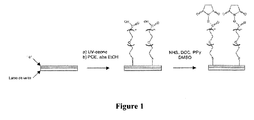
- POE molecules are organized by self-assembly in monolayer. This configuration is represented on the figure 1 .
- self-assembly or “self-assembly” refers to the ability of POE chains to spontaneously organize themselves relative to one another in space after grafting ( Surface Science Reports 61 (2006) 445-463 ).
- the term "monolayer” in the context of the present invention covers chains forming a dense and ordered structure in the plane of the metal face. It is typically an ordered monomolecular layer encountered in the case of alkanes thiol.
- the grafting can be carried out by any means known to those skilled in the art.
- the support comprising the metal face may be immersed directly in a solution containing the POE to be grafted.
- the POE solution can be deposited only on the metal face of the support.
- the solution containing the POE comprises the POE to graft dissolved in a suitable solvent does not interfere with the self-assembling reaction of the POE on the metal face of the support.
- This solvent may especially be absolute ethanol, water, dichloromethane or dimethylsulfoxide.
- the solvent used is absolute ethanol.
- the POE concentration in the solution may typically be from 0.5 to 10 mM, preferably from 1 to 5 mM, and most preferably the concentration of POE is about 2.5 mM. This last concentration makes it possible to reach 100% grafting.
- the grafting is carried out at a temperature preferably between 4 ° C and 100 ° C, preferably between 10 ° C and 70 ° C, even more preferably between 15 ° C and 30 ° C.
- the grafting is carried out at room temperature, that is to say at 20 ° C.
- Pressure conditions can also be adapted. So, the reaction can be carried out in particular at a pressure of between 10 -5 and 2 atmospheres.
- the grafting reaction is carried out at atmospheric pressure.
- the grafting time is at least one hour.
- the grafting time is at least 6 hours. Reaction times longer can be considered, including at least 12 hours or at least 24 hours. It is understood that the support may be placed in the presence of the POE to be grafted for a duration that may exceed several weeks. However, in practice, the grafting time will generally be less than 15 days, preferably less than 7 days.
- the grafting reaction is carried out by immersing the support in a solution of POE dissolved in absolute ethanol between 15 ° C. and 30 ° C., at a pressure of 0.5 to 2 atmospheres for at least 6 hours.
- the reaction is carried out so as to obtain a POE recovery rate on the metallic surface of the support greater than 70%, preferably 80%, preferably 90%, preferably 95%. Even more preferably, the support recovery rate is essentially 100%. This percentage corresponds to the percentage of inhibition of the conductivity of the metal face after recovery with the POE, relative to the measured conductivity before recovery.
- n is equal to 2. In a preferred embodiment, x is equal to 8.
- the POE is a short-chain POE, in particular a POE in which n is equal to 2 and x is equal to 8, that is to say a compound of formula : A- (CH 2 ) 2 - (O-CH 2 -CH 2 ) 8 -D.
- the group A is a group for anchoring the POE molecule on the metal surface of the support.
- A is a thiol group (-SH), known to those skilled in the art for grafting onto these metals, in particular gold, the sulfur having a great affinity for gold.
- a particular embodiment of the invention relates to a process as defined above, in which the metal of the metal face of the support is gold, and A is a -SH group.
- receptor molecules are, in the context of the present invention, molecules of biological interest, in particular peptides, sugars or nucleic acids.
- the "receptor” molecules can be proteins, oligosaccharides or oligonucleotides.
- the group D makes it possible to fix molecules on the functionalized support.
- the choice of the group D will therefore depend on the type of molecule to be immobilized, this choice being largely within the abilities of those skilled in the art.
- group D mention may be made of the groups -COOH, -NH 2 , -CHO, among others.
- the group D can allow the direct fixation of molecules, or indirect fixation after modification of group D.
- the group D corresponds to a group that can be modified to form an N-hydroxysuccinimide (NHS) group, in particular the -COOH group.
- NHS N-hydroxysuccinimide
- the POE grafted onto the metal face of the support is a POE of formula HS-CH 2 -CH 2 - (O-CH 2 -CH 2 ) 8 -COOH .
- the POE to be grafted can be found commercially, in particular POE of formula HS-CH 2 -CH 2 - (O-CH 2 -CH 2 ) 8 -COOH, also called O- (2-mercaptoethyl) -O'- (2-carboxyethy) heptaethylene glycol.
- the POE to be grafted can be synthesized according to methods that are within the reach of those skilled in the art ( J. Am. Chem. Soc. 1993, 115, 10714-10721 ).
- Cleaning in step 1) above is carried out by any suitable means known to those skilled in the art.
- this cleaning can in particular be carried out by UV-ozone treatment of the metal surface to be functionalized.
- the support can be cleaned with sulfochromic acid.
- the functionalized support can preferably be kept dry and / or preferably cold (approximately 4 ° C.), such as refrigerator (especially in confined atmosphere), before further processing or before use for analysis by SPR and / or MS.
- Step 3 corresponds to the modification of group D of the POE.
- the need for modification will depend on the type of group D at the end of the POE grafted onto the metal face, as is well known to those skilled in the art.
- D represents a -COOH group
- the latter may be modified to N-hydroxysuccinimide (NHS) group, under standard conditions known for this type of reaction.
- NHS N-hydroxysuccinimide
- the NHS group used for end-POE modification is well known for its reactivity as a protein coupling agent ( Macromolecules 35 (2002) 581-584 ).
- the functionalized support may be stored (preferably dry), in particular in the refrigerator (in particular in a confined atmosphere), before use in an SPR analysis, optionally followed by MS analysis.
- the invention furthermore relates to the use of a POE of formula (I) as defined above, according to all the variants envisaged, for functionalizing the metal face of an analysis support by SPR.
- the invention also relates to a functionalized SPR analysis support comprising a metal face on which a POE is grafted as defined above.
- the functionalized support according to the invention is in particular a functionalized support obtained according to the method described above. It may furthermore comprise the "receptor" molecules immobilized on the support functionalized via a link via the self-assembled monolayer of poly (oxy) ethylene, in particular of the group D or of the modified POE group D, in particular functionalized by a NHS grouping.
- the support comprises "receptor" molecules in the form of a network of pads. This network of pads has the advantage of being able to allow the specific analysis of the interactions of a given "receptor" molecule with a sample of analytes, in particular in the context of an SPR or MS experiment.
- the invention also relates to the use of a functionalized support as described above, in an SPR analysis, in particular in a SPRi analysis.
- receptor molecules are immobilized on the functionalized support via a bond via the group D or modified D group, in particular functionalized by an NHS group.
- the immobilization protocol of the "receptor” molecules depends on the type of group D of the POE grafted onto the support and the type of "receptor” molecules to be immobilized, as is well known to those skilled in the art.
- receptor molecules there may be mentioned proteins (antigens, antibodies, peptides), nucleic acids (DNA oligonucleotides, RNA) and carbohydrates (oligosaccharides). These different types of molecules can be immobilized on the support by appropriately selecting the group D of the POE grafted onto the support.
- the group D is modified into an NHS group or an NHS derivative
- a lysine solution can be used for this purpose. Lysine is present in this solution at a concentration of between 10 ⁇ M and 1 mM.
- the "receptor" molecules are immobilized on the functionalized support described above in order to carry out a SPRi analysis.
- SPRi analysis gives access to the multiplexed format, that is to say the simultaneous analysis (detection, quantification, visualization) in real time and without marking a large number of samples.
- the "receptor” molecules are immobilized on the surface of the functionalized support in the form of a network of pads whose immobilized molecules composition is known and ordered. This network gives access to the spatial resolution in SPR, that is to say that the plots of interest are visualized in SPR thanks to the imagery.
- Each plot may be interrogated individually by the analyzer MS, so each analyte specifically retained on the support can be identified in MS.
- the functionalized support on which receptor molecules have been immobilized is placed in a conventional SPRi or SPR analyzer.
- the SPR data, or SPRi, are then acquired and used.
- the major advantage of the functionalized support according to the present invention is that it allows a simplified and improved coupling between an SPR analysis and an MS analysis on the one hand, and that it minimizes the interferences due to non-specific links on the surface on the other hand, especially observed when using other supports functionalized by the MUA described above.
- the functionalized support on which the "receptor" molecules are immobilized is removed from the SPR analyzer, or SPRi, and is placed directly (without intermediate steps) into a MALDI MS mass spectrometer. , without destruction of the functionalized support, and without microelution or change of buffer solution of the analytes specifically selected during the SPR analysis.
- This is particularly advantageous since the solvents conventionally used to elute the molecules fixed on the SPR support are not compatible with the MS and therefore require an additional buffer exchange step. This extra step takes time and can lead to contamination and loss of equipment.
- the functionalized support according to the invention makes it possible to implement a simplified SPR-MS coupling, and with improved yields.
- the invention therefore also relates to the use of a modified support as described above for performing the analysis of the molecular interactions of a sample placed on the support by surface plasmon resonance coupled to the structural analysis of said sample. placed on the same support by mass spectrometry, preferably by MALDI mass spectrometry.
- the invention also relates to the use of a functionalized support as described above, to carry out two consecutive analyzes: an analysis by SPR and a mass spectrometry analysis.
- the invention also relates to the use of a functionalized support as described above in a mass spectrometry experiment, in particular of the MALDI type, in particular of the MALDI-TOF type.
- the support according to the invention in a protein analysis of the analytes retained on the "receptor" molecules immobilized on the functionalized support, in particular by performing an enzymatic digestion step localized in situ directly on the surface, which will make it possible to obtain either the peptide imprint of a protein by MALDI MS, or its sequence by MALDI-MS / MS.
- the MS will make it possible to identify structurally the analytes that have been specifically retained by the receptor molecules, themselves covalently bound to the functionalized support according to the invention.
- analyte in the context of the present invention, substances or chemical compounds subjected to an analytical procedure for detecting the presence and / or measure a characteristic (eg, content, concentration). These include substances or chemical compounds whose ability to interact with the "receptor" molecules immobilized on a support as described above is to be determined.
- the analytes can correspond to a mixture whose content is not known, for example a protein extract, carbohydrate, nucleic acids, etc.
- the mixture could also contain a mixture of proteins, carbohydrates, nucleic acids, etc. known.
- one or more "receptor” molecules can be immobilized.
- the "receptor” molecules are immobilized in a discrete and ordered manner on the support of the invention in the form of pads.
- the position of each of these "receptor” molecules is directly addressable, making the SPR and MS analyzes individually possible, plot by plot (ie, "receptor” molecule per "receptor” molecule).
- the functionalized support advantageously allows multiplexing during the MS analysis that follows the SPR analysis.
- MS analyzes are performed by MALDI-MS.
- a matrix compatible with the MALDI analysis is deposited on the support before its introduction into the mass spectrometer.
- the inventors of the present process have also been able to demonstrate that the functionalized support according to the invention makes it possible to carry out an enzymatic digestion localized on each of the blocks corresponding to an immobilized "receptor" molecule.
- the chosen enzyme can be deposited directly on the pads.
- the on-line coupling method SPRi-MS described in the present invention offers the user the choice of two types of MS analysis on the functionalized support: one without enzymatic digestion leading to the determination of the whole mass of the analytes having been specifically retained on the receptors, and the other including an enzymatic treatment in situ of the retained analytes (proteins, carbohydrates, nucleic acids), and leading to more detailed structural data.
- the proteolysis directly on the surface will make it possible to obtain either the peptide imprint of a protein by MALDI MS or its sequence by MALDI-MS / MS. Equipped with this feature, the online coupling method SPRi-MS described in the present invention thus gives access to fine structural analysis, especially in the case of proteomic analyzes.
- these two analyzes can be combined successively, on the same functionalized support according to the following sequence: SPR analysis and capture of the analyte, characterization of the entire mass of the analyte by MS, followed by enzymatic digestion of the analyte. analyte and a second analysis by MS.
- SPRi MALDI-MS online coupling giving access to the entire mass of the analyte
- the authors were able to demonstrate that it was possible to eliminate the matrix necessary for characterization in MALDI-MS, in order to proceed.
- the removal of the matrix is carried out by rinsing with the solubilization solution of the matrix, which for this purpose is devoid of acid.
- step 3 the structural analysis of step 3) above is carried out by MALDI-MS.
- the matrix used for the MALDI-MS is eliminated before step 4.
- the thiol (mercapto) function allows the polymer to be anchored to the metal face of the glass slide.
- the carboxylic acid function at the other end allows the functionalization of the chain, necessary for the covalent binding of "receptor" biomolecules.
- the POE is first deposited to form a self-assembled monolayer, then in the next step its carboxyl terminus is functionalized by the N-hydroxysuccinimide group (see diagram). figure 1 ).
- Gold-coated glass slats the dimensions of which are given above, are deposited on optical paper, gilded on the top and UV-ozone treatment is carried out for 1 hour.
- the beaker is then covered with 3 layers of parafilm to prevent evaporation.
- the coverslip treated with the POE is recovered and the excess solution is absorbed on blotting paper.
- the treated coverslip is then rinsed in two absolute ethanol baths, dried and stored in the refrigerator while waiting for the functionalization reaction with N-hydroxysuccinimide (NHS).
- NHS N-hydroxysuccinimide
- a solution of 1.09 mL of DMSO containing 27.6 mg (2.4 ⁇ 10 -4 mol) of N-hydroxysuccinimide, 53 mg (2.6 ⁇ 10 -4 mol) of N, N'-dicyclohexylcarbodiimide and 3.5 mg of , 23.10 -4 mol) of 4-pyrrolidinopyridine is prepared in a 100 ml beaker. The solution is then homogenized.
- the coverslip previously treated with the POE is then deposited in the freshly prepared DMSO solution, and the beaker is covered by two layers of parafilm.
- the excess solution is removed on blotting paper and then the coverslip is rinsed once in a bath of DMSO and then five times in ultra pure water baths and once in an absolute ethanol bath.
- the coverslip thus treated is then dried and then stored in a dry refrigerator before use.
- Example 2 Presentation of a SPRi experiment on a POE-NHS self-assembled single-layer biochip on the gold surface.
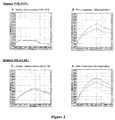
- This example deals with an SPRi experiment on a biochip having undergone a POE NHS surface treatment according to the invention and showing the interaction specificity of the analytes for their receptors. (cf. figure 3 )
- This experiment deals with the adsorption capacity of two protein analytes, ovalbumin and ⁇ -lactoglobulin, on anti-ovalbumin and anti- ⁇ -lactoglobulin antibodies (600nM and 6 ⁇ M) immobilized on the functionalized surface by comparison with measurements made on zones without antibodies (zones corresponding to POE-NHS chemistry without antibodies) and where no adsorption of analytes is recorded.
- Example 3 Presentation of a SPRi-MALDI-TOF MS coupling on a POE-NHS self-assembled single-layer biochip on the gold surface.
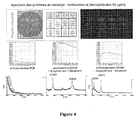
- This example deals with SPRi-MALDI-TOF MS coupling on a biochip having undergone a surface treatment according to the invention. (cf. figure 4 )
- This example relates to the SPR analysis of the interaction of ovalbumin and ⁇ -lactoglobulin with their respective anti-ovalbumin and anti- ⁇ -lactoglobulin antibodies (600 nM and 6 ⁇ M) immobilized on the functionalized surface in the form of plots, and on the detection of protein analytes by MALDI-TOF MS.
- the image shown on the figure 4 illustrates the adsorption of the proteins on their respective antibodies after 9 minutes of injection.
- the MALDI-TOF mass spectra are performed in positive linear mode (100 repeated shots and 500 accumulations, 25kV acceleration voltage, 93% grid applied voltage, 450ns extraction delay, 2800 laser intensity).
- the MALDI matrix chosen is HABA [2 (4-hydroxyphenylazo) benzoic acid], 10 -1 M in 50/50 water / acetonitrile 0.1% TFA. The matrix is deposited on the antibody spots as well as on a POE-NHS-Lys functionalized gold zone but without antibodies.
- This example deals with the comparison of the POE self-assembled monolayer surface chemistry according to the invention with the surface chemistry most commonly described in the SPR literature, that is to say a functionalization by MUA.
- This comparison relates to the adsorption capacity of ⁇ -lactoglobulin on pads of anti- ⁇ -lactoglobulin antibodies arranged on the two types of functionalized surface, as well as on the level of non-specific adsorption measured in SPRi on zones without antibodies.
- the zone functionalized by MUA-CDI ( Fig. 2C , without antibodies) retains proteins in a non-specific manner and this in spite of a rinsing of 5 minutes.
- This non-specific adsorption must therefore be taken into account when quantifying proteins specifically adsorbed on the antibody ( Fig. 2D ).
- this non-specific adsorption can be a source of difficulty in the mass spectrometric identification of the proteins specifically retained on the probes.
- This example deals with a tryptic digestion, analyzed online by MALDI-TOF MS following the capture of the analyte by the immobilized antibody during the SPRi analysis on the functionalized support according to the invention. (cf. figure 5 )
- This experiment focuses on the ability to access proteomic data following on-line coupling SPRi - tryptic treatment - MALDI-MS. This experiment concerns the interaction between ovalbumin and ⁇ -lactoglobulin on blocks of anti-ovalbumin and anti- ⁇ -lactoglobulin antibodies deposited or immobilized on the functionalized surface.
- Example 2 The conditions of the experiment are the same as in Example 2.
- the interaction of ovalbumin and ⁇ -lactoglobulin with the anti-ovalbumin and anti- ⁇ -lactoglobulin antibodies (6 ⁇ M) immobilized on the surface is followed by SPRi.
- SPRi For this, (as in Example 2) at the beginning of the experiment, lysine (100 ⁇ M) is injected in order to neutralize the NHS groups of the POE functionalized surface which have not reacted with the antibodies.
- 500 ⁇ l of a mixture of both ovalbumin and ⁇ -lactoglobulin proteins (50 ⁇ g / ml) is injected at a rate of 50 ⁇ l / min.
- the biochip is extracted from the SPR instrument and dried. The quantities retained are 40 ⁇ g / mm 2 of ⁇ lactoglobulin on the anti- ⁇ -lactoglobulin pads and 48 ⁇ g / mm 2 of ovalbumin on the anti-ovalbumin pads.
- the proteolysis is carried out in situ by addition of trypsin deposited on the antibody pads and incubation of the chip 1h in a humid chamber at 37 ° C.
- the MALDI-TOF mass spectra are carried out in reflectron mode (100 repeated shots and 500 accumulations, 20kV acceleration voltage, 68% grid applied voltage, 350ns extraction delay, 2400 laser intensity).
- the MALDI matrix chosen is HCCA [ ⁇ -cyano-4-hydroxycinnamic acid], 10 -1 M in 50/50 water / acetonitrile 0.1% TFA. The matrix is deposited on the antibody pads.
- the mass spectra obtained show different signals from which can be identified those corresponding to the analyte digestion products.
- This example is a presentation of a proteomic analysis by MALDI-MS and MALDI-MS / MS performed after an SPRi experiment.
- the sequencing of peptides formed by the in situ proteolysis of a specifically selected protein makes it possible to unambiguously determine the identity, the experiment being performed on a POE-NHS self-assembled monolayer type biochip on the gold surface. .
- This example therefore deals with on-line sequencing of peptides by MALDI-MS / MS following the capture of a protein by immobilized antibody during SPRi analysis and tryptic digestion in situ on the functionalized support according to the invention.
- This experiment illustrates the possibility of identifying a specifically selected protein following on-line coupling SPRi - tryptic treatment - MALDI-MS and MALDI-MS / MS.
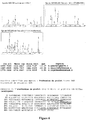
- the example serving as an illustration of principle concerns the interaction between ovalbumin and the anti-ovalbumin antibody immobilized on the functionalized surface ( cf. figure 6 ).
- a database search (SwissProt 56.2) using the MASCOT software makes it possible to precisely identify, from these three peptide sequences, the protein specifically selected on the plots ( cf. figure 6 ). Ovalbumin is unambiguously identified (Mowse score 145, 11% sequence coverage).
- this SPRi-MALDI-MS / MS analysis was repeated with another protein, ⁇ -lactoglobulin specifically retained by anti- ⁇ -lactoglobulin antibodies grafted onto the biochip, then digested directly on the biochip. Eight peptides from digestion were identified in MALDI-MS.
Landscapes
- Health & Medical Sciences (AREA)
- Life Sciences & Earth Sciences (AREA)
- Engineering & Computer Science (AREA)
- Immunology (AREA)
- Chemical & Material Sciences (AREA)
- Molecular Biology (AREA)
- Biomedical Technology (AREA)
- Urology & Nephrology (AREA)
- Hematology (AREA)
- Physics & Mathematics (AREA)
- Analytical Chemistry (AREA)
- Biochemistry (AREA)
- Pathology (AREA)
- General Physics & Mathematics (AREA)
- General Health & Medical Sciences (AREA)
- Food Science & Technology (AREA)
- Microbiology (AREA)
- Biotechnology (AREA)
- Cell Biology (AREA)
- Medicinal Chemistry (AREA)
- Bioinformatics & Computational Biology (AREA)
- Bioinformatics & Cheminformatics (AREA)
- Spectroscopy & Molecular Physics (AREA)
- Biophysics (AREA)
- Proteomics, Peptides & Aminoacids (AREA)
- Optics & Photonics (AREA)
- Inorganic Chemistry (AREA)
- Nanotechnology (AREA)
- Other Investigation Or Analysis Of Materials By Electrical Means (AREA)
Claims (15)
- Verfahren zur Funktionalisierung der metallischen Oberfläche eines Oberflächenplasmonenresonanz-Analyseträgers, wobei das Verfahren das Aufpfropfen einer selbstorganisierenden Monoschicht aus Poly(oxy)ethylen unmittelbar auf die metallische Oberfläche des Trägers umfasst,wobei es sich bei dem Metall der metallischen Oberfläche um Gold handelt, undwobei es sich bei dem Poly(oxy)ethylen (POE) um eine Verbindung der Formal (I) handelt
A-(CH2)n-(O-CH2-CH2)x-D (I)
wobei- n gleich 1 oder 2 ist, wobei insbesondere n gleich 2 ist;- x eine ganze Zahl zwischen 5 und 16 ist, wobei insbesondere x gleich 8 ist;- A eine Gruppe zur Verankerung des POE mittels kovalenter Bindung auf der Goldoberfläche des Trägers ist, wobei A insbesondere einer Gruppe der Formel -SH entspricht; und- D eine eventuell modifizierte Gruppe ist, welche die Fixierung von Biomolekülen erlaubt. - Verfahren nach Anspruch 1, wobei es sich bei dem POE um O-(2-Mercaptoethyl)-O'-(2-Carboxyethyl)Heptaethylenglykol der Formel HS-CH2-CH2-(O-CH2-CH2)8-COOH handelt.
- Verfahren nach Anspruch 1 oder 2, wobei das Verfahren die folgende Schrittfolge umfasst:1) das Vorreinigen des Trägers, insbesondere durch Ozon/UV-Behandlung;2) das Aufpfropfen des POE auf den Träger; und3) eventuell das Modifizieren der Gruppe D des POE.
- Verfahren nach Anspruch 3, wobei die Gruppe D eine Gruppe der Formel -COOH darstellt, welche in Schritt 3 zu einer Succinimidester-Gruppe modifiziert wird.
- Verfahren nach Anspruch 3 oder 4, wobei das Aufpfropfen dadurch erfolgt, dass der Träger in einen Behälter mit dem darin in Lösung befindlichen, aufzupfropfenden Poly(oxy)ethylen getaucht wird.
- Funktionalisierter Träger für die Oberflächenplasmonenresonanzanalyse, welcher eine metallische Oberfläche umfasst, auf der unmittelbar eine selbstorganisierende Monoschicht aus Poly(oxy)ethylen aufgepfropft ist,wobei die metallische Oberfläche aus Gold ist, undwobei es sich bei dem Poly(oxy)ethylen um eine Verbindung der Formel (I) handelt
A-(CH2)n-(O-CH2-CH2)x-D (I)
wobei- n gleich 1 oder 2 ist;- x eine ganze Zahl zwischen 5 und 16 ist;- A eine Gruppe zur Verankerung des POE mittels starker Wechselwirkung auf der Goldoberfläche des Trägers ist; und- D eine eventuell modifizierte Gruppe ist, welche die Fixierung von Biomolekülen erlaubt. - Funktionalisierter Träger nach Anspruch 6, hergestellt durch das Verfahren nach einem der Ansprüche 1 bis 5.
- Funktionalisierter Träger nach Anspruch 6 oder 7, welcher außerdem "Rezeptor"-Moleküle umfasst, die auf dem Träger mittels einer Bindung über aufgepfropftes Poly(oxy)ethylen immobilisiert sind.
- Verwendung eines funktionalisierten Trägers nach einem der Ansprüche 6 bis 8 in einem Oberflächenplasmonenresonanz-Experiment, insbesondere einem bildgebenden Oberflächenplasmonenresonanz-Experiment (SPRi).
- Verwendung nach Anspruch 9, wobei die Verwendung die Bindung von "Rezeptor"-Molekülen an der Oberfläche des Trägers und die Untersuchung der molekularen Wechselwirkungen dieser Moleküle durch Oberflächenplasmonenresonanz, insbesondere durch SPRi, umfasst.
- Verwendung eines funktionalisierten Trägers nach einem der Ansprüche 6 bis 8 in einem Massenspektrometrie-Experiment, insbesondere einer mit einer MALDI-Ionisierung durchgeführten Massenspektrometrie, um strukturell Analyten zu identifizieren, welche spezifisch von den in kovalenter Weise an den funktionalisierten Träger gebundenen Rezeptormolekülen zurückgehalten worden sind.
- Verwendung eines funktionalisierten Trägers nach Anspruch 6 oder 7 zur Durchführung zweier aufeinanderfolgender Analysen:- einer SPR-Analyse, insbesondere einer bildgebenden Oberflächenplasmonenresonanz-Analyse; und darauf folgend- einer Massenspektrometrie-Analyse, insbesondere einer MALDI-Analyse, vor allem einer MALDI-TOF-Analyse.
- Verfahren zur Koppelung einer SPR-Analyse, vor allem einer SPRi-Analyse, mit einer MALDI-MS-Analyse oder MALDI-MS/MS-Analyse, umfassend:1) das Immobilisieren eines oder mehrerer "Rezeptor"-Moleküle auf einem funktionalisierten Träger nach Anspruch 6 oder 7; und darauf folgend2) das Einbringen des Trägers in ein SPR-Analysegerät und das mittels SPR erfolgende Analysieren der Wechselwirkungen zwischen dem oder den "Rezeptor"-Molekülen und einer Analyten-Probe; und darauf folgend3) das Entnehmen des Trägers aus dem SPR-Analysegerät und dessen Einbringen in ein Massenspektrometer sowie das mittels MS erfolgende, strukturelle Analysieren der im Verlauf der SPR-Analyse von den "Rezeptor"-Molekülen spezifisch zurückgehaltenen Analyten.
- Verfahren zur Koppelung einer SPR-Analyse, vor allem einer SPRi-Analyse, mit einer MS-Analyse, vor allem einer MALDI-MS- oder MS/MS-Analyse, umfassend:1) das Immobilisieren eines oder mehrerer "Rezeptor"-Moleküle auf einem funktionalisierten Träger nach Anspruch 6 oder 7; und darauf folgend2) das Einbringen des Trägers in ein SPR-Analysegerät und das mittels SPR erfolgende Analysieren der Wechselwirkungen zwischen dem oder den "Rezeptor"-Molekülen und einer Analyten-Probe;3) das lokalisierte, in situ erfolgende enzymatische Verdauen der Analyten, die an den Plots der auf dem funktionalisierten Träger immobilisierten "Rezeptor"-Moleküle zurückgehalten werden, und darauf folgend das Einbringen des Trägers in ein Massenspektrometer und das mittels MS oder MS/MS erfolgende, strukturelle Analysieren der auf dem funktionalisierten Träger vorhandenen Verdauungsprodukte des oder der Analyten.
- Verfahren zur Koppelung einer SPR-Analyse, vor allem einer SPRi-Analyse, mit einer MS-Analyse, vor allem einer MALDI-MS-Analyse, umfassend:1) das Immobilisieren eines oder mehrerer "Rezeptor"-Moleküle auf einem funktionalisierten Träger nach Anspruch 6 oder 7; und darauf folgend2) das Einbringen des Trägers in ein SPR-Analysegerät und das mittels SPR erfolgende Analysieren der Wechselwirkungen zwischen dem oder den immobilisierten "Rezeptor"-Molekülen und einer Analyten-Probe; und darauf folgend3) das Entnehmen des Trägers aus dem SPR-Analysegerät und dessen Einbringen in ein Massenspektrometer sowie das mittels MS erfolgende, strukturelle Analysieren der im Verlauf der SPR-Analyse von den "Rezeptor"-Molekülen spezifisch zurückgehaltenen Analyten; und darauf folgend4) das lokalisierte, in situ erfolgende enzymatische Verdauen der Analyten, die an den Plots der auf dem funktionalisierten Träger immobilisierten "Rezeptor"-Moleküle zurückgehalten werden, und das Einbringen des Trägers in ein Massenspektrometer und das mittels MALDI-MS oder MALDI-MS/MS erfolgende, strukturelle Analysieren der auf dem funktionalisierten Träger vorhandenen Verdauungsprodukte des oder der Moleküle.
Applications Claiming Priority (2)
| Application Number | Priority Date | Filing Date | Title |
|---|---|---|---|
| FR0759351A FR2924225B1 (fr) | 2007-11-27 | 2007-11-27 | Biopuces fonctionnalisees pour le couplage spr-ms |
| PCT/FR2008/052149 WO2009071852A2 (fr) | 2007-11-27 | 2008-11-27 | Biopuces fonctionnalisees pour le couplage spr-ms |
Publications (2)
| Publication Number | Publication Date |
|---|---|
| EP2240772A2 EP2240772A2 (de) | 2010-10-20 |
| EP2240772B1 true EP2240772B1 (de) | 2016-09-07 |
Family
ID=39629146
Family Applications (1)
| Application Number | Title | Priority Date | Filing Date |
|---|---|---|---|
| EP08857644.2A Active EP2240772B1 (de) | 2007-11-27 | 2008-11-27 | Funktionalisierte biochips für spr-ms-koppelung |
Country Status (5)
| Country | Link |
|---|---|
| US (2) | US20100285512A1 (de) |
| EP (1) | EP2240772B1 (de) |
| JP (1) | JP6008462B2 (de) |
| FR (1) | FR2924225B1 (de) |
| WO (1) | WO2009071852A2 (de) |
Families Citing this family (5)
| Publication number | Priority date | Publication date | Assignee | Title |
|---|---|---|---|---|
| FR2924225B1 (fr) | 2007-11-27 | 2016-12-09 | Genoptics | Biopuces fonctionnalisees pour le couplage spr-ms |
| CN102608304A (zh) * | 2011-01-19 | 2012-07-25 | 福华电子股份有限公司 | 经表面改质的感测元件及其表面改质方法 |
| FR3024465B1 (fr) * | 2014-07-30 | 2018-03-23 | Biomerieux | Caracterisation de micro-organismes par maldi-tof |
| CN105067821B (zh) * | 2015-08-10 | 2017-02-22 | 国家纳米科学中心 | 一种利用小分子微阵列实现靶标垂钓和表征的方法 |
| CN106841491A (zh) * | 2017-03-16 | 2017-06-13 | 北京大学 | 一种表面等离子体共振与质谱联用装置及使用方法 |
Family Cites Families (10)
| Publication number | Priority date | Publication date | Assignee | Title |
|---|---|---|---|---|
| US4534674A (en) * | 1983-04-20 | 1985-08-13 | Cutler Repaving, Inc. | Dual-lift repaving machine |
| SE462454B (sv) * | 1988-11-10 | 1990-06-25 | Pharmacia Ab | Maetyta foer anvaendning i biosensorer |
| GB9518429D0 (en) | 1995-09-08 | 1995-11-08 | Pharmacia Biosensor | A rapid method for providing kinetic and structural data in molecular interaction analysis |
| US20040186359A1 (en) * | 2001-07-09 | 2004-09-23 | Beaudoin Stephen P. | Afinity biosensor for monitoring biological process |
| US20050260423A1 (en) * | 2004-05-18 | 2005-11-24 | Mohan Natesan | Modified microsurfaces and methods of their manufacture |
| JP2006053092A (ja) * | 2004-08-13 | 2006-02-23 | Fuji Photo Film Co Ltd | バイオセンサー |
| EP1818455B1 (de) * | 2004-12-03 | 2013-03-27 | Green Arm Co., Ltd | Verfahren zum kontinuierlichen recyceln einer pflasterasphaltmischungsschicht vor ort und selbstangetriebenes fahrzeugsystem dafür |
| JP4231888B2 (ja) * | 2005-11-25 | 2009-03-04 | 富士フイルム株式会社 | バイオセンサーの製造方法 |
| JP4330639B2 (ja) * | 2006-03-29 | 2009-09-16 | 株式会社竹中工務店 | アスファルト舗装体撤去方法、アスファルト舗装体撤去システム、電磁誘導コイルユニット、アスファルト舗装体撤去装置、及び剥離方法 |
| FR2924225B1 (fr) | 2007-11-27 | 2016-12-09 | Genoptics | Biopuces fonctionnalisees pour le couplage spr-ms |
-
2007
- 2007-11-27 FR FR0759351A patent/FR2924225B1/fr not_active Expired - Fee Related
-
2008
- 2008-11-27 JP JP2010535435A patent/JP6008462B2/ja not_active Expired - Fee Related
- 2008-11-27 EP EP08857644.2A patent/EP2240772B1/de active Active
- 2008-11-27 US US12/734,854 patent/US20100285512A1/en not_active Abandoned
- 2008-11-27 WO PCT/FR2008/052149 patent/WO2009071852A2/fr not_active Ceased
-
2016
- 2016-05-09 US US15/149,833 patent/US11754561B2/en active Active
Also Published As
| Publication number | Publication date |
|---|---|
| US20100285512A1 (en) | 2010-11-11 |
| FR2924225A1 (fr) | 2009-05-29 |
| US11754561B2 (en) | 2023-09-12 |
| WO2009071852A2 (fr) | 2009-06-11 |
| JP2011505007A (ja) | 2011-02-17 |
| JP6008462B2 (ja) | 2016-10-19 |
| FR2924225B1 (fr) | 2016-12-09 |
| WO2009071852A3 (fr) | 2009-08-20 |
| EP2240772A2 (de) | 2010-10-20 |
| US20160377610A1 (en) | 2016-12-29 |
Similar Documents
| Publication | Publication Date | Title |
|---|---|---|
| EP0744028B1 (de) | Festphasen, spezifisch für biologische reaktionen, ihre herstellung und anwendung | |
| US9651487B2 (en) | Surface plasmon resonance compatible carbon thin films | |
| JP4676983B2 (ja) | テラヘルツ放射を用いて生体分子結合を検出するための方法及び系 | |
| EP0842411B1 (de) | Vorrichtung zur parallel-ausrichtung von makromolekülen und verwendung davon | |
| EP2240772B1 (de) | Funktionalisierte biochips für spr-ms-koppelung | |
| Dugas et al. | Surface sensitization techniques and recognition receptors immobilization on biosensors and microarrays | |
| Penon et al. | Optimized immobilization of lectins using self-assembled monolayers on polysilicon encoded materials for cell tagging | |
| Gajos et al. | Protein adsorption/desorption and antibody binding stoichiometry on silicon interferometric biosensors examined with TOF-SIMS | |
| EP0843739B1 (de) | Molekulare ausrichtung von makromolekuelen mit hilfe eines fluessigkeitsmeniskus auf einer hochspezifischen oberflaeche | |
| WO2020173822A1 (en) | Detection and quantification of small molecules | |
| Islam et al. | Molecular switching fluorescence based high sensitive detection of label-free C-reactive protein on biochip | |
| Bousiakou et al. | Determination of Au Film Thiolation and Silane Bonding Onto SiO2 Films Within the Frame of Biosensor Surface Functionalization–an Analysis of Best Practices and Techniques | |
| Singh et al. | Non-specific adsorption of serum and cell lysate on 3D biosensor platforms: A comparative study based on SPRi | |
| Gajos et al. | Spatially selective biomolecules immobilization on silicon nitride waveguides through contact printing onto plasma treated photolithographic micropattern: Step-by-step analysis with TOF-SIMS chemical imaging | |
| JP4543860B2 (ja) | 試料の解析方法 | |
| KR101035957B1 (ko) | 번짐 현상이 억제된 단일스텝 바이오칩 제작방법 | |
| WO2003104794A1 (en) | A method for analyzing the spatial distribution of a chemical substance retained by a biological matter | |
| Schlotter et al. | Aptamer-functionalized interface nanopores enable amino acid-specific single-molecule proteomics | |
| JP2006098266A (ja) | 試料の染色方法及び解析方法 | |
| CN121039497A (zh) | 包含两亲聚合物的生物传感器及其用途 | |
| Mohan | Nanometric cellulosic layers for specific adsorption of polysaccharides and immobilization of bioactive molecules | |
| Zhu | Non-specific adsorption of serum and cell lysate on 3D biosensor platforms: A comparative study based on SPRi | |
| Leclerc | Visualisation de protéines individuelles pour la quantification à haute sensibilité du lysat cellulaire | |
| Stigter | Surface plasmon resonance on-line with liquid chromatography–mass spectrometry for the quantification and identification of proteins | |
| Cacao | Enzymatic darkening and silver staining: Application in microfluidic micro-retroreflector-based heterogeneous immunoassays |
Legal Events
| Date | Code | Title | Description |
|---|---|---|---|
| PUAI | Public reference made under article 153(3) epc to a published international application that has entered the european phase |
Free format text: ORIGINAL CODE: 0009012 |
|
| 17P | Request for examination filed |
Effective date: 20100618 |
|
| AK | Designated contracting states |
Kind code of ref document: A2 Designated state(s): AT BE BG CH CY CZ DE DK EE ES FI FR GB GR HR HU IE IS IT LI LT LU LV MC MT NL NO PL PT RO SE SI SK TR |
|
| DAX | Request for extension of the european patent (deleted) | ||
| 17Q | First examination report despatched |
Effective date: 20150113 |
|
| GRAP | Despatch of communication of intention to grant a patent |
Free format text: ORIGINAL CODE: EPIDOSNIGR1 |
|
| INTG | Intention to grant announced |
Effective date: 20160404 |
|
| GRAS | Grant fee paid |
Free format text: ORIGINAL CODE: EPIDOSNIGR3 |
|
| GRAA | (expected) grant |
Free format text: ORIGINAL CODE: 0009210 |
|
| AK | Designated contracting states |
Kind code of ref document: B1 Designated state(s): AT BE BG CH CY CZ DE DK EE ES FI FR GB GR HR HU IE IS IT LI LT LU LV MC MT NL NO PL PT RO SE SI SK TR |
|
| REG | Reference to a national code |
Ref country code: GB Ref legal event code: FG4D Free format text: NOT ENGLISH |
|
| REG | Reference to a national code |
Ref country code: CH Ref legal event code: EP |
|
| REG | Reference to a national code |
Ref country code: IE Ref legal event code: FG4D Free format text: LANGUAGE OF EP DOCUMENT: FRENCH |
|
| REG | Reference to a national code |
Ref country code: AT Ref legal event code: REF Ref document number: 827319 Country of ref document: AT Kind code of ref document: T Effective date: 20161015 |
|
| REG | Reference to a national code |
Ref country code: DE Ref legal event code: R096 Ref document number: 602008046221 Country of ref document: DE |
|
| REG | Reference to a national code |
Ref country code: FR Ref legal event code: PLFP Year of fee payment: 9 |
|
| REG | Reference to a national code |
Ref country code: LT Ref legal event code: MG4D |
|
| REG | Reference to a national code |
Ref country code: NL Ref legal event code: MP Effective date: 20160907 |
|
| PG25 | Lapsed in a contracting state [announced via postgrant information from national office to epo] |
Ref country code: HR Free format text: LAPSE BECAUSE OF FAILURE TO SUBMIT A TRANSLATION OF THE DESCRIPTION OR TO PAY THE FEE WITHIN THE PRESCRIBED TIME-LIMIT Effective date: 20160907 Ref country code: NO Free format text: LAPSE BECAUSE OF FAILURE TO SUBMIT A TRANSLATION OF THE DESCRIPTION OR TO PAY THE FEE WITHIN THE PRESCRIBED TIME-LIMIT Effective date: 20161207 Ref country code: FI Free format text: LAPSE BECAUSE OF FAILURE TO SUBMIT A TRANSLATION OF THE DESCRIPTION OR TO PAY THE FEE WITHIN THE PRESCRIBED TIME-LIMIT Effective date: 20160907 Ref country code: LT Free format text: LAPSE BECAUSE OF FAILURE TO SUBMIT A TRANSLATION OF THE DESCRIPTION OR TO PAY THE FEE WITHIN THE PRESCRIBED TIME-LIMIT Effective date: 20160907 |
|
| REG | Reference to a national code |
Ref country code: AT Ref legal event code: MK05 Ref document number: 827319 Country of ref document: AT Kind code of ref document: T Effective date: 20160907 |
|
| PG25 | Lapsed in a contracting state [announced via postgrant information from national office to epo] |
Ref country code: LV Free format text: LAPSE BECAUSE OF FAILURE TO SUBMIT A TRANSLATION OF THE DESCRIPTION OR TO PAY THE FEE WITHIN THE PRESCRIBED TIME-LIMIT Effective date: 20160907 Ref country code: BE Free format text: LAPSE BECAUSE OF NON-PAYMENT OF DUE FEES Effective date: 20161130 Ref country code: ES Free format text: LAPSE BECAUSE OF FAILURE TO SUBMIT A TRANSLATION OF THE DESCRIPTION OR TO PAY THE FEE WITHIN THE PRESCRIBED TIME-LIMIT Effective date: 20160907 Ref country code: GR Free format text: LAPSE BECAUSE OF FAILURE TO SUBMIT A TRANSLATION OF THE DESCRIPTION OR TO PAY THE FEE WITHIN THE PRESCRIBED TIME-LIMIT Effective date: 20161208 Ref country code: NL Free format text: LAPSE BECAUSE OF FAILURE TO SUBMIT A TRANSLATION OF THE DESCRIPTION OR TO PAY THE FEE WITHIN THE PRESCRIBED TIME-LIMIT Effective date: 20160907 Ref country code: SE Free format text: LAPSE BECAUSE OF FAILURE TO SUBMIT A TRANSLATION OF THE DESCRIPTION OR TO PAY THE FEE WITHIN THE PRESCRIBED TIME-LIMIT Effective date: 20160907 |
|
| PG25 | Lapsed in a contracting state [announced via postgrant information from national office to epo] |
Ref country code: EE Free format text: LAPSE BECAUSE OF FAILURE TO SUBMIT A TRANSLATION OF THE DESCRIPTION OR TO PAY THE FEE WITHIN THE PRESCRIBED TIME-LIMIT Effective date: 20160907 Ref country code: RO Free format text: LAPSE BECAUSE OF FAILURE TO SUBMIT A TRANSLATION OF THE DESCRIPTION OR TO PAY THE FEE WITHIN THE PRESCRIBED TIME-LIMIT Effective date: 20160907 |
|
| PG25 | Lapsed in a contracting state [announced via postgrant information from national office to epo] |
Ref country code: PT Free format text: LAPSE BECAUSE OF FAILURE TO SUBMIT A TRANSLATION OF THE DESCRIPTION OR TO PAY THE FEE WITHIN THE PRESCRIBED TIME-LIMIT Effective date: 20170109 Ref country code: BG Free format text: LAPSE BECAUSE OF FAILURE TO SUBMIT A TRANSLATION OF THE DESCRIPTION OR TO PAY THE FEE WITHIN THE PRESCRIBED TIME-LIMIT Effective date: 20161207 Ref country code: SK Free format text: LAPSE BECAUSE OF FAILURE TO SUBMIT A TRANSLATION OF THE DESCRIPTION OR TO PAY THE FEE WITHIN THE PRESCRIBED TIME-LIMIT Effective date: 20160907 Ref country code: IS Free format text: LAPSE BECAUSE OF FAILURE TO SUBMIT A TRANSLATION OF THE DESCRIPTION OR TO PAY THE FEE WITHIN THE PRESCRIBED TIME-LIMIT Effective date: 20170107 Ref country code: AT Free format text: LAPSE BECAUSE OF FAILURE TO SUBMIT A TRANSLATION OF THE DESCRIPTION OR TO PAY THE FEE WITHIN THE PRESCRIBED TIME-LIMIT Effective date: 20160907 Ref country code: CZ Free format text: LAPSE BECAUSE OF FAILURE TO SUBMIT A TRANSLATION OF THE DESCRIPTION OR TO PAY THE FEE WITHIN THE PRESCRIBED TIME-LIMIT Effective date: 20160907 Ref country code: PL Free format text: LAPSE BECAUSE OF FAILURE TO SUBMIT A TRANSLATION OF THE DESCRIPTION OR TO PAY THE FEE WITHIN THE PRESCRIBED TIME-LIMIT Effective date: 20160907 |
|
| REG | Reference to a national code |
Ref country code: DE Ref legal event code: R097 Ref document number: 602008046221 Country of ref document: DE |
|
| PG25 | Lapsed in a contracting state [announced via postgrant information from national office to epo] |
Ref country code: IT Free format text: LAPSE BECAUSE OF FAILURE TO SUBMIT A TRANSLATION OF THE DESCRIPTION OR TO PAY THE FEE WITHIN THE PRESCRIBED TIME-LIMIT Effective date: 20160907 |
|
| PLBE | No opposition filed within time limit |
Free format text: ORIGINAL CODE: 0009261 |
|
| STAA | Information on the status of an ep patent application or granted ep patent |
Free format text: STATUS: NO OPPOSITION FILED WITHIN TIME LIMIT |
|
| PG25 | Lapsed in a contracting state [announced via postgrant information from national office to epo] |
Ref country code: DK Free format text: LAPSE BECAUSE OF FAILURE TO SUBMIT A TRANSLATION OF THE DESCRIPTION OR TO PAY THE FEE WITHIN THE PRESCRIBED TIME-LIMIT Effective date: 20160907 |
|
| 26N | No opposition filed |
Effective date: 20170608 |
|
| REG | Reference to a national code |
Ref country code: IE Ref legal event code: MM4A |
|
| PG25 | Lapsed in a contracting state [announced via postgrant information from national office to epo] |
Ref country code: SI Free format text: LAPSE BECAUSE OF FAILURE TO SUBMIT A TRANSLATION OF THE DESCRIPTION OR TO PAY THE FEE WITHIN THE PRESCRIBED TIME-LIMIT Effective date: 20160907 |
|
| PG25 | Lapsed in a contracting state [announced via postgrant information from national office to epo] |
Ref country code: LU Free format text: LAPSE BECAUSE OF NON-PAYMENT OF DUE FEES Effective date: 20161130 |
|
| REG | Reference to a national code |
Ref country code: FR Ref legal event code: PLFP Year of fee payment: 10 |
|
| PG25 | Lapsed in a contracting state [announced via postgrant information from national office to epo] |
Ref country code: IE Free format text: LAPSE BECAUSE OF NON-PAYMENT OF DUE FEES Effective date: 20161127 |
|
| REG | Reference to a national code |
Ref country code: BE Ref legal event code: MM Effective date: 20161130 |
|
| PG25 | Lapsed in a contracting state [announced via postgrant information from national office to epo] |
Ref country code: HU Free format text: LAPSE BECAUSE OF FAILURE TO SUBMIT A TRANSLATION OF THE DESCRIPTION OR TO PAY THE FEE WITHIN THE PRESCRIBED TIME-LIMIT; INVALID AB INITIO Effective date: 20081127 Ref country code: CY Free format text: LAPSE BECAUSE OF FAILURE TO SUBMIT A TRANSLATION OF THE DESCRIPTION OR TO PAY THE FEE WITHIN THE PRESCRIBED TIME-LIMIT Effective date: 20160907 |
|
| PG25 | Lapsed in a contracting state [announced via postgrant information from national office to epo] |
Ref country code: MC Free format text: LAPSE BECAUSE OF FAILURE TO SUBMIT A TRANSLATION OF THE DESCRIPTION OR TO PAY THE FEE WITHIN THE PRESCRIBED TIME-LIMIT Effective date: 20160907 Ref country code: TR Free format text: LAPSE BECAUSE OF FAILURE TO SUBMIT A TRANSLATION OF THE DESCRIPTION OR TO PAY THE FEE WITHIN THE PRESCRIBED TIME-LIMIT Effective date: 20160907 |
|
| PG25 | Lapsed in a contracting state [announced via postgrant information from national office to epo] |
Ref country code: MT Free format text: LAPSE BECAUSE OF FAILURE TO SUBMIT A TRANSLATION OF THE DESCRIPTION OR TO PAY THE FEE WITHIN THE PRESCRIBED TIME-LIMIT Effective date: 20160907 |
|
| PGFP | Annual fee paid to national office [announced via postgrant information from national office to epo] |
Ref country code: GB Payment date: 20221122 Year of fee payment: 15 Ref country code: FR Payment date: 20221122 Year of fee payment: 15 Ref country code: DE Payment date: 20221128 Year of fee payment: 15 |
|
| PGFP | Annual fee paid to national office [announced via postgrant information from national office to epo] |
Ref country code: CH Payment date: 20221123 Year of fee payment: 15 |
|
| REG | Reference to a national code |
Ref country code: DE Ref legal event code: R119 Ref document number: 602008046221 Country of ref document: DE |
|
| REG | Reference to a national code |
Ref country code: CH Ref legal event code: PL |
|
| PG25 | Lapsed in a contracting state [announced via postgrant information from national office to epo] |
Ref country code: CH Free format text: LAPSE BECAUSE OF NON-PAYMENT OF DUE FEES Effective date: 20231130 |
|
| GBPC | Gb: european patent ceased through non-payment of renewal fee |
Effective date: 20231127 |
|
| PG25 | Lapsed in a contracting state [announced via postgrant information from national office to epo] |
Ref country code: CH Free format text: LAPSE BECAUSE OF NON-PAYMENT OF DUE FEES Effective date: 20231130 |
|
| PG25 | Lapsed in a contracting state [announced via postgrant information from national office to epo] |
Ref country code: DE Free format text: LAPSE BECAUSE OF NON-PAYMENT OF DUE FEES Effective date: 20240601 |
|
| PG25 | Lapsed in a contracting state [announced via postgrant information from national office to epo] |
Ref country code: GB Free format text: LAPSE BECAUSE OF NON-PAYMENT OF DUE FEES Effective date: 20231127 |
|
| PG25 | Lapsed in a contracting state [announced via postgrant information from national office to epo] |
Ref country code: FR Free format text: LAPSE BECAUSE OF NON-PAYMENT OF DUE FEES Effective date: 20231130 |
|
| PG25 | Lapsed in a contracting state [announced via postgrant information from national office to epo] |
Ref country code: GB Free format text: LAPSE BECAUSE OF NON-PAYMENT OF DUE FEES Effective date: 20231127 Ref country code: FR Free format text: LAPSE BECAUSE OF NON-PAYMENT OF DUE FEES Effective date: 20231130 Ref country code: DE Free format text: LAPSE BECAUSE OF NON-PAYMENT OF DUE FEES Effective date: 20240601 |