EP2218742A1 - Photopolymerzusammensetzungen als verdruckbare Formulierungen - Google Patents
Photopolymerzusammensetzungen als verdruckbare Formulierungen Download PDFInfo
- Publication number
- EP2218742A1 EP2218742A1 EP09001949A EP09001949A EP2218742A1 EP 2218742 A1 EP2218742 A1 EP 2218742A1 EP 09001949 A EP09001949 A EP 09001949A EP 09001949 A EP09001949 A EP 09001949A EP 2218742 A1 EP2218742 A1 EP 2218742A1
- Authority
- EP
- European Patent Office
- Prior art keywords
- weight
- printing
- polyurethane compositions
- acrylate
- component
- Prior art date
- Legal status (The legal status is an assumption and is not a legal conclusion. Google has not performed a legal analysis and makes no representation as to the accuracy of the status listed.)
- Withdrawn
Links
Images
Classifications
-
- C—CHEMISTRY; METALLURGY
- C08—ORGANIC MACROMOLECULAR COMPOUNDS; THEIR PREPARATION OR CHEMICAL WORKING-UP; COMPOSITIONS BASED THEREON
- C08L—COMPOSITIONS OF MACROMOLECULAR COMPOUNDS
- C08L75/00—Compositions of polyureas or polyurethanes; Compositions of derivatives of such polymers
- C08L75/04—Polyurethanes
-
- C—CHEMISTRY; METALLURGY
- C08—ORGANIC MACROMOLECULAR COMPOUNDS; THEIR PREPARATION OR CHEMICAL WORKING-UP; COMPOSITIONS BASED THEREON
- C08G—MACROMOLECULAR COMPOUNDS OBTAINED OTHERWISE THAN BY REACTIONS ONLY INVOLVING UNSATURATED CARBON-TO-CARBON BONDS
- C08G18/00—Polymeric products of isocyanates or isothiocyanates
- C08G18/06—Polymeric products of isocyanates or isothiocyanates with compounds having active hydrogen
- C08G18/28—Polymeric products of isocyanates or isothiocyanates with compounds having active hydrogen characterised by the compounds used containing active hydrogen
- C08G18/40—High-molecular-weight compounds
- C08G18/48—Polyethers
-
- C—CHEMISTRY; METALLURGY
- C08—ORGANIC MACROMOLECULAR COMPOUNDS; THEIR PREPARATION OR CHEMICAL WORKING-UP; COMPOSITIONS BASED THEREON
- C08G—MACROMOLECULAR COMPOUNDS OBTAINED OTHERWISE THAN BY REACTIONS ONLY INVOLVING UNSATURATED CARBON-TO-CARBON BONDS
- C08G18/00—Polymeric products of isocyanates or isothiocyanates
- C08G18/06—Polymeric products of isocyanates or isothiocyanates with compounds having active hydrogen
- C08G18/08—Processes
- C08G18/10—Prepolymer processes involving reaction of isocyanates or isothiocyanates with compounds having active hydrogen in a first reaction step
-
- C—CHEMISTRY; METALLURGY
- C08—ORGANIC MACROMOLECULAR COMPOUNDS; THEIR PREPARATION OR CHEMICAL WORKING-UP; COMPOSITIONS BASED THEREON
- C08G—MACROMOLECULAR COMPOUNDS OBTAINED OTHERWISE THAN BY REACTIONS ONLY INVOLVING UNSATURATED CARBON-TO-CARBON BONDS
- C08G18/00—Polymeric products of isocyanates or isothiocyanates
- C08G18/06—Polymeric products of isocyanates or isothiocyanates with compounds having active hydrogen
- C08G18/28—Polymeric products of isocyanates or isothiocyanates with compounds having active hydrogen characterised by the compounds used containing active hydrogen
- C08G18/67—Unsaturated compounds having active hydrogen
-
- C—CHEMISTRY; METALLURGY
- C08—ORGANIC MACROMOLECULAR COMPOUNDS; THEIR PREPARATION OR CHEMICAL WORKING-UP; COMPOSITIONS BASED THEREON
- C08G—MACROMOLECULAR COMPOUNDS OBTAINED OTHERWISE THAN BY REACTIONS ONLY INVOLVING UNSATURATED CARBON-TO-CARBON BONDS
- C08G18/00—Polymeric products of isocyanates or isothiocyanates
- C08G18/06—Polymeric products of isocyanates or isothiocyanates with compounds having active hydrogen
- C08G18/28—Polymeric products of isocyanates or isothiocyanates with compounds having active hydrogen characterised by the compounds used containing active hydrogen
- C08G18/67—Unsaturated compounds having active hydrogen
- C08G18/671—Unsaturated compounds having only one group containing active hydrogen
- C08G18/672—Esters of acrylic or alkyl acrylic acid having only one group containing active hydrogen
-
- C—CHEMISTRY; METALLURGY
- C08—ORGANIC MACROMOLECULAR COMPOUNDS; THEIR PREPARATION OR CHEMICAL WORKING-UP; COMPOSITIONS BASED THEREON
- C08G—MACROMOLECULAR COMPOUNDS OBTAINED OTHERWISE THAN BY REACTIONS ONLY INVOLVING UNSATURATED CARBON-TO-CARBON BONDS
- C08G18/00—Polymeric products of isocyanates or isothiocyanates
- C08G18/06—Polymeric products of isocyanates or isothiocyanates with compounds having active hydrogen
- C08G18/70—Polymeric products of isocyanates or isothiocyanates with compounds having active hydrogen characterised by the isocyanates or isothiocyanates used
- C08G18/72—Polyisocyanates or polyisothiocyanates
- C08G18/77—Polyisocyanates or polyisothiocyanates having heteroatoms in addition to the isocyanate or isothiocyanate nitrogen and oxygen or sulfur
-
- C—CHEMISTRY; METALLURGY
- C08—ORGANIC MACROMOLECULAR COMPOUNDS; THEIR PREPARATION OR CHEMICAL WORKING-UP; COMPOSITIONS BASED THEREON
- C08G—MACROMOLECULAR COMPOUNDS OBTAINED OTHERWISE THAN BY REACTIONS ONLY INVOLVING UNSATURATED CARBON-TO-CARBON BONDS
- C08G18/00—Polymeric products of isocyanates or isothiocyanates
- C08G18/06—Polymeric products of isocyanates or isothiocyanates with compounds having active hydrogen
- C08G18/70—Polymeric products of isocyanates or isothiocyanates with compounds having active hydrogen characterised by the isocyanates or isothiocyanates used
- C08G18/72—Polyisocyanates or polyisothiocyanates
- C08G18/77—Polyisocyanates or polyisothiocyanates having heteroatoms in addition to the isocyanate or isothiocyanate nitrogen and oxygen or sulfur
- C08G18/776—Polyisocyanates or polyisothiocyanates having heteroatoms in addition to the isocyanate or isothiocyanate nitrogen and oxygen or sulfur phosphorus
-
- C—CHEMISTRY; METALLURGY
- C08—ORGANIC MACROMOLECULAR COMPOUNDS; THEIR PREPARATION OR CHEMICAL WORKING-UP; COMPOSITIONS BASED THEREON
- C08G—MACROMOLECULAR COMPOUNDS OBTAINED OTHERWISE THAN BY REACTIONS ONLY INVOLVING UNSATURATED CARBON-TO-CARBON BONDS
- C08G18/00—Polymeric products of isocyanates or isothiocyanates
- C08G18/06—Polymeric products of isocyanates or isothiocyanates with compounds having active hydrogen
- C08G18/70—Polymeric products of isocyanates or isothiocyanates with compounds having active hydrogen characterised by the isocyanates or isothiocyanates used
- C08G18/72—Polyisocyanates or polyisothiocyanates
- C08G18/77—Polyisocyanates or polyisothiocyanates having heteroatoms in addition to the isocyanate or isothiocyanate nitrogen and oxygen or sulfur
- C08G18/78—Nitrogen
-
- C—CHEMISTRY; METALLURGY
- C08—ORGANIC MACROMOLECULAR COMPOUNDS; THEIR PREPARATION OR CHEMICAL WORKING-UP; COMPOSITIONS BASED THEREON
- C08G—MACROMOLECULAR COMPOUNDS OBTAINED OTHERWISE THAN BY REACTIONS ONLY INVOLVING UNSATURATED CARBON-TO-CARBON BONDS
- C08G18/00—Polymeric products of isocyanates or isothiocyanates
- C08G18/06—Polymeric products of isocyanates or isothiocyanates with compounds having active hydrogen
- C08G18/70—Polymeric products of isocyanates or isothiocyanates with compounds having active hydrogen characterised by the isocyanates or isothiocyanates used
- C08G18/72—Polyisocyanates or polyisothiocyanates
- C08G18/77—Polyisocyanates or polyisothiocyanates having heteroatoms in addition to the isocyanate or isothiocyanate nitrogen and oxygen or sulfur
- C08G18/78—Nitrogen
- C08G18/7806—Nitrogen containing -N-C=0 groups
- C08G18/7818—Nitrogen containing -N-C=0 groups containing ureum or ureum derivative groups
- C08G18/7837—Nitrogen containing -N-C=0 groups containing ureum or ureum derivative groups containing allophanate groups
-
- G—PHYSICS
- G03—PHOTOGRAPHY; CINEMATOGRAPHY; ANALOGOUS TECHNIQUES USING WAVES OTHER THAN OPTICAL WAVES; ELECTROGRAPHY; HOLOGRAPHY
- G03F—PHOTOMECHANICAL PRODUCTION OF TEXTURED OR PATTERNED SURFACES, e.g. FOR PRINTING, FOR PROCESSING OF SEMICONDUCTOR DEVICES; MATERIALS THEREFOR; ORIGINALS THEREFOR; APPARATUS SPECIALLY ADAPTED THEREFOR
- G03F7/00—Photomechanical, e.g. photolithographic, production of textured or patterned surfaces, e.g. printing surfaces; Materials therefor, e.g. comprising photoresists; Apparatus specially adapted therefor
- G03F7/0005—Production of optical devices or components in so far as characterised by the lithographic processes or materials used therefor
- G03F7/001—Phase modulating patterns, e.g. refractive index patterns
-
- G—PHYSICS
- G03—PHOTOGRAPHY; CINEMATOGRAPHY; ANALOGOUS TECHNIQUES USING WAVES OTHER THAN OPTICAL WAVES; ELECTROGRAPHY; HOLOGRAPHY
- G03F—PHOTOMECHANICAL PRODUCTION OF TEXTURED OR PATTERNED SURFACES, e.g. FOR PRINTING, FOR PROCESSING OF SEMICONDUCTOR DEVICES; MATERIALS THEREFOR; ORIGINALS THEREFOR; APPARATUS SPECIALLY ADAPTED THEREFOR
- G03F7/00—Photomechanical, e.g. photolithographic, production of textured or patterned surfaces, e.g. printing surfaces; Materials therefor, e.g. comprising photoresists; Apparatus specially adapted therefor
- G03F7/004—Photosensitive materials
- G03F7/027—Non-macromolecular photopolymerisable compounds having carbon-to-carbon double bonds, e.g. ethylenic compounds
-
- G—PHYSICS
- G03—PHOTOGRAPHY; CINEMATOGRAPHY; ANALOGOUS TECHNIQUES USING WAVES OTHER THAN OPTICAL WAVES; ELECTROGRAPHY; HOLOGRAPHY
- G03F—PHOTOMECHANICAL PRODUCTION OF TEXTURED OR PATTERNED SURFACES, e.g. FOR PRINTING, FOR PROCESSING OF SEMICONDUCTOR DEVICES; MATERIALS THEREFOR; ORIGINALS THEREFOR; APPARATUS SPECIALLY ADAPTED THEREFOR
- G03F7/00—Photomechanical, e.g. photolithographic, production of textured or patterned surfaces, e.g. printing surfaces; Materials therefor, e.g. comprising photoresists; Apparatus specially adapted therefor
- G03F7/004—Photosensitive materials
- G03F7/027—Non-macromolecular photopolymerisable compounds having carbon-to-carbon double bonds, e.g. ethylenic compounds
- G03F7/032—Non-macromolecular photopolymerisable compounds having carbon-to-carbon double bonds, e.g. ethylenic compounds with binders
- G03F7/035—Non-macromolecular photopolymerisable compounds having carbon-to-carbon double bonds, e.g. ethylenic compounds with binders the binders being polyurethanes
-
- G—PHYSICS
- G03—PHOTOGRAPHY; CINEMATOGRAPHY; ANALOGOUS TECHNIQUES USING WAVES OTHER THAN OPTICAL WAVES; ELECTROGRAPHY; HOLOGRAPHY
- G03H—HOLOGRAPHIC PROCESSES OR APPARATUS
- G03H1/00—Holographic processes or apparatus using light, infrared or ultraviolet waves for obtaining holograms or for obtaining an image from them; Details peculiar thereto
- G03H1/02—Details of features involved during the holographic process; Replication of holograms without interference recording
-
- G—PHYSICS
- G11—INFORMATION STORAGE
- G11B—INFORMATION STORAGE BASED ON RELATIVE MOVEMENT BETWEEN RECORD CARRIER AND TRANSDUCER
- G11B7/00—Recording or reproducing by optical means, e.g. recording using a thermal beam of optical radiation by modifying optical properties or the physical structure, reproducing using an optical beam at lower power by sensing optical properties; Record carriers therefor
- G11B7/24—Record carriers characterised by shape, structure or physical properties, or by the selection of the material
- G11B7/241—Record carriers characterised by shape, structure or physical properties, or by the selection of the material characterised by the selection of the material
- G11B7/242—Record carriers characterised by shape, structure or physical properties, or by the selection of the material characterised by the selection of the material of recording layers
- G11B7/244—Record carriers characterised by shape, structure or physical properties, or by the selection of the material characterised by the selection of the material of recording layers comprising organic materials only
- G11B7/245—Record carriers characterised by shape, structure or physical properties, or by the selection of the material characterised by the selection of the material of recording layers comprising organic materials only containing a polymeric component
-
- G—PHYSICS
- G03—PHOTOGRAPHY; CINEMATOGRAPHY; ANALOGOUS TECHNIQUES USING WAVES OTHER THAN OPTICAL WAVES; ELECTROGRAPHY; HOLOGRAPHY
- G03H—HOLOGRAPHIC PROCESSES OR APPARATUS
- G03H1/00—Holographic processes or apparatus using light, infrared or ultraviolet waves for obtaining holograms or for obtaining an image from them; Details peculiar thereto
- G03H1/02—Details of features involved during the holographic process; Replication of holograms without interference recording
- G03H1/024—Hologram nature or properties
- G03H1/0244—Surface relief holograms
-
- G—PHYSICS
- G03—PHOTOGRAPHY; CINEMATOGRAPHY; ANALOGOUS TECHNIQUES USING WAVES OTHER THAN OPTICAL WAVES; ELECTROGRAPHY; HOLOGRAPHY
- G03H—HOLOGRAPHIC PROCESSES OR APPARATUS
- G03H1/00—Holographic processes or apparatus using light, infrared or ultraviolet waves for obtaining holograms or for obtaining an image from them; Details peculiar thereto
- G03H1/02—Details of features involved during the holographic process; Replication of holograms without interference recording
- G03H2001/026—Recording materials or recording processes
- G03H2001/0264—Organic recording material
-
- G—PHYSICS
- G03—PHOTOGRAPHY; CINEMATOGRAPHY; ANALOGOUS TECHNIQUES USING WAVES OTHER THAN OPTICAL WAVES; ELECTROGRAPHY; HOLOGRAPHY
- G03H—HOLOGRAPHIC PROCESSES OR APPARATUS
- G03H2260/00—Recording materials or recording processes
- G03H2260/12—Photopolymer
-
- G—PHYSICS
- G03—PHOTOGRAPHY; CINEMATOGRAPHY; ANALOGOUS TECHNIQUES USING WAVES OTHER THAN OPTICAL WAVES; ELECTROGRAPHY; HOLOGRAPHY
- G03H—HOLOGRAPHIC PROCESSES OR APPARATUS
- G03H2260/00—Recording materials or recording processes
- G03H2260/30—Details of photosensitive recording material not otherwise provided for
-
- G—PHYSICS
- G11—INFORMATION STORAGE
- G11B—INFORMATION STORAGE BASED ON RELATIVE MOVEMENT BETWEEN RECORD CARRIER AND TRANSDUCER
- G11B7/00—Recording or reproducing by optical means, e.g. recording using a thermal beam of optical radiation by modifying optical properties or the physical structure, reproducing using an optical beam at lower power by sensing optical properties; Record carriers therefor
- G11B7/24—Record carriers characterised by shape, structure or physical properties, or by the selection of the material
- G11B7/241—Record carriers characterised by shape, structure or physical properties, or by the selection of the material characterised by the selection of the material
- G11B7/252—Record carriers characterised by shape, structure or physical properties, or by the selection of the material characterised by the selection of the material of layers other than recording layers
- G11B7/253—Record carriers characterised by shape, structure or physical properties, or by the selection of the material characterised by the selection of the material of layers other than recording layers of substrates
-
- Y—GENERAL TAGGING OF NEW TECHNOLOGICAL DEVELOPMENTS; GENERAL TAGGING OF CROSS-SECTIONAL TECHNOLOGIES SPANNING OVER SEVERAL SECTIONS OF THE IPC; TECHNICAL SUBJECTS COVERED BY FORMER USPC CROSS-REFERENCE ART COLLECTIONS [XRACs] AND DIGESTS
- Y10—TECHNICAL SUBJECTS COVERED BY FORMER USPC
- Y10T—TECHNICAL SUBJECTS COVERED BY FORMER US CLASSIFICATION
- Y10T428/00—Stock material or miscellaneous articles
- Y10T428/24—Structurally defined web or sheet [e.g., overall dimension, etc.]
- Y10T428/24479—Structurally defined web or sheet [e.g., overall dimension, etc.] including variation in thickness
Definitions
- the invention relates to the application of novel photopolymers based on special urethane acrylates as writing monomers, which are suitable for the production of holographic media, in particular for the visual display of images, in printing processes.
- Photopolymers are materials which can be exposed by the superposition of two coherent light sources, forming a three-dimensional structure in the photopolymers, which can generally be described by a regional change in the refractive index in the material. Such structures are called holograms. They can also be described as diffractive optical elements. It depends on the specific exposure, which optical functions such a hologram forms.
- US 4959284 describes photopolymers which consist inter alia of an organic solvent-soluble thermoplastic such as polyvinyl acetate, cellulose acetobutyrate or polymethyl methacrylate-styrene copolymers, a photoinitiator and at least one Vinylcyclopropanderivat.
- EP352774A1 also described other vinyl group-containing monomers such as N-vinylpyrrolidone, phenoxyethyl acrylate and acrylic esters of triols such as trimethylolpropane (TMPTA) and ethoxylated trimethylolpropane (TMPEOTA) or other acrylic esters or acrylamides.
- TMPTA trimethylolpropane
- TMPEOTA ethoxylated trimethylolpropane
- photopolymers which are not made of thermoplastics but of crosslinked polymers US 020070077498 2,4,6-tribromophenyl acrylate dissolved in a polyurethane matrix.
- US 6103454 also describes a polyurethane matrix with polymerizable components such as 4-chlorophenyl acrylate, 4-bromostyrene and vinyl napthalene.
- These formulations were developed for holographic data storage, a holographic application in which many, but also very weak, holograms readable only with electronic detectors are written and read out. For optical applications in the entire visible range such formulations are not suitable.
- low viscosity photopolymer formulations ( DE102004030019 . WO2005124456 ) which contains a difunctional acrylate with a mixture of natural unsaturated oils, a photoinitiator and an additive.
- a process for the production of printed films in which such polyurethane compositions according to the invention are applied in or as printing ink to a film.
- Another object of the invention is the film structure of the printed film.
- prepolymers of component A) essential to the invention are obtained in a manner well-known to the person skilled in the art by reacting monomeric, oligomeric or polyisocyanates A1) with isocyanate-reactive compounds A2) in suitable stoichiometry with the optional use of catalysts and solvents.
- NCO-functional prepolymers with urethane, allophanate, biuret and / or amide groups can be prepared.
- Suitable polyisocyanates A1) are all aliphatic, cycloaliphatic, aromatic or araliphatic di- and triisocyanates known to the person skilled in the art, it being immaterial whether these were obtained by phosgenation or by phosgene-free processes.
- the relatively high molecular weight derivatives of monomeric di- and / or triisocyanates with urethane, urea, carbodiimide, acylurea, isocyanurate, allophanate, biuret, oxadiazinetrione, uretdione, iminooxadiazinedione structure, which are well known per se, can also be used individually or be used in any mixtures with each other.
- Preferred monomeric di- or triisocyanates which can be used as component A1) are butylene diisocyanate, hexamethylene diisocyanate (HDI), isophorone diisocyanate (IPDI), trimethylhexamethylene n-diisocyanate (TMDI), and / or isocyanatomethyl-1,8-octane diisocyanate (TIN). Particularly preferred are TIN, TMDI and HDI and very particularly preferred is HDI.
- isocyanate-reactive compounds A2) for building up the prepolymers OH-functional compounds having an OH functionality of preferably 1.9 to 2.01, particularly preferably 2.0 are used.
- oligomeric or polymeric isocyanate-reactive compounds of the abovementioned range of functionality, such as low molecular weight, short-chain, i. 2 to 20 carbon atoms containing aliphatic, araliphatic or cycloaliphatic diols.
- diols examples include ethylene glycol, diethylene glycol, triethylene glycol, tetraethylene glycol, dipropylene glycol, tripropylene glycol, 1,2-propanediol, 1,3-propanediol, 1,4-butanediol, neopentyl glycol, 2-ethyl-2-butylpropanediol, trimethylpentanediol, positionally isomeric diethyloctanediols, 1,3-butylene glycol, cyclohexanediol, 1,4-cyclohexanedimethanol, 1,6-hexanediol, 1,2- and 1,4-cyclohexanediol, hydrogenated bisphenol A (2,2-bis (4-hydroxycyclohexyl) propane), 2, 2-dimethyl-3-hydroxypropionic acid (2,2-dimethyl-3-hydroxypropyl ester).
- polystyrene resins are particularly suitable.
- polyester polyols such as polyester polyols, polyether polyols, polycarbonate polyols, hydroxy-functional acrylic resins, hydroxy-functional polyurethanes, hydroxy-functional epoxy resins or corresponding hybrids.
- polyether polyols are z.
- difunctional polyaddition of ethylene oxide, propylene oxide, tetrahydrofuran, butylene oxide, and their Mischadditions- and graft products, as well as by condensation of dihydric alcohols or mixtures thereof and the obtained by alkoxylation of dihydric alcohols polyether polyols.
- Preferred difunctional polyether polyols are poly (propylene oxide) s, poly (ethylene oxides) and combinations thereof in the form of random or block copolymers and mixtures thereof having a number average molecular weight between 200 and 18000 g / mol, more preferably having a number average molecular weight between 600 and 8000 g / Mol and very particularly preferably having a number average molecular weight between 1000 and 4500 g / mol.
- poly (propylene oxide) s of the abovementioned range of functionality having number average molecular weights between 650 g / mol and 4500 g / mol, more preferably with number average molecular weights between 1000 g / mol and 4100 g / mol and most preferably with number average Molar masses between 1900 g / mol and 2100 g / mol used.
- isocyanate according to A1) is reacted with alcohol according to A2) in stoichiometric amounts for the urethanization, a urethane group being formed.
- Suitable alcohols in this case for the reaction with the di-, tri- and polyisocyanates mentioned all oligomeric or polymeric, primary or secondary, difunctional alcohols of the above are preferably ethanediol, di-, tri-, tetraethylene glycol, 1,2-propanediol, di-, tri-, tetrapropylene glycol, 1,3-propanediol, 1,4-butanediol, butanediol-1, 3, butanediol-2,3, pentanediol-1,5, hexanediol-1,6, 2,2-dimethyl-1,3-propanediol, 1,4-dihydroxycyclohexan
- an isocyanate according to A1) is initially reacted with an alcohol according to A2) in a stoichiometric ratio to a urethane for allophanatization, which is subsequently reacted with a further isocyanate to give an allophanate.
- Suitable alcohols in this case for the reaction with the mentioned di-, tri- or polyisocyanates to urethane all oligomeric or polymeric, primary or secondary, difunctional alcohols of the type described above.
- Preferred prepolymers are urethanes or allophanates of aliphatic isocyanate-functional compounds and oligomeric or polymeric isocyanate-reactive compounds, the prepolymers having number-average molar masses of 200 to 10,000 g / mol and NCO functionalities of 1.9 to 5.0. Particularly preferred are urethanes with NCO functionalities of 1.9 to 2.1 and number average molecular weights of 650 to 8200 g / mol.
- urethanes having NCO functionalities of 1.9 to 2.1 and number-average molar masses of from 1900 to 4100 g / mol prepared from aliphatic isocyanate-functional compounds and oligomeric or polymeric polyols and allophanates having functionalities greater than 2.0 to 3.2 or from 3.9 to 4.2 with number average molecular weights of 1900 to 4100 g / mol, prepared from aliphatic isocyanate-functional compounds and oligomeric or polymeric polyols or any mixtures thereof.
- the prepolymers described above have residual contents of free monomeric isocyanate of less than 1 wt .-%, more preferably less than 0.5 wt .-%, most preferably less than 0.2 wt .-% to.
- component A) proportionately in addition to the described invention essential prepolymers contain further isocyanates.
- aromatic, araliphatic, aliphatic and cycloaliphatic di-, tri- or polyisocyanates are used. It is also possible to use mixtures of such di-, tri- or polyisocyanates.
- Suitable di-, tri- or polyisocyanates are butylene diisocyanate, hexamethylene diisocyanate (HDI), isophorone diisocyanate (IPPI), 1,8-diisocyanato-4- (isocyanatomethyl) octane, 2,2,4- and / or 2,4,4- Trimethylhexamethylene diisocyanate (TMDI), the isomeric bis (4,4'-isocyanatocyclohexyl) methanes and mixtures thereof of any isomer content, isocyanatomethyl-1,8-octane diisocyanate, 1,4-cyclohexylene diisocyanate, the isomeric cyclohexanedimethylene diisocyanates, 1,4-phenylene diisocyanate, 2,4 and / or 2,6-tolylene diisocyanate, 1,5-naphthylene diisocyanate, 2,4'- or 4,4'-diphen
- isocyanate component A) comprises completely or proportionally isocyanates which are reacted wholly or partly with blocking agents known to the person skilled in the art from coating technology.
- blocking agents which may be mentioned are: alcohols, lactams, oximes, malonic esters, alkyl acetoacetates, triazoles, phenols, imidazoles, pyrazoles and amines, such as e.g.
- Butanone oxime diisopropylamine, 1,2,4-triazole, dimethyl-1,2,4-triazole, imidazole, diethyl malonate, acetoacetic ester, acetone oxime, 3,5-dimethylpyrazole, ⁇ -caprolactam, N-tert-butylbenzylamine, cyclopentanonecarboxyethyl ester or any mixtures of these blocking agents.
- component B it is possible to use all polyfunctional, isocyanate-reactive polyether polyols per se which preferably have on average at least 1.5 isocyanate-reactive groups per molecule.
- Isocyanate-reactive groups in the context of the present invention are preferably hydroxy compounds.
- Suitable polyfunctional, isocyanate-reactive compounds of the abovementioned type are, for example, polyester, polyether, polycarbonate, poly (meth) acrylate and / or polyurethane polyol, preferably hydroxy-functional polyether polyols.
- Polyether polyols are optionally block-built polyaddition of cyclic ethers to OH-functional starter molecules.
- Suitable cyclic ethers are, for example, styrene oxides, ethylene oxide, propylene oxide, tetrahydrofuran, butylene oxide, epichlorohydrin, and also any desired mixtures thereof.
- polyhydric alcohols having an OH functionality ⁇ 2 as well as primary or secondary amines and amino alcohols.
- examples thereof are ethanediol, di-, tri-, tetraethylene glycol, 1,2-propanediol, di-, tri-, tetra-propylene glycol, 1,3-propanediol, 1,4-butanediol, 1,3-butanediol, 2,3-butanediol , Pentanediol-1,5, hexanediol-1,6, 2,2-dimethyl-1,3-propanediol, 1,4-dihydroxycyclohexane, 1,4-dimethylol-cyclohexane, octanediol-1,8, decanediol-1,10, dodecanediol -1,12, trimethylolpropane, glycerol or any mixture
- Such polyether polyols preferably have number average molecular weights of from 500 to 8500 g / mol, more preferably from 1000 to 6500 g / mol, and most preferably from 1900 to 4500 g / mol.
- the OH functionality is preferably 1.5 to 4.0, more preferably 1.8 to 3.0.
- constituents of component B) are also low molecular weight, i. with molecular weights less than 500 g / mol, short chain, i. Containing 2 to 20 carbon atoms containing aliphatic, araliphatic or cycloaliphatic di-, tri- or polyfunctional alcohols.
- short chain i. Containing 2 to 20 carbon atoms containing aliphatic, araliphatic or cycloaliphatic di-, tri- or polyfunctional alcohols.
- the use of pure hydroxy-functional polyether polyols is preferred.
- Preferred compounds of component B) are poly (propylene oxide) s, poly (ethylene oxides) and combinations thereof in the form of random or block copolymers and block copolymers of propylene oxide and / or ethylene oxide.
- the ethylene oxide fraction based on the weight percent of the entire product, is preferably less than 55%, particularly preferably either between 55% and 45% or less than 30% and very particularly preferably less than 10%.
- Very particularly preferred compounds of component B) are difunctional polyether polyols based on propylene oxide and ethylene oxide with an ethylene oxide content of less than 10 percent by weight, based on the total mass of the underlying polyether, and a number average molecular weight between 2000 and 4200 g / mol.
- the components A) and B) are used in the preparation of the photopolymer formulation in an OH / NCO ratio to each other of typically 0.9 to 1.2, preferably 0.95 to 1.05.
- Component C) uses urethane acrylates and / or urethane methacrylates having at least one aromatic structural unit and a refractive index greater than 1.50 at 405 nm.
- Urethane (meth) acrylates are understood as meaning compounds having at least one acrylate or methacrylate group which additionally have at least one urethane bond. It is known that such compounds can be obtained by reacting a hydroxy-functional (meth) acrylic ester with an isocyanate-functional compound.
- Suitable isocyanates are aromatic, araliphatic, aliphatic and cycloaliphatic di-, tri- or polyisocyanates. It is also possible to use mixtures of such di-, tri- or polyisocyanates.
- suitable di-, tri- or polyisocyanates are butylene diisocyanate, hexamethylene diisocyanate (HDI), isophorone diisocyanate (IPDI), 1,8-diisocyanato-4- (isocyanatomethyl) octane, 2,2,4- and / or 2,4,4- Trimethylhexamethylene diisocyanate, the isomeric bis (4,4'-isocyanatocyclohexyl) methanes and mixtures thereof of any isomer content, isocyanatomethyl-1,8-octane diisocyanate, 1,4-cyclohexylene diisocyanate, the isomeric cyclohexanedimethylene diisocyan
- Suitable hydroxy-functional acrylates or methacrylates for the preparation of urethane acrylates are, for example, compounds such as 2-hydroxyethyl (meth) acrylate, polyethylene oxide mono (meth) acrylates, polypropylene oxide mono (meth) acrylates, polyalkylene oxide mono (meth) acrylates, poly ( ⁇ -caprolactone ) mono (meth) acrylates such as Tone® M100 (Dow, Schwalbach, DE), 2-hydroxypropyl (meth) acrylate, 4-hydroxybutyl (meth) acrylate, 3-hydroxy-2,2-dimethylpropyl (meth) acrylate , Hydroxypropyl (meth) acrylate, acrylic acid (2-hydroxy-3-phenoxypropyl ester), the hydroxy-functional mono-, di- or tetraacrylates of polyhydric alcohols, such as trimethylolpropane, glycerol, pentaerythritol, dipentaerythrito
- hydroxyl-containing epoxy (meth) acrylates known per se with OH contents of 20 to 300 mg KOH / g or hydroxyl-containing polyurethane (meth) acrylates with OH contents of 20 to 300 mg KOH / g or acrylated polyacrylates with OH - from 20 to 300 mg KOH / g and mixtures thereof and mixtures with hydroxyl-containing unsaturated polyesters and mixtures with polyester (meth) acrylates or mixtures of hydroxyl-containing unsaturated polyester with polyester (meth) acrylates.
- Hydroxyl-containing epoxy (meth) acrylates are based in particular on reaction products of acrylic acid and / or methacrylic acid with epoxides (glycidyl compounds) of monomeric, oligomeric or polymeric bisphenol A, bisphenol F, hexanediol and / or butanediol or their ethoxylated and / or propoxylated derivatives. Also preferred are epoxy acrylates with defined functionality as can be obtained from the known reaction of acrylic acid and / or methacrylic acid and glycidyl (meth) acrylate.
- urethane (meth) acrylates of the abovementioned type which have at least one aromatic structural unit.
- These urethane (meth) acrylates have refractive indices of typically greater than 1.50, preferably greater than 1.55 and most preferably greater than 1.58 at 405 nm.
- Particularly preferred compounds to be used as component C) are urethane acrylates and urethane methacrylates based on aromatic isocyanates and 2-hydroxyethyl acrylate, hydroxypropyl acrylate, 4-hydroxybutyl acrylate, polyethylene oxide mono (meth) acrylate, polypropylene oxide mono (meth) acrylate, polyalkylene oxide mono (meth) acrylate and poly ( ⁇ -caprolactone) mono (meth) acrylates.
- aromatic triisocyanates very particularly preferably tris (4-phenylisocyanato) thiophosphate or trimers of aromatic diisocyanates such as tolylene diisocyanate
- aromatic triisocyanates very particularly preferably tris (4-phenylisocyanato) thiophosphate or trimers of aromatic diisocyanates such as tolylene diisocyanate
- 3-thiomethylphenyl isocyanate with hydroxyethyl acrylate, hydroxypropyl acrylate, 4-hydroxybutyl acrylate are used as component C.
- Suitable compounds of component D) are, for example, inhibitors and antioxidants, as described, for example, in US Pat. Methods of Organic Chemistry "(Houben-Weyl), 4th Edition, Volume XIV / 1, p 433ff, Georg Thieme Verlag, Stuttgart 1961 , are described. Suitable classes are, for example, phenols such as 2,6-di-tert-butyl-4-methylphenol, cresols, hydroquinones, benzyl alcohols such as benzhydrol, possibly also quinones such. B. 2,5-di- tert -butylquinone, possibly also aromatic amines such as diisopropylamine or phenothiazine.
- photoinitiators are used as component E. These are usually activatable by actinic radiation initiators that trigger a polymerization of the corresponding polymerizable groups. Photoinitiators are known per se, commercially sold compounds, wherein a distinction is made between unimolecular (type I) and bimolecular (type II) initiators. Furthermore, depending on their chemical nature, these initiators are used for the free-radical, anionic (or), cationic (or mixed) forms of the abovementioned polymerizations.
- type (II) initiators such as those in EP-A 0223587 described photoinitiator systems consisting of a mixture of a Ammoniumarylborat and one or more dyes.
- suitable ammonium ammonium borate include tetrabutylammonium triphenylhexylborate, tetrabutylammonium tris (3-fluorophenyl) hexylborate and tetrabutylammonium tris (3-chloro-4-methylphenyl) hexylborate.
- Suitable dyes include, for example, Neu-Methylene Blue, Thionin, Basic Yellow, Pinacynol Chloride, Rhodamine 6G, Gallocyanine, Ethyl Violet, Victoria Blue R, Celestine Blue, Chinaldin Red, Crystal Violet, Brilliant Green, Astrazon Orange G, Darrow Red, Pyronin Y, Basic Red 29, pyrillium I, cyanine and methylene blue, azure A ( Cunningham et al., RadTech'98 North America UV / EB Conference Proceedings, Chicago, Apr. 19-22, 1998 ).
- Preferred photoinitiators E) are mixtures of tetrabutylammonium tetrahexylborate, tetrabutylammonium triphenylhexylborate, tetrabutylammonium tris (3-fluorophenyl) hexylborate and tetrabutylammonium tris (3-chloro-4-methylphenyl) hexylborate (component E1)) with dyes such as, for example, Astrazon Orange G, Methylene blue, new methylene blue, azure A, pyrillium I, safranine O, cyanine, gallocyanine, brilliant green, crystal violet, ethyl violet and thionine (component E2)). Particularly preferred is the combination of one blue-sensitive, one green-sensitive and one red-sensitive dye (for example Astrazon Orange G, Ethyl Violet and New Methylene Blue) and one of the abovementioned borate salts.
- catalysts for accelerating urethane formation.
- catalysts for this purpose are, for example, tin octoate, zinc octoate, dibutyltin dilaurate, dimethylbis [(1-oxoneodecyl) oxy] stannane, dimethyltin dicarboxylate, zirconium bis (ethylhexanoate), zirconium acetylacetonate or tertiary amines, for example 1,4-diazabicyclo [2.2.2 ] octane, diazabicyclononane, diazabicycloundecane, 1,1,3,3-tetramethylguanidine, 1,3,4,6,7,8-hexahydro-1-methyl-2H-pyrimido (1,2-a) pyrimidine.
- dibutyltin dilaurate dimethylbis [(1-oxoneodecyl) oxy] stannane, dimethyltin dicarboxylate, 1,4-diazabicyclo [2.2.2] octane, diazabicyclononane, diazabicycloundecane, 1,1,3,3-tetramethylguanidine, 1,3,4,6 , 7,8-hexahydro-1-methyl-2H-pyrimido (1,2-a) pyrimidine.
- additives G may be, for example, conventional additives in the field of coating technology, such as solvents, plasticizers, leveling agents, defoaming agents or adhesion promoters.
- the plasticizers used are preferably liquids having good release properties, low volatility and high boiling point.
- As a leveling agent surface-active compounds such as e.g. Polydimethylsiloxanes are used. It may also be advantageous to simultaneously use several additives of one type. Of course, it may also be advantageous to use several additives of several types.
- the photopolymer formulations of the invention have in component A) preferably at least 10% by weight, more preferably at least 15% by weight and very preferably at least 20% by weight, based on the photopolymer formulations, of the substantially unsaturated unsaturated urethanes C) as writing monomers.
- the proportion of these writing monomers C) in the overall formulation is preferably not more than 70% by weight, more preferably not more than 50% by weight.
- the surface tension of the photopolymer formulation must also be adjusted in order to ensure the courses and the stability of the printed image. This succeeds z. B. by the addition of suitable additives for demixing, defoaming, or bleeding.
- suitable additives for demixing, defoaming, or bleeding can be tested in series tests by the expert with conventional tests with polyester-modified polydimethylsiloxanes, fluorine-modified polymers, foam-destroying polysiloxanes, hydrophobic solids and emulsifiers, polyethemod er polymethylalkylsiloxane or nonionic polyacrylate copolymers and optimized in coordination with the printing press.
- Another object of the present invention is the article which is obtained by printing a transparent substrate as a carrier layer (I) with the prepolymer-based polyurethane formulation essential to the invention.
- Preferred materials or composite materials of the carrier layer (1) are based on polycarbonate (PC), polyethylene terephthalate (PET), polybutylene terephthalate, polyethylene, polypropylene, cellulose acetate, cellulose hydrate, cellulose nitrate, cycloolefin polymers, polystyrene, polyepoxides, polysulfone, cellulose triacetate (CTA), polyamide, polymethyl methacrylate, Polyvinyl chloride, polyvinyl butyral or polydicyclopentadiene or mixtures thereof.
- material associations such as film laminates or coextrudates can be used as carrier film (1).
- PC and PET are particularly preferably used as carrier film (I).
- the Haze value describes the proportion of transmitted light that is scattered forward by the irradiated sample. Thus, it is a measure of the opacity or turbidity of transparent materials and quantifies material defects, particles, inhomogeneities, or crystalline phase boundaries in the material or its surface that interfere with clear viewing.
- the method of measuring turbidity is described in the standard ASTM D 1003.
- the support (I) has not too high birefringence, i. typically has a mean optical retardation of less than 1000 nm, preferably less than 700 nm, more preferably less than 300 nm.
- the retardation R is the mathematical product of the birefringence ⁇ n and the thickness of the carrier d.
- the automatic and objective measurement of the retardation is carried out with an imaging polarimeter, eg from the company ilis GmbH, model StainMatic® M3 / M.
- the retardation is measured in vertical incidence.
- the values for the retardation given for the carrier (I) are lateral averages.
- the photopolymer layers (II) applied by printing preferably have a total layer thickness relative to all photopolymer layers applied in layer (II) of at most 200 ⁇ m, more preferably 3 to 100 ⁇ m, very particularly preferably 15 to 60 ⁇ m.
- one or more covering layers (III) on the photopolymer layer (II) can be used for the film composite in order to protect them from dirt and environmental influences.
- plastic films or composite film systems, but also clearcoats can be used.
- cover layers (III) it is preferred to use film materials analogous to the materials used in the carrier layer, these having a thickness of typically 5 to 200 .mu.m, preferably 8 to 125 .mu.m, particularly preferably 20 to 50 .mu.m.
- the roughness is determined according to DIN EN ISO 4288 "Geometrical Product Specification (GPS) - surface texture " (English: “Geometrical Product Specifications (GPS) - Surface texture ##), test condition R3z front side and rear side are preferred roughness in the range less than or equal to 2 microns, preferably less than or equal to 0.5 microns.
- cover layers (III) preferably PE or PET films of a thickness of 20 to 60 microns are used, more preferably a polyethylene film of 40 microns thickness is used.
- the printing process according to the invention for the production of films and paints and the recording of visual holograms is preferably carried out in such a way that the synthesis components of the polyurethane compositions according to the invention with the exception of component A) are homogeneously mixed with one another and only component A before application to the substrate or to the mold ) is mixed.
- Preferred dosage amounts are in the range of 2 ml / min to 1,000 ml / min, more preferably in the range of 2 ml / min to 100 ml / min.
- mixing it is possible to use all methods and apparatus known per se to the person skilled in the art of mixing technology, such as, for example, stirred tanks or both dynamic and static mixers.
- apparatuses without or with only small dead spaces are preferred.
- methods are preferred in which the mixing takes place within a very short time and with very strong mixing of the two components to be mixed.
- dynamic mixers in particular those in which the components only come into contact with each other in the mixer.
- the temperatures are from 0 to 100.degree. C., preferably from 10 to 80.degree. C., particularly preferably from 20 to 60.degree.
- the mixtures Before admixture of component A), the mixtures can be stored as a storage-stable intermediate, if appropriate for several months.
- component A) of the polyurethane compositions according to the invention After admixture of component A) of the polyurethane compositions according to the invention, a clear, liquid formulation is obtained which, depending on the composition, cures at room temperature within a few seconds to a few hours.
- the ratio and the type and reactivity of the structural components of the polyurethane compositions is preferably adjusted so that the curing occurs after admixture of component A) at room temperature within minutes to one hour.
- the curing is accelerated by the formulation after the admixture to temperatures between 30 and 180 ° C, preferably 40 to 120 ° C, particularly preferably 50 to 100 ° C is heated.
- the polyurethane compositions according to the invention have viscosities at 25 ° C. of typically 10 to 100,000 mPas, preferably 100 to 20,000 mPas, particularly preferably 200 to 10,000 mPas, particularly preferably 500 to 5,000 mPas, so that they are already very good in solvent-free form have processing properties.
- viscosities at 25 ° C below 10000 mPas, preferably below 2000 mPas, more preferably below 500 mPas can be adjusted.
- Polyurethane compositions of the abovementioned type which cure with a catalyst content of 0.004% by weight to 0.1% by weight at 80 ° C. for less than 6 minutes have proven advantageous, concentrations between 0.01% by weight and 0.08% by weight are preferred. %, particularly preferred concentrations between 0.03 wt .-% and 0.06 wt .-%.
- Printing processes are generally understood as working methods and methods for duplicating two-dimensional documents.
- the ink is transferred from an original to the material to be printed by a printing press; newer printing processes use digital printing systems for this purpose.
- the former printing processes are divided into the production phases of printing plate production and production. According to the peculiarity of the printing form different printing methods are distinguished.
- the printing form In the case of high pressure, all printing areas are raised in a single plane, are inked and transfer the printing ink to the substrate.
- the printing form consists of types of printing and / or machine-tool lines, stereos and electroforms; for indirect high pressure (Lettersettik) from a mostly etched, round bent metal plate (winding plate); in flexographic printing (flexography, outdated aniline, aniline rubber, rubber printing) made of flexible rubber or plastic.
- printing and non-printing printing forms are practically in one plane.
- the printing form is chemically treated so that it only takes on color at the printing areas.
- the printing ink is pressed onto the substrate by means of a stencil (sieve-like covering, for example, made of chemo silk, a printing frame) with a squeegee.
- a stencil sieve-like covering, for example, made of chemo silk, a printing frame
- the original is transferred from one surface (usually gravure printing form) to another, for example cups, ballpoint pens, with the aid of a tampon (made of porous silicone rubber) and can thus also be applied to the recess of a deformed printing material.
- a tampon made of porous silicone rubber
- stamp printing the individual printing plates are pressed onto the printing material.
- pigmentography as an independent graphic process, in contrast to pigment printing, at the end the through-printing and stencil printing process must be integrated.
- the individual printing forms are cut and engraved using the positive-negative method, whereby, in contrast to the Pochoir, very fine lines and dots can be printed.
- ink color pigments are brushed through the stencil by hand and then fixed.
- Bubble-jet printers create tiny drops of ink using a heating element that heats the water in the ink.
- a tiny vapor bubble explosively forms, which presses an ink drop out of the nozzle due to its pressure.
- Two systems are used: Lexmark and HP in the Deskjet series rely on flat nozzle elements, which essentially consist of two plates. The paper facing contains a tiny nozzle bore and the vapor bubble forms opposite this bore (side shooter).
- Lexmark and HP in the Deskjet series rely on flat nozzle elements, which essentially consist of two plates.
- the paper facing contains a tiny nozzle bore and the vapor bubble forms opposite this bore (side shooter).
- Canon uses a bubble-jet technique on its printers, with the nozzles at right angles to the heating elements (edgeshooter).
- the process is very similar to the Piezo process, except that the Pressing pressure is not generated by a piezoelectric element, but by a vapor bubble.
- the single heating element works with a frequency up to 10kHz.
- Piezo printers use the piezoelectric effect in piezoelectric ceramic elements to deform under electrical tension to force printing ink through a fine nozzle. There is a drop formation of the ink whose drop volume can be controlled by the size of the applied electrical pulse. The operating frequency of a piezocrystal reaches up to 23 kHz.
- valves are attached to the nozzles, which open when a drop is to leave the nozzle.
- a further subject matter of the present invention is the use of the printed articles according to the invention for recording visual holograms, for producing optical elements, images, representations and a method for recording holograms using the polyurethane compositions according to the invention and the media or holographic films obtainable therefrom.
- holograms for optical applications in the entire visible range as well as in the near UV range can be produced by appropriate exposure processes.
- Visual holograms include all holograms that can be recorded by methods known to those skilled in the art, including, but are not limited to, in-line (gabor) holograms, off-axis holograms, full-aperture transfer holograms, white-light transmission holograms ("rainbow holograms"), denisyuk holograms, Off-axis reflection holograms, edge-lit holograms and holographic stereograms, preference is given to reflection holograms, denisy-holograms, transmission holograms.
- optical elements such as lenses, mirrors, deflection mirrors, filters, diffusers, diffractive elements, light guides, waveguides, projection screens and / or masks. Frequently, these optical elements exhibit frequency selectivity depending on how the holograms were exposed and the dimensions of the hologram.
- holographic images or representations can also be produced, for example for personal portraits, biometric representations in security documents, or generally for images or image structures for advertising, security labels, trademark protection, branding, labels, design elements, decorations, illustrations, trading cards , Images and the like, as well as images that can represent digital data, including in combination with the previously presented products.
- Holographic images may have the appearance of a three-dimensional image, but they may also represent image sequences, short films or a number of different objects, depending according to which angle, with which (also moving) light source, etc., this is illuminated. Due to these diverse design possibilities, holograms, in particular volume holograms, represent an attractive technical solution for the above-mentioned application.
- Urethane acrylate 1 is an experimental product of Bayer MaterialScience AG, Leverkusen, DE, urethane acrylate based on 2-hydroxyethyl acrylate and tris (p-isocyanatophenyl) thiophosphate.
- Fomrez ® UL28 Urethanization catalyst, dimethylbis [(1-oxoneodecyl) oxy] stannane, commercial product from Momentive Performance Chemicals, Wilton, CT, USA (as 10% solution in N-ethylpyrrolidone).
- CGI 909 is a trial product distributed in 2009 by Ciba Inc., Basel, Switzerland.
- New Methylene blue (zinc-free) Dye of the company Sigma-Aldrich Chemie GmbH, Steinheim, Germany.
- Ethyl Violet Dye from Messrs. Biomedicals LLC, Solon, Ohio, USA.
- Astrazon Orange G dye from Sigma-Aldrich Chemie GmbH, Steinheim, Germany.
- Byk 310 silicone-based surface additive from BYK-Chemie GmbH, Wesel, Germany (solution about 25% in xylene), number average molecular weight about 2200 g / mol.
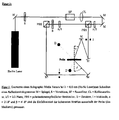
- the beam of a He-Ne laser (emission wavelength 633 nm) was converted into a parallel homogeneous beam by means of the spatial filter (SF) and together with the collimation lens (CL).
- the final cross sections of the signal and reference beam are defined by the iris diaphragms (I).
- the diameter of the iris aperture is 4 mm.
- the polarization dependent Beam splitters (PBS) divide the laser beam into two coherent identically polarized beams. Above the ⁇ / 2 plates, the power of the reference beam of 0.5 mW and the power of the signal beam were set to 0.65 mW. The performances were determined with the semiconductor detectors (D) with the sample removed.
- the angle of incidence ( ⁇ ) of the reference beam is 21.8 °
- the angle of incidence ( ⁇ ) of the signal beam is 41.8 °.
- the interference field of the two overlapping beams produced a grid of bright and dark stripes perpendicular to the bisector of the two beams incident on the sample (reflection hologram).
- the stripe spacing in the medium is ⁇ 225 nm (refractive index of the medium assumed to be ⁇ 1.49).
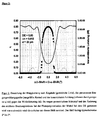
- the Bragg curve was measured, it describes the diffraction efficiency ⁇ as a function of the angle of rotation ⁇ of the written hologram and stored in a computer.
- the intensity transmitted in the zeroth order was also recorded against the rotation angle ⁇ and stored in a computer.
- the maximum diffraction efficiency (DE ⁇ max ) of the hologram, ie its peak value, was determined. It may be necessary to change the position of the detector of the diffracted beam to determine this maximum value.
- the measurement data of the diffraction efficiency, the theoretical Bragg curve and the transmitted intensity are as in FIG. 2 shown plotted against the centered angle of rotation ⁇ - ⁇ -shift. Since, because of geometric shrinkage and the change in the average refractive index in the photopolymerization, the angle measured at the DE differs from ⁇ , the x-axis is centered around this shift. The shift is typically 0 ° to 2 °.
- the detector for the diffracted light can only detect a finite angular range
- the Bragg curve is not completely detected by wide fathoms (small d) in an ⁇ scan, but only the central area, with suitable detector positioning. Therefore, the complementary to the Bragg curve shape of the transmitted intensity to adjust the layer thickness d is additionally used.
- this procedure may be repeated several times for different exposure times t on different media to determine at which average absorbed dose of the incident laser beam is going to saturate upon writing the hologram DE.
- the powers of the partial beams have been adjusted so that the same power density is achieved in the medium at the angles ⁇ and ⁇ used.
- the resulting photopolymer formulation is applied to screen printing on the prepared template and then processed in semi-automatic or fully automatic operation.
- the printing parameters such as e.g. the Rakol für Mandel
- the formulation is pressed through the template (grid) onto the substrate to be printed.
- the sieve is filled again with the flood squeegee and a new cycle starts.
- the substrate is removed from the screen printing machine and dried. This can be carried out separately in the downstream tunnel dryer or else in the tray trolley or oven.
- the printed substrates are dried at about 80 ° C and then covered with one of the above cover layers and packaged in a light-tight packaging.
- the thickness d of the photopolymer layer results from the coating parameters known to the person skilled in the art of the corresponding coating device.
- the above printable formulation was printed on a screen with the fabric PES 80/55 PW (VS-Monprint Polyester) on a semi-automatic screen printing machine AT-80 P from ESC.
- the open screen area of this fabric is about 31%.
- the tests showed that a slower squeegee speed showed a better print image in this setup. However, this can be seen independently, since this depends in each case on the overall interaction of the individual components (doctor blade, blade angle, type of fabric, etc.).
- the AT-80 P was also able to create working patterns with a medium / faster squeegee speed.
- ⁇ n The values found for the ⁇ n indicate the necessary dose that the photopolymers of the invention are very well suited as holographic media in the sense of the above description. Particularly good holographic media can be obtained when low squeegee speeds are set on a screen printing machine.
Landscapes
- Chemical & Material Sciences (AREA)
- Health & Medical Sciences (AREA)
- Chemical Kinetics & Catalysis (AREA)
- Medicinal Chemistry (AREA)
- Polymers & Plastics (AREA)
- Organic Chemistry (AREA)
- Physics & Mathematics (AREA)
- General Physics & Mathematics (AREA)
- Spectroscopy & Molecular Physics (AREA)
- Polyurethanes Or Polyureas (AREA)
- Holo Graphy (AREA)
- Laminated Bodies (AREA)
- Polymerisation Methods In General (AREA)
- Inks, Pencil-Leads, Or Crayons (AREA)
- Macromonomer-Based Addition Polymer (AREA)
Priority Applications (11)
| Application Number | Priority Date | Filing Date | Title |
|---|---|---|---|
| EP09001949A EP2218742A1 (de) | 2009-02-12 | 2009-02-12 | Photopolymerzusammensetzungen als verdruckbare Formulierungen |
| PCT/EP2010/000618 WO2010091807A1 (de) | 2009-02-12 | 2010-02-02 | Photopolymerzusammensetzungen als verdruckbare formulierungen |
| RU2011137188/04A RU2011137188A (ru) | 2009-02-12 | 2010-02-02 | Фотополимерные композиции в качестве пригодных для печатания композиций |
| CN2010800075012A CN102317336A (zh) | 2009-02-12 | 2010-02-02 | 作为可印刷配制剂的光聚合物组合物 |
| SG2011049608A SG173436A1 (en) | 2009-02-12 | 2010-02-02 | Photo polymer compositions as printable formulations |
| EP10702444.0A EP2396359B1 (de) | 2009-02-12 | 2010-02-02 | Photopolymerzusammensetzungen als verdruckbare formulierungen |
| JP2011549467A JP5684733B2 (ja) | 2009-02-12 | 2010-02-02 | 印刷可能配合物としての感光性ポリマー組成物 |
| KR1020117018681A KR20110123242A (ko) | 2009-02-12 | 2010-02-02 | 인쇄가능한 제제로서의 광중합체 조성물 |
| US13/201,004 US8715889B2 (en) | 2009-02-12 | 2010-02-02 | Photopolymer compositions as printable formulations |
| CA2751911A CA2751911A1 (en) | 2009-02-12 | 2010-02-02 | Photo polymer compositions as printable formulations |
| TW099104250A TW201035146A (en) | 2009-02-12 | 2010-02-11 | Photopolymer compositions as printable formulations |
Applications Claiming Priority (1)
| Application Number | Priority Date | Filing Date | Title |
|---|---|---|---|
| EP09001949A EP2218742A1 (de) | 2009-02-12 | 2009-02-12 | Photopolymerzusammensetzungen als verdruckbare Formulierungen |
Publications (1)
| Publication Number | Publication Date |
|---|---|
| EP2218742A1 true EP2218742A1 (de) | 2010-08-18 |
Family
ID=40886930
Family Applications (2)
| Application Number | Title | Priority Date | Filing Date |
|---|---|---|---|
| EP09001949A Withdrawn EP2218742A1 (de) | 2009-02-12 | 2009-02-12 | Photopolymerzusammensetzungen als verdruckbare Formulierungen |
| EP10702444.0A Active EP2396359B1 (de) | 2009-02-12 | 2010-02-02 | Photopolymerzusammensetzungen als verdruckbare formulierungen |
Family Applications After (1)
| Application Number | Title | Priority Date | Filing Date |
|---|---|---|---|
| EP10702444.0A Active EP2396359B1 (de) | 2009-02-12 | 2010-02-02 | Photopolymerzusammensetzungen als verdruckbare formulierungen |
Country Status (10)
| Country | Link |
|---|---|
| US (1) | US8715889B2 (enExample) |
| EP (2) | EP2218742A1 (enExample) |
| JP (1) | JP5684733B2 (enExample) |
| KR (1) | KR20110123242A (enExample) |
| CN (1) | CN102317336A (enExample) |
| CA (1) | CA2751911A1 (enExample) |
| RU (1) | RU2011137188A (enExample) |
| SG (1) | SG173436A1 (enExample) |
| TW (1) | TW201035146A (enExample) |
| WO (1) | WO2010091807A1 (enExample) |
Cited By (3)
| Publication number | Priority date | Publication date | Assignee | Title |
|---|---|---|---|---|
| DE102011005136A1 (de) | 2011-03-04 | 2012-09-06 | Infitec Gmbh | Brille zum Betrachten stereoskopischer Bilder oder eines Perspektivteilbildes eines solchen |
| WO2014026923A1 (de) | 2012-08-13 | 2014-02-20 | Bayer Materialscience Ag | Lichtführungsplatte mit auskoppelelementen |
| CN108368190A (zh) * | 2015-12-17 | 2018-08-03 | 三井化学株式会社 | 光固化性树脂组合物、显示元件密封剂、液晶密封剂和液晶显示面板及其制造方法 |
Families Citing this family (19)
| Publication number | Priority date | Publication date | Assignee | Title |
|---|---|---|---|---|
| JP2012504777A (ja) * | 2008-10-01 | 2012-02-23 | バイエル・マテリアルサイエンス・アクチェンゲゼルシャフト | 自己現像性ポリマーをベースとする体積ホログラフィックのための媒体 |
| KR101808493B1 (ko) * | 2008-10-01 | 2017-12-12 | 코베스트로 도이칠란드 아게 | 홀로그래피 매체의 제조를 위한 예비중합체-기재 폴리우레탄 제제 |
| EP2218743A1 (de) * | 2009-02-12 | 2010-08-18 | Bayer MaterialScience AG | Prepolymerbasierte Polyurethanformulierungen zur Herstellung holographischer Filme |
| EP2218744A1 (de) * | 2009-02-12 | 2010-08-18 | Bayer MaterialScience AG | Methode zur Herstellung von holografischen Photopolymeren auf Polymerfolien |
| EP2317511B1 (de) * | 2009-11-03 | 2012-03-07 | Bayer MaterialScience AG | Photopolymerformulierungen mit einstellbarem mechanischem Modul Guv |
| US8808946B2 (en) * | 2009-11-03 | 2014-08-19 | Bayer Materialscience Ag | Urethane acrylate having a high refractive index and reduced double bond density |
| KR101782182B1 (ko) * | 2009-11-03 | 2017-09-26 | 코베스트로 도이칠란드 아게 | 상이한 기록 공단량체를 갖는 광중합체 제제 |
| JP5925686B2 (ja) * | 2009-11-03 | 2016-05-25 | バイエル・マテリアルサイエンス・アクチェンゲゼルシャフトBayer MaterialScience AG | ホログラフィックフィルムの製造方法 |
| EP3461636B1 (en) * | 2017-09-29 | 2021-05-19 | Wayray AG | Laminated holographic display and manufacturing thereof |
| KR102166846B1 (ko) | 2017-12-11 | 2020-10-16 | 주식회사 엘지화학 | 포토폴리머 조성물 |
| US11267913B2 (en) | 2018-02-14 | 2022-03-08 | Mighty Buildings, Inc. | 3D printed material, structure and method for making the same |
| US11718580B2 (en) | 2019-05-08 | 2023-08-08 | Meta Platforms Technologies, Llc | Fluorene derivatized monomers and polymers for volume Bragg gratings |
| EP3997139A1 (en) | 2019-07-12 | 2022-05-18 | 3D Systems, Inc. | Build materials for 3d printing |
| US11780819B2 (en) | 2019-11-27 | 2023-10-10 | Meta Platforms Technologies, Llc | Aromatic substituted alkane-core monomers and polymers thereof for volume Bragg gratings |
| US20210155585A1 (en) * | 2019-11-27 | 2021-05-27 | Facebook Technologies, Llc | Anthraquinone derivatized monomers and polymers for volume bragg gratings |
| US11879024B1 (en) | 2020-07-14 | 2024-01-23 | Meta Platforms Technologies, Llc | Soft mold formulations for surface relief grating fabrication with imprinting lithography |
| CN113912809B (zh) * | 2021-12-02 | 2023-05-30 | 黄山中泽新材料有限公司 | 一种新型凹版印刷蓝色油墨用聚氨酯连接料及其制备方法 |
| KR102804517B1 (ko) * | 2022-10-18 | 2025-05-09 | 주식회사 엘지화학 | 홀로그램 기록 매체, 포토폴리머층 형성용 조성물, 및 광학 소자 |
| JP2025535210A (ja) * | 2022-10-18 | 2025-10-24 | エルジー・ケム・リミテッド | ホログラム記録媒体、フォトポリマー層形成用組成物、および光学素子 |
Citations (9)
| Publication number | Priority date | Publication date | Assignee | Title |
|---|---|---|---|---|
| EP0223587A1 (en) | 1985-11-20 | 1987-05-27 | The Mead Corporation | Photosensitive materials containing ionic dye compounds as initiators |
| EP0352774A1 (en) | 1988-07-28 | 1990-01-31 | E.I. Du Pont De Nemours And Company | Photopolymerisation sensitizer active at longer wavelength |
| US4959284A (en) | 1988-12-29 | 1990-09-25 | E. I. Du Pont De Nemours And Company | Holographic photopolymer compositions and elements containing a ring-opening monomer |
| EP1002817A2 (en) * | 1998-11-17 | 2000-05-24 | Showa Denko Kabushiki Kaisha | Photocurable composition |
| US6103454A (en) | 1998-03-24 | 2000-08-15 | Lucent Technologies Inc. | Recording medium and process for forming medium |
| WO2003014178A1 (en) * | 2001-08-07 | 2003-02-20 | Inphase Technologies, Inc. | Process and composition for rapid mass production of holographic recording article |
| WO2003023520A2 (en) * | 2001-06-27 | 2003-03-20 | Imation Corp. | Holographic photopolymer data recording media and meth of holographically reading and storing data |
| WO2005124456A2 (de) | 2004-06-22 | 2005-12-29 | Xetos Ag | Photopolymerisierbare zusammensetzung |
| WO2008125199A1 (en) * | 2007-04-11 | 2008-10-23 | Bayer Materialscience Ag | Aromatic urethane acrylates having a high refractive index |
Family Cites Families (20)
| Publication number | Priority date | Publication date | Assignee | Title |
|---|---|---|---|---|
| US7132200B1 (en) * | 1992-11-27 | 2006-11-07 | Dai Nippon Printing Co., Ltd. | Hologram recording sheet, holographic optical element using said sheet, and its production process |
| HUP0001995A3 (en) * | 1997-02-21 | 2002-02-28 | Ppg Ind Ohio Inc Cleveland | Photochromic polyurethane coatings and articles having such a coating |
| AU5871500A (en) * | 1999-06-11 | 2001-01-02 | Sydney Hyman | Image making medium |
| US20040152799A1 (en) * | 2003-01-31 | 2004-08-05 | Miller Christopher Wayne | Flexible radiation curable compositions |
| WO2005078533A1 (en) * | 2004-02-10 | 2005-08-25 | Zebra Imaging, Inc. | Deposition of photosensitive media for digital hologram recording |
| DE102004015983A1 (de) * | 2004-04-01 | 2005-10-20 | Bayer Materialscience Ag | Verfahren zur Herstellung von Polyetherallophanaten unter Verwendung von Zink-Verbindungen als Katalysatoren |
| US7736818B2 (en) * | 2004-12-27 | 2010-06-15 | Inphase Technologies, Inc. | Holographic recording medium and method of making it |
| US20070077498A1 (en) | 2005-09-30 | 2007-04-05 | Fuji Photo Film Co., Ltd. | Optical recording composition, optical recording medium and production method thereof, optical recording method and optical recording apparatus |
| DE102007005960A1 (de) * | 2007-02-07 | 2008-08-14 | Bayer Materialscience Ag | Ruß-gefüllte Polyurethane mit hoher Dielektrizitätskonstante und Durchschlagsfestigkeit |
| JP5060202B2 (ja) * | 2007-08-09 | 2012-10-31 | 本田技研工業株式会社 | 光輝性塗膜形成方法 |
| JP2012504777A (ja) * | 2008-10-01 | 2012-02-23 | バイエル・マテリアルサイエンス・アクチェンゲゼルシャフト | 自己現像性ポリマーをベースとする体積ホログラフィックのための媒体 |
| IL200997A0 (en) * | 2008-10-01 | 2010-06-30 | Bayer Materialscience Ag | Special polyether-based polyurethane formulations for the production of holographic media |
| IL200722A0 (en) | 2008-10-01 | 2010-06-30 | Bayer Materialscience Ag | Photopolymer compositions for optical elements and visual displays |
| IL200996A0 (en) * | 2008-10-01 | 2010-06-30 | Bayer Materialscience Ag | Photopolymer formulations having a low crosslinking density |
| KR101808493B1 (ko) | 2008-10-01 | 2017-12-12 | 코베스트로 도이칠란드 아게 | 홀로그래피 매체의 제조를 위한 예비중합체-기재 폴리우레탄 제제 |
| IL200995A0 (en) | 2008-10-01 | 2010-06-30 | Bayer Materialscience Ag | Polyether-based polyurethane formulations for the production of holographic media |
| EP2218744A1 (de) * | 2009-02-12 | 2010-08-18 | Bayer MaterialScience AG | Methode zur Herstellung von holografischen Photopolymeren auf Polymerfolien |
| EP2218743A1 (de) * | 2009-02-12 | 2010-08-18 | Bayer MaterialScience AG | Prepolymerbasierte Polyurethanformulierungen zur Herstellung holographischer Filme |
| IN2012DN03890A (enExample) * | 2009-11-03 | 2015-09-04 | Bayer Materialscience Ag | |
| EP2317511B1 (de) * | 2009-11-03 | 2012-03-07 | Bayer MaterialScience AG | Photopolymerformulierungen mit einstellbarem mechanischem Modul Guv |
-
2009
- 2009-02-12 EP EP09001949A patent/EP2218742A1/de not_active Withdrawn
-
2010
- 2010-02-02 RU RU2011137188/04A patent/RU2011137188A/ru unknown
- 2010-02-02 US US13/201,004 patent/US8715889B2/en active Active
- 2010-02-02 EP EP10702444.0A patent/EP2396359B1/de active Active
- 2010-02-02 CA CA2751911A patent/CA2751911A1/en not_active Abandoned
- 2010-02-02 JP JP2011549467A patent/JP5684733B2/ja active Active
- 2010-02-02 WO PCT/EP2010/000618 patent/WO2010091807A1/de not_active Ceased
- 2010-02-02 KR KR1020117018681A patent/KR20110123242A/ko not_active Withdrawn
- 2010-02-02 SG SG2011049608A patent/SG173436A1/en unknown
- 2010-02-02 CN CN2010800075012A patent/CN102317336A/zh active Pending
- 2010-02-11 TW TW099104250A patent/TW201035146A/zh unknown
Patent Citations (9)
| Publication number | Priority date | Publication date | Assignee | Title |
|---|---|---|---|---|
| EP0223587A1 (en) | 1985-11-20 | 1987-05-27 | The Mead Corporation | Photosensitive materials containing ionic dye compounds as initiators |
| EP0352774A1 (en) | 1988-07-28 | 1990-01-31 | E.I. Du Pont De Nemours And Company | Photopolymerisation sensitizer active at longer wavelength |
| US4959284A (en) | 1988-12-29 | 1990-09-25 | E. I. Du Pont De Nemours And Company | Holographic photopolymer compositions and elements containing a ring-opening monomer |
| US6103454A (en) | 1998-03-24 | 2000-08-15 | Lucent Technologies Inc. | Recording medium and process for forming medium |
| EP1002817A2 (en) * | 1998-11-17 | 2000-05-24 | Showa Denko Kabushiki Kaisha | Photocurable composition |
| WO2003023520A2 (en) * | 2001-06-27 | 2003-03-20 | Imation Corp. | Holographic photopolymer data recording media and meth of holographically reading and storing data |
| WO2003014178A1 (en) * | 2001-08-07 | 2003-02-20 | Inphase Technologies, Inc. | Process and composition for rapid mass production of holographic recording article |
| WO2005124456A2 (de) | 2004-06-22 | 2005-12-29 | Xetos Ag | Photopolymerisierbare zusammensetzung |
| WO2008125199A1 (en) * | 2007-04-11 | 2008-10-23 | Bayer Materialscience Ag | Aromatic urethane acrylates having a high refractive index |
Non-Patent Citations (6)
| Title |
|---|
| CUNNINGHAM ET AL., RADTECH'98 NORTH AMERICA UV/EB CONFERENCE PROCEEDINGS, 19 April 1998 (1998-04-19) |
| HOUBEN-WEYL: "Methoden der organischen Chemie", vol. XIV, 1961, GEORG THIEME VERLAG, pages: 433FF |
| LUO ET AL., OPTICS EXPRESS, vol. 13, no. 8, 2005, pages 3123 |
| O'NEILL ET AL., APPLIED OPTICS, vol. 41, no. 5, 2002, pages 845FF |
| OPTICAL SCIENCES, vol. 76, 2000, pages 209 - 228 |
| SIEHE; H. KOGELNIK, THE BELL SYSTEM TECHNICAL JOURNAL, vol. 48, no. 9, November 1969 (1969-11-01), pages 2909 - 2947 |
Cited By (7)
| Publication number | Priority date | Publication date | Assignee | Title |
|---|---|---|---|---|
| DE102011005136A1 (de) | 2011-03-04 | 2012-09-06 | Infitec Gmbh | Brille zum Betrachten stereoskopischer Bilder oder eines Perspektivteilbildes eines solchen |
| WO2012119944A1 (de) | 2011-03-04 | 2012-09-13 | Infitec Gmbh | Brille zum betrachten stereoskopischer bilder oder eines perspektivteilbildes eines solchen |
| JP2014514594A (ja) * | 2011-03-04 | 2014-06-19 | インフィテック ゲゼルシャフト ミット ベシュレンクテル ハフツング | ステレオ画像又はその種のステレオ画像の透視画像を見るための眼鏡 |
| US9703108B2 (en) | 2011-03-04 | 2017-07-11 | Infitec Gmbh | Eye-glasses for viewing stereoscopic images or a perspective sub-image of same |
| WO2014026923A1 (de) | 2012-08-13 | 2014-02-20 | Bayer Materialscience Ag | Lichtführungsplatte mit auskoppelelementen |
| CN108368190A (zh) * | 2015-12-17 | 2018-08-03 | 三井化学株式会社 | 光固化性树脂组合物、显示元件密封剂、液晶密封剂和液晶显示面板及其制造方法 |
| CN108368190B (zh) * | 2015-12-17 | 2019-12-31 | 三井化学株式会社 | 光固化性树脂组合物、显示元件密封剂、液晶密封剂和液晶显示面板及其制造方法 |
Also Published As
| Publication number | Publication date |
|---|---|
| WO2010091807A1 (de) | 2010-08-19 |
| RU2011137188A (ru) | 2013-03-20 |
| SG173436A1 (en) | 2011-09-29 |
| TW201035146A (en) | 2010-10-01 |
| EP2396359B1 (de) | 2017-09-27 |
| CN102317336A (zh) | 2012-01-11 |
| KR20110123242A (ko) | 2011-11-14 |
| JP2012517514A (ja) | 2012-08-02 |
| US8715889B2 (en) | 2014-05-06 |
| CA2751911A1 (en) | 2010-08-19 |
| JP5684733B2 (ja) | 2015-03-18 |
| US20110311906A1 (en) | 2011-12-22 |
| EP2396359A1 (de) | 2011-12-21 |
Similar Documents
| Publication | Publication Date | Title |
|---|---|---|
| EP2396359B1 (de) | Photopolymerzusammensetzungen als verdruckbare formulierungen | |
| EP2218745B1 (de) | Prepolymerbasierte Polyurethanformulierungen zur Herstellung holographischer Filme | |
| EP2497085B1 (de) | Verfahren zur herstellung eines holographischen films | |
| EP2497080B1 (de) | Verfahren zur herstellung eines holographischen films | |
| EP2172502B1 (de) | Polyetherbasierte polyurethanformulierungen zur herstellung holografischer medien | |
| EP2172503B1 (de) | Spezielle Polyetherbasierte Polyurethanformulierungen zur Herstellung holografischer Medien | |
| EP2497081B1 (de) | Verfahren zur herstellung von holographischen medien | |
| EP2342254B1 (de) | Medien für volumenholographische aufzeichnung basierend auf sich selbstentwickelndem polymer | |
| EP2342249B1 (de) | Prepolymerbasierte polyurethanformulierungen zur herstellung holografischer medien | |
| EP2531892B1 (de) | Verwendung einer photopolymer-formulierung mit triazin-basierten schreibmonomeren | |
| EP2531889B1 (de) | Verwendung einer photopolymer-formulierung mit ester-basierten schreibmonomeren zur herstellung holographischer medien | |
| EP2172504B1 (de) | Photopolymerformulierungen mit niedriger Vernetzungsdichte | |
| EP2317511B1 (de) | Photopolymerformulierungen mit einstellbarem mechanischem Modul Guv | |
| EP2497083B1 (de) | Photopolymer-formulierung mit verschiedenen schreibcomonomeren | |
| EP3230261B1 (de) | Naphthylacrylate als schreibmonomere für photopolymere | |
| EP2372454A1 (de) | Photopolymer-Formulierung zur Herstellung sichtbarer Hologramme | |
| EP2354845A1 (de) | (Meth)-Acrylat-Schreibmonomere | |
| WO2023156484A1 (de) | Photopolymerzusammensetzungen für thermostabile photopolymere im sichtbaren spektralbereich |
Legal Events
| Date | Code | Title | Description |
|---|---|---|---|
| PUAI | Public reference made under article 153(3) epc to a published international application that has entered the european phase |
Free format text: ORIGINAL CODE: 0009012 |
|
| AK | Designated contracting states |
Kind code of ref document: A1 Designated state(s): AT BE BG CH CY CZ DE DK EE ES FI FR GB GR HR HU IE IS IT LI LT LU LV MC MK MT NL NO PL PT RO SE SI SK TR |
|
| AX | Request for extension of the european patent |
Extension state: AL BA RS |
|
| STAA | Information on the status of an ep patent application or granted ep patent |
Free format text: STATUS: THE APPLICATION HAS BEEN WITHDRAWN |
|
| 18W | Application withdrawn |
Effective date: 20101208 |