EP2215134B1 - Verminderung der biofilmbildung durch multifunktionelle copolymere - Google Patents
Verminderung der biofilmbildung durch multifunktionelle copolymere Download PDFInfo
- Publication number
- EP2215134B1 EP2215134B1 EP08856076.8A EP08856076A EP2215134B1 EP 2215134 B1 EP2215134 B1 EP 2215134B1 EP 08856076 A EP08856076 A EP 08856076A EP 2215134 B1 EP2215134 B1 EP 2215134B1
- Authority
- EP
- European Patent Office
- Prior art keywords
- vinyl monomer
- methyl
- monomers
- ethyl
- stands
- Prior art date
- Legal status (The legal status is an assumption and is not a legal conclusion. Google has not performed a legal analysis and makes no representation as to the accuracy of the status listed.)
- Not-in-force
Links
- 229920001577 copolymer Polymers 0.000 title claims description 50
- 230000009467 reduction Effects 0.000 title claims description 19
- 230000015572 biosynthetic process Effects 0.000 title description 15
- 239000000178 monomer Substances 0.000 claims description 148
- 229920002554 vinyl polymer Polymers 0.000 claims description 73
- 125000000391 vinyl group Chemical group [H]C([*])=C([H])[H] 0.000 claims description 61
- 125000002496 methyl group Chemical group [H]C([H])([H])* 0.000 claims description 35
- 244000005700 microbiome Species 0.000 claims description 35
- 150000001875 compounds Chemical class 0.000 claims description 33
- 125000001495 ethyl group Chemical group [H]C([H])([H])C([H])([H])* 0.000 claims description 29
- 229910052739 hydrogen Inorganic materials 0.000 claims description 29
- 239000001257 hydrogen Substances 0.000 claims description 28
- 150000002431 hydrogen Chemical class 0.000 claims description 22
- 125000004432 carbon atom Chemical group C* 0.000 claims description 21
- -1 alkali metal salts Chemical class 0.000 claims description 19
- 229930195734 saturated hydrocarbon Natural products 0.000 claims description 16
- UZNHKBFIBYXPDV-UHFFFAOYSA-N trimethyl-[3-(2-methylprop-2-enoylamino)propyl]azanium;chloride Chemical compound [Cl-].CC(=C)C(=O)NCCC[N+](C)(C)C UZNHKBFIBYXPDV-UHFFFAOYSA-N 0.000 claims description 14
- 230000002209 hydrophobic effect Effects 0.000 claims description 13
- 229920001296 polysiloxane Polymers 0.000 claims description 13
- 125000001453 quaternary ammonium group Chemical group 0.000 claims description 13
- 229920006395 saturated elastomer Polymers 0.000 claims description 12
- 125000001302 tertiary amino group Chemical group 0.000 claims description 12
- 229930195735 unsaturated hydrocarbon Natural products 0.000 claims description 12
- 229910052760 oxygen Inorganic materials 0.000 claims description 11
- 125000000467 secondary amino group Chemical group [H]N([*:1])[*:2] 0.000 claims description 11
- SMZOUWXMTYCWNB-UHFFFAOYSA-N 2-(2-methoxy-5-methylphenyl)ethanamine Chemical compound COC1=CC=C(C)C=C1CCN SMZOUWXMTYCWNB-UHFFFAOYSA-N 0.000 claims description 8
- NIXOWILDQLNWCW-UHFFFAOYSA-N 2-Propenoic acid Natural products OC(=O)C=C NIXOWILDQLNWCW-UHFFFAOYSA-N 0.000 claims description 8
- CERQOIWHTDAKMF-UHFFFAOYSA-N Methacrylic acid Chemical compound CC(=C)C(O)=O CERQOIWHTDAKMF-UHFFFAOYSA-N 0.000 claims description 8
- JKNCOURZONDCGV-UHFFFAOYSA-N 2-(dimethylamino)ethyl 2-methylprop-2-enoate Chemical compound CN(C)CCOC(=O)C(C)=C JKNCOURZONDCGV-UHFFFAOYSA-N 0.000 claims description 7
- FLCAEMBIQVZWIF-UHFFFAOYSA-N 6-(dimethylamino)-2-methylhex-2-enamide Chemical compound CN(C)CCCC=C(C)C(N)=O FLCAEMBIQVZWIF-UHFFFAOYSA-N 0.000 claims description 7
- UFHFLCQGNIYNRP-UHFFFAOYSA-N Hydrogen Chemical compound [H][H] UFHFLCQGNIYNRP-UHFFFAOYSA-N 0.000 claims description 6
- 238000007334 copolymerization reaction Methods 0.000 claims description 6
- ZWAPMFBHEQZLGK-UHFFFAOYSA-N 5-(dimethylamino)-2-methylidenepentanamide Chemical compound CN(C)CCCC(=C)C(N)=O ZWAPMFBHEQZLGK-UHFFFAOYSA-N 0.000 claims description 5
- 150000003863 ammonium salts Chemical class 0.000 claims description 4
- 125000000484 butyl group Chemical group [H]C([*])([H])C([H])([H])C([H])([H])C([H])([H])[H] 0.000 claims description 4
- 125000001436 propyl group Chemical group [H]C([*])([H])C([H])([H])C([H])([H])[H] 0.000 claims description 4
- 125000001273 sulfonato group Chemical group [O-]S(*)(=O)=O 0.000 claims description 4
- 229910052783 alkali metal Inorganic materials 0.000 claims description 3
- 125000003178 carboxy group Chemical group [H]OC(*)=O 0.000 claims description 3
- 125000000383 tetramethylene group Chemical group [H]C([H])([*:1])C([H])([H])C([H])([H])C([H])([H])[*:2] 0.000 claims description 3
- OEIXGLMQZVLOQX-UHFFFAOYSA-N trimethyl-[3-(prop-2-enoylamino)propyl]azanium;chloride Chemical compound [Cl-].C[N+](C)(C)CCCNC(=O)C=C OEIXGLMQZVLOQX-UHFFFAOYSA-N 0.000 claims description 3
- XHZPRMZZQOIPDS-UHFFFAOYSA-N 2-Methyl-2-[(1-oxo-2-propenyl)amino]-1-propanesulfonic acid Chemical compound OS(=O)(=O)CC(C)(C)NC(=O)C=C XHZPRMZZQOIPDS-UHFFFAOYSA-N 0.000 claims description 2
- VOPWNXZWBYDODV-UHFFFAOYSA-N Chlorodifluoromethane Chemical compound FC(F)Cl VOPWNXZWBYDODV-UHFFFAOYSA-N 0.000 claims description 2
- 125000002723 alicyclic group Chemical group 0.000 claims description 2
- IYABWNGZIDDRAK-UHFFFAOYSA-N allene Chemical group C=C=C IYABWNGZIDDRAK-UHFFFAOYSA-N 0.000 claims description 2
- 238000011161 development Methods 0.000 claims description 2
- 229910052731 fluorine Inorganic materials 0.000 claims description 2
- 239000011737 fluorine Substances 0.000 claims description 2
- 125000001153 fluoro group Chemical group F* 0.000 claims description 2
- QQONPFPTGQHPMA-UHFFFAOYSA-N propylene Natural products CC=C QQONPFPTGQHPMA-UHFFFAOYSA-N 0.000 claims description 2
- 125000004805 propylene group Chemical group [H]C([H])([H])C([H])([*:1])C([H])([H])[*:2] 0.000 claims description 2
- 150000002430 hydrocarbons Chemical group 0.000 claims 12
- 125000001931 aliphatic group Chemical group 0.000 claims 2
- 150000002500 ions Chemical class 0.000 claims 2
- MALIONKMKPITBV-UHFFFAOYSA-N 2-(3-chloro-4-hydroxyphenyl)-n-[2-(4-sulfamoylphenyl)ethyl]acetamide Chemical compound C1=CC(S(=O)(=O)N)=CC=C1CCNC(=O)CC1=CC=C(O)C(Cl)=C1 MALIONKMKPITBV-UHFFFAOYSA-N 0.000 claims 1
- SYGWYBOJXOGMRU-UHFFFAOYSA-N chembl233051 Chemical compound C1=CC=C2C3=CC(C(N(CCN(C)C)C4=O)=O)=C5C4=CC=CC5=C3SC2=C1 SYGWYBOJXOGMRU-UHFFFAOYSA-N 0.000 claims 1
- 150000002169 ethanolamines Chemical class 0.000 claims 1
- RNDVCCAQMXGBSH-UHFFFAOYSA-M trimethyl-[2-(2-methylprop-2-enoyloxyamino)ethyl]azanium;chloride Chemical compound [Cl-].CC(=C)C(=O)ONCC[N+](C)(C)C RNDVCCAQMXGBSH-UHFFFAOYSA-M 0.000 claims 1
- GETQZCLCWQTVFV-UHFFFAOYSA-N trimethylamine Chemical class CN(C)C GETQZCLCWQTVFV-UHFFFAOYSA-N 0.000 claims 1
- 229920000642 polymer Polymers 0.000 description 52
- 238000012360 testing method Methods 0.000 description 29
- XLYOFNOQVPJJNP-UHFFFAOYSA-N water Substances O XLYOFNOQVPJJNP-UHFFFAOYSA-N 0.000 description 26
- LFQSCWFLJHTTHZ-UHFFFAOYSA-N Ethanol Chemical compound CCO LFQSCWFLJHTTHZ-UHFFFAOYSA-N 0.000 description 24
- IRLPACMLTUPBCL-KQYNXXCUSA-N 5'-adenylyl sulfate Chemical compound C1=NC=2C(N)=NC=NC=2N1[C@@H]1O[C@H](COP(O)(=O)OS(O)(=O)=O)[C@@H](O)[C@H]1O IRLPACMLTUPBCL-KQYNXXCUSA-N 0.000 description 22
- 239000000203 mixture Substances 0.000 description 20
- 239000000919 ceramic Substances 0.000 description 18
- WOBHKFSMXKNTIM-UHFFFAOYSA-N Hydroxyethyl methacrylate Chemical compound CC(=C)C(=O)OCCO WOBHKFSMXKNTIM-UHFFFAOYSA-N 0.000 description 17
- 239000003795 chemical substances by application Substances 0.000 description 17
- 229910052700 potassium Inorganic materials 0.000 description 17
- 150000003839 salts Chemical class 0.000 description 17
- 239000000126 substance Substances 0.000 description 17
- 229910052717 sulfur Inorganic materials 0.000 description 17
- KRKNYBCHXYNGOX-UHFFFAOYSA-N citric acid Chemical compound OC(=O)CC(O)(C(O)=O)CC(O)=O KRKNYBCHXYNGOX-UHFFFAOYSA-N 0.000 description 15
- 230000002829 reductive effect Effects 0.000 description 15
- 241000233866 Fungi Species 0.000 description 14
- 239000003599 detergent Substances 0.000 description 14
- 229920003023 plastic Polymers 0.000 description 14
- 239000004033 plastic Substances 0.000 description 14
- 239000000243 solution Substances 0.000 description 13
- 239000004094 surface-active agent Substances 0.000 description 12
- 238000002360 preparation method Methods 0.000 description 11
- 230000000694 effects Effects 0.000 description 9
- 241000894006 Bacteria Species 0.000 description 8
- SOGAXMICEFXMKE-UHFFFAOYSA-N Butylmethacrylate Chemical compound CCCCOC(=O)C(C)=C SOGAXMICEFXMKE-UHFFFAOYSA-N 0.000 description 8
- 239000000725 suspension Substances 0.000 description 8
- 239000004480 active ingredient Substances 0.000 description 7
- 239000012459 cleaning agent Substances 0.000 description 7
- 239000000975 dye Substances 0.000 description 7
- 238000000034 method Methods 0.000 description 7
- 229920001223 polyethylene glycol Polymers 0.000 description 7
- 238000005406 washing Methods 0.000 description 7
- 239000003139 biocide Substances 0.000 description 6
- 230000032770 biofilm formation Effects 0.000 description 6
- 230000002599 biostatic effect Effects 0.000 description 6
- 239000002537 cosmetic Substances 0.000 description 6
- 239000007788 liquid Substances 0.000 description 6
- 239000003921 oil Substances 0.000 description 6
- 235000019198 oils Nutrition 0.000 description 6
- 239000004753 textile Substances 0.000 description 6
- 241000222122 Candida albicans Species 0.000 description 5
- OKKJLVBELUTLKV-UHFFFAOYSA-N Methanol Chemical class OC OKKJLVBELUTLKV-UHFFFAOYSA-N 0.000 description 5
- 208000035415 Reinfection Diseases 0.000 description 5
- 241000191967 Staphylococcus aureus Species 0.000 description 5
- 239000002253 acid Substances 0.000 description 5
- 230000003115 biocidal effect Effects 0.000 description 5
- 239000007844 bleaching agent Substances 0.000 description 5
- 238000006243 chemical reaction Methods 0.000 description 5
- 235000015165 citric acid Nutrition 0.000 description 5
- 239000000839 emulsion Substances 0.000 description 5
- 239000003205 fragrance Substances 0.000 description 5
- 239000000499 gel Substances 0.000 description 5
- 239000011521 glass Substances 0.000 description 5
- 239000003112 inhibitor Substances 0.000 description 5
- 239000000463 material Substances 0.000 description 5
- 239000000825 pharmaceutical preparation Substances 0.000 description 5
- 239000003755 preservative agent Substances 0.000 description 5
- 239000000047 product Substances 0.000 description 5
- 239000007787 solid Substances 0.000 description 5
- IJGRMHOSHXDMSA-UHFFFAOYSA-N Atomic nitrogen Chemical compound N#N IJGRMHOSHXDMSA-UHFFFAOYSA-N 0.000 description 4
- 0 CCC(C)C1C(CC2)=*2CC1 Chemical compound CCC(C)C1C(CC2)=*2CC1 0.000 description 4
- 241000222120 Candida <Saccharomycetales> Species 0.000 description 4
- 239000004215 Carbon black (E152) Substances 0.000 description 4
- 241000195493 Cryptophyta Species 0.000 description 4
- DNIAPMSPPWPWGF-UHFFFAOYSA-N Propylene glycol Chemical class CC(O)CO DNIAPMSPPWPWGF-UHFFFAOYSA-N 0.000 description 4
- XSQUKJJJFZCRTK-UHFFFAOYSA-N Urea Chemical compound NC(N)=O XSQUKJJJFZCRTK-UHFFFAOYSA-N 0.000 description 4
- POJWUDADGALRAB-UHFFFAOYSA-N allantoin Chemical compound NC(=O)NC1NC(=O)NC1=O POJWUDADGALRAB-UHFFFAOYSA-N 0.000 description 4
- 125000000129 anionic group Chemical group 0.000 description 4
- 230000000845 anti-microbial effect Effects 0.000 description 4
- CUFNKYGDVFVPHO-UHFFFAOYSA-N azulene Chemical compound C1=CC=CC2=CC=CC2=C1 CUFNKYGDVFVPHO-UHFFFAOYSA-N 0.000 description 4
- 229930195733 hydrocarbon Natural products 0.000 description 4
- 238000011534 incubation Methods 0.000 description 4
- 239000004615 ingredient Substances 0.000 description 4
- 230000002401 inhibitory effect Effects 0.000 description 4
- BDAGIHXWWSANSR-UHFFFAOYSA-N methanoic acid Natural products OC=O BDAGIHXWWSANSR-UHFFFAOYSA-N 0.000 description 4
- 239000000843 powder Substances 0.000 description 4
- 230000008569 process Effects 0.000 description 4
- 159000000000 sodium salts Chemical class 0.000 description 4
- 239000002904 solvent Substances 0.000 description 4
- 239000003381 stabilizer Substances 0.000 description 4
- 125000000542 sulfonic acid group Chemical group 0.000 description 4
- ISXSCDLOGDJUNJ-UHFFFAOYSA-N tert-butyl prop-2-enoate Chemical compound CC(C)(C)OC(=O)C=C ISXSCDLOGDJUNJ-UHFFFAOYSA-N 0.000 description 4
- 239000002562 thickening agent Substances 0.000 description 4
- WDQMWEYDKDCEHT-UHFFFAOYSA-N 2-ethylhexyl 2-methylprop-2-enoate Chemical compound CCCCC(CC)COC(=O)C(C)=C WDQMWEYDKDCEHT-UHFFFAOYSA-N 0.000 description 3
- FJKROLUGYXJWQN-UHFFFAOYSA-N 4-hydroxybenzoic acid Chemical compound OC(=O)C1=CC=C(O)C=C1 FJKROLUGYXJWQN-UHFFFAOYSA-N 0.000 description 3
- NIXOWILDQLNWCW-UHFFFAOYSA-M Acrylate Chemical compound [O-]C(=O)C=C NIXOWILDQLNWCW-UHFFFAOYSA-M 0.000 description 3
- UHOVQNZJYSORNB-UHFFFAOYSA-N Benzene Chemical compound C1=CC=CC=C1 UHOVQNZJYSORNB-UHFFFAOYSA-N 0.000 description 3
- PEDCQBHIVMGVHV-UHFFFAOYSA-N Glycerine Chemical compound OCC(O)CO PEDCQBHIVMGVHV-UHFFFAOYSA-N 0.000 description 3
- 241001465754 Metazoa Species 0.000 description 3
- SJEYSFABYSGQBG-UHFFFAOYSA-M Patent blue Chemical compound [Na+].C1=CC(N(CC)CC)=CC=C1C(C=1C(=CC(=CC=1)S([O-])(=O)=O)S([O-])(=O)=O)=C1C=CC(=[N+](CC)CC)C=C1 SJEYSFABYSGQBG-UHFFFAOYSA-M 0.000 description 3
- NBIIXXVUZAFLBC-UHFFFAOYSA-N Phosphoric acid Chemical compound OP(O)(O)=O NBIIXXVUZAFLBC-UHFFFAOYSA-N 0.000 description 3
- 239000002202 Polyethylene glycol Substances 0.000 description 3
- 241000589517 Pseudomonas aeruginosa Species 0.000 description 3
- NJSSICCENMLTKO-HRCBOCMUSA-N [(1r,2s,4r,5r)-3-hydroxy-4-(4-methylphenyl)sulfonyloxy-6,8-dioxabicyclo[3.2.1]octan-2-yl] 4-methylbenzenesulfonate Chemical compound C1=CC(C)=CC=C1S(=O)(=O)O[C@H]1C(O)[C@@H](OS(=O)(=O)C=2C=CC(C)=CC=2)[C@@H]2OC[C@H]1O2 NJSSICCENMLTKO-HRCBOCMUSA-N 0.000 description 3
- 229940048053 acrylate Drugs 0.000 description 3
- 239000000853 adhesive Substances 0.000 description 3
- 230000001070 adhesive effect Effects 0.000 description 3
- 125000000217 alkyl group Chemical group 0.000 description 3
- 230000000844 anti-bacterial effect Effects 0.000 description 3
- 230000003373 anti-fouling effect Effects 0.000 description 3
- 239000004599 antimicrobial Substances 0.000 description 3
- 239000007864 aqueous solution Substances 0.000 description 3
- 244000052616 bacterial pathogen Species 0.000 description 3
- 239000000872 buffer Substances 0.000 description 3
- CQEYYJKEWSMYFG-UHFFFAOYSA-N butyl acrylate Chemical compound CCCCOC(=O)C=C CQEYYJKEWSMYFG-UHFFFAOYSA-N 0.000 description 3
- 201000003984 candidiasis Diseases 0.000 description 3
- 239000000969 carrier Substances 0.000 description 3
- 230000000052 comparative effect Effects 0.000 description 3
- 239000006071 cream Substances 0.000 description 3
- YRHAJIIKYFCUTG-UHFFFAOYSA-M dimethyl-bis(prop-2-enyl)azanium;bromide Chemical compound [Br-].C=CC[N+](C)(C)CC=C YRHAJIIKYFCUTG-UHFFFAOYSA-M 0.000 description 3
- 239000003925 fat Substances 0.000 description 3
- 239000006260 foam Substances 0.000 description 3
- 239000000446 fuel Substances 0.000 description 3
- 238000009533 lab test Methods 0.000 description 3
- 239000006210 lotion Substances 0.000 description 3
- 239000002609 medium Substances 0.000 description 3
- 229910052751 metal Inorganic materials 0.000 description 3
- 239000002184 metal Substances 0.000 description 3
- 150000002739 metals Chemical class 0.000 description 3
- 210000004400 mucous membrane Anatomy 0.000 description 3
- 239000002674 ointment Substances 0.000 description 3
- 239000003960 organic solvent Substances 0.000 description 3
- 239000003973 paint Substances 0.000 description 3
- 230000001717 pathogenic effect Effects 0.000 description 3
- 229920006254 polymer film Polymers 0.000 description 3
- 238000006116 polymerization reaction Methods 0.000 description 3
- 238000012216 screening Methods 0.000 description 3
- 241000894007 species Species 0.000 description 3
- 239000010935 stainless steel Substances 0.000 description 3
- 229910001220 stainless steel Inorganic materials 0.000 description 3
- VZCYOOQTPOCHFL-UHFFFAOYSA-N trans-butenedioic acid Natural products OC(=O)C=CC(O)=O VZCYOOQTPOCHFL-UHFFFAOYSA-N 0.000 description 3
- FZGFBJMPSHGTRQ-UHFFFAOYSA-M trimethyl(2-prop-2-enoyloxyethyl)azanium;chloride Chemical compound [Cl-].C[N+](C)(C)CCOC(=O)C=C FZGFBJMPSHGTRQ-UHFFFAOYSA-M 0.000 description 3
- 239000002351 wastewater Substances 0.000 description 3
- 239000001993 wax Substances 0.000 description 3
- VPTUPAVOBUEXMZ-UHFFFAOYSA-N (1-hydroxy-2-phosphonoethyl)phosphonic acid Chemical compound OP(=O)(O)C(O)CP(O)(O)=O VPTUPAVOBUEXMZ-UHFFFAOYSA-N 0.000 description 2
- 229920002818 (Hydroxyethyl)methacrylate Polymers 0.000 description 2
- DTOUUUZOYKYHEP-UHFFFAOYSA-N 1,3-bis(2-ethylhexyl)-5-methyl-1,3-diazinan-5-amine Chemical compound CCCCC(CC)CN1CN(CC(CC)CCCC)CC(C)(N)C1 DTOUUUZOYKYHEP-UHFFFAOYSA-N 0.000 description 2
- PQUXFUBNSYCQAL-UHFFFAOYSA-N 1-(2,3-difluorophenyl)ethanone Chemical compound CC(=O)C1=CC=CC(F)=C1F PQUXFUBNSYCQAL-UHFFFAOYSA-N 0.000 description 2
- FKKAGFLIPSSCHT-UHFFFAOYSA-N 1-dodecoxydodecane;sulfuric acid Chemical compound OS(O)(=O)=O.CCCCCCCCCCCCOCCCCCCCCCCCC FKKAGFLIPSSCHT-UHFFFAOYSA-N 0.000 description 2
- DPBJAVGHACCNRL-UHFFFAOYSA-N 2-(dimethylamino)ethyl prop-2-enoate Chemical compound CN(C)CCOC(=O)C=C DPBJAVGHACCNRL-UHFFFAOYSA-N 0.000 description 2
- HZAXFHJVJLSVMW-UHFFFAOYSA-N 2-Aminoethan-1-ol Chemical compound NCCO HZAXFHJVJLSVMW-UHFFFAOYSA-N 0.000 description 2
- GOXQRTZXKQZDDN-UHFFFAOYSA-N 2-Ethylhexyl acrylate Chemical compound CCCCC(CC)COC(=O)C=C GOXQRTZXKQZDDN-UHFFFAOYSA-N 0.000 description 2
- TYBHZVUFOINFDV-UHFFFAOYSA-N 2-bromo-6-[(3-bromo-5-chloro-2-hydroxyphenyl)methyl]-4-chlorophenol Chemical compound OC1=C(Br)C=C(Cl)C=C1CC1=CC(Cl)=CC(Br)=C1O TYBHZVUFOINFDV-UHFFFAOYSA-N 0.000 description 2
- OSWFIVFLDKOXQC-UHFFFAOYSA-N 4-(3-methoxyphenyl)aniline Chemical compound COC1=CC=CC(C=2C=CC(N)=CC=2)=C1 OSWFIVFLDKOXQC-UHFFFAOYSA-N 0.000 description 2
- 241000589158 Agrobacterium Species 0.000 description 2
- POJWUDADGALRAB-PVQJCKRUSA-N Allantoin Natural products NC(=O)N[C@@H]1NC(=O)NC1=O POJWUDADGALRAB-PVQJCKRUSA-N 0.000 description 2
- QGZKDVFQNNGYKY-UHFFFAOYSA-N Ammonia Chemical compound N QGZKDVFQNNGYKY-UHFFFAOYSA-N 0.000 description 2
- 241000320697 Aquabacterium Species 0.000 description 2
- 241000228212 Aspergillus Species 0.000 description 2
- 241001065417 Aspergillus chevalieri Species 0.000 description 2
- 241000228197 Aspergillus flavus Species 0.000 description 2
- 241000351920 Aspergillus nidulans Species 0.000 description 2
- 241000228230 Aspergillus parasiticus Species 0.000 description 2
- 241000589174 Bradyrhizobium japonicum Species 0.000 description 2
- 244000197813 Camelina sativa Species 0.000 description 2
- 206010007134 Candida infections Diseases 0.000 description 2
- 241000222173 Candida parapsilosis Species 0.000 description 2
- 241000222178 Candida tropicalis Species 0.000 description 2
- GHXZTYHSJHQHIJ-UHFFFAOYSA-N Chlorhexidine Chemical compound C=1C=C(Cl)C=CC=1NC(N)=NC(N)=NCCCCCCN=C(N)N=C(N)NC1=CC=C(Cl)C=C1 GHXZTYHSJHQHIJ-UHFFFAOYSA-N 0.000 description 2
- 241000195628 Chlorophyta Species 0.000 description 2
- 241000192700 Cyanobacteria Species 0.000 description 2
- FBPFZTCFMRRESA-FSIIMWSLSA-N D-Glucitol Natural products OC[C@H](O)[C@H](O)[C@@H](O)[C@H](O)CO FBPFZTCFMRRESA-FSIIMWSLSA-N 0.000 description 2
- FBPFZTCFMRRESA-JGWLITMVSA-N D-glucitol Chemical compound OC[C@H](O)[C@@H](O)[C@H](O)[C@H](O)CO FBPFZTCFMRRESA-JGWLITMVSA-N 0.000 description 2
- SNPLKNRPJHDVJA-ZETCQYMHSA-N D-panthenol Chemical compound OCC(C)(C)[C@@H](O)C(=O)NCCCO SNPLKNRPJHDVJA-ZETCQYMHSA-N 0.000 description 2
- 241000191949 Dermacoccus nishinomiyaensis Species 0.000 description 2
- 108090000790 Enzymes Proteins 0.000 description 2
- 102000004190 Enzymes Human genes 0.000 description 2
- 241000588724 Escherichia coli Species 0.000 description 2
- VZCYOOQTPOCHFL-OWOJBTEDSA-N Fumaric acid Chemical compound OC(=O)\C=C\C(O)=O VZCYOOQTPOCHFL-OWOJBTEDSA-N 0.000 description 2
- BAPJBEWLBFYGME-UHFFFAOYSA-N Methyl acrylate Chemical compound COC(=O)C=C BAPJBEWLBFYGME-UHFFFAOYSA-N 0.000 description 2
- 241000605122 Nitrosomonas Species 0.000 description 2
- OFOBLEOULBTSOW-UHFFFAOYSA-N Propanedioic acid Natural products OC(=O)CC(O)=O OFOBLEOULBTSOW-UHFFFAOYSA-N 0.000 description 2
- 241000589540 Pseudomonas fluorescens Species 0.000 description 2
- 241000194017 Streptococcus Species 0.000 description 2
- QAOWNCQODCNURD-UHFFFAOYSA-L Sulfate Chemical compound [O-]S([O-])(=O)=O QAOWNCQODCNURD-UHFFFAOYSA-L 0.000 description 2
- 241000192707 Synechococcus Species 0.000 description 2
- GWEVSGVZZGPLCZ-UHFFFAOYSA-N Titan oxide Chemical compound O=[Ti]=O GWEVSGVZZGPLCZ-UHFFFAOYSA-N 0.000 description 2
- XEFQLINVKFYRCS-UHFFFAOYSA-N Triclosan Chemical compound OC1=CC(Cl)=CC=C1OC1=CC=C(Cl)C=C1Cl XEFQLINVKFYRCS-UHFFFAOYSA-N 0.000 description 2
- 241000700605 Viruses Species 0.000 description 2
- 241000589634 Xanthomonas Species 0.000 description 2
- 241000589636 Xanthomonas campestris Species 0.000 description 2
- 241000607734 Yersinia <bacteria> Species 0.000 description 2
- 150000007513 acids Chemical class 0.000 description 2
- 239000013543 active substance Substances 0.000 description 2
- 239000000654 additive Substances 0.000 description 2
- 230000001464 adherent effect Effects 0.000 description 2
- 239000000443 aerosol Substances 0.000 description 2
- 230000001476 alcoholic effect Effects 0.000 description 2
- 229960000458 allantoin Drugs 0.000 description 2
- 239000003945 anionic surfactant Substances 0.000 description 2
- 230000000181 anti-adherent effect Effects 0.000 description 2
- 239000002519 antifouling agent Substances 0.000 description 2
- 238000013459 approach Methods 0.000 description 2
- 230000008901 benefit Effects 0.000 description 2
- 239000004566 building material Substances 0.000 description 2
- 239000001913 cellulose Substances 0.000 description 2
- 235000010980 cellulose Nutrition 0.000 description 2
- 229920002678 cellulose Polymers 0.000 description 2
- 239000011248 coating agent Substances 0.000 description 2
- 238000000576 coating method Methods 0.000 description 2
- 201000010099 disease Diseases 0.000 description 2
- 208000037265 diseases, disorders, signs and symptoms Diseases 0.000 description 2
- 229920001971 elastomer Polymers 0.000 description 2
- 239000003995 emulsifying agent Substances 0.000 description 2
- 229940088598 enzyme Drugs 0.000 description 2
- 150000002148 esters Chemical class 0.000 description 2
- 238000011010 flushing procedure Methods 0.000 description 2
- 235000019253 formic acid Nutrition 0.000 description 2
- 238000009472 formulation Methods 0.000 description 2
- 125000000524 functional group Chemical group 0.000 description 2
- 230000002538 fungal effect Effects 0.000 description 2
- 238000005227 gel permeation chromatography Methods 0.000 description 2
- 150000004676 glycans Chemical class 0.000 description 2
- 230000012010 growth Effects 0.000 description 2
- ACGUYXCXAPNIKK-UHFFFAOYSA-N hexachlorophene Chemical compound OC1=C(Cl)C=C(Cl)C(Cl)=C1CC1=C(O)C(Cl)=CC(Cl)=C1Cl ACGUYXCXAPNIKK-UHFFFAOYSA-N 0.000 description 2
- 229960004068 hexachlorophene Drugs 0.000 description 2
- LNCPIMCVTKXXOY-UHFFFAOYSA-N hexyl 2-methylprop-2-enoate Chemical compound CCCCCCOC(=O)C(C)=C LNCPIMCVTKXXOY-UHFFFAOYSA-N 0.000 description 2
- LNMQRPPRQDGUDR-UHFFFAOYSA-N hexyl prop-2-enoate Chemical compound CCCCCCOC(=O)C=C LNMQRPPRQDGUDR-UHFFFAOYSA-N 0.000 description 2
- 239000003999 initiator Substances 0.000 description 2
- JVTAAEKCZFNVCJ-UHFFFAOYSA-N lactic acid Chemical compound CC(O)C(O)=O JVTAAEKCZFNVCJ-UHFFFAOYSA-N 0.000 description 2
- 238000002386 leaching Methods 0.000 description 2
- 239000010985 leather Substances 0.000 description 2
- HQKMJHAJHXVSDF-UHFFFAOYSA-L magnesium stearate Chemical compound [Mg+2].CCCCCCCCCCCCCCCCCC([O-])=O.CCCCCCCCCCCCCCCCCC([O-])=O HQKMJHAJHXVSDF-UHFFFAOYSA-L 0.000 description 2
- VZCYOOQTPOCHFL-UPHRSURJSA-N maleic acid Chemical compound OC(=O)\C=C/C(O)=O VZCYOOQTPOCHFL-UPHRSURJSA-N 0.000 description 2
- 239000011976 maleic acid Substances 0.000 description 2
- 230000000813 microbial effect Effects 0.000 description 2
- 230000003020 moisturizing effect Effects 0.000 description 2
- DCBBWYIVFRLKCD-UHFFFAOYSA-N n-[2-(dimethylamino)ethyl]-2-methylprop-2-enamide Chemical compound CN(C)CCNC(=O)C(C)=C DCBBWYIVFRLKCD-UHFFFAOYSA-N 0.000 description 2
- RCLLINSDAJVOHP-UHFFFAOYSA-N n-ethyl-n',n'-dimethylprop-2-enehydrazide Chemical compound CCN(N(C)C)C(=O)C=C RCLLINSDAJVOHP-UHFFFAOYSA-N 0.000 description 2
- 229910052757 nitrogen Inorganic materials 0.000 description 2
- 239000002736 nonionic surfactant Substances 0.000 description 2
- 239000006916 nutrient agar Substances 0.000 description 2
- 150000007524 organic acids Chemical class 0.000 description 2
- 229940101267 panthenol Drugs 0.000 description 2
- 235000020957 pantothenol Nutrition 0.000 description 2
- 239000011619 pantothenol Substances 0.000 description 2
- 239000006072 paste Substances 0.000 description 2
- 239000002304 perfume Substances 0.000 description 2
- 239000000049 pigment Substances 0.000 description 2
- 239000011505 plaster Substances 0.000 description 2
- 229920001282 polysaccharide Polymers 0.000 description 2
- 239000005017 polysaccharide Substances 0.000 description 2
- NHARPDSAXCBDDR-UHFFFAOYSA-N propyl 2-methylprop-2-enoate Chemical compound CCCOC(=O)C(C)=C NHARPDSAXCBDDR-UHFFFAOYSA-N 0.000 description 2
- PNXMTCDJUBJHQJ-UHFFFAOYSA-N propyl prop-2-enoate Chemical compound CCCOC(=O)C=C PNXMTCDJUBJHQJ-UHFFFAOYSA-N 0.000 description 2
- 235000013772 propylene glycol Nutrition 0.000 description 2
- 239000005060 rubber Substances 0.000 description 2
- 230000035040 seed growth Effects 0.000 description 2
- 229940047670 sodium acrylate Drugs 0.000 description 2
- WXMKPNITSTVMEF-UHFFFAOYSA-M sodium benzoate Chemical compound [Na+].[O-]C(=O)C1=CC=CC=C1 WXMKPNITSTVMEF-UHFFFAOYSA-M 0.000 description 2
- 239000004299 sodium benzoate Substances 0.000 description 2
- 235000010234 sodium benzoate Nutrition 0.000 description 2
- CDBYLPFSWZWCQE-UHFFFAOYSA-L sodium carbonate Substances [Na+].[Na+].[O-]C([O-])=O CDBYLPFSWZWCQE-UHFFFAOYSA-L 0.000 description 2
- 239000001509 sodium citrate Substances 0.000 description 2
- NLJMYIDDQXHKNR-UHFFFAOYSA-K sodium citrate Chemical compound O.O.[Na+].[Na+].[Na+].[O-]C(=O)CC(O)(CC([O-])=O)C([O-])=O NLJMYIDDQXHKNR-UHFFFAOYSA-K 0.000 description 2
- SONHXMAHPHADTF-UHFFFAOYSA-M sodium;2-methylprop-2-enoate Chemical compound [Na+].CC(=C)C([O-])=O SONHXMAHPHADTF-UHFFFAOYSA-M 0.000 description 2
- 239000000600 sorbitol Substances 0.000 description 2
- 235000010356 sorbitol Nutrition 0.000 description 2
- 239000007921 spray Substances 0.000 description 2
- 238000004659 sterilization and disinfection Methods 0.000 description 2
- 230000001629 suppression Effects 0.000 description 2
- 239000003826 tablet Substances 0.000 description 2
- SJMYWORNLPSJQO-UHFFFAOYSA-N tert-butyl 2-methylprop-2-enoate Chemical compound CC(=C)C(=O)OC(C)(C)C SJMYWORNLPSJQO-UHFFFAOYSA-N 0.000 description 2
- 238000010998 test method Methods 0.000 description 2
- 229940098465 tincture Drugs 0.000 description 2
- 239000000606 toothpaste Substances 0.000 description 2
- 238000012546 transfer Methods 0.000 description 2
- 229960003500 triclosan Drugs 0.000 description 2
- 239000008158 vegetable oil Substances 0.000 description 2
- 239000000230 xanthan gum Substances 0.000 description 2
- 229920001285 xanthan gum Polymers 0.000 description 2
- 235000010493 xanthan gum Nutrition 0.000 description 2
- 229940082509 xanthan gum Drugs 0.000 description 2
- SJIXRGNQPBQWMK-UHFFFAOYSA-N 2-(diethylamino)ethyl 2-methylprop-2-enoate Chemical compound CCN(CC)CCOC(=O)C(C)=C SJIXRGNQPBQWMK-UHFFFAOYSA-N 0.000 description 1
- QHVBLSNVXDSMEB-UHFFFAOYSA-N 2-(diethylamino)ethyl prop-2-enoate Chemical compound CCN(CC)CCOC(=O)C=C QHVBLSNVXDSMEB-UHFFFAOYSA-N 0.000 description 1
- BEWCNXNIQCLWHP-UHFFFAOYSA-N 2-(tert-butylamino)ethyl 2-methylprop-2-enoate Chemical compound CC(=C)C(=O)OCCNC(C)(C)C BEWCNXNIQCLWHP-UHFFFAOYSA-N 0.000 description 1
- KDAKDBASXBEFFK-UHFFFAOYSA-N 2-(tert-butylamino)ethyl prop-2-enoate Chemical compound CC(C)(C)NCCOC(=O)C=C KDAKDBASXBEFFK-UHFFFAOYSA-N 0.000 description 1
- 229920000536 2-Acrylamido-2-methylpropane sulfonic acid Polymers 0.000 description 1
- ZXQOBTQMLMZFOW-UHFFFAOYSA-N 2-methylhex-2-enamide Chemical compound CCCC=C(C)C(N)=O ZXQOBTQMLMZFOW-UHFFFAOYSA-N 0.000 description 1
- ZKYCLDTVJCJYIB-UHFFFAOYSA-N 2-methylidenedecanamide Chemical compound CCCCCCCCC(=C)C(N)=O ZKYCLDTVJCJYIB-UHFFFAOYSA-N 0.000 description 1
- GASMGDMKGYYAHY-UHFFFAOYSA-N 2-methylidenehexanamide Chemical compound CCCCC(=C)C(N)=O GASMGDMKGYYAHY-UHFFFAOYSA-N 0.000 description 1
- HFVPDKWVDPEQCO-UHFFFAOYSA-N 2-methylideneoctanamide Chemical compound CCCCCCC(=C)C(N)=O HFVPDKWVDPEQCO-UHFFFAOYSA-N 0.000 description 1
- YICILWNDMQTUIY-UHFFFAOYSA-N 2-methylidenepentanamide Chemical compound CCCC(=C)C(N)=O YICILWNDMQTUIY-UHFFFAOYSA-N 0.000 description 1
- UHQADSBKMJUJEK-UHFFFAOYSA-N 2-methylidenetetradecanamide Chemical compound CCCCCCCCCCCCC(=C)C(N)=O UHQADSBKMJUJEK-UHFFFAOYSA-N 0.000 description 1
- VAPQAGMSICPBKJ-UHFFFAOYSA-N 2-nitroacridine Chemical compound C1=CC=CC2=CC3=CC([N+](=O)[O-])=CC=C3N=C21 VAPQAGMSICPBKJ-UHFFFAOYSA-N 0.000 description 1
- WWJCRUKUIQRCGP-UHFFFAOYSA-N 3-(dimethylamino)propyl 2-methylprop-2-enoate Chemical compound CN(C)CCCOC(=O)C(C)=C WWJCRUKUIQRCGP-UHFFFAOYSA-N 0.000 description 1
- UFQHFMGRRVQFNA-UHFFFAOYSA-N 3-(dimethylamino)propyl prop-2-enoate Chemical compound CN(C)CCCOC(=O)C=C UFQHFMGRRVQFNA-UHFFFAOYSA-N 0.000 description 1
- WZISPVCKWGNITO-UHFFFAOYSA-N 4-(diethylamino)-2-methylidenebutanamide Chemical compound CCN(CC)CCC(=C)C(N)=O WZISPVCKWGNITO-UHFFFAOYSA-N 0.000 description 1
- OAKUJYMZERNLLT-UHFFFAOYSA-N 4-(dimethylamino)butyl 2-methylprop-2-enoate Chemical compound CN(C)CCCCOC(=O)C(C)=C OAKUJYMZERNLLT-UHFFFAOYSA-N 0.000 description 1
- QGXMPHBQJFXJCI-UHFFFAOYSA-N 4-(dimethylamino)butyl prop-2-enoate Chemical compound CN(C)CCCCOC(=O)C=C QGXMPHBQJFXJCI-UHFFFAOYSA-N 0.000 description 1
- 229940090248 4-hydroxybenzoic acid Drugs 0.000 description 1
- LVGSUQNJVOIUIW-UHFFFAOYSA-N 5-(dimethylamino)-2-methylpent-2-enamide Chemical compound CN(C)CCC=C(C)C(N)=O LVGSUQNJVOIUIW-UHFFFAOYSA-N 0.000 description 1
- NFKIMJJASFDDJG-UHFFFAOYSA-N 5-amino-N,N-diethyl-2-methylpent-2-enamide Chemical compound NCCC=C(C(=O)N(CC)CC)C NFKIMJJASFDDJG-UHFFFAOYSA-N 0.000 description 1
- LPNVATKBHBASAJ-UHFFFAOYSA-N 6-(dimethylamino)-2-methylidenehexanamide Chemical compound CN(C)CCCCC(=C)C(N)=O LPNVATKBHBASAJ-UHFFFAOYSA-N 0.000 description 1
- GJCOSYZMQJWQCA-UHFFFAOYSA-N 9H-xanthene Chemical class C1=CC=C2CC3=CC=CC=C3OC2=C1 GJCOSYZMQJWQCA-UHFFFAOYSA-N 0.000 description 1
- 244000215068 Acacia senegal Species 0.000 description 1
- 241001156739 Actinobacteria <phylum> Species 0.000 description 1
- 241000186046 Actinomyces Species 0.000 description 1
- 241000186045 Actinomyces naeslundii Species 0.000 description 1
- 241000607528 Aeromonas hydrophila Species 0.000 description 1
- 241000607525 Aeromonas salmonicida Species 0.000 description 1
- 241000589155 Agrobacterium tumefaciens Species 0.000 description 1
- 241001200930 Agromyces albus Species 0.000 description 1
- 244000300657 Alchornea rugosa Species 0.000 description 1
- 241000607620 Aliivibrio fischeri Species 0.000 description 1
- 241001136792 Alle Species 0.000 description 1
- GUBGYTABKSRVRQ-XLOQQCSPSA-N Alpha-Lactose Chemical compound O[C@@H]1[C@@H](O)[C@@H](O)[C@@H](CO)O[C@H]1O[C@@H]1[C@@H](CO)O[C@H](O)[C@H](O)[C@H]1O GUBGYTABKSRVRQ-XLOQQCSPSA-N 0.000 description 1
- 241001135756 Alphaproteobacteria Species 0.000 description 1
- 241000223600 Alternaria Species 0.000 description 1
- 241000352696 Alternaria humicola Species 0.000 description 1
- 239000001729 Ammonium fumarate Substances 0.000 description 1
- 240000004904 Amorphophallus paeoniifolius Species 0.000 description 1
- 102000013142 Amylases Human genes 0.000 description 1
- 108010065511 Amylases Proteins 0.000 description 1
- 241000192542 Anabaena Species 0.000 description 1
- 241001480043 Arthrodermataceae Species 0.000 description 1
- 241000235349 Ascomycota Species 0.000 description 1
- 241000228215 Aspergillus aculeatus Species 0.000 description 1
- 241001261360 Aspergillus alliaceus Species 0.000 description 1
- 241000750542 Aspergillus asperescens Species 0.000 description 1
- 241001513093 Aspergillus awamori Species 0.000 description 1
- 241000131314 Aspergillus candidus Species 0.000 description 1
- 241000125121 Aspergillus carbonarius Species 0.000 description 1
- 241000131965 Aspergillus carneus Species 0.000 description 1
- 241000228193 Aspergillus clavatus Species 0.000 description 1
- 241000228195 Aspergillus ficuum Species 0.000 description 1
- 241000134991 Aspergillus flavipes Species 0.000 description 1
- 241000892910 Aspergillus foetidus Species 0.000 description 1
- 241001225321 Aspergillus fumigatus Species 0.000 description 1
- 241000132178 Aspergillus intermedius Species 0.000 description 1
- 241001480052 Aspergillus japonicus Species 0.000 description 1
- 241000228245 Aspergillus niger Species 0.000 description 1
- 241000131966 Aspergillus niveus Species 0.000 description 1
- 241000122824 Aspergillus ochraceus Species 0.000 description 1
- 240000006439 Aspergillus oryzae Species 0.000 description 1
- 241000981402 Aspergillus ostianus Species 0.000 description 1
- 241001328412 Aspergillus parasiticus var. globosus Species 0.000 description 1
- 241000134912 Aspergillus penicillioides Species 0.000 description 1
- 241000133685 Aspergillus rugulosus Species 0.000 description 1
- 241000981372 Aspergillus sclerotiorum Species 0.000 description 1
- 241000131386 Aspergillus sojae Species 0.000 description 1
- 241000134719 Aspergillus tamarii Species 0.000 description 1
- 241001465318 Aspergillus terreus Species 0.000 description 1
- 241001507822 Aspergillus terricola Species 0.000 description 1
- 241000122816 Aspergillus unguis Species 0.000 description 1
- 241000122818 Aspergillus ustus Species 0.000 description 1
- 241000203233 Aspergillus versicolor Species 0.000 description 1
- 241000228260 Aspergillus wentii Species 0.000 description 1
- 241000223651 Aureobasidium Species 0.000 description 1
- 241000193738 Bacillus anthracis Species 0.000 description 1
- 244000063299 Bacillus subtilis Species 0.000 description 1
- 235000014469 Bacillus subtilis Nutrition 0.000 description 1
- 241001135755 Betaproteobacteria Species 0.000 description 1
- 241000589969 Borreliella burgdorferi Species 0.000 description 1
- 241001465180 Botrytis Species 0.000 description 1
- 241000157902 Brachybacterium Species 0.000 description 1
- CPELXLSAUQHCOX-UHFFFAOYSA-M Bromide Chemical compound [Br-] CPELXLSAUQHCOX-UHFFFAOYSA-M 0.000 description 1
- 241000589513 Burkholderia cepacia Species 0.000 description 1
- 241001136175 Burkholderia pseudomallei Species 0.000 description 1
- ZJCZHWSVKJNYMJ-UHFFFAOYSA-N CCCCCCC=C(C)C(N)=O Chemical compound CCCCCCC=C(C)C(N)=O ZJCZHWSVKJNYMJ-UHFFFAOYSA-N 0.000 description 1
- UDGRXZGHFVNALZ-UHFFFAOYSA-N CN(C)CCCCC=C(C)C(N)=O Chemical compound CN(C)CCCCC=C(C)C(N)=O UDGRXZGHFVNALZ-UHFFFAOYSA-N 0.000 description 1
- 241000144583 Candida dubliniensis Species 0.000 description 1
- 241000222157 Candida viswanathii Species 0.000 description 1
- 229920002134 Carboxymethyl cellulose Polymers 0.000 description 1
- 102000005575 Cellulases Human genes 0.000 description 1
- 108010084185 Cellulases Proteins 0.000 description 1
- 241000195585 Chlamydomonas Species 0.000 description 1
- 241000195649 Chlorella <Chlorellales> Species 0.000 description 1
- VEXZGXHMUGYJMC-UHFFFAOYSA-M Chloride anion Chemical compound [Cl-] VEXZGXHMUGYJMC-UHFFFAOYSA-M 0.000 description 1
- ZAMOUSCENKQFHK-UHFFFAOYSA-N Chlorine atom Chemical compound [Cl] ZAMOUSCENKQFHK-UHFFFAOYSA-N 0.000 description 1
- 241000180279 Chlorococcum Species 0.000 description 1
- 241000131978 Choricystis Species 0.000 description 1
- 241000588879 Chromobacterium violaceum Species 0.000 description 1
- KRKNYBCHXYNGOX-UHFFFAOYSA-K Citrate Chemical compound [O-]C(=O)CC(O)(CC([O-])=O)C([O-])=O KRKNYBCHXYNGOX-UHFFFAOYSA-K 0.000 description 1
- 241000222290 Cladosporium Species 0.000 description 1
- 241001508813 Clavispora lusitaniae Species 0.000 description 1
- 229920002261 Corn starch Polymers 0.000 description 1
- 241000186216 Corynebacterium Species 0.000 description 1
- 241000186227 Corynebacterium diphtheriae Species 0.000 description 1
- 241001518260 Corynebacterium minutissimum Species 0.000 description 1
- 241001337994 Cryptococcus <scale insect> Species 0.000 description 1
- 241000186427 Cutibacterium acnes Species 0.000 description 1
- 241000235646 Cyberlindnera jadinii Species 0.000 description 1
- 244000081727 Cyperus tenuis Species 0.000 description 1
- 208000006558 Dental Calculus Diseases 0.000 description 1
- FEWJPZIEWOKRBE-JCYAYHJZSA-N Dextrotartaric acid Chemical compound OC(=O)[C@H](O)[C@@H](O)C(O)=O FEWJPZIEWOKRBE-JCYAYHJZSA-N 0.000 description 1
- 241000588700 Dickeya chrysanthemi Species 0.000 description 1
- 241000192484 Diutina catenulata Species 0.000 description 1
- 241000196324 Embryophyta Species 0.000 description 1
- 241001492222 Epicoccum Species 0.000 description 1
- 241001480035 Epidermophyton Species 0.000 description 1
- VGGSQFUCUMXWEO-UHFFFAOYSA-N Ethene Chemical compound C=C VGGSQFUCUMXWEO-UHFFFAOYSA-N 0.000 description 1
- JIGUQPWFLRLWPJ-UHFFFAOYSA-N Ethyl acrylate Chemical compound CCOC(=O)C=C JIGUQPWFLRLWPJ-UHFFFAOYSA-N 0.000 description 1
- 239000005977 Ethylene Substances 0.000 description 1
- 241000192125 Firmicutes Species 0.000 description 1
- 206010017533 Fungal infection Diseases 0.000 description 1
- 241000192128 Gammaproteobacteria Species 0.000 description 1
- 241001295925 Gegenes Species 0.000 description 1
- 108010010803 Gelatin Proteins 0.000 description 1
- 241001464427 Gloeocapsa Species 0.000 description 1
- 229920002907 Guar gum Polymers 0.000 description 1
- 229920000084 Gum arabic Polymers 0.000 description 1
- 241000606790 Haemophilus Species 0.000 description 1
- 241000216643 Hydrogenophaga Species 0.000 description 1
- 240000007597 Hymenaea verrucosa Species 0.000 description 1
- 206010020751 Hypersensitivity Diseases 0.000 description 1
- 244000285963 Kluyveromyces fragilis Species 0.000 description 1
- 241000191946 Kytococcus sedentarius Species 0.000 description 1
- GUBGYTABKSRVRQ-QKKXKWKRSA-N Lactose Natural products OC[C@H]1O[C@@H](O[C@H]2[C@H](O)[C@@H](O)C(O)O[C@@H]2CO)[C@H](O)[C@@H](O)[C@H]1O GUBGYTABKSRVRQ-QKKXKWKRSA-N 0.000 description 1
- 241000555688 Malassezia furfur Species 0.000 description 1
- 241001299738 Malassezia pachydermatis Species 0.000 description 1
- 241001291478 Malassezia sympodialis Species 0.000 description 1
- 240000002636 Manilkara bidentata Species 0.000 description 1
- 244000062730 Melissa officinalis Species 0.000 description 1
- 235000010654 Melissa officinalis Nutrition 0.000 description 1
- VVQNEPGJFQJSBK-UHFFFAOYSA-N Methyl methacrylate Chemical compound COC(=O)C(C)=C VVQNEPGJFQJSBK-UHFFFAOYSA-N 0.000 description 1
- 241000235048 Meyerozyma guilliermondii Species 0.000 description 1
- 241000192041 Micrococcus Species 0.000 description 1
- 229920000168 Microcrystalline cellulose Polymers 0.000 description 1
- 229920001410 Microfiber Polymers 0.000 description 1
- 241001480037 Microsporum Species 0.000 description 1
- 241000893980 Microsporum canis Species 0.000 description 1
- 241000235395 Mucor Species 0.000 description 1
- 241000186359 Mycobacterium Species 0.000 description 1
- 241000187479 Mycobacterium tuberculosis Species 0.000 description 1
- 208000031888 Mycoses Diseases 0.000 description 1
- 241000893976 Nannizzia gypsea Species 0.000 description 1
- 241000588653 Neisseria Species 0.000 description 1
- 241000588652 Neisseria gonorrhoeae Species 0.000 description 1
- 241000588650 Neisseria meningitidis Species 0.000 description 1
- 244000061176 Nicotiana tabacum Species 0.000 description 1
- 235000002637 Nicotiana tabacum Nutrition 0.000 description 1
- 241000192656 Nostoc Species 0.000 description 1
- 241001622831 Obesumbacterium proteus Species 0.000 description 1
- 208000007027 Oral Candidiasis Diseases 0.000 description 1
- 241000192497 Oscillatoria Species 0.000 description 1
- 241001555051 Oscillatoria lutea Species 0.000 description 1
- 241001236817 Paecilomyces <Clavicipitaceae> Species 0.000 description 1
- 241000588912 Pantoea agglomerans Species 0.000 description 1
- 241000932831 Pantoea stewartii Species 0.000 description 1
- 241000588701 Pectobacterium carotovorum Species 0.000 description 1
- 241000228143 Penicillium Species 0.000 description 1
- 102000035195 Peptidases Human genes 0.000 description 1
- 108091005804 Peptidases Proteins 0.000 description 1
- 241001503951 Phoma Species 0.000 description 1
- 241000192608 Phormidium Species 0.000 description 1
- ABLZXFCXXLZCGV-UHFFFAOYSA-N Phosphorous acid Chemical class OP(O)=O ABLZXFCXXLZCGV-UHFFFAOYSA-N 0.000 description 1
- 241000235645 Pichia kudriavzevii Species 0.000 description 1
- 241000235056 Pichia norvegensis Species 0.000 description 1
- 244000298647 Poinciana pulcherrima Species 0.000 description 1
- 239000001747 Potassium fumarate Substances 0.000 description 1
- 239000004365 Protease Substances 0.000 description 1
- 108010009736 Protein Hydrolysates Proteins 0.000 description 1
- 241000519590 Pseudoalteromonas Species 0.000 description 1
- 241001645955 Pseudomonas chlororaphis subsp. aureofaciens Species 0.000 description 1
- 241000589615 Pseudomonas syringae Species 0.000 description 1
- 241000588671 Psychrobacter Species 0.000 description 1
- 241000589771 Ralstonia solanacearum Species 0.000 description 1
- 241000589180 Rhizobium Species 0.000 description 1
- 241001148115 Rhizobium etli Species 0.000 description 1
- 241000589194 Rhizobium leguminosarum Species 0.000 description 1
- 241000191043 Rhodobacter sphaeroides Species 0.000 description 1
- 241000223252 Rhodotorula Species 0.000 description 1
- 240000004808 Saccharomyces cerevisiae Species 0.000 description 1
- 241000607142 Salmonella Species 0.000 description 1
- 241001138501 Salmonella enterica Species 0.000 description 1
- 241000122799 Scopulariopsis Species 0.000 description 1
- 241000192120 Scytonema Species 0.000 description 1
- 241000607720 Serratia Species 0.000 description 1
- 241000607717 Serratia liquefaciens Species 0.000 description 1
- 241000878021 Shewanella baltica Species 0.000 description 1
- UIIMBOGNXHQVGW-DEQYMQKBSA-M Sodium bicarbonate-14C Chemical compound [Na+].O[14C]([O-])=O UIIMBOGNXHQVGW-DEQYMQKBSA-M 0.000 description 1
- FAPWRFPIFSIZLT-UHFFFAOYSA-M Sodium chloride Chemical compound [Na+].[Cl-] FAPWRFPIFSIZLT-UHFFFAOYSA-M 0.000 description 1
- 239000001744 Sodium fumarate Substances 0.000 description 1
- DBMJMQXJHONAFJ-UHFFFAOYSA-M Sodium laurylsulphate Chemical compound [Na+].CCCCCCCCCCCCOS([O-])(=O)=O DBMJMQXJHONAFJ-UHFFFAOYSA-M 0.000 description 1
- 241001279361 Stachybotrys Species 0.000 description 1
- 241000122971 Stenotrophomonas Species 0.000 description 1
- 241000194026 Streptococcus gordonii Species 0.000 description 1
- 241000194019 Streptococcus mutans Species 0.000 description 1
- 241000193996 Streptococcus pyogenes Species 0.000 description 1
- CZMRCDWAGMRECN-UGDNZRGBSA-N Sucrose Chemical compound O[C@H]1[C@H](O)[C@@H](CO)O[C@@]1(CO)O[C@@H]1[C@H](O)[C@@H](O)[C@H](O)[C@@H](CO)O1 CZMRCDWAGMRECN-UGDNZRGBSA-N 0.000 description 1
- 229930006000 Sucrose Natural products 0.000 description 1
- FEWJPZIEWOKRBE-UHFFFAOYSA-N Tartaric acid Natural products [H+].[H+].[O-]C(=O)C(O)C(O)C([O-])=O FEWJPZIEWOKRBE-UHFFFAOYSA-N 0.000 description 1
- 206010044029 Tooth deposit Diseases 0.000 description 1
- 241000589884 Treponema pallidum Species 0.000 description 1
- 241000223259 Trichoderma Species 0.000 description 1
- 241000557621 Trichomonas gallinae Species 0.000 description 1
- 241000893962 Trichophyton equinum Species 0.000 description 1
- 241001045770 Trichophyton mentagrophytes Species 0.000 description 1
- 241000223229 Trichophyton rubrum Species 0.000 description 1
- 241001480046 Trichophyton schoenleinii Species 0.000 description 1
- 241001609978 Trichophyton terrestre Species 0.000 description 1
- 241001480048 Trichophyton tonsurans Species 0.000 description 1
- 241001480050 Trichophyton violaceum Species 0.000 description 1
- 241001634948 Trichosporon asteroides Species 0.000 description 1
- ZMANZCXQSJIPKH-UHFFFAOYSA-N Triethylamine Chemical class CCN(CC)CC ZMANZCXQSJIPKH-UHFFFAOYSA-N 0.000 description 1
- 241000287411 Turdidae Species 0.000 description 1
- 241000266300 Ulocladium Species 0.000 description 1
- 241000159614 Ulothrix Species 0.000 description 1
- 241000082085 Verticillium <Phyllachorales> Species 0.000 description 1
- 241000544286 Vibrio anguillarum Species 0.000 description 1
- 229930194204 Wallemia Natural products 0.000 description 1
- 241001339206 Wallemia Species 0.000 description 1
- 241000607735 Xenorhabdus nematophila Species 0.000 description 1
- 241000235015 Yarrowia lipolytica Species 0.000 description 1
- 241000607479 Yersinia pestis Species 0.000 description 1
- 241000607477 Yersinia pseudotuberculosis Species 0.000 description 1
- 241001148129 Yersinia ruckeri Species 0.000 description 1
- 241000758405 Zoopagomycotina Species 0.000 description 1
- 241001164734 Zooshikella Species 0.000 description 1
- LXEKPEMOWBOYRF-UHFFFAOYSA-N [2-[(1-azaniumyl-1-imino-2-methylpropan-2-yl)diazenyl]-2-methylpropanimidoyl]azanium;dichloride Chemical compound Cl.Cl.NC(=N)C(C)(C)N=NC(C)(C)C(N)=N LXEKPEMOWBOYRF-UHFFFAOYSA-N 0.000 description 1
- 241000222124 [Candida] boidinii Species 0.000 description 1
- 241000191353 [Candida] haemulonis Species 0.000 description 1
- 239000006096 absorbing agent Substances 0.000 description 1
- 235000010489 acacia gum Nutrition 0.000 description 1
- 239000000205 acacia gum Substances 0.000 description 1
- 230000002378 acidificating effect Effects 0.000 description 1
- 239000002535 acidifier Substances 0.000 description 1
- 229940095602 acidifiers Drugs 0.000 description 1
- 150000003926 acrylamides Chemical class 0.000 description 1
- 150000001252 acrylic acid derivatives Chemical class 0.000 description 1
- 239000012190 activator Substances 0.000 description 1
- 239000002671 adjuvant Substances 0.000 description 1
- 239000003463 adsorbent Substances 0.000 description 1
- 150000001298 alcohols Chemical class 0.000 description 1
- 230000005791 algae growth Effects 0.000 description 1
- 150000001338 aliphatic hydrocarbons Chemical class 0.000 description 1
- 150000008044 alkali metal hydroxides Chemical class 0.000 description 1
- 150000001340 alkali metals Chemical class 0.000 description 1
- 125000002947 alkylene group Chemical group 0.000 description 1
- 230000002009 allergenic effect Effects 0.000 description 1
- 208000026935 allergic disease Diseases 0.000 description 1
- 230000007815 allergy Effects 0.000 description 1
- 229910000147 aluminium phosphate Inorganic materials 0.000 description 1
- 229910021529 ammonia Inorganic materials 0.000 description 1
- 235000019297 ammonium fumarate Nutrition 0.000 description 1
- 239000002280 amphoteric surfactant Substances 0.000 description 1
- 235000019418 amylase Nutrition 0.000 description 1
- 229940025131 amylases Drugs 0.000 description 1
- 239000010775 animal oil Substances 0.000 description 1
- 150000001450 anions Chemical class 0.000 description 1
- 239000003242 anti bacterial agent Substances 0.000 description 1
- 230000002272 anti-calculus Effects 0.000 description 1
- 230000000843 anti-fungal effect Effects 0.000 description 1
- 239000002260 anti-inflammatory agent Substances 0.000 description 1
- 230000001166 anti-perspirative effect Effects 0.000 description 1
- 229940125714 antidiarrheal agent Drugs 0.000 description 1
- 239000003793 antidiarrheal agent Substances 0.000 description 1
- 239000003429 antifungal agent Substances 0.000 description 1
- 229940121375 antifungal agent Drugs 0.000 description 1
- 239000003963 antioxidant agent Substances 0.000 description 1
- 239000003213 antiperspirant Substances 0.000 description 1
- 239000012298 atmosphere Substances 0.000 description 1
- 125000004429 atom Chemical group 0.000 description 1
- CKKXWJDFFQPBQL-SEPHDYHBSA-N azane;(e)-but-2-enedioic acid Chemical compound N.N.OC(=O)\C=C\C(O)=O CKKXWJDFFQPBQL-SEPHDYHBSA-N 0.000 description 1
- WPKYZIPODULRBM-UHFFFAOYSA-N azane;prop-2-enoic acid Chemical compound N.OC(=O)C=C WPKYZIPODULRBM-UHFFFAOYSA-N 0.000 description 1
- DZGUJOWBVDZNNF-UHFFFAOYSA-N azanium;2-methylprop-2-enoate Chemical compound [NH4+].CC(=C)C([O-])=O DZGUJOWBVDZNNF-UHFFFAOYSA-N 0.000 description 1
- 229940065181 bacillus anthracis Drugs 0.000 description 1
- 230000001580 bacterial effect Effects 0.000 description 1
- 239000003899 bactericide agent Substances 0.000 description 1
- 230000009286 beneficial effect Effects 0.000 description 1
- 230000001588 bifunctional effect Effects 0.000 description 1
- 239000003613 bile acid Substances 0.000 description 1
- 239000011230 binding agent Substances 0.000 description 1
- 230000000035 biogenic effect Effects 0.000 description 1
- 229940095731 candida albicans Drugs 0.000 description 1
- 239000002775 capsule Substances 0.000 description 1
- 239000004202 carbamide Substances 0.000 description 1
- 239000001768 carboxy methyl cellulose Substances 0.000 description 1
- 235000010948 carboxy methyl cellulose Nutrition 0.000 description 1
- 239000008112 carboxymethyl-cellulose Substances 0.000 description 1
- 239000007374 caso agar Substances 0.000 description 1
- 239000003054 catalyst Substances 0.000 description 1
- 125000002091 cationic group Chemical group 0.000 description 1
- 239000003093 cationic surfactant Substances 0.000 description 1
- 229940119217 chamomile extract Drugs 0.000 description 1
- 235000020221 chamomile extract Nutrition 0.000 description 1
- 230000008859 change Effects 0.000 description 1
- 239000007795 chemical reaction product Substances 0.000 description 1
- 229960003260 chlorhexidine Drugs 0.000 description 1
- 239000000460 chlorine Substances 0.000 description 1
- 229910052801 chlorine Inorganic materials 0.000 description 1
- 238000004140 cleaning Methods 0.000 description 1
- 239000003086 colorant Substances 0.000 description 1
- 239000008139 complexing agent Substances 0.000 description 1
- 238000009833 condensation Methods 0.000 description 1
- 230000005494 condensation Effects 0.000 description 1
- 239000012050 conventional carrier Substances 0.000 description 1
- 238000001816 cooling Methods 0.000 description 1
- 239000005068 cooling lubricant Substances 0.000 description 1
- 239000013256 coordination polymer Substances 0.000 description 1
- 239000008120 corn starch Substances 0.000 description 1
- 239000008367 deionised water Substances 0.000 description 1
- 229910021641 deionized water Inorganic materials 0.000 description 1
- 239000002781 deodorant agent Substances 0.000 description 1
- 230000037304 dermatophytes Effects 0.000 description 1
- 238000000502 dialysis Methods 0.000 description 1
- CKKXWJDFFQPBQL-UAIGNFCESA-N diazanium;(z)-but-2-enedioate Chemical compound [NH4+].[NH4+].[O-]C(=O)\C=C/C([O-])=O CKKXWJDFFQPBQL-UAIGNFCESA-N 0.000 description 1
- PXBRQCKWGAHEHS-UHFFFAOYSA-N dichlorodifluoromethane Chemical compound FC(F)(Cl)Cl PXBRQCKWGAHEHS-UHFFFAOYSA-N 0.000 description 1
- HVUHISUXSQCUHS-UHFFFAOYSA-M diethyl-bis(prop-2-enyl)azanium;bromide Chemical compound [Br-].C=CC[N+](CC)(CC)CC=C HVUHISUXSQCUHS-UHFFFAOYSA-M 0.000 description 1
- IOMDIVZAGXCCAC-UHFFFAOYSA-M diethyl-bis(prop-2-enyl)azanium;chloride Chemical compound [Cl-].C=CC[N+](CC)(CC)CC=C IOMDIVZAGXCCAC-UHFFFAOYSA-M 0.000 description 1
- NZZFYRREKKOMAT-UHFFFAOYSA-N diiodomethane Chemical compound ICI NZZFYRREKKOMAT-UHFFFAOYSA-N 0.000 description 1
- 239000003085 diluting agent Substances 0.000 description 1
- 238000010790 dilution Methods 0.000 description 1
- 239000012895 dilution Substances 0.000 description 1
- 230000003292 diminished effect Effects 0.000 description 1
- SHPKCSFVQGSAJU-UAIGNFCESA-L dipotassium;(z)-but-2-enedioate Chemical compound [K+].[K+].[O-]C(=O)\C=C/C([O-])=O SHPKCSFVQGSAJU-UAIGNFCESA-L 0.000 description 1
- MSJMDZAOKORVFC-SEPHDYHBSA-L disodium fumarate Chemical compound [Na+].[Na+].[O-]C(=O)\C=C\C([O-])=O MSJMDZAOKORVFC-SEPHDYHBSA-L 0.000 description 1
- MSJMDZAOKORVFC-UAIGNFCESA-L disodium maleate Chemical compound [Na+].[Na+].[O-]C(=O)\C=C/C([O-])=O MSJMDZAOKORVFC-UAIGNFCESA-L 0.000 description 1
- SMVRDGHCVNAOIN-UHFFFAOYSA-L disodium;1-dodecoxydodecane;sulfate Chemical compound [Na+].[Na+].[O-]S([O-])(=O)=O.CCCCCCCCCCCCOCCCCCCCCCCCC SMVRDGHCVNAOIN-UHFFFAOYSA-L 0.000 description 1
- 239000002270 dispersing agent Substances 0.000 description 1
- 239000012153 distilled water Substances 0.000 description 1
- GMSCBRSQMRDRCD-UHFFFAOYSA-N dodecyl 2-methylprop-2-enoate Chemical compound CCCCCCCCCCCCOC(=O)C(C)=C GMSCBRSQMRDRCD-UHFFFAOYSA-N 0.000 description 1
- 239000008298 dragée Substances 0.000 description 1
- 239000006196 drop Substances 0.000 description 1
- 239000003814 drug Substances 0.000 description 1
- 238000004043 dyeing Methods 0.000 description 1
- 239000003792 electrolyte Substances 0.000 description 1
- 238000005516 engineering process Methods 0.000 description 1
- 239000002532 enzyme inhibitor Substances 0.000 description 1
- SUPCQIBBMFXVTL-UHFFFAOYSA-N ethyl 2-methylprop-2-enoate Chemical compound CCOC(=O)C(C)=C SUPCQIBBMFXVTL-UHFFFAOYSA-N 0.000 description 1
- LYCAIKOWRPUZTN-UHFFFAOYSA-N ethylene glycol Natural products OCCO LYCAIKOWRPUZTN-UHFFFAOYSA-N 0.000 description 1
- 238000002474 experimental method Methods 0.000 description 1
- 239000000835 fiber Substances 0.000 description 1
- 239000010408 film Substances 0.000 description 1
- 239000000796 flavoring agent Substances 0.000 description 1
- 235000019634 flavors Nutrition 0.000 description 1
- 239000012530 fluid Substances 0.000 description 1
- 150000002222 fluorine compounds Chemical class 0.000 description 1
- 235000013305 food Nutrition 0.000 description 1
- 235000003599 food sweetener Nutrition 0.000 description 1
- 239000012737 fresh medium Substances 0.000 description 1
- 235000011389 fruit/vegetable juice Nutrition 0.000 description 1
- 239000001530 fumaric acid Substances 0.000 description 1
- 244000000008 fungal human pathogen Species 0.000 description 1
- 239000000417 fungicide Substances 0.000 description 1
- 239000008273 gelatin Substances 0.000 description 1
- 229920000159 gelatin Polymers 0.000 description 1
- 235000019322 gelatine Nutrition 0.000 description 1
- 235000011852 gelatine desserts Nutrition 0.000 description 1
- 210000004392 genitalia Anatomy 0.000 description 1
- 239000000665 guar gum Substances 0.000 description 1
- 235000010417 guar gum Nutrition 0.000 description 1
- 229960002154 guar gum Drugs 0.000 description 1
- 150000004820 halides Chemical class 0.000 description 1
- 229940116364 hard fat Drugs 0.000 description 1
- 229960004867 hexetidine Drugs 0.000 description 1
- 239000003906 humectant Substances 0.000 description 1
- 239000000017 hydrogel Substances 0.000 description 1
- GBHRVZIGDIUCJB-UHFFFAOYSA-N hydrogenphosphite Chemical class OP([O-])[O-] GBHRVZIGDIUCJB-UHFFFAOYSA-N 0.000 description 1
- 239000003752 hydrotrope Substances 0.000 description 1
- WGCNASOHLSPBMP-UHFFFAOYSA-N hydroxyacetaldehyde Natural products OCC=O WGCNASOHLSPBMP-UHFFFAOYSA-N 0.000 description 1
- 239000001866 hydroxypropyl methyl cellulose Substances 0.000 description 1
- 235000010979 hydroxypropyl methyl cellulose Nutrition 0.000 description 1
- 229920003088 hydroxypropyl methyl cellulose Polymers 0.000 description 1
- UFVKGYZPFZQRLF-UHFFFAOYSA-N hydroxypropyl methyl cellulose Chemical compound OC1C(O)C(OC)OC(CO)C1OC1C(O)C(O)C(OC2C(C(O)C(OC3C(C(O)C(O)C(CO)O3)O)C(CO)O2)O)C(CO)O1 UFVKGYZPFZQRLF-UHFFFAOYSA-N 0.000 description 1
- 239000011261 inert gas Substances 0.000 description 1
- 208000015181 infectious disease Diseases 0.000 description 1
- 239000000077 insect repellent Substances 0.000 description 1
- 230000003993 interaction Effects 0.000 description 1
- 230000002452 interceptive effect Effects 0.000 description 1
- 239000004310 lactic acid Substances 0.000 description 1
- 235000014655 lactic acid Nutrition 0.000 description 1
- 239000008101 lactose Substances 0.000 description 1
- 230000002045 lasting effect Effects 0.000 description 1
- PBOSTUDLECTMNL-UHFFFAOYSA-N lauryl acrylate Chemical compound CCCCCCCCCCCCOC(=O)C=C PBOSTUDLECTMNL-UHFFFAOYSA-N 0.000 description 1
- 239000004611 light stabiliser Substances 0.000 description 1
- 230000000670 limiting effect Effects 0.000 description 1
- 239000000865 liniment Substances 0.000 description 1
- 239000002502 liposome Substances 0.000 description 1
- 235000019359 magnesium stearate Nutrition 0.000 description 1
- 210000004379 membrane Anatomy 0.000 description 1
- 239000012528 membrane Substances 0.000 description 1
- 125000001570 methylene group Chemical group [H]C([H])([*:1])[*:2] 0.000 description 1
- 239000004530 micro-emulsion Substances 0.000 description 1
- 235000019813 microcrystalline cellulose Nutrition 0.000 description 1
- 239000008108 microcrystalline cellulose Substances 0.000 description 1
- 229940016286 microcrystalline cellulose Drugs 0.000 description 1
- 239000003658 microfiber Substances 0.000 description 1
- 239000002480 mineral oil Substances 0.000 description 1
- 235000010446 mineral oil Nutrition 0.000 description 1
- 150000007522 mineralic acids Chemical class 0.000 description 1
- 230000007860 molecular communication Effects 0.000 description 1
- 125000000896 monocarboxylic acid group Chemical group 0.000 description 1
- 150000002772 monosaccharides Chemical class 0.000 description 1
- 239000002324 mouth wash Substances 0.000 description 1
- 229940051866 mouthwash Drugs 0.000 description 1
- LNOPIUAQISRISI-UHFFFAOYSA-N n'-hydroxy-2-propan-2-ylsulfonylethanimidamide Chemical compound CC(C)S(=O)(=O)CC(N)=NO LNOPIUAQISRISI-UHFFFAOYSA-N 0.000 description 1
- VQGWOOIHSXNRPW-UHFFFAOYSA-N n-butyl-2-methylprop-2-enamide Chemical compound CCCCNC(=O)C(C)=C VQGWOOIHSXNRPW-UHFFFAOYSA-N 0.000 description 1
- HOZLHJIPBBRFGM-UHFFFAOYSA-N n-dodecyl-2-methylprop-2-enamide Chemical compound CCCCCCCCCCCCNC(=O)C(C)=C HOZLHJIPBBRFGM-UHFFFAOYSA-N 0.000 description 1
- 230000017066 negative regulation of growth Effects 0.000 description 1
- 230000007935 neutral effect Effects 0.000 description 1
- 238000006386 neutralization reaction Methods 0.000 description 1
- 239000007764 o/w emulsion Substances 0.000 description 1
- NZIDBRBFGPQCRY-UHFFFAOYSA-N octyl 2-methylprop-2-enoate Chemical compound CCCCCCCCOC(=O)C(C)=C NZIDBRBFGPQCRY-UHFFFAOYSA-N 0.000 description 1
- 229940065472 octyl acrylate Drugs 0.000 description 1
- ANISOHQJBAQUQP-UHFFFAOYSA-N octyl prop-2-enoate Chemical compound CCCCCCCCOC(=O)C=C ANISOHQJBAQUQP-UHFFFAOYSA-N 0.000 description 1
- 150000002482 oligosaccharides Polymers 0.000 description 1
- 230000003287 optical effect Effects 0.000 description 1
- 230000003204 osmotic effect Effects 0.000 description 1
- RARSHUDCJQSEFJ-UHFFFAOYSA-N p-Hydroxypropiophenone Chemical compound CCC(=O)C1=CC=C(O)C=C1 RARSHUDCJQSEFJ-UHFFFAOYSA-N 0.000 description 1
- 230000021962 pH elevation Effects 0.000 description 1
- 239000002245 particle Substances 0.000 description 1
- 244000052769 pathogen Species 0.000 description 1
- PNJWIWWMYCMZRO-UHFFFAOYSA-N pent‐4‐en‐2‐one Natural products CC(=O)CC=C PNJWIWWMYCMZRO-UHFFFAOYSA-N 0.000 description 1
- 125000000864 peroxy group Chemical group O(O*)* 0.000 description 1
- 239000008194 pharmaceutical composition Substances 0.000 description 1
- WVDDGKGOMKODPV-ZQBYOMGUSA-N phenyl(114C)methanol Chemical compound O[14CH2]C1=CC=CC=C1 WVDDGKGOMKODPV-ZQBYOMGUSA-N 0.000 description 1
- 150000003904 phospholipids Chemical class 0.000 description 1
- 235000011007 phosphoric acid Nutrition 0.000 description 1
- 230000003032 phytopathogenic effect Effects 0.000 description 1
- 239000004014 plasticizer Substances 0.000 description 1
- 231100000614 poison Toxicity 0.000 description 1
- 229920001515 polyalkylene glycol Polymers 0.000 description 1
- 229920000193 polymethacrylate Polymers 0.000 description 1
- 229920005862 polyol Polymers 0.000 description 1
- 150000003077 polyols Chemical class 0.000 description 1
- 239000001267 polyvinylpyrrolidone Substances 0.000 description 1
- 229920000036 polyvinylpyrrolidone Polymers 0.000 description 1
- 235000013855 polyvinylpyrrolidone Nutrition 0.000 description 1
- SHPKCSFVQGSAJU-SEPHDYHBSA-L potassium fumarate Chemical compound [K+].[K+].[O-]C(=O)\C=C\C([O-])=O SHPKCSFVQGSAJU-SEPHDYHBSA-L 0.000 description 1
- 235000019295 potassium fumarate Nutrition 0.000 description 1
- 159000000001 potassium salts Chemical class 0.000 description 1
- LLLCSBYSPJHDJX-UHFFFAOYSA-M potassium;2-methylprop-2-enoate Chemical compound [K+].CC(=C)C([O-])=O LLLCSBYSPJHDJX-UHFFFAOYSA-M 0.000 description 1
- VXPLXMJHHKHSOA-UHFFFAOYSA-N propham Chemical compound CC(C)OC(=O)NC1=CC=CC=C1 VXPLXMJHHKHSOA-UHFFFAOYSA-N 0.000 description 1
- 229940055019 propionibacterium acne Drugs 0.000 description 1
- 230000001681 protective effect Effects 0.000 description 1
- 239000003531 protein hydrolysate Substances 0.000 description 1
- 238000000746 purification Methods 0.000 description 1
- 239000012429 reaction media Substances 0.000 description 1
- 239000011541 reaction mixture Substances 0.000 description 1
- 239000012966 redox initiator Substances 0.000 description 1
- 239000005871 repellent Substances 0.000 description 1
- 230000002940 repellent Effects 0.000 description 1
- 230000001850 reproductive effect Effects 0.000 description 1
- 210000002345 respiratory system Anatomy 0.000 description 1
- OARRHUQTFTUEOS-UHFFFAOYSA-N safranin Chemical compound [Cl-].C=12C=C(N)C(C)=CC2=NC2=CC(C)=C(N)C=C2[N+]=1C1=CC=CC=C1 OARRHUQTFTUEOS-UHFFFAOYSA-N 0.000 description 1
- 239000003352 sequestering agent Substances 0.000 description 1
- 239000002453 shampoo Substances 0.000 description 1
- 229910000029 sodium carbonate Inorganic materials 0.000 description 1
- 239000011780 sodium chloride Substances 0.000 description 1
- 235000011083 sodium citrates Nutrition 0.000 description 1
- AJPJDKMHJJGVTQ-UHFFFAOYSA-M sodium dihydrogen phosphate Chemical compound [Na+].OP(O)([O-])=O AJPJDKMHJJGVTQ-UHFFFAOYSA-M 0.000 description 1
- 229940005573 sodium fumarate Drugs 0.000 description 1
- 235000019294 sodium fumarate Nutrition 0.000 description 1
- 235000019333 sodium laurylsulphate Nutrition 0.000 description 1
- 229910000162 sodium phosphate Inorganic materials 0.000 description 1
- 239000002689 soil Substances 0.000 description 1
- WSWCOQWTEOXDQX-MQQKCMAXSA-N sorbic acid group Chemical class C(\C=C\C=C\C)(=O)O WSWCOQWTEOXDQX-MQQKCMAXSA-N 0.000 description 1
- 239000008223 sterile water Substances 0.000 description 1
- 230000001954 sterilising effect Effects 0.000 description 1
- 229960004793 sucrose Drugs 0.000 description 1
- 239000000829 suppository Substances 0.000 description 1
- 239000003765 sweetening agent Substances 0.000 description 1
- 230000008961 swelling Effects 0.000 description 1
- 230000009182 swimming Effects 0.000 description 1
- 238000003786 synthesis reaction Methods 0.000 description 1
- 239000000454 talc Substances 0.000 description 1
- 229910052623 talc Inorganic materials 0.000 description 1
- 239000011975 tartaric acid Substances 0.000 description 1
- 235000002906 tartaric acid Nutrition 0.000 description 1
- 210000001519 tissue Anatomy 0.000 description 1
- 239000004408 titanium dioxide Substances 0.000 description 1
- 230000001256 tonic effect Effects 0.000 description 1
- 229940034610 toothpaste Drugs 0.000 description 1
- 230000000699 topical effect Effects 0.000 description 1
- 231100000331 toxic Toxicity 0.000 description 1
- 230000002588 toxic effect Effects 0.000 description 1
- 239000003440 toxic substance Substances 0.000 description 1
- 230000002110 toxicologic effect Effects 0.000 description 1
- 231100000027 toxicology Toxicity 0.000 description 1
- CYRMSUTZVYGINF-UHFFFAOYSA-N trichlorofluoromethane Chemical compound FC(Cl)(Cl)Cl CYRMSUTZVYGINF-UHFFFAOYSA-N 0.000 description 1
- NCDYOSPPJZENCU-UHFFFAOYSA-M triethyl(2-prop-2-enoyloxyethyl)azanium;chloride Chemical compound [Cl-].CC[N+](CC)(CC)CCOC(=O)C=C NCDYOSPPJZENCU-UHFFFAOYSA-M 0.000 description 1
- YYDPXUCJQLEUHK-UHFFFAOYSA-N triethyl-[2-(2-methylprop-2-enoylamino)ethyl]azanium;chloride Chemical compound [Cl-].CC[N+](CC)(CC)CCNC(=O)C(C)=C YYDPXUCJQLEUHK-UHFFFAOYSA-N 0.000 description 1
- UFBSHLICJBTXGQ-UHFFFAOYSA-M triethyl-[2-(2-methylprop-2-enoyloxy)ethyl]azanium;chloride Chemical compound [Cl-].CC[N+](CC)(CC)CCOC(=O)C(C)=C UFBSHLICJBTXGQ-UHFFFAOYSA-M 0.000 description 1
- RJNGNWBDDLDAAP-UHFFFAOYSA-N triethyl-[2-(prop-2-enoylamino)ethyl]azanium;chloride Chemical compound [Cl-].CC[N+](CC)(CC)CCNC(=O)C=C RJNGNWBDDLDAAP-UHFFFAOYSA-N 0.000 description 1
- AJURYMCOXVKKFB-UHFFFAOYSA-M trimethyl(3-prop-2-enoyloxypropyl)azanium;chloride Chemical compound [Cl-].C[N+](C)(C)CCCOC(=O)C=C AJURYMCOXVKKFB-UHFFFAOYSA-M 0.000 description 1
- TUTHDLAQENNINR-UHFFFAOYSA-M trimethyl(4-prop-2-enoyloxybutyl)azanium;chloride Chemical compound [Cl-].C[N+](C)(C)CCCCOC(=O)C=C TUTHDLAQENNINR-UHFFFAOYSA-M 0.000 description 1
- GXJFCAAVAPZBDY-UHFFFAOYSA-N trimethyl-[2-(2-methylprop-2-enoylamino)ethyl]azanium;chloride Chemical compound [Cl-].CC(=C)C(=O)NCC[N+](C)(C)C GXJFCAAVAPZBDY-UHFFFAOYSA-N 0.000 description 1
- RRHXZLALVWBDKH-UHFFFAOYSA-M trimethyl-[2-(2-methylprop-2-enoyloxy)ethyl]azanium;chloride Chemical compound [Cl-].CC(=C)C(=O)OCC[N+](C)(C)C RRHXZLALVWBDKH-UHFFFAOYSA-M 0.000 description 1
- CCVMLEHYQVSFOM-UHFFFAOYSA-N trimethyl-[2-(prop-2-enoylamino)ethyl]azanium;chloride Chemical compound [Cl-].C[N+](C)(C)CCNC(=O)C=C CCVMLEHYQVSFOM-UHFFFAOYSA-N 0.000 description 1
- NFUDTVOYLQNLPF-UHFFFAOYSA-M trimethyl-[3-(2-methylprop-2-enoyloxy)propyl]azanium;chloride Chemical compound [Cl-].CC(=C)C(=O)OCCC[N+](C)(C)C NFUDTVOYLQNLPF-UHFFFAOYSA-M 0.000 description 1
- OMSYAZISARXEOX-UHFFFAOYSA-N trimethyl-[4-(2-methylprop-2-enoylamino)butyl]azanium;chloride Chemical compound [Cl-].CC(=C)C(=O)NCCCC[N+](C)(C)C OMSYAZISARXEOX-UHFFFAOYSA-N 0.000 description 1
- AOUXCXXWFABGTK-UHFFFAOYSA-M trimethyl-[4-(2-methylprop-2-enoyloxy)butyl]azanium;chloride Chemical compound [Cl-].CC(=C)C(=O)OCCCC[N+](C)(C)C AOUXCXXWFABGTK-UHFFFAOYSA-M 0.000 description 1
- URIUFIANQDJJSU-UHFFFAOYSA-N trimethyl-[4-(prop-2-enoylamino)butyl]azanium;chloride Chemical compound [Cl-].C[N+](C)(C)CCCCNC(=O)C=C URIUFIANQDJJSU-UHFFFAOYSA-N 0.000 description 1
- 241001515965 unidentified phage Species 0.000 description 1
- 229940045136 urea Drugs 0.000 description 1
- 235000015112 vegetable and seed oil Nutrition 0.000 description 1
- 235000013311 vegetables Nutrition 0.000 description 1
- 230000001790 virustatic effect Effects 0.000 description 1
- 235000013343 vitamin Nutrition 0.000 description 1
- 239000011782 vitamin Substances 0.000 description 1
- 229940088594 vitamin Drugs 0.000 description 1
- 229930003231 vitamin Natural products 0.000 description 1
- 239000007762 w/o emulsion Substances 0.000 description 1
- 239000000080 wetting agent Substances 0.000 description 1
- 239000002023 wood Substances 0.000 description 1
- 230000029663 wound healing Effects 0.000 description 1
Images

Classifications
-
- C—CHEMISTRY; METALLURGY
- C11—ANIMAL OR VEGETABLE OILS, FATS, FATTY SUBSTANCES OR WAXES; FATTY ACIDS THEREFROM; DETERGENTS; CANDLES
- C11D—DETERGENT COMPOSITIONS; USE OF SINGLE SUBSTANCES AS DETERGENTS; SOAP OR SOAP-MAKING; RESIN SOAPS; RECOVERY OF GLYCEROL
- C11D3/00—Other compounding ingredients of detergent compositions covered in group C11D1/00
- C11D3/48—Medical, disinfecting agents, disinfecting, antibacterial, germicidal or antimicrobial compositions
-
- A—HUMAN NECESSITIES
- A61—MEDICAL OR VETERINARY SCIENCE; HYGIENE
- A61Q—SPECIFIC USE OF COSMETICS OR SIMILAR TOILETRY PREPARATIONS
- A61Q17/00—Barrier preparations; Preparations brought into direct contact with the skin for affording protection against external influences, e.g. sunlight, X-rays or other harmful rays, corrosive materials, bacteria or insect stings
- A61Q17/005—Antimicrobial preparations
-
- C—CHEMISTRY; METALLURGY
- C08—ORGANIC MACROMOLECULAR COMPOUNDS; THEIR PREPARATION OR CHEMICAL WORKING-UP; COMPOSITIONS BASED THEREON
- C08F—MACROMOLECULAR COMPOUNDS OBTAINED BY REACTIONS ONLY INVOLVING CARBON-TO-CARBON UNSATURATED BONDS
- C08F220/00—Copolymers of compounds having one or more unsaturated aliphatic radicals, each having only one carbon-to-carbon double bond, and only one being terminated by only one carboxyl radical or a salt, anhydride ester, amide, imide or nitrile thereof
- C08F220/02—Monocarboxylic acids having less than ten carbon atoms; Derivatives thereof
- C08F220/10—Esters
- C08F220/26—Esters containing oxygen in addition to the carboxy oxygen
-
- C—CHEMISTRY; METALLURGY
- C11—ANIMAL OR VEGETABLE OILS, FATS, FATTY SUBSTANCES OR WAXES; FATTY ACIDS THEREFROM; DETERGENTS; CANDLES
- C11D—DETERGENT COMPOSITIONS; USE OF SINGLE SUBSTANCES AS DETERGENTS; SOAP OR SOAP-MAKING; RESIN SOAPS; RECOVERY OF GLYCEROL
- C11D3/00—Other compounding ingredients of detergent compositions covered in group C11D1/00
- C11D3/16—Organic compounds
- C11D3/37—Polymers
- C11D3/3746—Macromolecular compounds obtained by reactions only involving carbon-to-carbon unsaturated bonds
-
- C—CHEMISTRY; METALLURGY
- C11—ANIMAL OR VEGETABLE OILS, FATS, FATTY SUBSTANCES OR WAXES; FATTY ACIDS THEREFROM; DETERGENTS; CANDLES
- C11D—DETERGENT COMPOSITIONS; USE OF SINGLE SUBSTANCES AS DETERGENTS; SOAP OR SOAP-MAKING; RESIN SOAPS; RECOVERY OF GLYCEROL
- C11D3/00—Other compounding ingredients of detergent compositions covered in group C11D1/00
- C11D3/16—Organic compounds
- C11D3/37—Polymers
- C11D3/3746—Macromolecular compounds obtained by reactions only involving carbon-to-carbon unsaturated bonds
- C11D3/3757—(Co)polymerised carboxylic acids, -anhydrides, -esters in solid and liquid compositions
-
- C—CHEMISTRY; METALLURGY
- C11—ANIMAL OR VEGETABLE OILS, FATS, FATTY SUBSTANCES OR WAXES; FATTY ACIDS THEREFROM; DETERGENTS; CANDLES
- C11D—DETERGENT COMPOSITIONS; USE OF SINGLE SUBSTANCES AS DETERGENTS; SOAP OR SOAP-MAKING; RESIN SOAPS; RECOVERY OF GLYCEROL
- C11D3/00—Other compounding ingredients of detergent compositions covered in group C11D1/00
- C11D3/16—Organic compounds
- C11D3/37—Polymers
- C11D3/3746—Macromolecular compounds obtained by reactions only involving carbon-to-carbon unsaturated bonds
- C11D3/3769—(Co)polymerised monomers containing nitrogen, e.g. carbonamides, nitriles or amines
-
- C—CHEMISTRY; METALLURGY
- C11—ANIMAL OR VEGETABLE OILS, FATS, FATTY SUBSTANCES OR WAXES; FATTY ACIDS THEREFROM; DETERGENTS; CANDLES
- C11D—DETERGENT COMPOSITIONS; USE OF SINGLE SUBSTANCES AS DETERGENTS; SOAP OR SOAP-MAKING; RESIN SOAPS; RECOVERY OF GLYCEROL
- C11D3/00—Other compounding ingredients of detergent compositions covered in group C11D1/00
- C11D3/16—Organic compounds
- C11D3/37—Polymers
- C11D3/3746—Macromolecular compounds obtained by reactions only involving carbon-to-carbon unsaturated bonds
- C11D3/378—(Co)polymerised monomers containing sulfur, e.g. sulfonate
-
- C—CHEMISTRY; METALLURGY
- C08—ORGANIC MACROMOLECULAR COMPOUNDS; THEIR PREPARATION OR CHEMICAL WORKING-UP; COMPOSITIONS BASED THEREON
- C08F—MACROMOLECULAR COMPOUNDS OBTAINED BY REACTIONS ONLY INVOLVING CARBON-TO-CARBON UNSATURATED BONDS
- C08F220/00—Copolymers of compounds having one or more unsaturated aliphatic radicals, each having only one carbon-to-carbon double bond, and only one being terminated by only one carboxyl radical or a salt, anhydride ester, amide, imide or nitrile thereof
- C08F220/02—Monocarboxylic acids having less than ten carbon atoms; Derivatives thereof
- C08F220/52—Amides or imides
- C08F220/54—Amides, e.g. N,N-dimethylacrylamide or N-isopropylacrylamide
- C08F220/58—Amides, e.g. N,N-dimethylacrylamide or N-isopropylacrylamide containing oxygen in addition to the carbonamido oxygen, e.g. N-methylolacrylamide, N-(meth)acryloylmorpholine
- C08F220/585—Amides, e.g. N,N-dimethylacrylamide or N-isopropylacrylamide containing oxygen in addition to the carbonamido oxygen, e.g. N-methylolacrylamide, N-(meth)acryloylmorpholine and containing other heteroatoms, e.g. 2-acrylamido-2-methylpropane sulfonic acid [AMPS]
Definitions
- the present invention relates to the use of multifunctional copolymers to reduce the adhesion of microorganisms and / or to reduce biofilm formation on surfaces.
- mold fungi are found in many different places in the home, for example in the kitchen or in damp rooms, such as in the bathroom. Molds cause considerable problems in that the spores they release into the air are often allergy-producing. Furthermore, it can come in the household by bacteria to the formation of odorous and unaesthetic biofilms on many surfaces, especially in pipelines. Strong biofilm formation may lead to blockage of pipes and other flow systems. Fighting fungi and bacteria with biocidal agents is associated with an increased risk of resistance formation, so that after some time new antimicrobial substances must be found that act against these resistant microorganisms. Biocides are also ecologically and toxicologically not always safe. Furthermore, a trained biofilm can often only be insufficiently controlled with the help of biocides.
- antimicrobial substances In order to prevent reinfection by adhering to clothing or plastic surfaces microorganisms, antimicrobial substances have been used so far, either inhibit the growth of microorganisms (biostatics) or kill them (biocides).
- biostatics microorganisms
- biocides biocides
- the disadvantage is that such z. B. used in detergents and cleaners biocides or biostatics pollute the wastewater and thus affect the microbial treatment stages in the treatment plants in their function.
- the selection pressure on the Microorganisms for resistance formation greatly increased, so that after some time new antimicrobial substances must be found, which act against these resistant microorganisms. It is therefore desirable, instead of having biocidal or biostatic substances, to have biopulsive substances which prevent adhesion without physiologically affecting the microorganisms.
- the reduction of adhesion due to the reduced contact of the human body with the microorganism cells, for example the respiratory tract with mold spores, can also lead to a reduction of the allergenic potential.
- the object of the present invention was therefore to provide a method for deliberately reducing the adhesion of microorganisms to surfaces and / or inhibiting the formation of biofilms, if possible without these surfaces or the effluents with biocidal and / or biostatic agents to charge.
- the copolymer is a copolymer obtainable by copolymerization of 5-30% by weight, preferably 15-25% by weight, particularly preferably 18-22% by weight, of at least one anionic vinyl monomer (A); 70-95% by weight, preferably 75-85% by weight, particularly preferably 78-82% by weight, of at least one nonionic hydrophilic vinyl monomer (C), where the sum of the monomers (A) and (C) is at least 99% by weight. %, preferably 100 wt .-% is.
- the present invention therefore provides a process for temporarily or permanently reducing the adhesion of microorganisms to surfaces and / or for reducing the formation of a biofilm on surfaces, characterized in that a copolymer is applied to the surface or in the materials whose surfaces are prevented from adhesion be protected is introduced.
- the present invention therefore also provides the use of a copolymer for (temporarily or permanently) reducing the adhesion of microorganisms to surfaces and / or for reducing the formation of biofilms on surfaces.
- Reduction in adhesion or adhesion is understood to mean a significant reduction in the number of adherent microorganisms.
- the number of adhering microorganisms is preferably reduced by more than 20 or 40%, more preferably by more than 50, 60, 70 or 80%, in particular by more than 90 or 95%, relative to an untreated comparative sample. Ideally, attachment is completely or almost completely prevented.
- the percentages in this case relate to the difference in the total mass of the adhered microorganisms in comparison between untreated and inventively treated surface.
- copolymers and their components are described in more detail below.
- the copolymers may be obtained by any of the polymerization methods of ethylenically unsaturated monomers known to those skilled in the art.
- the Polymerization process is preferably carried out in the presence of thermolabile initiators, redox initiators or photoinitiators at a temperature of 30 ° C to 110 ° C.
- the reaction medium used is preferably a hydrophilic solvent, for example water or a mixture of water with a further hydrophilic solvent.
- the reaction is preferably carried out under an inert gas atmosphere, in particular using nitrogen.
- the average molecular weight of the copolymers is preferably from 10,000 to 1,000,000 g / mol, more preferably from 40,000 to 300,000 g / mol.
- the copolymers are preferably capable of providing hard surfaces with a hydrophilic, preferably negatively charged, coating.
- the copolymers are preferably capable of giving a glossy appearance to ceramic surfaces.
- Preferred copolymers used, when used, result in surfaces having a surface energy greater than 50 mN / m, preferably greater than 75 mN / m, and have contact angles with respect to water of preferably less than 30 °, more preferably less than 10 ° Contact angle with respect to diiodomethane of preferably less than 40 °, in particular less than 20 °, on.
- the anionic vinyl monomers (A) usable in the present invention are ethylenically unsaturated monomers having at least one anionic group or at least one group having a negative charge due to salt formation. Examples include monomers having carboxyl groups and their salts, and monomers containing sulfonic acid groups and their salts.
- a salt of the described monomers is mentioned, it is preferably an alkali metal salt or an ammonium salt.
- alkali metal salt or an ammonium salt include, in particular, sodium salts, potassium salts, ammonium salts, ethanolammonium salts and triethylammonium salts. If salts are used, they may each be used alone or in combination with the free acids.
- salts of the copolymers may also be obtained, for example, by neutralization of the acid group-bearing copolymers by means of alkali metal hydroxide or ammonia.
- Examples of monomers having carboxyl groups and their salts are acrylic acid, methacrylic acid, maleic acid, fumaric acid, sodium acrylate, potassium acrylate, sodium methacrylate, potassium methacrylate, sodium maleate, potassium maleate, sodium fumarate, potassium fumarate, ammonium acrylate, ammonium methacrylate, ammonium maleate, ammonium fumarate, acrylic acid monoethanolammonium salt, methacrylic acid monoethanolammonium Salt, maleic acid monoethanolammonium salt and fumaric monoethanolammonium salt.
- Preference is given to acrylic acid, methacrylic acid, sodium acrylate, sodium methacrylate, the monoethanolammonium salt of acrylic acid and the monoethanolammonium salt of methacrylic acid.
- Monomers having a sulfonic acid group in particular, monomers having a structure according to the general formulas (I) or (II) and their alkali metal and ammonium salts can be used.
- R 1 is hydrogen, methyl or ethyl
- Y 1 is a sulfonic acid group (-SO 3 H) or sulfonate group
- a 1 is O or NH
- V 1 is a linear or branched, saturated or unsaturated hydrocarbon radical with 1 to 15 carbon atoms.
- R 2 is hydrogen, methyl or ethyl
- Y 2 is a sulfonic acid group (-SO 3 H) or sulfonate group
- W 1 is a linear, branched or alicyclic, saturated or unsaturated hydrocarbon radical having 1 to 20 C. -atoms.
- the vinyl monomers having a secondary or tertiary amino group or quaternary ammonium group (B) are in a preferred embodiment compounds according to general formula (III).
- R 3 is hydrogen, methyl or ethyl
- a 2 is O or NH
- V 2 is a linear or branched, saturated or unsaturated hydrocarbon radical having 1 to 15 C atoms.
- R 4 is hydrogen, methyl, ethyl, propyl or butyl and R 5 is methyl, ethyl, propyl or butyl.
- dimethylaminoethyl methacrylate dimethylaminoethyl acrylate, dimethylaminoethyl methacrylamide and dimethylaminoethyl acrylamide, with dimethylaminoethyl methacrylate (DM) and dimethylaminoethyl methacrylamide being particularly preferred.
- R 6 is hydrogen, methyl or ethyl
- a 3 is O or NH
- V 3 is a linear or branched, saturated or unsaturated hydrocarbon radical having 1 to 15 C atoms
- R 7 , R 8 and R 9 is independently methyl or ethyl
- X 1 is a counterion.
- the radicals R 10, independently of one another, are hydrogen, methyl or ethyl
- R 11 and R 12, independently of one another, are methyl or ethyl
- X 2 is a counterion.
- Z 1 and Z 2 are independently methylene, ethylene or propylene.
- the counterion in formulas (IV) and (V) may be, for example, a halide, sulfate, or the anion of an organic acid, with chloride, bromide, sulfate, and citrate being particularly preferred as counterions.
- Examples of compounds of the formula (IV) which can be used according to the invention are acryloxyethyltrimethylammonium chloride, methacryloxypropyltrimethylammonium chloride, acryloyloxypropyltrimethylammonium chloride, acryloxybutyltrimethylammonium chloride, methacryloxybutyltrimethylammonium chloride, acryloxyethyltriethylammonium chloride, methacryloxyethyltriethylammonium chloride, acrylamidoethyltrimethylammonium chloride, methacrylamidoethyltrimethylammonium chloride, Acrylamidopropyltrimethylammonium chloride, methacrylamidopropyltrimethylammonium chloride, acrylamidobutyltrimethylammonium chloride, methacrylamidobutyltrimethylammonium chloride, acrylamidoethyltriethylammonium chloride and meth
- acryloxyethyltrimethylammonium chloride methacryloyloxyethyltrimethylammonium chloride, acrylamidopropyltrimethylammonium chloride (AAPTAC) and / or methacrylamidopropyltrimethylammonium chloride (MAPTAC), particularly preferably acryloxyethyltrimethylammonium chloride, MAPTAC and / or AAPTAC.
- Examples of compounds of the formula (V) which can be used according to the invention are diallyldimethylammonium chloride (DADMAC), diallyldimethylammonium bromide, diallyldiethylammonium chloride and diallyldiethylammonium bromide. Preference is given to using diallyldimethylammonium chloride, diallyldimethylammonium bromide, particularly preferably diallyldimethylammonium bromide.
- DADMAC diallyldimethylammonium chloride
- diallyldimethylammonium bromide diallyldimethylammonium bromide
- diallyldimethylammonium bromide particularly preferably diallyldimethylammonium bromide.
- the hydrophilic vinyl monomers (C) are preferably compounds of the general formula (VI) where R 13 is hydrogen, methyl or ethyl, A 4 is O or NH, Y 3 is preferably (CH 2 CH 2 O) n1 B 1 , where n 1 is preferably from 1 to 120, in particular from 1 to 1 to 60, and B 1 is preferably hydrogen or methyl.
- R 13 is hydrogen, methyl or ethyl
- a 4 is O or NH
- Y 3 is preferably (CH 2 CH 2 O) n1 B 1 , where n 1 is preferably from 1 to 120, in particular from 1 to 1 to 60, and B 1 is preferably hydrogen or methyl.
- polyethyleneoxy groups it is also possible for other polyalkyleneoxy groups, in particular copolymers of polyethyleneoxy and polypropyleneoxy and / or polybutyleneoxy groups, to be present in the vinyl monomers according to the invention.
- the molecular weight of the monomers (C) is preferably up to 15,000 g / mol, more preferably 300 to 12,000 g / mol, especially 300 to 2,500 g / mol.
- Hydrophobic vinyl monomers (D) have hydrophobic properties and preferably have a structure according to the general formula (VII). wherein R 14 has the same meaning as R 13 in the general formula (VI), A 5 has the same meaning as A 4 in the general formula (VI) and X 3 is a linear or branched, saturated or unsaturated hydrocarbon radical having 1 to 15 C Represents atoms.
- Examples of compounds of the general formula (VII) are alkyl (meth) acrylates and alkyl (meth) acrylamides, in particular methyl acrylate, methyl methacrylate (MMA), ethyl acrylate, ethyl methacrylate, propyl acrylate, propyl methacrylate, butyl acrylate, butyl methacrylate, t-butyl acrylate, t butyl-methacrylate, hexyl acrylate, hexyl methacrylate, 2-ethylhexyl acrylate, 2-ethylhexyl methacrylate (2EHMA), octyl acrylate, octyl methacrylate, lauryl acrylate, lauryl methacrylate, propylacrylamide, propylmethacrylamide, butylacrylamide, butylmethacrylamide, hexylacrylamide, hexylmethacrylamide,
- Preference according to the invention is given to propyl acrylate, propyl methacrylate, butyl acrylate, butyl methacrylate, t-butyl acrylate, t-butyl methacrylate, hexyl acrylate, hexyl methacrylate, 2-ethylhexyl acrylate and 2-ethylhexyl methacrylate, particular preference is given to butyl acrylate, butyl methacrylate, t-butyl acrylate and t-butyl acrylate. butyl methacrylate.
- the vinyl monomers (E) having at least one silicone group are preferably monomers of the general formula (VIII), wherein R 15 is hydrogen, methyl or ethyl, R 16 is a linear or branched saturated hydrocarbon radical having 1 to 6 C-atoms, preferably methylene, ethylene, propylene or butylene, wherein in the hydrocarbon radical one or more CH 2 groups optionally substituted by O, R 17 is a linear or branched, saturated or unsaturated hydrocarbon radical, preferably a linear, saturated hydrocarbon radical having 1 to 30, preferably 1 to 22 C atoms, wherein the Hydrocarbon radical may optionally also be monosubstituted or polysubstituted by fluorine, and wherein h 1 is 1 or 2 and j 1 has a value of 0 to 500, preferably 0 to 300, assumes.
- VIII vinyl monomers of the general formula (VIII), wherein R 15 is hydrogen, methyl or ethyl, R 16 is a linear or branched saturated hydrocarbon radical
- the average molecular weight of such monomers is preferably - measured by GPC (gel permeation chromatography) - 100 to 40,000 g / mol, particularly preferably 200 to 20,000 g / mol.
- a polyfunctional monomer (F) usable in the present invention is a monomer having polymerizable functional groups, preferably using those having two or three functional groups. These molecules can contribute to the formation of bridges and branching within the copolymer and are thereby particularly suitable for prolonging the duration of the adhesion and thus also the desired anti-adhesive effect.
- the polyfunctional monomer (F) which can be used according to the invention contains one or more hydrophilic groups in a preferred embodiment.
- n 2 takes a value of 1 to 20.
- the polyfunctional monomers may also be vinyl monomers having at least one alkoxysilane group as shown in the general formula (XI), or methylol derivatives as shown in the general formula (XII).
- R 20 is hydrogen or methyl
- R 21 and R 22 independently of one another are aliphatic hydrocarbons having preferably 1 to 6 C atoms, in particular methyl or ethyl
- Y 4 is an alkylene group having 1 to 6 C atoms, in particular for methylene or ethylene
- h 2 is 1, 2 or 3.
- R 23 is hydrogen, methyl or ethyl
- V is O or NH
- W is a hydrocarbon radical having 1 to 15 C atoms, in particular 1 to 6 C atoms, preferably methylene, ethylene, propylene or butylene
- Z is OR 24 , NHR 24 , COOH, Br, epoxyethylene or NCO and R 24 is hydrogen or a hydrocarbon radical having 1 to 6 C atoms.
- the copolymers are used in such final concentrations that no biocidal or biostatic activity is present.
- One particular advantage of this embodiment is that the risk of resistance formation is low because existing microorganisms are neither killed nor their growth is inhibited, but the effect is purely biorepulsive.
- the concentrations at which there is no inhibition of growth, and the minimum inhibitory concentrations themselves can be easily determined in a manner known to those skilled in the art. It has been demonstrated experimentally that many of the copolymers show little or no bactericidal activity even when used in relatively high concentrations. In addition, most of the copolymers are also harmless from a toxicological point of view, as far as known today.
- a further advantage of the invention is that some of the copolymers described, even in comparison to conventional biocides or biostats, are effective even in low final concentrations, so that only a small amount of substance has to be used.
- a copolymer takes place as and / or in an antifouling agent.
- the adhesion of microorganisms to filter media, adhesives, building materials and / or building aids is reduced.
- the adhesion of microorganisms on the surfaces which frequently come into contact with the human body is reduced.
- abiotic, technical (or technically produced) surfaces are meant.
- human or animal tissue is not to be understood.
- the adhesion of microorganisms to such surfaces as textiles, ceramics, metals, glass and / or plastics is reduced.
- these may be laundry, sanitary facilities such as showers, sinks or toilets, floor coverings, shoes, leather, utensils made of rubber, windows, glasses, aquariums, dishes, work surfaces, prostheses, dentures or kitchen appliances such as refrigerators or stoves.
- the adhesion and / or the formation of a biofilm on hard surfaces is particularly preferably suppressed and / or reduced, in particular on the aforementioned hard surfaces, particularly preferably on ceramics, above all in the sanitary sector.
- copolymers are preferably applied to the material in these applications or incorporated or incorporated into the material.
- the reduction of adhesion to textiles or plastic tops reduces the risk of reinfection of the affected areas of the body.
- the reduction of the adhesion of microorganisms to ceramics, plastics or metals, in particular to prostheses or dentures reduces the risk of infection or reinfection, without polluting the skin, the mucous membranes or the wastewaters with biocidal or biostatic or virostatic substances.
- catheters and other medical devices and / or prostheses made of plastic or metals can be removed from adherence by the use of copolymers in, for example, rinses or cleansers.
- the adhesion of microorganisms is suppressed by inhibiting the formation of a biofilm by interfering with the molecular communication of the microorganisms.
- biofilm suppression for example, also ship hulls can be indirectly protected against algae growth. Because the biofilm forms the basis for the settlement of larger Organisms such as shells and algae. This fouling brakes the ships by its frictional resistance and thus increases the fuel consumption in the air, which is why the coating must be regularly removed consuming. For this reason, the use of the condensation polymers as and / or in so-called antifouling agents is particularly preferred.
- the use according to the invention for biofilm control thus takes place in medical devices, instruments and apparatus, in particular in catheters and endoscopes.
- microorganisms are to be understood in particular bacteria, fungi, protozoa, viruses and microalgae. This includes bacterial endo- or exospores as well as spores that serve as reproductive structures in fungi.
- microorganisms are bacteria and fungi. Particularly preferred fungi are yeasts, molds, dermatophytes and keratinophilic fungi.
- the use of the copolymers reduces the adhesion of bacteria, in particular the adhesion of Gram-negative and Gram-positive bacteria, in particular the adhesion of pathogenic bacteria selected from Propionibacterium acnes, Stapylococcus aureus, Streptococcus group A (beta-hemolytic S. ), S. pyogenes, Corynebacterium spp. (especially C. tenuis, C. diphtheriae, C. minutissimum), Micrococcus spp. (especially M. sedentarius), Bacillus anthracis, Neisseria meningitidis, N.
- pathogenic bacteria selected from Propionibacterium acnes, Stapylococcus aureus, Streptococcus group A (beta-hemolytic S. ), S. pyogenes, Corynebacterium spp. (especially C. tenuis, C. diphtheriae, C. minutissimum), Micrococcus
- naeslundii Salmonella spec., Actinobacteria (especially Brachybacterium spec.), alpha-Proteobacteria (in particular Agrobacterium spec.), Beta-Proteobacteria (in particular Nitrosomonas spec.), Aquabacterium spec., Hydrogenophaga, gamma-Proteobacteria, Stenotrophomonas spec., Xanthomonas spec. (campestris), Neisseria spec., Haemophilus spec. as well as all microorganisms that by Paster et al. (J. Bac. 183 (2001) 12, 3770-3783 ) to be discribed.
- the adhesion of human pathogenic fungi is reduced by the use of the copolymers.
- human pathogenic species of fungi from the classes Ascomycota, Basidomycota, Deuteromycota and Zygomycota, in particular all species of the genera Aspergillus, Penicillium, Cladosporium and Mucor and Stachybotrys, Phoma, Alternaria, Aureobasidium, Ulocladium, Epicoccum, Stemphyllium, Paecilomyces , Trichoderma, Scopulariopsis, Wallemia, Botrytis, Verticillium and Chaetonium as well as the human pathogenic forms of Candida.
- the attachment of fungi of the species Rhodotorula spp., Cryptococcus spp., Exophilia spp. , Hormoconis spp. reduced.
- the adhesion of the medically relevant forms of Candida is particularly preferably reduced according to the invention, for example by C. albicans, C. boidinii, C. catenulata, C. cifieri, C. dubliniensis, C. glabrata, C. guilliermondii, C. haemulonii, C. kefyr, C. krusei, C. lipolytica, C. lusitaniae, C. norvegensis, C. parapsilosis, C. pulcherrima, C. rugosa, C. tropicalis, C. utilis, C. viswanathii.
- Particularly preferred are C. albicans, C. stellatoidea, C.
- Candida is considered as a human pathogenic form of the fungus. Reducing the adherence of Candida to, for example, textiles or plastics reduces the risk of reinfection without increasing the formation of resistance.
- the copolymers are particularly preferred for reducing the adhesion of all species of the genus Aspergillus to surfaces, most preferably those species selected from Aspergillus aculeatus, A.albus, A. alliaceus, A. asperescens, A. awamori, A. candidus A. carbonarius, A. carneus, A. chevalieri, A. chevalieri var. Intermedius, A. clavatus, A. ficuum, A. flavipes, A. flavus, A. foetidus, A. fumigatus, A. giganteus, A. humicola, A. intermedius, A. japonicus, A. nidulans, A. niger, A.
- the adhesion of Aspergillus flavus and Aspergillus nidulans is reduced or substantially completely prevented.
- the attachment of keratinophilic fungi is selected from Trichophyton mentagrophytes, T. rubrum, T. asteroides, T. concentrium, T. equinum, T. meginii, T. gallinae, T. tonsurans, T. schoenleinii, T. terrestre , T. verrucosum, T. violaceum, Microsporum canis, Microsporum audounii, M. gypseum, Epidermophyton flossocum, Malassezia furfur, M. sympodialis, M. globosa and M. pachydermatis diminished.
- the adhesion of algae, of human, animal and / or phytopathogenic viruses and of bacteriophages is reduced by the use of the copolymers, wherein, above all, the reduction of the adhesion of green and blue algae to facades and building materials is relevant.
- the relevant representatives of blue-green algae (cyanobacteria) are from the genera Anabaena, Anacystis, e.g. Anacystis montana, Gloeocapsa, Lyngbia, Nostoc, Oscillatoria, e.g. Oscillatoria lutea, Phormidium, Schiszothrix and Scytonema.
- Genera of green algae are, for example, Chlorella, Choricystis, Chlamydomonas, Chlorococcum, stingococcus, esp. Stichcoccus bacillaris, Ulothrix and Trentepholia, esp. Trentepholia odorata.
- Microorganisms which are particularly relevant in terms of biofilm formation and whose adhesion is particularly preferably reduced are, for example, Aeromonads, in particular Aeromonas hydrophila or Aeromonas salmonicida, Agrobacterium, in particular Agrobacterium tumefaciens, Aquabacterium, Bradyrhizobium japonicum, Burkholderia cepacia, Chromobacterium violaceum, Dermacocci, in particular Dermacoccus nishinomiyaensis, Enterobacter agglomerans, Erwinia carotovora, Erwinia chrysanthemi, Escherichia coli, Nitrosomona europaea, Obesumbacterium proteus, Pantoea stewartii, Pseudomonads, in particular Pseudomonas aeruginosa, Pseudomonas aureofaciens, Pseudomonas fluorescens or
- marine biofilm-forming agents which may contribute to so-called fouling on submerged surfaces, and whose adhesion and biofilm formation are also particularly preferably reduced, are in particular selected from Zooshikella gangwhensis, Pseudomonas fluorescens, Cythophaga sp. KT0803, Psychrobacter glacinola, Pseudoalteromonas carragenovora, Shewanella baltica and Bacillus subtilis.
- copolymers are preferably carried out in detergents and / or cleaning agents.
- copolymers containing detergents and / or cleaning agents are explained in more detail below.
- the detergents and cleaners can contain relatively small amounts of copolymers according to the invention without polluting the wastewaters. Since they are used in concentrated form for use in the cleaning of textiles and diluted to the corresponding effective concentrations in the wash liquor, the active ingredients must be used in this case in a correspondingly higher concentration. Dilutions of detergents and cleaners with water are usually between 1:40 and 1: 200.
- the copolymer is preferably used for cleaning agents which are used to clean hard surfaces, such as, for example, floors, tiles, plastics and other hard household surfaces, in toilets, in public sanitary facilities, in swimming pools, saunas, sports facilities or in doctor's offices. or massage practices are added.
- detergents and cleaners in the broadest sense are surfactant-containing preparations in solid form (particles, powders, etc.), semi-solid form (pastes, etc.), liquid form (solutions, emulsions, suspensions, gels, etc.) and gas-like form. Aerosols, etc.), which may contain any type of surfactant, with regard to a beneficial effect in the application, usually in addition to other components that are customary for the particular application.
- surfactant-containing preparations are surfactant-containing detergent formulations, surfactant-containing cleaners for hard surfaces, or surfactant-containing Avivierstoffzurened, each of which may be solid or liquid, but may also be present in a form comprising solid and liquid components or subsets of the components side by side.
- the detergents and cleaners may contain ingredients usually contained, such as anionic, nonionic, cationic and amphoteric surfactants, inorganic and organic builders, special polymers (for example those with co-builder properties), foam inhibitors, dyes and possibly additional fragrances (perfumes), pH adjusters , Thickeners, polyethylene glycols, bleaches (such as peroxy bleach and chlorine bleach), bleach activators, bleach stabilizers, bleach catalysts, enzymes, in particular proteases, amylases or cellulases, enzyme stabilizers, dye transfer inhibitors and grayness inhibitors, without the ingredients being restricted to these substance groups.
- ingredients usually contained such as anionic, nonionic, cationic and amphoteric surfactants, inorganic and organic builders, special polymers (for example those with co-builder properties), foam inhibitors, dyes and possibly additional fragrances (perfumes), pH adjusters , Thickeners, polyethylene glycols, bleaches (such as peroxy bleach and chlorine bleach), bleach activators,
- washing aids for example, non-limiting optical brighteners, UV-protective substances and Soil Repellents, especially polymers that counteract the re-soiling of fibers are understood.
- non-limiting optical brighteners for example, non-limiting optical brighteners, UV-protective substances and Soil Repellents, especially polymers that counteract the re-soiling of fibers are understood.
- binding and disintegration aids may also be present.
- copolymers are used in agents according to the invention, in particular in detergents and / or cleaners, preferably in an amount of 0.01-10% by weight, more preferably in an amount of 0.05-2% by weight, in particular in one Amount of 0.1 to 1 wt.% Used.
- Detergents and / or cleaning agents may have an acidic, neutral or basic pH.
- the detergents and / or cleaners have a pH of 0 to 14, particularly preferably from 0 to 7, in particular from 1 to 4.
- a Washing and / or cleaning agents in particular a hard surface cleaner, 0.1 to 10 wt .-%, preferably 0.5 to 5 wt .-%, in particular 1 to 3 wt .-%, of at least one copolymer according to the invention, 0.01 to 10 wt .-%, preferably 0.1 to 5 wt .-%, of at least one polyethylene glycol having an average average molecular weight of 200 to 600,000 g / mol, preferably 10,000 to 200,000 g / mol, From 0.01 to 10% by weight, preferably from 0.1 to 3% by weight, of at least one surfactant, preferably at least one anionic or nonionic surfactant, 0 to 10 wt .-%, preferably 0.01 to 10 wt .-%, of at least one thickener, From 0.01 to 80% by weight, preferably from 0.1 to 5% by weight, of at least one organic solvent, From 0.01 to 10% by
- a washing and / or cleaning agent in particular a hard surface cleaner
- the surfactants are selected from the group consisting of alkyl polyglycosides, in particular C 8-10 alkyl-1,5-glucoside, sodium lauryl ether sulfate and sodium lauryl sulfate
- the organic solvent is selected from the group consisting of alkanol, in particular ethanol, propylene glycols, glycol ethers and benzene
- the builders are selected from the group consisting of sodium citrate, sodium carbonate and phosphonates
- the thickeners are selected from the group consisting of polysaccharides, substituted cellulose, in particular hydroxypropylmethylcellulose, poly (meth) acrylates, guar gum and xanthan derivatives such as xanthan gum
- the acid is selected from the group consisting of citric acid, formic acid, lactic acid and sulfamic acid.
- a washing and / or cleaning agent in particular a hard surface cleaner, has a pH of from 0 to 10, preferably from 1 to 4.
- compositions can in this case be used both for the treatment of diseases and prophylactically.
- the active ingredients for the preparation of pharmaceutical preparations, the active ingredients, optionally in combination with other active substances, together with one or more inert conventional carriers and / or diluents, for.
- gum arabic, corn starch, lactose cane sugar, sorbitol, microcrystalline cellulose, magnesium stearate, polyvinylpyrrolidone, citric acid, tartaric acid, water, benzyl alcohol, polyalkylene glycol, water / ethanol, water / glycerol, water / sorbitol, water / polyethylene glycol, propylene glycol , Titanium dioxide, a cellulose derivative such as Carboxymethylcellulose or fat-containing substances such as hard fat, talc or vegetable oils or their suitable mixtures in conventional pharmaceutical preparations such as tablets, dragees, capsules, powders, suspensions, drops, ampoules, juices or suppositories.
- preservatives such as salts of bile acids or animal or plant phospholipids, but also mixtures thereof and liposomes or components thereof can also be used as carriers.
- the pharmaceutical and cosmetic preparations may also contain other active substances which prevent the adhesion of microorganisms.
- the use of the active compounds according to the invention optionally also in combination with antimicrobial, in particular antibacterial, antifungal and / or antiseptic agents and / or in combination with astringent substances, wherein the antimicrobial agents are then preferably used in low concentrations.
- the pharmaceutical or cosmetic preparations are those for topical application to the skin and its appendages and / or for application to the mucous membrane, in particular in the oral or genital area, or for intertriginous administration.
- these preparations are referred to as "skin treatment agents".
- the cosmetic or pharmaceutical preparation may in particular be a lotion, a cream, an emulsion, an ointment, a paste, an oil, a wax / fat mass, a gel, a powder, a spray or aerosol, a solution, in particular aqueous or alcoholic solution or tincture, to a moist dressing, a occlusion dressing, a plaster, a stick preparation, a hair treatment, hair washing or hair care product, in particular a hair shampoo, a hair lotion, a Hair conditioner or a hair tonic, a personal care product, a bubble bath, a shower bath or a foot bath.
- the physiological carrier of the skin treatment compositions preferably comprises one or, in any combination, several adjuvants or additives as commonly used in such preparations, e.g. Fats, oils, superfatting agents, waxes, silicones, emulsifiers, dispersants, pearlescent waxes, alcohols, polyols, consistency regulators, stabilizers, thickeners, film formers, swelling agents, hydrotropes or moisturizing and / or moisturizing substances, polymers, surfactants, plasticizers, foam inhibitors, alkalinization or acidifiers, softeners, adsorbents, light stabilizers, electrolytes, sequestering agents, solubilizers, organic solvents, preservatives, antimicrobial agents, in particular fungicides or bactericides, antioxidants, biogenic agents, vitamins, protein hydrolysates, mono-, oligo- and polysaccharides, enzyme inhibitors, in particular MMP1- inhibiting substances, deodorants or odor absorbers, antipers
- the skin treatment agents When applied topically, the skin treatment agents are advantageously in the form of a liquid or solid oil-in-water emulsion, water-in-oil emulsion, multiple emulsion, microemulsion, PIT emulsion or Pickering emulsion, in the form of a hydrogel, an alcoholic Gels, a lipogel, in the form of a single- or multi-phase solution, a foam, an ointment, a plaster, a suspension, a powder or a mixture with at least one polymer suitable as a medical adhesive.
- the Skin treatment agents may also be presented in anhydrous form, such as an oil or balm.
- the carrier may be a vegetable or animal oil, a mineral oil, a synthetic oil or a mixture of such oils.
- the cosmetic and / or pharmaceutical preparations are those for oral administration, wherein the destination of the application is the mouth itself.
- one of the previously described skin treatment compositions is used, wherein the composition is selected such that the preparation is a mouth cream, an ointment, a tincture or a suspension.
- pharmaceutical preparations for oral administration hereby includes not only oral and dental care products but also denture cleansing compositions, in particular denture cleansing tablets.
- the oral, dental and / or dental prosthesis care agents may be present, for example, as a mouthwash, gel, liquid toothbrush lotion, stiff toothpaste, denture cleaner or denture adhesive cream.
- a mouthwash for example, as a mouthwash, gel, liquid toothbrush lotion, stiff toothpaste, denture cleaner or denture adhesive cream.
- the toothpastes and tooth gels according to the invention may contain, as ingredients in addition to the active ingredients, in particular surfactants, cleansing agents, flavors, sweeteners and other active ingredients known to the person skilled in the art.
- the carriers used are preferably water and binders. Furthermore, humectants, preservatives, bodying agents and / or color pigments may also be included.
- the aforementioned other active ingredients which may be contained in the mouth-treatment agents may be, for example, a fluorine compound, an antidiarrheal agent, an anticalculus agent, reminalization, sensitive teeth or gums act.
- the further active ingredient may be another active ingredient for fungal treatment, in particular candidiasis treatment.
- hydrophobic monomers In the event that more hydrophobic monomers are used, use of surfactants and dispersing aids may be helpful.
- the pH of the reaction can be adjusted before the polymerization or after the reaction before performing application tests.
- Other water-soluble initiators which are thermolabile may also be used, alternatively redox couples or photoinitiators may be used.
- test specimens for S. aureus were overlaid with nutrient agar and then incubated for 48 hours at 30 ° C.
- test specimens for P. aeruginosa were shaken in buffer, then overlaid with nutrient agar plus 10% TZC and then incubated for 24 hours at 30 ° C.
- the shaking fluid was filtered through a membrane and the filters were incubated on Caso agar for 24 hours at 30 ° C.
- the extent of seed growth which suggests the colonization of the test specimens with nuclei, is given relative to a batch without polymer but with the corresponding percentage of solvent.
- the germ load of the control specimen is set as 100%.
- Table 1 shows the best-acting polymers in the screening adhesion test, with an effective effect always being defined as at least 50% germ reduction compared to the control.
- the best polymers have a broad biorepulsive effect against both test organisms on as many surfaces as possible and are effective even at concentrations below 1%.
- the polymers were immobilized as follows: 1% polymer solution in ethanol, 40 ⁇ l of this polymer solution were applied to surfaces (plastic and ceramic) and dried for 24 hours at room temperature (control: ethanol only).
- the test samples prepared in this way were mixed with a germ suspension of S. Aureus overlaid and incubated for 1 hour.
- the extent of seed growth, which suggests the colonization of the specimens with nuclei, is given in% relative to a test specimen coated with the comparative composition.
- the germ load of the test specimen coated with the comparative composition is set to 100%.
- Fig. 1 For example, the results for the polymers 9007-009, 8844-048, 8406-102 and 8406-108 are shown. It can be seen that the polymers cause a significant adhesion reduction.
- Example 4 Polymer-coated WC ceramics in an application-oriented laboratory test
- the polymers which showed a marked reduction in germs (especially on ceramics) in the simplified test procedure, were subsequently examined in an application-oriented test system, which simulates the structure of the function of a toilet.
- an application-oriented test system which simulates the structure of the function of a toilet.
- a test procedure including germ load was developed, which corresponds to the real conditions in the toilet.
- water flushing was done from a water tank over the test tile by opening a valve.
- the curvature of the toilet bowl was adjusted by means of an inclined plane at an angle of 45 ° and planar test tiles from Villeroy & Boch (15x15 cm 2 ).
- the sprinkler system served to moisten the test tiles as homogeneously as possible with 150 ml of sterile process water per second. Each wash was usually 900 ml of water used.
- the test tile was treated with ethanol before the experiment, then added with the polymer to be tested (2 ml undiluted polymer was triturated with pulp on the tile) and then dried horizontally at room temperature for 60 minutes to form the polymer film. Thereafter, the tile positioned on an incline was homogeneously loaded with a S. aureus suspension (10 4 germs in 100 ml saline) and incubated for 10 min at room temperature. To assess the antiadhesive effect, the tile was wetted with sterile service water through the sprinkler system.
- RODAC imprint on the tile was made after the rinsing process.
- the RODAC plates were incubated overnight at 37 ° C and then quantitatively evaluated.
- the ceramic tiles were examined in an almost automatically running, very close-to-application WC-reactor, which simulates the function of a toilet.
- This system makes it possible to examine adhesion and biofilm formation in a test system on several different surfaces over a short and longer period of time (in this case: total running time of three days).
- fresh medium TY / DGHM water 1:50
- the surfaces fall dry in phases and are then covered with liquid again. This change is very similar to the processes in a toilet, where the ceramic surfaces are also alternately wetted and allowed to dry again.
- the biofilms produced in the reactor correspond to those of microtiter plates in terms of strength and homogeneity.
- the reactor was first filled with 680 ml of medium and inoculated with a germ mixture consisting of Dermacoccus nishinomiyaensis DSMZ 20448, Bradyrhizobium japonicum DSMZ 1982 and Xanthomonas campestris DSMZ 1526, which forms a stable biofilm in aqueous environments.
- the incubation took place overnight, so that the germ flora could establish itself in the system.
- water flushing was done from a storage vessel by opening a solenoid valve, which in turn was controlled by a timer.
- the curvature of the toilet bowl was adjusted by clamping the tiles by means of an adapter in the reactor interior. Per wash was usually used about 600 ml of water. The first and second days after incubation were rinsed 15 times each, with the single rinse lasting 20 minutes. The first tiles were taken in the morning on the first day, after there were no or few rinses. The second withdrawal took place in the afternoon after the rinses, overnight the reactor was filled with medium without rinsing. Before being clamped in the reactor, the horizontally placed tiles were sprayed with a commercially available WC cleaner containing 10% polymer solution, wherein in each case 6 sprays were used per tile.
- the ceramic tiles were made after removal
- the reactor was dried at room temperature and then stained with 6 ml of 0.01% safranine solution for 15 minutes. Thereafter, the dyeing solution was filtered off with suction, removed from the tiles with non-bonded dye with bidistilled water and the dyed tiles dried.
- the stained and dried surfaces of the tiles were scanned and evaluated with Corel Draw Paint 9.
- the results for the polymer 9007-009 are in Fig. 3 compared to an untreated surface as well as compared to a surface treated with WC-cleaner only. It can be seen that the toilet cleaner with polymer has a significant reduction of the biofilm not only in relation to the control tile, which was treated neither with polymer nor with toilet cleaner, but also with respect to the tile, which was treated only with toilet cleaner. causes. After more than 65 h, an almost 70% biofilm reduction compared to the non-coated control was seen.
- 1 wt .-% of a copolymer preferably consisting of 20 wt.% AMPS and 80 wt .-% PEG-MA 2080
- 3 wt .-% citric acid 0.5 wt .-% formic acid
- 0.5 wt. % Kelzan ASX-T xanthan gum from CP Kelco
- 3 wt% ethanol 1 wt% Texapon NSO (lauryl ether sulfate, sodium salt from Cognis France SA.), 0.002 wt% Patent Blue (colorant) and 0.02 %
- a fragrance preferably consisting of 20 wt.% AMPS and 80 wt .-% PEG-MA 2080
- 3 wt .-% citric acid 0.5 wt .-% formic acid
- 0.5 wt. % Kelzan ASX-T xanthan gum from CP Kelco
- 3 wt% ethanol 1 wt%
- a copolymer preferably consisting of 20% by weight AMPS and 80% by weight PEG-MA 2080
- citric acid 2% by weight
- ethanol 1% by weight
- Texapon NSO laauryl ether sulfate, sodium salt of Cognis France SA.
- Patent Blue 0.002% by weight of Patent Blue (Dye) and 0.02% by weight of a fragrance.
- a copolymer preferably consisting of 20 wt .-% AMPS and 80 wt .-% PEG-MA 2080
- 1 wt.% Monoethanolamine (MEA) 1 wt.% Ethanol
- 0.6 wt. % Texapon LS 35 fatty alcohol sulfate, sodium salt from Cognis Deutschland GmbH
- Patent Blue 0.02% by weight of a fragrance
- Fig. 1 the results of the adhesion test described in Example 3 are shown.
- the polymers mentioned were applied to plastic surfaces and then investigated how strong the adhesion of Staphylococcus aureus is compared to an untreated plastic surface.
- the amount of adherent bacteria was represented in percent, with the adhesion to the untreated surface being set at 100%.
- Fig. 2 The results of the adhesion test described in Example 4 are in the laboratory scale test with Staphylococcus aureus on polymer coated ceramic tiles for polymers 9007-009 (right bars respectively) and 8406-108 (middle bars respectively) compared to a non-polymer treated one Reference (left bar) set to 100%.
- the polymer 9007-009 still caused a significant reduction in the adhesion of Staphylococcus aureus after three rinses
- the polymer 8406-108 showed an almost complete reduction in the adhesion of Staphylococcus aureus only at the first rinse , which can be explained by that the polymer 8406-108 is rinsed off in the first rinse, while the polymer 9007-009 semi-permanently adheres to the surface.
- Fig. 3 For example, the results of the adhesion test described in Example 5 are presented in the near-application laboratory test with a biofilm in the WC reactor on ceramic surfaces and using the polymer 9007-009. The results are given after 41.5; 48 and 65.5 hours incubation. The amount of cells adhered to the non-WC or polymer-treated tiles was set at 100% each. It can be seen that after 48 and 65.5 hours of incubation, the amount of cells adhered to the tiles treated with polymer-containing WC cleaner is significantly reduced both compared to the tiles treated with neither WC cleaner nor polymer Also compared to the tiles, which were treated only with commercial toilet cleaner.
- K denotes each control tile without polymer and WC product;
- WC refers in each case to the tile treated only with commercially available WC cleaner,
- WC + P in each case designates the tile treated with WC cleaner containing a 10% polymer solution.
Landscapes
- Chemical & Material Sciences (AREA)
- Life Sciences & Earth Sciences (AREA)
- Chemical Kinetics & Catalysis (AREA)
- Organic Chemistry (AREA)
- Engineering & Computer Science (AREA)
- Oil, Petroleum & Natural Gas (AREA)
- Wood Science & Technology (AREA)
- Health & Medical Sciences (AREA)
- Dermatology (AREA)
- Animal Behavior & Ethology (AREA)
- General Health & Medical Sciences (AREA)
- Public Health (AREA)
- Veterinary Medicine (AREA)
- Medicinal Chemistry (AREA)
- Polymers & Plastics (AREA)
- Addition Polymer Or Copolymer, Post-Treatments, Or Chemical Modifications (AREA)
- Treatments Of Macromolecular Shaped Articles (AREA)
Description
- Die vorliegende Erfindung betrifft die Verwendung multifunktioneller Copolymere zur Verminderung der Anhaftung von Mikroorganismen und/oder zur Verminderung der Biofilmbildung an Oberflächen.
- In unterschiedlichsten Bereichen besteht ein Bedarf, Mittel zur Verfügung zu haben, die die Adhäsion von Mikroorganismen und/oder die Ausbildung von Biofilmen verhindern.
- So befinden sich etwa im Haushalt Schimmelpilze an verschiedensten Stellen, beispielsweise in der Küche oder in feuchten Räumen, wie etwa im Badezimmer. Schimmelpilze verursachen erhebliche Probleme dadurch, dass die von ihnen in die Raumluft abgegebenen Sporen häufig allergieerzeugend sind. Des Weiteren kann es im Haushalt durch Bakterien zur Ausbildung von geruchsintensiven und unästhetischen Biofilmen auf vielen Oberflächen, insbesondere in Rohrleitungen, kommen. Bei starker Biofilmbildung kann es hierbei zur Verstopfung der Rohre und anderer Fließsysteme kommen. Eine Bekämpfung der Pilze und Bakterien mit bioziden Wirkstoffen geht mit einem erhöhten Risiko der Resistenzbildung einher, so dass nach einiger Zeit neue antimikrobielle Substanzen gefunden werden müssen, die gegen diese resistent gewordenen Mikroorganismen wirken. Biozide sind außerdem ökologisch und toxikologisch nicht immer unbedenklich. Des Weiteren kann ein ausgebildeter Biofilm mit Hilfe von Bioziden oftmals nur unzureichend bekämpft werden.
- Als weiterer Punkt zu nennen ist, dass empfindliche Textilien, wie etwa Seide oder Mikrofaser, immer häufiger zu Kleidungsstücken verarbeitet werden, die nur bei 30 oder 40°C gewaschen werden können. Dadurch werden Pilze, wie beispielsweise die humanpathogene Candida albicans, und Bakterien nicht abgetötet. Insbesondere nach einer Pilzinfektion kann es durch solche auf Kleidungsstücken haftenden, nicht abgetöteten Pilze zu einer Reinfektion kommen.
- Weiterhin erkranken Gebissträger häufig an einer oralen Candidose (Soor). An der Oberfläche der Prothese haftende Pilzzellen können bei Kontakt die Schleimhäute besiedeln, die durch Druckstellen oft vorgeschädigt sind.
- Um die Reinfektion durch an der Kleidung oder an Kunststoffoberflächen haftenden Mikroorganismen zu verhindern, wurden bisher vor allem antimikrobielle Substanzen eingesetzt, die entweder das Wachstum der Mikroorganismen hemmen (Biostatika) oder diese abtöten (Biozide). Nachteilig ist daran, dass solche z. B. in Wasch- und Reinigungsmitteln verwendeten Biozide oder Biostatika die Abwässer belasten und somit auch die mikrobiellen Klärstufen in den Kläranlagen in ihrer Funktion beeinträchtigen. Zudem wird der Selektionsdruck auf die Mikroorganismen zur Resistenzbildung stark erhöht, so dass nach einiger Zeit neue antimikrobielle Substanzen gefunden werden müssen, die gegen diese resistent gewordenen Mikroorganismen wirken. Es ist daher wünschenswert anstelle von biozid oder biostatisch wirkenden Substanzen biorepulsiv wirkende Substanzen zur Verfügung zu haben, die die Adhäsion verhindern, ohne die Mikroorganismen physiologisch zu beeinträchtigen.
- Darüber hinaus kann die Verminderung der Anhaftung durch den verringerten Kontakt des menschlichen Körpers mit den Mikroorganismenzellen, beispielsweise der Atemwege mit Schimmelpilzsporen, auch zu einer Verminderung des allergieauslösenden Potentials führen.
- Als weiterer wichtiger Applikationsbereich, bei dem die Adhäsion von Mikroorganismen eine entscheidende Rolle spielt, sind submerse Oberflächen im marinen Bereich zu nennen. Im Laufe der Zeit siedeln sich auf diesen in einer bestimmten Abfolge sessile Organismen an. In der Regel entsteht zunächst ein Biofilm aus Bakterien, Pilzen, Mikroalgen und Protozoen, auf dem sich anschließend größere Organismen wie insbesondere Algen ansiedeln können. Handelt es sich bei den besiedelten Oberflächen um solche von technischen Anlagen oder Schiffen, liegt die Notwendigkeit von Schutzmaßnahmen auf der Hand, denn die durch Besiedlung entstehende unebene Oberfläche erhöht den Reibungswiderstand und somit den Treibstoffverbrauch, außerdem korrodiert das besiedelte Material leichter. Die bisher verwendeten organozinnhaltigen Antifoulinganstriche erwiesen sich zwar als sehr effizient aber auch hochtoxisch und unspezifisch. Ihre Applikation wurde ab 2003 in der "International Convention on the control of harmful Antifouling Systems" untersagt, ab 2008 besteht ein Nutzungsverbot. Dies führte zu einem verstärkten Interesse an der Entwicklung umweltverträglicher Antifoulingtechniken.
- Aufgabe der vorliegenden Erfindung war es daher, ein Verfahren zur Verfügung zu stellen, um gezielt die Anhaftung von Mikroorganismen an Oberflächen zu vermindern und/oder die Ausbildung von Biofilmen zu hemmen, nach Möglichkeit ohne diese Oberflächen oder die Abwässer mit bioziden und/oder biostatischen Wirkstoffen zu belasten.
- Überraschenderweise wurde nun gefunden, dass auf einfache Weise durch bestimmte Copolymere von funktionellen Monomeren mit ethylenisch ungesättigter Gruppe die Adhäsion von Mikroorganismen an Oberflächen und insbesondere die Biofilmbildung vermindert werden kann. Dies kann etwa dadurch erreicht werden, dass diese Copolymere in einen Reiniger oder in ein Ausrüstungsmittel eingebracht werden, mit dem die betreffende Oberfläche behandelt wird. Alternativ können die Copolymere auch in das Material eingebracht und/oder eingearbeitet werden, dessen Oberfläche vor der Adhäsion geschützt werden soll.
- Bei diesen Copolymeren handelt es sich um Copolymere, die erhältlich sind durch Copolymerisation der folgenden ethylenisch ungesättigten Monomere in den angegebenen Mengen:
- 5-95 Gew.-% mindestens einer ethylenisch ungesättigten Verbindung umfassend eine anionische Gruppe (im Folgenden auch "Vinylmonomer (A)" oder "anionisches Vinylmonomer (A)" genannt);
- 0-50 Gew.-% mindestens einer ethylenisch ungesättigten Verbindung umfassend eine sekundäre oder tertiäre Aminogruppe oder eine quaternäre Ammoniumgruppe (im Folgenden auch "Vinylmonomer (B)" oder "Vinylmonomer (B) umfassend eine sekundäre oder tertiäre Aminogruppe oder eine quaternäre Ammoniumgruppe" genannt);
- 5-95 Gew.-% mindestens einer nichtionischen hydrophilen ethylenisch ungesättigten Verbindung (im Folgenden auch "Vinylmonomer (C)" oder "nichtionisches hydrophiles Vinylmonomer (C)" genannt);
- 0-15 Gew.-% mindestens einer polyfunktionalen hydrophilen ethylenisch ungesättigten Verbindung (im Folgenden auch "Vinylmonomer (F)" oder "polyfunktionales hydrophiles Vinylmonomer (F)" genannt);
- 0-30 Gew.-% mindestens einer hydrophoben ethylenisch ungesättigten Verbindung (im Folgenden auch "Vinylmonomer (D)" oder "hydrophobes Vinylmonomer (D)" genannt); und
- 0-20 Gew.-% mindestens einer ethylenisch ungesättigten Verbindung umfassend mindestens eine Silikongruppe (im Folgenden auch "Vinylmonomer (E)" oder "Vinylmonomer (E) enthaltend mindestens eine Silikongruppe" genannt);
- wobei die Summe der Monomere (A), (B), (C), (D), (E) und (F) 100 Gew.-% beträgt.
- In einer bevorzugten Ausführungsform sind die Mengen wie folgt gewählt:
- 65 - 95 Gew.-% mindestens eines anionischen Vinylmonomers (A);
- 0-5 Gew.-%, bevorzugt 0-2 Gew.-%, mindestens eines Vinylmonomers (B) umfassend eine sekundäre oder tertiäre Aminogruppe oder eine quaternäre Ammoniumgruppe;
- 5-25 Gew.-% mindestens eines nichtionischen hydrophilen Vinylmonomers (C);
- 0-2 Gew.-% mindestens eines polyfunktionalen Vinylmonomers (F);
- 0-2 Gew.-% mindestens eines hydrophoben Vinylmonomers (D); und
- 0-2 Gew.-% mindestens eines Vinylmonomers (E) enthaltend mindestens eine Silikongruppe;
- wobei die Summe der Monomere (A) und (C) mehr als 80 Gew.%, bevorzugt mehr als 90 Gew.-%, beträgt und die Summe der Monomere (A), (B), (C), (D), (E) und (F) 100 Gew.-% beträgt, wobei in einer bevorzugten Ausführungsform die Summe der Monomere (A) und (C) mindestens 98 oder 99 Gew.-%, bevorzugt 100 Gew.%, beträgt.
- In einer weiteren bevorzugten Ausführungsform sind die Mengen wie folgt gewählt:
- 5-30 Gew.%, bevorzugt 15-25 Gew.-%, mindestens eines anionischen Vinylmonomers (A);
- 0-5 Gew.-%, bevorzugt 0-2 Gew.-%, mindestens eines Vinylmonomers (B) umfassend eine sekundäre oder tertiäre Aminogruppe oder eine quaternäre Ammoniumgruppe;
- 70 - 95 Gew.-%, bevorzugt 75 -85 Gew.-%, mindestens eines nichtionischen hydrophilen Vinylmonomers (C);
- 0-2 Gew.-% mindestens eines polyfunktionalen Vinylmonomers (F);
- 0-2 Gew.-% mindestens eines hydrophoben Vinylmonomers (D); und
- 0-2 Gew.-% mindestens eines Vinylmonomers (E) enthaltend mindestens eine Silikongruppe;
- wobei die Summe der Monomere (A) und (C) mehr als 80 Gew.-%, bevorzugt mehr als 90 Gew.-%, beträgt und die Summe der Monomere (A), (B), (C), (D), (E) und (F) 100 Gew.-% beträgt, wobei in einer bevorzugten Ausführungsform die Summe der Monomere (A) und (C) mindestens 98 oder 99 Gew.%, bevorzugt 100 Gew.%, beträgt.
- In einer ganz besonders bevorzugten Ausführungsform handelt es sich bei dem Copolymer um ein Copolymer, das erhältlich ist durch Copolymerisation von
5-30 Gew.-%, bevorzugt 15 - 25 Gew.-%, besonders bevorzugt 18-22 Gew.-%, mindestens eines anionischen Vinylmonomers (A);
70 - 95 Gew.-%, bevorzugt 75 - 85 Gew.%, besonders bevorzugt 78 - 82 Gew.%, mindestens eines nichtionischen hydrophilen Vinylmonomers (C), wobei die Summe der Monomere (A) und (C) mindestens 99 Gew.%, vorzugsweise 100 Gew.-% beträgt. - Gegenstand der vorliegenden Erfindung ist daher ein Verfahren zur temporären oder permanenten Verminderung der Adhäsion von Mikroorganismen auf Oberflächen und/oder zur Verminderung der Ausbildung eines Biofilms auf Oberflächen, dadurch gekennzeichnet, dass ein Copolymer auf die Oberfläche aufgebracht oder in die Materialien, deren Oberflächen vor Adhäsion geschützt werden sollen, eingebracht wird.
- Gegenstand der vorliegenden Erfindung ist daher auch die Verwendung eines Copolymers zur (temporären oder permanenten) Verminderung der Adhäsion von Mikroorganismen auf Oberflächen und/oder zur Verminderung der Ausbildung von Biofilmen auf Oberflächen.
- Unter Verminderung der Anhaftung oder Adhäsion ist eine signifikante Reduktion der Anzahl an anhaftenden Mikroorganismen zu verstehen. Dabei wird die Anzahl der anhaftenden Mikroorganismen vorzugsweise um mehr als 20 oder 40 %, besonders bevorzugt um mehr als 50, 60, 70 oder 80 %, insbesondere um mehr als 90 oder 95 %, in Bezug zu einer unbehandelten Vergleichsprobe, vermindert. Idealerweise wird die Anhaftung vollständig oder annähernd vollständig verhindert. Die Prozentangaben beziehen sich hierbei auf den Unterschied in der Gesamtmasse der adhärierten Mikroorganismen im Vergleich zwischen unbehandelter und erfindungsgemäß behandelter Oberfläche.
- Im Folgenden werden die Copolymere und deren Komponenten näher beschrieben.
- Die Copolymere können durch jedes beliebige dem Fachmann bekannte Polymerisationsverfahren für ethylenisch ungesättigte Monomere erhalten werden. Das Polymerisationsverfahren wird vorzugsweise in Anwesenheit von thermolabilen Initiatoren, Redoxinitiatoren oder Photoinitiatoren bei einer Temperatur von 30 °C bis 110°C durchgeführt. Als Reaktionsmedium wird vorzugsweise ein hydrophiles Lösungsmittel, z.B. Wasser oder eine Mischung aus Wasser mit einem weiteren hydrophilen Lösungsmittel, eingesetzt. Die Reaktion wird vorzugsweise unter Inertgas-Atmosphäre, insbesondere unter Einsatz von Stickstoff durchgeführt.
- Das mittlere Molekulargewicht der Copolymere beträgt vorzugsweise von 10.000 bis 1.000.000 g/mol, besonders bevorzugt von 40.000 bis 300.000 g/mol. Die Copolymere sind vorzugsweise dazu in der Lage, harte Oberflächen mit einer hydrophilen, vorzugsweise negativ geladenen, Beschichtung auszustatten. Außerdem sind die Copolymere vorzugsweise dazu in der Lage, keramischen Oberflächen ein glänzendes Erscheinungsbild zu verleihen. Bevorzugte verwendete Copolymere führen bei Anwendung zu Oberflächen mit einer Oberflächenenergie von mehr als 50 mN/m, vorzugsweise von mehr als 75 mN/m, und weisen Kontaktwinkel in Bezug auf Wasser von vorzugsweise weniger als 30°, insbesondere von weniger als 10°, und Kontaktwinkel in Bezug auf Diiodmethan von vorzugsweise weniger als 40°, insbesondere weniger als 20°, auf.
- Im Folgenden werden erfindungsgemäß bevorzugte Ausführungsformen der Monomere (A), (B), (C), (D), (E) und (F) erläutert.
- Die erfindungsgemäß verwendbaren anionischen Vinylmonomere (A) sind ethylenisch ungesättigte Monomere mit mindestens einer anionischen Gruppe oder mit mindestens einer Gruppe, die infolge von Salzbildung eine negative Ladung aufweist. Beispiele hierfür sind Monomere mit Carboxylgruppen und deren Salze sowie Monomere mit Sulfonsäuregruppen und deren Salze.
- Falls von einem Salz der beschriebenen Monomere die Rede ist, handelt es sich vorzugsweise um ein Alkalimetallsalz oder um ein Ammoniumsalz. Hierunter sind insbesondere Natriumsalze, Kaliumsalze, Ammoniumsalze, Ethanolammoniumsalze und Triethylammoniumsalze zu verstehen. Falls Salze verwendet werden, können diese jeweils alleine oder in Kombination mit den freien Säuren verwendet werden.
- Außerdem können Salze der Copolymere etwa auch durch Neutralisation der Säuregruppen tragenden Copolymere mittels Alkalihydroxid oder Ammoniak erhalten werden.
- Beispiele für Monomere mit Carboxylgruppen und deren Salze sind Acrylsäure, Methacrylsäure, Maleinsäure, Fumarsäure, Natriumacrylat, Kaliumacrylat, Natriummethacrylat, Kaliummethacrylat, Natriummaleat, Kaliummaleat, Natriumfumarat, Kaliumfumarat, Ammoniumacrylat, Ammoniummethacrylat, Ammoniummaleat, Ammoniumfumarat, Acrylsäure-Monoethanolammonium-Salz, Methacrylsäure-Monoethanolammonium-Salz, Maleinsäure-Monoethanolammonium-Salz und Fumarsäure-Monoethanolammonium-Salz. Bevorzugt sind Acrylsäure, Methacrylsäure, Natriumacrylat, Natriummethacrylat, das Monoethanolammonium-Salz der Acrylsäure und das Monoethanolammonium-Salz der Methacrylsäure.
- Als Monomere mit Sulfonsäuregruppe können insbesondere Monomere mit einer Struktur gemäß der allgemeinen Formeln (I) oder (II) sowie deren Alkalimetall- und Ammoniumsalze eingesetzt werden.

- In der allgemeinen Formel (I) steht R1 für Wasserstoff, Methyl oder Ethyl, Y1 für eine Sulfonsäuregruppe (-SO3H) oder Sulfonatgruppe, A1 für O oder NH und V1 für einen linearen oder verzweigten, gesättigten oder ungesättigten Kohlenwasserstoffrest mit 1 bis 15 C-Atomen.

- In der allgemeinen Formel (II) stehen R2 für Wasserstoff, Methyl oder Ethyl, Y2 für eine Sulfonsäuregruppe (-SO3H) oder Sulfonatgruppe, W1 für einen linearen, verzweigten oder alicyclischen, gesättigten oder ungesättigten Kohlenwasserstoffrest mit 1 bis 20 C-Atomen.
- Es können jeweils einzelne der genannten Monomere oder auch Mischungen davon verwendet werden.
- Bei den Vinylmonomeren mit sekundärer oder tertiärer Aminogruppe oder quaternärer Ammoniumgruppe (B), handelt es sich in einer bevorzugten Ausführungsform um Verbindungen gemäß allgemeiner Formel (III).

- In der allgemeinen Formel (III) steht R3 für Wasserstoff, Methyl oder Ethyl, A2 für O oder NH und V2 für einen linearen oder verzweigten, gesättigten oder ungesättigten Kohlenwasserstoffrest mit 1 bis 15 C-Atomen. R4 steht für Wasserstoff, Methyl, Ethyl, Propyl oder Butyl und R5 steht für Methyl, Ethyl, Propyl oder Butyl.
- Insbesondere können als Monomere gemäß Formel (III) 2-tert-Butylaminoethylacrylat, 2-tert-Butylaminoethylmethacrylat, Dimethylaminoethyl-acrylat, Dimethylaminoethyl-methacrylat (DMEMA), Dimethylaminopropyl-acrylat, Dimethylaminopropyl-methacrylat, Dimethylaminobutylacrylat, Dimethylaminobutyl-methacrylat, Diethylaminoethyl-acrylat, Diethylaminoethyl-methacrylat, Dimethylaminoethyl-acrylamid, Dimethylaminoethyl-methacrylamid, Dimethylaminopropylacrylamid (DMAPA), Dimethylaminopropyl-methacrylamid (DMAPMA), Dimethylaminobutylacrylamid, Dimethylaminobutyl-methacrylamid, Diethylaminoethyl-acrylamid oder Diethylaminoethyl-methacrylamid verwendet werden. Bevorzugt werden DMAPA oder DMAPMA, besonders bevorzugt DMAPMA verwendet.
- Andere bevorzugte Verbindungen sind Dimethylaminoethyl-methacrylat, Dimethylaminoethylacrylat, Dimethylaminoethyl-methacrylamid und Dimethylaminoethyl-acrylamid, wobei Dimethylaminoethyl-methacrylat (DM) und Dimethylaminoethyl-methacrylamid besonders bevorzugt sind.
- Vorzugsweise werden als Monomere mit quaternärer Ammoniumgruppe Verbindungen der allgemeinen Formel (IV) oder (V) eingesetzt.

- In der allgmeinen Formel (IV) steht R6 für Wasserstoff, Methyl oder Ethyl, A3 für O oder NH, V3 für einen linearen oder verzweigten, gesättigten oder ungesättigten Kohlenwasserstoffrest mit 1 bis 15 C-Atomen, R7, R8 und R9 unabhängig voneinander für Methyl oder Ethyl und X1 für ein Gegenion.

- In der allgemeinen Formel (V) stehen die Reste R10 unabhängig voneinander für Wasserstoff, Methyl oder Ethyl , R11 und R12 unabhängig voneinander für Methyl oder Ethyl und X2 für ein Gegenion. Z1 und Z2 stehen unabhängig voneinander für Methylen, Ethylen oder Propylen.
- Bei dem Gegenion in den Formeln (IV) und (V) kann es sich beispielsweise um ein Halogenid, um Sulfat, oder um das Anion einer organischen Säure handeln, wobei Chlorid, Bromid, Sulfat und Citrat als Gegenionen besonders bevorzugt sind.
- Als Beispiele erfindungsgemäß verwendbarer Verbindungen gemäß Formel (IV) seien insbesondere Acryloxyethyltrimethyl-ammoniumchlorid, Methacrytoxyethyltrimethyl-ammoniumchlorid, Acryloxypropyltrimethyl-ammoniumchlorid, Methacryloxypropyltrimethylammoniumchlorid, Acryloxybutyltrimethyl-ammoniumchlorid, Methacryloxybutyltrimethyl-ammoniumchlorid, Acryloxyethyltriethyl-ammoniumchlorid, Methacryloxyethyltriethylammoniumchlorid, Acrylamidoethyltrimethyl-ammoniumchlorid, Methacrylamidoethyltrimethylammoniumchlorid, Acrylamidopropyltrimethyl-ammoniumchlorid, Methacrylamidopropyltrimethylammoniumchlorid, Acrylamidobutyltrimethyl-arnmoniumchlorid, Methacrylamidobutyltrimethyl-ammoniumchlorid, Acrylamidoethyltriethyl-ammoniumchlorid und Methacrylamidoethyltriethyl-ammoniumchlorid genannt. Vorzugsweise werden Acryloxyethyltrimethyl-ammoniumchlorid, Methacryloxyethyltrimethyl-ammoniumchlorid, Acrylamidopropyltrimethyl-ammoniumchlorid (AAPTAC) und/oder Methacrylamidopropyltrimethyl-ammoniumchlorid (MAPTAC), besonders bevorzugt Acryloxyethyltrimethyl-ammoniumchlorid, MAPTAC und/oder AAPTAC verwendet.
- Als Beispiele erfindungsgemäß verwendbarer Verbindungen gemäß Formel (V) seien Diallyldimethyl-ammoniumchlorid (DADMAC), Diallyldimethyl-ammoniumbromid, Diallyldiethylammoniumchlorid und Diallyldiethyl-ammoniumbromid. Vorzugsweise werden Diallyldimethyl-ammoniumchlorid, Diallyldimethyl-ammoniumbromid, besonders bevorzugt wird Diallyldimethyl-ammoniumbromid eingesetzt.
- Erfindungsgemäß können sowohl einzelne Verbindungen aus der Gruppe der Vinylmonomere mit tertiärer Aminogruppe oder quaternärer Ammoniumgruppe als auch beliebige Kombinationen davon eingesetzt werden.
- Bei den hydrophilen Vinylmonomeren (C) handelt es sich vorzugsweise um Verbindungen der allgemeinen Formel (VI)

- Als Beispiele für Verbindungen der allgemeinen Formel (VI) seien Methoxypolyethyleneglycolmethacrylat (mit n1 = 1 bis 30), und vorzugsweise Methoxypolyethyleneglycol-methacrylat (mit n1 = 4, 7, 9, 11, 17, 22, 23 oder 45) genannt.
- Das Molekulargewicht der Monomere (C) beträgt vorzugsweise bis zu 15.000 g/mol, besonders bevorzugt 300 bis 12.000 g/mol, vor allem 300 bis 2.500 g/mol.
- Hydrophobe Vinylmonomere (D) weisen hydrophobe Eigenschaften auf und besitzen vorzugsweise eine Struktur gemäß der allgemeinen Formel (VII).

- Als Beispiele für Verbindungen der allgemeinen Formel (VII) seien Alkyl(meth)acrylate und Alkyl(meth)acrylamide, insbesondere Methylacrylat, Methylmethacrylat (MMA), Ethylacrylat, Ethylmethacrylat, Propylacrylat, Propylmethacrylat, Butylacrylat, Butylmethacrylat, t-butyl-Acrylat, t-butyl-Methacrylat, Hexylacrylat, Hexylmethacrylat, 2-Ethylhexylacrylat, 2-Ethylhexylmethacrylat (2EHMA), Octylacrylat, Octylmethacrylat, Laurylacrylat, Laurylmethacrylat, Propylacrylamid, Propylmethacrylamid, Butylacrylamid, Butylmethacrylamid, Hexylacrylamid, Hexylmethacrylamid, Octylacrylamid, Octylmethacrylamid, Laurylacrylamid und Laurylmethacrylamid genannt. Erfindungsgemäß bevorzugt sind Propylacrylat, Propylmethacrylat, Butylacrylat, Butylmethacrylat, t-butyl-Acrylat, t-butyl-Methacrylat, Hexylacrylat, Hexylmethacrylat, 2-Ethylhexylacrylat und 2-Ethylhexylmethacrylat, besonders bevorzugt sind Butylacrylat, Butylmethacrylat, t-butyl-Acrylat und t-butyl-Methacrylat.
- Es können einzelne hydrophe Vinylmonomere (D) als auch Mischungen dieser verwendet werden.
- Bei den Vinylmonomeren (E) mit mindestens einer Silikongruppe handelt es sich vorzugsweise um Monomere der allgemeinen Formel (VIII),

- In einer besonders bevorzugten Ausführungsform wird als Monomer (E) PDMS1 (R15=CH3, R16=(CH2)3, R17=CH3, h1=2, j1=13) verwendet.
- Es können sowohl einzelne Verbindungen gemäß der allgemeinen Formel (VIII) als auch Mischungen solcher Verbindungen eingesetzt werden.
- Das durchschnittliche Molekulargewicht solcher Monmere, die auch als "Silikonmakromere" bezeichnet werden, beträgt vorzugsweise - gemessen durch GPC (Gelpermeationschromatographie) - 100 bis 40.000 g/mol, besonders bevorzugt 200 bis 20.000 g/mol.
- Ein erfindungsgemäß verwendbares polyfunktionelles Monomer (F) ist ein Monomer mit polymerisierbaren funktionellen Gruppen, wobei vorzugsweise solche Monomere verwendet werden, die zwei oder drei funktionelle Gruppen aufweisen. Diese Moleküle können zur Ausbildung von Verbrückungen und Verzweigungen innerhalb des Copolymers beitragen und sind dadurch insbesondere geeignet, die Dauer der Anhaftung und damit auch des gewünschten antiadhäsiven Effektes zu verlängern.
- Das erfindungsgemäß verwendbare polyfunktionelle Monomer (F) enthält in einer bevorzugten Ausführungsform eine oder mehrere hydrophile Gruppen.
- In der allgemeinen Formel (IX) ist ein typisches Beispiel für ein bifunktionelles Monomer dargestellt, während in der allgemeinen Formel (X) ein typisches Beispiel für ein trifunktionelles Monomer dargestellt ist.

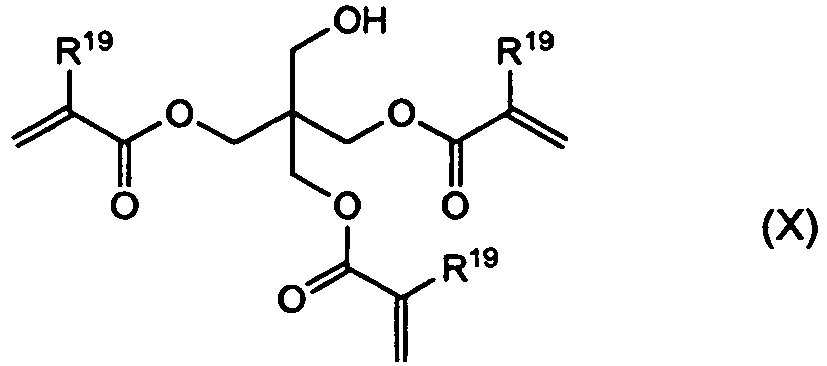
- In den allgemeinen Formeln (IX) und (X) stehen die verschiedenen Reste R18 und R19 jeweils unabhängig voneinander für Wasserstoff, Methyl oder Ethyl. In Formel (IX) nimmt n2 einen Wert von 1 bis 20 ein.
- Bevorzugt werden als polyfunktionelles Monomer (F) Monomere gemäß Formel (IX) eingesetzt, wobei die Reste R18 unabhängig voneinander für Wasserstoff oder Methyl stehen und n2 einen Wert von 1 bis 15 annimmt. In einer besonders bevorzugten Ausführungsform wird die Verbindung PEG400DA (R18=H, n2=8) eingesetzt.
- Bei den polyfunktionellen Monomeren kann es sich auch um Vinylmonomere mit mindestens einer Alkoxysilangruppe handeln wie in der allgemeinen Formel (XI) dargestellt, oder um Methylolderivate wie in der allgemeinen Formel (XII) dargestellt.

- In der allgemeinen Formel (XI) steht R20 für Wasserstoff oder Methyl, R21 und R22 stehen unabhängig voneinander für aliphatische Kohlenwasserstoffe mit vorzugsweise 1 bis 6 C-Atomen, insbesondere für Methyl oder Ethyl, Y4 steht für eine Alkylengruppe mit 1 bis 6 C-Atomen, insbesondere für Methylen oder Ethylen, und h2 ist 1, 2 oder 3.

- In der allgemeinen Formel (XII) steht R23 für Wasserstoff, Methyl oder Ethyl, V für O oder NH, W für einen Kohlenwasserstoffrest mit 1 bis 15 C-Atomen, insbesondere 1 bis 6 C-Atomen,vorzugsweise für Methylen, Ethylen, Propylen oder Butylen, Z für OR24, NHR24, COOH, Br, Epoxyethylen oder NCO und R24 für Wasserstoff oder einen Kohlenwasserstoffrest mit 1 bis 6 C-Atomen.
- Es werden Copolymere beschrieben, die erhältlich sind durch Copolymerisation folgender ethylenisch ungesättigter Monomere:
- 65 - 95 Gew.-% mindestens eines anionischen Vinylmonomers (A), vorzugsweise von AMPS;
- 0-5 Gew.-%, bevorzugt 0-2 Gew.%, mindestens eines Vinylmonomers (B) umfassend eine sekundäre oder tertiäre Aminogruppe oder eine quaternäre Ammoniumgruppe;
- 5-25 Gew.-% mindestens eines nichtionischen hydrophilen Vinylmonomers (C), vorzugsweise eines PEG-Methylether(meth)acrylats, insbesondere von PEG-Methylethermethacrylat 2080;
- 0-2 Gew.-% mindestens eines polyfunktionalen Vinylmonomers (F);
- 0-2 Gew.-% mindestens eines hydrophoben Vinylmonomers (D); und
- 0-2 Gew.-% mindestens eines Vinylmonomers (E) enthaltend mindestens eine Silikongruppe;
- wobei die Summe der Monomere (A) und (C) mehr als 80 Gew.%, bevorzugt mehr als 90 Gew.-%, beträgt und die Summe der Monomere (A), (B), (C), (D), (E) und (F) 100 Gew.-% beträgt, wobei in einer bevorzugten Ausführungsform die Summe der Monomere (A) und (C) mindestens 98 Gew.-%, bevorzugt 100 Gew.-%, beträgt.
- Es werden ferner Copolymere beschrieben, die erhältlich sind durch Copolymerisation folgender ethylenisch ungesättigter Monomere:
- 5-30 Gew.%, bevorzugt 15-25 Gew.%, mindestens eines anionischen Vinylmonomers (A), vorzugsweise von AMPS;
- 0-5 Gew.-%, bevorzugt 0-2 Gew.-%, mindestens eines Vinylmonomers (B) umfassend eine sekundäre oder tertiäre Aminogruppe oder eine quaternäre Ammoniumgruppe;
- 70 - 95 Gew.-%, bevorzugt 75 - 85 Gew.%, mindestens eines nichtionischen hydrophilen Vinylmonomers (C), vorzugsweise eines PEG-Methylether(meth)acrylats, besonders bevorzugt von PEG-Methylethermethacrylat 2080;
- 0-2 Gew.-% mindestens eines polyfunktionalen Vinylmonomers (F);
- 0-2 Gew.-% mindestens eines hydrophoben Vinylmonomers (D); und
- 0-2 Gew.-% mindestens eines Vinylmonomers (E) enthaltend mindestens eine Silikongruppe; wobei die Summe der Monomere (A) und (C) mehr als 80 Gew.-%, bevorzugt mehr als 90 Gew.-%, beträgt und die Summe der Monomere (A), (B), (C), (D), (E) und (F) 100 Gew.-% beträgt, wobei in einer bevorzugten Ausführungsform die Summe der Monomere (A) und (C) mindestens 98 Gew.-%, bevorzugt 100 Gew.-%, beträgt.
- Bevorzugt ist ein Copolymer, das erhältlich ist durch Copolymerisation folgender Monomere:
- 5-30 Gew.-%, bevorzugt 15-25 Gew.-%, vor allem 18-22 Gew.%, mindestens eines anionischen Vinylmonomers (A), vorzugsweise von AMPS;
- 70 - 95 Gew.-%, bevorzugt 75 - 85 Gew.-%, vor allem 78 - 82 Gew.-% mindestens eines nichtionischen hydrophilen Vinylmonomers (C), insbesondere eines PEG-Methylether(meth)acrylats, vorzugsweise von PEG-Methylethermethacrylat 2080,
- wobei die Summe der Monomere (A) und (C) vorzugsweise mindestens 99 Gew.-%, besonders bevorzugt 100 Gew.-% beträgt.
- Gemäß einer bevorzugten Ausführungsform werden die Copolymere in solchen Endkonzentrationen eingesetzt, dass keine biozide oder biostatische Wirksamkeit vorliegt. Ein besonderer Vorteil dieser Ausführungsform ist, dass das Risiko einer Resistenzbildung gering ist, da vorhandene Mikroorganismen weder abgetötet werden noch ihr Wachstum gehemmt wird, sondern der Effekt rein biorepulsiv ist. Die Konzentrationen, bei denen noch keine Hemmung des Wachstums vorliegt, sowie die minimalen Hemmkonzentrationen selbst können in dem Fachmann bekannter Weise einfach bestimmt werden. Experimentell konnte nachgewiesen werden, dass viele der Copolymere selbst bei Einsatz in relativ hohen Konzentrationen keine oder nur geringe bakterizide Wirkung zeigen. Darüber hinaus sind die meisten Copolymere auch aus toxikologischer Sicht, soweit nach heutigem Stand bekannt, unbedenklich.
- Ein weiterer Vorteil der Erfindung ist es, dass einige der beschriebenen Copolymere, auch im Vergleich zu herkömmlichen Bioziden oder Biostatika, bereits in geringen Endkonzentrationen wirksam sind, so dass nur wenig Substanz verwendet werden muss.
- In einer bevorzugten Ausführungsform erfolgt die Verwendung eines Copolymers als und/oder in einem Antifouling-Mittel.
- Gemäß einer bevorzugten Ausführungsform wird die Anhaftung von Mikroorganismen an Filtermedien, Klebstoffen, Baustoffen und/oder Bauhilfsstoffen vermindert.
- In einer weiteren bevorzugten Ausführungsform wird die Anhaftung von Mikroorganismen auf den Oberflächen, die häufig in Kontakt mit dem menschlichen Körper kommen, vermindert. Dabei sind insbesondere abiotische, technische (bzw. technisch hergestellte) Oberflächen gemeint. Im Sinne dieser besonderen Ausführungsform sind daher menschliches oder tierisches Gewebe nicht darunter zu verstehen.
- Gemäß einer weiteren bevorzugten Ausführungsform wird die Anhaftung von Mikroorganismen an solchen Oberflächen wie Textilien, Keramiken, Metallen, Glas und/oder Kunststoffen vermindert. Insbesondere kann es sich hierbei um Wäsche, Sanitäreinrichtungen wie Duschen, Waschbecken oder Toiletten, Bodenbeläge, Schuhe, Leder, aus Gummi hergestellte Gebrauchsgegenstände, Fensterscheiben, Gläser, Aquarien, Geschirr, Arbeitsoberflächen, Prothesen, Zahnersatz oder Küchengeräte wie Kühlschränke oder Herde handeln. Besonders bevorzugt wird hierbei die Anhaftung und/oder die Ausbildung eines Biofilms an harten Oberflächen unterdrückt und/oder vermindert, insbesondere an den zuvor genannten harten Oberflächen, besonders bevorzugt an Keramiken, vor allem im Sanitärbereich.
- Die Copolymere werden bei den genannten Anwendungen vorzugsweise auf das Material aufgebracht oder in das Material eingebracht bzw. eingearbeitet.
- Die Verminderung der Anhaftung an Textilien oder Kunststoffobertflächen vermindert das Risiko einer Reinfektion der befallenen Körperbereiche. Die Verminderung der Anhaftung von Mikroorganismen an Keramiken, Kunststoffen oder Metallen, insbesondere an Prothesen oder Zahnersatz, verringert das Infektions- bzw. Reinfektionsrisiko, ohne die Haut, die Schleimhäute oder die Abwässer mit biozid oder biostatisch bzw. virostatisch wirkenden Substanzen zu belasten. Ebenso können Katheter sowie andere aus Kunststoff oder Metallen hergestellte medizinische Geräte und/oder Prothesen durch die Verwendung von Copolymeren beispielsweise in Spülungen oder Reinigungsmitteln von der Anhaftung befreit werden.
- Zahnersatz, insbesondere Gebisse, können durch die Verwendung von erfindungsgemäßen Copolymeren in Mund-, Zahn- und/oder Zahnprothesenpflegeprodukten wirksam, einfach und ohne Belastung der behandelten Oberfläche mit stark biozid wirkenden, möglicherweise sogar bedingt toxischen Substanzen von der Mikroorganismenanhaftung befreit werden.
- In einer bevorzugten erfindungsgemäßen Ausführungsform wird die Adhäsion von Mikroorganismen dadurch unterdrückt, dass durch Eingriff in die molekulare Kommunikation der Mikroorganismen die Ausbildung eines Biofilms gehemmt wird.
- Durch die Biofilmunterdrückung lassen sich beispielsweise indirekt auch Schiffsrümpfe vor Algenbewuchs schützen. Denn der Biofilm bildet die Grundlage für die Ansiedlung von größeren Organismen wie Muscheln und Algen. Dieser Bewuchs bremst durch seinen Reibungswiderstand die Schiffe und treibt somit den Treibstoffverbrauch in die Höhe, weshalb der Belag regelmäßig aufwendig entfernt werden muss. Aus diesem Grund ist die Verwendung der Kondensationspolymere als und/oder in sogenannten Antifouling-Mitteln besonders bevorzugt.
- In einer bevorzugten Ausführungsform erfolgt die erfindungsgemäße Verwendung zur Unterdrückung von Biofilmen in Sterilisations-, Desinfektions- Imprägnier- oder Konservierungsmitteln, Wasch- oder Reinigungsmitteln, oder in Kühl- oder Kühlschmiermitteln (technische Anwendungslösungen) sowie auf dem Gebiet der Wasserreinigung / Wasserbehandlung sowie der Arzneimittel,- Lebensmittel-, Brauerei-, Medizintechnik-,Farben-, Holz-, Textil-, Kosmetik-, Leder-, Tabak-, Pelz-, Seil-, Papier-, Zellstoff-, Kunststoff-, Treibstoff-, Öl-, Kautschuk- oder Maschinenindustrie.
- In einer weiteren bevorzugten Ausführungsform erfolgt die erfindungsgemäße Verwendung zur Biofilmkontrolle somit bei medizinischen Geräten, Instrumenten und Apparaturen, insbesondere bei Kathetern und Endoskopen.
- Unter Mikroorganismen sind insbesondere Bakterien, Pilze, Protozoen, Viren und Mikroalgen zu verstehen. Dies schließt bakterielle Endo- oder Exosporen sowie Sporen, die als Fortpflanzungsstrukturen bei Pilzen dienen, mit ein. In einer bevorzugten Ausführungsform sind unter Mikroorganismen Bakterien und Pilze zu verstehen. Besonders bevorzugte Pilze sind hierbei Hefen, Schimmelpilze, Dermatophyten und keratinophile Pilze.
- Gemäß einer besonders bevorzugten Ausführungsform wird durch die Verwendung der Copolymere die Anhaftung von Bakterien vermindert, insbesondere die Anhaftung von gramnegativen und grampositiven Bakterien, vor allem die Anhaftung von pathogenen Bakterien ausgewählt aus Propionibacterium acnes, Stapylococcus aureus, Streptokokken Gruppe A (beta-hämolysierende S.), S. pyogenes, Corynebacterium spp. (insbesondere C. tenuis, C. diphtheriae, C. minutissimum), Micrococcus spp. (insbesondere M. sedentarius), Bacillus anthracis, Neisseria meningitidis, N. gonorrhoeae, Pseudomonas aeruginosa, P. pseudomallei, Borrelia burgdorferi, Treponema pallidum, Mycobacterium tuberculosis, Mycobacterium spp., Escherichia coli sowie Streptococcus spec. (insbesondere S. gordonii, S. mutans), Actinomyces spec. (insbesondere A. naeslundii), Salmonella spec., Actinobacteria (insbesondere Brachybacterium spec.), alpha-Proteobacteria (insbesondere Agrobacterium spec.), beta-Proteobacteria (insbesondere Nitrosomonas spec.), Aquabacterium spec., Hydrogenophaga, gamma-Proteobacteria, Stenotrophomonas spec., Xanthomonas spec. (campestris), Neisseria spec., Haemophilus spec. sowie alle Mikroorganismen, die von Paster et al. (J. Bac. 183 (2001) 12, 3770-3783) beschrieben werden.
- Nach einer weiteren bevorzugten Ausführungsform wird durch die Verwendung der Copolymere die Anhaftung von humanpathogenen Pilzen vermindert. Dazu sind zum Beispiel die humanpathogenen Spezies der Pilze aus den Klassen Ascomycota, Basidomycota, Deuteromycota und Zygomycota zu zählen, insbesondere alle Spezies der Gattungen Aspergillus, Penicillium, Cladosporium und Mucor sowie Stachybotrys, Phoma, Alternaria, Aureobasidium, Ulocladium, Epicoccum, Stemphyllium, Paecilomyces, Trichoderma, Scopulariopsis, Wallemia, Botrytis, Verticillium und Chaetonium sowie die humanpathogenen Formen von Candida.
- Nach einer weiteren bevorzugten Ausführungsform wird die Anhaftung von Pilzen der Spezies Rhodotorula spp., Cryptococcus spp., Exophilia spp. , Hormoconis spp. vermindert.
- Besonders bevorzugt wird erfindungsgemäß die Anhaftung der medizinisch relevanten Formen von Candida vermindert, beispielsweise von C. albicans, C. boidinii, C. catenulata, C. ciferii, C. dubliniensis, C. glabrata, C. guilliermondii, C. haemulonii, C. kefyr, C. krusei, C. lipolytica, C. lusitaniae, C. norvegensis, C. parapsilosis, C. pulcherrima, C. rugosa, C. tropicalis, C. utilis, C. viswanathii. Insbesondere bevorzugt sind C. albicans, C. stellatoidea, C. tropicalis, C. glabrata und C. parapsilosis. Die Mycel-Form von Candida wird als humanpathogene Form des Pilzes betrachtet. Eine Verminderung der Anhaftung von Candida beispielsweise an Textilien oder Kunststoffen vermindert das Risiko der Reinfektion, ohne die Bildung von Resistenzen zu erhöhen.
- Die Copolymere sind besonders bevorzugt zur Verminderung der Anhaftung aller Spezies der Gattung Aspergillus an Oberflächen geeignet, ganz besonders bevorzugt der Spezies, die ausgewählt sind aus Aspergillus aculeatus, A. albus, A. alliaceus, A. asperescens, A. awamori, A. candidus, A. carbonarius, A. carneus, A. chevalieri, A. chevalieri var. intermedius, A. clavatus, A. ficuum, A. flavipes, A. flavus, A. foetidus, A. fumigatus, A. giganteus, A. humicola, A. intermedius, A. japonicus, A. nidulans, A. niger, A. niveus, A. ochraceus, A. oryzae, A. ostianus, A. parasiticus, A. parasiticus var. globosus, A. penicillioides, A. phoenicis, A. rugulosus, A. sclerotiorum, A. sojae var. gymnosardae, A. sydowi, A. tamarii, A. terreus, A. terricola, A. toxicarius, A. unguis, A. ustus, A. versicolor, A. vitricolae und A. wentii. Besonders bevorzugt wird die Anhaftung von Aspergillus flavus und Aspergillus nidulans vermindert bzw. im Wesentlichen ganz verhindert.
- Gemäß einer weiteren Ausführungsform wird die Anhaftung von keratinophilen Pilzen ausgewählt aus Trichophyton mentagrophytes, T. rubrum, T. asteroides, T. concentrium, T. equinum, T. meginii, T. gallinae, T. tonsurans, T. schoenleinii, T. terrestre, T. verrucosum, T. violaceum, Microsporum canis, Microsporum audounii, M. gypseum, Epidermophyton flossocum, Malassezia furfur, M. sympodialis, M. globosa und M. pachydermatis vermindert.
- Gemäß einer weiteren Ausführungsform wird durch die Verwendung der Copolymere die Anhaftung von Algen, von human-, tier- und/oder pflanzenpathogenen Viren sowie von Bakteriophagen vermindert, wobei vor allem die Verminderung der Anhaftung von Grün- und Blaualgen an Fassaden und Baustoffen relevant ist. Die relevanten Vertreter der Blaualgen (Cyanobacteria) sind aus den Gattungen Anabaena, Anacystis, z.B. Anacystis montana, Gloeocapsa, Lyngbia, Nostoc, Oscillatoria, z.B. Oscillatoria lutea, Phormidium, Schiszothrix und Scytonema. Gattungen der Grünalgen (Chlorophyta) sind beispielsweise Chlorella, Choricystis, Chlamydomonas, Chlorococcum, Stichcoccus, insb. Stichcoccus bacillaris, Ulothrix und Trentepholia, insb. Trentepholia odorata.
- Mikroorganismen, die hinsichtlich der Biofilmbildung besonders relevant sind, und deren Anhaftung besonders bevorzugt vermindert wird, sind beispielsweise Aeromonaden, insbesondere Aeromonas hydrophila oder Aeromonas salmonicida, Agrobacterium, insbesondere Agrobacterium tumefaciens, Aquabakterium, Bradyrhizobium japonicum, Burkholderia cepacia, Chromobacterium violaceum, Dermacoccen, insbesondere Dermacoccus nishinomiyaensis, Enterobacter agglomerans, Erwinia carotovora, Erwinia chrysanthemi, Escherichia coli, Nitrosomona europaea, Obesumbacterium proteus, Pantoea stewartii, Pseudomonaden, insbesondere Pseudomonas aeruginosa, Pseudomonas aureofaciens, Pseudomonas fluorescens oder Pseudomonas syringae, Ralstonia solanacearum, Rhizobium, insbesondere Rhizobium etli oder Rhizobium leguminosarum, Rhodobacter sphaeroides, Salmonella enterica, Serratia, insbesondere Serratia liquefaciens, Vibrio anguillarum, Vibrio fischeri, Xanthomonas, insbesondere Xanthomonas campestris, Xenorhabdus nematophilus, Yersinia, insbesondere Yersinia enterolytica, Yersinia pestis, Yersinia pseudotuberculosis oder Yersinia ruckeri.
- Relevante Biofilmbildner im marinen Bereich, die das sogenannte Fouling auf submersen Oberflächen mitverursachen können, und deren Anhaftung und Biofilmbildung ebenfalls besonders bevorzugt vermindert wird, sind insbesondere ausgewählt aus Zooshikella gangwhensis, Pseudomonas fluorescens, Cythophaga sp. KT0803, Psychrobakter glacinola, Pseudoalteromonas carragenovora, Shewanella baltica und Bacillus subtilis.
- Die Verwendung der Copolymere erfolgt vorzugsweise in Wasch- und/oder Reinigungsmitteln.
- Die Copolymere enthaltenden Wasch- und/oder Reinigungsmittel werden im Folgenden näher erläutert.
- Die Wasch- und Reinigungsmittel können ohne Belastung der Abwässer relativ geringe Mengen an erfindungsgemäßen Copolymeren enthalten. Da sie beim Einsatz zur Reinigung von Textilien in konzentrierter Form eingesetzt und auf die entsprechend wirksamen Konzentrationen in der Waschlauge verdünnt werden, müssen die Wirkstoffe in diesem Fall in entsprechend höherer Konzentration eingesetzt werden. Üblich sind Verdünnungen der Wasch- und Reinigungsmittel mit Wasser zwischen 1:40 und 1:200.
- Das Copolymer wird erfindungsgemäß bevorzugt zu Reinigungsmitteln, die zum Säubern harter Oberflächen, wie zum Beispiel von Böden, Kacheln, Fliesen, Kunststoffen sowie anderen harten Oberflächen im Haushalt, in Toiletten, in öffentlichen sanitären Anlagen, in Schwimmbädern, Saunen, Sportanlagen oder in Arzt- oder Massagepraxen zugegeben werden.
- Unter Wasch- und Reinigungsmitteln werden im erfindungsgemäßen Zusammenhang im weitesten Sinn tensidhaltige Zubereitungen in fester Form (Partikel, Pulver usw.), halbfester Form (Pasten usw.), flüssiger Form (Lösungen, Emulsionen, Suspensionen, Gele usw.) und gasähnlicher Form (Aerosole usw.) verstanden, die im Hinblick auf eine vorteilhafte Wirkung bei der Anwendung jede beliebige Art von Tensiden enthalten können, üblicherweise neben weiteren Komponenten, die für den jeweiligen Anwendungszweck üblich sind. Beispiele für solche tensidhaltige Zubereitungen sind tensidhaltige Waschmittelzubereitungen, tensidhaltige Reinigungsmittel für harte Oberflächen, oder tensidhaltige Aviviermittelzubereitungen, die jeweils fest oder flüssig sein können, jedoch auch in einer Form vorliegen können, die feste und flüssige Komponenten oder Teilmengen der Komponenten nebeneinander umfasst.
- Die Wasch- und Reinigungsmittel können üblicherweise enthaltene Inhaltsstoffe enthalten, wie anionische, nichtionische, kationische und amphotere Tenside, anorganische und organische Buildersubstanzen, spezielle Polymere (beispielsweise solche mit Cobuildereigenschaften), Schauminhibitoren, Farbstoffe und ggf. zusätzliche Duftstoffe (Parfums), pH-Stellmittel, Verdicker, Polyethylenglykole, Bleichmittel (wie beispielsweise Peroxo-Bleichmittel und Chlor-Bleichmittel), Bleichaktivatoren, Bleichstabilisatoren, Bleichkatalysatoren, Enzyme, insbesondere Proteasen, Amylasen oder Cellulasen, Enzymstabilisatoren, Farbübertragungsinhibitoren und Vergrauungsinhibitoren, ohne dass die Inhaltsstoffe auf diese Substanzgruppen beschränkt sind. Häufig sind wichtige Inhaltsstoffe dieser Zubereitungen auch Waschhilfsmittel, für die beispielhaft und nicht beschränkend optische Aufheller, UV-Schutzsubstanzen sowie Soil Repellents, insbesondere Polymere, die einer Wiederanschmutzung von Fasern entgegenwirken, verstanden werden. Für den Fall, dass die Zubereitungen zumindest zum Teil als Formkörper vorliegen, können auch Binde- und Desintegrationshilfsmittel enthalten sein. Hinsichtlich der einzelnen Substanzgruppen wird insbesondere auf den Offenbarungsgehalt der Anmeldung
- Die Copolymere werden in erfindungsgemäßen Mitteln, insbesondere in Wasch- und/oder Reinigungsmitteln, vorzugsweise in einer Menge von 0,01 - 10 Gew.-%, besonders bevorzugt in einer Menge von 0,05 bis 2 Gew.-%, insbesondere in einer Menge von 0,1 bis 1 Gew.%, eingesetzt.
- Wasch- und/oder Reinigungsmittel können einen sauren, neutralen oder basischen pH-Wert besitzen. In einer bevorzugten erfindungsgemäßen Ausführungsform haben die Wasch- und/oder Reinigungsmittel einen pH von 0 bis 14, besonders bevorzugt von 0 bis 7, insbesondere von 1 bis 4.
- In einer besonders bevorzugten Ausführungsform enthält ein
Wasch- und/oder Reinigungsmittel, insbesondere ein Reiniger für harte Oberflächen,
0,1 bis 10 Gew.-%, vorzugsweise 0,5 bis 5 Gew.-%, insbesondere 1 bis 3 Gew.-%, mindestens eines erfindungsgemäßen Copolymers,
0,01 bis 10 Gew.-%, vorzugsweise 0,1 bis 5 Gew.-%, mindestens eines Polyethylenglycols mit einem durchschnittlichen mittleren Molekulargewicht von 200 bis 600.000 g/mol, vorzugsweise 10.000 bis 200.000 g/mol,
0,01 bis 10 Gew.-%, vorzugsweise 0,1 bis 3 Gew.-%, mindestens eines Tensids, vorzugsweise mindestens eines anionischen oder nichtionischen Tensids,
0 bis 10 Gew.-%, vorzugsweise 0,01 bis 10 Gew.-%, mindestens eines Verdickers,
0,01 bis 80 Gew.-%, vorzugsweise 0,1 bis 5 Gew.-%, mindestens eines organischen Lösungsmittels,
0,01 bis 10 Gew.%, vorzugsweise 0,1 bis 3 Gew.-%, mindestens eines komplexierenden Agens und/oder Gerüststoffs,
0,01 bis 10 Gew.%, vorzugsweise 0,2 bis 5 Gew.%, mindestens einer anorganischen oder organischen Säure,
0,001 bis 10 Gew.-%, vorzugsweise 0,01 bis 1 Gew.-%, mindestens eines Duftstoffs und
0,001 bis 10 Gew.-%, vorzugsweise 0,02 bis 1 Gew.-%, mindestens eines Farbstoffs. - In einer weiteren besonders bevorzugten Ausführungsform ist ein Wasch-und/oder Reinigungsmittel, insbesondere ein Reiniger für harte Oberflächen, dadurch gekennzeichnet,
dass die Tenside ausgewählt sind aus der Gruppe bestehend aus Alkylpolyglycoside, insbesondere C8-10-Alkyl-1,5-glucosid, Natriumlaurylethersulfat und Natriumlaurylsulfat;
dass das organische Lösungsmittel ausgewählt ist aus der Gruppe bestehend aus Alkanol, insbesondere Ethanol, Propylenglycole, Glycolether und Benzol;
dass die Gerüststoffe ausgewählt sind aus der Gruppe bestehend aus Natriumcitrat, Natriumcarbonat und Phosphonaten;
dass die Verdicker ausgewählt sind aus der Gruppe bestehend aus Polysacchariden, substitutierter Cellulose, insbesondere Hydroxypropylmethylcellulose, Poly(meth)acrylaten, Guar-Gum und Xanthan-Derivativen wie Xanthan-Gum;
und dass die Säure ausgewählt ist aus der Gruppe bestehend aus Citronensäure, Ameisensäure, Milchsäure und Amidosulfonsäure. - In einer weiteren besonders bevorzugten Ausführungsform hat ein Wasch-und/oder Reinigungsmittel, insbesondere ein Reiniger für harte Oberflächen, einen pH-Wert von 0 bis 10, vorzugsweise von 1 bis 4.
- Die pharmazeutischen Zusammensetzungen können hierbei sowohl zur Behandlung von Krankheiten als auch prophylaktisch eingesetzt werden.
- Zur Herstellung pharmazeutischer Zubereitungen lassen sich die Wirkstoffe, gegebenenfalls in Kombination mit anderen Wirksubstanzen, zusammen mit einem oder mehreren inerten üblichen Trägerstoffen und/oder Verdünnungsmitteln, z. B. mit Gelatine, Gummi arabicum, Maisstärke, Milchzucker, Rohrzucker, Sorbitol, mikrokristalliner Cellulose, Magnesiumstearat, Polyvinylpyrrolidon, Zitronensäure, Weinsäure, Wasser, Benzylalkohol, Polyalkylenglycol, Wasser/Ethanol, Wasser/Glycerin, Wasser/Sorbit, Wasser/Polyethylenglykol, Propylenglykol, Titandioxid, einem Cellulosederivat wie z.B. Carboxymethylcellulose oder fetthaltigen Substanzen wie Hartfett, Talkum oder pflanzliche Öle oder deren geeigneten Gemischen, in übliche galenische Zubereitungen wie Tabletten, Dragees, Kapseln, Pulver, Suspensionen, Tropfen, Ampullen, Säfte oder Zäpfchen einarbeiten. Gegebenenfalls können darüber hinaus Konservierungs-, Stabilisierungs-, Netzmittel, Emulgatoren oder Salze zur Veränderung des osmotischen Druckes oder Puffer enthalten sein. Als Träger können auch grenzflächenaktive Hilfsstoffe wie Salze der Gallensäuren oder tierische oder pflanzliche Phospholipide, aber auch Mischungen davon sowie Liposome oder deren Bestandteile verwendet werden.
- Die pharmazeutischen und kosmetischen Zubereitungen können neben den erfindungsgemäßen Wirkstoffen auch weitere Wirkstoffe enthalten, die die Adhäsion von Mikroorganismen verhindern. Ferner kann der Einsatz der erfindungsgemäßen Wirkstoffe gegebenenfalls auch in Kombination mit antimikrobiellen, insbesondere antibakteriellen, antimykotischen und/oder antiseptischen Wirkstoffen und/oder in Kombination mit adstringierenden Stoffen erfolgen, wobei die antimikrobiellen Wirkstoffe dann vorzugsweise in geringen Konzentrationen eingesetzt werden.
- In einer besonders bevorzugten Ausführungsform handelt es sich bei den pharmazeutischen oder kosmetischen Zubereitungen um solche zur topischen Applikation auf die Haut und deren Anhangsgebilde und/oder zur Applikation auf die Schleimhaut, insbesondere im oralen oder genitalen Bereich, bzw. zur intertriginösen Applikation. Im Folgenden werden diese Zubereitungen als "Hautbehandlungsmittel" bezeichnet.
- Bei der kosmetischen oder pharmazeutischen Zubereitung, und insbesondere bei dem Hautbehandlungsmittel, kann es sich hierbei insbesondere um eine Lotion, eine Creme, eine Emulsion, eine Salbe, eine Paste, ein Öl, eine Wachs/Fett-Masse, ein Gel, ein Puder, ein Spray bzw. Aerosol, eine Lösung, insbesondere wässrige oder alkoholische Lösung, bzw. Tinktur, um einen feuchten Verband, einen Okklusionsverband, ein Pflaster, ein Stiftpräparat, ein Haarbehandlungs-, Haarwasch- oder Haarpflegemittel, insbesondere ein Haarshampoo, eine Haarlotion, eine Haarkur oder ein Haarwasser, ein Körperpflegemittel, ein Schaumbad, ein Duschbad oder ein Fußbad handeln.
- Der physiologische Träger der Hautbehandlungsmittel umfasst vorzugsweise ein oder, in beliebiger Kombination, mehrere Hilfs- oder Zusatzstoffe, wie sie üblicherweise in solchen Zubereitungen verwendet werden, wie z.B. Fette, Öle, Überfettungsmittel, Wachse, Silikone, Emulgatoren, Dispergiermittel, Perlglanzwachse, Alkohole, Polyole, Konsistenzgeber, Stabilisatoren, Verdickungsmittel, Filmbildner, Quellmittel, Hydrotrope bzw. anfeuchtende und/oder feuchthaltende Substanzen, Polymere, Tenside, Weichmacher, Schaumbremsen, Alkalinisierungs- oder Acidifizierungsmittel, Enthärter, Adsorbentien, Lichtschutzmittel, Elektrolyte, Sequestrierungsmittel, Solubilisatoren, organische Lösungsmittel, Konservierungsmittel, keimhemmende Wirkstoffe, insbesondere Fungizide oder Bakterizide, Antioxidantien, biogene Wirkstoffe, Vitamine, Proteinhydrolysate, Mono-, Oligo- und Polysaccharide, Enzyminhibitoren, insbesondere MMP1-inhibierende Substanzen, Desodorantien bzw. Geruchsabsorber, Antitranspirantien, Antischuppenmittel, Insektenrepellentien, Selbstbräuner, α-Hydroxy- und α-Ketocarbonsäuren, Duftstoffe, Farbstoffe und/oder Pigmente.
- Die Hautbehandlungsmittel liegen bei topischer Verabreichung vorteilhafterweise in Form einer flüssigen oder festen Öl-in-Wasser-Emulsion, Wasser-in-Öl-Emulsion, Mehrfach-Emulsion, Mikroemulsion, PIT-Emulsion oder Pickering-Emulsion, in Form eines Hydrogels, eines alkhoholischen Gels, eines Lipogels, in Form einer ein- oder mehrphasigen Lösung, eines Schaumes, einer Salbe, eines Pflasters, einer Suspension, eines Puders oder einer Mischung mit mindestens einem als medizinischen Klebstoff geeigneten Polymer vor. Die Hautbehandlungsmittel können auch in wasserfreier Form, wie beispielsweise einem Öl oder einem Balsam, dargereicht werden. Hierbei kann der Träger ein pflanzliches oder tierisches Öl, ein Mineralöl, ein synthetisches Öl oder eine Mischung solcher Öle sein.
- In einer weiteren besonders bevorzugten Ausführungsform handelt es sich bei den kosmetischen und/oder pharmazeutischen Zubereitungen um solche zur oralen Applikation, wobei der Zielort der Applikation der Mund selbst ist. In einer bevorzugten Ausführungsform wird hierbei eines der zuvor beschriebenen Hautbehandlungsmittel verwendet, wobei die Zusammensetzung so gewählt wird, dass es sich bei dem Präparat um eine Mundcreme, eine Salbe, eine Tinktur oder um eine Suspension handelt. Der Begriff "pharmazeutische Zubereitungen zur oralen Applikation" umfasst hierbei neben Mund- und Zahnpflegemittel auch Prothesenreinigungsmittel, insbesondere Gebissreinigungstabletten.
- Die Mund-, Zahn- und/oder Zahnprothesenpflegemittel können beispielsweise als Mundwasser, Gel, flüssige Zahnputzlotion, steife Zahnpaste, Gebissreiniger oder Prothesenhaftcreme vorliegen. Hierzu ist es erforderlich, die verwendeten Stoffe in einen geeigneten Träger einzubringen.
- Die erfindungsgemäßen Zahnpasten und Zahngele können als Inhaltsstoffe neben den Wirkstoffen insbesondere Tenside, Putzkörper, Aromen, Süßungsmittel sowie weitere dem Fachmann bekannte Wirkstoffe enthalten. Als Träger dienen vorzugsweise Wasser und Bindemittel. Ferner können etwa auch Feuchthaltemittel, Konservierungsstoffe, Konsistenzgeber und/oder Farbpigmente enthalten sein.
- Bei den zuvor genannten weiteren Wirkstoffen, die in den Mundbehandlungsmitteln enthalten sein können, kann es sich beispielsweise um eine Fluor-Verbindung, um einen Wirkstoff gegen Plaque-Bakterien, um einen Wirkstoff gegen Zahnsteinbildung, zur Reminalisierung, gegen sensible Zähne oder zum Schutz des Zahnfleischs handeln. Des Weiteren kann es sich bei dem weiteren Wirkstoff um einen weiteren Wirkstoff zur Pilzbehandlung, insbesondere Candidosen-Behandlung, handeln.
- Weitere übliche Zusätze für die Mund-, Zahn- und/oder Zahnprothesenpflege mittel sind z.B.
- pH-Stellmittel und Puffersubstanzen wie z.B. Natriumbicarbonat, Natriumcitrat, Natriumbenzoat, Zitronensäure, Phosphorsäure oder saure Salze, z.B. NaH2PO4
- wundheilende und entzündungshemmende Stoffe wie z.B. Allantoin, Harnstoff, Panthenol, Azulen bzw. Kamillenextrakt
- weitere gegen Zahnstein wirksame Stoffe wie z.B. Organophosphonate, z.B. Hydroxyethandiphosphonate oder Azacycloheptandiphosphonat
- Konservierungsstoffe wie z.B. Sorbinsäure-Salze, Natriumbenzoat, Chlorhexidindigluconat, p-Hydroxybenzoesäure oder deren Ester.
- Plaque-Inhibitoren wie z.B. Hexachlorophen, Chlorhexidin, Hexetidin, Triclosan, Bromchlorophen, Phenylsalicylsäureester.
- 2,00 g 2-Acrylamido-2-methylpropanesulfonsäure und 16 g Polyethylenglycol-methacrylat 2080 (50% Lsg in Wasser) wurden in einen 250 ml-Kolben eingewogen und in 62 g entionisiertem Wasser gelöst. Die Reaktionsmischung wurde entgast und die folgende Reaktion unter Stickstoffzufuhr durchgeführt. Anschließend wurde der Inhalt des Kolbens auf 65°C erhitzt. Danach wurde eine Lösung von 0,2 g 2,2',-azobis(2-amidinopropan)-dihydrochlorid (V50) in 0,8 g Wasser hinzugegeben. Die so entstandene Mischung wurde für eine Stunde bei 75°C gerührt und anschließend eine weitere Stunde bei 80 °C. Auf diese Weise wurde eine viskose Polymerlösung erhalten. Das so erhaltene Reaktionsprodukt kann anschließend zur Entfernung von Resten an Monomeren der Dialyse unterzogen werden. Alternativ kann während der Reaktion ein Nachinitiierungsschritt durchgeführt werden.
- Für den Fall, dass hydrophobere Monomere verwendet werden, kann eine Verwendung von Tensiden und Dispergierhilfsmitteln hilfreich sein. Ebenso kann der pH-Wert der Reaktion schon vor der Polymerisation eingestellt werden oder aber nach der Reaktion vor Durchführung von Anwendungstests. Es können auch andere wasserlösliche Initiatoren verwendet werden, die thermolabil sind, alternativ können auch Redoxpaare oder Photoinitiatoren verwendet werden.
- Auf ähnliche Weise wurden folgende weitere Polymere erhalten (Anteile jeweils in Gew.-%): Mischungen aus
MAPTAC : AMPS : PEG-MA 2080 : MAA : Geniosil XL 34 = 2 : 76,3 : 12,1 : 8,0 : 1,6 (Verbindung 9007-012)
PEG-MA 475 : AMPS = 6,4 : 93,6 (Verbindung 8406-108)
PEG-MA 2080 : AMPS : DMAPMA: PEG-dimethacrylat M330 = 23,5 : 74,6 : 1,5: 0,4 (Verbindung 8389-115)
PEG-MA 2080 : AMPS : MAPTAC : MA = 11,3 : 71,7 : 1,9 : 15,1 (Verbindung 9007-001) PEG-MA 2080 : AMPS : MAPTAC : MA = 12 : 76 : 4 : 8 (Verbindung 8389-094)
PEG-MA 2080 : AMPS : MAPTAC : PEG-dimethacrylat M330 = 13,2: 83,7 : 2,2 : 0,9 (Verbindung 8389-036)
PEG-MA 2080 : AMPS : MAPTAC : MA = 21,8 : 69,1 : 1,8 : 7,3 (Verbindung 8389-181)
PEG-MA 2080 : AMPS : MAPTAC : MA = 12,2 : 77,6 : 2 : 8,2 (Verbindung 8844-046)
PEG-MA 1100 : AMPS : MAPTAC : MA = 21,8 : 69,1 : 1,8 : 7,3 (Verbindung 8844-048)
PEG-MA 2080 : AMPS = 10 : 90 (Verbindung 8844-004)
PEG-MA 2080 : AMPS, Natriumsalz : MAPTAC : MA = 8,9 : 71,3 : 1,8 : 18 (Verbindung 8406-102) - Im Folgenden sind die verwendeten Monomere dargestellt:
- Monomere (A)
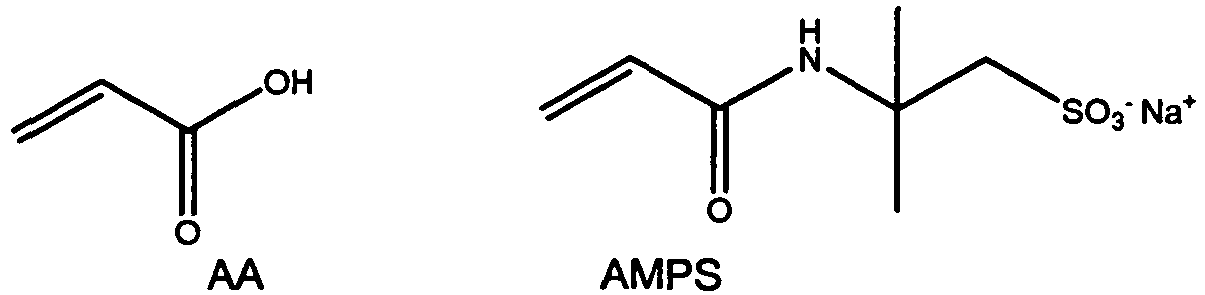
- Monomere (B)

- Monomere (C)

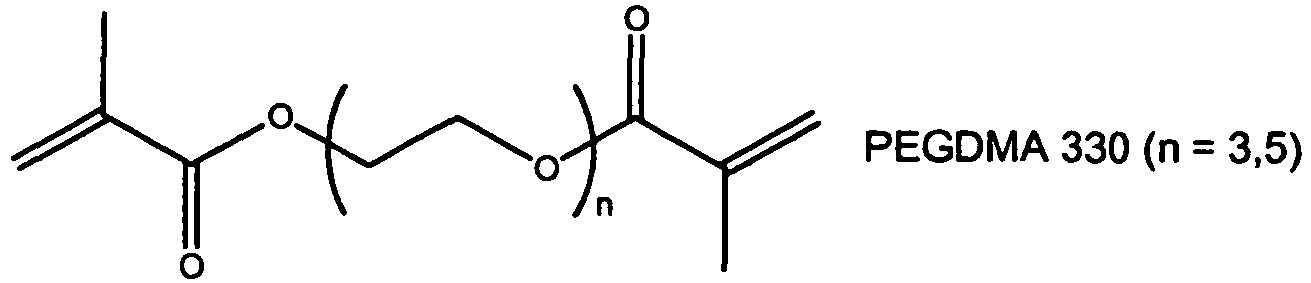
- Geniosil XL 34
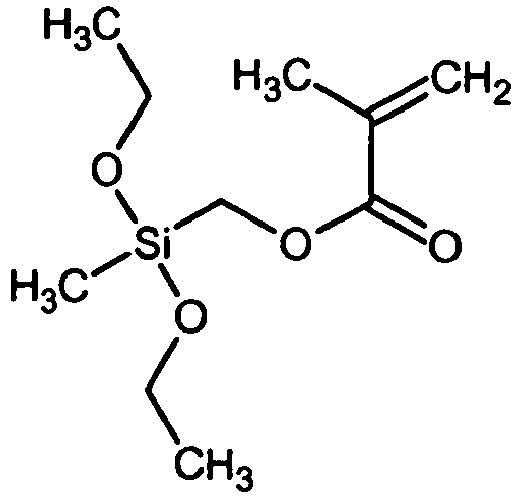
- Zum Vergleich der biorepulsiven Leistung von Polymerfilmen auf harten Oberflächen, die Relevanz im Haushalt haben wie z. B. Keramik, Kunststoff, Edelstahl und Glas, wurden die Polymere zunächst in einem Screening-Ansatz untersucht. Es wurden dazu Adhäsionstests für Mikroorganismen (hier: Staphylococcus aureus DSM799 und Pseudomonas aeruginosa DSM939) durchgeführt. Hierzu wurden Prüfkörper (Glas, Kunststoff, Keramik, Edelstahl) vom Format 18x18 bis 20x20 mm zunächst mit 70 %igem Methylalkohol für 10 Minuten desinfiziert und danach mit sterilem und destilliertem Wasser gewaschen und getrocknet. Die so vorbereiteten Prüfmuster wurden mit einer Keimsuspension, die zusätzlich eine entsprechende Polymerkonzentration enthielt, überschichtet und für 1 Stunde inkubiert. Anschließend wurden die Keimsuspensionen abgesaugt und die Prüfkörper 2 mal gewaschen. Nach Überführen in sterile Prüfplatten wurden die Prüfkörper für S. aureus mit Nähragar überschichtet und anschließend für 48 Stunden bei 30 °C inkubiert. Für P. aeruginosa wurden die Prüfkörper in Puffer geschüttelt, anschließend mit Nähragar plus 10 % TZC überschichtet und anschließend für 24 Stunden bei 30 °C inkubiert. Die Schüttelflüssigkeit wurde über eine Membran filtriert und die Filter auf Caso-Agar für 24 Stunden bei 30 °C inkubiert. Das Ausmaß von Keimwachstum, das auf die Besiedelung der Prüfkörper mit Keimen zurück schließen lässt, wird relativ zu einem Ansatz ohne Polymer jedoch mit entsprechenden Lösungsmittelanteil in % angegeben. Dabei wird die Keimbelastung des Kontroll- Prüfkörpers als 100 % gesetzt. Tabelle 1 zeigt die bestwirkenden Polymere im Screening-Adhäsionstest, wobei ein wirksamer Effekt immer als eine mindestens 50%ige Keimverminderung im Vergleich zur Kontrolle definiert wird. Die besten Polymere haben eine breite biorepulsive Wirkung gegenüber beiden Prüfkeimen bei möglichst allen Oberflächen und wirken optimal schon bei Konzentrationen unter 1%.
- In diesem Test zeigten alle Polymere aus Beispiel 1 eine gute Wirkung, wobei sehr gute Ergebnisse hinsichtlich der getesteten Mikroorganismen auf folgenden Oberflächen erhalten wurden (G, T, K und S stehen hierbei für Glas (G), Kunststoff (T), Keramik (K) und Edelstahl (S)):
- 9007-012: P. aeruginosa (G, T, K, S); S. aureus (G, T, K, S)
- 8406-108: P. aeruginosa (G, T, K, S); S. aureus (G, T)
- 8389-115: P. aeruginosa (G, T, K, S); S. aureus (G, K)
- 9007-001: P. aeruginosa (G, T, K, S); S. aureus (T)
- 8389-094: P. aeruginosa (G, T, K, S); S. aureus (T)
- 8389-036: P. aeruginosa (G, T, K, S)
- 8389-181: P. aeruginosa (G, T, K, S)
- 8844-046: P. aeruginosa (G, T)
- 8844-048: P. aeruginosa (G, T)
- 8844-004: :P. aeruginosa (T, K)
- 9007-009: P. aeruginosa (T, K)
- 8406-102: P. aeruginosa (T, K)
- Um Wechselwirkungen der gelösten Polymere mit den Prüfkeimen im Versuchsansatz auszuschließen, wurde die Wirkung ausgewählter Polymere direkt auf der Oberfläche getestet. Die Polymere wurden folgendermaßen immobilisiert: 1%ige Polymerlösung in Ethanol, 40µl dieser Polymer-Lösung wurden auf Oberflächen (Kunststoff und Keramik) aufgetragen und 24 Stunden bei Raumtemperatur getrocknet (Kontrolle: nur Ethanol). Die so vorbereiteten Prüfmuster wurden mit einer Keimsuspension von S. aureus überschichtet und für 1 Stunde inkubiert. Das Ausmaß von Keimwachstum, das auf die Besiedelung der Prüfkörper mit Keimen zurück schließen lässt, wird relativ zu einem mit der Vergleichszusammensetzung beschichteten Prüfkörper in % angegeben. Dabei wird die Keimbelastung des mit der Vergleichszusammensetzung beschichteten Prüfkörpers als 100 % gesetzt. Es zeigte sich, dass die meisten immobilisierten Polymere die gleiche Wirkung zeigten wie in gelöster Form. In
Fig. 1 sind beispielhaft die Ergebnisse für die Polymere 9007-009, 8844-048, 8406-102 und 8406-108 dargestellt. Es ist zu erkennen, dass die Polymere eine deutliche Adhäsionsreduktion bewirken. - Die Polymere, die im vereinfachten Testverfahren eine deutliche Keimreduktion (insbesondere auf Keramik) gezeigt haben, wurden anschließend in einem anwendungsnahen Testsystem untersucht, welches vom Aufbau die Funktion einer Toilette simuliert. Zum Vergleich der biorepulsiven Leistung von Polymerfilmen auf WC-Keramiken ist es erforderlich, einheitliche Testbedingungen festzulegen. Zu diesem Zweck wurde ein Testverfahren inklusive Keimbelastung entwickelt, das den realen Bedingungen in der Toilette entspricht. Wie in der realen Toilette erfolgte die Wasserspülung aus einem Wassertank über der Testkachel durch das Öffnen eines Ventils. Die Krümmung der Toilettenschüssel wurde mittels einer schiefen Ebene mit einem Winkel von 45° und planaren Testkacheln der Fa. Villeroy & Boch (15x15 cm2) nachgestellt. Die Sprinkleranlage diente dazu, die Testkacheln möglichst homogen mit 150 ml sterilem Brauchwasser pro Sekunde zu benetzen. Pro Spülgang wurde in der Regel 900 ml Wasser verwendet. Die Testkachel wurde vor dem Versuch mit Ethanol behandelt, anschließend mit dem zu testenden Polymer versetzt (2 ml unverdünntes Polymer wurde mit Zellstoff auf der Kachel verrieben) und danach waagerecht zur Ausbildung des Polymerfilms für 60 Minuten bei Raumtemperatur getrocknet. Danach wurde die auf Schräge positionierte Kachel mit einer S. aureus-Suspension (104 Keime in 100 ml Kochsalzlösung) homogen belastet und 10 min bei Raumtemperatur inkubiert. Zur Beurteilung der antiadhäsiven Wirkung wurde die Kachel mit sterilem Brauchwasser über die Sprinkleranlage benetzt. Zur Erfassung der verbliebenen Restkeimzahl auf der Kachel erfolgte nach dem Spülvorgang ein mittiger RODAC-Abklatsch auf der Kachel. Die Spülschritte inklusive der jeweils erneuten Keimanschmutzung und die damit verbundenen RODAC-Analysen wurden für jedes zu testende Polymer wiederholt, um die biorepulsive Wirkung auch nach mehrfacher Spülung (also Auslaugung) zu überprüfen. Die RODAC-Platten wurden über Nacht bei 37°C inkubiert und anschließend quantitativ ausgewertet.
- Es wurde nach den Spülschritten überraschenderweise gefunden, dass durch bestimmte Polymere eine signifikante Verminderung der Adhäsion von Mikroorganismen an die Keramik auch über mehrere Spülschritte erreicht werden konnte. Trotz Auslaugung der Polymerschicht auf der Kacheloberfläche zeigte insbesondere das binäre AMPS/PEG-Polymer 9007-009 (
Fig. 2 , pro Spülschritt jeweils der rechte Balken) eine über 90%ige Verminderung der Keimanhaftung auch nach 10 Spülvorgängen. Das Polymer 8406-108 hingegen (pro Spülschritt jeweils der mittlere Balken) zeigte beim ersten Spülgang eine noch bessere Wirkung als 9007-009, jedoch ging diese Wirkung bereits beim zweiten Spülgang vollständig verloren, was darauf hindeutet, dass das Polymer mit dem ersten Spülgang vollständig abgewaschen wird. - Parallel wurden die Keramik-Kacheln in einem fast automatisch laufenden, sehr anwendungsnahen WC-Reaktor untersucht, welcher vom Aufbau die Funktion einer Toilette simuliert. Dieses System erlaubt es, Adhäsion und Biofilmbildung in einem Testsystem auf mehreren unterschiedlichen Oberflächen über einen kurzen sowie längeren Zeitraum (hier: Gesamtlaufzeit von drei Tagen) zu untersuchen. Zudem handelt es sich im Gegensatz zum Mikrotiterplatten-System um ein dynamisches System, da laufend frisches Medium (TBY / DGHM-Wasser 1:50) über die Kacheln geleitet wird. Weiterhin fallen die Oberflächen phasenweise trocken und werden anschließend wieder mit Flüssigkeit überschichtet. Dieser Wechsel ähnelt sehr stark den Abläufen in einer Toilette, wo die Keramik-Oberflächen ebenfalls abwechselnd benetzt werden und wieder abtrocknen können. Die im Reaktor erzeugten Biofilme entsprechen hinsichtlich Stärke und Homogenität denen aus Mikrotiterplatten.
Der Reaktor wurde zunächst mit 680ml Medium befüllt und mit einem Keimgemisch, bestehend aus Dermacoccus nishinomiyaensis DSMZ 20448, Bradyrhizobium japonicum DSMZ 1982 und Xanthomonas campestris DSMZ 1526, welches in wässrigen Umgebungen einen stabilen Biofilm bildet, angeimpft. Die Inkubation erfolgte über Nacht, damit sich die Keimflora in dem System etablieren konnte. Wie in der realen Toilette erfolgte die Wasserspülung aus einem Vorratsgefäß durch das Öffnen eines Magnetventils, das wiederum über eine Zeitschaltuhr gesteuert wurde. Die Krümmung der Toilettenschüssel wurde durch Festklemmen der Kacheln mittels eines Adapters im Reaktorinnenraum nachgestellt. Pro Spülgang wurde in der Regel ca. 600 ml Wasser verwendet. Am ersten und zweiten Tag nach der Inkubation wurde jeweils 15 Mal gespült, wobei der einzelne Spülgang 20 Minuten dauerte. Die ersten Kacheln wurden morgens am ersten Tag entnommen, nachdem noch keine bzw. wenige Spülungen vorlagen. Die zweite Entnahme erfolgte am Nachmittag nach den Spülungen, über Nacht war der Reaktor mit Medium gefüllt, ohne dass Spülungen erfolgten. Die waagerecht platzierten Kacheln wurden vor Einspannen im Reaktor mit einem handelsüblichen WC-Reiniger enthaltend 10%ige Polymerlösung besprüht, wobei pro Kachel jeweils 6 Sprühstöße verwendet wurden. Die Keramik-Kacheln wurden nach Entnahme aus dem Reaktor bei Raumtemperatur getrocknet und anschließend mit je 6ml 0,01 %ige SafraninOLösung 15 Minuten angefärbt. Danach wurde die Färbelösung abgesaugt, mit bidestiliertem Wasser nicht-gebundener Farbstoff von den Kacheln entfernt und die gefärbten Kacheln getrocknet. Die angefärbten und getrockneten Oberflächen der Kacheln wurden eingescannt und mit Corel Draw Paint 9 ausgewertet. Die Ergebnisse für das Polymer 9007-009 sind inFig. 3 im Vergleich zu einer unbehandelten Oberfläche sowie im Vergleich zu einer nur mit WC-Reiniger behandelten Oberfläche dargestellt. Es ist zu erkennen, dass der WC-Reiniger mit Polymer eine deutliche Reduktion des Biofilms nicht nur gegenüber der Kontrollkachel, die weder mit Polymer noch mit WC-Reiniger behandelt wurde, sondern auch gegenüber der Kachel, die nur mit WC-Reiniger behandelt wurde, bewirkt. Es war nach über 65h eine noch nahezu 70%ige Biofilm-Reduktion im Vergleich zur nicht beschichteten Kontrolle zu erkennen. - 1 Gew.-% eines Copolymers (vorzugsweise bestehend aus 20 Gew.% AMPS und 80 Gew.-% PEG-MA 2080), 3 Gew.-% Citronensäure, 0,5 Gew.-% Ameisensäure, 0,5 Gew.-% Kelzan ASX-T (Xanthan Gum von CP Kelco), 3 Gew.-% Ethanol, 1 Gew.% Texapon NSO (Laurylethersulfat, Natriumsalz von Cognis France SA.), 0,002 Gew.% Patent Blue (Farbstoff) und 0,02 Gew.-% eines Duftstoffs.
- 2 Gew.% eines Copolymers (vorzugsweise bestehend aus 20 Gew.% AMPS und 80 Gew.% PEG-MA 2080), 3 Gew.% Citronensäure, 2 Gew.% ethanol, 1 Gew.-% Texapon NSO (Laurylethersulfat, Natriumsalz von Cognis France SA.), 0,002 Gew.% Patent Blue (Farbstoff) und 0.02 Gew.% eines Duftstoffs.
- 1 Gew.-% eines Copolymers (vorzugsweise bestehend aus 20 Gew.-% AMPS und 80 Gew.-% PEG-MA 2080), 1 Gew.% Monoethanolamin (MEA), 2 Gew.% Ethanol, 0,6 Gew.-% Texapon LS 35 (Fettalkoholsulfat, Natriumsalz von Cognis Deutschland GmbH), 0,002 Gew.-% Patent Blue (Farbstoff) und 0,02 Gew.-% eines Duftstoffs.
- In
Fig. 1 sind die Ergebnisse des in Beispiel 3 beschriebenen Adhäsionsversuchs dargestellt. Die genannten Polymere wurden auf Kunststoffoberflächen aufgetragen und anschließend untersucht, wie stark die Adhäsion von Staphylococcus aureus im Vergleich zu einer unbehandelten Kunststoffoberfläche ist. Die Menge an adhärierten Bakterien wurde in Prozent dargestellt, wobei die Adhäsion an die unbehandelte Oberfläche auf 100 % gesetzt wurde. - In
Fig. 2 sind die Ergebnisse des in Beispiel 4 beschriebenen Adhäsionsversuchs im anwendungsnahen Labortest mit Staphylococcus aureus auf mit Polymer beschichteten Keramik-Kacheln für die Polymere 9007-009 (jeweils rechter Balken) und 8406-108 (jeweils mittlerer Balken) im Vergleich zu einer nicht mit Polymer behandelten Referenz (jeweils linker Balken), die auf 100 % gesetzt wurde, dargestellt. Während mit dem Polymer 9007-009 auch nach drei Spülgängen noch eine deutliche Reduktion der Adhäsion von Staphylococcus aureus bewirkt werden konnte, zeigte das Polymer 8406-108 nur beim ersten Spülgang eine fast vollständige Reduktion der Adhäsion von Staphylococcus aureus, was dadurch zu erklären ist, dass das Polymer 8406-108 bereits im ersten Spülgang mit abgespült wird, während das Polymer 9007-009 semipermanent an der Oberfläche haftet. - In
Fig. 3 sind die Ergebnisse des in Beispiel 5 beschriebenen Adhäsionsversuchs im anwendungsnahen Labortest mit einem Biofilm im WC-Reaktor auf Keramik-Oberflächen und unter Verwendung des Polymers 9007-009 dargestellt. Angegeben sind die Ergebnisse nach 41,5; 48 und 65,5 Stunden Inkubation. Die Menge an an die weder mit WC-Reiniger noch mit Polymer behandelten Kacheln adhärierten Zellen wurde jeweils auf 100 % gesetzt. Es ist zu erkennen, dass nach 48 und 65,5 Stunden Inkubation die Menge an an die mit Polymer-haltigem WC-Reiniger behandelten Kacheln adhärierten Zellen deutlich reduziert ist sowohl gegenüber den Kacheln, die weder mit WC-Reiniger noch mit Polymer behandelt wurden als auch gegenüber den Kacheln, die nur mit handelsüblichem WC-Reiniger behandelt wurden.
"K" bezeichnet jeweils die Kontrollkachel ohne Polymer und WC-Produkt; "WC" bezeichnet jeweils die nur mit handelsüblichem WC-Reiniger behandelte Kachel, "WC+P" bezeichnet jeweils die Kachel, die mit WC-Reinger enthaltend eine 10%ige Polymerlösung behandelt wurde.
Claims (7)
- Verwendung eines Copolymers aus ethylenisch ungesättigten Monomeren zur Verminderung der Anhaftung von Mikroorganismen und/oder zur Verminderung der Ausbildung von Biofilmen an Oberflächen, dadurch gekennzeichnet, dass die copolymerisierten ethylenisch ungesättigten Monomere ausgewählt sind aus:5 - 95 Gew.-% mindestens eines anionischen Vinylmonomers (A);0 - 50 Gew.-% mindestens eines Vinylmonomers (B) umfassend eine sekundäre oder tertiäre Aminogruppe oder eine quaternäre Ammoniumgruppe;5 - 95 Gew.-% mindestens eines nichtionischen hydrophilen Vinylmonomers (C); und/oder0 - 15 Gew.% mindestens eines polyfunktionalen Vinylmonomers (F); sowie0 - 30 Gew.% mindestens eines hydrophoben Vinylmonomers (D); und0 - 20 Gew.% mindestens eines Vinylmonomers (E) enthaltend Silikogruppen;wobei die Summe der Monomere (A), (B), (C), (D), (E) und (F) 100 Gew.-% beträgt.
- Verwendung nach Anspruch 1, dadurch gekennzeichnet, dass die copolymerisierten ethylenisch ungesältigten Monomere ausgewählt sind aus:65 - 95 Gew.% mindestens eines anionischen Vinylmonomers (A);0 - 5 Gew.-% mindestens eines Vinylmonomers (B) umfassend eine sekundäre oder tertiäre Aminogruppe oder eine quaternäre Ammoniumgruppe;5 - 25 Gew.-% mindestens eines nichtionischen hydrophilen Vinylmonomers (C); und/oder0 - 2 Gew.-% mindestens eines polyfunktionalen Vinylmonomers (F); sowie0 - 2 Gew.% mindestens eines hydrophoben Vinylmonomers (D); und0 - 2 Gew.-% mindestens eines Vinylmonomers (E) enthaltend Silikogruppen;wobei die Summe der Monomere (A), (B), (C), (D), (E) und (F) 100 Gew.-% beträgt.
- Verwendung nach Anspruch 1, dadurch gekennzeichnet, dass die copolymerisierten ethylenisch ungesättigten Monomere ausgewählt sind aus5 - 30 Gew.% mindestens eines anionischen Vinylmonomers (A);0 - 5 Gew.-% mindestens eines Vinylmonomers (B) umfassend eine sekundäre oder tertiäre Aminogruppe oder eine quaternäre Ammoniumgruppe;70 - 95 Gew.% mindestens eines nichtionischen hydrophilen Vinylmonomers (C); und/oder0 - 2 Gew.% mindestens eines polyfunktionalen Vinylmonomers (F); sowie0 - 2 Gew.% mindestens eines hydrophoben Vinylmonomers (D); und0 - 2 Gew.-% mindestens eines Vinylmonomers (E) enthaltend Silikogruppen;wobei die Summe der Monomere (A), (B), (C), (D), (E) und (F) 100 Gew.-% beträgt.
- Verwendung nach einem der Ansprüche 2 oder 3, dadurch gekennzeichnet, dass die Summe der Monomere (A) und (C) mindestens 98 % beträgt.
- Verwendung nach einem der Ansprüche 1 bis 4, dadurch gekennzeichnet, dass das Copolymer ein durchschnittliches Molgewicht von 10000 bis 1000000 g/mol aufweist.
- Verwendung nach einem der Ansprüche 1 bis 5, dadurch gekennzeichnet, dass- das anionische Vinylmonomer (A) ausgewählt ist aus der Gruppe bestehend aus Acrylsäure (AA); Methacrylsäure (MAA); einem Monomer der allgemeinen Formel (I)


sowie beliebigen Alkalisalzen, Ammoniumsalzen, Monoethanolaminsalzen sowie Triethylaminsalzen der zuvor genannten Verbindungen und vorzugsweise ausgewählt ist aus der Gruppe bestehend aus 2-Acrylamido-2-methylpropansulfonsäure (AMPS), Methacrylsäure (MAA) und Acrylsäure (AA);- das Vinylmonomer mit sekundärer oder tertiärer Aminogruppe oder quaternärer Ammoniumgruppe (B) ausgewählt ist aus der Gruppe bestehend aus Monomeren der allgemeinen Formel (III)
Monomeren der allgemeinen Formel (IV)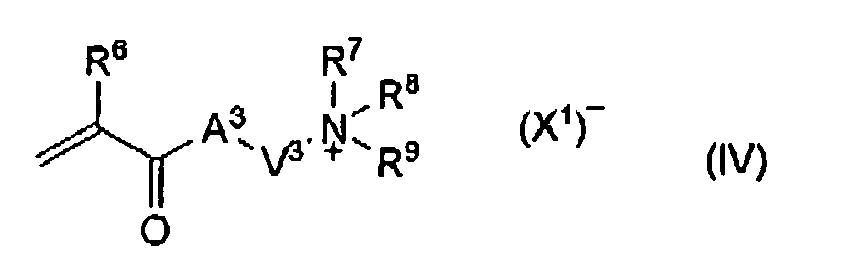
Monomeren der allgemeinen Formel (V)
vorzugsweise ist (B) ausgewählt aus der Gruppe bestehend aus Methacryl-amidopropyltrimethylammoniumchlorid (MAPTAC), Acrylamidopropyl-trimethyammoniumchlorid (AAPTAC), Dimethylaminoethyl-methacrylat (DM), Methacryloxy-aminoethyltrimethylammoniumchlorid (DMC), Dimethylaminopropylacrylamid (DMAPA) und Dimethylaminopropyl-methacrylamid (DMAPMA);- es sich bei dem hydrophilen Vinylmonomer (C) um ein Monomer der allgemeinen Formel (VI) handelt - es sich bei dem hydrophoben Vinylmonomer (D) um ein Monomer der allgemeinen Formel (VII) handelt
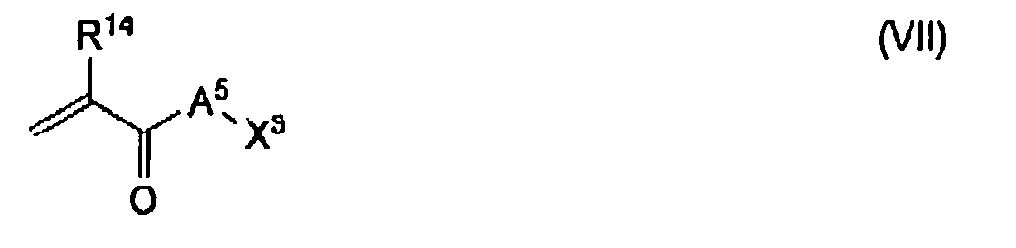 - es sich bei den Vinylmonomeren mit Silikongruppe (E) um Monomere der allgemeinen Formel (VIII) handelt
 - das polyfunktionale Vinylmonomer (F) ausgewählt ist aus der Gruppe bestehend aus den Monomeren der allgemeinen Formeln (IX), (X), (XI) und (XII)


- Verwendung nach einem der vorhergehenden Ansprüche, dadurch gekennzeichnet, dass das Copolymer ausschließlich durch Copolymerisation ethylenisch ungesättigter Monomere (A) und (C) erhalten wurde.
Priority Applications (1)
| Application Number | Priority Date | Filing Date | Title |
|---|---|---|---|
| PL08856076T PL2215134T3 (pl) | 2007-12-03 | 2008-11-21 | Zmniejszenie się tworzenia błonek biologicznych za pomocą wielofunkcyjnych kopolimerów |
Applications Claiming Priority (2)
| Application Number | Priority Date | Filing Date | Title |
|---|---|---|---|
| DE102007058342A DE102007058342A1 (de) | 2007-12-03 | 2007-12-03 | Verminderung der Biofilmbildung durch multifunktionelle Copolymere |
| PCT/EP2008/065972 WO2009071451A2 (de) | 2007-12-03 | 2008-11-21 | Verminderung der biofilmbildung durch multifunktionelle copolymere |
Publications (2)
| Publication Number | Publication Date |
|---|---|
| EP2215134A2 EP2215134A2 (de) | 2010-08-11 |
| EP2215134B1 true EP2215134B1 (de) | 2014-01-08 |
Family
ID=40430121
Family Applications (1)
| Application Number | Title | Priority Date | Filing Date |
|---|---|---|---|
| EP08856076.8A Not-in-force EP2215134B1 (de) | 2007-12-03 | 2008-11-21 | Verminderung der biofilmbildung durch multifunktionelle copolymere |
Country Status (5)
| Country | Link |
|---|---|
| US (1) | US20100249249A1 (de) |
| EP (1) | EP2215134B1 (de) |
| DE (1) | DE102007058342A1 (de) |
| PL (1) | PL2215134T3 (de) |
| WO (1) | WO2009071451A2 (de) |
Families Citing this family (12)
| Publication number | Priority date | Publication date | Assignee | Title |
|---|---|---|---|---|
| DE102009001693A1 (de) | 2009-03-20 | 2010-09-23 | Henkel Ag & Co. Kgaa | 4-Aminopyridin-Derivate als Katalysatoren für die Spaltung organischer Ester |
| EP2408895B1 (de) | 2009-03-20 | 2016-03-09 | Henkel AG & Co. KGaA | Verwendung von polymeren mit carboxylgruppen in kombination mit zweiwertigen kationen zur ausbildung einer schutzschicht |
| DE102010038340A1 (de) * | 2010-07-23 | 2012-01-26 | Henkel Ag & Co. Kgaa | Verhinderung der bakteriellen Adhäsion |
| DE102011119332A1 (de) | 2011-11-25 | 2013-05-29 | Centrum Für Angewandte Nanotechnologie (Can) Gmbh | Verwendung von über radikalische Emulsionspolymerisation erhältlichen Polymeren als Verdicker für Reinigungsmittel |
| DE102012221196A1 (de) * | 2012-11-20 | 2014-05-22 | Henkel Ag & Co. Kgaa | Anti-adhäsive Polymere zur mikrobiell-repulsiven Textilausrüstung |
| MX367955B (es) | 2014-12-19 | 2019-09-12 | Colgate Palmolive Co | Composición oral para el blanqueamiento dental. |
| EP3196283B1 (de) * | 2016-01-21 | 2018-06-20 | Henkel AG & Co. KGaA | Die primärwaschkraft verbessernde polymere wirkstoffe |
| IT201800004475A1 (it) * | 2018-04-13 | 2019-10-13 | Composizione detergente | |
| WO2021122709A1 (en) * | 2019-12-18 | 2021-06-24 | Basf Se | Textile coated with malodor reducing polymers |
| BR112022016985A2 (pt) | 2020-02-28 | 2022-10-25 | Catexel Tech Limited | Método de degradação |
| CN111269760B (zh) * | 2020-03-31 | 2021-07-02 | 广州立白企业集团有限公司 | 赋予洗涤后织物长效抗菌和抑制异味效能的洗涤剂组合物及异味评价方法 |
| GB202416639D0 (en) * | 2024-11-12 | 2024-12-25 | Innospec Ltd | Method, composition, product and use |
Family Cites Families (21)
| Publication number | Priority date | Publication date | Assignee | Title |
|---|---|---|---|---|
| US3234258A (en) | 1963-06-20 | 1966-02-08 | Procter & Gamble | Sulfation of alpha olefins |
| DE3413571A1 (de) | 1984-04-11 | 1985-10-24 | Hoechst Ag, 6230 Frankfurt | Verwendung von kristallinen schichtfoermigen natriumsilikaten zur wasserenthaertung und verfahren zur wasserenthaertung |
| JPH0339310A (ja) * | 1989-07-05 | 1991-02-20 | Teraguchi Sangyo Kk | ポリヘキサメチレンビグアナイド塩を含有するエマルジョンの製法及び該エマルジョンを含有する繊維用抗菌防臭加工剤 |
| YU221490A (sh) | 1989-12-02 | 1993-10-20 | Henkel Kg. | Postupak za hidrotermalnu izradu kristalnog natrijum disilikata |
| US5075041A (en) | 1990-06-28 | 1991-12-24 | Shell Oil Company | Process for the preparation of secondary alcohol sulfate-containing surfactant compositions |
| DE4400024A1 (de) | 1994-01-03 | 1995-07-06 | Henkel Kgaa | Silikatische Builder und ihre Verwendung in Wasch- und Reinigungsmitteln sowie Mehrstoffgemische für den Einsatz auf diesem Sachgebiet |
| DE4426215A1 (de) | 1994-07-23 | 1996-01-25 | Merck Patent Gmbh | Ketotricyclo [5.2.1.0] decan-Derivate |
| DE4426216A1 (de) | 1994-07-23 | 1996-01-25 | Merck Patent Gmbh | Benzyliden-Norcampher-Derivate |
| GB9419091D0 (en) | 1994-09-22 | 1994-11-09 | Cerestar Holding Bv | Process for decreasing the build up of inorganic incrustations on textiles and detergent composition used in such process |
| GB9503474D0 (en) | 1995-02-22 | 1995-04-12 | Ciba Geigy Ag | Compounds and their use |
| DE19539846C1 (de) | 1995-10-26 | 1996-11-21 | Henkel Kgaa | Esterquats |
| ES2188883T3 (es) | 1996-07-08 | 2003-07-01 | Ciba Sc Holding Ag | Derivados de triazina como filtro uv en productos antisolares. |
| DE19712033A1 (de) | 1997-03-21 | 1998-09-24 | Basf Ag | Photostabile UV-Filter enthaltende kosmetische und pharmazeutische Zubereitungen |
| DE19839054A1 (de) | 1998-08-28 | 2000-03-02 | Forschungszentrum Juelich Gmbh | Verfahren zur Effizienzsteigerung von Tensiden bei simultaner Unterdrückung lamellarer Mesophasen sowie Tenside, welchen ein Additiv beigefügt ist |
| FR2810261B1 (fr) * | 2000-06-15 | 2002-08-30 | Coatex Sa | Utilisation de copolymeres faiblement anioniques comme agent dispersant et/ou d'aide au broyage de suspension aqueuse de matieres minerales, suspensions aqueuses obtenues et leurs utilisations |
| JP2002327102A (ja) * | 2000-12-01 | 2002-11-15 | Clariant Gmbh | アクリロイルジメチルタウリン酸をベースとするコポリマーおよび相乗作用添加物を含有する組成物 |
| DE10059828A1 (de) * | 2000-12-01 | 2002-06-13 | Clariant Gmbh | Kammförmige Copolymere auf Basis von Acryloyldimethyltaurinsäure |
| DE10059822A1 (de) * | 2000-12-01 | 2002-06-13 | Clariant Gmbh | Saure kosmetische, pharmazeutische und dermatologische Mittel |
| EP1781717B1 (de) * | 2004-07-10 | 2012-11-07 | Henkel AG & Co. KGaA | Copolymerhaltige reinigungsmittel |
| DE102006007004A1 (de) * | 2006-02-15 | 2007-08-16 | Construction Research & Technology Gmbh | Wasserlösliche sulfogruppenhaltige Copolymere, Verfahren zu deren Herstellung und ihre Verwendung |
| CA2663308A1 (en) * | 2006-09-13 | 2008-03-20 | Lubrizol Advanced Materials, Inc. | Label adhesive and activation method for polymeric label |
-
2007
- 2007-12-03 DE DE102007058342A patent/DE102007058342A1/de not_active Withdrawn
-
2008
- 2008-11-21 WO PCT/EP2008/065972 patent/WO2009071451A2/de not_active Ceased
- 2008-11-21 EP EP08856076.8A patent/EP2215134B1/de not_active Not-in-force
- 2008-11-21 PL PL08856076T patent/PL2215134T3/pl unknown
-
2010
- 2010-06-03 US US12/792,876 patent/US20100249249A1/en not_active Abandoned
Also Published As
| Publication number | Publication date |
|---|---|
| EP2215134A2 (de) | 2010-08-11 |
| WO2009071451A3 (de) | 2009-10-01 |
| WO2009071451A2 (de) | 2009-06-11 |
| US20100249249A1 (en) | 2010-09-30 |
| DE102007058342A1 (de) | 2009-06-04 |
| PL2215134T3 (pl) | 2014-06-30 |
Similar Documents
| Publication | Publication Date | Title |
|---|---|---|
| EP2215134A2 (de) | Verminderung der biofilmbildung durch multifunktionelle copolymere | |
| EP1633193B1 (de) | Mittel gegen mikroorganismen enthaltend patchouliöl, patchoulialkohol und/oder dessen derivate | |
| EP1692250B1 (de) | Adhäsionshemmung von mikroorganismen durch nichtionische tenside | |
| DE60013837T2 (de) | Ein wasserlösliches oder wasserdispergierbares polymer enthaltendes reinigungsmittel | |
| EP1399118B1 (de) | Verwendung von kosmetischen Zubereitungen für die Rasur mittels eines Elektrorasiergerätes | |
| WO2015000971A1 (de) | Gelförmige polymerzusammensetzung, erhalten durch polymerisation eines säuregruppenhaltigen monomers in gegenwart einer polyetherverbindung | |
| RU2008110179A (ru) | Очищающие композиции, содержащие пленку | |
| JP2014520199A (ja) | 広範囲抗菌剤としてのアルキルアミノアルキルオリゴマー | |
| DE3336760A1 (de) | Milde reinigungszusammensetzung | |
| DE102005014293A1 (de) | Verdickungsmittel auf Basis von Amingruppen enthaltenden Polymeren | |
| WO2009150090A2 (de) | Kosmetische zubereitungen zur verminderung des hautgeruchs | |
| CN116583259A (zh) | 适于治疗痤疮的方法和组合物 | |
| EP1273567A2 (de) | Betainester | |
| EP0185007A2 (de) | Mischung zur Pflege und Reinigung von Kontaktlinsen | |
| WO2009071452A2 (de) | Verminderung der adhäsion von schmutz, staub und biologischem material durch polyesteramide | |
| DE102007030406A1 (de) | Verminderung der Adhäsion von biologischem Material durch Algenextrakte | |
| EP2931382A2 (de) | Wirkstoffkombination zur hautaufhellung i | |
| DE10327138A1 (de) | Hemmung der asexuellen Vermehrung von Pilzen | |
| DE102004028018A1 (de) | Verwendung von Stoffen, die Terpene und/oder Duftstoffalkohole freisetzen, zur Hemmung der Adhäsion von Mikroorganismen | |
| DE60014512T2 (de) | Zusammensetzung zur Behandlung der Haare und der Kopfhaut gegen Schuppen auf der Basis eines Wirkstoffs gegen Schuppen und einer Hydroxysäure | |
| WO2012010700A1 (de) | Verhinderung der bakteriellen adhäsion | |
| WO2004110148A1 (de) | Hemmung der asexuellen vermehrung von pilzen durch eugenol und/oder dessen derivate | |
| DE10327136A1 (de) | Hemmung der asexuellen Vermehrung von Pilzen durch Eugenol und/oder dessen Derivate | |
| WO2002017724A1 (de) | Antimikrobiell wirksame depotformulierungen | |
| DE10327134A1 (de) | Adhäsionshemmung von Mikroorganismen |
Legal Events
| Date | Code | Title | Description |
|---|---|---|---|
| PUAI | Public reference made under article 153(3) epc to a published international application that has entered the european phase |
Free format text: ORIGINAL CODE: 0009012 |
|
| 17P | Request for examination filed |
Effective date: 20100428 |
|
| AK | Designated contracting states |
Kind code of ref document: A2 Designated state(s): AT BE BG CH CY CZ DE DK EE ES FI FR GB GR HR HU IE IS IT LI LT LU LV MC MT NL NO PL PT RO SE SI SK TR |
|
| AX | Request for extension of the european patent |
Extension state: AL BA MK RS |
|
| DAX | Request for extension of the european patent (deleted) | ||
| 17Q | First examination report despatched |
Effective date: 20121213 |
|
| GRAP | Despatch of communication of intention to grant a patent |
Free format text: ORIGINAL CODE: EPIDOSNIGR1 |
|
| INTG | Intention to grant announced |
Effective date: 20130801 |
|
| GRAS | Grant fee paid |
Free format text: ORIGINAL CODE: EPIDOSNIGR3 |
|
| GRAA | (expected) grant |
Free format text: ORIGINAL CODE: 0009210 |
|
| AK | Designated contracting states |
Kind code of ref document: B1 Designated state(s): AT BE BG CH CY CZ DE DK EE ES FI FR GB GR HR HU IE IS IT LI LT LU LV MC MT NL NO PL PT RO SE SI SK TR |
|
| REG | Reference to a national code |
Ref country code: GB Ref legal event code: FG4D Free format text: NOT ENGLISH |
|
| REG | Reference to a national code |
Ref country code: CH Ref legal event code: EP |
|
| REG | Reference to a national code |
Ref country code: IE Ref legal event code: FG4D Free format text: LANGUAGE OF EP DOCUMENT: GERMAN |
|
| REG | Reference to a national code |
Ref country code: AT Ref legal event code: REF Ref document number: 648714 Country of ref document: AT Kind code of ref document: T Effective date: 20140215 |
|
| REG | Reference to a national code |
Ref country code: DE Ref legal event code: R096 Ref document number: 502008011208 Country of ref document: DE Effective date: 20140220 |
|
| REG | Reference to a national code |
Ref country code: NL Ref legal event code: VDEP Effective date: 20140108 |
|
| REG | Reference to a national code |
Ref country code: LT Ref legal event code: MG4D |
|
| REG | Reference to a national code |
Ref country code: PL Ref legal event code: T3 |
|
| REG | Reference to a national code |
Ref country code: HU Ref legal event code: AG4A Ref document number: E019790 Country of ref document: HU |
|
| PG25 | Lapsed in a contracting state [announced via postgrant information from national office to epo] |
Ref country code: LT Free format text: LAPSE BECAUSE OF FAILURE TO SUBMIT A TRANSLATION OF THE DESCRIPTION OR TO PAY THE FEE WITHIN THE PRESCRIBED TIME-LIMIT Effective date: 20140108 Ref country code: NO Free format text: LAPSE BECAUSE OF FAILURE TO SUBMIT A TRANSLATION OF THE DESCRIPTION OR TO PAY THE FEE WITHIN THE PRESCRIBED TIME-LIMIT Effective date: 20140408 Ref country code: IS Free format text: LAPSE BECAUSE OF FAILURE TO SUBMIT A TRANSLATION OF THE DESCRIPTION OR TO PAY THE FEE WITHIN THE PRESCRIBED TIME-LIMIT Effective date: 20140508 |
|
| PG25 | Lapsed in a contracting state [announced via postgrant information from national office to epo] |
Ref country code: ES Free format text: LAPSE BECAUSE OF FAILURE TO SUBMIT A TRANSLATION OF THE DESCRIPTION OR TO PAY THE FEE WITHIN THE PRESCRIBED TIME-LIMIT Effective date: 20140108 Ref country code: CY Free format text: LAPSE BECAUSE OF FAILURE TO SUBMIT A TRANSLATION OF THE DESCRIPTION OR TO PAY THE FEE WITHIN THE PRESCRIBED TIME-LIMIT Effective date: 20140108 Ref country code: NL Free format text: LAPSE BECAUSE OF FAILURE TO SUBMIT A TRANSLATION OF THE DESCRIPTION OR TO PAY THE FEE WITHIN THE PRESCRIBED TIME-LIMIT Effective date: 20140108 Ref country code: PT Free format text: LAPSE BECAUSE OF FAILURE TO SUBMIT A TRANSLATION OF THE DESCRIPTION OR TO PAY THE FEE WITHIN THE PRESCRIBED TIME-LIMIT Effective date: 20140508 Ref country code: SE Free format text: LAPSE BECAUSE OF FAILURE TO SUBMIT A TRANSLATION OF THE DESCRIPTION OR TO PAY THE FEE WITHIN THE PRESCRIBED TIME-LIMIT Effective date: 20140108 Ref country code: FI Free format text: LAPSE BECAUSE OF FAILURE TO SUBMIT A TRANSLATION OF THE DESCRIPTION OR TO PAY THE FEE WITHIN THE PRESCRIBED TIME-LIMIT Effective date: 20140108 |
|
| PG25 | Lapsed in a contracting state [announced via postgrant information from national office to epo] |
Ref country code: LV Free format text: LAPSE BECAUSE OF FAILURE TO SUBMIT A TRANSLATION OF THE DESCRIPTION OR TO PAY THE FEE WITHIN THE PRESCRIBED TIME-LIMIT Effective date: 20140108 Ref country code: HR Free format text: LAPSE BECAUSE OF FAILURE TO SUBMIT A TRANSLATION OF THE DESCRIPTION OR TO PAY THE FEE WITHIN THE PRESCRIBED TIME-LIMIT Effective date: 20140108 |
|
| REG | Reference to a national code |
Ref country code: DE Ref legal event code: R097 Ref document number: 502008011208 Country of ref document: DE |
|
| PG25 | Lapsed in a contracting state [announced via postgrant information from national office to epo] |
Ref country code: RO Free format text: LAPSE BECAUSE OF FAILURE TO SUBMIT A TRANSLATION OF THE DESCRIPTION OR TO PAY THE FEE WITHIN THE PRESCRIBED TIME-LIMIT Effective date: 20140108 Ref country code: DK Free format text: LAPSE BECAUSE OF FAILURE TO SUBMIT A TRANSLATION OF THE DESCRIPTION OR TO PAY THE FEE WITHIN THE PRESCRIBED TIME-LIMIT Effective date: 20140108 Ref country code: CZ Free format text: LAPSE BECAUSE OF FAILURE TO SUBMIT A TRANSLATION OF THE DESCRIPTION OR TO PAY THE FEE WITHIN THE PRESCRIBED TIME-LIMIT Effective date: 20140108 Ref country code: EE Free format text: LAPSE BECAUSE OF FAILURE TO SUBMIT A TRANSLATION OF THE DESCRIPTION OR TO PAY THE FEE WITHIN THE PRESCRIBED TIME-LIMIT Effective date: 20140108 |
|
| PLBE | No opposition filed within time limit |
Free format text: ORIGINAL CODE: 0009261 |
|
| STAA | Information on the status of an ep patent application or granted ep patent |
Free format text: STATUS: NO OPPOSITION FILED WITHIN TIME LIMIT |
|
| PG25 | Lapsed in a contracting state [announced via postgrant information from national office to epo] |
Ref country code: SK Free format text: LAPSE BECAUSE OF FAILURE TO SUBMIT A TRANSLATION OF THE DESCRIPTION OR TO PAY THE FEE WITHIN THE PRESCRIBED TIME-LIMIT Effective date: 20140108 |
|
| 26N | No opposition filed |
Effective date: 20141009 |
|
| REG | Reference to a national code |
Ref country code: DE Ref legal event code: R097 Ref document number: 502008011208 Country of ref document: DE Effective date: 20141009 |
|
| PG25 | Lapsed in a contracting state [announced via postgrant information from national office to epo] |
Ref country code: SI Free format text: LAPSE BECAUSE OF FAILURE TO SUBMIT A TRANSLATION OF THE DESCRIPTION OR TO PAY THE FEE WITHIN THE PRESCRIBED TIME-LIMIT Effective date: 20140108 |
|
| PG25 | Lapsed in a contracting state [announced via postgrant information from national office to epo] |
Ref country code: BE Free format text: LAPSE BECAUSE OF NON-PAYMENT OF DUE FEES Effective date: 20141130 Ref country code: MC Free format text: LAPSE BECAUSE OF FAILURE TO SUBMIT A TRANSLATION OF THE DESCRIPTION OR TO PAY THE FEE WITHIN THE PRESCRIBED TIME-LIMIT Effective date: 20140108 Ref country code: LU Free format text: LAPSE BECAUSE OF FAILURE TO SUBMIT A TRANSLATION OF THE DESCRIPTION OR TO PAY THE FEE WITHIN THE PRESCRIBED TIME-LIMIT Effective date: 20141121 |
|
| REG | Reference to a national code |
Ref country code: CH Ref legal event code: PL |
|
| GBPC | Gb: european patent ceased through non-payment of renewal fee |
Effective date: 20141121 |
|
| PG25 | Lapsed in a contracting state [announced via postgrant information from national office to epo] |
Ref country code: LI Free format text: LAPSE BECAUSE OF NON-PAYMENT OF DUE FEES Effective date: 20141130 Ref country code: CH Free format text: LAPSE BECAUSE OF NON-PAYMENT OF DUE FEES Effective date: 20141130 |
|
| REG | Reference to a national code |
Ref country code: IE Ref legal event code: MM4A |
|
| PG25 | Lapsed in a contracting state [announced via postgrant information from national office to epo] |
Ref country code: IE Free format text: LAPSE BECAUSE OF NON-PAYMENT OF DUE FEES Effective date: 20141121 Ref country code: GB Free format text: LAPSE BECAUSE OF NON-PAYMENT OF DUE FEES Effective date: 20141121 |
|
| REG | Reference to a national code |
Ref country code: FR Ref legal event code: PLFP Year of fee payment: 8 |
|
| REG | Reference to a national code |
Ref country code: AT Ref legal event code: MM01 Ref document number: 648714 Country of ref document: AT Kind code of ref document: T Effective date: 20141121 |
|
| PG25 | Lapsed in a contracting state [announced via postgrant information from national office to epo] |
Ref country code: AT Free format text: LAPSE BECAUSE OF NON-PAYMENT OF DUE FEES Effective date: 20141121 |
|
| PG25 | Lapsed in a contracting state [announced via postgrant information from national office to epo] |
Ref country code: BG Free format text: LAPSE BECAUSE OF FAILURE TO SUBMIT A TRANSLATION OF THE DESCRIPTION OR TO PAY THE FEE WITHIN THE PRESCRIBED TIME-LIMIT Effective date: 20140108 |
|
| PG25 | Lapsed in a contracting state [announced via postgrant information from national office to epo] |
Ref country code: GR Free format text: LAPSE BECAUSE OF FAILURE TO SUBMIT A TRANSLATION OF THE DESCRIPTION OR TO PAY THE FEE WITHIN THE PRESCRIBED TIME-LIMIT Effective date: 20140409 |
|
| PG25 | Lapsed in a contracting state [announced via postgrant information from national office to epo] |
Ref country code: TR Free format text: LAPSE BECAUSE OF FAILURE TO SUBMIT A TRANSLATION OF THE DESCRIPTION OR TO PAY THE FEE WITHIN THE PRESCRIBED TIME-LIMIT Effective date: 20140108 Ref country code: MT Free format text: LAPSE BECAUSE OF FAILURE TO SUBMIT A TRANSLATION OF THE DESCRIPTION OR TO PAY THE FEE WITHIN THE PRESCRIBED TIME-LIMIT Effective date: 20140108 |
|
| REG | Reference to a national code |
Ref country code: FR Ref legal event code: PLFP Year of fee payment: 9 |
|
| PGFP | Annual fee paid to national office [announced via postgrant information from national office to epo] |
Ref country code: FR Payment date: 20161118 Year of fee payment: 9 Ref country code: HU Payment date: 20161115 Year of fee payment: 9 |
|
| PGFP | Annual fee paid to national office [announced via postgrant information from national office to epo] |
Ref country code: IT Payment date: 20161123 Year of fee payment: 9 Ref country code: PL Payment date: 20161025 Year of fee payment: 9 |
|
| PGFP | Annual fee paid to national office [announced via postgrant information from national office to epo] |
Ref country code: DE Payment date: 20171121 Year of fee payment: 10 |
|
| PG25 | Lapsed in a contracting state [announced via postgrant information from national office to epo] |
Ref country code: HU Free format text: LAPSE BECAUSE OF NON-PAYMENT OF DUE FEES Effective date: 20171122 |
|
| REG | Reference to a national code |
Ref country code: FR Ref legal event code: ST Effective date: 20180731 |
|
| PG25 | Lapsed in a contracting state [announced via postgrant information from national office to epo] |
Ref country code: IT Free format text: LAPSE BECAUSE OF NON-PAYMENT OF DUE FEES Effective date: 20171121 Ref country code: FR Free format text: LAPSE BECAUSE OF NON-PAYMENT OF DUE FEES Effective date: 20171130 |
|
| PG25 | Lapsed in a contracting state [announced via postgrant information from national office to epo] |
Ref country code: PL Free format text: LAPSE BECAUSE OF NON-PAYMENT OF DUE FEES Effective date: 20171121 |
|
| REG | Reference to a national code |
Ref country code: DE Ref legal event code: R119 Ref document number: 502008011208 Country of ref document: DE |
|
| PG25 | Lapsed in a contracting state [announced via postgrant information from national office to epo] |
Ref country code: DE Free format text: LAPSE BECAUSE OF NON-PAYMENT OF DUE FEES Effective date: 20190601 |