EP2206908A1 - Engine-torque control during gear shifting for a vehicle with an automatic transmission - Google Patents
Engine-torque control during gear shifting for a vehicle with an automatic transmission Download PDFInfo
- Publication number
- EP2206908A1 EP2206908A1 EP10150079A EP10150079A EP2206908A1 EP 2206908 A1 EP2206908 A1 EP 2206908A1 EP 10150079 A EP10150079 A EP 10150079A EP 10150079 A EP10150079 A EP 10150079A EP 2206908 A1 EP2206908 A1 EP 2206908A1
- Authority
- EP
- European Patent Office
- Prior art keywords
- torque
- engine
- gear
- automatic transmission
- value
- Prior art date
- Legal status (The legal status is an assumption and is not a legal conclusion. Google has not performed a legal analysis and makes no representation as to the accuracy of the status listed.)
- Granted
Links
- 230000005540 biological transmission Effects 0.000 title claims abstract description 70
- 230000002265 prevention Effects 0.000 claims description 17
- 238000001514 detection method Methods 0.000 claims description 12
- 230000009471 action Effects 0.000 claims description 9
- 238000000034 method Methods 0.000 claims description 4
- 230000008569 process Effects 0.000 claims description 4
- 230000001133 acceleration Effects 0.000 claims description 2
- 230000009467 reduction Effects 0.000 abstract description 10
- 230000004044 response Effects 0.000 abstract description 2
- 239000012530 fluid Substances 0.000 description 9
- 230000007704 transition Effects 0.000 description 5
- 239000000446 fuel Substances 0.000 description 4
- 238000002347 injection Methods 0.000 description 4
- 239000007924 injection Substances 0.000 description 4
- 230000007423 decrease Effects 0.000 description 3
- 238000010521 absorption reaction Methods 0.000 description 1
- 230000008859 change Effects 0.000 description 1
- 230000000881 depressing effect Effects 0.000 description 1
- 230000000994 depressogenic effect Effects 0.000 description 1
- 238000010586 diagram Methods 0.000 description 1
- 238000007562 laser obscuration time method Methods 0.000 description 1
- 230000007257 malfunction Effects 0.000 description 1
- 230000004048 modification Effects 0.000 description 1
- 238000012986 modification Methods 0.000 description 1
- 230000035939 shock Effects 0.000 description 1
Images



Classifications
-
- F—MECHANICAL ENGINEERING; LIGHTING; HEATING; WEAPONS; BLASTING
- F02—COMBUSTION ENGINES; HOT-GAS OR COMBUSTION-PRODUCT ENGINE PLANTS
- F02D—CONTROLLING COMBUSTION ENGINES
- F02D41/00—Electrical control of supply of combustible mixture or its constituents
- F02D41/02—Circuit arrangements for generating control signals
- F02D41/021—Introducing corrections for particular conditions exterior to the engine
- F02D41/0215—Introducing corrections for particular conditions exterior to the engine in relation with elements of the transmission
- F02D41/023—Introducing corrections for particular conditions exterior to the engine in relation with elements of the transmission in relation with the gear ratio shifting
-
- F—MECHANICAL ENGINEERING; LIGHTING; HEATING; WEAPONS; BLASTING
- F16—ENGINEERING ELEMENTS AND UNITS; GENERAL MEASURES FOR PRODUCING AND MAINTAINING EFFECTIVE FUNCTIONING OF MACHINES OR INSTALLATIONS; THERMAL INSULATION IN GENERAL
- F16H—GEARING
- F16H61/00—Control functions within control units of change-speed- or reversing-gearings for conveying rotary motion ; Control of exclusively fluid gearing, friction gearing, gearings with endless flexible members or other particular types of gearing
- F16H61/14—Control of torque converter lock-up clutches
- F16H61/143—Control of torque converter lock-up clutches using electric control means
-
- F—MECHANICAL ENGINEERING; LIGHTING; HEATING; WEAPONS; BLASTING
- F16—ENGINEERING ELEMENTS AND UNITS; GENERAL MEASURES FOR PRODUCING AND MAINTAINING EFFECTIVE FUNCTIONING OF MACHINES OR INSTALLATIONS; THERMAL INSULATION IN GENERAL
- F16H—GEARING
- F16H63/00—Control outputs from the control unit to change-speed- or reversing-gearings for conveying rotary motion or to other devices than the final output mechanism
- F16H63/40—Control outputs from the control unit to change-speed- or reversing-gearings for conveying rotary motion or to other devices than the final output mechanism comprising signals other than signals for actuating the final output mechanisms
- F16H63/50—Signals to an engine or motor
-
- F—MECHANICAL ENGINEERING; LIGHTING; HEATING; WEAPONS; BLASTING
- F02—COMBUSTION ENGINES; HOT-GAS OR COMBUSTION-PRODUCT ENGINE PLANTS
- F02D—CONTROLLING COMBUSTION ENGINES
- F02D2200/00—Input parameters for engine control
- F02D2200/02—Input parameters for engine control the parameters being related to the engine
- F02D2200/023—Temperature of lubricating oil or working fluid
-
- F—MECHANICAL ENGINEERING; LIGHTING; HEATING; WEAPONS; BLASTING
- F02—COMBUSTION ENGINES; HOT-GAS OR COMBUSTION-PRODUCT ENGINE PLANTS
- F02D—CONTROLLING COMBUSTION ENGINES
- F02D2250/00—Engine control related to specific problems or objectives
- F02D2250/18—Control of the engine output torque
- F02D2250/26—Control of the engine output torque by applying a torque limit
-
- F—MECHANICAL ENGINEERING; LIGHTING; HEATING; WEAPONS; BLASTING
- F02—COMBUSTION ENGINES; HOT-GAS OR COMBUSTION-PRODUCT ENGINE PLANTS
- F02D—CONTROLLING COMBUSTION ENGINES
- F02D2400/00—Control systems adapted for specific engine types; Special features of engine control systems not otherwise provided for; Power supply, connectors or cabling for engine control systems
- F02D2400/12—Engine control specially adapted for a transmission comprising a torque converter or for continuously variable transmissions
-
- F—MECHANICAL ENGINEERING; LIGHTING; HEATING; WEAPONS; BLASTING
- F02—COMBUSTION ENGINES; HOT-GAS OR COMBUSTION-PRODUCT ENGINE PLANTS
- F02D—CONTROLLING COMBUSTION ENGINES
- F02D41/00—Electrical control of supply of combustible mixture or its constituents
- F02D41/02—Circuit arrangements for generating control signals
- F02D41/021—Introducing corrections for particular conditions exterior to the engine
- F02D41/0215—Introducing corrections for particular conditions exterior to the engine in relation with elements of the transmission
- F02D41/022—Introducing corrections for particular conditions exterior to the engine in relation with elements of the transmission in relation with the clutch status
-
- F—MECHANICAL ENGINEERING; LIGHTING; HEATING; WEAPONS; BLASTING
- F16—ENGINEERING ELEMENTS AND UNITS; GENERAL MEASURES FOR PRODUCING AND MAINTAINING EFFECTIVE FUNCTIONING OF MACHINES OR INSTALLATIONS; THERMAL INSULATION IN GENERAL
- F16H—GEARING
- F16H59/00—Control inputs to control units of change-speed- or reversing-gearings for conveying rotary motion
- F16H59/36—Inputs being a function of speed
- F16H59/46—Inputs being a function of speed dependent on a comparison between speeds
- F16H2059/465—Detecting slip, e.g. clutch slip ratio
Definitions
- the present invention relates to an engine-torque controlling apparatus for which an engine and an automatic transmission are connected to each other through a torque converter including a lock-up clutch, and which controls a torque of the engine so as to prevent a frictional engagement member of the automatic transmission from slipping,
- a transitional input torque is calculated by subtracting, from an engine torque, an inertial torque from the engine to the device of the drive-train system, and if the transitional input torque exceeds an allowable torque of said device, the engine torque is reduced.
- engine-torque-reduction control means executes an engine-torque-reduction control so as to prevent engagement elements, such as a clutch and a brake, in a power train of an automatic transmission from slipping if an excessive engine torque acts on the engagement elements.
- the maximum value of the allowable engine revolutions for the time while the engine-torque-reduction control means is operating properly is calculated with the torque ratio of a torque converter taken into consideration, and if the actual engine revolutions exceed the maximum value of the allowable engine revolutions, the system determines that the engine-torque-reduction control means malfunctions.
- Each of the systems disclosed in Patent Documents 1 and 2 calculates the limiter value of the engine torque without taking account of the engagement state of the lock-up clutch of the torque converter, the temperature of the oil for the automatic transmission, or the gear selected by the automatic transmission. Accordingly, if the slipping of the frictional engagement members has to be prevented reliably, the engine torque is likely to be reduced more than necessary.
- An object of the present invention is to minimize the amount of engine-torque reduction while reliably preventing the slipping of frictional engagement members of an automatic transmission, when an engine-torque-reduction control is executed to prevent the slipping of the frictional engagement members.
- an engine-torque controlling apparatus for which an engine and an automatic transmission are connected to each other through a torque converter including a lock-up clutch, and which controls a torque of the engine so as to prevent a frictional engagement member of the automatic transmission from slipping
- the engine-torque controlling apparatus characterized by comprising: lock-up-clutch engagement state determination means for determining an engagement state of the lock-up clutch; gear-shifting state determination means for determining a gear-shifting state of the automatic transmission; oil-temperature detection means for detecting a temperature of oil of the automatic transmission; engine-revolutions detection means for detecting engine revolutions; torque-limiter-value calculation means for calculating a torque limiter value of a torque capable of being outputted by the engine without causing any slipping of the frictional engagement member; and engine-torque control means for controlling a torque of the engine on the basis of the torque limiter value, the engine-torque controlling apparatus characterized in that the torque
- the engine-torque controlling apparatus wherein switching of the torque limiter values from one to another based on the gear-shifting state is carried out while a phase of a gear-shifting process is being transitioned from a torque phase to an inertial phase.
- the torque-limiter-value calculation means further includes: a slip-prevention torque-limiter-value calculation means for calculating a torque limiter value for slip prevention that can be outputted by the engine to the automatic transmission based on the engine revolutions, the temperature of the oil for the automatic transmission, the gear-shifting state of the automatic transmission, and the engagement state of the lock-up clutch; a stalling torque-limiter-value calculation means for outputting a torque limiter value at a time of stalling of the torque converter; a double-pedaling-action torque-limiter-value calculation means for outputting a torque limiter value at a time of double pedaling action of a brake pedal and an acceleration pedal; and a low-selection means for selecting the lowest value of the torque limiter value for slip prevention, the torque limiter value at the time of stalling, and the torque limiter value at the time of double pedaling action as the torque limiter
- an electronic control unit Ue of an engine of an embodiment corresponds to engine-torque control means of the present invention.
- the torque-limiter-value calculation means for calculating a torque limiter value which is a torque capable of being outputted by the engine without causing any slipping of the frictional engagement members of the automatic transmission calculates the torque limiter value on the basis of, as parameters, the engagement state of the lock-up clutch, the temperature of the oil for the automatic transmission, the engine revolutions, and the gear-shifting state of the automatic transmission. Accordingly, even if the slip limit of the frictional engagement members changes in response to the changes of the parameters, the minimum required reduction in the torque can be made according to the slip limit. Consequently, while the frictional engagement members can be reliably prevented from slipping, the reduction in the torque can be minimized.
- the torque limiter values are switched from one to another on the basis of the gear-shifting state while the torque phase transitions to the inertial phase in the gear-shifting process. Accordingly, even while the automatic transmission is executing a gear-shifting operation, an optimal torque-reduction control can be executed by use of the torque limiter value appropriate for the actual gear-shifting state.
- the torque-limiter-value calculation means further includes: a slip-prevention torque-limiter-value calculation means, a stalling torque-limiter-value calculation means, a double-pedaling-action torque-limiter-value calculation means, and a low-selection means for selecting the lowest value of the torque limiter value for slip prevention, the torque limiter value at the time of stalling, and the torque limiter value at the time of double pedaling action as the torque limiter value. Accordingly, the frictional engagement members can be reliably prevented from slipping based on different conditions mentioned above while the reduction in the torque can be minimized.
- FIGS. 1 to 9 show an embodiment of the present invention:
- a torque converter T includes: a pump impeller 12 connected to an output shaft 11 (crankshaft) of an engine E; a turbine runner 14 connected to an input shaft 13 (main shaft) of an automatic transmission M; a stator 17 supported by a casing 15 with a one-way clutch 16; and a lock-up clutch 18 capable of connecting the pump impeller 12 and the turbine runner 14 with each other.
- the lock-up clutch 18 includes a clutch piston 20 capable of contacting an inner surface of a torque-converter cover 19.
- a first fluid chamber 21 and a second fluid chamber 22 are formed respectively at the two sides of the clutch piston 20.
- Hydraulic-pressure controlling means 23 for supplying hydraulic pressures to control the lock-up clutch 18 is provided to the first and the second fluid chambers 21 and 22.
- the hydraulic-pressure controlling means 23 includes a hydraulic pump and a hydraulic-pressure control valve, and is controlled by an electronic control unit Ut in which a vehicle speed V, an engine revolution NE, a speed ratio of the torque converter T, a transmission ratio of the automatic transmission M, and the like are inputted.
- Controlling the difference between the pressure of the first fluid chamber 21 and that of the second fluid chamber 22 allows the slipping of the torque-converter cover 19 and the facing 20a of the clutch piston 20 to take place, and thus makes it possible to arbitrarily control the speed ratio of the torque converter T.
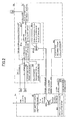
- the electronic control unit Ut of the automatic transmission M includes torque-limiter-value calculation means M1 and gear-shifting requiring torque calculation means M2.
- the torque-limiter-value calculation means M1 calculates a torque limiter value that is an upper limit of the torque that can be outputted by the engine E to the automatic transmission M within a degree that the slipping of the gear-shifting clutch does not take place.
- the gear-shifting requiring torque calculation means M2 calculates a torque required at the gear shifting so as to reduce, down to the minimum level, the shock caused when the automatic transmission M performs gear shifting.
- the torque-limiter-value calculation means M1 includes: slip-prevention torque-limiter-value calculation means M1a; stalling torque-limiter-value calculation means M1b; double-pedaling-action torque-limiter-value calculation means M1c; and low-selection means M1d.
- engine-revolutions detection means Sa for detecting engine revolutions
- oil-temperature detection means Sb for detecting the temperature of the oil for the automatic transmission M
- gear-shifting-state determination means Sc for determining the gear-shifting state (i.e., the selected gear and the gear-shifting phase) of the automatic transmission M
- lock-up-clutch engagement state determination means Sd for determining the engagement state of the lock-up clutch 18.
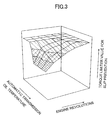
- the slip-prevention torque-limiter-value calculation means M1a calculates, by map searching, a torque limiter value for slip prevention that can be outputted by the engine E to the automatic transmission M within a degree that the slipping of the gear-shifting clutch does not take place.
- the map on which the calculation of the torque limiter value for slip prevention is based uses, as parameters, the temperature of the oil for the automatic transmission M and the engine revolutions.
- the map is set up in the following way: as the oil temperature rises, the torque limiter value for slip prevention decreases; and in addition, as the engine revolutions increase, the torque limiter value for slip prevention increases.
- Different maps are used depending upon whether the lock-up clutch 18 is in engagement or in disengagement, which is determined by the lock-up-clutch engagement state determination means Sd; and in addition, different maps are used depending upon the selected gear, which is determined by the gear-shifting-state determination means Sc. Accordingly, in the case of a 5-speed automatic transmission M, ten maps in total are selectively used.
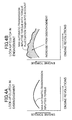
- FIG. 4A shows the torque inputted into the automatic transmission M from the engine E while the lock-up clutch 18 is in disengagement.
- FIG. 4B shows the torque inputted into the automatic transmission M from the engine E while the lock-up clutch 18 is in engagement. While the lock-up clutch 18 is in disengagement, the slipping of the torque converter T absorbs the fluctuation of the torque of the engine E. The absorption makes it difficult for the fluctuation of the torque of the engine E to be transmitted to the automatic transmission M. In contrast, while the lock-up clutch 18 is in engagement, the fluctuation of the torque of the engine E is transmitted, as it is, to the automatic transmission M. Consequently, even when the engine E outputs the same torque, the maximum value of the torque inputted into the automatic transmission M via the torque converter T while the lock-up clutch 18 is in engagement becomes larger than the corresponding maximum value while the lock-up clutch 18 is in disengagement.
- the torque limiter value for slip prevention which is a torque upper limit outputted by the engine E without causing the slipping of the gear-shifting clutch, is set so that the value obtained by searching the map selected while the lock-up clutch 18 is in engagement is smaller than the value obtained by searching the map selected while the lock-up clutch 18 is in disengagement.
- the stalling torque-limiter-value calculation means M1b outputs the torque limiter value at the time of stalling. Setting the torque limiter value at the time of stalling is provided for the following reason. If the torque converter T stalls, the torque ratio rises up to the maximum. The torque thus inputted into the automatic transmission M becomes so large that the slipping of the gear-shifting clutch may possibly take place.
- the double-pedaling-action torque-limiter-value calculation means M1c outputs the torque limiter value at the time of double pedaling action. Setting the torque limiter value at the time of double pedaling action is provided for the following reason. If the driver depresses the brake pedal while depressing also the accelerator pedal, the engine torque increases while the vehicle is not in motion. The torque thus inputted into the automatic transmission M becomes so large that the slipping of the gear-shifting clutch may possibly take place.
- the lowest value of the torque limiter value for slip prevention, the torque limiter value at the time of stalling, and the torque limiter value at the time of double pedaling action is selected as the torque limiter value by the low-selection means M1d.
- the torque limiter value thus selected is outputted, together with the torque required during gear shifting calculated by the gear-shifting requiring torque calculation means M2, to an electronic control unit Ue of the engine E by means of the Controller Area Network (CAN).
- CAN Controller Area Network
- the electronic control unit Ue controls the engine torque by controlling the amount of fuel injection of the engine E.
- the electronic control unit Ue includes driver-requiring-torque calculation means M3, low-selection means M4, and fuel-injection-amount calculation means M5.
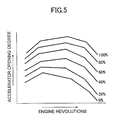
- the driver-requiring-torque calculation means M3 applies the engine revolutions detected by the engine-revolutions detection means Sa and the accelerator opening degree detected by accelerator-opening-degree detection means Sf to the map shown in FIG. 5 .
- the low-selection means M4 selects, as the final output torque, the lowest one of the torque required by the driver calculated by the driver-requiring-torque calculation means M3, the torque limiter value, and the torque required during the gear shifting. Note that the torque limiter value and the torque required during the gear shifting are inputted into the driver-requiring-torque calculation means M3 from the electronic control unit Ut of the automatic transmission M by means of the CAN.
- the low-selection means M4 outputs the final output torque thus selected to the fuel-injection-amount calculation means M5. Then the fuel-injection-amount calculation means M5 controls the amount of fuel injection so that the engine E can output the final output torque.
- the maximum engine torque that will not cause the slipping of the gear-shifting clutch of the automatic transmission M decreases if the lock-up clutch 18 is in engagement. While the lock-up clutch 18 is in disengagement, the torque limiter value stays above the torque required by the driver. Accordingly, even when the engine E outputs the torque equal to the torque required by the driver, no slipping of the gear-shifting clutch will take place. In contrast, while the lock-up clutch 18 is in engagement, the torque limiter value stays below the torque required by the driver. Accordingly, if the engine E outputs the torque equal to the torque required by the driver, the slipping of the gear-shifting clutch will take place. For this reason, to prevent the slipping of the gear-shifting clutch, the final output torque of the engine E has to be lowered from the level equal to the torque required by the driver down to the level equal to the torque limiter value.
- step S3 the map currently selected is still selected. If the gear-shifting state in the step S2 is the up-shifting state, that is, shifting the gears to a higher gear, in step S4 the map for the currently selected gear is switched to the map for the higher gear. If the gear-shifting state in the step S2 is the down-shifting state, that is, shifting to a lower gear, in step S5 the map for the currently selected gear is switched to the map for the lower gear.
- step S7 the map currently selected is still selected. If the gear-shifting state in the step S6 is the up-shifting state, that is, shifting to a higher gear, in step S8 the map for the currently selected gear is switched to the map for the higher gear. If the gear-shifting state in the step S6 is the down-shifting state, that is, shifting to a lower gear, in step S9 the map for the currently selected gear is switched to the map for the lower gear.
- the switching of the maps at each of the steps S4, S5, S8, and S9 is executed while the torque phase that is the earlier phase transitions to the inertial phase that is the later phase in the gear-shifting process.
- the gear-shifting clutch for the gear currently selected is transitioned from the engagement state to the disengagement state, and the gear-shifting clutch for the gear to be selected next is transitioned from the disengagement state to the engagement state.
- any change in the engine revolutions do not occur.
- the gear-shifting clutch for the gear currently selected is disengaged while slipping, and the gear-shifting clutch for the gear to be selected next is engaged while slipping.
- the engine revolutions decrease in the case of the up-shifting whereas the engine revolutions increase in the case of the down-shifting.
- the torque limiter value for slip prevention is searched from each of the maps selected in the steps S3 to S5 and in the steps S7 to S9.
- the map for the gear currently selected is used in the torque phase whereas the map for the gear be selected next is used in the inertial phase. Accordingly, a map appropriate for the ever-changing gear-shifting state is always used, and thus a highly accurate torque limiter value for slip prevention can be calculated.
- step S11 the lowest value of the torque limiter value for slip prevention, the torque limiter value at the time of stalling, the torque limiter value at the time of double-pedaling action is selected as the torque limiter value. Furthermore, in step S12, the lowest value of the torque required by the driver, the torque limiter value, and the torque required during the gear shifting is selected as the final output torque. In the end, in step S13, the amount of fuel injection is controlled so that the output torque of the engine E can be reduced down to the level of the final output torque. In this way, the slipping of the gear-shifting clutch of the automatic transmission M is prevented from taking place.
- the operation of the up-shifting of the gears from the second gear to the third gear will be described by referring to the time chart shown in FIG. 8 .
- the solid line and the dotted line represent the torque limiter values for the second gear and for the third gear.
- the broken line represents the selected torque limiter value
- the dashed-dotted line represents the torque required by the driver
- the dashed-two dotted line represents the final output torque.
- the selected torque limiter value (broken line) is the torque limiter value for the second gear (solid line).
- the selected torque limiter value (broken line) stays above the torque required by the driver (dashed-dotted line), so that the final output torque (dashed-two dotted line) coincides with the torque required by the driver (dashed-dotted line).
- the selected torque limiter value (broken line) is the torque limiter value for the second gear (solid line).
- the selected torque limiter value (broken line) stays below the torque required by the driver (dashed-dotted line), so that the final output torque (dashed-two dotted line) coincides with the selected torque limiter value (broken line).
- the map for the second gear is switched to the map for the third gear.
- the selected torque limiter value (broken line) is the torque limiter value for the third gear (solid line).
- the selected torque limiter value (broken line) is above the torque required by the driver (dashed-dotted line), so that the final output torque (dashed-two dotted line) coincides with the torque required by the driver (dashed-dotted line).
- the selected torque limiter value (broken line) is below the torque required by the driver (dashed-dotted line), so that the final output torque (dashed-two dotted line) coincides with the selected torque limiter value (broken line).
- the operation of the transition of the lock-up clutch 18 from the engagement state to the disengagement state will be described by referring to the time chart shown in FIG. 9 .
- the solid line and the dotted line represent the torque limiter values for the case where the lock-up clutch 18 is in engagement and for the case where the lock-up clutch 18 is in disengagement.
- the broken line represents the selected torque limiter value
- the dashed-dotted line represents the torque required by the driver
- the dashed-two dotted line represents the final output torque.
- the selected torque limiter value (broken line) is the torque limiter value for the case where the lock-up clutch 18 is in engagement (solid line).
- the selected torque limiter value (broken line) stays above the torque required by the driver (dashed-dotted line), so that the final output torque (dashed-two dotted line) coincides with the torque required by the driver (dashed-dotted line).
- the selected torque limiter value (broken line) is the torque limiter value for the case where the lock-up clutch 18 is in engagement (solid line).
- the selected torque limiter value (broken line) stays below the torque required by the driver (dashed-dotted line), so that the final output torque (dashed-two dotted line) coincides with the selected torque limiter value (broken line).
- the selected torque limiter value is the torque limiter value for the case where the lock-up clutch 18 is in disengagement (solid line).
- the selected torque limiter value (broken line) is above the torque required by the driver (dashed-dotted line), so that the final output torque (dashed-two dotted line) coincides with the torque required by the driver (dashed-dotted line).
- the selected torque limiter value (broken line) is below the torque required by the driver (dashed-dotted line), so that the final output torque (dashed-two dotted line) coincides with the selected torque limiter value (broken line).
- a frictional engagement member of the present invention is not limited to the gear-shifting clutch and may be a gear-shifting brake in which a rotating member is connected to the casing of the automatic transmission M.
- the reduction of the engine torque is achieved by the control on the amount of fuel injection, and may be achieved by a control on ignition timing.
Landscapes
- Engineering & Computer Science (AREA)
- General Engineering & Computer Science (AREA)
- Mechanical Engineering (AREA)
- Chemical & Material Sciences (AREA)
- Combustion & Propulsion (AREA)
- Control Of Vehicle Engines Or Engines For Specific Uses (AREA)
- Control Of Transmission Device (AREA)
- Combined Controls Of Internal Combustion Engines (AREA)
Abstract
Description
- The present invention relates to an engine-torque controlling apparatus for which an engine and an automatic transmission are connected to each other through a torque converter including a lock-up clutch, and which controls a torque of the engine so as to prevent a frictional engagement member of the automatic transmission from slipping,
- The following system is publicly known from
Patent Document 1. In the system, in order to prevent an excess torque from acting on a device of a drive-train system connected to an engine, a transitional input torque is calculated by subtracting, from an engine torque, an inertial torque from the engine to the device of the drive-train system, and if the transitional input torque exceeds an allowable torque of said device, the engine torque is reduced. - In addition, the following system is publicly known from
Patent Document 2. In the system, engine-torque-reduction control means executes an engine-torque-reduction control so as to prevent engagement elements, such as a clutch and a brake, in a power train of an automatic transmission from slipping if an excessive engine torque acts on the engagement elements. The maximum value of the allowable engine revolutions for the time while the engine-torque-reduction control means is operating properly is calculated with the torque ratio of a torque converter taken into consideration, and if the actual engine revolutions exceed the maximum value of the allowable engine revolutions, the system determines that the engine-torque-reduction control means malfunctions. - [Patent Document 1] Japanese Patent No.
2764751 - [Patent Document 2] Japanese Patent No.
2600982 - Incidentally, engaging a lock-up clutch provided in the torque converter increases the maximum value of the engine torque being inputted into the automatic transmission from the engine. Accordingly, while the lock-up clutch is not in engagement, frictional engagement members of the automatic transmission engage without slipping, but the slipping of the frictional engagement members of the automatic transmission possibly takes place while the lock-up clutch is in engagement. Detailed description of this phenomenon will be given below. Note that the engine torque that causes the slipping of the frictional engagement members of the automatic transmission varies depending upon the temperature of the oil for the automatic transmission and upon which gear is selected by the automatic transmission.
- Each of the systems disclosed in
Patent Documents - The invention has been made in view of the above-described circumstances. An object of the present invention is to minimize the amount of engine-torque reduction while reliably preventing the slipping of frictional engagement members of an automatic transmission, when an engine-torque-reduction control is executed to prevent the slipping of the frictional engagement members.
- In order to achieve the above object, according to the invention described in
claim 1, there is provided an engine-torque controlling apparatus for which an engine and an automatic transmission are connected to each other through a torque converter including a lock-up clutch, and which controls a torque of the engine so as to prevent a frictional engagement member of the automatic transmission from slipping, the engine-torque controlling apparatus characterized by comprising: lock-up-clutch engagement state determination means for determining an engagement state of the lock-up clutch; gear-shifting state determination means for determining a gear-shifting state of the automatic transmission; oil-temperature detection means for detecting a temperature of oil of the automatic transmission; engine-revolutions detection means for detecting engine revolutions; torque-limiter-value calculation means for calculating a torque limiter value of a torque capable of being outputted by the engine without causing any slipping of the frictional engagement member; and engine-torque control means for controlling a torque of the engine on the basis of the torque limiter value, the engine-torque controlling apparatus characterized in that the torque-limiter-value calculation means calculates the torque limiter value by using, as parameters, the engagement state of the lock-up clutch, the oil temperature, the engine revolutions, and the gear-shifting state. - According to the invention described in
claim 2, in addition to the configuration ofclaim 1, there is provided the engine-torque controlling apparatus wherein switching of the torque limiter values from one to another based on the gear-shifting state is carried out while a phase of a gear-shifting process is being transitioned from a torque phase to an inertial phase. - According to the invention described in claim 3, in addition to the configuration of
claim 1, there is provided the engine-torque controlling apparatus wherein the torque-limiter-value calculation means further includes: a slip-prevention torque-limiter-value calculation means for calculating a torque limiter value for slip prevention that can be outputted by the engine to the automatic transmission based on the engine revolutions, the temperature of the oil for the automatic transmission, the gear-shifting state of the automatic transmission, and the engagement state of the lock-up clutch; a stalling torque-limiter-value calculation means for outputting a torque limiter value at a time of stalling of the torque converter; a double-pedaling-action torque-limiter-value calculation means for outputting a torque limiter value at a time of double pedaling action of a brake pedal and an acceleration pedal; and a low-selection means for selecting the lowest value of the torque limiter value for slip prevention, the torque limiter value at the time of stalling, and the torque limiter value at the time of double pedaling action as the torque limiter value. - Note that an electronic control unit Ue of an engine of an embodiment corresponds to engine-torque control means of the present invention.
- According to the configuration described in
claim 1, the torque-limiter-value calculation means for calculating a torque limiter value which is a torque capable of being outputted by the engine without causing any slipping of the frictional engagement members of the automatic transmission calculates the torque limiter value on the basis of, as parameters, the engagement state of the lock-up clutch, the temperature of the oil for the automatic transmission, the engine revolutions, and the gear-shifting state of the automatic transmission. Accordingly, even if the slip limit of the frictional engagement members changes in response to the changes of the parameters, the minimum required reduction in the torque can be made according to the slip limit. Consequently, while the frictional engagement members can be reliably prevented from slipping, the reduction in the torque can be minimized. - In addition, according to the configuration described in
claim 2, the torque limiter values are switched from one to another on the basis of the gear-shifting state while the torque phase transitions to the inertial phase in the gear-shifting process. Accordingly, even while the automatic transmission is executing a gear-shifting operation, an optimal torque-reduction control can be executed by use of the torque limiter value appropriate for the actual gear-shifting state. - In addition, according to the configuration described in claim 3, the torque-limiter-value calculation means further includes: a slip-prevention torque-limiter-value calculation means, a stalling torque-limiter-value calculation means, a double-pedaling-action torque-limiter-value calculation means, and a low-selection means for selecting the lowest value of the torque limiter value for slip prevention, the torque limiter value at the time of stalling, and the torque limiter value at the time of double pedaling action as the torque limiter value. Accordingly, the frictional engagement members can be reliably prevented from slipping based on different conditions mentioned above while the reduction in the torque can be minimized.
- An embodiment of the present invention will be explained below by reference to the attached drawings.
FIGS. 1 to 9 show an embodiment of the present invention: - FIG. 1
- is a view showing a configuration of a torque converter including a lock-up clutch;
- FIG. 2
- is a block diagram of electronic control units of an automatic transmission and an engine;
- FIG. 3
- is a view showing a map searching a torque limiter value for slip prevention;
- FIGS. 4A and 4B
- are views showing a transmission input torque being changed depending on engagement states of the lock-up clutch;
- FIG. 5
- is a view showing a map searching a torque required by a driver;
- FIG. 6
- is a view showing a difference of an amount of torque reduction between engagement states of the lock-up clutch;
- FIG. 7
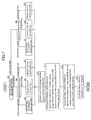
- is a flow chart of a control for slip prevention of a gear-shifting clutch;
- FIG. 8
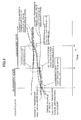
- is a time chart showing a switch of a torque limiter value depending on a gear-shifting state; and
- FIG. 9
- is a time chart showing a switch of a torque limiter value depending on an engagement state of the lock-up clutch.
- As
FIG. 1 shows, a torque converter T includes: apump impeller 12 connected to an output shaft 11 (crankshaft) of an engine E; aturbine runner 14 connected to an input shaft 13 (main shaft) of an automatic transmission M; a stator 17 supported by acasing 15 with a one-way clutch 16; and a lock-up clutch 18 capable of connecting thepump impeller 12 and theturbine runner 14 with each other. - When the
pump impeller 12 connected to theoutput shaft 11 of the engine E rotates, oil pushed out from thepump impeller 12 in a direction indicated by the arrow flows into theturbine runner 14, gives a torque to theturbine runner 14 to rotate theinput shaft 13 of the automatic transmission M, then passes through the stator 17, and flows back into thepump impeller 12. In this way, the rotation of theoutput shaft 11 of the engine E is transmitted to theinput shaft 13 of the automatic transmission M. - The lock-
up clutch 18 includes aclutch piston 20 capable of contacting an inner surface of a torque-converter cover 19. Afirst fluid chamber 21 and asecond fluid chamber 22 are formed respectively at the two sides of theclutch piston 20. Hydraulic-pressure controlling means 23 for supplying hydraulic pressures to control the lock-up clutch 18 is provided to the first and thesecond fluid chambers - With a hydraulic pressure being supplied to the
first fluid chamber 21, a facing 20a of theclutch piston 20 contacts the inner surface of the torque-converter cover 19, resulting in an engagement of the lock-up clutch 18. Consequently, the torque of theoutput shaft 11 of the engine E is transmitted directly to theinput shaft 13 of the automatic transmission M. With the supply of a hydraulic pressure to thesecond fluid chamber 22, the facing 20a of theclutch piston 20 is separated away from the torque-converter cover 19, resulting in a disengagement of the lock-up clutch 18. Consequently, the mechanical connection of theoutput shaft 11 of the engine E to theinput shaft 13 of the automatic transmission M is cut off. Controlling the difference between the pressure of thefirst fluid chamber 21 and that of thesecond fluid chamber 22 allows the slipping of the torque-converter cover 19 and the facing 20a of theclutch piston 20 to take place, and thus makes it possible to arbitrarily control the speed ratio of the torque converter T. - As
FIG. 2 shows, the electronic control unit Ut of the automatic transmission M includes torque-limiter-value calculation means M1 and gear-shifting requiring torque calculation means M2. The torque-limiter-value calculation means M1 calculates a torque limiter value that is an upper limit of the torque that can be outputted by the engine E to the automatic transmission M within a degree that the slipping of the gear-shifting clutch does not take place. The gear-shifting requiring torque calculation means M2 calculates a torque required at the gear shifting so as to reduce, down to the minimum level, the shock caused when the automatic transmission M performs gear shifting. The torque-limiter-value calculation means M1 includes: slip-prevention torque-limiter-value calculation means M1a; stalling torque-limiter-value calculation means M1b; double-pedaling-action torque-limiter-value calculation means M1c; and low-selection means M1d. - Connected to the slip-prevention torque-limiter-value calculation means M1a are: engine-revolutions detection means Sa for detecting engine revolutions; oil-temperature detection means Sb for detecting the temperature of the oil for the automatic transmission M; gear-shifting-state determination means Sc for determining the gear-shifting state (i.e., the selected gear and the gear-shifting phase) of the automatic transmission M; and lock-up-clutch engagement state determination means Sd for determining the engagement state of the lock-
up clutch 18. - Based on the engine revolutions, the temperature of the oil for the automatic transmission M, the gear-shifting state of the automatic transmission M, and the engagement state of the lock-
up clutch 18, the slip-prevention torque-limiter-value calculation means M1a calculates, by map searching, a torque limiter value for slip prevention that can be outputted by the engine E to the automatic transmission M within a degree that the slipping of the gear-shifting clutch does not take place. - As
FIG. 3 shows, the map on which the calculation of the torque limiter value for slip prevention is based uses, as parameters, the temperature of the oil for the automatic transmission M and the engine revolutions. The map is set up in the following way: as the oil temperature rises, the torque limiter value for slip prevention decreases; and in addition, as the engine revolutions increase, the torque limiter value for slip prevention increases. Different maps are used depending upon whether the lock-up clutch 18 is in engagement or in disengagement, which is determined by the lock-up-clutch engagement state determination means Sd; and in addition, different maps are used depending upon the selected gear, which is determined by the gear-shifting-state determination means Sc. Accordingly, in the case of a 5-speed automatic transmission M, ten maps in total are selectively used. -
FIG. 4A shows the torque inputted into the automatic transmission M from the engine E while the lock-up clutch 18 is in disengagement.FIG. 4B shows the torque inputted into the automatic transmission M from the engine E while the lock-up clutch 18 is in engagement. While the lock-up clutch 18 is in disengagement, the slipping of the torque converter T absorbs the fluctuation of the torque of the engine E. The absorption makes it difficult for the fluctuation of the torque of the engine E to be transmitted to the automatic transmission M. In contrast, while the lock-up clutch 18 is in engagement, the fluctuation of the torque of the engine E is transmitted, as it is, to the automatic transmission M. Consequently, even when the engine E outputs the same torque, the maximum value of the torque inputted into the automatic transmission M via the torque converter T while the lock-up clutch 18 is in engagement becomes larger than the corresponding maximum value while the lock-up clutch 18 is in disengagement. - Accordingly, the torque limiter value for slip prevention, which is a torque upper limit outputted by the engine E without causing the slipping of the gear-shifting clutch, is set so that the value obtained by searching the map selected while the lock-up clutch 18 is in engagement is smaller than the value obtained by searching the map selected while the lock-up clutch 18 is in disengagement.
- Referring back to
FIG. 2 , if, on the basis of the vehicle speed detected by vehicle-speed detection means Se and the gear-shifting state determined by the gear-shifting-state determination means Sc, it is determined that the torque converter T stalls, the stalling torque-limiter-value calculation means M1b outputs the torque limiter value at the time of stalling. Setting the torque limiter value at the time of stalling is provided for the following reason. If the torque converter T stalls, the torque ratio rises up to the maximum. The torque thus inputted into the automatic transmission M becomes so large that the slipping of the gear-shifting clutch may possibly take place. - If it is determined that both the accelerator pedal and the brake pedal are depressed simultaneously, the double-pedaling-action torque-limiter-value calculation means M1c outputs the torque limiter value at the time of double pedaling action. Setting the torque limiter value at the time of double pedaling action is provided for the following reason. If the driver depresses the brake pedal while depressing also the accelerator pedal, the engine torque increases while the vehicle is not in motion. The torque thus inputted into the automatic transmission M becomes so large that the slipping of the gear-shifting clutch may possibly take place.
- The lowest value of the torque limiter value for slip prevention, the torque limiter value at the time of stalling, and the torque limiter value at the time of double pedaling action is selected as the torque limiter value by the low-selection means M1d. The torque limiter value thus selected is outputted, together with the torque required during gear shifting calculated by the gear-shifting requiring torque calculation means M2, to an electronic control unit Ue of the engine E by means of the Controller Area Network (CAN).
- The electronic control unit Ue controls the engine torque by controlling the amount of fuel injection of the engine E. The electronic control unit Ue includes driver-requiring-torque calculation means M3, low-selection means M4, and fuel-injection-amount calculation means M5.
- When calculating the torque required by the driver, the driver-requiring-torque calculation means M3 applies the engine revolutions detected by the engine-revolutions detection means Sa and the accelerator opening degree detected by accelerator-opening-degree detection means Sf to the map shown in
FIG. 5 . The low-selection means M4 selects, as the final output torque, the lowest one of the torque required by the driver calculated by the driver-requiring-torque calculation means M3, the torque limiter value, and the torque required during the gear shifting. Note that the torque limiter value and the torque required during the gear shifting are inputted into the driver-requiring-torque calculation means M3 from the electronic control unit Ut of the automatic transmission M by means of the CAN. The low-selection means M4 outputs the final output torque thus selected to the fuel-injection-amount calculation means M5. Then the fuel-injection-amount calculation means M5 controls the amount of fuel injection so that the engine E can output the final output torque. - As
FIG. 6 shows, the maximum engine torque that will not cause the slipping of the gear-shifting clutch of the automatic transmission M (i.e., the torque limiter value) decreases if the lock-up clutch 18 is in engagement. While the lock-up clutch 18 is in disengagement, the torque limiter value stays above the torque required by the driver. Accordingly, even when the engine E outputs the torque equal to the torque required by the driver, no slipping of the gear-shifting clutch will take place. In contrast, while the lock-up clutch 18 is in engagement, the torque limiter value stays below the torque required by the driver. Accordingly, if the engine E outputs the torque equal to the torque required by the driver, the slipping of the gear-shifting clutch will take place. For this reason, to prevent the slipping of the gear-shifting clutch, the final output torque of the engine E has to be lowered from the level equal to the torque required by the driver down to the level equal to the torque limiter value. - Subsequently, the above-described operation will be further described by referring to the flow chart shown in
FIG. 7 . - Firstly, if the lock-up clutch 18 is in engagement in step S1 and if the gear-shifting state of the automatic transmission M is non-gear-shifting state in step S2, in step S3 the map currently selected is still selected. If the gear-shifting state in the step S2 is the up-shifting state, that is, shifting the gears to a higher gear, in step S4 the map for the currently selected gear is switched to the map for the higher gear. If the gear-shifting state in the step S2 is the down-shifting state, that is, shifting to a lower gear, in step S5 the map for the currently selected gear is switched to the map for the lower gear.
- If the lock-up clutch 18 is in disengagement in the step S1 and if the gear-shifting state of the automatic transmission M is non-gear-shifting state in step S6, in step S7 the map currently selected is still selected. If the gear-shifting state in the step S6 is the up-shifting state, that is, shifting to a higher gear, in step S8 the map for the currently selected gear is switched to the map for the higher gear. If the gear-shifting state in the step S6 is the down-shifting state, that is, shifting to a lower gear, in step S9 the map for the currently selected gear is switched to the map for the lower gear.
- The switching of the maps at each of the steps S4, S5, S8, and S9 is executed while the torque phase that is the earlier phase transitions to the inertial phase that is the later phase in the gear-shifting process. In the torque phase, the gear-shifting clutch for the gear currently selected is transitioned from the engagement state to the disengagement state, and the gear-shifting clutch for the gear to be selected next is transitioned from the disengagement state to the engagement state. In addition, during the transitions, any change in the engine revolutions do not occur. In the inertial phase, the gear-shifting clutch for the gear currently selected is disengaged while slipping, and the gear-shifting clutch for the gear to be selected next is engaged while slipping. In the meanwhile, the engine revolutions decrease in the case of the up-shifting whereas the engine revolutions increase in the case of the down-shifting.
- In the subsequent step S10, the torque limiter value for slip prevention is searched from each of the maps selected in the steps S3 to S5 and in the steps S7 to S9. In this event, the map for the gear currently selected is used in the torque phase whereas the map for the gear be selected next is used in the inertial phase. Accordingly, a map appropriate for the ever-changing gear-shifting state is always used, and thus a highly accurate torque limiter value for slip prevention can be calculated.
- In the subsequent step S11, the lowest value of the torque limiter value for slip prevention, the torque limiter value at the time of stalling, the torque limiter value at the time of double-pedaling action is selected as the torque limiter value. Furthermore, in step S12, the lowest value of the torque required by the driver, the torque limiter value, and the torque required during the gear shifting is selected as the final output torque. In the end, in step S13, the amount of fuel injection is controlled so that the output torque of the engine E can be reduced down to the level of the final output torque. In this way, the slipping of the gear-shifting clutch of the automatic transmission M is prevented from taking place.
- As has been described thus far, when the torque limiter value for slip prevention is calculated, the engagement state of the lock-up
clutch 18 of the torque converter T, the temperature of the oil for the automatic transmission M, and the gear-shifting state of the automatic transmission M (the selected gear and the gear-shifting phase) are taken into account. Accordingly, while the slipping of the gear-shifting clutch is prevented reliably, the reduction of the output torque of the engine E can be made as small as possible. - Subsequently, the operation of the up-shifting of the gears from the second gear to the third gear will be described by referring to the time chart shown in
FIG. 8 . In the time chart, the solid line and the dotted line represent the torque limiter values for the second gear and for the third gear. The broken line represents the selected torque limiter value, the dashed-dotted line represents the torque required by the driver, and the dashed-two dotted line represents the final output torque. - Until the time t1, the selected torque limiter value (broken line) is the torque limiter value for the second gear (solid line). The selected torque limiter value (broken line) stays above the torque required by the driver (dashed-dotted line), so that the final output torque (dashed-two dotted line) coincides with the torque required by the driver (dashed-dotted line). In the period from the time t1 to the time t2 (at the time of the transition from the torque phase to the inertial phase), the selected torque limiter value (broken line) is the torque limiter value for the second gear (solid line). The selected torque limiter value (broken line) stays below the torque required by the driver (dashed-dotted line), so that the final output torque (dashed-two dotted line) coincides with the selected torque limiter value (broken line).
- At the time t2, the map for the second gear is switched to the map for the third gear.
Then, in the subsequent period from the time t2 to the time t3, the selected torque limiter value (broken line) is the torque limiter value for the third gear (solid line). The selected torque limiter value (broken line) is above the torque required by the driver (dashed-dotted line), so that the final output torque (dashed-two dotted line) coincides with the torque required by the driver (dashed-dotted line). From the time t3 onwards, the selected torque limiter value (broken line) is below the torque required by the driver (dashed-dotted line), so that the final output torque (dashed-two dotted line) coincides with the selected torque limiter value (broken line). - Subsequently, the operation of the transition of the lock-up clutch 18 from the engagement state to the disengagement state will be described by referring to the time chart shown in
FIG. 9 . In the time chart, the solid line and the dotted line represent the torque limiter values for the case where the lock-up clutch 18 is in engagement and for the case where the lock-up clutch 18 is in disengagement. The broken line represents the selected torque limiter value, the dashed-dotted line represents the torque required by the driver, and the dashed-two dotted line represents the final output torque. - Until the time t1, the selected torque limiter value (broken line) is the torque limiter value for the case where the lock-up clutch 18 is in engagement (solid line). The selected torque limiter value (broken line) stays above the torque required by the driver (dashed-dotted line), so that the final output torque (dashed-two dotted line) coincides with the torque required by the driver (dashed-dotted line). In the period from the time t1 to the time t2 (at the time of transition from engagement to the disengagement of the lock-up clutch 18), the selected torque limiter value (broken line) is the torque limiter value for the case where the lock-up clutch 18 is in engagement (solid line). The selected torque limiter value (broken line) stays below the torque required by the driver (dashed-dotted line), so that the final output torque (dashed-two dotted line) coincides with the selected torque limiter value (broken line).
- At the time t2, the state of lock-up clutch 18 is transitioned from engagement state to the disengagement state. Then, in the subsequent period from the time t2 to the time t3, the selected torque limiter value (broken line) is the torque limiter value for the case where the lock-up clutch 18 is in disengagement (solid line). The selected torque limiter value (broken line) is above the torque required by the driver (dashed-dotted line), so that the final output torque (dashed-two dotted line) coincides with the torque required by the driver (dashed-dotted line). From the time t3 onwards, the selected torque limiter value (broken line) is below the torque required by the driver (dashed-dotted line), so that the final output torque (dashed-two dotted line) coincides with the selected torque limiter value (broken line).
- An embodiment of the present invention has been described thus far, but various modifications in design can also be made as long as being covered by the claims.
- For example, a frictional engagement member of the present invention is not limited to the gear-shifting clutch and may be a gear-shifting brake in which a rotating member is connected to the casing of the automatic transmission M.
- In addition, in the embodiment, the reduction of the engine torque is achieved by the control on the amount of fuel injection, and may be achieved by a control on ignition timing.
-
- 11
- output shaft (crankshaft)
- 12
- pump impeller
- 13
- input shaft (main shaft)
- 14
- turbine runner
- 15
- casing
- 16
- one-way clutch
- 17
- stator
- 18
- lock-up clutch
- 19
- torque-converter cover
- 20
- clutch piston
- 20a
- facing
- 21
- first fluid chamber
- 22
- second fluid chamber
- 23
- hydraulic-pressure controlling means
- M
- automatic transmission
- M1
- torque-limiter-value calculation means
- M1a
- slip-prevention torque-limiter-value calculation means
- M1b
- stalling torque-limiter-value calculation means
- M1c
- double-pedaling-action torque-limiter-value calculation means
- M1d
- low-selection means
- M2
- gear-shifting requiring torque calculation means
- M3
- driver-requiring-torque calculation means
- M4
- low-selection means
- M5
- fuel-injection-amount calculation means
- Sa
- engine-revolutions detection means
- Sb
- oil-temperature detection means
- Sc
- gear-shifting state determination means
- Sd
- lock-up-clutch engagement state determination means
- Se
- vehicle-speed detection means
- T
- torque converter
- Ue
- electronic control unit (engine-torque control means)
- Ut
- electronic control unit
Claims (3)
- An engine-torque controlling apparatus for which an engine (E) and an automatic transmission (M) are connected to each other through a torque converter (T) including a lock-up clutch (18), and which controls a torque of the engine (E) so as to prevent a frictional engagement member of the automatic transmission (M) from slipping, the engine-torque controlling apparatus characterized by comprising:lock-up-clutch engagement state determination means (Sd) for determining an engagement state of the lock-up clutch (18);gear-shifting state determination means (Sc) for determining a gear-shifting state of the automatic transmission (M);oil-temperature detection means (Sb) for detecting a temperature of oil of the automatic transmission (M);engine-revolutions detection means (Sa) for detecting engine revolutions;torque-limiter-value calculation means (M1) for calculating a torque limiter value of a torque capable of being outputted by the engine (E) without causing any slipping of the frictional engagement member; andengine-torque control means (Ue) for controlling a torque of the engine (E) on the basis of the torque limiter value, the engine-torque controlling apparatus characterized in thatthe torque-limiter-value calculation means (M1) calculates the torque limiter value by using, as parameters, the engagement state of the lock-up clutch (18), the oil temperature, the engine revolutions, and the gear-shifting state.
- The engine-torque controlling apparatus according to claim 1 wherein switching of the torque limiter values from one to another based on the gear-shifting state is carried out while a phase of a gear-shifting process is being transitioned from a torque phase to an inertial phase.
- The engine-torque controlling apparatus according to claim 1 wherein the torque-limiter-value calculation means (M1) further includes:a slip-prevention torque-limiter-value calculation means (M1a) for calculating a torque limiter value for slip prevention that can be outputted by the engine (E) to the automatic transmission (M) based on the engine revolutions, the temperature of the oil for the automatic transmission (M), the gear-shifting state of the automatic transmission (M), and the engagement state of the lock-up clutch (18);a stalling torque-limiter-value calculation means (M1b) for outputting a torque limiter value at a time of stalling of the torque converter (T);a double-pedaling-action torque-limiter-value calculation means (M1c) for outputting a torque limiter value at a time of double pedaling action of a brake pedal and an acceleration pedal; anda low-selection means (M1d) for selecting the lowest value of the torque limiter value for slip prevention, the torque limiter value at the time of stalling, and the torque limiter value at the time of double pedaling action as the torque limiter value.
Applications Claiming Priority (1)
| Application Number | Priority Date | Filing Date | Title |
|---|---|---|---|
| JP2009003530A JP4922317B2 (en) | 2009-01-09 | 2009-01-09 | Engine torque control device |
Publications (2)
| Publication Number | Publication Date |
|---|---|
| EP2206908A1 true EP2206908A1 (en) | 2010-07-14 |
| EP2206908B1 EP2206908B1 (en) | 2012-12-05 |
Family
ID=41818942
Family Applications (1)
| Application Number | Title | Priority Date | Filing Date |
|---|---|---|---|
| EP20100150079 Not-in-force EP2206908B1 (en) | 2009-01-09 | 2010-01-05 | Engine-torque control during gear shifting for a vehicle with an automatic transmission |
Country Status (2)
| Country | Link |
|---|---|
| EP (1) | EP2206908B1 (en) |
| JP (1) | JP4922317B2 (en) |
Cited By (3)
| Publication number | Priority date | Publication date | Assignee | Title |
|---|---|---|---|---|
| CN102777591A (en) * | 2012-07-31 | 2012-11-14 | 长城汽车股份有限公司 | Gear shifting method for automatic gearshift automobile |
| CN103097220A (en) * | 2010-10-21 | 2013-05-08 | 日野自动车株式会社 | Transmission control device, hybrid vehicle, transmission control method, and program |
| CN116710645A (en) * | 2021-01-22 | 2023-09-05 | 日产自动车株式会社 | Control method and control device for vehicle internal combustion engine |
Families Citing this family (10)
| Publication number | Priority date | Publication date | Assignee | Title |
|---|---|---|---|---|
| JP5299375B2 (en) * | 2010-07-30 | 2013-09-25 | 株式会社デンソー | Vehicle abnormality diagnosis device |
| JP5460920B2 (en) | 2011-03-12 | 2014-04-02 | 本田技研工業株式会社 | Torque control device for drive source |
| US8676457B2 (en) * | 2012-01-20 | 2014-03-18 | Caterpillar Inc. | System and method for controlling engine torque load |
| WO2014136364A1 (en) * | 2013-03-06 | 2014-09-12 | 日産自動車株式会社 | Vehicle shift control device |
| JP6567282B2 (en) * | 2015-01-30 | 2019-08-28 | ダイハツ工業株式会社 | Vehicle control device |
| JP6732446B2 (en) * | 2015-12-25 | 2020-07-29 | ダイハツ工業株式会社 | vehicle |
| JP7061836B2 (en) * | 2016-10-31 | 2022-05-02 | ダイハツ工業株式会社 | Transmission control device |
| CN110192017B (en) * | 2017-01-24 | 2020-09-01 | 日产自动车株式会社 | Vehicle control method and vehicle control device |
| JP6762332B2 (en) | 2018-03-15 | 2020-09-30 | 本田技研工業株式会社 | Target torque control device and target torque control method |
| US10821985B2 (en) | 2018-03-15 | 2020-11-03 | Honda Motor Co., Ltd. | Gear change control device and gear change control method |
Citations (8)
| Publication number | Priority date | Publication date | Assignee | Title |
|---|---|---|---|---|
| JP2600982B2 (en) | 1990-06-08 | 1997-04-16 | 日産自動車株式会社 | Integrated control system for automatic transmission and engine |
| JP2764751B2 (en) | 1989-11-24 | 1998-06-11 | トヨタ自動車株式会社 | Vehicle engine control device |
| EP1124049A2 (en) * | 1996-04-30 | 2001-08-16 | Honda Giken Kogyo Kabushiki Kaisha | Output torque control system for internal combustion engines for vehicles |
| DE10114040A1 (en) * | 2000-04-04 | 2001-10-11 | Bosch Gmbh Robert | Controlling vehicle drive unit involves increasing drive unit output parameter if revolution rate falls below predefined threshold revolution rate and drive unit is operating outside idling state |
| EP1605192A2 (en) * | 2004-06-09 | 2005-12-14 | Nissan Motor Co., Ltd. | Lockup control of torque converter |
| US20070207898A1 (en) * | 2004-05-28 | 2007-09-06 | Renault S.A.S. | Device and Method for Control of an Automatic Gearbox for Control of Lock-Up and Lock-Up Release |
| EP2028353A2 (en) * | 2007-08-21 | 2009-02-25 | Nissan Motor Co., Ltd. | Acceleration shock reduction apparatus for vehicle |
| US20090270225A1 (en) * | 2008-04-29 | 2009-10-29 | Gm Global Technology Operations, Inc. | Airflow based idle speed control power security |
Family Cites Families (4)
| Publication number | Priority date | Publication date | Assignee | Title |
|---|---|---|---|---|
| JP3738677B2 (en) * | 2000-07-19 | 2006-01-25 | トヨタ自動車株式会社 | Input torque switching control device for vehicle automatic transmission |
| JP3856309B2 (en) * | 2002-08-30 | 2006-12-13 | ジヤトコ株式会社 | Engine output control device for vehicle transmission system |
| JP3833594B2 (en) * | 2002-08-30 | 2006-10-11 | ジヤトコ株式会社 | Control device for automatic transmission |
| JP2004125103A (en) * | 2002-10-04 | 2004-04-22 | Jatco Ltd | Belt-type continuously variable transmission system for vehicles |
-
2009
- 2009-01-09 JP JP2009003530A patent/JP4922317B2/en not_active Expired - Fee Related
-
2010
- 2010-01-05 EP EP20100150079 patent/EP2206908B1/en not_active Not-in-force
Patent Citations (8)
| Publication number | Priority date | Publication date | Assignee | Title |
|---|---|---|---|---|
| JP2764751B2 (en) | 1989-11-24 | 1998-06-11 | トヨタ自動車株式会社 | Vehicle engine control device |
| JP2600982B2 (en) | 1990-06-08 | 1997-04-16 | 日産自動車株式会社 | Integrated control system for automatic transmission and engine |
| EP1124049A2 (en) * | 1996-04-30 | 2001-08-16 | Honda Giken Kogyo Kabushiki Kaisha | Output torque control system for internal combustion engines for vehicles |
| DE10114040A1 (en) * | 2000-04-04 | 2001-10-11 | Bosch Gmbh Robert | Controlling vehicle drive unit involves increasing drive unit output parameter if revolution rate falls below predefined threshold revolution rate and drive unit is operating outside idling state |
| US20070207898A1 (en) * | 2004-05-28 | 2007-09-06 | Renault S.A.S. | Device and Method for Control of an Automatic Gearbox for Control of Lock-Up and Lock-Up Release |
| EP1605192A2 (en) * | 2004-06-09 | 2005-12-14 | Nissan Motor Co., Ltd. | Lockup control of torque converter |
| EP2028353A2 (en) * | 2007-08-21 | 2009-02-25 | Nissan Motor Co., Ltd. | Acceleration shock reduction apparatus for vehicle |
| US20090270225A1 (en) * | 2008-04-29 | 2009-10-29 | Gm Global Technology Operations, Inc. | Airflow based idle speed control power security |
Cited By (7)
| Publication number | Priority date | Publication date | Assignee | Title |
|---|---|---|---|---|
| CN103097220A (en) * | 2010-10-21 | 2013-05-08 | 日野自动车株式会社 | Transmission control device, hybrid vehicle, transmission control method, and program |
| EP2631139A4 (en) * | 2010-10-21 | 2014-03-26 | Hino Motors Ltd | TRANSMISSION CONTROL DEVICE, HYBRID AUTOMOTIVE, TRANSMISSION CONTROL PROCEDURE AND PROGRAM |
| US9114807B2 (en) | 2010-10-21 | 2015-08-25 | Hino Motors, Ltd. | Transmission control device, hybrid vehicle, transmission control method, and computer program |
| CN103097220B (en) * | 2010-10-21 | 2015-09-30 | 日野自动车株式会社 | Speed change control device, hybrid electric vehicle and speed change control method |
| CN102777591A (en) * | 2012-07-31 | 2012-11-14 | 长城汽车股份有限公司 | Gear shifting method for automatic gearshift automobile |
| CN116710645A (en) * | 2021-01-22 | 2023-09-05 | 日产自动车株式会社 | Control method and control device for vehicle internal combustion engine |
| CN116710645B (en) * | 2021-01-22 | 2025-09-09 | 日产自动车株式会社 | Control method and control device for internal combustion engine for vehicle |
Also Published As
| Publication number | Publication date |
|---|---|
| JP2010159722A (en) | 2010-07-22 |
| EP2206908B1 (en) | 2012-12-05 |
| JP4922317B2 (en) | 2012-04-25 |
Similar Documents
| Publication | Publication Date | Title |
|---|---|---|
| EP2206908B1 (en) | Engine-torque control during gear shifting for a vehicle with an automatic transmission | |
| US8308611B2 (en) | Shift control systems and methods for an automatic transmission | |
| US8406975B2 (en) | Control apparatus and control method for vehicle mounted with automatic transmission | |
| US20070191184A1 (en) | Control unit and method for vehicle | |
| US7324886B2 (en) | Powertrain control apparatus and method | |
| JP4971967B2 (en) | Automatic transmission lockup clutch control device | |
| JPH0289857A (en) | Gear shifting control device for automatic transmission | |
| US7740559B2 (en) | Shift control device of vehicular automatic transmission | |
| KR100825247B1 (en) | Shift control device and shift control method of automatic transmission for vehicles | |
| EP1895202A2 (en) | Shift shock reducing apparatus for power train | |
| US6889130B2 (en) | Shift control system for automatic transmission | |
| CN106015558B (en) | The control device of lock-up clutch | |
| JP5497571B2 (en) | Control device for automatic transmission | |
| KR100491566B1 (en) | Shift control system for automatic transmission | |
| JP4682122B2 (en) | Control device for automatic transmission | |
| KR0174174B1 (en) | Shift control method at the power on and up-shift in automatic transmission | |
| KR101918823B1 (en) | Damper duty control method and apparatus on manual power off down shift | |
| EP1748230B1 (en) | Gear shifting completion determination device for automatic transmission | |
| KR101673722B1 (en) | Method for controlling of automatic transmission in vehicle | |
| JP4622234B2 (en) | Automatic transmission control device | |
| JP4696692B2 (en) | Automatic transmission control device | |
| JP2010007767A (en) | Automatic transmission control device | |
| KR101234626B1 (en) | Method for controlling damper clutch of automatic transmission for vehicles | |
| JPH10184904A (en) | Fail safe device for creep prevention device for automatic transmission | |
| JP6595411B2 (en) | Vehicle control device |
Legal Events
| Date | Code | Title | Description |
|---|---|---|---|
| PUAI | Public reference made under article 153(3) epc to a published international application that has entered the european phase |
Free format text: ORIGINAL CODE: 0009012 |
|
| 17P | Request for examination filed |
Effective date: 20100319 |
|
| AK | Designated contracting states |
Kind code of ref document: A1 Designated state(s): AT BE BG CH CY CZ DE DK EE ES FI FR GB GR HR HU IE IS IT LI LT LU LV MC MK MT NL NO PL PT RO SE SI SK SM TR |
|
| AX | Request for extension of the european patent |
Extension state: AL BA RS |
|
| GRAP | Despatch of communication of intention to grant a patent |
Free format text: ORIGINAL CODE: EPIDOSNIGR1 |
|
| GRAS | Grant fee paid |
Free format text: ORIGINAL CODE: EPIDOSNIGR3 |
|
| GRAA | (expected) grant |
Free format text: ORIGINAL CODE: 0009210 |
|
| AK | Designated contracting states |
Kind code of ref document: B1 Designated state(s): AT BE BG CH CY CZ DE DK EE ES FI FR GB GR HR HU IE IS IT LI LT LU LV MC MK MT NL NO PL PT RO SE SI SK SM TR |
|
| REG | Reference to a national code |
Ref country code: GB Ref legal event code: FG4D |
|
| REG | Reference to a national code |
Ref country code: CH Ref legal event code: EP |
|
| REG | Reference to a national code |
Ref country code: AT Ref legal event code: REF Ref document number: 587427 Country of ref document: AT Kind code of ref document: T Effective date: 20121215 |
|
| REG | Reference to a national code |
Ref country code: IE Ref legal event code: FG4D |
|
| REG | Reference to a national code |
Ref country code: DE Ref legal event code: R096 Ref document number: 602010003895 Country of ref document: DE Effective date: 20130124 |
|
| REG | Reference to a national code |
Ref country code: AT Ref legal event code: MK05 Ref document number: 587427 Country of ref document: AT Kind code of ref document: T Effective date: 20121205 |
|
| PG25 | Lapsed in a contracting state [announced via postgrant information from national office to epo] |
Ref country code: NO Free format text: LAPSE BECAUSE OF FAILURE TO SUBMIT A TRANSLATION OF THE DESCRIPTION OR TO PAY THE FEE WITHIN THE PRESCRIBED TIME-LIMIT Effective date: 20130305 Ref country code: ES Free format text: LAPSE BECAUSE OF FAILURE TO SUBMIT A TRANSLATION OF THE DESCRIPTION OR TO PAY THE FEE WITHIN THE PRESCRIBED TIME-LIMIT Effective date: 20130316 Ref country code: LT Free format text: LAPSE BECAUSE OF FAILURE TO SUBMIT A TRANSLATION OF THE DESCRIPTION OR TO PAY THE FEE WITHIN THE PRESCRIBED TIME-LIMIT Effective date: 20121205 Ref country code: SE Free format text: LAPSE BECAUSE OF FAILURE TO SUBMIT A TRANSLATION OF THE DESCRIPTION OR TO PAY THE FEE WITHIN THE PRESCRIBED TIME-LIMIT Effective date: 20121205 Ref country code: FI Free format text: LAPSE BECAUSE OF FAILURE TO SUBMIT A TRANSLATION OF THE DESCRIPTION OR TO PAY THE FEE WITHIN THE PRESCRIBED TIME-LIMIT Effective date: 20121205 |
|
| REG | Reference to a national code |
Ref country code: NL Ref legal event code: VDEP Effective date: 20121205 |
|
| REG | Reference to a national code |
Ref country code: LT Ref legal event code: MG4D |
|
| PG25 | Lapsed in a contracting state [announced via postgrant information from national office to epo] |
Ref country code: LV Free format text: LAPSE BECAUSE OF FAILURE TO SUBMIT A TRANSLATION OF THE DESCRIPTION OR TO PAY THE FEE WITHIN THE PRESCRIBED TIME-LIMIT Effective date: 20121205 Ref country code: GR Free format text: LAPSE BECAUSE OF FAILURE TO SUBMIT A TRANSLATION OF THE DESCRIPTION OR TO PAY THE FEE WITHIN THE PRESCRIBED TIME-LIMIT Effective date: 20130306 Ref country code: PL Free format text: LAPSE BECAUSE OF FAILURE TO SUBMIT A TRANSLATION OF THE DESCRIPTION OR TO PAY THE FEE WITHIN THE PRESCRIBED TIME-LIMIT Effective date: 20121205 Ref country code: SI Free format text: LAPSE BECAUSE OF FAILURE TO SUBMIT A TRANSLATION OF THE DESCRIPTION OR TO PAY THE FEE WITHIN THE PRESCRIBED TIME-LIMIT Effective date: 20121205 |
|
| PG25 | Lapsed in a contracting state [announced via postgrant information from national office to epo] |
Ref country code: AT Free format text: LAPSE BECAUSE OF FAILURE TO SUBMIT A TRANSLATION OF THE DESCRIPTION OR TO PAY THE FEE WITHIN THE PRESCRIBED TIME-LIMIT Effective date: 20121205 |
|
| PG25 | Lapsed in a contracting state [announced via postgrant information from national office to epo] |
Ref country code: BE Free format text: LAPSE BECAUSE OF FAILURE TO SUBMIT A TRANSLATION OF THE DESCRIPTION OR TO PAY THE FEE WITHIN THE PRESCRIBED TIME-LIMIT Effective date: 20121205 Ref country code: EE Free format text: LAPSE BECAUSE OF FAILURE TO SUBMIT A TRANSLATION OF THE DESCRIPTION OR TO PAY THE FEE WITHIN THE PRESCRIBED TIME-LIMIT Effective date: 20121205 Ref country code: BG Free format text: LAPSE BECAUSE OF FAILURE TO SUBMIT A TRANSLATION OF THE DESCRIPTION OR TO PAY THE FEE WITHIN THE PRESCRIBED TIME-LIMIT Effective date: 20130305 Ref country code: IS Free format text: LAPSE BECAUSE OF FAILURE TO SUBMIT A TRANSLATION OF THE DESCRIPTION OR TO PAY THE FEE WITHIN THE PRESCRIBED TIME-LIMIT Effective date: 20130405 Ref country code: SK Free format text: LAPSE BECAUSE OF FAILURE TO SUBMIT A TRANSLATION OF THE DESCRIPTION OR TO PAY THE FEE WITHIN THE PRESCRIBED TIME-LIMIT Effective date: 20121205 Ref country code: CZ Free format text: LAPSE BECAUSE OF FAILURE TO SUBMIT A TRANSLATION OF THE DESCRIPTION OR TO PAY THE FEE WITHIN THE PRESCRIBED TIME-LIMIT Effective date: 20121205 |
|
| PG25 | Lapsed in a contracting state [announced via postgrant information from national office to epo] |
Ref country code: NL Free format text: LAPSE BECAUSE OF FAILURE TO SUBMIT A TRANSLATION OF THE DESCRIPTION OR TO PAY THE FEE WITHIN THE PRESCRIBED TIME-LIMIT Effective date: 20121205 Ref country code: PT Free format text: LAPSE BECAUSE OF FAILURE TO SUBMIT A TRANSLATION OF THE DESCRIPTION OR TO PAY THE FEE WITHIN THE PRESCRIBED TIME-LIMIT Effective date: 20130405 Ref country code: RO Free format text: LAPSE BECAUSE OF FAILURE TO SUBMIT A TRANSLATION OF THE DESCRIPTION OR TO PAY THE FEE WITHIN THE PRESCRIBED TIME-LIMIT Effective date: 20121205 Ref country code: MC Free format text: LAPSE BECAUSE OF NON-PAYMENT OF DUE FEES Effective date: 20130131 |
|
| PLBE | No opposition filed within time limit |
Free format text: ORIGINAL CODE: 0009261 |
|
| STAA | Information on the status of an ep patent application or granted ep patent |
Free format text: STATUS: NO OPPOSITION FILED WITHIN TIME LIMIT |
|
| REG | Reference to a national code |
Ref country code: IE Ref legal event code: MM4A |
|
| PG25 | Lapsed in a contracting state [announced via postgrant information from national office to epo] |
Ref country code: DK Free format text: LAPSE BECAUSE OF FAILURE TO SUBMIT A TRANSLATION OF THE DESCRIPTION OR TO PAY THE FEE WITHIN THE PRESCRIBED TIME-LIMIT Effective date: 20121205 |
|
| 26N | No opposition filed |
Effective date: 20130906 |
|
| PG25 | Lapsed in a contracting state [announced via postgrant information from national office to epo] |
Ref country code: CY Free format text: LAPSE BECAUSE OF FAILURE TO SUBMIT A TRANSLATION OF THE DESCRIPTION OR TO PAY THE FEE WITHIN THE PRESCRIBED TIME-LIMIT Effective date: 20121205 |
|
| PG25 | Lapsed in a contracting state [announced via postgrant information from national office to epo] |
Ref country code: IT Free format text: LAPSE BECAUSE OF FAILURE TO SUBMIT A TRANSLATION OF THE DESCRIPTION OR TO PAY THE FEE WITHIN THE PRESCRIBED TIME-LIMIT Effective date: 20121205 |
|
| REG | Reference to a national code |
Ref country code: DE Ref legal event code: R097 Ref document number: 602010003895 Country of ref document: DE Effective date: 20130906 |
|
| PG25 | Lapsed in a contracting state [announced via postgrant information from national office to epo] |
Ref country code: IE Free format text: LAPSE BECAUSE OF NON-PAYMENT OF DUE FEES Effective date: 20130105 Ref country code: HR Free format text: LAPSE BECAUSE OF FAILURE TO SUBMIT A TRANSLATION OF THE DESCRIPTION OR TO PAY THE FEE WITHIN THE PRESCRIBED TIME-LIMIT Effective date: 20130731 |
|
| PG25 | Lapsed in a contracting state [announced via postgrant information from national office to epo] |
Ref country code: MT Free format text: LAPSE BECAUSE OF FAILURE TO SUBMIT A TRANSLATION OF THE DESCRIPTION OR TO PAY THE FEE WITHIN THE PRESCRIBED TIME-LIMIT Effective date: 20121205 |
|
| REG | Reference to a national code |
Ref country code: CH Ref legal event code: PL |
|
| PG25 | Lapsed in a contracting state [announced via postgrant information from national office to epo] |
Ref country code: LI Free format text: LAPSE BECAUSE OF NON-PAYMENT OF DUE FEES Effective date: 20140131 Ref country code: CH Free format text: LAPSE BECAUSE OF NON-PAYMENT OF DUE FEES Effective date: 20140131 |
|
| PG25 | Lapsed in a contracting state [announced via postgrant information from national office to epo] |
Ref country code: SM Free format text: LAPSE BECAUSE OF FAILURE TO SUBMIT A TRANSLATION OF THE DESCRIPTION OR TO PAY THE FEE WITHIN THE PRESCRIBED TIME-LIMIT Effective date: 20121205 |
|
| PG25 | Lapsed in a contracting state [announced via postgrant information from national office to epo] |
Ref country code: TR Free format text: LAPSE BECAUSE OF FAILURE TO SUBMIT A TRANSLATION OF THE DESCRIPTION OR TO PAY THE FEE WITHIN THE PRESCRIBED TIME-LIMIT Effective date: 20121205 |
|
| PG25 | Lapsed in a contracting state [announced via postgrant information from national office to epo] |
Ref country code: HU Free format text: LAPSE BECAUSE OF FAILURE TO SUBMIT A TRANSLATION OF THE DESCRIPTION OR TO PAY THE FEE WITHIN THE PRESCRIBED TIME-LIMIT; INVALID AB INITIO Effective date: 20100105 Ref country code: LU Free format text: LAPSE BECAUSE OF NON-PAYMENT OF DUE FEES Effective date: 20130105 Ref country code: MK Free format text: LAPSE BECAUSE OF FAILURE TO SUBMIT A TRANSLATION OF THE DESCRIPTION OR TO PAY THE FEE WITHIN THE PRESCRIBED TIME-LIMIT Effective date: 20121205 |
|
| REG | Reference to a national code |
Ref country code: FR Ref legal event code: PLFP Year of fee payment: 7 |
|
| REG | Reference to a national code |
Ref country code: FR Ref legal event code: PLFP Year of fee payment: 8 |
|
| REG | Reference to a national code |
Ref country code: FR Ref legal event code: PLFP Year of fee payment: 9 |
|
| PGFP | Annual fee paid to national office [announced via postgrant information from national office to epo] |
Ref country code: FR Payment date: 20171211 Year of fee payment: 9 |
|
| PGFP | Annual fee paid to national office [announced via postgrant information from national office to epo] |
Ref country code: GB Payment date: 20180103 Year of fee payment: 9 Ref country code: DE Payment date: 20171228 Year of fee payment: 9 |
|
| REG | Reference to a national code |
Ref country code: DE Ref legal event code: R084 Ref document number: 602010003895 Country of ref document: DE |
|
| REG | Reference to a national code |
Ref country code: GB Ref legal event code: 746 Effective date: 20180814 |
|
| REG | Reference to a national code |
Ref country code: DE Ref legal event code: R119 Ref document number: 602010003895 Country of ref document: DE |
|
| GBPC | Gb: european patent ceased through non-payment of renewal fee |
Effective date: 20190105 |
|
| PG25 | Lapsed in a contracting state [announced via postgrant information from national office to epo] |
Ref country code: DE Free format text: LAPSE BECAUSE OF NON-PAYMENT OF DUE FEES Effective date: 20190801 Ref country code: FR Free format text: LAPSE BECAUSE OF NON-PAYMENT OF DUE FEES Effective date: 20190131 |
|
| PG25 | Lapsed in a contracting state [announced via postgrant information from national office to epo] |
Ref country code: GB Free format text: LAPSE BECAUSE OF NON-PAYMENT OF DUE FEES Effective date: 20190105 |