EP2204354A2 - Feuerpolitur für Flachglas - Google Patents
Feuerpolitur für Flachglas Download PDFInfo
- Publication number
- EP2204354A2 EP2204354A2 EP09252858A EP09252858A EP2204354A2 EP 2204354 A2 EP2204354 A2 EP 2204354A2 EP 09252858 A EP09252858 A EP 09252858A EP 09252858 A EP09252858 A EP 09252858A EP 2204354 A2 EP2204354 A2 EP 2204354A2
- Authority
- EP
- European Patent Office
- Prior art keywords
- glass sheet
- flame
- glass
- cooling
- heating
- Prior art date
- Legal status (The legal status is an assumption and is not a legal conclusion. Google has not performed a legal analysis and makes no representation as to the accuracy of the status listed.)
- Withdrawn
Links
- 238000007524 flame polishing Methods 0.000 title description 10
- 239000005357 flat glass Substances 0.000 title description 4
- 239000011521 glass Substances 0.000 claims abstract description 120
- 238000000034 method Methods 0.000 claims abstract description 25
- 238000001816 cooling Methods 0.000 claims abstract description 23
- 238000010438 heat treatment Methods 0.000 claims abstract description 23
- 239000001257 hydrogen Substances 0.000 claims description 14
- 229910052739 hydrogen Inorganic materials 0.000 claims description 14
- 238000005498 polishing Methods 0.000 claims description 13
- 239000000446 fuel Substances 0.000 claims description 11
- 239000012809 cooling fluid Substances 0.000 claims description 10
- 238000007599 discharging Methods 0.000 claims description 6
- CURLTUGMZLYLDI-UHFFFAOYSA-N Carbon dioxide Chemical compound O=C=O CURLTUGMZLYLDI-UHFFFAOYSA-N 0.000 claims description 4
- 239000000919 ceramic Substances 0.000 claims description 4
- 239000007789 gas Substances 0.000 claims description 3
- IJGRMHOSHXDMSA-UHFFFAOYSA-N Atomic nitrogen Chemical compound N#N IJGRMHOSHXDMSA-UHFFFAOYSA-N 0.000 claims description 2
- 239000001569 carbon dioxide Substances 0.000 claims description 2
- 229910002092 carbon dioxide Inorganic materials 0.000 claims description 2
- JCXJVPUVTGWSNB-UHFFFAOYSA-N nitrogen dioxide Inorganic materials O=[N]=O JCXJVPUVTGWSNB-UHFFFAOYSA-N 0.000 claims description 2
- 239000003570 air Substances 0.000 claims 1
- -1 oxy hydrogen Chemical compound 0.000 claims 1
- 238000011144 upstream manufacturing Methods 0.000 claims 1
- 230000003746 surface roughness Effects 0.000 abstract description 2
- 230000004907 flux Effects 0.000 description 8
- 239000000203 mixture Substances 0.000 description 8
- 230000008569 process Effects 0.000 description 8
- 238000012546 transfer Methods 0.000 description 7
- QVGXLLKOCUKJST-UHFFFAOYSA-N atomic oxygen Chemical compound [O] QVGXLLKOCUKJST-UHFFFAOYSA-N 0.000 description 6
- 239000001301 oxygen Substances 0.000 description 6
- 229910052760 oxygen Inorganic materials 0.000 description 6
- ATJFFYVFTNAWJD-UHFFFAOYSA-N Tin Chemical compound [Sn] ATJFFYVFTNAWJD-UHFFFAOYSA-N 0.000 description 5
- 239000002826 coolant Substances 0.000 description 4
- 238000009826 distribution Methods 0.000 description 4
- 238000004519 manufacturing process Methods 0.000 description 4
- 206010016754 Flashback Diseases 0.000 description 3
- 239000002419 bulk glass Substances 0.000 description 3
- 239000005329 float glass Substances 0.000 description 3
- 239000007800 oxidant agent Substances 0.000 description 3
- 230000001590 oxidative effect Effects 0.000 description 3
- 239000002344 surface layer Substances 0.000 description 3
- 238000006124 Pilkington process Methods 0.000 description 2
- ATUOYWHBWRKTHZ-UHFFFAOYSA-N Propane Chemical compound CCC ATUOYWHBWRKTHZ-UHFFFAOYSA-N 0.000 description 2
- 230000001419 dependent effect Effects 0.000 description 2
- 238000009792 diffusion process Methods 0.000 description 2
- 239000004973 liquid crystal related substance Substances 0.000 description 2
- 238000002844 melting Methods 0.000 description 2
- 230000008018 melting Effects 0.000 description 2
- VNWKTOKETHGBQD-UHFFFAOYSA-N methane Chemical compound C VNWKTOKETHGBQD-UHFFFAOYSA-N 0.000 description 2
- 238000002156 mixing Methods 0.000 description 2
- 238000012986 modification Methods 0.000 description 2
- 230000004048 modification Effects 0.000 description 2
- 239000006060 molten glass Substances 0.000 description 2
- 238000007665 sagging Methods 0.000 description 2
- 239000000126 substance Substances 0.000 description 2
- HSFWRNGVRCDJHI-UHFFFAOYSA-N alpha-acetylene Natural products C#C HSFWRNGVRCDJHI-UHFFFAOYSA-N 0.000 description 1
- 238000013459 approach Methods 0.000 description 1
- 230000000712 assembly Effects 0.000 description 1
- 238000000429 assembly Methods 0.000 description 1
- 230000015572 biosynthetic process Effects 0.000 description 1
- 239000001273 butane Substances 0.000 description 1
- 230000001010 compromised effect Effects 0.000 description 1
- 238000010276 construction Methods 0.000 description 1
- 239000013078 crystal Substances 0.000 description 1
- 238000005520 cutting process Methods 0.000 description 1
- 230000006735 deficit Effects 0.000 description 1
- 230000001066 destructive effect Effects 0.000 description 1
- 230000000694 effects Effects 0.000 description 1
- 125000002534 ethynyl group Chemical group [H]C#C* 0.000 description 1
- 238000004880 explosion Methods 0.000 description 1
- 150000002431 hydrogen Chemical class 0.000 description 1
- 230000006872 improvement Effects 0.000 description 1
- 239000011261 inert gas Substances 0.000 description 1
- IJDNQMDRQITEOD-UHFFFAOYSA-N n-butane Chemical compound CCCC IJDNQMDRQITEOD-UHFFFAOYSA-N 0.000 description 1
- OFBQJSOFQDEBGM-UHFFFAOYSA-N n-pentane Natural products CCCCC OFBQJSOFQDEBGM-UHFFFAOYSA-N 0.000 description 1
- 238000012545 processing Methods 0.000 description 1
- 239000001294 propane Substances 0.000 description 1
- 238000010926 purge Methods 0.000 description 1
- 239000000376 reactant Substances 0.000 description 1
- 230000035939 shock Effects 0.000 description 1
- 239000007921 spray Substances 0.000 description 1
- 238000007669 thermal treatment Methods 0.000 description 1
- 230000007723 transport mechanism Effects 0.000 description 1
Images

Classifications
-
- C—CHEMISTRY; METALLURGY
- C03—GLASS; MINERAL OR SLAG WOOL
- C03B—MANUFACTURE, SHAPING, OR SUPPLEMENTARY PROCESSES
- C03B29/00—Reheating glass products for softening or fusing their surfaces; Fire-polishing; Fusing of margins
- C03B29/04—Reheating glass products for softening or fusing their surfaces; Fire-polishing; Fusing of margins in a continuous way
- C03B29/06—Reheating glass products for softening or fusing their surfaces; Fire-polishing; Fusing of margins in a continuous way with horizontal displacement of the products
- C03B29/08—Glass sheets
-
- C—CHEMISTRY; METALLURGY
- C03—GLASS; MINERAL OR SLAG WOOL
- C03B—MANUFACTURE, SHAPING, OR SUPPLEMENTARY PROCESSES
- C03B27/00—Tempering or quenching glass products
- C03B27/04—Tempering or quenching glass products using gas
-
- C—CHEMISTRY; METALLURGY
- C03—GLASS; MINERAL OR SLAG WOOL
- C03B—MANUFACTURE, SHAPING, OR SUPPLEMENTARY PROCESSES
- C03B27/00—Tempering or quenching glass products
- C03B27/04—Tempering or quenching glass products using gas
- C03B27/0404—Nozzles, blow heads, blowing units or their arrangements, specially adapted for flat or bent glass sheets
Definitions
- the present inventive embodiments relate to polishing a glass sheet with heat.
- flat sheet glass is made by one of two processes: a float glass or a rolled glass process.
- Float glass is formed by floating molten glass on a bath of molten tin and typically has a higher surface quality than rolled glass.
- Rolled glass is formed by passing glass between a series of rollers. As there is physical contact between the glass and the rollers in the rolled glass process, there is the propensity for the glass surface to be marred, distorted or imprinted.
- the surface quality of glass sheets formed by the rolled glass process is not suitable for the manufacture of photovoltaic used in solar panels.
- One method of manufacturing display glass e.g. liquid crystal display (LCD) or plasma display panel (PDP) glass
- LCD liquid crystal display
- PDP plasma display panel
- a thin ( ⁇ 0.5 - 0.8mm thick) glass sheet is formed by the process of floating molten glass on a bath of molten tin.
- the glass sheet is then fed through a lehr to carefully cool the glass prior to cutting and polishing the sheet.
- the lehr is a long, heated oven through which the glass sheet moves so gradual cooling will properly anneal and remove stress from the glass.
- a mechanical polishing stage follows, which is an expensive, but essential, large-scale operation that contributes significantly to the cost of the final glass product and is responsible for a significant amount of product loss.
- polishing LCD or PDP glass is to reduce roughness of the separate glass sheets, so that when they are placed together they form a useable LCD or PDP display. Any roughness remaining on the individual sheets creates uneven distribution of liquid crystals. This uneven crystal distribution creates differences in the color of the LCD cell and hence impacts product quality and usability.
- apparatus for polishing a glass sheet comprising a cooling assembly disposed in a vicinity of the glass sheet and having a discharge member for discharging a cooling fluid medium to contact a surface of the glass sheet, and a heating assembly disposed for discharging heat for a selected amount of time to heat the surface of the glass sheet to a depth not more than one-third of the thickness of the glass sheet.
- the invention also provides a method for polishing a glass sheet, comprising:
- the method and apparatus according to the invention eliminate the need for a tin bath to produce high quality sheet glass for PV applications and substantially reduce if not eliminate the need for mechanical polishing of a glass sheet for display panel manufacture.
- the method and apparatus according to the invention are able to apply high intensity flame polishing (or "fire-polishing") to a moving glass sheet.
- the flame polishing typically involves the direct impingement of intense high temperature flames onto the glass surface.
- the application of the high temperature flame causes the surface layer of the glass to become molten and flow so as to reduce visible and microscopic surface roughness and imperfections. It is important to control the amount of heat transferred to the underlying bulk of the glass sheet so that the bulk glass temperature does not approach the softening point of the glass and thereby cause sagging of the sheet. Were the softening point to be reached, the glass sheet could deform and stripes also may be created in the sheet as it moves through the flame.
- a surface layer of the glass sheet is typically heated, as rapidly as possible so as to minimize heat transfer into the bulk of the glass sheet below the sheet's surface.
- heat begins to penetrate into the bulk of the glass sheet moving away from the heated surface.
- rapid heating it is possible to achieve a suitably non-uniform temperature distribution within the glass sheet.
- the method and apparatus according to the invention make it possible to heat the surface of the glass sheet with a high intensity flame so that heat penetrates into the glass to a depth at which the heated surface of the glass sheet is molten and only up to one-third (1/3 rd ) of the glass sheet thickness is above its softening point, with the remaining bulk glass strong enough to resist softening.
- heat is applied to the surface of the sheet for a total period of 0.5 - 4 seconds, i.e., depending on its size, it takes an entire sheet from 0.5 to 4 seconds in which to traverse the flame.
- the rate of heating the surface of the glass sheet is controlled by the nature of the flame impinging the glass sheet, including the flame temperature, composition and velocity. Heat transfer rates have been determined for a range of flames and increase in the order oxy-methane tip-mixed; oxy-hydrogen tip-mixed; oxy-methane premixed; and oxy-hydrogen premixed.
- tip-mixed refers to the fuel and oxidant coming into contact only at a tip of the burner; also referred to as a diffusion flame.
- the flame forms at an interface of regions where the fuel and oxidant come together and so the rate of reaction is affected by the rates of mixing and not just the chemical kinetics.
- premixed means that the fuel and oxidant are mixed together into a flammable mixture.
- the formation of the flame is largely dependent on the chemical kinetics; i.e. once a flame is initiated it moves as a wave through the reactive mixture.
- the speed at which the wave or flame front moves is very much dependent on local composition, temperature, pressure and turbulence.
- the flame front is located where the local burning velocity (how fast the wave propagates) is equal to the local velocity.
- Premixed flames are more intense than diffusion (tip-mixed) flames and accordingly lead to a higher heat flux.
- Oxy-hydrogen flames have higher flame speeds than oxy-methane flames and lead to higher heat fluxes.
- the heat transfer rates increase from oxy-methane tip-mixed to oxy-hydrogen tip mixed to oxy-methane premixed to oxy-hydrogen premixed.
- a high intensity, premixed, oxy-hydrogen flame is preferred over other types of flames in order to address issues of softening and deformation.
- Such other types of flames such as premixed oxygen + methane ⁇ butane ⁇ propane ⁇ acetylene or substantive blends thereof with hydrogen, would be suitable for thicker glass sheets where a lower intensity flame would be acceptable.
- the system embodiments cool the glass sheet before the application of the flame polishing.
- Flame polishing by the method and apparatus according to the invention may occur between a glass furnace and a lehr so that final stress removal of the sheet can take place. Polishing can take place in general between the furnace and the lehr.
- the glass may be polished when it is as hot as possible in order to save energy but cold enough to maintain its shape.
- the minimum temperature for glass to be polished normally is above 500°C. It might be possible to integrate the polishing into a front part of the lehr (if no space is available), as well as directly at an outlet of the furnace, when the glass has the required temperature (500 - 550°C). A short distance to the lehr is preferred, to prevent glass from breaking by thermal shock as the polishing can increase tensile forces within the glass.
- the glass plate should be supported after flame polishing to ensure that as the thermal distribution within the plate equalizes and the heat within the glass plate penetrates to a greater depth, that the plate will not sag during this post heating stage. It has been found that supporting the plate on a ceramic plate will provide the necessary support during the process. The cooling also helps to prevent sagging post-heating.
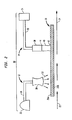
- System 10 for flame polishing a glass sheet or sheets 20 such as for example a thin glass sheet.
- System 10 includes a cooling assembly 12 and a heating assembly 14 for use upon the glass sheet 20, the glass sheet having opposed surfaces 20A, 20B.
- the system 10 is disposed between a melter shown generally at 16, which can be for example a glass melting furnace, and a lehr 18 disposed at a downstream end of the glass sheet 20 processing.
- Transport assembly conveyors shown generally at 22, 24 transport the glass sheet 20 from the melter 16 to the apparatus 10 (cooling assembly 12 and heating assembly 14), and from the apparatus10 to the lehr 18, respectively.
- the conveyors 22, 24 can include rollers, a mesh belt, conveyer belts, moving beds, moving plates such as for example a ceramic plate, etc.
- the transport mechanism needs to be of such construction that it can withstand the elevated temperatures generated in the system 10 and during support of the flame heated sheet 20.
- One embodiment to transport the glass sheet 20 includes a smooth ceramic plate which provides uniform support for the sheet in order to minimize mechanical stresses in the sheet.
- the glass sheet 20 upon entry into the system 10 has a surface 20A thereof exposed to the cooling assembly 12 and thereafter to the heating assembly 14.
- the cooling assembly 12 consists of a source 26 of a cooling fluid connected by a conduit 28 to a cooling discharge assembly 30.
- the source 26 of the cooling fluid may include air or a cryogen, such as nitrogen or carbon dioxide gas.
- the conduit 12 is connected to the discharge assembly 30 which preferably is a nozzle or other atomizer discharge member for dispersing the cooling medium in a uniform, even flow along the surface 20A of the glass sheet 20.
- the cooling discharge assembly 30 provides as uniformly as possible a flow of cooling medium onto the glass surface 20A. Cooling is performed uniformly, for the glass sheet being heated at a uniform temperature and as such reaches a uniform temperature across its upper surface 20A. Deviations in the thermal treatment of the upper surface 20A would lead to differential stresses, that could result in breakage and visible impairment of the surface.
- Cooling can be achieved for example by the discharge of a multitude of tiny jets from the assembly 30 arrayed across the upper surface 20A, or by an air-knife type arrangement (not shown) that consists of a continuous convergent slot through which high velocity air is blown directly on to the surface 20A at a steep angle with respect to the general direction of movement of the glass sheet 20.
- Arrows 32 approximate the flow stream of the cooling medium, whether by jets or air-knife, for contacting the surface 20A of the glass sheet 20.
- a heating assembly 14 includes a source 34 of combustible fuel connected by a conduit 36 to a burner assembly 38, such as for example an oxy-fuel burner.
- Burner 38 provides a flame 40 with a footprint 42 to contact and thus heat the surface 20A of the glass sheet 20.
- the burner 38 could be constructed in a number of ways, a typical burner for use in this application may be a long body of rectangular or circular cross section containing an internal plenum (not shown) such that a uniform pressure is delivered across the plenum from the premixed fuel and oxygen entering the plenum and uniform heating is given across the width of the sheet. If desired a plurality of burners or burner assemblies may be employed.
- a plenum discharge assembly having small holes or slots arranged across a side of the plenum oriented towards the glass sheet 20 may be used. Premixed fuel and oxygen are discharged through these holes at a velocity greater than the velocity at which the flame 40 can propagate back into the plenum. Were the velocity of the premixed fuel and oxygen issuing through the holes to be less than the velocity at which the flame can move through the flammable premixed fuel and oxygen, then the flame would move towards the holes, as the flame would be moving faster than the premixed fuel and oxygen. This situation where the flammable mixture is moving slower than the velocity at which the flame would propagate through said mixture could ultimately result in the flame passing through the holes and into the plenum chamber.
- flash-back This phenomenon is commonly termed as “flash-back” or “back-fire” and could result is the violent release of energy with potentially destructive consequences.
- Such occurrences are controlled by adopting of a combination of preventative measures such as but not limited to: ensuring the mixture cannot "flash-back”; the inclusion of flame arrestors or flash-back arrestors which are designed to extinguish the flame; pressure or explosion relief vents; minimizing of the volume of flammable gases enclosed by the system, i.e. the plenum and any mixing assembly; and by purging of the enclosure with inert gases.
- the burner assembly is typically lowered close to the glass surface 20A such that the peak heat flux as indicated and discussed below with respect to Figure 3 is located on the glass surface 20A and provides the maximum heating rate.
- the cooling or chilling effect of the cooling medium spray 32 compensates for the high intensity flame 40 so that only the surface 20A is polished. This avoids the bulk of the glass sheet 20 underlying the surface 20A from being heated above its softening point so that the smooth planar characteristics of surface 20A and the glass sheet 20 are not compromised.
- the cooling and heating elements are operated such that the elevated temperatures generated within the glass sheet only penetrate to a depth of a approximately one-third (1/3 rd ) of the glass sheet thickness.
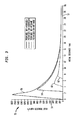
- Figure 3 is a graphical representation shown generally at 50 of the heat transfer rates from different types of flames under consideration.
- the distance between a discharge end 44 of the burner 38 and the glass surface 20A is represented on the horizontal axis 52 (Axial distance) and the magnitude of the heat transferred is shown on the vertical axis 54 (Heat transfer).
- Figure 3 shows the heat transfer compared to flame distance from the glass for a premixed oxy-hydrogen flame 56, a postmixed oxy-hydrogen flame 58, a premixed oxy-methane flame 60 and a postmixed oxy-methane flame 62.
- a peak or maximum heat flux occurs at a certain distance from the glass surface 20A which is different in both magnitude and location for each type of flame.
- the premixed oxy-hydrogen flame generates a peak heat flux of nearly 1600 kW/m2 at a distance of approximately two (2) cm from the glass surface 20A. This is twice as great as the heat flux from the post mixed oxy-hydrogen flame, over five (5) times greater than a premixed oxy-methane flame and eight (8) times greater than a postmixed oxy-methane flame.
- the premixed oxy-hydrogen flame generates a noticeably higher heat flux than the other types of flames and as such, would be more effective in melting just the surface layer 20A of the glass 20 exposed to such a flame.
- This improvement in glass surface quality allows a glass sheet produced with an unacceptably rough surface to be subsequently used in a number of processes that require smoother surfaces. Examples of this are improving the surface quality of rolled sheet glass to allow photovoltaic cells to be applied and of float glass to be used in LCD or PDP display glasses.
- any irregularities in the surface of the rolled glass sheet are reduced to the point where the glass surface is suitably smooth for the photovoltaic cells.
- the cost and complexity of operating the tin bath in the float process is avoided. Furthermore by avoiding the need for a tin bath a smaller glass production facility becomes financially feasible.
Landscapes
- Chemical & Material Sciences (AREA)
- Engineering & Computer Science (AREA)
- Materials Engineering (AREA)
- Organic Chemistry (AREA)
- Physics & Mathematics (AREA)
- Thermal Sciences (AREA)
- Re-Forming, After-Treatment, Cutting And Transporting Of Glass Products (AREA)
Applications Claiming Priority (2)
| Application Number | Priority Date | Filing Date | Title |
|---|---|---|---|
| US14146708P | 2008-12-30 | 2008-12-30 | |
| US12/407,989 US20100162761A1 (en) | 2008-12-30 | 2009-03-20 | Flame polishing of flat glass |
Publications (1)
| Publication Number | Publication Date |
|---|---|
| EP2204354A2 true EP2204354A2 (de) | 2010-07-07 |
Family
ID=41868806
Family Applications (1)
| Application Number | Title | Priority Date | Filing Date |
|---|---|---|---|
| EP09252858A Withdrawn EP2204354A2 (de) | 2008-12-30 | 2009-12-22 | Feuerpolitur für Flachglas |
Country Status (2)
| Country | Link |
|---|---|
| US (1) | US20100162761A1 (de) |
| EP (1) | EP2204354A2 (de) |
Cited By (1)
| Publication number | Priority date | Publication date | Assignee | Title |
|---|---|---|---|---|
| WO2020165325A1 (de) | 2019-02-16 | 2020-08-20 | Fraunhofer-Gesellschaft zur Förderung der angewandten Forschung e.V. | Verfahren zum erhöhen der festigkeit eines glassubstrates |
Families Citing this family (17)
| Publication number | Priority date | Publication date | Assignee | Title |
|---|---|---|---|---|
| US9190096B2 (en) * | 2008-10-17 | 2015-11-17 | Hoya Corporation | Method for producing glass substrate and method for producing magnetic recording medium |
| JP5617556B2 (ja) * | 2010-11-22 | 2014-11-05 | 日本電気硝子株式会社 | 帯状ガラスフィルム割断装置及び帯状ガラスフィルム割断方法 |
| DE102011084129A1 (de) * | 2011-10-07 | 2013-04-11 | Schott Ag | Glasfolie mit speziell ausgebildeter Kante |
| US9181123B2 (en) | 2012-12-07 | 2015-11-10 | Linde Aktiengesellschaft | Thermal imaging to optimize flame polishing |
| KR101530089B1 (ko) * | 2013-08-12 | 2015-06-18 | 유형근 | 글래스 멜팅 면취 방법 |
| DE102013225669B4 (de) | 2013-12-11 | 2025-02-06 | China Triumph International Engineering Co., Ltd. | Verfahren zur Herstellung eines Halbzeugs für Dünnschichtsolarzellen |
| US11097974B2 (en) | 2014-07-31 | 2021-08-24 | Corning Incorporated | Thermally strengthened consumer electronic glass and related systems and methods |
| DE102015120569A1 (de) * | 2014-12-01 | 2016-06-02 | Schott Ag | Herstellen von waferartigen Dünnglasplatten mit Aufbauten und Auftrennen in einzelne kleinere Dünnglasplatten |
| US12338159B2 (en) | 2015-07-30 | 2025-06-24 | Corning Incorporated | Thermally strengthened consumer electronic glass and related systems and methods |
| KR101952085B1 (ko) | 2016-01-12 | 2019-05-21 | 코닝 인코포레이티드 | 얇은, 열적 및 화학적으로 강화된 유리-계 제품 |
| US11795102B2 (en) | 2016-01-26 | 2023-10-24 | Corning Incorporated | Non-contact coated glass and related coating system and method |
| CN105906195A (zh) * | 2016-04-14 | 2016-08-31 | 南通德瑞森复合材料有限公司 | 一种玻璃钢生产冷却系统 |
| TW201920028A (zh) | 2017-08-24 | 2019-06-01 | 美商康寧公司 | 具有改良回火能力之玻璃 |
| TWI785156B (zh) | 2017-11-30 | 2022-12-01 | 美商康寧公司 | 具有高熱膨脹係數及對於熱回火之優先破裂行為的非離子交換玻璃 |
| CN113727954A (zh) | 2019-04-23 | 2021-11-30 | 康宁股份有限公司 | 具有确定的应力分布曲线的玻璃层叠物及其制作方法 |
| CN114514115B (zh) | 2019-08-06 | 2023-09-01 | 康宁股份有限公司 | 具有用于阻止裂纹的埋入式应力尖峰的玻璃层压体及其制造方法 |
| JP2023531448A (ja) * | 2020-06-19 | 2023-07-24 | コーニング インコーポレイテッド | ガラスリボンの製造方法 |
Family Cites Families (15)
| Publication number | Priority date | Publication date | Assignee | Title |
|---|---|---|---|---|
| US1667146A (en) * | 1928-04-24 | of toledo | ||
| US877729A (en) * | 1907-01-26 | 1908-01-28 | Toledo Glass Co | Process of making sheet-glass. |
| US972168A (en) * | 1909-05-26 | 1910-10-11 | Joseph Heidenkamp | Method of making polished glass. |
| US1555358A (en) * | 1920-07-14 | 1925-09-29 | Danner Edward | Method and apparatus for making sheet glass |
| US1492975A (en) * | 1923-02-09 | 1924-05-06 | Pittsburgh Plate Glass Co | Process and apparatus for making sheet glass |
| US2032009A (en) * | 1934-08-14 | 1936-02-25 | Pittsburgh Plate Glass Co | Apparatus for making flat glass |
| US4081260A (en) * | 1976-12-13 | 1978-03-28 | Mark Leonovich Glikman | Process for making sheet glass on a fluid support |
| IT1104849B (it) * | 1977-04-19 | 1985-10-28 | Kloeckner Humboldt Deutz Ag | Procedimento ed impianto per produrre vetro in lastre |
| FR2551431B1 (fr) * | 1983-09-06 | 1986-08-22 | Air Liquide | Procede de polissage de la surface d'articles en verre |
| US5707412A (en) * | 1994-09-30 | 1998-01-13 | Ppg Industries, Inc. | Method of reducing glass sheet marking |
| US6004655A (en) * | 1994-10-26 | 1999-12-21 | Nippon Sheet Glass Co., Ltd. | Method of finishing edge of sheet glass, heat-tempered sheet glass using the method, and fire-resistant construction material using the heat-tempered sheet glass |
| DE19513862C2 (de) * | 1995-04-12 | 1997-12-18 | Alcatel Kabel Ag | Verfahren und Vorrichtung zum Feuerpolieren eines langgestreckten Glaskörpers |
| US6877341B1 (en) * | 2001-01-26 | 2005-04-12 | The Trustees Of Columbia University In The City Of New York | Method for controlled surface scratch removal and glass resurfacing |
| DE10141498B4 (de) * | 2001-08-24 | 2004-08-26 | Schott Glas | Rollentisch zum Tragen und Fördern eines heißen Glasstranges |
| DE102006023078B4 (de) * | 2006-05-16 | 2012-04-19 | Schott Ag | Verfahren zur Herstellung von Glaskeramik-Artikeln mit verbesserter Oberfläche, Vorrichtung und Verwendung |
-
2009
- 2009-03-20 US US12/407,989 patent/US20100162761A1/en not_active Abandoned
- 2009-12-22 EP EP09252858A patent/EP2204354A2/de not_active Withdrawn
Non-Patent Citations (1)
| Title |
|---|
| None |
Cited By (1)
| Publication number | Priority date | Publication date | Assignee | Title |
|---|---|---|---|---|
| WO2020165325A1 (de) | 2019-02-16 | 2020-08-20 | Fraunhofer-Gesellschaft zur Förderung der angewandten Forschung e.V. | Verfahren zum erhöhen der festigkeit eines glassubstrates |
Also Published As
| Publication number | Publication date |
|---|---|
| US20100162761A1 (en) | 2010-07-01 |
Similar Documents
| Publication | Publication Date | Title |
|---|---|---|
| US20100162761A1 (en) | Flame polishing of flat glass | |
| JP7331082B2 (ja) | ガラス基板を加工する装置および方法 | |
| US11680006B2 (en) | Apparatus and method for forming thin glass articles | |
| US6715319B2 (en) | Melting of glass | |
| US8322160B2 (en) | Process and apparatus for producing glass sheet | |
| JP6110004B2 (ja) | 薄膜コーティングを被覆するための装置およびこのような装置を用いた被覆方法 | |
| US20120144867A1 (en) | System and method for producing patterned heat-strengthened glass | |
| CN111747634B (zh) | 一种高世代tft-lcd玻璃基板生产线 | |
| KR20170129224A (ko) | 유리 리본의 가장자리를 제거하기 위한 방법 및 장치 | |
| JP3217176B2 (ja) | フロートガラスの製造方法およびその装置 | |
| CN102056851A (zh) | 平板玻璃的制造装置及平板玻璃的制造方法 | |
| US20190202729A1 (en) | Antibody-coated nanoparticle vaccines | |
| CN102574719A (zh) | 熔融玻璃制造装置、熔融玻璃制造方法及使用了该装置和该方法的平板玻璃制造方法 | |
| NO145793B (no) | Analogifremgangsmaate for fremstilling av den fysiologisk aktive forbindelse n-(r-tetrahydrofurfuryl)-noroksymorfon | |
| TW201736286A (zh) | 玻璃片分離的方法 | |
| TW202212276A (zh) | 製造玻璃帶的方法 | |
| WO2013008894A1 (ja) | 積層膜付きガラス基板の製造方法 | |
| CN103649002A (zh) | 带层叠膜的玻璃基板的制造方法 | |
| TW201309838A (zh) | 附積層膜之玻璃基板之製造方法 | |
| JP2017065960A (ja) | ガラス基板の製造方法 |
Legal Events
| Date | Code | Title | Description |
|---|---|---|---|
| PUAI | Public reference made under article 153(3) epc to a published international application that has entered the european phase |
Free format text: ORIGINAL CODE: 0009012 |
|
| AK | Designated contracting states |
Kind code of ref document: A2 Designated state(s): AT BE BG CH CY CZ DE DK EE ES FI FR GB GR HR HU IE IS IT LI LT LU LV MC MK MT NL NO PL PT RO SE SI SK SM TR |
|
| AX | Request for extension of the european patent |
Extension state: AL BA RS |
|
| STAA | Information on the status of an ep patent application or granted ep patent |
Free format text: STATUS: THE APPLICATION IS DEEMED TO BE WITHDRAWN |
|
| 18D | Application deemed to be withdrawn |
Effective date: 20140701 |