EP2202644B1 - Data transforming apparatus and control method thereof - Google Patents
Data transforming apparatus and control method thereof Download PDFInfo
- Publication number
- EP2202644B1 EP2202644B1 EP09180473.2A EP09180473A EP2202644B1 EP 2202644 B1 EP2202644 B1 EP 2202644B1 EP 09180473 A EP09180473 A EP 09180473A EP 2202644 B1 EP2202644 B1 EP 2202644B1
- Authority
- EP
- European Patent Office
- Prior art keywords
- data
- transform
- weighting coefficients
- integer
- calculation
- Prior art date
- Legal status (The legal status is an assumption and is not a legal conclusion. Google has not performed a legal analysis and makes no representation as to the accuracy of the status listed.)
- Not-in-force
Links
Images




Classifications
-
- H—ELECTRICITY
- H03—ELECTRONIC CIRCUITRY
- H03M—CODING; DECODING; CODE CONVERSION IN GENERAL
- H03M7/00—Conversion of a code where information is represented by a given sequence or number of digits to a code where the same, similar or subset of information is represented by a different sequence or number of digits
- H03M7/30—Compression; Expansion; Suppression of unnecessary data, e.g. redundancy reduction
-
- G—PHYSICS
- G06—COMPUTING OR CALCULATING; COUNTING
- G06F—ELECTRIC DIGITAL DATA PROCESSING
- G06F17/00—Digital computing or data processing equipment or methods, specially adapted for specific functions
- G06F17/10—Complex mathematical operations
- G06F17/14—Fourier, Walsh or analogous domain transformations, e.g. Laplace, Hilbert, Karhunen-Loeve, transforms
- G06F17/145—Square transforms, e.g. Hadamard, Walsh, Haar, Hough, Slant transforms
-
- H—ELECTRICITY
- H04—ELECTRIC COMMUNICATION TECHNIQUE
- H04N—PICTORIAL COMMUNICATION, e.g. TELEVISION
- H04N19/00—Methods or arrangements for coding, decoding, compressing or decompressing digital video signals
- H04N19/42—Methods or arrangements for coding, decoding, compressing or decompressing digital video signals characterised by implementation details or hardware specially adapted for video compression or decompression, e.g. dedicated software implementation
Definitions
- the present invention relates to a data transforming technique capable of lossless transformation of nth-order integer data into nth-order integer data in a lossless orthogonal transform essential for transforming image data of each block and processing lossless coding and lossy coding by a unified scheme, in order to particularly implement various kinds of lossless rotational transforms which form the lossless orthogonal transform.
- An image especially a multi-valued image, includes many pieces of information, and requires a huge memory capacity for storage and a lot of time for transmission.
- the storage and transmission of an image uses high-efficiency coding to reduce the amount of data by removing redundancy of the image or changing its contents to a level at which the deterioration of image quality is visually unrecognizable.
- JPEG which is recommended by ISO and ITU-T as an international standard coding scheme for still images, transforms image data of each block (8 ⁇ 8 pixels) into a DCT coefficient by executing a discrete cosine transform (DCT). JPEG quantizes each coefficient and entropy-encodes the quantized coefficient, compressing the image data.
- DCT discrete cosine transform
- Other compression techniques using the DCT are H.261 and MPEG-1/2/4 in addition to JPEG.
- lossless coding was also standardized to make a compressed/decompressed image completely match an original image. In those days, studies of lossless transform techniques did not make remarkable progress, and a lossless transform using the DCT could not be implemented. Lossless coding was therefore performed not by block transform coding using the DCT but by predictive coding of each pixel.
- JPEG-LS lossless transform
- JPEG 2000 using a lossless wavelet transform for lossless image coding became an international standard later on.
- the lossless wavelet transform is a lossless transform from an integer data set to an integer data set. Coding using a lossless transform can literally achieve lossless coding unless the transmission coefficient is quantized. The intervention of quantization processing enables lossy coding. That is, this coding can seamlessly perform lossless coding and lossy coding by the same transform scheme. With this advantage, coding using the lossless transform is adopted even in JPEG-XR, which is now being internationally standardized.
- Japanese Patent Laid-Open No. 2003-258645 discloses a lossless transform method limited to the Hadamard transform.
- the method disclosed in this reference rounds up the fractional parts of an odd number of data and rounds down those of another odd number of data for transform coefficients of fractional data obtained by a linear Hadamard transform.
- This reference has a feature in the rounding method, and does not devise to reduce calculations of the linear Hadamard transform or decrease the amount of processing necessary for round processing.
- the present invention has been made to overcome the conventional drawbacks.
- the invention provides a technique of performing a lossless transform more quickly.
- the invention also provides a technique of performing the lossless Hadamard Transform using small circuit.
- the present invention in its first aspect provides a data transforming apparatus as specified in one of claims 1 to 3.
- the present invention in its second aspect provides a method of controlling a data transforming apparatus as specified in claim 4 or 5.
- the present invention can implement a fast lossless transform that is almost free from delay with a small amount of calculation.
- the lossless transform can perform lossless coding and lossy coding quickly.
- both software and hardware processes can execute a calculation capable of implementing a fast lossless Hadamard transform by the same description. This allows development of software and hardware together.
- the size of the circuit can be smaller than conventional other circuits and the circuit needs little electricity to work. This means that it is useful for a industrial product compressing data.
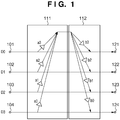
- the apparatus in Fig. 1 includes a first calculation unit 111 and second calculation unit 112.
- the first calculation unit 111 multiplies four data D0, D1, D2, and D3 input from input terminals 101, 102, 103, and 104 by weighting coefficients a0, a1, a2, and a3.
- the second calculation unit 112 multiplies the sum E by second weighting coefficients b0, b1, b2, and b3 set for the respective input data.
- the second calculation unit 112 adds the products to the input data D0, D1, D2, and D3, i.e., calculates D0 + b0*E, D1 + b1*E, D2 + b2*E, and D3 + b3*E.
- the second calculation unit 112 then outputs the sums from output terminals 121 to 124.
- the transform matrix of this transform can be expressed as 1 + a 0 b 0 a 1 b 0 a 2 b 0 a 3 b 0 a 0 b 1 1 + a 1 b 1 a 2 b 1 a 3 b 1 a 0 b 2 a 1 b 2 1 + a 2 b 2 a 3 b 2 a 0 b 3 a 1 b 3 a 2 b 3 1 + a 3 b 3 .
- An inverse transform matrix of matrix (1) is 1 ⁇ a 0 b 0 T ⁇ a 1 b 0 T ⁇ a 2 b 0 T ⁇ a 3 b 0 T ⁇ a 0 b 1 T 1 ⁇ a 1 b 1 T ⁇ a 2 b 1 T ⁇ a 3 b 1 T ⁇ a 1 b 2 T 1 ⁇ a 2 b 2 T ⁇ a 3 b 2 T ⁇ a 1 b 3 T ⁇ a 1 b 3 T ⁇ a 1 b 3 T ⁇ a 2 b 3 T 1 ⁇ a 3 b 3 T
- the value of the determinant T of the matrix needs to be -1 or +1 to prevent addition of redundancy or degeneracy of information upon transform.
- the present invention ensures reversibility in transforming integer data into integer data by using the similarity between a transform matrix (forward transform matrix) and an inverse transform matrix.
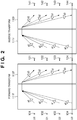
- the forward transform side and inverse transform side have the same arrangement.
- "f” is suffixed to the reference numerals of the first and second calculation units on the forward transform side
- "r” is suffixed to those of the first and second calculation units on the inverse transform side.
- Reference numerals 141 to 144 denote output terminals on the inverse transform side.
- the result of forward transform in this data transform processing is generally fractional data and is basically not an integer.
- the calculation result of a first calculation unit 111f on the forward transform side and that of a first calculation unit 111r on the inverse transform side have the same absolute value with opposite signs. Based on this relationship, reversibility by the data transforming apparatus can be explained.
- a second calculation unit 112f multiplies the calculation result of the first calculation unit 111f by the second weighting coefficient, and adds the product to each input data.
- a second calculation unit 112r multiplies, by the same second weighting coefficient, the calculation result of the first calculation unit 111r having a sign opposite to that of the first calculation unit 111f, and adds the product to inversely transformed input data. Consequently, data added on the forward transform side and that added on the inverse transform side cancel each other, leaving only input data.
- the result of forward transform is fractional data. Reversibility can be obtained if "added data in transform and added data in inverse transform can cancel each other" in the above-described way, even when fractional data is rounded into integer data.
- the relationship in which the calculation result of the first calculation unit 111f on the forward transform side and that of the first calculation unit 111r on the inverse transform side have opposite signs needs to be analyzed in more detail.
- a calculation result E of the first calculation unit 111f on the forward transform side is contained in the calculation result of the first calculation unit 111r on the inverse transform side as a transmission signal of -2E based on the transmission coefficient.
- the calculation result of the first calculation unit 111r on the inverse transform side contains the calculation result of the first calculation unit 111r on the inverse transform side for input data on the forward transform side.
- a signal corresponding to this calculation result is E, similar to the calculation result of the first calculation unit 111f on the forward transform side.
- the transmission coefficient "-2" needs to be held even after converting fractional data into an integer.
- the following three methods are conceivable. Before a description of the embodiments, these three methods will be explained at once to clarify the difference between them.
- the first calculation method all weighting coefficients at which fractional data are generated are collected to the first calculation unit.
- a rounding unit at the final stage of the first calculation unit rounds fractional data into an integer value, which serves as the calculation result of the first calculation unit.
- the second calculation unit multiplies the integer value by a limited second weight and adds the product to input data.
- the arrangement of the first calculation unit having the rounding unit is shown in Fig. 3 , which shows the first embodiment to be described later.
- the transmission value "-2E” is truly an integer value, does not contain fractional data, and thus does not undergo round processing.
- the transmission coefficient accurately keeps “-2", maintaining reversibility.
- the second method is a rounding method when the second weighting coefficient is a non-integer value.
- the arrangement of the second calculation unit having the rounding unit is shown in Fig. 4 , which shows the second embodiment to be described later.
- a fractional value generated by multiplication of the second weighting coefficient is rounded down.
- the rounded-down value is superposed on another signal to transmit the resultant signal.
- the fractional value is rounded up, the rounded-up component is subtracted from another signal to transmit the resultant signal.
- the value to be superposed needs to be adjusted so that a desired transmission value is finally obtained in consideration of the first weighting coefficient for the signal.
- An example of this method will be explained in the third embodiment to be described later. In this manner, the second method obtains the transmission coefficient "-2" accurately.
- the third method as well as the second one is a rounding method when the second weighting coefficient is a non-integer value.
- the second method assigns different round processes to paired data.
- the third processing method expands the processing to three or more data. In this processing, every time the fractional value of the calculation result of the first calculation unit increases by 1/n, one of n signals is incremented by one to transmit the signals every increment of 1/n.
- the three second weighting coefficients b0, b1, and b2 are 1/3. After signals are multiplied by the weighting coefficients, the fractional part of one signal is simply rounded down to an integer, that of another signal is rounded down to an integer after the addition of 1/3, and that of the remaining signal is rounded down to an integer after the addition of 2/3. Accordingly, the three signals can be transmitted in units of 1/3.
- the two second weighting coefficients b0 and b1 are 1/2. After signals are multiplied by the weighting coefficients, the fractional part of one signal is rounded down into an integer, and that of the other signal is rounded up into an integer. The signals can therefore be transmitted using the unit of 1/2. By transmitting the unit of 1/n using n signals, the transmission coefficient "-2" is maintained.
- Figs. 3 and 4 show the arrangement of a data transforming apparatus (data transforming circuit) in the first embodiment of the present invention.
- the physical meaning of this transform is to subtract the DC components of four input data from the respective input data.
- this transform is not so important, but is the simplest transform suited to explaining reversibility in the present invention and thus is exemplified in the present invention.
- Fig. 3 shows an arrangement when all first weighting coefficients a0, a1, a2, and a3 are set to "-1/2" and all second weighting coefficients b0, b1, b2, and b3 are set to an integer value "1".
- Fig. 4 shows an arrangement when all the first weighting coefficients a0, a1, a2, and a3 are set to an integer value "-1" and all the second weighting coefficients b0, b1, b2, and b3 are set to "1/2".
- a rounding unit 113 rounds fractional data into an integer round(F), which serves as an output E from a first calculation unit 111.
- the rounding method is either round-down or round-up as long as it is identical to that in the inverse transforming device.
- the first calculation unit of the inverse transforming device outputs -E, as described above.
- the inverse transforming device adds -E obtained by multiplying -E by the second weighting coefficient "1" to input data D0', D1', D2', and D3' of the inverse transforming device, thereby decoding the original data D0, D1, D2, and D3.
- a second calculation unit 112 multiplies the input data by the second weighting coefficient "1/2" and thus needs to perform round processing for each data multiplied by the second weighting coefficient.
- the processing equivalent to the arrangement of Fig. 3 is to perform the same processing in the four round processes. That is, round-up or - down is uniformly done in all the four round processes. This is also an arrangement condition when round processing in the first calculation unit 111 in Fig. 3 move to the second calculation unit 112 upon an equivalent modification.
- the other method of maintaining reversibility is to adjust the transmission coefficient accurately to "-2". This can be achieved by executing round-up in two of the four round processes and round-down in the remaining two.
- Multiplication of the weighting coefficient "1/2" may generate 1-bit fractional data. If the fractional data cannot be accurately transmitted owing to round processing, the transmission coefficient changes from "-2". In other words, if the 1-bit fractional value can be transmitted through a plurality of signals, the total transmission coefficient can be set to "-2".
- a lossless transform in the arrangement of Fig. 4 , round-up is done in an even number of round processes out of four round processes, and round-down is performed in the remaining even number of round processes.
- a lossless transform can be performed by half of all 16 combinations, i.e., eight combinations of the four round processes.
- an inverse transform for decoding original data from the lossless transformation data in the present invention is basically the same as transform processing.
- transform processing and inverse transform processing are completely the same, including round processing. Even when the second calculation unit executes round processing, if the round processing can be replaced with that in the first calculation unit, inverse transform can be done by the same processing as that of transform, including the round processing in the second calculation unit.
- the round processing is executed based on the same concept as that of an inverse transform in conventional lifting calculation. More specifically, the same value as that added in lifting calculation in transform is generated even in inverse transform and subtracted, thereby decoding original data.
- an output -E from the first calculation unit in inverse transform is multiplied by -1 to be equal to the output E from the first calculation unit in transform. Then, the resultant value is multiplied by the second weighting coefficient.
- the same processing as round processing by the second calculation unit in transform is applied to round processing by the second calculation unit in inverse transform, generating the same value as that in transform and subtracting the generated value.
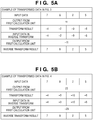
- Figs. 5A and 5B show examples of transformed data in the arrangement examples of Figs. 3 and 4 . Pay attention to reversibility in these examples.
- Fig. 6 shows the arrangement of an apparatus in an application example of the first embodiment.
- the example directly utilizes the arrangement of the first embodiment and adds slight processes at the input and output stages of this arrangement, implementing a lossless Hadamard transform which is a most basic transform in images data compression coding.
- a first sign inverter is added to the arrangement of Fig. 3 to invert the sign of the first input data.
- a second sign inverter is added to invert the sign again when outputting transformed data of the first input data.
- first and second sign inverters are represented by matrices.
- the sign of an element on the first row and first column of identity matrix is inverted into -1.
- the first sign inverter acts on input data
- the second sign inverter acts on a transformed output data.
- a lossless Hadamard transform can also be achieved by even an arrangement in which the first and second sign inverters are added at the preceding and subsequent stages of the transforming apparatus shown in Fig. 4 .
- Fig. 7 shows the arrangement of a data transforming apparatus in the second embodiment of the present invention.
- the transform matrix of this arrangement is the same as the matrix on the right-hand side of matrix (6) in the application example.
- a first calculation unit 301 and second calculation unit 302 respectively absorb and integrate two sign inverters arranged at the input and output stages in the application example.
- First weighting coefficients a0, a1, a2, and a3 are 1/2, -1/2, -1/2, and -1/2, respectively.
- Second weighting coefficients b0, b1, b2, and b3 are -1, 1, 1, and 1, respectively.
- a0*b0 + a1*b1 + a2*b2 + a3*b3 -2.
- sign inverters exist on a data path 115 in which the signs of the first and second weighting coefficients for the first input data are inverted and no weighting coefficient is multiplied.
- the sign inverter on the input side and that on the output side cancel each other as if no sign inverter existed on the data path, resulting in the arrangement shown in Fig. 7 .
- a lossless Hadamard transform can be performed by various calculation methods.
- the above calculation method can execute a calculation at high speed under control of both software and hardware, and makes the best use of features of the present invention.
- a lossless Hadamard transform could be calculated quickly by only either software or hardware.
- the calculation method based on the present invention can perform a high-speed calculation by both software and hardware processes.
- the software and hardware processes can employ the same calculation method.
- the first weighting coefficients a0, a1, a2, and a3 become 1, -1, -1, and - 1, respectively, and the second weighting coefficients b0, b1, b2, and b3 become -1/2, 1/2, 1/2, and 1/2, respectively.
- the second calculation unit performs round processing, similar to Fig. 4 .
- Fig. 8 shows an arrangement in this case.
- round processing by the first calculation unit in the arrangement of Fig. 7 is “round-down”
- round processing by the second calculation unit in Fig. 8 equivalent to that round processing is “round-up" for only the first data and “round-down” for the second to fourth data.
- round processing by the first calculation unit is “round-up”
- round processing by the second calculation unit in Fig. 8 equivalent to that round processing is “round-down” for only the first data and “round-up” for the second to fourth data.
- Round processes when inversely transforming data transformed by these round processes suffice to be the same as those in transform.
- An output -E from the first calculation unit in inverse transform is multiplied by -1 to make its sign coincide with that of the output E from the first calculation unit in transform, thereby obtaining the same value.
- the resultant value is multiplied by the second weighting coefficient, the same value as that in transform is reproduced by applying the same processing as round processing by the second calculation unit in transform.
- this value is added to input data to obtain transformed data.
- inverse transform therefore, the original input data can be reconstructed by subtracting this value.
- Figs. 9 and 10 show the arrangements of a data transforming apparatus in the third embodiment of the present invention.
- Figs. 9 and 10 can perform a fourth-order lossless Hadamard transform for weighted input data.
- Weighted data are generated in various situations. For example, in a lossless transform in image coding directed to the present invention, weighted transformed data is generated as a result of a lossless rotational transform by a smaller number of lifting calculations.
- Fig. 12 shows an arrangement which achieves a 45° rotation by two lifting calculations. It is known that three lifting calculations are required to implement a normal rotational transform which generate unweighted rotated data. If rotational transform is done by two lifting calculations, data is transformed into weighted one.
- a weight generated by the transform of Fig. 12 is (COS45°, 1/COS45°), i.e., 1 / 2 , 2 .
- An adder 411 adds data Xi input from a terminal 401 to data Yi input from a terminal 402, outputting data Yo from a terminal 422.
- the data Yo has a wide range and is weighted with 2 .
- the data Yo is multiplied by 1/2, and a subtracter 412 subtracts the product from data on the lower side, outputting data Xo from a terminal 421.
- the data Xo has a narrow range and is weighted with 1 / 2 .
- the third embodiment will describe two examples of an arrangement capable of performing the fourth-order lossless Hadamard transform for input data weighted with 1, 2, 1/2, and 1, respectively.
- first weighting coefficients a0, a1, a2, and a3 are -1/4, 1/8, 1/2, and 1/4, respectively.
- Second weighting coefficients b0, b1, b2, and b3 are 2, -4, -1, and -2, respectively.
- the first weighting coefficients a0, a1, a2, and a3 are - 1/2, 1/4, 1, and 1/2, respectively.
- the second weighting coefficients b0, b1, b2, and b3 are 1, -2, - 1/2, and -1, respectively.
- a first calculation unit 301 includes a rounding unit 303 and outputs integer values, so a second calculation unit 302 need not execute round processing (need not include a rounding unit).
- This arrangement has been described repetitively in the above embodiments and can achieve a lossless transform based on the same principle as the foregoing one.
- Fig. 10 The arrangement shown in Fig. 10 will suppresses distortions caused by rounding.
- Data rounded into an integer by a first calculation unit 311 is multiplied by 2 at maximum, then used by a second calculation unit 312.
- the first and second calculation units 311 and 312 include rounding units 313 and 314, respectively.
- the third embodiment therefore adopts the second method among the three rounding methods.
- a fractional value rounded down by the rounding unit of the second calculation unit is superposed on another data.
- a fractional value rounded up by the rounding unit needs to be subtracted from another data.
- a fractional value (1/2 or 0) is assumed to be rounded down in the round processing.
- a value to be superposed on another data is limited to an integer.
- the ratio of first weighting coefficients in decoding needs to be 2 : 1 between rounded-down data and superposed data.
- the fourth data satisfies this relation with respect to the third data rounded down by round processing of the second calculation unit 312.
- the rounded-down fractional value is doubled to be an integer, and the integer is added to the fourth data.
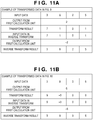
- FIGs. 11A and 11B show examples of the data transform in the third embodiment.
- Fig. 13 shows the arrangement of a data transforming apparatus according to the fourth embodiment of the present invention.
- the above embodiments have explained only a fourth-order transform for four input data, the present invention is also applicable to transforms of other orders.
- the fourth embodiment will exemplify a third-order orthogonal transform.
- all first weighting coefficients a0, a1, and a2 in a first calculation unit 511 are 2/3
- all second weighting coefficients b0, b1, and b2 in a second calculation unit 512 are -1.
- a transform implemented by these weighting coefficients can be given by 1 3 1 ⁇ 2 ⁇ 2 ⁇ 2 1 ⁇ 2 ⁇ 2 ⁇ 2 1 In this transform matrix, respective rows are orthogonal to each other, and the square sum of elements on each row is 1. Hence, this transform matrix is an orthonormal matrix.
- a divider In hardware processing of which high-speed processing is required, a divider hardly executes division by 3, and approximate calculation by multiplication is often performed instead. In this case, a value approximate to 2/3 is multiplied. For example, 2/3 approximated to a 12-bit fractional value is represented by 1365/2048, and this value is multiplied.
- approximate calculation produces a calculation error and generates fractional data even for a value divisible by 3.
- the calculation error produced by the approximate calculation is superposed on transformed output data after multiplied by the second weighting coefficient on the transform side, and propagates to the output of the first calculation unit 511 in inverse transform.
- Round processing by the first calculation unit in inverse transform needs to be effective for only the result of multiplying only original input data components by the first weighting coefficients and summating the products.
- the calculation error added by the approximate calculation makes it difficult to grasp the influence of round processing.
- the transmission coefficient has a nonlinear characteristic, is not a constant, and cannot be set to "-2" any more.
- a lossless transform is therefore achieved by maintaining the calculation precision so that the first calculation unit on the inverse transform side outputs -E with respect to the output E from the first calculation unit 511 on the transform side, in place of adjusting the transmission coefficient itself to "-2".
- the approximation precision of 2/3 may need more accuracy.
- an output from the first calculation unit in inverse transform becomes -E and a lossless transform can be realized. It is easy to verify that the output from the calculation unit always becomes -E while the input data fall within that range. Larger input data lead to a larger multiplication error. Thus, it suffices to confirm that this output becomes -E when all the three input data take values near a maximum value of 255 or smaller and their sums are 3n, 3n+1, and 3n+2.
- the signal is transmitted for each 1/3 using three data paths according to the third method described before the first embodiment.
- a method of slightly changing round processing after division by 3 is also available.
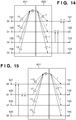
- Fig. 14 shows an arrangement in which four lifting calculations are combined as an arrangement in the fifth embodiment of the present invention.
- This arrangement implements a lossless Hadamard transform.
- first weighting coefficients a0, a1, a2, and a3 in a first calculation unit 601 according to the fifth embodiment are -1/2, 1/2, 1/2, and 1/2, respectively.
- a transform implemented by these weighting coefficients can be given by 1 2 3 ⁇ 1 ⁇ 1
- Fig. 15 shows the arrangement of inverse transform processing corresponding to the transform processing shown in Fig. 14 .
- an output from the first calculation unit 601 in inverse transform processing is equal to that from the first calculation unit 601 in forward transform processing. From the relationship between the second weighting coefficients in transform and inverse transform, values opposite in sign to values generated by multiplication of the second weighting coefficients in transform can be generated in inverse transform. By adding the generated values to cancel values added in transform, the original data can be reconstructed.
- the above-described lossless transform processing is applied to part of a DCT transform used in, e.g., JPEG coding.
- a lossless DCT transform can be calculated quickly, and DCT-based JPEG coding capable of seamlessly executing lossless compression and lossy compression can be performed at high speed.
- the size of the circuit illustrated in Fig. 7 can be smaller than that of other circuits shown in Figs. 6 , 8 and 14 , thereby the circuit needs little electricity to work. Accordingly, it will be understood that it is useful for a industrial product compressing data.
- aspects of the present invention can also be realized by a computer of a system or apparatus (or devices such as a CPU or MPU) that reads out and executes a program recorded on a memory device to perform the functions of the above-described embodiment(s), and by a method, the steps of which are performed by a computer of a system or apparatus by, for example, reading out and executing a program recorded on a memory device to perform the functions of the above-described embodiment(s).
- the program is provided to the computer for example via a network or from a recording medium of various types serving as the memory device (e.g., computer-readable medium).
Landscapes
- Engineering & Computer Science (AREA)
- Physics & Mathematics (AREA)
- General Physics & Mathematics (AREA)
- Mathematical Physics (AREA)
- Theoretical Computer Science (AREA)
- Computational Mathematics (AREA)
- Mathematical Analysis (AREA)
- Mathematical Optimization (AREA)
- Pure & Applied Mathematics (AREA)
- Data Mining & Analysis (AREA)
- Databases & Information Systems (AREA)
- Software Systems (AREA)
- General Engineering & Computer Science (AREA)
- Algebra (AREA)
- Multimedia (AREA)
- Signal Processing (AREA)
- Compression, Expansion, Code Conversion, And Decoders (AREA)
- Compression Or Coding Systems Of Tv Signals (AREA)
- Compression Of Band Width Or Redundancy In Fax (AREA)
- Complex Calculations (AREA)
Applications Claiming Priority (1)
| Application Number | Priority Date | Filing Date | Title |
|---|---|---|---|
| JP2008331190A JP4594420B2 (ja) | 2008-12-25 | 2008-12-25 | データ変換装置及びその制御方法 |
Publications (3)
| Publication Number | Publication Date |
|---|---|
| EP2202644A2 EP2202644A2 (en) | 2010-06-30 |
| EP2202644A3 EP2202644A3 (en) | 2017-07-12 |
| EP2202644B1 true EP2202644B1 (en) | 2018-08-29 |
Family
ID=41820359
Family Applications (1)
| Application Number | Title | Priority Date | Filing Date |
|---|---|---|---|
| EP09180473.2A Not-in-force EP2202644B1 (en) | 2008-12-25 | 2009-12-22 | Data transforming apparatus and control method thereof |
Country Status (5)
| Country | Link |
|---|---|
| US (1) | US7916962B2 (enExample) |
| EP (1) | EP2202644B1 (enExample) |
| JP (1) | JP4594420B2 (enExample) |
| KR (1) | KR101219411B1 (enExample) |
| CN (1) | CN101765013B (enExample) |
Families Citing this family (2)
| Publication number | Priority date | Publication date | Assignee | Title |
|---|---|---|---|---|
| JP4933405B2 (ja) * | 2007-11-13 | 2012-05-16 | キヤノン株式会社 | データ変換装置及びその制御方法 |
| JP6801461B2 (ja) | 2017-01-11 | 2020-12-16 | 富士通株式会社 | 情報処理装置、情報処理方法、及びプログラム |
Family Cites Families (12)
| Publication number | Priority date | Publication date | Assignee | Title |
|---|---|---|---|---|
| EP1292153B1 (en) * | 2001-08-29 | 2015-08-19 | Canon Kabushiki Kaisha | Image processing method and apparatus, computer program, and storage medium |
| US7082450B2 (en) * | 2001-08-30 | 2006-07-25 | Nokia Corporation | Implementation of a transform and of a subsequent quantization |
| US7194140B2 (en) * | 2001-11-05 | 2007-03-20 | Canon Kabushiki Kaisha | Image processing apparatus and method which compresses image data of each region using a selected encoding method |
| US7188132B2 (en) * | 2001-12-25 | 2007-03-06 | Canon Kabushiki Kaisha | Hadamard transformation method and apparatus |
| JP3754957B2 (ja) * | 2001-12-25 | 2006-03-15 | キヤノン株式会社 | アダマール変換処理方法及びその装置 |
| JP3902968B2 (ja) * | 2002-03-26 | 2007-04-11 | キヤノン株式会社 | 画像処理装置及びその制御方法及びコンピュータプログラム及び記憶媒体 |
| JP3902990B2 (ja) * | 2002-07-02 | 2007-04-11 | キヤノン株式会社 | アダマール変換処理方法及びその装置 |
| JP4366250B2 (ja) * | 2003-06-23 | 2009-11-18 | キヤノン株式会社 | データ変換処理装置及びプログラム |
| CN1642280B (zh) * | 2004-01-01 | 2010-04-28 | 浙江大学 | 图像和视频信号的变换装置及其方法 |
| JP4378245B2 (ja) * | 2004-08-23 | 2009-12-02 | キヤノン株式会社 | データ変換装置及び方法 |
| JP4236266B2 (ja) * | 2004-08-27 | 2009-03-11 | キヤノン株式会社 | データ変換装置およびその方法 |
| CN101106714A (zh) * | 2007-07-29 | 2008-01-16 | 浙江大学 | 应用于视频和图像处理的变换方法 |
-
2008
- 2008-12-25 JP JP2008331190A patent/JP4594420B2/ja not_active Expired - Fee Related
-
2009
- 2009-12-14 US US12/636,885 patent/US7916962B2/en not_active Expired - Fee Related
- 2009-12-15 KR KR20090124531A patent/KR101219411B1/ko not_active Expired - Fee Related
- 2009-12-22 CN CN200910254382XA patent/CN101765013B/zh not_active Expired - Fee Related
- 2009-12-22 EP EP09180473.2A patent/EP2202644B1/en not_active Not-in-force
Non-Patent Citations (1)
| Title |
|---|
| None * |
Also Published As
| Publication number | Publication date |
|---|---|
| EP2202644A3 (en) | 2017-07-12 |
| KR20100075734A (ko) | 2010-07-05 |
| CN101765013B (zh) | 2012-08-29 |
| US7916962B2 (en) | 2011-03-29 |
| JP2010154328A (ja) | 2010-07-08 |
| JP4594420B2 (ja) | 2010-12-08 |
| CN101765013A (zh) | 2010-06-30 |
| EP2202644A2 (en) | 2010-06-30 |
| KR101219411B1 (ko) | 2013-01-11 |
| US20100166329A1 (en) | 2010-07-01 |
Similar Documents
| Publication | Publication Date | Title |
|---|---|---|
| CN100379292C (zh) | 对具有n和m维数的媒体数据块进行转换的方法和装置 | |
| EP1440515B1 (en) | Implementation of a transform and of a subsequent quantization | |
| EP1294198B1 (en) | Improved block transform and quantization for image and video coding | |
| US5539836A (en) | Method and apparatus for the realization of two-dimensional discrete cosine transform for an 8*8 image fragment | |
| US7912318B2 (en) | Data transform apparatus and control method thereof | |
| US7188132B2 (en) | Hadamard transformation method and apparatus | |
| JP3902990B2 (ja) | アダマール変換処理方法及びその装置 | |
| US20090112958A1 (en) | Processes and apparatus for deriving order-16 integer transforms | |
| US8417045B2 (en) | Mechanism for processing order-16 discrete cosine transforms | |
| US20060294172A1 (en) | Method and system for high fidelity IDCT and DCT algorithms | |
| US7916962B2 (en) | Data transforming apparatus and control method thereof | |
| US6766341B1 (en) | Faster transforms using scaled terms | |
| JP3297742B2 (ja) | 画像再生装置及び画像再生方法 | |
| US7421139B2 (en) | Reducing errors in performance sensitive transformations | |
| US7489826B2 (en) | Compensating for errors in performance sensitive transformations | |
| US7555510B2 (en) | Scalable system for inverse discrete cosine transform and method thereof | |
| JP2003283840A (ja) | フィルタ処理装置およびフィルタ処理方法 | |
| US7430332B2 (en) | Approximations used in performance sensitive transformations which contain sub-transforms | |
| US6993550B2 (en) | Fixed point multiplying apparatus and method using encoded multiplicand | |
| Kulkarni et al. | Vector Quantization-Based Compression Using DCT and SVD Algorithms for Digital Images | |
| JP2809798B2 (ja) | 画像データ直交変換装置のマトリクス演算処理方式 | |
| JP2003258645A (ja) | アダマール変換処理方法及びその装置 | |
| JP5451171B2 (ja) | データ変換処理装置およびデータ変換処理方法 | |
| Miller et al. | MINIMAL HAAR TRANSFORM FOR FPGA | |
| JPH06303596A (ja) | データ圧縮方法及びデータ圧縮装置 |
Legal Events
| Date | Code | Title | Description |
|---|---|---|---|
| PUAI | Public reference made under article 153(3) epc to a published international application that has entered the european phase |
Free format text: ORIGINAL CODE: 0009012 |
|
| AK | Designated contracting states |
Kind code of ref document: A2 Designated state(s): AT BE BG CH CY CZ DE DK EE ES FI FR GB GR HR HU IE IS IT LI LT LU LV MC MK MT NL NO PL PT RO SE SI SK SM TR |
|
| PUAL | Search report despatched |
Free format text: ORIGINAL CODE: 0009013 |
|
| AK | Designated contracting states |
Kind code of ref document: A3 Designated state(s): AT BE BG CH CY CZ DE DK EE ES FI FR GB GR HR HU IE IS IT LI LT LU LV MC MK MT NL NO PL PT RO SE SI SK SM TR |
|
| RIC1 | Information provided on ipc code assigned before grant |
Ipc: G06F 17/14 20060101AFI20170606BHEP |
|
| 17P | Request for examination filed |
Effective date: 20180112 |
|
| RBV | Designated contracting states (corrected) |
Designated state(s): AT BE BG CH CY CZ DE DK EE ES FI FR GB GR HR HU IE IS IT LI LT LU LV MC MK MT NL NO PL PT RO SE SI SK SM TR |
|
| GRAP | Despatch of communication of intention to grant a patent |
Free format text: ORIGINAL CODE: EPIDOSNIGR1 |
|
| INTG | Intention to grant announced |
Effective date: 20180314 |
|
| GRAS | Grant fee paid |
Free format text: ORIGINAL CODE: EPIDOSNIGR3 |
|
| GRAA | (expected) grant |
Free format text: ORIGINAL CODE: 0009210 |
|
| AK | Designated contracting states |
Kind code of ref document: B1 Designated state(s): AT BE BG CH CY CZ DE DK EE ES FI FR GB GR HR HU IE IS IT LI LT LU LV MC MK MT NL NO PL PT RO SE SI SK SM TR |
|
| REG | Reference to a national code |
Ref country code: GB Ref legal event code: FG4D |
|
| RIN1 | Information on inventor provided before grant (corrected) |
Inventor name: NAKAYAMA, TADAYOSHI |
|
| REG | Reference to a national code |
Ref country code: CH Ref legal event code: EP |
|
| REG | Reference to a national code |
Ref country code: AT Ref legal event code: REF Ref document number: 1035968 Country of ref document: AT Kind code of ref document: T Effective date: 20180915 |
|
| REG | Reference to a national code |
Ref country code: IE Ref legal event code: FG4D |
|
| REG | Reference to a national code |
Ref country code: DE Ref legal event code: R096 Ref document number: 602009054133 Country of ref document: DE |
|
| REG | Reference to a national code |
Ref country code: NL Ref legal event code: MP Effective date: 20180829 |
|
| REG | Reference to a national code |
Ref country code: LT Ref legal event code: MG4D |
|
| PG25 | Lapsed in a contracting state [announced via postgrant information from national office to epo] |
Ref country code: NO Free format text: LAPSE BECAUSE OF FAILURE TO SUBMIT A TRANSLATION OF THE DESCRIPTION OR TO PAY THE FEE WITHIN THE PRESCRIBED TIME-LIMIT Effective date: 20181129 Ref country code: LT Free format text: LAPSE BECAUSE OF FAILURE TO SUBMIT A TRANSLATION OF THE DESCRIPTION OR TO PAY THE FEE WITHIN THE PRESCRIBED TIME-LIMIT Effective date: 20180829 Ref country code: IS Free format text: LAPSE BECAUSE OF FAILURE TO SUBMIT A TRANSLATION OF THE DESCRIPTION OR TO PAY THE FEE WITHIN THE PRESCRIBED TIME-LIMIT Effective date: 20181229 Ref country code: NL Free format text: LAPSE BECAUSE OF FAILURE TO SUBMIT A TRANSLATION OF THE DESCRIPTION OR TO PAY THE FEE WITHIN THE PRESCRIBED TIME-LIMIT Effective date: 20180829 Ref country code: BG Free format text: LAPSE BECAUSE OF FAILURE TO SUBMIT A TRANSLATION OF THE DESCRIPTION OR TO PAY THE FEE WITHIN THE PRESCRIBED TIME-LIMIT Effective date: 20181129 Ref country code: FI Free format text: LAPSE BECAUSE OF FAILURE TO SUBMIT A TRANSLATION OF THE DESCRIPTION OR TO PAY THE FEE WITHIN THE PRESCRIBED TIME-LIMIT Effective date: 20180829 Ref country code: GR Free format text: LAPSE BECAUSE OF FAILURE TO SUBMIT A TRANSLATION OF THE DESCRIPTION OR TO PAY THE FEE WITHIN THE PRESCRIBED TIME-LIMIT Effective date: 20181130 Ref country code: SE Free format text: LAPSE BECAUSE OF FAILURE TO SUBMIT A TRANSLATION OF THE DESCRIPTION OR TO PAY THE FEE WITHIN THE PRESCRIBED TIME-LIMIT Effective date: 20180829 |
|
| REG | Reference to a national code |
Ref country code: AT Ref legal event code: MK05 Ref document number: 1035968 Country of ref document: AT Kind code of ref document: T Effective date: 20180829 |
|
| PG25 | Lapsed in a contracting state [announced via postgrant information from national office to epo] |
Ref country code: ES Free format text: LAPSE BECAUSE OF FAILURE TO SUBMIT A TRANSLATION OF THE DESCRIPTION OR TO PAY THE FEE WITHIN THE PRESCRIBED TIME-LIMIT Effective date: 20180829 Ref country code: LV Free format text: LAPSE BECAUSE OF FAILURE TO SUBMIT A TRANSLATION OF THE DESCRIPTION OR TO PAY THE FEE WITHIN THE PRESCRIBED TIME-LIMIT Effective date: 20180829 Ref country code: HR Free format text: LAPSE BECAUSE OF FAILURE TO SUBMIT A TRANSLATION OF THE DESCRIPTION OR TO PAY THE FEE WITHIN THE PRESCRIBED TIME-LIMIT Effective date: 20180829 |
|
| PGFP | Annual fee paid to national office [announced via postgrant information from national office to epo] |
Ref country code: GB Payment date: 20181221 Year of fee payment: 10 |
|
| PG25 | Lapsed in a contracting state [announced via postgrant information from national office to epo] |
Ref country code: EE Free format text: LAPSE BECAUSE OF FAILURE TO SUBMIT A TRANSLATION OF THE DESCRIPTION OR TO PAY THE FEE WITHIN THE PRESCRIBED TIME-LIMIT Effective date: 20180829 Ref country code: IT Free format text: LAPSE BECAUSE OF FAILURE TO SUBMIT A TRANSLATION OF THE DESCRIPTION OR TO PAY THE FEE WITHIN THE PRESCRIBED TIME-LIMIT Effective date: 20180829 Ref country code: PL Free format text: LAPSE BECAUSE OF FAILURE TO SUBMIT A TRANSLATION OF THE DESCRIPTION OR TO PAY THE FEE WITHIN THE PRESCRIBED TIME-LIMIT Effective date: 20180829 Ref country code: CZ Free format text: LAPSE BECAUSE OF FAILURE TO SUBMIT A TRANSLATION OF THE DESCRIPTION OR TO PAY THE FEE WITHIN THE PRESCRIBED TIME-LIMIT Effective date: 20180829 Ref country code: AT Free format text: LAPSE BECAUSE OF FAILURE TO SUBMIT A TRANSLATION OF THE DESCRIPTION OR TO PAY THE FEE WITHIN THE PRESCRIBED TIME-LIMIT Effective date: 20180829 Ref country code: RO Free format text: LAPSE BECAUSE OF FAILURE TO SUBMIT A TRANSLATION OF THE DESCRIPTION OR TO PAY THE FEE WITHIN THE PRESCRIBED TIME-LIMIT Effective date: 20180829 |
|
| PG25 | Lapsed in a contracting state [announced via postgrant information from national office to epo] |
Ref country code: DK Free format text: LAPSE BECAUSE OF FAILURE TO SUBMIT A TRANSLATION OF THE DESCRIPTION OR TO PAY THE FEE WITHIN THE PRESCRIBED TIME-LIMIT Effective date: 20180829 Ref country code: SM Free format text: LAPSE BECAUSE OF FAILURE TO SUBMIT A TRANSLATION OF THE DESCRIPTION OR TO PAY THE FEE WITHIN THE PRESCRIBED TIME-LIMIT Effective date: 20180829 Ref country code: SK Free format text: LAPSE BECAUSE OF FAILURE TO SUBMIT A TRANSLATION OF THE DESCRIPTION OR TO PAY THE FEE WITHIN THE PRESCRIBED TIME-LIMIT Effective date: 20180829 |
|
| REG | Reference to a national code |
Ref country code: DE Ref legal event code: R097 Ref document number: 602009054133 Country of ref document: DE |
|
| REG | Reference to a national code |
Ref country code: DE Ref legal event code: R119 Ref document number: 602009054133 Country of ref document: DE |
|
| PLBE | No opposition filed within time limit |
Free format text: ORIGINAL CODE: 0009261 |
|
| STAA | Information on the status of an ep patent application or granted ep patent |
Free format text: STATUS: NO OPPOSITION FILED WITHIN TIME LIMIT |
|
| REG | Reference to a national code |
Ref country code: CH Ref legal event code: PL |
|
| 26N | No opposition filed |
Effective date: 20190531 |
|
| PG25 | Lapsed in a contracting state [announced via postgrant information from national office to epo] |
Ref country code: MC Free format text: LAPSE BECAUSE OF FAILURE TO SUBMIT A TRANSLATION OF THE DESCRIPTION OR TO PAY THE FEE WITHIN THE PRESCRIBED TIME-LIMIT Effective date: 20180829 Ref country code: LU Free format text: LAPSE BECAUSE OF NON-PAYMENT OF DUE FEES Effective date: 20181222 Ref country code: SI Free format text: LAPSE BECAUSE OF FAILURE TO SUBMIT A TRANSLATION OF THE DESCRIPTION OR TO PAY THE FEE WITHIN THE PRESCRIBED TIME-LIMIT Effective date: 20180829 |
|
| REG | Reference to a national code |
Ref country code: IE Ref legal event code: MM4A |
|
| REG | Reference to a national code |
Ref country code: BE Ref legal event code: MM Effective date: 20181231 |
|
| PG25 | Lapsed in a contracting state [announced via postgrant information from national office to epo] |
Ref country code: IE Free format text: LAPSE BECAUSE OF NON-PAYMENT OF DUE FEES Effective date: 20181222 Ref country code: FR Free format text: LAPSE BECAUSE OF NON-PAYMENT OF DUE FEES Effective date: 20181231 Ref country code: DE Free format text: LAPSE BECAUSE OF NON-PAYMENT OF DUE FEES Effective date: 20190702 |
|
| PG25 | Lapsed in a contracting state [announced via postgrant information from national office to epo] |
Ref country code: BE Free format text: LAPSE BECAUSE OF NON-PAYMENT OF DUE FEES Effective date: 20181231 |
|
| PG25 | Lapsed in a contracting state [announced via postgrant information from national office to epo] |
Ref country code: LI Free format text: LAPSE BECAUSE OF NON-PAYMENT OF DUE FEES Effective date: 20181231 Ref country code: CH Free format text: LAPSE BECAUSE OF NON-PAYMENT OF DUE FEES Effective date: 20181231 |
|
| PG25 | Lapsed in a contracting state [announced via postgrant information from national office to epo] |
Ref country code: MT Free format text: LAPSE BECAUSE OF NON-PAYMENT OF DUE FEES Effective date: 20181222 |
|
| PG25 | Lapsed in a contracting state [announced via postgrant information from national office to epo] |
Ref country code: TR Free format text: LAPSE BECAUSE OF FAILURE TO SUBMIT A TRANSLATION OF THE DESCRIPTION OR TO PAY THE FEE WITHIN THE PRESCRIBED TIME-LIMIT Effective date: 20180829 |
|
| PG25 | Lapsed in a contracting state [announced via postgrant information from national office to epo] |
Ref country code: PT Free format text: LAPSE BECAUSE OF FAILURE TO SUBMIT A TRANSLATION OF THE DESCRIPTION OR TO PAY THE FEE WITHIN THE PRESCRIBED TIME-LIMIT Effective date: 20180829 |
|
| PG25 | Lapsed in a contracting state [announced via postgrant information from national office to epo] |
Ref country code: CY Free format text: LAPSE BECAUSE OF FAILURE TO SUBMIT A TRANSLATION OF THE DESCRIPTION OR TO PAY THE FEE WITHIN THE PRESCRIBED TIME-LIMIT Effective date: 20180829 Ref country code: HU Free format text: LAPSE BECAUSE OF FAILURE TO SUBMIT A TRANSLATION OF THE DESCRIPTION OR TO PAY THE FEE WITHIN THE PRESCRIBED TIME-LIMIT; INVALID AB INITIO Effective date: 20091222 Ref country code: MK Free format text: LAPSE BECAUSE OF NON-PAYMENT OF DUE FEES Effective date: 20180829 |
|
| GBPC | Gb: european patent ceased through non-payment of renewal fee |
Effective date: 20191222 |
|
| PG25 | Lapsed in a contracting state [announced via postgrant information from national office to epo] |
Ref country code: GB Free format text: LAPSE BECAUSE OF NON-PAYMENT OF DUE FEES Effective date: 20191222 |