EP2200424B1 - Verfahren zur selektion von pflanzen mit bestimmten mutationen - Google Patents
Verfahren zur selektion von pflanzen mit bestimmten mutationen Download PDFInfo
- Publication number
- EP2200424B1 EP2200424B1 EP08834240.7A EP08834240A EP2200424B1 EP 2200424 B1 EP2200424 B1 EP 2200424B1 EP 08834240 A EP08834240 A EP 08834240A EP 2200424 B1 EP2200424 B1 EP 2200424B1
- Authority
- EP
- European Patent Office
- Prior art keywords
- dna
- plant
- primer
- plants
- seq
- Prior art date
- Legal status (The legal status is an assumption and is not a legal conclusion. Google has not performed a legal analysis and makes no representation as to the accuracy of the status listed.)
- Active
Links
Images




Classifications
-
- A—HUMAN NECESSITIES
- A01—AGRICULTURE; FORESTRY; ANIMAL HUSBANDRY; HUNTING; TRAPPING; FISHING
- A01H—NEW PLANTS OR NON-TRANSGENIC PROCESSES FOR OBTAINING THEM; PLANT REPRODUCTION BY TISSUE CULTURE TECHNIQUES
- A01H1/00—Processes for modifying genotypes ; Plants characterised by associated natural traits
- A01H1/04—Processes of selection involving genotypic or phenotypic markers; Methods of using phenotypic markers for selection
-
- A—HUMAN NECESSITIES
- A01—AGRICULTURE; FORESTRY; ANIMAL HUSBANDRY; HUNTING; TRAPPING; FISHING
- A01H—NEW PLANTS OR NON-TRANSGENIC PROCESSES FOR OBTAINING THEM; PLANT REPRODUCTION BY TISSUE CULTURE TECHNIQUES
- A01H1/00—Processes for modifying genotypes ; Plants characterised by associated natural traits
- A01H1/06—Processes for producing mutations, e.g. treatment with chemicals or with radiation
Definitions
- the present invention relates to a method for the selection of plants with specific mutations.
- the method relates to a method for the selection of plants that have a mutation in a desired genomic area that may lead to improved genetic variation and improved phenotypes.
- Mutagenic agents can be classified into three categories: physical (e.g., gamma rays), chemical (e.g., ethyl methane sulphonate, EMS) and transposable elements (such as transposons, retrotransposons, T-DNA, retroviruses).
- physical e.g., gamma rays
- chemical e.g., ethyl methane sulphonate, EMS
- transposable elements such as transposons, retrotransposons, T-DNA, retroviruses.
- SNPs single/simple nucleotide polymorphisms
- indels small insertions and deletions
- chromosomal rearrangements Even less is known about how induced mutation interact with epigenetic processes, such as methylation, activation of retro-elements, and perturbation of higher order DNA structure.
- Insertional mutagenesis involves inducing activity of transposition of known transposable elements to produce series of lines in which, in theory, every gene in the genome will have been inactivated by the transposon insertion. These lines can be used to identify genes that cause particular phenotypes or, conversely, can be used to identify gene function by searching for a phenotype associated with the inactivation of a particular known gene.
- insertional mutants have the drawback that gene function is heavily perturbed, usually presenting full gene knockout In many cases, mutations are desired that modify a gene rather than eliminate it.
- conventional mutation induction particularly chemical agents such as EMS provides the advantage of inducing point mutations and therefore a wide range of potential allelic variation.
- TILLING targeting induced local lesions in genomes'
- large numbers of small changes either DNA base pair substitutions or small deletions spanning no more than a few base pairs, are induced in a series of lines.
- gene function can be ascertained by associating a phenotype with changes in a particular gene and novel alleles of known genes can be generated.
- the present inventor has now found a solution to the above problems.
- the solution is based on the insight that primary mutagenised seeds give rise to chimeric plants, and that sector analysis can be used to specifically select heritable mutations. Only those mutations that occur in the embryonic apical stem cells will be incorporated in the entire body of the plant and will ultimately be transmitted to progeny. Non-stem cell mutations will generally not occupy a major portion of the different parts of the plant, such as the first series of true leaves or flowers in young plantlets, and generally will not extend into the germline.
- This insight is exploited in the present invention to screen for heritable mutations in any M1 population of plants, directly after seed mutagenesis.
- the method uses a specific multidimensional (more than 2) gridding strategy which pools different parts of the plants, such as the first true leaves in the first coordinate (x) of a multidimensional matrix, the second true leaves in the second coordinate (y), and, in the case of 3D pooling, the third true leaves in the third coordinate (z) (see figure).
- a specific multidimensional (more than 2) gridding strategy which pools different parts of the plants, such as the first true leaves in the first coordinate (x) of a multidimensional matrix, the second true leaves in the second coordinate (y), and, in the case of 3D pooling, the third true leaves in the third coordinate (z) (see figure).
- the true leaves one may also use the flowers or other parts (e.g. pollen) of the plant.
- Mutations detected in all three coordinates after KeyPoint (Tilling technology employing high throughput sequencing technology for the detection and identification of mutations instead of enzymes such as Cell) analysis are considered to have originated in the stem cells, because they are consistently present in all consecutive leaves or other organs. Mut
- the present invention provides for the sampling and sequencing of mutagenised populations in limited time.
- the individual mutant plants can be selected from a population of any desired size, and propagated with a large chance of carrying a specific heritable mutation. The rest of the population can be discarded.
- the advantage of this approach is that specific mutations can be made in different crops and their elite line(s), depending on actual needs. Also, long generation plants ((fruit) trees, grapes, etc) become amenable, because mutant selection only requires seed to grow individual mutant plants, and no progeny or generation times.
- the present invention relates to a method for the introduction and selection of a specific heritable mutation in plants, comprising the steps of:
- UV light-induced mutations are largely single nucleotide alterations.
- the mutated organism has been mutagenized such that at least about 1 mutation occurs in every 10,000-1,000 genes.
- the mutagenizing step in comprises inducing a (genetic) mutation into a gene of interest in an organism at an average frequency of 1/500, preferably 1/100, more preferably 1/10 organisms.
- the mutagenisation procedure can be adapted to achieve these rates, for instance by prolonging the exposure to the mutagenizing means.
- the mutation in any of the above-described methods is a single base pair mutation or a short insertion or deletion mutation, for example, in the range of about 1-10 base pairs
- seedlings are grown into plants.
- the seedlings (or parts of the resulting plants) can be sampled for instance by taking leaf or flower punches, but if possible entire true leaves or flowers are preferred.
- a sample of DNA-containing material is taken from one section of the plant.
- the sample is taken from the same section, for instance from the first true leaf or the first flower.
- DNA-containing material is sampled.
- the DNA-containing material is sampled from another section of the plant.
- the material is sampled from, for instance, the second true leaf etc.
- each of the sections of the plant is independently selected from the flowers, leaves, branches, stem or other parts of the plant located above ground and combinations thereof.
- the section is a leaf, preferably a true leaf.
- the section for the first dimension of the grid is the first true leaf, for the second dimension is the second true leaf, for the third dimension is the third true leaf.
- the DNA-containing material is pooled, whereby each section is pooled in one dimension of the pool.
- each section is pooled in one dimension of the pool.
- the DNA-containing material from the first section of the plants is pooled in the first dimension of the pool
- the DNA-containing material from the second section of the plants is pooled in the second dimension of the pool etc.
- the DNA is isolated from the pool, using any conventional method and means for the isolation of DNA.
- the pooled DNA can now be amplified using conventional means for the amplification of DNA, such as PCR, but other technologies may suffice as well.
- the pooled DNA is amplified with a set of primers that amplify (or span) (part of) the DNA containing the region or gene of interest.
- at least one of the primers contains a tag, preferably a nucleotide tag that identifies the pool.
- reaction products are obtained for each of the pools, whereby the reaction products can be linked to the pool from which they were amplified using the pool-specific tag.
- a pool of reaction products is now obtained, all containing DNA-fragments, stemming from different plants and possibly containing a variety of mutations in the region of interest.
- tag' or 'nucleotide tag' refers to the addition of a tag to a nucleic acid sample in order to be able to distinguish it from a second or further nucleic acid sample or amplification product.
- Tagging can e.g. be performed by the addition of a sequence identifier during amplification or by any other means known in the art.
- sequence identifier can e.g. be a unique base sequence of varying but defined length uniquely used for identifying a specific nucleic acid sample. Typical examples thereof are for instance ZIP sequences.
- the origin of a sample can be determined upon further processing.
- the different nucleic acid samples can be identified using different tags.
- the tag is also called an identifier sequence.
- the tag is located preferably at the 5' end of the primer.
- the reaction products can now be pooled if desired and subjected to sequencing.
- Sequencing can be performed using any known method for sequencing in the art.
- high throughput sequencing methods such as the methods disclosed in WO 03/004690 , WO 03/054142 , WO 2004/069849 , WO 2004/070005 , WO 2004/070007 , and WO 2005/003375 (all in the name of 454 Life Sciences), by Seo et al. (2004) Proc. Natl. Acad. Sci. USA 101:5488-93 , and technologies of Helios, Solexa, US Genomics, etcetera, which are herein incorporated by reference.
- the 454 technology described currently allows sequencing of up to 100 million bases in a single run and is 100 times faster and cheaper than competing technology. This will increase with increasing read length per reaction and/or increasing numbers of parallel reactions.
- the sequencing technology roughly consists of 5 steps: 1) fragmentation of DNA and ligation of specific adaptor to create a library of single-stranded DNA (ssDNA); 2) annealing of ssDNA to beads, emulsification of the beads in water-in-oil microreactors and performing emulsion PCR to amplify the individual ssDNA molecules on beads; 3) selection of /enrichment for beads containing amplified ssDNA molecules on their surface 4) deposition of DNA carrying beads in a PicoTiterPlate®; and 5) simultaneous sequencing in a plurality of wells by generation of a pyrophosphate light signal.
- sequences of the fragments that are directly obtained from the sequencing step may be trimmed, preferably in silico, to remove any bead annealing sequence, sequencing primer, or adaptor related sequence information.
- the information provided by the tag may be preserved in a separate database field so as to later on connect the discovered heritable mutation (gene) to the address in the DNA pools.
- the alignment or clustering is performed on sequence data that have been trimmed for any added adaptors/primer and/or identifier sequences i.e. using only the sequence data from the fragments that originate from the nucleic acid sample.
- NCBI Basic Local Alignment Search Tool (Altschul et al., 1990) is available from several sources, including the National Center for Biological Information (NCBI, Bethesda, Md.) and on the Internet, for use in connection with the sequence analysis programs blastp, blastn, blastx, tblastn and tblastx. It can be accessed at ⁇ http://www.ncbi.nlm.nih.gov/BLAST/>. A description of how to determine sequence identity using this program is available at ⁇ http://www.ncbi.nlm.nih.gov/BLAST/blast_help.html>.
- the database preferably comprises EST sequences, genomic sequences of the species of interest and/or the non-redundant sequence database of GenBank or similar sequence databases.
- High throughput sequencing methods can be used as described in Shendure et al. Science, Vol 309, Issue 5741, 1728-1732 . Examples thereof are microelectrophoretic sequencing, Hybridization sequencing/sequencing by hybridization (SBH), cyclic-array sequencing on amplified molecules, cyclic-array sequencing on single molecules, non-cyclical, single-molecule, real-time methods, such as , polymerase sequencing, exonuclease sequencing, nanopore sequencing.
- SBH Hybridization sequencing/sequencing by hybridization
- the fragments or the amplified products are sequenced with sufficient redundancy.
- Redundancy is what enables making the distinction between sequencing errors and genuine genome sequences.
- the redundancy of the sequencing is preferable at least 4, more preferably at least 5, but, redundancies of more than 6, preferably more than 8 or even more than 10 are considered advantageous, although not essential for the inventive concept.
- each seedling in the grid is identified by the deconvolution of the sequences of step (h) by using the pool specific tags. For each seedling or plant is determined whether the combination of the same mutation and the pool-associated tag can be retrieved commensurate with the number of dimensions of the grid. In other words, if the grid contains three dimensions, and the same mutation is retrieved three times together with three tags that identify a pool address that is linked to a particular seedling or plant, the induced mutation has likely been introduced in a manner that is considered for further processing. See also the schematic representation of the method in Fig 1 . These selected seedlings or plants may be grown and the inheritance of the mutation can be confirmed in a following generation. The seedling or plant may also be grown and used in breeding.
- the selected seedling or plant can now be analysed for the presence or absence of a phenotype of interest, in other words, the selected mutations can be assessed whether it is capable of providing a different phenotype or that the mutation is indifferent to the phenotype studied.
- Part of the original population of the mutagenised seeds that do not carry a mutation in the region of interest that is heritably present, i.e. is retrieved in every section of the plant that is analysed, can be discarded.
- Null mutants at AN1 give rise to white flowers.
- the second gene ( RT ) is UDP rhamnose: anthocyanin-3-glucoside rhamnosyl transferase.
- null mutants of RT produce red flowers, as a consequence of the accumulation of cyanidin-3-glucoside (Kroon et al. 1994, Brugliera et al. 1994).
- both recessive color markers are transposon insertion alleles carrying dTph1 and dTph3 insertions respectively (Spelt et al. 2000, Kroon et al. 1994).
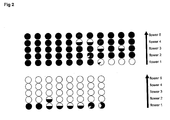
- a population of 3600 F1 plants was grown from EMS treated seed, and the sectoring patterns for flower color were recorded visually on the primary inflorescence only.
- the primary inflorescence is defined as clonally derived from the embryonic shoot apical meristem, as opposed to secondary inflorescences which grow from axillary meristems and are clonally derived from their subtending leaf (Furner and Pumfrey 1992).
- the results are schematically given in fig.2 .
- a total of 19 mutants were observed for AN1 and RT together. As can be seen, chimaerism followed a predictable pattern in that only large sectors occurred (mostly half flowers) and that chimaerism gradually disappeared with the age of the inflorescence.
- the F1 mutants were thus periclinal chimaeras carrying a mutation in one of the three clonal cell layers L1, L2, L3 that are the histogenic basis of the plant body.
- the L1 layer constitutes the epidermis of the flower corolla, and it is well known that anthocyanin pigmentation is restricted to the epidermis (refs).
- the analyzed RT mutants contained a fully mutant L1 layer, but a wild type L2 and L3 layer.
- phenotypic F1 mutant selection identified periclinal chimaeras, and that point mutations were found in the predicted genes.
- genotypic mutation screening is done on all 3600 F1 plants and a particular mutation is found in at least two consecutive floral nodes beyond the 4th node on the primary inflorescence of one individual plant, that plant is a stable periclinal chimaera in (at least) one of the three cell-layers L1, L2 or L3.
- Each plant in the grid corresponds to a unique (x,y,z) combination of one coordinate in each of the three axes.
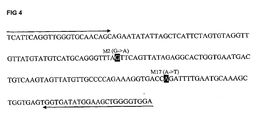
- a specific 199 bp segment ( fig.4 ) of the RT gene was amplified by PCR using RT -specific primers. These primers were extended at their 5' ends by a specific 5-base nucleotide sequence (henceforth termed tag ), with each of the 35 coordinates in the grid defined by a different sequence of the tag. Primers were designed so as to amplify only the RT allele derived from the M1 parent, which must carry the EMS-induced point mutations identified by the phenotypic screening. The resulting set of 35 PCR products are mixtures of products from the individual plants that constituted the DNA samples.
- This number of plants can be increased.
- Bract tissue subtending the 5th flower was harvested of an individual plant.
- Total genomic DNA was isolated using a Qiagen DNeasy Plant Mini Kit.
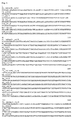
- the complete RT coding sequence was PCR amplified using primers 08A281 and 08A282 (see table 1) which are located in the 5' and 3' non-coding leader and trailer of the RT gene respectively. Reactions consisted of 25 pmol of each primer, 0.2mM dNTP, 1X PCR buffer, 50ng genomic DNA, 1 unit AmpliTaq Gold DNA polymerase (Applied Biosystems) in a total volume of 50 microliter.
- Plants were kept in a strictly maintained position in the greenhouse. Bracts subtending the 4th, 5th or 6th flower were harvested for each individual plant and pooled according to the 35 coordinates in the system. All 35 pools of bract tissue were homogenized in liquid nitrogen and stored at -80°C. Samples of tissue powder were taken for isolation of total genomic DNA using a Qiagen DNeasy Plant Mini Kit. PCR amplification of a single segment of the RT gene was done using the primers listed in table 1. For each of the 35 coordinates, a pair of forward and reverse primers was used that carried the same 5-base tag, such that each coordinate is specified by a single tag on both ends of the PCR product.
- Reactions were carried out with 30ng genomic DNA, 0.5mM dNTPs, 25pmol of each primer, 1 unit AmpliTaq DNA polymerase (Applied Biosystems) in a total volume of 25 microliter. Cycling was done with an initial 5 min. 95°C, followed by 35 cycles of 30 sec 94°C, 30 sec 65°C and 30 sec 72°C. PCR products were purified using the QIAquick PCR purification kit (Qiagen), and checked for being a single band after agarose gel electrophoresis. All 35 PCR products were made blunt by incubation with 0.5 unit Klenow enzyme in the presence of 1 mM dNTPs in a total volume of 40 microliter for 15 minutes at 25°C.
- ligated products were subjected to PCR amplification using standard PCR amplification primers (Roche Life Sciences GS, DNA library preparation kit). Cycling was done with 4 microliter of ligation mix, 0.5mM dNTPs, 25pmol of each primer, 1 unit AmpliTaq DNA polymerase (Applied Biosystems) in a total volume of 25 microliter. Cycling was done with an initial 60 sec. 72°C, 5 min. 95°C, followed by 25 cycles of 30 sec 94°C, 30 sec 55°C and 30 sec 72°C. Amplification products were analyzed by agarose gel electrophoresis, and pooled into one final sample.
Landscapes
- Life Sciences & Earth Sciences (AREA)
- Health & Medical Sciences (AREA)
- Genetics & Genomics (AREA)
- General Health & Medical Sciences (AREA)
- Botany (AREA)
- Developmental Biology & Embryology (AREA)
- Environmental Sciences (AREA)
- Molecular Biology (AREA)
- Measuring Or Testing Involving Enzymes Or Micro-Organisms (AREA)
- Breeding Of Plants And Reproduction By Means Of Culturing (AREA)
Claims (13)
- Verfahren zur Einführung und Selektion einer spezifischen vererbbaren Mutation in Pflanzen, umfassend die Schritte:a) Bereitstellen einer Vielzahl von mutagenisierten Samen;b) Aussähen der mutagenisierten Samen in einem N-dimensionalen Gitternetz, wobei N ≥1 ist;c) Züchten der Pflanzen aus den Samen;d) Probenentnahme des DNA-enthaltenden Materials aus einer Sektion der Pflanze;e) Vereinigen des DNA-enthaltenden Materials in einer ersten Dimension der N Dimensionen des N-dimensionalen Gitternetzes;f) Isolieren der DNA aus der Vereinigung;g) Wiederholen der Schritte (d)-(f) für jede Sekunde und weitere Dimension des N-dimensionalen Gitternetzes für eine unterschiedliche Sektion der Pflanze;h) Amplifizieren der vereinigten DNA mit einem Set von Primern, die die DNA (zum Teil) amplifiziert, welche die Position der Mutation von Interesse enthält, wobei mindestens einer der Primer eine für die Vereinigung spezifische Markierung enthält, um ein Reaktionsprodukt für jede der Vereinigungen zu erhalten;i) Vereinigen der Reaktionsprodukte;j) Bestimmen der Nukleotidsequenz der Reaktionsprodukte;k) Aufschlüsseln der Sequenzen aus der Vereinigung des Schritts (h) unter Verwendung der für die Vereinigung spezifischen Markierungen, um jede Pflanze in dem Gitternetz zu identifizieren; undl) Selektieren der Pflanze, die die gewünschte vererbbare Mutation trägt in jeder der entnommenen Proben der N Sektionen.
- Verfahren nach Anspruch 1, wobei N aus der Gruppe bestehend aus 1, 2, 3, 4, 5, 6, 7, 8, 9, 10, vorzugsweise 2, 3, 4, 5, 6, stärker bevorzugt 3 ausgewählt ist.
- Verfahren nach Anspruch 1, wobei die Sektion der Pflanze ausgewählt ist aus Blüten, Blättern Zweigen, Stamm, Pollen oder anderen Teilen der Pflanze, die oberhalb des Bodens lokalisiert sind, und Kombinationen davon.
- Verfahren nach Anspruch 3, wobei die Sektion ein Blatt oder eine Blüte, vorzugsweise ein Laubblatt ist.
- Verfahren nach Anspruch 1, wobei die Sektion der ersten Dimension des Gitternetzes die erste Blüte oder das erste Laubblatt ist, der zweiten Dimension das zweite Laubblatt ist, der dritten Dimension das dritte Laubblatt ist.
- Verfahren nach Anspruch 1, wobei die Vielzahl von Samen mindestens 100 Samen, mehr bevorzugt mindestens 1000 Samen, noch mehr bevorzugt mindestens 5000 Samen sind.
- Verfahren nach Anspruch 1, wobei das mutagenisierende Mittel ein chemisches oder physikalisches mutagenisierendes Mittel ist.
- Verfahren nach Anspruch 1, wobei das chemische Mittel ausgewählt ist aus der Gruppe, bestehend aus EMS, DMS, ENU, MNU, PRC, DEB, MMS, Chlorambucil, Melphalan, Natriumazid, Ethidiumbromid, Bromuracil, Brom oder salpetrige Säure.
- Verfahren nach Anspruch 1, wobei das physikalische mutagenisierende Mittel ionisierende Strahlung wie UV-Strahlung, radioaktive alpha- oder gamma-Strahlung ist.
- Verfahren nach Anspruch 1, wobei die Markierung ein Nukleotidmarker ist, der mindestens 4 Nukleotide enthält, der vorzugsweise am 5' -Ende des Primers lokalisiert ist.
- Verfahren nach Anspruch 1, wobei die Sequenzierung auf einer Hochdurchsatzsequenzierung beruht.
- Verfahren nach Anspruch 1, wobei die ausgewählte Pflanze mit der Anwesenheit oder Abwesenheit eines gewünschten Phänotyps korreliert wird.
- Verfahren zum Screenen von vererbbaren Mutationen in einer M1-Population der Pflanzen, umfassend die Schritte:Bereitstellen einer mutagenisierten M1-Population von Pflanzensamen, Züchten der Pflanzen oder Setzlinge aus den Pflanzensamen und Durchführen einer Sektoranalyse von verschiedenen Teilen der Pflanzen in der Population unter Verwendung von Nukleotidsequenzierung der amplifizierten vereinigten DNA-Proben der unterschiedlichen Teile der Pflanzen, um vererbbare Mutationen zu identifizieren.
Applications Claiming Priority (2)
| Application Number | Priority Date | Filing Date | Title |
|---|---|---|---|
| US97461207P | 2007-09-24 | 2007-09-24 | |
| PCT/NL2008/000209 WO2009041810A1 (en) | 2007-09-24 | 2008-09-24 | Method for the selection of plants with specific mutations |
Publications (2)
| Publication Number | Publication Date |
|---|---|
| EP2200424A1 EP2200424A1 (de) | 2010-06-30 |
| EP2200424B1 true EP2200424B1 (de) | 2014-03-05 |
Family
ID=40261745
Family Applications (1)
| Application Number | Title | Priority Date | Filing Date |
|---|---|---|---|
| EP08834240.7A Active EP2200424B1 (de) | 2007-09-24 | 2008-09-24 | Verfahren zur selektion von pflanzen mit bestimmten mutationen |
Country Status (8)
| Country | Link |
|---|---|
| US (1) | US8716550B2 (de) |
| EP (1) | EP2200424B1 (de) |
| JP (1) | JP5791897B2 (de) |
| CN (1) | CN101801176A (de) |
| AU (1) | AU2008303999B2 (de) |
| BR (1) | BRPI0816048B1 (de) |
| CA (1) | CA2700563C (de) |
| WO (1) | WO2009041810A1 (de) |
Cited By (1)
| Publication number | Priority date | Publication date | Assignee | Title |
|---|---|---|---|---|
| EP3199642A1 (de) | 2016-02-01 | 2017-08-02 | Fraunhofer-Gesellschaft zur Förderung der angewandten Forschung e.V. | Pflanzenzucht mithilfe von sequenzierung mit grossem durchsatz |
Families Citing this family (11)
| Publication number | Priority date | Publication date | Assignee | Title |
|---|---|---|---|---|
| CN103340150B (zh) * | 2013-07-19 | 2015-07-29 | 广东省农业科学院作物研究所 | 一种甲基磺酸乙酯诱变处理麻疯树种子的方法 |
| WO2015164805A1 (en) * | 2014-04-24 | 2015-10-29 | Purdue Research Foundation | Induced mutagenesis |
| MX2018003978A (es) | 2015-10-02 | 2018-08-15 | Keygene Nv | Metodo para la produccion de plantas haploides y doble haploides posteriores. |
| BR112018006573A2 (pt) | 2015-10-02 | 2018-10-09 | método para a produção de plantas haploides e subsequentes haploides duplicadas | |
| CN105734130B (zh) * | 2016-03-11 | 2019-10-25 | 中国农业科学院生物技术研究所 | 全基因组范围的植物基因功能鉴定的方法 |
| EP3457837A1 (de) | 2016-05-20 | 2019-03-27 | Keygene N.V. | Verfahren zur herstellung von haploiden und anschliessend doppelhaploiden pflanzen |
| FR3084374B1 (fr) | 2018-07-30 | 2024-04-26 | Limagrain Europe | Procede de controle qualite de lots de semences |
| CN112154910B (zh) * | 2019-06-16 | 2021-10-22 | 华中农业大学 | 一种中性突变体搭桥的植物自发突变基因的快速定位和克隆方法 |
| MX2022004361A (es) | 2019-10-10 | 2022-05-03 | Carlsberg As | Metodos para preparar plantas mutantes. |
| CN110904258B (zh) * | 2019-12-03 | 2021-08-17 | 湖南杂交水稻研究中心 | 一种高通量靶向鉴定理化诱变植株m1代突变及获取突变体的方法 |
| JP7503134B2 (ja) * | 2019-12-03 | 2024-06-19 | 湖南雑交水稲研究中心 | 物理的及び化学的突然変異誘発植物のm1世代突然変異を同定する方法、と突然変異体を取得する方法、及びイネの突然変異同定用のタイピングプライマー、突然変異遺伝子及び使用 |
Family Cites Families (3)
| Publication number | Priority date | Publication date | Assignee | Title |
|---|---|---|---|---|
| WO1999065292A1 (en) * | 1998-06-19 | 1999-12-23 | Konzak Calvin F | Methods for generating and identifying mutant polyploid plants, and uses therefor |
| US6730832B1 (en) * | 2001-09-10 | 2004-05-04 | Luis Mayan Dominguez | High threonine producing lines of Nicotiana tobacum and methods for producing |
| CA2910861C (en) * | 2005-09-29 | 2018-08-07 | Michael Josephus Theresia Van Eijk | High throughput screening of mutagenized populations |
-
2008
- 2008-09-24 EP EP08834240.7A patent/EP2200424B1/de active Active
- 2008-09-24 JP JP2010526837A patent/JP5791897B2/ja active Active
- 2008-09-24 CA CA2700563A patent/CA2700563C/en active Active
- 2008-09-24 WO PCT/NL2008/000209 patent/WO2009041810A1/en not_active Ceased
- 2008-09-24 CN CN200880107180A patent/CN101801176A/zh active Pending
- 2008-09-24 US US12/679,565 patent/US8716550B2/en active Active
- 2008-09-24 AU AU2008303999A patent/AU2008303999B2/en active Active
- 2008-09-24 BR BRPI0816048-1A patent/BRPI0816048B1/pt active IP Right Grant
Cited By (1)
| Publication number | Priority date | Publication date | Assignee | Title |
|---|---|---|---|---|
| EP3199642A1 (de) | 2016-02-01 | 2017-08-02 | Fraunhofer-Gesellschaft zur Förderung der angewandten Forschung e.V. | Pflanzenzucht mithilfe von sequenzierung mit grossem durchsatz |
Also Published As
| Publication number | Publication date |
|---|---|
| AU2008303999A1 (en) | 2009-04-02 |
| CA2700563A1 (en) | 2009-04-02 |
| US20100212043A1 (en) | 2010-08-19 |
| CA2700563C (en) | 2017-03-14 |
| JP2010539925A (ja) | 2010-12-24 |
| BRPI0816048B1 (pt) | 2020-09-01 |
| BRPI0816048A2 (pt) | 2019-08-27 |
| AU2008303999B2 (en) | 2014-07-24 |
| US8716550B2 (en) | 2014-05-06 |
| WO2009041810A1 (en) | 2009-04-02 |
| EP2200424A1 (de) | 2010-06-30 |
| CN101801176A (zh) | 2010-08-11 |
| JP5791897B2 (ja) | 2015-10-07 |
Similar Documents
| Publication | Publication Date | Title |
|---|---|---|
| US8716550B2 (en) | Method for the selection of plants with specific mutations | |
| JP2023153180A (ja) | トバモウイルスであるトマト褐色縮葉フルーツウイルス(tbrfv)に対するソヌラム・リコペルシカム植物における耐性 | |
| KR102897871B1 (ko) | 개선된 내병성을 갖는 옥수수 식물 | |
| EP2166833B1 (de) | Verbesserte paprikapflanze | |
| KR20100031102A (ko) | 에스. 하브로차이테스로부터 유래된 단위결실 유전 요소 | |
| US12545923B2 (en) | Mutant gene conferring a compact growth phenotype in watermelon | |
| US20220295719A1 (en) | Prolific flowering watermelon | |
| US8878012B2 (en) | Methods for improving the yield of cucumber plants | |
| JP4892647B1 (ja) | 新品種、植物品種の鑑別方法、及びイネ個体を早生化する方法 | |
| CN115811936B (zh) | 对疮痂病、蚜虫和白粉病具有抗性的甜瓜植物 | |
| Majumder et al. | Assessment of mutation in marigold (Tagetes erecta L.) using morphological and molecular markers | |
| CN107058590B (zh) | 调控玉米单穗重主效qtl的分子标记及其应用方法 | |
| JP7808811B2 (ja) | 向上した線虫耐性を有する植物 | |
| KUSHWAH | Genetics of Anther Extrusion and Genome Wide Association Studies in wheat (Triticum aestivum L. em. Thell) | |
| Roose | Comparative genomics and evolution of citrus | |
| Schwarz et al. | Fine Mapping of the Fusarium Head Blight Resistance QTL Qfhs. ifa-5A through Radiation Induced Deletion Mapping of a Gamma Treated Wheat Population |
Legal Events
| Date | Code | Title | Description |
|---|---|---|---|
| PUAI | Public reference made under article 153(3) epc to a published international application that has entered the european phase |
Free format text: ORIGINAL CODE: 0009012 |
|
| 17P | Request for examination filed |
Effective date: 20100412 |
|
| AK | Designated contracting states |
Kind code of ref document: A1 Designated state(s): AT BE BG CH CY CZ DE DK EE ES FI FR GB GR HR HU IE IS IT LI LT LU LV MC MT NL NO PL PT RO SE SI SK TR |
|
| AX | Request for extension of the european patent |
Extension state: AL BA MK RS |
|
| DAX | Request for extension of the european patent (deleted) | ||
| 17Q | First examination report despatched |
Effective date: 20110207 |
|
| GRAP | Despatch of communication of intention to grant a patent |
Free format text: ORIGINAL CODE: EPIDOSNIGR1 |
|
| INTG | Intention to grant announced |
Effective date: 20131018 |
|
| GRAS | Grant fee paid |
Free format text: ORIGINAL CODE: EPIDOSNIGR3 |
|
| GRAA | (expected) grant |
Free format text: ORIGINAL CODE: 0009210 |
|
| AK | Designated contracting states |
Kind code of ref document: B1 Designated state(s): AT BE BG CH CY CZ DE DK EE ES FI FR GB GR HR HU IE IS IT LI LT LU LV MC MT NL NO PL PT RO SE SI SK TR |
|
| REG | Reference to a national code |
Ref country code: GB Ref legal event code: FG4D |
|
| REG | Reference to a national code |
Ref country code: CH Ref legal event code: EP |
|
| REG | Reference to a national code |
Ref country code: AT Ref legal event code: REF Ref document number: 654226 Country of ref document: AT Kind code of ref document: T Effective date: 20140315 |
|
| REG | Reference to a national code |
Ref country code: IE Ref legal event code: FG4D |
|
| REG | Reference to a national code |
Ref country code: DE Ref legal event code: R096 Ref document number: 602008030668 Country of ref document: DE Effective date: 20140417 |
|
| REG | Reference to a national code |
Ref country code: NL Ref legal event code: T3 |
|
| REG | Reference to a national code |
Ref country code: AT Ref legal event code: MK05 Ref document number: 654226 Country of ref document: AT Kind code of ref document: T Effective date: 20140305 |
|
| PG25 | Lapsed in a contracting state [announced via postgrant information from national office to epo] |
Ref country code: LT Free format text: LAPSE BECAUSE OF FAILURE TO SUBMIT A TRANSLATION OF THE DESCRIPTION OR TO PAY THE FEE WITHIN THE PRESCRIBED TIME-LIMIT Effective date: 20140305 Ref country code: NO Free format text: LAPSE BECAUSE OF FAILURE TO SUBMIT A TRANSLATION OF THE DESCRIPTION OR TO PAY THE FEE WITHIN THE PRESCRIBED TIME-LIMIT Effective date: 20140605 |
|
| REG | Reference to a national code |
Ref country code: LT Ref legal event code: MG4D |
|
| PG25 | Lapsed in a contracting state [announced via postgrant information from national office to epo] |
Ref country code: AT Free format text: LAPSE BECAUSE OF FAILURE TO SUBMIT A TRANSLATION OF THE DESCRIPTION OR TO PAY THE FEE WITHIN THE PRESCRIBED TIME-LIMIT Effective date: 20140305 Ref country code: SE Free format text: LAPSE BECAUSE OF FAILURE TO SUBMIT A TRANSLATION OF THE DESCRIPTION OR TO PAY THE FEE WITHIN THE PRESCRIBED TIME-LIMIT Effective date: 20140305 Ref country code: CY Free format text: LAPSE BECAUSE OF FAILURE TO SUBMIT A TRANSLATION OF THE DESCRIPTION OR TO PAY THE FEE WITHIN THE PRESCRIBED TIME-LIMIT Effective date: 20140305 Ref country code: FI Free format text: LAPSE BECAUSE OF FAILURE TO SUBMIT A TRANSLATION OF THE DESCRIPTION OR TO PAY THE FEE WITHIN THE PRESCRIBED TIME-LIMIT Effective date: 20140305 |
|
| PG25 | Lapsed in a contracting state [announced via postgrant information from national office to epo] |
Ref country code: LV Free format text: LAPSE BECAUSE OF FAILURE TO SUBMIT A TRANSLATION OF THE DESCRIPTION OR TO PAY THE FEE WITHIN THE PRESCRIBED TIME-LIMIT Effective date: 20140305 Ref country code: HR Free format text: LAPSE BECAUSE OF FAILURE TO SUBMIT A TRANSLATION OF THE DESCRIPTION OR TO PAY THE FEE WITHIN THE PRESCRIBED TIME-LIMIT Effective date: 20140305 |
|
| PG25 | Lapsed in a contracting state [announced via postgrant information from national office to epo] |
Ref country code: BG Free format text: LAPSE BECAUSE OF FAILURE TO SUBMIT A TRANSLATION OF THE DESCRIPTION OR TO PAY THE FEE WITHIN THE PRESCRIBED TIME-LIMIT Effective date: 20140605 Ref country code: CZ Free format text: LAPSE BECAUSE OF FAILURE TO SUBMIT A TRANSLATION OF THE DESCRIPTION OR TO PAY THE FEE WITHIN THE PRESCRIBED TIME-LIMIT Effective date: 20140305 Ref country code: IS Free format text: LAPSE BECAUSE OF FAILURE TO SUBMIT A TRANSLATION OF THE DESCRIPTION OR TO PAY THE FEE WITHIN THE PRESCRIBED TIME-LIMIT Effective date: 20140705 Ref country code: RO Free format text: LAPSE BECAUSE OF FAILURE TO SUBMIT A TRANSLATION OF THE DESCRIPTION OR TO PAY THE FEE WITHIN THE PRESCRIBED TIME-LIMIT Effective date: 20140305 Ref country code: EE Free format text: LAPSE BECAUSE OF FAILURE TO SUBMIT A TRANSLATION OF THE DESCRIPTION OR TO PAY THE FEE WITHIN THE PRESCRIBED TIME-LIMIT Effective date: 20140305 |
|
| PG25 | Lapsed in a contracting state [announced via postgrant information from national office to epo] |
Ref country code: SK Free format text: LAPSE BECAUSE OF FAILURE TO SUBMIT A TRANSLATION OF THE DESCRIPTION OR TO PAY THE FEE WITHIN THE PRESCRIBED TIME-LIMIT Effective date: 20140305 Ref country code: ES Free format text: LAPSE BECAUSE OF FAILURE TO SUBMIT A TRANSLATION OF THE DESCRIPTION OR TO PAY THE FEE WITHIN THE PRESCRIBED TIME-LIMIT Effective date: 20140305 Ref country code: PL Free format text: LAPSE BECAUSE OF FAILURE TO SUBMIT A TRANSLATION OF THE DESCRIPTION OR TO PAY THE FEE WITHIN THE PRESCRIBED TIME-LIMIT Effective date: 20140305 |
|
| REG | Reference to a national code |
Ref country code: DE Ref legal event code: R097 Ref document number: 602008030668 Country of ref document: DE |
|
| PG25 | Lapsed in a contracting state [announced via postgrant information from national office to epo] |
Ref country code: PT Free format text: LAPSE BECAUSE OF FAILURE TO SUBMIT A TRANSLATION OF THE DESCRIPTION OR TO PAY THE FEE WITHIN THE PRESCRIBED TIME-LIMIT Effective date: 20140707 |
|
| PLBE | No opposition filed within time limit |
Free format text: ORIGINAL CODE: 0009261 |
|
| STAA | Information on the status of an ep patent application or granted ep patent |
Free format text: STATUS: NO OPPOSITION FILED WITHIN TIME LIMIT |
|
| PG25 | Lapsed in a contracting state [announced via postgrant information from national office to epo] |
Ref country code: DK Free format text: LAPSE BECAUSE OF FAILURE TO SUBMIT A TRANSLATION OF THE DESCRIPTION OR TO PAY THE FEE WITHIN THE PRESCRIBED TIME-LIMIT Effective date: 20140305 |
|
| 26N | No opposition filed |
Effective date: 20141208 |
|
| REG | Reference to a national code |
Ref country code: DE Ref legal event code: R097 Ref document number: 602008030668 Country of ref document: DE Effective date: 20141208 |
|
| PG25 | Lapsed in a contracting state [announced via postgrant information from national office to epo] |
Ref country code: IT Free format text: LAPSE BECAUSE OF FAILURE TO SUBMIT A TRANSLATION OF THE DESCRIPTION OR TO PAY THE FEE WITHIN THE PRESCRIBED TIME-LIMIT Effective date: 20140305 |
|
| PG25 | Lapsed in a contracting state [announced via postgrant information from national office to epo] |
Ref country code: MC Free format text: LAPSE BECAUSE OF FAILURE TO SUBMIT A TRANSLATION OF THE DESCRIPTION OR TO PAY THE FEE WITHIN THE PRESCRIBED TIME-LIMIT Effective date: 20140305 Ref country code: LU Free format text: LAPSE BECAUSE OF FAILURE TO SUBMIT A TRANSLATION OF THE DESCRIPTION OR TO PAY THE FEE WITHIN THE PRESCRIBED TIME-LIMIT Effective date: 20140924 |
|
| REG | Reference to a national code |
Ref country code: CH Ref legal event code: PL |
|
| PG25 | Lapsed in a contracting state [announced via postgrant information from national office to epo] |
Ref country code: SI Free format text: LAPSE BECAUSE OF FAILURE TO SUBMIT A TRANSLATION OF THE DESCRIPTION OR TO PAY THE FEE WITHIN THE PRESCRIBED TIME-LIMIT Effective date: 20140305 |
|
| REG | Reference to a national code |
Ref country code: IE Ref legal event code: MM4A |
|
| PG25 | Lapsed in a contracting state [announced via postgrant information from national office to epo] |
Ref country code: LI Free format text: LAPSE BECAUSE OF NON-PAYMENT OF DUE FEES Effective date: 20140930 Ref country code: CH Free format text: LAPSE BECAUSE OF NON-PAYMENT OF DUE FEES Effective date: 20140930 |
|
| PG25 | Lapsed in a contracting state [announced via postgrant information from national office to epo] |
Ref country code: IE Free format text: LAPSE BECAUSE OF NON-PAYMENT OF DUE FEES Effective date: 20140924 |
|
| PG25 | Lapsed in a contracting state [announced via postgrant information from national office to epo] |
Ref country code: MT Free format text: LAPSE BECAUSE OF FAILURE TO SUBMIT A TRANSLATION OF THE DESCRIPTION OR TO PAY THE FEE WITHIN THE PRESCRIBED TIME-LIMIT Effective date: 20140305 Ref country code: GR Free format text: LAPSE BECAUSE OF FAILURE TO SUBMIT A TRANSLATION OF THE DESCRIPTION OR TO PAY THE FEE WITHIN THE PRESCRIBED TIME-LIMIT Effective date: 20140606 |
|
| PG25 | Lapsed in a contracting state [announced via postgrant information from national office to epo] |
Ref country code: TR Free format text: LAPSE BECAUSE OF FAILURE TO SUBMIT A TRANSLATION OF THE DESCRIPTION OR TO PAY THE FEE WITHIN THE PRESCRIBED TIME-LIMIT Effective date: 20140305 Ref country code: HU Free format text: LAPSE BECAUSE OF FAILURE TO SUBMIT A TRANSLATION OF THE DESCRIPTION OR TO PAY THE FEE WITHIN THE PRESCRIBED TIME-LIMIT; INVALID AB INITIO Effective date: 20080924 |
|
| REG | Reference to a national code |
Ref country code: FR Ref legal event code: PLFP Year of fee payment: 9 |
|
| REG | Reference to a national code |
Ref country code: FR Ref legal event code: PLFP Year of fee payment: 10 |
|
| REG | Reference to a national code |
Ref country code: FR Ref legal event code: PLFP Year of fee payment: 11 |
|
| P01 | Opt-out of the competence of the unified patent court (upc) registered |
Effective date: 20230519 |
|
| PGFP | Annual fee paid to national office [announced via postgrant information from national office to epo] |
Ref country code: DE Payment date: 20250926 Year of fee payment: 18 |
|
| PGFP | Annual fee paid to national office [announced via postgrant information from national office to epo] |
Ref country code: NL Payment date: 20250909 Year of fee payment: 18 |
|
| PGFP | Annual fee paid to national office [announced via postgrant information from national office to epo] |
Ref country code: BE Payment date: 20250925 Year of fee payment: 18 Ref country code: GB Payment date: 20250923 Year of fee payment: 18 |
|
| PGFP | Annual fee paid to national office [announced via postgrant information from national office to epo] |
Ref country code: FR Payment date: 20250925 Year of fee payment: 18 |