EP2198617B1 - Videozusammensetzung einer beliebigen anzahl von quellenströmen unter verwendung flexibler makroblockanordnung - Google Patents
Videozusammensetzung einer beliebigen anzahl von quellenströmen unter verwendung flexibler makroblockanordnung Download PDFInfo
- Publication number
- EP2198617B1 EP2198617B1 EP08830482A EP08830482A EP2198617B1 EP 2198617 B1 EP2198617 B1 EP 2198617B1 EP 08830482 A EP08830482 A EP 08830482A EP 08830482 A EP08830482 A EP 08830482A EP 2198617 B1 EP2198617 B1 EP 2198617B1
- Authority
- EP
- European Patent Office
- Prior art keywords
- source
- video
- picture
- slice groups
- streams
- Prior art date
- Legal status (The legal status is an assumption and is not a legal conclusion. Google has not performed a legal analysis and makes no representation as to the accuracy of the status listed.)
- Active
Links
Images



Classifications
-
- H—ELECTRICITY
- H04—ELECTRIC COMMUNICATION TECHNIQUE
- H04N—PICTORIAL COMMUNICATION, e.g. TELEVISION
- H04N7/00—Television systems
- H04N7/14—Systems for two-way working
- H04N7/15—Conference systems
- H04N7/152—Multipoint control units therefor
-
- H—ELECTRICITY
- H04—ELECTRIC COMMUNICATION TECHNIQUE
- H04N—PICTORIAL COMMUNICATION, e.g. TELEVISION
- H04N19/00—Methods or arrangements for coding, decoding, compressing or decompressing digital video signals
- H04N19/40—Methods or arrangements for coding, decoding, compressing or decompressing digital video signals using video transcoding, i.e. partial or full decoding of a coded input stream followed by re-encoding of the decoded output stream
-
- H—ELECTRICITY
- H04—ELECTRIC COMMUNICATION TECHNIQUE
- H04N—PICTORIAL COMMUNICATION, e.g. TELEVISION
- H04N19/00—Methods or arrangements for coding, decoding, compressing or decompressing digital video signals
- H04N19/10—Methods or arrangements for coding, decoding, compressing or decompressing digital video signals using adaptive coding
- H04N19/102—Methods or arrangements for coding, decoding, compressing or decompressing digital video signals using adaptive coding characterised by the element, parameter or selection affected or controlled by the adaptive coding
- H04N19/103—Selection of coding mode or of prediction mode
-
- H—ELECTRICITY
- H04—ELECTRIC COMMUNICATION TECHNIQUE
- H04N—PICTORIAL COMMUNICATION, e.g. TELEVISION
- H04N19/00—Methods or arrangements for coding, decoding, compressing or decompressing digital video signals
- H04N19/10—Methods or arrangements for coding, decoding, compressing or decompressing digital video signals using adaptive coding
- H04N19/102—Methods or arrangements for coding, decoding, compressing or decompressing digital video signals using adaptive coding characterised by the element, parameter or selection affected or controlled by the adaptive coding
- H04N19/129—Scanning of coding units, e.g. zig-zag scan of transform coefficients or flexible macroblock ordering [FMO]
-
- H—ELECTRICITY
- H04—ELECTRIC COMMUNICATION TECHNIQUE
- H04N—PICTORIAL COMMUNICATION, e.g. TELEVISION
- H04N19/00—Methods or arrangements for coding, decoding, compressing or decompressing digital video signals
- H04N19/10—Methods or arrangements for coding, decoding, compressing or decompressing digital video signals using adaptive coding
- H04N19/134—Methods or arrangements for coding, decoding, compressing or decompressing digital video signals using adaptive coding characterised by the element, parameter or criterion affecting or controlling the adaptive coding
- H04N19/136—Incoming video signal characteristics or properties
-
- H—ELECTRICITY
- H04—ELECTRIC COMMUNICATION TECHNIQUE
- H04N—PICTORIAL COMMUNICATION, e.g. TELEVISION
- H04N19/00—Methods or arrangements for coding, decoding, compressing or decompressing digital video signals
- H04N19/10—Methods or arrangements for coding, decoding, compressing or decompressing digital video signals using adaptive coding
- H04N19/169—Methods or arrangements for coding, decoding, compressing or decompressing digital video signals using adaptive coding characterised by the coding unit, i.e. the structural portion or semantic portion of the video signal being the object or the subject of the adaptive coding
- H04N19/17—Methods or arrangements for coding, decoding, compressing or decompressing digital video signals using adaptive coding characterised by the coding unit, i.e. the structural portion or semantic portion of the video signal being the object or the subject of the adaptive coding the unit being an image region, e.g. an object
-
- H—ELECTRICITY
- H04—ELECTRIC COMMUNICATION TECHNIQUE
- H04N—PICTORIAL COMMUNICATION, e.g. TELEVISION
- H04N19/00—Methods or arrangements for coding, decoding, compressing or decompressing digital video signals
- H04N19/10—Methods or arrangements for coding, decoding, compressing or decompressing digital video signals using adaptive coding
- H04N19/169—Methods or arrangements for coding, decoding, compressing or decompressing digital video signals using adaptive coding characterised by the coding unit, i.e. the structural portion or semantic portion of the video signal being the object or the subject of the adaptive coding
- H04N19/17—Methods or arrangements for coding, decoding, compressing or decompressing digital video signals using adaptive coding characterised by the coding unit, i.e. the structural portion or semantic portion of the video signal being the object or the subject of the adaptive coding the unit being an image region, e.g. an object
- H04N19/174—Methods or arrangements for coding, decoding, compressing or decompressing digital video signals using adaptive coding characterised by the coding unit, i.e. the structural portion or semantic portion of the video signal being the object or the subject of the adaptive coding the unit being an image region, e.g. an object the region being a slice, e.g. a line of blocks or a group of blocks
-
- H—ELECTRICITY
- H04—ELECTRIC COMMUNICATION TECHNIQUE
- H04N—PICTORIAL COMMUNICATION, e.g. TELEVISION
- H04N19/00—Methods or arrangements for coding, decoding, compressing or decompressing digital video signals
- H04N19/46—Embedding additional information in the video signal during the compression process
-
- H—ELECTRICITY
- H04—ELECTRIC COMMUNICATION TECHNIQUE
- H04N—PICTORIAL COMMUNICATION, e.g. TELEVISION
- H04N19/00—Methods or arrangements for coding, decoding, compressing or decompressing digital video signals
- H04N19/50—Methods or arrangements for coding, decoding, compressing or decompressing digital video signals using predictive coding
- H04N19/59—Methods or arrangements for coding, decoding, compressing or decompressing digital video signals using predictive coding involving spatial sub-sampling or interpolation, e.g. alteration of picture size or resolution
-
- H—ELECTRICITY
- H04—ELECTRIC COMMUNICATION TECHNIQUE
- H04N—PICTORIAL COMMUNICATION, e.g. TELEVISION
- H04N19/00—Methods or arrangements for coding, decoding, compressing or decompressing digital video signals
- H04N19/60—Methods or arrangements for coding, decoding, compressing or decompressing digital video signals using transform coding
- H04N19/61—Methods or arrangements for coding, decoding, compressing or decompressing digital video signals using transform coding in combination with predictive coding
-
- H—ELECTRICITY
- H04—ELECTRIC COMMUNICATION TECHNIQUE
- H04N—PICTORIAL COMMUNICATION, e.g. TELEVISION
- H04N19/00—Methods or arrangements for coding, decoding, compressing or decompressing digital video signals
- H04N19/70—Methods or arrangements for coding, decoding, compressing or decompressing digital video signals characterised by syntax aspects related to video coding, e.g. related to compression standards
-
- H—ELECTRICITY
- H04—ELECTRIC COMMUNICATION TECHNIQUE
- H04N—PICTORIAL COMMUNICATION, e.g. TELEVISION
- H04N21/00—Selective content distribution, e.g. interactive television or video on demand [VOD]
- H04N21/20—Servers specifically adapted for the distribution of content, e.g. VOD servers; Operations thereof
- H04N21/23—Processing of content or additional data; Elementary server operations; Server middleware
- H04N21/236—Assembling of a multiplex stream, e.g. transport stream, by combining a video stream with other content or additional data, e.g. inserting a URL [Uniform Resource Locator] into a video stream, multiplexing software data into a video stream; Remultiplexing of multiplex streams; Insertion of stuffing bits into the multiplex stream, e.g. to obtain a constant bit-rate; Assembling of a packetised elementary stream
- H04N21/2365—Multiplexing of several video streams
-
- H—ELECTRICITY
- H04—ELECTRIC COMMUNICATION TECHNIQUE
- H04N—PICTORIAL COMMUNICATION, e.g. TELEVISION
- H04N21/00—Selective content distribution, e.g. interactive television or video on demand [VOD]
- H04N21/40—Client devices specifically adapted for the reception of or interaction with content, e.g. set-top-box [STB]; Operations thereof
- H04N21/43—Processing of content or additional data, e.g. demultiplexing additional data from a digital video stream; Elementary client operations, e.g. monitoring of home network or synchronising decoder's clock; Client middleware
- H04N21/434—Disassembling of a multiplex stream, e.g. demultiplexing audio and video streams, extraction of additional data from a video stream; Remultiplexing of multiplex streams; Extraction or processing of SI; Disassembling of packetised elementary stream
- H04N21/4347—Demultiplexing of several video streams
-
- H—ELECTRICITY
- H04—ELECTRIC COMMUNICATION TECHNIQUE
- H04N—PICTORIAL COMMUNICATION, e.g. TELEVISION
- H04N21/00—Selective content distribution, e.g. interactive television or video on demand [VOD]
- H04N21/40—Client devices specifically adapted for the reception of or interaction with content, e.g. set-top-box [STB]; Operations thereof
- H04N21/43—Processing of content or additional data, e.g. demultiplexing additional data from a digital video stream; Elementary client operations, e.g. monitoring of home network or synchronising decoder's clock; Client middleware
- H04N21/44—Processing of video elementary streams, e.g. splicing a video clip retrieved from local storage with an incoming video stream or rendering scenes according to encoded video stream scene graphs
- H04N21/4402—Processing of video elementary streams, e.g. splicing a video clip retrieved from local storage with an incoming video stream or rendering scenes according to encoded video stream scene graphs involving reformatting operations of video signals for household redistribution, storage or real-time display
- H04N21/440263—Processing of video elementary streams, e.g. splicing a video clip retrieved from local storage with an incoming video stream or rendering scenes according to encoded video stream scene graphs involving reformatting operations of video signals for household redistribution, storage or real-time display by altering the spatial resolution, e.g. for displaying on a connected PDA
- H04N21/440272—Processing of video elementary streams, e.g. splicing a video clip retrieved from local storage with an incoming video stream or rendering scenes according to encoded video stream scene graphs involving reformatting operations of video signals for household redistribution, storage or real-time display by altering the spatial resolution, e.g. for displaying on a connected PDA for performing aspect ratio conversion
-
- H—ELECTRICITY
- H04—ELECTRIC COMMUNICATION TECHNIQUE
- H04N—PICTORIAL COMMUNICATION, e.g. TELEVISION
- H04N21/00—Selective content distribution, e.g. interactive television or video on demand [VOD]
- H04N21/80—Generation or processing of content or additional data by content creator independently of the distribution process; Content per se
- H04N21/83—Generation or processing of protective or descriptive data associated with content; Content structuring
- H04N21/845—Structuring of content, e.g. decomposing content into time segments
- H04N21/8451—Structuring of content, e.g. decomposing content into time segments using Advanced Video Coding [AVC]
Definitions
- the present disclosure relates generally to the field of video data transmissions over digital networks.
- H.264/AVC Advanced Video Coding
- VCEG International Telecommunication Union
- ISO International Electrotechnical Commission
- MPEG Moving Picture Experts Group
- H.264/SVC Scalable Video Coding
- the H.264 standard contains a feature called Flexible Macroblock Ordering (FMO) that allows multiple "distinct slice groups" to be created in an H.264 picture in such a way that no macroblock (a block of 16x16 pixels) is surrounded by any other macroblock from the same slice group.
- FMO Flexible Macroblock Ordering
- Inside a slice group all macroblocks are ordered in raster scan order.
- each slice group is like its own little mini-picture. For instance, one slice group can be intracoded while a neighboring group can be predictively coded from the same corresponding slice group in a reference picture.
- the FMO feature makes it possible to take independent contributing streams from multiple sources and combine the streams together into one stream of composited pictures, say, for video conferencing.
- WO 2007/076486 discloses a_system using scalable video coding techniques and a compositing scalable video coding server (CSVCS) to composite input video signals from transmitting conferencing participants into one single output video signal forwarded to a receiving participant.
- the server is configured to composite the input video signals pictures without decoding, rescaling, and re-encoding of the signals.
- US Patent Application Publication No, US 2006/146734 discloses a system for compressed domain video mixing for spatially combining incoming video streams into an outgoing video stream. Using H.264 as an example, each incoming stream is divided into a plurality of slices, each having a plurality of header fields including a first_mb_in_slice header field.
- first_mb_in_slice for each incoming stream is modified such that the modified first_mb_in_slice header field is indicative of location in the spatial representation of the outgoing stream at which the slice of the incoming stream is placed.
- H.264's slice group mechanism is used to map the spatial positions of the second and following macroblocks of the slices to the appropriate locations. If the incoming streams are previously mixed by upstream mixers, a decomposer can be used to separate these mixed streams into component streams before combining them with other incoming streams.
- WO 03/026300 discloses a system in which Multiple video picture frames are combined into a spatial multiplex video picture frame that may be fully decoded and displayed.
- the video display of the spatial multiplex video picture frame is a composite combination of all of the video picture frames that have been combined, and may have an appearance such as a mosaic.
- Multiplexing the video picture frames involves removing picture headers, creating a picture header for the spatial multiplex video picture frame, and altering the headers of individual components of each video picture frame.
- the new header for the spatial multiplex video picture frame indicates a slice format frame, and headers of the individual components are altered to provide a slice format based picture position for each video picture frame.
- the headers of the individual components are altered to become slice based, such as in accordance with the ITU-TH.263 video standard, prior to establishing the slice based picture position if the frames are not already of the slice format.
- Figure 1 illustrates an example video communications system.
- Figure 2A illustrates an example composite picture produced by the compositor of Figure 1 .
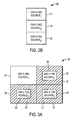
- Figure 2B illustrates another example composite picture produced by the compositor of Figure 1 .
- Figure 3A illustrates an example composite picture produced by the compositor of Figure 1 .
- Figure 3B illustrates an example set of slice groups encoded for the composite picture of Figure 3A .
- Figure 4A illustrates an example set of slice groups encoded by a compositor to create a picture from four incoming video bitstreams.
- Figure 4B illustrates an example picture produced as a single video bitstream containing the respective incoming video image slice groups shown in Figure 4A .
- Figure 4C illustrates another example picture produced as a single video bitstream containing the respective incoming video image slice groups shown in Figure 4A .
- Figure 5 illustrates an example method of operation for the compositor shown in Figure 1 .
- Figure 6 illustrates basic components of an example node or network device.
- a computer network is a geographically distributed collection of interconnected subnetworks for transporting data between nodes, such as intermediate nodes and end nodes (also referred to as endpoints).
- a local area network is an example of such a subnetwork; a plurality of LANs may be further interconnected by an intermediate network node, such as a router, bridge, or switch, to extend the effective "size" of the computer network and increase the number of communicating nodes.
- the devices or nodes include servers, mixers, control units, and personal computers.
- the nodes typically communicate by exchanging discrete frames or packets of data according to predefined protocols.
- a video receiver device represents any equipment, node, terminal, or other device capable of receiving, decoding, or rendering a digital video image therefrom.
- video receiver devices include a video appliance (e.g., a video monitor, etc.), a personal digital assistant (PDA); a personal computer (PC), such as notebook, laptop, or desktop computer; a television device, set-top box (STB), cellular phone, video phone, or any other device, component, element, or object capable of receiving, decoding, or rendering digital video images.
- a video stream such as a contributing stream or source stream, is a sequence of pictures encoded in accordance to a video coding specification, such as ITU H.264.
- a video coding specification may allow a video source to be encoded without incremental enhancement layers corresponding to SVC.
- An H.264/SVC stream herein refers to a video stream that contains at least one enhancement layer in addition to a base layer of coded video.
- a video compositor (“compositor” for short) is any device capable of receiving two or more digital video input streams and combining them into a single digital video output stream with minimal, or without performing, decoding or re-encoding operations below the slice layer on any of the constituent streams.
- Arbitrary Slice Ordering is a technique for restructuring the ordering of macroblocks in pictures that obviates the need to wait for a full set of pictures to arrive from all sources.
- a video compositor receives multiple video source streams.
- the source streams may comprise H.264/AVC streams, H.264-SVC streams, or a combination of H.264/AVC and H.264/SVC streams.
- Other types of streams compatible with the H.264 standard, such as future enhancements or extensions to the existing definitions, may also be received as inputs to the video compositor.
- the compositor first processes the existing H.264 headers from each source stream to provide proper information in the produced combined stream. Headers are removed from the source streams as necessary but some of the parsed or interpreted information is retained or modified as necessary to affect composited pictures in the combined stream. Processed header information may include slice headers, picture parameters sets, sequence parameter sets, and Network Abstraction Layer (NAL) headers.
- NAL Network Abstraction Layer
- the encoded macroblocks from each of the streams are preserved and are added to a picture with a picture parameter set (PPS) that identifies them as part of a larger composite picture containing multiple slice groups.
- PPS picture parameter set
- each contributing stream is a sequence of pictures
- the compositor produces a sequence of composited pictures, each composited picture for a corresponding time interval in sequential time intervals.
- Composition is performed in a manner that enables a visually synchronized presentation of the combined stream when decoded and displayed.
- the sequential progression of compositing pictures from contributing streams may be according to pictures having a transmission or presentation time within the time interval corresponding to a composition operation.
- the associated time with a picture may be expressed, for example, as a time stamp relative to a reference clock. In one implementation, only pictures with an associated time within a corresponding time interval are composited. In one embodiment, only pictures with an associated time within the corresponding time interval are composited.
- the incoming pictures can be combined in a time-consistent manner to produce streams of composited pictures.
- ASO provisions the respective portions of a composited picture to be transmitted or decoded in a particular order, e.g., raster scan order. Hence, the individual source streams do not need to be delayed to wait for pictures from the other sources to arrive. Note that all composition operations occur in the coded domain.
- the latency of the compositor is kept at an acceptable delay.
- the raster scan order of the contributing streams in the composited picture is maintained up to the latency amount that does not supersede the latency of a typically video switch (e.g., less than 20 milliseconds).
- any number of two or more source video streams may be composited together. Additionally, source streams having varying resolutions, aspect ratios, etc., may be composited together to form a single, larger picture. In a specific embodiment, the compositor further combines contributing streams of different profiles into a single profile.
- the maximum number of contributing streams for composition is set to a predetermined threshold. If the number of contributing streams exceed the threshold, certain contributing streams with the same picture resolution and/or AVC characteristics are adjoined side-by-side, or on top of each other, as a slice group.
- FIG. 1 illustrates an example video communications system 10 that shows a video compositor 15 located on IP network 11 receiving three incoming video source streams: an H.264/AVC stream produced by video source 12 (Source 1 ), an H.264/AVC stream produced by video source 13 (Source 2 ), and an H.264/SVC stream produced by video source 14 (Source 3 ).
- IP video terminals connected via an H.320 leg.
- compositor 15 produces a single, larger H.264/AVC compatible picture that has the source pictures pieced or composed together.
- the single, larger H.264/AVC compatible picture is shown being sent as a single transport stream to a receiver (e.g., video terminal) 17.
- video terminal 17 may comprise personal computer (PC) that includes standard audio and video codecs, and which is operable to render a video image or picture from the received H.264/AVC stream.
- PC personal computer
- the video compositor can reduce the scale of the stream, thereby allowing the overall bit rate of the composition to be controlled.
- FIG. 2A shows an example composite picture 20 produced by video compositor 15 of Figure 1 .
- the three video sources, Source 1 3 respectively produce regions or areas 21-23 of the composite picture, with each area having a size of 320 x 240 pixels in accordance with the picture size of the source streams.
- the compositor creates a fourth area 24 comprising a pad slice group that may be coded using either a constant blank color or, alternatively, some kind of constant-image splash screen to produce a composite picture that has a rectangular shape of 640 x 480 pixels (VGA-sized). Since picture 24 is composed as a plurality of slice groups using FMO and ASO techniques, area 24 may comprise a single pad slice. Practitioners in the art will understand that pad slice groups that form background or fill regions of a larger composite picture may be intra-coded once.
- composite picture 20 may be rendered as shown in Figure 2A or, alternatively into a 320 x 720 picture 26 (shown in Figure 2B ) or a 960 x 240 picture (not shown).
- the receiver codecs may need to negotiate higher bit rates to receive the composite image.
- the actually coded picture is still completely H.264-AVC conformant, meaning that it should be decodable by most, if not all, existing decoders. More advanced decoders may take the resulting image and scale it as needed for rendering.
- five video sources consisting of one Common Image Format (CIF) image (352 x 288 pixels) and four Quarter CIF (QCIF) images (each 176 x 144 pixels) may be pieced together by the compositor of Figure 1 to form a single VGA-sized image (640 x 480 pixels).
- CIF Common Image Format
- QCIF Quarter CIF
- Figure 3A illustrates another example composite picture 30 produced by the compositor of Figure 1 .
- the video compositor converts the source images into slice groups of a larger image, and then adds "pad slice groups" to create an image compatible with the existing H.264-AVC standard.
- Picture 30 of Figure 3A is a single VGA-sized image (640 x 480 pixels) composed of four source pictures: a single 320 x 240 picture (Source 1 ) that is located in upper left-hand area 31, and three 160 x 120 pictures 36, 38 and 40 (Source 2 4 ) that are positioned within areas 32-34, respectively, of picture 30.
- Cross-hatched regions 37, 39 and 41 comprise lossless encoded backgrounds for respective source images 36, 38 and 40. Note that each slice group is coded independent of every other slice group.
- Figure 3B illustrates an example set of slice groups encoded for the composite picture 30 of Figure 3A .
- Slice 1 encodes the image from Source 1
- Slice 4 encodes the image from Source 2
- Slice 9 encodes the image from Source 3
- Slice 11 encodes the image from Source 4 .
- the remaining slice groups (Slices 2-3, 5-8, 10 and 12-13) comprise pad slice groups encoded to provide a background or fill color for the smaller (160 x 120) images.
- the pad slice groups in addition to encoding the pad slice groups with a simple, constant image, may be keyed with a distinct pattern that readily identifies them as pad areas. This keying may include a small number of PCM-encoded macroblocks that have a unique pattern indicating that they comprise padding for the source pictures.
- a simple decoder could render these pad slice groups with only minor defects to the pad image.
- An enhanced or more sophisticated decoder could detect these keyed slice groups and recognize that all other slice groups were individually composed images. This would allow the decoder to scale and render each of the composed slice groups independently, producing an enhanced rendering.
- Figure 4A illustrates an example set of slice groups organized in such a way as to create a large, composite picture 45 from four smaller incoming video bitstreams.
- Picture 45 may be output by a compositor as a single video bitstream sent to one or more receiver devices.
- the picture images of each of the four incoming video bitstreams are shown as slice group 3, which is a 160 x 120 image (V 1 ), slice group 10, another 160 x 120 image (V 2 ), slice group 11, a 320 x 240 image (V 3 ), and slice group 12, another 320 x 240 image (V 4 ).
- the pad slice groups added to picture 45 by the compositor may be encoded to produce a uniform background (e.g., a color or blank region) around the smaller V 1 and V 2 images. That is to say, slice groups 1, 2, 4 & 5 comprise pad slice groups that provide a background area for video image V 1 (slice group 3) and slice groups 6, 7, 8 & 9 comprise pad slice groups that provide a background area for video image V 2 (slice group 10).
- a uniform background e.g., a color or blank region
- pad slice groups in a composite image may be produced using FMO in various rectilinear shapes, not limited to rectangles. Practitioners in the art will appreciate that FMO consists of multiple different types of patterns that may be utilized to mark macroblock areas of interest.
- Figure 4B illustrates an example picture 50 produced from the video image slice groups shown in Figure 4A .
- Picture 50 may be generated by a video codec capable of receiving a single transport bitstream that includes the slice groups shown in Figure 4A .
- the decoder has discarded the pad slice groups and arranged video image V 1 above V 2 on the left-hand side of the picture, with image V 3 in the middle, and V 4 on the right-hand side.
- composite picture 50 has a size of 800 x 240 pixels
- Figure 4C illustrates another example picture 52 produced from the video image slices shown in Figure 4A .
- the decoder has arranged video image V 3 on top, above V 4 , with images V 1 and V 2 being arranged side-by-side on the bottom of the picture.
- composite picture 50 has a size of 320 x 600 pixels.
- Figure 5 illustrates an example method of operation for the compositor shown in Figure 1 .
- the process begins with multiple H.264 video streams, each having different profiles (e.g., some AVC and others SVC, with a variety of resolutions and frame rates), being ingested by the compositor (block 53).
- the compositor basically converts each of these streams into a separate slice groups using FMO, and then outputs them as a single stream using ASO. That is, the multiple incoming video bitstreams are organized into a single bitstream comprising a composite picture that contains the multiple ingested video bitstreams.
- the compositor first removes the existing H.264 header information from each of the incoming streams (block 54). Once the incoming H.264 headers have been stripped, the compositor converts the macroblocks from the source streams into slice groups (block 55). Each of the source video images may comprise a single slice; however, as the separate source images are composed into a larger picture, pad slice groups may need to be added to create a rectangular composite picture size compatible with a certain output display format. The slice groups are then reordered into a single composite output stream with an appropriate slice group header using FMO and ASO techniques (block 56).
- an H.264/AVC compliant decoder receiving the output stream may simply render the composite picture as a large rectangle with the given padding area arrangement.
- More advanced decoders may have the ability to recognize the padding information contained in the output stream, select the active video portions, and either display them separately or arrange them into a different display format.
- the video compositor that formats the incoming streams into slice groups creates a picture parameter set with new (e.g., proprietary) fields that attach scaling parameters to each slice group.
- These scaling parameters may instruct the decoder to render the slice groups -- irrespective of their current width and height - as an image that is N macroblocks wide by M macroblocks high where N and M are integers.
- the scaling parameters may also indicate to the decoder whether a picture should be stretched, cropped, filled, or some combination thereof, to achieve a new scaled format.
- the slice groups are then placed at specific coordinates using FMO and ASO techniques. The slice groups, however, do not have to add up to an image that creates a rectangle. Instead, the scaling parameters would ensure that the decoder scale the individual slice groups to a rectangle.
- FIG. 6 illustrates basic components of an example network device or node 60 (e.g., a compositor or receiver device).
- Node 60 typically comprises a number of basic subsystems that includes a processor subsystem 61, a main memory 62 and an input/output (I/O) subsystem 65. Data is transferred between main memory (“system memory”) 62 and processor subsystem 61 over a memory bus 63, and between the processor and I/O subsystems over a system bus 66. Examples of the system bus may include the conventional lightning data transport (or hyper transport) bus and the conventional peripheral component interconnect (PCI) bus.
- Node 60 may also comprise other hardware units/modules 64 coupled to system bus 46 for performing additional functions.
- Processor subsystem 61 may comprise one or more processors and a controller device that incorporates a set of functions including a system memory controller, support for one or more system buses and direct memory access (DMA) engines.
- DMA direct memory access
- elements of the present invention may also be provided as a computer program product which may include a machine-readable medium having stored thereon instructions which may be used to program a computer (e.g., a processor or other electronic device) to perform a sequence of operations. Alternatively, the operations may be performed by a combination of hardware and software.
- the machine-readable medium may include, but is not limited to, floppy diskettes, optical disks, CD-ROMs, and magneto-optical disks, ROMs, RAMs, EPROMs, EEPROMs, magnet or optical cards, propagation media or other type of media/machine-readable medium suitable for storing electronic instructions.
- elements of the present invention may be downloaded as a computer program product, wherein the program may be transferred from a remote computer or telephonic device to a requesting process by way of data signals embodied in a carrier wave or other propagation medium via communication link (e.g., a modem or network connection).
- a remote computer or telephonic device to a requesting process by way of data signals embodied in a carrier wave or other propagation medium via communication link (e.g., a modem or network connection).
- communication link e.g., a modem or network connection
Landscapes
- Engineering & Computer Science (AREA)
- Multimedia (AREA)
- Signal Processing (AREA)
- Compression Or Coding Systems Of Tv Signals (AREA)
Claims (13)
- Verfahren, das umfasst:Empfangen (53), durch einen Compositor, einer Vielzahl von N H.264-konformen Quellenvideoströmen, die jeweils eine Bildfolge aufweisen, wobei N eine ganze Zahl größer Eins ist;Umwandeln (55) jedes der N Quellenvideoströme in Quellen-Slice-Gruppen mittels Flexible Macroblock Ordering (FMO);Hinzufügen von Füll-Slice-Gruppen zu den Quellen-Slice-Gruppen, um ein zusammengesetztes Bild mit einem ersten Anzeigeformat zu erzeugen, das mit einem H.264/Advanced Video Coding, H.264/AVC, -Standard kompatibel ist;Modulieren der Füll-Slice-Gruppen mit PCM-codierten Makroblöcken mit einem Muster, das die Füll-Slice-Gruppen als Füllung für die Quellen-Bilder identifiziert; undKombinieren (56) der zusammengesetzten Bilder zu einem einzigen zusammengesetzten Ausgangsstrom gemäß dem H.264/AVC-Standard mit einer Sequenz der zusammengesetzten Bilder, wobei jedes zusammengesetzte Bild nur die Bilder von den empfangenen Quellenvideoströmen verwendet, die in einem Zeitintervall empfangen wurden, das mit dem Kombiniervorgang für dieses zusammengesetzte Bild assoziiert ist.
- Verfahren nach Anspruch 1, wobei jeder der H.264-konformen Quellenvideoströme eine andere Auflösung oder Framerate hat.
- Verfahren nach Anspruch 1, wobei die Vielzahl der H.264-konformen Quellenvideoströme wenigstens einen H.264/SVC-Strom aufweisen.
- Verfahren nach Anspruch 1, wobei die Vielzahl der H.264-konformen Quellenvideoströme einen oder mehrere H.264/AVC-Ströme und einen oder mehrere H.264/SVC-Ströme aufweisen.
- Verfahren nach Anspruch 1, wobei das zusammengesetzte Bild eine rechteckige Form hat und Quellenbilder jedes der Quellenvideoströme aufweist.
- Verfahren nach Anspruch 1, wobei das zusammengesetzte Bild eine rechteckige Form hat und größer ist, als jedes der Quellenbilder.
- Verfahren nach Anspruch 1, das des Weiteren das Entfernen von H.264 Headerinformationen aus jedem der Quellenvideoströme umfasst.
- Verfahren nach Anspruch 1, wobei das Kombinieren mittels Arbitrary Slice Ordering (ASO) erzielt wird.
- Verfahren nach Anspruch 1, das des Weiteren das Wiedergeben des zusammengesetzten Bilds durch einen Decoder als rechteckiges Bild umfasst, das einen oder mehrere Füllbereiche aufweist, die durch die Füll-Slice-Gruppen definiert sind.
- Verfahren nach Anspruch 5, das des Weiteren umfasst:Empfangen, durch einen Decoder, des einzigen zusammengesetzten Ausgangsstroms;Erkennen der Füll-Slice-Gruppen;Auswählen der Quellenbilder, undentweder:Anzeigen jedes der Quellenbilder separat; oderAnordnen der Quellenbilder in einem zweiten Anzeigeformat, das sich von dem ersten Anzeigeformat unterscheidet.
- Computerprogrammpaket mit logischen Befehlen, eingebettet in einem oder mehreren Medien zur Ausführung und, wenn ausgeführt, betreibbar zum Durchführen des Verfahrens nach einem der vorhergehenden Ansprüche.
- Compositor (11), der betreibbar ist zum Durchführen des Verfahrens nach einem der Ansprüche 1 bis 8.
- System mit:einem Compositor (11) nach Anspruch 12; undeinem Decoder (17), der betreibbar ist zum Durchführen des Verfahrens nach Anspruch 9 oder Anspruch 10.
Applications Claiming Priority (2)
| Application Number | Priority Date | Filing Date | Title |
|---|---|---|---|
| US11/900,189 US8457214B2 (en) | 2007-09-10 | 2007-09-10 | Video compositing of an arbitrary number of source streams using flexible macroblock ordering |
| PCT/US2008/075550 WO2009035936A1 (en) | 2007-09-10 | 2008-09-08 | Video compositing of an arbitrary number of source streams using flexible macroblock ordering |
Publications (2)
| Publication Number | Publication Date |
|---|---|
| EP2198617A1 EP2198617A1 (de) | 2010-06-23 |
| EP2198617B1 true EP2198617B1 (de) | 2012-12-19 |
Family
ID=40261285
Family Applications (1)
| Application Number | Title | Priority Date | Filing Date |
|---|---|---|---|
| EP08830482A Active EP2198617B1 (de) | 2007-09-10 | 2008-09-08 | Videozusammensetzung einer beliebigen anzahl von quellenströmen unter verwendung flexibler makroblockanordnung |
Country Status (4)
| Country | Link |
|---|---|
| US (2) | US8457214B2 (de) |
| EP (1) | EP2198617B1 (de) |
| CN (1) | CN101803387B (de) |
| WO (1) | WO2009035936A1 (de) |
Families Citing this family (37)
| Publication number | Priority date | Publication date | Assignee | Title |
|---|---|---|---|---|
| US20060271990A1 (en) * | 2005-05-18 | 2006-11-30 | Rodriguez Arturo A | Higher picture rate HD encoding and transmission with legacy HD backward compatibility |
| US7991236B2 (en) * | 2006-10-16 | 2011-08-02 | Nokia Corporation | Discardable lower layer adaptations in scalable video coding |
| US9571902B2 (en) * | 2006-12-13 | 2017-02-14 | Quickplay Media Inc. | Time synchronizing of distinct video and data feeds that are delivered in a single mobile IP data network compatible stream |
| CA2672735A1 (en) | 2006-12-13 | 2008-06-19 | Quickplay Media Inc. | Mobile media platform |
| US8457214B2 (en) | 2007-09-10 | 2013-06-04 | Cisco Technology, Inc. | Video compositing of an arbitrary number of source streams using flexible macroblock ordering |
| US9602821B2 (en) * | 2008-10-01 | 2017-03-21 | Nvidia Corporation | Slice ordering for video encoding |
| US20110200093A1 (en) * | 2010-02-15 | 2011-08-18 | Lctank Llc | Method and apparatus for transmitting and receiving video and video links |
| US8411970B2 (en) | 2010-03-16 | 2013-04-02 | Pixia Corp. | Method and system for determining statistical data for image pixels having a higher bit depth per band |
| US9041765B2 (en) * | 2010-05-12 | 2015-05-26 | Blue Jeans Network | Systems and methods for security and privacy controls for videoconferencing |
| CN102387338B (zh) * | 2010-09-03 | 2017-04-12 | 中兴通讯股份有限公司 | 分布式视频处理方法及视频会议系统 |
| US9124757B2 (en) | 2010-10-04 | 2015-09-01 | Blue Jeans Networks, Inc. | Systems and methods for error resilient scheme for low latency H.264 video coding |
| US8786670B2 (en) | 2010-10-14 | 2014-07-22 | Cisco Technology, Inc. | Network synchronization video for composite video streams |
| US9369673B2 (en) | 2011-05-11 | 2016-06-14 | Blue Jeans Network | Methods and systems for using a mobile device to join a video conference endpoint into a video conference |
| US9300705B2 (en) | 2011-05-11 | 2016-03-29 | Blue Jeans Network | Methods and systems for interfacing heterogeneous endpoints and web-based media sources in a video conference |
| US9965520B2 (en) * | 2011-06-17 | 2018-05-08 | Microsoft Corporation | Efficient logical merging over physically divergent streams |
| JP5942617B2 (ja) * | 2012-06-11 | 2016-06-29 | ソニー株式会社 | 電子機器、電子機器におけるストリーム送受信方法、プログラム、ホストデバイスおよびホストデバイスにおけるストリーム送受信方法 |
| KR101955202B1 (ko) * | 2012-10-31 | 2019-03-07 | 삼성에스디에스 주식회사 | 다자간 영상 통화 장치 및 이를 이용한 다자간 영상 출력 방법 |
| KR20150009122A (ko) * | 2013-07-15 | 2015-01-26 | 주식회사 케이티 | 지역 광고를 합성하는 서버 및 장치, 그리고 영상 스트림을 합성하는 서버 |
| KR20150008739A (ko) * | 2013-07-15 | 2015-01-23 | 주식회사 케이티 | 개인화된 비디오 기반의 화면을 제공하는 서버 및 방법, 그리고 디바이스 |
| KR101459557B1 (ko) * | 2013-07-15 | 2014-11-17 | 주식회사 케이티 | 실시간 시청률에 기반한 모자이크 채널 가이드를 제공하는 서버 및 방법 |
| KR102070484B1 (ko) | 2013-10-25 | 2020-01-29 | 미디어텍 인크. | 슬라이스 높이로 균등하게 분할할 수 없는 화상 높이 및/또는 화소 그룹 폭으로 균등하게 분할할 수 없는 슬라이스 폭을 갖는 화상을 처리하는 방법 및 장치 |
| CN104754282A (zh) * | 2013-12-23 | 2015-07-01 | 鸿富锦精密工业(深圳)有限公司 | 基于ip的视频会议控制系统及方法 |
| US9031138B1 (en) * | 2014-05-01 | 2015-05-12 | Google Inc. | Method and system to combine multiple encoded videos for decoding via a video docoder |
| US9426523B2 (en) | 2014-06-25 | 2016-08-23 | International Business Machines Corporation | Video composition by dynamic linking |
| FR3030978A1 (fr) * | 2014-12-23 | 2016-06-24 | Orange | Generation d'une mosaique de videos |
| JP6387511B2 (ja) * | 2016-06-17 | 2018-09-12 | 株式会社アクセル | 画像データ処理方法 |
| WO2018105515A1 (ja) | 2016-12-09 | 2018-06-14 | 株式会社アクセル | 画像データ処理方法 |
| JP6732337B2 (ja) * | 2016-12-09 | 2020-07-29 | 株式会社アクセル | 画像データ処理方法 |
| JP7212611B2 (ja) * | 2017-02-27 | 2023-01-25 | パナソニック インテレクチュアル プロパティ コーポレーション オブ アメリカ | 画像配信方法、画像表示方法、画像配信装置及び画像表示装置 |
| US20180278947A1 (en) * | 2017-03-24 | 2018-09-27 | Seiko Epson Corporation | Display device, communication device, method of controlling display device, and method of controlling communication device |
| US10567703B2 (en) | 2017-06-05 | 2020-02-18 | Cisco Technology, Inc. | High frame rate video compatible with existing receivers and amenable to video decoder implementation |
| US10484714B2 (en) * | 2017-09-27 | 2019-11-19 | Intel Corporation | Codec for multi-camera compression |
| CN109963185B (zh) * | 2017-12-26 | 2022-09-02 | 杭州海康威视数字技术股份有限公司 | 视频数据发送方法、视频显示方法、装置、系统及设备 |
| EP3618442B1 (de) * | 2018-08-27 | 2020-09-30 | Axis AB | Bildaufnahmevorrichtung, verfahren und computerprogrammprodukt zur erzeugung eines codierten bildes |
| US12155824B2 (en) * | 2020-03-16 | 2024-11-26 | Interdigital Ce Patent Holdings, Sas | Signaling chroma offset presence in video coding |
| US12549677B2 (en) | 2022-06-15 | 2026-02-10 | Honeywell International Inc. | Apparatuses, computer program products, and computer-implemented methods for hardware-accelerated video stream synthesizing |
| CN118474380A (zh) * | 2024-07-05 | 2024-08-09 | 浙江大华技术股份有限公司 | 一种显示流压缩编码方法、装置、设备及介质 |
Family Cites Families (63)
| Publication number | Priority date | Publication date | Assignee | Title |
|---|---|---|---|---|
| US5055927A (en) | 1988-09-13 | 1991-10-08 | Deutsche Thomson-Brandt Gmbh | Dual channel video signal transmission system |
| CA2068719C (en) | 1989-11-14 | 1999-07-13 | Heinz-Werner Keesen | Transmission system |
| JP2962083B2 (ja) | 1993-01-22 | 1999-10-12 | 松下電器産業株式会社 | 解像度変換方法、解像度変換装置、画像符号化装置、画像復号化装置 |
| US5444491A (en) * | 1993-02-26 | 1995-08-22 | Massachusetts Institute Of Technology | Television system with multiple transmission formats |
| US5408270A (en) * | 1993-06-24 | 1995-04-18 | Massachusetts Institute Of Technology | Advanced television system |
| CA2126467A1 (en) * | 1993-07-13 | 1995-01-14 | Barin Geoffry Haskell | Scalable encoding and decoding of high-resolution progressive video |
| US5966120A (en) | 1995-11-21 | 1999-10-12 | Imedia Corporation | Method and apparatus for combining and distributing data with pre-formatted real-time video |
| KR19990044344A (ko) * | 1996-07-02 | 1999-06-25 | 이데이 노부유끼 | 정보 전송 장치 및 전송 방법 |
| US6757911B1 (en) * | 1996-08-30 | 2004-06-29 | Matsushita Electric Industrial Co., Ltd. | Digital broadcasting system, digital broadcasting apparatus, and a reception apparatus for digital broadcasts |
| US5923820A (en) * | 1997-01-23 | 1999-07-13 | Lexmark International, Inc. | Method and apparatus for compacting swath data for printers |
| JPH10248051A (ja) | 1997-03-05 | 1998-09-14 | Matsushita Electric Ind Co Ltd | ディジタルデータ送信方法、ディジタルデータ送信装置およびディジタルデータ受信装置 |
| US6542518B1 (en) | 1997-03-25 | 2003-04-01 | Sony Corporation | Transport stream generating device and method, and program transmission device |
| US6369861B1 (en) | 1997-03-31 | 2002-04-09 | Matsushita Electric Industrial Co., Ltd. | Program selection system for a digital television receiver |
| US6801575B1 (en) * | 1997-06-09 | 2004-10-05 | Sharp Laboratories Of America, Inc. | Audio/video system with auxiliary data |
| JP3791720B2 (ja) | 1997-06-11 | 2006-06-28 | ソニー株式会社 | 伝送装置及び伝送方法 |
| US6212680B1 (en) | 1998-03-04 | 2001-04-03 | Kabushiki Kaisha Toshiba | Multi-channel electronic programming guide and soft picture-in-picture acquisition for use with digital television |
| US6292512B1 (en) | 1998-07-06 | 2001-09-18 | U.S. Philips Corporation | Scalable video coding system |
| US6208382B1 (en) * | 1998-07-29 | 2001-03-27 | Florida Atlantic University | Color video processing system and method |
| KR100385968B1 (ko) * | 1998-12-09 | 2003-07-16 | 삼성전자주식회사 | 디스플레이 포맷 및/또는 프레임 레이트가 서로 다른 신호들을동시에 표시하는 수신기와 그 표시방법 |
| JP2000209580A (ja) | 1999-01-13 | 2000-07-28 | Canon Inc | 画像処理装置およびその方法 |
| US6658056B1 (en) | 1999-03-30 | 2003-12-02 | Sony Corporation | Digital video decoding, buffering and frame-rate converting method and apparatus |
| US6700624B2 (en) * | 1999-12-30 | 2004-03-02 | Lg Electronics Inc. | Combined terrestrial wave/cable broadcast receiver and program information processing method therefor |
| CN1316831C (zh) | 2000-01-10 | 2007-05-16 | 皇家菲利浦电子有限公司 | 在活动图像编码标准序列起始时设置系统时钟的方法 |
| US7975277B1 (en) | 2000-04-03 | 2011-07-05 | Jerding Dean F | System for providing alternative services |
| US7647619B2 (en) | 2000-04-26 | 2010-01-12 | Sony Corporation | Scalable filtering table |
| TW519840B (en) * | 2000-06-02 | 2003-02-01 | Sony Corp | Image coding apparatus and method, image decoding apparatus and method, and recording medium |
| US7020205B1 (en) * | 2000-07-12 | 2006-03-28 | Thomson Licensing | Sending progressive video sequences suitable for MPEG and other data formats |
| JP3561485B2 (ja) * | 2000-08-18 | 2004-09-02 | 株式会社メディアグルー | 符号化信号分離・合成装置、差分符号化信号生成装置、符号化信号分離・合成方法、差分符号化信号生成方法、符号化信号分離・合成プログラムを記録した媒体および差分符号化信号生成プログラムを記録した媒体 |
| US20020037046A1 (en) | 2000-09-22 | 2002-03-28 | Philips Electronics North America Corporation | Totally embedded FGS video coding with motion compensation |
| US6996101B2 (en) | 2000-11-29 | 2006-02-07 | International Business Machines Corporation | Re-mapping and interleaving transport packets of multiple transport streams for processing by a single transport demultiplexor |
| US6765966B2 (en) * | 2000-12-19 | 2004-07-20 | General Instrument Corporation | Methods and apparatus for re-encoding a high definition television signal to create a standard definition television signal |
| US7627887B2 (en) * | 2001-04-30 | 2009-12-01 | Scientific- Atlanta, Inc. | System and method for multicasting packets in a subscriber network |
| WO2003015416A1 (en) | 2001-08-09 | 2003-02-20 | Matsushita Electric Industrial Co., Ltd. | Unified rights management for ipmp systemsystem |
| US6956600B1 (en) | 2001-09-19 | 2005-10-18 | Bellsouth Intellectual Property Corporation | Minimal decoding method for spatially multiplexing digital video pictures |
| KR20040055786A (ko) * | 2001-10-19 | 2004-06-26 | 코닌클리케 필립스 일렉트로닉스 엔.브이. | 비디오 데이터 신호를 재생하는 장치, 기록매체와 방법 |
| US7693220B2 (en) * | 2002-01-03 | 2010-04-06 | Nokia Corporation | Transmission of video information |
| KR20040072717A (ko) | 2002-01-11 | 2004-08-18 | 코닌클리케 필립스 일렉트로닉스 엔.브이. | 전송 시스템 |
| FI114527B (fi) | 2002-01-23 | 2004-10-29 | Nokia Corp | Kuvakehysten ryhmittely videokoodauksessa |
| US7346054B2 (en) | 2002-08-29 | 2008-03-18 | Broadcom Corporation | Method and system for co-relating transport packets on different channels using a cyclic redundancy check (CRC) |
| FR2849327A1 (fr) * | 2002-12-20 | 2004-06-25 | St Microelectronics Sa | Procede et dispositif de decodage audio/video, circuit pilote video et boitier decodeur l'incorporant |
| JP3908691B2 (ja) * | 2003-04-28 | 2007-04-25 | 株式会社東芝 | 情報記録媒体、録画前処理方法、情報記録方法、情報再生方法、情報記録装置および情報再生装置 |
| US20040244059A1 (en) * | 2003-05-30 | 2004-12-02 | Lsi Logic Corporation | Digital set-top box transmodulator |
| US20050036067A1 (en) | 2003-08-05 | 2005-02-17 | Ryal Kim Annon | Variable perspective view of video images |
| US7366462B2 (en) * | 2003-10-24 | 2008-04-29 | Qualcomm Incorporated | Method and apparatus for seamlessly switching reception between multimedia streams in a wireless communication system |
| KR100597402B1 (ko) | 2003-12-01 | 2006-07-06 | 삼성전자주식회사 | 스케일러블 비디오 코딩 및 디코딩 방법, 이를 위한 장치 |
| EP1692872A1 (de) | 2003-12-03 | 2006-08-23 | Koninklijke Philips Electronics N.V. | System und verfahren für verbesserte skalierbare unterstützung in einem mpeg-2 system |
| AU2005226021B2 (en) * | 2004-03-09 | 2010-05-13 | Thomson Research Funding Corporation | Reduced resolution update mode for advanced video coding |
| US7594254B2 (en) * | 2004-03-22 | 2009-09-22 | Cox Communications, Inc | System and method for transmitting files from a sender to a receiver in a television distribution network |
| TWI237496B (en) | 2004-03-24 | 2005-08-01 | Realtek Semiconductor Corp | Method and apparatus for de-interlacing video data through utilizing motion compensation |
| WO2005099258A1 (ja) | 2004-04-07 | 2005-10-20 | Matsushita Electric Industrial Co., Ltd. | 高速変換可能なストリームを記録した情報記録媒体並びにその記録装置及び記録方法 |
| US20060023748A1 (en) * | 2004-07-09 | 2006-02-02 | Chandhok Ravinder P | System for layering content for scheduled delivery in a data network |
| US7636933B2 (en) | 2004-07-15 | 2009-12-22 | At&T Intellectual Property I, L.P. | Human factors-based video compression |
| US9071847B2 (en) * | 2004-10-06 | 2015-06-30 | Microsoft Technology Licensing, Llc | Variable coding resolution in video codec |
| DE102004059978B4 (de) * | 2004-10-15 | 2006-09-07 | Fraunhofer-Gesellschaft zur Förderung der angewandten Forschung e.V. | Vorrichtung und Verfahren zum Erzeugen einer codierten Videosequenz und zum Decodieren einer codierten Videosequenz unter Verwendung einer Zwischen-Schicht-Restwerte-Prädiktion sowie ein Computerprogramm und ein computerlesbares Medium |
| EP1667448A1 (de) * | 2004-12-02 | 2006-06-07 | Deutsche Thomson-Brandt Gmbh | Verfahren und Vorrichtung zur Kodierung und Dekodierung einer Hauptvideosignal und ein oder mehrere Zusatzvideosignale |
| US20060146734A1 (en) * | 2005-01-04 | 2006-07-06 | Nokia Corporation | Method and system for low-delay video mixing |
| US20060271990A1 (en) | 2005-05-18 | 2006-11-30 | Rodriguez Arturo A | Higher picture rate HD encoding and transmission with legacy HD backward compatibility |
| US7747921B2 (en) * | 2005-08-05 | 2010-06-29 | Sony Corporation | Systems and methods for transmitting data over lossy networks |
| CN101371312B (zh) * | 2005-12-08 | 2015-12-02 | 维德约股份有限公司 | 用于视频通信系统中的差错弹性和随机接入的系统和方法 |
| EP1985116A4 (de) | 2005-12-22 | 2013-06-05 | Vidyo Inc | System und verfahren für videokonferenzen unter verwendung skalierbarer videocodierung und zusammensetzung von skalierbaren videokonferenzservern |
| US7672377B2 (en) * | 2006-04-21 | 2010-03-02 | Dilithium Holdings, Inc. | Method and system for video encoding and transcoding |
| US8582663B2 (en) * | 2006-08-08 | 2013-11-12 | Core Wireless Licensing S.A.R.L. | Method, device, and system for multiplexing of video streams |
| US8457214B2 (en) | 2007-09-10 | 2013-06-04 | Cisco Technology, Inc. | Video compositing of an arbitrary number of source streams using flexible macroblock ordering |
-
2007
- 2007-09-10 US US11/900,189 patent/US8457214B2/en not_active Expired - Fee Related
-
2008
- 2008-09-08 EP EP08830482A patent/EP2198617B1/de active Active
- 2008-09-08 WO PCT/US2008/075550 patent/WO2009035936A1/en not_active Ceased
- 2008-09-08 CN CN200880106264.8A patent/CN101803387B/zh not_active Expired - Fee Related
-
2013
- 2013-06-04 US US13/909,633 patent/US8934553B2/en active Active
Non-Patent Citations (1)
| Title |
|---|
| T. SCHIERL ET AL: "Using H.264/AVC-based Scalable Video Coding (SVC) for Real Time Streaming in Wireless IP Networks", PROC. OF IEEE INTERNATIONAL SYMPOSIUM ON CIRCUITS AND SYSTEMS (ISCAS 2007) , 27-30 MAY 2007, 25 June 2007 (2007-06-25), pages 3455 - 3458, XP031182049, ISBN: 1-4244-0920-9, Retrieved from the Internet <URL:http://ieeexplore.ieee.org/stamp/stamp.jsp?tp=&arnumber=4253423&isnumber=4252535> DOI: 10.1109/ISCAS.2007.378370 * |
Also Published As
| Publication number | Publication date |
|---|---|
| WO2009035936A1 (en) | 2009-03-19 |
| US8457214B2 (en) | 2013-06-04 |
| US20090067507A1 (en) | 2009-03-12 |
| CN101803387B (zh) | 2014-03-19 |
| EP2198617A1 (de) | 2010-06-23 |
| US20130272431A1 (en) | 2013-10-17 |
| CN101803387A (zh) | 2010-08-11 |
| US8934553B2 (en) | 2015-01-13 |
Similar Documents
| Publication | Publication Date | Title |
|---|---|---|
| EP2198617B1 (de) | Videozusammensetzung einer beliebigen anzahl von quellenströmen unter verwendung flexibler makroblockanordnung | |
| US8872881B2 (en) | Minimal decoding method for spatially multiplexing digital video pictures | |
| AU2002355089B2 (en) | Method and apparatus for continuously receiving frames from a pluarlity of video channels and for alternatively continuously transmitting to each of a plurality of participants in a video conference individual frames containing information concerning each of said video channels | |
| US20060146734A1 (en) | Method and system for low-delay video mixing | |
| US6404928B1 (en) | System for producing a quantized signal | |
| US8436889B2 (en) | System and method for videoconferencing using scalable video coding and compositing scalable video conferencing servers | |
| US20190222805A1 (en) | Techniques for managing visual compositions for a multimedia conference call | |
| CA2633366C (en) | System and method for videoconferencing using scalable video coding and compositing scalable video conferencing servers | |
| CA2737728C (en) | Low latency video encoder | |
| US20040022202A1 (en) | Method and apparatus for continuously receiving images from a plurality of video channels and for alternately continuously transmitting to each of a plurality of participants in a video conference individual images containing information concerning each of said video channels | |
| AU2002355089A1 (en) | Method and apparatus for continuously receiving frames from a pluarlity of video channels and for alternatively continuously transmitting to each of a plurality of participants in a video conference individual frames containing information concerning each of said video channels | |
| EP0805600A2 (de) | Textüberlappung in komprimiertem Video | |
| EP1721462B1 (de) | Anordnung und verfahren zum erzeugen von kontinuierlichen präsenzbildern | |
| US6560280B1 (en) | Video transmission system | |
| Sun et al. | A coded-domain video combiner for multipoint continuous presence video conferencing | |
| Civanlar et al. | Workstation-PC multipoint video teleconferencing implementation on packet networks | |
| Loui et al. | Coded-domain multipoint video bridging |
Legal Events
| Date | Code | Title | Description |
|---|---|---|---|
| PUAI | Public reference made under article 153(3) epc to a published international application that has entered the european phase |
Free format text: ORIGINAL CODE: 0009012 |
|
| 17P | Request for examination filed |
Effective date: 20100329 |
|
| AK | Designated contracting states |
Kind code of ref document: A1 Designated state(s): AT BE BG CH CY CZ DE DK EE ES FI FR GB GR HR HU IE IS IT LI LT LU LV MC MT NL NO PL PT RO SE SI SK TR |
|
| AX | Request for extension of the european patent |
Extension state: AL BA MK RS |
|
| DAX | Request for extension of the european patent (deleted) | ||
| 17Q | First examination report despatched |
Effective date: 20110121 |
|
| GRAP | Despatch of communication of intention to grant a patent |
Free format text: ORIGINAL CODE: EPIDOSNIGR1 |
|
| GRAS | Grant fee paid |
Free format text: ORIGINAL CODE: EPIDOSNIGR3 |
|
| GRAA | (expected) grant |
Free format text: ORIGINAL CODE: 0009210 |
|
| AK | Designated contracting states |
Kind code of ref document: B1 Designated state(s): AT BE BG CH CY CZ DE DK EE ES FI FR GB GR HR HU IE IS IT LI LT LU LV MC MT NL NO PL PT RO SE SI SK TR |
|
| REG | Reference to a national code |
Ref country code: GB Ref legal event code: FG4D |
|
| REG | Reference to a national code |
Ref country code: CH Ref legal event code: EP |
|
| REG | Reference to a national code |
Ref country code: AT Ref legal event code: REF Ref document number: 589913 Country of ref document: AT Kind code of ref document: T Effective date: 20130115 |
|
| REG | Reference to a national code |
Ref country code: DE Ref legal event code: R096 Ref document number: 602008021030 Country of ref document: DE Effective date: 20130214 |
|
| PG25 | Lapsed in a contracting state [announced via postgrant information from national office to epo] |
Ref country code: NO Free format text: LAPSE BECAUSE OF FAILURE TO SUBMIT A TRANSLATION OF THE DESCRIPTION OR TO PAY THE FEE WITHIN THE PRESCRIBED TIME-LIMIT Effective date: 20130319 Ref country code: ES Free format text: LAPSE BECAUSE OF FAILURE TO SUBMIT A TRANSLATION OF THE DESCRIPTION OR TO PAY THE FEE WITHIN THE PRESCRIBED TIME-LIMIT Effective date: 20130330 Ref country code: LT Free format text: LAPSE BECAUSE OF FAILURE TO SUBMIT A TRANSLATION OF THE DESCRIPTION OR TO PAY THE FEE WITHIN THE PRESCRIBED TIME-LIMIT Effective date: 20121219 Ref country code: SE Free format text: LAPSE BECAUSE OF FAILURE TO SUBMIT A TRANSLATION OF THE DESCRIPTION OR TO PAY THE FEE WITHIN THE PRESCRIBED TIME-LIMIT Effective date: 20121219 Ref country code: FI Free format text: LAPSE BECAUSE OF FAILURE TO SUBMIT A TRANSLATION OF THE DESCRIPTION OR TO PAY THE FEE WITHIN THE PRESCRIBED TIME-LIMIT Effective date: 20121219 Ref country code: HR Free format text: LAPSE BECAUSE OF FAILURE TO SUBMIT A TRANSLATION OF THE DESCRIPTION OR TO PAY THE FEE WITHIN THE PRESCRIBED TIME-LIMIT Effective date: 20121219 |
|
| REG | Reference to a national code |
Ref country code: NL Ref legal event code: VDEP Effective date: 20121219 Ref country code: AT Ref legal event code: MK05 Ref document number: 589913 Country of ref document: AT Kind code of ref document: T Effective date: 20121219 |
|
| REG | Reference to a national code |
Ref country code: LT Ref legal event code: MG4D |
|
| PG25 | Lapsed in a contracting state [announced via postgrant information from national office to epo] |
Ref country code: LV Free format text: LAPSE BECAUSE OF FAILURE TO SUBMIT A TRANSLATION OF THE DESCRIPTION OR TO PAY THE FEE WITHIN THE PRESCRIBED TIME-LIMIT Effective date: 20121219 Ref country code: SI Free format text: LAPSE BECAUSE OF FAILURE TO SUBMIT A TRANSLATION OF THE DESCRIPTION OR TO PAY THE FEE WITHIN THE PRESCRIBED TIME-LIMIT Effective date: 20121219 Ref country code: GR Free format text: LAPSE BECAUSE OF FAILURE TO SUBMIT A TRANSLATION OF THE DESCRIPTION OR TO PAY THE FEE WITHIN THE PRESCRIBED TIME-LIMIT Effective date: 20130320 |
|
| PG25 | Lapsed in a contracting state [announced via postgrant information from national office to epo] |
Ref country code: BG Free format text: LAPSE BECAUSE OF FAILURE TO SUBMIT A TRANSLATION OF THE DESCRIPTION OR TO PAY THE FEE WITHIN THE PRESCRIBED TIME-LIMIT Effective date: 20130319 Ref country code: AT Free format text: LAPSE BECAUSE OF FAILURE TO SUBMIT A TRANSLATION OF THE DESCRIPTION OR TO PAY THE FEE WITHIN THE PRESCRIBED TIME-LIMIT Effective date: 20121219 Ref country code: BE Free format text: LAPSE BECAUSE OF FAILURE TO SUBMIT A TRANSLATION OF THE DESCRIPTION OR TO PAY THE FEE WITHIN THE PRESCRIBED TIME-LIMIT Effective date: 20121219 Ref country code: IS Free format text: LAPSE BECAUSE OF FAILURE TO SUBMIT A TRANSLATION OF THE DESCRIPTION OR TO PAY THE FEE WITHIN THE PRESCRIBED TIME-LIMIT Effective date: 20130419 Ref country code: CZ Free format text: LAPSE BECAUSE OF FAILURE TO SUBMIT A TRANSLATION OF THE DESCRIPTION OR TO PAY THE FEE WITHIN THE PRESCRIBED TIME-LIMIT Effective date: 20121219 Ref country code: SK Free format text: LAPSE BECAUSE OF FAILURE TO SUBMIT A TRANSLATION OF THE DESCRIPTION OR TO PAY THE FEE WITHIN THE PRESCRIBED TIME-LIMIT Effective date: 20121219 Ref country code: EE Free format text: LAPSE BECAUSE OF FAILURE TO SUBMIT A TRANSLATION OF THE DESCRIPTION OR TO PAY THE FEE WITHIN THE PRESCRIBED TIME-LIMIT Effective date: 20121219 |
|
| PG25 | Lapsed in a contracting state [announced via postgrant information from national office to epo] |
Ref country code: NL Free format text: LAPSE BECAUSE OF FAILURE TO SUBMIT A TRANSLATION OF THE DESCRIPTION OR TO PAY THE FEE WITHIN THE PRESCRIBED TIME-LIMIT Effective date: 20121219 Ref country code: RO Free format text: LAPSE BECAUSE OF FAILURE TO SUBMIT A TRANSLATION OF THE DESCRIPTION OR TO PAY THE FEE WITHIN THE PRESCRIBED TIME-LIMIT Effective date: 20121219 Ref country code: PT Free format text: LAPSE BECAUSE OF FAILURE TO SUBMIT A TRANSLATION OF THE DESCRIPTION OR TO PAY THE FEE WITHIN THE PRESCRIBED TIME-LIMIT Effective date: 20130419 Ref country code: PL Free format text: LAPSE BECAUSE OF FAILURE TO SUBMIT A TRANSLATION OF THE DESCRIPTION OR TO PAY THE FEE WITHIN THE PRESCRIBED TIME-LIMIT Effective date: 20121219 |
|
| PLBE | No opposition filed within time limit |
Free format text: ORIGINAL CODE: 0009261 |
|
| STAA | Information on the status of an ep patent application or granted ep patent |
Free format text: STATUS: NO OPPOSITION FILED WITHIN TIME LIMIT |
|
| PG25 | Lapsed in a contracting state [announced via postgrant information from national office to epo] |
Ref country code: DK Free format text: LAPSE BECAUSE OF FAILURE TO SUBMIT A TRANSLATION OF THE DESCRIPTION OR TO PAY THE FEE WITHIN THE PRESCRIBED TIME-LIMIT Effective date: 20121219 |
|
| 26N | No opposition filed |
Effective date: 20130920 |
|
| PG25 | Lapsed in a contracting state [announced via postgrant information from national office to epo] |
Ref country code: CY Free format text: LAPSE BECAUSE OF FAILURE TO SUBMIT A TRANSLATION OF THE DESCRIPTION OR TO PAY THE FEE WITHIN THE PRESCRIBED TIME-LIMIT Effective date: 20121219 |
|
| PG25 | Lapsed in a contracting state [announced via postgrant information from national office to epo] |
Ref country code: IT Free format text: LAPSE BECAUSE OF FAILURE TO SUBMIT A TRANSLATION OF THE DESCRIPTION OR TO PAY THE FEE WITHIN THE PRESCRIBED TIME-LIMIT Effective date: 20121219 |
|
| REG | Reference to a national code |
Ref country code: DE Ref legal event code: R097 Ref document number: 602008021030 Country of ref document: DE Effective date: 20130920 |
|
| PG25 | Lapsed in a contracting state [announced via postgrant information from national office to epo] |
Ref country code: MC Free format text: LAPSE BECAUSE OF FAILURE TO SUBMIT A TRANSLATION OF THE DESCRIPTION OR TO PAY THE FEE WITHIN THE PRESCRIBED TIME-LIMIT Effective date: 20121219 |
|
| REG | Reference to a national code |
Ref country code: CH Ref legal event code: PL |
|
| REG | Reference to a national code |
Ref country code: IE Ref legal event code: MM4A |
|
| PG25 | Lapsed in a contracting state [announced via postgrant information from national office to epo] |
Ref country code: CH Free format text: LAPSE BECAUSE OF NON-PAYMENT OF DUE FEES Effective date: 20130930 Ref country code: IE Free format text: LAPSE BECAUSE OF NON-PAYMENT OF DUE FEES Effective date: 20130908 Ref country code: LI Free format text: LAPSE BECAUSE OF NON-PAYMENT OF DUE FEES Effective date: 20130930 |
|
| PG25 | Lapsed in a contracting state [announced via postgrant information from national office to epo] |
Ref country code: MT Free format text: LAPSE BECAUSE OF FAILURE TO SUBMIT A TRANSLATION OF THE DESCRIPTION OR TO PAY THE FEE WITHIN THE PRESCRIBED TIME-LIMIT Effective date: 20121219 Ref country code: TR Free format text: LAPSE BECAUSE OF FAILURE TO SUBMIT A TRANSLATION OF THE DESCRIPTION OR TO PAY THE FEE WITHIN THE PRESCRIBED TIME-LIMIT Effective date: 20121219 |
|
| PG25 | Lapsed in a contracting state [announced via postgrant information from national office to epo] |
Ref country code: HU Free format text: LAPSE BECAUSE OF FAILURE TO SUBMIT A TRANSLATION OF THE DESCRIPTION OR TO PAY THE FEE WITHIN THE PRESCRIBED TIME-LIMIT; INVALID AB INITIO Effective date: 20080908 Ref country code: LU Free format text: LAPSE BECAUSE OF NON-PAYMENT OF DUE FEES Effective date: 20130908 |
|
| REG | Reference to a national code |
Ref country code: FR Ref legal event code: PLFP Year of fee payment: 8 |
|
| REG | Reference to a national code |
Ref country code: FR Ref legal event code: PLFP Year of fee payment: 9 |
|
| REG | Reference to a national code |
Ref country code: FR Ref legal event code: PLFP Year of fee payment: 10 |
|
| REG | Reference to a national code |
Ref country code: FR Ref legal event code: PLFP Year of fee payment: 11 |
|
| P01 | Opt-out of the competence of the unified patent court (upc) registered |
Effective date: 20230525 |
|
| PGFP | Annual fee paid to national office [announced via postgrant information from national office to epo] |
Ref country code: DE Payment date: 20250819 Year of fee payment: 18 |
|
| PGFP | Annual fee paid to national office [announced via postgrant information from national office to epo] |
Ref country code: GB Payment date: 20250923 Year of fee payment: 18 |
|
| PGFP | Annual fee paid to national office [announced via postgrant information from national office to epo] |
Ref country code: FR Payment date: 20250903 Year of fee payment: 18 |