EP2197140A2 - Wiederübertragungskommunikationsvorrichtung und Kommunikationsverfahren - Google Patents
Wiederübertragungskommunikationsvorrichtung und Kommunikationsverfahren Download PDFInfo
- Publication number
- EP2197140A2 EP2197140A2 EP20090177958 EP09177958A EP2197140A2 EP 2197140 A2 EP2197140 A2 EP 2197140A2 EP 20090177958 EP20090177958 EP 20090177958 EP 09177958 A EP09177958 A EP 09177958A EP 2197140 A2 EP2197140 A2 EP 2197140A2
- Authority
- EP
- European Patent Office
- Prior art keywords
- packet
- packets
- data packets
- data
- received
- Prior art date
- Legal status (The legal status is an assumption and is not a legal conclusion. Google has not performed a legal analysis and makes no representation as to the accuracy of the status listed.)
- Withdrawn
Links
Images


Classifications
-
- H—ELECTRICITY
- H04—ELECTRIC COMMUNICATION TECHNIQUE
- H04L—TRANSMISSION OF DIGITAL INFORMATION, e.g. TELEGRAPHIC COMMUNICATION
- H04L1/00—Arrangements for detecting or preventing errors in the information received
- H04L1/004—Arrangements for detecting or preventing errors in the information received by using forward error control
- H04L1/0045—Arrangements at the receiver end
-
- H—ELECTRICITY
- H04—ELECTRIC COMMUNICATION TECHNIQUE
- H04L—TRANSMISSION OF DIGITAL INFORMATION, e.g. TELEGRAPHIC COMMUNICATION
- H04L1/00—Arrangements for detecting or preventing errors in the information received
- H04L1/004—Arrangements for detecting or preventing errors in the information received by using forward error control
- H04L1/0056—Systems characterized by the type of code used
- H04L1/0057—Block codes
-
- H—ELECTRICITY
- H04—ELECTRIC COMMUNICATION TECHNIQUE
- H04L—TRANSMISSION OF DIGITAL INFORMATION, e.g. TELEGRAPHIC COMMUNICATION
- H04L1/00—Arrangements for detecting or preventing errors in the information received
- H04L1/12—Arrangements for detecting or preventing errors in the information received by using return channel
- H04L1/16—Arrangements for detecting or preventing errors in the information received by using return channel in which the return channel carries supervisory signals, e.g. repetition request signals
- H04L1/18—Automatic repetition systems, e.g. Van Duuren systems
- H04L1/1867—Arrangements specially adapted for the transmitter end
- H04L1/1887—Scheduling and prioritising arrangements
Definitions
- the present invention relates to a packet communication method.
- QoS Quality of Service
- ARQ Automatic Repeat Request
- FEC Forward Error Correction
- RTP Real-time Transport Protocol
- ARQ is a technique for retransmitting a packet that was not received by a reception device due to communication error.
- FEC is a technique for recovering a packet that was not normally received due to communication error, using redundant data attached to the rest of the data.
- Hybrid ARQ the combination of ARQ and FEC, is also known.
- Japanese Patent Application Laid-Open No. 2004-159042 discusses about retransmission of only a packet that could not be recovered using FEC, by ARQ.
- the retransmitted packet increases the volume of communication.
- the retransmission of all of the missing packets may drastically increase a volume of communication.
- Such missing packets may be caused by congestion on the network. In such a case, it is desirable to decrease the volume of communication as much as possible.
- a communication system as specified in claims 1 to 8.
- a transmission apparatus as specified in claims 9 to 11.
- a reception apparatus as specified in claim 12.
- a method for communication as specified in claim 13.
- a computer program as specified in claim 14.
- a storage medium having stored thereon a program as specified in claim 15.
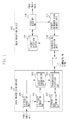
- Fig. 1 is a block diagram illustrating a basic configuration of a data transmission device and a data reception device of a first exemplary embodiment.
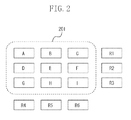
- Fig. 2 illustrates an example of a pattern for generating FEC packets from data packets by error correction coding.
- Fig. 3 illustrates an example of data packets and FEC packets after error correction coding, some of the packets being missing.
- Fig. 4 illustrates a series of processes in the first exemplary embodiment, the processes ranging from occurrence of packet lost in a transmission path to recovery of the lost packets by retransmission.
- Fig. 5 is a block diagram illustrating basic configurations of a data transmission device and a data reception device of a second exemplary embodiment.
- Fig. 6 illustrates a series of processes in the second exemplary embodiment, the processes ranging from the occurrence of packet lost in the transmission path to the recovery of the lost packets by retransmission.
- Fig. 7 illustrates another example of data packets and FEC packets after error correction coding, some of the packets being missing.
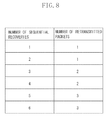
- Fig. 8 is a table illustrating correspondence between a number of sequential recoveries and a number of retransmitted data packets.
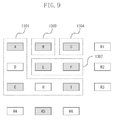
- Fig. 9 illustrates an example of the FEC packet generation from the data packets arranged in a matrix of three rows and three columns.
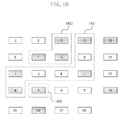
- Fig. 10 illustrates an example of the FEC packet generation from the data packets arranged in a matrix of four rows and four columns.
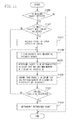
- Fig. 11 is a flow chart illustrating processing in a third exemplary embodiment for determining a data packet to be transmitted.
- Fig. 1 is a block diagram illustrating a basic configuration of a transmission/reception system including a data transmission device 101 and a data reception device 102 of a first exemplary embodiment.
- the data transmission device 101 transmits data packets including video and voice (i.e. audio data) and a recovery packet (FEC packet) to the data reception device 102.
- the FEC packet is used to recover a data packet that has failed to be communicated (missing data packet).
- the failed data packet (missing data packet) is a data packet which has been lost in a transmission path, for example.
- the data reception device 102 transmits a packet for requesting retransmission of the missing data packet that could not be recovered using the recovery packet, to the data transmission device 101.
- Both of the data transmission device 101 and the data reception device 102 are communication apparatuses for packet communication.
- the data transmission device 101 includes an RTP packet generation unit 103, an FEC packet generation unit 104, a packet transmission buffer 105, a transmission/reception unit 106, and a packet-retransmission determination unit 107.
- the data reception device 102 includes a transmission/reception unit 108, a packet reception buffer 109, a packet recovery unit 110, and a packet retransmission request unit 111.
- the data transmission device 101 is communicably connected to the data reception device 102 via a transmission path 112.
- the RTP packet generation unit 103 classifies video data and/or voice data input from an external device into data segments each having an appropriate size for communication, and attaches a header to each of the segments required for communication, to generate RTP data packets.
- the RTP packet generation unit 103 outputs the generated data packets to the FEC packet generation unit 104 and the packet transmission buffer 105.
- the FEC packet generation unit 104 generates a recovery packet (FEC packet) for recovering a data packet that is generated by the RTP packet generation unit 103 when the generated data packet is lost.
- the FEC packet generation unit 104 generates a recovery packet (FEC packet) that is communicated so that the data reception device 102 recovers a packet (missing data packet) that has failed to be communicated.
- the FEC packet generation unit 104 generates six FEC packets R1 to R6 from nine data packets 201 A to I by error correction coding, as shown in Fig. 2 .
- parity code is used to generate FEC packets, but the error correction code used is not limited to parity code and may be other code including those listed above.
- the FEC packets R1 to R3 are generated based on the three data packets in each of the rows of the data packets 201 by an exclusive OR (XOR) operation, respectively.
- the FEC packets R4 to R6 are generated based on the three data packets in each of the columns of the data packets 201 by the XOR operation, respectively.
- the FEC packet generation unit 104 of the present exemplary embodiment arranges the data packets generated by the RTP packet generation unit 103 in a matrix as shown in Fig. 2 . Then, the FEC packet generation unit 104 generates one FEC packet for a plurality of data packets arranged in one row, and also one FEC packet for the plurality of data packets arranged in one column. Accordingly, the FEC packet generation unit 104 of the present exemplary embodiment generates FEC packets so that each of the data packets belongs to two recovery groups.
- the other two data packets and the corresponding FEC packet are used to recover the missing data packet by the XOR operation.
- the data packets B and C and the FEC packet R1 are used to recover the data packet A.
- Each of the data packets may belong to a single recovery group, or three or more recovery groups.
- One recovery group may include data packets in any number other than three.
- FIG. 3 A method for recovering a plurality of missing packets is described below by referring to Fig. 3 .
- the missing data packet B is first recovered using the three packets. More specifically, the missing data packet B can be recovered using the normally received data packets A and C and the FEC packet R1 (which is received and contains the data packet B), by the XOR operation.
- the data packets F, G, and I each is in a row that misses two packets (F,R2; G, I) and in a column that misses two packets (G,R4; F, I), and cannot be recovered in the manner described above.
- the data packet F among the missing data packets F, G and I is retransmitted and normally received, the data packet I can be recovered using a combination of packets in the column.
- the data packet G can subsequently be recovered using the combination of packets in the row, based on the recovered data packet I.
- the retransmission of any one of the missing data packets F, G and I leads to recovery the other two missing data packets.
- the data packet F when the data packet F is retransmitted, the data packet I can be recovered using the data packets C and F and the FEC packet R6. Then, the data packet G can be recovered using the data packets H and I and the FEC packet R3.
- the retransmission of the data packet G or I also results in the recovery of all of the missing data packets in sequence.
- the number of the data packets that are recovered in sequence is referred to as "a number of sequential recoveries".
- the number of sequential recoveries includes the retransmitted data packet and the data packets that can be recovered based on the retransmitted data packet.
- each of the data packets F, G, and I has three sequential recoveries.
- the retransmission of the data packet B does not help the recovery of the other missing data packets, and the data packet B has one sequential recovery (itself).
- FIG. 7 Another pattern that is different from that of Fig. 3 is described below by referring to Fig. 7 .
- the data packets A, B, E, F, G, and I among the nine data packets 701 are missing.
- a path of sequential recoveries can be imagined.
- the data packets B and G can be recovered by error correction decoding in the row and column directions.
- the data packet I can be recovered by error correction decoding in the row direction from G.
- the data packet F can be recovered by error correction decoding in the column direction from I.
- the data packet E can be recovered by error correction decoding in the row direction from F. All data packets are thereby recovered by the retransmission of data packet A.
- the sequential recoveries can be performed similarly in the above pattern when a missing data packet other than the data packet A is normally communicated. In other words, the retransmission of any of the missing data packets leads to the sequential recoveries of the other missing data packets. Accordingly, each of the six missing data packets shown in Fig. 7 has six sequential recoveries.
- the packet-retransmission determination unit 107 determines a packet to be retransmitted from among the missing data packets. In other words, when it is determined that the plurality of missing data packets can be sequentially recovered by the normal retransmission of one of the missing data packets, the packet-retransmission determination unit 107 does not retransmit all of the plurality of recoverable data packets (or even the majority of them).
- the packet-retransmission determination unit 107 determines the recoverable missing data packets based on identification information about missing data packets and missing FEC packets which are included in a retransmission request packet transmitted from the data reception device 102, and retransmits only those (for example) that are required to enable the recovery of the other missing data packets.
- the packet-retransmission determination unit 107 determines packets that can be recovered when a first packet from among the plurality of packets that have failed to be communicated is normally communicated. When the first packet that is determined to recover the plurality of packets when it is normally communicated is retransmitted, the packet-retransmission determination unit 107 determines a retransmit packet so that at least a proportion of the plurality of recoverable packets are not retransmitted.
- the packet-retransmission determination unit 107 of the present exemplary embodiment also places higher importance (or higher priority) on a data packet that has a larger number of sequential recoveries. If the data packet that has a larger number of sequential recoveries is retransmitted and normally communicated, a larger number of missing data packets can be recovered. But if the retransmitted data packet is missing, the larger number of missing data packets cannot be recovered. Thus, the packet-retransmission determination unit 107 places higher importance on the data packet that has a larger number of sequential recoveries, and can retransmit a smaller number of data packets.
- Fig. 8 illustrates correspondence between the number of sequential recoveries and the number of retransmitted packets. The correspondence between the number of sequential recoveries and the number of retransmitted data packets are not limited to those in Fig. 8 .
- the group of missing data packets that can be used for mutual sequential recoveries is referred to as "sequential recovery group".
- the missing data packets in the same sequential recovery group have the same number of sequential recoveries.
- missing data packet having a certain number of sequential recoveries it means that the number of missing data packets that have that certain number of sequential recoveries exists which is equal to the number of sequential recoveries. In other words, for example, if there is a missing data packet that has three sequential recoveries, at least two other missing data packets that each has three sequential recoveries also exist. Further, when any one of the data packets among these three missing data packets is normally retransmitted, the other two missing data packets can be recovered, and it is determined that these three missing data packets are in the same sequential recovery group.
- the missing data packets A and B are determined as in the same sequential recovery group.
- the missing data packets in the same sequential recovery group satisfy the following condition. When any one of the missing data packets in an arbitrary sequential recovery group is normally communicated, the other missing data packets in the sequential recovery group can be recovered.
- a table is created that correlates the number of sequential recoveries with the number of data packets to be retransmitted. Following the table, whatever the number of sequential recoveries, a predetermined number of packets to be retransmitted is given.
- the packet-retransmission determination unit 107 selects one data packet to be retransmitted when the number of sequential recoveries is one or two. When there is a missing data packet that has the number of sequential recoveries of one, the missing data packet itself is determined to be retransmitted.
- the packet-retransmission determination unit 107 determines to retransmit one of the two missing data packets in a sequential recovery group. Similarly for other missing patterns, the packet-retransmission determination unit 107 determines the number of data packets to be retransmitted.
- the missing data packets (data packets A, B, E, F, G, and I) each have six sequential recoveries, and belong to the same sequential recovery group.
- the number of packets to be retransmitted for six sequential recoveries is three.
- the packet-retransmission determination unit 107 retransmits three missing data packets.
- the packet-retransmission determination unit 107 determines the number of packets that are retransmitted with the first packet from among the packets that can be recovered. Accordingly, the missing data packets can be recovered even if part of the retransmitted packets is lost. The same data packet among the missing data packets may be retransmitted a plurality of times which facilitates the retransmission processing. Alternatively, a plurality of different packets in a sequential recovery group may be retransmitted. This facilitates the recovery processing when a plurality of retransmitted packets is normally received.
- the number of retransmitted packets may be smaller than the number of missing data packets. More specifically, as shown in Fig. 8 , one packet is retransmitted for two missing data packets when the number of sequential recoveries is two. Alternatively, the number of retransmit packets in Fig. 8 may be set to be smaller than the number of missing data packets when the number of sequential recoveries is four or more. In this case, all of the missing data packets are retransmitted when the number of sequential recoveries is equal to a predetermined number or less (e.g., three).
- Fig. 11 is a flow chart illustrating the determination of a retransmit packet by the packet-retransmission determination unit 107 of the present exemplary embodiment.
- Fig. 4 illustrates a specific example of processing for recovering packets that are transmitted by the data transmission device 101 and that go missing in a transmission path.
- step S1501 in Fig. 11 the packet-retransmission determination unit 107 of the data transmission device 101 detects the missing one of the transmitted packets. The detection is performed based on information about missing packets in the retransmission request packets transmitted from the data reception device 102.
- the data transmission device 101 transmits, for example, data packets A to I, and FEC packets R1 to R6 to the data reception device 102. It is assumed here that the data packets C, E, F and H and the FEC packets R3 and R6 go missing in the transmission path 112.
- the packet recovery unit 110 of the data reception device 102 refers a sequence number at a header of each packet to check for any missing packet.
- the packet recovery unit 110 determines whether the missing data packet can be recovered using the other normally received data packets and FEC packet, and recovers the missing data packet by error correction coding.
- the missing data packet C is recovered using the normally received data packets A and B and FEC packet R1 (as shown in the upper right-hand corner of Fig. 4 ).
- the data reception device 102 transmits a retransmission request packet that includes the information (sequence number) about the missing data packet and missing FEC packet to the data transmission device 101.
- the retransmission request packet is transmitted that includes information about the missing data packets E, F, and H and the missing FEC packets R3 and R6.
- the data transmission device 101 does not perform the processing in step S1503, which will not be described here.
- the packet-retransmission determination unit 107 classifies the missing data packets (E, F, and H) into sequential recovery groups. For classifying the packets into sequential recovery groups, the packet-retransmission determination unit 107 determines the other missing data packet that can be recovered when each one of the missing data packets is normally communicated. More specifically, in step S1504, the packet-retransmission determination unit 107 determines the missing data packet that can be recovered when a first packet (missing data packet E) which is one of a plurality of packets (missing data packets) that have failed to be communicated is normally communicated. The packet-retransmission determination unit 107 determines the missing data packet that can be recovered based on: the missing data packet (first packet) that is assumed to be normally communicated, the normally communicated data packets and the FEC packets.
- Fig. 4 there is one sequential recovery group containing E, F and H.
- E, F and H normal transmission of any one of the missing data packets E, F and H can lead to the recovery of all of the missing data packets.
- Each of the missing data packets has the number of sequential recoveries of three.
- step S1505 the packet-retransmission determination unit 107 determines a missing data packet to be retransmitted from among the missing data packets in a sequential recovery group which has a maximum number of sequential recoveries.
- the packet-retransmission determination unit 107 determines a data packet to be retransmitted from among the missing data packets E, F and H.
- a number of the data packet to be retransmitted is determined (in the third embodiment) based on the table such as that of Fig. 8 .
- the packet-retransmission determination unit 107 determines the packet to be retransmitted from among a plurality of recoverable packets in which at least a part of the packet is removed. In step S403 in Fig. 4 , the data packets E and F are determined to be retransmitted, so that the missing data packet H is not retransmitted.
- step S1505 when a first packet which is determined that a plurality of packets can be recovered by normally communication thereof is retransmitted, the packet-retransmission determination unit 107 determines not to retransmit at least a part of the plurality of recoverable packets. After the determination of the packet to be retransmitted, the processing proceeds to step S1506.
- step S1506 the packet-retransmission determination unit 107 assumes that all of the missing packets in the sequential recovery group from which the retransmitted packet is determined are recovered, and the processing proceeds to step S1507.
- step S1507 the packet-retransmission determination unit 107 determines whether all of the missing packets are assumed to be recovered. If the packet-retransmission determination unit 107 determines that all of the missing packets are assumed to be recovered (YES in step S1507) such as the case in Fig. 4 (S404), the processing proceeds to step S1508. Whereas if the packet-retransmission determination unit 107 determines that there is a missing packet not yet be recovered (NO in step S1507), the processing returns to step S1504. When all of the missing data packets are not necessarily recovered, the packet-retransmission determination unit 107 determines whether the missing data packet that needs to be recovered is assumed to be recovered. When there is only one sequential recovery group as in Fig. 4 , the processing in step S1507 may be omitted.
- step S1508 the packet-retransmission determination unit 107 notifies the transmission/reception unit 106 of identification information (e.g., sequence number) of the retransmit packets determined in step S1505.
- the transmission/reception unit 106 reads the data of the retransmit packets from the packet transmission buffer 105 based on the identification information about the retransmit packets and transmits the retransmit packets to the data reception device 102.
- the data packets E and F among the missing data packets E, F and H are retransmitted.
- the data reception device 102 recovers the missing data packet H using the data packets B and E and the FEC packet R5 (S404).
- both of the retransmitted data packets E and F are normally received, but the normal reception of one of the data packets can also lead to the recovery of all of the missing data packets.
- Only one data packet (e.g., data packet E) among the three missing data packet E, F, and H may alternatively be determined to be retransmitted twice, in addition to determining two different data packets (e.g., data packets E and F) as the retransmit packets as described above.
- the number of retransmit packets for each number of sequential recoveries in the table illustrated in Fig. 8 may be all one, for example. In this case, if the retransmit packet is missing in the transmission path, the recovery of the other data packets cannot be achieved, but the number of packets to be retransmitted can be reduced. Accordingly, increase of the volume of communication due to the retransmission of missing packets can be efficiently reduced.
- the number of retransmit packets may be determined according to a condition of the transmission path 112.
- RTP Control Protocol is used to monitor a reception status of the packets.
- RTCP packets which include transmission information or reception information are mutually transmitted between a packet transmission side and a packet reception side.
- the packet from the reception side to the transmission side is referred to as a receiver report.
- the receiver report includes information about an accumulated number of lost (missing) packets and received packets. Further, the receiver report also includes delay time information about time (delay time) required for a packet to travel from the data transmission device 101 to the data reception device 102.
- the packet-retransmission determination unit 107 determines the condition of the transmission path 112 by analysing the above information. More specifically, congestion along the transmission path 112 causes increase in a rate (error rate) of missing packets to transmitted packets, and increase in the time required for the packet transmission. Thus, the packet-retransmission determination unit 107 of the present exemplary embodiment determines that congestion occurs when the error rate increases and the time (delay time) required for a packet to travel from the data transmission device 101 to the data reception device 102 increases. When it is determined that the congestion occurs in the transmission path 112, the packet-retransmission determination unit 107 decreases the number of retransmit packets as compared to that when there is no congestion.
- the packet-retransmission determination unit 107 obtains the error rate according to a number of packets which failed in transmission (the number of missing packets). Then, when obtained second error rate is higher than a first error rate and a number of packets (the number of sequential recoveries) that are determined as recoverable is a first number of packets, the packet-retransmission determination unit 107 determines the number of retransmit packets as follows.
- the packet-retransmission determination unit 107 determines the number of retransmit packets so that the number of retransmit packets is smaller than that in the case with the first error rate and the number of sequential recoveries is the first number of packets. Further, the packet-retransmission determination unit 107 obtains delay time information about the delay time required for a packet to be transmitted and received. Then, the packet-retransmission determination unit 107 determines the number of retransmit packets as follows, based on the delay time information and the number of packets that are determined as recoverable (the number of sequential recoveries).
- the packet-retransmission determination unit 107 determines a second number of packets as the number of retransmit packets.
- the packet-retransmission determination unit 107 determines a third number of packets as the number of retransmit packets. More specifically, the packet-retransmission determination unit 107 determines the retransmit packets so that the third number of packets which is smaller than the second number are retransmitted, from among the packets that can be sequentially recovered.
- the delay time information about the time (delay time) required for a packet to travel from the data transmission device 101 to the data reception device 102 may be based on Round Trip Time (RTT) or jitter information for example, but not limited thereto.
- RTT Round Trip Time
- jitter information for example, but not limited thereto.
- the occurrence of congestion may be determined based on either the error rate or the delay time information.
- the packet-retransmission determination unit 107 increases the number of packets to be retransmitted when it is determined that there is no congestion along the transmission path 112, whereas decreases the number of packets to be retransmitted when it is determined that the congestion occurs in the transmission path 112. Accordingly, this configuration may increase a possibility to recover all of missing packets when there is no congestion along the path, and reduce a possibility to worsen the congestion with the retransmit packets when there is congestion.
- the above example has been described focusing on the recovery of all of the missing data packets, but all of the missing data packets may not be necessarily recovered.
- the retransmit packets may be determined so that a data packet which has higher priority is recovered, from among missing data packets.
- the data packets which have higher priority include intra-frame compression data, for example.
- the intra-frame compression data is moving image data which is coded without referring to the other frame data.
- inter-frame compression data includes moving image data which is coded by referring to the other frame data.
- the intra-frame data is likely to be referred to by data that is transmitted later. If the intra-data is not recovered, the missing data may adversely affect the later communication for a long time. Therefore, the packet-retransmission determination unit 107 can determine a retransmit packet so that the data packet including intra-frame data can be recovered.
- the packet-retransmission determination unit 107 determines whether to retransmit a packet failed in transmission by checking whether the packet includes moving image data that is coded by referring to the other frame data. Accordingly, this configuration can reduce an effect due to the missing data packet, and an increase in a volume of communication due to the retransmission of the missing packet.
- the packet-retransmission determination unit 107 may determine whether to recover all of the missing data packets, or only data packets which have higher priority, according to whether the transmission path 112 is in a congestion state or not. For example, when it is determined that there is congestion along the transmission path 112, the packet-retransmission determination unit 107 may only retransmits a data packet for recovering intra-frame compression moving image data among the missing data packets. In contrast, when it is determined that no congestion occurs along the transmission path 112, the packet-retransmission determination unit 107 may determine a retransmitted data packet so that all of the missing data packets can be recovered. The determination of the occurrence of the congestion may be based on the error rate, the delay time information, or a combination thereof, for example.
- the packet-retransmission determination unit 107 obtains the error rate as described above.
- the retransmission packet is determined from among the packets failed in communication so that the packet that includes moving image data which is not coded by referring to the other frame data is retransmitted.
- the packet-retransmission determination unit 107 obtains delay information as described above. In the case of a delay time above a certain threshold, the packet-retransmission determination unit 107 determines a packet to be retransmitted regardless of intra-frame compression or inter-frame compression. More specifically, the packet-retransmission determination unit 107 determines a packet to be retransmitted so that a packet including intra-frame compression moving image data and a packet including inter-frame compression moving image data are retransmitted.
- the packet-retransmission determination unit 107 determines a packet to be retransmitted so that a packet including intra-frame compression moving image data is retransmitted when the delay time information about third delay time, which is longer than the second delay time, is obtained after the delay time information about the first delay time is obtained.
- Data to be prioritized may be determined, in addition to the intra-frame compression moving image data, according to a data position on a display screen or an amount of movement in the screen, for example.
- the packet-retransmission determination unit 107 may set a plurality of stages of priority and determine a data packet to be retransmitted according to the congestion state and the order of priority.
- this configuration can reduce the effect due to the missing data packet when there is congestion along the path, and prevents worsening of the congestion with the retransmitted packets.
- This configuration can suppress the increase in the volume of communication due to the retransmission of the missing packets. Further, since the data transmission device 101 determines a packet to be retransmitted, an effect of the exemplary embodiment of the present invention can be obtained regardless of functions provided in the data reception device 102.
- the data transmission device 101 determines a packet to be retransmitted. In the present exemplary embodiment, it is instead a data reception device 502 that determines a packet to be retransmitted.
- Fig. 5 is a block diagram illustrating a basic configuration of a transmission/reception system of the present exemplary embodiment including a data transmission device 501 and a data reception device 502.
- the data transmission device 501 transmits data packets such as video and voice (i.e. audio) and recovery packets (FEC packets) to the data reception device 502.
- the FEC packets are used by the data reception device 502 to recover a data packet that has failed to be communicated.
- the data reception device 502 further determines a data packet that requires retransmission based on a missing data packet that could not be recovered by the recovery packet, and transmits a retransmission request packet to the data transmission device 501.
- Both the data transmission device 501 and the data reception device 502 are communication apparatuses for packet communication.
- the data reception device 502 in the present exemplary embodiment includes a packet-retransmission determination unit 513.
- the data reception device 102 notifies the data transmission device 101 of the information about packets missing in the transmission path 112, so that the data transmission device 101 determines a data packet to be retransmitted.
- it is the data reception device 502 that determines a data packet to be retransmitted, and notifies the data transmission device 501 of a retransmission request packet including information (e.g., sequence number) about the data packet that is determined to be retransmitted.
- Fig. 11 is the flow chart illustrating the processing for determining a retransmit packet by the packet-retransmission determination unit 513 of the present exemplary embodiment.
- Fig. 6 illustrates a specific example of processing for recovering packets that are transmitted by the data transmission device 501 and missing in a transmission path 112.
- step S1501 in Fig. 11 the packet recovery unit 110 of the data reception device 502 detects a missing of a data packet.
- the packet recovery unit 110 of the present exemplary embodiment refers the sequence number at the header of each received packet to check for a missing packet, for example, when there is a missing sequence number.
- the data transmission device 501 transmits the data packets A to I and the FEC packets R1 to R6 to the data reception device 502. It is assumed that the data packets C, E, F and H and the FEC packets R3 and R6 are missing in the transmission path 112. After the detection of the missing packets by the packet recovery unit 110, the processing proceeds to step S1502.
- step S1502 the packet recovery unit 110 of the data reception device 502 determined whether there is a missing data packet that can be recovered by the normally received data packets and FEC packets. If it is determined that there is the missing data packet which can be recovered (YES in step S1502), the processing proceeds to step S1503, whereas if not, (NO in step S1502), the processing proceeds to step S1504. In Fig. 6 , the missing data packet C can be recovered using the normally received data packets A and B and the FEC packet R1, so that the processing proceeds to step S1503.
- step S1503 the packet recovery unit 110 recovers the missing data packet that can be recovered by error correction decoding.
- step S601 in Fig. 6 the packet recovery unit 110 recovers the missing data packet C.
- a header of the FEC packet of the present exemplary embodiment includes information about a data packet corresponding thereto.
- the FEC packet R1 in Fig. 6 includes information, at the header thereof, indicating that the FEC packet R1 corresponds to the data packets A, B and C.
- the packet recovery unit 110 recovers the missing data packet C based on the information.
- the data reception device 502 If there is any missing data packet that cannot be recovered by the FEC packet, the data reception device 502 notifies the packet-retransmission determination unit 513 in the data reception device 502 of information (sequence numbers) about the missing data packet and FEC packet. In Fig. 6 , the data reception device 502 notifies information about the missing data packets E, F and H and missing FEC packets R3 and R6. After the packet recovery unit 110 notifies the information about unrecoverable missing data packets and missing FEC packets, the processing proceeds to step S1504.
- the packet-retransmission determination unit 513 classifies the missing data packets into sequential recovery groups as described above. For example, in step S1504, the packet-retransmission determination unit 513 determines the missing data packet that can be recovered when a first packet (missing data packet F) which is one of a plurality of packets (missing data packets) that have failed to be communicated is normally communicated. The recoverable missing packets and packet F are in the same sequential recovery group. The packet-retransmission determination unit 513 determines the recoverable missing data packets based on the information about data packet that corresponds to an FEC packet, the information being included in the header of the FEC packet.
- Fig. 6 there is one sequential recovery group.
- a normal communication of one of the missing data packets E, F and H leads to the recovery of all of the missing data packets.
- Each of the missing data packets has the number of sequential recoveries of three.
- step S1505 the packet-retransmission determination unit 513 determines a missing data packet to be retransmitted from among the missing data packets in a sequential recovery group which has a maximum number of sequential recoveries.
- the packet-retransmission determination unit 513 determines a data packet to be retransmitted from the missing data packets E, F and H. A number of the data packet to be retransmitted is determined based on the table such as that of Fig, 8 .
- step S602 in Fig. 6 the data packets E and F are retransmitted, so that the missing data packet H is not.
- step S1505 when a first packet that is determined to recover a plurality of packets when it is normally communicated is retransmitted, the packet-retransmission determination unit 513 determines the retransmit packet so that at least a part of the plurality of recoverable packets are not retransmitted. After the determination of the retransmit packet, the processing proceeds to step S1506.
- step S1506 the packet-retransmission determination unit 513 assumes that all of the missing packets in the sequential recovery group from which the retransmit packet is determined are recovered, and the processing proceeds to step S1507.
- step S1507 it is assumed that all of the missing data packets E, F and H are recovered in steps S603 and S604.
- step S1507 the packet-retransmission determination unit 513 determined whether all of the missing data packets are assumed to be recovered. If the packet-retransmission determination unit 513 determines that all of the missing packets are assumed to be recovered (YES in step S1507), the processing proceeds to step S1508. Whereas if the packet-retransmission determination unit 107 determines that there is a missing packet not yet be recovered (NO in step S1507), the processing returns to step S1504. In the example illustrated in Fig. 6 , it is assumed that the retransmission of the data packets E and F leads to the recovery of all of the missing data packets, and the processing proceeds to step S1508.
- the packet-retransmission determination unit 513 determines whether the missing data packet that needs to be recovered is assumed to be recovered. When there is only one sequential recovery group as in Fig. 6 , the process in step S1507 may be omitted.
- step S1508 the packet-retransmission determination unit 513 notifies the packet retransmission request unit 111 of the identification information (e.g., sequence numbers) of the retransmitted data packets determined in step S1505.
- the packet retransmission request unit 111 generates a retransmission request packet based on the identification information about the retransmitted data packets.
- the transmission/reception unit 106 transmits the retransmission request packet generated by the packet retransmission request unit 111 to the data transmission device 501.
- step S603 in Fig. 6 the retransmission request packet for the data packets E and F among the missing data packets E, F and H is transmitted.
- the data transmission device 501 retransmits the data packets E and F.
- the data reception device 502 recovers the missing data packet H using the data packets B and E and the FEC packet R5.
- both of the retransmitted data packets E and F are normally received, but the normal reception of only one of the data packets can also lead to the recovery of all of the missing data packets.
- One, two or three of E, F and H may be retransmitted to recover all of the missing packets.
- the data reception device 502 can determine a data packet for retransmission request. Further, a load on the data transmission device 501 can be reduced by determining the packet which requires retransmission in the data reception device 502.
- the normal reception of one retransmitted data packet among a plurality of missing data packets can lead to the recovery of the other missing data packets in the same sequential recovery group.
- an example in which a plurality of sequential recovery groups is included is described below in detail.
- the normal reception of a plurality of retransmitted data packets are necessary for the recovery of all of the missing data packets.
- the transmission/reception system of the present exemplary embodiment has the basic configuration similar to that shown in Fig. 5 . As described in the first exemplary embodiment, however, the data transmission device 101 may determine the retransmitted data packet.
- Fig. 9 illustrates the missing of the data packets A, B, C, E, F, G, and I and the FEC packet R5.
- all of the missing data packets have the number of sequential recoveries that is equal to the number of the missing data packets.
- all of the missing data packets have the number of sequential recoveries that is smaller than the number of the missing data packets. Accordingly, to recover all of the missing data packets, normal communication of a plurality of retransmitted data packets is required.
- the packet-retransmission determination unit 513 classifies missing data packets into the sequential recovery groups, and determines a data packet to be retransmitted from among the missing data packets in a sequential recovery group which has a maximum number of sequential recoveries.
- the packet-retransmission determination unit 513 assumes that all of the missing data packets in the sequential recovery group which has the maximum number of sequential recoveries are recovered, and classifies the missing data packets that are not recovered yet into the sequential recovery groups.
- the packet-retransmission determination unit 513 of the present exemplary embodiment repeats the determinations of a retransmitted data packet according to the above procedure until all of the missing data packets that need to be recovered are assumed to be recovered.
- the packet-retransmission determination unit 513 calculates missing data packets that can be recovered when each of the missing data packets are normally communicated.
- the packet-retransmission determination unit 513 determines that the data packet A, G, and I belong to the same sequential recovery group.
- the packet-retransmission determination unit 513 determines that the data packet E and F belong to the same sequential recovery group.
- the normal communication of the data packet B or C does not lead to any recovery of a missing data packet, which means there is no other missing data packet that belongs to the same sequential recovery group with either data packet B or C.
- the above classification provides four sequential recovery groups in Fig. 9 , namely a group 1301 composed of the data packets ⁇ A, G, I ⁇ having the number of sequential recoveries of three, a group 1302 composed of the data packets ⁇ E, F ⁇ having the number of sequential recoveries of two, a group 1303 composed of the data packet ⁇ B ⁇ having the number of sequential recoveries of one, and a group 1304 composed of the data packet ⁇ C ⁇ having the number of sequential recoveries of one.
- the packet-retransmission determination unit 513 determines a retransmitted data packet from the sequential recovery group ⁇ A, G, I ⁇ having the maximum number of sequential recoveries among the above sequential recovery groups.
- the packet-retransmission determination unit 513 may determine a plurality of retransmitted data packets according to the number of sequential recoveries (e.g. A,E,B and C).
- the packet-retransmission determination unit 513 assumes that all of the missing data packets in the sequential recovery group having the maximum number of sequential recoveries are recovered, and classifies the other packets into sequential recovery groups. Then, the packet-retransmission determination unit 513 determines a retransmitted data packet from the remaining sequential recovery groups which has a maximum number of sequential recoveries. After this, the similar processing is repeated so that all of the missing data packets are recovered. In a case where there is no need to recover all of the missing data packets, the process may be terminated.
- the packet-retransmission determination unit 513 may determine a sequential recovery group from which a retransmitted data packet is determined in order of priority.
- the packet-retransmission determination unit 513 classifies the missing data packets into a sequential recovery group composed of the missing data packets B, C, E, and F and another sequential recovery group composed of the missing data packets G and H.
- Each of the missing data packets B, C, E and F has the number of sequential recoveries of six, and each of the missing data packets G and H has the number of sequential recoveries of two.
- the packet-retransmission determination unit 513 of the present exemplary embodiment determines a data packet to be retransmitted from among the missing data packets B, C, E, and F, in which it is assumed that the retransmission leads to the recovery of the missing data packets G and H. Hence, the packet-retransmission determination unit 513 does not determine a data packet to be retransmitted from among the sequential recovery group composed of missing data packets G and H. However, to reduce processing load, the data packet to be retransmitted may be determined from each of the sequential recovery groups.
- Fig. 11 is the flow chart illustrating the processing for determining a packet to be retransmitted by the data reception device 502 of the present exemplary embodiment.
- step S1501 the packet recovery unit 110 detects a lost packet (missing data packet) by monitoring the sequence numbers of received packets.
- the packet recovery unit 110 detects the missing of data packets A, B, C, E, F, G and I and the FEC packet R5 among the transmitted data packets A to I and the FEC packets R1 to R6.
- the processing proceeds to step S1502, whereas if not (NO in step S1501), the detection of a missing data packet is repeated.
- step S1502 the packet recovery unit 110 determines a missing data packet that can be recovered by error correction decoding. In other words, in step S1502, the packet recovery unit 110 determined whether the missing data packet can be recovered using an FEC packet (recovery packet). When the packet recovery unit 110 determines that there are data packets that can be recovered by error correction decoding (YES in step S1502), the processing proceeds to step S1503, and the missing data packets is recovered. More specifically, the packet recovery unit 110 recovers the missing data packet using the normally received data packet and FEC packet.
- the packet recovery unit 110 determines there is no missing data packet that can be recovered by error correction decoding (NO in step S1502), such as is the case in Fig. 9 , the processing proceeds to step S1504. Further, the packet recovery unit 110 notifies the packet-retransmission determination unit 513 of the information (e.g., sequence numbers) of the missing data packets that could not be recovered by error correction decoding.
- the information e.g., sequence numbers
- the packet-retransmission determination unit 513 classifies the missing data packets that could not be recovered by the packet recovery unit 110 into sequential recovery groups. The classification is performed as described above. For classifying the packets into sequential recovery groups, the packet-retransmission determination unit 513 determines the other missing data packet that can be recovered when each one of the missing data packets is normally communicated. For example, the packet-retransmission determination unit 513 determines missing data packets that can be recovered if the missing data packet A is normally communicated.
- step S1504 the packet-retransmission determination unit 513 determines missing data packets which can be recovered by normal communication of a first packet (missing data packet A) of a plurality of packets that have failed to be communicated.
- the plurality of packets is classified into four sequential recovery groups 1301, 1302, 1303 and 1304.
- step S1505 the packet-retransmission determination unit 513 determines a data packet to be retransmitted from among the missing data packets in a sequential recovery group which has a maximum number of sequential recoveries.
- the packet-retransmission determination unit 513 determines a data packet to be retransmitted from the sequential recovery group (group 1301) composed of the missing data packets A, G, and I. For example, it is assumed that missing data packets A and G are determined as the retransmitted data packets.
- step S1505 when a first packet that is determined to recover a plurality of packets when it is normally communicated is retransmitted, the packet-retransmission determination unit 513 determines the retransmission packet so that at least a proportion of the plurality of recoverable packets are not retransmitted.
- step S1506 the packet-retransmission determination unit 513 assumes that all of the missing packets in the sequential recovery group which has the maximum number of sequential recoveries are recovered. In other words, the packet-retransmission determination unit 513 assumes that all of the missing packets in the sequential recovery group that correspond to the retransmitted data packet are recovered by the retransmitted data packet determined in step S1505. In Fig. 9 , it is assumed that the retransmitted data packets A and G recover all of the missing data packets A, G, and I in the sequential recovery group (group 1301).
- step S1507 the packet-retransmission determination unit 513 determined whether all of the missing data packets are recovered. In other words, the packet-retransmission determination unit 513 determined whether all of the missing data packets are recovered on the assumption that all of the missing data packets in the sequential recovery group are recovered.
- step S1507 when there is no need to recover all of the missing data packets, the packet-retransmission determination unit 513 determines whether all of the data packets which need to be recovered can be recovered. If it is determined that not all of the data packets can be recovered (NO in step S1507), the processing returns to step S1504, and the similar processing is performed on the missing data packets that are not assumed to be recovered.
- step S1504 the packet-retransmission determination unit 513 classifies the missing data packets that are not assumed to be recovered into sequential recovery groups.
- step S1505 the packet-retransmission determination unit 513 determines a data packet to be retransmitted from the missing data packets in the sequential recovery group which has the maximum number of sequential recoveries.
- step S1506 the packet-retransmission determination unit 513 assumes that all of the missing packets in the sequential recovery group which has the maximum number of sequential recoveries are recovered. Then, in step S1507, the packet-retransmission determination unit 513 determines whether all of the missing data packets are assumed to be recovered.
- the packet-retransmission determination unit 513 determines a packet that is retransmitted with the retransmit packet determined in step S1505 from the plurality of missing data packets that have failed to be communicated except those that are assumed to be recoverable in step S1506.
- the missing data packets B, C, E, and F are not assumed to be recovered, so that the processing returns to step S1504.
- the missing data packets B, C, E, and F are classified into the sequential recovery groups.
- the packet-retransmission determination unit 513 determines a packet that can be recovered based on the normal communication of a second packet from among the plurality of packets B, C, E, and F that cannot be recovered when the first packets (missing data packets A and G) are normally communicated. In this example, these missing data packets are all determined to be in the same sequential recovery group.
- the packet-retransmission determination unit 513 determines a packet to be retransmitted from among the missing data packets B, C, E, and F.
- the missing data packets B and E are determined as the retransmitted data packets.
- the packet-retransmission determination unit 513 determines a retransmit packet as follows.
- the packet-retransmission determination unit 513 determines a retransmit packet so that at least a part of the plurality of packets (missing data packets B, C, E, and F) that are determined to be recovered by the normal transmission of the second packets (missing data packets B and E) is not retransmitted.
- step S1506 it is assumed that the retransmitted data packets B and E recover all of the missing data packets B, C, E, and F in the corresponding sequential recovery group. Then in step S1507, it is determined that all of the missing data packets can be recovered. In step S1507, when the packet-retransmission determination unit 513 determines that all of the missing data packets can be recovered, the processing proceeds to step S1508.
- step S1508 the packet-retransmission determination unit 513 notifies the packet retransmission request unit 111 of the identification information (e.g., sequence numbers) of the retransmitted data packets.
- the identification information about the missing data packets A, G, B, and E is notified.
- the packet retransmission request unit 111 generates a retransmission request packet so that the data packets that are determined as the retransmitted data packets are retransmitted.
- the transmission/reception unit 108 transmits the retransmission request packet to the data transmission device 501.
- the data packets are arranged in a matrix of three rows and three columns to generates FEC packets, but may be arranged in other configuration.
- step S1501 in Fig. 11 the packet recovery unit 110 detects missing data packets.
- the packet recovery unit 110 detects the missing of the data packets C, D, F, G, I, L, M, and N and the FEC packets R1, R4 and R6.
- the packet recovery unit 110 determines that none of the missing data packets can be recovered by the FEC packets, and proceeds to step S1504.
- the FEC packets of the present exemplary embodiment include information about corresponding data packets at the headers thereof.
- the FEC packet R1 in Fig. 10 has the information, in the header thereof, indicating that the FEC packet R1 corresponds to the data packets A, B, C, and D.
- the packet recovery unit 110 determines a missing data packet that can be recovered, based on the information in the header of the FEC packet.
- step S1504 the packet-retransmission determination unit 513 classifies the missing data packets into sequential recovery groups.
- the missing data packets are classified into three sequential recovery groups, namely, a sequential recovery group 1401 composed of the data packets ⁇ D, I, L, M ⁇ having four sequential recoveries, a sequential recovery group 1402 composed of the data packets ⁇ C, F, G ⁇ having three sequential recoveries, and a sequential recovery group 1403 composed of the data packet ⁇ N ⁇ having one sequential recoveries.
- step S1505 the packet-retransmission determination unit 513 determines a packet to be retransmitted from among the missing data packets in the sequential recovery group 1401.
- the missing data packets I and L are determined as the retransmitted data packets.
- step S1506 after the determination of the retransmitted data packets, it is assumed that all of the missing data packets (D, L, I and M) in the sequential recovery group 1401 are recovered.
- step S1507 the packet-retransmission determination unit 513 determines whether all of the missing data packets can be recovered.
- Fig. 10 as described above, it is assumed that the missing data packets D, L, I, and M can be recovered among the missing data packets C, D, F, G, I, L, M, and N. However, the missing data packets (C, F, G, and N) in the other sequential recovery groups are left un-recovered, so that the processing returns to step S1504, and the missing data packets C, F, G, and N are classified into sequential recovery groups.
- Fig. 10 as described above, it is assumed that the missing data packets D, L, I, and M can be recovered among the missing data packets C, D, F, G, I, L, M, and N. However, the missing data packets (C, F, G, and N) in the other sequential recovery groups are left un-recovered, so that the processing returns to step S1504, and the missing data packets C, F, G, and N are classified into sequential recovery
- the missing data packets C, F, G and N are classified into a sequential recovery group 1402 composed of the data packets C, F, and G, and another sequential recovery group 1403 composed of the data packet N.
- the constitutions of the other sequential recovery groups do not change before and after the assumption of the recovery of the sequential recovery group 1401.
- a data packet to be retransmitted is determined from among the missing data packets C, F, and G in the sequential recovery group 1402 which has the maximum number of sequential recoveries.
- the missing data packets C and F are determined as the retransmitted data packets.
- a data packet to be retransmitted is determined from among the missing data packets in the sequential recovery group 1403.
- the missing data packet N is determined as the retransmitted data packet.
- step S1508 the packet-retransmission determination unit 513 notifies the packet retransmission request unit 111 of the identification information (sequence numbers) about the data packet which is determined as the retransmitted data packet.
- the identification information about the missing data packets I, L, C, F, and N is notified.
- the packet retransmission request unit 111 generates the retransmission request packet based on the notified identification information.
- the transmission/reception unit 108 transmits the retransmission request packet to the data transmission device 501.
- the data transmission device 501 reads the data packets (I, L, C, F, and N) to be retransmitted from the packet transmission buffer 105 based on the identification information about the retransmit packets, and retransmits the requested packets.
- the number of data packets that are actually retransmitted may be five.
- two data packets are retransmitted from among the missing data packets D, I, L, and M in the sequential recovery group 1401, but the normal communication of one of the missing data packets leads to the recovery of the other missing data packets. Accordingly, in Fig. 10 , the number of data packets that are actually retransmitted may be minimized to three.
- the data reception device 502 of the present exemplary embodiment causes the transmission/reception unit 108 to receive a recovery packet (FEC packet) and a data packet that are used to recover a missing data packet (failed packet).
- the packet recovery unit 110 determines a data packet, from among the missing data packets (failed packets), that cannot be recovered by a recovery packet.
- the packet-retransmission determination unit 513 determines a data packet that can be recovered based on the reception of a first data packet from among the plurality of data packets that cannot be recovered.
- the data packet that requires retransmission is determined so that at least a part of the missing data packets that are determined as recoverable is not retransmitted.
- the present invention may be applicable to the case where the number of data packets that cannot be recovered by the recovery packet (FEC packet) exceeds a predetermined number of packets.
- the number of retransmitted data packets may further be reduced, for example, when the constitutions of the other sequential recovery groups are changed on the assumption that all of the missing data packets in one sequential recovery group are recovered.
- a retransmitted data packet may be determined from each of the sequential recovery groups that are originally classified. Accordingly, the processing load for determining retransmitted data packets can be reduced.
- the retransmitted data packet determination is not performed on the group.
- the increase in the volume of communication due to retransmitted data packets can be further reduced.
- the data reception device 502 determines a retransmitted data packet, but as described in the first exemplary embodiment, a data transmission device may determine a retransmitted data packet.
- the data transmission device includes the packet-retransmission determination unit 107, like the data transmission device 101 of Fig. 1 .
- the transmission/reception unit 106 of the data transmission device 101 transmits a recovery packet and a data packet used by the data reception device 102 to recover a failed (lost) data packet to the data reception device 102.
- the transmission/reception unit 106 also receives a retransmission request of data packets.
- the packet-retransmission determination unit 107 determines a data packet (missing data packet) that can be recovered by the data reception device 102 based on the reception of the first data packet, from among the plurality of data packets that are requested for retransmission.
- the packet-retransmission determination unit 107 determines a retransmitted data packet so that at least a part of the recoverable data packets is not retransmitted.
- the present invention may be applicable to the case where the number of retransmission request data packets exceeds a predetermined number of packets. Accordingly, the increase in the volume of communication due to the retransmission of missing data packets can be suppressed. Further, the effect of the exemplary embodiment of the present invention can be obtained regardless of functions provided in the data packet reception device by performing the determination processing of a packet to be retransmitted on a data packet transmission side.
- aspects of the present invention can also be realized by a computer (or devices such as a CPU or MPU) that reads out and executes a program recorded on a memory device to perform the functions of the above-described embodiments, and by a method, the steps of which are performed by a computer by, for example, reading out and executing a program recorded on a memory device to perform the functions of the above-described embodiments.
- the program is provided to the computer for example via a network or from a recording medium of various types serving as the memory device (e.g., computer-readable medium).
- the system or apparatus, and the recording medium where the program is stored are included as being within the scope of the present invention.
Landscapes
- Engineering & Computer Science (AREA)
- Computer Networks & Wireless Communication (AREA)
- Signal Processing (AREA)
- Detection And Prevention Of Errors In Transmission (AREA)
- Data Exchanges In Wide-Area Networks (AREA)
- Communication Control (AREA)
- Mobile Radio Communication Systems (AREA)
Applications Claiming Priority (1)
| Application Number | Priority Date | Filing Date | Title |
|---|---|---|---|
| JP2008313400A JP5408981B2 (ja) | 2008-12-09 | 2008-12-09 | 通信装置、及び通信方法、プログラム |
Publications (2)
| Publication Number | Publication Date |
|---|---|
| EP2197140A2 true EP2197140A2 (de) | 2010-06-16 |
| EP2197140A3 EP2197140A3 (de) | 2014-01-01 |
Family
ID=41694649
Family Applications (1)
| Application Number | Title | Priority Date | Filing Date |
|---|---|---|---|
| EP20090177958 Withdrawn EP2197140A3 (de) | 2008-12-09 | 2009-12-03 | Wiederübertragungskommunikationsvorrichtung und Kommunikationsverfahren |
Country Status (4)
| Country | Link |
|---|---|
| US (1) | US8312352B2 (de) |
| EP (1) | EP2197140A3 (de) |
| JP (1) | JP5408981B2 (de) |
| CN (1) | CN101753279B (de) |
Families Citing this family (14)
| Publication number | Priority date | Publication date | Assignee | Title |
|---|---|---|---|---|
| WO2007069406A1 (ja) * | 2005-12-15 | 2007-06-21 | Mitsubishi Electric Corporation | 通信システム、送信側通信装置および受信側通信装置 |
| US20120201248A1 (en) * | 2009-10-14 | 2012-08-09 | Nec Corporation | Transmission control method for packet communication and packet communication system |
| US10218467B2 (en) | 2009-12-23 | 2019-02-26 | Pismo Labs Technology Limited | Methods and systems for managing error correction mode |
| US8502859B2 (en) * | 2010-04-27 | 2013-08-06 | Lifesize Communications, Inc. | Determining buffer size based on forward error correction rate |
| JP5677070B2 (ja) * | 2010-12-14 | 2015-02-25 | キヤノン株式会社 | 受信装置及び、受信装置による処理方法 |
| EP2710853B1 (de) * | 2011-05-20 | 2017-11-08 | BlackBerry Limited | Harq mit mehreren empgänger-koordinierten sendern |
| JP5916512B2 (ja) * | 2012-05-22 | 2016-05-11 | 古河電気工業株式会社 | 車載装置および車載装置の判断方法 |
| GB201210779D0 (en) * | 2012-06-18 | 2012-08-01 | Microsoft Corp | Correction data |
| US9438483B2 (en) | 2012-10-15 | 2016-09-06 | At&T Intellectual Property I, L.P. | System and method of implementing quality of service over a packet-based Network |
| WO2016103008A1 (en) * | 2014-12-24 | 2016-06-30 | Pismo Labs Technology Limited | Methods and systems for transmitting data through an aggregated connection |
| JP6529299B2 (ja) | 2015-03-20 | 2019-06-12 | キヤノン株式会社 | 送信装置、受信装置、方法及びプログラム |
| CN112311497B (zh) * | 2019-07-29 | 2024-06-18 | 华为技术有限公司 | 一种通信方法和通信设备 |
| CN112968754B (zh) * | 2021-02-01 | 2022-03-15 | 航天国盛科技有限公司 | 一种基于n+1路e1信道实现数据可靠性传输方法、网络设备及计算机可读存储介质 |
| US12580677B2 (en) * | 2022-08-23 | 2026-03-17 | Nvidia Corporation | Error correction with proactive packet replacement for real-time data streaming |
Family Cites Families (14)
| Publication number | Priority date | Publication date | Assignee | Title |
|---|---|---|---|---|
| US6272658B1 (en) * | 1997-10-27 | 2001-08-07 | Kencast, Inc. | Method and system for reliable broadcasting of data files and streams |
| US7224702B2 (en) * | 2000-08-30 | 2007-05-29 | The Chinese University Of Hong Kong | System and method for error-control for multicast video distribution |
| CN101068138B (zh) * | 2001-02-21 | 2015-07-01 | 松下电器(美国)知识产权公司 | 使用信号星座重排的混合自动请求重发的方法 |
| US6851084B2 (en) * | 2002-06-10 | 2005-02-01 | Harris Corporation | Forward error correction method and system for reliable transmission of real time data over a packet based network |
| JP4088956B2 (ja) | 2002-11-06 | 2008-05-21 | ソニー株式会社 | 情報処理装置 |
| JP4328602B2 (ja) * | 2003-11-20 | 2009-09-09 | 富士通株式会社 | パケットエラー訂正装置及び方法 |
| WO2006090450A1 (ja) * | 2005-02-23 | 2006-08-31 | Media Global Links Co., Ltd | パケット再送アルゴリズム |
| JP4688566B2 (ja) * | 2005-05-10 | 2011-05-25 | 富士通東芝モバイルコミュニケーションズ株式会社 | 送信機及び受信機 |
| JP2007143113A (ja) * | 2005-10-19 | 2007-06-07 | Matsushita Electric Ind Co Ltd | 送受信システム、送信装置、および送信方法 |
| JP4666309B2 (ja) * | 2006-03-07 | 2011-04-06 | 財団法人エヌエイチケイエンジニアリングサービス | 送信装置、受信装置、中継装置及びパケット伝送システム |
| US7725797B2 (en) * | 2006-07-07 | 2010-05-25 | Scientific-Atlanta, Llc | Buffer for storing data and forward error correction (FEC) |
| JP4250654B2 (ja) * | 2006-11-17 | 2009-04-08 | 株式会社東芝 | 通信装置、通信方法および通信プログラム |
| US7930617B1 (en) * | 2007-06-20 | 2011-04-19 | Rockwell Collins, Inc. | Sliding window block codes for cross-packet coding |
| JP4808758B2 (ja) * | 2008-11-10 | 2011-11-02 | 株式会社エヌ・ティ・ティ・ドコモ | データ受信装置、及び、データ受信方法 |
-
2008
- 2008-12-09 JP JP2008313400A patent/JP5408981B2/ja active Active
-
2009
- 2009-12-03 EP EP20090177958 patent/EP2197140A3/de not_active Withdrawn
- 2009-12-07 US US12/632,606 patent/US8312352B2/en active Active
- 2009-12-08 CN CN2009102520921A patent/CN101753279B/zh active Active
Non-Patent Citations (1)
| Title |
|---|
| None * |
Also Published As
| Publication number | Publication date |
|---|---|
| CN101753279B (zh) | 2013-12-04 |
| US8312352B2 (en) | 2012-11-13 |
| EP2197140A3 (de) | 2014-01-01 |
| JP2010141413A (ja) | 2010-06-24 |
| US20100146352A1 (en) | 2010-06-10 |
| JP5408981B2 (ja) | 2014-02-05 |
| CN101753279A (zh) | 2010-06-23 |
Similar Documents
| Publication | Publication Date | Title |
|---|---|---|
| EP2197140A2 (de) | Wiederübertragungskommunikationsvorrichtung und Kommunikationsverfahren | |
| US9191158B2 (en) | Communication apparatus, communication method and computer readable medium | |
| US8503444B2 (en) | Transmission device, transmission method, and program for the same | |
| CN101043455B (zh) | 分组传输设备 | |
| US8347189B2 (en) | Data transmission system, program and method | |
| WO2013152585A1 (zh) | 数据传输方法、设备及系统 | |
| US20100290383A1 (en) | Retransmission method, base station, and user device in multicast system | |
| CN106658223B (zh) | 一种长期演进lte网络下的视频上行传输方法及装置 | |
| JP2010141413A5 (de) | ||
| US8713396B2 (en) | Transmission apparatus, receiving apparatus, method, and storage medium | |
| CN102104463B (zh) | 数据报文请求重传方法及装置 | |
| KR20120112981A (ko) | 데이터 프레임의 재전송 감소 방법 및 이를 위한 수신 노드 | |
| JP3516929B2 (ja) | 送信装置、受信装置、およびこれらを備えた通信システム | |
| JP3476788B2 (ja) | 通信方式ならびに送信装置、受信装置およびこれらを備えた通信システム | |
| US8948252B2 (en) | Moving picture transmission apparatus, moving picture transmission system, moving picture transmission method, and program | |
| US7239610B2 (en) | Methods and devices for partial upper layer frame loss detection based retransmission | |
| JP2009081567A (ja) | 再送制御システム、再送制御方法、送信機及び受信機 | |
| JP2010118894A (ja) | パケット生成装置、パケット生成方法及びパケット生成プログラム | |
| JP2011211616A (ja) | 動画像伝送装置、動画像伝送システム、動画像伝送方法およびプログラム | |
| KR20070003274A (ko) | 무선통신시스템에서 패킷 데이터 재전송 장치 및 방법 | |
| JP2011234268A (ja) | 通信制御装置および通信制御方法 | |
| JP5966502B2 (ja) | データ受信方法及び装置 | |
| JP2010118893A (ja) | パケット生成装置、パケット生成方法及びパケット生成プログラム | |
| US20080043713A1 (en) | Communication System, Data Retransmission Control Method Thereof, and Wireless Transmitting/Receiving Apparatus Used Therein | |
| JP2004140861A (ja) | 通信方式ならびに送信装置、受信装置およびこれらを備えた通信システム |
Legal Events
| Date | Code | Title | Description |
|---|---|---|---|
| PUAI | Public reference made under article 153(3) epc to a published international application that has entered the european phase |
Free format text: ORIGINAL CODE: 0009012 |
|
| AK | Designated contracting states |
Kind code of ref document: A2 Designated state(s): AT BE BG CH CY CZ DE DK EE ES FI FR GB GR HR HU IE IS IT LI LT LU LV MC MK MT NL NO PL PT RO SE SI SK SM TR |
|
| AX | Request for extension of the european patent |
Extension state: AL BA RS |
|
| PUAL | Search report despatched |
Free format text: ORIGINAL CODE: 0009013 |
|
| AK | Designated contracting states |
Kind code of ref document: A3 Designated state(s): AT BE BG CH CY CZ DE DK EE ES FI FR GB GR HR HU IE IS IT LI LT LU LV MC MK MT NL NO PL PT RO SE SI SK SM TR |
|
| AX | Request for extension of the european patent |
Extension state: AL BA RS |
|
| RIC1 | Information provided on ipc code assigned before grant |
Ipc: H04L 1/18 20060101AFI20131122BHEP Ipc: H04L 1/00 20060101ALI20131122BHEP |
|
| 17P | Request for examination filed |
Effective date: 20140701 |
|
| RBV | Designated contracting states (corrected) |
Designated state(s): AT BE BG CH CY CZ DE DK EE ES FI FR GB GR HR HU IE IS IT LI LT LU LV MC MK MT NL NO PL PT RO SE SI SK SM TR |
|
| STAA | Information on the status of an ep patent application or granted ep patent |
Free format text: STATUS: THE APPLICATION HAS BEEN WITHDRAWN |
|
| 18W | Application withdrawn |
Effective date: 20180322 |