EP2195449B1 - Verfahren zum selektiven amplifizieren, nachweisen oder quantifizieren von hypomethylierter dna - Google Patents
Verfahren zum selektiven amplifizieren, nachweisen oder quantifizieren von hypomethylierter dna Download PDFInfo
- Publication number
- EP2195449B1 EP2195449B1 EP08783612.8A EP08783612A EP2195449B1 EP 2195449 B1 EP2195449 B1 EP 2195449B1 EP 08783612 A EP08783612 A EP 08783612A EP 2195449 B1 EP2195449 B1 EP 2195449B1
- Authority
- EP
- European Patent Office
- Prior art keywords
- stem
- dna fragment
- digested
- hypomethylated
- primer
- Prior art date
- Legal status (The legal status is an assumption and is not a legal conclusion. Google has not performed a legal analysis and makes no representation as to the accuracy of the status listed.)
- Active
Links
Images


Classifications
-
- C—CHEMISTRY; METALLURGY
- C12—BIOCHEMISTRY; BEER; SPIRITS; WINE; VINEGAR; MICROBIOLOGY; ENZYMOLOGY; MUTATION OR GENETIC ENGINEERING
- C12Q—MEASURING OR TESTING PROCESSES INVOLVING ENZYMES, NUCLEIC ACIDS OR MICROORGANISMS; COMPOSITIONS OR TEST PAPERS THEREFOR; PROCESSES OF PREPARING SUCH COMPOSITIONS; CONDITION-RESPONSIVE CONTROL IN MICROBIOLOGICAL OR ENZYMOLOGICAL PROCESSES
- C12Q1/00—Measuring or testing processes involving enzymes, nucleic acids or microorganisms; Compositions therefor; Processes of preparing such compositions
- C12Q1/68—Measuring or testing processes involving enzymes, nucleic acids or microorganisms; Compositions therefor; Processes of preparing such compositions involving nucleic acids
- C12Q1/6844—Nucleic acid amplification reactions
- C12Q1/686—Polymerase chain reaction [PCR]
Definitions
- the present invention generally relates to methods and kits for selectively amplifying, detecting or quantifying a DNA fragment with a specific end sequence, especially that created by a restriction enzyme, in a sample containing other DNA fragments.
- trisomy 21 and trisomy 18 pregnancies could be inferred by the analysis of fetal nucleic acids in maternal plasma samples ( Lo and Chiu, Nat Rev Genet ,
- the tumor suppressor gene SERPINB5 ( maspin ) , which is expressed in placenta ( Dokras et al., Placenta, 23:274-80 (2002 )) and exhibits a tissue-specific methylation pattern ( Futscher et al., Nat Genet, 31:175-9 (2002 )), is the first universal fetal epigenetic marker reported ( Chim et al., Proc Natl Acad Sci USA, 102:14753-8 (2005 )).
- WO 2005/090607 discloses a method of preparing a DNA molecule, comprising digesting a DNA molecule with at least one methylation-sensitive restriction enzyme. The methylated uncut DNA is preferentially amplified.
- a potential approach would be to develop a specific method for the detection of the restriction products of hypomethylated SERPINB5 sequences following a methylation-sensitive restriction endonuclease treatment. To allow this to be done, a new method which can specifically detect a shorter DNA fragment (i.e. restricted) in the presence of an excess of longer DNA fragments (i.e. unrestricted) is needed.
- a method for selectively amplifying a hypomethylated target DNA fragment digested by a methylation-sensitive restriction enzyme in a sample containing a corresponding hypermethylated DNA fragment which cannot be digested by the enzyme comprising:
- a method for detecting and/or quantifying a hypomethylated target DNA fragment in a sample containing a corresponding hypermethylated target DNA fragment, wherein both the hypomethylated target DNA fragment and the corresponding hypermethylated target DNA fragment contain a methylation-sensitive restriction enzyme recognition site comprising:
- polynucleotide refers to a polymer of nucleotides of any length.
- a polynucleotide may comprise modified nucleotides, such as methylated nucleotides.
- a “primer,” as used herein, refers to a nucleotide sequence, generally with a free 3'-OH group, that hybridizes with a template sequence (such as a target polynucleotide or target DNA) and is capable of promoting polymerization of a polynucleotide complementary to the template.
- a “primer” can be, for example, an oligonucleotide.
- oligonucleotide generally refers to short, generally single stranded, generally synthetic polynucleotides that are usually, but not necessarily, less than about 200 nucleotides in length.
- a “template,” or “template strand,” as used herein, is a polynucleotide for which amplification is desired.
- the template sequence may be known or not known, in terms of its actual sequence.
- Amplification or “amplifying,” as used herein, generally refers to the process of producing multiple copies of a desired sequence or its complement.
- a “polymerase chain reaction” or “PCR” means a reaction for in vitro amplification of a specific DNA sequence by simultaneous primer extension of the complementary strands of the DNA.
- PCR is a reaction for making multiple copies or replicates of a target nucleic acid flanked by primer binding sites, such reaction comprising one or more repeats of the following steps: (i) denaturing the target nucleic acid, (ii) allowing primers to bind to the primer binding sites, and (iii) extending the primers by a nucleic acid polymerase in the presence of nucleoside triphosphates.
- the reaction is cycled through different temperatures optimized for each step in a thermal cycler instrument.
- a double-stranded target nucleic acid may be denatured at a temperature > 90°C, primers bound at a temperature in the range of 50-75°C, and primers extended at a temperature in the range of 72-78°C.
- a "Real-time PCR” means a PCR for which the amount of a reaction product, i.e. amplicon, is monitored as the reaction proceeds. There are many forms of real-time PCR that differ mainly in the probes used for monitoring the reaction product. One type of the probe is a fluorescent indicator.
- the fluorescent indicator has an oligonucleotide specific to a target sequence, and a fluorescent molecule in proximity to a fluorescent quencher until the oligonucleotide moiety to which they are attached specifically binds to the amplification product.
- a "portion”, “part” or “region,” used interchangeably herein, of a polynucleotide or oligonucleotide is a contiguous sequence of 2 or more bases. In some embodiments, a region, part or portion is at least about any of 3, 5, 10, 15, 20, 25 or more contiguous nucleotides.
- 3' portion or “3' region”, as used interchangeably herein, refers to the portion or region of a polynucleotide or oligonucleotide located at the 3' end of the polynucleotide or oligonucleotide.
- 5' portion and “5' region”, used interchangeably herein, refer to the portion or region of a polynucleotide or oligonucleotide located at the 5' end of the polynucleotide or oligonucleotide.
- methylation-sensitive restriction enzyme recognition site refers to a region of a DNA molecule, which can be recognized and then cleaved by a methylation-sensitive restriction enzyme when it is unmethylated.
- hypomethylated DNA or “hypomethylated DNA fragment” means a DNA or DNA fragment in which most of the CpG sites are not methylated. In particular, when they are used in combination with a methylation-sensitive restriction enzyme recognition site, it is intended to mean that the methylation-sensitive restriction enzyme recognition site is unmethylated and may be cleaved by a methylation-sensitive restriction enzyme.
- “hypermethylated DNA” or “hypermethylated DNA fragment” means a DNA or DNA fragment in which most of the CpG sites are methylated. In particular, when they are used in combination with a methylation-sensitive restriction enzyme recognition site, it is intended to mean that the methylation-sensitive restriction enzyme recognition site is methylated and may not be cleaved by a methylation-sensitive restriction enzyme.
- a primer used in a PCR assay is "specific" to a DNA molecular, especially to a stem-loop primer of the present invention, it is intended to mean that at least a part of the primer is complementary to the DNA sequence or has the same nucleotide sequence as the DNA molecule.
- a corresponding hypermethylated DNA fragment of a hypomethylated DNA fragment is intended to mean that the hypermethylated DNA fragment is substantially identical to the hypomethylated DNA fragment in terms of nucleotide sequence when properly aligned, but it is hypermethylated.
- substantially identical to means there may be one or more single-base variations, such as those known as “single nucleotide polymorphism", between these two DNA fragments.
- corresponding used herein does not mean these two DNA fragment necessarily have the same size.
- sample means a quantity of material from a biological, medical, or patient source in which detection or quantification of target DNA fragments is sought.
- a sample may be a blood or plasma specimen.
- the stem-loop primer used in the present invention is generally a synthetic oligonucleotide, which consists of a 3' portion and a 5' portion.
- the 3' portion of the stem-loop primer is single-stranded and is designed to be hybridizable or complementary to the 3' region of an oligonucleotide, such as, but not restricted to, a restriction enzyme-digested DNA fragment for which amplification is desired.
- an oligonucleotide such as, but not restricted to, a restriction enzyme-digested DNA fragment for which amplification is desired.
- this approach can also be applied without prior restriction enzyme digestion.
- stem-loop primer may need to be used, so as to cover a number of possible 3' end sequences of the nucleic acid molecules in the specimen. It is further possible that the 3' end of the stem-loop primer can be synthesized in a degenerate manner, so as to cover all possible 3' end sequences. Another possibility is that inosine can be incorporated into selected bases at the 3' end of the stem-loop primer so as to expand the range of sequences in which the stem-loop primer can amplify. The 5' portion of the stem-loop primer is capable of forming a stem-loop structure under normal assay conditions.
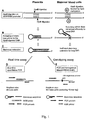
- stem-loop structure used herein is intended to mean the "stem” region is a double-stranded region formed by intramolecular base pairing, while the “loop” region is a single-stranded region, as shown in Fig. 1 .
- the 3' portion of the stem-loop primer of the present invention ranges from 4 to 15 bases, preferably from six to eight bases.
- the 5' portion of the stem-loop primer of the present invention ranges from 26 to 54 bases, preferably from 36 to 44 bases, in which the stem region ranges from five to 14 base pairs.
- the present invention involves the use of a methylation-sensitive restriction enzyme to digest a target DNA fragment in a sample.
- the target DNA fragment is selected such that it contains at least one methylation-sensitive restriction enzyme recognition site which may or may not be methylated.
- the methods of the present invention make use of a methylation-sensitive restriction enzyme which preferentially cleaves unmethylated sequences compared to methylated sequences. After the restriction digestion, the hypermethylated target DNA fragment is cleaved, while the hypermethylated target DNA fragment remains uncleaved in the sample. Therefore, the hypomethylated target DNA fragment is distinguished from the hypermethylated target DNA fragment by the methylation-sensitive restriction enzyme.
- methylation-sensitive restriction enzymes include, but not limited to, Aat II , Aci I , Act I , Afe I , Age I , Asc I , Asi SI , Ava I , Bce AI , Bmg BI , Bsa AI , Bsa HI , Bsi EI , Bsi WI , Bsm BI , Bsp DI , Bsr FI , Bss HII , Bst BI , Bst UI , Cla I , Eag I , Fau I , FseI, Fsp I , Hae II , Hga I , Hha I , Hin PII , Hpa II , Hpy 99I , Hpy CH4IV , Kas I , Mlu I , Nae I , Nar I , Ngo MIV , Not I , Nru I , Pml I, Pvu I , Rsr II
- the sample After a methylation-sensitive restriction enzyme digestion, the sample is heated to a suitable temperature to denature the restriction enzyme-digested target DNA fragment, and then cooled to allow the stem-loop primer to bind to the primer binding site, i.e., the 3' end of a strand of a digested target DNA fragment at the restriction enzyme site.
- annealing is intended to include both the denaturation and binding steps. However, in the case that the sample was already denatured, the term “annealing” would only include the binding step. Due to the stem-loop structure of the 5' portion of the stem-loop primer, binding of the stem-loop primer to an undigested target DNA fragment is not efficient. That is, during the annealing process, the stem-loop primer of the present invention preferentially or selectively binds a restriction enzyme-digested target DNA fragment when compared to an undigested target DNA fragment.
- the extension of the stem-loop primer is usually carried out with a DNA polymerase.
- the sequence of nucleotides added in the extension process is determined by the sequence of the template polynucleotide.
- the stem-loop primer selectively binds a restriction enzyme-digested target DNA fragment as described above, the extension reaction will use the restriction enzyme-digested target DNA fragment as a template, and no extension product is expected to be generated from undigested target DNA fragments.
- the enzyme-digested DNA fragment is denatured with the extension mixture, including the stem-loop primer, to maximize the chance of a stem-loop primer binding to a target DNA fragment.
- the stem-loop primer is added to the sample after the sample is denatured, and then cooled to permit the binding. A polymerase is then added and the whole mixture is subjected to the stem-loop primer extension.
- detecting and/or quantifying the stem-loop primer extension product are performed by using a PCR assay.
- one primer of the primer pair used in the PCR assay is designed such that it is specific to the stem-loop primer.
- the other one of the primer pair used in the PCR assay is designed to be specific to the digested target DNA fragment.
- the amplification product will be a DNA fragment flanked by these two primers.
- the stem-loop primer extension product serves as a template for PCR, the extension of PCR primers will unfold the stem-loop structure.
- the PCR assay is a real-time PCR assay.
- the probe used in the real-time PCR assay is preferably specific to the 3' portion of the stem-loop primer to further increase the specificity of the detection or quantification.
- methylation-sensitive restriction endonucleases involves the digestion of unmethylated CpG sites in a DNA sequence so as to selectively amplify the uncut DNA sequence containing methylated CpG sites by PCR amplification.
- the use of bisulfite conversion seems to be an unavoidable step. Therefore, the positive detection of the cleaved hypomethylated molecules would be desired.
- a method for selectively amplifying a hypomethylated target DNA fragment digested by a methylation-sensitive restriction enzyme in a sample containing a corresponding hypermethylated DNA fragment which cannot be digested by the enzyme comprising:
- the hypomethylated target DNA fragment and the corresponding hypermethylated target DNA fragment in a sample are derived from a gene of the same individual.
- the hypomethylated target DNA fragment in a sample is derived from a gene of a fetus, for example, its placenta, and the corresponding hypermethylated target DNA fragment in the sample is derived from the same gene of the pregnant mother.
- the sample is a blood or plasma specimen in a desired volume.
- the step of amplifying the extension product is achieved by using a PCR amplification, in which one primer of the primer pair is specific to the stem-loop primer.
- a real-time PCR amplification is preferably used to amplify the extension product, in which one primer of the primer pair is specific to the stem-loop primer. If the probe used in the real-time PCR amplification is specific to the 3' portion of the stem-loop primer, the specificity of the detection and/or quantification can be further improved.
- One embodiment of the kit comprises:
- the reagents for amplifying the stem-loop primer extension product can include those for PCR amplification, such as primers, a dNTP mixture and a Taq DNA polymerase, wherein one primer of the primer pair is specific to the stem-loop primer.
- the PCR amplification is a real-time PCR amplification
- the reagents further include a probe for monitoring the process of the amplification. More preferably, the probe has a sequence specific to the 3' portion of the stem-loop primer.
- the SERPINB5 promoter is used as a hypomethylated target DNA fragment.
- the present invention is not limited to the SERPINB5 promoter.
- Other hypomethylated DNA molecules which may be mentioned herein include CGI #137 as disclosed in Yamada et al., Genome Res 14, 247-266 (2004 ) as well as in WO2005/118852 to Lo et al.
- PDE9A phosphodiesterase 9A
- PPP1R2P2 Homo sapiens protein phosphatase 1, regulatory (inhibitor) subunit 2 pseudogene 2
- Fem1A Fem1A
- the mechanism of the stem-loop primer extension on fragmented DNA is illustrated in Figs. 1A to 1C , taking the SERPINB5 promoter as an example of the target DNA. After restriction enzyme digestion, the SERPINB5 promoter would be cut at specific restriction sites.
- the stem-loop primer was designed in such a way that the last few nucleotides on the 3' portion were complementary to the 3' end of the enzyme restriction site on the SERPINB5 promoter ( Fig. 1B ). In our assay, the complementary number of bases on the 3' portion of the stem-loop primer to anneal to the SERPINB5 promoter was six bases long.
- the SERPINB5 promoter is hypomethylated in the placenta and hypermethylated in maternal blood cells ( Chim, et al., Proc Natl Acad Sci USA, 102:14753-8 (2005 )). Enzyme digestion was performed by Hpa II , a methylation-sensitive restriction endonuclease which recognized and cut the DNA sequence CCGG, and its action would be blocked by CpG methylation. After enzyme digestion, a specific cut site would be created on the hypomethylated placental SERPINB5 DNA molecule, which would allow the stem-loop primer to anneal. For the hypermethylated DNA molecules that remained intact after enzyme digestion, the efficiency for stem-loop primer extension would be low.
- the stem-loop primer annealed to the minus strand of the enzyme-digested SERPINB5 promoter and proceeded with the extension reaction.
- This extension product served as a template for the subsequent PCR.
- the detection of the enzyme-digested, stem-loop primer extended hypomethylated fetal DNA molecules in third trimester pre-delivery maternal plasma was demonstrated by using real-time quantitative PCR ( Fig. 1D ) and the fetal origin of the detected molecules was further confirmed by genotyping the SERPlNB5 -156 single-base variation ( Tong, et al., Clin Chem, 52:2194-202 (2006 )) ( Fig. 1E ).
- Placental tissue samples were collected from 3rd-trimester pregnancies after elective cesarean delivery. Twelve milliliters of maternal peripheral blood samples were collected into EDTA tubes from all women before a cesarean section. An additional 12 mL of blood was collected into EDTA tubes from each of these women after delivery to demonstrate the postpartum clearance of the fetal DNA sequences.
- Hpa II New England Biolabs, Ipswich, MA
- Hpa II a methylation-sensitive restriction endonuclease
- Extracted DNA was digested with the Hpa II enzyme at 37°C for 16 hours in a 20 ⁇ L reaction mixture.
- 10 U of Hpa II enzyme was used to digest 100 ng and 50 ng of DNA for the real-time PCR and genotyping assays, respectively
- 10 U of the Hpa II enzyme was used to digest the DNA from 1.6 mL plasma.
- stem-loop primer extension 5 ⁇ L of the digestion products were mixed with 10 nM stem-loop primer (Integrated DNA Technologies, Coralville, IA, Table 1A), 1X RT buffer (Applied Biosystems, Foster City, CA), 0.25 mM each of dNTPs (Promega, Madison, WI), and the volume was made up to 14 ⁇ L with water. This mixture was denatured at 95°C for 5 min, snap cooled on ice, and 50 U of MultiScribe reverse transcriptase (Applied Biosystems), which worked on both RNA and DNA as templates, was added. This 15 ⁇ L reaction was incubated at 4°C for 5 min, 16°C for 30 min, 42°C for 30 min, and 85°C for 5 min. All samples, including no-template controls, were run in duplicate, and the mean quantity was calculated. Placental DNA and maternal blood cell DNA were included as positive and negative controls, respectively.
- 10 nM stem-loop primer Integrated DNA Technologies, Coralville, IA, Table 1A
- Real-time TaqMan ® assay for the SERPINB5 promoter sequence was performed on the Hpa II digested, stem-loop primer extended DNA. 1.33 ⁇ L of the extension product was used for the real-time assay
- Each 20 ⁇ L real-time PCR included 1x TaqMan ® Universal PCR Master Mix (Applied Biosystems), 40 nM TaqMan ® probe (Applied Biosystems), 300 nM forward primer (Integrated DNA Technologies) and 140 nM reverse primer (Integrated DNA Technologies). The sequences of the probe and primers are listed in Table 1A. The thermal profile was 95°C for 10 min, followed by 40 cycles of 95°C for 15 s, and 64°C for 1 min.
- stem-loop primer assay in amplifying the enzyme-digested, hypomethylated placental DNA molecules was further illustrated by assessing the genotype of the amplified enzyme-digested SERPINB5 molecules in maternal plasma samples collected from informative fetomaternal pairs. Paired placenta and maternal blood cell samples were genotyped, using a previously described protocol ( Tong, et al., Clin Chem, 52:2194-202 (2006 )), for the SERPINB5 -156 single-base variation, which was an A/C variation. Any pairs showing different placental and maternal genotypes were deemed informative. The maternal plasma samples from those informative cases were subjected to analysis by a stem-loop genotyping protocol as described below.
- the stem-loop genotyping protocol differed from the stem-loop real-time protocol, was aimed at specifically genotyping the enzyme-digested plasma SERPINB5 amplified through the stem-loop primer extension.
- all reaction products from the enzyme digestion reaction were used for the stem-loop primer extension as a large volume reaction.
- 10 nM stem-loop primer Integrated DNA Technologies, Table 1B
- 1X RT buffer Applied Biosystems
- 0.25 mM each of dNTPs Promega
- 1x HotStar Taq PCR buffer with 1.5 mM MgCl 2 (Qiagen), an additional 1 mM MgCl 2 , 200 ⁇ M dNTP mix (Promega), 750 nM of the forward primer (Integrated DNA Technologies, Table 1B), 350 nM of the reverse primer (Integrated DNA Technologies, Table 1B), and 4 U of HotStar Taq Polymerase were added with 53.2 ⁇ L of the stem-loop primer extended DNA template.
- the thermal profile was 95 °C for 15 min, followed by 50 cycles of 95°C for 20 s, 56°C for 30 s, and 72°C for 1 min, plus a final incubation at 72°C for 3 min.
- the single-base variation genotyping was then performed on the SAP-treated PCR products by a primer extension reaction, the MassARRAYTM Homogenous MassEXTENDTM (hME).
- hME MassARRAYTM Homogenous MassEXTENDTM
- extension primer Integrated DNA Technologies, Table 1B
- Thermosequenase Sequenom
- 64 ⁇ M each of ddATP, ddCTP, ddTTP and dGTP (Sequenom) in an extension cocktail were added to 10 ⁇ L of the SAP-treated PCR products.
- the thermal profile was 94°C for 2 min, followed by 95 cycles of 94°C for 5 s, 52°C for 5 seconds, and 72°C for 5 seconds.
- the allele-specific extension reactions were designed to generate products of distinct masses for each single-base variation that could be readily resolvable by Matrix-Assisted Laser-Desorption and Ionization Time-of-Flight Mass Spectrometry (MALDI-TOF MS) analysis.
- MALDI-TOF MS Matrix-Assisted Laser-Desorption and Ionization Time-of-Flight Mass Spectrometry
- Data acquisition from the SpectroCHIP was done using the MassARRAY Analyzer Compact Mass Spectrometer (Sequenom). Mass data were imported into the MassARRAY Typer (Sequenom) software for analysis.
- the percentage recovery of detectable SERPINB5 promoter sequence was observed to be an average of 5.91%.
- the percentage recovery was the quantity of detectable SERPINB5 promoter sequences expressed as a percentage of the original amount of DNA input into the reaction. Without Hpa II enzyme digestion, no detectable signal was observed for the placental DNA.
- stem-loop primer extension When subjected to Hpa II digestion followed by stem-loop primer extension, DNA from the maternal blood cells had not been showing any detectable signals. However, one of the duplicated wells in one particular run of the stem-loop protocol gave a low level of detectable enzyme-digested, stem-loop primer extended SERPINB5 promoter sequences. It gave a percentage recovery of 0.56%.
- DNA samples from the placenta and maternal blood cells of known genotypes were used as controls. Results showed that after enzyme digestion, correct genotypes were consistently identified in the placental DNA. In the case of maternal blood cell DNA, non-specific signals were occasionally detected.
- hypomethylated placental SERPINB5 molecules were detectable by adding a stem-loop primer extension step after methylation-sensitive restriction enzyme digestion.
- detection of the hypermethylated maternal SERPINB5 molecules was of a low efficiency.
- the low level of signal detected from maternal DNA might be due to Hpa II digestion on the rare maternal DNA molecules that were unmethylated at the site of enzyme cleavage.
- Previous results showed that the SERPINB5 promoter was close to, but not 100% methylated in maternal blood cells ( Chim, et al., Proc Natl Acad Sci USA, 102:14753-8 (2005 )).
- stem-loop primer extension and PCR amplification would continue. Since the stem-loop assay had a lowest detection limit of 6.25 copies/extension reaction, it was not surprising that an extremely low level of detectable Hpa II digested SERPINB5 molecules was sporadically detected in maternal DNA.
- the level of detectable SERPINB5 molecules showed a statistically significant difference between the Hpa II-digested and undigested pre-delivery maternal plasma.
- post-partum clearance of these enzyme-digested, stem-loop primer extended SERPINB5 molecules was observed.
- stem-loop primer extension step may facilitate more flexibility in PCR assay design, given that as few as 21 nucleotides of the target sequence is required.
- this stem-loop technique would represent an alternative in circulating fetal epigenetic marker detection to bisulfite conversion.
- the application of this technique can also extend to the use of nonmethylation-sensitive restriction enzymes for the detection of cut DNA fragments for general molecular analyses.
- Such a method would also have application to many diagnostic scenarios in which clinically relevant DNA fragments have a different size from the background nonclinically relevant DNA.
- Examples include: fetal DNA in maternal plasma in which the circulating fetal DNA is shorter than the background longer maternal DNA ( Chan KCA et al., Clin Chem, 50: 88-92 (2004 )); and mutant DNA in the plasma of cancer patients is enriched in the DNA of smaller molecular sizes ( Diehl F et al., Proc Natl Acad Sci USA, 102: 16368-73 (2005 )).
Landscapes
- Chemical & Material Sciences (AREA)
- Organic Chemistry (AREA)
- Life Sciences & Earth Sciences (AREA)
- Chemical Kinetics & Catalysis (AREA)
- Zoology (AREA)
- Wood Science & Technology (AREA)
- Proteomics, Peptides & Aminoacids (AREA)
- Health & Medical Sciences (AREA)
- Engineering & Computer Science (AREA)
- Biophysics (AREA)
- Immunology (AREA)
- Microbiology (AREA)
- Molecular Biology (AREA)
- Biotechnology (AREA)
- Analytical Chemistry (AREA)
- Physics & Mathematics (AREA)
- Biochemistry (AREA)
- Bioinformatics & Cheminformatics (AREA)
- General Engineering & Computer Science (AREA)
- General Health & Medical Sciences (AREA)
- Genetics & Genomics (AREA)
- Measuring Or Testing Involving Enzymes Or Micro-Organisms (AREA)
Claims (13)
- Verfahren zur selektiven Amplifikation eines hypomethylierten Ziel-DNA Fragments, das durch ein Methylierungs-sensitives Restriktionsenzym verdaut wurde, in einer Probe enthaltend ein entsprechendes hypermethyliertes DNA Fragment, das durch das Enzym nicht verdaut werden kann, wobei das Verfahren umfasst:(a) in Kontakt bringen der Probe mit einem Stem-Loop Primer, wobei der 3' Teil des Stem-Loop Primers komplementär zu dem 3' Ende eines Einzelstranges des verdauten hypomethylierten Ziel-DNA Fragments ist, und der 5' Teil des Stem-Loop Primers in der Lage ist, eine Stem-Loop-Struktur zu bilden;(b) Annealen des Stem-Loop Primers an den Strang des verdauten hypomethylierten DNA Fragments über den 3' Teil davon, und Durchführen einer Verlängerungsreaktion unter Verwendung des Stranges des verdauten hypomethylierten DNA Fragments als ein Template; und(c) Amplifizieren des Verlängerungsprodukts, um ein amplifiziertes Produkt des verdauten hypomethylierten Ziel-DNA Fragments zu erhalten.
- Verfahren zum Nachweis und/oder der Quantifizierung eines hypomethylierten Ziel-DNA Fragments in einer Probe enthaltend ein entsprechendes hypermethyliertes Ziel-DNA Fragment, wobei sowohl das hypomethylierte Ziel-DNA Fragment und das entsprechende hypermethylierte Ziel-DNA Fragment eine Methylierungs-sensitives Restriktionsenzym-Erkennungsstelle enthalten, wobei das Verfahren umfasst:(a) Verdauen der Probe mit einem Methylierungs-sensitiven Restriktionsenzym, das die Methylierungs-sensitives Restriktionsenzym-Erkennungsstelle erkennt, wodurch das hypomethylierte Ziel-DNA Fragment verdaut wird, während das hypermethylierte Ziel-DNA Fragment in der Probe nicht verdaut werden kann;(b) in Kontakt bringen der verdauten Probe mit einem Stem-Loop Primer, wobei der 3' Teil des Stem-Loop Primers komplementär zu dem 3' Ende eines Stranges eines verdauten DNA Fragments an der Methylierungs-sensitives Restriktionsenzym-Erkennungsstelle ist, und der 5' Teil des Stem-Loop Primers in der Lage ist, eine Stem-Loop-Struktur zu bilden;(c) Annealen des Stem-Loop Primers an den Strang des Restriktionsenzym-verdauten DNA Fragments über den 3' Teil davon, und Durchführen einer Verlängerungsreaktion unter Verwendung des Stranges des verdauten DNA Fragments als ein Template, um eine Verlängerungsprodukt zu erhalten; und gegebenenfalls(d) Amplifizieren des Verlängerungsprodukts, um ein amplifiziertes Produkt des verdauten hypomethylierten Ziel-DNA Fragments zu erhalten, und(e) Nachweisen und/oder der Quantifizieren des Verlängerungs- oder amplifizierten Produkts,wobei die Anwesenheit des Verlängerungs- oder amplifizierten Produkts die Existenz und/oder Menge des hypomethylierten Ziel-DNA Fragments in der Probe anzeigt.
- Verfahren nach einem der Ansprüche 1 bis 2, wobei das verdaute hypomethylierte Ziel-DNA Fragment nicht länger als 100 Basenpaare ist, bevorzugt nicht länger als 30 Basenpaare.
- Verfahren nach einem der Ansprüche 1 bis 3, wobei der 3' Teil des Stem-Loop Primers von 4 bis 15 Basen, bevorzugt von 6 bis 8 Basen, reicht.
- Verfahren nach einem der Ansprüche 1 bis 3, wobei der 5' Teil des Stem-Loop Primers von 26 bis 54 Basen, bevorzugt von 36 bis 44 Basen, reicht.
- Verfahren nach einem der Ansprüche 1 bis 3, wobei das Amplifizieren des Verlängerungsprodukts mittels einer PCR durchgeführt wird, bevorzugt mittels einer real-time PCR.
- Verfahren nach Anspruch 6, wobei ein Primer eines in der PCR verwendeten Primerpaares für den Stem-Loop Primer spezifisch ist.
- Verfahren nach Anspruch 6, wobei eine Sonde, die in dem real-time PCR Assay verwendet wird, eine Sequenz aufweist, die für den 3' Teil des Stem-Loop Primers spezifisch ist.
- Verfahren nach einem der Ansprüche 1 bis 3, wobei das Methylierungs-sensitive Restriktionsenzym ausgewählt ist aus der Gruppe bestehend aus: AatII, AciI, AclI, AfeI, AgeI, AscI, AsiSI, AvaI, BceAI, BmgBI, BsaAI, BsaHI, BsiEI, BsiWI, BsmBI, BspDI, BsrFI, BssHII, BstBI, BstUI, ClaI, EagI, FauI, FseI, FspI, HaeII, HgaI, HhaI, HinP1I, HpaII, Hpy99I, HpyCH4IV, KasI, MluI, NaeI, NarI, NgoMIV, NotI, Ni°atI, PrnalI, PvatI, RsrII, SacII, SaII, SfoI, SgrAI, SMaI und SnaBI, bevorzugt HpaII.
- Verfahren nach einem der Ansprüche 1-9, wobei das hypomethylierte DNA Fragment ein hypomethyliertes fötales DNA Fragment ist, und die Probe eine maternale Plasmaprobe enthaltend ein entsprechendes hypermethyliertes maternales DNA Fragment ist.
- Verfahren nach Anspruch 10, wobei das fötale DNA Fragment mindestens ein Teil des Gens SERPINB5, CGI137, Phosphodiesterase 9A (PDE9A), Homo sapiens protein phosphatase 1, and regulatory (inhibitor) subunit 2 pseudogene 2 (PPP1R2P2), und Similarity to Fem1A (Caenorhabditis elegans) ist, bevorzugt der Promotor des Gens SERPINB5.
- Verfahren nach Anspruch 11, wobei das fötale DNA Fragment mindestens ein Teil des Promotors des Gens SERPINB5 ist, und das Methylierungs-sensitive Restriktionsenzym HpaII ist.
- Verfahren nach Anspruch 12, wobei der Stem-Loop Primer eine Sequenz von SEQ ID NO. 1 aufweist, und/oder wobei ein Primer eines in dem PCR Assay verwendeten Primerpaares eine Sequenz von SEQ ID NO. 2 aufweist, und/oder wobei der Andere des in dem PCR Assay verwendeten Primerpaares eine Sequenz von SEQ ID NO. 3 aufweist, und/oder wobei die in dem real-time PCR Assay verwendete Sonde eine Sequenz von SEQ ID NO. 4 aufweist.
Applications Claiming Priority (2)
| Application Number | Priority Date | Filing Date | Title |
|---|---|---|---|
| US11/897,654 US8748100B2 (en) | 2007-08-30 | 2007-08-30 | Methods and kits for selectively amplifying, detecting or quantifying target DNA with specific end sequences |
| PCT/CN2008/001423 WO2009030100A1 (en) | 2007-08-30 | 2008-08-05 | Methods and kits for selectively amplifying, detecting or quantifying target dna with specific end sequences |
Publications (3)
| Publication Number | Publication Date |
|---|---|
| EP2195449A1 EP2195449A1 (de) | 2010-06-16 |
| EP2195449A4 EP2195449A4 (de) | 2011-08-17 |
| EP2195449B1 true EP2195449B1 (de) | 2016-07-27 |
Family
ID=40408070
Family Applications (1)
| Application Number | Title | Priority Date | Filing Date |
|---|---|---|---|
| EP08783612.8A Active EP2195449B1 (de) | 2007-08-30 | 2008-08-05 | Verfahren zum selektiven amplifizieren, nachweisen oder quantifizieren von hypomethylierter dna |
Country Status (3)
| Country | Link |
|---|---|
| US (2) | US8748100B2 (de) |
| EP (1) | EP2195449B1 (de) |
| WO (1) | WO2009030100A1 (de) |
Families Citing this family (104)
| Publication number | Priority date | Publication date | Assignee | Title |
|---|---|---|---|---|
| US10081839B2 (en) | 2005-07-29 | 2018-09-25 | Natera, Inc | System and method for cleaning noisy genetic data and determining chromosome copy number |
| US8532930B2 (en) | 2005-11-26 | 2013-09-10 | Natera, Inc. | Method for determining the number of copies of a chromosome in the genome of a target individual using genetic data from genetically related individuals |
| US11111543B2 (en) | 2005-07-29 | 2021-09-07 | Natera, Inc. | System and method for cleaning noisy genetic data and determining chromosome copy number |
| US9424392B2 (en) | 2005-11-26 | 2016-08-23 | Natera, Inc. | System and method for cleaning noisy genetic data from target individuals using genetic data from genetically related individuals |
| US10083273B2 (en) | 2005-07-29 | 2018-09-25 | Natera, Inc. | System and method for cleaning noisy genetic data and determining chromosome copy number |
| US11111544B2 (en) | 2005-07-29 | 2021-09-07 | Natera, Inc. | System and method for cleaning noisy genetic data and determining chromosome copy number |
| MX340916B (es) | 2008-01-18 | 2016-07-29 | President And Fellows Of Harvard College * | Metodos para detectar señales de identificacion de enfermedad o condiciones en fluidos corporales. |
| EP2271772B1 (de) * | 2008-03-11 | 2014-07-16 | Sequenom, Inc. | Tests auf nukleinsäurebasis zur pränatalen geschlechtsbestimmung |
| EP2321642B1 (de) | 2008-08-04 | 2017-01-11 | Natera, Inc. | Verfahren für allelzuordnung und ploidiezuordnung |
| US8962247B2 (en) | 2008-09-16 | 2015-02-24 | Sequenom, Inc. | Processes and compositions for methylation-based enrichment of fetal nucleic acid from a maternal sample useful for non invasive prenatal diagnoses |
| US8476013B2 (en) * | 2008-09-16 | 2013-07-02 | Sequenom, Inc. | Processes and compositions for methylation-based acid enrichment of fetal nucleic acid from a maternal sample useful for non-invasive prenatal diagnoses |
| EP2419536A4 (de) * | 2009-04-14 | 2012-09-05 | Merck Sharp & Dohme | Mikro-rna als biomarker für das eindringen von betazellen in die pankreasinseln |
| WO2010121294A1 (en) | 2009-04-21 | 2010-10-28 | Genetic Technologies Limited | Methods for obtaining fetal genetic material |
| GB0910302D0 (en) | 2009-06-15 | 2009-07-29 | Lumora Ltd | Nucleic acid amplification |
| WO2011030334A1 (en) * | 2009-09-09 | 2011-03-17 | New York University | Compositions and methods for treatment, diagnosis and prognosis of mesothelioma |
| WO2011041485A1 (en) | 2009-09-30 | 2011-04-07 | Gene Security Network, Inc. | Methods for non-invasive prenatal ploidy calling |
| AU2010306072A1 (en) * | 2009-10-14 | 2012-05-03 | Genetic Technologies Limited | Epigenetic DNA enrichment |
| WO2011053987A1 (en) * | 2009-11-02 | 2011-05-05 | Nugen Technologies, Inc. | Compositions and methods for targeted nucleic acid sequence selection and amplification |
| ES2577017T3 (es) | 2009-12-22 | 2016-07-12 | Sequenom, Inc. | Procedimientos y kits para identificar la aneuploidia |
| CA2817990A1 (en) | 2009-12-23 | 2011-06-30 | Genetic Technologies Limited | Methods of enriching and detecting fetal nucleic acids |
| US11326208B2 (en) | 2010-05-18 | 2022-05-10 | Natera, Inc. | Methods for nested PCR amplification of cell-free DNA |
| US12545960B2 (en) | 2010-05-18 | 2026-02-10 | Natera, Inc. | Methods for simultaneous amplification of target loci |
| US11332793B2 (en) | 2010-05-18 | 2022-05-17 | Natera, Inc. | Methods for simultaneous amplification of target loci |
| US12221653B2 (en) | 2010-05-18 | 2025-02-11 | Natera, Inc. | Methods for simultaneous amplification of target loci |
| WO2011146632A1 (en) | 2010-05-18 | 2011-11-24 | Gene Security Network Inc. | Methods for non-invasive prenatal ploidy calling |
| US11322224B2 (en) | 2010-05-18 | 2022-05-03 | Natera, Inc. | Methods for non-invasive prenatal ploidy calling |
| US20190010543A1 (en) | 2010-05-18 | 2019-01-10 | Natera, Inc. | Methods for simultaneous amplification of target loci |
| US11939634B2 (en) | 2010-05-18 | 2024-03-26 | Natera, Inc. | Methods for simultaneous amplification of target loci |
| US11408031B2 (en) | 2010-05-18 | 2022-08-09 | Natera, Inc. | Methods for non-invasive prenatal paternity testing |
| US9677118B2 (en) | 2014-04-21 | 2017-06-13 | Natera, Inc. | Methods for simultaneous amplification of target loci |
| US11339429B2 (en) | 2010-05-18 | 2022-05-24 | Natera, Inc. | Methods for non-invasive prenatal ploidy calling |
| US11332785B2 (en) | 2010-05-18 | 2022-05-17 | Natera, Inc. | Methods for non-invasive prenatal ploidy calling |
| US12152275B2 (en) | 2010-05-18 | 2024-11-26 | Natera, Inc. | Methods for non-invasive prenatal ploidy calling |
| US10316362B2 (en) | 2010-05-18 | 2019-06-11 | Natera, Inc. | Methods for simultaneous amplification of target loci |
| US20130203624A1 (en) | 2010-07-23 | 2013-08-08 | President And Fellows Of Harvard College | Methods of Detecting Prenatal or Pregnancy-Related Diseases or Conditions |
| EP2596132A4 (de) | 2010-07-23 | 2013-12-18 | Harvard College | Verfahren zur erkennung von anzeichen für krankheiten oder leiden in körperflüssigkeiten |
| TW201209171A (en) | 2010-07-23 | 2012-03-01 | Harvard College | Methods of detecting diseases or conditions using phagocytic cells |
| AU2011280997A1 (en) | 2010-07-23 | 2013-02-28 | President And Fellows Of Harvard College | Methods of detecting autoimmune or immune-related diseases or conditions |
| US20130261003A1 (en) | 2010-08-06 | 2013-10-03 | Ariosa Diagnostics, In. | Ligation-based detection of genetic variants |
| US11031095B2 (en) | 2010-08-06 | 2021-06-08 | Ariosa Diagnostics, Inc. | Assay systems for determination of fetal copy number variation |
| US20130040375A1 (en) | 2011-08-08 | 2013-02-14 | Tandem Diagnotics, Inc. | Assay systems for genetic analysis |
| US8700338B2 (en) | 2011-01-25 | 2014-04-15 | Ariosa Diagnosis, Inc. | Risk calculation for evaluation of fetal aneuploidy |
| US11203786B2 (en) | 2010-08-06 | 2021-12-21 | Ariosa Diagnostics, Inc. | Detection of target nucleic acids using hybridization |
| US10167508B2 (en) | 2010-08-06 | 2019-01-01 | Ariosa Diagnostics, Inc. | Detection of genetic abnormalities |
| US20140342940A1 (en) | 2011-01-25 | 2014-11-20 | Ariosa Diagnostics, Inc. | Detection of Target Nucleic Acids using Hybridization |
| US10533223B2 (en) | 2010-08-06 | 2020-01-14 | Ariosa Diagnostics, Inc. | Detection of target nucleic acids using hybridization |
| US20120034603A1 (en) | 2010-08-06 | 2012-02-09 | Tandem Diagnostics, Inc. | Ligation-based detection of genetic variants |
| CN103608466B (zh) | 2010-12-22 | 2020-09-18 | 纳特拉公司 | 非侵入性产前亲子鉴定方法 |
| US11270781B2 (en) | 2011-01-25 | 2022-03-08 | Ariosa Diagnostics, Inc. | Statistical analysis for non-invasive sex chromosome aneuploidy determination |
| US10131947B2 (en) | 2011-01-25 | 2018-11-20 | Ariosa Diagnostics, Inc. | Noninvasive detection of fetal aneuploidy in egg donor pregnancies |
| US9994897B2 (en) | 2013-03-08 | 2018-06-12 | Ariosa Diagnostics, Inc. | Non-invasive fetal sex determination |
| US8756020B2 (en) | 2011-01-25 | 2014-06-17 | Ariosa Diagnostics, Inc. | Enhanced risk probabilities using biomolecule estimations |
| RU2671980C2 (ru) | 2011-02-09 | 2018-11-08 | Натера, Инк. | Способы неинвазивного пренатального установления плоидности |
| AU2012249531B2 (en) | 2011-04-29 | 2017-06-29 | Sequenom, Inc. | Quantification of a minority nucleic acid species |
| US8663919B2 (en) | 2011-05-18 | 2014-03-04 | Life Technologies Corporation | Chromosome conformation analysis |
| US8712697B2 (en) | 2011-09-07 | 2014-04-29 | Ariosa Diagnostics, Inc. | Determination of copy number variations using binomial probability calculations |
| WO2013059746A1 (en) | 2011-10-19 | 2013-04-25 | Nugen Technologies, Inc. | Compositions and methods for directional nucleic acid amplification and sequencing |
| CN103930571A (zh) * | 2011-11-17 | 2014-07-16 | 瑞尼克斯有限公司 | 用于选择性分子分析的系统和方法 |
| EP2807292B1 (de) | 2012-01-26 | 2019-05-22 | Tecan Genomics, Inc. | Zusammensetzungen und verfahren zur gezielten nukleinsäuresequenzanreicherung und erzeugung einer hocheffizienten bibliothek |
| EP2820129A1 (de) | 2012-03-02 | 2015-01-07 | Sequenom, Inc. | Verfahren und prozesse zur nichtinvasiven beurteilung genetischer variationen |
| WO2013131083A1 (en) | 2012-03-02 | 2013-09-06 | Winthrop-University Hospital | METHOD FOR USING PROBE BASED PCR DETECTION TO MEASURE THE LEVELS OF CIRCULATING DEMETHYLATED β CELL DERIVED DNA AS A MEASURE OF β CELL LOSS IN DIABETES |
| US9920361B2 (en) | 2012-05-21 | 2018-03-20 | Sequenom, Inc. | Methods and compositions for analyzing nucleic acid |
| US10289800B2 (en) | 2012-05-21 | 2019-05-14 | Ariosa Diagnostics, Inc. | Processes for calculating phased fetal genomic sequences |
| US10504613B2 (en) | 2012-12-20 | 2019-12-10 | Sequenom, Inc. | Methods and processes for non-invasive assessment of genetic variations |
| CA2877094A1 (en) | 2012-06-18 | 2013-12-27 | Nugen Technologies, Inc. | Compositions and methods for negative selection of non-desired nucleic acid sequences |
| US20150011396A1 (en) | 2012-07-09 | 2015-01-08 | Benjamin G. Schroeder | Methods for creating directional bisulfite-converted nucleic acid libraries for next generation sequencing |
| US20140093873A1 (en) | 2012-07-13 | 2014-04-03 | Sequenom, Inc. | Processes and compositions for methylation-based enrichment of fetal nucleic acid from a maternal sample useful for non-invasive prenatal diagnoses |
| EP2875156A4 (de) | 2012-07-19 | 2016-02-24 | Ariosa Diagnostics Inc | Sequentielle ligationsbasierte multiplex-detektion von genetischen varianten |
| US20140100126A1 (en) | 2012-08-17 | 2014-04-10 | Natera, Inc. | Method for Non-Invasive Prenatal Testing Using Parental Mosaicism Data |
| NZ771629A (en) | 2013-03-09 | 2022-12-23 | Harry Stylli | Methods of detecting cancer |
| WO2014164362A1 (en) | 2013-03-09 | 2014-10-09 | Harry Stylli | Methods of detecting prostate cancer |
| US11060145B2 (en) | 2013-03-13 | 2021-07-13 | Sequenom, Inc. | Methods and compositions for identifying presence or absence of hypermethylation or hypomethylation locus |
| US9822408B2 (en) | 2013-03-15 | 2017-11-21 | Nugen Technologies, Inc. | Sequential sequencing |
| US9499870B2 (en) | 2013-09-27 | 2016-11-22 | Natera, Inc. | Cell free DNA diagnostic testing standards |
| US10262755B2 (en) | 2014-04-21 | 2019-04-16 | Natera, Inc. | Detecting cancer mutations and aneuploidy in chromosomal segments |
| US10577655B2 (en) | 2013-09-27 | 2020-03-03 | Natera, Inc. | Cell free DNA diagnostic testing standards |
| WO2015073711A1 (en) | 2013-11-13 | 2015-05-21 | Nugen Technologies, Inc. | Compositions and methods for identification of a duplicate sequencing read |
| US9745614B2 (en) | 2014-02-28 | 2017-08-29 | Nugen Technologies, Inc. | Reduced representation bisulfite sequencing with diversity adaptors |
| EP3736344A1 (de) | 2014-03-13 | 2020-11-11 | Sequenom, Inc. | Verfahren und prozesse zur nichtinvasiven beurteilung genetischer variationen |
| CA2945962C (en) | 2014-04-21 | 2023-08-29 | Natera, Inc. | Detecting mutations and ploidy in chromosomal segments |
| US12492429B2 (en) | 2014-04-21 | 2025-12-09 | Natera, Inc. | Detecting mutations and ploidy in chromosomal segments |
| US20180173846A1 (en) | 2014-06-05 | 2018-06-21 | Natera, Inc. | Systems and Methods for Detection of Aneuploidy |
| EP4358097A1 (de) | 2014-07-25 | 2024-04-24 | University of Washington | Verfahren zur bestimmung von gewebe- und/oder zelltypen zur entstehung von zellfreier dna und verfahren zur identifizierung einer krankheit oder störung damit |
| US10626464B2 (en) | 2014-09-11 | 2020-04-21 | Cell Mdx, Llc | Methods of detecting prostate cancer |
| US10557134B2 (en) | 2015-02-24 | 2020-02-11 | Trustees Of Boston University | Protection of barcodes during DNA amplification using molecular hairpins |
| US11479812B2 (en) | 2015-05-11 | 2022-10-25 | Natera, Inc. | Methods and compositions for determining ploidy |
| RU2760913C2 (ru) | 2016-04-15 | 2021-12-01 | Натера, Инк. | Способы выявления рака легкого |
| WO2018064486A1 (en) | 2016-09-29 | 2018-04-05 | Counsyl, Inc. | Noninvasive prenatal screening using dynamic iterative depth optimization |
| WO2018067517A1 (en) | 2016-10-04 | 2018-04-12 | Natera, Inc. | Methods for characterizing copy number variation using proximity-litigation sequencing |
| GB201618485D0 (en) | 2016-11-02 | 2016-12-14 | Ucl Business Plc | Method of detecting tumour recurrence |
| US10011870B2 (en) | 2016-12-07 | 2018-07-03 | Natera, Inc. | Compositions and methods for identifying nucleic acid molecules |
| WO2018156418A1 (en) | 2017-02-21 | 2018-08-30 | Natera, Inc. | Compositions, methods, and kits for isolating nucleic acids |
| US12492430B2 (en) | 2017-04-11 | 2025-12-09 | Tecan Genomics, Inc. | Library quantitation and qualification |
| US11099202B2 (en) | 2017-10-20 | 2021-08-24 | Tecan Genomics, Inc. | Reagent delivery system |
| US12084720B2 (en) | 2017-12-14 | 2024-09-10 | Natera, Inc. | Assessing graft suitability for transplantation |
| US12398389B2 (en) | 2018-02-15 | 2025-08-26 | Natera, Inc. | Methods for isolating nucleic acids with size selection |
| US12024738B2 (en) | 2018-04-14 | 2024-07-02 | Natera, Inc. | Methods for cancer detection and monitoring |
| US12234509B2 (en) | 2018-07-03 | 2025-02-25 | Natera, Inc. | Methods for detection of donor-derived cell-free DNA |
| CN109182497B (zh) * | 2018-09-25 | 2021-05-11 | 广州医科大学附属第三医院(广州重症孕产妇救治中心、广州柔济医院) | hsa-miR-17-5p作为类风湿关节炎诊断标志物的应用 |
| KR102209903B1 (ko) * | 2019-05-02 | 2021-02-02 | 한국과학기술연구원 | Rna를 표적으로 하는 증폭 구조체 및 이를 이용한 핵산 증폭 방법 |
| US12305235B2 (en) | 2019-06-06 | 2025-05-20 | Natera, Inc. | Methods for detecting immune cell DNA and monitoring immune system |
| EP3851542A1 (de) | 2020-01-20 | 2021-07-21 | Tecan Genomics, Inc. | Verarmung von reichlich uninformativen sequenzen |
| US12059674B2 (en) | 2020-02-03 | 2024-08-13 | Tecan Genomics, Inc. | Reagent storage system |
| CN114752665B (zh) * | 2022-05-31 | 2024-09-13 | 深圳市萨米医疗中心 | 小片段dna的检测方法及检测试剂盒 |
Family Cites Families (7)
| Publication number | Priority date | Publication date | Assignee | Title |
|---|---|---|---|---|
| US6777180B1 (en) * | 2000-11-28 | 2004-08-17 | Trustees Of Columbia University In The City Of New York | Method for full-length cDNA cloning using degenerate stem-loop annealing primers |
| EP2380993B1 (de) | 2004-03-08 | 2015-12-23 | Rubicon Genomics, Inc. | Verfahren zur Erstellung und Erweiterung von DNA-Bibliotheken zur sensitiven Erkennung und Analyse von DNA-Methylierung |
| US7575863B2 (en) * | 2004-05-28 | 2009-08-18 | Applied Biosystems, Llc | Methods, compositions, and kits comprising linker probes for quantifying polynucleotides |
| US7556943B2 (en) * | 2005-05-31 | 2009-07-07 | Applied Biosystems, Llc | Linear amplification of short nucleic acids |
| CA2645045A1 (en) * | 2006-03-06 | 2007-09-13 | The Trustees Of Columbia University In The City Of New York | Specific amplification of fetal dna sequences from a mixed, fetal-maternal source |
| US7901884B2 (en) * | 2006-05-03 | 2011-03-08 | The Chinese University Of Hong Kong | Markers for prenatal diagnosis and monitoring |
| CN101082060B (zh) * | 2006-06-01 | 2012-09-05 | 苏州吉玛基因药物科技有限公司 | 新型微核糖核酸定量pcr(聚合酶链式反应)检测方法 |
-
2007
- 2007-08-30 US US11/897,654 patent/US8748100B2/en active Active
-
2008
- 2008-08-05 WO PCT/CN2008/001423 patent/WO2009030100A1/en not_active Ceased
- 2008-08-05 EP EP08783612.8A patent/EP2195449B1/de active Active
-
2014
- 2014-04-29 US US14/264,928 patent/US10329606B2/en active Active
Also Published As
| Publication number | Publication date |
|---|---|
| US8748100B2 (en) | 2014-06-10 |
| US20090061425A1 (en) | 2009-03-05 |
| US10329606B2 (en) | 2019-06-25 |
| WO2009030100A1 (en) | 2009-03-12 |
| HK1142638A1 (en) | 2010-12-10 |
| EP2195449A1 (de) | 2010-06-16 |
| EP2195449A4 (de) | 2011-08-17 |
| US20140302506A1 (en) | 2014-10-09 |
Similar Documents
| Publication | Publication Date | Title |
|---|---|---|
| EP2195449B1 (de) | Verfahren zum selektiven amplifizieren, nachweisen oder quantifizieren von hypomethylierter dna | |
| US11597977B2 (en) | Marker for prenatal diagnosis and monitoring | |
| JP5789605B2 (ja) | 染色体異数性の検出方法 | |
| US8911937B2 (en) | Method for detecting methylation status by using methylation-independent primers | |
| US8623599B2 (en) | Method for methylation analysis | |
| JP2020532964A (ja) | ヌクレオチド組成が限定されたプライマーを用いたデジタル増幅 | |
| CN101370945B (zh) | 用于鉴别大量野生型dna背景中多个dna突变标记的方法 | |
| CN102648292A (zh) | 基于甲基化从母体样品中富集胎儿核酸的可用于无创性产前诊断的方法和组合物 | |
| US20170145485A1 (en) | Method for methylation analysis | |
| KR20100063050A (ko) | 디지털 pcr에 의한 다양한 길이의 핵산의 분석 | |
| JP4727670B2 (ja) | 核酸の改変された前処理によって達成されるメチル化解析を標的とするdna増幅系におけるキャリーオーバー保護のための方法 | |
| WO2011139920A2 (en) | Methylation-specific competitive allele-specific taqman polymerase chain reaction (cast-pcr) | |
| US20150299809A1 (en) | Biomarkers for Clinical Cancer Management | |
| Tong et al. | Detection of Restriction Enzyme–Digested Target DNA by PCR Amplification Using a Stem-Loop Primer: Application to the Detection of Hypomethylated Fetal DNA in Maternal Plasma | |
| AU2015336938A1 (en) | Genome methylation analysis | |
| HK1142638B (en) | Methods for selectively amplifying, detecting or quantifying hypomethylated target dna | |
| HK1231931B (en) | Method for methylation analysis | |
| HK1102196B (en) | A marker for prenatal diagnosis and monitoring |
Legal Events
| Date | Code | Title | Description |
|---|---|---|---|
| PUAI | Public reference made under article 153(3) epc to a published international application that has entered the european phase |
Free format text: ORIGINAL CODE: 0009012 |
|
| 17P | Request for examination filed |
Effective date: 20100322 |
|
| AK | Designated contracting states |
Kind code of ref document: A1 Designated state(s): AT BE BG CH CY CZ DE DK EE ES FI FR GB GR HR HU IE IS IT LI LT LU LV MC MT NL NO PL PT RO SE SI SK TR |
|
| AX | Request for extension of the european patent |
Extension state: AL BA MK RS |
|
| DAX | Request for extension of the european patent (deleted) | ||
| REG | Reference to a national code |
Ref country code: HK Ref legal event code: DE Ref document number: 1142638 Country of ref document: HK |
|
| RIC1 | Information provided on ipc code assigned before grant |
Ipc: C12Q 1/68 20060101AFI20110701BHEP |
|
| A4 | Supplementary search report drawn up and despatched |
Effective date: 20110714 |
|
| 17Q | First examination report despatched |
Effective date: 20130415 |
|
| GRAP | Despatch of communication of intention to grant a patent |
Free format text: ORIGINAL CODE: EPIDOSNIGR1 |
|
| INTG | Intention to grant announced |
Effective date: 20160309 |
|
| GRAS | Grant fee paid |
Free format text: ORIGINAL CODE: EPIDOSNIGR3 |
|
| GRAA | (expected) grant |
Free format text: ORIGINAL CODE: 0009210 |
|
| AK | Designated contracting states |
Kind code of ref document: B1 Designated state(s): AT BE BG CH CY CZ DE DK EE ES FI FR GB GR HR HU IE IS IT LI LT LU LV MC MT NL NO PL PT RO SE SI SK TR |
|
| REG | Reference to a national code |
Ref country code: GB Ref legal event code: FG4D |
|
| REG | Reference to a national code |
Ref country code: CH Ref legal event code: EP |
|
| REG | Reference to a national code |
Ref country code: AT Ref legal event code: REF Ref document number: 815847 Country of ref document: AT Kind code of ref document: T Effective date: 20160815 |
|
| REG | Reference to a national code |
Ref country code: IE Ref legal event code: FG4D |
|
| REG | Reference to a national code |
Ref country code: FR Ref legal event code: PLFP Year of fee payment: 9 |
|
| REG | Reference to a national code |
Ref country code: DE Ref legal event code: R096 Ref document number: 602008045337 Country of ref document: DE |
|
| REG | Reference to a national code |
Ref country code: LT Ref legal event code: MG4D |
|
| REG | Reference to a national code |
Ref country code: NL Ref legal event code: MP Effective date: 20160727 |
|
| REG | Reference to a national code |
Ref country code: AT Ref legal event code: MK05 Ref document number: 815847 Country of ref document: AT Kind code of ref document: T Effective date: 20160727 |
|
| PG25 | Lapsed in a contracting state [announced via postgrant information from national office to epo] |
Ref country code: BE Free format text: LAPSE BECAUSE OF NON-PAYMENT OF DUE FEES Effective date: 20160831 |
|
| PG25 | Lapsed in a contracting state [announced via postgrant information from national office to epo] |
Ref country code: IT Free format text: LAPSE BECAUSE OF FAILURE TO SUBMIT A TRANSLATION OF THE DESCRIPTION OR TO PAY THE FEE WITHIN THE PRESCRIBED TIME-LIMIT Effective date: 20160727 Ref country code: NL Free format text: LAPSE BECAUSE OF FAILURE TO SUBMIT A TRANSLATION OF THE DESCRIPTION OR TO PAY THE FEE WITHIN THE PRESCRIBED TIME-LIMIT Effective date: 20160727 Ref country code: NO Free format text: LAPSE BECAUSE OF FAILURE TO SUBMIT A TRANSLATION OF THE DESCRIPTION OR TO PAY THE FEE WITHIN THE PRESCRIBED TIME-LIMIT Effective date: 20161027 Ref country code: LT Free format text: LAPSE BECAUSE OF FAILURE TO SUBMIT A TRANSLATION OF THE DESCRIPTION OR TO PAY THE FEE WITHIN THE PRESCRIBED TIME-LIMIT Effective date: 20160727 Ref country code: HR Free format text: LAPSE BECAUSE OF FAILURE TO SUBMIT A TRANSLATION OF THE DESCRIPTION OR TO PAY THE FEE WITHIN THE PRESCRIBED TIME-LIMIT Effective date: 20160727 Ref country code: FI Free format text: LAPSE BECAUSE OF FAILURE TO SUBMIT A TRANSLATION OF THE DESCRIPTION OR TO PAY THE FEE WITHIN THE PRESCRIBED TIME-LIMIT Effective date: 20160727 Ref country code: IS Free format text: LAPSE BECAUSE OF FAILURE TO SUBMIT A TRANSLATION OF THE DESCRIPTION OR TO PAY THE FEE WITHIN THE PRESCRIBED TIME-LIMIT Effective date: 20161127 |
|
| PG25 | Lapsed in a contracting state [announced via postgrant information from national office to epo] |
Ref country code: LV Free format text: LAPSE BECAUSE OF FAILURE TO SUBMIT A TRANSLATION OF THE DESCRIPTION OR TO PAY THE FEE WITHIN THE PRESCRIBED TIME-LIMIT Effective date: 20160727 Ref country code: PL Free format text: LAPSE BECAUSE OF FAILURE TO SUBMIT A TRANSLATION OF THE DESCRIPTION OR TO PAY THE FEE WITHIN THE PRESCRIBED TIME-LIMIT Effective date: 20160727 Ref country code: AT Free format text: LAPSE BECAUSE OF FAILURE TO SUBMIT A TRANSLATION OF THE DESCRIPTION OR TO PAY THE FEE WITHIN THE PRESCRIBED TIME-LIMIT Effective date: 20160727 Ref country code: PT Free format text: LAPSE BECAUSE OF FAILURE TO SUBMIT A TRANSLATION OF THE DESCRIPTION OR TO PAY THE FEE WITHIN THE PRESCRIBED TIME-LIMIT Effective date: 20161128 Ref country code: GR Free format text: LAPSE BECAUSE OF FAILURE TO SUBMIT A TRANSLATION OF THE DESCRIPTION OR TO PAY THE FEE WITHIN THE PRESCRIBED TIME-LIMIT Effective date: 20161028 Ref country code: BE Free format text: LAPSE BECAUSE OF FAILURE TO SUBMIT A TRANSLATION OF THE DESCRIPTION OR TO PAY THE FEE WITHIN THE PRESCRIBED TIME-LIMIT Effective date: 20160727 Ref country code: ES Free format text: LAPSE BECAUSE OF FAILURE TO SUBMIT A TRANSLATION OF THE DESCRIPTION OR TO PAY THE FEE WITHIN THE PRESCRIBED TIME-LIMIT Effective date: 20160727 Ref country code: SE Free format text: LAPSE BECAUSE OF FAILURE TO SUBMIT A TRANSLATION OF THE DESCRIPTION OR TO PAY THE FEE WITHIN THE PRESCRIBED TIME-LIMIT Effective date: 20160727 |
|
| REG | Reference to a national code |
Ref country code: CH Ref legal event code: PL |
|
| REG | Reference to a national code |
Ref country code: HK Ref legal event code: GR Ref document number: 1142638 Country of ref document: HK |
|
| PG25 | Lapsed in a contracting state [announced via postgrant information from national office to epo] |
Ref country code: EE Free format text: LAPSE BECAUSE OF FAILURE TO SUBMIT A TRANSLATION OF THE DESCRIPTION OR TO PAY THE FEE WITHIN THE PRESCRIBED TIME-LIMIT Effective date: 20160727 Ref country code: CH Free format text: LAPSE BECAUSE OF NON-PAYMENT OF DUE FEES Effective date: 20160831 Ref country code: MC Free format text: LAPSE BECAUSE OF FAILURE TO SUBMIT A TRANSLATION OF THE DESCRIPTION OR TO PAY THE FEE WITHIN THE PRESCRIBED TIME-LIMIT Effective date: 20160727 Ref country code: LI Free format text: LAPSE BECAUSE OF NON-PAYMENT OF DUE FEES Effective date: 20160831 Ref country code: RO Free format text: LAPSE BECAUSE OF FAILURE TO SUBMIT A TRANSLATION OF THE DESCRIPTION OR TO PAY THE FEE WITHIN THE PRESCRIBED TIME-LIMIT Effective date: 20160727 |
|
| REG | Reference to a national code |
Ref country code: DE Ref legal event code: R097 Ref document number: 602008045337 Country of ref document: DE |
|
| PG25 | Lapsed in a contracting state [announced via postgrant information from national office to epo] |
Ref country code: BG Free format text: LAPSE BECAUSE OF FAILURE TO SUBMIT A TRANSLATION OF THE DESCRIPTION OR TO PAY THE FEE WITHIN THE PRESCRIBED TIME-LIMIT Effective date: 20161027 Ref country code: CZ Free format text: LAPSE BECAUSE OF FAILURE TO SUBMIT A TRANSLATION OF THE DESCRIPTION OR TO PAY THE FEE WITHIN THE PRESCRIBED TIME-LIMIT Effective date: 20160727 Ref country code: SK Free format text: LAPSE BECAUSE OF FAILURE TO SUBMIT A TRANSLATION OF THE DESCRIPTION OR TO PAY THE FEE WITHIN THE PRESCRIBED TIME-LIMIT Effective date: 20160727 Ref country code: DK Free format text: LAPSE BECAUSE OF FAILURE TO SUBMIT A TRANSLATION OF THE DESCRIPTION OR TO PAY THE FEE WITHIN THE PRESCRIBED TIME-LIMIT Effective date: 20160727 |
|
| REG | Reference to a national code |
Ref country code: IE Ref legal event code: MM4A |
|
| PLBE | No opposition filed within time limit |
Free format text: ORIGINAL CODE: 0009261 |
|
| STAA | Information on the status of an ep patent application or granted ep patent |
Free format text: STATUS: NO OPPOSITION FILED WITHIN TIME LIMIT |
|
| 26N | No opposition filed |
Effective date: 20170502 |
|
| REG | Reference to a national code |
Ref country code: FR Ref legal event code: PLFP Year of fee payment: 10 |
|
| PG25 | Lapsed in a contracting state [announced via postgrant information from national office to epo] |
Ref country code: IE Free format text: LAPSE BECAUSE OF NON-PAYMENT OF DUE FEES Effective date: 20160805 |
|
| PG25 | Lapsed in a contracting state [announced via postgrant information from national office to epo] |
Ref country code: SI Free format text: LAPSE BECAUSE OF FAILURE TO SUBMIT A TRANSLATION OF THE DESCRIPTION OR TO PAY THE FEE WITHIN THE PRESCRIBED TIME-LIMIT Effective date: 20160727 Ref country code: LU Free format text: LAPSE BECAUSE OF NON-PAYMENT OF DUE FEES Effective date: 20160805 |
|
| PG25 | Lapsed in a contracting state [announced via postgrant information from national office to epo] |
Ref country code: CY Free format text: LAPSE BECAUSE OF FAILURE TO SUBMIT A TRANSLATION OF THE DESCRIPTION OR TO PAY THE FEE WITHIN THE PRESCRIBED TIME-LIMIT Effective date: 20160727 Ref country code: HU Free format text: LAPSE BECAUSE OF FAILURE TO SUBMIT A TRANSLATION OF THE DESCRIPTION OR TO PAY THE FEE WITHIN THE PRESCRIBED TIME-LIMIT; INVALID AB INITIO Effective date: 20080805 |
|
| PG25 | Lapsed in a contracting state [announced via postgrant information from national office to epo] |
Ref country code: MT Free format text: LAPSE BECAUSE OF NON-PAYMENT OF DUE FEES Effective date: 20160831 Ref country code: TR Free format text: LAPSE BECAUSE OF FAILURE TO SUBMIT A TRANSLATION OF THE DESCRIPTION OR TO PAY THE FEE WITHIN THE PRESCRIBED TIME-LIMIT Effective date: 20160727 |
|
| REG | Reference to a national code |
Ref country code: FR Ref legal event code: PLFP Year of fee payment: 11 |
|
| REG | Reference to a national code |
Ref country code: DE Ref legal event code: R082 Ref document number: 602008045337 Country of ref document: DE Representative=s name: KRAUSS, JAN, DR., DE |
|
| P01 | Opt-out of the competence of the unified patent court (upc) registered |
Effective date: 20230524 |
|
| PGFP | Annual fee paid to national office [announced via postgrant information from national office to epo] |
Ref country code: DE Payment date: 20250702 Year of fee payment: 18 |
|
| PGFP | Annual fee paid to national office [announced via postgrant information from national office to epo] |
Ref country code: GB Payment date: 20250703 Year of fee payment: 18 |
|
| PGFP | Annual fee paid to national office [announced via postgrant information from national office to epo] |
Ref country code: FR Payment date: 20250703 Year of fee payment: 18 |