EP2190779B1 - Verwendung eines pulverförmigen übergangsmetalloxids als katalysator - Google Patents
Verwendung eines pulverförmigen übergangsmetalloxids als katalysator Download PDFInfo
- Publication number
- EP2190779B1 EP2190779B1 EP08785764A EP08785764A EP2190779B1 EP 2190779 B1 EP2190779 B1 EP 2190779B1 EP 08785764 A EP08785764 A EP 08785764A EP 08785764 A EP08785764 A EP 08785764A EP 2190779 B1 EP2190779 B1 EP 2190779B1
- Authority
- EP
- European Patent Office
- Prior art keywords
- transition metal
- catalyst
- metal oxide
- tar
- oxide catalyst
- Prior art date
- Legal status (The legal status is an assumption and is not a legal conclusion. Google has not performed a legal analysis and makes no representation as to the accuracy of the status listed.)
- Not-in-force
Links
Images
Classifications
-
- C—CHEMISTRY; METALLURGY
- C10—PETROLEUM, GAS OR COKE INDUSTRIES; TECHNICAL GASES CONTAINING CARBON MONOXIDE; FUELS; LUBRICANTS; PEAT
- C10J—PRODUCTION OF PRODUCER GAS, WATER-GAS, SYNTHESIS GAS FROM SOLID CARBONACEOUS MATERIAL, OR MIXTURES CONTAINING THESE GASES; CARBURETTING AIR OR OTHER GASES
- C10J3/00—Production of combustible gases containing carbon monoxide from solid carbonaceous fuels
- C10J3/72—Other features
- C10J3/82—Gas withdrawal means
- C10J3/84—Gas withdrawal means with means for removing dust or tar from the gas
-
- B—PERFORMING OPERATIONS; TRANSPORTING
- B01—PHYSICAL OR CHEMICAL PROCESSES OR APPARATUS IN GENERAL
- B01J—CHEMICAL OR PHYSICAL PROCESSES, e.g. CATALYSIS OR COLLOID CHEMISTRY; THEIR RELEVANT APPARATUS
- B01J23/00—Catalysts comprising metals or metal oxides or hydroxides, not provided for in group B01J21/00
- B01J23/002—Mixed oxides other than spinels, e.g. perovskite
-
- B—PERFORMING OPERATIONS; TRANSPORTING
- B01—PHYSICAL OR CHEMICAL PROCESSES OR APPARATUS IN GENERAL
- B01J—CHEMICAL OR PHYSICAL PROCESSES, e.g. CATALYSIS OR COLLOID CHEMISTRY; THEIR RELEVANT APPARATUS
- B01J23/00—Catalysts comprising metals or metal oxides or hydroxides, not provided for in group B01J21/00
- B01J23/16—Catalysts comprising metals or metal oxides or hydroxides, not provided for in group B01J21/00 of arsenic, antimony, bismuth, vanadium, niobium, tantalum, polonium, chromium, molybdenum, tungsten, manganese, technetium or rhenium
- B01J23/20—Vanadium, niobium or tantalum
- B01J23/22—Vanadium
-
- C—CHEMISTRY; METALLURGY
- C01—INORGANIC CHEMISTRY
- C01B—NON-METALLIC ELEMENTS; COMPOUNDS THEREOF; METALLOIDS OR COMPOUNDS THEREOF NOT COVERED BY SUBCLASS C01C
- C01B3/00—Hydrogen; Gaseous mixtures containing hydrogen; Separation of hydrogen from mixtures containing it; Purification of hydrogen; Reversible storage of hydrogen
- C01B3/50—Separation of hydrogen or hydrogen-containing gases from gaseous mixtures, e.g. purification
- C01B3/56—Separation of hydrogen or hydrogen-containing gases from gaseous mixtures, e.g. purification by contacting with solids; Regeneration of used solids
- C01B3/58—Separation of hydrogen or hydrogen-containing gases from gaseous mixtures, e.g. purification by contacting with solids; Regeneration of used solids including a catalytic reaction
-
- C—CHEMISTRY; METALLURGY
- C10—PETROLEUM, GAS OR COKE INDUSTRIES; TECHNICAL GASES CONTAINING CARBON MONOXIDE; FUELS; LUBRICANTS; PEAT
- C10J—PRODUCTION OF PRODUCER GAS, WATER-GAS, SYNTHESIS GAS FROM SOLID CARBONACEOUS MATERIAL, OR MIXTURES CONTAINING THESE GASES; CARBURETTING AIR OR OTHER GASES
- C10J3/00—Production of combustible gases containing carbon monoxide from solid carbonaceous fuels
-
- C—CHEMISTRY; METALLURGY
- C10—PETROLEUM, GAS OR COKE INDUSTRIES; TECHNICAL GASES CONTAINING CARBON MONOXIDE; FUELS; LUBRICANTS; PEAT
- C10J—PRODUCTION OF PRODUCER GAS, WATER-GAS, SYNTHESIS GAS FROM SOLID CARBONACEOUS MATERIAL, OR MIXTURES CONTAINING THESE GASES; CARBURETTING AIR OR OTHER GASES
- C10J3/00—Production of combustible gases containing carbon monoxide from solid carbonaceous fuels
- C10J3/72—Other features
- C10J3/723—Controlling or regulating the gasification process
-
- C—CHEMISTRY; METALLURGY
- C10—PETROLEUM, GAS OR COKE INDUSTRIES; TECHNICAL GASES CONTAINING CARBON MONOXIDE; FUELS; LUBRICANTS; PEAT
- C10J—PRODUCTION OF PRODUCER GAS, WATER-GAS, SYNTHESIS GAS FROM SOLID CARBONACEOUS MATERIAL, OR MIXTURES CONTAINING THESE GASES; CARBURETTING AIR OR OTHER GASES
- C10J3/00—Production of combustible gases containing carbon monoxide from solid carbonaceous fuels
- C10J3/72—Other features
- C10J3/725—Redox processes
-
- C—CHEMISTRY; METALLURGY
- C10—PETROLEUM, GAS OR COKE INDUSTRIES; TECHNICAL GASES CONTAINING CARBON MONOXIDE; FUELS; LUBRICANTS; PEAT
- C10K—PURIFYING OR MODIFYING THE CHEMICAL COMPOSITION OF COMBUSTIBLE GASES CONTAINING CARBON MONOXIDE
- C10K1/00—Purifying combustible gases containing carbon monoxide
- C10K1/34—Purifying combustible gases containing carbon monoxide by catalytic conversion of impurities to more readily removable materials
-
- B—PERFORMING OPERATIONS; TRANSPORTING
- B01—PHYSICAL OR CHEMICAL PROCESSES OR APPARATUS IN GENERAL
- B01J—CHEMICAL OR PHYSICAL PROCESSES, e.g. CATALYSIS OR COLLOID CHEMISTRY; THEIR RELEVANT APPARATUS
- B01J2523/00—Constitutive chemical elements of heterogeneous catalysts
-
- C—CHEMISTRY; METALLURGY
- C10—PETROLEUM, GAS OR COKE INDUSTRIES; TECHNICAL GASES CONTAINING CARBON MONOXIDE; FUELS; LUBRICANTS; PEAT
- C10J—PRODUCTION OF PRODUCER GAS, WATER-GAS, SYNTHESIS GAS FROM SOLID CARBONACEOUS MATERIAL, OR MIXTURES CONTAINING THESE GASES; CARBURETTING AIR OR OTHER GASES
- C10J2300/00—Details of gasification processes
- C10J2300/09—Details of the feed, e.g. feeding of spent catalyst, inert gas or halogens
- C10J2300/0913—Carbonaceous raw material
- C10J2300/0916—Biomass
-
- C—CHEMISTRY; METALLURGY
- C10—PETROLEUM, GAS OR COKE INDUSTRIES; TECHNICAL GASES CONTAINING CARBON MONOXIDE; FUELS; LUBRICANTS; PEAT
- C10J—PRODUCTION OF PRODUCER GAS, WATER-GAS, SYNTHESIS GAS FROM SOLID CARBONACEOUS MATERIAL, OR MIXTURES CONTAINING THESE GASES; CARBURETTING AIR OR OTHER GASES
- C10J2300/00—Details of gasification processes
- C10J2300/09—Details of the feed, e.g. feeding of spent catalyst, inert gas or halogens
- C10J2300/0913—Carbonaceous raw material
- C10J2300/093—Coal
-
- C—CHEMISTRY; METALLURGY
- C10—PETROLEUM, GAS OR COKE INDUSTRIES; TECHNICAL GASES CONTAINING CARBON MONOXIDE; FUELS; LUBRICANTS; PEAT
- C10J—PRODUCTION OF PRODUCER GAS, WATER-GAS, SYNTHESIS GAS FROM SOLID CARBONACEOUS MATERIAL, OR MIXTURES CONTAINING THESE GASES; CARBURETTING AIR OR OTHER GASES
- C10J2300/00—Details of gasification processes
- C10J2300/09—Details of the feed, e.g. feeding of spent catalyst, inert gas or halogens
- C10J2300/0913—Carbonaceous raw material
- C10J2300/0946—Waste, e.g. MSW, tires, glass, tar sand, peat, paper, lignite, oil shale
-
- C—CHEMISTRY; METALLURGY
- C10—PETROLEUM, GAS OR COKE INDUSTRIES; TECHNICAL GASES CONTAINING CARBON MONOXIDE; FUELS; LUBRICANTS; PEAT
- C10J—PRODUCTION OF PRODUCER GAS, WATER-GAS, SYNTHESIS GAS FROM SOLID CARBONACEOUS MATERIAL, OR MIXTURES CONTAINING THESE GASES; CARBURETTING AIR OR OTHER GASES
- C10J2300/00—Details of gasification processes
- C10J2300/09—Details of the feed, e.g. feeding of spent catalyst, inert gas or halogens
- C10J2300/0953—Gasifying agents
- C10J2300/0959—Oxygen
-
- C—CHEMISTRY; METALLURGY
- C10—PETROLEUM, GAS OR COKE INDUSTRIES; TECHNICAL GASES CONTAINING CARBON MONOXIDE; FUELS; LUBRICANTS; PEAT
- C10J—PRODUCTION OF PRODUCER GAS, WATER-GAS, SYNTHESIS GAS FROM SOLID CARBONACEOUS MATERIAL, OR MIXTURES CONTAINING THESE GASES; CARBURETTING AIR OR OTHER GASES
- C10J2300/00—Details of gasification processes
- C10J2300/09—Details of the feed, e.g. feeding of spent catalyst, inert gas or halogens
- C10J2300/0953—Gasifying agents
- C10J2300/0973—Water
- C10J2300/0976—Water as steam
-
- C—CHEMISTRY; METALLURGY
- C10—PETROLEUM, GAS OR COKE INDUSTRIES; TECHNICAL GASES CONTAINING CARBON MONOXIDE; FUELS; LUBRICANTS; PEAT
- C10J—PRODUCTION OF PRODUCER GAS, WATER-GAS, SYNTHESIS GAS FROM SOLID CARBONACEOUS MATERIAL, OR MIXTURES CONTAINING THESE GASES; CARBURETTING AIR OR OTHER GASES
- C10J2300/00—Details of gasification processes
- C10J2300/09—Details of the feed, e.g. feeding of spent catalyst, inert gas or halogens
- C10J2300/0983—Additives
- C10J2300/0986—Catalysts
-
- C—CHEMISTRY; METALLURGY
- C10—PETROLEUM, GAS OR COKE INDUSTRIES; TECHNICAL GASES CONTAINING CARBON MONOXIDE; FUELS; LUBRICANTS; PEAT
- C10J—PRODUCTION OF PRODUCER GAS, WATER-GAS, SYNTHESIS GAS FROM SOLID CARBONACEOUS MATERIAL, OR MIXTURES CONTAINING THESE GASES; CARBURETTING AIR OR OTHER GASES
- C10J2300/00—Details of gasification processes
- C10J2300/16—Integration of gasification processes with another plant or parts within the plant
- C10J2300/1671—Integration of gasification processes with another plant or parts within the plant with the production of electricity
-
- Y—GENERAL TAGGING OF NEW TECHNOLOGICAL DEVELOPMENTS; GENERAL TAGGING OF CROSS-SECTIONAL TECHNOLOGIES SPANNING OVER SEVERAL SECTIONS OF THE IPC; TECHNICAL SUBJECTS COVERED BY FORMER USPC CROSS-REFERENCE ART COLLECTIONS [XRACs] AND DIGESTS
- Y02—TECHNOLOGIES OR APPLICATIONS FOR MITIGATION OR ADAPTATION AGAINST CLIMATE CHANGE
- Y02P—CLIMATE CHANGE MITIGATION TECHNOLOGIES IN THE PRODUCTION OR PROCESSING OF GOODS
- Y02P20/00—Technologies relating to chemical industry
- Y02P20/50—Improvements relating to the production of bulk chemicals
- Y02P20/52—Improvements relating to the production of bulk chemicals using catalysts, e.g. selective catalysts
Definitions
- the invention relates to a use of a powdery transition metal mixed oxide as the oxide catalyst for the selective oxidation of tar substances in synthesis gases with molecular oxygen, and to a process for the selective removal of tar substances from synthesis gases according to the first or eighth patent claim.
- Synthesis gases in the aforementioned sense are gases, as obtained, for example, in the gasification (particle oxidation with the addition of oxygen or water vapor) of organic carbonaceous feedstocks first as Rohsynthesegase. They contain inorganic reducing agents such as CO and H 2 and serve as synthesis building blocks, for example for the production of methanol or hydrocarbons.
- Tar substances in the aforementioned sense comprise according to [1] the totality of all organic compounds with the exception of gaseous hydrocarbons (C1 to C6) in a synthesis gas obtained in a gasification of carbonaceous materials.
- heterogeneous carbonaceous feedstocks such as biomass result in a gasification to a relatively high tar charge in the synthesis gas. Therefore, one strives already in the formation of the synthesis gas, i. in gasification, a reduction in tar formation rate.
- Adequate measures include influencing the reaction kinetics in the gasification by catalyst use in the carburetor, constructive measures on the gasification devices as well as a process optimization by a corresponding parameter selection.
- a homogenization of the feed stream which could lead to a reduction of tar formation, requires additional process steps and is therefore uneconomical.
- an increase in the gasification temperature leads to a lower tar formation rate, but also to an increased energy requirement during gasification.
- the aforementioned measures to avoid tar formation during gasification for a desired maximum amount of tar in the synthesis gas alone are not sufficient.
- the requirements for purity are very different.
- the maximum allowable upper limit of the tar content in the supply of the synthesis gas to a grafting methanol synthesis is typically typically 1 mg / Nm 3 .
- [4] provides a summary of common tar removal processes.
- the catalytic tar removal also takes place in the hot raw synthesis gas, mostly by reforming reactions on various catalyst materials. It is based both on raw gas produced from biomass and on model gases with different catalyst systems been examined.
- Non-metallic partially pretreated catalysts such as dolomite [7, 8, 13, 14], olivine [9] and calcite or metal catalysts such as platinum and ruthenium, and nickel-based catalysts [10, 11] with the addition of promoters (molybdenum and cobalt ), as they are also used in the petrochemical reforming catalysts.
- promoters mobdenum and cobalt
- non-metallic catalysts [13, 14] are inexpensive, but very sensitive to impurities and pose a disposal problem due to their short life.
- rock materials [7-9] Even small deviations in the mineral composition have a significant change in the catalytic activity result.
- metal catalysts are more active and mechanically stable but comparatively expensive.
- both of these catalyst types are efficiently effective only above temperatures of 800-900 ° C, i. only then can the necessary reaction conversions of more than 99% be achieved with them.
- the object of the invention is to propose a method for removing tar substances from Rohsynthesegasen by means of catalyst and the use of a catalyst for this purpose, which do not have the known from the cited prior art constraints, by an improved economy and also characterized an improved selectivity for total oxidation.
- the object is achieved by a use and a method having the features of claims 1 and 8. Subclaims give advantageous embodiments of this use and the method again.
- An essential feature of the invention comprises a use of oxides of one or more transition metals with at least one mixed basic substance as a catalyst, with the existing tar substances in the synthesis gas are selectively oxidized with molecular oxygen, for example to CO and / or CO 2 and water, without simultaneously Main components of the synthesis gas, CO and H 2 , to oxidize.
- the mixing of the basic substance with the oxides takes place with pulverulent oxides (particles), whereby the mixture for the use does not necessarily have to be particulate, but for this purpose can be further processed and used in other states such as agglomerates or coated catalysts.
- the basic substances are characterized by a chemical stability during the oxidation (temperatures between 200 and 650 ° C, preferably between 400 and 500 ° C, mixed oxides and carbonate alone are temperature stable, mixed sodium carbonate is mixed with the mixed oxide only to about 520 ° C stable ) out.
- a transition metal oxide catalyst By treating a transition metal oxide catalyst with basic substances such as, for example, preferably by mixing in carbonates of an alkali or transition metal (addition of basic substances such as alkali or alkaline earth metal carbonates or oxides) extends the selectivity spectrum of the aforementioned oxidation advantageous from the tar substances to total oxidation products CO 2 and H 2 O, ie without a partial oxidation to intermediates such as phthalic anhydride (PSA, C 8 H 4 O 3 ) or maleic anhydride (MSA, C 2 H 2 O 3 ).
- the basic substances serve as promoters for the oxidation of the products. They bind these reinforced to the catalyst surface and prevent desorption, whereby a further total oxidation of the intermediates is favored.
- an essential feature of the process for the selective removal of tar substances from synthesis gases, comprising selective oxidation of the tar substances with molecular oxygen is the use of a transition metal oxide together with the aforementioned basic substances as catalyst.
- the transition metal oxide catalyst contains vanadium oxide, in another preferred embodiment additionally molybdenum oxide. Vanadium oxide advantageously effects oxidation of the tar model component naphthalene, while molybdenum oxide increases the selectivity with respect to the tar model component, so that oxidation of hydrogen and carbon monoxide is completely or almost avoided.
- the transition oxide catalyst consists of oxides of the system molybdenum / vanadium / tungsten.
- Tungsten oxides advantageously stabilize the structure and thus enable use in the desired temperature window.
- Mo / V / W oxide catalyst has a molar ratio of the elements molybdenum, vanadium and tungsten of 7.5 to 8.5 to 1 to 3 to 0.1 to 2, more preferably from 8 to 2 to 1 on.
- Mixed oxides of the Mo / V / W oxide type are already known as catalysts for the partial oxidation of acrolein C 2 H 3 CHO to acrylic acid C 3 H 4 O 2 . Surprisingly, however, it turned out in experiments that these catalysts are not only suitable for the oxidation of acrolein, but also for the desired selective oxidation of the aforementioned tar substances in the synthesis gas.
- the synthesis gas in particular the strong but inorganic reducing agents CO and H 2 contained therein, are not chemically changed.
- the oxygen ions become selective to organic molecules such as acrolein and tar substances are released to catalytically oxidize.
- the abovementioned oxygen species can thus not be absorbed by the synthesis gas, in particular the CO and H 2 constituents contained therein. Consequently, in the synthesis gas also no oxidation of syngas components takes place.
- ammonium heptamolybdate (NH 4 ) 6 Mo 7 O 24 ammonium metavanadate NH 4 VO 3 and ammonium metatungstate (NH 4 ) 6 H 2 W 12 O 41 are used as starting materials.
- the mixture is introduced into an aqueous solution (1.5 1 of water per 45 g of solid) , heated to 90 min (80 to 90 ° C) and spray-dried (6 bar, compressed air 12 ml / min liquid, 275 ° C hot air), with a powdered catalyst precursor sets (particles with particle sizes between 0.1 and 10 microns and with X-ray amorphous surface preferably without crystalline parts).
- aqueous solution 1.5 1 of water per 45 g of solid
- spray-dried (6 bar, compressed air 12 ml / min liquid, 275 ° C hot air
- the particulate catalyst in a several-hour temperature program (Heating with a heating rate of 2 K / min to 325 ° C, then holding time 240 min at 325 ° C, then further heating at 2 K / min to 400 ° C, then holding time 10 min at 400 ° C, then cooling) in a converted preferred active form.
- the desired proportion of basic substance is mixed mechanically into the pulverulent catalyst, preferably between 1 and 20% by weight, more preferably between 2 and 10% by weight, of one of the abovementioned carbonates in powder form, in the context of the present embodiment 5% by weight of Na 2 CO 3 (sodium content based on the mixed oxide) in powder form.
- the powder mixture is moistened with glycerol and then dried in a drying oven at 75 ° C under vacuum.
- a separation of particles with diameters below 0.315 mm was carried out by sieving, so that the agglomerates consisted of particles with a diameter range between 0.315 to 1.5 mm.
- the chemical activity of the Mo / V / W oxide catalyst without and with mixed basic substance was investigated by experiments in a flow tube reactor with coupled mass spectrometer. Before the start of the experiment, the catalyst and the mixture of catalyst and basic substance were pretreated with oxygen (heating at 5 K / min, then 1 h at 400 ° C in a thermobalance in the flow tube reactor, atmosphere 1% oxygen, 99% argon).
- the oxygen present on the catalyst surface may undergo reaction with the naphthalene present in the gaseous phase.
- the oxygen consumed on the catalyst is replaced with molecular oxygen from the gas phase.
- the process of reduction and subsequent oxidation of the catalyst is reversible and can therefore be carried out as often as desired.
- a renewed oxidation phase is carried out at 400 ° C. (1 h, 5% oxygen in argon). This serves to provide a completely oxidized catalyst again before a further reaction phase and thus to ensure comparable conditions during the reaction phases. It is now possible again to carry out a temperature-programmed reaction phase. Since the first reaction phase differs from the following due to retractions on the catalyst, in Fig.1 and 2 and in the following test descriptions, the results of the respective second reaction cycles based.
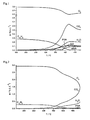
- Fig.1 shows in the context of using a transition metal catalyst without basic substances above 350 ° C in addition to the aforementioned concentration changes an increase in concentration of phthalic anhydride (PSA, C 8 H 4 O 3 ) and maleic anhydride (MSA, C 2 H 2 O 3 ).
- PSA phthalic anhydride
- MSA maleic anhydride
- Fig.2 ie when using a mixture of Catalyst and basic substance not on; the concentration of phthalic anhydride and maleic anhydride was nearly zero even at temperatures above 350 ° C.
Landscapes
- Chemical & Material Sciences (AREA)
- Engineering & Computer Science (AREA)
- Organic Chemistry (AREA)
- Combustion & Propulsion (AREA)
- Oil, Petroleum & Natural Gas (AREA)
- Chemical Kinetics & Catalysis (AREA)
- Materials Engineering (AREA)
- Inorganic Chemistry (AREA)
- General Chemical & Material Sciences (AREA)
- Organic Low-Molecular-Weight Compounds And Preparation Thereof (AREA)
- Catalysts (AREA)
Description
- Die Erfindung betrifft eine Verwendung eines pulverförmigen Übergangsmetallmischoxids als Oxidkatalysator zur selektiven Oxidation von Teersubstanzen in Synthesegasen mit molekularem Sauerstoff sowie ein Verfahren zur selektiven Entfernung von Teersubstanzen aus Synthesegasen gemäß des ersten bzw. achten Patentanspruchs.
- Synthesegase im vorgenannten Sinne sind Gase, wie sie beispielsweise in der Vergasung (Partikeloxidation unter Zugabe von Sauerstoff oder Wasserdampf) von organischen kohlenstoffhaltigen Einsatzstoffen zunächst als Rohsynthesegase anfallen. Sie enthalten anorganische Reduktionsmittel wie CO und H2 und dienen als Synthesebausteine z.B. für die Herstellung von Methanol oder Kohlenwasserstoffen.
- Teersubstanzen im vorgenannten Sinne umfassen gemäß [1] die Gesamtheit aller organischen Verbindungen mit Ausnahme der gasförmigen Kohlenwasserstoffe (C1 bis C6) in einem Synthesegas, das bei einer Vergasung von kohlenstoffhaltigen Materialien anfällt.
- Bei der Herstellung von Synthesegas aus kohlenstoffhaltigen, d.h. organischen Einsatzstoffen wie Erdöl- oder Kohleprodukte oder Biomasse mittels Vergasung entstehen neben dem gewünschten Synthesegas je nach Prozessbedingungen unterschiedliche Mengen an Teersubstanzen der vorgenannten Art in unterschiedlicher Zusammensetzungen. Diese Teersubstanzen stören sowohl bei einer weiterführenden Verarbeitung oder Nutzung des Synthesegases beispielsweise in Methanol- oder Fischer-Tropsch-Anlagen oder auch bei der direkten Befeuerung von Wärmekraftmaschinen wie z.B. in Blockheizkraftwerken (BHKW) und müssen daher entfernt werden.
Teersubstanzen im Synthesegas neigen zudem zu einer unerwünschten Kondensation in Leitungen oder sonstigen Anlageteilen wie Förderpumpen oder Ventilen. Dies führt zu allmählicher Verstopfung und damit zu kostenintensiven Nutzungseinschränkungen und -unterbrechungen. Sie deaktivieren die Katalysatoren durch Fouling (Belegen der katalytisch aktiven Oberflächen) bei den nachfolgenden Synthesestufen. - Insbesondere heterogene kohlenstoffhaltige Einsatzstoffe wie Biomasse führen bei einer Vergasung zu einer vergleichsweise hohen Teerbeladung im Synthesegas. Deshalb strebt man bereits bei der Entstehung des Synthesegases, d.h. bei der Vergasung eine Reduzierung der Teerbildungsrate an. Adäquate Maßnahmen umfassen dabei eine Beeinflussung der Reaktionskinetik bei der Vergasung durch Katalysatoreinsatz im Vergaser, konstruktive Maßnahmen an den Vergasungsvorrichtungen sowie auch eine Prozessoptimierung durch eine entsprechende Parameterwahl.
- Eine Homogenisierung des Zustroms der Einsatzstoffe, die zu einer Reduzierung der Teerbildung führen könnte, erfordert zusätzliche Verfahrensschritte und ist damit unwirtschaftlich. Auch eine Anhebung der Vergasungstemperatur führt zwar zu einer geringeren Teerbildungsrate, aber auch zu einem erhöhten Energiebedarf bei der Vergasung.
- Oftmals sind die vorgenannten Maßnahmen zur Vermeidung der Teerbildung während der Vergasung für einen gewünschten Maximalanteil an Teer im Synthesegas allein nicht ausreichend. Je nach Nutzung des Synthesegases sind die Anforderungen an die Reinheit sehr unterschiedlich. Während bei der direkten Nutzung des Synthesegases als Brennstoff z.B. in einer Gasturbine Teergehalte von bis zu 5 mg/Nm3 und mehr tolerierbar sind, liegt die maximal zulässige Obergrenze des Teergehalts bei der einer Zuführung des Synthesegases zu einer veredelnden Methanolsynthese charakteristischerweise typischerweise bei 1 mg/Nm3.
- Folglich ist man bestrebt, die Teersubstanzen in Synthesegasen nach einer Vergasung zu entfernen oder unschädlich zu machen.
- Häufig kommen hierbei aufwendige und teure physikalische Methoden wie Wäscher oder Elektrofilter zum Einsatz. Dabei sind verschiedene Bauarten bekannt, wie z.B. Wäschertürme, Rotationswäscher, Prallwäscher oder Venturiwäscher. Das am häufigsten eingesetzte Lösungsmittel ist Wasser, wobei sich jedoch nur Restteergehalte von minimal 20-40 mg/Nm3 erzielen lassen [17].
- In [17] wird z.B. ein Wäschersystem für Rohsynthesegas beschrieben, bei dem durch den Einsatz von Ölen als Lösungsmittel ein minimaler Restteergehalt auf 10 mg/Nm3 verringert werden.
- Ferner ist aus [3] ein Verfahren bekannt, bei dem ein organisches Lösungsmittel bei Temperaturen oberhalb des Siedepunktes von Wasser (100°C) eingesetzt wird.
- Die genannten physikalischen Methoden sind jedoch für einen großtechnischen Einsatz wegen der anfallenden teerhaltigen Abflussmengen umweltbelastend und oftmals nicht wirtschaftlich. Nachteilig ist außerdem ein Energieverlust aufgrund einer erforderlichen Abkühlung und Entspannung des Rohsynthesegases für die Abreinigung.
- Dies gilt grundsätzlich auch für eine Teerabscheidung mittels Elektrofilter. Sie bieten zwar den Vorteil einer Kombination von Teer- und Partikelabscheidung, lassen sich jedoch (wie die Gaswäsche) nur für kalte entspannte Synthesegase einsetzten [2].
- Eine weitere Möglichkeit der Teerentfernung aus dem abgekühlten Rohsynthesegas bietet eine Abscheidung mit Filterelementen [5], wobei sich die Abreinigung des Filtermediums jedoch häufig als problematisch erweist.
- Ferner zeigt [4] einen zusammenfassenden Überblick über gängige Verfahren zur Teerentfernung.
- Bei einer in [4] erwähnten thermischen Entfernung des Teers im heißen Rohsynthesegas sind jedoch Temperaturen von über 1000°C erforderlich [6], was die Wirtschaftlichkeit des Vergasungsprozesses beeinträchtigen könnte.
- Die katalytische Teerentfernung erfolgt ebenfalls im heißen Rohsynthesegas, zumeist durch Reformierungsreaktionen an verschiedenen Katalysatormaterialien. Sie ist sowohl an aus Biomasse erzeugten Rohgasen als auch an Modellgasen mit verschiedenen Katalysatorsystemen untersucht worden. Zum Einsatz kommen nichtmetallische teilweise dabei auch vorbehandelte Katalysatoren wie Dolomit [7, 8, 13, 14], Olivin [9] und Kalkspat oder Metallkatalysatoren wie Platin und Ruthenium sowie Katalysatoren auf Nickelbasis [10, 11] unter Zugabe von Promotoren (Molybdän und Kobalt), wie sie auch in der Petrochemie als Reformierkatalysatoren Verwendung finden. Es befinden sich außerdem katalytisch wirkende Filter auf Basis von Nickel in der Entwicklung [12].
- Nichtmetallischen Katalysatoren [13, 14] sind zwar kostengünstig, jedoch sehr empfindlich gegenüber Verunreinigungen und stellen aufgrund ihrer geringen Standzeit ein Entsorgungsproblem dar. Bei Verwendung von den vorgenannten Gesteinsmaterialien [7-9] haben bereits geringe Abweichungen in der Mineralzusammensetzung eine deutliche Veränderung der katalytischen Aktivität zur Folge. Metallkatalysatoren sind dagegen aktiver und mechanisch stabiler aber vergleichsweise teuer. Beide genannten Katalysatortypen sind jedoch erst oberhalb Temperaturen von 800-900 °C effizient wirksam, d.h. erst dann sind mit ihnen die erforderlichen Reaktionsumsätze von über 99% erzielbar.
- Weiterhin ist eine Teerentfernung mittels katalytischer Teeroxidation bekannt (vgl. [15-16]). Hierfür gibt es erste erfolgreich getestete Materialien. In [15] wird Zirkon als aktives Katalysatormaterial für die oxidative Teerentfernung im Temperaturbereich von 550-800°C beschrieben. Die Erprobung fand bisher jedoch nur mit der Modellsubstanz Toluol statt [15]. Bei der Verwendung von Palladium als aktivem Katalysatormaterial wurden bei 700 °c und unter Luftzugabe von 0,07 mg/Nm3 Rohgas Abbauraten von 98 % erreicht [16], diese Temperatur ist allerdings immer noch von der gewünschten entfernt, zudem ist Palladium ein sehr teures Material.
- Davon ausgehend liegt die Aufgabe der Erfindung darin, ein Verfahren zur Entfernung von Teersubstanzen aus Rohsynthesegasen mittels Katalysator sowie die Verwendung eines Katalysators für diesen Zweck vorzuschlagen, welche die aus dem genannten Stand der Technik bekannten Einschränkungen nicht aufweisen, sich durch eine verbesserte Wirtschaftlichkeit auszeichnen und zudem eine verbesserte Selektivität bezüglich einer Totaloxidation auszeichnet. Die Aufgabe wird durch eine Verwendung und ein Verfahren mit den Merkmalen aus Anspruch 1 und 8 gelöst. Unteransprüche geben vorteilhafte Ausgestaltungen dieser Verwendung und des Verfahrens wieder. Wesentliches Merkmal der Erfindung umfasst eine Verwendung von Oxiden von einem oder mehreren Übergangsmetallen mit mindestens einer eingemischten basischen Substanz als Katalysator, mit dem vorhandene Teersubstanzen im Synthesegas selektiv mit molekularem Sauerstoff z.B. zu CO und/oder CO2 und Wasser oxidiert werden, ohne dabei gleichzeitig die Hauptkomponenten des Synthesegas, CO und H2, zu oxidieren. Die Vermischung der basischen Substanz mit den Oxiden erfolgt mit pulverförmigen Oxiden (Partikel), wobei die Mischung für die Verwendung nicht unbedingt partikelförmig vorliegen muss, sondern hierfür auch in andere Zustände wie Agglomerate oder Schalenkatalysatoren weiterverarbeitet und eingesetzt werden kann. Die basischen Substanzen zeichnen sich durch eine chemische Stabilität während der Oxidation (Temperaturen zwischen 200 und 650°C, bevorzugt zwischen 400 und 500°C, Mischoxide und Carbonat sind allein temperaturstabil, vermischt ist Natriumcarbonat mit dem Mischoxid nur bis ca. 520 °C stabil) aus. Durch eine Behandlung eines Übergangsmetalloxidkatalysators mit basischen Substanzen wie beispielsweise bevorzugt durch Einmischen von Carbonaten eines Alkali- oder Übergangsmetalls (Zugabe basischer Substanzen wie z.B. Alkali- oder Erdalkalicarbonate oder Oxide) erweitert sich das Selektivitätsspektrum vorgenannter Oxidation vorteilhaft von den Teersubstanzen zu Totaloxidationsprodukten CO2 und H2O, d.h. ohne eine Partialoxidation zu Zwischenprodukte wie Phthalsäureanhydrid (PSA, C8H4O3) oder Maleinsäureanhydrid (MSA, C2H2O3). Die basischen Substanzen dienen als Promotor für die Oxidation der Produkte. Sie binden diese verstärkt an die Katalysatoroberfläche und verhindern eine Desorption, wodurch eine weiterführende Totaloxidation der Zwischenprodukte begünstigt wird. Ebenso besteht ein wesentliches Merkmal des Verfahrens zur selektiven Entfernung von Teersubstanzen aus Synthesegasen, umfassend eine selektive Oxidation der Teersubstanzen mit molekularem Sauerstoff, in der Verwendung eines Übergangsmetalloxids zusammen mit vorgenannten basischen Substanzen als Katalysator. Vorzugsweise enthält der Übergangsmetalloxidkatalysator Vanadiumoxid, in einer weiteren bevorzugten Ausführung zusätzlich Molybdänoxid. Vanadiumoxid bewirkt in vorteilhafter Weise eine Oxidation der Teermodellkomponente Naphthalin, während Molybdänoxid die Selektivität bezüglich der Teermodellkomponente erhöht, so dass eine Oxidation von Wasserstoff und Kohlenmonoxid vollständig oder nahezu vermieden wird. In einer weiter bevorzugten Ausführungsform besteht der Übergangsoxidkatalysator aus Oxiden aus dem System Molybdän/Vanadium/Wolfram. Wolframoxide bewirken in vorteilhafter Weise eine Stabilisierung der Struktur und ermöglichen damit den Einsatz im gewünschten Temperaturfenster. In einer besonders bevorzugten Ausführung weist Mo/V/W-Oxidkatalysator ein molares Verhältnis der Elemente Molybdän, Vanadium und Wolfram von 7,5 bis 8,5 zu 1 bis 3 zu 0,1 bis 2, weiter bevorzugt von 8 zu 2 zu 1 auf. Mischoxide vom Typ Mo/V/W-Oxid sind als Katalysator für die partielle Oxidation von Acrolein C2H3CHO zu Acrylsäure C3H4O2 bereits bekannt. Bei Versuchen stellte sich aber überraschenderweise heraus, dass diese Katalysatoren sich nicht nur für die Oxidation von Acrolein eignen, sondern auch für die gewünschte selektive Oxidation der vorgenannten Teersubstanzen im Synthesegas. Besonders vorteilhaft dabei ist, dass das Synthesegas, insbesondere die darin enthaltenen starken aber anorganischen Reduktionsmittel CO und H2 chemisch nicht verändert werden. Die vorteilhafte Wirkung der Übergangsmetalloxidkatalysator wie die genannten Mo/V/W-Mischoxide beruht auf deren Vermögen, molekularen Sauerstoff in Form von Sauerstoffionen wie O2- aus einer Gasphase zu binden. Die Sauerstoffionen werden selektiv an organische Moleküle wie Acrolein und Teersubstanzen abgegeben, um diese katalytisch zu oxidieren. Die vorgenannte Sauerstoffspezies kann somit nicht von dem Synthesegas, insbesondere den darin enthaltenen CO- und H2-Bestandteilen aufgenommen werden. Folglich findet im Synthesegas auch keine Oxidation von Synthesegasbestandteilen statt.
- Die Erfindung wird im Folgenden anhand von Versuchsbeispielen mit den folgenden Figuren näher erläutert. Es zeigen
-
Fig.1 die Verläufe der Volumenanteile ϕ verschiedener Substanzen bei einer temperaturprogrammierten Reaktion von Naphthalin und Sauerstoff bei Verwendung eines Übergangsmetallkatalysators Mo8V2W1Ox ohne basische Substanzen über verschiedene Temperaturen sowie -
Fig.2 die mitFig.1 direkt vergleichbaren Verläufe der Volumenanteile ϕ verschiedener Substanzen nach einer temperaturprogrammierten Reaktion von Naphthalin und Sauerstoff bei Verwendung eines Übergangsmetallkatalysators MO8V2W10x mit Na2CO3 als basische Substanz entsprechend einem Natriumanteil bezogen auf das Mischoxid von 5 Gew.% über verschiedene Temperaturen. - Für die Herstellung des Mo/V/W-Mischoxid-Katalysatormaterials werden Ammoniumheptamolybdat (NH4)6Mo7O24, Ammoniummetavanadat NH4VO3 und Ammoniummetawolframat (NH4)6H2W12O41 als Ausgangsstoffe eingesetzt. Nach Einstellung eines gewünschten molaren Verhältnisses der Elemente Molybdän, Vanadium und Wolfram, vorzugsweise von 8 zu 2 zu 1, über eine Wahl der entsprechenden Mengenverhältnisse der vorgenannten Ausgangsmaterialien wird die Mischung in eine wässrige Lösung eingebracht(1,5 1 Wasser pro 45 g Feststoff), auf 90 min erwärmt (80 bis 90°C) und sprühgetrocknet (6 bar, Druckluft 12 ml/min Flüssigkeit, 275°C Heißluft), wobei sich eine pulverförmige Katalysatorvorstufe einstellt (Partikel mit Partikelgrößen zwischen 0,1 und 10 µm und mit röntgenamorpher Oberfläche bevorzugt ohne kristalline Anteile). In einem anschließenden Kalzinierungsschritt unter Stickstoffatmosphäre wird der partikelförmige Katalysator in einem mehrstündigen Temperaturprogramm (Aufheizung mit einer Aufheizrate 2 K/min auf 325°C, danach Haltezeit 240 min bei 325°C, danach weiteres Aufheizen mit 2 K/min auf 400°C, danach Haltezeit 10 min bei 400°C, danach Abkühlung) in eine bevorzugte aktive Form überführt.
- Anschließend wird der gewünschte Anteil an basischer Substanz mechanisch in den pulverförmigen Katalysator eingemischt, vorzugsweise zwischen 1 und 20 Gew.%, weiter bevorzugt zwischen 2 und 10 Gew.% eines der vorgenannten Carbonate in Pulverform, im Rahmen des vorliegenden Ausführungsbeispiels 5 Gew.% Na2CO3 (Natriumgehalt bezogen auf das Mischoxid) in pulverförmiger Form.
- Zur Reduzierung von Druckverlusten bei der Durchströmung der Katalysatorschüttung mit dem Reaktionsgasgemisch (Synthesegas) erfolgte eine Agglomeration der pulverförmigen Mischung. Dadurch wird eine zu hohe Pulverschüttdichte und damit ein zu hoher Druckverlust über die Schüttung des Katalysators bzw. der Mischung vermieden und die Zugänglichkeit des Synthesegases auf die gesamte Oberfläche des pulverförmigen Katalysators verbessert. Für die Agglomeration wird die Pulvermischung mit Glycerin angefeuchtet und anschließend im Trockenschrank bei 75°C unter Vakuum getrocknet. Im Rahmen des Ausführungsbeispiels erfolgte eine Abtrennung von Partikeln mit Durchmessern unterhalb 0,315 mm durch Sieben, sodass die Agglomerate aus Partikeln mit einen Durchmesserbereich zwischen 0,315 bis 1,5 mm bestanden.
- Die chemische Aktivität des Mo/V/W-Oxid-Katalysators ohne und mit eingemischter basischer Substanz (vgl.
Fig.1 bzw. 2) wurde anhand von Experimenten in einem Strömungsrohrreaktor mit angekoppeltem Massenspektrometer untersucht. Vor Beginn des Versuches wurde der Katalysator und die Mischung aus Katalysator und basischer Substanz mit Sauerstoff vorbehandelt (Aufheizen mit 5K/min, dann 1h bei 400°C in einer Thermowaage im Strömungsrohrreaktor, Atmosphäre 1% Sauerstoff, 99% Argon). - Damit wird eine maximal mögliche Sauerstoffaufnahme im Katalysator erzielt. Während der folgenden temperaturprogrammierten Reaktion kann der auf der Katalysatoroberfläche vorliegende Sauerstoff eine Reaktion mit dem in der Gasphase vorliegenden Naphthalin eingehen. Der dabei am Katalysator verbrauchte Sauerstoff wird mit molekularem Sauerstoff aus der Gasphase ersetzt. Der Vorgang der Reduktion und darauf folgender Oxidation des Katalysators ist reversibel und kann daher beliebig oft durchgeführt werden. Nach der Reaktionsphase wird eine erneute Oxidationsphase bei 400°C durchgeführt (1h, 5% Sauerstoff in Argon). Diese dient dazu, vor einer weiteren Reaktionsphase wieder einen vollständig oxidierten Katalysator bereitzustellen und somit vergleichbare Bedingungen während der Reaktionsphasen zu gewährleisten. Es kann nun erneut eine temperaturprogrammierte Reaktionsphase durchgeführt werden. Da sich aufgrund von Einfahrvorgängen am Katalysator die erste Reaktionsphase von den folgenden unterscheidet, werden in
Fig.1 und 2 sowie in den folgenden Versuchsbeschreibungen die Ergebnisse der jeweiligen zweiten Reaktionszyklen zugrunde gelegt. - Die in
Fig.1 und 2 dargestellten Versuchsergebnisse wurden anhand eines Modellgases mit 0,25 Vol.% Naphthalin, 3 Vol.% Sauerstoff, einer Einwaage an Katalysatorsubstanz bzw. an vorgenannter Mischung aus Katalysator und basischer Substanz von 2 g und einem Gasvolumenstrom von 100 ml/min sowie bei 5 K/min Heizrate ermittelt. Das Naphthalin diente anstelle eines Teeres als definiertes und in seiner Wirkung bekanntes Modell-Reduktionsmittel zur Ermittlung der vorgenannten Versuchsergebnisses. - Bei der Reaktion des Naphthalin mit dem Sauerstoff wurde ab ca. 350°C ein deutlicher Anstieg der Oxidationsprodukte wie z.B. zu CO2, CO und Wasser festgestellt (
Fig.1 und 2 ), während die Konzentrationen von Sauerstoff und Naphthalin entsprechend abnahmen. -
Fig.1 zeigt im Rahmen einer Verwendung eines Übergangsmetallkatalysators ohne basische Substanzen oberhalb 350°C zusätzlich zu den vorgenannten Konzentrationsänderungen einen Konzentrationsanstieg von Phthalsäureanhydrid (PSA, C8H4O3) und Maleinsäureanhydrid (MSA, C2H2O3). Dieser tritt inFig.2 , d.h. bei Verwendung einer Mischung aus Katalysator und basischer Substanz nicht auf; die Konzentration von Phthalsäureanhydrid und Maleinsäureanhydrid betrug auch bei Temperaturen oberhalb von 350°C nahezu Null. -
- [1] DIN CEN15439 Biomassevergasung - Teer und Staub in Produktgasen - Probenahme und analytische Bestimmung; Deutsche Fassung CEN/TS 15439:2006
- [2] Ullmann's Encyclopedia of industrial chemistry, Kapitel: Gas Production, Abschnitt 5.4.4: Removal of Gas Impurities of low concentration, 7. Auflage, online release, 2005
- [3] Bandi A.: Gasreinigungsverfahren, Tagungsband Fachtagung "Regenerative Kraftstoffe" 124-129, Stuttgart, 2003
- [4] Bolhar-Nordenkampf M.: Arbeitsbericht der Projektgemeinschaft Biomassevergasung - Hersteller und Marktbetrachtung der thermo-chemischen Umwandlung von Biomasse, www.hessenenergie.net, 2002
- [5] Hasler P., Nussbaumer T.: Gas Cleaning for IC Engine Applications from fixed Bed Biomass Gasification, Biomass and Bioenergy 16 (1999) 385-395
- [6] Jess A.: Reaktionskinetische Untersuchungen zur thermischen Zersetzung von Modellkohlenwasserstoffen, Erdöl Erdgas Kohle 111 (1995) 479-484
- [7] Perez P., Aznar P.M., Caballero M.A., Gil J., Martin J.A., Corella, J.: Hot Gas Cleaning and Upgrading with Calcined Dolomite Located Downstream a Biomass Fluidized Bed Gasifier Operating with Steam -Oxygen Mixtures, Energy & Fuels 11 (1997) 1194-1203
- [8] Simell P.A., Halala N.A.K., Haario H.E.: Catalytic Decomposition of Gasification Gas Tar with Benzene as Model Compound, Ind. Eng. Chem. Res. 36 (1997) 42-51
- [9] Devi L., Ptasinski K.J., Janssen F.J.J.G.: Decomposition of naphthalene as a biomass Tar over Pretreated Olivine: Effect of Gas Composition, Kinetic Approach, and Reaction Scheme, Ind. Eng. Chem. Res. 44 (2005) 9096-9104
- [10] Jess, A.: Catalytic upgrading of tarry fuel gases: A kinetic study with model components, Chem. Eng. Proc. 35 (1996) 487- - 494
- [11] Dou B., Zhang M., Gao J., Shen W., Sha X.: High-Temperature Removal of NH3, Organic Sulphur, HCI, and tar Component from Coal-Derived Gas, Ind. Eng. Chem. Res. 41 (2002) 4195-4200
- [12] Ma L., Verelst H., Baron G.V.: Integrated high Temperature Gas Cleaning: Tar Removal in biomass gasification with a catalytic filter, Catalysis Today 105 (2005) 729-734
- [13] Myren C., Hörnell C., Bjömbom E., Sjöström K.: Catalytic Decomposition of Biomass Pyrolysis Gas with a Combination of Dolomite and Silica, Biomass and Bioenergy 23 (2002) 217-227
- [14] Orio A., Corella J., Narvaez I.: Performance of Different dolomites on Hot Raw Gas Cleaning from Biomass Gasification with Air, Ind. Eng. Chem. Res. 36 (1997) 3800-3808
- [15] Juutilainen S.J., Simell P.A., Krause A.O.I.: Zirconia: Selective oxidation catalyst for removal of for and ammonia from biomass gasification gas, Appl. Catalysis B: Environmental 62 (2006) 86-92
- [16] Klemm M., Hiller A., Wilhelm R.: Gasmotorentaugliches Brenngas aus der Holzvergasung durch die Entteerung mittels partieller katalytischer Oxidation und Prozessoptimierung, Tagungsband DGMK-Fachbereichstagung "Energetische Nutzung von Biomassen" 195 - 202, Velen, 2004
- [17] Analyse und Evaluierung der thermo-chemischen Vergasung von Biomasse; Schriftenreihe "Nachwachsende Rohstoffe" Band 29, Landwirtschaftsverlag GmbH (2006) insbes. S.81-88
Claims (10)
- Verwendung von Übergangsmetalloxiden als Übergangsmetalloxidkatalysatoren zur selektiven Oxidation von Teersubstanzen in Synthesegasen mit molekularem Sauerstoff, wobei in den Übergangsmetalloxidkatalysator eine basische Substanz eingemischt ist.
- Verwendung nach Anspruch 1, dadurch gekennzeichnet, dass der Übergangsmetalloxidkatalysator Vanadiumoxid enthält.
- Verwendung nach Anspruch 2, dadurch gekennzeichnet, dass der Übergangsmetalloxidkatalysator Molybdänoxid enthält.
- Verwendung nach einem der vorgenannten Ansprüche, dadurch gekennzeichnet, dass der Übergangsmetalloxidkatalysator ein Molybdän/Vanadium/Wolfram-Oxidkatalysator ist.
- Verwendung nach Anspruch 4, dadurch gekennzeichnet, dass der Mo/V/W-Mischoxidkatalysator ein molares Verhältnis der Elemente Molybdän, Vanadium und Wolfram von 7,5 bis 8,5 zu 1 bis 3 zu 0,1 bis 2 aufweist.
- Verwendung nach einem der vorgenannten Ansprüche, dadurch gekennzeichnet, dass die basische Substanz ein Carbonat eines Alkali- oder Übergangsmetalls ist.
- Verwendung nach Anspruch 6, dadurch gekennzeichnet, dass das Carbonat Natriumcarbonat ist.
- Verfahren zur selektiven Entfernung von Teersubstanzen in Synthesegasen, umfassend eine selektive Oxidation der Teersubstanzen mit molekularem Sauerstoff bei Verwendung eines pulverförmigen Übergangsmetall oxids als Übergangsmetalloxidkatalysator mit einer eingemischten basischen Substanz nach einem der vorgenann-ten Ansprüche.
- Verfahren nach Anspruch 6, dadurch gekennzeichnet, dass die selektive Oxidation bei einer Temperatur zwischen 200 und 650°C erfolgt.
- Verfahren nach Anspruch 7, dadurch gekennzeichnet, dass die selektive Oxidation bei einer Temperatur zwischen 400 und 500°C erfolgt.
Applications Claiming Priority (2)
| Application Number | Priority Date | Filing Date | Title |
|---|---|---|---|
| DE102007045665A DE102007045665A1 (de) | 2007-09-25 | 2007-09-25 | Verwendung eines pulverförmigen Übergangsmetalloxids als Katalysator |
| PCT/EP2008/007110 WO2009039938A1 (de) | 2007-09-25 | 2008-08-30 | Verwendung eines pulverförmigen übergangsmetalloxids als katalysator |
Publications (2)
| Publication Number | Publication Date |
|---|---|
| EP2190779A1 EP2190779A1 (de) | 2010-06-02 |
| EP2190779B1 true EP2190779B1 (de) | 2011-10-19 |
Family
ID=40086345
Family Applications (1)
| Application Number | Title | Priority Date | Filing Date |
|---|---|---|---|
| EP08785764A Not-in-force EP2190779B1 (de) | 2007-09-25 | 2008-08-30 | Verwendung eines pulverförmigen übergangsmetalloxids als katalysator |
Country Status (4)
| Country | Link |
|---|---|
| EP (1) | EP2190779B1 (de) |
| AT (1) | ATE529380T1 (de) |
| DE (1) | DE102007045665A1 (de) |
| WO (1) | WO2009039938A1 (de) |
Family Cites Families (1)
| Publication number | Priority date | Publication date | Assignee | Title |
|---|---|---|---|---|
| US4046523A (en) * | 1974-10-07 | 1977-09-06 | Exxon Research And Engineering Company | Synthesis gas production |
-
2007
- 2007-09-25 DE DE102007045665A patent/DE102007045665A1/de not_active Withdrawn
-
2008
- 2008-08-30 EP EP08785764A patent/EP2190779B1/de not_active Not-in-force
- 2008-08-30 AT AT08785764T patent/ATE529380T1/de active
- 2008-08-30 WO PCT/EP2008/007110 patent/WO2009039938A1/de not_active Ceased
Also Published As
| Publication number | Publication date |
|---|---|
| DE102007045665A1 (de) | 2009-04-02 |
| EP2190779A1 (de) | 2010-06-02 |
| WO2009039938A1 (de) | 2009-04-02 |
| ATE529380T1 (de) | 2011-11-15 |
Similar Documents
| Publication | Publication Date | Title |
|---|---|---|
| DE69324365T2 (de) | VERFAHREN ZUR ENTFERNUNG VON NOx AUS GASEN DER VERBRENNUNSZONE DURCH ABSORPTION | |
| DE69732231T2 (de) | Verfahren zur slektiven abtrennung von co2 aus einem mehrkomponenten-gasstrom | |
| DE2754118A1 (de) | Verbessertes verfahren zur aufarbeitung von schwefelwasserstoff enthaltenden gasen | |
| DE2341241A1 (de) | Verfahren zur entfernung von stick- und schwefeloxiden aus abgasen | |
| DE3601378A1 (de) | Verfahren zur reinigung von oxide des stickstoffs und schwefels enthaltenden abgasen aus verbrennungsanlagen | |
| DE102004045772A1 (de) | Verfahren und Vorrichtung zur Erzeugung eines Produktgases durch thermochemische Vergasung eines kohlenstoffhaltigen Einsatzstoffes | |
| DE3228481A1 (de) | Reaktionsmasse, verfahren zu ihrer herstellung und deren verwendung | |
| EP2271425B1 (de) | Verfahren zur katalytischen verringerung des teergehalts in gasen aus vergasungsprozessen unter verwendung eines katalysators auf edelmetallbasis | |
| DE102018204797A1 (de) | Ein katalysator zur behandlung eines abgases, ein abgassystem und ein verfahren | |
| WO2004056949A1 (de) | Verfahren zur entfernung von schwefelverbindungen aus kohlenwasserstoffhaltigen gasen | |
| DE10327059A1 (de) | Verfahren zum Konvertieren von fett- oder ölhaltigen Roh- und Abfallstoffen in Gemische mit hohem Kohlenwasserstoffanteil, mit diesem Verfahren hergestellte Produkte und deren Verwendung | |
| DE3524160A1 (de) | Katalysator zur verminderung des stickoxidgehalts von verbrennungsabgasen | |
| EP2155381B1 (de) | Verwendung eines übergangsmetalloxids als katalysator für die entfernung von teersubstanzen aus synthesegas | |
| EP2897712B1 (de) | Verfahren zur reinigung von abgas und zur regenerierung eines oxidationskatalysators | |
| DE3636024C2 (de) | ||
| DE3443686A1 (de) | Verfahren zur entfernung von stickoxiden und schwefeloxiden aus gasen | |
| EP2274094B1 (de) | Verwendung eines katalysators auf edelmetallbasis zur verringerung des teergehalts in gasen aus vergasungsprozessen | |
| EP2190779A1 (de) | Verwendung eines pulverförmigen übergangsmetalloxids als katalysator | |
| DE2733105B1 (de) | Verfahren zur Herstellung von Synthesegasen durch partielle Oxidation | |
| EP3506995A1 (de) | Verfahren und vorrichtung zum entfernen von organischen schwefelverbindungen aus wasserstoffreichen gasen | |
| DE69517261T2 (de) | Methode zur entfernung von distickstoffmonoxyd | |
| DE19544933A1 (de) | Verfahren zur Entfernung vn Merkaptanen aus Gasgemischen und Katalysator zur Zersetzung von Merkaptanen | |
| DD150475A5 (de) | Verfahren zur aufbereitung eines rohgases aus der vergasung | |
| DE69624944T2 (de) | Verfahren zur koniditionierung von heissen gasen | |
| Ordóñez Millán et al. | Steam reforming of tars and light hydrocarbons in TRL-5 gasification-derived syngas over Ni/mayenite–CaO catalysts |
Legal Events
| Date | Code | Title | Description |
|---|---|---|---|
| PUAI | Public reference made under article 153(3) epc to a published international application that has entered the european phase |
Free format text: ORIGINAL CODE: 0009012 |
|
| 17P | Request for examination filed |
Effective date: 20100122 |
|
| AK | Designated contracting states |
Kind code of ref document: A1 Designated state(s): AT BE BG CH CY CZ DE DK EE ES FI FR GB GR HR HU IE IS IT LI LT LU LV MC MT NL NO PL PT RO SE SI SK TR |
|
| AX | Request for extension of the european patent |
Extension state: AL BA MK RS |
|
| DAX | Request for extension of the european patent (deleted) | ||
| GRAP | Despatch of communication of intention to grant a patent |
Free format text: ORIGINAL CODE: EPIDOSNIGR1 |
|
| GRAS | Grant fee paid |
Free format text: ORIGINAL CODE: EPIDOSNIGR3 |
|
| GRAA | (expected) grant |
Free format text: ORIGINAL CODE: 0009210 |
|
| AK | Designated contracting states |
Kind code of ref document: B1 Designated state(s): AT BE BG CH CY CZ DE DK EE ES FI FR GB GR HR HU IE IS IT LI LT LU LV MC MT NL NO PL PT RO SE SI SK TR |
|
| REG | Reference to a national code |
Ref country code: GB Ref legal event code: FG4D Free format text: NOT ENGLISH |
|
| REG | Reference to a national code |
Ref country code: CH Ref legal event code: NV Representative=s name: ROTTMANN, ZIMMERMANN + PARTNER AG Ref country code: CH Ref legal event code: EP |
|
| REG | Reference to a national code |
Ref country code: IE Ref legal event code: FG4D |
|
| REG | Reference to a national code |
Ref country code: DE Ref legal event code: R096 Ref document number: 502008005269 Country of ref document: DE Effective date: 20120112 |
|
| REG | Reference to a national code |
Ref country code: NL Ref legal event code: VDEP Effective date: 20111019 |
|
| LTIE | Lt: invalidation of european patent or patent extension |
Effective date: 20111019 |
|
| PG25 | Lapsed in a contracting state [announced via postgrant information from national office to epo] |
Ref country code: LT Free format text: LAPSE BECAUSE OF FAILURE TO SUBMIT A TRANSLATION OF THE DESCRIPTION OR TO PAY THE FEE WITHIN THE PRESCRIBED TIME-LIMIT Effective date: 20111019 Ref country code: IS Free format text: LAPSE BECAUSE OF FAILURE TO SUBMIT A TRANSLATION OF THE DESCRIPTION OR TO PAY THE FEE WITHIN THE PRESCRIBED TIME-LIMIT Effective date: 20120219 Ref country code: NO Free format text: LAPSE BECAUSE OF FAILURE TO SUBMIT A TRANSLATION OF THE DESCRIPTION OR TO PAY THE FEE WITHIN THE PRESCRIBED TIME-LIMIT Effective date: 20120119 |
|
| REG | Reference to a national code |
Ref country code: IE Ref legal event code: FD4D |
|
| PG25 | Lapsed in a contracting state [announced via postgrant information from national office to epo] |
Ref country code: PT Free format text: LAPSE BECAUSE OF FAILURE TO SUBMIT A TRANSLATION OF THE DESCRIPTION OR TO PAY THE FEE WITHIN THE PRESCRIBED TIME-LIMIT Effective date: 20120220 Ref country code: GR Free format text: LAPSE BECAUSE OF FAILURE TO SUBMIT A TRANSLATION OF THE DESCRIPTION OR TO PAY THE FEE WITHIN THE PRESCRIBED TIME-LIMIT Effective date: 20120120 Ref country code: HR Free format text: LAPSE BECAUSE OF FAILURE TO SUBMIT A TRANSLATION OF THE DESCRIPTION OR TO PAY THE FEE WITHIN THE PRESCRIBED TIME-LIMIT Effective date: 20111019 Ref country code: LV Free format text: LAPSE BECAUSE OF FAILURE TO SUBMIT A TRANSLATION OF THE DESCRIPTION OR TO PAY THE FEE WITHIN THE PRESCRIBED TIME-LIMIT Effective date: 20111019 Ref country code: NL Free format text: LAPSE BECAUSE OF FAILURE TO SUBMIT A TRANSLATION OF THE DESCRIPTION OR TO PAY THE FEE WITHIN THE PRESCRIBED TIME-LIMIT Effective date: 20111019 Ref country code: SE Free format text: LAPSE BECAUSE OF FAILURE TO SUBMIT A TRANSLATION OF THE DESCRIPTION OR TO PAY THE FEE WITHIN THE PRESCRIBED TIME-LIMIT Effective date: 20111019 Ref country code: SI Free format text: LAPSE BECAUSE OF FAILURE TO SUBMIT A TRANSLATION OF THE DESCRIPTION OR TO PAY THE FEE WITHIN THE PRESCRIBED TIME-LIMIT Effective date: 20111019 |
|
| PG25 | Lapsed in a contracting state [announced via postgrant information from national office to epo] |
Ref country code: CY Free format text: LAPSE BECAUSE OF FAILURE TO SUBMIT A TRANSLATION OF THE DESCRIPTION OR TO PAY THE FEE WITHIN THE PRESCRIBED TIME-LIMIT Effective date: 20111019 |
|
| PG25 | Lapsed in a contracting state [announced via postgrant information from national office to epo] |
Ref country code: BG Free format text: LAPSE BECAUSE OF FAILURE TO SUBMIT A TRANSLATION OF THE DESCRIPTION OR TO PAY THE FEE WITHIN THE PRESCRIBED TIME-LIMIT Effective date: 20120119 Ref country code: SK Free format text: LAPSE BECAUSE OF FAILURE TO SUBMIT A TRANSLATION OF THE DESCRIPTION OR TO PAY THE FEE WITHIN THE PRESCRIBED TIME-LIMIT Effective date: 20111019 Ref country code: EE Free format text: LAPSE BECAUSE OF FAILURE TO SUBMIT A TRANSLATION OF THE DESCRIPTION OR TO PAY THE FEE WITHIN THE PRESCRIBED TIME-LIMIT Effective date: 20111019 Ref country code: DK Free format text: LAPSE BECAUSE OF FAILURE TO SUBMIT A TRANSLATION OF THE DESCRIPTION OR TO PAY THE FEE WITHIN THE PRESCRIBED TIME-LIMIT Effective date: 20111019 Ref country code: IE Free format text: LAPSE BECAUSE OF FAILURE TO SUBMIT A TRANSLATION OF THE DESCRIPTION OR TO PAY THE FEE WITHIN THE PRESCRIBED TIME-LIMIT Effective date: 20111019 Ref country code: CZ Free format text: LAPSE BECAUSE OF FAILURE TO SUBMIT A TRANSLATION OF THE DESCRIPTION OR TO PAY THE FEE WITHIN THE PRESCRIBED TIME-LIMIT Effective date: 20111019 |
|
| PLBE | No opposition filed within time limit |
Free format text: ORIGINAL CODE: 0009261 |
|
| STAA | Information on the status of an ep patent application or granted ep patent |
Free format text: STATUS: NO OPPOSITION FILED WITHIN TIME LIMIT |
|
| PG25 | Lapsed in a contracting state [announced via postgrant information from national office to epo] |
Ref country code: RO Free format text: LAPSE BECAUSE OF FAILURE TO SUBMIT A TRANSLATION OF THE DESCRIPTION OR TO PAY THE FEE WITHIN THE PRESCRIBED TIME-LIMIT Effective date: 20111019 Ref country code: IT Free format text: LAPSE BECAUSE OF FAILURE TO SUBMIT A TRANSLATION OF THE DESCRIPTION OR TO PAY THE FEE WITHIN THE PRESCRIBED TIME-LIMIT Effective date: 20111019 Ref country code: PL Free format text: LAPSE BECAUSE OF FAILURE TO SUBMIT A TRANSLATION OF THE DESCRIPTION OR TO PAY THE FEE WITHIN THE PRESCRIBED TIME-LIMIT Effective date: 20111019 |
|
| 26N | No opposition filed |
Effective date: 20120720 |
|
| REG | Reference to a national code |
Ref country code: DE Ref legal event code: R097 Ref document number: 502008005269 Country of ref document: DE Effective date: 20120720 |
|
| BERE | Be: lapsed |
Owner name: KARLSRUHER INSTITUT FUR TECHNOLOGIE Effective date: 20120831 |
|
| PG25 | Lapsed in a contracting state [announced via postgrant information from national office to epo] |
Ref country code: MC Free format text: LAPSE BECAUSE OF NON-PAYMENT OF DUE FEES Effective date: 20120831 |
|
| GBPC | Gb: european patent ceased through non-payment of renewal fee |
Effective date: 20120830 |
|
| REG | Reference to a national code |
Ref country code: FR Ref legal event code: ST Effective date: 20130430 |
|
| PG25 | Lapsed in a contracting state [announced via postgrant information from national office to epo] |
Ref country code: BE Free format text: LAPSE BECAUSE OF NON-PAYMENT OF DUE FEES Effective date: 20120831 |
|
| PG25 | Lapsed in a contracting state [announced via postgrant information from national office to epo] |
Ref country code: FI Free format text: LAPSE BECAUSE OF FAILURE TO SUBMIT A TRANSLATION OF THE DESCRIPTION OR TO PAY THE FEE WITHIN THE PRESCRIBED TIME-LIMIT Effective date: 20111019 |
|
| PG25 | Lapsed in a contracting state [announced via postgrant information from national office to epo] |
Ref country code: GB Free format text: LAPSE BECAUSE OF NON-PAYMENT OF DUE FEES Effective date: 20120830 |
|
| PG25 | Lapsed in a contracting state [announced via postgrant information from national office to epo] |
Ref country code: FR Free format text: LAPSE BECAUSE OF NON-PAYMENT OF DUE FEES Effective date: 20120831 |
|
| PG25 | Lapsed in a contracting state [announced via postgrant information from national office to epo] |
Ref country code: ES Free format text: LAPSE BECAUSE OF FAILURE TO SUBMIT A TRANSLATION OF THE DESCRIPTION OR TO PAY THE FEE WITHIN THE PRESCRIBED TIME-LIMIT Effective date: 20120130 |
|
| PG25 | Lapsed in a contracting state [announced via postgrant information from national office to epo] |
Ref country code: MT Free format text: LAPSE BECAUSE OF FAILURE TO SUBMIT A TRANSLATION OF THE DESCRIPTION OR TO PAY THE FEE WITHIN THE PRESCRIBED TIME-LIMIT Effective date: 20111019 |
|
| PG25 | Lapsed in a contracting state [announced via postgrant information from national office to epo] |
Ref country code: TR Free format text: LAPSE BECAUSE OF FAILURE TO SUBMIT A TRANSLATION OF THE DESCRIPTION OR TO PAY THE FEE WITHIN THE PRESCRIBED TIME-LIMIT Effective date: 20111019 |
|
| PG25 | Lapsed in a contracting state [announced via postgrant information from national office to epo] |
Ref country code: LU Free format text: LAPSE BECAUSE OF NON-PAYMENT OF DUE FEES Effective date: 20120830 |
|
| PG25 | Lapsed in a contracting state [announced via postgrant information from national office to epo] |
Ref country code: HU Free format text: LAPSE BECAUSE OF FAILURE TO SUBMIT A TRANSLATION OF THE DESCRIPTION OR TO PAY THE FEE WITHIN THE PRESCRIBED TIME-LIMIT Effective date: 20080830 |
|
| REG | Reference to a national code |
Ref country code: CH Ref legal event code: PCAR Free format text: NEW ADDRESS: GARTENSTRASSE 28 A, 5400 BADEN (CH) |
|
| REG | Reference to a national code |
Ref country code: CH Ref legal event code: NV Representative=s name: ALDO ROEMPLER PATENTANWALT, CH Ref country code: CH Ref legal event code: PUE Owner name: FRAUNHOFER-GESELLSCHAFT ZUR FOERDERUNG DER ANG, DE Free format text: FORMER OWNER: KARLSRUHER INSTITUT FUER TECHNOLOGIE, DE |
|
| REG | Reference to a national code |
Ref country code: DE Ref legal event code: R081 Ref document number: 502008005269 Country of ref document: DE Owner name: FRAUNHOFER-GESELLSCHAFT ZUR FOERDERUNG DER ANG, DE Free format text: FORMER OWNER: KARLSRUHER INSTITUT FUER TECHNOLOGIE, 76131 KARLSRUHE, DE |
|
| REG | Reference to a national code |
Ref country code: AT Ref legal event code: PC Ref document number: 529380 Country of ref document: AT Kind code of ref document: T Owner name: FRAUNHOFER-GESELLSCHAFT ZUR FOERDERUNG DER ANG, Effective date: 20180814 |
|
| PGFP | Annual fee paid to national office [announced via postgrant information from national office to epo] |
Ref country code: AT Payment date: 20210818 Year of fee payment: 14 |
|
| PGFP | Annual fee paid to national office [announced via postgrant information from national office to epo] |
Ref country code: DE Payment date: 20210819 Year of fee payment: 14 Ref country code: CH Payment date: 20210824 Year of fee payment: 14 |
|
| REG | Reference to a national code |
Ref country code: DE Ref legal event code: R119 Ref document number: 502008005269 Country of ref document: DE |
|
| REG | Reference to a national code |
Ref country code: CH Ref legal event code: PL |
|
| REG | Reference to a national code |
Ref country code: AT Ref legal event code: MM01 Ref document number: 529380 Country of ref document: AT Kind code of ref document: T Effective date: 20220830 |
|
| PG25 | Lapsed in a contracting state [announced via postgrant information from national office to epo] |
Ref country code: LI Free format text: LAPSE BECAUSE OF NON-PAYMENT OF DUE FEES Effective date: 20220831 Ref country code: CH Free format text: LAPSE BECAUSE OF NON-PAYMENT OF DUE FEES Effective date: 20220831 Ref country code: AT Free format text: LAPSE BECAUSE OF NON-PAYMENT OF DUE FEES Effective date: 20220830 |
|
| PG25 | Lapsed in a contracting state [announced via postgrant information from national office to epo] |
Ref country code: DE Free format text: LAPSE BECAUSE OF NON-PAYMENT OF DUE FEES Effective date: 20230301 |