EP2187824B1 - Tenaculum stabilizer device - Google Patents
Tenaculum stabilizer device Download PDFInfo
- Publication number
- EP2187824B1 EP2187824B1 EP08830197.3A EP08830197A EP2187824B1 EP 2187824 B1 EP2187824 B1 EP 2187824B1 EP 08830197 A EP08830197 A EP 08830197A EP 2187824 B1 EP2187824 B1 EP 2187824B1
- Authority
- EP
- European Patent Office
- Prior art keywords
- stabilizer
- sheath
- stabilizer element
- tenaculum
- track
- Prior art date
- Legal status (The legal status is an assumption and is not a legal conclusion. Google has not performed a legal analysis and makes no representation as to the accuracy of the status listed.)
- Not-in-force
Links
Images


Classifications
-
- A—HUMAN NECESSITIES
- A61—MEDICAL OR VETERINARY SCIENCE; HYGIENE
- A61B—DIAGNOSIS; SURGERY; IDENTIFICATION
- A61B17/00—Surgical instruments, devices or methods
- A61B17/42—Gynaecological or obstetrical instruments or methods
-
- A—HUMAN NECESSITIES
- A61—MEDICAL OR VETERINARY SCIENCE; HYGIENE
- A61B—DIAGNOSIS; SURGERY; IDENTIFICATION
- A61B17/00—Surgical instruments, devices or methods
- A61B17/42—Gynaecological or obstetrical instruments or methods
- A61B17/4241—Instruments for manoeuvring or retracting the uterus, e.g. during laparoscopic surgery
-
- A—HUMAN NECESSITIES
- A61—MEDICAL OR VETERINARY SCIENCE; HYGIENE
- A61B—DIAGNOSIS; SURGERY; IDENTIFICATION
- A61B18/00—Surgical instruments, devices or methods for transferring non-mechanical forms of energy to or from the body
- A61B18/04—Surgical instruments, devices or methods for transferring non-mechanical forms of energy to or from the body by heating
-
- A—HUMAN NECESSITIES
- A61—MEDICAL OR VETERINARY SCIENCE; HYGIENE
- A61B—DIAGNOSIS; SURGERY; IDENTIFICATION
- A61B17/00—Surgical instruments, devices or methods
- A61B17/34—Trocars; Puncturing needles
- A61B2017/348—Means for supporting the trocar against the body or retaining the trocar inside the body
- A61B2017/3492—Means for supporting the trocar against the body or retaining the trocar inside the body against the outside of the body
-
- A—HUMAN NECESSITIES
- A61—MEDICAL OR VETERINARY SCIENCE; HYGIENE
- A61B—DIAGNOSIS; SURGERY; IDENTIFICATION
- A61B17/00—Surgical instruments, devices or methods
- A61B17/42—Gynaecological or obstetrical instruments or methods
- A61B2017/4216—Operations on uterus, e.g. endometrium
- A61B2017/4225—Cervix uteri
Definitions
- a device may be necessary to seal the cervical opening to prevent fluids, gases etc. introduced into the uterus from escaping into the vagina. If such a device is prematurely withdrawn from the uterus (i.e., if a distal tip of the device is moved proximally beyond the cervical os), fluids and/or gases may be introduced into the vagina. Thus a tenaculum may be used to lock the device in place and prevent such premature withdrawal.
- the lining of the uterus is to be ablated using heated fluids inserted into the uterus via a device inserted through the cervix, it is important to prevent the heated fluids from damaging vaginal tissue.
- An exemplary system for such treatment is the Hydro ThermAblator® system (HTA) manufactured by the Boston Scientific Corporation.
- WO-A-01/52716 discloses a sheath adapted to receive an ultrasound transducer, a guide member coupled to the sheath comprising a stabilizer track and a stabilizer element for engaging a cervix forceps coupled to tissue to stabilize the sheath, the stabilizer element being movably coupled to the guide member for substantial parallel movement to the longitudinal axis of the sheath.
- This application relates to an apparatus for treating tissue, comprising a sheath defining a lumen sized and shaped to receive a treatment device therein.
- a guide member is coupled to the sheath and extends a predetermined distance substantially parallel to a longitudinal axis of the sheath.
- a stabilizer element for engaging an authoring device of the apparatus of the present invention is coupled to tissue to stabilize the sheath and the treatment device, the stabilizing element being movably coupled to the guide member for movement therealong substantially parallel to the longitudinal axis of the sheath wherein, when in a proximal-most position, the stabilizer element is located proximally of a proximal end of the guide member.
- the present invention may be further understood with reference to the following description and to the appended drawings, wherein like elements are referred to with the same reference numerals.
- the present invention relates to devices for stabilizing surgical instruments and, more specifically, relates to devices for stabilizing a tenaculum during procedures within the uterus.
- one or more tenaculums may be.employed to enhance the cervical seal to prevent heated liquids from leaking out of the uterus and damaging non-targeted tissue (e.g., vaginal tissue).
- a tenaculum stabilizer allows the tenaculum to be used to stabilize the sheath by countering forces applied thereto as instruments are inserted through the sheath. This reduces the likelihood that the sheath will be inadvertently pulled out of the cervix.
- a novel stabilizer for the tenaculum is provided to further aid in stabilizing the sheath within the cervix while minimizing interference between the stabilizer and the proximal end of a hysteroscope inserted through the sheath.
- a tenaculum stabilizer 100 is designed to work in conjunction with an HTA system or, as would be understood by those of skill in the art, any of a variety of different devices for a wide range of procedures.
- a tenaculum stabilizer according to the present invention is useful for any procedure in which a device must be inserted into any body cavity and for which it is desired to prevent the premature withdrawal of the device therefrom.
- Such procedures include, among others, all ablation procedures such as cryogenic, thermal and chemical ablation systems.
- the tenaculum stabilizer 100 is compatible with currently used tenaculums and, in particular, with those having a length of between about 22.86 and 25.4 cm. as are commonly used in HTA system procedures.
- the stabilizer 100 may preferably be made compatible with a wide range of hysteroscopes such as those manufactured by Olympus, Wolfe, ACMI, Karl Storz, etc. which are of different lengths and diameters.
- hysteroscopes such as those manufactured by Olympus, Wolfe, ACMI, Karl Storz, etc. which are of different lengths and diameters.
- the length of the scope extending proximally from the sheath will vary depending on the total length of the scope. The shorter the scope is, the closer the proximal handle of the scope will be to the proximal end of the sheath.
- the position of the tenaculum stabilizer is then adjusted to lock it against a cross bar or within a thumb loop of the tenaculum to immobilize the sheath relative to the tenaculum.
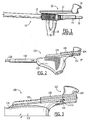
- FIG. 1 shows a conventional HTA system 10, including an insertion sheath 12 extending from a proximal scope insertion end 14, to a distal end (not shown) which is inserted into the uterus via the cervix.
- a cap 16 is removed from the scope insertion end 14 and a hysteroscope (not shown) is inserted through the sheath 12 until a distal end of the scope extends into the uterus for supply and withdraw ablation fluids.
- the HTA system 10 further includes an inflow/outflow tubing 18 and a tenaculum stabilizer arrangement 20 mounted thereon.
- the tenaculum stabilizer arrangement 20 includes a guide member 22 mounted on the sheath 12 adjacent to the inflow/outflow tubing 18 and a stabilizer element 24 slidably mounted on the guide member 22.
- the guide member 22 forms a track on which the stabilizer element 24 slides to allow for adjustments in the position of the stabilizer element 24 relative to a part of the tenaculum against which the stabilizer element 24 is to be locked to prevent the sheath 12 and the hysteroscope from being inadvertently withdrawn from the uterus.
- the stabilizer element 24 is slidable back and forth over guide member 22 to permit adjustment of the stabilizer arrangement 20 to allow for different tenaculum lengths and tensions.
- the track of the guide member 22 is approximately 9.35 cm. long to allow for a total range of motion of the stabilizer element 24 of 3.38 cm.
- the entire range of motion of the stabilizer element 24 is accounted for by the length of the guide member 22.
- the portion of the scope within the sheath 12 is constant, the portion of the scope extending from the proximal scope insertion end 14 of the sheath 12 varies depending on the length of the scope with control handles of shorter scopes remaining closer to the scope insertion end 14 than control handles of longer scopes.
- control handle portions of these scopes are wider than the insertion portions, extending radially outward, in some cases, as far as a radially inner surface of the guide member 22.
- the control handle will be closer to the scope insertion end 14 and, consequently, to the guide member 22. This may result in the rotation of the scope being interfered with or prevented by the portion P of the guide member 22 extending proximally of the scope insertion end 14 of the sheath 12.
- a novel HTA system 100 includes a tenaculum stabilizer arrangement 102 according to the invention.
- the stabilizer arrangement 102 comprises a fin-shaped stabilizer element 104.
- the stabilizer element 104 may be hook shaped or grooved, or may have any other shape that facilitates attachment to a cross bar, finger loop or body of a tenaculum.
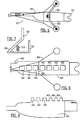
- an alternative stabilizer arrangement 300 not according to the invention includes a pair of arms 304 extending outward from a portion of a sheath 306 extending distally from a proximal end including a scope adapter 307 (described in more detail below) to engage finger loops of a tenaculum.
- Each of the arms 304 is pivotally connected to the sheath 306 at a hinge 308 and biased toward the sheath 306 by a spring 310 so that, after the finger loops of the tenaculum have been passed over ends of the arms 304, the bias of the springs 310 draws the arms 304 into engagement with corresponding braces 312 to lock the tenaculum to the sheath 306.
- Figs. 8 and 9 show a stabilizer arrangement 400 according to a further embodiment of the invention including a plurality of projections 402 spaced from one another and extending along the body of a sheath 404 so that a cross bar 406 of a tenaculum 408 can be slid over a desired one of the projections 402 to lock the tenaculum in any of a plurality of desired positions -- e.g., to achieve a desired tension.
- Fig. 10 shows a stabilizer arrangement 500 including a Velcro strap 502 extending along a portion of the length of a sheath 504 for securing to the sheath a cross bar or other structure of a tenaculum in a desired position relative to the sheath.
- the exemplary tenaculum stabilizer arrangement 102 may be connected to a device to be inserted through the cervix in various ways.
- the stabilizer arrangement 102 may be permanently connected to a sheath handle 110 of the HTA system 100 as an integral component of the HTA system 100 or, alternatively, may be formed as a separate device connected to the sheath handle 110 during preparation for an ablation procedure.
- the tenaculum stabilizer arrangement 102 is mounted on the sheath handle 110 of the HTA system 100 via a stabilizer track 105 attached to the sheath handle 110 with a sheath 108 extending distally from the handle 110.
- a stabilizer element 104 includes an elongated rail 106 sliding along the stabilizer track 105 which is significantly shorter than the guide member 22 of the system 10 shown in Fig. 1 .
- the lengths of the rail 106 and the track 105 are selected to, in combination, provide a desired range of motion necessary to accommodate various models of hysteroscope including any accessories such as light and fiber optic bundles of the scope.
- the distance between the tip of the sheath 120 and the distal end of the stabilizer arrangement 102, or more precisely, a distal end 107 of the stabilizer track 105 is a known constant value short enough to accommodate the shortest scope anticipated.
- the proximal extension of the rail 106 is reduced compared to that of the guide member 22.
- the extension of the rail 106 may be reduced to permit free rotation of the control handle of even shorter scopes which would be interfered with by the guide member 22 of the system 10 of Fig. 1 .
- the stabilizer element 104 can be cantilevered out proximally from the proximal end of the rail 106 so that, when the stabilizer element 104 is not in the proximal-most position, the proximal end of the rail 106 does not extend as far proximally as the guide member 22 of the conventional system.
- the track 105 may alternatively be shortened and coupled to a stabilizer element extending proximally therefrom -- i.e., with the stabilizer element located proximally of the proximal end of the track 105.
- the stabilizer arrangement 102 may include a mechanism ensuring that the stabilizer element 104 is not inadvertently removed from the track 105.
- a positive stop 112 formed as a catch protruding from the rail 106 and abutting one or more corresponding abutting features 114, 116 of the track 105.
- the features 114, 116 may comprise protrusions, detents or other discontinuities in the stabilizer track 105 which engage the positive stop 112 when a desired maximum travel of the stabilizer element 104 in a given direction has been reached.
- the location of the positive stop 112 is preferably selected to accommodate tenaculums of various dimensions and to permit a desired range of tensioning thereof.
- the tenaculum stabilizer arrangement 102 may be manufactured from any of a variety of flexible plastic materials or combinations of such materials.
- the device may be made of ABS, polyethylene or delrin.
- the stabilizer element 104 and/or the stabilizer track 105 may be coated with a low friction material, to ease the sliding movement of the rail 106 on the stabilizer track 105.
- Those of skill in the art will understand that various other plastic and non-plastic materials may be used in the manufacture of the tenaculum stabilizer device according to the invention.
- an HTA system 200 includes a handle 210 coupled to a proximal end of an HTA sheath 212 with a scope adapter 214 telescoping in and out of a proximal end of the handle 210.
- the telescoping scope adapter 214 accommodates scopes of various sizes and designs, as described above by extending proximally as needed to support the control handle of the scope and accommodating closely the diameter of the scope. That is, for longer scopes, a significant portion of the length may extend out of the proximal end of the handle 210 and, if left unsupported, this extending portion of the scope may move about in an undesired manner.
- a user depresses a scope adapter button 216 releasing the adapter 214 from a frame 218 of the handle 210 and slides the adapter 214 until a proximal end of the adapter 214 is separated from the proximal tip of the sheath 212 by a distance selected to enclose a desired portion of the length of the scope.
- the button 216 is then released to pop outward (e.g., under spring bias) into one of a plurality of locking holes 220, preventing the adapter from moving relative to the handle 210.
- the adapter 214 supports the extending portion of the scope (e.g., up to a distal end of the control handle).
- a scope adapter locking ring 222 may then be rotated to cinch an inner lumen of the adapter 214 around the scope to prevent liquid from passing through the handle 210 and out the proximal end thereof.
- the HTA system 200 includes a tenaculum stabilizer arrangement 230 including a stabilizer element 236 slidably mounted on the handle 210 of the HTA system 200 via a stabilizer track 232 attached to the handle 210.
- the stabilizer element 236 includes an elongated rail 234 sliding along the stabilizer track 232 which, similar to that of the device of Figs. 2 and 3 , is significantly shorter than the guide member 22 of the system 10 shown in Fig. 1 .
- the lengths of the rail 234 and the track 232 are selected to, in combination, provide a desired range of motion necessary to accommodate various models of hysteroscope including any accessories such as light and fiber optic bundles of the scope.
- the distance between the tip of the sheath 212 and the distal end of the stabilizer arrangement 230, or more precisely, a distal end 238 of the stabilizer track 232 is a known constant value short enough to accommodate the shortest scope anticipated.
- the stabilizer element 236 and the rail 234 are moved distally from this position, the proximal extension of the rail 234 is reduced compared to that of the guide member 22.
- the extension of the rail 234 may be reduced to permit free rotation of the control handle of even shorter scopes which would be interfered with by the guide member 22 of the system 10 of Fig. 1 .
- the sheath 212 includes, at a distal end thereof, a cervical seal 240 which is formed, for example, as a mesh 242 covered by a sheath of flexible material with a proximal end of the mesh abutting a sleeve 244 which is movable axially within the sheath 212.
- the sleeve 244 of this embodiment is coupled to a seal actuator 246 which, when rotated relative to the sheath 212 in a first direction moves the sleeve distally to axially compress the mesh 242 and, when rotated in the opposite direction, moves the sleeve proximally.
- the mesh 242 When axially compressed (e.g., between the sleeve 244 and the distal end of the sheath 212), the mesh 242 expands radially away from the sheath 212 to form an expanded distal end of the sheath 212 which may be drawn proximally against the cervical os to enhance the seal of the uterus.
- Fig. 11 shows another exemplary embodiment of an HTA system 600 according to the present invention.
- the HTA system 600 includes a tenaculum stabilizer arrangement 230 including a stabilizer element 236 slidably mounted on a handle 210 via a stabilizer track 232.
- the stabilizer element 236 includes an elongated rail 234 sliding along the stabilizer track 232 which, similar to that of the device of Figs. 2 and 3 , is significantly shorter than the guide member 22 of the system 10 shown in Fig. 1 .
- the stabilizer element 236 may be moved along the track 232 by pulling the element 236 proximally allowing a ratcheting surface 270 of the stabilizer element 236 to slide over angled teeth 280 disposed along the track 232.
- distal surfaces of the ratcheting surface 270 and the teeth 280 are preferably both angled substantially parallel to one another extending proximally in a direction away from the track 232 so that the ratcheting surface 270 rides up and over the teeth 280 as the stabilizer element 236 is moved proximally.
- Distal surfaces of the ratcheting surface 270 and the teeth 280 are preferably substantially perpendicular to a longitudinal axis of the track 232 so that distal movement of the stabilizer element 236 over the track 232 is prevented by contact between the ratcheting surface 270 and the teeth 280.
- the stabilizer element 236 may be moved distally over the track 232 by bending the stabilizer element 236 proximally, rotating the ratcheting surface 270 out of engagement with the teeth 280.
- the HTA system 600 also differs from the previously described embodiments in that one or more positive stops (not shown) are located within an internal surface of the rail 234, rather than externally as with the stop 112.
- the internal positive stop prevents the rail 234 from being removed from the track 232 and similarly to the stop 112, forms a catch which abuts a protruding feature (not shown) located at a proximal and/or a distal end of the track 232 such that movement of the stabilizer element 236 is confined to sliding between the proximal and distal ) ends of the track 232.
Landscapes
- Health & Medical Sciences (AREA)
- Surgery (AREA)
- Life Sciences & Earth Sciences (AREA)
- Biomedical Technology (AREA)
- Medical Informatics (AREA)
- Reproductive Health (AREA)
- Pregnancy & Childbirth (AREA)
- Engineering & Computer Science (AREA)
- Gynecology & Obstetrics (AREA)
- Heart & Thoracic Surgery (AREA)
- Nuclear Medicine, Radiotherapy & Molecular Imaging (AREA)
- Molecular Biology (AREA)
- Animal Behavior & Ethology (AREA)
- General Health & Medical Sciences (AREA)
- Public Health (AREA)
- Veterinary Medicine (AREA)
- Surgical Instruments (AREA)
Applications Claiming Priority (2)
| Application Number | Priority Date | Filing Date | Title |
|---|---|---|---|
| US97140907P | 2007-09-11 | 2007-09-11 | |
| PCT/US2008/075871 WO2009036075A1 (en) | 2007-09-11 | 2008-09-10 | Tenaculum stabilizer device |
Publications (2)
| Publication Number | Publication Date |
|---|---|
| EP2187824A1 EP2187824A1 (en) | 2010-05-26 |
| EP2187824B1 true EP2187824B1 (en) | 2014-03-19 |
Family
ID=39916322
Family Applications (1)
| Application Number | Title | Priority Date | Filing Date |
|---|---|---|---|
| EP08830197.3A Not-in-force EP2187824B1 (en) | 2007-09-11 | 2008-09-10 | Tenaculum stabilizer device |
Country Status (4)
| Country | Link |
|---|---|
| US (1) | US8597305B2 (https=) |
| EP (1) | EP2187824B1 (https=) |
| JP (1) | JP5539878B2 (https=) |
| WO (1) | WO2009036075A1 (https=) |
Family Cites Families (18)
| Publication number | Priority date | Publication date | Assignee | Title |
|---|---|---|---|---|
| US2707957A (en) * | 1952-09-30 | 1955-05-10 | Kidde Mfg Co Inc | Tenaculum holder for uterine cannula |
| US3796211A (en) * | 1972-08-07 | 1974-03-12 | Medics Res & Dev Inc | Biopsy sampling method and device for the female genital tract |
| US3777743A (en) * | 1972-09-29 | 1973-12-11 | Kendall & Co | Endometrial sampler |
| US4000743A (en) * | 1975-07-09 | 1977-01-04 | Kenneth Weaver | Uterine anteverter |
| US4702252A (en) * | 1983-10-13 | 1987-10-27 | Smiths Industries Public Limited Company | Catheters |
| US4611888A (en) * | 1983-10-17 | 1986-09-16 | Mp Video, Inc. | Coupler for surgical endoscope and video camera |
| US5368598A (en) * | 1991-04-19 | 1994-11-29 | Hasson; Harrith M. | Method of manipulating an uterus using a bendable manipulator |
| US5195964A (en) * | 1991-12-05 | 1993-03-23 | Research And Education Institute, Inc. | Transcervical catheterization cannula |
| US5431662A (en) * | 1992-02-12 | 1995-07-11 | United States Surgical Corporation | Manipulator apparatus |
| US5441044A (en) * | 1993-08-16 | 1995-08-15 | United States Surgical Corporation | Surgical retractor |
| US5498230A (en) * | 1994-10-03 | 1996-03-12 | Adair; Edwin L. | Sterile connector and video camera cover for sterile endoscope |
| US5935098A (en) * | 1996-12-23 | 1999-08-10 | Conceptus, Inc. | Apparatus and method for accessing and manipulating the uterus |
| US6371973B1 (en) | 1999-08-04 | 2002-04-16 | Ron-Tech Medical Ltd. | Forceps useful for intrabody guiding and/or positioning of a medical instrument |
| US7104996B2 (en) * | 2000-01-14 | 2006-09-12 | Marctec. Llc | Method of performing surgery |
| US6478731B2 (en) * | 2001-02-23 | 2002-11-12 | Linvatec Corporation | Endoscope-sheath interface using scope light post |
| US20040127931A1 (en) | 2002-08-09 | 2004-07-01 | Geoffrey Kincaid | Cervical dilator |
| US6899717B2 (en) * | 2002-09-18 | 2005-05-31 | Allergan, Inc. | Methods and apparatus for delivery of ocular implants |
| US20040097961A1 (en) * | 2002-11-19 | 2004-05-20 | Vascular Control System | Tenaculum for use with occlusion devices |
-
2008
- 2008-09-10 EP EP08830197.3A patent/EP2187824B1/en not_active Not-in-force
- 2008-09-10 WO PCT/US2008/075871 patent/WO2009036075A1/en not_active Ceased
- 2008-09-10 JP JP2010524960A patent/JP5539878B2/ja not_active Expired - Fee Related
- 2008-09-10 US US12/207,931 patent/US8597305B2/en active Active
Also Published As
| Publication number | Publication date |
|---|---|
| WO2009036075A1 (en) | 2009-03-19 |
| US8597305B2 (en) | 2013-12-03 |
| JP5539878B2 (ja) | 2014-07-02 |
| EP2187824A1 (en) | 2010-05-26 |
| US20090112227A1 (en) | 2009-04-30 |
| JP2010538750A (ja) | 2010-12-16 |
Similar Documents
| Publication | Publication Date | Title |
|---|---|---|
| AU2006280308B2 (en) | Drainage catheter with locking hub | |
| JP4136020B2 (ja) | 医療用結紮具 | |
| EP2967613B1 (en) | Medical device handles | |
| JP4097714B2 (ja) | 外科物質アプリケーター及び内視鏡アプリケーター | |
| US20090036840A1 (en) | Atraumatic ball tip and side wall opening | |
| US5522788A (en) | Finger-like laparoscopic blunt dissector device | |
| JPH04226620A (ja) | 外科用トロカール | |
| JP2005287963A (ja) | 内視鏡治療装置 | |
| US20250151987A1 (en) | Endoscope treatment tool and endoscope system | |
| US20250352391A1 (en) | Retractable backflush instrument | |
| EP2244641B1 (en) | Endoscope anchoring device | |
| FI4041128T3 (fi) | Kuljetusjärjestelmiä ja -laitteita eturauhasen hyvänlaatuisen liikakasvun ja siihen liityvien alavirtsatieoireiden hoitoon | |
| EP2187824B1 (en) | Tenaculum stabilizer device | |
| EP3547930B1 (en) | Interface device between surgical instruments or laparoscopes and organs or viscera | |
| CN114129213B (zh) | 一种可变臂长内镜下固定夹及其释放机构 | |
| GB2305609A (en) | Intra-uterine device | |
| US8372029B2 (en) | Fluid feeder, balloon catheter and fluid feeder supporting device | |
| EP4676301A1 (en) | Extendible and retractable endoscopic cap | |
| JP2004041551A (ja) | 内視鏡用ドレナージチューブ留置具 | |
| JP2010538750A5 (https=) | ||
| JP2004041549A (ja) | 内視鏡用ドレナージチューブ留置具 | |
| JPS59222146A (ja) | 高周波切開切除具 |
Legal Events
| Date | Code | Title | Description |
|---|---|---|---|
| PUAI | Public reference made under article 153(3) epc to a published international application that has entered the european phase |
Free format text: ORIGINAL CODE: 0009012 |
|
| 17P | Request for examination filed |
Effective date: 20100311 |
|
| AK | Designated contracting states |
Kind code of ref document: A1 Designated state(s): AT BE BG CH CY CZ DE DK EE ES FI FR GB GR HR HU IE IS IT LI LT LU LV MC MT NL NO PL PT RO SE SI SK TR |
|
| AX | Request for extension of the european patent |
Extension state: AL BA MK RS |
|
| RIN1 | Information on inventor provided before grant (corrected) |
Inventor name: KEANEY, STEPHEN Inventor name: SLANDA, JOZEF Inventor name: MACLEAN, BRIAN Inventor name: OSKIN, CHRISTOPHER Inventor name: ZERFAS, JEFFREY |
|
| 17Q | First examination report despatched |
Effective date: 20101026 |
|
| DAX | Request for extension of the european patent (deleted) | ||
| GRAP | Despatch of communication of intention to grant a patent |
Free format text: ORIGINAL CODE: EPIDOSNIGR1 |
|
| INTG | Intention to grant announced |
Effective date: 20130924 |
|
| GRAS | Grant fee paid |
Free format text: ORIGINAL CODE: EPIDOSNIGR3 |
|
| GRAA | (expected) grant |
Free format text: ORIGINAL CODE: 0009210 |
|
| RAP1 | Party data changed (applicant data changed or rights of an application transferred) |
Owner name: BOSTON SCIENTIFIC SCIMED, INC. |
|
| AK | Designated contracting states |
Kind code of ref document: B1 Designated state(s): AT BE BG CH CY CZ DE DK EE ES FI FR GB GR HR HU IE IS IT LI LT LU LV MC MT NL NO PL PT RO SE SI SK TR |
|
| REG | Reference to a national code |
Ref country code: GB Ref legal event code: FG4D |
|
| REG | Reference to a national code |
Ref country code: CH Ref legal event code: EP |
|
| REG | Reference to a national code |
Ref country code: IE Ref legal event code: FG4D |
|
| REG | Reference to a national code |
Ref country code: AT Ref legal event code: REF Ref document number: 657138 Country of ref document: AT Kind code of ref document: T Effective date: 20140415 |
|
| REG | Reference to a national code |
Ref country code: DE Ref legal event code: R096 Ref document number: 602008031003 Country of ref document: DE Effective date: 20140430 |
|
| REG | Reference to a national code |
Ref country code: DE Ref legal event code: R082 Ref document number: 602008031003 Country of ref document: DE Representative=s name: PFENNING MEINIG & PARTNER GBR, DE Ref country code: DE Ref legal event code: R082 Ref document number: 602008031003 Country of ref document: DE Representative=s name: PFENNING, MEINIG & PARTNER MBB PATENTANWAELTE, DE |
|
| PG25 | Lapsed in a contracting state [announced via postgrant information from national office to epo] |
Ref country code: NO Free format text: LAPSE BECAUSE OF FAILURE TO SUBMIT A TRANSLATION OF THE DESCRIPTION OR TO PAY THE FEE WITHIN THE PRESCRIBED TIME-LIMIT Effective date: 20140619 Ref country code: LT Free format text: LAPSE BECAUSE OF FAILURE TO SUBMIT A TRANSLATION OF THE DESCRIPTION OR TO PAY THE FEE WITHIN THE PRESCRIBED TIME-LIMIT Effective date: 20140319 |
|
| REG | Reference to a national code |
Ref country code: NL Ref legal event code: VDEP Effective date: 20140319 |
|
| REG | Reference to a national code |
Ref country code: AT Ref legal event code: MK05 Ref document number: 657138 Country of ref document: AT Kind code of ref document: T Effective date: 20140319 |
|
| REG | Reference to a national code |
Ref country code: LT Ref legal event code: MG4D |
|
| PG25 | Lapsed in a contracting state [announced via postgrant information from national office to epo] |
Ref country code: FI Free format text: LAPSE BECAUSE OF FAILURE TO SUBMIT A TRANSLATION OF THE DESCRIPTION OR TO PAY THE FEE WITHIN THE PRESCRIBED TIME-LIMIT Effective date: 20140319 Ref country code: CY Free format text: LAPSE BECAUSE OF FAILURE TO SUBMIT A TRANSLATION OF THE DESCRIPTION OR TO PAY THE FEE WITHIN THE PRESCRIBED TIME-LIMIT Effective date: 20140319 Ref country code: SE Free format text: LAPSE BECAUSE OF FAILURE TO SUBMIT A TRANSLATION OF THE DESCRIPTION OR TO PAY THE FEE WITHIN THE PRESCRIBED TIME-LIMIT Effective date: 20140319 |
|
| PG25 | Lapsed in a contracting state [announced via postgrant information from national office to epo] |
Ref country code: LV Free format text: LAPSE BECAUSE OF FAILURE TO SUBMIT A TRANSLATION OF THE DESCRIPTION OR TO PAY THE FEE WITHIN THE PRESCRIBED TIME-LIMIT Effective date: 20140319 Ref country code: HR Free format text: LAPSE BECAUSE OF FAILURE TO SUBMIT A TRANSLATION OF THE DESCRIPTION OR TO PAY THE FEE WITHIN THE PRESCRIBED TIME-LIMIT Effective date: 20140319 |
|
| PG25 | Lapsed in a contracting state [announced via postgrant information from national office to epo] |
Ref country code: BG Free format text: LAPSE BECAUSE OF FAILURE TO SUBMIT A TRANSLATION OF THE DESCRIPTION OR TO PAY THE FEE WITHIN THE PRESCRIBED TIME-LIMIT Effective date: 20140619 Ref country code: RO Free format text: LAPSE BECAUSE OF FAILURE TO SUBMIT A TRANSLATION OF THE DESCRIPTION OR TO PAY THE FEE WITHIN THE PRESCRIBED TIME-LIMIT Effective date: 20140319 Ref country code: BE Free format text: LAPSE BECAUSE OF FAILURE TO SUBMIT A TRANSLATION OF THE DESCRIPTION OR TO PAY THE FEE WITHIN THE PRESCRIBED TIME-LIMIT Effective date: 20140319 Ref country code: NL Free format text: LAPSE BECAUSE OF FAILURE TO SUBMIT A TRANSLATION OF THE DESCRIPTION OR TO PAY THE FEE WITHIN THE PRESCRIBED TIME-LIMIT Effective date: 20140319 Ref country code: IS Free format text: LAPSE BECAUSE OF FAILURE TO SUBMIT A TRANSLATION OF THE DESCRIPTION OR TO PAY THE FEE WITHIN THE PRESCRIBED TIME-LIMIT Effective date: 20140719 Ref country code: EE Free format text: LAPSE BECAUSE OF FAILURE TO SUBMIT A TRANSLATION OF THE DESCRIPTION OR TO PAY THE FEE WITHIN THE PRESCRIBED TIME-LIMIT Effective date: 20140319 Ref country code: CZ Free format text: LAPSE BECAUSE OF FAILURE TO SUBMIT A TRANSLATION OF THE DESCRIPTION OR TO PAY THE FEE WITHIN THE PRESCRIBED TIME-LIMIT Effective date: 20140319 |
|
| PG25 | Lapsed in a contracting state [announced via postgrant information from national office to epo] |
Ref country code: SK Free format text: LAPSE BECAUSE OF FAILURE TO SUBMIT A TRANSLATION OF THE DESCRIPTION OR TO PAY THE FEE WITHIN THE PRESCRIBED TIME-LIMIT Effective date: 20140319 Ref country code: AT Free format text: LAPSE BECAUSE OF FAILURE TO SUBMIT A TRANSLATION OF THE DESCRIPTION OR TO PAY THE FEE WITHIN THE PRESCRIBED TIME-LIMIT Effective date: 20140319 Ref country code: PL Free format text: LAPSE BECAUSE OF FAILURE TO SUBMIT A TRANSLATION OF THE DESCRIPTION OR TO PAY THE FEE WITHIN THE PRESCRIBED TIME-LIMIT Effective date: 20140319 Ref country code: ES Free format text: LAPSE BECAUSE OF FAILURE TO SUBMIT A TRANSLATION OF THE DESCRIPTION OR TO PAY THE FEE WITHIN THE PRESCRIBED TIME-LIMIT Effective date: 20140319 |
|
| REG | Reference to a national code |
Ref country code: DE Ref legal event code: R097 Ref document number: 602008031003 Country of ref document: DE |
|
| PG25 | Lapsed in a contracting state [announced via postgrant information from national office to epo] |
Ref country code: PT Free format text: LAPSE BECAUSE OF FAILURE TO SUBMIT A TRANSLATION OF THE DESCRIPTION OR TO PAY THE FEE WITHIN THE PRESCRIBED TIME-LIMIT Effective date: 20140721 |
|
| PLBE | No opposition filed within time limit |
Free format text: ORIGINAL CODE: 0009261 |
|
| STAA | Information on the status of an ep patent application or granted ep patent |
Free format text: STATUS: NO OPPOSITION FILED WITHIN TIME LIMIT |
|
| PG25 | Lapsed in a contracting state [announced via postgrant information from national office to epo] |
Ref country code: DK Free format text: LAPSE BECAUSE OF FAILURE TO SUBMIT A TRANSLATION OF THE DESCRIPTION OR TO PAY THE FEE WITHIN THE PRESCRIBED TIME-LIMIT Effective date: 20140319 |
|
| 26N | No opposition filed |
Effective date: 20141222 |
|
| REG | Reference to a national code |
Ref country code: DE Ref legal event code: R097 Ref document number: 602008031003 Country of ref document: DE Effective date: 20141222 |
|
| PG25 | Lapsed in a contracting state [announced via postgrant information from national office to epo] |
Ref country code: LU Free format text: LAPSE BECAUSE OF FAILURE TO SUBMIT A TRANSLATION OF THE DESCRIPTION OR TO PAY THE FEE WITHIN THE PRESCRIBED TIME-LIMIT Effective date: 20140910 Ref country code: MC Free format text: LAPSE BECAUSE OF FAILURE TO SUBMIT A TRANSLATION OF THE DESCRIPTION OR TO PAY THE FEE WITHIN THE PRESCRIBED TIME-LIMIT Effective date: 20140319 |
|
| REG | Reference to a national code |
Ref country code: CH Ref legal event code: PL |
|
| PG25 | Lapsed in a contracting state [announced via postgrant information from national office to epo] |
Ref country code: SI Free format text: LAPSE BECAUSE OF FAILURE TO SUBMIT A TRANSLATION OF THE DESCRIPTION OR TO PAY THE FEE WITHIN THE PRESCRIBED TIME-LIMIT Effective date: 20140319 Ref country code: LI Free format text: LAPSE BECAUSE OF NON-PAYMENT OF DUE FEES Effective date: 20140930 Ref country code: CH Free format text: LAPSE BECAUSE OF NON-PAYMENT OF DUE FEES Effective date: 20140930 |
|
| PG25 | Lapsed in a contracting state [announced via postgrant information from national office to epo] |
Ref country code: GR Free format text: LAPSE BECAUSE OF FAILURE TO SUBMIT A TRANSLATION OF THE DESCRIPTION OR TO PAY THE FEE WITHIN THE PRESCRIBED TIME-LIMIT Effective date: 20140620 Ref country code: MT Free format text: LAPSE BECAUSE OF FAILURE TO SUBMIT A TRANSLATION OF THE DESCRIPTION OR TO PAY THE FEE WITHIN THE PRESCRIBED TIME-LIMIT Effective date: 20140319 |
|
| PG25 | Lapsed in a contracting state [announced via postgrant information from national office to epo] |
Ref country code: HU Free format text: LAPSE BECAUSE OF FAILURE TO SUBMIT A TRANSLATION OF THE DESCRIPTION OR TO PAY THE FEE WITHIN THE PRESCRIBED TIME-LIMIT; INVALID AB INITIO Effective date: 20080910 Ref country code: TR Free format text: LAPSE BECAUSE OF FAILURE TO SUBMIT A TRANSLATION OF THE DESCRIPTION OR TO PAY THE FEE WITHIN THE PRESCRIBED TIME-LIMIT Effective date: 20140319 |
|
| REG | Reference to a national code |
Ref country code: FR Ref legal event code: PLFP Year of fee payment: 9 |
|
| REG | Reference to a national code |
Ref country code: FR Ref legal event code: PLFP Year of fee payment: 10 |
|
| PGFP | Annual fee paid to national office [announced via postgrant information from national office to epo] |
Ref country code: IE Payment date: 20170912 Year of fee payment: 10 |
|
| REG | Reference to a national code |
Ref country code: FR Ref legal event code: PLFP Year of fee payment: 11 |
|
| PGFP | Annual fee paid to national office [announced via postgrant information from national office to epo] |
Ref country code: IT Payment date: 20180919 Year of fee payment: 11 Ref country code: FR Payment date: 20180813 Year of fee payment: 11 |
|
| REG | Reference to a national code |
Ref country code: DE Ref legal event code: R119 Ref document number: 602008031003 Country of ref document: DE |
|
| GBPC | Gb: european patent ceased through non-payment of renewal fee |
Effective date: 20180910 |
|
| REG | Reference to a national code |
Ref country code: IE Ref legal event code: MM4A |
|
| PG25 | Lapsed in a contracting state [announced via postgrant information from national office to epo] |
Ref country code: IE Free format text: LAPSE BECAUSE OF NON-PAYMENT OF DUE FEES Effective date: 20180910 Ref country code: DE Free format text: LAPSE BECAUSE OF NON-PAYMENT OF DUE FEES Effective date: 20190402 |
|
| PG25 | Lapsed in a contracting state [announced via postgrant information from national office to epo] |
Ref country code: GB Free format text: LAPSE BECAUSE OF NON-PAYMENT OF DUE FEES Effective date: 20180910 |
|
| PG25 | Lapsed in a contracting state [announced via postgrant information from national office to epo] |
Ref country code: IT Free format text: LAPSE BECAUSE OF NON-PAYMENT OF DUE FEES Effective date: 20190910 |
|
| PG25 | Lapsed in a contracting state [announced via postgrant information from national office to epo] |
Ref country code: FR Free format text: LAPSE BECAUSE OF NON-PAYMENT OF DUE FEES Effective date: 20190930 |