EP2186410B1 - Isoxazoline derivative and herbicide comprising the same as active ingredient - Google Patents
Isoxazoline derivative and herbicide comprising the same as active ingredient Download PDFInfo
- Publication number
- EP2186410B1 EP2186410B1 EP10000323.5A EP10000323A EP2186410B1 EP 2186410 B1 EP2186410 B1 EP 2186410B1 EP 10000323 A EP10000323 A EP 10000323A EP 2186410 B1 EP2186410 B1 EP 2186410B1
- Authority
- EP
- European Patent Office
- Prior art keywords
- group
- groups
- substituted
- ome
- substituent
- Prior art date
- Legal status (The legal status is an assumption and is not a legal conclusion. Google has not performed a legal analysis and makes no representation as to the accuracy of the status listed.)
- Expired - Lifetime
Links
Classifications
-
- C—CHEMISTRY; METALLURGY
- C07—ORGANIC CHEMISTRY
- C07D—HETEROCYCLIC COMPOUNDS
- C07D261/00—Heterocyclic compounds containing 1,2-oxazole or hydrogenated 1,2-oxazole rings
- C07D261/02—Heterocyclic compounds containing 1,2-oxazole or hydrogenated 1,2-oxazole rings not condensed with other rings
- C07D261/06—Heterocyclic compounds containing 1,2-oxazole or hydrogenated 1,2-oxazole rings not condensed with other rings having two or more double bonds between ring members or between ring members and non-ring members
- C07D261/10—Heterocyclic compounds containing 1,2-oxazole or hydrogenated 1,2-oxazole rings not condensed with other rings having two or more double bonds between ring members or between ring members and non-ring members with hetero atoms or with carbon atoms having three bonds to hetero atoms with at the most one bond to halogen, e.g. ester or nitrile radicals, directly attached to ring carbon atoms
-
- A—HUMAN NECESSITIES
- A01—AGRICULTURE; FORESTRY; ANIMAL HUSBANDRY; HUNTING; TRAPPING; FISHING
- A01N—PRESERVATION OF BODIES OF HUMANS OR ANIMALS OR PLANTS OR PARTS THEREOF; BIOCIDES, e.g. AS DISINFECTANTS, AS PESTICIDES OR AS HERBICIDES; PEST REPELLANTS OR ATTRACTANTS; PLANT GROWTH REGULATORS
- A01N43/00—Biocides, pest repellants or attractants, or plant growth regulators containing heterocyclic compounds
- A01N43/72—Biocides, pest repellants or attractants, or plant growth regulators containing heterocyclic compounds having rings with nitrogen atoms and oxygen or sulfur atoms as ring hetero atoms
- A01N43/80—Biocides, pest repellants or attractants, or plant growth regulators containing heterocyclic compounds having rings with nitrogen atoms and oxygen or sulfur atoms as ring hetero atoms five-membered rings with one nitrogen atom and either one oxygen atom or one sulfur atom in positions 1,2
-
- A—HUMAN NECESSITIES
- A01—AGRICULTURE; FORESTRY; ANIMAL HUSBANDRY; HUNTING; TRAPPING; FISHING
- A01N—PRESERVATION OF BODIES OF HUMANS OR ANIMALS OR PLANTS OR PARTS THEREOF; BIOCIDES, e.g. AS DISINFECTANTS, AS PESTICIDES OR AS HERBICIDES; PEST REPELLANTS OR ATTRACTANTS; PLANT GROWTH REGULATORS
- A01N43/00—Biocides, pest repellants or attractants, or plant growth regulators containing heterocyclic compounds
- A01N43/90—Biocides, pest repellants or attractants, or plant growth regulators containing heterocyclic compounds having two or more relevant hetero rings, condensed among themselves or with a common carbocyclic ring system
-
- A—HUMAN NECESSITIES
- A01—AGRICULTURE; FORESTRY; ANIMAL HUSBANDRY; HUNTING; TRAPPING; FISHING
- A01N—PRESERVATION OF BODIES OF HUMANS OR ANIMALS OR PLANTS OR PARTS THEREOF; BIOCIDES, e.g. AS DISINFECTANTS, AS PESTICIDES OR AS HERBICIDES; PEST REPELLANTS OR ATTRACTANTS; PLANT GROWTH REGULATORS
- A01N47/00—Biocides, pest repellants or attractants, or plant growth regulators containing organic compounds containing a carbon atom not being member of a ring and having no bond to a carbon or hydrogen atom, e.g. derivatives of carbonic acid
- A01N47/08—Biocides, pest repellants or attractants, or plant growth regulators containing organic compounds containing a carbon atom not being member of a ring and having no bond to a carbon or hydrogen atom, e.g. derivatives of carbonic acid the carbon atom having one or more single bonds to nitrogen atoms
- A01N47/28—Ureas or thioureas containing the groups >N—CO—N< or >N—CS—N<
- A01N47/38—Ureas or thioureas containing the groups >N—CO—N< or >N—CS—N< containing the group >N—CO—N< where at least one nitrogen atom is part of a heterocyclic ring; Thio analogues thereof
-
- C—CHEMISTRY; METALLURGY
- C07—ORGANIC CHEMISTRY
- C07D—HETEROCYCLIC COMPOUNDS
- C07D261/00—Heterocyclic compounds containing 1,2-oxazole or hydrogenated 1,2-oxazole rings
- C07D261/02—Heterocyclic compounds containing 1,2-oxazole or hydrogenated 1,2-oxazole rings not condensed with other rings
- C07D261/04—Heterocyclic compounds containing 1,2-oxazole or hydrogenated 1,2-oxazole rings not condensed with other rings having one double bond between ring members or between a ring member and a non-ring member
-
- C—CHEMISTRY; METALLURGY
- C07—ORGANIC CHEMISTRY
- C07D—HETEROCYCLIC COMPOUNDS
- C07D261/00—Heterocyclic compounds containing 1,2-oxazole or hydrogenated 1,2-oxazole rings
- C07D261/02—Heterocyclic compounds containing 1,2-oxazole or hydrogenated 1,2-oxazole rings not condensed with other rings
- C07D261/06—Heterocyclic compounds containing 1,2-oxazole or hydrogenated 1,2-oxazole rings not condensed with other rings having two or more double bonds between ring members or between ring members and non-ring members
- C07D261/08—Heterocyclic compounds containing 1,2-oxazole or hydrogenated 1,2-oxazole rings not condensed with other rings having two or more double bonds between ring members or between ring members and non-ring members with only hydrogen atoms, hydrocarbon or substituted hydrocarbon radicals, directly attached to ring carbon atoms
-
- C—CHEMISTRY; METALLURGY
- C07—ORGANIC CHEMISTRY
- C07D—HETEROCYCLIC COMPOUNDS
- C07D261/00—Heterocyclic compounds containing 1,2-oxazole or hydrogenated 1,2-oxazole rings
- C07D261/20—Heterocyclic compounds containing 1,2-oxazole or hydrogenated 1,2-oxazole rings condensed with carbocyclic rings or ring systems
-
- C—CHEMISTRY; METALLURGY
- C07—ORGANIC CHEMISTRY
- C07D—HETEROCYCLIC COMPOUNDS
- C07D413/00—Heterocyclic compounds containing two or more hetero rings, at least one ring having nitrogen and oxygen atoms as the only ring hetero atoms
- C07D413/02—Heterocyclic compounds containing two or more hetero rings, at least one ring having nitrogen and oxygen atoms as the only ring hetero atoms containing two hetero rings
- C07D413/12—Heterocyclic compounds containing two or more hetero rings, at least one ring having nitrogen and oxygen atoms as the only ring hetero atoms containing two hetero rings linked by a chain containing hetero atoms as chain links
-
- C—CHEMISTRY; METALLURGY
- C07—ORGANIC CHEMISTRY
- C07D—HETEROCYCLIC COMPOUNDS
- C07D413/00—Heterocyclic compounds containing two or more hetero rings, at least one ring having nitrogen and oxygen atoms as the only ring hetero atoms
- C07D413/14—Heterocyclic compounds containing two or more hetero rings, at least one ring having nitrogen and oxygen atoms as the only ring hetero atoms containing three or more hetero rings
-
- C—CHEMISTRY; METALLURGY
- C07—ORGANIC CHEMISTRY
- C07D—HETEROCYCLIC COMPOUNDS
- C07D417/00—Heterocyclic compounds containing two or more hetero rings, at least one ring having nitrogen and sulfur atoms as the only ring hetero atoms, not provided for by group C07D415/00
- C07D417/02—Heterocyclic compounds containing two or more hetero rings, at least one ring having nitrogen and sulfur atoms as the only ring hetero atoms, not provided for by group C07D415/00 containing two hetero rings
- C07D417/12—Heterocyclic compounds containing two or more hetero rings, at least one ring having nitrogen and sulfur atoms as the only ring hetero atoms, not provided for by group C07D415/00 containing two hetero rings linked by a chain containing hetero atoms as chain links
Definitions
- the present invention relates to a novel isoxazoline derivative and a herbicide containing the isoxazoline derivative as the active ingredient.
- Herbicides applied to useful crops are desired to (a) be applicable to soil or foliage, (b) show a sufficient herbicidal effect at a low ingredient amount, and (c) show a high selectivity between crop and weed.
- the compounds described in the above literatures are not fully satisfactory.
- the present inventors made a study on the herbicidal effect and selectivity between crop and weed of various compounds. As a result, the present inventors found out that a novel isoxazoline derivative has an excellent herbicidal effect and an excellent selectivity between crop and weed. The above finding has led to the completion of the present invention.
- the present invention provides the followings.
- Hydroxyl group C3 to C8 cycloalkyl groups (which may be substituted with halogen atom or alkyl group); C1 to C10 alkoxy groups; C1 to C10 alkylthio groups; C1 to C10 alkylsulfonyl groups; C1 to C10 alkoxycarbonyl groups; C2 to C6 haloalkenyl groups; amino group (its nitrogen atom may be substituted with same or different groups selected from C1 to C10 alkyl groups, C1 to C6 acyl groups; C1 to C4 haloalkylcarbonyl groups, C1 to C10 alkylsulfonyl groups and C1 to C4 haloalkylsulfonyl groups); carbamoyl group (its nitrogen atom may be substituted with same or different C1 to C10 alkyl groups); C1 to C6 acyl groups; C1 to C4 haloalkylcarbonyl groups; C1 to C10 alkoxyimino
- C1 to C10 alkoxycarbonyl groups phenyl group which may be substituted with group(s) selected from the substituent group ⁇ ; aromatic heterocyclic groups which may be substituted with group(s) selected from the substituent group ⁇ ; cyano group; and carbamoyl group (its nitrogen atom may be substituted with same or different C1 to C10 alkyl groups).
- Halogen atom C1 to C10 alkyl groups, C1 to C4 haloalkyl groups, C1 to C10 alkoxyalkyl groups, C1 to C10 alkoxy groups, C1 to C10 alkylthio groups, C1 to C10 alkylsulfonyl groups, C1 to C10 alkoxycarbonyl groups, cyano group, carbamoyl group (its nitrogen atom may be substituted with same or different C1 to C10 alkyl groups), nitro group or amino group(its nitrogen atom may be substituted with same or different groups selected from C1 to C10 alkyl groups, C1 to C6 acyl groups, C1 to C4 haloalkylcarbonyl groups, C1 to C10 alkylsulfonyl groups and C1 to C4 haloalkylsulfonyl groups).
- Halogen atom refers to a fluorine atom, a chlorine atom, a bromine atom or an iodine atom.
- C1 to C10 alkyl group refers to a straight or branched chain alkyl group of 1 to 10 carbon atoms unless other wise specified; and there can be mentioned, for example, methyl group, ethyl group, n-propyl group, isopropyl group, n-butyl group, isobutyl group, sec-butyl group, tert-butyl group, n-pentyl group, isopentyl group, neopentyl group, n-hexyl group, isohexyl group, 3,3-dimethylbutyl group, heptyl group and octyl group.
- C3 to C8 cycloalkyl group refers to a cycloalkyl group of 3 to 8 carbon atoms; and there can be mentioned, for example, cyclopropyl group, cyclobutyl group, cyclopentyl group and cyclohexyl group.
- C3 to C8 cycloalkyl C1 to C3 alkyl group (which may be substituted with halogen atom or alkyl group) refers, unless otherwise specified, to a C1 to C3 alkyl group substituted with a C3 to C8 cycloalkyl group which may be substituted with 1 to 4 same or different halogen atoms or C1 to C3 alkyl group; and there can be mentioned, for example, cyclopropylmethyl group, 1-cyclopropylethyl group, 2-cyclopropylethyl group, 1-cyclopropylpropyl group, 2-cyclopropylpropyl group, 3-cyclopropylpropyl group, cyclobutylmethyl group, cyclopentylmethyl group, cyclohexylmethyl group, 2-chlorocyclopropylmethyl group, 2,2-dichlorocyclopropylmethyl group, 2-fluorocyclopropylmethyl group, 2,2-difluorocyclopropy
- C3 to C8 cycloalkyl C1 to C3 alkyl group refers to a alkyl group of 1 to 3 carbon atoms, substituted with a cycloalkyl group of 3 to 8 carbon atoms; and there can be mentioned, for example, cyclopropylmethyl group, 1-cyclopropylethyl group, 2-cyclopropylethyl group, 1-cyclopropylpropyl group, 2-cyclopropylpropyl group, 3-cyclopropylpropyl group, cyclobutylmethyl group, cyclopentylmethyl group and cyclohexylmethyl group.
- C1 to C4 haloalkyl group refers, unless otherwise specified, to a straight or branched chain alkyl group of 1 to 4 carbon atoms, substituted with 1 to 9 same or different halogen atoms; and there can be mentioned, for example, fluoromethyl group, chloromethyl group, bromomethyl group, difluoromethyl group, trifluoromethyl group, 2,2-difluoroethyl group, 2,2,2-trifluoroethyl group and pentafluoroethyl group.
- C2 to C6 alkenyl group refers to a straight or branched chain alkenyl group of 2 to 6 carbon atoms; and there can be mentioned, for example, ethenyl group, 1-propenyl group, 2-propenyl group, isopropenyl group, 1-butenyl group, 2-butenyl group, 3-butenyl group and 2-pentenyl group.
- C2 to C6 alkynyl group refers to a straight or branched chain alkynyl group of 2 to 6 carbon atoms; and there can be mentioned, for example, ethynyl group, 2-propynyl group, 1-methyl-2-propynyl group, 2-butynyl group, 3-butynyl group and 2-methyl-3-butynyl group.
- C2 to C6 haloalkenyl group refers, unless otherwise specified, to a straight or branched alkenyl group of 2 to 6 carbon atoms, substituted with 1 to 4 same or different halogen atoms; and there can be mentioned, for example, 3-chloro-2-propenyl group and 2-chloro-2-propneyl group.
- C1 to C10 alkoxy group refers to an (alkyl)-O- group wherein the alkyl moiety has the above definition; and there can be mentioned, for example, methoxy group, ethoxy group, n-propoxy group, isopropoxy group, tert-butoxy group, n-butoxy group, sec-butoxy group and isobutoxy group.
- C1 to C4 haloalkoxy group refers to a (haloalkyl)-O-group wherein the haloalkyl moiety has the above definition; and there can be mentioned, for example, difluoromethoxy group, trifluoromethoxy group, 2,2-difluoroethoxy group and 2,2,2-trifluoroethoxy group.
- C3 to C8 cycloalkyloxy group refers to a (cycloalkyl)-O- group wherein the cycloalkyl moiety has the above definition; and there can be mentioned, for example, cyclopropyloxy group, cyclobutyloxy group, cyclopentyloxy group and cyclohexyloxy group.
- C3 to C8 cycloalkyl C1 to C3 alkyloxy group refers to a (cycloalkylalkyl)-O- group wherein the cycloalkylalkyl moiety has the above definition; and there can be mentioned, for example, cyclopropylmethoxy group, 1-cyclopropylethoxy group, 2-cyclopropylethoxy group, 1-cyclopropylpropoxy group, 2-chclopropylpropoxy group, 3-cyclopropylpropoxy group, cyclobutylmethoxy group, cyclopentylmethoxy group and cyclohexylmethoxy group.
- C2 to C6 alkenyloxy group and C2 to C6 alkynyloxy group refer, respectively, to an (alkenyl)-O- group and an (alkynyl)-O- group, in each of which the alkenyl or alkynyl moiety has the above definition; and there can be mentioned, for example, 2-propenyloxy group and 2-propynyloxy group.
- C1 to C10 alkylthio group, C1 to C10 alkylsulfinyl group and C1 to C10 alkylsulfonyl group refer, respectively, to an (alkyl)-S- group, an (alkyl)-SO- group and an (alkyl)-SO 2 - group, in each of which the alkyl moiety has the above definition; and there can be mentioned, for example, methylthio group, ethylthio group, n-propylthio group, isopropylthio group, methylsulfinyl group, methylsulfonyl group, ethylsulfonyl group, n-propylsulfonyl group and isopropylsulfonyl group.
- C1 to C10 alkylsulfonyloxy group refers to an (alkylsulfonyl)-0- group wherein the alkylsulfonyl moiety has the above definition, and there can be mentioned, for example, methylsulfonyloxy group and ethylsulfonyloxy group.
- C1 to C10 alkoxycarbonyl group refers to an (alkoxy)-CO- group wherein the alkoxy moiety has the above definition, and there can be mentioned, for example, methoxycarbonyl group, ethoxycarbonyl group, n-propoxycarbonyl group and isopropoxycarbonyl group.
- C1 to C6 acyl group refers to a straight or branched chain aliphatic acyl group of 1 to 6 carbon atoms, and there can be mentioned, for example, formyl group, acetyl group, propionyl group, isopropionyl group, butyryl group and pivaloyl group.
- C1 to C10 acyloxy group refers to an (acyl)-O- group wherein the acyl moiety has the above definition; and there can be mentioned, for example, acetoxy gorup, propionyloxy group, ispropionyloxy group and pivalolyoxy group.
- C1 to C4 haloalkylcarbonyl group, C1 to C4 haloalkylthio group and C1 to C4 haloalkylsulfonyl group refers, respectively, to a (haloalkyl)-CO- group, a (haloalkyl)-S-group and a (haloalkyl)-SO 2 - group, in each of which the haloalkyl moiety has the above definition; and there can be mentioned, for example, chloroacetyl group, trifluoroacetyl group, pentafluoropropyl group, difluoromethylthio group, trifluoromethylthio group, chloromethylsulfonyl group, di-fluoromethylsulfonyl group and trifluoromethylsulfonyl group.
- C1 to C4 haloalkylcarbonyloxy group and C1 to C4 haloalkylsulfonyloxy group refer, respectively, to a (haloalkylcarbonyl)-O- group and a (haloalkylsulfonyl)-O-group, in each of which the haloalkylcarbonyl moiety or the haloalkylsulfonyl moiety has the above definition; and there can be mentioned, for example, chloroacetyloxy group, trifluoroacetyloxy group, chloromethylsulfonyloxy group and trifluoromehtylsulfonyloxy group.
- 5- to 6-membered aromatic heterocyclic group having a hetero atom selected from a nitrogen atom, an oxygen atom and a sulfur atom includes, for example, furyl group, thienyl group, pyrrolyl group, pyrazolyl group, isoxazolyl group, isothiazolyl group, oxazolyl group, thiazolyl group, imidazolyl group, pyridyl group, pyridazinyl group, pyrimidinyl group, pyrazinyl group, triazinyl group, triazolyl group, oxadiazolyl group and thiadiazolyl group, each having 1 to 3 hetero atoms.
- Fused aromatic heterocyclic group refers to a group having 1 to 3 hetero atoms randomly selected from nitrogen atom, oxygen atom and sulfur atom; and there can be mentioned, for example, benzofuryl group, benzothienyl group, indolyl group, benzoxazolyl group, benzothiazolyl group, benzimidazolyl group, benzisoxazolyl group, benzisothiazolyl group, indazolyl group, quinolyl group, isoquinolyl group, phthalazinyl group, quinoxalinyl group, quinazolinyl group, cinnolinyl group and benzotriazolyl group.
- Aromatic heterocycle in (optionally substituted) aromatic heterocyclic group, (optionally substituted) aromatic heterocyclic oxy group, (optionally substituted) aromatic heterocyclic thio group and (optionally substituted) aromatic heterocyclic sulfonyl group refers to a 5- to 6-membered group having 1 to 3 hetero atoms randomly selected from nitrogen atom, oxygen atom and sulfur atom; and there can be mentioned, for example, furyl group, thienyl group, pyrrolyl group, pyrazolyl group, isoxazolyl group, isothiazolyl group, oxazolyl group, thiazolyl group, imidazolyl group, pyridyl group, pyridazinyl group, pyrimidinyl group, pyrazinyl group, triazinyl group, triazolyl group, oxadiazolyl group and thiadiazolyl group.
- Pharmaceutically acceptable salt is a salt of a compound of the general formula [I] having, in the structure, hydroxyl group, carboxyl group, amino group or the like, with a metal or an organic base or with a mineral acid or an organic acid.
- a metal there can be mentioned alkali metals such as sodium, potassium and the like; and alkaline earth metals such as magnesium, calcium and the like.
- the organic base there can be mentioned triethylamine, diisopropylamine, etc.
- mineral acids there can be mentioned hydrochloric acid, sulfuric acid, etc.
- As the organic acid there can be mentioned acetic acid, methanesulfonic acid, p-toluenesulfonic acid, etc.
- R 1 and R 2 may be the same or different and are each a methyl group or an ethyl group; R 3 , R 4 , R 5 and R 6 are each a hydrogen atom; n is an integer of 2; and Y is a pyrimidin-5-yl group [the 4- and 6-positions of the group are substituted with same or different groups selected from halogen atoms, alkyl groups, haloalkyl groups, alkoxyalkyl groups, cycloalkyl groups, alkoxy groups, haloalkoxy groups, alkylthio groups, alkylsulfonyl groups, acyl groups, haloalkylcarbonyl groups, alkoxycarbonyl groups, cyano group and carbamoyl group (its nitrogen atom may be substituted with same or different alkyl groups)].
- (4-Cl)Ph indicates 4-chlorophenyl group
- 3-Hex indicates 3-hexyl group
- R 1 , R 2 , R 3 , R 4 , R 5 , R 6 and Y have the same definitions as given above;
- X 1 is a halogen atom;
- R 7 is a C1 to C4 alkyl group, an optionally substituted phenyl group or an optionally substituted benzyl group;
- L is a leaving group such as halogen atom, C1 to C4 alkylsulfonyl group, optionally substituted phenylsulfonyl group, optionally substituted benzylsulfonyl group or the like; and
- x is an integer of 1 or more.
- a sulfide derivative represented by the general formula [5] can be produced by reacting a compound represented by the general formula [1] with a sodium hydrosulfide hydrate represented by the general formula [2] in the presence or absence of a solvent (preferably in an appropriate solvent) in the presence of a salt to produce a base of a mercaptan, represented by the general formula [3] in the reaction system, and then, without isolating the salt of a mercaptan [3], reacting the salt [3] with a halogen derivative represented by the general formula [4] [in this case, a radical-generating agent, for example, Rongalit (trade name): CH 2 (OH)SO 2 Na ⁇ 2H 2 O may be added].
- a radical-generating agent for example, Rongalit (trade name): CH 2 (OH)SO 2 Na ⁇ 2H 2 O may be added.
- the reaction temperature in each reaction is any temperature between 0°C and the reflux temperature of each reaction system and is preferably 10 to 100°C.
- the reaction time varies depending upon the compounds used, but is 0.5 to 24 hours.
- each of the compound represented by the general formula [2] and the compound represented by the general formula [4] is used in an amount of 1 to 3 equivalents relative to one equivalent of the compound represented by the general formula [1] and, when a base is used, the base is used in an amount of 0.5 to 3 equivalents.
- ethers such as dioxane, tetrahydrofuran (THF) and the like
- halogenated hydrocarbons such as dichloroethane, carbon tetrachloride, chlorobenzene, dichlorobenzene and the like
- amides such as N,N-dimethylacetamide, N,N-dimethylformamide, N-methyl-2-pyrrolidinone and the like
- sulfur compounds such as dimethyl sulfoxide, sulfolane and the like
- aromatic hydrocarbons such as benzene, toluene, xylene and the like
- alcohols such as methanol, ethanol, propanol, isopropanol, butanol, tert-butanol and the like
- ketones such as acetone, 2-butanone and the like
- nitriles such as acetonitrile and the like
- water and mixtures thereof.
- metal hydrides such as sodium hydride and the like
- alkali metal amides such as sodium amide, lithium diisopropylamide and the like
- organic bases such as pyridine, triethylamine, 1,8-diazabicyclo[5.4.0]-7-undecene and the like
- alkali metal hydroxides such as sodium hydroxide, potassium hydroxide and the like
- alkaline earth metal hydroxides such as calcium hydroxide, magnesium hydroxide and the like
- alkali metal carbonates such as sodium carbonate, potassium carbonate and the like
- alkali metal hydrogencarbonates such as sodium hydrogencarbonate, potassium hydrogencarbonate and the like
- metal alcholates such as sodium methoxide, potassium tert-butoxide and the like.
- a sulfoxide derivative represented by the general formula [6] can be produced by reacting the sulfide derivative represented by the general formula [5] with an oxidizing agent in an appropriate solvent.
- the reaction temperature is any temperature between 0°C and the reflux temperature of the reaction system and is preferably 0 to 60°C.
- the reaction time varies depending upon the compounds used, but is 1 to 72 hours.
- the oxidizing agent is used in an amount of 1 to 3 equivalents per equivalent of the compound represented by the general formula [5].
- halogenated hydrocarbons such as dichloromethane, chloroform, dichloroethane, carbon tetrachloride, chlorobenzene, dichlorobenzene and the like
- ethers such as dioxane, tetrahydrofuran (THF), dimethoxyethane, diethyl ether and the like
- amides such as N,N-dimethylacetamide, N,N-dimethylformamide, N-methyl-2-pyrrolidinone and the like
- alcohols such as methanol, ethanol, propanol, isopropanol, butanol, tert-butanol and the like
- ketones such as acetone, 2-butanone and the like
- nitriles such as acetonitrile and the like
- acetic acid water; and mixtures thereof.
- oxidizing agent there can be mentioned, for example, organic peroxides such as m-chloroperbenzoic acid, performic acid, peracetic acid and the like; and inorganic peroxides such as hydrogen peroxide, potassium permanganate, sodium periodate and the like.
- a sulfone derivative represented by the general formula [7] can be produced by reacting the sulfoxide derivative represented by the general formula [6] with an oxidizing agent in an appropriate solvent.
- the reaction temperature is any temperature between 0°C and the reflux temperature of the reaction system and is preferably 0 to 60°C.
- the reaction time varies depending upon the compounds used, but is 1 to 72 hours.
- the oxidizing agent is used in an amount of 1 to 3 equivalents per equivalent of the compound represented by the general formula [6].
- the solvent and the oxidizing agent there can be mentioned the same solvents and oxidizing agents as in the step 2.
- the sulfone derivative represented by the general formula [7] can also be produced by reacting the sulfide derivative represented by the general formula [5] with an oxidizing agent of appropriate amount in an appropriate solvent without isolating the sulfoxide derivative represented by the general formula [6].
- the reaction temperature is any temperature between 0°C and the reflux temperature of the reaction system and is preferably 0 to 60°C.
- the reaction time varies depending upon the compounds used, but is 1 to 72 hours.
- the oxidizing agent is used in an amount of 1 to 3 equivalents per equivalent of the compound represented by the general formula [5].
- the solvent and the oxidizing agent there can be mentioned the same solvents and oxidizing agents as in the step 2.
- the sulfide derivative represented by the general formula [5] can also be produced by reacting a compound represented by the general formula [8] with a mercaptan derivative represented by the general formula [9] in the presence or absence of a solvent (preferably in an appropriate solvent) in the presence of a base.
- the reaction temperature is any temperature between 0°C and the reflux temperature of the reaction system and is preferably 10 to 100°C.
- the reaction time varies depending upon the compounds used, but is 0.5 to 24 hours.
- the compound represented by the general formula [9] is used in an amount of 1 to 3 equivalents per equivalent of the compound represented by the general formula [8], and the base is used in an amount of 0.5 to 3 equivalents.
- ethers such as diethyl ether, dimethoxyethane, dioxane, tetrahydrofuran (THF) and the like; halogenated hydrocarbons such as dichloromethane, chloroform, carbon tetrachloride, dichloroethane, chlorobenzene, dichlorobenzene and the like; amides such as N,N-dimethylacetamide, N,N-dimethylformamide, N-methyl-2-pyrrolidinone and the like; sulfur compounds such as dimethyl sulfoxide, sulfolane and the like; aromatic hydrocarbons such as benzene, toluene, xylene and the like; alcohols such as methanol, ethanol, propanol, isopropanol, butanol, tert-butanol and the like; ketones such as acetone, 2-butanone and the like; nitriles such as
- metal hydrides such as sodium hydride and the like
- alkali metal amides such as sodium amide, lithium diisopropylamide and the like
- organic bases such as pyridine, triethylamine, 1,8-diazabicyclo[5.4.0]-7-undecene and the like
- alkali metal hydroxides such as sodium hydroxide, potassium hydroxide and the like
- alkaline earth metal hydroxides such as calcium hydroxide, magnesium hydroxide and the like
- alkali metal carbonates such as sodium carbonate, potassium carbonate and the like
- alkali metal hydrogencarbonates such as sodium hydrogencarbonate, potassium hydrogencarbonate and the like
- metal alcholates such as sodium methoxide, potassium tert-butoxide and the like.
- a compound of the general formula [8] wherein L is a halogen atom i.e. a compound [12] can be produced by a process shown by the following step 6. As necessary, a mixture of the compound [12] and a compound [13] is subjected to a separation and purification procedure to isolate the compound [12]
- the isoxazoline compounds represented by the general formulas [12] and [13] can be produced by reacting an olefin derivative represented by the general formula [10] with an oxime derivative represented by the general formula [11] in the presence or absence of a solvent (preferably in an appropriate solvent) in the presence of a base.
- a solvent preferably in an appropriate solvent
- the reaction temperature is any temperature between 0°C and the reflux temperature of the reaction system and is preferably 10 to 80°C.
- the reaction time varies depending upon the compounds used, but is 0.5 hours to 2 weeks.
- the compound represented by the general formula [10] is used in an amount of 1 to 3 equivalents per equivalent of the compound represented by the general formula [11].
- ethers such as ethylene glycol dimethyl ether, ethylene glycol diethyl ether, diethyl ether, dioxane, tetrahydrofuran and the like; halogenated hydrocarbons such as dichloroethane, carbon tetrachloride, chlorobenzene, dichlorobenzene and the like; aromatic hydrocarbons such as benzene, toluene, xylene and the like; acetic acid esters such as ethyl acetate, butyl acetate and the like; water; and mixtures thereof.
- halogenated hydrocarbons such as dichloroethane, carbon tetrachloride, chlorobenzene, dichlorobenzene and the like
- aromatic hydrocarbons such as benzene, toluene, xylene and the like
- acetic acid esters such as ethyl acetate, butyl acetate and the like
- water and mixtures thereof.
- alkali metal hydroxides such as sodium hydroxide, potassium hydroxide and the like
- alkaline earth metal hydroxides such as calcium hydroxide, magnesium hydroxide and the like
- alkali metal carbonates such as sodium carbonate, potassium carbonate and the like
- alkali metal hydrogencarbonates such as sodium hydrogencarbonate, potassium hydrogencarbonate and the like
- alkali metal acetates such as sodium acetate, potassium acetate and the like
- alkali metal fluorides such as sodium fluoride, potassium fluoride and the like
- organic bases such as pyridine, triethylamine, 1,8-diazabicyclo[5.4.0]-7-undecene and the like.
- the compound represented by the general formula [10] used as an intermediate can be a commercial product or can be produced by a known reaction such as Wittig reaction or the like.
- the compound represented by the general formula [11] can be produced, for example, by a process described in Liebigs Annalen der Chemie, 985 (1989 ).
- the compound represented by the general formula [1] can be produced from the above-shown compound represented by the general formula [12] by the following process.
- X 1 , R 1 , R 2 , R 3 , R 4 and R 7 have the same definitions as given above.
- a compound represented by the general formula [15] can be produced by the above-described step 5; a compound represented by the general formula [16] can be produced by the above-described step 2; and the compound represented by the general formula [1] can be produced from the compound [15] by the above-described step 4 or from the compound [16] by the above-described step 3.
- the solvent base and oxidizing agent
- the same solvents, bases and oxidizing agents as mentioned in the step 2, 3, 4 or 5.
- a compound represented by the general formula [4] wherein R 6 is a hydrogen atom, i.e. a compound represented by the general formula [21] can be produced by the following process.
- R 5 , X 1 and Y have the same definitions as given above; and R 8 is an alkyl group.
- a compound represented by the general formula [20] can be produced by reacting a compound [17], [18] or [19] with a reducing agent in a solvent.
- This reaction is conducted ordinarily at -60 to 150°C for 10 minutes to 24 hours.
- the reducing agent is used in an amount of desirably 0.5 to 2 equivalents per equivalent of the compound [17], [18] or [19]; however, the amount can be varied appropriately depending upon the condition of the reaction.
- metal hydrides e.g. diisobutyl aluminum hydride
- metal hydrogen complex compounds e.g. sodium borohydride and lithium aluminum hydride
- metal hydrides e.g. diisobutyl aluminum hydride
- metal hydrogen complex compounds e.g. sodium borohydride and lithium aluminum hydride
- diborane in production of [20] from [18] or [19].
- ethers such as diethyl ether, tetrahydrofuran, dioxane and the like
- aromatic hydrocarbons such as benzene, toluene and the like
- alcohols such as methanol, ethanol and the like.
- a compound represented by the general formula [21] can be produced by reacting the compound [20] with a halogenating agent in a solvent.
- This reaction is conducted ordinarily at -50 to 100°C for 10 minutes to 24 hours.
- the halogenating agent is used in an amount of desirably 1 to 3 equivalents per equivalent of the compound [20]; however, the amount can be varied appropriately depending upon the condition of the reaction.
- halogenating agent there can be mentioned, for example, hydrogen chloride, hydrogen bromide, phosphorus trichloride, phosphorus tribromide and thionyl chloride.
- halogenated hydrocarbons such as dichloroethane, carbon tetrachloride and the like
- acids such as acetic acid and the like
- ethers such as tetrahydrofuran and the like.
- the compound represented by the general formula [4] can be produced by the following process.
- R 5 , R 6 , X 1 and Y have the same definitions as given above.
- the compound represented by the general formula [4] can be produced by reacting a compound [22] with a halogenating agent in a solvent in the presence or absence of a catalyst.
- This reaction is conducted ordinarily at 30 to 150°C for 10 minutes to 24 hours.
- the halogenating agent is used in an amount of desirably 1 to 10 equivalents relative to one equivalent of the compound [22]; however, the amount of the halogenating agent can be varied appropriately depending upon the condition of the reaction.
- the catalyst is used in an amount of 0.01 to 0.5 equivalent.
- halogenating agent there can be mentioned, for example, halogens such as bromine, chlorine and the like; N-halosuccinimides such as N-bromosuccinimide and the like; and pyridine salts such as pyridinium perbromide and the like.
- halogenated hydrocarbons such as dichloroethane, carbon tetrachloride, chlorobenzene, dichlorobenzene and the like
- amides such as N,N-dimethylacetamide, N,N-dimethylformamide, N-methyl-2-pyrrolidinone and the like
- sulfur compounds such as dimethyl sulfoxide, sulfolane and the like
- carboxylic acids such as formic acid, acetic acid and the like.
- the catalyst there can be mentioned, for example, benzoyl peroxide, ⁇ , ⁇ -azobisisobutyronitrile and a mixture thereof.
- a compound represented by the general formula [4] wherein R 5 and R 6 are each a hydrogen atom, i.e. a compound represented by the general formula [24] can be produced by the following process.
- the compound represented by the general formula [24] can be produced by reacting a compound [23], hydrogen halide, and formaldehyde or paraformaldehyde in a solvent in the presence or absence of a Lewis acid according to the method described in Org. Synth., III, 557 (1955 ) or J. Am. Chem. Soc., 72, 2216 (1950 ), or by reacting the compound [23] with a halogenomethyl ether in a solvent in the presence of a Lewis acid according to the method described in J. Am. Chem. Soc., 97, 6155 (1975 ).
- This reaction is conducted ordinarily at -40 to 150°C for 10 minutes to 24 hours.
- the hydrogen halide, formaldehyde, paraformaldehyde, Lewis acid or halogenomethyl ether is used in an amount of desirably 1 to 2 equivalents per equivalent of the compound [23]; however, the amount of the former can be varied appropriately depending upon the condition of the reaction.
- Lewis acid there can be mentioned, for example, titanium tetrachloride, zinc chloride, aluminum chloride and zinc bromide.
- hydrogen halide there can be mentioned hydrogen chloride, hydrogen bromide and hydrogen iodide.
- halogenated hydrocarbons such as dichloroethane, carbon tetrachloride, chloroform and the like
- aliphatic hydrocarbons such as hexane, heptane and the like
- ethers such as dioxane, tetrahydrofuran and the like
- carboxylic acids such as acetic acid and the like
- carbon disulfide and mixtures thereof.
- a compound represented by the general formula [19] wherein R 5 is a hydrogen atom, i.e. a compound represented by the general formula [25] can be produced by the following process.
- the compound represented by the general formula [25] can be produced by reacting the compound [23] with N,N-dimethylformamide in the presence of phosphoryl chloride, phosgene or thionyl chloride in the presence or absence of a solvent according to the Vilsmeier method described in Org. Syrith., IV, 831 (1963 ), or by reacting the compound [23] with a dihalogenomethyl ether in a solvent in the presence of a Lewis acid and then giving rise to hydrolysis according to the method described in Chem. Ber., 93, 88 (1960 ).
- This reaction is conducted ordinarily at -40 to 150°C for 10 minutes to 24 hours.
- the phosphoryl chloride, phosgene, thionyl chloride, N,N-dimethylformamide, Lewis acid or dihalogenomethyl ether is used in an amount of desirably 1 to 2 equivalents per equivalent of the compound [23]; however, the amount of the former can be varied appropriately depending upon the condition of the reaction.
- Lewis acid there can be mentioned, for example, titanium tetrachloride, tin tetrachloride, zinc chloride, aluminum chloride and zinc bromide.
- halogenated hydrocarbons such as dichloroethane, carbon tetrachloride, chloroform and the like
- aliphatic hydrocarbons such as hexane, heptane and the like
- ethers such as dioxane, tetrahydrofuran and the like
- carboxylic acids such as acetic acid and the like
- amides such as N,N-dimethylformamide and the like
- carbon disulfide and mixtures thereof.
- the compounds represented by the general formulas [17], [18], [19] and [20] can be produced by the following process.
- R 5 , R 8 and Y have the same definitions as given above; and X 2 is a chlorine atom, a bromine atom or an iodine atom.
- the compounds represented by the general formulas [17], [18], [19] and [20] can be produced by reacting a compound [26] with a magnesium reagent in the presence or absence of a solvent to obtain a compound [27] and then reacting the compound [27] J with an electrophilic reagent according to the method described in J. Org. Chem., 65, 4618 (2000 ), or by reacting the compound [26] with n-butyl lithium in a solvent to obtain a compound [28] and then reacting the compound [28] with an electrophilic reagent according to the method described in Synth. Commun., 24 (2), 253 (1994 ).
- This reaction is conducted ordinarily at -100 to 150°C for 10 minutes to 24 hours.
- the amount of the magnesium reagent or the lithium reagent is desirably 1 to 5 equivalents per equivalent of the compound [26], and the amount of the electrophilic reagent is desirably 1 to 5 equivalents; however, these amounts can be varied appropriately depending upon the condition of the reaction.
- magnesium reagent there can be mentioned, for example, metal magnesium, isopropyl magnesium bromide and di-isopropyl magnesium.
- lithium reagent there can be mentioned, for example, n-butyl lithium, sec-butyl lithium and tert-butyl lithium.
- esters such as ethyl formate, ethyl cyanoformate, ethyl acetate and the like
- acid halides such as acetyl chloride, methyl chloroformate and the like
- amides such as N,N-dimethylformamide and the like
- aldehydes such as paraformaldehyde and the like
- carbon dioxide ethyl formate, ethyl cyanoformate, ethyl acetate and the like
- acid halides such as acetyl chloride, methyl chloroformate and the like
- amides such as N,N-dimethylformamide and the like
- aldehydes such as paraformaldehyde and the like
- carbon dioxide for example, esters such as ethyl formate, ethyl cyanoformate, ethyl acetate and the like
- acid halides such as acetyl chloride, methyl chlor
- halogenated hydrocarbons such as dichloroethane, carbon tetrachloride, chloroform and the like
- aliphatic hydrocarbons such as hexane, pentane and the like
- ethers such as dioxane, tetrahydrofuran and the like; and mixtures thereof.
- a compound represented by the general formula [31] can be produced by the following process.
- R 9 is an alkyl group, a haloalkyl group, a cycloalkyl gorup, a cycloalkylalkyl group, an alkoxycarbonylalkyl group, an optionally substituted benzyl group, an optionally substituted heterocyclic alkyl group, an alkenyl tionally substituted heterocyclic alkyl group, an alkenyl group, an alkynyl group, an alkylsulfonyl group, a haloalkylsulfonyl group, an optionally substituted aromatic heterocyclic group, an optionally substituted phenylsulfonyl group, an acyl group, a haloalkylcabonyl group, an optionally substituted benzylcarbonyl group or an optionally substituted benzoyl group; and L 1 is a leaving group such as halogen atom, C1 to C4 alkylsul
- L 1 is a leaving group having a higher reactivity than the halogen atom remaining after haloalkylation.
- L 1 is a chlorine atom or a bromine atom
- R 9 is a CH 2 CF 3 group
- L 1 is a chlorine atom, a bromine atom, a p-toluenesulfonyloxy group or a methylsulfonyloxy group.
- the compound represented by the general formula [31] can be produced by reacting a compound [29] with a compound [30] in a solvent in the presence of a base.
- This reaction is conducted ordinarily at 0 to 120°C for 10 minutes to 24 hours.
- the amount of the compound [30] is 1 to 20 equivalents per equivalent of the compound [29], and the amount of the base is 1 to 3 equivalents.
- alkali metal carbonates such as sodium carbonate, potassium carbonate and the like
- alkali metal hydroxides such as sodium hydroxide, potassium hydroxide and the like
- alkali metal hydrides such as potassium hydride, sodium hydride and the like
- alkali metal alcoholates such as sodium ethoxide, sodium methoxide and the like
- organic bases such as 1,8-diazabicyclo[5.4.0]-7-undecene and the like.
- halogenated hydrocarbons such as dichloromethane, chloroform and the like
- ethers such as diethyl ether, tetrahydrofuran and the like
- aromatic hydrocarbons such as benzene, toluene and the like
- aliphatic hydrocarbons such as hexane, heptane and the like
- ketones such as acetone, methyl isobutyl ketone and the like
- esters such as ethyl acetate, methyl acetate and the like
- amides such as N-methylpyrrolidone, N,N-diméthylformamide and the like
- sulfur compounds such as dimethyl sulfoxide, sulfolane and the like
- nitriles such as acetonitrile and the like; and mixtures thereof.
- a compound represented by the general formula [34] can be produced by the following process.
- L 1 has the same definition as given above; and R 10 is an alkyl group, an alkyl group mono-substituted with a group selected from the substituent group ⁇ , a haloalkyl group, a cycloalkyl group, an alkenyl group, an alkynyl group, an alkylsulfinyl group, an alkylsulfonyl group, an alkylsulfonyl group mono-substituted with a group selected from the substituent group ⁇ , a haloalkylsulfonyl group, an optionally substituted phenyl group, an optionally substituted aromatic heterocyclic group, an optionally substituted phenylsulfonyl group, an optionally substituted aromatic heterocyclicsulfonyl group, an acyl group, a haloalkyl-carbonyl group, an optionally substituted benzylcarbonyl group, an optionally substituted benzoyl
- the compound represented by the general formula [34] can be produced by reacting a compound [32] with a compound [33] in a solvent in the presence of a base.
- This reaction is conducted ordinarily at 0 to 120°C for 10 minutes to 24 hours.
- the amount of the compound [33] is 1 to 20 equivalents per equivalent of the compound [32], and the amount of the base is 1 to 3 equivalents.
- Introduction of a trifluoromethyl group into Y can be conducted according to or based on, for example, the methods described in J. Chem. Soc. Perkin Trans. 1, 8, 2293-2299 (1990 ); J. Fluorine Chem., 50 (3), 411-426 (1990 ); J. Chem. Soc. Chem. Commun., 18, 1389-1391 (1993 ); J. Chem. Soc. Chem. Commun., 1, 53-54 (1992 ); Chem. Lett., 1719-1720 (1981 ); Chem. Pharm. Bull., 38 (9), 2446-2458 (1990 ); J. Chem. Soc. Perkin Trans.
- the compounds represented by the general formulas [4], [17], [18], [19], [20], [21], [22], [23], [24], [25], [26], [29] and [31] can be produced according to or based on, for example, the methods described in Methoden der Organischen Chemie, E6a, 16-185 (1994 ) when Y is a furyl group; Methoden der Organischen Chemie, E6a, 186-555 (1994 ) when Y is a thienyl group; Methoden der Organischen Chemie, E6a, 556-798 (1994 ) when Y is a pyrrolyl group; Methoden der Organischen Chemie., E8b, 399-763 (1994 ) and JP-A-2000-219679 when Y is a pyrazolyl group; Methoden der Organischen Chemie, E8a, 45-225 (1993 ) when Y is an isoxazolyl group; Methoden der Organischen Chemie, E8a, 668-798 (1993
- Y, R 1 , R 2 , R 3 , R 4 , R 5 , R 6 , R 9 and L 1 have the same definitions as given above.
- Y may be substituted with 1 to 5 same or different groups selected from the substituent group ⁇ .
- a compound represented by the general formula [48] according to the present invention can be produced by reacting a compound [47] of the present invention with the compound [30] in a solvent in the presence of a base.
- This reaction is conducted ordinarily at 0 to 150°C for 10 minutes to 24 hours.
- the amount of the acid is desirably 1 to 1.2 equivalents per equivalent of the compound [47]; however, the amount can be varied appropriately depending upon the condition of the reaction.
- Y, R 1 , R 2 , R 3 , R 4 , R 5 and R 6 have the same definitions as given above; and R 17 is an alkyl group, an optionally substituted benzyl group or an optionally substituted phenyl group.
- Y may be substituted with 1 to 5 same or different groups selected from the substituent group ⁇ .
- a compound represented by the general formula [50] according to the present invention can be produced by hydrolyzing a compound [49] of the present invention in water or a mixed solvent of water and other solvent in the presence or absence of a base.
- This reaction is conducted ordinarily at 0 to 100°C for 10 minutes to 24 hours.
- the amount of the base when used, is desirably 1 to 2 equivalents per equivalent of the compound [49]; however, the amount can be varied appropriately depending upon the condition of the reaction.
- inorganic bases such as potassium carbonate, sodium hydride, sodium hydroxide and the like
- organic bases such as 1,8-diazabicyclo[5.4.0]-7-undecene and the like.
- alcohols such as methanol, ethanol and the like
- ethers such as tetrahydrofuran and the like
- ketones such as acetone, methyl isobutyl ketone and the like
- amides such as N,N-dimethylformamide and the like
- sulfur compounds such as dimethyl sulfoxide, sulfolane and the like
- acetonitrile and mixtures thereof.
- Y, R 1 , R 2 , R 3 , R 4 , R 4 , R 6 and R 8 have the same definitions as given above; and R 18 is an alkyl group.
- Y may be substituted with 1 to 5 same or different groups selected from the substituent group ⁇ .
- a compound represented by the general formula [53] according to the present invention can be produced by reacting a compound [51] of the present invention with a compound [52] in a solvent in the presence of a base.
- This reaction is conducted ordinarily at 0 to 100°C for 10 minutes to 24 hours.
- the amount of the hydrochloride or sulfate of the compound [52] is desirably 1 to 5 equivalents per equivalent of the compound [51] and the amount of the base is desirably 1 to 10 equivalents; however, these amounts can be varied appropriately depending upon the condition of the reaction.
- metal carbonates such as potassium carbonate, sodium carbonate and the like
- metal acetates such as potassium acetate, sodium acetate and the like
- organic bases such as triethylamine, dimethylamine, 1,8-diazabicyclo[5.4.0]-7-undecene and the like.
- solvent there can be mentioned, for example, alcohols such as methanol, ethanol and the like; ethers such as tetrahydrofuran and the like; amides such as N,N-dimethylformamide and the like; water; and mixtures thereof.
- alcohols such as methanol, ethanol and the like
- ethers such as tetrahydrofuran and the like
- amides such as N,N-dimethylformamide and the like
- water and mixtures thereof.
- Y, R 1 , R 2 , R 3 , R 4 , R 5 and R 6 have the same definitions as given above; and R 19 and R 20 are each a hydrogen atom or an alkyl group. Y may be substituted with 1 to 5 same or different groups selected from the substituent group a.
- a compound represented by the general formula [57] according to the present invention can be produced by reacting the compound [50] of the present invention with thionyl chloride in the presence or absence of a solvent to obtain a compound [55] and then reacting the compound [55] with a compound [56] in the presence or absence of a solvent.
- the reaction from the compound [50] to the compound [55] is conducted ordinarily at 0 to 100°C for 10 minutes to 24 hours.
- the amount of thionyl chloride [54] is desirably 1 to 100 equivalents per equivalent of the compound [50] but it can be varied appropriately depending upon the condition of the reaction.
- halogenated hydrocarbons such as dichloromethane, chloroform and the like
- ethers such as diethyl ether, tetrahydrofuran and the like
- aromatic hydrocarbons such as benzene, toluene and the like.
- the reaction from the compound [55] to the compound [57] is conducted ordinarily at 0 to 100°C for 10 minutes to 24 hours.
- the amount of the compound [56] is desirably 1 to 100 equivalents per equivalent of the compound [55] but it can be varied appropriately depending upon the condition of the reaction.
- the solvent there can be mentioned, for example, the same solvents as used in the reaction from the compound [50] to the compound [55].
- R 21 is an alkyl group, a haloalkyl group, a cycloalkyl group, a cycloalkylalkyl group, an alkenyl group, an alkynyl group, an alkoxycarbonylalkyl group, an optionally substituted heteroalkyl group or an optionally substituted benzyl group.
- Y may be substituted with 1 to 5 same or different groups selected from the substituent group ⁇ .
- a compound represented by the general formula [61] according to the present invention can be produced by reacting the compound [47] of the present invention with a compound [60] in the presence of an azo compound and triphenylphosphine in a solvent according to a known method [ Synthesis, 1-28 (1981 )].
- This reaction is conducted ordinarily at 0 to 100°C for 10 minutes to 24 hours.
- the amounts of the compound [60], the azo compound and triphenylphosphine are desirably each 1 to 1.5 equivalents per equivalent of the compound [47] but the amounts can be varied appropriately depending upon the condition of the reaction.
- ethers such as dioxane, tetrahydrofuran (THF) and the like
- halogenated hydrocarbons such as dichloroethane, carbon tetrachloride, chlorobenzene, dichlorobenzene and the like
- amides such as N,N-dimethylacetamide, N,N-dimethylformamide, N-methyl-2-pyrrolidinone and the like
- sulfur compounds such as dimethyl sulfoxide, sulfolane and the like
- aromatic hydrocarbons such as benzene, toluene, xylene and the like
- acetonitrile and mixtures thereof.
- azo compound there can be mentioned, for example, diethyl azodicarboxylate and diisopropyl azodicarboxylate.
- the sulfide compound mentioned in the Production Processes 2 to 6 can be converted into a sulfoxide compound or a sulfone compound by oxidation according to the method described in the Production Process 1. Furthermore, the sulfide compound mentioned in the Production Processes 2 to 6 wherein substituent Y is substituted by C1 to C10 alkylthio group, C1 to C10 alkylthio group mono-substituted with a group selected from the substituent group ⁇ or C1 to C4 haloalkylthio group, can be converted into a sulfoxide compound or a sulfone compound according to the method described in the Production Process 1, by adding equi-molar to excess amount of an oxidizing agent to the sulfide compound; oxidizing the substituent substituted to substituent Y (C1 to C10 alkylthio group, C1 to C10 alkylthio group mono-substituted with a group selected from the substituent group
- 0.32 g of sodium hydrosulfide (purity: 70%, 4.00 mmoles) was added, at room temperature, to a solution of 0.35 g (2.00 mmoles) of 5,5-dimethyl-3-methylsulfonyl-2-isoxazoline dissolved in 10 ml of dimethylformamide. The mixture was stirred for 2 hours. To the reaction mixture were added 0.28 g (2.00 mmoles) of anhydrous potassium carbonate, 0.31 g (2.00 mmoles) of Rongalit and 0.45 g (2.00 mmoles) of 5-chloromethyl-4-methoxy-6-trifluoromethylpyrimidine. The resulting mixture was stirred at room temperature for 2 hours to give rise to a reaction.
- the resulting filtrate was washed with an aqueous sodium hydrogensulfite solution, an aqueous sodium hydrogencarbonate solution, water and an aqueous sodium chloride solution in this order and then dried over anhydrous magnesium sulfate.
- the resulting solution was subjected to vacuum distillation to remove the solvent contained therein.
- the residue was washed with n-hexane to obtain 133.6 g (yield: 65.4%) of 5,5-dimethyl-3-ethylsulfonyl-2-isoxazoline as a white powder.
- the herbicide of the present invention contains, as the active ingredient, an isoxazoline derivative represented by the genera formula [I] or a salt thereof.
- the present compound may be used by itself. It can also be used in the form of a powder, a wettable powder, an emulsifiable concentrate, a flowable, fine granules, granules, etc. by mixing with a carrier, a surfactant, a dispersant, a adjuvant, etc. all generally used in formulation.
- carrier used in formulation there can be mentioned, for example, solid carriers such as talc, bentonite, clay, kaolin, diatomaceous earth, white carbon, vermiculite, calcium carbonate, slaked lime, siliceous sand, ammonium sulfate, urea and the like; and liquid carriers such as isopropyl alcohol, xylene, cyclohexane, methylnaphthalene and the like.
- solid carriers such as talc, bentonite, clay, kaolin, diatomaceous earth, white carbon, vermiculite, calcium carbonate, slaked lime, siliceous sand, ammonium sulfate, urea and the like
- liquid carriers such as isopropyl alcohol, xylene, cyclohexane, methylnaphthalene and the like.
- the surfactant and the dispersant there can be mentioned, for example, metal salts of alkylbenzenesulfonic acids, metal salts of dinaphthylmethanedisulfonic acid, salts of alcohol sulfates, alkylarylsulfonic acid salts, ligninsulfonic acid salts, polyoxyethylene glycol ether, polyoxyethylene alkyl aryl ethers, monoalkylates of polyoxyethylene sorbitan and the like.
- the adjuvant there can be mentioned, for example, carboxymethyl cellulose, polyethylene glycol and gum arabic. The present herbicide, when used, is diluted to an appropriate concentration and sprayed or applied directly.
- the herbicide of the present invention can be used by spraying on foliage, application to soil, application on water surface, etc.
- the amount of the active ingredient used is determined appropriately so as to meet the application purpose.
- the content of the active ingredient is appropriately determined according to the purpose.
- the present compound is formulated as a powder or granules, the content is in a range of 0.01% to 10% by weight, preferably 0.05% to 5% by weight.
- the present compound is made into an emulsifiable concentrate or a wettable powder, the amount is appropriately determined in a range of 1 to 50% by weight, 5 to 30% by weight.
- the present compound is made into a flowable, the amount is appropriately determined in a range of 1 to 40% by weight, preferably 5 to 30% by weight.
- the amount of the present herbicide used varies depending upon the kind of the compound used, the target weed, the tendency of weed emergence, the environmental conditions, the type of the herbicide used, etc.
- the amount is appropriately selected in a range of 1 g to 50 kg, preferably 10 g to 10 kg per 1 hectare in terms of the active ingredient.
- the present herbicide is used in a liquid form as in the case of an emulsifiable concentrate, a wettable powder or a flowable, the amount is appropriately seelected in a range of 0.1 to 50,000 ppm, preferably 10 to 10,000 ppm.
- the compound of the present invention may be mixed as necessary with an insecticide, a fungicide, other herbicide, a plant growth-regulating agent, a fertilizer, etc.
- a paddy field soil was filled in a plastic pot of 100 cm 2 and subjected to puddling. Then, seeds of Echinochloa oryzicola Vasing. and Monochoria vaginalis (Murm. f.) Presl var. plantaginea (Roxb.) Solms-Laub. were sowed and water was filled in a depth of 3 cm. Next day, wettable powders produced in accordance with the Formulation 1 were diluted with water and dropped on the water surface. The application amount of each wettable powder was 1,000 g per 1 hectare in terms of the active ingredient.
- a sand was filled in a plastic pot of 80 cm 2 . Seeds of Echinochloa crus-galli (L.) Beauv. var. crus-galli and Setaria viridis (L.) Beauv. were sowed. Breeding was made in a greenhouse for 2 weeks. Wettable powders produced in accordance with the Formulation 1 were diluted with water and sprayed on the whole foliage of plants from above the plants using a small sprayer in an amount of 1,000 liters per 1 hectare so that the amount of each active ingredient became 1,000 g per 1 hectare. Then, breeding was made in the greenhouse, and the herbicidal effect of each wettable powder was examined at the 14th day from the treatment in accordance with the standard shown in Table 3.
- the compound represented by the general formula [I] shows an excellent herbicidal effect over a wide period from before germination to growth, to various weeds causing problems in upland fields, for example, broadleaf weeds [e.g. Polygonum lapathifolium L. subsp. nodosum (Pers.) Kitam., Amaranthus viridis L., Cheno-podium album L., Stellaria media (L.) Villars, Abutilon theophrasti Medik., Sida spinosa, Sesbaria exaltata, ipomoea spp. and Xanthium strumarium L.], perennial or annual cyperaceous weeds [e.g.
- Cyperus rotundus L. Cyperus esculentus, Kyllinga brevifolia Rottb. subsp. leiolepis (Fraxch. et Savat.) T. Ko-yama, Cyperus microiria Steud., and Cyperus iria L.], and Gramineae weeds [e.g. Echinochloa crus-galli (L.) Beauv. var. crus-galli, Digitaria ciliaris (Retz.) Koeler, Setaria viridis (L.) Beauv., Poa annua L., Sorghum halepense (L.) Pers., Alopecurus aequalis Sobol.
- Echinochloa crus-galli L.
- Beauv. var. crus-galli Digitaria ciliaris (Retz.) Koeler
- Setaria viridis (L.) Beauv. Poa annu
- the present compound shows a herbicidal effect also to weeds emerging in paddy fields, i.e. annual weeds [e.g. Echinochloa oryzicola Vasing., Cyperus difformis L., Moriochoria vaginalis (Burm. f.) Presl. var. plantaginea (Roxb.) Solms-Laub., and Lindernia procumbens] and perennial weeds [e.g.
- the herbicide of the present invention has high safety to crops, particularly to rice, wheat, barley, corn, grain sorghum, soybean, cotton, sugar beat, etc.
Landscapes
- Organic Chemistry (AREA)
- Chemical & Material Sciences (AREA)
- Life Sciences & Earth Sciences (AREA)
- Health & Medical Sciences (AREA)
- Environmental Sciences (AREA)
- Engineering & Computer Science (AREA)
- Dentistry (AREA)
- General Health & Medical Sciences (AREA)
- Wood Science & Technology (AREA)
- Zoology (AREA)
- Plant Pathology (AREA)
- Pest Control & Pesticides (AREA)
- Agronomy & Crop Science (AREA)
- Plural Heterocyclic Compounds (AREA)
- Agricultural Chemicals And Associated Chemicals (AREA)
- Heterocyclic Carbon Compounds Containing A Hetero Ring Having Nitrogen And Oxygen As The Only Ring Hetero Atoms (AREA)
- Pharmaceuticals Containing Other Organic And Inorganic Compounds (AREA)
Description
- The present invention relates to a novel isoxazoline derivative and a herbicide containing the isoxazoline derivative as the active ingredient.
- The herbicidal activity of isoxazoline derivatives are reported in, for example,
JP-A-8-225548 JP-A-9-328477 JP-A-9-328483 - Herbicides applied to useful crops are desired to (a) be applicable to soil or foliage, (b) show a sufficient herbicidal effect at a low ingredient amount, and (c) show a high selectivity between crop and weed. In these respects, the compounds described in the above literatures are not fully satisfactory.
- In view of the above situation, the present inventors made a study on the herbicidal effect and selectivity between crop and weed of various compounds. As a result, the present inventors found out that a novel isoxazoline derivative has an excellent herbicidal effect and an excellent selectivity between crop and weed. The above finding has led to the completion of the present invention.
- The present invention provides the followings.
- (1) An isoxazoline derivative represented by the following general formula [I] or a pharmaceutically acceptable salt thereof:

- wherein R1 and R2 may be the same or different and are each a hydrogen atom, a C1 to C10 alkyl group, a C3 to C8 cycloalkyl group or a C3 to C8 cycloalkyl C1 to C3 alkyl group; or R1 and R2 may be bonded to each other to form a C3 to C7 spiro ring together with the carbon atoms to which they bond;
- R3 and R4 may be the same or different and are each a hydrogen atom, a C1 to C10 alkyl group or a C3 to C8 cycloalkyl group; or R3 and R4 may be bonded to each other to form a C3 to C7 spiro ring together with the carbon atoms to which they bond; or R1, R2, R3 and R4 may form a 5- to 8-membered ring together with the carbon atoms to which they bond;
- R5 and R6 may be the same or different and are each a hydrogen atom or a C1 to C10 alkyl group;
- n is an integer of 0 to 2;
- wherein Y is a pyrimidin-5-yl group and the pyrimidine ring may be substituted with the substituent group α at the 2-, 4- and 6-positions, wherein:
- Hydroxyl group; thiol group; halogen atoms; C1 to C10 alkyl groups; C1 to C10 alkyl groups each mono-substituted with a group selected from the following substituent group β, C1 to C4 haloalkyl groups; C3 to C8 cycloalkyl groups; C1 to C10 alkoxy groups; C1 to C10 alkoxy groups each mono-substituted with a group selected from the following substituent group γ; C1 to C4 haloalkoxy groups; C3 to C8 cycloalkyloxy groups; C3 to C8 cycloalkyl C1 to C3 alkyloxy groups; C1 to C10 alkylthio groups; C1 to C10 alkylthio groups each mono-substituted with a group selected from the substituent group γ; C1 to C4 haloalkylthio groups; C2 to C6 alkenyl groups; C2 to C6 alkenyloxy groups; C2 to C6 alkynyl groups; C2 to C6 alkynyloxy groups; C1 to C10 alkylsulfinyl groups; C1 to C10 alkylsulfinyl groups each mono-substituted with a group selected from the substituent group γ; C1 to C10 alkylsulfonyl groups; C1 to C10 alkylsulfonyl groups each mono-substituted with a group selected from the substituent group γ; C1 to C4 haloalkylsulfinyl groups; C1 to C10 alkylsulfonyloxy groups each mono-substituted with a group selected from the substituent group γ; C1 to C4 haloalkylsulfonyl groups; C1 to C10 alkylsulfonyloxy groups; C1 to C4 haloalkylsulfonyloxy groups; phenyl group which may be substituted with group(s) selected from following substituent group ε; phenoxy group which may be substituted with group(s) selected from the substituent group ε; phenylthio group which may be substituted with group(s) selected from the substituent group ε; aromatic heterocyclic groups which may be substituted with group(s) selected from the substituent group ε; aromatic heterocyclic oxy groups which may be substituted with group(s) selected from the substituent group ε; aromatic heterocyclic thio groups which may be substituted with group(s) selected from the substituent group ε; phenylsulfonyl groups which may be substituted with group(s) selected from the substituent group ε; phenylsulfonyl groups which may be substituted with group(s) selected from the substituent group ε; aromatic heterocyclic sulfonyl groups which may be substituted with group(s) selected from the substituent group ε; phenylsulfonyloxy groups which may be substituted with group(s) selected from the substituent group ε; C1 to C4 haloalkylcarbonyl groups; benzylcarbonyl group which may be substituted with group(s) selected from the substituent group ε; benzoyl group which may be substituted with group(s) selected from the substituent group ε; carboxyl group; C1 to C10 alkoxycarbonyl groups; benzyloxycarbonyl group which may be substituted with group(s) selected from the substituent group ε; phenoxycarbonyl group which may be substituted with group(s) selected from the substituent group ε; cyano group; carbamoyl group (its nitrogen atom may be substituted with same or different groups selected from C1 to C10 alkyl groups and phenyl group which may be substituted with group(s) selected from the substituent group ε); C1 to C6 acyloxy groups; C1 to C4 haloalkylcarbonyloxy groups; benzylcarbonyloxy group which may be substituted with group(s) selected from the substituent group ε; benzoyloxy group which may be substituted with group(s) selected from the substituent group ε; nitro group; and amino group (its nitrogen atom may be substituted with same or different groups selected from C1 to C10 alkyl groups, phenyl group which may be substituted with group(s) selected from the substituent group ε; C1 to C6 acyl groups, C1 to C4 haloalkylcarbonyl groups, benzylcarbonyl group which may be substituted with group(s) selected from the substituent group ε; benzoyl group which may be substituted with group(s) selected from the substituent group ε; C1 to C10 alkylsulfonyl group, C1 to C4 haloalkylsulfonyl groups, benzylsulfonyl group which may be substituted with group(s) selected from the substituent group ε; and phenylsulfonyl group which may be substituted with group(s) selected from the substituent group ε).
- Hydroxyl group; C3 to C8 cycloalkyl groups (which may be substituted with halogen atom or alkyl group); C1 to C10 alkoxy groups; C1 to C10 alkylthio groups; C1 to C10 alkylsulfonyl groups; C1 to C10 alkoxycarbonyl groups; C2 to C6 haloalkenyl groups; amino group (its nitrogen atom may be substituted with same or different groups selected from C1 to C10 alkyl groups, C1 to C6 acyl groups; C1 to C4 haloalkylcarbonyl groups, C1 to C10 alkylsulfonyl groups and C1 to C4 haloalkylsulfonyl groups); carbamoyl group (its nitrogen atom may be substituted with same or different C1 to C10 alkyl groups); C1 to C6 acyl groups; C1 to C4 haloalkylcarbonyl groups; C1 to C10 alkoxyimino groups; cyano group; phenyl group which may be substituted with group(s) selected from the substituent group ε; and phenoxy group which may be substituted with group(s) selected from the substituent group ε.
- C1 to C10 alkoxycarbonyl groups; phenyl group which may be substituted with group(s) selected from the substituent group ε; aromatic heterocyclic groups which may be substituted with group(s) selected from the substituent group ε; cyano group; and carbamoyl group (its nitrogen atom may be substituted with same or different C1 to C10 alkyl groups).
- Halogen atom, C1 to C10 alkyl groups, C1 to C4 haloalkyl groups, C1 to C10 alkoxyalkyl groups, C1 to C10 alkoxy groups, C1 to C10 alkylthio groups, C1 to C10 alkylsulfonyl groups, C1 to C10 alkoxycarbonyl groups, cyano group, carbamoyl group (its nitrogen atom may be substituted with same or different C1 to C10 alkyl groups), nitro group or amino group(its nitrogen atom may be substituted with same or different groups selected from C1 to C10 alkyl groups, C1 to C6 acyl groups, C1 to C4 haloalkylcarbonyl groups, C1 to C10 alkylsulfonyl groups and C1 to C4 haloalkylsulfonyl groups).
- (2) An isoxazoline derivative according to Claim 1, wherein the substituent group α on the heterocycle which may be substituted with 0 to 6 same or different groups, includes hydroxyl group; halogen atoms; C1 to C10 alkyl groups; C1 to C10 alkyl groups each mono-substituted with a group selected from the substituent group β, C1 to C4 haloalkyl groups; C3 to C8 cycloalkyl groups; C1 to C10 alkoxy groups; C1 to C10 alkoxy groups each mono-substituted with a group selected from the substituent group γ; C1 to C4 haloalkoxy groups; C3 to C8 cycloalkyloxy groups; C3 to C8 cycloalkyl C1 to C3 alkyloxy groups; C1 to C10 alkylthio groups; C1 to C10 alkylthio groups each mono-substituted with a group selected from the substituent group γ; C1 to C4 haloalkylthio groups; C2 to C6 alkenyl groups; C2 to C6 alkenyloxy groups; C2 to C6 alkynyl groups; C2 to C6 alkynyloxy groups; C1 to C10 alkylsulfonyl groups; C1 to C4 haloalkylsulfonyl groups; phenyl group which may be substituted with group(s) selected from the substituent group ε; phenoxy group which may be substituted with group(s) selected from the substituent group ε; phenylthio group which may be substituted with group(s) selected from the substituent group ε; aromatic heterocyclic groups which may be substituted with group(s) selected from the substituent group ε; aromatic heterocyclic oxy groups which may be substituted with group(s) selected from the substituent group ε; aromatic heterocyclic thio groups which may be substituted with group(s) selected from the substituent group ε; phenylsulfonyl groups which may be substituted with group(s) selected from the substituent group ε; aromatic heterocyclic sulfonyl groups which may be substituted with group(s) selected from the substituent group ε; C1 to C6 acyl groups; C1 to C4 haloalkylcarbonyl groups; benzylcarbonyl group which may be substituted with group(s) selected from the substituent group ε; benzoyl group which may be substituted with group(s) selected from the substituent group ε; carboxyl group; C1 to C10 alkoxycarbonyl groups; cyano group; carbamoyl group (its nitrogen atom may be substituted with same or different groups selected from C1 to C10 alkyl groups and phenyl group which may be substituted with group(s) selected from the substituent group ε); nitro group; and amino group (its nitrogen atom may be substituted with same or different groups selected from C1 to C10 alkyl groups, phenyl group which may be substituted with group(s) selected from the substituent group ε;C1 to C6 acyl groups, C1 to C4 haloalkylcarbonyl groups, benzylcarbonyl group which may be substituted with group(s) selected from the substituent group ε; benzoyl group which may be substituted with group(s) selected from the substituent group ε; C1 to C10 alkylsulfonyl groups, C1 to C4 haloalkylsulfonyl groups, benzylsulfonyl group which may be substituted with group(s) selected from the substituent group ε; and phenylsulfonyl group which may be substituted with group(s) selected from the substituent group ε); when the heterocyclic group is substituted at the two adjacent positions with two alkyl groups, two alkoxy groups, an alkyl group and an alkoxy group, an alkyl group and an alkylthio group, an alkyl group and an alkylsulfonyl group, an alkyl group and a monoalkylamino group, or an alkyl group and a dialkylamino group, all selected from the substituent group α, the two groups may form, together with the atoms to which they bond, a 5- to 8-membered ring which may be substituted with 1 to 4 halogen atoms.
- (3) An isoxazoline derivative according to Claim 2, wherein the substituent group α on the heterocycle which may be substituted with 0 to 6 same or different groups, includes halogen atoms; C1 to C10 alkyl groups; C1 to C4 haloalkyl groups; C1 to C10 alkoxy C1 to C3 alkyl groups; C3 to C8 cycloalkyl groups (which may be substituted with halogen atom or alkyl group); C1 to C10 alkoxy groups; C1 to C4 haloalkoxy groups; C3 to C8 cycloalkyl C1 to C3 alkyloxy groups; phenoxy group which may be substituted with group(s) selected from the substituent group ε; C1 to C10 alkylthio groups; C1 to C10 alkylsulfonyl groups; C1 to C4 haloalkylcarbonyl groups; C1 to C10 alkoxycarbonyl groups; cyano group and carbamoyl group (its nitrogen atom may be substituted with same or different C1 to C10 alkyl groups).
- (4) An isoxazoline derivative according to any of Claims 1 to 3, wherein R1 and R2 may be the same or different and are each a methyl group or an ethyl group; and R3, R4, R5 and R6 are each a hydrogen atom.
- (5) An isoxazoline derivative according to any of Claims 1 to 4, wherein n is an integer of 2.
- (6) An isoxazoline derivative according to any of Claims 1 to 4, wherein n is an integer of 1.
- (7) An isoxazoline derivative according to any of Claims 1 to 4 wherein n is an integer of 0.
- (8) A herbicide containing, as the active ingredient, an isoxazoline derivative set forth in any of Claims 1 to 7 or a pharmaceutically acceptable salt thereof.
- The definitions of the terms used in the present specification are given below.
- The expression of "C1 to C10", etc. indicates that the substituent appearing after the expression has 1 to 10 carbon atoms in the case of "C1 to C10".
- Halogen atom refers to a fluorine atom, a chlorine atom, a bromine atom or an iodine atom.
- C1 to C10 alkyl group refers to a straight or branched chain alkyl group of 1 to 10 carbon atoms unless other wise specified; and there can be mentioned, for example, methyl group, ethyl group, n-propyl group, isopropyl group, n-butyl group, isobutyl group, sec-butyl group, tert-butyl group, n-pentyl group, isopentyl group, neopentyl group, n-hexyl group, isohexyl group, 3,3-dimethylbutyl group, heptyl group and octyl group.
- C3 to C8 cycloalkyl group refers to a cycloalkyl group of 3 to 8 carbon atoms; and there can be mentioned, for example, cyclopropyl group, cyclobutyl group, cyclopentyl group and cyclohexyl group.
- C3 to C8 cycloalkyl C1 to C3 alkyl group (which may be substituted with halogen atom or alkyl group) refers, unless otherwise specified, to a C1 to C3 alkyl group substituted with a C3 to C8 cycloalkyl group which may be substituted with 1 to 4 same or different halogen atoms or C1 to C3 alkyl group; and there can be mentioned, for example, cyclopropylmethyl group, 1-cyclopropylethyl group, 2-cyclopropylethyl group, 1-cyclopropylpropyl group, 2-cyclopropylpropyl group, 3-cyclopropylpropyl group, cyclobutylmethyl group, cyclopentylmethyl group, cyclohexylmethyl group, 2-chlorocyclopropylmethyl group, 2,2-dichlorocyclopropylmethyl group, 2-fluorocyclopropylmethyl group, 2,2-difluorocyclopropylmethyl group, 2-methylcyclopropylmethyl group, 2,2-dimethylcyclopropylmethyl group and 2-methylcyclopropylethyl group.
- C3 to C8 cycloalkyl C1 to C3 alkyl group refers to a alkyl group of 1 to 3 carbon atoms, substituted with a cycloalkyl group of 3 to 8 carbon atoms; and there can be mentioned, for example, cyclopropylmethyl group, 1-cyclopropylethyl group, 2-cyclopropylethyl group, 1-cyclopropylpropyl group, 2-cyclopropylpropyl group, 3-cyclopropylpropyl group, cyclobutylmethyl group, cyclopentylmethyl group and cyclohexylmethyl group.
- C1 to C4 haloalkyl group refers, unless otherwise specified, to a straight or branched chain alkyl group of 1 to 4 carbon atoms, substituted with 1 to 9 same or different halogen atoms; and there can be mentioned, for example, fluoromethyl group, chloromethyl group, bromomethyl group, difluoromethyl group, trifluoromethyl group, 2,2-difluoroethyl group, 2,2,2-trifluoroethyl group and pentafluoroethyl group.
- C2 to C6 alkenyl group refers to a straight or branched chain alkenyl group of 2 to 6 carbon atoms; and there can be mentioned, for example, ethenyl group, 1-propenyl group, 2-propenyl group, isopropenyl group, 1-butenyl group, 2-butenyl group, 3-butenyl group and 2-pentenyl group.
- C2 to C6 alkynyl group refers to a straight or branched chain alkynyl group of 2 to 6 carbon atoms; and there can be mentioned, for example, ethynyl group, 2-propynyl group, 1-methyl-2-propynyl group, 2-butynyl group, 3-butynyl group and 2-methyl-3-butynyl group.
- C2 to C6 haloalkenyl group refers, unless otherwise specified, to a straight or branched alkenyl group of 2 to 6 carbon atoms, substituted with 1 to 4 same or different halogen atoms; and there can be mentioned, for example, 3-chloro-2-propenyl group and 2-chloro-2-propneyl group.
- C1 to C10 alkoxy group refers to an (alkyl)-O- group wherein the alkyl moiety has the above definition; and there can be mentioned, for example, methoxy group, ethoxy group, n-propoxy group, isopropoxy group, tert-butoxy group, n-butoxy group, sec-butoxy group and isobutoxy group.
- C1 to C4 haloalkoxy group refers to a (haloalkyl)-O-group wherein the haloalkyl moiety has the above definition; and there can be mentioned, for example, difluoromethoxy group, trifluoromethoxy group, 2,2-difluoroethoxy group and 2,2,2-trifluoroethoxy group.
- C3 to C8 cycloalkyloxy group refers to a (cycloalkyl)-O- group wherein the cycloalkyl moiety has the above definition; and there can be mentioned, for example, cyclopropyloxy group, cyclobutyloxy group, cyclopentyloxy group and cyclohexyloxy group.
- C3 to C8 cycloalkyl C1 to C3 alkyloxy group refers to a (cycloalkylalkyl)-O- group wherein the cycloalkylalkyl moiety has the above definition; and there can be mentioned, for example, cyclopropylmethoxy group, 1-cyclopropylethoxy group, 2-cyclopropylethoxy group, 1-cyclopropylpropoxy group, 2-chclopropylpropoxy group, 3-cyclopropylpropoxy group, cyclobutylmethoxy group, cyclopentylmethoxy group and cyclohexylmethoxy group.
- C2 to C6 alkenyloxy group and C2 to C6 alkynyloxy group refer, respectively, to an (alkenyl)-O- group and an (alkynyl)-O- group, in each of which the alkenyl or alkynyl moiety has the above definition; and there can be mentioned, for example, 2-propenyloxy group and 2-propynyloxy group.
- C1 to C10 alkoxyimino group refers to an (alkoxy)-N= group wherein the alkoxy moiety has the above definition; and there can be mentioned, for example, methoxyimino group and ethoxyimino group.
- C1 to C10 alkylthio group, C1 to C10 alkylsulfinyl group and C1 to C10 alkylsulfonyl group refer, respectively, to an (alkyl)-S- group, an (alkyl)-SO- group and an (alkyl)-SO2- group, in each of which the alkyl moiety has the above definition; and there can be mentioned, for example, methylthio group, ethylthio group, n-propylthio group, isopropylthio group, methylsulfinyl group, methylsulfonyl group, ethylsulfonyl group, n-propylsulfonyl group and isopropylsulfonyl group.
- C1 to C10 alkylsulfonyloxy group refers to an (alkylsulfonyl)-0- group wherein the alkylsulfonyl moiety has the above definition, and there can be mentioned, for example, methylsulfonyloxy group and ethylsulfonyloxy group.
- C1 to C10 alkoxycarbonyl group refers to an (alkoxy)-CO- group wherein the alkoxy moiety has the above definition, and there can be mentioned, for example, methoxycarbonyl group, ethoxycarbonyl group, n-propoxycarbonyl group and isopropoxycarbonyl group.
- C1 to C6 acyl group refers to a straight or branched chain aliphatic acyl group of 1 to 6 carbon atoms, and there can be mentioned, for example, formyl group, acetyl group, propionyl group, isopropionyl group, butyryl group and pivaloyl group.
- C1 to C10 acyloxy group refers to an (acyl)-O- group wherein the acyl moiety has the above definition; and there can be mentioned, for example, acetoxy gorup, propionyloxy group, ispropionyloxy group and pivalolyoxy group.
- C1 to C4 haloalkylcarbonyl group, C1 to C4 haloalkylthio group and C1 to C4 haloalkylsulfonyl group refers, respectively, to a (haloalkyl)-CO- group, a (haloalkyl)-S-group and a (haloalkyl)-SO2- group, in each of which the haloalkyl moiety has the above definition; and there can be mentioned, for example, chloroacetyl group, trifluoroacetyl group, pentafluoropropyl group, difluoromethylthio group, trifluoromethylthio group, chloromethylsulfonyl group, di-fluoromethylsulfonyl group and trifluoromethylsulfonyl group.
- C1 to C4 haloalkylcarbonyloxy group and C1 to C4 haloalkylsulfonyloxy group refer, respectively, to a (haloalkylcarbonyl)-O- group and a (haloalkylsulfonyl)-O-group, in each of which the haloalkylcarbonyl moiety or the haloalkylsulfonyl moiety has the above definition; and there can be mentioned, for example, chloroacetyloxy group, trifluoroacetyloxy group, chloromethylsulfonyloxy group and trifluoromehtylsulfonyloxy group.
- "Optionally substituted" in (optionally substituted) phenyl group, (optionally substituted) aromatic heterocyclic group, (optionally substituted) phenoxy group, (optionally substituted aromatic heterocyclic oxy group, (optionally substituted) phenylthio group, (optionally substituted) aromatic heterocyclic thio group, (optionally substituted) phenylsulfonyl group, (optionally substituted) phenylsulfonyloxi group, (optionally substituted) aromatic heterocyclic sulfonyl group, (optionally substituted) benzylcarbonyl group, (optionally substituted) benzylcarbonyloxy group, (optionally substituted) benzylsulfonyl group, (optionally substituted) benzoyl group, (optionally substituted) benzoyloxy group, (optionally substituted) benzyloxycarbonyl group and (optionally substituted) phenoxycarbonyl group, refers to being optionally substituted with, for example, halogen atom, C1 to C10 alkyl group, C1 to C4 haloalkyl group, C1 to C10 alkoxyalkyl group, C1 to C10 alkoxy group, C1 to C10 alkylthio group, C1 to C10 alkylsulfonyl group, acyl group, C1 to C10 alkoxycarbonyl group, cyano group, carbamoyl group (its nitrogen atom may be substituted with same or different C1 to C10 alkyl groups), nitro group or amino group (its nitrogen atom may be substituted with same or different groups selected from C1 to C10 alkyl groups, C1 to C6 acyl groups, C1 to C4 haloalkylcarbonyl groups, C1 to C10 alkylsulfonyl groups and C1 to C4 haloalkylsulfonyl groups).
- 5- to 6-membered aromatic heterocyclic group having a hetero atom selected from a nitrogen atom, an oxygen atom and a sulfur atom includes, for example, furyl group, thienyl group, pyrrolyl group, pyrazolyl group, isoxazolyl group, isothiazolyl group, oxazolyl group, thiazolyl group, imidazolyl group, pyridyl group, pyridazinyl group, pyrimidinyl group, pyrazinyl group, triazinyl group, triazolyl group, oxadiazolyl group and thiadiazolyl group, each having 1 to 3 hetero atoms.
- Fused aromatic heterocyclic group refers to a group having 1 to 3 hetero atoms randomly selected from nitrogen atom, oxygen atom and sulfur atom; and there can be mentioned, for example, benzofuryl group, benzothienyl group, indolyl group, benzoxazolyl group, benzothiazolyl group, benzimidazolyl group, benzisoxazolyl group, benzisothiazolyl group, indazolyl group, quinolyl group, isoquinolyl group, phthalazinyl group, quinoxalinyl group, quinazolinyl group, cinnolinyl group and benzotriazolyl group.
- Aromatic heterocycle in (optionally substituted) aromatic heterocyclic group, (optionally substituted) aromatic heterocyclic oxy group, (optionally substituted) aromatic heterocyclic thio group and (optionally substituted) aromatic heterocyclic sulfonyl group, refers to a 5- to 6-membered group having 1 to 3 hetero atoms randomly selected from nitrogen atom, oxygen atom and sulfur atom; and there can be mentioned, for example, furyl group, thienyl group, pyrrolyl group, pyrazolyl group, isoxazolyl group, isothiazolyl group, oxazolyl group, thiazolyl group, imidazolyl group, pyridyl group, pyridazinyl group, pyrimidinyl group, pyrazinyl group, triazinyl group, triazolyl group, oxadiazolyl group and thiadiazolyl group.
- Pharmaceutically acceptable salt is a salt of a compound of the general formula [I] having, in the structure, hydroxyl group, carboxyl group, amino group or the like, with a metal or an organic base or with a mineral acid or an organic acid. As the metal, there can be mentioned alkali metals such as sodium, potassium and the like; and alkaline earth metals such as magnesium, calcium and the like. As the organic base, there can be mentioned triethylamine, diisopropylamine, etc. As the mineral acids, there can be mentioned hydrochloric acid, sulfuric acid, etc. As the organic acid, there can be mentioned acetic acid, methanesulfonic acid, p-toluenesulfonic acid, etc.
- In the above-mentioned general formula [I], it is preferred that
R1 and R2 may be the same or different and are each a methyl group or an ethyl group;
R3, R4, R5 and R6 are each a hydrogen atom;
n is an integer of 2; and
Y is a pyrimidin-5-yl group [the 4- and 6-positions of the group are substituted with same or different groups selected from halogen atoms, alkyl groups, haloalkyl groups, alkoxyalkyl groups, cycloalkyl groups, alkoxy groups, haloalkoxy groups, alkylthio groups, alkylsulfonyl groups, acyl groups, haloalkylcarbonyl groups, alkoxycarbonyl groups, cyano group and carbamoyl group (its nitrogen atom may be substituted with same or different alkyl groups)]. - Next, representative examples of the present compound represented by the general formula [I] are shown in Table 1. However, the present compound is not restricted to these examples.
- The following abbreviated expressions used in the Tables refer to the following groups.
Me: methyl group Et: ethyl group Pr: n-propyl group Pr-i: isopropyl group Pr-c: cyclopropyl roup Bu: n-butyl group Bu-i: isobutyl group Bu-s: sec-butyl group Bu-t: tert-butyl group Bu-c: cyclobutyl group Pen: n-pentyl group Pen-c: cyclopentyl group Hex: n-hexyl group Hex-c: cyclohexyl group Ph: phenyl group - For example, (4-Cl)Ph indicates 4-chlorophenyl group, and 3-Hex indicates 3-hexyl group.
- When the present compound contains hydroxyl group as a substituent, there may exist keto-enol tautomers. Any of these tautomers and any mixture of these tautomers are included in the present compound.
Table 1 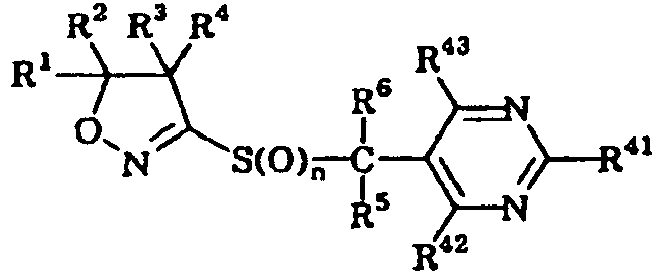
R1 R2 R3 R4 n R5 R6 R41 R42 R43 Me Me H H 2 H H H Cl Cl Me Me H H 2 H H H OH Cl Me Me H H 2 H H H OMe Cl Me Me H H 2 H H H OEt Cl Me Me H H 2 H H H OPr-i Cl Me Me H H 2 H H H OPr Cl Me Me H H 2 H H H OBu-t Cl Me Me H H 2 H H H OCH2Pr-c Cl Me Me H H 2 H H H OCH2Bu-c Cl Me Me H H 2 H H H OCH2Pen-c Cl Me Me H H 2 H H H OCH2Hex-c Cl Me Me H H 2 H H H OPen-c Cl Me Me H H 2 H H H OHex-c Cl Me Me H H 2 H H H OCH2Ph Cl Me Me H H 2 H H H OPh Cl Me Me H H 2 H H H OCHF2 Cl Me Me H H 2 H H H SH Cl Me Me H H 2 H H H SMe Cl Me Me H H 2 H H H SO2Me Cl Me Me H H 2 H H H SEt Cl Me Me H H 2 H H H SO2Et Cl Me Me H H 2 H H H SPr-i Cl Me Me H H 2 H H H SO2Pr-i Cl Me Me H H 2 H H H SPh Cl Me Me H H 2 H H H SO2Ph Cl Me Me H H 2 H H H SCHF2 Cl Me Me H H 2 H H H SO2CHF2 Cl Me Me H H 2 H H H NH2 Cl Me Me H H 2 H H H NHMe Cl Me Me H H 2 H H H NMe2 Cl Me Me H H 2 H H H NHEt Cl Me Me H H 2 H H H NEt2 Cl Me Me H H 2 H H H NHPh Cl Me Me H H 2 H H H N(Me)Ph Cl Me Me H H 2 H H H CN Cl Me Me H H 2 H H H F Me Me Me H H 2 H H H Cl Me Me Me H H 2 H H H OH Me Me Me H H 2 H H H OMe Me Me Me H H 2 H H H OEt Me Me Me H H 2 H H H OPr-i Me Me Me H H 2 H H H OPr Me Me Me H H 2 H H H OBu-t Me Me Me H H 2 H H H OCH2Pr-c Me Me Me H H 2 H H H OCH2Bu-c Me Me Me H H 2 H H H OCH2Pen-c Me Me Me H H 2 H H H OCH2Hex-c Me Me Me H H 2 H H H OPen-c Me Me Me H H 2 H H H OHex-c Me Me Me H H 2 H H H OCH2Ph Me Me Me H H 2 H H H OPh Me Me Me H H 2 H H H OCHF2 Me Me Me H H 2 H H H SH Me Me Me H H 2 H H H SMe Me Me Me H H 2 H H H SO2Me Me Me Me H H 2 H H H SEt Me Me Me H H 2 H H H SO2Et Me Me Me H H 2 H H H SPr-i Me Me Me H H 2 H H H SO2Pr-i Me Me Me H H 2 H H H SPh Me Me Me H H 2 H H H SO2Ph Me Me Me H H 2 H H H SCHF2 Me Me Me H H 2 H H H SO2CHF2 Me Me Me H H 2 H H H NH2 Me Me Me H H 2 H H H NHMe Me Me Me H H 2 H H H NMe2 Me Me Me H H 2 H H H NHEt Me Me Me H H 2 H H H NEt2 Me Me Me H H 2 H H H NHPh Me Me Me H H 2 H H H N(Me)Ph Me Me Me H H 2 H H H CN Me Me Me H H 2 H H H F Pr-i Me Me H H 2 H H H Cl Pr-i Me Me H H 2 H H H OH Pr-i Me Me H H 2 H H H OMe Pr-i Me Me H H 2 H H H OEt Pr-i Me Me H H 2 H H H OPr-i Pr-i Me Me H H 2 H H H OPr Pr-i Me Me H H 2 H H H OBu-t Pr-i Me Me H H 2 H H H OCH2Pr-c Pr-i Me Me H H 2 H H H OCH2Bu-c Pr-i Me Me H H 2 H H H OCH2Pen-c Pr-i Me Me H H 2 H H H OCH2Hex-c Pr-i Me Me H H 2 H H H OPen-c Pr-i Me Me H H 2 H H H OHex-c Pr-i Me Me H H 2 H H H OCH2Ph Pr-i Me Me H H 2 H H H OPh Pr-i Me Me H H 2 H H H OCHF2 Pr-i Me Me H H 2 H H H SH Pr-i Me Me H H 2 H H H SMe Pr-i Me Me H H 2 H H H SO2Me Pr-i Me Me H H 2 H H H SEt Pr-i Me Me H H 2 H H H SO2Et Pr-i Me Me H H 2 H H H SPr-i Pr-i Me Me H H 2 H H H SO2Pr-i Pr-i Me Me H H 2 H H H SPh Pr-i Me Me H H 2 H H H SO2Ph Pr-i Me Me H H 2 H H H SCHF2 Pr-i Me Me H H 2 H H H SO2CHF2 Pr-i Me Me H H 2 H H H NH2 Pr-i Me Me H H 2 H H H NHMe Pr-i Me Me H H 2 H H H NMe2 Pr-i Me Me H H 2 H H H NHEt Pr-i Me Me H H 2 H H H NEt2 Pr-i Me Me H H 2 H H H NHPh Pr-i Me Me H H 2 H H H N(Me)Ph Pr-i Me Me H H 2 H H H CN Pr-i Me Me H H 2 H H H F Pr-c Me Me H H 2 H H H Cl Pr-c Me Me H H 2 H H H OH Pr-c Me Me H H 2 H H H OMe Pr-c Me Me H H 2 H H H OEt Pr-c Me Me H H 2 H H H OPr-i Pr-c Me Me H H 2 H H H OPr Pr-c Me Me H H 2 H H H OBu-t Pr-c Me Me H H 2 H H H OCH2Pr-c Pr-c Me Me H H 2 H H H OCH2Bu-c Pr-c Me Me H H 2 H H H OCH2Pen-c Pr-c Me Me H H 2 H H H OCH2Hex-c Pr-c Me Me H H 2 H H H OPen-c Pr-c Me Me. H H 2 H H H OHex-c Pr-c Me Me H H 2 H H H OCH2Ph Pr-c Me Me H H 2 H H . H OPh Pr-c Me Me H H 2 H H H OCHF2 Pr-c Me Me H H 2 H H H SH Pr-c Me Me H H 2 H H H SMe Pr-c Me Me H H 2 H H H SO2Me Pr-c Me Me H H 2 H H H SEt Pr-c Me Me H H 2 H H H SO2Et Pr-c Me Me H H 2 H H H SPr-i Pr-c Me Me H H 2 H H H SO2Pr-i Pr-c Me Me H H 2 H H H SPh Pr-c Me Me H H 2 H H H SO2Ph Pr-c Me Me H H 2 H H H SCHF2 Pr-c Me Me H H 2 H H H SO2CHF2 Pr-c Me Me H H 2 H H H NH2 Pr-c Me Me H H 2 H H H NHMe Pr-c Me Me H H 2 H H H NMe2 Pr-c Me Me H H 2 H H H NHEt Pr-c Me Me H H 2 H H H NEt2 Pr-c Me Me H H 2 H H H NHPh Pr-c Me Me H H 2 H H H N(Me)Ph Pr-c Me Me H H 2 H H H CN Pr-c Me Me H H 2 H H H F CHF2 Me Me H H 2 H H H Cl CHF2 Me Me H H 2 H H H OH CHF2 Me Me H H 2 H H H OMe CHF2 Me Me H H 2 H H H OEt CHF2 Me Me H H 2 H H H OPr-i CHF2 Me Me H H 2 H H H OPr CHF2 Me Me H H 2 H H H OBu-t CHF2 Me Me H H 2 H H H OCH2Pr-c CHF2 Me Me H H 2 H H H OCH2Bu-c CHF2 Me Me H H 2 H H H OCH2Pen-c CHF2 Me Me H H 2 H H H OCH2Hex-c CHF2 Me Me H H 2 H H H OPen-c CHF2 Me Me H H 2 H H H OHex-c CHF2 Me Me H H 2 H H H OCH2Ph CHF2 Me Me H H 2 H H H OPh CHF2 Me Me H H 2 H H H OCHF2 CHF2 Me Me H H 2 H H H SH CHF2 Me Me H H 2 H H H SMe CHF2 Me Me H H 2 H H H SO2Me CHF2 Me Me H H 2 H H H SEt CHF2 Me Me H H 2 H H H SO2Et CHF2 Me Me H H 2 H H H SPr-i CHF2 Me Me H H 2 H H H SO2Pr-i CHF2 Me Me H H 2 H H H SPh CHF2 Me Me H H 2 H H H SO2Ph CHF2 Me Me H H 2 H H H SCHF2 CHF2 Me Me H H 2 H H H SO2CHF2 CHF2 Me Me H H 2 H H H NH2 CHF2 Me Me H H 2 H H H NHMe CHF2 Me Me H H 2 H H H NMe2 CHF2 Me Me H H 2 H H H NHEt CHF2 Me Me H H 2 H H H NEt2 CHF2 Me Me H H 2 H H H NHPh CHF2 Me Me H H 2 H H H N(Me)Ph CHF2 Me Me H H 2 H H H CN CHF2 Me Me H H 2 H H H F CF3 Me Me H H 2 H H H Cl CF3 Me Me H H 2 H H H OH CF3 Me Me H H 2 H H H OMe CF3 Me Me H H 2 H H H OEt CF3 Me Me H H 2 H H H OPr-i CF3 Me Me H H 2 H H H OPr CF3 Me Me H H 2 H H H OBu-t CF3 Me Me H H 2 H H H OCH2Pr-c CF3 Me Me H H 2 H H H OCH2Bu-c CF3 Me Me H H 2 H H H OCH2Pen-c CF3 Me Me H H 2 H H H OCH2Hex-c CF3 Me Me H H 2 H H H OPen-c CF3 Me Me H H 2 H H H OHex-c CF3 Me Me H H 2 H H H OCH2Ph CF3 Me Me H H 2 H H H OPh CF3 Me Me H H 2 H H H OCHF2 CF3 Me Me H H 2 H H H SH CF3 Me Me H H 2 H H H SMe CF3 Me Me H H 2 H H H SO2Me CF3 Me Me H H 2 H H H SEt CF3 Me Me H H 2 H H H SO2Et CF3 Me Me H H 2 H H H SPr-i CF3 Me Me H H 2 H H H SO2Pr-i CF3 Me Me H H 2 H H H SPh CF3 Me Me H H 2 H H H SO2Ph CF3 Me Me H H 2 H H H SCHF2 CF3 Me Me H H 2 H H H SO2CHF2 CF3 Me Me H H 2 H H H NH2 CF3 Me Me H H 2 H H H NHMe CF3 Me Me H H 2 H H H NMe2 CF3 Me Me H H 2 H H H NHEt CF3 Me Me H H 2 H H H NEt2 CF3 Me Me H H 2 H H H NHPh CF3 Me Me H H 2 H H H N(Me)Ph CF3 Me Me H H 2 H H H CN CF3 Me Me H H 2 H H H F OMe Me Me H H 2 H H H OH OMe Me Me H H 2 H H H OMe OMe Me Me H H 2 H H H OEt OMe Me Me H H 2 H H H OPr-i OMe Me Me H H 2 H H H OPr OMe Me Me H H 2 H H H OBu-t OMe Me Me H H 2 H H H OCH2Pr-c OMe Me Me H H 2 H H H OCH2Bu-c OMe Me Me H H 2 H H H OCH2Pen-c OMe Me Me H H 2 H H H OCH2Hex-c OMe Me Me H H 2 H H H OPen-c OMe Me Me H H 2 H H H OHex-c OMe Me Me H H 2 H H H OCH2Ph OMe Me Me H H 2 H H H OPh OMe Me Me H H 2 H H H OCHF2 OMe Me Me H H 2 H H H SH OMe Me Me H H 2 H H H SMe OMe Me Me H H 2 H H H SO2Me OMe Me Me H H 2 H H H SEt OMe Me Me H H 2 H H H SO2Et OMe Me Me H H 2 H H H SPr-i OMe Me Me H H 2 H H H SO2Pr-i OMe Me Me H H 2 H H H SPh OMe Me Me H H 2 H H H SO2Ph OMe Me Me H H 2 H H H SCHF2 OMe Me Me H H 2 H H H SO2CHF2 OMe Me Me H H 2 H H H NH2 OMe Me Me H H 2 H H H NHMe OMe Me Me H H 2 H H H NMe2 OMe Me Me H H 2 H H H NHEt OMe Me Me H H 2 H H H NEt2 OMe Me Me H H 2 H H H NHPh OMe Me Me H H 2 H H H N(Me)Ph OMe Me Me H H 2 H H H CN OMe Me Me H H 2 H H H F OPh Me Me H H 2 H H H OH OPh Me Me H H 2 H H H OMe OPh Me Me H H 2 H H H OEt OPh Me Me H H 2 H H H OPr-i OPh Me Me H H 2 H H H OPr OPh Me Me H H 2 H H H OBu-t OPh Me Me H H 2 H H H OCH2Pr-c OPh Me Me H H 2 H H H OCH2Bu-c OPh Me Me H H 2 H H H OCH2Pen-c OPh Me Me H H 2 H H H OCH2Hex-c OPh Me Me H H 2 H H H OPen-c OPh Me Me H H 2 H H H OHex-c OPh Me Me H H 2 H H H OCH2Ph OPh Me Me H H 2 H H H OPh OPh Me Me H H 2 H H H OCHF2 OPh Me Me H H 2 H H H SH OPh Me Me H H 2 H H H SMe OPh Me Me H H 2 H H H SO2Me OPh Me Me H H 2 H H H SEt OPh Me Me H H 2 H H H SO2Et OPh Me Me H H 2 H H H SPr-i OPh Me Me H H 2 H H H SO2Pr-i OPh Me Me H H 2 H H H SPh OPh Me Me H H 2 H H H SO2Ph OPh Me Me H H 2 H H H SCHF2 OPh Me Me H H 2 H H H SO2CHF2 OPh Me Me H H 2 H H H NH2 OPh Me Me H H 2 H H H NHMe OPh Me Me H H 2 H H H NMe2 OPh Me Me H H 2 H H H NHEt OPh Me Me H H 2 H H H NEt2 OPh Me Me H H 2 H H H NHPh OPh Me Me H H 2 H H H N(Me)Ph OPh Me Me H H 2 H H H CN OPh Me Me H H 2 H H H F OCHF2 Me Me H H 2 H H H OH OCHF2 Me Me H H 2 H H H OMe OCHF2 Me Me H H 2 H H H OEt OCHF2 Me Me H H 2 H H H OPr-i OCHF2 Me Me H H 2 H H H OPr OCHF2 Me Me H H 2 H H H OBu-t OCHF2 Me Me H H 2 H H H OCH2Pr-c OCHF2 Me Me H H 2 H H H OCH2Bu-c OCHF2 Me Me H H 2 H H H OCH2Pen-c OCHF2 Me Me H H 2 H H H OCH2Hex-c OCHF2 Me Me H H 2 H H H OPen-c OCHF2 Me Me H H 2 H H H OHex-c OCHF2 Me Me H H 2 H H H OCH2Ph OCHF2 Me Me H H 2 H H H OPh OCHF2 Me Me H H 2 H H H OCHF2 OCHF2 Me Me H H 2 H H H SH OCHF2 Me Me H H 2 H H H SMe OCHF2 Me Me H H 2 H H H SO2Me OCHF2 Me Me H H 2 H H H SEt OCHF2 Me Me H H 2 H H H SO2Et OCHF2 Me Me H H 2 H H H SPr-i OCHF2 Me Me H H 2 H H H SO2Pr-i OCHF2 Me Me H H 2 H H H SPh OCHF2 Me Me H H 2 H H H SO2Ph OCHF2 Me Me H H 2 H H H SCHF2 OCHF2 Me Me H H 2 H H H SO2CHF2 OCHF2 Me Me H H 2 H H H NH2 OCHF2 Me Me H H 2 H H H NHMe OCHF2 Me Me H H 2 H H H NMe2 OCHF2 Me Me H H 2 H H H NHEt OCHF2 Me Me H H 2 H H H NEt2 OCHF2 Me Me H H 2 H H H NHPh OCHF2 Me Me H H 2 H H H N(Me)Ph OCHF2 Me Me H H 2 H H H CN OCHF2 Me Me H H 2 H H Me F CF3 Me Me H H 2 H H Me Cl CF3 Me Me H H 2 H H Me OH CF3 Me Me H H 2 H H Me OMe CF3 Me Me H H 2 H H Me OEt CF3 Me Me H H 2 H H Me OPr-i CF3 Me Me H H 2 H H Me OPr CF3 Me Me H H 2 H H Me OBu-t CF3 Me Me H H 2 H H Me OCH2Pr-c CF3 Me Me H H 2 H H Me OCH2Bu-c CF3 Me Me H H 2 H H Me OCH2Pen-c CF3 Me Me H H 2 H H Me OCH2Hex-c CF3 Me Me H H 2 H H Me OPen-c CF3 Me Me H H 2 H H Me OHex-c CF3 Me Me H H 2 H H Me OCH2Ph CF3 Me Me H H 2 H H Me OPh CF3 Me Me H H 2 H H Me OCHF2 CF3 Me Me H H 2 H H Me SH CF3 Me Me H H 2 H H Me SMe CF3 Me Me H H 2 H H Me SO2Me CF3 Me Me H H 2 H H Me SEt CF3 Me Me H H 2 H H Me SO2Et CF3 Me Me H H 2 H H Me SPr-i CF3 Me Me H H 2 H H Me SO2Pr-i CF3 Me Me H H 2 H H Me SPh GF3 Me Me H H 2 H H Me SO2Ph CF3 Me Me H H 2 H H Me SCHF CF3 Me Me H H 2 H H Me SO2CHF2 CF3 Me Me H H 2 H H Me N2 CF3 Me Me H H 2 H H Me NHMe CF3 Me Me H H 2 H H Me NMe2 CF3 Me Me H H 2 H H Me NHEt CF3 Me Me H H 2 H H Me NEt2 CF3 Me Me H H 2 H H Me NHPh CF3 Me Me H H 2 H H Me N(Me)Ph CF3 Me Me H H 2 H H Me CN CF3 Me Me H H 2 H H OMe F CF3 Me Me H H 2 H H OMe Cl CF3 Me Me H H 2 H H OMe OH CF3 Me Me H H 2 H H OMe OMe CF3 Me Me H H 2 H H OMe OEt CF3 Me Me H H 2 H H OMe OPr-i CF3 Me Me H H 2 H H OMe OPr CF3 Me Me H H 2 H H OMe OBu-t CF3 Me Me H H 2 H H OMe OCH2Pr-c CF3 Me Me H H 2 H H OMe OCH2Bu-c CF3 Me Me H H 2 H H OMe OCH2Pen-c CF3 Me Me H H 2 H H OMe OCH2Hex-c CF3 Me Me H H 2 H H OMe OPen-c CF3 Me Me H H 2 H H OMe OHex-c CF3 Me Me H H 2 H H OMe OCH2Ph CF3 Me Me H H 2 H H OMe OPh CF3 Me Me H H 2 H H OMe OCHF2 CF3 Me Me H H 2 H H OMe SH CF3 Me Me H H 2 H H OMe SMe CF3 Me Me H H 2 H H OMe SO2Me CF3 Me Me H H 2 H H OMe SEt CF3 Me Me H H 2 H H OMe SO2Et CF3 Me Me H H 2 H H OMe SPr-i CF3 Me Me H H 2 H H OMe SO2Pr-i CF3 Me Me H H 2 H H OMe SPh CF3 Me Me H H 2 H H OMe SO2Ph CF3 Me Me H H 2 H H OMe SCHF2 CF3 Me Me H H 2 H H OMe SO2CHF2 CF3 Me Me H H 2 H H OMe NH2 CF3 Me Me H H 2 H H OMe NHMe CF3 Me Me H H 2 H H OMe NMe2 CF3 Me Me H H 2 H H OMe NHEt CF3 Me Me H H 2 H H OMe NEt2 CF3 Me Me H H 2 H H OMe NHPh CF3 Me Me H H 2 H H OMe N(Me)Ph CF3 Me Me H H 2 H H OMe CN CF3 Me Me H H 2 H H SMe F CF3 Me Me H H 2 H H SMe Cl CF3 Me Me H H 2 H H SMe OH CF3 Me Me H H 2 H H SMe OMe CF3 Me Me H H 2 H H SMe OEt CF3 Me Me H H 2 H H SMe OPr-i CF3 Me Me H H 2 H H SMe OPr CF3 Me Me H H 2 H H SMe OBu-t CF3 Me Me H H 2 H H SMe OCH2Pr-c CF3 Me Me H H 2 H H SMe OCH2Bu-c CF3 Me Me H H 2 H H SMe OCH2Pen-c CF3 Me Me H H 2 H H SMe OCH2Hex-c CF3 Me Me H H 2 H H SMe OPen-c CF3 Me Me H H 2 H H SMe OHex-c CF3 Me Me H H 2 H H SMe OCH2Ph CF3 Me Me H H 2 H H SMe OPh CF3 Me Me H H 2 H H SMe OCHF2 CF3 Me Me H H 2 H H SMe SH CF3 Me Me H H 2 H H SMe SMe CF3 Me Me H H 2 H H SMe SO2Me CF3 Me Me H H 2 H H SMe SEt CF3 Me Me H H 2 H H SMe SO2Et CF3 Me Me H H 2 H H SMe SPr-i CF3 Me Me H H 2 H H SMe SO2Pr-i CF3 Me Me H H 2 H H SMe SPh CF3 Me Me H H 2 H H SMe SO2Ph CF3 Me Me H H 2 H H SMe SCHF2 CF3 Me Me H H 2 H H SMe SO2CHF2 CF3 Me Me H H 2 H H SMe NH2 CF3 Me Me H H 2 H H SMe NHMe CF3 Me Me H H 2 H H SMe NMe2 CF3 Me Me H H 2 H H SMe NHEt CF3 Me Me H H 2 H H SMe NEt2 CF3 Me Me H H 2 H H SMe NHPh CF3 Me Me H H 2 H H SMe N(Me)Ph CF3 Me Me H H 2 H H SMe CN CF3 Me Me H H 2 H H SO2Me F CF3 Me Me H H 2 H H SO2Me Cl CF3 Me Me H H 2 H H SO2Me OH CF3 Me Me H H 2 H H SO2Me OMe CF3 Me Me H H 2 H H SO2Me OEt CF3 Me Me H H 2 H H SO2Me OPr-i CF3 Me Me H H 2 H H SO2Me OPr CF3 Me Me H H 2 H H SO2Me OBu-t CF3 Me Me H H 2 H H SO2Me OCH2Pr-c CF3 Me Me H H 2 H H SO2Me OCH2Bu-c CF3 Me Me H H 2 H H SO2Me OCH2Pen-c CF3 Me Me H H 2 H H SO2Me OCH2Hex-c CF3 Me Me H H 2 H H SO2Me OPen-c CF3 Me Me H H 2 H H SO2Me OHex-c CF3 Me Me H H 2 H H SO2Me OCH2Ph CF3 Me Me H H 2 H H SO2Me OPh CF3 Me Me H H 2 H H SO2Me OCHF2 CF3 Me Me H H 2 H H SO2Me SH CF3 Me Me H H 2 H H SO2Me SMe CF3 Me Me H H 2 H H SO2Me SO2Me CF3 Me Me H H 2 H H SO2Me SEt CF3 Me Me H H 2 H H SO2Me SO2Et CF3 Me Me H H 2 H H SO2Me SPr-i CF3 Me Me H H 2 H H SO2Me SO2Pr-i CF3 Me Me H H 2 H H SO2Me SPh CF3 Me Me H H 2 H H SO2Me SO2Ph CF3 Me Me H H 2 H H SO2Me SCHF2 CF3 Me Me H H 2 H H SO2Me SO2CHF2 CF3 Me Me H H 2 H H SO2Me NH2 CF3 Me Me H H 2 H H SO2Me NHMe CF3 Me Me H H 2 H H SO2Me NMe2 CF3 Me Me H H 2 H H SO2Me NHEt CF3 Me Me H H 2 H H SO2Me NEt2 CF3 Me Me H H 2 H H SO2Me NHPh CF3 Me Me H H 2 H H SO2Me N(Me)Ph CF3 Me Me H H 2 H H SO2Me CN CF3 Me Me H H 2 H H NH2 F CF3 Me Me H H 2 H H NH2 Cl CF3 Me Me H H 2 H H NH2 OH CF3 Me Me H H 2 H H NH2 OMe CF3 Me Me H H 2 H H NH2 OEt CF3 Me Me H H 2 H H NH2 OPr-i CF3 Me Me H H 2 H H NH2 OPr CF3 Me Me H H 2 H H NH2 OBu-t CF3 Me Me H H 2 H H NH2 OCH2Pr-c CF3 Me Me H H 2 H H NH2 OCH2Bu-c CF3 Me Me H H 2 H H NH2 OCH2Pen-c CF3 Me Me H H 2 H H NH2 OCH2Hex-c CF3 Me Me H H 2 H H NH2 OPen-c CF3 Me Me H H 2 H H NH2 OHex-c CF3 Me Me H H 2 H H NH2 OCH2Ph CF3 Me Me H H 2 H H NH2 OPh CF3 Me Me H H 2 H H NH2 OCHF2 CF3 Me Me H H 2 H H NH2 SH CF3 Me Me H H 2 H H NH2 SMe CF3 Me Me H H 2 H H NH2 SO2Me CF3 Me Me H H 2 H H NH2 SEt CF3 Me Me H H 2 H H NH2 SO2Et CF3 Me Me H H 2 H H NH2 SPr-i CF3 Me Me H H 2 H H NH2 SO2Pr-i CF3 Me Me H H 2 H H NH2 SPh CF3 Me Me H H 2 H H NH2 SO2Ph CF3 Me Me H H 2 H H NH2 SCHF2 CF3 Me Me H H 2 H H NH2 SO2CHF2 CF3 Me Me H H 2 H H NH2 NH2 CF3 Me Me H H 2 H H NH2 NHMe CF3 Me Me H H 2 H H NH2 NMe2 CF3 Me Me H H 2 H H NH2 NHEt CF3 Me Me H H 2 H H NH2 NEt2 CF3 Me Me H H 2 H H NH2 NHPh CF3 Me Me H H 2 H H NH2 N(Me)Ph CF3 Me Me H H 2 H H NH2 CN CF3 H H H H 2 H H H OMe CF3 H H H H 2 H H H OEt CF3 Me H H H 2 H H H OMe CF3 Me H H H 2 H H H OEt CF3 Me H Me H 2 H H H OMe CF3 Me H Me H 2 H H H OEt CF3 Me Me H H 2 Me H H OMe CF3 Me Me H H 2 Me H H OEt CF3 Me Me H H 2 Et H H OMe CF3 Me Me H H 2 Et H H OEt CF3 Me Me H H 2 Pr-i H H H CF3 Me Me H H 2 Pr-i H H OMe CF3 Me Me H H 2 Pr-i H H OEt CF3 Me Me H H 2 Me Me H OMe CF3 Me Me H H 2 Me Me H OEt CF3 Me Et H H 2 H H H OMe CF3 Me Et H H 2 H H H OEt CF3 Et Et H H 2 H H H OMe CF3 Et Et H H 2 H H H OEt CF3 Me Pr-i H H 2 H H H OMe CF3 Me Pr-i H H 2 H H H OEt CF3 Me Pr H H 2 H H H OMe CF3 Me Pr H H 2 H H H OEt CF3 Me Pr-c H H 2 H H H OMe CF3 Me Pr-c H H 2 H H H OEt CF3 Me CH2Pr-c H H 2 H H H OMe CF3 Me CH2Pr-c H H 2 H H H OEt CF3 -(CH2)2- H H 2 H H H OMe CF3 -(CH2)2- H H 2 H H H OEt CF3 -(CH2)3- H H 2 H H H OMe CF3 -(CH2)3- H H 2 H H H OEt CF3 -(CH2)4- H H 2 H H H OMe CF3 -(CH2)4- H H 2 H H H OEt CF3 -(CH2)5- H H 2 H H H OMe CF3 -(CH2)5- H H 2 H H H OEt CF3 H -(CH2)3- H 2 H H H OMe CF3 H -(CH2)3- H 2 H H H OEt CF3 H -(CH2)4- H 2 H H H OMe CF3 H -(CH2)4- H 2 H H H OEt CF3 H -(CH2)5- H 2 H H H OMe CF3 H -(CH2)5- H 2 H H H OEt CF3 H -(CH2)6- H 2 H H H OMe CF3 H -(CH2)6- H 2 H H H OEt CF3 Me Me H H 1 H H H Cl Cl Me Me H H 1 H H H OH Cl Me Me H H 1 H H H OMe Cl Me Me H H 1 H H H OEt Cl Me Me H H 1 H H H OPr-i Cl Me Me H H 1 H H H OPr Cl Me Me H H 1 H H H OBu-t Cl Me Me H H 1 H H H OCH2Pr-c Cl Me Me H H 1 H H H OCH2Bu-c Cl Me Me H H 1 H H H OCH2Pen-c Cl Me Me H H 1 H H H OCH2Hex-c Cl Me Me H H 1 H H H OPen-c Cl Me Me H H 1 H H H OHex-c Cl Me Me H H 1 H H H OCH2Ph Cl Me Me H H 1 H H H OPh Cl Me Me H H 1 H H H OCHF2 Cl Me Me H H 1 H H H SH Cl Me Me H H 1 H H H SMe Cl Me Me H H 1 H H H SO2Me Cl Me Me H H 1 H H H SEt Cl Me Me H H 1 H H H SO2Et Cl Me Me H H 1 H H H SPr-i Cl Me Me H H 1 H H H SO2Pr-i Cl Me Me H H 1 H H H SPh Cl Me Me H H 1 H H H SO2Ph Cl Me Me H H 1 H H H SCHF2 Cl Me Me H H 1 H H H SO2CHF2 Cl Me Me H H 1 H H H NH2 Cl Me Me H H 1 H H H NHMe Cl Me Me H H 1 H H H NMe2 Cl Me Me H H 1 H H H NHEt Cl Me Me H H 1 H H H NEt2 Cl Me Me H H 1 H H H NHPh Cl Me Me H H 1 H H H N(Me)Ph Cl Me Me H H 1 H H H CN Cl Me Me H H 1 H H H F Me Me Me H H 1 H H H Cl Me Me Me H H 1 H H H OH Me Me Me H H 1 H H H OMe Me Me Me H H 1 H H H OEt Me Me Me H H 1 H H H OPr-i Me Me Me H H 1 H H H OPr Me Me Me H H 1 H H H OBu-t Me Me Me H H 1 H H H OCH2Pr-c Me Me Me H H 1 H H H OCH2Bu-c Me Me Me H H 1 H H H OCH2Pen-c Me Me Me H H 1 H H H OCH2Hex-c Me Me Me H H 1 H H H OPen-c Me Me Me H H 1 H H H OHex-c Me Me Me H H 1 H H H OCH2Ph Me Me Me H H 1 H H H OPh Me Me Me H H 1 H H H OCHF2 Me Me Me H H 1 H H H SH Me Me Me H H 1 H H H SMe Me Me Me H H 1 H H H SO2Me Me Me Me H H 1 H H H SEt Me Me Me H H 1 H H H SO2Et Me Me Me H H 1 H H H SPr-i Me Me Me H H 1 H H H SO2Pr-i Me Me Me H H 1 H H H SPh Me Me Me H H 1 H H H SO2Ph Me Me Me H H 1 H H H SCHF2 Me Me Me H H 1 H H H SO2CHF2 Me Me Me H H 1 H H H NH2 Me Me Me H H 1 H H H NHMe Me Me Me H H 1 H H H NMe2 Me Me Me H H 1 H H H NHEt Me Me Me H H 1 H H H NEt2 Me Me Me H H 1 H H H NHPh Me Me Me H H 1 H H H N(Me)Ph Me Me Me H H 1 H H H CN Me Me Me H H 1 H H H F Pr-i Me Me H H 1 H H H Cl Pr-i Me Me H H 1 H H H OH Pr-i Me Me H H 1 H H H OMe Pr-i Me Me H H 1 H H H OEt Pr-i Me Me H H 1 H H H OPr-i Pr-i Me Me H H 1 H H H OPr Pr-i Me Me H H 1 H H H OBu-t Pr-i Me Me H H 1 H H H OCH2Pr-c Pr-i Me Me H H 1 H H H OCH2Bu-c Pr-i Me Me H H 1 H H H OCH2Pen-c Pr-i Me Me H H 1 H H H OCH2Hex-c Pr-i Me Me H H 1 H H H OPen-c Pr-i Me Me H H 1 H H H OHex-c Pr-i Me Me H H 1 H H H OCH2Ph Pr-i Me Me H H 1 H H H OPh Pr-i Me Me H H 1 H H H OCHF2 Pr-i Me Me H H 1 H H H SH Pr-i Me Me H H 1 H H H SMe Pr-i Me Me H H 1 H H H SO2Me Pr-i Me Me H H 1 H H H SEt Pr-i Me Me H H 1 H H H SO2Et Pr-i Me Me H H 1 H H H SPr-i Pr-i Me Me H H 1 H H H SO2Pr-i Pr-i Me Me H H 1 H H H SPh Pr-i Me Me H H 1 H H H SO2Ph Pr-i Me Me H H 1 H H H SCHF2 Pr-i Me Me H H 1 H H H SO2CHF2 Pr-i Me Me H H 1 H H H NH2 Pr-i Me Me H H 1 H H H NHMe Pr-i Me Me H H 1 H H H NMe2 Pr-i Me Me H H 1 H H H NHEt Pr-i Me Me H H 1 H H H NEt2 Pr-i Me Me H H 1 H H H NHPh Pr-i Me Me H H 1 H H H N(Me)Ph Pr-i Me Me H H 1 H H H CN Pr-i Me Me H H 1 H H H F Pr-c Me. Me H H 1 H H H Cl Pr-c Me Me H H 1 H H H OH Pr-c Me Me H H 1 H H H OMe Pr-c Me Me H H 1 H H H OEt Pr-c Me Me H H 1 H H H OPr-i Pr-c Me Me H H 1 H H H OPr Pr-c Me Me H H 1 H H H OBu-t Pr-c Me Me H H 1 H H H OCH2Pr-c Pr-c Me Me H H 1 H H H OCH2Bu-c Pr-c Me Me H H 1 H H H OCH2Pen-c Pr-c Me Me H H 1 H H H OCH2Hex-c Pr-c Me Me H H 1 H H H OPen-c Pr-c Me Me H H 1 H H H OHex-c Pr-c Me Me H H 1 H H H OCH2Ph Pr-c Me Me H H 1 H H H OPh Pr-c Me Me H H 1 H H H OCHF2 Pr-c Me Me H H 1 H H H SH Pr-c Me Me H H 1 H H H SMe Pr-c Me Me H H 1 H H H SO2Me Pr-c Me Me H H 1 H H H SEt Pr-c Me Me H H 1 H H H SO2Et Pr-c Me Me H H 1 H H H SPr-i Pr-c Me Me H H 1 H H H SO2Pr-i Pr-c Me Me H H 1 H H H SPh Pr-c Me Me H H 1 H H H SO2Ph Pr-c Me Me H H 1 H H H SCHF2 Pr-c Me Me H H 1 H H H SO2CHF2 Pr-c Me Me H H 1 H H H NH2 Pr-c Me Me H H 1 H H H NHMe Pr-c Me Me H H 1 H H H NMe2 Pr-c Me Me H H 1 H H H NHEt Pr-c Me Me H H 1 H H H NEt2 Pr-c Me Me H H 1 H H H NHPh Pr-c Me Me H H 1 H H H N(Me)Ph Pr-c Me Me H H 1 H H H CN Pr-c Me Me H H 1 H H H F CHF2 Me Me H H 1 H H H Cl CHF2 Me Me H H 1 H H H OH CHF2 Me Me H H 1 H H H OMe CHF2 Me Me H H 1 H H H OEt CHF2 Me Me H H 1 H H H OPr-i CHF2 Me Me H H 1 H H H OPr CHF2 Me Me H H 1 H H H OBu-t CHF2 Me Me H H 1 H H H OCH2Pr-c CHF2 Me Me H H 1 H H H OCH2Bu-c CHF2 Me Me H H 1 H H H OCH2Pen-c CHF2 Me Me H H 1 H H H OCH2Hex-c CHF2 Me Me H H 1 H H H OPen-c CHF2 Me Me H H 1 H H H OHex-c CHF2 Me Me H H 1 H H H OCH2Ph CHF2 Me Me H H 1 H H H OPh CHF2 Me Me H H 1 H H H OCHF2 CHF2 Me Me H H 1 H H H SH CHF2 Me Me H H 1 H H H SMe CHF2 Me Me H H 1 H H H SO2Me CHF2 Me Me H H 1 H H H SEt CHF2 Me Me H H 1 H H H SO2Et CHF2 Me Me H H 1 H H H SPr-i CHF2 Me Me H H 1 H H H SO2Pr-i CHF2 Me Me H H 1 H H H SPh CHF2 Me Me H H 1 H H H SO2Ph CHF2 Me Me H H 1 H H H SCHF2 CHF2 Me Me H H 1 H H H SO2CHF2 CHF2 Me Me H H 1 H H H NH2 CHF2 Me Me H H 1 H H H NHMe CHF2 Me Me H H 1 H H H NMe2 CHF2 Me Me H H 1 H H H NHEt CHF2 Me Me H H 1 H H H NEt2 CHF2 Me' Me H H 1 H H H NHPh CHF2 Me Me H H 1 H H H N(Me)Ph CHF2 Me Me H H 1 H H H CN CHF2 Me Me H H 1 H H H F CF3 Me Me H H 1 H H H Cl CF3 Me Me H H 1 H H H OH CF3 Me Me H H 1 H H H OMe CF3 Me Me H H 1 H H H OEt CF3 Me Me H H 1 H H H OPr-i CF3 Me Me H H 1 H H H OPr CF3 Me Me H H 1 H H H OBu-t CF3 Me Me H H 1 H H H OCH2Pr-c CF3 Me Me H H 1 H H H OCH2Bu-c CF3 Me Me H H 1 H H H OCH2Pen-c CF3 Me Me H H 1 H H H OCH2Hex-c CF3 Me Me H H 1 H H H OPen-c CF3 Me Me H H 1 H H H OHex-c CF3 Me Me H H 1 H H H OCH2Ph CF3 Me Me H H 1 H H H OPh CF3 Me Me H H 1 H H H OCHF2 CF3 Me Me H H 1 H H H SH CF3 Me Me H H 1 H H H SMe CF3 Me Me H H 1 H H H SO2Me CF3 Me Me H H 1 H H H SEt CF3 Me Me H H 1 H H H SO2Et CF3 Me Me H H 1 H H H SPr-i CF3 Me Me H H 1 H H H SO2Pr-i CF3 Me Me H H 1 H H H SPh CF3 Me Me H H 1 H H H SO2Ph CF3 Me Me H H 1 H H H SCHF2 CF3 Me Me H H 1 H H H SO2CHF2 CF3 Me Me H H 1 H H H NH2 CF3 Me Me H H 1 H H H NHMe CF3 Me Me H H 1 H H H NMe2 CF3 Me Me H H 1 H H H NHEt CF3 Me Me H H 1 H H H NEt2 CF3 Me Me H H 1 H H H NHPh CF3 Me Me H H 1 H H H N(Me)Ph CF3 Me Me H H 1 H H H CN CF3 Me Me H H 1 H H H F OMe Me Me H H 1 H H H OH OMe Me Me H H 1 H H H OMe OMe Me Me H H 1 H H H OEt OMe Me Me H H 1 H H H OPr-i OMe Me Me H H 1 H H H OPr OMe Me Me H H 1 H H H OBu-t OMe Me Me H H 1 H H H OCH2Pr-c OMe Me Me H H 1 H H H OCH2Bu-c OMe Me Me H H 1 H H H OCH2Pen-c OMe Me Me H H 1 H H H OCH2Hex-c OMe Me Me H H 1 H H H OPen-c OMe Me Me H H 1 H H H OHex-c OMe Me Me H H 1 H H H OCH2Ph OMe Me Me H H 1 H H H OPh OMe Me Me H H 1 H H H OCHF2 OMe Me Me H H 1 H H H SH OMe Me Me H H 1 H H H SMe OMe Me Me H H 1 H H H SO2Me OMe Me Me H H 1 H H H SEt OMe Me Me H H 1 H H H SO2Et OMe Me Me H H 1 H H H SPr-i OMe Me Me H H 1 H H H SO2Pr-i OMe Me Me H H 1 H H H SPh OMe Me Me H H 1 H H H SO2Ph OMe Me Me H H 1 H H H SCHF2 OMe Me Me H H 1 H H H SO2CHF2 OMe Me Me H H 1 H H H NH2 OMe Me Me H H 1 H H H NHMe OMe Me Me H H 1 H H H NMe2 OMe Me Me H H 1 H H H NHEt OMe Me Me H H 1 H H H NEt2 OMe Me Me H H 1 H H H NHPh OMe Me Me H H 1 H H H N(Me)Ph OMe Me Me H H 1 H H H CN OMe Me Me H H 1 H H H F OPh Me Me H H 1 H H H OH OPh Me Me H H 1 H H H OMe OPh Me Me H H 1 H H H OEt OPh Me Me H H 1 H H H OPr-i OPh Me Me H H 1 H H H OPr OPh Me Me H H 1 H H H OBu-t OPh Me Me H H 1 H H H OCH2Pr-c OPh Me Me H H 1 H H H OCH2Bu-c OPh Me Me H H 1 H H H OCH2Pen-c OPh Me Me H H 1 H H H OCH2Hex-c OPh Me Me H H 1 H H H OPen-c OPh Me Me H H 1 H H H OHex-c OPh Me Me H H 1 H H H OCH2Ph OPh Me Me H H 1 H H H OPh OPh Me Me H H 1 H H H OCHF2 OPh Me Me H H 1 H H H SH OPh Me Me H H 1 H H H SMe OPh Me Me H H 1 H H H SO2Me OPh Me Me H H 1 H H H SEt OPh Me Me H H 1 H H H SO2Et OPh Me Me H H 1 H H H SPr-i OPh Me Me H H 1 H H H SO2Pr-i OPh Me Me H H 1 H H H SPh OPh Me Me H H 1 H H H SO2Ph OPh Me Me H H 1 H H H SCHF2 OPh Me Me H H 1 H H H SO2CHF2 OPh Me Me H H 1 H H H NH2 OPh Me Me H H 1 H H H NHMe OPh Me Me H H 1 H H H NMe2 OPh Me Me H H 1 H H H NHEt OPh Me Me H H 1 H H H NEt2 OPh Me Me H H 1 H H H NHPh OPh Me Me H H 1 H H H N(Me)Ph OPh Me Me H H 1 H H H CN OPh Me Me H H 1 H H H F OCHF2 Me Me H H 1 H H H OH OCHF2 Me Me H H 1 H H H OMe OCHF2 Me Me H H 1 H H H OEt OCHF2 Me Me H H 1 H H H OPr-i OCHF2 Me Me H H 1 H H H OPr OCHF2 Me Me H H 1 H H H OBu-t OCHF2 Me Me H H 1 H H H OCH2Pr-c OCHF2 Me Me H H 1 H H H OCH2Bu-c OCHF2 Me Me H H 1 H H H OCH2Pen-c OCHF2 Me Me H H 1 H H H OCH2Hex-c OCHF2 Me Me H H 1 H H H OPen-c OCHF2 Me Me H H 1 H H H OHex-c OCHF2 Me Me H H 1 H H H OCH2Ph OCHF2 Me Me H H 1 H H H OPh OCHF2 Me Me H H 1 H H H OCHF2 OCHF2 Me Me H H 1 H H H SH OCHF2 Me Me H H 1 H H H SMe OCHF2 Me Me H H 1 H H H SO2Me OCHF2 Me Me H H 1 H H H SEt OCHF2 Me Me H H 1 H H H SO2Et OCHF2 Me Me H H 1 H H H SPr-i OCHF2 Me Me H H 1 H H H SO2Pr-i OCHF2 Me Me H H 1 H H H SPh OCHF2 Me Me H H 1 H H H SO2Ph OCHF2 Me Me H H 1 H H H SCHF2 OCHF2 Me Me H H 1 H H H SO2CHF2 OCHF2 Me Me H H 1 H H H NH2 OCHF2 Me Me H H 1 H H H NHMe OCHF2 Me Me H H 1 H H H NMe2 OCHF2 Me Me H H 1 H H H NHEt OCHF2 Me Me H H 1 H H H NEt2 OCHF2 Me Me H H 1 H H H NHPh OCHF2 Me Me H H 1 H H H N(Me)Ph OCHF2 Me Me H H 1 H H H CN OCHF2 Me Me H H 1 H H Me F CF3 Me Me H H 1 H H Me Cl CF3 Me Me H H 1 H H Me OH CF3 Me Me H H 1 H H Me OMe CF3 Me Me H H 1 H H Me OEt CF3 Me Me H H 1 H H Me OPr-i CF3 Me Me H H 1 H H Me OPr CF3 Me Me H H 1 H H Me OBu-t CF3 Me Me H H 1 H H Me OCH2Pr-c CF3 Me Me H H 1 H H Me OCH2Bu-c CF3 Me Me H H 1 H H Me OCH2Pen-c CF3 Me Me H H 1 H H Me OCH2Hex-c CF3 Me Me H H 1 H H Me OPen-c CF3 Me Me H H 1 H H Me OHex-c CF3 Me Me H H 1 H H Me OCH2Ph CF3 Me Me H H 1 H H Me OPh CF3 Me Me H H 1 H H Me OCHF2 CF3 Me Me H H 1 H H Me SH CF3 Me Me H H 1 H H Me SMe CF3 Me Me H H 1 H H Me SO2Me CF3 Me Me H H 1 H H Me SEt CF3 Me Me H H 1 H H Me SO2Et CF3 Me Me H H 1 H H Me SPr-i CF3 Me Me H H 1 H H Me SO2Pr-i CF3 Me Me H H 1 H H Me SPh CF3 Me Me H H 1 H H Me SO2Ph CF3 Me Me H H 1 H H Me SCHF2 CF3 Me Me H H 1 H H Me SO2CHF2 CF3 Me Me H H 1 H H Me NH2 CF3 Me Me H H 1 H H Me NHMe CF3 Me Me H H 1 H H Me NMe2 CF3 Me Me H H 1 H H Me NHEt CF3 Me Me H H 1 H H Me NEt2 CF3 Me Me H H 1 H H Me NHPh CF3 Me Me H H 1 H H Me N(Me)Ph CF3 Me Me H H 1 H H Me CN CF3 Me Me H H 1 H H OMe F CF3 Me Me H H 1 H H OMe Cl CF3 Me Me H H 1 H H OMe OH CF3 Me Me H H 1 H H OMe OMe CF3 Me Me H H 1 H H OMe OEt CF3 Me Me H H 1 H H OMe OPr-i CF3 Me Me H H 1 H H OMe OPr CF3 Me Me H H 1 H H OMe OBu-t CF3 Me Me H H 1 H H OMe OCH2Pr-c CF3 Me Me H H 1 H H OMe OCH2Bu-c CF3 Me Me H H 1 H H OMe OCH2Pen-c CF3 Me Me H H 1 H H OMe OCH2Hex-c CF3 Me Me H H 1 H H OMe OPen-c CF3 Me Me H H 1 H H OMe OHex-c CF3 Me Me H H 1 H H OMe OCH2Ph CF3 Me Me H H 1 H H OMe OPh CF3 Me Me H H 1 H H OMe OCHF2 CF3 Me Me H H 1 H H OMe SH CF3 Me Me H H 1 H H OMe SMe CF3 Me Me H H 1 H H OMe SO2Me CF3 Me Me H H 1 H H OMe SEt CF3 Me Me H H 1 H H OMe SO2Et CF3 Me Me H H 1 H H OMe SPr-i CF3 Me Me H H 1 H H OMe SO2Pr-i CF3 Me Me H H 1 H H OMe SPh CF3 Me Me H H 1 H H OMe SO2Ph CF3 Me Me H H 1 H H OMe SCHF2 CF3 Me Me H H 1 H H OMe SO2CHF2 CF3 Me Me H H 1 H H OMe NH2 CF3 Me Me H H 1 H H OMe NHMe CF3 Me Me H H 1 H H OMe NMe2 CF3 Me Me H H 1 H H OMe NHEt CF3 Me Me H H 1 H H OMe NEt2 CF3 Me Me H H 1 H H OMe NHPh CF3 Me Me H H 1 H H OMe N(Me)Ph CF3 Me Me H H 1 H H OMe CN CF3 Me Me H H 1 H H SMe F CF3 Me Me H H 1 H H SMe Cl CF3 Me Me H H 1 H H SMe OH CF3 Me Me H H 1 H H SMe OMe CF3 Me Me H H 1 H H SMe OEt CF3 Me Me H H 1 H H SMe OPr-i CF3 Me Me H H 1 H H SMe OPr CF3 Me Me H H 1 H H SMe OBu-t CF3 Me Me H H 1 H H SMe OCH2Pr-c CF3 Me Me H H 1 H H SMe OCH2Bu-c CF3 Me Me H H 1 H H SMe OCH2Pen-c CF3 Me Me H H 1 H H SMe OCH2Hex-c CF3 Me Me H H 1 H H SMe OPen-c CF3 Me Me H H 1 H H SMe OHex-c CF3 Me Me H H 1 H H SMe OCH2Ph CF3 Me Me H H 1 H H SMe OPh CF3 Me Me H H 1 H H SMe OCHF2 CF3 Me Me H H 1 H H SMe SH CF3 Me Me H H 1 H H SMe SMe CF3 Me Me H H 1 H H SMe SO2Me CF3 Me Me H H 1 H H SMe SEt CF3 Me Me H H 1 H H SMe SO2Et CF3 Me Me H H 1 H H SMe SPr-i CF3 Me Me H H 1 H H SMe SO2Pr-i CF3 Me Me H H 1 H H SMe SPh CF3 Me Me H H 1 H H SMe SO2Ph CF3 Me Me H H 1 H H SMe SCHF2 CF3 Me Me H H 1 H H SMe SO2CHF2 CF3 Me Me H H 1 H H SMe NH2 CF3 Me Me H H 1 H H SMe NHMe CF3 Me Me H H 1 H H SMe NMe2 CF3 Me Me H H 1 H H SMe NHEt CF3 Me Me H H 1 H H SMe NEt2 CF3 Me Me H H 1 H H SMe NHPh CF3 Me Me H H 1 H H SMe N(Me)Ph CF3 Me Me H H 1 H H SMe CN CF3 Me Me H H 1 H H SO2Me F CF3 Me Me H H 1 H H SO2Me Cl CF3 Me Me H H 1 H H SO2Me OH CF3 Me Me H H 1 H H SO2Me OMe CF3 Me Me H H 1 H H SO2Me OEt CF3 Me Me H H 1 H H SO2Me OPr-i CF3 Me Me H H 1 H H SO2Me OPr CF3 Me Me H H 1 H H SO2Me OBu-t CF3 Me Me H H 1 H H SO2Me OCH2Pr-c CF3 Me Me H H 1 H H SO2Me OCH2Bu-c CF3 Me Me H H 1 H H SO2Me OCH2Pen-c CF3 Me Me H H 1 H H SO2Me OCH2Hex-c CF3 Me Me H H 1 H H SO2Me OPen-c CF3 Me Me H H 1 H H SO2Me OHex-c CF3 Me Me H H 1 H H SO2Me OCH2Ph CF3 Me Me H H 1 H H SO2Me OPh CF3 Me Me H H 1 H H SO2Me OCHF2 CF3 Me Me H H 1 H H SO2Me SH CF3 Me Me H H 1 H H SO2Me SMe CF3 Me Me H H 1 H H SO2Me SO2Me CF3 Me Me H H 1 H H SO2Me SEt CF3 Me Me H H 1 H H SO2Me SO2Et CF3 Me Me H H 1 H H SO2Me SPr-i CF3 Me Me H H 1 H H SO2Me SO2Pr-i CF3 Me Me H H 1 H H SO2Me SPh CF3 Me Me H H 1 H H SO2Me SO2Ph CF3 Me Me H H 1 H H SO2Me SCHF2 CF3 Me Me H H 1 H H SO2Me SO2CHF2 CF3 Me Me H H 1 H H SO2Me NH2 CF3 Me Me H H 1 H H SO2Me NHMe CF3 Me Me H H 1 H H SO2Me NMe2 CF3 Me Me H H 1 H H SO2Me NHEt CF3 Me Me H H 1 H H SO2Me NEt2 CF3 Me Me H H 1 H H SO2Me NHPh CF3 Me Me H H 1 H H SO2Me N(Me)Ph CF3 Me Me H H 1 H H SO2Me CN CF3 Me Me H H 1 H H NH2 F CF3 Me Me H H 1 H H NH2 Cl CF3 Me Me H H 1 H H NH2 OH CF3 Me Me H H 1 H H NH2 OMe CF3 Me Me H H 1 H H NH2 OEt CF3 Me Me H H 1 H H NH2 OPr-i CF3 Me Me H H 1 H H NH2 OPr CF3 Me Me H H 1 H H NH2 OBu-t CF3 Me Me H H 1 H H NH2 OCH2Pr-c CF3 Me Me H H 1 H H NH2 OCH2Bu-c CF3 Me Me H H 1 H H NH2 OCH2Pen-c CF3 Me Me H H 1 H H NH2 OCH2Hex-c CF3 Me Me H H 1 H H NH2 OPen-c CF3 Me Me H H 1 H H NH2 OHex-c CF3 Me Me H H 1 H H NH2 OCH2Ph CF3 Me Me H H 1 H H NH2 OPh CF3 Me Me H H 1 H H NH2 OCHF2 CF3 Me Me H H 1 H H NH2 SH CF3 Me Me H H 1 H H NH2 SMe CF3 Me Me H H 1 H H NH2 SO2Me CF3 Me Me H H 1 H H NH2 SEt CF3 Me Me H H 1 H H NH2 SO2Et CF3 Me Me H H 1 H H NH2 SPr-i CF3 Me Me H H 1 H H NH2 SO2Pr-i CF3 Me Me H H 1 H H NH2 SPh CF3 Me Me H H 1 H H NH2 SO2Ph CF3 Me Me H H 1 H H NH2 SCHF2 CF3 Me Me H H 1 H H NH2 SO2CHF2 CF3 Me Me H H 1 H H NH2 NH2 CF3 Me Me H H 1 H H NH2 NHMe CF3 Me Me H H 1 H H NH2 NMe2 CF3 Me Me H H 1 H H NH2 NHEt CF3 Me Me H H 1 H H NH2 NEt2 CF3 Me Me H H 1 H H NH2 NHPh CF3 Me Me H H 1 H H NH2 N(Me)Ph CF3 Me Me H H 1 H H NH2 CN CF3 H H H H 1 H H H OMe CF3 H H H H 1 H H H OEt CF3 Me H H H 1 H H H OMe CF3 Me H H H 1 H H H OEt CF3 Me H Me H 1 H H H OMe CF3 Me H Me H 1 H H H OEt CF3 Me Me H H 1 Me H H OMe CF3 Me Me H H 1 Me H H OEt CF3 Me Me H H 1 Et H H OMe CF3 Me Me H H 1 Et H H OEt CF3 Me Me H H 1 Pr-i H H H CF3 Me Me H H 1 Pr-i H H OMe CF3 Me Me H H 1 Pr-i H H OEt CF3 Me Me H H 1 Me Me H OMe CF3 Me Me H H 1 Me Me H OEt CF3 Me Et H H 1 H H H OMe CF3 Me Et H H 1 H H H OEt CF3 Et Et H H 1 H H H OMe CF3 Et Et H H 1 H H H OEt CF3 Me Pr-i H H 1 H H H OMe CF3 Me Pr-i H H 1 H H H OEt CF3 Me Pr H H 1 H H H OMe CF3 Me Pr H H 1 H H H OEt CF3 Me Pr-c H H 1 H H H OMe CF3 Me Pr-c H H 1 H H H OEt CF3 Me CH2Pr-c H H 1 H H H OMe CF3 Me CH2Pr-c H H 1 H H H OEt CF3 -(CH2)2- H H 1 H H H OMe CF3 -(CH2)2- H H 1 H H H OEt CF3 -(CH2)3- H H 1 H H H OMe CF3 -(CH2)3- H H 1 H H H OEt CF3 -(CH2)4- H H 1 H H H OMe CF3 -(CH2)4- H H 1 H H H OEt CF3 -(CH2)5- H H 1 H H H OMe CF3 -(CH2)5- H H 1 H H H OEt CF3 H -(CH2)3- H 1 H H H OMe CF3 H -(CH2)3- H 1 H H H OEt CF3 H -(CH2)4- H 1 H H H OMe CF3 H -(CH2)4- H 1 H H H OEt CF3 H -(CH2)5- H 1 H H H OMe CF3 H -(CH2)5- H 1 H H H OEt CF3 H -(CH2)6- H 1 H H H OMe CF3 H -(CH2)6- H 1 H H H OEt CF3 Me Me H H 0 H H H Cl Cl Me Me H H 0 H H H OH Cl Me Me H H 0 H H H OMe Cl Me Me H H 0 H H H OEt Cl Me Me H H 0 H H H OPr-i Cl Me Me H H 0 H H H OPr Cl Me Me H H 0 H H H OBu-t Cl Me Me H H 0 H H H OCH2Pr-c Cl Me Me H H 0 H H H OCH2Bu-c Cl Me Me H H 0 H H H OCH2Pen-c Cl Me Me H H 0 H H H OCH2Hex-c Cl Me Me H H 0 H H H OPen-c Cl Me Me H H 0 H H H OHex-c Cl Me Me H H 0 H H H OCH2Ph Cl Me Me H H 0 H H H OPh Cl Me Me H H 0 H H H OCHF2 Cl Me Me H H 0 H H H SH Cl Me Me H H 0 H H H SMe Cl Me Me H H 0 H H H SO2Me Cl Me Me H H 0 H H H SEt Cl Me Me H H 0 H H H SO2Et Cl Me Me H H 0 H H H SPr-i Cl Me Me H H 0 H H H SO2Pr-i Cl Me Me H H 0 H H H SPh Cl Me Me H H 0 H H H SO2Ph Cl Me Me H H 0 H H H SCHF2 Cl Me Me H H 0 H H H SO2CHF2 Cl Me Me H H 0 H H H NH2 Cl Me Me H H 0 H H H NHMe Cl Me Me H H 0 H H H NMe2 Cl Me Me H H 0 H H H NHEt Cl Me Me H H 0 H H H NEt2 Cl Me Me H H 0 H H H NHPh Cl Me Me H H 0 H H H N(Me)Ph Cl Me Me H H 0 H H H CN Cl Me Me H H 0 H H H F Me Me Me H H 0 H H H Cl Me Me Me H H 0 H H H OH Me Me Me H H 0 H H H OMe Me Me Me H H 0 H H H OEt Me Me Me H H 0 H H H OPr-i Me Me Me H H 0 H H H OPr Me Me Me H H 0 H H H OBu-t Me Me Me H H 0 H H H OCH2Pr-c Me Me Me H H 0 H H H OCH2Bu-c Me Me Me H H 0 H H H OCH2Pen-c Me Me Me H H 0 H H H OCH2Hex-c Me Me Me H H 0 H H H OPen-c Me Me Me H H 0 H H H OHex-c Me Me Me H H 0 H H H OCH2Ph Me Me Me H H 0 H H H OPh Me Me Me H H 0 H H H OCHF2 Me Me Me H H 0 H H H SH Me Me Me H H 0 H H H SMe Me Me Me H H 0 H H H SO2Me Me Me Me H H 0 H H H SEt Me Me Me H H 0 H H H SO2Et Me Me Me H H 0 H H H SPr-i Me Me Me H H 0 H H H SO2Pr-i Me Me Me H H 0 H H H SPh Me Me Me H H 0 H H H SO2Ph Me Me Me H H 0 H H H SCHF2 Me Me Me H H 0 H H H SO2CHF2 Me Me Me H H 0 H H H NH2 Me Me Me H H 0 H H H NHMe Me Me Me H H 0 H H H NMe2 Me Me Me H H 0 H H H NHEt Me Me Me H H 0 H H H NEt2 Me Me Me H H 0 H H H NHPh Me Me Me H H 0 H H H N(Me)Ph Me Me Me H H 0 H H H CN Me Me Me H H 0 H H H F Pr-i Me Me H H 0 H H H Cl Pr-i Me Me H H 0 H H H OH Pr-i Me Me H H 0 H H H OMe Pr-i Me Me H H 0 H H H OEt Pr-i Me Me H H 0 H H H OPr-i Pr-i Me Me H H 0 H H H OPr Pr-i Me Me H H 0 H H H OBu-t Pr-i Me Me H H 0 H H H OCH2Pr-c Pr-i Me Me H H 0 H H H OCH2Bu-c Pr-i Me Me H H 0 H H H OCH2Pen-c Pr-i Me Me H H 0 H H H OCH2Hex-c Pr-i Me Me H H 0 H H H OPen-c Pr-i Me Me H H 0 H H H OHex-c Pr-i Me Me H H 0 H H H OCH2Ph Pr-i Me Me H H 0 H H H OPh Pr-i Me Me H H 0 H H H OCHF2 Pr-i Me Me H H 0 H H H SH Pr-i Me Me H H 0 H H H SMe Pr-i Me Me H H 0 H H H SO2Me Pr-i Me Me H H 0 H H H SEt Pr-i Me Me H H 0 H H H SO2Et Pr-i Me Me H H 0 H H H SPr-i Pr-i Me Me H H 0 H H H SO2Pr-i Pr-i Me Me H H 0 H H H SPh Pr-i Me Me H H 0 H H H SO2Ph Pr-i Me Me H H 0 H H H SCHF2 Pr-i Me Me H H 0 H H H SO2CHF2 Pr-i Me Me H H 0 H H H NH2 Pr-i Me Me H H 0 H H H NHMe Pr-i Me Me H H 0 H H H NMe2 Pr-i Me Me H H 0 H H H NHEt Pr-i Me Me H H 0 H H H NEt2 Pr-i Me Me H H 0 H H H NHPh Pr-i Me Me H H 0 H H H N(Me)Ph Pr-i Me Me H H 0 H H H CN Pr-i Me Me H H 0 H H H F Pr-c Me Me H H 0 H H H Cl Pr-c Me Me H H 0 H H H OH Pr-c Me Me H H 0 H H H OMe Pr-c Me Me H H 0 H H H OEt Pr-c Me Me H H 0 H H H OPr-i Pr-c Me Me H H 0 H H H OPr Pr-c Me Me H H 0 H H H OBu-t Pr-c Me Me H H 0 H H H OCH2Pr-c Pr-c Me Me H H 0 H H H OCH2Bu-c Pr-c Me Me H H 0 H H H OCH2Pen-c Pr-c Me Me H H 0 H H H OCH2Hex-c Pr-c Me Me H H 0 H H H OPen-c Pr-c Me Me H H 0 H H H OHex-c Pr-c Me Me H H 0 H H H OCH2Ph Pr-c Me Me H H 0 H H H OPh Pr-c Me Me H H 0 H H H OCHF2 Pr-c Me Me H H 0 H H H SH Pr-c Me Me H H 0 H H H SMe Pr-c Me Me H H 0 H H H SO2Me Pr-c Me Me H H 0 H H H SEt Pr-c Me Me H H 0 H H H SO2Et Pr-c Me Me H H 0 H H H SPr-i Pr-c Me Me H H 0 H H H SO2Pr-i Pr-c Me Me H H 0 H H H SPh Pr-c Me Me H H 0 H H H SO2Ph Pr-c Me Me H H 0 H H H SCHF2 Pr-c Me Me H H 0 H H H SO2CHF2 Pr-c Me Me H H 0 H H H NH2 Pr-c Me Me H H 0 H H H NHMe Pr-c Me Me H H 0 H H H NMe2 Pr-c Me Me H H 0 H H H NHEt Pr-c Me Me H H 0 H H H NEt2 Pr-c Me Me H H 0 H H H NHPh Pr-c Me Me H H 0 H H H N(Me)Ph Pr-c Me Me H H 0 H H H CN Pr-c Me Me H H 0 H H H F CHF2 Me Me H H 0 H H H Cl CHF2 Me Me H H 0 H H H OH CHF2 Me Me H H 0 H H H OMe CHF2 Me Me H H 0 H H H OEt CHF2 Me Me H H 0 H H H OPr-i CHF2 Me Me H H 0 H H H OPr CHF2 Me Me H H 0 H H H OBu-t CHF2 Me Me H H 0 H H H OCH2Pr-c CHF2 Me Me H H 0 H H H OCH2Bu-c CHF2 Me Me H H 0 H H H OCH2Pen-c CHF2 Me Me H H 0 H H H OCH2Hex-c CHF2 Me Me H H 0 H H H OPen-c CHF2 Me Me H H 0 H H H OHex-c CHF2 Me Me H H 0 H H H OCH2Ph CHF2 Me Me H H 0 H H H OPh CHF2 Me Me H H 0 H H H OCHF2 CHF2 Me Me H H 0 H H H SH CHF2 Me Me H H 0 H H H SMe CHF2 Me Me H H 0 H H H SO2Me CHF2 Me Me H H 0 H H H SEt CHF2 Me Me H H 0 H H H SO2Et CHF2 Me Me H H 0 H H H SPr-i CHF2 Me Me H H 0 H H H SO2Pr-i CHF2 Me Me H H 0 H H H SPh CHF2 Me Me H H 0 H H H SO2Ph CHF2 Me Me H H 0 H H H SCHF2 CHF2 Me Me H H 0 H H H SO2CHF2 CHF2 Me Me H H 0 H H H NH2 CHF2 Me Me H H 0 H H H NHMe CHF2 Me Me H H 0 H H H NMe2 CHF2 Me Me H H 0 H H H NHEt CHF2 Me Me H H 0 H H H NEt2 CHF2 Me Me H H 0 H H H NHPh CHF2 Me Me H H 0 H H H N(Me)Ph CHF2 Me Me H H 0 H H H CN CHF2 Me Me H H 0 H H H F CF3 Me Me H H 0 H H H Cl CF3 Me Me H H 0 H H H OH CF3 Me Me H H 0 H H H OMe CF3 Me Me H H 0 H H H OEt CF3 Me Me H H 0 H H H OPr-i CF3 Me Me H H 0 H H H OPr CF3 Me Me H H 0 H H H OBu-t CF3 Me Me H H 0 H H H OCH2Pr-c CF3 Me Me H H 0 H H H OCH2Bu-c CF3 Me Me H H 0 H H H OCH2Pen-c CF3 Me Me H H 0 H H H OCH2Hex-c CF3 Me Me H H 0 H H H OPen-c CF3 Me Me H H 0 H H H OHex-c CF3 Me Me H H 0 H H H OCH2Ph CF3 Me Me H H 0 H H H OPh CF3 Me Me H H 0 H H H OCHF2 CF3 Me Me H H 0 H H H SH CF3 Me Me H H 0 H H H SMe CF3 Me Me H H 0 H H H SO2Me CF3 Me Me H H 0 H H H SEt CF3 Me Me H H 0 H H H SO2Et CF3 Me Me H H 0 H H H SPr-i CF3 Me Me H H 0 H H H SO2Pr-i CF3 Me Me H H 0 H H H SPh CF3 Me Me H H 0 H H H SO2Ph CF3 Me Me H H 0 H H H SCHF2 CF3 Me Me H H 0 H H H SO2CHF2 CF3 Me Me H H 0 H H H NH2 CF3 Me Me H H 0 H H H NHMe CF3 Me Me H H 0 H H H NMe2 CF3 Me Me H H 0 H H H NHEt CF3 Me Me H H 0 H H H NEt2 CF3 Me Me H H 0 H H H NHPh CF3 Me Me H H 0 H H H N(Me)Ph CF3 Me Me H H 0 H H H CN CF3 Me Me H H 0 H H H F OMe Me Me H H 0 H H H OH OMe Me Me H H 0 H H H OMe OMe Me Me H H 0 H H H OEt OMe Me Me H H 0 H H H OPr-i OMe Me Me H H 0 H H H OPr OMe Me Me H H 0 H H H OBu-t OMe Me Me H H 0 H H H OCH2Pr-c OMe Me Me H H 0 H H H OCH2Bu-c OMe Me Me H H 0 H H H OCH2Pen-c OMe Me Me H H 0 H H H OCH2Hex-c OMe Me Me H H 0 H H H OPen-c OMe Me Me H H 0 H H H OHex-c OMe Me Me H H 0 H H H OCH2Ph OMe Me Me H H 0 H H H OPh OMe Me Me H H 0 H H H OCHF2 OMe Me Me H H 0 H H H SH OMe Me Me H H 0 H H H SMe OMe Me Me H H 0 H H H SO2Me OMe Me Me H H 0 H H H SEt OMe Me Me H H 0 H H H SO2Et OMe Me Me H H 0 H H H SPr-i OMe Me Me H H 0 H H H SO2Pr-i OMe Me Me H H 0 H H H SPh OMe Me Me H H 0 H H H SO2Ph OMe Me Me H H 0 H H H SCHF2 OMe Me Me H H 0 H H H SO2CHF2 OMe Me Me H H 0 H H H NH2 OMe Me Me H H 0 H H H NHMe OMe Me Me H H 0 H H H NMe2 OMe Me Me H H 0 H H H NHEt OMe Me Me H H 0 H H H NEt2 OMe Me Me H H 0 H H H NHPh OMe Me Me H H 0 H H H N(Me)Ph OMe Me Me H H 0 H H H CN OMe Me Me H H 0 H H H F OPh Me Me H H 0 H H H OH OPh Me Me H H 0 H H H OMe OPh Me Me H H 0 H H H OEt OPh Me Me H H 0 H H H OPr-i OPh Me Me H H 0 H H H OPr OPh Me Me H H 0 H H H OBu-t OPh Me Me H H 0 H H H OCH2Pr-c OPh Me Me H H 0 H H H OCH2Bu-c OPh Me Me H H 0 H H H OCH2Pen-c OPh Me Me H H 0 H H H OCH2Hex-c OPh Me Me H H 0 H H H OPen-c OPh Me Me H H 0 H H H OHex-c OPh Me Me H H 0 H H H OCH2Ph OPh Me Me H H 0 H H H OPh OPh Me Me H H 0 H H H OCHF2 OPh Me Me H H 0 H H H SH OPh Me Me H H 0 H H H SMe OPh Me Me H H 0 H H H SO2Me OPh Me Me H H 0 H H H SEt OPH Me Me H H 0 H H H SO2Et OPh Me Me H H 0 H H H SPr-i OPh Me Me H H 0 H H H SO2Pr-i OPh Me Me H H 0 H H H SPh OPh Me Me H H 0 H H H SO2Ph OPh Me Me H H 0 H H H SCHF2 OPh Me Me H H 0 H H H SO2CHF2 OPh Me Me H H 0 H H H NH2 OPh Me Me H H 0 H H H NHMe OPh Me Me H H 0 H H H NMe2 OPh Me Me H H 0 H H H NHEt OPh Me Me H H 0 H H H NEt2 OPh Me Me H H 0 H H H NHPh OPh Me Me H H 0 H H H N(Me)Ph OPh Me Me H H 0 H H H CN OPh Me Me H H 0 H H H F OCHF2 Me Me H H 0 H H H OH OCHF2 Me Me H H 0 H H H OMe OCHF2 Me Me H H 0 H H H OEt OCHF2 Me Me H H 0 H H H OPr-i OCHF2 Me Me H H 0 H H H OPr OCHF2 Me Me H H 0 H He H OBu-t OCHF2 Me Me H H 0 H H H OCH2Pr-c OCHF2 Me Me H H 0 H H H OCH2Bu-c OCHF2 Me Me H H 0 H H H OCH2Pen-c OCHF2 Me Me H H 0 H H H OCH2Hex-c OCHF2 Me Me H H 0 H H H OPen-c OCHF2 Me Me H H 0 H H H OHex-c OCHF2 Me Me H H 0 H H H OCH2Ph OCHF2 Me Me H H 0 H H H OPh CHF2 Me Me H H 0 H H H OCHF2 OCHF2 Me Me H H 0 H H H SH SCHF2 Me Me H H 0 H H H SMe OCHF2 Me Me H H 0 H H H SO2Me OCHF2 Me Me H H 0 H H H SEt OCHF2 Me Me H H 0 H H H SO2Et OCHF2 Me Me H H 0 H H H SPr-i OCHF2 Me Me H H 0 H H H SO2Pr-i OCHF2 Me Me H H 0 H H H SPh OCHF2 Me Me H H 0 H H H SO2Ph OCHF2 Me Me H H 0 H H H SCHF2 OCHF2 Me Me H H 0 H H H SO2CHF2 OCHF2 Me Me H H 0 H H H NH2 OCHF2 Me Me H H 0 H H H NHMe OCHF2 Me Me H H 0 H H H NMe2 OCHF2 Me Me H H 0 H H H NHEt SCHF2 Me Me H H 0 H H H NEt2 CHF2 Me Me H H 0 H H H NHPh OCHF2 Me Me H H 0 H H H N(Me)Ph OCHF2 Me Me H H 0 H H H CN OCHF2 Me Me H H 0 H H Me F CF3 Me Me H H 0 H H Me Cl CF3 Me Me H H 0 H H Me OH CF3 Me Me H H 0 H H Me OMe CF3 Me Me H H 0 H H Me OEt CF3 Me Me H H 0 H H Me OPr-i CF3 Me Me H H 0 H H Me OPr CF3 Me Me H H 0 H H Me OBu-t CF3 Me Me H H 0 H H Me OCH2Pr-c CF3 Me Me H H 0 H H Me OCH2Bu-c CF3 Me Me H H 0 H H Me OCH2Pen-c CF3 Me Me H H 0 H H Me OCH2Hex-c CF3 Me Me H H 0 H H Me OPen-c CF3 Me Me H H 0 H H Me OHex-c CF3 Me Me H H 0 H H Me OCH2Ph CF3 Me Me H H 0 H H Me OPh CF3 Me Me H H 0 H H Me OCHF2 CF3 Me Me H H 0 H H Me SH CF3 Me Me H H 0 H H Me SMe CF3 Me Me H H 0 H H Me SO2Me CF3 Me Me H H 0 H H Me SEt CF3 Me Me H H 0 H H Me SO2Et CF3 Me Me H H 0 H H Me SPr-i CF3 Me Me H H 0 H H Me SO2Pr-i CF3 Me Me H H 0 H H Me Sh CF3 Me Me H H 0 H H Me SO2Ph CF3 Me Me H H 0 H H Me SCHF2 CF3 Me Me H H 0 H H Me SO2CHF2 CF3 Me Me H H 0 H H Me NH2 CF3 Me Me H H 0 H H Me NHMe CF3 Me Me H H 0 H H Me NMe2 CF3 Me Me H H 0 H H Me NHEt CF3 Me Me H H 0 H H Me NEt2 CF3 Me Me H H 0 H H Me NHPh CF3 Me Me H H 0 H H me N(Me)Ph CF3 Me Me H H 0 H H Me CN CF3 Me Me H H 0 H H OMe F CF3 Me Me H H 0 H H OMe Cl CF3 Me Me H H 0 H H OMe OH CF3 Me Me H H 0 H H OMe OMe CF3 Me Me H H 0 H H OMe OEt CF3 Me Me H H 0 H H OMe OPr-i CF3 Me Me H H 0 H H OMe OPr CF3 Me Me H H 0 H H OMe OBu-t CF3 Me Me H H 0 H H OMe OCH2Pr-c CF3 Me Me H H 0 H H OMe OCH2Bu-c CF3 Me Me H H 0 H H OMe OCH2Pen-c CF3 Me Me H H 0 H H OMe OCH2Hex-c CF3 Me Me H H 0 H H OMe OPen-c CF3 Me Me H H 0 H H OMe OHex-c CF3 Me Me H H 0 H H OMe OCH2Ph CF3 Me Me H H 0 H H OMe OPh CF3 Me Me H H 0 H H OMe OCHF2 CF3 Me Me H H 0 H H OMe SH CF3 Me Me H H 0 H H OMe SMe CF3 Me Me H H 0 H H OMe SO2Me CF3 Me Me H H 0 H H OMe SEt CF3 Me Me H H 0 H H OMe SO2Et CF3 Me Me H H 0 H H OMe SPr-i CF3 Me Me H H 0 H H OMe SO2Pr-i CF3 Me Me H H 0 H H OMe SPh CF3 Me Me H H 0 H H OMe SO2Ph CF3 Me Me H H 0 H H OMe SCHF2 CF3 Me Me H H 0 H H OMe SO2CHF2 CF3 Me Me H H 0 H H OMe NH2 CF3 Me Me H H 0 H H OMe NHMe CF3 Me Me H H 0 H H OMe NMe2 CF3 Me Me H H 0 H H OMe NHEt CF3 Me Me H H 0 H H OMe NEt2 CF3 Me Me H H 0 H H OMe NHPh CF3 - Me Me H H 0 H H OMe N(Me)Ph CF3 Me Me H H 0 H H OMe CN CF3 Me Me H H 0 H H SMe F CF3 Me Me H H 0 H H SMe Cl CF3 Me Me H H 0 H H SMe OH CF3 Me Me H H 0 H H SMe OMe CF3 Me Me H H 0 H H SMe OEt CF3 Me Me H H 0 H H SMe OPr-i CF3 Me Me H H 0 H H SMe OPr CF3 Me Me H H 0 H H SMe OBu-t CF3 Me Me H H 0 H H SMe OCH2Pr-c CF3 Me Me H H 0 H H SMe OCH2Bu-c CF3 Me Me H H 0 H H SMe OCH2Pen-c CF3 Me Me H H 0 H H SMe OCH2Hex-c CF3 Me Me H H 0 H H SMe OPen-c CF3 Me Me H H 0 H H SMe OHex-c CF3 Me Me H H 0 H H SMe OCH2Ph CF3 Me Me H H 0 H H SMe OPh CF3 Me Me H H 0 H H SMe OCHF2 CF3 Me Me H H 0 H H SMe SH CF3 Me Me H H 0 H H SMe SMe CF3 Me Me H H 0 H H SMe SO2Me CF3 Me Me H H 0 H H SMe SEt CF3 Me Me H H 0 H H SMe SO2Et CF3 Me Me H H 0 H H SMe SPr-i CF3 Me Me H H 0 H H SMe SO2Pr-i CF3 Me Me H H 0 H H SMe SPh CF3 Me Me H H 0 H H SMe SO2Ph CF3 Me Me H H 0 H H SMe SCHF2 CF3 Me Me H H 0 H H SMe SO2CHF2 CF3 Me Me H H 0 H H SMe NH2 CF3 Me Me H H 0 H H SMe NHMe CF3 Me Me H H 0 H H SMe NMe2 CF3 Me Me H H 0 H H SMe NHEt CF3 Me Me H H 0 H H SMe NEt2 CF3 Me Me H H 0 H H SMe NHPh CF3 Me Me H H 0 H H SMe N(Me)Ph CF3 Me Me H H 0 H H SMe CN CF3 Me Me H H 0 H H SO2Me F CF3 Me Me H H 0 H H SO2Me Cl CF3 Me Me H H 0 H H SO2Me OH CF3 Me Me H H 0 H H SO2Me OMe CF3 Me Me H H 0 H H SO2Me OEt CF3 Me Me H H 0 H H SO2Me OPr-i CF3 Me Me H H 0 H H SO2Me OPr CF3 Me Me H H 0 H H SO2Me OBu-t CF3 Me Me H H 0 H H SO2Me OCH2Pr-c CF3 Me Me H H 0 H H SO2Me OCH2Bu-c CF3 Me Me H H 0 H H SO2M OCH2Pen-c CF3 Me Me H H 0 H H SOzMe OCH2Hex-c CF3 Me Me H H 0 H H SO2Me OPen-c CF3 Me Me H H 0 H H SO2Me OHex-c CF3 Me Me H H 0 H H SO2Me OCH2Ph CF3 Me Me H H 0 H H SO2Me OPh CF3 Me Me H H 0 H H SO2Me OCHF2 CF3 Me Me H H 0 H H SO2Me SH CF3 Me Me H H 0 H H SO2Me SMe CF3 Me Me H H 0 H H SO2Me SO2Me CF3 Me Me H H 0 H H SO2Me SEt CF3 Me Me H H 0 H H SO2Me SO2Et CF3 Me Me H H 0 H H SO2Me SPr-i CF3 Me Me H H 0 H H SO2Me SO2Pr-i CF3 Me Me H H 0 H H SO2Me SPh CF3 Me Me H H 0 H H SO2Me SO2Ph CF3 Me Me H H 0 H H SO2Me SCHF2 CF3 Me Me H H 0 H H SO2Me SO2CHF2 CF3 Me Me H H 0 H H SO2Me NH2 CF3 Me Me H H 0 H H SO2Me NHMe CF3 Me Me H H 0 H H SO2Me NMe2 CF3 Me Me H H 0 H H SO2Me NHEt CF3 Me Me H H 0 H H SO2Me NEt2 CF3 Me Me H H 0 H H SO2Me NHPh CF3 Me Me H H 0 H H SO2Me N(Me)Ph CF3 Me Me H H 0 H H SO2Me CN CF3 Me Me H H 0 H H NH2 F CF3 Me Me H H 0 H H NH2 Cl CF3 Me Me H H 0 H H NH2 OH CF3 Me Me H H 0 H H NH2 OMe CF3 Me Me H H 0 H H NH2 OEt CF3 Me Me H H 0 H H NH2 OPr-i CF3 Me Me H H 0 H H NH2 OPr CF3 Me Me H H 0 H H NH2 OBu-t CF3 Me Me H H 0 H H NH2 OCH2Pr-c CF3 Me Me H H 0 H H NH2 OCH2Bu-c CF3 Me Me H H 0 H H NH2 OCH2Pen-c CF3 Me Me H H 0 H H NH2 OCH2Hex-c CF3 Me Me H H 0 H H NH2 OPen-c CF3 Me Me H H 0 H H NH2 OHex-c CF3 Me Me H H 0 H H NH2 OCH2Ph CF3 Me Me H H 0 H H NH2 OPh CF3 Me Me H H 0 H H NH2 OCHF2 CF3 Me Me H H 0 H H NH2 SH CF3 Me Me H H 0 H H NH2 SMe CF3 Me Me H H 0 H H NH2 SO2Me CF3 Me Me H H 0 H H NH2 SEt CF3 Me Me H H 0 H H NH2 SO2Et CF3 Me Me H H 0 H H NH2 SPr-i CF3 Me Me H H 0 H H NH2 SO2Pr-i CF3 Me Me H H 0 H H NH2 SPh CF3 Me Me H H 0 H H NH2 SO2Ph CF3 Me Me H H 0 H H NH2 SCHF CF3 Me Me H H 0 H H NH2 SO2CHF2 CF3 Me Me H H 0 H H NH2 NH2 CF3 Me Me H H 0 H H NH2 NHMe CF3 Me Me H H 0 H H NH2 NMe2 CF3 Me Me H H 0 H H NH2 NHEt CF3 Me Me H H 0 H H NH2 NEt2 CF3 Me Me H H 0 H H NH2 NHPh CF3 Me Me H H 0 H H NH2 N(Me)Ph CF3 Me Me H H 0 H H NH2 CN CF3 H H H H 0 H H H OMe CF3 H H H H 0 H H H OEt CF3 Me H H H 0 H H H OMe CF3 Me H H H 0 H H H OEt CF3 Me H Me H 0 H H H OMe CF3 Me H Me H 0 H H H OEt CF3 Me Me H H 0 Me H H OMe CF3 Me Me H H 0 Me H H OEt CF3 Me Me H H 0 Et H H OMe CF3 Me Me H H 0 Et H H OEt CF3 Me Me H H 0 Pr-i H H H CF3 Me Me H H 0 Pr-i H H OMe CF3 Me Me H H 0 Pr-i H H OEt CF3 Me Me H H 0 Me Me H OMe CF3 Me Me H H 0 Me Me H OEt CF3 Me Et H H 0 H H H OMe CF3 Me Et H H 0 H H H OEt CF3 Et Et H H 0 H H H OMe CF3 Et Et H H 0 H H H OEt CF3 Me Pr-i H H 0 H H H OMe CF3 Me Pr-i H H 0 H H H OEt CF3 Me Pr H H 0 H H H OMe CF3 Me Pr H H 0 H H H OEt CF3 Me Pr-c H H 0 H H H OMe CF3 Me Pr-c H H 0 H H H OEt CF3 Me CH2Pr-c H H 0 H H H OMe CF3 Me CH2Pr-c H H 0 H H H OEt CF3 -(CHF2)2- H H 0 H H H OMe CF3 -(CH2)2- H H 0 H H H OEt CF3 -(CH2)3- H H 0 H H H OMe CF3 -(CH2)3- H H 0 H H H OEt CF3 -(CH2)4- H H 0 H H H OMe CF3 -(CH2)4- H H 0 H H H OEt CF3 -(CHF2)5- H H 0 H H H OMe CF3 -(CH2)5- H H 0 H H H OEt CF3 H -(CH2)3- H 0 H H H OMe CF3 H -(CH2)3- H 0 H H H OEt CF3 H -(CH2)4- H 0 H H H OMe CF3 H -(CH2)4- H 0 H H H OEt CF3 H -(CH2)5- H 0 H H H OMe CF3 H -(CH2)5- H 0 H H H OEt CF3 H -(CH2)6- H 0 H H H OMe CF3 H -(CH2)6- H 0 H H H OEt CF3 - The present compound represented by the general formula [I] can be produced according to the processes shown below; however, the compound can be produced also by other processes. <Production Process 1> Step 1 to Step 5

- In the above production scheme, R1, R2, R3, R4, R5, R6 and Y have the same definitions as given above; X1 is a halogen atom; R7 is a C1 to C4 alkyl group, an optionally substituted phenyl group or an optionally substituted benzyl group; L is a leaving group such as halogen atom, C1 to C4 alkylsulfonyl group, optionally substituted phenylsulfonyl group, optionally substituted benzylsulfonyl group or the like; and x is an integer of 1 or more.
- The above production process is described below in detail on each step.
- A sulfide derivative represented by the general formula [5] can be produced by reacting a compound represented by the general formula [1] with a sodium hydrosulfide hydrate represented by the general formula [2] in the presence or absence of a solvent (preferably in an appropriate solvent) in the presence of a salt to produce a base of a mercaptan, represented by the general formula [3] in the reaction system, and then, without isolating the salt of a mercaptan [3], reacting the salt [3] with a halogen derivative represented by the general formula [4] [in this case, a radical-generating agent, for example, Rongalit (trade name): CH2(OH)SO2Na·2H2O may be added].
- The reaction temperature in each reaction is any temperature between 0°C and the reflux temperature of each reaction system and is preferably 10 to 100°C. The reaction time varies depending upon the compounds used, but is 0.5 to 24 hours.
- With respect to the amounts of the reagents used in each reaction, each of the compound represented by the general formula [2] and the compound represented by the general formula [4] is used in an amount of 1 to 3 equivalents relative to one equivalent of the compound represented by the general formula [1] and, when a base is used, the base is used in an amount of 0.5 to 3 equivalents.
- As the solvent, there can be mentioned, for example, ethers such as dioxane, tetrahydrofuran (THF) and the like; halogenated hydrocarbons such as dichloroethane, carbon tetrachloride, chlorobenzene, dichlorobenzene and the like; amides such as N,N-dimethylacetamide, N,N-dimethylformamide, N-methyl-2-pyrrolidinone and the like; sulfur compounds such as dimethyl sulfoxide, sulfolane and the like; aromatic hydrocarbons such as benzene, toluene, xylene and the like; alcohols such as methanol, ethanol, propanol, isopropanol, butanol, tert-butanol and the like; ketones such as acetone, 2-butanone and the like; nitriles such as acetonitrile and the like; water; and mixtures thereof.
- As the base, there can be mentioned, for example, metal hydrides such as sodium hydride and the like; alkali metal amides such as sodium amide, lithium diisopropylamide and the like; organic bases such as pyridine, triethylamine, 1,8-diazabicyclo[5.4.0]-7-undecene and the like; alkali metal hydroxides such as sodium hydroxide, potassium hydroxide and the like; alkaline earth metal hydroxides such as calcium hydroxide, magnesium hydroxide and the like; alkali metal carbonates such as sodium carbonate, potassium carbonate and the like; alkali metal hydrogencarbonates such as sodium hydrogencarbonate, potassium hydrogencarbonate and the like; and metal alcholates such as sodium methoxide, potassium tert-butoxide and the like.
- A sulfoxide derivative represented by the general formula [6] can be produced by reacting the sulfide derivative represented by the general formula [5] with an oxidizing agent in an appropriate solvent.
- The reaction temperature is any temperature between 0°C and the reflux temperature of the reaction system and is preferably 0 to 60°C. The reaction time varies depending upon the compounds used, but is 1 to 72 hours.
- With respect to the amounts of the reagents used in the reaction, the oxidizing agent is used in an amount of 1 to 3 equivalents per equivalent of the compound represented by the general formula [5].
- As the solvent, there can be mentioned, for example, halogenated hydrocarbons such as dichloromethane, chloroform, dichloroethane, carbon tetrachloride, chlorobenzene, dichlorobenzene and the like; ethers such as dioxane, tetrahydrofuran (THF), dimethoxyethane, diethyl ether and the like; amides such as N,N-dimethylacetamide, N,N-dimethylformamide, N-methyl-2-pyrrolidinone and the like; alcohols such as methanol, ethanol, propanol, isopropanol, butanol, tert-butanol and the like; ketones such as acetone, 2-butanone and the like; nitriles such as acetonitrile and the like; acetic acid; water; and mixtures thereof.
- As the oxidizing agent, there can be mentioned, for example, organic peroxides such as m-chloroperbenzoic acid, performic acid, peracetic acid and the like; and inorganic peroxides such as hydrogen peroxide, potassium permanganate, sodium periodate and the like.
- A sulfone derivative represented by the general formula [7] can be produced by reacting the sulfoxide derivative represented by the general formula [6] with an oxidizing agent in an appropriate solvent.
- The reaction temperature is any temperature between 0°C and the reflux temperature of the reaction system and is preferably 0 to 60°C. The reaction time varies depending upon the compounds used, but is 1 to 72 hours.
- With respect to the amounts of the reagents used in the reaction, the oxidizing agent is used in an amount of 1 to 3 equivalents per equivalent of the compound represented by the general formula [6].
- As the solvent and the oxidizing agent, there can be mentioned the same solvents and oxidizing agents as in the step 2.
- The sulfone derivative represented by the general formula [7] can also be produced by reacting the sulfide derivative represented by the general formula [5] with an oxidizing agent of appropriate amount in an appropriate solvent without isolating the sulfoxide derivative represented by the general formula [6].
- The reaction temperature is any temperature between 0°C and the reflux temperature of the reaction system and is preferably 0 to 60°C. The reaction time varies depending upon the compounds used, but is 1 to 72 hours.
- With respect to the amounts of the reagents used in the reaction, the oxidizing agent is used in an amount of 1 to 3 equivalents per equivalent of the compound represented by the general formula [5].
- As the solvent and the oxidizing agent, there can be mentioned the same solvents and oxidizing agents as in the step 2.
- The sulfide derivative represented by the general formula [5] can also be produced by reacting a compound represented by the general formula [8] with a mercaptan derivative represented by the general formula [9] in the presence or absence of a solvent (preferably in an appropriate solvent) in the presence of a base.
- The reaction temperature is any temperature between 0°C and the reflux temperature of the reaction system and is preferably 10 to 100°C. The reaction time varies depending upon the compounds used, but is 0.5 to 24 hours.
- With respect to the amounts of the reagents used in the reaction, the compound represented by the general formula [9] is used in an amount of 1 to 3 equivalents per equivalent of the compound represented by the general formula [8], and the base is used in an amount of 0.5 to 3 equivalents.
- As the solvent, there can be mentioned, for example, ethers such as diethyl ether, dimethoxyethane, dioxane, tetrahydrofuran (THF) and the like; halogenated hydrocarbons such as dichloromethane, chloroform, carbon tetrachloride, dichloroethane, chlorobenzene, dichlorobenzene and the like; amides such as N,N-dimethylacetamide, N,N-dimethylformamide, N-methyl-2-pyrrolidinone and the like; sulfur compounds such as dimethyl sulfoxide, sulfolane and the like; aromatic hydrocarbons such as benzene, toluene, xylene and the like; alcohols such as methanol, ethanol, propanol, isopropanol, butanol, tert-butanol and the like; ketones such as acetone, 2-butanone and the like; nitriles such as acetonitrile and the like; water; and mixtures thereof.
- As the base, there can be mentioned, for example, metal hydrides such as sodium hydride and the like; alkali metal amides such as sodium amide, lithium diisopropylamide and the like; organic bases such as pyridine, triethylamine, 1,8-diazabicyclo[5.4.0]-7-undecene and the like; alkali metal hydroxides such as sodium hydroxide, potassium hydroxide and the like; alkaline earth metal hydroxides such as calcium hydroxide, magnesium hydroxide and the like; alkali metal carbonates such as sodium carbonate, potassium carbonate and the like; alkali metal hydrogencarbonates such as sodium hydrogencarbonate, potassium hydrogencarbonate and the like; and metal alcholates such as sodium methoxide, potassium tert-butoxide and the like.
- A compound of the general formula [8] wherein L is a halogen atom, i.e. a compound [12] can be produced by a process shown by the following step 6. As necessary, a mixture of the compound [12] and a compound [13] is subjected to a separation and purification procedure to isolate the compound [12]
-
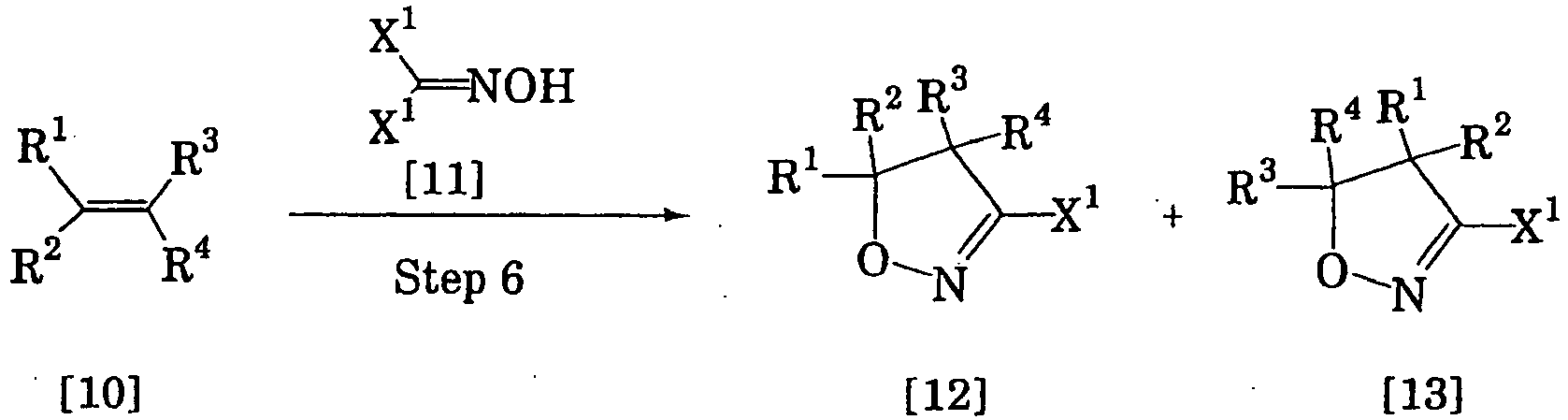
- In the above reaction, X1, R1, R2, R3 and R4 have the same definitions as given above.
- The isoxazoline compounds represented by the general formulas [12] and [13] can be produced by reacting an olefin derivative represented by the general formula [10] with an oxime derivative represented by the general formula [11] in the presence or absence of a solvent (preferably in an appropriate solvent) in the presence of a base. When R3 and R4 are each a hydrogen atom, the isoxazoline compound represented by the general formula [12] can be obtained preferentially.
- The reaction temperature is any temperature between 0°C and the reflux temperature of the reaction system and is preferably 10 to 80°C. The reaction time varies depending upon the compounds used, but is 0.5 hours to 2 weeks.
- With respect to the amounts of the reagents used in the reaction, the compound represented by the general formula [10] is used in an amount of 1 to 3 equivalents per equivalent of the compound represented by the general formula [11].
- As the solvent, there can be mentioned, for example, ethers such as ethylene glycol dimethyl ether, ethylene glycol diethyl ether, diethyl ether, dioxane, tetrahydrofuran and the like; halogenated hydrocarbons such as dichloroethane, carbon tetrachloride, chlorobenzene, dichlorobenzene and the like; aromatic hydrocarbons such as benzene, toluene, xylene and the like; acetic acid esters such as ethyl acetate, butyl acetate and the like; water; and mixtures thereof.
- As the base, there can be mentioned, for example, alkali metal hydroxides such as sodium hydroxide, potassium hydroxide and the like; alkaline earth metal hydroxides such as calcium hydroxide, magnesium hydroxide and the like; alkali metal carbonates such as sodium carbonate, potassium carbonate and the like; alkali metal hydrogencarbonates such as sodium hydrogencarbonate, potassium hydrogencarbonate and the like; alkali metal acetates such as sodium acetate, potassium acetate and the like; alkali metal fluorides such as sodium fluoride, potassium fluoride and the like; and organic bases such as pyridine, triethylamine, 1,8-diazabicyclo[5.4.0]-7-undecene and the like.
- In the above production process, the compound represented by the general formula [10], used as an intermediate can be a commercial product or can be produced by a known reaction such as Wittig reaction or the like. The compound represented by the general formula [11] can be produced, for example, by a process described in Liebigs Annalen der Chemie, 985 (1989).
- The compound represented by the general formula [1] can be produced from the above-shown compound represented by the general formula [12] by the following process.

- In the above reaction, X1, R1, R2, R3, R4 and R7 have the same definitions as given above.
- A compound represented by the general formula [15] can be produced by the above-described step 5; a compound represented by the general formula [16] can be produced by the above-described step 2; and the compound represented by the general formula [1] can be produced from the compound [15] by the above-described step 4 or from the compound [16] by the above-described step 3.
- As the solvent, base and oxidizing agent, there can be mentioned the same solvents, bases and oxidizing agents as mentioned in the step 2, 3, 4 or 5.
- A compound represented by the general formula [4] wherein R6 is a hydrogen atom, i.e. a compound represented by the general formula [21] can be produced by the following process.

- In the above reaction, R5, X1 and Y have the same definitions as given above; and R8 is an alkyl group.
- A compound represented by the general formula [20] can be produced by reacting a compound [17], [18] or [19] with a reducing agent in a solvent.
- This reaction is conducted ordinarily at -60 to 150°C for 10 minutes to 24 hours.
- With respect to the amounts of the reagents used in the reaction, the reducing agent is used in an amount of desirably 0.5 to 2 equivalents per equivalent of the compound [17], [18] or [19]; however, the amount can be varied appropriately depending upon the condition of the reaction.
- As the reducing agent, there can be mentioned, for example, metal hydrides (e.g. diisobutyl aluminum hydride) and metal hydrogen complex compounds (e.g. sodium borohydride and lithium aluminum hydride) in production of [20] from [17]; and metal hydrides (e.g. diisobutyl aluminum hydride), metal hydrogen complex compounds (e.g. sodium borohydride and lithium aluminum hydride) and diborane in production of [20] from [18] or [19].
- As the solvent, there can be mentioned, for example, ethers such as diethyl ether, tetrahydrofuran, dioxane and the like; aromatic hydrocarbons such as benzene, toluene and the like; and alcohols such as methanol, ethanol and the like.
- A compound represented by the general formula [21] can be produced by reacting the compound [20] with a halogenating agent in a solvent.
- This reaction is conducted ordinarily at -50 to 100°C for 10 minutes to 24 hours.
- With respect to the amounts of the reagents used in the reaction, the halogenating agent is used in an amount of desirably 1 to 3 equivalents per equivalent of the compound [20]; however, the amount can be varied appropriately depending upon the condition of the reaction.
- As the halogenating agent, there can be mentioned, for example, hydrogen chloride, hydrogen bromide, phosphorus trichloride, phosphorus tribromide and thionyl chloride.
- As the solvent, there can be mentioned, for example, halogenated hydrocarbons such as dichloroethane, carbon tetrachloride and the like; acids such as acetic acid and the like; and ethers such as tetrahydrofuran and the like.
- The compound represented by the general formula [4] can be produced by the following process.

- In the above reaction, R5, R6, X1 and Y have the same definitions as given above.
- The compound represented by the general formula [4] can be produced by reacting a compound [22] with a halogenating agent in a solvent in the presence or absence of a catalyst.
- This reaction is conducted ordinarily at 30 to 150°C for 10 minutes to 24 hours.
- With respect to the amounts of the reagents used in the reaction, the halogenating agent is used in an amount of desirably 1 to 10 equivalents relative to one equivalent of the compound [22]; however, the amount of the halogenating agent can be varied appropriately depending upon the condition of the reaction. The catalyst is used in an amount of 0.01 to 0.5 equivalent.
- As the halogenating agent, there can be mentioned, for example, halogens such as bromine, chlorine and the like; N-halosuccinimides such as N-bromosuccinimide and the like; and pyridine salts such as pyridinium perbromide and the like.
- As the solvent, there can be mentioned, for example, halogenated hydrocarbons such as dichloroethane, carbon tetrachloride, chlorobenzene, dichlorobenzene and the like; amides such as N,N-dimethylacetamide, N,N-dimethylformamide, N-methyl-2-pyrrolidinone and the like; sulfur compounds such as dimethyl sulfoxide, sulfolane and the like; and carboxylic acids such as formic acid, acetic acid and the like.
- As the catalyst, there can be mentioned, for example, benzoyl peroxide, α, α-azobisisobutyronitrile and a mixture thereof.
- A compound represented by the general formula [4] wherein R5 and R6 are each a hydrogen atom, i.e. a compound represented by the general formula [24] can be produced by the following process.

- In the above reaction, X1 and Y have the same definitions as given above.
- The compound represented by the general formula [24] can be produced by reacting a compound [23], hydrogen halide, and formaldehyde or paraformaldehyde in a solvent in the presence or absence of a Lewis acid according to the method described in Org. Synth., III, 557 (1955) or J. Am. Chem. Soc., 72, 2216 (1950), or by reacting the compound [23] with a halogenomethyl ether in a solvent in the presence of a Lewis acid according to the method described in J. Am. Chem. Soc., 97, 6155 (1975).
- This reaction is conducted ordinarily at -40 to 150°C for 10 minutes to 24 hours.
- With respect to the amounts of the reagents used in the reaction, the hydrogen halide, formaldehyde, paraformaldehyde, Lewis acid or halogenomethyl ether is used in an amount of desirably 1 to 2 equivalents per equivalent of the compound [23]; however, the amount of the former can be varied appropriately depending upon the condition of the reaction.
- As the Lewis acid, there can be mentioned, for example, titanium tetrachloride, zinc chloride, aluminum chloride and zinc bromide.
- As the hydrogen halide, there can be mentioned hydrogen chloride, hydrogen bromide and hydrogen iodide.
- As the solvent, there can be mentioned, for example, halogenated hydrocarbons such as dichloroethane, carbon tetrachloride, chloroform and the like; aliphatic hydrocarbons such as hexane, heptane and the like; ethers such as dioxane, tetrahydrofuran and the like; carboxylic acids such as acetic acid and the like; carbon disulfide; and mixtures thereof.
- A compound represented by the general formula [19] wherein R5 is a hydrogen atom, i.e. a compound represented by the general formula [25] can be produced by the following process.

- In the above reaction, Y has the same definition as given above.
- The compound represented by the general formula [25] can be produced by reacting the compound [23] with N,N-dimethylformamide in the presence of phosphoryl chloride, phosgene or thionyl chloride in the presence or absence of a solvent according to the Vilsmeier method described in Org. Syrith., IV, 831 (1963), or by reacting the compound [23] with a dihalogenomethyl ether in a solvent in the presence of a Lewis acid and then giving rise to hydrolysis according to the method described in Chem. Ber., 93, 88 (1960).
- This reaction is conducted ordinarily at -40 to 150°C for 10 minutes to 24 hours.
- With respect to the amounts of the reagents used in the reaction, the phosphoryl chloride, phosgene, thionyl chloride, N,N-dimethylformamide, Lewis acid or dihalogenomethyl ether is used in an amount of desirably 1 to 2 equivalents per equivalent of the compound [23]; however, the amount of the former can be varied appropriately depending upon the condition of the reaction.
- As the Lewis acid, there can be mentioned, for example, titanium tetrachloride, tin tetrachloride, zinc chloride, aluminum chloride and zinc bromide.
- As the solvent, there can be mentioned, for example, halogenated hydrocarbons such as dichloroethane, carbon tetrachloride, chloroform and the like; aliphatic hydrocarbons such as hexane, heptane and the like; ethers such as dioxane, tetrahydrofuran and the like; carboxylic acids such as acetic acid and the like; amides such as N,N-dimethylformamide and the like; carbon disulfide; and mixtures thereof.
- The compounds represented by the general formulas [17], [18], [19] and [20] can be produced by the following process.
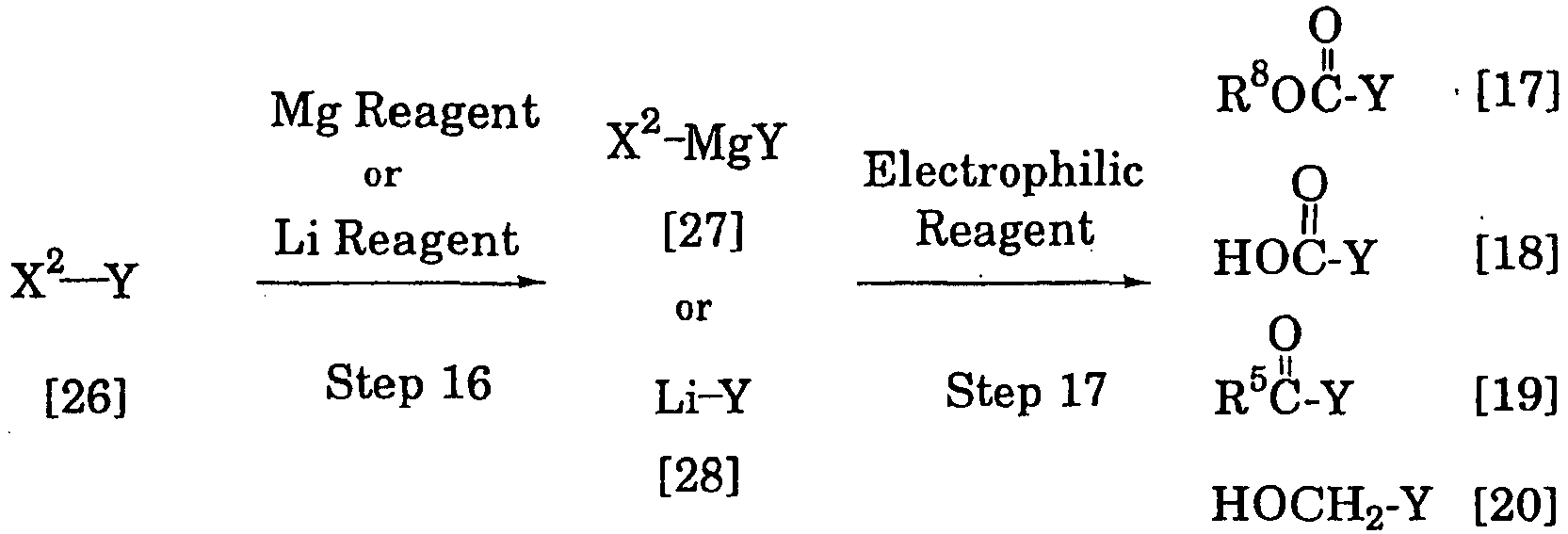
- In the above reaction, R5, R8 and Y have the same definitions as given above; and X2 is a chlorine atom, a bromine atom or an iodine atom.
- The compounds represented by the general formulas [17], [18], [19] and [20] can be produced by reacting a compound [26] with a magnesium reagent in the presence or absence of a solvent to obtain a compound [27] and then reacting the compound [27] J with an electrophilic reagent according to the method described in J. Org. Chem., 65, 4618 (2000), or by reacting the compound [26] with n-butyl lithium in a solvent to obtain a compound [28] and then reacting the compound [28] with an electrophilic reagent according to the method described in Synth. Commun., 24 (2), 253 (1994).
- This reaction is conducted ordinarily at -100 to 150°C for 10 minutes to 24 hours.
- With respect to the amounts of the reagents used in the reaction, the amount of the magnesium reagent or the lithium reagent is desirably 1 to 5 equivalents per equivalent of the compound [26], and the amount of the electrophilic reagent is desirably 1 to 5 equivalents; however, these amounts can be varied appropriately depending upon the condition of the reaction.
- As the magnesium reagent, there can be mentioned, for example, metal magnesium, isopropyl magnesium bromide and di-isopropyl magnesium.
- As the lithium reagent, there can be mentioned, for example, n-butyl lithium, sec-butyl lithium and tert-butyl lithium.
- As the electrophilic reagent, there can be mentioned, for example, esters such as ethyl formate, ethyl cyanoformate, ethyl acetate and the like; acid halides such as acetyl chloride, methyl chloroformate and the like; amides such as N,N-dimethylformamide and the like; aldehydes such as paraformaldehyde and the like; and carbon dioxide.
- As the solvent, there can be mentioned, for example, halogenated hydrocarbons such as dichloroethane, carbon tetrachloride, chloroform and the like; aliphatic hydrocarbons such as hexane, pentane and the like; ethers such as dioxane, tetrahydrofuran and the like; and mixtures thereof.
- Among compounds represented by the general formulas [4], [17], [18], [19], [20], [22], [23], [26], [29] or [34], a compound represented by the general formula [31] can be produced by the following process.

- In the above reaction, Y has the same definition as given above; R9 is an alkyl group, a haloalkyl group, a cycloalkyl gorup, a cycloalkylalkyl group, an alkoxycarbonylalkyl group, an optionally substituted benzyl group, an optionally substituted heterocyclic alkyl group, an alkenyl tionally substituted heterocyclic alkyl group, an alkenyl group, an alkynyl group, an alkylsulfonyl group, a haloalkylsulfonyl group, an optionally substituted aromatic heterocyclic group, an optionally substituted phenylsulfonyl group, an acyl group, a haloalkylcabonyl group, an optionally substituted benzylcarbonyl group or an optionally substituted benzoyl group; and L1 is a leaving group such as halogen atom, C1 to C4 alkylsulfonate group, C1 to C4 alkylsulfonyl group, optionally substituted benzylsulfonyl group, optionally substituted phenylsulfonate group, optionally substituted benzylsulfonate group or the like. When R9 is a haloalkyl group, L1 is a leaving group having a higher reactivity than the halogen atom remaining after haloalkylation. For example, when R9 is a CHF2 group, L1 is a chlorine atom or a bromine atom; and when R9 is a CH2CF3 group, L1 is a chlorine atom, a bromine atom, a p-toluenesulfonyloxy group or a methylsulfonyloxy group.
- The compound represented by the general formula [31] can be produced by reacting a compound [29] with a compound [30] in a solvent in the presence of a base.
- This reaction is conducted ordinarily at 0 to 120°C for 10 minutes to 24 hours.
- With respect to the amounts of the reagents used in the reaction, the amount of the compound [30] is 1 to 20 equivalents per equivalent of the compound [29], and the amount of the base is 1 to 3 equivalents.
- As the base, there can be mentioned, for example, alkali metal carbonates such as sodium carbonate, potassium carbonate and the like; alkali metal hydroxides such as sodium hydroxide, potassium hydroxide and the like; alkali metal hydrides such as potassium hydride, sodium hydride and the like; alkali metal alcoholates such as sodium ethoxide, sodium methoxide and the like; and organic bases such as 1,8-diazabicyclo[5.4.0]-7-undecene and the like.
- As the solvent, there can be mentioned, for example, halogenated hydrocarbons such as dichloromethane, chloroform and the like; ethers such as diethyl ether, tetrahydrofuran and the like; aromatic hydrocarbons such as benzene, toluene and the like; aliphatic hydrocarbons such as hexane, heptane and the like; ketones such as acetone, methyl isobutyl ketone and the like; esters such as ethyl acetate, methyl acetate and the like; amides such as N-methylpyrrolidone, N,N-diméthylformamide and the like; sulfur compounds such as dimethyl sulfoxide, sulfolane and the like; nitriles such as acetonitrile and the like; and mixtures thereof.
- Among compounds represented by the general formulas [4], [17], [18], [19], [20], [22], [23], [26], [29] or [31], a compound represented by the general formula [34] can be produced by the following process.

- In the above reaction, L1 has the same definition as given above; and R10 is an alkyl group, an alkyl group mono-substituted with a group selected from the substituent group β, a haloalkyl group, a cycloalkyl group, an alkenyl group, an alkynyl group, an alkylsulfinyl group, an alkylsulfonyl group, an alkylsulfonyl group mono-substituted with a group selected from the substituent group γ, a haloalkylsulfonyl group, an optionally substituted phenyl group, an optionally substituted aromatic heterocyclic group, an optionally substituted phenylsulfonyl group, an optionally substituted aromatic heterocyclicsulfonyl group, an acyl group, a haloalkyl-carbonyl group, an optionally substituted benzylcarbonyl group, an optionally substituted benzoyl group, an alkoxycar-bonyl group, an optionally substituted benzyloxycarbonyl group, an optionally substituted phenoxycarbonyl group, or a carbamoyl group (its nitrogen atom may be substituted with same or different groups selected from alkyl groups and optionally substituted phenyl group). The carbon atoms of the pyrazole ring may be substituted with 1 to 2 same or different groups selected from the substituent group α.
- The compound represented by the general formula [34] can be produced by reacting a compound [32] with a compound [33] in a solvent in the presence of a base.
- This reaction is conducted ordinarily at 0 to 120°C for 10 minutes to 24 hours.
- With respect to the amounts of the reagents used in the reaction, the amount of the compound [33] is 1 to 20 equivalents per equivalent of the compound [32], and the amount of the base is 1 to 3 equivalents.
- As the base and the solvent, there can be mentioned, for example, the same bases and solvents as mentioned in production of the compound [31] from the compound [29].
- Introduction of a trifluoromethyl group into Y can be conducted according to or based on, for example, the methods described in J. Chem. Soc. Perkin Trans. 1, 8, 2293-2299 (1990); J. Fluorine Chem., 50 (3), 411-426 (1990); J. Chem. Soc. Chem. Commun., 18, 1389-1391 (1993); J. Chem. Soc. Chem. Commun., 1, 53-54 (1992); Chem. Lett., 1719-1720 (1981); Chem. Pharm. Bull., 38 (9), 2446-2458 (1990); J. Chem. Soc. Perkin Trans. 1, 921-926 (1988); Heterocycles, 37 (2), 775-782 (1994); Tetrahedron Lett., 30 (16), 2133-2136 (1989); J. Chem. Soc. Perkin Trans. 1, 2755-2761 (1980); Hetrocycles, 22 (1), 117-124 (1984); Eur. J. Med. Chem. Chim. Ther., 24, 249-258 (1989); Acta Chem. Scand. Ser. B, 38 (6), 505-508 (1984); J. Fluorine Chem., 21, 495-514 (1982); J. Chem. Soc. Chem. Commun., 10, 638-639 (1988); J. Fluorine Chem., 67 (1), 5-6 (1994); J. Heterocycl. Chem., 31 (6), 1413-1416 (1994); Chem. Heterocycl. Compd., 30 (5), 576-578 (1994); J. Fluorine Chem., 78 (2), 177-182 (1996); J. Heterocycl. Chem., 34 (2), 551-556 (1997); Tetrahedron, 55 (52), 15067-15070 (1999); and Synthesis, 11, 932-933 (1980).
- The compounds represented by the general formulas [4], [17], [18], [19], [20], [21], [22], [23], [24], [25], [26], [29] and [31] can be produced according to or based on, for example, the methods described in Methoden der Organischen Chemie, E6a, 16-185 (1994) when Y is a furyl group; Methoden der Organischen Chemie, E6a, 186-555 (1994) when Y is a thienyl group; Methoden der Organischen Chemie, E6a, 556-798 (1994) when Y is a pyrrolyl group; Methoden der Organischen Chemie., E8b, 399-763 (1994) and
JP-A-2000-219679 WO-1997/29105 WO-1997/42188-A1 -

- In the above reaction, Y, R1, R2, R3, R4, R5, R6, R9 and L1 have the same definitions as given above. Y may be substituted with 1 to 5 same or different groups selected from the substituent group α.
- A compound represented by the general formula [48] according to the present invention can be produced by reacting a compound [47] of the present invention with the compound [30] in a solvent in the presence of a base.
- This reaction is conducted ordinarily at 0 to 150°C for 10 minutes to 24 hours.
- With respect to the amounts of the reagents used in the reaction, the amount of the acid is desirably 1 to 1.2 equivalents per equivalent of the compound [47]; however, the amount can be varied appropriately depending upon the condition of the reaction.
- As the base and the solvent, there can be mentioned the same bases and solvents as mentioned in the Production Process 3.
-

- In the above reaction, Y, R1, R2, R3, R4, R5 and R6 have the same definitions as given above; and R17 is an alkyl group, an optionally substituted benzyl group or an optionally substituted phenyl group. Y may be substituted with 1 to 5 same or different groups selected from the substituent group α.
- A compound represented by the general formula [50] according to the present invention can be produced by hydrolyzing a compound [49] of the present invention in water or a mixed solvent of water and other solvent in the presence or absence of a base.
- This reaction is conducted ordinarily at 0 to 100°C for 10 minutes to 24 hours.
- With respect to the amounts of the reagents used in the reaction, the amount of the base, when used, is desirably 1 to 2 equivalents per equivalent of the compound [49]; however, the amount can be varied appropriately depending upon the condition of the reaction.
- As the base, there can be mentioned, for example, inorganic bases such as potassium carbonate, sodium hydride, sodium hydroxide and the like; and organic bases such as 1,8-diazabicyclo[5.4.0]-7-undecene and the like.
- As the other solvent mixed with water, there can be mentioned, for example, alcohols such as methanol, ethanol and the like; ethers such as tetrahydrofuran and the like; ketones such as acetone, methyl isobutyl ketone and the like; amides such as N,N-dimethylformamide and the like; sulfur compounds such as dimethyl sulfoxide, sulfolane and the like; acetonitrile; and mixtures thereof.
-

- In the above reaction, Y, R1, R2, R3, R4, R4, R6 and R8 have the same definitions as given above; and R18 is an alkyl group. Y may be substituted with 1 to 5 same or different groups selected from the substituent group α.
- A compound represented by the general formula [53] according to the present invention can be produced by reacting a compound [51] of the present invention with a compound [52] in a solvent in the presence of a base.
- This reaction is conducted ordinarily at 0 to 100°C for 10 minutes to 24 hours.
- With respect to the amounts of the reagents used in the reaction, the amount of the hydrochloride or sulfate of the compound [52] is desirably 1 to 5 equivalents per equivalent of the compound [51] and the amount of the base is desirably 1 to 10 equivalents; however, these amounts can be varied appropriately depending upon the condition of the reaction.
- As the base, there can be mentioned, for example, metal carbonates such as potassium carbonate, sodium carbonate and the like; metal acetates such as potassium acetate, sodium acetate and the like; and organic bases such as triethylamine, dimethylamine, 1,8-diazabicyclo[5.4.0]-7-undecene and the like.
- As the solvent, there can be mentioned, for example, alcohols such as methanol, ethanol and the like; ethers such as tetrahydrofuran and the like; amides such as N,N-dimethylformamide and the like; water; and mixtures thereof.
-

- In the above reaction, Y, R1, R2, R3, R4, R5 and R6 have the same definitions as given above; and R19 and R20 are each a hydrogen atom or an alkyl group. Y may be substituted with 1 to 5 same or different groups selected from the substituent group a.
- A compound represented by the general formula [57] according to the present invention can be produced by reacting the compound [50] of the present invention with thionyl chloride in the presence or absence of a solvent to obtain a compound [55] and then reacting the compound [55] with a compound [56] in the presence or absence of a solvent.
- The reaction from the compound [50] to the compound [55] is conducted ordinarily at 0 to 100°C for 10 minutes to 24 hours.
- With respect to the amounts of the reagents used in the reaction, the amount of thionyl chloride [54] is desirably 1 to 100 equivalents per equivalent of the compound [50] but it can be varied appropriately depending upon the condition of the reaction.
- As the solvent, there can be mentioned, for example, halogenated hydrocarbons such as dichloromethane, chloroform and the like; ethers such as diethyl ether, tetrahydrofuran and the like; and aromatic hydrocarbons such as benzene, toluene and the like.
- The reaction from the compound [55] to the compound [57] is conducted ordinarily at 0 to 100°C for 10 minutes to 24 hours.
- With respect to the amounts of the reagents used in the reaction, the amount of the compound [56] is desirably 1 to 100 equivalents per equivalent of the compound [55] but it can be varied appropriately depending upon the condition of the reaction.
- As the solvent, there can be mentioned, for example, the same solvents as used in the reaction from the compound [50] to the compound [55].
-

- In the above reaction, Y, R1, R2, R3, R4, R5 and R6 have the same definitions as given above; and R21 is an alkyl group, a haloalkyl group, a cycloalkyl group, a cycloalkylalkyl group, an alkenyl group, an alkynyl group, an alkoxycarbonylalkyl group, an optionally substituted heteroalkyl group or an optionally substituted benzyl group. Y may be substituted with 1 to 5 same or different groups selected from the substituent group α.
- A compound represented by the general formula [61] according to the present invention can be produced by reacting the compound [47] of the present invention with a compound [60] in the presence of an azo compound and triphenylphosphine in a solvent according to a known method [Synthesis, 1-28 (1981)].
- This reaction is conducted ordinarily at 0 to 100°C for 10 minutes to 24 hours.
- With respect to the amounts of the reagents used in the reaction, the amounts of the compound [60], the azo compound and triphenylphosphine are desirably each 1 to 1.5 equivalents per equivalent of the compound [47] but the amounts can be varied appropriately depending upon the condition of the reaction.
- As the solvent, there can be mentioned, for example, ethers such as dioxane, tetrahydrofuran (THF) and the like; halogenated hydrocarbons such as dichloroethane, carbon tetrachloride, chlorobenzene, dichlorobenzene and the like; amides such as N,N-dimethylacetamide, N,N-dimethylformamide, N-methyl-2-pyrrolidinone and the like; sulfur compounds such as dimethyl sulfoxide, sulfolane and the like; aromatic hydrocarbons such as benzene, toluene, xylene and the like; acetonitrile; and mixtures thereof.
- As the azo compound, there can be mentioned, for example, diethyl azodicarboxylate and diisopropyl azodicarboxylate.
- Incidentally, the sulfide compound mentioned in the Production Processes 2 to 6 can be converted into a sulfoxide compound or a sulfone compound by oxidation according to the method described in the Production Process 1. Furthermore, the sulfide compound mentioned in the Production Processes 2 to 6 wherein substituent Y is substituted by C1 to C10 alkylthio group, C1 to C10 alkylthio group mono-substituted with a group selected from the substituent group γ or C1 to C4 haloalkylthio group, can be converted into a sulfoxide compound or a sulfone compound according to the method described in the Production Process 1, by adding equi-molar to excess amount of an oxidizing agent to the sulfide compound; oxidizing the substituent substituted to substituent Y (C1 to C10 alkylthio group, C1 to C10 alkylthio group mono-substituted with a group selected from the substituent group γ or C1 to C4 haloalkylthio group) at the same time, and convert these substituent into a sulfoxide group or a sulfone group.
- Then, specific description is made on the production process of the present compound, the production method of the present herbicide and the application of the present herbicide by way of Examples. Description is also made on the production process of each intermediate of the present compound.
- 0.32 g of sodium hydrosulfide (purity: 70%, 4.00 mmoles) was added, at room temperature, to a solution of 0.35 g (2.00 mmoles) of 5,5-dimethyl-3-methylsulfonyl-2-isoxazoline dissolved in 10 ml of dimethylformamide. The mixture was stirred for 2 hours. To the reaction mixture were added 0.28 g (2.00 mmoles) of anhydrous potassium carbonate, 0.31 g (2.00 mmoles) of Rongalit and 0.45 g (2.00 mmoles) of 5-chloromethyl-4-methoxy-6-trifluoromethylpyrimidine. The resulting mixture was stirred at room temperature for 2 hours to give rise to a reaction. After confirmation of the completion of the reaction, the reaction mixture was poured into water, followed by extraction with ethyl acetate. The resulting organic layer was washed with water and an aqueous sodium chloride solution and then dried over anhydrous magnesium sulfate. The resulting solution was subjected to vacuum distillation to remove the solvent contained therein. The residue was purified by silica gel column chromatography to obtain 0.55 g (yield: 85.9%) of 5,5-dimethyl-[(4-methoxy-6-trifluoromethylpyrimidin-5-yl)-methylthiol-2-isoxazoline.
1H-NMR [CDCl3/TMS, δ (ppm)]: - 8.81 (1H,s), 4.44 (2H,d), 4.12 (3H,s), 2.81 (2H,s), 1.45 (6H,s)
- 1.05 g of m-chloroperbenzoic acid (purity: 70%, 4.28 mmoles) was added, with ice-cooling, to a solution of 0.55 g (1.71 mmoles) of 5,5-dimethyl-[(4-methoxy-6-trifluoromethylpyrimidin-5-yl)-methylthiol-2-isoxazoline dissolved in 20 ml of chloroform. The mixture was stirred for 1 hour and then at room temperature for 4 hours to give rise to a reaction. After the completion of the reaction, the reaction mixture was poured into water, followed by extraction with chloroform. The resulting organic layer was washed with an aqueous sodium hydrogensulfite solution, an aqueous sodium hydrogencarbonate solution and an aqueous sodium chloride solution in this order and then dried over anhydrous magnesium sulfate. The resulting solution was subjected to vacuum distillation to remove the solvent contained therein. The residue was purified by silica gel column chromatography to obtain 0.45 g (yield: 75.0%) of 5,5-dimethyl-[(4-methoxy-6-trifluoromethylpyrimidin-5-yl)-methylsulfonyl]-2-isoxazoline as white feather-like crystals (melting point: 175 to 176°C).
1H-NMR [CDCl3/TMS, δ (ppm)]: - 8.89 (1H,s), 5.00 (2H,d), 4.11 (3H,s), 3.11 (2H,s), 1.53 (6H,s)
- 2.34 (2H,m), 1.50 (6H,s)
- Compound numbers shown in Table 2 are referred to in the Examples.
Table 2 
R1 R2 R3 R4 n R5 R6 R41 R42 R43 Melting point(°C) or refractive index (nD20) 8-0001 Me Me H H 2 H H H OMe CF3 175-176 8-0002 Me Me H H 0 H H H OMe CF3 8-0003 Me Me H H 2 H H H Cl Cl 119-120 8-0004 Me Me H H 2 H H H OEt CF3 94-95 8-0005 Me Me H H 2 H H H OMe OMe 186-187 8-0006 Me Me H H 2 H H Me OMe CF3 143-144 8-0007 Me Me H H 2 H H OMe OMe CF3 144-145 8-0008 Me Me H H 2 H H SMe OMe CF3 160-162 8-0009 Me Me H H 2 H H SO2Me OMe CF3 144-146 8-0010 Me Me H H 2 H H NH2 OMe CF3 208-209 8-0011 Me Me H H 2 Pr-i H H H CF3 112-113 8-0012 Me Me H H Pr-i H H H CF3 1.4986 - 534.0 g (4.0 moles) of N-chlorosuccinimide was gradually added, at 65 to 70°C, to a solution of 182.7 g (2.05 moles) of glyoxylic acid aldoxime dissolved in 2 liters of 1,2-dimethoxyethane. The mixture was refluxed for 1 hour with heating. Thereto were added, with ice-cooling, 1,440.0 g (14.4 moles) of potassium hydrogencarbonate and 10 ml of water. Then, 360.0 g (6.4 moles) of 2-methylpropene was added. The resulting mixture was stirred at room temperature for 24 hours to give rise to a reaction. The reaction mixture was poured into water, followed by extraction with dii-sopropyl ether. The resulting organic layer was washed with water and an aqueous sodium chloride solution in this order and then dried over anhydrous magnesium sulfate. The resulting solution was subjected to vacuum distillation to remove the solvent contained therein, to obtain 107.7 g (yield: 40.0%) of 3-chloro-5,5-dimethyl-2-isoxazoline as a yellow viscous liquid.
1H-NMR [CDCl3/TMS, δ (ppm)]: - 2.93 (2H,s), 1.47 (6H,s)
- 61.9 g (463.4 mmoles) of N-chlorosuccinimide was gradually added, at 60°C, to a solution of 20.6 g (231.7 mmoles) of glyoxylic acid aldoxime dissolved in 500 ml of 1,2-dimethoxyethane. After the addition, the mixture was refluxed for 10 minutes with heating. Thereto were added, with ice-cooling, 50 ml (463.4 mmoles) of 2-methyl-1-butene, 98.9 g (1,622 mmoles) of potassium hydrogencarbonate and 10 ml of water. The resulting mixture was stirred for 12 hours to give rise to a reaction. The reaction mixture was poured into water, followed by extraction with n-hexane. The resulting organic layer was washed with water and an aqueous sodium chloride solution in this order and then dried over anhydrous magnesium sulfate. The resulting solution was subjected to vacuum distillation to remove the solvent contained therein, to obtain 13.9 g (yield: 40.6%) of 3-chloro-5-ethyl-5-methyl-2-isoxazoline as a yellow viscous liquid.
1H-NMR [CDCl3/TMS, δ (ppm)]: - 2.91 (2H, ABq, J=17.0, Δν=46.1 Hz), 1.73 (2H,q),
- 1.42 (3H,s), 0.96 (3H,t)
- 3.2 g (23.2 mmoles) of anhydrous potassium carbonate and 3.0 g (22.5 mmoles) of 3-chloro-5,5-dimethyl-2-isoxazoline were added, in a nitrogen atmosphere, to a solution of 2.8 g (22.5 mmoles) of benzylmercaptan dissolved in 50 ml of N,N-dimethylformamide. The mixture was stirred at 100°C for 2 hours to give rise to a reaction. After the completion of the reaction, the reaction mixture was poured into water, followed by extraction with ethyl acetate. The resulting organic layer was washed with water and an aqueous sodium chloride solution in this order and then dried over anhydrous magnesium sulfate. The resulting solution was subjected to vacuum distillation to remove the solvent contained therein. The residue was purified by silica gel column chromatography to obtain 3.1 g (yield: 62.0%) of 3-benzylthio-5,5-dimethyl-2-isoxazoline as a yellow oily substance (nD20 = 1.5521).
1H-NMR [CDCl3/TMS, δ (ppm)]: - 7.24-7.39 (5H,m), 4.26 (2H,s), 2.77 (2H,s),
- 1.40 (6H,s)
- 4.6 g of m-chloroperbenzoic acid (purity: 70%, 18.8 mmoles) was added, with ice-cooling, to a solution of 4.1 g (15.0 mmoles) of 3-(2,6-difluorobenzylthio)-5-ethyl-5-methyl-2-isoxazoline dissolved in 50 ml of chloroform. The mixture was stirred for 1 hour and then at room temperature for 12 hours to give rise to a reaction. After the completion of the reaction. the reaction mixture was poured into water, followed by extraction with chloroform. The resulting organic layer was washed with an aqueous sodium hydrogensulfite solution, an aqueous sodium hydrogencarbonate solution, water and an aqueous sodium chloride solution in this order and then dried over anhydrous magnesium sulfate. The resulting solution was subjected to vacuum distillation to remove the solvent contained therein. The residue was purified by silica gel column chromatography (developing solvent: hexane-ethyl acetate mixed solvent) to obtain 1.5 g (yield: 34.8%) of 3-(2,6-difluorobenzylsulfinyl)-5-ethyl-5-methyl-2-isoxazoline as a white powder (melting point: 30°C or less).
1H-NMR [CDCl3/TMS, δ (ppm)]: - 7.39-7.28 (1H,m), 7.03-6.94 (2H,m), 4.38 (2H,s), 3.04 (1H, ABq, J=17.2, Δν=85.7 Hz), 3.12 (1H,s), 1.75 (2H,m), 1.44 (3H,S)+1.41 (3H,s), 0.97 (3H,m)
- 1.0 g of m-chloroperbenzoic acid (purity: 70%, 4.1 mmoles) was added, with ice-cooling, to a solution of 0.8 g (2.8 mmoles) of 3-(2,6-difluorobenzylsulfinyl)-5-ethyl-5-methyl-2-isoxazoline dissolved in 50 ml of chloroform. The mixture was stirred for 1 hour and then at room temperature for 12 hours to give rise to a reaction. After the completion of the reaction. the reaction mixture was poured into water, followed by extraction with chloroform. The resulting organic layer was washed with an aqueous sodium hydrogensulfite solution, an aqueous sodium hydrogencarbonate solution, water and an aqueous sodium chloride solution in this order and then dried over anhydrous magnesium sulfate. The resulting solution was subjected to vacuum distillation to remove the solvent contained therein. The residue was purified by silica gel column chromatography (developing solvent: hexane-ethyl acetate mixed solvent) to obtain 0.6 g (yield: 75.0%) of 3-(2,6-difluorobenzylsulfonyl)-5-ethyl-5-methyl-2-isoxazoline as a white powder (melting point: 64 to 65°C).
1H-NMR [CDCl3/TMS, δ (ppm)]: - 7.36-7.46 (1H,m), 6.98-7.04 (2H,m), 4.73 (2H,s), 3.04 (2H, ABq, J=17.2, Δν-51.1 Hz), 1.77 (2H,q), 1.46 (3H,s), 0.97 (3H,t)
- 1.0 kg of an aqueous sodium methanethiolate solution (content: 15%, 2.14 mmoles) was dropwise added, with ice-cooling, to a solution of 143.0 g (1.07 moles) of 3-chloro-5,5-dimethyl-2-isoxazoline dissolved in 500 ml of N,N-dimethylformamide. The mixture was stirred at room temperature for 12 hours to give rise to a reaction. After the completion of the reaction, the reaction mixture was poured into water, followed by extraction with ethyl acetate. The resulting organic layer was washed with an aqueous sodium chloride solution and then dried over anhydrous magnesium sulfate. The resulting solution was subjected to vacuum distillation to remove the solvent contained therein, to obtain 115.0 g (yield: 74.1%) of 5,5-dimethyl-3-methylthio-2-isoxazoline. This residue (741.2 moles) was dissolved in 1 liter of chloroform. Thereto was added, with ice-cooling, 392.0 g of m-chloroperbenzoic acid (purity: 70%, 1.59 moles). The resulting mixture was stirred for 1 hour and then at room temperature for 12 hours to give rise to a reaction. After the completion of the reaction, the separated m-chloroperbenzoic acid was removed by filtration. The resulting filtrate was washed with an aqueous sodium hydrogensulfite solution, water, an aqueous sodium hydrogencarbonate solution and an aqueous sodium chloride solution in this order and then dried over anhydrous magnesium sulfate. The resulting solution was subjected to vacuum distillation to remove the solvent contained therein. The residue was washed with diisopropyl ether to obtain 77.6 g (yield: 59.1%) of 5,5-dimethyl-3-methylsulfonyl-2-isoxazoline as a white powder (melting point: 82 to 84°C).
1H-NMR [CDCl3/TMS, δ (ppm)]: - 3.26 (3H,s), 3.12 (2H,s), 1.51 (6H,s)
- 1,500 ml of an aqueous solution containing 560.0 g (9.0 moles) of ethyl mercaptan and 360.0 g (9.0 moles) of sodium hydroxide was added to a solution containing 3-chloro-5,5-dimethyl-2-isoxazoline. The mixture was stirred at 60 to 70°C for 16 hours to give rise to a reaction. After confirmation of the completion of the reaction, the reaction mixture was poured into water, followed by extraction with ethyl acetate. The resulting organic layer was washed with water and an aqueous sodium chloride solution and then dried over anhydrous magnesium sulfate. The resulting solution was subjected to vacuum distillation to remove the solvent contained therein, to obtain 270.0 g of crude 5,5-dimethyl-3-ethylthio-2-isoxazoline as a dark red oily substance.
- 270.0 g (1.7 moles) of crude oily 5,5-dimethyl-3-ethylthio-2-isoxazoline was dissolved in 1.0 liter of chloroform. Thereto was added, with ice-cooling, 1,050 g of m-chloroperbenzoic acid (purity: 70%, 6.1 moles). The resulting mixture was stirred for 1 hour and then at room temperature for 12 hours to give rise to a reaction. After confirmation of the completion of the reaction, the separated m-chloroperbenzoic acid was removed by filtration. The resulting filtrate was washed with an aqueous sodium hydrogensulfite solution, an aqueous sodium hydrogencarbonate solution, water and an aqueous sodium chloride solution in this order and then dried over anhydrous magnesium sulfate. The resulting solution was subjected to vacuum distillation to remove the solvent contained therein. The residue was washed with n-hexane to obtain 133.6 g (yield: 65.4%) of 5,5-dimethyl-3-ethylsulfonyl-2-isoxazoline as a white powder.
- 77.5 g (945.0 mmoles) of anhydrous sodium acetate was added, at room temperature, to a solution of 49.2 g (300.0 mmoles) of 4-hydroxy-6-trifluoromethylpyrimidine dissolved in 600 ml of acetic acid. Thereto was gradually added 50.3 g (315 mmoles) of bromine at 45°C. The resulting mixture was stirred at the same temperature for 3 hours to give rise to a reaction. After confirmation of the completion of the reaction, the reaction mixture was subjected to vacuum distillation to remove the solvent contained therein. The residue was poured into water, followed by extraction with ethyl acetate. The resulting organic layer was washed with water and an aqueous sodium chloride solution in this order and then dried over anhydrous magnesium sulfate. The resulting solution was subjected to vacuum distillation to remove the solvent contained therein. The residue was washed with n-hexane to obtain 38.9 g (yield: 53.4%) of 5-bromo-4-hydroxy-6-trifluoromethylpyrimidine.
- 24.3 g (100.0 mmoles) of 5-bromo-4-hydroxy-6-trifluoromethylpyrimidine was suspended in 18.5 g (120.0 mmoles) of phosphorus oxychloride. The mixture was stirred at 100°C for 2 hours to give rise to a reaction. After confirmation of the completion of the reaction, the reaction mixture was poured into water gradually, followed by extraction with chloroform. The resulting organic layer was washed with water and an aqueous sodium chloride solution in this order and then dried over anhydrous magnesium sulfate. The resulting solution was subjected to vacuum distillation to remove the solvent contained therein. The residue was purified by silica gel column chromatography to obtain 21.5 g (yield: 82.4%) of 5-bromo-4-chloro-6-trifluoromethylpyrimidine.
- 16.7 ml of sodium methoxide (a 28% methanol solution, 86.4 mmoles) was added, at room temperature, to a solution of 21.5 g (82.2 mmoles) of 5-bromo-4-chloro-6-trifluoromethylpyrimidine dissolved in 100 ml of methanol. The mixture was stirred to give rise to a reaction. After confirmation of the completion of the reaction, the reaction mixture was subjected to vacuum distillation to remove the solvent contained therein. The residue was poured into water, followed by extraction with chloroform. The resulting organic layer was washed with water and an aqueous sodium chloride solution in this order and then dried over anhydrous magnesium sulfate. The resulting solution was subjected to vacuum distillation to remove the solvent contained therein. The residue was washed with n-hexane to obtain 19.2 g (yield: 91.0%) of 5-bromo-4-methoxy-6-trifluoromethylpyrimidine.
- 0.94 g (13.77 mmoles) of sodium ethoxide was added, at room temperature, to a solution of 3.00 g (11.48 mmoles) of 5-bromo-4-chloro-6-trifluoromethylpyrimidine dissolved in 50 ml of ethanol. The mixture was stirred to give rise to a reaction. After confirmation of the completion of the reaction, the reaction mixture was subjected to vacuum distillation to remove the solvent contained therein. The residue was poured into water, followed by extraction with chloroform. The resulting organic layer was washed with water and an aqueous sodium chloride solution in this order and then dried over anhydrous magnesium sulfate. The resulting solution was subjected to vacuum distillation to remove the solvent contained therein. The residue was purified by silica gel column chromatography to obtain 2.44 g (yield: 82.9%) of 5-bromo-4-ethoxy-6-trifluoromethylpyrimidine.
- 30.0 ml of n-butyllithium (a 1.6 moles/liter n-hexane solution, 48.0 mmoles) was gradually added, at -65 to -60°C, to a solution of 10.3 g (40.0 mmoles) of 5-bromo-4-methoxy-6-trifluoromethylpyrimidine dissolved in 100 ml of tetrahydrofuran. The mixture was stirred for 30 minutes. Thereto was added 3.6 g (48.0 mmoles) of ethyl formate at the same temperature. The resulting mixture was stirred at the same temperature for 3 hours to give rise to a reaction. The reaction mixture was poured into water, followed by extraction with ethyl acetate. The resulting organic layer was washed with water and an aqueous sodium chloride solution in this order and then dried over anhydrous magnesium sulfate. The resulting solution was subjected to vacuum distillation to remove the solvent contained therein. The residue was purified by silica gel column chromatography to obtain 1.3 g (yield: 15.8%) of 4-methoxy-6-trifluoromethylpyrimidine-5-carboaldehyde.
1H-NMR [CDCl3/TMS, δ (ppm)]: - 10.41 (1H,q), 8.91 (1H,s), 4.18 (3H,s)
- A solution of 5.76 g (21.3 mmoles) of 5-bromo-4-ethoxy-6-trifluoromethylpyrimidine dissolved in 250 ml of THF was cooled to -78°C. Thereto was dropwise added 22.6 ml of n-butyllithium (a 1.6 moles/liter n-hexane solution, 36.1 mmoles) . The mixture was stirred for 40 minutes. Thereto was added 2.7 g (45.1 mmoles) of methyl formate. The resulting mixture was stirred for 1.5 hours to give rise to a reaction. After the completion of the reaction, an aqueous ammonium chloride solution was added. The mixture was extracted with diethyl ether. The resulting organic layer was washed with an aqueous sodium chloride solution and then dried over anhydrous magnesium sulfate. The resulting solution was subjected to vacuum distillation to remove the solvent contained therein. The residue was purified by silica gel column chromatography (developing solvent: hexane-ethyl acetate mixed solvent) to obtain 3.82 g (yield: 81.6%) of 4-ethoxy-6-trifluoromethylpyrimidine-5-carboaldehyde.
1H-NMR [CDCl3/TMS, δ (ppm)]: - 10.41 (1H,s), 8.95 (1H,s), 4.63 (2H,q), 1.48 (3H,t)
- 0.24 g (6.3 mmoles) of sodium borohydride was gradually added, at room temperature, to a solution of 1.3 g (6.3 mmoles) of 4-methoxy-6-trifluoromethylpyrimidine-5-carboaldehyde dissolved in 30 ml of methanol. The mixture was stirred for 3 hours to give rise to a reaction. After confirmation of the completion of the reaction, the reaction mixture was poured into water, followed by extraction with ethyl acetate. The resulting organic layer was washed with water and an aqueous sodium chloride solution in this order and then dried over anhydrous magnesium sulfate. The resulting solution was subjected to vacuum distillation to remove the solvent contained therein. The residue was purified by silica gel column chromatography to obtain 0.42 g (yield: 32.1%) of (4-methoxy-6-trifluoromethylpyrimidin-5-yl)-methanol
1H-NMR [CDCl3/TMS, δ (ppm)]: - 8.93 (1H,s), 4.81 (2H,s), 4.13 (3H,s), 2.26 (1H,br)
- A solution of 3.82 g (17.2 mmoles) of 4-ethoxy-6-trifluoromethylpyrimidine-5-carboaldehyde dissolved in 50 ml of methanol was added, with ice-cooling, to a solution of 1.7 g (45.7 mmoles) of sodium borohydride dissolved in 50 ml of methanol. The mixture was stirred at 0°C for 1 hour to give rise to a reaction. After the completion of the reaction, the reaction mixture was poured into water, followed by extraction with ethyl acetate. The resulting organic layer was washed with an aqueous sodium chloride solution and then dried over anhydrous magnesium sulfate. The resulting solution was subjected to vacuum distillation to remove the solvent contained therein, to obtain 3.77 g (yield: 97.8%) of (4-ethoxy-6-trifluoromethylpyrimidin-5-yl)-methanol
1H-NMR CCDCl3/TMS, δ (ppm)]: - 8.80 (1H,s), 4.81 (2H,s), 4.59 (2H,q), 2.28 (1H,b), 1.48 (3H,t)
- 1.19 g (10.1 mmoles) of thionyl chloride was added, at room temperature, to a solution of 0.42 g (2.02 mmoles) of (4-methoxy-6-trifluoromethylpyrimidin-5-yl)-methanol. The mixture was stirred for 3 hours to give rise to a reaction. After confirmation of the completion of the reaction, the reaction mixture was subjected to vacuum distillation to remove the solvent contained therein, to obtain 0.45 g (yield: quantitative) of 5-chloromethyl-4-methoxy-6-trifluoromethylpyrimidine.
- A solution of 3.77 g (17.0 mmoles) of (4-ethoxy-6-trifluoromethylpyrimidin-5-yl)-methanol dissolved in 50 ml of diethyl ether was cooled to 0°C. Thereto was added 2.0 g (7.2 mmoles) of phosphorus tribromide. The mixture was stirred at room temperature for 1 hour. The resulting salt was dissolved using methanol. The resulting mixture was stirred for 1 hour to give rise to a reaction. The reaction mixture was poured into water, followed by extraction with diethyl ether. The resulting organic layer was washed with an aqueous sodium chloride solution and then dried over anhydrous magnesium sulfate. The resulting solution was subjected to vacuum distillation to remove the solvent contained therein, to obtain crude 5-bromomethyl-4-ethoxy-6-trifluoromethylpyrimidine.
1H-NMR [CDCl3/TMS, δ (ppm)]: - 8.79 (1H,s), 4.61 (2H,q), 4.55 (2H,s), 1.49 (3H,t)
- The herbicide of the present invention contains, as the active ingredient, an isoxazoline derivative represented by the genera formula [I] or a salt thereof.
- In using the compound of the present invention as a herbicide, the present compound may be used by itself. It can also be used in the form of a powder, a wettable powder, an emulsifiable concentrate, a flowable, fine granules, granules, etc. by mixing with a carrier, a surfactant, a dispersant, a adjuvant, etc. all generally used in formulation.
- As the carrier used in formulation, there can be mentioned, for example, solid carriers such as talc, bentonite, clay, kaolin, diatomaceous earth, white carbon, vermiculite, calcium carbonate, slaked lime, siliceous sand, ammonium sulfate, urea and the like; and liquid carriers such as isopropyl alcohol, xylene, cyclohexane, methylnaphthalene and the like.
- As the surfactant and the dispersant, there can be mentioned, for example, metal salts of alkylbenzenesulfonic acids, metal salts of dinaphthylmethanedisulfonic acid, salts of alcohol sulfates, alkylarylsulfonic acid salts, ligninsulfonic acid salts, polyoxyethylene glycol ether, polyoxyethylene alkyl aryl ethers, monoalkylates of polyoxyethylene sorbitan and the like. As the adjuvant, there can be mentioned, for example, carboxymethyl cellulose, polyethylene glycol and gum arabic. The present herbicide, when used, is diluted to an appropriate concentration and sprayed or applied directly.
- The herbicide of the present invention can be used by spraying on foliage, application to soil, application on water surface, etc. The amount of the active ingredient used is determined appropriately so as to meet the application purpose. The content of the active ingredient is appropriately determined according to the purpose. When the present compound is formulated as a powder or granules, the content is in a range of 0.01% to 10% by weight, preferably 0.05% to 5% by weight. When the present compound is made into an emulsifiable concentrate or a wettable powder, the amount is appropriately determined in a range of 1 to 50% by weight, 5 to 30% by weight. When the present compound is made into a flowable, the amount is appropriately determined in a range of 1 to 40% by weight, preferably 5 to 30% by weight.
- The amount of the present herbicide used varies depending upon the kind of the compound used, the target weed, the tendency of weed emergence, the environmental conditions, the type of the herbicide used, etc. When the present herbicide is used per se as in the case of a powder or granules, the amount is appropriately selected in a range of 1 g to 50 kg, preferably 10 g to 10 kg per 1 hectare in terms of the active ingredient. When the present herbicide is used in a liquid form as in the case of an emulsifiable concentrate, a wettable powder or a flowable, the amount is appropriately seelected in a range of 0.1 to 50,000 ppm, preferably 10 to 10,000 ppm.
- The compound of the present invention may be mixed as necessary with an insecticide, a fungicide, other herbicide, a plant growth-regulating agent, a fertilizer, etc.
- Next, Application Examples of the present compound are described to show the effect of the present compound.
- A paddy field soil was filled in a plastic pot of 100 cm2 and subjected to puddling. Then, seeds of Echinochloa oryzicola Vasing. and Monochoria vaginalis (Murm. f.) Presl var. plantaginea (Roxb.) Solms-Laub. were sowed and water was filled in a depth of 3 cm. Next day, wettable powders produced in accordance with the Formulation 1 were diluted with water and dropped on the water surface. The application amount of each wettable powder was 1,000 g per 1 hectare in terms of the active ingredient. Then, breeding was made in a greenhouse, and the herbicidal effect of each wettable powder was examined at the 21st day from the treatment in accordance with the standard shown in Table 3. The results are shown in Table 4.
Table 3 Index Herbicidal effect (extent of growth inhibition) or phytotoxicity 5 A herbicidal effect or phytotoxicity of 90% 4 A herbicidal effect or phytotoxicity of 70% to less than 90% 3 A herbicidal effect or phytotoxicity of 50% to less than 70% 2 A herbicidal effect or phytotoxicity of 30% to less than 50% 1 A herbicidal effect or phytotoxicity of 10% to less than 30% 0 A herbicidal effect or phytotoxicity of 0% to less than 10% Table 4 Compound No. Active ingredient (g/ha) Echinochlo a oryzicola Vasing Monochoria vaginalis (Burm.F.) Presl var. plantaginea (Roxb.) Solms-Laub. 8-0001 1000 5 5 8-0012 1000 5 5 - An upland field soil was filled in a plastic pot of 80 cm2. Seeds of Echinochloa crus-galli (L.) Beauv. var. crus-galli and Setaria viridis (L.) Beauv. were sowed, followed by covering with the same soil. Wettable powders produced in accordance with the Formulation 1 were diluted with water and sprayed uniformly on the soil surface using a small sprayer, in an amount of 1,000 liters per 1 hectare so that the amount of each active ingredient became 1,000 g per 1 hectare. Then, breeding was made in a greenhouse, and the herbicidal effect of each wettable powder was examined at the 21st day from the treatment in accordance with the standard shown in Table 3. The results are shown in Table 5.
Table 5 Compound No. Active ingredient (g/ha) Echinochloa curs-galli (L.) Beauv. Var. crus-galli Setaria viridis (L.) Beauv. 8-0001 1000 5 5 8-0004 1000 5 5 8-0005 1000 5 4 8-0007 1000 5 5 - A sand was filled in a plastic pot of 80 cm2. Seeds of Echinochloa crus-galli (L.) Beauv. var. crus-galli and Setaria viridis (L.) Beauv. were sowed. Breeding was made in a greenhouse for 2 weeks. Wettable powders produced in accordance with the Formulation 1 were diluted with water and sprayed on the whole foliage of plants from above the plants using a small sprayer in an amount of 1,000 liters per 1 hectare so that the amount of each active ingredient became 1,000 g per 1 hectare. Then, breeding was made in the greenhouse, and the herbicidal effect of each wettable powder was examined at the 14th day from the treatment in accordance with the standard shown in Table 3. The results are shown in Table 6.
Table 6 Compound No. Active ingredient (g/ha) Echinochloa curs-galli (L.) Beauv. Var. crus-galli Setaria viridis (L.) Beauv. 8-0001 1000 5 4 - The compound represented by the general formula [I] according to the present invention shows an excellent herbicidal effect over a wide period from before germination to growth, to various weeds causing problems in upland fields, for example, broadleaf weeds [e.g. Polygonum lapathifolium L. subsp. nodosum (Pers.) Kitam., Amaranthus viridis L., Cheno-podium album L., Stellaria media (L.) Villars, Abutilon theophrasti Medik., Sida spinosa, Sesbaria exaltata, ipomoea spp. and Xanthium strumarium L.], perennial or annual cyperaceous weeds [e.g. Cyperus rotundus L., Cyperus esculentus, Kyllinga brevifolia Rottb. subsp. leiolepis (Fraxch. et Savat.) T. Ko-yama, Cyperus microiria Steud., and Cyperus iria L.], and Gramineae weeds [e.g. Echinochloa crus-galli (L.) Beauv. var. crus-galli, Digitaria ciliaris (Retz.) Koeler, Setaria viridis (L.) Beauv., Poa annua L., Sorghum halepense (L.) Pers., Alopecurus aequalis Sobol. var. amurensis (Komar.) Ohwi, and Avena fatua L.]. Further, the present compound shows a herbicidal effect also to weeds emerging in paddy fields, i.e. annual weeds [e.g. Echinochloa oryzicola Vasing., Cyperus difformis L., Moriochoria vaginalis (Burm. f.) Presl. var. plantaginea (Roxb.) Solms-Laub., and Lindernia procumbens] and perennial weeds [e.g. Sagittaria trifolia L., Sagittaria pygmaea Miq., Cyperus serotinus Rottb., Eleocharis kuroguwai Ohwi, and Scirpus juncoides Roxb. subsp. hotarui (Ohwi) T. Koyama, Alisma canaliculatum].
- The herbicide of the present invention has high safety to crops, particularly to rice, wheat, barley, corn, grain sorghum, soybean, cotton, sugar beat, etc.
Claims (8)
- An isoxazoline derivative represented by the following general formula [I] or a pharmaceutically acceptable salt thereof:
 wherein R1 and R2 may be the same or different and are each a hydrogen atom, a C1 to C10 alkyl group, a C3 to C8 cycloalkyl group or a C3 to C8 cycloalkyl C1 to C3 alkyl group; or R1 and R2 may be bonded to each other to form a C3 to C7 spiro ring together with the carbon atoms to which they bond;R3 and R4 may be the same or different and are each a hydrogen atom, a C1 to C10 alkyl group or a C3 to C8 cycloalkyl group; or R3 and R4 may be bonded to each other to form a C3 to C7 spiro ring together with the carbon atoms to which they bond; or R1, R2, R3 and R4 may form a 5- to 8-membered ring together with the carbon atoms to which they bond;R5 and R6 may be the same or different and are each a hydrogen atom or a C1 to C10 alkyl group;n is an integer of 0 to 2;wherein Y is a pyrimidin-5-yl group and the pyrimidine ring may be substituted with the substituent group α at the 2-, 4- and 6-positions, wherein:[Substituent group α]
Hydroxyl group; thiol group; halogen atoms; C1 to C10 alkyl groups; C1 to C10 alkyl groups each mono-substituted with a group selected from the following substituent group β, C1 to C4 haloalkyl groups; C3 to C8 cycloalkyl groups; C1 to C10 alkoxy groups; C1 to C10 alkoxy groups each mono-substituted with a group selected from the following substituent group γ; C1 to C4 haloalkoxy groups; C3 to C8 cycloalkyloxy groups; C3 to C8 cycloalkyl C1 to C3 alkyloxy groups; C1 to C10 alkylthio groups; C1 to C10 alkylthio groups each mono-substituted with a group selected from the substituent group γ; C1 to C4 haloalkylthio groups; C2 to C6 alkenyl groups; C2 to C6 alkenyloxy groups; C2 to C6 alkynyl groups; C2 to C6 alkynyloxy groups; C1 to C10 alkylsulfinyl groups; C1 to C10 alkylsulfinyl groups each mono-substituted with a group selected from the substituent group γ; C1 to C10 alkylsulfonyl groups; C1 to C10 alkylsulfonyl groups each mono-substituted with a group selected from the substituent group γ; C1 to C4 haloalkylsulfinyl groups; C1 to C10 alkylsulfonyloxy groups each mono-substituted with a group selected from the substituent group γ; C1 to C4 haloalkylsulfonyl groups; C1 to C10 alkylsulfonyloxy groups; C1 to C4 haloalkylsulfonyloxy groups; phenyl group which may be substituted with group(s) selected from following substituent group ε; phenoxy group which may be substituted with group(s) selected from the substituent group ε; phenylthio group which may be substituted with group(s) selected from the substituent group ε; aromatic heterocyclic groups which may be substituted with group(s) selected from the substituent group ε; aromatic heterocyclic oxy groups which may be substituted with group(s) selected from the substituent group ε; aromatic heterocyclic thio groups which may be substituted with group(s) selected from the substituent group ε; phenylsulfinyl groups which may be substituted with group(s) selected from the substituent group ε; phenylsulfonyl groups which may be substituted with group(s) selected from the substituent group ε; aromatic heterocyclic sulfonyl groups which may be substituted with group(s) selected from the substituent group ε; phenylsulfonyloxy groups which may be substituted with group(s) selected from the substituent group ε; C1 to C4 haloalkylcarbonyl groups; benzylcarbonyl group which may be substituted with group(s) selected from the substituent group ε; benzoyl group which may be substituted with group(s) selected from the substituent group ε; carboxyl group; C1 to C10 alkoxycarbonyl groups; benzyloxycarbonyl group which may be substituted with group(s) selected from the substituent group ε; phenoxycarbonyl group which may be substituted with group(s) selected from the substituent group ε; cyano group; carbamoyl group (its nitrogen atom may be substituted with same or different groups selected from C1 to C10 alkyl groups and phenyl group which may be substituted with group(s) selected from the substituent group ε); C1 to C6 acyloxy groups; C1 to C4 haloalkylcarbonyloxy groups; benzylcarbonyloxy group which may be substituted with group(s) selected from the substituent group ε; benzoyloxy group which may be substituted with group(s) selected from the substituent group ε; nitro group; and amino group (its nitrogen atom may be substituted with same or different groups selected from C1 to C10 alkyl groups, phenyl group which may be substituted with group(s) selected from the substituent group ε; C1 to C6 acyl groups, C1 to C4 haloalkylcarbonyl groups, benzylcarbonyl group which may be substituted with group(s) selected from the substituent group ε; benzoyl group which may be substituted with group(s) selected from the substituent group ε; C1 to C10 alkylsulfonyl group, C1 to C4 haloalkylsulfonyl groups, benzylsulfonyl group which may be substituted with group(s) selected from the substituent group ε; and phenylsulfonyl group which may be substituted with group(s) selected from the substituent group ε).[Substituent group β]
Hydroxyl group; C3 to C8 cycloalkyl groups (which may be substituted with halogen atom or alkyl group); C1 to C10 alkoxy groups; C1 to C10 alkylthio groups; C1 to C10 alkylsulfonyl groups; C1 to C10 alkoxycarbonyl groups; C2 to C6 haloalkenyl groups; amino group (its nitrogen atom may be substituted with same or different groups selected from C1 to C10 alkyl groups, C1 to C6 acyl groups; C1 to C4 haloalkylcarbonyl groups, C1 to C10 alkylsulfonyl groups and C1 to C4 haloalkylsulfonyl groups); carbamoyl group (its nitrogen atom may be substituted with same or different C1 to C10 alkyl groups); C1 to C6 acyl groups; C1 to C4 haloalkylcarbonyl groups; C1 to C10 alkoxyimino groups; cyano group; phenyl group which may be substituted with group(s) selected from the substituent group ε; and phenoxy group which may be substituted with group(s) selected from the substituent group ε.[Substituent group γ]
C1 to C10 alkoxycarbonyl groups; phenyl group which may be substituted with group(s) selected from the substituent group ε; aromatic heterocyclic groups which may be substituted with group(s) selected from the substituent group ε; cyano group; and carbamoyl group (its nitrogen atom may be substituted with same or different C1 to C10 alkyl groups).[Substituent group ε]
Halogen atom, C1 to C10 alkyl groups, C1 to C4 haloalkyl groups, C1 to C10 alkoxyalkyl groups, C1 to C10 alkoxy groups, C1 to C10 alkylthio groups, C1 to C10 alkylsulfonyl groups, C1 to C10 alkoxycarbonyl groups, cyano group, carbamoyl group (its nitrogen atom may be substituted with same or different C1 to C10 alkyl groups), nitro group or amino group(its nitrogen atom may be substituted with same or different groups selected from C1 to C10 alkyl groups, C1 to C6 acyl groups, C1 to C4 haloalkylcarbonyl groups, C1 to C10 alkylsulfonyl groups and C1 to C4 haloalkylsulfonyl groups). - An isoxazoline derivative according to Claim 1, wherein the substituent group α on the pyrimidin-5-yl group which may be substituted with 0 to 3 same or different groups, includes hydroxyl group; halogen atoms; C1 to C10 alkyl groups; C1 to C10 alkyl groups each mono-substituted with a group selected from the substituent group β, C1 to C4 haloalkyl groups; C3 to C8 cycloalkyl groups; C1 to C10 alkoxy groups; C1 to C10 alkoxy groups each mono-substituted with a group selected from the substituent group γ; C1 to C4 haloalkoxy groups; C3 to C8 cycloalkyloxy groups; C3 to C8 cycloalkyl C1 to C3 alkyloxy groups; C1 to C10 alkylthio groups; C1 to C10 alkylthio groups each mono-substituted with a group selected from the substituent group γ; C1 to C4 haloalkylthio groups; C2 to C6 alkenyl groups; C2 to C6 alkenyloxy groups; C2 to C6 alkynyl groups; C2 to C6 alkynyloxy groups; C1 to C10 alkylsulfonyl groups; C1 to C4 haloalkylsulfonyl groups; phenyl group which may be substituted with group(s) selected from the substituent group ε; phenoxy group which may be substituted with group(s) selected from the substituent group ε; phenylthio group which may be substituted with group(s) selected from the substituent group ε; aromatic heterocyclic groups which may be substituted with group(s) selected from the substituent group ε; aromatic heterocyclic oxy groups which may be substituted with group(s) selected from the substituent group ε; aromatic heterocyclic thio groups which may be substituted with group(s) selected from the substituent group ε; phenylsulfonyl groups which may be substituted with group(s) selected from the substituent group ε; aromatic heterocyclic sulfonyl groups which may be substituted with group(s) selected from the substituent group ε; C1 to C6 acyl groups; C1 to C4 haloalkylcarbonyl groups; benzylcarbonyl group which may be substituted with group(s) selected from the substituent group ε; benzoyl group which may be substituted with group(s) selected from the substituent group ε; carboxyl group; C1 to C10 alkoxycarbonyl groups; cyano group; carbamoyl group (its nitrogen atom may be substituted with same or different groups selected from C1 to C10 alkyl groups and phenyl group which may be substituted with group(s) selected from the substituent group ε); nitro group; and amino group (its nitrogen atom may be substituted with same or different groups selected from C1 to C10 alkyl groups, phenyl group which may be substituted with group(s) selected from the substituent group ε; C1 to C6 acyl groups, C1 to C4 haloalkylcarbonyl groups, benzylcarbonyl group which may be substituted with group(s) selected from the substituent group ε; benzoyl group which may be substituted with group(s) selected from the substituent group ε; C1 to C10 alkylsulfonyl groups, C1 to C4 haloalkylsulfonyl groups, benzylsulfonyl group which may be substituted with group(s) selected from the substituent group ε; and phenylsulfonyl group which may be substituted with group(s) selected from the substituent group ε); when the heterocyclic group is substituted at the two adjacent positions with two alkyl groups, two alkoxy groups, an alkyl group and an alkoxy group, an alkyl group and an alkylthio group, an alkyl group and an alkylsulfonyl group, an alkyl group and a monoalkylamino group, or an alkyl group and a dialkylamino group, all selected from the substituent group α, the two groups may form, together with the atoms to which they bond, a 5- to 8-membered ring which may be substituted with 1 to 4 halogen atoms.
- An isoxazoline derivative according to Claim 2, wherein the substituent group α on the pyrimidin-5-yl group which may be substituted with 0 to 3 same or different groups, includes halogen atoms; C1 to C10 alkyl groups; C1 to C4 haloalkyl groups; C1 to C10 alkoxy C1 to C3 alkyl groups; C3 to C8 cycloalkyl groups (which may be substituted with halogen atom or alkyl group); C1 to C10 alkoxy groups; C1 to C4 haloalkoxy groups; C3 to C8 cycloalkyl C1 to C3 alkyloxy groups; phenoxy group which may be substituted with group(s) selected from the substituent group ε; C1 to C10 alkylthio groups; C1 to C10 alkylsulfonyl groups; C1 to C4 haloalkylcarbonyl groups; C1 to C10 alkoxycarbonyl groups; cyano group and carbamoyl group (its nitrogen atom may be substituted with same or different C1 to C10 alkyl groups).
- An isoxazoline derivative according to any of Claims 1 to 3, wherein R1 and R2 may be the same or different and are each a methyl group or an ethyl group; and R3, R4, R5 and R6 are each a hydrogen atom.
- An isoxazoline derivative according to any of Claims 1 to 4, wherein n is an integer of 2.
- An isoxazoline derivative according to any of Claims 1 to 4, wherein n is an integer of 1.
- An isoxazoline derivative according to any of Claims 1 to 4 wherein n is an integer of 0.
- A herbicide containing, as the active ingredient, an isoxazoline derivative set forth in any of Claims 1 to 7 or a pharmaceutically acceptable salt thereof.
Applications Claiming Priority (2)
| Application Number | Priority Date | Filing Date | Title |
|---|---|---|---|
| JP2001031784 | 2001-02-08 | ||
| EP02701539A EP1364946B1 (en) | 2001-02-08 | 2002-02-07 | Isoxazoline derivative and herbicide comprising the same as active ingredient |
Related Parent Applications (2)
| Application Number | Title | Priority Date | Filing Date |
|---|---|---|---|
| EP02701539A Division EP1364946B1 (en) | 2001-02-08 | 2002-02-07 | Isoxazoline derivative and herbicide comprising the same as active ingredient |
| EP02701539.5 Division | 2002-02-07 |
Publications (2)
| Publication Number | Publication Date |
|---|---|
| EP2186410A1 EP2186410A1 (en) | 2010-05-19 |
| EP2186410B1 true EP2186410B1 (en) | 2014-05-07 |
Family
ID=18895815
Family Applications (2)
| Application Number | Title | Priority Date | Filing Date |
|---|---|---|---|
| EP10000323.5A Expired - Lifetime EP2186410B1 (en) | 2001-02-08 | 2002-02-07 | Isoxazoline derivative and herbicide comprising the same as active ingredient |
| EP02701539A Expired - Lifetime EP1364946B1 (en) | 2001-02-08 | 2002-02-07 | Isoxazoline derivative and herbicide comprising the same as active ingredient |
Family Applications After (1)
| Application Number | Title | Priority Date | Filing Date |
|---|---|---|---|
| EP02701539A Expired - Lifetime EP1364946B1 (en) | 2001-02-08 | 2002-02-07 | Isoxazoline derivative and herbicide comprising the same as active ingredient |
Country Status (26)
| Country | Link |
|---|---|
| US (1) | US7238689B2 (en) |
| EP (2) | EP2186410B1 (en) |
| JP (1) | JP4465133B2 (en) |
| KR (2) | KR100889894B1 (en) |
| CN (2) | CN100361982C (en) |
| AR (1) | AR034426A1 (en) |
| AT (1) | ATE488996T1 (en) |
| AU (1) | AU2002234870B2 (en) |
| BR (1) | BR0207025B1 (en) |
| CA (1) | CA2438547C (en) |
| CZ (1) | CZ305049B6 (en) |
| DE (1) | DE60238390D1 (en) |
| DK (1) | DK1364946T3 (en) |
| EC (1) | ECSP034720A (en) |
| ES (1) | ES2357054T3 (en) |
| HU (2) | HU230746B1 (en) |
| IL (2) | IL157070A0 (en) |
| MX (1) | MX255941B (en) |
| NZ (1) | NZ527032A (en) |
| PT (1) | PT1364946E (en) |
| RO (1) | RO122995B1 (en) |
| RS (1) | RS52091B (en) |
| RU (1) | RU2286989C2 (en) |
| SK (1) | SK288107B6 (en) |
| TW (1) | TWI324598B (en) |
| WO (1) | WO2002062770A1 (en) |
Families Citing this family (94)
| Publication number | Priority date | Publication date | Assignee | Title |
|---|---|---|---|---|
| EP1405853B1 (en) * | 2001-06-21 | 2010-11-03 | Kumiai Chemical Industry Co., Ltd. | Isoxazoline derivatives and herbicides |
| DE10163079A1 (en) * | 2001-12-20 | 2003-07-03 | Basf Ag | Process for improving plant growth by applying a mixture of sulfur and complexing agent |
| EP1541561B1 (en) * | 2002-08-01 | 2014-07-23 | Ihara Chemical Industry Co., Ltd. | Pyrazole derivatives and process for the production thereof |
| UA78071C2 (en) * | 2002-08-07 | 2007-02-15 | Kumiai Chemical Industry Co | Herbicidal composition |
| JP4570015B2 (en) * | 2003-07-14 | 2010-10-27 | クミアイ化学工業株式会社 | 2-Isoxazoline derivatives and herbicides containing them as active ingredients |
| JP4621939B2 (en) * | 2004-03-31 | 2011-02-02 | イハラケミカル工業株式会社 | Process for producing 5-hydroxy-4-thiomethylpyrazole compound |
| JP2007246396A (en) * | 2004-04-28 | 2007-09-27 | Ihara Chem Ind Co Ltd | Process for producing 5-difluoromethoxy-4-thiomethylpyrazole compound |
| CA2829979A1 (en) * | 2004-04-30 | 2005-11-10 | Syngenta Participations Ag | Herbicidal composition comprising an isoxazoline derivative and a safener |
| EA012848B1 (en) | 2004-09-03 | 2009-12-30 | Синджента Лимитед | Isoxazoline derivatives and their use as herbicides |
| WO2006032851A1 (en) * | 2004-09-20 | 2006-03-30 | Biolipox Ab | Pyrazole compounds useful in the treatment of inflammation |
| US20080090836A1 (en) * | 2004-09-20 | 2008-04-17 | Peter Nilsson | Pyrazole Compounds Useful In The Treatment Of Inflammation |
| US7465805B2 (en) * | 2004-10-05 | 2008-12-16 | Syngenta Limited | Isoxazoline derivatives and their use as herbicides |
| JP2008001597A (en) * | 2004-10-06 | 2008-01-10 | Ihara Chem Ind Co Ltd | Process for producing 3-bromo-5,5-dimethyl-4,5-dihydroisoxazole |
| WO2006068092A1 (en) | 2004-12-20 | 2006-06-29 | Ihara Chemical Industry Co., Ltd. | Process for production of (4,5-dihydroisoxazol-3-yl)thio- carboxamidine salts |
| MY144905A (en) * | 2005-03-17 | 2011-11-30 | Basf Ag | Herbicidal compositions based on 3-phenyluracils and 3-sulfonylisoxazolines |
| GB0505645D0 (en) * | 2005-03-18 | 2005-04-27 | Syngenta Participations Ag | Herbicidal composition |
| WO2007003296A1 (en) * | 2005-07-06 | 2007-01-11 | Bayer Cropscience Ag | Herbicide-safener combination |
| DE102005031412A1 (en) * | 2005-07-06 | 2007-01-11 | Bayer Cropscience Gmbh | 3- [1-Halo-1-aryl-methane-sulfonyl] and 3- [1-halo-1-heteroaryl-methanesulfonyl] -isoxazoline derivatives, processes for their preparation and use as herbicides and plant growth regulators |
| DE102005031583A1 (en) * | 2005-07-06 | 2007-01-25 | Bayer Cropscience Gmbh | Process for the preparation of 3-arylmethylthio and 3-heteroarylmethylthio-4,5-dihydro-isoxazoline derivatives |
| WO2007006409A2 (en) * | 2005-07-07 | 2007-01-18 | Bayer Cropscience Ag | Herbicide-safener combination |
| TW200800911A (en) * | 2005-10-20 | 2008-01-01 | Biolipox Ab | Pyrazoles useful in the treatment of inflammation |
| EA200801108A1 (en) * | 2005-10-31 | 2008-10-30 | Биолипокс Аб | TRIAZOLE, SUITABLE FOR THE TREATMENT OF INFLAMMATION |
| TW200732320A (en) * | 2005-10-31 | 2007-09-01 | Biolipox Ab | Pyrazoles useful in the treatment of inflammation |
| EP1943225A1 (en) * | 2005-11-01 | 2008-07-16 | Biolipox AB | Pyrazoles useful in the treatment of inflammation |
| GB0526044D0 (en) * | 2005-12-21 | 2006-02-01 | Syngenta Ltd | Novel herbicides |
| TWI412322B (en) * | 2005-12-30 | 2013-10-21 | Du Pont | Isoxazolines for controlling invertebrate pests |
| GB0603891D0 (en) * | 2006-02-27 | 2006-04-05 | Syngenta Ltd | Novel herbicides |
| US8110530B2 (en) | 2006-12-21 | 2012-02-07 | Kumiai Chemical Industry Co., Ltd. | Herbicidal composition |
| US8114814B2 (en) * | 2007-03-16 | 2012-02-14 | Kumiai Chemical Industry Co., Ltd. | Herbicide composition |
| EP2052615A1 (en) | 2007-10-24 | 2009-04-29 | Bayer CropScience AG | Herbicide combination |
| EP2065373A1 (en) * | 2007-11-30 | 2009-06-03 | Bayer CropScience AG | Chiral 3-(benzylsulfinyl)-5,5-dimethyl-4,5-dihydroisoxazole and 5,5-dimethyl-3-[(1H-pyrazol-4-ylmethyl) sulfinyl]-4,5-dihydroisoxazole derivatives, methods for their preparation and their use as herbicides and plant growth regulators |
| EP2065374A1 (en) | 2007-11-30 | 2009-06-03 | Bayer CropScience AG | 2-(benzyl- and 1H-pyrazol-4-ylmethyl)sulfinyl-thiazol-derivatives as herbicides and plant growth regulators |
| CN102065692B (en) * | 2008-03-10 | 2014-12-24 | 巴斯夫欧洲公司 | Herbicidal compositions comprising pyroxasulfone |
| TW200944127A (en) | 2008-03-14 | 2009-11-01 | Basf Se | Herbicidal compositions comprising pyroxasulfone |
| EP2112143A1 (en) | 2008-04-22 | 2009-10-28 | Bayer CropScience AG | 2-(benzylsulfonyl)-oxazol-derivatives, chiral 2-(benzylsulfinyl]-oxazol derivatives, 2-(benzylsulfanyl-oxazol) derivatives, process for their preparation, as well as their use as herbicide and plant growth regulators |
| EP2112149A1 (en) | 2008-04-22 | 2009-10-28 | Bayer CropScience Aktiengesellschaft | 2-[(1H-Pyrazol-4-ylmethyl)-sulfonyl]-oxazole derivatives, 2-[(1H-pyrazol-4-ylmethyl)-sulfanyl]-oxazole derivatives and chiral 2-[(1H-pyrazol-4-ylmethyl)-sulfinyl]-oxazole derivatives, method for production of same and their use as herbicides and plant growth regulators |
| WO2009158258A1 (en) * | 2008-06-25 | 2009-12-30 | E. I. Du Pont De Nemours And Company | Herbicidal dihydro oxo six-membered azinyl isoxazolines |
| DE102008037628A1 (en) * | 2008-08-14 | 2010-02-18 | Bayer Crop Science Ag | Herbicide combination with dimethoxytriazinyl-substituted difluoromethanesulfonylanilides |
| GB0906289D0 (en) * | 2009-04-09 | 2009-05-20 | Syngenta Ltd | Processes for making isoxazoline derivatives |
| EP2420484A4 (en) | 2009-04-15 | 2012-11-28 | Kumiai Chemical Industry Co | FERTILIZER GRANULATE WITH A HERBICID AGROCHEMICAL AGENT |
| GB0916267D0 (en) | 2009-09-16 | 2009-10-28 | Syngenta Ltd | Herbicidal compounds |
| EP2325173A1 (en) | 2009-11-19 | 2011-05-25 | Bayer CropScience AG | Method for producing 5-fluor-1-alkyl-3-fluoralkyl-1H-pyrazol-4-carboxylic acid chlorides |
| US8921572B2 (en) | 2009-11-26 | 2014-12-30 | Basf Se | Method for producing 5,5-disubstituted 4,5-dihydroisoxazol-3-thiocarboxamidine salts |
| EP2504321B1 (en) * | 2009-11-26 | 2014-04-16 | Basf Se | Method for producing 5,5-disubstituted 2-isoxazolines |
| WO2011073616A2 (en) | 2009-12-17 | 2011-06-23 | Syngenta Limited | Herbicidal compositions comprising, and methods of use of, herbicidally active pyrandiones |
| KR20120116439A (en) | 2009-12-17 | 2012-10-22 | 신젠타 리미티드 | Herbicidal composition comprising a pyrandione herbicide and a co-herbicide |
| MX2012012085A (en) | 2010-04-23 | 2012-11-29 | Bayer Ip Gmbh | Process for preparing 5-fluoro-1-alkyl-3-fluoroalkyl-1h-pyrazole- 4-carbonyl chlorides and fluorides. |
| KR101093102B1 (en) | 2011-10-04 | 2011-12-13 | (주)목우연구소 | Phenylisoxazolin-based compound having herbicidal activity and use thereof |
| BR112017003295A2 (en) | 2014-09-19 | 2018-01-23 | Isagro Spa | 1,3,4-thiadiazoles with a herbicidal activity, their agronomic compositions and relative use |
| CN106259398A (en) * | 2015-06-09 | 2017-01-04 | 江苏龙灯化学有限公司 | A kind of Synergistic herbicide compositions |
| CN106259363A (en) * | 2015-06-09 | 2017-01-04 | 江苏龙灯化学有限公司 | A kind of Synergistic herbicide compositions and the method preventing and treating undesirable plant growing thereof |
| CN106259361A (en) * | 2015-06-09 | 2017-01-04 | 江苏龙灯化学有限公司 | A kind of Synergistic herbicide compositions |
| CN106259364A (en) * | 2015-06-09 | 2017-01-04 | 江苏龙灯化学有限公司 | A kind of Synergistic herbicide compositions |
| AR108940A1 (en) | 2016-07-04 | 2018-10-10 | Kumiai Chemical Industry Co | TRANSGENIC PLANT THAT HAS RESISTANCE TO HERBICIDES |
| WO2018016635A1 (en) * | 2016-07-22 | 2018-01-25 | 住友化学株式会社 | Herbicide composition and weed control method |
| CN106336409B (en) * | 2016-07-28 | 2019-05-24 | 浙江工业大学 | A kind of thiadiazoles -2- thio-ether type compounds and its preparation method and application containing trifluoromethyl pyrazol |
| CN106614630A (en) * | 2016-09-18 | 2017-05-10 | 辽宁海佳农化有限公司 | Weedicide and preparation method of weedicide |
| CN108929319B (en) * | 2017-05-22 | 2019-07-09 | 东莞东阳光科研发有限公司 | Isoxazoline derivative and its application in agricultural |
| CN109574945B (en) * | 2017-09-28 | 2021-04-20 | 东莞市东阳光农药研发有限公司 | Isoxazoline Derivatives and Their Applications in Agriculture |
| CN109836391B (en) * | 2017-11-24 | 2019-12-27 | 东莞市东阳光农药研发有限公司 | Isoxazoline derivatives and their use in agriculture |
| IL275272B (en) | 2017-12-15 | 2022-08-01 | Kumiai Chemical Industry Co | A method for the production of 5,5-di-converted-5,4- dihydroisoxazole |
| MX2020006837A (en) | 2017-12-27 | 2020-09-03 | Kumiai Chemical Industry Co | Method for producing thiocarboxamidine salt compound. |
| CN108294016A (en) * | 2018-02-02 | 2018-07-20 | 河北中天邦正生物科技股份公司 | A kind of pesticide composition and its application |
| TWI810284B (en) | 2018-04-27 | 2023-08-01 | 日商組合化學工業股份有限公司 | Method for producing 5,5-disubstituted-4,5-dihydroisoxazole |
| WO2019223664A1 (en) * | 2018-05-22 | 2019-11-28 | Dongguan HEC Pesticides R&D Co., Ltd. | Oxazoline derivatives and uses in agriculture thereof |
| IT201800009385A1 (en) | 2018-10-11 | 2020-04-11 | Isagro Spa | Caffeine derivatives with nematicide activity, their agronomic compositions and relative use |
| IT201900001339A1 (en) | 2019-01-30 | 2020-07-30 | Isagro Spa | Theophylline derivatives with nematicide activity, their agronomic compositions and relative use |
| CN111574509B (en) * | 2019-02-18 | 2021-08-31 | 宁夏苏融达化工有限公司 | Isoxazoline Derivatives and Their Applications in Agriculture |
| WO2020240392A1 (en) | 2019-05-24 | 2020-12-03 | Pi Industries Limited | Process for preparation of pyroxasulfone |
| IL290169B2 (en) | 2019-07-30 | 2025-04-01 | Adama Agan Ltd | Process and intermediates for the preparation of pyroxasulfone |
| AR119774A1 (en) * | 2019-08-19 | 2022-01-12 | Pi Industries Ltd | OXADIAZOLE COMPOUNDS CONTAINING A 5-MEMBER HETEROAROMATIC RING TO CONTROL OR PREVENT PHYTOPATHOGENIC FUNGI |
| CA3217505A1 (en) * | 2019-10-31 | 2021-01-07 | Kumiai Chemical Industry Co., Ltd. | Process for producing herbicide and intermediate thereof |
| US12435076B2 (en) | 2019-11-01 | 2025-10-07 | Unimatec Co., Ltd. | Fluorine-containing pyrimidine compound and method for producing same |
| CA3160070A1 (en) | 2019-11-07 | 2021-05-14 | Qingdao Kingagroot Chemical Compound Co., Ltd. | Substituted-isoxazoline-containing aromatic compound, preparation method therefor, herbicidal composition and use thereof |
| CN112794846B (en) * | 2019-11-14 | 2022-09-20 | 宁夏苏融达化工有限公司 | Ethyl isoxazoline derivative and application thereof |
| AR121018A1 (en) | 2020-01-15 | 2022-04-06 | Adama Agan Ltd | SOLID STATE FORM OF PYROXASULFONE |
| KR102942253B1 (en) | 2020-01-16 | 2026-03-19 | 칭다오 킹아그루트 케미컬 컴파운드 컴퍼니 리미티드 | Conjugated-ring substituted aromatic compounds, methods for preparing the same, herbicidal compositions, and uses thereof |
| IL296145A (en) | 2020-03-05 | 2022-11-01 | Adama Agan Ltd | Process and intermediates for the preparation of pyroxasulfone |
| CN113620941B (en) * | 2020-05-07 | 2023-07-14 | 宁夏苏融达化工有限公司 | Cyclopropyl-pyrazole derivatives and their use in agriculture |
| EP4177252A3 (en) | 2020-07-10 | 2023-08-09 | Adama Agan Ltd. | Process and intermediates for the preparation of pyroxasulfone, fenoxasulfone and various sulfone analogs of 5,5-dimethyl-4h-1,2-oxazole |
| KR102871914B1 (en) * | 2020-10-29 | 2025-10-15 | 니혼노야쿠가부시키가이샤 | Nitrogen-containing condensed heterocyclic compound having an oxime group, an agricultural and horticultural herbicide containing the compound, and a method for using the same |
| WO2022137370A1 (en) * | 2020-12-23 | 2022-06-30 | クミアイ化学工業株式会社 | Sulfone derivative production method |
| CN116801721B (en) | 2021-01-19 | 2026-04-17 | 组合化学工业株式会社 | Weed control methods |
| WO2022158499A1 (en) | 2021-01-19 | 2022-07-28 | クミアイ化学工業株式会社 | Method for controlling weeds |
| WO2023074828A1 (en) | 2021-10-29 | 2023-05-04 | クミアイ化学工業株式会社 | Disulfide compound, polysulfide compound, and use thereof |
| AR127776A1 (en) | 2021-11-28 | 2024-02-28 | Adama Agan Ltd | HIGH CHARGE SUSPENSION CONCENTRATED COMPOSITIONS |
| IL317715A (en) * | 2022-06-21 | 2025-02-01 | Kumiai Chemical Industry Co | Method for producing sulfone derivative using haloacetic acid |
| WO2024012913A1 (en) | 2022-07-13 | 2024-01-18 | BASF Agro B.V. | Herbicidal eode formulation comprising several active ingredients |
| US20260026505A1 (en) | 2022-07-25 | 2026-01-29 | Syngenta Crop Protection Ag | Herbicidal compositions |
| CA3265577A1 (en) | 2022-08-26 | 2024-02-29 | BASF Agro B.V. | Aqueous herbicide formulations |
| WO2024224390A1 (en) | 2023-04-24 | 2024-10-31 | Adama Agan Ltd. | Synergistic herbicide mixture |
| CN116655536A (en) * | 2023-05-16 | 2023-08-29 | 天津大学 | Class N 1 -aryl-3-fluoroalkyl-5-fluoropyrazole compound, and preparation method and application thereof |
| CN119192093B (en) * | 2024-09-23 | 2025-04-18 | 衢州凯沃化工有限公司 | A preparation method of sulfonepyraclostrobin intermediate |
| CN119954791A (en) * | 2025-02-15 | 2025-05-09 | 山东诚创蓝海医药科技有限公司 | Production method of metazachlor and intermediate thereof |
Family Cites Families (5)
| Publication number | Priority date | Publication date | Assignee | Title |
|---|---|---|---|---|
| DE4305502A1 (en) * | 1993-02-23 | 1994-08-25 | Basf Ag | Ortho-substituted 2-methoxyiminophenylacetic acid methylamides |
| JP3810838B2 (en) * | 1994-12-12 | 2006-08-16 | 三共アグロ株式会社 | Herbicidal isoxazoline derivatives |
| JPH09328483A (en) | 1996-06-11 | 1997-12-22 | Sankyo Co Ltd | Herbicidal isoxazoline derivative |
| EP1031573B2 (en) * | 1997-10-30 | 2015-05-27 | Nippon Soda Co., Ltd. | Use of a benzoylpyrazole compound as herbicide |
| WO2000050410A1 (en) * | 1999-02-25 | 2000-08-31 | Nippon Soda Co., Ltd. | Isoxazoline compounds and processes for the preparation thereof |
-
2001
- 2001-07-16 JP JP2001215942A patent/JP4465133B2/en not_active Expired - Lifetime
-
2002
- 2002-02-04 TW TW091101919A patent/TWI324598B/en not_active IP Right Cessation
- 2002-02-06 AR ARP020100384A patent/AR034426A1/en active IP Right Grant
- 2002-02-07 IL IL15707002A patent/IL157070A0/en active IP Right Grant
- 2002-02-07 AU AU2002234870A patent/AU2002234870B2/en not_active Expired
- 2002-02-07 MX MXPA03006615 patent/MX255941B/en active IP Right Grant
- 2002-02-07 US US10/250,937 patent/US7238689B2/en not_active Expired - Lifetime
- 2002-02-07 KR KR1020037010472A patent/KR100889894B1/en not_active Expired - Fee Related
- 2002-02-07 RU RU2003127064/04A patent/RU2286989C2/en active
- 2002-02-07 BR BRPI0207025-1A patent/BR0207025B1/en active IP Right Grant
- 2002-02-07 NZ NZ527032A patent/NZ527032A/en not_active IP Right Cessation
- 2002-02-07 DE DE60238390T patent/DE60238390D1/en not_active Expired - Lifetime
- 2002-02-07 PT PT02701539T patent/PT1364946E/en unknown
- 2002-02-07 AT AT02701539T patent/ATE488996T1/en active
- 2002-02-07 CN CNB2005100666704A patent/CN100361982C/en not_active Expired - Lifetime
- 2002-02-07 EP EP10000323.5A patent/EP2186410B1/en not_active Expired - Lifetime
- 2002-02-07 SK SK1005-2003A patent/SK288107B6/en unknown
- 2002-02-07 CN CNB028046757A patent/CN1257895C/en not_active Expired - Lifetime
- 2002-02-07 CA CA2438547A patent/CA2438547C/en not_active Expired - Lifetime
- 2002-02-07 CZ CZ2003-2148A patent/CZ305049B6/en not_active IP Right Cessation
- 2002-02-07 WO PCT/JP2002/001015 patent/WO2002062770A1/en not_active Ceased
- 2002-02-07 HU HU1600521A patent/HU230746B1/en unknown
- 2002-02-07 ES ES02701539T patent/ES2357054T3/en not_active Expired - Lifetime
- 2002-02-07 RO ROA200300669A patent/RO122995B1/en unknown
- 2002-02-07 EP EP02701539A patent/EP1364946B1/en not_active Expired - Lifetime
- 2002-02-07 RS YU62803A patent/RS52091B/en unknown
- 2002-02-07 HU HU0400723A patent/HU230573B1/en unknown
- 2002-02-07 KR KR1020087003240A patent/KR20080019731A/en not_active Ceased
- 2002-02-07 DK DK02701539.5T patent/DK1364946T3/en active
-
2003
- 2003-07-23 IL IL157070A patent/IL157070A/en unknown
- 2003-08-07 EC EC2003004720A patent/ECSP034720A/en unknown
Also Published As
Similar Documents
| Publication | Publication Date | Title |
|---|---|---|
| RU2286989C2 (en) | Isoxazoline derivative and herbicide comprising its as active component | |
| US7875606B2 (en) | Izoxazoline derivative and herbicide | |
| US7833939B2 (en) | Herbicide compositions | |
| EP1541561B1 (en) | Pyrazole derivatives and process for the production thereof | |
| KR100602776B1 (en) | Isoxazoline derivatives and herbicides containing the same as active ingredients | |
| JP4570015B2 (en) | 2-Isoxazoline derivatives and herbicides containing them as active ingredients | |
| WO2001032609A1 (en) | Novel compounds having cyano and insecticides and miticides | |
| JPWO2001032609A1 (en) | Novel compounds containing a cyano group and insecticides and acaricides | |
| JP2005060299A (en) | Substituted pyridine derivative and herbicide containing the same as active ingredient |
Legal Events
| Date | Code | Title | Description |
|---|---|---|---|
| PUAI | Public reference made under article 153(3) epc to a published international application that has entered the european phase |
Free format text: ORIGINAL CODE: 0009012 |
|
| 17P | Request for examination filed |
Effective date: 20100114 |
|
| AC | Divisional application: reference to earlier application |
Ref document number: 1364946 Country of ref document: EP Kind code of ref document: P |
|
| AK | Designated contracting states |
Kind code of ref document: A1 Designated state(s): AT BE CH CY DE DK ES FI FR GB GR IE IT LI LU MC NL PT SE TR |
|
| RIN1 | Information on inventor provided before grant (corrected) |
Inventor name: TAKAHASHI, SATORU Inventor name: UENO, RYOHEI Inventor name: FUJINAMI, MAKOTO Inventor name: MIYAZAKI, MASAHIRO Inventor name: NAKATANI, MASAO Inventor name: KUGO, RYOTARO Inventor name: KAKU, KOICHIRO |
|
| 17Q | First examination report despatched |
Effective date: 20100714 |
|
| RIN1 | Information on inventor provided before grant (corrected) |
Inventor name: TAKAHASHI, SATORU Inventor name: UENO, RYOHEI Inventor name: FUJINAMI, MAKOTO Inventor name: KAKU, KOICHIRO Inventor name: MIYAZAKI, MASAHIRO Inventor name: KUGO, RYOTARO Inventor name: NAKATANI, MASAO |
|
| RIN1 | Information on inventor provided before grant (corrected) |
Inventor name: FUJINAMI, MAKOTO Inventor name: KUGO, RYOTARO Inventor name: TAKAHASHI, SATORU Inventor name: KAKU, KOICHIRO Inventor name: MIYAZAKI, MASAHIRO Inventor name: NAKATANI, MASAO Inventor name: UENO, RYOHEI |
|
| GRAP | Despatch of communication of intention to grant a patent |
Free format text: ORIGINAL CODE: EPIDOSNIGR1 |
|
| RIC1 | Information provided on ipc code assigned before grant |
Ipc: C07D 261/10 20060101ALI20131113BHEP Ipc: C07D 413/12 20060101ALI20131113BHEP Ipc: A01N 43/80 20060101AFI20131113BHEP Ipc: C07D 261/20 20060101ALI20131113BHEP Ipc: C07D 417/12 20060101ALI20131113BHEP Ipc: C07D 498/04 20060101ALI20131113BHEP Ipc: C07D 413/14 20060101ALI20131113BHEP Ipc: C07D 261/08 20060101ALI20131113BHEP Ipc: C07D 261/04 20060101ALI20131113BHEP |
|
| INTG | Intention to grant announced |
Effective date: 20131213 |
|
| GRAS | Grant fee paid |
Free format text: ORIGINAL CODE: EPIDOSNIGR3 |
|
| GRAA | (expected) grant |
Free format text: ORIGINAL CODE: 0009210 |
|
| AC | Divisional application: reference to earlier application |
Ref document number: 1364946 Country of ref document: EP Kind code of ref document: P |
|
| AK | Designated contracting states |
Kind code of ref document: B1 Designated state(s): AT BE CH CY DE DK ES FI FR GB GR IE IT LI LU MC NL PT SE TR |
|
| REG | Reference to a national code |
Ref country code: GB Ref legal event code: FG4D |
|
| REG | Reference to a national code |
Ref country code: AT Ref legal event code: REF Ref document number: 665857 Country of ref document: AT Kind code of ref document: T Effective date: 20140515 |
|
| REG | Reference to a national code |
Ref country code: IE Ref legal event code: FG4D |
|
| REG | Reference to a national code |
Ref country code: DE Ref legal event code: R096 Ref document number: 60246268 Country of ref document: DE Effective date: 20140618 |
|
| REG | Reference to a national code |
Ref country code: AT Ref legal event code: MK05 Ref document number: 665857 Country of ref document: AT Kind code of ref document: T Effective date: 20140507 |
|
| REG | Reference to a national code |
Ref country code: NL Ref legal event code: VDEP Effective date: 20140507 |
|
| PG25 | Lapsed in a contracting state [announced via postgrant information from national office to epo] |
Ref country code: GR Free format text: LAPSE BECAUSE OF FAILURE TO SUBMIT A TRANSLATION OF THE DESCRIPTION OR TO PAY THE FEE WITHIN THE PRESCRIBED TIME-LIMIT Effective date: 20140808 Ref country code: CY Free format text: LAPSE BECAUSE OF FAILURE TO SUBMIT A TRANSLATION OF THE DESCRIPTION OR TO PAY THE FEE WITHIN THE PRESCRIBED TIME-LIMIT Effective date: 20140507 Ref country code: FI Free format text: LAPSE BECAUSE OF FAILURE TO SUBMIT A TRANSLATION OF THE DESCRIPTION OR TO PAY THE FEE WITHIN THE PRESCRIBED TIME-LIMIT Effective date: 20140507 |
|
| PG25 | Lapsed in a contracting state [announced via postgrant information from national office to epo] |
Ref country code: ES Free format text: LAPSE BECAUSE OF FAILURE TO SUBMIT A TRANSLATION OF THE DESCRIPTION OR TO PAY THE FEE WITHIN THE PRESCRIBED TIME-LIMIT Effective date: 20140507 Ref country code: AT Free format text: LAPSE BECAUSE OF FAILURE TO SUBMIT A TRANSLATION OF THE DESCRIPTION OR TO PAY THE FEE WITHIN THE PRESCRIBED TIME-LIMIT Effective date: 20140507 Ref country code: SE Free format text: LAPSE BECAUSE OF FAILURE TO SUBMIT A TRANSLATION OF THE DESCRIPTION OR TO PAY THE FEE WITHIN THE PRESCRIBED TIME-LIMIT Effective date: 20140507 |
|
| PG25 | Lapsed in a contracting state [announced via postgrant information from national office to epo] |
Ref country code: PT Free format text: LAPSE BECAUSE OF FAILURE TO SUBMIT A TRANSLATION OF THE DESCRIPTION OR TO PAY THE FEE WITHIN THE PRESCRIBED TIME-LIMIT Effective date: 20140908 |
|
| PG25 | Lapsed in a contracting state [announced via postgrant information from national office to epo] |
Ref country code: BE Free format text: LAPSE BECAUSE OF FAILURE TO SUBMIT A TRANSLATION OF THE DESCRIPTION OR TO PAY THE FEE WITHIN THE PRESCRIBED TIME-LIMIT Effective date: 20140507 Ref country code: DK Free format text: LAPSE BECAUSE OF FAILURE TO SUBMIT A TRANSLATION OF THE DESCRIPTION OR TO PAY THE FEE WITHIN THE PRESCRIBED TIME-LIMIT Effective date: 20140507 |
|
| REG | Reference to a national code |
Ref country code: DE Ref legal event code: R097 Ref document number: 60246268 Country of ref document: DE |
|
| PG25 | Lapsed in a contracting state [announced via postgrant information from national office to epo] |
Ref country code: NL Free format text: LAPSE BECAUSE OF FAILURE TO SUBMIT A TRANSLATION OF THE DESCRIPTION OR TO PAY THE FEE WITHIN THE PRESCRIBED TIME-LIMIT Effective date: 20140507 |
|
| PLBE | No opposition filed within time limit |
Free format text: ORIGINAL CODE: 0009261 |
|
| STAA | Information on the status of an ep patent application or granted ep patent |
Free format text: STATUS: NO OPPOSITION FILED WITHIN TIME LIMIT |
|
| 26N | No opposition filed |
Effective date: 20150210 |
|
| PG25 | Lapsed in a contracting state [announced via postgrant information from national office to epo] |
Ref country code: IT Free format text: LAPSE BECAUSE OF FAILURE TO SUBMIT A TRANSLATION OF THE DESCRIPTION OR TO PAY THE FEE WITHIN THE PRESCRIBED TIME-LIMIT Effective date: 20140507 |
|
| REG | Reference to a national code |
Ref country code: DE Ref legal event code: R097 Ref document number: 60246268 Country of ref document: DE Effective date: 20150210 |
|
| PG25 | Lapsed in a contracting state [announced via postgrant information from national office to epo] |
Ref country code: LU Free format text: LAPSE BECAUSE OF FAILURE TO SUBMIT A TRANSLATION OF THE DESCRIPTION OR TO PAY THE FEE WITHIN THE PRESCRIBED TIME-LIMIT Effective date: 20150207 |
|
| REG | Reference to a national code |
Ref country code: CH Ref legal event code: PL |
|
| PG25 | Lapsed in a contracting state [announced via postgrant information from national office to epo] |
Ref country code: MC Free format text: LAPSE BECAUSE OF FAILURE TO SUBMIT A TRANSLATION OF THE DESCRIPTION OR TO PAY THE FEE WITHIN THE PRESCRIBED TIME-LIMIT Effective date: 20140507 Ref country code: LI Free format text: LAPSE BECAUSE OF NON-PAYMENT OF DUE FEES Effective date: 20150228 Ref country code: CH Free format text: LAPSE BECAUSE OF NON-PAYMENT OF DUE FEES Effective date: 20150228 |
|
| REG | Reference to a national code |
Ref country code: IE Ref legal event code: MM4A |
|
| PG25 | Lapsed in a contracting state [announced via postgrant information from national office to epo] |
Ref country code: IE Free format text: LAPSE BECAUSE OF NON-PAYMENT OF DUE FEES Effective date: 20150207 |
|
| REG | Reference to a national code |
Ref country code: FR Ref legal event code: PLFP Year of fee payment: 15 |
|
| REG | Reference to a national code |
Ref country code: FR Ref legal event code: PLFP Year of fee payment: 16 |
|
| PG25 | Lapsed in a contracting state [announced via postgrant information from national office to epo] |
Ref country code: TR Free format text: LAPSE BECAUSE OF FAILURE TO SUBMIT A TRANSLATION OF THE DESCRIPTION OR TO PAY THE FEE WITHIN THE PRESCRIBED TIME-LIMIT Effective date: 20140507 |
|
| REG | Reference to a national code |
Ref country code: FR Ref legal event code: PLFP Year of fee payment: 17 |
|
| PGFP | Annual fee paid to national office [announced via postgrant information from national office to epo] |
Ref country code: FR Payment date: 20210113 Year of fee payment: 20 |
|
| PGFP | Annual fee paid to national office [announced via postgrant information from national office to epo] |
Ref country code: GB Payment date: 20210127 Year of fee payment: 20 Ref country code: DE Payment date: 20210126 Year of fee payment: 20 |
|
| REG | Reference to a national code |
Ref country code: GB Ref legal event code: PE20 Expiry date: 20220206 |
|
| PG25 | Lapsed in a contracting state [announced via postgrant information from national office to epo] |
Ref country code: GB Free format text: LAPSE BECAUSE OF EXPIRATION OF PROTECTION Effective date: 20220206 |