EP2185649B1 - Warm mix asphalt binder compositions containing lubricating additives - Google Patents
Warm mix asphalt binder compositions containing lubricating additives Download PDFInfo
- Publication number
- EP2185649B1 EP2185649B1 EP08829370.9A EP08829370A EP2185649B1 EP 2185649 B1 EP2185649 B1 EP 2185649B1 EP 08829370 A EP08829370 A EP 08829370A EP 2185649 B1 EP2185649 B1 EP 2185649B1
- Authority
- EP
- European Patent Office
- Prior art keywords
- lubricating
- warm mix
- asphalt
- surfactant
- acid
- Prior art date
- Legal status (The legal status is an assumption and is not a legal conclusion. Google has not performed a legal analysis and makes no representation as to the accuracy of the status listed.)
- Revoked
Links
Images
Classifications
-
- C—CHEMISTRY; METALLURGY
- C08—ORGANIC MACROMOLECULAR COMPOUNDS; THEIR PREPARATION OR CHEMICAL WORKING-UP; COMPOSITIONS BASED THEREON
- C08L—COMPOSITIONS OF MACROMOLECULAR COMPOUNDS
- C08L95/00—Compositions of bituminous materials, e.g. asphalt, tar, pitch
-
- C—CHEMISTRY; METALLURGY
- C04—CEMENTS; CONCRETE; ARTIFICIAL STONE; CERAMICS; REFRACTORIES
- C04B—LIME, MAGNESIA; SLAG; CEMENTS; COMPOSITIONS THEREOF, e.g. MORTARS, CONCRETE OR LIKE BUILDING MATERIALS; ARTIFICIAL STONE; CERAMICS; REFRACTORIES; TREATMENT OF NATURAL STONE
- C04B26/00—Compositions of mortars, concrete or artificial stone, containing only organic binders, e.g. polymer or resin concrete
- C04B26/02—Macromolecular compounds
- C04B26/26—Bituminous materials, e.g. tar, pitch
-
- C—CHEMISTRY; METALLURGY
- C08—ORGANIC MACROMOLECULAR COMPOUNDS; THEIR PREPARATION OR CHEMICAL WORKING-UP; COMPOSITIONS BASED THEREON
- C08K—Use of inorganic or non-macromolecular organic substances as compounding ingredients
- C08K5/00—Use of organic ingredients
- C08K5/0008—Organic ingredients according to more than one of the "one dot" groups of C08K5/01 - C08K5/59
-
- C—CHEMISTRY; METALLURGY
- C09—DYES; PAINTS; POLISHES; NATURAL RESINS; ADHESIVES; COMPOSITIONS NOT OTHERWISE PROVIDED FOR; APPLICATIONS OF MATERIALS NOT OTHERWISE PROVIDED FOR
- C09D—COATING COMPOSITIONS, e.g. PAINTS, VARNISHES OR LACQUERS; FILLING PASTES; CHEMICAL PAINT OR INK REMOVERS; INKS; CORRECTING FLUIDS; WOODSTAINS; PASTES OR SOLIDS FOR COLOURING OR PRINTING; USE OF MATERIALS THEREFOR
- C09D195/00—Coating compositions based on bituminous materials, e.g. asphalt, tar, pitch
-
- E—FIXED CONSTRUCTIONS
- E01—CONSTRUCTION OF ROADS, RAILWAYS, OR BRIDGES
- E01C—CONSTRUCTION OF, OR SURFACES FOR, ROADS, SPORTS GROUNDS, OR THE LIKE; MACHINES OR AUXILIARY TOOLS FOR CONSTRUCTION OR REPAIR
- E01C19/00—Machines, tools or auxiliary devices for preparing or distributing paving materials, for working the placed materials, or for forming, consolidating, or finishing the paving
- E01C19/02—Machines, tools or auxiliary devices for preparing or distributing paving materials, for working the placed materials, or for forming, consolidating, or finishing the paving for preparing the materials
- E01C19/08—Apparatus for transporting and heating or melting asphalt, bitumen, tar, or the like
-
- E—FIXED CONSTRUCTIONS
- E01—CONSTRUCTION OF ROADS, RAILWAYS, OR BRIDGES
- E01C—CONSTRUCTION OF, OR SURFACES FOR, ROADS, SPORTS GROUNDS, OR THE LIKE; MACHINES OR AUXILIARY TOOLS FOR CONSTRUCTION OR REPAIR
- E01C19/00—Machines, tools or auxiliary devices for preparing or distributing paving materials, for working the placed materials, or for forming, consolidating, or finishing the paving
- E01C19/02—Machines, tools or auxiliary devices for preparing or distributing paving materials, for working the placed materials, or for forming, consolidating, or finishing the paving for preparing the materials
- E01C19/10—Apparatus or plants for premixing or precoating aggregate or fillers with non-hydraulic binders, e.g. with bitumen, with resins, i.e. producing mixtures or coating aggregates otherwise than by penetrating or surface dressing; Apparatus for premixing non-hydraulic mixtures prior to placing or for reconditioning salvaged non-hydraulic compositions
-
- E—FIXED CONSTRUCTIONS
- E01—CONSTRUCTION OF ROADS, RAILWAYS, OR BRIDGES
- E01C—CONSTRUCTION OF, OR SURFACES FOR, ROADS, SPORTS GROUNDS, OR THE LIKE; MACHINES OR AUXILIARY TOOLS FOR CONSTRUCTION OR REPAIR
- E01C7/00—Coherent pavings made in situ
- E01C7/08—Coherent pavings made in situ made of road-metal and binders
- E01C7/18—Coherent pavings made in situ made of road-metal and binders of road-metal and bituminous binders
- E01C7/26—Coherent pavings made in situ made of road-metal and binders of road-metal and bituminous binders mixed with other materials, e.g. cement, rubber, leather, fibre
- E01C7/265—Coherent pavings made in situ made of road-metal and binders of road-metal and bituminous binders mixed with other materials, e.g. cement, rubber, leather, fibre with rubber or synthetic resin, e.g. with rubber aggregate, with synthetic resin binder
-
- C—CHEMISTRY; METALLURGY
- C04—CEMENTS; CONCRETE; ARTIFICIAL STONE; CERAMICS; REFRACTORIES
- C04B—LIME, MAGNESIA; SLAG; CEMENTS; COMPOSITIONS THEREOF, e.g. MORTARS, CONCRETE OR LIKE BUILDING MATERIALS; ARTIFICIAL STONE; CERAMICS; REFRACTORIES; TREATMENT OF NATURAL STONE
- C04B2111/00—Mortars, concrete or artificial stone or mixtures to prepare them, characterised by specific function, property or use
- C04B2111/00474—Uses not provided for elsewhere in C04B2111/00
- C04B2111/0075—Uses not provided for elsewhere in C04B2111/00 for road construction
-
- C—CHEMISTRY; METALLURGY
- C08—ORGANIC MACROMOLECULAR COMPOUNDS; THEIR PREPARATION OR CHEMICAL WORKING-UP; COMPOSITIONS BASED THEREON
- C08K—Use of inorganic or non-macromolecular organic substances as compounding ingredients
- C08K5/00—Use of organic ingredients
- C08K5/16—Nitrogen-containing compounds
- C08K5/17—Amines; Quaternary ammonium compounds
-
- C—CHEMISTRY; METALLURGY
- C08—ORGANIC MACROMOLECULAR COMPOUNDS; THEIR PREPARATION OR CHEMICAL WORKING-UP; COMPOSITIONS BASED THEREON
- C08K—Use of inorganic or non-macromolecular organic substances as compounding ingredients
- C08K5/00—Use of organic ingredients
- C08K5/49—Phosphorus-containing compounds
- C08K5/51—Phosphorus bound to oxygen
- C08K5/52—Phosphorus bound to oxygen only
- C08K5/521—Esters of phosphoric acids, e.g. of H3PO4
-
- C—CHEMISTRY; METALLURGY
- C08—ORGANIC MACROMOLECULAR COMPOUNDS; THEIR PREPARATION OR CHEMICAL WORKING-UP; COMPOSITIONS BASED THEREON
- C08L—COMPOSITIONS OF MACROMOLECULAR COMPOUNDS
- C08L2555/00—Characteristics of bituminous mixtures
- C08L2555/20—Mixtures of bitumen and aggregate defined by their production temperatures, e.g. production of asphalt for road or pavement applications
- C08L2555/24—Asphalt produced between 100°C and 140°C, e.g. warm mix asphalt
-
- C—CHEMISTRY; METALLURGY
- C08—ORGANIC MACROMOLECULAR COMPOUNDS; THEIR PREPARATION OR CHEMICAL WORKING-UP; COMPOSITIONS BASED THEREON
- C08L—COMPOSITIONS OF MACROMOLECULAR COMPOUNDS
- C08L2555/00—Characteristics of bituminous mixtures
- C08L2555/30—Environmental or health characteristics, e.g. energy consumption, recycling or safety issues
- C08L2555/34—Recycled or waste materials, e.g. reclaimed bitumen, asphalt, roads or pathways, recycled roof coverings or shingles, recycled aggregate, recycled tires, crumb rubber, glass or cullet, fly or fuel ash, or slag
-
- C—CHEMISTRY; METALLURGY
- C08—ORGANIC MACROMOLECULAR COMPOUNDS; THEIR PREPARATION OR CHEMICAL WORKING-UP; COMPOSITIONS BASED THEREON
- C08L—COMPOSITIONS OF MACROMOLECULAR COMPOUNDS
- C08L2555/00—Characteristics of bituminous mixtures
- C08L2555/40—Mixtures based upon bitumen or asphalt containing functional additives
-
- C—CHEMISTRY; METALLURGY
- C08—ORGANIC MACROMOLECULAR COMPOUNDS; THEIR PREPARATION OR CHEMICAL WORKING-UP; COMPOSITIONS BASED THEREON
- C08L—COMPOSITIONS OF MACROMOLECULAR COMPOUNDS
- C08L2555/00—Characteristics of bituminous mixtures
- C08L2555/40—Mixtures based upon bitumen or asphalt containing functional additives
- C08L2555/60—Organic non-macromolecular ingredients, e.g. oil, fat, wax or natural dye
-
- C—CHEMISTRY; METALLURGY
- C08—ORGANIC MACROMOLECULAR COMPOUNDS; THEIR PREPARATION OR CHEMICAL WORKING-UP; COMPOSITIONS BASED THEREON
- C08L—COMPOSITIONS OF MACROMOLECULAR COMPOUNDS
- C08L2555/00—Characteristics of bituminous mixtures
- C08L2555/40—Mixtures based upon bitumen or asphalt containing functional additives
- C08L2555/60—Organic non-macromolecular ingredients, e.g. oil, fat, wax or natural dye
- C08L2555/70—Organic non-macromolecular ingredients, e.g. oil, fat, wax or natural dye from natural non-renewable resources
- C08L2555/72—Petrochemical based or extracted waxes, e.g. paraffin, Montan wax or cracked polyethylene wax
-
- C—CHEMISTRY; METALLURGY
- C08—ORGANIC MACROMOLECULAR COMPOUNDS; THEIR PREPARATION OR CHEMICAL WORKING-UP; COMPOSITIONS BASED THEREON
- C08L—COMPOSITIONS OF MACROMOLECULAR COMPOUNDS
- C08L2555/00—Characteristics of bituminous mixtures
- C08L2555/40—Mixtures based upon bitumen or asphalt containing functional additives
- C08L2555/80—Macromolecular constituents
-
- Y—GENERAL TAGGING OF NEW TECHNOLOGICAL DEVELOPMENTS; GENERAL TAGGING OF CROSS-SECTIONAL TECHNOLOGIES SPANNING OVER SEVERAL SECTIONS OF THE IPC; TECHNICAL SUBJECTS COVERED BY FORMER USPC CROSS-REFERENCE ART COLLECTIONS [XRACs] AND DIGESTS
- Y02—TECHNOLOGIES OR APPLICATIONS FOR MITIGATION OR ADAPTATION AGAINST CLIMATE CHANGE
- Y02A—TECHNOLOGIES FOR ADAPTATION TO CLIMATE CHANGE
- Y02A30/00—Adapting or protecting infrastructure or their operation
- Y02A30/30—Adapting or protecting infrastructure or their operation in transportation, e.g. on roads, waterways or railways
-
- Y—GENERAL TAGGING OF NEW TECHNOLOGICAL DEVELOPMENTS; GENERAL TAGGING OF CROSS-SECTIONAL TECHNOLOGIES SPANNING OVER SEVERAL SECTIONS OF THE IPC; TECHNICAL SUBJECTS COVERED BY FORMER USPC CROSS-REFERENCE ART COLLECTIONS [XRACs] AND DIGESTS
- Y02—TECHNOLOGIES OR APPLICATIONS FOR MITIGATION OR ADAPTATION AGAINST CLIMATE CHANGE
- Y02P—CLIMATE CHANGE MITIGATION TECHNOLOGIES IN THE PRODUCTION OR PROCESSING OF GOODS
- Y02P20/00—Technologies relating to chemical industry
- Y02P20/50—Improvements relating to the production of bulk chemicals
- Y02P20/582—Recycling of unreacted starting or intermediate materials
-
- Y—GENERAL TAGGING OF NEW TECHNOLOGICAL DEVELOPMENTS; GENERAL TAGGING OF CROSS-SECTIONAL TECHNOLOGIES SPANNING OVER SEVERAL SECTIONS OF THE IPC; TECHNICAL SUBJECTS COVERED BY FORMER USPC CROSS-REFERENCE ART COLLECTIONS [XRACs] AND DIGESTS
- Y02—TECHNOLOGIES OR APPLICATIONS FOR MITIGATION OR ADAPTATION AGAINST CLIMATE CHANGE
- Y02W—CLIMATE CHANGE MITIGATION TECHNOLOGIES RELATED TO WASTEWATER TREATMENT OR WASTE MANAGEMENT
- Y02W30/00—Technologies for solid waste management
- Y02W30/50—Reuse, recycling or recovery technologies
- Y02W30/91—Use of waste materials as fillers for mortars or concrete
Definitions
- a lubricating additive such as lubricating non-aqueous surfactants, lubricating non-surfactants, lubricating acids or combinations thereof.
- the term "functionally dry” as used herein in connection with compositions, aggregates or mixtures is used to describe reduced water content compositions, aggregates or mixtures, particularly those in the "warm mix” regime, as further described herein.
- the mentioned lubricating non-aqueous surfactants, non-surfactants or acids, such as polyphosphoric acid additives provide asphalt binder compositions that may be adequately mixed with aggregate at temperatures 16.7-27.8°C lower (30-50°F lower), even more than 27.8°C (50°F) lower, or as much as 56°C (100°F) lower than a substantially similar asphalt binder or cement that does not contain these lubricating additives or combinations thereof.
- these asphalt-aggregate mixtures may be compacted at temperatures 16.7-27.8°C (30-50°F) lower, even temperatures more than 27.8°C (50°F) lower, or as much as 56°C (1 00°F) lower than a substantially similar asphalt-aggregate mixture that does not contain a lubricating additive or combinations thereof.
- Another meaning for the term “functionally dry” as used herein is "essentially water-free" as described below.
- lubricating additive includes materials described below that may be added to asphalt binders to provide compositions that have a normal force at warm mix temperatures of less than 2 newtons at a gap width of 50 microns when the normal force is measured according to the laboratory testing for lubricity procedures set out below.
- the normal force at warm mix temperature is less than 1 newton or, in other embodiments may be less than 0.5 newtons.
- Warm mix temperatures may varying according to the grade of asphalt binder that is used. For example, warm mix temperatures for a PG 58-28 asphalt binder containing a lubricating additive are less than 130°C. In another example, warm mix temperatures for a PG 70-28 asphalt binder containing a lubricating additive are less than 150°C.
- the asphalt binder compositions and aggregate mixtures that contain lubricating additives disclosed in the present application may also include liquid antistripping additives used in conventional asphalt-aggregate mixtures.
- a first embodiment of the present disclosure is a warm mix, functionally dry asphalt binder composition comprising a lubricating surfactant.
- Suitable lubricating surfactants include neutral, cationic and anionic surfactants.
- One suitable surfactant is an ethoxylated tallow diamine surfactant.
- the lubricating surfactant can be used in an amount of about 0.1-1.0 wt% of the asphalt binder composition.
- a second embodiment of the present invention is a functionally dry warm mix asphalt binder composition
- a lubricating non-surfactant wax Suitable lubricating non-surfactants include waxes such as montan waxes, petroleum waxes or amide waxes.
- the lubricating wax may be used in amount of about less than 2.5 wt% of the asphalt binder composition. In other alternative embodiments of the disclosure the wax may be used in an amount of about 0.1-0.5 wt%.
- a third embodiment of the present disclosure is a functionally dry warm mix asphalt binder composition
- a lubricating acid such as, for example, anhydrous phosphoric acid.
- Suitable lubricating phosphoric acid grades include polyphosphoric acid (PPA), superphosphoric acid (SPA), or other grades of phosphoric acid.
- PPA polyphosphoric acid
- SPA superphosphoric acid
- One suitable phosphoric acid derivative is polyphosphoric acid (commercially available from ICL, St. Louis, MO).
- the lubricating phosphoric acid derivative may be used in an amount of about 0.2-1.0 wt% of the asphalt binder composition.
- Each of these and other embodiments of the present asphalt binder compositions may be mixed with aggregate at a temperature of about 138°C (280°F) and lower temperatures (where this mixing temperature may be a function of the original or starting PG asphalt grade, viscosity or penetration of the binder) and the resultant mixture may be compacted at a temperature of about 127°C (260°F) and lower tempertures (where this compaction temperature may also be a function of the original or starting PG asphalt grade, viscosity or penetration of the binder).
- Hot mix asphalt mixtures produced from the same binders not utilizing the present disclosure are reasonably expected to require respective mixing and compaction temperatures 39-56°C (70-100°F) higher than those temperatures stated above.
- Another embodiment of the present disclosure is a functionally dry warm mix polymer/acid modified asphalt binder composition comprising a lubricating surfactant, a lubricating wax or both.
- Still another embodiment of the present disclosure is a functionally dry warm mix polymer modified asphalt binder composition comprising a lubricating surfactant, or a lubricating non-surfactant or both.
- This embodiment provides a modified asphalt binder composition that can be mixed with aggregate at a temperature that is at least 16.7-27.8°C (30-50°F) below, even temperatures more than 27.8°F (50°F) lower, or as much as 56°C (100°F) lower than the temperature that is adequate to mix a similar modified asphalt binder composition that does not contain a lubricating surfactant, a lubricating wax or a lubricating acid or combinations thereof.
- the lubricating additives described in the present application allow using a stiffer binder in a paving application while retaining the desired physical properties of a binder that is less stiff.
- the lubricating additives described in the present application allow using recycled asphalt pavement (RAP) or increased amounts of RAP in a paving application while retaining the desired physical properties of the paving.
- RAP recycled asphalt pavement
- stiffer binders may allow the use of more readily available or more economical grades of an asphalt binder.
- these lubricating additives may allow substituting a PG 58-22 asphalt binder for a PG 58-28 binder without sacrificing the low temperature cracking properties provided by the less stiff PG 58-28 binder.
- the lubricating additives may allow using a PG 64-16 asphalt binder as a substitute for a PG 64-22 asphalt binder.
- the present disclosure also includes forming a paved surface using the novel warm mix composition described herein.
- a paving mix may be made in the temperature ranges described herein using the composition described.
- the mixing typically occurs away from the paving site (both in-line injection and preblended mixing processes, as well as other mixing processes, are included), and the mixture is then hauled to the site and supplied to a paving machine.
- the mixture of the lubricated asphalt binder composition and aggregate is then applied by the paving machine to a prepared surface after which it is usually roller compacted by additional equipment while still at an elevated temperature.
- the compacted aggregate and asphalt mixture eventually hardens upon cooling.
- the cost of the thermal energy to achieve suitable mixing and paving is reduced because of the reduction in the temperature necessary in the mixture for proper paving. This will result in cost savings attributable to the present disclosure because of the reduced need for thermal energy to be supplied or maintained in the mixture.
- the visco-lubricity characteristics of the binder and lubricating additive composition affect the temperature needed to provide thorough coating of the aggregate and application and compaction of the asphalt-aggregate mixture according to the present disclosure.
- the present disclosure includes a paved surface formed using the novel warm mix composition described herein.
- a paved surface comprises a compacted mixture of an aggregate and a functionally dry warm mix asphalt binder composition including an asphalt binder, and a lubricating additive such as a lubricating surfactant, a lubricating non-surfactant additive, a lubricating acid or combinations thereof.
- the present disclosure includes a method of forming a paved surface using the novel warm mix composition described herein.
- the presently disclosed process includes adding a lubricating substance into an asphalt binder heated to within a warm mix temperature range to create a warm mix lubricated asphalt binder composition; combining the warm mix lubricated asphalt binder composition with a suitable aggregate; mixing to coat the aggregate with the lubricated asphalt binder composition to form a warm mix paving material; transferring the warm mix paving material to a paving machine; applying the warm mix paving material with the paving machine at a warm mix paving temperature to a prepared surface; and then compacting the applied paving material to form a paved surface.
- each of the terms “functionally dry” or “essentially water-free” means or is intended to refer to an asphalt binder composition that contains less water or moisture than is routinely used in conventional or known warm mixes. This term does not mean and is not intended to refer to a warm mix composition that is completely free of water, moisture or added water.
- aggregate that will be mixed with the present asphalt binder compositions will also contain varying amounts of water and that water may affect the aggregate coating process. In embodiments of the present invention it is acceptable that there is some moisture contained in the aggregate, because a completely dry aggregate is not practical or may not be desirable.
- the amounts of water or moisture in the aggregate will vary for any number of reasons including but not limited to the particular geographical region where the aggregate is crushed or stockpiled, the local weather conditions, the local temperature or the particular stockpile facilities. Due to this variation in the water content of the aggregate, there may be adjustments made to the actual water content of the asphalt binder compositions of this disclosure before the aggregate is coated with the asphalt mixture in order to achieve acceptable coating of the aggregate. If the aggregate is either very wet or very dry, the water content of the aggregate may be adjusted or altered. Alternatively, or in addition, the water or moisture content of the asphalt binder composition may be adjusted or altered in order to optimize or ensure adequate coating of the aggregate during mixing.
- Warm mixes of the present disclosure will generally include about 2-9 wt% asphalt binder composition and about 91-98 wt% aggregate. In other embodiments, the warm mixes will include about 3-8 wt% asphalt binder composition and about 92-97 wt% aggregate. The amount of asphalt binder composition required will depend upon mix type, layer in the pavement structure, aggregate size, traffic considerations, or other factors.
- the moisture content of the asphalt binder composition may be changed in a number of ways such as injecting or spraying water into the asphalt binder compositions. Even though the asphalt binder compositions may have the water or moisture content adjusted or altered, these compositions are considered to be functionally dry when the overall water content is lower or substantially lower than other known or conventional warm mix asphalt binder compositions and mixtures.
- the asphalt-aggregate mixes or mixtures of the present invention will typically have a water content of less than about 5 wt%. In many instances the water content is less than about 4 wt%, less than about 3 wt%, less than about 2 wt% or less than about 1 wt%. In certain embodiments of this invention, the asphalt binder compositions comprise less than about 0.5 wt% water.
- compositions contain the lubricating additives, including the non-aqueous surfactants, lubricating non-surfactants and acids, disclosed in this application.
- Surfactants in both aqueous or non-aqueous form are a class of lubricating additives that may, when incorporated into an asphalt binder or cement at levels as low as 0.1 wt%, provide sufficient lubrication of the asphalt cement so that aggregate may be adequately coated at temperatures 16.7-27.8°C (30-50°F) lower, even more than 27.8°C (50°F) lower, or as much as 56°C (100°F) lower than the temperatures normally needed to produce a bituminous mixture without an added lubricating additive.
- the lubricating additive then enables compaction of these mixtures at 16.7-27.8°C (30-50°F) lower, even more than 27.8°C (50°F) lower, or as much as 56°C (100°F) lower than the temperatures normally needed for compaction of otherwise similar bituminous mixtures.
- Non-aqueous surfactants as additives have been incorporated into hot mix asphalt cement to provide improved moisture resistance, however, their value and function as a lubricating additive in warm mix asphalt and specifically as a functionally dry or water free warm mix composition have not been recognized by those skilled in the art prior to the disclosure of the elements and examples of this invention.
- Suitable lubricating surfactants as additives include naturally occurring compounds and more commonly synthesized chemical compounds from three categories of surfactants: detergents, wetting agents and emulsifiers.
- Surfactant additives may be specifically grouped into four classifications: i) anionic surface agents to include, but not limited to, fatty acids (saturated and unsaturated fatty acids), fatty acid pitch (stearic acid pitch), fatty acid derivatives (fatty acid esters and fatty acid sulfonates), and organo phosphates (alkyl phosphates); ii) cationic surface agents to include, but not limited to, alkyl amines, alkyl quaternary ammonium salts, heterocyclic quaternary ammonium salts, amido amines, and non-nitrogenous sulfur or phosphorous derivatives; iii) ampholytic surface agents to include, but not limited to, amino acids, amino acid derivatives, betain derivatives (alkylbetains and alkylaminobetains), imidazolines, and imidazoline derivatives; and iv) non-ionic surface agents to include, but not limited to, fatty acids with ester bonds (SPANS and T
- Lubricating non-surfactants based on wax chemistry have been incorporated into an asphalt binder or cement to produce warm mix based on the concept that these wax additives reduce the viscosity of the wax asphalt blend to an extent sufficient to enable production and lay down of the asphalt-aggregate mixture at reduced temperatures, when incorporated into an asphalt binder or cement at levels as low as 0.1 wt%, provide sufficient lubrication of the asphalt cement so that aggregate may be adequately coated at temperatures 16.7-27.8°C (30-50°F) lower, even more than 27.8°C (50°F) lower, or as much as 56°C (100°F) lower than the temperatures normally needed to produce a bituminous mixture without an added lubricating additive.
- the lubricating additive then enables compaction of these mixtures at 16.7-27.8°C (30-50°F) lower, even more than 27.8°C (50°F) lower, or as much as 56°C (100°F) lower than the temperatures normally needed for compaction of otherwise similar bituminous mixtures.
- wax additives in an amount less than about 2.5 wt% such as SasobitTM wax (Sasol North America Inc.) and montan wax (Romanta, Amsdorf, Germany or Strohmeyer and Arpe, NJ), when used for this application have only a minor effect on reducing the viscosity of the asphalt-wax blend, but such additives, even at usage levels well below those generally employed, provide a noticeable and beneficial lubricating effect on the asphalt-wax combination.
- Exemplary usage levels may include less than about 2 wt%, less than about 1.5 wt%, less than about 1 wt%, or less than about 0.5 wt %.
- Lubricating non-surfactants based on wax chemistry may be selected from paraffin and non-paraffin waxes.
- Paraffin waxes include, but are not limited to, petroleum derived and refined waxes (slack wax and refined micro-crystalline wax) while non-paraffin waxes include, but are not limited to, natural waxes (animal and vegetable waxes e.g.
- bees wax and carnauba wax modified natural waxes (brown coal derivatives, e.g., montan wax and mineral oil derivatives), partial synthetic waxes (acid waxes, ester waxes, amid waxes, alcohol waxes and oxidized polyethylene waxes), or full synthetic waxes (Fischer-Tropsch waxes and polyethylene waxes).
- lubricating non-surfactants such as viscosity modifiers (VMS), dispersant viscosity modifiers (DVMS), and additives containing viscosity modifiers or dispersant viscosity modifiers as well as extrusion and molding production processing aids, polyolefins and sulfur, may provide lubricating characteristics to petroleum products and may also be used as a non-surfactant additive for functionally dry or waterless warm mix asphalt formulations.
- VMS viscosity modifiers
- DVMS dispersant viscosity modifiers
- additives containing viscosity modifiers or dispersant viscosity modifiers as well as extrusion and molding production processing aids, polyolefins and sulfur may provide lubricating characteristics to petroleum products and may also be used as a non-surfactant additive for functionally dry or waterless warm mix asphalt formulations.
- Such additives include, but are not limited to, VMS and DVMS used in engine lubricating oils (polyisobutylenes, olefin copolymers, hydrogenated styrene-diene copolymers, styrene maleate copolymers, polymethacrylates, olefin-graft PMA polymers and hydrogenated polyisoprene star polymers) and products containing VMS and DVMS such as the residual bottoms from refined recycled engine lubricating oils; processing aids used in extrusion and molding operations (high trans content polyoctenamer reactive polymer), polyolefins (ethylene vinyl acetate (EVA), acrylic polymers and silicones); sulfur or sulfur compounds (sulfur impurities in fuels may provide lubrication properties).
- Exemplary usage levels may include less than about 2 wt%, less than about 1.5 wt%, less than about 1 wt%, or less than about 0.5 wt %.
- Different concentrations of polyphosphoric acid are another class of additives that that can, when incorporated into an asphalt cement at levels as low as about 0.2-1.0 wt%, provide sufficient lubrication of the asphalt cement so that aggregate may be adequately coated at temperatures 16.7-27.8°C (30-50°F), or greater difference, below the temperatures normally needed to produce a bituminous mixture without the polyphosphoric acid additives.
- the data set out in the examples indicate that the addition of surfactant in non-aqueous form enables utilization of asphalt cements that have been produced using acid modifiers.
- acid modifiers from the type of polyphosphoric acid (PPA) or superphosphoric acid (SPA), although other grades of phosphoric acid and other types of acids, such as mineral acids, other inorganic acids or organic acids, may be utilized with the present invention.
- visco-lubricity means a characteristic of a material exhibited under high rotational velocity as the gap thickness of the material being tested approaches zero. As the gap thickness is reduced and as rotational velocity is increased, the material's viscosity begins to decrease but the normal force between the plates begins to increase. A material that has good visco-lubricity characteristics will exhibit less normal force increase than one which has poor visco-lubricity.
- visco-lubricity is the observed reduced requirements for hot mixing and compaction temperatures of polymer modified asphalt binders compared to conventional asphalt binders. Based solely on viscosity data, polymer modified binders should require mixing and compaction temperatures that are 20-50°F higher than those which common practice have found to be adequate. We believe that these polymer systems could have visco-lubricity properties that provide adequate mixing to coat aggregate particles and further provide mix compaction at temperatures substantially below those predicted based on viscosity alone.
- visco-lubricity Another example illustrating the meaning of the term visco-lubricity is the reduction in dry tensile strength of many mixtures produced using conventional asphalt binders combined with liquid antistrip or antistripping additives.
- TSR tensile strength ratio
- a PG 58-28 with and without a polyamine antistrip was used to produce a hot mix asphalt composition for tensile strength ratio testing according AASHTO test method T-283.
- Rheological properties of the PG 58-28 with and without the antistrip were determined. All results are shown in Table 1. For these particular samples there is actually a slight increase in stiffness after the addition of the antistrip (6.3% increase) and yet the dry tensile strength of the mix with the antistrip is reduced by 22.7% based on the average values of the two results using the PG 58-28 without antistrip. The wet strength is reduced by only 8.4%. This reduction in dry tensile strength, which does not occur with all mixes and all binders, may be observed in some mixes and binders.
- the dry tensile strengths are being reduced due to the lubricating effect of antistripping additive.
- the specimens tested for wet strength are typically saturated to a level of 60 to 80%.
- the reduced strength of saturated mixes without antistrip is typically attributed to debonding of the binder from the aggregate, which typically can be visually verified.
- the comparative reduction in wet strength of the antistrip treated mix is related to the lower dry strength value due to the lubricating effect of the antistrip.
- the upper sets of plotted data are for viscosity, while the lower sets of plotted data are for normal force.
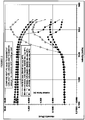
- Figure 2 illustrates the normal force comparison of neat PG 58-28 (open circles), 1.5 wt% SasobitTM wax (open squares), 1% montan wax (solid squares) and 0.5 wt% SasobitTM wax (solid circles).
- the normal force for the neat PG 58-28 increases to approximately 8 newtons at 100 radians/second.
- the normal force for the 1.5 wt% SasobitTM wax increases to approximately 5.5 newtons before decreasing.
- Both the 1 wt% montan wax and 0.5 wt% SasobitTM wax only reach a normal force maximum of about 3 newtons.
- the viscosities of the various samples are very nearly identical in the low and medium velocity ranges, indicating that the wax additives are not functioning by a mechanism of decreasing the viscosity of the asphalt and wax blends.
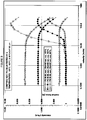
- Figure 3 illustrates the variation in viscosity and normal force for a neat PG 58-28 at 3 different temperatures; those temperatures being 90°C (194°F), 100°C (212°F) and 125°C (257°F).
- Figure 3 illustrates that as the temperature increases the viscosity decreases, as would be expected.
- Figure 3 also illustrates that between a test velocity of 10 and 20 radians/second the normal force begins to increase. As the test temperature increases the normal force peak shifts to lower values at ever increasing velocity values.
- the 90°C sample exhibits a normal force of about 9 newtons, the 100°C sample exhibits a normal force of about 4.5 newtons and the 125°C sample exhibits a normal force of just under 2 newtons.
- typical hot mix asphalt materials are initially compacted in the range of 125°C but are not initially compacted at 90°C.
- This data indicates that warming neat PG 58-28 provides lubricating properties in the binder that are acceptable for compaction, whereas typically contractors would not allow a paving mix to cool to a temperature as low as 90°C before beginning compaction. Therefore hot mix and warm mix are on a continuum line of temperature and it is the nature of the additives that enable warm mix materials to be compacted adequately at temperatures in the 90-100°C range.
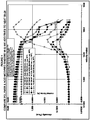
- Example 4 illustrates the impact of polyphosphoric acid (PPA) plus other additives on the reduction of normal force buildup in the asphalt binder.
- PPA polyphosphoric acid
- a polymer modified PG 58-34 which also contains PPA as a reactant was tested in duplicate (open and solid circles). Additionally, 0.5 wt% INNOVALT W phosphate ester antistripping material was added to the PG 58-34 and tested and in another sample 0.3 wt% E-6 ethoxylated tallow diamine was added to the PG 58-34. All of these samples were compared to a standard PG 58-28. All tests were conducted at 90°C with a 50 ⁇ m test gap.
- a PG 64-28 asphalt binder was made by blending 0.75 weight percent polyphosphoric acid with a PG 58-28 asphalt cement. To this blend was added 0.5 wt% phosphate ester antistripping additive and 0.2 wt% of E-6 ethoxylated tallow diamine. This asphalt binder blend was mixed using no water at 110°C (230°F) with a gravel aggregate. A 100% coating was achieved of the aggregate at this temperature. The mix was compacted to produce Hamburg rut testing specimens at 110°C (230°F) achieving the density values expected of a hot mix asphalt.
- One test of a paved material's performance is to simulate vehicle traffic stress by the number of repetitive passes a roller supporting a specified weight load must make to cause formation of a rut of a specified depth in the material.
- Such testing of compacted material produced by the inventive process was done using a testing machine referred to as a Hamburg Wheel Tracking Tester ("HWT”), also known as a PMW Wheel Tracker, available from Precision Machine and Welding, Salina, Kans.
- HWT Hamburg Wheel Tracking Tester
- the number of Hamburg passes required to reach a rut depth of 10 mm when the compacted material tested in a dry condition was used for comparative evaluation.
- the test conditions were 158 lb. wheel load, 52 passes per minute at the test temperature using heated air to achieve the specimen test temperature.
- Rut tests were performed on specimens produced as identified above using completely dry aggregate and compared to rut tests performed on specimens produced using the same 64-28 plus 0.5 weight percent phosphate ester plus 0.2 weight percent of E-6 introduced using a water dispersed solution (as set out in United States Published Application 2007/0191514 ).
- Hamburg rut tests were conducted at 50°C in a water immersed procedure. The average number of rut passes to reach 12.5 mm of rutting was 7300 for the specimens prepared according the procedure of this invention and 4176 according to the procedure using the aqueous, foaming lubricating solution. Further the binders from specimens from each rut test were extracted and recovered and the rheological properties determined at 64°C.
- the PG 64-28 plus 0.5 weight percent phosphate ester antistrip had a test value for G*/sin(delta) of 1.12 kiloPascals at 64°C.
- the binder recovered from the mixture produced using the foaming, lubricating solution had a test value of 1.27 kiloPascals and the binder recovered from the mixture produced using the procedure of this invention had a test value of 1.99 kiloPascals. Normally one would expect the value of G*/sin(delta) to increase as a result of mixing and recovery.
- a field trial consisting of 700 tons was conducted using a PG 58-28 binder with 0.3 wt% polyamine antistripping additive and 0.3 wt% E-6 ethoxylated tallow diamine added.
- This blend was mixed with a limestone aggregate through a counterflow drum mixing facility.
- Warm mix was produced at temperatures varying from 99°C (210°F) to as high as 127°C (260°F) due to plant variations caused by low production rates during the trial.
- the mix discharge temperature was stabilized at 107-113°C (225-235°F) the coating of the aggregate was at 100%.
- RAP in warm mix is a matter of choice, an amount could be greater than about 50 wt% because of the requirement that the warm mix discharge temperature be kept low relative to conventional HMA.
- This same mixture when produced as a conventional hot mix asphalt was mixed at a temperature of 149-154°C (300-310°F) and compacted at temperatures approximately 8.3-11.1°C (15-20°F) cooler than the mix temperature.
- a field trial was conducted using a PG 58-28 binder with 0.3 wt% polyamine antistripping additive and 0.3 wt% E-6 ethoxylated tallow diamine added. This blend was then mixed with aggregate containing 30 wt% RAP at mixing temperatures ranging from 104-1 16°C (220-240°F). Compaction took place at temperatures ranging from 96-107°C (205-225°F). After this asphalt binder composition was mixed with aggregate, applied and compacted the pavement densities were determined using standard industry procedures.
- the two pavement densities were taken on pavement sections paved over conventional hot mix asphalt.
- the first layer of mix paved over aggregate has lower density because the underlying structure is not as rigid.
- Target mix density for the mix over pavement is 92% or higher and the density for shoulder mix over crushed aggregate is 91% or higher.
- This warm mix sample had measured physical properties that were above minimum properties for conventional heat mix samples.
- a treated asphalt binder composition of PG 58-28 binder modified with E-6 ethoxylated tallow diamine surfactant and polyamine antistripping additive was added to a tank that had held an untreated asphalt.
- the untreated binder in the tank was first pumped into a mixing drum at warm mix temperatures. This untreated binder did not produce a coated asphalt-aggregate mix. After some time when the treated binder was being eventually incorporated into the mix, good coating in the 104-116°C (220-240°F) temperature range was achieved. Approximately 700 tons of this warm mix was placed and compacted in the field at temperatures ranging from about 100-109°C (212-228°F).
- the pavement densities were determined using standard industry procedures. The following density was measured from a randomly selected sample - 93.0% of maximum theoretical density. The following density results were determined: 92.7% on the shoulder, 93.0% in the region where the mix was sticking, 93.4%, 93.5% and 93.3% at other locations on the pavement when the mixing temperature was back in the 1 10-1 16°C (230-240°F) range. For this project shoulder density minimum requirements were 92.0% of maximum theoretical density and mainline pavement minimum density requirements were 93.0% of maximum theoretical density.
- a laboratory mix was produced using a PG 70-22 binder modified with SBS (styrene butadiene styrene) polymer. To this blend was added 0.3% polyphosphoric acid and 0.3% PreTech Pavegrip 650 (as an amine based antistrip). The asphalt temperature was 163°C (325°F) and was being used in an amount of 5.3%. The aggregate was completely dry and heated to 127°C (260°F) and verified with a certified thermometer. The mixture was put together and mixed in a bucket mixer for approximately 30 to 45 seconds. The coating was 100% and comparable to the hot mix version that was compacted previously. The heat in the bucket dropped below 116°C (240°F) before the sample was removed from the mixer.
- SBS styrene butadiene styrene
- Binder PG70-22 (SBS) Mix Temp Compaction Temp Blows Air Voids 0.3% PPA, 0.3% AS 171°C (340°F) 149°C (300°F) 30 5.49 0.3% PPA, 0.3% AS 171°C (340°F) 130°C (266°F) 37 5.59 0.3% PPA, 0.3% AS 171°C (340°F) 120°C (248°F) 37 5.77 0.3% PPA, 0.3% AS 127°C (260°F) 120°C (248°F) 37 5.88
Landscapes
- Chemical & Material Sciences (AREA)
- Engineering & Computer Science (AREA)
- Organic Chemistry (AREA)
- Structural Engineering (AREA)
- Civil Engineering (AREA)
- Materials Engineering (AREA)
- Ceramic Engineering (AREA)
- Chemical Kinetics & Catalysis (AREA)
- Health & Medical Sciences (AREA)
- Medicinal Chemistry (AREA)
- Polymers & Plastics (AREA)
- Architecture (AREA)
- Life Sciences & Earth Sciences (AREA)
- Wood Science & Technology (AREA)
- Compositions Of Macromolecular Compounds (AREA)
- Road Paving Structures (AREA)
- Environmental & Geological Engineering (AREA)
- Oil, Petroleum & Natural Gas (AREA)
- Inorganic Chemistry (AREA)
- Adhesives Or Adhesive Processes (AREA)
Description
- International Application
WO 2007/032915 , and United States Published Application2007/0191514 report a warm mix asphalt binder composition and process that injects a foaming, lubricating solution into a stream of asphalt cement prior to incorporation of the asphalt cement plus foaming, lubricating solution with aggregate at reduced temperatures to produce a warm mix asphalt paving mixture. - The present invention is as defined in the appended claims.
- Disclosed herein are functionally dry warm mix asphalt binder compositions, polymer modified asphalt binder compositions or polymer/acid-modified asphalt binder compositions that have been modified with a lubricating additive such as lubricating non-aqueous surfactants, lubricating non-surfactants, lubricating acids or combinations thereof. The term "functionally dry" as used herein in connection with compositions, aggregates or mixtures is used to describe reduced water content compositions, aggregates or mixtures, particularly those in the "warm mix" regime, as further described herein. The mentioned lubricating non-aqueous surfactants, non-surfactants or acids, such as polyphosphoric acid additives, provide asphalt binder compositions that may be adequately mixed with aggregate at temperatures 16.7-27.8°C lower (30-50°F lower), even more than 27.8°C (50°F) lower, or as much as 56°C (100°F) lower than a substantially similar asphalt binder or cement that does not contain these lubricating additives or combinations thereof. In addition, these asphalt-aggregate mixtures may be compacted at temperatures 16.7-27.8°C (30-50°F) lower, even temperatures more than 27.8°C (50°F) lower, or as much as 56°C (1 00°F) lower than a substantially similar asphalt-aggregate mixture that does not contain a lubricating additive or combinations thereof. Another meaning for the term "functionally dry" as used herein is "essentially water-free" as described below.
- The term "lubricating additive" includes materials described below that may be added to asphalt binders to provide compositions that have a normal force at warm mix temperatures of less than 2 newtons at a gap width of 50 microns when the normal force is measured according to the laboratory testing for lubricity procedures set out below. In some embodiments, the normal force at warm mix temperature is less than 1 newton or, in other embodiments may be less than 0.5 newtons. Warm mix temperatures may varying according to the grade of asphalt binder that is used. For example, warm mix temperatures for a PG 58-28 asphalt binder containing a lubricating additive are less than 130°C. In another example, warm mix temperatures for a PG 70-28 asphalt binder containing a lubricating additive are less than 150°C.
- The asphalt binder compositions and aggregate mixtures that contain lubricating additives disclosed in the present application may also include liquid antistripping additives used in conventional asphalt-aggregate mixtures.
- Methods of preparing the present asphalt binder compositions as well as methods of using the present asphalt binder compositions mixed with aggregate to prepare paved surfaces are also disclosed in this application.
- A first embodiment of the present disclosure is a warm mix, functionally dry asphalt binder composition comprising a lubricating surfactant. Suitable lubricating surfactants include neutral, cationic and anionic surfactants. One suitable surfactant is an ethoxylated tallow diamine surfactant. In alternative embodiments of the disclosure, the lubricating surfactant can be used in an amount of about 0.1-1.0 wt% of the asphalt binder composition.
- A second embodiment of the present invention is a functionally dry warm mix asphalt binder composition comprising a lubricating non-surfactant wax. Suitable lubricating non-surfactants include waxes such as montan waxes, petroleum waxes or amide waxes. In alternative embodiments of the disclosure, the lubricating wax may be used in amount of about less than 2.5 wt% of the asphalt binder composition. In other alternative embodiments of the disclosure the wax may be used in an amount of about 0.1-0.5 wt%.
- A third embodiment of the present disclosure is a functionally dry warm mix asphalt binder composition comprising a lubricating acid such as, for example, anhydrous phosphoric acid. Suitable lubricating phosphoric acid grades include polyphosphoric acid (PPA), superphosphoric acid (SPA), or other grades of phosphoric acid. One suitable phosphoric acid derivative is polyphosphoric acid (commercially available from ICL, St. Louis, MO). In alternative embodiments of the disclosure, the lubricating phosphoric acid derivative may be used in an amount of about 0.2-1.0 wt% of the asphalt binder composition.
- Each of these and other embodiments of the present asphalt binder compositions may be mixed with aggregate at a temperature of about 138°C (280°F) and lower temperatures (where this mixing temperature may be a function of the original or starting PG asphalt grade, viscosity or penetration of the binder) and the resultant mixture may be compacted at a temperature of about 127°C (260°F) and lower tempertures (where this compaction temperature may also be a function of the original or starting PG asphalt grade, viscosity or penetration of the binder). Hot mix asphalt mixtures produced from the same binders not utilizing the present disclosure are reasonably expected to require respective mixing and compaction temperatures 39-56°C (70-100°F) higher than those temperatures stated above.
- Another embodiment of the present disclosure is a functionally dry warm mix polymer/acid modified asphalt binder composition comprising a lubricating surfactant, a lubricating wax or both.
- Still another embodiment of the present disclosure is a functionally dry warm mix polymer modified asphalt binder composition comprising a lubricating surfactant, or a lubricating non-surfactant or both. This embodiment provides a modified asphalt binder composition that can be mixed with aggregate at a temperature that is at least 16.7-27.8°C (30-50°F) below, even temperatures more than 27.8°F (50°F) lower, or as much as 56°C (100°F) lower than the temperature that is adequate to mix a similar modified asphalt binder composition that does not contain a lubricating surfactant, a lubricating wax or a lubricating acid or combinations thereof.
- In another embodiment, the lubricating additives described in the present application allow using a stiffer binder in a paving application while retaining the desired physical properties of a binder that is less stiff.
- In another embodiment, the lubricating additives described in the present application allow using recycled asphalt pavement (RAP) or increased amounts of RAP in a paving application while retaining the desired physical properties of the paving.
- The use of stiffer binders may allow the use of more readily available or more economical grades of an asphalt binder. For example, the use of these lubricating additives may allow substituting a PG 58-22 asphalt binder for a PG 58-28 binder without sacrificing the low temperature cracking properties provided by the less stiff PG 58-28 binder. Similarly, the lubricating additives may allow using a PG 64-16 asphalt binder as a substitute for a PG 64-22 asphalt binder.
- The present disclosure also includes forming a paved surface using the novel warm mix composition described herein. In this aspect, a paving mix may be made in the temperature ranges described herein using the composition described. The mixing typically occurs away from the paving site (both in-line injection and preblended mixing processes, as well as other mixing processes, are included), and the mixture is then hauled to the site and supplied to a paving machine. The mixture of the lubricated asphalt binder composition and aggregate is then applied by the paving machine to a prepared surface after which it is usually roller compacted by additional equipment while still at an elevated temperature. The compacted aggregate and asphalt mixture eventually hardens upon cooling. Because of the large mass of material in paving a roadway or commercial parking lot, the cost of the thermal energy to achieve suitable mixing and paving is reduced because of the reduction in the temperature necessary in the mixture for proper paving. This will result in cost savings attributable to the present disclosure because of the reduced need for thermal energy to be supplied or maintained in the mixture. For common binders used in the practice of the present disclosure, the visco-lubricity characteristics of the binder and lubricating additive composition affect the temperature needed to provide thorough coating of the aggregate and application and compaction of the asphalt-aggregate mixture according to the present disclosure.
- Accordingly, in one aspect, the present disclosure includes a paved surface formed using the novel warm mix composition described herein. Such a paved surface comprises a compacted mixture of an aggregate and a functionally dry warm mix asphalt binder composition including an asphalt binder, and a lubricating additive such as a lubricating surfactant, a lubricating non-surfactant additive, a lubricating acid or combinations thereof. In another aspect, the present disclosure includes a method of forming a paved surface using the novel warm mix composition described herein.
- The presently disclosed process includes adding a lubricating substance into an asphalt binder heated to within a warm mix temperature range to create a warm mix lubricated asphalt binder composition; combining the warm mix lubricated asphalt binder composition with a suitable aggregate; mixing to coat the aggregate with the lubricated asphalt binder composition to form a warm mix paving material; transferring the warm mix paving material to a paving machine; applying the warm mix paving material with the paving machine at a warm mix paving temperature to a prepared surface; and then compacting the applied paving material to form a paved surface.
-
-
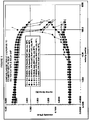
Fig. 1 is a graph plotting measured viscosity and normal force properties with respect to velocity as a measure of lubricity of an asphalt cement and an asphalt cement modified with a lubricating surfactant. -
Fig. 2 is a graph plotting measured viscosity and normal force properties with respect to velocity as a measure of lubricity of an asphalt cement and two asphalt cements modified with a lubricating wax. -
Fig. 3 is a graph plotting the measured viscosities and normal forces with respect to velocity as a measure of lubricity of an asphalt cement at three different temperatures. -
Fig. 4 is a graph plotting the measured viscosity and normal force properties with respect to velocity as a measure of lubricity of an asphalt cement, a related polymer-acid modified asphalt cement further modified with polyphosphoric acid, a polymer-acid modified asphalt cement further modified with a liquid antistripping additive and a polymer-acid modified asphalt cement further modified with a lubricating surfactant. - We have found that field-produced warm mixes using a foaming, lubricating solution may be adequately compacted at temperatures approximately 16.7-27.8°C (30-50°F) or more below typical hot mix asphalt compaction temperatures days after field production. Testing of mix samples taken at the paver have shown that this mix contains approximately 0.5 wt%, or less, water which is an amount of water well below the amount of water generally utilized in conventional warm mix production. The only component of the foaming, lubricating solution remaining with the asphalt mixture is an effective concentration of the surfactant providing the lubricating effect. This observation indicates that the incorporation of water in conjunction with a foam for the production of warm mix is not an essential component in all instances, although the water may be used in a system for delivery of the lubricating additive into the asphalt binder or cement. The present invention thus relies, in part, in determining that the lubricating properties of additives added to an asphalt binder or cement are an important component of the present warm mix asphalt mixtures and that it is not necessary or essential to use foamed asphalt binders or emulsified asphalt binders that are used in warm mix asphalt binder compositions, mixtures and paving processes.
- As used in the present application, each of the terms "functionally dry" or "essentially water-free" means or is intended to refer to an asphalt binder composition that contains less water or moisture than is routinely used in conventional or known warm mixes. This term does not mean and is not intended to refer to a warm mix composition that is completely free of water, moisture or added water. For example, aggregate that will be mixed with the present asphalt binder compositions will also contain varying amounts of water and that water may affect the aggregate coating process. In embodiments of the present invention it is acceptable that there is some moisture contained in the aggregate, because a completely dry aggregate is not practical or may not be desirable. The amounts of water or moisture in the aggregate will vary for any number of reasons including but not limited to the particular geographical region where the aggregate is crushed or stockpiled, the local weather conditions, the local temperature or the particular stockpile facilities. Due to this variation in the water content of the aggregate, there may be adjustments made to the actual water content of the asphalt binder compositions of this disclosure before the aggregate is coated with the asphalt mixture in order to achieve acceptable coating of the aggregate. If the aggregate is either very wet or very dry, the water content of the aggregate may be adjusted or altered. Alternatively, or in addition, the water or moisture content of the asphalt binder composition may be adjusted or altered in order to optimize or ensure adequate coating of the aggregate during mixing. Warm mixes of the present disclosure will generally include about 2-9 wt% asphalt binder composition and about 91-98 wt% aggregate. In other embodiments, the warm mixes will include about 3-8 wt% asphalt binder composition and about 92-97 wt% aggregate. The amount of asphalt binder composition required will depend upon mix type, layer in the pavement structure, aggregate size, traffic considerations, or other factors.
- The moisture content of the asphalt binder composition may be changed in a number of ways such as injecting or spraying water into the asphalt binder compositions. Even though the asphalt binder compositions may have the water or moisture content adjusted or altered, these compositions are considered to be functionally dry when the overall water content is lower or substantially lower than other known or conventional warm mix asphalt binder compositions and mixtures.
- In addition, different grades of asphalt will have different mixing properties and conditions. Adjustments or alterations of the water or moisture concentrations that take into account different asphalt grades may provide functionally dry (or essentially water-free) asphalt binder compositions. When variations in the water contents of different aggregates and different asphalt grades are accounted for, the asphalt-aggregate mixes or mixtures of the present invention will typically have a water content of less than about 5 wt%. In many instances the water content is less than about 4 wt%, less than about 3 wt%, less than about 2 wt% or less than about 1 wt%. In certain embodiments of this invention, the asphalt binder compositions comprise less than about 0.5 wt% water. It is understood, however, that water contents outside this range may still be within the scope of the present claims and embodiments of the invention when the claimed compositions contain the lubricating additives, including the non-aqueous surfactants, lubricating non-surfactants and acids, disclosed in this application.
- Surfactants (in both aqueous or non-aqueous form) are a class of lubricating additives that may, when incorporated into an asphalt binder or cement at levels as low as 0.1 wt%, provide sufficient lubrication of the asphalt cement so that aggregate may be adequately coated at temperatures 16.7-27.8°C (30-50°F) lower, even more than 27.8°C (50°F) lower, or as much as 56°C (100°F) lower than the temperatures normally needed to produce a bituminous mixture without an added lubricating additive. The lubricating additive then enables compaction of these mixtures at 16.7-27.8°C (30-50°F) lower, even more than 27.8°C (50°F) lower, or as much as 56°C (100°F) lower than the temperatures normally needed for compaction of otherwise similar bituminous mixtures.
- Non-aqueous surfactants as additives have been incorporated into hot mix asphalt cement to provide improved moisture resistance, however, their value and function as a lubricating additive in warm mix asphalt and specifically as a functionally dry or water free warm mix composition have not been recognized by those skilled in the art prior to the disclosure of the elements and examples of this invention. Suitable lubricating surfactants as additives include naturally occurring compounds and more commonly synthesized chemical compounds from three categories of surfactants: detergents, wetting agents and emulsifiers. Surfactant additives may be specifically grouped into four classifications: i) anionic surface agents to include, but not limited to, fatty acids (saturated and unsaturated fatty acids), fatty acid pitch (stearic acid pitch), fatty acid derivatives (fatty acid esters and fatty acid sulfonates), and organo phosphates (alkyl phosphates); ii) cationic surface agents to include, but not limited to, alkyl amines, alkyl quaternary ammonium salts, heterocyclic quaternary ammonium salts, amido amines, and non-nitrogenous sulfur or phosphorous derivatives; iii) ampholytic surface agents to include, but not limited to, amino acids, amino acid derivatives, betain derivatives (alkylbetains and alkylaminobetains), imidazolines, and imidazoline derivatives; and iv) non-ionic surface agents to include, but not limited to, fatty acids with ester bonds (SPANS and TWEENS), surfactants with ether bonds (alkylphenolpolyoxeythylenes and polyoxyethylenated alcohols), surfactants with amid bonds (alcanolamides, mono and diethanolamides and their derivatives), alkylenated oxide copolymers and polyoxyethylenated mercaptans.
- Lubricating non-surfactants based on wax chemistry have been incorporated into an asphalt binder or cement to produce warm mix based on the concept that these wax additives reduce the viscosity of the wax asphalt blend to an extent sufficient to enable production and lay down of the asphalt-aggregate mixture at reduced temperatures, when incorporated into an asphalt binder or cement at levels as low as 0.1 wt%, provide sufficient lubrication of the asphalt cement so that aggregate may be adequately coated at temperatures 16.7-27.8°C (30-50°F) lower, even more than 27.8°C (50°F) lower, or as much as 56°C (100°F) lower than the temperatures normally needed to produce a bituminous mixture without an added lubricating additive. The lubricating additive then enables compaction of these mixtures at 16.7-27.8°C (30-50°F) lower, even more than 27.8°C (50°F) lower, or as much as 56°C (100°F) lower than the temperatures normally needed for compaction of otherwise similar bituminous mixtures.
- The data in this application indicates that wax additives in an amount less than about 2.5 wt%, such as Sasobit™ wax (Sasol North America Inc.) and montan wax (Romanta, Amsdorf, Germany or Strohmeyer and Arpe, NJ), when used for this application have only a minor effect on reducing the viscosity of the asphalt-wax blend, but such additives, even at usage levels well below those generally employed, provide a noticeable and beneficial lubricating effect on the asphalt-wax combination. Exemplary usage levels may include less than about 2 wt%, less than about 1.5 wt%, less than about 1 wt%, or less than about 0.5 wt %. Lubricating non-surfactants based on wax chemistry may be selected from paraffin and non-paraffin waxes. Paraffin waxes include, but are not limited to, petroleum derived and refined waxes (slack wax and refined micro-crystalline wax) while non-paraffin waxes include, but are not limited to, natural waxes (animal and vegetable waxes e.g. bees wax and carnauba wax), modified natural waxes (brown coal derivatives, e.g., montan wax and mineral oil derivatives), partial synthetic waxes (acid waxes, ester waxes, amid waxes, alcohol waxes and oxidized polyethylene waxes), or full synthetic waxes (Fischer-Tropsch waxes and polyethylene waxes).
- Other lubricating non-surfactants such as viscosity modifiers (VMS), dispersant viscosity modifiers (DVMS), and additives containing viscosity modifiers or dispersant viscosity modifiers as well as extrusion and molding production processing aids, polyolefins and sulfur, may provide lubricating characteristics to petroleum products and may also be used as a non-surfactant additive for functionally dry or waterless warm mix asphalt formulations. Such additives include, but are not limited to, VMS and DVMS used in engine lubricating oils (polyisobutylenes, olefin copolymers, hydrogenated styrene-diene copolymers, styrene maleate copolymers, polymethacrylates, olefin-graft PMA polymers and hydrogenated polyisoprene star polymers) and products containing VMS and DVMS such as the residual bottoms from refined recycled engine lubricating oils; processing aids used in extrusion and molding operations (high trans content polyoctenamer reactive polymer), polyolefins (ethylene vinyl acetate (EVA), acrylic polymers and silicones); sulfur or sulfur compounds (sulfur impurities in fuels may provide lubrication properties). Exemplary usage levels may include less than about 2 wt%, less than about 1.5 wt%, less than about 1 wt%, or less than about 0.5 wt %.
- Different concentrations of polyphosphoric acid, are another class of additives that that can, when incorporated into an asphalt cement at levels as low as about 0.2-1.0 wt%, provide sufficient lubrication of the asphalt cement so that aggregate may be adequately coated at temperatures 16.7-27.8°C (30-50°F), or greater difference, below the temperatures normally needed to produce a bituminous mixture without the polyphosphoric acid additives.
- The data set out in the examples indicate that the addition of surfactant in non-aqueous form enables utilization of asphalt cements that have been produced using acid modifiers. For example, acid modifiers from the type of polyphosphoric acid (PPA) or superphosphoric acid (SPA), although other grades of phosphoric acid and other types of acids, such as mineral acids, other inorganic acids or organic acids, may be utilized with the present invention.
- While not intending to be bound by theory, the present invention is based, in part, on the observations that lubricating additives may be used without added water to provide a warm mix having desired visco-lubricity characteristics or properties. As used in this application the term "visco-lubricity" means a characteristic of a material exhibited under high rotational velocity as the gap thickness of the material being tested approaches zero. As the gap thickness is reduced and as rotational velocity is increased, the material's viscosity begins to decrease but the normal force between the plates begins to increase. A material that has good visco-lubricity characteristics will exhibit less normal force increase than one which has poor visco-lubricity. Stated another way, the ability of the material being tested to enable the plates to easily rotate relative to each other becomes more important than the viscosity of the material being tested. An example illustrating the meaning of the term "visco-lubricity" is the observed reduced requirements for hot mixing and compaction temperatures of polymer modified asphalt binders compared to conventional asphalt binders. Based solely on viscosity data, polymer modified binders should require mixing and compaction temperatures that are 20-50°F higher than those which common practice have found to be adequate. We believe that these polymer systems could have visco-lubricity properties that provide adequate mixing to coat aggregate particles and further provide mix compaction at temperatures substantially below those predicted based on viscosity alone.
- Another example illustrating the meaning of the term visco-lubricity is the reduction in dry tensile strength of many mixtures produced using conventional asphalt binders combined with liquid antistrip or antistripping additives. Those skilled in the art of performing tensile strength ratio (TSR) tests to verify that bituminous mixtures will not be water sensitive, have seen that the dry tensile strength of mixtures using antistrip treated binders can be noticeably lower than the dry tensile strength of the same mix produced with the same binder but without antistrip. This observation has typically been attributed to a reduction in binder viscosity or stiffness due to the addition of the antistrip to the binder. However, there may be minor reduction in viscosity or stiffness when low levels of antistrip are added to the binder. We believe that this tensile strength reduction is an example of the antistrip lubricating the mix resulting in the observed reduced dry tensile strength. A typical recent example will serve to make the point.
- A PG 58-28 with and without a polyamine antistrip was used to produce a hot mix asphalt composition for tensile strength ratio testing according AASHTO test method T-283. Rheological properties of the PG 58-28 with and without the antistrip were determined. All results are shown in Table 1. For these particular samples there is actually a slight increase in stiffness after the addition of the antistrip (6.3% increase) and yet the dry tensile strength of the mix with the antistrip is reduced by 22.7% based on the average values of the two results using the PG 58-28 without antistrip. The wet strength is reduced by only 8.4%. This reduction in dry tensile strength, which does not occur with all mixes and all binders, may be observed in some mixes and binders. Based on the present warm mix work and lubricity testing disclosed herein, the dry tensile strengths are being reduced due to the lubricating effect of antistripping additive. The specimens tested for wet strength are typically saturated to a level of 60 to 80%. The reduced strength of saturated mixes without antistrip is typically attributed to debonding of the binder from the aggregate, which typically can be visually verified. When an antistrip functions as desired there is little or no visual debonding of binder from the aggregate, but the comparative reduction in wet strength of the antistrip treated mix is related to the lower dry strength value due to the lubricating effect of the antistrip.
Table 1 Sample % AC DSR, G*/sin(δ) @ 58°C, kPa Complex viscosity @ 58°C, Pa·s Dry Strength, kPa (PSI) Wet Strength, kPa (PSI) TSR 58-28, no antistrip 5.5% 1.33 133 539 (78.2) 358 (51.9) 66.4% 58-28, no antistrip 5.8% 1.33 133 499 (72.4) 329 (47.7) 65.9% 58-28, 0.3% polyamine antistrip 5.6% 1.42 142 401 (58.2) 314 (45.6) 78.4% - Since there are no readily available rheological tests identified for determining the lubricity of asphalt cement, the following test provides comparative testing of asphalt cement at different temperatures and with different additives to determine lubricity. This test is described as follows.
- 1. An AR2000 dynamic shear rheometer using a heated air test chamber was utilized.
- 2. A shallow cylindrical cup measuring approximately 35 mm in diameter and approximately 5 mm in height was used to contain the liquid being tested. This cup was secured to the bottom pedestal of the test fixture in the rheometer.
- 3. A small quantity of the asphalt cement or asphalt cement plus lubricating additive was added to the bottom of the cup. A 25 mm diameter flat plate was used as an upper test fixture in the rheometer. This upper test fixture is a typical test fixture used in plate-plate rheological testing with this instrument.
- 4. The plate attached to the upper test fixture is brought into contact with the specimen in the cup and the gap is reduced until a membrane of material to be tested is either 100 or 50 µm thick.
- 5. The test used is a steady shear test with increasing velocity. The specimen is maintained at a constant temperature while the upper plate rotates in one direction with a programmed increase in angular velocity. As the rotational speed increases the drag between the upper plate and the bottom of the cup increases. In addition, normal force increases, attempting to force the plates apart. The more lubricating character an additive has the lower the normal force buildup.
- In reference to Figures, the upper sets of plotted data are for viscosity, while the lower sets of plotted data are for normal force.
- A neat PG 58-28 asphalt cement was tested as described above at 90°C (194°F) as being representative of a low end, but not uncommon, warm mix asphalt compaction temperature. A material thickness of 100 µm was used.
Figure 1 illustrates that, as the test velocity increases, the viscosity of the material is nearly steady and then begins to gradually decrease until a point is reached where the viscosity decreases very rapidly. For the neat PG 58-28 (black solid diamonds) the normal force begins to increase at a velocity of approximately 50 radians/sec. As the test velocity increases the normal force increases for the neat asphalt until the endpoint of the test is reached. The normal force increases to approximately 2.7 newtons. Several different additives and usage levels are compared in this plot. Two different tests of the PG 58-28 with 1.5 wt% Sasobit™ wax are shown, the open and solid circles. In one test (the open circle) the normal force reached a value of approximately 1.2 newtons before the test terminated. In the other test (solid circles) the normal force reached about 0.4 newtons. Two tests at a usage level of 0.5 wt% Sasobit™ wax are also shown (open and solid squares). In both of those tests the maximum normal force never exceeded 0.4 newtons. Lastly, E-6, an ethoxylated tallow diamine (Akzo Nobel Co.), was added at 0.2% by weight to the PG 58-28 and tested (open diamond). This sample achieved a maximum normal force of approximately 0.7 newtons before decreasing. For all blends it is possible to observe that the viscosity of the neat asphalt and the asphalt plus additives is similar from blend to blend for low to medium velocities. The normal forces are also similar until the test velocity becomes quite high. Then the blends with the additives exhibit lower normal forces and in several instances the normal force values peak and then diminish. The data in this plot supports the assertion that (1) the addition of wax additives such as Sasobit™ wax do not appreciably diminish the viscosity in the low to medium velocity ranges of the asphalt cement at warm mix compaction temperatures (regardless of dosage level) and (2) the addition of the wax additive does provide evidence of lubricating the blend compared to the control, neat PG 58-28. - To better differentiate between neat asphalt and asphalt containing lubricating additives, the gap in the testing fixture was reduced to 50 µm.
Figure 2 illustrates the normal force comparison of neat PG 58-28 (open circles), 1.5 wt% Sasobit™ wax (open squares), 1% montan wax (solid squares) and 0.5 wt% Sasobit™ wax (solid circles). The normal force for the neat PG 58-28 increases to approximately 8 newtons at 100 radians/second. The normal force for the 1.5 wt% Sasobit™ wax increases to approximately 5.5 newtons before decreasing. Both the 1 wt% montan wax and 0.5 wt% Sasobit™ wax only reach a normal force maximum of about 3 newtons. For all of these blends note that the viscosities of the various samples are very nearly identical in the low and medium velocity ranges, indicating that the wax additives are not functioning by a mechanism of decreasing the viscosity of the asphalt and wax blends. - A common way to achieve properties suitable for an asphalt cement that enable it to be compacted is to increase its temperature.
Figure 3 illustrates the variation in viscosity and normal force for a neat PG 58-28 at 3 different temperatures; those temperatures being 90°C (194°F), 100°C (212°F) and 125°C (257°F).Figure 3 illustrates that as the temperature increases the viscosity decreases, as would be expected.Figure 3 also illustrates that between a test velocity of 10 and 20 radians/second the normal force begins to increase. As the test temperature increases the normal force peak shifts to lower values at ever increasing velocity values. At 100 radians/second the 90°C sample exhibits a normal force of about 9 newtons, the 100°C sample exhibits a normal force of about 4.5 newtons and the 125°C sample exhibits a normal force of just under 2 newtons. It is instructive to realize that typical hot mix asphalt materials are initially compacted in the range of 125°C but are not initially compacted at 90°C. This data indicates that warming neat PG 58-28 provides lubricating properties in the binder that are acceptable for compaction, whereas typically contractors would not allow a paving mix to cool to a temperature as low as 90°C before beginning compaction. Therefore hot mix and warm mix are on a continuum line of temperature and it is the nature of the additives that enable warm mix materials to be compacted adequately at temperatures in the 90-100°C range. - Example 4 illustrates the impact of polyphosphoric acid (PPA) plus other additives on the reduction of normal force buildup in the asphalt binder. A polymer modified PG 58-34 which also contains PPA as a reactant was tested in duplicate (open and solid circles). Additionally, 0.5 wt% INNOVALT W phosphate ester antistripping material was added to the PG 58-34 and tested and in another sample 0.3 wt% E-6 ethoxylated tallow diamine was added to the PG 58-34. All of these samples were compared to a standard PG 58-28. All tests were conducted at 90°C with a 50 µm test gap. The data plotted in
Figure 4 indicate that even though the viscosities of the 58-34 and its blends (upper curves on the plot) are greater than the viscosity of the PG 58-28, the normal force values are uniformly lower at 10 radians/second and higher. The INNOVALT W added to the PG 58-34 showed the greatest reduction in normal force build-up, but the PG 58-34 with just the acid additive also showed surprising reduction in normal force relative to a neat, unmodified binder. In summary, PPA at typical usage levels (0.2 to 1 wt%) can serve as a lubricating additive in the production of warn mix asphalt binder compositions. - A PG 64-28 asphalt binder was made by blending 0.75 weight percent polyphosphoric acid with a PG 58-28 asphalt cement. To this blend was added 0.5 wt% phosphate ester antistripping additive and 0.2 wt% of E-6 ethoxylated tallow diamine. This asphalt binder blend was mixed using no water at 110°C (230°F) with a gravel aggregate. A 100% coating was achieved of the aggregate at this temperature. The mix was compacted to produce Hamburg rut testing specimens at 110°C (230°F) achieving the density values expected of a hot mix asphalt.
- One test of a paved material's performance is to simulate vehicle traffic stress by the number of repetitive passes a roller supporting a specified weight load must make to cause formation of a rut of a specified depth in the material. Such testing of compacted material produced by the inventive process was done using a testing machine referred to as a Hamburg Wheel Tracking Tester ("HWT"), also known as a PMW Wheel Tracker, available from Precision Machine and Welding, Salina, Kans. The number of Hamburg passes required to reach a rut depth of 10 mm when the compacted material tested in a dry condition was used for comparative evaluation. The test conditions were 158 lb. wheel load, 52 passes per minute at the test temperature using heated air to achieve the specimen test temperature. Generally, when all other variables are essentially the same, the greater the number of passes, the better the anticipated paving mix performance. Those persons of ordinary skill in the art and familiar with the HWT will recognize paving materials that are suitable for a particular application based on the results that are provided when samples are subjected to these test conditions.
- Rut tests were performed on specimens produced as identified above using completely dry aggregate and compared to rut tests performed on specimens produced using the same 64-28 plus 0.5 weight percent phosphate ester plus 0.2 weight percent of E-6 introduced using a water dispersed solution (as set out in United States Published Application
2007/0191514 ). Hamburg rut tests were conducted at 50°C in a water immersed procedure. The average number of rut passes to reach 12.5 mm of rutting was 7300 for the specimens prepared according the procedure of this invention and 4176 according to the procedure using the aqueous, foaming lubricating solution. Further the binders from specimens from each rut test were extracted and recovered and the rheological properties determined at 64°C. The PG 64-28 plus 0.5 weight percent phosphate ester antistrip had a test value for G*/sin(delta) of 1.12 kiloPascals at 64°C. The binder recovered from the mixture produced using the foaming, lubricating solution had a test value of 1.27 kiloPascals and the binder recovered from the mixture produced using the procedure of this invention had a test value of 1.99 kiloPascals. Normally one would expect the value of G*/sin(delta) to increase as a result of mixing and recovery. While there was a slight increase using the foaming lubricating solution it is most likely that a more substantial increase was counteracted by the interaction of the polyphosphoric acid with the water from the foaming solution and the basic character of the dispersed E-6 diamine. By adding the E-6 in non-aqueous form as per this invention the value of G*/sin(delta) increased to greater and more typical extent while still maintaining the ability of the mixture to be produced and compacted under warm mix conditions. The above further supports the embodiment of the present invention for the production of warm mix using binders containing acid modifiers. - A field trial using 300 tons of mix that was produced from PG 58-28 asphalt binder with 0.3 wt% polyamine antistripping additive and 0.3 wt% E-6 ethoxylated tallow diamine added. This mix was made at a counterflow drum mix plant and placed on a private road. The mix contained 20% RAP and warm mix was produced at a temperature of about 104-1 16°C (220-240°F). Compaction took place at temperatures ranging from 96-104°C (205-220°F). Typical hot mix temperatures for this same mix were 154°C (310°F) mix temperature and initial compaction temperatures in the range of 141°C (285°F) and higher. Field cores obtained one day after mix laydown and compaction showed results of 93.3% and 93.8% of maximum theoretical density. The target density for this mix by specification is 92.0% or greater.
- A field trial consisting of 700 tons was conducted using a PG 58-28 binder with 0.3 wt% polyamine antistripping additive and 0.3 wt% E-6 ethoxylated tallow diamine added. This blend was mixed with a limestone aggregate through a counterflow drum mixing facility. Warm mix was produced at temperatures varying from 99°C (210°F) to as high as 127°C (260°F) due to plant variations caused by low production rates during the trial. However, when the mix discharge temperature was stabilized at 107-113°C (225-235°F) the coating of the aggregate was at 100%. This mixture was further taken to an on-going road project and successfully paved at temperatures ranging from 107°C (225°F) to as low as 93°C (200°F). Cores cut from this trial pavement exhibited in place densities of 90.8%, 91.6%, 92.2%, 91.2%, 92.1% and 94.0% with values of 91-92% being typical for in place densities when this type of mix is placed as a hot mix. The mixture produced during this trial contained 20 wt% reclaimed asphalt pavement (RAP). This is significant because the utilization of RAP is an important component of the Hot Mix Asphalt (HMA) paving industry. Although the top end amount of RAP in warm mix is a matter of choice, an amount could be greater than about 50 wt% because of the requirement that the warm mix discharge temperature be kept low relative to conventional HMA. This same mixture when produced as a conventional hot mix asphalt was mixed at a temperature of 149-154°C (300-310°F) and compacted at temperatures approximately 8.3-11.1°C (15-20°F) cooler than the mix temperature.
- A field trial was conducted using a PG 58-28 binder with 0.3 wt% polyamine antistripping additive and 0.3 wt% E-6 ethoxylated tallow diamine added. This blend was then mixed with aggregate containing 30 wt% RAP at mixing temperatures ranging from 104-1 16°C (220-240°F). Compaction took place at temperatures ranging from 96-107°C (205-225°F). After this asphalt binder composition was mixed with aggregate, applied and compacted the pavement densities were determined using standard industry procedures.
- The following densities were measured.
1 foot off center line - 95.4% of maximum theoretical density
6 feet off center line - 94.7% of maximum theoretical density
Shoulder of road paved over crushed aggregate base - 92.5% of maximum theoretical density - The two pavement densities were taken on pavement sections paved over conventional hot mix asphalt. Typically the first layer of mix paved over aggregate has lower density because the underlying structure is not as rigid. Target mix density for the mix over pavement is 92% or higher and the density for shoulder mix over crushed aggregate is 91% or higher. This warm mix sample had measured physical properties that were above minimum properties for conventional heat mix samples.
- A treated asphalt binder composition of PG 58-28 binder modified with E-6 ethoxylated tallow diamine surfactant and polyamine antistripping additive was added to a tank that had held an untreated asphalt. As a mix with aggregate containing 30 wt% RAP was beginning to be made, the untreated binder in the tank was first pumped into a mixing drum at warm mix temperatures. This untreated binder did not produce a coated asphalt-aggregate mix. After some time when the treated binder was being eventually incorporated into the mix, good coating in the 104-116°C (220-240°F) temperature range was achieved. Approximately 700 tons of this warm mix was placed and compacted in the field at temperatures ranging from about 100-109°C (212-228°F). A sample of this mix was taken for moisture content determination just as the mix was discharged from the mixing drum at a discharge temperature of about 113°C (235°F). The sample was placed in a plastic container and sealed. Within 30 minutes this sample was tested for moisture content using a solvent refluxing procedure, ASTM D 1461. The moisture content of the mix was 0.25 wt%.
- After this asphalt binder composition was mixed with aggregate, applied and compacted, the pavement densities were determined using standard industry procedures. The following densities were measured from randomly selected samples - 93.3%, 93.4% and 93.8% of maximum theoretical density. Normal hot mix produced at this plant with the same aggregate and RAP materials and untreated PG58-28 was mixed at 163°C (325°F) and paved at approximately 149°C (300°F) and compacted 2.8-5.5°C (5-10°F) below the paving temperature.
- Using the same aggregate and RAP as Example 9, about 200 tons of warm mix was prepared using a blend of PG 58-28 binder, 0.5 wt% Sasobit wax and 0.3 wt% polyamine antistripping additive. A well coated warm mix containing 30 wt% RAP was produced at temperatures ranging from 102-116°C (215-240°F). When the mix was produced on the cooler end of this temperature range, there was tendency of the mix to drag due to sticking on the paver screed. However, when the mixing temperature again increased to 116°C (240°F), the dragging disappeared. This mix appeared to compact adequately.
- After this asphalt binder composition was mixed with aggregate, applied and compacted, the pavement densities were determined using standard industry procedures. The following density was measured from a randomly selected sample - 93.0% of maximum theoretical density. The following density results were determined: 92.7% on the shoulder, 93.0% in the region where the mix was sticking, 93.4%, 93.5% and 93.3% at other locations on the pavement when the mixing temperature was back in the 1 10-1 16°C (230-240°F) range. For this project shoulder density minimum requirements were 92.0% of maximum theoretical density and mainline pavement minimum density requirements were 93.0% of maximum theoretical density.
- A laboratory mix was produced using a PG 70-22 binder modified with SBS (styrene butadiene styrene) polymer. To this blend was added 0.3% polyphosphoric acid and 0.3% PreTech Pavegrip 650 (as an amine based antistrip). The asphalt temperature was 163°C (325°F) and was being used in an amount of 5.3%. The aggregate was completely dry and heated to 127°C (260°F) and verified with a certified thermometer. The mixture was put together and mixed in a bucket mixer for approximately 30 to 45 seconds. The coating was 100% and comparable to the hot mix version that was compacted previously. The heat in the bucket dropped below 116°C (240°F) before the sample was removed from the mixer. The sample was then "cured" for 2 hours at 120°F (248°F) and then compacted with 37 blows per side on the Marshall Hammer compacting machine. The resultant sample had about 5.88% average air voids. Data comparing the hot mix version and warm mix version are listed in Table 2.
Table 2 Binder = PG70-22 (SBS) Mix Temp Compaction Temp Blows Air Voids 0.3% PPA, 0.3% AS 171°C (340°F) 149°C (300°F) 30 5.49 0.3% PPA, 0.3% AS 171°C (340°F) 130°C (266°F) 37 5.59 0.3% PPA, 0.3% AS 171°C (340°F) 120°C (248°F) 37 5.77 0.3% PPA, 0.3% AS 127°C (260°F) 120°C (248°F) 37 5.88
Claims (14)
- A warm mix asphalt paving composition comprising a blend of i) functionally dry, essentially water-free, non-foamed asphalt binder containing, ii) a lubricating surfactant, a lubricating non-surfactant, a lubricating acid or a combination thereof, the blend having a measured maximum normal force no more than about 5.5 Newtons at 90°C or no more than about 3 Newtons at 90°C using a dynamic shear rheometer with a 50 µm gap, and the blend mixed with; iii) uncompacted aggregate at a temperature of 138°C (280°F) or lower to provide the warm mix asphalt paving composition, wherein when the lubricating non-surfactant comprises a Fischer-Tropsch or Montan wax, the wax is 0.5 wt% or less of the functionally dry, essentially dry, essentially water-free, non-foamed asphalt binder weight.
- A warm mix asphalt paving composition according to claims 1, wherein the warm mix temperature is at least 16°C (30°F) lower than a temperature needed to mix and compact an asphalt paving composition without an added lubricating surfactant, a lubricating non-surfactant, a lubricating acid or a combination thereof.
- A warm mix asphalt paving composition according to claim 1 or 2, wherein the asphalt paving composition when paved and compacted has a density 91% or higher compared to maximum theoretical density.
- A warm mix asphalt paving composition according to claims 1 to 3, wherein the asphalt binder comprises a polymer-modified, acid-modified or polymer and acid-modified binder.
- A warm mix asphalt paving composition according to claims 1 to 4, wherein the asphalt paving composition contains less than 5 wt% water, less than 1 wt% water, or less than 0.5 wt% water.
- A warm mix asphalt paving composition according to claims 2 to 5, wherein the amount of lubricating surfactant is about 0.1-1.0 wt%, the amount of lubricating non-surfactant is less than 2.5 wt%, or the amount of lubricating acid is about 0.2-1.0 wt% of the asphalt binder weight.
- A warm mix asphalt paving composition according to claims 1 to 6 comprising a cationic surfactant as lubricating surfactant, wherein the cationic surfactant comprises an alkyl amine, amido amine, alkyl quaternary ammonium salt, heterocyclic quaternary ammonium salt, non-nitrogenous sulfur or phosphorous derivatives, or ethoxylated tallow diamine.
- A warm mix asphalt paving composition according to claims 1 to 6, wherein the ampholytic surfactant comprises an amino acid, amino acid derivative, a betain derivative, an imidazoline or imidazoline derivative.
- A warm mix asphalt paving composition according to claims 1 to 6, wherein the lubricating acid comprises anhydrous phosphoric acid, polyphosphoric acid, superphosphoric acid or other grades of phosphoric acid.
- A warm mix asphalt paving composition according to claim 1 to 6, wherein the lubricating non-surfactant comprises Montan wax, polymethacrylate, polyacrylate, polyolefin, styrene-maleic ester copolymer, hydrogenated polyisoprene, residual bottoms recovered from refining of recycled engine lubricating oils, or high trans content polyoctenamer reactive polymer.
- A warm mix asphalt paving composition according to claims 1 to 10, wherein the aggregate includes up to 100 weight percent reclaimed asphalt pavement (RAP).
- A warm mix asphalt paving composition according to claims 1 to 11 further comprising an antistripping additive.
- A method of making a bituminous paved surface comprising the steps of:(a) applying an asphalt paving composition of any of claims 1 to 12 at a temperature of 138°C (280°F) or lower to a surface to be paved to provide an applied paving material, and(b) compacting the applied paving material at a temperature of 127°C (260°F) or lower to form a paved surface.
- A method of forming a paved surface comprising the steps of:(a) forming a mixture of an aggregate with a blend of i) functionally dry, essentially water-free, non-foamed asphalt binder containing, ii) a lubricating surfactant, a lubricating non-surfactant, a lubricating acid or a combination thereof at a temperature of 138°C (280°F) or lower to provide a warm mix composition, the blend having a measured maximum normal force no more than about 5.5 Newtons at 90°C or no more than about 3 Newtons at 90°C using a dynamic shear rheometer with a 50 µm gap;(b) hauling the warm mix composition to a site to be paved;(c) supplying the warm mix composition to a paving machine;(d) using the paving machine to apply the warm mix composition to the site to be paved; and(e) compacting the warm mix composition and aggregate mixture at a temperature of 127°C (260°F) or lower.
Priority Applications (3)
| Application Number | Priority Date | Filing Date | Title |
|---|---|---|---|
| EP18186378.8A EP3425007A1 (en) | 2007-09-07 | 2008-09-05 | Warm mix asphalt binder compositions containing lubricating additives |
| PL08829370T PL2185649T3 (en) | 2007-09-07 | 2008-09-05 | Warm mix asphalt binder compositions containing lubricating additives |
| EP25208366.2A EP4674828A3 (en) | 2007-09-07 | 2008-09-05 | Warm mix asphalt binder compositions containing lubricating additives |
Applications Claiming Priority (4)
| Application Number | Priority Date | Filing Date | Title |
|---|---|---|---|
| US97080907P | 2007-09-07 | 2007-09-07 | |
| US97614107P | 2007-09-28 | 2007-09-28 | |
| US11/871,782 US7815725B2 (en) | 2007-09-07 | 2007-10-12 | Warm asphalt binder compositions containing lubricating agents |
| PCT/US2008/075452 WO2009033060A1 (en) | 2007-09-07 | 2008-09-05 | Warm mix asphalt binder compositions containing lubricating additives |
Related Child Applications (3)
| Application Number | Title | Priority Date | Filing Date |
|---|---|---|---|
| EP25208366.2A Division EP4674828A3 (en) | 2007-09-07 | 2008-09-05 | Warm mix asphalt binder compositions containing lubricating additives |
| EP18186378.8A Division EP3425007A1 (en) | 2007-09-07 | 2008-09-05 | Warm mix asphalt binder compositions containing lubricating additives |
| EP18186378.8A Division-Into EP3425007A1 (en) | 2007-09-07 | 2008-09-05 | Warm mix asphalt binder compositions containing lubricating additives |
Publications (2)
| Publication Number | Publication Date |
|---|---|
| EP2185649A1 EP2185649A1 (en) | 2010-05-19 |
| EP2185649B1 true EP2185649B1 (en) | 2019-05-01 |
Family
ID=40278894
Family Applications (3)
| Application Number | Title | Priority Date | Filing Date |
|---|---|---|---|
| EP08829370.9A Revoked EP2185649B1 (en) | 2007-09-07 | 2008-09-05 | Warm mix asphalt binder compositions containing lubricating additives |
| EP25208366.2A Pending EP4674828A3 (en) | 2007-09-07 | 2008-09-05 | Warm mix asphalt binder compositions containing lubricating additives |
| EP18186378.8A Pending EP3425007A1 (en) | 2007-09-07 | 2008-09-05 | Warm mix asphalt binder compositions containing lubricating additives |
Family Applications After (2)
| Application Number | Title | Priority Date | Filing Date |
|---|---|---|---|
| EP25208366.2A Pending EP4674828A3 (en) | 2007-09-07 | 2008-09-05 | Warm mix asphalt binder compositions containing lubricating additives |
| EP18186378.8A Pending EP3425007A1 (en) | 2007-09-07 | 2008-09-05 | Warm mix asphalt binder compositions containing lubricating additives |
Country Status (10)
| Country | Link |
|---|---|
| US (11) | US7815725B2 (en) |
| EP (3) | EP2185649B1 (en) |
| CN (2) | CN101848969B (en) |
| BR (1) | BRPI0816667B1 (en) |
| CA (1) | CA2698734C (en) |
| CO (1) | CO6260144A2 (en) |
| DK (1) | DK2185649T3 (en) |
| MX (1) | MX2010002588A (en) |
| PL (1) | PL2185649T3 (en) |
| WO (1) | WO2009033060A1 (en) |
Cited By (1)
| Publication number | Priority date | Publication date | Assignee | Title |
|---|---|---|---|---|
| US12258476B2 (en) | 2007-09-07 | 2025-03-25 | A.L.M. Holding Company | Warm mix asphalt binder compositions containing lubricating additives |
Families Citing this family (57)
| Publication number | Priority date | Publication date | Assignee | Title |
|---|---|---|---|---|
| US7649402B1 (en) | 2003-12-23 | 2010-01-19 | Tien-Min Chen | Feedback-controlled body-bias voltage source |
| US8454739B2 (en) | 2005-09-12 | 2013-06-04 | Alm Holding Co. | Bituminous paving composition and process for bituminous paving |
| RU2489462C2 (en) | 2007-07-26 | 2013-08-10 | Акцо Нобель Н.В. | Adhesion and cohesion modifiers for asphalt |
| EP2062943A1 (en) * | 2007-11-14 | 2009-05-27 | Akzo Nobel N.V. | Asphalt modifiers for "warm mix" applications including adhesion promoter |
| CN102015902A (en) | 2008-02-22 | 2011-04-13 | Alm控股公司 | Method of paving asphalt mixture at reduced temperature |
| MX2011001290A (en) | 2008-08-05 | 2011-06-21 | A L M Holding Company | Process for cold-in-place recycling using foamed asphalt and lubrication additive. |
| US20100227954A1 (en) * | 2009-03-08 | 2010-09-09 | Asphalt & Wax Innovations, LLC. | Asphalt modifiers, methods of modifying asphalt, asphalt compositions and methods of making |
| US9884965B2 (en) | 2009-03-08 | 2018-02-06 | Lehigh Tehnologies, Inc. | Functional group asphalt modifiers, methods of modifying asphalt, asphalt compositions and methods of making |
| US9617424B2 (en) * | 2009-03-08 | 2017-04-11 | Lehigh Technologies, Inc. | Polyolefin asphalt modifiers, methods of modifying asphalt, asphalt compositions and methods of making |
| US8784554B2 (en) * | 2009-03-08 | 2014-07-22 | Premnathan Naidoo | Asphalt modifiers, methods of modifying asphalt, asphalt compositions and methods of making |
| US9896582B2 (en) | 2009-03-08 | 2018-02-20 | Lehigh Technologies, Inc. | Micronized asphalt modifiers, methods of modifying asphalt, asphalt compositions and methods of making |
| CA2765965C (en) * | 2009-06-19 | 2016-08-30 | Innophos, Inc. | Reclaimed asphalt pavement containing polyphosphoric acid modified binder |
| CN102149764B (en) * | 2009-08-31 | 2013-07-10 | 韩国建设技术研究院 | Low carbon additive, warm mixed asphalt, and preparation method of warm mix asphalt mixture |
| KR100949380B1 (en) | 2009-08-31 | 2010-03-25 | 한국건설기술연구원 | Additive composition of warm-mix asphalt for low carbon dioxide green growth |
| US8206500B1 (en) | 2009-09-30 | 2012-06-26 | Shelbyville Asphalt Company, LLC | Performance grade asphalt mix |
| CN101831191B (en) * | 2010-03-23 | 2012-05-23 | 天津康泽威科技有限公司 | Warm-mixing additive for road repairing and building asphalt mixture and preparation and use methods thereof |
| PL2576437T3 (en) * | 2010-06-01 | 2018-10-31 | Innophos, Inc. | Polyphosphoric acid compositions having a reduced viscosity |
| US8722771B2 (en) | 2010-11-03 | 2014-05-13 | Saudi Arabian Oil Company | Sulfur modified asphalt for warm mix applications |
| US8772380B2 (en) * | 2010-11-03 | 2014-07-08 | Saudi Arabian Oil Company | Performance graded sulfur modified asphalt compositions for super pave compliant pavements |
| WO2012081010A1 (en) * | 2010-12-15 | 2012-06-21 | D.S.I - Dimona Silica Industries Ltd. | Warm stone-matrix asphalt mix |
| KR101060996B1 (en) | 2010-12-15 | 2011-09-01 | 한국건설기술연구원 | Low Carbon Medium Temperature Asphalt Mixture Using Liquid-Type Medium Temperature Additives and Its Manufacturing Method |
| EP2471877A1 (en) * | 2010-12-30 | 2012-07-04 | LANXESS Deutschland GmbH | Agent containing oil and wax in portioned form with particular wax mixtures for colouring asphalt and bitumen |
| US8658717B2 (en) * | 2011-01-28 | 2014-02-25 | Honeywell International Inc. | Asphalt paving materials and methods for making the same |
| BR112013018477A2 (en) * | 2011-04-13 | 2016-10-18 | Quimigel Indústria E Comércio Ltda | warm asphalt mix compositions, process for obtaining them, use on surfaces |
| WO2012160554A1 (en) * | 2011-05-24 | 2012-11-29 | Dsi - Dimona Silica Industries Ltd. | Modified hot-mix asphalt with anti-rutting properties and method of manufacturing the same |
| EP2723818B1 (en) | 2011-06-24 | 2016-02-10 | Akzo Nobel Chemicals International B.V. | Additives for bitumen containing compositions |
| US8764340B2 (en) | 2011-08-17 | 2014-07-01 | Shawn Campbell | Trackless tack coat |
| FR2981347B1 (en) | 2011-10-12 | 2015-10-16 | Ceca Sa | ADDITIVE FOR COATS CONTAINING RECYCLED BITUMINOUS PRODUCTS |
| EP2771405B1 (en) | 2011-10-26 | 2018-12-26 | Saudi Arabian Oil Company | Sulfur-modified asphalt emulsion and binder compositions |
| BR112014017511A8 (en) | 2012-04-26 | 2017-07-04 | Arizona Chemical Co Llc | recycled asphalt rejuvenation |
| CN102849979B (en) * | 2012-09-12 | 2014-04-02 | 北京工业大学 | Application of drought-resistant and water-retaining materials used in agriculture as water-retaining warm-mix additives |
| US10584247B2 (en) * | 2012-12-28 | 2020-03-10 | Honeywell International Inc. | Methods for reducing asphalt pavement thickness |
| CN103132418B (en) * | 2013-02-22 | 2015-07-01 | 东南大学 | Construction mixing temperature determination method of warm-mix asphalt mixture using surface active warm-mix agent |
| US10011722B2 (en) | 2013-06-18 | 2018-07-03 | The Trustees Of Columbia University In The City Of New York | Methods and systems for producing ethanol based warm foam mix asphalt |
| US9353489B1 (en) * | 2013-07-24 | 2016-05-31 | Astec, Inc. | Apparatus and method for asphalt control system |
| US9598824B2 (en) * | 2013-07-24 | 2017-03-21 | Astec, Inc. | Apparatus and method for an asphaltic material control system |
| CN104559245B (en) * | 2013-10-22 | 2017-01-11 | 中国石油化工股份有限公司 | Warm mix asphalt and preparation method thereof |
| CN104559251B (en) * | 2013-10-22 | 2016-08-17 | 中国石油化工股份有限公司 | A kind of amphion-non-ionic composite asphalt warm-mix agent and preparation method thereof |
| CN103709765B (en) * | 2013-12-10 | 2016-08-17 | 柳州博泽科技有限公司 | A kind of warm-mixed asphalt additive and preparation method thereof |
| CN104211326B (en) * | 2014-08-26 | 2017-07-25 | 北京建筑大学 | A warm-mix recycled asphalt mixture and its preparation method |
| CN104194358B (en) * | 2014-08-26 | 2017-07-25 | 北京建筑大学 | A kind of warm mixed recycled asphalt and its preparation method |
| US20160090512A1 (en) | 2014-09-25 | 2016-03-31 | Tamko Building Products, Inc. | System and method for reducing viscosity variations in roofing asphalt |
| CN104327524B (en) * | 2014-11-25 | 2017-07-18 | 江苏省交通科学研究院股份有限公司 | A kind of warm mix type water resistant damages bituminous paving reinforcing agent and preparation method thereof |
| CN105255205B (en) * | 2015-10-21 | 2017-08-25 | 王立志 | A kind of low-temp recovery asphalt and preparation method thereof |
| US20170190618A1 (en) | 2015-12-31 | 2017-07-06 | Honeywell International Inc. | Foamed asphalt compositions, recycled asphalt composition including the same, asphalt pavement including the same, and methods of forming asphalt pavement using the same |
| JP6731573B2 (en) * | 2016-01-15 | 2020-07-29 | 日本道路株式会社 | Mixture for high performance type II pavement and high performance type II pavement |
| CN107163592A (en) * | 2016-03-07 | 2017-09-15 | 上海龙孚材料技术有限公司 | A kind of warm-mixed asphalt additive, warm-mixed asphalt and preparation method and application |
| CN110003112B (en) * | 2016-03-07 | 2020-08-21 | 厦门华特公路沥青技术有限公司 | Compound, warm-mixed asphalt, asphalt mixture and preparation method and application thereof |
| EP3249017A1 (en) * | 2016-05-27 | 2017-11-29 | Sasol Wax GmbH | A bitumen composition comprising a wax mixture consisting of a petroleum slack wax and a fischer-tropsch wax, the use of the wax mixture in bitumen compositions, the use of the bitumen composition in asphalt compositions, asphalt compositions comprising the bitumen composition and the method of producing asphalt pavements thereof |
| US10093578B2 (en) | 2016-07-01 | 2018-10-09 | Matthew Paul Elam | Asphalt crack filling system and method of use |
| ES2923874T3 (en) | 2017-04-12 | 2022-10-03 | Quimikao S A De C V | Hot Mix Asphalt Compositions as Pavement Surface Treatment |
| US10947386B2 (en) | 2018-08-09 | 2021-03-16 | Matthew Paul Elam | Method and system of anti-stripping process using organosilanes and lime to manufacture asphalt |
| CN111320551B (en) * | 2019-01-15 | 2021-04-27 | 山东大学 | Secondary amide diamine quaternary ammonium salt amphoteric asphalt emulsifier and preparation method thereof |
| CN110591395B (en) * | 2019-08-23 | 2022-05-24 | 武汉市市政路桥有限公司 | Warm-mixing modifier for oily asphalt mixture and preparation method of warm-mixing modifier |
| KR102797699B1 (en) * | 2021-01-04 | 2025-04-21 | 에스케이이노베이션 주식회사 | High performance asphalt composition, asphalt mixture comprising the same and manufacturing thereof |
| JP7625165B2 (en) * | 2022-12-23 | 2025-01-31 | 株式会社Nippo | Asphalt mixture manufacturing method |
| KR102989993B1 (en) | 2026-03-09 | 2026-07-14 | 주식회사 윤천씨엔엠 | Asphalt binder composition and construction method |
Citations (3)
| Publication number | Priority date | Publication date | Assignee | Title |
|---|---|---|---|---|
| EP0077632A1 (en) * | 1981-10-21 | 1983-04-27 | Morton Thiokol, Inc. | Compositions comprising a bituminous material and an epoxylated amine asphalt anti-stripping agent, aggregate coated therewith and substrates coated with said aggregate |
| GB2234512A (en) * | 1989-08-04 | 1991-02-06 | Shell Int Research | A road surfacing composition and its use |
| WO2007054503A1 (en) * | 2005-11-10 | 2007-05-18 | Shell Internationale Research Maatschappij B.V. | Bitumen composition |
Family Cites Families (107)
| Publication number | Priority date | Publication date | Assignee | Title |
|---|---|---|---|---|
| US1014103A (en) | 1910-12-03 | 1912-01-09 | Reinhold Wallbaum | Hydrocarbon emulsion. |
| US1384805A (en) | 1920-03-05 | 1921-07-19 | Francis R Mullin | Process for emulsifying oil or asphalt |
| US1373661A (en) | 1920-12-14 | 1921-04-05 | Atlantic Refining Co | Emulsion and method of producing it |
| US1542626A (en) | 1923-04-11 | 1925-06-16 | Asphalt Cold Mix Ltd | Bituminous emulsion |
| US1675523A (en) * | 1924-04-10 | 1928-07-03 | Yarnall Waring Co | Indicating and recording nonreturn valve |
| US1778760A (en) | 1924-12-16 | 1930-10-21 | Flintkote Roads Inc | Bituminous emulsion |
| US1640544A (en) | 1926-08-05 | 1927-08-30 | William T Headley | Soapy emulsion of bitumen suitable for paving and method of making the same |
| US1834552A (en) | 1926-09-15 | 1931-12-01 | Amiesite Asphalt Company | Road composition |
| US1887518A (en) | 1926-12-16 | 1932-11-15 | Amiesite Asphalt Company | Bitumen road composition and method of forming the same |
| US1674523A (en) | 1927-03-26 | 1928-06-19 | Amiesite Asphalt Company Of Am | Art of road making |
| US1948881A (en) | 1928-05-26 | 1934-02-27 | Patent & Licensing Corp | Bituminous emulsion |
| US1888295A (en) | 1928-07-26 | 1932-11-22 | Barber Asphalt Co | Bituminous emulsion and method of producing |
| US1815089A (en) | 1928-10-15 | 1931-07-21 | Frederick C Alsdorf | Process of manufacturing plastic asphaltic compositions for pavements |
| US1842139A (en) | 1928-12-12 | 1932-01-19 | George W Alsdorf | Method or process of producing road paving material |
| US1932649A (en) * | 1929-06-24 | 1933-10-31 | Waltber Huessy | Power brake for motor vehicles |
| US1988879A (en) | 1930-10-01 | 1935-01-22 | Standard Oil Co | Asphalt emulsions |
| US1932648A (en) | 1930-12-19 | 1933-10-31 | Standard Oil Co | Asphalt emulsion |
| US2046902A (en) | 1931-08-22 | 1936-07-07 | Patent & Licensing Corp | Process of producing bituminous road mixtures |
| US2025945A (en) | 1932-07-11 | 1935-12-31 | Barber Asphalt Co | Paving mixture and method of producing same |
| US1988336A (en) | 1932-08-04 | 1935-01-15 | Patent & Licensing Corp | Bituminous emulsion and method of making same |
| US2087401A (en) | 1934-02-09 | 1937-07-20 | Barrett Co | Process of making bituminous emulsions |
| US2023068A (en) | 1934-02-26 | 1935-12-03 | Walter H Flood | Bituminous paving mixture |
| GB429548A (en) | 1934-05-31 | 1935-05-31 | Bataafsche Petroleum | A process for the manufacture of bituminous road oils |
| US2191295A (en) | 1935-12-05 | 1940-02-20 | Ig Farbenindustrie Ag | Bituminous materials |
| US2087402A (en) | 1935-12-07 | 1937-07-20 | Louis A Geibig | Beet harvesting and topping machine |
| US2243519A (en) | 1937-01-06 | 1941-05-27 | Sinclair Refining Co | Asphalt emulsion and method of preparing same |
| US2283192A (en) | 1938-05-04 | 1942-05-19 | Emulsions Process Corp | Method of utilizing emulsions |
| US2317959A (en) | 1941-03-01 | 1943-04-27 | Nostrip Inc | Bituminous composition |
| US2340449A (en) | 1941-05-08 | 1944-02-01 | Hercules Powder Co Ltd | Stabilized bituminous emulsion |
| US2461971A (en) | 1941-09-27 | 1949-02-15 | Standard Catalytic Co | Asphalt with improved adhesion properties for aggregates |
| US2427488A (en) | 1942-09-21 | 1947-09-16 | Shell Dev | Asphalt compositions having improved adhesivity to aggregate |
| US2374732A (en) | 1942-10-26 | 1945-05-01 | Richard R Colburn | Method of paving |
| US2550481A (en) | 1944-04-06 | 1951-04-24 | Shell Dev | Bituminous compositions |
| US2888418A (en) * | 1953-10-22 | 1959-05-26 | Albanese John | Production of coated sand |
| GB783015A (en) | 1954-06-30 | 1957-09-18 | Texaco Development Corp | Improvements in or relating to protection of metal bodies |
| US2861787A (en) | 1956-06-20 | 1958-11-25 | Iowa State College Res Found | Apparatus for mixing finely-divided solids with liquids |
| US2901136A (en) | 1956-08-17 | 1959-08-25 | Fmc Corp | Box handling device |
| US2901369A (en) | 1957-01-16 | 1959-08-25 | Shell Dev | Process of forming foamed asphalt |
| US2917395A (en) | 1957-06-24 | 1959-12-15 | Iowa State College Res Found | Method for combining a bituminous binder with an aggregate material |
| US3855167A (en) * | 1969-09-29 | 1974-12-17 | H Bowman | Paving compositions and methods of making same |
| US3904428A (en) | 1970-05-18 | 1975-09-09 | Kenneth E Mcconnaughay | Paving composition and method for making it |
| AU433003B2 (en) | 1971-01-15 | 1973-02-26 | Mobil Oil Corp. | Method and apparatus for producing foamed materials |
| US4197209A (en) * | 1977-03-10 | 1980-04-08 | Ciba-Geigy Corporation | Lubricant compositions containing sulfur-containing esters of phosphoric acid |
| US4198177A (en) | 1978-10-26 | 1980-04-15 | Collier and Associates | Method and apparatus for repair of asphalt surfaces |
| US4234346A (en) | 1978-11-24 | 1980-11-18 | Chem-Crete Corporation | High strength modified asphalt paving composition |
| US4244747A (en) | 1979-03-12 | 1981-01-13 | Chem-Crete Corporation | Modified asphalt paving compositions |
| US4348237A (en) | 1980-06-20 | 1982-09-07 | Conoco Inc. | Additive composition and method of using same |
| US4592507A (en) | 1983-10-05 | 1986-06-03 | Benedict Charles R | Apparatus and method for producing and uniformly applying foamed bituminous binders to road surfaces |
| US4743304A (en) * | 1983-12-14 | 1988-05-10 | Morton Thiokol, Inc. | Asphalt antistripping agents containing organic amines and Portland cement |
| US4692350A (en) | 1984-12-12 | 1987-09-08 | Mobil Oil Corporation | Asphalt coating method |
| US4724003A (en) | 1987-02-24 | 1988-02-09 | The Dow Chemical Company | Asphalt compositions containing anti-stripping additives prepared from hydrocarbyl substituted nitrogen-containing aromatic heterocyclic compounds, aldehydes or ketones and amines |
| US4836857A (en) | 1987-03-09 | 1989-06-06 | The Lubrizol Corporation | Asphalt additive compositions |
| US5109041A (en) | 1990-03-07 | 1992-04-28 | Saburo Matsuno | Producing method for asphalt mixture |
| JP3005361B2 (en) | 1992-04-28 | 2000-01-31 | 日石三菱株式会社 | Binder composition |
| FI94884C (en) | 1994-02-18 | 1995-11-10 | Nesotec Oy | Method and apparatus for manufacturing foam bitumen |
| US5539029A (en) | 1994-03-11 | 1996-07-23 | Burris; Michael V. | Asphalt emulsion-rubber paving composition |
| JP3339970B2 (en) * | 1994-09-05 | 2002-10-28 | 花王株式会社 | Additive for high-viscosity asphalt for drainable pavement, high-viscosity asphalt pavement composition for drainage pavement using the same, and method for producing the same |
| US5721296A (en) | 1995-02-24 | 1998-02-24 | Kao Corporation | Asphalt additive and asphalt composition |
| PL182706B1 (en) | 1995-03-13 | 2002-02-28 | Mathy Construction Co | Polymer-modified asphalt compositions of acidic reactivity and their production |
| HUP0000245A3 (en) | 1996-02-20 | 2001-06-28 | Rhodia Inc Cranbury | Method for fluidizing tars |
| JP3375244B2 (en) * | 1996-02-28 | 2003-02-10 | 花王株式会社 | Asphalt modifier and asphalt composition |
| US5622554A (en) * | 1996-07-19 | 1997-04-22 | Tomah Products, Inc. | Asphalt-based coating composition with alkoxylated amine-derived salt surfactant |
| US5904760A (en) * | 1996-08-23 | 1999-05-18 | Marathon Ashland Petroleum Llc | Rerefined oil or hydrofinished neutral oil for blending superpave asphalts with low temperature properties |
| US5827360A (en) | 1996-10-09 | 1998-10-27 | Cmi Corporation | Method and equipment for producing foam bitumen |
| DE19642493A1 (en) * | 1996-10-15 | 1998-04-16 | Clariant Gmbh | Use of alkanesulfonic acids as asphaltene dispersants |
| AU746435B2 (en) | 1997-08-29 | 2002-05-02 | Schumann Sasol Gmbh | Bitumen or asphalt for producing a road topping, road topping and method for the production of bitumen or asphalt |
| US5772749A (en) | 1997-09-15 | 1998-06-30 | Westvaco Corporation | Anionic bituminous emulsions with improved adhesion |
| FR2778409B1 (en) | 1998-05-07 | 2000-06-16 | Screg | METHOD OF MANUFACTURING A BITUMEN EMULSION, CORRESPONDING BITUMEN EMULSION AND ITS USE |
| FR2781234B1 (en) | 1998-07-16 | 2000-10-13 | Lafarge Mortiers Sa | BITUMEN EMULSIONS, PROCESS FOR OBTAINING SAME, AND COMPOSITIONS CONTAINING SAME |
| RU2149848C1 (en) * | 1998-09-30 | 2000-05-27 | Илиополов Сергей Константинович | Concrete asphalt mix |
| IL129102A0 (en) | 1999-03-22 | 2000-02-17 | J P M E D Ltd | An emulsion |
| US6136898A (en) | 1999-06-15 | 2000-10-24 | Marathon Ashland Petroleum Llc | Unblown ethylene-vinyl acetate copolymer treated asphalt and its method of preparation |
| FR2796075B1 (en) | 1999-07-05 | 2001-09-21 | Colas Sa | BITUMEN AND RESIN LOADED EMULSION FOR ROAD COVERING |
| US6362257B1 (en) | 1999-08-27 | 2002-03-26 | Crafco, Incorporated | Pavement patch material |
| GB9930644D0 (en) | 1999-12-23 | 2000-02-16 | Lanfina Bitumen Limited | Bitumen coating of particulate material |
| NO311140B1 (en) | 2000-02-25 | 2001-10-15 | Kolo Veidekke As | Process and system for the production of a lukewarm foam asphalt and its use |
| DE60123258T2 (en) * | 2000-08-25 | 2007-02-01 | Bp Oil International Ltd. | USING A BITUMEN / WAX MIXTURE |
| FR2815628B1 (en) | 2000-10-23 | 2004-02-13 | Total Raffinage Distrib | PROCESS FOR MANUFACTURING COLD BITUMINOUS COATINGS |
| US6653389B2 (en) | 2000-11-20 | 2003-11-25 | Flex Products, Inc. | Aqueous crumb rubber composition |
| US6855754B2 (en) | 2000-12-18 | 2005-02-15 | Basf Ag | Asphalt-based formulations and method of making and using the same for paving and coating applications |
| JP2002332606A (en) | 2001-05-10 | 2002-11-22 | Seikitokyu Kogyo Co Ltd | Asphalt pavement workability improving agent and pavement construction method using the same |
| US6599057B2 (en) | 2001-06-14 | 2003-07-29 | Kmc Enterprises, Inc. | Cold in-place recycling of bituminous material |
| NO20034089L (en) | 2002-09-16 | 2004-03-17 | Shell Int Research | Process for the preparation of asphalt |
| FR2847584A1 (en) | 2002-11-22 | 2004-05-28 | Rhodia Cons Spec Ltd | Improving the physicochemical properties of bitumen compositions, e.g. for road coverings, comprises adding optionally functionalized amorphous silica |
| FR2853918B1 (en) | 2003-04-18 | 2005-06-24 | Htp Est | METHOD AND DEVICE FOR HOT IMPLEMENTATION OF A BITUMINOUS SPRAY |
| FR2853919B1 (en) | 2003-04-18 | 2006-02-03 | Htp Est | PROCESS FOR PRODUCING A BITUMINOUS SPRAY |
| US7114843B2 (en) | 2003-07-21 | 2006-10-03 | Htp Est | Method of manufacturing a bituminous coated aggregate mix |
| US7297204B2 (en) | 2004-02-18 | 2007-11-20 | Meadwestvaco Corporation | Water-in-oil bituminous dispersions and methods for producing paving compositions from the same |
| ES2394404T3 (en) * | 2004-02-18 | 2013-01-31 | Meadwestvaco Corporation | Procedure to produce bituminous compositions |
| MXPA06014927A (en) * | 2004-06-23 | 2007-08-20 | Icl Performance Products Lp | Strip resistant asphalt paving composition and method. |
| US20060200907A1 (en) * | 2004-07-28 | 2006-09-14 | Jeanie Cha | Variable coverage bed covering |
| FR2876700B1 (en) | 2004-10-19 | 2007-01-05 | Ceca Sa Sa | BITUMINOUS EMULSIONS, PROCESS FOR THEIR PREPARATION AND THEIR USE FOR THE PRODUCTION OF MATERIALS AND ROADMAPS |
| JP4443384B2 (en) | 2004-11-04 | 2010-03-31 | 日工株式会社 | Manufacturing method and manufacturing apparatus for asphalt mixture |
| CN1285676C (en) * | 2004-12-27 | 2006-11-22 | 西安理工大学 | Modified asphalt for high graded road and dam, its production thereof |
| FR2883882B1 (en) | 2005-04-05 | 2007-05-25 | Ceca S A Sa | ADDITIVES FOR BITUMINOUS PRODUCTS, BITUMINOUS PRODUCTS CONTAINING SAME AND USES THEREOF |
| FR2884264B1 (en) | 2005-04-08 | 2015-05-15 | Appia | PROCESS FOR PRODUCING A BITUMINOUS SPRAY |
| US7691195B2 (en) | 2005-06-24 | 2010-04-06 | Fox Steve A | Compositions of pellets of tacky, deformable material dispersed within a fine flowable material and methods of making the compositions |
| US8454740B2 (en) | 2005-09-12 | 2013-06-04 | Alm Holding Co. | Bituminous paving composition and process for bituminous paving |
| US8454739B2 (en) | 2005-09-12 | 2013-06-04 | Alm Holding Co. | Bituminous paving composition and process for bituminous paving |
| US7238230B1 (en) | 2006-01-20 | 2007-07-03 | Tomah Products, Inc. | Asphalt-based coating compositions and salt surfactants |
| FR2901801B1 (en) | 2006-06-06 | 2009-06-12 | Ceca Sa Sa | BITUMINOUS PRODUCTS AND AQUEOUS EMULSIONS BASED ON BITUMINOUS PRODUCTS AND USES THEREOF |
| FR2915485B1 (en) | 2007-04-26 | 2009-06-12 | Ceca Sa Sa | PROCESS FOR THE PREPARATION OF BITUMINOUS PRODUCT-BASED COATS AND USES THEREOF |
| RU2489462C2 (en) | 2007-07-26 | 2013-08-10 | Акцо Нобель Н.В. | Adhesion and cohesion modifiers for asphalt |
| US7815725B2 (en) | 2007-09-07 | 2010-10-19 | Alm Holding Co. | Warm asphalt binder compositions containing lubricating agents |
| EP2062943A1 (en) | 2007-11-14 | 2009-05-27 | Akzo Nobel N.V. | Asphalt modifiers for "warm mix" applications including adhesion promoter |
| CN102015902A (en) | 2008-02-22 | 2011-04-13 | Alm控股公司 | Method of paving asphalt mixture at reduced temperature |
| MX2011001290A (en) * | 2008-08-05 | 2011-06-21 | A L M Holding Company | Process for cold-in-place recycling using foamed asphalt and lubrication additive. |
-
2007
- 2007-10-12 US US11/871,782 patent/US7815725B2/en active Active
-
2008
- 2008-09-05 CN CN200880114881.2A patent/CN101848969B/en active Active
- 2008-09-05 EP EP08829370.9A patent/EP2185649B1/en not_active Revoked
- 2008-09-05 PL PL08829370T patent/PL2185649T3/en unknown
- 2008-09-05 EP EP25208366.2A patent/EP4674828A3/en active Pending
- 2008-09-05 WO PCT/US2008/075452 patent/WO2009033060A1/en not_active Ceased
- 2008-09-05 DK DK08829370.9T patent/DK2185649T3/en active
- 2008-09-05 CN CN201310238877.XA patent/CN103374232B/en active Active
- 2008-09-05 BR BRPI0816667-6A patent/BRPI0816667B1/en active IP Right Grant
- 2008-09-05 EP EP18186378.8A patent/EP3425007A1/en active Pending
- 2008-09-05 MX MX2010002588A patent/MX2010002588A/en active IP Right Grant
- 2008-09-05 CA CA2698734A patent/CA2698734C/en active Active
-
2010
- 2010-03-08 CO CO10027024A patent/CO6260144A2/en active IP Right Grant
- 2010-10-01 US US12/896,488 patent/US7981466B2/en active Active
- 2010-10-01 US US12/896,532 patent/US7981952B2/en active Active
- 2010-10-01 US US12/896,570 patent/US7968627B2/en active Active
-
2011
- 2011-05-20 US US13/112,815 patent/US8323394B2/en active Active
-
2012
- 2012-11-21 US US13/683,043 patent/US8679245B2/en active Active
-
2014
- 2014-03-24 US US14/223,569 patent/US9394652B2/en active Active
-
2015
- 2015-10-29 US US14/926,752 patent/US10214646B2/en active Active
-
2019
- 2019-02-05 US US16/267,830 patent/US12258475B2/en active Active
-
2023
- 2023-02-02 US US18/105,089 patent/US12258476B2/en active Active
-
2025
- 2025-01-18 US US19/031,526 patent/US20250163271A1/en active Pending
Patent Citations (3)
| Publication number | Priority date | Publication date | Assignee | Title |
|---|---|---|---|---|
| EP0077632A1 (en) * | 1981-10-21 | 1983-04-27 | Morton Thiokol, Inc. | Compositions comprising a bituminous material and an epoxylated amine asphalt anti-stripping agent, aggregate coated therewith and substrates coated with said aggregate |
| GB2234512A (en) * | 1989-08-04 | 1991-02-06 | Shell Int Research | A road surfacing composition and its use |
| WO2007054503A1 (en) * | 2005-11-10 | 2007-05-18 | Shell Internationale Research Maatschappij B.V. | Bitumen composition |
Non-Patent Citations (6)
| Title |
|---|
| "Studies in Ancient Technology ED - Forbes; Robert J", 1 January 1993, STUDIES IN ANCIENT TECHNOLOGY (THIRD EDIT, E.J. BRILL, PAGE(S) 1 - 124, ISBN: 90-04-00621-4, XP007922201 * |
| ANONYMOUS: "Recommended Mixing and Compaction Temperatures for Performance Graded (PG) Binders (Unmodified PG Binders and Modified PG Binders)", 20 January 2011 (2011-01-20), pages 1 - 1, XP055390475, Retrieved from the Internet <URL:http://www.asphalt-materials.com/docs/flyers/CompactionTemperatures.pdf> [retrieved on 20170713] * |
| DAVID HOLLANDER ET AL: "Annealing, distilling, reheating and recycling : bitumen processing in the Ancient Near East", PALÉORIENT, vol. 26, no. 2, 1 January 2000 (2000-01-01), pages 83 - 91, XP055074667, ISSN: 0153-9345, DOI: 10.3406/paleo.2000.4712 * |
| GRAHAM C HURLEY ET AL: "Evaluation of Potential Processes for Use in Warm Mix Asphalt", 22 June 2006 (2006-06-22), pages 1 - 46, XP055390865, Retrieved from the Internet <URL:http://citeseerx.ist.psu.edu/viewdoc/download?doi=10.1.1.463.7020&rep=rep1&type=pdf> [retrieved on 20170714] * |
| J. P. MAHONEY ET AL: "Sulfur Extended Asphalt Laboratory Investigation - Mixture Characterization (WA-RD 53.2)", 1 June 1982 (1982-06-01), Highway Administration Building, Olympia, WA 98504, USA, pages 1 - 172, XP055390447, Retrieved from the Internet <URL:https://www.wsdot.wa.gov/research/reports/fullreports/053.2.pdf> [retrieved on 20170713] * |
| YLVA EDWARDS: "Influence of Waxes on Bitumen and Asphalt Concrete Mixture Performance", THESIS, 7 December 2005 (2005-12-07), KTH Royal Institute of Technology 100 44 Stockholm Sweden, pages 1 - 54, XP055390453, Retrieved from the Internet <URL:http://www.diva-portal.org/smash/get/diva2:14419/fulltext01.pdf> [retrieved on 20170713] * |
Cited By (2)
| Publication number | Priority date | Publication date | Assignee | Title |
|---|---|---|---|---|
| US12258476B2 (en) | 2007-09-07 | 2025-03-25 | A.L.M. Holding Company | Warm mix asphalt binder compositions containing lubricating additives |
| US12258475B2 (en) | 2007-09-07 | 2025-03-25 | A.L.M. Holding Company | Warm mix asphalt binder compositions containing lubricating additives |
Also Published As
Similar Documents
| Publication | Publication Date | Title |
|---|---|---|
| US12258476B2 (en) | Warm mix asphalt binder compositions containing lubricating additives | |
| US20240141169A1 (en) | Additive for Asphalt Mixes Containing Reclaimed Bituminous Products | |
| JP6204883B2 (en) | Asphalt modifiers for “medium-temperature mixture” applications, including adhesion promoters | |
| BR122018014513B1 (en) | ASPHALT PAVING COMPOSITION AND METHOD FOR MANUFACTURING A BITUMINOUS PAVING SURFACE |
Legal Events
| Date | Code | Title | Description |
|---|---|---|---|
| PUAI | Public reference made under article 153(3) epc to a published international application that has entered the european phase |
Free format text: ORIGINAL CODE: 0009012 |
|
| 17P | Request for examination filed |
Effective date: 20100305 |
|
| AK | Designated contracting states |
Kind code of ref document: A1 Designated state(s): AT BE BG CH CY CZ DE DK EE ES FI FR GB GR HR HU IE IS IT LI LT LU LV MC MT NL NO PL PT RO SE SI SK TR |
|
| AX | Request for extension of the european patent |
Extension state: AL BA MK RS |
|
| DAX | Request for extension of the european patent (deleted) | ||
| 17Q | First examination report despatched |
Effective date: 20160323 |
|
| STAA | Information on the status of an ep patent application or granted ep patent |
Free format text: STATUS: EXAMINATION IS IN PROGRESS |
|
| RAP1 | Party data changed (applicant data changed or rights of an application transferred) |
Owner name: ERGON ASPHALT & EMULSIONS INC. Owner name: A.L.M. HOLDING COMPANY |
|
| GRAP | Despatch of communication of intention to grant a patent |
Free format text: ORIGINAL CODE: EPIDOSNIGR1 |
|
| STAA | Information on the status of an ep patent application or granted ep patent |
Free format text: STATUS: GRANT OF PATENT IS INTENDED |
|
| RIC1 | Information provided on ipc code assigned before grant |
Ipc: C08L 95/00 20060101AFI20181123BHEP Ipc: E01C 19/10 20060101ALI20181123BHEP Ipc: E01C 19/08 20060101ALI20181123BHEP Ipc: E01C 7/00 20060101ALI20181123BHEP Ipc: C04B 26/26 20060101ALI20181123BHEP Ipc: C08K 5/17 20060101ALI20181123BHEP Ipc: E01C 7/26 20060101ALI20181123BHEP Ipc: C04B 111/00 20060101ALI20181123BHEP Ipc: C08K 5/521 20060101ALI20181123BHEP Ipc: C08K 5/00 20060101ALI20181123BHEP Ipc: C09D 195/00 20060101ALI20181123BHEP Ipc: C08K 5/52 20060101ALI20181123BHEP |
|
| INTG | Intention to grant announced |
Effective date: 20181218 |
|
| GRAS | Grant fee paid |
Free format text: ORIGINAL CODE: EPIDOSNIGR3 |
|
| GRAA | (expected) grant |
Free format text: ORIGINAL CODE: 0009210 |
|
| STAA | Information on the status of an ep patent application or granted ep patent |
Free format text: STATUS: THE PATENT HAS BEEN GRANTED |
|
| AK | Designated contracting states |
Kind code of ref document: B1 Designated state(s): AT BE BG CH CY CZ DE DK EE ES FI FR GB GR HR HU IE IS IT LI LT LU LV MC MT NL NO PL PT RO SE SI SK TR |
|
| REG | Reference to a national code |
Ref country code: GB Ref legal event code: FG4D |
|
| REG | Reference to a national code |
Ref country code: CH Ref legal event code: EP Ref country code: AT Ref legal event code: REF Ref document number: 1126832 Country of ref document: AT Kind code of ref document: T Effective date: 20190515 |
|
| REG | Reference to a national code |
Ref country code: DE Ref legal event code: R096 Ref document number: 602008059933 Country of ref document: DE |
|
| REG | Reference to a national code |
Ref country code: DE Ref legal event code: R082 Ref document number: 602008059933 Country of ref document: DE Representative=s name: VOSSIUS & PARTNER PATENTANWAELTE RECHTSANWAELT, DE |
|
| REG | Reference to a national code |
Ref country code: NL Ref legal event code: FP |
|
| REG | Reference to a national code |
Ref country code: IE Ref legal event code: FG4D |
|
| REG | Reference to a national code |
Ref country code: DK Ref legal event code: T3 Effective date: 20190529 |
|
| REG | Reference to a national code |
Ref country code: CH Ref legal event code: NV Representative=s name: VOSSIUS AND PARTNER PATENTANWAELTE RECHTSANWAE, CH |
|
| REG | Reference to a national code |
Ref country code: SE Ref legal event code: TRGR |
|
| REG | Reference to a national code |
Ref country code: SK Ref legal event code: T3 Ref document number: E 31053 Country of ref document: SK |
|
| REG | Reference to a national code |
Ref country code: LT Ref legal event code: MG4D |
|
| PG25 | Lapsed in a contracting state [announced via postgrant information from national office to epo] |
Ref country code: FI Free format text: LAPSE BECAUSE OF FAILURE TO SUBMIT A TRANSLATION OF THE DESCRIPTION OR TO PAY THE FEE WITHIN THE PRESCRIBED TIME-LIMIT Effective date: 20190501 Ref country code: NO Free format text: LAPSE BECAUSE OF FAILURE TO SUBMIT A TRANSLATION OF THE DESCRIPTION OR TO PAY THE FEE WITHIN THE PRESCRIBED TIME-LIMIT Effective date: 20190801 Ref country code: HR Free format text: LAPSE BECAUSE OF FAILURE TO SUBMIT A TRANSLATION OF THE DESCRIPTION OR TO PAY THE FEE WITHIN THE PRESCRIBED TIME-LIMIT Effective date: 20190501 Ref country code: LT Free format text: LAPSE BECAUSE OF FAILURE TO SUBMIT A TRANSLATION OF THE DESCRIPTION OR TO PAY THE FEE WITHIN THE PRESCRIBED TIME-LIMIT Effective date: 20190501 Ref country code: PT Free format text: LAPSE BECAUSE OF FAILURE TO SUBMIT A TRANSLATION OF THE DESCRIPTION OR TO PAY THE FEE WITHIN THE PRESCRIBED TIME-LIMIT Effective date: 20190901 Ref country code: ES Free format text: LAPSE BECAUSE OF FAILURE TO SUBMIT A TRANSLATION OF THE DESCRIPTION OR TO PAY THE FEE WITHIN THE PRESCRIBED TIME-LIMIT Effective date: 20190501 |
|
| PG25 | Lapsed in a contracting state [announced via postgrant information from national office to epo] |
Ref country code: GR Free format text: LAPSE BECAUSE OF FAILURE TO SUBMIT A TRANSLATION OF THE DESCRIPTION OR TO PAY THE FEE WITHIN THE PRESCRIBED TIME-LIMIT Effective date: 20190802 |
|
| REG | Reference to a national code |
Ref country code: AT Ref legal event code: MK05 Ref document number: 1126832 Country of ref document: AT Kind code of ref document: T Effective date: 20190501 |
|
| PG25 | Lapsed in a contracting state [announced via postgrant information from national office to epo] |
Ref country code: IS Free format text: LAPSE BECAUSE OF FAILURE TO SUBMIT A TRANSLATION OF THE DESCRIPTION OR TO PAY THE FEE WITHIN THE PRESCRIBED TIME-LIMIT Effective date: 20190901 |
|
| PG25 | Lapsed in a contracting state [announced via postgrant information from national office to epo] |
Ref country code: RO Free format text: LAPSE BECAUSE OF FAILURE TO SUBMIT A TRANSLATION OF THE DESCRIPTION OR TO PAY THE FEE WITHIN THE PRESCRIBED TIME-LIMIT Effective date: 20190501 Ref country code: EE Free format text: LAPSE BECAUSE OF FAILURE TO SUBMIT A TRANSLATION OF THE DESCRIPTION OR TO PAY THE FEE WITHIN THE PRESCRIBED TIME-LIMIT Effective date: 20190501 Ref country code: AT Free format text: LAPSE BECAUSE OF FAILURE TO SUBMIT A TRANSLATION OF THE DESCRIPTION OR TO PAY THE FEE WITHIN THE PRESCRIBED TIME-LIMIT Effective date: 20190501 |
|
| REG | Reference to a national code |
Ref country code: DE Ref legal event code: R026 Ref document number: 602008059933 Country of ref document: DE |
|
| PLBI | Opposition filed |
Free format text: ORIGINAL CODE: 0009260 |
|
| PLAX | Notice of opposition and request to file observation + time limit sent |
Free format text: ORIGINAL CODE: EPIDOSNOBS2 |
|
| 26 | Opposition filed |
Opponent name: NOURYON CHEMICALS INTERNATIONAL B.V. Effective date: 20200131 |
|
| PG25 | Lapsed in a contracting state [announced via postgrant information from national office to epo] |
Ref country code: MC Free format text: LAPSE BECAUSE OF FAILURE TO SUBMIT A TRANSLATION OF THE DESCRIPTION OR TO PAY THE FEE WITHIN THE PRESCRIBED TIME-LIMIT Effective date: 20190501 Ref country code: SI Free format text: LAPSE BECAUSE OF FAILURE TO SUBMIT A TRANSLATION OF THE DESCRIPTION OR TO PAY THE FEE WITHIN THE PRESCRIBED TIME-LIMIT Effective date: 20190501 |
|
| PLAF | Information modified related to communication of a notice of opposition and request to file observations + time limit |
Free format text: ORIGINAL CODE: EPIDOSCOBS2 |
|
| PG25 | Lapsed in a contracting state [announced via postgrant information from national office to epo] |
Ref country code: LU Free format text: LAPSE BECAUSE OF NON-PAYMENT OF DUE FEES Effective date: 20190905 Ref country code: IE Free format text: LAPSE BECAUSE OF NON-PAYMENT OF DUE FEES Effective date: 20190905 |
|
| PLBB | Reply of patent proprietor to notice(s) of opposition received |
Free format text: ORIGINAL CODE: EPIDOSNOBS3 |
|
| PG25 | Lapsed in a contracting state [announced via postgrant information from national office to epo] |
Ref country code: CY Free format text: LAPSE BECAUSE OF FAILURE TO SUBMIT A TRANSLATION OF THE DESCRIPTION OR TO PAY THE FEE WITHIN THE PRESCRIBED TIME-LIMIT Effective date: 20190501 |
|
| PG25 | Lapsed in a contracting state [announced via postgrant information from national office to epo] |
Ref country code: HU Free format text: LAPSE BECAUSE OF FAILURE TO SUBMIT A TRANSLATION OF THE DESCRIPTION OR TO PAY THE FEE WITHIN THE PRESCRIBED TIME-LIMIT; INVALID AB INITIO Effective date: 20080905 Ref country code: MT Free format text: LAPSE BECAUSE OF FAILURE TO SUBMIT A TRANSLATION OF THE DESCRIPTION OR TO PAY THE FEE WITHIN THE PRESCRIBED TIME-LIMIT Effective date: 20190501 |
|
| RAP4 | Party data changed (patent owner data changed or rights of a patent transferred) |
Owner name: ERGON ASPHALT & EMULSIONS, INC. Owner name: A.L.M. HOLDING COMPANY |
|
| TPAC | Observations filed by third parties |
Free format text: ORIGINAL CODE: EPIDOSNTIPA |
|
| RDAF | Communication despatched that patent is revoked |
Free format text: ORIGINAL CODE: EPIDOSNREV1 |
|
| APAH | Appeal reference modified |
Free format text: ORIGINAL CODE: EPIDOSCREFNO |
|
| APBM | Appeal reference recorded |
Free format text: ORIGINAL CODE: EPIDOSNREFNO |
|
| APBP | Date of receipt of notice of appeal recorded |
Free format text: ORIGINAL CODE: EPIDOSNNOA2O |
|
| APBQ | Date of receipt of statement of grounds of appeal recorded |
Free format text: ORIGINAL CODE: EPIDOSNNOA3O |
|
| P01 | Opt-out of the competence of the unified patent court (upc) registered |
Effective date: 20230515 |
|
| REG | Reference to a national code |
Ref country code: DE Ref legal event code: R103 Ref document number: 602008059933 Country of ref document: DE Ref country code: DE Ref legal event code: R064 Ref document number: 602008059933 Country of ref document: DE |
|
| APBU | Appeal procedure closed |
Free format text: ORIGINAL CODE: EPIDOSNNOA9O |
|
| RDAG | Patent revoked |
Free format text: ORIGINAL CODE: 0009271 |
|
| STAA | Information on the status of an ep patent application or granted ep patent |
Free format text: STATUS: PATENT REVOKED |
|
| PGFP | Annual fee paid to national office [announced via postgrant information from national office to epo] |
Ref country code: BG Payment date: 20240913 Year of fee payment: 17 |
|
| PGFP | Annual fee paid to national office [announced via postgrant information from national office to epo] |
Ref country code: DE Payment date: 20240910 Year of fee payment: 17 |
|
| PGFP | Annual fee paid to national office [announced via postgrant information from national office to epo] |
Ref country code: DK Payment date: 20240913 Year of fee payment: 17 |
|
| PGFP | Annual fee paid to national office [announced via postgrant information from national office to epo] |
Ref country code: GB Payment date: 20240906 Year of fee payment: 17 |
|
| PGFP | Annual fee paid to national office [announced via postgrant information from national office to epo] |
Ref country code: BE Payment date: 20240917 Year of fee payment: 17 |
|
| REG | Reference to a national code |
Ref country code: CH Ref legal event code: PL |
|
| PGFP | Annual fee paid to national office [announced via postgrant information from national office to epo] |
Ref country code: FR Payment date: 20240909 Year of fee payment: 17 |
|
| PGFP | Annual fee paid to national office [announced via postgrant information from national office to epo] |
Ref country code: NL Payment date: 20240917 Year of fee payment: 17 |
|
| PGFP | Annual fee paid to national office [announced via postgrant information from national office to epo] |
Ref country code: CZ Payment date: 20240904 Year of fee payment: 17 |
|
| REG | Reference to a national code |
Ref country code: SK Ref legal event code: MC4A Ref document number: E 31053 Country of ref document: SK Effective date: 20240927 |
|
| PGFP | Annual fee paid to national office [announced via postgrant information from national office to epo] |
Ref country code: PL Payment date: 20240904 Year of fee payment: 17 |
|
| PGFP | Annual fee paid to national office [announced via postgrant information from national office to epo] |
Ref country code: SK Payment date: 20240904 Year of fee payment: 17 |
|
| PGFP | Annual fee paid to national office [announced via postgrant information from national office to epo] |
Ref country code: LV Payment date: 20240919 Year of fee payment: 17 |
|
| PGFP | Annual fee paid to national office [announced via postgrant information from national office to epo] |
Ref country code: SE Payment date: 20240910 Year of fee payment: 17 Ref country code: IT Payment date: 20240910 Year of fee payment: 17 |
|
| 27W | Patent revoked |
Effective date: 20240927 |
|
| GBPR | Gb: patent revoked under art. 102 of the ep convention designating the uk as contracting state |
Effective date: 20240927 |
|
| PGFP | Annual fee paid to national office [announced via postgrant information from national office to epo] |
Ref country code: CH Payment date: 20241001 Year of fee payment: 17 |
|
| REG | Reference to a national code |
Ref country code: SE Ref legal event code: ECNC |
|
| PGFP | Annual fee paid to national office [announced via postgrant information from national office to epo] |
Ref country code: TR Payment date: 20250826 Year of fee payment: 18 |