EP2182007B1 - Process for preparing human G-CSF - Google Patents
Process for preparing human G-CSF Download PDFInfo
- Publication number
- EP2182007B1 EP2182007B1 EP10153219.0A EP10153219A EP2182007B1 EP 2182007 B1 EP2182007 B1 EP 2182007B1 EP 10153219 A EP10153219 A EP 10153219A EP 2182007 B1 EP2182007 B1 EP 2182007B1
- Authority
- EP
- European Patent Office
- Prior art keywords
- csf
- batch
- production
- culture broth
- concentration
- Prior art date
- Legal status (The legal status is an assumption and is not a legal conclusion. Google has not performed a legal analysis and makes no representation as to the accuracy of the status listed.)
- Not-in-force
Links
Images




Classifications
-
- C—CHEMISTRY; METALLURGY
- C07—ORGANIC CHEMISTRY
- C07K—PEPTIDES
- C07K14/00—Peptides having more than 20 amino acids; Gastrins; Somatostatins; Melanotropins; Derivatives thereof
- C07K14/435—Peptides having more than 20 amino acids; Gastrins; Somatostatins; Melanotropins; Derivatives thereof from animals; from humans
- C07K14/52—Cytokines; Lymphokines; Interferons
- C07K14/53—Colony-stimulating factor [CSF]
- C07K14/535—Granulocyte CSF; Granulocyte-macrophage CSF
-
- C—CHEMISTRY; METALLURGY
- C12—BIOCHEMISTRY; BEER; SPIRITS; WINE; VINEGAR; MICROBIOLOGY; ENZYMOLOGY; MUTATION OR GENETIC ENGINEERING
- C12N—MICROORGANISMS OR ENZYMES; COMPOSITIONS THEREOF; PROPAGATING, PRESERVING, OR MAINTAINING MICROORGANISMS; MUTATION OR GENETIC ENGINEERING; CULTURE MEDIA
- C12N1/00—Microorganisms, e.g. protozoa; Compositions thereof; Processes of propagating, maintaining or preserving microorganisms or compositions thereof; Processes of preparing or isolating a composition containing a microorganism; Culture media therefor
- C12N1/20—Bacteria; Culture media therefor
-
- C—CHEMISTRY; METALLURGY
- C12—BIOCHEMISTRY; BEER; SPIRITS; WINE; VINEGAR; MICROBIOLOGY; ENZYMOLOGY; MUTATION OR GENETIC ENGINEERING
- C12N—MICROORGANISMS OR ENZYMES; COMPOSITIONS THEREOF; PROPAGATING, PRESERVING, OR MAINTAINING MICROORGANISMS; MUTATION OR GENETIC ENGINEERING; CULTURE MEDIA
- C12N15/00—Mutation or genetic engineering; DNA or RNA concerning genetic engineering, vectors, e.g. plasmids, or their isolation, preparation or purification; Use of hosts therefor
- C12N15/09—Recombinant DNA-technology
- C12N15/63—Introduction of foreign genetic material using vectors; Vectors; Use of hosts therefor; Regulation of expression
- C12N15/67—General methods for enhancing the expression
- C12N15/68—Stabilisation of the vector
Definitions
- the present invention relates to an improved process for the production of G-CSF in high yield via a high salt-induced increase in plasmid stability during the production phase.
- the cytokine Granulocyte Colony Stimulating Factor (G-CSF) treatment significantly improves the quality of life among patients with severe chronic neutropenia [ Jones et al. JAMA 270: 1132-1133 (1993 )].
- the G-CSF is a potent endogenous trigger for the release of neutrophils from bone marrow stores and for their activation for enhanced antimicrobial activity.
- G-CSF has been widely evaluated in various pre-clinical models of acute illness, with generally promising results [ Marshall J.C. Shock 24: 120-9 (2005 )]. Due to its proven efficacy during chemotherapy cycles, the G-CSF is an important biopharmaceutical drug used in oncology.
- G-CSF has been cloned and expressed in various types of cells, e.g. microbial cells [ Souza L.M. Science 232: 61-65 (1986 ); Hu Z.Y. et al. Zhongguo Shenghua Yaowu Zazhi (1999), 20: 55-57 ], yeast cells [ Lasnik M.A. et al. Biotechnol. Bioeng. 81: 768-774 (2003 ); Lee S.M. et al. Korean patent KR 160934 B1 19981116], rice cells [ Hong et al. Protein Expr Purif. Epub ahead of print (2005 )], feline cells [ Yamamoto et al.
- G-CSF is produced primarily in Escherichia coli [ Jevsevar S. et al. Biotechnol. Prog. 21: 632-639 (2005 )], where it is produced as inclusion bodies, which are insoluble aggregates of the recombinant protein in non-native conformation [ Baneyx F.
- G-CSF G-CSF in E. coli as inclusion bodies.
- Properly folded, biologically active G-CSF protein is easily obtained from inclusion bodies in a commercially viable manner, using denaturation and renaturation processes applied subsequent to the isolation and solubilization of inclusion bodies [ Rudolph R, In Protein Engineering: Principles and Practice; Cleland, J. L., Craik, S. C., Eds.; Wiley-Liss, Inc.: New York, 1996; pp 283-298 ; Rathore A.S. et al. J Pharm Biomed Anal. 32:1199-1211 (2003 )].
- plasmid stability can be improved at the level of vector construction [ Schweder T. et al. Appl Microbiol Biotechnol. 38:91-93 (1992 ); Pan S.H. and Malcom B.A. Biotechniques. 29:1234-1238 (2000 )]. In process it can be improved by adjusting the culture conditions, such as avoiding nutrient starvation [ Smith & Bidochka Can. J. Microbiol. 44: 351- 355 (1998 )].
- the present invention describes a non-cyclic fed-batch process to produce Granulocyte Colony Stimulating Factor (G-CSF) in high volumetric yields in Escherichia coli by maintaining high plasmid stability in the culture, with the use of thiamine in the production medium and culture broth.
- G-CSF Granulocyte Colony Stimulating Factor
- the present invention relates to an improved fermentation process for the production of Granulocyte Colony Stimulating Factor (G-CSF) at improved levels of volumetric yield. It also discloses culturing conditions for improved plasmid stability that further leads to a high volumetric yield of G-CSF.
- G-CSF Granulocyte Colony Stimulating Factor
- the process of the invention involves a non-cyclic fed-batch process via multiple inductions, carried out in the presence of thiamine at high concentrations in the production media. Surprisingly, when such a process of the present invention as is hereinafter described in details, was used in combination with high specific growth rate, it still maintained high plasmid stability leading to further increase of volumetric yield.
- Granulocyte Colony Stimulating Factor also referred here as 'G-CSF'
- G-CSF Granulocyte Colony Stimulating Factor
- G-CSF refers to native G-CSF, muteins, fragments, fusions, analogs and derivatives thereof either exhibiting at least 60% biological or receptor binding activity as the native hG-CSF or retaining at least about 80% amino acid identity. Examples of such G-CSF sequence includes Genbank Sequence ID GI:27437048 and those described in US Patent No. 4810643 .
- Escherichia coli cells are transformed with suitable expression vector comprising the coding sequence of G-CSF and a suitable promotor selected from t7 , tac, and similar promoters along with other vector components using transformation techniques well known in art.
- the fermentation refers to an aerobic growth of microorganisms, preferably recombinant E. coli, for the production of G-CSF.
- the batch phase of growth refers to the period in which after inoculation, no nutrient, except ammonium hydroxide is added (if needed) to the culture broth in the fermenter.
- the culture broth is a suspension of cells, media, and derivatives of the media and cells (if any).
- the substrate limiting fed-batch in growth phase refers to that part of growth phase in which major increase in biomass (at least 2 doublings) takes place by adding the fed batch growth media to the culture broth in such a way that the concentration of the main carbon/energy source (for example, glucose) is limiting.
- the main carbon/energy source for example, glucose
- Pre-induction media refers to the media, having a different composition than the growth media, which is added to the culture broth before adding the inducer (for example IPTG).
- Induction is the process of appreciably increasing the concentration of the G-CSF in the cells, as determined by tools known in the prior art, by addition of inducer (for example, IPTG and lactose).
- Production media has a different composition than the growth media and is added to the culture broth in the fermenter during the induction of the G-CSF gene.
- the production media was also added in such a way that the concentration of substrate (for example, glucose) remains limiting.
- the flow rate of production media determines the specific growth rate of the culture during production phase.
- coli previously transformed with a suitable expression vector encoding G-CSF, were initially cultured at 37 °C in shaker-flasks to develop the seed for fermenter.
- the seed culture was used for inoculating the sterile growth media in a fermenter.
- the substrate-limiting fed-batch mode of growth phase of fermentation is initiated once the recombinant E. coli culture starts to grow and the glucose concentration in the culture broth drops down to 0.5 g/L or less.
- the feed of fed-batch growth medium, added in substrate-limiting fed-batch manner, is kept continuous (exponential or constant rate) or discontinuous during growth phase.
- addition of the pre-production medium is done and subsequently the feed of production media started and continued in a continuous- or discontinuous-substrate-limiting fashion.
- Multiple inductions of G-CSF gene are made with IPTG.
- the average specific growth rate is not decreased during or after the additions of the inducer.
- the pH is maintained at about 5-7.
- the temperature is maintained at about 30-42 °C.
- the media of the growth phase comprise carbon and energy sources selected from the group comprising of glucose, glycerol, etc. and the like or mixtures thereof, complex media components selected from the group comprising of yeast extract, tryptone, peptone, casein enzyme hydrolysate, soyabean casein hydrolysate and the like, or mixtures thereof, suitable salts/nutrients selected from the group comprising of citric acid, potassium chloride, sodium chloride, magnesium sulphate, di-ammonium hydrogen phosphate, potassium dihydrogen phosphate, sodium butyrate, thiamine, glycine, and zinc chloride.
- fermentation conditions like aeration, agitation, inoculum, time of inoculation etc. are all chosen as per convenience as are known in prior art.
- the pre-production medium comprises, complex media components selected from yeast extract, tryptone, peptone, casein enzyme hydrolysate, soyabean casein hydrolysate, along with nutrients such as thiamine, glycine and the like or mixtures thereof; antibiotics like kanamycin, and ampicillin and the like.
- Suitable salts are selected from the group comprising of citric acid, potassium chloride, sodium chloride, magnesium sulphate, di-ammonium hydrogen phosphate, potassium dihydrogen phosphate, sodium butyrate, and zinc chloride such that the medium contains high level of K ion concentration in combination with either Na or Mg ions.
- the production medium contains a carbon source in addition to the constituents of the pre-production medium.
- Suitable carbon source can be selected from the group consisting of glycerol, glucose, fructose and the like or mixtures thereof.
- the preferred carbon source of the present invention is glucose.
- the culture broth may be maintained with high level of K ions in combination with either Na or Mg ions.
- the concentration of K ions may be maintained at about 60 mM to about 300 mM, Na ions at about 60 mM to about 300 mM, and Mg ions at about 150 mM to about 250 mM in the culture broth.
- the K ion concentration is 90 mM to 150 mM
- Na ion concentration is 60 mM to 120 mM
- the Mg ion concentration in the culture broth is in the range of 180 mM to 220 mM.
- the process of the present invention results in the production of G-CSF in high yields (5-9.5 g/L) with maintenance of high plasmid stability throughout the growth and the production phase (75-90%).
- the experiment was carried out in a 30-L fermenter.
- a seed culture of E. coli BL21 (DE3) cells transformed with the human G-CSF gene was inoculated in the growth media of the following composition.
- Component Concentration before inoculation KH 2 PO 4 13.3 g/L (NH 4 ) 2 HPO 4 4.0 g/L Yeast extract 1.0 g/L Glucose 10.0 g/L Citric acid 1.7 g/L MgSO 4 .7H 2 O 1.2 g/L Trace element solution 20.0 mL/L Kanamycin 50 mg/L
- ammonium hydroxide was used as the pH regulator to maintain the pH in the range of 6.8 to 7.0.
- the temperature was maintained at 37 °C.
- the pre-induction media consisting of the following composition, was added in the culture broth: Component Concentration Yeast extract 84.38 g/L Potassium chloride 75.41 g/L Sodium chloride 123.13 g/L Thiamine hydrochloride 8.44 g/L
- the final concentration of Potassium and Sodium cations in the culture broth was about 120 mM and 250 mM, respectively.
- G-CSF gene was induced by multiple additions of filter-sterilized solution of IPTG to the culture broth.
- ammonium hydroxide was used as the pH regulator to maintain the pH 6.8.
- the temperature was maintained at 37 °C.
- Kanamycin was added to the culture to put selection pressure.
- the amount of Kanamycin used during production phase of Batch 2 (37.5 mg, added once), was about 1% of the amount used in Batch 1 (2925 mg, multiple additions) in order to greatly challenge the effect of salts on plasmid stability.
- the plasmid stability was determined by first aseptically collecting the end-of-the-batch sample in a sterile tube and aseptically spreading appropriate volume of the suitable diluted sample on Luria-Bertani medium with and without Kanamycin (50 mg/L). The plates were incubated at 37 °C for 48 hours and the plates, having statistically significant colonies were counted. A value obtained by dividing the number of colonies obtained on Kanamycin-containing plates with those on Kanamycin non-containing plates was used to calculate plasmid stability.
- the plasmid stability in Batch 2 (96.8%) was more than twice, as compared to the plasmid stability in Batch 1 (45.0%), thereby showing the importance of Sodium and Potassium cations in improving the plasmid stability ( Figure 1 ).
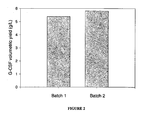
- the volumetric yield of G-CSF as determined by densitometric quantification of the GCSF band with respect to the standard plot of authentic standard, after SDS-PAGE, was 5.38 g/L in Batch 1 and 5.81 g/L in Batch 2.
- the volumetric yield in Batch 2 was about 8% higher than that of Batch 1 ( Figure 2 ).
- the experiment was carried out in a 30-L fermenter. Since the production phase media of both batches (Batch 3 and Batch 4) were identical including the concentration of Potassium cation, except only the concentration of Magnesium cation, the results reflected the effect of the combination of Potassium and Magnesium cation.
- a seed culture of E. coli BL21 (DE3) cells transformed with the human G-CSF gene was inoculated in the growth media of the following composition.
- ammonium hydroxide was used as the pH regulator to maintain the pH in the range of 6.8 to 7.0.
- the temperature was maintained at 37 °C.
- the pre-induction media consisting of the following composition, was added in the culture broth: Component Concentration Yeast extract 84.38 g/L Potassium chloride 75.44 g/L Thiamine hydrochloride 8.38 g/L Magnesium Sulfate 187.06 g/L (only in Batch 4)
- G-CSF gene was induced by multiple additions of filter-sterilized solution of IPTG to the culture broth.
- ammonium hydroxide was used as the pH regulator to maintain the pH 6.8.
- the temperature was maintained at 37 °C.
- Kanamycin was added to the culture to put selection pressure.
- the equal amount of Kanamycin (37.5 mg, added once) was used during production phase.
- the concentration of Potassium and Magnesium cations in the culture broth during production phase was about 120 mM and 200 mM, respectively.
- the plasmid stability was determined as described previously The plasmid stability in Batch 4 (97.3%) was about 6% higher than the plasmid stability in Batch 3 (91.8%), thereby showing the effectiveness of Magnesium and Potassium cations in improving the plasmid stability ( Figure 3 ).
- the plasmid stability obtained in presence of Magnesium and Potassium cations was 116.2% higher than that in Batch 1 (without high concentration of salts in production phase).
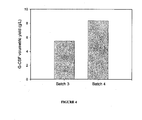
- the volumetric yield of G-CSF as determined by densitometric quantification of the GCSF band with respect to the standard plot of authentic standard, after SDS-PAGE, was 5.48 g/L in Batch 3 and 8.35 g/L in Batch 4 ( Figure 4 ).
- the volumetric yield in Batch 4 was about 55% higher than that on Batch 1.
- the experiment was carried out in a 30-L fermenter.
- the production phase media composition of both batches (Batch 4 and Batch 5) were identical including the concentrations of Potassium and Magnesium cations.
- the average specific growth rate during production phase of Batch 5 was higher than that in production phase of Batch 4.
- a seed culture of E. coli BL21 (DE3) cells transformed with the human G-CSF gene was inoculated in the growth media of the following composition.
- ammonium hydroxide was used as the pH regulator to maintain the pH in the range of 6.8 to 7.0.
- the temperature was maintained at 37 °C.
- the pre-induction media consisting of the following composition, was added in the culture broth: Component Concentration Yeast extract 84.38 g/L Potassium chloride 75.44 g/L Thiamine hydrochloride 8.38 g/L Magnesium Sulfate 187.06 g/L
- G-CSF gene was induced by multiple additions of filter-sterilized solution of IPTG to the culture broth.
- ammonium hydroxide was used as the pH regulator to maintain the pH 6.8.
- the temperature was maintained at 37 °C.
- Kanamycin was added to the culture to put selection pressure. Equal amount of Kanamycin (37.5 mg, added once) was used during production phase.
- the average specific growth rate during production phase in Batch 4 was about 0.04 1/h, whereas that in Batch 5 was about 0.07 l/h.
- the volumetric yield of G-CSF determined, as described previously, to be 8.35 g/L in Batch 4 and 9.94 g/L in Batch 5.
- the volumetric yield in Batch 5 was about 19% higher than that on Batch 4 ( Figure 5 ).
- the plasmid stability in the end-of-the-batch samples of both batches was high (>75%).
- the experiment was carried out in a 30-L fermenter.
- a seed culture of E. coli BL21 (DE3) cells transformed with the human G-CSF gene was inoculated in the growth media of the following composition.
- Component Concentration before inoculation KH 2 PO 4 13.3 g/L (NH 4 ) 2 HPO 4 4.0 g/L Yeast extract 1.0 g/L Glucose 10.0 g/L Citric acid 1.7 g/L MgSO 4 .7H 2 O 1.2 g/L Trace element solution 20.0 mL/L Kanamycin 50 mg/L (In Batch 1) Ampicillin 100 mg/L (In Batch 6)
- ammonium hydroxide was used as the pH regulator to maintain the pH about 6.8.
- the temperature was maintained at 37 °C.
- G-CSF gene was induced by multiple additions of filter-sterilized solution of IPTG to the culture broth.
- ammonium hydroxide was used as the pH regulator to maintain the pH 6.8.
- the temperature was maintained at 37 °C.
- the volumetric yield of G-CSF was determined, as described previously.
- the volumetric yield in end-of-batch sample of Batch 1 (high thiamine batch) was about 10.7% higher than that of in Batch 6 (4.86 g/L), thereby showing the effectiveness of high concentration of thiamine in improving the G-CSF volumetric yield ( Figure 6 ).
Landscapes
- Health & Medical Sciences (AREA)
- Chemical & Material Sciences (AREA)
- Life Sciences & Earth Sciences (AREA)
- Organic Chemistry (AREA)
- Genetics & Genomics (AREA)
- Engineering & Computer Science (AREA)
- Zoology (AREA)
- Wood Science & Technology (AREA)
- Bioinformatics & Cheminformatics (AREA)
- Biotechnology (AREA)
- Biochemistry (AREA)
- General Health & Medical Sciences (AREA)
- Medicinal Chemistry (AREA)
- General Engineering & Computer Science (AREA)
- Biomedical Technology (AREA)
- Biophysics (AREA)
- Microbiology (AREA)
- Molecular Biology (AREA)
- Immunology (AREA)
- Toxicology (AREA)
- Proteomics, Peptides & Aminoacids (AREA)
- Virology (AREA)
- Gastroenterology & Hepatology (AREA)
- Tropical Medicine & Parasitology (AREA)
- Physics & Mathematics (AREA)
- Plant Pathology (AREA)
- Preparation Of Compounds By Using Micro-Organisms (AREA)
- Micro-Organisms Or Cultivation Processes Thereof (AREA)
- Saccharide Compounds (AREA)
- Peptides Or Proteins (AREA)
Priority Applications (1)
| Application Number | Priority Date | Filing Date | Title |
|---|---|---|---|
| PL10153219T PL2182007T3 (pl) | 2006-03-06 | 2007-03-05 | Sposób wytwarzania ludzkiego G-CSF |
Applications Claiming Priority (2)
| Application Number | Priority Date | Filing Date | Title |
|---|---|---|---|
| IN309MU2006 | 2006-03-06 | ||
| EP07736565.8A EP1994138B1 (en) | 2006-03-06 | 2007-03-05 | Process for preparing human g-csf |
Related Parent Applications (3)
| Application Number | Title | Priority Date | Filing Date |
|---|---|---|---|
| EP07736565.8A Division-Into EP1994138B1 (en) | 2006-03-06 | 2007-03-05 | Process for preparing human g-csf |
| EP07736565.8A Division EP1994138B1 (en) | 2006-03-06 | 2007-03-05 | Process for preparing human g-csf |
| EP07736565.8 Division | 2007-03-05 |
Publications (2)
| Publication Number | Publication Date |
|---|---|
| EP2182007A1 EP2182007A1 (en) | 2010-05-05 |
| EP2182007B1 true EP2182007B1 (en) | 2014-03-05 |
Family
ID=38436804
Family Applications (2)
| Application Number | Title | Priority Date | Filing Date |
|---|---|---|---|
| EP10153219.0A Not-in-force EP2182007B1 (en) | 2006-03-06 | 2007-03-05 | Process for preparing human G-CSF |
| EP07736565.8A Active EP1994138B1 (en) | 2006-03-06 | 2007-03-05 | Process for preparing human g-csf |
Family Applications After (1)
| Application Number | Title | Priority Date | Filing Date |
|---|---|---|---|
| EP07736565.8A Active EP1994138B1 (en) | 2006-03-06 | 2007-03-05 | Process for preparing human g-csf |
Country Status (17)
| Country | Link |
|---|---|
| US (2) | US8021862B2 (pl) |
| EP (2) | EP2182007B1 (pl) |
| JP (2) | JP4927103B2 (pl) |
| KR (1) | KR101176794B1 (pl) |
| CN (2) | CN101410410B (pl) |
| AP (2) | AP2647A (pl) |
| AU (1) | AU2007224331B2 (pl) |
| BR (1) | BRPI0707078A2 (pl) |
| CA (1) | CA2642654C (pl) |
| DK (2) | DK2182007T3 (pl) |
| EA (2) | EA022782B1 (pl) |
| MX (1) | MX2008011407A (pl) |
| MY (1) | MY149168A (pl) |
| NZ (2) | NZ596111A (pl) |
| PL (2) | PL2182007T3 (pl) |
| WO (1) | WO2007102174A2 (pl) |
| ZA (1) | ZA200806978B (pl) |
Families Citing this family (6)
| Publication number | Priority date | Publication date | Assignee | Title |
|---|---|---|---|---|
| EP2522728A1 (en) | 2007-09-21 | 2012-11-14 | Cadila Healthcare Limited | GCSF fusion protein systems suitable for high expression of peptides |
| US8927256B2 (en) * | 2008-02-06 | 2015-01-06 | Biocon Limited | Fermentation medias and processes thereof |
| WO2011086447A2 (en) | 2010-01-12 | 2011-07-21 | Lupin Limited | Fermentation process for the preparation of recombinant heterologous proteins |
| CN108103243A (zh) * | 2018-01-04 | 2018-06-01 | 哈尔滨瀚邦医疗科技有限公司 | 一种猪乙脑病毒遗传稳定性的检测方法及应用 |
| CN114350588B (zh) * | 2021-12-31 | 2024-03-15 | 山东新时代药业有限公司 | 一种rhG-CSF的发酵培养基及其发酵方法 |
| JP2023159784A (ja) * | 2022-04-20 | 2023-11-01 | 東ソー株式会社 | アデノ随伴ウイルス結合性タンパク質の製造方法 |
Family Cites Families (2)
| Publication number | Priority date | Publication date | Assignee | Title |
|---|---|---|---|---|
| GB9107846D0 (en) * | 1990-04-30 | 1991-05-29 | Ici Plc | Polypeptides |
| CA2591235C (en) * | 2004-12-20 | 2014-03-11 | Cadila Healthcare Limited | Process for preparing high levels of interferon beta |
-
2007
- 2007-03-05 EP EP10153219.0A patent/EP2182007B1/en not_active Not-in-force
- 2007-03-05 EP EP07736565.8A patent/EP1994138B1/en active Active
- 2007-03-05 CN CN2007800080771A patent/CN101410410B/zh not_active Expired - Fee Related
- 2007-03-05 MX MX2008011407A patent/MX2008011407A/es active IP Right Grant
- 2007-03-05 AP AP2008004592A patent/AP2647A/xx active
- 2007-03-05 NZ NZ596111A patent/NZ596111A/xx not_active IP Right Cessation
- 2007-03-05 EA EA201100718A patent/EA022782B1/ru not_active IP Right Cessation
- 2007-03-05 PL PL10153219T patent/PL2182007T3/pl unknown
- 2007-03-05 DK DK10153219.0T patent/DK2182007T3/da active
- 2007-03-05 BR BRPI0707078-0A patent/BRPI0707078A2/pt not_active IP Right Cessation
- 2007-03-05 NZ NZ571337A patent/NZ571337A/en not_active IP Right Cessation
- 2007-03-05 CN CN201210265322.XA patent/CN102776261B/zh not_active Expired - Fee Related
- 2007-03-05 WO PCT/IN2007/000105 patent/WO2007102174A2/en not_active Ceased
- 2007-03-05 DK DK07736565.8T patent/DK1994138T3/da active
- 2007-03-05 PL PL07736565T patent/PL1994138T3/pl unknown
- 2007-03-05 MY MYPI20083266A patent/MY149168A/en unknown
- 2007-03-05 AP AP2012006440A patent/AP3142A/xx active
- 2007-03-05 AU AU2007224331A patent/AU2007224331B2/en not_active Ceased
- 2007-03-05 KR KR1020087022969A patent/KR101176794B1/ko not_active Expired - Fee Related
- 2007-03-05 EA EA200870320A patent/EA015498B1/ru not_active IP Right Cessation
- 2007-03-05 CA CA2642654A patent/CA2642654C/en not_active Expired - Fee Related
- 2007-03-05 US US12/280,496 patent/US8021862B2/en not_active Expired - Fee Related
- 2007-03-05 JP JP2008557902A patent/JP4927103B2/ja not_active Expired - Fee Related
-
2008
- 2008-08-13 ZA ZA200806978A patent/ZA200806978B/xx unknown
-
2010
- 2010-11-23 US US12/952,277 patent/US8492120B2/en not_active Expired - Fee Related
-
2011
- 2011-08-17 JP JP2011178332A patent/JP5460660B2/ja not_active Expired - Fee Related
Also Published As
Similar Documents
| Publication | Publication Date | Title |
|---|---|---|
| US8492120B2 (en) | Process for preparing human G-CSF | |
| EP0156355B2 (en) | Method of improving the yield of heterologous protein produced by cultivating recombinant bacteria | |
| WO2004015124A1 (en) | Process for the production of a heterologous protein | |
| HK1176645B (en) | Process for preparing human g-csf | |
| HK1127617B (en) | Process for preparing human g-csf | |
| SI21272A (sl) | Sintetski gen za humani granulocitne kolonije stimulirajoči dejavnik za ekspresijo v E. coli | |
| WO2008096368A2 (en) | A novel process for production of recombinant human g-csf | |
| US7923220B2 (en) | Process for preparing high levels of interferon beta | |
| CA2998579A1 (en) | Method for producing a recombinant protein with reduced impurities | |
| KR0134856B1 (ko) | 재조합 대장균의 유가식 회분발효에 의한 인간 알파 인터페론의 제조방법 |
Legal Events
| Date | Code | Title | Description |
|---|---|---|---|
| PUAI | Public reference made under article 153(3) epc to a published international application that has entered the european phase |
Free format text: ORIGINAL CODE: 0009012 |
|
| AC | Divisional application: reference to earlier application |
Ref document number: 1994138 Country of ref document: EP Kind code of ref document: P |
|
| AK | Designated contracting states |
Kind code of ref document: A1 Designated state(s): AT BE BG CH CY CZ DE DK EE ES FI FR GB GR HU IE IS IT LI LT LU LV MC MT NL PL PT RO SE SI SK TR |
|
| AX | Request for extension of the european patent |
Extension state: AL BA HR MK RS |
|
| 17P | Request for examination filed |
Effective date: 20101027 |
|
| 17Q | First examination report despatched |
Effective date: 20101201 |
|
| GRAP | Despatch of communication of intention to grant a patent |
Free format text: ORIGINAL CODE: EPIDOSNIGR1 |
|
| INTG | Intention to grant announced |
Effective date: 20131018 |
|
| GRAS | Grant fee paid |
Free format text: ORIGINAL CODE: EPIDOSNIGR3 |
|
| GRAA | (expected) grant |
Free format text: ORIGINAL CODE: 0009210 |
|
| AC | Divisional application: reference to earlier application |
Ref document number: 1994138 Country of ref document: EP Kind code of ref document: P |
|
| AK | Designated contracting states |
Kind code of ref document: B1 Designated state(s): AT BE BG CH CY CZ DE DK EE ES FI FR GB GR HU IE IS IT LI LT LU LV MC MT NL PL PT RO SE SI SK TR |
|
| REG | Reference to a national code |
Ref country code: GB Ref legal event code: FG4D |
|
| REG | Reference to a national code |
Ref country code: CH Ref legal event code: EP |
|
| REG | Reference to a national code |
Ref country code: AT Ref legal event code: REF Ref document number: 654831 Country of ref document: AT Kind code of ref document: T Effective date: 20140315 |
|
| REG | Reference to a national code |
Ref country code: NL Ref legal event code: T3 |
|
| REG | Reference to a national code |
Ref country code: IE Ref legal event code: FG4D |
|
| REG | Reference to a national code |
Ref country code: DE Ref legal event code: R096 Ref document number: 602007035454 Country of ref document: DE Effective date: 20140417 |
|
| REG | Reference to a national code |
Ref country code: DK Ref legal event code: T3 Effective date: 20140410 |
|
| REG | Reference to a national code |
Ref country code: SE Ref legal event code: TRGR |
|
| REG | Reference to a national code |
Ref country code: PL Ref legal event code: T3 |
|
| REG | Reference to a national code |
Ref country code: AT Ref legal event code: MK05 Ref document number: 654831 Country of ref document: AT Kind code of ref document: T Effective date: 20140305 |
|
| PG25 | Lapsed in a contracting state [announced via postgrant information from national office to epo] |
Ref country code: LT Free format text: LAPSE BECAUSE OF FAILURE TO SUBMIT A TRANSLATION OF THE DESCRIPTION OR TO PAY THE FEE WITHIN THE PRESCRIBED TIME-LIMIT Effective date: 20140305 |
|
| REG | Reference to a national code |
Ref country code: LT Ref legal event code: MG4D |
|
| PG25 | Lapsed in a contracting state [announced via postgrant information from national office to epo] |
Ref country code: CY Free format text: LAPSE BECAUSE OF FAILURE TO SUBMIT A TRANSLATION OF THE DESCRIPTION OR TO PAY THE FEE WITHIN THE PRESCRIBED TIME-LIMIT Effective date: 20140305 Ref country code: AT Free format text: LAPSE BECAUSE OF FAILURE TO SUBMIT A TRANSLATION OF THE DESCRIPTION OR TO PAY THE FEE WITHIN THE PRESCRIBED TIME-LIMIT Effective date: 20140305 Ref country code: FI Free format text: LAPSE BECAUSE OF FAILURE TO SUBMIT A TRANSLATION OF THE DESCRIPTION OR TO PAY THE FEE WITHIN THE PRESCRIBED TIME-LIMIT Effective date: 20140305 |
|
| PG25 | Lapsed in a contracting state [announced via postgrant information from national office to epo] |
Ref country code: LV Free format text: LAPSE BECAUSE OF FAILURE TO SUBMIT A TRANSLATION OF THE DESCRIPTION OR TO PAY THE FEE WITHIN THE PRESCRIBED TIME-LIMIT Effective date: 20140305 |
|
| PG25 | Lapsed in a contracting state [announced via postgrant information from national office to epo] |
Ref country code: BE Free format text: LAPSE BECAUSE OF FAILURE TO SUBMIT A TRANSLATION OF THE DESCRIPTION OR TO PAY THE FEE WITHIN THE PRESCRIBED TIME-LIMIT Effective date: 20140305 Ref country code: CZ Free format text: LAPSE BECAUSE OF FAILURE TO SUBMIT A TRANSLATION OF THE DESCRIPTION OR TO PAY THE FEE WITHIN THE PRESCRIBED TIME-LIMIT Effective date: 20140305 Ref country code: BG Free format text: LAPSE BECAUSE OF FAILURE TO SUBMIT A TRANSLATION OF THE DESCRIPTION OR TO PAY THE FEE WITHIN THE PRESCRIBED TIME-LIMIT Effective date: 20140605 Ref country code: RO Free format text: LAPSE BECAUSE OF FAILURE TO SUBMIT A TRANSLATION OF THE DESCRIPTION OR TO PAY THE FEE WITHIN THE PRESCRIBED TIME-LIMIT Effective date: 20140305 Ref country code: EE Free format text: LAPSE BECAUSE OF FAILURE TO SUBMIT A TRANSLATION OF THE DESCRIPTION OR TO PAY THE FEE WITHIN THE PRESCRIBED TIME-LIMIT Effective date: 20140305 Ref country code: IS Free format text: LAPSE BECAUSE OF FAILURE TO SUBMIT A TRANSLATION OF THE DESCRIPTION OR TO PAY THE FEE WITHIN THE PRESCRIBED TIME-LIMIT Effective date: 20140705 |
|
| PG25 | Lapsed in a contracting state [announced via postgrant information from national office to epo] |
Ref country code: ES Free format text: LAPSE BECAUSE OF FAILURE TO SUBMIT A TRANSLATION OF THE DESCRIPTION OR TO PAY THE FEE WITHIN THE PRESCRIBED TIME-LIMIT Effective date: 20140305 Ref country code: SK Free format text: LAPSE BECAUSE OF FAILURE TO SUBMIT A TRANSLATION OF THE DESCRIPTION OR TO PAY THE FEE WITHIN THE PRESCRIBED TIME-LIMIT Effective date: 20140305 |
|
| REG | Reference to a national code |
Ref country code: DE Ref legal event code: R097 Ref document number: 602007035454 Country of ref document: DE |
|
| REG | Reference to a national code |
Ref country code: HU Ref legal event code: AG4A Ref document number: E021114 Country of ref document: HU |
|
| PG25 | Lapsed in a contracting state [announced via postgrant information from national office to epo] |
Ref country code: PT Free format text: LAPSE BECAUSE OF FAILURE TO SUBMIT A TRANSLATION OF THE DESCRIPTION OR TO PAY THE FEE WITHIN THE PRESCRIBED TIME-LIMIT Effective date: 20140707 |
|
| PLBE | No opposition filed within time limit |
Free format text: ORIGINAL CODE: 0009261 |
|
| STAA | Information on the status of an ep patent application or granted ep patent |
Free format text: STATUS: NO OPPOSITION FILED WITHIN TIME LIMIT |
|
| 26N | No opposition filed |
Effective date: 20141208 |
|
| REG | Reference to a national code |
Ref country code: DE Ref legal event code: R097 Ref document number: 602007035454 Country of ref document: DE Effective date: 20141208 |
|
| PG25 | Lapsed in a contracting state [announced via postgrant information from national office to epo] |
Ref country code: IT Free format text: LAPSE BECAUSE OF FAILURE TO SUBMIT A TRANSLATION OF THE DESCRIPTION OR TO PAY THE FEE WITHIN THE PRESCRIBED TIME-LIMIT Effective date: 20140305 |
|
| PG25 | Lapsed in a contracting state [announced via postgrant information from national office to epo] |
Ref country code: SI Free format text: LAPSE BECAUSE OF FAILURE TO SUBMIT A TRANSLATION OF THE DESCRIPTION OR TO PAY THE FEE WITHIN THE PRESCRIBED TIME-LIMIT Effective date: 20140305 |
|
| PG25 | Lapsed in a contracting state [announced via postgrant information from national office to epo] |
Ref country code: MC Free format text: LAPSE BECAUSE OF FAILURE TO SUBMIT A TRANSLATION OF THE DESCRIPTION OR TO PAY THE FEE WITHIN THE PRESCRIBED TIME-LIMIT Effective date: 20140305 |
|
| PG25 | Lapsed in a contracting state [announced via postgrant information from national office to epo] |
Ref country code: MT Free format text: LAPSE BECAUSE OF FAILURE TO SUBMIT A TRANSLATION OF THE DESCRIPTION OR TO PAY THE FEE WITHIN THE PRESCRIBED TIME-LIMIT Effective date: 20140305 |
|
| REG | Reference to a national code |
Ref country code: FR Ref legal event code: PLFP Year of fee payment: 10 |
|
| PG25 | Lapsed in a contracting state [announced via postgrant information from national office to epo] |
Ref country code: GR Free format text: LAPSE BECAUSE OF FAILURE TO SUBMIT A TRANSLATION OF THE DESCRIPTION OR TO PAY THE FEE WITHIN THE PRESCRIBED TIME-LIMIT Effective date: 20140606 |
|
| PG25 | Lapsed in a contracting state [announced via postgrant information from national office to epo] |
Ref country code: LU Free format text: LAPSE BECAUSE OF NON-PAYMENT OF DUE FEES Effective date: 20140305 |
|
| REG | Reference to a national code |
Ref country code: FR Ref legal event code: PLFP Year of fee payment: 11 |
|
| PGFP | Annual fee paid to national office [announced via postgrant information from national office to epo] |
Ref country code: FR Payment date: 20170322 Year of fee payment: 11 Ref country code: CH Payment date: 20170322 Year of fee payment: 11 Ref country code: DE Payment date: 20170322 Year of fee payment: 11 Ref country code: NL Payment date: 20170321 Year of fee payment: 11 Ref country code: SE Payment date: 20170321 Year of fee payment: 11 |
|
| PGFP | Annual fee paid to national office [announced via postgrant information from national office to epo] |
Ref country code: IE Payment date: 20170321 Year of fee payment: 11 Ref country code: HU Payment date: 20170316 Year of fee payment: 11 Ref country code: PL Payment date: 20170223 Year of fee payment: 11 Ref country code: DK Payment date: 20170321 Year of fee payment: 11 Ref country code: GB Payment date: 20170322 Year of fee payment: 11 |
|
| PGFP | Annual fee paid to national office [announced via postgrant information from national office to epo] |
Ref country code: TR Payment date: 20170222 Year of fee payment: 11 |
|
| REG | Reference to a national code |
Ref country code: DE Ref legal event code: R119 Ref document number: 602007035454 Country of ref document: DE |
|
| REG | Reference to a national code |
Ref country code: DK Ref legal event code: EBP Effective date: 20180331 |
|
| PG25 | Lapsed in a contracting state [announced via postgrant information from national office to epo] |
Ref country code: SE Free format text: LAPSE BECAUSE OF NON-PAYMENT OF DUE FEES Effective date: 20180306 |
|
| REG | Reference to a national code |
Ref country code: CH Ref legal event code: PL |
|
| REG | Reference to a national code |
Ref country code: NL Ref legal event code: MM Effective date: 20180401 |
|
| GBPC | Gb: european patent ceased through non-payment of renewal fee |
Effective date: 20180305 |
|
| REG | Reference to a national code |
Ref country code: IE Ref legal event code: MM4A |
|
| PG25 | Lapsed in a contracting state [announced via postgrant information from national office to epo] |
Ref country code: NL Free format text: LAPSE BECAUSE OF NON-PAYMENT OF DUE FEES Effective date: 20180401 |
|
| PG25 | Lapsed in a contracting state [announced via postgrant information from national office to epo] |
Ref country code: HU Free format text: LAPSE BECAUSE OF NON-PAYMENT OF DUE FEES Effective date: 20180306 Ref country code: DE Free format text: LAPSE BECAUSE OF NON-PAYMENT OF DUE FEES Effective date: 20181002 Ref country code: IE Free format text: LAPSE BECAUSE OF NON-PAYMENT OF DUE FEES Effective date: 20180305 |
|
| PG25 | Lapsed in a contracting state [announced via postgrant information from national office to epo] |
Ref country code: CH Free format text: LAPSE BECAUSE OF NON-PAYMENT OF DUE FEES Effective date: 20180331 Ref country code: GB Free format text: LAPSE BECAUSE OF NON-PAYMENT OF DUE FEES Effective date: 20180305 Ref country code: LI Free format text: LAPSE BECAUSE OF NON-PAYMENT OF DUE FEES Effective date: 20180331 |
|
| PG25 | Lapsed in a contracting state [announced via postgrant information from national office to epo] |
Ref country code: FR Free format text: LAPSE BECAUSE OF NON-PAYMENT OF DUE FEES Effective date: 20180331 |
|
| PG25 | Lapsed in a contracting state [announced via postgrant information from national office to epo] |
Ref country code: DK Free format text: LAPSE BECAUSE OF NON-PAYMENT OF DUE FEES Effective date: 20180331 |
|
| PG25 | Lapsed in a contracting state [announced via postgrant information from national office to epo] |
Ref country code: PL Free format text: LAPSE BECAUSE OF NON-PAYMENT OF DUE FEES Effective date: 20180305 |
|
| PG25 | Lapsed in a contracting state [announced via postgrant information from national office to epo] |
Ref country code: TR Free format text: LAPSE BECAUSE OF NON-PAYMENT OF DUE FEES Effective date: 20180305 |