EP2175930B1 - Device for preventing alterations in circadian rhythm - Google Patents
Device for preventing alterations in circadian rhythm Download PDFInfo
- Publication number
- EP2175930B1 EP2175930B1 EP07855478A EP07855478A EP2175930B1 EP 2175930 B1 EP2175930 B1 EP 2175930B1 EP 07855478 A EP07855478 A EP 07855478A EP 07855478 A EP07855478 A EP 07855478A EP 2175930 B1 EP2175930 B1 EP 2175930B1
- Authority
- EP
- European Patent Office
- Prior art keywords
- light
- melatonin
- night
- wavelengths
- filter
- Prior art date
- Legal status (The legal status is an assumption and is not a legal conclusion. Google has not performed a legal analysis and makes no representation as to the accuracy of the status listed.)
- Not-in-force
Links
- 230000027288 circadian rhythm Effects 0.000 title claims description 41
- 230000004075 alteration Effects 0.000 title description 2
- 230000003287 optical effect Effects 0.000 claims description 27
- 230000005540 biological transmission Effects 0.000 claims description 15
- 238000000576 coating method Methods 0.000 claims description 5
- 239000011248 coating agent Substances 0.000 claims description 4
- YJPIGAIKUZMOQA-UHFFFAOYSA-N Melatonin Natural products COC1=CC=C2N(C(C)=O)C=C(CCN)C2=C1 YJPIGAIKUZMOQA-UHFFFAOYSA-N 0.000 description 79
- DRLFMBDRBRZALE-UHFFFAOYSA-N melatonin Chemical compound COC1=CC=C2NC=C(CCNC(C)=O)C2=C1 DRLFMBDRBRZALE-UHFFFAOYSA-N 0.000 description 79
- 229960003987 melatonin Drugs 0.000 description 78
- JYGXADMDTFJGBT-VWUMJDOOSA-N hydrocortisone Chemical compound O=C1CC[C@]2(C)[C@H]3[C@@H](O)C[C@](C)([C@@](CC4)(O)C(=O)CO)[C@@H]4[C@@H]3CCC2=C1 JYGXADMDTFJGBT-VWUMJDOOSA-N 0.000 description 38
- 230000014509 gene expression Effects 0.000 description 37
- 241001465754 Metazoa Species 0.000 description 29
- 230000028327 secretion Effects 0.000 description 27
- 238000000034 method Methods 0.000 description 25
- 230000000903 blocking effect Effects 0.000 description 23
- 239000003862 glucocorticoid Substances 0.000 description 22
- 206010041349 Somnolence Diseases 0.000 description 21
- 208000032140 Sleepiness Diseases 0.000 description 19
- 229960000890 hydrocortisone Drugs 0.000 description 19
- 230000037321 sleepiness Effects 0.000 description 19
- 230000036626 alertness Effects 0.000 description 18
- OMFXVFTZEKFJBZ-UHFFFAOYSA-N Corticosterone Natural products O=C1CCC2(C)C3C(O)CC(C)(C(CC4)C(=O)CO)C4C3CCC2=C1 OMFXVFTZEKFJBZ-UHFFFAOYSA-N 0.000 description 17
- 101150074181 PER2 gene Proteins 0.000 description 17
- OMFXVFTZEKFJBZ-HJTSIMOOSA-N corticosterone Chemical compound O=C1CC[C@]2(C)[C@H]3[C@@H](O)C[C@](C)([C@H](CC4)C(=O)CO)[C@@H]4[C@@H]3CCC2=C1 OMFXVFTZEKFJBZ-HJTSIMOOSA-N 0.000 description 17
- 238000010171 animal model Methods 0.000 description 16
- 230000001965 increasing effect Effects 0.000 description 16
- 230000007958 sleep Effects 0.000 description 13
- 230000004253 retinal exposure Effects 0.000 description 12
- 241000700159 Rattus Species 0.000 description 11
- 230000000694 effects Effects 0.000 description 11
- 210000003016 hypothalamus Anatomy 0.000 description 11
- 230000001629 suppression Effects 0.000 description 11
- 101150038243 CLOCK gene Proteins 0.000 description 10
- 238000012360 testing method Methods 0.000 description 10
- 101150032765 ARNTL gene Proteins 0.000 description 9
- 208000019888 Circadian rhythm sleep disease Diseases 0.000 description 9
- 230000000422 nocturnal effect Effects 0.000 description 9
- 229940037128 systemic glucocorticoids Drugs 0.000 description 9
- 210000004100 adrenal gland Anatomy 0.000 description 8
- 210000004369 blood Anatomy 0.000 description 8
- 239000008280 blood Substances 0.000 description 8
- 201000001098 delayed sleep phase syndrome Diseases 0.000 description 8
- 208000033921 delayed sleep phase type circadian rhythm sleep disease Diseases 0.000 description 8
- 229940088597 hormone Drugs 0.000 description 8
- 239000005556 hormone Substances 0.000 description 8
- 230000002060 circadian Effects 0.000 description 7
- 238000002474 experimental method Methods 0.000 description 7
- 210000001519 tissue Anatomy 0.000 description 7
- 238000001914 filtration Methods 0.000 description 6
- 239000011521 glass Substances 0.000 description 6
- 230000035790 physiological processes and functions Effects 0.000 description 6
- 230000033764 rhythmic process Effects 0.000 description 6
- 230000006870 function Effects 0.000 description 5
- 230000007774 longterm Effects 0.000 description 5
- 108090000623 proteins and genes Proteins 0.000 description 5
- 230000002411 adverse Effects 0.000 description 4
- 238000004458 analytical method Methods 0.000 description 4
- 230000033228 biological regulation Effects 0.000 description 4
- 210000004556 brain Anatomy 0.000 description 4
- 230000003247 decreasing effect Effects 0.000 description 4
- 239000000835 fiber Substances 0.000 description 4
- 230000008821 health effect Effects 0.000 description 4
- 230000035935 pregnancy Effects 0.000 description 4
- 230000004044 response Effects 0.000 description 4
- 210000001525 retina Anatomy 0.000 description 4
- 208000019116 sleep disease Diseases 0.000 description 4
- 241000282412 Homo Species 0.000 description 3
- 206010020772 Hypertension Diseases 0.000 description 3
- 208000010340 Sleep Deprivation Diseases 0.000 description 3
- 208000013738 Sleep Initiation and Maintenance disease Diseases 0.000 description 3
- 238000009395 breeding Methods 0.000 description 3
- 230000001488 breeding effect Effects 0.000 description 3
- 230000008632 circadian clock Effects 0.000 description 3
- 230000003111 delayed effect Effects 0.000 description 3
- 210000003754 fetus Anatomy 0.000 description 3
- 230000001976 improved effect Effects 0.000 description 3
- 206010022437 insomnia Diseases 0.000 description 3
- 208000024714 major depressive disease Diseases 0.000 description 3
- 238000012986 modification Methods 0.000 description 3
- 230000004048 modification Effects 0.000 description 3
- 210000004560 pineal gland Anatomy 0.000 description 3
- 239000004417 polycarbonate Substances 0.000 description 3
- 229920000515 polycarbonate Polymers 0.000 description 3
- 208000020016 psychiatric disease Diseases 0.000 description 3
- 238000011160 research Methods 0.000 description 3
- 210000003994 retinal ganglion cell Anatomy 0.000 description 3
- 210000003296 saliva Anatomy 0.000 description 3
- 239000000126 substance Substances 0.000 description 3
- 208000024891 symptom Diseases 0.000 description 3
- 208000001072 type 2 diabetes mellitus Diseases 0.000 description 3
- SFLSHLFXELFNJZ-QMMMGPOBSA-N (-)-norepinephrine Chemical compound NC[C@H](O)C1=CC=C(O)C(O)=C1 SFLSHLFXELFNJZ-QMMMGPOBSA-N 0.000 description 2
- IJGRMHOSHXDMSA-UHFFFAOYSA-N Atomic nitrogen Chemical compound N#N IJGRMHOSHXDMSA-UHFFFAOYSA-N 0.000 description 2
- 208000020925 Bipolar disease Diseases 0.000 description 2
- 206010006187 Breast cancer Diseases 0.000 description 2
- 208000026310 Breast neoplasm Diseases 0.000 description 2
- 208000024172 Cardiovascular disease Diseases 0.000 description 2
- 208000020401 Depressive disease Diseases 0.000 description 2
- 238000008157 ELISA kit Methods 0.000 description 2
- 241000124008 Mammalia Species 0.000 description 2
- 208000019022 Mood disease Diseases 0.000 description 2
- 206010028980 Neoplasm Diseases 0.000 description 2
- 206010062519 Poor quality sleep Diseases 0.000 description 2
- 230000003466 anti-cipated effect Effects 0.000 description 2
- 238000013459 approach Methods 0.000 description 2
- 230000008901 benefit Effects 0.000 description 2
- 201000011510 cancer Diseases 0.000 description 2
- 210000004027 cell Anatomy 0.000 description 2
- 230000001068 chronobiotic effect Effects 0.000 description 2
- 239000003086 colorant Substances 0.000 description 2
- 238000011161 development Methods 0.000 description 2
- 230000018109 developmental process Effects 0.000 description 2
- 230000002526 effect on cardiovascular system Effects 0.000 description 2
- 230000002996 emotional effect Effects 0.000 description 2
- 201000003104 endogenous depression Diseases 0.000 description 2
- 238000011156 evaluation Methods 0.000 description 2
- 230000004438 eyesight Effects 0.000 description 2
- 230000001605 fetal effect Effects 0.000 description 2
- 230000002650 habitual effect Effects 0.000 description 2
- -1 hydroxyindol-O-methyl Chemical group 0.000 description 2
- 208000018773 low birth weight Diseases 0.000 description 2
- 231100000533 low birth weight Toxicity 0.000 description 2
- 238000004519 manufacturing process Methods 0.000 description 2
- 238000005259 measurement Methods 0.000 description 2
- 210000001640 nerve ending Anatomy 0.000 description 2
- 229960002748 norepinephrine Drugs 0.000 description 2
- SFLSHLFXELFNJZ-UHFFFAOYSA-N norepinephrine Natural products NCC(O)C1=CC=C(O)C(O)=C1 SFLSHLFXELFNJZ-UHFFFAOYSA-N 0.000 description 2
- 238000010606 normalization Methods 0.000 description 2
- 230000000247 oncostatic effect Effects 0.000 description 2
- 230000010355 oscillation Effects 0.000 description 2
- 230000007170 pathology Effects 0.000 description 2
- 230000010363 phase shift Effects 0.000 description 2
- 239000004033 plastic Substances 0.000 description 2
- 230000002829 reductive effect Effects 0.000 description 2
- 230000003938 response to stress Effects 0.000 description 2
- QZAYGJVTTNCVMB-UHFFFAOYSA-N serotonin Chemical compound C1=C(O)C=C2C(CCN)=CNC2=C1 QZAYGJVTTNCVMB-UHFFFAOYSA-N 0.000 description 2
- 238000002834 transmittance Methods 0.000 description 2
- 230000000007 visual effect Effects 0.000 description 2
- XLYOFNOQVPJJNP-UHFFFAOYSA-N water Substances O XLYOFNOQVPJJNP-UHFFFAOYSA-N 0.000 description 2
- 208000005623 Carcinogenesis Diseases 0.000 description 1
- 201000009030 Carcinoma Diseases 0.000 description 1
- 208000020446 Cardiac disease Diseases 0.000 description 1
- 208000017164 Chronobiology disease Diseases 0.000 description 1
- 206010009944 Colon cancer Diseases 0.000 description 1
- 208000001333 Colorectal Neoplasms Diseases 0.000 description 1
- 206010012374 Depressed mood Diseases 0.000 description 1
- 108090000790 Enzymes Proteins 0.000 description 1
- 102000004190 Enzymes Human genes 0.000 description 1
- 208000001362 Fetal Growth Retardation Diseases 0.000 description 1
- 206010070531 Foetal growth restriction Diseases 0.000 description 1
- 229910001335 Galvanized steel Inorganic materials 0.000 description 1
- 208000018522 Gastrointestinal disease Diseases 0.000 description 1
- WQZGKKKJIJFFOK-GASJEMHNSA-N Glucose Natural products OC[C@H]1OC(O)[C@H](O)[C@@H](O)[C@@H]1O WQZGKKKJIJFFOK-GASJEMHNSA-N 0.000 description 1
- 208000002705 Glucose Intolerance Diseases 0.000 description 1
- 206010018429 Glucose tolerance impaired Diseases 0.000 description 1
- HTTJABKRGRZYRN-UHFFFAOYSA-N Heparin Chemical compound OC1C(NC(=O)C)C(O)OC(COS(O)(=O)=O)C1OC1C(OS(O)(=O)=O)C(O)C(OC2C(C(OS(O)(=O)=O)C(OC3C(C(O)C(O)C(O3)C(O)=O)OS(O)(=O)=O)C(CO)O2)NS(O)(=O)=O)C(C(O)=O)O1 HTTJABKRGRZYRN-UHFFFAOYSA-N 0.000 description 1
- 206010022489 Insulin Resistance Diseases 0.000 description 1
- PIWKPBJCKXDKJR-UHFFFAOYSA-N Isoflurane Chemical compound FC(F)OC(Cl)C(F)(F)F PIWKPBJCKXDKJR-UHFFFAOYSA-N 0.000 description 1
- QIVBCDIJIAJPQS-VIFPVBQESA-N L-tryptophane Chemical compound C1=CC=C2C(C[C@H](N)C(O)=O)=CNC2=C1 QIVBCDIJIAJPQS-VIFPVBQESA-N 0.000 description 1
- 102100025912 Melanopsin Human genes 0.000 description 1
- 208000001145 Metabolic Syndrome Diseases 0.000 description 1
- 101710202061 N-acetyltransferase Proteins 0.000 description 1
- 206010029216 Nervousness Diseases 0.000 description 1
- 208000008589 Obesity Diseases 0.000 description 1
- 206010060862 Prostate cancer Diseases 0.000 description 1
- 206010037213 Psychomotor retardation Diseases 0.000 description 1
- 208000012545 Psychophysiologic disease Diseases 0.000 description 1
- 238000002123 RNA extraction Methods 0.000 description 1
- 206010041243 Social avoidant behaviour Diseases 0.000 description 1
- 206010041347 Somnambulism Diseases 0.000 description 1
- 108090000992 Transferases Proteins 0.000 description 1
- 102000004357 Transferases Human genes 0.000 description 1
- QIVBCDIJIAJPQS-UHFFFAOYSA-N Tryptophan Natural products C1=CC=C2C(CC(N)C(O)=O)=CNC2=C1 QIVBCDIJIAJPQS-UHFFFAOYSA-N 0.000 description 1
- 239000004904 UV filter Substances 0.000 description 1
- 201000000690 abdominal obesity-metabolic syndrome Diseases 0.000 description 1
- 230000003213 activating effect Effects 0.000 description 1
- 230000003044 adaptive effect Effects 0.000 description 1
- 239000000556 agonist Substances 0.000 description 1
- 238000000540 analysis of variance Methods 0.000 description 1
- 239000006117 anti-reflective coating Substances 0.000 description 1
- 230000003078 antioxidant effect Effects 0.000 description 1
- 238000003556 assay Methods 0.000 description 1
- 230000002238 attenuated effect Effects 0.000 description 1
- 230000009286 beneficial effect Effects 0.000 description 1
- 230000008827 biological function Effects 0.000 description 1
- 239000000090 biomarker Substances 0.000 description 1
- 230000015572 biosynthetic process Effects 0.000 description 1
- 230000036772 blood pressure Effects 0.000 description 1
- 238000010241 blood sampling Methods 0.000 description 1
- 210000005013 brain tissue Anatomy 0.000 description 1
- 210000000481 breast Anatomy 0.000 description 1
- 201000008275 breast carcinoma Diseases 0.000 description 1
- 238000013547 bright light therapy Methods 0.000 description 1
- 238000004364 calculation method Methods 0.000 description 1
- 230000036952 cancer formation Effects 0.000 description 1
- 231100000504 carcinogenesis Toxicity 0.000 description 1
- 238000012754 cardiac puncture Methods 0.000 description 1
- 230000004663 cell proliferation Effects 0.000 description 1
- 230000001413 cellular effect Effects 0.000 description 1
- 230000019522 cellular metabolic process Effects 0.000 description 1
- 230000001684 chronic effect Effects 0.000 description 1
- 230000001149 cognitive effect Effects 0.000 description 1
- 201000010989 colorectal carcinoma Diseases 0.000 description 1
- 230000000295 complement effect Effects 0.000 description 1
- 150000001875 compounds Chemical class 0.000 description 1
- 230000001276 controlling effect Effects 0.000 description 1
- 238000012937 correction Methods 0.000 description 1
- 230000002596 correlated effect Effects 0.000 description 1
- 230000006378 damage Effects 0.000 description 1
- 238000009195 dark therapy Methods 0.000 description 1
- 230000007423 decrease Effects 0.000 description 1
- 230000001934 delay Effects 0.000 description 1
- 230000001419 dependent effect Effects 0.000 description 1
- 238000013461 design Methods 0.000 description 1
- 230000001627 detrimental effect Effects 0.000 description 1
- 229960003957 dexamethasone Drugs 0.000 description 1
- UREBDLICKHMUKA-CXSFZGCWSA-N dexamethasone Chemical compound C1CC2=CC(=O)C=C[C@]2(C)[C@]2(F)[C@@H]1[C@@H]1C[C@@H](C)[C@@](C(=O)CO)(O)[C@@]1(C)C[C@@H]2O UREBDLICKHMUKA-CXSFZGCWSA-N 0.000 description 1
- 238000003745 diagnosis Methods 0.000 description 1
- 238000002224 dissection Methods 0.000 description 1
- 230000035622 drinking Effects 0.000 description 1
- 230000002124 endocrine Effects 0.000 description 1
- 229940011871 estrogen Drugs 0.000 description 1
- 239000000262 estrogen Substances 0.000 description 1
- 208000030941 fetal growth restriction Diseases 0.000 description 1
- 239000010794 food waste Substances 0.000 description 1
- 239000008397 galvanized steel Substances 0.000 description 1
- 239000007789 gas Substances 0.000 description 1
- 239000008103 glucose Substances 0.000 description 1
- 230000012010 growth Effects 0.000 description 1
- 229910052736 halogen Inorganic materials 0.000 description 1
- 230000036541 health Effects 0.000 description 1
- 230000007407 health benefit Effects 0.000 description 1
- 230000005802 health problem Effects 0.000 description 1
- 208000019622 heart disease Diseases 0.000 description 1
- 229960002897 heparin Drugs 0.000 description 1
- 229920000669 heparin Polymers 0.000 description 1
- 230000003284 homeostatic effect Effects 0.000 description 1
- 230000003054 hormonal effect Effects 0.000 description 1
- 230000004179 hypothalamic–pituitary–adrenal axis Effects 0.000 description 1
- 238000005286 illumination Methods 0.000 description 1
- 230000002519 immonomodulatory effect Effects 0.000 description 1
- 230000001900 immune effect Effects 0.000 description 1
- 210000000987 immune system Anatomy 0.000 description 1
- 230000001771 impaired effect Effects 0.000 description 1
- 238000000338 in vitro Methods 0.000 description 1
- 238000001727 in vivo Methods 0.000 description 1
- 230000006698 induction Effects 0.000 description 1
- 230000001939 inductive effect Effects 0.000 description 1
- 230000002401 inhibitory effect Effects 0.000 description 1
- 230000005764 inhibitory process Effects 0.000 description 1
- 229960002725 isoflurane Drugs 0.000 description 1
- 230000000670 limiting effect Effects 0.000 description 1
- 239000007788 liquid Substances 0.000 description 1
- 210000004185 liver Anatomy 0.000 description 1
- 210000004072 lung Anatomy 0.000 description 1
- 238000012423 maintenance Methods 0.000 description 1
- 239000011159 matrix material Substances 0.000 description 1
- 230000035800 maturation Effects 0.000 description 1
- 235000012054 meals Nutrition 0.000 description 1
- 108010005417 melanopsin Proteins 0.000 description 1
- 230000002503 metabolic effect Effects 0.000 description 1
- 230000003278 mimic effect Effects 0.000 description 1
- 230000000116 mitigating effect Effects 0.000 description 1
- 230000036651 mood Effects 0.000 description 1
- 210000000653 nervous system Anatomy 0.000 description 1
- 239000000712 neurohormone Substances 0.000 description 1
- 102000008434 neuropeptide hormone activity proteins Human genes 0.000 description 1
- 108040002669 neuropeptide hormone activity proteins Proteins 0.000 description 1
- 230000004297 night vision Effects 0.000 description 1
- 229910052757 nitrogen Inorganic materials 0.000 description 1
- 238000011330 nucleic acid test Methods 0.000 description 1
- 235000020824 obesity Nutrition 0.000 description 1
- 210000000056 organ Anatomy 0.000 description 1
- 230000005305 organ development Effects 0.000 description 1
- 230000032633 organ maturation Effects 0.000 description 1
- 230000037361 pathway Effects 0.000 description 1
- 238000011056 performance test Methods 0.000 description 1
- 230000009984 peri-natal effect Effects 0.000 description 1
- 230000035479 physiological effects, processes and functions Effects 0.000 description 1
- 239000000049 pigment Substances 0.000 description 1
- 239000000902 placebo Substances 0.000 description 1
- 229940068196 placebo Drugs 0.000 description 1
- 230000005195 poor health Effects 0.000 description 1
- 230000004793 poor memory Effects 0.000 description 1
- 230000003389 potentiating effect Effects 0.000 description 1
- 201000011461 pre-eclampsia Diseases 0.000 description 1
- 230000008569 process Effects 0.000 description 1
- 230000035755 proliferation Effects 0.000 description 1
- 210000002307 prostate Anatomy 0.000 description 1
- 201000001514 prostate carcinoma Diseases 0.000 description 1
- 238000003753 real-time PCR Methods 0.000 description 1
- 238000011084 recovery Methods 0.000 description 1
- 230000009467 reduction Effects 0.000 description 1
- 230000001105 regulatory effect Effects 0.000 description 1
- 238000005070 sampling Methods 0.000 description 1
- 238000012216 screening Methods 0.000 description 1
- 230000001932 seasonal effect Effects 0.000 description 1
- 239000000932 sedative agent Substances 0.000 description 1
- 229940076279 serotonin Drugs 0.000 description 1
- 210000002966 serum Anatomy 0.000 description 1
- 230000008665 sleep physiology Effects 0.000 description 1
- 230000004622 sleep time Effects 0.000 description 1
- 230000008454 sleep-wake cycle Effects 0.000 description 1
- 208000020685 sleep-wake disease Diseases 0.000 description 1
- 230000002557 soporific effect Effects 0.000 description 1
- 241000894007 species Species 0.000 description 1
- 238000013222 sprague-dawley male rat Methods 0.000 description 1
- 238000007619 statistical method Methods 0.000 description 1
- 239000003270 steroid hormone Substances 0.000 description 1
- 230000002889 sympathetic effect Effects 0.000 description 1
- 238000003786 synthesis reaction Methods 0.000 description 1
- 230000029305 taxis Effects 0.000 description 1
- 238000002560 therapeutic procedure Methods 0.000 description 1
- 231100000419 toxicity Toxicity 0.000 description 1
- 230000001988 toxicity Effects 0.000 description 1
- 238000011282 treatment Methods 0.000 description 1
- 229960001005 tuberculin Drugs 0.000 description 1
- 229910052721 tungsten Inorganic materials 0.000 description 1
- 239000010937 tungsten Substances 0.000 description 1
- 230000004304 visual acuity Effects 0.000 description 1
Images






Classifications
-
- A—HUMAN NECESSITIES
- A61—MEDICAL OR VETERINARY SCIENCE; HYGIENE
- A61N—ELECTROTHERAPY; MAGNETOTHERAPY; RADIATION THERAPY; ULTRASOUND THERAPY
- A61N5/00—Radiation therapy
- A61N5/06—Radiation therapy using light
- A61N5/0613—Apparatus adapted for a specific treatment
- A61N5/0618—Psychological treatment
-
- A—HUMAN NECESSITIES
- A61—MEDICAL OR VETERINARY SCIENCE; HYGIENE
- A61N—ELECTROTHERAPY; MAGNETOTHERAPY; RADIATION THERAPY; ULTRASOUND THERAPY
- A61N5/00—Radiation therapy
- A61N5/06—Radiation therapy using light
- A61N2005/0635—Radiation therapy using light characterised by the body area to be irradiated
- A61N2005/0643—Applicators, probes irradiating specific body areas in close proximity
- A61N2005/0645—Applicators worn by the patient
- A61N2005/0647—Applicators worn by the patient the applicator adapted to be worn on the head
- A61N2005/0648—Applicators worn by the patient the applicator adapted to be worn on the head the light being directed to the eyes
Definitions
- the present invention relates to devices for maintaining circadian rhythm in a subject.
- the present invention further relates to normalizing gene expression levels of genes that exhibit a circadian rhythm expression pattern in a subject exposed to light at night.
- the present invention further relates to normalizing levels of melatonin and glucocorticoids in a subject exposed to light at night.
- Circadian rhythms exhibit roughly a 24 hour pattern and are observed in various physiological functions including, but not limited to, sleep/wake cycle, feeding times, mood, alertness, cell proliferation and even gene expression in various tissue types. 14-16 These rhythms are regulated by the master circadian clock located in the Suprachiasmatic Nuclei (SCN).
- SCN Suprachiasmatic Nuclei
- One key regulator used by the SCN is the neurohormone melatonin, often referred to as the hormone of darkness. 17
- Melatonin (N-acetyl-5-methoxytryptamine) is the principal hormone of the pineal gland, and mediates many biological functions, particularly the timing of those physiological functions that are controlled by the duration of light and darkness. Melatonin is synthesized from tryptophan through serotonin, which is N-acetylated by the enzyme n-acetyl transferase or NAT, and then methylated by hydroxyindol-O-methyl transferase.
- the enzyme NAT is the rate-limiting enzyme for the synthesis of melatonin, and is increased by norepinephrine at the sympathetic nerve endings in the pineal gland. Norepinephrine is released at night or in the dark phase from these nerve endings. Thus, melatonin secretion is controlled mainly by light and dark phases.
- Melatonin is secreted from the pineal gland in a diurnal rhythm, peaking at night and its secretion is highly light sensitive. Nocturnal light exposure significantly suppresses melatonin secretion. 18-20 Interestingly, the suppressive effect of light on melatonin varies with differing wavelengths, and light of relatively short wavelengths (between 420 to 520 nm) has the most pronounced suppressant effect. 21-27 Melatonin has been shown to have various functions such as chronobiotic regulation, immunomodulation, antioxidant effects, regulation of the timing of seasonal breeding and oncostatic effects. 28-30 The oncostatic effects of melatonin have been shown in vitro, and in animal studies showing that constant exposure to light significantly promotes carcinogenesis due to melatonin suppression. 29,30 Hence, melatonin suppression by nocturnal bright light has been proposed as a key mediator of the adverse affects of rotating shift work.
- Glucocorticoids are a class of steroid hormone produced in the cortex of the adrenal glands. Cortisol is the most important human glucocorticoid and is associated with a variety of cardiovascular, metabolic, immunologic, and homeostatic functions. Elevated levels of cortisol are associated with a stress response. Light induces gene expression in the adrenal gland via the SCN-sympathetic nervous system and this gene expression is associated with elevated plasma and brain glucocorticoids. The amount of cortisol present in the serum generally undergoes diurnal variation, with the highest levels present in the early morning, and the lowest levels at night.
- glucocorticoid release by light is also dose dependently correlated with the light intensity.
- Light-induced clock-dependent secretion of glucocorticoids may serve an adaptive function to adjust cellular metabolism to the light in a night environment, but also illustrates the presence of stress in response to nocturnal lighting. Elevated glucocorticoids pose numerous health risks including hypertension, 32 psychiatric disorders, 33 elevated blood sugar levels, and suppression of the immune system. Increased glucocorticoid levels have also been linked with faster proliferation rates of various carcinomas, most notably breast cancer. 34,35 Elevated levels of cortisol during pregnancy are further associated with metabolic syndrome in offspring.
- Glucocorticoids exert long-term organizational effects and regulate organ development and maturation. 39,40 In fact, glucocorticoids are exploited therapeutically in the perinatal period to alter the rate of maturation of organs such as the lung. 41 Glucocorticoid treatment during pregnancy reduces birth weight in animals and humans. 42,43 Furthermore, cortisol levels are increased in human fetuses with intrauterine growth retardation or in pregnancies complicated by preeclampsia, which may reflect a stress response in the fetus. 44 It has been shown that rats exposed to dexamethasone (synthetic glucocorticoid) during the last third of pregnancy, are of low birth weight and develop hypertension and glucose intolerance in adulthood . 45-48
- the chronobiotic properties of melatonin can synchronize overall circadian rhythms.
- melatonin there can be desynchronization of the biological clock because the phase or timing of physiological processes does not align with external time queues.
- Such an example is the markedly delayed time of sleep onset and offset in patients with Delayed Sleep Phase Syndrome (DSPS), which does not correspond to habitual hours of sleep and activity.
- DSPS Delayed Sleep Phase Syndrome
- These individuals exhibit poor alertness and psychomotor performance when they are made to conform to conventional times of activity.
- circadian rhythm misalignment can often manifest itself as overt psychological disorders ranging from subsyndromal depression to major depression.
- DSPS DSPS
- sleep onset insomnia where the patient may spend long hours before being able to fall asleep. It is a Circadian Rhythm Sleep Disorder, caused by a desynchronized central biological clock. It has been reported that DSPS patients showed emotional features such as low self esteem, nervousness and lack of control of emotional expression. These characteristics may worsen social withdrawal, causing a loss of social cues in synchronizing their circadian rhythm. Thus, the phase shift becomes more profound and a vicious circle continues.
- rhythm disturbances and associated pathologies are of major concern not only in adults but in adolescents too.
- 53 Given their post-pubescent hormonal system that is constantly changing along with multi-faceted social demands and poor sleep hygiene, circadian rhythm disruptions can pose as a significant threat to their overall well being.
- 54 Although limited in numbers, epidemiological and clinical research of sleep in adolescents shows alarming trends. A major study showed that adolescents need 8.5-9.25 hours sleep per night. 55 The same researchers, in a survey of 3,120 high school students, found those who reported grades as C, D or F had 25 minutes less sleep on week nights than those reporting A or B grades.
- Exposure to bright light at night can desynchronize the SCN, the master circadian clock leading to the mistiming of various physiological functions resulting in poor health.
- United States patent 5,304,212 to Czeisler et al. teaches a method for modifying the endogenous circadian pacemaker involving the timed application of light.
- United States patent 6,156,743 to Whitcomb teaches a method of decreasing fatigue in humans who are shifting their time of wakefulness (e.g. night shift workers) by administering an effective amount of hydrocortisone (i.e. pharmaceutical cortisol.) While administration of hydrocortisone may be associated with short-term relief from fatigue, as discussed above, elevated levels of cortisol are associated with a number of adverse health effects.
- hydrocortisone i.e. pharmaceutical cortisol.
- Johansen et al. teaches sunglasses for blocking horizontally polarized light and blue light, blocking light between 300 and 549nm, but also substantially blocking light at all wavelengths: less than 50% of the light at wavelengths above the "blocked" range is transmitted.
- Johansen et al. does not address the problems associated with disruption of the circadian rhythm suffered by those exposed to light at night.
- the Johansen et al. inventors are concerned with protecting the retina from damage caused by exposure to high intensity daylight.
- the U.S. Patent No 6,235,046 B1 discloses a device for controlling circadian clook comprising a notch filter in the wavelength range of about 435 nm or a cut-on blue blocker filter.
- the present disclosure provides a method of maintaining the circadian rhythm of a subject comprising selectively substantially blocking retinal exposure of the subject to light of wavelengths less than about 490 nm during the night.
- the present disclosure provides a method of maintaining the circadian rhythm of a subject comprising selectively substantially blocking retinal exposure of the subject to light of wavelengths less than about 480 nm during the night.
- the present disclosure provides a method of maintaining the circadian rhythm of a subject comprising selectively substantially blocking retinal exposure of the subject to light of wavelengths less than about 470 nm during the night.
- the present disclosure provides a method of maintaining the circadian rhythm of a subject comprising selectively substantially blocking retinal exposure of the subject to light of wavelengths less than about 460 nm during the night.
- the present disclosure provides a method of normalizing levels of melatonin and at least one glucocorticoid in a subject comprising selectively substantially blocking retinal exposure of the subject to light of wavelengths selected from the group consisting of between about 420 nm and about 490 nm; between about 430 nm and about 490 nm; between about 440 nm and about 490 nm; between about 420 nm and about 480 nm; between about 430 nm and about 480 nm; between about 440 nm and about 480 nm; between about 420 nm and about 470 nm; between about 430 nm and about 470 nm; between about 440 nm and about 470 nm; between about 420 nm and about 460 nm; between about 430 nm and about 460 nm; between about 440 nm and about 460 nm; between about 440 nm and about 460 nm; during the
- the present disclosure provides a device for maintaining the circadian rhythm of a subject exposed to light at night comprising an optical filter that selectively substantially blocks light of wavelengths less than about 490 nm.
- the present disclosure provides a device for maintaining the circadian rhythm of a subject exposed to light at night comprising an optical filter that selectively substantially blocks light of wavelengths less than about 480 nm.
- the present disclosure provides a device for maintaining the circadian rhythm of a subject exposed to light at night comprising an optical filter that selectively substantially blocks light of wavelengths less than about 470 nm.
- the present disclosure provides a device for maintaining the circadian rhythm of a subject exposed to light at night comprising an optical filter that selectively substantially blocks light of wavelengths less than about 460 nm.
- the present disclosure provides a device for maintaining the circadian rhythm of a subject exposed to light at night comprising an optical filter that selectively substantially blocks light of wavelengths selected from the group consisting of between about 420 nm and about 490 nm; between about 430 nm and about 490 nm; between about 440 nm and about 490 nm; between about 420 nm and about 480 nm; between about 430 nm and about 480 nm; between about 440 nm and about 480 nm; between about 420 nm and about 470 nm; between about 430 nm and about 470 nm; between about 440 nm and about 470 nm; between about 420 nm and about 460 nm; between about 430 nm and about 460 nm; between about 440 nm and about 460 nm.
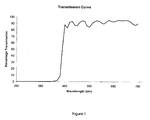
- Figure 1 shows the transmission curve of the lenses of a pair of glasses of one embodiment of the present invention.
- Figure 2 shows the transmission curve of the lenses of a pair of glasses of another embodiment of the present invention.
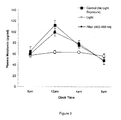
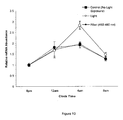
- Figure 3 shows the melatonin profile in an animal model over 12 hours from 8 pm to 8 am in a dark environment, in a light environment and in a lighted environment filter of the present invention.
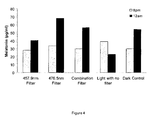
- Figure 4 shows melatonin levels at 8 pm and 12 am in an animal model under lighted conditions with no filter, with a 457.9 nm notch filter, with a 476.5 nm notch filter and with both filters.
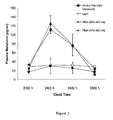
- Figure 5 shows the melatonin profile in an animal model over 12 hours from 8 pm to 8 am under lighted conditions with no filter, with a 457.9 nm notch filter, with a 476.5 nm notch filter and in a dark environment.
- Figure 6 shows the corticosterone profile in an animal model over 12 hours from 8 pm to 8 am in a dark environment, in a light environment and in a lighted environment with a filter of the present invention.
- Figure 7 shows corticosterone levels at 8 pm and 12 am in an animal model under lighted conditions with no filter, with a 457.9 nm notch filter, with a 476.5 nm notch filter and with both filters.
- Figure 8 shows the corticosterone profile in an animal model over 12 hours from 8 pm to 8 am, under lighted conditions with no filter, with a 457.9 nm notch filter, with a 476.5 nm notch filter and in a dark environment.
- Figure 9 shows expression of the Per2 clock gene in an animal model over 12 hours from 8 pm to 8 am in a dark environment, in a light environment and in a lighted environment with a filter of the present invention.
- Figure 10 shows expression of the Bmal1 clock gene in an animal model over 12 hours from 8 pm to 8 am in a dark environment, in a light environment and in a lighted environment with a filter of the present invention.
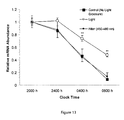
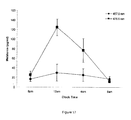
- Figure 11 shows expression of the Per2 clock gene in the hypothalamus of an animal model over 12 hours from 8 pm to 8 am under lighted conditions with no filter, with a 457.9 nm notch filter, with a 476.5 nm notch filter and in a dark environment.
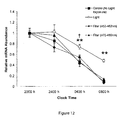
- Figure 12 shows expression of the Per2 clock gene in the adrenal gland of an animal model over 12 hours from 8 pm to 8 am under lighted conditions with no filter, with a 457.9 nm notch filter, with a 476.5 nm notch filter and in a dark environment.
- Figure 13 shows expression of the Per2 clock gene in the hypothalamus of an animal model over 12 hours from 8 pm to 8 am in a dark environment, in a light environment and in a lighted environment with a filter of the present invention.
- Figure 14 shows expression of the Bmal1 clock gene in the adrenal gland of an animal model over 12 hours from 8 pm to 8 am in a dark environment, in a light environment and in a lighted environment with a filter of the present invention.
- Figure 15 shows corticosterone levels at 12 am in an animal model under lighted conditions with no filter, with a filter that substantially blocks wavelengths below 460 nm, with a filter that substantially blocks wavelengths below 490 nm and under no light condition.
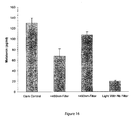
- Figure 16 shows melatonin levels at 12 am in an animal model under lighted conditions with no filter, with a filter that substantially blocks wavelengths below 460 nm, with a filter that substantially blocks wavelengths below 490 nm and under no light condition.
- Figure 17 shows the melatonin profile in an animal model over 12 hours from 8 pm to 8 am with a 457.9 nm notch filter and a 476.5 nm notch filter.
- Circadian rhythm refers to the cycle of approximately 24 hours in the physiological processes of living organisms.
- the master circadian clock in mammals is located in the Suprachiasmatic Nuclei (SCN), a group of cells located in the hypothalamus.
- SCN Suprachiasmatic Nuclei
- the SCN receives information about illumination through the eyes.
- the retina of each eye contains special photoresponsive retinal ganglion cells (RGCs) along with traditional photoresponsive rods and cones. These RGCs contain a photo pigment called melanopsin, and follow a pathway called the retinohypothalamic tract, leading to the SCN.
- RGCs retinal ganglion cells
- circadian rhythms are found in cells in the body outside the SCN master clock, in other words the expression of genes in various tissues throughout the body also follows a circadian rhythm pattern.
- a "clock gene” refers to any gene that follows such an expression pattern and is responsible for maintaining circadian oscillations in a specific cellular physiology. It is estimated that about 25% of the human genome shows such a periodicity in expression.
- maintaining the circadian rhythm refers to maintaining the amplitude and periodicity of the circadian oscillations observed in physiological processes including, but not limited to, melatonin and cortisol secretion and clock gene expression that would be present in the subject exposed to the geophysical light/dark cycle.
- Normalizing levels of the expression product of a clock gene refers to either increasing or decreasing the level of expression so as to more closely correspond to the levels of the product that would be found in the same subject exposed to a regular geophysical light/dark cycle. More particularly, with respect to melatonin, it refers to maintaining at least 50% of the level in the same individual kept in darkness.
- normalizing the levels of melatonin involves increasing the level of melatonin as compared to the level that would otherwise be present in a subject exposed to light at night.
- cortisol it involves decreasing the level of cortisol as compared to the level that would otherwise be present in a subject exposed to light at night.
- the "subject” is a mammal, preferably a human. There may be particular advantages conferred where the subject is a female human subject and even more advantages where the subject is pregnant.
- substantially blocks when used in terms of wavelength of light, is defined as transmitting less than 40 percent of the incident wavelengths; less than 30 percent of the incident wavelengths; less than 20 percent of the incident wavelengths; and less than 10 percent of the incident wavelengths.
- selectively blocking refers to substantially blocking only those wavelengths of light specified, while allowing substantial transmission (i.e. transmission of more than 40 percent; of more than 50 percent; of more than 60 percent; of more than 70 percent; of more than 80 percent; of more than 90 percent; or 100 percent) of the other wavelengths of light in the subject's environment.
- “About” in the context of wavelength ranges refers to +/- 5 nm.
- an "optical filter” is a device that substantially blocks (as this term is defined above) a range of non-transmitted wavelengths of light.
- optical filter is not to be understood as equivalent to a colour filter, which, while transmitting light having a certain visual colour may not "substantially block” wavelengths of light outside those of the transmitted visual colour.
- Retinal exposure refers to light impingement upon the retina of a subject.
- Light refers to the natural hours of darkness and, more specifically, to the dark phase of the geophysical light/dark cycle. In summer, in peri-equatorial latitudes, this is roughly equivalent to about 2100 hrs (9pm) to about 0600 hr (6am), which are the peak hours of melatonin production. "During the night” refers to any time during this period; preferably, the method of the present invention is practiced throughout the night.
- Eyewear is used as a broad term to encompass such items as eyeglasses, goggles, contact lenses and the like, that are used in connection with the eyes of a user to either shield/protect the eyes from harmful substances, for example chemicals in the context of goggles or to enhance the eyesight of the user, for example contact lenses.
- eyewear is not limited to the above examples, and describes any device used in connection with the eyes that contains a viewing window of sorts.
- the eyewear of the present invention is designed to substantially prevent impingement of unfiltered light on the retina of the wearer.
- the invention can be used in a method of maintaining the circadian rhythm of a subject by selectively substantially blocking retinal exposure of the subject to light of wavelengths less than about 490 nm during the night.
- the invention can be used in a method of maintaining the circadian rhythm of a subject by selectively substantially blocking retinal exposure of the subject to light of less than about 480 nm; less than about 470 nm; and less than about 460 nm during the night. Optimally, the method is practised throughout the night.
- the present invention can also be used in methods involving more restricted ranges of light blockage and, more specifically, ranges that allow the transmission of certain lower wavelengths of light, outside the key range for maintaining circadian rhythm identified by the inventors.
- the invention can be used in a method of maintaining the circadian rhythm of a subject by selectively substantially blocking retinal exposure of the subject to light of wavelengths between about 420 nm and about 490 nm; between about 430 nm and about 490 nm; between about 440 nm and about 490 nm; between about 420 nm and about 480 nm; between about 430 nm and about 480 nm; between about 440 nm and about 480 nm; between about 420 nm and about 470 nm; between about 430 nm and about 470 nm; between about 440 nm and about 470 nm; between about 420 nm and about 460 nm; between about 430 nm and about 460 nm; and between about 440 nm and about 460 nm; during the night.
- the method is practised throughout the night.
- these specific ranges may be combined with a UV
- the sleep wake cycle of a subject with Delayed Sleep Phase Syndrome can be corrected and maintained.
- a person with DSPS suffers from sleep onset insomnia and will regularly spend all or a major portion of the night awake and in an artificially lighted environment. Exposure during early night to unfiltered artificial light will expose the subject to low wavelengths that causes the phase delay, shifting the sleep onset to an even later time.
- the phase delays can be attenuated, and the circadian rhythm of the subject can be maintained, thereby mitigating the negative health effects of being awake and in an artificially lighted environment at night and potentially improving sleeping patterns.
- the invention can be used in a method of normalizing levels of melatonin and at least one glucocorticoid, including cortisol, in a subject by selectively substantially blocking retinal exposure of the subject to light of wavelengths less than about 490nm; less than about 480 nm; less than about 470 nm; and less than about 460 nm during the night.
- the method is employed throughout the night.
- the invention can be used a method of normalizing levels of melatonin and at least one glucocorticoid, including cortisol, in a subject by selectively substantially blocking retinal exposure of the subject to light of wavelengths between about 420 nm and about 490 nm; between about 430 nm and about 490 nm; between about 440 nm and about 490 nm; between about 420 nm and about 480 nm; between about 430 nm and about 480 nm; between about 440 nm and about 480 nm; between about 420 nm and about 470 nm; between about 430 nm and about 470 nm; between about 440 nm and about 470 nm; between about 420 nm and about 460 nm; between about 430 nm and about 460 nm; and between about 440 nm and about 460 nm; during the night.
- the method is employed
- the invention is a device for maintaining the circadian rhythm of a subject that includes an optical filter for selectively blocking light of wavelengths between about 440 nm and about 480 nm; between about 430 nm and about 470 nm; between about 440 nm and about 470 nm; between about 430 nm and about 460 nm; and between about 440 nm and about 460 nm; during the night.
- optical filters enable good colour recognition and do not impart a significant yellow hue. They also permit an average user to distinguish between most shades of white/grey/yellow and blue/green/black.
- an optical filter such as those described above may be applied to the surface of a light source, including an incandescent or fluorescent light bulb.
- the optical filter is in the form of a coating.
- a transparent or semi-transparent cover including an optical filter as described above can be releasably attached to a light source to channel the light emitted from the light source through the cover.
- a light source can include devices that emit light, although this is not their primary function, for example a television screen or a computer monitor. It will be understood by a person skilled in the art that the cover may be any shape or form as long as it is operable to cover the light source that it is to be used with. In an alternative embodiment, the light cover can be permanently attached to a light source.
- the invention is eyewear that includes an optical filter for blocking light of wavelengths between about 440 nm and about 490 nm; between about 430 nm and about 480 nm; between about 440 nm and about 480 nm; between about 430 nm and about 470 nm; between about 440 nm and about 470 nm; between about 440 nm and about 460 nm.
- the optical filter is in the form of a coating.
- Table 1 the transmission values of a pair of glasses incorporating polycarbonate lenses vacuum coated with an optical filter made in accordance with the present invention is shown. Wavelengths of light at or below about 460 nm are substantially blocked. These transmission values are shown as a transmission curve in Figure 1 .
- Table 2 the transmission values of another pair of glasses incorporating polycarbonate lenses vacuum coated with an optical filter made in accordance with the present invention is shown. Here, wavelengths of light at or below about 490 nm are substantially blocked. Both sets of glasses enable good colour recognition, while providing the health benefits of the present invention to those exposed to light at night. These lenses can also be ground according to an optometric prescription to allow vision correction.
- Table 3 shows the transmission values of the pair of glasses that substantially blocks light of wavelengths at or below 490 nm with a anti-reflective coating applied thereto.
- polycarbonate lenses are vacuum coated with a plurality of optical filter layers, which cumulatively provide the selective wavelength blocking of the present invention.
- 10 or more layers of optical filter coatings are suitably applied to form lenses of the present invention.
- the baseline melatonin and corticosterone profile under normal 12:12 LD cycle was determined.
- corticosterone rather than cortisol, is the predominant glucocorticoid produced by the adrenal gland.
- Corticosterone measurements were done as well as melatonin concentrations to determine the degree of stress the animals were exposed to during the different light conditions and to ensure that excess stress did not affect the results.
- starting from 8pm until 8am four animals were used every four hours for blood and tissue sample collection under darkness using a safe red light lamp ( ⁇ 5 Lux luminosity) and with the aid of night vision goggles. The animals were anesthetized with Isoflurane gas (5% Induction; 3% Maintenance).
- the melatonin and corticosterone secretion profile in rats exposed to 12:12 LL cycles or continuous lighting was determined.
- four animals were housed in a specially designed box.
- the box was 24" x 24" x 14" and held two regulation size rat cages.
- the rat cages were modified such that more than 80% of each plastic side was replaced with galvanized steel mesh wire.
- the dimensions and bedding used were exactly the same as the original cages in which the animals were housed during entrainment. The modification was to ensure that light could enter freely and not be refracted or filtered by the original plastic sides while still ensuring that the animals were kept under regulation holding conditions.
- Each modified cage housed two non-breeding male animals.
- Animals were housed in pairs from the beginning of the entrainment period and the same pairs were transferred to their modified holding cages to negate stress caused by exposure to a new animal.
- the box did not allow external lighting to enter or internal light to escape preventing any potential alterations in light intensity within the holding conditions.
- the animals were exposed to light from 7 pm to 8 am.
- Light was fed evenly throughout the box using fiber optic cables running from a fiber optic light source fitted with a 183 watt tungsten halogen bulb generating 500 Lux light intensity at animal eye level. Animals were sacrificed as in the first phase for blood and tissue sampling. Since the box was designed to hold only four animals, one time point was tested per night and experiments were carried out on four consecutive nights.
- the melatonin and corticosterone secretion profile in rats exposed to 12:12 LL cycles as in Phase 2, but with optically filtered lighting was determined.
- the animals were kept under the same conditions as in the second phase of the study, but in this case the light was filtered using holographic notch filters (Kaiser Optical Systems, Ann Arbor, MI) specially designed to cut out approximately 10-15 nm wavelength bandwidths.
- Four notch filters were purchased, each designed to cut out 10-15 nm bandwidths covering the range of approximately 440-530 nm.
- the notch filter was attached to the light source of the box so that the light was filtered before it entered the fiber optic cables to ensure that all fiber optic bundles delivered the same intensity and wavelength of light.
- the optically filtered light intensity was adjusted using a rheostat to maintain 500 Lux at animal eye level. Since the box was designed to hold only four animals, one time point per filter or combination of filters was tested per night and experiments were carried out on four consecutive nights for each filter as in phase two. All blood and tissue collection was conducted as previously described. Additionally, to ensure that the animals were exposed to the same conditions during each of the three phases, the animals in the first phase were also kept in the specially designed box, but with no light exposure. The 457.9 nm and 476.5 nm holographic notch filters were initially tested, both alone and combined. Upon completion of sample collection from each phase of experimentation, the blood was used to analyze melatonin and corticosterone from plasma.
- Preliminary data from the hormone analysis demonstrated that the 457.9 nm notch filter was not able to prevent melatonin suppression by light whereas the 476.5 nm filter prevented melatonin suppression.
- the combination of the 457.9 and 476.5 was also excellent in preventing melatonin suppression by light at midnight.
- the 457.9 nm filter was found effective in preventing a rise in corticosterone secretion by light exposure at midnight but the 476.5 nm filter was less effective.
- the combination of the 457.9 and 476.5 nm filters was also excellent in preventing increased corticosterone secretion by light at midnight.
- the combination of the 457.9 and 476.5 nm filters on melatonin and corticosterone secretion was therefore tested in rats sacrificed at 8 pm, 12 am, 4 am, and 8 am (four animals at each time point).
- the combination of the two filters covering a wavelength range from approximately 452-462 nm and 470-480 nm maintained corticosterone and melatonin secretion profiles under constant light exposure identical to the profiles seen when the rats were kept in the dark.
- Per2 and Bmal1 expression show a consistent circadian rhythm across different species. Per2 expression peaks during the day and declines gradually through the course of the night in darkness, while Bmal1 expression is antiphase of Per2 expression. Bmal1 starts to increase with the onset of darkness and peaks around 4 am and decreases to basal levels by the end of night. However, Per2 expression is highly sensitive to light and even a brief exposure to light at night can induce strong Per2 expression in the hypothalamus.
- filtering wavelengths of approximately 450 nm to 480 nm using the combination of the 457.9 nm and 476.5 nm filters normalized Per2 and Bmal1 gene expression in the adrenal gland from disruption induced by nocturnal light exposure. (** indicates a statistically significant difference compared to levels obtained with light exposure.)
- Example 1 Based on the results of Example 1, optical filters that block a narrower range of low wavelength light, specifically between 440 nm to 480 nm have been developed. These filters have increased light transmittance and improved color recognition and overall improved visual acuity. As described in Example 1, data from animal studies have shown that filtering this narrow range of low wavelength light can normalize melatonin secretion ( Figures 3 and 4 ), reduce glucocorticoid secretion to physiologic levels ( Figures 5 and 6 ) and restore overall circadian rhythm as reflected by normalization of Per2 and Bmal1 ( Figures 7 and 8 ) gene expression in the hypothalamus, even after continuous 12 hour light exposure at night.
- Examples 2 to 3 will test the feasibility of using these filters as goggles in a mock night shift work environment and it is hypothesized that using these filters will restore melatonin secretion and glucocorticoid levels.
- This is a randomized crossover study with subjects serving as their own controls. Self-report instruments evaluating subjective fatigue, sleepiness and alertness complement the physiological measures of melatonin and cortisol. Subjects are randomly assigned to one of the following crossover study conditions: (1) No light exposure at night; (2) 12 hour bright light (500 Lux) exposure at night; (3) 12 hour filtered bright light (500 Lux) exposure at night; (4) "Mock” filtered (yellow tinted lenses without any melatonin-sensitive light-filtering properties) bright light (500 Lux) exposure to night.
- Example 2 Measurement of nocturnal melatonin and cortisol levels under no light baseline conditions and under bright ambient light at night
- Subjects are randomly assigned to one of the crossover study conditions. The addition of a 'mock' filter arm to the study serves to strengthen the research design, making this a more rigorous, true placebo controlled trial. Subjects are randomly tested under all conditions and the same procedures are carried out for each condition. All study conditions are separated by at least 5 recovery days between the last day of testing for one study condition and the first night of testing for the following condition. Each study condition involves one night of testing. During the night of testing the subjects are asked to remain awake for 12 hours mimicking a 12-hour night shift from 1900h to 0700h. Starting from 1900h, saliva samples are collected from the subjects at an hourly interval until 0700h giving a total of 13 samples per subject per experimental condition.
- the subjects receive two short meal breaks at 4 hours (2300h) and 8 hours (0300h) after the start of the session but are asked to refrain from eating or drinking (other than water) throughout the remainder of the time as food residues can contaminate the saliva samples.
- the saliva samples are used for hormone analysis using commercially available ELISA kits for melatonin (ALPCO, USA) and cortisol (Cayman Chemical, USA).
- the experimental filters will be effective in preventing melatonin suppression and reducing stress levels induced by nocturnal bright light exposure as observed in our preliminary in vivo studies. Furthermore, the mock filters will not preserve the physiologic melatonin levels or reduce stress levels in response to nocturnal bright light exposure.
- Example 3 Evaluation of subjective fatigue, sleepiness and alertness under no light baseline conditions and under bright ambient light at night.
- Example 2 subjects are randomly assigned to one of the crossover study conditions. These tests are carried out on the same night of testing as Example 2. Subjects are asked to complete state questionnaires half-hour after the start of the session and at 2-hourly intervals thereafter to assess changes in sleepiness and fatigue throughout the night. The subjects will have the aid of a dim red light ( ⁇ 5 Lux) to complete the forms and the forms will be printed in large font in order to aid in reading under dim light conditions. Subjective sleepiness will be assessed using the Stanford Sleepiness Scale (SSS) 68 , subjective fatigue will be measured using the Fatigue Severity Scale (FSS) 69 and alertness will be measured using the Alertness Scale (AS) 70 .
- SSS Stanford Sleepiness Scale
- FSS Fatigue Severity Scale
- AS Alertness Scale
- SSS current level of sleepiness
- AS the subjects choose from being extremely alert to having very low alertness.
- FSS subjects are asked to rate their level of agreement or disagreement with statements relating to the level of subjective fatigue on a 7-point likert scale ranging from 1 (strongly disagree) to 7 (strongly agree).
- the SSS, FSS and AS take about 10 minutes to complete in total and each of the questionnaires have multiple questions or items that can be objectively used to evaluate the state measures. All the questionnaires have been previously validated by independent studies.
- the ESS determines trait sleepiness and is an 8-item trait scale that assesses the subject's subjective likelihood of falling asleep in several soporific conditions.
- the scale refers to the subject's usual way of life in recent times.
- the ESS will be administered during the initial screening process.
- the filters are expected to be found to be effective in preventing melatonin suppression and reducing stress levels in response to nocturnal bright light exposure.
- the filters are expected to normalize melatonin and cortisol levels to at least 60%, and possibly 80% or more, of physiologic levels.
- a clinical trial will be performed with active rotating shift workers.
- the long term effectiveness of these filters in preventing phase shifts observed with bright light exposure will also be investigated and objective evaluation of daytime sleep physiology and nighttime cognitive functioning and psychomotor performance in rotating night shift workers will be performed.
- a "standardized difference” is defined as ⁇ / ⁇ , where the difference of interest is ⁇ and the standard deviation of the difference is ⁇ .
- the sample should be increased to accommodate a minimum dropout rate of 17%. Thus, 30 patients will be recruited for the study.
- Results from the four different conditions will be analysed using the General Linear Model Procedure and Multifactor analysis of Variance (MANOVA) to detect statistically significant differences in hormone levels. Further analysis will include Tukey post hoc paired comparisons. Non-parametric Mann-Whitney's U-test will be used for assessment of the subjective scales. The relationship between melatonin levels and subjective sleepiness, fatigue and alertness will be analyzed using Spearman correlations. Statistical analysis will be performed using SPSS software for Windows.
- MANOVA General Linear Model Procedure and Multifactor analysis of Variance
- Example 2 The same methodology was employed as in Example 1, but the notch filters were replaced with the filters whose transmission profiles are shown in Tables 1 and 2 above, i.e. a filter that substantially blocks wavelengths of light below about 460 nm and a filter that substantially blocks wavelengths of light below about 490 nm.
- a filter that substantially blocks wavelengths of light below about 460 nm and a filter that substantially blocks wavelengths of light below about 490 nm.
- filtering these wavelengths of light normalizes glucocorticoid secretion to physiologic levels.
- Figure 10 at 12 am, both lenses normalized melatonin levels. While the lens that blocks wavelengths of light below 490 nm results in melatonin levels more closely approaching that of the dark control, the 460 nm filter does preserve up to 53 % of the dark control values.
- Notch filter data from Example 1 is shown in Figure 11 for comparison purposes. As illustrated, the notch filter of 452-462 nm is not effective in increasing melatonin levels, although the 460 nm filter of Table 1 is effective. This is likely due to the broader range of the 460 nm filter, which also blocks a significant percentage of wavelengths at 470 nm.
Landscapes
- Health & Medical Sciences (AREA)
- Engineering & Computer Science (AREA)
- Biomedical Technology (AREA)
- Nuclear Medicine, Radiotherapy & Molecular Imaging (AREA)
- Life Sciences & Earth Sciences (AREA)
- Psychology (AREA)
- Social Psychology (AREA)
- Hospice & Palliative Care (AREA)
- Developmental Disabilities (AREA)
- Pathology (AREA)
- Child & Adolescent Psychology (AREA)
- Radiology & Medical Imaging (AREA)
- Psychiatry (AREA)
- Animal Behavior & Ethology (AREA)
- General Health & Medical Sciences (AREA)
- Public Health (AREA)
- Veterinary Medicine (AREA)
- Medicines That Contain Protein Lipid Enzymes And Other Medicines (AREA)
- Radiation-Therapy Devices (AREA)
- Pharmaceuticals Containing Other Organic And Inorganic Compounds (AREA)
- Peptides Or Proteins (AREA)
Applications Claiming Priority (2)
| Application Number | Priority Date | Filing Date | Title |
|---|---|---|---|
| US11/833,072 US7748845B2 (en) | 2002-08-28 | 2007-08-02 | Method and device for preventing alterations in circadian rhythm |
| PCT/CA2007/002196 WO2009015457A1 (en) | 2007-08-02 | 2007-12-05 | Method and device for preventing alterations in circadian rhythm |
Publications (3)
| Publication Number | Publication Date |
|---|---|
| EP2175930A1 EP2175930A1 (en) | 2010-04-21 |
| EP2175930A4 EP2175930A4 (en) | 2011-06-29 |
| EP2175930B1 true EP2175930B1 (en) | 2013-03-27 |
Family
ID=39170767
Family Applications (1)
| Application Number | Title | Priority Date | Filing Date |
|---|---|---|---|
| EP07855478A Not-in-force EP2175930B1 (en) | 2007-08-02 | 2007-12-05 | Device for preventing alterations in circadian rhythm |
Country Status (9)
| Country | Link |
|---|---|
| US (1) | US7748845B2 (enExample) |
| EP (1) | EP2175930B1 (enExample) |
| JP (1) | JP5506677B2 (enExample) |
| KR (1) | KR101511623B1 (enExample) |
| AU (1) | AU2007357066B2 (enExample) |
| CA (1) | CA2695453C (enExample) |
| DK (1) | DK2175930T3 (enExample) |
| ES (1) | ES2419304T3 (enExample) |
| WO (1) | WO2009015457A1 (enExample) |
Families Citing this family (60)
| Publication number | Priority date | Publication date | Assignee | Title |
|---|---|---|---|---|
| EP1283733A1 (en) | 2000-05-10 | 2003-02-19 | Thomas Jefferson University | Photoreceptor system for melatonin regulation and phototherapy |
| US8841864B2 (en) | 2011-12-05 | 2014-09-23 | Biological Illumination, Llc | Tunable LED lamp for producing biologically-adjusted light |
| US9024536B2 (en) | 2011-12-05 | 2015-05-05 | Biological Illumination, Llc | Tunable LED lamp for producing biologically-adjusted light and associated methods |
| US8686641B2 (en) | 2011-12-05 | 2014-04-01 | Biological Illumination, Llc | Tunable LED lamp for producing biologically-adjusted light |
| US9827439B2 (en) | 2010-07-23 | 2017-11-28 | Biological Illumination, Llc | System for dynamically adjusting circadian rhythm responsive to scheduled events and associated methods |
| US9532423B2 (en) | 2010-07-23 | 2016-12-27 | Lighting Science Group Corporation | System and methods for operating a lighting device |
| US8743023B2 (en) | 2010-07-23 | 2014-06-03 | Biological Illumination, Llc | System for generating non-homogenous biologically-adjusted light and associated methods |
| US9681522B2 (en) | 2012-05-06 | 2017-06-13 | Lighting Science Group Corporation | Adaptive light system and associated methods |
| US9764157B2 (en) | 2011-01-17 | 2017-09-19 | University Of Utah Research Foundation | Methods, systems, and apparatus for reducing the frequency and/or severity of photophobic responses or for modulating circadian cycles |
| EP4245347A3 (en) | 2011-01-17 | 2023-12-06 | University of Utah Research Foundation | Apparatus and methods for reducing frequency or severity of photophobic responses or modulating circadian cycles |
| US10359552B2 (en) | 2011-01-17 | 2019-07-23 | University Of Utah Research Foundation | Methods, systems, and apparatus for reducing the frequency and/or severity of photophobic responses or for modulating circadian cycles |
| ES2400590B1 (es) * | 2011-03-31 | 2013-12-17 | Universidad De Murcia | Dispositivo de iluminación circadiano. |
| US8754832B2 (en) | 2011-05-15 | 2014-06-17 | Lighting Science Group Corporation | Lighting system for accenting regions of a layer and associated methods |
| US9173269B2 (en) | 2011-05-15 | 2015-10-27 | Lighting Science Group Corporation | Lighting system for accentuating regions of a layer and associated methods |
| US8901850B2 (en) | 2012-05-06 | 2014-12-02 | Lighting Science Group Corporation | Adaptive anti-glare light system and associated methods |
| US9778490B2 (en) | 2011-11-04 | 2017-10-03 | Spy Optic Inc. | Therapeutic eyewear |
| US9289574B2 (en) | 2011-12-05 | 2016-03-22 | Biological Illumination, Llc | Three-channel tuned LED lamp for producing biologically-adjusted light |
| US9220202B2 (en) | 2011-12-05 | 2015-12-29 | Biological Illumination, Llc | Lighting system to control the circadian rhythm of agricultural products and associated methods |
| US9913341B2 (en) | 2011-12-05 | 2018-03-06 | Biological Illumination, Llc | LED lamp for producing biologically-adjusted light including a cyan LED |
| US9402294B2 (en) | 2012-05-08 | 2016-07-26 | Lighting Science Group Corporation | Self-calibrating multi-directional security luminaire and associated methods |
| WO2014011581A2 (en) * | 2012-07-10 | 2014-01-16 | Photokinetics, Inc. | Optimization of light filters and illuminants and products derived therefrom |
| EP2901184A4 (en) | 2012-09-26 | 2015-11-18 | 8797625 Canada Inc | MULTILAYER OPTICAL INTERFERENCE FILTER |
| US9174067B2 (en) | 2012-10-15 | 2015-11-03 | Biological Illumination, Llc | System for treating light treatable conditions and associated methods |
| US20140257439A1 (en) * | 2013-03-06 | 2014-09-11 | Verilux, Inc. | Adjustable therapeutic lights |
| US20140268731A1 (en) | 2013-03-15 | 2014-09-18 | Lighting Science Group Corpporation | Low bay lighting system and associated methods |
| AU2014248104B2 (en) | 2013-04-04 | 2018-07-05 | Circadian Zirclight Inc | Lighting systems for protecting circadian neuroendocrine function |
| US9750918B2 (en) * | 2013-04-11 | 2017-09-05 | Circadian Zirclight Inc. | Methods and devices for improving sleep performance in subject exposed to light at night |
| US10722727B2 (en) * | 2013-07-09 | 2020-07-28 | Bonnie Brandes | Therapeutic signal generator |
| US9410664B2 (en) | 2013-08-29 | 2016-08-09 | Soraa, Inc. | Circadian friendly LED light source |
| EP3045941B1 (en) | 2013-09-10 | 2019-11-20 | Mitsui Chemicals, Inc. | Optical material and use therefor |
| EP3045942B1 (en) | 2013-09-10 | 2018-11-07 | Mitsui Chemicals, Inc. | Optical material and use therefor |
| US10234608B2 (en) | 2013-11-15 | 2019-03-19 | University Of Utah Research Foundation | Nanoparticle light filtering method and apparatus |
| US10281627B2 (en) | 2013-11-15 | 2019-05-07 | University Of Utah Research Foundation | Nanoparticle light filtering method and apparatus |
| US20150234207A1 (en) * | 2014-02-17 | 2015-08-20 | Daniel Koifman | Device and method for selective wavelength filtration and selective wavelength transmission for therapeutic effect |
| US10100987B1 (en) | 2014-09-24 | 2018-10-16 | Ario, Inc. | Lamp with directional, independently variable light sources |
| LT6170B (lt) | 2014-10-27 | 2015-06-25 | Uab "Metapro Holding" | Paros širdies ritmo autonominės nervų sistemos balanso analizės sistema |
| US10401683B2 (en) | 2015-01-14 | 2019-09-03 | Soraa, Inc. | Low blue light displays |
| US9943042B2 (en) | 2015-05-18 | 2018-04-17 | Biological Innovation & Optimization Systems, LLC | Grow light embodying power delivery and data communications features |
| USD760398S1 (en) | 2015-06-12 | 2016-06-28 | Verilux, Inc. | Lamp for light therapy |
| USD760913S1 (en) | 2015-06-12 | 2016-07-05 | Verilux, Inc. | Light therapy luminaire |
| US9844116B2 (en) | 2015-09-15 | 2017-12-12 | Biological Innovation & Optimization Systems, LLC | Systems and methods for controlling the spectral content of LED lighting devices |
| US9788387B2 (en) | 2015-09-15 | 2017-10-10 | Biological Innovation & Optimization Systems, LLC | Systems and methods for controlling the spectral content of LED lighting devices |
| CN108431677B (zh) | 2015-12-22 | 2020-02-07 | 依视路国际公司 | 用于刺激非视觉生理效应的方法和眼科元件 |
| WO2017145022A1 (en) | 2016-02-22 | 2017-08-31 | Novartis Ag | Uv/visible-absorbing vinylic monomers and uses thereof |
| WO2017145024A1 (en) | 2016-02-22 | 2017-08-31 | Novartis Ag | Uv-absorbing vinylic monomers and uses thereof |
| US10175508B2 (en) | 2016-03-14 | 2019-01-08 | Younger Mfg. Co. | Photochromic optical lens with selective blue light attenuation |
| US10595376B2 (en) | 2016-09-13 | 2020-03-17 | Biological Innovation & Optimization Systems, LLC | Systems and methods for controlling the spectral content of LED lighting devices |
| KR20180078956A (ko) * | 2016-12-30 | 2018-07-10 | 공주대학교 산학협력단 | 멜라토닌 량 분석에 기초한 수면 유도 조명 장치 및 방법 |
| KR101848290B1 (ko) * | 2017-08-10 | 2018-04-12 | 주식회사 피앤지아이엔씨 | 크라운 전면부 제조방법 및 그를 이용한 모자 |
| EP3737469A4 (en) * | 2018-01-11 | 2021-11-10 | Ecosense Lighting Inc. | CIRCADIAN EFFECT DISPLAY LIGHTING SYSTEMS |
| WO2019140309A1 (en) | 2018-01-11 | 2019-07-18 | Ecosense Lighting Inc. | Switchable systems for white light with high color rendering and biological effects |
| CN110538381B (zh) | 2018-05-29 | 2021-06-22 | 华为技术有限公司 | 光照调整方法及终端 |
| US20200018982A1 (en) * | 2018-07-14 | 2020-01-16 | Beau David Whitaker | Protecting horses and other animals from blue light |
| JP2022514141A (ja) | 2018-09-25 | 2022-02-10 | コーニンクレッカ フィリップス エヌ ヴェ | 概日フェーズ管理のための露光量制御 |
| US12073775B2 (en) | 2018-11-08 | 2024-08-27 | Korrus, Inc. | Display lighting systems with bioactive lighting |
| US20220001200A1 (en) | 2018-11-08 | 2022-01-06 | Ecosense Lighting Inc. | Switchable bioactive lighting |
| US11783748B2 (en) | 2018-11-08 | 2023-10-10 | Korrus, Inc. | Display lighting systems with bioactive lighting |
| KR102135627B1 (ko) * | 2019-01-23 | 2020-07-21 | 국민대학교산학협력단 | 일주기 리듬 관리 장치 및 시스템 |
| JP7228206B2 (ja) | 2019-04-19 | 2023-02-24 | 三井化学株式会社 | 光学材料 |
| CN113692550B (zh) | 2019-04-19 | 2023-11-03 | 三井化学株式会社 | 光学材料、光学材料用聚合性组合物、固化物、塑料透镜、光学材料的应用方法 |
Family Cites Families (27)
| Publication number | Priority date | Publication date | Assignee | Title |
|---|---|---|---|---|
| US1971941A (en) | 1932-07-22 | 1934-08-28 | Gen Electric | Electric discharge lamp device |
| US3112886A (en) | 1960-02-01 | 1963-12-03 | Leonard H Kushner | Color control |
| US3826751A (en) | 1970-12-07 | 1974-07-30 | American Optical Corp | Selective optical filter and method of manufacture |
| US4500810A (en) | 1980-11-25 | 1985-02-19 | North American Philips Lighting Corporation | Fluorescent lamp having integral light-filtering means and starting aid |
| US4952046A (en) | 1982-02-26 | 1990-08-28 | Stephens James B | Optical lenses with selective transmissivity functions |
| US4719248A (en) | 1985-08-08 | 1988-01-12 | Bausch & Lomb Incorporated | Ultraviolet blocking agents for contact lenses |
| US5177509A (en) | 1987-02-26 | 1993-01-05 | Suntiger, Inc. | Ultraviolet radiation and blue light blocking polarizing lens |
| US4878748A (en) | 1987-02-26 | 1989-11-07 | Suntiger, Inc. | Ultraviolet radiation and blue light blocking polarizing lens |
| US5167228A (en) | 1987-06-26 | 1992-12-01 | Brigham And Women's Hospital | Assessment and modification of endogenous circadian phase and amplitude |
| US5274403A (en) | 1987-08-28 | 1993-12-28 | Gott George M | Lens useful in inhibiting the production of melatonin and lens produced thereby |
| US5083858A (en) | 1989-04-17 | 1992-01-28 | Girerd Rene J | Photobiologic sunglasses and transmitters |
| US6638963B1 (en) | 1990-12-04 | 2003-10-28 | Oregon Health And Science University | Methods for treating circadian rhythm disorders |
| US6019476A (en) | 1996-06-24 | 2000-02-01 | Kirschner; Kevin A. | Full spectrum filtering for fluorescent lighting |
| JP3357803B2 (ja) | 1996-10-30 | 2002-12-16 | タレックス光学工業株式会社 | 眼鏡用偏光膜および偏光眼鏡 |
| DE19729719A1 (de) | 1997-07-11 | 1998-02-12 | Bock Manfred | Lampenkörper mit Farbmischvorrichtung |
| US6235046B1 (en) * | 1998-01-21 | 2001-05-22 | David W. Gerdt | Passive photonic eye delivery system |
| US6156743A (en) | 1999-10-18 | 2000-12-05 | Whitcomb; John E. | Method of decreasing fatigue |
| GB2378656A (en) | 2001-08-14 | 2003-02-19 | Stephen Bryce Hayes | Means for modulation of circadian rhythms |
| US6902296B2 (en) | 2002-06-15 | 2005-06-07 | Searfoss, Iii Robert Lee | Nightlight for phototherapy |
| AU2003264202A1 (en) | 2002-08-28 | 2004-03-19 | Robert Casper | A device for the prevention of melatonin suppression by light at night |
| EP1619648A4 (en) * | 2003-03-28 | 2008-08-06 | Sharp Kk | DISPLAY DEVICE |
| US10252079B2 (en) | 2003-06-06 | 2019-04-09 | Koninklijke Philips N.V. | Hand-held light therapy apparatus |
| US6926405B2 (en) | 2003-06-06 | 2005-08-09 | Younger Mfg. Co. | Eyewear lens having selective spectral response |
| CA2532657A1 (en) | 2003-07-14 | 2005-01-20 | Charles A. Czeisler | Method for modifying or resetting the circadian cycle using short wavelength light |
| CA2552122A1 (en) * | 2003-12-29 | 2005-07-21 | Advanced Medical Optics, Inc. | Intraocular lenses having a visible light-selective-transmissive-region |
| JP4544948B2 (ja) * | 2004-03-26 | 2010-09-15 | シャープ株式会社 | 画像表示制御装置 |
| JP4743835B2 (ja) * | 2004-12-27 | 2011-08-10 | Hoya株式会社 | 光学レンズのコーティング装置 |
-
2007
- 2007-08-02 US US11/833,072 patent/US7748845B2/en not_active Expired - Lifetime
- 2007-12-05 WO PCT/CA2007/002196 patent/WO2009015457A1/en not_active Ceased
- 2007-12-05 KR KR1020107004719A patent/KR101511623B1/ko not_active Expired - Fee Related
- 2007-12-05 DK DK07855478.9T patent/DK2175930T3/da active
- 2007-12-05 JP JP2010518463A patent/JP5506677B2/ja not_active Expired - Fee Related
- 2007-12-05 AU AU2007357066A patent/AU2007357066B2/en not_active Ceased
- 2007-12-05 CA CA2695453A patent/CA2695453C/en not_active Expired - Fee Related
- 2007-12-05 EP EP07855478A patent/EP2175930B1/en not_active Not-in-force
- 2007-12-05 ES ES07855478T patent/ES2419304T3/es active Active
Also Published As
| Publication number | Publication date |
|---|---|
| JP5506677B2 (ja) | 2014-05-28 |
| DK2175930T3 (da) | 2013-06-24 |
| US20080065177A1 (en) | 2008-03-13 |
| JP2010535538A (ja) | 2010-11-25 |
| EP2175930A4 (en) | 2011-06-29 |
| AU2007357066B2 (en) | 2014-08-21 |
| CA2695453C (en) | 2016-11-29 |
| ES2419304T3 (es) | 2013-08-20 |
| WO2009015457A1 (en) | 2009-02-05 |
| KR20110000618A (ko) | 2011-01-04 |
| CA2695453A1 (en) | 2009-02-05 |
| KR101511623B1 (ko) | 2015-04-14 |
| US7748845B2 (en) | 2010-07-06 |
| AU2007357066A1 (en) | 2009-02-05 |
| EP2175930A1 (en) | 2010-04-21 |
Similar Documents
| Publication | Publication Date | Title |
|---|---|---|
| EP2175930B1 (en) | Device for preventing alterations in circadian rhythm | |
| Sun et al. | Treatment of circadian rhythm sleep–wake disorders | |
| Wahl et al. | The inner clock—Blue light sets the human rhythm | |
| Ayaki et al. | Sleep disorders are a prevalent and serious comorbidity in dry eye | |
| Abbott et al. | The ipRGC-driven pupil response with light exposure, refractive error, and sleep | |
| Gooley | Treatment of circadian rhythm sleep disorders with light | |
| Terman et al. | Light therapy | |
| Rüger et al. | Human phase response curve to a single 6.5 h pulse of short‐wavelength light | |
| Arns et al. | Identification and management of circadian rhythm sleep disorders as a transdiagnostic feature in child and adolescent psychiatry | |
| Najjar et al. | Temporal integration of light flashes by the human circadian system | |
| Terman et al. | Light therapy for seasonal and nonseasonal depression: efficacy, protocol, safety, and side effects | |
| Yerevanian et al. | Effects of bright incandescent light on seasonal and nonseasonal major depressive disorder | |
| US20150192800A1 (en) | Optimization of light filters and illuminants and products derived therefrom | |
| US20060106437A1 (en) | Method for modifying or resetting the circadian cycle using short wavelength light | |
| Wright et al. | Light emitting diodes can be used to phase delay the melatonin rhythm | |
| Rosenthal et al. | A multicenter study of the light visor for seasonal affective disorder: no difference in efficacy found between two different intensities | |
| JP2011161246A (ja) | 人間被験者の注意力の制御方法及びこの方法に使用する光源 | |
| Figueiro et al. | Implications of controlled short-wavelength light exposure for sleep in older adults | |
| Münch et al. | Melanopsin-mediated acute light responses measured in winter and in summer: seasonal variations in adults with and without cataracts | |
| Schmidt et al. | Light exposure via a head‐mounted device suppresses melatonin and improves vigilant attention without affecting cortisol and comfort | |
| Martinez et al. | Circadian rhythm sleep disorders | |
| Boyce | Lemmings, light, and health | |
| Nixon | The Multifaceted Implications of Light for Psychological Well-Being and Mood | |
| Doyle | Effect of short-term light exposure on alertness | |
| Oxley | POTENTIAL AGE MODERATION OF BLUE LIGHT THERAPY ON PTSD SLEEP SYMPTOM SEVERITY |
Legal Events
| Date | Code | Title | Description |
|---|---|---|---|
| PUAI | Public reference made under article 153(3) epc to a published international application that has entered the european phase |
Free format text: ORIGINAL CODE: 0009012 |
|
| 17P | Request for examination filed |
Effective date: 20100224 |
|
| AK | Designated contracting states |
Kind code of ref document: A1 Designated state(s): AT BE BG CH CY CZ DE DK EE ES FI FR GB GR HU IE IS IT LI LT LU LV MC MT NL PL PT RO SE SI SK TR |
|
| AX | Request for extension of the european patent |
Extension state: AL BA HR MK RS |
|
| DAX | Request for extension of the european patent (deleted) | ||
| RAP1 | Party data changed (applicant data changed or rights of an application transferred) |
Owner name: MELCORT INC. |
|
| RIN1 | Information on inventor provided before grant (corrected) |
Inventor name: SOLO PETER Inventor name: CASPER, ROBERT F. Inventor name: WARDROP JENNIFER Inventor name: RAHMAN SHADAB Inventor name: SPILKIN JONATHON |
|
| A4 | Supplementary search report drawn up and despatched |
Effective date: 20110531 |
|
| 17Q | First examination report despatched |
Effective date: 20120215 |
|
| GRAP | Despatch of communication of intention to grant a patent |
Free format text: ORIGINAL CODE: EPIDOSNIGR1 |
|
| RIN1 | Information on inventor provided before grant (corrected) |
Inventor name: RAHMAN SHADAB Inventor name: CASPER, ROBERT F. Inventor name: SOLO PETER Inventor name: WARDROP JENNIFER Inventor name: SPILKIN JONATHON |
|
| GRAS | Grant fee paid |
Free format text: ORIGINAL CODE: EPIDOSNIGR3 |
|
| GRAA | (expected) grant |
Free format text: ORIGINAL CODE: 0009210 |
|
| AK | Designated contracting states |
Kind code of ref document: B1 Designated state(s): AT BE BG CH CY CZ DE DK EE ES FI FR GB GR HU IE IS IT LI LT LU LV MC MT NL PL PT RO SE SI SK TR |
|
| REG | Reference to a national code |
Ref country code: GB Ref legal event code: FG4D |
|
| REG | Reference to a national code |
Ref country code: CH Ref legal event code: EP |
|
| REG | Reference to a national code |
Ref country code: AT Ref legal event code: REF Ref document number: 602987 Country of ref document: AT Kind code of ref document: T Effective date: 20130415 |
|
| REG | Reference to a national code |
Ref country code: IE Ref legal event code: FG4D |
|
| REG | Reference to a national code |
Ref country code: DE Ref legal event code: R096 Ref document number: 602007029411 Country of ref document: DE Effective date: 20130523 |
|
| REG | Reference to a national code |
Ref country code: DK Ref legal event code: T3 |
|
| REG | Reference to a national code |
Ref country code: SE Ref legal event code: TRGR |
|
| PG25 | Lapsed in a contracting state [announced via postgrant information from national office to epo] |
Ref country code: BG Free format text: LAPSE BECAUSE OF FAILURE TO SUBMIT A TRANSLATION OF THE DESCRIPTION OR TO PAY THE FEE WITHIN THE PRESCRIBED TIME-LIMIT Effective date: 20130627 Ref country code: LT Free format text: LAPSE BECAUSE OF FAILURE TO SUBMIT A TRANSLATION OF THE DESCRIPTION OR TO PAY THE FEE WITHIN THE PRESCRIBED TIME-LIMIT Effective date: 20130327 |
|
| REG | Reference to a national code |
Ref country code: AT Ref legal event code: MK05 Ref document number: 602987 Country of ref document: AT Kind code of ref document: T Effective date: 20130327 |
|
| REG | Reference to a national code |
Ref country code: ES Ref legal event code: FG2A Ref document number: 2419304 Country of ref document: ES Kind code of ref document: T3 Effective date: 20130820 |
|
| REG | Reference to a national code |
Ref country code: LT Ref legal event code: MG4D |
|
| REG | Reference to a national code |
Ref country code: NL Ref legal event code: T3 |
|
| PG25 | Lapsed in a contracting state [announced via postgrant information from national office to epo] |
Ref country code: LV Free format text: LAPSE BECAUSE OF FAILURE TO SUBMIT A TRANSLATION OF THE DESCRIPTION OR TO PAY THE FEE WITHIN THE PRESCRIBED TIME-LIMIT Effective date: 20130327 Ref country code: FI Free format text: LAPSE BECAUSE OF FAILURE TO SUBMIT A TRANSLATION OF THE DESCRIPTION OR TO PAY THE FEE WITHIN THE PRESCRIBED TIME-LIMIT Effective date: 20130327 Ref country code: SI Free format text: LAPSE BECAUSE OF FAILURE TO SUBMIT A TRANSLATION OF THE DESCRIPTION OR TO PAY THE FEE WITHIN THE PRESCRIBED TIME-LIMIT Effective date: 20130327 Ref country code: GR Free format text: LAPSE BECAUSE OF FAILURE TO SUBMIT A TRANSLATION OF THE DESCRIPTION OR TO PAY THE FEE WITHIN THE PRESCRIBED TIME-LIMIT Effective date: 20130628 |
|
| PG25 | Lapsed in a contracting state [announced via postgrant information from national office to epo] |
Ref country code: BE Free format text: LAPSE BECAUSE OF FAILURE TO SUBMIT A TRANSLATION OF THE DESCRIPTION OR TO PAY THE FEE WITHIN THE PRESCRIBED TIME-LIMIT Effective date: 20130327 |
|
| PG25 | Lapsed in a contracting state [announced via postgrant information from national office to epo] |
Ref country code: IS Free format text: LAPSE BECAUSE OF FAILURE TO SUBMIT A TRANSLATION OF THE DESCRIPTION OR TO PAY THE FEE WITHIN THE PRESCRIBED TIME-LIMIT Effective date: 20130727 Ref country code: EE Free format text: LAPSE BECAUSE OF FAILURE TO SUBMIT A TRANSLATION OF THE DESCRIPTION OR TO PAY THE FEE WITHIN THE PRESCRIBED TIME-LIMIT Effective date: 20130327 Ref country code: RO Free format text: LAPSE BECAUSE OF FAILURE TO SUBMIT A TRANSLATION OF THE DESCRIPTION OR TO PAY THE FEE WITHIN THE PRESCRIBED TIME-LIMIT Effective date: 20130327 Ref country code: CZ Free format text: LAPSE BECAUSE OF FAILURE TO SUBMIT A TRANSLATION OF THE DESCRIPTION OR TO PAY THE FEE WITHIN THE PRESCRIBED TIME-LIMIT Effective date: 20130327 Ref country code: AT Free format text: LAPSE BECAUSE OF FAILURE TO SUBMIT A TRANSLATION OF THE DESCRIPTION OR TO PAY THE FEE WITHIN THE PRESCRIBED TIME-LIMIT Effective date: 20130327 Ref country code: PT Free format text: LAPSE BECAUSE OF FAILURE TO SUBMIT A TRANSLATION OF THE DESCRIPTION OR TO PAY THE FEE WITHIN THE PRESCRIBED TIME-LIMIT Effective date: 20130729 Ref country code: SK Free format text: LAPSE BECAUSE OF FAILURE TO SUBMIT A TRANSLATION OF THE DESCRIPTION OR TO PAY THE FEE WITHIN THE PRESCRIBED TIME-LIMIT Effective date: 20130327 |
|
| PG25 | Lapsed in a contracting state [announced via postgrant information from national office to epo] |
Ref country code: CY Free format text: LAPSE BECAUSE OF FAILURE TO SUBMIT A TRANSLATION OF THE DESCRIPTION OR TO PAY THE FEE WITHIN THE PRESCRIBED TIME-LIMIT Effective date: 20130327 Ref country code: PL Free format text: LAPSE BECAUSE OF FAILURE TO SUBMIT A TRANSLATION OF THE DESCRIPTION OR TO PAY THE FEE WITHIN THE PRESCRIBED TIME-LIMIT Effective date: 20130327 |
|
| RAP2 | Party data changed (patent owner data changed or rights of a patent transferred) |
Owner name: ZIRCLIGHT, INC. |
|
| REG | Reference to a national code |
Ref country code: NL Ref legal event code: SD Effective date: 20140122 |
|
| PLBE | No opposition filed within time limit |
Free format text: ORIGINAL CODE: 0009261 |
|
| STAA | Information on the status of an ep patent application or granted ep patent |
Free format text: STATUS: NO OPPOSITION FILED WITHIN TIME LIMIT |
|
| REG | Reference to a national code |
Ref country code: NL Ref legal event code: SD Effective date: 20140122 |
|
| REG | Reference to a national code |
Ref country code: DE Ref legal event code: R081 Ref document number: 602007029411 Country of ref document: DE Owner name: ZIRCLIGHT, INC., STONEHAM, US Free format text: FORMER OWNER: MELCORT INC., TORONTO, CA Effective date: 20140121 Ref country code: DE Ref legal event code: R081 Ref document number: 602007029411 Country of ref document: DE Owner name: ZIRCLIGHT, INC., US Free format text: FORMER OWNER: MELCORT INC., TORONTO, CA Effective date: 20140121 Ref country code: DE Ref legal event code: R081 Ref document number: 602007029411 Country of ref document: DE Owner name: CIRCADIAN ZIRCLIGHT, INC. (N.D.GES. D. STAATES, US Free format text: FORMER OWNER: MELCORT INC., TORONTO, CA Effective date: 20140121 |
|
| 26N | No opposition filed |
Effective date: 20140103 |
|
| REG | Reference to a national code |
Ref country code: DE Ref legal event code: R097 Ref document number: 602007029411 Country of ref document: DE Effective date: 20140103 |
|
| REG | Reference to a national code |
Ref country code: FR Ref legal event code: TP Owner name: ZIRCLIGHT, INC., US Effective date: 20140310 |
|
| REG | Reference to a national code |
Ref country code: GB Ref legal event code: 732E Free format text: REGISTERED BETWEEN 20140403 AND 20140409 |
|
| PG25 | Lapsed in a contracting state [announced via postgrant information from national office to epo] |
Ref country code: LU Free format text: LAPSE BECAUSE OF FAILURE TO SUBMIT A TRANSLATION OF THE DESCRIPTION OR TO PAY THE FEE WITHIN THE PRESCRIBED TIME-LIMIT Effective date: 20131205 Ref country code: MC Free format text: LAPSE BECAUSE OF FAILURE TO SUBMIT A TRANSLATION OF THE DESCRIPTION OR TO PAY THE FEE WITHIN THE PRESCRIBED TIME-LIMIT Effective date: 20130327 |
|
| REG | Reference to a national code |
Ref country code: CH Ref legal event code: PUE Owner name: CIRCADIAN ZIRCLIGHT INC., US Free format text: FORMER OWNER: MELCORT INC., CA |
|
| REG | Reference to a national code |
Ref country code: DE Ref legal event code: R081 Ref document number: 602007029411 Country of ref document: DE Owner name: CIRCADIAN ZIRCLIGHT, INC. (N.D.GES. D. STAATES, US Free format text: FORMER OWNER: ZIRCLIGHT, INC., STONEHAM, MASS., US Effective date: 20150331 |
|
| REG | Reference to a national code |
Ref country code: FR Ref legal event code: CD Owner name: CIRCADIAN ZIRCLIGHT INC., US Effective date: 20150505 |
|
| PG25 | Lapsed in a contracting state [announced via postgrant information from national office to epo] |
Ref country code: TR Free format text: LAPSE BECAUSE OF FAILURE TO SUBMIT A TRANSLATION OF THE DESCRIPTION OR TO PAY THE FEE WITHIN THE PRESCRIBED TIME-LIMIT Effective date: 20130327 |
|
| PG25 | Lapsed in a contracting state [announced via postgrant information from national office to epo] |
Ref country code: HU Free format text: LAPSE BECAUSE OF FAILURE TO SUBMIT A TRANSLATION OF THE DESCRIPTION OR TO PAY THE FEE WITHIN THE PRESCRIBED TIME-LIMIT; INVALID AB INITIO Effective date: 20071205 |
|
| PG25 | Lapsed in a contracting state [announced via postgrant information from national office to epo] |
Ref country code: MT Free format text: LAPSE BECAUSE OF FAILURE TO SUBMIT A TRANSLATION OF THE DESCRIPTION OR TO PAY THE FEE WITHIN THE PRESCRIBED TIME-LIMIT Effective date: 20130327 |
|
| REG | Reference to a national code |
Ref country code: ES Ref legal event code: PC2A Owner name: CIRCADIAN ZIRCLIGHT, INC. Effective date: 20151028 |
|
| REG | Reference to a national code |
Ref country code: FR Ref legal event code: PLFP Year of fee payment: 9 |
|
| REG | Reference to a national code |
Ref country code: NL Ref legal event code: HC Owner name: CIRCADIAN ZIRCLIGHT INC.; US Free format text: DETAILS ASSIGNMENT: VERANDERING VAN EIGENAAR(S), VERANDERING VAN NAAM VAN DE EIGENAAR(S); FORMER OWNER NAME: ZIRCLIGHT, INC. Effective date: 20160222 |
|
| REG | Reference to a national code |
Ref country code: FR Ref legal event code: PLFP Year of fee payment: 10 |
|
| PGFP | Annual fee paid to national office [announced via postgrant information from national office to epo] |
Ref country code: DK Payment date: 20161221 Year of fee payment: 10 Ref country code: CH Payment date: 20161221 Year of fee payment: 10 Ref country code: NL Payment date: 20161221 Year of fee payment: 10 Ref country code: IE Payment date: 20161118 Year of fee payment: 10 |
|
| PGFP | Annual fee paid to national office [announced via postgrant information from national office to epo] |
Ref country code: SE Payment date: 20161118 Year of fee payment: 10 Ref country code: ES Payment date: 20161213 Year of fee payment: 10 |
|
| PGFP | Annual fee paid to national office [announced via postgrant information from national office to epo] |
Ref country code: IT Payment date: 20161223 Year of fee payment: 10 |
|
| REG | Reference to a national code |
Ref country code: FR Ref legal event code: PLFP Year of fee payment: 11 |
|
| REG | Reference to a national code |
Ref country code: DK Ref legal event code: EBP Effective date: 20171231 |
|
| REG | Reference to a national code |
Ref country code: CH Ref legal event code: PL |
|
| REG | Reference to a national code |
Ref country code: NL Ref legal event code: MM Effective date: 20180101 |
|
| PG25 | Lapsed in a contracting state [announced via postgrant information from national office to epo] |
Ref country code: SE Free format text: LAPSE BECAUSE OF NON-PAYMENT OF DUE FEES Effective date: 20171206 |
|
| REG | Reference to a national code |
Ref country code: IE Ref legal event code: MM4A |
|
| PG25 | Lapsed in a contracting state [announced via postgrant information from national office to epo] |
Ref country code: NL Free format text: LAPSE BECAUSE OF NON-PAYMENT OF DUE FEES Effective date: 20180101 |
|
| PG25 | Lapsed in a contracting state [announced via postgrant information from national office to epo] |
Ref country code: IT Free format text: LAPSE BECAUSE OF NON-PAYMENT OF DUE FEES Effective date: 20171205 Ref country code: IE Free format text: LAPSE BECAUSE OF NON-PAYMENT OF DUE FEES Effective date: 20171205 |
|
| PG25 | Lapsed in a contracting state [announced via postgrant information from national office to epo] |
Ref country code: LI Free format text: LAPSE BECAUSE OF NON-PAYMENT OF DUE FEES Effective date: 20171231 Ref country code: CH Free format text: LAPSE BECAUSE OF NON-PAYMENT OF DUE FEES Effective date: 20171231 |
|
| PG25 | Lapsed in a contracting state [announced via postgrant information from national office to epo] |
Ref country code: DK Free format text: LAPSE BECAUSE OF NON-PAYMENT OF DUE FEES Effective date: 20171231 |
|
| REG | Reference to a national code |
Ref country code: ES Ref legal event code: FD2A Effective date: 20190702 |
|
| PG25 | Lapsed in a contracting state [announced via postgrant information from national office to epo] |
Ref country code: ES Free format text: LAPSE BECAUSE OF NON-PAYMENT OF DUE FEES Effective date: 20171206 |
|
| PGFP | Annual fee paid to national office [announced via postgrant information from national office to epo] |
Ref country code: FR Payment date: 20191220 Year of fee payment: 13 |
|
| PGFP | Annual fee paid to national office [announced via postgrant information from national office to epo] |
Ref country code: DE Payment date: 20191219 Year of fee payment: 13 Ref country code: GB Payment date: 20191220 Year of fee payment: 13 |
|
| REG | Reference to a national code |
Ref country code: DE Ref legal event code: R119 Ref document number: 602007029411 Country of ref document: DE |
|
| GBPC | Gb: european patent ceased through non-payment of renewal fee |
Effective date: 20201205 |
|
| PG25 | Lapsed in a contracting state [announced via postgrant information from national office to epo] |
Ref country code: FR Free format text: LAPSE BECAUSE OF NON-PAYMENT OF DUE FEES Effective date: 20201231 |
|
| PG25 | Lapsed in a contracting state [announced via postgrant information from national office to epo] |
Ref country code: GB Free format text: LAPSE BECAUSE OF NON-PAYMENT OF DUE FEES Effective date: 20201205 Ref country code: DE Free format text: LAPSE BECAUSE OF NON-PAYMENT OF DUE FEES Effective date: 20210701 |