EP2174539B1 - Pflanzenzuchtanordnung, Mehrheit von solchen Anordnungen und Pflanzenzuchtverfahren - Google Patents
Pflanzenzuchtanordnung, Mehrheit von solchen Anordnungen und Pflanzenzuchtverfahren Download PDFInfo
- Publication number
- EP2174539B1 EP2174539B1 EP09172775A EP09172775A EP2174539B1 EP 2174539 B1 EP2174539 B1 EP 2174539B1 EP 09172775 A EP09172775 A EP 09172775A EP 09172775 A EP09172775 A EP 09172775A EP 2174539 B1 EP2174539 B1 EP 2174539B1
- Authority
- EP
- European Patent Office
- Prior art keywords
- outer pot
- pot
- plant
- wall
- assembly
- Prior art date
- Legal status (The legal status is an assumption and is not a legal conclusion. Google has not performed a legal analysis and makes no representation as to the accuracy of the status listed.)
- Active
Links
Images

Classifications
-
- A—HUMAN NECESSITIES
- A01—AGRICULTURE; FORESTRY; ANIMAL HUSBANDRY; HUNTING; TRAPPING; FISHING
- A01G—HORTICULTURE; CULTIVATION OF VEGETABLES, FLOWERS, RICE, FRUIT, VINES, HOPS OR SEAWEED; FORESTRY; WATERING
- A01G9/00—Cultivation in receptacles, forcing-frames or greenhouses; Edging for beds, lawn or the like
- A01G9/02—Receptacles, e.g. flower-pots or boxes; Glasses for cultivating flowers
Definitions
- the present invention relates to an assembly for growing a plant, comprising on the one hand an inner pot for holding a substrate with a plant growing in the substrate, and on the other hand an outer pot; in which the inner pot can be accommodated in the outer pot; and in which, when the inner pot is accommodated in the outer pot, the wall of the outer pot protrudes above the wall of the inner pot in the vertical direction in order to support said plant.
- Such an assembly according to the preamble of claim 1 is known from US-2003/0,106,262 .
- This publication discloses an inner pot which is placed in an outer pot, with the wall of the outer pot protruding above the wall of the inner pot.
- the side wall and bottom of the inner pot are provided with ventilation holes and slots. Except for a ventilation hole provided in the centre of the bottom, the outer pot is closed at the bottom in order to form a water reservoir.
- the inner pot with its top edge which is in the shape of a round, ring-shaped band, sealingly bears against the inner wall of the outer pot on all sides. Below the ring-shaped band which forms the top edge of the inner pot, the wall of the inner pot is not round, but ridged in order to provide ventilation ducts.
- Air which has entered via the central ventilation hole in the bottom of the outer pot can thus, via the ventilation ducts between the wall of the outer pot and the ridged part of the wall of the inner pot, flow to the ventilation holes and slots in the inner wall of the inner pot, enter the substrate via these ventilation holes and slots and subsequently flow through the substrate and leave the substrate at the top.
- the fact that the ring- and band-shaped top edge of the inner pot sealingly bears against the inner wall of the outer pot on all sides ensures that the ventilation flow is forced to flow through the substrate. If this sealing on all sides were not present, the ventilation flow would find the path of least resistance and no longer pass through the substrate.
- Such an assembly according to the preamble of claim 1 is also known in practice.
- phalaenopsis a species of orchid, it is for example known to raise the plant at least from a certain stage onwards in an inner pot which is placed inside an outer pot.
- the inner pot is lower than the outer pot.
- the inner pot contains substrate which contains the plant, in this example a phalaenopsis plant.
- This inner pot is placed in an outer pot.
- This outer pot supports the plant, in particular the leaves of the plant.
- the outer pot protruding above the inner pot in this case ensures that the leaves of a plant in the one inner pot cannot end up between the leaves of a plant in an adjacent inner pot. This could otherwise result in the plants situated next to one another becoming entangled with one another. It is not easy to disentangle plants which are situated next to one another and have become entangled with one another, and they can easily become damaged in the process.
- the outer pot protects the plant from damage during handling of the assembly. When the plant is a phalaenopsis, damage of a leaf will result in permanent damage. The leaf does not fall off, but the damaged parts become brown around the edges and this makes the plant difficult to sell.
- the outer pot furthermore ensures that the leaves of one plant do not overlap another neighbouring plant and thus take away water and light from this neighbouring plant. The use of an outer pot thus makes it possible to ensure even lighting and humidification of plants which are placed close together.
- the outer pot may be a pot in which the inner pot is accommodated in its entirety, that is to say the bottom of the inner pot will (usually) be on the bottom of the outer pot, will at least be higher than the bottom of the outer pot.
- the outer pot is designed as a collar which is placed on the wall of the inner pot, usually on the top edge of the wall of the inner pot, and is attached to the wall of the inner pot.
- the walls of the inner pot and outer pot can overlap in this case, but it is also possible for the wall of the outer pot and the wall of the inner pot not to overlap, viewed in the horizontal direction.
- the outer pot and inner pot are substantially round in shape, viewed in the horizontal plane.
- climate in this context is understood to mean the temperature, the moisture and the composition of the air in which the plants are grown.
- the plants may in this case be subjected to a forced air stream or to a natural air stream - under the effect of heat, air has a natural tendency to rise and thus create an upward stream.
- this object is achieved by providing an assembly for growing a plant, comprising on the one hand an inner pot for holding a substrate with a plant growing in the substrate and on the other hand an outer pot; in which the inner pot can be accommodated in the outer pot; in which, when the inner pot is accommodated in the outer pot, the wall of the outer pot protrudes above the wall of the inner pot in the vertical direction in order to support said plant; which assembly is characterized, according to the invention, by the fact that, viewed in the horizontal plane, the top edge of the wall of the outer pot has a hexagonal shape having six sides extending between adjacent corners, the opposite sides of the hexagonal top edge in each case running parallel to one another.
- a substrate is provided in the inner pot which contains a plant.
- the plant is of the type in which the leaves grow in substantially opposite directions - the leaves generally being folded out at an angle of 120° to 180° - as is the case with a plant of the phalaenopsis species, and in which the plant is oriented in the outer pot in such a manner that these leaves point to opposite corners of the top edge. Good support for the leaves is provided in this manner.
- the plant is of the phalaenopsis species.
- the hexagonal top edge having parallel opposite sides makes it possible for a plurality of assemblies to be arranged in a honeycomb-like structure with the top edges of the outer pots positioned against one another. Intermediate spaces between adjacent portions of top edges of adjacent outer pots may in this case be substantially absent.
- the hexagonal top edge with parallel opposite sides furthermore ensures an optimum use of space which is entirely to the benefit of the plant to be grown in the assembly.
- the outer pot of which has a round top edge there are always empty spaces between adjacent outer pots when a large number of such assemblies are placed close together. These empty spaces result in an inefficient use of space, since this space cannot be used by the plants to be grown.
- these empty spaces are as it were moved completely to the inside of the outer pot and thus form a useful space for the plant to be grown.
- This may result in an increase in the useful internal space of an inner pot at an equal maximum number of assemblies per m 2 , but it can also result in more assemblies per m 2 when the interior space of the outer pot remains unchanged or, as is made possible by the invention, is even reduced if desired.
- combinations of these variants will be possible, such as increasing the maximum number of assemblies per m 2 while at the same time increasing the interior space of the outer pots.
- Preventing empty spaces, and moving these empty spaces to the inside of the outer pots can as such also be realized by designing the outer pots to be square or rectangular. In that case, the assemblies can also all be placed in a matrix-like pattern with the top edges of the outer pots placed against one another. However, the use of space in the outer pot is then relatively limited with a view to the supporting function of the wall of the outer pot for the plant to be grown.
- the bottom of the outer pot is at least partially open.
- the bottom of the outer pot can then allow a vertical gas stream to pass through.
- a plurality of assemblies according to the invention arranged in a honeycomb-like structure is placed in a vertical gas stream, then this vertical gas stream will pass through the outer pots virtually completely.
- a vertical gas stream between adjacent outer pots is prevented by the top edges of adjacent outer pots being placed against one another.
- the plant to be grown is, at least to a large degree, inside the outer pot. This also applies to the leaves of the plant, which rest or at least can rest on the portion of the wall of the outer pot which is situated above the inner pot in a known manner.
- the contact between the vertical gas stream and the plants to be grown in the assemblies is thus optimal, since there is no gas stream which passes between adjacent outer pots as a kind of leakage flow.
- the hexagonal shape has a first set of two opposite sides of mutually equal length, with the other sides in each case having the same length, and with the length of the sides of the first set of two opposite sides being unequal to the length of the other sides.
- a more or less elongate hexagonal shape of the top edge is achieved.
- the plant then has more space to branch out in the elongate direction, while the creation of space which is not used in an optimum manner in the interior of the outer pot is prevented.
- the wall of the outer pot at a distance from the top edge, has a cross-sectional shape which is equilaterally polygonal or round (viewed in the horizontal plane). This may, at the bottom of the outer pot, be at the bottom edge of the outer pot, but can also equally well be at a distance above the bottom side of the wall of the outer pot.
- the advantage thereof is that the outer pot fits into conventional round receiving holes with a diameter which is equal to that of the imaginary outer circle.
- a further advantage is the fact that conventional round inner pots can be lifted up by means of gripping elements which are adjusted to round pots.
- said equilateral polygonal or round cross-sectional shape is situated at a vertical height of approximately 5 to 12 cm, such as approximately 8 cm, above the bottom side of the inner pot - when the latter is accommodated in the outer pot.
- a vertical height of approximately 5 to 12 cm, such as approximately 8 cm, above the bottom side of the inner pot - when the latter is accommodated in the outer pot.
- An equilateral polygonal shape means that an outer circle can be defined which intersects all corners of the polygonal shape and that an inner circle can also be defined which touches all sides of the polygonal shape in the centre.
- said cross section of the wall of the outer pot in this case has a hexagonal shape.
- the wall of the outer pot has six substantially flat wall segments, with the sides of the hexagonal top edge in each case form a top side of said segment plane.
- Such flat wall segments offer the advantage that they can easily be engaged by means of a suction cup.
- suction cup grippers for gripping and handling an assembly according to the invention or an outer pot of such an assembly.
- the outer pot As has been explained above, according to the prior art and also according to the invention, it is possible to design the outer pot as a kind of collar which is fitted to the wall of the inner pot, in particular to the top edge thereof. The bottom side of the outer pot is then essentially completely open and, when the inner pot is accommodated in the outer pot, the inner pot to a large extent or virtually completely projects below the bottom edge of the wall of the outer pot.
- a collar is not very practical in use.
- the outer pot and the inner pot each comprise a bottom, and the bottom of the outer pot being situated below the bottom of the inner pot when the inner pot is accommodated in the outer pot. Combining the outer pot and inner pot to form an assembly is then simply carried out by placing the inner pot in the outer pot.
- the outer pot has a substantially open bottom, with the bottom of the outer pot being composed of supporting arms and a mount supported by said supporting arms, with the supporting arms extending from the mount to the bottom edge of the wall of the outer pot, and with there being in each case an open space between adjacent supporting arms.
- the bottom of the outer pot can be kept open to a very large degree.
- the open gaps between the supporting arms ensure that a vertical gas stream can pass through the assembly.
- the supporting arms extend up to the wall of the outer pot, in particular the bottom edge thereof, and the supporting arms are attached to the wall of the outer pot. The open spaces between the adjacent supporting arms therefore run up to the wall of the outer pot.
- the mount When the mount is provided in the centre of the bottom of the outer pot and has an identification element, a reading device can easily read this.
- the assembly according to the invention only has to be positioned with respect to the reading device to a limited degree.
- the rotational position of the assembly according to the invention with respect to the reading device is immaterial, since the identification element is provided in the central area of the bottom.
- a mount in the central area of the bottom of the outer pot moreover has virtually no adverse effect on the vertical through-flow with a gas, since the inner pot will be situated above this centre, i.e. above the mount, as a result of which the gas stream is already deflected in order to pass along the inner pot, between the inner pot and the outer pot.
- the supporting arms may serve to support the mount for an identification element in the centre of the bottom and, on the other hand, they can serve to support the inner pot to prevent the inner pot from falling out of the outer pot when the assembly is lifted up.
- the invention relates to a plurality of adjacent assemblies according to the invention, in which a central outer pot is in each case surrounded by six surrounding outer pots, and in which each side of the top edge of the central outer pot in each case bears against the side of the top edge of one of these six surrounding outer pots.
- the plurality of assemblies according to the invention is placed on a gas-permeable bearing surface of a support frame, such as on a gas-permeable bottom of a tray.
- the invention relates to a method for growing a plant by means of an assembly according to the invention, in which the plant is of the type in which the leaves grow in a substantially opposite direction, as is the case with a phalaenopsis plant, and in which the plant is oriented in the outer pot in such a manner that these leaves point to opposite corners of the top edge.
- the opposite corners to which the leaves point are further apart than the other corners.
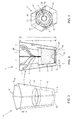
- Figure 1 shows a perspective view of an outer pot 6 for an assembly according to the invention.
- This outer pot 6 has a wall 7 which extends upwards from the bottom edge 20, which is near the bottom 9, up to the top edge 10 of the wall 7 of the outer pot 6.
- the shape of this top edge 10 is hexagonal.
- the hexagonal shape of the top edge 10 is illustrated in detail, in particular in Figure 8 .
- the top edge 10 has six corners 21, 22, 23, 24, 25 and 26. Between each of these corners, in each case one side 11, 12, 13, 14, 15 and 16 of the hexagonal top edge 10 extends.
- the opposite sides 11 and 14 extend parallel to one another.
- the opposite sides 13 and 16 as well as the opposite sides 12 and 15 also run parallel to one another.
- the sides 12 and 15 each have a length B and all four sides 11, 13, 14 and 16 have the same length C.
- adjacent sides in each case enclose an identical angle ⁇ . This angle ⁇ is 120°.
- the distance between the sides 12 and 15 with the top edge shown by way of example in Figure 8 is 130 mm and the distance between the opposite corners 21 and 24 is 185 mm.
- the surface area enclosed by the top edge 10 can then be calculated as approximately 18,200 mm 2 .
- this can be compared to a conventional round top edge having a diameter of approximately 150 mm.
- the surface area enclosed by a top edge having a diameter of 150 mm is approximately 17,670 mm 2 .
- a container tray which is known in practice and has a bearing surface of 6 m times 1.6 m, a maximum of 474 outer pots with a round top edge and a diameter of 150 mm can thus be placed, while 501 (i.e.
- this bottom 9 is completely open or completely closed.
- the bottom 9 of the outer pot 6 is substantially open.
- the bottom 9 is composed of a ring-shaped mount 30 which is attached to the bottom edge 20 of the wall 7 of the outer pot 6 by means of supporting arms 31.
- a passage in the form of an open intermediate space 35 is present in each case between adjacent supporting arms 31.
- the wall 7 of the outer pot 6 is composed of six flat wall segments 51, 52, 53, 54, 55 and 56. Furthermore, Figure 1 shows that the wall segments 51 and 56 as well as the wall segments 53 and 54 (not visible in Figure 1 ) are provided with ribs 36 on the inside. The purpose of these ribs 36 is to prevent leaves from sticking to the wall segment. It will be clear that the wall segments 52 and 55 may also have such ribs on the inside.
- the assembly 1 comprises an outer pot 6 as well as an inner pot 2.
- the (in fact invisible) inner pot 2 which is situated inside the outer pot 6 is indicated by dashed lines.
- the inner pot 2 has a side wall 8 and bottom 19.
- the side wall 8 is delimited on the top side by a circular top edge 37.
- the height D of the inner pot 2 is approximately 110 mm and the height E of the outer pot is approximately 230 mm.
- this difference in height F is preferably at least 50 mm and more preferably at least 80 mm, for example 100 mm or more.
- the assembly 1 can easily be identified through the RFID by means of a reading device which is not discussed here in any more detail.
- the mount 30 may also be provided with other identification elements.
- a diagrammatically indicated barcode or dot code 32 is illustrated by way of example. Such a two-dimensional visual marking may also be provided in several locations on the mount ring 30.
- the diameter of the mount ring 30 may be 65 mm
- the diameter of the bottom edge 38 of the inner pot 2 may be approximately 75-80 mm
- the distance X between the outer side 8 of the inner pot 2 and the inner side of the wall 7 of the outer pot 6 will, according to the invention, preferably be at least 5, more preferably approximately 10 mm or more.
- a vertical air flow can enter the outer pot 6 via the intermediate spaces 35 and flow upwards via the space between the wall 8 of the inner pot 2 and the wall 7 of the outer pot 6 in order to leave the outer pot 6 at the top side. It will be clear that this air flow can also be reversed.
- the bottom edge 20 of the wall 7 of the outer pot 6 is in the form of a hexagon.
- the outer pot 6 indicated in the drawings has an equilateral hexagonal cross-sectional shape, with each side of the hexagonal shape thus being of equal length. This makes it easy for the outer pot 6 to be taken up by a conventional gripper for cylindrical pots.
- reference numeral 3 furthermore denotes the substrate and reference numeral 4 denotes a plant whose leaves 29 bear against the inner side of the wall 7 of the outer pot 6.
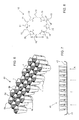
- Figure 6 shows a plurality 40 of assemblies 1 according to the invention. It can be seen that a central outer pot 6a is in each case surrounded by six surrounding outer pots 6b. Adjoining each side 11-16 of the top edge 10 of the central outer pot 6a is an equally long side of the top edge of one of the surrounding outer pots 6b. It will be clear that the vertical gas stream indicated by arrows in Figure 7 is forced to pass through the outer pots 6 in its entirety and cannot pass on the outside.
- Figure 7 shows a support frame 41, such as a container tray with a bearing surface 42 which is permeable to gas.
Landscapes
- Life Sciences & Earth Sciences (AREA)
- Environmental Sciences (AREA)
- Cultivation Receptacles Or Flower-Pots, Or Pots For Seedlings (AREA)
- Fertilizers (AREA)
- Agricultural Chemicals And Associated Chemicals (AREA)
Claims (23)
- Anordnung (1) zum Züchten einer Pflanze (4),
enthaltend einerseits einen Innentopf (2) zum Halten eines Substrates (3) mit einer Pflanze (4), die in dem Substrat (3) wächst, und andererseits einen Außentopf (6);
wobei der Innentopf (2) in dem Außentopf (6) aufgenommen werden kann und, wenn der Innentopf (2) in dem Außentopf (6) aufgenommen ist, die Wand (7) des Außentopfes (6) über die Wand (8) des Innentopfes (2) in der vertikalen Richtung hervorragt, um die Pflanze (4) zu stützen;
wobei ein Substrat (3) in dem Innentopf (2) vorgesehen ist, der eine Pflanze (4) enthält;
dadurch gekennzeichnet, dass,
in der horizontalen Ebene gesehen, der obere Rand (10) der Wand (7) des Außentopfes (6) eine sechseckige Form hat, die über sechs Seiten (11-16) verfügt, die sich zwischen benachbarten Ecken (21-26) erstrecken, wobei die gegenüberliegenden Seiten (11, 14 und 12, 15 sowie 13, 16) des sechseckigen oberen Randes (10) in jedem Fall parallel zueinander verlaufen und
die Pflanze (4) von einem Typ ist, bei dem die Blätter (29) in im wesentlichen entgegengesetzten Richtungen wachsen, wie es bei einer Pflanze (4) der Gattung der Phalaenopsis der Fall ist, und bei der die Pflanze (4) in dem Außentopf (6) derart ausgerichtet ist, dass die Blätter (29) zu gegenüberliegenden Ecken des oberen Randes (10) des Außentopfes (6) weisen. - Anordnung nach Anspruch 1, bei der die Pflanze von der Gattung der Phalaenopsis ist.
- Anordnung nach Anspruch 1 oder 2, bei der, um den Durchgang eines vertikalen Gasstroms zuzulassen, einerseits der Boden (9) des Außentopfes teilweise geöffnet ist und andererseits ein Durchgang, der in der vertikalen Richtung frei ist, zwischen der Wand (8) des Innentopfes (2) und der Wand (7) des Außentopfes (6) vorhanden ist und sich vom Boden (9) des Außentopfes (6) bis zum oberen Rand (37) des Innentopfes (2) erstreckt.
- Anordnung (1) nach einem der vorhergehenden Ansprüche, bei der jeder Winkel (α) zwischen benachbarten Seiten (11, 12 und 12, 13 und 13, 14 und 14, 15 und 15, 16 und 16, 11) des oberen Randes (10) des Außentopfes (6) wenigstens 100°, vorzugsweise etwa 120° beträgt.
- Anordnung (1) nach einem der vorhergehenden Ansprüche, bei der die Sechseckform einen ersten Satz gegenüberliegender Seiten (12, 15) mit wechselseitig gleicher Länge (B) hat, wobei die äußeren vier Seiten (11, 13, 14, 16) in jedem Fall dieselbe Länge (C) haben und die Länge (B) der Seiten (12, 15) des ersten Satzes zweier gegenüberliegender Seiten ungleich der Länge (C) der anderen vier Seiten (11, 13, 14, 16) ist.
- Anordnung (1) nach Anspruch 5, bei der die Länge (B) der Seiten (12, 15) des ersten Satzes zweier gegenüberliegender Seiten größer als die Länge (C) der anderen vier Seiten (11, 13, 14, 16) ist.
- Anordnung (1) nach einem der Ansprüche 1 bis 4 oder 6, bei der die Wand (7) des Außentopfes (6) in einem Abstand von dem oberen Rand eine Querschnittsform hat, die gleichseitig polygonal oder rund ist.
- Anordnung (1) nach Anspruch 7, bei der der Querschnitt eine sechseckige Form hat.
- Anordnung (1) nach einem der vorhergehenden Ansprüche, bei der die Wand (7) des Außentopfes (6) sechs, im wesentlichen flache, Wandsegmente (51-56) enthält und bei der die Seiten (11-16) des sechseckigen oberen Randes (10) in jedem Fall eine Oberseite des flachen Wandsegmentes (51-56) bilden.
- Anordnung (1) nach einem der vorhergehenden Ansprüche, bei der die horizontale Querschnittsfläche des Außentopfes (6), in vertikal aufwärtiger Richtung betrachtet, zunimmt.
- Anordnung (1) nach einem der vorhergehenden Ansprüche, bei der der Außentopf (6) und der Innentopf (2) jeweils einen Boden (9, 19) enthalten und sich der Boden (9) des Außentopfes (6) unter dem Boden (19) des Innentopfes (2) befindet, wenn der Innentopf (2) in dem Außentopf (6) aufgenommen ist.
- Anordnung nach einem der vorhergehenden Ansprüche 1 bis 10, bei der der Außentopf ein Kranz ist, der an die Wand (8) des Innentopfes (2), wie etwa den oberen Rand (37) der Wand (8) des Innentopfes (2), angepasst ist.
- Anordnung (1) nach einem der vorhergehenden Ansprüche, bei der die Pflanze (4) von einer Gattung, bei der die Blätter in einem wechselseitigen Winkel von 120° bis 180° wachsen, wie etwa der Gattung der Phalaenopsis ist.
- Anordnung (1) nach einem der vorhergehenden Ansprüche, bei der der Außentopf einen im wesentlichen offenen Boden (9) enthält, wobei der Boden (9) des Außentopfes (6) aus Haltearmen (31) und einer Halterung (30) besteht, die von den Haltearmen (31) gehalten ist, und sich die Haltearme (31) von der Halterung (30) zu dem Bodenrand der Wand (7) des Außentopfes (6) erstrecken und es in jedem Fall einen offenen Zwischenraum (35) zwischen benachbarten Haltearmen (31) gibt.
- Anordnung (1) nach Anspruch 14, bei der sich die Haltearme (31) bis zu der Wand (7) des Außentopfes (6) erstrecken und die Haltearme (31) an der Wand (7) des Außentopfes (6) angebracht sind.
- Anordnung nach Anspruch 14 oder 15, bei der die Halterung (30) ringförmig ist und/oder die Halterung (30) dazu bestimmt ist, ein Kennzeichnungselement (32, 33) zu halten und im Zentrum des Bodens (9) des Außentopfes (6) vorgesehen ist.
- Anordnung nach einem der vorhergehenden Ansprüche, bei der, wenn der Innentopf (2) in dem Außentopf (6) aufgenommen ist, in vertikaler Richtung betrachtet, der obere Rand (10) des Außentopfes (6) wenigstens 50 mm, vorzugsweise wenigstens 80 mm, wie etwa wenigstens 100 mm, höher als der obere Rand (37) des Innentopfes (2) ist.
- Anordnung nach Anspruch 9, bei der in Kombination wenigstens mit Anspruch 5 die Wandsegmente (51, 53, 54, 56), die den anderen vier Seiten (11, 13, 14, 16) zugeordnet sind, die in jedem Fall eine wechselseitig gleiche Länge (C) haben, mit Stegen (36) auf der Innenseite versehen sind.
- Anordnung gemäß dem vorhergehenden Anspruch, bei der die Wandsegmente (52, 55), die dem ersten Satz zweier gegenüberliegender Seiten (12, 15) zugeordnet sind, die eine wechselseitig gleiche Länge (B) haben, mit Stegen auf der Innenseite versehen sind.
- Vielzahl (40) aneinander grenzender Anordnungen (1) nach einem der vorhergehenden Ansprüche, bei denen ein zentraler Außentopf (6a) in jedem Fall von sechs umgebenden Außentöpfen (6b) umgeben ist und bei denen jede Seite (11-16) des oberen Randes (10) des zentralen Außentopfes (6a) in jedem Fall an einer Seite (11-16) des oberen Randes (10) eines dieser sechs umgebenden Außentöpfe (6b) anliegt.
- Vielzahl (40) nach Anspruch 20, wobei die Vielzahl auf einer gasdurchlässigen Lagerfläche (42) eines Halterahmens (41) angeordnet ist.
- Verfahren zum Züchten einer Pflanze (4) unter Verwendung einer Anordnung nach einem der Ansprüche 1 bis 19 oder einer Vielzahl nach einem der Ansprüche 20 bis 21, wobei die Pflanze von einem Typ ist, bei dem die Blätter in im wesentlichen entgegengesetzten Richtung wachsen, wie es bei einer Phalaenopsis (4) der Fall ist, und bei dem die Pflanze (4) in dem Außentopf (6) derart ausgerichtet ist, dass diese Blätter in gegenüberliegende Ecken des oberen Randes (10) zeigen.
- Verfahren nach Anspruch 22, bei dem die gegenüberliegenden Seiten, auf die die Blätter zeigen, voneinander weiter entfernt sind als die anderen Ecken.
Applications Claiming Priority (1)
| Application Number | Priority Date | Filing Date | Title |
|---|---|---|---|
| NL2002081A NL2002081C (nl) | 2008-10-10 | 2008-10-10 | Samenstel voor het kweken van een plant, veelheid van dergelijke samenstellen, draagframe voorzien van een veelheid dergelijke samenstellen alsmede een werkwijze voor het kweken van een plant. |
Publications (2)
| Publication Number | Publication Date |
|---|---|
| EP2174539A1 EP2174539A1 (de) | 2010-04-14 |
| EP2174539B1 true EP2174539B1 (de) | 2011-07-20 |
Family
ID=40601688
Family Applications (1)
| Application Number | Title | Priority Date | Filing Date |
|---|---|---|---|
| EP09172775A Active EP2174539B1 (de) | 2008-10-10 | 2009-10-12 | Pflanzenzuchtanordnung, Mehrheit von solchen Anordnungen und Pflanzenzuchtverfahren |
Country Status (3)
| Country | Link |
|---|---|
| EP (1) | EP2174539B1 (de) |
| AT (1) | ATE516700T1 (de) |
| NL (3) | NL2002081C (de) |
Cited By (1)
| Publication number | Priority date | Publication date | Assignee | Title |
|---|---|---|---|---|
| RU230361U1 (ru) * | 2024-10-16 | 2024-11-28 | Общество с ограниченной ответственностью "Октава-Плюс" | Посадочный модуль для выращивания эпифитных растений, учитывающий особенности развития корневой системы и роста побегов |
Family Cites Families (8)
| Publication number | Priority date | Publication date | Assignee | Title |
|---|---|---|---|---|
| US4791754A (en) * | 1987-07-13 | 1988-12-20 | Demars Jr George H | Plant assisting device |
| JPH0698654A (ja) * | 1992-03-19 | 1994-04-12 | Bunkei Ri | ラ ン |
| JP2747873B2 (ja) * | 1993-07-22 | 1998-05-06 | 日本甜菜製糖株式会社 | 底付き鉢とその集合体 |
| JP2984622B2 (ja) * | 1997-05-09 | 1999-11-29 | 三郎 東 | 種苗育成ポット |
| JP2001086873A (ja) * | 1999-09-17 | 2001-04-03 | Koichi Kato | 植木鉢の受具 |
| US20030106262A1 (en) * | 2001-12-11 | 2003-06-12 | Yuan-Song Lai | Ventilation filter for flowerpot |
| WO2005077150A1 (ja) * | 2004-02-17 | 2005-08-25 | Minoru Sangyo Kabushiki Kaisha | イグサの育苗方法及びそれに用いるポット苗箱 |
| JP2007244219A (ja) * | 2006-03-13 | 2007-09-27 | Masaru Nanri | 鉢および植物が植えられた鉢の製造方法 |
-
2008
- 2008-10-10 NL NL2002081A patent/NL2002081C/nl not_active IP Right Cessation
-
2009
- 2009-10-12 AT AT09172775T patent/ATE516700T1/de not_active IP Right Cessation
- 2009-10-12 EP EP09172775A patent/EP2174539B1/de active Active
- 2009-10-12 NL NL2003625A patent/NL2003625C2/nl active
-
2010
- 2010-12-27 NL NL2005924A patent/NL2005924C2/nl active
Cited By (1)
| Publication number | Priority date | Publication date | Assignee | Title |
|---|---|---|---|---|
| RU230361U1 (ru) * | 2024-10-16 | 2024-11-28 | Общество с ограниченной ответственностью "Октава-Плюс" | Посадочный модуль для выращивания эпифитных растений, учитывающий особенности развития корневой системы и роста побегов |
Also Published As
| Publication number | Publication date |
|---|---|
| NL2003625A (nl) | 2010-04-13 |
| NL2002081C (nl) | 2010-04-13 |
| NL2005924C2 (nl) | 2011-06-06 |
| EP2174539A1 (de) | 2010-04-14 |
| NL2005924A (nl) | 2011-02-17 |
| ATE516700T1 (de) | 2011-08-15 |
| NL2003625C2 (nl) | 2010-12-30 |
Similar Documents
| Publication | Publication Date | Title |
|---|---|---|
| CA3038594C (en) | Climatically sealed climate cell for cultivating plants in indoor spaces | |
| KR102514269B1 (ko) | 캐리어 상에 배열되는 제거 가능한 측면 지지 구조를 구비하는 캐리어를 이용하는 식물의 재배를 위한 방법 | |
| US20170150686A1 (en) | Container for supplying plant roots with nutrient solution without the use of soil | |
| US20100199554A1 (en) | Pot assembly | |
| US20170079217A1 (en) | Terrarium | |
| EP2174539B1 (de) | Pflanzenzuchtanordnung, Mehrheit von solchen Anordnungen und Pflanzenzuchtverfahren | |
| EP3148320B1 (de) | Systeme zum züchten von pflanzen mit luftwurzeln | |
| US5337517A (en) | Transferable growing tray apparatus | |
| US20110247271A1 (en) | Water wick pot | |
| KR20140078331A (ko) | 화분 | |
| US12114623B2 (en) | Plant pot support assembly | |
| WO2023175135A1 (en) | Gripper, system and method for handling plants or plant receptacles | |
| KR102728507B1 (ko) | 화분 덮개 | |
| EP2245920B1 (de) | Verfahren und Röhrenkörper zum Züchten von Pflanzen | |
| JP6118139B2 (ja) | 植物生育器 | |
| US20180110193A1 (en) | Planter container | |
| WO2018185117A1 (en) | Pot for cultivating a plant with aerial roots | |
| JP3036789U (ja) | 園芸用トレー | |
| JP3076746U (ja) | 園芸用トレー | |
| KR20110092591A (ko) | 균일하고 효율적인 통풍이 이루어지도록 된 플라스틱 화분 | |
| GB2509048A (en) | A plant shelter which supports a growing plant | |
| JP2020005570A (ja) | バイオマス発酵装置 | |
| KR20150000101U (ko) | 난(蘭) 재배용 화분 |
Legal Events
| Date | Code | Title | Description |
|---|---|---|---|
| PUAI | Public reference made under article 153(3) epc to a published international application that has entered the european phase |
Free format text: ORIGINAL CODE: 0009012 |
|
| AK | Designated contracting states |
Kind code of ref document: A1 Designated state(s): AT BE BG CH CY CZ DE DK EE ES FI FR GB GR HR HU IE IS IT LI LT LU LV MC MK MT NL NO PL PT RO SE SI SK SM TR |
|
| AX | Request for extension of the european patent |
Extension state: AL BA RS |
|
| 17P | Request for examination filed |
Effective date: 20101014 |
|
| GRAP | Despatch of communication of intention to grant a patent |
Free format text: ORIGINAL CODE: EPIDOSNIGR1 |
|
| GRAS | Grant fee paid |
Free format text: ORIGINAL CODE: EPIDOSNIGR3 |
|
| GRAA | (expected) grant |
Free format text: ORIGINAL CODE: 0009210 |
|
| AK | Designated contracting states |
Kind code of ref document: B1 Designated state(s): AT BE BG CH CY CZ DE DK EE ES FI FR GB GR HR HU IE IS IT LI LT LU LV MC MK MT NL NO PL PT RO SE SI SK SM TR |
|
| REG | Reference to a national code |
Ref country code: GB Ref legal event code: FG4D |
|
| REG | Reference to a national code |
Ref country code: CH Ref legal event code: EP |
|
| REG | Reference to a national code |
Ref country code: DE Ref legal event code: R096 Ref document number: 602009001867 Country of ref document: DE Effective date: 20110922 |
|
| REG | Reference to a national code |
Ref country code: NL Ref legal event code: T3 |
|
| REG | Reference to a national code |
Ref country code: AT Ref legal event code: MK05 Ref document number: 516700 Country of ref document: AT Kind code of ref document: T Effective date: 20110720 |
|
| PG25 | Lapsed in a contracting state [announced via postgrant information from national office to epo] |
Ref country code: FI Free format text: LAPSE BECAUSE OF FAILURE TO SUBMIT A TRANSLATION OF THE DESCRIPTION OR TO PAY THE FEE WITHIN THE PRESCRIBED TIME-LIMIT Effective date: 20110720 Ref country code: NO Free format text: LAPSE BECAUSE OF FAILURE TO SUBMIT A TRANSLATION OF THE DESCRIPTION OR TO PAY THE FEE WITHIN THE PRESCRIBED TIME-LIMIT Effective date: 20111020 Ref country code: PT Free format text: LAPSE BECAUSE OF FAILURE TO SUBMIT A TRANSLATION OF THE DESCRIPTION OR TO PAY THE FEE WITHIN THE PRESCRIBED TIME-LIMIT Effective date: 20111121 Ref country code: IS Free format text: LAPSE BECAUSE OF FAILURE TO SUBMIT A TRANSLATION OF THE DESCRIPTION OR TO PAY THE FEE WITHIN THE PRESCRIBED TIME-LIMIT Effective date: 20111120 Ref country code: BE Free format text: LAPSE BECAUSE OF FAILURE TO SUBMIT A TRANSLATION OF THE DESCRIPTION OR TO PAY THE FEE WITHIN THE PRESCRIBED TIME-LIMIT Effective date: 20110720 Ref country code: LT Free format text: LAPSE BECAUSE OF FAILURE TO SUBMIT A TRANSLATION OF THE DESCRIPTION OR TO PAY THE FEE WITHIN THE PRESCRIBED TIME-LIMIT Effective date: 20110720 Ref country code: HR Free format text: LAPSE BECAUSE OF FAILURE TO SUBMIT A TRANSLATION OF THE DESCRIPTION OR TO PAY THE FEE WITHIN THE PRESCRIBED TIME-LIMIT Effective date: 20110720 Ref country code: SE Free format text: LAPSE BECAUSE OF FAILURE TO SUBMIT A TRANSLATION OF THE DESCRIPTION OR TO PAY THE FEE WITHIN THE PRESCRIBED TIME-LIMIT Effective date: 20110720 |
|
| PG25 | Lapsed in a contracting state [announced via postgrant information from national office to epo] |
Ref country code: PL Free format text: LAPSE BECAUSE OF FAILURE TO SUBMIT A TRANSLATION OF THE DESCRIPTION OR TO PAY THE FEE WITHIN THE PRESCRIBED TIME-LIMIT Effective date: 20110720 Ref country code: SI Free format text: LAPSE BECAUSE OF FAILURE TO SUBMIT A TRANSLATION OF THE DESCRIPTION OR TO PAY THE FEE WITHIN THE PRESCRIBED TIME-LIMIT Effective date: 20110720 Ref country code: LV Free format text: LAPSE BECAUSE OF FAILURE TO SUBMIT A TRANSLATION OF THE DESCRIPTION OR TO PAY THE FEE WITHIN THE PRESCRIBED TIME-LIMIT Effective date: 20110720 Ref country code: AT Free format text: LAPSE BECAUSE OF FAILURE TO SUBMIT A TRANSLATION OF THE DESCRIPTION OR TO PAY THE FEE WITHIN THE PRESCRIBED TIME-LIMIT Effective date: 20110720 Ref country code: CY Free format text: LAPSE BECAUSE OF FAILURE TO SUBMIT A TRANSLATION OF THE DESCRIPTION OR TO PAY THE FEE WITHIN THE PRESCRIBED TIME-LIMIT Effective date: 20110720 Ref country code: GR Free format text: LAPSE BECAUSE OF FAILURE TO SUBMIT A TRANSLATION OF THE DESCRIPTION OR TO PAY THE FEE WITHIN THE PRESCRIBED TIME-LIMIT Effective date: 20111021 |
|
| PG25 | Lapsed in a contracting state [announced via postgrant information from national office to epo] |
Ref country code: CZ Free format text: LAPSE BECAUSE OF FAILURE TO SUBMIT A TRANSLATION OF THE DESCRIPTION OR TO PAY THE FEE WITHIN THE PRESCRIBED TIME-LIMIT Effective date: 20110720 Ref country code: SK Free format text: LAPSE BECAUSE OF FAILURE TO SUBMIT A TRANSLATION OF THE DESCRIPTION OR TO PAY THE FEE WITHIN THE PRESCRIBED TIME-LIMIT Effective date: 20110720 |
|
| PLBE | No opposition filed within time limit |
Free format text: ORIGINAL CODE: 0009261 |
|
| STAA | Information on the status of an ep patent application or granted ep patent |
Free format text: STATUS: NO OPPOSITION FILED WITHIN TIME LIMIT |
|
| PG25 | Lapsed in a contracting state [announced via postgrant information from national office to epo] |
Ref country code: EE Free format text: LAPSE BECAUSE OF FAILURE TO SUBMIT A TRANSLATION OF THE DESCRIPTION OR TO PAY THE FEE WITHIN THE PRESCRIBED TIME-LIMIT Effective date: 20110720 Ref country code: RO Free format text: LAPSE BECAUSE OF FAILURE TO SUBMIT A TRANSLATION OF THE DESCRIPTION OR TO PAY THE FEE WITHIN THE PRESCRIBED TIME-LIMIT Effective date: 20110720 Ref country code: MC Free format text: LAPSE BECAUSE OF NON-PAYMENT OF DUE FEES Effective date: 20111031 Ref country code: IT Free format text: LAPSE BECAUSE OF FAILURE TO SUBMIT A TRANSLATION OF THE DESCRIPTION OR TO PAY THE FEE WITHIN THE PRESCRIBED TIME-LIMIT Effective date: 20110720 |
|
| 26N | No opposition filed |
Effective date: 20120423 |
|
| PG25 | Lapsed in a contracting state [announced via postgrant information from national office to epo] |
Ref country code: DK Free format text: LAPSE BECAUSE OF FAILURE TO SUBMIT A TRANSLATION OF THE DESCRIPTION OR TO PAY THE FEE WITHIN THE PRESCRIBED TIME-LIMIT Effective date: 20110720 |
|
| REG | Reference to a national code |
Ref country code: FR Ref legal event code: ST Effective date: 20120629 |
|
| PG25 | Lapsed in a contracting state [announced via postgrant information from national office to epo] |
Ref country code: DE Free format text: LAPSE BECAUSE OF NON-PAYMENT OF DUE FEES Effective date: 20120501 |
|
| REG | Reference to a national code |
Ref country code: IE Ref legal event code: MM4A |
|
| REG | Reference to a national code |
Ref country code: DE Ref legal event code: R119 Ref document number: 602009001867 Country of ref document: DE Effective date: 20120501 |
|
| REG | Reference to a national code |
Ref country code: DE Ref legal event code: R097 Ref document number: 602009001867 Country of ref document: DE Effective date: 20120423 |
|
| PG25 | Lapsed in a contracting state [announced via postgrant information from national office to epo] |
Ref country code: FR Free format text: LAPSE BECAUSE OF NON-PAYMENT OF DUE FEES Effective date: 20111102 |
|
| PG25 | Lapsed in a contracting state [announced via postgrant information from national office to epo] |
Ref country code: IE Free format text: LAPSE BECAUSE OF NON-PAYMENT OF DUE FEES Effective date: 20111012 |
|
| PG25 | Lapsed in a contracting state [announced via postgrant information from national office to epo] |
Ref country code: MT Free format text: LAPSE BECAUSE OF FAILURE TO SUBMIT A TRANSLATION OF THE DESCRIPTION OR TO PAY THE FEE WITHIN THE PRESCRIBED TIME-LIMIT Effective date: 20110720 Ref country code: MK Free format text: LAPSE BECAUSE OF FAILURE TO SUBMIT A TRANSLATION OF THE DESCRIPTION OR TO PAY THE FEE WITHIN THE PRESCRIBED TIME-LIMIT Effective date: 20110720 |
|
| PG25 | Lapsed in a contracting state [announced via postgrant information from national office to epo] |
Ref country code: SM Free format text: LAPSE BECAUSE OF FAILURE TO SUBMIT A TRANSLATION OF THE DESCRIPTION OR TO PAY THE FEE WITHIN THE PRESCRIBED TIME-LIMIT Effective date: 20110720 Ref country code: ES Free format text: LAPSE BECAUSE OF FAILURE TO SUBMIT A TRANSLATION OF THE DESCRIPTION OR TO PAY THE FEE WITHIN THE PRESCRIBED TIME-LIMIT Effective date: 20111031 |
|
| PG25 | Lapsed in a contracting state [announced via postgrant information from national office to epo] |
Ref country code: LU Free format text: LAPSE BECAUSE OF NON-PAYMENT OF DUE FEES Effective date: 20111012 |
|
| PG25 | Lapsed in a contracting state [announced via postgrant information from national office to epo] |
Ref country code: BG Free format text: LAPSE BECAUSE OF FAILURE TO SUBMIT A TRANSLATION OF THE DESCRIPTION OR TO PAY THE FEE WITHIN THE PRESCRIBED TIME-LIMIT Effective date: 20111020 |
|
| PG25 | Lapsed in a contracting state [announced via postgrant information from national office to epo] |
Ref country code: TR Free format text: LAPSE BECAUSE OF FAILURE TO SUBMIT A TRANSLATION OF THE DESCRIPTION OR TO PAY THE FEE WITHIN THE PRESCRIBED TIME-LIMIT Effective date: 20110720 |
|
| PG25 | Lapsed in a contracting state [announced via postgrant information from national office to epo] |
Ref country code: HU Free format text: LAPSE BECAUSE OF FAILURE TO SUBMIT A TRANSLATION OF THE DESCRIPTION OR TO PAY THE FEE WITHIN THE PRESCRIBED TIME-LIMIT Effective date: 20110720 |
|
| REG | Reference to a national code |
Ref country code: CH Ref legal event code: PL |
|
| GBPC | Gb: european patent ceased through non-payment of renewal fee |
Effective date: 20131012 |
|
| PG25 | Lapsed in a contracting state [announced via postgrant information from national office to epo] |
Ref country code: GB Free format text: LAPSE BECAUSE OF NON-PAYMENT OF DUE FEES Effective date: 20131012 Ref country code: CH Free format text: LAPSE BECAUSE OF NON-PAYMENT OF DUE FEES Effective date: 20131031 Ref country code: LI Free format text: LAPSE BECAUSE OF NON-PAYMENT OF DUE FEES Effective date: 20131031 |
|
| PGFP | Annual fee paid to national office [announced via postgrant information from national office to epo] |
Ref country code: NL Payment date: 20251023 Year of fee payment: 17 |