EP2161543A2 - Navigation device and associated display method - Google Patents
Navigation device and associated display method Download PDFInfo
- Publication number
- EP2161543A2 EP2161543A2 EP09252018A EP09252018A EP2161543A2 EP 2161543 A2 EP2161543 A2 EP 2161543A2 EP 09252018 A EP09252018 A EP 09252018A EP 09252018 A EP09252018 A EP 09252018A EP 2161543 A2 EP2161543 A2 EP 2161543A2
- Authority
- EP
- European Patent Office
- Prior art keywords
- current location
- map
- display
- navigation device
- mode
- Prior art date
- Legal status (The legal status is an assumption and is not a legal conclusion. Google has not performed a legal analysis and makes no representation as to the accuracy of the status listed.)
- Granted
Links
Images



Classifications
-
- G—PHYSICS
- G01—MEASURING; TESTING
- G01C—MEASURING DISTANCES, LEVELS OR BEARINGS; SURVEYING; NAVIGATION; GYROSCOPIC INSTRUMENTS; PHOTOGRAMMETRY OR VIDEOGRAMMETRY
- G01C21/00—Navigation; Navigational instruments not provided for in groups G01C1/00 - G01C19/00
- G01C21/26—Navigation; Navigational instruments not provided for in groups G01C1/00 - G01C19/00 specially adapted for navigation in a road network
- G01C21/34—Route searching; Route guidance
- G01C21/36—Input/output arrangements for on-board computers
- G01C21/3667—Display of a road map
- G01C21/367—Details, e.g. road map scale, orientation, zooming, illumination, level of detail, scrolling of road map or positioning of current position marker
-
- G—PHYSICS
- G01—MEASURING; TESTING
- G01C—MEASURING DISTANCES, LEVELS OR BEARINGS; SURVEYING; NAVIGATION; GYROSCOPIC INSTRUMENTS; PHOTOGRAMMETRY OR VIDEOGRAMMETRY
- G01C21/00—Navigation; Navigational instruments not provided for in groups G01C1/00 - G01C19/00
- G01C21/20—Instruments for performing navigational calculations
-
- G—PHYSICS
- G01—MEASURING; TESTING
- G01C—MEASURING DISTANCES, LEVELS OR BEARINGS; SURVEYING; NAVIGATION; GYROSCOPIC INSTRUMENTS; PHOTOGRAMMETRY OR VIDEOGRAMMETRY
- G01C21/00—Navigation; Navigational instruments not provided for in groups G01C1/00 - G01C19/00
- G01C21/26—Navigation; Navigational instruments not provided for in groups G01C1/00 - G01C19/00 specially adapted for navigation in a road network
- G01C21/28—Navigation; Navigational instruments not provided for in groups G01C1/00 - G01C19/00 specially adapted for navigation in a road network with correlation of data from several navigational instruments
- G01C21/30—Map- or contour-matching
-
- G—PHYSICS
- G01—MEASURING; TESTING
- G01C—MEASURING DISTANCES, LEVELS OR BEARINGS; SURVEYING; NAVIGATION; GYROSCOPIC INSTRUMENTS; PHOTOGRAMMETRY OR VIDEOGRAMMETRY
- G01C21/00—Navigation; Navigational instruments not provided for in groups G01C1/00 - G01C19/00
- G01C21/26—Navigation; Navigational instruments not provided for in groups G01C1/00 - G01C19/00 specially adapted for navigation in a road network
- G01C21/34—Route searching; Route guidance
- G01C21/3407—Route searching; Route guidance specially adapted for specific applications
- G01C21/3423—Multimodal routing
Definitions
- the present invention relates to a navigation device, a display method of the navigation device, a program of the display method of the navigation device, and a recording medium recording the program of the display method of the navigation device.
- Embodiments of the present invention may provide a car navigation device, which may be used as a personal navigation device (PND), for example.
- Embodiments of the present invention may also displays a map in which a mark of a current location is arranged on a current location corrected using map matching in a normal mode, and displays the map in a manner that the correction by the map matching is stopped in a pedestrian mode, thereby preventing an erroneous display of the current location when used as the PND.
- PND personal navigation device
- a car navigation device detects the current location using a global positioning system (GPS) and displays the detected current location on a map display.
- GPS global positioning system
- the car navigation device is based on in-vehicle use. Then, the car navigation device corrects the current location detected by the GPS using map matching processing using road information stored in map data for display, thereby preventing an unnatural display of the current location such as running through a housing site or the like.
- map matching is disclosed in Japanese Patent Application Laid-Open No. S58-129313 .
- the car navigation device detects a running direction based on temporal change in the current location, and displays the map by appropriately changing a direction of the display such that an upward direction is a traveling direction. Also, the current location is displayed on the map display by using a mark evoking the traveling direction such as a triangle or an arrow. Thereby, the car navigation device displays the map and the current location such that the current location and the traveling direction may be intuitively grasped.
- the car navigation device holds location information on various shops and facilities, which might be expected to be used by the user, such as gas stations, restaurants and the like classified according to categories, and displays the various shops and facilities on the map in response to an operation of the user. Also, the navigation processing is executed by searching a route to the shops and facilities according to an indication of the user.
- the car navigation device a portable device, which may be detached from the vehicle and used as the PND, is provided.
- a case of using the car navigation device as the PND includes a case in which the user carries the same to use. Therefore, spots other than roads on which a vehicle runs, such as a site of various facilities and a pedestrian walk, may become the current location. Therefore, in the car navigation device, which corrects the current location by the map matching based on the in-vehicle use, there is a possibility that the current location is displayed in error.
- the present invention is made in view of the above-described circumstances, and it is desirable to provide a navigation device capable of preventing or reducing a likelihood of the erroneous display of the current location when used as the PND, a display method of the navigation device, a program of the display method of the navigation device, and a recording medium for recording the program of the display method of the navigation device.
- a navigation device including: a current location detection unit for detecting a current location; a current location correction unit for correcting the current location detected by the current location detection unit using map matching; and a display unit for displaying a map, wherein the navigation device switches an operation mode between a normal mode being an operation mode based on in-vehicle use and a pedestrian mode being an operation mode based on use when moving on foot, displays the map of the current location in the display unit by arranging a mark indicating the current location based on the current location corrected by the current location correction unit in the normal mode, and displays the map of the current location in the display unit by arranging the mark indicating the current location based on the current location detected by the current location detection unit in the pedestrian mode.
- the navigation device may include: traveling direction detecting means for detecting a traveling direction based on change of the current location detected by the current location detection unit, or change of the current location corrected by the current location correction unit, and the navigation device may change a direction of the map based on the traveling direction detected by the traveling direction detecting means, and hold the direction on the map corresponding to the traveling direction detected by the traveling direction detecting means in an upward direction of the display screen in the normal mode, and stop changing the direction of the map according to the traveling direction, and changes the direction of the map in response to the operation of the user for display in the pedestrian mode.
- a mark indicating the current location in the normal mode may be a mark indicating the traveling direction, and a mark indicating the current location in the pedestrian mode may be a mark without directionality.
- the navigation device may receive setting of a destination in the pedestrian mode, and display a mark indicating the destination on the map and displays a distance from the current location to the destination.
- the navigation device may receive setting of a plurality of destinations in the pedestrian mode, display a mark indicating the destination on the map, and sequentially select the plurality of destinations, sets the selected destination to be identifiable from other destinations, and display a distance to the selected destination.
- the navigation device may receive setting of a plurality of destinations in the pedestrian mode, sequentially select the plurality of destinations, and change a scale, a direction and a display location of the map, and display the map by arranging a mark indicating the selected destination and a mark indicating the current location on positions on both ends in a longitudinal direction of a display screen.
- the navigation device may receive setting of a plurality of destinations in the pedestrian mode, alternately execute a separate display of the plurality of destinations and an entire display of the plurality of destinations, in the separate display: sequentially may select the plurality of destinations, change a scale, a direction and a display location of the map, and display the map by arranging a mark indicating the selected destination and a mark indicating the current location on positions on both ends in a longitudinal direction of the display screen, and in the entire display: may change the scale, the direction and the display location of the map, and display the marks indicating the plurality of destinations and the current location on the display screen.
- a display method of a navigation device having a current location detection unit for detecting a current location, a current location correction unit for correcting the current location detected by the current location detection unit using map matching, and a display unit for displaying a map
- the method including: an operation mode switching step of switching an operation mode of the display unit between a normal mode being an operation mode based on in-vehicle use and a pedestrian mode being an operation mode based on use when moving on foot; a normal mode map displaying step of displaying the map of the current location by the display unit by arranging a mark indicating the current location based on the current location corrected by the current location correction unit in the normal mode; and a pedestrian mode map displaying step of displaying the map of the current location by the display unit by arranging the mark indicating the current location based on the current location detected by the current location detection unit in the pedestrian mode.
- a program of a display method of a navigation device wherein the navigation device has a current location detection unit for detecting a current location, a current location correction unit for correcting the current location detected by the current location detection unit using map matching, a display unit for displaying a map, and a calculation unit for executing the program of the display method to control operation of each unit, and the program of the display method has an operation mode switching step of switching an operation mode of the display unit between a normal mode being an operation mode based on in-vehicle use and a pedestrian mode being an operation mode based on use when moving on foot, a normal mode map displaying step of displaying the map of the current location by the display unit by arranging a mark indicating the current location based on the current location corrected by the current location correction unit in the normal mode, and a pedestrian mode map displaying step of displaying the map of the current location by the display unit by arranging the mark indicating the current location based on the current location detected by the current location detection unit
- a recording medium for recording a program of a display method of a navigation device, wherein the navigation device has a current location detection unit for detecting a current location, a current location correction unit for correcting the current location detected by the current location detection unit using map matching, a display unit for displaying a map, and a calculation unit for executing the program of the display method to control operation of each unit, and the program of the display method has an operation mode switching step of switching an operation mode of the display unit between a normal mode being an operation mode based on in-vehicle use and a pedestrian mode being an operation mode based on use when moving on foot, a normal mode map displaying step of displaying the map of the current location by the display unit by arranging a mark indicating the current location based on the current location corrected by the current location correction unit in the normal mode, and a pedestrian mode map displaying step of displaying the map of the current location by the display unit by arranging the mark indicating the current location based on the current location detected
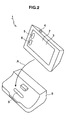
- Fig. 2 is a perspective view showing a navigation device according to the first embodiment of the present invention.
- the navigation device 1 is a car navigation device, which can be used as a PND.
- the navigation device 1 displays a map of a current location in response to an operation of a user, and performs navigation processing.
- a display screen 2 for displaying the map, menus of various operations and the like is provided in front thereof, and a touch panel 3 for detecting the operation of the user is provided on a front surface of the display screen 2.
- a speaker is provided on a side thereof, and a power switch 4 is provided on an upper end face thereof.
- a menu button 5 for instructing to display the menu, and a current location button 6 for instructing to display the current location are provided on a left end of the display screen 2.
- the navigation device 1 operates by a built-in battery for portable use.
- the navigation device 1 is structured to be placed on a cradle 8 as indicated by an arrow A of use in a vehicle or the like.
- the cradle 8 is fixed on a dashboard or the like of the vehicle and detachably holds the navigation device 1 in a concave portion thereof.
- the navigation device 1 operates by power or the like supplied from the cradle 8.
- a terminal 9 for supplying the navigation device 1 with the power is provided on the cradle 8.
- Fig. 3 is a block diagram showing a configuration of the navigation device 1.
- a GPS unit 11 which is a current location detection unit for detecting the current location, receives and processes electric waves coming from a GPS satellite, and detects the current location to notify a central processing unit 12.
- a display unit 13 includes, for example, a thin film transistor-liquid crystal display (TFT-LCD), and forms the display screen 2 described above with reference to Fig. 2 .
- the display unit 13 displays the map, the menus of the various operations and the like by control of the central processing unit 12.
- An operation unit 14 which includes the touch panel 3 arranged on the display screen 2, the power switch 4, the menu button 5, the current location button 6 and the like, detects the operation of the user to notify the central processing unit 12.
- a audio circuit 15 processes voice data and audio data output from the central processing unit 12 to drive a speaker 16 by voice signals and audio signals, which are the processing results.
- a random access memory (RAM) 19 constitutes a work area of the central processing unit 12.
- a read only memory (ROM) 20 stores and holds a program of the central processing unit 12, map data necessary for executing the program and the like.
- the program and the various data of the read only memory 20 are provided by being installed in the navigation device 1 in advance, they may alternatively be provided by being recorded in a recording medium such as an optical disk, a magnetic disk and a memory card, or may be provided by being downloaded via a network such as the Internet.
- the central processing unit 12 which is a control unit for controlling operation of the entire navigation device 1, controls the operation of the entire navigation device 1 by securing the work area in the random access memory 19 and executing the program recorded in the read only memory 20.
- the central processing unit 12 starts up the entire operation in response to an operation of the power switch 4 by control of each unit by the execution of the program. At this time, the central processing unit 12 starts up the entire operation by the built-in battery when the power is not supplied from the cradle 8.
- the central processing unit 12 displays a top menu screen in response to an operation of the menu button 5 to display a menu relating to the navigation, a menu to reproduce audio data and video data, and a menu of various settings.
- the central processing unit 12 opens a submenu to receive an operation of the user, and reproduces the audio data and the video data recorded in the memory card not shown to provide to the user.
- the central processing unit 12 opens a submenu to receive an operation of the user and receives the various settings in response to the operation of the user. Also, on the top menu screen, when the menu relating to the navigation is selected, the central processing unit 12 opens a submenu to receive an input of a destination by a phone number, an address or the like, and thereafter executes route search processing. Also, the central processing unit 12 starts the navigation processing for a route searched based on the route search result and current location information obtained by the GPS unit 11.
- the central processing unit 12 displays the map of the current location on the display screen 2.
- the central processing unit 12 may also receive an input of the destination by an operation of the user on the display of the map to execute the route search processing and the navigation processing. Also, when the central processing unit 12 starts the navigation processing, it displays the map of the current location on the display screen 2, displays a route guide on the display screen 2, and further announces the route guide by text, or by both text and voice.
- Fig. 4 is a plan view showing the display screen in a normal mode when the current location button 6 is operated.
- the normal mode is an operation mode based on in-vehicle use.
- the central processing unit 12 sets a belt-like menu display area AR1 along a bottom side of the display screen.
- the central processing unit 12 sets a remaining area other than the menu display area AR1 as a map display area AR2 and displays the map of the current location on the map display area AR2.
- the central processing unit 12 displays a mark M1 indicating the current location and the traveling direction on a lower potion of the map display area AR2, substantially in the center in the horizontal direction.
- a mark M1 indicating the current location and the traveling direction on a lower potion of the map display area AR2, substantially in the center in the horizontal direction.
- the mark M1 a mark having directionality, which allows the user to recognize that a specific direction is a significant direction, the mark allowing the user to recognize that the specific direction is the traveling direction, is applied.
- the mark M1 has a triangular shape with an apex on an upper side, and the display location is set as the current location and a direction of the apex is set in the traveling direction.
- the central processing unit 12 makes up the display screen using the map data stored in the read only memory 20. Also, by map matching processing using road information stored in the map data, the mark M1 is displayed by correcting the current location detected by the GPS, to prevent an unnatural display of the current location such as running through a housing site. Also, the traveling direction is detected based on temporal change in the current location corrected by the map matching processing. Alternatively, the traveling direction may be detected based on change of the current location detected by the GPS unit 11.
- various methods such as a method of simply correcting the current location to a location on a road the closest to the current location detected by the GPS, and a method of correcting the current location detected by the GPS on the assumption that a traveled route having the smallest error relative to the traveled route drawn by the current locations detected by the GPS so far is the correct traveled route may be applied.
- the central processing unit 12 allows the direction of the map to be variable in response to the change of the traveling direction at a constant time interval such that the traveling direction is in an upward direction on the display screen in the map display of the current location. Thereby, the central processing unit 12 displays the map such that a passenger who sits on a seat and faces the traveling direction may intuitively grasp the current location and the traveling direction. Also, the central processing unit 12 scrolls the map display in response to the change of the current location, and holds the mark M1 of the current location on the lower portion of the map display area AR2, substantially in the center in the horizontal direction. The central processing unit 12 displays a display M2 of a direction and a current time, a display M3 of information on lanes of the road on which the vehicle is running, a mark M4 relating to acquisition of traffic information and the like together for convenience of the user.
- the central processing unit 12 displays menus MM1 to MM5 of "scale”, “display change”, “point”, “guide”, and “sound volume” in the menu display area AR1.
- the menu MM1 of "scale” is a menu for changing the scale of the map display, and a current scale is displayed on the menu.
- the central processing unit 12 displays a submenu for increasing and decreasing the scale in response to the selection of the menu MM1, and changes the scale of the map in response to an operation on the submenu.
- the menu MM2 of "display change" is a menu for switching a display mode of the map.
- the central processing unit 12 displays a submenu for selecting the display mode in response to the selection of the menu MM2, and switches the display mode in response to an operation of the user.
- the switching of the display mode is to switch between the display mode shown in Fig. 4 and the display mode for use on an expressway.
- the menu MM3 of "point" is a menu for switching between display and non-display of the marks of various shops and facilities on the map.
- the central processing unit 12 displays a submenu in response to an operation of the menu MM2.
- the central processing unit 12 displays the marks of the shops and facilities or stops displaying the marks of the shops and facilities according to the operation of the submenu.
- the menu MM5 of "sound volume” is a menu for changing or muting a sound volume of voice guidance.
- the central processing unit 12 displays a submenu to receive an operation of the user in response to the operation on this menu, and changes or mutes the sound volume.
- the menu MM4 of "guide” is a menu for switching the guide on the map display.
- the central processing unit 12 displays submenus MM6 to MM10 of "guide end", “stopover skip”, “route confirm”, “destination display”, and “pedestrian mode start”, respectively, as shown in Fig. 4B , in response to the operation on the menu MM4.
- the submenus MM6 to MM9 out of the submenus MM6 to MM10 are selectable only when executing the navigation processing.
- the central processing unit 12 displays the submenus MM6 to MM9 with a lowered brightness level, and informs the user that it is difficult to select the menus.
- the menu MM10 of "pedestrian mode start" is a menu for switching the map display to the map display in the pedestrian mode.
- the pedestrian mode is an operation mode based on portable use detached from the cradle.
- the central processing unit 12 displays the submenu MM10 to be selectable only at the time of operation by the built-in battery.
- the central processing unit 12 displays the submenu MM10 with the lowered brightness level such that the user may grasp difficulty of selection.
- the central processing unit 12 switches the map display to the display in the pedestrian mode in response to the selection of the submenu MM10.
- the central processing unit 12 executes the map display similar to the map display shown in Fig. 4 , and switches the display to the pedestrian mode in response to the operation of the menu MM4 of "guide” and the menu MM10 of "pedestrian mode start".
- the central processing unit 12 displays additional information such as a route to the destination and distance to a point to make a turn in addition to the map display shown in Fig. 4 .
- Fig. 1 is a plan view showing the map display in the pedestrian mode.
- the menu display area AR1 and the map display area AR2 are provided as in the case of the map display in the normal mode.
- the menus MM1 to MM5 of "scale”, “display change”, “point”, “guide” and “sound volume”, respectively, are displayed in the menu display area AR1 as in the case of the map display in the normal mode.
- the central processing unit 12 starts the map display of the current location in the map display area AR2 with the same scale and direction as those of the map display in the normal mode just before switching to the pedestrian mode. Also, the central processing unit 12 displays the map of the current location by setting the current location on the lower portion of the map display area AR2, substantially in the center in the horizontal direction, as in the case of the normal mode. Also, a mark M1T indicating the current location is displayed on the current location. Thereby, the current location may be intuitively grasped even when the display is switched between the normal mode and the pedestrian mode. In this case, the map may be displayed in a manner that the current location is in the center of the map display area AR2 or the map may be displayed such that north is on an upward direction.
- the central processing unit 12 stops the map matching processing and displays the mark M1T of the current location according to the current location information detected by the GPS unit 11. In this case, detection accuracy of the current location may be improved by increasing the number of repetitions of calculation for detecting the current location by the GPS unit 11, time averaging of the current locations detected by the GPS unit 11, and the like. Also, in the pedestrian mode, the central processing unit 12 stops the process to change the direction of the map such that the traveling direction is in the upward direction. In addition, the central processing unit 12 stops the process to hold the mark M1T of the current location at a fixed location and moves the map display in response to an operation of the user on the touch panel 3.
- the central processing unit 12 changes a design of the mark M1T of the current location for display in the pedestrian mode from the mark M1 of the current location in the normal mode. More specifically, the central processing unit 12 displays the current location by the mark M1T without the directionality, which does not allow the user to recognize that a specific direction is a significant direction.
- a simplest mark with a certain size as the mark, which does not allow the user to recognize that a specific direction is a significant direction, is a circular shape in which all parts are rotationally symmetric about the center. Therefore, in this embodiment, a circular outline with a point arranged on the center is applied as the mark M1T.
- the central processing unit 12 displays the mark M1T by setting the point on the center of the mark M1T as the current location.
- the central processing unit 12 displays a mark M2T indicating a start point on a point at which it is switched to the pedestrian mode.
- the mark M2T indicating the start point may be displayed on the current location at which the power supply from the cradle 8 is stopped in place of the point at which it is switched to the pedestrian mode.
- the central processing unit 12 displays the traveled route from the start point to the current location as indicated by a bold line in Fig. 1 .
- the central processing unit 12 displays an icon M3T as a marker on the destination set by the user in the pedestrian mode. Also, the central processing unit 12 displays a mark M4T indicating a direction of the destination indicated by the user on a position on which the mark M1T of the current location is displayed. Also, as indicated by a symbol MM, linear distance to the destination relating to the mark M4T is displayed on a right upper corner of the screen together with the mark M3T indicating the destination.
- the central processing unit 12 displays the submenu to receive the operation of the user in response to the operation on the menu MM of "sound volume" as in the case of the map display in the normal mode.
- the central processing unit 12 displays the submenus MM6 to MM9 out of the submenus MM6 to MM9 and MM10T with the lowered brightness level so as not to receive the operation of the user.
- the map display is switched to the display in the normal mode.
- the central processing unit 12 also switches the operation from the pedestrian mode to the normal mode when start of the power supply from the cradle 8 is detected and placement on the cradle 8 is detected.
- the central processing unit 12 displays submenus MM11 to MM15 of "go to this point", “stop at this point”, “neighborhood search", “mark register”, and “mark this point”, respectively, as shown in Fig. 5 .
- the submenus MM11 to MM15 are also displayed when the menu MM3 of "point” is operated on the map display in the normal mode.
- the submenus MM11 and MM12 of "go to this point” and “stop at this point”, respectively, are menus for inputting the destination and stopover of the navigation processing on the map display in the normal mode, and they are set to be difficult to select and displayed with the lowered brightness level in the pedestrian mode.
- the submenu MM13 of "neighborhood search” is a menu for searching the shops, facilities and the like indicated by the user.
- the central processing unit 12 displays a predetermined submenu to receive the input of a search target, and thereafter searches the record of the read only memory 20.
- the central processing unit 12 displays locations of the shops, facilities and the like indicated by the user on the map based on the search result.
- the submenu MM14 of "mark register” is a menu for registering the search target for the submenu MM13 of "neighborhood search".
- the central processing unit 12 displays a cursor on the map to receive the input of a registration site, and then receives the input of a name, a category and the like to be registered.
- the submenu MM15 of "mark this point” is a menu for receiving setting of the mark M3T as the marker.
- the central processing unit 12 displays a cursor K in response to the selection of the submenu MM15, to receive the input of the destination on which the marker is set.
- the submenu MM15 of "mark this point” is set to be difficult to select on the map display in the normal mode, and is displayed with the lowered brightness level. Therefore, the destination relating to the mark M3T as the marker is the destination set only in the pedestrian mode.
- the menu MM4 of "display change" is a menu for instructing to switch the mark M4T indicating the direction to the destination and the distance display MM.
- the central processing unit 12 sequentially selects the destinations in the increasing order of the linear distance from the current location.
- the central processing unit 12 changes the mark M4T to the direction to the selected destination and sets the selected destination to be identifiable.
- the central processing unit 12 switches the distance display MM according to the setting of the mark M4T. In this case, the display of the destination indicating the direction by the mark M4T may be set to be identifiable by switching the same to blinking display or the like.
- the central processing unit 12 displays a submenu M21 of "switch scale” and a submenu M22 of “rotate display”, as shown in Fig. 6 .
- the submenu M21 of "switch scale” includes a menu of "wide area” to switch the map display to a wide area display, a menu of "detail” to switch the map display to a detailed display, and a display of a bar graph indicating the current scale.
- the central processing unit 12 changes the scale of the map display in response to the selection of the menu of "wide area” and the menu of "detail” and switches the display of the bar graph.
- the submenu M22 of "rotate display” includes a menu to rotate the map in a clockwise direction and a menu to rotate the map in a counterclockwise direction.
- the central processing unit 12 rotates the map display in the clockwise direction or in the counterclockwise direction about the current location as indicated by arrows A and B, respectively, in response to the operation of the menus arranged in the submenu M22.
- the navigation device 1 receives the input of the destination by the operation of the user to execute the route search processing and thereafter executes the navigation processing.
- the navigation processing is executed by displaying the map of the current location on the display screen 2 of the display unit 13 ( Figs. 2 to 4 ). Thereby, the user may confirm the current location and the route to the destination on the map and arrive at the desired destination without problem.
- the current location is displayed by correcting the location information on the current location obtained by the GPS unit 11 using the map matching method, and an unnatural display of the current location such as running through a housing site is prevented. Also, in the display of the map, the map is scrolled according to change of the current location so as to hold the current location on the lower portion of the map display area AR2, substantially in the center in the horizontal direction, and further the map is rotated such that the traveling direction detected based on the change of the current location is in the upward direction on the screen.
- the map display is appropriately changed such that the passenger who sits on the seat and faces the front of the vehicle may intuitively grasp the current location, the traveling direction and the neighborhood of the current location. Thereby, usability for the user in navigation of the navigation device 1 is improved.
- the map of the vicinity of the current location is similarly displayed also when the user instructs to display the current location, which also improves the usability for the user in this case.
- a case of visiting sight seeing spots in the neighborhood of the destination other than the destination on foot may be expected.
- the various facilities dotted in the vast site will be visited on foot.
- the navigation device 1 Since the navigation device 1 operates by the battery when detached from the cradle 8, it is possible to display the map of the current location by being carried during such movement on foot ( Figs. 1 and 2 ). Thereby, in the navigation device 1, it is possible to appropriately confirm the current location, the desired destination and the like during the movement on foot, thereby further improving the usability for the user.
- the navigation device 1 corrects the current location by the map matching processing based on the in-vehicle use, and prevents an unnatural display of the current location such as running through a housing site.
- the movement is not necessarily on the road on which a vehicle runs, and movement across a park or the like and movement within a station are possible. Therefore, if the current location simply displayed based on the in-vehicle usage, there is a case in which the current location is displayed in error.
- a movement speed is significantly slow relative to the movement with a vehicle. Therefore, in the movement on foot, accuracy of the traveling direction detected based on the change of the current location is significantly lowered relative to a case of moving with the vehicle. Therefore, if the traveling direction is detected based on the change of the current location and the direction of the map display is changed such that the traveling direction is in the upward direction as in the case of the in-vehicle use, a case in which the direction of the map is displayed in error by erroneous detection of the traveling direction might occur.
- the current location is displayed on the map in the pedestrian mode. Also, in the map display, the map matching processing is stopped and the mark M1T indicating the current location is displayed based on the current location detected by the GPS unit 11. Thereby, in this embodiment, an erroneous display of the current location when used as the PND may be effectively prevented.
- the map display is executed by changing the mark M1T indicating the current location in the map display in the normal mode, which is the previous map display, to the mark M1T indicating the current location in the pedestrian mode.
- the mark M1T without the directionality which does not allow the user to recognize that a specific direction is a significant direction, is applied as the mark M1T indicating the current location in the pedestrian mode. Further, the detection of the traveling direction based on the change of the current location and the change of the direction of the map display based on the detected traveling direction are stopped. Thereby, in this embodiment, the erroneous display of the direction of the map by the erroneous detection of the traveling direction may be effectively prevented, thereby effectively preventing the erroneous display of the current location according to the traveling direction when used as the PND.
- the direction of the map is changed by the operation of the user ( Fig. 6 ), thereby improving the usability for the user.
- the navigation device 1 in the pedestrian mode, the setting of the destination is separately received and the mark M3T indicating the destination is displayed together ( Figs. 1 and 5 ). Also, the linear distance to the destination is sequentially displayed in response to the operation of the user. Thereby, in the navigation device 1, when visiting various facilities dotted in a vast site on foot, for example, the linear distance to the target facilities or the like may be confirmed on the map. Therefore, the user may select and change the facility to be visited next based on the display of the linear distance, and thereby, the navigation device 1 may improve the usability by simple configuration.
- the target facilities can be efficiently visited by searching the route and executing the navigation processing as in the case of the in-vehicle use.
- it is necessary to hold the information on each destination necessary for the route search which results in that an amount of data to be stored in the read only memory 20 drastically increases.
- the route search processing becomes significantly complicated, and it is not necessarily sure that the route may be appropriately detected. Thereby, it becomes necessary to execute significantly inefficient processes with a large-scale configuration.
- the erroneous display of the current location when used as the PND may be prevented.
- the map display in an erroneous direction based on the erroneous detection of the traveling direction may be prevented.
- the current location may be intuitively correctly grasped even when switching the display between the normal mode and the pedestrian mode.
- the usability for the user when moving on foot may be improved.
- Fig. 7 is a plan view showing the map display of the navigation device according to a second embodiment of the present invention.
- the map display shown in Fig. 7 is applied in place of the map display described above with reference to Fig. 1 .
- a menu MN1 of "perfect fit” and a menu MN2 of "mark display” are provided on a right side of the display screen.
- the navigation device according to the second embodiment is configured in the same manner as the navigation device 1 of the first embodiment except that the configuration relating to the menus MN1 and MN2 is different.
- the navigation device switches the operation mode of the display unit between the pedestrian mode and the normal mode, and receives the setting of the destination in the pedestrian mode.
- the central processing unit of the navigation device displays the destination relating to the pedestrian mode by the mark M3T as the marker in response to the selection of the menu MN2 of "mark display", and switches the menu MN2 of "mark display” to the menu of "hide mark”. Also, the display of the mark M3T as the marker is stopped in response to the selection of the menu of "hide mark”.
- the central processing unit 12 displays the menu MN1 of "perfect fit”.
- the central processing unit 12 sequentially cyclically switches the display of the display screen 2 in response to the operation of the menu MN1 of "perfect fit".
- the central processing unit 12 detects the linear distance from the current location to a plurality of destinations relating to the mark M3T as the displayed marker, and detects the destination having the shortest linear distance. Also, the scale, the direction and the location of the map are changed as a shape of the display screen indicated by a symbol WA in Fig. 7 , and the map is displayed by arranging the mark M3T(A) as the marker corresponding to the destination having the shortest distance and the mark M1 of the current location on both ends in a longitudinal direction of the display screen.
- the destination having next shortest linear distance is subsequently selected.
- the scale, the direction and the location of the map are changed as a shape of the display screen indicated by a symbol WB, and the map is displayed by arranging the mark M3T(B) as the marker and the mark M1 of the current location on both ends in the longitudinal direction of the display screen.
- the destination having next shortest linear distance is subsequently selected.
- the mark M3T(C) as the marker relating to the selected destination the scale, the direction and the location of the map are changed as indicated by a symbol WC, and the map is displayed by arranging the mark M3T(C) as the marker and the mark M1 of the current location on both ends in the longitudinal direction of the display screen.
- the central processing unit 12 repeats the displays in response to the operation of the menu MN1 of "perfect fit". Accordingly, the central processing unit 12 alternately repeats separate display of a plurality of destinations and an entire display of a plurality of destinations. In the separate display of the destinations, a plurality of destinations are sequentially selected, and the selected destination and the current location are separately displayed in detail.
- the order of selection of the destinations may be in the decreasing order of the linear distance in place of the increasing order of the linear distance, and may be in the increasing order of the angle to rotate the map.
- the central processing unit 12 gradually changes the scale, the direction and the location in a certain transition time to switch the display, thereby making the relation between displays be further grasped.
- the area displayed in the separate display is indicated by a frame shape in the entire display, thereby making the relation between displays be further grasped.
- the switch of the display by the menu MN2 of the "mark display” and the menu of "hide mark” may be included in the switching of the display by the menu MN1 of "perfect fit" and the entire display, the separate display, and non-display of the mark of the marker may be sequentially cyclically executed. Also, only the separate display may be sequentially cyclically executed.
- a course from the current location to each destination and the like may be individually examined in detail by sequentially selecting a plurality of destinations, changing the scale, the direction and the display location, and arranging the mark indicating the selected destination and the mark indicating the current location on positions on both ends in the longitudinal direction of the display screen.
- the usability for the user may be further improved.
- the present invention is not limited thereto, and it is also possible to detect the mounting on the cradle and the removal from the cradle to switch the normal mode and the pedestrian mode based on the detection result.
- the present invention is not limited thereto and it may be widely applied to a portable phone or the like having a navigation function, for example.
- the present invention may be applied to the car navigation device, which may be used as the PND, for example.
Landscapes
- Engineering & Computer Science (AREA)
- Radar, Positioning & Navigation (AREA)
- Remote Sensing (AREA)
- Automation & Control Theory (AREA)
- Physics & Mathematics (AREA)
- General Physics & Mathematics (AREA)
- Navigation (AREA)
- Instructional Devices (AREA)
- Traffic Control Systems (AREA)
- Mobile Radio Communication Systems (AREA)
Abstract

Description
- The present invention relates to a navigation device, a display method of the navigation device, a program of the display method of the navigation device, and a recording medium recording the program of the display method of the navigation device.
- Embodiments of the present invention may provide a car navigation device, which may be used as a personal navigation device (PND), for example. Embodiments of the present invention may also displays a map in which a mark of a current location is arranged on a current location corrected using map matching in a normal mode, and displays the map in a manner that the correction by the map matching is stopped in a pedestrian mode, thereby preventing an erroneous display of the current location when used as the PND.
- In related art, a car navigation device detects the current location using a global positioning system (GPS) and displays the detected current location on a map display. However, it is difficult to prevent occurrence of error in the detection of the current location by the GPS. On the other hand, the car navigation device is based on in-vehicle use. Then, the car navigation device corrects the current location detected by the GPS using map matching processing using road information stored in map data for display, thereby preventing an unnatural display of the current location such as running through a housing site or the like. For example, the map matching is disclosed in Japanese Patent Application Laid-Open No.
S58-129313 - Also, the car navigation device detects a running direction based on temporal change in the current location, and displays the map by appropriately changing a direction of the display such that an upward direction is a traveling direction. Also, the current location is displayed on the map display by using a mark evoking the traveling direction such as a triangle or an arrow. Thereby, the car navigation device displays the map and the current location such that the current location and the traveling direction may be intuitively grasped.
- Also, the car navigation device holds location information on various shops and facilities, which might be expected to be used by the user, such as gas stations, restaurants and the like classified according to categories, and displays the various shops and facilities on the map in response to an operation of the user. Also, the navigation processing is executed by searching a route to the shops and facilities according to an indication of the user.
- Recently, as the car navigation device, a portable device, which may be detached from the vehicle and used as the PND, is provided.
- Various aspects and features of the present invention are defined in the appended claims.
- A case of using the car navigation device as the PND includes a case in which the user carries the same to use. Therefore, spots other than roads on which a vehicle runs, such as a site of various facilities and a pedestrian walk, may become the current location. Therefore, in the car navigation device, which corrects the current location by the map matching based on the in-vehicle use, there is a possibility that the current location is displayed in error.
- The present invention is made in view of the above-described circumstances, and it is desirable to provide a navigation device capable of preventing or reducing a likelihood of the erroneous display of the current location when used as the PND, a display method of the navigation device, a program of the display method of the navigation device, and a recording medium for recording the program of the display method of the navigation device.
- According to an embodiment of the present invention, there is provided a navigation device, including: a current location detection unit for detecting a current location; a current location correction unit for correcting the current location detected by the current location detection unit using map matching; and a display unit for displaying a map, wherein the navigation device switches an operation mode between a normal mode being an operation mode based on in-vehicle use and a pedestrian mode being an operation mode based on use when moving on foot, displays the map of the current location in the display unit by arranging a mark indicating the current location based on the current location corrected by the current location correction unit in the normal mode, and displays the map of the current location in the display unit by arranging the mark indicating the current location based on the current location detected by the current location detection unit in the pedestrian mode.
- According to such a configuration, in the normal mode based on the in-vehicle use, it is possible to display the current location detected by the current location detection unit by correcting the same onto a road on which a vehicle runs using the map matching. Therefore, it is possible to prevent an unnatural display of the current location such as running through a housing site in the normal mode. Also, in the pedestrian mode based on the use when moving on foot, it is possible to prevent an erroneous display of the current location, which displays the current location on a road on which a vehicle runs when the correct current location is not on the road on which a vehicle runs, by stopping the map matching processing to display the current location.
- The navigation device may include: traveling direction detecting means for detecting a traveling direction based on change of the current location detected by the current location detection unit, or change of the current location corrected by the current location correction unit, and the navigation device may change a direction of the map based on the traveling direction detected by the traveling direction detecting means, and hold the direction on the map corresponding to the traveling direction detected by the traveling direction detecting means in an upward direction of the display screen in the normal mode, and stop changing the direction of the map according to the traveling direction, and changes the direction of the map in response to the operation of the user for display in the pedestrian mode.
- A mark indicating the current location in the normal mode may be a mark indicating the traveling direction, and a mark indicating the current location in the pedestrian mode may be a mark without directionality.
- The navigation device may receive setting of a destination in the pedestrian mode, and display a mark indicating the destination on the map and displays a distance from the current location to the destination.
- The navigation device may receive setting of a plurality of destinations in the pedestrian mode, display a mark indicating the destination on the map, and sequentially select the plurality of destinations, sets the selected destination to be identifiable from other destinations, and display a distance to the selected destination.
- The navigation device may receive setting of a plurality of destinations in the pedestrian mode, sequentially select the plurality of destinations, and change a scale, a direction and a display location of the map, and display the map by arranging a mark indicating the selected destination and a mark indicating the current location on positions on both ends in a longitudinal direction of a display screen.
- The navigation device may receive setting of a plurality of destinations in the pedestrian mode, alternately execute a separate display of the plurality of destinations and an entire display of the plurality of destinations, in the separate display: sequentially may select the plurality of destinations, change a scale, a direction and a display location of the map, and display the map by arranging a mark indicating the selected destination and a mark indicating the current location on positions on both ends in a longitudinal direction of the display screen, and in the entire display: may change the scale, the direction and the display location of the map, and display the marks indicating the plurality of destinations and the current location on the display screen.
- According to another embodiment of the present invention, there is provided a display method of a navigation device having a current location detection unit for detecting a current location, a current location correction unit for correcting the current location detected by the current location detection unit using map matching, and a display unit for displaying a map, the method including: an operation mode switching step of switching an operation mode of the display unit between a normal mode being an operation mode based on in-vehicle use and a pedestrian mode being an operation mode based on use when moving on foot; a normal mode map displaying step of displaying the map of the current location by the display unit by arranging a mark indicating the current location based on the current location corrected by the current location correction unit in the normal mode; and a pedestrian mode map displaying step of displaying the map of the current location by the display unit by arranging the mark indicating the current location based on the current location detected by the current location detection unit in the pedestrian mode.
- According to another embodiment of the present invention, there is provided a program of a display method of a navigation device, wherein the navigation device has a current location detection unit for detecting a current location, a current location correction unit for correcting the current location detected by the current location detection unit using map matching, a display unit for displaying a map, and a calculation unit for executing the program of the display method to control operation of each unit, and the program of the display method has an operation mode switching step of switching an operation mode of the display unit between a normal mode being an operation mode based on in-vehicle use and a pedestrian mode being an operation mode based on use when moving on foot, a normal mode map displaying step of displaying the map of the current location by the display unit by arranging a mark indicating the current location based on the current location corrected by the current location correction unit in the normal mode, and a pedestrian mode map displaying step of displaying the map of the current location by the display unit by arranging the mark indicating the current location based on the current location detected by the current location detection unit in the pedestrian mode.
- According to another embodiment of the present invention, there is provided a recording medium for recording a program of a display method of a navigation device, wherein the navigation device has a current location detection unit for detecting a current location, a current location correction unit for correcting the current location detected by the current location detection unit using map matching, a display unit for displaying a map, and a calculation unit for executing the program of the display method to control operation of each unit, and the program of the display method has an operation mode switching step of switching an operation mode of the display unit between a normal mode being an operation mode based on in-vehicle use and a pedestrian mode being an operation mode based on use when moving on foot, a normal mode map displaying step of displaying the map of the current location by the display unit by arranging a mark indicating the current location based on the current location corrected by the current location correction unit in the normal mode, and a pedestrian mode map displaying step of displaying the map of the current location by the display unit by arranging the mark indicating the current location based on the current location detected by the current location detection unit in the pedestrian mode.
- According to the embodiments of the present invention described above, it is possible to prevent or at least reduce a likelihood of an erroneous display of the current location when used as the PND.
- Embodiments of the invention will now be described with reference to the accompanying drawings, throughout which like parts are referred to by like references, and in which:
-
FIG. 1 is a plan view showing a display screen in a pedestrian mode of a navigation device according to a first embodiment of the present invention; -
FIG. 2 is a perspective view showing the navigation device according to the first embodiment of the present invention; -
FIG. 3 is a block diagram of the navigation device shown inFIG. 2 ; -
FIG. 4 is a plan view showing the display screen in a normal mode of the navigation device shown inFIG. 2 ; -
FIG. 5 is a plan view showing the display screen when a menu of "guide" is operated in the pedestrian mode shown inFIG. 1 ; -
FIG. 6 is a plan view showing the display screen when a menu of "scale" is operated in the pedestrian mode shown inFIG. 1 ; and -
FIG. 7 is a plan view showing the display screen in the pedestrian mode of the navigation device according to a second embodiment of the present invention. - Hereinafter, preferred embodiments of the present invention will be described in detail with reference to the appended drawings. Note that, in this specification and the appended drawings, structural elements that have substantially the same function and structure are denoted with the same reference numerals, and repeated explanation of these structural elements is omitted.
- Hereinafter, embodiments of the present invention will be described in detail with appropriate reference to drawings. The description will be given in the following order.
- 1. First Embodiment
- 2. Second Embodiment
- 3. Variation
-
Fig. 2 is a perspective view showing a navigation device according to the first embodiment of the present invention. The navigation device 1 is a car navigation device, which can be used as a PND. The navigation device 1 displays a map of a current location in response to an operation of a user, and performs navigation processing. In the navigation device 1, adisplay screen 2 for displaying the map, menus of various operations and the like is provided in front thereof, and atouch panel 3 for detecting the operation of the user is provided on a front surface of thedisplay screen 2. Also, in the navigation device 1, a speaker is provided on a side thereof, and apower switch 4 is provided on an upper end face thereof. In addition, in the navigation device 1, amenu button 5 for instructing to display the menu, and acurrent location button 6 for instructing to display the current location are provided on a left end of thedisplay screen 2. - In addition, the navigation device 1 operates by a built-in battery for portable use. Also, the navigation device 1 is structured to be placed on a
cradle 8 as indicated by an arrow A of use in a vehicle or the like. Thecradle 8 is fixed on a dashboard or the like of the vehicle and detachably holds the navigation device 1 in a concave portion thereof. When placed on thecradle 8, the navigation device 1 operates by power or the like supplied from thecradle 8. For this purpose, aterminal 9 for supplying the navigation device 1 with the power is provided on thecradle 8. -
Fig. 3 is a block diagram showing a configuration of the navigation device 1. Herein, aGPS unit 11, which is a current location detection unit for detecting the current location, receives and processes electric waves coming from a GPS satellite, and detects the current location to notify acentral processing unit 12. - A
display unit 13 includes, for example, a thin film transistor-liquid crystal display (TFT-LCD), and forms thedisplay screen 2 described above with reference toFig. 2 . Thedisplay unit 13 displays the map, the menus of the various operations and the like by control of thecentral processing unit 12. - An
operation unit 14, which includes thetouch panel 3 arranged on thedisplay screen 2, thepower switch 4, themenu button 5, thecurrent location button 6 and the like, detects the operation of the user to notify thecentral processing unit 12. - A
audio circuit 15 processes voice data and audio data output from thecentral processing unit 12 to drive aspeaker 16 by voice signals and audio signals, which are the processing results. A random access memory (RAM) 19 constitutes a work area of thecentral processing unit 12. A read only memory (ROM) 20 stores and holds a program of thecentral processing unit 12, map data necessary for executing the program and the like. Although the program and the various data of the read onlymemory 20 are provided by being installed in the navigation device 1 in advance, they may alternatively be provided by being recorded in a recording medium such as an optical disk, a magnetic disk and a memory card, or may be provided by being downloaded via a network such as the Internet. - The
central processing unit 12, which is a control unit for controlling operation of the entire navigation device 1, controls the operation of the entire navigation device 1 by securing the work area in therandom access memory 19 and executing the program recorded in the read onlymemory 20. Thecentral processing unit 12 starts up the entire operation in response to an operation of thepower switch 4 by control of each unit by the execution of the program. At this time, thecentral processing unit 12 starts up the entire operation by the built-in battery when the power is not supplied from thecradle 8. - The
central processing unit 12 displays a top menu screen in response to an operation of themenu button 5 to display a menu relating to the navigation, a menu to reproduce audio data and video data, and a menu of various settings. When the menu to reproduce audio data and video data is selected on the top menu screen, thecentral processing unit 12 opens a submenu to receive an operation of the user, and reproduces the audio data and the video data recorded in the memory card not shown to provide to the user. - Also, when the menu of various settings is selected on the top menu screen, the
central processing unit 12 opens a submenu to receive an operation of the user and receives the various settings in response to the operation of the user. Also, on the top menu screen, when the menu relating to the navigation is selected, thecentral processing unit 12 opens a submenu to receive an input of a destination by a phone number, an address or the like, and thereafter executes route search processing. Also, thecentral processing unit 12 starts the navigation processing for a route searched based on the route search result and current location information obtained by theGPS unit 11. - On the other hand, when the
current location button 6 is operated, thecentral processing unit 12 displays the map of the current location on thedisplay screen 2. Thecentral processing unit 12 may also receive an input of the destination by an operation of the user on the display of the map to execute the route search processing and the navigation processing. Also, when thecentral processing unit 12 starts the navigation processing, it displays the map of the current location on thedisplay screen 2, displays a route guide on thedisplay screen 2, and further announces the route guide by text, or by both text and voice. -
Fig. 4 is a plan view showing the display screen in a normal mode when thecurrent location button 6 is operated. Herein, the normal mode is an operation mode based on in-vehicle use. Thecentral processing unit 12 sets a belt-like menu display area AR1 along a bottom side of the display screen. Thecentral processing unit 12 sets a remaining area other than the menu display area AR1 as a map display area AR2 and displays the map of the current location on the map display area AR2. - The
central processing unit 12 displays a mark M1 indicating the current location and the traveling direction on a lower potion of the map display area AR2, substantially in the center in the horizontal direction. As the mark M1, a mark having directionality, which allows the user to recognize that a specific direction is a significant direction, the mark allowing the user to recognize that the specific direction is the traveling direction, is applied. Specifically, in this embodiment, the mark M1 has a triangular shape with an apex on an upper side, and the display location is set as the current location and a direction of the apex is set in the traveling direction. - The
central processing unit 12 makes up the display screen using the map data stored in the read onlymemory 20. Also, by map matching processing using road information stored in the map data, the mark M1 is displayed by correcting the current location detected by the GPS, to prevent an unnatural display of the current location such as running through a housing site. Also, the traveling direction is detected based on temporal change in the current location corrected by the map matching processing. Alternatively, the traveling direction may be detected based on change of the current location detected by theGPS unit 11. For the map matching processing, various methods such as a method of simply correcting the current location to a location on a road the closest to the current location detected by the GPS, and a method of correcting the current location detected by the GPS on the assumption that a traveled route having the smallest error relative to the traveled route drawn by the current locations detected by the GPS so far is the correct traveled route may be applied. - The
central processing unit 12 allows the direction of the map to be variable in response to the change of the traveling direction at a constant time interval such that the traveling direction is in an upward direction on the display screen in the map display of the current location. Thereby, thecentral processing unit 12 displays the map such that a passenger who sits on a seat and faces the traveling direction may intuitively grasp the current location and the traveling direction. Also, thecentral processing unit 12 scrolls the map display in response to the change of the current location, and holds the mark M1 of the current location on the lower portion of the map display area AR2, substantially in the center in the horizontal direction. Thecentral processing unit 12 displays a display M2 of a direction and a current time, a display M3 of information on lanes of the road on which the vehicle is running, a mark M4 relating to acquisition of traffic information and the like together for convenience of the user. - The
central processing unit 12 displays menus MM1 to MM5 of "scale", "display change", "point", "guide", and "sound volume" in the menu display area AR1. The menu MM1 of "scale" is a menu for changing the scale of the map display, and a current scale is displayed on the menu. Thecentral processing unit 12 displays a submenu for increasing and decreasing the scale in response to the selection of the menu MM1, and changes the scale of the map in response to an operation on the submenu. - Also, the menu MM2 of "display change" is a menu for switching a display mode of the map. The
central processing unit 12 displays a submenu for selecting the display mode in response to the selection of the menu MM2, and switches the display mode in response to an operation of the user. The switching of the display mode is to switch between the display mode shown inFig. 4 and the display mode for use on an expressway. - Also, the menu MM3 of "point" is a menu for switching between display and non-display of the marks of various shops and facilities on the map. The
central processing unit 12 displays a submenu in response to an operation of the menu MM2. Thecentral processing unit 12 displays the marks of the shops and facilities or stops displaying the marks of the shops and facilities according to the operation of the submenu. - The menu MM5 of "sound volume" is a menu for changing or muting a sound volume of voice guidance. The
central processing unit 12 displays a submenu to receive an operation of the user in response to the operation on this menu, and changes or mutes the sound volume. - On the other hand, the menu MM4 of "guide" is a menu for switching the guide on the map display. The
central processing unit 12 displays submenus MM6 to MM10 of "guide end", "stopover skip", "route confirm", "destination display", and "pedestrian mode start", respectively, as shown inFig. 4B , in response to the operation on the menu MM4. The submenus MM6 to MM9 out of the submenus MM6 to MM10 are selectable only when executing the navigation processing. Therefore, when the map is displayed in response to the operation of thecurrent location button 6 in a state in which the navigation processing is not executed, thecentral processing unit 12 displays the submenus MM6 to MM9 with a lowered brightness level, and informs the user that it is difficult to select the menus. On the other hand, the menu MM10 of "pedestrian mode start" is a menu for switching the map display to the map display in the pedestrian mode. Herein, the pedestrian mode is an operation mode based on portable use detached from the cradle. Thecentral processing unit 12 displays the submenu MM10 to be selectable only at the time of operation by the built-in battery. Therefore, at the time of operation by the power from thecradle 8, thecentral processing unit 12 displays the submenu MM10 with the lowered brightness level such that the user may grasp difficulty of selection. Thecentral processing unit 12 switches the map display to the display in the pedestrian mode in response to the selection of the submenu MM10. - Even when executing the navigation processing, the
central processing unit 12 executes the map display similar to the map display shown inFig. 4 , and switches the display to the pedestrian mode in response to the operation of the menu MM4 of "guide" and the menu MM10 of "pedestrian mode start". In a case of the map display in the navigation processing, thecentral processing unit 12 displays additional information such as a route to the destination and distance to a point to make a turn in addition to the map display shown inFig. 4 . -
Fig. 1 is a plan view showing the map display in the pedestrian mode. Herein, in the map display in the pedestrian mode, the menu display area AR1 and the map display area AR2 are provided as in the case of the map display in the normal mode. Also, the menus MM1 to MM5 of "scale", "display change", "point", "guide" and "sound volume", respectively, are displayed in the menu display area AR1 as in the case of the map display in the normal mode. - The
central processing unit 12 starts the map display of the current location in the map display area AR2 with the same scale and direction as those of the map display in the normal mode just before switching to the pedestrian mode. Also, thecentral processing unit 12 displays the map of the current location by setting the current location on the lower portion of the map display area AR2, substantially in the center in the horizontal direction, as in the case of the normal mode. Also, a mark M1T indicating the current location is displayed on the current location. Thereby, the current location may be intuitively grasped even when the display is switched between the normal mode and the pedestrian mode. In this case, the map may be displayed in a manner that the current location is in the center of the map display area AR2 or the map may be displayed such that north is on an upward direction. - The pedestrian mode, the
central processing unit 12 stops the map matching processing and displays the mark M1T of the current location according to the current location information detected by theGPS unit 11. In this case, detection accuracy of the current location may be improved by increasing the number of repetitions of calculation for detecting the current location by theGPS unit 11, time averaging of the current locations detected by theGPS unit 11, and the like. Also, in the pedestrian mode, thecentral processing unit 12 stops the process to change the direction of the map such that the traveling direction is in the upward direction. In addition, thecentral processing unit 12 stops the process to hold the mark M1T of the current location at a fixed location and moves the map display in response to an operation of the user on thetouch panel 3. - The
central processing unit 12 changes a design of the mark M1T of the current location for display in the pedestrian mode from the mark M1 of the current location in the normal mode. More specifically, thecentral processing unit 12 displays the current location by the mark M1T without the directionality, which does not allow the user to recognize that a specific direction is a significant direction. A simplest mark with a certain size as the mark, which does not allow the user to recognize that a specific direction is a significant direction, is a circular shape in which all parts are rotationally symmetric about the center. Therefore, in this embodiment, a circular outline with a point arranged on the center is applied as the mark M1T. Thecentral processing unit 12 displays the mark M1T by setting the point on the center of the mark M1T as the current location. As the mark M1T of the current location without the directionality, wide variety of shapes such as polygonal shapes having four or more apexes, for example, a square shape and a hexagonal shape, further, a star-shape, a heart-shape, and a bilaterally symmetrical character may be applied. - Also, the
central processing unit 12 displays a mark M2T indicating a start point on a point at which it is switched to the pedestrian mode. Alternatively, the mark M2T indicating the start point may be displayed on the current location at which the power supply from thecradle 8 is stopped in place of the point at which it is switched to the pedestrian mode. Also, thecentral processing unit 12 displays the traveled route from the start point to the current location as indicated by a bold line inFig. 1 . - Also, the
central processing unit 12 displays an icon M3T as a marker on the destination set by the user in the pedestrian mode. Also, thecentral processing unit 12 displays a mark M4T indicating a direction of the destination indicated by the user on a position on which the mark M1T of the current location is displayed. Also, as indicated by a symbol MM, linear distance to the destination relating to the mark M4T is displayed on a right upper corner of the screen together with the mark M3T indicating the destination. - The
central processing unit 12 displays the submenu to receive the operation of the user in response to the operation on the menu MM of "sound volume" as in the case of the map display in the normal mode. - On the other hand, when the menu MM4 of "guide" is operated, the submenus MM6 to MM9 and MM10T of "guide end", "stopover skip", "route confirm", "destination display" and "pedestrian mode end", respectively, are displayed, as shown in
Fig. 1B . At this time, thecentral processing unit 12 displays the submenus MM6 to MM9 out of the submenus MM6 to MM9 and MM10T with the lowered brightness level so as not to receive the operation of the user. On the other hand, when the submenu MM10T of "pedestrian mode end" is operated, the map display is switched to the display in the normal mode. Similarly, thecentral processing unit 12 also switches the operation from the pedestrian mode to the normal mode when start of the power supply from thecradle 8 is detected and placement on thecradle 8 is detected. - On the other hand, when the menu MM3 of "point" is operated, the
central processing unit 12 displays submenus MM11 to MM15 of "go to this point", "stop at this point", "neighborhood search", "mark register", and "mark this point", respectively, as shown inFig. 5 . The submenus MM11 to MM15 are also displayed when the menu MM3 of "point" is operated on the map display in the normal mode. - Out of the submenus MM11 to MM15, the submenus MM11 and MM12 of "go to this point" and "stop at this point", respectively, are menus for inputting the destination and stopover of the navigation processing on the map display in the normal mode, and they are set to be difficult to select and displayed with the lowered brightness level in the pedestrian mode.
- On the other hand, the submenu MM13 of "neighborhood search" is a menu for searching the shops, facilities and the like indicated by the user. When the menu MM13 is selected, the
central processing unit 12 displays a predetermined submenu to receive the input of a search target, and thereafter searches the record of the read onlymemory 20. Thecentral processing unit 12 displays locations of the shops, facilities and the like indicated by the user on the map based on the search result. - On the other hand, the submenu MM14 of "mark register" is a menu for registering the search target for the submenu MM13 of "neighborhood search". When the submenu MM14 is selected, the
central processing unit 12 displays a cursor on the map to receive the input of a registration site, and then receives the input of a name, a category and the like to be registered. - On the other hand, the submenu MM15 of "mark this point" is a menu for receiving setting of the mark M3T as the marker. The
central processing unit 12 displays a cursor K in response to the selection of the submenu MM15, to receive the input of the destination on which the marker is set. The submenu MM15 of "mark this point" is set to be difficult to select on the map display in the normal mode, and is displayed with the lowered brightness level. Therefore, the destination relating to the mark M3T as the marker is the destination set only in the pedestrian mode. - On the other hand, the menu MM4 of "display change" is a menu for instructing to switch the mark M4T indicating the direction to the destination and the distance display MM. When the menu MM4 is operated, the
central processing unit 12 sequentially selects the destinations in the increasing order of the linear distance from the current location. Also, thecentral processing unit 12 changes the mark M4T to the direction to the selected destination and sets the selected destination to be identifiable. Also, thecentral processing unit 12 switches the distance display MM according to the setting of the mark M4T. In this case, the display of the destination indicating the direction by the mark M4T may be set to be identifiable by switching the same to blinking display or the like. - On the other hand, when the menu MM1 of "scale" is selected, the
central processing unit 12 displays a submenu M21 of "switch scale" and a submenu M22 of "rotate display", as shown inFig. 6 . Herein, the submenu M21 of "switch scale" includes a menu of "wide area" to switch the map display to a wide area display, a menu of "detail" to switch the map display to a detailed display, and a display of a bar graph indicating the current scale. Thecentral processing unit 12 changes the scale of the map display in response to the selection of the menu of "wide area" and the menu of "detail" and switches the display of the bar graph. - On the other hand, the submenu M22 of "rotate display" includes a menu to rotate the map in a clockwise direction and a menu to rotate the map in a counterclockwise direction. The
central processing unit 12 rotates the map display in the clockwise direction or in the counterclockwise direction about the current location as indicated by arrows A and B, respectively, in response to the operation of the menus arranged in the submenu M22. - In the above-described configuration, the navigation device 1 receives the input of the destination by the operation of the user to execute the route search processing and thereafter executes the navigation processing. In the navigation device 1, the navigation processing is executed by displaying the map of the current location on the
display screen 2 of the display unit 13 (Figs. 2 to 4 ). Thereby, the user may confirm the current location and the route to the destination on the map and arrive at the desired destination without problem. - Also, on the map display in the navigation processing (
Fig. 4 ), the current location is displayed by correcting the location information on the current location obtained by theGPS unit 11 using the map matching method, and an unnatural display of the current location such as running through a housing site is prevented. Also, in the display of the map, the map is scrolled according to change of the current location so as to hold the current location on the lower portion of the map display area AR2, substantially in the center in the horizontal direction, and further the map is rotated such that the traveling direction detected based on the change of the current location is in the upward direction on the screen. Thereby, in the navigation device 1, the map display is appropriately changed such that the passenger who sits on the seat and faces the front of the vehicle may intuitively grasp the current location, the traveling direction and the neighborhood of the current location. Thereby, usability for the user in navigation of the navigation device 1 is improved. - Also, in the navigation device 1, the map of the vicinity of the current location is similarly displayed also when the user instructs to display the current location, which also improves the usability for the user in this case.
at the time of arriving at the destination using the navigation by the navigation device 1, a case of visiting sight seeing spots in the neighborhood of the destination other than the destination on foot may be expected. Also, when the destination is facilities dotted in a vast site, into which it is difficult for the vehicle to enter, the various facilities dotted in the vast site will be visited on foot. - Since the navigation device 1 operates by the battery when detached from the
cradle 8, it is possible to display the map of the current location by being carried during such movement on foot (Figs. 1 and2 ). Thereby, in the navigation device 1, it is possible to appropriately confirm the current location, the desired destination and the like during the movement on foot, thereby further improving the usability for the user. - However, if the map is simply displayed with the configuration for in-vehicle use, this might cause significant confusion to the user. That is to say, in the normal mode, the navigation device 1 corrects the current location by the map matching processing based on the in-vehicle use, and prevents an unnatural display of the current location such as running through a housing site. On the other hand, when moving on foot, the movement is not necessarily on the road on which a vehicle runs, and movement across a park or the like and movement within a station are possible. Therefore, if the current location simply displayed based on the in-vehicle usage, there is a case in which the current location is displayed in error.
- Also, in the movement on foot, a movement speed is significantly slow relative to the movement with a vehicle. Therefore, in the movement on foot, accuracy of the traveling direction detected based on the change of the current location is significantly lowered relative to a case of moving with the vehicle. Therefore, if the traveling direction is detected based on the change of the current location and the direction of the map display is changed such that the traveling direction is in the upward direction as in the case of the in-vehicle use, a case in which the direction of the map is displayed in error by erroneous detection of the traveling direction might occur.
- Therefore, in this embodiment, when the user instructs to display in the pedestrian mode in a state being detached from the vehicle, the current location is displayed on the map in the pedestrian mode. Also, in the map display, the map matching processing is stopped and the mark M1T indicating the current location is displayed based on the current location detected by the
GPS unit 11. Thereby, in this embodiment, an erroneous display of the current location when used as the PND may be effectively prevented. - Also, the map display is executed by changing the mark M1T indicating the current location in the map display in the normal mode, which is the previous map display, to the mark M1T indicating the current location in the pedestrian mode. Thereby, in this embodiment, it is set that the current location may be intuitively grasped even when the display is switched between the normal mode and the pedestrian mode.
- Also, the mark M1T without the directionality, which does not allow the user to recognize that a specific direction is a significant direction, is applied as the mark M1T indicating the current location in the pedestrian mode. Further, the detection of the traveling direction based on the change of the current location and the change of the direction of the map display based on the detected traveling direction are stopped. Thereby, in this embodiment, the erroneous display of the direction of the map by the erroneous detection of the traveling direction may be effectively prevented, thereby effectively preventing the erroneous display of the current location according to the traveling direction when used as the PND.
- Also, instead of stopping to detect the traveling direction and to change the direction of the map display based on the detected traveling direction, the direction of the map is changed by the operation of the user (
Fig. 6 ), thereby improving the usability for the user. - Also, in the navigation device 1, in the pedestrian mode, the setting of the destination is separately received and the mark M3T indicating the destination is displayed together (
Figs. 1 and5 ). Also, the linear distance to the destination is sequentially displayed in response to the operation of the user. Thereby, in the navigation device 1, when visiting various facilities dotted in a vast site on foot, for example, the linear distance to the target facilities or the like may be confirmed on the map. Therefore, the user may select and change the facility to be visited next based on the display of the linear distance, and thereby, the navigation device 1 may improve the usability by simple configuration. - That is to say, in this case, it may be considered that the target facilities can be efficiently visited by searching the route and executing the navigation processing as in the case of the in-vehicle use. However, in this case, it is necessary to hold the information on each destination necessary for the route search, which results in that an amount of data to be stored in the read only
memory 20 drastically increases. Also, since it is not necessarily based on the movement on the road on which a vehicle runs, the route search processing becomes significantly complicated, and it is not necessarily sure that the route may be appropriately detected. Thereby, it becomes necessary to execute significantly inefficient processes with a large-scale configuration. - However, when allowing the user to select the destination by sequentially displaying the direction of the destination and the linear distance as in this embodiment, it becomes possible to appropriately select the destination without executing such significantly inefficient processes with the large-scale configuration.
- According to the above-described configuration, by displaying the map by arranging the mark of the current location on the current location corrected using the map matching in the normal mode, and by stopping the correction by the map matching in the pedestrian mode, the erroneous display of the current location when used as the PND may be prevented.
- Also, by changing the direction of the map such that the traveling direction detected based on the change of the current location is in the upward direction to display in the normal mode, and by stopping to change the direction of the map according to the direction of the movement and by changing the direction of the map in response to the operation of the user in the pedestrian mode, the map display in an erroneous direction based on the erroneous detection of the traveling direction may be prevented.
- Also, by applying the mark indicating the traveling direction as the mark indicating the current location in the normal mode, and by applying the mark without the directionality as the mark indicating the current location in the pedestrian mode, the current location may be intuitively correctly grasped even when switching the display between the normal mode and the pedestrian mode.
- In addition, in the pedestrian mode, by receiving the setting of the destination and displaying the mark indicating the destination on the map, and by displaying the distance from the current location to the destination, the usability for the user when moving on foot may be improved.
- Also, by sequentially selecting a plurality of destinations and setting the selected destination to be identifiable from other destinations, and by displaying the distance to the selected destination, it is possible to set so as to appropriately select the destination without executing significantly inefficient processes with the large-scale configuration.
-
Fig. 7 is a plan view showing the map display of the navigation device according to a second embodiment of the present invention. In the navigation device, the map display shown inFig. 7 is applied in place of the map display described above with reference toFig. 1 . In the map display shown inFig. 7 , a menu MN1 of "perfect fit" and a menu MN2 of "mark display" are provided on a right side of the display screen. The navigation device according to the second embodiment is configured in the same manner as the navigation device 1 of the first embodiment except that the configuration relating to the menus MN1 and MN2 is different. - In the same manner as the navigation device 1 of the first embodiment, the navigation device switches the operation mode of the display unit between the pedestrian mode and the normal mode, and receives the setting of the destination in the pedestrian mode.
- The central processing unit of the navigation device displays the destination relating to the pedestrian mode by the mark M3T as the marker in response to the selection of the menu MN2 of "mark display", and switches the menu MN2 of "mark display" to the menu of "hide mark". Also, the display of the mark M3T as the marker is stopped in response to the selection of the menu of "hide mark".
- When the mark M3T as the marker is displayed in response to the selection of the menu MN2 of the "mark display", the
central processing unit 12 displays the menu MN1 of "perfect fit". Thecentral processing unit 12 sequentially cyclically switches the display of thedisplay screen 2 in response to the operation of the menu MN1 of "perfect fit". - That is to say, when the menu MN1 of "perfect fit" is operated, the
central processing unit 12 detects the linear distance from the current location to a plurality of destinations relating to the mark M3T as the displayed marker, and detects the destination having the shortest linear distance. Also, the scale, the direction and the location of the map are changed as a shape of the display screen indicated by a symbol WA inFig. 7 , and the map is displayed by arranging the mark M3T(A) as the marker corresponding to the destination having the shortest distance and the mark M1 of the current location on both ends in a longitudinal direction of the display screen. - When the menu MN1 of "perfect fit" is subsequently operated, the destination having next shortest linear distance is subsequently selected. Also, as for a mark M3T(B) of the marker relating to the selected destination, the scale, the direction and the location of the map are changed as a shape of the display screen indicated by a symbol WB, and the map is displayed by arranging the mark M3T(B) as the marker and the mark M1 of the current location on both ends in the longitudinal direction of the display screen.
- Also, when the menu MN1 of "perfect fit" is subsequently operated, the destination having next shortest linear distance is subsequently selected. Also, as for the mark M3T(C) as the marker relating to the selected destination, the scale, the direction and the location of the map are changed as indicated by a symbol WC, and the map is displayed by arranging the mark M3T(C) as the marker and the mark M1 of the current location on both ends in the longitudinal direction of the display screen.
- Also, when the selection of the destinations takes a round, the scale, the direction and the location of the map are changed by the operation of the menu MN1 of "perfect fit" to return to the original display screen. The
central processing unit 12 repeats the displays in response to the operation of the menu MN1 of "perfect fit". Accordingly, thecentral processing unit 12 alternately repeats separate display of a plurality of destinations and an entire display of a plurality of destinations. In the separate display of the destinations, a plurality of destinations are sequentially selected, and the selected destination and the current location are separately displayed in detail. The order of selection of the destinations may be in the decreasing order of the linear distance in place of the increasing order of the linear distance, and may be in the increasing order of the angle to rotate the map. - In this case, the
central processing unit 12 gradually changes the scale, the direction and the location in a certain transition time to switch the display, thereby making the relation between displays be further grasped. As indicated by the symbols WA to WC inFig. 7 , it may be configured so that the area displayed in the separate display is indicated by a frame shape in the entire display, thereby making the relation between displays be further grasped. Also, the switch of the display by the menu MN2 of the "mark display" and the menu of "hide mark" may be included in the switching of the display by the menu MN1 of "perfect fit" and the entire display, the separate display, and non-display of the mark of the marker may be sequentially cyclically executed. Also, only the separate display may be sequentially cyclically executed. - In this embodiment, a course from the current location to each destination and the like may be individually examined in detail by sequentially selecting a plurality of destinations, changing the scale, the direction and the display location, and arranging the mark indicating the selected destination and the mark indicating the current location on positions on both ends in the longitudinal direction of the display screen. Thereby, the usability for the user may be further improved.
- Also, by switching such separated display and entire display, it is possible to switch the display as needed, thereby improving the usability for the user.
- The present application contains subject matter related to that disclosed in Japanese Priority Patent Application
JP 2008-225548 - It should be understood by those skilled in the art that various modifications, combinations, sub-combinations and alterations may occur depending on design requirements and other factors insofar as they are within the scope of the appended claims or the equivalents thereof.
- For example, a case of switching the operation between the normal mode and the pedestrian mode by the selection of the menu by the user has been described in the above-described embodiment. However, the present invention is not limited thereto, and it is also possible to detect the mounting on the cradle and the removal from the cradle to switch the normal mode and the pedestrian mode based on the detection result.
- Although a case in which the present invention is applied to the car navigation device, which may be used as the PND, is described in the above-described embodiments, the present invention is not limited thereto and it may be widely applied to a portable phone or the like having a navigation function, for example.
- The present invention may be applied to the car navigation device, which may be used as the PND, for example.
Claims (10)
- A navigation device, comprising:a current location detection unit for detecting a current location;a current location correction unit for correcting the current location detected by the current location detection unit using map matching; anda display unit for displaying a map,
wherein the navigation device
switches an operation mode between a normal mode being an operation mode based on in-vehicle use and a pedestrian mode being an operation mode based on use when moving on foot,
displays the map of the current location in the display unit by arranging a mark indicating the current location based on the current location corrected by the current location correction unit in the normal mode, and
displays the map of the current location in the display unit by arranging the mark indicating the current location based on the current location detected by the current location detection unit in the pedestrian mode. - The navigation device according to claim 1, comprising:traveling direction detecting means for detecting a traveling direction based on change of the current location detected by the current location detection unit, or change of the current location corrected by the current location correction unit,wherein the navigation device
changes a direction of the map based on the traveling direction detected by the traveling direction detecting means, and holds the direction on the map corresponding to the traveling direction detected by the traveling direction detecting means in an upward direction of the display screen in the normal mode, and
stops changing the direction of the map according to the traveling direction, and changes the direction of the map in response to the operation of the user for display in the pedestrian mode. - The navigation device according to claim 2,
wherein a mark indicating the current location in the normal mode is a mark indicating the traveling direction, and
a mark indicating the current location in the pedestrian mode is a mark without directionality. - The navigation device according to claim 1, wherein the navigation device
receives setting of a destination in the pedestrian mode, and
displays a mark indicating the destination on the map and displays a distance from the current location to the destination. - The navigation device according to claim 1, wherein the navigation device
receives setting of a plurality of destinations in the pedestrian mode, displays a mark indicating the destination on the map, and
sequentially selects the plurality of destinations, sets the selected destination to be identifiable from other destinations, and displays a distance to the selected destination. - The navigation device according to claim 1, wherein the navigation device
receives setting of a plurality of destinations in the pedestrian mode, sequentially selects the plurality of destinations, and
changes a scale, a direction and a display location of the map, and displays the map by arranging a mark indicating the selected destination and a mark indicating the current location on positions on both ends in a longitudinal direction of a display screen. - The navigation device according to claim 1, wherein the navigation device
receives setting of a plurality of destinations in the pedestrian mode,
alternately executes a separate display of the plurality of destinations and an entire display of the plurality of destinations,
in the separate display:sequentially selects the plurality of destinations,changes a scale, a direction and a display location of the map, and displays the map by arranging a mark indicating the selected destination and a mark indicating the current location on positions on both ends in a longitudinal direction of the display screen, andin the entire display:changes the scale, the direction and the display location of the map, and displays the marks indicating the plurality of destinations and the current location on the display screen. - A display method of a navigation device havinga current location detection unit for detecting a current location,a current location correction unit for correcting the current location detected by the current location detection unit using map matching, anda display unit for displaying a map,the method comprising:an operation mode switching step of switching an operation mode of the display unit between a normal mode being an operation mode based on in-vehicle use and a pedestrian mode being an operation mode based on use when moving on foot;a normal mode map displaying step of displaying the map of the current location by the display unit by arranging a mark indicating the current location based on the current location corrected by the current location correction unit in the normal mode; anda pedestrian mode map displaying step of displaying the map of the current location by the display unit by arranging the mark indicating the current location based on the current location detected by the current location detection unit in the pedestrian mode.
- A program of a display method of a navigation device,
wherein the navigation device hasa current location detection unit for detecting a current location,a current location correction unit for correcting the current location detected by the current location detection unit using map matching,a display unit for displaying a map, anda calculation unit for executing the program of the display method to control operation of each unit, and
the program of the display method hasan operation mode switching step of switching an operation mode of the display unit between a normal mode being an operation mode based on in-vehicle use and a pedestrian mode being an operation mode based on use when moving on foot,a normal mode map displaying step of displaying the map of the current location by the display unit by arranging a mark indicating the current location based on the current location corrected by the current location correction unit in the normal mode, anda pedestrian mode map displaying step of displaying the map of the current location by the display unit by arranging the mark indicating the current location based on the current location detected by the current location detection unit in the pedestrian mode. - A recording medium for recording a program of a display method of a navigation device,
wherein the navigation device hasa current location detection unit for detecting a current location,a current location correction unit for correcting the current location detected by the current location detection unit using map matching,a display unit for displaying a map, anda calculation unit for executing the program of the display method to control operation of each unit, and
the program of the display method hasan operation mode switching step of switching an operation mode of the display unit between a normal mode being an operation mode based on in-vehicle use and a pedestrian mode being an operation mode based on use when moving on foot,a normal mode map displaying step of displaying the map of the current location by the display unit by arranging a mark indicating the current location based on the current location corrected by the current location correction unit in the normal mode, anda pedestrian mode map displaying step of displaying the map of the current location by the display unit by arranging the mark indicating the current location based on the current location detected by the current location detection unit in the pedestrian mode.
Applications Claiming Priority (1)
| Application Number | Priority Date | Filing Date | Title |
|---|---|---|---|
| JP2008225548A JP2010060400A (en) | 2008-09-03 | 2008-09-03 | Navigator, navigator display method, program of navigator display method, and recording medium for program of navigator display method |
Publications (3)
| Publication Number | Publication Date |
|---|---|
| EP2161543A2 true EP2161543A2 (en) | 2010-03-10 |
| EP2161543A3 EP2161543A3 (en) | 2016-07-27 |
| EP2161543B1 EP2161543B1 (en) | 2020-04-22 |
Family
ID=41353998
Family Applications (1)
| Application Number | Title | Priority Date | Filing Date |
|---|---|---|---|
| EP09252018.8A Active EP2161543B1 (en) | 2008-09-03 | 2009-08-18 | Navigation device and associated display method |
Country Status (4)
| Country | Link |
|---|---|
| US (1) | US8442761B2 (en) |
| EP (1) | EP2161543B1 (en) |
| JP (1) | JP2010060400A (en) |
| CN (1) | CN101666654B (en) |
Families Citing this family (25)
| Publication number | Priority date | Publication date | Assignee | Title |
|---|---|---|---|---|
| US20110077852A1 (en) * | 2009-09-25 | 2011-03-31 | Mythreyi Ragavan | User-defined marked locations for use in conjunction with a personal navigation device |
| JP4911389B2 (en) * | 2009-09-30 | 2012-04-04 | Necビッグローブ株式会社 | Information display system, server, terminal, and method |
| DE102009060365A1 (en) * | 2009-12-24 | 2012-03-01 | Volkswagen Ag | Navigation system, in particular for a motor vehicle |
| CN102200443B (en) * | 2010-03-23 | 2013-04-10 | 神达电脑股份有限公司 | Method for automatically selecting navigation route in personal navigation device |
| US20110242136A1 (en) * | 2010-03-31 | 2011-10-06 | Denso Corporation | Map display device |
| DE102010018334A1 (en) * | 2010-04-27 | 2011-10-27 | Gm Global Technology Operations Llc (N.D.Ges.D. Staates Delaware) | Navigation device for a vehicle |
| CN102809378A (en) * | 2011-05-30 | 2012-12-05 | 昆达电脑科技(昆山)有限公司 | Navigation apparatus and navigation switching method |
| CN102997924A (en) * | 2011-09-08 | 2013-03-27 | 昆达电脑科技(昆山)有限公司 | Navigation device and navigation switching method |
| US9243918B2 (en) | 2011-12-22 | 2016-01-26 | AppLabz, LLC | Systems, methods, and apparatus for providing indoor navigation using magnetic sensors |
| US9513127B2 (en) * | 2011-12-22 | 2016-12-06 | AppLabz, LLC | Systems, methods, and apparatus for providing indoor navigation |
| US9702707B2 (en) | 2011-12-22 | 2017-07-11 | AppLabz, LLC | Systems, methods, and apparatus for providing indoor navigation using optical floor sensors |
| TW201348678A (en) * | 2012-05-31 | 2013-12-01 | Wistron Corp | Method of establishing map data and navigation device |
| CN104603576B (en) * | 2012-08-30 | 2017-06-27 | 三菱电机株式会社 | Guider |
| JP6094183B2 (en) * | 2012-12-03 | 2017-03-15 | 日本精機株式会社 | Vehicle display device |
| US9098386B1 (en) * | 2012-12-31 | 2015-08-04 | Amdocs Software Systems Limited | System, method, and computer program for determining a subjective distance between two locations |
| JP6111752B2 (en) * | 2013-03-08 | 2017-04-12 | 大日本印刷株式会社 | Information processing device, information processing method, program for information processing device, information processing system, and terminal device |
| US9423946B2 (en) * | 2013-08-12 | 2016-08-23 | Apple Inc. | Context sensitive actions in response to touch input |
| US10262335B2 (en) * | 2014-02-21 | 2019-04-16 | Ebay Inc. | Systems and methods for real time upgrades |
| CN104268384A (en) * | 2014-09-17 | 2015-01-07 | 沈阳美行科技有限公司 | Method for calculating hybrid line of navigated vehicle and walk |
| DE102014014601A1 (en) * | 2014-10-07 | 2016-04-07 | Audi Ag | Method for operating a motor vehicle and motor vehicle |
| CN105628035B (en) * | 2014-10-30 | 2018-12-11 | 高德软件有限公司 | Walking navigation method and apparatus |
| CN106546247A (en) * | 2015-09-18 | 2017-03-29 | 厦门雅迅网络股份有限公司 | A kind of data transmission device and method for improving positioning precision |
| CN106534499B (en) * | 2016-10-31 | 2019-05-21 | 北京小米移动软件有限公司 | The switching method and device of terminal pattern |
| CN108871350B (en) * | 2017-05-11 | 2021-05-18 | 北京嘀嘀无限科技发展有限公司 | Map navigation mode display method, display system and computer device |
| JP7664940B2 (en) * | 2020-02-25 | 2025-04-18 | ジェイティー インターナショナル エスエイ | Method and steam generating device for indicating directions to an area of interest - Patents.com |
Citations (2)
| Publication number | Priority date | Publication date | Assignee | Title |
|---|---|---|---|---|
| JPS58129313A (en) | 1982-01-29 | 1983-08-02 | Honda Motor Co Ltd | Vehicle running position display device |
| JP2008225548A (en) | 2007-03-08 | 2008-09-25 | Fujitsu Ltd | Electronic medical record input program, electronic medical record input device, and electronic medical record input method |
Family Cites Families (31)
| Publication number | Priority date | Publication date | Assignee | Title |
|---|---|---|---|---|
| JPH05280991A (en) * | 1992-03-30 | 1993-10-29 | Toshiba Corp | Vehicle-mounted car navigation apparatus |
| GB9508884D0 (en) | 1995-05-02 | 1995-06-21 | Telecom Sec Cellular Radio Ltd | Cellular radio system |
| EP1517283A3 (en) | 1996-06-19 | 2006-05-03 | Matsushita Electric Industrial Co., Ltd. | Road area extracting apparatus for extracting a road area from a block map, deformed map automatic generation system for generating a deformed map from road area data obtained by the road area extracting apparatus, map information providing system, geographical information providing system and geographical information describing method |
| JPH11230778A (en) * | 1998-02-18 | 1999-08-27 | Tdk Corp | Portable gps navigation system |
| JP3403074B2 (en) * | 1998-06-30 | 2003-05-06 | 三洋電機株式会社 | Portable navigation device |
| JP3896728B2 (en) * | 1999-06-23 | 2007-03-22 | トヨタ自動車株式会社 | Portable terminal device and in-vehicle information processing device |
| JP2001108457A (en) * | 1999-10-13 | 2001-04-20 | Toyota Motor Corp | Position detecting device and recording medium |
| JP2001256598A (en) * | 2000-03-08 | 2001-09-21 | Honda Motor Co Ltd | Danger spot notification system |
| EP1287513B1 (en) * | 2000-05-18 | 2004-09-29 | Siemens Aktiengesellschaft | Navigation method |
| JP2002139343A (en) * | 2000-11-01 | 2002-05-17 | Seiko Epson Corp | Navigation device |
| JP2002174523A (en) * | 2000-12-06 | 2002-06-21 | Seiko Epson Corp | Navigation device |
| JP4161554B2 (en) * | 2001-08-06 | 2008-10-08 | 松下電器産業株式会社 | In-vehicle terminal |
| JP3863765B2 (en) * | 2001-11-30 | 2006-12-27 | 三洋電機株式会社 | Navigation device |
| JP2003202229A (en) * | 2002-01-08 | 2003-07-18 | Navitime Japan Co Ltd | On-vehicle/portable map display device |
| JP3899946B2 (en) * | 2002-01-29 | 2007-03-28 | マツダ株式会社 | Route setting method, navigation apparatus, and computer program thereof |
| JP3899947B2 (en) * | 2002-01-29 | 2007-03-28 | マツダ株式会社 | Route setting method, navigation apparatus, and computer program thereof |
| JP3910463B2 (en) * | 2002-02-20 | 2007-04-25 | 株式会社ナビタイムジャパン | In-vehicle / portable map display device |
| KR100495635B1 (en) * | 2002-09-02 | 2005-06-16 | 엘지전자 주식회사 | Method for correcting position error in navigation system |
| JP3945444B2 (en) * | 2003-04-08 | 2007-07-18 | 株式会社デンソー | Car navigation system |
| JP2005345115A (en) * | 2004-05-31 | 2005-12-15 | Kyocera Corp | Mobile communication terminal, navigation system, and navigation method |
| KR20060081193A (en) * | 2005-01-07 | 2006-07-12 | 삼성전자주식회사 | A method of providing route guidance in a mobile communication terminal having a navigation function associated with a schedule function |
| JP4731930B2 (en) * | 2005-02-02 | 2011-07-27 | 株式会社テクノプランニング | Electronic travel guide user portable terminal |
| JP4556733B2 (en) * | 2005-03-28 | 2010-10-06 | 日産自動車株式会社 | Navigation device and navigation method |
| CN101248626A (en) | 2005-06-24 | 2008-08-20 | 高通股份有限公司 | Apparatus and method for determining WLAN access point location |
| US8589532B2 (en) | 2005-06-24 | 2013-11-19 | Qualcomm Incorporated | Apparatus and method for determining WLAN access point position |
| US8170790B2 (en) * | 2006-09-05 | 2012-05-01 | Garmin Switzerland Gmbh | Apparatus for switching navigation device mode |
| JP5064016B2 (en) | 2006-12-26 | 2012-10-31 | ローム株式会社 | Position display device |
| US8332142B2 (en) | 2006-12-26 | 2012-12-11 | Rohm Co., Ltd. | Position display apparatus |
| KR101355302B1 (en) * | 2007-05-11 | 2014-02-05 | 삼성전자주식회사 | Navigation system and method using visible light communication |
| JP2009075010A (en) * | 2007-09-21 | 2009-04-09 | Denso It Laboratory Inc | Route length calculation device, route length calculation method, route length calculation program, vehicle air conditioner, and control device for moving object mounted device |
| JP4561802B2 (en) * | 2007-10-02 | 2010-10-13 | 株式会社デンソー | Map display device and program |
-
2008
- 2008-09-03 JP JP2008225548A patent/JP2010060400A/en active Pending
-
2009
- 2009-08-18 EP EP09252018.8A patent/EP2161543B1/en active Active
- 2009-09-02 US US12/552,710 patent/US8442761B2/en not_active Expired - Fee Related
- 2009-09-03 CN CN200910172014.0A patent/CN101666654B/en not_active Expired - Fee Related
Patent Citations (2)
| Publication number | Priority date | Publication date | Assignee | Title |
|---|---|---|---|---|
| JPS58129313A (en) | 1982-01-29 | 1983-08-02 | Honda Motor Co Ltd | Vehicle running position display device |
| JP2008225548A (en) | 2007-03-08 | 2008-09-25 | Fujitsu Ltd | Electronic medical record input program, electronic medical record input device, and electronic medical record input method |
Also Published As
| Publication number | Publication date |
|---|---|
| CN101666654B (en) | 2014-02-19 |
| EP2161543B1 (en) | 2020-04-22 |
| JP2010060400A (en) | 2010-03-18 |
| EP2161543A3 (en) | 2016-07-27 |
| US8442761B2 (en) | 2013-05-14 |
| US20100057344A1 (en) | 2010-03-04 |
| CN101666654A (en) | 2010-03-10 |
Similar Documents
| Publication | Publication Date | Title |
|---|---|---|
| EP2161543B1 (en) | Navigation device and associated display method | |
| JP4548460B2 (en) | Navigation device | |
| US8271193B2 (en) | Navigation apparatus and navigation apparatus display method | |
| US9081483B2 (en) | Navigation apparatus and navigation apparatus display method | |
| CN101793527B (en) | Navigation apparatus | |
| US8275543B2 (en) | Path guidance apparatus and method of inputting execution command thereof | |
| EP2366973A2 (en) | Map display apparatus, map display method and program | |
| JP2006315597A (en) | In-vehicle display device | |
| EP2023089B1 (en) | Navigation apparatus and navigation program | |
| JP5328280B2 (en) | Navigation device | |
| JP2013050305A (en) | Map display device and program | |
| JP2008241591A (en) | Navigation device, control method and control program therefor | |
| JP2004163525A (en) | Map display device | |
| JP2002090169A (en) | Navigation device | |
| JP2000074677A (en) | Navigation device and method | |
| JP2000234935A (en) | Navigation device | |
| JP4989982B2 (en) | Navigation device | |
| JP4754974B2 (en) | Navigation apparatus and method, and navigation program | |
| JP2001264084A (en) | Navigation system | |
| JP2011209169A (en) | Navigation device | |
| JP2004144712A (en) | Car navigation system | |
| KR20130066239A (en) | Navigation apparatus with poi set up function using pop-up menu and method thereof | |
| JP2003097966A (en) | Navigation device | |
| JP2006308346A (en) | Navigation system | |
| JP2004077322A (en) | On-vehicle navigation device |
Legal Events
| Date | Code | Title | Description |
|---|---|---|---|
| PUAI | Public reference made under article 153(3) epc to a published international application that has entered the european phase |
Free format text: ORIGINAL CODE: 0009012 |
|
| 17P | Request for examination filed |
Effective date: 20090827 |
|
| AK | Designated contracting states |
Kind code of ref document: A2 Designated state(s): AT BE BG CH CY CZ DE DK EE ES FI FR GB GR HR HU IE IS IT LI LT LU LV MC MK MT NL NO PL PT RO SE SI SK SM TR |
|
| AX | Request for extension of the european patent |
Extension state: AL BA RS |
|
| RIC1 | Information provided on ipc code assigned before grant |
Ipc: G01C 21/34 20060101ALN20150610BHEP Ipc: G01C 21/36 20060101AFI20150610BHEP Ipc: G01C 21/20 20060101ALI20150610BHEP Ipc: G01C 21/30 20060101ALI20150610BHEP |
|
| RIC1 | Information provided on ipc code assigned before grant |
Ipc: G01C 21/30 20060101ALI20160406BHEP Ipc: G01C 21/20 20060101ALI20160406BHEP Ipc: G01C 21/34 20060101ALN20160406BHEP Ipc: G01C 21/36 20060101AFI20160406BHEP |
|
| RIC1 | Information provided on ipc code assigned before grant |
Ipc: G01C 21/36 20060101AFI20160414BHEP Ipc: G01C 21/30 20060101ALI20160414BHEP Ipc: G01C 21/20 20060101ALI20160414BHEP Ipc: G01C 21/34 20060101ALN20160414BHEP |
|
| PUAL | Search report despatched |
Free format text: ORIGINAL CODE: 0009013 |
|
| AK | Designated contracting states |
Kind code of ref document: A3 Designated state(s): AT BE BG CH CY CZ DE DK EE ES FI FR GB GR HR HU IE IS IT LI LT LU LV MC MK MT NL NO PL PT RO SE SI SK SM TR |
|
| AX | Request for extension of the european patent |
Extension state: AL BA RS |
|
| RIC1 | Information provided on ipc code assigned before grant |
Ipc: G01C 21/36 20060101AFI20160617BHEP Ipc: G01C 21/34 20060101ALN20160617BHEP Ipc: G01C 21/30 20060101ALI20160617BHEP Ipc: G01C 21/20 20060101ALI20160617BHEP |
|
| STAA | Information on the status of an ep patent application or granted ep patent |
Free format text: STATUS: EXAMINATION IS IN PROGRESS |
|
| 17Q | First examination report despatched |
Effective date: 20170413 |
|
| REG | Reference to a national code |
Ref country code: DE Ref legal event code: R079 Ref document number: 602009061782 Country of ref document: DE Free format text: PREVIOUS MAIN CLASS: G01C0021200000 Ipc: G01C0021360000 |
|
| RIC1 | Information provided on ipc code assigned before grant |
Ipc: G01C 21/20 20060101ALI20191001BHEP Ipc: G01C 21/34 20060101ALN20191001BHEP Ipc: G01C 21/36 20060101AFI20191001BHEP Ipc: G01C 21/30 20060101ALI20191001BHEP |
|
| GRAP | Despatch of communication of intention to grant a patent |
Free format text: ORIGINAL CODE: EPIDOSNIGR1 |
|
| STAA | Information on the status of an ep patent application or granted ep patent |
Free format text: STATUS: GRANT OF PATENT IS INTENDED |
|
| RIC1 | Information provided on ipc code assigned before grant |
Ipc: G01C 21/36 20060101AFI20191029BHEP Ipc: G01C 21/34 20060101ALN20191029BHEP Ipc: G01C 21/20 20060101ALI20191029BHEP Ipc: G01C 21/30 20060101ALI20191029BHEP |
|
| INTG | Intention to grant announced |
Effective date: 20191118 |
|
| RIN1 | Information on inventor provided before grant (corrected) |
Inventor name: KASHIMOTO, KAORI Inventor name: NEZU, YOSHIYUKI Inventor name: TANAKA, TOSHIHARU |
|
| GRAS | Grant fee paid |
Free format text: ORIGINAL CODE: EPIDOSNIGR3 |
|
| GRAA | (expected) grant |
Free format text: ORIGINAL CODE: 0009210 |
|
| STAA | Information on the status of an ep patent application or granted ep patent |
Free format text: STATUS: THE PATENT HAS BEEN GRANTED |
|
| AK | Designated contracting states |
Kind code of ref document: B1 Designated state(s): AT BE BG CH CY CZ DE DK EE ES FI FR GB GR HR HU IE IS IT LI LT LU LV MC MK MT NL NO PL PT RO SE SI SK SM TR |
|
| REG | Reference to a national code |
Ref country code: GB Ref legal event code: FG4D |
|
| REG | Reference to a national code |
Ref country code: CH Ref legal event code: EP |
|
| REG | Reference to a national code |
Ref country code: IE Ref legal event code: FG4D |
|
| REG | Reference to a national code |
Ref country code: DE Ref legal event code: R096 Ref document number: 602009061782 Country of ref document: DE |
|
| REG | Reference to a national code |
Ref country code: AT Ref legal event code: REF Ref document number: 1260717 Country of ref document: AT Kind code of ref document: T Effective date: 20200515 |
|
| REG | Reference to a national code |
Ref country code: LT Ref legal event code: MG4D |
|
| REG | Reference to a national code |
Ref country code: NL Ref legal event code: MP Effective date: 20200422 |
|
| PG25 | Lapsed in a contracting state [announced via postgrant information from national office to epo] |
Ref country code: NO Free format text: LAPSE BECAUSE OF FAILURE TO SUBMIT A TRANSLATION OF THE DESCRIPTION OR TO PAY THE FEE WITHIN THE PRESCRIBED TIME-LIMIT Effective date: 20200722 Ref country code: IS Free format text: LAPSE BECAUSE OF FAILURE TO SUBMIT A TRANSLATION OF THE DESCRIPTION OR TO PAY THE FEE WITHIN THE PRESCRIBED TIME-LIMIT Effective date: 20200822 Ref country code: GR Free format text: LAPSE BECAUSE OF FAILURE TO SUBMIT A TRANSLATION OF THE DESCRIPTION OR TO PAY THE FEE WITHIN THE PRESCRIBED TIME-LIMIT Effective date: 20200723 Ref country code: PT Free format text: LAPSE BECAUSE OF FAILURE TO SUBMIT A TRANSLATION OF THE DESCRIPTION OR TO PAY THE FEE WITHIN THE PRESCRIBED TIME-LIMIT Effective date: 20200824 Ref country code: NL Free format text: LAPSE BECAUSE OF FAILURE TO SUBMIT A TRANSLATION OF THE DESCRIPTION OR TO PAY THE FEE WITHIN THE PRESCRIBED TIME-LIMIT Effective date: 20200422 Ref country code: LT Free format text: LAPSE BECAUSE OF FAILURE TO SUBMIT A TRANSLATION OF THE DESCRIPTION OR TO PAY THE FEE WITHIN THE PRESCRIBED TIME-LIMIT Effective date: 20200422 Ref country code: SE Free format text: LAPSE BECAUSE OF FAILURE TO SUBMIT A TRANSLATION OF THE DESCRIPTION OR TO PAY THE FEE WITHIN THE PRESCRIBED TIME-LIMIT Effective date: 20200422 Ref country code: FI Free format text: LAPSE BECAUSE OF FAILURE TO SUBMIT A TRANSLATION OF THE DESCRIPTION OR TO PAY THE FEE WITHIN THE PRESCRIBED TIME-LIMIT Effective date: 20200422 |
|
| PGFP | Annual fee paid to national office [announced via postgrant information from national office to epo] |
Ref country code: GB Payment date: 20200826 Year of fee payment: 12 Ref country code: FR Payment date: 20200821 Year of fee payment: 12 Ref country code: DE Payment date: 20200819 Year of fee payment: 12 |
|
| REG | Reference to a national code |
Ref country code: AT Ref legal event code: MK05 Ref document number: 1260717 Country of ref document: AT Kind code of ref document: T Effective date: 20200422 |
|
| PG25 | Lapsed in a contracting state [announced via postgrant information from national office to epo] |
Ref country code: HR Free format text: LAPSE BECAUSE OF FAILURE TO SUBMIT A TRANSLATION OF THE DESCRIPTION OR TO PAY THE FEE WITHIN THE PRESCRIBED TIME-LIMIT Effective date: 20200422 Ref country code: LV Free format text: LAPSE BECAUSE OF FAILURE TO SUBMIT A TRANSLATION OF THE DESCRIPTION OR TO PAY THE FEE WITHIN THE PRESCRIBED TIME-LIMIT Effective date: 20200422 Ref country code: BG Free format text: LAPSE BECAUSE OF FAILURE TO SUBMIT A TRANSLATION OF THE DESCRIPTION OR TO PAY THE FEE WITHIN THE PRESCRIBED TIME-LIMIT Effective date: 20200722 |
|
| REG | Reference to a national code |
Ref country code: DE Ref legal event code: R097 Ref document number: 602009061782 Country of ref document: DE |
|
| PG25 | Lapsed in a contracting state [announced via postgrant information from national office to epo] |
Ref country code: ES Free format text: LAPSE BECAUSE OF FAILURE TO SUBMIT A TRANSLATION OF THE DESCRIPTION OR TO PAY THE FEE WITHIN THE PRESCRIBED TIME-LIMIT Effective date: 20200422 Ref country code: AT Free format text: LAPSE BECAUSE OF FAILURE TO SUBMIT A TRANSLATION OF THE DESCRIPTION OR TO PAY THE FEE WITHIN THE PRESCRIBED TIME-LIMIT Effective date: 20200422 Ref country code: CZ Free format text: LAPSE BECAUSE OF FAILURE TO SUBMIT A TRANSLATION OF THE DESCRIPTION OR TO PAY THE FEE WITHIN THE PRESCRIBED TIME-LIMIT Effective date: 20200422 Ref country code: RO Free format text: LAPSE BECAUSE OF FAILURE TO SUBMIT A TRANSLATION OF THE DESCRIPTION OR TO PAY THE FEE WITHIN THE PRESCRIBED TIME-LIMIT Effective date: 20200422 Ref country code: SM Free format text: LAPSE BECAUSE OF FAILURE TO SUBMIT A TRANSLATION OF THE DESCRIPTION OR TO PAY THE FEE WITHIN THE PRESCRIBED TIME-LIMIT Effective date: 20200422 Ref country code: EE Free format text: LAPSE BECAUSE OF FAILURE TO SUBMIT A TRANSLATION OF THE DESCRIPTION OR TO PAY THE FEE WITHIN THE PRESCRIBED TIME-LIMIT Effective date: 20200422 Ref country code: IT Free format text: LAPSE BECAUSE OF FAILURE TO SUBMIT A TRANSLATION OF THE DESCRIPTION OR TO PAY THE FEE WITHIN THE PRESCRIBED TIME-LIMIT Effective date: 20200422 Ref country code: DK Free format text: LAPSE BECAUSE OF FAILURE TO SUBMIT A TRANSLATION OF THE DESCRIPTION OR TO PAY THE FEE WITHIN THE PRESCRIBED TIME-LIMIT Effective date: 20200422 |
|
| PG25 | Lapsed in a contracting state [announced via postgrant information from national office to epo] |
Ref country code: SK Free format text: LAPSE BECAUSE OF FAILURE TO SUBMIT A TRANSLATION OF THE DESCRIPTION OR TO PAY THE FEE WITHIN THE PRESCRIBED TIME-LIMIT Effective date: 20200422 Ref country code: PL Free format text: LAPSE BECAUSE OF FAILURE TO SUBMIT A TRANSLATION OF THE DESCRIPTION OR TO PAY THE FEE WITHIN THE PRESCRIBED TIME-LIMIT Effective date: 20200422 |
|
| PLBE | No opposition filed within time limit |
Free format text: ORIGINAL CODE: 0009261 |
|
| STAA | Information on the status of an ep patent application or granted ep patent |
Free format text: STATUS: NO OPPOSITION FILED WITHIN TIME LIMIT |
|
| 26N | No opposition filed |
Effective date: 20210125 |
|
| PG25 | Lapsed in a contracting state [announced via postgrant information from national office to epo] |
Ref country code: MC Free format text: LAPSE BECAUSE OF FAILURE TO SUBMIT A TRANSLATION OF THE DESCRIPTION OR TO PAY THE FEE WITHIN THE PRESCRIBED TIME-LIMIT Effective date: 20200422 |
|
| REG | Reference to a national code |
Ref country code: CH Ref legal event code: PL |
|
| PG25 | Lapsed in a contracting state [announced via postgrant information from national office to epo] |
Ref country code: LI Free format text: LAPSE BECAUSE OF NON-PAYMENT OF DUE FEES Effective date: 20200831 Ref country code: CH Free format text: LAPSE BECAUSE OF NON-PAYMENT OF DUE FEES Effective date: 20200831 Ref country code: LU Free format text: LAPSE BECAUSE OF NON-PAYMENT OF DUE FEES Effective date: 20200818 |
|
| REG | Reference to a national code |
Ref country code: BE Ref legal event code: MM Effective date: 20200831 |
|
| PG25 | Lapsed in a contracting state [announced via postgrant information from national office to epo] |
Ref country code: SI Free format text: LAPSE BECAUSE OF FAILURE TO SUBMIT A TRANSLATION OF THE DESCRIPTION OR TO PAY THE FEE WITHIN THE PRESCRIBED TIME-LIMIT Effective date: 20200422 |
|
| PG25 | Lapsed in a contracting state [announced via postgrant information from national office to epo] |
Ref country code: BE Free format text: LAPSE BECAUSE OF NON-PAYMENT OF DUE FEES Effective date: 20200831 Ref country code: IE Free format text: LAPSE BECAUSE OF NON-PAYMENT OF DUE FEES Effective date: 20200818 |
|
| REG | Reference to a national code |
Ref country code: DE Ref legal event code: R119 Ref document number: 602009061782 Country of ref document: DE |
|
| GBPC | Gb: european patent ceased through non-payment of renewal fee |
Effective date: 20210818 |
|
| PG25 | Lapsed in a contracting state [announced via postgrant information from national office to epo] |
Ref country code: TR Free format text: LAPSE BECAUSE OF FAILURE TO SUBMIT A TRANSLATION OF THE DESCRIPTION OR TO PAY THE FEE WITHIN THE PRESCRIBED TIME-LIMIT Effective date: 20200422 Ref country code: MT Free format text: LAPSE BECAUSE OF FAILURE TO SUBMIT A TRANSLATION OF THE DESCRIPTION OR TO PAY THE FEE WITHIN THE PRESCRIBED TIME-LIMIT Effective date: 20200422 Ref country code: CY Free format text: LAPSE BECAUSE OF FAILURE TO SUBMIT A TRANSLATION OF THE DESCRIPTION OR TO PAY THE FEE WITHIN THE PRESCRIBED TIME-LIMIT Effective date: 20200422 |
|
| PG25 | Lapsed in a contracting state [announced via postgrant information from national office to epo] |
Ref country code: MK Free format text: LAPSE BECAUSE OF FAILURE TO SUBMIT A TRANSLATION OF THE DESCRIPTION OR TO PAY THE FEE WITHIN THE PRESCRIBED TIME-LIMIT Effective date: 20200422 |
|
| PG25 | Lapsed in a contracting state [announced via postgrant information from national office to epo] |
Ref country code: GB Free format text: LAPSE BECAUSE OF NON-PAYMENT OF DUE FEES Effective date: 20210818 Ref country code: FR Free format text: LAPSE BECAUSE OF NON-PAYMENT OF DUE FEES Effective date: 20210831 Ref country code: DE Free format text: LAPSE BECAUSE OF NON-PAYMENT OF DUE FEES Effective date: 20220301 |