EP2161145A2 - Stromversorgungseinrichtung für ein auflaufgebremstes Anhängerfahrzeug - Google Patents
Stromversorgungseinrichtung für ein auflaufgebremstes Anhängerfahrzeug Download PDFInfo
- Publication number
- EP2161145A2 EP2161145A2 EP09168976A EP09168976A EP2161145A2 EP 2161145 A2 EP2161145 A2 EP 2161145A2 EP 09168976 A EP09168976 A EP 09168976A EP 09168976 A EP09168976 A EP 09168976A EP 2161145 A2 EP2161145 A2 EP 2161145A2
- Authority
- EP
- European Patent Office
- Prior art keywords
- trailer
- power supply
- supply device
- socket
- electrical
- Prior art date
- Legal status (The legal status is an assumption and is not a legal conclusion. Google has not performed a legal analysis and makes no representation as to the accuracy of the status listed.)
- Granted
Links
Images
Classifications
-
- B—PERFORMING OPERATIONS; TRANSPORTING
- B60—VEHICLES IN GENERAL
- B60D—VEHICLE CONNECTIONS
- B60D1/00—Traction couplings; Hitches; Draw-gear; Towing devices
- B60D1/24—Traction couplings; Hitches; Draw-gear; Towing devices characterised by arrangements for particular functions
- B60D1/30—Traction couplings; Hitches; Draw-gear; Towing devices characterised by arrangements for particular functions for sway control ; Sway alarm means
-
- B—PERFORMING OPERATIONS; TRANSPORTING
- B60—VEHICLES IN GENERAL
- B60D—VEHICLE CONNECTIONS
- B60D1/00—Traction couplings; Hitches; Draw-gear; Towing devices
- B60D1/24—Traction couplings; Hitches; Draw-gear; Towing devices characterised by arrangements for particular functions
- B60D1/242—Traction couplings; Hitches; Draw-gear; Towing devices characterised by arrangements for particular functions for supporting braking actions, e.g. braking means integrated with hitches; Braking sensors
-
- B—PERFORMING OPERATIONS; TRANSPORTING
- B60—VEHICLES IN GENERAL
- B60D—VEHICLE CONNECTIONS
- B60D1/00—Traction couplings; Hitches; Draw-gear; Towing devices
- B60D1/58—Auxiliary devices
- B60D1/62—Auxiliary devices involving supply lines, electric circuits or the like
-
- B—PERFORMING OPERATIONS; TRANSPORTING
- B60—VEHICLES IN GENERAL
- B60T—VEHICLE BRAKE CONTROL SYSTEMS OR PARTS THEREOF; BRAKE CONTROL SYSTEMS OR PARTS THEREOF, IN GENERAL; ARRANGEMENT OF BRAKING ELEMENTS ON VEHICLES IN GENERAL; PORTABLE DEVICES FOR PREVENTING UNWANTED MOVEMENT OF VEHICLES; VEHICLE MODIFICATIONS TO FACILITATE COOLING OF BRAKES
- B60T13/00—Transmitting braking action from initiating means to ultimate brake actuator with power assistance or drive; Brake systems incorporating such transmitting means, e.g. air-pressure brake systems
- B60T13/02—Transmitting braking action from initiating means to ultimate brake actuator with power assistance or drive; Brake systems incorporating such transmitting means, e.g. air-pressure brake systems with mechanical assistance or drive
- B60T13/06—Transmitting braking action from initiating means to ultimate brake actuator with power assistance or drive; Brake systems incorporating such transmitting means, e.g. air-pressure brake systems with mechanical assistance or drive by inertia, e.g. flywheel
- B60T13/08—Overrun brakes
-
- B—PERFORMING OPERATIONS; TRANSPORTING
- B60—VEHICLES IN GENERAL
- B60T—VEHICLE BRAKE CONTROL SYSTEMS OR PARTS THEREOF; BRAKE CONTROL SYSTEMS OR PARTS THEREOF, IN GENERAL; ARRANGEMENT OF BRAKING ELEMENTS ON VEHICLES IN GENERAL; PORTABLE DEVICES FOR PREVENTING UNWANTED MOVEMENT OF VEHICLES; VEHICLE MODIFICATIONS TO FACILITATE COOLING OF BRAKES
- B60T13/00—Transmitting braking action from initiating means to ultimate brake actuator with power assistance or drive; Brake systems incorporating such transmitting means, e.g. air-pressure brake systems
- B60T13/74—Transmitting braking action from initiating means to ultimate brake actuator with power assistance or drive; Brake systems incorporating such transmitting means, e.g. air-pressure brake systems with electrical assistance or drive
- B60T13/746—Transmitting braking action from initiating means to ultimate brake actuator with power assistance or drive; Brake systems incorporating such transmitting means, e.g. air-pressure brake systems with electrical assistance or drive and mechanical transmission of the braking action
-
- B—PERFORMING OPERATIONS; TRANSPORTING
- B60—VEHICLES IN GENERAL
- B60T—VEHICLE BRAKE CONTROL SYSTEMS OR PARTS THEREOF; BRAKE CONTROL SYSTEMS OR PARTS THEREOF, IN GENERAL; ARRANGEMENT OF BRAKING ELEMENTS ON VEHICLES IN GENERAL; PORTABLE DEVICES FOR PREVENTING UNWANTED MOVEMENT OF VEHICLES; VEHICLE MODIFICATIONS TO FACILITATE COOLING OF BRAKES
- B60T7/00—Brake-action initiating means
- B60T7/12—Brake-action initiating means for automatic initiation; for initiation not subject to will of driver or passenger
- B60T7/20—Brake-action initiating means for automatic initiation; for initiation not subject to will of driver or passenger specially for trailers, e.g. in case of uncoupling of or overrunning by trailer
-
- B—PERFORMING OPERATIONS; TRANSPORTING
- B60—VEHICLES IN GENERAL
- B60T—VEHICLE BRAKE CONTROL SYSTEMS OR PARTS THEREOF; BRAKE CONTROL SYSTEMS OR PARTS THEREOF, IN GENERAL; ARRANGEMENT OF BRAKING ELEMENTS ON VEHICLES IN GENERAL; PORTABLE DEVICES FOR PREVENTING UNWANTED MOVEMENT OF VEHICLES; VEHICLE MODIFICATIONS TO FACILITATE COOLING OF BRAKES
- B60T8/00—Arrangements for adjusting wheel-braking force to meet varying vehicular or ground-surface conditions, e.g. limiting or varying distribution of braking force
- B60T8/17—Using electrical or electronic regulation means to control braking
- B60T8/1701—Braking or traction control means specially adapted for particular types of vehicles
- B60T8/1708—Braking or traction control means specially adapted for particular types of vehicles for lorries or tractor-trailer combinations
-
- B—PERFORMING OPERATIONS; TRANSPORTING
- B60—VEHICLES IN GENERAL
- B60T—VEHICLE BRAKE CONTROL SYSTEMS OR PARTS THEREOF; BRAKE CONTROL SYSTEMS OR PARTS THEREOF, IN GENERAL; ARRANGEMENT OF BRAKING ELEMENTS ON VEHICLES IN GENERAL; PORTABLE DEVICES FOR PREVENTING UNWANTED MOVEMENT OF VEHICLES; VEHICLE MODIFICATIONS TO FACILITATE COOLING OF BRAKES
- B60T2230/00—Monitoring, detecting special vehicle behaviour; Counteracting thereof
- B60T2230/06—Tractor-trailer swaying
Definitions
- the invention relates to a power supply device for a auflaufgebremstes trailer vehicle, which with an additional electric braking system, for.
- a roll stop system as well as other electrical consumers is provided with a starting from a multi-pin connector to an electrical distributor in the trailer vehicle leading supply cable, wherein the multi-pin connector is configured corresponding to a towing vehicle mounted, multi-pin socket.
- run-on trailer vehicles i. Trailers whose brakes are mechanically actuated in response to the deceleration of the towing vehicle are equipped with auxiliary braking systems. These are either used to increase the braking power on the trailer in addition to the mechanical overrun braking, or to brake independently of the driving conditions of the towing vehicle, such as to compensate for rolling motions of the trailer vehicle, only the trailer vehicle on one or both sides.
- Additional braking systems for preventing or suppressing the lurching of the trailer vehicle are from the DE 296 07 092 U1 and the registration DE 10 2007 036 909 A1 known.
- a working with electric drive brake unit is installed in the front part of the trailer near the drawbar.
- An acting on the vehicle brake tension element which is in the power flow upon actuation of the additional brake system, is moved by an actuating element from an initial position to an actuating position, and acts on this via a coupling point, the trailer brake.
- an actuating element an electric motor is used whose operation requires a sufficient supply voltage. Since trailer vehicles often do not have their own battery, the voltage is supplied via the battery or the electrical system of the towing vehicle.
- the power supply via a trailer-side flexible connection cable, the multi-pin plug is designed to correspond to a towing vehicle mounted, multi-pin socket.
- Plug and socket are for Caravan trailers and other light trailer vehicles standardized in the European Union.
- the connection cable leads to a usually centrally disposed within the vehicle trailer distributor, z. B. a terminal box or a junction box.
- the additional brake system is connected by means of appropriate electrical supply lines.
- This priority circuit of the additional brake system leads to relatively long cable lengths, which can lead to exceeding the maximum permissible cable lengths specified in the technical standards in trailer vehicles.
- the invention is therefore based on the object , taking into account the provisions on the length of cable connections to reduce installation costs for the power supply of the auxiliary brake system.
- a power supply device for an overrun trailer vehicle according to the preamble is characterized by a trailer side connector with the zughus solutionen socket electrically connecting wiring harness whose Treasurepluspfad is guided in the bypass on the positive contact of the electric auxiliary brake system.
- the wiring harness is formed at least to the towing vehicle as a flexible cable harness that ends in a plug-in in the zugjan supra socket, second connector.
- the wiring harness to the trailer ends in a connector housing, in which the trailer-side connector is inserted.
- the beginning and end of the bypass are within this connector housing.
- the connector housing is structurally integrated into a device housing of the electric auxiliary brake system.
- the ground path of the wiring harness is tapped parallel to the permanent plus path.
- the total length of the continuous plus path measured between the towing vehicle-side bushing and the positive contact of the additional electric braking system is not more than 1.5 m, so that the electrical line resistances do not assume too high values.
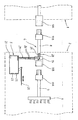
- the drawing shows schematically the structure of the power supply device for a trailer, including the electrical interface to the towing vehicle.
- the trailer 2 is connected in the usual way via a drawbar with the towing vehicle 1, wherein the drawbar is not shown in the drawing.
- the trailer 2 is provided with an electromechanical additional brake system 5, a so-called roll stop system.
- a so-called roll stop system which supplements the trailer side provided overrun brake and in this case engages in the function of the overrun brake, z. B. in the patent application DE 10 2007 036 909 described.
- the roll stop system operates electromechanically, thus has to achieve or enhance the braking force via a arranged in a device housing 21 electric motor for driving on a brake linkage 20.
- connections 22 for an acceleration sensor and connections 23 for indicator lights are Further arranged on the device housing 21 .
- connections 22 for an acceleration sensor and connections 23 for indicator lights are Further arranged on the device housing 21 .
- an acceleration sensor for the electric motor, but also for the integrated electronic control of the roll stop system, a sufficient electrical power supply is required. Since the trailer vehicle 2 does not have its own battery, the power and voltage is supplied by the electrical system of the towing vehicle. 1
- the towing vehicle 1 is provided with a multi-pole electrical socket 11A, for example a 13-pin socket according to the widely used in Europe standard ISO 11446. Usually, this is close to the coupling pin for the trailer drawbar attached.
- a multi-pole electrical socket 11A for example a 13-pin socket according to the widely used in Europe standard ISO 11446. Usually, this is close to the coupling pin for the trailer drawbar attached.
- an electrical distributor 9 typically, such electrical distributor 9 are centrally located in the trailer 2, to have from there the shortest electrical paths to the individual internal consumers of the trailer vehicle, such as the interior lighting, a refrigerator or stove, a TV connection or the like.
- caravan connections use 7-pin ISO 1724 and ISO 3732 connectors with the permanent plus path in the ISO 3732 connector.
- the vehicle trailers have twice seven poles, or even thirteen poles, so an adapter from thirteen poles to twice seven poles is used.
- the plug 10A of the supply cable 7, which is already present on the trailer 2 is not connected directly to the socket 11A of the towing vehicle 1, but indirectly with the interposition of an adapter 6, which forms an additional wire harness 8.
- the plug 10B at the towing vehicle end of the wiring harness 8 is designed identically to the plug 10A and has the same polarity.
- an electrical socket 11 B At the rear end of the cable harness 8 is an electrical socket 11 B, which is connectable to the plug 10 A.
- the structure and the polarity of the bushing 11B are again identical to the bushing 11A fastened to the towing vehicle 1.
- the wiring harness 8 has a sufficient excess length, so that it easily sags in a straight aligned vehicle combination, without it comes at high cornering tearing of the connecting cable.
- the auxiliary brake system 5 For safe operation of the auxiliary brake system 5 while driving, the auxiliary brake system 5 operates with priority over the other, connected to the electrical distributor 9 electrical loads of the trailer 2.
- the permanent positive path 25 of the additional wiring harness 8 in the bypass 26 via the positive contact of the electric Additional brake system 5 out.
- the additional brake system 5 comes almost the full Supply voltage, as provided by the electrical system of the towing vehicle 1 available. Due to the reduced and through the wiring harness 8 always the same supply paths for the supply of the additional brake system accounts for performance differences that are due to varying ohmic line losses.
- the unit 5 can be put out of action in a few simple steps and the supply of the internal consumers connected to the electrical distributor 9 can be restored. This may even be expressly intended, for. B. during prolonged driving on a campsite on a bad surface and at low speed to selectively suppress any false triggering of the anti-roll system 5.
- a switch in the region of the socket 11B of the adapter 6, with which the roll stop system 5 can be disabled.
- the switch preferably acts on a grounding path 27.
- the grounding path 27 connects in the form of a branch the continuous grounding path 28 of the wiring harness 8 with the corresponding electrical connections of the auxiliary brake system 5.
- the additional wiring harness 8 terminates in a connector housing 14 of the adapter 6, to which the socket 11B is located for the connector 10A present on the trailer side.
- the bypass 26 in this connector housing 14 are the beginning and end of the bypass 26 in this connector housing 14, as well as the branch for the ground path 27th
- the connector housing 14 structurally in the device housing 21 of the auxiliary brake system 5, especially in practice, the additional brake system 5 is arranged anyway in the trailer towbar and thus in that area of the trailer, in which the adapter 6 is located.
- connection of the trailer-side connector 10 A with the socket 11 B of the wiring harness 8 may be permanent.
- Plug 10A and / or socket 11B may therefore be placed in the region of the trailer drawbar, z. B. by screwing or clamping. Because when disconnecting the vehicle combination of the wiring harness 8 remains including attached to the ends of contacting the socket 11 B and connector 10 B on the trailer vehicle 2. Therefore, only the plug 10 B of the adapter is separated from the zug mecanic permanently installed socket 11 A.
Landscapes
- Engineering & Computer Science (AREA)
- Transportation (AREA)
- Mechanical Engineering (AREA)
- Physics & Mathematics (AREA)
- Fluid Mechanics (AREA)
- Braking Systems And Boosters (AREA)
- Details Of Connecting Devices For Male And Female Coupling (AREA)
- Regulating Braking Force (AREA)
Abstract
Description
- Die Erfindung betrifft eine Stromversorgungseinrichtung für ein auflaufgebremstes Anhängerfahrzeug, welches mit einem elektrischen Zusatzbremssystem, z. B. einem Schlingerstoppsystem, sowie weiteren elektrischen Verbrauchern versehen ist, mit einem ausgehend von einem mehrpoligen Stecker bis zu einem elektrischen Verteiler im Anhängerfahrzeug führenden Versorgungskabel, wobei der mehrpolige Stecker korrespondierend zu einer am Zugfahrzeug befestigten, mehrpoligen Buchse ausgestaltet ist.
- Aus Gründen der Fahrsicherheit werden auflaufgebremste Anhängerfahrzeuge, d.h. Anhängerfahrzeuge, deren Bremsen mechanisch in Abhängigkeit von der Verzögerung des Zugfahrzeugs betätigt werden, mit Zusatzbremssystemen ausgestattet. Diese werden entweder eingesetzt, um in Ergänzung zu der mechanischen Auflaufbremsung die Bremsleistung am Anhänger zu erhöhen, oder um unabhängig von den Fahrzuständen des Zugfahrzeuges, etwa zum Ausgleich von Schlingerbewegungen des Anhängerfahrzeuges, gezielt nur das Anhängerfahrzeug ein- oder beidseitig abzubremsen.
- Zusatzbremssysteme zur Vermeidung bzw. Unterdrückung eines Schlingerns des Anhängerfahrzeuges sind aus der
DE 296 07 092 U1 und der AnmeldungDE 10 2007 036 909 A1 bekannt. Bei derartigen Schlingerstoppsystemen ist ein mit elektrischem Antrieb arbeitendes Bremsaggregat im vorderen Teil des Anhängers nahe dessen Zugdeichsel installiert. Ein auf die Fahrzeugbremse wirkendes Zugelement, welches bei Betätigung des Zusatzbremssystems im Kraftfluss liegt, ist durch ein Betätigungselement von einer Ausgangsstellung in eine Betätigungsstellung bewegbar, und beaufschlagt hierbei über einen Kopplungspunkt die Anhängerbremse. Als Betätigungselement kommt ein Elektromotor zum Einsatz, dessen Betrieb eine ausreichende Versorgungsspannung erfordert. Da Anhängerfahrzeuge häufig über keine eigene Batterie verfügen, erfolgt die Spannungsversorgung über die Batterie bzw. das Bordnetz des Zugfahrzeuges. - Vor allem bei Wohnanhängern erfolgt die Spannungsversorgung über ein anhängerseitiges flexibles Anschlusskabel, dessen mehrpoliger Stecker korrespondierend zu einer am Zugfahrzeug befestigten, mehrpoligen Buchse ausgestaltet ist. Stecker und Buchse sind für Wohnanhänger und andere leichte Anhängerfahrzeuge in der Europäischen Union genormt. Neben der genannten Spannungsversorgung der internen elektrischen Verbraucher des Anhängers übernehmen sie, elektrisch getrennt, noch verschiedene weitere Funktionen, etwa die Signalübertragung der Bremslichtsignale oder Warnblinksignale. Zur Versorgung der internen elektrischen Verbraucher des Anhängers führt das Anschlusskabel zu einem zumeist zentral innerhalb des Fahrzeuganhängers angeordneten Verteiler, z. B. einem Klemmenkasten oder einer Verteilerdose. An diesen Verteiler ist auch das Zusatzbremssystem mittels entsprechender elektrischer Versorgungsleitungen angeschlossen. Um allerdings eine Überlastung der bordeigenen Sicherungen des Anhängerfahrzeuges durch Einsatz des Zusatzbremssystems zu vermeiden, wird mittels geeigneter Schalter oder Relais sichergestellt, dass dem Zusatzbremssystem im Bedarfsfall eine ausschließliche Spannungsversorgung zur Verfügung steht, wohingegen die anderen internen Verbraucher des Anhängers für diesen Zeitraum von der Spannungsversorgung getrennt sind.
- Diese Prioritätsschaltung des Zusatzbremssystems führt zu relativ langen Kabellängen, wodurch es zu einem Übersteigen der durch technische Normen festgelegten, maximal zulässigen Kabellängen in Anhängerfahrzeugen kommen kann.
- Der Erfindung liegt daher die Aufgabe zugrunde, unter Beachtung der Bestimmungen zur Länge von Kabelverbindungen den Montageaufwand für die Stromversorgung des Zusatzbremssystems zu verringern.
- Zur Lösung dieser Aufgabe ist eine Stromversorgungseinrichtung für ein auflaufgebremstes Anhängerfahrzeug gemäß Oberbegriff gekennzeichnet durch einen den anhängerseitigen Stecker mit der zugfahrzeugseitigen Buchse elektrisch verbindenden Leitungsstrang, dessen Dauerpluspfad im Bypass über den Pluskontakt des elektrischen Zusatzbremssystems geführt ist.
- Gemäß einer Ausgestaltung der erfindungsgemäßen Stromversorgungseinrichtung ist der Leitungsstrang zumindest zum Zugfahrzeug hin als biegsamer Kabelstrang ausgebildet, der in einem in die zugfahrzeugseitige Buchse einsteckbaren, zweiten Stecker endet. Mit einer weiteren Ausgestaltung wird vorgeschlagen, dass der Leitungsstrang zum Anhänger hin in einem Steckverbindergehäuse endet, in das der anhängerseitige Stecker einsteckbar ist. Vorzugsweise befinden sich Anfang und Ende des Bypasses innerhalb dieses Steckverbindergehäuses.
- Mit einer weiteren Ausgestaltung wird vorgeschlagen, dass das Steckverbindergehäuse baulich in ein Gerätegehäuse des elektrischen Zusatzbremssystems integriert ist. Mit einer weiteren Ausgestaltung der Erfindung wird vorgeschlagen, dass parallel zum Dauerpluspfad der Massepfad des Leitungsstrangs abgegriffen wird.
- Mit einer weiteren Ausgestaltung wird vorgeschlagen, dass die zwischen der zugfahrzeugseitigen Buchse und dem Pluskontakt des elektrischen Zusatzbremssystems gemessene Gesamtlänge des Dauerpluspfades nicht mehr als 1,5 m beträgt, so dass die elektrischen Leitungswiderstände keine zu hohen Werte annehmen.
- Weitere Vorteile und Einzelheiten werden im Folgenden anhand eines auf der Zeichnung dargestellten Ausführungsbeispiels beschrieben. Die Zeichnung stellt schematisch den Aufbau der Stromversorgungseinrichtung für ein Anhängerfahrzeug dar, einschließlich der elektrischen Schnittstelle zum Zugfahrzeug.
- Mit 1 ist das Zugfahrzeug, z. B. ein Pkw, und mit 2 das Anhängerfahrzeug, z. B. ein Wohnanhänger, bezeichnet. Der Anhänger 2 ist in üblicher Weise über eine Deichsel mit dem Zugfahrzeug 1 verbunden, wobei die Deichsel auf der Zeichnung nicht dargestellt ist. Zur Erhöhung der Fahrsicherheit in labilen Fahrsituationen ist der Anhänger 2 mit einem elektromechanischen Zusatzbremssystem 5, einem sogenannten Schlingerstoppsystem, versehen. Ein derartiges System, welches die anhängerseitig vorgesehene Auflaufbremse ergänzt und hierbei in die Funktion der Auflaufbremse eingreift, ist z. B. in der Patentanmeldung
DE 10 2007 036 909 beschrieben. Das Schlingerstoppsystem arbeitet elektromechanisch, verfügt also zur Erzielung oder Verstärkung der Bremskraft über einen in einem Gerätegehäuse 21 angeordneten Elektromotor zum Antrieb auf ein Bremsgestänge 20. Ferner angeordnet am Gerätegehäuse 21 sind Anschlüsse 22 für einen Beschleunigungssensor sowie Anschlüsse 23 für Kontrollleuchten. Für den Elektromotor, jedoch auch für die integrierte elektronische Steuerung des Schlingerstoppsystems, ist eine ausreichende elektrische Spannungsversorgung erforderlich. Da das Anhängerfahrzeug 2 über keine eigene Batterie verfügt, erfolgt die Strom- und Spannungsversorgung durch das elektrische Bordnetz des Zugfahrzeuges 1. - Zur Versorgung der verschiedenen elektrischen Verbraucher des Anhängerfahrzeuges 2 einschließlich des Zusatzbremssystems 5 ist das Zugfahrzeug 1 mit einer mehrpoligen elektrischen Buchse 11A versehen, z.B. einer 13-poligen Buchse nach dem in Europa weit verbreiteten Standard ISO 11446. Üblicherweise ist diese nahe des Kupplungszapfens für die Anhängerzugdeichsel befestigt. Zur Verstellung der elektrischen Verbindung mit dem Anhängerfahrzeug 2 dient dann ein entsprechender 13-poliger Stecker nach ebenfalls Standard ISO 11446, von dem aus die Anschlussverkabelungzu einem elektrischen Verteiler 9 führt. Üblicherweise sind derartige elektrische Verteiler 9 zentral im Anhängerfahrzeug 2 angeordnet, um von dort die kürzesten elektrischen Wege zu den einzelnen internen Verbrauchern des Anhängerfahrzeuges zu haben, etwa der Innenbeleuchtung, einem Kühlschrank oder Herd, einem TV-Anschluss oder dergleichen. In Großbritannien sind bei Wohnwagenanschlüssen auch 7-polige Stecker nach ISO 1724 und ISO 3732 in Gebrauch, wobei sich der Dauerpluspfad in dem ISO 3732 Anschluss befindet. In diesen Fällen haben die Fahrzeuganhänger zweimal sieben Pole oder einmal dreizehn Pole, daher wird ein Adapter von dreizehn Polen auf zweimal sieben Pole verwendet.
- Im Rahmen der Erfindung wird der am Anhänger 2 ohnehin vorhandene Stecker 10A des Versorgungskabels 7 nicht unmittelbar an die Steckbuchse 11A des Zugfahrzeuges 1 angeschlossen, sondern mittelbar unter Zwischenschaltung eines Adapters 6, der einen zusätzlichen Leitungsstrang 8 bildet. Der Stecker 10B am zugfahrzeugseitigen Ende des Leitungsstrangs 8 ist identisch zu dem Stecker 10A gestaltet und weist dieselbe Polung auf. Am rückwärtigen Ende des Leitungsstranges 8 befindet sich eine elektrische Buchse 11B, die mit dem Stecker 10A verbindbar ist. Der Aufbau und die Polung der Buchse 11B sind wiederum identisch zu der am Zugfahrzeug 1 befestigten Buchse 11A.
- Zum Anschluss an das elektrische Bordnetz des Zugfahrzeuges 1 ist der die Funktion des Anschlusskabels übernehmende Leitungsstrang auf seiner überwiegenden Länge biegsam, so dass er, sobald der Stecker 10B in die zugfahrzeugseitige Buchse 11A eingesteckt und daran verriegelt ist, die im Fahrbetrieb auftretenden Relativbewegungen zwischen Zugfahrzeug und Anhänger auszugleichen vermag. Zu diesem Zweck weist der Leitungsstrang 8 eine ausreichende Überlänge auf, so dass er bei gerade ausgerichtetem Fahrzeuggespann leicht durchhängt, ohne dass es bei starker Kurvenfahrt zu einem Abreißen des Anschlusskabels kommt.
- Für einen sicheren Betrieb des Zusatzbremssystems 5 im Fahrbetrieb arbeitet das Zusatzbremssystem 5 mit Priorität gegenüber den übrigen, an dem elektrischen Verteiler 9 angeschlossenen elektrischen Verbrauchern des Anhängers 2. Zu diesem Zweck ist der Dauerpluspfad 25 des zusätzlichen Leitungsstrangs 8 im Bypass 26 über den Pluskontakt des elektrischen Zusatzbremssystems 5 geführt. Auf dem Weg vom elektrischen Bordnetz des Zugfahrzeuges zu dem elektrischen Verteiler 9 des Anhängers nimmt der Dauerpluspfad 25 daher nicht den direkten Weg, sondern den Umweg über den elektrischen Anschluss des Zusatzbremssystems. Dies führt aber zu einem deutlich verkürzten Strompfad bis zum Zusatzbremssystem, so dass elektrische Leistungsverluste aufgrund ohmscher Leitungswiderstände reduziert werden. Am Zusatzbremssystem 5 kommt nahezu die volle Versorgungsspannung an, wie sie vom elektrischen Bordnetz des Zugfahrzeuges 1 zur Verfügung gestellt wird. Durch die reduzierten und durch den Leitungsstrang 8 immer gleich langen Versorgungswege für die Versorgung des Zusatzbremssystems entfallen Leistungsstreuungen, die auf variierende ohmsche Leitungsverluste zurückzuführen sind.
- Durch die Verbindbarkeit wie Trennbarkeit einerseits von Stecker 10A und Buchse 11B und andererseits von Stecker 10B und Buchse 11A ist nicht nur die Montage, sondern auch die Demontage des Schlingerstoppsystems 5 auf sehr einfache Art und Weise möglich. So kann im Fall eines Gerätedefekts die Einheit 5 mit wenigen Handgriffen außer Betrieb gesetzt und die Versorgung der am elektrischen Verteiler 9 angeschlossenen internen Verbraucher wieder hergestellt werden. Dies kann sogar ausdrücklich gewollt sein, z. B. bei längerer Fahrt auf einen Campingplatz auf schlechtem Untergrund und mit niedriger Geschwindigkeit, um etwaige Fehlauslösungen des Schlingerstoppsystems 5 gezielt zu unterdrücken.
- Ferner ist es möglich, im Bereich der Buchse 11B des Adapters 6 einen Schalter anzuordnen, mit dem sich das Schlingerstoppsystem 5 außer Kraft setzen lässt. Der Schalter wirkt vorzugsweise auf einen Massepfad 27. Der Massepfad 27 verbindet in Gestalt einer Abzweigung den durchgehenden Massepfad 28 des Leitungsstrangs 8 mit den entsprechenden elektrischen Anschlüssen des Zusatzbremssystems 5.
- Bei dem dargestellten Ausführungsbeispiel endet der zusätzliche Leitungsstrang 8 in einem Steckverbindergehäuse 14 des Adapters 6, an welchem sich die Buchse 11B für den anhängerseitig vorhandenen Stecker 10A befindet. In konstruktiv einfacher Weise befinden sich Anfang und Ende des Bypasses 26 in diesem Steckverbindergehäuses 14, ebenso der Abzweig für den Massepfad 27.
- Alternativ ist es auch möglich, das Steckverbindergehäuse 14 baulich in das Gerätegehäuse 21 des Zusatzbremssystems 5 zu integrieren, zumal in der Praxis das Zusatzbremssystem 5 ohnehin im Bereich der Anhängerdeichsel angeordnet ist und damit in jenem Bereich des Anhängers, in welchem sich der Adapter 6 befindet.
- Im Praxiseinsatz kann die Verbindung des anhängerseitigen Steckers 10A mit der Buchse 11B des Leitungsstrangs 8 dauerhaft sein. Stecker 10A und/oder Buchse 11B können daher im Bereich der Anhängerdeichsel gelegt sein, z. B. durch Verschrauben oder Festklemmen. Denn beim Trennen des Fahrzeuggespanns verbleibt der Leitungsstrang 8 einschließlich der an dessen Enden befestigten Kontaktierungselemente Buchse 11B und Stecker 10B am Anhängerfahrzeug 2. Getrennt wird daher nur der Stecker 10B des Adapters von der zugfahrzeugseitig fest installierten Buchse 11A.
-
- 1
- Zugfahrzeug
- 2
- Anhängerfahrzeug
- 5
- Zusatzbremssystem, Schlingerstoppsystem
- 6
- Adapter
- 7
- Versorgungskabel
- 8
- Leitungsstrang
- 9
- elektrischer Verteiler
- 10A
- Stecker
- 10B
- Stecker
- 11A
- Buchse
- 11B
- Buchse
- 14
- Steckverbindergehäuse
- 20
- Bremsgestänge
- 21
- Gerätegehäuse
- 22
- Anschluss
- 23
- Anschluss
- 25
- Dauerpluspfad
- 26
- Bypass
- 27
- Massepfad
- 28
- Massepfad
Claims (7)
- Stromversorgungseinrichtung für ein auflaufgebremstes Anhängerfahrzeug, welches mit einem elektrischen Zusatzbremssystem (5), z. B. einem Schlingerstoppsystem, sowie weiteren elektrischen Verbrauchern versehen ist, mit einem ausgehend von einem mehrpoligen Stecker (10A) bis zu einem elektrischen Verteiler (9) im Anhängerfahrzeug führenden Versorgungskabel (7), wobei der mehrpolige Stecker (10A) korrespondierend zu einer am Zugfahrzeug befestigten, mehrpoligen Buchse (11A) ausgestaltet ist, gekennzeichnet durch einen den anhängerseitigen Stecker (10A) mit der zugfahrzeugseitigen Buchse (11A) elektrisch verbindenden Leitungsstrang (8), dessen Dauerpluspfad (25) im Bypass (26) über den Pluskontakt des elektrischen Zusatzbremssystems (5) geführt ist.
- Stromversorgungseinrichtung nach Anspruch 1, dadurch gekennzeichnet, dass der Leitungsstrang (8) zumindest zum Zugfahrzeug hin als biegsamer Kabelstrang ausgebildet ist, der in einem in die zugfahrzeugseitige Buchse (11A) einsteckbaren, zweiten Stecker (10B) endet.
- Stromversorgungseinrichtung nach Anspruch 1 oder 2, dadurch gekennzeichnet, dass der Leitungsstrang (8) zum Anhänger hin in einem Steckverbindergehäuse (14) endet, in das der anhängerseitige Stecker (10A) einsteckbar ist.
- Stromversorgungseinrichtung nach Anspruch 3, dadurch gekennzeichnet, dass sich Anfang und Ende des Bypasses(26) innerhalb des Steckverbindergehäuses (14) befinden.
- Stromversorgungseinrichtung nach Anspruch 3 oder 4, dadurch gekennzeichnet, dass das Steckverbindergehäuse (14) baulich in ein Gerätegehäuse (21) des elektrischen Zusatzbremssystems (5) integriert ist.
- Stromversorgungseinrichtung nach einem der vorangehenden Ansprüche, dadurch gekennzeichnet, dass parallel zum Dauerpluspfad (25) der Massepfad (28) des Leitungsstrangs (8) abgegriffen wird.
- Stromversorgungseinrichtung nach einem der vorangehenden Ansprüche, dadurch gekennzeichnet, dass die zwischen der zugfahrzeugseitigen Buchse (11A) und dem Pluskontakt des elektrischen Zusatzbremssystems (5) gemessene Gesamtlänge des Dauerpluspfads (25) nicht mehr als 1,5 m beträgt.
Applications Claiming Priority (1)
| Application Number | Priority Date | Filing Date | Title |
|---|---|---|---|
| DE102008044941A DE102008044941A1 (de) | 2008-08-29 | 2008-08-29 | Stromversorgungseinrichtung für ein auflaufgebremstes Anhängerfahrzeug |
Publications (3)
| Publication Number | Publication Date |
|---|---|
| EP2161145A2 true EP2161145A2 (de) | 2010-03-10 |
| EP2161145A3 EP2161145A3 (de) | 2012-11-28 |
| EP2161145B1 EP2161145B1 (de) | 2014-04-02 |
Family
ID=41395060
Family Applications (1)
| Application Number | Title | Priority Date | Filing Date |
|---|---|---|---|
| EP20090168976 Not-in-force EP2161145B1 (de) | 2008-08-29 | 2009-08-28 | Stromversorgungseinrichtung für ein auflaufgebremstes Anhängerfahrzeug |
Country Status (2)
| Country | Link |
|---|---|
| EP (1) | EP2161145B1 (de) |
| DE (1) | DE102008044941A1 (de) |
Families Citing this family (3)
| Publication number | Priority date | Publication date | Assignee | Title |
|---|---|---|---|---|
| DE102013109488A1 (de) * | 2013-08-30 | 2015-03-05 | Gebr. Vitte Gmbh & Co. | An einem Zugfahrzeug befestigbarer Anhänger |
| CN113232466B (zh) * | 2021-05-21 | 2022-11-08 | 福建盛海智能科技有限公司 | 一种拖车撞刹 |
| DE202024104835U1 (de) | 2024-08-27 | 2024-09-05 | Knott Gmbh | Stützradbaugruppe für einen Fahrzeuganhänger sowie Verstelleinheit |
Citations (1)
| Publication number | Priority date | Publication date | Assignee | Title |
|---|---|---|---|---|
| DE102007036909A1 (de) | 2007-08-06 | 2009-02-12 | Bpw Bergische Achsen Kg | Zusatzbremssystem und Lösevorrichtung für Zusatzbremssysteme zur Betätigung der Bremsen auflaufgebremster Anhängerfahrzeuge |
Family Cites Families (5)
| Publication number | Priority date | Publication date | Assignee | Title |
|---|---|---|---|---|
| DE29607092U1 (de) | 1996-04-19 | 1996-10-17 | Lubs, Wolfgang, 50996 Köln | Elektronisches Antischlinger-System |
| DE19643014C1 (de) * | 1996-10-18 | 1998-08-13 | Telefunken Microelectron | Bussystem zur elektronischen Energieversorgung |
| DE29800542U1 (de) * | 1998-01-07 | 1998-03-26 | Erich Jaeger GmbH & Co KG, 61350 Bad Homburg | Steckdose für mehrpolige Steckvorrichtungen |
| US6280004B1 (en) * | 1999-05-19 | 2001-08-28 | John C. Greaves, Jr. | Brake control system for balanced braking of a towed vehicle |
| DE10021232B4 (de) * | 2000-04-29 | 2014-05-15 | Westfalia-Automotive Gmbh | Anhängerkupplung |
-
2008
- 2008-08-29 DE DE102008044941A patent/DE102008044941A1/de not_active Withdrawn
-
2009
- 2009-08-28 EP EP20090168976 patent/EP2161145B1/de not_active Not-in-force
Patent Citations (1)
| Publication number | Priority date | Publication date | Assignee | Title |
|---|---|---|---|---|
| DE102007036909A1 (de) | 2007-08-06 | 2009-02-12 | Bpw Bergische Achsen Kg | Zusatzbremssystem und Lösevorrichtung für Zusatzbremssysteme zur Betätigung der Bremsen auflaufgebremster Anhängerfahrzeuge |
Also Published As
| Publication number | Publication date |
|---|---|
| DE102008044941A1 (de) | 2010-03-04 |
| EP2161145B1 (de) | 2014-04-02 |
| EP2161145A3 (de) | 2012-11-28 |
Similar Documents
| Publication | Publication Date | Title |
|---|---|---|
| EP1967393B1 (de) | Elektrische Anhängeranschlusseinrichtung | |
| DE102007054189B4 (de) | Bremssteuermodul | |
| DE102016114176B3 (de) | Elektromechanischer Schutzschalter für einen Batterieverteilerkasten eines Kraftfahrzeugs sowie entsprechenden Batterieverteilerkasten | |
| EP2423029A2 (de) | Mobile Ladevorrichtung für Elektrofahrräder, Stromanschlusselement und Ladegerät für Elektrofahrräder | |
| DE4424471A1 (de) | Elektrisches Anhängeranschlußgerät für ein Zugfahrzeug | |
| EP2161145B1 (de) | Stromversorgungseinrichtung für ein auflaufgebremstes Anhängerfahrzeug | |
| DE102011001650B4 (de) | Vorrichtung zur Stromversorgung von Einparkhilfen für Kraftfahrzeuge mit Anhängerkupplung | |
| DE10300464A1 (de) | Bordnetz eines Kraftfahrzeugs | |
| EP1031730A2 (de) | Vorrichtung zur Befestigung von pneumatischen und/oder elektropneumatischen Einrichtungen eines Fahrzeugs | |
| DE102009044055A1 (de) | Elektrische Anschlusseinheit für ein Anhängerfahrzeug | |
| EP2352655B1 (de) | Anschlussanordnung für ein anhängefahrzeug, sowie anhängefahrzeug | |
| DE102010051584A1 (de) | Schaltungsanordnung in einem Zugfahrzeug sowie einem Anhänger | |
| DE1172134B (de) | Einrichtung zum UEberwachen elektrischer Steckverbindungen zwischen ziehendem Kraft-fahrzeug und Anhaengern | |
| EP3944970A1 (de) | Anhängeranschlussgerät | |
| DE202010015919U1 (de) | Schaltungsanordnung für ein Fahrzeug | |
| EP2913208A1 (de) | Anhängekupplung mit einer Fahrzeug-Kontakteinheit | |
| DE10063802C2 (de) | Einrichtung zum Erkennen eines an einem Zugfahrzeug angekuppelten Anhängers | |
| DE19625001C1 (de) | Einrichtung zur Versorgung einer Betriebsleuchte eines Anhängers oder Lasttragmittels bei einem Kraftfahrzeug | |
| DE3334087C2 (de) | Bremsanlage für einen im Rahmen eines Gespannes als Zugwagen einsetzbaren Personenkraftwagen | |
| DE102005028026A1 (de) | Kupplungssystem | |
| EP3944973A1 (de) | Anhängeranschlussgerät mit stromabnahme-überwachung | |
| EP3944972A1 (de) | Anhängeranschlussgerät mit verbessertem nebelschlussleuchten-betrieb | |
| DE10047471A1 (de) | Anhänger-Erkennungsschaltung | |
| DE102009044056A1 (de) | Fahrzeugbeleuchtungssystem mit einer Lichtsteuereinheit | |
| DE102013109488A1 (de) | An einem Zugfahrzeug befestigbarer Anhänger |
Legal Events
| Date | Code | Title | Description |
|---|---|---|---|
| PUAI | Public reference made under article 153(3) epc to a published international application that has entered the european phase |
Free format text: ORIGINAL CODE: 0009012 |
|
| AK | Designated contracting states |
Kind code of ref document: A2 Designated state(s): AT BE BG CH CY CZ DE DK EE ES FI FR GB GR HR HU IE IS IT LI LT LU LV MC MK MT NL NO PL PT RO SE SI SK SM TR |
|
| AX | Request for extension of the european patent |
Extension state: AL BA RS |
|
| PUAL | Search report despatched |
Free format text: ORIGINAL CODE: 0009013 |
|
| AK | Designated contracting states |
Kind code of ref document: A3 Designated state(s): AT BE BG CH CY CZ DE DK EE ES FI FR GB GR HR HU IE IS IT LI LT LU LV MC MK MT NL NO PL PT RO SE SI SK SM TR |
|
| AX | Request for extension of the european patent |
Extension state: AL BA RS |
|
| RIC1 | Information provided on ipc code assigned before grant |
Ipc: B60T 13/08 20060101ALI20121025BHEP Ipc: B60D 1/24 20060101ALI20121025BHEP Ipc: B60D 1/62 20060101ALI20121025BHEP Ipc: B60T 7/20 20060101ALI20121025BHEP Ipc: B60T 13/74 20060101ALI20121025BHEP Ipc: B60T 8/17 20060101ALI20121025BHEP Ipc: B60D 1/30 20060101AFI20121025BHEP |
|
| 17P | Request for examination filed |
Effective date: 20130422 |
|
| RIC1 | Information provided on ipc code assigned before grant |
Ipc: B60T 8/17 20060101ALI20130507BHEP Ipc: B60D 1/30 20060101AFI20130507BHEP Ipc: B60D 1/62 20060101ALI20130507BHEP Ipc: B60D 1/24 20060101ALI20130507BHEP Ipc: B60T 7/20 20060101ALI20130507BHEP Ipc: B60T 13/08 20060101ALI20130507BHEP Ipc: B60T 13/74 20060101ALI20130507BHEP |
|
| GRAP | Despatch of communication of intention to grant a patent |
Free format text: ORIGINAL CODE: EPIDOSNIGR1 |
|
| INTG | Intention to grant announced |
Effective date: 20131030 |
|
| GRAS | Grant fee paid |
Free format text: ORIGINAL CODE: EPIDOSNIGR3 |
|
| GRAA | (expected) grant |
Free format text: ORIGINAL CODE: 0009210 |
|
| AK | Designated contracting states |
Kind code of ref document: B1 Designated state(s): AT BE BG CH CY CZ DE DK EE ES FI FR GB GR HR HU IE IS IT LI LT LU LV MC MK MT NL NO PL PT RO SE SI SK SM TR |
|
| REG | Reference to a national code |
Ref country code: GB Ref legal event code: FG4D Free format text: NOT ENGLISH |
|
| RIN1 | Information on inventor provided before grant (corrected) |
Inventor name: MANZ, STEFAN Inventor name: SCHNEIDER, PETER |
|
| REG | Reference to a national code |
Ref country code: AT Ref legal event code: REF Ref document number: 659850 Country of ref document: AT Kind code of ref document: T Effective date: 20140415 Ref country code: CH Ref legal event code: EP |
|
| REG | Reference to a national code |
Ref country code: IE Ref legal event code: FG4D Free format text: LANGUAGE OF EP DOCUMENT: GERMAN |
|
| REG | Reference to a national code |
Ref country code: DE Ref legal event code: R096 Ref document number: 502009009092 Country of ref document: DE Effective date: 20140508 |
|
| REG | Reference to a national code |
Ref country code: NL Ref legal event code: T3 |
|
| REG | Reference to a national code |
Ref country code: LT Ref legal event code: MG4D |
|
| PG25 | Lapsed in a contracting state [announced via postgrant information from national office to epo] |
Ref country code: LT Free format text: LAPSE BECAUSE OF FAILURE TO SUBMIT A TRANSLATION OF THE DESCRIPTION OR TO PAY THE FEE WITHIN THE PRESCRIBED TIME-LIMIT Effective date: 20140402 Ref country code: BG Free format text: LAPSE BECAUSE OF FAILURE TO SUBMIT A TRANSLATION OF THE DESCRIPTION OR TO PAY THE FEE WITHIN THE PRESCRIBED TIME-LIMIT Effective date: 20140702 Ref country code: GR Free format text: LAPSE BECAUSE OF FAILURE TO SUBMIT A TRANSLATION OF THE DESCRIPTION OR TO PAY THE FEE WITHIN THE PRESCRIBED TIME-LIMIT Effective date: 20140703 Ref country code: NO Free format text: LAPSE BECAUSE OF FAILURE TO SUBMIT A TRANSLATION OF THE DESCRIPTION OR TO PAY THE FEE WITHIN THE PRESCRIBED TIME-LIMIT Effective date: 20140702 Ref country code: IS Free format text: LAPSE BECAUSE OF FAILURE TO SUBMIT A TRANSLATION OF THE DESCRIPTION OR TO PAY THE FEE WITHIN THE PRESCRIBED TIME-LIMIT Effective date: 20140802 Ref country code: CZ Free format text: LAPSE BECAUSE OF FAILURE TO SUBMIT A TRANSLATION OF THE DESCRIPTION OR TO PAY THE FEE WITHIN THE PRESCRIBED TIME-LIMIT Effective date: 20140402 Ref country code: FI Free format text: LAPSE BECAUSE OF FAILURE TO SUBMIT A TRANSLATION OF THE DESCRIPTION OR TO PAY THE FEE WITHIN THE PRESCRIBED TIME-LIMIT Effective date: 20140402 Ref country code: CY Free format text: LAPSE BECAUSE OF FAILURE TO SUBMIT A TRANSLATION OF THE DESCRIPTION OR TO PAY THE FEE WITHIN THE PRESCRIBED TIME-LIMIT Effective date: 20140402 |
|
| PG25 | Lapsed in a contracting state [announced via postgrant information from national office to epo] |
Ref country code: ES Free format text: LAPSE BECAUSE OF FAILURE TO SUBMIT A TRANSLATION OF THE DESCRIPTION OR TO PAY THE FEE WITHIN THE PRESCRIBED TIME-LIMIT Effective date: 20140402 Ref country code: HR Free format text: LAPSE BECAUSE OF FAILURE TO SUBMIT A TRANSLATION OF THE DESCRIPTION OR TO PAY THE FEE WITHIN THE PRESCRIBED TIME-LIMIT Effective date: 20140402 Ref country code: SE Free format text: LAPSE BECAUSE OF FAILURE TO SUBMIT A TRANSLATION OF THE DESCRIPTION OR TO PAY THE FEE WITHIN THE PRESCRIBED TIME-LIMIT Effective date: 20140402 Ref country code: LV Free format text: LAPSE BECAUSE OF FAILURE TO SUBMIT A TRANSLATION OF THE DESCRIPTION OR TO PAY THE FEE WITHIN THE PRESCRIBED TIME-LIMIT Effective date: 20140402 Ref country code: PL Free format text: LAPSE BECAUSE OF FAILURE TO SUBMIT A TRANSLATION OF THE DESCRIPTION OR TO PAY THE FEE WITHIN THE PRESCRIBED TIME-LIMIT Effective date: 20140402 |
|
| REG | Reference to a national code |
Ref country code: DE Ref legal event code: R082 Ref document number: 502009009092 Country of ref document: DE Representative=s name: BUNGARTZ CHRISTOPHERSEN PARTNERSCHAFT MBB PATE, DE |
|
| PG25 | Lapsed in a contracting state [announced via postgrant information from national office to epo] |
Ref country code: PT Free format text: LAPSE BECAUSE OF FAILURE TO SUBMIT A TRANSLATION OF THE DESCRIPTION OR TO PAY THE FEE WITHIN THE PRESCRIBED TIME-LIMIT Effective date: 20140804 |
|
| REG | Reference to a national code |
Ref country code: DE Ref legal event code: R097 Ref document number: 502009009092 Country of ref document: DE |
|
| PG25 | Lapsed in a contracting state [announced via postgrant information from national office to epo] |
Ref country code: EE Free format text: LAPSE BECAUSE OF FAILURE TO SUBMIT A TRANSLATION OF THE DESCRIPTION OR TO PAY THE FEE WITHIN THE PRESCRIBED TIME-LIMIT Effective date: 20140402 Ref country code: RO Free format text: LAPSE BECAUSE OF FAILURE TO SUBMIT A TRANSLATION OF THE DESCRIPTION OR TO PAY THE FEE WITHIN THE PRESCRIBED TIME-LIMIT Effective date: 20140402 Ref country code: SK Free format text: LAPSE BECAUSE OF FAILURE TO SUBMIT A TRANSLATION OF THE DESCRIPTION OR TO PAY THE FEE WITHIN THE PRESCRIBED TIME-LIMIT Effective date: 20140402 Ref country code: DK Free format text: LAPSE BECAUSE OF FAILURE TO SUBMIT A TRANSLATION OF THE DESCRIPTION OR TO PAY THE FEE WITHIN THE PRESCRIBED TIME-LIMIT Effective date: 20140402 |
|
| PLBE | No opposition filed within time limit |
Free format text: ORIGINAL CODE: 0009261 |
|
| STAA | Information on the status of an ep patent application or granted ep patent |
Free format text: STATUS: NO OPPOSITION FILED WITHIN TIME LIMIT |
|
| 26N | No opposition filed |
Effective date: 20150106 |
|
| PG25 | Lapsed in a contracting state [announced via postgrant information from national office to epo] |
Ref country code: LU Free format text: LAPSE BECAUSE OF FAILURE TO SUBMIT A TRANSLATION OF THE DESCRIPTION OR TO PAY THE FEE WITHIN THE PRESCRIBED TIME-LIMIT Effective date: 20140828 Ref country code: MC Free format text: LAPSE BECAUSE OF FAILURE TO SUBMIT A TRANSLATION OF THE DESCRIPTION OR TO PAY THE FEE WITHIN THE PRESCRIBED TIME-LIMIT Effective date: 20140402 Ref country code: IT Free format text: LAPSE BECAUSE OF FAILURE TO SUBMIT A TRANSLATION OF THE DESCRIPTION OR TO PAY THE FEE WITHIN THE PRESCRIBED TIME-LIMIT Effective date: 20140402 |
|
| REG | Reference to a national code |
Ref country code: CH Ref legal event code: PL |
|
| REG | Reference to a national code |
Ref country code: DE Ref legal event code: R097 Ref document number: 502009009092 Country of ref document: DE Effective date: 20150106 |
|
| PG25 | Lapsed in a contracting state [announced via postgrant information from national office to epo] |
Ref country code: CH Free format text: LAPSE BECAUSE OF NON-PAYMENT OF DUE FEES Effective date: 20140831 Ref country code: LI Free format text: LAPSE BECAUSE OF NON-PAYMENT OF DUE FEES Effective date: 20140831 Ref country code: BE Free format text: LAPSE BECAUSE OF NON-PAYMENT OF DUE FEES Effective date: 20140831 |
|
| REG | Reference to a national code |
Ref country code: IE Ref legal event code: MM4A |
|
| PG25 | Lapsed in a contracting state [announced via postgrant information from national office to epo] |
Ref country code: SI Free format text: LAPSE BECAUSE OF FAILURE TO SUBMIT A TRANSLATION OF THE DESCRIPTION OR TO PAY THE FEE WITHIN THE PRESCRIBED TIME-LIMIT Effective date: 20140402 |
|
| PG25 | Lapsed in a contracting state [announced via postgrant information from national office to epo] |
Ref country code: IE Free format text: LAPSE BECAUSE OF NON-PAYMENT OF DUE FEES Effective date: 20140828 |
|
| REG | Reference to a national code |
Ref country code: AT Ref legal event code: MM01 Ref document number: 659850 Country of ref document: AT Kind code of ref document: T Effective date: 20140828 |
|
| PG25 | Lapsed in a contracting state [announced via postgrant information from national office to epo] |
Ref country code: AT Free format text: LAPSE BECAUSE OF NON-PAYMENT OF DUE FEES Effective date: 20140828 |
|
| PG25 | Lapsed in a contracting state [announced via postgrant information from national office to epo] |
Ref country code: SM Free format text: LAPSE BECAUSE OF FAILURE TO SUBMIT A TRANSLATION OF THE DESCRIPTION OR TO PAY THE FEE WITHIN THE PRESCRIBED TIME-LIMIT Effective date: 20140402 |
|
| PG25 | Lapsed in a contracting state [announced via postgrant information from national office to epo] |
Ref country code: MT Free format text: LAPSE BECAUSE OF FAILURE TO SUBMIT A TRANSLATION OF THE DESCRIPTION OR TO PAY THE FEE WITHIN THE PRESCRIBED TIME-LIMIT Effective date: 20140402 |
|
| PG25 | Lapsed in a contracting state [announced via postgrant information from national office to epo] |
Ref country code: TR Free format text: LAPSE BECAUSE OF FAILURE TO SUBMIT A TRANSLATION OF THE DESCRIPTION OR TO PAY THE FEE WITHIN THE PRESCRIBED TIME-LIMIT Effective date: 20140402 Ref country code: HU Free format text: LAPSE BECAUSE OF FAILURE TO SUBMIT A TRANSLATION OF THE DESCRIPTION OR TO PAY THE FEE WITHIN THE PRESCRIBED TIME-LIMIT; INVALID AB INITIO Effective date: 20090828 |
|
| REG | Reference to a national code |
Ref country code: FR Ref legal event code: PLFP Year of fee payment: 8 |
|
| REG | Reference to a national code |
Ref country code: FR Ref legal event code: PLFP Year of fee payment: 9 |
|
| PG25 | Lapsed in a contracting state [announced via postgrant information from national office to epo] |
Ref country code: MK Free format text: LAPSE BECAUSE OF FAILURE TO SUBMIT A TRANSLATION OF THE DESCRIPTION OR TO PAY THE FEE WITHIN THE PRESCRIBED TIME-LIMIT Effective date: 20140402 |
|
| REG | Reference to a national code |
Ref country code: FR Ref legal event code: PLFP Year of fee payment: 10 |
|
| PGFP | Annual fee paid to national office [announced via postgrant information from national office to epo] |
Ref country code: DE Payment date: 20180905 Year of fee payment: 10 Ref country code: FR Payment date: 20180824 Year of fee payment: 10 Ref country code: NL Payment date: 20180822 Year of fee payment: 10 |
|
| PGFP | Annual fee paid to national office [announced via postgrant information from national office to epo] |
Ref country code: GB Payment date: 20180828 Year of fee payment: 10 |
|
| REG | Reference to a national code |
Ref country code: DE Ref legal event code: R119 Ref document number: 502009009092 Country of ref document: DE |
|
| REG | Reference to a national code |
Ref country code: NL Ref legal event code: MM Effective date: 20190901 |
|
| GBPC | Gb: european patent ceased through non-payment of renewal fee |
Effective date: 20190828 |
|
| PG25 | Lapsed in a contracting state [announced via postgrant information from national office to epo] |
Ref country code: NL Free format text: LAPSE BECAUSE OF NON-PAYMENT OF DUE FEES Effective date: 20190901 Ref country code: FR Free format text: LAPSE BECAUSE OF NON-PAYMENT OF DUE FEES Effective date: 20190831 Ref country code: DE Free format text: LAPSE BECAUSE OF NON-PAYMENT OF DUE FEES Effective date: 20200303 |
|
| PG25 | Lapsed in a contracting state [announced via postgrant information from national office to epo] |
Ref country code: GB Free format text: LAPSE BECAUSE OF NON-PAYMENT OF DUE FEES Effective date: 20190828 |