EP2144809B1 - Entlüftungstürsystem mit hebelmechanismus - Google Patents
Entlüftungstürsystem mit hebelmechanismus Download PDFInfo
- Publication number
- EP2144809B1 EP2144809B1 EP08769382.6A EP08769382A EP2144809B1 EP 2144809 B1 EP2144809 B1 EP 2144809B1 EP 08769382 A EP08769382 A EP 08769382A EP 2144809 B1 EP2144809 B1 EP 2144809B1
- Authority
- EP
- European Patent Office
- Prior art keywords
- lever
- vent door
- arm
- door
- vent
- Prior art date
- Legal status (The legal status is an assumption and is not a legal conclusion. Google has not performed a legal analysis and makes no representation as to the accuracy of the status listed.)
- Active
Links
Images




Classifications
-
- E—FIXED CONSTRUCTIONS
- E05—LOCKS; KEYS; WINDOW OR DOOR FITTINGS; SAFES
- E05B—LOCKS; ACCESSORIES THEREFOR; HANDCUFFS
- E05B17/00—Accessories in connection with locks
- E05B17/0025—Devices for forcing the wing firmly against its seat or to initiate the opening of the wing
- E05B17/0033—Devices for forcing the wing firmly against its seat or to initiate the opening of the wing for opening only
-
- B—PERFORMING OPERATIONS; TRANSPORTING
- B64—AIRCRAFT; AVIATION; COSMONAUTICS
- B64C—AEROPLANES; HELICOPTERS
- B64C1/00—Fuselages; Constructional features common to fuselages, wings, stabilising surfaces or the like
- B64C1/14—Windows; Doors; Hatch covers or access panels; Surrounding frame structures; Canopies; Windscreens accessories therefor, e.g. pressure sensors, water deflectors, hinges, seals, handles, latches, windscreen wipers
- B64C1/1407—Doors; surrounding frames
-
- Y—GENERAL TAGGING OF NEW TECHNOLOGICAL DEVELOPMENTS; GENERAL TAGGING OF CROSS-SECTIONAL TECHNOLOGIES SPANNING OVER SEVERAL SECTIONS OF THE IPC; TECHNICAL SUBJECTS COVERED BY FORMER USPC CROSS-REFERENCE ART COLLECTIONS [XRACs] AND DIGESTS
- Y10—TECHNICAL SUBJECTS COVERED BY FORMER USPC
- Y10T—TECHNICAL SUBJECTS COVERED BY FORMER US CLASSIFICATION
- Y10T292/00—Closure fasteners
- Y10T292/68—Keepers
- Y10T292/696—With movable dog, catch or striker
Definitions
- This invention relates generally to vent door systems and, more particularly, to vent door systems that include lever mechanisms to open the vent door against the pressure caused by ice buildup.
- Vents are used countless applications to provide an entrance or exit for the flow of air. When it is necessary to control whether air flows through a vent, then a vent door is typically used.
- An example of where vent doors are used is on the passenger doors of commercial aircraft. Vents allow the pressure inside the aircraft to be equalized with the pressure on the outside of the aircraft after the aircraft lands.
- One problem with conventional vent doors is ice build-up. Ice build-up occurs particularly when the air temperature on one side of the vent door is much lower than the air temperature on the other side of the vent door. This causes ice to build up on the vent door. When the ice builds up around the edges of the door, it can cause the door to become stuck in a closed position.
- US 5031863 discloses a hatch assembly for closing an overwing emergency exit opening formed in the body of an aircraft.
- the hatch includes a pair of hinge arms for swinging the hatch between closed and fully open positions and has a pressure relief vent.
- the vent has a link that simply pulls the vent inwardly to relieve air pressure.
- An embodiment of the present invention provides a vent door system according to claim 1.
- the vent door system includes a vent door.
- a cam is disposed on the vent door.
- the cam has a groove defined on it.
- the system also includes a movement assembly, which includes a roller, which is disposed within the groove, and a lever coupled to the movement assembly. A portion of the lever extends beyond and proximate to the perimeter of the vent door.
- the lever can be one of at least two levers.
- the second lever can be attached to a surface beyond the periphery of the vent door.
- a first portion of the cam can be attached to the vent door, and a second portion of the cam can be pivotally attached to a surface outside of the vent door.
- the movement assembly can also include a first arm, a second arm, and a rod, with the first and second arms being connected to the rod such that, when the rod rotates about its longitudinal axis, the first and second arms move correspondingly, the first arm being coupled to the lever, the roller being attached to the second arm.
- the cam can be a first cam
- the system can further include a second cam disposed on the vent door generally parallel to and facing the first cam, the second cam having defined thereon a groove.
- the movement assembly can include a third arm having a roller that is disposed within the groove, with the third arm being connected to the rod.
- the lever can be pivotally attached to the vent door, and the movement assembly includes an arm that is coupled to the lever when the vent door is opened. During opening of the vent door, the arm urges the portion of the lever that extends beyond the vent door against a surface that is beyond the vent door. Also, when the vent door enters a partially open position, the arm can decouple from the lever.
- the vent door can include a generally planar panel, and a wall that surrounds and is generally perpendicular to the panel.
- the panel and the wall define a cavity, and a generally planar member is disposed within the cavity and attached to the panel.
- the cam can be attached to the member.
- the movement assembly can include an arm with a hooked end.
- the lever can have a first end that protrudes beyond the periphery of the vent door, and a second end.
- the hooked end of the arm is coupled to the second end of the lever when the vent door is in its closed position.
- the lever can be pivotally attached to the door. In this arrangement, when the movement assembly pulls the door toward its open position, the hooked end of the arm pulls on the second end of the lever, causing the lever to pivot, and urging the first end of the lever against a surface that is beyond the periphery of the door.
- the vent door system can include a cam attached to the door.
- the cam can have a groove defined on it, and the movement assembly includes an arm to which the roller is attached, such that when the arm pivots, the roller rolls along the groove and thereby urges the cam and the vent door away from a vent.
- the cam can have a first portion attached to the vent door, and a second portion pivotally attached to a surface outside of the vent door.
- the cam can have defined thereon a groove
- the movement assembly can include a first arm, a second arm having a roller attached thereto, and a rod.
- the first and second arms can be connected to the rod such that, when the rod rotates about its longitudinal axis, the first and second arms move correspondingly.
- the first arm can be coupled to the lever, and the roller is disposed within the groove.
- the lever can be pivotally attached to the vent door.
- the movement assembly includes an arm that is coupled to the lever when the vent door is opened and, during opening of the vent door, urges the portion of the lever that extends beyond the vent door against a surface that is beyond the vent door.
- the vent door can have a generally planar panel, and a wall that surrounds and is generally perpendicular to the panel. The panel and the wall define a cavity, and a generally planar member can be disposed within the cavity and attached to the panel.
- the movement assembly can be attached to the generally planar member.
- the aircraft door can have a vent and a vent door having an open position and a closed position.
- the vent door is seated within the vent when the vent door is in the closed position.
- the system also includes a rod disposed proximate to the vent door, and a first arm and a second arm attached to the rod.
- the first and second arms are generally perpendicular to the rod.
- the first arm has a hooked end and the second arm has a roller attached to it.
- the system also includes a cam having a first portion that is attached to the vent door and a second portion that is pivotally attached to a surface of the aircraft door. Defined on the cam is a groove, in which the roller is disposed.
- the system further includes a lever pivotally attached to the vent door, with one end of the lever being coupled to the hooked end of the first arm when the vent door is in the closed position.
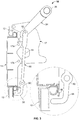
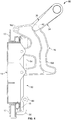
- FIGS. 1-8 illustrate examples of the vent door system according to various embodiments of the present invention.
- the system generally labeled 10, is integrated with an aircraft door 8 in this example.
- the aircraft door 8 has a vent opening 9 (shown in FIG. 6 ), around which a vent door frame 12 is disposed.
- the vent door frame 12 is attached to the aircraft door 8.
- the system also includes a vent door 14, which has an open position and a closed position.
- a flexible seal 13 is attached to the vent door 14. When in its closed position, a peripheral lip 15 of the vent door 14 is seated against the seal 13 and within the opening around which the vent door frame 12 is disposed.
- the vent door 14 includes a front panel 18 and a wall 20.
- the front panel 18 and the wall 20 define a cavity 22.
- the vent door 14 further includes a first generally planar member 24 and a second generally planar member 26 that are integrally formed with the front panel 18 and run along the length of the vent door 14.
- the vent door 14 further includes a first rib 27 and a second rib 28, also integrally formed with the first panel 18.
- Attached to the vent door 14 are two brackets 62 and 64. The brackets 62 and 64 are fastened to the vent door 14 by bolts.
- the vent door system 10 further includes a first cam 16 and a second cam 17. Both the first and second cams 16 and 17 are shown in FIG. 1 . In FIGS. 2 , 3 , and 7 , only the second cam 17 is shown. In FIGS. 4 , 5 , 6 , and 8 , only the first cam 16 is shown.
- the first cam 16 is attached to the vent door 14 at points 16a and 16b, while the second cam 17 is attached to the vent door 14 at points 17a & 17b.
- the vent door frame 12 also includes a hinge 19.
- the first cam 16 is attached to the hinge 19 at point 16c, which the second cam 17 is attached to the hinge 19 at point 17c.
- the first can 16 has defined thereon a groove 16d.
- the second cam 17 has defined thereon a groove 17d.
- the vent door 14 moves from its open position to its closed position and vice versa via the movement of the first and second cams 16 and 17.
- the first and second cams 16 and 17 pivot about the hinge 19, taking the attached vent door 14 with them.
- the lever 50 is an elongated member that has a first end 52, a middle portion 54 and a second end 56.
- the first end 52 has two generally planar members 52a and 52b that face one another and are generally parallel to each other. Between the two planar members 52a and 52b is a gap.
- a pin 58 connects the two planar members 52a and 52b across the gap.
- the middle portion 54 of the lever 50 is generally solid. Between the middle portion 54 and the second end 56 is a rounded portion 60.
- the second end 56 of the lever 50 is generally solid and hooks at about a 90 degree angle.
- the lever 50 is attached to the vent door 14 by a bolt 58 that extends through a sleeve 51 that passes through a hole in the rounded portion 60 of the lever 50 and is anchored by the brackets 62 and 64.
- the lever 50 pivots about the sleeve 51.
- the vent door system 10 also includes movement assembly, which imparts the force to the first and second cams 16 and 17 necessary to move the vent door 14 from its open to its closed position and vice versa.
- the movement assembly generally labelled 30, includes a rod 32 (shown in FIG. 1 ) that is rotatable around its longitudinal axis, a first arm 34 [referred to as 'an arm (34)' in the attached claims], second arm 36 [referred to as 'a further arm (36)' in the attached claims] and third arm 38 that are attached to the rod 32.
- the first arm 34 has a first end 35, which is attached to the rod 32, and a second end 37, which is hooked.
- the second arm 36 has a first end and a second end. The first end of the second arm 36 is attached to the rod 32.
- a roller 40 Disposed on the second end of the second arm is a roller 40.
- the third arm 38 has a first end and a second end. The first end of the third arm 38 is attached to the rod 32.
- a roller 42 Disposed on the second end of the third arm 38 is a roller 42.
- the roller 40 of the second arm 36 is disposed in the groove 16d of the first cam 16, and the roller 42 of the third arm 38 is disposed within the groove 17d of the second cam 17.
- the rollers 40 and 42 rotate against the profile of the respective grooves 16d and 17d of the first cam 16 and the second cam 17, and the first and second arms 36 and 38 pull the first and second cams 16 and 17 in proportion to the profile of the grooves.
- This pulling force causes the cams 16 and 17, along with the vent door 14, to pivot counterclockwise (from the perspective of FIGS. 4-6 ) about the hinge 19.
- the first arm 34 decouples from the lever 50.
- the vent door 14 will have opened about 45 degrees.
- the rod 32 rotates clockwise (from the perspective of FIGS.
- the vent door system 10 includes a second lever 70 that is attached to the aircraft door 8 by a pivot 72.
- the second lever 70 has a first section 74 and a second section 76.
- the first section 74 is disposed between the second section 76 and the door 8 and has a hole through which the pivot 72 passes.
- the second section 76 is disposed on top of the first section 74 and is between the first section 74 and the second end 56 of the lever 50.
- the first section 74 has a first portion 78 that slopes at an acute angle relative to the door 8, and a second portion 80 that curves upward to a point that is substantially vertical relative to the door 8.
- the second lever 70 is disposed within a depression 82 of the door 8, so that it sits below the lever of the vent door 14. When the vent door 14 is in the closed position, the tip of the second portion 80 is just below or touches the peripheral lip 15 of the vent door 14.
- the remaining portions of the vent door system 10 have the same structures shown in FIGS. 1-6 and previously described.
- the rod 32 rotates (counterclockwise from the perspective of FIGS. 7-8 ). This rotation causes the first arm 34, the second arm 36 and the third arm 38 to rotate at or near 5 degrees (also counterclockwise from the perspective FIGS. 7-8 ).
- the rotation of the first arm 34 pushes the lever 50 against the first portion 78 of the second section 74 of second lever 70.
- the second lever 70 rotates clockwise about the pivot 72.
- the second portion 80 of the second section 74 of the second lever 70 pushes upward against the lip 15 of the vent door 14 thereby breaking ice that may have been formed between the vent door 14 and the frame 12.
- the rollers 40 and 42 rotate against the profile of the respective grooves 16d and 17d of the first cam 16 and the second cam 17, and the first and second arms 36 and 38 pull the first and second cams 16 and 17 in proportion to the profile of the grooves.
- This pulling force causes the cams 16 and 17, along with the vent door 14, to pivot counterclockwise (from the perspective of FIGS. 7-8 ) about the hinge 19 in the same fashion as shown in the description of the previous embodiment in FIGS. 4-6 .
- the first arm 34 decouples from the lever 50.
- the vent door 14 will have opened about 45 degrees.
- the rod 32 rotates clockwise (from the perspective of FIGS. 7-8 ), thereby moving the first, second and third arms 34, 36 and 38 clockwise.
- the action of the second and third arms 36 and 38 along with the rollers 40 and 42 force the first and second cams 16 and 17 to rotate clockwise (from the perspective of FIGS. 7-8 ) about the hinge 19, which moves the vent door 14 into its closed position.
- the first arm 34 reconnects with the first lever 50.
Landscapes
- Engineering & Computer Science (AREA)
- Mechanical Engineering (AREA)
- Aviation & Aerospace Engineering (AREA)
- Specific Sealing Or Ventilating Devices For Doors And Windows (AREA)
- Air-Conditioning For Vehicles (AREA)
Claims (12)
- Entlüftungstürsystem, Folgendes umfassend:eine Entlüftungstür (14);eine Fläche hinter der Entlüftungstür (14);eine Nocke, angeordnet auf der Entlüftungstür (14), wobei die Nocke (16) eine darauf definierte Nut (16d) aufweist;eine Bewegungsbaugruppe (30), umfassend eine Walze (40), einen ersten Arm (34) und einen zweiten Arm (36), wobei die Walze in der Nut (16d) angeordnet ist, der zweite Arm (36) an der Walze (40) angebracht ist, so dass, wenn der zweite Arm (36) schwenkt, die Walze (40) entlang der Nut (16d) rollt und dabei die Nocke (16) und die Entlüftungstür (14) zwingt, sich von einer Entlüftungsöffnung (9) wegzuschwenken;einen Hebel (50), der an den ersten Arm (34) gekoppelt ist, wobei ein Abschnitt des Hebels (50) sich über den Umfang und neben der Entlüftungstür (14) erstreckt;eine Stange (32) mit einer Längsachse, wobei der erste Arm (34) und der zweite Arm (36) mit der Stange (32) verbunden und so angeordnet sind, dass sie sich um die Längsachse schwenken, dergestalt, dass sich der erste Arm (34) und der zweite Arm (36) entsprechend bewegen; unddergestalt, dass, wenn die Stange (32) sich um ihre Längsachse schwenkt, der zweite Arm (36) die Walze (40) veranlasst, entlang der Nut (16d) zu rollen, der erste Arm (34) den Hebel (50) zum Schwenken veranlasst und dabei den Abschnitt am Hebel (50), der sich über die Entlüftungstür (14) hinaus erstreckt, gegen die Fläche hinter der Entlüftungstür (14) in eine entgegengesetzte Richtung zu der Richtung zwingt, in der sich die Entlüftungstür (14) öffnet und dabei die Entlüftungstür (14) zum Öffnen zwingt.
- System gemäß Anspruch 1, wobei die Nocke (16) eine erste Nocke ist, das System ferner eine zweite Nocke (17) umfasst, die auf der Entlüftungstür (14) allgemein parallel und der ersten Nocke (16) zugewandt angeordnet ist, wobei die zweite Nocke (17) darauf eine Nut (17d) definiert hat, die Bewegungsbaugruppe (30) ferner einen dritten Arm (38) umfasst, wobei der dritte Arm eine Walze (42) hat, die innerhalb der Nut (17d) der zweiten Nocke (17) angeordnet ist, wobei der dritte Arm (38) mit der Stange (32) verbunden ist.
- System gemäß Anspruch 1, wobei
die Entlüftungstür (14) an einer Tür (8) eines Flugzeuges angebracht ist und wenigstens eine Öffnungsposition hat;
der Hebel (50) schwenkbar an der Entlüftungstür angebracht ist;
der Hebel (50) ein erster Hebel ist, der an den ersten Arm (34) gekoppelt ist, wenn die Entlüftungstür (14) sich in ihrer geschlossenen Position befindet, und vom ersten Arm (34) abgekoppelt ist, wenn die Entlüftungstür (14) sich in ihrer offenen Position befindet, wobei das System ferner umfasst:
einen zweiten Hebel (70), der schwenkbar an der Flugzeugtür (8) angebracht ist, wobei die Fläche hinter der Entlüftungstür (14) sich an einem ersten Abschnitt (78) des zweiten Hebels (70) befindet und in Kontakt mit dem ersten Hebel (50) ist, und ein zweiter Abschnitt (80) des zweiten Hebels (70) in Kontakt mit der Entlüftungstür (14) ist. - System gemäß Anspruch 3, wobei sich der erste Abschnitt (78) und der zweite Abschnitt (80) des zweiten Hebels (70) auf gegenüberliegenden Seiten des Schwenkpunkts des zweiten Hebels (70) befinden.
- System gemäß Anspruch 3, wobei der erste Arm (34) ein hakenförmiges Ende (37) hat und der erste Hebel (50) ein erstes Ende (52) hat, das den Abschnitt bereitstellt, der sich über den Umfang der Entlüftungstür (14) hinaus erstreckt, und ein zweites Ende (56) hat, wobei das hakenförmige Ende (37) des ersten Arms (34) an das zweite Ende (56) des ersten Hebels (50) gekoppelt ist, wenn sich die Entlüftungstür (14) in ihrer geschlossenen Position befindet.
- System gemäß Anspruch 5, wobei, wenn die Bewegungsbaugruppe (30) die Entlüftungstür (14) in ihre offene Position zieht, das hakenförmige Ende (37) des ersten Arms (34) an dem zweiten Ende (56) des ersten Hebels (50) zieht und den ersten Hebel (50) zum Schwenken veranlasst und das erste Ende (52) des ersten Hebels (50) gegen die Fläche auf dem ersten Abschnitt (78) des zweiten Hebels (70) drückt.
- System gemäß Anspruch 3, wobei die Nocke (16) eine erste Nocke ist, das System ferner eine zweite Nocke (17) umfasst, die an der Entlüftungstür (14) allgemein parallel und der ersten Nocke (16) zugewandt angeordnet ist, wobei die zweite Nocke (17) darauf eine Nut (17d) definiert hat, wobei die Bewegungsbaugruppe (30) einen dritten Arm (38) beinhaltet, an dem eine Walze (42) angebracht ist, so dass, wenn der dritte Arm (38) schwenkt, die Walze (42) des dritten Arms (38) entlang der Nut (17d) der zweiten Nocke (17) läuft und dadurch die zweite Nocke (17) und die Entlüftungstür (14) von einer Entlüftungsöffnung (9) der Flugzeugtür (8) wegdrückt.
- System nach Anspruch 3, wobei der erste Hebel (50) schwenkbar an der Entlüftungstür (14) angebracht ist und der erste Arm (34) während des Öffnens der Entlüftungstür (14) auf den Abschnitt des ersten Hebels (50) drückt, der sich über die Entlüftungstür (14) hinaus gegen den zweiten Hebel (70) erstreckt, der wiederum schwenkt und Druck auf eine Peripherielippe (15) der Entlüftungstür (14) ausübt und dadurch die Entlüftungstür (14) zum Öffnen zwingt.
- System gemäß Anspruch 1, wobei die Entlüftungstür (14) eine allgemein ebene Platte (18), eine Wand (20), welche die Platte (18) umgibt und allgemein senkrecht zu der Platte (18) ist, wobei die Platte und die Wand einen Hohlraum (22) definieren, sowie ein allgemein ebenes Bauteil (24) umfasst, das innerhalb des Hohlraums (22) angeordnet und an der Platte (18) angebracht ist, und wobei die Nocke (16) an dem Bauteil (24) angebracht ist.
- System gemäß Anspruch 1, ferner umfassend eine Flugzeugtür (8) mit einer darin definierten Entlüftungsöffnung (9), wobei, wenn die Entlüftungstür (14) sich in einer geschlossenen Position befindet, die Entlüftungstür (14) innerhalb der Entlüftungsöffnung (9) sitzt.
- System gemäß Anspruch 1, ferner umfassend:eine Flugzeugtür (8) mit einer Entlüftungsöffnung (9),wobei die Entlüftungstür (14) eine offene Position und eine geschlossene Position hat, die Entlüftungstür (14) innerhalb der Entlüftungsöffnung (9) sitzt, wenn die Entlüftungstür (14) sich in der geschlossenen Position befindet;wobei die Stange (32) neben der Entlüftungstür (14) angeordnet ist;wobei der erste Arm (34) und der zweite Arm (36) allgemein senkrecht zur Stange (32) sind, der Arm (34) ein hakenförmiges Ende (37) hat,die Nocke (16) einen ersten Abschnitt, der an der Entlüftungstür (14) angebracht ist, und einen zweiten Abschnitt hat, der schwenkbar an einer Fläche der Flugzeugtür (8) angebracht ist, wobei der Hebel (50) ein erster Hebel ist, ein erstes Ende (52) des ersten Hebels (50) an das hakenförmige Ende (37) des ersten Arms (34) gekoppelt ist, wenn sich die Entlüftungstür (14) in der geschlossenen Position befindet, und sich ein zweites Ende (56) des ersten Hebels (50), das den Abschnitt bereitstellt, über den Umfang der Entlüftungstür (14) hinaus erstreckt; undeinen zweiten Hebel (70), auf dem sich die Fläche hinter der Entlüftungstür (14) befindet, wobei der zweite Hebel (70) schwenkbar an der Flugzeugtür (8) angebracht ist, das zweite Ende des ersten Hebels (50) den zweiten Hebel (70) zwingt, sich als Reaktion auf die Bewegung des ersten Arms (34) zu schwenken, wobei der zweite Hebel (70) die Entlüftungstür (14) als Reaktion auf den ausgeübten Zwang durch das zweite Ende des ersten Hebels (50) in die offene Position zwingt.
- System gemäß Anspruch 1, wobei die Entlüftungstür (14) eine allgemein ebene Platte (18), eine Wand (20), welche die Platte (18) umgibt und allgemein senkrecht zu der Platte ist, wobei die Platte und die Wand einen Hohlraum (22) definieren und ein allgemein ebenes Bauteil (24) innerhalb des Hohlraums (22) angeordnet und an der Platte (18) angebracht ist, und wobei die Bewegungsbaugruppe (30) an dem allgemein ebenen Bauteil (24) angebracht ist.
Applications Claiming Priority (2)
| Application Number | Priority Date | Filing Date | Title |
|---|---|---|---|
| US92843507P | 2007-05-09 | 2007-05-09 | |
| PCT/US2008/063199 WO2008141146A1 (en) | 2007-05-09 | 2008-05-09 | Vent door system with lever mechanism |
Publications (3)
| Publication Number | Publication Date |
|---|---|
| EP2144809A1 EP2144809A1 (de) | 2010-01-20 |
| EP2144809A4 EP2144809A4 (de) | 2015-10-14 |
| EP2144809B1 true EP2144809B1 (de) | 2018-07-11 |
Family
ID=39968655
Family Applications (1)
| Application Number | Title | Priority Date | Filing Date |
|---|---|---|---|
| EP08769382.6A Active EP2144809B1 (de) | 2007-05-09 | 2008-05-09 | Entlüftungstürsystem mit hebelmechanismus |
Country Status (4)
| Country | Link |
|---|---|
| US (1) | US7900870B2 (de) |
| EP (1) | EP2144809B1 (de) |
| RU (1) | RU2476349C2 (de) |
| WO (1) | WO2008141146A1 (de) |
Families Citing this family (10)
| Publication number | Priority date | Publication date | Assignee | Title |
|---|---|---|---|---|
| US20120267475A1 (en) * | 2011-04-20 | 2012-10-25 | Fernando Campos | Acoustic seal for aircraft |
| DE102011114643B4 (de) * | 2011-09-30 | 2016-03-24 | Airbus Operations Gmbh | Betätigungsvorrichtung zum Öffnen einer Notausgangsklappe einer Cockpittür |
| FR3006993B1 (fr) | 2013-06-14 | 2018-01-05 | Latecoere | Procede et systeme d'antigivrage / degivrage de porte d'aeronef et porte d'aeronef equipee d'un tel systeme |
| US9517830B2 (en) * | 2014-03-18 | 2016-12-13 | The Boeing Company | Seal design for vehicle and structure application |
| US10240389B2 (en) * | 2015-09-30 | 2019-03-26 | Arconic Inc. | Pressure relief door |
| RU2685634C1 (ru) * | 2018-04-03 | 2019-04-22 | Публичное акционерное общество "Научно-производственная корпорация "Иркут" | Устройство управления дверью самолёта |
| BR102021018231A2 (pt) * | 2020-11-05 | 2022-05-17 | The Boeing Company | Conjunto de travamento de pressão coaxial |
| CN112591071B (zh) * | 2020-12-17 | 2022-03-15 | 中航沈飞民用飞机有限责任公司 | 一种舱门提升开启破冰机构 |
| CN112550665B (zh) * | 2021-02-24 | 2021-04-30 | 中国空气动力研究与发展中心低速空气动力研究所 | 一种基于弹性蒙皮的飞机除冰装置 |
| EP4098555B1 (de) * | 2021-06-01 | 2023-08-02 | Airbus Operations GmbH | Türeinheit für ein fahrzeug |
Family Cites Families (14)
| Publication number | Priority date | Publication date | Assignee | Title |
|---|---|---|---|---|
| GB1291854A (en) * | 1969-02-07 | 1972-10-04 | British Aircraft Corp Ltd | Aircraft doors |
| US4125235A (en) * | 1977-04-04 | 1978-11-14 | The Boeing Company | Apparatus for opening an aircraft door and for arming and disarming an escape slide deploying mechanism |
| US4473201A (en) * | 1982-10-29 | 1984-09-25 | The Boeing Company | Canopy-type aircraft cargo door and actuating mechanisms |
| US4497462A (en) * | 1983-03-28 | 1985-02-05 | The Boeing Company | Outward opening electrically powered plug-type cargo door |
| SU1736844A1 (ru) * | 1989-06-19 | 1992-05-30 | Саратовский Авиационный Институт | Устройство навески и креплени двери летательного аппарата |
| US5031863A (en) | 1989-12-21 | 1991-07-16 | The Boeing Company | Upward/outward opening, plug-type overwing emergency exit hatch |
| US5305969A (en) * | 1991-07-16 | 1994-04-26 | The Boeing Company | Aircraft door latch lock mechanism |
| US5337977A (en) * | 1993-01-29 | 1994-08-16 | The Boeing Company | Vent-latch interlock assembly for an aircraft door |
| US5931415A (en) * | 1997-05-09 | 1999-08-03 | The Boeing Company | Plug-type overwing emergency exit door assembly |
| US5846127A (en) * | 1997-12-04 | 1998-12-08 | Kile; Walter F. | Apparatus for venting |
| FR2794717B1 (fr) * | 1999-06-10 | 2001-09-28 | D Aviat Latecoere Soc Ind | Perfectionnements aux portes de soutes pour aeronefs |
| DE10020825B4 (de) * | 2000-04-28 | 2006-08-24 | Eurocopter Deutschland Gmbh | Verfahren und Vorrichtung zum Schliessen einer Tür eines Flugzeuges |
| US6454210B1 (en) * | 2000-07-13 | 2002-09-24 | Wesley M. Plattner | Aircraft vent and cargo door locking mechanism |
| FR2864021B1 (fr) * | 2003-12-19 | 2006-05-26 | Lacroix Soc E | Dispositif de commande a deplacement d'un element de fermeture pour vehicule |
-
2008
- 2008-05-09 RU RU2009145523/11A patent/RU2476349C2/ru active
- 2008-05-09 EP EP08769382.6A patent/EP2144809B1/de active Active
- 2008-05-09 WO PCT/US2008/063199 patent/WO2008141146A1/en not_active Ceased
- 2008-05-09 US US12/118,080 patent/US7900870B2/en active Active
Non-Patent Citations (1)
| Title |
|---|
| None * |
Also Published As
| Publication number | Publication date |
|---|---|
| WO2008141146A1 (en) | 2008-11-20 |
| US7900870B2 (en) | 2011-03-08 |
| RU2476349C2 (ru) | 2013-02-27 |
| US20080277530A1 (en) | 2008-11-13 |
| EP2144809A1 (de) | 2010-01-20 |
| RU2009145523A (ru) | 2011-06-20 |
| EP2144809A4 (de) | 2015-10-14 |
Similar Documents
| Publication | Publication Date | Title |
|---|---|---|
| EP2144809B1 (de) | Entlüftungstürsystem mit hebelmechanismus | |
| US8342920B2 (en) | Outflow valve having J-shaped bellmouth and cabin pressure control system employing the same | |
| EP1438473B1 (de) | Druckerfassungsriegel | |
| EP3792174B1 (de) | Türmechanismus | |
| EP3356628B1 (de) | Druckentlastungsklappe | |
| EP2885205B1 (de) | Türanordnung für flugzeuginnenraum | |
| US9707831B2 (en) | Active glass retention system | |
| EP3219526B1 (de) | Gerät für ein fenster | |
| EP3336291B1 (de) | Doppelriegelanordnung für zu öffnende strukturen | |
| EP3170750B1 (de) | Faltablassventil zur schubwiederherstellung mit stauluftklappe | |
| US9630700B2 (en) | Device for opening an aircraft door | |
| EP2567895B1 (de) | Ablassventil zur Schubwiederherstellung mit einer einzigen zweifachen Tür und Verfahren zur Steuerung des Flugzeugkabinendrucks | |
| US11820484B2 (en) | Aircraft door having a mechanism for conditional opening along two trajectories | |
| US7887106B2 (en) | Floor lock | |
| CN115432167A (zh) | 用于交通工具的门单元 | |
| WO2002076777A1 (en) | Arrangement in hatch structure | |
| US10472041B2 (en) | System and method for flag door operation | |
| KR101536893B1 (ko) | 문 닫힘 제어 기능을 갖는 경첩 | |
| US7331547B2 (en) | Device for facilitating the lowering of a landing gear by gravity | |
| CN209365859U (zh) | 一种自动伸缩侧门系统 | |
| US9873513B2 (en) | Cabin outflow valves having laterally-tapered sealing surfaces and cabin pressure control systems employing the same | |
| US20100019184A1 (en) | Valve seal with integral flexure joints | |
| US20200190875A1 (en) | Locking element stable under panel distortion | |
| GB2573504A (en) | A vehicle sliding door | |
| JP6792993B2 (ja) | 止水扉 |
Legal Events
| Date | Code | Title | Description |
|---|---|---|---|
| PUAI | Public reference made under article 153(3) epc to a published international application that has entered the european phase |
Free format text: ORIGINAL CODE: 0009012 |
|
| 17P | Request for examination filed |
Effective date: 20091106 |
|
| AK | Designated contracting states |
Kind code of ref document: A1 Designated state(s): AT BE BG CH CY CZ DE DK EE ES FI FR GB GR HR HU IE IS IT LI LT LU LV MC MT NL NO PL PT RO SE SI SK TR |
|
| AX | Request for extension of the european patent |
Extension state: AL BA MK RS |
|
| DAX | Request for extension of the european patent (deleted) | ||
| REG | Reference to a national code |
Ref country code: HK Ref legal event code: DE Ref document number: 1139630 Country of ref document: HK |
|
| RA4 | Supplementary search report drawn up and despatched (corrected) |
Effective date: 20150910 |
|
| RIC1 | Information provided on ipc code assigned before grant |
Ipc: B64C 1/14 20060101AFI20150904BHEP Ipc: E05B 17/00 20060101ALI20150904BHEP |
|
| STAA | Information on the status of an ep patent application or granted ep patent |
Free format text: STATUS: EXAMINATION IS IN PROGRESS |
|
| 17Q | First examination report despatched |
Effective date: 20161212 |
|
| GRAP | Despatch of communication of intention to grant a patent |
Free format text: ORIGINAL CODE: EPIDOSNIGR1 |
|
| STAA | Information on the status of an ep patent application or granted ep patent |
Free format text: STATUS: GRANT OF PATENT IS INTENDED |
|
| INTG | Intention to grant announced |
Effective date: 20180322 |
|
| GRAS | Grant fee paid |
Free format text: ORIGINAL CODE: EPIDOSNIGR3 |
|
| GRAA | (expected) grant |
Free format text: ORIGINAL CODE: 0009210 |
|
| STAA | Information on the status of an ep patent application or granted ep patent |
Free format text: STATUS: THE PATENT HAS BEEN GRANTED |
|
| AK | Designated contracting states |
Kind code of ref document: B1 Designated state(s): AT BE BG CH CY CZ DE DK EE ES FI FR GB GR HR HU IE IS IT LI LT LU LV MC MT NL NO PL PT RO SE SI SK TR |
|
| REG | Reference to a national code |
Ref country code: GB Ref legal event code: FG4D |
|
| REG | Reference to a national code |
Ref country code: CH Ref legal event code: EP |
|
| REG | Reference to a national code |
Ref country code: AT Ref legal event code: REF Ref document number: 1016610 Country of ref document: AT Kind code of ref document: T Effective date: 20180715 |
|
| REG | Reference to a national code |
Ref country code: IE Ref legal event code: FG4D |
|
| REG | Reference to a national code |
Ref country code: DE Ref legal event code: R096 Ref document number: 602008055968 Country of ref document: DE |
|
| REG | Reference to a national code |
Ref country code: NL Ref legal event code: FP |
|
| REG | Reference to a national code |
Ref country code: LT Ref legal event code: MG4D |
|
| REG | Reference to a national code |
Ref country code: HK Ref legal event code: WD Ref document number: 1139630 Country of ref document: HK |
|
| REG | Reference to a national code |
Ref country code: AT Ref legal event code: MK05 Ref document number: 1016610 Country of ref document: AT Kind code of ref document: T Effective date: 20180711 |
|
| PG25 | Lapsed in a contracting state [announced via postgrant information from national office to epo] |
Ref country code: GR Free format text: LAPSE BECAUSE OF FAILURE TO SUBMIT A TRANSLATION OF THE DESCRIPTION OR TO PAY THE FEE WITHIN THE PRESCRIBED TIME-LIMIT Effective date: 20181012 Ref country code: NO Free format text: LAPSE BECAUSE OF FAILURE TO SUBMIT A TRANSLATION OF THE DESCRIPTION OR TO PAY THE FEE WITHIN THE PRESCRIBED TIME-LIMIT Effective date: 20181011 Ref country code: AT Free format text: LAPSE BECAUSE OF FAILURE TO SUBMIT A TRANSLATION OF THE DESCRIPTION OR TO PAY THE FEE WITHIN THE PRESCRIBED TIME-LIMIT Effective date: 20180711 Ref country code: BG Free format text: LAPSE BECAUSE OF FAILURE TO SUBMIT A TRANSLATION OF THE DESCRIPTION OR TO PAY THE FEE WITHIN THE PRESCRIBED TIME-LIMIT Effective date: 20181011 Ref country code: LT Free format text: LAPSE BECAUSE OF FAILURE TO SUBMIT A TRANSLATION OF THE DESCRIPTION OR TO PAY THE FEE WITHIN THE PRESCRIBED TIME-LIMIT Effective date: 20180711 Ref country code: IS Free format text: LAPSE BECAUSE OF FAILURE TO SUBMIT A TRANSLATION OF THE DESCRIPTION OR TO PAY THE FEE WITHIN THE PRESCRIBED TIME-LIMIT Effective date: 20181111 Ref country code: PL Free format text: LAPSE BECAUSE OF FAILURE TO SUBMIT A TRANSLATION OF THE DESCRIPTION OR TO PAY THE FEE WITHIN THE PRESCRIBED TIME-LIMIT Effective date: 20180711 Ref country code: FI Free format text: LAPSE BECAUSE OF FAILURE TO SUBMIT A TRANSLATION OF THE DESCRIPTION OR TO PAY THE FEE WITHIN THE PRESCRIBED TIME-LIMIT Effective date: 20180711 Ref country code: SE Free format text: LAPSE BECAUSE OF FAILURE TO SUBMIT A TRANSLATION OF THE DESCRIPTION OR TO PAY THE FEE WITHIN THE PRESCRIBED TIME-LIMIT Effective date: 20180711 |
|
| PG25 | Lapsed in a contracting state [announced via postgrant information from national office to epo] |
Ref country code: HR Free format text: LAPSE BECAUSE OF FAILURE TO SUBMIT A TRANSLATION OF THE DESCRIPTION OR TO PAY THE FEE WITHIN THE PRESCRIBED TIME-LIMIT Effective date: 20180711 Ref country code: LV Free format text: LAPSE BECAUSE OF FAILURE TO SUBMIT A TRANSLATION OF THE DESCRIPTION OR TO PAY THE FEE WITHIN THE PRESCRIBED TIME-LIMIT Effective date: 20180711 Ref country code: ES Free format text: LAPSE BECAUSE OF FAILURE TO SUBMIT A TRANSLATION OF THE DESCRIPTION OR TO PAY THE FEE WITHIN THE PRESCRIBED TIME-LIMIT Effective date: 20180711 |
|
| REG | Reference to a national code |
Ref country code: DE Ref legal event code: R097 Ref document number: 602008055968 Country of ref document: DE |
|
| PG25 | Lapsed in a contracting state [announced via postgrant information from national office to epo] |
Ref country code: EE Free format text: LAPSE BECAUSE OF FAILURE TO SUBMIT A TRANSLATION OF THE DESCRIPTION OR TO PAY THE FEE WITHIN THE PRESCRIBED TIME-LIMIT Effective date: 20180711 Ref country code: CZ Free format text: LAPSE BECAUSE OF FAILURE TO SUBMIT A TRANSLATION OF THE DESCRIPTION OR TO PAY THE FEE WITHIN THE PRESCRIBED TIME-LIMIT Effective date: 20180711 Ref country code: IT Free format text: LAPSE BECAUSE OF FAILURE TO SUBMIT A TRANSLATION OF THE DESCRIPTION OR TO PAY THE FEE WITHIN THE PRESCRIBED TIME-LIMIT Effective date: 20180711 Ref country code: RO Free format text: LAPSE BECAUSE OF FAILURE TO SUBMIT A TRANSLATION OF THE DESCRIPTION OR TO PAY THE FEE WITHIN THE PRESCRIBED TIME-LIMIT Effective date: 20180711 |
|
| PLBE | No opposition filed within time limit |
Free format text: ORIGINAL CODE: 0009261 |
|
| STAA | Information on the status of an ep patent application or granted ep patent |
Free format text: STATUS: NO OPPOSITION FILED WITHIN TIME LIMIT |
|
| PG25 | Lapsed in a contracting state [announced via postgrant information from national office to epo] |
Ref country code: DK Free format text: LAPSE BECAUSE OF FAILURE TO SUBMIT A TRANSLATION OF THE DESCRIPTION OR TO PAY THE FEE WITHIN THE PRESCRIBED TIME-LIMIT Effective date: 20180711 Ref country code: SK Free format text: LAPSE BECAUSE OF FAILURE TO SUBMIT A TRANSLATION OF THE DESCRIPTION OR TO PAY THE FEE WITHIN THE PRESCRIBED TIME-LIMIT Effective date: 20180711 |
|
| 26N | No opposition filed |
Effective date: 20190412 |
|
| PG25 | Lapsed in a contracting state [announced via postgrant information from national office to epo] |
Ref country code: SI Free format text: LAPSE BECAUSE OF FAILURE TO SUBMIT A TRANSLATION OF THE DESCRIPTION OR TO PAY THE FEE WITHIN THE PRESCRIBED TIME-LIMIT Effective date: 20180711 |
|
| REG | Reference to a national code |
Ref country code: CH Ref legal event code: PL |
|
| PG25 | Lapsed in a contracting state [announced via postgrant information from national office to epo] |
Ref country code: MC Free format text: LAPSE BECAUSE OF FAILURE TO SUBMIT A TRANSLATION OF THE DESCRIPTION OR TO PAY THE FEE WITHIN THE PRESCRIBED TIME-LIMIT Effective date: 20180711 Ref country code: CH Free format text: LAPSE BECAUSE OF NON-PAYMENT OF DUE FEES Effective date: 20190531 Ref country code: LI Free format text: LAPSE BECAUSE OF NON-PAYMENT OF DUE FEES Effective date: 20190531 |
|
| REG | Reference to a national code |
Ref country code: BE Ref legal event code: MM Effective date: 20190531 |
|
| PG25 | Lapsed in a contracting state [announced via postgrant information from national office to epo] |
Ref country code: LU Free format text: LAPSE BECAUSE OF NON-PAYMENT OF DUE FEES Effective date: 20190509 |
|
| PG25 | Lapsed in a contracting state [announced via postgrant information from national office to epo] |
Ref country code: TR Free format text: LAPSE BECAUSE OF FAILURE TO SUBMIT A TRANSLATION OF THE DESCRIPTION OR TO PAY THE FEE WITHIN THE PRESCRIBED TIME-LIMIT Effective date: 20180711 |
|
| PG25 | Lapsed in a contracting state [announced via postgrant information from national office to epo] |
Ref country code: IE Free format text: LAPSE BECAUSE OF NON-PAYMENT OF DUE FEES Effective date: 20190509 |
|
| PG25 | Lapsed in a contracting state [announced via postgrant information from national office to epo] |
Ref country code: BE Free format text: LAPSE BECAUSE OF NON-PAYMENT OF DUE FEES Effective date: 20190531 |
|
| PG25 | Lapsed in a contracting state [announced via postgrant information from national office to epo] |
Ref country code: PT Free format text: LAPSE BECAUSE OF FAILURE TO SUBMIT A TRANSLATION OF THE DESCRIPTION OR TO PAY THE FEE WITHIN THE PRESCRIBED TIME-LIMIT Effective date: 20181111 |
|
| PG25 | Lapsed in a contracting state [announced via postgrant information from national office to epo] |
Ref country code: CY Free format text: LAPSE BECAUSE OF FAILURE TO SUBMIT A TRANSLATION OF THE DESCRIPTION OR TO PAY THE FEE WITHIN THE PRESCRIBED TIME-LIMIT Effective date: 20180711 |
|
| PG25 | Lapsed in a contracting state [announced via postgrant information from national office to epo] |
Ref country code: HU Free format text: LAPSE BECAUSE OF FAILURE TO SUBMIT A TRANSLATION OF THE DESCRIPTION OR TO PAY THE FEE WITHIN THE PRESCRIBED TIME-LIMIT; INVALID AB INITIO Effective date: 20080509 Ref country code: MT Free format text: LAPSE BECAUSE OF FAILURE TO SUBMIT A TRANSLATION OF THE DESCRIPTION OR TO PAY THE FEE WITHIN THE PRESCRIBED TIME-LIMIT Effective date: 20180711 |
|
| REG | Reference to a national code |
Ref country code: DE Ref legal event code: R082 Ref document number: 602008055968 Country of ref document: DE Representative=s name: KRAUS & LEDERER PARTGMBB, DE |
|
| PGFP | Annual fee paid to national office [announced via postgrant information from national office to epo] |
Ref country code: NL Payment date: 20250423 Year of fee payment: 18 |
|
| PGFP | Annual fee paid to national office [announced via postgrant information from national office to epo] |
Ref country code: DE Payment date: 20250423 Year of fee payment: 18 |
|
| PGFP | Annual fee paid to national office [announced via postgrant information from national office to epo] |
Ref country code: GB Payment date: 20250423 Year of fee payment: 18 |
|
| PGFP | Annual fee paid to national office [announced via postgrant information from national office to epo] |
Ref country code: FR Payment date: 20250424 Year of fee payment: 18 |