EP2143797A1 - Weizenstärke sowie Weizenmehle und Lebensmittel enthaltend diese Weizenstärke/Weizenmehle - Google Patents
Weizenstärke sowie Weizenmehle und Lebensmittel enthaltend diese Weizenstärke/Weizenmehle Download PDFInfo
- Publication number
- EP2143797A1 EP2143797A1 EP08075631A EP08075631A EP2143797A1 EP 2143797 A1 EP2143797 A1 EP 2143797A1 EP 08075631 A EP08075631 A EP 08075631A EP 08075631 A EP08075631 A EP 08075631A EP 2143797 A1 EP2143797 A1 EP 2143797A1
- Authority
- EP
- European Patent Office
- Prior art keywords
- wheat
- starch
- weight
- flour
- plant
- Prior art date
- Legal status (The legal status is an assumption and is not a legal conclusion. Google has not performed a legal analysis and makes no representation as to the accuracy of the status listed.)
- Withdrawn
Links
- 229920002472 Starch Polymers 0.000 title claims abstract description 263
- 229940100445 wheat starch Drugs 0.000 title description 69
- 241000209140 Triticum Species 0.000 claims abstract description 284
- 235000013312 flour Nutrition 0.000 claims abstract description 218
- 235000021307 Triticum Nutrition 0.000 claims abstract description 209
- 235000019698 starch Nutrition 0.000 claims abstract description 167
- 239000008107 starch Substances 0.000 claims abstract description 141
- 229920000294 Resistant starch Polymers 0.000 claims abstract description 103
- 235000021254 resistant starch Nutrition 0.000 claims abstract description 103
- 229920000856 Amylose Polymers 0.000 claims abstract description 76
- 239000000203 mixture Substances 0.000 claims abstract description 16
- 235000013373 food additive Nutrition 0.000 claims abstract description 4
- 239000002778 food additive Substances 0.000 claims abstract description 4
- 108010023236 starch synthase II Proteins 0.000 claims description 55
- 235000013305 food Nutrition 0.000 claims description 46
- 150000001413 amino acids Chemical class 0.000 claims description 20
- 125000003275 alpha amino acid group Chemical group 0.000 claims 4
- 230000000694 effects Effects 0.000 abstract description 50
- 208000001953 Hypotension Diseases 0.000 abstract 1
- 230000001539 anorectic effect Effects 0.000 abstract 1
- 230000003178 anti-diabetic effect Effects 0.000 abstract 1
- 239000003472 antidiabetic agent Substances 0.000 abstract 1
- 206010061428 decreased appetite Diseases 0.000 abstract 1
- 208000021822 hypotensive Diseases 0.000 abstract 1
- 230000001077 hypotensive effect Effects 0.000 abstract 1
- 230000010534 mechanism of action Effects 0.000 abstract 1
- 241000196324 Embryophyta Species 0.000 description 135
- 210000004027 cell Anatomy 0.000 description 75
- 238000000034 method Methods 0.000 description 70
- 108090000623 proteins and genes Proteins 0.000 description 64
- 150000007523 nucleic acids Chemical class 0.000 description 51
- 238000000113 differential scanning calorimetry Methods 0.000 description 47
- 108020004707 nucleic acids Proteins 0.000 description 47
- 102000039446 nucleic acids Human genes 0.000 description 47
- 235000013339 cereals Nutrition 0.000 description 45
- 102000004169 proteins and genes Human genes 0.000 description 39
- 239000000523 sample Substances 0.000 description 37
- 230000001965 increasing effect Effects 0.000 description 33
- WQZGKKKJIJFFOK-GASJEMHNSA-N Glucose Natural products OC[C@H]1OC(O)[C@H](O)[C@@H](O)[C@@H]1O WQZGKKKJIJFFOK-GASJEMHNSA-N 0.000 description 32
- 239000008103 glucose Substances 0.000 description 32
- 238000004519 manufacturing process Methods 0.000 description 28
- 240000008042 Zea mays Species 0.000 description 21
- 238000005259 measurement Methods 0.000 description 20
- 239000002773 nucleotide Substances 0.000 description 19
- 125000003729 nucleotide group Chemical group 0.000 description 19
- 239000013598 vector Substances 0.000 description 19
- 240000007594 Oryza sativa Species 0.000 description 18
- 235000007164 Oryza sativa Nutrition 0.000 description 17
- 235000002017 Zea mays subsp mays Nutrition 0.000 description 17
- 239000013612 plasmid Substances 0.000 description 16
- 238000012545 processing Methods 0.000 description 16
- XLYOFNOQVPJJNP-UHFFFAOYSA-N water Substances O XLYOFNOQVPJJNP-UHFFFAOYSA-N 0.000 description 16
- HEMHJVSKTPXQMS-UHFFFAOYSA-M Sodium hydroxide Chemical compound [OH-].[Na+] HEMHJVSKTPXQMS-UHFFFAOYSA-M 0.000 description 15
- 235000016383 Zea mays subsp huehuetenangensis Nutrition 0.000 description 15
- 239000008280 blood Substances 0.000 description 15
- 210000004369 blood Anatomy 0.000 description 15
- 230000014509 gene expression Effects 0.000 description 15
- 230000002641 glycemic effect Effects 0.000 description 15
- 235000009973 maize Nutrition 0.000 description 15
- 230000010076 replication Effects 0.000 description 14
- 235000000346 sugar Nutrition 0.000 description 14
- 230000009466 transformation Effects 0.000 description 13
- 229920000945 Amylopectin Polymers 0.000 description 12
- RAXXELZNTBOGNW-UHFFFAOYSA-N imidazole Natural products C1=CNC=N1 RAXXELZNTBOGNW-UHFFFAOYSA-N 0.000 description 12
- 239000000463 material Substances 0.000 description 12
- 241000589158 Agrobacterium Species 0.000 description 11
- 241000589155 Agrobacterium tumefaciens Species 0.000 description 11
- 241000588724 Escherichia coli Species 0.000 description 11
- 230000008901 benefit Effects 0.000 description 11
- 229910052799 carbon Inorganic materials 0.000 description 11
- 235000009566 rice Nutrition 0.000 description 11
- 108091026890 Coding region Proteins 0.000 description 10
- 230000002068 genetic effect Effects 0.000 description 10
- 230000008569 process Effects 0.000 description 10
- 239000000047 product Substances 0.000 description 10
- 101000642824 Arabidopsis thaliana Starch synthase 2, chloroplastic/amyloplastic Proteins 0.000 description 9
- 108091028043 Nucleic acid sequence Proteins 0.000 description 9
- 108010039811 Starch synthase Proteins 0.000 description 9
- 238000006243 chemical reaction Methods 0.000 description 9
- 238000012239 gene modification Methods 0.000 description 9
- 230000005017 genetic modification Effects 0.000 description 9
- 235000013617 genetically modified food Nutrition 0.000 description 9
- 235000016709 nutrition Nutrition 0.000 description 9
- 230000035764 nutrition Effects 0.000 description 9
- HNSDLXPSAYFUHK-UHFFFAOYSA-N 1,4-bis(2-ethylhexyl) sulfosuccinate Chemical compound CCCCC(CC)COC(=O)CC(S(O)(=O)=O)C(=O)OCC(CC)CCCC HNSDLXPSAYFUHK-UHFFFAOYSA-N 0.000 description 8
- 102000004190 Enzymes Human genes 0.000 description 8
- 108090000790 Enzymes Proteins 0.000 description 8
- XJLXINKUBYWONI-DQQFMEOOSA-N [[(2r,3r,4r,5r)-5-(6-aminopurin-9-yl)-3-hydroxy-4-phosphonooxyoxolan-2-yl]methoxy-hydroxyphosphoryl] [(2s,3r,4s,5s)-5-(3-carbamoylpyridin-1-ium-1-yl)-3,4-dihydroxyoxolan-2-yl]methyl phosphate Chemical compound NC(=O)C1=CC=C[N+]([C@@H]2[C@H]([C@@H](O)[C@H](COP([O-])(=O)OP(O)(=O)OC[C@@H]3[C@H]([C@@H](OP(O)(O)=O)[C@@H](O3)N3C4=NC=NC(N)=C4N=C3)O)O2)O)=C1 XJLXINKUBYWONI-DQQFMEOOSA-N 0.000 description 8
- 238000010367 cloning Methods 0.000 description 8
- 238000009826 distribution Methods 0.000 description 8
- 229940088598 enzyme Drugs 0.000 description 8
- 239000000284 extract Substances 0.000 description 8
- 239000000499 gel Substances 0.000 description 8
- 238000000227 grinding Methods 0.000 description 8
- 238000002360 preparation method Methods 0.000 description 8
- 230000001105 regulatory effect Effects 0.000 description 8
- 238000011160 research Methods 0.000 description 8
- 239000000243 solution Substances 0.000 description 8
- NBSCHQHZLSJFNQ-GASJEMHNSA-N D-Glucose 6-phosphate Chemical compound OC1O[C@H](COP(O)(O)=O)[C@@H](O)[C@H](O)[C@H]1O NBSCHQHZLSJFNQ-GASJEMHNSA-N 0.000 description 7
- VFRROHXSMXFLSN-UHFFFAOYSA-N Glc6P Natural products OP(=O)(O)OCC(O)C(O)C(O)C(O)C=O VFRROHXSMXFLSN-UHFFFAOYSA-N 0.000 description 7
- 238000004458 analytical method Methods 0.000 description 7
- 235000008429 bread Nutrition 0.000 description 7
- 239000000872 buffer Substances 0.000 description 7
- LFQSCWFLJHTTHZ-UHFFFAOYSA-N Ethanol Chemical compound CCO LFQSCWFLJHTTHZ-UHFFFAOYSA-N 0.000 description 6
- 244000098338 Triticum aestivum Species 0.000 description 6
- 238000010521 absorption reaction Methods 0.000 description 6
- 150000001720 carbohydrates Chemical class 0.000 description 6
- 235000014633 carbohydrates Nutrition 0.000 description 6
- 238000005516 engineering process Methods 0.000 description 6
- 238000000605 extraction Methods 0.000 description 6
- UYTPUPDQBNUYGX-UHFFFAOYSA-N guanine Chemical compound O=C1NC(N)=NC2=C1N=CN2 UYTPUPDQBNUYGX-UHFFFAOYSA-N 0.000 description 6
- NOESYZHRGYRDHS-UHFFFAOYSA-N insulin Chemical compound N1C(=O)C(NC(=O)C(CCC(N)=O)NC(=O)C(CCC(O)=O)NC(=O)C(C(C)C)NC(=O)C(NC(=O)CN)C(C)CC)CSSCC(C(NC(CO)C(=O)NC(CC(C)C)C(=O)NC(CC=2C=CC(O)=CC=2)C(=O)NC(CCC(N)=O)C(=O)NC(CC(C)C)C(=O)NC(CCC(O)=O)C(=O)NC(CC(N)=O)C(=O)NC(CC=2C=CC(O)=CC=2)C(=O)NC(CSSCC(NC(=O)C(C(C)C)NC(=O)C(CC(C)C)NC(=O)C(CC=2C=CC(O)=CC=2)NC(=O)C(CC(C)C)NC(=O)C(C)NC(=O)C(CCC(O)=O)NC(=O)C(C(C)C)NC(=O)C(CC(C)C)NC(=O)C(CC=2NC=NC=2)NC(=O)C(CO)NC(=O)CNC2=O)C(=O)NCC(=O)NC(CCC(O)=O)C(=O)NC(CCCNC(N)=N)C(=O)NCC(=O)NC(CC=3C=CC=CC=3)C(=O)NC(CC=3C=CC=CC=3)C(=O)NC(CC=3C=CC(O)=CC=3)C(=O)NC(C(C)O)C(=O)N3C(CCC3)C(=O)NC(CCCCN)C(=O)NC(C)C(O)=O)C(=O)NC(CC(N)=O)C(O)=O)=O)NC(=O)C(C(C)CC)NC(=O)C(CO)NC(=O)C(C(C)O)NC(=O)C1CSSCC2NC(=O)C(CC(C)C)NC(=O)C(NC(=O)C(CCC(N)=O)NC(=O)C(CC(N)=O)NC(=O)C(NC(=O)C(N)CC=1C=CC=CC=1)C(C)C)CC1=CN=CN1 NOESYZHRGYRDHS-UHFFFAOYSA-N 0.000 description 6
- 230000001404 mediated effect Effects 0.000 description 6
- 235000013406 prebiotics Nutrition 0.000 description 6
- 229910001220 stainless steel Inorganic materials 0.000 description 6
- 239000010935 stainless steel Substances 0.000 description 6
- 230000008961 swelling Effects 0.000 description 6
- IAZDPXIOMUYVGZ-UHFFFAOYSA-N Dimethylsulphoxide Chemical compound CS(C)=O IAZDPXIOMUYVGZ-UHFFFAOYSA-N 0.000 description 5
- 206010020772 Hypertension Diseases 0.000 description 5
- 208000008589 Obesity Diseases 0.000 description 5
- 108010055615 Zein Proteins 0.000 description 5
- 102000004139 alpha-Amylases Human genes 0.000 description 5
- 108090000637 alpha-Amylases Proteins 0.000 description 5
- 238000005119 centrifugation Methods 0.000 description 5
- 238000003306 harvesting Methods 0.000 description 5
- 208000019622 heart disease Diseases 0.000 description 5
- 235000012054 meals Nutrition 0.000 description 5
- 235000020824 obesity Nutrition 0.000 description 5
- 239000007858 starting material Substances 0.000 description 5
- 239000006228 supernatant Substances 0.000 description 5
- 210000001519 tissue Anatomy 0.000 description 5
- 238000012546 transfer Methods 0.000 description 5
- 230000009261 transgenic effect Effects 0.000 description 5
- LWTDZKXXJRRKDG-KXBFYZLASA-N (-)-phaseollin Chemical compound C1OC2=CC(O)=CC=C2[C@H]2[C@@H]1C1=CC=C3OC(C)(C)C=CC3=C1O2 LWTDZKXXJRRKDG-KXBFYZLASA-N 0.000 description 4
- 108010085238 Actins Proteins 0.000 description 4
- 241000894006 Bacteria Species 0.000 description 4
- 229920002261 Corn starch Polymers 0.000 description 4
- DHMQDGOQFOQNFH-UHFFFAOYSA-N Glycine Chemical compound NCC(O)=O DHMQDGOQFOQNFH-UHFFFAOYSA-N 0.000 description 4
- VMHLLURERBWHNL-UHFFFAOYSA-M Sodium acetate Chemical compound [Na+].CC([O-])=O VMHLLURERBWHNL-UHFFFAOYSA-M 0.000 description 4
- 241000187391 Streptomyces hygroscopicus Species 0.000 description 4
- 108091036066 Three prime untranslated region Proteins 0.000 description 4
- 235000015173 baked goods and baking mixes Nutrition 0.000 description 4
- 230000015572 biosynthetic process Effects 0.000 description 4
- 230000015556 catabolic process Effects 0.000 description 4
- 230000008859 change Effects 0.000 description 4
- 238000012512 characterization method Methods 0.000 description 4
- 238000004590 computer program Methods 0.000 description 4
- 238000011161 development Methods 0.000 description 4
- 230000018109 developmental process Effects 0.000 description 4
- 230000029087 digestion Effects 0.000 description 4
- 230000001079 digestive effect Effects 0.000 description 4
- 201000010099 disease Diseases 0.000 description 4
- 208000037265 diseases, disorders, signs and symptoms Diseases 0.000 description 4
- 230000004720 fertilization Effects 0.000 description 4
- 230000006362 insulin response pathway Effects 0.000 description 4
- 230000003914 insulin secretion Effects 0.000 description 4
- 238000002955 isolation Methods 0.000 description 4
- 229930027917 kanamycin Natural products 0.000 description 4
- SBUJHOSQTJFQJX-NOAMYHISSA-N kanamycin Chemical compound O[C@@H]1[C@@H](O)[C@H](O)[C@@H](CN)O[C@@H]1O[C@H]1[C@H](O)[C@@H](O[C@@H]2[C@@H]([C@@H](N)[C@H](O)[C@@H](CO)O2)O)[C@H](N)C[C@@H]1N SBUJHOSQTJFQJX-NOAMYHISSA-N 0.000 description 4
- 229960000318 kanamycin Drugs 0.000 description 4
- 229930182823 kanamycin A Natural products 0.000 description 4
- 239000011159 matrix material Substances 0.000 description 4
- 238000003801 milling Methods 0.000 description 4
- 108010058731 nopaline synthase Proteins 0.000 description 4
- 235000015927 pasta Nutrition 0.000 description 4
- 239000000843 powder Substances 0.000 description 4
- 235000011962 puddings Nutrition 0.000 description 4
- 230000009467 reduction Effects 0.000 description 4
- 235000015067 sauces Nutrition 0.000 description 4
- 241000894007 species Species 0.000 description 4
- 239000000758 substrate Substances 0.000 description 4
- 102100031126 6-phosphogluconolactonase Human genes 0.000 description 3
- 108010029731 6-phosphogluconolactonase Proteins 0.000 description 3
- WFPZSXYXPSUOPY-ROYWQJLOSA-N ADP alpha-D-glucoside Chemical compound C([C@H]1O[C@H]([C@@H]([C@@H]1O)O)N1C=2N=CN=C(C=2N=C1)N)OP(O)(=O)OP(O)(=O)O[C@H]1O[C@H](CO)[C@@H](O)[C@H](O)[C@H]1O WFPZSXYXPSUOPY-ROYWQJLOSA-N 0.000 description 3
- WFPZSXYXPSUOPY-UHFFFAOYSA-N ADP-mannose Natural products C1=NC=2C(N)=NC=NC=2N1C(C(C1O)O)OC1COP(O)(=O)OP(O)(=O)OC1OC(CO)C(O)C(O)C1O WFPZSXYXPSUOPY-UHFFFAOYSA-N 0.000 description 3
- CSCPPACGZOOCGX-UHFFFAOYSA-N Acetone Chemical compound CC(C)=O CSCPPACGZOOCGX-UHFFFAOYSA-N 0.000 description 3
- 229930024421 Adenine Natural products 0.000 description 3
- 241000701489 Cauliflower mosaic virus Species 0.000 description 3
- 108020004705 Codon Proteins 0.000 description 3
- 108020004414 DNA Proteins 0.000 description 3
- KCXVZYZYPLLWCC-UHFFFAOYSA-N EDTA Chemical compound OC(=O)CN(CC(O)=O)CCN(CC(O)=O)CC(O)=O KCXVZYZYPLLWCC-UHFFFAOYSA-N 0.000 description 3
- 108700039691 Genetic Promoter Regions Proteins 0.000 description 3
- 108010018962 Glucosephosphate Dehydrogenase Proteins 0.000 description 3
- PEDCQBHIVMGVHV-UHFFFAOYSA-N Glycerine Chemical compound OCC(O)CO PEDCQBHIVMGVHV-UHFFFAOYSA-N 0.000 description 3
- 102000004877 Insulin Human genes 0.000 description 3
- 108090001061 Insulin Proteins 0.000 description 3
- 108010068086 Polyubiquitin Proteins 0.000 description 3
- 240000004808 Saccharomyces cerevisiae Species 0.000 description 3
- 239000007983 Tris buffer Substances 0.000 description 3
- 235000007244 Zea mays Nutrition 0.000 description 3
- 229960000643 adenine Drugs 0.000 description 3
- GFFGJBXGBJISGV-UHFFFAOYSA-N adenyl group Chemical group N1=CN=C2N=CNC2=C1N GFFGJBXGBJISGV-UHFFFAOYSA-N 0.000 description 3
- 238000013459 approach Methods 0.000 description 3
- 238000007707 calorimetry Methods 0.000 description 3
- 239000003153 chemical reaction reagent Substances 0.000 description 3
- 238000004587 chromatography analysis Methods 0.000 description 3
- 238000001816 cooling Methods 0.000 description 3
- 230000003247 decreasing effect Effects 0.000 description 3
- 238000006731 degradation reaction Methods 0.000 description 3
- 206010012601 diabetes mellitus Diseases 0.000 description 3
- 238000010790 dilution Methods 0.000 description 3
- 239000012895 dilution Substances 0.000 description 3
- 230000002255 enzymatic effect Effects 0.000 description 3
- 210000003527 eukaryotic cell Anatomy 0.000 description 3
- 239000000835 fiber Substances 0.000 description 3
- 230000006870 function Effects 0.000 description 3
- 238000010353 genetic engineering Methods 0.000 description 3
- 108010050792 glutenin Proteins 0.000 description 3
- 239000008187 granular material Substances 0.000 description 3
- 238000010438 heat treatment Methods 0.000 description 3
- 238000004128 high performance liquid chromatography Methods 0.000 description 3
- 238000011534 incubation Methods 0.000 description 3
- 229940125396 insulin Drugs 0.000 description 3
- 210000004347 intestinal mucosa Anatomy 0.000 description 3
- 238000010369 molecular cloning Methods 0.000 description 3
- 229930027945 nicotinamide-adenine dinucleotide Natural products 0.000 description 3
- 238000006116 polymerization reaction Methods 0.000 description 3
- 210000001236 prokaryotic cell Anatomy 0.000 description 3
- 230000008929 regeneration Effects 0.000 description 3
- 238000011069 regeneration method Methods 0.000 description 3
- 235000021391 short chain fatty acids Nutrition 0.000 description 3
- 150000004666 short chain fatty acids Chemical class 0.000 description 3
- SUKJFIGYRHOWBL-UHFFFAOYSA-N sodium hypochlorite Chemical compound [Na+].Cl[O-] SUKJFIGYRHOWBL-UHFFFAOYSA-N 0.000 description 3
- 238000010186 staining Methods 0.000 description 3
- 239000000725 suspension Substances 0.000 description 3
- 238000012360 testing method Methods 0.000 description 3
- LENZDBCJOHFCAS-UHFFFAOYSA-N tris Chemical compound OCC(N)(CO)CO LENZDBCJOHFCAS-UHFFFAOYSA-N 0.000 description 3
- 208000001072 type 2 diabetes mellitus Diseases 0.000 description 3
- FQVLRGLGWNWPSS-BXBUPLCLSA-N (4r,7s,10s,13s,16r)-16-acetamido-13-(1h-imidazol-5-ylmethyl)-10-methyl-6,9,12,15-tetraoxo-7-propan-2-yl-1,2-dithia-5,8,11,14-tetrazacycloheptadecane-4-carboxamide Chemical compound N1C(=O)[C@@H](NC(C)=O)CSSC[C@@H](C(N)=O)NC(=O)[C@H](C(C)C)NC(=O)[C@H](C)NC(=O)[C@@H]1CC1=CN=CN1 FQVLRGLGWNWPSS-BXBUPLCLSA-N 0.000 description 2
- 101150028074 2 gene Proteins 0.000 description 2
- 102000007469 Actins Human genes 0.000 description 2
- 101150021974 Adh1 gene Proteins 0.000 description 2
- IJGRMHOSHXDMSA-UHFFFAOYSA-N Atomic nitrogen Chemical compound N#N IJGRMHOSHXDMSA-UHFFFAOYSA-N 0.000 description 2
- 241001515826 Cassava vein mosaic virus Species 0.000 description 2
- 239000004606 Fillers/Extenders Substances 0.000 description 2
- 241001295925 Gegenes Species 0.000 description 2
- 108010073178 Glucan 1,4-alpha-Glucosidase Proteins 0.000 description 2
- 108010068370 Glutens Proteins 0.000 description 2
- 239000004471 Glycine Substances 0.000 description 2
- 240000005979 Hordeum vulgare Species 0.000 description 2
- 235000007340 Hordeum vulgare Nutrition 0.000 description 2
- 206010020649 Hyperkeratosis Diseases 0.000 description 2
- 108091092195 Intron Proteins 0.000 description 2
- XEEYBQQBJWHFJM-UHFFFAOYSA-N Iron Chemical compound [Fe] XEEYBQQBJWHFJM-UHFFFAOYSA-N 0.000 description 2
- FFEARJCKVFRZRR-BYPYZUCNSA-N L-methionine Chemical compound CSCC[C@H](N)C(O)=O FFEARJCKVFRZRR-BYPYZUCNSA-N 0.000 description 2
- KZSNJWFQEVHDMF-BYPYZUCNSA-N L-valine Chemical compound CC(C)[C@H](N)C(O)=O KZSNJWFQEVHDMF-BYPYZUCNSA-N 0.000 description 2
- 235000019759 Maize starch Nutrition 0.000 description 2
- 240000008790 Musa x paradisiaca Species 0.000 description 2
- SEQKRHFRPICQDD-UHFFFAOYSA-N N-tris(hydroxymethyl)methylglycine Chemical compound OCC(CO)(CO)[NH2+]CC([O-])=O SEQKRHFRPICQDD-UHFFFAOYSA-N 0.000 description 2
- 229910019093 NaOCl Inorganic materials 0.000 description 2
- 101710163504 Phaseolin Proteins 0.000 description 2
- 101001135788 Pinus taeda (+)-alpha-pinene synthase, chloroplastic Proteins 0.000 description 2
- RWRDLPDLKQPQOW-UHFFFAOYSA-N Pyrrolidine Chemical compound C1CCNC1 RWRDLPDLKQPQOW-UHFFFAOYSA-N 0.000 description 2
- 108091028664 Ribonucleotide Proteins 0.000 description 2
- 244000082988 Secale cereale Species 0.000 description 2
- 235000007238 Secale cereale Nutrition 0.000 description 2
- 238000012300 Sequence Analysis Methods 0.000 description 2
- 244000061456 Solanum tuberosum Species 0.000 description 2
- 235000002595 Solanum tuberosum Nutrition 0.000 description 2
- 108091081024 Start codon Proteins 0.000 description 2
- 229930006000 Sucrose Natural products 0.000 description 2
- CZMRCDWAGMRECN-UGDNZRGBSA-N Sucrose Chemical compound O[C@H]1[C@H](O)[C@@H](CO)O[C@@]1(CO)O[C@@H]1[C@H](O)[C@@H](O)[C@H](O)[C@@H](CO)O1 CZMRCDWAGMRECN-UGDNZRGBSA-N 0.000 description 2
- 102000044159 Ubiquitin Human genes 0.000 description 2
- 108090000848 Ubiquitin Proteins 0.000 description 2
- KZSNJWFQEVHDMF-UHFFFAOYSA-N Valine Natural products CC(C)C(N)C(O)=O KZSNJWFQEVHDMF-UHFFFAOYSA-N 0.000 description 2
- 241000700605 Viruses Species 0.000 description 2
- 235000005824 Zea mays ssp. parviglumis Nutrition 0.000 description 2
- 229940024171 alpha-amylase Drugs 0.000 description 2
- 238000005571 anion exchange chromatography Methods 0.000 description 2
- 235000012791 bagels Nutrition 0.000 description 2
- 235000013361 beverage Nutrition 0.000 description 2
- 235000015895 biscuits Nutrition 0.000 description 2
- 235000021152 breakfast Nutrition 0.000 description 2
- 235000014121 butter Nutrition 0.000 description 2
- 235000012970 cakes Nutrition 0.000 description 2
- 239000007795 chemical reaction product Substances 0.000 description 2
- 210000001072 colon Anatomy 0.000 description 2
- 238000010276 construction Methods 0.000 description 2
- 235000005822 corn Nutrition 0.000 description 2
- 235000013365 dairy product Nutrition 0.000 description 2
- 238000007405 data analysis Methods 0.000 description 2
- 238000001514 detection method Methods 0.000 description 2
- 239000010432 diamond Substances 0.000 description 2
- 235000005911 diet Nutrition 0.000 description 2
- 230000037213 diet Effects 0.000 description 2
- 238000001938 differential scanning calorimetry curve Methods 0.000 description 2
- 239000012470 diluted sample Substances 0.000 description 2
- 235000021186 dishes Nutrition 0.000 description 2
- 238000004090 dissolution Methods 0.000 description 2
- 238000001035 drying Methods 0.000 description 2
- 238000004520 electroporation Methods 0.000 description 2
- 210000002257 embryonic structure Anatomy 0.000 description 2
- 238000010195 expression analysis Methods 0.000 description 2
- 229910052731 fluorine Inorganic materials 0.000 description 2
- 125000002791 glucosyl group Chemical group C1([C@H](O)[C@@H](O)[C@H](O)[C@H](O1)CO)* 0.000 description 2
- 108010004047 granule-bound starch synthase I Proteins 0.000 description 2
- 244000005709 gut microbiome Species 0.000 description 2
- 230000002363 herbicidal effect Effects 0.000 description 2
- 239000004009 herbicide Substances 0.000 description 2
- 210000005260 human cell Anatomy 0.000 description 2
- 230000007062 hydrolysis Effects 0.000 description 2
- 238000006460 hydrolysis reaction Methods 0.000 description 2
- 229910052738 indium Inorganic materials 0.000 description 2
- APFVFJFRJDLVQX-UHFFFAOYSA-N indium atom Chemical compound [In] APFVFJFRJDLVQX-UHFFFAOYSA-N 0.000 description 2
- 230000005764 inhibitory process Effects 0.000 description 2
- 230000010354 integration Effects 0.000 description 2
- JVTAAEKCZFNVCJ-UHFFFAOYSA-N lactic acid Chemical compound CC(O)C(O)=O JVTAAEKCZFNVCJ-UHFFFAOYSA-N 0.000 description 2
- 150000002632 lipids Chemical class 0.000 description 2
- 238000013507 mapping Methods 0.000 description 2
- 235000013310 margarine Nutrition 0.000 description 2
- 239000003264 margarine Substances 0.000 description 2
- 229930182817 methionine Natural products 0.000 description 2
- 244000005700 microbiome Species 0.000 description 2
- 239000006870 ms-medium Substances 0.000 description 2
- 235000012459 muffins Nutrition 0.000 description 2
- 125000000740 n-pentyl group Chemical group [H]C([H])([H])C([H])([H])C([H])([H])C([H])([H])C([H])([H])* 0.000 description 2
- 235000012771 pancakes Nutrition 0.000 description 2
- 239000003415 peat Substances 0.000 description 2
- 239000008188 pellet Substances 0.000 description 2
- LWTDZKXXJRRKDG-UHFFFAOYSA-N phaseollin Natural products C1OC2=CC(O)=CC=C2C2C1C1=CC=C3OC(C)(C)C=CC3=C1O2 LWTDZKXXJRRKDG-UHFFFAOYSA-N 0.000 description 2
- YBYRMVIVWMBXKQ-UHFFFAOYSA-N phenylmethanesulfonyl fluoride Chemical compound FS(=O)(=O)CC1=CC=CC=C1 YBYRMVIVWMBXKQ-UHFFFAOYSA-N 0.000 description 2
- 108010082527 phosphinothricin N-acetyltransferase Proteins 0.000 description 2
- 235000013550 pizza Nutrition 0.000 description 2
- 229920002401 polyacrylamide Polymers 0.000 description 2
- 229910052700 potassium Inorganic materials 0.000 description 2
- SCVFZCLFOSHCOH-UHFFFAOYSA-M potassium acetate Chemical compound [K+].CC([O-])=O SCVFZCLFOSHCOH-UHFFFAOYSA-M 0.000 description 2
- 230000002265 prevention Effects 0.000 description 2
- 108090000765 processed proteins & peptides Proteins 0.000 description 2
- 210000001938 protoplast Anatomy 0.000 description 2
- 235000015504 ready meals Nutrition 0.000 description 2
- 230000006798 recombination Effects 0.000 description 2
- 238000012552 review Methods 0.000 description 2
- 239000002336 ribonucleotide Substances 0.000 description 2
- 125000002652 ribonucleotide group Chemical group 0.000 description 2
- 230000000630 rising effect Effects 0.000 description 2
- 239000013049 sediment Substances 0.000 description 2
- 230000014639 sexual reproduction Effects 0.000 description 2
- 238000001542 size-exclusion chromatography Methods 0.000 description 2
- 210000000813 small intestine Anatomy 0.000 description 2
- 239000001632 sodium acetate Substances 0.000 description 2
- 235000017281 sodium acetate Nutrition 0.000 description 2
- 239000002689 soil Substances 0.000 description 2
- 235000013547 stew Nutrition 0.000 description 2
- 238000006467 substitution reaction Methods 0.000 description 2
- 239000005720 sucrose Substances 0.000 description 2
- 238000003786 synthesis reaction Methods 0.000 description 2
- 238000002076 thermal analysis method Methods 0.000 description 2
- 235000012184 tortilla Nutrition 0.000 description 2
- 235000008371 tortilla/corn chips Nutrition 0.000 description 2
- 238000013518 transcription Methods 0.000 description 2
- 230000035897 transcription Effects 0.000 description 2
- 239000004474 valine Substances 0.000 description 2
- 230000017260 vegetative to reproductive phase transition of meristem Effects 0.000 description 2
- 239000003981 vehicle Substances 0.000 description 2
- 235000012773 waffles Nutrition 0.000 description 2
- 238000005406 washing Methods 0.000 description 2
- 235000013618 yogurt Nutrition 0.000 description 2
- 108091032973 (ribonucleotides)n+m Proteins 0.000 description 1
- 108090000344 1,4-alpha-Glucan Branching Enzyme Proteins 0.000 description 1
- 102000003925 1,4-alpha-Glucan Branching Enzyme Human genes 0.000 description 1
- FPIPGXGPPPQFEQ-UHFFFAOYSA-N 13-cis retinol Natural products OCC=C(C)C=CC=C(C)C=CC1=C(C)CCCC1(C)C FPIPGXGPPPQFEQ-UHFFFAOYSA-N 0.000 description 1
- SATHPVQTSSUFFW-UHFFFAOYSA-N 4-[6-[(3,5-dihydroxy-4-methoxyoxan-2-yl)oxymethyl]-3,5-dihydroxy-4-methoxyoxan-2-yl]oxy-2-(hydroxymethyl)-6-methyloxane-3,5-diol Chemical compound OC1C(OC)C(O)COC1OCC1C(O)C(OC)C(O)C(OC2C(C(CO)OC(C)C2O)O)O1 SATHPVQTSSUFFW-UHFFFAOYSA-N 0.000 description 1
- BIRSGZKFKXLSJQ-SQOUGZDYSA-N 6-Phospho-D-gluconate Chemical compound OP(=O)(O)OC[C@@H](O)[C@@H](O)[C@H](O)[C@@H](O)C(O)=O BIRSGZKFKXLSJQ-SQOUGZDYSA-N 0.000 description 1
- ZCYVEMRRCGMTRW-UHFFFAOYSA-N 7553-56-2 Chemical compound [I] ZCYVEMRRCGMTRW-UHFFFAOYSA-N 0.000 description 1
- 101150103244 ACT1 gene Proteins 0.000 description 1
- 101710197633 Actin-1 Proteins 0.000 description 1
- 241001522110 Aegilops tauschii Species 0.000 description 1
- 241000222518 Agaricus Species 0.000 description 1
- 244000251953 Agaricus brunnescens Species 0.000 description 1
- 235000001674 Agaricus brunnescens Nutrition 0.000 description 1
- 241000589156 Agrobacterium rhizogenes Species 0.000 description 1
- 239000004382 Amylase Substances 0.000 description 1
- 108010065511 Amylases Proteins 0.000 description 1
- 102000013142 Amylases Human genes 0.000 description 1
- 241000219194 Arabidopsis Species 0.000 description 1
- 229920000189 Arabinogalactan Polymers 0.000 description 1
- 239000001904 Arabinogalactan Substances 0.000 description 1
- 241000228212 Aspergillus Species 0.000 description 1
- 235000007319 Avena orientalis Nutrition 0.000 description 1
- 244000075850 Avena orientalis Species 0.000 description 1
- 241000616862 Belliella Species 0.000 description 1
- 229920002498 Beta-glucan Polymers 0.000 description 1
- 241000186000 Bifidobacterium Species 0.000 description 1
- 241000908115 Bolivar Species 0.000 description 1
- 244000257790 Brassica carinata Species 0.000 description 1
- 235000005156 Brassica carinata Nutrition 0.000 description 1
- FERIUCNNQQJTOY-UHFFFAOYSA-M Butyrate Chemical compound CCCC([O-])=O FERIUCNNQQJTOY-UHFFFAOYSA-M 0.000 description 1
- FERIUCNNQQJTOY-UHFFFAOYSA-N Butyric acid Natural products CCCC(O)=O FERIUCNNQQJTOY-UHFFFAOYSA-N 0.000 description 1
- OYPRJOBELJOOCE-UHFFFAOYSA-N Calcium Chemical compound [Ca] OYPRJOBELJOOCE-UHFFFAOYSA-N 0.000 description 1
- 241001480010 Cestrum Species 0.000 description 1
- 229920001661 Chitosan Polymers 0.000 description 1
- 241000195585 Chlamydomonas Species 0.000 description 1
- ZAMOUSCENKQFHK-UHFFFAOYSA-N Chlorine atom Chemical compound [Cl] ZAMOUSCENKQFHK-UHFFFAOYSA-N 0.000 description 1
- 235000007836 Chlorogalum pomeridianum Nutrition 0.000 description 1
- VYZAMTAEIAYCRO-UHFFFAOYSA-N Chromium Chemical compound [Cr] VYZAMTAEIAYCRO-UHFFFAOYSA-N 0.000 description 1
- 244000205754 Colocasia esculenta Species 0.000 description 1
- 235000006481 Colocasia esculenta Nutrition 0.000 description 1
- 206010009944 Colon cancer Diseases 0.000 description 1
- 108020004635 Complementary DNA Proteins 0.000 description 1
- 108091035707 Consensus sequence Proteins 0.000 description 1
- RYGMFSIKBFXOCR-UHFFFAOYSA-N Copper Chemical compound [Cu] RYGMFSIKBFXOCR-UHFFFAOYSA-N 0.000 description 1
- 241000195493 Cryptophyta Species 0.000 description 1
- 101150097493 D gene Proteins 0.000 description 1
- 108010066133 D-octopine dehydrogenase Proteins 0.000 description 1
- 230000006820 DNA synthesis Effects 0.000 description 1
- 206010013554 Diverticulum Diseases 0.000 description 1
- 101150111720 EPSPS gene Proteins 0.000 description 1
- PXGOKWXKJXAPGV-UHFFFAOYSA-N Fluorine Chemical compound FF PXGOKWXKJXAPGV-UHFFFAOYSA-N 0.000 description 1
- 241000233866 Fungi Species 0.000 description 1
- 102000006395 Globulins Human genes 0.000 description 1
- 108010044091 Globulins Proteins 0.000 description 1
- 229920001503 Glucan Polymers 0.000 description 1
- 229920002527 Glycogen Polymers 0.000 description 1
- 229920002488 Hemicellulose Polymers 0.000 description 1
- 102000005548 Hexokinase Human genes 0.000 description 1
- 102100030338 Hexokinase-1 Human genes 0.000 description 1
- 101710198391 Hexokinase-1 Proteins 0.000 description 1
- 108700040460 Hexokinases Proteins 0.000 description 1
- 241000282412 Homo Species 0.000 description 1
- 101001067844 Homo sapiens Histone H3.1 Proteins 0.000 description 1
- 235000003332 Ilex aquifolium Nutrition 0.000 description 1
- 241000209027 Ilex aquifolium Species 0.000 description 1
- DGAQECJNVWCQMB-PUAWFVPOSA-M Ilexoside XXIX Chemical compound C[C@@H]1CC[C@@]2(CC[C@@]3(C(=CC[C@H]4[C@]3(CC[C@@H]5[C@@]4(CC[C@@H](C5(C)C)OS(=O)(=O)[O-])C)C)[C@@H]2[C@]1(C)O)C)C(=O)O[C@H]6[C@@H]([C@H]([C@@H]([C@H](O6)CO)O)O)O.[Na+] DGAQECJNVWCQMB-PUAWFVPOSA-M 0.000 description 1
- 108010028688 Isoamylase Proteins 0.000 description 1
- 241000186660 Lactobacillus Species 0.000 description 1
- 108091026898 Leader sequence (mRNA) Proteins 0.000 description 1
- 241000192130 Leuconostoc mesenteroides Species 0.000 description 1
- 241000209510 Liliopsida Species 0.000 description 1
- 239000007993 MOPS buffer Substances 0.000 description 1
- FYYHWMGAXLPEAU-UHFFFAOYSA-N Magnesium Chemical compound [Mg] FYYHWMGAXLPEAU-UHFFFAOYSA-N 0.000 description 1
- 240000003183 Manihot esculenta Species 0.000 description 1
- 235000016735 Manihot esculenta subsp esculenta Nutrition 0.000 description 1
- 229920000881 Modified starch Polymers 0.000 description 1
- 239000004368 Modified starch Substances 0.000 description 1
- ZOKXTWBITQBERF-UHFFFAOYSA-N Molybdenum Chemical compound [Mo] ZOKXTWBITQBERF-UHFFFAOYSA-N 0.000 description 1
- 235000018290 Musa x paradisiaca Nutrition 0.000 description 1
- KWYHDKDOAIKMQN-UHFFFAOYSA-N N,N,N',N'-tetramethylethylenediamine Chemical compound CN(C)CCN(C)C KWYHDKDOAIKMQN-UHFFFAOYSA-N 0.000 description 1
- 238000000636 Northern blotting Methods 0.000 description 1
- 239000004677 Nylon Substances 0.000 description 1
- AYRXSINWFIIFAE-UHFFFAOYSA-N O6-alpha-D-Galactopyranosyl-D-galactose Natural products OCC1OC(OCC(O)C(O)C(O)C(O)C=O)C(O)C(O)C1O AYRXSINWFIIFAE-UHFFFAOYSA-N 0.000 description 1
- 108700026244 Open Reading Frames Proteins 0.000 description 1
- BPQQTUXANYXVAA-UHFFFAOYSA-N Orthosilicate Chemical compound [O-][Si]([O-])([O-])[O-] BPQQTUXANYXVAA-UHFFFAOYSA-N 0.000 description 1
- 241000209094 Oryza Species 0.000 description 1
- 101150040784 PAT1 gene Proteins 0.000 description 1
- 229910019142 PO4 Inorganic materials 0.000 description 1
- 241001364096 Pachycephalidae Species 0.000 description 1
- 108010019160 Pancreatin Proteins 0.000 description 1
- OAICVXFJPJFONN-UHFFFAOYSA-N Phosphorus Chemical compound [P] OAICVXFJPJFONN-UHFFFAOYSA-N 0.000 description 1
- 235000010582 Pisum sativum Nutrition 0.000 description 1
- 240000004713 Pisum sativum Species 0.000 description 1
- ZLMJMSJWJFRBEC-UHFFFAOYSA-N Potassium Chemical compound [K] ZLMJMSJWJFRBEC-UHFFFAOYSA-N 0.000 description 1
- 241000589774 Pseudomonas sp. Species 0.000 description 1
- 241000220317 Rosa Species 0.000 description 1
- BUGBHKTXTAQXES-UHFFFAOYSA-N Selenium Chemical compound [Se] BUGBHKTXTAQXES-UHFFFAOYSA-N 0.000 description 1
- 239000005708 Sodium hypochlorite Substances 0.000 description 1
- 235000014289 Solanum fendleri Nutrition 0.000 description 1
- 244000027740 Solanum jamesii Species 0.000 description 1
- 235000009865 Solanum jamesii Nutrition 0.000 description 1
- 240000006394 Sorghum bicolor Species 0.000 description 1
- 235000011684 Sorghum saccharatum Nutrition 0.000 description 1
- 108010043934 Sucrose synthase Proteins 0.000 description 1
- NINIDFKCEFEMDL-UHFFFAOYSA-N Sulfur Chemical compound [S] NINIDFKCEFEMDL-UHFFFAOYSA-N 0.000 description 1
- UZMAPBJVXOGOFT-UHFFFAOYSA-N Syringetin Natural products COC1=C(O)C(OC)=CC(C2=C(C(=O)C3=C(O)C=C(O)C=C3O2)O)=C1 UZMAPBJVXOGOFT-UHFFFAOYSA-N 0.000 description 1
- 241000223259 Trichoderma Species 0.000 description 1
- 239000007997 Tricine buffer Substances 0.000 description 1
- 240000000359 Triticum dicoccon Species 0.000 description 1
- 240000004922 Vigna radiata Species 0.000 description 1
- 235000010721 Vigna radiata var radiata Nutrition 0.000 description 1
- 235000011469 Vigna radiata var sublobata Nutrition 0.000 description 1
- FPIPGXGPPPQFEQ-BOOMUCAASA-N Vitamin A Natural products OC/C=C(/C)\C=C\C=C(\C)/C=C/C1=C(C)CCCC1(C)C FPIPGXGPPPQFEQ-BOOMUCAASA-N 0.000 description 1
- HCHKCACWOHOZIP-UHFFFAOYSA-N Zinc Chemical compound [Zn] HCHKCACWOHOZIP-UHFFFAOYSA-N 0.000 description 1
- VFRROHXSMXFLSN-VANKVMQKSA-N [(2s,3s,4r,5s)-2,3,4,5-tetrahydroxy-6-oxohexyl] dihydrogen phosphate Chemical compound OP(=O)(O)OC[C@H](O)[C@H](O)[C@@H](O)[C@H](O)C=O VFRROHXSMXFLSN-VANKVMQKSA-N 0.000 description 1
- 238000002835 absorbance Methods 0.000 description 1
- 230000021736 acetylation Effects 0.000 description 1
- 238000006640 acetylation reaction Methods 0.000 description 1
- 239000002253 acid Substances 0.000 description 1
- 150000007513 acids Chemical class 0.000 description 1
- 230000032683 aging Effects 0.000 description 1
- FPIPGXGPPPQFEQ-OVSJKPMPSA-N all-trans-retinol Chemical compound OC\C=C(/C)\C=C\C=C(/C)\C=C\C1=C(C)CCCC1(C)C FPIPGXGPPPQFEQ-OVSJKPMPSA-N 0.000 description 1
- 235000019418 amylase Nutrition 0.000 description 1
- 210000004102 animal cell Anatomy 0.000 description 1
- 239000003963 antioxidant agent Substances 0.000 description 1
- 235000006708 antioxidants Nutrition 0.000 description 1
- 239000007900 aqueous suspension Substances 0.000 description 1
- 235000019312 arabinogalactan Nutrition 0.000 description 1
- 238000003556 assay Methods 0.000 description 1
- 235000008452 baby food Nutrition 0.000 description 1
- 235000021015 bananas Nutrition 0.000 description 1
- 235000021168 barbecue Nutrition 0.000 description 1
- 239000011575 calcium Substances 0.000 description 1
- 229910052791 calcium Inorganic materials 0.000 description 1
- 238000004364 calculation method Methods 0.000 description 1
- 238000011088 calibration curve Methods 0.000 description 1
- 235000019577 caloric intake Nutrition 0.000 description 1
- 238000009924 canning Methods 0.000 description 1
- 230000023852 carbohydrate metabolic process Effects 0.000 description 1
- 235000021256 carbohydrate metabolism Nutrition 0.000 description 1
- 238000004113 cell culture Methods 0.000 description 1
- 210000003855 cell nucleus Anatomy 0.000 description 1
- 239000001913 cellulose Substances 0.000 description 1
- 229920002678 cellulose Polymers 0.000 description 1
- 235000013351 cheese Nutrition 0.000 description 1
- 230000001055 chewing effect Effects 0.000 description 1
- 239000000460 chlorine Substances 0.000 description 1
- 229910052801 chlorine Inorganic materials 0.000 description 1
- 229910052804 chromium Inorganic materials 0.000 description 1
- 239000011651 chromium Substances 0.000 description 1
- 239000004927 clay Substances 0.000 description 1
- 238000003776 cleavage reaction Methods 0.000 description 1
- 229910017052 cobalt Inorganic materials 0.000 description 1
- 239000010941 cobalt Substances 0.000 description 1
- GUTLYIVDDKVIGB-UHFFFAOYSA-N cobalt atom Chemical compound [Co] GUTLYIVDDKVIGB-UHFFFAOYSA-N 0.000 description 1
- 210000004922 colonic epithelial cell Anatomy 0.000 description 1
- 208000029742 colonic neoplasm Diseases 0.000 description 1
- 239000000470 constituent Substances 0.000 description 1
- 229910052802 copper Inorganic materials 0.000 description 1
- 239000010949 copper Substances 0.000 description 1
- 238000004132 cross linking Methods 0.000 description 1
- 238000012258 culturing Methods 0.000 description 1
- 230000007850 degeneration Effects 0.000 description 1
- 229910003460 diamond Inorganic materials 0.000 description 1
- 235000014113 dietary fatty acids Nutrition 0.000 description 1
- 235000019621 digestibility Nutrition 0.000 description 1
- KCFYHBSOLOXZIF-UHFFFAOYSA-N dihydrochrysin Natural products COC1=C(O)C(OC)=CC(C2OC3=CC(O)=CC(O)=C3C(=O)C2)=C1 KCFYHBSOLOXZIF-UHFFFAOYSA-N 0.000 description 1
- 238000002224 dissection Methods 0.000 description 1
- 239000012153 distilled water Substances 0.000 description 1
- 239000000975 dye Substances 0.000 description 1
- 238000001962 electrophoresis Methods 0.000 description 1
- 230000037149 energy metabolism Effects 0.000 description 1
- 239000003623 enhancer Substances 0.000 description 1
- 238000006911 enzymatic reaction Methods 0.000 description 1
- 235000004626 essential fatty acids Nutrition 0.000 description 1
- 230000032050 esterification Effects 0.000 description 1
- 238000005886 esterification reaction Methods 0.000 description 1
- 238000011156 evaluation Methods 0.000 description 1
- 239000011536 extraction buffer Substances 0.000 description 1
- 239000003925 fat Substances 0.000 description 1
- 235000019197 fats Nutrition 0.000 description 1
- 229930195729 fatty acid Natural products 0.000 description 1
- 239000000194 fatty acid Substances 0.000 description 1
- 150000004665 fatty acids Chemical class 0.000 description 1
- 239000000706 filtrate Substances 0.000 description 1
- 239000000796 flavoring agent Substances 0.000 description 1
- 235000019634 flavors Nutrition 0.000 description 1
- 239000012530 fluid Substances 0.000 description 1
- 239000011737 fluorine Substances 0.000 description 1
- 230000037406 food intake Effects 0.000 description 1
- 239000012634 fragment Substances 0.000 description 1
- 235000011389 fruit/vegetable juice Nutrition 0.000 description 1
- 230000002538 fungal effect Effects 0.000 description 1
- 230000000855 fungicidal effect Effects 0.000 description 1
- 239000000417 fungicide Substances 0.000 description 1
- 235000021255 galacto-oligosaccharides Nutrition 0.000 description 1
- 150000003271 galactooligosaccharides Chemical class 0.000 description 1
- DLRVVLDZNNYCBX-CQUJWQHSSA-N gentiobiose Chemical compound O[C@@H]1[C@@H](O)[C@H](O)[C@@H](CO)O[C@H]1OC[C@@H]1[C@@H](O)[C@H](O)[C@@H](O)C(O)O1 DLRVVLDZNNYCBX-CQUJWQHSSA-N 0.000 description 1
- 229940096919 glycogen Drugs 0.000 description 1
- 235000003642 hunger Nutrition 0.000 description 1
- 239000010903 husk Substances 0.000 description 1
- 229910052739 hydrogen Inorganic materials 0.000 description 1
- 239000001257 hydrogen Substances 0.000 description 1
- 235000015243 ice cream Nutrition 0.000 description 1
- 238000000338 in vitro Methods 0.000 description 1
- 239000002917 insecticide Substances 0.000 description 1
- 230000000968 intestinal effect Effects 0.000 description 1
- 238000011835 investigation Methods 0.000 description 1
- PNDPGZBMCMUPRI-UHFFFAOYSA-N iodine Chemical compound II PNDPGZBMCMUPRI-UHFFFAOYSA-N 0.000 description 1
- 239000011630 iodine Substances 0.000 description 1
- 229910052740 iodine Inorganic materials 0.000 description 1
- 229910052742 iron Inorganic materials 0.000 description 1
- 235000008960 ketchup Nutrition 0.000 description 1
- BJHIKXHVCXFQLS-PQLUHFTBSA-N keto-D-tagatose Chemical compound OC[C@@H](O)[C@H](O)[C@H](O)C(=O)CO BJHIKXHVCXFQLS-PQLUHFTBSA-N 0.000 description 1
- 239000004310 lactic acid Substances 0.000 description 1
- 235000014655 lactic acid Nutrition 0.000 description 1
- 229940039696 lactobacillus Drugs 0.000 description 1
- 208000030175 lameness Diseases 0.000 description 1
- 239000007788 liquid Substances 0.000 description 1
- 238000011068 loading method Methods 0.000 description 1
- 239000011777 magnesium Substances 0.000 description 1
- 229910052749 magnesium Inorganic materials 0.000 description 1
- 210000001161 mammalian embryo Anatomy 0.000 description 1
- WPBNNNQJVZRUHP-UHFFFAOYSA-L manganese(2+);methyl n-[[2-(methoxycarbonylcarbamothioylamino)phenyl]carbamothioyl]carbamate;n-[2-(sulfidocarbothioylamino)ethyl]carbamodithioate Chemical compound [Mn+2].[S-]C(=S)NCCNC([S-])=S.COC(=O)NC(=S)NC1=CC=CC=C1NC(=S)NC(=O)OC WPBNNNQJVZRUHP-UHFFFAOYSA-L 0.000 description 1
- 239000003550 marker Substances 0.000 description 1
- 235000010746 mayonnaise Nutrition 0.000 description 1
- 239000008268 mayonnaise Substances 0.000 description 1
- 235000013622 meat product Nutrition 0.000 description 1
- 239000002609 medium Substances 0.000 description 1
- 239000012528 membrane Substances 0.000 description 1
- 210000003470 mitochondria Anatomy 0.000 description 1
- 238000002156 mixing Methods 0.000 description 1
- 238000012986 modification Methods 0.000 description 1
- 230000004048 modification Effects 0.000 description 1
- 235000019426 modified starch Nutrition 0.000 description 1
- 229910052750 molybdenum Inorganic materials 0.000 description 1
- 239000011733 molybdenum Substances 0.000 description 1
- 239000004570 mortar (masonry) Substances 0.000 description 1
- 238000002703 mutagenesis Methods 0.000 description 1
- 231100000350 mutagenesis Toxicity 0.000 description 1
- 230000035772 mutation Effects 0.000 description 1
- 229910052757 nitrogen Inorganic materials 0.000 description 1
- 235000012149 noodles Nutrition 0.000 description 1
- 229920001778 nylon Polymers 0.000 description 1
- 239000003921 oil Substances 0.000 description 1
- 235000019198 oils Nutrition 0.000 description 1
- 229920001542 oligosaccharide Polymers 0.000 description 1
- 150000002482 oligosaccharides Chemical class 0.000 description 1
- 230000003287 optical effect Effects 0.000 description 1
- 210000000056 organ Anatomy 0.000 description 1
- 238000010525 oxidative degradation reaction Methods 0.000 description 1
- 229940055695 pancreatin Drugs 0.000 description 1
- 239000001814 pectin Substances 0.000 description 1
- 229920001277 pectin Polymers 0.000 description 1
- 235000010987 pectin Nutrition 0.000 description 1
- NBIIXXVUZAFLBC-UHFFFAOYSA-K phosphate Chemical compound [O-]P([O-])([O-])=O NBIIXXVUZAFLBC-UHFFFAOYSA-K 0.000 description 1
- 239000010452 phosphate Substances 0.000 description 1
- 229910052698 phosphorus Inorganic materials 0.000 description 1
- 239000011574 phosphorus Substances 0.000 description 1
- 230000037039 plant physiology Effects 0.000 description 1
- 229920003023 plastic Polymers 0.000 description 1
- 239000004033 plastic Substances 0.000 description 1
- 210000002706 plastid Anatomy 0.000 description 1
- 230000008488 polyadenylation Effects 0.000 description 1
- 230000032361 posttranscriptional gene silencing Effects 0.000 description 1
- 239000011591 potassium Substances 0.000 description 1
- 235000011056 potassium acetate Nutrition 0.000 description 1
- 229920001592 potato starch Polymers 0.000 description 1
- 238000004321 preservation Methods 0.000 description 1
- 239000006041 probiotic Substances 0.000 description 1
- 235000018291 probiotics Nutrition 0.000 description 1
- 230000001902 propagating effect Effects 0.000 description 1
- 150000003254 radicals Chemical class 0.000 description 1
- 238000005215 recombination Methods 0.000 description 1
- 238000009877 rendering Methods 0.000 description 1
- 230000004044 response Effects 0.000 description 1
- 238000003757 reverse transcription PCR Methods 0.000 description 1
- 229940100486 rice starch Drugs 0.000 description 1
- 239000012146 running buffer Substances 0.000 description 1
- 238000005070 sampling Methods 0.000 description 1
- 239000004576 sand Substances 0.000 description 1
- 235000013580 sausages Nutrition 0.000 description 1
- 230000007017 scission Effects 0.000 description 1
- 229910052711 selenium Inorganic materials 0.000 description 1
- 239000011669 selenium Substances 0.000 description 1
- 230000010153 self-pollination Effects 0.000 description 1
- 230000001568 sexual effect Effects 0.000 description 1
- 238000002741 site-directed mutagenesis Methods 0.000 description 1
- 229910052708 sodium Inorganic materials 0.000 description 1
- 239000011734 sodium Substances 0.000 description 1
- 239000007974 sodium acetate buffer Substances 0.000 description 1
- 239000001509 sodium citrate Substances 0.000 description 1
- NLJMYIDDQXHKNR-UHFFFAOYSA-K sodium citrate Chemical compound O.O.[Na+].[Na+].[Na+].[O-]C(=O)CC(O)(CC([O-])=O)C([O-])=O NLJMYIDDQXHKNR-UHFFFAOYSA-K 0.000 description 1
- 239000007787 solid Substances 0.000 description 1
- 238000009331 sowing Methods 0.000 description 1
- 235000014268 sports nutrition Nutrition 0.000 description 1
- 239000007921 spray Substances 0.000 description 1
- 230000001954 sterilising effect Effects 0.000 description 1
- 238000004659 sterilization and disinfection Methods 0.000 description 1
- 150000008163 sugars Chemical class 0.000 description 1
- 229910052717 sulfur Inorganic materials 0.000 description 1
- 239000011593 sulfur Substances 0.000 description 1
- 230000009897 systematic effect Effects 0.000 description 1
- 238000001757 thermogravimetry curve Methods 0.000 description 1
- 239000011573 trace mineral Substances 0.000 description 1
- 235000013619 trace mineral Nutrition 0.000 description 1
- 230000002103 transcriptional effect Effects 0.000 description 1
- 230000007704 transition Effects 0.000 description 1
- 238000013519 translation Methods 0.000 description 1
- 230000014616 translation Effects 0.000 description 1
- 230000014621 translational initiation Effects 0.000 description 1
- UONOETXJSWQNOL-UHFFFAOYSA-N tungsten carbide Chemical compound [W+]#[C-] UONOETXJSWQNOL-UHFFFAOYSA-N 0.000 description 1
- 241001515965 unidentified phage Species 0.000 description 1
- 235000021122 unsaturated fatty acids Nutrition 0.000 description 1
- 150000004670 unsaturated fatty acids Chemical class 0.000 description 1
- 229910052720 vanadium Inorganic materials 0.000 description 1
- LEONUFNNVUYDNQ-UHFFFAOYSA-N vanadium atom Chemical compound [V] LEONUFNNVUYDNQ-UHFFFAOYSA-N 0.000 description 1
- 239000011782 vitamin Substances 0.000 description 1
- 229940088594 vitamin Drugs 0.000 description 1
- 229930003231 vitamin Natural products 0.000 description 1
- 235000013343 vitamin Nutrition 0.000 description 1
- 235000019155 vitamin A Nutrition 0.000 description 1
- 239000011719 vitamin A Substances 0.000 description 1
- 229940045997 vitamin a Drugs 0.000 description 1
- 235000012794 white bread Nutrition 0.000 description 1
- 229910052725 zinc Inorganic materials 0.000 description 1
- 239000011701 zinc Substances 0.000 description 1
Images


Classifications
-
- C—CHEMISTRY; METALLURGY
- C12—BIOCHEMISTRY; BEER; SPIRITS; WINE; VINEGAR; MICROBIOLOGY; ENZYMOLOGY; MUTATION OR GENETIC ENGINEERING
- C12N—MICROORGANISMS OR ENZYMES; COMPOSITIONS THEREOF; PROPAGATING, PRESERVING, OR MAINTAINING MICROORGANISMS; MUTATION OR GENETIC ENGINEERING; CULTURE MEDIA
- C12N15/00—Mutation or genetic engineering; DNA or RNA concerning genetic engineering, vectors, e.g. plasmids, or their isolation, preparation or purification; Use of hosts therefor
- C12N15/09—Recombinant DNA-technology
- C12N15/63—Introduction of foreign genetic material using vectors; Vectors; Use of hosts therefor; Regulation of expression
- C12N15/79—Vectors or expression systems specially adapted for eukaryotic hosts
- C12N15/82—Vectors or expression systems specially adapted for eukaryotic hosts for plant cells, e.g. plant artificial chromosomes (PACs)
- C12N15/8241—Phenotypically and genetically modified plants via recombinant DNA technology
- C12N15/8242—Phenotypically and genetically modified plants via recombinant DNA technology with non-agronomic quality (output) traits, e.g. for industrial processing; Value added, non-agronomic traits
- C12N15/8243—Phenotypically and genetically modified plants via recombinant DNA technology with non-agronomic quality (output) traits, e.g. for industrial processing; Value added, non-agronomic traits involving biosynthetic or metabolic pathways, i.e. metabolic engineering, e.g. nicotine, caffeine
- C12N15/8245—Phenotypically and genetically modified plants via recombinant DNA technology with non-agronomic quality (output) traits, e.g. for industrial processing; Value added, non-agronomic traits involving biosynthetic or metabolic pathways, i.e. metabolic engineering, e.g. nicotine, caffeine involving modified carbohydrate or sugar alcohol metabolism, e.g. starch biosynthesis
Definitions
- the present invention relates to wheat flours whose starch component has an amylose content of between 15.0% by weight and 30.0% by weight and which has a content of resistant starch of more than 5.0% by weight, and foods containing these wheat flours. Furthermore, the present invention relates to processes for the preparation of said wheat flours and their use as prebiotic or for the production of foods with reduced glycemic index.
- the present invention also relates to nucleic acid molecules which encode soluble starch synthase II and to vectors containing such nucleic acid molecules. Furthermore, the present invention also relates to host cells and plants comprising such nucleic acid molecules or vectors.
- RS resistant starch
- Starch is mainly digested in the small intestine by the enzyme alpha-amylase, which hydrolyzes the alpha-1,4-glucosidic bonds of the starch to sugars.
- alpha-amylase hydrolyzes the alpha-1,4-glucosidic bonds of the starch to sugars.
- the resistant starch in the small intestine is not digested by alpha-amylases, but passes into the colon, where it behaves like fiber.
- the organism From the degradation of RS-containing products, the organism obtains only a small amount of energy. This energy intake only affects the oxidative degradation of absorbed short-chain fatty acids from the colon. These short-chain fatty acids are end products of the carbohydrate metabolism of the intestinal microflora.
- the RS forms 1 to 3 can be made accessible to the alpha-amylase degradation by dissolution in NaOH or dimethyl sulfoxide.
- resistant starch For the production of resistant starch, various methods have been described. Most of these methods involve the production of RS3 starches ( EP 564893 A1 ; EP 688872 A1 ; EP 846704 A1 ; US5051271 ). All of these methods of making resistant starch involve dispersing and gelatinizing starch in large excess amounts of water, followed by retrogradation using enzymes or acids. They are based on the notion that resistant starch is formed when the amylose fraction of starch is retrograded after starch gelatinization. After gelatinization, the linear amylose molecules are thought to form dense, double-helix configurations bound by hydrogen bonding, rendering the alpha-1,4-glucosidic bonds inaccessible to alpha-amylases. These processes are labor intensive, time consuming and can result in low yields. In addition, the high water content of the products may require expensive drying steps.
- Granular starches of the type RS2 with a high content of resistant starch are found mainly in native, uncooked wild potato starches which, depending on the method of determination, have an RS content between 74-85% by weight ( Faisant et al., Sciences of Aliments 15, (1995), 83-89 ; Evans and Thompson, Cereal Chemistry 81 (1), (2004), 31-37 ).
- Previously known granular corn starches with a high RS content are always distinguished by a high amylose content (> 40% by weight).
- Native, ie granular, high amylose corn starches synthesized in various maize plants of the genotype amylose extender ("ae") were analyzed by the RS assay method by Englyst et al. (Europ. J. of Clinical Nutrition 46 (Suppl. 2), (1992), p 33-50 ) RS values between about 40-70 wt .-% determined ( Evans and Thompson, Cereal Chemistry 81 (1), (2004), 31-37 ). Also, that of Faisant et al.
- RS contents for native, ie granular amylomais starch of the type Hylon VII (identical to ae VII, which was investigated by Evans and Thompson) determined with the aid of two other RS determination methods are approximately 54% by weight and 67% by weight, respectively. in this area, which is also confirmed by a cross-laboratory study which determines RS values for native amyl maize starch between about 50% and 72% by weight using different RS determination methods ( McCleary and Monaghan, J. AOAC Int. 85, (2002), 665-675 ).
- amylose extender (ae) mutants have the disadvantage of poor processing properties in certain product groups because these starches hardly gelatinize, have low solubility and low swelling power.
- the Amylomaisstarn are therefore either not at all suitable, or they must be additionally chemically modified to meet these requirements, which is time consuming and costly ( Senti and Russell, Tappi Vol. 43, No.4, (April 1960), 343-349 ; Z. Luo et al., Starch / herb 58, (2006), 468-474 ).
- the wheat flour of these SSlla inhibited wheat plants leads to an undesirable reduction of the bread volume during baking ( Morita et al., Cereal Chemistry 79, (2002), 491-495 ) and the dough produced from the wheat flour shows a reduced dough stability ( Morita et al., Cereal Chemistry 79, (2002), 491-495 ; Hung et al., Cereal Chemsitry 82, (2005), 690-694 ; Hung et al., Trends in Food Science & Technology 17, (2006), 448-456 ).
- the experts assume that an increase in the RS content of wheat starches or flours can be achieved by an increase in the apparent amylose content ( Morell et al., Journal of AOAC International Vol. 3, (2004), 740-748 ; Yamamori et al., Australian Journal of Agricultural Research 57, (2006), 531-535 ).
- RS resistant starch
- RDS rapidly digestible starch
- a further object of the present invention is to provide wheat flours or wheat starches which, in addition to the altered digestive properties, have processing properties which are improved over the processing properties of the high amylose wheat flours described in the prior art. Improved processing properties in this connection include, for example, an increased bread volume of the loaves and / or increased dough stability and / or increased thermal stability.
- the present invention thus relates to a wheat starch which has an amylose content of between 15.0% by weight and 30.0% by weight, preferably between 18.0% by weight and 30.0% by weight and more preferably between 20.0% by weight and 30.0% Wt .-% and a content of resistant starch (RS starch) (English: resistant starch, abbreviated RS) of more than 5.0 wt .-%, preferably between 5.0 wt .-% to 35.0 wt .-%, more preferably between 7.0 wt .-% to 30 wt .-%.
- RS starch Korean: resistant starch
- the present invention relates to a wheat starch which has an amylose content of between 15.0% by weight and 30.0% by weight, preferably between 18.0% by weight and 29.5% by weight, and particularly preferably between 20.0% by weight and 29.5 wt .-% and a content of resistant starch (RS starch) (English: resistant starch, abbreviated RS) of more than 5.0 wt .-%, preferably between 5.0 wt .-% to 15.0 wt .-% or between 16.0 wt .-% to 29.0 wt .-% has.
- RS starch Korean: resistant starch
- the present invention also relates to a wheat starch having an amylose content between 15.0 wt .-% to 30.0 wt .-%, preferably between 18.0 wt .-% to 30.0 wt .-% and particularly preferably between 20.0 wt .-% to 30.0 wt. % and the content of rapidly digestible starch (RDS starch) between 10.0 wt .-% to 38 wt .-%, preferably between 15.0 wt .-% to 35.0 wt .-%, particularly preferably between 20.0 wt .-% to 33 wt .-%.
- RDS starch rapidly digestible starch
- RDS rapidly digestible starch digestible starch
- the wheat starch according to the invention has an RS content (RS starch) of between 5.0% by weight to 35.0% by weight, preferably between 7.0% by weight to 32% by weight, particularly preferably between 10% by weight. % to 30.0% by weight.
- RS content RS starch
- amylose content is known to the person skilled in the art. Some of these methods are based on the iodine binding capacity of amylose, which is potentiometrically (Banks & Greenwood, in W. Banks & CT Greenwood, Starch and Its Components (pp. 51-66), Edinburgh, Edinburgh University Press ), amperometrically ( Larson et al., Analytical Chemistry 25 (5), (1953), 802-804 ) or spectrophotometrically ( Morrison & Laignelet, J. Cereal Sc. 1, (1983), 9-20 ) can be determined.
- iodine binding capacity of amylose which is potentiometrically (Banks & Greenwood, in W. Banks & CT Greenwood, Starch and Its Components (pp. 51-66), Edinburgh, Edinburgh University Press ), amperometrically ( Larson et al., Analytical Chemistry 25 (5), (1953), 802-804 ) or spectrophotometrically ( Morrison
- the determination of the amylose content can also be carried out calorimetrically by means of DSC (Differential Scanning Calorimetry) measurements ( Kugimiya & Donovan, Journal of Food Science 46, (1981), 765-770 ; Sievert & Holm, Starch / Strength 45 (4), (1993), 136-139 ). Furthermore, it is possible to determine the amylose content by using SEC (size exclusion chromatography) chromatography of native or debranched starch.
- DSC Different Scanning Calorimetry
- the amylose content of the starch component of the wheat flour according to the invention is determined by means of the DSC method "Determination of the content of apparent amylose" described below.
- the DSC method can optionally be carried out on a wheat starch sample (a method for isolating wheat starch from wheat flour is described below under “production of wheat flours and subsequent extraction of wheat starch") or on a wheat flour sample.
- the DSC method is carried out on a wheat flour sample (for the production of the wheat flour see "Production of wheat flours and subsequent extraction of wheat starch”).
- the weight fraction of the starch in the flour sample is preferably determined by the method described in Method 8 (Determination of the proportion of rapidly digestible and resistant starch in wheat flour / starches).
- the determination of the RS content of the starch is preferably carried out by the method by Englyst et al. (Europ. J. of Clinical Nutrition 46 (Suppl. 2), (1992), p 33-50 , see in particular the following Sections of Englyst et al., Page S35-S36: "Reagents, Apparatus, Spectrophotometer”; Page S36-S37 , Paragraph “Measurement of free glucose (FG)", page S38, paragraph “Measurement of RDS and SDS”).
- the total starch content is preferably determined by the method described in Method 8 (Determination of the proportion of rapidly digestible and resistant starch in wheat flours / starches).
- RDS rapidly digestible starch
- the total starch content is preferably determined by the method described in Method 8 (Determination of the proportion of rapidly digestible and resistant starch in wheat flours / starches).
- DSC T-onset temperature in connection with the present invention is to be understood as the temperature which represents the beginning of the phase transformation of the starch or the flour sample. It is characterized as the intersection between the extension of the baseline and the tangent to the rising edge of the peak through the inflection point.
- DSC T-peak temperature refers to the temperature at which the DSC curve of the starch or flour sample has reached a maximum and the first derivative of the curve is zero.
- the present invention relates to a wheat starch which has an amylose content of between 15.0% by weight and 30.0% by weight, preferably between 18.0% by weight and 30.0% by weight and more preferably between 20.0% by weight and 30.0 wt .-% and the one DSC T-onset temperature between 63.0 ° C to 70.0 ° C, preferably between 64.0 ° C to 69.0 ° C, more preferably between 65.0 ° C to 68.0 ° C.
- the present invention relates to a wheat starch which has an amylose content of between 15.0% by weight and 30.0% by weight, preferably between 18.0% by weight and 30.0% by weight and more preferably between 20.0% by weight and 30.0 wt .-% and having a DSC T-peak temperature between 70.0 ° C to 78.0 ° C, preferably between 71.0 ° C to 75.0 ° C.
- the wheat starch according to the invention has a DSC T-peak temperature between 71.0 ° C to 77.0 ° C, preferably between 72.0 ° C to 75.0 ° C.
- the wheat starch according to the invention has an altered side chain distribution of the side chains of the amylopectin over the side chain distribution of the amylopectin of wheat wild-type starch.
- the wheat starch according to the invention has an increase in the proportion of side chains of amylopectin having a degree of polymerization (DP) of DP 17-20 by 2% -20%, preferably by 5% -15%, compared to the proportion of the corresponding side chains of amylopectin of corresponding wheat wild type plants.
- DP degree of polymerization
- the wheat starch according to the invention has a reduction of the proportion of the side chains of amylopectin having a degree of polymerization (DP) of DP 6-11 by 5% -50%, preferably by 10% -15%, compared to the proportion of the corresponding side chains of Amylopectin from corresponding wheat wild type plants.
- DP degree of polymerization
- the wheat starch according to the invention has an ACR value of less than 0.160, preferably less than 0.155.
- the ACR value is understood as meaning the ratio of the sum of the proportions of the side chains with a DP6-10 divided by the sum of the proportions of the side chains with a DP6-24.
- the determination of the side chain distribution is carried out in connection with the present invention by the method described below ("preparation of wheat flour / starch for the investigation of amylopectin side chain distribution by high pressure anion exchange chromatography").
- the proportion of side chains is determined by determining the percentage of a particular side chain in the total proportion of all side chains.
- the total amount of all side chains is determined by determining the total area among the peaks that represent the degree of polymerization of DP 6 to 50 in the HPLC chromatogram.
- the percentage of a particular side chain in the total proportion of all side chains is determined by determining the ratio of the area under the peak, which represents this side chain in the HPLC chromatogram, to the total area.
- the program Chromelion 6.60 from Dionex, USA can be used.
- the wheat starches according to the invention are granular wheat starches.
- the wheat flours according to the invention are wheat flours, their starch component, i. the wheat starch according to the invention, is granular.
- a "granular wheat starch” is to be understood as meaning a wheat starch which has not or only completely gelatinized and predominantly has a granular structure, ie at least 90%, preferably at least 95%, particularly preferably at least 99% of the starch granules of one Starch sample have a granular form.
- Fully retrograded wheat starch is not a granular wheat starch in the sense of the present invention.
- the granular structure of a wheat starch grain leads to a characteristic light birefringence in a light microscope under polarized light and can be determined therefrom (see, for example, page 126, FIG. 4 in FIG Yahl et al., Microscope 32, (1984), 123-132 ).
- the present invention relates to the use of the wheat starch according to the invention, which is preferably a granular wheat starch, as the resistant starch.
- the present invention relates to the use of the wheat starch according to the invention, which is preferably a granular wheat starch, as a prebiotic.
- the wheat starch according to the invention surprisingly shows an increased RS content in comparison to wheat starch of wheat wild-type plants. So far, a prebiotic effect could only be shown for wheat starches with an increased amylose content ( Regina et al., PNAS Vol. 10, (2006), 3546-3551 ).
- the wheat flours / wheat starches according to the invention additionally have the advantage of a reduced proportion of rapidly digestible flour or starch (RDS), which is particularly advantageous because rapid release of larger quantities of glucose and their absorption across the small intestinal epithelium results in an abrupt increase in blood sugar levels.
- RDS rapidly digestible flour or starch
- insulin insulin response
- the present invention therefore relates to the use of the wheat starch according to the invention, which is preferably a granular wheat starch, or the wheat flour according to the invention described below for the preparation of a food, preferably for the diet of diabetics or for the prevention of hypertension, obesity, heart disease or Type II diabetes appropriate food. Due to the exchange of conventional wheat starch or wheat flour, e.g.
- the present invention relates to the use of the inventive - preferably granular - wheat starch or the wheat flour according to the invention as a component of diabetic nutrition or for the prevention of hypertension, obesity, heart disease or diabetes type II.
- the present invention also relates to the use of the inventive - preferably granular - wheat starch or the wheat flour according to the invention for the production of foods having a reduced glycemic index compared to the glycemic Index of foods containing starch or flour from wheat wild-type plants.
- the present invention relates to the use of the inventive - preferably granular - wheat starch or wheat flour according to the invention for reducing the glycemic index of foods compared to the glycemic index of foods containing starch or flour from corresponding wheat wild-type plants ,
- the Glycemic Index gives in numbers the blood sugar increasing effect of the carbohydrates or the food.
- the blood sugar history is measured in test subjects after a meal, usually over a period of 2 hours.
- the subjects receive the food, whose Gl is to be determined, in an amount that contains exactly 50 grams of usable carbohydrates.
- the blood sugar is measured regularly and its course is monitored. The measurement is carried out on several subjects and calculates a mean value in order to take into account the different blood sugar curves from person to person.
- the areas under the blood sugar curves are integrated.
- the Gl for a food thus describes the relative area under the blood sugar curve as compared to the curve after the reference food (glucose) as a percentage.
- High glucose means that the carbohydrates of the food are rapidly broken down into glucose and enter the blood, so that the blood sugar level rises rapidly and a strong, regulative insulin secretion occurs.
- foods with a moderate or low GI only produce a slower and overall lower increase in the blood sugar curve.
- the present invention relates to the use of the inventive - preferably granular - wheat starch or the wheat flour according to the invention for the production of foods which, after uptake by the human body, lead to a slower increase in the blood sugar level than is the case after intake of appropriate foods containing starch / flour from (corresponding) wheat wild-type plants.
- the wheat starches / wheat flours according to the invention furthermore have the advantage that, in addition to a reduced proportion of RDS compared to wheat wild-type starches / wild-type flours, they simultaneously show an increased proportion of RS.
- the advantages associated with this increase in the RS component of the starch / flour, such as e.g. the prebiotic effect is thus paired with the benefits attributable to the decreased RDS level of starch / meal (e.g., decreased glycemic response).
- Typical foods to which the starch / meal of the present invention may be added or which may be made from the wheat starches / flours of the invention include tortillas, tortilla chips, baked goods (eg, bread, wheat bread, rolls, biscuits, cakes, waffles, muffins , Wheat patties, bagels), pancakes, pizza, pasta (eg pasta), stews, sauces, wheat flour pudding, dairy products (eg yoghurt, quark), puddings, spreads (eg butter, margarine), drinks, beverage powder, ready meals, sauces, (breakfast ) Cereals and others.
- the present invention relates to a process for preparing a wheat starch according to the invention, preferably granular comprising the step of extracting the starch of the invention from a wheat plant expressing a heterologous starch synthase II.
- the present invention further relates to a process for producing a starch, comprising the step of extracting the starch from a wheat plant cell expressing a heterologous starch synthase II.
- the wheat starch according to the invention is extracted from a wheat plant according to the invention comprising wheat plant cells according to the invention, from propagation material according to the invention of a wheat plant according to the invention and / or from starch-storing parts of a wheat plant according to the invention.
- the method according to the invention preferably also comprises the step of harvesting the cultured wheat plants according to the invention or the starch-storing plant parts and / or the propagation material according to the invention of the wheat plants according to the invention before the extraction of the starch.
- the method according to the invention also comprises the step of culturing the wheat plants according to the invention before harvesting.
- starch-storing parts is intended to mean those parts of a plant in which Strength as opposed to transitory leaf strength is stored for prolonged periods of time as a depot.
- Preferred starch-storing plant parts are wheat grains, particularly preferred are wheat grains containing an endosperm.
- the present invention also relates to wheat plant cells or wheat plants expressing a heterologous starch synthase II.
- the wheat plant cells or wheat plants according to the invention synthesize the wheat starch according to the invention.
- starch synthase II is to be understood as meaning a protein which catalyzes a glucosylation reaction in which glucose residues of the substrate convert ADP-glucose to form an alpha-1,4 linkage to alpha-1,4-dione.
- the amino acid sequence of the starch synthase II has an identity of at least 86%, preferably at least 93%, particularly preferably at least 95% with the amino acids 333 to 362 (domain 1) of the amino acid sequence shown under SEQ ID NO 4 and / or an identity of at least 83 %, preferably at least 86%, particularly preferably at least 95% with the amino acids 434 to 473 (domain 2) of the amino acid sequence shown under SEQ ID NO 4 and / or an identity of at least 70%, preferably at least 82%, preferably 86%, especially preferably 98%, in particular Favor t of at least 95% with the amino acids 652 to 716 (domain 3) of the amino acid sequence shown under SEQ ID NO 4.
- the starch synthase II additionally has one or more of the following peptide motifs: MNVIW (SEQ ID No. 10), GGNRQ (SEQ ID No. 11), MADRW (SEQ ID No. 12), ELKTT (SEQ ID No.13), RAEPHL (SEQ ID No.14), LDSSK (SEQ ID No.15).
- Nucleic acid sequences and the corresponding amino acid sequences which have the required identity with the domains 1, 2 and 3 and which encode a starch synthase II are known to the person skilled in the art and are published, for example by Gao and Chibbar, (Genome 43 (5), (2000), 768-775 : Wheat Synthase II from Wheat NCBI Acc. AJ269502.1, AJ269503.1, AJ269504.1) or accession no.
- AF155217.2 Triticum aestivum
- AY133249 Hordeum vulgare
- Accession No AY133248 Aegilops tauschii
- Accession Nos XP467757, AAK64284 Oryza sativa
- Accession No AAK81729 Oryza sativa
- Accession Nos AAD13341, AAS77569 Accession No AAF13168 (Manihut esculenta ), Accession No AAP41030 ( Colocasia esculenta ), Accession No AAS88880 ( Ostraeococcus tauri ), or Accession No AAC17970 ( Chlamydomonas reinhardii ).
- nucleic acid sequences and amino acid sequences encoding a protein having the activity of a starch synthase II are accessible via NCBI (http://www.ncbi.nlm.nih.gov/entrez/) and are expressly incorporated by reference to the references in the present application ,
- a "heterologous" starch synthase II is to be understood as meaning a starch synthase II whose coding nucleotide sequence naturally does not occur in the wheat plant (cell) or which is not under the control of its own promoter and / or its coding DNA Sequence, for example by means of genetic engineering methods, such as Transformation of the cell into which wheat cell is introduced.
- the heterologous starch synthase is derived from a different plant species than the transformed wheat plant cell or wheat plant.
- the coding DNA sequence of the heterologous starch synthase II particularly preferably originates from a different genus of plant than the transformed wheat plant cell or plant.
- plant genus is to be understood in the context of the present invention, a hierarchical level of biological classification.
- a genus contains one or more species.
- An example of a genus is Triticum L. (Wheat). All species within a genus always have a two-part (binominal) name, which in addition to the genus name still contains a species Epipheton. Triticum aestivum L. (the common wheat) is then a species of the genus Triticum.
- a heterologous starch synthase II of the genus Oryza, preferably of the species Oryza sativa is used in connection with the present invention.
- Particular preference is given to a starch synthase II which has an amino acid exchange with respect to OsSSII-3 (SEQ ID No. 2) at position 737 of the amino acid sequence indicated under SEQ ID No.2 (valine instead of a methionine) and whose complete amino acid sequence is shown under SEQ ID No , 4 is indicated.
- the starch synthase II has the nucleotide sequence given under SEQ ID No.1.
- the starch synthase II particularly preferably has the nucleotide sequence given under SEQ ID No.3.
- SEQ ID No.3 differs from SEQ ID no. 1 by a nucleotide exchange at position 2209 of SEQ ID NO. 1 nucleotide sequence (adenine exchanged for guanine).
- Particularly preferred is the starch synthase II with the nucleotide sequence given under SEQ ID No.3.
- a synthetic starch synthase II is used in connection with the present invention.
- Particularly preferred is a synthetic variant of the starch synthase II, which the SEQ ID NO. 5 has indicated nucleotide sequence.
- the synthetic sequence of SEQ ID no. 5 optimized by nucleotide substitutions in order to achieve the highest possible increase in SSII activity against wheat wild-type plants.
- the present invention relates to vectors, in particular plasmids, cosmids, viruses, bacteriophages and other commonly used in genetic engineering vectors containing the nucleic acid molecules according to the invention.
- nucleic acid molecules of the invention contained in the vectors are linked to regulatory sequences that initiate expression in prokaryotic or eukaryotic cells.
- expression may mean transcription as well as transcription and translation.
- nucleic acid molecules according to the invention are preferably in the sense of the regulatory sequences in sense orientation.
- a further subject of the present invention is a host cell, in particular a prokaryotic or eukaryotic cell (human cells should not be included in this term), which is genetically modified with a nucleic acid molecule according to the invention and / or with a vector according to the invention, as well as cells derived from derived from such host cells and containing the inventive genetic modification.
- a host cell in particular a prokaryotic or eukaryotic cell (human cells should not be included in this term), which is genetically modified with a nucleic acid molecule according to the invention and / or with a vector according to the invention, as well as cells derived from derived from such host cells and containing the inventive genetic modification.
- the invention relates to host cells, in particular prokaryotic or eukaryotic cells (human cells are not intended to be encompassed by this term), which have been transformed with a nucleic acid molecule or a vector according to the invention, and host cells derived from such host cells and described Nucleic acid molecules or vectors according to the invention.
- the host cells may be bacteria (eg E. coli , bacteria of the genus Agrobacterium, in particular Agrobacterium tumefaciens or Agrobacterium rhizogenes ) or fungal cells (eg yeast, in particular S. cerevisiae, Agaricus , in particular Agaricus bisporus, Aspergillus, Trichoderma ), as well as plant or animal cells ,
- bacteria eg E. coli , bacteria of the genus Agrobacterium, in particular Agrobacterium tumefaciens or Agrobacterium rhizogenes
- fungal cells eg yeast, in particular S. cerevisiae, Agaricus , in particular Agaricus bisporus, Aspergillus, Trichoderma
- the term "transformed” means that the cells according to the invention are genetically modified with a nucleic acid molecule according to the invention insofar as they contain at least one nucleic acid molecule according to
- the host cells are microorganisms.
- this includes all bacteria and all protists (eg fungi, in particular yeasts and algae), as described, for example, in US Pat.
- protists eg fungi, in particular yeasts and algae
- Schlegel "General Microbiology” (Georg Thieme Verlag (1985), 1-2 ) are defined.
- the host cells according to the invention are preferably plant cells. These may in principle be plant cells from any plant species, ie both monocotyledonous and dicotyledonous plants. Preferably, it is plant cells from agricultural crops, ie from plants that are cultivated by humans for purposes of nutrition or for technical, especially industrial purposes.
- the invention relates to plant cells and plants from starch-storing plants (maize, rice, wheat, rye, oats, barley, cassava, potato, sago, mung bean, pea or sorghum), preferably plant cells from plants of the (systematic) family Poacea. Particularly preferred are plant cells from wheat plants.
- identity in the context of the present invention is understood to mean the number of matching amino acids / nucleotides (identity) with other proteins / nucleic acids, expressed in percent.
- identity Preferably, the identity of a protein having the activity of a starch synthase II by comparison with the amino acid sequence given under SEQ ID NO 4 or the identity of a nucleic acid molecule encoding a protein having the activity of a starch synthase II by comparison with the nucleic acid sequence indicated under SEQ ID NO 3 with other proteins / nucleic acids detected by computer programs.
- the identity must be determined so that the number of amino acids / nucleotides shared by the shorter sequence and the longer sequence determines the percentage of the identity.
- the identity is determined using the known and publicly available computer program ClustalW ( Thompson et al., Nucleic Acids Research 22 (1994), 4673-4680 ).
- ClustalW is publicly available from Julie Thompson (Thompson@EMBL-Heidelberg.DE) and Toby Gibson (Gibson@EMBL-Heidelberg.DE), European Molecular Biology Laboratory, Meyerhofstrasse 1, D 69117 Heidelberg, Germany.
- ClustalW can also be found on various websites, including the IGBMC (Institut de Génétique et de Biologie Molé Diagram et Cellulaire, BP163, 67404 IIIkirch Cedex, France; ftp://ftp-igbmc.u-strasbg.fr/pub/) and the EBI ( ftp://ftp.ebi.ac.uk/pub/software/) as well as on all mirrored websites of the EBI (European Bioinformatics Institute, Wellcome Trust Genome Campus, Hinxton, Cambridge CB10 1SD, UK).
- the ClustalW computer program of version 1.8 is used to determine the identity between proteins and other proteins described within the scope of the present invention.
- the ClustalW computer program of version 1.8 is used to determine the identity between, for example, the nucleotide sequence of the nucleic acid molecules described in the present invention and the nucleotide sequence of other nucleic acid molecules.
- the wheat plant according to the invention which synthesizes the wheat starch according to the invention is genetically modified, the genetic modification leading to an increase in the activity of a starch synthase II in comparison to corresponding non-genetically modified wheat wild-type Plant cells or wheat wild-type plants.
- the genetic modification may be any genetic modification that results in an increase in the activity of a starch synthase II in comparison to corresponding non-genetically modified wheat wild-type plant cells or wheat wild-type plants.
- wheat wild-type plant cell in connection with the present invention means that it is wheat plant cells which served as starting material for the production of the wheat plant cells according to the invention which synthesize the starch according to the invention.
- wheat wild-type plant in the context of the present invention means that they are wheat plants which served as starting material for the production of the wheat plants according to the invention which synthesize the starch according to the invention.
- the term "wheat wild-type plant” refers to the variety Fielder, which is publicly available, for example, the Alberta Stock Seed Distribution Committee, Alberta Agriculture and Rural Development, JG O'Donoghue Building 203, 7000-113 St. Edmonton. AB T6H 5T6, Canada.
- correspondingly in the context of the present invention means that, when comparing a plurality of articles, the respective articles being compared are kept under the same conditions.
- Term “correspondingly” in the context of wheat wild-type plant cells or wheat wild-type plants that the plant cells or plants compared with each other were grown under the same culture conditions and that they have the same (culture) age.
- increasing the activity of a starch synthase II in the context of the present invention means an increase in the expression of endogenous genes encoding proteins with the activity of a starch synthase II and / or an increase in the amount of proteins having the activity of a starch synthase II in the wheat Plants (cells) and / or preferably an increase in the enzymatic activity of proteins having the activity of a starch synthase II in the wheat plants (cells) according to the invention.
- the increase in expression can be determined, for example, by measuring the amount of transcripts encoding proteins having the activity of a starch synthase II. The determination may e.g. by Northern blot analysis or RT-PCR.
- the amount of activity of a protein having the activity of a starch synthase II can, for example, as described in the literature ( Nishi et al., 2001, Plant Physiology 127, 459-472 ).
- a preferred method in the context of the present invention for determining the amount of activity of a protein having the activity of a starch synthase II is described below ("Determination of SSII activity by means of activity gel").
- the wheat plants (cells) which synthesize the starch according to the invention have an enzymatic activity of the starch synthase II which is at least 2 times, preferably 3 - 10 times increased in comparison to corresponding genetically unmodified wheat wild-type plant cells or wheat wild-type plants.
- the genetic modification of the wheat plant (cell) according to the invention consists in the introduction of at least one foreign nucleic acid molecule into the genome of the plant cell or into the genome of the plant.
- the term "genetic modification” means introducing at least one foreign nucleic acid molecule into the genome of a wheat plant (cell), said introduction of said molecule leading to an increase in the activity of a protein having the activity of a starch synthase II.
- the wheat plants (cells) according to the invention are altered in their genetic information.
- the presence or expression of at least one foreign nucleic acid molecule results in a phenotypic change.
- "Phenotypic change” preferably means a measurable change of one or more functions of the cells.
- the genetically modified wheat plants (cells) show an increase in the activity of a protein having the activity of a starch synthase II and / or synthesize a wheat starch according to the invention due to the presence or expression of introduced foreign nucleic acid molecules.
- foreign nucleic acid molecule in connection with the present invention means such a molecule which either does not naturally occur in corresponding wheat wild-type plants (cells) or which does not naturally occur in the specific spatial arrangement in wild-type plants (cells). or that is located at a location in the genome of the wild-type plant cell where it does not naturally occur.
- a foreign nucleic acid molecule can be any nucleic acid molecule which causes an increase in the activity of a protein having the activity of a starch synthase II in the plant cell or plant.
- the foreign nucleic acid molecule is a recombinant nucleic acid molecule consisting of various elements whose combination or specific spatial arrangement does not naturally occur in plant cells.
- the term "recombinant nucleic acid molecule” is to be understood as meaning a nucleic acid molecule which has different nucleic acid molecules, which naturally do not exist in one Combination as present in a recombinant nucleic acid molecule.
- the recombinant nucleic acid molecules have additional nucleic acid sequences which are not naturally present in combination with these nucleic acid molecules.
- the recombinant nucleic acid molecule has, for example, regulatory sequences (eg promoters, termination signals, enhancers), preferably regulatory sequences that are heterologous with respect to the nucleic acid molecule encoding the starch synthase II.
- regulatory sequences eg promoters, termination signals, enhancers
- heterologous in this context means that the regulatory sequence is not the endogenous regulatory sequence of the starch synthase II gene used.
- Suitable promoters are constitutive promoters, such as the promoter of the 35S RNA of Cauliflower Mosaic Virus ( Odell et al., 1985, Nature, 313, 810-812 ), the ubiquitin promoter from maize ( Christensen et al., Plant Mol.
- tissue-specific regulatory sequences which are active in wheat tissue, preferably in the endosperm of wheat plants.
- Further endosperm-specific promoters are the promoter of the 10 kD zein gene from maize ( Kirihara et al. (1988) Gene 71: 359-370 ), the 15 kD zein gene from maize ( Hoffmann et al. (1987) EMBO J. 6: 3213-3221 ; Schernthaner et al. (1988) EMBO J. 7: 1249-1253 ; Williamson et al. (1988) Plant Physiol. 88: 1002-1007 ), the 27 kd zein gene from maize ( Prat et al.
- promoters conceivable in connection with the present invention are the promoter of the sucrose synthase gene ( Yang, N.-S. and Russell, D. (1990) Proc. Natl. Acad Sci 87: 4144-4148 ), the waxy gene ( Unger et al. (1991) Plant Physiol. 96: 124 ), the sh 2 gene ( Bhave et al. (1990) Plant Cell 2: 581-588 , the bt 2 gene ( Bae et al. (1990) Maydica 35: 317-322 ). Further, the HMG promoter (also called wheat glutenin HMWG promoter) from wheat ( Colot et al., EMBO J.
- promoters are used that are specific for starch-storing organs, such as endosperm-specific promoters, such as the glutelin promoter ( Leisy et al., Plant Mol. Biol. 14, (1990), 41-50 ; Zheng et al., Plant J. 4, (1993), 357-366 ; Yoshihara et al., FEBS Lett. 383, (1996), 213-218 ), the HMW promoter from wheat ( Anderson, Theoretical and Applied Genetics 96, (1998), 568-576 . Thomas, Plant Cell 2 (12), (1990), 1171-1180 ), the USP promoter, the phaseolin promoter ( Sengupta-Gopalan, Proc. Natl. Acad.
- endosperm-specific promoters such as the glutelin promoter ( Leisy et al., Plant Mol. Biol. 14, (1990), 41-50 ; Zheng et al., Plant J. 4, (1993), 357-366 ; Yo
- Intron sequences may also be present between the promoter and the coding region. Such intron sequences can lead to the stability of the expression and to an increased expression in plants ( Callis et al., 1987, Genes Devel. 1, 1183-1200 ; Luehrsen, and Walbot, 1991, Mol. Genet. 225, 81-93 ; Rethmeier, et al., 1997; Plant Journal. 12 (4): 895-899 ; Rose and Beliakoff, 2000, Plant Physiol. 122 (2), 535-542 ; Vasil et al., 1989, Plant Physiol. 91, 1575-1579 ; XU et al., 2003, Science in China Series C Vol.46 No.6, 561-569 ).
- Suitable intron sequences are, for example, the first intron of the sh1 gene from maize ( Maas et al. (1991) Plant. Mol. Biol. 16: 199-207 , the first intron of the maize poly-ubiquitin gene 1, the first intron of the EPSPS gene from rice or one of the first two introns of the PAT1 gene from Arabidopsis , furthermore introns of the Adh-1 or Bz-1 gene from maize ( Callis et al. (1987) Genes Dev. 1: 1183-1200 ), the intron 3 of the maize actin gene ( Luehrsen, KR and Walbot, V. (1991) Mol. Genet. 225: 81-93 ) or the Adh1 intron 6 ( Oard et al. (1989) Plant Cell Rep 8: 156-160 ).
- Methods for generating recombinant nucleic acid molecules are known in the art and include genetic engineering methods, such as the connection of nucleic acid molecules by ligation, genetic recombination or the new synthesis of nucleic acid molecules (see, eg Sambrook et al., Molecular Cloning, A Laboratory Manual, 3rd edition (2001) Cold Spring Harbor Laboratory Press, Cold Spring Harbor, NY. ISBN: 0879695773 . Ausubel et al., Short Protocols in Molecular Biology, John Wiley &Sons; 5th edition (2002), ISBN: 0471250929 ).
- the term "genome” is to be understood as meaning the entirety of the genetic material present in a plant cell. It is known to those skilled in the art that in addition to the cell nucleus, other compartments (e.g., plastids, mitochondria) also contain genetic material.
- the invention further relates to genetically modified wheat plants which contain the wheat plant cells according to the invention.
- Such wheat plants can be produced by regeneration from plant cells according to the invention.
- the present invention also relates to propagation material of wheat plants according to the invention.
- propagating material includes those components of the plant that are suitable for the production of offspring by vegetative or sexual means.
- callus cultures are suitable for vegetative propagation.
- the propagation material is endosperm-containing wheat seeds (grains).
- step b) The regeneration of the wheat plants according to step b) can be carried out by methods known to the person skilled in the art (for example described in " Plant Cell Culture Protocols ", 1999, ed. By RD Hall, Humana Press, ISBN 0-89603-549-2 ).
- step c) of the method according to the invention can e.g. are carried out by vegetative propagation (for example via callus cultures) or by sexual reproduction.
- sexual reproduction preferably takes place in a controlled manner, i. Selected wheat plants with certain characteristics are crossed and multiplied.
- the selection is preferably carried out in such a way that the wheat plants obtained after step c) have the genetic modification introduced in step a).
- the present invention relates to wheat flour containing the inventive - preferably granular - wheat starch.
- Starch-retaining parts of plants can be processed into flours.
- the endosperm-containing wheat grains are ground and sieved.
- Starch is a major component of the endosperm.
- the wheat starch according to the invention is, in addition to proteins and lipids, the essential constituent of the wheat flour according to the invention. The properties of Wheat flours according to the invention are therefore greatly influenced by the wheat starch according to the invention contained in the wheat flour.
- the term "wheat flour” is to be understood as meaning a powder obtained by grinding wheat grains, the wheat grains consisting of wheat plant cells which express a heterologous starch synthase II.
- the wheat grains are dried before grinding and comminuted and / or sieved after grinding.
- the present invention relates to wheat flour whose starch component has an amylose content of between 15.0% by weight and 30.0% by weight, preferably between 18.0% by weight and 30.0% by weight and more preferably between 20.0% by weight 30.0 wt .-% and the wheat flour has a content of resistant starch of the flour (RS flour) of more than 5.0 wt .-%, preferably between 5.0 wt .-% to 30.0 wt .-%, particularly preferably between 6.0 wt .-% to 20 wt .-% has.
- RS flour resistant starch of the flour
- the amylose content of the starch component of the wheat flour according to the invention is determined by means of the DSC method "Determination of the content of apparent amylose" described below.
- the DSC method can optionally be carried out on a wheat starch sample (a method for isolating wheat starch from wheat flour is described below under “production of wheat flours and subsequent extraction of wheat starch") or on a wheat flour sample.
- the DSC method is performed on a wheat flour sample.
- the weight fraction X of starch in the flour sample is preferably determined as described in Method 8 (Determination of the proportion of fast digestible and resistant starch in wheat flours / starches).
- the RS content of the wheat flour (RS flour) is preferably determined in connection with the present invention by the method already mentioned above by Englyst et al. (Europ. J. of Clinical Nutrition 46 (Suppl. 2), (1992), p 33-50 , see in particular the following sections Englyst et al., Page S35-S36: "Reagents, Apparatus, Spectrophotometer “, Page S36-S37, paragraph” Measurement of free glucose (FG) "; Page S38, paragraph “Measurement of RDS and SDS”)
- the indication of the amylose content does not relate to the starch component of the wheat flour but to the amylose content of the wheat flour (amylose content of flour) according to the invention.
- the amylose content of the wheat flours according to the invention is between 10.0% by weight and 22% by weight, preferably between 11% by weight and 21% by weight and more preferably between 12% by weight and 20.0% by weight. %.
- amylose content of the wheat flour (amylose content of flour) according to the invention is determined by means of the DSC method "determination of the content of apparent amylose" described below on a wheat flour sample.
- the wheat flours according to the invention have a content of fast-digesting flour (RDS flour) based on the amount of flour (fresh weight) between 10% by weight and 22% by weight, preferably between 11 Wt .-% to 21 wt .-%, particularly preferably between 12 wt .-% to 20 wt .-% on.
- RDS flour fast-digesting flour
- RDS flour the proportion of a wheat flour which is used in the abovementioned method of Englyst et al. to determine the RS content after 20 minutes as glucose is released.
- the present invention relates to wheat flour whose starch component has an amylose content of between 15.0% by weight and 30.0% by weight, preferably between 18.0% by weight and 30.0% by weight and more preferably between 20.0% by weight 30.0 wt .-% and its starch component has a content of resistant starch (RS starch) of more than 5.0 wt .-%, preferably between 6 wt .-% to 30.0 wt .-%.
- RS starch resistant starch
- RS starch starch component of the wheat flour according to the invention
- the starch component of the wheat flour according to the invention has a content of rapidly digestible starch (RDS starch) of between 10.0% by weight to 38% by weight, preferably between 15.0% by weight and 35.0% by weight, more preferably between 20.0 wt .-% to 33 wt .-% on.
- RDS starch rapidly digestible starch
- the RDS content of the starch component (RDS starch) of the wheat flour according to the invention is determined in connection with the present invention as described above for the wheat starch according to the invention.
- the wheat starches / wheat flours according to the invention have the advantage of a reduced proportion of fast-digesting flour, which is particularly advantageous since rapid release of larger quantities of glucose and its absorption across the small intestinal epithelium results in an abrupt increase in blood sugar level. As a result, there is a release of insulin (insulin response).
- insulin insulin response
- the continued consumption of foods with high glycemic load, and the associated insulin secretion, is suspected to be a risk factor in the development of diseases such as high blood pressure, obesity, heart disease and type II diabetes.
- the present invention also relates to wheat flours whose starch component has an amylose content of between 15.0% by weight and 30.0% by weight, preferably between 18.0% by weight and 30.0% by weight and particularly preferably between 20.0% by weight. to 30.0% by weight based on the starch, and the flour has a DSC T-onset temperature between 63.0 ° C to 70.0 ° C, preferably between 64.0 ° C to 69.0 ° C, more preferably between 65.0 ° C to 68.0 ° C.
- the wheat flours of the invention have an increase in the DSC T-onset temperature compared to the DSC T-onset temperature of corresponding wheat flours from wheat wild plants by 2 ° C to 9 ° C, preferably by 3 ° C to 7 ° C on.
- the wheat flour according to the invention has a DSC T-peak temperature between 70.0 ° C to 78.0 ° C, preferably between 71.0 ° C to 75.0 ° C.
- the wheat flours of the invention have an increase in the DSC T-peak temperature compared to the DSC T-peak temperature of corresponding wheat flours from wheat wild plants by 2 ° C to 8 ° C, preferably by 3 ° C to 7 ° C on.
- the DSC-T onset and the DSC T-peak temperature of the wheat starch or flours according to the invention were markedly increased compared to corresponding starches or flours of wheat wild-type plants.
- the wheat starches and flours according to the invention have an amylose content compared to starches / flours from wheat wild-type plants not increased.
- the wheat flours according to the invention are distinguished from hitherto known wheat flours with increased RS content or reduced content of RDS, which in this is due to a significantly increased amylose content compared to wheat wild-type meals, by a significantly improved processability.
- the wheat starches described in the prior art with an amylose content of> 70% by weight have the disadvantage of poor processing properties because these starches hardly gelatinize, have an increased tendency to retrogradation, a low swelling capacity and are poorly soluble in water.
- these wheat starches with an amylose content of> 70 wt .-% therefore either not at all suitable, or they must additionally be chemically modified to adjust the desired properties.
- the wheat starches and flours according to the invention have the advantage that advantageous digestive properties (increased RS content, reduced content of RDS) pair with advantageous processing properties (eg thermal stability, Swelling capacity, solubility, gelatinization).
- advantageous digestive properties increased RS content, reduced content of RDS
- advantageous processing properties eg thermal stability, Swelling capacity, solubility, gelatinization.
- the wheat starches and flours according to the invention are better suited for applications in which either gelatinized starches can be used and / or in which a higher swelling capacity and / or higher solubility and / or increased thermal stability are required.
- the wheat flours according to the invention have the advantage of increased dough stability of the doughs, which can be produced from the wheat flour according to the invention, compared with the wheat flour with increased RS content described in the prior art.
- the dough which is produced from the wheat flour of a SSlla inhibited wheat plant, shows a reduced dough stability ( Morita et al., Cereal Chemistry 79, (2002), 491-495 ; Hung et al., Cereal Chemistry 82, (2005), 690-694 ; Hung et al., Trends in Food Science & Technology 17, (2006), 448-456 ).
- the wheat flours according to the invention have the advantage that they do not reduce the undesired reduction of the bread volume when baking compared to the wheat flour SSlla of inhibited wheat plants ( Morita et al., Cereal Chemistry 79, (2002), 491-495 ) demonstrate.
- wheat flours according to the invention have the advantage over high-amylose wheat flours that they can be used alone because of their good processing properties, whereas high-yylose wheat flours can only be used in mixtures with conventional wheat flours due to their poor processing quality Hung et al., Trends in Food Science & Technology 17, (2006), 448-456 ).
- the present invention therefore provides for the first time wheat flours with increased RS content and / or reduced RDS content compared to wheat flour from wheat wild-type plants, which moreover have substantially improved processing properties in comparison to highly amylose-containing RS wheat flours from wheat plants with inhibited gene expression of SSlla ( Yamamori et al., Australian Journal of Agricultural Research 57, (2006), 531-53 ) or the branching enzyme BElla ( Regina et al., PNAS Vol. 103 No. 10, (2006), 3546-3551 ).
- Another object of the present invention is a process for the preparation of wheat flours according to the invention comprising the step of Milling at least one wheat plant that expresses a heterologous starch synthase II.
- wheat grains are ground which consist of (inventive) wheat plant cells which express a heterologous starch synthase II.
- the method according to the invention for producing wheat flours preferably also comprises the step of harvesting the wheat plants or wheat grains of these wheat plants prior to milling, preferably washing the wheat plants or wheat grains prior to milling and also the step the cultivation of the (inventive) wheat plants before harvesting.
- the process according to the invention for the preparation of flours comprises a processing of the wheat plants or wheat grains according to the invention, the plant cells of which express a heterologous starch synthase II, before the grinding.
- the processing can be e.g. a heat treatment and / or a drying.
- the comminution of wheat plants, starch-storing parts or wheat grains of such (inventive) wheat plants before grinding can also constitute a processing in the sense of the present invention.
- the removal of plant tissue, such as e.g. of husks of the grains before grinding also constitutes a processing before grinding in the sense of the present invention.
- the process for producing flours after grinding comprises processing the ground material.
- the material to be ground may be e.g. be sieved after milling, e.g. produce various types of flour.
- the present invention relates to the use of wheat flour according to the invention for the production of a food.
- the present invention relates to the use of wheat flour according to the invention as a prebiotic.
- the present invention relates to a composition
- a composition comprising the wheat starch according to the invention and at least one food additive.
- the present invention relates to a composition
- a composition comprising the wheat flour according to the invention and at least one food additive.
- vitamins eg vitamin A, B1, B2, B3, B5, B6, B9, B12, C, D, E, F, K
- provitamins eg Chromium, iron, fluorine, iodine, cobalt, copper, manganese, molybdenum, selenium, vanadium, zinc
- quantitative elements eg calcium, chlorine, potassium, magnesium, phosphorus, sulfur, sodium
- flavors dyes, oils, fats, Fatty acids, in particular (poly) unsaturated fatty acids, essential fatty acids, carbohydrates (eg starches, galactooligosaccharides, gentiobiose, tagatose), fiber (eg cellulose, hemicellulose, pectin, ligin), prebiotics (eg oligofructose, oligosaccharides, chitosan, beta glucans, arabinogalactan) , Probiotics (eg bifidobacteria),
- compositions according to the invention can be carried out, for example, by simple mixing.
- the present invention relates to a food containing the wheat starch according to the invention.
- the present invention relates to a food containing the wheat flour according to the invention.
- the present invention relates to a foodstuff containing the composition according to the invention.
- Typical foods which can be prepared using the wheat starch of the invention, the wheat flour or the composition according to the invention are, for example, tortillas, tortilla chips, baked goods (eg bread, wheat bread, rolls, biscuits, cakes, waffles, muffins, wheat patties, bagels), pancakes , Pizza, pasta (eg pasta), stews, sauces, wheat flour pudding, dairy products (eg yoghurt, cottage cheese, ice cream), puddings, spreads (eg butter, margarine), drinks, beverage powder, ready meals, (breakfast) cereals, sausages, meat products , Baby food, ketchup, mayonnaise, barbecue sauces and others.
- baked goods eg bread, wheat bread, rolls, biscuits, cakes, waffles, muffins, wheat patties, bagels
- pancakes Pizza
- pasta eg pasta
- stews sauces
- wheat flour pudding dairy products
- dairy products eg yoghurt, cottage cheese, ice cream
- puddings eg butter, margarine
- drinks beverage powder,
- the cultivation of the wheat plants in the greenhouse was carried out under the following conditions: substrate: Special mixture for sowing 80% white peat 20% black peat 100 kg / m 3 sand 40 kg / m 3 damp tone Structure: fine pH value: 5.3 - 6.1 Basic fertilization: 2 kg / m 3 12-12-17 (+2) and 100 g / m 3 Radigen (Theraflor GmbH; Iserlohn; Germany) pots: 12 cm rectangle pot Object distance: Max.
- Example 1 To transform wheat, a mutagenized form of rice OsSSII-3 was used. Isolation and cloning were carried out as described in Example 1. The transformation vector pBA71 used is described in Example 1.
- T1 grains To produce T1 grains, the plants regenerated in the tissue culture were transferred into pots with soil after reaching a sufficient size of plants. The culture guide and the composition of the earth are described under 1). The plants were first covered with a plastic hood to avoid excessive moisture loss. The fertilization of the flowers was done by self-pollination. The grains were left to ripen on the plant and dried after harvest for 3-5 days at 37 ° C.
- T1 grains were harvested before lameness occurred and freed from lemmas.
- the seeds were placed in an Eppendorf tube for Incubated with 70% ethanol for one minute before replacing the ethanol with a 1% sodium hypochlorite (NaOCl) solution in which the seeds remained for 20 minutes.
- NaOCl sodium hypochlorite
- the seeds were washed three times in succession with water. The embryos were separated from the endosperm under sterile conditions and germinated on Petri dishes containing MS medium ( Murashige and Skoog (1962); Physiol. Plant. 15: 473-497 ) with 3% sucrose.
- wheat grains were filled into 2 ml Eppendorf vessels and comminuted together with a tungsten-carbide ball for 30 seconds at 30 hertz in a ball mill from Retsch GmbH (Haan).
- the resulting flour served as starting material for all further analyzes.
- wheat grains were ground into a type flour 550 in a Brabender mill (Quadrumat Junior type, Brabender GmbH, Duisburg).
- Glutomatic Perten GmbH, Hamburg
- the starch is collected as an aqueous suspension and subsequently sedimented by centrifugation (3000 rpm, 10 min, RT). The pellet is resuspended in water and the resulting suspension centrifuged as described above. The upper yellowish / brown layer of the sediment was removed manually and the remaining sediment was resuspended in acetone. After re-centrifugation, the supernatant was discarded and the starch pellet dried under the hood. Before further use, the starch was processed by means of mortars to a fine powder.
- DSC T-onset is characterized as the intersection between the extension of the baseline and the tangent to the rising edge of the peak through the inflection point. It characterizes the beginning of the phase transformation.
- the maximum temperature DSC T-peak is the maximum temperature at which the DSC curve has reached a maximum (ie, the temperature at which the first derivative of the curve is zero). In the case of the function used in Pyris (calc-peak area), a start and end temperature for the baseline fit is entered manually.
- thermostable ⁇ -amylase 53 U
- MOPS buffer 50 mM, pH 7.0
- the samples are cooled at RT for 5 min, before each 200 ul amyloglucosidase (4.5 U) in NaOAc buffer (200 mM, pH 4.5) are added. After incubation for 60 min at 50 ° C, aliquots of 50 ⁇ l are removed and inactivated and diluted as above. The diluted samples are used to measure the level of liberated glucose after 20 minutes, 120 minutes, and total starch digestion.
- 20 ⁇ l of diluted sample are mixed with 180 ⁇ l of measurement buffer (100 mM imidazole / HCl pH 6.9, 5 mM MgCl 2 , 1 mM ATP, 2 mM NADP) and the absorbance of the sample is recorded at 340 nm.
- measurement buffer 100 mM imidazole / HCl pH 6.9, 5 mM MgCl 2 , 1 mM ATP, 2 mM NADP
- the conversion of the glucose is started by addition of 2 .mu.l of enzyme mix (10 .mu.l of hexokinase, 10 .mu.l glucose-6-phosphate dehydrogenase, 80 .mu.l measuring buffer) and the equimolar conversion of NADP to NADPH at 340 nm until a plateau is reached .
- the determined glucose amounts are set in relation to the weight and give the proportion of the sample, which was released as glucose after the appropriate period.
- the values of glucose released after 20 minutes and 120 minutes can also be related to the amount of total glucose, since the proportion of starch in the fresh weight can vary.
- HPLC system GP 50 Dionex Gradient Pump ED 50 Dionex Electrochem. Detector / PAD AS 50 autosampler column oven Pillar: Dionex CarboPac PA 100 4 x 250 mm (P / N 046110) with Guard Column PA 100 4 x 50 mm (P / N 046115)
- the data are analyzed using Dionex Chromeleon v6.70 (Dionex Corporation, Sunnyvale, California, USA).
- the manual "Tutorial and User Manual” of version 6.60, March 2004, is available from Dionex or can be downloaded from the homepage (http://www.dionex.com).
- amylose content of wheat flour / starch was determined by DSC according to the method by Polaske et. Al (2005) (Starch 57: 118-123 ).
- the measuring principle of this method is based on the fact that starch - consisting of amylose and amylopectin - is first completely melted in the presence of a lipid solution and subsequently cooled again. In the course of the cooling process, amyloid-lipid complexes are formed whose formation leads to a release of energy, which is visible as a peak in the thermogram and can be evaluated accordingly.
- the peak area is directly proportional to the amount of amylose in the sample, corresponding to the amount of released energy.
- the data analysis was performed by software program of Pyris (Perkin Elmer, version 7.0). To determine the amylose content of a sample, the area of the peak (deltaH) in the cooling phase in the temperature range between 65 ° C. and 105 ° C. was determined and related to the initial weight. For standardization of the system, parallel samples of known amylose content are analyzed and from this data a calibration curve is generated, which is used to calculate the amylase content (expressed in% FG) in the sample.
- the principle of this analysis is based on the fact that a suspension of water and wheat starch is subjected to a defined temperature and shear protocol, continuously recording the viscosity of the suspension.
- the measuring device is a RVA Super3 from Newport Scientific (Macclesfield, UK) with the corresponding software "Thermocline for Windows", version 2.3.
- 2.5 g of wheat starch weighed in as pure dry weight of the sample material, corrected to 0% moisture
- Peak viscosity highest viscosity between 2 and 7 minutes measurement time
- Trough viscosity lowest viscosity between 7 and 12 minutes measurement time
- Final viscosity viscosity at the end of the measurement
- Peak time time at which the peak viscosity is reached
- positions C3 and C6 of the glucose units can be phosphorylated.
- C6-P content of the starch modified according to Nielsen et al., 1994, Plant Physiol. 105: 111-117 ) were hydrolyzed 50 mg wheat flour / starch in 500 ul 0.7 M HCl for 4 h at 95 ° C with constant shaking. Subsequently, the batches were centrifuged for 10 min at 15,500 g and the supernatants by means of a filter membrane (0.45 uM) of suspended solids and turbidities cleaned.
- the reaction was followed until reaching a plateau.
- the result of this measurement provides the content of glucose-6-phosphate in the hydrolyzate.
- the degree of hydrolysis was determined on the basis of the content of released glucose. This is used to refer the content of glucose-6-phosphate to the amount of hydrolyzed starch from the amount fresh weight.
- 10 ⁇ l of hydrolyzate were neutralized with 10 ⁇ l of 0.7 M NaOH and subsequently diluted 1: 100 with water. 4 ⁇ l of this dilution were mixed with 196 ⁇ l of measurement buffer (100 mM Imidazole pH 6.9, 5 mM MgCl 2 , 1 mM ATP, 0.4 mM NADP) and used to determine the base absorption.
- the reaction was followed by addition of 2 ⁇ l enzyme mix (hexokinase 1:10, glucose-6-phosphate dehydrogenase from yeast 1:10 in buffer) and 340nm to the plateau.
- the measuring principle corresponds to that of the first reaction.
- the result of this measurement provides the amount of glucose (in mg) released in the course of hydrolysis from the starch present in the starting material.
- the result of both measurements is related to express the content of glucose-6-phosphate per mg of hydrolyzed starch. Unlike a reference of the amount of glucose-6-phosphate to the fresh weight of the sample by this calculation, the amount of glucose-6-phosphate only on the part of the starch, which has been completely hydrolyzed to glucose and thus is also to be regarded as the source of the glucose-6-phosphate.
- the detection of the different starch synthase activities in immature wheat grains was carried out by means of activity gels (zymograms) in which protein extracts were separated under native conditions in a polyacrylamide gel and subsequently incubated with appropriate substrates.
- the resulting reaction product (starch) was stained in the gel using Lugol's solution (2% (w / v) KI; 0.2% (w / v) I 2 ).
- the protein extracts were separated by means of a continuous 7.5% polyacrylamide gel (7.5% AA / BAA 37.5: 1, 25 mM Tris / HCl pH 7.6, 192 mM glycine, 0.1% (w / w)).
- a radical removal run is performed for 30 minutes at 8mA and 4 ° C. For each sample, 30 ⁇ g protein was applied and electrophoresis was carried out for 2-2.5 hours at 4 ° C.
- the gels were dissolved in 15 ml of incubation buffer (0.5M sodium citrate pH 7.0, 25 mM potassium acetate, 2 mM EDTA, 2 mM DTT, 0.1% (w / v) amylopectin, 50 mM Tricine / NaOH pH 8.5, 1 mM ADP-glucose) overnight at room temperature with constant shaking.
- incubation buffer 0.5M sodium citrate pH 7.0, 25 mM potassium acetate, 2 mM EDTA, 2 mM DTT, 0.1% (w / v) amylopectin, 50 mM Tricine / NaOH pH 8.5, 1 mM ADP-glucose
- the intensity of the staining of the products correlates directly with the activity of a protein having the activity of a starch synthase II, bands of products with equal intensities have the same activity. If the band of the product of a protein having the activity of a starch synthase II in the diluted protein extract has the same intensity as the relevant band of the product of corresponding, undiluted protein extract from wild-type plants, the dilution factor corresponds to the degree of increase in the activity in the respective genetically modified plant.
- the genetic elements transferred into the plant genome are shown in the vector map (see FIG. 1 ) and detailed in Table 1.
- Table 1 Description of the genetic elements that are inserted into the plant genome Nt positions Orientation Origin 540-563 LB: "left border repeat" of the T-DNA of Agrobacterium tumefaciens (Zambryski, 1988) 615-2623 Clockwise PUbiZm + intron: promoter and intron of the ubiquitin-1 gene ( ubi1 ) from Zea mays (Christensen et al., 1992). 2624-3204 Clockwise bar .
- Clockwise 3'nos Sequence comprising the 3 'untranslated region of the nopaline synthase gene of the T-DNA of pTiT37 (Depicker et al., 1982) 3543-3743
- Counterclockwise 3'35S fragment of the 3 'untranslated region of the 35S transcript of cauliflower mosaic virus (Sanfaçon et al (1991) 3759-6191
- Counterclockwise synthSS2 Osmut mutagenized coding region of starch synthase II-3 from Oryza sativa (Jiang et al., 2004 or Acc.
- the Not I sites (nt 406-413 and 470-477) via codon switch (nt 408 G-> C), (nt 470 G-> C, nt 471 C-> A, nt 475 C-> A, nt 477 C-> G).
- the internal Xhol site (nt 2302-2307) was also deleted by a nucleotide exchange at position 2304 (C-> G).
- the T-DNA of the plasmid pBA71 was determined using the methods described in Wu et al. (2003; Wu H, Sparks C, Amoah B, Jones HD (2003) Factors influencing successful Agrobacterium mediated genetic transformation of wheat. Plant Cell Reports 21: 659-6686 ) using Agrobacteria transformed into wheat plants of the variety Fielder and then regenerated.
- the increase in SS2 activity of the transgenic wheat plants compared to the wild-type wheat plants is demonstrated in zymograms.
- T1 grains The analysis of T1 grains was based on pools of a small number of single grains.
- the grain material was processed into wheat flours as described under Material and Methods and subsequently used for the analysis of the amylose content, the DSC properties, the digestibility and the amylopectin side chain distribution.
- the DSC temperatures of the flours of the transgenic wheat grains are up to 5 ° C higher than those of the corresponding controls.
- the flours of the transgenic wheat grains are less accessible to degradation by starch-hydrolyzing enzymes, which is to be recognized by a reduced content of rapidly digestible starch (RDS) and an increased content of resistant starch (RS).
- RDS rapidly digestible starch
- RS resistant starch
- the structure of the starch of the transgenic wheat grains is altered in that it has less short side chains (DP6-10) and more middle side chains (DP11-24). This is also clearly recognizable in the ratio of short side chains to short and medium side chains, which is designated as ACR, which is significantly lower for the starches of the transgenic wheat plants. a.
- Amylose content of flour and starch (amylose content of the starch was calculated using an experimentally determined 60% strength by weight starch according to Method 8): sample Amylose content of flour in% by weight Amylose content Starch in% by weight Wild-type plant variety Fielder 17.7 29.5 GKTA0001-2201 17.1 28.5 GKTA0001-1304 13.8 23.0 b. DSC data of flours (DSC analysis with 3-fold excess water) sample Clay set in ° C Tpeak in ° C Wild-type plant variety Fielder 62.0 68.2 GKTA0001-2201 65.5 71.9 GKTA0001-1304 66.9 73.0 c.
- the RDS strength value then results arithmetically from the RS flour or the RDS flour value, in which the RS flour or RDS flour value is respectively multiplied by 100 and then divided by 60 in each case): sample RS starch (in% by weight) RDS starch (in% by weight) Wild-type plant variety Fielder 4.0 40.0 GKTA0001-2201 25.0 31.0 GKTA0001-1304 22.0 31.0 e.
- the genetic elements transferred into the plant genome are shown in the vector map (see FIG. 2 ) and detailed in Table 2.
- Table 2 Description of the genetic elements that are inserted into the plant genome Nt positions Orientation Origin 540-563 LB: "left border repeat" of the T-DNA of Agrobacterium tumefaciens (Zambryski, 1988) 615-2623 Clockwise PUbiZm + intron: promoter and intron of the ubiquitin-1 gene ( ubi1 ) from Zea mays (Christensen et al., 1992). 2624-3204 Clockwise bar.
Landscapes
- Health & Medical Sciences (AREA)
- Life Sciences & Earth Sciences (AREA)
- Genetics & Genomics (AREA)
- Engineering & Computer Science (AREA)
- Molecular Biology (AREA)
- Biotechnology (AREA)
- Nutrition Science (AREA)
- Organic Chemistry (AREA)
- Chemical & Material Sciences (AREA)
- Biomedical Technology (AREA)
- Zoology (AREA)
- General Engineering & Computer Science (AREA)
- Wood Science & Technology (AREA)
- Bioinformatics & Cheminformatics (AREA)
- Plant Pathology (AREA)
- Microbiology (AREA)
- Biophysics (AREA)
- Physics & Mathematics (AREA)
- Biochemistry (AREA)
- General Health & Medical Sciences (AREA)
- Cell Biology (AREA)
- Cereal-Derived Products (AREA)
- Bakery Products And Manufacturing Methods Therefor (AREA)
- Breeding Of Plants And Reproduction By Means Of Culturing (AREA)
- Polysaccharides And Polysaccharide Derivatives (AREA)
- Micro-Organisms Or Cultivation Processes Thereof (AREA)
Abstract
Die vorliegende Erfindung betrifft Weizenmehle, deren Stärkekomponente einen Amylosegehalt zwischen 15.0 Gew.-% bis 30.0 Gew.-% und die einen Gehalt an resistenter Stärke von mehr als 5.0 Gew.-% aufweisen sowie Lebensmittel enthaltend diese Weizenmehle. Ferner betrifft die vorliegende Erfindung Verfahren zur Herstellung besagter Weizenmehle und deren Verwendung als resistente Stärke, als Präbiotikum oder zur Herstellung von Lebensmitteln mit verringertem glykämischen Index. Die vorliegende Erfindung betrifft auch Nucleinsäuremoleküle, die eine lösliche Stärkesynthase II kodieren, sowie Vektoren enthaltend solche Nucleinsäuremoleküle. Ferner betrifft die vorliegende Erfindung auch Wirtszellen und Pflanzen, die solche Nucleinsäuremoleküle oder Vektoren umfassen.
Description
- Die vorliegende Erfindung betrifft Weizenmehle, deren Stärkekomponente einen Amylosegehalt zwischen 15.0 Gew.-% bis 30.0 Gew.-% und die einen Gehalt an resistenter Stärke von mehr als 5.0 Gew.-% aufweisen sowie Lebensmittel enthaltend diese Weizenmehle. Ferner betrifft die vorliegende Erfindung Verfahren zur Herstellung besagter Weizenmehle und deren Verwendung als Präbiotikum oder zur Herstellung von Lebensmitteln mit verringertem glykämischen Index. Die vorliegende Erfindung betrifft auch Nucleinsäuremoleküle, die eine lösliche Stärkesynthase II kodieren, sowie Vektoren enthaltend solche Nucleinsäuremoleküle. Ferner betrifft die vorliegende Erfindung auch Wirtszellen und Pflanzen, die solche Nucleinsäuremoleküle oder Vektoren umfassen.
- Der Einsatz resistenter Stärke (RS) gewinnt in der Lebensmittelindustrie zunehmend an Bedeutung. Stärke wird hauptsächlich im Dünndarm durch das Enzym alpha-Amylase verdaut, das die alpha-1,4-glucosidischen Bindungen der Stärke zu Zuckern hydrolysiert. Im Gegensatz dazu wird die resistente Stärke im Dünndarm nicht durch alpha-Amylasen verdaut, sondern geht in den Dickdarm über, wo sie sich ähnlich wie Ballaststoffe verhält. Aus dem Abbau von RS-haltigen Produkten bezieht der Organismus nur in geringem Umfang Energie. Diese Energiezufuhr betrifft ausschließlich den oxidativen Abbau resorbierter kurzkettiger Fettsäuren aus dem Dickdarm. Diese kurzkettigen Fettsäuren sind Endprodukte des Kohlenhydratstoffwechsels der intestinalen Mikroflora. Mit der Aufnahme RS-haltiger Lebensmittel werden Substrate für den Energiestoffinrechsel der intestinalen Mikroflora und der Dickdarmepithelzellen bereitgestellt. Letztere sind zur Aufrechterhaltung ihrer Struktur und Funktion auf die luminale Zufuhr der kurzkettigen Fettsäuren und insbesondere von Butyrat angewiesen. Resistente Stärke ist wahrscheinlich ein Faktor zur Verhinderung von Divertikulose und Dickdarmkrebs.
- Es wird zwischen den folgenden Typen resistenter Stärke unterschieden:
- RS1
- Physikalisch der Verdauung unzugängliche Stärke, z.B. in ein Protein oder eine Fasermatrix eingebettete Stärke. Wenn diese physikalisch (z.B. durch Kauen) oder chemisch (z.B. durch Abbau der sie umgebenden Matrix) aufgeschlossen wird, kann sie durch die Verdauungssäfte in normaler Weise bearbeitet werden.
- RS2
- Unverdauliche intakte (granuläre) native Stärkekörner, z.B. ungekochte Kartoffel- oder Bananenstärke insbesondere von unreifen Bananen)
- RS3
- Unverdauliche retrogradierte Stärke, die nicht granulär ist
- RS4
- Unverdauliche chemisch modifizierte Stärke, z.B. durch Quervernetzung oder Veresterung (Acetylierung etc.)
- Im Gegensatz zu RS 4 können die RS-Formen 1 bis 3 durch Lösung in NaOH oder Dimethylsulfoxid dem alpha-Amylase-Abbau zugänglich gemacht werden.
- Zur Herstellung von resistenter Stärke wurden verschiedene Verfahren beschrieben. Die meisten dieser Verfahren betreffen die Herstellung von RS3-Stärken (
EP 564893 A1 EP 688872 A1 EP 846704 A1 US5051271 ). Alle diese Verfahren zur Herstellung resistenter Stärke beinhalten das Dispergieren und Gelatinisieren von Stärke in großen Überschussmengen an Wasser, gefolgt von einer Retrogradation unter Verwendung von Enzymen oder Säuren. Sie beruhen auf der Auffassung, dass resistente Stärke gebildet wird, wenn die Amylosefraktion von Stärke nach der Gelatinisierung von Stärke retrogradiert. Man geht davon aus, dass sich die linearen Amylosemoleküle nach Gelatinisierung zu dichten, durch Wasserstoffbrückenbindungen gebundenen Doppelhelixkonfigurationen anordnen, so dass die alpha-1,4-Glucosidbindungen für alpha-Amylasen nicht mehr zugänglich sind. Diese Verfahren sind arbeitsintensiv, zeitaufwendig und können zu geringen Ausbeuten führen. Darüber hinaus kann der große Wassergehalt der Produkte teure Trocknungsschritte erforderlich machen. - Granuläre Stärken des Typs RS2 mit einem hohen Gehalt an resistenter Stärke findet man vor allem bei nativen, ungekochten Wildtyp-Kartoffelstärken, die je nach Bestimmungsmethode einen RS-Gehalt zwischen 74-85 Gew.-% aufweisen (Faisant et al., Sciences des Aliments 15, (1995), 83-89; Evans and Thompson, Cereal Chemistry 81(1), (2004), 31-37).
- Bisher bekannte granuläre Maisstärken mit hohem RS-Anteil zeichnen sich immer durch einen hohen Amylosegehalt (>40 Gew.-%) aus. Für native, d.h. granuläre Maisstärken mit hohem Amylosegehalt, die in verschiedenen Maispflanzen des Genotyps amylose extender ("ae") synthetisiert werden, wurden mit Hilfe der RS-Bestimmungsmethode von Englyst et al. (Europ. J. of Clinical Nutrition 46 (Suppl. 2), (1992), S 33-50) RS-Werte zwischen etwa 40-70 Gew.-% ermittelt (Evans and Thompson, Cereal Chemistry 81(1), (2004), 31-37). Auch der von Faisant et al. mit Hilfe zweier anderer RS-Bestimmungsmethoden ermittelten RS-Gehalte für native, d.h. granuläre Amylomaisstärke des Typs Hylon VII (identisch zu ae VII, die von Evans and Thompson untersucht wurde) liegen mit ca. 54 Gew.-% bzw. 67 Gew-% in diesem Bereich, der auch durch eine laborübergreifende Studie bestätigt wird, die mit Hilfe unterschiedlicher RS-Bestimmungsmethoden RS-Werte für native Amylomaisstärke zwischen etwa 50 und 72 Gew.-% ermittelt (McCleary und Monaghan, J. AOAC Int. 85, (2002), 665-675). Derartige granuläre Amylomaisstärken von amylose extender (ae) Mutanten weisen bei bestimmten Produktgruppen den Nachteil schlechter Verarbeitungseigenschaften auf, weil diese Stärken kaum verkleistern, eine geringe Löslichkeit und geringes Quellvermögen aufweisen. Für Anwendungen, in denen nur verkleisterte Stärken einsetzbar sind oder die lösliche Stärken oder Stärken mit Quellvermögen erfordern, sind die Amylomaisstärken daher entweder überhaupt nicht geeignet, oder sie müssen zusätzlich chemisch modifiziert werden, um diese Anforderungen zu erfüllen, was zeit- und kostenintensiv ist (Senti und Russell, Tappi Vol. 43, No.4, (April 1960), 343-349; Z. Luo et al., Starch/Stärke 58, (2006), 468-474).
- Weizen-Stärken mit einem gegenüber Weizen-Wildtyp-Pflanzen erhöhten RS-Anteil sind erst seit kurzem bekannt und bisher nur in sehr begrenztem Umfang verfügbar. Der erhöhte RS-Anteil der bisher bekannten RS-Weizenstärken beruht - wie bei den Amylomaisstärken - auf einer Erhöhung des Amylosegehaltes. Im Unterschied zu den ae-Mutanten in Mais, die auf einer Mutation des BEllb-Gens aus Mais beruhen und einen Amylosegehalt zwischen 50 bis 90 Gew.-% aufweisen, zeigt sich die für die Steigerung des RS-Gehaltes erforderliche Erhöhung des Amylosegehaltes bei Weizen nach Inhibierung der Genexpression der Verzweigungsenzyme lla und llb (Regina et al., PNAS Vol. 103 No.10, (2006), 3546-3551). Ein alternativer Ansatz, der in Weizen auch zu einem erhöhten Amylosegehalt und erhöhtem RS-Gehalt der Weizenstärke gegenüber der Stärke von Weizen-Wildtyp-Pflanzen führt, beruht auf der Inhibierung des Gens der löslichen Stärkesynthase lla (SSlla) (Yamamori et al., Australian Journal of Agricultural Research 57, (2006), 531-535). Diese SSlla inhibierten Weizen-Pflanzen weisen eine Stärke mit einem erhöhten apparenten Amylosegehalt auf, für den Werte von 37 Gew.-% (Yamamori et al., Australian Journal of Agricultural Research 57, (2006), 531-535) und 44 Gew.-% (Konik-Rose et al., Theor. Appl. Genet. 115, (2007), 1053-1065) ermittelt wurden. Die Erhöhung des apparenten Amylosegehaltes führt zu einem RS-Gehalt der nativen Weizenstärke von bis zu 3,6 Gew.-%, wohingegen native (granuläre) Weizen-Stärken von Wildtyp-Pflanzen keine oder kaum resistente Stärke enthalten (Yamamori et al., Australian Journal of Agricultural Research 57, (2006), 531-535). Das Weizenmehl dieser SSlla inhibierten Weizenpflanzen führt beim Backen zu einer unerwünschten Verringerung des Brotvolumens (Morita et al., Cereal Chemistry 79, (2002), 491-495) und der aus dem Weizenmehl hergestellte Teig zeigt eine verringerte Teigstabilität (Morita et al., Cereal Chemistry 79, (2002), 491-495; Hung et al., Cereal Chemsitry 82, (2005), 690-694; Hung et al., Trends in Food Science & Technology 17, (2006), 448-456). Die Fachwelt geht davon aus, dass eine Steigerung des RS-Gehaltes von Weizenstärken oder -mehlen über eine Steigerung des apparenten Amylosegehaltes erzielt werden kann (Morell et al., Journal of AOAC International Vol. 87 No. 3, (2004), 740-748; Yamamori et al., Australian Journal of Agricultural Research 57, (2006), 531-535).
- Neben resistenten Stärken (RS) sind bei der Lebensmittelzubereitung zunehmend auch Stärken oder Mehle mit geringem Anteil an schnell verdaulicher Stärke (rapidly digestible starch = RDS) gefragt. Denn es besteht der Verdacht, dass der fortwährende Konsum von Lebensmitteln mit einer hohen glykämischen Ladung, wie z.B. bei herkömmlichen stärkehaltigen Lebensmitteln mit relativ hohem RDS-Anteil, und die damit verbundene Insulinausschüttung ein Risikofaktor bei der Entstehung von Krankheiten wie Bluthochdruck, Übergewicht, Herzkrankheiten und Diabetes Typ II ist. Nahrungsmittel mit hohem RDS-Anteil haben in der Regel einen hohen Glykämischen Index (=Gl) (Englyst et al., British Journal of Nutrition, 75, 327-337). Die bei der Verdauung von herkömmlichen Stärken/Mehlen oder von Verarbeitungsprodukten dieser Stärken/Mehle (z.B. Backwaren, Nudeln) zu beobachtende schnelle Freisetzung größerer Mengen an Glukose und deren Absorption über das Dünndarmepithel führt zu einer abrupten Zunahme des Blutzuckerspiegels und zu einer Ausschüttung von Insulin (Insulinantwort). Verringert man den Gehalt an RDS einer Stärke oder eines Mehles so führt dies zu einer verlangsamten Freisetzung von Glukose aus der Stärke, zu einer veränderten Insulinantwort und somit letztlich zu einer Verringerung des Risikos für die oben genannten Krankheiten.
- Der Einsatz von Weizenstärken und -mehlen mit geringem Anteil an RDS scheint vor allem in solchen Nahrungsmitteln wünschenswert, bei denen eine kontinuierliche Freisetzung von Glukose angestrebt wird, wie z.B. bei Sportlernahrung für Ausdauersport oder bei Diätnahrung zur Reduktion des Hungergefühls.
- Aufgabe der vorliegenden Erfindung ist es daher, Weizenmehle/Weizenstärken zur Verfügung zu stellen, welche im Vergleich zu Weizenmehlen/Weizenstärken von Weizen-Wildtyppflanzen veränderte Verdauungseigenschaften, insbesondere einen erhöhten Anteil an resistenter Stärke (RS) und/oder einen verringerten Anteil an schnell verdaulicher Stärke (RDS) aufweisen.
- Eine weitere Aufgabe der vorliegenden Erfindung ist es, Weizenmehle oder Weizenstärken zur Verfügung zu stellen, die neben den veränderten Verdauungseigenschaften solche Verarbeitungseigenschaften aufweisen, die gegenüber den Verarbeitungseigenschaften der im Stand der Technik beschriebenen Weizenmehlen/Weizenstärken mit erhöhtem Amylosegehalt verbessert sind. Unter verbesserten Verarbeitungseigenschaften sind in diesem Zusammenhang beispielsweise ein vergrößertes Brotvolumen der Brote und/oder eine erhöhte Teigstabilität und/oder eine erhöhte thermische Stabilität zu nennen.
- Diese Aufgaben werden durch die in den Ansprüchen bezeichneten Ausführungsformen gelöst.
- Die vorliegende Erfindung betrifft somit eine Weizenstärke, die einen Amylosegehalt zwischen 15.0 Gew.-% bis 30.0 Gew.-%, vorzugsweise zwischen 18.0.0 Gew.-% bis 30.0 Gew.-% und besonders bevorzugt zwischen 20.0 Gew.-% bis 30.0 Gew.-% und die einen Gehalt an resistenter Stärke (RS Stärke) (englisch: resistant starch, abgekürzt RS) von mehr als 5.0 Gew.-%, vorzugsweise zwischen 5.0 Gew.-% bis 35.0 Gew.-%, besonders bevorzugt zwischen 7.0 Gew.-% bis 30 Gew.-% aufweist.
- In diesem Zusammenhang und im Zusammenhang mit der vorliegenden Erfindung soll der Begriff "zwischen" die jeweils angegebenen Zahlengrenzen nicht mit einschließen.
- Da der Stand der Technik davon ausgeht, dass eine Steigerung des RS-Gehaltes von Weizenstärken oder -mehlen über eine Steigerung des apparenten Amylosegehaltes erzielt werden kann (Morell et al., Journal of AOAC International Vol. 87 No. 3, (2004), 740-748; Yamamori et al., Australian Journal of Agricultural Research 57, (2006), 531-535), ist es für den Fachmann sehr überraschend, dass die erfindungsgemäßen Weizen-Stärken/-Mehle einen gegenüber Stärken/Mehlen von Weizenwildtyp-Pflanzen deutlich erhöhten RS-Gehalt bei nahezu unverändertem oder sogar leicht verringertem apparentem Amylosegehalt aufweisen.
- In einer weiteren Ausführungsform betrifft die vorliegende Erfindung eine Weizenstärke, die einen Amylosegehalt zwischen 15.0 Gew.-% bis 30.0 Gew.-%, vorzugsweise zwischen 18.0 Gew.-% bis 29.5 Gew.-% und besonders bevorzugt zwischen 20.0 Gew.-% bis 29.5 Gew.-% und einen Gehalt an resistenter Stärke (RS Stärke) (englisch: resistant starch, abgekürzt RS) von mehr als 5.0 Gew.-%, vorzugsweise zwischen 5.0 Gew.-% bis 15.0 Gew.-% oder zwischen 16.0 Gew.-% bis 29.0 Gew.-% aufweist.
- Die vorliegende Erfindung betrifft auch eine Weizenstärke, die einen Amylosegehalt zwischen 15.0 Gew.-% bis 30.0 Gew.-%, vorzugsweise zwischen 18.0 Gew.-% bis 30.0 Gew.-% und besonders bevorzugt zwischen 20.0 Gew.-% bis 30.0 Gew.-% und die einen Gehalt an schnell verdaulicher Stärke (englisch: rapidly digestible starch = RDS Stärke) zwischen 10.0 Gew.-% bis 38 Gew.-%, vorzugsweise zwischen 15.0 Gew.-% bis 35.0 Gew.-%, besonders bevorzugt zwischen 20.0 Gew.-% bis 33 Gew.-% aufweist.
- In einer weiteren Ausführungsform betrifft die vorliegende Erfindung eine Weizenstärke, die einen Gehalt an schnell verdaulicher Stärke (englisch: rapidly digestible starch = RDS) zwischen 10.0 Gew.-% bis 38 Gew.-%, vorzugsweise zwischen 15.0 Gew.-% bis 35.0 Gew.-%, besonders bevorzugt zwischen 20.0 Gew.-% bis 33 Gew.-% aufweist.
- In einer weiteren Ausführungsform weist die erfindungsgemäße Weizenstärke einen RS-Gehalt (RS Stärke) zwischen 5.0 Gew.-% bis 35.0 Gew.-%, vorzugsweise zwischen 7.0 Gew.-% bis 32 Gew.-%, besonders bevorzugt zwischen 10 Gew.-% bis 30.0 Gew.-% auf.
- Verfahren zur Bestimmung des Amylosegehaltes sind dem Fachmann bekannt. Einige dieser Methoden basieren auf dem Jodbindevermögen der Amylose, das potentiometrisch (Banks & Greenwood, in W. Banks & C.T. Greenwood, Starch and its components (pp. 51-66), Edinburgh, Edinburgh University Press), amperometrisch (Larson et al., Analytical Chemistry 25(5), (1953), 802-804) oder spektrophotometrisch (Morrison & Laignelet, J. Cereal Sc. 1, (1983), 9-20) bestimmt werden kann. Die Bestimmung des Amylosegehaltes kann auch kalorimetrisch mittels DSC-(Differential Scanning Calorimetry)-Messungen erfolgen (Kugimiya & Donovan, Journal of Food Science 46, (1981), 765-770; Sievert & Holm, Starch/Stärke 45 (4), (1993), 136-139). Ferner besteht die Möglichkeit, den Amylosegehalt über den Einsatz von SEC-(size exclusion chromatography)-Chromatographie von nativer oder entzweigter Stärke zu bestimmen.
- Im Zusammenhang mit der vorliegenden Erfindung wird der Amylosegehalt der Stärkekomponente des erfindungsgemäßen Weizenmehles mit Hilfe der weiter unten beschriebenen DSC-Methode "Bestimmung des Gehaltes an apparenter Amlyose" ermittelt. Die DSC-Methode kann dabei wahlweise an einer Weizenstärkeprobe (eine Methode zur Isolierung von Weizenstärke aus Weizenmehl ist weiter unten beschrieben unter "Herstellung von Weizenmehlen und nachfolgende Extraktion von Weizenstärke") oder an einer Weizenmehlprobe durchgeführt werden.
- Vorzugsweise wird die DSC-Methode an einer Weizenmehlprobe (zur Herstellung des Weizenmehls siehe "Herstellung von Weizenmehlen und nachfolgende Extraktion von Weizenstärke") durchgeführt. Der Amylosegehalt der Stärke ergibt sich dann - unter Annahme eines x-%-igen Gewichtsanteils der Stärke an einer Weizenmehlprobe (Hung et al., Trends in Food Science & Technology 17, (2006), 448-456) - rechnerisch gemäß folgender Formel:

- Der Gewichtsanteil der Stärke an der Mehlprobe wird vorzugsweise nach der in Methode 8 (Bestimmung des Anteiles an schnell verdaubarer und resistenter Stärke in Weizenmehlen/-stärken) beschriebenen Weise bestimmt.
- Im Zusammenhang mit der vorliegenden Erfindung erfolgt die Bestimmung des RS-Gehaltes der Stärke (RS Stärke) vorzugsweise über die Methode von Englyst et al. (Europ. J. of Clinical Nutrition 46 (Suppl. 2), (1992), S 33-50, siehe insbesondere folgende Abschnitte aus Englyst et al., Seite S35-S36: "Reagents, Apparatus, Spectrophotometer"; Seite S36-S37, Absatz ,,Measurement of free glucose (FG)"; Seite S38, Absatz ,,Measurement of RDS and SDS"). Als resistenten Stärkeanteil der Stärke (RS Stärke) bezeichnet man den Anteil der eingewogenen Mehlprobe (Frischgewicht), der in der beschriebenen Methode nach 2 Stunden nicht als Glukose freigesetzt wird. Er ergibt sich demnach gemäß folgender Formel:

- Der Gesamtstärkegehalt wird vorzugsweise nach der in Methode 8 (Bestimmung des Anteiles an schnell verdaubarer und resistenter Stärke in Weizenmehlen/-stärken) beschriebenen Weise bestimmt.
- Im Zusammenhang mit der vorliegenden Erfindung soll unter "dem Gehalt an schnell verdaulicher Stärke (RDS)" (= Rapidly Digestible Starch = RDS Stärke) der Anteil einer Weizenstärke verstanden werden, der in der oben genannten Methode von Englyst et al. zur Bestimmung des RS-Gehaltes nach 20 Minuten als Glukose freigesetzt wird. Die Angabe des RDS Stärke-Gehaltes erfolgt in Gewichtsprozent der Gesamtstärke. Demnach gilt im Zusammenhang mit der vorliegenden Erfindung:

- Der Gesamtstärkegehalt wird vorzugsweise nach der in Methode 8 (Bestimmung des Anteiles an schnell verdaubarer und resistenter Stärke in Weizenmehlen/-stärken) beschriebenen Weise bestimmt.
- Die Wärmeeigenschaften der erfindungsgemäßen Weizenstärke sowie des erfindungsgemäßen Weizenmehls lassen sich durch das Wärmefluss-Kalorimetrieverfahren (Differential Scanning Calorimetry = DSC) analysieren. Diese werden als Gelatinisierungstemperatur mit den Werten für die DSC T-onset (=Gelatinisierungstiefsttemperatur) sowie für DSC T-peak (=Gelatinisierungshöchsttemperatur) dargestellt.
- Unter dem Begriff "DSC T-onset Temperatur" ist im Zusammenhang mit der vorliegenden Erfindung diejenige Temperatur zu verstehen, welche den Beginn der Phasenumwandlung der Stärke- bzw. der Mehlprobe darstellt. Sie wird charakterisiert als der Schnittpunkt zwischen der Verlängerung der Basislinie und der an die ansteigende Flanke des Peaks angelegten Tangente durch den Wendepunkt.
- Unter dem Begriff "DSC T-peak Temperatur" wird im Zusammenhang mit der vorliegenden Erfindung die Temperatur bezeichnet, bei der die DSC-Kurve der Stärke- bzw. der Mehlprobe ein Maximum erreicht hat und die erste Ableitung der Kurve Null ist.
- Die Bestimmung der "DSC T-onset"- sowie der "DSC T-peak"- Temperatur erfolgt im Zusammenhang mit der vorliegenden Erfindung nach der unten beschriebenen Methode ("Thermische Analyse von Weizenmehl/-stärke mittels Wärmefluss-Kalorimetrieverfahren (Differential Scanning Calorimetry").
- Die vorliegende Erfindung betrifft in einer weiteren Ausführungsform eine Weizenstärke, die einen Amylosegehalt zwischen 15.0 Gew.-% bis 30.0 Gew.-%, vorzugsweise zwischen 18.0 Gew.-% bis 30.0 Gew.-% und besonders bevorzugt zwischen 20.0 Gew.-% bis 30.0 Gew.-% und die eine DSC T-onset-Temperatur zwischen 63.0 °C bis 70.0 °C, vorzugsweise zwischen 64.0 °C bis 69.0 °C, besonders bevorzugt zwischen 65.0 °C bis 68.0 °C aufweist.
- Die vorliegende Erfindung betrifft in einer weiteren Ausführungsform eine Weizenstärke, die einen Amylosegehalt zwischen 15.0 Gew.-% bis 30.0 Gew.-%, vorzugsweise zwischen 18.0 Gew.-% bis 30.0 Gew.-% und besonders bevorzugt zwischen 20.0 Gew.-% bis 30.0 Gew.-% und die eine DSC T-peak-Temperatur zwischen 70.0 °C bis 78.0 °C, vorzugsweise zwischen 71.0 °C bis 75.0 °C aufweist.
- In einer weiteren Ausführungsform weist die erfindungsgemäße Weizenstärke eine DSC T-peak-Temperatur zwischen 71.0 °C bis 77.0 °C, vorzugsweise zwischen 72.0 °C bis 75.0 °C auf.
- In einer weiteren Ausführungsform betrifft die vorliegende Erfindung eine Weizenstärke, die neben einem Amylosegehalt zwischen 15.0 Gew.-% bis 30.0 Gew.-%, vorzugsweise zwischen 18.0 Gew.-% bis 29.5 Gew.-% und besonders bevorzugt zwischen 20.0 Gew.-% bis 29.5 Gew.-% zusätzlich wahlweise
- a) einen RS-Gehalt zwischen 5.0 Gew.-% bis 30.0 Gew.-%, vorzugsweise zwischen 6.0 Gew.-% bis 29.5Gew.-%, besonders bevorzugt zwischen 7 Gew.-% bis 29.5 Gew.-% ; und/oder
- b) einen Gehalt an schnell verdaulicher Stärke (englisch: rapidly digestible starch = RDS) bezogen auf die Stärkemenge (Trockengewicht) zwischen 10.0 Gew.-% bis 38 Gew.-%, vorzugsweise zwischen 15.0 Gew.-% bis 35.0 Gew.-%, besonders bevorzugt zwischen 20.0 Gew.-% bis 33 Gew.-%; und/oder
- c) eine DSC T-onset-Temperatur zwischen 63.0 °C bis 70.0 °C, vorzugsweise zwischen 64.0 °C bis 69.0 °C, besonders bevorzugt zwischen 65.0 °C bis 68.0 °C; und/oder
- d) eine DSC T-peak-Temperatur zwischen 70.0 °C bis 78.0 °C, vorzugsweise zwischen 71.0 °C bis 75.0 °C aufweist.
- In einer weiteren Ausführungsform weist die erfindungsgemäße Weizenstärke eine veränderte Seitenkettenverteilung der Seitenketten des Amylopektins auf gegenüber der Seitenkettenverteilung des Amylopektins von Weizen-Wildtypstärke.
- In einer weiteren Ausführungsform weist die erfindungsgemäße Weizenstärke eine Erhöhung des Anteils der Seitenketten des Amylopektins mit einem Polymerisationsgrad (DP) von DP 17-20 um 2%-20%, vorzugsweise um 5%-15% im Vergleich zum Anteil der entsprechenden Seitenketten des Amylopektins von entsprechenden Weizen-Wildtyppflanzen auf.
- In einer weiteren Ausführungsform weist die erfindungsgemäße Weizenstärke eine Verringerung des Anteils der Seitenketten des Amylopektins mit einem Polymerisationsgrad (DP) von DP 6-11 um 5%-50%, vorzugsweise um 10%-15% auf im Vergleich zum Anteil der entsprechenden Seitenketten des Amylopektins von entsprechenden Weizen-Wildtyppflanzen.
- In einer weiteren Ausführungsform weist die erfindungsgemäße Weizenstärke einen ACR-Wert von weniger als 0.160, vorzugsweise von weniger als 0.155 auf.
- Unter dem ACR-Wert wird im Zusammenhang mit der vorliegenden Erfindung das Verhältnis aus der Summe der Anteile der Seitenketten mit einem DP6-10 geteilt durch die Summe der Anteile der Seitenketten mit einem DP6-24 verstanden.
- Die Bestimmung der Seitenkettenverteilung erfolgt im Zusammenhang mit der vorliegenden Erfindung nach der weiter unten beschriebenen Methode ("Aufbereitung von Weizenmehl/-stärke zur Untersuchung der Amylopektin-Seitenkettenverteilung mittels Hochdruck-Anionenaustausch-Chromatographie"). Die Bestimmung des Anteils an Seitenketten erfolgt über die Bestimmung des prozentualen Anteils einer bestimmten Seitenkette am Gesamtanteil aller Seitenketten. Der Gesamtanteil aller Seitenketten wird ermittelt über die Bestimmung der Gesamtfläche unter den Peaks, die im HPLC-Chromatogramm die Polymerisationsgrade von DP 6 bis 50 repräsentieren. Der prozentuale Anteil einer bestimmten Seitenkette am Gesamtanteil aller Seitenketten wird über die Bestimmung des Verhältnisses der Fläche unter dem Peak ermittelt, der diese Seitenkette im HPLC-Chromatogramm repräsentiert, zur Gesamtfläche. Zur Bestimmung der Peakflächen kann beispielsweise das Programm Chromelion 6.60 der Firma Dionex, USA, verwendet werden.
- In einer besonders bevorzugten Ausführungsform der vorliegenden Erfindung handelt es sich bei den erfindungsgemäßen Weizenstärken um granuläre Weizenstärken.
- In einer weiteren besonders bevorzugten Ausführungsform der vorliegenden Erfindung handelt es sich bei den erfindungsgemäßen Weizenmehlen um Weizenmehle, deren Stärkekomponente, d.h. die erfindungsgemäße Weizenstärke, granulär ist.
- Unter einer "granulären Weizenstärke" soll im Zusammenhang mit der vorliegenden Erfindung eine Weizenstärke verstanden werden, die nicht oder nicht vollständig verkleistert wurde und vorwiegend eine granuläre Struktur aufweist, d.h. mindestens 90%, vorzugsweise mindestens 95%, besonders bevorzugt mindestens 99% der Stärkekörner einer Stärkeprobe weisen eine granuläre Form auf. Vollständig retrogradierte Weizenstärke ist keine granuläre Weizenstärke im Sinne der vorliegenden Erfindung. Die granuläre Struktur eines Weizenstärkekorns führt im Lichtmikroskop unter polarisiertem Licht zu einer charakteristischen Lichtdoppelbrechung und ist hierüber bestimmbar (siehe beispielsweise Seite 126, Figur 4 in Yahl et al., Microscope 32, (1984), 123-132).
- In einer weiteren Ausführungsform betrifft die vorliegende Erfindung die Verwendung der erfindungsgemäßen Weizenstärke, die vorzugsweise eine granuläre Weizen-stärke ist, als resistente Stärke.
- In einer weiteren Ausführungsform betrifft die vorliegende Erfindung die Verwendung der erfindungsgemäßen Weizenstärke, die vorzugsweise eine granuläre Weizenstärke ist, als Präbiotikum. Denn die erfindungsgemäße Weizenstärke zeigt überraschenderweise einen erhöhten RS-Gehalt im Vergleich zu Weizenstärke von Weizen-Wildtyppflanzen. Bisher konnte ein präbiotischer Effekt nur für Weizenstärken mit einem erhöhten Amylosegehalt gezeigt werden (Regina et al., PNAS Vol. 103 No. 10, (2006), 3546-3551).
- Die erfindungsgemäßen Weizenmehle/ Weizenstärken weisen zudem den Vorteil eines verringerten Anteils an schnell verdauliche(m/r ) Mehl bzw. Stärke (RDS) auf, was besonders vorteilhaft ist, da eine schnelle Freisetzung größerer Mengen Glukose und deren Absorption über das Dünndarmepithel zu einer abrupten Zunahme des Blutzuckerspiegels führt. In dessen Folge kommt es zu einer Ausschüttung von Insulin (Insulin Antwort). Der fortwährende Konsum von Lebensmitteln mit einer hohen glykämischen Ladung, und die damit verbundene Insulinausschüttung, stehen in Verdacht ein Risikofaktor bei der Entstehung von Krankheiten wie Bluthochdruck, Übergewicht, Herzkrankheiten und Diabetes Typ II zu sein.
- In einer weiteren Ausführungsform betrifft die vorliegende Erfindung daher die Verwendung der erfindungsgemäßen Weizenstärke, die vorzugsweise eine granuläre Weizenstärke ist, oder des unten beschriebenen erfindungsgemäßen Weizenmehls zur Herstellung eines Lebensmittels, vorzugsweise eines für die Ernährung von Diabetikern oder für die Prävention von Bluthochdruck, Übergewicht, Herzkrankheiten oder Diabetes Typ II geeigneten Lebensmittels. Aufgrund des Austausches herkömmlicher Weizenstärke bzw. Weizenmehls, z.B. aus Weizen-Wildtyp-Pflanzen, gegen die erfindungsgemäße Weizenstärke bzw. das erfindungsgemäße Weizenmehl zeigt das Lebensmittel vorzugsweise einen reduzierten glykämischen Index, der darauf zurückzuführen ist, dass die erfindungsgemäße Weizenstärke/das erfindungsgemäße Weizenmehl gegenüber Stärke/Mehl aus Weizen-Wildtyp-Pflanzen einen deutlich verringerten Gehalt an schnell verdaulicher Stärke (=RDS Stärke) bzw. schnell verdaulichem Mehl (=RDS Mehl) enthält.
- In einer weiteren Ausführungsform betrifft die vorliegende Erfindung die Verwendung der erfindungsgemäßen - vorzugsweise granulären - Weizenstärke bzw. des erfindungsgemäßen Weizenmehls als Bestandteil von Diabetikernahrung oder zur Prävention von Bluthochdruck, Übergewicht, Herzkrankheiten oder Diabetes Typ II.
- In einer weiteren Ausführungsform betrifft die vorliegende Erfindung auch die Verwendung der erfindungsgemäßen - vorzugsweise granulären - Weizenstärke bzw. des erfindungsgemäßen Weizenmehls zur Herstellung von Lebensmitteln, die einen verringerten glykämischen Index aufweisen im Vergleich zum glykämischen Index von Lebensmitteln, die Stärke bzw. Mehl aus Weizen-Wildtyp-Pflanzen enthalten.
- In einer weiteren Ausführungsform betrifft die vorliegende Erfindung die Verwendung der erfindungsgemäßen - vorzugsweise granulären - Weizenstärke bzw. des erfindungsgemäßen Weizenmehls zur Verringerung des glykämischen Indexes von Lebensmitteln im Vergleich zum glykämischen Index von Lebensmitteln, die Stärke bzw. Mehl aus entsprechenden Weizen-Wildtyp-Pflanzen enthalten.
- Der Glykämische Index (=Gl) ist ein Maß zur Bestimmung der Wirkung eines kohlenhydrathaltigen Lebensmittels auf den Blutzuckerspiegel. Der Glykämische Index gibt in Zahlen die blutzuckersteigernde Wirkung der Kohlenhydrate bzw. der Lebensmittel an. Die blutzuckersteigernde Wirkung von Traubenzucker (=Glukose) oder Weißbrot dient hierbei in der Regel als Referenzwert (100).
- Um den Gl eines Lebensmittels zu ermitteln, misst man bei Versuchspersonen nach einer Mahlzeit den Blutzuckerverlauf, in der Regel über einen Zeitraum von 2 Stunden. Hierzu erhalten die Probanden das Lebensmittel, dessen Gl festgestellt werden soll, in einer Menge, die genau 50 Gramm verwertbare Kohlenhydrate enthält. Nach der Test-"Mahlzeit" wird der Blutzucker regelmäßig gemessen und so dessen Verlauf beobachtet. Man nimmt die Messung an mehreren Versuchspersonen vor und errechnet einen Mittelwert, um die von Mensch zu Mensch unterschiedlich ausfallenden Blutzuckerkurven zu berücksichtigen. Die Flächen unter den Blutzuckerkurven werden integriert. Die Fläche, die sich nach der Aufnahme von Glukose (normalerweise 50 Gramm) (=Referenz-Lebensmittel) ergibt, wird als Standard gleich 100 gesetzt. Der Gl für ein Lebensmittel beschreibt somit die relative Fläche unter der Blutzuckerkurve im Vergleich zur Kurve nach dem Referenz-Lebensmittel (Glukose) als Prozentwert.
- Detaillierte Methodenbeschreibungen zur Bestimmung des glykämischen Indexes sind dem Fachmann bekannt und beispielsweise beschrieben von Wolever et al. (Am. J. Clin. Nutr. 54, (1991), 846-854) oder in FAO Food and Nutrition Paper 66, "Carbohydrates in human nutrition", Chapter 4-The Role of the Glycemic Index in Food Choice, pp. 25-30, Report from Apr. 14-18, (1997).
- Ein hoher Gl bedeutet, dass die Kohlenhydrate des Lebensmittels schnell zu Glukose abgebaut werden und ins Blut gelangen, so dass der Blutzuckerspiegel rasch ansteigt und eine starke, regulative Insulinausschüttung erfolgt. Lebensmittel mit einem mittleren oder niedrigen Gl bewirken dagegen nur einen langsameren und insgesamt geringeren Anstieg der Blutzuckerkurve.
- In einer weiteren Ausführungsform betrifft die vorliegende Erfindung die Verwendung der erfindungsgemäßen - vorzugsweise granulären - Weizenstärke bzw. des erfindungsgemäßen Weizenmehls zur Herstellung von Lebensmitteln, die nach Aufnahme durch den menschlichen Körper zu einem langsameren Anstieg des Blutzuckerspiegels führen als dies nach Aufnahme entsprechender Lebensmittel der Fall ist, die Stärke/Mehl aus (entsprechenden) Weizen-Wildtyp-Pflanzen enthalten.
- Gegenüber den bisher bekannten Weizenstärken/Weizenmehlen weisen die erfindungsgemäßen Weizenstärken/Weizenmehle weiterhin den Vorteil auf, dass sie neben einem verringerten Anteil an RDS gegenüber Weizen-Wildtypstärken/- Wildtypmehlen gleichzeitig einen erhöhten Anteil an RS zeigen. Die mit dieser Erhöhung des RS-Anteils der Stärke/des Mehles einhergehenden Vorteile, wie z.B. die präbiotische Wirkung, werden somit gepaart mit den Vorteilen, die auf den verringerten RDS-Anteil der Stärke/des Mehles (z.B. verringerte glykämische Antwort) zurückzuführen sind.
- Typische Lebensmittel, denen die erfindungsgemäße Stärke/das erfindungsgemäße Mehl zugesetzt werden kann oder die aus den erfindungsgemäßen Weizenstärken/Weizenmehlen hergestellt werden können, umfassen Tortillas, Tortillachips, Backwaren (z. B. Brot, Weizenbrot, Brötchen, Kekse, Kuchen, Waffeln, Muffins, Weizenfladen, Bagels), Pfannkuchen, Pizza, Teigwaren (z.B. Nudeln), Eintopfgerichte, Saucen, Weizenmehlpudding, Milchprodukte (z.B. Joghurt, Quark), Puddings, Aufstriche (z.B. Butter, Margarine), Getränke, Getränkepulver, Fertiggerichte, Soßen, (Frühstücks)-Cerealien und andere.
- In einer weiteren Ausführungsform betrifft die vorliegende Erfindung ein Verfahren zur Herstellung einer erfindungsgemäßen - vorzugsweise granulären - Weizenstärke umfassend den Schritt der Extraktion der erfindungsgemäßen Stärke aus einer Weizen-Pflanze, die eine heterologe Stärkesynthase II exprimiert.
- In einer weiteren Ausführungsform betrifft die vorliegende Erfindung ferner ein Verfahren zur Herstellung einer Stärke, umfassend den Schritt der Extraktion der Stärke aus einer Weizen-Pflanzenzelle, die eine heterologe Stärkesynthase II exprimiert.
- In einer bevorzugten Ausführungsform der vorliegenden Erfindung wird die erfindungsgemäße Weizen-Stärke aus einer erfindungsgemäßen Weizen-Pflanze enthaltend erfindungsgemäße Weizen-Pflanzenzellen, aus erfindungsgemäßen Vermehrungsmaterial einer erfindungsgemäßen Weizen-Pflanze und/oder aus stärkespeichernden Teilen einer erfindungsgemäßen Weizen-Pflanze extrahiert.
- Vorzugsweise umfasst das erfindungsgemäße Verfahren auch den Schritt des Erntens der kultivierten erfindungsgemäßen Weizen-Pflanzen oder der stärkespeichernden Pflanzenteile und/oder des erfindungsgemäßen Vermehrungsmaterials der erfindungsgemäßen Weizen-Pflanzen vor der Extraktion der Stärke. In einer weiteren Ausführungsform umfasst das erfindungsgemäße Verfahren auch den Schritt der Kultivierung der erfindungsgemäßen Weizen-Pflanzen vor dem Ernten.
- Verfahren zur Extraktion der Stärke aus Pflanzen oder von stärkespeichernden Teilen von Weizen-Pflanzen sind dem Fachmann bekannt. Weiterhin sind Verfahren zur Extraktion der Stärke aus Weizen- Pflanzen beschrieben, z. B. in Starch: Chemistry and Technology (Hrsg.: Whistler, BeMiller und Paschall (1994), 2. Ausgabe, Academic Press Inc. London Ltd; ISBN 0-12-746270-8; siehe z.B. Kapitel XV, Seite 491 bis 506: Weizenstärke: Herstellung, Modifizierung und Verwendungen; oder in Eckhoff et al., Cereal Chem. 73 (1996), 54-57). Vorrichtungen, die gewöhnlich zur Extraktion von Stärke aus Pflanzen material verwendet werden, sind Separatoren, Dekanter, Hydrocyclone, Sprühtrockner und Wirbelschichttrockner.
- Unter dem Begriff "stärkespeichernde Teile" sollen im Zusammenhang mit der vorliegenden Erfindung solche Teile einer Pflanze verstanden werden, in welchen Stärke im Gegensatz zu transitorischer Blattstärke zur Überdauerung von längeren Zeiträumen als Depot gespeichert wird. Bevorzugte stärkespeichemde Pflanzenteile sind Weizen-Körner, besonders bevorzugt sind Weizen-Körner enthaltend ein Endosperm.
- Ferner betrifft die vorliegende Erfindung auch Weizen-Pflanzenzellen oder Weizen-Pflanzen, die eine heterologe Stärkesynthase II exprimieren.
- In einer bevorzugten Ausführungsform synthetisieren die erfindungsgemäßen Weizen-Pflanzenzellen oder Weizen-Pflanzen die erfindungsgemäße Weizen-Stärke.
- Im Zusammenhang mit der vorliegenden Erfindung soll unter dem Begriff ,,Stärkesynthase ll" ein Protein verstanden werden, dass eine Glucosylierungsreaktion katalysiert, bei der Glucosereste des Substrates ADP-Glucose unter Bildung einer alpha-1,4-Verknüpfung auf alpha-1,4-verknüpfte Glucanketten übertragen werden (ADP-Glukose + {(1,4)- alpha-D-glucosyl}(N) <=> ADP + {(1,4)- alpha-D-glucosyl}(N+1)). Die Aminosäuresequenz der Stärkesynthase II weist eine Identität von mindestens 86%, bevorzugt mindestens 93%, besonders bevorzugt mindestens 95% mit den Aminosäuren 333 bis 362 (Domäne 1) der unter SEQ ID NO 4 dargestellten Aminosäuresequenz auf und/oder eine Identität von mindestens 83%, bevorzugt mindestens 86%, besonders bevorzugt mindestens 95% mit den Aminosäuren 434 bis 473 (Domäne 2) der unter SEQ ID NO 4 dargestellten Aminosäuresequenz und/oder eine Identität von mindestens 70%, vorzugsweise mindestens 82%, bevorzugt 86%, besonders bevorzugt 98%, insbesondere bevorzugt von mindestens 95% mit den Aminosäuren 652 bis 716 (Domäne 3) der unter SEQ ID NO 4 dargestellten Aminosäuresequenz auf.
- In einer bevorzugten Ausführungsform der vorliegenden Erfindung weist die Stärkesynthase II mindestens eines, vorzugsweise zwei der folgenden Peptidmotive auf:
- PVVHAVGGLRDTV (SEQ ID No. 7) und/oder zusätzlich entweder das Motiv SWXXI (SEQ ID No. 8) oder SWXXL (SEQ ID No. 9).
- In einer bevorzugten Ausführungsform der vorliegenden Erfindung weist die Stärkesynthase II zusätzlich eines oder mehrere der folgenden Peptidmotive auf: MNVIW (SEQ ID No. 10), GGNRQ (SEQ ID No 11), MADRW (SEQ ID No.12), ELKTT (SEQ ID No.13), RAEPHL (SEQ ID No.14), LDSSK (SEQ ID No. 15).
- Nucleinsäuresequenzen und die dazu korrespondierenden Aminosäuresequenzen, die die geforderte Identität mit den Domänen 1, 2 und 3 aufweisen und die eine Stärkesynthase II codieren, sind dem Fachmann bekannt und z.B. veröffentlicht von Gao und Chibbar, (Genome 43 (5), (2000), 768-775: Stärkesynthase II aus Weizen NCBI Acc No. AJ269502.1, AJ269503.1, AJ269504.1) oder unter Accession No. AF155217.2 (Triticum aestivum), AY133249 (Hordeum vulgare), Accession No AY133248 (Aegilops tauschii), Accession Nos XP467757, AAK64284 (Oryza sativa), Accession No AAK81729 (Oryza sativa) Accession Nos AAD13341, AAS77569, Accession No AAF13168 (Manihut esculenta), Accession No AAP41030 (Colocasia esculenta), Accession No AAS88880 (Ostraeococcus tauri), oder Accession No AAC17970 (Chlamydomonas reinhardii). Die genannten Nucleinsäuresequenzen und Aminosäuresequenzen codierend ein Protein mit der Aktivität einer Stärkesynthase II sind zugänglich über NCBI (http://www.ncbi.nlm.nih.gov/entrez/) und sind durch Nennung der Referenzen ausdrücklich in den Offenbarungsgehalt der vorliegenden Anmeldung aufgenommen.
- Unter einer "heterologen" Stärkesynthase II ist im Zusammenhang mit der vorliegenden Erfindung eine Stärkesynthase II zu verstehen, deren codierende Nukleotidsequenz natürlicherweise nicht in der Weizen-Pflanze(nzelle) vorkommt oder die nicht unter der Kontrolle ihres eigenen Promotors steht und/oder deren codierende DNA-Sequenz beispielsweise mittels gentechnischer Methoden, wie z.B. Transformation der Zelle, in die Weizen-Zelle eingeführt wird. Vorzugsweise stammt die heterologe Stärkesynthase aus einer anderen Pflanzenart als die transformierte Weizen-Pflanzenzelle bzw. Weizen-Pflanze. Besonders bevorzugt stammt die codierende DNA-Sequenz der heterologen Stärkesynthase II aus einer anderen Pflanzengattung als die transformierte Weizen-Pflanzenzelle bzw. -Pflanze.
- Unter dem Begriff "Pflanzengattung" ist im Zusammenhang mit der vorliegenden Erfindung eine hierarchische Stufe der biologischen Systematik zu verstehen. Eine Gattung enthält eine oder mehrere Arten. Ein Beispiel einer Gattung ist Triticum L. (Weizen). Alle Arten innerhalb einer Gattung haben immer einen zweiteiligen (binominalen) Namen, der neben der Gattungsbezeichnung noch ein Art-Epipheton enthält. Triticum aestivum L. (der Weichweizen) ist danach eine Art der Gattung Triticum.
- In einer besonders bevorzugten Ausführungsform wird im Zusammenhang mit der vorliegenden Erfindung eine heterologe Stärkesynthase II der Gattung Oryza, vorzugsweise der Art Oryza sativa verwendet. Weiterhin bevorzugt ist die Stärkesynthase II, die von Jiang et al. als OsSSII-3 bezeichnet wird (Jiang H., Dian W., Liu F., Wu P. (2004). Molecular cloning and expression analysis of three genes encoding starch synthase II in rice. Planta, 218, 1062-1070; GenBank Acc. No. AF419099.1 = SEQ ID No. 1). Besonders bevorzugt ist eine Stärkesynthase II, die gegenüber der OsSSII-3 (SEQ ID No. 2) an Position 737 der unter SEQ ID No.2 angegebenen Aminosäuresequenz einen Aminosäureaustausch aufweist (Valin an Stelle eines Methionins) und deren vollständige Aminosäuresequenz unter SEQ ID No. 4 angegeben ist.
- Vorzugsweise weist die Stärkesynthase II die unter SEQ ID No.1 angegebene Nukleotidsequenz auf. Besonders bevorzugt weist die Stärkesynthase II die unter SEQ ID No.3 angegebene Nukleotidsequenz auf. SEQ ID No.3 unterscheidet sich von SEQ ID No. 1 durch einen Nukleotidaustausch an Position 2209 der unter SEQ ID No. 1 angegebenen Nukleotidsequenz (Adenin ausgetauscht gegen Guanin). Besonders bevorzugt ist die Stärkesynthase II mit der unter SEQ ID No.3 angegebenen Nukleotidsequenz.
- In einer weiteren bevorzugten Ausführungsform wird im Zusammenhang mit der vorliegenden Erfindung eine synthetische Stärkesynthase II verwendet. Besonders bevorzugt ist eine synthetische Variante der Stärkesynthase II, die die unter SEQ ID No. 5 angegebene Nukleotidsequenz aufweist. Im Unterschied zur natürlichen Stärkesynthase II aus Weizen, die unter SEQ ID No. 6 angegeben ist und die das gleiche Protein codiert wie SEQ ID No. 5, wurde die synthetische Sequenz der SEQ ID No. 5 durch Nukleotidaustausche optimiert, um eine möglichst starke Erhöhung der SSII-Aktivität gegenüber Weizen-Wildtyp-Pflanzen zu erzielen.
- Die vorliegende Erfindung betrifft somit auch ein Nucleinsäuremolekül codierend ein Protein mit der enzymatischen Aktivität einer Stärkesynthase II, wobei das Nucleinsäuremolekül ausgewählt ist aus der Gruppe bestehend aus
- (a) einem Nucleinsäuremolekül, das ein Protein codiert, das die unter Seq ID NO. 4 angegebene Aminosäuresequenz umfasst;
- (b) einem Nucleinsäuremolekül, das die unter Seq ID No. 3 dargestellte Nucleotidsequenz oder eine hierzu korrespondierende Ribonucleotidsequenz;
- (c) einem Nucleinsäuremolekül, das die unter Seq ID No.5 dargestellte Nucleotidsequenz oder eine hierzu korrespondierende Ribonucleotidsequenz;
- (d) einem Nucleinsäuremolekül, und dessen Nucleotidsequenz aufgrund der Degeneration des genetischen Codes von der Sequenz eines unter (a) oder (b) genannten Nucleinsäuremoleküls abweicht.
- In einer weiteren Ausführungsform betrifft die vorliegende Erfindung Vektoren, insbesondere Plasmide, Cosmide, Viren, Bacteriophagen und andere in der Gentechnik gängige Vektoren, die die erfindungsgemäßen Nucleinsäuremoleküle enthalten.
- In einer weiteren Ausführungsform sind die in den Vektoren enthaltenen erfindungsgemäßen Nucleinsäuremoleküle verknüpft mit regulatorischen Sequenzen, die die Expression in prokaryontischen oder eukaryontischen Zellen initiieren. Der Begriff "Expression" kann dabei Transkription als auch Transkription und Translation bedeuten. Vorzugsweise liegen die erfindungsgemäßen Nucleinsäuremoleküle dabei zu den regulatorischen Sequenzen in "sense"-Orientierung vor.
- Ein weiterer Gegenstand der vorliegenden Erfindung ist eine Wirtszelle, insbesondere eine prokaryontische oder eukaryontische Zelle (wobei menschliche Zellen von diesem Begriff nicht umfasst sein sollen), die genetisch modifiziert ist mit einem erfindungsgemäßen Nucleinsäuremolekül und/oder mit einem erfindungsgemäßen Vektor, sowie Zellen, die von derartigen Wirtszellen abstammen und die die erfindungsgemäße genetische Modifikation enthalten.
- In einer weiteren Ausführungsform betrifft die Erfindung Wirtszellen, insbesondere prokaryontische oder eukaryontische Zellen (wobei menschliche Zellen von diesem Begriff nicht umfasst sein sollen), die mit einem erfindungsgemäßen Nucleinsäuremolekül oder einem erfindungsgemäßen Vektor transformiert wurden, sowie Wirtszellen, die von derartigen Wirtszellen abstammen und die beschriebenen erfindungsgemäßen Nucleinsäuremoleküle oder Vektoren enthalten.
- Die Wirtszellen können Bakterien- (z.B. E. coli, Bakterien der Gattung Agrobacterium insbesondere Agrobacterium tumefaciens oder Agrobacterium rhizogenes) oder Pilzzellen (z.B. Hefe, insbesondere S. cerevisiae, Agaricus, insbesondere Agaricus bisporus, Aspergillus, Trichoderma), sowie pflanzliche oder tierische Zellen sein. Der Begriff "transformiert" bedeutet dabei, dass die erfindungsgemäßen Zellen mit einem erfindungsgemäßen Nucleinsäuremolekül genetisch modifiziert sind insofern, als sie zusätzlich zu ihrem natürlichen Genom mindestens ein erfindungsgemäßes Nucleinsäuremolekül enthalten. Dieses kann in der Zelle frei, gegebenenfalls als selbstreplizierendes Molekül, vorliegen oder es kann stabil in das Genom der Wirtszelle integriert vorliegen.
- Vorzugsweise sind die Wirtszellen Mikroorganismen. Darunter werden im Rahmen der vorliegenden Anmeldung alle Bakterien und alle Protisten (z. B. Pilze, insbesondere Hefen und Algen) verstanden, so wie sie z. B. in Schlegel "Allgemeine Mikrobiologie" (Georg Thieme Verlag (1985), 1-2) definiert sind.
- Bevorzugt sind die erfindungsgemäßen Wirtszellen Pflanzenzellen. Dabei kann es sich prinzipiell um Pflanzenzellen aus jeder beliebigen Pflanzenspezies handeln, d.h. sowohl monokotyle als auch dikotyle Pflanzen. Bevorzugt handelt es sich um Pflanzenzellen aus landwirtschaftlichen Nutzpflanzen, d.h. aus Pflanzen, die vom Menschen kultiviert werden für Zwecke der Ernährung oder für technische, insbesondere industrielle Zwecke. Vorzugsweise betrifft die Erfindung Pflanzenzellen und Pflanzen aus Stärke speichernden Pflanzen (Mais, Reis, Weizen, Roggen, Hafer, Gerste, Maniok, Kartoffel, Sago, Mungbohne, Erbse oder Sorghum), bevorzugt Pflanzenzellen aus Pflanzen der (systematischen) Familie Poacea. Besonders bevorzugt sind Pflanzenzellen aus Weizenpflanzen.
- Unter dem Begriff "Identität" soll im Zusammenhang mit der vorliegenden Erfindung die Anzahl der übereinstimmenden Aminosäuren/Nucleotide (Identität) mit anderen Proteinen/Nucleinsäuren, ausgedrückt in Prozent verstanden werden. Bevorzugt wird die Identität eines Protein mit der Aktivität einer Stärkesynthase II durch Vergleich mit der unter SEQ ID NO 4 angegebenen Aminosäuresequenz bzw. die Identität eines Nucleinsäuremoleküls codierend ein Protein mit der Aktivität einer Stärkesynthase II durch Vergleich mit der unter SEQ ID NO 3 angegebenen Nucleinsäuresequenz mit anderen Proteinen/Nucleinsäuren durch Computerprogramme ermittelt. Weisen Sequenzen, die miteinander verglichen werden, unterschiedliche Längen auf, ist die Identität so zu ermitteln, dass die Anzahl an Aminosäuren/Nucleotiden, welche die kürzere Sequenz mit der längeren Sequenz gemeinsam hat, den prozentualen Anteil der Identität bestimmt. Vorzugsweise wird die Identität mittels des bekannten und der Öffentlichkeit zur Verfügung stehenden Computerprogramms ClustalW (Thompson et al., Nucleic Acids Research 22 (1994), 4673-4680) ermittelt. ClustalW wird öffentlich zur Verfügung gestellt von Julie Thompson (Thompson@EMBL-Heidelberg.DE) und Toby Gibson (Gibson@EMBL-Heidelberg.DE), European Molecular Biology Laboratory, Meyerhofstrasse 1, D 69117 Heidelberg, Germany. ClustalW kann ebenfalls von verschiedenen Internetseiten, u.a. beim IGBMC (Institut de Génétique et de Biologie Moléculaire et Cellulaire, B.P.163, 67404 IIIkirch Cedex, France; ftp://ftp-igbmc.u-strasbg.fr/pub/) und beim EBI (ftp://ftp.ebi.ac.uk/pub/software/) sowie bei allen gespiegelten Internetseiten des EBI (European Bioinformatics Institute, Wellcome Trust Genome Campus, Hinxton, Cambridge CB10 1SD, UK) heruntergeladen werden.
Vorzugsweise wird das ClustalW Computerprogramm der Version 1.8 benutzt, um die Identität zwischen im Rahmen der vorliegenden Erfindung beschriebenen Proteinen und anderen Proteinen zu bestimmen. Dabei sind folgende Parameter einzustellen: KTUPLE=1, TOPDIAG=5, WINDOW=5, PAIRGAP=3, GAPOPEN=10, GAPEXTEND=0.05, GAPDIST=8, MAXDIV=40, MATRIX=GONNET, ENDGAPS(OFF), NOPGAP, NOHGAP.
Vorzugsweise wird das ClustalW Computerprogramm der Version 1.8 benutzt, um die Identität zwischen z.B. der Nucleotidsequenz der im Rahmen der vorliegenden Erfindung beschriebenen Nucleinsäuremoleküle und der Nucleotidsequenz von anderen Nucleinsäuremolekülen zu bestimmen. Dabei sind folgende Parameter einzustellen: KTUPLE=2, TOPDIAGS=4, PAIRGAP=5, DNAMATRIX:IUB, GAPOPEN=10, GAPEXT=5, MAXDIV=40, TRANSITIONS: unweighted. - In einer weiteren Ausführungsform der vorliegenden Erfindung ist die erfindungsgemäße Weizen- Pflanze(nzelle), die die erfindungsgemäße Weizenstärke synthetisiert, genetisch modifiziert, wobei die genetische Modifikation zu einer Erhöhung der Aktivität einer Stärkesynthase II führt im Vergleich zu entsprechenden nicht genetisch modifizierten Weizen-Wildtyp-Pflanzenzellen bzw. Weizen-Wildtyp-Pflanzen.
- Die genetische Modifikation kann dabei jede genetische Modifikation sein, die zu einer Erhöhung der Aktivität einer Stärkesynthase II führt im Vergleich zu entsprechenden nicht genetisch modifizierten Weizen-Wildtyp-Pflanzenzellen oder Weizen-Wildtyp-Pflanzen.
- Der Begriff "Weizen-Wildtyp-Pflanzenzelle" bedeutet im Zusammenhang mit der vorliegenden Erfindung, dass es sich um Weizen-Pflanzenzellen handelt, die als Ausgangsmaterial für die Herstellung der erfindungsgemäßen Weizen-Pflanzenzellen dienten, die die erfindungsgemäße Stärke synthetisieren.
- Der Begriff "Weizen-Wildtyp-Pflanze" bedeutet im Zusammenhang mit der vorliegenden Erfindung, dass es sich um Weizen-Pflanzen handelt, die als Ausgangsmaterial für die Herstellung der erfindungsgemäßen Weizen-Pflanzen dienten, die die erfindungsgemäße Stärke synthetisieren.
- Vorzugsweise bezieht sich der Begriff "Weizen-Wildtyp-Pflanze" auf die Varietät Fielder, die öffentlich verfügbar ist, beispielsweise beim Alberta Stock Seed Distribution Committee, Alberta Agriculture and Rural Development, J. G. O'Donoghue Building 203, 7000 - 113 St. Edmonton, AB T6H 5T6, Kanada.
- Der Begriff "entsprechend" bedeutet im Zusammenhang mit der vorliegenden Erfindung, dass beim Vergleich von mehreren Gegenständen die betreffenden Gegenstände, die miteinander verglichen werden, unter gleichen Bedingungen gehalten werden. Im Zusammenhang mit der vorliegenden Erfindung bedeutet der Begriff "entsprechend" im Zusammenhang mit Weizen-Wildtyp-Pflanzenzellen oder Weizen-Wildtyp-Pflanzen, dass die Pflanzenzellen oder Pflanzen, die miteinander verglichen werden, unter gleichen Kulturbedingungen aufgezogen wurden und dass sie ein gleiches (Kultur)-Alter aufweisen.
- Der Begriff "Erhöhung der Aktivität einer Stärkesynthase II" bedeutet im Rahmen der vorliegenden Erfindung eine Erhöhung der Expression endogener Gene, die Proteine mit der Aktivität einer Stärkesynthase II codieren und/oder eine Erhöhung der Menge an Proteinen mit der Aktivität einer Stärkesynthase II in den Weizen-Pflanzen(zellen) und/oder vorzugsweise eine Erhöhung der enzymatischen Aktivität von Proteinen mit der Aktivität einer Stärkesynthase II in den erfindungsgemäßen Weizen-Pflanzen(zellen).
- Die Erhöhung der Expression kann beispielsweise bestimmt werden durch Messung der Menge an Transkripten, die Proteine mit der Aktivität einer Stärkesynthase II codieren. Die Bestimmung kann z.B. durch Northern-Blot-Analyse oder RT-PCR erfolgen.
- Die Menge der Aktivität eines Proteins mit der Aktivität einer Stärkesynthase II kann z.B. wie in der Literatur beschrieben (Nishi et al., 2001, Plant Physiology 127, 459-472) bestimmt werden. Eine im Zusammenhang mit der vorliegenden Erfindung bevorzugte Methode zur Bestimmung der Menge an Aktivität eines Proteins mit der Aktivität einer Stärkesynthase II ist weiter unten beschrieben ("Bestimmung der SSII-Aktivität mittels Aktivitätsgel").
- Vorzugsweise weisen die Weizen-Pflanzen(zellen), die die erfindungsgemäße Stärke synthetisieren, eine enzymatische Aktivität der Stärkesynthase II auf, die mindestens 2 fach, bevorzugt 3 - 10 fach erhöht ist im Vergleich zu entsprechenden genetisch nicht modifizierten Weizen-Wildtyp-Pflanzenzellen bzw. Weizen-Wildtyp-Pflanzen.
- In einer weiteren Ausführungsform der vorliegenden Erfindung besteht die genetische Modifikation der erfindungsgemäßen Weizen-Pflanze(nzelle) in der Einführung mindestens eines fremden Nucleinsäuremoleküls in das Genom der Pflanzenzelle bzw. in das Genom der Pflanze.
- In diesem Zusammenhang bedeutet der Begriff "genetische Modifikation" das Einführen mindestens eines fremden Nucleinsäuremoleküls in das Genom einer Weizen-Pflanze(nzelle), wobei besagtes Einführen dieses Moleküls zur Erhöhung der Aktivität eines Proteins mit der Aktivität einer Stärkesynthase II führt.
- Durch Einführung eines fremden Nucleinsäuremoleküls sind die erfindungsgemäßen Weizen-Pflanzen(zellen) in ihrer genetischen Information verändert. Das Vorhandensein oder die Expression mindestens eines fremden Nucleinsäuremoleküls führt zu einer phänotypischen Veränderung. "Phänotypische Veränderung" bedeutet dabei vorzugsweise eine messbare Veränderung einer oder mehrerer Funktionen der Zellen. Beispielsweise zeigen die genetisch modifizierten Weizen-Pflanzen(zellen) aufgrund des Vorhandenseins oder bei Expression eingeführter fremder Nucleinsäuremoleküle eine Erhöhung der Aktivität eines Proteins mit der Aktivität einer Stärkesynthase II und/oder synthetisieren eine erfindungsgemäße Weizen-Stärke.
- Unter dem Begriff "fremdes Nukleinsäuremolekül" versteht man im Zusammenhang mit der vorliegenden Erfindung ein solches Molekül, das entweder natürlicherweise in entsprechenden Weizen-Wildtyp-Pflanzen(zellen) nicht vorkommt oder das in der konkreten räumlichen Anordnung nicht natürlicherweise in Wildtyp-Pflanzen(zellen) vorkommt oder das an einem Ort im Genom der Wildtyp-Pflanzenzelle lokalisiert ist, an dem es natürlicherweise nicht vorkommt. Prinzipiell kann ein fremdes Nucleinsäuremolekül jedes beliebige Nucleinsäuremolekül sein, das in der Pflanzenzelle oder Pflanze eine Erhöhung der Aktivität eines Proteins mit der Aktivität einer Stärkesynthase II bewirkt.
- Bevorzugt ist das fremde Nukleinsäuremolekül ein rekombinantes Nukleinsäuremolekül, das aus verschiedenen Elementen besteht, deren Kombination oder spezifische räumliche Anordnung natürlicherweise in pflanzlichen Zellen nicht auftritt.
- Unter dem Begriff "rekombinantes Nukleinsäuremolekül" soll im Zusammenhang mit der vorliegenden Erfindung ein Nukleinsäuremolekül verstanden werden, welches unterschiedliche Nucleinsäuremoleküle aufweist, die natürlicherweise nicht in einer Kombination vorliegen, wie sie in einem rekombinanten Nucleinsäuremolekül vorliegen. So weisen die rekombinanten Nucleinsäuremoleküle beispielsweise neben Nucleinsäuremolekülen, die ein Protein mit der Aktivität einer Stärkesynthase II codieren (z.B. genomische Nukleinsäuremoleküle oder cDNAs), zusätzliche Nucleinsäuresequenzen auf, welche natürlicherweise nicht in Kombination mit diesen Nucleinsäuremolekülen vorliegen. Das rekombinante Nukleinsäuremolekül weist beispielsweise regulatorische Sequenzen auf (z.B. Promotoren, Terminationssignale, Enhancer), vorzugsweise regulatorische Sequenzen, die heterolog sind in Bezug auf das Nukleinsäuremolekül, das die Stärkesynthase II codiert. Heterolog bedeutet in diesem Zusammenhang, dass es sich bei der regulatorischen Sequenz nicht um die eigene endogene regulatorische Sequenz des eingesetzten Stärkesynthase II Gens handelt. Weiterhin bevorzugt sind regulatorische Sequenzen, die in pflanzlichem Gewebe aktiv sind.
Geeignete Promotoren sind konstitutive Promotoren, wie z.B. der Promotor der 35S RNA des Cauliflower Mosaic Virus (Odell et al., 1985, Nature, 313, 810-812), der Ubiquitin-Promotor aus Mais (Christensen et al., Plant Mol. Biol. 18, (1992), 675-689), der Ubiquitin-Promotor aus Reis (Liu et al., Plant Science 165, (2003), der Reis Actin Promoter (Zhang, et al., Plant Cell 3:1150-1160, 1991), der Cassava Vein Mosaic Virus (CVMV) Promotor (Verdaguer et. al., Plant Mol. Biol. 31: 1129-1139), der Mais Histon H3C4 Promotor (US 6,750,378 ) oder der Cestrum YLCV Promotor (Yellow Leaf Curling Virus;WO 01 73087
Besonders bevorzugt handelt es sich um gewebespezifische regulatorische Sequenzen, die in Weizengewebe, vorzugsweise im Endosperm von Weizenpflanzen aktiv sind. Weitere endosperm-spezifische Promotoren sind der Promotor des10 kD Zein-Gens aus Mais (Kirihara et al. (1988) Gene 71: 359-370), des 15 kD Zein-Gens aus Mais (Hoffmann et al. (1987) EMBO J. 6: 3213-3221; Schernthaner et al. (1988) EMBO J. 7: 1249-1253; Williamson et al. (1988) Plant Physiol. 88: 1002-1007), des 27 kd Zein-Gens aus Mais (Prat et al. (1987) Gene 52: 51-49; Gallardo et al. (1988) Plant Sci. 54: 211-281), des 19 kD Zein-Gens aus Mais (Marks et al. (1985) J. Biol. Chem. 260: 16451-16459). Die relativen transkriptionalen Aktivitäten dieser Promotoren in Mais sind bei Kodrzyck et al., (1989), Plant Cell 1, 105-114) beschrieben. - Andere, in Verbindung mit der vorliegenden Erfindung denkbare Promotoren sind der Promotor des Sucrose Synthase Gens (Yang, N.-S. and Russel, D. (1990) Proc. Natl. Acad Sci 87: 4144-4148), des waxy-Gens (Unger et al. (1991) Plant Physiol. 96: 124), des sh 2-Gens (Bhave et al. (1990) Plant Cell 2: 581-588, des bt 2-Gens (Bae et al. (1990) Maydica 35: 317-322). Ferner der HMG-Promotor (auch als Weizen Glutenin HMWG-Promotor bezeichnet) aus Weizen (Colot et al., EMBO J. 6, (1987, 3559-3564; Clarke and Appels, Genome 41, (1998), 865-871), der USP-Promotor, der Phaseolinpromotor, Promotoren von Zein-Genen aus Mais (Pedersen et al., Cell 29 (1982), 1015-1026; Quatroccio et al., Plant Mol. Biol. 15 (1990), 81-93), der Glutelin-Promotor (Leisy et al., Plant Mol. Biol. 14 (1990), 41-50; Zheng et al., Plant J. 4 (1993), 357-366; Yoshihara et al., FEBS Lett. 383 (1996), 213-218), der Globulin Promotor (Nakase et al., 1996, Gene 170(2), 223-226) oder der Prolamin Promotor (Qu und Takaiwa, 2004, Plant Biotechnology Journal 2(2), 113-125).
- Vorzugsweise werden Promotoren verwendet, die spezifisch sind für stärkespeichernde Organe, wie z.B. endosperm-spezifische Promotoren, wie beispielsweise der Glutelin-Promotor (Leisy et al., Plant Mol. Biol. 14, (1990), 41-50; Zheng et al., Plant J. 4, (1993), 357-366; Yoshihara et al., FEBS Lett. 383, (1996), 213-218), der HMW-Promotor aus Weizen (Anderson, Theoretical and Applied Genetics 96, (1998), 568-576, Thomas, Plant Cell 2 (12), (1990), 1171-1180), der USP-Promotor, der Phaseolinpromotor (Sengupta-Gopalan, Proc. Natl. Acad. Sci. USA 82 (1985), 3320-3324, Bustos, Plant Cell 1 (9) (1989), 839-853) oder die karyopsenspezifischen Promotoren der GBSSI (granule bound starch synthase I) (
DE10041861.9 ) und der SSII (soluble starch synthase II) aus Weizen (DE10032379.0 ). - Es können auch Intronsequenzen zwischen dem Promotor und der codierenden Region vorhanden sein. Solche Intronsequenzen können zur Stabilität der Expression und zu einer erhöhten Expression in Pflanzen führen (Callis et al., 1987, Genes Devel. 1, 1183-1200; Luehrsen, and Walbot, 1991, Mol. Gen. Genet. 225, 81-93; Rethmeier, et al., 1997; Plant Journal. 12(4):895-899; Rose and Beliakoff, 2000, Plant Physiol. 122 (2), 535-542; Vasil et al., 1989, Plant Physiol. 91, 1575-1579; XU et al., 2003, Science in China Series C Vol.46 No.6, 561-569). Geeignete Intronsequenzen sind beispielsweise das erste Intron des sh1-Gens aus Mais (Maas et al. (1991) Plant. Mol. Biol. 16: 199-207, das erste Intron des Poly-Ubiquitin Gens 1 aus Mais, das erste Intron des EPSPS Gens aus Reis oder eines der beiden ersten Introns des PAT1 Gens aus Arabidopsis, ferner Introns des Adh-1 oder Bz-1 Gens aus Mais (Callis et al. (1987) Genes Dev. 1: 1183-1200), das Intron 3 des Mais Actin Gens (Luehrsen, K. R. and Walbot, V. (1991) Mol. Gen. Genet. 225: 81-93) oder des Adh1 Introns 6 (Oard et al. (1989) Plant Cell Rep 8: 156-160).
- Methoden zur Erzeugung rekombinanter Nucleinsäuremoleküle sind dem Fachmann bekannt und umfassen gentechnische Methoden, wie z.B. die Verbindung von Nucleinsäuremolekülen durch Ligation, genetische Rekombination oder die Neusynthese von Nucleinsäuremolekülen (siehe z.B. Sambrook et al., Molecular Cloning, A Laboratory Manual, 3rd edition (2001) Cold Spring Harbour Laboratory Press, Cold Spring Harbour, NY. ISBN: 0879695773, Ausubel et al., Short Protocols in Molecular Biology, John Wiley & Sons; 5th edition ( 2002), ISBN: 0471250929).
- Unter dem Begriff "Genom" soll im Zusammenhang mit der vorliegenden Erfindung die Gesamtheit des in einer pflanzlichen Zelle vorliegenden Erbmaterials verstanden werden. Dem Fachmann ist bekannt, dass neben dem Zellkern auch andere Kompartimente (z.B. Plastiden, Mitochondrien) Erbmaterial enthalten.
- Ferner sind Gegenstand der Erfindung genetisch modifizierte Weizen-Pflanzen, die die erfindungsgemäßen Weizen-Pflanzenzellen enthalten. Derartige Weizen-Pflanzen können durch Regeneration aus erfindungsgemäßen Pflanzenzellen erzeugt werden.
- Die vorliegende Erfindung betrifft auch Vermehrungsmaterial erfindungsgemäßer Weizen-Pflanzen. Der Begriff "Vermehrungsmaterial" umfasst dabei jene Bestandteile der Pflanze, die geeignet sind zur Erzeugung von Nachkommen auf vegetativem oder sexuellem Weg. Für die vegetative Vermehrung eignen sich beispielsweise Calluskulturen. Besonders bevorzugt handelt es sich bei dem Vermehrungsmaterial um endospermhaltige Weizen-Samen (Körner).
- Weiterhin betrifft die vorliegende Erfindung auch ein Verfahren zur Herstellung einer erfindungsgemäßen Weizen- Pflanze, worin
- a) eine Weizen-Pflanzenzelle genetisch modifiziert wird, wobei die genetische Modifikation zu einer Erhöhung der Aktivität einer Stärkesynthase II führt im Vergleich zu entsprechenden nicht genetisch modifizierten Weizen-Wildtyp-Pflanzenzellen;
- b) aus Weizen-Pflanzenzellen von Schritt a) eine Weizen-Pflanze regeneriert wird; und
- c) gegebenenfalls weitere Weizen-Pflanzen mit Hilfe der Weizen-Pflanzen nach Schritt b) erzeugt werden.
- Für die laut Schritt a) in die Weizen-Pflanzenzelle eingeführte genetische Modifikation gilt, was bereits im Zusammenhang mit der Beschreibung der erfindungsgemäßen Weizen-Pflanzen(zellen) erläutert wurde.
- Die Regeneration der Weizen-Pflanzen gemäß Schritt b) kann nach dem Fachmann bekannten Methoden erfolgen (z.B. beschrieben in "Plant Cell Culture Protocols", 1999, edt. by R.D. Hall, Humana Press, ISBN 0-89603-549-2).
- Die Erzeugung weiterer Pflanzen gemäß Schritt c) des erfindungsgemäßen Verfahrens kann z.B. erfolgen durch vegetative Vermehrung (beispielsweise über Calluskulturen) oder durch sexuelle Vermehrung. Die sexuelle Vermehrung findet dabei vorzugsweise kontrolliert statt, d.h. es werden ausgewählte Weizen-Pflanzen mit bestimmten Eigenschaften miteinander gekreuzt und vermehrt. Die Auswahl erfolgt dabei bevorzugt in der Weise, dass die Weizen-Pflanzen, die nach Schritt c) erhalten werden, die genetische Modifikation, die in Schritt a) eingeführt wurde, aufweisen.
- In einer weiteren Ausführungsform betrifft die vorliegende Erfindung Weizenmehl enthaltend die erfindungsgemäße - vorzugsweise granuläre - Weizenstärke.
- Stärkespeichernde Teile von Pflanzen können zu Mehlen verarbeitet werden. Zur Herstellung von Weizenmehlen werden die endospermhaltigen Weizenkörner gemahlen und gesiebt. Stärke ist ein Hauptbestandteil des Endosperms. Die erfindungsgemäße Weizenstärke ist neben Proteinen und Lipiden der wesentliche Bestandteil des erfindungsgemäßen Weizenmehls. Die Eigenschaften der erfindungsgemäßen Weizenmehle werden daher stark durch die in dem Weizenmehl enthaltene erfindungsgemäße Weizenstärke beeinflusst.
- Unter dem Begriff "Weizenmehl" soll im Zusammenhang mit der vorliegenden Erfindung ein durch Mahlen von Weizenkörnern erhaltenes Pulver verstanden werden, wobei die Weizenkörner aus Weizen-Pflanzenzellen bestehen, die eine heterologe Stärkesynthase II exprimieren. Gegebenenfalls werden die Weizenkörner vor dem Mahlen getrocknet und nach dem Mahlen zerkleinert und/oder gesiebt.
- In einer weiteren Ausführungsform betrifft die vorliegende Erfindung Weizenmehl, dessen Stärkekomponente einen Amylosegehalt zwischen 15.0 Gew.-% bis 30.0 Gew.-%, vorzugsweise zwischen 18.0 Gew.-% bis 30.0 Gew.-% und besonders bevorzugt zwischen 20.0 Gew.-% bis 30.0 Gew.-% und das Weizenmehl einen Gehalt an resistenter Stärke des Mehles (RS Mehl) von mehr als 5.0 Gew.-%, vorzugsweise zwischen 5.0 Gew.-% bis 30.0 Gew.-%, besonders bevorzugt zwischen 6.0 Gew.-% bis 20 Gew.-% aufweist.
- Im Zusammenhang mit der vorliegenden Erfindung wird der Amylosegehalt der Stärkekomponente des erfindungsgemäßen Weizenmehles mit Hilfe der weiter unten beschriebenen DSC-Methode "Bestimmung des Gehaltes an apparenter Amlyose" ermittelt. Die DSC-Methode kann dabei wahlweise an einer Weizenstärkeprobe (eine Methode zur Isolierung von Weizenstärke aus Weizenmehl ist weiter unten beschrieben unter "Herstellung von Weizenmehlen und nachfolgende Extraktion von Weizenstärke") oder an einer Weizenmehlprobe durchgeführt werden.
Vorzugsweise wird die DSC-Methode an einer Weizenmehlprobe durchgeführt. Der Amylosegehalt der Stärkekomponente des Weizenmehles ergibt sich dann unter Annahme eines x-%-igen Gewichtsanteils der Stärke am Weizenmehl (Hung et al., Trends in Food Science & Technology 17, (2006), 448-456) rechnerisch gemäß folgender Formel:
- Der Gewichtsanteil X der Stärke an der Mehlprobe wird vorzugsweise wie in Methode 8 (Bestimmung des Anteiles an schnell verdaubarer und resistenter Stärke in Weizenmehlen/-stärken) beschrieben bestimmt.
- Die Bestimmung des RS-Gehaltes des erfindungsgemäßen Weizenmehles (RS Mehl) erfolgt im Zusammenhang mit der vorliegenden Erfindung vorzugsweise über die bereits oben erwähnte Methode von Englyst et al. (Europ. J. of Clinical Nutrition 46 (Suppl. 2), (1992), S 33-50, siehe insbesondere folgende Abschnitte aus Englyst et al., Seite S35-S36: "Reagents, Apparatus, Spectrophotometer"; Seite S36-S37, Absatz ,,Measurement of free glucose (FG)"; Seite S38, Absatz ,,Measurement of RDS and SDS"). Als "RS-Gehalt des Weizenmehles" bezeichnet man im Zusammenhang mit der vorliegenden Erfindung den Anteil der eingewogenen Mehlprobe (Frischgewicht), der in der Methode von Englyst et al. nach 2 Stunden nicht als Glukose freigesetzt wird. Er ergibt sich demnach gemäß folgender Formel:

- In einer weiteren bevorzugten Ausführungsform der vorliegenden Erfindung bezieht sich die Angabe des Amylosegehaltes nicht auf die Stärkekomponente des Weizenmehles, sondern auf den Amylosegehalt des erfindungsgemäßen Weizenmehles (Amylosegehalt Mehl). Der Amylosegehalt der erfindungsgemäßen Weizenmehle (Amylosegehalt Mehl) beträgt zwischen 10.0 Gew.-% bis 22 Gew.-%, vorzugsweise zwischen 11 Gew.-% bis 21 Gew.-% und besonders bevorzugt zwischen 12 Gew.-% bis 20.0 Gew.-%.
- Im Zusammenhang mit der vorliegenden Erfindung wird der Amylosegehalt des erfindungsgemäßen Weizenmehles (Amylosegehalt Mehl) mit Hilfe der weiter unten beschriebenen DSC-Methode "Bestimmung des Gehaltes an apparenter Amlyose" an einer Weizenmehlprobe ermittelt.
- In einer weiteren Ausführungsform weisen die erfindungsgemäßen Weizenmehle einen Gehalt an schnell verdaulichem Mehl (RDS Mehl) bezogen auf die Mehlmenge (Frischgewicht) zwischen 10 Gew.-% bis 22 Gew.-%, vorzugsweise zwischen 11 Gew.-% bis 21 Gew.-%, besonders bevorzugt zwischen 12 Gew.-% bis 20 Gew.-% auf.
- Im Zusammenhang mit der vorliegenden Erfindung soll unter "dem Gehalt an schnell verdaulichem Mehl (=RDS Mehl)" der Anteil eines Weizenmehls verstanden werden, der in der oben genannten Methode von Englyst et al. zur Bestimmung des RS-Gehaltes nach 20 Minuten als Glukose freigesetzt wird. Die Angabe in Gewichtsprozent bezieht sich hierbei auf das Frischgewicht der Mehlprobe. Demnach gilt im Zusammenhang mit der vorliegenden Erfindung:

- In einer weiteren Ausführungsform betrifft die vorliegende Erfindung Weizenmehl, dessen Stärkekomponente einen Amylosegehalt zwischen 15.0 Gew.-% bis 30.0 Gew.-%, vorzugsweise zwischen 18.0 Gew.-% bis 29.5 Gew.-% und besonders bevorzugt zwischen 20.0 Gew.-% bis 29.5 Gew.-% und das Weizenmehl
- a) einen Gehalt an resistenter Stärke des Mehles (RS Mehl) von mehr als 5.0 Gew.-%, vorzugsweise zwischen 6.0 Gew.-% bis 30.0 Gew.-%; und
- b) einen Gehalt an schnell verdaulichem Mehl (RDS Mehl) bezogen auf die Mehlmenge (Trockengewicht) zwischen 10 Gew.-% bis 22 Gew.-%, vorzugsweise zwischen 11 Gew.-% bis 21 Gew.-%, besonders bevorzugt zwischen 12 Gew.-% bis 20 Gew.-% aufweist.
- In einer weiteren Ausführungsform betrifft die vorliegende Erfindung Weizenmehl, dessen Stärkekomponente einen Amylosegehalt zwischen 15.0 Gew.-% bis 30.0 Gew.-%, vorzugsweise zwischen 18.0 Gew.-% bis 30.0 Gew.-% und besonders bevorzugt zwischen 20.0 Gew.-% bis 30.0 Gew.-% und dessen Stärkekomponente einen Gehalt an resistenter Stärke (RS Stärke) von mehr als 5.0 Gew.-%, vorzugsweise zwischen 6 Gew.-% bis 30.0 Gew.-% aufweist.
- Die Bestimmung des RS-Gehaltes der Stärkekomponente (RS Stärke) des erfindungsgemäßen Weizenmehles erfolgt im Zusammenhang mit der vorliegenden Erfindung wie oben für die erfindungsgemäße Weizenstärke beschrieben.
- In einer weiteren Ausführungsform weist die Stärkekomponente des erfindungsgemäßen Weizenmehls einen Gehalt an schnell verdaulicher Stärke (RDS Stärke) zwischen 10.0 Gew.-% bis 38 Gew.-%, vorzugsweise zwischen 15.0 Gew.-% bis 35.0 Gew.-%, besonders bevorzugt zwischen 20.0 Gew.-% bis 33 Gew.-% auf.
- Die Bestimmung des RDS-Gehaltes der Stärkekomponente (RDS Stärke) des erfindungsgemäßen Weizenmehles erfolgt im Zusammenhang mit der vorliegenden Erfindung wie oben für die erfindungsgemäße Weizenstärke beschrieben.
- Die erfindungsgemäßen Weizenstärken/Weizenmehle weisen den Vorteil eines verringerten Anteils an schnell verdauliche(m/r) Mehl/Stärke auf, was besonders vorteilhaft ist, da eine schnelle Freisetzung größerer Mengen Glukose und dessen Absorption über das Dünndarmepithel zu einer abrupten Zunahme des Blutzuckerspiegels führt. In dessen Folge kommt es zu einer Ausschüttung von Insulin (Insulin Antwort). Der fortwährende Konsum von Lebensmitteln mit einer hohen glykämischen Ladung, und die damit verbundene Insulinausschüttung, steht in Verdacht ein Risikofaktor bei der Entstehung von Krankheiten wie Bluthochdruck, Übergewicht, Herzkrankheiten und Diabetes Typ II zu sein.
- In einer weiteren Ausführungsform betrifft die vorliegende Erfindung Weizenmehl, dessen Stärkekomponente einen Amylosegehalt zwischen 15.0 Gew.-% bis 30.0 Gew.-%, vorzugsweise zwischen 18.0 Gew.-% bis 29.5 Gew.-% und besonders bevorzugt zwischen 20.0 Gew.-% bis 29.5 Gew.-% und dessen Stärkekomponente
- a) einen Gehalt an resistenter Stärke (RS Stärke) von mehr als 5.0 Gew.-%, vorzugsweise zwischen 6.0 Gew.-% bis 30.0 Gew.-%; und
- b) einen Gehalt an schnell verdaulicher Stärke (RDS Stärke) zwischen 10.0 Gew.-% bis 38 Gew.-%, vorzugsweise zwischen 15.0 Gew.-% bis 35.0 Gew.-%, besonders bevorzugt zwischen 20.0 Gew.-% bis 33 Gew.-% aufweist.
- In einer weiteren Ausführungsform betrifft die vorliegende Erfindung auch Weizenmehle, deren Stärkekomponente einen Amylosegehalt zwischen 15.0 Gew.-% bis 30.0 Gew.-%, vorzugsweise zwischen 18.0 Gew.-% bis 30.0 Gew.-% und besonders bevorzugt zwischen 20.0 Gew.-% bis 30.0 Gew.-% bezogen auf die Stärke, und das Mehl eine DSC T-onset-Temperatur zwischen 63.0 °C bis 70.0 °C, vorzugsweise zwischen 64.0 °C bis 69.0 °C, besonders bevorzugt zwischen 65.0 °C bis 68.0 °C aufweist.
- In einer weiteren Ausführungsform weisen die erfindungsgemäßen Weizenmehle eine Erhöhung der DSC T-onset-Temperatur im Vergleich zur DSC T-onset-Temperatur von entsprechenden Weizenmehlen aus Weizen-Wildtyppflanzen um 2 °C bis 9 °C, vorzugsweise um 3 °C bis 7 °C auf.
- In einer weiteren Ausführungsform weist das erfindungsgemäße Weizenmehl eine DSC T-peak-Temperatur zwischen 70.0 °C bis 78.0 °C, vorzugsweise zwischen 71.0 °C bis 75.0 °C auf.
- In einer weiteren Ausführungsform weisen die erfindungsgemäßen Weizenmehle eine Erhöhung der DSC T-peak-Temperatur im Vergleich zur DSC T-peak-Temperatur von entsprechenden Weizenmehlen aus Weizen-Wildtyppflanzen um 2 °C bis 8 °C, vorzugsweise um 3 °C bis 7 °C auf.
- Es war für den Fachmann überraschend, dass die DSC-T-onset- und die DSC T-peak-Temperatur der erfindungsgemäßen Weizenstärke bzw. - mehle deutlich erhöht war gegenüber entsprechenden Stärken bzw. Mehlen von Weizen-Wildtyppflanzen. Insbesondere deshalb, weil eine Erhöhung der thermischen Stabilität normalerweise bei Stärken/Mehlen mit erhöhtem Amylosegehalt gegenüber Wildtyp-Stärken/-Mehlen zu beobachten ist, die erfindungsgemäßen Weizenstärken und -mehle aber einen Amylosegehalt aufweisen, der im Vergleich zu Stärken/Mehlen aus Weizen-Wildtyppflanzen nicht erhöht ist.
- Bei vielen thermischen Prozessierungen und Applikationen ist der Einsatz von (granulären) Weizenstärken oder von Weizenmehlen enthaltend solche (granulären) Weizenstärken wünschenswert. Die hohe DSC T-onset bzw. T-peak Temperatur der erfindungsgemäßen Weizenstärken bzw. der erfindungsgemäßen Weizenmehle ist daher von besonderem Vorteil, da der Strukturerhalt der Stärkegranuli aufgrund dieser Eigenschaft auch bei erhöhten Prozesstemperaturen gewährleistet wird.
- Die erfindungsgemäßen Weizenmehle zeichnen sich gegenüber bisher bekannten Weizenmehlen mit erhöhtem RS-Gehalt oder verringertem Gehalt an RDS, der in diesen auf einen gegenüber Weizen-Wildtypmehlen deutlich erhöhten Amylosegehalt zurückzuführen ist, durch eine wesentlich verbesserte Verarbeitbarkeit aus.
- Die im Stand der Technik beschriebenen Weizenstärken mit einem Amylosegehalt von >70 Gew.-% (Regina et al., PNAS 103 (10), (2006), 3546-3551) weisen den Nachteil schlechter Verarbeitungseigenschaften auf, weil diese Stärken kaum verkleistern, ein erhöhte Neigung zur Retrogradation, ein geringes Quellvermögen aufweisen und in Wasser schlecht löslich sind. Für Anwendungen, in denen nur verkleisterte Stärken einsetzbar sind oder die Retrogradationsneigung vermindert werden soll (z.B. zur Vermeidung von Alterungsprozessen bei Backwaren) oder ein höheres Quellvermögen oder eine höhere Löslichkeit erforderlich sind, sind diese Weizenstärken mit einem Amylosegehalt von >70 Gew.-% daher entweder überhaupt nicht geeignet, oder sie müssen zusätzlich chemisch modifiziert werden, um die gewünschten Eigenschaften einzustellen. Gegenüber diesen Weizenstärken und - Mehlen mit einem Amylosegehalt >70 Gew.-% weisen die erfindungsgemäßen Weizenstärken und -mehle den Vorteil auf, dass sich vorteilhafte Verdauungseigenschaften (erhöhter RS-Gehalt, verringerter Gehalt an RDS) paaren mit vorteilhaften Verarbeitungseigenschaften (z.B. thermische Stabilität, Quellvermögen, Löslichkeit, Verkleisterung). Dadurch eignen sich die erfindungsgemäßen Weizenstärken und - mehle besser für solche Anwendungen, in denen entweder nur verkleisterte Stärken einsetzbar sind und/oder in denen ein höheres Quellvermögen und/oder eine höhere Löslichkeit und/oder eine erhöhte thermische Stabilität erforderlich sind.
- Insbesondere weisen die erfindungsgemäßen Weizen-Mehle gegenüber den im Stand der Technik beschriebenen Weizen-Mehlen mit erhöhtem RS-Gehalt den Vorteil einer erhöhten Teigstabilität der Teige auf, die aus dem erfindungsgemäßen Weizen-Mehl hergestellt werden können. Denn der Teig, der aus dem Weizenmehl einer SSlla inhibierten Weizenpflanze hergestellt wird, zeigt eine verringerte Teigstabilität (Morita et al., Cereal Chemistry 79, (2002), 491-495; Hung et al., Cereal Chemistry 82, (2005), 690-694; Hung et al., Trends in Food Science & Technology 17, (2006), 448-456). Ferner weisen die erfindungsgemäßen Weizen-Mehle den Vorteil auf, dass sie Im Vergleich zum Weizenmehl SSlla inhibierter Weizenpflanzen beim Backen nicht die unerwünschte Verringerung des Brotvolumens (Morita et al., Cereal Chemistry 79, (2002), 491-495) zeigen. Darüber hinaus weisen die erfindungsgemäßen Weizen-Mehle gegenüber hochamylosigen Weizenmehlen den Vorteil auf, dass sie aufgrund ihrer guten Verarbeitungseigenschaften alleine eingesetzt werden können, wohingegen hochamylosehaltige Weizen-Mehle aufgrund ihrer schlechten Verarbeitungsqualität nur in Mischungen mit herkömmlichen Weizen-Mehlen eingesetzt werden können Hung et al., Trends in Food Science & Technology 17, (2006), 448-456). Durch die vorliegende Erfindung werden daher erstmals Weizenmehle mit gegenüber Weizenmehl aus Weizen-Wildtyppflanzen erhöhtem RS-Gehalt und/oder verringertem RDS-Gehalt zur Verfügung gestellt, die darüber hinaus wesentlich verbesserte Verarbeitungseigenschaften aufweisen im Vergleich zu hochamylosehaltigen RS-Weizen-Mehlen aus Weizen-Pflanzen mit inhibierter Genexpression der SSlla (Yamamori et al., Australian Journal of Agricultural Research 57, (2006), 531-53) oder des Verzweigungsenzyms BElla (Regina et al., PNAS Vol. 103 No.10, (2006), 3546-3551).
- In einer weiteren Ausführungsform betrifft die vorliegende Erfindung ein Weizenmehl, dessen Stärkekomponente einen Amylosegehalt zwischen 15.0 Gew.-% bis 30.0 Gew.-%, vorzugsweise zwischen 18.0 Gew.-% bis 29.5 Gew.-% und besonders bevorzugt zwischen 20.0 Gew.-% bis 29.5 Gew.-% aufweist und das Mehl zusätzlich wahlweise
- a) einen Gehalt an resistenter Stärke des Mehles (RS Mehl) von mehr als 5.0 Gew.-%, vorzugsweise zwischen 6.0 Gew.-% bis 30.0 Gew.-%; und/oder
- b) einen Gehalt an schnell verdaulichem Mehl (RDS Mehl) bezogen auf die Mehlmenge (Trockengewicht) zwischen 10 Gew.-% bis 22 Gew.-%, vorzugsweise zwischen 11 Gew.-% bis 21 Gew.-%, besonders bevorzugt zwischen 12 Gew.-% bis 20 Gew.-%; und/oder
- c) eine DSC T-onset-Temperatur zwischen 63.0 °C bis 70.0 °C, vorzugsweise zwischen 64.0 °C bis 69.0 °C, besonders bevorzugt zwischen 65.0 °C bis 68.0 °C; und/oder
- d) DSC T-peak-Temperatur zwischen 70.0 °C bis 78.0 °C, vorzugsweise zwischen 71.0 °C bis 75.0 °C aufweist.
- Ein weiterer Gegenstand der vorliegenden Erfindung ist ein Verfahren zur Herstellung der erfindungsgemäßen Weizen-Mehle umfassend den Schritt des Mahlens mindestens einer Weizen-Pflanze, die eine heterologe Stärkesynthase II exprimiert.
- In einer weiteren Ausführungsform des erfindungsgemäßen Verfahrens zur Herstellung der erfindungsgemäßen Mehle werden Weizen-Körner gemahlen, die aus (erfindungsgemäßen) Weizen-Pflanzenzellen bestehen, die eine heterologe Stärkesynthase II exprimieren.
- Vorzugsweise umfasst das erfindungsgemäße Verfahren zur Herstellung von Weizen-Mehlen auch den Schritt des Erntens der (erfindungsgemäßen) Weizenpflanzen bzw. der Weizenkörner dieser Weizenpflanzen vor dem Mahlen, vorzugsweise des Waschens der (erfindungsgemäßen) Weizenpflanzen bzw. der Weizenkörner vor dem Mahlen und ferner den Schritt der Kultivierung der (erfindungsgemäßen) Weizenpflanzen vor dem Ernten.
- In einer weiteren Ausführungsform der vorliegenden Erfindung umfasst das erfindungsgemäße Verfahren zur Herstellung von Mehlen eine Prozessierung der (erfindungsgemäßen) Weizenpflanzen bzw. Weizenkörnern, deren Pflanzenzellen eine heterologe Stärkesynthase II exprimieren, vor dem Mahlen.
- Die Prozessierung kann dabei z.B. eine Hitzebehandlung und/oder eine Trocknung sein. Die Zerkleinerung von Weizenpflanzen, von stärkespeichernden Teilen oder Weizenkörnern solcher (erfindungsgemäßer) Weizenpflanzen vor dem Mahlen kann ebenfalls eine Prozessierung im Sinne der vorliegenden Erfindung darstellen. Das Entfernen von pflanzlichem Gewebe, wie z.B. von Spelzen der Körner, vor dem Mahlen stellt auch eine Prozessierung vor dem Mahlen in Sinne der vorliegenden Erfindung dar.
- In einer weiteren Ausführungsform der vorliegenden Erfindung umfasst das Verfahren zur Herstellung von Mehlen nach dem Mahlen eine Prozessierung des Mahlgutes. Das Mahlgut kann dabei z.B. nach dem Mahlen gesiebt werden, um z.B. verschiedene Typenmehle herzustellen.
- In einer weiteren Ausführungsform betrifft die vorliegende Erfindung die Verwendung von erfindungsgemäßem Weizenmehl zur Herstellung eines Lebensmittels.
- In einer weiteren Ausführungsform betrifft die vorliegende Erfindung die Verwendung von erfindungsgemäßem Weizenmehl als Präbiotikum.
- In einer weiteren Ausführungsform betrifft die vorliegende Erfindung eine Zusammensetzung enthaltend die erfindungsgemäße Weizenstärke und mindestens einen Nahrungsmittelzusatzstoff.
- In einer weiteren Ausführungsform betrifft die vorliegende Erfindung eine Zusammensetzung enthaltend das erfindungsgemäße Weizenmehl und mindestens einen Nahrungsmittelzusatzstoff.
- Als Nahrungsmittelzusatzstoff sollen im Zusammenhang mit der vorliegenden Erfindung beispielsweise Vitamine (z.B. Vitamin A, B1, B2, B3, B5, B6, B9, B12, C, D, E, F, K), Provitamine, Antioxidantien, Spurenelemente (z. B. Chrom, Eisen, Fluor, Jod, Kobalt, Kupfer, Mangan, Molybdän, Selen, Vanadium, Zink), Mengenelemente (z.B. Calcium, Chlor, Kalium, Magnesium, Phosphor, Schwefel, Natrium), Aromen, Farbstoffe, Öle, Fette, Fettsäuren, insbesondere (mehrfach) ungesättigte Fettsäuren, essentielle Fettsäuren, Kohlenhydrate (z.B. Stärken, Galaktooligosaccharide, Gentiobiose, Tagatose), Ballaststoffe (z.B. Zellulose, Hemizellulose, Pektin, Ligin), Präbiotika (z.B. Oligofruktose, Oligosaccharide, Chitosan, beta Glukane, Arabinogalactan), Probiotika (z.B. Bifidobakterien, Milchsäurebakterien wie z.B. der Gattung Lactobacillus), d.h. nicht-pathogene Mikroorganismen, die dem Lebensmittel lebend oder in Sporenform zugesetzt werden und die Darmflora positiv beeinflussen können.
- Die Herstellung der erfindungsgemäßen Zusammensetzungen kann beispielsweise durch einfaches Mischen erfolgen.
- In einer weiteren Ausführungsform betrifft die vorliegende Erfindung ein Lebensmittel enthaltend die erfindungsgemäße Weizenstärke.
- In einer weiteren Ausführungsform betrifft die vorliegende Erfindung ein Lebensmittel enthaltend das erfindungsgemäße Weizenmehl.
- In einer weiteren Ausführungsform betrifft die vorliegende Erfindung ein Lebensmittel enthaltend die erfindungsgemäße Zusammensetzung.
- Typische Lebensmittel, die unter Verwendung der erfindungsgemäßen Weizenstärke, des erfindungsgemäßen Weizenmehls oder der erfindungsgemäßen Zusammensetzung hergestellt werden können, sind beispielsweise Tortillas, Tortillachips, Backwaren (z.B. Brot, Weizenbrot, Brötchen, Kekse, Kuchen, Waffeln, Muffins, Weizenfladen, Bagels), Pfannkuchen, Pizza, Teigwaren (z.B. Nudeln), Eintopfgerichte, Saucen, Weizenmehlpudding, Milchprodukte (z.B. Joghurt, Quark, Eis), Puddings, Aufstriche (z.B. Butter, Margarine), Getränke, Getränkepulver, Fertiggerichte, (Frühstücks)-Cerealien, Wurstwaren, Fleischwaren, Kindernahrung, Ketchup, Mayonnaise, Barbecue-Saucen und andere.
- In den Beispielen wurden die folgenden Methoden verwendet. Diese Methoden können zur Durchführung der erfindungsgemäßen Verfahren verwendet werden, sie stellen konkrete Ausführungsformen der vorliegenden Erfindung dar, beschränken die vorliegende Erfindung jedoch nicht auf diese Methoden.
- Die Kulturführung der Weizenpflanzen im Gewächshaus erfolgte unter nachfolgenden Bedingungen:
Substrat: Sondermischung für Aussaat 80% Weißtorf 20% Schwarztorf 100 kg/m3 Sand 40 kg/m3 Feuchtton Struktur: fein pH-Wert: 5,3 - 6,1 Grunddüngung: 2 kg/m3 12-12-17 (+2) und 100g/m3 Radigen (Theraflor GmbH; Iserlohn; Germany) Töpfe: 12 cm Vierecktopf Standweite: Max. 64 Pflanzen/m2 Düngung: Blattdüngung mit 1% Vitanica Si (5-3-7) + 10% Silikat (Fa.Compo) Hakaphos blau (15-10-15+2) 0,2g/Pflanze Temperatur: Tag 22-25°C/Nacht 16°C Licht: 16 Stunden, 350-400µEinstein/s/m Luftfeuchte: 50% rel. Pflanzenschutzmaßnahmen: nach Bedarf (Insektizid z.B.:Karate Zeon, Fungizid z.B. Stratego) - Zur Transformation von Weizen wurde eine mutagenisierte Form der OsSSII-3 aus Reis verwendet. Isolierung und Klonierung erfolgte wie in Beispiel 1 beschrieben. Der verwendete Transformationsvektor pBA71 ist in Beispiel 1 beschrieben.
- Weizenpflanzen wurden nach der von Wu et al. (2003; Wu H, Sparks C, Amoah B, Jones HD (2003) Factors influencing successful Agrobacterium-mediated genetic transformation of wheat. Plant Cell Reports 21:659-6686) beschriebenen Methode transformiert und regeneriert.
- Zur Produktion von T1-Körnern wurden die in der Gewebekultur regenerierten Pflanzen nach Erreichen einer hinreichenden Pflanzengröße in Töpfe mit Erde überführt. Die Kulturführung sowie die Zusammensetzung der Erde sind unter 1) beschrieben. Die Pflanzen wurden zunächst mit einer Plastikhaube abgedeckt, um einen zu starken Feuchtigkeitsverlust zu vermeiden. Die Befruchtung der Blüten erfolgte mittels Selbstbestäubung. Die Körner wurden bis zur Reife an der Pflanze belassen und nach der Ernte für 3-5 Tage bei 37°C getrocknet.
- Um eine zeitnahe Produktion von T2-Körner zu bewerkstelligen wurden T1-Körner vor Eintreten der Samenruhe geerntet und von den Deckspelzen befreit. Zur Sterilisation der Samenoberfläche wurden die Samen in einem Eppendorfgefäß für eine Minute mit 70% Ethanol inkubiert, bevor das Ethanol durch eine 1%ige Natriumhypochlorid (NaOCl) -Lösung ersetzt wurde, in der die Samen für 20 Minuten verblieben. Zur vollständigen Entfernung des NaOCls wurden die Samen dreimal aufeinanderfolgend mit Wasser gewaschen. Die Embryonen wurden unter sterilen Bedingungen vom Endosperm getrennt und zur Keimung auf Petrischalen mit MS-Medium (Murashige und Skoog (1962); Physiol. Plant. 15:473-497) mit 3% Saccharose gelegt. Nach dreitägiger Inkubation im Dunkeln wurden die Petrischalen mit den Embryonen ins Licht überführt. Die gekeimten Pflanzen wurden in Gläser mit MS-Medium mit 2% Saccharose überführt und bis zum Erreichen einer für den Transfer in Erdkultur ausreichenden Größe dort belassen. Die weitere Produktion von T2-Körner erfolgte entsprechend dem unter 4) beschriebenen Ablauf.
- Für Analysen im kleinen Maßstab wurden Weizenkörner in 2ml Eppendorfgefässe gefüllt und zusammen mit einer Wolfram-Carbit-Kugel für 30 Sekunden bei 30 Hertz in einer Kugelmühle der Firma Retsch GmbH (Haan) zerkleinert. Das resultierende Mehl diente als Ausgangsmaterial für alle weiteren Analysen.
Für die Produktion von größeren Mengen an Mehl als Ausgangsmaterial für die Extraktion von Weizenstärke wurden Weizenkörner in einer Brabender Mühle (Typ Quadrumat Junior; Brabender GmbH, Duisburg) zu einem Typenmehl 550 vermahlen. Jeweils 10 g Weizenmehl (Typ 550) wurden in die Gluten-Auswaschmaschine Glutomatic (Perten GmbH; Hamburg) eingefüllt und die Maschien nach Angaben des Herstellers bedient. Die Stärke wird als wässrige Suspension aufgefangen und nachfolgend mittels Zentrifugation (3000 rpm, 10 min, RT) sedimentiert. Das Pellet wird erneut in Wasser resuspendiert und die entstandene Suspension wie oben beschreiben zentrifugiert. Die obere gelblich/braune Schicht des Sediment wurde manuel entfernt und das verbleibende Sediment in Aceton resuspendiert. Nach erneuter Zentrifugation wurde der Überstand verworfen und das Stärkepellet unter dem Abzug getrockent.
Vor der weiteren Verwendung wurde die Stärke mittels Mörsern zu einem feinen Pulver verarbeitet. - Jeweils 10mg Weizenmehl oder Weizenstärke wurden in einem Edelstahl-Pfännchen (Perkin Elmer, "Large Volume Stainless Steel Pans" [03190218], Volumen 60 µl) mit 30µl bi-destilliertem Wasser versetzt und dieses nachfolgend hermetisch verschlossen. Mit einer Heizgeschwindigkeit von 10°C/min wurde die Probe von 20°C bis 150°C in einem Diamond DSC-Gerät (Perkin Elmer) erhitzt. Dabei dient ein leeres verschlossenes Edelstahlpfännchen als Referenz. Das System wurde mit definierten Mengen Indium kalibriert.
Die Datenanalyse wurde mittels Softwareprogramm von Pyris (Perkin Elmer, Version 7.0) durchgeführt. Die Weiterverarbeitung auswertbarer Rohdaten erfolgte durch Analyse der einzelnen Peaks der Phasenübergänge 1. Ordnung auf T-onset (°C), T-peak (°C), T-end (°C) und dH (J/g) (Standard ist dabei die gerade Basislinie).
DSC T-onset ist dabei charakterisiert als der Schnittpunkt zwischen der Verlängerung der Basislinie und der an die ansteigende Flanke des Peaks angelegten Tangente durch den Wendepunkt. Sie charakterisiert den Beginn der Phasenumwandlung.
Als Maximaltemperatur DSC T-peak wird die Maximaltemperatur bezeichnet, bei der die DSC-Kurve ein Maximum erreicht hat (d.h., diejenige Temperatur, bei der die erste Ableitung der Kurve Null ist).
Bei der in Pyris verwendeten Funktion (calc-peak Area) wird von Hand eine Start-und eine Endtemperatur für den Baselinefit eingegeben. - Die Bestimmung des Anteils an resistenter Stärke erfolgt in Anlehnung an die nach Englyst et al. (Europ. J. of Clinical Nutrition 46 (Suppl. 2), (1992), S 33-50)) beschriebene Methode (siehe insbesondere folgende Abschnitte aus Englyst et al., Seite S35-S36: "Reagents, Apparatus, Spectrophotometer"; Seite S36-S37, Absatz ,,Measurement of free glucose (FG)"; Seite S38, Absatz ,,Measurement of RDS and SDS").
Zur Herstellung der Enzymlösung werden 1,2 g Pankreatin (Merck) in 8 ml Wasser für 10 Minuten bei 37 °C extrahiert. Nach Zentrifugation (10', 3000 U/min; RT) werden 7,02 ml des Überstandes mit 1,227 ml demineralisiertem Wasser und 0,136 ml Amyloglukosidase (3260 U/ml) (Sigma-Aldrich, Taufkirchen) versetzt.
Parallel werden 10 mg (Trockengewicht) Weizenmehl oder -stärke pro Probe in einem 2 ml Reaktionsgefäß mit 0,75 ml Natrium-Acetat-Puffer (0,1 M Natrium-Acetat pH 5,2; 4 mM CaCl2) versetzt und zur Erwärmung des Ansatzes für 5 Minuten bei 37°C inkubiert.
Der Verdau der Stärke wird durch Zugabe von jeweils 0,25 ml Enzymlösung pro Ansatz gestartet. Als Kontrolle dient ein Ansatz ohne Stärke. Nach jeweils 20 und 120 Minuten werden Aliquots von 50 µl entnommen und mit je 12,5 µl 25 %iger TCA für 10 min auf Eis gestellt, wodurch die Enzyme inaktiviert werden. Nach Zentrifugation (2', 13 000 U/min; RT) werden 25 µl des Überstandes mit Wasser auf 1 ml verdünnt.
Zur Bestimmung der Gesamtstärke werden nach der 120 min-Probenahme je 150 µl hitzestabile α-Amylase (53 U) in MOPS-Puffer (50 mM; pH 7,0) zu den Ansätzen gegeben. Anschließend werden die Proben für 6 min bei 95°C geschüttelt. Dann werden die Proben bei RT 5 min abgekühlt, bevor je 200 µl Amyloglucosidase (4,5 U) in NaOAc-Puffer (200 mM, pH 4,5) dazugegeben werden. Nach 60 min Inkubation bei 50 °C werden Aliquots von 50 µl entnommen und wie oben inaktiviert und verdünnt.
Die verdünnten Proben werden zur Messung des Gehaltes an freigesetzter Glucose nach 20 min, 120 min und nach Gesamtstärkeaufschluss verwendet. Hierzu werden 20µl verdünnte Probe mit 180 µl Messpuffer (100 mM Imidazol/HCl pH 6,9; 5 mM MgCl2; 1 mM ATP; 2 mM NADP) vermischt und die Absorption der Probe bei 340 nm erfasst. Die Umsetzung der Glukose wird durch Zugabe von 2 µl Enzym-Mix (10 µl Hexokinase, 10 µl Glukose-6-Phosphat-Dehydrogenase, 80 µl Messpuffer) gestartet und der äquimolare Umsatz von NADP zu NADPH bei 340 nm bis zum Erreichen eines Plateaus verfolgt. Die ermittelten Glukose-Mengen werden in Relation zur Einwaage gesetzt und ergeben den Anteil der Probe, der nach dem entsprechenden Zeitraum als Glukose freigesetzt wurde. Insbesondere bei Weizenmehlen können die Werte an freigesetzter Glucose nach 20 min und 120 min auch auf die Menge an Gesamtglucose bezogen werden, da der Anteil an Stärke am Frischgewicht variieren kann. - Pro Probe wurden 10 mg Weizenmehl oder -stärke in ein 2 ml Eppendorfcup eingewogen und mit 250µl 90% (v/v) DMSO versetzt. Nach einstündigem Lösen der Probe unter Schütteln bei 95°C wurden 375µl Wasser zugesetzt und der Ansatz für eine Stunde bei 95°C inkubiert. Zu 200µl des Ansatzes wurden 300µl 16,7 mM Natriumacetat pH 3,5 sowie 0,5 U Isoamylase aus Pseudomonas sp. (Megazyme; Bray, Irland) gegeben und 24 Stunden bei 37°C inkubiert.
Für die Chromatographie wurden 50 µl des Ansatzes 1:10 mit Wasser verdünnt und nachfolgend durch 0,22µm Nylon-Filter filtriert. Etwa 50µl des Filtrats wurden injiziert. -
HPLC- Anlage: GP 50 Dionex Gradient Pump ED 50 Dionex Electrochem. Detector/ PAD AS 50 Autosampler Säulenofen Säule: Dionex CarboPac PA 100 4 x 250 mm (P/N 046110) mit Guard Column PA 100 4 x 50 mm (P/N 046115) -

-
            Pressure.LowerLimit =                               50
            Pressure.UpperLimit =                               3500
            %A.Equate =                                         "Wasser"
            %B.Equate =                                         "NaOAc 1,0 M in NaOH
 0,25 M"
            %C.Equate =                                         "NaOH 0,25 M"
            ECD.Data_Collection_Rate =                          1.0
            Waveform Time = 0.00, Potential =                   0.05
            Waveform Time = 0.20, Potential =                   0.05, Integration =
 Begin
            Waveform Time = 0.40, Potential =                   0.05, Integration = End
            Waveform Time = 0.41, Potential =                   0.75
            Waveform Time = 0.60, Potential =                   0.75
            Waveform Time = 0.61, Potential =                   -0.15
            Waveform Time = 1.00, Potential =                   -0.15
            Cell =                                              On

            Pump_Pressure.Formula                               Formula=Pump.Pressure
            Pump_Pressure.Type =                                Analog
            Pump_Pressure.Step =                                Auto
            Pump_Pressure.Average =                             On

            Flush                                               Volume = 500
            Wait                                                FlushState
            NeedleHeight =                                      2
            CutSegmentVolume =                                  1
            SyringeSpeed =                                      4
            Cycle =                                             0
            WaitForTemperature =                                False
            Wait                                                SampleReady

 0.000 Flow =                                                   1.00
            %B =                                                0.0
            %C =                                                100.0
            %D =                                                0.0
            Curve =                                             5
            Load
            Inject
            Wait                                                InjectState
            ECD.Autozero
            ECD_1.AcqOn
            Pump_Pressure.AcqOn
            Flow =                                              1.00
            %B =                                                0.0
            %C =                                                100.0
            %D =                                                0.0
            Curve =                                             5

 4.000 Flow =                                                   1.00
            %B =                                                11.0
            %C =                                                89.0
            %D =                                                0.0
            Curve =                                             5
            Flow =                                              1.00
            %B =                                                11.0
            %C =                                                89.0
            %D =                                                0.0
            Curve =                                             4

 95.000 Flow =                                                  1.00
            %B =                                                35.0
            %C =                                                65.0
            %D =                                                0.0
            Curve =                                             4

 97.000 Flow =                                                  1.00
            %B =                                                100.0
            %C =                                                0.0
            %D =                                                0.0
            Curve =                                             5

 98.000 Flow =                                                  1.00
            %B =                                                100.0
            %C =                                                0.0
            %D =                                                0.0
            Curve =                                             5

 105.000 Flow =                                                 1.00
            %B =                                                0.0
            %C =                                                100.0
            %D =                                                0.0
            Curve =                                             5

 106.000 Flow =                                                 1.00
            %B =                                                0.0
            %C =                                                5.0
            %D =                                                95.0
            Curve =                                             5

 112.000 Flow =                                                 1.00
            %B =                                                0.0
            %C =                                                5.0
            %D =                                                95.0
            Curve =                                             5

 ECD_1.AcqOff
 Pump_Pressure.AcqOff
            End
Die Auswertung der Daten erfolgt mit Dionex Chromeleon v6.70 (Dionex Corporation, Sunnyvale, Kalifornien, USA). Das Handbuch "Tutorial and User Manual" der Version 6.60, März 2004, ist über Dionex zu beziehen bzw. kann über die Homepage (http://www.dionex.com) herunter geladen werden.
Zum Vergleich der Chromatogramme gegeneinander wurden für jedes Chromatogramm die identifizierten Peaks der unterschiedlichen Maltooligasaccharide Mittelwert-normalisiert (Summe aller Peakflächen = 1). Die Auswertung erfolgte aufgrund der ,,force common baseline", wie im Dionex Chromeleon v.6.60 zu "log baseline" beschrieben. Dabei wird die log baseline gesetzt kurz vor dem ersten Seitenkettenpeak und bis zum letzten auswertbaren Peak des kürzesten Chromatogramms eines Messdurchgangs, daraus wird der letzte auswertbare Peak für alle Chromatogramme berechnet.
Zum Vergleich der Chromatogramme gegeneinander wurden für jedes Chromatogramm die identifizierten Peaks der unterschiedlichen Maltooligasaccharide Mittelwert-normalisiert (Summe aller Peakflächen = 1). Die Auswertung erfolgte aufgrund der ,,force common baseline", wie im Dionex Chromeleon v.6.60 zu "log baseline" beschrieben. Dabei wird die log baseline gesetzt kurz vor dem ersten Seitenkettenpeak und bis zum letzten auswertbaren Peak des kürzesten Chromatogramms eines Messdurchgangs, daraus wird der letzte auswertbare Peak für alle Chromatogramme berechnet.
Der Amylose-Gehalt von Weizenmehl/-stärke wurde mittels DSC in Anlehnung an die Methode von Polaske et. Al (2005) (Starch 57:118-123) ermittelt.
Das Messprinzip dieser Methode beruht darauf, dass Stärke - bestehend aus Amylose und Amylopektin - zunächst in Gegenwart einer Lipidlösung vollständig aufgeschmolzen wird und nachfolgend wieder abgekühlt wird. Im Verlauf des Abkühlungsprozess kommt es zur Ausbildung von Amlyose-Lipid-Komplexen, deren Ausbildung zu einer Freisetzung von Energie führt, welche als Peak im Thermogramm sichtbar wird und entsprechend ausgewertet werden kann. Hierbei ist die Peakfläche entpsrechend der Menge an freigesetzter Energie direkt proportional zur Menge an Amlyose in der Probe.
Für die Messung wurden 10 mg Weizenmehl/-stärke in ein Edelstahlpfännchen (Perkin Elmer, "Large Volume Stainless Steel Pans" [03190218], Volumen 60 µl) eingewogen, mit 50µl einer 2%igen wässrigen L-a-Lysophosphatidylcholine (LPC)-Lösung versetzt. Nachfolgend wurden die Pfännchen hermetisch verschlossen und in dem DSC-Gerät Diamond (Perkin-Elmer Inc, USA) zunächst bei einer Heizrate von 10°C/min von 25°C auf 125°C erhitzt, bei dieser Temperatur für 2 Minuten belassen und anschließend bei identischer Kühlrate von 125°C auf 60°C abgekühlt. Dabei diente ein leeres verschlossenes Edelstahlpfännchen als Referenz. Das System wurde mit definierten Mengen Indium kalibriert.
Die Datenanalyse wurde mittels Softwareprogramm von Pyris (Perkin Elmer, Version 7.0) durchgeführt. Zur Bestimmung des Amlyosegehaltes einer Probe wurde die Fläche des Peak (deltaH) in der Abkühlphase in dem Temperaturbereich zwischen 65°C und 105°C ermittelt und auf die Einwaage bezogen. Zur Normierung des Systems werden parallel Proben mit bekanntem Amylose-Gehalt analysiert und aus diesen Daten eine Eichkurve erstellt, die zur Berechnung des Amlyosegehalte (ausgedrückt in %FG) in der Probe herangezogen wird.
Das Messprinzip dieser Methode beruht darauf, dass Stärke - bestehend aus Amylose und Amylopektin - zunächst in Gegenwart einer Lipidlösung vollständig aufgeschmolzen wird und nachfolgend wieder abgekühlt wird. Im Verlauf des Abkühlungsprozess kommt es zur Ausbildung von Amlyose-Lipid-Komplexen, deren Ausbildung zu einer Freisetzung von Energie führt, welche als Peak im Thermogramm sichtbar wird und entsprechend ausgewertet werden kann. Hierbei ist die Peakfläche entpsrechend der Menge an freigesetzter Energie direkt proportional zur Menge an Amlyose in der Probe.
Für die Messung wurden 10 mg Weizenmehl/-stärke in ein Edelstahlpfännchen (Perkin Elmer, "Large Volume Stainless Steel Pans" [03190218], Volumen 60 µl) eingewogen, mit 50µl einer 2%igen wässrigen L-a-Lysophosphatidylcholine (LPC)-Lösung versetzt. Nachfolgend wurden die Pfännchen hermetisch verschlossen und in dem DSC-Gerät Diamond (Perkin-Elmer Inc, USA) zunächst bei einer Heizrate von 10°C/min von 25°C auf 125°C erhitzt, bei dieser Temperatur für 2 Minuten belassen und anschließend bei identischer Kühlrate von 125°C auf 60°C abgekühlt. Dabei diente ein leeres verschlossenes Edelstahlpfännchen als Referenz. Das System wurde mit definierten Mengen Indium kalibriert.
Die Datenanalyse wurde mittels Softwareprogramm von Pyris (Perkin Elmer, Version 7.0) durchgeführt. Zur Bestimmung des Amlyosegehaltes einer Probe wurde die Fläche des Peak (deltaH) in der Abkühlphase in dem Temperaturbereich zwischen 65°C und 105°C ermittelt und auf die Einwaage bezogen. Zur Normierung des Systems werden parallel Proben mit bekanntem Amylose-Gehalt analysiert und aus diesen Daten eine Eichkurve erstellt, die zur Berechnung des Amlyosegehalte (ausgedrückt in %FG) in der Probe herangezogen wird.
Das Prinzip dieser Analyse beruht darauf, dass eine Suspension aus Wasser und Weizenstärke einem definierten Temperatur- und Scher-Protokol unterzogen wird und dabei kontinuierlich die Viskosität der Suspension aufgezeichnet wird. Als Messgerät dient ein RVA Super3 der Firma Newport Scientific (Macclesfield, UK) mit der entsprechenden Software "Thermocline for Windows", Version 2.3.
Für die Analyse wurden 2,5 g Weizenstärke (Einwaage als reines Trockengewicht des Probenmaterials, korrigiert auf 0% Feuchte) in ein Messgefäß eingewogen, mit 25 ml Wasser versetzt und das Messgerät nach Einsetzen eines Rührers in das Gerät eingespannt.
Für die Analyse wurden 2,5 g Weizenstärke (Einwaage als reines Trockengewicht des Probenmaterials, korrigiert auf 0% Feuchte) in ein Messgefäß eingewogen, mit 25 ml Wasser versetzt und das Messgerät nach Einsetzen eines Rührers in das Gerät eingespannt.
Das folgende Temperatur- und Scher-Profil wurde appliziert:
(entspricht der "RVA-method for wheat and rye flour" von Newport Scientific; Australien)
(entspricht der "RVA-method for wheat and rye flour" von Newport Scientific; Australien)
| Zeit | Art | Wert |
| 00:00:00 | Temp | 50°C |
| 00:00:00 | Speed | 960 rpm |
| 00:00:10 | Speed | 160 rpm |
| 00:01:00 | Temp | 50°C |
| 00:04:42 | Temp | 95°C |
| 00:07:12 | Temp | 95°C |
| 00:11:00 | Temp | 50°C |
| 00:13:00 | End of test |
Nach Beendigung der Messung wurden die folgenden Parameter ermittelt:
Peak Viskosität (höchste Viskosität zwischen 2 und 7 Minuten Messzeit)
Trough Viskosität (geringste Viskosität zwischen 7 und 12 Minuten Messzeit)
Final Viskosität (Viskosität am Ende der Messung)
Breakdown = Peak - Trough
Setback = Final - Trough
Pasting Temperatur (Temperatur, bei der sich in einem Zeitintervall von 0,5 Minuten die Viskosität um mehr als 50cP ändert)
Peak time (Zeit, bei der die Peak Viskosität erreicht ist)
Peak Viskosität (höchste Viskosität zwischen 2 und 7 Minuten Messzeit)
Trough Viskosität (geringste Viskosität zwischen 7 und 12 Minuten Messzeit)
Final Viskosität (Viskosität am Ende der Messung)
Breakdown = Peak - Trough
Setback = Final - Trough
Pasting Temperatur (Temperatur, bei der sich in einem Zeitintervall von 0,5 Minuten die Viskosität um mehr als 50cP ändert)
Peak time (Zeit, bei der die Peak Viskosität erreicht ist)
In der Stärke können die Positionen C3 und C6 der Glucoseeinheiten phosphoryliert sein. Zur Bestimmung des C6-P-Gehaltes der Stärke (modifiziert nach Nielsen et al., 1994, Plant Physiol. 105: 111-117) wurden 50 mg Weizenmehl/-stärke in 500 µl 0,7 M HCl 4 h bei 95°C unter ständigem Schütteln hydrolysiert. Anschließend wurden die Ansätze für 10 min bei 15.500 g zentrifugiert und die Überstände mittels einer Filtermembran (0,45 µM) von Schwebstoffen und Trübungen gereinigt. Von dem klaren Hydrolysat wurden 20 µl mit 180 µl Imidazol-Puffer (300 mM Imidazol, pH 7,4; 7,5 mM MgCl2, 1 mM EDTA und 0,4 mM NADP) gemischt. Die Messung wurde im Photometer bei 340 nm durchgeführt. Nach Erfassung der Basisabsorption wurde die Enzymreaktion durch die Zugabe von 2 Einheiten (units) Glucose-6-Phosphat Dehydrogenase (von Leuconostoc mesenteroides, Boehringer Mannheim) gestartet. Die Absorptionsänderung beruht auf einer äquimolaren Umsetzung von Glucose-6-Phosphat und NADP zu 6-Phosphoglukonat und NADPH, wobei die Bildung des NADPH bei der o. g. Wellenlänge erfasst wird. Die Reaktion wurde bis zum Erreichen eines Plateaus verfolgt. Das Ergebnis dieser Messung liefert den Gehalt an Glucose-6-Phosphat im Hydrolysat. Aus dem identischen Hydrolysat wurde anhand des Gehaltes an freigesetzter Glucose der Grad der Hydrolyse bestimmt. Dieser wird verwendet, um den Gehalt an Glucose-6-Phosphat auf den Anteil hydrolysierter Stärke aus der Menge Frischgewicht zu beziehen. Hierzu wurden 10µl Hydrolysat mit 10µl 0,7 M NaOH neutralisiert und nachfolgend 1:100 mit Wasser verdünnt. 4 µl dieser Verdünnung wurden mit 196µl Messpuffer (100mM Imidazol pH 6,9; 5 mM MgCl2, 1 mM ATP, 0,4 mM NADP) versetzt und zur Bestimmung der Basisabsorption verwendet. Die Reaktion wurde durch Zugabe von 2 µl Enzym-Mix (Hexokinase 1:10; Glucose-6-Phosphat Dehydrogenase aus Hefe 1:10 in Messpuffer) und bei 340nm bis zum Plateau verfolgt. Das Messprinzip entspricht dem der ersten Reaktion.
Das Ergebnis dieser Messung liefert die Menge an Glucose (in mg), die im Verlauf der Hydrolyse aus der im Ausgangsmaterial vorhandenen Stärke freigesetzt wurde.
Nachfolgend wird das Ergebnis beider Messung in Relation gesetzt, um so den Gehalt an Glucose-6-Phosphat pro mg hydrolysierter Stärke auszudrücken. Anders als bei einem Bezug der Menge an Glucose-6-Phosphat auf das Frischgewicht der Probe wird durch diese Berechnung die Menge an Glucose-6-Phosphat lediglich auf den Teil der der Stärke bezogen, welcher vollständig zu Glucose hydrolysiert wurde und somit auch als Quelle für das Glucose-6-Phosphat anzusehen ist.
Der Nachweis der verschiedenen Stärke-Synthase-Aktivitäten in unreifen Weizenkörnern erfolgte mittels Aktivitätsgelen (Zymogrammen), bei denen Proteinextrakte unter nativen Bedingungen in einem Polyacrylamidgel aufgetrennt und nachfolgend mit entsprechenden Substraten inkubiert werden. Das entstandene Reaktionsprodukt (Stärke) wurde mittels Lugol'scher Lösung (2% (w/v) Kl; 0,2% (w/v) I2) im Gel angefärbt.
Einzelne unreife Weizenkörner (ca. 15 Tage nach der Blüte - gemessen ab dem Tag des Blühbeginns) wurden in flüssigem Stickstoff schock gefroren und in 150-200 µl kaltem Extraktionspuffer (50 mM Tris/HCl pH 7,6, 2,5 mM EDTA, 2 mM DTT, 4 mM PMSF, 0,1% (w/v) Glykogen, 10% (v/v) Glyzerin) homogenisiert. Nach Zentrifugation (15 min, 13000 g, 4°C) wurde der klare Überstand in ein frisches Reaktionsgefäß überführt und ein Aliquot des Extraktes zur Bestimmung des Proteingehaltes nach Bradford (1976, Anal Biochem 72: 248-254) verwendet.
Die Auftrennung der Proteinextrakte erfolgte mittels eines kontinuierlichen 7,5% Polyacrylamid-Geles (7,5% AA/BAA 37,5:1; 25 mM Tris/HCl pH 7,6, 192 mM Glycin, 0,1% (w/v) APS, 0,05% (v/v) TEMED) unter Verwendung von einfach konzentriertem Laufpuffer (25 mM Tris/HCl, 192 mM Glycin). Vor Beladung der Gele erfolgt ein Vorlauf zur Entfernung von Radikalen für 30 Minuten bei 8mA und 4°C. Für jede Probe wurden 30 µg Protein aufgetragen und die Elektrophorese für 2 - 2,5 Stunden bei 4°C durchgeführt.
Nachfolgend wurden die Gele in 15 ml lnkubationspuffer ( 0,5M Natriumcitrat pH 7,0, 25mM Kaliumacetat, 2mM EDTA, 2 mM DTT, 0,1% (w/v) Amylopektin, 50mM Tricine/NaOH pH 8,5, 1 mM ADP-Glucose) über Nacht bei Raumtemperatur unter ständigem Schütteln inkubiert. Die Anfärbung der gebildeten Stärke erfolgte mittels Lugol'scher Lösung.
Die Auftrennung der Proteinextrakte erfolgte mittels eines kontinuierlichen 7,5% Polyacrylamid-Geles (7,5% AA/BAA 37,5:1; 25 mM Tris/HCl pH 7,6, 192 mM Glycin, 0,1% (w/v) APS, 0,05% (v/v) TEMED) unter Verwendung von einfach konzentriertem Laufpuffer (25 mM Tris/HCl, 192 mM Glycin). Vor Beladung der Gele erfolgt ein Vorlauf zur Entfernung von Radikalen für 30 Minuten bei 8mA und 4°C. Für jede Probe wurden 30 µg Protein aufgetragen und die Elektrophorese für 2 - 2,5 Stunden bei 4°C durchgeführt.
Nachfolgend wurden die Gele in 15 ml lnkubationspuffer ( 0,5M Natriumcitrat pH 7,0, 25mM Kaliumacetat, 2mM EDTA, 2 mM DTT, 0,1% (w/v) Amylopektin, 50mM Tricine/NaOH pH 8,5, 1 mM ADP-Glucose) über Nacht bei Raumtemperatur unter ständigem Schütteln inkubiert. Die Anfärbung der gebildeten Stärke erfolgte mittels Lugol'scher Lösung.
Um zu ermitteln, um das wie viel Fache die Aktivität eines Proteins mit der Aktivität einer Stärkesynthase II im Vergleich zu entsprechenden nicht genetisch modifizierten Wildtyp-Pflanzen erhöht ist, wurden Proteinextrakte der genetisch modifizierten Linien jeweils sequentiell verdünnt und entsprechend der oben beschriebenen Methode elektrophoretisch aufgetrennt. Die Durchführung der weiteren Schritte erfolgte wie oben bereits beschrieben. Nach Anfärbung der Zymogrammme mit Lugol'scher Lösung wurde ein optischer Vergleich der Intensität der angefärbten Produkte, produziert durch ein Protein mit der Aktivität einer Stärkesynthase II für die verschiedenen Verdünnungen der Proteinextrakte von genetisch modifizierten Pflanzen mit den betreffenden Produkten des unverdünnten Wildtyp-Proteinextraktes durchgeführt. Da die Intensität der Färbung der Produkte direkt korreliert mit der Aktivität eines Proteins mit der Aktivität einer Stärkesynthase II, weisen Banden der Produkte mit gleichen Intensitäten die gleiche Aktivität auf. Weist die Bande des Produktes eines Proteins mit der Aktivität einer Stärkesynthase II im verdünnten Proteinextrakt die gleiche Intensität auf, wie die betreffende Bande des Produktes von entsprechendem, unverdünntem Proteinextrakt aus Wildtyp-Pflanzen, so entspricht der Verdünnungsfaktor dem Grad der Erhöhung der Aktivität in der betreffenden genetisch modifizierten Pflanze.
Die folgenden Beispiele erläutern die vorstehend beschriebene Erfindung.
Der Vektor pBA71 ist ein Derivat des Plasmids pGREEN (Hellens et al., 2000). Der "backbone" des Plasmids enthält folgende funktionelle Elemente:
- [1] Den "origin of replication" des Plasmids pBR322 (Bolivar et al., 1977) zur Replikation in Escherichia coli (ORI ColE1)
- [2] Einen Selektionsmarker vermittelnd Resistenz gegen Kanamyzin (npt/; Grindley and Joyce, 1980) zur Vermehrung in Escherichia coli and Agrobacterium tumefaciens.
- [3] Den "origin of replication" des Plasmids pSA (Tait et al., 1982) zur Replikation in Agrobacterium (ORI pSA)
Die in das Pflanzengenom übertragenen genetischen Elemente sind in der Vektor Karte dargestellt (siehe Figur 1 ) und detailliert beschrieben in Tabelle 1.
Tabelle 1:
| Beschreibung der genetischen Elemente welche in das Pflanzengenom inseriert werden | ||
| Nt Positions | Orientation | Origin |
| 540-563 | LB: "left border repeat" der T-DNA of Agrobacterium tumefaciens (Zambryski, 1988) | |
| 615-2623 | Clockwise | PUbiZm + intron: Promotor und Intron des Ubiquitin-1 Gens (ubi1) aus Zea mays (Christensen et al., 1992). |
| 2624-3204 | Clockwise | bar. Kodierende Region des Phosphinothricin Acetyltransferase Gens aus Streptomyces hygroscopicus Thompson et al. (1987) |
| 3205-3461 | Clockwise | 3'nos: Sequenz umfassend die 3' nicht translatierte Region des Nopalin Synthase Gens der T-DNA von pTiT37 (Depicker et al., 1982) |
| 3543-3743 | Counter clockwise | 3'35S: Fragment des 3' nicht translatierten Bereichs des 35S Transkripts des Blumenkohl Mosaik Virus (Sanfaçon et al (1991) |
| 3759-6191 | Counter clockwise | synthSS2 Os mut: mutagenisierte kodierende Region der Stärkesynthase II-3 aus Oryza sativa (Jiang et al., 2004 oder Acc. AF419099); durch DNA-Synthese synthetisch hergestellte Version mit einem Nukleotidaustausch an Position 2209 (Adenin ausgetauscht gegen ein Guanin); DNA-Sequenz der synthSS2 Os mut siehe SEQ ID NO. 3* |
| 6302-6821 | Counter clockwise | intron1 ubi1 Zm: Erstes Intron des Ubiquitin-1 Gens (ubi1) aus Zea mays (Christensen et al., 1992). |
| 6844-7561 | Counter clockwise | Phmw4 Ta: Promotor Region der hochmolekularen Untereinheit des Glutenin 1 D Gens aus Triticum aestivum (Jiang et al., GenBank Acc. No. DQ208971) |
| 8052-8076 | RB: "right border repeat" der T-DNA of Agrobacterium tumefaciens (Zambryski, 1988) | |
| *Ergänzender Hinweis zur synthSS2 Os mut: |
Im Unterschied zur Stärkesynthase II-3 aus Oryza sativa wurde unter anderem eine Restriktionsschnittstelle zur Klonierung EcoRV (N-Terminus), eine ,,Kozak" Consensus Sequenz für Monokotyledone Pos -10 bis -1 relativ zum Startcodon (Joshi et al., 1997 PMB 35: 993-1001, ,,Contex sequences of translation initiation codon in plants") sowie C-terminal eine Hindlll site zur Klonierung eingeführt. Die interne Hindlll site (nt 1037-1042) wurde zu diesem Zwecke über Codon-Switch deletiert (nt1038 A->G). Ebenso wurde zu Klonierungszwecken die Not I sites (nt 406-413 und 470-477) über Codon Switch deletiert (nt 408 G->C), (nt 470 G->C, nt 471 C->A, nt 475 C->A, nt 477 C->G). Ebenso deletiert wurde die interne Xhol site (nt 2302-2307) durch einen Nukleotidaustausch an Position 2304 (C->G). Im Sinne einer Optimierung der intrinsischen Aktivität der Stärkesynthase SS2a wurde auf der kodierenden Region der synthetischen Sequenz eine spezifische Mutagenese mit Hilfe der Primer Os_SS2-3-Mutag.F1 (CTg Agg gAC ACC gTg TCg gCg TTC gA = SEQ ID No. 16) und Os_SS2-3-Mutag.R1 (TCg AAC gCC gAC ACg gTg TCC CTC Ag = SEQ ID No. 17) und dem Site Directed Mutagenesis Kit von Stratagene nach Herstellerangaben durchgeführt, um das Adenin an Position 2209 des offenen Leserasters zu Guanin zu verändern. Damit wurde in der resultierenden Kodierregion ein Kodon geschaffen, welches an der AS Position 737 für Valin anstelle von Methionin kodiert.
| Bolivar F., Rodriguez R.L.., Greene P.J., Betlach M.C., Heyneker H.L., Boyer H.W. (1977). Construction and characterization of new cloning vehicles. II. A multipurpose cloning system, Gene, 2, 95-113. |
| Christensen A. H., Sharrock R.A., Quail P.H. (1992). Maize polyubiquitin genes: structure, thermal pertubation of expression and transcript splicing, and promoter activity following transfer to protoplasts by electroporation. Plant Molecular Biology, 18, 675-689. |
| Depicker A., Stachel S., Dhaese P., Zambryski P., Goodman H.M. (1982). Nopaline synthase: transcript mapping and DNA sequence. Journal of Molecular and Applied Genetics, 1, 561-573. |
| Grindley N.D.F., Joyce C.M. (1980) Genetic and DNA sequence analysis of the kanamycin resistance transposon Tn903. Proc. Natl. Acad. Sci. U.S.A. 77(12):7176-7180 |
| Hellens RP, Edwards EA, Leyland NR, Bean S, Mullineaux PM. (2000). pGreen: a versatile and flexible binary Ti vector for Agrobacterium-mediated plant transformation. Plant Mol Biol 42(6): 819-832. |
| Jiang H., Dian W., Liu F., Wu P. (2004). Molecular cloning and expression analysis of three genes encoding starch synthase II in rice. Planta, 218, 1062-1070. |
| Jiang,Q.-T., Wang,X.-R., Wei,Y.-M., Zheng,Y.-L.. Triticum aestivum high molecular weight glutenin subunit 1 Dx2 gene, promoter region and 5' UTR. ACCESSION DQ208971 |
| Sanfaçon H, Brodmann P, Hohn T. (1991) A dissection of the cauliflower mosaic virus polyadenylation signal. Genes Dev. 5(1): 141-149. |
| Tait RC, Close TJ, Rodriguez RL, Kado CI. (1982) Isolation of the origin of replication of the IncW-group plasmid pSa. Gene. 20(1): 39-49. |
| Thompson C.J., Rao Movva N., Tizard R., Crameri R., Davies J., Lauwereys M., Botterman J. (1987). Characterization of the herbicide resistance gene bar from Streptomyces hygroscopicus. The EMBO Journal, 6, 2519-2523. |
| Zambryski P. (1988). Basic processes underlying Agrobacterium-mediated DNA transfer to plant cells. Annual Review of Genetics, 22, 1-30. |
Zur Herstellung genetisch veränderter Pflanzen mit einer erhöhten Stärke Synthase II (SSII) Aktivität, wurde die T-DNA des Plasmids pBA71 mit Hilfe der bei Wu et al. (2003; Wu H, Sparks C, Amoah B, Jones HD (2003) Factors influencing successful Agrobacterium-mediated genetic transformation of wheat. Plant Cell Reports 21:659-6686) beschriebenen Methode mit Hilfe von Agrobakterien in Weizenpflanzen der Varietät Fielder transformiert und anschließend regeneriert.
Der Anstieg der SS2 Aktivität der transgenen Weizen-Pflanzen im Vergleich zu den Wildtyp-Weizen-Pflanzen wird in Zymogrammen nachgewiesen.
Der Anstieg der SS2 Aktivität der transgenen Weizen-Pflanzen im Vergleich zu den Wildtyp-Weizen-Pflanzen wird in Zymogrammen nachgewiesen.
Die Analyse von T1-Körnern erfolgte auf Basis von Pools aus einer geringen Zahl von Einzelkörnern. Das Kornmaterial wurde wie unter Material und Methoden beschrieben zu Weizenmehlen verarbeitet und nachfolgend für die Analyse des Amlyosegehaltes, der DSC-Eigenschaften, der Verdaubarkeit sowie der Amylopektin-Seitenkettenverteilung verwendet.
Mehle der Weizenkörner, welche die T-DNA für die Expression der mutagenisierten Form der Stärkesynthase II-3 aus Reis (=synthSS2 Os mut; siehe SEQ ID No. 3) enthalten, weisen einen nahezu unveränderten oder leicht reduzierten Amlyosegehalt im Vergleich zu Mehlen genetisch unveränderter Weizenkörner von Wildtyp-Pflanzen auf. Die DSC-Temperaturen der Mehle der transgenen Weizenkörner sind bis zu 5°C höher als die der entsprechenden Kontrollen. Zudem sind die Mehle der transgenen Weizenkörner schlechter für einen Abbau durch Stärke-hydrolysierende Enzyme zugänglich, was an einem reduzierten Gehalt an schnell verdaubarer Stärke (RDS) sowie einem erhöhten Gehalt an resistenter Stärke (RS) zu erkennen ist. Die Struktur der Stärke der transgenen Weizenkörner ist insofern verändert, als dass sie über weniger kurze Seitenketten (DP6-10) und mehr mittlere Seitenketten (DP11-24) verfügt. Deutlich erkennbar wird dies auch in dem als ACR bezeichneten Verhältnis von kurzen Seitenketten zu kurzen und mittleren Seitenketten, welches für die Stärken der transgenen Weizen-Pflanzen deutlich geringer ist.
a. Amylosegehalt des Mehles und der Stärke (Amylosegehalt der Stärke wurde rechnerisch ermittelt, ausgehend von einem gemäß Methode 8 experimentell ermittelten Gewichtsanteil der Stärke von 60%):
b. DSC-Daten der Mehle (DSC-Analyse bei 3-fachem Wasserüberschuss)
c. RS-und RDS-Gehalt des Mehles (= RS Mehl und RDS Mehl)
d. RS-und RDS-Gehalt der Stärke (= RS Stärke bzw. RDS Stärke) (bestimmt an einer Mehlprobe, die einen gemäß Methode 8 experimentell ermittelten Gewichtsanteil der Stärke von 60 Gew.- % an der Mehlprobe aufwies. Der RS Stärke- bzw. der RDS Stärke-Wert ergibt sich dann rechnerisch aus dem RS Mehl- bzw. dem RDS Mehl-Wert, in dem man den RS Mehl bzw. RDS-Mehl-Wert jeweils mit 100 multipliziert und anschließend jeweils durch 60 dividiert):
e. Seitenkettenverteilung des Amylopektins
f. ACR-Werte
Mehle der Weizenkörner, welche die T-DNA für die Expression der mutagenisierten Form der Stärkesynthase II-3 aus Reis (=synthSS2 Os mut; siehe SEQ ID No. 3) enthalten, weisen einen nahezu unveränderten oder leicht reduzierten Amlyosegehalt im Vergleich zu Mehlen genetisch unveränderter Weizenkörner von Wildtyp-Pflanzen auf. Die DSC-Temperaturen der Mehle der transgenen Weizenkörner sind bis zu 5°C höher als die der entsprechenden Kontrollen. Zudem sind die Mehle der transgenen Weizenkörner schlechter für einen Abbau durch Stärke-hydrolysierende Enzyme zugänglich, was an einem reduzierten Gehalt an schnell verdaubarer Stärke (RDS) sowie einem erhöhten Gehalt an resistenter Stärke (RS) zu erkennen ist. Die Struktur der Stärke der transgenen Weizenkörner ist insofern verändert, als dass sie über weniger kurze Seitenketten (DP6-10) und mehr mittlere Seitenketten (DP11-24) verfügt. Deutlich erkennbar wird dies auch in dem als ACR bezeichneten Verhältnis von kurzen Seitenketten zu kurzen und mittleren Seitenketten, welches für die Stärken der transgenen Weizen-Pflanzen deutlich geringer ist.
a. Amylosegehalt des Mehles und der Stärke (Amylosegehalt der Stärke wurde rechnerisch ermittelt, ausgehend von einem gemäß Methode 8 experimentell ermittelten Gewichtsanteil der Stärke von 60%):
| Probe | Amylosegehalt Mehl in Gew.-% | Amylosegehalt Stärke in Gew.-% |
| Wildtyp-Pflanze Varietät Fielder | 17.7 | 29.5 |
| GKTA0001-2201 | 17.1 | 28.5 |
| GKTA0001-1304 | 13.8 | 23.0 |
| Probe | Tonset in °C | Tpeak in °C |
| Wildtyp-Pflanze Varietät Fielder | 62.0 | 68.2 |
| GKTA0001-2201 | 65.5 | 71.9 |
| GKTA0001-1304 | 66.9 | 73.0 |
| Probe | RS Mehl (in Gew.-%) | RDS Mehl (in Gew.-%) |
| Wildtyp-Pflanze Varietät Fielder | 2.4 | 24.0 |
| GKTA0001-2201 | 15.0 | 18.6 |
| GKTA0001-1304 | 13.0 | 18.6 |
| Probe | RS Stärke (in Gew.-%) | RDS Stärke (in Gew.-%) |
| Wildtyp-Pflanze Varietät Fielder | 4.0 | 40.0 |
| GKTA0001-2201 | 25.0 | 31.0 |
| GKTA0001-1304 | 22.0 | 31.0 |
| Probe | DP6-11 (Summe der Flächen im Chromatogramm) | Verhältnis zum Wildtyp in % | Unterschied zum Wildtyp (in %) |
| Wildtyp-Pflanze Varietät Fielder | 21.95 | 100% | 0% |
| GKTA0001-2201 | 19.03 | 86.7% | -13.3 % |
| GKTA0001-1304 | 18.59 | 84.7% | -15.3% |
| Probe | DP17-20 (Summe der Flächen im Chromatogramm) | Verhältnis zum Wildtyp in % | Unterschied zum Wildtyp (in %) |
| Wildtyp-Pflanze Varietät Fielder | 15.29 | 100% | 0% |
| GKTA0001-2201 | 16.60 | 108.6% | 8.6% |
| GKTA0001-1304 | 17.03 | 111.4% | 11.4% |
| Probe | ACR-Wert |
| Wildtyp-Pflanze Varietät Fielder | 0.177 |
| GKTA0001-2201 | 0.148 |
| GKTA0001-1304 | 0.143 |
Funktionelle Elemente des Transformationsvektors
Der Vektor pBA71 ist ein Derivat des Plasmids pGREEN (Hellens et al., 2000). Der "backbone" des Plasmids enthält folgende funktionelle Elemente:
Der Vektor pBA71 ist ein Derivat des Plasmids pGREEN (Hellens et al., 2000). Der "backbone" des Plasmids enthält folgende funktionelle Elemente:
- [1] Den "origin of replication" des Plasmids pBR322 (Bolivar et al., 1977) zur Replikation in Escherichia coli (ORI ColE1)
- [2] Einen Selektionsmarker vermittelnd Resistenz gegen Kanamyzin (nptl; Grindley and Joyce, 1980) zur Vermehrung in Escherichia coli and Agrobacterium tumefaciens.
- [3] Den "origin of replication" des Plasmids pSA (Tait et al., 1982) zur Replikation in Agrobacterium (ORI pSA)
Die in das Pflanzengenom übertragenen genetischen Elemente sind in der Vektor Karte dargestellt (siehe Figur 2 ) und detailliert beschrieben in Tabelle 2.
Tabelle2:
| Beschreibung der genetischen Elemente welche in das Pflanzengenom inseriert werden | ||
| Nt Positions | Orientation | Origin |
| 540-563 | LB: "left border repeat" der T-DNA of Agrobacterium tumefaciens (Zambryski, 1988) | |
| 615-2623 | Clockwise | PUbiZm + intron: Promotor und Intron des Ubiquitin-1 Gens (ubi1) aus Zea mays (Christensen et al., 1992). |
| 2624-3204 | Clockwise | bar. Kodierende Region des Phosphinothricin Acetyltransferase Gens aus Streptomyces hygroscopicus Thompson et al. (1987) |
| 3205-3461 | Clockwise | 3'nos: Sequenz umfassend die 3' nicht translatierte Region des Nopalin Synthase Gens der T-DNA von pTiT37 (Depicker et al., 1982) |
| 3562-3587 | Clockwise | attB1: Sequenz umfassend modifizierte Erkennungssequenz von attB aus E.coli (Hartley et al., 2000) |
| 3543-3743 | Counter clockwise | 3'ocs: Sequenz beinhaltend die 3' untranslatierte Region des Octopin Synthase Gens von Agrobacterium tumefaciens wie beschrieben bei De Greve et al. (1982) |
| 3828-6227 | Counter clockwise | synthSS2 Ta.: Kodierende Region der Stärkesynthase II aus Weizen als synthetische Version.** Aminosäure-Sequenz identisch zur Stärkesynthase aus Weizen (SEQ ID No. 6 oder GenBank Acc. Nummer CAB69544.1) |
| 6268-6729 | Counter clockwise | intron1 act1 Os: Erstes Intron des Actin Gens aus Oryza sativa (Reis) (Mc Elroy et al., 1990). |
| 6769-8408 | Counter clockwise | Pact1Os: Sequenz umfassens die Promotor Region des Actin 1 Gens aus Oryza sativa (Reis) (Mc Elroy et al., 1990). |
| 8549-8573 | Clockwise | attB2: Sequenz umfassend modifizierte Erkennungssequenz von attB aus E.coli (Hartley et al., 2000) |
| 8581-8605 | RB: "right border repeat" der T-DNA aus Agrobacterium tumefaciens (Zambryski, 1988) | |
| ** Ausgehend von der kodierenden Region der SS2 aus Weizen (siehe SEQ ID No. 18) wurde zur Vermeidung von Cosuppressionseffekten die DNA-Sequenz in einer Weise synthetisiert, dass keine identischen Nukleotidabschnitte mit einer Länge von mehr als 11 Basenpaaren zwischen der natürlichen SS2 aus Weizen (SEQ ID No. 18) und der synthetischen Sequenz (synthSS2 Ta, siehe SEQ ID No. 5) vorhanden sind. |
| Bolivar F., Rodriguez R.L.., Greene P.J., Betlach M.C., Heyneker H.L., Boyer H.W. (1977). Construction and characterization of new cloning vehicles. II. A multipurpose cloning system, Gene, 2, 95-113. |
| Christensen A. H., Sharrock R.A., Quail P.H. (1992). Maize polyubiquitin genes: structure, thermal pertubation of expression and transcript splicing, and promoter activity following transfer to protoplasts by electroporation. Plant Molecular Biology, 18, 675-689. |
| De Greve H., Dhaese P., Seurinck J., Lemmers M., Van Montagu M., Schell J. (1982). Nucleotide sequence and transcript map of the Agrobacterium tumefaciens Ti plasmid-encoded octopine synthase gene. Journal of Molecular and Applied Genetics, 1, 499-511. |
| Depicker A., Stachel S., Dhaese P., Zambryski P., Goodman H.M. (1982). Nopaline synthase: transcript mapping and DNA sequence. Journal of Molecular and Applied Genetics, 1, 561-573. |
| Grindley N.D.F., Joyce C.M. (1980) Genetic and DNA sequence analysis of the kanamycin resistance transposon Tn903. Proc. Natl. Acad. Sci. U.S.A. 77(12):7176-7180 |
| Hartley J.L., Temple G.F., Brasch M.A. (2000) DNA cloning using in vitro site-specific recombination. Genome Research 10: 1788-1795 |
| Hellens RP, Edwards EA, Leyland NR, Bean S, Mullineaux PM. (2000). pGreen: a versatile and flexible binary Ti vector for Agrobacterium-mediated plant transformation. Plant Mol Biol 42(6): 819-832. |
| Mc Elroy D., Zhang W., Cao J., Wu R. (1990). Isolation of an efficient actin promoter for use in rice transformation. The Plant Cell, 2, 163-171. |
| Tait RC, Close TJ, Rodriguez RL, Kado CI. (1982) Isolation of the origin of replication of the IncW-group plasmid pSa. Gene. 20(1): 39-49. |
| Thompson C.J., Rao Movva N., Tizard R., Crameri R., Davies J., Lauwereys M., Botterman J. (1987). Characterization of the herbicide resistance gene bar from Streptomyces hygroscopicus. The EMBO Journal, 6, 2519-2523. |
| Zambryski P. (1988). Basic processes underlying Agrobacterium-mediated DNA transfer to plant cells. Annual Review of Genetics, 22, 1-30. |


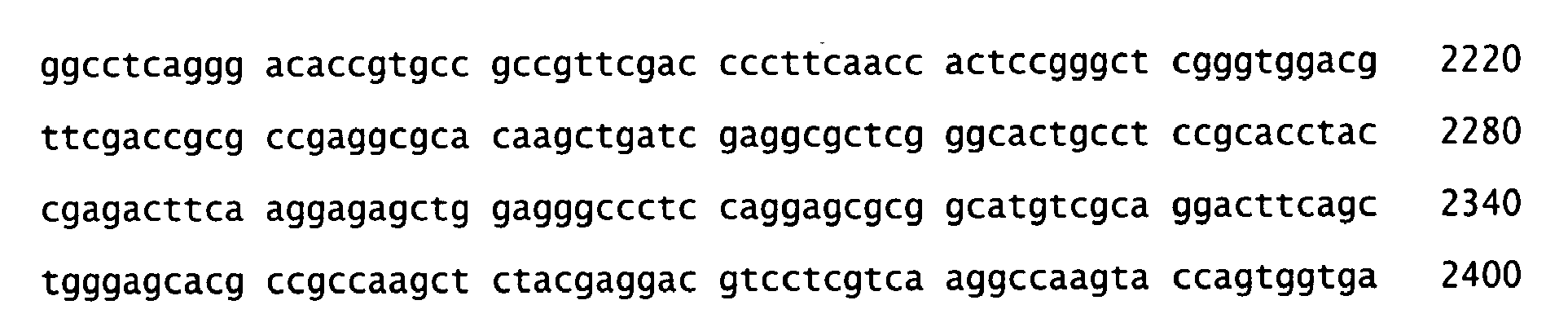
Claims (10)
- Weizenmehl, dessen Stärkekomponente einen Amylosegehalt zwischen 15.0 Gew.-% bis 30.0 Gew.-% und dessen Stärkekomponente einen Gehalt an resistenter Stärke (RS Stärke) von mehr als 5.0 Gew.-% aufweist.
- Weizenmehl nach Anspruch 1, dessen Stärkekomponente einen Amylose-gehalt zwischen 18.0 Gew.-% bis 30.0 Gew.-% aufweist.
- Weizenmehl nach Anspruch 1, dessen Stärkekomponente einen Amylosegehalt zwischen 20.0 Gew.-% bis 30.0 Gew.-% aufweist.
- Weizenmehl nach einem der Ansprüche 1-3, das einen Gehalt an resistenter Stärke (RS) zwischen 5.0 Gew.-% bis 30.0 Gew.-% aufweist.
- Weizenmehl nach einem der Ansprüche 1-4, das aus einer Weizen-Pflanze gewonnen wurde, die eine heterologe Stärkesynthase II exprimiert.
- Weizenmehl nach einem der Ansprüche 1 bis 5, dessen Stärkekomponente granulär ist.
- Weizenmehl nach Anspruch 5 oder 6, wobei die Aminosäuresequenz der heterologen Stärkesynthase II dadurch gekennzeichnet ist, dass sie eine Identität von mindestens 86% mit den Aminosäuren 333 bis 362 der unter SEQ ID NO 4 dargestellten Aminosäuresequenz und eine Identität von mindestens 83% mit den Aminosäuren 434 bis 473 der unter SEQ ID NO 4 dargestellten Aminosäuresequenz und eine Identität von mindestens 70% mit den Aminosäuren 652 bis 716 der unter SEQ ID NO 4 dargestellten Aminosäuresequenz aufweist.
- Zusammensetzung enthaltend Weizenmehl nach einem der Ansprüche 1 bis 7 und mindestens einen Nahrungsmittelzusatzstoff.
- Lebensmittel enthaltend Weizenmehl nach einem der Ansprüche 1 bis 7.
- Lebensmittel enthaltend eine Zusammensetzung nach Anspruch 8.
Priority Applications (7)
| Application Number | Priority Date | Filing Date | Title |
|---|---|---|---|
| EP08075631A EP2143797A1 (de) | 2008-07-10 | 2008-07-10 | Weizenstärke sowie Weizenmehle und Lebensmittel enthaltend diese Weizenstärke/Weizenmehle |
| ARP090102592A AR072724A1 (es) | 2008-07-10 | 2009-07-08 | Almidon de trigo asi como harinas de trigo y comestibles que contienen este almidon de trigo / harinas de trigo |
| US13/003,495 US8759645B2 (en) | 2008-07-10 | 2009-07-09 | Wheat starch and wheat flours and foodstuffs containing these wheat starch/wheat flours |
| EP09793893.0A EP2310514B1 (de) | 2008-07-10 | 2009-07-09 | Weizenstärke und Weizenmehle sowie Lebensmittel mit dieser Weizenstärke/diesen Weizenmehlen |
| CA2733353A CA2733353C (en) | 2008-07-10 | 2009-07-09 | Wheat starch and wheat flours and foodstuffs containing these wheat starch/wheat flours |
| PCT/EP2009/005098 WO2010003701A1 (en) | 2008-07-10 | 2009-07-09 | Wheat starch and wheat flours and foodstuffs containing these wheat starch/wheat flours |
| AU2009268303A AU2009268303B2 (en) | 2008-07-10 | 2009-07-09 | Wheat starch and wheat flours and foodstuffs containing these wheat starch/wheat flours |
Applications Claiming Priority (1)
| Application Number | Priority Date | Filing Date | Title |
|---|---|---|---|
| EP08075631A EP2143797A1 (de) | 2008-07-10 | 2008-07-10 | Weizenstärke sowie Weizenmehle und Lebensmittel enthaltend diese Weizenstärke/Weizenmehle |
Publications (1)
| Publication Number | Publication Date |
|---|---|
| EP2143797A1 true EP2143797A1 (de) | 2010-01-13 |
Family
ID=39941542
Family Applications (2)
| Application Number | Title | Priority Date | Filing Date |
|---|---|---|---|
| EP08075631A Withdrawn EP2143797A1 (de) | 2008-07-10 | 2008-07-10 | Weizenstärke sowie Weizenmehle und Lebensmittel enthaltend diese Weizenstärke/Weizenmehle |
| EP09793893.0A Not-in-force EP2310514B1 (de) | 2008-07-10 | 2009-07-09 | Weizenstärke und Weizenmehle sowie Lebensmittel mit dieser Weizenstärke/diesen Weizenmehlen |
Family Applications After (1)
| Application Number | Title | Priority Date | Filing Date |
|---|---|---|---|
| EP09793893.0A Not-in-force EP2310514B1 (de) | 2008-07-10 | 2009-07-09 | Weizenstärke und Weizenmehle sowie Lebensmittel mit dieser Weizenstärke/diesen Weizenmehlen |
Country Status (6)
| Country | Link |
|---|---|
| US (1) | US8759645B2 (de) |
| EP (2) | EP2143797A1 (de) |
| AR (1) | AR072724A1 (de) |
| AU (1) | AU2009268303B2 (de) |
| CA (1) | CA2733353C (de) |
| WO (1) | WO2010003701A1 (de) |
Cited By (3)
| Publication number | Priority date | Publication date | Assignee | Title |
|---|---|---|---|---|
| CN108728456A (zh) * | 2011-10-04 | 2018-11-02 | 阿凯笛亚生物科学公司 | 具有增加的抗性淀粉水平的小麦 |
| FR3120318A1 (fr) * | 2021-03-02 | 2022-09-09 | Arista Cereal Technologies Pty Ltd | Procédé de meunerie industrielle à rendement augmenté, farines obtenues par ce procédé, produits notamment de panification fabriqués à partir de ces farines |
| US12364269B1 (en) * | 2021-03-30 | 2025-07-22 | Hero Labs, Inc. | Dough compositions having little to no net carbohydrates for use in bakery products |
Families Citing this family (41)
| Publication number | Priority date | Publication date | Assignee | Title |
|---|---|---|---|---|
| AR087159A1 (es) | 2011-06-20 | 2014-02-26 | Gen Biscuit | Galletita para desayuno con glucosa de lenta disponibilidad |
| UA115132C2 (uk) | 2011-10-04 | 2017-09-25 | Байєр Інтелекчуал Проперті Гмбх | Спосіб боротьби з грибами та ооміцетами шляхом інгібування гена сахаропіндегідрогенази |
| RU2014125077A (ru) | 2011-11-21 | 2015-12-27 | Байер Интеллекчуал Проперти Гмбх | Фунгицидные n-[(тризамещенный силил)этил]-карбоксамидные производные |
| AR089656A1 (es) | 2011-11-30 | 2014-09-10 | Bayer Ip Gmbh | Derivados de n-bicicloalquil- y n-tricicloalquil-(tio)-carboxamida fungicidas |
| CN104270946B (zh) | 2011-12-19 | 2017-05-10 | 拜耳农作物科学股份公司 | 邻氨基苯甲酸二酰胺衍生物用于防治转基因作物中的害虫的用途 |
| MX343871B (es) | 2011-12-29 | 2016-11-25 | Bayer Ip Gmbh | Derivados de 3-[(piridin-2-ilmetoxiimino)(fenil)metil]-2-sustituid o-1,2,4-oxadiazol-5(2h)-ona fungicidas. |
| WO2013098146A1 (en) | 2011-12-29 | 2013-07-04 | Bayer Intellectual Property Gmbh | Fungicidal 3-[(1,3-thiazol-4-ylmethoxyimino)(phenyl)methyl]-2-substituted-1,2,4-oxadiazol-5(2h)-one derivatives |
| AP2014007876A0 (en) | 2012-02-27 | 2014-08-31 | Bayer Ip Gmbh | Active compound combinations containing a thiazoylisoxazoline and a fungicide |
| WO2013139949A1 (en) | 2012-03-23 | 2013-09-26 | Bayer Intellectual Property Gmbh | Compositions comprising a strigolactame compound for enhanced plant growth and yield |
| EP2662360A1 (de) | 2012-05-09 | 2013-11-13 | Bayer CropScience AG | 5-Halogenpyrazol-Indanyl-Carboxamide |
| EP2662363A1 (de) | 2012-05-09 | 2013-11-13 | Bayer CropScience AG | 5-Halogenpyrazol-Biphenyl-Carboxamide |
| EP2662370A1 (de) | 2012-05-09 | 2013-11-13 | Bayer CropScience AG | 5-Halogenpyrazol-Benzofuranyl-Carboxamide |
| EP2662361A1 (de) | 2012-05-09 | 2013-11-13 | Bayer CropScience AG | Pyrazol-Indanyl-Carboxamide |
| EP2662364A1 (de) | 2012-05-09 | 2013-11-13 | Bayer CropScience AG | Pyrazol-Tetrahydronaphthyl-Carboxamide |
| EP2662362A1 (de) | 2012-05-09 | 2013-11-13 | Bayer CropScience AG | Pyrazol-Indanyl-Carboxamide |
| US9249104B2 (en) | 2012-05-09 | 2016-02-02 | Bayer Cropscience Ag | Pyrazole indanyl carboxamides |
| BR112014027644A2 (pt) | 2012-05-09 | 2017-06-27 | Bayer Cropscience Ag | 5-halogenopirazol-indanil-carboxamidas |
| CA2888600C (en) | 2012-10-19 | 2021-08-10 | Bayer Cropscience Ag | Active compound combinations comprising carboxamide derivatives |
| MX380476B (es) | 2012-10-19 | 2025-03-12 | Bayer Cropscience Ag | Método de promoción de crecimiento de planta usando derivados de carboxamida. |
| CA2888559C (en) | 2012-10-19 | 2021-03-02 | Bayer Cropscience Ag | Method for enhancing tolerance to abiotic stress in plants using carboxamide or thiocarboxamide derivatives |
| AU2013333847B2 (en) | 2012-10-19 | 2017-04-20 | Bayer Cropscience Ag | Method for treating plants against fungi resistant to fungicides using carboxamide or thiocarboxamide derivatives |
| EP2735231A1 (de) | 2012-11-23 | 2014-05-28 | Bayer CropScience AG | Wirkstoffkombinationen |
| BR122020019349B1 (pt) | 2012-11-30 | 2021-05-11 | Bayer Cropscience Ag | composição, seu processo de preparação, método para controlar um ou mais microrganismos nocivos, semente resistente a microorganismos nocivos e seu método de tratamento |
| UA117819C2 (uk) | 2012-11-30 | 2018-10-10 | Байєр Кропсайєнс Акцієнгезелльшафт | Подвійні пестицидні і фунгіцидні суміші |
| UA116223C2 (uk) | 2012-11-30 | 2018-02-26 | Байєр Кропсайєнс Акцієнгезелльшафт | Подвійна фунгіцидна суміш |
| BR112015012054A2 (pt) | 2012-11-30 | 2017-07-11 | Bayer Cropscience Ag | mistura fungicida ou pesticida binária |
| WO2014083089A1 (en) | 2012-11-30 | 2014-06-05 | Bayer Cropscience Ag | Ternary fungicidal and pesticidal mixtures |
| AR093996A1 (es) | 2012-12-18 | 2015-07-01 | Bayer Cropscience Ag | Combinaciones bactericidas y fungicidas binarias |
| US9428459B2 (en) | 2012-12-19 | 2016-08-30 | Bayer Cropscience Ag | Difluoromethyl-nicotinic- tetrahydronaphtyl carboxamides |
| WO2014167009A1 (en) | 2013-04-12 | 2014-10-16 | Bayer Cropscience Ag | Novel triazole derivatives |
| EP2984080B1 (de) | 2013-04-12 | 2017-08-30 | Bayer CropScience Aktiengesellschaft | Neuartige triazolderivate |
| WO2014170345A2 (en) | 2013-04-19 | 2014-10-23 | Bayer Cropscience Ag | Method for improved utilization of the production potential of transgenic plants |
| CN105307492B (zh) | 2013-04-19 | 2018-03-30 | 拜耳作物科学股份公司 | 二元杀虫或除虫混合物 |
| WO2014177514A1 (en) | 2013-04-30 | 2014-11-06 | Bayer Cropscience Ag | Nematicidal n-substituted phenethylcarboxamides |
| TW201507722A (zh) | 2013-04-30 | 2015-03-01 | Bayer Cropscience Ag | 做為殺線蟲劑及殺體內寄生蟲劑的n-(2-鹵素-2-苯乙基)-羧醯胺類 |
| BR112015030970B8 (pt) * | 2013-06-13 | 2021-09-14 | Griffith Laboratories | Produtos aglomerados texturados, produto alimentício, método para formar um produto aglomerado texturizado e uso do produto aglomerado texturizado e de amido resistente a rs4 de curto tempo e alta pressão |
| EP3490379A1 (de) | 2016-07-29 | 2019-06-05 | Bayer CropScience Aktiengesellschaft | Wirkstoffkombinationen und verfahren zum schutz des vermehrungsmaterials von pflanzen |
| BR112019005668A2 (pt) | 2016-09-22 | 2019-06-04 | Bayer Ag | novos derivados de triazol |
| BR112019005660A2 (pt) | 2016-09-22 | 2019-06-04 | Bayer Cropscience Ag | novos derivados de triazol e seu uso como fungicidas |
| CN112513033A (zh) | 2018-06-04 | 2021-03-16 | 拜耳公司 | 除草活性的双环苯甲酰基吡唑 |
| WO2025264991A1 (en) * | 2024-06-21 | 2025-12-26 | Keeley Jess | Flour analog |
Citations (10)
| Publication number | Priority date | Publication date | Assignee | Title |
|---|---|---|---|---|
| US5051271A (en) | 1989-11-22 | 1991-09-24 | Opta Food Ingredients, Inc. | Starch-derived, food-grade, insoluble bulking agent |
| EP0564893A1 (de) | 1992-03-25 | 1993-10-13 | National Starch and Chemical Investment Holding Corporation | Amylase-resistente Stärke |
| EP0688872A1 (de) | 1994-04-15 | 1995-12-27 | Cerestar Holding Bv | Verfahren zur Herstellung von stärkehaltigen Produkten |
| EP0846704A2 (de) | 1996-12-03 | 1998-06-10 | Cerestar Holding B.V. | Sehr fermentierbare resistente Stärke |
| WO2001073087A1 (en) | 2000-03-27 | 2001-10-04 | Syngenta Participations Ag | Cestrum yellow leaf curling virus promoters |
| DE10032379A1 (de) | 2000-07-06 | 2002-01-17 | Aventis Cropscience Gmbh | Promotoren zur Genexpression in Karyopsen von Pflanzen |
| DE10041861A1 (de) | 2000-08-26 | 2002-03-14 | Aventis Cropscience Gmbh | Promotor zur Genexpression in Karyopsen von Pflanzen |
| US6750378B2 (en) | 1997-12-14 | 2004-06-15 | Rhone-Poulenc Agro | Maize H3C4 promoter combined with the first intron of rice actin, chimeric gene comprising it and transformed plant |
| WO2006069422A1 (en) * | 2004-12-30 | 2006-07-06 | Commonwealth Scientific And Industrial Research Organisation | Method and means for improving bowel health |
| WO2007009823A1 (en) * | 2005-07-22 | 2007-01-25 | Bayer Cropscience Ag | Overexpression of starch synthase in plants |
Family Cites Families (3)
| Publication number | Priority date | Publication date | Assignee | Title |
|---|---|---|---|---|
| CA2624375C (en) * | 1996-05-29 | 2010-07-27 | Bayer Cropscience Gmbh | Nucleic acid molecules encoding enzymes from wheat which are involved in starch synthesis |
| WO2006069442A1 (en) | 2004-12-27 | 2006-07-06 | Louis Morissette | Braking mechanism for moving assemblies |
| AR064557A1 (es) | 2006-12-29 | 2009-04-08 | Bayer Cropscience Ag | Almidon de maiz y harinas y alimentos de maiz que comprenden este almidon de maiz |
-
2008
- 2008-07-10 EP EP08075631A patent/EP2143797A1/de not_active Withdrawn
-
2009
- 2009-07-08 AR ARP090102592A patent/AR072724A1/es not_active Application Discontinuation
- 2009-07-09 US US13/003,495 patent/US8759645B2/en not_active Expired - Fee Related
- 2009-07-09 WO PCT/EP2009/005098 patent/WO2010003701A1/en not_active Ceased
- 2009-07-09 CA CA2733353A patent/CA2733353C/en not_active Expired - Fee Related
- 2009-07-09 EP EP09793893.0A patent/EP2310514B1/de not_active Not-in-force
- 2009-07-09 AU AU2009268303A patent/AU2009268303B2/en not_active Ceased
Patent Citations (10)
| Publication number | Priority date | Publication date | Assignee | Title |
|---|---|---|---|---|
| US5051271A (en) | 1989-11-22 | 1991-09-24 | Opta Food Ingredients, Inc. | Starch-derived, food-grade, insoluble bulking agent |
| EP0564893A1 (de) | 1992-03-25 | 1993-10-13 | National Starch and Chemical Investment Holding Corporation | Amylase-resistente Stärke |
| EP0688872A1 (de) | 1994-04-15 | 1995-12-27 | Cerestar Holding Bv | Verfahren zur Herstellung von stärkehaltigen Produkten |
| EP0846704A2 (de) | 1996-12-03 | 1998-06-10 | Cerestar Holding B.V. | Sehr fermentierbare resistente Stärke |
| US6750378B2 (en) | 1997-12-14 | 2004-06-15 | Rhone-Poulenc Agro | Maize H3C4 promoter combined with the first intron of rice actin, chimeric gene comprising it and transformed plant |
| WO2001073087A1 (en) | 2000-03-27 | 2001-10-04 | Syngenta Participations Ag | Cestrum yellow leaf curling virus promoters |
| DE10032379A1 (de) | 2000-07-06 | 2002-01-17 | Aventis Cropscience Gmbh | Promotoren zur Genexpression in Karyopsen von Pflanzen |
| DE10041861A1 (de) | 2000-08-26 | 2002-03-14 | Aventis Cropscience Gmbh | Promotor zur Genexpression in Karyopsen von Pflanzen |
| WO2006069422A1 (en) * | 2004-12-30 | 2006-07-06 | Commonwealth Scientific And Industrial Research Organisation | Method and means for improving bowel health |
| WO2007009823A1 (en) * | 2005-07-22 | 2007-01-25 | Bayer Cropscience Ag | Overexpression of starch synthase in plants |
Non-Patent Citations (107)
| Title |
|---|
| "Plant Cell Culture Protocols", 1999, HUMANA PRESS |
| "The Role of the Glycemic Index in Food Choice", 14 April 1997, article "Carbohydrates in human nutrition", pages: 25 - 30 |
| "Tutorial and User Manual", March 2004, DIONEX CORPORATION |
| ABSATZ, MEASUREMENT OF FREE GLUCOSE (FG)", pages S36 - S37 |
| ABSATZ, MEASUREMENT OF FREE GLUCOSE (FG, pages S36 - S37 |
| ABSATZ, MEASUREMENT OF RDS AND SDS, pages S38 |
| ANDERSON, THEORETICAL AND APPLIED GENETICS, vol. 96, 1998, pages 568 - 576 |
| AUSUBEL ET AL.: "Short Protocols in Molecular Biology", 2002, JOHN WILEY & SONS |
| BAE ET AL., MAYDICA, vol. 35, 1990, pages 317 - 322 |
| BHAVE ET AL., PLANT CELL, vol. 2, 1990, pages 581 - 588 |
| BOLIVAR ET AL.: "origin of replication", DES PLASMIDS PBR322, 1977 |
| BOLIVAR: "origin of replication", DES PLASMIDS PBR322, 1977 |
| BRADFORD, ANAL BIOCHEM, vol. 72, 1976, pages 248 - 254 |
| BUSTOS, PLANT CELL, vol. 1, no. 9, 1989, pages 839 - 853 |
| CALLIS ET AL., GENES DEV., vol. 1, 1987, pages 1183 - 1200 |
| CALLIS ET AL., GENES DEVEL., vol. 1, 1987, pages 1183 - 1200 |
| CHANVRIER HELENE ET AL: "Processing of novel elevated amylose wheats: Functional properties and starch digestibility of extruded products", JOURNAL OF AGRICULTURAL AND FOOD CHEMISTRY, vol. 55, no. 25, December 2007 (2007-12-01), pages 10248 - 10257, XP002504473, ISSN: 0021-8561 * |
| CHRISTENSEN ET AL., PLANT MOL. BIOL., vol. 18, 1992, pages 675 - 689 |
| CLARKE; APPELS, GENOME, vol. 41, 1998, pages 865 - 871 |
| COLOT ET AL., EMBO J., vol. 6, 1987, pages 3559 - 3564 |
| ECKHOFF ET AL., CEREAL CHEM., vol. 73, 1996, pages 54 - 57 |
| ENGLYST ET AL., BRITISH JOURNAL OF NUTRITION, vol. 75, pages 327 - 337 |
| ENGLYST ET AL., EUROP. J. OF CLINICAL NUTRITION, vol. 46, no. 2, 1992, pages S 33 - 50 |
| ENGLYST ET AL., REAGENTS, APPARATUS, SPECTROPHOTOMETER, pages S35 - S36 |
| EUROP. J. OF CLINICAL NUTRITION, vol. 46, no. 2, 1992, pages S 33 - 50 |
| EVANS; THOMPSON, CEREAL CHEMISTRY, vol. 81, no. 1, 2004, pages 31 - 37 |
| FAISANT ET AL., SCIENCES DES ALIMENTS, vol. 15, 1995, pages 83 - 89 |
| GALLARDO ET AL., PLANT SCI., vol. 54, 1988, pages 211 - 281 |
| GAO; CHIBBAR, GENOME, vol. 43, no. 5, 2000, pages 768 - 775 |
| GRINDLEY; JOYCE: "Einen Selektionsmarker vermittelnd Resistenz gegen Kanamyzin", ESCHERICHIA COLI AND AGROBACTERIUM TUMEFACIENS, 1980 |
| GRINDLEY; JOYCE: "Einen Selektionsmarker vermittelnd Resistenz gegen Kanamyzin", VERMEHRUNG IN ESCHERICHIA COLI AND AGROBACTERIUM TUMEFACIENS, 1980 |
| HOFFMANN ET AL., EMBO J., vol. 6, 1987, pages 3213 - 3221 |
| HUNG ET AL., CEREAL CHEMISTRY, vol. 82, 2005, pages 690 - 694 |
| HUNG ET AL., CEREAL CHEMSITRY, vol. 82, 2005, pages 690 - 694 |
| HUNG ET AL., TRENDS IN FOOD SCIENCE & TECHNOLOGY, vol. 17, 2006, pages 448 - 456 |
| J. G. O'DONOGHUE BUILDING, ALBERTA STOCK SEED DISTRIBUTION COMMITTEE, ALBERTA AGRICULTURE AND RURAL DEVELOPMENT, vol. 203, pages 7000 - 113 |
| JIANG H. ET AL.: "Molecular cloning and expression analysis of three genes encoding starch synthase 11 in rice", PLANTA, vol. 218, 2004, pages 1062 - 1070 |
| JOSHI ET AL.: "Contex sequences of translation initiation codon in plants", PMB, vol. 35, 1997, pages 993 - 1001 |
| KIRIHARA ET AL., GENE, vol. 71, 1988, pages 359 - 370 |
| KODRZYCK ET AL., PLANT CELL, vol. 1, 1989, pages 105 - 114 |
| KONIK-ROSE ET AL., THEOR. APPL. GENET., vol. 115, 2007, pages 1053 - 1065 |
| KUGIMIYA; DONOVAN, JOURNAL OF FOOD SCIENCE, vol. 46, 1981, pages 765 - 770 |
| LARSON ET AL., ANALYTICAL CHEMISTRY, vol. 25, no. 5, 1953, pages 802 - 804 |
| LEISY ET AL., PLANT MOL. BIOL., vol. 14, 1990, pages 41 - 50 |
| LIU ET AL., PLANT SCIENCE, 2003, pages 165 |
| LUEHRSEN, K. R.; WALBOT, V., MOL. GEN. GENET., vol. 225, 1991, pages 81 - 93 |
| LUEHRSEN; WALBOT, MOL. GEN. GENET., vol. 225, 1991, pages 81 - 93 |
| MAAS ET AL., PLANT. MOL. BIOL., vol. 16, 1991, pages 199 - 207 |
| MARKS ET AL., J. BIOL. CHEM., vol. 260, 1985, pages 16451 - 16459 |
| MCCLEARY; MONAGHAN, J. AOAC INT., vol. 85, 2002, pages 665 - 675 |
| MIKULIKOVA D ET AL.: "The Potential of Common Cereals to form Retrograded Resistant Starch", CZECH J. GENET. PLANT BREED., vol. 42, 2006, pages 95 - 102, XP002504475 * |
| MORELL ET AL., JOURNAL OF AOAC INTERNATIONAL, vol. 87, no. 3, 2004, pages 740 - 748 |
| MORITA ET AL., CEREAL CHEMISTRY, vol. 79, 2002, pages 491 - 495 |
| MORRISON; LAIGNELET, J. CEREAL SC., vol. 1, 1983, pages 9 - 20 |
| MURASHIGE; SKOOG, PHYSIOL. PLANT., vol. 15, 1962, pages 473 - 497 |
| NAKASE ET AL., GENE, vol. 170, no. 2, 1996, pages 223 - 226 |
| NIELSEN ET AL., PLANT PHYSIOL., vol. 105, 1994, pages 111 - 117 |
| NISHI ET AL., PLANT PHYSIOLOGY, vol. 127, 2001, pages 459 - 472 |
| OARD ET AL., PLANT CELL REP, vol. 8, 1989, pages 156 - 160 |
| ODELL ET AL., NATURE, vol. 313, 1985, pages 810 - 812 |
| PEDERSEN ET AL., CELL, vol. 29, 1982, pages 1015 - 1026 |
| PERKIN EIMER, LARGE VOLUME STAINLESS STEEL PANS |
| POLASKE, STARCH, vol. 57, 2005, pages 118 - 123 |
| PRAT ET AL., GENE, vol. 52, 1987, pages 51 - 49 |
| QU; TAKAIWA, PLANT BIOTECHNOLOGY JOURNAL, vol. 2, no. 2, 2004, pages 113 - 125 |
| QUATROCCIO ET AL., PLANT MOL. BIOL., vol. 15, 1990, pages 81 - 93 |
| REGINA ET AL., PNAS, vol. 103, no. 10, 2006, pages 3546 - 3551 |
| RETHMEIER ET AL., PLANT JOURNAL., vol. 12, no. 4, 1997, pages 895 - 899 |
| ROSE; BELIAKOFF, PLANT PHYSIOL., vol. 122, no. 2, 2000, pages 535 - 542 |
| SAJILATA M G ET AL.: "Resistant Starch - A Review", COMPREHENSIVE REVIEWS IN FOOD SCIENCE AND FOOD SAFETY, vol. 5, 2006, pages 1 - 17, XP002504477 * |
| SAMBROOK ET AL.: "Molecular Cloning, A Laboratory Manual", 2001, COLD SPRING HARBOUR LABORATORY PRESS |
| SCHERNTHANER ET AL., EMBO J., vol. 7, 1988, pages 1249 - 1253 |
| SCHLEGEL: "Allgemeine Mikrobiologie", 1985, GEORG THIEME VERLAG, pages: 1 - 2 |
| SENGUPTA-GOPALAN, PROC. NATL. ACAD. SCI. USA, vol. 82, 1985, pages 3320 - 3324 |
| SENTI; RUSSELL, TAPPI, vol. 43, no. 4, April 1960 (1960-04-01), pages 343 - 349 |
| SESTILI F ET AL.: "PRODUCTION OF DURUM AND BREAD WHEAT LINES WITH HIGH AMYLOSE STARCH", PROCEEDINGS OF THE 51ST ITALIAN SOCIETY OF AGRICULTURAL GENETICS ANNUAL CONGRESS, RIVA DEL GARDA, ITALY, 23/26 SEPTEMBER 2007, 2007, XP002504478, ISBN: 978-88-900622-7-8 * |
| SHIN MALSHICK ET AL: "Hot-water solubilities and water sorptions of resistant starches at 25degreeC", CEREAL CHEMISTRY, AMERICAN ASSOCIATION OF CEREAL CHEMISTS. MINNEAPOLIS, US, vol. 80, no. 5, 1 September 2003 (2003-09-01), pages 564 - 566, XP008098848, ISSN: 0009-0352 * |
| SHIN MALSHICK ET AL: "In vitro digestibility of cross-linked starches - RS4", STARCH, vol. 56, no. 10, October 2004 (2004-10-01), pages 478 - 483, XP002504472, ISSN: 0038-9056 * |
| SIEVERT; HOLM, STARCH/STÄRKE, vol. 45, no. 4, 1993, pages 136 - 139 |
| SKRABANJA VIDA ET AL: "Nutritional properties of starch in buckwheat products: Studies in vitro and in vivo", JOURNAL OF AGRICULTURAL AND FOOD CHEMISTRY, vol. 49, no. 1, January 2001 (2001-01-01), pages 490 - 496, XP002504474, ISSN: 0021-8561 * |
| STAVOLONE ET AL., PLANT MOL. BIOL., vol. 53, 2003, pages 703 - 713 |
| TAIT ET AL.: "origin of replication", DES PLASMIDS PSA, 1982 |
| TAIT: "origin of replication", DES PLASMIDS PSA, 1982 |
| THOMAS, PLANT CELL, vol. 2, no. 12, 1990, pages 1171 - 1180 |
| THOMPSON ET AL., NUCLEIC ACIDS RESEARCH, vol. 22, 1994, pages 4673 - 4680 |
| UNGER ET AL., PLANT PHYSIOL., vol. 96, 1991, pages 124 |
| VAN HUNG PHAM ET AL: "Formation of enzyme-resistant starch in bread as affected by high-amylose wheat flour substitutions", CEREAL CHEMISTRY, vol. 82, no. 6, November 2005 (2005-11-01), pages 690 - 694, XP008098914, ISSN: 0009-0352 * |
| VASIL ET AL., PLANT PHYSIOL., vol. 91, 1989, pages 1575 - 1579 |
| VERDAGUER, PLANT MOL. BIOL., vol. 31, pages 1129 - 1139 |
| W. BANKS; C.T. GREENWOOD: "Starch and its components", EDINBURGH UNIVERSITY PRESS, pages: 51 - 66 |
| WASSERMAN L A ET AL.: "PREPARATION OF WHEAT RESISTANT STARCH. Treatment of gels and DSC characterization", JOURNAL OF THERMAL ANALYSIS AND CALORIMETRY, vol. 87, 2007, pages 153 - 157, XP019482422 * |
| WHISTLER; BEMILLER; PASCHALL: "Herstellung, Modifizierung und Verwendungen", 1994, ACADEMIC PRESS INC. LONDON LTD |
| WILLIAMSON ET AL., PLANT PHYSIOL., vol. 88, 1988, pages 1002 - 1007 |
| WOLEVER ET AL., AM. J. CLIN. NUTR., vol. 54, 1991, pages 846 - 854 |
| WOO K S ET AL: "CROSS-LINKED RESISTANT STARCH: PREPARATION AND PROPERTIES", CEREAL CHEMISTRY, AMERICAN ASSOCIATION OF CEREAL CHEMISTS. MINNEAPOLIS, US, vol. 79, no. 6, 1 November 2002 (2002-11-01), pages 819 - 825, XP001132662, ISSN: 0009-0352 * |
| WU H ET AL.: "Factors influencing successful Agrobacterium-mediated genetic transformation of wheat", PLANT CELL REPORTS, vol. 21, 2003, pages 659 - 6686 |
| XU ET AL., SCIENCE IN CHINA SERIES C, vol. 46, no. 6, 2003, pages 561 - 569 |
| YAHL ET AL., MICROSCOPE, vol. 32, 1984, pages 123 - 132 |
| YAMAMORI ET AL., AUSTRALIAN JOUMAL OF AGRICULTURAL RESEARCH, vol. 57, 2006, pages 531 - 535 |
| YAMAMORI ET AL., AUSTRALIAN JOURNAL OF AGRICULTURAL RESEARCH, vol. 57, 2006, pages 531 - 53 |
| YAMAMORI ET AL., AUSTRALIAN JOURNAL OF AGRICULTURAL RESEARCH, vol. 57, 2006, pages 531 - 535 |
| YAMAMORI M ET AL: "Resistant starch and starch pasting properties of a starch synthase IIa-deficient wheat with apparent high amylose", AUSTRALIAN JOURNAL OF AGRICULTURAL RESEARCH, vol. 57, no. 5, 2006, pages 531 - 535, XP008098696, ISSN: 0004-9409 * |
| YANG, N.-S.; RUSSEL, D., PROC. NATL. ACAD SCI, vol. 87, 1990, pages 4144 - 4148 |
| YOSHIHARA ET AL., FEBS LETT., vol. 383, 1996, pages 213 - 218 |
| Z. LUO ET AL., STARCH/STÄRKE, vol. 58, 2006, pages 468 - 474 |
| ZHANG ET AL., PLANT CELL, vol. 3, 1991, pages 1150 - 1160 |
| ZHENG ET AL., PLANT J., vol. 4, 1993, pages 357 - 366 |
Cited By (7)
| Publication number | Priority date | Publication date | Assignee | Title |
|---|---|---|---|---|
| CN108728456A (zh) * | 2011-10-04 | 2018-11-02 | 阿凯笛亚生物科学公司 | 具有增加的抗性淀粉水平的小麦 |
| US11649464B2 (en) | 2011-10-04 | 2023-05-16 | Arcadia Biosciences, Inc. | Wheat with increased resistant starch levels |
| CN108728456B (zh) * | 2011-10-04 | 2023-06-16 | 阿凯笛亚生物科学公司 | 具有增加的抗性淀粉水平的小麦 |
| US12319920B2 (en) | 2011-10-04 | 2025-06-03 | Arcadia Biosciences, Inc. | Wheat with increased resistant starch levels |
| FR3120318A1 (fr) * | 2021-03-02 | 2022-09-09 | Arista Cereal Technologies Pty Ltd | Procédé de meunerie industrielle à rendement augmenté, farines obtenues par ce procédé, produits notamment de panification fabriqués à partir de ces farines |
| EP4301146A4 (de) * | 2021-03-02 | 2025-09-03 | Arista Cereal Tech Pty Ltd | Industrielles mahlverfahren mit erhöhter ausbeute, mit diesem verfahren erhaltene mehle, produkte, insbesondere produkte zur brotherstellung, hergestellt aus diesen mehlen |
| US12364269B1 (en) * | 2021-03-30 | 2025-07-22 | Hero Labs, Inc. | Dough compositions having little to no net carbohydrates for use in bakery products |
Also Published As
| Publication number | Publication date |
|---|---|
| AU2009268303A1 (en) | 2010-01-14 |
| US8759645B2 (en) | 2014-06-24 |
| CA2733353C (en) | 2018-11-13 |
| US20110296560A1 (en) | 2011-12-01 |
| EP2310514A1 (de) | 2011-04-20 |
| CA2733353A1 (en) | 2010-01-14 |
| EP2310514B1 (de) | 2014-05-21 |
| WO2010003701A1 (en) | 2010-01-14 |
| AR072724A1 (es) | 2010-09-15 |
| AU2009268303B2 (en) | 2015-04-02 |
Similar Documents
| Publication | Publication Date | Title |
|---|---|---|
| EP2310514B1 (de) | Weizenstärke und Weizenmehle sowie Lebensmittel mit dieser Weizenstärke/diesen Weizenmehlen | |
| EP2099915B1 (de) | Maisstärke sowie diese maisstärke enthaltende maismehle und lebensmittel | |
| CN101228280B (zh) | 植物内淀粉合酶的过量表达 | |
| EP2099905B1 (de) | Verfahren zur modifizierung der thermischen und/oder digestiven eigenschaften von mais stärke und mais mehl | |
| EP1950303A1 (de) | Genetisch modifizierte Pflanzen, die eine Stärke mit geringem Amylosegehalt und erhöhtem Quellvermögen synthetisieren | |
| EP1887079A1 (de) | Genetisch modifizierte Pflanzen, die eine Stärke mit erhöhtem Quellvermögen synthetisieren | |
| EP1100937A1 (de) | Pflanzen, die eine modifizierte stärke synthetisieren, verfahren zur herstellung der pflanzen, ihre verwendung sowie die modifizierte stärke | |
| DE19836099A1 (de) | Nukleinsäuremoleküle kodierend für eine ß-Amylase, Pflanzen, die eine modifizierte Stärke synthetisieren, Verfahren zur Herstellung der Pflanzen, ihre Verwendung sowie die modifizierte Stärke | |
| DE19836097A1 (de) | Nukleinsäuremoleküle kodierend für eine alpha-Glukosidase, Pflanzen, die eine modifizierte Stärke synthetisieren, Verfahren zur Herstellung der Pflanzen, ihre Verwendung sowie die modifizierte Stärke | |
| CA2690489C (en) | Starches with high amylose content and improved processing properties | |
| EP1980619A1 (de) | Verfahren zur Herstellung einer resistenten Stärke | |
| EP2009108A1 (de) | Stärken mit hohem Amylosegehalt und verbesserten Verarbeitungseigenschaften | |
| EP1801152A1 (de) | Reisstärken mit verbesserten Qualitätseigenschaften | |
| WO2008122449A1 (en) | Method of producing a resistant starch |
Legal Events
| Date | Code | Title | Description |
|---|---|---|---|
| PUAI | Public reference made under article 153(3) epc to a published international application that has entered the european phase |
Free format text: ORIGINAL CODE: 0009012 |
|
| AK | Designated contracting states |
Kind code of ref document: A1 Designated state(s): AT BE BG CH CY CZ DE DK EE ES FI FR GB GR HR HU IE IS IT LI LT LU LV MC MT NL NO PL PT RO SE SI SK TR |
|
| AX | Request for extension of the european patent |
Extension state: AL BA MK RS |
|
| AKY | No designation fees paid | ||
| STAA | Information on the status of an ep patent application or granted ep patent |
Free format text: STATUS: THE APPLICATION IS DEEMED TO BE WITHDRAWN |
|
| 18D | Application deemed to be withdrawn |
Effective date: 20100714 |
|
| REG | Reference to a national code |
Ref country code: DE Ref legal event code: 8566 |