EP2138804A2 - Method and apparatus for displaying map based on course direction - Google Patents
Method and apparatus for displaying map based on course direction Download PDFInfo
- Publication number
- EP2138804A2 EP2138804A2 EP20090156271 EP09156271A EP2138804A2 EP 2138804 A2 EP2138804 A2 EP 2138804A2 EP 20090156271 EP20090156271 EP 20090156271 EP 09156271 A EP09156271 A EP 09156271A EP 2138804 A2 EP2138804 A2 EP 2138804A2
- Authority
- EP
- European Patent Office
- Prior art keywords
- centre
- course
- current position
- map
- area
- Prior art date
- Legal status (The legal status is an assumption and is not a legal conclusion. Google has not performed a legal analysis and makes no representation as to the accuracy of the status listed.)
- Granted
Links
Images



Classifications
-
- G—PHYSICS
- G01—MEASURING; TESTING
- G01C—MEASURING DISTANCES, LEVELS OR BEARINGS; SURVEYING; NAVIGATION; GYROSCOPIC INSTRUMENTS; PHOTOGRAMMETRY OR VIDEOGRAMMETRY
- G01C21/00—Navigation; Navigational instruments not provided for in groups G01C1/00 - G01C19/00
- G01C21/26—Navigation; Navigational instruments not provided for in groups G01C1/00 - G01C19/00 specially adapted for navigation in a road network
- G01C21/34—Route searching; Route guidance
- G01C21/36—Input/output arrangements for on-board computers
- G01C21/3667—Display of a road map
- G01C21/367—Details, e.g. road map scale, orientation, zooming, illumination, level of detail, scrolling of road map or positioning of current position marker
-
- G—PHYSICS
- G08—SIGNALLING
- G08G—TRAFFIC CONTROL SYSTEMS
- G08G1/00—Traffic control systems for road vehicles
- G08G1/09—Arrangements for giving variable traffic instructions
- G08G1/0962—Arrangements for giving variable traffic instructions having an indicator mounted inside the vehicle, e.g. giving voice messages
- G08G1/0968—Systems involving transmission of navigation instructions to the vehicle
- G08G1/0969—Systems involving transmission of navigation instructions to the vehicle having a display in the form of a map
-
- G—PHYSICS
- G09—EDUCATION; CRYPTOGRAPHY; DISPLAY; ADVERTISING; SEALS
- G09B—EDUCATIONAL OR DEMONSTRATION APPLIANCES; APPLIANCES FOR TEACHING, OR COMMUNICATING WITH, THE BLIND, DEAF OR MUTE; MODELS; PLANETARIA; GLOBES; MAPS; DIAGRAMS
- G09B29/00—Maps; Plans; Charts; Diagrams, e.g. route diagram
- G09B29/003—Maps
- G09B29/005—Map projections or methods associated specifically therewith
-
- G—PHYSICS
- G09—EDUCATION; CRYPTOGRAPHY; DISPLAY; ADVERTISING; SEALS
- G09B—EDUCATIONAL OR DEMONSTRATION APPLIANCES; APPLIANCES FOR TEACHING, OR COMMUNICATING WITH, THE BLIND, DEAF OR MUTE; MODELS; PLANETARIA; GLOBES; MAPS; DIAGRAMS
- G09B29/00—Maps; Plans; Charts; Diagrams, e.g. route diagram
- G09B29/10—Map spot or coordinate position indicators; Map reading aids
- G09B29/106—Map spot or coordinate position indicators; Map reading aids using electronic means
Definitions
- the present invention relates to a map displaying apparatus and method, and more particularly, to a map displaying apparatus and method by which an area in a course direction is more widely displayed on a screen.
- a navigation system calculates a position of a local navigation terminal based on signals received from a plurality of global positioning system (GPS) satellites and displays a current position and a course to a destination of the navigation terminal on a screen.
- GPS global positioning system
- the navigation terminals are more widely used in cars that frequently search for a course.
- the information has to be appropriately displayed on a screen of the navigation terminal.
- map displaying methods include a head-up mode method in which a map is displayed so that a current movement direction of a driver always corresponds to an upward direction of a screen.
- a north-up mode method in which a map is displayed so that an actual north direction always corresponds to an upward direction of a screen.
- a further example is a bird's-eye view mode method in which a map is three-dimensionally displayed so that a driver can easily compare an actual driving environment to the map displayed on a screen.
- map displaying methods do not display a certain area of the map that the driver may want to see on a screen.
- aspects of the present invention provide a map displaying apparatus and method thereof whereby an area or more interest to a user is displayed on a screen, and a computer readable recording medium having recorded thereon a computer program for executing the map displaying method.
- a map displaying method to display a map on a screen, the map displaying method including: determining a course direction of an object at a current position of the map; moving a first centre of a first area of the map is set based on the current position, by a predetermined distance in the course direction so as to determine a second centre; and displaying a second area of the map on the screen having the second centre as a centre thereof.
- the determining of the course direction may include setting an analysis area to analyze the course direction at the current position; and analyzing a course included in the analysis area and determining a direction of the course included in the analysis area as the course direction.
- the direction of the course included in the analysis area may be a direction of the course from the current position or the first centre to a predetermined destination.
- the determining of the direction of the course included in the analysis area may include determining a point where a course from the current position or the first centre to the predetermined destination intersects a boundary of the analysis area; and determining a direction from the current position or the first centre to the point on the boundary of the analysis area as the course direction.
- the course direction at the current position may be a link direction at the current position.
- the moving of the first centre may include moving the first centre by a predetermined distance in only a vertical or a horizontal direction based on the course direction so as to determine the second centre.
- a map displaying apparatus to display a map on a screen, the apparatus including: a course direction determination unit to determine a course direction at a current position of a map; a centre movement unit to move a first centre of a first area that is set based on the current position, by a predetermined distance in the course direction so as to determine a second centre; and a display unit to display a second area having the second centre as a centre thereof.
- a computer readable recording medium having recorded thereon a computer program for executing the map displaying method.
- a map displaying method to display a map on a screen, the map displaying method including: displaying a first area of the map on the screen, the first area having a first centre; determining a course direction of an object at a current position of the map; and displaying a second area of the map on the screen, the second area having a second centre as a centre thereof, wherein the second centre is a predetermined distance away, in the course direction, from the first centre.
- a map displaying apparatus to display a map on a screen
- the map displaying apparatus including: a course direction determination unit to determine a course direction of an object at a current position of the map; and a display unit to change a display of a first area of the map on the screen, the first area having a first centre, to a second area of the map on the screen, the second area having a second centre as a centre thereof, wherein the second centre is a predetermined distance away, in the course direction, from the first centre.
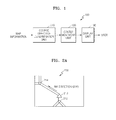
- FIG. 1 is a block diagram of a map displaying apparatus 100 according to an embodiment of the present invention.
- the map displaying apparatus 100 includes a course direction determination unit 110, a centre movement unit 120, and a display unit 130. While not restricted thereto, the apparatus 100 can be included in a car, a telephone, a personal media player, a portable computer, or as a stand alone GPS unit. Further, while not shown, it is understood that the apparatus 100 can include a GPS device to determine the location and a storage device to store the map information.
- the course direction determination unit 110 determines a course direction at a current position in a first area that is set based on the current position. Accordingly, a user seeing a map displayed on a screen (such as the display unit 130) of a mobile device (such as a navigation terminal) can view information on an area that the user is going to move to, rather than information on an area that the user is moving from. Such information can include information on road conditions and points of interest (POIs) of the area that the user is going to move to. The area that the user is going to move to is determined in accordance with the course direction at the current position determined by the course direction determination unit 110. The course direction at the current position may be determined by any of a variety of methods.
- a link direction at the current position or a direction of a course, that is included in a predetermined analysis area, from the current position to a destination may be determined as the course direction at the current position.
- a method of determining a course direction will now be described in detail with reference to FIGs. 2A through 2C .
- FIGs. 2A through 2C are diagrams to describe a method of determining a course direction, according to an embodiment of the present invention.
- the method illustrated in FIGs. 2A through 2C determines a link direction at a current position as the course direction.
- a link is a single course, or route, between two nodes and, thus, the link direction is a movement direction of a user.
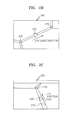
- FIG. 2A illustrates a head-up mode.
- the head-up mode displays a map so that the movement direction of the user always corresponds to an upward direction of a first area 200 on a screen that is set based on the current position. If a link from a node A 212 to a node B 214 is as illustrated in FIG. 2A , a link direction 216 is determined as the course direction at the current position.
- the first area 200 is an area displayed on the screen when the map is displayed, regardless of the movement direction of the user (i.e., the course direction at the current position).
- the current position is displayed on a vertical line that intersects the screen on which the map is displayed, and the first area 200 is set based on the current position.
- FIG. 2B illustrates a north-up mode.
- the north-up mode displays the map so that an actual north direction always corresponds to the upward direction of the first area 200 on the screen. If a link from a node A 222 to a node B 224 is as illustrated in FIG. 2B , a link direction 226 is determined as the course direction at the current position.
- FIG. 2C illustrates a bird's-eye view mode.
- the bird's-eye view mode three-dimensionally displays the map. If a link from a node A 232 to a node B 234 is as illustrated in FIG. 2C , a link direction 236 is determined as the course direction at the current position.
- FIGs. 2A through 2C show cases when a link direction at a current position is determined as a course direction. However, if a course from the current position to a destination is detected, a direction of the detected course may be determined as the course direction at the current position. A method of determining a course direction when a course from a current position to a destination is detected will now be described in detail with reference to FIGs. 3A through 3C .
- FIGs. 3A through 3C are diagrams to describe a method of determining a course direction, according to another embodiment of the present invention.
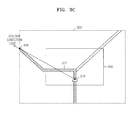
- a course 312 (represented as a shaded portion), also referred to herein as a route, from a current position 310 to a destination is detected in a first area 300.
- the course direction determination unit 110 illustrated in FIG. 1 sets the analysis area 320 in order to analyse the course direction at the current position 310.
- a large area including the first area 300 that is set based on the current position 310 is set as the analysis area 320.
- the same area as the first area 300 or a smaller area included in the first area 300 may also be set as the analysis area 320 according to other aspects.
- the course direction determination unit 110 sets a direction 326 from a centre 322 of the first area 300 to a point 324 where the detected course 312 intersects a boundary of the analysis area 320, as the course direction 326.
- a direction 328 from the current position 310 (as opposed to the centre 322 of the first area 300 as shown in FIG. 3B ) to the point 324 where the detected course 312 meets the boundary of the analysis area 320, may be determined as the course direction 326. Accordingly, if the centre 322 of the first area 300 differs from the current position 310, the direction 326 illustrated in FIG. 3B differs from the direction 328 illustrated in FIG. 3C .
- FIGs. 3A through 3C are described based on a head-up mode, it is understood that the same method may be applied to a north-up mode or a bird's-eye view mode shown in FIGs. 2B and 2C .
- the centre movement unit 120 moves a first centre of the first area to a second centre in accordance with the course direction at the current position, determined by the course direction determination unit 110.
- the display unit 130 displays a second area having the second centre on a screen.
- the first area displayed on the screen moves to the second area.
- a method of moving an area displayed on a screen will now be described in detail with reference to FIGs. 4A through 4C .
- FIGs. 4A through 4C are diagrams to describe methods of moving an area displayed on a screen, according to embodiments of the present invention.
- FIG. 4A illustrates a method of moving an area displayed on a screen when a course direction at a current position 220 is determined as illustrated in FIG. 2B .
- the centre movement unit 120 moves a first centre 402 of a first area 200 that is set based on the current position 220, in a link direction 226 that is determined by the course direction determination unit 110, so as to determine a second centre 404.
- a movement distance from the first centre 402 to the second centre 404 may differ in accordance with embodiments of the present invention.
- the movement distance can vary as long as the current position 220 can be displayed on the screen.
- the movement distance may adaptively differ in accordance with a user's speed of movement, which will be described in detail later with reference to FIG. 5 .
- the display unit 130 displays a second area 400 having the second centre 404 as its centre, on the screen.
- FIG. 4A is described based on a north-up mode, it is understood that the same method may be applied to a head-up mode or a bird's-eye view mode.
- FIG. 4B illustrates a method of moving an area displayed on a screen when a course direction at a current position 310 is determined as illustrated in FIG. 3B .
- the centre movement unit 120 moves a first centre 322 of a first area 300 that is set based on the current position 310, in a direction 326 that is determined as the course direction in FIG. 3B , so as to determine a second centre 412.
- a movement distance from the first centre 322 to the second centre 412 can vary, according to aspects of the present invention, as long as the current position 310 can be displayed on the screen.
- FIG. 4B is described based on the direction 326 illustrated in FIG. 3B , the same method may be applied when the direction 328 illustrated in FIG.
- 3C is determined as the course direction.
- the first centre 322 of the first area 300 may move by a predetermined distance in the direction 328 illustrated in FIG. 3C instead of the direction 326 illustrated in FIG. 3B , so as to determine a different second centre.
- the display unit 130 displays a second area 410 having the second centre 412 as its centre, on the screen.
- FIG. 4B is described based on a head-up mode, it is understood that the same method may be applied to a north-up mode or a bird's-eye view mode.
- FIG. 4C illustrates a method of moving an area displayed on a screen, according to another embodiment of the present invention.
- the centre movement unit 120 moves a first centre 322 of a first area 300 in only a vertical or a horizontal direction based on a course direction at a current position 310.
- the centre movement unit 120 moves the first centre 322 in only the horizontal direction so as to determine a second centre 422.
- the first centre 322 respectively moves in the vertical or the horizontal direction.
- the course direction is a top-left direction as illustrated in FIG. 3B or FIG. 3C
- the first centre 322 does not move in a top-left direction in the current embodiment.
- the first centre 322 moves in only the vertical or the horizontal direction so as to determine the second centre 422.
- the method illustrated in FIG. 4C may be applied to a head-up mode, a north-up mode, or a bird's-eye view mode.
- the first centre 322 may move based on only a horizontal component of the course direction, so as to determine the second centre 422, in the head-up mode or the bird's-eye view mode.
- FIG. 5 is a diagram to describe a method of moving an area displayed on a screen in accordance with a speed of movement, according to an embodiment of the present invention.
- a movement distance of a first centre 510 may differ in accordance with a user's speed of movement. If the user's speed of movement is relatively high (for example, greater than a predetermined speed), the first centre 510 moves to a second centre 520 so that the user can view information on an area that is relatively farther from the current position in a movement direction. As illustrated, a distance between the first centre 510 and the second centre 520 is relatively large. Accordingly, a displacement between a first area 500 having the first centre 510 as its centre and a second area 502 to be displayed on the screen is also respectively large.
- the first centre 510 moves to a second centre 530 so that the user can view information on an area that is relatively closer to the current position in the movement direction.
- a distance between the first centre 510 and the second centre 530 is relatively small. Accordingly, a displacement between the first area 500 having the first centre 510 as its centre and a second area 504 to be displayed on the screen is smaller than the case when the user's speed of movement is high.
- FIG. 6 is a flowchart of a map displaying method according to an embodiment of the present invention.
- a map display apparatus determines a course direction at a current position in operation 610.
- a link direction at the current position or a direction of a course, that is included in a predetermined analysis area, from the current position to a destination is determined as the course direction, though it is understood that aspects of the present invention are not limited thereto.
- the map display apparatus moves a first centre of a first area that is set based on the current position by a predetermined distance in the course direction that is determined in operation 610, so as to determine a second centre in operation 620.
- the first area is set regardless of the course direction at the current position and is an area displayed on a screen when a map is displayed in a display mode (such as a head-up mode, a north-up mode, or a bird's-eye view mode).
- the map display apparatus displays a second area having the second centre that is determined in operation 620, as its centre on the screen in operation 630.
- the second area is set based on the second centre that is moved from the first centre of the first area, and is displayed on the screen. Since the second centre is determined based on the course direction at the current position, the second area is moved from the first area by the predetermined distance in the course direction.
- FIG. 7 is a flowchart of a method of calling a centre movement operation, according to an embodiment of the present invention.
- a method of applying a map displaying operation is illustrated, in which an area that is moved from a first area by a predetermined distance based on a course direction at a current position is displayed on a screen as described above with reference to FIGs. 1, 2A through 2C , 3A through 3C , 4A through 5C , 5, and 6 .
- a map display apparatus calls the centre movement operation in operation 710. Then, the map display apparatus determines whether a course from a current position to a destination is detected in operation 720. Different methods of determining a course direction at the current position can be used according to whether the course from the current position to the destination is detected.
- an analysis area is set in order to analyze the course in operation 730.
- the map display apparatus determines the course direction in the analysis area in operation 750. For example, a point where the detected course intersects a boundary of the analysis area is determined and a direction from the current position or a first centre of the first area to the determined point may be determined as the course direction.
- a method of determining a course direction is not limited to the method described above with reference to FIGs. 3A through 3C .
- the map display apparatus determines a link direction as the course direction in operation 740.
- a link is a single course between two nodes and thus the link direction is a movement direction of a user on the link. Accordingly, the link direction is determined as the course direction.
- the map display apparatus moves the first centre of the first area in the determined course direction (operation 740 or 750), so as to determine a second centre in operation 760.
- Operation 760 corresponds to operation 620 illustrated in FIG. 6 .
- the map display apparatus displays a second area having the second centre as its centre, on the screen, in operation 770.
- the centre movement operation may be selectively used.
- the map display apparatus may or may not use the centre movement operation in accordance with a user's input.
- the centre movement operation may not be used and the first area that is set based on the current position may be displayed on the screen.
- the centre movement operation may not be used if the user departs from the course by more than a predetermined distance.
- the centre movement operation may be re-called.
- an area in a course direction may be more widely displayed on a screen and, thus, a user may rapidly check information on an area that the user is going to. Accordingly, a driver may safely drive a car by easily predicting a course.
- aspects of the present invention can also be embodied as computer-readable codes on a computer-readable recording medium.
- the computer-readable recording medium is any data storage device that can store data that can be thereafter read by a computer system. Examples of the computer-readable recording medium include read-only memory (ROM), random-access memory (RAM), CD-ROMs, magnetic tapes, floppy disks, and optical data storage devices.
- ROM read-only memory
- RAM random-access memory
- CD-ROMs compact discs, digital versatile discs, and Blu-rays, and Blu-rays, and Blu-rays, etc.
- the computer-readable recording medium can also be distributed over network-coupled computer systems so that the computer-readable code is stored and executed in a distributed fashion.
Landscapes
- Engineering & Computer Science (AREA)
- Physics & Mathematics (AREA)
- Theoretical Computer Science (AREA)
- Remote Sensing (AREA)
- General Physics & Mathematics (AREA)
- Radar, Positioning & Navigation (AREA)
- Business, Economics & Management (AREA)
- Educational Administration (AREA)
- Educational Technology (AREA)
- Mathematical Physics (AREA)
- Automation & Control Theory (AREA)
- Navigation (AREA)
- Instructional Devices (AREA)
Abstract
Description
- The present invention relates to a map displaying apparatus and method, and more particularly, to a map displaying apparatus and method by which an area in a course direction is more widely displayed on a screen.
- Currently, with the development of information technology (IT), navigation terminals have become widely used. A navigation system calculates a position of a local navigation terminal based on signals received from a plurality of global positioning system (GPS) satellites and displays a current position and a course to a destination of the navigation terminal on a screen.
- The navigation terminals are more widely used in cars that frequently search for a course. In order to allow a driver of a car to check information on a current position and a course to a destination as rapidly as possible while driving, the information has to be appropriately displayed on a screen of the navigation terminal.
- Conventional navigation terminals use various map displaying methods in order to allow the driver to easily and rapidly check the information. An example of the map displaying methods include a head-up mode method in which a map is displayed so that a current movement direction of a driver always corresponds to an upward direction of a screen. Another example is a north-up mode method in which a map is displayed so that an actual north direction always corresponds to an upward direction of a screen. A further example is a bird's-eye view mode method in which a map is three-dimensionally displayed so that a driver can easily compare an actual driving environment to the map displayed on a screen.
- However, the above map displaying methods do not display a certain area of the map that the driver may want to see on a screen.
- Aspects of the present invention provide a map displaying apparatus and method thereof whereby an area or more interest to a user is displayed on a screen, and a computer readable recording medium having recorded thereon a computer program for executing the map displaying method.
- According to an aspect of the present invention, there is provided a map displaying method to display a map on a screen, the map displaying method including: determining a course direction of an object at a current position of the map; moving a first centre of a first area of the map is set based on the current position, by a predetermined distance in the course direction so as to determine a second centre; and displaying a second area of the map on the screen having the second centre as a centre thereof.
- According to an aspect of the present invention, the determining of the course direction may include setting an analysis area to analyze the course direction at the current position; and analyzing a course included in the analysis area and determining a direction of the course included in the analysis area as the course direction.
- According to an aspect of the present invention, the direction of the course included in the analysis area may be a direction of the course from the current position or the first centre to a predetermined destination.
- According to an aspect of the present invention, the determining of the direction of the course included in the analysis area may include determining a point where a course from the current position or the first centre to the predetermined destination intersects a boundary of the analysis area; and determining a direction from the current position or the first centre to the point on the boundary of the analysis area as the course direction.
- According to an aspect of the present invention, the course direction at the current position may be a link direction at the current position.
- According to an aspect of the present invention, the moving of the first centre may include moving the first centre by a predetermined distance in only a vertical or a horizontal direction based on the course direction so as to determine the second centre.
- According to another aspect of the present invention, there is provided a map displaying apparatus to display a map on a screen, the apparatus including: a course direction determination unit to determine a course direction at a current position of a map; a centre movement unit to move a first centre of a first area that is set based on the current position, by a predetermined distance in the course direction so as to determine a second centre; and a display unit to display a second area having the second centre as a centre thereof.
- According to another aspect of the present invention, there is provided a computer readable recording medium having recorded thereon a computer program for executing the map displaying method.
- According to yet another aspect of the present invention, there is provided a map displaying method to display a map on a screen, the map displaying method including: displaying a first area of the map on the screen, the first area having a first centre; determining a course direction of an object at a current position of the map; and displaying a second area of the map on the screen, the second area having a second centre as a centre thereof, wherein the second centre is a predetermined distance away, in the course direction, from the first centre.
- According to still another aspect of the present invention, there is provided a map displaying apparatus to display a map on a screen, the map displaying apparatus including: a course direction determination unit to determine a course direction of an object at a current position of the map; and a display unit to change a display of a first area of the map on the screen, the first area having a first centre, to a second area of the map on the screen, the second area having a second centre as a centre thereof, wherein the second centre is a predetermined distance away, in the course direction, from the first centre.
- Additional aspects and/or advantages of the invention will be set forth in part in the description which follows and, in part, will be obvious from the description, or may be learned by practice of the invention.
- These and/or other aspects and advantages of the invention will become apparent and more readily appreciated from the following description of the embodiments, taken in conjunction with the accompanying drawings of which:
-
FIG. 1 is a block diagram of a map displaying apparatus according to an embodiment of the present invention; -
FIGs. 2A through 2C are diagrams to describe a method of determining a course direction, according to an embodiment of the present invention; -
FIGs. 3A through 3C are diagrams to describe a method of determining a course direction, according to another embodiment of the present invention; -
FIGs. 4A through 4C are diagrams to describe methods of moving an area displayed on a screen, according to embodiments of the present invention; -
FIG. 5 is a diagram to describe a method of moving an area displayed on a screen in accordance with a speed of movement, according to an embodiment of the present invention; -
FIG. 6 is a flowchart of a map displaying method according to an embodiment of the present invention; and -
FIG. 7 is a flowchart of a method of calling a centre movement operation, according to an embodiment of the present invention. - Reference will now be made in detail to the embodiments of the present invention, examples of which are illustrated in the accompanying drawings, wherein like reference numerals refer to the like elements throughout. The embodiments are described below in order to explain the present invention by referring to the figures.
-
FIG. 1 is a block diagram of amap displaying apparatus 100 according to an embodiment of the present invention. Referring toFIG. 1 , themap displaying apparatus 100 includes a coursedirection determination unit 110, acentre movement unit 120, and adisplay unit 130. While not restricted thereto, theapparatus 100 can be included in a car, a telephone, a personal media player, a portable computer, or as a stand alone GPS unit. Further, while not shown, it is understood that theapparatus 100 can include a GPS device to determine the location and a storage device to store the map information. - The course
direction determination unit 110 determines a course direction at a current position in a first area that is set based on the current position. Accordingly, a user seeing a map displayed on a screen (such as the display unit 130) of a mobile device (such as a navigation terminal) can view information on an area that the user is going to move to, rather than information on an area that the user is moving from. Such information can include information on road conditions and points of interest (POIs) of the area that the user is going to move to. The area that the user is going to move to is determined in accordance with the course direction at the current position determined by the coursedirection determination unit 110. The course direction at the current position may be determined by any of a variety of methods. For example, according to aspects of the present invention, a link direction at the current position or a direction of a course, that is included in a predetermined analysis area, from the current position to a destination may be determined as the course direction at the current position. A method of determining a course direction will now be described in detail with reference toFIGs. 2A through 2C . -
FIGs. 2A through 2C are diagrams to describe a method of determining a course direction, according to an embodiment of the present invention. The method illustrated inFIGs. 2A through 2C determines a link direction at a current position as the course direction. A link is a single course, or route, between two nodes and, thus, the link direction is a movement direction of a user. -
FIG. 2A illustrates a head-up mode. The head-up mode displays a map so that the movement direction of the user always corresponds to an upward direction of afirst area 200 on a screen that is set based on the current position. If a link from anode A 212 to anode B 214 is as illustrated inFIG. 2A , alink direction 216 is determined as the course direction at the current position. Here, thefirst area 200 is an area displayed on the screen when the map is displayed, regardless of the movement direction of the user (i.e., the course direction at the current position). In general, the current position is displayed on a vertical line that intersects the screen on which the map is displayed, and thefirst area 200 is set based on the current position. -
FIG. 2B illustrates a north-up mode. The north-up mode displays the map so that an actual north direction always corresponds to the upward direction of thefirst area 200 on the screen. If a link from anode A 222 to anode B 224 is as illustrated inFIG. 2B , alink direction 226 is determined as the course direction at the current position. -
FIG. 2C illustrates a bird's-eye view mode. The bird's-eye view mode three-dimensionally displays the map. If a link from anode A 232 to anode B 234 is as illustrated inFIG. 2C , alink direction 236 is determined as the course direction at the current position. -
FIGs. 2A through 2C show cases when a link direction at a current position is determined as a course direction. However, if a course from the current position to a destination is detected, a direction of the detected course may be determined as the course direction at the current position. A method of determining a course direction when a course from a current position to a destination is detected will now be described in detail with reference toFIGs. 3A through 3C . -
FIGs. 3A through 3C are diagrams to describe a method of determining a course direction, according to another embodiment of the present invention. Referring toFIG. 3A , a course 312 (represented as a shaded portion), also referred to herein as a route, from acurrent position 310 to a destination is detected in afirst area 300. - Referring to
FIG. 3B , a direction of thecourse 312 from thecurrent position 310 to the destination, which is included in ananalysis area 320, is determined as the course direction. The coursedirection determination unit 110 illustrated inFIG. 1 sets theanalysis area 320 in order to analyse the course direction at thecurrent position 310. InFIGs. 3B and3C , a large area including thefirst area 300 that is set based on thecurrent position 310 is set as theanalysis area 320. However, it is understood by those of ordinary skill in the art that the same area as thefirst area 300 or a smaller area included in thefirst area 300 may also be set as theanalysis area 320 according to other aspects. - When the
analysis area 320 is set, the coursedirection determination unit 110 sets adirection 326 from acentre 322 of thefirst area 300 to apoint 324 where the detectedcourse 312 intersects a boundary of theanalysis area 320, as thecourse direction 326. - Alternatively, as illustrated in
FIG. 3C , adirection 328 from the current position 310 (as opposed to thecentre 322 of thefirst area 300 as shown inFIG. 3B ) to thepoint 324 where the detectedcourse 312 meets the boundary of theanalysis area 320, may be determined as thecourse direction 326. Accordingly, if thecentre 322 of thefirst area 300 differs from thecurrent position 310, thedirection 326 illustrated inFIG. 3B differs from thedirection 328 illustrated inFIG. 3C . AlthoughFIGs. 3A through 3C are described based on a head-up mode, it is understood that the same method may be applied to a north-up mode or a bird's-eye view mode shown inFIGs. 2B and 2C . - Referring back to
FIG. 1 , thecentre movement unit 120 moves a first centre of the first area to a second centre in accordance with the course direction at the current position, determined by the coursedirection determination unit 110.
Thedisplay unit 130 displays a second area having the second centre on a screen. - Thus, the first area displayed on the screen moves to the second area. A method of moving an area displayed on a screen will now be described in detail with reference to
FIGs. 4A through 4C . -
FIGs. 4A through 4C are diagrams to describe methods of moving an area displayed on a screen, according to embodiments of the present invention.FIG. 4A illustrates a method of moving an area displayed on a screen when a course direction at acurrent position 220 is determined as illustrated inFIG. 2B . Referring toFIG. 4A , thecentre movement unit 120 moves afirst centre 402 of afirst area 200 that is set based on thecurrent position 220, in alink direction 226 that is determined by the coursedirection determination unit 110, so as to determine asecond centre 404. A movement distance from thefirst centre 402 to thesecond centre 404 may differ in accordance with embodiments of the present invention. In particular, the movement distance can vary as long as thecurrent position 220 can be displayed on the screen. Furthermore, the movement distance may adaptively differ in accordance with a user's speed of movement, which will be described in detail later with reference toFIG. 5 .
When thesecond centre 404 is determined, thedisplay unit 130 displays asecond area 400 having thesecond centre 404 as its centre, on the screen. AlthoughFIG. 4A is described based on a north-up mode, it is understood that the same method may be applied to a head-up mode or a bird's-eye view mode. -
FIG. 4B illustrates a method of moving an area displayed on a screen when a course direction at acurrent position 310 is determined as illustrated inFIG. 3B . Referring toFIG. 4B , thecentre movement unit 120 moves afirst centre 322 of afirst area 300 that is set based on thecurrent position 310, in adirection 326 that is determined as the course direction inFIG. 3B , so as to determine asecond centre 412. A movement distance from thefirst centre 322 to thesecond centre 412 can vary, according to aspects of the present invention, as long as thecurrent position 310 can be displayed on the screen. AlthoughFIG. 4B is described based on thedirection 326 illustrated inFIG. 3B , the same method may be applied when thedirection 328 illustrated inFIG. 3C is determined as the course direction. For example, thefirst centre 322 of thefirst area 300 may move by a predetermined distance in thedirection 328 illustrated inFIG. 3C instead of thedirection 326 illustrated inFIG. 3B , so as to determine a different second centre. Accordingly, when thesecond centre 412 is determined, thedisplay unit 130 displays asecond area 410 having thesecond centre 412 as its centre, on the screen. AlthoughFIG. 4B is described based on a head-up mode, it is understood that the same method may be applied to a north-up mode or a bird's-eye view mode. -
FIG. 4C illustrates a method of moving an area displayed on a screen, according to another embodiment of the present invention. Referring toFIG. 4C , thecentre movement unit 120 moves afirst centre 322 of afirst area 300 in only a vertical or a horizontal direction based on a course direction at acurrent position 310. For example, inFIG. 4C , thecentre movement unit 120 moves thefirst centre 322 in only the horizontal direction so as to determine asecond centre 422. - Specifically, if the course direction is a vertical or a horizontal direction, the
first centre 322 respectively moves in the vertical or the horizontal direction. However, if the course direction is a top-left direction as illustrated inFIG. 3B orFIG. 3C , thefirst centre 322 does not move in a top-left direction in the current embodiment. Based on a vertical or horizontal component of the course direction, thefirst centre 322 moves in only the vertical or the horizontal direction so as to determine thesecond centre 422. - The method illustrated in
FIG. 4C may be applied to a head-up mode, a north-up mode, or a bird's-eye view mode. However, according to other aspects, thefirst centre 322 may move based on only a horizontal component of the course direction, so as to determine thesecond centre 422, in the head-up mode or the bird's-eye view mode. -
FIG. 5 is a diagram to describe a method of moving an area displayed on a screen in accordance with a speed of movement, according to an embodiment of the present invention. Referring toFIG. 5 , a movement distance of afirst centre 510 may differ in accordance with a user's speed of movement. If the user's speed of movement is relatively high (for example, greater than a predetermined speed), thefirst centre 510 moves to asecond centre 520 so that the user can view information on an area that is relatively farther from the current position in a movement direction. As illustrated, a distance between thefirst centre 510 and thesecond centre 520 is relatively large. Accordingly, a displacement between afirst area 500 having thefirst centre 510 as its centre and asecond area 502 to be displayed on the screen is also respectively large. - On the other hand, if the user's speed of movement is low (for example, less than a predetermined speed), the
first centre 510 moves to asecond centre 530 so that the user can view information on an area that is relatively closer to the current position in the movement direction. As illustrated, a distance between thefirst centre 510 and thesecond centre 530 is relatively small. Accordingly, a displacement between thefirst area 500 having thefirst centre 510 as its centre and asecond area 504 to be displayed on the screen is smaller than the case when the user's speed of movement is high. -
FIG. 6 is a flowchart of a map displaying method according to an embodiment of the present invention. Referring toFIG. 6 , a map display apparatus determines a course direction at a current position inoperation 610. As described above with reference toFIGs. 2A through 2C and3A through 3C , a link direction at the current position or a direction of a course, that is included in a predetermined analysis area, from the current position to a destination is determined as the course direction, though it is understood that aspects of the present invention are not limited thereto. - The map display apparatus moves a first centre of a first area that is set based on the current position by a predetermined distance in the course direction that is determined in
operation 610, so as to determine a second centre inoperation 620. The first area is set regardless of the course direction at the current position and is an area displayed on a screen when a map is displayed in a display mode (such as a head-up mode, a north-up mode, or a bird's-eye view mode). - Accordingly, the map display apparatus displays a second area having the second centre that is determined in
operation 620, as its centre on the screen inoperation 630. The second area is set based on the second centre that is moved from the first centre of the first area, and is displayed on the screen. Since the second centre is determined based on the course direction at the current position, the second area is moved from the first area by the predetermined distance in the course direction. -
FIG. 7 is a flowchart of a method of calling a centre movement operation, according to an embodiment of the present invention. InFIG. 7 , a method of applying a map displaying operation is illustrated, in which an area that is moved from a first area by a predetermined distance based on a course direction at a current position is displayed on a screen as described above with reference toFIGs. 1, 2A through2C ,3A through 3C ,4A through 5C ,5, and 6 . - Referring to
FIG. 7 , a map display apparatus according to an embodiment of the present invention calls the centre movement operation inoperation 710. Then, the map display apparatus determines whether a course from a current position to a destination is detected inoperation 720. Different methods of determining a course direction at the current position can be used according to whether the course from the current position to the destination is detected. - If it is determined that the course from the current position to the destination is detected (operation 720), an analysis area is set in order to analyze the course in
operation 730. When the analysis area is set (operation 730), the map display apparatus determines the course direction in the analysis area inoperation 750. For example, a point where the detected course intersects a boundary of the analysis area is determined and a direction from the current position or a first centre of the first area to the determined point may be determined as the course direction. However, it is understood that a method of determining a course direction is not limited to the method described above with reference toFIGs. 3A through 3C . - If it is determined that the course from the current position to the destination is not detected (operation 720), the map display apparatus determines a link direction as the course direction in
operation 740. A link is a single course between two nodes and thus the link direction is a movement direction of a user on the link. Accordingly, the link direction is determined as the course direction. - The map display apparatus moves the first centre of the first area in the determined course direction (
operation 740 or 750), so as to determine a second centre inoperation 760.Operation 760 corresponds tooperation 620 illustrated inFIG. 6 . Accordingly, the map display apparatus displays a second area having the second centre as its centre, on the screen, inoperation 770. - The method illustrated in
FIG. 7 is exemplarily described and it will be easily understood by those of ordinary skill in the art that various other methods may also be used. Furthermore, it is understood that the centre movement operation may be selectively used. For example, the map display apparatus may or may not use the centre movement operation in accordance with a user's input. Also, if an exceptional case happens (for example, if the user departs from the course), the centre movement operation may not be used and the first area that is set based on the current position may be displayed on the screen. In this case, according to an embodiment of the present invention, the centre movement operation may not be used if the user departs from the course by more than a predetermined distance. Alternatively, if the exceptional case happens, the centre movement operation may be re-called. - As described above, according to aspects of the present invention, an area in a course direction may be more widely displayed on a screen and, thus, a user may rapidly check information on an area that the user is going to. Accordingly, a driver may safely drive a car by easily predicting a course.
- While aspects of the present invention have been particularly shown and described with reference to embodiments thereof, it will be understood by those of ordinary skill in the art that various changes in form and details may be made therein without departing from the spirit and scope of the invention as defined by the appended claims. Also, aspects of the present invention can also be embodied as computer-readable codes on a computer-readable recording medium. The computer-readable recording medium is any data storage device that can store data that can be thereafter read by a computer system. Examples of the computer-readable recording medium include read-only memory (ROM), random-access memory (RAM), CD-ROMs, magnetic tapes, floppy disks, and optical data storage devices. The computer-readable recording medium can also be distributed over network-coupled computer systems so that the computer-readable code is stored and executed in a distributed fashion.
- Although a few embodiments of the present invention have been shown and described, it would be appreciated by those skilled in the art that changes may be made in this embodiment without departing from the principles of the invention, the scope of which is defined in the claims.
Claims (15)
- A map displaying method to display a map on a screen, the map displaying method comprising:determining a course direction of an object at a current position of the map;moving a first centre of a first area of the map, displayed on the screen, that is set based on the current position, by a predetermined distance in the determined course direction so as to determine a second centre; anddisplaying a second area of the map on the screen having the determined second centre as a centre thereof.
- The map displaying method as claimed in claim 1, wherein the determining of the course direction comprises:setting an analysis area to analyze the course direction at the current position; andanalyzing a course included in the analysis area and determining a direction of the course included in the analysis area as the course direction.
- The map displaying method as claimed in claim 2, wherein the direction of the course included in the analysis area is a direction of the course, that is included in a predetermined analysis area, from the current position or the first centre to a predetermined destination.
- The map displaying method as claimed in claim 2, wherein the determining of the direction of the course included in the analysis area comprises:determining a point where a course from the current position or the first centre to a predetermined destination intersects a boundary of the analysis area; anddetermining a direction from the current position or the first centre to the point on the boundary of the analysis area as the course direction.
- The map displaying method as claimed in claim 1, wherein the course direction at the current position is a link direction at the current position.
- The map displaying method as claimed in any one of the preceding claims, wherein the moving of the first centre comprises moving the first centre by the predetermined distance in only a vertical or a horizontal direction based on the course direction so as to determine the second centre.
- The map displaying method as claimed in any one of the preceding claims, wherein the moving of the first centre comprises:moving the first centre by a first distance in the course direction when a moving speed of the object is a first speed; andmoving the first centre by a second distance, less than the first distance, when the moving speed of the object is a second speed, less than the first speed.
- A map displaying apparatus for displaying a map on a screen, the map displaying apparatus comprising:a course direction determination unit to determine a course direction of an object at a current position of the map;a centre movement unit to move a first centre of a first area of the map, displayed on the screen, that is set based on the current position, by a predetermined distance in the determined course direction so as to determine a second centre; anda display unit to display a second area of the map on the screen having the determined second centre as a centre thereof.
- The map displaying apparatus as claimed in claim 8, wherein the course direction determination unit sets an analysis area to analyze the course direction at the current position, and analyzes a course included in the analysis area to determine a direction of the course included in the analysis area as the course direction.
- The map displaying apparatus as claimed in claim 9, wherein the direction of the course included in the analysis area is a direction of the course, that is included in a predetermined analysis area, from the current position or the first centre to a predetermined destination.
- The map displaying apparatus as claimed in claim 9, wherein the course direction determination unit determines a point where a course from the current position or the first centre to a predetermined destination intersects a boundary of the analysis area, and determines a direction from the current position or the first centre to the point on the boundary of the analysis area as the course direction.
- The map displaying apparatus as claimed in any one of claims 8 to 11, wherein the course direction at the current position is a link direction at the current position.
- The map displaying apparatus as claimed in any one of claims 8 to 12, wherein the centre movement unit moves the first centre by the predetermined distance in only a vertical or a horizontal direction based on the course direction so as to determine the second centre.
- The map displaying apparatus as claimed in any one of claims 8 to 13, wherein the centre movement unit moves the first centre by a first distance in the course direction when a moving speed of the object is a first speed, and moves the first centre by a second distance, less than the first distance, when the moving speed of the object is a second speed, less than the first speed.
- A computer program which, when executed by a processor, is arranged to perform a method according to any one of claims 1 to 7.
Applications Claiming Priority (1)
| Application Number | Priority Date | Filing Date | Title |
|---|---|---|---|
| KR1020080060229A KR101538653B1 (en) | 2008-06-25 | 2008-06-25 | Map display method and apparatus based on path direction |
Publications (3)
| Publication Number | Publication Date |
|---|---|
| EP2138804A2 true EP2138804A2 (en) | 2009-12-30 |
| EP2138804A3 EP2138804A3 (en) | 2012-11-14 |
| EP2138804B1 EP2138804B1 (en) | 2015-09-23 |
Family
ID=41055451
Family Applications (1)
| Application Number | Title | Priority Date | Filing Date |
|---|---|---|---|
| EP09156271.0A Not-in-force EP2138804B1 (en) | 2008-06-25 | 2009-03-26 | Method and apparatus for displaying map based on course direction |
Country Status (4)
| Country | Link |
|---|---|
| US (1) | US20090326812A1 (en) |
| EP (1) | EP2138804B1 (en) |
| KR (1) | KR101538653B1 (en) |
| ES (1) | ES2551357T3 (en) |
Cited By (1)
| Publication number | Priority date | Publication date | Assignee | Title |
|---|---|---|---|---|
| CN109377856A (en) * | 2018-10-31 | 2019-02-22 | 巴中彩颉电子商务有限公司 | A kind of regional customization cartography method |
Families Citing this family (1)
| Publication number | Priority date | Publication date | Assignee | Title |
|---|---|---|---|---|
| US9031783B2 (en) * | 2013-02-28 | 2015-05-12 | Blackberry Limited | Repositionable graphical current location indicator |
Citations (2)
| Publication number | Priority date | Publication date | Assignee | Title |
|---|---|---|---|---|
| JPH06331367A (en) | 1993-05-19 | 1994-12-02 | Sumitomo Electric Ind Ltd | Road map display |
| EP1014038A1 (en) | 1997-06-20 | 2000-06-28 | Mitsubishi Denki Kabushiki Kaisha | Map information displaying device |
Family Cites Families (19)
| Publication number | Priority date | Publication date | Assignee | Title |
|---|---|---|---|---|
| US5093669A (en) * | 1989-10-20 | 1992-03-03 | Mazda Motor Corporation | Vehicle navigation apparatus |
| US5412573A (en) * | 1993-05-20 | 1995-05-02 | Motorola Inc. | Multi-mode route guidance system and method therefor |
| US5982301A (en) * | 1995-01-20 | 1999-11-09 | Mitsubishi Denki Kabushiki Kaisha | Navigation apparatus |
| US6138203A (en) * | 1995-11-10 | 2000-10-24 | Sony Corporation | Information processing apparatus and method enabling a write-once recording medium to be utilized as a rewriteable recording medium |
| JP3630258B2 (en) * | 1997-02-10 | 2005-03-16 | 本田技研工業株式会社 | Route guidance device |
| US6160778A (en) * | 1999-03-08 | 2000-12-12 | Matsushita Electric Industrial Co., Ltd. | Information recording medium, information recording method, information recording apparatus and information reproducing apparatus |
| EP1335339B1 (en) * | 2002-01-30 | 2005-10-05 | Pioneer Corporation | Position display system |
| EP1416252A2 (en) * | 2002-11-01 | 2004-05-06 | Matsushita Electric Industrial Co., Ltd. | Display of the recommended route in a navigation device |
| KR101008641B1 (en) * | 2002-12-11 | 2011-01-17 | 엘지전자 주식회사 | Method and apparatus for superimposing recording on optical disc which can be recorded once |
| US6839628B1 (en) * | 2003-06-13 | 2005-01-04 | Alpine Electronics, Inc | Display method and apparatus for arranging order of listing points of interest for navigation system |
| JP2005017052A (en) * | 2003-06-25 | 2005-01-20 | Hitachi Ltd | How to display navigation |
| JP3962764B2 (en) * | 2004-06-11 | 2007-08-22 | 松下電器産業株式会社 | Map display device and map display method |
| KR100663025B1 (en) * | 2004-07-20 | 2006-12-28 | 엘지전자 주식회사 | How to update the background map of the navigation system |
| JP4783603B2 (en) * | 2005-08-26 | 2011-09-28 | 株式会社デンソー | MAP DISPLAY DEVICE, MAP DISPLAY METHOD, MAP DISPLAY PROGRAM, AND RECORDING MEDIUM CONTAINING THE PROGRAM |
| WO2007066483A1 (en) * | 2005-12-07 | 2007-06-14 | Matsushita Electric Industrial Co., Ltd. | Route information display device amd route information display method |
| JP4595866B2 (en) * | 2006-03-30 | 2010-12-08 | アイシン・エィ・ダブリュ株式会社 | Route information creation system and route information creation method |
| JP4654968B2 (en) * | 2006-04-25 | 2011-03-23 | 株式会社デンソー | Navigation device |
| TWI291548B (en) * | 2006-10-13 | 2007-12-21 | Mitac Int Corp | Navigation device capable of displaying on the basis of moving direction and the method thereof |
| US8073617B2 (en) * | 2006-12-27 | 2011-12-06 | Aisin Aw Co., Ltd. | Map information generating systems, methods, and programs |
-
2008
- 2008-06-25 KR KR1020080060229A patent/KR101538653B1/en active Active
- 2008-12-03 US US12/327,269 patent/US20090326812A1/en not_active Abandoned
-
2009
- 2009-03-26 EP EP09156271.0A patent/EP2138804B1/en not_active Not-in-force
- 2009-03-26 ES ES09156271.0T patent/ES2551357T3/en active Active
Patent Citations (2)
| Publication number | Priority date | Publication date | Assignee | Title |
|---|---|---|---|---|
| JPH06331367A (en) | 1993-05-19 | 1994-12-02 | Sumitomo Electric Ind Ltd | Road map display |
| EP1014038A1 (en) | 1997-06-20 | 2000-06-28 | Mitsubishi Denki Kabushiki Kaisha | Map information displaying device |
Cited By (1)
| Publication number | Priority date | Publication date | Assignee | Title |
|---|---|---|---|---|
| CN109377856A (en) * | 2018-10-31 | 2019-02-22 | 巴中彩颉电子商务有限公司 | A kind of regional customization cartography method |
Also Published As
| Publication number | Publication date |
|---|---|
| KR20100000651A (en) | 2010-01-06 |
| EP2138804B1 (en) | 2015-09-23 |
| ES2551357T3 (en) | 2015-11-18 |
| US20090326812A1 (en) | 2009-12-31 |
| EP2138804A3 (en) | 2012-11-14 |
| KR101538653B1 (en) | 2015-07-29 |
Similar Documents
| Publication | Publication Date | Title |
|---|---|---|
| US9691281B2 (en) | Navigation system with image assisted navigation mechanism and method of operation thereof | |
| US7519469B2 (en) | Display method and apparatus for navigation system | |
| KR100429128B1 (en) | Navigation device | |
| US7590487B2 (en) | Method and apparatus of displaying three-dimensional arrival screen for navigation system | |
| US20100268460A1 (en) | Navigation system with predictive multi-routing and method of operation thereof | |
| EP2096413A1 (en) | Method and apparatus for adjusting distance for generating maneuver instruction for navigation system | |
| EP2302323A2 (en) | Method, system, and computer program product for navigating vehicle | |
| JP4783603B2 (en) | MAP DISPLAY DEVICE, MAP DISPLAY METHOD, MAP DISPLAY PROGRAM, AND RECORDING MEDIUM CONTAINING THE PROGRAM | |
| EP2136185A2 (en) | Method and apparatus for displaying map using non-linear compression | |
| JP2001174271A (en) | Navigation apparatus | |
| CN104598712A (en) | Positioning point screening method and system | |
| US9304013B2 (en) | Storage device and navigation system | |
| EP2988097A1 (en) | Driving support system, method, and program | |
| JP5183353B2 (en) | Navigation device | |
| EP2138804B1 (en) | Method and apparatus for displaying map based on course direction | |
| JP4111444B2 (en) | Navigation device | |
| JP4097553B2 (en) | Navigation device | |
| JP2005321268A (en) | Navigation system | |
| JP4682210B2 (en) | NAVIGATION DEVICE, PROCESS CONTROL METHOD, PROCESS CONTROL PROGRAM, AND RECORDING MEDIUM | |
| US8340906B2 (en) | Method for generating and searching through trajectory content performed in navigation device | |
| JP3909185B2 (en) | Automotive electronics | |
| JP2008082818A (en) | Navigation system and navigation device | |
| KR20260041775A (en) | Method and system for providing navigation service | |
| JP2007040795A (en) | Navigation device and information providing method | |
| CN110892229A (en) | Notification control device and notification control method |
Legal Events
| Date | Code | Title | Description |
|---|---|---|---|
| PUAI | Public reference made under article 153(3) epc to a published international application that has entered the european phase |
Free format text: ORIGINAL CODE: 0009012 |
|
| AK | Designated contracting states |
Kind code of ref document: A2 Designated state(s): AT BE BG CH CY CZ DE DK EE ES FI FR GB GR HR HU IE IS IT LI LT LU LV MC MK MT NL NO PL PT RO SE SI SK TR |
|
| AX | Request for extension of the european patent |
Extension state: AL BA RS |
|
| RAP1 | Party data changed (applicant data changed or rights of an application transferred) |
Owner name: SAMSUNG ELECTRONICS CO., LTD. |
|
| PUAL | Search report despatched |
Free format text: ORIGINAL CODE: 0009013 |
|
| AK | Designated contracting states |
Kind code of ref document: A3 Designated state(s): AT BE BG CH CY CZ DE DK EE ES FI FR GB GR HR HU IE IS IT LI LT LU LV MC MK MT NL NO PL PT RO SE SI SK TR |
|
| AX | Request for extension of the european patent |
Extension state: AL BA RS |
|
| RIC1 | Information provided on ipc code assigned before grant |
Ipc: G09B 29/10 20060101ALI20121010BHEP Ipc: G01C 21/36 20060101AFI20121010BHEP Ipc: G08G 1/0969 20060101ALI20121010BHEP |
|
| 17P | Request for examination filed |
Effective date: 20130514 |
|
| AKX | Designation fees paid |
Designated state(s): CH ES FI LI PL SE TR |
|
| REG | Reference to a national code |
Ref country code: DE Ref legal event code: R108 |
|
| REG | Reference to a national code |
Ref country code: DE Ref legal event code: R108 Effective date: 20130717 |
|
| 17Q | First examination report despatched |
Effective date: 20130909 |
|
| GRAP | Despatch of communication of intention to grant a patent |
Free format text: ORIGINAL CODE: EPIDOSNIGR1 |
|
| INTG | Intention to grant announced |
Effective date: 20150429 |
|
| GRAS | Grant fee paid |
Free format text: ORIGINAL CODE: EPIDOSNIGR3 |
|
| GRAA | (expected) grant |
Free format text: ORIGINAL CODE: 0009210 |
|
| AK | Designated contracting states |
Kind code of ref document: B1 Designated state(s): CH ES FI LI PL SE TR |
|
| REG | Reference to a national code |
Ref country code: CH Ref legal event code: EP |
|
| REG | Reference to a national code |
Ref country code: ES Ref legal event code: FG2A Ref document number: 2551357 Country of ref document: ES Kind code of ref document: T3 Effective date: 20151118 |
|
| PG25 | Lapsed in a contracting state [announced via postgrant information from national office to epo] |
Ref country code: FI Free format text: LAPSE BECAUSE OF FAILURE TO SUBMIT A TRANSLATION OF THE DESCRIPTION OR TO PAY THE FEE WITHIN THE PRESCRIBED TIME-LIMIT Effective date: 20150923 |
|
| PG25 | Lapsed in a contracting state [announced via postgrant information from national office to epo] |
Ref country code: SE Free format text: LAPSE BECAUSE OF FAILURE TO SUBMIT A TRANSLATION OF THE DESCRIPTION OR TO PAY THE FEE WITHIN THE PRESCRIBED TIME-LIMIT Effective date: 20150923 |
|
| PG25 | Lapsed in a contracting state [announced via postgrant information from national office to epo] |
Ref country code: PL Free format text: LAPSE BECAUSE OF FAILURE TO SUBMIT A TRANSLATION OF THE DESCRIPTION OR TO PAY THE FEE WITHIN THE PRESCRIBED TIME-LIMIT Effective date: 20150923 |
|
| PLBE | No opposition filed within time limit |
Free format text: ORIGINAL CODE: 0009261 |
|
| STAA | Information on the status of an ep patent application or granted ep patent |
Free format text: STATUS: NO OPPOSITION FILED WITHIN TIME LIMIT |
|
| 26N | No opposition filed |
Effective date: 20160624 |
|
| REG | Reference to a national code |
Ref country code: CH Ref legal event code: PL |
|
| PG25 | Lapsed in a contracting state [announced via postgrant information from national office to epo] |
Ref country code: LI Free format text: LAPSE BECAUSE OF NON-PAYMENT OF DUE FEES Effective date: 20160331 Ref country code: CH Free format text: LAPSE BECAUSE OF NON-PAYMENT OF DUE FEES Effective date: 20160331 |
|
| PG25 | Lapsed in a contracting state [announced via postgrant information from national office to epo] |
Ref country code: TR Free format text: LAPSE BECAUSE OF FAILURE TO SUBMIT A TRANSLATION OF THE DESCRIPTION OR TO PAY THE FEE WITHIN THE PRESCRIBED TIME-LIMIT Effective date: 20150923 |
|
| PGFP | Annual fee paid to national office [announced via postgrant information from national office to epo] |
Ref country code: ES Payment date: 20200414 Year of fee payment: 12 |
|
| REG | Reference to a national code |
Ref country code: ES Ref legal event code: FD2A Effective date: 20220524 |
|
| PG25 | Lapsed in a contracting state [announced via postgrant information from national office to epo] |
Ref country code: ES Free format text: LAPSE BECAUSE OF NON-PAYMENT OF DUE FEES Effective date: 20210327 |