EP2138152A2 - Perlend-prickelnde Mundwässerzubereitungen - Google Patents
Perlend-prickelnde Mundwässerzubereitungen Download PDFInfo
- Publication number
- EP2138152A2 EP2138152A2 EP09154618A EP09154618A EP2138152A2 EP 2138152 A2 EP2138152 A2 EP 2138152A2 EP 09154618 A EP09154618 A EP 09154618A EP 09154618 A EP09154618 A EP 09154618A EP 2138152 A2 EP2138152 A2 EP 2138152A2
- Authority
- EP
- European Patent Office
- Prior art keywords
- weight
- acid
- ethyl
- hydroxy
- und
- Prior art date
- Legal status (The legal status is an assumption and is not a legal conclusion. Google has not performed a legal analysis and makes no representation as to the accuracy of the status listed.)
- Ceased
Links
- 239000002324 mouth wash Substances 0.000 title claims abstract description 102
- 229940051866 mouthwash Drugs 0.000 title claims abstract description 90
- 238000002360 preparation method Methods 0.000 title claims abstract description 14
- 239000000203 mixture Substances 0.000 claims abstract description 105
- XLYOFNOQVPJJNP-UHFFFAOYSA-N water Substances O XLYOFNOQVPJJNP-UHFFFAOYSA-N 0.000 claims abstract description 45
- 239000000126 substance Substances 0.000 claims abstract description 39
- CURLTUGMZLYLDI-UHFFFAOYSA-N Carbon dioxide Chemical compound O=C=O CURLTUGMZLYLDI-UHFFFAOYSA-N 0.000 claims abstract description 32
- 239000007789 gas Substances 0.000 claims abstract description 29
- 238000000034 method Methods 0.000 claims abstract description 17
- IJGRMHOSHXDMSA-UHFFFAOYSA-N Atomic nitrogen Chemical compound N#N IJGRMHOSHXDMSA-UHFFFAOYSA-N 0.000 claims abstract description 16
- 210000000214 mouth Anatomy 0.000 claims abstract description 16
- 239000001569 carbon dioxide Substances 0.000 claims abstract description 14
- 229910002092 carbon dioxide Inorganic materials 0.000 claims abstract description 14
- 239000001301 oxygen Substances 0.000 claims abstract description 10
- 229910052760 oxygen Inorganic materials 0.000 claims abstract description 10
- QVGXLLKOCUKJST-UHFFFAOYSA-N atomic oxygen Chemical compound [O] QVGXLLKOCUKJST-UHFFFAOYSA-N 0.000 claims abstract description 9
- 238000004140 cleaning Methods 0.000 claims abstract description 8
- 239000007788 liquid Substances 0.000 claims abstract description 5
- JCXJVPUVTGWSNB-UHFFFAOYSA-N nitrogen dioxide Inorganic materials O=[N]=O JCXJVPUVTGWSNB-UHFFFAOYSA-N 0.000 claims abstract description 4
- 238000005429 filling process Methods 0.000 claims abstract description 3
- -1 4-hydroxy-3-methoxyphenyl Chemical group 0.000 claims description 104
- 125000004432 carbon atom Chemical group C* 0.000 claims description 60
- PEDCQBHIVMGVHV-UHFFFAOYSA-N Glycerine Chemical compound OCC(O)CO PEDCQBHIVMGVHV-UHFFFAOYSA-N 0.000 claims description 55
- 125000001495 ethyl group Chemical group [H]C([H])([H])C([H])([H])* 0.000 claims description 47
- 125000000217 alkyl group Chemical group 0.000 claims description 43
- 239000004094 surface-active agent Substances 0.000 claims description 17
- 230000002265 prevention Effects 0.000 claims description 16
- BXOCHUWSGYYSFW-HVWOQQCMSA-N spilanthol Chemical compound C\C=C\C=C/CC\C=C\C(=O)NCC(C)C BXOCHUWSGYYSFW-HVWOQQCMSA-N 0.000 claims description 16
- 230000000069 prophylactic effect Effects 0.000 claims description 14
- 229910052757 nitrogen Inorganic materials 0.000 claims description 13
- 125000003762 3,4-dimethoxyphenyl group Chemical group [H]C1=C([H])C(OC([H])([H])[H])=C(OC([H])([H])[H])C([H])=C1* 0.000 claims description 12
- 125000002496 methyl group Chemical group [H]C([H])([H])* 0.000 claims description 12
- KDSNLYIMUZNERS-UHFFFAOYSA-N 2-methylpropanamine Chemical compound CC(C)CN KDSNLYIMUZNERS-UHFFFAOYSA-N 0.000 claims description 11
- 239000000796 flavoring agent Substances 0.000 claims description 11
- 235000019634 flavors Nutrition 0.000 claims description 11
- MAGQQZHFHJDIRE-BNFZFUHLSA-N pellitorine Chemical compound CCCCC\C=C\C=C\C(=O)NCC(C)C MAGQQZHFHJDIRE-BNFZFUHLSA-N 0.000 claims description 9
- DNIAPMSPPWPWGF-UHFFFAOYSA-N Propylene glycol Chemical compound CC(O)CO DNIAPMSPPWPWGF-UHFFFAOYSA-N 0.000 claims description 8
- BXOCHUWSGYYSFW-UHFFFAOYSA-N all-trans spilanthol Natural products CC=CC=CCCC=CC(=O)NCC(C)C BXOCHUWSGYYSFW-UHFFFAOYSA-N 0.000 claims description 8
- 125000004108 n-butyl group Chemical group [H]C([H])([H])C([H])([H])C([H])([H])C([H])([H])* 0.000 claims description 8
- 125000002914 sec-butyl group Chemical group [H]C([H])([H])C([H])([H])C([H])(*)C([H])([H])[H] 0.000 claims description 8
- PUZPDOWCWNUUKD-UHFFFAOYSA-M sodium fluoride Chemical compound [F-].[Na+] PUZPDOWCWNUUKD-UHFFFAOYSA-M 0.000 claims description 8
- FBPFZTCFMRRESA-FSIIMWSLSA-N D-Glucitol Natural products OC[C@H](O)[C@H](O)[C@@H](O)[C@H](O)CO FBPFZTCFMRRESA-FSIIMWSLSA-N 0.000 claims description 7
- 239000000600 sorbitol Substances 0.000 claims description 7
- 125000004203 4-hydroxyphenyl group Chemical group [H]OC1=C([H])C([H])=C(*)C([H])=C1[H] 0.000 claims description 6
- 150000001412 amines Chemical class 0.000 claims description 6
- NROKBHXJSPEDAR-UHFFFAOYSA-M potassium fluoride Chemical compound [F-].[K+] NROKBHXJSPEDAR-UHFFFAOYSA-M 0.000 claims description 6
- BHHYHSUAOQUXJK-UHFFFAOYSA-L zinc fluoride Chemical compound F[Zn]F BHHYHSUAOQUXJK-UHFFFAOYSA-L 0.000 claims description 6
- VSHUQLRHTJOKTA-XBXARRHUSA-N N-cis-Caffeoyltyramine Chemical compound C1=CC(O)=CC=C1CCNC(=O)\C=C\C1=CC=C(O)C(O)=C1 VSHUQLRHTJOKTA-XBXARRHUSA-N 0.000 claims description 5
- RRGACHGVTJJFEN-LFKFIDTLSA-N Undeca-2E,7Z,9E-trienoic acid isobutylamide Natural products C\C=C\C=C/CCC\C=C\C(=O)NCC(C)C RRGACHGVTJJFEN-LFKFIDTLSA-N 0.000 claims description 5
- ULDHMXUKGWMISQ-UHFFFAOYSA-N carvone Natural products CC(=C)C1CC=C(C)C(=O)C1 ULDHMXUKGWMISQ-UHFFFAOYSA-N 0.000 claims description 5
- 229940079593 drug Drugs 0.000 claims description 5
- 239000003814 drug Substances 0.000 claims description 5
- OPZKBPQVWDSATI-UHFFFAOYSA-N oleoyl vanillylamide Natural products CCCCCCCCC=CCCCCCCCC(=O)NCC1=CC=C(O)C(OC)=C1 OPZKBPQVWDSATI-UHFFFAOYSA-N 0.000 claims description 5
- MAGQQZHFHJDIRE-QNRZBPGKSA-N (2E,4Z)-N-Isobutyl-2,4-decadienamide Chemical compound CCCCC\C=C/C=C/C(/O)=N/CC(C)C MAGQQZHFHJDIRE-QNRZBPGKSA-N 0.000 claims description 4
- KSEBMYQBYZTDHS-HWKANZROSA-M (E)-Ferulic acid Natural products COC1=CC(\C=C\C([O-])=O)=CC=C1O KSEBMYQBYZTDHS-HWKANZROSA-M 0.000 claims description 4
- ZRLYUFOWFPPSTD-QPJJXVBHSA-N (e)-n-[2-(3,4-dihydroxyphenyl)ethyl]-3-(4-hydroxy-3-methoxyphenyl)prop-2-enamide Chemical compound C1=C(O)C(OC)=CC(\C=C\C(=O)NCCC=2C=C(O)C(O)=CC=2)=C1 ZRLYUFOWFPPSTD-QPJJXVBHSA-N 0.000 claims description 4
- 239000005973 Carvone Substances 0.000 claims description 4
- 235000008733 Citrus aurantifolia Nutrition 0.000 claims description 4
- 235000011941 Tilia x europaea Nutrition 0.000 claims description 4
- 150000001408 amides Chemical class 0.000 claims description 4
- 230000000675 anti-caries Effects 0.000 claims description 4
- MAGQQZHFHJDIRE-VVKPDYKWSA-N cis-pellitorine Natural products C(C(C)C)NC(\C=C\C=CCCCCC)=O MAGQQZHFHJDIRE-VVKPDYKWSA-N 0.000 claims description 4
- KSEBMYQBYZTDHS-HWKANZROSA-N ferulic acid Chemical compound COC1=CC(\C=C\C(O)=O)=CC=C1O KSEBMYQBYZTDHS-HWKANZROSA-N 0.000 claims description 4
- 229940114124 ferulic acid Drugs 0.000 claims description 4
- KSEBMYQBYZTDHS-UHFFFAOYSA-N ferulic acid Natural products COC1=CC(C=CC(O)=O)=CC=C1O KSEBMYQBYZTDHS-UHFFFAOYSA-N 0.000 claims description 4
- 235000001785 ferulic acid Nutrition 0.000 claims description 4
- 208000007565 gingivitis Diseases 0.000 claims description 4
- 239000004571 lime Substances 0.000 claims description 4
- 239000011775 sodium fluoride Substances 0.000 claims description 4
- 235000013024 sodium fluoride Nutrition 0.000 claims description 4
- QURCVMIEKCOAJU-UHFFFAOYSA-N trans-isoferulic acid Natural products COC1=CC=C(C=CC(O)=O)C=C1O QURCVMIEKCOAJU-UHFFFAOYSA-N 0.000 claims description 4
- NOOLISFMXDJSKH-UTLUCORTSA-N (+)-Neomenthol Chemical compound CC(C)[C@@H]1CC[C@@H](C)C[C@@H]1O NOOLISFMXDJSKH-UTLUCORTSA-N 0.000 claims description 3
- XGRSAFKZAGGXJV-UHFFFAOYSA-N 3-azaniumyl-3-cyclohexylpropanoate Chemical compound OC(=O)CC(N)C1CCCCC1 XGRSAFKZAGGXJV-UHFFFAOYSA-N 0.000 claims description 3
- 206010006326 Breath odour Diseases 0.000 claims description 3
- NOOLISFMXDJSKH-UHFFFAOYSA-N DL-menthol Natural products CC(C)C1CCC(C)CC1O NOOLISFMXDJSKH-UHFFFAOYSA-N 0.000 claims description 3
- XQFRJNBWHJMXHO-RRKCRQDMSA-N IDUR Chemical compound C1[C@H](O)[C@@H](CO)O[C@H]1N1C(=O)NC(=O)C(I)=C1 XQFRJNBWHJMXHO-RRKCRQDMSA-N 0.000 claims description 3
- 125000003545 alkoxy group Chemical group 0.000 claims description 3
- 208000002399 aphthous stomatitis Diseases 0.000 claims description 3
- 150000001735 carboxylic acids Chemical class 0.000 claims description 3
- 208000002925 dental caries Diseases 0.000 claims description 3
- 150000002012 dioxanes Chemical class 0.000 claims description 3
- 229940041616 menthol Drugs 0.000 claims description 3
- 201000001245 periodontitis Diseases 0.000 claims description 3
- 239000011698 potassium fluoride Substances 0.000 claims description 3
- 235000003270 potassium fluoride Nutrition 0.000 claims description 3
- 229960004711 sodium monofluorophosphate Drugs 0.000 claims description 3
- 208000003265 stomatitis Diseases 0.000 claims description 3
- 150000005846 sugar alcohols Polymers 0.000 claims description 3
- ZRAYIVLLJRSIJV-UHFFFAOYSA-N 3-(4-hydroxy-3-methoxyphenyl)-N-[2-(4-hydroxy-3-methoxyphenyl)ethyl]propanamide 4-(4-hydroxy-3-methoxyphenyl)-1-[2-(4-hydroxyphenyl)ethylamino]oxybutan-2-one Chemical compound C1=C(O)C(OC)=CC(CCNC(=O)CCC=2C=C(OC)C(O)=CC=2)=C1.C1=C(O)C(OC)=CC(CCC(=O)CONCCC=2C=CC(O)=CC=2)=C1 ZRAYIVLLJRSIJV-UHFFFAOYSA-N 0.000 claims description 2
- 235000002961 Aloe barbadensis Nutrition 0.000 claims description 2
- 244000144927 Aloe barbadensis Species 0.000 claims description 2
- 235000005979 Citrus limon Nutrition 0.000 claims description 2
- 244000131522 Citrus pyriformis Species 0.000 claims description 2
- 235000016623 Fragaria vesca Nutrition 0.000 claims description 2
- 235000011363 Fragaria x ananassa Nutrition 0.000 claims description 2
- 235000011430 Malus pumila Nutrition 0.000 claims description 2
- 235000015103 Malus silvestris Nutrition 0.000 claims description 2
- 235000014749 Mentha crispa Nutrition 0.000 claims description 2
- 244000246386 Mentha pulegium Species 0.000 claims description 2
- 235000016257 Mentha pulegium Nutrition 0.000 claims description 2
- 244000078639 Mentha spicata Species 0.000 claims description 2
- 235000004357 Mentha x piperita Nutrition 0.000 claims description 2
- 206010065764 Mucosal infection Diseases 0.000 claims description 2
- GRXBVKANHNUZNL-VMPITWQZSA-N N-trans-feruloyl-3-methoxytyramine Chemical compound C1=C(O)C(OC)=CC(CCNC(=O)\C=C\C=2C=C(OC)C(O)=CC=2)=C1 GRXBVKANHNUZNL-VMPITWQZSA-N 0.000 claims description 2
- 235000011399 aloe vera Nutrition 0.000 claims description 2
- 229940112822 chewing gum Drugs 0.000 claims description 2
- 235000015218 chewing gum Nutrition 0.000 claims description 2
- 150000002222 fluorine compounds Chemical class 0.000 claims description 2
- 235000001050 hortel pimenta Nutrition 0.000 claims description 2
- 230000007794 irritation Effects 0.000 claims description 2
- ANOBYBYXJXCGBS-UHFFFAOYSA-L stannous fluoride Chemical compound F[Sn]F ANOBYBYXJXCGBS-UHFFFAOYSA-L 0.000 claims description 2
- 229960002799 stannous fluoride Drugs 0.000 claims description 2
- 244000307700 Fragaria vesca Species 0.000 claims 1
- 230000000694 effects Effects 0.000 abstract description 8
- 230000035807 sensation Effects 0.000 abstract description 4
- 238000011049 filling Methods 0.000 abstract description 3
- 230000000844 anti-bacterial effect Effects 0.000 abstract description 2
- 230000003110 anti-inflammatory effect Effects 0.000 abstract 1
- 230000000767 anti-ulcer Effects 0.000 abstract 1
- 230000010534 mechanism of action Effects 0.000 abstract 1
- 239000007787 solid Substances 0.000 abstract 1
- 239000000194 fatty acid Substances 0.000 description 43
- 235000014113 dietary fatty acids Nutrition 0.000 description 42
- 229930195729 fatty acid Natural products 0.000 description 42
- LFQSCWFLJHTTHZ-UHFFFAOYSA-N Ethanol Chemical compound CCO LFQSCWFLJHTTHZ-UHFFFAOYSA-N 0.000 description 31
- 150000004665 fatty acids Chemical class 0.000 description 31
- 239000000047 product Substances 0.000 description 28
- 238000004806 packaging method and process Methods 0.000 description 24
- IAYPIBMASNFSPL-UHFFFAOYSA-N Ethylene oxide Chemical compound C1CO1 IAYPIBMASNFSPL-UHFFFAOYSA-N 0.000 description 23
- 239000002253 acid Substances 0.000 description 23
- RTZKZFJDLAIYFH-UHFFFAOYSA-N Diethyl ether Chemical compound CCOCC RTZKZFJDLAIYFH-UHFFFAOYSA-N 0.000 description 19
- 235000011187 glycerol Nutrition 0.000 description 19
- 150000001875 compounds Chemical class 0.000 description 14
- 150000002148 esters Chemical class 0.000 description 13
- 239000003795 chemical substances by application Substances 0.000 description 12
- 235000000346 sugar Nutrition 0.000 description 12
- BHRZNVHARXXAHW-UHFFFAOYSA-N sec-butylamine Chemical compound CCC(C)N BHRZNVHARXXAHW-UHFFFAOYSA-N 0.000 description 11
- QUSNBJAOOMFDIB-UHFFFAOYSA-N Ethylamine Chemical compound CCN QUSNBJAOOMFDIB-UHFFFAOYSA-N 0.000 description 10
- 239000000284 extract Substances 0.000 description 10
- MGJXBDMLVWIYOQ-UHFFFAOYSA-N methylazanide Chemical compound [NH-]C MGJXBDMLVWIYOQ-UHFFFAOYSA-N 0.000 description 10
- XUWVIABDWDTJRZ-UHFFFAOYSA-N propan-2-ylazanide Chemical compound CC(C)[NH-] XUWVIABDWDTJRZ-UHFFFAOYSA-N 0.000 description 10
- UFHFLCQGNIYNRP-UHFFFAOYSA-N Hydrogen Chemical compound [H][H] UFHFLCQGNIYNRP-UHFFFAOYSA-N 0.000 description 9
- FPIPGXGPPPQFEQ-OVSJKPMPSA-N all-trans-retinol Chemical compound OC\C=C(/C)\C=C\C=C(/C)\C=C\C1=C(C)CCCC1(C)C FPIPGXGPPPQFEQ-OVSJKPMPSA-N 0.000 description 9
- 125000002887 hydroxy group Chemical group [H]O* 0.000 description 9
- YBRBMKDOPFTVDT-UHFFFAOYSA-N tert-butylamine Chemical compound CC(C)(C)N YBRBMKDOPFTVDT-UHFFFAOYSA-N 0.000 description 9
- GHOKWGTUZJEAQD-ZETCQYMHSA-N (D)-(+)-Pantothenic acid Chemical compound OCC(C)(C)[C@@H](O)C(=O)NCCC(O)=O GHOKWGTUZJEAQD-ZETCQYMHSA-N 0.000 description 8
- 125000003342 alkenyl group Chemical group 0.000 description 8
- 150000002191 fatty alcohols Chemical class 0.000 description 8
- 239000002736 nonionic surfactant Substances 0.000 description 8
- 239000003921 oil Substances 0.000 description 8
- 235000019198 oils Nutrition 0.000 description 8
- 150000003254 radicals Chemical class 0.000 description 8
- MGSRCZKZVOBKFT-UHFFFAOYSA-N thymol Chemical compound CC(C)C1=CC=C(C)C=C1O MGSRCZKZVOBKFT-UHFFFAOYSA-N 0.000 description 8
- YKHVVNDSWHSBPA-BLHCBFLLSA-N (2E,4E)-deca-2,4-dienoic acid Chemical compound CCCCC\C=C\C=C\C(O)=O YKHVVNDSWHSBPA-BLHCBFLLSA-N 0.000 description 7
- YKHVVNDSWHSBPA-NMMTYZSQSA-N (2e,4z)-deca-2,4-dienoic acid Chemical compound CCCCC\C=C/C=C/C(O)=O YKHVVNDSWHSBPA-NMMTYZSQSA-N 0.000 description 7
- FPIPGXGPPPQFEQ-UHFFFAOYSA-N 13-cis retinol Natural products OCC=C(C)C=CC=C(C)C=CC1=C(C)CCCC1(C)C FPIPGXGPPPQFEQ-UHFFFAOYSA-N 0.000 description 7
- VBYOTISTNZJGRH-DTFLGMRGSA-N 2E,6E,8E-decatrienoic acid Chemical compound C\C=C\C=C\CC\C=C\C(O)=O VBYOTISTNZJGRH-DTFLGMRGSA-N 0.000 description 7
- GOOHAUXETOMSMM-UHFFFAOYSA-N Propylene oxide Chemical compound CC1CO1 GOOHAUXETOMSMM-UHFFFAOYSA-N 0.000 description 7
- DYUCHOKALYJDDA-ANYPYVPJSA-N amidenin Natural products CCCCCC=C\C=C\C(N)=O DYUCHOKALYJDDA-ANYPYVPJSA-N 0.000 description 7
- 229910052739 hydrogen Inorganic materials 0.000 description 7
- 238000004519 manufacturing process Methods 0.000 description 7
- VBYOTISTNZJGRH-IPKGEKJZSA-N (2e,6z,8e)-deca-2,6,8-trienoic acid Chemical compound C\C=C\C=C/CC\C=C\C(O)=O VBYOTISTNZJGRH-IPKGEKJZSA-N 0.000 description 6
- FBPFZTCFMRRESA-JGWLITMVSA-N D-glucitol Chemical compound OC[C@H](O)[C@@H](O)[C@H](O)[C@H](O)CO FBPFZTCFMRRESA-JGWLITMVSA-N 0.000 description 6
- SNPLKNRPJHDVJA-ZETCQYMHSA-N D-panthenol Chemical compound OCC(C)(C)[C@@H](O)C(=O)NCCCO SNPLKNRPJHDVJA-ZETCQYMHSA-N 0.000 description 6
- WQZGKKKJIJFFOK-GASJEMHNSA-N Glucose Natural products OC[C@H]1OC(O)[C@H](O)[C@@H](O)[C@@H]1O WQZGKKKJIJFFOK-GASJEMHNSA-N 0.000 description 6
- VYGQUTWHTHXGQB-FFHKNEKCSA-N Retinol Palmitate Chemical compound CCCCCCCCCCCCCCCC(=O)OC\C=C(/C)\C=C\C=C(/C)\C=C\C1=C(C)CCCC1(C)C VYGQUTWHTHXGQB-FFHKNEKCSA-N 0.000 description 6
- XEFQLINVKFYRCS-UHFFFAOYSA-N Triclosan Chemical compound OC1=CC(Cl)=CC=C1OC1=CC=C(Cl)C=C1Cl XEFQLINVKFYRCS-UHFFFAOYSA-N 0.000 description 6
- TVXBFESIOXBWNM-UHFFFAOYSA-N Xylitol Natural products OCCC(O)C(O)C(O)CCO TVXBFESIOXBWNM-UHFFFAOYSA-N 0.000 description 6
- 238000009826 distribution Methods 0.000 description 6
- 239000008103 glucose Substances 0.000 description 6
- 239000001257 hydrogen Substances 0.000 description 6
- 239000004615 ingredient Substances 0.000 description 6
- HEBKCHPVOIAQTA-UHFFFAOYSA-N meso ribitol Natural products OCC(O)C(O)C(O)CO HEBKCHPVOIAQTA-UHFFFAOYSA-N 0.000 description 6
- 229960003471 retinol Drugs 0.000 description 6
- 150000003839 salts Chemical class 0.000 description 6
- 235000010356 sorbitol Nutrition 0.000 description 6
- 235000019640 taste Nutrition 0.000 description 6
- 235000010447 xylitol Nutrition 0.000 description 6
- 239000000811 xylitol Substances 0.000 description 6
- HEBKCHPVOIAQTA-SCDXWVJYSA-N xylitol Chemical compound OC[C@H](O)[C@@H](O)[C@H](O)CO HEBKCHPVOIAQTA-SCDXWVJYSA-N 0.000 description 6
- 229960002675 xylitol Drugs 0.000 description 6
- GHOKWGTUZJEAQD-UHFFFAOYSA-N Chick antidermatitis factor Natural products OCC(C)(C)C(O)C(=O)NCCC(O)=O GHOKWGTUZJEAQD-UHFFFAOYSA-N 0.000 description 5
- 150000007513 acids Chemical class 0.000 description 5
- 239000003945 anionic surfactant Substances 0.000 description 5
- 230000002882 anti-plaque Effects 0.000 description 5
- 150000004283 biguanides Chemical class 0.000 description 5
- 239000011713 pantothenic acid Substances 0.000 description 5
- 235000020944 retinol Nutrition 0.000 description 5
- 239000011607 retinol Substances 0.000 description 5
- 229960003500 triclosan Drugs 0.000 description 5
- JNYAEWCLZODPBN-JGWLITMVSA-N (2r,3r,4s)-2-[(1r)-1,2-dihydroxyethyl]oxolane-3,4-diol Chemical compound OC[C@@H](O)[C@H]1OC[C@H](O)[C@H]1O JNYAEWCLZODPBN-JGWLITMVSA-N 0.000 description 4
- LYCAIKOWRPUZTN-UHFFFAOYSA-N Ethylene glycol Chemical compound OCCO LYCAIKOWRPUZTN-UHFFFAOYSA-N 0.000 description 4
- LRHPLDYGYMQRHN-UHFFFAOYSA-N N-Butanol Chemical compound CCCCO LRHPLDYGYMQRHN-UHFFFAOYSA-N 0.000 description 4
- WCUXLLCKKVVCTQ-UHFFFAOYSA-M Potassium chloride Chemical compound [Cl-].[K+] WCUXLLCKKVVCTQ-UHFFFAOYSA-M 0.000 description 4
- 239000005844 Thymol Substances 0.000 description 4
- 125000002252 acyl group Chemical group 0.000 description 4
- 229910052784 alkaline earth metal Inorganic materials 0.000 description 4
- 150000005215 alkyl ethers Chemical class 0.000 description 4
- 230000000845 anti-microbial effect Effects 0.000 description 4
- 239000011111 cardboard Substances 0.000 description 4
- POULHZVOKOAJMA-UHFFFAOYSA-N dodecanoic acid Chemical compound CCCCCCCCCCCC(O)=O POULHZVOKOAJMA-UHFFFAOYSA-N 0.000 description 4
- IPCSVZSSVZVIGE-UHFFFAOYSA-N hexadecanoic acid Chemical compound CCCCCCCCCCCCCCCC(O)=O IPCSVZSSVZVIGE-UHFFFAOYSA-N 0.000 description 4
- 238000006384 oligomerization reaction Methods 0.000 description 4
- 229940101267 panthenol Drugs 0.000 description 4
- 229940055726 pantothenic acid Drugs 0.000 description 4
- 235000019161 pantothenic acid Nutrition 0.000 description 4
- 235000020957 pantothenol Nutrition 0.000 description 4
- 239000011619 pantothenol Substances 0.000 description 4
- 229920001223 polyethylene glycol Polymers 0.000 description 4
- 229920000151 polyglycol Polymers 0.000 description 4
- 239000010695 polyglycol Substances 0.000 description 4
- FGIUAXJPYTZDNR-UHFFFAOYSA-N potassium nitrate Chemical compound [K+].[O-][N+]([O-])=O FGIUAXJPYTZDNR-UHFFFAOYSA-N 0.000 description 4
- 239000003755 preservative agent Substances 0.000 description 4
- 230000001953 sensory effect Effects 0.000 description 4
- 239000002904 solvent Substances 0.000 description 4
- 229960000790 thymol Drugs 0.000 description 4
- LDVVTQMJQSCDMK-UHFFFAOYSA-N 1,3-dihydroxypropan-2-yl formate Chemical compound OCC(CO)OC=O LDVVTQMJQSCDMK-UHFFFAOYSA-N 0.000 description 3
- WNWHHMBRJJOGFJ-UHFFFAOYSA-N 16-methylheptadecan-1-ol Chemical compound CC(C)CCCCCCCCCCCCCCCO WNWHHMBRJJOGFJ-UHFFFAOYSA-N 0.000 description 3
- TYBHZVUFOINFDV-UHFFFAOYSA-N 2-bromo-6-[(3-bromo-5-chloro-2-hydroxyphenyl)methyl]-4-chlorophenol Chemical compound OC1=C(Br)C=C(Cl)C=C1CC1=CC(Cl)=CC(Br)=C1O TYBHZVUFOINFDV-UHFFFAOYSA-N 0.000 description 3
- OSCJHTSDLYVCQC-UHFFFAOYSA-N 2-ethylhexyl 4-[[4-[4-(tert-butylcarbamoyl)anilino]-6-[4-(2-ethylhexoxycarbonyl)anilino]-1,3,5-triazin-2-yl]amino]benzoate Chemical compound C1=CC(C(=O)OCC(CC)CCCC)=CC=C1NC1=NC(NC=2C=CC(=CC=2)C(=O)NC(C)(C)C)=NC(NC=2C=CC(=CC=2)C(=O)OCC(CC)CCCC)=N1 OSCJHTSDLYVCQC-UHFFFAOYSA-N 0.000 description 3
- QGZKDVFQNNGYKY-UHFFFAOYSA-N Ammonia Chemical compound N QGZKDVFQNNGYKY-UHFFFAOYSA-N 0.000 description 3
- 229940123208 Biguanide Drugs 0.000 description 3
- GHXZTYHSJHQHIJ-UHFFFAOYSA-N Chlorhexidine Chemical compound C=1C=C(Cl)C=CC=1NC(N)=NC(N)=NCCCCCCN=C(N)N=C(N)NC1=CC=C(Cl)C=C1 GHXZTYHSJHQHIJ-UHFFFAOYSA-N 0.000 description 3
- 235000013162 Cocos nucifera Nutrition 0.000 description 3
- 244000060011 Cocos nucifera Species 0.000 description 3
- BAVYZALUXZFZLV-UHFFFAOYSA-N Methylamine Chemical compound NC BAVYZALUXZFZLV-UHFFFAOYSA-N 0.000 description 3
- 239000004283 Sodium sorbate Substances 0.000 description 3
- ULUAUXLGCMPNKK-UHFFFAOYSA-N Sulfobutanedioic acid Chemical compound OC(=O)CC(C(O)=O)S(O)(=O)=O ULUAUXLGCMPNKK-UHFFFAOYSA-N 0.000 description 3
- 150000001298 alcohols Chemical class 0.000 description 3
- 229910052783 alkali metal Inorganic materials 0.000 description 3
- 150000008051 alkyl sulfates Chemical class 0.000 description 3
- 239000004359 castor oil Substances 0.000 description 3
- 235000019438 castor oil Nutrition 0.000 description 3
- 229960003260 chlorhexidine Drugs 0.000 description 3
- 150000001805 chlorine compounds Chemical class 0.000 description 3
- KRKNYBCHXYNGOX-UHFFFAOYSA-N citric acid Chemical compound OC(=O)CC(O)(C(O)=O)CC(O)=O KRKNYBCHXYNGOX-UHFFFAOYSA-N 0.000 description 3
- USIUVYZYUHIAEV-UHFFFAOYSA-N diphenyl ether Chemical class C=1C=CC=CC=1OC1=CC=CC=C1 USIUVYZYUHIAEV-UHFFFAOYSA-N 0.000 description 3
- NOPFSRXAKWQILS-UHFFFAOYSA-N docosan-1-ol Chemical compound CCCCCCCCCCCCCCCCCCCCCCO NOPFSRXAKWQILS-UHFFFAOYSA-N 0.000 description 3
- 235000003599 food sweetener Nutrition 0.000 description 3
- 239000011521 glass Substances 0.000 description 3
- ZEMPKEQAKRGZGQ-XOQCFJPHSA-N glycerol triricinoleate Natural products CCCCCC[C@@H](O)CC=CCCCCCCCC(=O)OC[C@@H](COC(=O)CCCCCCCC=CC[C@@H](O)CCCCCC)OC(=O)CCCCCCCC=CC[C@H](O)CCCCCC ZEMPKEQAKRGZGQ-XOQCFJPHSA-N 0.000 description 3
- BXWNKGSJHAJOGX-UHFFFAOYSA-N hexadecan-1-ol Chemical compound CCCCCCCCCCCCCCCCO BXWNKGSJHAJOGX-UHFFFAOYSA-N 0.000 description 3
- 150000002431 hydrogen Chemical class 0.000 description 3
- 239000002563 ionic surfactant Substances 0.000 description 3
- 239000000463 material Substances 0.000 description 3
- OSWPMRLSEDHDFF-UHFFFAOYSA-N methyl salicylate Chemical compound COC(=O)C1=CC=CC=C1O OSWPMRLSEDHDFF-UHFFFAOYSA-N 0.000 description 3
- VLKZOEOYAKHREP-UHFFFAOYSA-N n-Hexane Chemical compound CCCCCC VLKZOEOYAKHREP-UHFFFAOYSA-N 0.000 description 3
- 125000004123 n-propyl group Chemical group [H]C([H])([H])C([H])([H])C([H])([H])* 0.000 description 3
- GLDOVTGHNKAZLK-UHFFFAOYSA-N octadecan-1-ol Chemical compound CCCCCCCCCCCCCCCCCCO GLDOVTGHNKAZLK-UHFFFAOYSA-N 0.000 description 3
- WWZKQHOCKIZLMA-UHFFFAOYSA-N octanoic acid Chemical compound CCCCCCCC(O)=O WWZKQHOCKIZLMA-UHFFFAOYSA-N 0.000 description 3
- 125000001997 phenyl group Chemical group [H]C1=C([H])C([H])=C(*)C([H])=C1[H] 0.000 description 3
- 229920003023 plastic Polymers 0.000 description 3
- 239000004033 plastic Substances 0.000 description 3
- 229920000139 polyethylene terephthalate Polymers 0.000 description 3
- 239000005020 polyethylene terephthalate Substances 0.000 description 3
- 229920005862 polyol Polymers 0.000 description 3
- 150000003077 polyols Chemical class 0.000 description 3
- 229920001451 polypropylene glycol Polymers 0.000 description 3
- 229940108325 retinyl palmitate Drugs 0.000 description 3
- 235000019172 retinyl palmitate Nutrition 0.000 description 3
- 239000011769 retinyl palmitate Substances 0.000 description 3
- 229920006395 saturated elastomer Polymers 0.000 description 3
- WXMKPNITSTVMEF-UHFFFAOYSA-M sodium benzoate Chemical compound [Na+].[O-]C(=O)C1=CC=CC=C1 WXMKPNITSTVMEF-UHFFFAOYSA-M 0.000 description 3
- 235000010234 sodium benzoate Nutrition 0.000 description 3
- 239000004299 sodium benzoate Substances 0.000 description 3
- LROWVYNUWKVTCU-STWYSWDKSA-M sodium sorbate Chemical compound [Na+].C\C=C\C=C\C([O-])=O LROWVYNUWKVTCU-STWYSWDKSA-M 0.000 description 3
- 235000019250 sodium sorbate Nutrition 0.000 description 3
- 241000894007 species Species 0.000 description 3
- 238000003860 storage Methods 0.000 description 3
- AKEJUJNQAAGONA-UHFFFAOYSA-N sulfur trioxide Inorganic materials O=S(=O)=O AKEJUJNQAAGONA-UHFFFAOYSA-N 0.000 description 3
- 239000003765 sweetening agent Substances 0.000 description 3
- HLZKNKRTKFSKGZ-UHFFFAOYSA-N tetradecan-1-ol Chemical compound CCCCCCCCCCCCCCO HLZKNKRTKFSKGZ-UHFFFAOYSA-N 0.000 description 3
- KJIOQYGWTQBHNH-UHFFFAOYSA-N undecanol Chemical compound CCCCCCCCCCCO KJIOQYGWTQBHNH-UHFFFAOYSA-N 0.000 description 3
- 239000002888 zwitterionic surfactant Substances 0.000 description 3
- XHXUANMFYXWVNG-ADEWGFFLSA-N (-)-Menthyl acetate Chemical compound CC(C)[C@@H]1CC[C@@H](C)C[C@H]1OC(C)=O XHXUANMFYXWVNG-ADEWGFFLSA-N 0.000 description 2
- OEGPRYNGFWGMMV-UHFFFAOYSA-N (3,4-dimethoxyphenyl)methanol Chemical compound COC1=CC=C(CO)C=C1OC OEGPRYNGFWGMMV-UHFFFAOYSA-N 0.000 description 2
- UHLBAFVNIHLWQA-XBXARRHUSA-N (e)-4-(4-hydroxy-3-methoxyphenyl)-1-[2-(4-hydroxyphenyl)ethylamino]oxybut-3-en-2-one Chemical compound C1=C(O)C(OC)=CC(\C=C\C(=O)CONCCC=2C=CC(O)=CC=2)=C1 UHLBAFVNIHLWQA-XBXARRHUSA-N 0.000 description 2
- VAZJLPXFVQHDFB-UHFFFAOYSA-N 1-(diaminomethylidene)-2-hexylguanidine Polymers CCCCCCN=C(N)N=C(N)N VAZJLPXFVQHDFB-UHFFFAOYSA-N 0.000 description 2
- KBPLFHHGFOOTCA-UHFFFAOYSA-N 1-Octanol Chemical compound CCCCCCCCO KBPLFHHGFOOTCA-UHFFFAOYSA-N 0.000 description 2
- OWEGMIWEEQEYGQ-UHFFFAOYSA-N 100676-05-9 Natural products OC1C(O)C(O)C(CO)OC1OCC1C(O)C(O)C(O)C(OC2C(OC(O)C(O)C2O)CO)O1 OWEGMIWEEQEYGQ-UHFFFAOYSA-N 0.000 description 2
- CFOQKXQWGLAKSK-UHFFFAOYSA-N 13-docosen-1-ol Natural products CCCCCCCCC=CCCCCCCCCCCCCO CFOQKXQWGLAKSK-UHFFFAOYSA-N 0.000 description 2
- PXFBZOLANLWPMH-UHFFFAOYSA-N 16-Epiaffinine Natural products C1C(C2=CC=CC=C2N2)=C2C(=O)CC2C(=CC)CN(C)C1C2CO PXFBZOLANLWPMH-UHFFFAOYSA-N 0.000 description 2
- XDOFQFKRPWOURC-UHFFFAOYSA-N 16-methylheptadecanoic acid Chemical compound CC(C)CCCCCCCCCCCCCCC(O)=O XDOFQFKRPWOURC-UHFFFAOYSA-N 0.000 description 2
- GVNVAWHJIKLAGL-UHFFFAOYSA-N 2-(cyclohexen-1-yl)cyclohexan-1-one Chemical compound O=C1CCCCC1C1=CCCCC1 GVNVAWHJIKLAGL-UHFFFAOYSA-N 0.000 description 2
- LQJBNNIYVWPHFW-UHFFFAOYSA-N 20:1omega9c fatty acid Natural products CCCCCCCCCCC=CCCCCCCCC(O)=O LQJBNNIYVWPHFW-UHFFFAOYSA-N 0.000 description 2
- WHKRHBLAJFYZKF-UHFFFAOYSA-N 5-(hydroxymethyl)-2-methoxyphenol Chemical compound COC1=CC=C(CO)C=C1O WHKRHBLAJFYZKF-UHFFFAOYSA-N 0.000 description 2
- PVXPPJIGRGXGCY-DJHAAKORSA-N 6-O-alpha-D-glucopyranosyl-alpha-D-fructofuranose Chemical compound O[C@@H]1[C@@H](O)[C@H](O)[C@@H](CO)O[C@@H]1OC[C@@H]1[C@@H](O)[C@H](O)[C@](O)(CO)O1 PVXPPJIGRGXGCY-DJHAAKORSA-N 0.000 description 2
- 235000015752 Aframomum melegueta Nutrition 0.000 description 2
- 244000227206 Aframomum melegueta Species 0.000 description 2
- 241000234282 Allium Species 0.000 description 2
- DHMQDGOQFOQNFH-UHFFFAOYSA-M Aminoacetate Chemical compound NCC([O-])=O DHMQDGOQFOQNFH-UHFFFAOYSA-M 0.000 description 2
- 235000011330 Armoracia rusticana Nutrition 0.000 description 2
- 240000003291 Armoracia rusticana Species 0.000 description 2
- 244000140786 Brassica hirta Species 0.000 description 2
- 244000024671 Brassica kaber Species 0.000 description 2
- 235000004977 Brassica sinapistrum Nutrition 0.000 description 2
- CPELXLSAUQHCOX-UHFFFAOYSA-M Bromide Chemical compound [Br-] CPELXLSAUQHCOX-UHFFFAOYSA-M 0.000 description 2
- 235000002566 Capsicum Nutrition 0.000 description 2
- 240000008574 Capsicum frutescens Species 0.000 description 2
- 101150065749 Churc1 gene Proteins 0.000 description 2
- SRBFZHDQGSBBOR-IOVATXLUSA-N D-xylopyranose Chemical compound O[C@@H]1COC(O)[C@H](O)[C@H]1O SRBFZHDQGSBBOR-IOVATXLUSA-N 0.000 description 2
- ROSDSFDQCJNGOL-UHFFFAOYSA-N Dimethylamine Chemical compound CNC ROSDSFDQCJNGOL-UHFFFAOYSA-N 0.000 description 2
- 241000196324 Embryophyta Species 0.000 description 2
- ZFMSMUAANRJZFM-UHFFFAOYSA-N Estragole Chemical compound COC1=CC=C(CC=C)C=C1 ZFMSMUAANRJZFM-UHFFFAOYSA-N 0.000 description 2
- GLZPCOQZEFWAFX-UHFFFAOYSA-N Geraniol Chemical compound CC(C)=CCCC(C)=CCO GLZPCOQZEFWAFX-UHFFFAOYSA-N 0.000 description 2
- MHAJPDPJQMAIIY-UHFFFAOYSA-N Hydrogen peroxide Chemical compound OO MHAJPDPJQMAIIY-UHFFFAOYSA-N 0.000 description 2
- 244000062241 Kaempferia galanga Species 0.000 description 2
- 235000013421 Kaempferia galanga Nutrition 0.000 description 2
- 239000005639 Lauric acid Substances 0.000 description 2
- GUBGYTABKSRVRQ-PICCSMPSSA-N Maltose Natural products O[C@@H]1[C@@H](O)[C@H](O)[C@@H](CO)O[C@@H]1O[C@@H]1[C@@H](CO)OC(O)[C@H](O)[C@H]1O GUBGYTABKSRVRQ-PICCSMPSSA-N 0.000 description 2
- ZQPPMHVWECSIRJ-UHFFFAOYSA-N Oleic acid Natural products CCCCCCCCC=CCCCCCCCC(O)=O ZQPPMHVWECSIRJ-UHFFFAOYSA-N 0.000 description 2
- 239000004435 Oxo alcohol Substances 0.000 description 2
- 235000021314 Palmitic acid Nutrition 0.000 description 2
- 240000000275 Persicaria hydropiper Species 0.000 description 2
- 235000017337 Persicaria hydropiper Nutrition 0.000 description 2
- 241000722363 Piper Species 0.000 description 2
- 235000008184 Piper nigrum Nutrition 0.000 description 2
- 239000002202 Polyethylene glycol Substances 0.000 description 2
- 102100038239 Protein Churchill Human genes 0.000 description 2
- 241000220259 Raphanus Species 0.000 description 2
- 229920002125 Sokalan® Polymers 0.000 description 2
- 244000139010 Spilanthes oleracea Species 0.000 description 2
- 235000007892 Spilanthes oleracea Nutrition 0.000 description 2
- 229920002472 Starch Polymers 0.000 description 2
- QAOWNCQODCNURD-UHFFFAOYSA-L Sulfate Chemical compound [O-]S([O-])(=O)=O QAOWNCQODCNURD-UHFFFAOYSA-L 0.000 description 2
- CZNLTCTYLMYLHL-UHFFFAOYSA-N [6]-Paradol Chemical compound CCCCCCCC(=O)CCC1=CC=C(O)C(OC)=C1 CZNLTCTYLMYLHL-UHFFFAOYSA-N 0.000 description 2
- 230000010933 acylation Effects 0.000 description 2
- 238000005917 acylation reaction Methods 0.000 description 2
- 150000001340 alkali metals Chemical class 0.000 description 2
- 150000001342 alkaline earth metals Chemical class 0.000 description 2
- 125000002947 alkylene group Chemical group 0.000 description 2
- SHGAZHPCJJPHSC-YCNIQYBTSA-N all-trans-retinoic acid Chemical compound OC(=O)\C=C(/C)\C=C\C=C(/C)\C=C\C1=C(C)CCCC1(C)C SHGAZHPCJJPHSC-YCNIQYBTSA-N 0.000 description 2
- POJWUDADGALRAB-UHFFFAOYSA-N allantoin Chemical compound NC(=O)NC1NC(=O)NC1=O POJWUDADGALRAB-UHFFFAOYSA-N 0.000 description 2
- IAOZJIPTCAWIRG-QWRGUYRKSA-N aspartame Chemical compound OC(=O)C[C@H](N)C(=O)N[C@H](C(=O)OC)CC1=CC=CC=C1 IAOZJIPTCAWIRG-QWRGUYRKSA-N 0.000 description 2
- CUFNKYGDVFVPHO-UHFFFAOYSA-N azulene Chemical compound C1=CC=CC2=CC=CC2=C1 CUFNKYGDVFVPHO-UHFFFAOYSA-N 0.000 description 2
- YSJGOMATDFSEED-UHFFFAOYSA-M behentrimonium chloride Chemical compound [Cl-].CCCCCCCCCCCCCCCCCCCCCC[N+](C)(C)C YSJGOMATDFSEED-UHFFFAOYSA-M 0.000 description 2
- 125000002511 behenyl group Chemical group [H]C([*])([H])C([H])([H])C([H])([H])C([H])([H])C([H])([H])C([H])([H])C([H])([H])C([H])([H])C([H])([H])C([H])([H])C([H])([H])C([H])([H])C([H])([H])C([H])([H])C([H])([H])C([H])([H])C([H])([H])C([H])([H])C([H])([H])C([H])([H])C([H])([H])C([H])([H])[H] 0.000 description 2
- KVYGGMBOZFWZBQ-UHFFFAOYSA-N benzyl nicotinate Chemical compound C=1C=CN=CC=1C(=O)OCC1=CC=CC=C1 KVYGGMBOZFWZBQ-UHFFFAOYSA-N 0.000 description 2
- GUBGYTABKSRVRQ-QUYVBRFLSA-N beta-maltose Chemical compound OC[C@H]1O[C@H](O[C@H]2[C@H](O)[C@@H](O)[C@H](O)O[C@@H]2CO)[C@H](O)[C@@H](O)[C@@H]1O GUBGYTABKSRVRQ-QUYVBRFLSA-N 0.000 description 2
- 230000004071 biological effect Effects 0.000 description 2
- 230000005587 bubbling Effects 0.000 description 2
- YKPUWZUDDOIDPM-SOFGYWHQSA-N capsaicin Chemical compound COC1=CC(CNC(=O)CCCC\C=C\C(C)C)=CC=C1O YKPUWZUDDOIDPM-SOFGYWHQSA-N 0.000 description 2
- 125000003178 carboxy group Chemical group [H]OC(*)=O 0.000 description 2
- 239000003054 catalyst Substances 0.000 description 2
- 125000002091 cationic group Chemical group 0.000 description 2
- 239000003093 cationic surfactant Substances 0.000 description 2
- QMVPMAAFGQKVCJ-UHFFFAOYSA-N citronellol Chemical compound OCCC(C)CCC=C(C)C QMVPMAAFGQKVCJ-UHFFFAOYSA-N 0.000 description 2
- 239000002537 cosmetic Substances 0.000 description 2
- GHVNFZFCNZKVNT-UHFFFAOYSA-N decanoic acid Chemical compound CCCCCCCCCC(O)=O GHVNFZFCNZKVNT-UHFFFAOYSA-N 0.000 description 2
- 150000005690 diesters Chemical class 0.000 description 2
- MTHSVFCYNBDYFN-UHFFFAOYSA-N diethylene glycol Chemical group OCCOCCO MTHSVFCYNBDYFN-UHFFFAOYSA-N 0.000 description 2
- IRXRGVFLQOSHOH-UHFFFAOYSA-L dipotassium;oxalate Chemical compound [K+].[K+].[O-]C(=O)C([O-])=O IRXRGVFLQOSHOH-UHFFFAOYSA-L 0.000 description 2
- UKMSUNONTOPOIO-UHFFFAOYSA-N docosanoic acid Chemical compound CCCCCCCCCCCCCCCCCCCCCC(O)=O UKMSUNONTOPOIO-UHFFFAOYSA-N 0.000 description 2
- LQZZUXJYWNFBMV-UHFFFAOYSA-N dodecan-1-ol Chemical compound CCCCCCCCCCCCO LQZZUXJYWNFBMV-UHFFFAOYSA-N 0.000 description 2
- ZQPPMHVWECSIRJ-MDZDMXLPSA-N elaidic acid Chemical compound CCCCCCCC\C=C\CCCCCCCC(O)=O ZQPPMHVWECSIRJ-MDZDMXLPSA-N 0.000 description 2
- 125000001033 ether group Chemical group 0.000 description 2
- RRAFCDWBNXTKKO-UHFFFAOYSA-N eugenol Chemical compound COC1=CC(CC=C)=CC=C1O RRAFCDWBNXTKKO-UHFFFAOYSA-N 0.000 description 2
- 235000019387 fatty acid methyl ester Nutrition 0.000 description 2
- 229940002508 ginger extract Drugs 0.000 description 2
- 235000020708 ginger extract Nutrition 0.000 description 2
- NLDDIKRKFXEWBK-AWEZNQCLSA-N gingerol Chemical compound CCCCC[C@H](O)CC(=O)CCC1=CC=C(O)C(OC)=C1 NLDDIKRKFXEWBK-AWEZNQCLSA-N 0.000 description 2
- JZLXEKNVCWMYHI-UHFFFAOYSA-N gingerol Natural products CCCCC(O)CC(=O)CCC1=CC=C(O)C(OC)=C1 JZLXEKNVCWMYHI-UHFFFAOYSA-N 0.000 description 2
- 235000002780 gingerol Nutrition 0.000 description 2
- 239000012676 herbal extract Substances 0.000 description 2
- ZSIAUFGUXNUGDI-UHFFFAOYSA-N hexan-1-ol Chemical compound CCCCCCO ZSIAUFGUXNUGDI-UHFFFAOYSA-N 0.000 description 2
- FUZZWVXGSFPDMH-UHFFFAOYSA-N hexanoic acid Chemical compound CCCCCC(O)=O FUZZWVXGSFPDMH-UHFFFAOYSA-N 0.000 description 2
- 238000005984 hydrogenation reaction Methods 0.000 description 2
- 230000002209 hydrophobic effect Effects 0.000 description 2
- VLHZUYUOEGBBJB-UHFFFAOYSA-N hydroxy stearic acid Natural products OCCCCCCCCCCCCCCCCCC(O)=O VLHZUYUOEGBBJB-UHFFFAOYSA-N 0.000 description 2
- WGCNASOHLSPBMP-UHFFFAOYSA-N hydroxyacetaldehyde Natural products OCC=O WGCNASOHLSPBMP-UHFFFAOYSA-N 0.000 description 2
- VKOBVWXKNCXXDE-UHFFFAOYSA-N icosanoic acid Chemical compound CCCCCCCCCCCCCCCCCCCC(O)=O VKOBVWXKNCXXDE-UHFFFAOYSA-N 0.000 description 2
- QXJSBBXBKPUZAA-UHFFFAOYSA-N isooleic acid Natural products CCCCCCCC=CCCCCCCCCC(O)=O QXJSBBXBKPUZAA-UHFFFAOYSA-N 0.000 description 2
- 125000001449 isopropyl group Chemical group [H]C([H])([H])C([H])(*)C([H])([H])[H] 0.000 description 2
- CDOSHBSSFJOMGT-UHFFFAOYSA-N linalool Chemical compound CC(C)=CCCC(C)(O)C=C CDOSHBSSFJOMGT-UHFFFAOYSA-N 0.000 description 2
- UWKAYLJWKGQEPM-LBPRGKRZSA-N linalyl acetate Chemical compound CC(C)=CCC[C@](C)(C=C)OC(C)=O UWKAYLJWKGQEPM-LBPRGKRZSA-N 0.000 description 2
- YNBADRVTZLEFNH-UHFFFAOYSA-N methyl nicotinate Chemical compound COC(=O)C1=CC=CN=C1 YNBADRVTZLEFNH-UHFFFAOYSA-N 0.000 description 2
- WQEPLUUGTLDZJY-UHFFFAOYSA-N n-Pentadecanoic acid Natural products CCCCCCCCCCCCCCC(O)=O WQEPLUUGTLDZJY-UHFFFAOYSA-N 0.000 description 2
- FBUKVWPVBMHYJY-UHFFFAOYSA-N nonanoic acid Chemical compound CCCCCCCCC(O)=O FBUKVWPVBMHYJY-UHFFFAOYSA-N 0.000 description 2
- 239000000123 paper Substances 0.000 description 2
- 229940116257 pepper extract Drugs 0.000 description 2
- ZQBAKBUEJOMQEX-UHFFFAOYSA-N phenyl salicylate Chemical class OC1=CC=CC=C1C(=O)OC1=CC=CC=C1 ZQBAKBUEJOMQEX-UHFFFAOYSA-N 0.000 description 2
- 229920000136 polysorbate Polymers 0.000 description 2
- 229910000028 potassium bicarbonate Inorganic materials 0.000 description 2
- 239000011736 potassium bicarbonate Substances 0.000 description 2
- 235000015497 potassium bicarbonate Nutrition 0.000 description 2
- 239000001103 potassium chloride Substances 0.000 description 2
- 235000011164 potassium chloride Nutrition 0.000 description 2
- 239000001508 potassium citrate Substances 0.000 description 2
- 229960002635 potassium citrate Drugs 0.000 description 2
- QEEAPRPFLLJWCF-UHFFFAOYSA-K potassium citrate (anhydrous) Chemical compound [K+].[K+].[K+].[O-]C(=O)CC(O)(CC([O-])=O)C([O-])=O QEEAPRPFLLJWCF-UHFFFAOYSA-K 0.000 description 2
- 235000011082 potassium citrates Nutrition 0.000 description 2
- TYJJADVDDVDEDZ-UHFFFAOYSA-M potassium hydrogencarbonate Chemical compound [K+].OC([O-])=O TYJJADVDDVDEDZ-UHFFFAOYSA-M 0.000 description 2
- 235000010333 potassium nitrate Nutrition 0.000 description 2
- 239000004323 potassium nitrate Substances 0.000 description 2
- 159000000001 potassium salts Chemical class 0.000 description 2
- 150000003138 primary alcohols Chemical class 0.000 description 2
- 125000001436 propyl group Chemical group [H]C([*])([H])C([H])([H])C([H])([H])[H] 0.000 description 2
- 150000003856 quaternary ammonium compounds Chemical class 0.000 description 2
- 125000001453 quaternary ammonium group Chemical group 0.000 description 2
- 239000002994 raw material Substances 0.000 description 2
- 238000006268 reductive amination reaction Methods 0.000 description 2
- 235000019615 sensations Nutrition 0.000 description 2
- 239000008107 starch Substances 0.000 description 2
- 235000019698 starch Nutrition 0.000 description 2
- 229940032147 starch Drugs 0.000 description 2
- BDHFUVZGWQCTTF-UHFFFAOYSA-M sulfonate Chemical compound [O-]S(=O)=O BDHFUVZGWQCTTF-UHFFFAOYSA-M 0.000 description 2
- 150000003871 sulfonates Chemical class 0.000 description 2
- XTHPWXDJESJLNJ-UHFFFAOYSA-N sulfurochloridic acid Chemical compound OS(Cl)(=O)=O XTHPWXDJESJLNJ-UHFFFAOYSA-N 0.000 description 2
- 239000008399 tap water Substances 0.000 description 2
- 235000020679 tap water Nutrition 0.000 description 2
- 125000000999 tert-butyl group Chemical group [H]C([H])([H])C(*)(C([H])([H])[H])C([H])([H])[H] 0.000 description 2
- 239000000606 toothpaste Substances 0.000 description 2
- RUVINXPYWBROJD-ONEGZZNKSA-N trans-anethole Chemical compound COC1=CC=C(\C=C\C)C=C1 RUVINXPYWBROJD-ONEGZZNKSA-N 0.000 description 2
- 229960001727 tretinoin Drugs 0.000 description 2
- 150000003626 triacylglycerols Chemical class 0.000 description 2
- 230000029663 wound healing Effects 0.000 description 2
- NPNUFJAVOOONJE-ZIAGYGMSSA-N β-(E)-Caryophyllene Chemical compound C1CC(C)=CCCC(=C)[C@H]2CC(C)(C)[C@@H]21 NPNUFJAVOOONJE-ZIAGYGMSSA-N 0.000 description 2
- WTVHAMTYZJGJLJ-UHFFFAOYSA-N (+)-(4S,8R)-8-epi-beta-bisabolol Natural products CC(C)=CCCC(C)C1(O)CCC(C)=CC1 WTVHAMTYZJGJLJ-UHFFFAOYSA-N 0.000 description 1
- RGZSQWQPBWRIAQ-CABCVRRESA-N (-)-alpha-Bisabolol Chemical compound CC(C)=CCC[C@](C)(O)[C@H]1CCC(C)=CC1 RGZSQWQPBWRIAQ-CABCVRRESA-N 0.000 description 1
- CFOQKXQWGLAKSK-KTKRTIGZSA-N (13Z)-docosen-1-ol Chemical compound CCCCCCCC\C=C/CCCCCCCCCCCCO CFOQKXQWGLAKSK-KTKRTIGZSA-N 0.000 description 1
- FCSNZJLUQLZSBW-JLNYLFASSA-N (1r,5as,9as,9br)-6,6,9a-trimethyl-1,3,5,5a,7,8,9,9b-octahydrobenzo[g][2]benzofuran-1-ol Chemical compound C1[C@H]2C(C)(C)CCC[C@]2(C)[C@H]2[C@H](O)OCC2=C1 FCSNZJLUQLZSBW-JLNYLFASSA-N 0.000 description 1
- FTLYMKDSHNWQKD-UHFFFAOYSA-N (2,4,5-trichlorophenyl)boronic acid Chemical compound OB(O)C1=CC(Cl)=C(Cl)C=C1Cl FTLYMKDSHNWQKD-UHFFFAOYSA-N 0.000 description 1
- OCUXKVCDBHKIIP-UHFFFAOYSA-N (2E,4E,8Z)-N-isobutyl-2,4,8-decatrienamide Natural products CC=CCCC=CC=CC(=O)NCC(C)C OCUXKVCDBHKIIP-UHFFFAOYSA-N 0.000 description 1
- 239000001490 (3R)-3,7-dimethylocta-1,6-dien-3-ol Substances 0.000 description 1
- 239000001605 (5-methyl-2-propan-2-ylcyclohexyl) acetate Substances 0.000 description 1
- OQWKEEOHDMUXEO-UHFFFAOYSA-N (6)-shogaol Natural products CCCCCC=CC(=O)CCC1=CC=C(O)C(OC)=C1 OQWKEEOHDMUXEO-UHFFFAOYSA-N 0.000 description 1
- ALSTYHKOOCGGFT-KTKRTIGZSA-N (9Z)-octadecen-1-ol Chemical compound CCCCCCCC\C=C/CCCCCCCCO ALSTYHKOOCGGFT-KTKRTIGZSA-N 0.000 description 1
- OYHQOLUKZRVURQ-NTGFUMLPSA-N (9Z,12Z)-9,10,12,13-tetratritiooctadeca-9,12-dienoic acid Chemical compound C(CCCCCCC\C(=C(/C\C(=C(/CCCCC)\[3H])\[3H])\[3H])\[3H])(=O)O OYHQOLUKZRVURQ-NTGFUMLPSA-N 0.000 description 1
- ADLXTJMPCFOTOO-UHFFFAOYSA-N (E)-2-Nonenoic acid Natural products CCCCCCC=CC(O)=O ADLXTJMPCFOTOO-UHFFFAOYSA-N 0.000 description 1
- WRIDQFICGBMAFQ-UHFFFAOYSA-N (E)-8-Octadecenoic acid Natural products CCCCCCCCCC=CCCCCCCC(O)=O WRIDQFICGBMAFQ-UHFFFAOYSA-N 0.000 description 1
- KJPRLNWUNMBNBZ-QPJJXVBHSA-N (E)-cinnamaldehyde Chemical compound O=C\C=C\C1=CC=CC=C1 KJPRLNWUNMBNBZ-QPJJXVBHSA-N 0.000 description 1
- ADLXTJMPCFOTOO-BQYQJAHWSA-N (E)-non-2-enoic acid Chemical compound CCCCCC\C=C\C(O)=O ADLXTJMPCFOTOO-BQYQJAHWSA-N 0.000 description 1
- QMVPMAAFGQKVCJ-SNVBAGLBSA-N (R)-(+)-citronellol Natural products OCC[C@H](C)CCC=C(C)C QMVPMAAFGQKVCJ-SNVBAGLBSA-N 0.000 description 1
- CDOSHBSSFJOMGT-JTQLQIEISA-N (R)-linalool Natural products CC(C)=CCC[C@@](C)(O)C=C CDOSHBSSFJOMGT-JTQLQIEISA-N 0.000 description 1
- DJYWKXYRGAMLRE-QXMHVHEDSA-N (z)-icos-9-en-1-ol Chemical compound CCCCCCCCCC\C=C/CCCCCCCCO DJYWKXYRGAMLRE-QXMHVHEDSA-N 0.000 description 1
- TVPWKOCQOFBNML-SEYXRHQNSA-N (z)-octadec-6-en-1-ol Chemical compound CCCCCCCCCCC\C=C/CCCCCO TVPWKOCQOFBNML-SEYXRHQNSA-N 0.000 description 1
- 150000000180 1,2-diols Chemical class 0.000 description 1
- KEQGZUUPPQEDPF-UHFFFAOYSA-N 1,3-dichloro-5,5-dimethylimidazolidine-2,4-dione Chemical compound CC1(C)N(Cl)C(=O)N(Cl)C1=O KEQGZUUPPQEDPF-UHFFFAOYSA-N 0.000 description 1
- 150000005207 1,3-dihydroxybenzenes Chemical class 0.000 description 1
- 150000000185 1,3-diols Chemical class 0.000 description 1
- RYHBNJHYFVUHQT-UHFFFAOYSA-N 1,4-Dioxane Chemical compound C1COCCO1 RYHBNJHYFVUHQT-UHFFFAOYSA-N 0.000 description 1
- RZRNAYUHWVFMIP-KTKRTIGZSA-N 1-oleoylglycerol Chemical compound CCCCCCCC\C=C/CCCCCCCC(=O)OCC(O)CO RZRNAYUHWVFMIP-KTKRTIGZSA-N 0.000 description 1
- HTYFFCPFVMJTKM-UHFFFAOYSA-N 2-(4-chlorophenyl)-1-(diaminomethylidene)guanidine Chemical compound NC(N)=NC(N)=NC1=CC=C(Cl)C=C1 HTYFFCPFVMJTKM-UHFFFAOYSA-N 0.000 description 1
- ZILVNHNSYBNLSZ-UHFFFAOYSA-N 2-(diaminomethylideneamino)guanidine Chemical class NC(N)=NNC(N)=N ZILVNHNSYBNLSZ-UHFFFAOYSA-N 0.000 description 1
- SBRYFUVVWOMLLP-UHFFFAOYSA-N 2-azaniumyl-4-methoxy-4-oxobutanoate Chemical compound COC(=O)CC(N)C(O)=O SBRYFUVVWOMLLP-UHFFFAOYSA-N 0.000 description 1
- NJBCRXCAPCODGX-UHFFFAOYSA-N 2-methyl-n-(2-methylpropyl)propan-1-amine Chemical compound CC(C)CNCC(C)C NJBCRXCAPCODGX-UHFFFAOYSA-N 0.000 description 1
- UMUCPCGHTHMWCQ-UHFFFAOYSA-N 3-(4-hydroxy-3-methoxyphenyl)-n-[2-(4-hydroxy-3-methoxyphenyl)ethyl]propanamide Chemical compound C1=C(O)C(OC)=CC(CCNC(=O)CCC=2C=C(OC)C(O)=CC=2)=C1 UMUCPCGHTHMWCQ-UHFFFAOYSA-N 0.000 description 1
- YSTPAHQEHQSRJD-UHFFFAOYSA-N 3-Carvomenthenone Chemical compound CC(C)C1CCC(C)=CC1=O YSTPAHQEHQSRJD-UHFFFAOYSA-N 0.000 description 1
- VPWNQTHUCYMVMZ-UHFFFAOYSA-N 4,4'-sulfonyldiphenol Chemical class C1=CC(O)=CC=C1S(=O)(=O)C1=CC=C(O)C=C1 VPWNQTHUCYMVMZ-UHFFFAOYSA-N 0.000 description 1
- VLDFMKOUUQYFGF-UHFFFAOYSA-N 4-(butoxymethyl)-2-methoxyphenol Chemical compound CCCCOCC1=CC=C(O)C(OC)=C1 VLDFMKOUUQYFGF-UHFFFAOYSA-N 0.000 description 1
- 150000005168 4-hydroxybenzoic acids Chemical class 0.000 description 1
- QSBYPNXLFMSGKH-UHFFFAOYSA-N 9-Heptadecensaeure Natural products CCCCCCCC=CCCCCCCCC(O)=O QSBYPNXLFMSGKH-UHFFFAOYSA-N 0.000 description 1
- NVEQFIOZRFFVFW-UHFFFAOYSA-N 9-epi-beta-caryophyllene oxide Natural products C=C1CCC2OC2(C)CCC2C(C)(C)CC21 NVEQFIOZRFFVFW-UHFFFAOYSA-N 0.000 description 1
- WBZFUFAFFUEMEI-UHFFFAOYSA-M Acesulfame k Chemical compound [K+].CC1=CC(=O)[N-]S(=O)(=O)O1 WBZFUFAFFUEMEI-UHFFFAOYSA-M 0.000 description 1
- QTBSBXVTEAMEQO-UHFFFAOYSA-M Acetate Chemical compound CC([O-])=O QTBSBXVTEAMEQO-UHFFFAOYSA-M 0.000 description 1
- 235000018811 Aframomum Nutrition 0.000 description 1
- 241001127758 Aframomum Species 0.000 description 1
- 229920001817 Agar Polymers 0.000 description 1
- POJWUDADGALRAB-PVQJCKRUSA-N Allantoin Natural products NC(=O)N[C@@H]1NC(=O)NC1=O POJWUDADGALRAB-PVQJCKRUSA-N 0.000 description 1
- 235000002732 Allium cepa var. cepa Nutrition 0.000 description 1
- GUBGYTABKSRVRQ-XLOQQCSPSA-N Alpha-Lactose Chemical compound O[C@@H]1[C@@H](O)[C@@H](O)[C@@H](CO)O[C@H]1O[C@@H]1[C@@H](CO)O[C@H](O)[C@H](O)[C@H]1O GUBGYTABKSRVRQ-XLOQQCSPSA-N 0.000 description 1
- 235000006887 Alpinia galanga Nutrition 0.000 description 1
- 240000002768 Alpinia galanga Species 0.000 description 1
- QGZKDVFQNNGYKY-UHFFFAOYSA-O Ammonium Chemical compound [NH4+] QGZKDVFQNNGYKY-UHFFFAOYSA-O 0.000 description 1
- 241000404031 Anacyclus Species 0.000 description 1
- 235000011980 Anacyclus pyrethrum Nutrition 0.000 description 1
- 240000008276 Anacyclus pyrethrum Species 0.000 description 1
- 108010011485 Aspartame Proteins 0.000 description 1
- 241000416162 Astragalus gummifer Species 0.000 description 1
- 241000894006 Bacteria Species 0.000 description 1
- 235000021357 Behenic acid Nutrition 0.000 description 1
- 229930185605 Bisphenol Natural products 0.000 description 1
- 235000006463 Brassica alba Nutrition 0.000 description 1
- 235000008427 Brassica arvensis Nutrition 0.000 description 1
- 235000011371 Brassica hirta Nutrition 0.000 description 1
- 235000011291 Brassica nigra Nutrition 0.000 description 1
- 244000180419 Brassica nigra Species 0.000 description 1
- 235000011292 Brassica rapa Nutrition 0.000 description 1
- DPUOLQHDNGRHBS-UHFFFAOYSA-N Brassidinsaeure Natural products CCCCCCCCC=CCCCCCCCCCCCC(O)=O DPUOLQHDNGRHBS-UHFFFAOYSA-N 0.000 description 1
- YGKFYWDFCVBWJJ-YCVYMCOJSA-N C1=C(O)C(OC)=CC(CCNC(=O)\C=C/C=2C=C(OC)C(O)=CC=2)=C1.C1=C(O)C(OC)=CC(\C=C/C(=O)CONCCC=2C=CC(O)=CC=2)=C1 Chemical compound C1=C(O)C(OC)=CC(CCNC(=O)\C=C/C=2C=C(OC)C(O)=CC=2)=C1.C1=C(O)C(OC)=CC(\C=C/C(=O)CONCCC=2C=CC(O)=CC=2)=C1 YGKFYWDFCVBWJJ-YCVYMCOJSA-N 0.000 description 1
- YGKFYWDFCVBWJJ-HHXXFDSYSA-N C1=C(O)C(OC)=CC(CCNC(=O)\C=C\C=2C=C(OC)C(O)=CC=2)=C1.C1=C(O)C(OC)=CC(\C=C\C(=O)CONCCC=2C=CC(O)=CC=2)=C1 Chemical compound C1=C(O)C(OC)=CC(CCNC(=O)\C=C\C=2C=C(OC)C(O)=CC=2)=C1.C1=C(O)C(OC)=CC(\C=C\C(=O)CONCCC=2C=CC(O)=CC=2)=C1 YGKFYWDFCVBWJJ-HHXXFDSYSA-N 0.000 description 1
- KAWOEDMUUFFXAM-UHFFFAOYSA-N CC1(C)CCCC2(C)C(C)C(C=O)=CCC21 Polymers CC1(C)CCCC2(C)C(C)C(C=O)=CCC21 KAWOEDMUUFFXAM-UHFFFAOYSA-N 0.000 description 1
- 0 COc(cc(CO*)cc1)c1OC(*)=O Chemical compound COc(cc(CO*)cc1)c1OC(*)=O 0.000 description 1
- 239000005632 Capric acid (CAS 334-48-5) Substances 0.000 description 1
- 239000005635 Caprylic acid (CAS 124-07-2) Substances 0.000 description 1
- 240000004160 Capsicum annuum Species 0.000 description 1
- 235000008534 Capsicum annuum var annuum Nutrition 0.000 description 1
- 235000002568 Capsicum frutescens Nutrition 0.000 description 1
- 239000004215 Carbon black (E152) Substances 0.000 description 1
- 229920002134 Carboxymethyl cellulose Polymers 0.000 description 1
- 235000005747 Carum carvi Nutrition 0.000 description 1
- 240000000467 Carum carvi Species 0.000 description 1
- NPBVQXIMTZKSBA-UHFFFAOYSA-N Chavibetol Natural products COC1=CC=C(CC=C)C=C1O NPBVQXIMTZKSBA-UHFFFAOYSA-N 0.000 description 1
- RKWGIWYCVPQPMF-UHFFFAOYSA-N Chloropropamide Chemical compound CCCNC(=O)NS(=O)(=O)C1=CC=C(Cl)C=C1 RKWGIWYCVPQPMF-UHFFFAOYSA-N 0.000 description 1
- 235000019499 Citrus oil Nutrition 0.000 description 1
- RGJOEKWQDUBAIZ-IBOSZNHHSA-N CoASH Chemical compound O[C@@H]1[C@H](OP(O)(O)=O)[C@@H](COP(O)(=O)OP(O)(=O)OCC(C)(C)[C@@H](O)C(=O)NCCC(=O)NCCS)O[C@H]1N1C2=NC=NC(N)=C2N=C1 RGJOEKWQDUBAIZ-IBOSZNHHSA-N 0.000 description 1
- 244000007835 Cyamopsis tetragonoloba Species 0.000 description 1
- FBPFZTCFMRRESA-KVTDHHQDSA-N D-Mannitol Chemical compound OC[C@@H](O)[C@@H](O)[C@H](O)[C@H](O)CO FBPFZTCFMRRESA-KVTDHHQDSA-N 0.000 description 1
- RGHNJXZEOKUKBD-SQOUGZDYSA-M D-gluconate Chemical compound OC[C@@H](O)[C@@H](O)[C@H](O)[C@@H](O)C([O-])=O RGHNJXZEOKUKBD-SQOUGZDYSA-M 0.000 description 1
- XHXUANMFYXWVNG-UHFFFAOYSA-N D-menthyl acetate Natural products CC(C)C1CCC(C)CC1OC(C)=O XHXUANMFYXWVNG-UHFFFAOYSA-N 0.000 description 1
- 235000004866 D-panthenol Nutrition 0.000 description 1
- 239000011703 D-panthenol Substances 0.000 description 1
- FEWJPZIEWOKRBE-JCYAYHJZSA-N Dextrotartaric acid Chemical compound OC(=O)[C@H](O)[C@@H](O)C(O)=O FEWJPZIEWOKRBE-JCYAYHJZSA-N 0.000 description 1
- MYMOFIZGZYHOMD-UHFFFAOYSA-N Dioxygen Chemical compound O=O MYMOFIZGZYHOMD-UHFFFAOYSA-N 0.000 description 1
- URXZXNYJPAJJOQ-UHFFFAOYSA-N Erucic acid Natural products CCCCCCC=CCCCCCCCCCCCC(O)=O URXZXNYJPAJJOQ-UHFFFAOYSA-N 0.000 description 1
- WEEGYLXZBRQIMU-UHFFFAOYSA-N Eucalyptol Chemical compound C1CC2CCC1(C)OC2(C)C WEEGYLXZBRQIMU-UHFFFAOYSA-N 0.000 description 1
- 239000005770 Eugenol Substances 0.000 description 1
- PXGOKWXKJXAPGV-UHFFFAOYSA-N Fluorine Chemical compound FF PXGOKWXKJXAPGV-UHFFFAOYSA-N 0.000 description 1
- 240000009088 Fragaria x ananassa Species 0.000 description 1
- 239000005715 Fructose Substances 0.000 description 1
- RFSUNEUAIZKAJO-ARQDHWQXSA-N Fructose Chemical compound OC[C@H]1O[C@](O)(CO)[C@@H](O)[C@@H]1O RFSUNEUAIZKAJO-ARQDHWQXSA-N 0.000 description 1
- 229930091371 Fructose Natural products 0.000 description 1
- 241001295925 Gegenes Species 0.000 description 1
- 239000005792 Geraniol Substances 0.000 description 1
- GLZPCOQZEFWAFX-YFHOEESVSA-N Geraniol Natural products CC(C)=CCC\C(C)=C/CO GLZPCOQZEFWAFX-YFHOEESVSA-N 0.000 description 1
- 208000032139 Halitosis Diseases 0.000 description 1
- 239000004354 Hydroxyethyl cellulose Substances 0.000 description 1
- 229920000663 Hydroxyethyl cellulose Polymers 0.000 description 1
- AVXURJPOCDRRFD-UHFFFAOYSA-N Hydroxylamine Chemical compound ON AVXURJPOCDRRFD-UHFFFAOYSA-N 0.000 description 1
- DGAQECJNVWCQMB-PUAWFVPOSA-M Ilexoside XXIX Chemical compound C[C@@H]1CC[C@@]2(CC[C@@]3(C(=CC[C@H]4[C@]3(CC[C@@H]5[C@@]4(CC[C@@H](C5(C)C)OS(=O)(=O)[O-])C)C)[C@@H]2[C@]1(C)O)C)C(=O)O[C@H]6[C@@H]([C@H]([C@@H]([C@H](O6)CO)O)O)O.[Na+] DGAQECJNVWCQMB-PUAWFVPOSA-M 0.000 description 1
- FCSNZJLUQLZSBW-UHFFFAOYSA-N Isodrimeninol Natural products C1C2C(C)(C)CCCC2(C)C2C(O)OCC2=C1 FCSNZJLUQLZSBW-UHFFFAOYSA-N 0.000 description 1
- 208000007976 Ketosis Diseases 0.000 description 1
- GUBGYTABKSRVRQ-QKKXKWKRSA-N Lactose Natural products OC[C@H]1O[C@@H](O[C@H]2[C@H](O)[C@@H](O)C(O)O[C@@H]2CO)[C@H](O)[C@@H](O)[C@H]1O GUBGYTABKSRVRQ-QKKXKWKRSA-N 0.000 description 1
- ARIWANIATODDMH-UHFFFAOYSA-N Lauric acid monoglyceride Natural products CCCCCCCCCCCC(=O)OCC(O)CO ARIWANIATODDMH-UHFFFAOYSA-N 0.000 description 1
- 240000007472 Leucaena leucocephala Species 0.000 description 1
- 235000010643 Leucaena leucocephala Nutrition 0.000 description 1
- 229920000161 Locust bean gum Polymers 0.000 description 1
- 229930195725 Mannitol Natural products 0.000 description 1
- 241001465754 Metazoa Species 0.000 description 1
- 239000004165 Methyl ester of fatty acids Substances 0.000 description 1
- DAOANAATJZWTSJ-UHFFFAOYSA-N N-Decanoylmorpholine Chemical compound CCCCCCCCCC(=O)N1CCOCC1 DAOANAATJZWTSJ-UHFFFAOYSA-N 0.000 description 1
- HGMADQPCPDASBR-UHFFFAOYSA-N OCCN1CCN(CC(O)=O)C1 Chemical class OCCN1CCN(CC(O)=O)C1 HGMADQPCPDASBR-UHFFFAOYSA-N 0.000 description 1
- 229910004727 OSO3H Inorganic materials 0.000 description 1
- 239000005642 Oleic acid Substances 0.000 description 1
- 235000011203 Origanum Nutrition 0.000 description 1
- 240000000783 Origanum majorana Species 0.000 description 1
- 229910019142 PO4 Inorganic materials 0.000 description 1
- QHZLMUACJMDIAE-UHFFFAOYSA-N Palmitic acid monoglyceride Natural products CCCCCCCCCCCCCCCC(=O)OCC(O)CO QHZLMUACJMDIAE-UHFFFAOYSA-N 0.000 description 1
- 239000006002 Pepper Substances 0.000 description 1
- 235000012550 Pimpinella anisum Nutrition 0.000 description 1
- 240000004760 Pimpinella anisum Species 0.000 description 1
- 235000016761 Piper aduncum Nutrition 0.000 description 1
- 235000017804 Piper guineense Nutrition 0.000 description 1
- 244000203593 Piper nigrum Species 0.000 description 1
- BHUIUXNAPJIDOG-UHFFFAOYSA-N Piperonol Chemical compound OCC1=CC=C2OCOC2=C1 BHUIUXNAPJIDOG-UHFFFAOYSA-N 0.000 description 1
- 239000004698 Polyethylene Substances 0.000 description 1
- AZJUJOFIHHNCSV-KCQAQPDRSA-N Polygodial Polymers C[C@@]1([C@H](C(C=O)=CC2)C=O)[C@@H]2C(C)(C)CCC1 AZJUJOFIHHNCSV-KCQAQPDRSA-N 0.000 description 1
- 241000205407 Polygonum Species 0.000 description 1
- 239000004372 Polyvinyl alcohol Substances 0.000 description 1
- ZLMJMSJWJFRBEC-UHFFFAOYSA-N Potassium Chemical compound [K] ZLMJMSJWJFRBEC-UHFFFAOYSA-N 0.000 description 1
- QOSMNYMQXIVWKY-UHFFFAOYSA-N Propyl levulinate Chemical compound CCCOC(=O)CCC(C)=O QOSMNYMQXIVWKY-UHFFFAOYSA-N 0.000 description 1
- 108010009736 Protein Hydrolysates Proteins 0.000 description 1
- UVMRYBDEERADNV-UHFFFAOYSA-N Pseudoeugenol Natural products COC1=CC(C(C)=C)=CC=C1O UVMRYBDEERADNV-UHFFFAOYSA-N 0.000 description 1
- 235000006140 Raphanus sativus var sativus Nutrition 0.000 description 1
- 241000220317 Rosa Species 0.000 description 1
- 206010039424 Salivary hypersecretion Diseases 0.000 description 1
- 241000220261 Sinapis Species 0.000 description 1
- 235000013474 Spilanthes acmella Nutrition 0.000 description 1
- 235000021355 Stearic acid Nutrition 0.000 description 1
- VBIIFPGSPJYLRR-UHFFFAOYSA-M Stearyltrimethylammonium chloride Chemical compound [Cl-].CCCCCCCCCCCCCCCCCC[N+](C)(C)C VBIIFPGSPJYLRR-UHFFFAOYSA-M 0.000 description 1
- CZMRCDWAGMRECN-UGDNZRGBSA-N Sucrose Chemical compound O[C@H]1[C@H](O)[C@@H](CO)O[C@@]1(CO)O[C@@H]1[C@H](O)[C@@H](O)[C@H](O)[C@@H](CO)O1 CZMRCDWAGMRECN-UGDNZRGBSA-N 0.000 description 1
- 229930006000 Sucrose Natural products 0.000 description 1
- FEWJPZIEWOKRBE-UHFFFAOYSA-N Tartaric acid Natural products [H+].[H+].[O-]C(=O)C(O)C(O)C([O-])=O FEWJPZIEWOKRBE-UHFFFAOYSA-N 0.000 description 1
- 229920001615 Tragacanth Polymers 0.000 description 1
- GSEJCLTVZPLZKY-UHFFFAOYSA-N Triethanolamine Chemical compound OCCN(CCO)CCO GSEJCLTVZPLZKY-UHFFFAOYSA-N 0.000 description 1
- 208000027418 Wounds and injury Diseases 0.000 description 1
- 241000949456 Zanthoxylum Species 0.000 description 1
- 235000008853 Zanthoxylum piperitum Nutrition 0.000 description 1
- 244000131415 Zanthoxylum piperitum Species 0.000 description 1
- 241000234314 Zingiber Species 0.000 description 1
- 235000006886 Zingiber officinale Nutrition 0.000 description 1
- 244000273928 Zingiber officinale Species 0.000 description 1
- OQWKEEOHDMUXEO-BQYQJAHWSA-N [6]-Shogaol Chemical compound CCCCC\C=C\C(=O)CCC1=CC=C(O)C(OC)=C1 OQWKEEOHDMUXEO-BQYQJAHWSA-N 0.000 description 1
- 235000010358 acesulfame potassium Nutrition 0.000 description 1
- 229960004998 acesulfame potassium Drugs 0.000 description 1
- 239000000619 acesulfame-K Substances 0.000 description 1
- 235000019647 acidic taste Nutrition 0.000 description 1
- 239000000654 additive Substances 0.000 description 1
- 230000001464 adherent effect Effects 0.000 description 1
- 238000004026 adhesive bonding Methods 0.000 description 1
- 239000001857 aframomum melegueta rosc. k. schum. Substances 0.000 description 1
- 239000008272 agar Substances 0.000 description 1
- 235000010419 agar Nutrition 0.000 description 1
- 150000001299 aldehydes Chemical class 0.000 description 1
- 150000001323 aldoses Chemical class 0.000 description 1
- 235000010443 alginic acid Nutrition 0.000 description 1
- 229920000615 alginic acid Polymers 0.000 description 1
- 125000001931 aliphatic group Chemical group 0.000 description 1
- 239000003513 alkali Substances 0.000 description 1
- 150000008044 alkali metal hydroxides Chemical class 0.000 description 1
- 229910001860 alkaline earth metal hydroxide Inorganic materials 0.000 description 1
- 229910000287 alkaline earth metal oxide Inorganic materials 0.000 description 1
- 150000003973 alkyl amines Chemical class 0.000 description 1
- 235000019169 all-trans-retinol Nutrition 0.000 description 1
- 239000011717 all-trans-retinol Substances 0.000 description 1
- 229960000458 allantoin Drugs 0.000 description 1
- RGZSQWQPBWRIAQ-LSDHHAIUSA-N alpha-Bisabolol Natural products CC(C)=CCC[C@@](C)(O)[C@@H]1CCC(C)=CC1 RGZSQWQPBWRIAQ-LSDHHAIUSA-N 0.000 description 1
- FAMPSKZZVDUYOS-UHFFFAOYSA-N alpha-Caryophyllene Natural products CC1=CCC(C)(C)C=CCC(C)=CCC1 FAMPSKZZVDUYOS-UHFFFAOYSA-N 0.000 description 1
- DTOSIQBPPRVQHS-PDBXOOCHSA-N alpha-linolenic acid Chemical compound CC\C=C/C\C=C/C\C=C/CCCCCCCC(O)=O DTOSIQBPPRVQHS-PDBXOOCHSA-N 0.000 description 1
- 235000020661 alpha-linolenic acid Nutrition 0.000 description 1
- 230000009435 amidation Effects 0.000 description 1
- 238000007112 amidation reaction Methods 0.000 description 1
- 125000003368 amide group Chemical group 0.000 description 1
- 229940024606 amino acid Drugs 0.000 description 1
- 150000001413 amino acids Chemical class 0.000 description 1
- 125000003277 amino group Chemical group 0.000 description 1
- 229910021529 ammonia Inorganic materials 0.000 description 1
- 239000002280 amphoteric surfactant Substances 0.000 description 1
- 229940011037 anethole Drugs 0.000 description 1
- 125000000129 anionic group Chemical group 0.000 description 1
- 239000002260 anti-inflammatory agent Substances 0.000 description 1
- 239000007864 aqueous solution Substances 0.000 description 1
- PYMYPHUHKUWMLA-UHFFFAOYSA-N arabinose Natural products OCC(O)C(O)C(O)C=O PYMYPHUHKUWMLA-UHFFFAOYSA-N 0.000 description 1
- 239000010692 aromatic oil Substances 0.000 description 1
- 125000003118 aryl group Chemical group 0.000 description 1
- 239000000605 aspartame Substances 0.000 description 1
- 235000010357 aspartame Nutrition 0.000 description 1
- 229960003438 aspartame Drugs 0.000 description 1
- 239000010619 basil oil Substances 0.000 description 1
- 229940018006 basil oil Drugs 0.000 description 1
- 239000011324 bead Substances 0.000 description 1
- 229940116226 behenic acid Drugs 0.000 description 1
- 229940075506 behentrimonium chloride Drugs 0.000 description 1
- 230000009286 beneficial effect Effects 0.000 description 1
- JBIROUFYLSSYDX-UHFFFAOYSA-M benzododecinium chloride Chemical compound [Cl-].CCCCCCCCCCCC[N+](C)(C)CC1=CC=CC=C1 JBIROUFYLSSYDX-UHFFFAOYSA-M 0.000 description 1
- 229950004580 benzyl nicotinate Drugs 0.000 description 1
- IZJRISIINLJVBU-UHFFFAOYSA-N beta-Butoxyethyl nicotinate Chemical compound CCCCOCCOC(=O)C1=CC=CN=C1 IZJRISIINLJVBU-UHFFFAOYSA-N 0.000 description 1
- SRBFZHDQGSBBOR-UHFFFAOYSA-N beta-D-Pyranose-Lyxose Natural products OC1COC(O)C(O)C1O SRBFZHDQGSBBOR-UHFFFAOYSA-N 0.000 description 1
- NPNUFJAVOOONJE-UHFFFAOYSA-N beta-cariophyllene Natural products C1CC(C)=CCCC(=C)C2CC(C)(C)C21 NPNUFJAVOOONJE-UHFFFAOYSA-N 0.000 description 1
- JGQFVRIQXUFPAH-UHFFFAOYSA-N beta-citronellol Natural products OCCC(C)CCCC(C)=C JGQFVRIQXUFPAH-UHFFFAOYSA-N 0.000 description 1
- WHGYBXFWUBPSRW-FOUAGVGXSA-N beta-cyclodextrin Chemical compound OC[C@H]([C@H]([C@@H]([C@H]1O)O)O[C@H]2O[C@@H]([C@@H](O[C@H]3O[C@H](CO)[C@H]([C@@H]([C@H]3O)O)O[C@H]3O[C@H](CO)[C@H]([C@@H]([C@H]3O)O)O[C@H]3O[C@H](CO)[C@H]([C@@H]([C@H]3O)O)O[C@H]3O[C@H](CO)[C@H]([C@@H]([C@H]3O)O)O3)[C@H](O)[C@H]2O)CO)O[C@@H]1O[C@H]1[C@H](O)[C@@H](O)[C@@H]3O[C@@H]1CO WHGYBXFWUBPSRW-FOUAGVGXSA-N 0.000 description 1
- VBICKXHEKHSIBG-UHFFFAOYSA-N beta-monoglyceryl stearate Natural products CCCCCCCCCCCCCCCCCC(=O)OCC(O)CO VBICKXHEKHSIBG-UHFFFAOYSA-N 0.000 description 1
- 230000015572 biosynthetic process Effects 0.000 description 1
- VHIZYFAEPDWBFM-UHFFFAOYSA-M bis(2-hexadecanoyloxyethyl)-dimethylazanium;chloride Chemical compound [Cl-].CCCCCCCCCCCCCCCC(=O)OCC[N+](C)(C)CCOC(=O)CCCCCCCCCCCCCCC VHIZYFAEPDWBFM-UHFFFAOYSA-M 0.000 description 1
- 229940036350 bisabolol Drugs 0.000 description 1
- HHGZABIIYIWLGA-UHFFFAOYSA-N bisabolol Natural products CC1CCC(C(C)(O)CCC=C(C)C)CC1 HHGZABIIYIWLGA-UHFFFAOYSA-N 0.000 description 1
- 230000017531 blood circulation Effects 0.000 description 1
- 238000009835 boiling Methods 0.000 description 1
- 150000001649 bromium compounds Chemical class 0.000 description 1
- 235000017663 capsaicin Nutrition 0.000 description 1
- 229960002504 capsaicin Drugs 0.000 description 1
- 239000001728 capsicum frutescens Substances 0.000 description 1
- 239000001390 capsicum minimum Substances 0.000 description 1
- 235000014171 carbonated beverage Nutrition 0.000 description 1
- 238000003763 carbonization Methods 0.000 description 1
- 239000001768 carboxy methyl cellulose Substances 0.000 description 1
- 235000010948 carboxy methyl cellulose Nutrition 0.000 description 1
- 150000007942 carboxylates Chemical class 0.000 description 1
- 150000001732 carboxylic acid derivatives Chemical class 0.000 description 1
- 239000008112 carboxymethyl-cellulose Substances 0.000 description 1
- 230000001013 cariogenic effect Effects 0.000 description 1
- 239000004075 cariostatic agent Substances 0.000 description 1
- 235000010418 carrageenan Nutrition 0.000 description 1
- 239000000679 carrageenan Substances 0.000 description 1
- 229920001525 carrageenan Polymers 0.000 description 1
- 229940113118 carrageenan Drugs 0.000 description 1
- NPNUFJAVOOONJE-UONOGXRCSA-N caryophyllene Natural products C1CC(C)=CCCC(=C)[C@@H]2CC(C)(C)[C@@H]21 NPNUFJAVOOONJE-UONOGXRCSA-N 0.000 description 1
- 229940117948 caryophyllene Drugs 0.000 description 1
- 238000009903 catalytic hydrogenation reaction Methods 0.000 description 1
- 150000001768 cations Chemical class 0.000 description 1
- 210000004027 cell Anatomy 0.000 description 1
- 229920003086 cellulose ether Polymers 0.000 description 1
- 229960000541 cetyl alcohol Drugs 0.000 description 1
- WOWHHFRSBJGXCM-UHFFFAOYSA-M cetyltrimethylammonium chloride Chemical compound [Cl-].CCCCCCCCCCCCCCCC[N+](C)(C)C WOWHHFRSBJGXCM-UHFFFAOYSA-M 0.000 description 1
- 235000020221 chamomile extract Nutrition 0.000 description 1
- 238000006243 chemical reaction Methods 0.000 description 1
- 239000007795 chemical reaction product Substances 0.000 description 1
- XENVCRGQTABGKY-ZHACJKMWSA-N chlorohydrin Chemical compound CC#CC#CC#CC#C\C=C\C(Cl)CO XENVCRGQTABGKY-ZHACJKMWSA-N 0.000 description 1
- KMPWYEUPVWOPIM-UHFFFAOYSA-N cinchonidine Natural products C1=CC=C2C(C(C3N4CCC(C(C4)C=C)C3)O)=CC=NC2=C1 KMPWYEUPVWOPIM-UHFFFAOYSA-N 0.000 description 1
- RFFOTVCVTJUTAD-UHFFFAOYSA-N cineole Natural products C1CC2(C)CCC1(C(C)C)O2 RFFOTVCVTJUTAD-UHFFFAOYSA-N 0.000 description 1
- 229960005233 cineole Drugs 0.000 description 1
- 229940117916 cinnamic aldehyde Drugs 0.000 description 1
- KJPRLNWUNMBNBZ-UHFFFAOYSA-N cinnamic aldehyde Natural products O=CC=CC1=CC=CC=C1 KJPRLNWUNMBNBZ-UHFFFAOYSA-N 0.000 description 1
- 239000010630 cinnamon oil Substances 0.000 description 1
- JMFRWRFFLBVWSI-UHFFFAOYSA-N cis-coniferyl alcohol Natural products COC1=CC(C=CCO)=CC=C1O JMFRWRFFLBVWSI-UHFFFAOYSA-N 0.000 description 1
- 235000000484 citronellol Nutrition 0.000 description 1
- 239000010500 citrus oil Substances 0.000 description 1
- 239000010634 clove oil Substances 0.000 description 1
- MRUAUOIMASANKQ-UHFFFAOYSA-N cocamidopropyl betaine Chemical compound CCCCCCCCCCCC(=O)NCCC[N+](C)(C)CC([O-])=O MRUAUOIMASANKQ-UHFFFAOYSA-N 0.000 description 1
- 229940073507 cocamidopropyl betaine Drugs 0.000 description 1
- 229940096386 coconut alcohol Drugs 0.000 description 1
- RGJOEKWQDUBAIZ-UHFFFAOYSA-N coenzime A Natural products OC1C(OP(O)(O)=O)C(COP(O)(=O)OP(O)(=O)OCC(C)(C)C(O)C(=O)NCCC(=O)NCCS)OC1N1C2=NC=NC(N)=C2N=C1 RGJOEKWQDUBAIZ-UHFFFAOYSA-N 0.000 description 1
- 239000005516 coenzyme A Substances 0.000 description 1
- 229940093530 coenzyme a Drugs 0.000 description 1
- 239000000084 colloidal system Substances 0.000 description 1
- 239000013065 commercial product Substances 0.000 description 1
- 239000002131 composite material Substances 0.000 description 1
- 239000012141 concentrate Substances 0.000 description 1
- 239000007859 condensation product Substances 0.000 description 1
- 235000009508 confectionery Nutrition 0.000 description 1
- HCAJEUSONLESMK-UHFFFAOYSA-N cyclohexylsulfamic acid Chemical class OS(=O)(=O)NC1CCCCC1 HCAJEUSONLESMK-UHFFFAOYSA-N 0.000 description 1
- GVJHHUAWPYXKBD-UHFFFAOYSA-N d-alpha-tocopherol Natural products OC1=C(C)C(C)=C2OC(CCCC(C)CCCC(C)CCCC(C)C)(C)CCC2=C1C GVJHHUAWPYXKBD-UHFFFAOYSA-N 0.000 description 1
- 230000006378 damage Effects 0.000 description 1
- KDTSHFARGAKYJN-UHFFFAOYSA-N dephosphocoenzyme A Natural products OC1C(O)C(COP(O)(=O)OP(O)(=O)OCC(C)(C)C(O)C(=O)NCCC(=O)NCCS)OC1N1C2=NC=NC(N)=C2N=C1 KDTSHFARGAKYJN-UHFFFAOYSA-N 0.000 description 1
- 229960003949 dexpanthenol Drugs 0.000 description 1
- GUJOJGAPFQRJSV-UHFFFAOYSA-N dialuminum;dioxosilane;oxygen(2-);hydrate Chemical compound O.[O-2].[O-2].[O-2].[Al+3].[Al+3].O=[Si]=O.O=[Si]=O.O=[Si]=O.O=[Si]=O GUJOJGAPFQRJSV-UHFFFAOYSA-N 0.000 description 1
- JQVDAXLFBXTEQA-UHFFFAOYSA-N dibutylamine Chemical compound CCCCNCCCC JQVDAXLFBXTEQA-UHFFFAOYSA-N 0.000 description 1
- HPNMFZURTQLUMO-UHFFFAOYSA-N diethylamine Chemical compound CCNCC HPNMFZURTQLUMO-UHFFFAOYSA-N 0.000 description 1
- XJQPQKLURWNAAH-UHFFFAOYSA-N dihydrocapsaicin Chemical compound COC1=CC(CNC(=O)CCCCCCC(C)C)=CC=C1O XJQPQKLURWNAAH-UHFFFAOYSA-N 0.000 description 1
- RBCYRZPENADQGZ-UHFFFAOYSA-N dihydrocapsaicin Natural products COC1=CC(COC(=O)CCCCCCC(C)C)=CC=C1O RBCYRZPENADQGZ-UHFFFAOYSA-N 0.000 description 1
- UAOMVDZJSHZZME-UHFFFAOYSA-N diisopropylamine Chemical compound CC(C)NC(C)C UAOMVDZJSHZZME-UHFFFAOYSA-N 0.000 description 1
- 238000010790 dilution Methods 0.000 description 1
- 239000012895 dilution Substances 0.000 description 1
- ROSDSFDQCJNGOL-UHFFFAOYSA-O dimethylaminium Chemical compound C[NH2+]C ROSDSFDQCJNGOL-UHFFFAOYSA-O 0.000 description 1
- QKIUAMUSENSFQQ-UHFFFAOYSA-N dimethylazanide Chemical compound C[N-]C QKIUAMUSENSFQQ-UHFFFAOYSA-N 0.000 description 1
- REZZEXDLIUJMMS-UHFFFAOYSA-M dimethyldioctadecylammonium chloride Chemical compound [Cl-].CCCCCCCCCCCCCCCCCC[N+](C)(C)CCCCCCCCCCCCCCCCCC REZZEXDLIUJMMS-UHFFFAOYSA-M 0.000 description 1
- 150000002009 diols Chemical class 0.000 description 1
- WEHWNAOGRSTTBQ-UHFFFAOYSA-N dipropylamine Chemical compound CCCNCCC WEHWNAOGRSTTBQ-UHFFFAOYSA-N 0.000 description 1
- 239000004664 distearyldimethylammonium chloride (DHTDMAC) Substances 0.000 description 1
- 238000007700 distillative separation Methods 0.000 description 1
- 229960000735 docosanol Drugs 0.000 description 1
- PGQAXGHQYGXVDC-UHFFFAOYSA-N dodecyl(dimethyl)azanium;chloride Chemical compound Cl.CCCCCCCCCCCCN(C)C PGQAXGHQYGXVDC-UHFFFAOYSA-N 0.000 description 1
- 239000000975 dye Substances 0.000 description 1
- DPUOLQHDNGRHBS-KTKRTIGZSA-N erucic acid Chemical compound CCCCCCCC\C=C/CCCCCCCCCCCC(O)=O DPUOLQHDNGRHBS-KTKRTIGZSA-N 0.000 description 1
- 150000002170 ethers Chemical class 0.000 description 1
- 125000000816 ethylene group Chemical group [H]C([H])([*:1])C([H])([H])[*:2] 0.000 description 1
- LIWAQLJGPBVORC-UHFFFAOYSA-N ethylmethylamine Chemical compound CCNC LIWAQLJGPBVORC-UHFFFAOYSA-N 0.000 description 1
- 239000010642 eucalyptus oil Substances 0.000 description 1
- 229940044949 eucalyptus oil Drugs 0.000 description 1
- 229960002217 eugenol Drugs 0.000 description 1
- 239000010643 fennel seed oil Substances 0.000 description 1
- 239000011737 fluorine Substances 0.000 description 1
- 229910052731 fluorine Inorganic materials 0.000 description 1
- 239000006260 foam Substances 0.000 description 1
- 235000013305 food Nutrition 0.000 description 1
- 238000009472 formulation Methods 0.000 description 1
- LQJBNNIYVWPHFW-QXMHVHEDSA-N gadoleic acid Chemical compound CCCCCCCCCC\C=C/CCCCCCCC(O)=O LQJBNNIYVWPHFW-QXMHVHEDSA-N 0.000 description 1
- 235000020706 garlic extract Nutrition 0.000 description 1
- 229940113087 geraniol Drugs 0.000 description 1
- 239000010648 geranium oil Substances 0.000 description 1
- 235000019717 geranium oil Nutrition 0.000 description 1
- 235000008397 ginger Nutrition 0.000 description 1
- 229940050410 gluconate Drugs 0.000 description 1
- 150000002314 glycerols Chemical class 0.000 description 1
- 229920000591 gum Polymers 0.000 description 1
- 229930195733 hydrocarbon Natural products 0.000 description 1
- 239000000416 hydrocolloid Substances 0.000 description 1
- 150000004679 hydroxides Chemical class 0.000 description 1
- 235000019447 hydroxyethyl cellulose Nutrition 0.000 description 1
- BTFJIXJJCSYFAL-UHFFFAOYSA-N icosan-1-ol Chemical compound CCCCCCCCCCCCCCCCCCCCO BTFJIXJJCSYFAL-UHFFFAOYSA-N 0.000 description 1
- MTNDZQHUAFNZQY-UHFFFAOYSA-N imidazoline Chemical group C1CN=CN1 MTNDZQHUAFNZQY-UHFFFAOYSA-N 0.000 description 1
- 150000004693 imidazolium salts Chemical class 0.000 description 1
- 208000014674 injury Diseases 0.000 description 1
- 229910001506 inorganic fluoride Inorganic materials 0.000 description 1
- 229910052500 inorganic mineral Inorganic materials 0.000 description 1
- 229930002839 ionone Natural products 0.000 description 1
- 150000002499 ionone derivatives Chemical class 0.000 description 1
- 150000002584 ketoses Chemical class 0.000 description 1
- 239000008101 lactose Substances 0.000 description 1
- 229930007744 linalool Natural products 0.000 description 1
- UWKAYLJWKGQEPM-UHFFFAOYSA-N linalool acetate Natural products CC(C)=CCCC(C)(C=C)OC(C)=O UWKAYLJWKGQEPM-UHFFFAOYSA-N 0.000 description 1
- 229960004488 linolenic acid Drugs 0.000 description 1
- KQQKGWQCNNTQJW-UHFFFAOYSA-N linolenic acid Natural products CC=CCCC=CCC=CCCCCCCCC(O)=O KQQKGWQCNNTQJW-UHFFFAOYSA-N 0.000 description 1
- 235000010420 locust bean gum Nutrition 0.000 description 1
- 239000000711 locust bean gum Substances 0.000 description 1
- 239000000594 mannitol Substances 0.000 description 1
- 235000010355 mannitol Nutrition 0.000 description 1
- 239000001525 mentha piperita l. herb oil Substances 0.000 description 1
- 239000001683 mentha spicata herb oil Substances 0.000 description 1
- 229910052751 metal Inorganic materials 0.000 description 1
- 239000002184 metal Substances 0.000 description 1
- 235000010270 methyl p-hydroxybenzoate Nutrition 0.000 description 1
- 239000004292 methyl p-hydroxybenzoate Substances 0.000 description 1
- 229960001047 methyl salicylate Drugs 0.000 description 1
- 229960001238 methylnicotinate Drugs 0.000 description 1
- LXCFILQKKLGQFO-UHFFFAOYSA-N methylparaben Chemical compound COC(=O)C1=CC=C(O)C=C1 LXCFILQKKLGQFO-UHFFFAOYSA-N 0.000 description 1
- 235000010755 mineral Nutrition 0.000 description 1
- 239000011707 mineral Substances 0.000 description 1
- 238000002156 mixing Methods 0.000 description 1
- RZRNAYUHWVFMIP-UHFFFAOYSA-N monoelaidin Natural products CCCCCCCCC=CCCCCCCCC(=O)OCC(O)CO RZRNAYUHWVFMIP-UHFFFAOYSA-N 0.000 description 1
- 229910052901 montmorillonite Inorganic materials 0.000 description 1
- 229940043348 myristyl alcohol Drugs 0.000 description 1
- WXGCSMVDGKYACS-UHFFFAOYSA-N n-(2-methylpropyl)non-2-enamide Chemical compound CCCCCCC=CC(=O)NCC(C)C WXGCSMVDGKYACS-UHFFFAOYSA-N 0.000 description 1
- 229940049292 n-(3-(dimethylamino)propyl)octadecanamide Drugs 0.000 description 1
- WWVIUVHFPSALDO-UHFFFAOYSA-N n-[3-(dimethylamino)propyl]octadecanamide Chemical compound CCCCCCCCCCCCCCCCCC(=O)NCCCN(C)C WWVIUVHFPSALDO-UHFFFAOYSA-N 0.000 description 1
- GDNPPPKKPHNMTQ-UHFFFAOYSA-N n-ethyl-5-methyl-2-propan-2-ylcyclohexane-1-carboxamide Chemical compound CCNC(=O)C1CC(C)CCC1C(C)C.CCNC(=O)C1CC(C)CCC1C(C)C GDNPPPKKPHNMTQ-UHFFFAOYSA-N 0.000 description 1
- XCVNDBIXFPGMIW-UHFFFAOYSA-N n-ethylpropan-1-amine Chemical compound CCCNCC XCVNDBIXFPGMIW-UHFFFAOYSA-N 0.000 description 1
- RIVIDPPYRINTTH-UHFFFAOYSA-N n-ethylpropan-2-amine Chemical compound CCNC(C)C RIVIDPPYRINTTH-UHFFFAOYSA-N 0.000 description 1
- GOQYKNQRPGWPLP-UHFFFAOYSA-N n-heptadecyl alcohol Natural products CCCCCCCCCCCCCCCCCO GOQYKNQRPGWPLP-UHFFFAOYSA-N 0.000 description 1
- GVWISOJSERXQBM-UHFFFAOYSA-N n-methylpropan-1-amine Chemical compound CCCNC GVWISOJSERXQBM-UHFFFAOYSA-N 0.000 description 1
- XHFGWHUWQXTGAT-UHFFFAOYSA-N n-methylpropan-2-amine Chemical compound CNC(C)C XHFGWHUWQXTGAT-UHFFFAOYSA-N 0.000 description 1
- CATWEXRJGNBIJD-UHFFFAOYSA-N n-tert-butyl-2-methylpropan-2-amine Chemical compound CC(C)(C)NC(C)(C)C CATWEXRJGNBIJD-UHFFFAOYSA-N 0.000 description 1
- 125000004433 nitrogen atom Chemical group N* 0.000 description 1
- QJGQUHMNIGDVPM-UHFFFAOYSA-N nitrogen group Chemical group [N] QJGQUHMNIGDVPM-UHFFFAOYSA-N 0.000 description 1
- QIQXTHQIDYTFRH-UHFFFAOYSA-N octadecanoic acid Chemical compound CCCCCCCCCCCCCCCCCC(O)=O QIQXTHQIDYTFRH-UHFFFAOYSA-N 0.000 description 1
- OQCDKBAXFALNLD-UHFFFAOYSA-N octadecanoic acid Natural products CCCCCCCC(C)CCCCCCCCC(O)=O OQCDKBAXFALNLD-UHFFFAOYSA-N 0.000 description 1
- 229960002446 octanoic acid Drugs 0.000 description 1
- 235000019645 odor Nutrition 0.000 description 1
- ALSTYHKOOCGGFT-MDZDMXLPSA-N oleyl alcohol Chemical compound CCCCCCCC\C=C\CCCCCCCCO ALSTYHKOOCGGFT-MDZDMXLPSA-N 0.000 description 1
- 229940055577 oleyl alcohol Drugs 0.000 description 1
- XMLQWXUVTXCDDL-UHFFFAOYSA-N oleyl alcohol Natural products CCCCCCC=CCCCCCCCCCCO XMLQWXUVTXCDDL-UHFFFAOYSA-N 0.000 description 1
- 239000003605 opacifier Substances 0.000 description 1
- 239000005022 packaging material Substances 0.000 description 1
- RUVINXPYWBROJD-UHFFFAOYSA-N para-methoxyphenyl Natural products COC1=CC=C(C=CC)C=C1 RUVINXPYWBROJD-UHFFFAOYSA-N 0.000 description 1
- 235000010987 pectin Nutrition 0.000 description 1
- 239000001814 pectin Substances 0.000 description 1
- 229920001277 pectin Polymers 0.000 description 1
- YWAKXRMUMFPDSH-UHFFFAOYSA-N pentene Chemical compound CCCC=C YWAKXRMUMFPDSH-UHFFFAOYSA-N 0.000 description 1
- 235000019477 peppermint oil Nutrition 0.000 description 1
- CNVZJPUDSLNTQU-SEYXRHQNSA-N petroselinic acid Chemical compound CCCCCCCCCCC\C=C/CCCCC(O)=O CNVZJPUDSLNTQU-SEYXRHQNSA-N 0.000 description 1
- 150000002989 phenols Chemical class 0.000 description 1
- 235000021317 phosphate Nutrition 0.000 description 1
- 125000002467 phosphate group Chemical group [H]OP(=O)(O[H])O[*] 0.000 description 1
- 229910052615 phyllosilicate Inorganic materials 0.000 description 1
- MXXWOMGUGJBKIW-YPCIICBESA-N piperine Chemical compound C=1C=C2OCOC2=CC=1/C=C/C=C/C(=O)N1CCCCC1 MXXWOMGUGJBKIW-YPCIICBESA-N 0.000 description 1
- 229940075559 piperine Drugs 0.000 description 1
- WVWHRXVVAYXKDE-UHFFFAOYSA-N piperine Natural products O=C(C=CC=Cc1ccc2OCOc2c1)C3CCCCN3 WVWHRXVVAYXKDE-UHFFFAOYSA-N 0.000 description 1
- 235000019100 piperine Nutrition 0.000 description 1
- 229930006968 piperitone Natural products 0.000 description 1
- 239000000419 plant extract Substances 0.000 description 1
- 229920001521 polyalkylene glycol ether Polymers 0.000 description 1
- FPGPDEPMWUWLOV-UHFFFAOYSA-N polygodial Natural products CC1(C)CCCC2(C)C(C=O)C(=CC(O)C12)C=O FPGPDEPMWUWLOV-UHFFFAOYSA-N 0.000 description 1
- 229950008882 polysorbate Drugs 0.000 description 1
- 229940068965 polysorbates Drugs 0.000 description 1
- 229920002451 polyvinyl alcohol Polymers 0.000 description 1
- 239000001267 polyvinylpyrrolidone Substances 0.000 description 1
- 229920000036 polyvinylpyrrolidone Polymers 0.000 description 1
- 235000013855 polyvinylpyrrolidone Nutrition 0.000 description 1
- 239000011591 potassium Substances 0.000 description 1
- 229960003975 potassium Drugs 0.000 description 1
- 229910052700 potassium Inorganic materials 0.000 description 1
- 229940094025 potassium bicarbonate Drugs 0.000 description 1
- 229960002816 potassium chloride Drugs 0.000 description 1
- 229940093928 potassium nitrate Drugs 0.000 description 1
- 239000002243 precursor Substances 0.000 description 1
- CLAOCVVWIKGTOP-UHFFFAOYSA-N propyl pyridine-3-carboxylate Chemical compound CCCOC(=O)C1=CC=CN=C1 CLAOCVVWIKGTOP-UHFFFAOYSA-N 0.000 description 1
- 239000003531 protein hydrolysate Substances 0.000 description 1
- 108090000623 proteins and genes Proteins 0.000 description 1
- 102000004169 proteins and genes Human genes 0.000 description 1
- QJZUKDFHGGYHMC-UHFFFAOYSA-N pyridine-3-carbaldehyde Chemical compound O=CC1=CC=CN=C1 QJZUKDFHGGYHMC-UHFFFAOYSA-N 0.000 description 1
- 229940079053 quaternium-27 Drugs 0.000 description 1
- 230000035484 reaction time Effects 0.000 description 1
- 238000006722 reduction reaction Methods 0.000 description 1
- 230000002829 reductive effect Effects 0.000 description 1
- 229930002330 retinoic acid Natural products 0.000 description 1
- 150000004609 retinol derivatives Chemical class 0.000 description 1
- WBHHMMIMDMUBKC-XLNAKTSKSA-N ricinelaidic acid Chemical compound CCCCCC[C@@H](O)C\C=C\CCCCCCCC(O)=O WBHHMMIMDMUBKC-XLNAKTSKSA-N 0.000 description 1
- 229960003656 ricinoleic acid Drugs 0.000 description 1
- FEUQNCSVHBHROZ-UHFFFAOYSA-N ricinoleic acid Natural products CCCCCCC(O[Si](C)(C)C)CC=CCCCCCCCC(=O)OC FEUQNCSVHBHROZ-UHFFFAOYSA-N 0.000 description 1
- 230000000630 rising effect Effects 0.000 description 1
- 229940085605 saccharin sodium Drugs 0.000 description 1
- 235000020752 sage extract Nutrition 0.000 description 1
- 239000010670 sage oil Substances 0.000 description 1
- 208000026451 salivation Diseases 0.000 description 1
- 239000000344 soap Substances 0.000 description 1
- 239000011734 sodium Substances 0.000 description 1
- 229910052708 sodium Inorganic materials 0.000 description 1
- 159000000000 sodium salts Chemical class 0.000 description 1
- RPACBEVZENYWOL-XFULWGLBSA-M sodium;(2r)-2-[6-(4-chlorophenoxy)hexyl]oxirane-2-carboxylate Chemical compound [Na+].C=1C=C(Cl)C=CC=1OCCCCCC[C@]1(C(=O)[O-])CO1 RPACBEVZENYWOL-XFULWGLBSA-M 0.000 description 1
- 239000000243 solution Substances 0.000 description 1
- 210000002023 somite Anatomy 0.000 description 1
- 238000001179 sorption measurement Methods 0.000 description 1
- 235000019721 spearmint oil Nutrition 0.000 description 1
- 239000007921 spray Substances 0.000 description 1
- 239000010676 star anise oil Substances 0.000 description 1
- 239000007858 starting material Substances 0.000 description 1
- 239000008117 stearic acid Substances 0.000 description 1
- 238000006467 substitution reaction Methods 0.000 description 1
- 239000005720 sucrose Substances 0.000 description 1
- 150000008163 sugars Chemical class 0.000 description 1
- 150000003467 sulfuric acid derivatives Chemical class 0.000 description 1
- 239000013589 supplement Substances 0.000 description 1
- 239000003760 tallow Substances 0.000 description 1
- 239000011975 tartaric acid Substances 0.000 description 1
- 235000002906 tartaric acid Nutrition 0.000 description 1
- 210000001779 taste bud Anatomy 0.000 description 1
- 229930006978 terpinene Natural products 0.000 description 1
- 150000003507 terpinene derivatives Chemical class 0.000 description 1
- TUNFSRHWOTWDNC-HKGQFRNVSA-N tetradecanoic acid Chemical compound CCCCCCCCCCCCC[14C](O)=O TUNFSRHWOTWDNC-HKGQFRNVSA-N 0.000 description 1
- 239000010678 thyme oil Substances 0.000 description 1
- 239000005028 tinplate Substances 0.000 description 1
- 239000011732 tocopherol Substances 0.000 description 1
- 229960001295 tocopherol Drugs 0.000 description 1
- 229930003799 tocopherol Natural products 0.000 description 1
- 235000010384 tocopherol Nutrition 0.000 description 1
- 235000010487 tragacanth Nutrition 0.000 description 1
- 239000000196 tragacanth Substances 0.000 description 1
- 229940116362 tragacanth Drugs 0.000 description 1
- RBNWAMSGVWEHFP-UHFFFAOYSA-N trans-p-Menthane-1,8-diol Chemical compound CC(C)(O)C1CCC(C)(O)CC1 RBNWAMSGVWEHFP-UHFFFAOYSA-N 0.000 description 1
- UFTFJSFQGQCHQW-UHFFFAOYSA-N triformin Chemical compound O=COCC(OC=O)COC=O UFTFJSFQGQCHQW-UHFFFAOYSA-N 0.000 description 1
- FAGMGMRSURYROS-UHFFFAOYSA-M trihexadecyl(methyl)azanium;chloride Chemical compound [Cl-].CCCCCCCCCCCCCCCC[N+](C)(CCCCCCCCCCCCCCCC)CCCCCCCCCCCCCCCC FAGMGMRSURYROS-UHFFFAOYSA-M 0.000 description 1
- ZEMPKEQAKRGZGQ-VBJOUPRGSA-N triricinolein Chemical compound CCCCCC[C@@H](O)C\C=C/CCCCCCCC(=O)OCC(OC(=O)CCCCCCC\C=C/C[C@H](O)CCCCCC)COC(=O)CCCCCCC\C=C/C[C@H](O)CCCCCC ZEMPKEQAKRGZGQ-VBJOUPRGSA-N 0.000 description 1
- 229940057402 undecyl alcohol Drugs 0.000 description 1
- 235000021122 unsaturated fatty acids Nutrition 0.000 description 1
- 150000004670 unsaturated fatty acids Chemical class 0.000 description 1
- MWOOGOJBHIARFG-UHFFFAOYSA-N vanillin Chemical compound COC1=CC(C=O)=CC=C1O MWOOGOJBHIARFG-UHFFFAOYSA-N 0.000 description 1
- 235000012141 vanillin Nutrition 0.000 description 1
- FGQOOHJZONJGDT-UHFFFAOYSA-N vanillin Natural products COC1=CC(O)=CC(C=O)=C1 FGQOOHJZONJGDT-UHFFFAOYSA-N 0.000 description 1
- ZENOXNGFMSCLLL-UHFFFAOYSA-N vanillyl alcohol Chemical compound COC1=CC(CO)=CC=C1O ZENOXNGFMSCLLL-UHFFFAOYSA-N 0.000 description 1
- 230000000007 visual effect Effects 0.000 description 1
- 235000019156 vitamin B Nutrition 0.000 description 1
- 239000011720 vitamin B Substances 0.000 description 1
- 229940046001 vitamin b complex Drugs 0.000 description 1
- 239000000341 volatile oil Substances 0.000 description 1
- 239000003643 water by type Substances 0.000 description 1
- 229920003169 water-soluble polymer Polymers 0.000 description 1
- 239000000230 xanthan gum Substances 0.000 description 1
- 235000010493 xanthan gum Nutrition 0.000 description 1
- 229920001285 xanthan gum Polymers 0.000 description 1
- 229940082509 xanthan gum Drugs 0.000 description 1
- UHVMMEOXYDMDKI-JKYCWFKZSA-L zinc;1-(5-cyanopyridin-2-yl)-3-[(1s,2s)-2-(6-fluoro-2-hydroxy-3-propanoylphenyl)cyclopropyl]urea;diacetate Chemical compound [Zn+2].CC([O-])=O.CC([O-])=O.CCC(=O)C1=CC=C(F)C([C@H]2[C@H](C2)NC(=O)NC=2N=CC(=CC=2)C#N)=C1O UHVMMEOXYDMDKI-JKYCWFKZSA-L 0.000 description 1
- 239000001841 zingiber officinale Substances 0.000 description 1
- 239000004711 α-olefin Substances 0.000 description 1
- GVJHHUAWPYXKBD-IEOSBIPESA-N α-tocopherol Chemical compound OC1=C(C)C(C)=C2O[C@@](CCC[C@H](C)CCC[C@H](C)CCCC(C)C)(C)CCC2=C1C GVJHHUAWPYXKBD-IEOSBIPESA-N 0.000 description 1
Classifications
-
- A—HUMAN NECESSITIES
- A61—MEDICAL OR VETERINARY SCIENCE; HYGIENE
- A61K—PREPARATIONS FOR MEDICAL, DENTAL OR TOILETRY PURPOSES
- A61K8/00—Cosmetics or similar toiletry preparations
- A61K8/18—Cosmetics or similar toiletry preparations characterised by the composition
- A61K8/30—Cosmetics or similar toiletry preparations characterised by the composition containing organic compounds
- A61K8/40—Cosmetics or similar toiletry preparations characterised by the composition containing organic compounds containing nitrogen
- A61K8/42—Amides
-
- A—HUMAN NECESSITIES
- A61—MEDICAL OR VETERINARY SCIENCE; HYGIENE
- A61K—PREPARATIONS FOR MEDICAL, DENTAL OR TOILETRY PURPOSES
- A61K8/00—Cosmetics or similar toiletry preparations
- A61K8/18—Cosmetics or similar toiletry preparations characterised by the composition
- A61K8/19—Cosmetics or similar toiletry preparations characterised by the composition containing inorganic ingredients
-
- A—HUMAN NECESSITIES
- A61—MEDICAL OR VETERINARY SCIENCE; HYGIENE
- A61K—PREPARATIONS FOR MEDICAL, DENTAL OR TOILETRY PURPOSES
- A61K8/00—Cosmetics or similar toiletry preparations
- A61K8/18—Cosmetics or similar toiletry preparations characterised by the composition
- A61K8/19—Cosmetics or similar toiletry preparations characterised by the composition containing inorganic ingredients
- A61K8/22—Peroxides; Oxygen; Ozone
-
- A—HUMAN NECESSITIES
- A61—MEDICAL OR VETERINARY SCIENCE; HYGIENE
- A61K—PREPARATIONS FOR MEDICAL, DENTAL OR TOILETRY PURPOSES
- A61K8/00—Cosmetics or similar toiletry preparations
- A61K8/18—Cosmetics or similar toiletry preparations characterised by the composition
- A61K8/30—Cosmetics or similar toiletry preparations characterised by the composition containing organic compounds
- A61K8/33—Cosmetics or similar toiletry preparations characterised by the composition containing organic compounds containing oxygen
-
- A—HUMAN NECESSITIES
- A61—MEDICAL OR VETERINARY SCIENCE; HYGIENE
- A61K—PREPARATIONS FOR MEDICAL, DENTAL OR TOILETRY PURPOSES
- A61K8/00—Cosmetics or similar toiletry preparations
- A61K8/18—Cosmetics or similar toiletry preparations characterised by the composition
- A61K8/30—Cosmetics or similar toiletry preparations characterised by the composition containing organic compounds
- A61K8/33—Cosmetics or similar toiletry preparations characterised by the composition containing organic compounds containing oxygen
- A61K8/35—Ketones, e.g. benzophenone
-
- A—HUMAN NECESSITIES
- A61—MEDICAL OR VETERINARY SCIENCE; HYGIENE
- A61K—PREPARATIONS FOR MEDICAL, DENTAL OR TOILETRY PURPOSES
- A61K8/00—Cosmetics or similar toiletry preparations
- A61K8/18—Cosmetics or similar toiletry preparations characterised by the composition
- A61K8/30—Cosmetics or similar toiletry preparations characterised by the composition containing organic compounds
- A61K8/33—Cosmetics or similar toiletry preparations characterised by the composition containing organic compounds containing oxygen
- A61K8/37—Esters of carboxylic acids
-
- A—HUMAN NECESSITIES
- A61—MEDICAL OR VETERINARY SCIENCE; HYGIENE
- A61K—PREPARATIONS FOR MEDICAL, DENTAL OR TOILETRY PURPOSES
- A61K8/00—Cosmetics or similar toiletry preparations
- A61K8/18—Cosmetics or similar toiletry preparations characterised by the composition
- A61K8/30—Cosmetics or similar toiletry preparations characterised by the composition containing organic compounds
- A61K8/49—Cosmetics or similar toiletry preparations characterised by the composition containing organic compounds containing heterocyclic compounds
- A61K8/4973—Cosmetics or similar toiletry preparations characterised by the composition containing organic compounds containing heterocyclic compounds with oxygen as the only hetero atom
- A61K8/498—Cosmetics or similar toiletry preparations characterised by the composition containing organic compounds containing heterocyclic compounds with oxygen as the only hetero atom having 6-membered rings or their condensed derivatives, e.g. coumarin
-
- A—HUMAN NECESSITIES
- A61—MEDICAL OR VETERINARY SCIENCE; HYGIENE
- A61Q—SPECIFIC USE OF COSMETICS OR SIMILAR TOILETRY PREPARATIONS
- A61Q11/00—Preparations for care of the teeth, of the oral cavity or of dentures; Dentifrices, e.g. toothpastes; Mouth rinses
-
- A—HUMAN NECESSITIES
- A61—MEDICAL OR VETERINARY SCIENCE; HYGIENE
- A61K—PREPARATIONS FOR MEDICAL, DENTAL OR TOILETRY PURPOSES
- A61K2800/00—Properties of cosmetic compositions or active ingredients thereof or formulation aids used therein and process related aspects
- A61K2800/20—Chemical, physico-chemical or functional or structural properties of the composition as a whole
- A61K2800/22—Gas releasing
-
- A—HUMAN NECESSITIES
- A61—MEDICAL OR VETERINARY SCIENCE; HYGIENE
- A61K—PREPARATIONS FOR MEDICAL, DENTAL OR TOILETRY PURPOSES
- A61K2800/00—Properties of cosmetic compositions or active ingredients thereof or formulation aids used therein and process related aspects
- A61K2800/20—Chemical, physico-chemical or functional or structural properties of the composition as a whole
- A61K2800/24—Thermal properties
- A61K2800/242—Exothermic; Self-heating; Heating sensation
Definitions
- the invention relates to ready-to-use mouthwashes which cause a special sensation in the mouth and can be formulated more consumer-friendly.
- the DE 33 41 466 A1 discloses aqueous oral care products containing in addition to 1 to 3 wt .-% hydrogen peroxide 3 to 15 wt .-% glycerol and / or sorbitol and 3 to 10 wt .-% ethanol.
- the European patent application EP 0 497 476 A2 discloses antiplaque compositions which in the form of mouthwashes may contain 1 to 20% by weight of glycerol, 1 to 20% by weight of propylene glycol, 1 to 25% by weight of sorbitol and 5 to 20% by weight of ethanol.
- Mouthwash is often offered in the form of concentrates, which are diluted with water by the consumer just before use. Since this requires access to water and a mixing container, ready-to-use mouthwashes, which, for example, can be taken directly from the packaging into the mouth and spit out after use, are met with increased consumer interest.
- the present invention has for its object to provide forms of preparation for mouthwashes that cause a sensory unique sensation that is accepted by the consumer and not perceived as unpleasant.
- the use of preservatives should be reduced or dispensed with altogether.
- Mouwash or "mouthwash” in the context of the present invention are also so-called mouthwashes, anti-plaque rinses, etc. "ready for use” in the context of the present invention means that the composition without further processing steps (eg dilution) removed from the packaging and from Consumers can and should be used.
- compositions according to the invention are aqueous compositions containing from 10 to 99.5% by weight of water.
- the mouthwash compositions of the invention contain water.
- whose amount may indeed vary according to other ingredients, particularly preferred mouthwash compositions according to the invention are characterized in that they are based on their weight 15 to 99 wt .-%, preferably 30 to 98 wt .-%, particularly preferably 40 to 97 wt .-% and in particular 70 to 95 wt .-% water.
- the mouthwash compositions according to the invention contain a pungent-tasting and / or a feeling of heat-generating substance. These substances give the user a sharp, tingling, mouth-watering or heat-generating effect, ie they cause sensory heat impression or burning, or tingling, beads, tickling or bubbling.
- Mouthwash compositions preferred according to the invention contain the pungent-tasting and / or a feeling of heat-generating substance (s) in amounts of from 0.00001 to 5% by weight, preferably from 0.0005 to 2.5% by weight. %, more preferably from 0.001 to 1 wt .-%, particularly preferably from 0.005 to 0.5 wt .-% and in particular from 0.01 to 0.2 wt .-%, each based on the weight of the total composition.
- N-dialkylamides such as... N, N-dimethylamide,... N, N-diethylamide,... N, N-di-n-propylamide,... N, N-diisopropylamide,... N, N-di-n-butylamide,... N-di (1-methylpropyl) amide,... N, N-diisobutylamide,... N, N-di-tert-butylamide,... N, N-methyl-ethylamide,... N, N-methyl-n-propylamide, N, N-methylisopropylamide, N, N-ethyl-n-propylamide, N, N-ethyl-isopropylamide, etc.
- Hot-tasting herbal extracts can be any physiologically harmless herbal extract that produces a sharp or warm sensory impression.
- Pepper extract Piper ssp., In particular Piper nigrum
- water pepper extract Polygonum spp. , In particular Polygonum hydropiper
- extracts of Allium ssp . In particular onion and garlic extracts
- extracts of radish Raphanus ssp .
- Horseradish extracts Cochlearia armoracia
- extracts of black Brassica nigra
- wild or yellow mustard Sinapis ssp., In particular Sinapis arvensis and Sinapis alba
- Bertram root extracts Anacyclus ssp., In particular Anacyclus pyrethrum L.
- sun hatch extracts Echinaceae ssp .
- Extracts of Szechuan pepper Zanthoxylum ssp., especially Zanthoxylum piperitum
- Spilanthesex Consumer Spilanthes ssp., especially Spilanthes acmella
- chiliex Exercise Capsicum ssp., Capsicum frutescens particular
- grains of paradise extract Aframomum ssp., in particular Aframomum melegueta [Rose] K. Schum.
- Ginger extract Zingiber ssp., Especially Zingiber
- a particularly suitable substance is the gingerol derived from the ginger extract: It is also possible to use N-ethyl-p-menthane-3-carboxamide (N-ethyl-5-methyl-2-isopropylcyclohexanecarboxamide):
- pungent-tasting or heat-generating substances may e.g. its capsaicin, dihydrocapsaicin, gingerol, paradol, shogaol, piperine, carboxylic acid N-vanillylamide, in particular nonanoic acid N-vanillylamide, 2-alkeneamic acid amides, in particular 2-nonenoic acid N-isobutylamide, 2-nonenoic acid N-4-hydroxy-3 4-hydroxy-3-methoxybenzyl alcohol, in particular 4-hydroxy-3-methoxybenzyl n-butyl ether, alkyl ether of 3-hydroxy-4-methoxybenzyl alcohol, alkyl ether of 3,4-dimethoxybenzyl alcohol, alkyl ether of 3-ethoxy 4-hydroxybenzyl alcohol, alkyl ethers of 3,4-methylenedioxybenzyl alcohol, nicotinaldehyde, methyl nicotinate, propyl nicotinate, 2-butoxyethyl
- pungent-tasting and / or heat-generating substances may also be incorporated into the mouthwash compositions of the present invention.
- alkyl-substituted dioxanes of the formula proved are alkyl-substituted dioxanes of the formula proved, in which R1 and R2 are independently selected from -H, -CH 3, -CH 2 CH 3 and R3 and R4 are independently selected from -H, -CH 3, -CH 2 CH 3, -CH 2 CH 2 CH 3 , -CH (CH 3 ) 2 .
- Individual species satisfying the above formula are listed in terms of their residues R1, R2, R3 and R4 in the priority document in a table on pages 13 and 14. These are particularly preferred according to the invention.
- phenyl esters of the formula proved, in which R 5 is -CH 3 or a straight-chain or branched alkyl or alkenyl radical having 2 to 8 carbon atoms, and R6 is -CH3 or a straight-chain or branched alkyl or alkenyl radical having 2 to 8 carbon atoms or an alkoxy group having 1 to 3 Carbon atoms
- R 7 to R 12 are independently selected from -H, -CH 3 , -CH 2 CH 3 , -CH 2 CH 2 CH 3 , -CH (CH 3 ) 2 , -CH 2 CH 2 CH 2 CH 3 , -CH 2 CH (CH 3 ) 2 , -CH (CH 3 ) CH 2 CH 3 , -C (CH 3 ) 3 or R 9 and R 10 together represent a chemical bond or a group - (CR 13 R 14) x , where x is the values 1 or 2 and R 13 and R 14 are independently selected from -H, -CH 3 , -CH 2 CH 3 , -CH 2 CH 2 CH 3 , -CH (CH 3 ) 2 , -CH 2 CH 2 CH 2 CH 3 , -CH 2 CH (CH 3 ) 2 , -CH (CH 3 ) CH 2 CH 3 , -C (CH 3 ) 3
- the water is enriched with a gas from the group oxygen and / or nitrogen and / or carbon dioxide.
- enriched means that the water contains more of the gases in question than can be dissolved in water at 20 ° C. and 1013.25 mbar.
- carbon dioxide the amount that can be dissolved in water at 20 ° C and 1013.25 mbar, about 1.5 grams per liter, for oxygen about 31 milliliters per liter and for nitrogen about 20 milliliters per liter of water.
- the enrichment of the water with the corresponding gases can be carried out in accordance with the methods known from the food industry, for example in the case of carbon dioxide by the so-called carbonization, see below.
- the water contained in the mouthwash compositions according to the invention preferably contains the dissolved gas (s) in narrower quantitative ranges. Within these ranges, the effects are particularly pronounced.
- mouthwash compositions according to the invention are preferred in which the water contained in them 2.5 to 10 g / l, preferably 3 to 9.5 g / l, more preferably 3.5 to 9 g / l, more preferably 4 to 8, 5 g / l and especially 5 to 7.5 g / l of carbon dioxide.
- CO 2 -enriched water In the production of CO 2 -enriched water, carbon dioxide is pumped into the water under high pressure, reacting with water at about 0.2% to carbonic acid; most of it is dissolved as gas in the water. When the pressure drops by opening the vessel, it nucleates, so that the now excess dissolved gas bubbles out and rises. The bubbling of the gas and the acidic taste of the carbon dioxide on the tongue when rinsing with the mouthwash composition stimulate the taste sensory cells, resulting in a refreshing effect.
- carbonic acid In the packaging of the mouthwash composition, carbonic acid not only gives the product the typical refreshing taste and pearlescent effect, but also keeps the product naturally fresh. Carbonic acid has a conservative side effect and kills bacteria. In the mouth, the carbon dioxide cleanses the taste buds, promotes blood circulation and stimulates the salivation. The tongue can be more sensitive to subtle differences in taste and perceive the subtleties of any other flavors.
- the water used in the mouthwash compositions of the invention may also be oxygenated.
- preferred mouthwash compositions are characterized in that the water contained in them 40 to 100 ml / l, preferably 42.5 to 95 ml / l, more preferably 45 to 90 ml / l, more preferably 47.5 to 85 ml / l and in particular 50 to 75 ml / l of oxygen.
- the water used in the mouthwash compositions of the invention may also be nitrogen-enriched.
- Mouthwash compositions which are likewise preferred according to the invention are characterized in that the water contained in them is from 25 to 50 ml / l, preferably from 27.5 to 47.5 ml / l, particularly preferably from 30 to 45 ml / l, more preferably from 32.5 to 42, 5 ml / l and in particular 35 to 40 ml / l of nitrogen.
- the mouth-water compositions of the invention may contain other flavors and / or flavors.
- Suitable water-insoluble aroma oils are all natural and synthetic flavors customary for oral and dental care products. Natural flavors can be used both in the form of the essential oils isolated from the drugs and in the form of the individual components isolated from them. At least one aromatic oil from the group of peppermint oil, spearmint oil, aniseed oil, Star anise oil, caraway oil, eucalyptus oil, fennel oil, cinnamon oil, clove oil, geranium oil, sage oil, pimento oil, thyme oil, marjoram oil, basil oil, citrus oil, gaultheria oil, or one or more components isolated or synthetically produced from these oils. The most important components of the oils mentioned are z.
- Other suitable flavors are z.
- Particularly preferred mouthwash compositions according to the invention are characterized in that they additionally contain, by weight, from 0.001 to 5% by weight, preferably from 0.005 to 4% by weight, particularly preferably from 0.01 to 1.5% by weight, more preferably 0.05 to 1 wt .-% and in particular 0.1 to 0.4 wt .-% of at least one flavor from the group of peppermint, spearmint, menthol, lime, lime, apple, orange, lemon, strawberry, aloe vera , Containing chewing gum.
- the mouthwash compositions according to the invention may contain at least one anticaries drug.
- the mouthwash compositions according to the invention contain - based on their weight - 0.01 to 2.5 wt.%, Preferably 0.02 to 1 wt.% And in particular 0.03 to 0.5 wt.% Anticaries drugs, each based on the entire means.
- anti-caries agents may be selected, for example, from organic or inorganic fluorides, e.g. Example of sodium fluoride, potassium fluoride, sodium monofluorophosphate and sodium fluorosilicate. Also zinc fluoride, tin (II) fluoride are preferred. An amount of 0.01-0.2% by weight of fluorine should preferably be present in the form of the compounds mentioned.
- particularly preferred mouthwash compositions according to the invention are characterized in that they contain as anticaries drugs fluorine compound (s), in particular from the group sodium fluoride, potassium fluoride, sodium monofluorophosphate, zinc fluoride, stannous fluoride and sodium fluorosilicate.
- fluorine compound s
- s anticaries drugs fluorine compound
- Very particularly preferred mouthwash compositions according to the invention contain - based on their weight - 0.01 to 0.5 wt .-%, preferably 0.02 to 0.25 wt .-%, particularly preferably 0.025 to 0.1 wt .-% more preferred 0.03 to 0.08 wt .-% and in particular 0.04 to 0.06 wt .-% sodium fluoride.
- the mouthwash compositions according to the invention may contain polyhydric alcohols, in particular xylitol or sorbitol or glycerol or 1,2-propylene glycol.
- Xylitol also called “xylitol”
- xylitol is a polyol ( xylo -1,2,3,4,5-pentane pentene) belonging to the pentitols (5-hydric alcohols) obtained by catalytic hydrogenation of xylose.
- preferred mouthwash compositions contain, based on their weight, from 0.25 to 5% by weight of xylitol, preferably from 0.5 to 4% by weight, more preferably from 0.75 to 3.75% by weight and in particular from 1.00 to 2 , 75% by weight.
- the mouthwash compositions of the invention may also contain glycerol.
- Glycerol is referred to IUPAC as 1,2,3-propanetriol, the INCI name is: glycerol, other names are, for example, 1,2,3-trihydroxypropane, glycerol, oil sweet, or E 422.
- preferred mouthwash compositions contain by weight 0.25 to 15 wt .-% glycerol, wherein mouthwash compositions according to the invention are preferred, based on their weight 0.5 to 12 wt .-%, preferably 0.75 to 11 wt .-% and in particular 1.00 to 10 wt .-% glycerin included.
- the mouthwash compositions of the invention may contain other polyhydroxy compounds, preferably alcohols having at least 2 OH groups, more preferably mannitol, xylitol, polyethylene glycol, polypropylene glycol and mixtures thereof.
- polyhydroxy compounds those having 2 to 12 OH groups and especially those having 2, 3, 4, 5, 6 or 10 OH groups are preferred.
- the (n, n + 1) or (n, n + 2) diols with non-terminal OH groups can also be used.
- polyhydroxy compounds having 2 OH groups are also the polyethylene and polypropylene glycols.
- mouthwash compositions according to the invention which additionally contain sorbitol, preferably in amounts of from 0.5 to 20% by weight, particularly preferably from 0.75 to 15% by weight and in particular from 1.00 to 10% by weight, in each case based on the total mean, included.
- the total amount of polyhydroxy compounds in the mouthwash compositions according to the invention 1.5 to 35 wt .-%, preferably 2.5 to 32.5 wt .-%, particularly preferably 5 to 30 wt .-% and in particular 7 to 24 wt .-%, each based on the total agent is.
- Particularly preferred mouthwash compositions according to the invention are characterized in that they contain 0.5 to 20% by weight, preferably 1 to 15% by weight, particularly preferably 2 to 12% by weight and in particular 3 to 10% by weight of at least one polyhydric Alcohol from the group sorbitol and / or glycerol and / or 1,2-Propylenglycol .-%, each based on the weight of the total mouthwash composition included.
- the mouthwash compositions of the invention may contain ethanol.
- preferred mouthwash compositions contain - based on their weight - 1 to 40 wt .-% ethanol, which refers to pure alcohol (100%), even if this ethanol was not used as 100% ethanol since ethanol forms an azeotrope with water consisting of 95.57% by weight of ethanol and 4.43% by weight of water and boiling constantly at 78.2 ° C.
- the mouthwash compositions of the invention contain higher amounts of ethanol, wherein mouthwash compositions according to the invention are particularly preferred, which by weight 1.5 to 35 wt .-%, preferably 2 to 30 wt .-% and in particular 2.5 to 25 wt .-% ethanol.
- a preferred class of ingredients which may be present in the mouthwash compositions according to the invention are the surfactants.
- Surfactants are surfactants which form adsorption layers on the upper and boundary surfaces or which can aggregate in volume phases to form micellar colloids or iyotropic mesophases.
- anionic surfactants consisting of a hydrophobic radical and a negatively charged hydrophilic head group
- amphoteric surfactants which carry both a negative and a compensating positive charge
- cationic surfactants which, in addition to a hydrophobic radical, have a positively charged hydrophilic group
- nonionic surfactants which have no charges but strong dipole moments and are highly hydrated in aqueous solution.
- Preferred anionic surfactants are alkyl sulfates, alkyl polyglycol ether sulfates and ether carboxylic acids having 10 to 18 carbon atoms in the alkyl group and up to 12 glycol ether groups in the molecule, sulfosuccinic acid mono- and dialkyl esters having 8 to 18 carbon atoms in the alkyl group and sulfosuccinic monoalkylpolyoxyethyl ester having 8 to 18 C atoms in the alkyl group and 1 to 6 oxyethyl groups, Monoglycerdisulfate, alkyl and Alkenyletherphosphate and Eiweissfettkladensate.
- Zwitterionic surfactants are those surface-active compounds which carry at least one quaternary ammonium group and at least one -COO (-) or -SO 3 (-) group in the molecule.
- Particularly suitable zwitterionic surfactants are the so-called betaines such as N-alkyl-N, N-dimethylammonium glycinates, for example cocoalkyl dimethylammonium glycinate, N-acylaminopropyl N, N-dimethylammonium glycinates, for example cocoacylaminopropyldimethylammonium glycinate, and 2-alkyl-3 carboxymethyl-3-hydroxyethyl-imidazolines having in each case 8 to 18 C atoms in the alkyl or acyl group, and the cocoacylaminoethylhydroxyethylcarboxymethylglycinate.
- a preferred zwitterionic surfactant is the fatty acid amide derivative known by the INCI name
- Ampholytic surfactants (E3) are understood as meaning those surface-active compounds which contain, in addition to a C 8 -C 24 -alkyl or -acyl group, at least one free amino group and at least one -COOH or -SO 3 H group in the molecule and for forming internal Salts are capable.
- ampholytic surfactants are N-alkylglycines, N-alkylpropionic acids, N-alkylaminobutyric acids, N-alkyliminodipropionic acids, N-hydroxyethyl-N-alkylamidopropylglycines, N-alkyltaurines, N-alkylsarcosines, 2-alkylaminopropionic acids and alkylaminoacetic acids each having about 8 to 24 C Atoms in the alkyl group.
- Particularly preferred ampholytic surfactants are N-cocoalkylaminopropionate, cocoacylaminoethylaminopropionate and C 12 -C 18 acylsarcosine.
- Preferred nonionic surfactants are the alkylene oxide addition products of saturated linear fatty alcohols and fatty acids with 2 to 30 mol of ethylene oxide per mole of fatty alcohol or
- the alkyl radical R contains 6 to 22 carbon atoms and may be both linear and branched. Preference is given to primary linear and methyl-branched in the 2-position aliphatic radicals.
- Such alkyl radicals are, for example, 1-octyl, 1-decyl, 1-lauryl, 1-myristyl, 1-cetyl and 1-stearyl. Particularly preferred are 1-octyl, 1-decyl, 1-lauryl, 1-myristyl.
- oxo-alcohols compounds with an odd number of carbon atoms in the alkyl chain predominate.
- nonionic surfactants are the sugar surfactants. These may preferably be present in the agents used according to the invention in amounts of from 0.1 to 20% by weight, based on the total agent. Amounts of 0.5-15% by weight are preferred, and most preferred are amounts of 0.5-7.5% by weight.
- the compounds used as surfactant with alkyl groups may each be uniform substances. However, it is usually preferred to start from the production of these substances from native plant or animal raw materials, so as to obtain substance mixtures with different, depending on the particular raw material alkyl chain lengths.
- both products with a "normal” homolog distribution and those with a narrow homolog distribution can be used.
- normal homolog distribution are meant mixtures of homologs obtained in the reaction of fatty alcohol and alkylene oxide using alkali metals, alkali metal hydroxides or alkali metal alcoholates as catalysts. Narrowed homolog distributions, on the other hand, are obtained when, for example, hydrotalcites, alkaline earth metal salts of ether carboxylic acids, alkaline earth metal oxides, hydroxides or alcoholates are used as catalysts.
- the use of products with narrow homolog distribution may be preferred.
- Cationic surfactants of the quaternary ammonium compound type, the esterquats and the amidoamines can be used according to the invention.
- Preferred quaternary ammonium compounds are ammonium halides, especially chlorides and bromides, such as alkyltrimethylammonium chlorides, dialkyldimethylammonium chlorides and trialkylmethylammonium chlorides, e.g.
- cetyltrimethylammonium chloride stearyltrimethylammonium chloride, distearyldimethylammonium chloride, lauryldimethylammonium chloride, lauryldimethylbenzylammonium chloride and tricetylmethylammonium chloride, and the imidazolium compounds known under the INCI names Quaternium-27 and Quaternium-83.
- the long alkyl chains of the above-mentioned surfactants preferably have 10 to 18 carbon atoms.
- QAV with behenyl radicals
- behentrimonium chloride or bromide docosanyltrimethylammonium chloride or bromide
- Other preferred QAV's have at least two behenyl residues, with QAV being particularly preferred, which are two behenyl residues on an imidazolinium backbone.
- Esterquats are known substances which contain both at least one ester function and at least one quaternary ammonium group as a structural element.
- Preferred ester quats are quaternized ester salts of fatty acids with triethanolamine, quaternized ester salts of fatty acids with diethanolalkylamines and quaternized ester salts of fatty acids with 1,2-dihydroxypropyldialkylamines.
- Such products are sold, for example, under the trademarks Stepantex®, Dehyquart® and Armocare®.
- alkylamidoamines are usually prepared by amidation of natural or synthetic fatty acids and fatty acid cuts with dialkylaminoamines.
- a particularly suitable compound according to the invention from this group of substances is stearamidopropyl-dimethylamine, which is commercially available under the name Tegoamid® S 18.
- the surfactant (s) are preferably used in the mouthwash compositions according to the invention in amounts of from 0.01 to 10% by weight, smaller amounts, for example from 0.05 to 5% by weight or from 0.1 to 2, 5 wt .-%, each based on the total agent, are preferred.
- nonionic surfactants are used, among which the ethoxylated nonionic surfactants and the sugar surfactants are particularly preferred.
- Preferred mouthwash compositions of the invention contain sugar surfactants of the alkyl and alkenyl oligoglycoside type of the formula R 4 O- [G] p in which R 4 is an alkyl or alkenyl radical of 4 to 22 carbon atoms, G is a sugar radical of 5 or 6 carbon atoms and p is from 1 to 10, with preferred sugar surfactants being selected from the group of alkyl polyglucosides which have a degree of oligomerization p of from 1 to 3, preferably from 1.1 to 2 and in particular from 1.2 to 1.5, and as alkyl radical R 4 a radical having 8 to 14 carbon atoms, preferably having 10 to 12 carbon atoms, carry.
- R 4 is an alkyl or alkenyl radical of 4 to 22 carbon atoms
- G is a sugar radical of 5 or 6 carbon atoms
- p is from 1 to 10
- preferred sugar surfactants being selected from the group of alkyl polyglucosides which have a degree of oli
- Mouthwash compositions preferred according to the invention are characterized by containing from 0.01 to 4% by weight, preferably from 0.05 to 2.0% by weight and in particular from 0.1 to 1.0% by weight of surfactant (s).
- the mouthwash compositions of the invention may, for. B. also contain antimicrobial substances as preservatives or as antiplaque agents.
- antimicrobial substances may, for. B. be selected from p-Hydroxybenzoeklaremethyl-, ethyl or propyl ester, sodium sorbate, sodium benzoate, bromochlorophene, triclosan, phenyl salicylates, biguanides z. Chlorohydrin, thymol, etc.
- preferred mouthwash compositions are characterized in that they additionally antiplaque agents, preferably p-Hydroxybenzoeklaremethyl-, ethyl or propyl esters, sodium sorbate, sodium benzoate, bromochlorophene, triclosan, phenyl salicylates, biguanides z.
- antiplaque agents preferably p-Hydroxybenzoeklaremethyl-, ethyl or propyl esters
- sodium sorbate sodium benzoate
- bromochlorophene triclosan
- phenyl salicylates biguanides z.
- chlorhexidine thymol, preferably in amounts of 0.01 to 5 wt.%, Preferably from 0.02 to 2.5 wt.% And in particular from 0.03 to 1.5 wt.%, Each based on the total Means, included.
- antimicrobially effective biguanide compounds are preferably contained in a very low concentration of 0.0025 to 0.04% by weight.
- antimicrobially effective BiguanidENS is preferably 1,1in-hexamethylene-bis (4-chlorophenyl) - biguanide ("chlorhexidine”) in the form of a water-soluble, physiologically acceptable salt, eg. B. used in the form of acetate or as gluconate.
- Other antimicrobial biguanide compounds which are suitable according to the invention are e.g. Example, the polyhexamethylene biguanide compounds of the type Vantocil (R) IB (ICI) or the 1,6-bis (4-chlorobenzylbiguanido) hexane (fluorohexidine).
- compositions according to the invention are characterized in that they additionally antiplaque agents, preferably methyl p-hydroxybenzoate, ethyl or propyl, sodium sorbate, sodium benzoate, bromochlorophene, triclosan, phenyl salicylic, biguanides z.
- antiplaque agents preferably methyl p-hydroxybenzoate, ethyl or propyl, sodium sorbate, sodium benzoate, bromochlorophene, triclosan, phenyl salicylic, biguanides z.
- chlorhexidine thymol, preferably in amounts of 0.01 to 2.5 wt.%, Preferably from 0.05 to 1 wt.% And in particular from 0.1 to 0.5 wt.%, Each based on the total Means, included.
- the mouthwash compositions may also contain the insensitivity of the teeth-enhancing substances, for example, potassium salts such.
- potassium salts such as potassium nitrate, potassium citrate, potassium chloride, potassium bicarbonate and potassium oxalate.
- preferred mouthwash compositions according to the invention are characterized in that they the insensitivity of the teeth-enhancing substances, preferably potassium salts, more preferably potassium nitrate and / or potassium citrate and / or potassium chloride and / or potassium bicarbonate and / or potassium oxalate, preferably in amounts of 0.05 to 5 wt. %, particularly preferably from 0.1 to 2.5% by weight, more preferably from 0.2 to 1% by weight and in particular from 0.25 to 0.75% by weight, in each case based on the total agent ,
- compositions according to the invention can also additionally other wound-healing and anti-inflammatory substances, eg. B. agents for gingivitis included.
- B. agents for gingivitis included Such substances may, for. B. be selected from allantoin, azulen, chamomile extracts, tocopherol, panthenol, bisabolol, sage extracts.
- non-cationic, bactericidal component e.g. Phenols, resorcinols, bisphenols, salicylanilides and their halogenated derivatives, halogenated carbanilides and p-hydroxybenzoic acid esters.
- Particularly preferred antimicrobial components are halogenated diphenyl ethers, e.g. 2,4-dichloro-2'-hydroxydiphenyl ether, 4,4'-dichloro-2'-hydroxydiphenyl ether, 2,4,4'-tribromo-2'-hydroxydiphenyl ether and 2,4,4'-trichloro-2'-hydroxydiphenyl ether (triclosan).
- triclosan 2,4-dichloro-2'-hydroxydiphenyl ether
- Triclosan is particularly preferably used in an amount of 0.01-0.3% by weight.
- D-panthenol D - (+) - 2,4-dihydroxy-N- (3-hydroxypropyl) -3,3-dimethyl-butyramide exhibits a biological activity corresponding to pantothenic acid.
- the pantothenic acid (R - (+) - N - (2,4-dihydroxy-3,3-dimethylbutyryl- ⁇ -alanine) is a precursor in the biosynthesis of coenzyme A and is counted to the vitamin B complex (B3).
- B3 vitamin B complex
- These substances are known to promote wound healing and have a beneficial effect on the skin, and have therefore been occasionally described in toothpastes
- the mouthwash compositions of the present invention preferably contain 0.05-5% by weight of panthenol or a salt of pantothenic acid ,
- Solubilizers from the group of ethoxylated Fettkladreglyceride include especially adducts of 20-60 moles of ethylene oxide with mono- and diglycerides of linear fatty acids having 12-18 carbon atoms or triglycerides of hydroxy fatty acids such as oxystearic acid or ricinoleic acid.
- Further suitable solubilizers are ethoxylated fatty acid sorbitan partial esters; these are preferably addition products of 20-60 moles of ethylene oxide with sorbitan monoesters and sorbitan diesters of fatty acids with 12-18 carbon atoms.
- solubilizers are fatty acid partial esters of glycerol or sorbitan ethoxylates; these are preferably mono- and diesters of C 12-18 fatty acids and adducts of 20-60 moles of ethylene oxide with 1 mole of glycerol or 1 mole of sorbitol.
- the formulations of the present invention preferably contain as solubilizers addition products of 20-60 moles of ethylene oxide with hydrogenated or uncured castor oil (i.e., oxystearic acid or ricinoleic acid triglyceride), with glycerol mono- and / or distearate, or with sorbitan mono- and / or distearate.
- hydrogenated or uncured castor oil i.e., oxystearic acid or ricinoleic acid triglyceride
- glycerol mono- and / or distearate i.e., oxystearic acid or ricinoleic acid triglyceride
- glycerol mono- and / or distearate i.e., oxystearic acid or ricinoleic acid triglyceride
- glycerol mono- and / or distearate i.e., oxystearic acid or ricinole
- the preparations according to the invention may contain further components which are known per se and which are customary in antimicrobial preparations for the field of personal hygiene in order to improve their appearance, taste or handling.
- physiologically acceptable dyes opacifiers or pearlescing agents are added.
- natural or synthetic sweeteners preferably cariogenic carbohydrate-free sweeteners may be added. These include, for example, saccharin sodium, cyclamates, acesulfame potassium, aspartame (R) (L-aspartyl-L-phenylalanine methyl ester).
- suitable sweeteners are, for example, sucrose, lactose, meltose, fructose.
- the mouthwash compositions according to the invention preferably have viscosities (measured at 20 ° C. with Brookfield viscometer DV III, spindle 4, 4 rpm) below 1000 mPas. Particular preference is given to viscosities below 500 mPas, more preferably below 250 mPas and in particular below 100 mPas.
- the mouthwash compositions according to the invention can be used as consistency regulators, for.
- natural and / or synthetic water-soluble polymers such as alginates, carrageenan, tragacanth, starch and starch ethers, cellulose ethers such.
- Carboxymethylcellulose Na salt
- hydroxyethylcellulose methylhydroxypropylcellulose
- guar acacia
- agar xanthan gum
- succinoglycan gum locust bean gum
- pectins water-soluble carboxyvinyl polymers
- carboxyvinyl polymers e.g., Carbopol® types
- polyvinyl alcohol polyvinylpyrrolidone
- Polyethylene glycols in particular those having molecular weights of 1 500-1 000 000, included.
- z. B phyllosilicates
- montmorillonite clays colloidal thickened silicas such.
- airgel silicas fumed silicas or finely ground precipitated silicas.
- viscosity-stabilizing additives from the group of cationic, zwitterionic or ampholytic nitrogenous surfactants, hydroxypropyl-substituted hydrocolloids or polyethylene glycol / polypropylene glycol copolymers having an average molecular weight of from 1000 to 5000 or a combination of the compounds mentioned.
- gas-treated waters for the production of the mouthwash compositions according to the invention is carried out by methods known in the art.
- the gas can be applied directly to the filling of the mouthwash compositions in containers, after which the containers are closed and prevented so that the gas or gas mixture can escape.
- a further subject of the present invention is a process for producing gas-infused mouthwash compositions, in which a liquid which contains at least one pungent-tasting and / or heat-generating substance is filled in a pressure-resistant container and during or after the filling process (s). is acted upon with gas.
- the gas exchange charge preferably takes place via a long tube whose opening is located near the bottom of the pressure-resistant container.
- a distance from the opening of the tube to the container bottom of 1 to 30 mm, preferably 2 to 25 mm and in particular 5 to 20 mm has been found to be particularly preferred.
- the carbonic acid is preferably pressed into the bottle via a small but long tube.
- the pressure is necessary to dissolve and simultaneously distribute the gas or gas mixture in the mouthwash composition.
- the bottle is closed as soon as these steps have been carried out.
- the gases are dissolved under pressure in the water and can not bubble.
- part of this pressure escapes, as evidenced by the hissing noise when unscrewing and the rising gas bubbles that the consumer associates with freshness and vitality.
- the containers used in the process according to the invention for the mouthwash composition must be sufficiently stable gas-tight to withstand the internal pressure of the gas-treated product.
- Analogous to the materials used for carbonated drinks, glass and PET in particular have proven to be suitable here.
- PET is a suitable packaging material for the mouthwash compositions according to the invention.
- Preferred methods according to the invention are therefore characterized in that the flameproof container is made of glass or polyethylene terephthalate.
- Another object of the present invention is a method for cleaning the oral cavity, in which a mouthwash composition according to the invention is introduced undiluted into the oral cavity and removed from it again after a contact time.
- the reaction time is 5 seconds to 5 minutes, preferably 20 to 240 seconds, more preferably 30 to 180 seconds and especially 60 to 120 seconds.
- the ready solution is moved within the contact time in the mouth, which can assist the user by rinsing or Gurgelschulen.
- the introduction of the mouthwash composition according to the invention in the oral cavity in amounts of 3 to 50 ml, preferably from 5 to 40 ml, more preferably from 10 to 30 ml and in particular from 15 to 50 ml per application.
- the use of the method according to the invention by the consumer can be ensured if the mouthwash compositions according to the invention are provided with a corresponding instruction for use.
- Such mouthwash compositions are essentially a "kit" of the packaged mouthwash composition and instructions for use.
- kits of the invention comprise at least one package.
- This packaging is used in the not even dimensionally stable mouthwash compositions according to the invention for their storage and facilitates their dosage and use.
- Packaging preferred according to the invention are, for example, tubes, dispensers, bottles, cans, pots, pots, spray cans, boxes, buckets, boxes, tubs, etc. They can be made of a wide variety of materials, for example plastic, metal, glass, composites, etc.
- Packaging for cosmetic products in general and for mouthwashes in particular are widely described in the art, and depending on the cosmetic product to be packaged, there is a wide variety of commercial packaging in a wide variety of shapes and sizes.
- the packaged mouthwash compositions according to the invention can be provided in a kit with an outer packaging - but for cost reasons, this will only be practiced in higher-valued and higher-priced agents of the invention.
- the outer packaging can be made of a wide variety of materials and can take on a wide variety of shapes. For higher quality products, a tinplate can with removable lid can recommend. Also plastic boxes are possible embodiments. These outer packaging have the advantage of being appropriately decorated and used as a storage container after consumption. For products whose outer packaging is to be disposed of after use, a cardboard box is recommended. Cardboards have the advantage of low cost and easy printability. Colored and formal designs can be varied widely in these outer packaging.
- Kits according to the invention which have at least one packaging directly surrounding the mouthwash composition and an outer packaging containing this packaging, which is preferably selected from cardboard boxes, are preferred according to the invention.
- the above-mentioned kit according to the invention comprises an instruction manual which gives the consumer instructions for use for the mouthwash composition.
- "Instructions for use” in the sense of the present application can not only be written versions in any language, but also visual representations such as pictograms.
- the instructions for use may be permanently attached to or attached to the packaging.
- the instructions for use may be applied to the outside of the package.
- the instructions for use may also be applied to the inside of the package in preferred embodiments of the present invention. This embodiment is particularly recommended in kits according to the invention, which have an outer packaging.
- Applied is an instruction for the purposes of the present invention to a package when it is firmly adhered to the package.
- the instructions for use can be printed directly on the outside and / or inside of the packaging.
- separately prefabricated instructions for use which may be configured fragrant, adherent to the packaging. Possibilities for this include gluing on labels, shrinking of films, the mechanical attachment of labels, papers, boxes, cards, etc. by means of snap, snap or clamp connections.
- the scope of design for packaging developers is almost limitless.
- kits according to the invention which have an additional outer packaging.
- the separate instructions for use can be made on paper, cardboard, plastic, etc. in the form of sheets, sheets, cards, cards, flyers, fanfolds, etc.
- the separate instructions for use has the advantage that the consumer attach them in an exposed position and in the application of the agent can read repeatedly. Also, such a separate instruction manual can be taken out of the packaging and read several times in changing places, without always the complete kit must be carried.
- Kits according to the invention in which the instructions for use are designed as a separate supplement, are a further preferred embodiment of the present invention.
- the instructions for use preferably lead the consumer to use the method according to the invention.
- Another object of the present invention is the use of gas-supplied water for the production of mouthwashes, in particular the use of carbonated water for the production of mouthwashes.
Landscapes
- Health & Medical Sciences (AREA)
- Life Sciences & Earth Sciences (AREA)
- General Health & Medical Sciences (AREA)
- Veterinary Medicine (AREA)
- Public Health (AREA)
- Animal Behavior & Ethology (AREA)
- Birds (AREA)
- Epidemiology (AREA)
- Emergency Medicine (AREA)
- Chemical & Material Sciences (AREA)
- Inorganic Chemistry (AREA)
- Oral & Maxillofacial Surgery (AREA)
- Cosmetics (AREA)
Abstract
Description
- Die Erfindung betrifft gebrauchsfertige Mundwässer, die ein besonderes Gefühl im Mund bewirken und verbraucherfreundlicher formuliert werden können.
- In der Mund- und Zahnpflege werden neben Zahnpasten vielfach flüssige Zubereitungen eingesetzt, bei welchen der Reinigungs- und Pflegeeffekt durch den Kontakt der Zubereitung mit der Mundhöhle erzielt wird, ohne daß es eines zusätzlichen Hilfsmittels wie einer Zahnbürste bedarf. Diese Zubereitungen, die üblicherweise als Mundwässer bezeichnet werden, bieten dadurch einen besonderen Anwendungskomfort und gewährleisten darüber hinaus, daß auch schwer zugängliche Bereiche der Mundhöhle, insbesondere an den Zähnen, mit der Zubereitung in Kontakt kommen.
- Mundwässer sind im Stand der Technik breit beschrieben. Die
DE 33 41 466 A1 offenbart wäßrige Mundpflegemittel, welche neben 1 bis 3 Gew.-% Wasserstoffperoxid 3 bis 15 Gew.-% Glycerin und/oder Sorbit sowie 3 bis 10 Gew.-% Ethanol enthalten. Die europäische PatentanmeldungEP 0 497 476 A2 offenbart Antiplaque-Zusammensetzungen, welche in Form von Mundspülungen 1 bis 20 Gew.-% Glycerin, 1 bis 20 Gew.-% Propylenglycol, 1 bis 25 Gew.-% Sorbitol und 5 bis 20 Gew.-% Ethanol enthalten können. - Mundwässer werden oft in der Form von Konzentraten angeboten, die vom Verbraucher direkt vor der Anwendung mit Wasser verdünnt werden. Da dies den Zugang zu Wasser und einem Mischbehälter voraussetzt, stoßen gebrauchsfertige Mundwässer, die beispielsweise direkt aus der Verpackung in den Mund aufgenommen und nach der Benutzung ausgespuckt werden können, auf gesteigertes Verbraucherinteresse.
- Es ist bekannt, Zubereitungen zur Mund- und Zahnpflege- und -reinigung Geruchs- und/oder Geschmacksstoffe bzw. Aromen zuzusetzen, um ihnen einerseits einen besonderen Geruch bzw. Geschmack zu verleihen und andererseits um ein aromatisches Gefühl von Frische nach der Anwendung zu hinterlassen. Solche Aromen usw. sind im Bereich der Mund- und Zahnpflege und -reinigung weit verbreitet.
- Es hat sich gezeigt, daß die üblicherweise eingesetzten Aromen das Verbraucherinteresse nach einem einzigartigen Produktempfinden nur unzureichend oder nur über einen bestimmten Zeitraum befriedigen. Es besteht daher nach wie vor der Bedarf, dem Verbraucher ein "typisches und unverwechselbares" Produkt zur Verfügung zu stellen, dass er wiederholt kauft und anwendet.Ein weiteres Aufgabenfeld besteht darin, dem Verbraucher möglichst "naturnahe" Produkte zur Verfügung zu stellen, die nur die absolut notwendigen Mengen an synthetischen Stoffen enthalten. Insbesondere der Einsatz synthetischer Konservierungsmittel stößt bei vielen Verbrauchern auf Ablehnung, auch wenn dies im Einzelfall sachlich unbegründet erscheint.
- Der vorliegenden Erfindung lag die Aufgabe zugrunde, Zubereitungsformen für Mundwässer bereitzustellen, die ein sensorisch einzigartiges Empfinden hervorrufen, das vom Verbraucher akzeptiert und nicht als unangenehm empfunden wird. Zusätzlich sollte nach Möglichkeit der Einsatz von Konservierungsmitteln verringert oder auf diese ganz verzichtet werden können.
- Überraschenderweise wurde nun festgestellt, daß die Gasbeaufschlagung von Mundwässern, welche bestimmte Geschmacksstoffe enthalten, die angesprochenen Probleme löst.
- Gegenstand der vorliegenden Erfindung sind demnach gebrauchsfertige Mundwasserzusammensetzungen, enthaltend bezogen auf ihr Gewicht
- a) 10 bis 99,5 Gew.-% Wasser,
- b) mindestens eine scharf schmeckende und/oder ein Gefühl von Wärme erzeugende Substanz,
- "Mundwasser" bzw. Mundwasserzusammensetzung" im Sinne der vorliegenden Erfindung sind auch sogenannte Mundspülungen, Anti-Plaque-Spülungen usw. "Gebrauchsfertig" im Rahmen der vorliegenden Erfindung bedeutet, daß die Zusammensetzung ohne weitere Verarbeitungsschritte (z.B. Verdünnung) aus der Verpackung entnommen und vom Verbraucher angewendet werden kann und soll.
- Die erfindungsgemäßen Zusammensetzungen sind wäßrige Mittel, die 10 bis 99,5 Gew.-% Wasser enthalten. Als ersten wesentlichen Inhaltsstoff enthalten die erfindungsgemäßen Mundwasserzusammensetzungen Wasser. Dessen Menge kann ja nach weiteren Inhaltsstoffen variieren, besonders bevorzugte erfindungsgemäße Mundwasserzusammensetzungen sind dadurch gekennzeichnet, daß sie bezogen auf ihr Gewicht 15 bis 99 Gew.-%, vorzugsweise 30 bis 98 Gew.-%, besonders bevorzugt 40 bis 97 Gew.-% und insbesondere 70 bis 95 Gew.-% Wasser enthalten.
- Als zweiten wesentlichen Inhaltsstoff enthalten die erfindungsgemäßen Mundwasserzusammensetzungen eine scharf schmeckende und/oder ein Gefühl von Wärme erzeugende Substanz. Diese Substanzen vermitteln dem Anwender einen scharfen, kribbelnden, mundwässernden oder wärmeerzeugenden Effekt, d.h. sie rufen sensorisch einen Wärmeeindruck oder ein Brennen, oder ein Prickeln, Perlen, Kitzeln oder Sprudeln hervor.
- Erfindungsgemäß bevorzugte Mundwasserzusammensetzungen enthalten die scharf schmeckende(n) und/oder ein Gefühl von Wärme erzeugende(n) Substanz(en) in Mengen von 0,00001 bis 5 Gew.-%, vorzugsweise von 0,0005 bis 2,5 Gew.-%, weiter bevorzugt von 0,001 bis 1 Gew.-%, besonders bevorzugt von 0,005 bis 0,5 Gew.-% und insbesondere von 0,01 bis 0,2 Gew.-%, jeweils bezogen auf das Gewichts des gesamten Mittels.
- Als scharf schmeckende oder ein Gefühl von Wärme erzeugende Substanz kann eine Reihe von Stoffen eingesetzt werden. Bevorzugt sind insbesondere N-Alkyl-substituierte Amide von ungesättigten Carbonsäuren, beispielsweise
- 2E,4E-Decadiensäure-N-Methylamid, 2E,4E-Decadiensäure-N-Ethylamid, 2E,4E-Decadiensäure-N-n-Propylamid, 2E,4E-Decadiensäure-N-Isopropylamid, 2E,4E-Decadiensäure-N-n-Butylamid, 2E,4E-Decadiensäure-N-(1-Methylpropyl)-amid, 2E,4E-Decadiensäure-N-Isobutylamid, 2E,4E-Decadiensäure-N-tert-Butylamid,
- 2E,4Z-Decadiensäure-N-Methylamid, 2E,4Z-Decadiensäure-N-Ethylamid, 2E,4Z-Decadiensäure-N-n-Propylamid, 2E,4Z-Decadiensäure-N-Isopropylamid, 2E,4Z-Decadiensäure-N-n-Butylamid, 2E,4Z-Decadiensäure-N-(1-Methylpropyl)-amid, 2E,4Z-Decadiensäure-N-Isobutylamid, 2E,4Z-Decadiensäure-N-tert-Butylamid,
- 2E,4E,8Z-Decatriensäure-N-Methylamid, 2E,4E,8Z-Decatriensäure-N-Ethylamid, 2E,4E,8Z-Decatriensäure-N-n-Propylamid, 2E,4E,8Z-Decatriensäure-N-Isopropylamid, 2E,4E,8Z-Decatriensäure-N-n-Butylamid, 2E,4E,8Z-Decatriensäure-N-(1-Methylpropyl)-amid, 2E,4E,8Z-Decatriensäure-N-Isobutylamid, 2E,4E,8Z-Decatriensäure-N-tert-Butylamid,
- 2E,4Z,8Z-Decatriensäure-N-Methylamid, 2E,4Z,8Z-Decatriensäure-N-Ethylamid, 2E,4Z,8Z-Decatriensäure-N-n-Propylamid, 2E,4Z,8Z-Decatriensäure-N-Isopropylamid, 2E,4Z,8Z-Decatriensäure-N-n-Butylamid, 2E,4Z,8Z-Decatriensäure-N-(1-Methylpropyl)-amid, 2E,4Z,8Z-Decatriensäure-N-Isobutylamid, 2E,4Z,8Z-Decatriensäure-N-tert-Butylamid,
- 2E,4E,8E-Decatriensäure-N-Methylamid, 2E,4E,8E-Decatriensäure-N-Ethylamid, 2E,4E,8E-Decatriensäure-N-n-Propylamid, 2E,4E,8E-Decatriensäure-N-Isopropylamid, 2E,4E,8E-Decatriensäure-N-n-Butylamid, 2E,4E,8E-Decatriensäure-N-(1-Methylpropyl)-amid, 2E,4E,8E-Decatriensäure-N-Isobutylamid, 2E,4E,8E-Decatriensäure-N-tert-Butylamid,
- 2E,4Z,8E-Decatriensäure-N-Methylamid, 2E,4Z,8E-Decatriensäure-N-Ethylamid, 2E,4Z,8E-Decatriensäure-N-n-Propylamid, 2E,4Z,8E-Decatriensäure-N-Isopropylamid, 2E,4Z,8E-Decatriensäure-N-n-Butylamid, 2E,4Z,8E-Decatriensäure-N-(1-Methylpropyl)-amid, 2E,4Z,8E-Decatriensäure-N-Isobutylamid, 2E,4Z,8E-Decatriensäure-N-tert-Butylamid,
- 2E,6Z,8E-Decatriensäure-N-Methylamid, 2E,6Z,8E-Decatriensäure-N-Ethylamid, 2E,6Z,8E-Decatriensäure-N-n-Propylamid, 2E,6Z,8E-Decatriensäure-N-Isopropylamid, 2E,6Z,8E-Decatriensäure-N-n-Butylamid, 2E,6Z,8E-Decatriensäure-N-(1-Methylpropyl)-amid, 2E,6Z,8E-Decatriensäure-N-Isobutylamid, 2E,6Z,8E-Decatriensäure-N-tert-Butylamid,
- 2E,6E,8E-Decatriensäure-N-Methylamid, 2E,6E,8E-Decatriensäure-N-Ethylamid, 2E,6E,8E-Decatriensäure-N-n-Propylamid, 2E,6E,8E-Decatriensäure-N-Isopropylamid, 2E,6E,8E-Decatriensäure-N-n-Butylamid, 2E,6E,8E-Decatriensäure-N-(1-Methylpropyl)-amid, 2E,6E,8E-Decatriensäure-N-Isobutylamid, 2E,6E,8E-Decatriensäure-N-tert-Butylamid,
- 2E,6Z,8Z-Decatriensäure-N-Methylamid, 2E,6Z,8Z-Decatriensäure-N-Ethylamid, 2E,6Z,8Z-Decatriensäure-N-n-Propylamid, 2E,6Z,8Z-Decatriensäure-N-Isopropylamid, 2E,6Z,8Z-Decatriensäure-N-n-Butylamid, 2E,6Z,8Z-Decatriensäure-N-(1-Methylpropyl)-amid, 2E,6Z,8Z-Decatriensäure-N-Isobutylamid, 2E,6Z,8Z-Decatriensäure-N-tert-Butylamid,
- 2E,6E,8Z-Decatriensäure-N-Methylamid, 2E,6E,8Z-Decatriensäure-N-Ethylamid, 2E,6E,8Z-Decatriensäure-N-n-Propylamid, 2E,6E,8Z-Decatriensäure-N-Isopropylamid, 2E,6E,8Z-Decatriensäure-N-n-Butylamid, 2E,6E,8Z-Decatriensäure-N-(1-Methylpropyl)-amid, 2E,6E,8Z-Decatriensäure-N-Isobutylamid, 2E,6E,8Z-Decatriensäure-N-tert-Butylamid,
- 2E,7Z,9E-Undecatriensäure -N-Methylamid, 2E,7Z,9E-Undecatriensäure -N-Ethylamid, 2E,7Z,9E-Undecatriensäure -N-n-Propylamid, 2E,7Z,9E-Undecatriensäure -N-Isopropylamid, 2E,7Z,9E-Undecatriensäure -N-n-Butylamid, 2E,7Z,9E-Undecatriensäure -N-(1-Methylpropyl)-amid, 2E,7Z,9E-Undecatriensäure-N-isobutylamid, 2E,7Z,9E-Undecatriensäure -N-tert-Butylamid,
- 2E,7E,9E-Undecatriensäure -N-Methylamid, 2E,7E,9E-Undecatriensäure -N-Ethylamid, 2E,7E,9E-Undecatriensäure -N-n-Propylamid, 2E,7E,9E-Undecatriensäure -N-Isopropylamid, 2E,7E,9E-Undecatriensäure -N-n-Butylamid, 2E,7E,9E-Undecatriensäure -N-(1-Methylpropyl)-amid, 2E,7E,9E-Undecatriensäure-N-isobutylamid, 2E,7E,9E-Undecatriensäure -N-tert-Butylamid,
- 2E,7Z,9Z-Undecatriensäure -N-Methylamid, 2E,7Z,9Z-Undecatriensäure -N-Ethylamid, 2E,7Z,9Z-Undecatriensäure -N-n-Propylamid, 2E,7Z,9Z-Undecatriensäure -N-Isopropylamid, 2E,7Z,9Z-Undecatriensäure -N-n-Butylamid, 2E,7Z,9Z-Undecatriensäure -N-(1-Methylpropyl)-amid, 2E,7Z,9Z-Undecatriensäure-N-isobutylamid, 2E,7Z,9Z-Undecatriensäure -N-tert-Butylamid,
- 2E,7Z,9E-Undecatriensäure -N-Methylamid, 2E,7Z,9E-Undecatriensäure -N-Ethylamid, 2E,7Z,9E-Undecatriensäure -N-n-Propylamid, 2E,7Z,9E-Undecatriensäure -N-Isopropylamid, 2E,7Z,9E-Undecatriensäure -N-n-Butylamid, 2E,7Z,9E-Undecatriensäure -N-(1-Methylpropyl)-amid, 2E,7Z,9E-Undecatriensäure-N-isobutylamid, 2E,7Z,9E-Undecatriensäure -N-tert-Butylamid.
- Selbstverständlich sind auch andere Substitutionsmuster am Stickstoffatom möglich und bevorzugt, beispielsweise längerkettige n-Alkylreste (...-N-n-Pentylamid, ...-N-n-Pentylamid, ...-N-n-Pentylamid, ...-N-n-Pentylamid, ...-N-n-Pentylamid, ...-N-n-Hexylamid, ...-N-n-Heptylamid, ...-N-n-Octylamid, ...-N-n-Nonylamid, ...-N-n-Decylamid, ...-N-n-Undecylamid, ...-N-n-Dodecylamid, ...-N-n-Tridecylamid, usw.) oder disubstituierte ...-N,N-Dialkylamide wie ...-N,N-dimethylamid, ...-N,N-diethylamid, ...-N,N-di-n-propylamid, ...-N,N-düsopropylamid, ...-N,N-di-n-butylamid, ...-N,N-di(1-Methylpropyl)amid, ...-N,N-düsobutylamid, ...-N,N-di-tert-butylamid, ...-N,N-methyl-ethylamid, ...-N,N-methyl-n-propylamid, ...-N,N-methylisopropylamid, ...-N,N-ethyl-n-propylamid, ...-N,N-ethyl-isopropylamid, usw..
- Unter den genannten Verbindungen sind einige im Rahmen der vorliegenden Erfindung besonders bevorzugt. Diese sind nachfolgend aufgeführt:
- 2E,6Z,8E-Decatriensäure-N-isobutylamid (N-Isobutyl-2E,6Z,8E-decatrienamid, auch Spilanthol oder Affinin genannt):

- 2E,4E,8Z-Decatriensäure-N-isobutylamid (N-Isobutyl-2E,4E,8Z-decatrienamid, auch Isoaffinin genannt):

- 2E,7Z,9E-Undecatriensäure-N-isobutylamid (N-Isobutyl-2E,7Z,9E-undecatrienamid):

- 2E,4Z-Decadiensäure-N-isobutylamid (cis-Pellitorin):

- 2E,4E-Decadiensäure-N-isobutylamid (trans-Pellitorin):

- Ferulasäureamide, beispielsweise
- Ferulasäure-N-Vanillylamid:

- N-[2-(4-Hydroxy-3-methoxyphenyl)ethyl]-3-(4-hydroxy-3-methoxy-phenyl)- (2E)-propensäureamid (trans-Feruloylmethoxytyramin):

- N-[2- (4-Hydroxy-3-methoxyphenyl)ethyl]-3-(4-hydroxy-3-methoxy-phenyl)-(2 Z)-propensäureamid (cis-Feruloylmethoxytyramin):

- N-[2-(4- Hydroxy-3-methoxyphenyl)ethyl]-3-(4-hydroxy-3-methoxy-phenyl)- propansäureamid (Dihydroferuloylmethoxytyramin):

- N-[2-(3,4- Dihydroxyphenyl)ethyl]-3-(4-hydroxy-3-methoxy-phenyl)-(2E)- propensäureamid (trans-Feruloyldopamin):

- N-[2-(3,4-Dihydroxyphenyl) ethyl]-3-(4-hydroxy-3-methoxy-phenyl)-(2Z)-propensäureamid (cis-Feruloyldopamin):

- N-[2-(4-Hydroxyphenyl)ethyl]-3-(3,4- dihydroxyphenyl)-(2E)-propensäureamid (trans-Caffeoyltyramin):
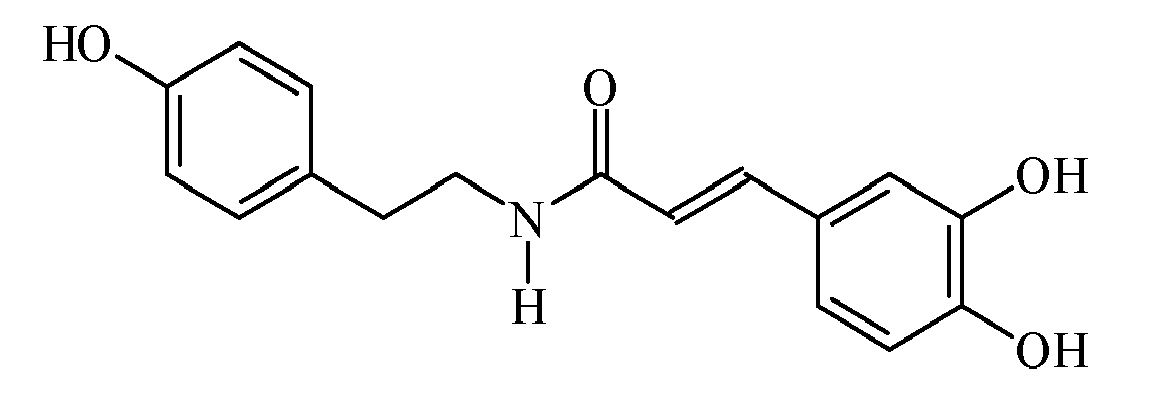
- N-[2-(4-Hydroxyphenyl)ethyl]-3-(3,4-dihydroxyphenyl)-(2Z)- propensäureamid (cis-Caffeoyltyramin):

- N-[2-(3,4-Dimethoxyphenyl) ethyl]-3-(3,4-dimethoxyphenyl)-(2E)-propensäureamid (trans- Rubenamin):

- N-[2-(3,4-dimethoxyphenyl)ethyl]-3-(3,4- dimethoxy-phenyl)-(2Z)-propensäureamid (cis-Rubenamin):

- Weitere im Rahmen der vorliegenden Erfindung mit besonderem Vorzug einsetzbare Scharfstoffe sind beispielsweise Extrakte aus Naturpflanzen. Scharf schmeckende pflanzliche Extrakte können alle physiologisch unbedenklichen pflanzlichen Extrakte sein, die einen scharfen oder warmen sensorischen Eindruck hervorrufen. Bevorzugt als scharf schmeckende pflanzliche Extrakte sind beispielsweise Pfefferextrakt (Piper ssp., insbesondere Piper nigrum), Wasserpfefferextrakt (Polygonum ssp. ,insbesondere Polygonum hydropiper), Extrakte aus Allium ssp.(insbesondere Zwiebel und Knoblauchextrakte), Extrakte aus Rettich (Raphanus ssp.), Meerrettichextrakte (Cochlearia armoracia), Extrakte aus schwarzem (Brassica nigra), wildem oder gelbem Senf (Sinapis ssp., insbesondere Sinapis arvensis und Sinapis alba), Bertramwurzel-Extrakte (Anacyclus ssp., insbesondere Anacyclus pyrethrumL.), Sonnenhutextrakte ( Echinaceae ssp.), Extrakten aus Szechuan-Pfeffer (Zanthoxylum ssp., insbesondere Zanthoxylum piperitum), Spilanthesextrakt (Spilanthes ssp., insbesondere Spilanthes acmella), Chiliextrakt (Capsicum ssp., insbesondere Capsicum frutescens ), Paradieskörner-Extrakt ( Aframomum ssp.,insbesondere Aframomum melegueta[Rose] K. Schum.),Ingwerextrakt (Zingiber ssp.,insbesondere Zingiber officinale) und Galangaextrakt (Kaempferia galanga oder Alpinia galanga).
- Eine besonders geeignete Substanz ist das aus dem Ingwerextrakt stammende Gingerol:


- Andere scharf schmeckende oder ein Gefühl von Wärme erzeugende Substanzen können z.B. sein Capsaicin, Dihydrocapsaicin, Gingerol, Paradol, Shogaol, Piperin, Carbonsäure-N- vanillylamide, insbesondere Nonansäure-N- vanillylamid, 2-Alkensäureamide, insbesondere 2-Nonensäure-N-isobutylamid, 2- Nonensäure-N-4-hydroxy-3- methoxyphenylamid, Alkylether von 4-Hydroxy-3-methoxybenzylalkohol, insbesonders 4-Hydroxy-3-methoxybenzyl-n-butylether, Alkylether von 3-Hydroxy-4-methoxybenzylalkohol, Alkylether von 3,4- Dimethoxybenzylalkohol, Alkylether von 3-Ethoxy-4-hydroxybenzylalkohol, Alkylether von 3,4-Methylendioxybenzylalkohol, Nicotinaldehyd, Methylnicotinat, Propylnicotinat, 2-Butoxyethylnicotinat, Benzylnicotinat, 1-Acetoxychavicol, Polygodial oder Isodrimeninol.
- Besonders bevorzugte erfindungsgemäße Mundwasserzusammensetzungen sind demnach dadurch gekennzeichnet, daß sie mindestens einen Scharfstoff aus der Gruppe der N-Alkyl-substituierte Amide von ungesättigten Carbonsäuren, vorzugsweise
- 2E,6Z,8E-Decatriensäure-N-isobutylamid (Spilanthol) und/oder
- 2E,4E,8Z-Decatriensäure-N-isobutylamid und/oder
- 2E,7Z,9E-Undecatriensäure-N-isobutylamid und/oder
- 2E,4Z-Decadiensäure-N-isobutylamid (cis-Pellitorin) und/oder
- 2E,4E-Decadiensäure-N-isobutylamid (trans-Pellitorin) und/oder
- Ferulasäure-N-Vanillylamid und/oder
- N-[2-(4-Hydroxy-3-methoxyphenyl)ethyl]-3-(4-hydroxy-3-methoxy-phenyl)- (2E)-propensäureamid (trans-Feruloylmethoxytyramin) und/oder
- N-[2- (4-Hydroxy-3-methoxyphenyl)ethyl]-3-(4-hydroxy-3-methoxy-phenyl)-(2 Z)-propensäureamid (cis-Feruloylmethoxytyramin) und/oder
- N-[2-(4- Hydroxy-3-methoxyphenyl)ethyl]-3-(4-hydroxy-3-methoxy-phenyl)-propansäureamid (Dihydroferuloylmethoxytyramin) und/oder
- N-[2-(3,4- Dihydroxyphenyl)ethyl]-3-(4-hydroxy-3-methoxy-phenyl)-(2E)-propensäureamid (trans-Feruloyldopamin) und/oder
- N-[2-(3,4-Dihydroxyphenyl) ethyl]-3-(4-hydroxy-3-methoxy-phenyl)-(2Z)-propensäureamid (cis- Feruloyldopamin) und/oder
- N-[2-(4-Hydroxyphenyl)ethyl]-3-(3,4- dihydroxyphenyl)-(2E)-propensäureamid (trans-Caffeoyltyramin) und/oder
- N-[2-(4-Hydroxyphenyl)ethyl]-3-(3,4-dihydroxyphenyl)-(2Z)- propensäureamid (cis-Caffeoyltyramin) und/oder
- N-[2-(3,4-Dimethoxyphenyl) ethyl]-3-(3,4-dimethoxyphenyl)-(2E)-propensäureamid (trans-Rubenamin) und/oder
- N-[2-(3,4-dimethoxyphenyl)ethyl]-3-(3,4- dimethoxy-phenyl)-(2Z)-propensäureamid (cis-Rubenamin)
- Zusätzlich zu den genannten Scharfstoffen oder an ihrer Stelle können auch weitere scharf schmeckende und/oder ein Gefühl von Wärme erzeugende Substanzen in die erfindungsgemäßen Mundwasserzusammensetzungen eingearbeitet werden.
- Als besonders geeignet haben sich im Rahmen der vorliegenden Erfindung alkylsubstituierte Dioxane der Formel

- Als weiterhin besonders geeignet haben sich im Rahmen der vorliegenden Erfindung Phenylester der Formel

- Einzelne Spezies, die der vorstehend genannten Formel genügen, sind hinsichtlich ihrer Reste R5 und R6 im Prioritätsdokument in Tabelle 2 auf den Seiten 15 bis 40 aufgeführt. Diese sind erfindungsgemäß besonders bevorzugt.
- Als weiterhin besonders geeignet haben sich im Rahmen der vorliegenden Erfindung Carvonacetale der Formel

- Einzelne Spezies, die der vorstehend genannten Formel genügen, sind hinsichtlich ihrer Reste R7 bis R12 im Prioritätsdokument in Tabelle 3 auf den Seiten 40 bis 51aufgeführt.
- Zusammenfassend sind erfindungsgemäße Mundwasserzusammensetzungen bevorzugt, die mindestens einen Scharfstoff aus den Gruppen der
- alkylsubstituierten Dioxane der Formel

und/oder - Phenylestern der Formel

und/oder - Carvonacetalen der Formel

- Erfindungsgemäß ist das Wasser mit einem Gas aus der Gruppe Sauerstoff und/oder Stickstoff und/oder Kohlendioxid angereichert. "Angereichert" bedeutet dabei im Sinne der vorliegenden Anmeldung, daß das Wasser mehr an den betreffenden Gasen enthält, als sich bei 20°C und 1013,25 mbar in Wasser lösen lassen. Für Kohlendioxid beträgt die Menge, die sich bei 20°C und 1013,25 mbar in Wasser lösen läßt, ca. 1,5 Gramm pro Liter, für Sauerstoff ca. 31 Milliliter pro Liter und für Stickstoff ca. 20 Milliliter pro Liter Wasser.
- Die Anreicherung des Wassers mit den entsprechenden Gasen kann in Anlehnung an die aus der Nahrungsmittelindustrie bekannten Verfahren erfolgen, beispielsweise im Falle des Kohlendioxids durch die sogenannte Carbonisierung, siehe weiter unten.
- Vorzugsweise enthält das in den erfindungsgemäßen Mundwasserzusammensetzungen enthaltene Wasser das bzw. die gelösten Gase in engeren Mengenbereichen. Innerhalb dieser Mengenbereiche sind die Effekte besonders ausgeprägt.
- So sind insbesondere erfindungsgemäße Mundwasserzusammensetzungen bevorzugt, bei denen das in ihnen enthaltene Wasser 2,5 bis 10 g/I, vorzugsweise 3 bis 9,5 g/I, besonders bevorzugt 3,5 bis 9 g/I, weiter bevorzugt 4 bis 8,5 g/I und insbesondere 5 bis 7,5 g/I Kohlendioxid enthält.
- Bei der Herstellung von mit CO2 angereichertem Wasser wird Kohlenstoffdioxid unter hohem Druck in das Wasser gepumpt, wobei es zu etwa 0,2 % mit Wasser zu Kohlensäure reagiert; der größte Teil ist als Gas im Wasser gelöst. Bei einem Druckabfall durch Öffnen des Gefäßes kommt es zu einer Nukleation, so dass das nun überschüssig gelöste Gas bläschenförmig austritt und aufsteigt. Die Bläschenbildung des Gases und der säuerliche Geschmack der Kohlensäure auf der Zunge beim Spülen mit der Mundwasserzusammensetzung stimulieren die Geschmackssinneszellen, was einen Erfrischungseffekt zur Folge hat.
- In der Verpackung der Mundwasserzusammensetzung gibt Kohlensäure dem Produkt nicht nur den typischen erfrischenden Geschmack und perlenden Effekt, sondern hält das Produkt auf natürliche Weise frisch. Kohlensäure hat einen konservierenden Nebeneffekt und tötet Bakterien ab. Im Mund reinigt die Kohlensäure die Geschmackspapillen, fördert die Durchblutung und regt den Speichelfluss an. Die Zunge kann sensibler auf feine Geschmacksunterschiede reagieren und die Feinheiten von eventuell vorhandenen weiteren Aromen wahrnehmen.
- Zusätzlich zu Kohlendioxid oder an seiner Stelle kann das in den erfindungsgemäßen Mundwasserzusammensetzungen eingesetzte Wasser auch mit Sauerstoff angereichert sein. Erfindungsgemäß ebenfalls bevorzugte Mundwasserzusammensetzungen sind dadurch gekennzeichnet, daß das in ihnen enthaltene Wasser 40 bis 100 ml/l, vorzugsweise 42,5 bis 95 ml/I, besonders bevorzugt 45 bis 90 ml/I, weiter bevorzugt 47,5 bis 85 ml/I und insbesondere 50 bis 75 ml/I Sauerstoff enthält.
- Zusätzlich zu Kohlendioxid und/oder Sauerstoff oder an ihrer Stelle kann das in den erfindungsgemäßen Mundwasserzusammensetzungen eingesetzte Wasser auch mit Stickstoff angereichert sein. Erfindungsgemäß ebenfalls bevorzugte Mundwasserzusammensetzungen sind dadurch gekennzeichnet, daß das in ihr enthaltene Wasser 25 bis 50 ml/I, vorzugsweise 27,5 bis 47,5 ml/l, besonders bevorzugt 30 bis 45 ml/I, weiter bevorzugt 32,5 bis 42,5 ml/I und insbesondere 35 bis 40 ml/I Stickstoff enthält.
- Auch bei der Beaufschlagung des erfindungsgemäß in den Mundwasserzusammensetzungen enthaltenen Wassers mit Stickstoff oder Sauerstoff wird das entsprechende Gas oder Gasgemisch durch Druck in die Flüssigkeit eingebracht. Nähere Angaben zur Herstellung erfindungsgemäßer Produkte finden sich weiter unten.
- Zusätzlich zu der bzw. den scharf schmeckenden und/oder ein Gefühl von Wärme vermittelnden Substanzen können die erfindungsgemäßen Mundwasserzusammensetzungen weitere Aromen und/oder Geschmacksstoffe enthalten.
- Als wasserunlösliche Aromaöle kommen alle für Mund- und Zahnpflegemittel gebräuchlichen natürlichen und synthetischen Aromen infrage. Natürliche Aromen können sowohl in Form der aus den Drogen isolierten ätherischen Öle als auch in Form der aus diesen isolierten Einzelkomponenten verwendet werden. Bevorzugt sollte wenigstens ein Aromaöl aus der Gruppe Pfefferminzöl, Krauseminzöl, Anisöl, Sternanisöl, Kümmelöl, Eukalyptusöl, Fenchelöl, Zimtöl, Nelkenöl, Geraniumöl, Salbeiöl, Pimentöl, Thymianöl, Majoranöl, Basilikumöl, Citrusöl, Gaultheriaöl oder eine oder mehrere daraus isolierte oder synthetisch erzeugte Komponenten dieser Öle enthalten sein. Die wichtigsten Komponenten der genannten Öle sind z. B. Menthol, Carvon, Anethol, Cineol, Eugenol, Zimtaldehyd, Caryophyllen, Geraniol, Citronellol, Linalool, Salven, Thymol, Terpinen, Terpinol, Methylchavicol und Methylsalicylat. Weitere geeignete Aromen sind z. B. Menthylacetat, Vanillin, Jonone, Linalylacetat, Rhodinol und Piperiton.
- Besonders bevorzugte erfindungsgemäße Mundwasserzusammensetzungen sind dadurch gekennzeichnet, daß sie zusätzlich- bezogen auf ihr Gewicht - Gewicht- 0,001 bis 5 Gew.-%, vorzugsweise 0,005 bis 4 Gew.-%, besonders bevorzugt 0,01 bis 1,5 Gew.-%, weiter bevorzugt 0,05 bis 1 Gew.-% und insbesondere 0,1 bis 0,4 Gew.-% mindestens eines Aromas aus der Gruppe Pfefferminz, Spearmint, Menthol, Limone, Limette, Apfel, Orange, Zitrone, Erdbeere, Aloe Vera, Kaugummi enthalten.
- Als weiteren Inhaltsstoff können die erfindungsgemäßen Mundwasserzusammensetzungen mindestens einen Antikaries-Wirkstoff enthalten. Erfindungsgemäß bevorzugte Mundwasserzusammensetzungen enthalten - bezogen auf ihr Gewicht - 0,01 bis 2,5 Gew.%, vorzugsweise 0,02 bis 1 Gew.% und insbesondere 0,03 bis 0,5 Gew.% Antikaries-Wirkstoffe, jeweils bezogen auf das gesamte Mittel.
- Diese Antikaries-Wirkstoffe können beispielsweise aus organischen oder anorganischen Fluoriden ausgewählt sein, z. B. aus Natriumfluorid, Kaliumfluorid, Natriummonofluorphosphat und Natriumfluorosilikat. Auch Zinkfluorid, Zinn-(II)-fluorid sind bevorzugt. Bevorzugt sollte eine Menge von 0,01 - 0,2 Gew.-% Fluor in Form der genannten Verbindungen enthalten sein.
- Demnach sind erfindungsgemäß besonders bevorzugte erfindungsgemäße Mundwasserzusammensetzungen dadurch gekennzeichnet, dass sie als Antikaries-Wirkstoffe Fluorverbindung(en), insbesondere aus der Gruppe Natriumfluorid, Kaliumfluorid, Natriummonofluorphosphat, Zinkfluorid, Zinnfluorid und Natriumfluorosilikat enthalten.
- Ganz besonders bevorzugte erfindungsgemäße Mundwasserzusammensetzungen enthalten - bezogen auf ihr Gewicht - 0,01 bis 0,5 Gew.-%, vorzugsweise 0,02 bis 0,25 Gew.-%, besonders bevorzugt 0,025 bis 0,1 Gew.-% weiter bevorzugt 0,03 bis 0,08 Gew.-% und insbesondere 0,04 bis 0,06 Gew.-% Natriumfluorid.
- Die erfindungsgemäßen Mundwasserzusammensetzungen können mehrwertige Alkohole, insbesondere Xylit bzw. Sorbit bzw. Glycerin bzw. 1,2-Propylenglycol enthalten. Xylitol, auch "Xylit" genannt, ist ein zu den Pentiten (5-wertige Alkohole) gehörendes Polyol (xylo-1,2,3,4,5-Pentanpentol), das durch katalytische Hydrierung von Xylose gewonnen wird. Erfindungsgemäß bevorzugte Mundwasserzusammensetzungen enthalten bezogen auf ihr Gewicht 0,25 bis 5 Gew.-% Xylitol, vorzugsweise 0,5 bis 4 Gew.-%, besonders bevorzugt 0,75 bis 3,75 Gew.-% und insbesondere 1,00 bis 2,75 Gew.-%.
- Die erfindungsgemäßen Mundwasserzusammensetzungen können auch Glycerin enthalten. Glycerin wird nach IUPAC als 1,2,3-Propantriol bezeichnet, die INCI-Bezeichnung ist: Glycerin, andere Namen sind beispielsweise 1,2,3-Trihydroxypropan, Glycerol, Ölsüß, oder E 422. Erfindungsgemäß bevorzugte Mundwasserzusammensetzungen enthalten bezogen auf ihr Gewicht 0,25 bis 15 Gew.-% Glycerin, wobei erfindungsgemäße Mundwasserzusammensetzungen bevorzugt sind, die bezogen auf ihr Gewicht 0,5 bis 12 Gew.-%, vorzugsweise 0,75 bis 11 Gew.-% und insbesondere 1,00 bis 10 Gew.-% Glycerin enthalten.
- Zusätzlich zu Glycerin und Xylitol können die erfindungsgemäßen Mundwasserzusammensetzungen weitere Polyhydroxyverbindungen, vorzugsweise Alkohole mit mindestens 2 OH-Gruppen, besonders bevorzugt Mannit, Xylitol, Polyethylenglycol, Polypropylenglycol und deren Mischungen, enthalten.
- Unter den Polyhydroxyverbindungen sind diejenigen mit 2 bis 12 OH-Gruppen und insbesondere diejenigen mit 2, 3, 4, 5, 6 oder 10 OH-Gruppen bevorzugt.
- Polyhydroxyverbindungen mit 2 OH-Gruppen sind beispielsweise Glycol (CH2(OH)CH2OH) und andere 1,2-Diole wie H-(CH2)n-CH(OH)CH2OH mit n = 2, 3, 4, 5, 6, 7, 8, 9, 10, 11, 12, 13, 14, 15, 16, 17, 18, 19, 20. Auch 1,3-Diole wie H-(CH2)n-CH(OH) CH2CH2OH mit n = 1, 2, 3, 4, 5, 6, 7, 8, 9, 10, 11, 12, 13, 14, 15, 16, 17, 18, 19, 20 sind erfindungsgemäß einsetzbar. Die (n,n+1)- bzw. (n,n+2)-Diole mit nicht endständigen OH-Gruppen können ebenfalls eingesetzt werden.
- Wichtige Vertreter von Polyhydroxyverbindungen mit 2 OH-Gruppen sind auch die Polyethylen- und Polypropylenglycole.
- Besonders bevorzugt sind erfindungsgemäße Mundwasserzusammensetzungen, die zusätzlich Sorbitol, vorzugsweise in Mengen von 0,5 bis 20 Gew.-%, besonders bevorzugt von 0,75 bis 15 Gew.-% und insbesondere von 1,00 bis 10 Gew.-%, jeweils bezogen auf das gesamte Mittel, enthalten.
- Besonders bevorzugt ist weiterhin, daß die Gesamtmenge an Polyhydroxyverbindungen in den erfindungsgemäßen Mundwasserzusammensetzungen 1,5 bis 35 Gew.-%, vorzugsweise 2,5 bis 32,5 Gew.-%, besonders bevorzugt 5 bis 30 Gew.-% und insbesondere 7 bis 24 Gew.-%, jeweils bezogen auf das gesamte Mittel, beträgt.
- Besonders bevorzugte erfindungsgemäße Mundwasserzusammensetzungen sind dadurch gekennzeichnet, daß sie 0,5 bis 20 Gew.-%, vorzugsweise 1 bis 15 Gew.-%, besonders bevorzugt 2 bis 12 Gew.-% und insbesondere 3 bis 10 Gew.-% mindestens eines mehrwertigen Alkohols aus der Gruppe Sorbit und/oder Glycerin und/oder 1,2-Propylenglycol.-%, jeweils bezogen auf das Gewicht der gesamten Mundwasserzusammensetzung, enthalten.
- Zusätzlich können die erfindungsgemäße Mundwasserzusammensetzungen Ethanol enthalten. Erfindungsgemäß bevorzugte Mundwasserzusammensetzungen enthalten - bezogen auf ihr Gewicht - 1 bis 40 Gew.-% Ethanol, wobei sich die Angabe auf reinen Alkohol (100 %) bezieht, auch wenn dieser nicht als 100%iges Ethanol eingesetzt wurde, da Ethanol mit Wasser ein Azeotrop bildet, das aus 95,57 Gew.-% Ethanol und 4,43 Gew.-% Wasser besteht und konstant bei 78,2°C siedet.
- Mit besonderem Vorzug enthalten die erfindungsgemäßen Mundwasserzusammensetzungen höhere Mengen an Ethanol, wobei erfindungsgemäße Mundwasserzusammensetzungen besonders bevorzugt sind, die bezogen auf ihr Gewicht 1,5 bis 35 Gew.-%, vorzugsweise 2 bis 30 Gew.-% und insbesondere 2,5 bis 25 Gew.-% Ethanol enthalten.
- Eine bevorzugte Klasse von Inhaltsstoffen, die in den erfindungsgemäßen Mundwasserzusammensetzungen enthalten sein kann, stellen die Tenside dar. Unter dem Begriff Tenside werden grenzflächenaktive Substanzen, die an Ober- und Grenzflächen Adsorptionsschichten bilden oder in Volumenphasen zu Mizellkolloiden oder Iyotropen Mesophasen aggregieren können, verstanden. Man unterscheidet Aniontenside bestehend aus einem hydrophoben Rest und einer negativ geladenen hydrophilen Kopfgruppe, amphotere Tenside, welche sowohl eine negative als auch eine kompensierende positive Ladung tragen, kationische Tenside, welche neben einem hydrophoben Rest eine positiv geladene hydrophile Gruppe aufweisen, und nichtionische Tenside, welche keine Ladungen sondern starke Dipolmomente aufweisen und in wäßriger Lösung stark hydratisiert sind.
- Als anionische Tenside (E1) eignen sich in erfindungsgemäßen Zubereitungen alle für die Verwendung am menschlichen Körper geeigneten anionischen oberflächenaktiven Stoffe. Diese sind gekennzeichnet durch eine wasserlöslich machende, anionische Gruppe wie z. B. eine Carboxylat-, Sulfat-, Sulfonat- oder Phosphat-Gruppe und eine lipophile Alkylgruppe mit etwa 8 bis 30 C-Atomen. Zusätzlich können im Molekül Glykol- oder Polyglykolether-Gruppen, Ester-, Ether- und Amidgruppen sowie Hydroxylgruppen enthalten sein. Beispiele für geeignete anionische Tenside sind, jeweils in Form der Natrium-, Kalium-und Ammonium- sowie der Mono-, Di- und Trialkanolammoniumsalze mit 2 bis 4 C-Atomen in der Alkanolgruppe,
- lineare und verzweigte Fettsäuren mit 8 bis 30 C-Atomen (Seifen),
- Ethercarbonsäuren der Formel R-O-(CH2-CH2O)x-CH2-COOH, in der R eine lineare Alkylgruppe mit 8 bis 30 C-Atomen und x = 0 oder 1 bis 16 ist,
- Acylsarcoside mit 8 bis 24 C-Atomen in der Acylgruppe,
- Acyltauride mit 8 bis 24 C-Atomen in der Acylgruppe,
- Acylisethionate mit 8 bis 24 C-Atomen in der Acylgruppe,
- Sulfobernsteinsäuremono- und -dialkylester mit 8 bis 24 C-Atomen in der Alkylgruppe und Sulfobernsteinsäuremono-alkylpolyoxyethylester mit 8 bis 24 C-Atomen in der Alkylgruppe und 1 bis 6 Oxyethylgruppen,
- lineare Alkansulfonate mit 8 bis 24 C-Atomen,
- lineare Alpha-Olefinsulfonate mit 8 bis 24 C-Atomen,
- Alpha-Sulfofettsäuremethylester von Fettsäuren mit 8 bis 30 C-Atomen,
- Alkylsulfate und Alkylpolyglykolethersulfate der Formel R-O(CH2-CH2O)x-OSO3H, in der R eine bevorzugt lineare Alkylgruppe mit 8 bis 30 C-Atomen und x = 0 oder 1 bis 12 ist,
- sulfatierte Hydroxyalkylpolyethylen- und/oder Hydroxyalkylenpropylenglykolether
- Sulfonate ungesättigter Fettsäuren mit 8 bis 24 C-Atomen und 1 bis 6 Doppelbindungen
- Ester der Weinsäure und Zitronensäure mit Alkoholen, die Anlagerungsprodukte von etwa 2-15 Molekülen Ethylenoxid und/oder Propylenoxid an Fettalkohole mit 8 bis 22 C-Atomen darstellen,
- Alkyl- und/oder Alkenyletherphosphate der Formel (E1-I),
R1(OCH2CH2)nO-P(O)(OX)-OR2 (E1-I)
in der R1 bevorzugt für einen aliphatischen Kohlenwasserstoffrest mit 8 bis 30 Kohlenstoffatomen, R2 für Wasserstoff, einen Rest (CH2CH2O)nR2 oder X, n für Zahlen von 1 bis 10 und X für Wasserstoff, ein Alkali- oder Erdalkalimetall oder NR3R4R5R6, mit R3 bis R6 unabhängig voneinander stehend für Wasserstoff oder einen C1 bis C4 - Kohlenwasserstoffrest, steht, - sulfatierte Fettsäurealkylenglykolester der Formel (E1-II)
R7CO(AlkO)nSO3M (E1-II)
in der R7CO- für einen linearen oder verzweigten, aliphatischen, gesättigten und/oder ungesättigten Acylrest mit 6 bis 22 C-Atomen, Alk für CH2CH2, CHCH3CH2 und/oder CH2CHCH3, n für Zahlen von 0,5 bis 5 und M für ein Kation steht, - Monoglyceridsulfate und Monoglyceridethersulfate der Formel (E1-III)

- Amidethercarbonsäuren,
- Kondensationsprodukte aus C8 - C30 - Fettalkoholen mit Proteinhydrolysaten und/oder Aminosäuren und deren Derivaten,welche dem Fachmann als Eiweissfettsäurekondensate bekannt sind, wie beispielsweise die Lamepon® - Typen, Gluadin® - Typen, Hostapon® KCG oder die Amisoft® - Typen.
- Bevorzugte anionische Tenside sind Alkylsulfate, Alkylpolyglykolethersulfate und Ethercarbonsäuren mit 10 bis 18 C-Atomen in der Alkylgruppe und bis zu 12 Glykolethergruppen im Molekül, Sulfobernsteinsäuremono- und -dialkylester mit 8 bis 18 C-Atomen in der Alkylgruppe und Sulfobernsteinsäuremono-alkylpolyoxyethylester mit 8 bis 18 C-Atomen in der Alkylgruppe und 1 bis 6 Oxyethylgruppen, Monoglycerdisulfate, Alkyl- und Alkenyletherphosphate sowie Eiweissfettsäurekondensate.
- Als zwitterionische Tenside (E2) werden solche oberflächenaktiven Verbindungen bezeichnet, die im Molekül mindestens eine quartäre Ammoniumgruppe und mindestens eine -COO(-) - oder -SO3 (-) - Gruppe tragen. Besonders geeignete zwitterionische Tenside sind die sogenannten Betaine wie die N-Alkyl-N,N-dimethylammonium-glycinate, beispielsweise das Kokosalkyl-dimethylammoniumglycinat, N-Acyl-aminopropyl-N,N-dimethylammoniumglycinate, beispielsweise das Kokosacylaminopropyldimethylammoniumglycinat, und 2-Alkyl-3-carboxymethyl-3-hydroxyethyl-imidazoline mit jeweils 8 bis 18 C-Atomen in der Alkyl- oder Acylgruppe sowie das Kokosacylaminoethylhydroxyethylcarboxymethylglycinat. Ein bevorzugtes zwitterionisches Tensid ist das unter der INCI-Bezeichnung Cocamidopropyl Betaine bekannte Fettsäureamid-Derivat.
- Unter ampholytischen Tensiden (E3) werden solche oberflächenaktiven Verbindungen verstanden, die außer einer C8 - C24 - Alkyl- oder -Acylgruppe im Molekül mindestens eine freie Aminogruppe und mindestens eine -COOH- oder -SO3H-Gruppe enthalten und zur Ausbildung innerer Salze befähigt sind. Beispiele für geeignete ampholytische Tenside sind N-Alkylglycine, N-Alkylpropionsäuren, N-Alkylaminobuttersäuren, N-Alkyliminodipropionsäuren, N-Hydroxyethyl-N-alkylamidopropylglycine, N-Alkyltaurine, N-Alkylsarcosine, 2-Alkylaminopropionsäuren und Alkylaminoessigsäuren mit jeweils etwa 8 bis 24 C-Atomen in der Alkylgruppe. Besonders bevorzugte ampholytische Tenside sind das N-Kokosalkylaminopropionat, das Kokosacylaminoethylaminopropionat und das C12 - C18 - Acylsarcosin.
- Nichtionische Tenside (E4) enthalten als hydrophile Gruppe z.B. eine Polyolgruppe, eine Polyalkylenglykolethergruppe oder eine Kombination aus Polyol- und Polyglykolethergruppe. Solche Verbindungen sind beispielsweise
- Anlagerungsprodukte von 2 bis 50 Mol Ethylenoxid und/oder 0 bis 5 Mol Propylenoxid an lineare und verzweigte Fettalkohole mit 8 bis 30 C-Atomen, an Fettsäuren mit 8 bis 30 C-Atomen und an Alkylphenole mit 8 bis 15 C-Atomen in der Alkylgruppe,
- mit einem Methyl- oder C2 - C6 - Alkylrest endgruppenverschlossene Anlagerungsprodukte von 2 bis 50 Mol Ethylenoxid und/oder 0 bis 5 Mol Propylenoxid an lineare und verzweigte Fettalkohole mit 8 bis 30 C-Atomen, an Fettsäuren mit 8 bis 30 C-Atomen und an Alkylphenole mit 8 bis 15 C-Atomen in der Alkylgruppe, wie beispielsweise die unter den Verkaufsbezeichnungen Dehydol® LS, Dehydol® LT (Cognis) erhältlichen Typen,
- C12-C30-Fettsäuremono- und -diester von Anlagerungsprodukten von 1 bis 30 Mol Ethylenoxid an Glycerin,
- Anlagerungsprodukte von 5 bis 60 Mol Ethylenoxid an Rizinusöl und gehärtetes Rizinusöl,
- Polyolfettsäureester, wie beispielsweise das Handelsprodukt Hydagen® HSP (Cognis) oder Sovermol - Typen (Cognis),
- alkoxilierte Triglyceride,
- alkoxilierte Fettsäurealkylester der Formel (E4-I)
R1CO-(OCH2CHR2)wOR3 (E4-I)
in der R1CO für einen linearen oder verzweigten, gesättigten und/oder ungesättigten Acylrest mit 6 bis 22 Kohlenstoffatomen, R2 für Wasserstoff oder Methyl, R3 für lineare oder verzweigte Alkylreste mit 1 bis 4 Kohlenstoffatomen und w für Zahlen von 1 bis 20 steht, - Aminoxide,
- Hydroxymischether,
- Sorbitanfettsäureester und Anlagerungeprodukte von Ethylenoxid an Sorbitanfettsäureester wie beispielsweise die Polysorbate,
- Zuckerfettsäureester und Anlagerungsprodukte von Ethylenoxid an Zuckerfettsäureester,
- Anlagerungsprodukte von Ethylenoxid an Fettsäurealkanolamide und Fettamine,
- Zuckertenside vom Typ der Alkyl- und Alkenyloligoglykoside gemäß Formel (E4-II),
R4O-[G]p (E4-II)
in der R4 für einen Alkyl- oder Alkenylrest mit 4 bis 22 Kohlenstoffatomen, G für einen Zuckerrest mit 5 oder 6 Kohlenstoffatomen und p für Zahlen von 1 bis 10 steht. Sie können nach den einschlägigen Verfahren der präparativen organischen Chemie erhalten werden.
Die Alkyl- und Alkenyloligoglykoside können sich von Aldosen bzw. Ketosen mit 5 oder 6 Kohlenstoffatomen, vorzugsweise von Glucose, ableiten. Die bevorzugten Alkyl- und/oder Alkenyloligoglykoside sind somit Alkyl- und/oder Alkenyloligoglucoside. Die Indexzahl p in der allgemeinen Formel (E4-II) gibt den Oligomerisierungsgrad (DP), d. h. die Verteilung von Mono- und Oligoglykosiden an und steht für eine Zahl zwischen 1 und 10. Während p im einzelnen Molekül stets ganzzahlig sein muß und hier vor allem die Werte p = 1 bis 6 annehmen kann, ist der Wert p für ein bestimmtes Alkyloligoglykosid eine analytisch ermittelte rechnerische Größe, die meistens eine gebrochene Zahl darstellt. Vorzugsweise werden Alkyl- und/oder Alkenyloligoglykoside mit einem mittleren Oligomerisierungsgrad p von 1,1 bis 3,0 eingesetzt. Aus anwendungstechnischer Sicht sind solche Alkyl- und/oder Alkenyloligoglykoside bevorzugt, deren Oligomerisierungsgrad kleiner als 1,7 ist und insbesondere zwischen 1,2 und 1,4 liegt. Der Alkyl- bzw. Alkenylrest R4 kann sich von primären Alkoholen mit 4 bis 11, vorzugsweise 8 bis 10 Kohlenstoffatomen ableiten. Typische Beispiele sind Butanol, Capronalkohol, Caprylalkohol, Caprinalkohol und Undecylalkohol sowie deren technische Mischungen, wie sie beispielsweise bei der Hydrierung von technischen Fettsäuremethylestern oder im Verlauf der Hydrierung von Aldehyden aus der Roelen'schen Oxosynthese erhalten werden. Bevorzugt sind Alkyloligoglucoside der Kettenlänge C8-C10 (DP = 1 bis 3), die als Vorlauf bei der destillativen Auftrennung von technischem C8-C18-Kokosfettalkohol anfallen und mit einem Anteil von weniger als 6 Gew.-% C12-Alkohol verunreinigt sein können sowie Alkyloligoglucoside auf Basis technischer C9/11-Oxoalkohole (DP = 1 bis 3). Der Alkyl- bzw. Alkenylrest R15 kann sich ferner auch von primären Alkoholen mit 12 bis 22, vorzugsweise 12 bis 14 Kohlenstoffatomen ableiten. Typische Beispiele sind Laurylalkohol, Myristylalkohol, Cetylalkohol, Palmoleylalkohol, Stearylalkohol, Isostearylalkohol, Oleylalkohol, Elaidylalkohol, Petroselinylalkohol, Arachylalkohol, Gadoleylalkohol, Behenylalkohol, Erucylalkohol, Brassidylalkohol sowie deren technische Gemische, die wie oben beschrieben erhalten werden können. Bevorzugt sind Alkyloligoglucoside auf Basis von gehärtetem C12/14-Kokosalkohol mit einem DP von 1 bis 3. - Zuckertenside vom Typ der Fettsäure-N-alkylpolyhydroxyalkylamide, ein nichtionisches Tensid der Formel (E4-III),
R5CO-NR6-[Z] (E4-III)
in der R5CO für einen aliphatischen Acylrest mit 6 bis 22 Kohlenstoffatomen, R6 für Wasserstoff, einen Alkyl- oder Hydroxyalkylrest mit 1 bis 4 Kohlenstoffatomen und [Z] für einen linearen oder verzweigten Polyhydroxyalkylrest mit 3 bis 12 Kohlenstoffatomen und 3 bis 10 Hydroxylgruppen steht. Bei den Fettsäure-N-alkylpolyhydroxyalkylamiden handelt es sich um bekannte Stoffe, die üblicherweise durch reduktive Aminierung eines reduzierenden Zuckers mit Ammoniak, einem Alkylamin oder einem Alkanolamin und nachfolgende Acylierung mit einer Fettsäure, einem Fettsäurealkylester oder einem Fettsäurechlorid erhalten werden. Vorzugsweise leiten sich die Fettsäure-N-alkylpolyhydroxyalkylamide von reduzierenden Zuckern mit 5 oder 6 Kohlenstoffatomen, insbesondere von der Glucose ab. Die bevorzugten Fettsäure-N-alkylpolyhydroxyalkylamide stellen daher Fettsäure-N-alkylglucamide dar, wie sie durch die Formel (E4-IV) wiedergegeben werden:
R7CO-NR8-CH2-(CHOH)4-CH2OH (E4-IV)
Vorzugsweise werden als Fettsäure-N-alkylpolyhydroxyalkylamide Glucamide der Formel (E4-IV) eingesetzt, in der R8 für Wasserstoff oder eine Alkylgruppe steht und R7CO für den Acylrest der Capronsäure, Caprylsäure, Caprinsäure, Laurinsäure, Myristinsäure, Palmitinsäure, Palmoleinsäure, Stearinsäure, Isostearinsäure, Ölsäure, Elaidinsäure, Petroselinsäure, Linolsäure, Linolensäure, Arachinsäure, Gadoleinsäure, Behensäure oder Erucasäure bzw. derer technischer Mischungen steht. Besonders bevorzugt sind Fettsäure-N-alkylglucamide der Formel (E4-IV), die durch reduktive Aminierung von Glucose mit Methylamin und anschließende Acylierung mit Laurinsäure oder C12/14-Kokosfettsäure bzw. einem entsprechenden Derivat erhalten werden. Weiterhin können sich die Polyhydroxyalkylamide auch von Maltose und Palatinose ableiten. - Als bevorzugte nichtionische Tenside haben sich die Alkylenoxid-Anlagerungsprodukte an gesättigte lineare Fettalkohole und Fettsäuren mit jeweils 2 bis 30 Mol Ethylenoxid pro Mol Fettalkohol bzw.
- Fettsäure erwiesen. Zubereitungen mit hervorragenden Eigenschaften werden ebenfalls erhalten, wenn sie als nichtionische Tenside Fettsäureester von ethoxyliertem Glycerin enthalten.
- Diese Verbindungen sind durch die folgenden Parameter gekennzeichnet. Der Alkylrest R enthält 6 bis 22 Kohlenstoffatome und kann sowohl linear als auch verzweigt sein. Bevorzugt sind primäre lineare und in 2-Stellung methylverzweigte aliphatische Reste. Solche Alkylreste sind beispielsweise 1-Octyl, 1-Decyl, 1-Lauryl, 1-Myristyl, 1-Cetyl und 1-Stearyl. Besonders bevorzugt sind 1-Octyl, 1-Decyl, 1-Lauryl, 1-Myristyl. Bei Verwendung sogenannter "Oxo-Alkohole" als Ausgangsstoffe überwiegen Verbindungen mit einer ungeraden Anzahl von Kohlenstoffatomen in der Alkylkette.
- Weiterhin sind ganz besonders bevorzugte nichtionische Tenside die Zuckertenside. Diese können in den erfindungsgemäß verwendeten Mitteln bevorzugt in Mengen von 0,1 - 20 Gew.-%, bezogen auf das gesamte Mittel, enthalten sein. Mengen von 0,5 - 15 Gew.-% sind bevorzugt, und ganz besonders bevorzugt sind Mengen von 0,5 - 7,5 Gew.%.
- Bei den als Tensid eingesetzten Verbindungen mit Alkylgruppen kann es sich jeweils um einheitliche Substanzen handeln. Es ist jedoch in der Regel bevorzugt, bei der Herstellung dieser Stoffe von nativen pflanzlichen oder tierischen Rohstoffen auszugehen, so daß man Substanzgemische mit unterschiedlichen, vom jeweiligen Rohstoff abhängigen Alkylkettenlängen erhält.
- Bei den Tensiden, die Anlagerungsprodukte von Ethylen- und/oder Propylenoxid an Fettalkohole oder Derivate dieser Anlagerungsprodukte darstellen, können sowohl Produkte mit einer "normalen" Homologenverteilung als auch solche mit einer eingeengten Homologenverteilung verwendet werden. Unter "normaler" Homologenverteilung werden dabei Mischungen von Homologen verstanden, die man bei der Umsetzung von Fettalkohol und Alkylenoxid unter Verwendung von Alkalimetallen, Alkalimetallhydroxiden oder Alkalimetallalkoholaten als Katalysatoren erhält. Eingeengte Homologenverteilungen werden dagegen erhalten, wenn beispielsweise Hydrotalcite, Erdalkalimetallsalze von Ethercarbonsäuren, Erdalkalimetalloxide, -hydroxide oder -alkoholate als Katalysatoren verwendet werden. Die Verwendung von Produkten mit eingeengter Homologenverteilung kann bevorzugt sein.
- Erfindungsgemäß einsetzbar sind kationische Tenside vom Typ der quarternären Ammoniumverbindungen, der Esterquats und der Amidoamine. Bevorzugte quaternäre Ammoniumverbindungen sind Ammoniumhalogenide, insbesondere Chloride und Bromide, wie Alkyltrimethylammoniumchloride, Dialkyldimethylammoniumchloride und Trialkylmethylammoniumchloride, z. B. Cetyltrimethylammoniumchlorid, Stearyltrimethylammoniumchlorid, Distearyldimethylammoniumchlorid, Lauryldimethylammoniumchlorid, Lauryldimethylbenzylammoniumchlorid und Tricetylmethylammoniumchlorid, sowie die unter den INCI-Bezeichnungen Quaternium-27 und Quaternium-83 bekannten Imidazolium-Verbindungen. Die langen Alkylketten der oben genannten Tenside weisen bevorzugt 10 bis 18 Kohlenstoffatome auf.
- Bevorzugt einsetzbar sind erfindungsgemäß QAV mit Behenylresten, insbesondere die unter der Bezeichnung Behentrimoniumchlorid bzw. -bromid (Docosanyltrimethylammonium Chlorid bzw. -Bromid) bekannten Substanzen. Andere bevorzugte QAV weisen mindestens zwei Behenylreste auf, wobei QAV, welche zwei Behenylreste an einem Imidazoliniumrückgrat besonders bevorzugt sind. Kommerziell erhältlich sind diese Substanzen beispielsweise unter den Bezeichnungen Genamin® KDMP (Clariant) und Crodazosoft® DBQ (Crodauza).
- Bei Esterquats handelt es sich um bekannte Stoffe, die sowohl mindestens eine Esterfunktion als auch mindestens eine quartäre Ammoniumgruppe als Strukturelement enthalten. Bevorzugte Esterquats sind quaternierte Estersalze von Fettsäuren mit Triethanolamin, quaternierte Estersalze von Fettsäuren mit Diethanolalkylaminen und quaternierten Estersalzen von Fettsäuren mit 1,2-Dihydroxypropyldialkylaminen. Solche Produkte werden beispielsweise unter den Warenzeichen Stepantex®, Dehyquart® und Armocare® vertrieben. Die Produkte Armocare® VGH-70, ein N,N-Bis(2-Palmitoyloxyethyl)dimethylammoniumchlorid, sowie Dehyquart® F-75, Dehyquart® C-4046, Dehyquart® L80 und Dehyquart® AU-35 sind Beispiele für solche Esterquats.
- Die Alkylamidoamine werden üblicherweise durch Amidierung natürlicher oder synthetischer Fettsäuren und Fettsäureschnitte mit Dialkylaminoaminen hergestellt. Eine erfindungsgemäß besonders geeignete Verbindung aus dieser Substanzgruppe stellt das unter der Bezeichnung Tegoamid® S 18 im Handel erhältliche Stearamidopropyl-dimethylamin dar.
- Das bzw. die Tensid(e) werden in den erfindungsgemäßen Mundwasserzusammensetzungen vorzugsweise in Mengen von 0,01 bis 10 Gew.-% eingesetzt, wobei geringere Mengen, beispielsweise von 0,05 bis 5 Gew.-% oder 0,1 bis 2,5 Gew.-%, jeweils bezogen auf das gesamte Mittel, bevorzugt sind. Mit besonderem Vorzug werden nichtionische Tenside eingesetzt, wobei unter diesen die ethoxylierten Niotenside und die Zuckertenside besonders bevorzugt sind. Bevorzugte erfindungsgemäße Mundwasserzusammensetzungen enthalten Zuckertenside vom Typ der Alkyl- und Alkenyloligoglykoside der Formel R4O-[G]p, in der R4 für einen Alkyl- oder Alkenylrest mit 4 bis 22 Kohlenstoffatomen, G für einen Zuckerrest mit 5 oder 6 Kohlenstoffatomen und p für Zahlen von 1 bis 10 steht, wobei bevorzugte Zuckertenside aus der Gruppe der Alkylpolyglucoside stammen, die einen Oligomerisierungsgrad p von 1 bis 3, vorzugsweise von 1,1 bis 2 und insbesondere von 1,2 bis 1,5 aufweisen und als Alkylrest R4 einen Rest mit 8 bis 14 Kohlenstoffatomen, vorzugsweise mit 10 bis 12 Kohlenstoffatomen, tragen.
- Erfindungsgemäß bevorzugte Mundwasserzusammensetzungen sind dadurch gekennzeichnet, daß sie 0,01 bis 4 Gew.-%, vorzugsweise 0,05 bis 2,0 Gew.-% und insbesondere 0,1 bis 1,0 Gew.-% Tensid(e) enthalten.
- Ganz besonders bevorzugt werden ausschließlich schaumarme Tenside eingesetzt, die vorzugsweise aus der Gruppe der Alkylpolyglycoside stammen.
- Die erfindungsgemäßen Mundwasserzusammensetzungen können z. B. auch antimikrobielle Stoffe als Konservierungsmittel oder als Antiplaque-Wirkstoffe enthalten. Derartige Stoffe können z. B. ausgewählt sein aus p-Hydroxybenzoesäuremethyl-, -ethyl- oder propylester, Natriumsorbat, Natriumbenzoat, Bromchlorophen, Triclosan, Phenyl- Salicylsäureester, Biguanide z. B. Chlorhexidin, Thymol usw.. Erfindungsgemäß bevorzugte Mundwasserzusammensetzungen sind dadurch gekennzeichnet, daß sie zusätzlich Antiplaque-Wirkstoffe, vorzugsweise p-Hydroxybenzoesäuremethyl-, -ethyl- oder propylester, Natriumsorbat, Natriumbenzoat, Bromchlorophen, Triclosan, Phenyl- Salicylsäureester, Biguanide z. B. Chlorhexidin, Thymol, vorzugsweise in Mengen von 0,01 bis 5 Gew.%, vorzugsweise von 0,02 bis 2,5 Gew.% und insbesondere von 0,03 bis 1,5 Gew.%, jeweils bezogen auf das gesamte Mittel, enthalten.
- Besonders bevorzugt ist erfindungsgemäß der Einsatz von Biguanidinverbindungen. Diese antimikrobiell wirksamen Biguanidverbindungen sind bevorzugt in sehr niedriger Konzentration von 0,0025 bis 0,04 Gew.- % enthalten. Als antimikrobiell wirksame Biguanidverbindung wird bevorzugt das 1,1in-Hexamethylen-bis-(4-chlorphenyl)- biguanid ("Chlorhexidin") in Form eines wasserlöslichen, physiologisch verträglichen Salzes, z. B. in Form des Acetats oder als Gluconat eingesetzt. Andere erfindungsgemäß geeignete antimikrobielle Biguanidverbindungen sind z. B. die Polyhexamethylenbiguanidverbindungen des Typs Vantocil (R) IB (ICI) oder das 1,6-Bis-(4-chlorbenzylbiguanido)-hexan (Fluorhexidin).
- Erfindungsgemäß bevorzugte Mundwasserzusammensetzungen sind dadurch gekennzeichnet, daß sie zusätzlich Antiplaque-Wirkstoffe, vorzugsweise p-Hydroxybenzoesäuremethyl-, -ethyl- oder propylester, Natriumsorbat, Natriumbenzoat, Bromchlorophen, Triclosan, Phenyl- Salicylsäureester, Biguanide z. B. Chlorhexidin, Thymol, vorzugsweise in Mengen von 0,01 bis 2,5 Gew.%, vorzugsweise von 0,05 bis 1 Gew.% und insbesondere von 0,1 bis 0,5 Gew.%, jeweils bezogen auf das gesamte Mittel, enthalten.
- Die Mundwasserzusammensetzungen können auch die Unempfindlichkeit der Zähne steigernde Substanzen enthalten, beispielsweise Kaliumsalze wie z. B. Kaliumnitrat, Kaliumcitrat, Kaliumchlorid, Kaliumbicarbonat und Kaliumoxalat. Erfindungsgemäß bevorzugte Mundwasserzusammensetzungen sind dadurch gekennzeichnet, daß sie die Unempfindlichkeit der Zähne steigernde Substanzen, vorzugsweise Kaliumsalze, besonders bevorzugt Kaliumnitrat und/oder Kaliumcitrat und/oder Kaliumchlorid und/oder Kaliumbicarbonat und/oder Kaliumoxalat, vorzugsweise in Mengen von 0,05 bis 5 Gew.%, besonders bevorzugt von 0,1 bis 2,5 Gew.%, weiter bevorzugt von 0,2 bis 1 Gew.-% und insbesondere von 0,25 bis 0,75 Gew.%, jeweils bezogen auf das gesamte Mittel, enthalten.
- Die erfindungsgemäßen Mittel können auch zusätzlich weitere wundheilende und entzündungshemmende Stoffe, z. B. Wirkstoffe gegen Zahnfleischentzündungen, enthalten. Derartige Stoffe können z. B. ausgewählt sein aus Allantoin, Azulen, Kamillenextrakten, Tocopherol, Panthenol, Bisabolol, Salbeiextrakten.
- Als nicht-kationische, bakterizide Komponente eignen sich z.B. Phenole, Resorcine, Bisphenole, Salicylanilide und deren halogenierte Derivate, halogenierte Carbanilide und p-Hydroxybenzoesäureester. Besonders bevorzugte antimikrobielle Komponenten sind halogenierte Diphenylether, z.B. 2,4-Dichlor-2'-hydroxydiphenylether, 4,4'-Dichlor-2'-hydroxydiphenylether, 2,4,4'-Tribrom-2'-hydroxydiphenylether und 2,4,4'-Trichlor-2'-hydroxydiphenylether (Triclosan). Sie werden bevorzugt in Mengen von 0,01 - 1 Gew.-% in die erfindungsgemäßen Mundwasserzusammensetzungen eingesetzt. Besonders bevorzugt wird Triclosan in einer Menge von 0,01 - 0,3 Gew.-% eingesetzt.
- D-Panthenol D - (+) - 2,4-Dihydroxy-N-(3-hydroxypropyl)-3,3-dimethyl-butyramid zeigt eine der Pantothensäure entsprechende biologische Aktivität. Die Pantothensäure (R - (+) - N - (2,4-Dihydroxy-3,3-dimethylbutyryl-β-alanin) ist eine Vorstufe in der Biosynthese des Coenzyms A und wird zum Vitamin-B-Komplex (B3) gezählt. Diese Stoffe sind dafür bekannt, daß sie die Wundheilung fördern und eine günstige Wirkung auf die Haut haben. Sie sind daher auch gelegentlich in Zahnpasten beschrieben worden. Die erfindungsgemäßen Mundwasserzusammensetzungen enthalten bevorzugt 0,05 - 5 Gew.-% Panthenol oder ein Salz der Pantothensäure.
- Retinol (3,7-Dimethyl-9-(2,6,6-trimethyl-1-cyclohexenyl)-2,4,6,8-nonatetraen-1-ol ist der internationale Freiname für Vitamin A1. Anstelle des Retinols kann auch eines seiner Derivate mit ähnlicher biologischer Wirkung, z.B. ein Ester oder die Retinoesäure (Tretinoin), eines ihrer Salze oder ihre Ester verwendet werden. Bevorzugt wird ein Retinol-Ester, insbesondere ein Fettsäureester einer Fettsäure mit 12 - 22 C-Atomen verwendet. Besonders bevorzugt ist Retinol-Palmitat geeignet. Bei Verwendung eines Retinol-Esters, z.B. Retinol-Palmitat mit einer Aktivität von 1,7 106 I.E. pro g ist eine Menge von 0,001 bis 0,1 Gew.-% bevorzugt. Bei Verwendung anderer Retinol-Derivate empfiehlt sich eine Einsatzmenge, die einer Konzentration von 103 bis 106 I.E. (Internationale Einheiten) pro 100 g entspricht.
Bevorzugte Mundwasserzusammensetzungen gemäß der vorliegenden Erfindung enthalten neben den vorstehend genannten zwingenden Inhaltstoffen bevorzugt - 0,01 - 1 Gew.-% eines halogenierten Diphenylethers
- 0,05 - 5 Gew.-% Panthenol oder ein Salz der Pantothensäure und
- 0,01 - 0,1 Gew.-% eines Retinol-Esters, bevorzugt Retinol-Palmitat.
- Lösungsvermittler aus der Gruppe der oxethylierten Fettsäureglyceride umfassen vor allem Anlagerungsprodukte von 20-60 Mol Ethylenoxid an Mono- und Diglyceride von linearen Fettsäuren mit 12-18 C- Atomen oder an Triglyceride von Hydroxyfettsäuren wie Oxystearinsäure oder Ricinolsäure. Weitere geeignete Lösungsvermittler sind oxethylierte Fettsäuresorbitanpartialester; das sind bevorzugt Anlagerungsprodukte von 20-60 Mol Ethylenoxid an Sorbitanmonoester und Sorbitandiester von Fettsäuren mit 12-18 C-Atomen. Ebenfalls geeignete Lösungsvermittler sind Fettsäurepartialester von Glycerin- oder Sorbitan- Oxethylaten; das sind bevorzugt Mono- und Diester von C12-18-Fettsäuren und Anlagerungsprodukten von 20-60 Mol Ethylenoxid an 1 Mol Glycerin oder an 1 Mol Sorbit.
- Die erfindungsgemäßen Zubereitungen enthalten bevorzugt als Lösungsvermittler Anlagerungsprodukte von 20-60 Mol Ethylenoxid an gehärtetes oder ungehärtetes Ricinusöl (d.h. an Oxystearinsäure- oder Ricinolsäure-triglycerid), an Glycerin-mono- und/oder -distearat oder an Sorbitanmono- und/oder-distearat.
- Neben den genannten obligatorischen Komponenten können die erfindungsgemäßen Zubereitungen noch weitere, an sich bekannte und in antimikrobiellen Zubereitungen für den Bereich der Körperhygiene übliche Komponenten zur Verbesserung des Aussehens, des Geschmacks oder der Handhabung enthalten. Zur Verbesserung des Aussehens können z. B. physiologisch unbedenkliche Farbstoffe, Trübungs- oder Perlglanzmittel zugegeben werden. Zur Verbesserung des Geschmackes können natürliche oder synthetische, bevorzugt von kariogenen Kohlehydraten freie Süssungsmittel zugegeben werden. Hierzu gehören z.B. Saccharin-Natrium, Cyclamate, Acesulfam- Kalium, Aspartame (R) (L-Aspartyl-L- phenylalaninmethylester). Weitere geeignete Süßungsmittel sind z.B. Sucrose, Lactose, Meltose, Fructose.
- Die erfindungsgemäßen Mundwasserzusammensetzungen weisen vorzugsweise Viskositäten (gemessen bei 20°C mit Brookfield-Viskosimeter DV III, Spindel 4, 4 U/min) unterhalb von 1000 mPas auf. Besonders bevorzugt sind Viskositäten unterhalb von 500 mPas, weiter bevorzugt unterhalb von 250 mPas und insbesondere von unterhalb 100 mPas.
- Sollten in Einzelfällen höhere Viskositäten gewünscht sein, können die erfindungsgemäßen Mundwasserzusammensetzungen als Konsistenzregler z. B. natürliche und/oder synthetische wasserlösliche Polymere wie Alginate, Carragheenate, Traganth, Stärke und Stärkeether, Celluloseether wie z. B. Carboxymethylcellulose (Na-Salz), Hydroxyethylcellulose, Methylhydroxypropylcellulose, Guar, Akaziengum, Agar-Agar, Xanthan- Gum, Succinoglycan-Gum, Johannisbrotmehl, Pectine, wasserlösliche Carboxyvinylpolymere (z. B. Carbopol®-Typen), Polyvinylalkohol, Polyvinylpyrrolidon, Polyethylenglycole, insbesondere solche mit Molekulargewichten von 1 500-1 000 000, enthalten.
- Weitere Stoffe, die sich zur Viskositätskontrolle eignen, sind z. B. Schichtsilikate wie z. B. Montmorillonit-Tone, kolloidale Verdickungskieselsäuren wie z. B. Aerogel-Kieselsäuren, pyrogene Kieselsäuren oder feinstvermahlene Fällungskieselsäuren. Es können auch viskositätsstabilisierende Zusätze aus der Gruppe der kationischen, zwitterionischen oder ampholytischen stickstoffhaltigen Tenside, der hydroxypropylsubstituierten Hydrocolloide oder der Polyethylenglycol/Polypropylenglycol- Copolymere mit einem mittleren Molgewicht von 1000 bis 5000 oder eine Kombination der genannten Verbindungen verwendet werden.
- Wie bereits weiter oben erwähnt, erfolgt die Herstellung gasbeaufschlagter Wässer für die Herstellung der erfindungsgemäßen Mundwasserzusammensetzungen nach im Stand der Technik bekannten verfahren. Zur Herstellung der erfindungsgemäßen Zusammensetzungen bieten sich grundsätzlich zwei Wege an: Zum einen kann von gasbeaufschlagtem Wasser ausgegangen werden, das in der Produktion anstelle von normalem Leitungswasser bzw. vollentsalztem Wasser eingesetzt wird. Bei diesem Weg sind Vorkehrungen zu treffen, daß das Gas, mit dem das Wasser beaufschlagt wurde, nicht entweicht.
- Bevorzugt ist deshalb, die erfindungsgemäßen Produkte zunächst auf herkömmliche Weise herzustellen und anschließen mit den entsprechenden Mengen an den entsprechenden Gasen zu beaufschlagen. So kann beispielsweise die Gasbeaufschlagung direkt bei der Abfüllung der Mundwasserzusammensetzungen in Behälter erfolgen, wonach die Behälter verschlossen werden und so verhindert wird, daß das Gas bzw. Gasgemisch entweichen kann.
- Ein weiterer Gegenstand der vorliegenden Erfindung ist ein Verfahren zur Herstellung gasbeaufschlagter Mundwasserzusammensetzungen, bei dem eine Flüssigkeit, die mindestens eine scharf schmeckende und/oder ein Gefühl von Wärme erzeugende Substanz enthält, in einer druckfesten Behälter abgefüllt und während des oder nach dem Abfüllungsvorgang(es) mit Gas beaufschlagt wird.
- Analog zur Befüllung von Mineralwasserflaschen oder der Heimaufbereitung von Leitungswasser zu kohlensäurehaltigem Wasser erfolgt die Gasbeauschlagung vorzugsweise über ein langes Rohr, dessen Öffnung sich nahe dem Boden des druckfesten Behälters befindet. Hier hat sich ein Abstand von der Öffnung des Rohres bis zum Behälterboden von 1 bis 30 mm, vorzugsweise 2 bis 25 mm und insbesondere 5 bis 20 mm als besonders bevorzugt erwiesen.
- Bei der Herstellung der gasbeaufschlagten Mundwasserzusammensetzung muss Druck aufgewendet werden, um in einer kurzen Zeit von üblicherweise etwa sieben bis acht Sekunden die Flasche zu füllen. Zur gleichen Zeit wird vorzugsweise über ein kleines, aber langes Röhrchen die Kohlensäure in die Flasche gepresst. Der Druck ist dabei notwendig, um das Gas bzw. Gasgemisch in der Mundwasserzusammensetzung zu lösen und gleichzeitig zu verteilen. Die Flasche wird verschlossen, sobald diese Schritte durchgeführt worden sind. Damit sind die Gase unter Druck im Wasser gelöst und können nicht ausperlen. Beim Öffnen der Flasche entweicht ein Teil dieses Drucks, erkennbar am Zisch-Geräusch beim Aufschrauben und den aufsteigenden Gasbläschen, die vom Verbraucher mit Frische und Vitalität assoziiert werden.
- Im falle der Verwendung von Kohlendioxid kann wie weiter oben ausgeführt wurde, auf synthetische Konservierungsmittel verzichtet werden, was von vielen Verbrauchern als vorteilhaft empfunden wird.
- Die im erfindungsgemäßen Verfahren eingesetzten Behälter für die Mundwasserzusammensetzung müssen genügend stabil gasdicht sein, um dem Innendruck des gasbeaufschlagten Produktes standzuhalten. Analog zu den Materialien, die für kohlensäurehaltige Getränke verwendet werden, haben sich hier insbesondere Glas und PET als geeignet erwiesen. Im Hinblick auf den Applikations- und Lagerort von Mundwässern (Badezimmer) und die Bruch- und Verletzungsgefahr ist insbesondere PET ein geeignetes Verpackungsmaterial für die erfindungsgemäßen Mundwasserzusammensetzungen.
- Erfindungsgemäß bevorzugte Verfahren sind daher dadurch gekennzeichnet, daß der druckfeste Behälter aus Glas oder Polyethylenterephthalat gefertigt ist.
- Bezüglich bevorzugter erfindungsgemäßer Verfahren gilt mutatis mutandis das zu den erfindungsgemäßen Mundwasserzusammensetzungen Gesagte.
- Ein weiterer Gegenstand der vorliegenden Erfindung ist ein Verfahren zur Reinigung der Mundhöhle, bei dem eine erfindungsgemäße Mundwasserzusammensetzung unverdünnt in die Mundhöhle eingebracht und nach einer Einwirkzeit wieder aus ihr entfernt wird.
- In bevorzugten erfindungsgemäßen Verfahren beträgt die Einwirkzeit 5 Sekunden bis fünf Minuten, vorzugsweise 20 bis 240 Sekunden, besonders bevorzugt 30 bis 180 Sekunden und insbesondere 60 bis 120 Sekunden. In weiter bevorzugten erfindungsgemäßen Verfahren wird die gebrauchsfertige Lösung innerhalb der Einwirkzeit im Mund bewegt, was der Anwender durch Spül- oder Gurgelbewegungen unterstützen kann.
- Bevorzugt ist das Einbringen der erfindungsgemäßen Mundwasserzusammensetzung in die Mundhöhle in Mengen von 3 bis 50 ml, vorzugsweise von 5 bis 40 ml, besonders bevorzugt von 10 bis 30 ml und insbesondere von 15 bis 50 ml pro Anwendung.
- Besonders bevorzugt läßt sich die Anwendung des erfindungsgemäßen Verfahrens durch den Verbraucher sicherstellen, wenn die erfindungsgemäßen Mundwasserzusammensetzungen mit einer entsprechenden Gebrauchsanweisung versehen werden. Solche Mundwasserzusammensetzungen stellen quasi ein "Kit" aus der verpackten Mundwasserzusammensetzung und der Gebrauchsanweisung dar.
- Solche erfindungsgemäßen Kits umfassen mindestens eine Verpackung. Diese Verpackung dient bei den nicht selbst formstabilen erfindungsgemäßen Mundwasserzusammensetzungen zu ihrer Aufbewahrung und erleichtert ihre Dosierung und Anwendung. Erfindungsgemäß bevorzugte Verpackungen sind beispielsweise Tuben, Spender, Flaschen, Dosen, Tiegel, Töpfe, Spraydosen, Boxen, Eimer, Kisten, Kübel usw.. Sie können aus den unterschiedlichsten Materialien gefertigt sein, beispielsweise Kunststoff, Metall, Glas, Verbundwerkstoffen usw.. Verpackungen für kosmetische Produkte im allgemeinen und für speziell Mundwässer sind im Stand der Technik breit beschrieben, und je nach zu verpackendem kosmetischem Mittel existiert eine breite Vielfalt marktüblicher Verpackungen in den unterschiedlichsten Formen und Größen.
- Die erfindungsgemäßen verpackten Mundwasserzusammensetzungen können in einem Kit mit einer Umverpackung versehen werden - aus Kostengründen wird dies aber nur bei höherwertigen und höherpreisigen erfindungsgemäßen Mitteln praktiziert werden.
- Die Umverpackung kann wie die Verpackung aus den unterschiedlichsten Materialien gefertigt werden und die unterschiedlichsten Formen annehmen. Für höherwertige Produkte kann sich eine Weißblechdose mit abnehmbarem Deckel empfehlen. Auch Kunststoffboxen sind mögliche Ausführungsformen. Diese Umverpackungen haben den Vorteil, entsprechend dekoriert und nach dem Verbrauch als Aufbewahrungsbehälter genutzt werden zu können. Für Produkte, deren Umverpackung nach dem Gebrauch entsorgt werden soll, empfiehlt sich eine Kartonage. Kartons besitzen den Vorteil der geringen Kosten und der leichten Bedruckbarkeit. Farbliche und formliche Ausgestaltungen können bei diesen Umverpackungen breit variiert werden.
- Erfindungsgemäße Kits, die mindestens eine die Mundwasserzusammensetzung direkt umgebende Verpackung und eine diese Verpackung enthaltende Umverpackung aufweisen, die vorzugsweise ausgewählt ist aus Kartonagen, sind erfindungsgemäß bevorzugt.
- Als weiteren Bestandteil umfaßt das oben genannte erfindungsgemäße Kit eine Gebrauchsanweisung, die dem Verbraucher Anwendungshinweise zu der Mundwasserzusammensetzung gibt. "Gebrauchsanweisung" im Sinne der vorliegenden Anmeldung können nicht nur schriftliche Ausführungen in einer beliebigen Sprache sein, sondern auch bildliche Darstellungen wie beispielsweise Piktogramme.
- Die Gebrauchsanweisung kann fest mit der Verpackung verbunden oder auch auf ihr angebracht sein. So kann die Gebrauchsanweisung in einer Ausführungsform der vorliegenden Erfindung außen auf die Verpackung aufgebracht werden. Die Gebrauchsanweisung kann in bevorzugten Ausführungsformen der vorliegenden Erfindung auch auf die Innenseite der Verpackung aufgebracht werden. Diese Ausführungsform empfiehlt sich insbesondere bei erfindungsgemäßen Kits, welche eine Umverpackung aufweisen.
- "Aufgebracht" ist eine Gebrauchsanweisung im Sinne der vorliegenden Erfindung auf eine Verpackung dann, wenn sie mit der Verpackung haftfest verbunden ist. Im einfachsten Fall kann die Gebrauchsanweisung direkt auf die Außen- und/oder Innenseite der Verpackung gedruckt werden. Es ist aber auch möglich und bevorzugt, separat vorgefertigte Gebrauchsanweisungen, die duftend ausgestaltet sein können, haftfest mit der Verpackung zu verbinden. Möglichkeiten hierzu bestehen unter anderem im Aufkleben von Etiketten, Aufschrumpfen von Folien, der mechanischen Befestigung von Etiketten, Papieren, Kartons, Kärtchen usw. mittels Rast-, Schnapp- oder Klemmverbindungen. Der Gestaltungsspielraum für Verpackungsentwickler ist hier nahezu grenzenlos.
- Selbstverständlich ist es auch möglich, die Gebrauchsanweisung als separates Beiblatt auszugestalten, welches in die Verpackung gegeben wird. Diese Ausführungsform empfiehlt sich wiederum bei erfindungsgemäßen Kits, welche eine zusätzliche Umverpackung aufweisen. Die separate Gebrauchsanweisung kann auf Papier, Karton, Kunstoffen usw. in Form von Bögen, Blättern, Karten, Kärtchen, Flyern, Leporellos usw. gefertigt werden. Die separate Gebrauchsanweisung hat den Vorteil, daß der Verbraucher diese an exponierter Stelle befestigen und bei der Anwendung des Mittels wiederholt lesen kann. Auch kann eine solche separate Gebrauchsanweisung aus der Verpackung genommen und mehrfach an wechselnden Orten gelesen werden, ohne daß immer das komplette Kit mitgeführt werden muß.
- Erfindungsgemäße Kits, bei denen die Gebrauchsanweisung als separate Beilage ausgestaltet ist, sind eine weitere bevorzugte Ausführungsform der vorliegenden Erfindung.
- Vorzugsweise leitet die Gebrauchsanweisung den Verbraucher an, das erfindungsgemäße Verfahren anzuwenden.
- Bezüglich bevorzugter erfindungsgemäßer Verfahren zur Reinigung der Mundhöhle gilt mutatis mutandis das zu den erfindungsgemäßen Mundwasserzusammensetzungen Gesagte.
- Ein weiterer Gegenstand der vorliegenden Erfindung ist die Verwendung von gasbeaufschlagtem Wasser zur Herstellung von Mundwässern, insbesondere die Verwendung von kohlensäurehaltigem Wasser zur Herstellung von Mundwässern.
- Die erfindungsgemäßen Zusammensetzungen führen bei ihrer Anwendung im Rahmen des erfindungsgemäßen Verfahrens zu einer Reihe von Verbrauchervorteilen, wobei die nachfolgende Liste nicht abschließend ist. Insbesondere bevorzugt ist die Verwendung von erfindungsgemäßen gebrauchsfertigen Mundwasserzusammensetzungen
- zur Reinigung der Mundhöhle und/oder
- zur Reduzierung von Plaque und/oder
- zur Vorbeugung gegen und/oder Reduzierung von Mundgeruch und/oder
- zur prophylaktischen Vorbeugung vor Karies und/oder
- zur prophylaktischen Vorbeugung vor Gingivitis und/oder
- zur prophylaktischen Vorbeugung vor Periodontitis und/oder
- zur prophylaktischen Vorbeugung vor Aphthen und/oder
- zur prophylaktischen Vorbeugung vor Gebißreizungen und/oder
- zur prophylaktischen Vorbeugung vor Mucosainfektionen und/oder
- zur prophylaktischen Vorbeugung vor Herpes stomatitis.
Claims (15)
- Gebrauchsfertige Mundwasserzusammensetzung, enthaltend bezogen auf ihr Gewichta) 10 bis 99,5 Gew.-% Wasser,b) mindestens eine scharf schmeckende und/oder ein Gefühl von Wärme erzeugende Substanz,dadurch gekennzeichnet, daß das Wasser mit einem Gas aus der Gruppe Sauerstoff und/oder Stickstoff und/oder Kohlendioxid angereichert ist.
- Mundwasserzusammensetzung nach Anspruch 1, dadurch gekennzeichnet, daß sie bezogen auf ihr Gewicht die scharf schmeckende(n) und/oder ein Gefühl von Wärme erzeugende(n) Substanz(en) in Mengen von 0,00001 bis 5 Gew.-%, vorzugsweise von 0,0001 bis 2,5 Gew.-%, weiter bevorzugt von 0,0005 bis 0,5 Gew.-%, besonders bevorzugt von 0,0008 bis 0,1 Gew.-% und insbesondere von 0,001 - 0,05 Gew.-%, enthält.
- Mundwasserzusammensetzung nach einem der Ansprüche 1 oder 2, dadurch gekennzeichnet, daß sie mindestens einen Scharfstoff aus der Gruppe der N-Alkyl-substituierte Amide von ungesättigten Carbonsäuren, vorzugsweisea. 2E,6Z,8E-Decatriensäure-N-isobutylamid (Spilanthol) und/oderb. 2E,4E,8Z-Decatriensäure-N-isobutylamid und/oderc. 2E,7Z,9E-Undecatriensäure-N-isobutylamid und/oderd. 2E,4Z-Decadiensäure-N-isobutylamid (cis-Pellitorin) und/odere. 2E,4E-Decadiensäure-N-isobutylamid (trans-Pellitorin) und/oderf. Ferulasäure-N-Vanillylamid und/oderg. N-[2-(4-Hydroxy-3-methoxyphenyl)ethyl]-3-(4-hydroxy-3-methoxy-phenyl)-(2E)-propensäureamid (trans-Feruloylmethoxytyramin) und/oderh. N-[2- (4-Hydroxy-3-methoxyphenyl)ethyl]-3-(4-hydroxy-3-methoxy-phenyl)-(2 Z)-propensäureamid (cis-Feruloylmethoxytyramin) und/oderi. N-[2-(4- Hydroxy-3-methoxyphenyl)ethyl]-3-(4-hydroxy-3-methoxy-phenyl)-propansäureamid (Dihydroferuloylmethoxytyramin) und/oderj. N-[2-(3,4- Dihydroxyphenyl)ethyl]-3-(4-hydroxy-3-methoxy-phenyl)-(2E)-propensäureamid (trans-Feruloyldopamin) und/oderk. N-[2-(3,4-Dihydroxyphenyl) ethyl]-3-(4-hydroxy-3-methoxy-phenyl)-(2Z)-propensäureamid (cis- Feruloyldopamin) und/oderl. N-[2-(4-Hydroxyphenyl)ethyl]-3-(3,4- dihydroxyphenyl)-(2E)-propensäureamid (trans-Caffeoyltyramin) und/oderm. N-[2-(4-Hydroxyphenyl)ethyl]-3-(3,4-dihydroxyphenyl)-(2Z)- propensäureamid (cis-Caffeoyltyramin) und/odern. N-[2-(3,4-Dimethoxyphenyl) ethyl]-3-(3,4-dimethoxyphenyl)-(2E)-propensäureamid (trans- Rubenamin) und/odero. N-[2-(3,4-dimethoxyphenyl)ethyl]-3-(3,4- dimethoxy-phenyl)-(2Z)-propensäureamid (cis-Rubenamin)enthält.
- Mundwasserzusammensetzung nach einem der Ansprüche 1 bis 3, dadurch gekennzeichnet, daß sie mindestens einen Scharfstoff aus den Gruppen der- alkylsubstituierten Dioxane der Formel

und/oder- Phenylestern der Formel
und/oder- Carvonacetalen der Formel
enthält. - Mundwasserzusammensetzung nach einem der Ansprüche 1 bis 4, dadurch gekennzeichnet, daß sie zusätzlich- bezogen auf ihr Gewicht - Gewicht- 0,001 bis 5 Gew.-%, vorzugsweise 0,005 bis 4 Gew.-%, besonders bevorzugt 0,01 bis 1,5 Gew.-%, weiter bevorzugt 0,05 bis 1 Gew.-% und insbesondere 0,1 bis 0,4 Gew.-% mindestens eines Aromas aus der Gruppe Pfefferminz, Spearmint, Menthol, Limone, Limette, Apfel, Orange, Zitrone, Erdbeere, Aloe Vera, Kaugummi enthält.
- Mundwasserzusammensetzung nach einem der Ansprüche 1 bis 5, dadurch gekennzeichnet, daß sie als Antikaries-Wirkstoffe Fluorverbindung(en), insbesondere aus der Gruppe Natriumfluorid, Kaliumfluorid, Natriummonofluorphosphat, Zinkfluorid, Zinnfluorid und Natriumfluorosilikat enthält.
- Mundwasserzusammensetzung nach einem der Ansprüche 1 bis 6, dadurch gekennzeichnet, daß sie bezogen auf ihr Gewicht 15 bis 99 Gew.-%, vorzugsweise 30 bis 98 Gew.-%, besonders bevorzugt 40 bis 97 Gew.-% und insbesondere 70 bis 95 Gew.-% Wasser enthält.
- Mundwasserzusammensetzung nach einem der Ansprüche 1 bis 7, dadurch gekennzeichnet, daß das in ihr enthaltene Wasser 2,5 bis 10 g/I, vorzugsweise 3 bis 9,5 g/l, besonders bevorzugt 3,5 bis 9 g/l, weiter bevorzugt 4 bis 8,5 g/I und insbesondere 5 bis 7,5 g/I Kohlendioxid enthält.
- Mundwasserzusammensetzung nach einem der Ansprüche 1 bis 8, dadurch gekennzeichnet, daß das in ihr enthaltene Wasser 40 bis 100 ml/I, vorzugsweise 42,5 bis 95 ml/I, besonders bevorzugt 45 bis 90 ml/I, weiter bevorzugt 47,5 bis 85 ml/I und insbesondere 50 bis 75 ml/I Sauerstoff enthält.
- Mundwasserzusammensetzung nach einem der Ansprüche 1 bis 9, dadurch gekennzeichnet, daß das in ihr enthaltene Wasser 25 bis 50 ml/I, vorzugsweise 27,5 bis 47,5 ml/I, besonders bevorzugt 30 bis 45 ml/I, weiter bevorzugt 32,5 bis 42,5 ml/I und insbesondere 35 bis 40 ml/I Stickstoff enthält.
- Mundwasserzusammensetzung nach einem der Ansprüche 1 bis 10, dadurch gekennzeichnet, daß sie bezogen auf ihr Gewicht 0,5 bis 20 Gew.-%, vorzugsweise 1 bis 15 Gew.-%, besonders bevorzugt 2 bis 12 Gew.-% und insbesondere 3 bis 10 Gew.-% mindestens eines mehrwertigen Alkohols aus der Gruppe Sorbit und/oder Glycerin und/oder 1,2-Propylenglycol.-%, jeweils bezogen auf das Gewichts der gesamten Mundwasserzusammensetzung, enthält.
- Mundwasserzusammensetzung nach einem der Ansprüche 1 bis 11, dadurch gekennzeichnet, daß sie 0,01 bis 4 Gew.-%, vorzugsweise 0,05 bis 2,0 Gew.-% und insbesondere 0,1 bis 1,0 Gew.-% Tensid(e), enthält.
- Verfahren zur Herstellung gasbeaufschlagter Mundwasserzusammensetzungen, dadurch gekennzeichnet, daß eine Flüssigkeit, die mindestens eine scharf schmeckende und/oder ein Gefühl von Wärme erzeugende Substanz enthält, in einer druckfesten Behälter abgefüllt und während des oder nach dem Abfüllungsvorgang(es) mit Gas beaufschlagt wird.
- Verfahren zur Reinigung der Mundhöhle, dadurch gekennzeichnet, daß eine gebrauchsfertige Mundwasserzusammensetzung nach einem der Ansprüche 1 bis 12 unverdünnt in die Mundhöhle eingebracht und nach einer Einwirkzeit wieder aus ihr entfernt wird.
- Verwendung von gebrauchsfertigen Mundwasserzusammensetzungen nach einem der Ansprüche 1 bis 12- zur Reinigung der Mundhöhle und/oder- zur Reduzierung von Plaque und/oder- zur Vorbeugung gegen und/oder Reduzierung von Mundgeruch und/oder- zur prophylaktischen Vorbeugung vor Karies und/oder- zur prophylaktischen Vorbeugung vor Gingivitis und/oder- zur prophylaktischen Vorbeugung vor Periodontitis und/oder- zur prophylaktischen Vorbeugung vor Aphthen und/oder- zur prophylaktischen Vorbeugung vor Gebißreizungen und/oder- zur prophylaktischen Vorbeugung vor Mucosainfektionen und/oder- zur prophylaktischen Vorbeugung vor Herpes stomatitis.
Applications Claiming Priority (1)
| Application Number | Priority Date | Filing Date | Title |
|---|---|---|---|
| DE200810029665 DE102008029665A1 (de) | 2008-06-24 | 2008-06-24 | Perlend-prickelnde Mundwässerzubereitungen |
Publications (2)
| Publication Number | Publication Date |
|---|---|
| EP2138152A2 true EP2138152A2 (de) | 2009-12-30 |
| EP2138152A3 EP2138152A3 (de) | 2014-01-15 |
Family
ID=41061288
Family Applications (1)
| Application Number | Title | Priority Date | Filing Date |
|---|---|---|---|
| EP09154618.4A Ceased EP2138152A3 (de) | 2008-06-24 | 2009-03-09 | Perlend-prickelnde Mundwässerzubereitungen |
Country Status (2)
| Country | Link |
|---|---|
| EP (1) | EP2138152A3 (de) |
| DE (1) | DE102008029665A1 (de) |
Cited By (3)
| Publication number | Priority date | Publication date | Assignee | Title |
|---|---|---|---|---|
| WO2013000673A1 (en) | 2011-06-30 | 2013-01-03 | Firmenich Sa | Taste modifying product |
| WO2014095564A1 (en) | 2012-12-21 | 2014-06-26 | Firmenich Sa | Taste-modifying combinations |
| WO2021179711A1 (zh) * | 2020-03-11 | 2021-09-16 | 中国热带农业科学院热带生物技术研究所 | 一种从金钗石斛中提取化合物的工艺及应用 |
Citations (2)
| Publication number | Priority date | Publication date | Assignee | Title |
|---|---|---|---|---|
| DE3341466A1 (de) | 1983-01-03 | 1984-07-05 | Colgate-Palmolive Co., New York, N.Y. | Waessriges mundpflegemittel |
| EP0497476A2 (de) | 1991-01-30 | 1992-08-05 | Colgate-Palmolive Company | Orale Präparate gegen Zahnbelag |
Family Cites Families (4)
| Publication number | Priority date | Publication date | Assignee | Title |
|---|---|---|---|---|
| DE1964350A1 (de) * | 1969-12-23 | 1971-07-01 | Joseph Degen | Mund- und Zahnpflegemittel |
| DE2526808A1 (de) * | 1975-06-16 | 1977-01-20 | Henkel & Cie Gmbh | Fluorhaltige zahnpasta fuer druckgasverpackung |
| JPS63132818A (ja) * | 1986-11-25 | 1988-06-04 | Kao Corp | 含嗽剤 |
| DE102005049974A1 (de) * | 2005-10-17 | 2007-04-19 | Henkel Kgaa | Prickelnde Mundwasserkonzentrate |
-
2008
- 2008-06-24 DE DE200810029665 patent/DE102008029665A1/de not_active Withdrawn
-
2009
- 2009-03-09 EP EP09154618.4A patent/EP2138152A3/de not_active Ceased
Patent Citations (2)
| Publication number | Priority date | Publication date | Assignee | Title |
|---|---|---|---|---|
| DE3341466A1 (de) | 1983-01-03 | 1984-07-05 | Colgate-Palmolive Co., New York, N.Y. | Waessriges mundpflegemittel |
| EP0497476A2 (de) | 1991-01-30 | 1992-08-05 | Colgate-Palmolive Company | Orale Präparate gegen Zahnbelag |
Cited By (8)
| Publication number | Priority date | Publication date | Assignee | Title |
|---|---|---|---|---|
| WO2013000673A1 (en) | 2011-06-30 | 2013-01-03 | Firmenich Sa | Taste modifying product |
| EP2912954A1 (de) | 2011-06-30 | 2015-09-02 | Firmenich SA | Geschmacksmodifizierendes Produkt |
| DE202012013593U1 (de) | 2011-06-30 | 2018-03-05 | Firmenich Sa | Geschmacksmodifizierendes Produkt |
| DE202012013594U1 (de) | 2011-06-30 | 2018-03-05 | Firmenich Sa | Geschmacksmodifizierendes Produkt |
| DE202012013595U1 (de) | 2011-06-30 | 2018-03-05 | Firmenich Sa | Geschmacksmodifizierendes Produkt |
| WO2014095564A1 (en) | 2012-12-21 | 2014-06-26 | Firmenich Sa | Taste-modifying combinations |
| US11224243B2 (en) | 2012-12-21 | 2022-01-18 | Firmenich Sa | Taste-modifying combinations |
| WO2021179711A1 (zh) * | 2020-03-11 | 2021-09-16 | 中国热带农业科学院热带生物技术研究所 | 一种从金钗石斛中提取化合物的工艺及应用 |
Also Published As
| Publication number | Publication date |
|---|---|
| EP2138152A3 (de) | 2014-01-15 |
| DE102008029665A1 (de) | 2009-12-31 |
Similar Documents
| Publication | Publication Date | Title |
|---|---|---|
| EP3238786B1 (de) | Verwendung von speziellen n-methyl-n-acylglucaminen in hautreinigungsmitteln | |
| CN111631216B (zh) | 抗微生物组合物 | |
| EP2438907A2 (de) | Mundwasser und Mundwasserkonzentrate | |
| EP2332514A1 (de) | Antibakterielle Mund- und Zahnpflege- und -Reinigungsmittel mit Silber | |
| EP2099419A1 (de) | Stabilisierte mundwässer und mundwasserkonzentrate enthaltend cyclodextrin (derivat) | |
| DE102008029665A1 (de) | Perlend-prickelnde Mundwässerzubereitungen | |
| EP2111841A2 (de) | Perlende Mundwässerzubereitungen | |
| WO2008058820A1 (de) | Zweiphasiges mundwasser | |
| EP2617466B1 (de) | Farbstabile Mundwässer und Mundwasserkonzentrate | |
| EP1774955A2 (de) | Gebrauchsfertiges Mundwasser | |
| EP2140853B1 (de) | Beschichtete Partikel für den Einsatz in Kosmetika | |
| DE102008033105A1 (de) | Optisch differenzierte Mund- und Zahnpflege- und -reinigungsmittel | |
| EP1774953A2 (de) | Mundwasserkonzentrate | |
| DE102009029162A1 (de) | Antibakterielle Mund- und Zahnpflege- und -reinigungsmittel IV | |
| EP2111853A1 (de) | Mund- und Zahnphlege- und- Reinigungsmittel mit Granatapfelextrakt | |
| EP2025319B1 (de) | Desensibilisierende Mund- und Zahnpflege- und reinigungsmittel | |
| DE102010003280A1 (de) | Mund- und Zahnpflege- und -reinigungsmittel mit pflanzlichen Peptiden | |
| EP1745823A1 (de) | Gebrauchsfertige Mundwasserzusammensetzung und Verwendung derselben | |
| DE102004057858A1 (de) | Kosmetische Zusammensetzungen zur Mund- und Zahnhygiene | |
| EP2347754B1 (de) | Mund- und Zahnpflege- und -Reinigungsmittel mit Alkylpyridiniumsalzen I | |
| EP1935397B1 (de) | Mund- und Zahnpflege- und Reinigungsmittel zur Bekämpfung von Halitosis | |
| DE102006062568A1 (de) | Verbesserte Farbstabilisierung wasserhaltiger kosmetischer und pharmazeutischer Mittel | |
| EP1296635B1 (de) | Stabilisiertes kosmetisches mittel | |
| EP1774954B1 (de) | Mund-und Zahnpflege-und Reinigunsmittel | |
| EP3003253A1 (de) | Geschmacksoptimierte mund und zahnpflege- und -reinigungsmittel |
Legal Events
| Date | Code | Title | Description |
|---|---|---|---|
| PUAI | Public reference made under article 153(3) epc to a published international application that has entered the european phase |
Free format text: ORIGINAL CODE: 0009012 |
|
| 17P | Request for examination filed |
Effective date: 20090309 |
|
| AK | Designated contracting states |
Kind code of ref document: A2 Designated state(s): AT BE BG CH CY CZ DE DK EE ES FI FR GB GR HR HU IE IS IT LI LT LU LV MC MK MT NL NO PL PT RO SE SI SK TR |
|
| AX | Request for extension of the european patent |
Extension state: AL BA RS |
|
| PUAL | Search report despatched |
Free format text: ORIGINAL CODE: 0009013 |
|
| AK | Designated contracting states |
Kind code of ref document: A3 Designated state(s): AT BE BG CH CY CZ DE DK EE ES FI FR GB GR HR HU IE IS IT LI LT LU LV MC MK MT NL NO PL PT RO SE SI SK TR |
|
| AX | Request for extension of the european patent |
Extension state: AL BA RS |
|
| RIC1 | Information provided on ipc code assigned before grant |
Ipc: A61K 8/49 20060101ALI20131210BHEP Ipc: A61K 8/37 20060101ALI20131210BHEP Ipc: A61K 8/42 20060101ALI20131210BHEP Ipc: A61Q 11/00 20060101ALI20131210BHEP Ipc: A61K 8/33 20060101ALI20131210BHEP Ipc: A61K 8/22 20060101AFI20131210BHEP Ipc: A61K 8/35 20060101ALI20131210BHEP Ipc: A61K 8/19 20060101ALI20131210BHEP |
|
| 17Q | First examination report despatched |
Effective date: 20140122 |
|
| STAA | Information on the status of an ep patent application or granted ep patent |
Free format text: STATUS: THE APPLICATION HAS BEEN REFUSED |
|
| 18R | Application refused |
Effective date: 20140404 |