EP2137116B2 - Verglasung mit geringer emissivität - Google Patents
Verglasung mit geringer emissivität Download PDFInfo
- Publication number
- EP2137116B2 EP2137116B2 EP08717902.4A EP08717902A EP2137116B2 EP 2137116 B2 EP2137116 B2 EP 2137116B2 EP 08717902 A EP08717902 A EP 08717902A EP 2137116 B2 EP2137116 B2 EP 2137116B2
- Authority
- EP
- European Patent Office
- Prior art keywords
- layer
- layers
- silver
- dielectric
- timo
- Prior art date
- Legal status (The legal status is an assumption and is not a legal conclusion. Google has not performed a legal analysis and makes no representation as to the accuracy of the status listed.)
- Active
Links
Images

Classifications
-
- C—CHEMISTRY; METALLURGY
- C03—GLASS; MINERAL OR SLAG WOOL
- C03C—CHEMICAL COMPOSITION OF GLASSES, GLAZES OR VITREOUS ENAMELS; SURFACE TREATMENT OF GLASS; SURFACE TREATMENT OF FIBRES OR FILAMENTS MADE FROM GLASS, MINERALS OR SLAGS; JOINING GLASS TO GLASS OR OTHER MATERIALS
- C03C17/00—Surface treatment of glass, not in the form of fibres or filaments, by coating
- C03C17/34—Surface treatment of glass, not in the form of fibres or filaments, by coating with at least two coatings having different compositions
- C03C17/36—Surface treatment of glass, not in the form of fibres or filaments, by coating with at least two coatings having different compositions at least one coating being a metal
-
- C—CHEMISTRY; METALLURGY
- C03—GLASS; MINERAL OR SLAG WOOL
- C03C—CHEMICAL COMPOSITION OF GLASSES, GLAZES OR VITREOUS ENAMELS; SURFACE TREATMENT OF GLASS; SURFACE TREATMENT OF FIBRES OR FILAMENTS MADE FROM GLASS, MINERALS OR SLAGS; JOINING GLASS TO GLASS OR OTHER MATERIALS
- C03C17/00—Surface treatment of glass, not in the form of fibres or filaments, by coating
- C03C17/34—Surface treatment of glass, not in the form of fibres or filaments, by coating with at least two coatings having different compositions
- C03C17/36—Surface treatment of glass, not in the form of fibres or filaments, by coating with at least two coatings having different compositions at least one coating being a metal
- C03C17/3602—Surface treatment of glass, not in the form of fibres or filaments, by coating with at least two coatings having different compositions at least one coating being a metal the metal being present as a layer
- C03C17/3613—Coatings of type glass/inorganic compound/metal/inorganic compound/metal/other
-
- C—CHEMISTRY; METALLURGY
- C03—GLASS; MINERAL OR SLAG WOOL
- C03C—CHEMICAL COMPOSITION OF GLASSES, GLAZES OR VITREOUS ENAMELS; SURFACE TREATMENT OF GLASS; SURFACE TREATMENT OF FIBRES OR FILAMENTS MADE FROM GLASS, MINERALS OR SLAGS; JOINING GLASS TO GLASS OR OTHER MATERIALS
- C03C17/00—Surface treatment of glass, not in the form of fibres or filaments, by coating
- C03C17/34—Surface treatment of glass, not in the form of fibres or filaments, by coating with at least two coatings having different compositions
- C03C17/36—Surface treatment of glass, not in the form of fibres or filaments, by coating with at least two coatings having different compositions at least one coating being a metal
- C03C17/3602—Surface treatment of glass, not in the form of fibres or filaments, by coating with at least two coatings having different compositions at least one coating being a metal the metal being present as a layer
- C03C17/3626—Surface treatment of glass, not in the form of fibres or filaments, by coating with at least two coatings having different compositions at least one coating being a metal the metal being present as a layer one layer at least containing a nitride, oxynitride, boronitride or carbonitride
-
- C—CHEMISTRY; METALLURGY
- C03—GLASS; MINERAL OR SLAG WOOL
- C03C—CHEMICAL COMPOSITION OF GLASSES, GLAZES OR VITREOUS ENAMELS; SURFACE TREATMENT OF GLASS; SURFACE TREATMENT OF FIBRES OR FILAMENTS MADE FROM GLASS, MINERALS OR SLAGS; JOINING GLASS TO GLASS OR OTHER MATERIALS
- C03C17/00—Surface treatment of glass, not in the form of fibres or filaments, by coating
- C03C17/34—Surface treatment of glass, not in the form of fibres or filaments, by coating with at least two coatings having different compositions
- C03C17/36—Surface treatment of glass, not in the form of fibres or filaments, by coating with at least two coatings having different compositions at least one coating being a metal
- C03C17/3602—Surface treatment of glass, not in the form of fibres or filaments, by coating with at least two coatings having different compositions at least one coating being a metal the metal being present as a layer
- C03C17/3639—Multilayers containing at least two functional metal layers
-
- C—CHEMISTRY; METALLURGY
- C03—GLASS; MINERAL OR SLAG WOOL
- C03C—CHEMICAL COMPOSITION OF GLASSES, GLAZES OR VITREOUS ENAMELS; SURFACE TREATMENT OF GLASS; SURFACE TREATMENT OF FIBRES OR FILAMENTS MADE FROM GLASS, MINERALS OR SLAGS; JOINING GLASS TO GLASS OR OTHER MATERIALS
- C03C17/00—Surface treatment of glass, not in the form of fibres or filaments, by coating
- C03C17/34—Surface treatment of glass, not in the form of fibres or filaments, by coating with at least two coatings having different compositions
- C03C17/36—Surface treatment of glass, not in the form of fibres or filaments, by coating with at least two coatings having different compositions at least one coating being a metal
- C03C17/3602—Surface treatment of glass, not in the form of fibres or filaments, by coating with at least two coatings having different compositions at least one coating being a metal the metal being present as a layer
- C03C17/3644—Surface treatment of glass, not in the form of fibres or filaments, by coating with at least two coatings having different compositions at least one coating being a metal the metal being present as a layer the metal being silver
-
- C—CHEMISTRY; METALLURGY
- C03—GLASS; MINERAL OR SLAG WOOL
- C03C—CHEMICAL COMPOSITION OF GLASSES, GLAZES OR VITREOUS ENAMELS; SURFACE TREATMENT OF GLASS; SURFACE TREATMENT OF FIBRES OR FILAMENTS MADE FROM GLASS, MINERALS OR SLAGS; JOINING GLASS TO GLASS OR OTHER MATERIALS
- C03C17/00—Surface treatment of glass, not in the form of fibres or filaments, by coating
- C03C17/34—Surface treatment of glass, not in the form of fibres or filaments, by coating with at least two coatings having different compositions
- C03C17/36—Surface treatment of glass, not in the form of fibres or filaments, by coating with at least two coatings having different compositions at least one coating being a metal
- C03C17/3602—Surface treatment of glass, not in the form of fibres or filaments, by coating with at least two coatings having different compositions at least one coating being a metal the metal being present as a layer
- C03C17/3657—Surface treatment of glass, not in the form of fibres or filaments, by coating with at least two coatings having different compositions at least one coating being a metal the metal being present as a layer the multilayer coating having optical properties
- C03C17/366—Low-emissivity or solar control coatings
-
- C—CHEMISTRY; METALLURGY
- C03—GLASS; MINERAL OR SLAG WOOL
- C03C—CHEMICAL COMPOSITION OF GLASSES, GLAZES OR VITREOUS ENAMELS; SURFACE TREATMENT OF GLASS; SURFACE TREATMENT OF FIBRES OR FILAMENTS MADE FROM GLASS, MINERALS OR SLAGS; JOINING GLASS TO GLASS OR OTHER MATERIALS
- C03C17/00—Surface treatment of glass, not in the form of fibres or filaments, by coating
- C03C17/34—Surface treatment of glass, not in the form of fibres or filaments, by coating with at least two coatings having different compositions
- C03C17/36—Surface treatment of glass, not in the form of fibres or filaments, by coating with at least two coatings having different compositions at least one coating being a metal
- C03C17/3602—Surface treatment of glass, not in the form of fibres or filaments, by coating with at least two coatings having different compositions at least one coating being a metal the metal being present as a layer
- C03C17/3681—Surface treatment of glass, not in the form of fibres or filaments, by coating with at least two coatings having different compositions at least one coating being a metal the metal being present as a layer the multilayer coating being used in glazing, e.g. windows or windscreens
-
- C—CHEMISTRY; METALLURGY
- C03—GLASS; MINERAL OR SLAG WOOL
- C03C—CHEMICAL COMPOSITION OF GLASSES, GLAZES OR VITREOUS ENAMELS; SURFACE TREATMENT OF GLASS; SURFACE TREATMENT OF FIBRES OR FILAMENTS MADE FROM GLASS, MINERALS OR SLAGS; JOINING GLASS TO GLASS OR OTHER MATERIALS
- C03C2218/00—Methods for coating glass
- C03C2218/10—Deposition methods
- C03C2218/15—Deposition methods from the vapour phase
- C03C2218/154—Deposition methods from the vapour phase by sputtering
-
- C—CHEMISTRY; METALLURGY
- C03—GLASS; MINERAL OR SLAG WOOL
- C03C—CHEMICAL COMPOSITION OF GLASSES, GLAZES OR VITREOUS ENAMELS; SURFACE TREATMENT OF GLASS; SURFACE TREATMENT OF FIBRES OR FILAMENTS MADE FROM GLASS, MINERALS OR SLAGS; JOINING GLASS TO GLASS OR OTHER MATERIALS
- C03C2218/00—Methods for coating glass
- C03C2218/10—Deposition methods
- C03C2218/15—Deposition methods from the vapour phase
- C03C2218/154—Deposition methods from the vapour phase by sputtering
- C03C2218/155—Deposition methods from the vapour phase by sputtering by reactive sputtering
-
- Y—GENERAL TAGGING OF NEW TECHNOLOGICAL DEVELOPMENTS; GENERAL TAGGING OF CROSS-SECTIONAL TECHNOLOGIES SPANNING OVER SEVERAL SECTIONS OF THE IPC; TECHNICAL SUBJECTS COVERED BY FORMER USPC CROSS-REFERENCE ART COLLECTIONS [XRACs] AND DIGESTS
- Y10—TECHNICAL SUBJECTS COVERED BY FORMER USPC
- Y10T—TECHNICAL SUBJECTS COVERED BY FORMER US CLASSIFICATION
- Y10T428/00—Stock material or miscellaneous articles
- Y10T428/24—Structurally defined web or sheet [e.g., overall dimension, etc.]
- Y10T428/24942—Structurally defined web or sheet [e.g., overall dimension, etc.] including components having same physical characteristic in differing degree
- Y10T428/2495—Thickness [relative or absolute]
- Y10T428/24967—Absolute thicknesses specified
- Y10T428/24975—No layer or component greater than 5 mils thick
-
- Y—GENERAL TAGGING OF NEW TECHNOLOGICAL DEVELOPMENTS; GENERAL TAGGING OF CROSS-SECTIONAL TECHNOLOGIES SPANNING OVER SEVERAL SECTIONS OF THE IPC; TECHNICAL SUBJECTS COVERED BY FORMER USPC CROSS-REFERENCE ART COLLECTIONS [XRACs] AND DIGESTS
- Y10—TECHNICAL SUBJECTS COVERED BY FORMER USPC
- Y10T—TECHNICAL SUBJECTS COVERED BY FORMER US CLASSIFICATION
- Y10T428/00—Stock material or miscellaneous articles
- Y10T428/26—Web or sheet containing structurally defined element or component, the element or component having a specified physical dimension
- Y10T428/263—Coating layer not in excess of 5 mils thick or equivalent
- Y10T428/264—Up to 3 mils
- Y10T428/265—1 mil or less
Definitions
- the present invention relates to low-emissivity glazing, in other words glazing which reflects a very large proportion of infrared rays and allows rays of visible wavelength to pass through. More precisely, the invention relates to low-emissivity glazing which retains or improves its opto-energetic characteristics when subjected to intense heat treatment such as thermal tempering and/or a bending operation.
- Glazing with low emissivity and high light transmission is traditionally obtained by applying a thin metallic layer to a sheet of glass, in particular a silver-based layer, which is protected against various possible alterations by protective layers of a dielectric nature.
- the layers are applied by a vacuum deposition technique of the type known as "sputtering", the material of the layers is obtained from targets bombarded by ionized particles which detach the elements from the target which, possibly after reaction with the components of the The atmosphere is deposited on the sheet of glass constituting the substrate.
- sputtering a vacuum deposition technique of the type known as "sputtering"
- the traditional basic structure when the assembly comprises a single layer of silver, is of the type: glass/dielectric 1/Ag/barrier/dielectric II
- the barrier layer is implemented essentially to protect the silver metallic layer from possible degradation during the application of the dielectric layer II. This is particularly the case when the latter is deposited using a so-called "reactive" technique in which the deposition is carried out from metallic targets in an atmosphere reacting with the deposited metal, in particular an oxidizing or nitriding atmosphere.
- Dielectrics I and II have several functions. They are necessary to constitute an interference filter which makes it possible to reduce the reflection of visible wavelengths, and therefore makes it possible to increase light transmission. They are also implemented in such a way that the fraction reflected in the visible leads to as high a color neutrality as possible, and in particular that the reflection does not lead to purple shades to satisfy customer preferences on this subject. Furthermore, the choice of dielectric layers, or systems of dielectric layers, is such that neutrality in reflection is obtained for the widest range of angles of incidence with respect to the glazing.
- the dielectric layers must as far as possible lead to the formation of a metallic layer whose properties are optimized.
- the layer can in fact lead to a more or less high emissivity depending on the way in which it is formed in contact with the dielectrics and in particular with dielectric I.
- the patent US 5,110,662 thus teaches that the use of a thin layer of zinc oxide immediately under the metal layer makes it possible to significantly improve the properties of the assembly, particularly with regard to emissivity. This improvement seems to come from the structure of this zinc layer which would present a very regular interface with the deposited metallic layer, favoring the growth of the latter in a well-controlled structure.
- glazing with layer systems must be able to withstand heat treatment of the bending/tempering type. In these treatments which bring the glazing to temperatures which can reach and even exceed 600°C for several minutes, the layer systems can change. Depending on the conditions, these modifications can improve certain properties, notably emissivity, by what appears to be a transformation of the crystal structure of the silver-based layers. But this requires the very particular choice of sets of layers. Failing this, most generally we observe a deterioration of one or more of the properties fundamentally sought after for these glazings, whether for example emissivity, coloring in reflection or even the appearance of a veil (“haze”).
- the systems implemented are the result of difficult selections, both with regard to the materials of the layers and their arrangement in these stacks, the modification of a characteristic to improve a property being likely to have negative repercussions on d other properties.
- a known means consists of increasing the thickness of the layer or layers of silver. By making this modification, the system otherwise remaining unchanged, it is known that color neutrality in reflection is lost. The modified glazing offers a purple color reflection.
- titanium oxide has the advantage, in addition to a relatively low cost, of good light transmission and high chemical stability. For this reason the use of titanium oxide layers may seem advantageous. This use is effectively for glazing which is not subjected to heat treatment after the formation of the layers. For these glazings, the systems therefore often include a more or less thick layer of titanium oxide.
- WO 2006/097513 EP 1 538 131 , EP 0 995 724 , DE 10 2005 039 707 Or WO 00/72053 describe these glazings.
- This modification which could come from that of the contiguous layers, can also be induced by backlash, by layers which are not in direct contact with the silver.
- the first case is that for example in which a layer on which the silver rests has an irregular interface like that coming from a too marked columnar structure.
- a structure of this type can be found for example in zinc oxide layers of excessive thickness, even though a thin layer, as indicated above, is on the contrary very favorable to the growth of a silver layer with good properties.
- titanium oxide presents itself in varied structures depending on the conditions in which the layer is formed. In the conditions that influence the structure of this layer, different factors have been identified. The nature of the atmosphere in which the "sputtering" is carried out, in particular the oxygen concentration of this atmosphere, is involved. The speed with which deposition is achieved is another previously recognized factor. In all cases studies on the nature of the layers show that titanium oxide is either amorphous or in rutile form, or in anatase form, or even, and this is the vast majority of cases, in the form of a mixture of these various forms.
- An aim of the invention is therefore, in a system comprising at least one layer based on titanium oxide, to propose means making it possible to ensure that the structure of this layer remains substantially unchanged when it is subjected to a bending/quenching type heat treatment.
- Another aim of the invention is to propose layer systems comprising a layer based on silver under which there is a layer based on titanium oxide or oxy-nitride having this property of substantially retaining its very structure. subjected to these treatments.
- Another object of the invention is to provide glazing comprising a set of layers including a silver layer selectively reflecting infrared, and dereflective dielectric layers located above and below the silver layer, at least one layer located under the silver being a layer based on titanium oxide having this property of substantially retaining its structure even when subjected to these heat treatments.
- An aim of the invention is also to propose tempered and/or curved glazing comprising the layer systems indicated above.
- the invention relates to coated glazing according to claim 1.
- the inventors have shown that these goals could be achieved, at least in part, by constituting layers based on titanium oxide or oxy-nitride of the TiMOx or TiMOxNy type, in which M is metal or several metals or silicon , these metals or silicon being introduced in such quantities that they modify the structure of the layer to making it practically insensitive to heat treatments of the bending/quenching type.
- the inventors also propose choosing the metal(s) or silicon used in the composition of the layer based on titanium oxide or oxy-nitride according to their specific contribution to the properties sought for the layer in question. .
- one or more metals from the group comprising: Zr, Ta, Nb, V, Nd, Ce, Hf are advantageously used according to the invention. , W, Mo, La, Y.
- the preferred metals being those whose oxides have the highest refractive indices, Zr, Ta, Nb are most readily used alone or in mixture and especially Zr.
- the choice of additional metals is preferably such that the TiMOx oxides or TiMOxNy oxy-nitrides have a refractive index greater than 2.2 and advantageously greater than 2.3.
- the metals or silicon in the layers based on titanium oxide or oxy-nitride are advantageously introduced from metallic or silicon targets, or ceramic targets, corresponding to the desired compositions such that the deposit obtained corresponds effectively to an intimate mixture of metal oxides, or of silicon, a mixture which opposes the formation of regular crystallographic structures of significant dimensions.
- the deposition, in particular for oxides, is preferably carried out in an oxidizing atmosphere.
- the atmosphere can be neutral, notably argon, or slightly oxidizing.
- the atmosphere is oxidizing.
- the oxy-nitrides are deposited in an atmosphere containing nitrogen.
- nitrogen reacts more easily with oxygen than with nitrogen.
- the proportion of nitrogen in the atmosphere of the deposit must be relatively high.
- the N 2 /O 2 ratio will advantageously be greater than 2 to have a significant quantity of nitrogen in the oxy-nitride. This proportion can go up to 3 or 4 to obtain a nitrogen content in the oxy-nitride which is greater than 10%.
- titanium oxynitride like that of additional metal or silicon, tends to make the structural transformation of titanium oxide during heat treatment less easy.
- the nitrogen in the titanium oxy-nitride can, however, increase the extinction coefficient of the layer, in other words to reduce the light transmission a little, and to promote the appearance of a haze. For these reasons the presence of nitrogen must be well controlled to optimize the properties.
- the presence of nitrogen in the modified titanium oxy-nitride does not usually exceed 30% in the N 2 /O 2 ratio, and preferably is less than 25% and particularly preferably is less than 20%.
- the content of additional metal or silicon is at least 10 atomic% relative to the Ti in the mixture. It is preferably greater than 15% and particularly preferably greater than 20%.
- the atomic proportion of additional metal or silicon is at most 60% and preferably does not exceed 50%.
- the thickness of the TiMOx or TiMOxNy layer is advantageously at least equal to 6nm, preferably at least equal to 8nm and particularly preferably at least equal to 10nm.
- the TiMOx or TiMOxNy layer(s) implemented according to the invention to promote the formation of the silver-based layer leading to the best properties in particular of electrical conduction or low emissivity, it is advantageous according to the invention to place under the silver-based layer, and in contact with this layer, a zinc oxide-based layer of limited thickness.
- the zinc oxide-based layer promotes the growth of the silver-based layer as long as its thickness remains such that it does not develop in columnar form.
- the zinc oxide-based layer may include “doping” elements in small quantities. These elements are in particular Al, Sn, or Mg. They are advantageously in atomic quantity less than 15% and preferably less than 10%.
- a particularly preferred layer consists of a zinc oxide comprising between 3 and 6% Sn.
- the thickness of the layer based on zinc oxide is advantageously less than 10nm, and preferably less than 8nm.
- the silver-based layers are advantageously protected in the traditional way by a barrier or sacrificial layer.
- the role of this layer is mainly to prevent the degradation of the silver-based layer during the formation of the dielectric layers superimposed on these silver-based layers.
- the barrier layer is formed of a metal which reacts in atmospheres likely to degrade silver.
- barrier layers are traditionally those which allow this type of protection and do not significantly reduce the optical properties of the assembly.
- Very thin metal layers are used so as not to reduce light transmission. These layers are also preferably implemented under conditions such that, as a whole, they are transformed as much as possible into transparent dielectrics, the transformation taking place in particular during the reactive deposition of the layers located above these barrier layers.
- Preferred metals and alloys for constituting these barrier layers include: Ti, Zn, Sn, Zr, Cr, and NiCr.
- the preferred constituents are Ti and NiCr alloys, and for the latter alloys made up in proportions close to 80/20.
- Titanium-based barriers are preferred as they offer, once oxidized, very low light absorption.
- NiCr-based barriers have the advantage of lending themselves to relatively precise control of their degree of oxidation. These at least partially oxidized barriers are of the TiOw type (with w ⁇ 2) or NiCrOv.
- NiCr barrier Due to their respective advantages, a combination of Ti and NiCr alloy barriers is also particularly advantageous. The preferred choice is then to place the NiCr barrier in contact with the silver-based layer and to superimpose a Ti barrier on it.
- the barrier(s) are preferably very thin. Together they advantageously remain less than 10nm and preferably less than 8nm. Separately, each of the barrier layers has a thickness which is not greater than 6 nm.
- composition of all the layers forming an interference filter intended in particular for controlling light transmission and color neutrality, particularly in reflection, optionally comprises additional dielectric layers located under the TiMOX or TiMOxNy layer, or above that. -here, or above and below.
- the preferred additional dielectric layers include at least one layer of zinc oxide or a mixture of zinc oxide and tin, aluminum or magnesium, in atomic proportions Zn/Sn, Zn/Al , Zn/Mg between 30 and 70%.
- the thickness of these additional layers is controlled in particular by that of the TiMOx or TiMOxNy layer, to establish the optical path at a satisfactory value to constitute the interference filter corresponding to the thickness of the silver layer chosen.
- the layer assemblies according to the invention are remarkable for the quality of the silver layer that they make it possible to obtain after heat treatment.
- This quality translates for a given emissivity by the quantity of silver necessary to achieve this emissivity. The smaller this quantity, the better the silver layer.
- the content for the glazing according to the invention is between 80 and 160 mg/m2, and preferably between 100 and 140 mg/m2.
- the glazing according to the invention is such that after heat treatment at a temperature which is not lower than 650°C for a period of at least 3 minutes, the quality of the silver layer is such that the product of the mass of silver per unit surface expressed in mg/m2 by the normal emissivity (Qx ⁇ ) is less than 5.0, preferably less than 4.8 and particularly preferably less than 4.6.
- FIG. 1 represents in schematic section a sheet of glass 1 comprising a system of layers, which comprises an infrared reflecting layer 4 based on silver.
- the silver-based layer may, if necessary, be “doped” with a metal which promotes its crystalline structure or its durability.
- a metal is for example, in a known manner, palladium, platinum, nickel and silicon.
- At least one dielectric layer 2 consists of a mixed oxide or mixed oxy-nitride of titanium and another metal or silicon of the TiOx or TiOxNy type.
- This layer promotes the growth of the silver-based layer structure.
- Relatively thin in comparison with dielectric layers 2 or 6 conferring most of the filter characteristics in combination with the silver-based layer, this layer 3 vis-à-vis the silver-based layer does not mask the restructuring underlying layers when such changes occur during heat treatment in particular. So that the silver-based layer is not altered, it is necessary according to the teaching of the invention that layer 2 itself does not present any significant modification of its structure.
- the silver traditionally there is a thin barrier layer 5, which prevents the oxidation of the silver during the deposition of layers deposited subsequently.
- the outermost dielectric layer is a thick layer 6, which completes the interference filter.
- the structure shown in figure 2 is similar to the previous one. Similar layers are referenced as in figure 1 .
- This structure comprises, in addition to the layers previously described, a surface layer 7, and a second dielectric 8 located in contact with the glass sheet 1.
- dielectrics 6 The main quality of dielectrics 6 being to contribute to the constitution of the interference filter, the choice of these dielectrics depends on their optical properties: index, transparency etc. These dielectrics do not all have the mechanical qualities which guarantee good resistance of all the layers in the implementation of glazing. In particular, the layers are not always sufficiently resistant to scratches which may be caused during storage or transport.
- Preferred layers are for example titanium oxide. The thickness of these layers is limited to what is useful for conferring the desired mechanical strength.
- the dielectric layer 8 contributes to the formation of the optical properties of the assembly. It is generally relatively thick. This layer also intervenes to protect the assembly against migrations of ions coming from the glass sheet 1, migrations which are facilitated by the heat treatment.
- the order of the layers is not necessarily that shown, namely a thick layer 8 with a lower index than that of layer 2 based on TiOMx or TiOMxNy.
- the order of the layers can be reversed, layer 2 being for example in contact with the glass and covered by layer 8.
- Additional layers may still be included in the assembly. Starting from the structure represented in figure 2 it is possible for example to add a layer between layer 2 and layer 3. This layer is for example of the same nature as layer 8, but it can also be different.
- layer 6 can be associated with another dielectric layer located above or below layer 6.
- the barrier layer 5 can be simple or itself composed of several layers. In particular, as indicated previously, it may be an assembly comprising a first layer of NiCr oxide and a layer of a titanium oxide.
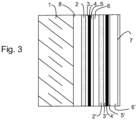
- FIG. 3 outside the invention, schematically presents a structure comprising two silver-based layers 4 and 4'.
- the usefulness of double layers of silver is well known from the prior art. At the cost of a higher cost due to the complexity introduced by the multiplicity of layers to be deposited, the presence of two layers of silver makes it possible on the one hand to further improve the emissivity of the glazing and to better control the neutrality of color in reflection.
- FIG. 3 shows with regard to the additional layers (2',3',4',5',6') as previously an assembly comprising layers (2' and 3') promoting the formation of a silver layer having an adequate structure to present in particular the best quality in terms of conduction and emissivity, one or more barrier layers (5') protecting the silver-based layer (4') against possible degradation during deposition of the layers which are superimposed on it, and one or more dielectric layers (6') to complete the filter.
- layer systems comprising or not oxide or oxy-nitride layers, TiOMx or TiOMxNy, were compared both for their emissivity and their neutrality in reflection .
- the thicknesses of the layers are expressed in Angstrom for dielectrics and in mg/m 2 for silver.
- the deposits are carried out in an oxidizing atmosphere from metallic targets for the dielectrics, and in a neutral atmosphere (argon) for the silver layer and for the TiOw barrier layer.
- a set of similar layers is deposited by reducing the first layer ZnSnO(50/50) to 180 Angstrom, and by depositing on this layer in a weakly oxidizing atmosphere, from a ceramic target made of titanium oxide. , a layer of 100 Angstroms.
- the structure of this system is therefore:
- emissivity veil L* has* b* reference 0.040 4 42.62 - 0.65 - 8.08 with TiO 2 0.073 4 42.94 - 1.23 - 6.32
- emissivity veil L* has* b* TiZrYO (50%Zr) 0.038 1.5 40.18 2.6 - 4.3
- emissivity veil L* has* b* TiZrYO (25%Zr) 0.041 40.83 0.97 - 5.31
- this layer with a high refractive index does not significantly alter the quality of the emissivity when the glazing is subjected to heat treatment.
- Example 2 A test similar to that of Example 1 is carried out this time by depositing the layer based on titanium and zirconium (50%) in a nitrogen atmosphere.
- the deposit obtained under these conditions is an oxy-nitride, the oxygen of the target entering mainly into the composition of the layer.
- emissivity veil L* has* b* TiZrYON (50%Zr) 0.041 2 42.45 1.8 - 7.3
- the layer based on mixed oxide is also deposited in a nitrogen atmosphere.
- the ceramic target is made of a mixture of titanium and silicon (8% by weight).
- emissivity veil L* has* b* TiSiO (8%Si) 0.041 3.5 42.54 1.38 - 8.3
- the procedure is as in the previous examples, this time using a layer of mixed oxide of titanium and niobium of 100 ⁇ , the other layers being those presented above.
- the mixed oxide layer is deposited in weakly oxidizing environments from a ceramic target of titanium oxide and Nb 2 O 5 oxide comprising 30% in peas of Nb 2 O 5 .
- emissivity veil L* has* b* TiNbO 0.043 2.0 40.74 -0.45 - 3.41
- the mixed oxide layer of titanium and niobium like that of titanium and zirconium, is very stable under thermal testing.
- the silver layer retains good properties, and the coloring in reflection is very neutral.
- the first system is made up as follows, starting from glass:
- the second system has the same composition but the layer of mixed oxide of titanium and niobium is only 80 ⁇ thick instead of 100 ⁇
- TiNbO emissivity veil L* has* b* (has) 0.042 2.0 40.74 - 0.5 - 4.72 (b) 0.041 2.0 41.22 - 0.49 - 6.16
- the presence of the zinc oxide-based layer under the silver can be omitted without the heat treatment appreciably affecting the performance of the zinc oxide layer.
- silver or colorimetric characteristics in reflection can be omitted without the heat treatment appreciably affecting the performance of the zinc oxide layer.
Landscapes
- Chemical & Material Sciences (AREA)
- Life Sciences & Earth Sciences (AREA)
- Engineering & Computer Science (AREA)
- Chemical Kinetics & Catalysis (AREA)
- General Chemical & Material Sciences (AREA)
- Geochemistry & Mineralogy (AREA)
- Materials Engineering (AREA)
- Organic Chemistry (AREA)
- Surface Treatment Of Glass (AREA)
- Transition And Organic Metals Composition Catalysts For Addition Polymerization (AREA)
- Joining Of Glass To Other Materials (AREA)
Claims (9)
- Verglasung, die mittels Vakuumbeschichtungsverfahren ("Sputtern") mit einer Anordnung von Dünnschichten beschichtet ist, die ihr Eigenschaften zur Reflexion von Infrarotstrahlung verleihen, bei gleichzeitiger Beibehaltung einer hohen Durchlässigkeit im sichtbaren Bereich,a. wobei die Eigenschaften der Schichten, insbesondere die Reflexionseigenschaften im Infrarotbereich, nicht wesentlich verändert werden, wenn diese Verglasung mit einer Wärmebehandlung zum Biegen/Vorspannen behandelt wird, oder nach einer Wärmebehandlung bei einer Temperatur über 650°C und während einer Dauer von mindestens 3 Minuten die Qualität von der Schicht auf Basis von Silber derart ist, dass Q x ε < 5,0, wobei Q in mg/m2 ausgedrückt ist und ε der normale Emissionsgrad ist, undb. die eine einzige Schicht auf Basis von Silber in einer Menge zwischen 80 und 160 mg/m2 und dielektrische Schichten umfasst,c. wobei mindestens eine dielektrische Schicht, die sich unterhalb der Schicht auf Basis von Silber befindet, eine Schicht auf Basis von Titanoxid oder Titanoxinitrid vom Typ TiMOx oder TiMOxNy ist,i. wobei M ein Metall ist oder mehrere Metalle aus der Gruppe sind, die Zr, Nb, Hf, Ta, Nd, V, Ce, W, Mo, La, Y umfasst, oder Silicium ist,ii. das Verhältnis, in Atomprozent, des Metalls oder der Metalle oder von Silicium, M/Ti, nicht kleiner ist als 10 %, vorzugsweise höher als 15 % und besonders bevorzugt höher als 20 %, und das Verhältnis, in Atomprozent, des Metalls oder der Metalle oder von Silicium, M/Ti, höchstens 60 % beträgt, um eine erhebliche Umwandlung der kristallografischen Struktur der zuvor aufgebrachten Schicht auf Basis von Titanoxid unter der Einwirkung der Wärmebehandlung zu verhindern, undiii. die eine Dicke von nicht unter 6 nm aufweist, undd. wobei sich unter der Schicht auf Basis von Silber und im Kontakt damit eine Schicht auf Basis von Zinkoxid vom Typ ZnO, ZnAlOz, ZnSnOz oder ZnMgOz befindet, wobei das Verhältnis, in Atomprozent, von Al/Zn, Sn/Zn oder Mg/Zn nicht über 15 ö und vorzugsweise nicht über 10 ö beträgt, die eine Dicke von höchstens 10 nm und vorzugsweise höchstens 8 nm aufweist,e. und die eine Anordnung von Schichten umfasst:- Glas/Dielektrikum/TiMOx oder TiMOxNy/ZnO oder ZnAlOz oder ZnSnOz oder ZnMgOz/Ag/Grenzschicht/Dielektrikum II
oder- Glas/TiMox oder TiMoxNy/Dielektrikum/ZnO oder ZnAlOz oder ZnSnOz oder ZnMgOz/Ag/Grenzschicht/Dielektrikum II
oder- Glas/Dielektrikum/TiMox oder TiMoxNy/Dielektrikum/ZnO oder ZnAlOz oder ZnSnOz oder ZnMgOz/Ag/Grenzschicht/Dielektrikum II,f. wobei die zusätzlichen dielektrischen Schichten identisch oder unterschiedlich sind und wobei zu der oder den ergänzenden dielektrischen Schicht(en) mindestens eine Schicht auf Basis eines Zink-Zinn-Mischoxids mit einem Gewichtsverhältnis Zn/Sn zwischen 30 und 70 ö gehört. - Verglasung nach dem vorhergehenden Anspruch, wobei in der Schicht auf Basis von Titanoxinitrid das Verhältnis N2/O2 nicht über 30 % und vorzugsweise nicht über 25 ö und besonders bevorzugt nicht über 20 % liegt.
- Verglasung nach einem der vorhergehenden Ansprüche, wobei die Schicht auf Basis von Titanoxid oder Titanoxinitrid eine Dicke aufweist, die nicht unter 8 nm und besonders bevorzugt nicht unter 10 nm beträgt.
- Verglasung nach einem der vorhergehenden Ansprüche, wobei das oder die Metalle oder Silicium, das bzw. die in die Zusammensetzung der Schicht auf Basis von Titanoxid oder Titanoxinitrid aufgenommen wird bzw. werden, derart und in derartigen Anteilen ausgewählt ist bzw. sind, dass die betreffende Schicht einen Brechungsindex von über 2,2 und vorzugsweise über 2,3 aufweist.
- Verglasung nach einem der vorhergehenden Ansprüche, wobei die Schicht auf Basis von Silber mit mindestens einer Grenzschicht auf Basis von Titan TiOw mit w ≤ 2 oder einer NiCrOv-Schicht oder beiden bedeckt ist.
- Verglasung nach Anspruch 5, wobei die Schicht oder Schichten TiOw und/oder NiCrOv gemeinsam eine Dicke aufweisen, die nicht über 10 nm und vorzugsweise nicht über 8 nm beträgt, wobei jede dieser Schichten einzeln eine Dicke aufweist, die nicht über 6 nm beträgt.
- Verglasung nach einem der vorgehenden Ansprüche, die eine einzige Schicht auf Basis von Silber in einer Menge zwischen 100 und 140 mg/m2 umfasst.
- Verglasung nach Anspruch 7, wobei nach einer Wärmebehandlung bei einer Temperatur über 650°C und während einer Dauer von mindestens 3 Minuten die Qualität der Schicht auf Basis von Silber derart ist, dass


- Verglasung nach einem der vorhergehenden Ansprüche, die eine Anordnung von Schichten umfasst:
Glas/TiMox oder TiMoxNy/ZnO oder ZnAlOz oder ZnSnOz oder ZnMgOz/Ag/Grenzschicht/Dielektrikum II.
Priority Applications (2)
| Application Number | Priority Date | Filing Date | Title |
|---|---|---|---|
| PL08717902.4T PL2137116T5 (pl) | 2007-03-19 | 2008-03-17 | Oszklenie niskoemisyjne |
| EP08717902.4A EP2137116B2 (de) | 2007-03-19 | 2008-03-17 | Verglasung mit geringer emissivität |
Applications Claiming Priority (3)
| Application Number | Priority Date | Filing Date | Title |
|---|---|---|---|
| EP07104429A EP1980539A1 (de) | 2007-03-19 | 2007-03-19 | Verglasung mit geringer Emissivität |
| EP08717902.4A EP2137116B2 (de) | 2007-03-19 | 2008-03-17 | Verglasung mit geringer emissivität |
| PCT/EP2008/053166 WO2008113786A1 (fr) | 2007-03-19 | 2008-03-17 | Vitrage à faible émissivité |
Publications (3)
| Publication Number | Publication Date |
|---|---|
| EP2137116A1 EP2137116A1 (de) | 2009-12-30 |
| EP2137116B1 EP2137116B1 (de) | 2020-06-03 |
| EP2137116B2 true EP2137116B2 (de) | 2023-10-11 |
Family
ID=38293960
Family Applications (2)
| Application Number | Title | Priority Date | Filing Date |
|---|---|---|---|
| EP07104429A Withdrawn EP1980539A1 (de) | 2007-03-19 | 2007-03-19 | Verglasung mit geringer Emissivität |
| EP08717902.4A Active EP2137116B2 (de) | 2007-03-19 | 2008-03-17 | Verglasung mit geringer emissivität |
Family Applications Before (1)
| Application Number | Title | Priority Date | Filing Date |
|---|---|---|---|
| EP07104429A Withdrawn EP1980539A1 (de) | 2007-03-19 | 2007-03-19 | Verglasung mit geringer Emissivität |
Country Status (9)
| Country | Link |
|---|---|
| US (1) | US8105695B2 (de) |
| EP (2) | EP1980539A1 (de) |
| JP (1) | JP5553746B2 (de) |
| CN (1) | CN101675011B (de) |
| EA (1) | EA020682B1 (de) |
| ES (1) | ES2814249T5 (de) |
| HU (1) | HUE050289T2 (de) |
| PL (1) | PL2137116T5 (de) |
| WO (1) | WO2008113786A1 (de) |
Families Citing this family (36)
| Publication number | Priority date | Publication date | Assignee | Title |
|---|---|---|---|---|
| CN102084192A (zh) * | 2007-12-21 | 2011-06-01 | 旭硝子欧洲玻璃公司 | 太阳能反射体 |
| KR20110033769A (ko) | 2009-09-25 | 2011-03-31 | (주)엘지하우시스 | 저방사 유리 및 이의 제조방법 |
| EP2314553A1 (de) * | 2009-10-16 | 2011-04-27 | AGC Glass Europe | Emaillierte, reflektierende Verglasung |
| FR2963788B1 (fr) * | 2010-08-10 | 2016-01-22 | Saint Gobain | Vitrage a proprietes antisolaires |
| TWI477635B (zh) * | 2010-09-15 | 2015-03-21 | Hon Hai Prec Ind Co Ltd | 殼體之製作方法及由該方法製得之殼體 |
| CN102603209A (zh) * | 2011-01-25 | 2012-07-25 | 鸿富锦精密工业(深圳)有限公司 | 镀膜玻璃及其制备方法 |
| GB201102724D0 (en) * | 2011-02-17 | 2011-03-30 | Pilkington Group Ltd | Heat treatable coated glass pane |
| US8557391B2 (en) | 2011-02-24 | 2013-10-15 | Guardian Industries Corp. | Coated article including low-emissivity coating, insulating glass unit including coated article, and/or methods of making the same |
| US8790783B2 (en) * | 2011-03-03 | 2014-07-29 | Guardian Industries Corp. | Barrier layers comprising Ni and/or Ti, coated articles including barrier layers, and methods of making the same |
| KR101381531B1 (ko) * | 2011-08-18 | 2014-04-07 | (주)엘지하우시스 | 열처리가 가능한 저방사 유리 및 이의 제조방법 |
| US9011969B2 (en) | 2011-12-27 | 2015-04-21 | Intermolecular, Inc. | Low-E panel with improved dielectric layer and method for forming the same |
| CN102515562A (zh) * | 2011-12-23 | 2012-06-27 | 福耀玻璃工业集团股份有限公司 | 一种镀膜产品 |
| US9279910B2 (en) * | 2013-03-13 | 2016-03-08 | Intermolecular, Inc. | Color shift of high LSG low emissivity coating after heat treatment |
| US9790127B2 (en) | 2013-03-14 | 2017-10-17 | Intermolecular, Inc. | Method to generate high LSG low-emissivity coating with same color after heat treatment |
| FR3030491B1 (fr) * | 2014-12-23 | 2016-12-30 | Saint Gobain | Vitrage comprenant un revetement protecteur |
| FR3032958B1 (fr) * | 2015-02-24 | 2017-02-17 | Saint Gobain | Vitrage comprenant un revetement protecteur. |
| EP3347321B1 (de) * | 2015-09-08 | 2019-06-12 | Saint-Gobain Glass France | Verglasung mit funktionsbeschichtung |
| WO2018160789A1 (en) * | 2017-03-03 | 2018-09-07 | Guardian Glass, LLC | Coated article having low-e coating with ir reflecting layer(s) and niobium-doped titanium oxide dielectric layer(s) and method of making same |
| US10196735B2 (en) * | 2017-03-03 | 2019-02-05 | Guardian Glass, LLC | Coated article having low-E coating with IR reflecting layer(s) and doped titanium oxide dielectric layer(s) and method of making same |
| US10138159B2 (en) * | 2017-03-09 | 2018-11-27 | Guardian Glass, LLC | Coated article having low-E coating with IR reflecting layer(s) and high index nitrided dielectric film having multiple layers |
| US10138158B2 (en) * | 2017-03-10 | 2018-11-27 | Guardian Glass, LLC | Coated article having low-E coating with IR reflecting layer(s) and high index nitrided dielectric layers |
| FR3065722B1 (fr) * | 2017-04-28 | 2021-09-24 | Saint Gobain | Vitrage colore et son procede d'obtention |
| US10336651B1 (en) | 2018-07-16 | 2019-07-02 | Guardian Glass, LLC | Coated article with IR reflecting layer(s) and silicon zirconium oxynitride layer(s) and method of making same |
| RU2696748C1 (ru) * | 2018-10-18 | 2019-08-05 | Общество с ограниченной ответственностью "Пилкингтон Гласс" | Изделие с гибридным сильнопоглощающим энергосберегающим покрытием на стеклянной подложке |
| FR3088636B1 (fr) * | 2018-11-16 | 2022-09-09 | Saint Gobain | Materiau traite thermiquement a proprietes mecaniques ameliorees |
| JP7428188B2 (ja) * | 2019-09-09 | 2024-02-06 | Agc株式会社 | 積層体および複層ガラス |
| CN111393036A (zh) * | 2020-03-25 | 2020-07-10 | 四川猛犸半导体科技有限公司 | 一种薄膜器件 |
| WO2022053507A1 (en) | 2020-09-10 | 2022-03-17 | Agc Glass Europe | Temperable uv reflecting coated glass sheet |
| EP4377274A1 (de) | 2021-07-27 | 2024-06-05 | AGC Glass Europe | Verglasung zur verhinderung von vogelkollisionen |
| GB202110849D0 (en) | 2021-07-28 | 2021-09-08 | Pilkington Group Ltd | Coated glass pane |
| FR3129938B1 (fr) * | 2021-12-08 | 2026-03-13 | Saint Gobain | Vitrage comprenant un empilement antisolaire et un revêtement protecteur comprenant un oxyde d’yttrium et d’au moins un élément choisi parmi l’hafnium et/ou le titane |
| WO2025073836A1 (en) | 2023-10-04 | 2025-04-10 | Agc Glass Europe | Insulating glazing |
| WO2025140827A1 (en) | 2023-12-27 | 2025-07-03 | Agc Glass Europe | Glazed assembly |
| WO2025140828A1 (en) | 2023-12-27 | 2025-07-03 | Agc Glass Europe | Glazed assembly |
| EP4613965A1 (de) | 2024-03-06 | 2025-09-10 | AGC Glass Europe | Glasierte anordnung |
| GB202403355D0 (en) | 2024-03-08 | 2024-04-24 | Pilkington Group Ltd | Coated glass pane |
Citations (4)
| Publication number | Priority date | Publication date | Assignee | Title |
|---|---|---|---|---|
| US5110637A (en) † | 1988-03-03 | 1992-05-05 | Asahi Glass Company Ltd. | Amorphous oxide film and article having such film thereon |
| US5962115A (en) † | 1995-06-08 | 1999-10-05 | Balzers Und Leybold Deutschland Holding Ag | Pane of transparent material having a low emissivity |
| WO2000072053A1 (fr) † | 1999-05-20 | 2000-11-30 | Saint-Gobain Glass France | Substrat transparent a revetement antireflets bas-emissif ou anti-solaire |
| WO2006048463A1 (fr) † | 2004-11-08 | 2006-05-11 | Glaverbel | Vitrage |
Family Cites Families (13)
| Publication number | Priority date | Publication date | Assignee | Title |
|---|---|---|---|---|
| US5059295A (en) * | 1986-12-29 | 1991-10-22 | Ppg Industries, Inc. | Method of making low emissivity window |
| ES2077562T3 (es) | 1987-07-22 | 1995-12-01 | Philips Electronics Nv | Filtro de interferencia optico. |
| EP0963960A1 (de) | 1998-06-08 | 1999-12-15 | Glaverbel | Durchsichtiges Substrat mit Silberbeschichtung |
| FR2784985B1 (fr) * | 1998-10-22 | 2001-09-21 | Saint Gobain Vitrage | Substrat transparent muni d'un empilement de couches minces |
| US20020136905A1 (en) * | 1999-11-24 | 2002-09-26 | Medwick Paul A. | Low shading coefficient and low emissivity coatings and coated articles |
| MXPA04007578A (es) * | 2002-02-11 | 2004-11-10 | Ppg Ind Ohio Inc | Recubrimiento de control solar. |
| EP1748035B1 (de) * | 2002-03-01 | 2010-10-20 | Cardinal CG Company | Dünnfilmbeschichtung mit einer transparenten Grundierungsschicht |
| EP1375445A1 (de) | 2002-06-17 | 2004-01-02 | Glaverbel | Verfahren zur Herstellung einer Verglasung mit einer mehrlagigen Beschichtung |
| JP4114429B2 (ja) * | 2002-07-31 | 2008-07-09 | 旭硝子株式会社 | 積層体および構造体 |
| AU2004225545B2 (en) | 2003-03-28 | 2008-08-14 | Ppg Industries Ohio, Inc. | Substrates coated with mixtures of titanium and aluminum materials, methods for making the substrates, and cathode targets of titanium and aluminum metal |
| DE50312424D1 (de) * | 2003-12-02 | 2010-04-01 | Scheuten Glasgroep Bv | Temperbares Low-e-Schichtsystem; Verfahren zur Herstellung und Low-e-Glasprodukt mit Schichtsystem |
| BE1016553A3 (fr) * | 2005-03-17 | 2007-01-09 | Glaverbel | Vitrage a faible emissivite. |
| DE102005039707B4 (de) * | 2005-08-23 | 2009-12-03 | Saint-Gobain Glass Deutschland Gmbh | Thermisch hoch belastbares Low-E-Schichtsystem für transparente Substrate, insbesondere für Glasscheiben |
-
2007
- 2007-03-19 EP EP07104429A patent/EP1980539A1/de not_active Withdrawn
-
2008
- 2008-03-17 US US12/532,318 patent/US8105695B2/en active Active
- 2008-03-17 JP JP2010500200A patent/JP5553746B2/ja not_active Expired - Fee Related
- 2008-03-17 ES ES08717902T patent/ES2814249T5/es active Active
- 2008-03-17 HU HUE08717902A patent/HUE050289T2/hu unknown
- 2008-03-17 PL PL08717902.4T patent/PL2137116T5/pl unknown
- 2008-03-17 EA EA200901252A patent/EA020682B1/ru not_active IP Right Cessation
- 2008-03-17 WO PCT/EP2008/053166 patent/WO2008113786A1/fr not_active Ceased
- 2008-03-17 EP EP08717902.4A patent/EP2137116B2/de active Active
- 2008-03-17 CN CN200880014802.0A patent/CN101675011B/zh not_active Expired - Fee Related
Patent Citations (4)
| Publication number | Priority date | Publication date | Assignee | Title |
|---|---|---|---|---|
| US5110637A (en) † | 1988-03-03 | 1992-05-05 | Asahi Glass Company Ltd. | Amorphous oxide film and article having such film thereon |
| US5962115A (en) † | 1995-06-08 | 1999-10-05 | Balzers Und Leybold Deutschland Holding Ag | Pane of transparent material having a low emissivity |
| WO2000072053A1 (fr) † | 1999-05-20 | 2000-11-30 | Saint-Gobain Glass France | Substrat transparent a revetement antireflets bas-emissif ou anti-solaire |
| WO2006048463A1 (fr) † | 2004-11-08 | 2006-05-11 | Glaverbel | Vitrage |
Also Published As
| Publication number | Publication date |
|---|---|
| PL2137116T3 (pl) | 2020-11-16 |
| ES2814249T5 (es) | 2024-04-22 |
| US8105695B2 (en) | 2012-01-31 |
| EA020682B1 (ru) | 2015-01-30 |
| EA200901252A1 (ru) | 2010-04-30 |
| EP2137116A1 (de) | 2009-12-30 |
| JP5553746B2 (ja) | 2014-07-16 |
| EP1980539A1 (de) | 2008-10-15 |
| ES2814249T3 (es) | 2021-03-26 |
| CN101675011A (zh) | 2010-03-17 |
| JP2010521410A (ja) | 2010-06-24 |
| PL2137116T5 (pl) | 2024-01-29 |
| WO2008113786A1 (fr) | 2008-09-25 |
| CN101675011B (zh) | 2016-02-03 |
| US20100167034A1 (en) | 2010-07-01 |
| HUE050289T2 (hu) | 2020-11-30 |
| EP2137116B1 (de) | 2020-06-03 |
Similar Documents
| Publication | Publication Date | Title |
|---|---|---|
| EP2137116B1 (de) | Verglasung mit geringer emissivität | |
| EP2262745B2 (de) | Verglasung mit dünnschichtbeschichtung | |
| EP3702337B1 (de) | Verglasung mit dünnschichtbeschichtung | |
| CA2286440C (fr) | Substrat transparent muni d'un empilement de couches minces | |
| EP2262743B2 (de) | Verglasung mit dünnschichtbeschichtung | |
| EP2956421B1 (de) | Sonnenschutzverglasung | |
| EP2027076B1 (de) | Low-e-verglasung | |
| EP2331475B1 (de) | Verglasung mit erhöhter reflexion | |
| EP3172175B2 (de) | Zierglasscheibe | |
| EP2686279B1 (de) | Isolierverglasung | |
| EP2585411B1 (de) | Isolierverglasung | |
| EP3347322B1 (de) | Glasur mit einem stapel aus dünnen schichten | |
| FR2948037A1 (fr) | Materiau photocatalytique | |
| EP2585410B1 (de) | Isolierverglasung | |
| EP2314553A1 (de) | Emaillierte, reflektierende Verglasung | |
| EP2545012A1 (de) | Glasplatte mit hoher reflexion | |
| EP2545011B1 (de) | Glasplatte mit hoher reflexion | |
| EP2822908B1 (de) | Isolierverglasung | |
| WO2024223577A1 (fr) | Substrat transparent muni d'un empilement fonctionnel de couches minces | |
| EP3419946B1 (de) | Sonnenschutzverglasung mit einer schicht aus einer nicucr-legierung |
Legal Events
| Date | Code | Title | Description |
|---|---|---|---|
| PUAI | Public reference made under article 153(3) epc to a published international application that has entered the european phase |
Free format text: ORIGINAL CODE: 0009012 |
|
| 17P | Request for examination filed |
Effective date: 20090918 |
|
| AK | Designated contracting states |
Kind code of ref document: A1 Designated state(s): AT BE BG CH CY CZ DE DK EE ES FI FR GB GR HR HU IE IS IT LI LT LU LV MC MT NL NO PL PT RO SE SI SK TR |
|
| 17Q | First examination report despatched |
Effective date: 20100107 |
|
| TPAC | Observations filed by third parties |
Free format text: ORIGINAL CODE: EPIDOSNTIPA |
|
| DAX | Request for extension of the european patent (deleted) | ||
| RAP1 | Party data changed (applicant data changed or rights of an application transferred) |
Owner name: AGC GLASS EUROPE |
|
| RAP1 | Party data changed (applicant data changed or rights of an application transferred) |
Owner name: AGC GLASS EUROPE |
|
| STAA | Information on the status of an ep patent application or granted ep patent |
Free format text: STATUS: EXAMINATION IS IN PROGRESS |
|
| GRAP | Despatch of communication of intention to grant a patent |
Free format text: ORIGINAL CODE: EPIDOSNIGR1 |
|
| STAA | Information on the status of an ep patent application or granted ep patent |
Free format text: STATUS: GRANT OF PATENT IS INTENDED |
|
| INTG | Intention to grant announced |
Effective date: 20200107 |
|
| GRAS | Grant fee paid |
Free format text: ORIGINAL CODE: EPIDOSNIGR3 |
|
| GRAA | (expected) grant |
Free format text: ORIGINAL CODE: 0009210 |
|
| STAA | Information on the status of an ep patent application or granted ep patent |
Free format text: STATUS: THE PATENT HAS BEEN GRANTED |
|
| AK | Designated contracting states |
Kind code of ref document: B1 Designated state(s): AT BE BG CH CY CZ DE DK EE ES FI FR GB GR HR HU IE IS IT LI LT LU LV MC MT NL NO PL PT RO SE SI SK TR |
|
| REG | Reference to a national code |
Ref country code: GB Ref legal event code: FG4D Free format text: NOT ENGLISH |
|
| REG | Reference to a national code |
Ref country code: CH Ref legal event code: EP Ref country code: AT Ref legal event code: REF Ref document number: 1276853 Country of ref document: AT Kind code of ref document: T Effective date: 20200615 |
|
| REG | Reference to a national code |
Ref country code: DE Ref legal event code: R096 Ref document number: 602008062804 Country of ref document: DE |
|
| REG | Reference to a national code |
Ref country code: RO Ref legal event code: EPE |
|
| REG | Reference to a national code |
Ref country code: LT Ref legal event code: MG4D |
|
| PG25 | Lapsed in a contracting state [announced via postgrant information from national office to epo] |
Ref country code: FI Free format text: LAPSE BECAUSE OF FAILURE TO SUBMIT A TRANSLATION OF THE DESCRIPTION OR TO PAY THE FEE WITHIN THE PRESCRIBED TIME-LIMIT Effective date: 20200603 Ref country code: GR Free format text: LAPSE BECAUSE OF FAILURE TO SUBMIT A TRANSLATION OF THE DESCRIPTION OR TO PAY THE FEE WITHIN THE PRESCRIBED TIME-LIMIT Effective date: 20200904 Ref country code: NO Free format text: LAPSE BECAUSE OF FAILURE TO SUBMIT A TRANSLATION OF THE DESCRIPTION OR TO PAY THE FEE WITHIN THE PRESCRIBED TIME-LIMIT Effective date: 20200903 Ref country code: SE Free format text: LAPSE BECAUSE OF FAILURE TO SUBMIT A TRANSLATION OF THE DESCRIPTION OR TO PAY THE FEE WITHIN THE PRESCRIBED TIME-LIMIT Effective date: 20200603 Ref country code: LT Free format text: LAPSE BECAUSE OF FAILURE TO SUBMIT A TRANSLATION OF THE DESCRIPTION OR TO PAY THE FEE WITHIN THE PRESCRIBED TIME-LIMIT Effective date: 20200603 |
|
| REG | Reference to a national code |
Ref country code: NL Ref legal event code: MP Effective date: 20200603 |
|
| PG25 | Lapsed in a contracting state [announced via postgrant information from national office to epo] |
Ref country code: LV Free format text: LAPSE BECAUSE OF FAILURE TO SUBMIT A TRANSLATION OF THE DESCRIPTION OR TO PAY THE FEE WITHIN THE PRESCRIBED TIME-LIMIT Effective date: 20200603 Ref country code: HR Free format text: LAPSE BECAUSE OF FAILURE TO SUBMIT A TRANSLATION OF THE DESCRIPTION OR TO PAY THE FEE WITHIN THE PRESCRIBED TIME-LIMIT Effective date: 20200603 |
|
| REG | Reference to a national code |
Ref country code: HU Ref legal event code: AG4A Ref document number: E050289 Country of ref document: HU |
|
| REG | Reference to a national code |
Ref country code: AT Ref legal event code: MK05 Ref document number: 1276853 Country of ref document: AT Kind code of ref document: T Effective date: 20200603 |
|
| PG25 | Lapsed in a contracting state [announced via postgrant information from national office to epo] |
Ref country code: NL Free format text: LAPSE BECAUSE OF FAILURE TO SUBMIT A TRANSLATION OF THE DESCRIPTION OR TO PAY THE FEE WITHIN THE PRESCRIBED TIME-LIMIT Effective date: 20200603 |
|
| PG25 | Lapsed in a contracting state [announced via postgrant information from national office to epo] |
Ref country code: EE Free format text: LAPSE BECAUSE OF FAILURE TO SUBMIT A TRANSLATION OF THE DESCRIPTION OR TO PAY THE FEE WITHIN THE PRESCRIBED TIME-LIMIT Effective date: 20200603 Ref country code: AT Free format text: LAPSE BECAUSE OF FAILURE TO SUBMIT A TRANSLATION OF THE DESCRIPTION OR TO PAY THE FEE WITHIN THE PRESCRIBED TIME-LIMIT Effective date: 20200603 Ref country code: PT Free format text: LAPSE BECAUSE OF FAILURE TO SUBMIT A TRANSLATION OF THE DESCRIPTION OR TO PAY THE FEE WITHIN THE PRESCRIBED TIME-LIMIT Effective date: 20201006 |
|
| PG25 | Lapsed in a contracting state [announced via postgrant information from national office to epo] |
Ref country code: SK Free format text: LAPSE BECAUSE OF FAILURE TO SUBMIT A TRANSLATION OF THE DESCRIPTION OR TO PAY THE FEE WITHIN THE PRESCRIBED TIME-LIMIT Effective date: 20200603 Ref country code: IS Free format text: LAPSE BECAUSE OF FAILURE TO SUBMIT A TRANSLATION OF THE DESCRIPTION OR TO PAY THE FEE WITHIN THE PRESCRIBED TIME-LIMIT Effective date: 20201003 |
|
| REG | Reference to a national code |
Ref country code: DE Ref legal event code: R026 Ref document number: 602008062804 Country of ref document: DE |
|
| PLBI | Opposition filed |
Free format text: ORIGINAL CODE: 0009260 |
|
| PLAB | Opposition data, opponent's data or that of the opponent's representative modified |
Free format text: ORIGINAL CODE: 0009299OPPO |
|
| PLAX | Notice of opposition and request to file observation + time limit sent |
Free format text: ORIGINAL CODE: EPIDOSNOBS2 |
|
| REG | Reference to a national code |
Ref country code: ES Ref legal event code: FG2A Ref document number: 2814249 Country of ref document: ES Kind code of ref document: T3 Effective date: 20210326 |
|
| 26 | Opposition filed |
Opponent name: PILKINGTON GROUP LIMITED Effective date: 20210303 |
|
| R26 | Opposition filed (corrected) |
Opponent name: PILKINGTON GROUP LIMITED Effective date: 20210303 |
|
| PG25 | Lapsed in a contracting state [announced via postgrant information from national office to epo] |
Ref country code: DK Free format text: LAPSE BECAUSE OF FAILURE TO SUBMIT A TRANSLATION OF THE DESCRIPTION OR TO PAY THE FEE WITHIN THE PRESCRIBED TIME-LIMIT Effective date: 20200603 |
|
| PG25 | Lapsed in a contracting state [announced via postgrant information from national office to epo] |
Ref country code: SI Free format text: LAPSE BECAUSE OF FAILURE TO SUBMIT A TRANSLATION OF THE DESCRIPTION OR TO PAY THE FEE WITHIN THE PRESCRIBED TIME-LIMIT Effective date: 20200603 |
|
| PLBB | Reply of patent proprietor to notice(s) of opposition received |
Free format text: ORIGINAL CODE: EPIDOSNOBS3 |
|
| PG25 | Lapsed in a contracting state [announced via postgrant information from national office to epo] |
Ref country code: MC Free format text: LAPSE BECAUSE OF FAILURE TO SUBMIT A TRANSLATION OF THE DESCRIPTION OR TO PAY THE FEE WITHIN THE PRESCRIBED TIME-LIMIT Effective date: 20200603 |
|
| REG | Reference to a national code |
Ref country code: CH Ref legal event code: PL |
|
| PG25 | Lapsed in a contracting state [announced via postgrant information from national office to epo] |
Ref country code: IE Free format text: LAPSE BECAUSE OF NON-PAYMENT OF DUE FEES Effective date: 20210317 Ref country code: LI Free format text: LAPSE BECAUSE OF NON-PAYMENT OF DUE FEES Effective date: 20210331 Ref country code: CH Free format text: LAPSE BECAUSE OF NON-PAYMENT OF DUE FEES Effective date: 20210331 |
|
| APAH | Appeal reference modified |
Free format text: ORIGINAL CODE: EPIDOSCREFNO |
|
| APBM | Appeal reference recorded |
Free format text: ORIGINAL CODE: EPIDOSNREFNO |
|
| APBP | Date of receipt of notice of appeal recorded |
Free format text: ORIGINAL CODE: EPIDOSNNOA2O |
|
| PGFP | Annual fee paid to national office [announced via postgrant information from national office to epo] |
Ref country code: RO Payment date: 20230227 Year of fee payment: 16 Ref country code: LU Payment date: 20230227 Year of fee payment: 16 Ref country code: CZ Payment date: 20230228 Year of fee payment: 16 |
|
| PG25 | Lapsed in a contracting state [announced via postgrant information from national office to epo] |
Ref country code: CY Free format text: LAPSE BECAUSE OF FAILURE TO SUBMIT A TRANSLATION OF THE DESCRIPTION OR TO PAY THE FEE WITHIN THE PRESCRIBED TIME-LIMIT Effective date: 20200603 |
|
| PGFP | Annual fee paid to national office [announced via postgrant information from national office to epo] |
Ref country code: HU Payment date: 20230213 Year of fee payment: 16 |
|
| APBU | Appeal procedure closed |
Free format text: ORIGINAL CODE: EPIDOSNNOA9O |
|
| P01 | Opt-out of the competence of the unified patent court (upc) registered |
Effective date: 20230620 |
|
| PUAH | Patent maintained in amended form |
Free format text: ORIGINAL CODE: 0009272 |
|
| STAA | Information on the status of an ep patent application or granted ep patent |
Free format text: STATUS: PATENT MAINTAINED AS AMENDED |
|
| 27A | Patent maintained in amended form |
Effective date: 20231011 |
|
| AK | Designated contracting states |
Kind code of ref document: B2 Designated state(s): AT BE BG CH CY CZ DE DK EE ES FI FR GB GR HR HU IE IS IT LI LT LU LV MC MT NL NO PL PT RO SE SI SK TR |
|
| REG | Reference to a national code |
Ref country code: DE Ref legal event code: R102 Ref document number: 602008062804 Country of ref document: DE |
|
| REG | Reference to a national code |
Ref country code: ES Ref legal event code: DC2A Ref document number: 2814249 Country of ref document: ES Kind code of ref document: T5 Effective date: 20240422 |
|
| PG25 | Lapsed in a contracting state [announced via postgrant information from national office to epo] |
Ref country code: CZ Free format text: LAPSE BECAUSE OF FAILURE TO SUBMIT A TRANSLATION OF THE DESCRIPTION OR TO PAY THE FEE WITHIN THE PRESCRIBED TIME-LIMIT Effective date: 20200603 |
|
| PG25 | Lapsed in a contracting state [announced via postgrant information from national office to epo] |
Ref country code: MT Free format text: LAPSE BECAUSE OF FAILURE TO SUBMIT A TRANSLATION OF THE DESCRIPTION OR TO PAY THE FEE WITHIN THE PRESCRIBED TIME-LIMIT Effective date: 20200603 |
|
| PG25 | Lapsed in a contracting state [announced via postgrant information from national office to epo] |
Ref country code: RO Free format text: LAPSE BECAUSE OF NON-PAYMENT OF DUE FEES Effective date: 20240317 |
|
| PG25 | Lapsed in a contracting state [announced via postgrant information from national office to epo] |
Ref country code: LU Free format text: LAPSE BECAUSE OF NON-PAYMENT OF DUE FEES Effective date: 20240317 |
|
| PG25 | Lapsed in a contracting state [announced via postgrant information from national office to epo] |
Ref country code: HU Free format text: LAPSE BECAUSE OF NON-PAYMENT OF DUE FEES Effective date: 20240318 |
|
| PG25 | Lapsed in a contracting state [announced via postgrant information from national office to epo] |
Ref country code: LU Free format text: LAPSE BECAUSE OF NON-PAYMENT OF DUE FEES Effective date: 20240317 Ref country code: HU Free format text: LAPSE BECAUSE OF NON-PAYMENT OF DUE FEES Effective date: 20240318 |
|
| PGFP | Annual fee paid to national office [announced via postgrant information from national office to epo] |
Ref country code: BE Payment date: 20250214 Year of fee payment: 18 |
|
| PGFP | Annual fee paid to national office [announced via postgrant information from national office to epo] |
Ref country code: FR Payment date: 20250210 Year of fee payment: 18 Ref country code: PL Payment date: 20250213 Year of fee payment: 18 |
|
| PGFP | Annual fee paid to national office [announced via postgrant information from national office to epo] |
Ref country code: ES Payment date: 20250404 Year of fee payment: 18 |
|
| PGFP | Annual fee paid to national office [announced via postgrant information from national office to epo] |
Ref country code: GB Payment date: 20260202 Year of fee payment: 19 |
|
| PGFP | Annual fee paid to national office [announced via postgrant information from national office to epo] |
Ref country code: DE Payment date: 20260204 Year of fee payment: 19 |
|
| PGFP | Annual fee paid to national office [announced via postgrant information from national office to epo] |
Ref country code: IT Payment date: 20260220 Year of fee payment: 19 |
|
| PGFP | Annual fee paid to national office [announced via postgrant information from national office to epo] |
Ref country code: TR Payment date: 20260316 Year of fee payment: 19 |
|
| PGFP | Annual fee paid to national office [announced via postgrant information from national office to epo] |
Ref country code: BG Payment date: 20260218 Year of fee payment: 19 |