EP2130880A1 - Ink Jet Tinte - Google Patents
Ink Jet Tinte Download PDFInfo
- Publication number
- EP2130880A1 EP2130880A1 EP09161119A EP09161119A EP2130880A1 EP 2130880 A1 EP2130880 A1 EP 2130880A1 EP 09161119 A EP09161119 A EP 09161119A EP 09161119 A EP09161119 A EP 09161119A EP 2130880 A1 EP2130880 A1 EP 2130880A1
- Authority
- EP
- European Patent Office
- Prior art keywords
- ink
- pigment
- groups
- ink jet
- modified
- Prior art date
- Legal status (The legal status is an assumption and is not a legal conclusion. Google has not performed a legal analysis and makes no representation as to the accuracy of the status listed.)
- Withdrawn
Links
- 239000000976 ink Substances 0.000 claims abstract description 87
- 239000000049 pigment Substances 0.000 claims abstract description 53
- 230000000740 bleeding effect Effects 0.000 claims abstract description 30
- XNGIFLGASWRNHJ-UHFFFAOYSA-N phthalic acid Chemical class OC(=O)C1=CC=CC=C1C(O)=O XNGIFLGASWRNHJ-UHFFFAOYSA-N 0.000 claims abstract description 19
- 150000003839 salts Chemical class 0.000 claims abstract description 15
- 125000000962 organic group Chemical group 0.000 claims abstract description 13
- 238000000034 method Methods 0.000 claims abstract description 8
- 150000001875 compounds Chemical class 0.000 claims description 15
- 125000003118 aryl group Chemical group 0.000 claims description 10
- 125000000217 alkyl group Chemical group 0.000 claims description 8
- 125000001165 hydrophobic group Chemical group 0.000 claims description 4
- 239000004753 textile Substances 0.000 claims description 2
- 230000008569 process Effects 0.000 abstract description 4
- 239000006229 carbon black Substances 0.000 description 32
- 235000019241 carbon black Nutrition 0.000 description 32
- 239000006185 dispersion Substances 0.000 description 29
- 208000032843 Hemorrhage Diseases 0.000 description 27
- -1 Pyrrolidinyl- Chemical group 0.000 description 23
- 150000001721 carbon Chemical group 0.000 description 18
- XLYOFNOQVPJJNP-UHFFFAOYSA-N water Substances O XLYOFNOQVPJJNP-UHFFFAOYSA-N 0.000 description 16
- OKTJSMMVPCPJKN-UHFFFAOYSA-N Carbon Chemical compound [C] OKTJSMMVPCPJKN-UHFFFAOYSA-N 0.000 description 14
- 239000000654 additive Substances 0.000 description 10
- LPXPTNMVRIOKMN-UHFFFAOYSA-M sodium nitrite Chemical compound [Na+].[O-]N=O LPXPTNMVRIOKMN-UHFFFAOYSA-M 0.000 description 10
- 239000003575 carbonaceous material Substances 0.000 description 9
- 230000002378 acidificating effect Effects 0.000 description 8
- 239000007864 aqueous solution Substances 0.000 description 8
- 238000002360 preparation method Methods 0.000 description 8
- 230000000996 additive effect Effects 0.000 description 7
- 239000012153 distilled water Substances 0.000 description 7
- 239000000080 wetting agent Substances 0.000 description 7
- KFZMGEQAYNKOFK-UHFFFAOYSA-N Isopropanol Chemical compound CC(C)O KFZMGEQAYNKOFK-UHFFFAOYSA-N 0.000 description 6
- UEEJHVSXFDXPFK-UHFFFAOYSA-N N-dimethylaminoethanol Chemical compound CN(C)CCO UEEJHVSXFDXPFK-UHFFFAOYSA-N 0.000 description 6
- 125000004093 cyano group Chemical group *C#N 0.000 description 6
- 239000000203 mixture Substances 0.000 description 6
- 239000000126 substance Substances 0.000 description 6
- 229910052783 alkali metal Inorganic materials 0.000 description 5
- 238000006243 chemical reaction Methods 0.000 description 5
- 239000000123 paper Substances 0.000 description 5
- 239000005060 rubber Substances 0.000 description 5
- 235000010288 sodium nitrite Nutrition 0.000 description 5
- IJGRMHOSHXDMSA-UHFFFAOYSA-N Atomic nitrogen Chemical compound N#N IJGRMHOSHXDMSA-UHFFFAOYSA-N 0.000 description 4
- VEXZGXHMUGYJMC-UHFFFAOYSA-N Hydrochloric acid Chemical compound Cl VEXZGXHMUGYJMC-UHFFFAOYSA-N 0.000 description 4
- OWYWGLHRNBIFJP-UHFFFAOYSA-N Ipazine Chemical compound CCN(CC)C1=NC(Cl)=NC(NC(C)C)=N1 OWYWGLHRNBIFJP-UHFFFAOYSA-N 0.000 description 4
- 150000001412 amines Chemical class 0.000 description 4
- 239000003139 biocide Substances 0.000 description 4
- 229910052751 metal Inorganic materials 0.000 description 4
- 239000002184 metal Substances 0.000 description 4
- 239000003607 modifier Substances 0.000 description 4
- 239000000047 product Substances 0.000 description 4
- 239000000243 solution Substances 0.000 description 4
- RTZKZFJDLAIYFH-UHFFFAOYSA-N Diethyl ether Chemical compound CCOCC RTZKZFJDLAIYFH-UHFFFAOYSA-N 0.000 description 3
- 229920003171 Poly (ethylene oxide) Polymers 0.000 description 3
- HEMHJVSKTPXQMS-UHFFFAOYSA-M Sodium hydroxide Chemical compound [OH-].[Na+] HEMHJVSKTPXQMS-UHFFFAOYSA-M 0.000 description 3
- 239000007900 aqueous suspension Substances 0.000 description 3
- 230000003115 biocidal effect Effects 0.000 description 3
- 239000001055 blue pigment Substances 0.000 description 3
- 125000002091 cationic group Chemical group 0.000 description 3
- 229920006317 cationic polymer Polymers 0.000 description 3
- 229920001577 copolymer Polymers 0.000 description 3
- 125000000524 functional group Chemical group 0.000 description 3
- 229920000642 polymer Polymers 0.000 description 3
- QGZKDVFQNNGYKY-UHFFFAOYSA-O Ammonium Chemical compound [NH4+] QGZKDVFQNNGYKY-UHFFFAOYSA-O 0.000 description 2
- 229920000049 Carbon (fiber) Polymers 0.000 description 2
- LYCAIKOWRPUZTN-UHFFFAOYSA-N Ethylene glycol Chemical compound OCCO LYCAIKOWRPUZTN-UHFFFAOYSA-N 0.000 description 2
- IAYPIBMASNFSPL-UHFFFAOYSA-N Ethylene oxide Chemical compound C1CO1 IAYPIBMASNFSPL-UHFFFAOYSA-N 0.000 description 2
- PEDCQBHIVMGVHV-UHFFFAOYSA-N Glycerol Natural products OCC(O)CO PEDCQBHIVMGVHV-UHFFFAOYSA-N 0.000 description 2
- MHAJPDPJQMAIIY-UHFFFAOYSA-N Hydrogen peroxide Chemical compound OO MHAJPDPJQMAIIY-UHFFFAOYSA-N 0.000 description 2
- XEEYBQQBJWHFJM-UHFFFAOYSA-N Iron Chemical compound [Fe] XEEYBQQBJWHFJM-UHFFFAOYSA-N 0.000 description 2
- ALQSHHUCVQOPAS-UHFFFAOYSA-N Pentane-1,5-diol Chemical compound OCCCCCO ALQSHHUCVQOPAS-UHFFFAOYSA-N 0.000 description 2
- 150000001298 alcohols Chemical class 0.000 description 2
- 125000001931 aliphatic group Chemical group 0.000 description 2
- 150000005215 alkyl ethers Chemical class 0.000 description 2
- 125000000129 anionic group Chemical group 0.000 description 2
- 239000010426 asphalt Substances 0.000 description 2
- KKEYFWRCBNTPAC-UHFFFAOYSA-N benzene-dicarboxylic acid Natural products OC(=O)C1=CC=C(C(O)=O)C=C1 KKEYFWRCBNTPAC-UHFFFAOYSA-N 0.000 description 2
- 229910052799 carbon Inorganic materials 0.000 description 2
- 239000003638 chemical reducing agent Substances 0.000 description 2
- 239000003086 colorant Substances 0.000 description 2
- 239000004567 concrete Substances 0.000 description 2
- 125000004122 cyclic group Chemical group 0.000 description 2
- 235000014113 dietary fatty acids Nutrition 0.000 description 2
- 238000011156 evaluation Methods 0.000 description 2
- 239000000194 fatty acid Substances 0.000 description 2
- 229930195729 fatty acid Natural products 0.000 description 2
- 150000002191 fatty alcohols Chemical class 0.000 description 2
- 239000000835 fiber Substances 0.000 description 2
- 239000000945 filler Substances 0.000 description 2
- 239000012065 filter cake Substances 0.000 description 2
- 229930195733 hydrocarbon Natural products 0.000 description 2
- 150000002576 ketones Chemical class 0.000 description 2
- 238000005259 measurement Methods 0.000 description 2
- 238000005272 metallurgy Methods 0.000 description 2
- 229910052757 nitrogen Inorganic materials 0.000 description 2
- 125000001997 phenyl group Chemical group [H]C1=C([H])C([H])=C(*)C([H])=C1[H] 0.000 description 2
- 239000004033 plastic Substances 0.000 description 2
- 229920003023 plastic Polymers 0.000 description 2
- 229920002503 polyoxyethylene-polyoxypropylene Polymers 0.000 description 2
- 150000003141 primary amines Chemical class 0.000 description 2
- HXHCOXPZCUFAJI-UHFFFAOYSA-N prop-2-enoic acid;styrene Chemical compound OC(=O)C=C.C=CC1=CC=CC=C1 HXHCOXPZCUFAJI-UHFFFAOYSA-N 0.000 description 2
- HNJBEVLQSNELDL-UHFFFAOYSA-N pyrrolidin-2-one Chemical compound O=C1CCCN1 HNJBEVLQSNELDL-UHFFFAOYSA-N 0.000 description 2
- 239000011541 reaction mixture Substances 0.000 description 2
- 239000012763 reinforcing filler Substances 0.000 description 2
- 239000004071 soot Substances 0.000 description 2
- 238000003756 stirring Methods 0.000 description 2
- 125000001424 substituent group Chemical group 0.000 description 2
- 125000000335 thiazolyl group Chemical group 0.000 description 2
- 125000001544 thienyl group Chemical group 0.000 description 2
- 125000005208 trialkylammonium group Chemical group 0.000 description 2
- YFNKIDBQEZZDLK-UHFFFAOYSA-N triglyme Chemical compound COCCOCCOCCOC YFNKIDBQEZZDLK-UHFFFAOYSA-N 0.000 description 2
- GETQZCLCWQTVFV-UHFFFAOYSA-N trimethylamine Chemical compound CN(C)C GETQZCLCWQTVFV-UHFFFAOYSA-N 0.000 description 2
- OMSDHVIUTLVVOF-UHFFFAOYSA-M (3-dodecanoyloxy-2-hydroxypropyl)-trimethylazanium chloride Chemical compound [Cl-].CCCCCCCCCCCC(=O)OCC(O)C[N+](C)(C)C OMSDHVIUTLVVOF-UHFFFAOYSA-M 0.000 description 1
- VUWCWMOCWKCZTA-UHFFFAOYSA-N 1,2-thiazol-4-one Chemical class O=C1CSN=C1 VUWCWMOCWKCZTA-UHFFFAOYSA-N 0.000 description 1
- QLAJNZSPVITUCQ-UHFFFAOYSA-N 1,3,2-dioxathietane 2,2-dioxide Chemical compound O=S1(=O)OCO1 QLAJNZSPVITUCQ-UHFFFAOYSA-N 0.000 description 1
- GPNNOCMCNFXRAO-UHFFFAOYSA-N 2-aminoterephthalic acid Chemical compound NC1=CC(C(O)=O)=CC=C1C(O)=O GPNNOCMCNFXRAO-UHFFFAOYSA-N 0.000 description 1
- OJOKXBOONCXWCY-XCECJLTFSA-N 3-[[(z,12r)-12-hydroxyoctadec-9-enoyl]amino]propyl-trimethylazanium;methyl sulfate Chemical compound COS([O-])(=O)=O.CCCCCC[C@@H](O)C\C=C/CCCCCCCC(=O)NCCC[N+](C)(C)C OJOKXBOONCXWCY-XCECJLTFSA-N 0.000 description 1
- XWNSFEAWWGGSKJ-UHFFFAOYSA-N 4-acetyl-4-methylheptanedinitrile Chemical compound N#CCCC(C)(C(=O)C)CCC#N XWNSFEAWWGGSKJ-UHFFFAOYSA-N 0.000 description 1
- OXSANYRLJHSQEP-UHFFFAOYSA-N 4-aminophthalic acid Chemical compound NC1=CC=C(C(O)=O)C(C(O)=O)=C1 OXSANYRLJHSQEP-UHFFFAOYSA-N 0.000 description 1
- CFKMVGJGLGKFKI-UHFFFAOYSA-N 4-chloro-m-cresol Chemical compound CC1=CC(O)=CC=C1Cl CFKMVGJGLGKFKI-UHFFFAOYSA-N 0.000 description 1
- UWPJYQYRSWYIGZ-UHFFFAOYSA-N 5-aminonaphthalene-2-sulfonic acid Chemical compound OS(=O)(=O)C1=CC=C2C(N)=CC=CC2=C1 UWPJYQYRSWYIGZ-UHFFFAOYSA-N 0.000 description 1
- NIXOWILDQLNWCW-UHFFFAOYSA-N Acrylic acid Chemical compound OC(=O)C=C NIXOWILDQLNWCW-UHFFFAOYSA-N 0.000 description 1
- XMWRBQBLMFGWIX-UHFFFAOYSA-N C60 fullerene Chemical class C12=C3C(C4=C56)=C7C8=C5C5=C9C%10=C6C6=C4C1=C1C4=C6C6=C%10C%10=C9C9=C%11C5=C8C5=C8C7=C3C3=C7C2=C1C1=C2C4=C6C4=C%10C6=C9C9=C%11C5=C5C8=C3C3=C7C1=C1C2=C4C6=C2C9=C5C3=C12 XMWRBQBLMFGWIX-UHFFFAOYSA-N 0.000 description 1
- VEXZGXHMUGYJMC-UHFFFAOYSA-M Chloride anion Chemical compound [Cl-] VEXZGXHMUGYJMC-UHFFFAOYSA-M 0.000 description 1
- RUPBZQFQVRMKDG-UHFFFAOYSA-M Didecyldimethylammonium chloride Chemical compound [Cl-].CCCCCCCCCC[N+](C)(C)CCCCCCCCCC RUPBZQFQVRMKDG-UHFFFAOYSA-M 0.000 description 1
- 240000002989 Euphorbia neriifolia Species 0.000 description 1
- 206010015719 Exsanguination Diseases 0.000 description 1
- 229920005692 JONCRYL® Polymers 0.000 description 1
- 229920005732 JONCRYL® 678 Polymers 0.000 description 1
- 229920005733 JONCRYL® 682 Polymers 0.000 description 1
- 229920001732 Lignosulfonate Polymers 0.000 description 1
- OFOBLEOULBTSOW-UHFFFAOYSA-N Malonic acid Chemical compound OC(=O)CC(O)=O OFOBLEOULBTSOW-UHFFFAOYSA-N 0.000 description 1
- IGFHQQFPSIBGKE-UHFFFAOYSA-N Nonylphenol Natural products CCCCCCCCCC1=CC=C(O)C=C1 IGFHQQFPSIBGKE-UHFFFAOYSA-N 0.000 description 1
- CBENFWSGALASAD-UHFFFAOYSA-N Ozone Chemical compound [O-][O+]=O CBENFWSGALASAD-UHFFFAOYSA-N 0.000 description 1
- 239000002202 Polyethylene glycol Substances 0.000 description 1
- 239000004153 Potassium bromate Substances 0.000 description 1
- 239000012963 UV stabilizer Substances 0.000 description 1
- 239000006230 acetylene black Substances 0.000 description 1
- 239000002253 acid Substances 0.000 description 1
- 239000004964 aerogel Substances 0.000 description 1
- 150000001299 aldehydes Chemical class 0.000 description 1
- 150000001335 aliphatic alkanes Chemical class 0.000 description 1
- 229910001854 alkali hydroxide Inorganic materials 0.000 description 1
- 150000008044 alkali metal hydroxides Chemical class 0.000 description 1
- 150000001336 alkenes Chemical class 0.000 description 1
- 229920005603 alternating copolymer Polymers 0.000 description 1
- ROOXNKNUYICQNP-UHFFFAOYSA-N ammonium persulfate Chemical compound [NH4+].[NH4+].[O-]S(=O)(=O)OOS([O-])(=O)=O ROOXNKNUYICQNP-UHFFFAOYSA-N 0.000 description 1
- 239000012935 ammoniumperoxodisulfate Substances 0.000 description 1
- 125000002178 anthracenyl group Chemical group C1(=CC=CC2=CC3=CC=CC=C3C=C12)* 0.000 description 1
- 239000012736 aqueous medium Substances 0.000 description 1
- QVGXLLKOCUKJST-UHFFFAOYSA-N atomic oxygen Chemical compound [O] QVGXLLKOCUKJST-UHFFFAOYSA-N 0.000 description 1
- IRERQBUNZFJFGC-UHFFFAOYSA-L azure blue Chemical compound [Na+].[Na+].[Na+].[Na+].[Na+].[Na+].[Na+].[Na+].[Al+3].[Al+3].[Al+3].[Al+3].[Al+3].[Al+3].[S-]S[S-].[O-][Si]([O-])([O-])[O-].[O-][Si]([O-])([O-])[O-].[O-][Si]([O-])([O-])[O-].[O-][Si]([O-])([O-])[O-].[O-][Si]([O-])([O-])[O-].[O-][Si]([O-])([O-])[O-] IRERQBUNZFJFGC-UHFFFAOYSA-L 0.000 description 1
- 239000011324 bead Substances 0.000 description 1
- 230000008901 benefit Effects 0.000 description 1
- DMSMPAJRVJJAGA-UHFFFAOYSA-N benzo[d]isothiazol-3-one Chemical compound C1=CC=C2C(=O)NSC2=C1 DMSMPAJRVJJAGA-UHFFFAOYSA-N 0.000 description 1
- 229920001400 block copolymer Polymers 0.000 description 1
- 239000001058 brown pigment Substances 0.000 description 1
- 239000004566 building material Substances 0.000 description 1
- 239000006227 byproduct Substances 0.000 description 1
- 239000004917 carbon fiber Substances 0.000 description 1
- 239000002041 carbon nanotube Substances 0.000 description 1
- 229910021393 carbon nanotube Inorganic materials 0.000 description 1
- 230000008859 change Effects 0.000 description 1
- 239000006231 channel black Substances 0.000 description 1
- 238000012824 chemical production Methods 0.000 description 1
- 239000007795 chemical reaction product Substances 0.000 description 1
- 239000003795 chemical substances by application Substances 0.000 description 1
- 229910017052 cobalt Inorganic materials 0.000 description 1
- 239000010941 cobalt Substances 0.000 description 1
- GUTLYIVDDKVIGB-UHFFFAOYSA-N cobalt atom Chemical compound [Co] GUTLYIVDDKVIGB-UHFFFAOYSA-N 0.000 description 1
- 238000009833 condensation Methods 0.000 description 1
- 230000005494 condensation Effects 0.000 description 1
- 238000001816 cooling Methods 0.000 description 1
- XCJYREBRNVKWGJ-UHFFFAOYSA-N copper(II) phthalocyanine Chemical compound [Cu+2].C12=CC=CC=C2C(N=C2[N-]C(C3=CC=CC=C32)=N2)=NC1=NC([C]1C=CC=CC1=1)=NC=1N=C1[C]3C=CC=CC3=C2[N-]1 XCJYREBRNVKWGJ-UHFFFAOYSA-N 0.000 description 1
- 125000000392 cycloalkenyl group Chemical group 0.000 description 1
- 125000000753 cycloalkyl group Chemical group 0.000 description 1
- 238000006193 diazotization reaction Methods 0.000 description 1
- 238000001035 drying Methods 0.000 description 1
- 125000004185 ester group Chemical group 0.000 description 1
- 150000002148 esters Chemical class 0.000 description 1
- 150000002170 ethers Chemical class 0.000 description 1
- 239000010408 film Substances 0.000 description 1
- 125000003709 fluoroalkyl group Chemical group 0.000 description 1
- 125000004407 fluoroaryl group Chemical group 0.000 description 1
- 229910003472 fullerene Inorganic materials 0.000 description 1
- 239000006232 furnace black Substances 0.000 description 1
- 125000002541 furyl group Chemical group 0.000 description 1
- 239000011521 glass Substances 0.000 description 1
- 229910021397 glassy carbon Inorganic materials 0.000 description 1
- 150000002334 glycols Chemical class 0.000 description 1
- 229920000578 graft copolymer Polymers 0.000 description 1
- 229910002804 graphite Inorganic materials 0.000 description 1
- 239000010439 graphite Substances 0.000 description 1
- 239000001056 green pigment Substances 0.000 description 1
- 125000001072 heteroaryl group Chemical group 0.000 description 1
- 125000005842 heteroatom Chemical group 0.000 description 1
- 150000002391 heterocyclic compounds Chemical class 0.000 description 1
- 125000000623 heterocyclic group Chemical group 0.000 description 1
- 229920001519 homopolymer Polymers 0.000 description 1
- 150000002430 hydrocarbons Chemical class 0.000 description 1
- XMBWDFGMSWQBCA-UHFFFAOYSA-N hydrogen iodide Chemical compound I XMBWDFGMSWQBCA-UHFFFAOYSA-N 0.000 description 1
- WGCNASOHLSPBMP-UHFFFAOYSA-N hydroxyacetaldehyde Natural products OCC=O WGCNASOHLSPBMP-UHFFFAOYSA-N 0.000 description 1
- 125000002883 imidazolyl group Chemical group 0.000 description 1
- UHOKSCJSTAHBSO-UHFFFAOYSA-N indanthrone blue Chemical compound C1=CC=C2C(=O)C3=CC=C4NC5=C6C(=O)C7=CC=CC=C7C(=O)C6=CC=C5NC4=C3C(=O)C2=C1 UHOKSCJSTAHBSO-UHFFFAOYSA-N 0.000 description 1
- 125000001041 indolyl group Chemical group 0.000 description 1
- 229910052742 iron Inorganic materials 0.000 description 1
- 239000010985 leather Substances 0.000 description 1
- 239000007788 liquid Substances 0.000 description 1
- 238000004519 manufacturing process Methods 0.000 description 1
- 239000000463 material Substances 0.000 description 1
- 150000007522 mineralic acids Chemical class 0.000 description 1
- 238000002156 mixing Methods 0.000 description 1
- 125000002757 morpholinyl group Chemical group 0.000 description 1
- 125000001624 naphthyl group Chemical group 0.000 description 1
- 230000007935 neutral effect Effects 0.000 description 1
- 239000002736 nonionic surfactant Substances 0.000 description 1
- SNQQPOLDUKLAAF-UHFFFAOYSA-N nonylphenol Chemical compound CCCCCCCCCC1=CC=CC=C1O SNQQPOLDUKLAAF-UHFFFAOYSA-N 0.000 description 1
- 150000002894 organic compounds Chemical class 0.000 description 1
- 239000007800 oxidant agent Substances 0.000 description 1
- 238000007254 oxidation reaction Methods 0.000 description 1
- 239000001301 oxygen Substances 0.000 description 1
- 229910052760 oxygen Inorganic materials 0.000 description 1
- 239000003973 paint Substances 0.000 description 1
- 125000005010 perfluoroalkyl group Chemical group 0.000 description 1
- WTJKGGKOPKCXLL-RRHRGVEJSA-N phosphatidylcholine Chemical compound CCCCCCCCCCCCCCCC(=O)OC[C@H](COP([O-])(=O)OCC[N+](C)(C)C)OC(=O)CCCCCCCC=CCCCCCCCC WTJKGGKOPKCXLL-RRHRGVEJSA-N 0.000 description 1
- 125000003386 piperidinyl group Chemical group 0.000 description 1
- 229920000728 polyester Polymers 0.000 description 1
- 229920001223 polyethylene glycol Polymers 0.000 description 1
- 229920000151 polyglycol Polymers 0.000 description 1
- 239000010695 polyglycol Substances 0.000 description 1
- 229920000036 polyvinylpyrrolidone Polymers 0.000 description 1
- 239000001267 polyvinylpyrrolidone Substances 0.000 description 1
- 235000013855 polyvinylpyrrolidone Nutrition 0.000 description 1
- 229940094037 potassium bromate Drugs 0.000 description 1
- 235000019396 potassium bromate Nutrition 0.000 description 1
- 125000003226 pyrazolyl group Chemical group 0.000 description 1
- 125000004076 pyridyl group Chemical group 0.000 description 1
- 125000000719 pyrrolidinyl group Chemical group 0.000 description 1
- 125000001422 pyrrolinyl group Chemical group 0.000 description 1
- 150000003254 radicals Chemical class 0.000 description 1
- 229920005604 random copolymer Polymers 0.000 description 1
- 230000001105 regulatory effect Effects 0.000 description 1
- 229920005989 resin Polymers 0.000 description 1
- 239000011347 resin Substances 0.000 description 1
- WBHHMMIMDMUBKC-XLNAKTSKSA-N ricinelaidic acid Chemical compound CCCCCC[C@@H](O)C\C=C\CCCCCCCC(O)=O WBHHMMIMDMUBKC-XLNAKTSKSA-N 0.000 description 1
- 229960003656 ricinoleic acid Drugs 0.000 description 1
- FEUQNCSVHBHROZ-UHFFFAOYSA-N ricinoleic acid Natural products CCCCCCC(O[Si](C)(C)C)CC=CCCCCCCCC(=O)OC FEUQNCSVHBHROZ-UHFFFAOYSA-N 0.000 description 1
- 239000002002 slurry Substances 0.000 description 1
- 239000011734 sodium Substances 0.000 description 1
- 229960001922 sodium perborate Drugs 0.000 description 1
- YKLJGMBLPUQQOI-UHFFFAOYSA-M sodium;oxidooxy(oxo)borane Chemical compound [Na+].[O-]OB=O YKLJGMBLPUQQOI-UHFFFAOYSA-M 0.000 description 1
- 230000006641 stabilisation Effects 0.000 description 1
- 238000011105 stabilization Methods 0.000 description 1
- 238000003860 storage Methods 0.000 description 1
- 150000003460 sulfonic acids Chemical class 0.000 description 1
- 239000004094 surface-active agent Substances 0.000 description 1
- 239000000725 suspension Substances 0.000 description 1
- QEMXHQIAXOOASZ-UHFFFAOYSA-N tetramethylammonium Chemical compound C[N+](C)(C)C QEMXHQIAXOOASZ-UHFFFAOYSA-N 0.000 description 1
- 239000006234 thermal black Substances 0.000 description 1
- 230000008719 thickening Effects 0.000 description 1
- 235000013799 ultramarine blue Nutrition 0.000 description 1
- 238000011144 upstream manufacturing Methods 0.000 description 1
- 230000000007 visual effect Effects 0.000 description 1
- 239000002023 wood Substances 0.000 description 1
Classifications
-
- C—CHEMISTRY; METALLURGY
- C09—DYES; PAINTS; POLISHES; NATURAL RESINS; ADHESIVES; COMPOSITIONS NOT OTHERWISE PROVIDED FOR; APPLICATIONS OF MATERIALS NOT OTHERWISE PROVIDED FOR
- C09D—COATING COMPOSITIONS, e.g. PAINTS, VARNISHES OR LACQUERS; FILLING PASTES; CHEMICAL PAINT OR INK REMOVERS; INKS; CORRECTING FLUIDS; WOODSTAINS; PASTES OR SOLIDS FOR COLOURING OR PRINTING; USE OF MATERIALS THEREFOR
- C09D11/00—Inks
- C09D11/30—Inkjet printing inks
- C09D11/32—Inkjet printing inks characterised by colouring agents
-
- C—CHEMISTRY; METALLURGY
- C09—DYES; PAINTS; POLISHES; NATURAL RESINS; ADHESIVES; COMPOSITIONS NOT OTHERWISE PROVIDED FOR; APPLICATIONS OF MATERIALS NOT OTHERWISE PROVIDED FOR
- C09D—COATING COMPOSITIONS, e.g. PAINTS, VARNISHES OR LACQUERS; FILLING PASTES; CHEMICAL PAINT OR INK REMOVERS; INKS; CORRECTING FLUIDS; WOODSTAINS; PASTES OR SOLIDS FOR COLOURING OR PRINTING; USE OF MATERIALS THEREFOR
- C09D11/00—Inks
- C09D11/30—Inkjet printing inks
- C09D11/32—Inkjet printing inks characterised by colouring agents
- C09D11/324—Inkjet printing inks characterised by colouring agents containing carbon black
- C09D11/326—Inkjet printing inks characterised by colouring agents containing carbon black characterised by the pigment dispersant
-
- B—PERFORMING OPERATIONS; TRANSPORTING
- B41—PRINTING; LINING MACHINES; TYPEWRITERS; STAMPS
- B41J—TYPEWRITERS; SELECTIVE PRINTING MECHANISMS, i.e. MECHANISMS PRINTING OTHERWISE THAN FROM A FORME; CORRECTION OF TYPOGRAPHICAL ERRORS
- B41J2/00—Typewriters or selective printing mechanisms characterised by the printing or marking process for which they are designed
- B41J2/005—Typewriters or selective printing mechanisms characterised by the printing or marking process for which they are designed characterised by bringing liquid or particles selectively into contact with a printing material
- B41J2/01—Ink jet
-
- B—PERFORMING OPERATIONS; TRANSPORTING
- B41—PRINTING; LINING MACHINES; TYPEWRITERS; STAMPS
- B41M—PRINTING, DUPLICATING, MARKING, OR COPYING PROCESSES; COLOUR PRINTING
- B41M5/00—Duplicating or marking methods; Sheet materials for use therein
-
- C—CHEMISTRY; METALLURGY
- C09—DYES; PAINTS; POLISHES; NATURAL RESINS; ADHESIVES; COMPOSITIONS NOT OTHERWISE PROVIDED FOR; APPLICATIONS OF MATERIALS NOT OTHERWISE PROVIDED FOR
- C09C—TREATMENT OF INORGANIC MATERIALS, OTHER THAN FIBROUS FILLERS, TO ENHANCE THEIR PIGMENTING OR FILLING PROPERTIES ; PREPARATION OF CARBON BLACK ; PREPARATION OF INORGANIC MATERIALS WHICH ARE NO SINGLE CHEMICAL COMPOUNDS AND WHICH ARE MAINLY USED AS PIGMENTS OR FILLERS
- C09C3/00—Treatment in general of inorganic materials, other than fibrous fillers, to enhance their pigmenting or filling properties
- C09C3/08—Treatment with low-molecular-weight non-polymer organic compounds
-
- Y—GENERAL TAGGING OF NEW TECHNOLOGICAL DEVELOPMENTS; GENERAL TAGGING OF CROSS-SECTIONAL TECHNOLOGIES SPANNING OVER SEVERAL SECTIONS OF THE IPC; TECHNICAL SUBJECTS COVERED BY FORMER USPC CROSS-REFERENCE ART COLLECTIONS [XRACs] AND DIGESTS
- Y10—TECHNICAL SUBJECTS COVERED BY FORMER USPC
- Y10T—TECHNICAL SUBJECTS COVERED BY FORMER US CLASSIFICATION
- Y10T428/00—Stock material or miscellaneous articles
- Y10T428/24—Structurally defined web or sheet [e.g., overall dimension, etc.]
- Y10T428/24802—Discontinuous or differential coating, impregnation or bond [e.g., artwork, printing, retouched photograph, etc.]
-
- Y—GENERAL TAGGING OF NEW TECHNOLOGICAL DEVELOPMENTS; GENERAL TAGGING OF CROSS-SECTIONAL TECHNOLOGIES SPANNING OVER SEVERAL SECTIONS OF THE IPC; TECHNICAL SUBJECTS COVERED BY FORMER USPC CROSS-REFERENCE ART COLLECTIONS [XRACs] AND DIGESTS
- Y10—TECHNICAL SUBJECTS COVERED BY FORMER USPC
- Y10T—TECHNICAL SUBJECTS COVERED BY FORMER US CLASSIFICATION
- Y10T428/00—Stock material or miscellaneous articles
- Y10T428/24—Structurally defined web or sheet [e.g., overall dimension, etc.]
- Y10T428/24802—Discontinuous or differential coating, impregnation or bond [e.g., artwork, printing, retouched photograph, etc.]
- Y10T428/24934—Discontinuous or differential coating, impregnation or bond [e.g., artwork, printing, retouched photograph, etc.] including paper layer
Definitions
- the invention relates to an ink jet ink and its use.
- Out EP 1 061 106 are ink jet inks containing a colorant with functional groups known ester groups bleeding and water resistance and Groups improve water dispersibility.
- the known ink jet inks have the disadvantage that they bleed heavily when printed on paper.
- the object of the invention is to provide an ink jet ink which shows a low bleeding during printing ("intercolor bleeding").
- the invention relates to an ink jet ink containing a modified pigment, which is characterized in that the modified pigment is a pigment having bound organic groups of unsubstituted or substituted 1,2-benzenedicarboxylic acids and / or salts thereof.
- the bound organic groups of unsubstituted or substituted 1,2-benzenedicarboxylic acids and / or their salts can be attached to the pigment via a carbon atom of the benzene ring.
- the bound organic groups of unsubstituted or substituted 1,2-benzenedicarboxylic acid groups and / or their salts may be compounds of general formula 1 or 2, be, where R is the same or different and consists of H, acceptor groups, donor groups, alkyl or aryl groups with acceptor or donor groups, hydrophilic and / or hydrophobic groups, and M + is H + , Na + , K + , Li + , NH 4 + , trimethylammonium (CH 3 ) 3 NH + and tetramethylammonium (CH 3 ) 4 N + .
- the group R is not a COO - M + group.
- Donor groups may be SR 2 , OR 2 or N (R 2 ) 2 , where R 2 is H, alkyl, aryl or functionalized alkyl or aryl.
- Hydrophobic groups can be alkyl, aryl, fluoroalkyl, perfluoroalkyl, fluoroaryl or perfluoroaryl.
- the modified pigment may have the following structures wherein one or more bonded organic groups of unsubstituted or substituted 1,2-benzenedicarboxylic acid groups and / or their salts may be bonded to the pigment.
- the group of organic compounds of the general formula 1 and 2 can be tailored to the potential fields of application, since the reaction principle allows, for example, both the introduction of hydrophilic, as well as lipophilic groups.
- the groups may also be ionic, polymeric or reactive for further reactions.
- the groups can be used to purposefully change the different, application-related interesting properties of the pigment. For example, the hydrophilicity of Carbon material can be increased so that the carbon material forms stable dispersions without the use of a wetting agent in aqueous media.
- Compounds of general formula 1 and 2 may be, for example or
- the modified pigments with organic groups of unsubstituted or substituted 1,2-benzenedicarboxylic acids and / or salts thereof bonded to the pigment can be obtained by reacting compounds of general formula 3 and / or 4 wherein R and M + have the abovementioned meaning, diazotized with alkali metal nitrite, preferably NaNO 2 , in the acidic pH range and reacting this with the pigment.
- the modified pigments can be prepared by diazotization of compounds of general formula 3 and / or 4 wherein R and M + have the abovementioned meaning, be prepared with alkali metal nitrite, preferably NaNO 2 , in the acidic pH range and reaction with the pigment.
- Compounds of the general formula 3 and 4 may be, for example or
- pigment carbon material or colored pigment can be used.
- colored pigment for example, yellow, orange, red, magenta, violet, blue, cyan, green or brown pigment can be used.
- An inorganic blue pigment for example iron blue, ultramarine blue, cobalt blue or mixed phase blue pigment, or organic blue pigment, for example phthalocyanine blue or indanthrene blue, may preferably be used as the colored pigment.
- carbon material carbon black, graphite powder, graphite fibers, carbon fibers, carbon fibrils, carbon nanotubes, aerogels, carbon fabrics, glassy carbon products, activated carbon and fullerenes can be used.
- carbon black furnace black, carbon black, channel black, flame black, thermal black, acetylene black, plasma black, inversion black, are known DE 195 21 565 , Si-containing carbon blacks, known from WO 98/45361 or DE 196 13 796 , or metal-containing carbon blacks, known from WO 98/42778 , Soot and carbon black, which are by-products of chemical production processes, are used.
- the modified pigment and / or the pigment according to the invention can be activated by upstream reactions. These can be, for example, oxidation reactions.
- oxidizing agent for example, ammonium peroxodisulfate, hydrogen peroxide, ozone, oxygen (pure or as air), potassium bromate and / or sodium perborate can be used.
- the pigment may be an oxidized gas black.
- Carbon materials used as reinforcing filler in rubber compounds can be used. It can be used color soot.
- Other carbon materials may be: conductivity carbon black, UV stabilization carbon material, carbon material as a filler in systems other than rubber, such as in bitumen or plastic, or carbon material as a reductant in metallurgy.
- the process for producing the modified pigments can be carried out in aqueous solution or aqueous suspension.
- the pigment can be dispersed.
- the pigment dispersion may consist of the pigment, water and a wetting agent.
- Wetting agents which can be used are anionic, cationic and / or nonionic wetting agents.
- Vandispers CB lignin sulfonate
- anionic wetting agent lignin sulfonate
- Akypoquat 132 (cationic fatty ester (CTFA: Lauroyl PG-Trimonium Chloride)) from Kao Chemicals GmbH, Bayowet FT 738 VP AC 2023 (quaternary fluoroalkylammonium iodide) from Bayer AG, DP2-7949 (aqueous solution of cationic homopolymers) of the Ciba Geigy Chemicals, DP7-7961 (Aqueous solution of cationic polymers) from Ciba Geigy Chemicals, DP7-7962 (aqueous solution of cationic polymers) from Ciba Geigy Chemicals, DP7-7963 (aqueous solution of cationic polymers) from Ciba Geigy Chemicals, Epikuron 200 (phosphatidylcholine) from Lukas Meyer, Ethoxamine SF 11 (etoxylated fatty amine with 11 moles of ethylene oxide) from Witco, Ethoxamine SF 15
- nonionic surfactant a compound selected from the group crosslinked Polyoxyethylenacryl Textre, fatty alcohol ethoxylates, nonylphenol polyglycol ether, polyvinylpyrrolidone, glycerol fatty acid ester, Propylenglykolfett Textreester, sorbitan fatty acid esters, polyoxyethylene, TetraoleinTexrepolyoxyethylensorbitol, polyoxyethylene alkyl ether, polyoxyethylene alkylphenyl ether, polyoxyethylene polyoxypropylene glycol, polyoxyethylene polyoxypropylene alkyl ether, polyethylene glycol, higher Fettklarealkoholester, Polyhydricalkoholfettkladreester be used.
- the pigment dispersion can be prepared by mixing the pigment optionally together with the or Wetting agents dispersed in water and optionally used for the dispersion of bead mills, ultrasonic devices, paddle stirrers, dissolvers or an Ultra-Turrax. Following dispersion, the carbon black dispersion can be centrifuged or filtered.
- inorganic acids preferably hydrochloric acid
- the pH may be less than 6, preferably less than 3.
- the pigment dispersion and the acidic, aqueous solution of the primary amine can be mixed with stirring.
- the sodium nitrite can be dissolved in water.
- the sodium nitrite solution can be added dropwise to the pigment dispersion / amine mixture.
- the reaction with sodium nitrite solution can be carried out at temperatures of -5 ° C to 30 ° C.
- the modified pigments can be used as a filler, reinforcing filler, UV stabilizer, conductivity black or pigment.
- the modified pigments of the present invention can be used in rubber, plastic, printing inks, inks, inkjet inks, xerographic toners, paints and inks, bitumen, concrete and other building materials or paper. Further, the modified pigments of the present invention can be used as a reducing agent in metallurgy.
- the modified pigments according to the invention can be used for the preparation of rubber compounds, for example for the production of tires.
- the ink jet ink according to the invention may additionally contain one or more additives, such as biocides, wetting agents, Ketones, glycols, alcohols or mixtures of the aforementioned compounds.
- additives can be added to specific applications and, for example, consist of monomeric, oligomeric or polymeric compounds. These additives can bring about improvements in properties such as degree of dispersion, storage stability, freeze stability, drying behavior, film-forming ability, crosslinkability and / or attachment to certain support materials such as paper, metal, glass, polymers, fibers, leather, wood, concrete or rubber.
- the biocide may be added in amounts of 0.01-1.0% by weight.
- Isothiazolinone derivatives, Formaldehydabspalter or combination products of both product classes can be used as a biocide.
- Parmetol from Schülke & Mayr, Ebotec from Bode Chemie, Acticide from Thor Chemie or Proxel from Zeneca can be used as the biocide.
- the ink jet ink of the present invention may contain a dye.
- the ink jet ink of the present invention may contain a dispersing assisting additive.
- the dispersing assisting additive may be used in amounts of from 0.1 to 30% by weight, preferably from 0.3 to 10% by weight, based on the ink.
- the molecular weight of the dispersion assisting additive may be 1,000 to 20,000 g / mol, preferably 14500 to 17000 g / mol.
- the acid number of the dispersing assisting additive may be 120 to 320, preferably 180 to 280.
- styrene-acrylic acid copolymers can be used.
- the copolymers can be random, alternating, block or graft copolymers be.
- Joncryl 678, Joncryl 680, Joncryl 682 or Joncryl 690 from Johnson Polymer BV can be used as the dispersion-supporting additive.
- the dispersing assisting additive completely ammonium or alkali hydroxide neutralized forms, especially NaOH neutralized forms, of the styrene-acrylic acid copolymers can be used.
- the ink jet ink according to the invention can be used for printing on textiles, films and paper.
- Another object of the invention is a method for improving the bleeding in ink jet inks, which is characterized in that the ink contains a modified pigment, wherein the modified pigment is a pigment having bonded organic groups of unsubstituted or substituted benzenedicarboxylic acids and / or salts thereof is.
- the benzenedicarboxylic acid may preferably be a 1,2-benzenedicarboxylic acid.
- the modified pigments having pigment-attached organic groups of unsubstituted or substituted benzene dicarboxylic acids and / or their salts may be used to improve bleeding in ink jet inks.
- the benzenedicarboxylic acid may preferably be a 1,2-benzenedicarboxylic acid.
- the inkjet ink according to the invention has the advantage that the bleeding is improved over the prior art.
- the pigment used in the examples is the carbon black S 160.
- the gas black S 160 is a sales product of Evonik Degussa GmbH.
- the example describes the preparation of a carbon black modified with 0.8 mmol / g of the corresponding modifier.
- This solution is then added dropwise to the carbon black suspension with moderate stirring within 30 minutes.
- the mixture is stirred for 1 hour and raises the temperature of the reaction mixture using an IKA Combimag RET magnetic stirrer / hot plate to 30 ° C and stirred at this temperature for 3 hours.
- the example describes the preparation of a dispersion (Table 2) with the modified carbon blacks described in Example 1 and a Degussa carbon black S 160.
- Inks (Table 3) having a pigment content of 5% of the modified carbon black are formulated using the dispersions mentioned in Example 2.
- the inks furthermore contain 6% by weight of 2-pyrrolidone, 3% by weight of 1,5-pentanediol, 1.5% by weight of 2-propanol, 1.5% by weight of Liponic EG-07, 3% by weight.
- % Triethylene glycol dimethyl ether filled to 100 wt .-% with distilled water.
- Table 3 ink including: Ink 1 Dispersion 1 Ink 2 Dispersion 2 Ink 3 Dispersion 3 Ink 4 Dispersion 4 Ink 5 Dispersion 5 Ink 6 Dispersion 6
- An ink 8 is formulated using Cabot Cab-O-Jet 300 dispersion.
- Cab-O-Jet consists of 15% by weight of a surface-functional carboxylated carbon black.
- the ink contains 5% by weight of carbon black, 6% by weight of 2-pyrrolidone, 3% by weight of 1,5-pentanediol, 1.5% by weight of 2-propanol, 1.5% by weight of Liponic EG -07.3% by weight of triethylene glycol dimethyl ether; filled to 100 wt .-% with distilled water.
- the pH is regulated with 2- (dimethylamino) ethanol between 8-9.
- Table 4 Used ink bleed out Ink 1 5 Ink 2 1 to 2 Ink 3 2 to 3 Ink 4 2 to 3 Ink 5 5 Ink 6 4 to 5 Ink 8 2 to 3 Original Canon BCI-3eBK ink 1 to 2
- the measurement is carried out with a picture analyzer model "Personal IAS" of the manufacturer qea. It becomes in each case the third widest of the in 4 widths divided black bar in the first 4 square color blocks, starting from the left white, cyano, magenta and yellow from picture 2: Graphic block for "bleeding” and “fraying” the DIN original 33871-1: 2003 -10 optically recorded and the mean width measured in microns. From the measured values of the black bar in the cyano, magenta and the yellow measuring square, the value of the black bar in the white measuring square is subtracted. The resulting value provides information about the bleeding. The smaller the value the less the bleeding.
- the ortho-dicarboxylic acid shows the least bleeding (Table 5 + 6).
- Table 5 Paper Compass Copy Office Used ink Bleeding Cyano Width [ ⁇ m] Bleeding Magenta Width [ ⁇ m] Bleeding Yellow Width [ ⁇ m] Ink 2 6.2 0 2.9 Ink 3 31.1 18.6 22.5 Ink 4 18.1 11.4 26.9 Ink 8 43.7 11.5 27.7 Original Canon BCI-3eBK ink 11.6 3.4 9.4 Used ink Bleeding Cyano Width [ ⁇ m] Bleeding Magenta Width [ ⁇ m] Bleeding Yellow Width [ ⁇ m] Ink 2 1 0.8 4.2 Ink 3 43.5 10.4 49.6 Ink 4 67.2 17.1 42.8 Ink 8 72.8 26.2 42.2 Original Canon BCI-3eBK ink 20.2 7.7 15
Landscapes
- Chemical & Material Sciences (AREA)
- Organic Chemistry (AREA)
- Life Sciences & Earth Sciences (AREA)
- Engineering & Computer Science (AREA)
- Materials Engineering (AREA)
- Wood Science & Technology (AREA)
- Inks, Pencil-Leads, Or Crayons (AREA)
- Ink Jet (AREA)
- Ink Jet Recording Methods And Recording Media Thereof (AREA)
- Pigments, Carbon Blacks, Or Wood Stains (AREA)
Abstract
Ink Jet Tinte enthaltend ein modifiziertes Pigment, wobei das modifizierte Pigment ein Pigment mit gebundenen organischen Gruppen von unsubstituierten oder substituierten 1,2-Benzoldicarbonsäuren und/oder deren Salze ist.
Description
- Die Erfindung betrifft eine Ink Jet Tinte sowie deren Verwendung.
- Aus
US 5,922,118 undUS 5,554,739 sind modifizierte Pigmente mit aromatischen oder aliphatischen Gruppen bekannt. - Aus
EP 1 061 106 sind Ink Jet Tinten enthaltend ein Farbmittel mit funktionellen Gruppen bekannt, wobei Estergruppen Gruppen die Wasserdispergierbarkeit verbessern.
- Ferner sind aus
EP 1 061 107 Ink Jet Tinten enthaltend ein Farbmittel mit funktionellen Gruppen bekannt, wobei -R1-COOM und -Ar-CONHR1COOM das Ausbluten und die Wasserfestigkeit undGruppen die Wasserdispergierbarkeit verbessern.
- Die bekannten Ink Jet Tinten haben den Nachteil, dass diese beim Druck auf Papier stark Ausbluten.
- Aufgabe der Erfindung ist es eine Ink Jet Tinte zur Verfügung zu stellen, die beim Druck ein geringes Ausbluten ("intercolor bleeding") zeigt.
- Gegenstand der Erfindung ist eine Ink Jet Tinte enthaltend ein modifiziertes Pigment, welches dadurch gekennzeichnet ist, dass das modifizierte Pigment ein Pigment mit gebundenen organischen Gruppen von unsubstituierten oder substituierten 1,2-Benzoldicarbonsäuren und/oder deren Salze ist.
- Die gebundenen organischen Gruppen von unsubstituierten oder substituierten 1,2-Benzoldicarbonsäuren und/oder deren Salze können über ein C-Atom des Benzolringes an das Pigment angebunden sein.
- Die gebundenen organischen Gruppen von unsubstituierten oder substituierten 1,2-Benzoldicarbonsäurengruppen und/oder deren Salze können Verbindungen der allgemeinen Formel 1 oder 2,

wobei R gleich oder verschieden sind und aus H, Akzeptorgruppen, Donatorgruppen, Alkyl- oder Arylgruppen mit Akzeptor- beziehungsweise Donatorgruppen, hydrophilen und/oder hydrophoben Gruppen bestehen und M+ gleich H+, Na+, K+, Li+, NH4 +, Trimethylammonium (CH3)3NH+ und Tetramethylammonium (CH3)4N+ ist. - Die Gruppe R ist keine COO-M+-Gruppe.
- Akzeptorgruppen können -CO-R1, -CN, -SO2R1 oder -SO2OR1, mit R1 = Metall, H, Alkyl, Aryl, Ammonium oder funktionalisiertes Alkyl oder Aryl sein. Donatorgruppen können SR2, OR2 oder N(R2)2, mit R2 = H, Alkyl, Aryl oder funkionalisiertes Alkyl oder Aryl, sein.
- Hydrophile Gruppen können SO3Me (Me = Metall) oder -(CH2-CH2-O)n-R2, mit n=1-45, sein. Hydrophobe Gruppen können Alkyl, Aryl, Fluoralkyl, Perfluoralkyl, Fluoraryl oder Perfluoraryl sein.
- Die organischen Gruppen R können:
- substituiert oder unsubstituiert, verzweigt oder unverzweigt sein,
- eine aliphatische Gruppe sein, beispielsweise Reste aus Alkanen, Alkenen, Alkoholen, Ethern, Aldehyden, Ketonen, Estern, Kohlenwasserstoffen, Sulfonsäuren, Aminen, Trialkylammonium-, Trialkylphosphonium- oder Dialkylsulfoniumsalzen,
- eine cyclische Gruppe sein, beispielsweise alicyclische Kohlenwasserstoffe, wie zum Beispiel Cycloalkyle oder Cycloalkenyle, heterocyclische Verbindungen, wie zum Beispiel Pyrrolidinyl-, Pyrrolinyl-, Piperidinyl- oder Morpholinylgruppen, Arylgruppen, wie zum Beispiel Phenyl-, Naphthyl- oder Anthracenylgruppen, oder Heteroarylgruppen, wie zum Beispiel Imidazolyl-, Pyrazolyl-, Pyridinyl-, Thienyl-, Thiazolyl-, Furyl- oder Indolylgruppen,
- eine heterocyclische Gruppe sein, enthaltend Stickstoff oder weitere Heteroatome und einen drei-, vier-, fünf-, sechs- oder höhergliedrigen Ring bilden, der wiederum durch H, Alkyl- oder Arylgruppen mit Akzeptor- beziehungsweise Donatorsubstituenten oder Teilen von cyclischen Systemen mit Akzeptor- beziehungsweise Donatorsubstituenten und/oder hydrophilen beziehungsweise hydrophoben Gruppen substituiert ist,
- durch weitere funktionelle Gruppen substituiert sein,
- eine chromophore Gruppe oder ein Farbstoff sein oder
- geeignete reaktive Verbindungen sein, wie zum Beispiel Triarylammonium-, Triarylphosphonium-, Diarylsulfonium- und Aryliodoniumsalze.
- Das modifizierte Pigment kann die folgenden Strukturen haben

- Die Gruppe der organischen Verbindungen der allgemeinen Formel 1 und 2 können dabei auf die potentiellen Anwendungsgebiete maßgeschneidert sein, da das Reaktionsprinzip beispielsweise sowohl die Einführung von hydrophilen, wie auch von lipophilen Gruppen gestattet. Die Gruppen können auch ionisch, polymer oder für weitere Reaktionen reaktiv sein. Über die Gruppen können unterschiedliche, anwendungstechnische interessante Eigenschaften des Pigments gezielt verändert werden. So kann beispielsweise die Hydrophilie des Kohlenstoffmaterials so weit gesteigert werden, dass das Kohlenstoffmaterial ohne Verwendung eines Netzmittels in wässrigen Medien stabile Dispersionen bildet.
- Verbindungen der allgemeinen Formel 1 und 2 können beispielsweise sein


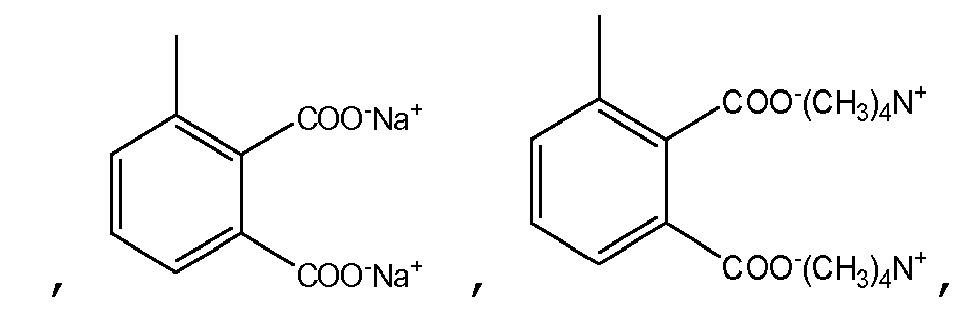


- Die modifizierten Pigmente mit an das Pigment gebundenen organischen Gruppen von unsubstituierten oder substituierten 1,2-Benzoldicarbonsäuren und/oder deren Salze, können erhältlich sein indem man Verbindungen der allgemeinen Formel 3 und/oder 4

- Die modifizierten Pigmente können durch Diazotierung von Verbindungen der allgemeinen Formel 3 und/oder 4

- Bei dem Verfahren kann man zunächst das Pigment und die Verbindungen der allgemeinen Formel 3 und/oder 4 mischen, beispielsweise als eine wäßrige Suspension, anschließend einen sauren pH-Bereich einstellen und dann das Alkalimetallnitrit zugeben.
- Bei dem Verfahren kann man zunächst das Pigment und die in einen sauren pH-Bereich eingestellten Verbindungen der allgemeinen Formel 3 und/oder 4 mischen und dann das Alkalimetallnitrit zugeben.
- Bei dem Verfahren kann man zunächst die in einen sauren pH-Bereich eingestellten Verbindungen der allgemeinen Formel 3 und/oder 4 mit Alkalimetallnitrit mischen und dann das Reaktionsprodukt mit dem Pigment umsetzen.
- Verbindungen der allgemeinen Formel 3 und 4 können beispielsweise sein


- Als Pigment kann Kohlenstoffmaterial oder Buntpigment eingesetzt werden.
- Als Buntpigment kann beispielsweise Gelb-, Orange-, Rot-, Magenta-, Violett-, Blau-, Cyan-, Grün- oder Braunpigment, verwendet werden. Vorzugsweise kann als Buntpigment anorganisches Blaupigment, beispielsweise Eisenblau, Ultramarinblau, Kobaltblau oder Mischphasenblaupigment, oder organisches Blaupigment, beispielsweise Phthalocyaninblau oder Indanthrenblau, eingesetzt werden.
- Als Kohlenstoffmaterial kann Ruß, Graphitpulver, Graphitfasern, Kohlenstofffasern, Kohlenstofffibrillen, Kohlenstoffnanoröhren (Carbon Nanotubes), Aerogele, Kohlenstoffgewebe, glasartige Kohlenstoffprodukte, Aktivkohle und Fullerene eingesetzt werden.
- Als Ruß kann Furnaceruß, Gasruß, Channelruß, Flammruß, Thermalruß, Acetylenruß, Plasmaruß, Inversionsruß, bekannt aus
DE 195 21 565 , Si-haltige Ruße, bekannt ausWO 98/45361 DE 196 13 796 , oder metallhaltige Ruße, bekannt ausWO 98/42778 - Das erfindungsgemäße modifizierte Pigment und/oder das Pigment kann durch vorgelagerte Reaktionen aktiviert werden. Dies können zum Beispiel Oxidationsreaktionen sein. Als Oxidationsmittel können beispielsweise Ammoniumperoxodisulfat, Wasserstoffperoxid, Ozon, Sauerstoff (rein oder als Luft), Kaliumbromat und/oder Natriumperborat eingesetzt werden. Das Pigment kann ein oxidierter Gasruß sein.
- Es können Kohlenstoffmaterialien, die als Verstärkerfüllstoff in Kautschukmischungen verwendet werden, eingesetzt werden. Es können Farbruße eingesetzt werden. Weitere Kohlenstoffmaterialien können sein: Leitfähigkeitsruß, Kohlenstoffmaterial zur UV-Stabilisierung, Kohlenstoffmaterial als Füllstoff in anderen Systemen als Kautschuk, wie zum Beispiel in Bitumen oder Kunststoff, oder Kohlenstoffmaterial als Reduktionsmittel in der Metallurgie.
- Das Verfahren zur Herstellung der modifizierten Pigmente kann in wäßriger Lösung oder wäßriger Suspension durchgeführt werden.
- Das Pigment kann dispergiert werden. Die Pigmentdispersion kann aus dem Pigment, Wasser und einem Netzmittel bestehen.
- Als Netzmittel können anionische, kationische und/oder nichtionische Netzmittel verwendet werden.
- Als anionisches Netzmittel kann Tamol, Vandispers CB (Ligninsulfonat) verwendet werden.
- Als kationisches Netzmittel kann Akypoquat 132 (kationischer Fettester (CTFA: Lauroyl PG-Trimonium Chloride)) der Firma Kao Chemicals GmbH, Bayowet FT 738 VP AC 2023 (Quarternäres Fluoralkylammoniumiodid) der Firma Bayer AG, DP2-7949 (Wässrige Lösung kationischer Homopolymere) der Firma Ciba Geigy Chemicals, DP7-7961 (Wässrige Lösung kationischer Polymere) der Firma Ciba Geigy Chemicals, DP7-7962 (Wässrige Lösung kationischer Polymere) der Firma Ciba Geigy Chemicals, DP7-7963 (Wässrige Lösung kationischer Polymere) der Firma Ciba Geigy Chemicals, Epikuron 200 (Phosphatidylcholin) der Firma Lukas Meyer, Ethoxamine SF 11 (Etoxyliertes Fettamin mit 11 Mol Ethylenoxid) der Firma Witco, Ethoxamine SF 15 (Ethoxyliertes Fettamin mit 15 Mol Ethylenoxid) der Firma Witco, Forbest 13 (Compound neutr., saurer Polyester und Fettalkohol) der Firma Lukas Meyer, Forbest 610 (Carbonsäure-Diamin-Zubereitung) der Firma Lukas Meyer, Magnafloc 1797 (Wässrige Lösung kationischer quervernetzter Kondensationsharze) der Firma Ciba Speciality Chemicals, Protectol KLC 50 (Dimethyl-C 12/14-alkylbenzylammoniumchlorid in Wasser (ca. 50%)) der Firma BASF, Rewoquat CPEM (Cocospentaethoxymethylammoniummethosulfat) der Firma Witco Surfactants GmbH, Rewoquat RTM 50 (Ricinolsäure propylamido trimethylammonium methosulfat) der Firma Witco Surfactans GmbH, Sochamine 35 (Alkylimidazolin) der Firma Witco Surfactans GmbH, eingesetzt werden.
- Als nichtionisches Netzmittel kann eine Verbindung aus der Gruppe vernetzte Polyoxyethylenacrylsäure, Fettalkoholoxethylate, Nonylphenolpolyglycolether, Polyvinylpyrolidon, Glycerolfettsäureester, Propylenglykolfettsäureester, Sorbitanfettsäureester, Polyoxyethylensorbitanfettsäureester, Tetraoleinsäurepolyoxyethylensorbitol, Polyoxyethylenalkylether, Polyoxyethylenalkylphenylether, Polyoxyethylenpolyoxypropylenglykol, Polyoxyethylenpolyoxypropylenalkylether, Polyethylenglycolfettsäureester, höhere Fettsäurealkoholester, Polyhydricalkoholfettsäureester, eingesetzt werden.
- Die Pigmentdispersion kann hergestellt werden, indem man das Pigment gegebenenfalls gemeinsam mit dem oder den Netzmitteln in Wasser dispergiert und gegebenenfalls für die Dispergierung Perlmühlen, Ultraschall-Geräte, Flügelrührer, Dissolver oder ein Ultra-Turrax verwendet. Im Anschluß an die Dispergierung kann die Rußdispersion zentrifugiert oder gefiltert werden.
- Zur Einstellung des sauren pH-Wertes der wäßrigen Lösung oder Suspension des primären Amins können anorganische Säuren, vorzugsweise Salzsäure, verwendet werden. Der pH-Wert kann kleiner 6, vorzugsweise kleiner 3, sein.
- Die Pigmentdispersion und die saure, wäßrige Lösung des primären Amins können unter Rühren gemischt werden.
- Das Natriumnitrit kann in Wasser gelöst werden. Die Natriumnitrit-Lösung kann zur Pigmentdispersion/Amin-Mischung zugetropft werden. Die Umsetzung mit Natriumnitrit-Lösung kann bei Temperaturen von -5°C bis 30°C durchgeführt werden.
- Die modifizierten Pigmente können als Füllstoff, Verstärkerfüllstoff, UV-Stabilisator, Leitfähigkeitsruß oder Pigment verwendet werden.
Die erfindungsgemäßen modifizierten Pigmente können in Kautschuk, Kunststoff, Druckfarben, Tinten, Inkjet-Tinten, xerographischen Tonern, Lacken und Farben, Bitumen, Beton und anderen Baustoffen oder Papier eingesetzt werden. Ferner können die erfindungsgemäßen modifizierten Pigmente als Reduktionsmittel in der Metallurgie verwendet werden. Die erfindungsgemäßen modifizierten Pigmente können zur Herstellung von Gummimischungen, beispielsweise zur Herstellung von Reifen, verwendet werden. - Die erfindungsgemäße Ink Jet Tinte kann zusätzlich ein oder mehrere Additive enthalten, wie Biozide, Netzmittel, Ketone, Glykole, Alkohole oder Gemische der vorgenannten Verbindungen. Diese Additive können auf spezielle Anwendungen hin zugesetzt werden und zum Beispiel auch aus monomeren, oligomeren oder polymeren Verbindungen bestehen. Diese Additive können Verbesserungen von Eigenschaften, wie Dispergiergrad, Lagerstabilität, Gefrierstabilität, Trocknungsverhalten, Filmbildungsvermögen, Vernetzbarkeit und/oder die Anbindung an bestimmte Trägermaterialien, wie Papier, Metall, Glas, Polymere, Fasern, Leder, Holz, Beton oder Kautschuk, bewirken.
- Das Biozid kann in Mengen von 0,01 -1,0 Gew.-% zugesetzt werden. Als Biozid können Isothiazolinon-Derivate, Formaldehydabspalter oder Kombinationsprodukte beider Produktklassen verwendet werden. Beispielsweise können als Biozid Parmetol der Firma Schülke & Mayr, Ebotec der Firma Bode Chemie, Acticide der Firma Thor Chemie oder Proxel der Firma Zeneca eingesetzt werden.
- Die erfindungsgemäße Ink Jet Tinte kann einen Farbstoff enthalten.
- Die erfindungsgemäße Ink Jet Tinte kann ein dispergierunterstützendes Additiv enthalten. Das dispergierunterstützende Additiv kann in Mengen von 0,1 - 30 Gew.-%, vorzugsweise 0,3 - 10 Gew.-%, bezogen auf die Tinte eingesetzt werden. Das Molekulargewicht des dispergierunterstützenden Additivs kann 1000 bis 20000 g/mol, vorzugsweise 14500 bis 17000 g/mol, sein. Die Säurezahl des dispergierunterstützenden Additivs kann 120 bis 320, vorzugsweise 180 bis 280, sein. Als dispergierunterstützendes Additiv können Styrol-Acrylsäure Copolymere verwendet werden. Die Copolymere können statistische, alternierende, Block- oder Pfropfcopolymere sein. Beispielsweise kann als dispergierunterstützendes Additiv Joncryl 678, Joncryl 680, Joncryl 682 oder Joncryl 690 der Firma Johnson Polymer B.V. eingesetzt werden. Als dispergierunterstützendes Additiv können vollständig Ammonium- oder Alkalihydroxid-neutralisierte Formen, insbesondere NaOH neutralisierte Formen, der Styrol-Acrylsäure Copolymere verwendet werden.
- Die erfindungsgemäße Ink Jet Tinte kann zum Bedrucken von Textilien, Folien und Papier verwendet werden.
- Ein weiterer Gegenstand der Erfindung ist ein Verfahren zur Verbesserung des Ausblutens bei Ink Jet Tinten, welches dadurch gekennzeichnet ist, das die Tinte ein modifiziertes Pigment enthält, wobei das modifizierte Pigment ein Pigment mit gebundenen organischen Gruppen von unsubstituierten oder substituierten Benzoldicarbonsäuren und/oder deren Salze ist. Die Benzoldicarbonsäure kann bevorzugt eine 1,2-Benzoldicarbonsäure sein.
- Die modifizierten Pigmente mit an das Pigment gebundenen organischen Gruppen von unsubstituierten oder substituierten Benzoldicarbonsäuren und/oder deren Salze, können zur Verbesserung des Ausblutens bei Ink Jet Tinten verwendet werden. Die Benzoldicarbonsäure kann bevorzugt eine 1,2-Benzoldicarbonsäure sein.
- Die erfindungsgemäße Ink Jet Tinte hat den Vorteil, dass das Ausbluten gegenüber dem Stand der Technik verbessert ist.
- Als Pigment wird in den Beispielen der Ruß S 160 eingesetzt. Der Gasruß S 160 ist ein Verkaufsprodukt der Firma Evonik Degussa GmbH.
- Das Beispiel beschreibt die Herstellung eines mit 0,8 mmol/g des entsprechenden Modifizierungsmittels modifizierten Rußes.
- Es werden 70g Ruß S 160 und 800g eisgekühltes destilliertes Wasser in einem 2 l Becherglas vorgelegt und mit einem Heidolph Rührer Modell ZR 2051 mit Flügelrührer aufgerührt.
- In einem 100 ml Becherglas werden 4,2g Natriumnitrit in 8g Eis und 12g destilliertem Wasser mit einem Magnetrührer aufgerührt.
- Die in der Tabelle 1 genannten Mengen an Modifizierungsmittel werden jeweils in einem 40 ml Becherglas in 45g eiskaltem destilliertem Wasser aufgeschlämmt und unter Kühlung mit 16,3g konz. Salzsäure versetzt. Dazu wird nun vorsichtig die Natriumnitrit-Lösung zudosiert.
- Diese Lösung wird nun innerhalb von 30 Minuten zur Rußaufschlämmung unter moderatem Rühren zugetropft. Man rührt 1 Stunde nach und erhöht die Temperatur der Reaktionsmischung mit Hilfe eines IKA Combimag RET Magnetrührers/Heizplatte auf 30°C und rührt bei dieser Temperatur 3 Stunden nach.
- Die Reaktionsmischung wird über eine Nutsche mit Blaubandfilter abgezogen und der Filterkuchen mit 5 Liter destilliertem Wasser gewaschen. Der Filterkuchen wird über Nacht bei 120°C getrocknet.
Tabelle 1 Modifizierungsmittel Menge an Modifizierungsmittel (g) Modifizierter Ruß 1 6-Amino-2-naphtholcarbonsäure 10,48 Modifizierter Ruß 2 4-Aminophthalsäure 10,14 Modifizierter Ruß 3 5-Aminoisoterephthalsäure 10,14 Modifizierter Ruß 4 2-Aminoterephthalsäure 10,14 Modifizierter Ruß 5 Sulfanilsäure 9,70 Modifizierter Ruß 6 5-Amino-2-naphthalensulfonsäure 13,40 - Das Beispiel beschreibt die Herstellung einer Dispersion (Tabelle 2) mit den unter Beispiel 1 beschriebenen modifizierten Rußen sowie einem Degussa Ruß S 160.
- Es werden jeweils 60g Ruß und 340g destilliertes Wasser in einem 1 l Rührgefäß vorgelegt und mit einem Spatel eingerührt. Mit 2-(Dimethylamino)-ethanol wird ein pH-Wert zwischen 8-9 eingestellt. Mit einem Ultra-Turrax wird bei 10000 UpM unter Kühlung die Aufschlämmung vordispergiert. Diese Vordispersion wird unter Kühlung durch eine Hielscher Ultraschall Durchflusszelle mit Ultraschallgeber UIP 500 in 3 Passagen mit einer Zahnradpumpe der Firma Ismatec Modell MV-Z bei Einstellung 27 der Pumpe durchgepumpt und bei maximaler Leistung des Ultraschallgebers dispergiert.
- Die Verwendung von Ruß S 160 führt zu einer sofortigen Verdickung. Eine flüssige Dispersion 7 ist nicht herstellbar.
Tabelle 2: Dispersion Enthaltend: Dispersion 1 Modifizierter Ruß 1 Dispersion 2 Modifizierter Ruß 2 Dispersion 3 Modifizierter Ruß 3 Dispersion 4 Modifizierter Ruß 4 Dispersion 5 Modifizierter Ruß 5 Dispersion 6 Modifizierter Ruß 6 Dispersion 7 Ruß S 160 - Es werden Tinten (Tabelle 3) mit einem Pigmentgehalt von 5% des modifizierten Rußes unter Verwendung der in Beispiel 2 genannten Dispersionen formuliert. Die Tinten beinhalten weiterhin 6 Gew.-% 2-Pyrrolidon, 3 Gew.-% 1,5-Pentandiol, 1,5 Gew.-% 2-Propanol, 1,5 Gew.-% Liponic EG-07, 3 Gew.-% Triethylenglycol-dimethylether; aufgefüllt auf 100 Gew.-% mit destilliertem Wasser.
- Der pH wird mit 2-(Dimethylamino)-ethanol zwischen 8-9 einreguliert.
Tabelle 3: Tinte Enthaltend: Tinte 1 Dispersion 1 Tinte 2 Dispersion 2 Tinte 3 Dispersion 3 Tinte 4 Dispersion 4 Tinte 5 Dispersion 5 Tinte 6 Dispersion 6 - Es wird eine Tinte 8 unter Verwendung einer Cab-O-Jet 300 Dispersion der Firma Cabot formuliert. Cab-O-Jet besteht aus 15 Gew.-% eines oberflächenfunktionellen carboxylierten Rußes. Die Tinte beinhaltet 5 Gew.-% Ruß, 6 Gew.-% 2-Pyrrolidon, 3 Gew.-% 1,5-Pentandiol, 1,5 Gew.-% 2-Propanol, 1,5 Gew.-% Liponic EG-07, 3 Gew.-% Triethylenglycoldimethylether; aufgefüllt auf 100 Gew.-% mit destilliertem Wasser.
- Der pH-Wert wird mit 2-(Dimethylamino)-ethanol zwischen 8-9 einreguliert.
- Zur Beurteilung wird der in 4 Größen unterteilte schwarze Balken in den ersten 4 quadratischen Farbblöcken beginnend von links Weiß, Cyano, Magenta und Gelb aus Bild 2:
- Grafikblock für "Ausbluten" und "Ausfransen" der DIN Vorlage 33871-1:2003-10 herangezogen.
- Es wird eine Rangfolge für das Verhalten des Ausblutens von 1 = kein Ausbluten, 2 = sehr geringes Ausbluten, 3 = geringes Ausbluten, 4 = Ausbluten, 5 = starkes Ausbluten, 6 = sehr starkes Ausbluten festgelegt.
- Die Dicarbonsäure in ortho-Stellung zeigt das geringste Ausbluten (Tabelle 4).
Tabelle 4: Verwendete Tinte Ausbluten Tinte 1 5 Tinte 2 1 bis 2 Tinte 3 2 bis 3 Tinte 4 2 bis 3 Tinte 5 5 Tinte 6 4 bis 5 Tinte 8 2 bis 3 Original Canon BCI-3eBK Tinte 1 bis 2 - Die Messung erfolgt mit einem Bild-Analysator Modell "Personal IAS" des Herstellers qea. Es wird jeweils der drittbreiteste des in 4 Breiten unterteilten schwarzen Balkens in den ersten 4 quadratischen Farbblöcken, beginnend von links Weiß, Cyano, Magenta und Gelb aus Bild 2: Grafikblock für "Ausbluten" und "Ausfransen" der DIN Vorlage 33871-1:2003-10 optisch erfasst und die mittlere Breite in µm vermessen. Von den Messwerten des schwarzen Balkens im Cyano, Magenta und dem Gelbem Messquadrat wird nun der Wert des schwarzen Balkens im weißen Messquadrat abgezogen. Der daraus resultierende Wert gibt Aufschluss über das Ausbluten. Je kleiner der Wert desto geringer das Ausbluten.
- Hierbei zeigt die ortho-Dicarbonsäure das geringste Ausbluten (Tabelle 5 + 6).
Tabelle 5: Papier Kompass Copy Office Verwendete Tinte Ausbluten Cyano Breite [µm] Ausbluten Magenta Breite [µm] Ausbluten Gelb Breite [µm] Tinte 2 6,2 0 2,9 Tinte 3 31,1 18,6 22,5 Tinte 4 18,1 11,4 26,9 Tinte 8 43,7 11,5 27,7 Original Canon BCI-3eBK Tinte 11,6 3,4 9,4 Tabelle 6: Papier Inapa Tecno Office Verwendete Tinte Ausbluten Cyano Breite [µm] Ausbluten Magenta Breite [µm] Ausbluten Gelb Breite [µm] Tinte 2 1 0,8 4,2 Tinte 3 43,5 10,4 49,6 Tinte 4 67,2 17,1 42,8 Tinte 8 72,8 26,2 42,2 Original Canon BCI-3eBK Tinte 20,2 7,7 15
Claims (5)
- Ink Jet Tinte enthaltend ein modifiziertes Pigment, dadurch gekennzeichnet, dass das modifizierte Pigment ein Pigment mit gebundenen organischen Gruppen von unsubstituierten oder substituierten 1,2-Benzoldicarbonsäuren und/oder deren Salze ist.
- Ink Jet Tinte gemäß Anspruch 1, dadurch gekennzeichnet, dass die unsubstituierten oder substituierten 1,2-Benzoldicarbonsäurengruppen und/oder deren Salze Verbindungen der Formel 1 oder 2

wobei R gleich oder verschieden sind und aus H, Akzeptorgruppen, Donatorgruppen, Alkyl- oder Arylgruppen mit Akzeptor- beziehungsweise Donatorgruppen, hydrophilen und/oder hydrophoben Gruppen bestehen und M+ gleich H+, Na+, K+, Li+, NH4 +, (CH3)3NH+ und (CH3)4N+ ist. - Verwendung der Ink Jet Tinte gemäß Anspruch 1 zum Bedrucken von Textilien, Folien und Papier.
- Verfahren zur Verbesserung des Ausblutens bei Ink Jet Tinten, dadurch gekennzeichnet, das die Tinte ein modifiziertes Pigment enthält, wobei das modifizierte Pigment ein Pigment mit gebundenen organischen Gruppen von unsubstituierten oder substituierten Benzoldicarbonsäuren und/oder deren Salze ist.
- Verwendung von modifizierten Pigmenten mit an das Pigment gebundenen organischen Gruppen von unsubstituierten oder substituierten Benzoldicarbonsäuren und/oder deren Salze zur Verbesserung des Ausblutens bei Ink Jet Tinten.
Applications Claiming Priority (1)
| Application Number | Priority Date | Filing Date | Title |
|---|---|---|---|
| DE102008026894A DE102008026894A1 (de) | 2008-06-05 | 2008-06-05 | Ink Jet Tinte |
Publications (1)
| Publication Number | Publication Date |
|---|---|
| EP2130880A1 true EP2130880A1 (de) | 2009-12-09 |
Family
ID=40795061
Family Applications (1)
| Application Number | Title | Priority Date | Filing Date |
|---|---|---|---|
| EP09161119A Withdrawn EP2130880A1 (de) | 2008-06-05 | 2009-05-26 | Ink Jet Tinte |
Country Status (6)
| Country | Link |
|---|---|
| US (1) | US20090305011A1 (de) |
| EP (1) | EP2130880A1 (de) |
| JP (1) | JP2009293030A (de) |
| KR (1) | KR20090127093A (de) |
| CN (1) | CN101597441A (de) |
| DE (1) | DE102008026894A1 (de) |
Families Citing this family (11)
| Publication number | Priority date | Publication date | Assignee | Title |
|---|---|---|---|---|
| DE102005009321A1 (de) * | 2005-03-01 | 2006-09-07 | Degussa Ag | Suspension |
| DE102006037079A1 (de) | 2006-08-07 | 2008-02-14 | Evonik Degussa Gmbh | Ruß, Verfahren zur Herstellung von Ruß und Vorrichtung zur Durchführung des Verfahrens |
| DE102007060307A1 (de) | 2007-12-12 | 2009-06-18 | Evonik Degussa Gmbh | Verfahren zur Nachbehandlung von Ruß |
| DE102008005005A1 (de) * | 2008-01-17 | 2009-07-23 | Evonik Degussa Gmbh | Kohlenstoff-Aerogele, Verfahren zu deren Herstellung und deren Verwendung |
| DE102008044116A1 (de) | 2008-11-27 | 2010-06-02 | Evonik Degussa Gmbh | Pigmentgranulat, Verfahren zu dessen Herstellung und Verwendung |
| ATE516330T1 (de) | 2008-12-12 | 2011-07-15 | Evonik Carbon Black Gmbh | Ink jet tinte |
| JP5349281B2 (ja) | 2009-12-24 | 2013-11-20 | 株式会社日本自動車部品総合研究所 | 回転電機 |
| DE102010002244A1 (de) | 2010-02-23 | 2011-08-25 | Evonik Carbon Black GmbH, 63457 | Ruß, Verfahren zu seiner Herstellung und seine Verwendung |
| CN103710772B (zh) * | 2013-12-30 | 2015-09-23 | 苏州世名科技股份有限公司 | 纤维原液着色用超细炭黑水性色浆 |
| EP4703444A1 (de) * | 2024-08-27 | 2026-03-04 | Canon Kabushiki Kaisha | Wässrige tinte, tintenpatrone und tintenstrahlaufzeichnungsverfahren |
| EP4703443A1 (de) * | 2024-08-27 | 2026-03-04 | Canon Kabushiki Kaisha | Wässrige tinte, tintenpatrone und tintenstrahlaufzeichnungsverfahren |
Citations (12)
| Publication number | Priority date | Publication date | Assignee | Title |
|---|---|---|---|---|
| US5554739A (en) | 1994-12-15 | 1996-09-10 | Cabot Corporation | Process for preparing carbon materials with diazonium salts and resultant carbon products |
| DE19521565A1 (de) | 1995-06-19 | 1997-01-16 | Degussa | Verbesserte Furnaceruße und Verfahren zu ihrer Herstellung |
| DE19613796A1 (de) | 1996-04-04 | 1997-10-09 | Degussa | Ruß und Verfahren zu seiner Herstellung |
| WO1998042778A1 (en) | 1997-03-27 | 1998-10-01 | Cabot Corporation | Elastomeric compositions incorporating metal-treated carbon blacks |
| WO1998045361A1 (en) | 1997-04-09 | 1998-10-15 | Cabot Corporation | A method to improve traction using silicon-treated carbon blacks |
| US5922118A (en) | 1996-06-14 | 1999-07-13 | Cabot Corporation | Modified colored pigments and ink jet inks, inks, and coatings containing modified colored pigments |
| EP1061106A1 (de) | 1999-06-18 | 2000-12-20 | Hewlett-Packard Company | Tintenstrahldrucktinten enthaltende estermodifizierte makromolekulare Chromophore |
| EP1061107A1 (de) | 1999-06-18 | 2000-12-20 | Hewlett-Packard Company | Hohe Wasserfestigkeit und Ausblutechteitkontrolle durch speziell behandelte Pigmente für den Tintenstrahldruck |
| JP2006008899A (ja) * | 2004-06-28 | 2006-01-12 | Canon Inc | インクセット、インクジェット記録方法、インクカートリッジ、記録ユニット、インクジェット記録装置及び画像形成方法 |
| WO2006066132A2 (en) * | 2004-12-17 | 2006-06-22 | Cabot Corporation | Method of preparing oxidized modified pigments and inkjet ink compositions comprising the same |
| WO2007027625A2 (en) * | 2005-08-31 | 2007-03-08 | Cabot Corporation | Process for preparing modified pigments |
| US20070076071A1 (en) * | 2005-09-30 | 2007-04-05 | Kai-Kong Iu | Ink-jet inks and ink sets exhibiting reduced bleed, wicking, and/or halo effect and associated methods |
Family Cites Families (89)
| Publication number | Priority date | Publication date | Assignee | Title |
|---|---|---|---|---|
| US3133893A (en) * | 1957-07-30 | 1964-05-19 | American Cyanamid Co | Pigment particles coated with polymer and method of preparing the same |
| US3314814A (en) * | 1964-03-02 | 1967-04-18 | Columbia Ribbon & Carbon | Method of preparing transfer elements |
| US3519452A (en) * | 1967-03-09 | 1970-07-07 | Cabot Corp | Sulfonated carbon black pigmented compositions |
| NL6807617A (de) * | 1968-05-30 | 1969-12-02 | ||
| US3749670A (en) * | 1970-04-17 | 1973-07-31 | Dick Co Ab | Electrostatic liquid developer containing dye coated carbon particles |
| US3903034A (en) * | 1970-12-07 | 1975-09-02 | Dick Co Ab | Offset jet printing ink |
| US3705043A (en) * | 1970-12-07 | 1972-12-05 | Dick Co Ab | Infrared absorptive jet printing ink composition |
| US3841888A (en) * | 1971-11-15 | 1974-10-15 | Basf Ag | Aqueous pigment dispersions |
| US3946138A (en) * | 1974-04-01 | 1976-03-23 | Monarch Marking Systems, Inc. | Compositions and methods relating to transfer processes |
| AR204755A1 (es) * | 1974-05-04 | 1976-02-27 | Bayer Ag | Dispersiones acuosas de pigmentos |
| CH596280A5 (de) * | 1974-09-13 | 1978-03-15 | Ciba Geigy Ag | |
| US4075160A (en) * | 1976-04-30 | 1978-02-21 | Phillips Petroleum Company | Non-carcinogenic carbon black |
| US4076527A (en) * | 1976-10-26 | 1978-02-28 | Xerox Corporation | Photosensitive composition useful in photoelectrophoretic imaging |
| DE2908202A1 (de) * | 1979-03-02 | 1980-10-30 | Degussa | Verfahren zur herstellung von wasserhaltigen russpraeparationen |
| DE3009603A1 (de) * | 1980-03-13 | 1981-10-01 | Basf Ag, 6700 Ludwigshafen | Verfahren zum trocknen von feinteiligen pigmenten |
| DE3041188A1 (de) * | 1980-11-03 | 1982-06-03 | Degussa Ag, 6000 Frankfurt | Vorrichtung zur oxidativen nachbehandlung von russ |
| DE3118907A1 (de) * | 1981-05-13 | 1982-12-02 | Degussa Ag, 6000 Frankfurt | Verfahren zur entfernung von extrahierbaren bestandteilen aus russen |
| IT1195810B (it) * | 1981-10-05 | 1988-10-27 | Olivetti & Co Spa | Dispositivo di scrittura a getto selettivo di inchiostro relativo in choistro e processo di preparazione dell inchiotro |
| US4486033A (en) * | 1983-07-15 | 1984-12-04 | Beatrice Foods Co. | Sublimable dye imaging of lottery ticket and commercial game coupon and the like |
| US4769258A (en) * | 1984-09-12 | 1988-09-06 | Brother Kogyo Kabushiki Kaisha | Multiple-time ink-bearing medium for thermal printing |
| DE3435862A1 (de) * | 1984-09-29 | 1986-04-10 | Degussa Ag, 6000 Frankfurt | Kontinuierliches verfahren zur mehrstufigen behandlung feinteiliger feststoffe mit gasen |
| IT1195146B (it) * | 1986-09-01 | 1988-10-12 | Olivetti & Co Spa | Inchiostro particolarmente adatto per una stampante a getto d inchiostro |
| JPH0635688B2 (ja) * | 1986-09-30 | 1994-05-11 | 東洋インキ製造株式会社 | ポリエステル繊維原着用黒色液状着色剤 |
| DE3708904A1 (de) * | 1987-03-19 | 1988-09-29 | Bayer Ag | Pigmentpraeparationen |
| US4963616A (en) * | 1988-12-29 | 1990-10-16 | Honeywell Inc. | Complexation-mediated solubilization of polymers |
| US5085698A (en) * | 1990-04-11 | 1992-02-04 | E. I. Du Pont De Nemours And Company | Aqueous pigmented inks for ink jet printers |
| CA2043246C (en) * | 1990-06-25 | 1997-05-13 | Bruce A. Lent | Ink jet composition and method |
| US5320668A (en) * | 1991-09-23 | 1994-06-14 | Hewlett-Packard Company | Bleed alleviation using pH-sensitive agents |
| US5461232A (en) * | 1993-01-08 | 1995-10-24 | Mccandless; Brian K. | Pulse transmission scintigraphic imaging |
| DE4308488A1 (de) * | 1993-03-17 | 1994-09-22 | Mmm Sa | Ruß-/Kautschukzusammensetzung |
| ATE145675T1 (de) * | 1993-11-27 | 1996-12-15 | Basf Ag | Verfahren zur beschichtung oder oberflächenbehandlung von feststoffteilchen mittels einer plasma-wirbelschicht |
| US5760112A (en) * | 1994-02-23 | 1998-06-02 | Henkel Corporation | Water-borne autodepositing coating compositions |
| JP3778956B2 (ja) * | 1994-03-28 | 2006-05-24 | 三菱化学株式会社 | カーボンブラック |
| US5609671A (en) * | 1994-06-20 | 1997-03-11 | Orient Chemical Industries, Ltd. | Water-based pigment ink and process for producing the same |
| US5531818A (en) * | 1994-12-01 | 1996-07-02 | Xerox Corporation | Ink jet ink compositions and printing processes |
| IL116378A (en) * | 1994-12-15 | 2003-05-29 | Cabot Corp | Non-aqueous coating or ink composition with improved optical properties containing modified carbon product and method of preparation of the composition |
| IL116377A (en) * | 1994-12-15 | 2003-05-29 | Cabot Corp | Reaction of carbon black with diazonium salts, resultant carbon black products and their uses |
| US6099818A (en) * | 1995-06-19 | 2000-08-08 | Degussa-Huls Aktiengesellschaft | Carbon blacks and process for producing them |
| US5837044A (en) * | 1996-08-13 | 1998-11-17 | Eastman Kodak Company | Ink jet inks containing polyethylene fatty ether additives |
| DE19704943A1 (de) * | 1997-02-10 | 1998-08-13 | Bayer Ag | Anorganische Pigmentgranulate zum Einfärben von Kunststoffen, Lacken und Baustoffen und ein Verfahren zu deren Herstellung |
| PL190381B1 (pl) * | 1997-03-24 | 2005-12-30 | Basf Ag | Stała mieszanina chwastobójcza i sposób jej wytwarzania |
| HUP0003689A3 (en) * | 1997-09-05 | 2003-05-28 | Warner Lambert Co | Benzothiazine dioxide derivatives with endothelin antagonist activity, pharmaceutical compositions containing them and process for the preparation of known derivatives |
| US6063182A (en) * | 1997-09-08 | 2000-05-16 | Ciba Speciality Chemicals Corporation | Stir-in pigment compositions |
| DE19748575A1 (de) * | 1997-11-04 | 1999-05-06 | Henkel Kgaa | Verwendung von Dimerdiolalkoxylaten als Additive zur Herstellung von Pigmentkonzentraten |
| US5977209A (en) * | 1998-02-02 | 1999-11-02 | Xerox Corporation | Ink compositions |
| AU6228398A (en) * | 1998-02-24 | 1999-09-15 | Rotem Amfert Negev Ltd. | A modified titanium dioxide and a method for its preparation |
| TW394749B (en) * | 1998-03-05 | 2000-06-21 | Deng Jian Lang | Method of manufacturing active carbon by using carbon black |
| US6056933A (en) * | 1998-04-09 | 2000-05-02 | Degussa-Huls Aktiengesellschaft | Inversion carbon blacks and method for their manufacture |
| US6251983B1 (en) * | 1998-04-09 | 2001-06-26 | DEGUSSA - HüLS AKTIENGESELLSCHAFT | Inversion carbon blacks and method for their manufacture |
| GB9810233D0 (en) * | 1998-05-14 | 1998-07-08 | Ici Plc | Dispersion of pigments |
| JP3125748B2 (ja) * | 1998-05-27 | 2001-01-22 | 富士ゼロックス株式会社 | 画像記録方法 |
| DE19824047A1 (de) * | 1998-05-29 | 1999-12-02 | Degussa | Oxidativ nachbehandelter Ruß |
| DE19824947A1 (de) * | 1998-06-04 | 1999-12-09 | Degussa | Wäßrige Rußdispersionen |
| US6212794B1 (en) * | 1998-08-13 | 2001-04-10 | The University Of Western Ontario | Gaseous fluidization aids |
| US6491976B2 (en) * | 1998-08-28 | 2002-12-10 | Sharp Kabushiki Kaisha | Method for adding hydrophilic groups to the surface of particles |
| US6387168B1 (en) * | 1998-12-22 | 2002-05-14 | Canon Kabushiki Kaisha | Ink, ink container, ink set, ink-jet printing apparatus and ink-jet printing process |
| US6290767B1 (en) * | 1999-01-26 | 2001-09-18 | Degussa Ag | Carbon black |
| DE19934281A1 (de) * | 1999-07-21 | 2001-01-25 | Degussa | Wäßrige Rußdispersionen |
| DE19934282A1 (de) * | 1999-07-21 | 2001-01-25 | Degussa | Wäßrige Rußdispersionen |
| DE19950043A1 (de) * | 1999-10-16 | 2001-07-12 | Degussa | Pigmentpräparationen, Verfahren zu ihrer Herstellung und Verwendung |
| DE19954260A1 (de) * | 1999-11-11 | 2001-06-28 | Degussa | Wäßrige Rußdispersionen |
| DE19954401C2 (de) * | 1999-11-12 | 2002-08-29 | Bayer Ag | Feste Pigmentpräparationen zur Saatgut-/beizeneinfärbung |
| DE10012784A1 (de) * | 2000-03-16 | 2001-09-27 | Degussa | Ruß |
| EP1167470B1 (de) * | 2000-06-21 | 2006-08-23 | Canon Kabushiki Kaisha | Tintenstrahltinte, Tintenstrahldruckverfahren, Tintenstrahl-Druckvorrichtung,Tintenstrahldruckeinheit und Tintenpatrone |
| ATE284315T1 (de) * | 2000-08-30 | 2004-12-15 | Alcoa Inc | Vorbehandelte folie für flachdruckplatte |
| WO2003004281A1 (en) * | 2001-07-02 | 2003-01-16 | Alcoa Inc. | Printing plate with dyed and anodized surface |
| DE10136043A1 (de) * | 2001-07-25 | 2003-02-13 | Degussa | Verfahren zur Herstellung von modifiziertem Ruß |
| US6821334B2 (en) * | 2001-09-19 | 2004-11-23 | Dainichiseika Color & Chemicals Mfg. Co., Ltd. | Process for producing sulfonated solid particles |
| US6758891B2 (en) * | 2001-10-09 | 2004-07-06 | Degussa Ag | Carbon-containing material |
| DE10204304A1 (de) * | 2002-02-01 | 2003-08-14 | Basf Ag | Pigmentgranulate |
| DE10211098A1 (de) * | 2002-03-14 | 2003-10-02 | Degussa | Verfahren zur Herstellung von nachbehandeltem Ruß |
| DE10235027A1 (de) * | 2002-07-31 | 2004-02-12 | Degussa Ag | Wäßrige, kolloidale, gefrier- und lagerstabile Gasrußsuspension |
| DE10238149A1 (de) * | 2002-08-15 | 2004-02-26 | Degussa Ag | Kohlenstoffhaltiges Material |
| DE10253447A1 (de) * | 2002-11-16 | 2004-06-03 | Degussa Ag | Wäßrige, kolloidale Gasrußsuspension |
| US6863719B2 (en) * | 2002-12-30 | 2005-03-08 | Lexmark International, Inc. | Ink jet ink with improved reliability |
| US7001936B2 (en) * | 2003-07-16 | 2006-02-21 | Lexmark International, Inc. | Pigmented inkjet ink |
| DE10336575A1 (de) * | 2003-08-08 | 2005-03-10 | Degussa | Ruß |
| DE10338142A1 (de) * | 2003-08-15 | 2005-03-17 | Basf Ag | Farbmittelzubereitungen |
| DE10340884A1 (de) * | 2003-09-04 | 2005-03-31 | Riebel, Ulrich, Prof. Dr.-Ing. | Verfahren zur Herstellung von Ruß oder anderen Flammenaerosolen und Vorrichtung zur Durchführung des Verfahrens |
| US20050100502A1 (en) * | 2003-11-06 | 2005-05-12 | Kai Krauss | Carbon black |
| DE102004007780A1 (de) * | 2004-02-18 | 2005-09-08 | Degussa Ag | Wäßrige, kolloidale Gasrusssuspension |
| DE102004059489C5 (de) * | 2004-12-10 | 2011-12-08 | Clariant Produkte (Deutschland) Gmbh | Verfahren zur Herstellung von reinen alpha-Alkoxy-omega-hydroxy-Polyalkylenglykolen |
| US9382437B2 (en) * | 2005-09-30 | 2016-07-05 | Hewlett-Packard Development Company, L.P. | Aryltricarboxyl-attached pigment-based inks with improved slewing decap |
| WO2007039604A2 (en) * | 2005-10-04 | 2007-04-12 | Akzo Nobel Coatings International B.V. | Solid pigment concentrates |
| DE102007026551A1 (de) * | 2007-06-08 | 2008-12-11 | Evonik Degussa Gmbh | Pigmentpräparation, Verfahren zu deren Herstellung und Verwendung |
| DE102007047432A1 (de) * | 2007-10-04 | 2009-04-09 | Evonik Degussa Gmbh | Ruß, Verfahren zu seiner Herstellung und seine Verwendung |
| DE102008044116A1 (de) * | 2008-11-27 | 2010-06-02 | Evonik Degussa Gmbh | Pigmentgranulat, Verfahren zu dessen Herstellung und Verwendung |
| ATE516330T1 (de) * | 2008-12-12 | 2011-07-15 | Evonik Carbon Black Gmbh | Ink jet tinte |
| DE102010002244A1 (de) * | 2010-02-23 | 2011-08-25 | Evonik Carbon Black GmbH, 63457 | Ruß, Verfahren zu seiner Herstellung und seine Verwendung |
-
2008
- 2008-06-05 DE DE102008026894A patent/DE102008026894A1/de not_active Withdrawn
-
2009
- 2009-05-26 EP EP09161119A patent/EP2130880A1/de not_active Withdrawn
- 2009-05-30 US US12/475,517 patent/US20090305011A1/en not_active Abandoned
- 2009-06-04 CN CNA200910141398XA patent/CN101597441A/zh active Pending
- 2009-06-04 KR KR1020090049416A patent/KR20090127093A/ko not_active Withdrawn
- 2009-06-05 JP JP2009136114A patent/JP2009293030A/ja active Pending
Patent Citations (12)
| Publication number | Priority date | Publication date | Assignee | Title |
|---|---|---|---|---|
| US5554739A (en) | 1994-12-15 | 1996-09-10 | Cabot Corporation | Process for preparing carbon materials with diazonium salts and resultant carbon products |
| DE19521565A1 (de) | 1995-06-19 | 1997-01-16 | Degussa | Verbesserte Furnaceruße und Verfahren zu ihrer Herstellung |
| DE19613796A1 (de) | 1996-04-04 | 1997-10-09 | Degussa | Ruß und Verfahren zu seiner Herstellung |
| US5922118A (en) | 1996-06-14 | 1999-07-13 | Cabot Corporation | Modified colored pigments and ink jet inks, inks, and coatings containing modified colored pigments |
| WO1998042778A1 (en) | 1997-03-27 | 1998-10-01 | Cabot Corporation | Elastomeric compositions incorporating metal-treated carbon blacks |
| WO1998045361A1 (en) | 1997-04-09 | 1998-10-15 | Cabot Corporation | A method to improve traction using silicon-treated carbon blacks |
| EP1061106A1 (de) | 1999-06-18 | 2000-12-20 | Hewlett-Packard Company | Tintenstrahldrucktinten enthaltende estermodifizierte makromolekulare Chromophore |
| EP1061107A1 (de) | 1999-06-18 | 2000-12-20 | Hewlett-Packard Company | Hohe Wasserfestigkeit und Ausblutechteitkontrolle durch speziell behandelte Pigmente für den Tintenstrahldruck |
| JP2006008899A (ja) * | 2004-06-28 | 2006-01-12 | Canon Inc | インクセット、インクジェット記録方法、インクカートリッジ、記録ユニット、インクジェット記録装置及び画像形成方法 |
| WO2006066132A2 (en) * | 2004-12-17 | 2006-06-22 | Cabot Corporation | Method of preparing oxidized modified pigments and inkjet ink compositions comprising the same |
| WO2007027625A2 (en) * | 2005-08-31 | 2007-03-08 | Cabot Corporation | Process for preparing modified pigments |
| US20070076071A1 (en) * | 2005-09-30 | 2007-04-05 | Kai-Kong Iu | Ink-jet inks and ink sets exhibiting reduced bleed, wicking, and/or halo effect and associated methods |
Non-Patent Citations (1)
| Title |
|---|
| "Gasruss, Dokumentenkennung RD-07-00259", RÖMPP ONLINE, VERSION 3.13, 1 February 2005 (2005-02-01), Retrieved from the Internet <URL:www.roempp.com> [retrieved on 20110606] * |
Also Published As
| Publication number | Publication date |
|---|---|
| US20090305011A1 (en) | 2009-12-10 |
| KR20090127093A (ko) | 2009-12-09 |
| JP2009293030A (ja) | 2009-12-17 |
| CN101597441A (zh) | 2009-12-09 |
| DE102008026894A1 (de) | 2009-12-10 |
Similar Documents
| Publication | Publication Date | Title |
|---|---|---|
| EP2130880A1 (de) | Ink Jet Tinte | |
| EP1394221B1 (de) | Kohlenstoffhaltiges Material | |
| DE60036866T2 (de) | Kationische pigmente und diese enthaltende wässrige zusammensetzungen | |
| DE69711040T2 (de) | Farbpigment und wässrige zusammensetzungen die dieses pigment enthalten | |
| DE112013003520B4 (de) | Hoch strukturierte Ruße | |
| EP2196507B1 (de) | Ink Jet Tinte | |
| DE60004732T2 (de) | Hohe Wasserfestigkeit und Ausblutechteitkontrolle durch speziell behandelte Pigmente für den Tintenstrahldruck | |
| EP1136526B1 (de) | Russ | |
| DE60132766T2 (de) | Selbstdispergierendes pigment und verfahren zur herstellung sowie verwendung desselben | |
| DE69527543T3 (de) | Mit diazoniumsalzen umgesetzter russ und russprodukte | |
| EP1279704B1 (de) | Verfahren zur Herstellung von modifiziertem Russ | |
| EP1072654B1 (de) | Wässrige Russdispersionen | |
| DE60002564T2 (de) | Verfahren zur herstellung von farbpigmenten | |
| DE19954260A1 (de) | Wäßrige Rußdispersionen | |
| EP1072655B1 (de) | Wässrige Russdispersionen | |
| EP1418209A2 (de) | Verfahren zur Herstellung einer wässrigen Russdispersion | |
| EP1134261B1 (de) | Russ | |
| DE102004018746A1 (de) | Kohlenstoffmaterial | |
| DE60004731T2 (de) | Tintenstrahldrucktinten enthaltende estermodifizierte makromolekulare Chromophore | |
| US6214100B1 (en) | Ink-jet printing inks containing ester modified macromolecular chromophores | |
| EP1304362B1 (de) | Kohlenstoffhaltiges Material | |
| DE102005037336A1 (de) | Kohlenstoffmaterial | |
| EP1734083A2 (de) | Suspension enthaltend ein wasserunloesliches Farbmittel und eine heterozyklische Verbindung | |
| DE102006022450A1 (de) | Wässrige Rußdispersionen für Ink-Jet | |
| EP1403328B1 (de) | Kupferkomplex-Monoazofarbstoffe, deren Herstellung und Verwendung |
Legal Events
| Date | Code | Title | Description |
|---|---|---|---|
| PUAI | Public reference made under article 153(3) epc to a published international application that has entered the european phase |
Free format text: ORIGINAL CODE: 0009012 |
|
| 17P | Request for examination filed |
Effective date: 20090526 |
|
| AK | Designated contracting states |
Kind code of ref document: A1 Designated state(s): AT BE BG CH CY CZ DE DK EE ES FI FR GB GR HR HU IE IS IT LI LT LU LV MC MK MT NL NO PL PT RO SE SI SK TR |
|
| 17Q | First examination report despatched |
Effective date: 20100211 |
|
| RAP1 | Party data changed (applicant data changed or rights of an application transferred) |
Owner name: EVONIK CARBON BLACK GMBH |
|
| STAA | Information on the status of an ep patent application or granted ep patent |
Free format text: STATUS: THE APPLICATION IS DEEMED TO BE WITHDRAWN |
|
| 18D | Application deemed to be withdrawn |
Effective date: 20120214 |