EP2124004A2 - Kompressorerweiterungssatz zur kritischen Geschwindigkeitsvermeidung - Google Patents
Kompressorerweiterungssatz zur kritischen Geschwindigkeitsvermeidung Download PDFInfo
- Publication number
- EP2124004A2 EP2124004A2 EP09155157A EP09155157A EP2124004A2 EP 2124004 A2 EP2124004 A2 EP 2124004A2 EP 09155157 A EP09155157 A EP 09155157A EP 09155157 A EP09155157 A EP 09155157A EP 2124004 A2 EP2124004 A2 EP 2124004A2
- Authority
- EP
- European Patent Office
- Prior art keywords
- compressor
- rotational speed
- expander
- recycle
- value related
- Prior art date
- Legal status (The legal status is an assumption and is not a legal conclusion. Google has not performed a legal analysis and makes no representation as to the accuracy of the status listed.)
- Withdrawn
Links
Images



Classifications
-
- F—MECHANICAL ENGINEERING; LIGHTING; HEATING; WEAPONS; BLASTING
- F25—REFRIGERATION OR COOLING; COMBINED HEATING AND REFRIGERATION SYSTEMS; HEAT PUMP SYSTEMS; MANUFACTURE OR STORAGE OF ICE; LIQUEFACTION SOLIDIFICATION OF GASES
- F25B—REFRIGERATION MACHINES, PLANTS OR SYSTEMS; COMBINED HEATING AND REFRIGERATION SYSTEMS; HEAT PUMP SYSTEMS
- F25B31/00—Compressor arrangements
-
- F—MECHANICAL ENGINEERING; LIGHTING; HEATING; WEAPONS; BLASTING
- F01—MACHINES OR ENGINES IN GENERAL; ENGINE PLANTS IN GENERAL; STEAM ENGINES
- F01D—NON-POSITIVE DISPLACEMENT MACHINES OR ENGINES, e.g. STEAM TURBINES
- F01D21/00—Shutting-down of machines or engines, e.g. in emergency; Regulating, controlling, or safety means not otherwise provided for
- F01D21/02—Shutting-down responsive to overspeed
-
- F—MECHANICAL ENGINEERING; LIGHTING; HEATING; WEAPONS; BLASTING
- F02—COMBUSTION ENGINES; HOT-GAS OR COMBUSTION-PRODUCT ENGINE PLANTS
- F02C—GAS-TURBINE PLANTS; AIR INTAKES FOR JET-PROPULSION PLANTS; CONTROLLING FUEL SUPPLY IN AIR-BREATHING JET-PROPULSION PLANTS
- F02C9/00—Controlling gas-turbine plants; Controlling fuel supply in air- breathing jet-propulsion plants
- F02C9/16—Control of working fluid flow
- F02C9/18—Control of working fluid flow by bleeding, bypassing or acting on variable working fluid interconnections between turbines or compressors or their stages
-
- F—MECHANICAL ENGINEERING; LIGHTING; HEATING; WEAPONS; BLASTING
- F04—POSITIVE - DISPLACEMENT MACHINES FOR LIQUIDS; PUMPS FOR LIQUIDS OR ELASTIC FLUIDS
- F04B—POSITIVE-DISPLACEMENT MACHINES FOR LIQUIDS; PUMPS
- F04B49/00—Control, e.g. of pump delivery, or pump pressure of, or safety measures for, machines, pumps, or pumping installations, not otherwise provided for, or of interest apart from, groups F04B1/00 - F04B47/00
- F04B49/02—Stopping, starting, unloading or idling control
-
- F—MECHANICAL ENGINEERING; LIGHTING; HEATING; WEAPONS; BLASTING
- F04—POSITIVE - DISPLACEMENT MACHINES FOR LIQUIDS; PUMPS FOR LIQUIDS OR ELASTIC FLUIDS
- F04D—NON-POSITIVE-DISPLACEMENT PUMPS
- F04D25/00—Pumping installations or systems
- F04D25/02—Units comprising pumps and their driving means
- F04D25/04—Units comprising pumps and their driving means the pump being fluid-driven
-
- F—MECHANICAL ENGINEERING; LIGHTING; HEATING; WEAPONS; BLASTING
- F04—POSITIVE - DISPLACEMENT MACHINES FOR LIQUIDS; PUMPS FOR LIQUIDS OR ELASTIC FLUIDS
- F04D—NON-POSITIVE-DISPLACEMENT PUMPS
- F04D27/00—Control, e.g. regulation, of pumps, pumping installations or pumping systems specially adapted for elastic fluids
- F04D27/02—Surge control
- F04D27/0261—Surge control by varying driving speed
-
- F—MECHANICAL ENGINEERING; LIGHTING; HEATING; WEAPONS; BLASTING
- F25—REFRIGERATION OR COOLING; COMBINED HEATING AND REFRIGERATION SYSTEMS; HEAT PUMP SYSTEMS; MANUFACTURE OR STORAGE OF ICE; LIQUEFACTION SOLIDIFICATION OF GASES
- F25B—REFRIGERATION MACHINES, PLANTS OR SYSTEMS; COMBINED HEATING AND REFRIGERATION SYSTEMS; HEAT PUMP SYSTEMS
- F25B11/00—Compression machines, plants or systems, using turbines, e.g. gas turbines
- F25B11/02—Compression machines, plants or systems, using turbines, e.g. gas turbines as expanders
-
- F—MECHANICAL ENGINEERING; LIGHTING; HEATING; WEAPONS; BLASTING
- F25—REFRIGERATION OR COOLING; COMBINED HEATING AND REFRIGERATION SYSTEMS; HEAT PUMP SYSTEMS; MANUFACTURE OR STORAGE OF ICE; LIQUEFACTION SOLIDIFICATION OF GASES
- F25J—LIQUEFACTION, SOLIDIFICATION OR SEPARATION OF GASES OR GASEOUS OR LIQUEFIED GASEOUS MIXTURES BY PRESSURE AND COLD TREATMENT OR BY BRINGING THEM INTO THE SUPERCRITICAL STATE
- F25J1/00—Processes or apparatus for liquefying or solidifying gases or gaseous mixtures
- F25J1/0002—Processes or apparatus for liquefying or solidifying gases or gaseous mixtures characterised by the fluid to be liquefied
- F25J1/0022—Hydrocarbons, e.g. natural gas
-
- F—MECHANICAL ENGINEERING; LIGHTING; HEATING; WEAPONS; BLASTING
- F25—REFRIGERATION OR COOLING; COMBINED HEATING AND REFRIGERATION SYSTEMS; HEAT PUMP SYSTEMS; MANUFACTURE OR STORAGE OF ICE; LIQUEFACTION SOLIDIFICATION OF GASES
- F25J—LIQUEFACTION, SOLIDIFICATION OR SEPARATION OF GASES OR GASEOUS OR LIQUEFIED GASEOUS MIXTURES BY PRESSURE AND COLD TREATMENT OR BY BRINGING THEM INTO THE SUPERCRITICAL STATE
- F25J1/00—Processes or apparatus for liquefying or solidifying gases or gaseous mixtures
- F25J1/003—Processes or apparatus for liquefying or solidifying gases or gaseous mixtures characterised by the kind of cold generation within the liquefaction unit for compensating heat leaks and liquid production
- F25J1/0047—Processes or apparatus for liquefying or solidifying gases or gaseous mixtures characterised by the kind of cold generation within the liquefaction unit for compensating heat leaks and liquid production using an "external" refrigerant stream in a closed vapor compression cycle
- F25J1/005—Processes or apparatus for liquefying or solidifying gases or gaseous mixtures characterised by the kind of cold generation within the liquefaction unit for compensating heat leaks and liquid production using an "external" refrigerant stream in a closed vapor compression cycle by expansion of a gaseous refrigerant stream with extraction of work
-
- F—MECHANICAL ENGINEERING; LIGHTING; HEATING; WEAPONS; BLASTING
- F25—REFRIGERATION OR COOLING; COMBINED HEATING AND REFRIGERATION SYSTEMS; HEAT PUMP SYSTEMS; MANUFACTURE OR STORAGE OF ICE; LIQUEFACTION SOLIDIFICATION OF GASES
- F25J—LIQUEFACTION, SOLIDIFICATION OR SEPARATION OF GASES OR GASEOUS OR LIQUEFIED GASEOUS MIXTURES BY PRESSURE AND COLD TREATMENT OR BY BRINGING THEM INTO THE SUPERCRITICAL STATE
- F25J1/00—Processes or apparatus for liquefying or solidifying gases or gaseous mixtures
- F25J1/003—Processes or apparatus for liquefying or solidifying gases or gaseous mixtures characterised by the kind of cold generation within the liquefaction unit for compensating heat leaks and liquid production
- F25J1/0047—Processes or apparatus for liquefying or solidifying gases or gaseous mixtures characterised by the kind of cold generation within the liquefaction unit for compensating heat leaks and liquid production using an "external" refrigerant stream in a closed vapor compression cycle
- F25J1/0052—Processes or apparatus for liquefying or solidifying gases or gaseous mixtures characterised by the kind of cold generation within the liquefaction unit for compensating heat leaks and liquid production using an "external" refrigerant stream in a closed vapor compression cycle by vaporising a liquid refrigerant stream
-
- F—MECHANICAL ENGINEERING; LIGHTING; HEATING; WEAPONS; BLASTING
- F25—REFRIGERATION OR COOLING; COMBINED HEATING AND REFRIGERATION SYSTEMS; HEAT PUMP SYSTEMS; MANUFACTURE OR STORAGE OF ICE; LIQUEFACTION SOLIDIFICATION OF GASES
- F25J—LIQUEFACTION, SOLIDIFICATION OR SEPARATION OF GASES OR GASEOUS OR LIQUEFIED GASEOUS MIXTURES BY PRESSURE AND COLD TREATMENT OR BY BRINGING THEM INTO THE SUPERCRITICAL STATE
- F25J1/00—Processes or apparatus for liquefying or solidifying gases or gaseous mixtures
- F25J1/006—Processes or apparatus for liquefying or solidifying gases or gaseous mixtures characterised by the refrigerant fluid used
- F25J1/007—Primary atmospheric gases, mixtures thereof
- F25J1/0072—Nitrogen
-
- F—MECHANICAL ENGINEERING; LIGHTING; HEATING; WEAPONS; BLASTING
- F25—REFRIGERATION OR COOLING; COMBINED HEATING AND REFRIGERATION SYSTEMS; HEAT PUMP SYSTEMS; MANUFACTURE OR STORAGE OF ICE; LIQUEFACTION SOLIDIFICATION OF GASES
- F25J—LIQUEFACTION, SOLIDIFICATION OR SEPARATION OF GASES OR GASEOUS OR LIQUEFIED GASEOUS MIXTURES BY PRESSURE AND COLD TREATMENT OR BY BRINGING THEM INTO THE SUPERCRITICAL STATE
- F25J1/00—Processes or apparatus for liquefying or solidifying gases or gaseous mixtures
- F25J1/02—Processes or apparatus for liquefying or solidifying gases or gaseous mixtures requiring the use of refrigeration, e.g. of helium or hydrogen ; Details and kind of the refrigeration system used; Integration with other units or processes; Controlling aspects of the process
- F25J1/0211—Processes or apparatus for liquefying or solidifying gases or gaseous mixtures requiring the use of refrigeration, e.g. of helium or hydrogen ; Details and kind of the refrigeration system used; Integration with other units or processes; Controlling aspects of the process using a multi-component refrigerant [MCR] fluid in a closed vapor compression cycle
- F25J1/0217—Processes or apparatus for liquefying or solidifying gases or gaseous mixtures requiring the use of refrigeration, e.g. of helium or hydrogen ; Details and kind of the refrigeration system used; Integration with other units or processes; Controlling aspects of the process using a multi-component refrigerant [MCR] fluid in a closed vapor compression cycle as at least a three level refrigeration cascade with at least one MCR cycle
- F25J1/0218—Processes or apparatus for liquefying or solidifying gases or gaseous mixtures requiring the use of refrigeration, e.g. of helium or hydrogen ; Details and kind of the refrigeration system used; Integration with other units or processes; Controlling aspects of the process using a multi-component refrigerant [MCR] fluid in a closed vapor compression cycle as at least a three level refrigeration cascade with at least one MCR cycle with one or more SCR cycles, e.g. with a C3 pre-cooling cycle
-
- F—MECHANICAL ENGINEERING; LIGHTING; HEATING; WEAPONS; BLASTING
- F25—REFRIGERATION OR COOLING; COMBINED HEATING AND REFRIGERATION SYSTEMS; HEAT PUMP SYSTEMS; MANUFACTURE OR STORAGE OF ICE; LIQUEFACTION SOLIDIFICATION OF GASES
- F25J—LIQUEFACTION, SOLIDIFICATION OR SEPARATION OF GASES OR GASEOUS OR LIQUEFIED GASEOUS MIXTURES BY PRESSURE AND COLD TREATMENT OR BY BRINGING THEM INTO THE SUPERCRITICAL STATE
- F25J1/00—Processes or apparatus for liquefying or solidifying gases or gaseous mixtures
- F25J1/02—Processes or apparatus for liquefying or solidifying gases or gaseous mixtures requiring the use of refrigeration, e.g. of helium or hydrogen ; Details and kind of the refrigeration system used; Integration with other units or processes; Controlling aspects of the process
- F25J1/0243—Start-up or control of the process; Details of the apparatus used; Details of the refrigerant compression system used
- F25J1/0257—Construction and layout of liquefaction equipments, e.g. valves, machines
- F25J1/0262—Details of the cold heat exchange system
- F25J1/0264—Arrangement of heat exchanger cores in parallel with different functions, e.g. different cooling streams
- F25J1/0265—Arrangement of heat exchanger cores in parallel with different functions, e.g. different cooling streams comprising cores associated exclusively with the cooling of a refrigerant stream, e.g. for auto-refrigeration or economizer
-
- F—MECHANICAL ENGINEERING; LIGHTING; HEATING; WEAPONS; BLASTING
- F25—REFRIGERATION OR COOLING; COMBINED HEATING AND REFRIGERATION SYSTEMS; HEAT PUMP SYSTEMS; MANUFACTURE OR STORAGE OF ICE; LIQUEFACTION SOLIDIFICATION OF GASES
- F25J—LIQUEFACTION, SOLIDIFICATION OR SEPARATION OF GASES OR GASEOUS OR LIQUEFIED GASEOUS MIXTURES BY PRESSURE AND COLD TREATMENT OR BY BRINGING THEM INTO THE SUPERCRITICAL STATE
- F25J1/00—Processes or apparatus for liquefying or solidifying gases or gaseous mixtures
- F25J1/02—Processes or apparatus for liquefying or solidifying gases or gaseous mixtures requiring the use of refrigeration, e.g. of helium or hydrogen ; Details and kind of the refrigeration system used; Integration with other units or processes; Controlling aspects of the process
- F25J1/0243—Start-up or control of the process; Details of the apparatus used; Details of the refrigerant compression system used
- F25J1/0257—Construction and layout of liquefaction equipments, e.g. valves, machines
- F25J1/0269—Arrangement of liquefaction units or equipments fulfilling the same process step, e.g. multiple "trains" concept
- F25J1/0271—Inter-connecting multiple cold equipments within or downstream of the cold box
-
- F—MECHANICAL ENGINEERING; LIGHTING; HEATING; WEAPONS; BLASTING
- F25—REFRIGERATION OR COOLING; COMBINED HEATING AND REFRIGERATION SYSTEMS; HEAT PUMP SYSTEMS; MANUFACTURE OR STORAGE OF ICE; LIQUEFACTION SOLIDIFICATION OF GASES
- F25J—LIQUEFACTION, SOLIDIFICATION OR SEPARATION OF GASES OR GASEOUS OR LIQUEFIED GASEOUS MIXTURES BY PRESSURE AND COLD TREATMENT OR BY BRINGING THEM INTO THE SUPERCRITICAL STATE
- F25J1/00—Processes or apparatus for liquefying or solidifying gases or gaseous mixtures
- F25J1/02—Processes or apparatus for liquefying or solidifying gases or gaseous mixtures requiring the use of refrigeration, e.g. of helium or hydrogen ; Details and kind of the refrigeration system used; Integration with other units or processes; Controlling aspects of the process
- F25J1/0243—Start-up or control of the process; Details of the apparatus used; Details of the refrigerant compression system used
- F25J1/0257—Construction and layout of liquefaction equipments, e.g. valves, machines
- F25J1/0269—Arrangement of liquefaction units or equipments fulfilling the same process step, e.g. multiple "trains" concept
- F25J1/0271—Inter-connecting multiple cold equipments within or downstream of the cold box
- F25J1/0272—Multiple identical heat exchangers in parallel
-
- F—MECHANICAL ENGINEERING; LIGHTING; HEATING; WEAPONS; BLASTING
- F25—REFRIGERATION OR COOLING; COMBINED HEATING AND REFRIGERATION SYSTEMS; HEAT PUMP SYSTEMS; MANUFACTURE OR STORAGE OF ICE; LIQUEFACTION SOLIDIFICATION OF GASES
- F25J—LIQUEFACTION, SOLIDIFICATION OR SEPARATION OF GASES OR GASEOUS OR LIQUEFIED GASEOUS MIXTURES BY PRESSURE AND COLD TREATMENT OR BY BRINGING THEM INTO THE SUPERCRITICAL STATE
- F25J1/00—Processes or apparatus for liquefying or solidifying gases or gaseous mixtures
- F25J1/02—Processes or apparatus for liquefying or solidifying gases or gaseous mixtures requiring the use of refrigeration, e.g. of helium or hydrogen ; Details and kind of the refrigeration system used; Integration with other units or processes; Controlling aspects of the process
- F25J1/0243—Start-up or control of the process; Details of the apparatus used; Details of the refrigerant compression system used
- F25J1/0279—Compression of refrigerant or internal recycle fluid, e.g. kind of compressor, accumulator, suction drum etc.
- F25J1/0281—Compression of refrigerant or internal recycle fluid, e.g. kind of compressor, accumulator, suction drum etc. characterised by the type of prime driver, e.g. hot gas expander
- F25J1/0283—Gas turbine as the prime mechanical driver
-
- F—MECHANICAL ENGINEERING; LIGHTING; HEATING; WEAPONS; BLASTING
- F25—REFRIGERATION OR COOLING; COMBINED HEATING AND REFRIGERATION SYSTEMS; HEAT PUMP SYSTEMS; MANUFACTURE OR STORAGE OF ICE; LIQUEFACTION SOLIDIFICATION OF GASES
- F25J—LIQUEFACTION, SOLIDIFICATION OR SEPARATION OF GASES OR GASEOUS OR LIQUEFIED GASEOUS MIXTURES BY PRESSURE AND COLD TREATMENT OR BY BRINGING THEM INTO THE SUPERCRITICAL STATE
- F25J1/00—Processes or apparatus for liquefying or solidifying gases or gaseous mixtures
- F25J1/02—Processes or apparatus for liquefying or solidifying gases or gaseous mixtures requiring the use of refrigeration, e.g. of helium or hydrogen ; Details and kind of the refrigeration system used; Integration with other units or processes; Controlling aspects of the process
- F25J1/0243—Start-up or control of the process; Details of the apparatus used; Details of the refrigerant compression system used
- F25J1/0279—Compression of refrigerant or internal recycle fluid, e.g. kind of compressor, accumulator, suction drum etc.
- F25J1/0285—Combination of different types of drivers mechanically coupled to the same refrigerant compressor, possibly split on multiple compressor casings
- F25J1/0288—Combination of different types of drivers mechanically coupled to the same refrigerant compressor, possibly split on multiple compressor casings using work extraction by mechanical coupling of compression and expansion of the refrigerant, so-called companders
-
- F—MECHANICAL ENGINEERING; LIGHTING; HEATING; WEAPONS; BLASTING
- F25—REFRIGERATION OR COOLING; COMBINED HEATING AND REFRIGERATION SYSTEMS; HEAT PUMP SYSTEMS; MANUFACTURE OR STORAGE OF ICE; LIQUEFACTION SOLIDIFICATION OF GASES
- F25J—LIQUEFACTION, SOLIDIFICATION OR SEPARATION OF GASES OR GASEOUS OR LIQUEFIED GASEOUS MIXTURES BY PRESSURE AND COLD TREATMENT OR BY BRINGING THEM INTO THE SUPERCRITICAL STATE
- F25J1/00—Processes or apparatus for liquefying or solidifying gases or gaseous mixtures
- F25J1/02—Processes or apparatus for liquefying or solidifying gases or gaseous mixtures requiring the use of refrigeration, e.g. of helium or hydrogen ; Details and kind of the refrigeration system used; Integration with other units or processes; Controlling aspects of the process
- F25J1/0243—Start-up or control of the process; Details of the apparatus used; Details of the refrigerant compression system used
- F25J1/0279—Compression of refrigerant or internal recycle fluid, e.g. kind of compressor, accumulator, suction drum etc.
- F25J1/0294—Multiple compressor casings/strings in parallel, e.g. split arrangement
-
- F—MECHANICAL ENGINEERING; LIGHTING; HEATING; WEAPONS; BLASTING
- F25—REFRIGERATION OR COOLING; COMBINED HEATING AND REFRIGERATION SYSTEMS; HEAT PUMP SYSTEMS; MANUFACTURE OR STORAGE OF ICE; LIQUEFACTION SOLIDIFICATION OF GASES
- F25J—LIQUEFACTION, SOLIDIFICATION OR SEPARATION OF GASES OR GASEOUS OR LIQUEFIED GASEOUS MIXTURES BY PRESSURE AND COLD TREATMENT OR BY BRINGING THEM INTO THE SUPERCRITICAL STATE
- F25J1/00—Processes or apparatus for liquefying or solidifying gases or gaseous mixtures
- F25J1/02—Processes or apparatus for liquefying or solidifying gases or gaseous mixtures requiring the use of refrigeration, e.g. of helium or hydrogen ; Details and kind of the refrigeration system used; Integration with other units or processes; Controlling aspects of the process
- F25J1/0243—Start-up or control of the process; Details of the apparatus used; Details of the refrigerant compression system used
- F25J1/0279—Compression of refrigerant or internal recycle fluid, e.g. kind of compressor, accumulator, suction drum etc.
- F25J1/0298—Safety aspects and control of the refrigerant compression system, e.g. anti-surge control
-
- F—MECHANICAL ENGINEERING; LIGHTING; HEATING; WEAPONS; BLASTING
- F05—INDEXING SCHEMES RELATING TO ENGINES OR PUMPS IN VARIOUS SUBCLASSES OF CLASSES F01-F04
- F05D—INDEXING SCHEME FOR ASPECTS RELATING TO NON-POSITIVE-DISPLACEMENT MACHINES OR ENGINES, GAS-TURBINES OR JET-PROPULSION PLANTS
- F05D2270/00—Control
- F05D2270/01—Purpose of the control system
- F05D2270/02—Purpose of the control system to control rotational speed (n)
- F05D2270/021—Purpose of the control system to control rotational speed (n) to prevent overspeed
-
- F—MECHANICAL ENGINEERING; LIGHTING; HEATING; WEAPONS; BLASTING
- F25—REFRIGERATION OR COOLING; COMBINED HEATING AND REFRIGERATION SYSTEMS; HEAT PUMP SYSTEMS; MANUFACTURE OR STORAGE OF ICE; LIQUEFACTION SOLIDIFICATION OF GASES
- F25J—LIQUEFACTION, SOLIDIFICATION OR SEPARATION OF GASES OR GASEOUS OR LIQUEFIED GASEOUS MIXTURES BY PRESSURE AND COLD TREATMENT OR BY BRINGING THEM INTO THE SUPERCRITICAL STATE
- F25J2240/00—Processes or apparatus involving steps for expanding of process streams
- F25J2240/02—Expansion of a process fluid in a work-extracting turbine (i.e. isentropic expansion), e.g. of the feed stream
- F25J2240/04—Multiple expansion turbines in parallel
-
- F—MECHANICAL ENGINEERING; LIGHTING; HEATING; WEAPONS; BLASTING
- F25—REFRIGERATION OR COOLING; COMBINED HEATING AND REFRIGERATION SYSTEMS; HEAT PUMP SYSTEMS; MANUFACTURE OR STORAGE OF ICE; LIQUEFACTION SOLIDIFICATION OF GASES
- F25J—LIQUEFACTION, SOLIDIFICATION OR SEPARATION OF GASES OR GASEOUS OR LIQUEFIED GASEOUS MIXTURES BY PRESSURE AND COLD TREATMENT OR BY BRINGING THEM INTO THE SUPERCRITICAL STATE
- F25J2270/00—Refrigeration techniques used
- F25J2270/14—External refrigeration with work-producing gas expansion loop
- F25J2270/16—External refrigeration with work-producing gas expansion loop with mutliple gas expansion loops of the same refrigerant
-
- F—MECHANICAL ENGINEERING; LIGHTING; HEATING; WEAPONS; BLASTING
- F25—REFRIGERATION OR COOLING; COMBINED HEATING AND REFRIGERATION SYSTEMS; HEAT PUMP SYSTEMS; MANUFACTURE OR STORAGE OF ICE; LIQUEFACTION SOLIDIFICATION OF GASES
- F25J—LIQUEFACTION, SOLIDIFICATION OR SEPARATION OF GASES OR GASEOUS OR LIQUEFIED GASEOUS MIXTURES BY PRESSURE AND COLD TREATMENT OR BY BRINGING THEM INTO THE SUPERCRITICAL STATE
- F25J2290/00—Other details not covered by groups F25J2200/00 - F25J2280/00
- F25J2290/34—Details about subcooling of liquids
-
- Y—GENERAL TAGGING OF NEW TECHNOLOGICAL DEVELOPMENTS; GENERAL TAGGING OF CROSS-SECTIONAL TECHNOLOGIES SPANNING OVER SEVERAL SECTIONS OF THE IPC; TECHNICAL SUBJECTS COVERED BY FORMER USPC CROSS-REFERENCE ART COLLECTIONS [XRACs] AND DIGESTS
- Y02—TECHNOLOGIES OR APPLICATIONS FOR MITIGATION OR ADAPTATION AGAINST CLIMATE CHANGE
- Y02B—CLIMATE CHANGE MITIGATION TECHNOLOGIES RELATED TO BUILDINGS, e.g. HOUSING, HOUSE APPLIANCES OR RELATED END-USER APPLICATIONS
- Y02B30/00—Energy efficient heating, ventilation or air conditioning [HVAC]
- Y02B30/70—Efficient control or regulation technologies, e.g. for control of refrigerant flow, motor or heating
Definitions
- the present invention relates generally to a control scheme. More particularly the present invention relates to a method and apparatus for limiting a time of operation in a critical speed zone of turbomachinery. This invention also relates to an antisurge scheme for a recycle compressor when a compressor-expander set trips.
- turbomachines such as compressors, gas turbines, steam turbines, and expanders inherently exhibit at least one critical speed where the rotational speed of the turbomachine excites a natural frequency of the turbomachine. Extended operation at such critical speeds must necessarily be avoided.
- critical speed zones When the critical speed or speeds reside below the normal operating region of the turbomachine, a startup procedure involving high angular accelerations through the critical speed or speeds is carried out, thus minimizing the time of operation in a neighborhood of the critical speed or speeds.
- This neighborhood around a critical angular or rotational speed is known as a "critical rotational speed zone,” and is thus defined for the purposes of this application, including the claims.
- Critical speed zones for a particular turbomachine are disclosed by the turbomachine manufacturer.
- Critical speed zones residing within the normal operating speed range of a particular turbomachine are less common than those residing outside this normal operating speed range.
- the expander is used to drop the pressure of the gas, but also serves to extract energy from the refrigerant via shaft power.
- Shaft power derived from the expander is used to provide at least a portion of the required refrigerant compressor power.
- Gas refrigeration cycles are covered in many undergraduate thermodynamics textbooks such as Fundamentals of Engineering Thermodynamics 6th ed. by Moran and Shapiro, John Wiley & Sons, Inc., publishers, ISBN-13: 978-0471-78735-8 which is hereby incorporated in its entirety by reference.
- the gas refrigeration cycle used for producing Liquid Natural Gas (LNG) in the Roberts et al. process is a regenerative cycle. That is, a heat exchanger is used to cool the high pressure stream upstream of the expander using the relatively cold low pressure stream downstream of the cooling load.
- a departure from text-book gas refrigeration cycles in the Roberts et al. LNG application is the use of a first compressor, driven by the expander, and a second compressor driven by a separate driver. Because of the energy provided by the second compressor to the gas stream, the expander produces sufficient power to fully drive the first compressor.
- the gas refrigeration cycle of the Roberts et al. LNG process is the coldest of a plurality of cascaded refrigeration cycles. Hence, the gas refrigeration cycle is used to subcool the liquid natural gas below its saturation temperature.
- a plurality of gas refrigeration cycles is used in the LNG process.
- the compressors in the compressor-expander sets may be operated using a load-sharing algorithm such as those disclosed in U.S. Patent No. 5,743,715 to Staroselsky et al. , which is hereby incorporated in its entirety by reference.
- Turbocompressors generally experience unstable operation at low flow rates.
- the instability takes the form of either stall or surge, with surge being the most common for industrial compressors.
- surge the flow through the compressor suddenly reverses direction. This results in large thrust loads that can damage thrust bearings and cause vanes to contact the compressor shroud.
- Relatively hot gases from the discharge side of the compressor are drawn back into the compressor where more energy is added from the rotor, increasing the gas temperature even more. Repeated surge is to be avoided.
- Surge control algorithms are described in the Compressor Controls Series 5 Antisurge Control Application Manual...Publication UM5411 rev. 2.8.0 December 2007 , herein incorporated in its entirety by reference.
- a control system for the refrigeration processes in the Roberts et al. LNG process is needed.
- a challenging aspect for this control system is avoidance of critical speeds for the compressor-expander sets used in the gas refrigeration loop.
- These compressor-expander sets typically have a plurality of critical speed zones, some of which reside within the normal operating speed range of the compressor-expander sets. Extended operation in these critical speed zones must be avoided, but the gas refrigeration process must not be disrupted.
- the second compressor When a compressor-expander set trips or is shut down for any reason, including that of residing too long in a critical rotational speed zone, the second compressor, driven by a separate driver, may be pushed toward surge.
- a purpose of the present invention is to provide a method and apparatus for avoiding operating a compressor-expander set in a critical speed zone longer than a predetermined time while maintaining the process at its set point or set points.
- compressor-expander sets is provided to produce the nitrogen mass flow rate needed to subcool the natural gas feed stock.
- each compressor-expander set is constructed with variable geometry, often adjustable nozzles.
- the position of the adjustable nozzles is the manipulated variable used to maintain the total nitrogen mass flow rate at a desired set point.
- the rotational, or angular, speed of the compressor-expander set varies based on the refrigeration load.
- each individual compressor-expander set may be operated at a rotational speed providing a desired operating condition of the compressor.
- the instant invention calls for manipulation of the expanders' adjustable nozzles to cause the operating points of the compressors to reach their surge control lines simultaneously. Once recycle begins, recycle flow rate or recycle valve opening may be used to balance the operation of the compressors.
- the compressor in each compressor-expander set is outfitted with a recycle or antisurge valve.
- a recycle valve When the recycle valve is opened, gas is permitted to travel from the high pressure discharge side of the compressor to the low pressure suction side through the valve, thus increasing the flow rate through the compressor.
- the recycle valve is used as the manipulated variable by an antisurge control system to avoid operation in the compressor's unstable surge region.
- a novel use of the compressor's recycle valve is that of critical speed zone avoidance. If a compressor-expander set enters one of its critical speed zones, the automatic control system will open the compressor's recycle valve to increase the compressor's flow rate, usually slowing the rotational speed of the compressor-expander set out of its critical speed zone.
- An additional object of this invention is the use of a feed-forward signal to signal the nitrogen recycle compressor's control system of a compressor-expander set trip. That is, if a compressor-expander goes into shutdown expectedly or unexpectedly, the nitrogen recycle compressor may be driven toward surge. By signaling the nitrogen recycle compressor's control system to open the nitrogen recycle compressor's recycle valve, surge of the nitrogen recycle compressor can be avoided.
- a method of critical speed avoidance for a compressor-expander set comprising at least one expander connected to a shaft of at least one compressor, the at least one compressor being fitted with a recycle valve, the method comprising:
- the step of predetermining the range of values associated with the critical rotational speed zone comprises predetermining a plurality of ranges of values associated with a plurality of critical rotational speed zones.
- the step of closing the recycle valve comprises closing the recycle valve according to a predetermined ramp rate.
- the step of opening the recycle valve comprises opening the recycle valve according to a predetermined ramp rate.
- the at least one expander comprises adjustable nozzles, the method additionally comprising manipulating the expander adjustable nozzles to maintain a mass flow rate of working fluid at a mass flow rate set point.
- the expander-compressor set comprises a plurality of expanders, each of the plurality of expanders having adjustable nozzles, the method additionally comprising:
- an apparatus for critical speed avoidance for a compressor-expander set comprising:
- control system includes a ramp function for closing the recycle valve according to a predetermined ramp rate.
- control system includes a ramp function for opening the recycle valve according to a predetermined ramp rate.
- a method of surge avoidance for a recycle compressor within a gas refrigeration system comprising a compressor-expander set in fluid communication with the recycle compressor, a compressor-expander set control system, a recycle compressor control system, and a recycle compressor antisurge valve, the method comprising:
- the step of increasing the opening of the recycle compressor antisurge valve comprises increasing the opening of the recycle compressor antisurge valve a predetermined amount.
- an apparatus for surge avoidance for a recycle compressor comprising:
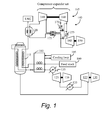
- feed stock 100 for this example, natural gas
- a relatively high temperature cooling loop 105 such as a propane refrigeration loop, is used to lower the temperature of the gaseous feedstock 100 in a high temperature heat exchanger 110.
- the feedstock 100 then enters a main heat exchanger 115, where the remainder of the sensible heat is removed, and at least some of the latent heat is also removed from the feedstock 100.
- the feedstock 100 is further cooled in a subcooling heat exchanger 120 where the temperature of the feedstock 100 is lowered below the saturation temperature. At this point, with very little additional processing, the pressure of the liquid natural gas is dropped and the LNG stream is directed to storage.
- the refrigeration loop providing the low temperature stream in the main heat exchanger 115 is often a mixed refrigerant (MR) refrigeration system.
- MR mixed refrigerant
- Two stages of compression 125 in series, each compression stage 125 with its own driver 130 are shown in the schematic of Fig. 1 .
- Typical drivers 130 include gas turbines and steam turbines. Although typical, the depicted arrangement is not universal. Heat is rejected to the ambient (air or water) by two ambient MR heat exchangers 135. Cooling of the MR to a lower temperature occurs in the high temperature heat exchanger 110.
- the cold MR stream is passed through the main heat exchanger 115 where heat is transferred from the feedstock 100 stream to the MR stream.
- Cascaded with the MR refrigeration loop is at least one gas refrigeration loop 140.
- the refrigerant in a typical gas refrigeration loop 140 for LNG production is pure nitrogen (N 2 ).
- a nitrogen recycle compressor 145 is driven by a driver 150, such as a gas turbine. The rotational speed of the nitrogen recycle compressor 145 is typically variable. Referring now to Figs. 2a and 2b , as well as Fig. 1 , the nitrogen recycle compressor 145 brings the pressure of the nitrogen refrigerant from its lowest pressure [state (1)] to an intermediate pressure [state (2)], where heat is rejected from the nitrogen stream to the ambient in a first nitrogen ambient heat exchanger 155. The pressure, p , tends to drop from state (2) to state (3), through the first nitrogen ambient heat exchanger 155 as seen in Fig. 2b where the dotted curves represent constant pressure curves. Additionally, the temperature, T , decreases and entropy, s , is transferred out of the nitrogen stream with the heat.
- the nitrogen refrigerant passes through the compressor 160 in the compressor-expander set 165, where the pressure of the nitrogen stream is increased to its greatest value [state (4)].
- the nitrogen stream then passes through a second nitrogen ambient heat exchanger 170 [state (4) to state (5)].
- the pressure again drops slightly, the temperature, T , decreases, and entropy, s , is transferred out of the stream with the heat, all depicted in Fig. 2b .
- More heat and entropy are transferred out of the nitrogen in a regenerative heat exchanger 175.
- the heat transferred out of the stream from state (5) to state (6) enters the relatively lower temperature stream from state (8) to state (1).
- the temperature, T , pressure, p , and entropy, s all decrease in the regenerative heat exchanger 175 from state (5) to state (6).
- the nitrogen stream is expanded from state (6) to state (7) in the expander 180 of the compressor-expander set 165.
- the expander 180 is outfitted with adjustable nozzles 210.
- the temperature reaches its lowest value, as clearly seen in Fig. 2b .
- the subcooling heat exchanger 120 is encountered next, where the nitrogen stream passes from state (7) to state (8), gaining heat and entropy from the feedstock 100 stream.
- the temperature, T of the nitrogen stream increases from state (7) to state (8), while the pressure, p , decreases due to friction.
- the stream can be used in the regenerative heat exchanger 175 to reduce the temperature of the nitrogen stream from state (5) to state (6).
- the nitrogen stream entering the regenerative heat exchanger at state (8) exits at state (1).
- the process from state (8) to state (1) involves an increase in heat, entropy, s , and temperature, T , and a decrease in pressure, p .
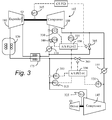
- Fig. 3 details of a control system are included, along with the refrigeration equipment shown in Figs. 1 and 2a .
- Recycle, or antisurge, valves 300, 305 are provided for the nitrogen recycle compressor 145 and the compressor 160 of the compressor-expander set 165, respectively.
- the recycle valves 300, 305 are used to vary the flow rate of the nitrogen through these compressors 145, 165.
- Surge avoidance in the nitrogen recycle compressor 145 is effected by the manipulation of the first recycle valve 300.
- antisurge control is effected through the manipulation of the second recycle valve 305.
- Some of the transmitters used for the recycle compressor 145 include: a flow transmitter, FT1 310, a suction pressure transmitter, PT1 315, a discharge pressure transmitter, PT2 320, and a rotational speed transmitter, SE1 325 .
- the flow transmitter, FT1 310 is shown on the suction side of the recycle compressor 145 in Fig. 3 , but the present invention is not limited thereto.
- Signals from the recycle compressor flow transmitter, FT1 310 , suction pressure transmitter, PT1 315 , and discharge pressure transmitter, PT2 320 are read into an antisurge control system, A/S PID 01 330 , where an automatic control algorithm, preferably a Proportional, Integral, Differential (PID) algorithm, is used to keep the recycle compressor from surging.
- PID Proportional, Integral, Differential
- the recycle compressor recycle valve 300 is manipulated by the antisurge control system, A/S PID 01 330.
- Some of the transmitters used for the compressor 160 of the compressor-expander set 165 include: a flow transmitter, FT2 330, a suction pressure transmitter, FT3 335, a discharge pressure transmitter, FT4 340, and a rotational speed transmitter, SE2 345.
- the flow transmitter, FT2 330 is shown on the discharge side of the compressor 160 in Fig. 3 , but the present invention is not limited thereto.
- Signals from the compressor-expander set compressor flow transmitter, FT2 330, suction pressure transmitter, PT3 335, discharge pressure transmitter, PT4 340 are read into a second antisurge control system, A/S PID 02 350, where an automatic control algorithm is used to keep the recycle compressor from surging.
- the compressor-expander set compressor recycle valve 305 is manipulated by the antisurge control system, A/S PID 02 350.
- redundant transmitters are not shown in Fig. 3 . However, redundant transmitters are common in LNG processes.
- a single compressor-expander set 165 is shown in each of Figs. 1 , 2a and 3 .
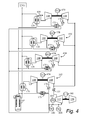
- multiple compressor-expander sets 165 are provided and often arranged in parallel, serviced by a single nitrogen recycle compressor 145 as shown in Figs. 4 and 5 .
- four (4) compressor-expander sets 165, 410, 420, 430, are shown operating in parallel with one another.
- each compressor-expander set 165, 410, 420, 430 is associated with its own subcooling heat exchanger 120.
- the plurality of subcooling heat exchangers 120 are arranged in series on the LNG side, thus energy is removed from the product 100 consecutively in each of the subcooling heat exchangers 120. All the compressor-expander sets 165, 410, 420, 430 share a single subcooling heat exchanger 120 in Fig. 5 .
- the present invention is not limited to either of these subcooling heat exchanger arrangements.
- the sum of the mass flow rates of the nitrogen in all the compressor-expander sets 165, 410, 420, 430 is determined using the signals received from the flow transmitter, FT3 440, the pressure transmitter, PT5 450, and the temperature transmitter, TT1 460.
- the nitrogen is always superheated at the position of these transmitters, so the pressure and temperature are independent thermodynamic properties.
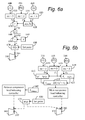
- the resulting mass flow rate, ⁇ is used in an automatic control algorithm such as a PID loop as shown in Fig. 6a .
- the raw signals from the transmitters 440, 450, 460 may need to be scaled and an offset accommodated as shown in blocks 610 to obtain actual values of pressure differential, ⁇ p , pressure, p , and temperature, T .
- the pressure, p , and temperature, T , values are used in the function block 620 for calculating the density, ⁇ , of the nitrogen as a function of pressure, p , and temperature, T .
- a first product block 630 is used to calculate the product of the pressure differential, ⁇ p , and density, p . Then the square root of the product is found in the square root block 640.
- a second product block 650 resolves the product of the square root of the product of the pressure differential, ⁇ p , and density, p and the constant, A 660.
- the result of the second product block 650 is the calculated mass flow rate, ⁇ , of the nitrogen.
- the mass flow rate, ⁇ is used as the process variable in the mass flow rate PID loop 670.
- the set point 680 is preferably provided by a supervisory or optimizing control system, but also may be entered by an operator or field engineer.
- the output of the mass flow rate PID loop 670 is directed to the adjustable nozzles 210 of one or more of the expanders 180 in the compressor-expander sets 165, 410, 420, 430.
- the transmitters associated with the main compressor flow transmitter, FT2 330, suction pressure transmitter PT3, 335, and discharge pressure transmitter PT4, 340 may need to be scaled and an offset accommodated as shown in blocks 610 to obtain actual values of pressure differential, ⁇ p , suction pressure, p s , and discharge pressure, p d .
- a first division block 615 the pressure differential, ⁇ p , and the suction pressure, p s , are combined to produce a dimensionless flow parameter denoted here as q 2 .
- a second division block 625 the discharge pressure, p d , and the suction pressure, p s , are combined to produce a dimensionless pressure ratio denoted here as R c .
- An identical process is carried out, using sensors and transmitters associated with the balance compressor, to calculate a measure of proximity to a surge control line, S s , for the balance compressor as indicated by the S s ,balance block 645.
- the two values of proximity to the surge control line, S s ,main , and S s ,balance are used in the respective antisurge control systems to protect these two compressors from surge.
- These same values may be used by a load sharing and balancing control system, whereby the rotational speeds of the respective compressors are manipulated via the expander adjustable nozzles 210.
- the overall performance of the combined system is controlled by the mass flow rate PID loop 670, which maintains the mass flow rate at its set point.
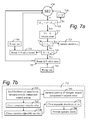
- a flow diagram outlining the critical speed avoidance algorithm is shown in Fig. 7a .
- a rotational speed transmitter 470 is provided to each of the compressor-expander sets 165, 410, 420, 430.
- the critical speed avoidance control system receives a rotational speed signal, N , from the rotational speed transmitter 470.
- the compressor-expander set 410 rotational speed, N is within the normal operating range.
- the recycle valve 305 is ramped open 745 at a predetermined ramp rate 750 until the result of the first comparator block 705 is false.
- the shutdown block 725 is expanded in a representative shutdown procedure in Fig. 7b . Such a procedure is used regardless of the reason for the shutdown. As those of ordinary skill in this art are well aware, a shutdown may be planned in advance, or it may be an emergency shutdown due to a sensed condition demanding immediate shutdown.
- a feedforward signal is provided to the nitrogen recycle compressor's control system, A/S PID 01, 330 .
- This step is shown in feedforward block 755.
- the nitrogen recycle compressor's control system 330 will act to increase the opening of the nitrogen recycle compressor's antisurge valve 300, as shown in the resultant block 760, when it receives this feedforward signal.
- the increase in opening may be a predetermined, fixed amount, or the increase may be calculated based on operating parameters of the nitrogen recycle compressor 145 and/or the tripped compressor-expander set 165, 410, 420,430.
- steps in the shutdown procedure include: opening the compressor-expander set compressor 160, 810, 820 recycle valve as shown in the recycle block 765; closing the expander adjustable nozzles 210 as indicated in the nozzle block 770; closing the expander shutdown valve 850 or 860 as illustrated in the shutdown valve bock 775; and alarming the operator of the shutdown 780.
- the order in which these steps are carried out depends on the system, rates of actuation, and personal preference.
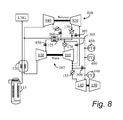
- a preferred piping system is illustrated.
- the compressors 810, 820 within the main and balance compressor-expander sets, respectively are plumbed in parallel.
- the expanders 830, 840 are not in parallel with one another. Rather, the main expander 830 feeds the subcooling heat exchanger 120, while the exhaust from the balance expander 840 is combined with the discharge of the subcooling heat exchanger 120, and the entire flow is used as the cold fluid in the regenerator 175.
- This piping arrangement is presented to provide a full disclosure of the systems on which the present invention may be used. However, the method and apparatus of the instant invention is unaffected by the known piping variations shown in Figs. 1 , 2a, 3-5, and 8 .
- Expander shutdown valves 850, 860 are provided for shutting down the main and balance compressor-expander sets.
- Performance maps for the main compressor 810 are shown in Figs. 9 and 10 .
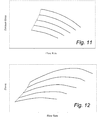
- Performance maps for the balance compressor 820 are shown in Figs. 11 and 12 .
- the shaft power required by a centrifugal compressor 160, 810, 820 often has a positive slope as shown in Figs. 10 and 12 .
- the shaft power curve for a constant rotational speed, N may have a negative slope. Either way, the shaft power required by the centrifugal compressors 160, 810, 820 changes with flow rate. Therefore, the shaft power varies with the opening of the recycle valve 305.
- I is the moment of inertia for the compressor-expander set 410
- N is the rotational speed of the compressor-expander set 410
- ⁇ in is the shaft power supplied to the compressor 160, 810, 820
- ⁇ out is the shaft power required by the compressor 160, 810, 820.
- Opening the recycle valve 305 changes ⁇ out , and hence the rotational speed, N . Therefore, changing the opening of the recycle valve 305 may be used to move the rotational speed, N , of the compressor-expander set 410 out of a critical speed zone.
Landscapes
- Engineering & Computer Science (AREA)
- Mechanical Engineering (AREA)
- General Engineering & Computer Science (AREA)
- Physics & Mathematics (AREA)
- Thermal Sciences (AREA)
- Chemical & Material Sciences (AREA)
- Combustion & Propulsion (AREA)
- Chemical Kinetics & Catalysis (AREA)
- General Chemical & Material Sciences (AREA)
- Oil, Petroleum & Natural Gas (AREA)
- Fluid Mechanics (AREA)
- Control Of Positive-Displacement Air Blowers (AREA)
Applications Claiming Priority (1)
| Application Number | Priority Date | Filing Date | Title |
|---|---|---|---|
| US12/047,938 US8360744B2 (en) | 2008-03-13 | 2008-03-13 | Compressor-expander set critical speed avoidance |
Publications (2)
| Publication Number | Publication Date |
|---|---|
| EP2124004A2 true EP2124004A2 (de) | 2009-11-25 |
| EP2124004A3 EP2124004A3 (de) | 2013-01-30 |
Family
ID=41063236
Family Applications (1)
| Application Number | Title | Priority Date | Filing Date |
|---|---|---|---|
| EP09155157A Withdrawn EP2124004A3 (de) | 2008-03-13 | 2009-03-13 | Kompressorerweiterungssatz zur kritischen Geschwindigkeitsvermeidung |
Country Status (2)
| Country | Link |
|---|---|
| US (3) | US8360744B2 (de) |
| EP (1) | EP2124004A3 (de) |
Cited By (3)
| Publication number | Priority date | Publication date | Assignee | Title |
|---|---|---|---|---|
| CN102373969A (zh) * | 2010-08-11 | 2012-03-14 | 诺沃皮尼奥内有限公司 | 用于自动控制膨胀机速度的方法和装置 |
| US8761958B2 (en) | 2010-08-11 | 2014-06-24 | Nuovo Pignone S.P.A. | Methods and devices used for automatically controlling speed of an expander |
| CN105510621A (zh) * | 2015-09-28 | 2016-04-20 | 沈阳鼓风机集团安装检修配件有限公司 | 一种离心压缩机临界转速获取方法和装置 |
Families Citing this family (32)
| Publication number | Priority date | Publication date | Assignee | Title |
|---|---|---|---|---|
| US20090297333A1 (en) * | 2008-05-28 | 2009-12-03 | Saul Mirsky | Enhanced Turbocompressor Startup |
| US8360744B2 (en) * | 2008-03-13 | 2013-01-29 | Compressor Controls Corporation | Compressor-expander set critical speed avoidance |
| AU2009228000B2 (en) * | 2008-09-19 | 2013-03-07 | Woodside Energy Limited | Mixed refrigerant compression circuit |
| IT1401425B1 (it) * | 2010-06-24 | 2013-07-26 | Nuovo Pignone Spa | Turboespansore e metodo per usare palette direttrici di ingresso mobili all'ingresso di un compressore |
| US9003814B2 (en) * | 2011-11-11 | 2015-04-14 | Hamilton Sundstrand Corporation | Turbo air compressor with pressure recovery |
| US9205925B2 (en) * | 2011-11-11 | 2015-12-08 | Hamilton Sundstrand Corporation | Turbo air compressor |
| ITFI20120196A1 (it) * | 2012-10-01 | 2014-04-02 | Nuovo Pignone Srl | "a turboexpander and driven turbomachine system" |
| US9016074B2 (en) | 2013-03-15 | 2015-04-28 | Energy Recovery Systems Inc. | Energy exchange system and method |
| US9234686B2 (en) | 2013-03-15 | 2016-01-12 | Energy Recovery Systems Inc. | User control interface for heat transfer system |
| US20140260380A1 (en) * | 2013-03-15 | 2014-09-18 | Energy Recovery Systems Inc. | Compressor control for heat transfer system |
| US10260775B2 (en) | 2013-03-15 | 2019-04-16 | Green Matters Technologies Inc. | Retrofit hot water system and method |
| US9695834B2 (en) | 2013-11-25 | 2017-07-04 | Woodward, Inc. | Load sharing control for compressors in series |
| US9696074B2 (en) | 2014-01-03 | 2017-07-04 | Woodward, Inc. | Controlling refrigeration compression systems |
| CN104019627B (zh) * | 2014-05-06 | 2017-01-04 | 上海安恩吉新能源技术有限公司 | 移动式小型撬装lng液化装置 |
| DE102014010104A1 (de) * | 2014-07-08 | 2016-01-14 | Linde Aktiengesellschaft | Verfahren zur Regelung der Drehzahl von seriengeschalteten kryogenen Verdichtern zur Kühlung von tiefkaltem, kryogenen Helium |
| JP6415989B2 (ja) * | 2015-01-05 | 2018-10-31 | 三菱重工サーマルシステムズ株式会社 | 液化ガス用冷却装置 |
| JP2016125773A (ja) * | 2015-01-05 | 2016-07-11 | 三菱重工業株式会社 | 液化ガス用冷却装置 |
| US10415857B2 (en) * | 2015-05-01 | 2019-09-17 | Mayekawa Mfg. Co., Ltd. | Refrigerator and operation method for refrigerator |
| CN104989465B (zh) * | 2015-07-17 | 2017-01-11 | 国家电网公司 | 一种防止汽轮机转速超调的自动变升速率控制方法 |
| KR20180040153A (ko) * | 2015-07-24 | 2018-04-19 | 누보 피그노네 테크놀로지 에스알엘 | 축류 압축기와 원심 압축기를 포함하는 lng 플랜트 |
| ITUB20152489A1 (it) * | 2015-07-24 | 2017-01-24 | Nuovo Pignone Tecnologie Srl | Treno di compressione con un compressore assiale e impianto lng con un compressore assiale |
| ITUB20152501A1 (it) * | 2015-07-24 | 2017-01-24 | Nuovo Pignone Tecnologie Srl | Treno di compressione con un compressore centrifugo e impianto lng con un compressore centrifugo |
| US20170030359A1 (en) * | 2015-07-31 | 2017-02-02 | Siemens Aktiencesellschaft | Batch change control for variable speed driven centrifugal pumps and pump systems |
| US10017032B2 (en) * | 2016-02-16 | 2018-07-10 | The Boeing Company | Thermal management systems and methods |
| KR101792708B1 (ko) * | 2016-06-22 | 2017-11-02 | 삼성중공업(주) | 유체냉각장치 |
| CN106441964B (zh) * | 2016-09-14 | 2018-10-02 | 中海石油气电集团有限责任公司 | 一种浮式天然气液化系统的试验平台 |
| CN110375454B (zh) * | 2019-06-24 | 2021-05-11 | 东南大学 | 一种天然气压力能制冷系统 |
| WO2021161133A1 (en) * | 2020-02-10 | 2021-08-19 | Khalifa University of Science and Technology | An apparatus for optimal loadsharing between parallel gas compressors |
| US12123646B2 (en) | 2021-04-16 | 2024-10-22 | Praxair Technology, Inc. | System and method to produce liquefied natural gas using a three pinion integral gear machine |
| US20230129424A1 (en) * | 2021-10-21 | 2023-04-27 | Henry Edward Howard | System and method to produce liquefied natural gas |
| FR3149676B1 (fr) * | 2023-06-07 | 2025-04-25 | Air Liquide | Réfrigérateur à gaz de cycle et installation de liquéfaction. |
| CN119982617B (zh) * | 2025-04-16 | 2025-09-05 | 中国电建集团河北省电力勘测设计研究院有限公司 | 一种压缩空气储能电站多级压缩机启停控制系统及方法 |
Citations (2)
| Publication number | Priority date | Publication date | Assignee | Title |
|---|---|---|---|---|
| US5743715A (en) | 1995-10-20 | 1998-04-28 | Compressor Controls Corporation | Method and apparatus for load balancing among multiple compressors |
| US6308531B1 (en) | 1999-10-12 | 2001-10-30 | Air Products And Chemicals, Inc. | Hybrid cycle for the production of liquefied natural gas |
Family Cites Families (14)
| Publication number | Priority date | Publication date | Assignee | Title |
|---|---|---|---|---|
| US4255089A (en) * | 1979-03-22 | 1981-03-10 | Dravo Corporation | Method of controlling series fans driving a variable load |
| US4281970A (en) * | 1979-06-15 | 1981-08-04 | Phillips Petroleum Company | Turbo-expander control |
| US4494006A (en) * | 1982-09-15 | 1985-01-15 | Compressor Controls Corporation | Method and apparatus for controlling a multicompressor station |
| US4640665A (en) * | 1982-09-15 | 1987-02-03 | Compressor Controls Corp. | Method for controlling a multicompressor station |
| FR2666854B1 (fr) * | 1990-09-19 | 1992-12-18 | Framatome Sa | Dispositif de commande de moyens d'antipompage d'un compresseur. |
| US5347467A (en) * | 1992-06-22 | 1994-09-13 | Compressor Controls Corporation | Load sharing method and apparatus for controlling a main gas parameter of a compressor station with multiple dynamic compressors |
| US5343384A (en) * | 1992-10-13 | 1994-08-30 | Ingersoll-Rand Company | Method and apparatus for controlling a system of compressors to achieve load sharing |
| US5951240A (en) * | 1997-11-21 | 1999-09-14 | Compressor Controls Corporation | Method and apparatus for improving antisurge control of turbocompressors by reducing control valve response time |
| US5967742A (en) * | 1997-12-23 | 1999-10-19 | Compressor Controls Corporation | Method and apparatus for preventing surge while taking a turbocompressor off-line from a parallel configuration |
| US6217288B1 (en) * | 1998-01-20 | 2001-04-17 | Compressor Controls Corporation | Method and apparatus for limiting a critical variable of a group of compressors or an individual compressor |
| US6332336B1 (en) * | 1999-02-26 | 2001-12-25 | Compressor Controls Corporation | Method and apparatus for maximizing the productivity of a natural gas liquids production plant |
| US6602057B2 (en) * | 2001-10-01 | 2003-08-05 | Dresser-Rand Company | Management and optimization of load sharing between multiple compressor trains for controlling a main process gas variable |
| US7356999B2 (en) * | 2003-10-10 | 2008-04-15 | York International Corporation | System and method for stability control in a centrifugal compressor |
| US8360744B2 (en) * | 2008-03-13 | 2013-01-29 | Compressor Controls Corporation | Compressor-expander set critical speed avoidance |
-
2008
- 2008-03-13 US US12/047,938 patent/US8360744B2/en active Active
-
2009
- 2009-03-13 EP EP09155157A patent/EP2124004A3/de not_active Withdrawn
-
2012
- 2012-12-06 US US13/706,748 patent/US20130094974A1/en not_active Abandoned
-
2013
- 2013-01-17 US US13/743,418 patent/US8540498B2/en active Active
Patent Citations (2)
| Publication number | Priority date | Publication date | Assignee | Title |
|---|---|---|---|---|
| US5743715A (en) | 1995-10-20 | 1998-04-28 | Compressor Controls Corporation | Method and apparatus for load balancing among multiple compressors |
| US6308531B1 (en) | 1999-10-12 | 2001-10-30 | Air Products And Chemicals, Inc. | Hybrid cycle for the production of liquefied natural gas |
Non-Patent Citations (2)
| Title |
|---|
| "Fundamentals ofEngineering Thermodynamics", JOHN WILEY & SONS, INC. |
| CHAVEZ, TECHNICAL CHALLENGES DURING THE ENGINEERING PHASES OF THE QATARGAS II LARGE LNG TRAINS |
Cited By (6)
| Publication number | Priority date | Publication date | Assignee | Title |
|---|---|---|---|---|
| CN102373969A (zh) * | 2010-08-11 | 2012-03-14 | 诺沃皮尼奥内有限公司 | 用于自动控制膨胀机速度的方法和装置 |
| US8761957B2 (en) | 2010-08-11 | 2014-06-24 | Nuovo Pignone S.P.A. | Methods and devices used for automatically controlling speed of an expander |
| US8761958B2 (en) | 2010-08-11 | 2014-06-24 | Nuovo Pignone S.P.A. | Methods and devices used for automatically controlling speed of an expander |
| CN102373969B (zh) * | 2010-08-11 | 2015-05-20 | 诺沃皮尼奥内有限公司 | 用于自动控制膨胀机速度的方法和装置 |
| CN105510621A (zh) * | 2015-09-28 | 2016-04-20 | 沈阳鼓风机集团安装检修配件有限公司 | 一种离心压缩机临界转速获取方法和装置 |
| CN105510621B (zh) * | 2015-09-28 | 2018-10-30 | 沈阳鼓风机集团安装检修配件有限公司 | 一种离心压缩机临界转速获取方法和装置 |
Also Published As
| Publication number | Publication date |
|---|---|
| US20090232663A1 (en) | 2009-09-17 |
| US8360744B2 (en) | 2013-01-29 |
| US20130129528A1 (en) | 2013-05-23 |
| US8540498B2 (en) | 2013-09-24 |
| US20130094974A1 (en) | 2013-04-18 |
| EP2124004A3 (de) | 2013-01-30 |
Similar Documents
| Publication | Publication Date | Title |
|---|---|---|
| US8360744B2 (en) | Compressor-expander set critical speed avoidance | |
| KR950000479B1 (ko) | 가스 액화 공정 제어장치 | |
| US8567207B2 (en) | Compressor control system using a variable geometry diffuser | |
| EP2042743B1 (de) | Gaskompressionssystem und Verfahren zur Steuerung eines Gaskompressionssystems. | |
| AU2007347705B2 (en) | Anti-bogdown control system for turbine/compressor systems | |
| CN109690216B (zh) | 原料气体液化装置及其控制方法 | |
| EP3408543B2 (de) | Anfahren des verdichterstrangs mit variablen einlassleitschaufeln | |
| RU2762473C2 (ru) | Способ регулирования многоступенчатого компрессора | |
| US10571189B2 (en) | System and method for operating a liquefaction train | |
| EP3855099B1 (de) | Verflüssigungsvorrichtung | |
| Jacobson et al. | Compressor loadsharing control and surge detection techniques | |
| JPH01269875A (ja) | 液化冷凍装置の液化制御方法および装置 | |
| Joshi et al. | Automatic PID control loops design for performance improvement of cryogenic turboexpander | |
| JP2793074B2 (ja) | タービン式膨張機の運転制御方法及び装置 | |
| JPH05322344A (ja) | 冷凍装置におけるタービン式膨張機の運転状態制御方法及び装置 | |
| Jacobson et al. | Detailed Review and Implementation (Explanation) of Api 617 Annex E: Guidelines for Antisurge Control Systems | |
| JPH08136073A (ja) | タービン式膨張機の運転制御方法及び装置 | |
| HK40055845A (en) | Liquefaction apparatus | |
| Sandberg et al. | TT02-Compressor Selection for LNG Liquefaction Plants | |
| JPH0317062B2 (de) | ||
| Brown et al. | Application of Gas Turbine/Compressors in LNG Plants | |
| Staroselsky et al. | COMPRESSOR LOADSHARING CONTROL AND SURGE DETECTION TECHNIQUES | |
| deSa et al. | The operating and control philosophy of turbo-compressors | |
| JPS63201457A (ja) | 膨張機の制御装置 |
Legal Events
| Date | Code | Title | Description |
|---|---|---|---|
| PUAI | Public reference made under article 153(3) epc to a published international application that has entered the european phase |
Free format text: ORIGINAL CODE: 0009012 |
|
| AK | Designated contracting states |
Kind code of ref document: A2 Designated state(s): AT BE BG CH CY CZ DE DK EE ES FI FR GB GR HR HU IE IS IT LI LT LU LV MC MK MT NL NO PL PT RO SE SI SK TR |
|
| AX | Request for extension of the european patent |
Extension state: AL BA RS |
|
| PUAL | Search report despatched |
Free format text: ORIGINAL CODE: 0009013 |
|
| AK | Designated contracting states |
Kind code of ref document: A3 Designated state(s): AT BE BG CH CY CZ DE DK EE ES FI FR GB GR HR HU IE IS IT LI LT LU LV MC MK MT NL NO PL PT RO SE SI SK TR |
|
| AX | Request for extension of the european patent |
Extension state: AL BA RS |
|
| RIC1 | Information provided on ipc code assigned before grant |
Ipc: F25J 1/02 20060101AFI20121224BHEP Ipc: F02C 1/00 20060101ALI20121224BHEP Ipc: F25B 9/00 20060101ALI20121224BHEP Ipc: F01D 21/00 20060101ALI20121224BHEP Ipc: F04D 27/02 20060101ALI20121224BHEP Ipc: F01D 15/00 20060101ALI20121224BHEP |
|
| AKY | No designation fees paid | ||
| REG | Reference to a national code |
Ref country code: DE Ref legal event code: R108 Effective date: 20131002 |
|
| STAA | Information on the status of an ep patent application or granted ep patent |
Free format text: STATUS: THE APPLICATION IS DEEMED TO BE WITHDRAWN |
|
| 18D | Application deemed to be withdrawn |
Effective date: 20130731 |