EP2117639B1 - Nachweis von nahrungsaufnahme zur einleitung von magen-pacing - Google Patents
Nachweis von nahrungsaufnahme zur einleitung von magen-pacing Download PDFInfo
- Publication number
- EP2117639B1 EP2117639B1 EP07709366.4A EP07709366A EP2117639B1 EP 2117639 B1 EP2117639 B1 EP 2117639B1 EP 07709366 A EP07709366 A EP 07709366A EP 2117639 B1 EP2117639 B1 EP 2117639B1
- Authority
- EP
- European Patent Office
- Prior art keywords
- blood
- stomach
- flow
- blood vessel
- patient
- Prior art date
- Legal status (The legal status is an assumption and is not a legal conclusion. Google has not performed a legal analysis and makes no representation as to the accuracy of the status listed.)
- Not-in-force
Links
- 230000002496 gastric effect Effects 0.000 title claims description 25
- 235000005686 eating Nutrition 0.000 title description 18
- 210000002784 stomach Anatomy 0.000 claims description 39
- 210000000056 organ Anatomy 0.000 claims description 20
- 210000002249 digestive system Anatomy 0.000 claims description 15
- 230000010412 perfusion Effects 0.000 claims description 15
- 230000000638 stimulation Effects 0.000 claims description 15
- 235000013305 food Nutrition 0.000 claims description 9
- 210000004185 liver Anatomy 0.000 claims description 9
- 210000000952 spleen Anatomy 0.000 claims description 7
- 210000000496 pancreas Anatomy 0.000 claims description 5
- 230000001419 dependent effect Effects 0.000 claims description 3
- 210000004204 blood vessel Anatomy 0.000 description 50
- 230000017531 blood circulation Effects 0.000 description 47
- 210000004369 blood Anatomy 0.000 description 22
- 239000008280 blood Substances 0.000 description 22
- 238000004458 analytical method Methods 0.000 description 12
- 230000000694 effects Effects 0.000 description 9
- 230000004936 stimulating effect Effects 0.000 description 8
- 238000002604 ultrasonography Methods 0.000 description 7
- 230000005670 electromagnetic radiation Effects 0.000 description 6
- 210000003240 portal vein Anatomy 0.000 description 6
- 210000001367 artery Anatomy 0.000 description 5
- 239000012530 fluid Substances 0.000 description 5
- 230000037406 food intake Effects 0.000 description 5
- 210000002767 hepatic artery Anatomy 0.000 description 5
- 238000000034 method Methods 0.000 description 5
- 210000001519 tissue Anatomy 0.000 description 5
- 230000008081 blood perfusion Effects 0.000 description 4
- 210000001072 colon Anatomy 0.000 description 4
- 238000005259 measurement Methods 0.000 description 4
- 208000008589 Obesity Diseases 0.000 description 3
- 230000033001 locomotion Effects 0.000 description 3
- 210000001363 mesenteric artery superior Anatomy 0.000 description 3
- 238000012544 monitoring process Methods 0.000 description 3
- 235000020824 obesity Nutrition 0.000 description 3
- WQZGKKKJIJFFOK-GASJEMHNSA-N Glucose Natural products OC[C@H]1OC(O)[C@H](O)[C@@H](O)[C@@H]1O WQZGKKKJIJFFOK-GASJEMHNSA-N 0.000 description 2
- 206010020710 Hyperphagia Diseases 0.000 description 2
- 210000000601 blood cell Anatomy 0.000 description 2
- 239000004020 conductor Substances 0.000 description 2
- 230000007423 decrease Effects 0.000 description 2
- 238000001514 detection method Methods 0.000 description 2
- 230000005674 electromagnetic induction Effects 0.000 description 2
- 238000005265 energy consumption Methods 0.000 description 2
- 235000012631 food intake Nutrition 0.000 description 2
- 239000008103 glucose Substances 0.000 description 2
- 210000002989 hepatic vein Anatomy 0.000 description 2
- NOESYZHRGYRDHS-UHFFFAOYSA-N insulin Chemical compound N1C(=O)C(NC(=O)C(CCC(N)=O)NC(=O)C(CCC(O)=O)NC(=O)C(C(C)C)NC(=O)C(NC(=O)CN)C(C)CC)CSSCC(C(NC(CO)C(=O)NC(CC(C)C)C(=O)NC(CC=2C=CC(O)=CC=2)C(=O)NC(CCC(N)=O)C(=O)NC(CC(C)C)C(=O)NC(CCC(O)=O)C(=O)NC(CC(N)=O)C(=O)NC(CC=2C=CC(O)=CC=2)C(=O)NC(CSSCC(NC(=O)C(C(C)C)NC(=O)C(CC(C)C)NC(=O)C(CC=2C=CC(O)=CC=2)NC(=O)C(CC(C)C)NC(=O)C(C)NC(=O)C(CCC(O)=O)NC(=O)C(C(C)C)NC(=O)C(CC(C)C)NC(=O)C(CC=2NC=NC=2)NC(=O)C(CO)NC(=O)CNC2=O)C(=O)NCC(=O)NC(CCC(O)=O)C(=O)NC(CCCNC(N)=N)C(=O)NCC(=O)NC(CC=3C=CC=CC=3)C(=O)NC(CC=3C=CC=CC=3)C(=O)NC(CC=3C=CC(O)=CC=3)C(=O)NC(C(C)O)C(=O)N3C(CCC3)C(=O)NC(CCCCN)C(=O)NC(C)C(O)=O)C(=O)NC(CC(N)=O)C(O)=O)=O)NC(=O)C(C(C)CC)NC(=O)C(CO)NC(=O)C(C(C)O)NC(=O)C1CSSCC2NC(=O)C(CC(C)C)NC(=O)C(NC(=O)C(CCC(N)=O)NC(=O)C(CC(N)=O)NC(=O)C(NC(=O)C(N)CC=1C=CC=CC=1)C(C)C)CC1=CN=CN1 NOESYZHRGYRDHS-UHFFFAOYSA-N 0.000 description 2
- 235000012054 meals Nutrition 0.000 description 2
- 210000004249 mesenteric artery inferior Anatomy 0.000 description 2
- 235000020830 overeating Nutrition 0.000 description 2
- 210000002563 splenic artery Anatomy 0.000 description 2
- 238000011144 upstream manufacturing Methods 0.000 description 2
- 206010020772 Hypertension Diseases 0.000 description 1
- 102000004877 Insulin Human genes 0.000 description 1
- 108090001061 Insulin Proteins 0.000 description 1
- 206010028980 Neoplasm Diseases 0.000 description 1
- 206010033307 Overweight Diseases 0.000 description 1
- 208000006011 Stroke Diseases 0.000 description 1
- 239000002253 acid Substances 0.000 description 1
- 210000000709 aorta Anatomy 0.000 description 1
- WQZGKKKJIJFFOK-VFUOTHLCSA-N beta-D-glucose Chemical compound OC[C@H]1O[C@@H](O)[C@H](O)[C@@H](O)[C@@H]1O WQZGKKKJIJFFOK-VFUOTHLCSA-N 0.000 description 1
- 210000004556 brain Anatomy 0.000 description 1
- 201000011510 cancer Diseases 0.000 description 1
- 150000001720 carbohydrates Chemical class 0.000 description 1
- 230000000747 cardiac effect Effects 0.000 description 1
- 210000002434 celiac artery Anatomy 0.000 description 1
- 210000004027 cell Anatomy 0.000 description 1
- 230000034994 death Effects 0.000 description 1
- 231100000517 death Toxicity 0.000 description 1
- 210000004207 dermis Anatomy 0.000 description 1
- 238000010586 diagram Methods 0.000 description 1
- 208000037265 diseases, disorders, signs and symptoms Diseases 0.000 description 1
- 208000035475 disorder Diseases 0.000 description 1
- 210000002615 epidermis Anatomy 0.000 description 1
- 210000001035 gastrointestinal tract Anatomy 0.000 description 1
- 230000005802 health problem Effects 0.000 description 1
- 208000019622 heart disease Diseases 0.000 description 1
- 230000002440 hepatic effect Effects 0.000 description 1
- 238000002847 impedance measurement Methods 0.000 description 1
- 229940125396 insulin Drugs 0.000 description 1
- 238000007918 intramuscular administration Methods 0.000 description 1
- 238000012986 modification Methods 0.000 description 1
- 230000004048 modification Effects 0.000 description 1
- 230000005804 musculo-skeletal problem Effects 0.000 description 1
- 210000005036 nerve Anatomy 0.000 description 1
- 210000000653 nervous system Anatomy 0.000 description 1
- 230000019612 pigmentation Effects 0.000 description 1
- 230000008325 portal venous blood flow Effects 0.000 description 1
- 230000000291 postprandial effect Effects 0.000 description 1
- 230000002028 premature Effects 0.000 description 1
- 102000004169 proteins and genes Human genes 0.000 description 1
- 108090000623 proteins and genes Proteins 0.000 description 1
- 230000029058 respiratory gaseous exchange Effects 0.000 description 1
- 230000036186 satiety Effects 0.000 description 1
- 235000019627 satiety Nutrition 0.000 description 1
- 210000000813 small intestine Anatomy 0.000 description 1
- 238000001356 surgical procedure Methods 0.000 description 1
- 230000001515 vagal effect Effects 0.000 description 1
- 210000005166 vasculature Anatomy 0.000 description 1
- 210000003462 vein Anatomy 0.000 description 1
- 210000001631 vena cava inferior Anatomy 0.000 description 1
- 210000001835 viscera Anatomy 0.000 description 1
Images



Classifications
-
- A—HUMAN NECESSITIES
- A61—MEDICAL OR VETERINARY SCIENCE; HYGIENE
- A61N—ELECTROTHERAPY; MAGNETOTHERAPY; RADIATION THERAPY; ULTRASOUND THERAPY
- A61N1/00—Electrotherapy; Circuits therefor
- A61N1/18—Applying electric currents by contact electrodes
- A61N1/32—Applying electric currents by contact electrodes alternating or intermittent currents
- A61N1/36—Applying electric currents by contact electrodes alternating or intermittent currents for stimulation
- A61N1/36007—Applying electric currents by contact electrodes alternating or intermittent currents for stimulation of urogenital or gastrointestinal organs, e.g. for incontinence control
-
- A—HUMAN NECESSITIES
- A61—MEDICAL OR VETERINARY SCIENCE; HYGIENE
- A61B—DIAGNOSIS; SURGERY; IDENTIFICATION
- A61B5/00—Measuring for diagnostic purposes; Identification of persons
- A61B5/02—Detecting, measuring or recording for evaluating the cardiovascular system, e.g. pulse, heart rate, blood pressure or blood flow
- A61B5/026—Measuring blood flow
-
- A—HUMAN NECESSITIES
- A61—MEDICAL OR VETERINARY SCIENCE; HYGIENE
- A61B—DIAGNOSIS; SURGERY; IDENTIFICATION
- A61B5/00—Measuring for diagnostic purposes; Identification of persons
- A61B5/02—Detecting, measuring or recording for evaluating the cardiovascular system, e.g. pulse, heart rate, blood pressure or blood flow
- A61B5/026—Measuring blood flow
- A61B5/0295—Measuring blood flow using plethysmography, i.e. measuring the variations in the volume of a body part as modified by the circulation of blood therethrough, e.g. impedance plethysmography
-
- A—HUMAN NECESSITIES
- A61—MEDICAL OR VETERINARY SCIENCE; HYGIENE
- A61B—DIAGNOSIS; SURGERY; IDENTIFICATION
- A61B5/00—Measuring for diagnostic purposes; Identification of persons
- A61B5/42—Detecting, measuring or recording for evaluating the gastrointestinal, the endocrine or the exocrine systems
- A61B5/4222—Evaluating particular parts, e.g. particular organs
- A61B5/4238—Evaluating particular parts, e.g. particular organs stomach
-
- A—HUMAN NECESSITIES
- A61—MEDICAL OR VETERINARY SCIENCE; HYGIENE
- A61B—DIAGNOSIS; SURGERY; IDENTIFICATION
- A61B5/00—Measuring for diagnostic purposes; Identification of persons
- A61B5/68—Arrangements of detecting, measuring or recording means, e.g. sensors, in relation to patient
- A61B5/6846—Arrangements of detecting, measuring or recording means, e.g. sensors, in relation to patient specially adapted to be brought in contact with an internal body part, i.e. invasive
- A61B5/6867—Arrangements of detecting, measuring or recording means, e.g. sensors, in relation to patient specially adapted to be brought in contact with an internal body part, i.e. invasive specially adapted to be attached or implanted in a specific body part
- A61B5/6876—Blood vessel
-
- A—HUMAN NECESSITIES
- A61—MEDICAL OR VETERINARY SCIENCE; HYGIENE
- A61B—DIAGNOSIS; SURGERY; IDENTIFICATION
- A61B5/00—Measuring for diagnostic purposes; Identification of persons
- A61B5/68—Arrangements of detecting, measuring or recording means, e.g. sensors, in relation to patient
- A61B5/6846—Arrangements of detecting, measuring or recording means, e.g. sensors, in relation to patient specially adapted to be brought in contact with an internal body part, i.e. invasive
- A61B5/6879—Means for maintaining contact with the body
- A61B5/6884—Clamps or clips
-
- A—HUMAN NECESSITIES
- A61—MEDICAL OR VETERINARY SCIENCE; HYGIENE
- A61B—DIAGNOSIS; SURGERY; IDENTIFICATION
- A61B5/00—Measuring for diagnostic purposes; Identification of persons
- A61B5/02—Detecting, measuring or recording for evaluating the cardiovascular system, e.g. pulse, heart rate, blood pressure or blood flow
- A61B5/026—Measuring blood flow
- A61B5/0261—Measuring blood flow using optical means, e.g. infrared light
-
- A—HUMAN NECESSITIES
- A61—MEDICAL OR VETERINARY SCIENCE; HYGIENE
- A61B—DIAGNOSIS; SURGERY; IDENTIFICATION
- A61B5/00—Measuring for diagnostic purposes; Identification of persons
- A61B5/02—Detecting, measuring or recording for evaluating the cardiovascular system, e.g. pulse, heart rate, blood pressure or blood flow
- A61B5/026—Measuring blood flow
- A61B5/0265—Measuring blood flow using electromagnetic means, e.g. electromagnetic flowmeter
-
- A—HUMAN NECESSITIES
- A61—MEDICAL OR VETERINARY SCIENCE; HYGIENE
- A61B—DIAGNOSIS; SURGERY; IDENTIFICATION
- A61B5/00—Measuring for diagnostic purposes; Identification of persons
- A61B5/02—Detecting, measuring or recording for evaluating the cardiovascular system, e.g. pulse, heart rate, blood pressure or blood flow
- A61B5/026—Measuring blood flow
- A61B5/0275—Measuring blood flow using tracers, e.g. dye dilution
- A61B5/028—Measuring blood flow using tracers, e.g. dye dilution by thermo-dilution
-
- A—HUMAN NECESSITIES
- A61—MEDICAL OR VETERINARY SCIENCE; HYGIENE
- A61B—DIAGNOSIS; SURGERY; IDENTIFICATION
- A61B5/00—Measuring for diagnostic purposes; Identification of persons
- A61B5/05—Detecting, measuring or recording for diagnosis by means of electric currents or magnetic fields; Measuring using microwaves or radio waves
- A61B5/053—Measuring electrical impedance or conductance of a portion of the body
- A61B5/0535—Impedance plethysmography
-
- A—HUMAN NECESSITIES
- A61—MEDICAL OR VETERINARY SCIENCE; HYGIENE
- A61B—DIAGNOSIS; SURGERY; IDENTIFICATION
- A61B8/00—Diagnosis using ultrasonic, sonic or infrasonic waves
- A61B8/06—Measuring blood flow
Definitions
- the present invention relates to methods and devices for monitoring at least one physiological parameter that relates to the activity of the digestive system of a patient.
- a modem major health concern is the increasing proportion of the human population who are so overweight that they suffer from obesity. Obesity is a leading cause of premature deaths and is associated with other health problems such as high blood pressure, heart disease, strokes, breathing disorders, cancer and musculoskeletal problems.
- US2005/0149142 teaches a number of ways in which eating by a patient can be detected by a monitoring a physiological parameter that reflects activity of the patients stomach. Such parameters including gastric electrical activity, trans-abdominal impedance, blood glucose levels, insulin levels, stomach acid levels, motion of the stomach, distension of the stomach or other mechanical indicators of stomach activity.
- WO 2004/112883 describes an apparatus for detecting eating by a subject comprising a food intake detection device.
- the food intake detection device is adapted to be coupled to a hepatic portal vein of a subject and may comprise a blood flow sensor, which is adapted to detect a rate of blood flow in the portal vein.
- Increased portal blood flow is said to be indicative of elevated postprandial portal blood glucose, carbohydrate, fat, or protein levels, and thus indicates the quantity of such products recently absorbed by small intestine during eating.
- the blood flow sensor may comprise an implantable blood flow meter, e.g. a pulsed Doppler ultrasonic flow meter, or a meter that utilizes the thermodilution principle.
- the blood flow sensor may comprise one or more electrodes adapted to measure changes in impedance between the electrodes, which changes are indicative of stretching of portal vein caused by increased portal blood flow.
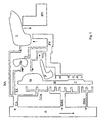
- the gastrointestinal tract is perfused by three branches from the aorta (A): the coeliac artery (CA) (which supplies blood to the stomach (St) via the left gastric artery (LGA), the liver (L) via the hepatic artery (HA) and the spleen (SP) via the splenic artery (SA)), the superior mesenteric artery (SMA) and the inferior mesenteric artery (IMA).
- CA coeliac artery
- LGA left gastric artery
- HA hepatic artery
- SP spleen
- SA splenic artery
- IMA superior mesenteric artery
- IMA inferior mesenteric artery
- This blood is fed to the liver (L) from the stomach (St), spleen (Sp), pancreas (P), small bowel (B) and colon (C) via the portal vein (PV) and accounts for approximately 80% of the blood flow to the liver.
- the remaining 20% of the blood flow to the liver is directly from the hepatic artery (HA). Blood from the liver returns to the heart via the hepatic veins (HV) to the inferior vena cava.
- the portal venous blood flow is 1200 ml/min in the fasting state but it may increase to 2000 ml/min following a meal.
- the SMA blood flow can double from 500 to 1000 ml/min within 15 minutes of food ingestion, the increase being dependent on caloric load, food volume and type.
- the CA blood flow can increase from 800 ml/min to 1100 ml/min following feeding.
- the present invention is as per claim 1.
- the digestive system is defined to include the stomach, spleen, pancreas, liver, small bowel and colon
- changes in the blood flow or perfusion of the small bowel and colon occur too long after the ingestion of food to be useful in detecting that eating has begun. Consequently, in the following the expression "digestive system" will be taken to mean the stomach, spleen, pancreas and liver unless stated otherwise, as changes in the blood flow and perfusion of these organs occur quickly after the onset of eating.
- Changes in the blood flow of the digestive system of a patient can be used to determine if the patient has started to eat. These changes can be measured by taking measurements of a parameter related to blood flow directly at one or more organs or by measuring the blood flow through one or more arteries or veins connected to an organ or system of organs.
- a reflective photoplethysmograph (PPG) 2 is used to analyse a parameter related to blood flow of an organ of a patient, in this embodiment the perfusion of the stomach 3. Only elements of the PPG necessary for the understanding of the present invention are shown, other features such as power supply, switch(es), contacts, leads, etc being omitted for the sake of clarity of the figures.
- the PPG 2 comprises at least one light source, such as light emitting diode (LED) 5, which emits electromagnetic radiation 7 towards the organ being analysed.
- LED light emitting diode
- Sensing device 1 produces an output signal S dependant on the intensity of the reflected electromagnetic radiation.
- the intensity of the reflected electromagnetic radiation varies according to the perfusion of the portion of the tissue of the organ 3 that the electromagnetic radiation passes through when travelling from the source 5 to the sensor 9.
- the output signal S can be transmitted to analytical device such as a gastric stimulator (not shown), which analyses the signal in order to detect changes in perfusion and determines from these changes when feeding has commenced.
- the PPG 2 is held in place on a particular part of the stomach in order to prevent artefacts caused by relative movement between the PPG and the stomach.
- a PPG can be sutured to the wall 21 of the stomach by sutures 23 which pass through suture holes 25 provided on the PPG 2.
- a PPG could be mounted on the stomach by means of a belt or ring that is placed around the stomach.
- the belt could be the same as, or similar to, a band, known in the art, used for gastric banding. In gastric banding, a belt is placed around the stomach during surgery to decrease the usable volume of the stomach.
- the PPG could be placed between the stomach and the belt.
- a beltlike stimulation ring is arranged around the stomach for electro stimulation of the stomach, the PPG could be integrated into the stimulation ring or placed between the stimulation ring and the stomach.
- the intramuscular resistance or impedance of the stomach of a patient is measured by means of an impedance sensing device comprising two or more electrodes spaced close to each other across a portion of the stomach wall.
- Impedance measuring signals of predetermined currents/voltages are transmitted from one electrode and the tissue that the signal passes though before being received at the other electrode(s) modulates the signal so that the current/voltages received at the receiving electrode(s) will have different amplitudes and phase-angles.
- the resistance or impedance across a blood vessel related to the digestive system of a patient can be monitored in order to determine the flow inside it.
- Blood vessels in which the flow increases shortly after feeding has commenced e.g. the left gastric artery, the hepatic artery, the portal vein, the celiac artery and the lienal artery
- the resistance of blood is lower than the resistance of other body tissues. Owing to this, increases in the flow of blood to the digestive system, and the accompanying increase in the diameter of the blood vessels through which the blood flows, lead to a change in the impedance or resistance measured.
- a sensing device could comprise sensing electrodes positioned diametrically-opposed each other on a blood vessel and changes in resistance or impedance between the electrodes analysed.
- the diameter of the blood vessel increases, which occurs when the blood flow through it increases, then the resistance across it changes due to changes in the average resistivity of the media between the electrodes.
- the orientation of the blood cells in the blood vessel changes. At low velocities the blood cells are randomly orientated but as the flow velocity increases the cells become orientated with the greatest surface area facing the stream.
- the impedance measured inside the vessel is affected by this change in orientation and decreases as the flow velocity increase. If measurements are taken on a blood vessel at two different frequencies with different electrodes it is possible to obtain metrics related to both the blood velocity and the surface area of the blood flow. These can be combined to obtain the blood volume per unit time.
- FIG. 3 shows schematically an embodiment of an ultrasound sensing device 31 for measuring the flow rate in a blood vessel 33 (not part of the present invention).
- This sensing device comprises an ultrasound transmitter 35 attached to the wall 37 of blood vessel 33 (for example by a cuff - not shown) and an ultrasound receiver 39 attached to the wall of the blood vessel opposite transmitter 35 and either upstream or down stream of it.
- Ultrasound transmitter 35 is controlled by a control device 41 to emit a pulse or pulses of ultrasound at predetermined intervals and the arrival time of these pulses at receiver 39 is registered by control device 41. Owing to the Doppler Effect the time between an ultrasound pulse being transmitted from the transmitter 35 and its receipt at receiver 39 varies as the speed of the flow in blood vessel varies.
- Control device 41 can produce an output signal S which reflects the variations in the time between pulses being transmitted and received.
- data relating to the transmitting of pulses from transmitter 35 and data relating to their arrival time at receiver 39 can be transmitted directly to a stimulating device which analyses this data to determine if feeding has commenced.
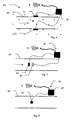
- FIGS 4a) and 4b ) show schematically an embodiment of a sensing device 43 for measuring the diameter of a blood vessel (not part of the present invention).
- This device comprises a flexible cuff 45 which is placed around a blood vessel 47.
- Cuff 45 is flexible enough to follow movement of the wall 48 of the blood vessel 47 without restricting flow through the blood vessel, while at the same time staying in contact with the blood vessel.
- Cuff 45 is provided with a stretch sensor, for example a strain gauge, 50 which in positioned in the centre of the cuff.
- This stretch sensor 50 produces an output signal S which varies as the ends 51, 53 move closer and further apart due to changes in the diameter of the blood vessel.
- data relating to the diameter of the blood vessel can be analysed to determine if eating has commenced.
- FIG. 5 shows schematically a further embodiment of a sensing device 55 for measuring the diameter of a blood vessel (not part of the present invention).
- Sensing device 55 comprises a cuff 57 which surrounds a blood vessel 58.
- Cuff 57 has a spring-loaded coiled end 61 which can coil and uncoil inside a housing 59 attached to the other end 63 of cuff 57.
- End 61 coils and uncoils to follow the diameter of the blood vessel.
- a sensor 65 inside housing 59 detects how much coiled end 61 moves and produces an output signal S which relates to the circumference of the blood vessel.
- FIG. 6 shows schematically an embodiment of an electromagnetic induction sensing device 67 for measuring the flow rate in a blood vessel 69 of a patient (not part of the present invention).
- a pair of electrodes 71, 73 are placed on opposite sides of the blood vessel and connected to a voltage measuring device 75.
- the blood vessel is subjected to a magnetic field B (represented by "x" in figure 6 ) of the order of 1 mT which acts perpendicular to the direction of blood flow.
- the voltage measuring device can produce an output signal S which can be used to determine the velocity of the blood in the blood vessel.
- the blood vessel diameter can be estimated using any suitable method and the total blood flow volume calculated.
- FIG. 7 shows schematically an embodiment of a calorimetric sensing device 81 for measuring flow velocity in a blood vessel 83 of a subject (not part of the present invention).
- a first temperature sensor 85 is mounted closely upstream of a second temperature sensor 87 in said blood vessel 83.
- First temperature sensor 85 is heated to a temperature which is slightly above blood temperature, e.g. 2° C above blood temperature.
- These sensors 85, 87 can be mounted on a lead, not shown, which contains conductors for supplying electrical energy to said second temperature sensor 87 and transmitting signals from said sensors 85, 87 to a control device (not shown).
- the temperature registered by downstream second temperature sensor 87 is influenced by the heat transferred to it from first temperature sensor 85.
- the amount of heat transferred to it from first temperature sensor 85 is influenced by the velocity of the blood flowing past it - as the blood flow increases proportionally more energy is transferred from the first sensor 85 to the second sensor 87 and an output signal S from the second sensor 87 registers an increase in temperature.
- the value of the output signal S can be used to determine the velocity of the blood in the blood vessel 83.
- FIG 8 shows schematically an embodiment of a thermistor sensing device 91 for measuring flow velocity in a blood vessel 93 of a subject (not part of the present invention).
- a thermistor 95 is mounted on a lead, not shown, which contains conductors for supplying electrical energy to said thermistor 95 and transmitting signals from said thermistor 95 to a control device 97.
- Control device 97 supplies electrical energy to thermistor 95 so that it is maintained at a constant temperature which is slightly above blood temperature, e.g. 2° C above blood temperature. The amount of electrical energy needed to maintain this temperature depends on the amount of energy lost to the blood flowing past the thermistor and is dependent on the velocity of the blood flowing past the thermistor.
- Control device 97 can monitor the current supplied to thermistor 95 and produce an output signal S related to this current and which can be used to determine the velocity of the blood in the blood vessel 93.
- Vortex counters are based on the principle that an obstruction in a fluid flow can create vortices downstream of the obstruction. Every obstruction has a critical fluid flow rate at which vortex shedding occurs. Vortex shedding causes alternating low pressure zones downstream of the obstruction which exert a downstream pull force on the obstruction. Analysis by a control device of the frequency of the vortices and the force that the low pressure exerts on the obstacle can be used to determine the fluid flow rate.
- Elbow flow meters are based on the principle that a differential pressure exists when a flowing fluid changes direction due to a pipe turn or elbow - a high pressure node forms at the outside of the bend and a low pressure node forms at the inside of the bend. Pressure transducers can be attached at the inside and outside of a bend in a blood vessel and will detect different pressures due to the pressure differential at the bend. The data from the transducers can be processed by a control device to determine the fluid flow rate.
- a patient is provided with a sensing device which can measure the perfusion, or changes in the perfusion, of an organ in the digestive system of the patient wherein increased organ activity may indicate that the patient has begun eating, or a sensing device which can measure the blood flow, or changes in the blood flow, in a blood vessel connected to the digestive system which blood vessel exhibits an increase in flow when the patient has begun eating.
- the sensing device produces an output signal which reflects variations in the perfusion of, or blood flow in, the organ or blood flow in the blood vessel. This output signal may be used to control a gastric simulator.
- the raw output signal can be transmitted from the sensing device to the gastric stimulator which itself analyses the output signal and determines from this analysis when gastric stimulation should be started and stopped or modified.
- a patient is provided with two or more sensing devices, each of which can measure the perfusion of, or blood flow in, or changes in the perfusion of, or blood flow in, an organ in the digestive system of the patient wherein increased organ activity may indicate that the patient has begun eating and/or which can measure the blood flow or changes in the blood flow in a blood vessel connected to the digestive system which blood vessel exhibits an increase in flow when the patient has begun eating.
- the sensing devices each produce an output signal which reflects variations in the perfusion of the organ or blood flow in the blood vessel. One or more of these output signals may be used to control a gastric simulator.
- the raw output signals can be transmitted from the sensing devices to the gastric stimulator which itself analyses the output signals and determines from this analysis when gastric stimulation should be started and stopped or modified.
- FIG 9 shows an example of measured blood flow amplitude (F) to the stomach of a patent during a 24 hour period (T).
- the blood flow was sampled once per minute and averaged over 15 minutes.
- the flow amplitude is in arbitrary units, for instance as a percentage of a normal level.
- Three feeding occasions can be identified from the curve in figure 9 : at 7 (7 am) in the morning, at 13 (1 pm) and 19:45 (7:45 pm).
- One way of keeping track of how many times a day the patient is eating would be to either count the number of eating occasions per day or, if storage of that information would be too memory-consuming, to create a histogram of the number of times the patient eats per day and to refresh the histogram at regular intervals, e.g. daily.
- Figure 10 is a 24-bin histogram of the blood flow amplitude data shown in figure 9 where amplitude of the column in each bin shows the duration in hours (t) for each blood flow amplitude (F). This histogram provides information on how much food the patient consumed during a 24-hour period. The amount of time that the blood flow to the patient's stomach at a high blood flow amplitude can be used to determine how active the stomach is and comparison of these daily histograms over a period of time can show if the patient's stomach is working less - i.e.
- the patient is consuming less food - or more. If, despite the use of a gastric stimulating system, analysis of the histograms show that patient is eating the same amount or more, then the stimulating regime provided by the gastric stimulating system can be modified in order to reduce the patient's intake of food.
Landscapes
- Health & Medical Sciences (AREA)
- Life Sciences & Earth Sciences (AREA)
- Engineering & Computer Science (AREA)
- Veterinary Medicine (AREA)
- Public Health (AREA)
- General Health & Medical Sciences (AREA)
- Animal Behavior & Ethology (AREA)
- Biomedical Technology (AREA)
- Molecular Biology (AREA)
- Pathology (AREA)
- Heart & Thoracic Surgery (AREA)
- Medical Informatics (AREA)
- Biophysics (AREA)
- Surgery (AREA)
- Physics & Mathematics (AREA)
- Physiology (AREA)
- Hematology (AREA)
- Cardiology (AREA)
- Gastroenterology & Hepatology (AREA)
- Nuclear Medicine, Radiotherapy & Molecular Imaging (AREA)
- Radiology & Medical Imaging (AREA)
- Endocrinology (AREA)
- Vascular Medicine (AREA)
- Measuring Pulse, Heart Rate, Blood Pressure Or Blood Flow (AREA)
Claims (5)
- Vorrichtung zum Nachweis der Nahrungsaufnahme in einer Person, dadurch gekennzeichnet, dass sie Folgendes umfasst:- einen Photoplethysmographen (2), der an einem Organ des Verdauungssystems der Person angeordnet sein kann, wobei das Organ der Magen, die Milz, die Bauchspeicheldrüse oder die Leber ist, um die Perfusion des Organs des Verdauungssystems zu messen und ein Ausgangssignal in Abhängigkeit von der Perfusion zu erzeugen, und- eine Analysevorrichtung, die angeordnet ist, um das Ausgangssignal zu analysieren, um eine Nahrungsaufnahme nachzuweisen.
- Vorrichtung nach Anspruch 1, dadurch gekennzeichnet, dass der Photoplethysmograph am Magen (3) der Person angebracht sein kann.
- Vorrichtung nach Anspruch 1 oder 2, dadurch gekennzeichnet, dass der Photoplethysmograph an einem Band oder Ring, das bzw. der um den Magen der Person herum platziert sein kann, befestigt sein kann, oder der Photoplethysmograph mit Nahtlöchern (25) versehen ist.
- Vorrichtung nach einem der vorhergehenden Ansprüche, dadurch gekennzeichnet, dass sie in einem System enthalten ist, das einen Magenstimulator zur Stimulation des Magen-Darm-Systems einer Person umfasst.
- Vorrichtung nach Anspruch 4, dadurch gekennzeichnet, dass das Ausgangssignal verwendet werden kann, um den Magenstimulator zu steuern, um die Stimulation des Magen-Darm-Systems der Person auszulösen, abzuändern und/oder anzuhalten.
Applications Claiming Priority (1)
| Application Number | Priority Date | Filing Date | Title |
|---|---|---|---|
| PCT/SE2007/000154 WO2008103077A1 (en) | 2007-02-21 | 2007-02-21 | Detect eating to initiate gastric pacing |
Publications (3)
| Publication Number | Publication Date |
|---|---|
| EP2117639A1 EP2117639A1 (de) | 2009-11-18 |
| EP2117639A4 EP2117639A4 (de) | 2010-06-16 |
| EP2117639B1 true EP2117639B1 (de) | 2013-05-22 |
Family
ID=39710280
Family Applications (1)
| Application Number | Title | Priority Date | Filing Date |
|---|---|---|---|
| EP07709366.4A Not-in-force EP2117639B1 (de) | 2007-02-21 | 2007-02-21 | Nachweis von nahrungsaufnahme zur einleitung von magen-pacing |
Country Status (3)
| Country | Link |
|---|---|
| US (1) | US20100324432A1 (de) |
| EP (1) | EP2117639B1 (de) |
| WO (1) | WO2008103077A1 (de) |
Families Citing this family (46)
| Publication number | Priority date | Publication date | Assignee | Title |
|---|---|---|---|---|
| US12343530B2 (en) | 2006-05-18 | 2025-07-01 | Paras Holdings, Llc | Device and implantation system for electrical stimulation of biological systems |
| US9020597B2 (en) | 2008-11-12 | 2015-04-28 | Endostim, Inc. | Device and implantation system for electrical stimulation of biological systems |
| US8543210B2 (en) | 2008-01-25 | 2013-09-24 | Endostim, Inc. | Device and implantation system for electrical stimulation of biological systems |
| US20150224310A1 (en) | 2006-10-09 | 2015-08-13 | Endostim, Inc. | Device and Implantation System for Electrical Stimulation of Biological Systems |
| US9724510B2 (en) | 2006-10-09 | 2017-08-08 | Endostim, Inc. | System and methods for electrical stimulation of biological systems |
| US11577077B2 (en) | 2006-10-09 | 2023-02-14 | Endostim, Inc. | Systems and methods for electrical stimulation of biological systems |
| US9345879B2 (en) | 2006-10-09 | 2016-05-24 | Endostim, Inc. | Device and implantation system for electrical stimulation of biological systems |
| US10603489B2 (en) | 2008-10-09 | 2020-03-31 | Virender K. Sharma | Methods and apparatuses for stimulating blood vessels in order to control, treat, and/or prevent a hemorrhage |
| US9079028B2 (en) | 2008-10-09 | 2015-07-14 | Virender K. Sharma | Method and apparatus for stimulating the vascular system |
| US11717681B2 (en) | 2010-03-05 | 2023-08-08 | Endostim, Inc. | Systems and methods for treating gastroesophageal reflux disease |
| US8447403B2 (en) | 2010-03-05 | 2013-05-21 | Endostim, Inc. | Device and implantation system for electrical stimulation of biological systems |
| EP3308830A1 (de) | 2011-04-14 | 2018-04-18 | Endostim, Inc. | System und verfahren zur behandlung der magen-/speiseröhren-refluxkrankheit |
| US20120277619A1 (en) * | 2011-04-29 | 2012-11-01 | Medtronic, Inc. | Detecting food intake based on impedance |
| WO2013022886A1 (en) * | 2011-08-10 | 2013-02-14 | Cardiac Pacemakers, Inc. | Determining physiological parameters using cervical impedance |
| US9037245B2 (en) | 2011-09-02 | 2015-05-19 | Endostim, Inc. | Endoscopic lead implantation method |
| US9925367B2 (en) | 2011-09-02 | 2018-03-27 | Endostim, Inc. | Laparoscopic lead implantation method |
| US9782583B2 (en) | 2012-02-21 | 2017-10-10 | Virender K. Sharma | System and method for electrical stimulation of anorectal structures to treat urinary dysfunction |
| US10576278B2 (en) | 2012-02-21 | 2020-03-03 | Virender K. Sharma | System and method for electrical stimulation of anorectal structures to treat urinary dysfunction |
| US8706234B2 (en) | 2012-02-21 | 2014-04-22 | Virender K. Sharma | System and method for electrical stimulation of anorectal structures to treat anal dysfunction |
| US10456060B2 (en) | 2012-02-22 | 2019-10-29 | Ghassan S. Kassab | Devices for detecting organ contents using impedance and methods of using the same to provide various therapies |
| US9456916B2 (en) | 2013-03-12 | 2016-10-04 | Medibotics Llc | Device for selectively reducing absorption of unhealthy food |
| AU2013305543A1 (en) | 2012-08-23 | 2015-03-19 | Endostim, Inc. | Device and implantation system for electrical stimulation of biological systems |
| US9498619B2 (en) | 2013-02-26 | 2016-11-22 | Endostim, Inc. | Implantable electrical stimulation leads |
| US9067070B2 (en) | 2013-03-12 | 2015-06-30 | Medibotics Llc | Dysgeusia-inducing neurostimulation for modifying consumption of a selected nutrient type |
| US9011365B2 (en) | 2013-03-12 | 2015-04-21 | Medibotics Llc | Adjustable gastrointestinal bifurcation (AGB) for reduced absorption of unhealthy food |
| AU2014315411A1 (en) | 2013-09-03 | 2016-03-10 | Endostim, Inc. | Methods and systems of electrode polarity switching in electrical stimulation therapy |
| EP3220999A2 (de) | 2014-11-17 | 2017-09-27 | Endostim, Inc. | Implantierbare elektromedizinische vorrichtung mit fähigkeit zur programmierung für verlängerte lebensdauer |
| US12465324B2 (en) | 2015-02-12 | 2025-11-11 | Foundry Innovation & Research 1, Ltd. | Patient fluid management systems and methods employing integrated fluid status sensing |
| WO2018031714A1 (en) | 2016-08-11 | 2018-02-15 | Foundry Innovation & Research 1, Ltd. | Systems and methods for patient fluid management |
| SG11201706394QA (en) * | 2015-02-12 | 2017-09-28 | Foundry Innovation & Res 1 Ltd | Implantable devices and related methods for heart failure monitoring |
| CN104921724A (zh) * | 2015-07-17 | 2015-09-23 | 中国医学科学院生物医学工程研究所 | 一种用于电阻抗成像检测的胃排空模拟装置 |
| US11039813B2 (en) | 2015-08-03 | 2021-06-22 | Foundry Innovation & Research 1, Ltd. | Devices and methods for measurement of Vena Cava dimensions, pressure and oxygen saturation |
| RU2626672C2 (ru) * | 2015-11-11 | 2017-07-31 | Самсунг Электроникс Ко., Лтд. | Устройство (варианты) и способ автоматического мониторинга привычек питания |
| US11206992B2 (en) | 2016-08-11 | 2021-12-28 | Foundry Innovation & Research 1, Ltd. | Wireless resonant circuit and variable inductance vascular monitoring implants and anchoring structures therefore |
| US11701018B2 (en) | 2016-08-11 | 2023-07-18 | Foundry Innovation & Research 1, Ltd. | Wireless resonant circuit and variable inductance vascular monitoring implants and anchoring structures therefore |
| WO2018094207A1 (en) | 2016-11-17 | 2018-05-24 | Endostim, Inc. | Modular stimulation system for the treatment of gastrointestinal disorders |
| US12465761B2 (en) | 2016-11-17 | 2025-11-11 | Endostim, Inc. | Electrical stimulation system for the treatment of gastrointestinal disorders |
| AU2017367100B2 (en) | 2016-11-29 | 2022-12-01 | Foundry Innovation & Research 1, Ltd. | Wireless resonant circuit and variable inductance vascular implants for monitoring patient vasculature and fluid status and systems and methods employing same |
| US12053626B2 (en) | 2017-04-06 | 2024-08-06 | Endostim, Inc. | Surface electrodes |
| US11779238B2 (en) | 2017-05-31 | 2023-10-10 | Foundry Innovation & Research 1, Ltd. | Implantable sensors for vascular monitoring |
| US11944495B2 (en) | 2017-05-31 | 2024-04-02 | Foundry Innovation & Research 1, Ltd. | Implantable ultrasonic vascular sensor |
| KR102500769B1 (ko) | 2017-12-01 | 2023-02-16 | 삼성전자주식회사 | 헬스 케어 장치 및 헬스 케어 장치의 동작 방법 |
| US11064942B1 (en) | 2018-05-04 | 2021-07-20 | Optum Labs, Llc | Methods and systems to detect eating |
| US11185260B1 (en) | 2018-08-14 | 2021-11-30 | Optum Labs, Llc | State-based methods and systems using continuous glucose monitors and accelerometers to regulate glucose levels |
| AU2022420480A1 (en) * | 2021-12-20 | 2024-07-04 | Baxter Healthcare Sa | Body-worn device for measuring blood flow |
| WO2024023791A1 (en) | 2022-07-29 | 2024-02-01 | Foundry Innovation & Research 1, Ltd. | Multistranded conductors adapted to dynamic in vivo environments |
Family Cites Families (16)
| Publication number | Priority date | Publication date | Assignee | Title |
|---|---|---|---|---|
| US5188104A (en) * | 1991-02-01 | 1993-02-23 | Cyberonics, Inc. | Treatment of eating disorders by nerve stimulation |
| US20040127800A1 (en) * | 1995-07-06 | 2004-07-01 | Kimball Victor E. | Device for assessing perfusion failure in a patient by measurement of blood flow |
| US5690691A (en) * | 1996-05-08 | 1997-11-25 | The Center For Innovative Technology | Gastro-intestinal pacemaker having phased multi-point stimulation |
| WO2004112883A2 (en) | 2003-06-20 | 2004-12-29 | Metacure N.V. | Hepatic device for treatment or glucose detection |
| US20040249421A1 (en) * | 2000-09-13 | 2004-12-09 | Impulse Dynamics Nv | Blood glucose level control |
| US8019421B2 (en) * | 1999-03-05 | 2011-09-13 | Metacure Limited | Blood glucose level control |
| EP2027816B1 (de) * | 2000-07-19 | 2012-06-20 | Innovamédica S.A. de C.V. | Katheter zur ischämischer Überwachung von Schleimhautschäden von viskosen Hohlorgane |
| US7160258B2 (en) * | 2001-06-26 | 2007-01-09 | Entrack, Inc. | Capsule and method for treating or diagnosing the intestinal tract |
| US20070060971A1 (en) * | 2003-07-21 | 2007-03-15 | Ofer Glasberg | Hepatic device for treatment or glucose detection |
| US20050149142A1 (en) * | 2004-01-07 | 2005-07-07 | Starkebaum Warren L. | Gastric stimulation responsive to sensing feedback |
| WO2006049725A2 (en) * | 2004-03-23 | 2006-05-11 | Minimus Surgical Systems | Surgical systems and devices to enhance gastric restriction therapies |
| US20050222638A1 (en) * | 2004-03-30 | 2005-10-06 | Steve Foley | Sensor based gastrointestinal electrical stimulation for the treatment of obesity or motility disorders |
| US7483746B2 (en) * | 2004-12-06 | 2009-01-27 | Boston Scientific Neuromodulation Corp. | Stimulation of the stomach in response to sensed parameters to treat obesity |
| US7341562B2 (en) * | 2004-12-15 | 2008-03-11 | Neuropace, Inc. | Modulation and analysis of cerebral perfusion in epilepsy and other neurological disorders |
| EP2260756A1 (de) * | 2005-08-09 | 2010-12-15 | Flore, Ingo | Medizinische Messvorrichtung |
| US20070265646A1 (en) * | 2006-01-17 | 2007-11-15 | Ellipse Technologies, Inc. | Dynamically adjustable gastric implants |
-
2007
- 2007-02-21 EP EP07709366.4A patent/EP2117639B1/de not_active Not-in-force
- 2007-02-21 WO PCT/SE2007/000154 patent/WO2008103077A1/en not_active Ceased
- 2007-02-21 US US12/526,137 patent/US20100324432A1/en not_active Abandoned
Also Published As
| Publication number | Publication date |
|---|---|
| EP2117639A4 (de) | 2010-06-16 |
| US20100324432A1 (en) | 2010-12-23 |
| EP2117639A1 (de) | 2009-11-18 |
| WO2008103077A1 (en) | 2008-08-28 |
Similar Documents
| Publication | Publication Date | Title |
|---|---|---|
| EP2117639B1 (de) | Nachweis von nahrungsaufnahme zur einleitung von magen-pacing | |
| AU2020289809B2 (en) | Non-invasive detection of the backflow of urine | |
| US8172762B2 (en) | Simultaneous blood flow and hematocrit sensor | |
| US9662240B2 (en) | Feedback systems and methods to enhance obstructive and other obesity treatments, optionally using multiple sensors | |
| JP5591794B2 (ja) | 患者の心臓を監視する装置 | |
| CN105142515B (zh) | 测定有利于唤醒的人类睡眠阶段的方法 | |
| US7899526B2 (en) | Portable device for monitoring electrocardiographic signals and indices of blood flow | |
| KR100926155B1 (ko) | 글루코스 레벨 모니터링 방법 | |
| JPH07508662A (ja) | 経皮的に配置される電気による腸のペースメーカー | |
| US20070255154A1 (en) | Activity level feedback for managing obesity | |
| JP2014522713A (ja) | 頚部インピーダンスを使用する生理学的パラメータの判定 | |
| Semproni et al. | Bladder monitoring systems: State of the art and future perspectives | |
| JP2004523328A (ja) | 食習慣の解析 | |
| US8965493B2 (en) | Electromedical implant and monitoring system | |
| Harkin et al. | A study of VitalView™ for behavioural and physiological monitoring in laboratory rats | |
| GB2443935A (en) | A method and device for monitoring exercise using hemodynamic sensors mounted in a wristop device | |
| WO2011119812A2 (en) | Methods and devices for diagnosing and treating vocal cord dysfunction | |
| KR101879634B1 (ko) | 심폐혈관 모니터링 시스템 | |
| JP2003529434A (ja) | 身体流測定システム | |
| CN101889860A (zh) | 一种脑血流调节功能检测装置 | |
| Mendez et al. | Chronic monitoring of bladder volume: a critical review and assessment of measurement methods | |
| US20140005554A1 (en) | Telemetric Sensing of Blood Flow Rates by Passive Infrared Temperature Sensing | |
| JPH04300562A (ja) | 電気的薬剤導入装置 | |
| JP2025537204A (ja) | 腹腔内の健康状態を評価するための方法およびシステム | |
| JPH06277300A (ja) | 電気的薬剤導入装置 |
Legal Events
| Date | Code | Title | Description |
|---|---|---|---|
| PUAI | Public reference made under article 153(3) epc to a published international application that has entered the european phase |
Free format text: ORIGINAL CODE: 0009012 |
|
| 17P | Request for examination filed |
Effective date: 20090921 |
|
| AK | Designated contracting states |
Kind code of ref document: A1 Designated state(s): AT BE BG CH CY CZ DE DK EE ES FI FR GB GR HU IE IS IT LI LT LU LV MC NL PL PT RO SE SI SK TR |
|
| DAX | Request for extension of the european patent (deleted) | ||
| A4 | Supplementary search report drawn up and despatched |
Effective date: 20100518 |
|
| GRAP | Despatch of communication of intention to grant a patent |
Free format text: ORIGINAL CODE: EPIDOSNIGR1 |
|
| GRAP | Despatch of communication of intention to grant a patent |
Free format text: ORIGINAL CODE: EPIDOSNIGR1 |
|
| GRAS | Grant fee paid |
Free format text: ORIGINAL CODE: EPIDOSNIGR3 |
|
| GRAA | (expected) grant |
Free format text: ORIGINAL CODE: 0009210 |
|
| INTG | Intention to grant announced |
Effective date: 20130327 |
|
| GRAL | Information related to payment of fee for publishing/printing deleted |
Free format text: ORIGINAL CODE: EPIDOSDIGR3 |
|
| GRAS | Grant fee paid |
Free format text: ORIGINAL CODE: EPIDOSNIGR3 |
|
| AK | Designated contracting states |
Kind code of ref document: B1 Designated state(s): AT BE BG CH CY CZ DE DK EE ES FI FR GB GR HU IE IS IT LI LT LU LV MC NL PL PT RO SE SI SK TR |
|
| REG | Reference to a national code |
Ref country code: GB Ref legal event code: FG4D |
|
| REG | Reference to a national code |
Ref country code: CH Ref legal event code: EP |
|
| REG | Reference to a national code |
Ref country code: AT Ref legal event code: REF Ref document number: 612885 Country of ref document: AT Kind code of ref document: T Effective date: 20130615 |
|
| REG | Reference to a national code |
Ref country code: IE Ref legal event code: FG4D |
|
| REG | Reference to a national code |
Ref country code: CH Ref legal event code: NV Representative=s name: E. BLUM AND CO. AG PATENT- UND MARKENANWAELTE , CH |
|
| REG | Reference to a national code |
Ref country code: DE Ref legal event code: R096 Ref document number: 602007030586 Country of ref document: DE Effective date: 20130718 |
|
| REG | Reference to a national code |
Ref country code: AT Ref legal event code: MK05 Ref document number: 612885 Country of ref document: AT Kind code of ref document: T Effective date: 20130522 |
|
| REG | Reference to a national code |
Ref country code: LT Ref legal event code: MG4D |
|
| PG25 | Lapsed in a contracting state [announced via postgrant information from national office to epo] |
Ref country code: FI Free format text: LAPSE BECAUSE OF FAILURE TO SUBMIT A TRANSLATION OF THE DESCRIPTION OR TO PAY THE FEE WITHIN THE PRESCRIBED TIME-LIMIT Effective date: 20130522 Ref country code: AT Free format text: LAPSE BECAUSE OF FAILURE TO SUBMIT A TRANSLATION OF THE DESCRIPTION OR TO PAY THE FEE WITHIN THE PRESCRIBED TIME-LIMIT Effective date: 20130522 Ref country code: PT Free format text: LAPSE BECAUSE OF FAILURE TO SUBMIT A TRANSLATION OF THE DESCRIPTION OR TO PAY THE FEE WITHIN THE PRESCRIBED TIME-LIMIT Effective date: 20130923 Ref country code: IS Free format text: LAPSE BECAUSE OF FAILURE TO SUBMIT A TRANSLATION OF THE DESCRIPTION OR TO PAY THE FEE WITHIN THE PRESCRIBED TIME-LIMIT Effective date: 20130922 Ref country code: ES Free format text: LAPSE BECAUSE OF FAILURE TO SUBMIT A TRANSLATION OF THE DESCRIPTION OR TO PAY THE FEE WITHIN THE PRESCRIBED TIME-LIMIT Effective date: 20130902 Ref country code: SI Free format text: LAPSE BECAUSE OF FAILURE TO SUBMIT A TRANSLATION OF THE DESCRIPTION OR TO PAY THE FEE WITHIN THE PRESCRIBED TIME-LIMIT Effective date: 20130522 Ref country code: SE Free format text: LAPSE BECAUSE OF FAILURE TO SUBMIT A TRANSLATION OF THE DESCRIPTION OR TO PAY THE FEE WITHIN THE PRESCRIBED TIME-LIMIT Effective date: 20130522 Ref country code: LT Free format text: LAPSE BECAUSE OF FAILURE TO SUBMIT A TRANSLATION OF THE DESCRIPTION OR TO PAY THE FEE WITHIN THE PRESCRIBED TIME-LIMIT Effective date: 20130522 Ref country code: GR Free format text: LAPSE BECAUSE OF FAILURE TO SUBMIT A TRANSLATION OF THE DESCRIPTION OR TO PAY THE FEE WITHIN THE PRESCRIBED TIME-LIMIT Effective date: 20130823 |
|
| REG | Reference to a national code |
Ref country code: NL Ref legal event code: VDEP Effective date: 20130522 |
|
| PG25 | Lapsed in a contracting state [announced via postgrant information from national office to epo] |
Ref country code: PL Free format text: LAPSE BECAUSE OF FAILURE TO SUBMIT A TRANSLATION OF THE DESCRIPTION OR TO PAY THE FEE WITHIN THE PRESCRIBED TIME-LIMIT Effective date: 20130522 Ref country code: BG Free format text: LAPSE BECAUSE OF FAILURE TO SUBMIT A TRANSLATION OF THE DESCRIPTION OR TO PAY THE FEE WITHIN THE PRESCRIBED TIME-LIMIT Effective date: 20130822 |
|
| PG25 | Lapsed in a contracting state [announced via postgrant information from national office to epo] |
Ref country code: LV Free format text: LAPSE BECAUSE OF FAILURE TO SUBMIT A TRANSLATION OF THE DESCRIPTION OR TO PAY THE FEE WITHIN THE PRESCRIBED TIME-LIMIT Effective date: 20130522 |
|
| PG25 | Lapsed in a contracting state [announced via postgrant information from national office to epo] |
Ref country code: DK Free format text: LAPSE BECAUSE OF FAILURE TO SUBMIT A TRANSLATION OF THE DESCRIPTION OR TO PAY THE FEE WITHIN THE PRESCRIBED TIME-LIMIT Effective date: 20130522 Ref country code: BE Free format text: LAPSE BECAUSE OF FAILURE TO SUBMIT A TRANSLATION OF THE DESCRIPTION OR TO PAY THE FEE WITHIN THE PRESCRIBED TIME-LIMIT Effective date: 20130522 Ref country code: EE Free format text: LAPSE BECAUSE OF FAILURE TO SUBMIT A TRANSLATION OF THE DESCRIPTION OR TO PAY THE FEE WITHIN THE PRESCRIBED TIME-LIMIT Effective date: 20130522 Ref country code: SK Free format text: LAPSE BECAUSE OF FAILURE TO SUBMIT A TRANSLATION OF THE DESCRIPTION OR TO PAY THE FEE WITHIN THE PRESCRIBED TIME-LIMIT Effective date: 20130522 Ref country code: CZ Free format text: LAPSE BECAUSE OF FAILURE TO SUBMIT A TRANSLATION OF THE DESCRIPTION OR TO PAY THE FEE WITHIN THE PRESCRIBED TIME-LIMIT Effective date: 20130522 |
|
| PG25 | Lapsed in a contracting state [announced via postgrant information from national office to epo] |
Ref country code: NL Free format text: LAPSE BECAUSE OF FAILURE TO SUBMIT A TRANSLATION OF THE DESCRIPTION OR TO PAY THE FEE WITHIN THE PRESCRIBED TIME-LIMIT Effective date: 20130522 Ref country code: RO Free format text: LAPSE BECAUSE OF FAILURE TO SUBMIT A TRANSLATION OF THE DESCRIPTION OR TO PAY THE FEE WITHIN THE PRESCRIBED TIME-LIMIT Effective date: 20130522 |
|
| PLBE | No opposition filed within time limit |
Free format text: ORIGINAL CODE: 0009261 |
|
| STAA | Information on the status of an ep patent application or granted ep patent |
Free format text: STATUS: NO OPPOSITION FILED WITHIN TIME LIMIT |
|
| 26N | No opposition filed |
Effective date: 20140225 |
|
| REG | Reference to a national code |
Ref country code: DE Ref legal event code: R097 Ref document number: 602007030586 Country of ref document: DE Effective date: 20140225 |
|
| PG25 | Lapsed in a contracting state [announced via postgrant information from national office to epo] |
Ref country code: MC Free format text: LAPSE BECAUSE OF FAILURE TO SUBMIT A TRANSLATION OF THE DESCRIPTION OR TO PAY THE FEE WITHIN THE PRESCRIBED TIME-LIMIT Effective date: 20130522 Ref country code: LU Free format text: LAPSE BECAUSE OF FAILURE TO SUBMIT A TRANSLATION OF THE DESCRIPTION OR TO PAY THE FEE WITHIN THE PRESCRIBED TIME-LIMIT Effective date: 20140221 |
|
| GBPC | Gb: european patent ceased through non-payment of renewal fee |
Effective date: 20140221 |
|
| REG | Reference to a national code |
Ref country code: IE Ref legal event code: MM4A |
|
| PG25 | Lapsed in a contracting state [announced via postgrant information from national office to epo] |
Ref country code: IE Free format text: LAPSE BECAUSE OF NON-PAYMENT OF DUE FEES Effective date: 20140221 Ref country code: GB Free format text: LAPSE BECAUSE OF NON-PAYMENT OF DUE FEES Effective date: 20140221 |
|
| PGFP | Annual fee paid to national office [announced via postgrant information from national office to epo] |
Ref country code: CH Payment date: 20150226 Year of fee payment: 9 |
|
| REG | Reference to a national code |
Ref country code: FR Ref legal event code: PLFP Year of fee payment: 10 |
|
| PGFP | Annual fee paid to national office [announced via postgrant information from national office to epo] |
Ref country code: IT Payment date: 20160223 Year of fee payment: 10 |
|
| PGFP | Annual fee paid to national office [announced via postgrant information from national office to epo] |
Ref country code: FR Payment date: 20160217 Year of fee payment: 10 |
|
| PG25 | Lapsed in a contracting state [announced via postgrant information from national office to epo] |
Ref country code: CY Free format text: LAPSE BECAUSE OF FAILURE TO SUBMIT A TRANSLATION OF THE DESCRIPTION OR TO PAY THE FEE WITHIN THE PRESCRIBED TIME-LIMIT Effective date: 20130522 |
|
| PG25 | Lapsed in a contracting state [announced via postgrant information from national office to epo] |
Ref country code: HU Free format text: LAPSE BECAUSE OF FAILURE TO SUBMIT A TRANSLATION OF THE DESCRIPTION OR TO PAY THE FEE WITHIN THE PRESCRIBED TIME-LIMIT; INVALID AB INITIO Effective date: 20070221 Ref country code: TR Free format text: LAPSE BECAUSE OF FAILURE TO SUBMIT A TRANSLATION OF THE DESCRIPTION OR TO PAY THE FEE WITHIN THE PRESCRIBED TIME-LIMIT Effective date: 20130522 |
|
| REG | Reference to a national code |
Ref country code: CH Ref legal event code: PL |
|
| PG25 | Lapsed in a contracting state [announced via postgrant information from national office to epo] |
Ref country code: LI Free format text: LAPSE BECAUSE OF NON-PAYMENT OF DUE FEES Effective date: 20160229 Ref country code: CH Free format text: LAPSE BECAUSE OF NON-PAYMENT OF DUE FEES Effective date: 20160229 |
|
| REG | Reference to a national code |
Ref country code: FR Ref legal event code: ST Effective date: 20171031 |
|
| PG25 | Lapsed in a contracting state [announced via postgrant information from national office to epo] |
Ref country code: FR Free format text: LAPSE BECAUSE OF NON-PAYMENT OF DUE FEES Effective date: 20170228 |
|
| PG25 | Lapsed in a contracting state [announced via postgrant information from national office to epo] |
Ref country code: IT Free format text: LAPSE BECAUSE OF NON-PAYMENT OF DUE FEES Effective date: 20170221 |
|
| PGFP | Annual fee paid to national office [announced via postgrant information from national office to epo] |
Ref country code: DE Payment date: 20190115 Year of fee payment: 13 |
|
| PGFP | Annual fee paid to national office [announced via postgrant information from national office to epo] |
Ref country code: DE Payment date: 20190115 Year of fee payment: 13 |
|
| REG | Reference to a national code |
Ref country code: DE Ref legal event code: R119 Ref document number: 602007030586 Country of ref document: DE |
|
| PG25 | Lapsed in a contracting state [announced via postgrant information from national office to epo] |
Ref country code: DE Free format text: LAPSE BECAUSE OF NON-PAYMENT OF DUE FEES Effective date: 20200901 |
|
| P01 | Opt-out of the competence of the unified patent court (upc) registered |
Effective date: 20230602 |