EP2109501B1 - Radial mixing devices for rotating inclined reactors - Google Patents
Radial mixing devices for rotating inclined reactors Download PDFInfo
- Publication number
- EP2109501B1 EP2109501B1 EP08708705A EP08708705A EP2109501B1 EP 2109501 B1 EP2109501 B1 EP 2109501B1 EP 08708705 A EP08708705 A EP 08708705A EP 08708705 A EP08708705 A EP 08708705A EP 2109501 B1 EP2109501 B1 EP 2109501B1
- Authority
- EP
- European Patent Office
- Prior art keywords
- reactor
- mixing device
- length
- rotation
- mixing
- Prior art date
- Legal status (The legal status is an assumption and is not a legal conclusion. Google has not performed a legal analysis and makes no representation as to the accuracy of the status listed.)
- Active
Links
- 0 CCC1C=C(C)C2C1C(C)C([C@@](C)*(C)=C)=CC2 Chemical compound CCC1C=C(C)C2C1C(C)C([C@@](C)*(C)=C)=CC2 0.000 description 1
Images





Classifications
-
- B—PERFORMING OPERATIONS; TRANSPORTING
- B01—PHYSICAL OR CHEMICAL PROCESSES OR APPARATUS IN GENERAL
- B01J—CHEMICAL OR PHYSICAL PROCESSES, e.g. CATALYSIS OR COLLOID CHEMISTRY; THEIR RELEVANT APPARATUS
- B01J19/00—Chemical, physical or physico-chemical processes in general; Their relevant apparatus
- B01J19/18—Stationary reactors having moving elements inside
- B01J19/20—Stationary reactors having moving elements inside in the form of helices, e.g. screw reactors
-
- C—CHEMISTRY; METALLURGY
- C08—ORGANIC MACROMOLECULAR COMPOUNDS; THEIR PREPARATION OR CHEMICAL WORKING-UP; COMPOSITIONS BASED THEREON
- C08G—MACROMOLECULAR COMPOUNDS OBTAINED OTHERWISE THAN BY REACTIONS ONLY INVOLVING UNSATURATED CARBON-TO-CARBON BONDS
- C08G63/00—Macromolecular compounds obtained by reactions forming a carboxylic ester link in the main chain of the macromolecule
- C08G63/78—Preparation processes
- C08G63/785—Preparation processes characterised by the apparatus used
-
- B—PERFORMING OPERATIONS; TRANSPORTING
- B01—PHYSICAL OR CHEMICAL PROCESSES OR APPARATUS IN GENERAL
- B01F—MIXING, e.g. DISSOLVING, EMULSIFYING OR DISPERSING
- B01F29/00—Mixers with rotating receptacles
- B01F29/40—Parts or components, e.g. receptacles, feeding or discharging means
- B01F29/401—Receptacles, e.g. provided with liners
- B01F29/4011—Receptacles, e.g. provided with liners characterised by the shape or cross-section of the receptacle, e.g. of Y-, Z -, S -, or X shape
- B01F29/40112—Polygonal sections, e.g. triangularor square
-
- B—PERFORMING OPERATIONS; TRANSPORTING
- B01—PHYSICAL OR CHEMICAL PROCESSES OR APPARATUS IN GENERAL
- B01F—MIXING, e.g. DISSOLVING, EMULSIFYING OR DISPERSING
- B01F29/00—Mixers with rotating receptacles
- B01F29/40—Parts or components, e.g. receptacles, feeding or discharging means
- B01F29/403—Disposition of the rotor axis
- B01F29/4033—Disposition of the rotor axis inclined
-
- B—PERFORMING OPERATIONS; TRANSPORTING
- B01—PHYSICAL OR CHEMICAL PROCESSES OR APPARATUS IN GENERAL
- B01F—MIXING, e.g. DISSOLVING, EMULSIFYING OR DISPERSING
- B01F29/00—Mixers with rotating receptacles
- B01F29/60—Mixers with rotating receptacles rotating about a horizontal or inclined axis, e.g. drum mixers
-
- B—PERFORMING OPERATIONS; TRANSPORTING
- B01—PHYSICAL OR CHEMICAL PROCESSES OR APPARATUS IN GENERAL
- B01F—MIXING, e.g. DISSOLVING, EMULSIFYING OR DISPERSING
- B01F29/00—Mixers with rotating receptacles
- B01F29/60—Mixers with rotating receptacles rotating about a horizontal or inclined axis, e.g. drum mixers
- B01F29/63—Mixers with rotating receptacles rotating about a horizontal or inclined axis, e.g. drum mixers with fixed bars, i.e. stationary, or fixed on the receptacle
-
- B—PERFORMING OPERATIONS; TRANSPORTING
- B01—PHYSICAL OR CHEMICAL PROCESSES OR APPARATUS IN GENERAL
- B01F—MIXING, e.g. DISSOLVING, EMULSIFYING OR DISPERSING
- B01F33/00—Other mixers; Mixing plants; Combinations of mixers
- B01F33/40—Mixers using gas or liquid agitation, e.g. with air supply tubes
-
- B—PERFORMING OPERATIONS; TRANSPORTING
- B01—PHYSICAL OR CHEMICAL PROCESSES OR APPARATUS IN GENERAL
- B01J—CHEMICAL OR PHYSICAL PROCESSES, e.g. CATALYSIS OR COLLOID CHEMISTRY; THEIR RELEVANT APPARATUS
- B01J19/00—Chemical, physical or physico-chemical processes in general; Their relevant apparatus
- B01J19/0053—Details of the reactor
- B01J19/006—Baffles
-
- B—PERFORMING OPERATIONS; TRANSPORTING
- B01—PHYSICAL OR CHEMICAL PROCESSES OR APPARATUS IN GENERAL
- B01J—CHEMICAL OR PHYSICAL PROCESSES, e.g. CATALYSIS OR COLLOID CHEMISTRY; THEIR RELEVANT APPARATUS
- B01J19/00—Chemical, physical or physico-chemical processes in general; Their relevant apparatus
- B01J19/24—Stationary reactors without moving elements inside
- B01J19/2405—Stationary reactors without moving elements inside provoking a turbulent flow of the reactants, such as in cyclones, or having a high Reynolds-number
-
- B—PERFORMING OPERATIONS; TRANSPORTING
- B01—PHYSICAL OR CHEMICAL PROCESSES OR APPARATUS IN GENERAL
- B01J—CHEMICAL OR PHYSICAL PROCESSES, e.g. CATALYSIS OR COLLOID CHEMISTRY; THEIR RELEVANT APPARATUS
- B01J19/00—Chemical, physical or physico-chemical processes in general; Their relevant apparatus
- B01J19/26—Nozzle-type reactors, i.e. the distribution of the initial reactants within the reactor is effected by their introduction or injection through nozzles
-
- B—PERFORMING OPERATIONS; TRANSPORTING
- B01—PHYSICAL OR CHEMICAL PROCESSES OR APPARATUS IN GENERAL
- B01J—CHEMICAL OR PHYSICAL PROCESSES, e.g. CATALYSIS OR COLLOID CHEMISTRY; THEIR RELEVANT APPARATUS
- B01J19/00—Chemical, physical or physico-chemical processes in general; Their relevant apparatus
- B01J19/28—Moving reactors, e.g. rotary drums
-
- B—PERFORMING OPERATIONS; TRANSPORTING
- B01—PHYSICAL OR CHEMICAL PROCESSES OR APPARATUS IN GENERAL
- B01J—CHEMICAL OR PHYSICAL PROCESSES, e.g. CATALYSIS OR COLLOID CHEMISTRY; THEIR RELEVANT APPARATUS
- B01J4/00—Feed or outlet devices; Feed or outlet control devices
- B01J4/001—Feed or outlet devices as such, e.g. feeding tubes
- B01J4/002—Nozzle-type elements
-
- B—PERFORMING OPERATIONS; TRANSPORTING
- B01—PHYSICAL OR CHEMICAL PROCESSES OR APPARATUS IN GENERAL
- B01J—CHEMICAL OR PHYSICAL PROCESSES, e.g. CATALYSIS OR COLLOID CHEMISTRY; THEIR RELEVANT APPARATUS
- B01J6/00—Heat treatments such as Calcining; Fusing ; Pyrolysis
- B01J6/001—Calcining
- B01J6/002—Calcining using rotating drums
-
- B—PERFORMING OPERATIONS; TRANSPORTING
- B01—PHYSICAL OR CHEMICAL PROCESSES OR APPARATUS IN GENERAL
- B01J—CHEMICAL OR PHYSICAL PROCESSES, e.g. CATALYSIS OR COLLOID CHEMISTRY; THEIR RELEVANT APPARATUS
- B01J8/00—Chemical or physical processes in general, conducted in the presence of fluids and solid particles; Apparatus for such processes
- B01J8/18—Chemical or physical processes in general, conducted in the presence of fluids and solid particles; Apparatus for such processes with fluidised particles
-
- B—PERFORMING OPERATIONS; TRANSPORTING
- B01—PHYSICAL OR CHEMICAL PROCESSES OR APPARATUS IN GENERAL
- B01J—CHEMICAL OR PHYSICAL PROCESSES, e.g. CATALYSIS OR COLLOID CHEMISTRY; THEIR RELEVANT APPARATUS
- B01J8/00—Chemical or physical processes in general, conducted in the presence of fluids and solid particles; Apparatus for such processes
- B01J8/18—Chemical or physical processes in general, conducted in the presence of fluids and solid particles; Apparatus for such processes with fluidised particles
- B01J8/24—Chemical or physical processes in general, conducted in the presence of fluids and solid particles; Apparatus for such processes with fluidised particles according to "fluidised-bed" technique
-
- C—CHEMISTRY; METALLURGY
- C08—ORGANIC MACROMOLECULAR COMPOUNDS; THEIR PREPARATION OR CHEMICAL WORKING-UP; COMPOSITIONS BASED THEREON
- C08G—MACROMOLECULAR COMPOUNDS OBTAINED OTHERWISE THAN BY REACTIONS ONLY INVOLVING UNSATURATED CARBON-TO-CARBON BONDS
- C08G63/00—Macromolecular compounds obtained by reactions forming a carboxylic ester link in the main chain of the macromolecule
- C08G63/78—Preparation processes
- C08G63/80—Solid-state polycondensation
-
- B—PERFORMING OPERATIONS; TRANSPORTING
- B01—PHYSICAL OR CHEMICAL PROCESSES OR APPARATUS IN GENERAL
- B01J—CHEMICAL OR PHYSICAL PROCESSES, e.g. CATALYSIS OR COLLOID CHEMISTRY; THEIR RELEVANT APPARATUS
- B01J2219/00—Chemical, physical or physico-chemical processes in general; Their relevant apparatus
- B01J2219/00002—Chemical plants
- B01J2219/00027—Process aspects
- B01J2219/0004—Processes in series
-
- B—PERFORMING OPERATIONS; TRANSPORTING
- B01—PHYSICAL OR CHEMICAL PROCESSES OR APPARATUS IN GENERAL
- B01J—CHEMICAL OR PHYSICAL PROCESSES, e.g. CATALYSIS OR COLLOID CHEMISTRY; THEIR RELEVANT APPARATUS
- B01J2219/00—Chemical, physical or physico-chemical processes in general; Their relevant apparatus
- B01J2219/00049—Controlling or regulating processes
- B01J2219/00164—Controlling or regulating processes controlling the flow
- B01J2219/00166—Controlling or regulating processes controlling the flow controlling the residence time inside the reactor vessel
-
- B—PERFORMING OPERATIONS; TRANSPORTING
- B01—PHYSICAL OR CHEMICAL PROCESSES OR APPARATUS IN GENERAL
- B01J—CHEMICAL OR PHYSICAL PROCESSES, e.g. CATALYSIS OR COLLOID CHEMISTRY; THEIR RELEVANT APPARATUS
- B01J2219/00—Chemical, physical or physico-chemical processes in general; Their relevant apparatus
- B01J2219/00049—Controlling or regulating processes
- B01J2219/00168—Controlling or regulating processes controlling the viscosity
-
- B—PERFORMING OPERATIONS; TRANSPORTING
- B01—PHYSICAL OR CHEMICAL PROCESSES OR APPARATUS IN GENERAL
- B01J—CHEMICAL OR PHYSICAL PROCESSES, e.g. CATALYSIS OR COLLOID CHEMISTRY; THEIR RELEVANT APPARATUS
- B01J2219/00—Chemical, physical or physico-chemical processes in general; Their relevant apparatus
- B01J2219/00761—Details of the reactor
- B01J2219/00763—Baffles
- B01J2219/00765—Baffles attached to the reactor wall
- B01J2219/00768—Baffles attached to the reactor wall vertical
-
- B—PERFORMING OPERATIONS; TRANSPORTING
- B01—PHYSICAL OR CHEMICAL PROCESSES OR APPARATUS IN GENERAL
- B01J—CHEMICAL OR PHYSICAL PROCESSES, e.g. CATALYSIS OR COLLOID CHEMISTRY; THEIR RELEVANT APPARATUS
- B01J2219/00—Chemical, physical or physico-chemical processes in general; Their relevant apparatus
- B01J2219/00761—Details of the reactor
- B01J2219/00763—Baffles
- B01J2219/00765—Baffles attached to the reactor wall
- B01J2219/0077—Baffles attached to the reactor wall inclined
-
- B—PERFORMING OPERATIONS; TRANSPORTING
- B01—PHYSICAL OR CHEMICAL PROCESSES OR APPARATUS IN GENERAL
- B01J—CHEMICAL OR PHYSICAL PROCESSES, e.g. CATALYSIS OR COLLOID CHEMISTRY; THEIR RELEVANT APPARATUS
- B01J2219/00—Chemical, physical or physico-chemical processes in general; Their relevant apparatus
- B01J2219/00761—Details of the reactor
- B01J2219/00763—Baffles
- B01J2219/00765—Baffles attached to the reactor wall
- B01J2219/0077—Baffles attached to the reactor wall inclined
- B01J2219/00772—Baffles attached to the reactor wall inclined in a helix
-
- B—PERFORMING OPERATIONS; TRANSPORTING
- B01—PHYSICAL OR CHEMICAL PROCESSES OR APPARATUS IN GENERAL
- B01J—CHEMICAL OR PHYSICAL PROCESSES, e.g. CATALYSIS OR COLLOID CHEMISTRY; THEIR RELEVANT APPARATUS
- B01J2219/00—Chemical, physical or physico-chemical processes in general; Their relevant apparatus
- B01J2219/00761—Details of the reactor
- B01J2219/00763—Baffles
- B01J2219/00765—Baffles attached to the reactor wall
- B01J2219/00777—Baffles attached to the reactor wall horizontal
-
- B—PERFORMING OPERATIONS; TRANSPORTING
- B01—PHYSICAL OR CHEMICAL PROCESSES OR APPARATUS IN GENERAL
- B01J—CHEMICAL OR PHYSICAL PROCESSES, e.g. CATALYSIS OR COLLOID CHEMISTRY; THEIR RELEVANT APPARATUS
- B01J2219/00—Chemical, physical or physico-chemical processes in general; Their relevant apparatus
- B01J2219/18—Details relating to the spatial orientation of the reactor
- B01J2219/187—Details relating to the spatial orientation of the reactor inclined at an angle to the horizontal or to the vertical plane
-
- B—PERFORMING OPERATIONS; TRANSPORTING
- B01—PHYSICAL OR CHEMICAL PROCESSES OR APPARATUS IN GENERAL
- B01J—CHEMICAL OR PHYSICAL PROCESSES, e.g. CATALYSIS OR COLLOID CHEMISTRY; THEIR RELEVANT APPARATUS
- B01J2219/00—Chemical, physical or physico-chemical processes in general; Their relevant apparatus
- B01J2219/19—Details relating to the geometry of the reactor
- B01J2219/192—Details relating to the geometry of the reactor polygonal
- B01J2219/1923—Details relating to the geometry of the reactor polygonal square or square-derived
-
- B—PERFORMING OPERATIONS; TRANSPORTING
- B01—PHYSICAL OR CHEMICAL PROCESSES OR APPARATUS IN GENERAL
- B01J—CHEMICAL OR PHYSICAL PROCESSES, e.g. CATALYSIS OR COLLOID CHEMISTRY; THEIR RELEVANT APPARATUS
- B01J2219/00—Chemical, physical or physico-chemical processes in general; Their relevant apparatus
- B01J2219/19—Details relating to the geometry of the reactor
- B01J2219/194—Details relating to the geometry of the reactor round
- B01J2219/1941—Details relating to the geometry of the reactor round circular or disk-shaped
- B01J2219/1943—Details relating to the geometry of the reactor round circular or disk-shaped cylindrical
Definitions
- Rotary Kiln or cement kiln reactors for thermally treating plastic pellets, or chips, in particular granules, pellets or chips of crystallizable polyesters containing at least 75% of their acid units derived from terephthalic acid, orthophthalic acid, 2,6 naphthalate dicarboxylic acid or their respective diesters has been described previously in the patent application WO 2004/018541 .
- An essential feature of WO 2004/018541 is the use of plug flow like behaviour to achieve uniformity of the properties of the granules at the exit. While WO 2004/018541 contemplates the use of baffles or internals it does nothing to teach the design of such baffles necessary to increase the mixing in the radial turning direction and yet maintain plug flow like behaviour.
- US 3,767,601 describes a rotary kiln reactor for polyester flake with internals for good mixing.
- US 3,767,601 discloses kilns with internals for both batch and continuous processes. A batch process by definition cannot have plug flow, and nothing in US 3,767,601 1 indicates that the internals are specially configured for mixing while maintaining plug flow like behaviour.
- This specification discloses a horizontal rotating reactor having an axis of rotation, wherein the axis of rotation is not parallel to the horizontal line perpendicular to the force of gravity and wherein the horizontal reactor has at least one mixing device wherein the mixing device has a height, width, and an equivalent length defined as the distance between the plane perpendicular to the axis of rotation that contains the point where the mixing device first protrudes from the wall and the plane perpendicular to the axis of rotation that contains the point where the mixing device stops protruding from the wall and the equivalent length of the mixing device is selected from the group consisting of equivalent lengths less than 1/10 th the length of the reactor.
- Further more preferred equivalent lengths of the mixing device are less than 1/12 th the length of the reactor, less than 1/14 th the length of the reactor, less than 1/15 th the length of the reactor, less than 1/16 th the length of the reactor, 1/18 th the length of the reactor and less than 1/20 th the length of the reactor. It is further disclosed that there is more than one mixing device.
- At least one of the mixing devices has holes to introduce a purge gas into the reactor. It is disclosed that there are two or more mixing devices with holes. It is further disclosed that when there are two or more mixing devices with holes, the mixing devices are connected in a manner so that the purge gas can pass from the first mixing device to the second mixing device through a connection.
- Described and claimed herein is that discovery that when the equivalent length of the internal mixing device is greater than about 1/10 th the length of the horizontal reactor, the axial mixing component is greater than the reactor without a mixing device, but when the equivalent length of the mixing device is less than about 1/10 th , in particular less than 1/20 th , the length of the horizontal reactor, the degree of plug flow, as defined herein, increases, rather than decreases, as evidenced by the increased radial flow component, without a corresponding increase in axial flow component.
- the internal is referred to as a mixing device, or mixing devices if more than one is present.
- the mixing device is also known as a baffle or lifter. This internal is particularly useful in rotating reactors used to increase the intrinsic viscosity of polyester resins.
- CSTR reactor Continuous Stirred Tank Reactor
- Plug Flow reactor which is the perfectly segregated reactor, namely a reactor whose hold-up can be divided into an infinite number of hold-up slices with the specific composition each one different form the next one.
- the matter inside the reactor proceeds like a "plug” or like a "piston”.
- the degree of plug flow is expressed in the n-CSTR in series model, where n is the number of CSTR's which constitute the cascade or series of n-CSTR having the same distribution of the residence times as the reactor.
- SSP Vertical moving bed solid state polymerization
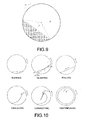
- Figure 10 shows the type of flow regimes of the solid phase and the movement of the material described with the literature with slipping being associated with the slower reactor rotational speed and centrifugation associated with the higher speeds.
- the rotary reactor contemplated for these internal mixing devices is a reactor which is part of a larger process used to continuously solid phase polymerize polyesters as described in WO 2004/018541 , the teachings of which are incorporated in their entirety. This process is shown in various Figures accompanying this written description.
- Polyester prepolymer granules stored in hopper 1-8, or other such storage device are fed to a heater-crystallizer 1-6, where they are heated to a suitable temperature to cause the crystallization of the granules, pellets, or chips with minimal sticking. Preferably there should be no sticking.
- This crystallizer could be one of many in the art, however, the rapid crystallization at high temperatures is preferred over slow crystallization and low temperatures.
- the crystallization step is carried out in a fluidised bed crystalliser 1-6 by utilizing a gas flow rate sufficient to cause the polyester granules to be fluidized with or without mechanical vibration.
- inert gas or air can be used.
- Crystallization can generally be accomplished at residence times in the range of about 2 to about 20 minutes and, preferably, from about 10 to about 15 minutes.
- heating is achieved by use of a fluidizing medium (either air or inert gas) at temperatures in the range of about 140 °C to about 235 °C and preferably in the range of about 200 °C to about 225 °C.
- the residence time to crystallize the polyester granules to the desired level depends on the crystallization temperature and crystallization rate of the polymer; low crystallization temperature requires longer crystallization time.
- polyethylene terephthalate prepolymer is crystallized to a crystallization degree corresponding to a density of at least about 1.37 g/cm 3 .
- the polyester granules can also be crystallized by vapor treatment (see for example U.S. Pat. No. 4,644,049 ) or by high frequency energy field ranging from about 20 to about 300 MHz (see for example U.S. Pat. No. 4,254,253 ). After being crystallized, granules may optionally be fed into a preheater using purge inert gas. The crystallized polyester granules can optionally be dried after exiting the crystallizer. However, drying it is not strictly necessary and it is less costly to polymerize "wet" polyester, as it is known from U.S. Pat. No. 3,718,621 .
- the polyester granules are solid-phase polymerised.
- the crystallization and solid phase polymerization steps do not have to be conducted in strict temporal sequence, namely they have not to be necessarily conducted one right after the other.
- the solid phase polymerization step is carried out in at least one horizontal inclined (preferably cylindrical) reactor shown as 1-5 in Figure 1 .
- the reactor rotates around a central axis, 1-3, known as the axis of rotation. This is similar to a “rotary kiln”.
- the solid phase polymerization reactor will be hereinafter for simplicity abbreviated as "HCIRR” and is referenced in FIGURE 1 as 1-5.
- An additional feature of the HCIRR reactor is the angle of inclination ( ⁇ , in Figure 1 ) which is the angle formed from the intersection of the horizontal 1-2 and the axis of rotation 1-3. As shown in Figure 1 it is also the angle formed by a line 1-4 parallel to the axis of rotation with the horizontal 1-2.
- Preferred values for the angle of inclination are between 0.1° and 12°, more preferably between 1° and 6°, with a preferred maximum polyester granule bed height of 4-5 meters.
- the combination of the inclination and the rotation preferably with a speed between 0.1 and 10 rpm of the HCIRR reactor ( Figure 1-5 ) and proper flow from one end to the other of the HCIRR reactor ( Figure 1-5 ), is provided and constant renewal of the inter-granular contact areas occurs so that polyester granules do not have a chance to creep into one another.
- This flow regime is such that, when granules are submersed in the bed of solid, they behave as a rigid body and rotate at the same rotational speed of the HCIRR reactor, and, when they come at the surface of the solid bed, they slide on the surface itself.
- This solid flow regime facilitates having a true "plug flow like” behaviour of granules or pellets. Because absolute true plug flow is only a theoretical construct, the phrase plug flow like behaviour is used, with the reactor exhibiting more or less plug flow like behaviour which means the reactor has more or less degrees of plug flow behaviour as described previously.
- the crystallized (or crystallized and preheated) polyester granules are passed into the top of the HCIRR reactor ( Figure 1-5 ) (or in the first HCIRR reactor of a series of HCIRR reactors, when the plant has more than one HCIRR reactor in series) and pass through the HCIRR reactor (or the reactors) due the force of gravity brought on by the reactor's inclination as well as the reactor's rotation.
- the granule flow rate through the HCIRR reactor 1-5 is controlled by regulating discharge from the HCIRR reactor itself. Such discharge is then fed into a cooling device 1-7.
- Polymerization is conducted in a stream of purge inert gas.
- Purge flow well below the turbulent rate is generally preferred so to prevent fluidization and entrainment of polyester granules.
- the inert gas flow rate will normally be approximately equal. In the latter case, it is preferred that the rate in each HCIRR reactor not exceed 1.25 times the rate in any other reactor in a reactor series.
- the purge gas passes through the HCIRR reactor 1-5 counter-current to flow direction of the polyester granules.
- a purge gas flow co-current with the direction of the flow of the granules can be used, this latter configuration proves to be less efficient and generally requires a higher gas flow rate.
- Suitable purge gases for use in the process of this invention preferably include nitrogen, but also carbon dioxide, helium, argon, neon, krypton, xenon, air and certain industrial waste gases and combinations or mixtures thereof can be chosen.
- purge inert gas can be recycled to the reactor, after having been purified of organic impurities, preferably until reaching a level of organic impurities less than or equal to 100 p.p.m. by weight (CH 4 equivalent).
- the polymerization temperature will be included in the range from just above the threshold polymerisation temperature to a temperature within a few (3) degrees Centigrade of the polymer sticking temperature (which may be well below the melting point of the polymer).
- this threshold temperature is 40 °C above the onset of the crystallization temperature of the polymer.
- a temperature in the HCIRR reactor within the range of about 170°C to about 235°C and preferably in the range of about 190°C to about 225°C is suitable. Temperatures in the range of about 205°C to about 220°C are preferred. These are also the suitable temperatures for the first HCIRR reactor in a series if there is more than one HCIRR reactor.
- Modified PET copolymers containing from about 1 to about 3 mole percent isophthalic acid, a percentage based on total acids, are polymerized at about 5 to 8 °C lower temperatures because their melt points are lower the PET homopolymers. Such copolyesters are less crystalline and have a great tendency to stick at polymerization temperatures.
- a central feature of the HCIRR reactor is that it revolves around an axis of rotation ( Figure 1-3 ), wherein the axis is not parallel with the horizontal, which is a line perpendicular to the gravitational pull.
- the axis of rotation is not parallel with the horizontal perpendicular to gravitational pull when a material such as water or pellets are placed in the higher end of the rotating reactor and when unaided by forces other than gravity and the rotating reactor, move to the other, lower end.
- the rotational axis is parallel to the horizontal line perpendicular to gravitational pull when water, pellets, or another substance placed in an end of the reactor and subjected to no force other than gravity, (including friction forces), will not move to the other end.
- mixing devices such as baffles or lifters
- the design for plug flow like behaviour has not previously been disclosed.
- mixing devices which mix the material by removing the material at the wall and replacing it with material towards the center of the bed of flow, but doing so in a manner that maintains or improves the plug flow like behaviour of the reactor.
- chord is the chord of the circle described by the cross sectional of the reactor wall wherein the chord is top of the granule bed as the granules are pulled up the wall of the rotating vessel. This chord is depicted in Figure 9 . While rolling down the chord, each chip is disturbed by the roughness of the bed surface (made up of other chips).
- At least one mixing device is attached to the wall of the reactor.
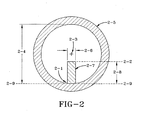
- Figure 2 is cutaway view of the reactor in a plane perpendicular to the axis of rotation and containing one mixing device 2-7.
- the thickness of the mixing device is depicted as 2-6.
- the reactor wall is depicted as 2-5 and the inner diameter thereof as 2-4.
- the mixing device protrudes from the wall at point 2-1, which is the intersection of the line 2-9 which is the line tangent to the circle circumscribed by the rotation of reactor wall at a point the furthest distance from the axis of rotation 2-3.
- the height of the mixing device in the plane view is the distance 2-8 which is measured from the point of protrusion 2-1 to the top of the mixing device in the plane 2-2.
- the thickness 2-6 of the mixing device in the plane perpendicular to the axis of rotation is not essential to maintaining plug flow. However, the practitioner will recognize that it must be strong enough to not deform or break under the stress due to the resistance of the solid phase when rotating through the material it is trying to mix. Therefore, the thickness of the mixing device is determined by the required strength which is determined in part by the material of construction and the temperature of operation.
- the height of the mixing device in the plane perpendicular to the axis of rotation is the distance from wall of the reactor to the top of the mixing device. Although not essential to maintaining plug flow like behaviour, it has been found that the best results are obtained when the height is less than half the diameter of the circle defined by the rotation of the point where the mixing device joins the wall of the reactor about the axis of rotation ( Figure 2-3 ). For a circlular reactor, the height of the mixing device would be less than one half the inside diameter, or the radius, of reactor. It is not necessary or required that the height of the mixing device be constant along the length of the mixing device.
- the physical length of the mixing device is the length of the device measured from top of the device at the point where the mixing device first protrudes from the wall to the top of the device where the mixing device ends, or stops protruding from the wall.
- the point of protusion at the beginning or end of the mixing device is when the height of the mixing device is less than about 1/20 th the diameter of the circumference of a circular reactor.
- the mixing device stops protruding from the wall when the height is less than about 1/20 th the diameter of the circumference described by the rotation of the point of protrusion.
- the equivalent length of the mixing device is the distance between the plane perpendicular to the axis of rotation that contains the point where the mixing device first protrudes from the wall and the plane perpendicular to the axis of rotation that contains the point where the mixing device stops protruding from the wall.
- Figure 3 shows the reactor length of length 3-10 and the equivalent length of two mixing devices, 3-11 and 3-13.
- Mixing device 3-13 is a spiral that traces the rotational curve of the reactor.
- the equivalent length of device 3-13 is depicted as 3-12. which is the distance along the axis of rotation of the point of first protusion 3-1, which corresponds to 3-4 and the last protrusion, which corresponds to 3-6.
- the physical length of this mixing device is greater than the equivalent length because the device traces the curve or spiral of the reactor. This is line 3-2.
- the second mixing device, 3-11 runs parallel to the axis of rotation. Therefore its physical length and equivalent length are the same.
- the length of the reactor is not to scale, but is 3-10, which is the distance between points 3-8 and 3-9.
- Other reference points on Figure 3 are 3-5, the reactor wall, 3-3, the axis of rotation and 3-7, the diameter of the reactor.
- the physical length can be determined from Pythagorean's theorem treating the circumference of the reactor as the base of the triangle, the equivalent length as the height and the physical length as the hypotenuse of the right triangle.
- Forming a complete circle can be described as when the physical length of the mixing device is greater than the following formula, (Formula 1) a 2 + b 2 where a is the equivalent length of the mixing device and b is the circumference of rotation which is the distance traveled in one rotation of the point of protrusion from the wall. It is also the inner circumference of a round annular reactor. It is believed preferred therefore that the physical length be kept less than the value defined by Formula 1.
- the equivalent length determines whether plug flow like behaviour is affected. What has been discovered is that when the equivalent length is less than about 1/20 th the length of the reactor, plug flow is enhanced. While equivalent lengths of less than 1/20 th the length of the reactor are beneficial, it is also believed that other lengths will work as well, therefore it can be said that the equivalent length be selected from the group consisting of equivalent lengths less than 1/10 th the length of the reactor, less than 1/12 th the length of the reactor, less than 1/14 th the length of the reactor, less than 1/15 th the length of the reactor, less than 1/16 th the length of the reactor, 1/18 th the length of the reactor and less than 1/20 th the length of the reactor.
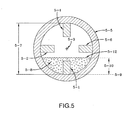
- Figure 5 shows the reactor wall of 5-5, the axis of rotation 5-3, and four mixing devices (5-1, 5-2, 5-4, 5-6), each 90° apart from each other. Also shown is the bed of material, 5-8, when the reactor is not rotating. The bed height is depicted as 5-10 and is the distance from the top of the bed 5-12 to the wall of the reactor at the thickest point of the bed. 5-9 is the tangent line intersecting the point of protrusion and 5-7 is the inside diameter of the reactor.
- mixing devices start to protrude and cease to protrude in the same plane perpendicular to the axis of rotation. They could be staggered along the length of the reactor.
- the mixing device be curved from the top of the mixing device to the point of protrusion from the wall. This curve is also relative to the plane intersecting axis of rotation and the point of protrusion from the wall. The curve could arc into the direction of rotation or away from the direction of rotation.
- Figure 6 shows an embodiment that could include the teachings of this kind.
- the actual reactor vessel 6-5 is not round, but in this example, square. Even though the reactor 6-5 is square, its rotation about the axis of rotation 6-3 will describe a circle 6-6 at its external corners and a further circle 6-8 at its points of protrusion for each baffle 6-1, 6-2, 6-4, and 6-7. It is this latter circle which would be used to calculate the various dimensions for each mixing device.
- the mixing device can be attached to the wall in any manner.
- Figures 7a and 7b show a bolted and welded mixing device.
- mixing device 7-2 is attached using the bolt 7-1.
- the mixing device 7-2 is welded to the wall and 7-4 shows a bead from a weld.
- the mixing device should also be devoid of holes transversing the axis of rotation which are larger than the size of the granules, pellets, flakes or chips to be processed. In one embodiment holes are specifically contemplated. Since the reactor performs better when a gas is, partially or totally, injected into the chips bed, the mixing device can be hollow with holes that allow the purge gas to be introduced into the material by first passing it into the mixing device and letting it pass through the holes into the bed of the material being processed. Multiple mixing devices can be connected by a pipe or functional equivalent structure.
- Figures 8a and 8b show an embodiment of this mixing device.
- the reactor 8-5 with axis of rotation 8-3, has a series of mixing devices 8-1. These mixing devices are hollow with a large hole, 8-4. Holes 8-4 are for the introduction of the purge gas into the mixing devices, while holes 8-2, which are smaller than the pellets or chips being processed, are used to distribute the purge gas, 8-6, throughout the bed 8-8.
- the mixing devices 8-1 are linked in series by connectors denoted as 8-7. Although believed to be not essential, it is believed that better efficiency is achieved when the connectors are "not in contact” with the wall of the reactor. In practice, "not in contact” means at least 10mm from the reactor wall.
- an 80 meter reactor into 3 zones: 30 meters, 20 meters, 30 meters, and place two mixing devices in each 2 meter section of each zone.
- the mixing devices are preferably 180° radially apart from each other.
- the difference between the zones is that the height of the mixing device is varied, also as a function of the different height of the head of the solid phase along the axial coordinate of the HCIRR reactor.
- the reactor is divided into 80 meter sections, with the first section having one mixing device, the next section having the second mixing device with the start of the second mixing device located 90° from the end of the first mixing device, the start of the third mixing device in the third section located 90° from the end of the second mixing device and 180° from the end of the first mixing device.
- Such a configuration would continue through the zones. All of these configurations have been trialed with better plug flow like behaviour than having no internals and certainly better than when the internal mixing device was greater than 1/10 th the length of the reactor.
- the first set of experiments were conducted in a glass tube rotating circular reactor having an internal diameter of 175 mm, a length of 1800 mm, total volume of 43 cubic decimeters and a 1 angle of inclination.
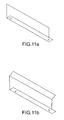
- the types of internal mixing devices used are depicted in figures 11a and 11b , with type 1 ( fig. 11a ) being an "L" shaped metal piece and type 2 ( fig. 11b ) being a piece with a 60° bend at the top.
- the mixing devices were mounted in such a manner that the equivalent length and actual length were equal, otherwise parallel to the axis of rotation.
- the mixing devices were each 100mm in length and 30 mm high for the type 1 and 35.43 mm high for the type 2.
- four mixing devices were mounted in the reactor, one for each 100 mm section, 90° apart.
- a mixing device was mounted in the first of the 100 mm sections; a further mixing device was mounted in the second and successive 100 mm section, 90° apart from the end of the mixing device mounted in the first section; a further mixing device was mounted in the third and successive section, 90° apart from the end of the mixing device mounted in the second section and 180° apart from the end of the mixing device mounted in the first section; a further mixing device was mounted in the fourth and successive section, 90° apart from the end of the mixing device mounted in the third section, 180° apart from the end of the mixing device mounted in the second section and 270° apart from the end of the mixing device mounted in the first section.
- Experiments were conducted using chips of commercial bottle grade PET, as well as chips covered of magnetic powder (i.e.
Landscapes
- Chemical & Material Sciences (AREA)
- Chemical Kinetics & Catalysis (AREA)
- Organic Chemistry (AREA)
- Health & Medical Sciences (AREA)
- Medicinal Chemistry (AREA)
- Polymers & Plastics (AREA)
- Physics & Mathematics (AREA)
- Combustion & Propulsion (AREA)
- Engineering & Computer Science (AREA)
- Thermal Sciences (AREA)
- Geometry (AREA)
- Mixers Of The Rotary Stirring Type (AREA)
- Processing And Handling Of Plastics And Other Materials For Molding In General (AREA)
- Polyesters Or Polycarbonates (AREA)
- Metal Rolling (AREA)
- Organic Low-Molecular-Weight Compounds And Preparation Thereof (AREA)
- Physical Or Chemical Processes And Apparatus (AREA)
Priority Applications (1)
| Application Number | Priority Date | Filing Date | Title |
|---|---|---|---|
| PL08708705T PL2109501T3 (pl) | 2007-02-06 | 2008-02-05 | Promieniowe elementy mieszające do nachylonych reaktorów obrotowych |
Applications Claiming Priority (2)
| Application Number | Priority Date | Filing Date | Title |
|---|---|---|---|
| IT000084A ITTO20070084A1 (it) | 2007-02-06 | 2007-02-06 | Dispositivi di miscelazione radiale per reattori inclinati rotanti. |
| PCT/EP2008/051406 WO2008095934A1 (en) | 2007-02-06 | 2008-02-05 | Radial mixing devices for rotating inclined reactors |
Publications (2)
| Publication Number | Publication Date |
|---|---|
| EP2109501A1 EP2109501A1 (en) | 2009-10-21 |
| EP2109501B1 true EP2109501B1 (en) | 2010-09-29 |
Family
ID=39322643
Family Applications (1)
| Application Number | Title | Priority Date | Filing Date |
|---|---|---|---|
| EP08708705A Active EP2109501B1 (en) | 2007-02-06 | 2008-02-05 | Radial mixing devices for rotating inclined reactors |
Country Status (18)
| Country | Link |
|---|---|
| US (3) | US8454896B2 (it) |
| EP (1) | EP2109501B1 (it) |
| KR (1) | KR101451609B1 (it) |
| CN (1) | CN101678313B (it) |
| AR (1) | AR065156A1 (it) |
| AT (1) | ATE482764T1 (it) |
| AU (1) | AU2008212914B2 (it) |
| BR (1) | BRPI0806379B1 (it) |
| CA (1) | CA2677344C (it) |
| DE (1) | DE602008002818D1 (it) |
| EA (1) | EA014970B1 (it) |
| ES (1) | ES2353583T3 (it) |
| IT (1) | ITTO20070084A1 (it) |
| MX (1) | MX2009008478A (it) |
| PL (1) | PL2109501T3 (it) |
| TW (1) | TWI418399B (it) |
| UA (1) | UA96319C2 (it) |
| WO (1) | WO2008095934A1 (it) |
Families Citing this family (9)
| Publication number | Priority date | Publication date | Assignee | Title |
|---|---|---|---|---|
| CN104147966A (zh) * | 2014-08-12 | 2014-11-19 | 南京工程学院 | 混合搅拌机 |
| SG10201900158PA (en) | 2019-01-08 | 2020-08-28 | Jie Xiong Jonathan Yeo | Manufacturing facility |
| KR102130575B1 (ko) * | 2019-10-04 | 2020-07-06 | 강성기 | 곡물 혼합장치 |
| US11358114B2 (en) * | 2020-01-07 | 2022-06-14 | Samsung Electro-Mechanics Co., Ltd. | Continuous tubular reactor and method of operating the same |
| ES2987874T3 (es) | 2022-09-20 | 2024-11-18 | Revalyu Resources Gmbh | Proceso para reciclar tereftalato de polietileno utilizando una materia prima seleccionada |
| EP4342938B1 (en) | 2022-09-20 | 2024-07-17 | revalyu Resources GmbH | Process for recycling polyethylene terephthalate using specific colour coordinates for oligomer processing |
| ES2987879T3 (es) | 2022-09-20 | 2024-11-18 | Revalyu Resources Gmbh | Proceso para reciclar tereftalato de polietileno utilizando un reactor de lavado |
| EP4342945B1 (en) | 2022-09-20 | 2024-07-17 | revalyu Resources GmbH | Process for recycling polyethylene terephthalate using different mono-ethylene glycol levels |
| CN116585939A (zh) * | 2023-06-08 | 2023-08-15 | 上海瑞邦生物材料有限公司 | 一种人工骨粉制备装置及其制备方法 |
Family Cites Families (46)
| Publication number | Priority date | Publication date | Assignee | Title |
|---|---|---|---|---|
| CH260294A (de) * | 1947-11-11 | 1949-03-15 | Weber Emil | Apparat zum Mischen und Rühren von pulverförmigen, fein- und grobkörnigen Substanzen und von Flüssigkeiten. |
| US2721069A (en) * | 1954-07-20 | 1955-10-18 | Southern Lightweight Aggragate | Lightweight aggregate, and apparatus and process |
| US2939693A (en) * | 1956-08-06 | 1960-06-07 | Southern Lightweight Aggregate | Rotary kiln |
| US3075952A (en) | 1959-01-21 | 1963-01-29 | Eastman Kodak Co | Solid phase process for linear superpolyesters |
| DE1128657B (de) * | 1960-02-20 | 1962-04-26 | Glanzstoff Ag | Vorrichtung zur kontinuierlichen Polykondensation von Diolestern der Terephthalsaeure |
| NL272388A (it) | 1960-12-16 | |||
| CH444126A (de) * | 1965-09-08 | 1967-09-30 | Inventa Ag | Vorrichtung zur kontinuierlichen Durchführung von chemischen Reaktionen in viskosen Flüssigkeiten |
| BE697132A (it) | 1966-05-12 | 1967-10-02 | ||
| US3497477A (en) | 1969-06-02 | 1970-02-24 | Eastman Kodak Co | Process for removing metallic antimony from polyester prepolymers |
| US3676074A (en) * | 1969-06-30 | 1972-07-11 | Yamato Setubi Koji Kk | Apparatus for treating organic waste |
| US3767601A (en) | 1971-09-01 | 1973-10-23 | Du Pont | Solid phase polymerization of waste polyethylene terephthalate |
| US3953404A (en) | 1974-02-07 | 1976-04-27 | General Electric Company | Solid state polymerization of poly(1,4-butylene terephthalate) |
| US4276261A (en) | 1979-07-16 | 1981-06-30 | The Goodyear Tire & Rubber Company | Polymerization apparatus and process |
| US4370302A (en) | 1980-01-04 | 1983-01-25 | Teijin Limited | Machine for solid phase polymerization |
| US4725350A (en) * | 1981-02-13 | 1988-02-16 | Smith Anthon L | Process for extracting oil and hydrocarbons from crushed solids using hydrogen rich syn gas |
| DE3442058C2 (de) * | 1984-11-15 | 1993-11-18 | Paul Johannsen Gmbh & Co Kg | Trommelreaktor zur Herstellung von Düngemitteln und anderen Grundstoffen durch ärobe Fermentierung |
| US4639217A (en) | 1985-01-14 | 1987-01-27 | Adams D Carlos | Countercurrent heat transfer device for solid particle streams |
| CA1285515C (en) | 1985-11-20 | 1991-07-02 | Gerhard J.A. Kennepohl | Method for passivating particulate coal |
| US4644049A (en) | 1986-03-05 | 1987-02-17 | The Goodyear Tire & Rubber Company | Solid state polymerization |
| US4876326A (en) | 1987-03-26 | 1989-10-24 | The Goodyear Tire & Rubber Company | Solid state polymerization of polyester prepolymers |
| NO871895D0 (no) * | 1987-05-07 | 1987-05-07 | Erik Voje Heieren | Roterende syklon for utskilling av stoev i f.eks. roekgasser |
| US4849497A (en) | 1988-08-03 | 1989-07-18 | The Goodyear Tire & Rubber Company | Solid state polymerization of porous pills made by compacting polyester prepolymers |
| US5245093A (en) | 1989-01-26 | 1993-09-14 | Abb Lummus Crest Inc. | Reaction processes in a multi-stage fluidized bed |
| US4963644A (en) | 1989-09-18 | 1990-10-16 | The Goodyear Tire & Rubber Company | Process for crystallization of polyethylene naphthalate |
| GB8921241D0 (en) | 1989-09-20 | 1989-11-08 | Monsanto Plc | Testing of viscoelastic materials |
| GB9013481D0 (en) | 1990-06-15 | 1990-08-08 | Ici Plc | Polyester polymer products |
| US5408035A (en) | 1991-10-16 | 1995-04-18 | Shell Oil Company | Solid state polymerization |
| DE4309227A1 (de) | 1993-03-23 | 1994-09-29 | Zimmer Ag | Kontinuierliches Verfahren zur Herstellung von Polyester für Lebensmittelverpackungen |
| AU6519594A (en) * | 1993-04-02 | 1994-10-24 | Valence Technology, Inc. | Apparatus and method for continuous synthesis of vanadium oxide |
| US5632616A (en) * | 1994-11-28 | 1997-05-27 | Cadence Environmental Energy, Inc. | Method and apparatus for injecting air into long cement kilns |
| SE503674C2 (sv) * | 1994-11-28 | 1996-07-29 | Flaekt Ab | Anordning för blandning av partikelformigt material och vätska |
| US5449701A (en) | 1994-12-15 | 1995-09-12 | Shell Oil Company | Solid state polymerization process for foamed poly(ethylene naphthalate) |
| US5711089A (en) | 1995-03-03 | 1998-01-27 | Hosokawa Bepex Corporation | Radiant heater for processing of polymers |
| US5716013A (en) | 1995-04-26 | 1998-02-10 | Benson; Jack M. | Polygon-shaped rotatable apparatus and its use in composting and cement industries |
| US6190625B1 (en) | 1997-08-07 | 2001-02-20 | Qualchem, Inc. | Fluidized-bed roasting of molybdenite concentrates |
| US6140458A (en) | 1998-04-28 | 2000-10-31 | Mitsui Chemicals, Inc. | Preparation process of polyester |
| US6672865B2 (en) * | 2000-09-11 | 2004-01-06 | Cadence Enviromental Energy, Inc. | Method of mixing high temperature gases in mineral processing kilns |
| US7229281B2 (en) * | 2000-09-11 | 2007-06-12 | Cadence Environmental Energy, Inc. | Method of mixing high temperature gases in mineral processing kilns |
| US6910801B2 (en) * | 2001-04-05 | 2005-06-28 | Umeda Industry Co., Ltd. | Agitating and mixing device |
| ITTO20020714A1 (it) * | 2002-08-09 | 2004-02-10 | Giuliano Cavaglia | Procedimento per la polimerizzazione continua di |
| US7098300B1 (en) | 2002-12-19 | 2006-08-29 | Uop Llc | Apparatus and process for continuous solid-state poly-condensation in a fluidized reactor with multiple stages |
| DE102004036109B4 (de) * | 2004-07-08 | 2006-08-03 | BLüCHER GMBH | Drehrohr für die Aktivkohleherstellung und seine Verwendung |
| DE102005036607A1 (de) * | 2005-07-28 | 2007-02-08 | BLüCHER GMBH | Drehrohrofen für die Herstellung von Aktivkohle |
| US7585104B2 (en) * | 2005-09-12 | 2009-09-08 | Uop Llc | Rotary processor |
| US20070157676A1 (en) * | 2005-12-28 | 2007-07-12 | Taquet Bernadette F | Granulation-coating machine for glass fiber granules |
| KR101148080B1 (ko) * | 2009-12-07 | 2012-06-13 | (주)인사이드밸류 | 유체 혼합장치 |
-
2007
- 2007-02-06 IT IT000084A patent/ITTO20070084A1/it unknown
-
2008
- 2008-02-04 AR ARP080100450A patent/AR065156A1/es active IP Right Grant
- 2008-02-04 TW TW097104185A patent/TWI418399B/zh not_active IP Right Cessation
- 2008-02-05 PL PL08708705T patent/PL2109501T3/pl unknown
- 2008-02-05 MX MX2009008478A patent/MX2009008478A/es active IP Right Grant
- 2008-02-05 CA CA2677344A patent/CA2677344C/en active Active
- 2008-02-05 AT AT08708705T patent/ATE482764T1/de not_active IP Right Cessation
- 2008-02-05 UA UAA200909096A patent/UA96319C2/ru unknown
- 2008-02-05 EP EP08708705A patent/EP2109501B1/en active Active
- 2008-02-05 BR BRPI0806379-6A patent/BRPI0806379B1/pt not_active IP Right Cessation
- 2008-02-05 KR KR1020097018560A patent/KR101451609B1/ko active Active
- 2008-02-05 ES ES08708705T patent/ES2353583T3/es active Active
- 2008-02-05 CN CN2008800113144A patent/CN101678313B/zh active Active
- 2008-02-05 WO PCT/EP2008/051406 patent/WO2008095934A1/en not_active Ceased
- 2008-02-05 AU AU2008212914A patent/AU2008212914B2/en not_active Ceased
- 2008-02-05 US US12/524,776 patent/US8454896B2/en not_active Expired - Fee Related
- 2008-02-05 EA EA200970732A patent/EA014970B1/ru active IP Right Revival
- 2008-02-05 DE DE602008002818T patent/DE602008002818D1/de active Active
-
2012
- 2012-04-26 US US13/456,340 patent/US8454865B2/en not_active Expired - Fee Related
-
2013
- 2013-06-03 US US13/908,181 patent/US8790580B2/en active Active
Also Published As
| Publication number | Publication date |
|---|---|
| CA2677344C (en) | 2015-04-07 |
| EP2109501A1 (en) | 2009-10-21 |
| CN101678313B (zh) | 2013-10-30 |
| CA2677344A1 (en) | 2008-08-14 |
| MX2009008478A (es) | 2009-11-26 |
| TW200900140A (en) | 2009-01-01 |
| US8454896B2 (en) | 2013-06-04 |
| KR101451609B1 (ko) | 2014-10-16 |
| US20100008830A1 (en) | 2010-01-14 |
| KR20090120478A (ko) | 2009-11-24 |
| PL2109501T3 (pl) | 2011-03-31 |
| US8454865B2 (en) | 2013-06-04 |
| AU2008212914A1 (en) | 2008-08-14 |
| WO2008095934A1 (en) | 2008-08-14 |
| ITTO20070084A1 (it) | 2008-08-07 |
| UA96319C2 (ru) | 2011-10-25 |
| BRPI0806379B1 (pt) | 2018-02-14 |
| AU2008212914B2 (en) | 2012-02-02 |
| EA200970732A1 (ru) | 2010-02-26 |
| ES2353583T3 (es) | 2011-03-03 |
| US8790580B2 (en) | 2014-07-29 |
| DE602008002818D1 (de) | 2010-11-11 |
| US20120226012A1 (en) | 2012-09-06 |
| US20130261281A1 (en) | 2013-10-03 |
| AR065156A1 (es) | 2009-05-20 |
| BRPI0806379A2 (pt) | 2011-09-13 |
| ATE482764T1 (de) | 2010-10-15 |
| EA014970B1 (ru) | 2011-04-29 |
| CN101678313A (zh) | 2010-03-24 |
| TWI418399B (zh) | 2013-12-11 |
Similar Documents
| Publication | Publication Date | Title |
|---|---|---|
| US8790580B2 (en) | Radial mixing devices for rotating inclined reactors | |
| AU2003246367B2 (en) | Continuous process for solid phase polymerisation of polyesters | |
| KR101593699B1 (ko) | 수지의 분해 생성물의 회수 방법 | |
| JPH0454683B2 (it) | ||
| JP4143670B2 (ja) | 工業的蒸発装置 | |
| KR101272429B1 (ko) | 폴리에스테르의 연속 및/또는 불연속 고상 중합을 위한 반응성 대기 및 상기 대기의 이용 방법 | |
| US20220049055A1 (en) | Continuous solid-state polymerization process and reactor column for use therein | |
| EP1943011B1 (en) | Rotary processor and process | |
| KR20010093117A (ko) | 폴리(에틸렌 테레프탈레이트)-폴리(에틸렌이소프탈레이트) 코폴리에스테르의 제조 방법 | |
| JPWO2006067994A1 (ja) | 工業的連続蒸発装置 | |
| JPWO2006067993A1 (ja) | 工業的な蒸発装置 | |
| JP4336597B2 (ja) | 固相重合法によるポリマーの製造方法 | |
| JPH0134445B2 (it) |
Legal Events
| Date | Code | Title | Description |
|---|---|---|---|
| PUAI | Public reference made under article 153(3) epc to a published international application that has entered the european phase |
Free format text: ORIGINAL CODE: 0009012 |
|
| 17P | Request for examination filed |
Effective date: 20090730 |
|
| AK | Designated contracting states |
Kind code of ref document: A1 Designated state(s): AT BE BG CH CY CZ DE DK EE ES FI FR GB GR HR HU IE IS IT LI LT LU LV MC MT NL NO PL PT RO SE SI SK TR |
|
| GRAP | Despatch of communication of intention to grant a patent |
Free format text: ORIGINAL CODE: EPIDOSNIGR1 |
|
| DAX | Request for extension of the european patent (deleted) | ||
| REG | Reference to a national code |
Ref country code: HK Ref legal event code: DE Ref document number: 1137687 Country of ref document: HK |
|
| RAP1 | Party data changed (applicant data changed or rights of an application transferred) |
Owner name: COBARR S.R.L. |
|
| GRAS | Grant fee paid |
Free format text: ORIGINAL CODE: EPIDOSNIGR3 |
|
| GRAA | (expected) grant |
Free format text: ORIGINAL CODE: 0009210 |
|
| AK | Designated contracting states |
Kind code of ref document: B1 Designated state(s): AT BE BG CH CY CZ DE DK EE ES FI FR GB GR HR HU IE IS IT LI LT LU LV MC MT NL NO PL PT RO SE SI SK TR |
|
| REG | Reference to a national code |
Ref country code: GB Ref legal event code: FG4D |
|
| REG | Reference to a national code |
Ref country code: CH Ref legal event code: EP |
|
| REG | Reference to a national code |
Ref country code: CH Ref legal event code: NV Representative=s name: JACOBACCI & PARTNERS S.P.A. |
|
| REG | Reference to a national code |
Ref country code: IE Ref legal event code: FG4D |
|
| REF | Corresponds to: |
Ref document number: 602008002818 Country of ref document: DE Date of ref document: 20101111 Kind code of ref document: P |
|
| REG | Reference to a national code |
Ref country code: GR Ref legal event code: EP Ref document number: 20100402312 Country of ref document: GR |
|
| REG | Reference to a national code |
Ref country code: NL Ref legal event code: T3 |
|
| PG25 | Lapsed in a contracting state [announced via postgrant information from national office to epo] |
Ref country code: LT Free format text: LAPSE BECAUSE OF FAILURE TO SUBMIT A TRANSLATION OF THE DESCRIPTION OR TO PAY THE FEE WITHIN THE PRESCRIBED TIME-LIMIT Effective date: 20100929 Ref country code: AT Free format text: LAPSE BECAUSE OF FAILURE TO SUBMIT A TRANSLATION OF THE DESCRIPTION OR TO PAY THE FEE WITHIN THE PRESCRIBED TIME-LIMIT Effective date: 20100929 Ref country code: FI Free format text: LAPSE BECAUSE OF FAILURE TO SUBMIT A TRANSLATION OF THE DESCRIPTION OR TO PAY THE FEE WITHIN THE PRESCRIBED TIME-LIMIT Effective date: 20100929 Ref country code: NO Free format text: LAPSE BECAUSE OF FAILURE TO SUBMIT A TRANSLATION OF THE DESCRIPTION OR TO PAY THE FEE WITHIN THE PRESCRIBED TIME-LIMIT Effective date: 20101229 |
|
| LTIE | Lt: invalidation of european patent or patent extension |
Effective date: 20100929 |
|
| PG25 | Lapsed in a contracting state [announced via postgrant information from national office to epo] |
Ref country code: SI Free format text: LAPSE BECAUSE OF FAILURE TO SUBMIT A TRANSLATION OF THE DESCRIPTION OR TO PAY THE FEE WITHIN THE PRESCRIBED TIME-LIMIT Effective date: 20100929 Ref country code: HR Free format text: LAPSE BECAUSE OF FAILURE TO SUBMIT A TRANSLATION OF THE DESCRIPTION OR TO PAY THE FEE WITHIN THE PRESCRIBED TIME-LIMIT Effective date: 20100929 |
|
| REG | Reference to a national code |
Ref country code: ES Ref legal event code: FG2A Effective date: 20110221 |
|
| PG25 | Lapsed in a contracting state [announced via postgrant information from national office to epo] |
Ref country code: SE Free format text: LAPSE BECAUSE OF FAILURE TO SUBMIT A TRANSLATION OF THE DESCRIPTION OR TO PAY THE FEE WITHIN THE PRESCRIBED TIME-LIMIT Effective date: 20100929 Ref country code: LV Free format text: LAPSE BECAUSE OF FAILURE TO SUBMIT A TRANSLATION OF THE DESCRIPTION OR TO PAY THE FEE WITHIN THE PRESCRIBED TIME-LIMIT Effective date: 20100929 |
|
| REG | Reference to a national code |
Ref country code: PL Ref legal event code: T3 |
|
| PG25 | Lapsed in a contracting state [announced via postgrant information from national office to epo] |
Ref country code: EE Free format text: LAPSE BECAUSE OF FAILURE TO SUBMIT A TRANSLATION OF THE DESCRIPTION OR TO PAY THE FEE WITHIN THE PRESCRIBED TIME-LIMIT Effective date: 20100929 Ref country code: IS Free format text: LAPSE BECAUSE OF FAILURE TO SUBMIT A TRANSLATION OF THE DESCRIPTION OR TO PAY THE FEE WITHIN THE PRESCRIBED TIME-LIMIT Effective date: 20110129 Ref country code: SK Free format text: LAPSE BECAUSE OF FAILURE TO SUBMIT A TRANSLATION OF THE DESCRIPTION OR TO PAY THE FEE WITHIN THE PRESCRIBED TIME-LIMIT Effective date: 20100929 Ref country code: RO Free format text: LAPSE BECAUSE OF FAILURE TO SUBMIT A TRANSLATION OF THE DESCRIPTION OR TO PAY THE FEE WITHIN THE PRESCRIBED TIME-LIMIT Effective date: 20100929 Ref country code: PT Free format text: LAPSE BECAUSE OF FAILURE TO SUBMIT A TRANSLATION OF THE DESCRIPTION OR TO PAY THE FEE WITHIN THE PRESCRIBED TIME-LIMIT Effective date: 20110131 Ref country code: CZ Free format text: LAPSE BECAUSE OF FAILURE TO SUBMIT A TRANSLATION OF THE DESCRIPTION OR TO PAY THE FEE WITHIN THE PRESCRIBED TIME-LIMIT Effective date: 20100929 |
|
| PLBE | No opposition filed within time limit |
Free format text: ORIGINAL CODE: 0009261 |
|
| STAA | Information on the status of an ep patent application or granted ep patent |
Free format text: STATUS: NO OPPOSITION FILED WITHIN TIME LIMIT |
|
| PG25 | Lapsed in a contracting state [announced via postgrant information from national office to epo] |
Ref country code: DK Free format text: LAPSE BECAUSE OF FAILURE TO SUBMIT A TRANSLATION OF THE DESCRIPTION OR TO PAY THE FEE WITHIN THE PRESCRIBED TIME-LIMIT Effective date: 20100929 |
|
| PG25 | Lapsed in a contracting state [announced via postgrant information from national office to epo] |
Ref country code: MC Free format text: LAPSE BECAUSE OF NON-PAYMENT OF DUE FEES Effective date: 20110228 |
|
| REG | Reference to a national code |
Ref country code: DE Ref legal event code: R097 Ref document number: 602008002818 Country of ref document: DE Effective date: 20110630 |
|
| REG | Reference to a national code |
Ref country code: IE Ref legal event code: MM4A |
|
| PG25 | Lapsed in a contracting state [announced via postgrant information from national office to epo] |
Ref country code: MT Free format text: LAPSE BECAUSE OF FAILURE TO SUBMIT A TRANSLATION OF THE DESCRIPTION OR TO PAY THE FEE WITHIN THE PRESCRIBED TIME-LIMIT Effective date: 20100929 |
|
| PG25 | Lapsed in a contracting state [announced via postgrant information from national office to epo] |
Ref country code: IE Free format text: LAPSE BECAUSE OF NON-PAYMENT OF DUE FEES Effective date: 20110205 |
|
| PGFP | Annual fee paid to national office [announced via postgrant information from national office to epo] |
Ref country code: IT Payment date: 20120216 Year of fee payment: 5 |
|
| PG25 | Lapsed in a contracting state [announced via postgrant information from national office to epo] |
Ref country code: LU Free format text: LAPSE BECAUSE OF NON-PAYMENT OF DUE FEES Effective date: 20110205 Ref country code: CY Free format text: LAPSE BECAUSE OF FAILURE TO SUBMIT A TRANSLATION OF THE DESCRIPTION OR TO PAY THE FEE WITHIN THE PRESCRIBED TIME-LIMIT Effective date: 20100929 |
|
| PG25 | Lapsed in a contracting state [announced via postgrant information from national office to epo] |
Ref country code: BG Free format text: LAPSE BECAUSE OF FAILURE TO SUBMIT A TRANSLATION OF THE DESCRIPTION OR TO PAY THE FEE WITHIN THE PRESCRIBED TIME-LIMIT Effective date: 20101229 |
|
| PG25 | Lapsed in a contracting state [announced via postgrant information from national office to epo] |
Ref country code: HU Free format text: LAPSE BECAUSE OF FAILURE TO SUBMIT A TRANSLATION OF THE DESCRIPTION OR TO PAY THE FEE WITHIN THE PRESCRIBED TIME-LIMIT Effective date: 20100929 |
|
| PG25 | Lapsed in a contracting state [announced via postgrant information from national office to epo] |
Ref country code: IT Free format text: LAPSE BECAUSE OF NON-PAYMENT OF DUE FEES Effective date: 20130205 |
|
| REG | Reference to a national code |
Ref country code: FR Ref legal event code: PLFP Year of fee payment: 8 |
|
| REG | Reference to a national code |
Ref country code: CH Ref legal event code: PCAR Free format text: NEW ADDRESS: VIA LUGANETTO 3, 6962 LUGANO (CH) |
|
| REG | Reference to a national code |
Ref country code: FR Ref legal event code: PLFP Year of fee payment: 9 |
|
| REG | Reference to a national code |
Ref country code: DE Ref legal event code: R081 Ref document number: 602008002818 Country of ref document: DE Owner name: CORPUS CHRISTI POLYMERS LLC (A DELAWARE LLC), , US Free format text: FORMER OWNER: COBARR S.R.L., TORTONA, ALESSANDRIA, IT Ref country code: DE Ref legal event code: R082 Ref document number: 602008002818 Country of ref document: DE Representative=s name: HOFFMANN - EITLE PATENT- UND RECHTSANWAELTE PA, DE Ref country code: DE Ref legal event code: R081 Ref document number: 602008002818 Country of ref document: DE Owner name: M&G USA CORP., APPLE GROVE, US Free format text: FORMER OWNER: COBARR S.R.L., TORTONA, ALESSANDRIA, IT |
|
| REG | Reference to a national code |
Ref country code: CH Ref legal event code: PUE Owner name: M&G USA CORPORATION, US Free format text: FORMER OWNER: COBARR S.R.L., IT |
|
| REG | Reference to a national code |
Ref country code: FR Ref legal event code: TP Owner name: M&G USA CORPORATION, US Effective date: 20160705 |
|
| REG | Reference to a national code |
Ref country code: ES Ref legal event code: PC2A Owner name: M&G USA CORPORATION Effective date: 20160823 |
|
| REG | Reference to a national code |
Ref country code: HK Ref legal event code: WD Ref document number: 1137687 Country of ref document: HK |
|
| REG | Reference to a national code |
Ref country code: NL Ref legal event code: PD Owner name: M&G USA CORPORATION; US Free format text: DETAILS ASSIGNMENT: VERANDERING VAN EIGENAAR(S), OVERDRACHT; FORMER OWNER NAME: COBARR S.R.L. Effective date: 20160503 |
|
| REG | Reference to a national code |
Ref country code: GB Ref legal event code: 732E Free format text: REGISTERED BETWEEN 20161124 AND 20161130 |
|
| REG | Reference to a national code |
Ref country code: FR Ref legal event code: PLFP Year of fee payment: 10 |
|
| PGFP | Annual fee paid to national office [announced via postgrant information from national office to epo] |
Ref country code: CH Payment date: 20170214 Year of fee payment: 10 |
|
| REG | Reference to a national code |
Ref country code: FR Ref legal event code: PLFP Year of fee payment: 11 |
|
| REG | Reference to a national code |
Ref country code: CH Ref legal event code: PL |
|
| PG25 | Lapsed in a contracting state [announced via postgrant information from national office to epo] |
Ref country code: LI Free format text: LAPSE BECAUSE OF NON-PAYMENT OF DUE FEES Effective date: 20180228 Ref country code: CH Free format text: LAPSE BECAUSE OF NON-PAYMENT OF DUE FEES Effective date: 20180228 |
|
| REG | Reference to a national code |
Ref country code: GB Ref legal event code: 732E Free format text: REGISTERED BETWEEN 20190131 AND 20190206 |
|
| REG | Reference to a national code |
Ref country code: DE Ref legal event code: R082 Ref document number: 602008002818 Country of ref document: DE Representative=s name: HOFFMANN - EITLE PATENT- UND RECHTSANWAELTE PA, DE Ref country code: DE Ref legal event code: R081 Ref document number: 602008002818 Country of ref document: DE Owner name: CORPUS CHRISTI POLYMERS LLC (A DELAWARE LLC), , US Free format text: FORMER OWNER: M&G USA CORP., APPLE GROVE, W.VA., US |
|
| REG | Reference to a national code |
Ref country code: BE Ref legal event code: PD Owner name: M&G USA CORPORATION; US Free format text: DETAILS ASSIGNMENT: CHANGE OF OWNER(S), AFFECTATION / CESSION; FORMER OWNER NAME: COBARR S.R.L. Effective date: 20160519 Ref country code: BE Ref legal event code: PD Owner name: CORPUS CHRISTI POLYMERS LLC; US Free format text: DETAILS ASSIGNMENT: CHANGE OF OWNER(S), CESSION; FORMER OWNER NAME: M&G USA CORPORATION Effective date: 20190212 |
|
| REG | Reference to a national code |
Ref country code: NL Ref legal event code: MM Effective date: 20190301 |
|
| REG | Reference to a national code |
Ref country code: NL Ref legal event code: NE Effective date: 20191204 |
|
| PG25 | Lapsed in a contracting state [announced via postgrant information from national office to epo] |
Ref country code: NL Free format text: LAPSE BECAUSE OF NON-PAYMENT OF DUE FEES Effective date: 20190301 |
|
| REG | Reference to a national code |
Ref country code: NL Ref legal event code: NF Effective date: 20210105 |
|
| REG | Reference to a national code |
Ref country code: NL Ref legal event code: PD Owner name: CORPUS CHRISTI POLYMERS LLC; US Free format text: DETAILS ASSIGNMENT: CHANGE OF OWNER(S), ASSIGNMENT; FORMER OWNER NAME: M&G USA CORPORATION Effective date: 20210210 |
|
| PG25 | Lapsed in a contracting state [announced via postgrant information from national office to epo] |
Ref country code: NL Free format text: LAPSE BECAUSE OF NON-PAYMENT OF DUE FEES Effective date: 20190301 |
|
| PGRI | Patent reinstated in contracting state [announced from national office to epo] |
Ref country code: NL Effective date: 20210105 |
|
| REG | Reference to a national code |
Ref country code: ES Ref legal event code: PC2A Owner name: CORPUS CHRISTI POLYMERS LLC Effective date: 20230303 |
|
| PGFP | Annual fee paid to national office [announced via postgrant information from national office to epo] |
Ref country code: NL Payment date: 20240129 Year of fee payment: 17 |
|
| PGFP | Annual fee paid to national office [announced via postgrant information from national office to epo] |
Ref country code: GR Payment date: 20240130 Year of fee payment: 17 |
|
| PGFP | Annual fee paid to national office [announced via postgrant information from national office to epo] |
Ref country code: ES Payment date: 20240307 Year of fee payment: 17 |
|
| PGFP | Annual fee paid to national office [announced via postgrant information from national office to epo] |
Ref country code: DE Payment date: 20240116 Year of fee payment: 17 Ref country code: GB Payment date: 20240118 Year of fee payment: 17 |
|
| PGFP | Annual fee paid to national office [announced via postgrant information from national office to epo] |
Ref country code: TR Payment date: 20240202 Year of fee payment: 17 Ref country code: PL Payment date: 20240126 Year of fee payment: 17 Ref country code: FR Payment date: 20240123 Year of fee payment: 17 Ref country code: BE Payment date: 20240129 Year of fee payment: 17 |
|
| REG | Reference to a national code |
Ref country code: DE Ref legal event code: R119 Ref document number: 602008002818 Country of ref document: DE |
|
| REG | Reference to a national code |
Ref country code: NL Ref legal event code: MM Effective date: 20250301 |
|
| PG25 | Lapsed in a contracting state [announced via postgrant information from national office to epo] |
Ref country code: GR Free format text: LAPSE BECAUSE OF NON-PAYMENT OF DUE FEES Effective date: 20250903 |
|
| GBPC | Gb: european patent ceased through non-payment of renewal fee |
Effective date: 20250205 |
|
| PG25 | Lapsed in a contracting state [announced via postgrant information from national office to epo] |
Ref country code: NL Free format text: LAPSE BECAUSE OF NON-PAYMENT OF DUE FEES Effective date: 20250301 |