EP2108474A1 - Method of joining - Google Patents
Method of joining Download PDFInfo
- Publication number
- EP2108474A1 EP2108474A1 EP08704529A EP08704529A EP2108474A1 EP 2108474 A1 EP2108474 A1 EP 2108474A1 EP 08704529 A EP08704529 A EP 08704529A EP 08704529 A EP08704529 A EP 08704529A EP 2108474 A1 EP2108474 A1 EP 2108474A1
- Authority
- EP
- European Patent Office
- Prior art keywords
- bonded
- members
- bonding material
- bonding
- heating
- Prior art date
- Legal status (The legal status is an assumption and is not a legal conclusion. Google has not performed a legal analysis and makes no representation as to the accuracy of the status listed.)
- Granted
Links
Images


Classifications
-
- B—PERFORMING OPERATIONS; TRANSPORTING
- B23—MACHINE TOOLS; METAL-WORKING NOT OTHERWISE PROVIDED FOR
- B23K—SOLDERING OR UNSOLDERING; WELDING; CLADDING OR PLATING BY SOLDERING OR WELDING; CUTTING BY APPLYING HEAT LOCALLY, e.g. FLAME CUTTING; WORKING BY LASER BEAM
- B23K35/00—Rods, electrodes, materials, or media, for use in soldering, welding, or cutting
- B23K35/22—Rods, electrodes, materials, or media, for use in soldering, welding, or cutting characterised by the composition or nature of the material
- B23K35/24—Selection of soldering or welding materials proper
- B23K35/30—Selection of soldering or welding materials proper with the principal constituent melting at less than 1550°C
-
- H—ELECTRICITY
- H10—SEMICONDUCTOR DEVICES; ELECTRIC SOLID-STATE DEVICES NOT OTHERWISE PROVIDED FOR
- H10W—GENERIC PACKAGES, INTERCONNECTIONS, CONNECTORS OR OTHER CONSTRUCTIONAL DETAILS OF DEVICES COVERED BY CLASS H10
- H10W72/00—Interconnections or connectors in packages
- H10W72/01—Manufacture or treatment
- H10W72/013—Manufacture or treatment of die-attach connectors
- H10W72/01365—Thermally treating
-
- H—ELECTRICITY
- H10—SEMICONDUCTOR DEVICES; ELECTRIC SOLID-STATE DEVICES NOT OTHERWISE PROVIDED FOR
- H10W—GENERIC PACKAGES, INTERCONNECTIONS, CONNECTORS OR OTHER CONSTRUCTIONAL DETAILS OF DEVICES COVERED BY CLASS H10
- H10W72/00—Interconnections or connectors in packages
- H10W72/071—Connecting or disconnecting
- H10W72/073—Connecting or disconnecting of die-attach connectors
- H10W72/07311—Treating the bonding area before connecting, e.g. by applying flux or cleaning
-
- H—ELECTRICITY
- H10—SEMICONDUCTOR DEVICES; ELECTRIC SOLID-STATE DEVICES NOT OTHERWISE PROVIDED FOR
- H10W—GENERIC PACKAGES, INTERCONNECTIONS, CONNECTORS OR OTHER CONSTRUCTIONAL DETAILS OF DEVICES COVERED BY CLASS H10
- H10W72/00—Interconnections or connectors in packages
- H10W72/071—Connecting or disconnecting
- H10W72/073—Connecting or disconnecting of die-attach connectors
- H10W72/07331—Connecting techniques
-
- H—ELECTRICITY
- H10—SEMICONDUCTOR DEVICES; ELECTRIC SOLID-STATE DEVICES NOT OTHERWISE PROVIDED FOR
- H10W—GENERIC PACKAGES, INTERCONNECTIONS, CONNECTORS OR OTHER CONSTRUCTIONAL DETAILS OF DEVICES COVERED BY CLASS H10
- H10W72/00—Interconnections or connectors in packages
- H10W72/071—Connecting or disconnecting
- H10W72/073—Connecting or disconnecting of die-attach connectors
- H10W72/07331—Connecting techniques
- H10W72/07332—Compression bonding, e.g. thermocompression bonding
-
- H—ELECTRICITY
- H10—SEMICONDUCTOR DEVICES; ELECTRIC SOLID-STATE DEVICES NOT OTHERWISE PROVIDED FOR
- H10W—GENERIC PACKAGES, INTERCONNECTIONS, CONNECTORS OR OTHER CONSTRUCTIONAL DETAILS OF DEVICES COVERED BY CLASS H10
- H10W72/00—Interconnections or connectors in packages
- H10W72/30—Die-attach connectors
- H10W72/321—Structures or relative sizes of die-attach connectors
-
- H—ELECTRICITY
- H10—SEMICONDUCTOR DEVICES; ELECTRIC SOLID-STATE DEVICES NOT OTHERWISE PROVIDED FOR
- H10W—GENERIC PACKAGES, INTERCONNECTIONS, CONNECTORS OR OTHER CONSTRUCTIONAL DETAILS OF DEVICES COVERED BY CLASS H10
- H10W72/00—Interconnections or connectors in packages
- H10W72/30—Die-attach connectors
- H10W72/321—Structures or relative sizes of die-attach connectors
- H10W72/325—Die-attach connectors having a filler embedded in a matrix
-
- H—ELECTRICITY
- H10—SEMICONDUCTOR DEVICES; ELECTRIC SOLID-STATE DEVICES NOT OTHERWISE PROVIDED FOR
- H10W—GENERIC PACKAGES, INTERCONNECTIONS, CONNECTORS OR OTHER CONSTRUCTIONAL DETAILS OF DEVICES COVERED BY CLASS H10
- H10W72/00—Interconnections or connectors in packages
- H10W72/30—Die-attach connectors
- H10W72/351—Materials of die-attach connectors
- H10W72/352—Materials of die-attach connectors comprising metals or metalloids, e.g. solders
-
- H—ELECTRICITY
- H10—SEMICONDUCTOR DEVICES; ELECTRIC SOLID-STATE DEVICES NOT OTHERWISE PROVIDED FOR
- H10W—GENERIC PACKAGES, INTERCONNECTIONS, CONNECTORS OR OTHER CONSTRUCTIONAL DETAILS OF DEVICES COVERED BY CLASS H10
- H10W72/00—Interconnections or connectors in packages
- H10W72/30—Die-attach connectors
- H10W72/351—Materials of die-attach connectors
- H10W72/353—Materials of die-attach connectors not comprising solid metals or solid metalloids, e.g. ceramics
- H10W72/354—Materials of die-attach connectors not comprising solid metals or solid metalloids, e.g. ceramics comprising polymers
Definitions
- the present invention relates to a bonding method that bonds members to be bonded together by carrying out heating and firing while metal nanoparticles are held at a predetermined position between the members to be bonded.
- Patent Document 1 Japanese Patent Application Publication No. JP-A-2004-130371
- This bonding technology that uses metal nanoparticles is a bonding method that bonds the members to be bonded together by heating and pressurizing the members to be bonded and a bonding material, and then firing the bonded members in a state where the bonding material that includes metal nanoparticles, which are coated by an organic protective film, and a binder is applied to a predetermined position of each of the members to be bonded such that the bonding material is held between the members to be bonded.
- the metal nanoparticles that are used here are coated by an organic protective film, and further, the metal nanoparticles are mixed with a binder and a solvent, this can be handled at room temperature as a bonding material that has the consistency of a paste.
- the bonded members are sintered, it is necessary to heat the members to be bonded and the bonding material, and pressurize the bonded material.
- the bonding strength of the bonded members is reduced when this applied pressure is either too high or too low, there is a difficulty in that a set range of the pressure condition is narrow in the bonding method that uses metal nanoparticles.
- Such a problem originates in a mechanism that occurs during the firing process of the bonding material. Specifically, in the bonding material that has the consistency of a paste, the solvent and the organic protecting film vaporize due to being heated, and the bonded material then exhibits a porous structure due to the metal nanoparticles and the binder. In addition, by collapsing a void portion of such a porous structure by applying the pressure, the metal nanoparticles are bonded at a high density, and the bonded strength increases. However, the void portion of the porous structure functions as a degassing path for the gasified organic protective film. Thus, the imparting of an excessive applied pressure to the bonded material seals off the degassing path.
- the gas that has lost an escape path as a result of the sealing off of the degassing path is discharged all at once from the bonding material, and the binder and the metal nanoparticles are ejected from the bonding surface, resulting in a decrease in the bonding strength.
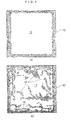
- FIG. 4 schematically shows the fracture surface that is obtained by peeling apart members that have been bonded together by using metal nanoparticles.
- (a) shows the normal fracture surface in the case where a suitable pressure has been applied
- (b) shows the defective fracture surface in the case where an excessive pressure has been applied.
- a bonding material 12 is spread evenly over the surface of a bonded member 10
- the defective fracture surface that is shown in (b) it can be understood from gas ejection pits 14 that irregularities have occurred in the bonding material 12.
- the bonding method of the present invention makes the gas discharge capacity compatible with the bonding capacity during the heating and the firing of the bonding material by applying a bonding material that includes metal nanoparticles, which are coated by an organic protective film, and a binder to a bonding surface of each of the members to be bonded, overlaying and aligning the members to be bonded together, heating the bonding material so as to attain a bonding temperature thereof or higher, and at a comparatively early stage of the bonding process, setting the pressure condition such that the discharge of a gas from the bonding material is carried out smoothly, and at the time point when the firing of the bonding material has progressed and the discharge of the gas from the bonding material has stopped, setting the applied pressure condition such that the bonding strength is improved.
- a bonding method in which members to be bonded are bonded together by carrying out heating and firing in a state where metal nanoparticles are held at a predetermined position between the members to be bonded.
- a bonding material that includes metal nanoparticles, which are coated with an organic protective film, and a binder is applied to a bonding surface of each of the members to be bonded, the members to be bonded are overlaid and aligned together, the members to be bonded are pressurized together by an applied pressure that is comparatively low while the bonding material is heated so as to attain a bonding temperature thereof or higher, a change in a predetermined physical quantity that occurs in any of the members to be bonded, the bonding material, and an ambient atmosphere thereof is measured, and at the time point when the change in the physical quantity has reached a certain amount, the applied pressure is increased to a comparatively high pressure.
- the members to be bonded are overlaid and aligned together, the bonding material is heated so as to attain the bonding temperature thereof or higher, and at a comparatively early stage, the members to be bonded are pressurized together by an applied pressure that is comparatively low (a gas venting process).
- an applied pressure that is comparatively low the gas venting process
- the organic protective film is vaporized due to the bonding material being heated, and a void portion of the porous structure that is formed by the metal nanoparticles and the binder in the bonding material is not collapsed any more than necessary due to the pressure. Accordingly, the void portion of the porous structure functions as a degassing path for the gasified organic protective film, and the gas can be smoothly released from between the members to be bonded.
- the change in a predetermined physical quantity that occurs in any of the members to be bonded, the bonding material, and the ambient atmosphere thereof are measured, and at the time point when the change in the physical quantity reaches a certain amount, the applied pressure is increased from a comparatively low pressure to a comparatively high pressure (a pressure increase process).
- the bonding strength is improved (a bonding process). Under such a comparatively high applied pressure condition (the bonding process), the void portion of the porous structure is suitably collapsed by the applied pressure and the metal nanoparticles are bonded at a high density, and thus the bonding strength is increased.
- a bonding method in which members to be bonded are bonded together by carrying out heating and firing in a state where metal nanoparticles are held at a predetermined position between the members to be bonded.
- a bonding material that includes metal nanoparticles, which are coated with an organic protective film, and a binder are applied to a bonding surface of each of the members to be bonded, the members to be bonded are overlaid and aligned together, the members to be bonded are pressurized together by an applied pressure that is comparatively low while the bonding material is heated so as to attain a bonding temperature thereof or higher, an elapsed time from the initiation of the heating is measured, and after the elapse of a certain time, the applied pressure is increased to a comparatively high pressure.
- the members to be bonded are overlaid and aligned together, the bonding material is heated so as to attain the bonding temperature thereof or higher, and at a comparatively early stage, the members to be bonded are pressurized by an applied pressure that is comparatively low (the gas venting process).
- the organic protective film is vaporized due to the bonding material being heated, and the void portion of the porous structure that is formed by the metal nanoparticles and the binder in the bonding material is not collapsed any more than necessary due to the applied pressure. Accordingly, the void portion of the porous structure functions as a degassing path for the gasified organic protective film, and the gas can be released smoothly from between the members to be bonded.
- the elapsed time from the initiation of the heating is measured, and after a certain time has elapsed, the applied pressure is increased from a comparatively low pressure to a comparatively high pressure (the pressure increase process).
- the bonding strength is increased (the bonding process).
- the bonding process Under such a comparatively high pressure condition (the bonding process), the void portion of the porous structure is suitably collapsed due to the applied pressure, the metal nanoparticles are bonded at a high density, and thus the bonding strength is increased.
- a bonding method in which members to be bonded are bonded together by carrying out heating and firing in a state where metal nanoparticles are held at a predetermined position between the members to be bonded, characterized in that a bonding material that includes metal nanoparticles, which are coated with an organic protective film, and a binder is applied to a bonding surface of each of the members to be bonded, the members to be bonded are overlaid and aligned together, the members to be bonded are pressurized together by an applied pressure that is comparatively low while the bonding material is heated so as to attain a bonding temperature thereof or higher, a change in a predetermined physical quantity that occurs in any of the members to be bonded, the bonding material, and an ambient atmosphere thereof, or an elapsed time from the initiation of the heating is measured, and at the time point when the change in the physical quantity has reached a certain amount or after the elapse of a certain time, the applied pressure is increased to a comparatively high pressure.
- the members to be bonded are overlaid and aligned together, the bonding material is heated so as to attain the bonding temperature thereof or higher, and at a comparatively early stage, the members to be bonded are pressurized together by an applied pressure that is comparatively low (the gas venting process).
- the applied pressure condition that is comparatively low the gas venting process
- the organic protective film is vaporized due to the bonding material being heated, and the void portion of the porous structure that is formed by the metal nanoparticles and the binder in the bonding material is not collapsed any more than necessary due to the applied pressure. Accordingly, the void portion of the porous structure functions as a degassing path for the gasified organic protective film, and the gas is smoothly released from between the members to be bonded.
- the change in a predetermined physical quantity that occurs in any of the members to be bonded, the bonding material, and the ambient atmosphere thereof or the elapsed time from the initiation of the heating is measured, and at the time point when the change in the physical quantity has reached a certain amount or after a certain time has elapsed, the applied pressure is increased from a comparatively low pressure to a comparatively high pressure (the pressure increase process).
- the bonding strength is increased (the bonding process). Under such a comparatively high applied pressure condition (the bonding process), the void portion of the porous structure is suitably collapsed by the applied pressure, the metal nanoparticles are bonded at a high density, and thus the bonding strength is improved.
- the temperature of the members to be bonded or the bonding material at the time point when the thermal decomposition of the organic protective film has completed is ascertained in advance.
- the members to be bonded and the bonding material are heated.
- the amount of the weight reduction from the initiation of the heating of the members to be bonded and the bonding material to the time point when the thermal decomposition of the organic protective film has completed is ascertained in advance.
- the members to be bonded and the bonding material are heated.
- the timing of the switching from the gas venting process to the pressure increase process is correctly measured based on the amount of the weight reduction in the bonding material.
- both the gas venting operation and the bonding operation are reliably carried out.
- the elapsed time from the initiation of the heating of the members to be bonded and the bonding material to the time point when the thermal decomposition of the organic protective film has completed is ascertained in advance.
- the members to be bonded and the bonding material are heated.
- the timing of the switching from the gas venting process to the pressure increase process is accurately measured based on the elapsed time from the initiation of the heating and the pressurization. As a result, both the gas venting operation and the bonding operation are reliably carried out.
- the bonding method (claim 5) based on the above-described section (3), wherein, in a test process, an amount of reduction in the thickness of the bonding material from the initiation of the heating of the members to be bonded and the bonding material to the time point when thermal decomposition of the organic protective film has completed is ascertained in advance, and under a heating condition that is identical to that of the test process, the members to be bonded and the bonding material are heated, and at the time point when the amount of the reduction in the thickness of the bonding material from the initiation of the heating of the members to be bonded and the bonding material reaches an amount of reduction corresponding to the time point when the thermal decomposition of the organic protective film has completed, the applied pressure is increased from a comparatively low pressure to a comparatively high pressure.
- the amount of the reduction in the thickness of the bonding material from the initiation of the heating of the members to be bonded and the bonding material to the time point when the thermal decomposition of the organic protective film has completed is ascertained in advance.
- the members to be bonded and the bonding material are heated.
- the timing of the switching from the gas venting process to the pressure increase process is correctly measured based on the amount of the reduction in the thickness of the bonding material.
- both the gas venting operation and the bonding operation are reliably carried out.
- the amount of the increase in the decomposition gas concentration of the organic protective film that is present in the ambient atmosphere of the members to be bonded or the bonding material from the initiation of the heating of the members to be bonded and the bonding material to the time point when the thermal decomposition of the organic protective film has completed is ascertained in advance.
- the members to be bonded and the bonding material are heated.
- the timing of the switching from the gas venting process to the pressure increase process is correctly measured based on the amount of the increase of the decomposition gas concentration of the organic protective film. As a result, both the gas venting operation and the bonding operation are reliably carried out.
- the time point when the thermal decomposition of the organic protective film in the test process has completed is correctly ascertained based on the rate of the change in the weight of the bonding material that occurs due to the heating of the members to be bonded and the bonding material, that is, based on the rate of change in the weight that originates in the vaporization of the organic protective film from the bonding material.
- bonding is carried out after optimal maximum and minimum applied pressures and a pressure increase rate during the pressure increase process have been set depending on the composition of the bonding material that is used.
- both the gas venting operation and the bonding operation are reliably carried out.
- a bonding method is provided in which, at the time point when at least two of the changes in the predetermined physical quantities or the elapsed times according to the above-described sections (3) to (6) reach a certain amount or a certain time, the applied pressure is increased from a comparatively low pressure to a comparatively high pressure.
- the time point when the thermal decomposition of the organic protective film has completed is more correctly ascertained by using, as the determination reference, the changes in the plurality of physical quantities or the elapsed times according to the above-described sections (3) to (6).
- the present invention is configured as described above, it is possible to stably obtain a necessary bonding strength in a bonding method that uses metal nanoparticles.
- FIG. 1 schematically shows a bonding procedure according to an embodiment of the present invention, in which members to be bonded are bonded together by using metal nanoparticles.
- FIG. 1 shows the state of a bonding material in each process in an enlarged manner as necessary.
- a bonding material 12 that is a mixture of metal nanoparticles 18 that are coated by an organic protective film 16, a binder 20, and a solvent 22 is applied to the bonding surface of a member to be bonded 10 (10A).
- a bonding material 12 that is a mixture of metal nanoparticles 18 that are coated by an organic protective film 16, a binder 20, and a solvent 22 is applied to the bonding surface of a member to be bonded 10 (10A).
- copper plates are used as the members to be bonded 10
- silver nanoparticles are used as the metal nanoparticles 18
- a resin flux for soldering is used as the binder 20
- alcohol is used as the solvent 22.
- a member to be bonded 10 (10B) is overlaid on and aligned with the member to be bonded 10 (10A) to which the bonding material 12 has been applied, and the bonding material 12 is sandwiched between the two members to be bonded 10 (10A, 10B).
- Heating-pressurizing process (a gas venting process): While the bonding material 12 is heated so as to attain the bonding temperature thereof or higher, the members to be bonded 10 (10A, 10B) are pressurized together by an applied pressure that is comparatively low.
- Heating-pressurizing process (a pressure increase process): The change in a predetermined physical quantity that occurs in any of the members to be bonded 10 (10A, 10B), the bonding material 12, and the ambient atmosphere thereof, or the elapsed time from the initiation of the heating is measured, and at the time point when the change in the physical quantity has reached a certain amount or after a certain elapsed time, the applied pressure is increased from a comparatively low pressure to a comparatively high pressure.
- Bonding process (a bonding completion process): While the bonding material 12 is maintained at the bonding temperature thereof or higher, the members to be bonded 10 (10A, 10B) are bonded together by imparting a pressure to obtain the necessary bonding strength to the members to be bonded 10 (10A, 10B).
- FIG. 2 shows an example of thermal properties of the bonding material 12 that has been found by using thermal analysis (TG) and the like.
- the abscissa shows the heating elapsed time t(s)
- the ordinate shows the weight m (g) and the temperature T (°C) of the bonding material 12.
- the weight m of the bonding material 12 is a constant value m1, but when the temperature T exceeds a predetermined temperature T1, the weight starts to decrease, and when the temperature exceeds a temperature T2, the decrease in the weight stops and attains a constant value m2.
- the temperature T1 is the decomposition initiation temperature of the organic protective film 16 contained in the bonding material 12
- the temperature T2 is the decomposition completion temperature at which the organic protective film 16 contained in the bonding material 12 has substantially completely decomposed.
- the elapsed time t1 from the initiation t0 of the heating to the decomposition initiation temperature T1 (of the organic protective film 16) and the elapsed time t2 to the same decomposition completion temperature T2 are both strictly associated.
- a change (reduction) also occurs in the thickness of the bonding material.
- a change (increase) also occurs in the decomposition gas concentration of the organic protective film that is present in the ambient atmosphere of the members to be bonded 10 or the bonding material 12.
- FIG. 3 shows the relationship between the applied pressure P (MPa) that is applied to the members to be bonded 10 and the bonding strength I (MPa) of the members to be bonded 10 from (iv) the heating-pressurizing process (the gas venting process) to (vi) the bonding process (the bonding completion process) that are shown in FIG. 1 .
- the bonding strength I is found by using a tensile shear test (test equipment: an autograph made by Shimazu; maximum thrust, 10kN; test speed, 6.0 m/min).
- these values of the applied pressures P1 and P2 are ascertained in advance for each bonding material that is used, the applied pressure that is comparatively low in (iv) the heating-pressurizing process (the gas venting process) is set to P1 (for example, P1 ⁇ 10 MPa), and in (v) the heating-pressurizing process (the pressure increase process), the applied pressure is increased to P2 (for example, P2 ⁇ 30 MPa).
- the pressure increase rate in (v) the heating-pressurizing process (the pressure increase process) is suitably set according to the composition of the bonding material that is used.
- Method 1 (a method in which the temperature serves as the reference): In a test process, after the initiation of the heating of the members to be bonded 10 and the bonding material 12, the temperature T2 at the time point when the thermal decomposition of the organic protective film 16 that covers the metal nanoparticles 18 has completed is ascertained in advance.
- the heating-pressurizing process (the gas venting process)
- the gases to be bonded 10 and the bonding material 12 are heated, and at the time point when the temperature of the members to be bonded 10 and the bonding material 12 reaches the temperature T2 corresponding to the time point when the thermal decomposition of the organic protective film 16 has completed, the process moves to (v) the heating-pressurizing process (the pressure increase process), and the pressure is increased from the applied pressure P1 that is comparatively low to the applied pressure P2 that is comparatively high.
- the temperature of the members to be bonded 10 and the bonding material 12 can be correctly ascertained by measuring the temperature of the press die in the vicinity of the portion that is in contact with the members to be bonded.
- the temperature of the members to be bonded 10 may be ascertained by using a general-use temperature measuring device such as a thermocouple.
- Method 2 (a method in which the weight serves as the reference): In a test process, the amount of the weight reduction from the initiation of the heating of the members to be bonded 10 and the bonding material 12 to the time point when the thermal decomposition of the organic protective film 16 that covers the metal nanoparticles 18 has completed is ascertained in advance.
- the heating-pressurizing process (the gas venting process)
- the gases to be bonded 10 and the bonding material 12 are heated, the amount of the weight reduction in the bonding material 12 from the initiation of the heating of the members to be bonded 10 and the bonding material 12 is measured, at the time point when this amount of reduction reaches an amount of reduction (m1 - m2) corresponding to the time point when the thermal decomposition of the organic protective film 16 has completed, the process moves to (v) the heating-pressurizing process (the pressure increase process), and the pressure is increased from the applied pressure P1 that is comparatively low to the applied pressure P2 that is comparatively high.
- the applied amount of the bonding material 12 that is applied to the members to be bonded that are actually bonded, and the applied amount of the bonding material 12 in the test process should precisely match to the extent possible.
- Method 3 (a method in which the elapsed time serves as the reference): In a test process, the elapsed time (t2 - t0) from the initiation of the heating of the members to be bonded 10 and the bonding material 12 to the time point when the thermal decomposition of the organic protective film 16 that covers the metal nanoparticles 18 has completed is ascertained in advance.
- the heating-pressurizing process (the gas venting process)
- the members to be bonded 10 and the bonding material 12 are heated, at the time point when the heating time reaches the elapsed time (t2 - t0), the process moves to (v) the heating-pressurizing process (the pressure increase process), and the pressure is increased from the applied pressure P1 that is comparatively low to the applied pressure P2 that is comparatively high.
- Method 4 (a method in which the amount of the reduction in the thickness serves as the reference): In a test process, the amount of the reduction in the thickness of the bonding material 12 from the initiation of the heating of the members to be bonded 10 and the bonding material 12 to the time point when the thermal decomposition of the organic protective film 16 that covers the metal nanoparticles 18 has completed is ascertained in advance.
- the heating-pressurizing process (the gas venting process)
- the gases to be bonded 10 and the bonding material 12 are heated, at the time point when the amount of the reduction in the thickness of the bonding material 12 from the initiation of the heating of the members to be bonded 10 and the bonding material 12 has reached the amount of the reduction corresponding to the time point when the thermal decomposition of the organic protective film has completed, the process moves to (v) the heating-pressurizing process (the pressure increase process), and the pressure is increased from the applied pressure P1 that is comparatively low to the applied pressure P2 that is comparatively high.
- the thickness of the bonding material 12 that is applied to the members to be bonded that are actually bonded, and the thickness of the bonding material 12 in the test process should precisely match to the extent possible.
- Method 5 (a method in which the decomposition gas concentration of the organic protective film serves as the reference): In a test process, the amount of the increase in the decomposition gas concentration of the organic protective film 16 that is present in the ambient atmosphere of the members to be bonded 10 or the bonding material 12 from the initiation of the heating of the members to be bonded 10 and the bonding material 12 to the time point when the thermal decomposition of the organic protective film 16 that covers the metal nanoparticles 18 has completed is ascertained in advance.
- the process moves to (v) the heating-pressurizing process (the pressure increase process), and the pressure is increased from the applied pressure P1 that is comparatively low to the applied pressure P2 that is comparatively high.
- the applied amount of the bonding material 12 that is applied to the members to be bonded that are actually bonded, and the applied amount of the bonding material 12 in the test process should precisely match to the extent possible.
- the bonding material 12 in the bonding process in which the bonding material 12 is heated so as to attain the bonding temperature thereof or higher, the bonding material 12 is applied to the bonding surface of the member to be bonded 10, the members to be bonded 10A, 10B are overlaid and aligned, and, at a comparatively early stage, the members to be bonded 10A, 10B together are pressurized by the applied pressure P1 that is comparatively low ((iv) heating-pressurizing process (the gas venting process)).
- the organic protective film 16 Under the condition of the applied pressure that is comparatively low (the gas venting process), the organic protective film 16 is vaporized due to the bonding material 12 being heated, and the void portion of the porous structure that is formed by the metal nanoparticles 18 and the binder 20 of the bonding material 12 is not collapsed any more than necessary due to the applied pressure.
- the void portion of the porous structure functions as a degassing path for the gasified organic protective film 16, and the gas is smoothly released from between the members to be bonded 10A, 10B.
- the change in a predetermined physical quantity that occurs in any of the members to be bonded 10, the bonding material 12, and the ambient atmosphere thereof, or the elapsed time from the initiation of the heating is measured, and at the time point when the change in the physical quantity has reached a certain amount or after a certain time has elapsed, the pressure is increased from the applied pressure P1 that is comparatively low to the applied pressure P2 that is comparatively high (the pressure increase process), and the bonding strength is increased by bonding the members to be bonded 10A, 10B together at the applied pressure P2 (the bonding process).
- the void portion of the porous structure is suitably collapsed by the applied pressure, the metal nanoparticles are bonded in a high density, and thus the bonding strength is increased.
- the temperature change (T2 - T1) of the members to be bonded 10 and the bonding material 12 from the initiation of the heating of the members to be bonded 10 and the bonding material 12 to the time point when the thermal decomposition of the organic protective film 16 has completed is ascertained in advance.
- the members to be bonded 10 and the bonding material 12 are heated, and the timing of the switching from the gas venting process (iv) to the pressure increase process (v) is correctly measured based on the temperature T2 after the initiation of the heating and the pressurization.
- the amount of the weight reduction (m1 - m2) from the initiation of the heating of the members to be bonded 10 and the bonding material to the time point when the thermal decomposition of the organic protective film 16 has completed is ascertained in advance.
- the members to be bonded 10 and the bonding material 12 are heated, and the timing of the switching from the gas venting process (iv) to the pressure increase process (v) is correctly measured based on the amount of the weight reduction (m1 - m2) of the bonding material 12.
- the elapsed time (t2 - t0) from the initiation of the heating of the members to be bonded 10 and the bonding material 12 to the time point when the thermal decomposition of the organic protective film 16 has completed is ascertained in advance.
- the members to be bonded 10 and the bonding material 12 are heated, and the timing of the switching from the gas venting process (iv) to the pressure increase process (v) is correctly measured based on the elapsed time (t2 - t0) from the initiation of the heating and the pressurization.
- the amount of the reduction in the thickness of the bonding material 12 from the initiation of the heating of the members to be bonded 10 and the bonding material 12 to the time point when the thermal decomposition of the organic protective film 16 has completed is ascertained in advance.
- the members to be bonded 10 and the bonding material 12 are heated, and the timing of the switching from the gas venting process (iv) to the pressure increase process (v) is correctly measured based on the amount of the reduction in the thickness in the bonding material 12, and thereby it is possible to carry out both the gas venting operation and the bonding operation reliably.
- the amount of the increase in the decomposition gas concentration of the organic protective film 16 that is present in the ambient atmosphere of the members to be bonded 10 or the bonding material 12 from the initiation of the heating of the members to be bonded 10 and the bonding material 12 to the time point when the thermal decomposition of the organic protective film 16 has completed is ascertained in advance.
- the members to be bonded 10 and the bonding material 12 are heated, and the timing of the switching from the gas venting process (iv) to the pressure increase process (v) is accurately measured based on the amount of the increase in the decomposition gas concentration of the organic protective film 16.
- the time point when thermal decomposition of the organic protective film 16 in the test process has completed can be correctly ascertained based on the rate of the weight change in the bonding material 12 that occurs due to heating the members to be bonded 10 and the bonding material 12, that is, the rate of the weight change ((m2 - m1) / (t2 - t1) in FIG. 2 ) that originates due to the vaporization of the organic protective film 16 from the bonding material 12.
- bonding is carried out after setting optimal maximum and minimum applied pressures (P2, P1) and setting the pressure increase rate in the pressure increase process, depending on the composition of the bonding material 12 that is used.
- P2, P1 optimal maximum and minimum applied pressures
Landscapes
- Engineering & Computer Science (AREA)
- Mechanical Engineering (AREA)
- Pressure Welding/Diffusion-Bonding (AREA)
- Powder Metallurgy (AREA)
Abstract
Description
- The present invention relates to a bonding method that bonds members to be bonded together by carrying out heating and firing while metal nanoparticles are held at a predetermined position between the members to be bonded.
- In known technology, various techniques such as soldering, bonding, welding and the like have been used as a technique for bonding members together. On the other hand, in recent years, taking into consideration that more serious attention must be given to environmental contamination and that there are cases in which these conventional bonding techniques are inappropriate due to the properties of the members to be bonded, a bonding technology that differs from the known technology and that uses metal nanoparticles has come to be used (refer, for example, to Patent Document 1).
Patent Document 1: Japanese Patent Application Publication No.JP-A-2004-130371 - This bonding technology that uses metal nanoparticles is a bonding method that bonds the members to be bonded together by heating and pressurizing the members to be bonded and a bonding material, and then firing the bonded members in a state where the bonding material that includes metal nanoparticles, which are coated by an organic protective film, and a binder is applied to a predetermined position of each of the members to be bonded such that the bonding material is held between the members to be bonded.
- Since the metal nanoparticles that are used here are coated by an organic protective film, and further, the metal nanoparticles are mixed with a binder and a solvent, this can be handled at room temperature as a bonding material that has the consistency of a paste. In addition, when the bonded members are sintered, it is necessary to heat the members to be bonded and the bonding material, and pressurize the bonded material. However, because the bonding strength of the bonded members is reduced when this applied pressure is either too high or too low, there is a difficulty in that a set range of the pressure condition is narrow in the bonding method that uses metal nanoparticles.
- Such a problem originates in a mechanism that occurs during the firing process of the bonding material. Specifically, in the bonding material that has the consistency of a paste, the solvent and the organic protecting film vaporize due to being heated, and the bonded material then exhibits a porous structure due to the metal nanoparticles and the binder. In addition, by collapsing a void portion of such a porous structure by applying the pressure, the metal nanoparticles are bonded at a high density, and the bonded strength increases. However, the void portion of the porous structure functions as a degassing path for the gasified organic protective film. Thus, the imparting of an excessive applied pressure to the bonded material seals off the degassing path. In addition, the gas that has lost an escape path as a result of the sealing off of the degassing path is discharged all at once from the bonding material, and the binder and the metal nanoparticles are ejected from the bonding surface, resulting in a decrease in the bonding strength.
-
FIG. 4 schematically shows the fracture surface that is obtained by peeling apart members that have been bonded together by using metal nanoparticles. Here, (a) shows the normal fracture surface in the case where a suitable pressure has been applied, and (b) shows the defective fracture surface in the case where an excessive pressure has been applied. In the normal fracture surface that is shown in (a), abonding material 12 is spread evenly over the surface of a bondedmember 10, while in contrast, in the defective fracture surface that is shown in (b), it can be understood fromgas ejection pits 14 that irregularities have occurred in thebonding material 12. - In light of the problems described above, it is an object of the present invention to stably obtain a necessary bonding strength by applying a suitable pressure during the firing of a bonding material, in a bonding method that uses metal nanoparticles.
- In order to solve the above-described problems, the bonding method of the present invention makes the gas discharge capacity compatible with the bonding capacity during the heating and the firing of the bonding material by applying a bonding material that includes metal nanoparticles, which are coated by an organic protective film, and a binder to a bonding surface of each of the members to be bonded, overlaying and aligning the members to be bonded together, heating the bonding material so as to attain a bonding temperature thereof or higher, and at a comparatively early stage of the bonding process, setting the pressure condition such that the discharge of a gas from the bonding material is carried out smoothly, and at the time point when the firing of the bonding material has progressed and the discharge of the gas from the bonding material has stopped, setting the applied pressure condition such that the bonding strength is improved.
- The following modes of the invention illustrate the structure of the present invention, and in order to facilitate the understanding of the various structures of the present invention, explanations will be provided in separate sections. In addition, these sections do not limit the technical scope of the present invention. Thus, while referring to the best modes for carrying out the invention, the exchange or elimination of some of the structural elements of each section or the further addition of other structural elements can be included in the technical scope of the present invention.
- (1) A bonding method is provided in which members to be bonded are bonded together by carrying out heating and firing in a state where metal nanoparticles are held at a predetermined position between the members to be bonded. In the bonding method, a bonding material that includes metal nanoparticles, which are coated with an organic protective film, and a binder is applied to a bonding surface of each of the members to be bonded, the members to be bonded are overlaid and aligned together, the members to be bonded are pressurized together by an applied pressure that is comparatively low while the bonding material is heated so as to attain a bonding temperature thereof or higher, a change in a predetermined physical quantity that occurs in any of the members to be bonded, the bonding material, and an ambient atmosphere thereof is measured, and at the time point when the change in the physical quantity has reached a certain amount, the applied pressure is increased to a comparatively high pressure.
- According to the bonding method that is described in this section, in the bonding process in which the bonding material is applied to the bonding surface of each of the members to be bonded, the members to be bonded are overlaid and aligned together, the bonding material is heated so as to attain the bonding temperature thereof or higher, and at a comparatively early stage, the members to be bonded are pressurized together by an applied pressure that is comparatively low (a gas venting process). Under the applied pressure condition that is comparatively low (the gas venting process), the organic protective film is vaporized due to the bonding material being heated, and a void portion of the porous structure that is formed by the metal nanoparticles and the binder in the bonding material is not collapsed any more than necessary due to the pressure. Accordingly, the void portion of the porous structure functions as a degassing path for the gasified organic protective film, and the gas can be smoothly released from between the members to be bonded.
- In this section, the change in a predetermined physical quantity that occurs in any of the members to be bonded, the bonding material, and the ambient atmosphere thereof are measured, and at the time point when the change in the physical quantity reaches a certain amount, the applied pressure is increased from a comparatively low pressure to a comparatively high pressure (a pressure increase process). In addition, because the members to be bonded are bonded together by applying the high pressure, the bonding strength is improved (a bonding process). Under such a comparatively high applied pressure condition (the bonding process), the void portion of the porous structure is suitably collapsed by the applied pressure and the metal nanoparticles are bonded at a high density, and thus the bonding strength is increased.
- (2) A bonding method is provided in which members to be bonded are bonded together by carrying out heating and firing in a state where metal nanoparticles are held at a predetermined position between the members to be bonded. In the bonding method, a bonding material that includes metal nanoparticles, which are coated with an organic protective film, and a binder are applied to a bonding surface of each of the members to be bonded, the members to be bonded are overlaid and aligned together, the members to be bonded are pressurized together by an applied pressure that is comparatively low while the bonding material is heated so as to attain a bonding temperature thereof or higher, an elapsed time from the initiation of the heating is measured, and after the elapse of a certain time, the applied pressure is increased to a comparatively high pressure.
- According to the bonding method that is described in this section, in a bonding process in which the bonding material is applied to the bonding surface of each of the members to be bonded, the members to be bonded are overlaid and aligned together, the bonding material is heated so as to attain the bonding temperature thereof or higher, and at a comparatively early stage, the members to be bonded are pressurized by an applied pressure that is comparatively low (the gas venting process). Under the applied pressure condition that is comparatively low (the gas venting process), the organic protective film is vaporized due to the bonding material being heated, and the void portion of the porous structure that is formed by the metal nanoparticles and the binder in the bonding material is not collapsed any more than necessary due to the applied pressure. Accordingly, the void portion of the porous structure functions as a degassing path for the gasified organic protective film, and the gas can be released smoothly from between the members to be bonded.
- In this section, the elapsed time from the initiation of the heating is measured, and after a certain time has elapsed, the applied pressure is increased from a comparatively low pressure to a comparatively high pressure (the pressure increase process). In addition, because the members to be bonded are bonded together by the high applied pressure, the bonding strength is increased (the bonding process). Under such a comparatively high pressure condition (the bonding process), the void portion of the porous structure is suitably collapsed due to the applied pressure, the metal nanoparticles are bonded at a high density, and thus the bonding strength is increased.
- (3) There is provided a bonding method (claim 1) in which members to be bonded are bonded together by carrying out heating and firing in a state where metal nanoparticles are held at a predetermined position between the members to be bonded, characterized in that a bonding material that includes metal nanoparticles, which are coated with an organic protective film, and a binder is applied to a bonding surface of each of the members to be bonded, the members to be bonded are overlaid and aligned together, the members to be bonded are pressurized together by an applied pressure that is comparatively low while the bonding material is heated so as to attain a bonding temperature thereof or higher, a change in a predetermined physical quantity that occurs in any of the members to be bonded, the bonding material, and an ambient atmosphere thereof, or an elapsed time from the initiation of the heating is measured, and at the time point when the change in the physical quantity has reached a certain amount or after the elapse of a certain time, the applied pressure is increased to a comparatively high pressure.
- According to the bonding method that is described in this section, in the bonding process in which the bonding material is applied to the bonding surface of each of the members to be bonded, the members to be bonded are overlaid and aligned together, the bonding material is heated so as to attain the bonding temperature thereof or higher, and at a comparatively early stage, the members to be bonded are pressurized together by an applied pressure that is comparatively low (the gas venting process). Under the applied pressure condition that is comparatively low (the gas venting process), the organic protective film is vaporized due to the bonding material being heated, and the void portion of the porous structure that is formed by the metal nanoparticles and the binder in the bonding material is not collapsed any more than necessary due to the applied pressure. Accordingly, the void portion of the porous structure functions as a degassing path for the gasified organic protective film, and the gas is smoothly released from between the members to be bonded.
- In this section, the change in a predetermined physical quantity that occurs in any of the members to be bonded, the bonding material, and the ambient atmosphere thereof or the elapsed time from the initiation of the heating is measured, and at the time point when the change in the physical quantity has reached a certain amount or after a certain time has elapsed, the applied pressure is increased from a comparatively low pressure to a comparatively high pressure (the pressure increase process). In addition, because the members to be bonded are bonded together by a high applied pressure, the bonding strength is increased (the bonding process). Under such a comparatively high applied pressure condition (the bonding process), the void portion of the porous structure is suitably collapsed by the applied pressure, the metal nanoparticles are bonded at a high density, and thus the bonding strength is improved.
- (4) There is provided the bonding method (claim 2) based on the above-described section (3), wherein, in a test process, a temperature change in the members to be bonded or the bonding material is ascertained in advance from the initiation of the heating of the members to be bonded and the bonding material to the time point when thermal decomposition of the organic protective film has completed, and under a heating condition that is identical to that of the test process, the members to be bonded and the bonding material are heated, the temperature change in the members to be bonded or the bonding material from the initiation of the heating of the members to be bonded and the bonding material is measured, and at the time point when this temperature has reached a temperature corresponding to the time point when the thermal decomposition of the organic protective film has completed, the applied pressure is increased from a comparatively low pressure to a comparatively high pressure.
- According to the bonding method that is described in this section, in the test process, after the initiation of the heating of the members to be bonded and the bonding material, the temperature of the members to be bonded or the bonding material at the time point when the thermal decomposition of the organic protective film has completed is ascertained in advance. Under the heating condition that is identical to that of the test process, the members to be bonded and the bonding material are heated. Thus, the timing of the switching from the gas venting process to the pressure increase process is correctly measured based on the temperature after the initiation of the heating and pressurization. As a result, both the gas venting operation and the bonding operations are reliably carried out.
- (5) There is provided the bonding method (claim 3) based on the above-described section (3), wherein, in a test process, an amount of weight reduction from the initiation of the heating of the members to be bonded and the bonding material to the time point when thermal decomposition of the organic protective film has completed is ascertained in advance, and under a heating condition that is identical to that of the test process, the members to be bonded and the bonding material are heated, an amount of weight reduction in the bonding material from the initiation of the heating of the members to be bonded and the bonding material is measured, and at the time point when the amount of this reduction attains an amount of reduction corresponding to the time point when the thermal decomposition of the organic protective film has completed, the applied pressure is increased from a comparatively low pressure to a comparatively high pressure.
- According to the bonding method that is described in this section, in the test process, the amount of the weight reduction from the initiation of the heating of the members to be bonded and the bonding material to the time point when the thermal decomposition of the organic protective film has completed is ascertained in advance. Under the heating condition that is identical to that of the test process, the members to be bonded and the bonding material are heated. Thus, the timing of the switching from the gas venting process to the pressure increase process is correctly measured based on the amount of the weight reduction in the bonding material. As a result, both the gas venting operation and the bonding operation are reliably carried out.
- (6) There is provided the bonding method (claim 4) based on the above-described section (3), wherein, in a test process, the elapsed time from the initiation of the heating of the members to be bonded and the bonding material to the time point when thermal decomposition of the organic protective film has completed is ascertained in advance, and under a heating condition that is identical to that of the test process, the members to be bonded and the bonding material are heated, and at the time point when the heating time has reached a time that corresponds to the elapsed time, the applied pressure is increased from a comparatively low pressure to a comparatively high pressure.
- According to the bonding method that is described in this section, in the test process, the elapsed time from the initiation of the heating of the members to be bonded and the bonding material to the time point when the thermal decomposition of the organic protective film has completed is ascertained in advance. Under the heating condition that is identical to that of the test process, the members to be bonded and the bonding material are heated. Thus, the timing of the switching from the gas venting process to the pressure increase process is accurately measured based on the elapsed time from the initiation of the heating and the pressurization. As a result, both the gas venting operation and the bonding operation are reliably carried out.
- (7) There is provided the bonding method (claim 5) based on the above-described section (3), wherein, in a test process, an amount of reduction in the thickness of the bonding material from the initiation of the heating of the members to be bonded and the bonding material to the time point when thermal decomposition of the organic protective film has completed is ascertained in advance, and under a heating condition that is identical to that of the test process, the members to be bonded and the bonding material are heated, and at the time point when the amount of the reduction in the thickness of the bonding material from the initiation of the heating of the members to be bonded and the bonding material reaches an amount of reduction corresponding to the time point when the thermal decomposition of the organic protective film has completed, the applied pressure is increased from a comparatively low pressure to a comparatively high pressure.
- According to the bonding method that is described in this section, the amount of the reduction in the thickness of the bonding material from the initiation of the heating of the members to be bonded and the bonding material to the time point when the thermal decomposition of the organic protective film has completed is ascertained in advance. Under the heating condition that is identical to that of the test process, the members to be bonded and the bonding material are heated. Thus, the timing of the switching from the gas venting process to the pressure increase process is correctly measured based on the amount of the reduction in the thickness of the bonding material. As a result, both the gas venting operation and the bonding operation are reliably carried out.
- (8) There is provided the bonding method (claim 6) based on the above-described section (3), wherein, in a test process, an amount of increase in a decomposition gas concentration of the organic protective film that is present in the ambient atmosphere of the members to be bonded and the bonding material from the initiation of the heating of the members to be bonded and the bonding material to the time point when thermal decomposition of the organic protective film has completed is ascertained in advance, and under a heating condition that is identical to that of the test process, the members to be bonded and the bonding material are heated, and at the time point when the amount of the increase in the decomposition gas concentration of the organic protective film that is present in the ambient atmosphere of the members to be bonded or the bonding material from the initiation of the heating of the members to be bonded and the bonding material reaches an increased amount corresponding to the time point when the thermal decomposition of the organic protective film has completed, the applied pressure is increased from a comparatively low pressure to a comparatively high pressure.
- According to the bonding method that is described in this section, the amount of the increase in the decomposition gas concentration of the organic protective film that is present in the ambient atmosphere of the members to be bonded or the bonding material from the initiation of the heating of the members to be bonded and the bonding material to the time point when the thermal decomposition of the organic protective film has completed is ascertained in advance. Under the heating condition that is identical to the test process, the members to be bonded and the bonding material are heated. Thus, the timing of the switching from the gas venting process to the pressure increase process is correctly measured based on the amount of the increase of the decomposition gas concentration of the organic protective film. As a result, both the gas venting operation and the bonding operation are reliably carried out.
- (9) There is provided the bonding method (claim 7) based on any one of the above-described sections (1) to (8), wherein the ascertaining of the time point when the thermal decomposition of the organic protective film in the test process has completed is carried out based on a rate of change in the weight of the bonding material that occurs due to the heating of the members to be bonded and the bonding material.
- According to the bonding method that is described in this section, the time point when the thermal decomposition of the organic protective film in the test process has completed is correctly ascertained based on the rate of the change in the weight of the bonding material that occurs due to the heating of the members to be bonded and the bonding material, that is, based on the rate of change in the weight that originates in the vaporization of the organic protective film from the bonding material.
- (10) There is provided the bonding method (claim 8) based on any one of the above-described sections (1) to (8), wherein the values of an applied pressure that is comparatively low and an applied pressure that is comparatively high when the members to be bonded are pressurized together, and an increase rate per unit time when the applied pressure is increased from the comparatively low pressure to the comparatively high pressure are set depending on a composition of the bonding material.
- According to the bonding method that is described in this section, bonding is carried out after optimal maximum and minimum applied pressures and a pressure increase rate during the pressure increase process have been set depending on the composition of the bonding material that is used. Thus, both the gas venting operation and the bonding operation are reliably carried out.
- (11) A bonding method is provided in which, at the time point when at least two of the changes in the predetermined physical quantities or the elapsed times according to the above-described sections (3) to (6) reach a certain amount or a certain time, the applied pressure is increased from a comparatively low pressure to a comparatively high pressure.
- According to the bonding method that is described in this section, the time point when the thermal decomposition of the organic protective film has completed is more correctly ascertained by using, as the determination reference, the changes in the plurality of physical quantities or the elapsed times according to the above-described sections (3) to (6).
- Since the present invention is configured as described above, it is possible to stably obtain a necessary bonding strength in a bonding method that uses metal nanoparticles.
-
-
FIG. 1 is a schematic drawing that shows a bonding procedure in which members to be bonded are bonded together by using metal nanoparticles according to an embodiment of the present invention; -
FIG. 2 is a graph that shows an example of the heating characteristics of a bonding material that is obtained by thermoanalysis (TG); -
FIG. 3 is a drawing that illustrates the relationship between the applied pressure that is applied to the members to be bonded and the bonding strength of the members to be bonded in a bonding process; and -
FIG. 4 schematically shows the fracture surfaces obtained by peeling apart the members that have been bonded together by using the metal nanoparticles, where (a) shows the normal fracture surface in the case where a suitable applied pressure has been applied, and (b) shows the defective fracture surface in the case
where an excessive applied pressure has been applied. -
10, 10A, 10B: MEMBERS TO BE BONDED 12: BONDING MATERIAL 16: ORGANIC PROTECTIVE FILM 18: METAL NANOPARTICLES 20: BINDER 22: SOLVENT - Hereinafter, the best modes for carrying out the present invention will be explained with reference to the appended drawings. Note that portions that are identical to or correspond to the background art are denoted by the identical reference numerals, and detailed explanations thereof are omitted.
-
FIG. 1 schematically shows a bonding procedure according to an embodiment of the present invention, in which members to be bonded are bonded together by using metal nanoparticles. In addition,FIG. 1 shows the state of a bonding material in each process in an enlarged manner as necessary. - (i) Application process: A bonding
material 12 that is a mixture ofmetal nanoparticles 18 that are coated by an organicprotective film 16, abinder 20, and a solvent 22 is applied to the bonding surface of a member to be bonded 10 (10A). Note that, in the illustrated example, copper plates are used as the members to be bonded 10, silver nanoparticles are used as themetal nanoparticles 18, a resin flux for soldering is used as thebinder 20, and alcohol is used as the solvent 22. - (ii) Drying process: In the drying process, the
bonding material 12, which has been applied to the bonding surface of the member to be bonded 10, is dried, and the solvent 20 is vaporized from thebonding material 12. - (iii) Assembly process: A member to be bonded 10 (10B) is overlaid on and aligned with the member to be bonded 10 (10A) to which the
bonding material 12 has been applied, and thebonding material 12 is sandwiched between the two members to be bonded 10 (10A, 10B). - (iv) Heating-pressurizing process (a gas venting process): While the
bonding material 12 is heated so as to attain the bonding temperature thereof or higher, the members to be bonded 10 (10A, 10B) are pressurized together by an applied pressure that is comparatively low. - (v) Heating-pressurizing process (a pressure increase process): The change in a predetermined physical quantity that occurs in any of the members to be bonded 10 (10A, 10B), the
bonding material 12, and the ambient atmosphere thereof, or the elapsed time from the initiation of the heating is measured, and at the time point when the change in the physical quantity has reached a certain amount or after a certain elapsed time, the applied pressure is increased from a comparatively low pressure to a comparatively high pressure. - (vi) Bonding process (a bonding completion process): While the
bonding material 12 is maintained at the bonding temperature thereof or higher, the members to be bonded 10 (10A, 10B) are bonded together by imparting a pressure to obtain the necessary bonding strength to the members to be bonded 10 (10A, 10B). - During the above processes, it is important that the pressure increase timing to reach (vi) the bonding process (the bonding completion process) from (iv) the heating-pressurizing process (the gas venting process) be measured correctly, and in the embodiment of the present invention, this timing is correctly calculated by the following procedure.
-
FIG. 2 shows an example of thermal properties of thebonding material 12 that has been found by using thermal analysis (TG) and the like. Here, the abscissa shows the heating elapsed time t(s), and the ordinate shows the weight m (g) and the temperature T (°C) of thebonding material 12. In addition, for a certain time from the initiation of the heating, the weight m of thebonding material 12 is a constant value m1, but when the temperature T exceeds a predetermined temperature T1, the weight starts to decrease, and when the temperature exceeds a temperature T2, the decrease in the weight stops and attains a constant value m2. This phenomenon originates in that thebonding material 12 from which the solvent 22 has already vaporized is further heated, and thus the organicprotective film 16 vaporizes from thebonding material 12. In addition, the temperature T1 is the decomposition initiation temperature of the organicprotective film 16 contained in thebonding material 12, and the temperature T2 is the decomposition completion temperature at which the organicprotective film 16 contained in thebonding material 12 has substantially completely decomposed. - Note that in the case where the speed of the rise in the temperature T is made constant, the elapsed time t1 from the initiation t0 of the heating to the decomposition initiation temperature T1 (of the organic protective film 16) and the elapsed time t2 to the same decomposition completion temperature T2 are both strictly associated. In addition, during thermal decomposition of the organic
protective film 16, a change (reduction) also occurs in the thickness of the bonding material. Furthermore, during thermal decomposition of the organicprotective film 16, a change (increase) also occurs in the decomposition gas concentration of the organic protective film that is present in the ambient atmosphere of the members to be bonded 10 or thebonding material 12. - In addition,
FIG. 3 shows the relationship between the applied pressure P (MPa) that is applied to the members to be bonded 10 and the bonding strength I (MPa) of the members to be bonded 10 from (iv) the heating-pressurizing process (the gas venting process) to (vi) the bonding process (the bonding completion process) that are shown inFIG. 1 . Here, the bonding strength I is found by using a tensile shear test (test equipment: an autograph made by Shimazu; maximum thrust, 10kN; test speed, 6.0 m/min). InFIG. 3 , under the applied pressure condition that falls below the applied pressure P1, it is not possible to obtain the necessary bonding strength due to insufficient applied pressure, and under the applied pressure condition that exceeds the applied pressure P2, it is not possible to obtain the necessary bonding strength due to gas venting defects. - Thus, in the embodiment of the present invention, these values of the applied pressures P1 and P2 are ascertained in advance for each bonding material that is used, the applied pressure that is comparatively low in (iv) the heating-pressurizing process (the gas venting process) is set to P1 (for example, P1 ≤ 10 MPa), and in (v) the heating-pressurizing process (the pressure increase process), the applied pressure is increased to P2 (for example, P2 ≥ 30 MPa). In addition, the pressure increase rate in (v) the heating-pressurizing process (the pressure increase process) is suitably set according to the composition of the bonding material that is used.
- Using the above as a basis, in the embodiment of the present invention, it is possible to use various methods such as those described below in order to correctly calculate the pressure increase timing.
- Method 1 (a method in which the temperature serves as the reference): In a test process, after the initiation of the heating of the members to be bonded 10 and the
bonding material 12, the temperature T2 at the time point when the thermal decomposition of the organicprotective film 16 that covers themetal nanoparticles 18 has completed is ascertained in advance. In addition, in (iv) the heating-pressurizing process (the gas venting process), under a heating condition that is identical to that of the test process, the members to be bonded 10 and thebonding material 12 are heated, and at the time point when the temperature of the members to be bonded 10 and thebonding material 12 reaches the temperature T2 corresponding to the time point when the thermal decomposition of the organicprotective film 16 has completed, the process moves to (v) the heating-pressurizing process (the pressure increase process), and the pressure is increased from the applied pressure P1 that is comparatively low to the applied pressure P2 that is comparatively high. - Note that in the case where a press die is used in a heat pressure welding operation, in either the test process or the actual pressure welding process, the temperature of the members to be bonded 10 and the
bonding material 12 can be correctly ascertained by measuring the temperature of the press die in the vicinity of the portion that is in contact with the members to be bonded. Alternatively, the temperature of the members to be bonded 10 may be ascertained by using a general-use temperature measuring device such as a thermocouple. - Method 2 (a method in which the weight serves as the reference): In a test process, the amount of the weight reduction from the initiation of the heating of the members to be bonded 10 and the
bonding material 12 to the time point when the thermal decomposition of the organicprotective film 16 that covers themetal nanoparticles 18 has completed is ascertained in advance. In addition, in (iv) the heating-pressurizing process (the gas venting process), under a heating condition that is identical to that of the test process, the members to be bonded 10 and thebonding material 12 are heated, the amount of the weight reduction in thebonding material 12 from the initiation of the heating of the members to be bonded 10 and thebonding material 12 is measured, at the time point when this amount of reduction reaches an amount of reduction (m1 - m2) corresponding to the time point when the thermal decomposition of the organicprotective film 16 has completed, the process moves to (v) the heating-pressurizing process (the pressure increase process), and the pressure is increased from the applied pressure P1 that is comparatively low to the applied pressure P2 that is comparatively high. - Note that, in such a method, preferably, the applied amount of the
bonding material 12 that is applied to the members to be bonded that are actually bonded, and the applied amount of thebonding material 12 in the test process should precisely match to the extent possible. - Method 3 (a method in which the elapsed time serves as the reference): In a test process, the elapsed time (t2 - t0) from the initiation of the heating of the members to be bonded 10 and the
bonding material 12 to the time point when the thermal decomposition of the organicprotective film 16 that covers themetal nanoparticles 18 has completed is ascertained in advance. In addition, in (iv) the heating-pressurizing process (the gas venting process), under a heating condition that is identical to that of the test process, the members to be bonded 10 and thebonding material 12 are heated, at the time point when the heating time reaches the elapsed time (t2 - t0), the process moves to (v) the heating-pressurizing process (the pressure increase process), and the pressure is increased from the applied pressure P1 that is comparatively low to the applied pressure P2 that is comparatively high. - Method 4 (a method in which the amount of the reduction in the thickness serves as the reference): In a test process, the amount of the reduction in the thickness of the
bonding material 12 from the initiation of the heating of the members to be bonded 10 and thebonding material 12 to the time point when the thermal decomposition of the organicprotective film 16 that covers themetal nanoparticles 18 has completed is ascertained in advance. In addition, in (iv) the heating-pressurizing process (the gas venting process), under a heating condition that is identical to that of the test process, the members to be bonded 10 and thebonding material 12 are heated, at the time point when the amount of the reduction in the thickness of thebonding material 12 from the initiation of the heating of the members to be bonded 10 and thebonding material 12 has reached the amount of the reduction corresponding to the time point when the thermal decomposition of the organic protective film has completed, the process moves to (v) the heating-pressurizing process (the pressure increase process), and the pressure is increased from the applied pressure P1 that is comparatively low to the applied pressure P2 that is comparatively high. - Note that, in such a method, preferably, the thickness of the
bonding material 12 that is applied to the members to be bonded that are actually bonded, and the thickness of thebonding material 12 in the test process should precisely match to the extent possible. - Method 5 (a method in which the decomposition gas concentration of the organic protective film serves as the reference): In a test process, the amount of the increase in the decomposition gas concentration of the organic
protective film 16 that is present in the ambient atmosphere of the members to be bonded 10 or thebonding material 12 from the initiation of the heating of the members to be bonded 10 and thebonding material 12 to the time point when the thermal decomposition of the organicprotective film 16 that covers themetal nanoparticles 18 has completed is ascertained in advance. In addition, under a heating condition that is identical to that in the test process of (iv) the heating-pressurizing process (the gas venting process), the members to be bonded 10 and thebonding material 12 are heated, at the time point when the amount of the increase of the decomposition gas concentration of the organicprotective film 16 that is present in the ambient atmosphere of the members to be bonded 10 or thebonding material 12 from the initiation of the heating of the members to be bonded 10 and thebonding material 12 reaches an amount of the increase corresponding to the time point when the thermal decomposition of the organicprotective film 16 has completed, the process moves to (v) the heating-pressurizing process (the pressure increase process), and the pressure is increased from the applied pressure P1 that is comparatively low to the applied pressure P2 that is comparatively high. - Note that, in such a method, preferably, the applied amount of the
bonding material 12 that is applied to the members to be bonded that are actually bonded, and the applied amount of thebonding material 12 in the test process should precisely match to the extent possible. - The operational effects that can be obtained from the embodiment of the present invention that have the structure described above are as follows.
- Specifically, in the bonding method according to the embodiment of the present invention, in the bonding process in which the
bonding material 12 is heated so as to attain the bonding temperature thereof or higher, thebonding material 12 is applied to the bonding surface of the member to be bonded 10, the members to be bonded 10A, 10B are overlaid and aligned, and, at a comparatively early stage, the members to be bonded 10A, 10B together are pressurized by the applied pressure P1 that is comparatively low ((iv) heating-pressurizing process (the gas venting process)). Under the condition of the applied pressure that is comparatively low (the gas venting process), the organicprotective film 16 is vaporized due to thebonding material 12 being heated, and the void portion of the porous structure that is formed by themetal nanoparticles 18 and thebinder 20 of thebonding material 12 is not collapsed any more than necessary due to the applied pressure. Thus, the void portion of the porous structure functions as a degassing path for the gasified organicprotective film 16, and the gas is smoothly released from between the members to be bonded 10A, 10B. - In addition, the change in a predetermined physical quantity that occurs in any of the members to be bonded 10, the
bonding material 12, and the ambient atmosphere thereof, or the elapsed time from the initiation of the heating is measured, and at the time point when the change in the physical quantity has reached a certain amount or after a certain time has elapsed, the pressure is increased from the applied pressure P1 that is comparatively low to the applied pressure P2 that is comparatively high (the pressure increase process), and the bonding strength is increased by bonding the members to be bonded 10A, 10B together at the applied pressure P2 (the bonding process). Under the condition of the applied pressure P2 that is comparatively high, the void portion of the porous structure is suitably collapsed by the applied pressure, the metal nanoparticles are bonded in a high density, and thus the bonding strength is increased. - In addition, in a test process, the temperature change (T2 - T1) of the members to be bonded 10 and the
bonding material 12 from the initiation of the heating of the members to be bonded 10 and thebonding material 12 to the time point when the thermal decomposition of the organicprotective film 16 has completed is ascertained in advance. Under a heating condition that is identical to that of the test process, the members to be bonded 10 and thebonding material 12 are heated, and the timing of the switching from the gas venting process (iv) to the pressure increase process (v) is correctly measured based on the temperature T2 after the initiation of the heating and the pressurization. Thus, it is possible to reliably carry out both the gas venting operation and the bonding operation. - In addition, in a test process, the amount of the weight reduction (m1 - m2) from the initiation of the heating of the members to be bonded 10 and the bonding material to the time point when the thermal decomposition of the organic
protective film 16 has completed is ascertained in advance. Under a heating condition that is identical to that of the test process, the members to be bonded 10 and thebonding material 12 are heated, and the timing of the switching from the gas venting process (iv) to the pressure increase process (v) is correctly measured based on the amount of the weight reduction (m1 - m2) of thebonding material 12. Thus, it is possible to reliably carry out both the gas venting operation and the bonding operation. - In addition, in a test process, the elapsed time (t2 - t0) from the initiation of the heating of the members to be bonded 10 and the
bonding material 12 to the time point when the thermal decomposition of the organicprotective film 16 has completed is ascertained in advance. Under a heating condition that is identical to that of the test process, the members to be bonded 10 and thebonding material 12 are heated, and the timing of the switching from the gas venting process (iv) to the pressure increase process (v) is correctly measured based on the elapsed time (t2 - t0) from the initiation of the heating and the pressurization. Thus, it is possible to reliably carry out both the gas venting operation and the bonding operation. - In addition, in a test process, the amount of the reduction in the thickness of the
bonding material 12 from the initiation of the heating of the members to be bonded 10 and thebonding material 12 to the time point when the thermal decomposition of the organicprotective film 16 has completed is ascertained in advance. Under a heating condition that is identical to that of the test process, the members to be bonded 10 and thebonding material 12 are heated, and the timing of the switching from the gas venting process (iv) to the pressure increase process (v) is correctly measured based on the amount of the reduction in the thickness in thebonding material 12, and thereby it is possible to carry out both the gas venting operation and the bonding operation reliably. - In addition, in a test process, the amount of the increase in the decomposition gas concentration of the organic
protective film 16 that is present in the ambient atmosphere of the members to be bonded 10 or thebonding material 12 from the initiation of the heating of the members to be bonded 10 and thebonding material 12 to the time point when the thermal decomposition of the organicprotective film 16 has completed is ascertained in advance. Under a heating condition that is identical to that of the test process, the members to be bonded 10 and thebonding material 12 are heated, and the timing of the switching from the gas venting process (iv) to the pressure increase process (v) is accurately measured based on the amount of the increase in the decomposition gas concentration of the organicprotective film 16. Thus, it is possible to carry out both the gas venting operation and the bonding operation reliably. - Note that the time point when thermal decomposition of the organic
protective film 16 in the test process has completed can be correctly ascertained based on the rate of the weight change in thebonding material 12 that occurs due to heating the members to be bonded 10 and thebonding material 12, that is, the rate of the weight change ((m2 - m1) / (t2 - t1) inFIG. 2 ) that originates due to the vaporization of the organicprotective film 16 from thebonding material 12. In addition, bonding is carried out after setting optimal maximum and minimum applied pressures (P2, P1) and setting the pressure increase rate in the pressure increase process, depending on the composition of thebonding material 12 that is used. Thus, it is possible to reliably carry out both the gas venting operation and the bonding operation. - Note that, in the embodiment of the present invention, it is possible to more accurately ascertain the time point when the thermal decomposition of the organic protective film has completed in the test process, by combining the determinations based on the changes in the plurality of physical quantities or the elapsed times to make a complex determination.
Claims (8)
- A bonding method in which members to be bonded are bonded together by carrying out heating and firing in a state where metal nanoparticles are held at a predetermined position between the members to be bonded, characterized in that
a bonding material that includes metal nanoparticles, which are coated with an organic protective film, and a binder is applied to a bonding surface of each of the members to be bonded, the members to be bonded are overlaid and aligned together, the members to be bonded are pressurized together by an applied pressure that is comparatively low while the bonding material is heated so as to attain a bonding temperature thereof or higher, a change in a predetermined physical quantity that occurs in any of the members to be bonded, the bonding material, and an ambient atmosphere thereof, or an elapsed time from the initiation of the heating is measured, and at the time point when the change in the physical quantity has reached a certain amount or after the elapse of a certain time, the applied pressure is increased to a comparatively high pressure. - The bonding method according to claim 1, characterized in that,
in a test process, a temperature change in the members to be bonded or the bonding material is ascertained in advance from the initiation of the heating of the members to be bonded and the bonding material to the time point when thermal decomposition of the organic protective film has completed, and
under a heating condition that is identical to that of the test process, the members to be bonded and the bonding material are heated, the temperature change in the members to be bonded or the bonding material from the initiation of the heating of the members to be bonded and the bonding material is measured, and at the time point when this temperature has reached a temperature corresponding to the time point when the thermal decomposition of the organic protective film has completed, the applied pressure is increased from a comparatively low pressure to a comparatively high pressure. - The bonding method according to claim 1, characterized in that,
in a test process, an amount of weight reduction from the initiation of the heating of the members to be bonded and the bonding material to the time point when thermal decomposition of the organic protective film has completed is ascertained in advance, and
under a heating condition that is identical to that of the test process, the members to be bonded and the bonding material are heated, an amount of weight reduction in the bonding material from the initiation of the heating of the members to be bonded and the bonding material is measured, and at the time point when the amount of this reduction attains an amount of reduction corresponding to the time point when the thermal decomposition of the organic protective film has completed, the applied pressure is increased from a comparatively low pressure to a comparatively high pressure. - The bonding method according to claim 1, characterized in that,
in a test process, the elapsed time from the initiation of the heating of the members to be bonded and the bonding material to the time point when thermal decomposition of the organic protective film has completed is ascertained in advance, and
under a heating condition that is identical to that of the test process, the members to be bonded and the bonding material are heated, and at the time point when the heating time has reached a time that corresponds to the elapsed time, the applied pressure is increased from a comparatively low pressure to a comparatively high pressure. - The bonding method according to claim 1, characterized in that,
in a test process, an amount of reduction in the thickness of the bonding material from the initiation of the heating of the members to be bonded and the bonding material to the time point when thermal decomposition of the organic protective film has completed is ascertained in advance, and
under a heating condition that is identical to that of the test process, the members to be bonded and the bonding material are heated, and at the time point when the amount of the reduction in the thickness of the bonding material from the initiation of the heating of the members to be bonded and the bonding material reaches an amount of reduction corresponding to the time point when the thermal decomposition of the organic protective film has completed, the applied pressure is increased from a comparatively low pressure to a comparatively high pressure. - The bonding method according to claim 1, characterized in that,
in a test process, an amount of increase in a decomposition gas concentration of the organic protective film that is present in the ambient atmosphere of the members to be bonded and the bonding material from the initiation of the heating of the members to be bonded and the bonding material to the time point when thermal decomposition of the organic protective film has completed is ascertained in advance, and
under a heating condition that is identical to that of the test process, the members to be bonded and the bonding material are heated, and at the time point when the amount of the increase in the decomposition gas concentration of the organic protective film that is present in the ambient atmosphere of the members to be bonded or the bonding material from the initiation of the heating of the members to be bonded and the bonding material reaches an increased amount corresponding to the time point when the thermal decomposition of the organic protective film has completed, the applied pressure is increased from a comparatively low pressure to a comparatively high pressure. - The bonding method according to any one of claims 2 to 6, characterized in that the ascertaining of the time point when the thermal decomposition of the organic protective film in the test process has completed is carried out based on a rate of change in the weight of the bonding material that occurs due to the heating of the members to be bonded and the bonding material.
- The bonding method according to any one of claims 1 to 7, characterized in that the values of an applied pressure that is comparatively low and an applied pressure that is comparatively high when the members to be bonded are pressurized together, and an increase rate per unit time when the applied pressure is increased from the comparatively low pressure to the comparatively high pressure are set depending on a composition of the bonding material.
Applications Claiming Priority (2)
| Application Number | Priority Date | Filing Date | Title |
|---|---|---|---|
| JP2007029582A JP4873160B2 (en) | 2007-02-08 | 2007-02-08 | Joining method |
| PCT/JP2008/052209 WO2008096886A1 (en) | 2007-02-08 | 2008-02-05 | Method of joining |
Publications (3)
| Publication Number | Publication Date |
|---|---|
| EP2108474A1 true EP2108474A1 (en) | 2009-10-14 |
| EP2108474A4 EP2108474A4 (en) | 2017-07-05 |
| EP2108474B1 EP2108474B1 (en) | 2019-07-03 |
Family
ID=39681782
Family Applications (1)
| Application Number | Title | Priority Date | Filing Date |
|---|---|---|---|
| EP08704529.0A Ceased EP2108474B1 (en) | 2007-02-08 | 2008-02-05 | Method of joining |
Country Status (5)
| Country | Link |
|---|---|
| US (1) | US7770781B2 (en) |
| EP (1) | EP2108474B1 (en) |
| JP (1) | JP4873160B2 (en) |
| CN (1) | CN101541466B (en) |
| WO (1) | WO2008096886A1 (en) |
Families Citing this family (13)
| Publication number | Priority date | Publication date | Assignee | Title |
|---|---|---|---|---|
| WO2009090748A1 (en) * | 2008-01-17 | 2009-07-23 | Applied Nanoparticle Laboratory Corporation | Silver composite nanoparticle and process and apparatus for producing the same |
| JP4685145B2 (en) * | 2008-09-10 | 2011-05-18 | ニホンハンダ株式会社 | Method for manufacturing metal member assembly and metal member assembly |
| JP5461134B2 (en) * | 2008-11-20 | 2014-04-02 | 三ツ星ベルト株式会社 | Bonding agent for inorganic material and bonded body of inorganic material |
| WO2010062254A1 (en) * | 2008-11-27 | 2010-06-03 | Agency For Science, Technology And Research | Room temperature direct metal-metal bonding |
| DE102009008926B4 (en) * | 2009-02-13 | 2022-06-15 | Danfoss Silicon Power Gmbh | Process for creating a high-temperature and temperature-change-resistant connection of a semiconductor component with a connection partner and a contact lug using a temperature-loading process |
| JP2010283105A (en) * | 2009-06-04 | 2010-12-16 | Hitachi Metals Ltd | Wiring board cooling mechanism, manufacturing method thereof, bonded structure, and manufacturing method thereof |
| JP5659663B2 (en) * | 2010-09-28 | 2015-01-28 | 富士電機株式会社 | Semiconductor device and manufacturing method of semiconductor device |
| JP6093633B2 (en) * | 2013-04-22 | 2017-03-08 | Dowaエレクトロニクス株式会社 | Bonding method of electronic parts |
| JP6380791B2 (en) * | 2013-08-09 | 2018-08-29 | 国立大学法人大阪大学 | Joining method using micro-sized silver particles |
| JP6422289B2 (en) * | 2014-09-30 | 2018-11-14 | 日鉄ケミカル&マテリアル株式会社 | Nickel particle composition, bonding material and bonding method |
| DE202015102825U1 (en) * | 2015-06-01 | 2016-09-02 | Kuka Systems Gmbh | Plug fastening tool |
| JP6796937B2 (en) | 2016-03-16 | 2020-12-09 | 日東電工株式会社 | Manufacturing method of joint |
| CN116156787A (en) * | 2022-12-29 | 2023-05-23 | 河北中瓷电子科技股份有限公司 | A kind of laminating method of multilayer ceramic material |
Family Cites Families (41)
| Publication number | Priority date | Publication date | Assignee | Title |
|---|---|---|---|---|
| US2792302A (en) * | 1955-08-29 | 1957-05-14 | Connecticut Metals Inc | Process for making porous metallic bodies |
| US2838829A (en) * | 1956-09-05 | 1958-06-17 | Toefco Engineering Company | Method of making bearings |
| US3266893A (en) * | 1965-06-17 | 1966-08-16 | Electric Storage Battery Co | Method for manufacturing porous sinterable articles |
| US3716347A (en) * | 1970-09-21 | 1973-02-13 | Minnesota Mining & Mfg | Metal parts joined with sintered powdered metal |
| US3888663A (en) * | 1972-10-27 | 1975-06-10 | Federal Mogul Corp | Metal powder sintering process |
| US4325734A (en) * | 1980-03-27 | 1982-04-20 | Mcgraw-Edison Company | Method and apparatus for forming compact bodies from conductive and non-conductive powders |
| US5028367A (en) * | 1988-08-15 | 1991-07-02 | Rensselaer Polytechnic Institute | Two-stage fast debinding of injection molding powder compacts |
| US5578527A (en) * | 1995-06-23 | 1996-11-26 | Industrial Technology Research Institute | Connection construction and method of manufacturing the same |
| SG86345A1 (en) * | 1998-05-14 | 2002-02-19 | Matsushita Electric Industrial Co Ltd | Circuit board and method of manufacturing the same |
| US6087021A (en) * | 1998-05-28 | 2000-07-11 | International Business Machines Corporation | Polymer with transient liquid phase bondable particles |
| US6245849B1 (en) * | 1999-06-02 | 2001-06-12 | Sandia Corporation | Fabrication of ceramic microstructures from polymer compositions containing ceramic nanoparticles |
| JP3772957B2 (en) * | 2000-02-18 | 2006-05-10 | 株式会社荏原製作所 | Metal joining method |
| JP3993369B2 (en) * | 2000-07-14 | 2007-10-17 | 株式会社東芝 | Manufacturing method of semiconductor device |
| EP1231637A3 (en) * | 2001-02-08 | 2004-08-25 | Hitachi, Ltd. | High dielectric constant composite material and multilayer wiring board using the same |
| EP1244168A1 (en) * | 2001-03-20 | 2002-09-25 | Francois Sugnaux | Mesoporous network electrode for electrochemical cell |
| JP3800977B2 (en) * | 2001-04-11 | 2006-07-26 | 株式会社日立製作所 | Products using Zn-Al solder |
| JP4051893B2 (en) * | 2001-04-18 | 2008-02-27 | 株式会社日立製作所 | Electronics |
| JP4255652B2 (en) * | 2002-06-21 | 2009-04-15 | 株式会社オクテック | Solid bonding method |
| JP3998536B2 (en) * | 2002-08-22 | 2007-10-31 | 松下電器産業株式会社 | Bonding material and manufacturing method thereof, supplying method of bonding material, and electronic circuit board |
| JP2004130371A (en) * | 2002-10-11 | 2004-04-30 | Ebara Corp | Joint |
| JP2004107728A (en) * | 2002-09-18 | 2004-04-08 | Ebara Corp | Joining material and joining method |
| JP2004128357A (en) * | 2002-10-04 | 2004-04-22 | Ebara Corp | Electrode-provided base and electrode bonding method therefor |
| WO2004026526A1 (en) | 2002-09-18 | 2004-04-01 | Ebara Corporation | Bonding material and bonding method |
| JP2005019955A (en) * | 2003-05-30 | 2005-01-20 | Seiko Epson Corp | Thin film pattern forming method, device manufacturing method, electro-optical device, and electronic apparatus |
| JP3797990B2 (en) * | 2003-08-08 | 2006-07-19 | 株式会社東芝 | Thermosetting flux and solder paste |
| JP4151541B2 (en) * | 2003-09-26 | 2008-09-17 | 松下電器産業株式会社 | Wiring board and manufacturing method thereof |
| US20050175507A1 (en) * | 2003-12-23 | 2005-08-11 | Tsukruk Vladimir V. | Compliant, nanoscale free-standing multilayer films |
| JP2005205696A (en) * | 2004-01-21 | 2005-08-04 | Ebara Corp | Joining supplies |
| US20070183920A1 (en) * | 2005-02-14 | 2007-08-09 | Guo-Quan Lu | Nanoscale metal paste for interconnect and method of use |
| US8257795B2 (en) * | 2004-02-18 | 2012-09-04 | Virginia Tech Intellectual Properties, Inc. | Nanoscale metal paste for interconnect and method of use |
| JPWO2005095040A1 (en) * | 2004-03-31 | 2008-02-21 | 株式会社荏原製作所 | Joining method and joined body |
| US7696625B2 (en) * | 2004-11-30 | 2010-04-13 | Semiconductor Energy Laboratory Co., Ltd. | Semiconductor device and method for manufacturing the same |
| JP2006202938A (en) * | 2005-01-20 | 2006-08-03 | Kojiro Kobayashi | Semiconductor device and manufacturing method thereof |
| US20070131912A1 (en) * | 2005-07-08 | 2007-06-14 | Simone Davide L | Electrically conductive adhesives |
| JP2007019360A (en) * | 2005-07-11 | 2007-01-25 | Fuji Electric Holdings Co Ltd | Electronic component mounting method |
| JP2007044754A (en) * | 2005-08-12 | 2007-02-22 | Fuji Electric Device Technology Co Ltd | Metal plate joining method |
| US7635014B2 (en) * | 2005-11-11 | 2009-12-22 | Semiconductor Energy Laboratory Co., Ltd. | Method for pressure bonding and method for manufacturing semiconductor device |
| KR100690930B1 (en) * | 2006-05-03 | 2007-03-09 | 한국기계연구원 | High resolution pattern formation method with desired pattern thickness or high aspect ratio using deep removal |
| TW200802506A (en) * | 2006-06-13 | 2008-01-01 | Nat Univ Tsing Hua | Method of making field emission cathode component with vertical carbon nano tube array and product thereof |
| EP2104472A1 (en) * | 2007-01-19 | 2009-09-30 | Cinvention Ag | Porous, degradable implant made by powder molding |
| US8555491B2 (en) * | 2007-07-19 | 2013-10-15 | Alpha Metals, Inc. | Methods of attaching a die to a substrate |
-
2007
- 2007-02-08 JP JP2007029582A patent/JP4873160B2/en not_active Expired - Fee Related
-
2008
- 2008-02-05 WO PCT/JP2008/052209 patent/WO2008096886A1/en not_active Ceased
- 2008-02-05 CN CN2008800004452A patent/CN101541466B/en not_active Expired - Fee Related
- 2008-02-05 EP EP08704529.0A patent/EP2108474B1/en not_active Ceased
- 2008-02-05 US US12/223,538 patent/US7770781B2/en not_active Expired - Fee Related
Non-Patent Citations (1)
| Title |
|---|
| See references of WO2008096886A1 * |
Also Published As
| Publication number | Publication date |
|---|---|
| EP2108474A4 (en) | 2017-07-05 |
| WO2008096886A1 (en) | 2008-08-14 |
| JP4873160B2 (en) | 2012-02-08 |
| EP2108474B1 (en) | 2019-07-03 |
| CN101541466B (en) | 2011-07-20 |
| JP2008195974A (en) | 2008-08-28 |
| US20090020587A1 (en) | 2009-01-22 |
| US7770781B2 (en) | 2010-08-10 |
| CN101541466A (en) | 2009-09-23 |
Similar Documents
| Publication | Publication Date | Title |
|---|---|---|
| EP2108474B1 (en) | Method of joining | |
| CN101341585B (en) | Bonding method | |
| US9688060B2 (en) | Method for producing a composite and a power semiconductor module | |
| JP5731990B2 (en) | Method for forming a connection resistant to high temperatures and temperature changes between a semiconductor module and a connection partner | |
| JP5255767B2 (en) | Manufacturing method and apparatus for fuel cell stack | |
| Zheng et al. | Low-pressure (< 5 MPa) low-temperature joining of large-area chips on copper using nanosilver paste | |
| DE102009017763A1 (en) | Method and device for producing an electronic component | |
| CN114450828A (en) | Method for joining fuel cell components | |
| CN117280451A (en) | Method of mounting electronic components onto a substrate by sintering | |
| WO2015024541A1 (en) | Method for producing metal-ceramic substrates, and metal-ceramic substrate | |
| Nakako et al. | Sintering Cu Bonding Paste: Cycle Reliability and Applications | |
| EP3611759B1 (en) | Sealing structure and sealing method of through hole, and transfer substrate for sealing through hole | |
| WO2020039165A1 (en) | Method and apparatus for solid state bonding | |
| CN100496852C (en) | Tools for diffusion bonding and superplastic forming | |
| Novikov et al. | Intermetallic connections for high temperature applications | |
| JP2023046305A (en) | Manufacturing method of connection structure | |
| CN100509249C (en) | Diffusion bonding and superplastic forming device using movable insert modules | |
| Ma et al. | Aging induced evolution of free solder material behavior | |
| Jiang et al. | Thermo-mechanical reliability of nano-silver sintered joints versus lead-free solder joints for attaching large-area silicon devices | |
| WO2014008889A1 (en) | Method for producing metal-ceramic substrates and metal-ceramic substrate | |
| JP7086429B1 (en) | Liquid phase diffusion bonding method | |
| CN101466530A (en) | Apparatus for improving the consistency of internal bond strength testing on glued bio-based panel products | |
| JP2023176346A (en) | Manufacturing method of circuit connection structure and circuit connection device | |
| JP2002324823A (en) | Bonding apparatus, bonding method and magnetic head | |
| Sharma et al. | The application of surface mount technology to multi-scale process intensification |
Legal Events
| Date | Code | Title | Description |
|---|---|---|---|
| PUAI | Public reference made under article 153(3) epc to a published international application that has entered the european phase |
Free format text: ORIGINAL CODE: 0009012 |
|
| 17P | Request for examination filed |
Effective date: 20090331 |
|
| AK | Designated contracting states |
Kind code of ref document: A1 Designated state(s): AT BE BG CH CY CZ DE DK EE ES FI FR GB GR HR HU IE IS IT LI LT LU LV MC MT NL NO PL PT RO SE SI SK TR |
|
| RBV | Designated contracting states (corrected) |
Designated state(s): DE FR GB |
|
| RAP1 | Party data changed (applicant data changed or rights of an application transferred) |
Owner name: TOYOTA JIDOSHA KABUSHIKI KAISHA |
|
| RA4 | Supplementary search report drawn up and despatched (corrected) |
Effective date: 20170608 |
|
| RIC1 | Information provided on ipc code assigned before grant |
Ipc: B23K 35/30 20060101ALI20170601BHEP Ipc: B23K 35/14 20060101ALI20170601BHEP Ipc: B23K 20/00 20060101AFI20170601BHEP |
|
| GRAP | Despatch of communication of intention to grant a patent |
Free format text: ORIGINAL CODE: EPIDOSNIGR1 |
|
| STAA | Information on the status of an ep patent application or granted ep patent |
Free format text: STATUS: GRANT OF PATENT IS INTENDED |
|
| INTG | Intention to grant announced |
Effective date: 20171208 |
|
| GRAS | Grant fee paid |
Free format text: ORIGINAL CODE: EPIDOSNIGR3 |
|
| GRAA | (expected) grant |
Free format text: ORIGINAL CODE: 0009210 |
|
| STAA | Information on the status of an ep patent application or granted ep patent |
Free format text: STATUS: THE PATENT HAS BEEN GRANTED |
|
| AK | Designated contracting states |
Kind code of ref document: B1 Designated state(s): DE FR GB |
|
| REG | Reference to a national code |
Ref country code: GB Ref legal event code: FG4D |
|
| REG | Reference to a national code |
Ref country code: DE Ref legal event code: R096 Ref document number: 602008060575 Country of ref document: DE |
|
| REG | Reference to a national code |
Ref country code: DE Ref legal event code: R084 Ref document number: 602008060575 Country of ref document: DE |
|
| REG | Reference to a national code |
Ref country code: GB Ref legal event code: 746 Effective date: 20200324 |
|
| REG | Reference to a national code |
Ref country code: DE Ref legal event code: R097 Ref document number: 602008060575 Country of ref document: DE |
|
| PLBE | No opposition filed within time limit |
Free format text: ORIGINAL CODE: 0009261 |
|
| STAA | Information on the status of an ep patent application or granted ep patent |
Free format text: STATUS: NO OPPOSITION FILED WITHIN TIME LIMIT |
|
| 26N | No opposition filed |
Effective date: 20200603 |
|
| PGFP | Annual fee paid to national office [announced via postgrant information from national office to epo] |
Ref country code: FR Payment date: 20210113 Year of fee payment: 14 |
|
| PGFP | Annual fee paid to national office [announced via postgrant information from national office to epo] |
Ref country code: GB Payment date: 20210127 Year of fee payment: 14 Ref country code: DE Payment date: 20210126 Year of fee payment: 14 |
|
| REG | Reference to a national code |
Ref country code: DE Ref legal event code: R119 Ref document number: 602008060575 Country of ref document: DE |
|
| GBPC | Gb: european patent ceased through non-payment of renewal fee |
Effective date: 20220205 |
|
| PG25 | Lapsed in a contracting state [announced via postgrant information from national office to epo] |
Ref country code: FR Free format text: LAPSE BECAUSE OF NON-PAYMENT OF DUE FEES Effective date: 20220228 |
|
| PG25 | Lapsed in a contracting state [announced via postgrant information from national office to epo] |
Ref country code: GB Free format text: LAPSE BECAUSE OF NON-PAYMENT OF DUE FEES Effective date: 20220205 Ref country code: DE Free format text: LAPSE BECAUSE OF NON-PAYMENT OF DUE FEES Effective date: 20220901 |