EP2107938B1 - Herstellung von superabsorbierenden polymeren auf einem endlosbandreaktor - Google Patents
Herstellung von superabsorbierenden polymeren auf einem endlosbandreaktor Download PDFInfo
- Publication number
- EP2107938B1 EP2107938B1 EP08701056.7A EP08701056A EP2107938B1 EP 2107938 B1 EP2107938 B1 EP 2107938B1 EP 08701056 A EP08701056 A EP 08701056A EP 2107938 B1 EP2107938 B1 EP 2107938B1
- Authority
- EP
- European Patent Office
- Prior art keywords
- belt
- continuous
- process according
- continuous support
- polymerization
- Prior art date
- Legal status (The legal status is an assumption and is not a legal conclusion. Google has not performed a legal analysis and makes no representation as to the accuracy of the status listed.)
- Active
Links
- 229920000247 superabsorbent polymer Polymers 0.000 title claims description 13
- 239000004583 superabsorbent polymers (SAPs) Substances 0.000 title claims description 11
- 238000004519 manufacturing process Methods 0.000 title claims description 9
- 238000006116 polymerization reaction Methods 0.000 claims description 38
- 239000000178 monomer Substances 0.000 claims description 34
- 238000000034 method Methods 0.000 claims description 31
- 230000008569 process Effects 0.000 claims description 29
- -1 polytetrafluoro-ethylene Polymers 0.000 claims description 13
- NIXOWILDQLNWCW-UHFFFAOYSA-N 2-Propenoic acid Natural products OC(=O)C=C NIXOWILDQLNWCW-UHFFFAOYSA-N 0.000 claims description 11
- SMZOUWXMTYCWNB-UHFFFAOYSA-N 2-(2-methoxy-5-methylphenyl)ethanamine Chemical compound COC1=CC=C(C)C=C1CCN SMZOUWXMTYCWNB-UHFFFAOYSA-N 0.000 claims description 10
- 239000000463 material Substances 0.000 claims description 6
- 230000004888 barrier function Effects 0.000 claims description 4
- 229920001343 polytetrafluoroethylene Polymers 0.000 claims description 3
- 150000003839 salts Chemical class 0.000 claims description 3
- 239000007788 liquid Substances 0.000 claims description 2
- 239000004810 polytetrafluoroethylene Substances 0.000 claims description 2
- 239000011248 coating agent Substances 0.000 claims 1
- 238000000576 coating method Methods 0.000 claims 1
- 229940058401 polytetrafluoroethylene Drugs 0.000 claims 1
- 229920000642 polymer Polymers 0.000 description 19
- PEDCQBHIVMGVHV-UHFFFAOYSA-N Glycerine Chemical compound OCC(O)CO PEDCQBHIVMGVHV-UHFFFAOYSA-N 0.000 description 18
- 239000000499 gel Substances 0.000 description 14
- 238000001035 drying Methods 0.000 description 13
- 239000000243 solution Substances 0.000 description 11
- 239000004971 Cross linker Substances 0.000 description 10
- 239000000017 hydrogel Substances 0.000 description 9
- RTZKZFJDLAIYFH-UHFFFAOYSA-N Diethyl ether Chemical compound CCOCC RTZKZFJDLAIYFH-UHFFFAOYSA-N 0.000 description 8
- QIGBRXMKCJKVMJ-UHFFFAOYSA-N Hydroquinone Chemical compound OC1=CC=C(O)C=C1 QIGBRXMKCJKVMJ-UHFFFAOYSA-N 0.000 description 8
- 150000001875 compounds Chemical class 0.000 description 8
- 235000011187 glycerol Nutrition 0.000 description 7
- HEMHJVSKTPXQMS-UHFFFAOYSA-M Sodium hydroxide Chemical compound [OH-].[Na+] HEMHJVSKTPXQMS-UHFFFAOYSA-M 0.000 description 6
- ZJCCRDAZUWHFQH-UHFFFAOYSA-N Trimethylolpropane Chemical class CCC(CO)(CO)CO ZJCCRDAZUWHFQH-UHFFFAOYSA-N 0.000 description 6
- 150000002314 glycerols Chemical class 0.000 description 6
- GVJHHUAWPYXKBD-IEOSBIPESA-N α-tocopherol Chemical compound OC1=C(C)C(C)=C2O[C@@](CCC[C@H](C)CCC[C@H](C)CCCC(C)C)(C)CCC2=C1C GVJHHUAWPYXKBD-IEOSBIPESA-N 0.000 description 6
- 239000002253 acid Substances 0.000 description 5
- 238000006243 chemical reaction Methods 0.000 description 5
- 239000003795 chemical substances by application Substances 0.000 description 5
- 239000001257 hydrogen Substances 0.000 description 5
- 229910052739 hydrogen Inorganic materials 0.000 description 5
- 239000007787 solid Substances 0.000 description 5
- XLYOFNOQVPJJNP-UHFFFAOYSA-N water Substances O XLYOFNOQVPJJNP-UHFFFAOYSA-N 0.000 description 5
- 125000004435 hydrogen atom Chemical group [H]* 0.000 description 4
- 125000002496 methyl group Chemical group [H]C([H])([H])* 0.000 description 4
- 238000006386 neutralization reaction Methods 0.000 description 4
- 230000003472 neutralizing effect Effects 0.000 description 4
- 239000002245 particle Substances 0.000 description 4
- 125000003903 2-propenyl group Chemical group [H]C([*])([H])C([H])=C([H])[H] 0.000 description 3
- 229920002472 Starch Polymers 0.000 description 3
- 229910052783 alkali metal Inorganic materials 0.000 description 3
- 239000007864 aqueous solution Substances 0.000 description 3
- 150000001735 carboxylic acids Chemical class 0.000 description 3
- 150000002170 ethers Chemical class 0.000 description 3
- 230000014759 maintenance of location Effects 0.000 description 3
- 235000013372 meat Nutrition 0.000 description 3
- 239000000203 mixture Substances 0.000 description 3
- 229920001223 polyethylene glycol Polymers 0.000 description 3
- 239000008107 starch Substances 0.000 description 3
- 235000019698 starch Nutrition 0.000 description 3
- 239000000725 suspension Substances 0.000 description 3
- 235000004835 α-tocopherol Nutrition 0.000 description 3
- 239000002076 α-tocopherol Substances 0.000 description 3
- UNMJLQGKEDTEKJ-UHFFFAOYSA-N (3-ethyloxetan-3-yl)methanol Chemical compound CCC1(CO)COC1 UNMJLQGKEDTEKJ-UHFFFAOYSA-N 0.000 description 2
- LEJBBGNFPAFPKQ-UHFFFAOYSA-N 2-(2-prop-2-enoyloxyethoxy)ethyl prop-2-enoate Chemical compound C=CC(=O)OCCOCCOC(=O)C=C LEJBBGNFPAFPKQ-UHFFFAOYSA-N 0.000 description 2
- JKNCOURZONDCGV-UHFFFAOYSA-N 2-(dimethylamino)ethyl 2-methylprop-2-enoate Chemical compound CN(C)CCOC(=O)C(C)=C JKNCOURZONDCGV-UHFFFAOYSA-N 0.000 description 2
- IZXIZTKNFFYFOF-UHFFFAOYSA-N 2-Oxazolidone Chemical compound O=C1NCCO1 IZXIZTKNFFYFOF-UHFFFAOYSA-N 0.000 description 2
- KUDUQBURMYMBIJ-UHFFFAOYSA-N 2-prop-2-enoyloxyethyl prop-2-enoate Chemical compound C=CC(=O)OCCOC(=O)C=C KUDUQBURMYMBIJ-UHFFFAOYSA-N 0.000 description 2
- QBGJZIGMETUVBL-UHFFFAOYSA-N 3-(2-hydroxyethyl)-1,3-oxazolidin-2-id-4-one Chemical compound OCCN1[CH-]OCC1=O QBGJZIGMETUVBL-UHFFFAOYSA-N 0.000 description 2
- BXAAQNFGSQKPDZ-UHFFFAOYSA-N 3-[1,2,2-tris(prop-2-enoxy)ethoxy]prop-1-ene Chemical compound C=CCOC(OCC=C)C(OCC=C)OCC=C BXAAQNFGSQKPDZ-UHFFFAOYSA-N 0.000 description 2
- DBCAQXHNJOFNGC-UHFFFAOYSA-N 4-bromo-1,1,1-trifluorobutane Chemical compound FC(F)(F)CCCBr DBCAQXHNJOFNGC-UHFFFAOYSA-N 0.000 description 2
- IJGRMHOSHXDMSA-UHFFFAOYSA-N Atomic nitrogen Chemical compound N#N IJGRMHOSHXDMSA-UHFFFAOYSA-N 0.000 description 2
- VZCYOOQTPOCHFL-OWOJBTEDSA-N Fumaric acid Chemical compound OC(=O)\C=C\C(O)=O VZCYOOQTPOCHFL-OWOJBTEDSA-N 0.000 description 2
- CERQOIWHTDAKMF-UHFFFAOYSA-N Methacrylic acid Chemical compound CC(=C)C(O)=O CERQOIWHTDAKMF-UHFFFAOYSA-N 0.000 description 2
- NBIIXXVUZAFLBC-UHFFFAOYSA-N Phosphoric acid Chemical compound OP(O)(O)=O NBIIXXVUZAFLBC-UHFFFAOYSA-N 0.000 description 2
- 239000002202 Polyethylene glycol Substances 0.000 description 2
- 239000004372 Polyvinyl alcohol Substances 0.000 description 2
- CDBYLPFSWZWCQE-UHFFFAOYSA-L Sodium Carbonate Chemical compound [Na+].[Na+].[O-]C([O-])=O CDBYLPFSWZWCQE-UHFFFAOYSA-L 0.000 description 2
- UIIMBOGNXHQVGW-UHFFFAOYSA-M Sodium bicarbonate Chemical compound [Na+].OC([O-])=O UIIMBOGNXHQVGW-UHFFFAOYSA-M 0.000 description 2
- DAKWPKUUDNSNPN-UHFFFAOYSA-N Trimethylolpropane triacrylate Chemical compound C=CC(=O)OCC(CC)(COC(=O)C=C)COC(=O)C=C DAKWPKUUDNSNPN-UHFFFAOYSA-N 0.000 description 2
- 125000002777 acetyl group Chemical group [H]C([H])([H])C(*)=O 0.000 description 2
- 150000007513 acids Chemical class 0.000 description 2
- NIXOWILDQLNWCW-UHFFFAOYSA-M acrylate group Chemical group C(C=C)(=O)[O-] NIXOWILDQLNWCW-UHFFFAOYSA-M 0.000 description 2
- 150000001252 acrylic acid derivatives Chemical class 0.000 description 2
- 229940087168 alpha tocopherol Drugs 0.000 description 2
- 229920005601 base polymer Polymers 0.000 description 2
- 235000013877 carbamide Nutrition 0.000 description 2
- 150000007942 carboxylates Chemical group 0.000 description 2
- 238000001816 cooling Methods 0.000 description 2
- 230000000694 effects Effects 0.000 description 2
- 150000002148 esters Chemical class 0.000 description 2
- STVZJERGLQHEKB-UHFFFAOYSA-N ethylene glycol dimethacrylate Substances CC(=C)C(=O)OCCOC(=O)C(C)=C STVZJERGLQHEKB-UHFFFAOYSA-N 0.000 description 2
- 238000001704 evaporation Methods 0.000 description 2
- 239000004745 nonwoven fabric Substances 0.000 description 2
- 230000001590 oxidative effect Effects 0.000 description 2
- NWVVVBRKAWDGAB-UHFFFAOYSA-N p-methoxyphenol Chemical compound COC1=CC=C(O)C=C1 NWVVVBRKAWDGAB-UHFFFAOYSA-N 0.000 description 2
- 229920005862 polyol Polymers 0.000 description 2
- 150000003077 polyols Chemical class 0.000 description 2
- 229920002451 polyvinyl alcohol Polymers 0.000 description 2
- 238000007665 sagging Methods 0.000 description 2
- 238000005507 spraying Methods 0.000 description 2
- 239000000126 substance Substances 0.000 description 2
- 238000010998 test method Methods 0.000 description 2
- 229960000984 tocofersolan Drugs 0.000 description 2
- 239000011732 tocopherol Substances 0.000 description 2
- 229930003799 tocopherol Natural products 0.000 description 2
- VZCYOOQTPOCHFL-UHFFFAOYSA-N trans-butenedioic acid Natural products OC(=O)C=CC(O)=O VZCYOOQTPOCHFL-UHFFFAOYSA-N 0.000 description 2
- 238000012546 transfer Methods 0.000 description 2
- VPYJNCGUESNPMV-UHFFFAOYSA-N triallylamine Chemical compound C=CCN(CC=C)CC=C VPYJNCGUESNPMV-UHFFFAOYSA-N 0.000 description 2
- QXJQHYBHAIHNGG-UHFFFAOYSA-N trimethylolethane Chemical class OCC(C)(CO)CO QXJQHYBHAIHNGG-UHFFFAOYSA-N 0.000 description 2
- 238000013022 venting Methods 0.000 description 2
- 229920003169 water-soluble polymer Polymers 0.000 description 2
- TYMYJUHDFROXOO-UHFFFAOYSA-N 1,3-bis(prop-2-enoxy)-2,2-bis(prop-2-enoxymethyl)propane Chemical compound C=CCOCC(COCC=C)(COCC=C)COCC=C TYMYJUHDFROXOO-UHFFFAOYSA-N 0.000 description 1
- OYELEBBISJGNHJ-UHFFFAOYSA-N 1,3-oxazinan-2-one Chemical compound O=C1NCCCO1 OYELEBBISJGNHJ-UHFFFAOYSA-N 0.000 description 1
- UWFRVQVNYNPBEF-UHFFFAOYSA-N 1-(2,4-dimethylphenyl)propan-1-one Chemical compound CCC(=O)C1=CC=C(C)C=C1C UWFRVQVNYNPBEF-UHFFFAOYSA-N 0.000 description 1
- HSOOIVBINKDISP-UHFFFAOYSA-N 1-(2-methylprop-2-enoyloxy)butyl 2-methylprop-2-enoate Chemical compound CC(=C)C(=O)OC(CCC)OC(=O)C(C)=C HSOOIVBINKDISP-UHFFFAOYSA-N 0.000 description 1
- GELKGHVAFRCJNA-UHFFFAOYSA-N 2,2-Dimethyloxirane Chemical compound CC1(C)CO1 GELKGHVAFRCJNA-UHFFFAOYSA-N 0.000 description 1
- JHSWSKVODYPNDV-UHFFFAOYSA-N 2,2-bis(prop-2-enoxymethyl)propane-1,3-diol Chemical compound C=CCOCC(CO)(CO)COCC=C JHSWSKVODYPNDV-UHFFFAOYSA-N 0.000 description 1
- BWDHJINUKACSDS-UHFFFAOYSA-N 2,3-bis(prop-2-enoxy)propan-1-ol Chemical compound C=CCOC(CO)COCC=C BWDHJINUKACSDS-UHFFFAOYSA-N 0.000 description 1
- BJELTSYBAHKXRW-UHFFFAOYSA-N 2,4,6-triallyloxy-1,3,5-triazine Chemical compound C=CCOC1=NC(OCC=C)=NC(OCC=C)=N1 BJELTSYBAHKXRW-UHFFFAOYSA-N 0.000 description 1
- JAHNSTQSQJOJLO-UHFFFAOYSA-N 2-(3-fluorophenyl)-1h-imidazole Chemical compound FC1=CC=CC(C=2NC=CN=2)=C1 JAHNSTQSQJOJLO-UHFFFAOYSA-N 0.000 description 1
- SJIXRGNQPBQWMK-UHFFFAOYSA-N 2-(diethylamino)ethyl 2-methylprop-2-enoate Chemical compound CCN(CC)CCOC(=O)C(C)=C SJIXRGNQPBQWMK-UHFFFAOYSA-N 0.000 description 1
- DPBJAVGHACCNRL-UHFFFAOYSA-N 2-(dimethylamino)ethyl prop-2-enoate Chemical compound CN(C)CCOC(=O)C=C DPBJAVGHACCNRL-UHFFFAOYSA-N 0.000 description 1
- 229920000536 2-Acrylamido-2-methylpropane sulfonic acid Polymers 0.000 description 1
- HZAXFHJVJLSVMW-UHFFFAOYSA-N 2-Aminoethan-1-ol Chemical compound NCCO HZAXFHJVJLSVMW-UHFFFAOYSA-N 0.000 description 1
- XHZPRMZZQOIPDS-UHFFFAOYSA-N 2-Methyl-2-[(1-oxo-2-propenyl)amino]-1-propanesulfonic acid Chemical compound OS(=O)(=O)CC(C)(C)NC(=O)C=C XHZPRMZZQOIPDS-UHFFFAOYSA-N 0.000 description 1
- 229940095095 2-hydroxyethyl acrylate Drugs 0.000 description 1
- OMIGHNLMNHATMP-UHFFFAOYSA-N 2-hydroxyethyl prop-2-enoate Chemical compound OCCOC(=O)C=C OMIGHNLMNHATMP-UHFFFAOYSA-N 0.000 description 1
- TURITJIWSQEMDB-UHFFFAOYSA-N 2-methyl-n-[(2-methylprop-2-enoylamino)methyl]prop-2-enamide Chemical compound CC(=C)C(=O)NCNC(=O)C(C)=C TURITJIWSQEMDB-UHFFFAOYSA-N 0.000 description 1
- AGBXYHCHUYARJY-UHFFFAOYSA-N 2-phenylethenesulfonic acid Chemical compound OS(=O)(=O)C=CC1=CC=CC=C1 AGBXYHCHUYARJY-UHFFFAOYSA-N 0.000 description 1
- CARNFEUGBMWTON-UHFFFAOYSA-N 3-(2-prop-2-enoxyethoxy)prop-1-ene Chemical compound C=CCOCCOCC=C CARNFEUGBMWTON-UHFFFAOYSA-N 0.000 description 1
- XUYDVDHTTIQNMB-UHFFFAOYSA-N 3-(diethylamino)propyl prop-2-enoate Chemical compound CCN(CC)CCCOC(=O)C=C XUYDVDHTTIQNMB-UHFFFAOYSA-N 0.000 description 1
- UFQHFMGRRVQFNA-UHFFFAOYSA-N 3-(dimethylamino)propyl prop-2-enoate Chemical compound CN(C)CCCOC(=O)C=C UFQHFMGRRVQFNA-UHFFFAOYSA-N 0.000 description 1
- 125000004080 3-carboxypropanoyl group Chemical group O=C([*])C([H])([H])C([H])([H])C(O[H])=O 0.000 description 1
- FYRWKWGEFZTOQI-UHFFFAOYSA-N 3-prop-2-enoxy-2,2-bis(prop-2-enoxymethyl)propan-1-ol Chemical compound C=CCOCC(CO)(COCC=C)COCC=C FYRWKWGEFZTOQI-UHFFFAOYSA-N 0.000 description 1
- ATVJXMYDOSMEPO-UHFFFAOYSA-N 3-prop-2-enoxyprop-1-ene Chemical compound C=CCOCC=C ATVJXMYDOSMEPO-UHFFFAOYSA-N 0.000 description 1
- QGXMPHBQJFXJCI-UHFFFAOYSA-N 4-(dimethylamino)butyl prop-2-enoate Chemical compound CN(C)CCCCOC(=O)C=C QGXMPHBQJFXJCI-UHFFFAOYSA-N 0.000 description 1
- JHWGFJBTMHEZME-UHFFFAOYSA-N 4-prop-2-enoyloxybutyl prop-2-enoate Chemical compound C=CC(=O)OCCCCOC(=O)C=C JHWGFJBTMHEZME-UHFFFAOYSA-N 0.000 description 1
- HRPVXLWXLXDGHG-UHFFFAOYSA-N Acrylamide Chemical compound NC(=O)C=C HRPVXLWXLXDGHG-UHFFFAOYSA-N 0.000 description 1
- NOWKCMXCCJGMRR-UHFFFAOYSA-N Aziridine Chemical compound C1CN1 NOWKCMXCCJGMRR-UHFFFAOYSA-N 0.000 description 1
- 229920002785 Croscarmellose sodium Polymers 0.000 description 1
- 244000007835 Cyamopsis tetragonoloba Species 0.000 description 1
- FBPFZTCFMRRESA-FSIIMWSLSA-N D-Glucitol Natural products OC[C@H](O)[C@H](O)[C@@H](O)[C@H](O)CO FBPFZTCFMRRESA-FSIIMWSLSA-N 0.000 description 1
- KMTRUDSVKNLOMY-UHFFFAOYSA-N Ethylene carbonate Chemical compound O=C1OCCO1 KMTRUDSVKNLOMY-UHFFFAOYSA-N 0.000 description 1
- IAYPIBMASNFSPL-UHFFFAOYSA-N Ethylene oxide Chemical compound C1CO1 IAYPIBMASNFSPL-UHFFFAOYSA-N 0.000 description 1
- CTKINSOISVBQLD-UHFFFAOYSA-N Glycidol Chemical compound OCC1CO1 CTKINSOISVBQLD-UHFFFAOYSA-N 0.000 description 1
- UFHFLCQGNIYNRP-UHFFFAOYSA-N Hydrogen Chemical compound [H][H] UFHFLCQGNIYNRP-UHFFFAOYSA-N 0.000 description 1
- DGAQECJNVWCQMB-PUAWFVPOSA-M Ilexoside XXIX Chemical compound C[C@@H]1CC[C@@]2(CC[C@@]3(C(=CC[C@H]4[C@]3(CC[C@@H]5[C@@]4(CC[C@@H](C5(C)C)OS(=O)(=O)[O-])C)C)[C@@H]2[C@]1(C)O)C)C(=O)O[C@H]6[C@@H]([C@H]([C@@H]([C@H](O6)CO)O)O)O.[Na+] DGAQECJNVWCQMB-PUAWFVPOSA-M 0.000 description 1
- 229920000881 Modified starch Polymers 0.000 description 1
- 239000004952 Polyamide Substances 0.000 description 1
- 239000004698 Polyethylene Substances 0.000 description 1
- 229920002873 Polyethylenimine Polymers 0.000 description 1
- 229920002367 Polyisobutene Polymers 0.000 description 1
- 239000004743 Polypropylene Substances 0.000 description 1
- ZLMJMSJWJFRBEC-UHFFFAOYSA-N Potassium Chemical compound [K] ZLMJMSJWJFRBEC-UHFFFAOYSA-N 0.000 description 1
- OFOBLEOULBTSOW-UHFFFAOYSA-N Propanedioic acid Natural products OC(=O)CC(O)=O OFOBLEOULBTSOW-UHFFFAOYSA-N 0.000 description 1
- GOOHAUXETOMSMM-UHFFFAOYSA-N Propylene oxide Chemical compound CC1CO1 GOOHAUXETOMSMM-UHFFFAOYSA-N 0.000 description 1
- 229920002125 Sokalan® Polymers 0.000 description 1
- 229910000831 Steel Inorganic materials 0.000 description 1
- GSEJCLTVZPLZKY-UHFFFAOYSA-N Triethanolamine Chemical compound OCCN(CCO)CCO GSEJCLTVZPLZKY-UHFFFAOYSA-N 0.000 description 1
- NEGKNLJVKTUFJV-UHFFFAOYSA-N [1-(dimethylamino)-2,2-dimethylpropyl] 2-methylprop-2-enoate Chemical compound CN(C)C(C(C)(C)C)OC(=O)C(C)=C NEGKNLJVKTUFJV-UHFFFAOYSA-N 0.000 description 1
- KNUSQTXJWATMLJ-UHFFFAOYSA-N [1-(dimethylamino)-2,2-dimethylpropyl] prop-2-enoate Chemical compound CN(C)C(C(C)(C)C)OC(=O)C=C KNUSQTXJWATMLJ-UHFFFAOYSA-N 0.000 description 1
- 229910000288 alkali metal carbonate Inorganic materials 0.000 description 1
- 150000008041 alkali metal carbonates Chemical class 0.000 description 1
- 150000008044 alkali metal hydroxides Chemical class 0.000 description 1
- 229910000272 alkali metal oxide Inorganic materials 0.000 description 1
- 150000001340 alkali metals Chemical class 0.000 description 1
- 125000005370 alkoxysilyl group Chemical group 0.000 description 1
- 229910000147 aluminium phosphate Inorganic materials 0.000 description 1
- 150000003863 ammonium salts Chemical class 0.000 description 1
- 239000006286 aqueous extract Substances 0.000 description 1
- 239000012223 aqueous fraction Substances 0.000 description 1
- 125000003289 ascorbyl group Chemical group [H]O[C@@]([H])(C([H])([H])O*)[C@@]1([H])OC(=O)C(O*)=C1O* 0.000 description 1
- QVGXLLKOCUKJST-UHFFFAOYSA-N atomic oxygen Chemical compound [O] QVGXLLKOCUKJST-UHFFFAOYSA-N 0.000 description 1
- 238000010533 azeotropic distillation Methods 0.000 description 1
- HONIICLYMWZJFZ-UHFFFAOYSA-N azetidine Chemical compound C1CNC1 HONIICLYMWZJFZ-UHFFFAOYSA-N 0.000 description 1
- 239000002585 base Substances 0.000 description 1
- 238000005452 bending Methods 0.000 description 1
- ZPOLOEWJWXZUSP-WAYWQWQTSA-N bis(prop-2-enyl) (z)-but-2-enedioate Chemical compound C=CCOC(=O)\C=C/C(=O)OCC=C ZPOLOEWJWXZUSP-WAYWQWQTSA-N 0.000 description 1
- 238000007664 blowing Methods 0.000 description 1
- 125000004432 carbon atom Chemical group C* 0.000 description 1
- 125000003178 carboxy group Chemical group [H]OC(*)=O 0.000 description 1
- 230000015556 catabolic process Effects 0.000 description 1
- 239000001913 cellulose Substances 0.000 description 1
- 229920002678 cellulose Polymers 0.000 description 1
- 230000008859 change Effects 0.000 description 1
- 238000010276 construction Methods 0.000 description 1
- 238000004132 cross linking Methods 0.000 description 1
- 150000005676 cyclic carbonates Chemical class 0.000 description 1
- GVJHHUAWPYXKBD-UHFFFAOYSA-N d-alpha-tocopherol Natural products OC1=C(C)C(C)=C2OC(CCCC(C)CCCC(C)CCCC(C)C)(C)CCC2=C1C GVJHHUAWPYXKBD-UHFFFAOYSA-N 0.000 description 1
- 125000004386 diacrylate group Chemical group 0.000 description 1
- ZBCBWPMODOFKDW-UHFFFAOYSA-N diethanolamine Chemical compound OCCNCCO ZBCBWPMODOFKDW-UHFFFAOYSA-N 0.000 description 1
- 238000005516 engineering process Methods 0.000 description 1
- 239000003822 epoxy resin Substances 0.000 description 1
- 239000004744 fabric Substances 0.000 description 1
- 239000012530 fluid Substances 0.000 description 1
- 239000001530 fumaric acid Substances 0.000 description 1
- 125000000524 functional group Chemical group 0.000 description 1
- 238000010413 gardening Methods 0.000 description 1
- 239000003365 glass fiber Substances 0.000 description 1
- 125000003055 glycidyl group Chemical group C(C1CO1)* 0.000 description 1
- 229920000578 graft copolymer Polymers 0.000 description 1
- 238000000227 grinding Methods 0.000 description 1
- LNEPOXFFQSENCJ-UHFFFAOYSA-N haloperidol Chemical compound C1CC(O)(C=2C=CC(Cl)=CC=2)CCN1CCCC(=O)C1=CC=C(F)C=C1 LNEPOXFFQSENCJ-UHFFFAOYSA-N 0.000 description 1
- 238000010438 heat treatment Methods 0.000 description 1
- 238000000265 homogenisation Methods 0.000 description 1
- 239000011261 inert gas Substances 0.000 description 1
- 239000003999 initiator Substances 0.000 description 1
- 238000004898 kneading Methods 0.000 description 1
- 238000012423 maintenance Methods 0.000 description 1
- VZCYOOQTPOCHFL-UPHRSURJSA-N maleic acid Chemical compound OC(=O)\C=C/C(O)=O VZCYOOQTPOCHFL-UPHRSURJSA-N 0.000 description 1
- 239000011976 maleic acid Substances 0.000 description 1
- 239000000155 melt Substances 0.000 description 1
- 238000002844 melting Methods 0.000 description 1
- 230000008018 melting Effects 0.000 description 1
- 239000007769 metal material Substances 0.000 description 1
- FQPSGWSUVKBHSU-UHFFFAOYSA-N methacrylamide Chemical compound CC(=C)C(N)=O FQPSGWSUVKBHSU-UHFFFAOYSA-N 0.000 description 1
- LVHBHZANLOWSRM-UHFFFAOYSA-N methylenebutanedioic acid Natural products OC(=O)CC(=C)C(O)=O LVHBHZANLOWSRM-UHFFFAOYSA-N 0.000 description 1
- 235000019426 modified starch Nutrition 0.000 description 1
- MENOBBYDZHOWLE-UHFFFAOYSA-N morpholine-2,3-dione Chemical compound O=C1NCCOC1=O MENOBBYDZHOWLE-UHFFFAOYSA-N 0.000 description 1
- ZIUHHBKFKCYYJD-UHFFFAOYSA-N n,n'-methylenebisacrylamide Chemical compound C=CC(=O)NCNC(=O)C=C ZIUHHBKFKCYYJD-UHFFFAOYSA-N 0.000 description 1
- 229920003052 natural elastomer Polymers 0.000 description 1
- 229930014626 natural product Natural products 0.000 description 1
- 229920001194 natural rubber Polymers 0.000 description 1
- 229910052757 nitrogen Inorganic materials 0.000 description 1
- 238000013021 overheating Methods 0.000 description 1
- AHHWIHXENZJRFG-UHFFFAOYSA-N oxetane Chemical compound C1COC1 AHHWIHXENZJRFG-UHFFFAOYSA-N 0.000 description 1
- 150000002921 oxetanes Chemical class 0.000 description 1
- 239000001301 oxygen Substances 0.000 description 1
- 229910052760 oxygen Inorganic materials 0.000 description 1
- 230000035699 permeability Effects 0.000 description 1
- 229920000233 poly(alkylene oxides) Polymers 0.000 description 1
- 229920000962 poly(amidoamine) Polymers 0.000 description 1
- 229920002647 polyamide Polymers 0.000 description 1
- 229920000768 polyamine Polymers 0.000 description 1
- 229920000647 polyepoxide Polymers 0.000 description 1
- 229920001225 polyester resin Polymers 0.000 description 1
- 239000004645 polyester resin Substances 0.000 description 1
- 229920000573 polyethylene Polymers 0.000 description 1
- 229920000151 polyglycol Polymers 0.000 description 1
- 239000010695 polyglycol Substances 0.000 description 1
- 229920000098 polyolefin Polymers 0.000 description 1
- 229920001155 polypropylene Polymers 0.000 description 1
- 235000019422 polyvinyl alcohol Nutrition 0.000 description 1
- 229920000915 polyvinyl chloride Polymers 0.000 description 1
- 239000004800 polyvinyl chloride Substances 0.000 description 1
- 229920000036 polyvinylpyrrolidone Polymers 0.000 description 1
- 239000001267 polyvinylpyrrolidone Substances 0.000 description 1
- 235000013855 polyvinylpyrrolidone Nutrition 0.000 description 1
- 229910052700 potassium Inorganic materials 0.000 description 1
- 239000011591 potassium Substances 0.000 description 1
- FBCQUCJYYPMKRO-UHFFFAOYSA-N prop-2-enyl 2-methylprop-2-enoate Chemical compound CC(=C)C(=O)OCC=C FBCQUCJYYPMKRO-UHFFFAOYSA-N 0.000 description 1
- 230000009467 reduction Effects 0.000 description 1
- 229920002379 silicone rubber Polymers 0.000 description 1
- 239000004945 silicone rubber Substances 0.000 description 1
- 229910052708 sodium Inorganic materials 0.000 description 1
- 239000011734 sodium Substances 0.000 description 1
- 229910000030 sodium bicarbonate Inorganic materials 0.000 description 1
- 235000017557 sodium bicarbonate Nutrition 0.000 description 1
- 229910000029 sodium carbonate Inorganic materials 0.000 description 1
- 239000011343 solid material Substances 0.000 description 1
- 239000000600 sorbitol Substances 0.000 description 1
- 229910001220 stainless steel Inorganic materials 0.000 description 1
- 239000010935 stainless steel Substances 0.000 description 1
- 239000010959 steel Substances 0.000 description 1
- 238000003756 stirring Methods 0.000 description 1
- 150000005846 sugar alcohols Polymers 0.000 description 1
- 229920003051 synthetic elastomer Polymers 0.000 description 1
- 229920002994 synthetic fiber Polymers 0.000 description 1
- 239000012209 synthetic fiber Substances 0.000 description 1
- 239000005061 synthetic rubber Substances 0.000 description 1
- 235000010384 tocopherol Nutrition 0.000 description 1
- 229960001295 tocopherol Drugs 0.000 description 1
- 125000002640 tocopherol group Chemical class 0.000 description 1
- 235000019149 tocopherols Nutrition 0.000 description 1
- 150000003628 tricarboxylic acids Chemical class 0.000 description 1
- ZTWTYVWXUKTLCP-UHFFFAOYSA-N vinylphosphonic acid Chemical class OP(O)(=O)C=C ZTWTYVWXUKTLCP-UHFFFAOYSA-N 0.000 description 1
- 238000004383 yellowing Methods 0.000 description 1
Images
Classifications
-
- B—PERFORMING OPERATIONS; TRANSPORTING
- B01—PHYSICAL OR CHEMICAL PROCESSES OR APPARATUS IN GENERAL
- B01J—CHEMICAL OR PHYSICAL PROCESSES, e.g. CATALYSIS OR COLLOID CHEMISTRY; THEIR RELEVANT APPARATUS
- B01J19/00—Chemical, physical or physico-chemical processes in general; Their relevant apparatus
- B01J19/18—Stationary reactors having moving elements inside
- B01J19/22—Stationary reactors having moving elements inside in the form of endless belts
-
- C—CHEMISTRY; METALLURGY
- C08—ORGANIC MACROMOLECULAR COMPOUNDS; THEIR PREPARATION OR CHEMICAL WORKING-UP; COMPOSITIONS BASED THEREON
- C08F—MACROMOLECULAR COMPOUNDS OBTAINED BY REACTIONS ONLY INVOLVING CARBON-TO-CARBON UNSATURATED BONDS
- C08F2/00—Processes of polymerisation
- C08F2/01—Processes of polymerisation characterised by special features of the polymerisation apparatus used
Definitions
- the present invention relates to a process for production of superabsorbent polymers on a continuous belt reactor, wherein a continuous polymerization belt rests at least partly upon the upper surface of at least one continuous support belt.
- Superabsorbent polymers are in particular polymers of (co)polymerized hydrophilic monomers, graft (co)polymers of one or more hydrophilic monomers on a suitable grafting base, crosslinked ethers of cellulose or of starch, crosslinked carboxymethylcellulose, partially crosslinked polyalkylene oxide or natural products swellable in aqueous fluids, such as guar derivatives for example.
- Such polymers are used as products capable of absorbing aqueous solutions to produce diapers, tampons, sanitary napkins and other hygiene articles, but also as water-retaining agents in market gardening.
- Superabsorbent polymers typically have a Centrifuge Retention Capacity in the range from 25 to 60 g/g, preferably of at least 30 g/g, more preferably of at least 32 g/g, even more preferably of at least 34 g/g and most preferably of at least 35 g/g.
- Centrifuge Retention Capacity is determined by EDANA (European Disposables and Nonwovens Association) recommended test method No. WSP 241.2-05 "Centrifuge retention capacity".
- superabsorbent polymeric particles are generally postcrosslinked. This postcrosslinking can be carried out in the aqueous gel phase. Preferably, however, dried, ground and screened particles of the base polymer are surface coated with a postcrosslinker, dried and thermally postcrosslinked.
- Useful crosslinkers for this purpose include compounds comprising at least two groups capable of forming covalent bonds with the carboxylate groups of the superabsorbent polymer particles or capable of crosslinking together carboxyl groups or other functional groups of at least two different polymeric chains of the base polymer.
- Kneading reactors or belt reactors are suitable reactors.
- the polymer gel which is produced in the course of the polymerization of an aqueous monomer solution is for example continuously comminuted by contrarotatory stirring shafts, as described in WO 2001/38402 A1 .
- the polymerization on a belt is described for example in DE 38 25 366 A1 and US 6,241,928 .
- the polymerization in a belt reactor produces a polymer gel which has to be comminuted in a further process step, for example in a meat grinder, extruder or kneader.
- EP 955 086 A1 discloses a process for polymerization of an aqueous monomer solution on a continuous belt. The change of thickness in the direction of width of the formed polymer gel is maintained to not more than 20%.
- EP 1 683 813 A1 describes continuous belt reactors having a fluororesin layer with a low melt viscosity.
- the fluororesin layer can be laminated on the continuous belt or be fixed on a continuous chain conveyor.
- a fixed surface is a surface that does not move with the at least one continuous support belt ii).
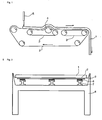
- At least one continuous support belt ii) (3) slides on least one slide bar (7).
- the at least one continuous support belt ii) slides preferably on at least two slide bars, more preferably on at least three slide bars, most preferably on at least four slide bars.
- the slide bars stabilizes the at least one continuous support belt ii) in longitudinal direction.
- the tension of the at least one continuous support belt ii) can be reduced.
- the upper surface of the slide bars has a friction coefficient of preferably less than 0.5, more preferably less than 0.4, most preferably less than 0.3. It is possible to use slide bars wherein only the upper surface of the slide bars is coated with a material (6) having a low friction coefficient, i.e. polytetrafluoroethylene.
- the continuous polymerization belt i) comprises a carcass and a cover.
- the continuous polymerization belt i) can be made of various materials, although these must meet the requirements of good tensile strength and flexibility, good fatigue strength under repeating bending stresses, good deformability and chemical resistance to the individual reaction components under the conditions of the polymerization. These demands cannot be met by a single material. Therefore, a multi-layer material must be used as continuous polymerization belt i) of the present invention.
- the mechanical requirements can be satisfied by a carcass of, for example, fabric inserts of natural and/or synthetic fibers or glass fibers or steel cords.
- the chemical resistance can be achieved by a cover of, for example, polyethylene, polypropylene, polyisobutylene, halogenated polyolefines such as polyvinyl chloride or polytetrafluorethylene, polyamides, natural or synthetic rubbers, polyester resins or epoxy resins.
- the preferred cover material is silicone rubber.
- the continuous support belt ii) used in the invention is preferably a metallic belt, more preferably a stainless steel belt.
- metallic continuous support belts ii) can be used under high tensile stress that prevents sagging of the continuous polymerization belt i).
- the supported continuous polymerization belt i) shows a reduced sagging compared to the prior art continuous belt reactors using idlers as support means.
- Another effect of the inventive process is that the necessary tension of the continuous polymerization belt i) can be reduced.
- the continuous polymerization belt i) of the inventive process has a highly improved serviceable life.
- the continuous polymerization belt i) (2) rests upon at least two continuous support belts ii) (3).
- the usage of more than one continuous support belt ii) reduces the necessary tension of each continuous support belt ii).
- the lateral edges of the continuous polymerization belt i) are curved upwardly from the horizontal plane by at least one fixed support means.
- a fixed support means is a support means that does not move with the continuous polymerization belt i).
- a fixed support means can be, for example, slide bars that curve the lateral edges of polymerization belt i) upwardly. It is also possible that these slide bars are part of the support construction (8).
- the first section of the continuous polymerization belt i) (2) is not supported by a continuous support belt ii) (3). Without support of a continuous support belt ii), the first section forms a trough by the weight of the added monomer solution (5).
- continuous support belts ii) can be stiffed in transverse direction.
- At least one continuous support belt ii) forms at the end in downward direction a barrier for liquids.
- the barrier can be formed by an additional roll (4) that lifts the continuous support belt ii) (3). The barrier prevents that monomer solution can flow into the next production steps on breakdown of the polymerization.
- the polymerization is an exothermic reaction.
- the formed polymer gel must be cooled to prevent overheating.
- the at least one continuous support belt ii) (3) cools the formed polymer gel (1) by its heat capacity. Therefore, the cooling of the formed hydrogel can be improved by the at least one continuous support belt ii).
- the at least one continuous support belt ii) is a metallic belt with a basis weight of at least 1 kg/m 2 .
- Metallic materials have a high heat transfer rate.
- the basis weight of the at least one continuous support belt ii) is preferably from 3 to 25 kg/m 2 , more preferably from 5 to 20 kg/m 2 , most preferably from 7 to 15 kg/m 2 .
- the cooling effect of the at least one continuous support belt ii) increases with the basis weight. Too high basis weights of the at least one continuous support belt ii) causes mechanical problems.
- the at least one continuous support belt ii) have meshes with a mesh size from 6 to 35 mm, more preferably from 9 to 30 mm, most preferably from 12 to 25 mm.
- the at least one continuous support belt ii) have a thickness from 4 to 35 mm, more preferably from 8 to 30 mm, most preferably from 12 to 25 mm.
- the at least one continuous support belt ii) is a flat wire belt.
- US 6,530,469 describes useful flat wire belts.
- a preferred flat wire belt is PACTITE® Flatwire Belting (Maryland Wire Belts Inc., US).
- the strip thickness of the flat wire belt is preferably from 0.6 to 2 mm, more preferably from 0.8 to 1.8 mm, most preferably from 1 to 1.6 mm.
- the preferred flat wire belts have a high basis weight and a high surface area.
- the flat wire belts have a high heat capacity and a high heat transfer rate to the surrounding airspace.
- the monomer solutions or monomer suspensions usable in the process of the present invention comprises
- Suitable monomers a) are for example ethylenically unsaturated carboxylic acids, such as acrylic acid, methacrylic acid, maleic acid, fumaric acid and itaconic acid and/or salts of these acids. Acrylic acid and methacrylic acid are particularly preferred monomers. Acrylic acid is most preferable.
- Useful monomers a) are further styrenesulfonic acid, 2-acrylamido-2-methylpropanesulfonic acid and 2-hydroxyethylacrylate.
- the proportion of the total amount of monomers a) which is attributable to acrylic acid and/or its salts is preferably at least 50 mol-%, more preferably at least 90 mol-% and most preferably at least 95 mol-%.
- the monomers a) and especially acrylic acid comprise preferably up to 0.025 % by weight of a hydroquinone half ether.
- Preferred hydroquinone half ethers are hydroquinone monomethyl ether (MEHQ) and/or tocopherols.
- Tocopherol refers to compounds of the following formula: where R 1 is hydrogen or methyl, R 2 is hydrogen or methyl, R 3 is hydrogen or methyl and R 4 is hydrogen or an acid radical of 1 to 20 carbon atoms.
- Preferred R 4 radicals are acetyl, ascorbyl, succinyl, nicotinyl and other physiologically tolerable carboxylic acids.
- the carboxylic acids can be mono-, di- or tricarboxylic acids.
- R 4 is more preferably hydrogen or acetyl.
- RRR-alpha-Tocopherol is preferred in particular.
- the monomer solution comprises preferably not more than 130 weight ppm, more preferably not more than 70 weight ppm, preferably not less than 10 weight ppm, more preferably not less than 30 weight ppm and especially about 50 weight ppm of hydroquinone half ether, all based on acrylic acid, with acrylic acid salts being arithmetically counted as acrylic acid.
- the monomer solution can be produced using an acrylic acid having an appropriate hydroquinone half ether content.
- the superabsorbent polymers are in a crosslinked state, i.e., the polymerization is carried out in the presence of compounds having two or more polymerizable groups which can be free-radically interpolymerized into the polymer network.
- Useful crosslinkers b) include for example ethylene glycol dimethacrylate, diethylene glycol diacrylate, allyl methacrylate, trimethylolpropane triacrylate, triallylamine, tetraallyloxyethane as described in EP 530 438 A1 , di- and triacrylates as described in EP 547 847 A1 , EP 559 476 A1 , EP 632 068 A1 , WO 93/21237 A1 , WO 2003/104299 A1 ,
- WO 2003/104300 A1 , WO 2003/104301 A1 and DE 103 31 450 A1 mixed acrylates which, as well as acrylate groups, comprise further ethylenically unsaturated groups, as described in DE 103 31 456 A1 and DE 103 55 401 A1 , or crosslinker mixtures as described for example in DE 195 43 368 A1 , DE 196 46 484 A1 , WO 90/15830 A1 and WO 2002/32962 A2 .
- Useful crosslinkers b) include in particular N,N'-methylenebisacrylamide and N,N'-methylenebismethacrylamide, esters of unsaturated mono- or polycarboxylic acids of polyols, such as diacrylate or triacrylate, for example butanediol diacrylate, butanediol dimethacrylate, ethylene glycol diacrylate, ethylene glycol dimethacrylate and also trimethylolpropane triacrylate and allyl compounds, such as allyl (meth)acrylate, triallyl cyanurate, diallyl maleate, polyallyl esters, tetraallyloxyethane, triallylamine, tetraallylethylenediamine, allyl esters of phosphoric acid and also vinylphosphonic acid derivatives as described for example in EP 343 427 A2 .
- esters of unsaturated mono- or polycarboxylic acids of polyols such as diacrylate or triacrylate, for example butan
- Useful crosslinkers b) further include pentaerythritol diallyl ether, pentaerythritol triallyl ether, pentaerythritol tetraallyl ether, polyethylene glycol diallyl ether, ethylene glycol diallyl ether, glycerol diallyl ether, glycerol triallyl ether, polyallyl ethers based on sorbitol, and also ethoxylated variants thereof.
- the process of the present invention utilizes di(meth)acrylates of polyethylene glycols, the polyethylene glycol used having a molecular weight between 300 and 1000.
- crosslinkers b) are di- and triacrylates of 3- to 20-tuply ethoxylated glycerol, of 3- to 20-tuply ethoxylated trimethylolpropane, of 3- to 20-tuply ethoxylated trimethylolethane, especially di- and triacrylates of 2- to 6-tuply ethoxylated glycerol or of 2- to 6-tuply ethoxylated trimethylolpropane, of 3-tuply propoxylated glycerol, of 3-tuply propoxylated trimethylolpropane, and also of 3-tuply mixedly ethoxylated or propoxylated glycerol, of 3-tuply mixedly ethoxylated or propoxylated trimethylolpropane, of 15-tuply ethoxylated glycerol, of 15-tuply ethoxylated trimethylolpropane, of at least 40-t
- crosslinkers b) are diacrylated, dimethacrylated, triacrylated or trimethacrylated multiply ethoxylated and/or propoxylated glycerols as described for example in WO 2003/104301 A1 .
- Di- and/or triacrylates of 3- to 10-tuply ethoxylated glycerol are particularly advantageous.
- di- or triacrylates of 1- to 5-tuply ethoxylated and/or propoxylated glycerol are particularly preferred.
- the triacrylates of 3- to 5-tuply ethoxylated and/or propoxylated glycerol are most preferred.
- the amount of crosslinker b) is preferably from 0.001 to 10 wt.%, more preferably from 0.01 to 5 wt.% and most preferably from 0.1 to 2 wt.%, all based on monomer a).
- Examples of ethylenically unsaturated monomers c) which are copolymerizable with the monomers a) are acrylamide, methacrylamide, crotonamide, dimethylaminoethyl methacrylate, dimethylaminoethyl acrylate, dimethylaminopropyl acrylate, diethylaminopropyl acrylate, dimethylaminobutyl acrylate, dimethylaminoethyl methacrylate, diethylaminoethyl methacrylate, dimethylaminoneopentyl acrylate and dimethylaminoneopentyl methacrylate.
- Useful water-soluble polymers d) include polyvinyl alcohol, polyvinylpyrrolidone, starch, starch derivatives, polyglycols or polyacrylic acids, preferably polyvinyl alcohol and starch.
- the solids content of the monomer solution is preferably at least 30 wt.%, more preferably at least 35 wt.%, most preferably at least 40 wt.%.
- the solids content is the sum of monomer a), crosslinker b), monomer c) and polymer d).
- the usage of aqueous monomer suspensions with high solids contents is also possible.
- the monomer solution or the monomer suspension is polymerized on continuous polymerization belt i) forming a polymer gel.
- the width of the continuous polymerization belt i) is preferably from 1 to 10 m, more preferably from 2 to 8 m, most preferably from 3 to 6 m.
- the length of the continuous polymerization belt i) is preferably from 3 to 50 m, more preferably from 5 to 40 m, most preferably from 10 to 30 m.
- the residence time on the continuous polymerization belt i) is preferably from 5 to 120 minutes, more preferably from 10 to 60 minutes, most preferably from 12 to 40 minutes.
- the thickness of the formed polymer gel layer is preferably from 1 to 20 cm, more preferable from 2 to 15 cm, most preferable from 5 to 10 cm.
- the polymer gel is comminuted in a further process step, for example in a meat grinder, extruder or kneader.
- the acid groups of the hydrogels obtained are typically in a partially neutralized state, the extent of neutralization preferably being in the range from 25 to 95 mol-%, more preferably in the range from 50 to 80 mol-% and even more preferably in the range from 60 to 75 mol-%, for which the customary neutralizing agents can be used, for example alkali metal hydroxides, alkali metal oxides, alkali metal carbonates or alkali metal bicarbonates and also mixtures thereof.
- Ammonium salts can also be used instead of alkali metal salts.
- Sodium and potassium are particularly preferred as alkali metals, but most preference is given to sodium hydroxide, sodium carbonate or sodium bicarbonate and also mixtures thereof.
- Neutralization is preferably carried out at the monomer stage. This is customarily accomplished by admixing the neutralizing agent as an aqueous solution, as a melt or else preferably as a solid material.
- the neutralizing agent for example, sodium hydroxide having a water fraction of distinctly below 50 % by weight can be present as a waxy mass having a melting point above 23 °C. In this case, metering as piece goods or melt at elevated temperature is possible.
- Neutralization can also be carried out after polymerization, at the hydrogel stage. But it is also possible to neutralize up to 40 mol-%, preferably from 10 to 30 mol-% and more preferably from 15 to 25 mol-% of the acid groups before polymerization by adding a portion of the neutralizing agent to the monomer solution and setting the desired final degree of neutralization only after polymerization, at the hydrogel stage.
- the hydrogel is neutralized at least partly after polymerization, the hydrogel is preferably mechanically comminuted, for example by means of a meat grinder, in which case the neutralizing agent can be sprayed, sprinkled or poured on and then carefully mixed in. To this end, the gel mass obtained can be repeatedly grindered for homogenization.
- the hydrogel is then preferably dried with a belt dryer until the residual moisture content is preferably below 15 % by weight and especially below 10 % by weight, the water content being determined by EDANA (European Disposables and Nonwovens Association) recommended test method No. WSP 230.2-05 "Moisture content".
- drying can also be carried out using a fluidized bed dryer or a heated plowshare mixer.
- a fluidized bed dryer or a heated plowshare mixer it is advantageous to dry this gel by ensuring rapid removal of the evaporating water.
- the dryer temperature must be optimized, the air feed and removal has to be policed, and at all times sufficient venting must be ensured.
- Drying is naturally all the more simple - and the product all the more white - when the solids content of the gel is as high as possible.
- the solids content of the gel prior to drying is therefore preferably between 30 % and 80 % by weight. It is particularly advantageous to vent the dryer with nitrogen or some other non-oxidizing inert gas. Selectively, however, simply just the partial pressure of the oxygen can be lowered during drying to prevent oxidative yellowing processes. But in general adequate venting and removal of the water vapor will likewise still lead to an acceptable product. A very short drying time is generally advantageous with regard to color and product quality.
- a further important function of drying the gel is the ongoing reduction in the residual monomer content of the superabsorbent. This is because any residual initiator will decompose during drying, leading to any residual monomers becoming interpolymerized. In addition, the evaporating amounts of water will entrain any free water-vapor-volatile monomers still present, such as acrylic acid for example, and thus likewise lower the residual monomer content of the superabsorbent.
- the dried hydrogel is then ground and classified, useful grinding apparatus typically including single or multiple stage roll mills, preferably two or three stage roll mills, pin mills, hammer mills or swing mills.
- Useful postcrosslinkers are compounds comprising two or more groups capable of forming covalent bonds with the carboxylate groups of the polymers.
- Useful compounds are for example alkoxysilyl compounds, polyaziridines, polyamines, polyamidoamines, di- or polyglycidyl compounds as described in EP 83 022 A2 , EP 543 303 A1 and EP 937 736 A2 , polyhydric alcohols as described in DE 33 14 019 A1 , DE 35 23 617 A1 and EP 450 922 A2 , or ß-hydroxyalkylamides as described in DE 102 04 938 A1 and US 6,239,230 .
- Useful postcrosslinkers are further said to include by DE 40 20 780 C1 cyclic carbonates, by DE 198 07 502 A1 2-oxazolidone and its derivatives, such as N-(2-hydroxyethyl)-2-oxazolidone, by DE 198 07 992 A1 bis- and poly-2-oxazolidinones, by DE 198 54 573 A2 2-oxotetrahydro-1,3-oxazine and its derivatives, by DE 198 54 574 A1 N-acyl-2-oxazolidones, by DE 102 04 937 A1 cyclic ureas, by DE 103 34 584 A1 bicyclic amide acetals, by EP 1 199 327 A2 oxetanes and cyclic ureas and by WO 2003/31482 A1 morpholine-2,3-dione and its derivatives.
- Preferred postcrosslinkers are oxazolidone and its derivatives, in particular N-(2-hydroxyethyl)-2-oxazolidone, glycidyl compounds, in particular ethylene glycol diglycidyl ether, polyols, in particular glycerol, and ethylene carbonate.
- the amount of postcrosslinker is preferably in the range from 0.001 % to 5 % by weight, more preferably in the range from 0.01 % to 2.5 % by weight and most preferably in the range from 0.1 % to 1 % by weight, all based on the polymer.
- Postcrosslinking is customarily carried out by spraying the hydrogel or the dry polymeric particles with a solution, preferably an aqueous solution, of the postcrosslinker. Spraying is followed by thermal drying, and the postcrosslinking reaction can take place not only before but also during drying.
- the postcrosslinker is advantageously mixed with the polymer by the process of the present invention and subsequently thermally dried.
- Contact dryers are preferable, shovel dryers more preferable and disk dryers most preferable as apparatus in which thermal drying is carried out.
- Suitable dryers include for example Bepex ® dryers and Nara ® dryers. Fluidized bed dryers can be used as well.
- Drying can take place in the mixer itself, by heating the shell or blowing warm air into it. It is similarly possible to use a downstream dryer, for example a tray dryer, a rotary tube oven or a heatable screw. But it is also possible for example to utilize an azeotropic distillation as a drying process.
- Preferred drying temperatures range from 50 to 250 °C, preferably from 50 to 200 °C, and more preferably from 50 to 150 °C.
- the preferred residence time at this temperature in the reaction mixer or dryer is below 30 minutes and more preferably below 10 minutes.
- the present invention provides an improved process for production of superabsorbent polymers of uniform quality and low maintenance costs in a large scale on a continuous belt reactor.
Landscapes
- Chemical & Material Sciences (AREA)
- Chemical Kinetics & Catalysis (AREA)
- Organic Chemistry (AREA)
- Health & Medical Sciences (AREA)
- Medicinal Chemistry (AREA)
- Polymers & Plastics (AREA)
- Addition Polymer Or Copolymer, Post-Treatments, Or Chemical Modifications (AREA)
- Polymerisation Methods In General (AREA)
Claims (16)
- Verfahren zur Herstellung von superabsorbierenden Polymeren auf einem kontinuierlichen Bandreaktor, umfassend:i) ein kontinuierliches Polymerisationsband (2) undii) mindestens ein kontinuierliches Stützband (3),wobei der erste Abschnitt des kontinuierlichen Polymerisationsbands i) (2) eine Mulde bildet, das kontinuierliche Polymerisationsband i) (2) zumindest teilweise auf der Oberseite des mindestens einen kontinuierlichen Stützbands ii) (3) aufliegt und das mindestens eine kontinuierliche Stützband ii) (3) zumindest teilweise auf einer festgelegten Fläche gleitet.
- Verfahren nach Anspruch 1, wobei weniger als 20% der Breite des mindestens einen kontinuierlichen Stützbands ii) (3) auf der festgelegten Fläche gleitet.
- Verfahren nach Anspruch 2, wobei die festgelegte Fläche mindestens eine Gleitstange (7) aufweist.
- Verfahren nach Anspruch 3, wobei die Oberseite der Gleitstange (7) zumindest teilweise mit einem Material (6) beschichtet ist, das einen Reibungskoeffizienten von weniger als 0,5 aufweist.
- Verfahren nach Anspruch 4, wobei das Beschichtungsmaterial Polytetrafluorethylen ist.
- Verfahren nach einem der Ansprüche 1 bis 5, wobei das kontinuierliche Polymerisationsband i) (2) eine Karkasse und einen Bezug umfasst.
- Verfahren nach einem der Ansprüche 1 bis 6, wobei das kontinuierliche Polymerisationsband i) (2) auf mindestens zwei kontinuierlichen Stützbändern ii) (3) aufliegt.
- Verfahren nach einem der Ansprüche 1 bis 7, wobei die lateralen Ränder des kontinuierlichen Polymerisationsbands i) (2) durch mindestens ein festgelegtes Stützmittel von der horizontalen Ebene nach oben gekrümmt sind.
- Verfahren nach einem der Ansprüche 1 bis 8, wobei das mindestens eine kontinuierliche Stützband ii) (3) in Querrichtung versteift ist.
- Verfahren nach einem der Ansprüche 1 bis 9, wobei mindestens ein kontinuierliches Stützband ii) (3) am Ende in Abwärtsrichtung eine Flüssigkeitssperre bildet.
- Verfahren nach einem der Ansprüche 1 bis 10, wobei mindestens ein kontinuierliches Stützband ii) (3) ein metallisches Band mit einem Flächengewicht von mindestens 1 kg/m2 ist.
- Verfahren nach einem der Ansprüche 1 bis 11, wobei das mindestens eine kontinuierliche Stützband ii) (3) Maschen mit einer Maschenweite von mindestens 6 mm aufweist.
- Verfahren nach einem der Ansprüche 1 bis 12, wobei das mindestens eine kontinuierliche Stützband ii) (3) eine Dicke von mindestens 4 mm aufweist.
- Verfahren nach einem der Ansprüche 1 bis 13, wobei das mindestens eine kontinuierliche Stützband ii) (3) ein Flachdrahtband ist.
- Verfahren nach einem der Ansprüche 1 bis 14, wobei das mindestens eine kontinuierliche Stützband ii) (3) ein Flachdrahtband mit einer Banddicke von weniger als 2 mm ist.
- Verfahren nach einem der Ansprüche 1 bis 15, wobei das Monomer, das auf dem kontinuierlichen Bandreaktor verarbeitet wird, mindestens 50 Gew.-% Acrylsäure und/oder ein Salz davon ist.
Applications Claiming Priority (2)
| Application Number | Priority Date | Filing Date | Title |
|---|---|---|---|
| US88088107P | 2007-01-16 | 2007-01-16 | |
| PCT/EP2008/000130 WO2008086973A1 (en) | 2007-01-16 | 2008-01-10 | Production of superabsorbent polymers on a continuous belt reactor |
Publications (2)
| Publication Number | Publication Date |
|---|---|
| EP2107938A1 EP2107938A1 (de) | 2009-10-14 |
| EP2107938B1 true EP2107938B1 (de) | 2016-08-17 |
Family
ID=39133918
Family Applications (1)
| Application Number | Title | Priority Date | Filing Date |
|---|---|---|---|
| EP08701056.7A Active EP2107938B1 (de) | 2007-01-16 | 2008-01-10 | Herstellung von superabsorbierenden polymeren auf einem endlosbandreaktor |
Country Status (5)
| Country | Link |
|---|---|
| US (1) | US8138280B2 (de) |
| EP (1) | EP2107938B1 (de) |
| JP (1) | JP5415281B2 (de) |
| CN (1) | CN101588863B (de) |
| WO (1) | WO2008086973A1 (de) |
Families Citing this family (1)
| Publication number | Priority date | Publication date | Assignee | Title |
|---|---|---|---|---|
| US8623994B2 (en) * | 2010-01-20 | 2014-01-07 | Nippon Shokubai, Co., Ltd. | Method for producing water absorbent resin |
Family Cites Families (18)
| Publication number | Priority date | Publication date | Assignee | Title |
|---|---|---|---|---|
| US3794155A (en) * | 1972-06-02 | 1974-02-26 | Ashworth Bros Inc | Wire mesh belt |
| FR2409934A1 (fr) * | 1977-11-29 | 1979-06-22 | Gontrand Daniel | Transporteur a courroie et courroies speciales pour un tel transporteur |
| US4389357A (en) * | 1981-06-26 | 1983-06-21 | Ashland Oil, Inc. | Method for preparing thermosetting resins |
| JPH06804B2 (ja) | 1985-03-27 | 1994-01-05 | 三菱レイヨン株式会社 | 水溶性ビニル単量体の連続光重合方法 |
| DE3544770A1 (de) | 1985-12-18 | 1987-06-19 | Stockhausen Chem Fab Gmbh | Verfahren und vorrichtung zum kontinuierlichen herstellen von polymerisaten und copolymerisaten der acrylsaeure und/oder methacrylsaeure |
| GB2208387B (en) | 1987-07-28 | 1990-11-14 | Dai Ichi Kogyo Seiyaku Co Ltd | Process for continuously preparing acrylic polymer gel |
| JPH03223010A (ja) * | 1990-01-26 | 1991-10-02 | Anritsu Corp | ベルト受台 |
| JPH06804A (ja) | 1992-06-17 | 1994-01-11 | Tokin Corp | 積層セラミックグリーンシートの製造方法 |
| DK172562B1 (da) * | 1995-10-06 | 1999-01-18 | Danfoss As | Fremgangsmåde ved måling af fejlstrømme i en vekselretter, samt vekselretter med styrede halvlederswitche |
| TW460528B (en) * | 1998-04-28 | 2001-10-21 | Nippon Catalytic Chem Ind | Method for production of shaped hydrogel of absorbent resin |
| KR100476170B1 (ko) * | 1998-04-28 | 2005-03-10 | 니폰 쇼쿠바이 컴파니 리미티드 | 흡수성수지 함수겔상물의 제조방법 |
| DE19928896A1 (de) * | 1999-06-16 | 2000-12-21 | August Heinr Schmidt Gmbh & Co | Transporteinrichtung für den translatorischen Transport von Waren |
| DE19955861A1 (de) * | 1999-11-20 | 2001-05-23 | Basf Ag | Verfahren zur kontinuierlichen Herstellung von vernetzten feinteiligen gelförmigen Polymerisaten |
| US6530469B2 (en) * | 2001-01-16 | 2003-03-11 | Maryland Wire Belts, Inc. | Wire belt with compound link formation |
| JP2005036100A (ja) * | 2003-07-14 | 2005-02-10 | Nippon Shokubai Co Ltd | 吸水性樹脂を製造する方法 |
| JP4713167B2 (ja) | 2005-01-21 | 2011-06-29 | 株式会社日本触媒 | 吸水性樹脂の製造方法 |
| WO2008086972A1 (en) | 2007-01-16 | 2008-07-24 | Basf Se | Production of superabsorbent polymers on a continuous belt reactor |
| WO2008086974A1 (en) | 2007-01-16 | 2008-07-24 | Basf Se | Production of super absorbent polymers on a continuous belt reactor |
-
2008
- 2008-01-10 US US12/521,941 patent/US8138280B2/en active Active
- 2008-01-10 WO PCT/EP2008/000130 patent/WO2008086973A1/en not_active Ceased
- 2008-01-10 JP JP2009545857A patent/JP5415281B2/ja active Active
- 2008-01-10 EP EP08701056.7A patent/EP2107938B1/de active Active
- 2008-01-10 CN CN2008800023877A patent/CN101588863B/zh active Active
Also Published As
| Publication number | Publication date |
|---|---|
| CN101588863B (zh) | 2013-01-02 |
| US8138280B2 (en) | 2012-03-20 |
| JP5415281B2 (ja) | 2014-02-12 |
| CN101588863A (zh) | 2009-11-25 |
| EP2107938A1 (de) | 2009-10-14 |
| WO2008086973A1 (en) | 2008-07-24 |
| JP2010515813A (ja) | 2010-05-13 |
| US20100041847A1 (en) | 2010-02-18 |
Similar Documents
| Publication | Publication Date | Title |
|---|---|---|
| EP2104559B1 (de) | Herstellung von superabsorbierenden polymeren auf einem endlosbandreaktor | |
| EP2121770B1 (de) | Herstellung von superabsorbierenden polymeren | |
| US20080202987A1 (en) | Method for Grading a Particulate Water-Absorbing Resin | |
| US20110194984A1 (en) | Polymerization Method | |
| US20090060660A1 (en) | Process for Pneumatic Conveying of Water-Absorbing Polymer Particles | |
| US7910675B2 (en) | Method for producing water-absorbing polymer particles | |
| US20090060661A1 (en) | Method for the Pneumatic Conveying of Water-Absorbent Polymer Particles | |
| EP2107939B2 (de) | Herstellung supersaugfähiger polymere auf einem durchgehenden bandreaktor | |
| US7915355B2 (en) | Polymerization process | |
| EP2115016B1 (de) | Herstellung supersaugfähiger polymere auf einem durchgehenden bandreaktor | |
| EP2104601B1 (de) | Herstellung supersaugfähiger polymere auf einem durchgehenden bandreaktor | |
| EP2107938B1 (de) | Herstellung von superabsorbierenden polymeren auf einem endlosbandreaktor |
Legal Events
| Date | Code | Title | Description |
|---|---|---|---|
| PUAI | Public reference made under article 153(3) epc to a published international application that has entered the european phase |
Free format text: ORIGINAL CODE: 0009012 |
|
| 17P | Request for examination filed |
Effective date: 20090817 |
|
| AK | Designated contracting states |
Kind code of ref document: A1 Designated state(s): AT BE BG CH CY CZ DE DK EE ES FI FR GB GR HR HU IE IS IT LI LT LU LV MC MT NL NO PL PT RO SE SI SK TR |
|
| 17Q | First examination report despatched |
Effective date: 20100114 |
|
| DAX | Request for extension of the european patent (deleted) | ||
| GRAP | Despatch of communication of intention to grant a patent |
Free format text: ORIGINAL CODE: EPIDOSNIGR1 |
|
| INTG | Intention to grant announced |
Effective date: 20160404 |
|
| GRAS | Grant fee paid |
Free format text: ORIGINAL CODE: EPIDOSNIGR3 |
|
| GRAA | (expected) grant |
Free format text: ORIGINAL CODE: 0009210 |
|
| AK | Designated contracting states |
Kind code of ref document: B1 Designated state(s): AT BE BG CH CY CZ DE DK EE ES FI FR GB GR HR HU IE IS IT LI LT LU LV MC MT NL NO PL PT RO SE SI SK TR |
|
| REG | Reference to a national code |
Ref country code: GB Ref legal event code: FG4D |
|
| REG | Reference to a national code |
Ref country code: CH Ref legal event code: EP |
|
| REG | Reference to a national code |
Ref country code: IE Ref legal event code: FG4D |
|
| REG | Reference to a national code |
Ref country code: AT Ref legal event code: REF Ref document number: 820525 Country of ref document: AT Kind code of ref document: T Effective date: 20160915 |
|
| REG | Reference to a national code |
Ref country code: DE Ref legal event code: R096 Ref document number: 602008045698 Country of ref document: DE |
|
| REG | Reference to a national code |
Ref country code: NL Ref legal event code: MP Effective date: 20160817 |
|
| REG | Reference to a national code |
Ref country code: LT Ref legal event code: MG4D |
|
| REG | Reference to a national code |
Ref country code: AT Ref legal event code: MK05 Ref document number: 820525 Country of ref document: AT Kind code of ref document: T Effective date: 20160817 |
|
| PG25 | Lapsed in a contracting state [announced via postgrant information from national office to epo] |
Ref country code: NL Free format text: LAPSE BECAUSE OF FAILURE TO SUBMIT A TRANSLATION OF THE DESCRIPTION OR TO PAY THE FEE WITHIN THE PRESCRIBED TIME-LIMIT Effective date: 20160817 Ref country code: FI Free format text: LAPSE BECAUSE OF FAILURE TO SUBMIT A TRANSLATION OF THE DESCRIPTION OR TO PAY THE FEE WITHIN THE PRESCRIBED TIME-LIMIT Effective date: 20160817 Ref country code: LT Free format text: LAPSE BECAUSE OF FAILURE TO SUBMIT A TRANSLATION OF THE DESCRIPTION OR TO PAY THE FEE WITHIN THE PRESCRIBED TIME-LIMIT Effective date: 20160817 Ref country code: NO Free format text: LAPSE BECAUSE OF FAILURE TO SUBMIT A TRANSLATION OF THE DESCRIPTION OR TO PAY THE FEE WITHIN THE PRESCRIBED TIME-LIMIT Effective date: 20161117 Ref country code: HR Free format text: LAPSE BECAUSE OF FAILURE TO SUBMIT A TRANSLATION OF THE DESCRIPTION OR TO PAY THE FEE WITHIN THE PRESCRIBED TIME-LIMIT Effective date: 20160817 Ref country code: IT Free format text: LAPSE BECAUSE OF FAILURE TO SUBMIT A TRANSLATION OF THE DESCRIPTION OR TO PAY THE FEE WITHIN THE PRESCRIBED TIME-LIMIT Effective date: 20160817 |
|
| PG25 | Lapsed in a contracting state [announced via postgrant information from national office to epo] |
Ref country code: AT Free format text: LAPSE BECAUSE OF FAILURE TO SUBMIT A TRANSLATION OF THE DESCRIPTION OR TO PAY THE FEE WITHIN THE PRESCRIBED TIME-LIMIT Effective date: 20160817 Ref country code: ES Free format text: LAPSE BECAUSE OF FAILURE TO SUBMIT A TRANSLATION OF THE DESCRIPTION OR TO PAY THE FEE WITHIN THE PRESCRIBED TIME-LIMIT Effective date: 20160817 Ref country code: PT Free format text: LAPSE BECAUSE OF FAILURE TO SUBMIT A TRANSLATION OF THE DESCRIPTION OR TO PAY THE FEE WITHIN THE PRESCRIBED TIME-LIMIT Effective date: 20161219 Ref country code: LV Free format text: LAPSE BECAUSE OF FAILURE TO SUBMIT A TRANSLATION OF THE DESCRIPTION OR TO PAY THE FEE WITHIN THE PRESCRIBED TIME-LIMIT Effective date: 20160817 Ref country code: SE Free format text: LAPSE BECAUSE OF FAILURE TO SUBMIT A TRANSLATION OF THE DESCRIPTION OR TO PAY THE FEE WITHIN THE PRESCRIBED TIME-LIMIT Effective date: 20160817 Ref country code: PL Free format text: LAPSE BECAUSE OF FAILURE TO SUBMIT A TRANSLATION OF THE DESCRIPTION OR TO PAY THE FEE WITHIN THE PRESCRIBED TIME-LIMIT Effective date: 20160817 Ref country code: GR Free format text: LAPSE BECAUSE OF FAILURE TO SUBMIT A TRANSLATION OF THE DESCRIPTION OR TO PAY THE FEE WITHIN THE PRESCRIBED TIME-LIMIT Effective date: 20161118 |
|
| PG25 | Lapsed in a contracting state [announced via postgrant information from national office to epo] |
Ref country code: RO Free format text: LAPSE BECAUSE OF FAILURE TO SUBMIT A TRANSLATION OF THE DESCRIPTION OR TO PAY THE FEE WITHIN THE PRESCRIBED TIME-LIMIT Effective date: 20160817 Ref country code: EE Free format text: LAPSE BECAUSE OF FAILURE TO SUBMIT A TRANSLATION OF THE DESCRIPTION OR TO PAY THE FEE WITHIN THE PRESCRIBED TIME-LIMIT Effective date: 20160817 |
|
| REG | Reference to a national code |
Ref country code: DE Ref legal event code: R097 Ref document number: 602008045698 Country of ref document: DE |
|
| PG25 | Lapsed in a contracting state [announced via postgrant information from national office to epo] |
Ref country code: CZ Free format text: LAPSE BECAUSE OF FAILURE TO SUBMIT A TRANSLATION OF THE DESCRIPTION OR TO PAY THE FEE WITHIN THE PRESCRIBED TIME-LIMIT Effective date: 20160817 Ref country code: SK Free format text: LAPSE BECAUSE OF FAILURE TO SUBMIT A TRANSLATION OF THE DESCRIPTION OR TO PAY THE FEE WITHIN THE PRESCRIBED TIME-LIMIT Effective date: 20160817 Ref country code: BG Free format text: LAPSE BECAUSE OF FAILURE TO SUBMIT A TRANSLATION OF THE DESCRIPTION OR TO PAY THE FEE WITHIN THE PRESCRIBED TIME-LIMIT Effective date: 20161117 Ref country code: DK Free format text: LAPSE BECAUSE OF FAILURE TO SUBMIT A TRANSLATION OF THE DESCRIPTION OR TO PAY THE FEE WITHIN THE PRESCRIBED TIME-LIMIT Effective date: 20160817 |
|
| PLBE | No opposition filed within time limit |
Free format text: ORIGINAL CODE: 0009261 |
|
| STAA | Information on the status of an ep patent application or granted ep patent |
Free format text: STATUS: NO OPPOSITION FILED WITHIN TIME LIMIT |
|
| 26N | No opposition filed |
Effective date: 20170518 |
|
| PG25 | Lapsed in a contracting state [announced via postgrant information from national office to epo] |
Ref country code: SI Free format text: LAPSE BECAUSE OF FAILURE TO SUBMIT A TRANSLATION OF THE DESCRIPTION OR TO PAY THE FEE WITHIN THE PRESCRIBED TIME-LIMIT Effective date: 20160817 |
|
| REG | Reference to a national code |
Ref country code: CH Ref legal event code: PL |
|
| GBPC | Gb: european patent ceased through non-payment of renewal fee |
Effective date: 20170110 |
|
| PG25 | Lapsed in a contracting state [announced via postgrant information from national office to epo] |
Ref country code: MC Free format text: LAPSE BECAUSE OF FAILURE TO SUBMIT A TRANSLATION OF THE DESCRIPTION OR TO PAY THE FEE WITHIN THE PRESCRIBED TIME-LIMIT Effective date: 20160817 |
|
| REG | Reference to a national code |
Ref country code: FR Ref legal event code: ST Effective date: 20170929 |
|
| PG25 | Lapsed in a contracting state [announced via postgrant information from national office to epo] |
Ref country code: LI Free format text: LAPSE BECAUSE OF NON-PAYMENT OF DUE FEES Effective date: 20170131 Ref country code: FR Free format text: LAPSE BECAUSE OF NON-PAYMENT OF DUE FEES Effective date: 20170131 Ref country code: CH Free format text: LAPSE BECAUSE OF NON-PAYMENT OF DUE FEES Effective date: 20170131 |
|
| REG | Reference to a national code |
Ref country code: IE Ref legal event code: MM4A |
|
| PG25 | Lapsed in a contracting state [announced via postgrant information from national office to epo] |
Ref country code: LU Free format text: LAPSE BECAUSE OF NON-PAYMENT OF DUE FEES Effective date: 20170110 Ref country code: GB Free format text: LAPSE BECAUSE OF NON-PAYMENT OF DUE FEES Effective date: 20170110 |
|
| PG25 | Lapsed in a contracting state [announced via postgrant information from national office to epo] |
Ref country code: IE Free format text: LAPSE BECAUSE OF NON-PAYMENT OF DUE FEES Effective date: 20170110 |
|
| PG25 | Lapsed in a contracting state [announced via postgrant information from national office to epo] |
Ref country code: MT Free format text: LAPSE BECAUSE OF NON-PAYMENT OF DUE FEES Effective date: 20170110 |
|
| PG25 | Lapsed in a contracting state [announced via postgrant information from national office to epo] |
Ref country code: HU Free format text: LAPSE BECAUSE OF FAILURE TO SUBMIT A TRANSLATION OF THE DESCRIPTION OR TO PAY THE FEE WITHIN THE PRESCRIBED TIME-LIMIT; INVALID AB INITIO Effective date: 20080110 |
|
| PG25 | Lapsed in a contracting state [announced via postgrant information from national office to epo] |
Ref country code: CY Free format text: LAPSE BECAUSE OF NON-PAYMENT OF DUE FEES Effective date: 20160817 |
|
| PG25 | Lapsed in a contracting state [announced via postgrant information from national office to epo] |
Ref country code: TR Free format text: LAPSE BECAUSE OF FAILURE TO SUBMIT A TRANSLATION OF THE DESCRIPTION OR TO PAY THE FEE WITHIN THE PRESCRIBED TIME-LIMIT Effective date: 20160817 |
|
| PG25 | Lapsed in a contracting state [announced via postgrant information from national office to epo] |
Ref country code: IS Free format text: LAPSE BECAUSE OF FAILURE TO SUBMIT A TRANSLATION OF THE DESCRIPTION OR TO PAY THE FEE WITHIN THE PRESCRIBED TIME-LIMIT Effective date: 20161217 |
|
| PGFP | Annual fee paid to national office [announced via postgrant information from national office to epo] |
Ref country code: DE Payment date: 20250129 Year of fee payment: 18 |
|
| PGFP | Annual fee paid to national office [announced via postgrant information from national office to epo] |
Ref country code: BE Payment date: 20250127 Year of fee payment: 18 |