EP2105443A1 - Oxime derivatives and their use in photopolymerizable compositions for colour filters - Google Patents
Oxime derivatives and their use in photopolymerizable compositions for colour filters Download PDFInfo
- Publication number
- EP2105443A1 EP2105443A1 EP09154902A EP09154902A EP2105443A1 EP 2105443 A1 EP2105443 A1 EP 2105443A1 EP 09154902 A EP09154902 A EP 09154902A EP 09154902 A EP09154902 A EP 09154902A EP 2105443 A1 EP2105443 A1 EP 2105443A1
- Authority
- EP
- European Patent Office
- Prior art keywords
- group
- photopolymerizable composition
- compound
- mass
- ring
- Prior art date
- Legal status (The legal status is an assumption and is not a legal conclusion. Google has not performed a legal analysis and makes no representation as to the accuracy of the status listed.)
- Withdrawn
Links
- 239000000203 mixture Substances 0.000 title claims description 312
- 150000002923 oximes Chemical class 0.000 title 1
- 150000001875 compounds Chemical class 0.000 claims abstract description 190
- 125000005647 linker group Chemical group 0.000 claims abstract description 13
- 238000007639 printing Methods 0.000 claims description 65
- 239000003086 colorant Substances 0.000 claims description 46
- 239000002243 precursor Substances 0.000 claims description 37
- 238000004519 manufacturing process Methods 0.000 claims description 26
- 238000003384 imaging method Methods 0.000 claims description 17
- -1 oxime ester Chemical class 0.000 description 486
- 239000000049 pigment Substances 0.000 description 119
- 230000035945 sensitivity Effects 0.000 description 84
- 239000006185 dispersion Substances 0.000 description 80
- 239000010410 layer Substances 0.000 description 79
- 125000004432 carbon atom Chemical group C* 0.000 description 71
- 239000010408 film Substances 0.000 description 70
- 238000000576 coating method Methods 0.000 description 65
- 230000000052 comparative effect Effects 0.000 description 63
- 239000011248 coating agent Substances 0.000 description 61
- 239000000975 dye Substances 0.000 description 46
- 239000000243 solution Substances 0.000 description 45
- 239000000758 substrate Substances 0.000 description 45
- 229920000642 polymer Polymers 0.000 description 44
- 238000011161 development Methods 0.000 description 40
- 230000018109 developmental process Effects 0.000 description 40
- 238000000034 method Methods 0.000 description 39
- 239000011230 binding agent Substances 0.000 description 38
- 125000001424 substituent group Chemical group 0.000 description 37
- 238000010438 heat treatment Methods 0.000 description 36
- XLYOFNOQVPJJNP-UHFFFAOYSA-N water Substances O XLYOFNOQVPJJNP-UHFFFAOYSA-N 0.000 description 33
- 125000003118 aryl group Chemical group 0.000 description 31
- 125000000217 alkyl group Chemical group 0.000 description 29
- 238000011156 evaluation Methods 0.000 description 29
- 239000007787 solid Substances 0.000 description 29
- 239000002253 acid Substances 0.000 description 27
- 229910052782 aluminium Inorganic materials 0.000 description 27
- XAGFODPZIPBFFR-UHFFFAOYSA-N aluminium Chemical compound [Al] XAGFODPZIPBFFR-UHFFFAOYSA-N 0.000 description 27
- 239000000463 material Substances 0.000 description 26
- 239000000178 monomer Substances 0.000 description 23
- LLHKCFNBLRBOGN-UHFFFAOYSA-N propylene glycol methyl ether acetate Chemical compound COCC(C)OC(C)=O LLHKCFNBLRBOGN-UHFFFAOYSA-N 0.000 description 23
- 239000003999 initiator Substances 0.000 description 22
- 239000002904 solvent Substances 0.000 description 22
- 125000001997 phenyl group Chemical group [H]C1=C([H])C([H])=C(*)C([H])=C1[H] 0.000 description 21
- 239000007864 aqueous solution Substances 0.000 description 19
- 239000002270 dispersing agent Substances 0.000 description 19
- 229910052760 oxygen Inorganic materials 0.000 description 19
- 239000001301 oxygen Substances 0.000 description 19
- XEKOWRVHYACXOJ-UHFFFAOYSA-N Ethyl acetate Chemical compound CCOC(C)=O XEKOWRVHYACXOJ-UHFFFAOYSA-N 0.000 description 18
- 238000002360 preparation method Methods 0.000 description 18
- 239000000126 substance Substances 0.000 description 18
- 125000005842 heteroatom Chemical group 0.000 description 17
- 238000003860 storage Methods 0.000 description 17
- 239000011241 protective layer Substances 0.000 description 16
- 229910052717 sulfur Inorganic materials 0.000 description 16
- CSCPPACGZOOCGX-UHFFFAOYSA-N Acetone Chemical compound CC(C)=O CSCPPACGZOOCGX-UHFFFAOYSA-N 0.000 description 15
- 125000004429 atom Chemical group 0.000 description 15
- 229940125904 compound 1 Drugs 0.000 description 15
- 229920001577 copolymer Polymers 0.000 description 15
- 0 CC(C(CC*)N)=O Chemical compound CC(C(CC*)N)=O 0.000 description 14
- 230000015572 biosynthetic process Effects 0.000 description 14
- 125000005843 halogen group Chemical group 0.000 description 14
- 125000004435 hydrogen atom Chemical group [H]* 0.000 description 14
- 238000001556 precipitation Methods 0.000 description 14
- 229920005989 resin Polymers 0.000 description 14
- 239000011347 resin Substances 0.000 description 14
- 239000004065 semiconductor Substances 0.000 description 14
- 125000003545 alkoxy group Chemical group 0.000 description 13
- QVGXLLKOCUKJST-UHFFFAOYSA-N atomic oxygen Chemical compound [O] QVGXLLKOCUKJST-UHFFFAOYSA-N 0.000 description 13
- 230000000694 effects Effects 0.000 description 13
- 239000002245 particle Substances 0.000 description 13
- 238000006116 polymerization reaction Methods 0.000 description 13
- 230000002123 temporal effect Effects 0.000 description 13
- ZWEHNKRNPOVVGH-UHFFFAOYSA-N 2-Butanone Chemical compound CCC(C)=O ZWEHNKRNPOVVGH-UHFFFAOYSA-N 0.000 description 12
- YXFVVABEGXRONW-UHFFFAOYSA-N Toluene Chemical compound CC1=CC=CC=C1 YXFVVABEGXRONW-UHFFFAOYSA-N 0.000 description 12
- 125000002252 acyl group Chemical group 0.000 description 12
- 125000003277 amino group Chemical group 0.000 description 12
- 239000003795 chemical substances by application Substances 0.000 description 12
- 238000001035 drying Methods 0.000 description 12
- 229920006158 high molecular weight polymer Polymers 0.000 description 12
- 239000003960 organic solvent Substances 0.000 description 12
- 229910052710 silicon Inorganic materials 0.000 description 12
- 239000010703 silicon Substances 0.000 description 12
- XUIMIQQOPSSXEZ-UHFFFAOYSA-N Silicon Chemical compound [Si] XUIMIQQOPSSXEZ-UHFFFAOYSA-N 0.000 description 11
- 125000001931 aliphatic group Chemical group 0.000 description 11
- 125000004453 alkoxycarbonyl group Chemical group 0.000 description 11
- 229910052799 carbon Inorganic materials 0.000 description 11
- 238000004040 coloring Methods 0.000 description 11
- 239000000976 ink Substances 0.000 description 11
- 229920002451 polyvinyl alcohol Polymers 0.000 description 11
- 235000019422 polyvinyl alcohol Nutrition 0.000 description 11
- 239000001052 yellow pigment Substances 0.000 description 11
- FBPFZTCFMRRESA-FSIIMWSLSA-N D-Glucitol Natural products OC[C@H](O)[C@H](O)[C@@H](O)[C@H](O)CO FBPFZTCFMRRESA-FSIIMWSLSA-N 0.000 description 10
- FBPFZTCFMRRESA-JGWLITMVSA-N D-glucitol Chemical compound OC[C@H](O)[C@@H](O)[C@H](O)[C@H](O)CO FBPFZTCFMRRESA-JGWLITMVSA-N 0.000 description 10
- CERQOIWHTDAKMF-UHFFFAOYSA-N Methacrylic acid Chemical compound CC(=C)C(O)=O CERQOIWHTDAKMF-UHFFFAOYSA-N 0.000 description 10
- 239000004372 Polyvinyl alcohol Substances 0.000 description 10
- WYURNTSHIVDZCO-UHFFFAOYSA-N Tetrahydrofuran Chemical compound C1CCOC1 WYURNTSHIVDZCO-UHFFFAOYSA-N 0.000 description 10
- 239000000987 azo dye Substances 0.000 description 10
- 238000006243 chemical reaction Methods 0.000 description 10
- JHIVVAPYMSGYDF-UHFFFAOYSA-N cyclohexanone Chemical compound O=C1CCCCC1 JHIVVAPYMSGYDF-UHFFFAOYSA-N 0.000 description 10
- 125000000623 heterocyclic group Chemical group 0.000 description 10
- 239000003112 inhibitor Substances 0.000 description 10
- 229910052757 nitrogen Inorganic materials 0.000 description 10
- 229920000620 organic polymer Polymers 0.000 description 10
- 239000003505 polymerization initiator Substances 0.000 description 10
- 238000007788 roughening Methods 0.000 description 10
- 239000000600 sorbitol Substances 0.000 description 10
- 238000011282 treatment Methods 0.000 description 10
- OKKJLVBELUTLKV-UHFFFAOYSA-N Methanol Chemical compound OC OKKJLVBELUTLKV-UHFFFAOYSA-N 0.000 description 9
- ZMXDDKWLCZADIW-UHFFFAOYSA-N N,N-Dimethylformamide Chemical compound CN(C)C=O ZMXDDKWLCZADIW-UHFFFAOYSA-N 0.000 description 9
- 238000010521 absorption reaction Methods 0.000 description 9
- 125000003342 alkenyl group Chemical group 0.000 description 9
- 125000004414 alkyl thio group Chemical group 0.000 description 9
- 230000008859 change Effects 0.000 description 9
- 150000002148 esters Chemical class 0.000 description 9
- 125000002887 hydroxy group Chemical group [H]O* 0.000 description 9
- 229910052751 metal Inorganic materials 0.000 description 9
- 239000002184 metal Substances 0.000 description 9
- 125000004433 nitrogen atom Chemical group N* 0.000 description 9
- 230000008569 process Effects 0.000 description 9
- PPBRXRYQALVLMV-UHFFFAOYSA-N Styrene Chemical compound C=CC1=CC=CC=C1 PPBRXRYQALVLMV-UHFFFAOYSA-N 0.000 description 8
- NINIDFKCEFEMDL-UHFFFAOYSA-N Sulfur Chemical compound [S] NINIDFKCEFEMDL-UHFFFAOYSA-N 0.000 description 8
- MPIAGWXWVAHQBB-UHFFFAOYSA-N [3-prop-2-enoyloxy-2-[[3-prop-2-enoyloxy-2,2-bis(prop-2-enoyloxymethyl)propoxy]methyl]-2-(prop-2-enoyloxymethyl)propyl] prop-2-enoate Chemical compound C=CC(=O)OCC(COC(=O)C=C)(COC(=O)C=C)COCC(COC(=O)C=C)(COC(=O)C=C)COC(=O)C=C MPIAGWXWVAHQBB-UHFFFAOYSA-N 0.000 description 8
- 239000000980 acid dye Substances 0.000 description 8
- 239000003513 alkali Substances 0.000 description 8
- 125000004644 alkyl sulfinyl group Chemical group 0.000 description 8
- 125000004390 alkyl sulfonyl group Chemical group 0.000 description 8
- 150000001408 amides Chemical class 0.000 description 8
- 125000005135 aryl sulfinyl group Chemical group 0.000 description 8
- 125000004391 aryl sulfonyl group Chemical group 0.000 description 8
- 125000004104 aryloxy group Chemical group 0.000 description 8
- 230000007547 defect Effects 0.000 description 8
- LZCLXQDLBQLTDK-UHFFFAOYSA-N ethyl 2-hydroxypropanoate Chemical compound CCOC(=O)C(C)O LZCLXQDLBQLTDK-UHFFFAOYSA-N 0.000 description 8
- 239000011521 glass Substances 0.000 description 8
- 239000011593 sulfur Substances 0.000 description 8
- 125000004434 sulfur atom Chemical group 0.000 description 8
- 238000012719 thermal polymerization Methods 0.000 description 8
- VZSRBBMJRBPUNF-UHFFFAOYSA-N 2-(2,3-dihydro-1H-inden-2-ylamino)-N-[3-oxo-3-(2,4,6,7-tetrahydrotriazolo[4,5-c]pyridin-5-yl)propyl]pyrimidine-5-carboxamide Chemical compound C1C(CC2=CC=CC=C12)NC1=NC=C(C=N1)C(=O)NCCC(N1CC2=C(CC1)NN=N2)=O VZSRBBMJRBPUNF-UHFFFAOYSA-N 0.000 description 7
- OKTJSMMVPCPJKN-UHFFFAOYSA-N Carbon Chemical compound [C] OKTJSMMVPCPJKN-UHFFFAOYSA-N 0.000 description 7
- YLQBMQCUIZJEEH-UHFFFAOYSA-N Furan Chemical group C=1C=COC=1 YLQBMQCUIZJEEH-UHFFFAOYSA-N 0.000 description 7
- 229910019142 PO4 Inorganic materials 0.000 description 7
- HEMHJVSKTPXQMS-UHFFFAOYSA-M Sodium hydroxide Chemical compound [OH-].[Na+] HEMHJVSKTPXQMS-UHFFFAOYSA-M 0.000 description 7
- 125000004423 acyloxy group Chemical group 0.000 description 7
- 125000004397 aminosulfonyl group Chemical group NS(=O)(=O)* 0.000 description 7
- 125000005163 aryl sulfanyl group Chemical group 0.000 description 7
- 125000000751 azo group Chemical group [*]N=N[*] 0.000 description 7
- AOJOEFVRHOZDFN-UHFFFAOYSA-N benzyl 2-methylprop-2-enoate Chemical compound CC(=C)C(=O)OCC1=CC=CC=C1 AOJOEFVRHOZDFN-UHFFFAOYSA-N 0.000 description 7
- 125000003178 carboxy group Chemical group [H]OC(*)=O 0.000 description 7
- 229940125782 compound 2 Drugs 0.000 description 7
- 238000001723 curing Methods 0.000 description 7
- 230000001965 increasing effect Effects 0.000 description 7
- 125000002496 methyl group Chemical group [H]C([H])([H])* 0.000 description 7
- 239000000123 paper Substances 0.000 description 7
- 235000021317 phosphate Nutrition 0.000 description 7
- IEQIEDJGQAUEQZ-UHFFFAOYSA-N phthalocyanine Chemical class N1C(N=C2C3=CC=CC=C3C(N=C3C4=CC=CC=C4C(=N4)N3)=N2)=C(C=CC=C2)C2=C1N=C1C2=CC=CC=C2C4=N1 IEQIEDJGQAUEQZ-UHFFFAOYSA-N 0.000 description 7
- 239000000047 product Substances 0.000 description 7
- 125000000391 vinyl group Chemical group [H]C([*])=C([H])[H] 0.000 description 7
- HMUNWXXNJPVALC-UHFFFAOYSA-N 1-[4-[2-(2,3-dihydro-1H-inden-2-ylamino)pyrimidin-5-yl]piperazin-1-yl]-2-(2,4,6,7-tetrahydrotriazolo[4,5-c]pyridin-5-yl)ethanone Chemical compound C1C(CC2=CC=CC=C12)NC1=NC=C(C=N1)N1CCN(CC1)C(CN1CC2=C(CC1)NN=N2)=O HMUNWXXNJPVALC-UHFFFAOYSA-N 0.000 description 6
- XLLIQLLCWZCATF-UHFFFAOYSA-N 2-methoxyethyl acetate Chemical compound COCCOC(C)=O XLLIQLLCWZCATF-UHFFFAOYSA-N 0.000 description 6
- NIXOWILDQLNWCW-UHFFFAOYSA-M Acrylate Chemical compound [O-]C(=O)C=C NIXOWILDQLNWCW-UHFFFAOYSA-M 0.000 description 6
- IAZDPXIOMUYVGZ-UHFFFAOYSA-N Dimethylsulphoxide Chemical compound CS(C)=O IAZDPXIOMUYVGZ-UHFFFAOYSA-N 0.000 description 6
- MYMOFIZGZYHOMD-UHFFFAOYSA-N Dioxygen Chemical compound O=O MYMOFIZGZYHOMD-UHFFFAOYSA-N 0.000 description 6
- KWYUFKZDYYNOTN-UHFFFAOYSA-M Potassium hydroxide Chemical compound [OH-].[K+] KWYUFKZDYYNOTN-UHFFFAOYSA-M 0.000 description 6
- 239000004115 Sodium Silicate Substances 0.000 description 6
- ZMANZCXQSJIPKH-UHFFFAOYSA-N Triethylamine Chemical compound CCN(CC)CC ZMANZCXQSJIPKH-UHFFFAOYSA-N 0.000 description 6
- 230000002378 acidificating effect Effects 0.000 description 6
- 125000000641 acridinyl group Chemical group C1(=CC=CC2=NC3=CC=CC=C3C=C12)* 0.000 description 6
- 150000001252 acrylic acid derivatives Chemical class 0.000 description 6
- 239000000654 additive Substances 0.000 description 6
- 150000001338 aliphatic hydrocarbons Chemical class 0.000 description 6
- 150000004056 anthraquinones Chemical class 0.000 description 6
- 150000004945 aromatic hydrocarbons Chemical group 0.000 description 6
- 125000003917 carbamoyl group Chemical group [H]N([H])C(*)=O 0.000 description 6
- 125000002843 carboxylic acid group Chemical group 0.000 description 6
- 239000003054 catalyst Substances 0.000 description 6
- 239000013078 crystal Substances 0.000 description 6
- QSHDDOUJBYECFT-UHFFFAOYSA-N mercury Chemical compound [Hg] QSHDDOUJBYECFT-UHFFFAOYSA-N 0.000 description 6
- 229910052753 mercury Inorganic materials 0.000 description 6
- 125000001624 naphthyl group Chemical group 0.000 description 6
- 230000003287 optical effect Effects 0.000 description 6
- 239000010452 phosphate Substances 0.000 description 6
- 239000004014 plasticizer Substances 0.000 description 6
- 125000003367 polycyclic group Chemical group 0.000 description 6
- 229920000728 polyester Polymers 0.000 description 6
- 230000005855 radiation Effects 0.000 description 6
- 239000001054 red pigment Substances 0.000 description 6
- NTHWMYGWWRZVTN-UHFFFAOYSA-N sodium silicate Chemical compound [Na+].[Na+].[O-][Si]([O-])=O NTHWMYGWWRZVTN-UHFFFAOYSA-N 0.000 description 6
- 229910052911 sodium silicate Inorganic materials 0.000 description 6
- 125000005017 substituted alkenyl group Chemical group 0.000 description 6
- 125000000547 substituted alkyl group Chemical group 0.000 description 6
- 125000004426 substituted alkynyl group Chemical group 0.000 description 6
- 125000003107 substituted aryl group Chemical group 0.000 description 6
- 238000003786 synthesis reaction Methods 0.000 description 6
- WGTYBPLFGIVFAS-UHFFFAOYSA-M tetramethylammonium hydroxide Chemical compound [OH-].C[N+](C)(C)C WGTYBPLFGIVFAS-UHFFFAOYSA-M 0.000 description 6
- ARXJGSRGQADJSQ-UHFFFAOYSA-N 1-methoxypropan-2-ol Chemical compound COCC(C)O ARXJGSRGQADJSQ-UHFFFAOYSA-N 0.000 description 5
- SJEYSFABYSGQBG-UHFFFAOYSA-M Patent blue Chemical compound [Na+].C1=CC(N(CC)CC)=CC=C1C(C=1C(=CC(=CC=1)S([O-])(=O)=O)S([O-])(=O)=O)=C1C=CC(=[N+](CC)CC)C=C1 SJEYSFABYSGQBG-UHFFFAOYSA-M 0.000 description 5
- 235000010724 Wisteria floribunda Nutrition 0.000 description 5
- 125000002777 acetyl group Chemical group [H]C([H])([H])C(*)=O 0.000 description 5
- 125000000304 alkynyl group Chemical group 0.000 description 5
- 150000001412 amines Chemical class 0.000 description 5
- 125000005161 aryl oxy carbonyl group Chemical group 0.000 description 5
- 125000005165 aryl thioxy group Chemical group 0.000 description 5
- 230000004888 barrier function Effects 0.000 description 5
- 125000003236 benzoyl group Chemical group [H]C1=C([H])C([H])=C(C([H])=C1[H])C(*)=O 0.000 description 5
- 125000000609 carbazolyl group Chemical group C1(=CC=CC=2C3=CC=CC=C3NC12)* 0.000 description 5
- 229910052801 chlorine Inorganic materials 0.000 description 5
- 238000000354 decomposition reaction Methods 0.000 description 5
- 235000014113 dietary fatty acids Nutrition 0.000 description 5
- BHXIWUJLHYHGSJ-UHFFFAOYSA-N ethyl 3-ethoxypropanoate Chemical compound CCOCCC(=O)OCC BHXIWUJLHYHGSJ-UHFFFAOYSA-N 0.000 description 5
- 125000001495 ethyl group Chemical group [H]C([H])([H])C([H])([H])* 0.000 description 5
- 239000000194 fatty acid Substances 0.000 description 5
- 229930195729 fatty acid Natural products 0.000 description 5
- 150000004665 fatty acids Chemical class 0.000 description 5
- 229910052731 fluorine Inorganic materials 0.000 description 5
- 230000006870 function Effects 0.000 description 5
- 229910052739 hydrogen Inorganic materials 0.000 description 5
- 230000005764 inhibitory process Effects 0.000 description 5
- 230000031700 light absorption Effects 0.000 description 5
- 230000007246 mechanism Effects 0.000 description 5
- 229920003145 methacrylic acid copolymer Polymers 0.000 description 5
- 125000000449 nitro group Chemical group [O-][N+](*)=O 0.000 description 5
- 230000003647 oxidation Effects 0.000 description 5
- 238000007254 oxidation reaction Methods 0.000 description 5
- 125000004430 oxygen atom Chemical group O* 0.000 description 5
- 125000002080 perylenyl group Chemical group C1(=CC=C2C=CC=C3C4=CC=CC5=CC=CC(C1=C23)=C45)* 0.000 description 5
- 150000003254 radicals Chemical class 0.000 description 5
- 150000003839 salts Chemical class 0.000 description 5
- 230000001235 sensitizing effect Effects 0.000 description 5
- 239000004094 surface-active agent Substances 0.000 description 5
- ANRHNWWPFJCPAZ-UHFFFAOYSA-M thionine Chemical compound [Cl-].C1=CC(N)=CC2=[S+]C3=CC(N)=CC=C3N=C21 ANRHNWWPFJCPAZ-UHFFFAOYSA-M 0.000 description 5
- VZCYOOQTPOCHFL-UHFFFAOYSA-N trans-butenedioic acid Natural products OC(=O)C=CC(O)=O VZCYOOQTPOCHFL-UHFFFAOYSA-N 0.000 description 5
- 229920002554 vinyl polymer Polymers 0.000 description 5
- YXIWHUQXZSMYRE-UHFFFAOYSA-N 1,3-benzothiazole-2-thiol Chemical compound C1=CC=C2SC(S)=NC2=C1 YXIWHUQXZSMYRE-UHFFFAOYSA-N 0.000 description 4
- 125000003903 2-propenyl group Chemical group [H]C([*])([H])C([H])=C([H])[H] 0.000 description 4
- WHGMHGPIJZTKTI-UHFFFAOYSA-N 3h-1,2-benzodithiole Chemical group C1=CC=C2CSSC2=C1 WHGMHGPIJZTKTI-UHFFFAOYSA-N 0.000 description 4
- YEJRWHAVMIAJKC-UHFFFAOYSA-N 4-Butyrolactone Chemical compound O=C1CCCO1 YEJRWHAVMIAJKC-UHFFFAOYSA-N 0.000 description 4
- ZCYVEMRRCGMTRW-UHFFFAOYSA-N 7553-56-2 Chemical group [I] ZCYVEMRRCGMTRW-UHFFFAOYSA-N 0.000 description 4
- IJGRMHOSHXDMSA-UHFFFAOYSA-N Atomic nitrogen Chemical compound N#N IJGRMHOSHXDMSA-UHFFFAOYSA-N 0.000 description 4
- XTHFKEDIFFGKHM-UHFFFAOYSA-N Dimethoxyethane Chemical compound COCCOC XTHFKEDIFFGKHM-UHFFFAOYSA-N 0.000 description 4
- 239000004593 Epoxy Chemical class 0.000 description 4
- JOYRKODLDBILNP-UHFFFAOYSA-N Ethyl urethane Chemical compound CCOC(N)=O JOYRKODLDBILNP-UHFFFAOYSA-N 0.000 description 4
- QIGBRXMKCJKVMJ-UHFFFAOYSA-N Hydroquinone Chemical compound OC1=CC=C(O)C=C1 QIGBRXMKCJKVMJ-UHFFFAOYSA-N 0.000 description 4
- XEEYBQQBJWHFJM-UHFFFAOYSA-N Iron Chemical compound [Fe] XEEYBQQBJWHFJM-UHFFFAOYSA-N 0.000 description 4
- CSNNHWWHGAXBCP-UHFFFAOYSA-L Magnesium sulfate Chemical compound [Mg+2].[O-][S+2]([O-])([O-])[O-] CSNNHWWHGAXBCP-UHFFFAOYSA-L 0.000 description 4
- 229920003171 Poly (ethylene oxide) Polymers 0.000 description 4
- OFOBLEOULBTSOW-UHFFFAOYSA-N Propanedioic acid Natural products OC(=O)CC(O)=O OFOBLEOULBTSOW-UHFFFAOYSA-N 0.000 description 4
- QAOWNCQODCNURD-UHFFFAOYSA-N Sulfuric acid Chemical compound OS(O)(=O)=O QAOWNCQODCNURD-UHFFFAOYSA-N 0.000 description 4
- MCMNRKCIXSYSNV-UHFFFAOYSA-N Zirconium dioxide Chemical compound O=[Zr]=O MCMNRKCIXSYSNV-UHFFFAOYSA-N 0.000 description 4
- HVVWZTWDBSEWIH-UHFFFAOYSA-N [2-(hydroxymethyl)-3-prop-2-enoyloxy-2-(prop-2-enoyloxymethyl)propyl] prop-2-enoate Chemical compound C=CC(=O)OCC(CO)(COC(=O)C=C)COC(=O)C=C HVVWZTWDBSEWIH-UHFFFAOYSA-N 0.000 description 4
- CYKMNKXPYXUVPR-UHFFFAOYSA-N [C].[Ti] Chemical compound [C].[Ti] CYKMNKXPYXUVPR-UHFFFAOYSA-N 0.000 description 4
- 238000002835 absorbance Methods 0.000 description 4
- YRKCREAYFQTBPV-UHFFFAOYSA-N acetylacetone Chemical compound CC(=O)CC(C)=O YRKCREAYFQTBPV-UHFFFAOYSA-N 0.000 description 4
- 125000003668 acetyloxy group Chemical group [H]C([H])([H])C(=O)O[*] 0.000 description 4
- 150000008065 acid anhydrides Chemical class 0.000 description 4
- 239000012670 alkaline solution Substances 0.000 description 4
- 125000005377 alkyl thioxy group Chemical group 0.000 description 4
- 125000002490 anilino group Chemical group [H]N(*)C1=C([H])C([H])=C([H])C([H])=C1[H] 0.000 description 4
- PYKYMHQGRFAEBM-UHFFFAOYSA-N anthraquinone Natural products CCC(=O)c1c(O)c2C(=O)C3C(C=CC=C3O)C(=O)c2cc1CC(=O)OC PYKYMHQGRFAEBM-UHFFFAOYSA-N 0.000 description 4
- 125000005428 anthryl group Chemical group [H]C1=C([H])C([H])=C2C([H])=C3C(*)=C([H])C([H])=C([H])C3=C([H])C2=C1[H] 0.000 description 4
- 239000002585 base Substances 0.000 description 4
- 239000011324 bead Substances 0.000 description 4
- 125000001231 benzoyloxy group Chemical group C(C1=CC=CC=C1)(=O)O* 0.000 description 4
- 125000001797 benzyl group Chemical group [H]C1=C([H])C([H])=C(C([H])=C1[H])C([H])([H])* 0.000 description 4
- IISBACLAFKSPIT-UHFFFAOYSA-N bisphenol A Chemical compound C=1C=C(O)C=CC=1C(C)(C)C1=CC=C(O)C=C1 IISBACLAFKSPIT-UHFFFAOYSA-N 0.000 description 4
- 239000001055 blue pigment Substances 0.000 description 4
- GDTBXPJZTBHREO-UHFFFAOYSA-N bromine Chemical compound BrBr GDTBXPJZTBHREO-UHFFFAOYSA-N 0.000 description 4
- 150000001721 carbon Chemical group 0.000 description 4
- 239000006229 carbon black Substances 0.000 description 4
- 235000019241 carbon black Nutrition 0.000 description 4
- 150000001733 carboxylic acid esters Chemical class 0.000 description 4
- 150000001735 carboxylic acids Chemical class 0.000 description 4
- 238000001444 catalytic combustion detection Methods 0.000 description 4
- 239000007795 chemical reaction product Substances 0.000 description 4
- 229940126214 compound 3 Drugs 0.000 description 4
- 125000004093 cyano group Chemical group *C#N 0.000 description 4
- SWXVUIWOUIDPGS-UHFFFAOYSA-N diacetone alcohol Chemical compound CC(=O)CC(C)(C)O SWXVUIWOUIDPGS-UHFFFAOYSA-N 0.000 description 4
- ZUOUZKKEUPVFJK-UHFFFAOYSA-N diphenyl Chemical group C1=CC=CC=C1C1=CC=CC=C1 ZUOUZKKEUPVFJK-UHFFFAOYSA-N 0.000 description 4
- UKMSUNONTOPOIO-UHFFFAOYSA-N docosanoic acid Chemical compound CCCCCCCCCCCCCCCCCCCCCC(O)=O UKMSUNONTOPOIO-UHFFFAOYSA-N 0.000 description 4
- 125000003438 dodecyl group Chemical group [H]C([H])([H])C([H])([H])C([H])([H])C([H])([H])C([H])([H])C([H])([H])C([H])([H])C([H])([H])C([H])([H])C([H])([H])C([H])([H])C([H])([H])* 0.000 description 4
- 125000001301 ethoxy group Chemical group [H]C([H])([H])C([H])([H])O* 0.000 description 4
- 229940116333 ethyl lactate Drugs 0.000 description 4
- 125000003983 fluorenyl group Chemical group C1(=CC=CC=2C3=CC=CC=C3CC12)* 0.000 description 4
- 229920000578 graft copolymer Polymers 0.000 description 4
- 150000002430 hydrocarbons Chemical group 0.000 description 4
- 229910052740 iodine Inorganic materials 0.000 description 4
- 239000007788 liquid Substances 0.000 description 4
- 239000011976 maleic acid Substances 0.000 description 4
- 229940117841 methacrylic acid copolymer Drugs 0.000 description 4
- 125000000956 methoxy group Chemical group [H]C([H])([H])O* 0.000 description 4
- LVHBHZANLOWSRM-UHFFFAOYSA-N methylenebutanedioic acid Natural products OC(=O)CC(=C)C(O)=O LVHBHZANLOWSRM-UHFFFAOYSA-N 0.000 description 4
- 239000011259 mixed solution Substances 0.000 description 4
- 239000012860 organic pigment Substances 0.000 description 4
- CSHWQDPOILHKBI-UHFFFAOYSA-N peryrene Natural products C1=CC(C2=CC=CC=3C2=C2C=CC=3)=C3C2=CC=CC3=C1 CSHWQDPOILHKBI-UHFFFAOYSA-N 0.000 description 4
- YNPNZTXNASCQKK-UHFFFAOYSA-N phenanthrene Chemical group C1=CC=C2C3=CC=CC=C3C=CC2=C1 YNPNZTXNASCQKK-UHFFFAOYSA-N 0.000 description 4
- 125000005561 phenanthryl group Chemical group 0.000 description 4
- 125000001791 phenazinyl group Chemical group C1(=CC=CC2=NC3=CC=CC=C3N=C12)* 0.000 description 4
- 125000001484 phenothiazinyl group Chemical group C1(=CC=CC=2SC3=CC=CC=C3NC12)* 0.000 description 4
- 125000006678 phenoxycarbonyl group Chemical group 0.000 description 4
- 125000002467 phosphate group Chemical group [H]OP(=O)(O[H])O[*] 0.000 description 4
- 230000000704 physical effect Effects 0.000 description 4
- 238000005498 polishing Methods 0.000 description 4
- 239000008213 purified water Substances 0.000 description 4
- BBEAQIROQSPTKN-UHFFFAOYSA-N pyrene Chemical compound C1=CC=C2C=CC3=CC=CC4=CC=C1C2=C43 BBEAQIROQSPTKN-UHFFFAOYSA-N 0.000 description 4
- WQGWDDDVZFFDIG-UHFFFAOYSA-N pyrogallol Chemical compound OC1=CC=CC(O)=C1O WQGWDDDVZFFDIG-UHFFFAOYSA-N 0.000 description 4
- 125000000999 tert-butyl group Chemical group [H]C([H])([H])C(*)(C([H])([H])[H])C([H])([H])[H] 0.000 description 4
- 125000003396 thiol group Chemical group [H]S* 0.000 description 4
- LDHQCZJRKDOVOX-UHFFFAOYSA-N trans-crotonic acid Natural products CC=CC(O)=O LDHQCZJRKDOVOX-UHFFFAOYSA-N 0.000 description 4
- 238000012546 transfer Methods 0.000 description 4
- 125000005580 triphenylene group Chemical group 0.000 description 4
- WSLDOOZREJYCGB-UHFFFAOYSA-N 1,2-Dichloroethane Chemical compound ClCCCl WSLDOOZREJYCGB-UHFFFAOYSA-N 0.000 description 3
- LIPRQQHINVWJCH-UHFFFAOYSA-N 1-ethoxypropan-2-yl acetate Chemical compound CCOCC(C)OC(C)=O LIPRQQHINVWJCH-UHFFFAOYSA-N 0.000 description 3
- XNWFRZJHXBZDAG-UHFFFAOYSA-N 2-METHOXYETHANOL Chemical compound COCCO XNWFRZJHXBZDAG-UHFFFAOYSA-N 0.000 description 3
- WZFUQSJFWNHZHM-UHFFFAOYSA-N 2-[4-[2-(2,3-dihydro-1H-inden-2-ylamino)pyrimidin-5-yl]piperazin-1-yl]-1-(2,4,6,7-tetrahydrotriazolo[4,5-c]pyridin-5-yl)ethanone Chemical compound C1C(CC2=CC=CC=C12)NC1=NC=C(C=N1)N1CCN(CC1)CC(=O)N1CC2=C(CC1)NN=N2 WZFUQSJFWNHZHM-UHFFFAOYSA-N 0.000 description 3
- ZNQVEEAIQZEUHB-UHFFFAOYSA-N 2-ethoxyethanol Chemical compound CCOCCO ZNQVEEAIQZEUHB-UHFFFAOYSA-N 0.000 description 3
- URDOJQUSEUXVRP-UHFFFAOYSA-N 3-triethoxysilylpropyl 2-methylprop-2-enoate Chemical compound CCO[Si](OCC)(OCC)CCCOC(=O)C(C)=C URDOJQUSEUXVRP-UHFFFAOYSA-N 0.000 description 3
- 125000002471 4H-quinolizinyl group Chemical group C=1(C=CCN2C=CC=CC12)* 0.000 description 3
- LPEKGGXMPWTOCB-UHFFFAOYSA-N 8beta-(2,3-epoxy-2-methylbutyryloxy)-14-acetoxytithifolin Natural products COC(=O)C(C)O LPEKGGXMPWTOCB-UHFFFAOYSA-N 0.000 description 3
- 229920002126 Acrylic acid copolymer Polymers 0.000 description 3
- WKBOTKDWSSQWDR-UHFFFAOYSA-N Bromine atom Chemical group [Br] WKBOTKDWSSQWDR-UHFFFAOYSA-N 0.000 description 3
- KZBUYRJDOAKODT-UHFFFAOYSA-N Chlorine Chemical compound ClCl KZBUYRJDOAKODT-UHFFFAOYSA-N 0.000 description 3
- LFQSCWFLJHTTHZ-UHFFFAOYSA-N Ethanol Chemical compound CCO LFQSCWFLJHTTHZ-UHFFFAOYSA-N 0.000 description 3
- PXGOKWXKJXAPGV-UHFFFAOYSA-N Fluorine Chemical compound FF PXGOKWXKJXAPGV-UHFFFAOYSA-N 0.000 description 3
- PEDCQBHIVMGVHV-UHFFFAOYSA-N Glycerine Chemical compound OCC(O)CO PEDCQBHIVMGVHV-UHFFFAOYSA-N 0.000 description 3
- VEXZGXHMUGYJMC-UHFFFAOYSA-N Hydrochloric acid Chemical compound Cl VEXZGXHMUGYJMC-UHFFFAOYSA-N 0.000 description 3
- 235000000177 Indigofera tinctoria Nutrition 0.000 description 3
- WMFOQBRAJBCJND-UHFFFAOYSA-M Lithium hydroxide Chemical compound [Li+].[OH-] WMFOQBRAJBCJND-UHFFFAOYSA-M 0.000 description 3
- NIPNSKYNPDTRPC-UHFFFAOYSA-N N-[2-oxo-2-(2,4,6,7-tetrahydrotriazolo[4,5-c]pyridin-5-yl)ethyl]-2-[[3-(trifluoromethoxy)phenyl]methylamino]pyrimidine-5-carboxamide Chemical compound O=C(CNC(=O)C=1C=NC(=NC=1)NCC1=CC(=CC=C1)OC(F)(F)F)N1CC2=C(CC1)NN=N2 NIPNSKYNPDTRPC-UHFFFAOYSA-N 0.000 description 3
- AFCARXCZXQIEQB-UHFFFAOYSA-N N-[3-oxo-3-(2,4,6,7-tetrahydrotriazolo[4,5-c]pyridin-5-yl)propyl]-2-[[3-(trifluoromethoxy)phenyl]methylamino]pyrimidine-5-carboxamide Chemical compound O=C(CCNC(=O)C=1C=NC(=NC=1)NCC1=CC(=CC=C1)OC(F)(F)F)N1CC2=C(CC1)NN=N2 AFCARXCZXQIEQB-UHFFFAOYSA-N 0.000 description 3
- GRYLNZFGIOXLOG-UHFFFAOYSA-N Nitric acid Chemical compound O[N+]([O-])=O GRYLNZFGIOXLOG-UHFFFAOYSA-N 0.000 description 3
- 239000004677 Nylon Substances 0.000 description 3
- MUBZPKHOEPUJKR-UHFFFAOYSA-N Oxalic acid Chemical compound OC(=O)C(O)=O MUBZPKHOEPUJKR-UHFFFAOYSA-N 0.000 description 3
- 239000004952 Polyamide Substances 0.000 description 3
- 239000004721 Polyphenylene oxide Substances 0.000 description 3
- 229920002125 Sokalan® Polymers 0.000 description 3
- GWEVSGVZZGPLCZ-UHFFFAOYSA-N Titan oxide Chemical compound O=[Ti]=O GWEVSGVZZGPLCZ-UHFFFAOYSA-N 0.000 description 3
- RTAQQCXQSZGOHL-UHFFFAOYSA-N Titanium Chemical compound [Ti] RTAQQCXQSZGOHL-UHFFFAOYSA-N 0.000 description 3
- HCHKCACWOHOZIP-UHFFFAOYSA-N Zinc Chemical compound [Zn] HCHKCACWOHOZIP-UHFFFAOYSA-N 0.000 description 3
- DPKHZNPWBDQZCN-UHFFFAOYSA-N acridine orange free base Chemical compound C1=CC(N(C)C)=CC2=NC3=CC(N(C)C)=CC=C3C=C21 DPKHZNPWBDQZCN-UHFFFAOYSA-N 0.000 description 3
- 238000007259 addition reaction Methods 0.000 description 3
- 125000003368 amide group Chemical group 0.000 description 3
- QGZKDVFQNNGYKY-UHFFFAOYSA-O ammonium group Chemical group [NH4+] QGZKDVFQNNGYKY-UHFFFAOYSA-O 0.000 description 3
- 239000001000 anthraquinone dye Substances 0.000 description 3
- DZBUGLKDJFMEHC-UHFFFAOYSA-N benzoquinolinylidene Natural products C1=CC=CC2=CC3=CC=CC=C3N=C21 DZBUGLKDJFMEHC-UHFFFAOYSA-N 0.000 description 3
- IOJUPLGTWVMSFF-UHFFFAOYSA-N benzothiazole Chemical group C1=CC=C2SC=NC2=C1 IOJUPLGTWVMSFF-UHFFFAOYSA-N 0.000 description 3
- 125000004744 butyloxycarbonyl group Chemical group 0.000 description 3
- 150000001732 carboxylic acid derivatives Chemical class 0.000 description 3
- 229920002678 cellulose Polymers 0.000 description 3
- 235000010980 cellulose Nutrition 0.000 description 3
- 239000000460 chlorine Substances 0.000 description 3
- 229930002875 chlorophyll Natural products 0.000 description 3
- 235000019804 chlorophyll Nutrition 0.000 description 3
- 239000011651 chromium Substances 0.000 description 3
- 238000007334 copolymerization reaction Methods 0.000 description 3
- IPHJYJHJDIGARM-UHFFFAOYSA-M copper phthalocyaninesulfonic acid, dioctadecyldimethylammonium salt Chemical compound [Cu+2].CCCCCCCCCCCCCCCCCC[N+](C)(C)CCCCCCCCCCCCCCCCCC.C=1C(S(=O)(=O)[O-])=CC=C(C(=NC2=NC(C3=CC=CC=C32)=N2)[N-]3)C=1C3=NC([C]1C=CC=CC1=1)=NC=1N=C1[C]3C=CC=CC3=C2[N-]1 IPHJYJHJDIGARM-UHFFFAOYSA-M 0.000 description 3
- XCJYREBRNVKWGJ-UHFFFAOYSA-N copper(II) phthalocyanine Chemical compound [Cu+2].C12=CC=CC=C2C(N=C2[N-]C(C3=CC=CC=C32)=N2)=NC1=NC([C]1C=CC=CC1=1)=NC=1N=C1[C]3C=CC=CC3=C2[N-]1 XCJYREBRNVKWGJ-UHFFFAOYSA-N 0.000 description 3
- 125000006165 cyclic alkyl group Chemical group 0.000 description 3
- SBZXBUIDTXKZTM-UHFFFAOYSA-N diglyme Chemical compound COCCOCCOC SBZXBUIDTXKZTM-UHFFFAOYSA-N 0.000 description 3
- 238000009826 distribution Methods 0.000 description 3
- ODQWQRRAPPTVAG-GZTJUZNOSA-N doxepin Chemical compound C1OC2=CC=CC=C2C(=C/CCN(C)C)/C2=CC=CC=C21 ODQWQRRAPPTVAG-GZTJUZNOSA-N 0.000 description 3
- 239000011737 fluorine Substances 0.000 description 3
- 125000000524 functional group Chemical group 0.000 description 3
- 239000000499 gel Substances 0.000 description 3
- 239000001056 green pigment Substances 0.000 description 3
- 230000002209 hydrophobic effect Effects 0.000 description 3
- 125000002883 imidazolyl group Chemical group 0.000 description 3
- 238000007654 immersion Methods 0.000 description 3
- 229940097275 indigo Drugs 0.000 description 3
- COHYTHOBJLSHDF-UHFFFAOYSA-N indigo powder Natural products N1C2=CC=CC=C2C(=O)C1=C1C(=O)C2=CC=CC=C2N1 COHYTHOBJLSHDF-UHFFFAOYSA-N 0.000 description 3
- 125000003406 indolizinyl group Chemical group C=1(C=CN2C=CC=CC12)* 0.000 description 3
- 125000001041 indolyl group Chemical group 0.000 description 3
- 239000001023 inorganic pigment Substances 0.000 description 3
- IQPQWNKOIGAROB-UHFFFAOYSA-N isocyanate group Chemical group [N-]=C=O IQPQWNKOIGAROB-UHFFFAOYSA-N 0.000 description 3
- 125000000842 isoxazolyl group Chemical group 0.000 description 3
- 150000002734 metacrylic acid derivatives Chemical class 0.000 description 3
- 150000002739 metals Chemical class 0.000 description 3
- 125000001160 methoxycarbonyl group Chemical group [H]C([H])([H])OC(*)=O 0.000 description 3
- 229940057867 methyl lactate Drugs 0.000 description 3
- 125000000250 methylamino group Chemical group [H]N(*)C([H])([H])[H] 0.000 description 3
- 125000002816 methylsulfanyl group Chemical group [H]C([H])([H])S[*] 0.000 description 3
- 125000004170 methylsulfonyl group Chemical group [H]C([H])([H])S(*)(=O)=O 0.000 description 3
- 125000004573 morpholin-4-yl group Chemical group N1(CCOCC1)* 0.000 description 3
- 229910017604 nitric acid Inorganic materials 0.000 description 3
- 229920001778 nylon Polymers 0.000 description 3
- 125000000962 organic group Chemical group 0.000 description 3
- NWVVVBRKAWDGAB-UHFFFAOYSA-N p-methoxyphenol Chemical compound COC1=CC=C(O)C=C1 NWVVVBRKAWDGAB-UHFFFAOYSA-N 0.000 description 3
- 125000001037 p-tolyl group Chemical group [H]C1=C([H])C(=C([H])C([H])=C1*)C([H])([H])[H] 0.000 description 3
- 125000000951 phenoxy group Chemical group [H]C1=C([H])C([H])=C(O*)C([H])=C1[H] 0.000 description 3
- 125000003356 phenylsulfanyl group Chemical group [*]SC1=C([H])C([H])=C([H])C([H])=C1[H] 0.000 description 3
- 239000001007 phthalocyanine dye Substances 0.000 description 3
- 239000002985 plastic film Substances 0.000 description 3
- 229920006255 plastic film Polymers 0.000 description 3
- 239000004584 polyacrylic acid Substances 0.000 description 3
- 229920002647 polyamide Polymers 0.000 description 3
- 229920000570 polyether Polymers 0.000 description 3
- 229920000036 polyvinylpyrrolidone Polymers 0.000 description 3
- 239000001267 polyvinylpyrrolidone Substances 0.000 description 3
- 235000013855 polyvinylpyrrolidone Nutrition 0.000 description 3
- 150000004032 porphyrins Chemical class 0.000 description 3
- 239000011164 primary particle Substances 0.000 description 3
- 125000001436 propyl group Chemical group [H]C([*])([H])C([H])([H])C([H])([H])[H] 0.000 description 3
- 125000003373 pyrazinyl group Chemical group 0.000 description 3
- MCSKRVKAXABJLX-UHFFFAOYSA-N pyrazolo[3,4-d]triazole Chemical compound N1=NN=C2N=NC=C21 MCSKRVKAXABJLX-UHFFFAOYSA-N 0.000 description 3
- 125000000714 pyrimidinyl group Chemical group 0.000 description 3
- 125000000168 pyrrolyl group Chemical group 0.000 description 3
- 125000001567 quinoxalinyl group Chemical group N1=C(C=NC2=CC=CC=C12)* 0.000 description 3
- PYWVYCXTNDRMGF-UHFFFAOYSA-N rhodamine B Chemical compound [Cl-].C=12C=CC(=[N+](CC)CC)C=C2OC2=CC(N(CC)CC)=CC=C2C=1C1=CC=CC=C1C(O)=O PYWVYCXTNDRMGF-UHFFFAOYSA-N 0.000 description 3
- 229940043267 rhodamine b Drugs 0.000 description 3
- 238000007650 screen-printing Methods 0.000 description 3
- 239000011163 secondary particle Substances 0.000 description 3
- 230000003595 spectral effect Effects 0.000 description 3
- 238000004528 spin coating Methods 0.000 description 3
- 125000005415 substituted alkoxy group Chemical group 0.000 description 3
- 125000000020 sulfo group Chemical group O=S(=O)([*])O[H] 0.000 description 3
- 125000000542 sulfonic acid group Chemical group 0.000 description 3
- 238000004381 surface treatment Methods 0.000 description 3
- 125000004213 tert-butoxy group Chemical group [H]C([H])([H])C(O*)(C([H])([H])[H])C([H])([H])[H] 0.000 description 3
- 238000012360 testing method Methods 0.000 description 3
- 125000001935 tetracenyl group Chemical group C1(=CC=CC2=CC3=CC4=CC=CC=C4C=C3C=C12)* 0.000 description 3
- 150000003573 thiols Chemical class 0.000 description 3
- 239000010936 titanium Substances 0.000 description 3
- 229910052719 titanium Inorganic materials 0.000 description 3
- OGIDPMRJRNCKJF-UHFFFAOYSA-N titanium oxide Inorganic materials [Ti]=O OGIDPMRJRNCKJF-UHFFFAOYSA-N 0.000 description 3
- 238000002834 transmittance Methods 0.000 description 3
- 239000001018 xanthene dye Substances 0.000 description 3
- 125000001834 xanthenyl group Chemical group C1=CC=CC=2OC3=CC=CC=C3C(C12)* 0.000 description 3
- 125000005023 xylyl group Chemical group 0.000 description 3
- 229910052725 zinc Inorganic materials 0.000 description 3
- 239000011701 zinc Substances 0.000 description 3
- JHPBZFOKBAGZBL-UHFFFAOYSA-N (3-hydroxy-2,2,4-trimethylpentyl) 2-methylprop-2-enoate Chemical compound CC(C)C(O)C(C)(C)COC(=O)C(C)=C JHPBZFOKBAGZBL-UHFFFAOYSA-N 0.000 description 2
- MYWOJODOMFBVCB-UHFFFAOYSA-N 1,2,6-trimethylphenanthrene Chemical compound CC1=CC=C2C3=CC(C)=CC=C3C=CC2=C1C MYWOJODOMFBVCB-UHFFFAOYSA-N 0.000 description 2
- GJZFGDYLJLCGHT-UHFFFAOYSA-N 1,2-diethylthioxanthen-9-one Chemical compound C1=CC=C2C(=O)C3=C(CC)C(CC)=CC=C3SC2=C1 GJZFGDYLJLCGHT-UHFFFAOYSA-N 0.000 description 2
- MUZIZEZCKKMZRT-UHFFFAOYSA-N 1,2-dithiolane Chemical group C1CSSC1 MUZIZEZCKKMZRT-UHFFFAOYSA-N 0.000 description 2
- 125000000355 1,3-benzoxazolyl group Chemical group O1C(=NC2=C1C=CC=C2)* 0.000 description 2
- YHMYGUUIMTVXNW-UHFFFAOYSA-N 1,3-dihydrobenzimidazole-2-thione Chemical compound C1=CC=C2NC(S)=NC2=C1 YHMYGUUIMTVXNW-UHFFFAOYSA-N 0.000 description 2
- AZQWKYJCGOJGHM-UHFFFAOYSA-N 1,4-benzoquinone Chemical compound O=C1C=CC(=O)C=C1 AZQWKYJCGOJGHM-UHFFFAOYSA-N 0.000 description 2
- FLBAYUMRQUHISI-UHFFFAOYSA-N 1,8-naphthyridine Chemical group N1=CC=CC2=CC=CN=C21 FLBAYUMRQUHISI-UHFFFAOYSA-N 0.000 description 2
- OHVLMTFVQDZYHP-UHFFFAOYSA-N 1-(2,4,6,7-tetrahydrotriazolo[4,5-c]pyridin-5-yl)-2-[4-[2-[[3-(trifluoromethoxy)phenyl]methylamino]pyrimidin-5-yl]piperazin-1-yl]ethanone Chemical compound N1N=NC=2CN(CCC=21)C(CN1CCN(CC1)C=1C=NC(=NC=1)NCC1=CC(=CC=C1)OC(F)(F)F)=O OHVLMTFVQDZYHP-UHFFFAOYSA-N 0.000 description 2
- YIWGJFPJRAEKMK-UHFFFAOYSA-N 1-(2H-benzotriazol-5-yl)-3-methyl-8-[2-[[3-(trifluoromethoxy)phenyl]methylamino]pyrimidine-5-carbonyl]-1,3,8-triazaspiro[4.5]decane-2,4-dione Chemical compound CN1C(=O)N(c2ccc3n[nH]nc3c2)C2(CCN(CC2)C(=O)c2cnc(NCc3cccc(OC(F)(F)F)c3)nc2)C1=O YIWGJFPJRAEKMK-UHFFFAOYSA-N 0.000 description 2
- RPUJTMFKJTXSHW-UHFFFAOYSA-N 1-(methoxymethoxy)ethanol Chemical compound COCOC(C)O RPUJTMFKJTXSHW-UHFFFAOYSA-N 0.000 description 2
- KBPLFHHGFOOTCA-UHFFFAOYSA-N 1-Octanol Chemical compound CCCCCCCCO KBPLFHHGFOOTCA-UHFFFAOYSA-N 0.000 description 2
- IANQTJSKSUMEQM-UHFFFAOYSA-N 1-benzofuran Chemical group C1=CC=C2OC=CC2=C1 IANQTJSKSUMEQM-UHFFFAOYSA-N 0.000 description 2
- FCEHBMOGCRZNNI-UHFFFAOYSA-N 1-benzothiophene Chemical group C1=CC=C2SC=CC2=C1 FCEHBMOGCRZNNI-UHFFFAOYSA-N 0.000 description 2
- UZKWTJUDCOPSNM-UHFFFAOYSA-N 1-ethenoxybutane Chemical compound CCCCOC=C UZKWTJUDCOPSNM-UHFFFAOYSA-N 0.000 description 2
- RRQYJINTUHWNHW-UHFFFAOYSA-N 1-ethoxy-2-(2-ethoxyethoxy)ethane Chemical compound CCOCCOCCOCC RRQYJINTUHWNHW-UHFFFAOYSA-N 0.000 description 2
- JOLQKTGDSGKSKJ-UHFFFAOYSA-N 1-ethoxypropan-2-ol Chemical compound CCOCC(C)O JOLQKTGDSGKSKJ-UHFFFAOYSA-N 0.000 description 2
- 125000001637 1-naphthyl group Chemical group [H]C1=C([H])C([H])=C2C(*)=C([H])C([H])=C([H])C2=C1[H] 0.000 description 2
- JLIDVCMBCGBIEY-UHFFFAOYSA-N 1-penten-3-one Chemical compound CCC(=O)C=C JLIDVCMBCGBIEY-UHFFFAOYSA-N 0.000 description 2
- WJFKNYWRSNBZNX-UHFFFAOYSA-N 10H-phenothiazine Chemical compound C1=CC=C2NC3=CC=CC=C3SC2=C1 WJFKNYWRSNBZNX-UHFFFAOYSA-N 0.000 description 2
- 238000005160 1H NMR spectroscopy Methods 0.000 description 2
- KGRVJHAUYBGFFP-UHFFFAOYSA-N 2,2'-Methylenebis(4-methyl-6-tert-butylphenol) Chemical compound CC(C)(C)C1=CC(C)=CC(CC=2C(=C(C=C(C)C=2)C(C)(C)C)O)=C1O KGRVJHAUYBGFFP-UHFFFAOYSA-N 0.000 description 2
- SMZOUWXMTYCWNB-UHFFFAOYSA-N 2-(2-methoxy-5-methylphenyl)ethanamine Chemical compound COC1=CC=C(C)C=C1CCN SMZOUWXMTYCWNB-UHFFFAOYSA-N 0.000 description 2
- SBASXUCJHJRPEV-UHFFFAOYSA-N 2-(2-methoxyethoxy)ethanol Chemical compound COCCOCCO SBASXUCJHJRPEV-UHFFFAOYSA-N 0.000 description 2
- HIXDQWDOVZUNNA-UHFFFAOYSA-N 2-(3,4-dimethoxyphenyl)-5-hydroxy-7-methoxychromen-4-one Chemical compound C=1C(OC)=CC(O)=C(C(C=2)=O)C=1OC=2C1=CC=C(OC)C(OC)=C1 HIXDQWDOVZUNNA-UHFFFAOYSA-N 0.000 description 2
- JAHNSTQSQJOJLO-UHFFFAOYSA-N 2-(3-fluorophenyl)-1h-imidazole Chemical compound FC1=CC=CC(C=2NC=CN=2)=C1 JAHNSTQSQJOJLO-UHFFFAOYSA-N 0.000 description 2
- NIXOWILDQLNWCW-UHFFFAOYSA-N 2-Propenoic acid Natural products OC(=O)C=C NIXOWILDQLNWCW-UHFFFAOYSA-N 0.000 description 2
- YJGHMLJGPSVSLF-UHFFFAOYSA-N 2-[2-(2-octanoyloxyethoxy)ethoxy]ethyl octanoate Chemical compound CCCCCCCC(=O)OCCOCCOCCOC(=O)CCCCCCC YJGHMLJGPSVSLF-UHFFFAOYSA-N 0.000 description 2
- INQDDHNZXOAFFD-UHFFFAOYSA-N 2-[2-(2-prop-2-enoyloxyethoxy)ethoxy]ethyl prop-2-enoate Chemical compound C=CC(=O)OCCOCCOCCOC(=O)C=C INQDDHNZXOAFFD-UHFFFAOYSA-N 0.000 description 2
- HCLJOFJIQIJXHS-UHFFFAOYSA-N 2-[2-[2-(2-prop-2-enoyloxyethoxy)ethoxy]ethoxy]ethyl prop-2-enoate Chemical compound C=CC(=O)OCCOCCOCCOCCOC(=O)C=C HCLJOFJIQIJXHS-UHFFFAOYSA-N 0.000 description 2
- SXAMGRAIZSSWIH-UHFFFAOYSA-N 2-[3-[2-(2,3-dihydro-1H-inden-2-ylamino)pyrimidin-5-yl]-1,2,4-oxadiazol-5-yl]-1-(2,4,6,7-tetrahydrotriazolo[4,5-c]pyridin-5-yl)ethanone Chemical compound C1C(CC2=CC=CC=C12)NC1=NC=C(C=N1)C1=NOC(=N1)CC(=O)N1CC2=C(CC1)NN=N2 SXAMGRAIZSSWIH-UHFFFAOYSA-N 0.000 description 2
- IHCCLXNEEPMSIO-UHFFFAOYSA-N 2-[4-[2-(2,3-dihydro-1H-inden-2-ylamino)pyrimidin-5-yl]piperidin-1-yl]-1-(2,4,6,7-tetrahydrotriazolo[4,5-c]pyridin-5-yl)ethanone Chemical compound C1C(CC2=CC=CC=C12)NC1=NC=C(C=N1)C1CCN(CC1)CC(=O)N1CC2=C(CC1)NN=N2 IHCCLXNEEPMSIO-UHFFFAOYSA-N 0.000 description 2
- TXBCBTDQIULDIA-UHFFFAOYSA-N 2-[[3-hydroxy-2,2-bis(hydroxymethyl)propoxy]methyl]-2-(hydroxymethyl)propane-1,3-diol Chemical compound OCC(CO)(CO)COCC(CO)(CO)CO TXBCBTDQIULDIA-UHFFFAOYSA-N 0.000 description 2
- UXGVMFHEKMGWMA-UHFFFAOYSA-N 2-benzofuran Chemical group C1=CC=CC2=COC=C21 UXGVMFHEKMGWMA-UHFFFAOYSA-N 0.000 description 2
- NQBXSWAWVZHKBZ-UHFFFAOYSA-N 2-butoxyethyl acetate Chemical compound CCCCOCCOC(C)=O NQBXSWAWVZHKBZ-UHFFFAOYSA-N 0.000 description 2
- SVONRAPFKPVNKG-UHFFFAOYSA-N 2-ethoxyethyl acetate Chemical compound CCOCCOC(C)=O SVONRAPFKPVNKG-UHFFFAOYSA-N 0.000 description 2
- KUDUQBURMYMBIJ-UHFFFAOYSA-N 2-prop-2-enoyloxyethyl prop-2-enoate Chemical compound C=CC(=O)OCCOC(=O)C=C KUDUQBURMYMBIJ-UHFFFAOYSA-N 0.000 description 2
- HCGFUIQPSOCUHI-UHFFFAOYSA-N 2-propan-2-yloxyethanol Chemical compound CC(C)OCCO HCGFUIQPSOCUHI-UHFFFAOYSA-N 0.000 description 2
- HXIQYSLFEXIOAV-UHFFFAOYSA-N 2-tert-butyl-4-(5-tert-butyl-4-hydroxy-2-methylphenyl)sulfanyl-5-methylphenol Chemical compound CC1=CC(O)=C(C(C)(C)C)C=C1SC1=CC(C(C)(C)C)=C(O)C=C1C HXIQYSLFEXIOAV-UHFFFAOYSA-N 0.000 description 2
- XBNVWXKPFORCRI-UHFFFAOYSA-N 2h-naphtho[2,3-f]quinolin-1-one Chemical compound C1=CC=CC2=CC3=C4C(=O)CC=NC4=CC=C3C=C21 XBNVWXKPFORCRI-UHFFFAOYSA-N 0.000 description 2
- YLZOPXRUQYQQID-UHFFFAOYSA-N 3-(2,4,6,7-tetrahydrotriazolo[4,5-c]pyridin-5-yl)-1-[4-[2-[[3-(trifluoromethoxy)phenyl]methylamino]pyrimidin-5-yl]piperazin-1-yl]propan-1-one Chemical compound N1N=NC=2CN(CCC=21)CCC(=O)N1CCN(CC1)C=1C=NC(=NC=1)NCC1=CC(=CC=C1)OC(F)(F)F YLZOPXRUQYQQID-UHFFFAOYSA-N 0.000 description 2
- JDFDHBSESGTDAL-UHFFFAOYSA-N 3-methoxypropan-1-ol Chemical compound COCCCO JDFDHBSESGTDAL-UHFFFAOYSA-N 0.000 description 2
- CCTFMNIEFHGTDU-UHFFFAOYSA-N 3-methoxypropyl acetate Chemical compound COCCCOC(C)=O CCTFMNIEFHGTDU-UHFFFAOYSA-N 0.000 description 2
- JIGUICYYOYEXFS-UHFFFAOYSA-N 3-tert-butylbenzene-1,2-diol Chemical compound CC(C)(C)C1=CC=CC(O)=C1O JIGUICYYOYEXFS-UHFFFAOYSA-N 0.000 description 2
- XDQWJFXZTAWJST-UHFFFAOYSA-N 3-triethoxysilylpropyl prop-2-enoate Chemical compound CCO[Si](OCC)(OCC)CCCOC(=O)C=C XDQWJFXZTAWJST-UHFFFAOYSA-N 0.000 description 2
- UUEWCQRISZBELL-UHFFFAOYSA-N 3-trimethoxysilylpropane-1-thiol Chemical compound CO[Si](OC)(OC)CCCS UUEWCQRISZBELL-UHFFFAOYSA-N 0.000 description 2
- XDLMVUHYZWKMMD-UHFFFAOYSA-N 3-trimethoxysilylpropyl 2-methylprop-2-enoate Chemical compound CO[Si](OC)(OC)CCCOC(=O)C(C)=C XDLMVUHYZWKMMD-UHFFFAOYSA-N 0.000 description 2
- KBQVDAIIQCXKPI-UHFFFAOYSA-N 3-trimethoxysilylpropyl prop-2-enoate Chemical compound CO[Si](OC)(OC)CCCOC(=O)C=C KBQVDAIIQCXKPI-UHFFFAOYSA-N 0.000 description 2
- VVBLNCFGVYUYGU-UHFFFAOYSA-N 4,4'-Bis(dimethylamino)benzophenone Chemical compound C1=CC(N(C)C)=CC=C1C(=O)C1=CC=C(N(C)C)C=C1 VVBLNCFGVYUYGU-UHFFFAOYSA-N 0.000 description 2
- ZEHOVWPIGREOPO-UHFFFAOYSA-N 4,5,6,7-tetrachloro-2-[2-(4,5,6,7-tetrachloro-1,3-dioxoinden-2-yl)quinolin-8-yl]isoindole-1,3-dione Chemical compound O=C1C(C(=C(Cl)C(Cl)=C2Cl)Cl)=C2C(=O)N1C(C1=N2)=CC=CC1=CC=C2C1C(=O)C2=C(Cl)C(Cl)=C(Cl)C(Cl)=C2C1=O ZEHOVWPIGREOPO-UHFFFAOYSA-N 0.000 description 2
- IICCLYANAQEHCI-UHFFFAOYSA-N 4,5,6,7-tetrachloro-3',6'-dihydroxy-2',4',5',7'-tetraiodospiro[2-benzofuran-3,9'-xanthene]-1-one Chemical compound O1C(=O)C(C(=C(Cl)C(Cl)=C2Cl)Cl)=C2C21C1=CC(I)=C(O)C(I)=C1OC1=C(I)C(O)=C(I)C=C21 IICCLYANAQEHCI-UHFFFAOYSA-N 0.000 description 2
- KWOLFJPFCHCOCG-UHFFFAOYSA-N Acetophenone Chemical compound CC(=O)C1=CC=CC=C1 KWOLFJPFCHCOCG-UHFFFAOYSA-N 0.000 description 2
- 229910000838 Al alloy Inorganic materials 0.000 description 2
- 229910000980 Aluminium gallium arsenide Inorganic materials 0.000 description 2
- NLXLAEXVIDQMFP-UHFFFAOYSA-N Ammonia chloride Chemical compound [NH4+].[Cl-] NLXLAEXVIDQMFP-UHFFFAOYSA-N 0.000 description 2
- VHUUQVKOLVNVRT-UHFFFAOYSA-N Ammonium hydroxide Chemical compound [NH4+].[OH-] VHUUQVKOLVNVRT-UHFFFAOYSA-N 0.000 description 2
- 235000021357 Behenic acid Nutrition 0.000 description 2
- KYNSBQPICQTCGU-UHFFFAOYSA-N Benzopyrane Chemical compound C1=CC=C2C=CCOC2=C1 KYNSBQPICQTCGU-UHFFFAOYSA-N 0.000 description 2
- KAKZBPTYRLMSJV-UHFFFAOYSA-N Butadiene Chemical compound C=CC=C KAKZBPTYRLMSJV-UHFFFAOYSA-N 0.000 description 2
- NLZUEZXRPGMBCV-UHFFFAOYSA-N Butylhydroxytoluene Chemical compound CC1=CC(C(C)(C)C)=C(O)C(C(C)(C)C)=C1 NLZUEZXRPGMBCV-UHFFFAOYSA-N 0.000 description 2
- SOGAXMICEFXMKE-UHFFFAOYSA-N Butylmethacrylate Chemical compound CCCCOC(=O)C(C)=C SOGAXMICEFXMKE-UHFFFAOYSA-N 0.000 description 2
- VYZAMTAEIAYCRO-UHFFFAOYSA-N Chromium Chemical compound [Cr] VYZAMTAEIAYCRO-UHFFFAOYSA-N 0.000 description 2
- RYGMFSIKBFXOCR-UHFFFAOYSA-N Copper Chemical compound [Cu] RYGMFSIKBFXOCR-UHFFFAOYSA-N 0.000 description 2
- XDTMQSROBMDMFD-UHFFFAOYSA-N Cyclohexane Chemical compound C1CCCCC1 XDTMQSROBMDMFD-UHFFFAOYSA-N 0.000 description 2
- MQIUGAXCHLFZKX-UHFFFAOYSA-N Di-n-octyl phthalate Natural products CCCCCCCCOC(=O)C1=CC=CC=C1C(=O)OCCCCCCCC MQIUGAXCHLFZKX-UHFFFAOYSA-N 0.000 description 2
- PYGXAGIECVVIOZ-UHFFFAOYSA-N Dibutyl decanedioate Chemical compound CCCCOC(=O)CCCCCCCCC(=O)OCCCC PYGXAGIECVVIOZ-UHFFFAOYSA-N 0.000 description 2
- ORAWFNKFUWGRJG-UHFFFAOYSA-N Docosanamide Chemical compound CCCCCCCCCCCCCCCCCCCCCC(N)=O ORAWFNKFUWGRJG-UHFFFAOYSA-N 0.000 description 2
- BRLQWZUYTZBJKN-UHFFFAOYSA-N Epichlorohydrin Chemical compound ClCC1CO1 BRLQWZUYTZBJKN-UHFFFAOYSA-N 0.000 description 2
- IMROMDMJAWUWLK-UHFFFAOYSA-N Ethenol Chemical group OC=C IMROMDMJAWUWLK-UHFFFAOYSA-N 0.000 description 2
- QUSNBJAOOMFDIB-UHFFFAOYSA-N Ethylamine Chemical compound CCN QUSNBJAOOMFDIB-UHFFFAOYSA-N 0.000 description 2
- WSFSSNUMVMOOMR-UHFFFAOYSA-N Formaldehyde Chemical compound O=C WSFSSNUMVMOOMR-UHFFFAOYSA-N 0.000 description 2
- VZCYOOQTPOCHFL-OWOJBTEDSA-N Fumaric acid Chemical compound OC(=O)\C=C\C(O)=O VZCYOOQTPOCHFL-OWOJBTEDSA-N 0.000 description 2
- WOBHKFSMXKNTIM-UHFFFAOYSA-N Hydroxyethyl methacrylate Chemical compound CC(=C)C(=O)OCCO WOBHKFSMXKNTIM-UHFFFAOYSA-N 0.000 description 2
- DGAQECJNVWCQMB-PUAWFVPOSA-M Ilexoside XXIX Chemical compound C[C@@H]1CC[C@@]2(CC[C@@]3(C(=CC[C@H]4[C@]3(CC[C@@H]5[C@@]4(CC[C@@H](C5(C)C)OS(=O)(=O)[O-])C)C)[C@@H]2[C@]1(C)O)C)C(=O)O[C@H]6[C@@H]([C@H]([C@@H]([C@H](O6)CO)O)O)O.[Na+] DGAQECJNVWCQMB-PUAWFVPOSA-M 0.000 description 2
- UQSXHKLRYXJYBZ-UHFFFAOYSA-N Iron oxide Chemical compound [Fe]=O UQSXHKLRYXJYBZ-UHFFFAOYSA-N 0.000 description 2
- RRHGJUQNOFWUDK-UHFFFAOYSA-N Isoprene Chemical compound CC(=C)C=C RRHGJUQNOFWUDK-UHFFFAOYSA-N 0.000 description 2
- FYYHWMGAXLPEAU-UHFFFAOYSA-N Magnesium Chemical compound [Mg] FYYHWMGAXLPEAU-UHFFFAOYSA-N 0.000 description 2
- BAPJBEWLBFYGME-UHFFFAOYSA-N Methyl acrylate Chemical compound COC(=O)C=C BAPJBEWLBFYGME-UHFFFAOYSA-N 0.000 description 2
- 238000005481 NMR spectroscopy Methods 0.000 description 2
- PXHVJJICTQNCMI-UHFFFAOYSA-N Nickel Chemical compound [Ni] PXHVJJICTQNCMI-UHFFFAOYSA-N 0.000 description 2
- NBIIXXVUZAFLBC-UHFFFAOYSA-N Phosphoric acid Chemical compound OP(O)(O)=O NBIIXXVUZAFLBC-UHFFFAOYSA-N 0.000 description 2
- NQRYJNQNLNOLGT-UHFFFAOYSA-N Piperidine Chemical compound C1CCNCC1 NQRYJNQNLNOLGT-UHFFFAOYSA-N 0.000 description 2
- 239000004698 Polyethylene Substances 0.000 description 2
- 239000004743 Polypropylene Substances 0.000 description 2
- 239000004793 Polystyrene Substances 0.000 description 2
- 239000004820 Pressure-sensitive adhesive Substances 0.000 description 2
- WTKZEGDFNFYCGP-UHFFFAOYSA-N Pyrazole Chemical compound C=1C=NNC=1 WTKZEGDFNFYCGP-UHFFFAOYSA-N 0.000 description 2
- JUJWROOIHBZHMG-UHFFFAOYSA-N Pyridine Chemical group C1=CC=NC=C1 JUJWROOIHBZHMG-UHFFFAOYSA-N 0.000 description 2
- KAESVJOAVNADME-UHFFFAOYSA-N Pyrrole Chemical compound C=1C=CNC=1 KAESVJOAVNADME-UHFFFAOYSA-N 0.000 description 2
- RWRDLPDLKQPQOW-UHFFFAOYSA-N Pyrrolidine Chemical group C1CCNC1 RWRDLPDLKQPQOW-UHFFFAOYSA-N 0.000 description 2
- 239000006087 Silane Coupling Agent Substances 0.000 description 2
- YSMRWXYRXBRSND-UHFFFAOYSA-N TOTP Chemical compound CC1=CC=CC=C1OP(=O)(OC=1C(=CC=CC=1)C)OC1=CC=CC=C1C YSMRWXYRXBRSND-UHFFFAOYSA-N 0.000 description 2
- FZWLAAWBMGSTSO-UHFFFAOYSA-N Thiazole Chemical group C1=CSC=N1 FZWLAAWBMGSTSO-UHFFFAOYSA-N 0.000 description 2
- YTPLMLYBLZKORZ-UHFFFAOYSA-N Thiophene Chemical group C=1C=CSC=1 YTPLMLYBLZKORZ-UHFFFAOYSA-N 0.000 description 2
- SLGBZMMZGDRARJ-UHFFFAOYSA-N Triphenylene Natural products C1=CC=C2C3=CC=CC=C3C3=CC=CC=C3C2=C1 SLGBZMMZGDRARJ-UHFFFAOYSA-N 0.000 description 2
- QYKIQEUNHZKYBP-UHFFFAOYSA-N Vinyl ether Chemical compound C=COC=C QYKIQEUNHZKYBP-UHFFFAOYSA-N 0.000 description 2
- DGEZNRSVGBDHLK-UHFFFAOYSA-N [1,10]phenanthroline Chemical group C1=CN=C2C3=NC=CC=C3C=CC2=C1 DGEZNRSVGBDHLK-UHFFFAOYSA-N 0.000 description 2
- XQAXGZLFSSPBMK-UHFFFAOYSA-M [7-(dimethylamino)phenothiazin-3-ylidene]-dimethylazanium;chloride;trihydrate Chemical compound O.O.O.[Cl-].C1=CC(=[N+](C)C)C=C2SC3=CC(N(C)C)=CC=C3N=C21 XQAXGZLFSSPBMK-UHFFFAOYSA-M 0.000 description 2
- DHKHKXVYLBGOIT-UHFFFAOYSA-N acetaldehyde Diethyl Acetal Natural products CCOC(C)OCC DHKHKXVYLBGOIT-UHFFFAOYSA-N 0.000 description 2
- 150000001241 acetals Chemical class 0.000 description 2
- WETWJCDKMRHUPV-UHFFFAOYSA-N acetyl chloride Chemical compound CC(Cl)=O WETWJCDKMRHUPV-UHFFFAOYSA-N 0.000 description 2
- 239000012346 acetyl chloride Substances 0.000 description 2
- PEJLNXHANOHNSU-UHFFFAOYSA-N acridine-3,6-diamine;10-methylacridin-10-ium-3,6-diamine;chloride Chemical compound [Cl-].C1=CC(N)=CC2=NC3=CC(N)=CC=C3C=C21.C1=C(N)C=C2[N+](C)=C(C=C(N)C=C3)C3=CC2=C1 PEJLNXHANOHNSU-UHFFFAOYSA-N 0.000 description 2
- 229920006243 acrylic copolymer Polymers 0.000 description 2
- 125000003647 acryloyl group Chemical group O=C([*])C([H])=C([H])[H] 0.000 description 2
- 239000000853 adhesive Substances 0.000 description 2
- 230000001070 adhesive effect Effects 0.000 description 2
- 150000001298 alcohols Chemical class 0.000 description 2
- 125000003282 alkyl amino group Chemical group 0.000 description 2
- 125000004691 alkyl thio carbonyl group Chemical group 0.000 description 2
- 235000011114 ammonium hydroxide Nutrition 0.000 description 2
- MWPLVEDNUUSJAV-UHFFFAOYSA-N anthracene Chemical compound C1=CC=CC2=CC3=CC=CC=C3C=C21 MWPLVEDNUUSJAV-UHFFFAOYSA-N 0.000 description 2
- 125000005577 anthracene group Chemical group 0.000 description 2
- 150000001491 aromatic compounds Chemical class 0.000 description 2
- 125000001769 aryl amino group Chemical group 0.000 description 2
- WXLFIFHRGFOVCD-UHFFFAOYSA-L azophloxine Chemical compound [Na+].[Na+].OC1=C2C(NC(=O)C)=CC(S([O-])(=O)=O)=CC2=CC(S([O-])(=O)=O)=C1N=NC1=CC=CC=C1 WXLFIFHRGFOVCD-UHFFFAOYSA-L 0.000 description 2
- 229940116226 behenic acid Drugs 0.000 description 2
- 125000003785 benzimidazolyl group Chemical group N1=C(NC2=C1C=CC=C2)* 0.000 description 2
- 125000000649 benzylidene group Chemical group [H]C(=[*])C1=C([H])C([H])=C([H])C([H])=C1[H] 0.000 description 2
- 125000000051 benzyloxy group Chemical group [H]C1=C([H])C([H])=C(C([H])=C1[H])C([H])([H])O* 0.000 description 2
- 239000004305 biphenyl Substances 0.000 description 2
- 235000010290 biphenyl Nutrition 0.000 description 2
- BJQHLKABXJIVAM-UHFFFAOYSA-N bis(2-ethylhexyl) phthalate Chemical compound CCCCC(CC)COC(=O)C1=CC=CC=C1C(=O)OCC(CC)CCCC BJQHLKABXJIVAM-UHFFFAOYSA-N 0.000 description 2
- HSUIVCLOAAJSRE-UHFFFAOYSA-N bis(2-methoxyethyl) benzene-1,2-dicarboxylate Chemical compound COCCOC(=O)C1=CC=CC=C1C(=O)OCCOC HSUIVCLOAAJSRE-UHFFFAOYSA-N 0.000 description 2
- ZFMQKOWCDKKBIF-UHFFFAOYSA-N bis(3,5-difluorophenyl)phosphane Chemical compound FC1=CC(F)=CC(PC=2C=C(F)C=C(F)C=2)=C1 ZFMQKOWCDKKBIF-UHFFFAOYSA-N 0.000 description 2
- 229910052794 bromium Inorganic materials 0.000 description 2
- GKRVGTLVYRYCFR-UHFFFAOYSA-N butane-1,4-diol;2-methylidenebutanedioic acid Chemical compound OCCCCO.OC(=O)CC(=C)C(O)=O.OC(=O)CC(=C)C(O)=O GKRVGTLVYRYCFR-UHFFFAOYSA-N 0.000 description 2
- FUSUHKVFWTUUBE-UHFFFAOYSA-N buten-2-one Chemical compound CC(=O)C=C FUSUHKVFWTUUBE-UHFFFAOYSA-N 0.000 description 2
- 125000004106 butoxy group Chemical group [*]OC([H])([H])C([H])([H])C(C([H])([H])[H])([H])[H] 0.000 description 2
- 125000000484 butyl group Chemical group [H]C([*])([H])C([H])([H])C([H])([H])C([H])([H])[H] 0.000 description 2
- 239000001913 cellulose Substances 0.000 description 2
- BEQIIZJSZSVJJK-UHFFFAOYSA-M chembl2028372 Chemical compound [Na+].OC1=CC=C(S([O-])(=O)=O)C=C1N=NC1=C(O)C=CC2=CC=CC=C12 BEQIIZJSZSVJJK-UHFFFAOYSA-M 0.000 description 2
- 125000001309 chloro group Chemical group Cl* 0.000 description 2
- ATNHDLDRLWWWCB-AENOIHSZSA-M chlorophyll a Chemical compound C1([C@@H](C(=O)OC)C(=O)C2=C3C)=C2N2C3=CC(C(CC)=C3C)=[N+]4C3=CC3=C(C=C)C(C)=C5N3[Mg-2]42[N+]2=C1[C@@H](CCC(=O)OC\C=C(/C)CCC[C@H](C)CCC[C@H](C)CCCC(C)C)[C@H](C)C2=C5 ATNHDLDRLWWWCB-AENOIHSZSA-M 0.000 description 2
- IJOOHPMOJXWVHK-UHFFFAOYSA-N chlorotrimethylsilane Chemical compound C[Si](C)(C)Cl IJOOHPMOJXWVHK-UHFFFAOYSA-N 0.000 description 2
- QZHPTGXQGDFGEN-UHFFFAOYSA-N chromene Chemical group C1=CC=C2C=C[CH]OC2=C1 QZHPTGXQGDFGEN-UHFFFAOYSA-N 0.000 description 2
- 229910052804 chromium Inorganic materials 0.000 description 2
- 239000002131 composite material Substances 0.000 description 2
- 229940125898 compound 5 Drugs 0.000 description 2
- 238000009833 condensation Methods 0.000 description 2
- 230000005494 condensation Effects 0.000 description 2
- 230000001276 controlling effect Effects 0.000 description 2
- 229910052802 copper Inorganic materials 0.000 description 2
- 239000010949 copper Substances 0.000 description 2
- 150000004775 coumarins Chemical class 0.000 description 2
- LDHQCZJRKDOVOX-NSCUHMNNSA-N crotonic acid Chemical compound C\C=C\C(O)=O LDHQCZJRKDOVOX-NSCUHMNNSA-N 0.000 description 2
- 125000002592 cumenyl group Chemical group C1(=C(C=CC=C1)*)C(C)C 0.000 description 2
- 125000000113 cyclohexyl group Chemical group [H]C1([H])C([H])([H])C([H])([H])C([H])(*)C([H])([H])C1([H])[H] 0.000 description 2
- 125000001511 cyclopentyl group Chemical group [H]C1([H])C([H])([H])C([H])([H])C([H])(*)C1([H])[H] 0.000 description 2
- 125000002704 decyl group Chemical group [H]C([H])([H])C([H])([H])C([H])([H])C([H])([H])C([H])([H])C([H])([H])C([H])([H])C([H])([H])C([H])([H])C([H])([H])* 0.000 description 2
- 238000013461 design Methods 0.000 description 2
- 238000001514 detection method Methods 0.000 description 2
- 230000002542 deteriorative effect Effects 0.000 description 2
- 125000004663 dialkyl amino group Chemical group 0.000 description 2
- 125000004473 dialkylaminocarbonyl group Chemical group 0.000 description 2
- 125000004671 dialkylaminothiocarbonyl group Chemical group 0.000 description 2
- 125000000664 diazo group Chemical group [N-]=[N+]=[*] 0.000 description 2
- PUFGCEQWYLJYNJ-UHFFFAOYSA-N didodecyl benzene-1,2-dicarboxylate Chemical compound CCCCCCCCCCCCOC(=O)C1=CC=CC=C1C(=O)OCCCCCCCCCCCC PUFGCEQWYLJYNJ-UHFFFAOYSA-N 0.000 description 2
- 125000001664 diethylamino group Chemical group [H]C([H])([H])C([H])([H])N(*)C([H])([H])C([H])([H])[H] 0.000 description 2
- 229940019778 diethylene glycol diethyl ether Drugs 0.000 description 2
- XXJWXESWEXIICW-UHFFFAOYSA-N diethylene glycol monoethyl ether Chemical compound CCOCCOCCO XXJWXESWEXIICW-UHFFFAOYSA-N 0.000 description 2
- 229940075557 diethylene glycol monoethyl ether Drugs 0.000 description 2
- 239000003085 diluting agent Substances 0.000 description 2
- 125000002147 dimethylamino group Chemical group [H]C([H])([H])N(*)C([H])([H])[H] 0.000 description 2
- ASQQEOXYFGEFKQ-UHFFFAOYSA-N dioxirane Chemical group C1OO1 ASQQEOXYFGEFKQ-UHFFFAOYSA-N 0.000 description 2
- 238000007598 dipping method Methods 0.000 description 2
- 239000012153 distilled water Substances 0.000 description 2
- 239000008151 electrolyte solution Substances 0.000 description 2
- 238000005516 engineering process Methods 0.000 description 2
- 230000002708 enhancing effect Effects 0.000 description 2
- YQGOJNYOYNNSMM-UHFFFAOYSA-N eosin Chemical compound [Na+].OC(=O)C1=CC=CC=C1C1=C2C=C(Br)C(=O)C(Br)=C2OC2=C(Br)C(O)=C(Br)C=C21 YQGOJNYOYNNSMM-UHFFFAOYSA-N 0.000 description 2
- IINNWAYUJNWZRM-UHFFFAOYSA-L erythrosin B Chemical compound [Na+].[Na+].[O-]C(=O)C1=CC=CC=C1C1=C2C=C(I)C(=O)C(I)=C2OC2=C(I)C([O-])=C(I)C=C21 IINNWAYUJNWZRM-UHFFFAOYSA-L 0.000 description 2
- 229940011411 erythrosine Drugs 0.000 description 2
- 235000012732 erythrosine Nutrition 0.000 description 2
- 239000004174 erythrosine Substances 0.000 description 2
- FJKIXWOMBXYWOQ-UHFFFAOYSA-N ethenoxyethane Chemical compound CCOC=C FJKIXWOMBXYWOQ-UHFFFAOYSA-N 0.000 description 2
- RTZKZFJDLAIYFH-UHFFFAOYSA-N ether Substances CCOCC RTZKZFJDLAIYFH-UHFFFAOYSA-N 0.000 description 2
- GVEPBJHOBDJJJI-UHFFFAOYSA-N fluoranthrene Natural products C1=CC(C2=CC=CC=C22)=C3C2=CC=CC3=C1 GVEPBJHOBDJJJI-UHFFFAOYSA-N 0.000 description 2
- GNBHRKFJIUUOQI-UHFFFAOYSA-N fluorescein Chemical compound O1C(=O)C2=CC=CC=C2C21C1=CC=C(O)C=C1OC1=CC(O)=CC=C21 GNBHRKFJIUUOQI-UHFFFAOYSA-N 0.000 description 2
- 125000001153 fluoro group Chemical group F* 0.000 description 2
- NVVZQXQBYZPMLJ-UHFFFAOYSA-N formaldehyde;naphthalene-1-sulfonic acid Chemical compound O=C.C1=CC=C2C(S(=O)(=O)O)=CC=CC2=C1 NVVZQXQBYZPMLJ-UHFFFAOYSA-N 0.000 description 2
- 238000009472 formulation Methods 0.000 description 2
- 125000002485 formyl group Chemical group [H]C(*)=O 0.000 description 2
- 239000007789 gas Substances 0.000 description 2
- 238000000227 grinding Methods 0.000 description 2
- JTHNLKXLWOXOQK-UHFFFAOYSA-N hex-1-en-3-one Chemical compound CCCC(=O)C=C JTHNLKXLWOXOQK-UHFFFAOYSA-N 0.000 description 2
- FFUAGWLWBBFQJT-UHFFFAOYSA-N hexamethyldisilazane Chemical compound C[Si](C)(C)N[Si](C)(C)C FFUAGWLWBBFQJT-UHFFFAOYSA-N 0.000 description 2
- 125000004051 hexyl group Chemical group [H]C([H])([H])C([H])([H])C([H])([H])C([H])([H])C([H])([H])C([H])([H])* 0.000 description 2
- 125000003707 hexyloxy group Chemical group [H]C([H])([H])C([H])([H])C([H])([H])C([H])([H])C([H])([H])C([H])([H])O* 0.000 description 2
- 239000001257 hydrogen Substances 0.000 description 2
- 230000007062 hydrolysis Effects 0.000 description 2
- 238000006460 hydrolysis reaction Methods 0.000 description 2
- 230000006872 improvement Effects 0.000 description 2
- 239000011256 inorganic filler Substances 0.000 description 2
- 229910003475 inorganic filler Inorganic materials 0.000 description 2
- 150000002500 ions Chemical class 0.000 description 2
- 229910052742 iron Inorganic materials 0.000 description 2
- 125000000959 isobutyl group Chemical group [H]C([H])([H])C([H])(C([H])([H])[H])C([H])([H])* 0.000 description 2
- LDHQCZJRKDOVOX-IHWYPQMZSA-N isocrotonic acid Chemical compound C\C=C/C(O)=O LDHQCZJRKDOVOX-IHWYPQMZSA-N 0.000 description 2
- 239000012948 isocyanate Substances 0.000 description 2
- 150000002513 isocyanates Chemical class 0.000 description 2
- ZFSLODLOARCGLH-UHFFFAOYSA-N isocyanuric acid Chemical compound OC1=NC(O)=NC(O)=N1 ZFSLODLOARCGLH-UHFFFAOYSA-N 0.000 description 2
- GWVMLCQWXVFZCN-UHFFFAOYSA-N isoindoline Chemical compound C1=CC=C2CNCC2=C1 GWVMLCQWXVFZCN-UHFFFAOYSA-N 0.000 description 2
- 125000001449 isopropyl group Chemical group [H]C([H])([H])C([H])(*)C([H])([H])[H] 0.000 description 2
- 125000002183 isoquinolinyl group Chemical group C1(=NC=CC2=CC=CC=C12)* 0.000 description 2
- 239000011254 layer-forming composition Substances 0.000 description 2
- 239000004973 liquid crystal related substance Substances 0.000 description 2
- 229910052749 magnesium Inorganic materials 0.000 description 2
- 239000011777 magnesium Substances 0.000 description 2
- 229910052943 magnesium sulfate Inorganic materials 0.000 description 2
- 235000019341 magnesium sulphate Nutrition 0.000 description 2
- VZCYOOQTPOCHFL-UPHRSURJSA-N maleic acid Chemical compound OC(=O)\C=C/C(O)=O VZCYOOQTPOCHFL-UPHRSURJSA-N 0.000 description 2
- 239000011159 matrix material Substances 0.000 description 2
- 229910044991 metal oxide Inorganic materials 0.000 description 2
- 150000004706 metal oxides Chemical class 0.000 description 2
- LVWZTYCIRDMTEY-UHFFFAOYSA-N metamizole Chemical compound O=C1C(N(CS(O)(=O)=O)C)=C(C)N(C)N1C1=CC=CC=C1 LVWZTYCIRDMTEY-UHFFFAOYSA-N 0.000 description 2
- FQPSGWSUVKBHSU-UHFFFAOYSA-N methacrylamide Chemical class CC(=C)C(N)=O FQPSGWSUVKBHSU-UHFFFAOYSA-N 0.000 description 2
- 229960000907 methylthioninium chloride Drugs 0.000 description 2
- 238000002156 mixing Methods 0.000 description 2
- 239000000983 mordant dye Substances 0.000 description 2
- 238000000465 moulding Methods 0.000 description 2
- DAHPIMYBWVSMKQ-UHFFFAOYSA-N n-hydroxy-n-phenylnitrous amide Chemical compound O=NN(O)C1=CC=CC=C1 DAHPIMYBWVSMKQ-UHFFFAOYSA-N 0.000 description 2
- 125000002347 octyl group Chemical group [H]C([*])([H])C([H])([H])C([H])([H])C([H])([H])C([H])([H])C([H])([H])C([H])([H])C([H])([H])[H] 0.000 description 2
- 239000012044 organic layer Substances 0.000 description 2
- 125000002971 oxazolyl group Chemical group 0.000 description 2
- 125000000466 oxiranyl group Chemical group 0.000 description 2
- 125000002972 p-tolylamino group Chemical group [H]N(*)C1=C([H])C([H])=C(C([H])=C1[H])C([H])([H])[H] 0.000 description 2
- 125000004115 pentoxy group Chemical group [*]OC([H])([H])C([H])([H])C([H])([H])C(C([H])([H])[H])([H])[H] 0.000 description 2
- RDOWQLZANAYVLL-UHFFFAOYSA-N phenanthridine Chemical group C1=CC=C2C3=CC=CC=C3C=NC2=C1 RDOWQLZANAYVLL-UHFFFAOYSA-N 0.000 description 2
- 229950000688 phenothiazine Drugs 0.000 description 2
- GJSGGHOYGKMUPT-UHFFFAOYSA-N phenoxathiine Chemical group C1=CC=C2OC3=CC=CC=C3SC2=C1 GJSGGHOYGKMUPT-UHFFFAOYSA-N 0.000 description 2
- 125000000914 phenoxymethylpenicillanyl group Chemical group CC1(S[C@H]2N([C@H]1C(=O)*)C([C@H]2NC(COC2=CC=CC=C2)=O)=O)C 0.000 description 2
- 125000001476 phosphono group Chemical group [H]OP(*)(=O)O[H] 0.000 description 2
- LFSXCDWNBUNEEM-UHFFFAOYSA-N phthalazine Chemical group C1=NN=CC2=CC=CC=C21 LFSXCDWNBUNEEM-UHFFFAOYSA-N 0.000 description 2
- 125000000587 piperidin-1-yl group Chemical group [H]C1([H])N(*)C([H])([H])C([H])([H])C([H])([H])C1([H])[H] 0.000 description 2
- 125000003386 piperidinyl group Chemical group 0.000 description 2
- 229920003023 plastic Polymers 0.000 description 2
- 239000004033 plastic Substances 0.000 description 2
- 229920000768 polyamine Polymers 0.000 description 2
- 229920000573 polyethylene Polymers 0.000 description 2
- 229920000139 polyethylene terephthalate Polymers 0.000 description 2
- 239000005020 polyethylene terephthalate Substances 0.000 description 2
- 229920001155 polypropylene Polymers 0.000 description 2
- 229920002223 polystyrene Polymers 0.000 description 2
- 229920002635 polyurethane Polymers 0.000 description 2
- 239000004814 polyurethane Substances 0.000 description 2
- 125000002572 propoxy group Chemical group [*]OC([H])([H])C(C([H])([H])[H])([H])[H] 0.000 description 2
- PBMFSQRYOILNGV-UHFFFAOYSA-N pyridazine Chemical group C1=CC=NN=C1 PBMFSQRYOILNGV-UHFFFAOYSA-N 0.000 description 2
- 229940079877 pyrogallol Drugs 0.000 description 2
- FYNROBRQIVCIQF-UHFFFAOYSA-N pyrrolo[3,2-b]pyrrole-5,6-dione Chemical compound C1=CN=C2C(=O)C(=O)N=C21 FYNROBRQIVCIQF-UHFFFAOYSA-N 0.000 description 2
- GZTPJDLYPMPRDF-UHFFFAOYSA-N pyrrolo[3,2-c]pyrazole Chemical compound N1=NC2=CC=NC2=C1 GZTPJDLYPMPRDF-UHFFFAOYSA-N 0.000 description 2
- 125000002294 quinazolinyl group Chemical group N1=C(N=CC2=CC=CC=C12)* 0.000 description 2
- IZMJMCDDWKSTTK-UHFFFAOYSA-N quinoline yellow Chemical compound C1=CC=CC2=NC(C3C(C4=CC=CC=C4C3=O)=O)=CC=C21 IZMJMCDDWKSTTK-UHFFFAOYSA-N 0.000 description 2
- 125000002943 quinolinyl group Chemical group N1=C(C=CC2=CC=CC=C12)* 0.000 description 2
- 230000006798 recombination Effects 0.000 description 2
- 238000005215 recombination Methods 0.000 description 2
- 238000011084 recovery Methods 0.000 description 2
- 235000012739 red 2G Nutrition 0.000 description 2
- 230000009467 reduction Effects 0.000 description 2
- 229940081623 rose bengal Drugs 0.000 description 2
- 229930187593 rose bengal Natural products 0.000 description 2
- STRXNPAVPKGJQR-UHFFFAOYSA-N rose bengal A Natural products O1C(=O)C(C(=CC=C2Cl)Cl)=C2C21C1=CC(I)=C(O)C(I)=C1OC1=C(I)C(O)=C(I)C=C21 STRXNPAVPKGJQR-UHFFFAOYSA-N 0.000 description 2
- 125000002914 sec-butyl group Chemical group [H]C([H])([H])C([H])([H])C([H])(*)C([H])([H])[H] 0.000 description 2
- 238000000926 separation method Methods 0.000 description 2
- 239000011734 sodium Substances 0.000 description 2
- 229910052708 sodium Inorganic materials 0.000 description 2
- 125000004079 stearyl group Chemical group [H]C([*])([H])C([H])([H])C([H])([H])C([H])([H])C([H])([H])C([H])([H])C([H])([H])C([H])([H])C([H])([H])C([H])([H])C([H])([H])C([H])([H])C([H])([H])C([H])([H])C([H])([H])C([H])([H])C([H])([H])C([H])([H])[H] 0.000 description 2
- 125000005504 styryl group Chemical group 0.000 description 2
- 238000006467 substitution reaction Methods 0.000 description 2
- 150000005846 sugar alcohols Polymers 0.000 description 2
- 239000002344 surface layer Substances 0.000 description 2
- 239000003826 tablet Substances 0.000 description 2
- GVIJJXMXTUZIOD-UHFFFAOYSA-N thianthrene Chemical group C1=CC=C2SC3=CC=CC=C3SC2=C1 GVIJJXMXTUZIOD-UHFFFAOYSA-N 0.000 description 2
- 150000004897 thiazines Chemical class 0.000 description 2
- 229950003937 tolonium Drugs 0.000 description 2
- HNONEKILPDHFOL-UHFFFAOYSA-M tolonium chloride Chemical compound [Cl-].C1=C(C)C(N)=CC2=[S+]C3=CC(N(C)C)=CC=C3N=C21 HNONEKILPDHFOL-UHFFFAOYSA-M 0.000 description 2
- 125000005425 toluyl group Chemical group 0.000 description 2
- URAYPUMNDPQOKB-UHFFFAOYSA-N triacetin Chemical compound CC(=O)OCC(OC(C)=O)COC(C)=O URAYPUMNDPQOKB-UHFFFAOYSA-N 0.000 description 2
- 229960002622 triacetin Drugs 0.000 description 2
- 125000002023 trifluoromethyl group Chemical group FC(F)(F)* 0.000 description 2
- ZNOCGWVLWPVKAO-UHFFFAOYSA-N trimethoxy(phenyl)silane Chemical compound CO[Si](OC)(OC)C1=CC=CC=C1 ZNOCGWVLWPVKAO-UHFFFAOYSA-N 0.000 description 2
- DQZNLOXENNXVAD-UHFFFAOYSA-N trimethoxy-[2-(7-oxabicyclo[4.1.0]heptan-4-yl)ethyl]silane Chemical compound C1C(CC[Si](OC)(OC)OC)CCC2OC21 DQZNLOXENNXVAD-UHFFFAOYSA-N 0.000 description 2
- AAAQKTZKLRYKHR-UHFFFAOYSA-N triphenylmethane Chemical compound C1=CC=CC=C1C(C=1C=CC=CC=1)C1=CC=CC=C1 AAAQKTZKLRYKHR-UHFFFAOYSA-N 0.000 description 2
- 150000003673 urethanes Chemical class 0.000 description 2
- 229920001567 vinyl ester resin Polymers 0.000 description 2
- 229920003169 water-soluble polymer Polymers 0.000 description 2
- 150000003732 xanthenes Chemical class 0.000 description 2
- WYTZZXDRDKSJID-UHFFFAOYSA-N (3-aminopropyl)triethoxysilane Chemical compound CCO[Si](OCC)(OCC)CCCN WYTZZXDRDKSJID-UHFFFAOYSA-N 0.000 description 1
- JAMNSIXSLVPNLC-UHFFFAOYSA-N (4-ethenylphenyl) acetate Chemical compound CC(=O)OC1=CC=C(C=C)C=C1 JAMNSIXSLVPNLC-UHFFFAOYSA-N 0.000 description 1
- OAKFFVBGTSPYEG-UHFFFAOYSA-N (4-prop-2-enoyloxycyclohexyl) prop-2-enoate Chemical compound C=CC(=O)OC1CCC(OC(=O)C=C)CC1 OAKFFVBGTSPYEG-UHFFFAOYSA-N 0.000 description 1
- HPZJMUBDEAMBFI-WTNAPCKOSA-N (D-Ala(2)-mephe(4)-gly-ol(5))enkephalin Chemical compound C([C@H](N)C(=O)N[C@H](C)C(=O)NCC(=O)N(C)[C@@H](CC=1C=CC=CC=1)C(=O)NCCO)C1=CC=C(O)C=C1 HPZJMUBDEAMBFI-WTNAPCKOSA-N 0.000 description 1
- 229920002818 (Hydroxyethyl)methacrylate Polymers 0.000 description 1
- DNIAPMSPPWPWGF-GSVOUGTGSA-N (R)-(-)-Propylene glycol Chemical class C[C@@H](O)CO DNIAPMSPPWPWGF-GSVOUGTGSA-N 0.000 description 1
- FGTUGLXGCCYKPJ-SPIKMXEPSA-N (Z)-but-2-enedioic acid 2-[2-(2-hydroxyethoxy)ethoxy]ethanol Chemical compound OC(=O)\C=C/C(O)=O.OC(=O)\C=C/C(O)=O.OCCOCCOCCO FGTUGLXGCCYKPJ-SPIKMXEPSA-N 0.000 description 1
- SORHAFXJCOXOIC-CCAGOZQPSA-N (z)-4-[2-[(z)-3-carboxyprop-2-enoyl]oxyethoxy]-4-oxobut-2-enoic acid Chemical compound OC(=O)\C=C/C(=O)OCCOC(=O)\C=C/C(O)=O SORHAFXJCOXOIC-CCAGOZQPSA-N 0.000 description 1
- BVOMRRWJQOJMPA-UHFFFAOYSA-N 1,2,3-trithiane Chemical compound C1CSSSC1 BVOMRRWJQOJMPA-UHFFFAOYSA-N 0.000 description 1
- VDYWHVQKENANGY-UHFFFAOYSA-N 1,3-Butyleneglycol dimethacrylate Chemical compound CC(=C)C(=O)OC(C)CCOC(=O)C(C)=C VDYWHVQKENANGY-UHFFFAOYSA-N 0.000 description 1
- YJTKZCDBKVTVBY-UHFFFAOYSA-N 1,3-Diphenylbenzene Chemical group C1=CC=CC=C1C1=CC=CC(C=2C=CC=CC=2)=C1 YJTKZCDBKVTVBY-UHFFFAOYSA-N 0.000 description 1
- OGBWMWKMTUSNKE-UHFFFAOYSA-N 1-(2-methylprop-2-enoyloxy)hexyl 2-methylprop-2-enoate Chemical compound CCCCCC(OC(=O)C(C)=C)OC(=O)C(C)=C OGBWMWKMTUSNKE-UHFFFAOYSA-N 0.000 description 1
- YNSNJGRCQCDRDM-UHFFFAOYSA-N 1-chlorothioxanthen-9-one Chemical compound S1C2=CC=CC=C2C(=O)C2=C1C=CC=C2Cl YNSNJGRCQCDRDM-UHFFFAOYSA-N 0.000 description 1
- OGNSDRMLWYNUED-UHFFFAOYSA-N 1-cyclohexyl-4-[4-[4-(4-cyclohexylcyclohexyl)cyclohexyl]cyclohexyl]cyclohexane Chemical group C1CCCCC1C1CCC(C2CCC(CC2)C2CCC(CC2)C2CCC(CC2)C2CCCCC2)CC1 OGNSDRMLWYNUED-UHFFFAOYSA-N 0.000 description 1
- XXCVIFJHBFNFBO-UHFFFAOYSA-N 1-ethenoxyoctane Chemical compound CCCCCCCCOC=C XXCVIFJHBFNFBO-UHFFFAOYSA-N 0.000 description 1
- OVGRCEFMXPHEBL-UHFFFAOYSA-N 1-ethenoxypropane Chemical compound CCCOC=C OVGRCEFMXPHEBL-UHFFFAOYSA-N 0.000 description 1
- 125000006219 1-ethylpentyl group Chemical group [H]C([H])([H])C([H])([H])C([H])([H])C([H])([H])C([H])(*)C([H])([H])C([H])([H])[H] 0.000 description 1
- 125000005978 1-naphthyloxy group Chemical group 0.000 description 1
- KUIZKZHDMPERHR-UHFFFAOYSA-N 1-phenylprop-2-en-1-one Chemical compound C=CC(=O)C1=CC=CC=C1 KUIZKZHDMPERHR-UHFFFAOYSA-N 0.000 description 1
- VOBUAPTXJKMNCT-UHFFFAOYSA-N 1-prop-2-enoyloxyhexyl prop-2-enoate Chemical compound CCCCCC(OC(=O)C=C)OC(=O)C=C VOBUAPTXJKMNCT-UHFFFAOYSA-N 0.000 description 1
- YIKSHDNOAYSSPX-UHFFFAOYSA-N 1-propan-2-ylthioxanthen-9-one Chemical compound S1C2=CC=CC=C2C(=O)C2=C1C=CC=C2C(C)C YIKSHDNOAYSSPX-UHFFFAOYSA-N 0.000 description 1
- 125000005955 1H-indazolyl group Chemical group 0.000 description 1
- GQHTUMJGOHRCHB-UHFFFAOYSA-N 2,3,4,6,7,8,9,10-octahydropyrimido[1,2-a]azepine Chemical compound C1CCCCN2CCCN=C21 GQHTUMJGOHRCHB-UHFFFAOYSA-N 0.000 description 1
- BFQFFNWLTHFJOZ-UHFFFAOYSA-N 2-(1,3-benzodioxol-5-yl)-4,6-bis(trichloromethyl)-1,3,5-triazine Chemical compound ClC(Cl)(Cl)C1=NC(C(Cl)(Cl)Cl)=NC(C=2C=C3OCOC3=CC=2)=N1 BFQFFNWLTHFJOZ-UHFFFAOYSA-N 0.000 description 1
- GBOJZXLCJZDBKO-UHFFFAOYSA-N 2-(2-chlorophenyl)-2-[2-(2-chlorophenyl)-4,5-diphenylimidazol-2-yl]-4,5-diphenylimidazole Chemical compound ClC1=CC=CC=C1C1(C2(N=C(C(=N2)C=2C=CC=CC=2)C=2C=CC=CC=2)C=2C(=CC=CC=2)Cl)N=C(C=2C=CC=CC=2)C(C=2C=CC=CC=2)=N1 GBOJZXLCJZDBKO-UHFFFAOYSA-N 0.000 description 1
- JNGRENQDBKMCCR-UHFFFAOYSA-N 2-(3-amino-6-iminoxanthen-9-yl)benzoic acid;hydrochloride Chemical compound [Cl-].C=12C=CC(=[NH2+])C=C2OC2=CC(N)=CC=C2C=1C1=CC=CC=C1C(O)=O JNGRENQDBKMCCR-UHFFFAOYSA-N 0.000 description 1
- HZAXFHJVJLSVMW-UHFFFAOYSA-N 2-Aminoethan-1-ol Chemical compound NCCO HZAXFHJVJLSVMW-UHFFFAOYSA-N 0.000 description 1
- GOXQRTZXKQZDDN-UHFFFAOYSA-N 2-Ethylhexyl acrylate Chemical compound CCCCC(CC)COC(=O)C=C GOXQRTZXKQZDDN-UHFFFAOYSA-N 0.000 description 1
- RFCQDOVPMUSZMN-UHFFFAOYSA-N 2-Naphthalenethiol Chemical compound C1=CC=CC2=CC(S)=CC=C21 RFCQDOVPMUSZMN-UHFFFAOYSA-N 0.000 description 1
- APJRQJNSYFWQJD-GGWOSOGESA-N 2-[(e)-but-2-enoyl]oxyethyl (e)-but-2-enoate Chemical compound C\C=C\C(=O)OCCOC(=O)\C=C\C APJRQJNSYFWQJD-GGWOSOGESA-N 0.000 description 1
- APJRQJNSYFWQJD-GLIMQPGKSA-N 2-[(z)-but-2-enoyl]oxyethyl (z)-but-2-enoate Chemical compound C\C=C/C(=O)OCCOC(=O)\C=C/C APJRQJNSYFWQJD-GLIMQPGKSA-N 0.000 description 1
- HWSSEYVMGDIFMH-UHFFFAOYSA-N 2-[2-[2-(2-methylprop-2-enoyloxy)ethoxy]ethoxy]ethyl 2-methylprop-2-enoate Chemical compound CC(=C)C(=O)OCCOCCOCCOC(=O)C(C)=C HWSSEYVMGDIFMH-UHFFFAOYSA-N 0.000 description 1
- VIYWVRIBDZTTMH-UHFFFAOYSA-N 2-[4-[2-[4-[2-(2-methylprop-2-enoyloxy)ethoxy]phenyl]propan-2-yl]phenoxy]ethyl 2-methylprop-2-enoate Chemical compound C1=CC(OCCOC(=O)C(=C)C)=CC=C1C(C)(C)C1=CC=C(OCCOC(=O)C(C)=C)C=C1 VIYWVRIBDZTTMH-UHFFFAOYSA-N 0.000 description 1
- POAOYUHQDCAZBD-UHFFFAOYSA-N 2-butoxyethanol Chemical compound CCCCOCCO POAOYUHQDCAZBD-UHFFFAOYSA-N 0.000 description 1
- 125000003541 2-chlorobenzoyl group Chemical group ClC1=C(C(=O)*)C=CC=C1 0.000 description 1
- GPOGMJLHWQHEGF-UHFFFAOYSA-N 2-chloroethyl 2-methylprop-2-enoate Chemical compound CC(=C)C(=O)OCCCl GPOGMJLHWQHEGF-UHFFFAOYSA-N 0.000 description 1
- WHBAYNMEIXUTJV-UHFFFAOYSA-N 2-chloroethyl prop-2-enoate Chemical compound ClCCOC(=O)C=C WHBAYNMEIXUTJV-UHFFFAOYSA-N 0.000 description 1
- VUIWJRYTWUGOOF-UHFFFAOYSA-N 2-ethenoxyethanol Chemical compound OCCOC=C VUIWJRYTWUGOOF-UHFFFAOYSA-N 0.000 description 1
- WDQMWEYDKDCEHT-UHFFFAOYSA-N 2-ethylhexyl 2-methylprop-2-enoate Chemical compound CCCCC(CC)COC(=O)C(C)=C WDQMWEYDKDCEHT-UHFFFAOYSA-N 0.000 description 1
- OMIGHNLMNHATMP-UHFFFAOYSA-N 2-hydroxyethyl prop-2-enoate Chemical compound OCCOC(=O)C=C OMIGHNLMNHATMP-UHFFFAOYSA-N 0.000 description 1
- VHSHLMUCYSAUQU-UHFFFAOYSA-N 2-hydroxypropyl methacrylate Chemical compound CC(O)COC(=O)C(C)=C VHSHLMUCYSAUQU-UHFFFAOYSA-N 0.000 description 1
- GWZMWHWAWHPNHN-UHFFFAOYSA-N 2-hydroxypropyl prop-2-enoate Chemical compound CC(O)COC(=O)C=C GWZMWHWAWHPNHN-UHFFFAOYSA-N 0.000 description 1
- FLFWJIBUZQARMD-UHFFFAOYSA-N 2-mercapto-1,3-benzoxazole Chemical compound C1=CC=C2OC(S)=NC2=C1 FLFWJIBUZQARMD-UHFFFAOYSA-N 0.000 description 1
- HGJDNBZIDQOMEU-UHFFFAOYSA-N 2-methyl-n,n-bis(prop-2-enyl)prop-2-enamide Chemical compound CC(=C)C(=O)N(CC=C)CC=C HGJDNBZIDQOMEU-UHFFFAOYSA-N 0.000 description 1
- TURITJIWSQEMDB-UHFFFAOYSA-N 2-methyl-n-[(2-methylprop-2-enoylamino)methyl]prop-2-enamide Chemical compound CC(=C)C(=O)NCNC(=O)C(C)=C TURITJIWSQEMDB-UHFFFAOYSA-N 0.000 description 1
- YBKWKURHPIBUEM-UHFFFAOYSA-N 2-methyl-n-[6-(2-methylprop-2-enoylamino)hexyl]prop-2-enamide Chemical compound CC(=C)C(=O)NCCCCCCNC(=O)C(C)=C YBKWKURHPIBUEM-UHFFFAOYSA-N 0.000 description 1
- 125000003229 2-methylhexyl group Chemical group [H]C([H])([H])C([H])([H])C([H])([H])C([H])([H])C([H])(C([H])([H])[H])C([H])([H])* 0.000 description 1
- XBIPWOJKRZBTQK-UHFFFAOYSA-N 2-methylidenebut-3-enamide Chemical compound NC(=O)C(=C)C=C XBIPWOJKRZBTQK-UHFFFAOYSA-N 0.000 description 1
- GDHSRTFITZTMMP-UHFFFAOYSA-N 2-methylidenebutanedioic acid;propane-1,2-diol Chemical compound CC(O)CO.OC(=O)CC(=C)C(O)=O.OC(=O)CC(=C)C(O)=O GDHSRTFITZTMMP-UHFFFAOYSA-N 0.000 description 1
- RUMACXVDVNRZJZ-UHFFFAOYSA-N 2-methylpropyl 2-methylprop-2-enoate Chemical compound CC(C)COC(=O)C(C)=C RUMACXVDVNRZJZ-UHFFFAOYSA-N 0.000 description 1
- CFVWNXQPGQOHRJ-UHFFFAOYSA-N 2-methylpropyl prop-2-enoate Chemical compound CC(C)COC(=O)C=C CFVWNXQPGQOHRJ-UHFFFAOYSA-N 0.000 description 1
- 125000001216 2-naphthoyl group Chemical group C1=C(C=CC2=CC=CC=C12)C(=O)* 0.000 description 1
- 125000001622 2-naphthyl group Chemical group [H]C1=C([H])C([H])=C2C([H])=C(*)C([H])=C([H])C2=C1[H] 0.000 description 1
- 125000005979 2-naphthyloxy group Chemical group 0.000 description 1
- 125000004135 2-norbornyl group Chemical group [H]C1([H])C([H])([H])C2([H])C([H])([H])C1([H])C([H])([H])C2([H])* 0.000 description 1
- QCDWFXQBSFUVSP-UHFFFAOYSA-N 2-phenoxyethanol Chemical compound OCCOC1=CC=CC=C1 QCDWFXQBSFUVSP-UHFFFAOYSA-N 0.000 description 1
- CWZWBNXFJNGGRL-UHFFFAOYSA-N 2-phenylethenyl 2-methylprop-2-enoate Chemical compound CC(=C)C(=O)OC=CC1=CC=CC=C1 CWZWBNXFJNGGRL-UHFFFAOYSA-N 0.000 description 1
- ZCYIYBNDJKVCBR-UHFFFAOYSA-N 2-prop-2-enoxyethyl 2-methylprop-2-enoate Chemical compound CC(=C)C(=O)OCCOCC=C ZCYIYBNDJKVCBR-UHFFFAOYSA-N 0.000 description 1
- AKSBCQNPVMRHRZ-UHFFFAOYSA-N 2-prop-2-enoxyethyl prop-2-enoate Chemical compound C=CCOCCOC(=O)C=C AKSBCQNPVMRHRZ-UHFFFAOYSA-N 0.000 description 1
- VFZKVQVQOMDJEG-UHFFFAOYSA-N 2-prop-2-enoyloxypropyl prop-2-enoate Chemical compound C=CC(=O)OC(C)COC(=O)C=C VFZKVQVQOMDJEG-UHFFFAOYSA-N 0.000 description 1
- 125000001494 2-propynyl group Chemical group [H]C#CC([H])([H])* 0.000 description 1
- RVBUGGBMJDPOST-UHFFFAOYSA-N 2-thiobarbituric acid Chemical class O=C1CC(=O)NC(=S)N1 RVBUGGBMJDPOST-UHFFFAOYSA-N 0.000 description 1
- REEBWSYYNPPSKV-UHFFFAOYSA-N 3-[(4-formylphenoxy)methyl]thiophene-2-carbonitrile Chemical compound C1=CC(C=O)=CC=C1OCC1=C(C#N)SC=C1 REEBWSYYNPPSKV-UHFFFAOYSA-N 0.000 description 1
- WSNKEJIFARPOSQ-UHFFFAOYSA-N 3-[4-(aminomethyl)-6-(trifluoromethyl)pyridin-2-yl]oxy-N-(1-benzothiophen-2-ylmethyl)benzamide Chemical compound NCC1=CC(=NC(=C1)C(F)(F)F)OC=1C=C(C(=O)NCC2=CC3=C(S2)C=CC=C3)C=CC=1 WSNKEJIFARPOSQ-UHFFFAOYSA-N 0.000 description 1
- IKYAJDOSWUATPI-UHFFFAOYSA-N 3-[dimethoxy(methyl)silyl]propane-1-thiol Chemical compound CO[Si](C)(OC)CCCS IKYAJDOSWUATPI-UHFFFAOYSA-N 0.000 description 1
- IWTYTFSSTWXZFU-UHFFFAOYSA-N 3-chloroprop-1-enylbenzene Chemical compound ClCC=CC1=CC=CC=C1 IWTYTFSSTWXZFU-UHFFFAOYSA-N 0.000 description 1
- OXYZDRAJMHGSMW-UHFFFAOYSA-N 3-chloropropyl(trimethoxy)silane Chemical compound CO[Si](OC)(OC)CCCCl OXYZDRAJMHGSMW-UHFFFAOYSA-N 0.000 description 1
- KNTKCYKJRSMRMZ-UHFFFAOYSA-N 3-chloropropyl-dimethoxy-methylsilane Chemical compound CO[Si](C)(OC)CCCCl KNTKCYKJRSMRMZ-UHFFFAOYSA-N 0.000 description 1
- GNSFRPWPOGYVLO-UHFFFAOYSA-N 3-hydroxypropyl 2-methylprop-2-enoate Chemical compound CC(=C)C(=O)OCCCO GNSFRPWPOGYVLO-UHFFFAOYSA-N 0.000 description 1
- QZPSOSOOLFHYRR-UHFFFAOYSA-N 3-hydroxypropyl prop-2-enoate Chemical compound OCCCOC(=O)C=C QZPSOSOOLFHYRR-UHFFFAOYSA-N 0.000 description 1
- FMGBDYLOANULLW-UHFFFAOYSA-N 3-isocyanatopropyl(trimethoxy)silane Chemical compound CO[Si](OC)(OC)CCCN=C=O FMGBDYLOANULLW-UHFFFAOYSA-N 0.000 description 1
- JKIGHOGKGARVAG-UHFFFAOYSA-N 3-phenyl-1h-benzimidazole-2-thione Chemical compound S=C1NC2=CC=CC=C2N1C1=CC=CC=C1 JKIGHOGKGARVAG-UHFFFAOYSA-N 0.000 description 1
- FQMIAEWUVYWVNB-UHFFFAOYSA-N 3-prop-2-enoyloxybutyl prop-2-enoate Chemical compound C=CC(=O)OC(C)CCOC(=O)C=C FQMIAEWUVYWVNB-UHFFFAOYSA-N 0.000 description 1
- DCQBZYNUSLHVJC-UHFFFAOYSA-N 3-triethoxysilylpropane-1-thiol Chemical compound CCO[Si](OCC)(OCC)CCCS DCQBZYNUSLHVJC-UHFFFAOYSA-N 0.000 description 1
- SJECZPVISLOESU-UHFFFAOYSA-N 3-trimethoxysilylpropan-1-amine Chemical compound CO[Si](OC)(OC)CCCN SJECZPVISLOESU-UHFFFAOYSA-N 0.000 description 1
- MUPJJZVGSOUSFH-UHFFFAOYSA-N 4-(2-cyanoethyl)-4-nitroheptanedinitrile Chemical compound N#CCCC([N+](=O)[O-])(CCC#N)CCC#N MUPJJZVGSOUSFH-UHFFFAOYSA-N 0.000 description 1
- XOJWAAUYNWGQAU-UHFFFAOYSA-N 4-(2-methylprop-2-enoyloxy)butyl 2-methylprop-2-enoate Chemical compound CC(=C)C(=O)OCCCCOC(=O)C(C)=C XOJWAAUYNWGQAU-UHFFFAOYSA-N 0.000 description 1
- BGNGWHSBYQYVRX-UHFFFAOYSA-N 4-(dimethylamino)benzaldehyde Chemical compound CN(C)C1=CC=C(C=O)C=C1 BGNGWHSBYQYVRX-UHFFFAOYSA-N 0.000 description 1
- 125000001999 4-Methoxybenzoyl group Chemical group [H]C1=C([H])C(=C([H])C([H])=C1OC([H])([H])[H])C(*)=O 0.000 description 1
- JLBJTVDPSNHSKJ-UHFFFAOYSA-N 4-Methylstyrene Chemical compound CC1=CC=C(C=C)C=C1 JLBJTVDPSNHSKJ-UHFFFAOYSA-N 0.000 description 1
- KTZOPXAHXBBDBX-FCXRPNKRSA-N 4-[(e)-but-2-enoyl]oxybutyl (e)-but-2-enoate Chemical compound C\C=C\C(=O)OCCCCOC(=O)\C=C\C KTZOPXAHXBBDBX-FCXRPNKRSA-N 0.000 description 1
- DBCAQXHNJOFNGC-UHFFFAOYSA-N 4-bromo-1,1,1-trifluorobutane Chemical compound FC(F)(F)CCCBr DBCAQXHNJOFNGC-UHFFFAOYSA-N 0.000 description 1
- MPFIISCRTZAMEQ-UHFFFAOYSA-N 4-chloro-n-(2-methylprop-2-enoyl)benzamide Chemical compound CC(=C)C(=O)NC(=O)C1=CC=C(Cl)C=C1 MPFIISCRTZAMEQ-UHFFFAOYSA-N 0.000 description 1
- IRQWEODKXLDORP-UHFFFAOYSA-N 4-ethenylbenzoic acid Chemical compound OC(=O)C1=CC=C(C=C)C=C1 IRQWEODKXLDORP-UHFFFAOYSA-N 0.000 description 1
- YKXAYLPDMSGWEV-UHFFFAOYSA-N 4-hydroxybutyl 2-methylprop-2-enoate Chemical compound CC(=C)C(=O)OCCCCO YKXAYLPDMSGWEV-UHFFFAOYSA-N 0.000 description 1
- NDWUBGAGUCISDV-UHFFFAOYSA-N 4-hydroxybutyl prop-2-enoate Chemical compound OCCCCOC(=O)C=C NDWUBGAGUCISDV-UHFFFAOYSA-N 0.000 description 1
- QPQKUYVSJWQSDY-UHFFFAOYSA-N 4-phenyldiazenylaniline Chemical compound C1=CC(N)=CC=C1N=NC1=CC=CC=C1 QPQKUYVSJWQSDY-UHFFFAOYSA-N 0.000 description 1
- JHWGFJBTMHEZME-UHFFFAOYSA-N 4-prop-2-enoyloxybutyl prop-2-enoate Chemical compound C=CC(=O)OCCCCOC(=O)C=C JHWGFJBTMHEZME-UHFFFAOYSA-N 0.000 description 1
- CDSULTPOCMWJCM-UHFFFAOYSA-N 4h-chromene-2,3-dione Chemical compound C1=CC=C2OC(=O)C(=O)CC2=C1 CDSULTPOCMWJCM-UHFFFAOYSA-N 0.000 description 1
- DEXFNLNNUZKHNO-UHFFFAOYSA-N 6-[3-[4-[2-(2,3-dihydro-1H-inden-2-ylamino)pyrimidin-5-yl]piperidin-1-yl]-3-oxopropyl]-3H-1,3-benzoxazol-2-one Chemical compound C1C(CC2=CC=CC=C12)NC1=NC=C(C=N1)C1CCN(CC1)C(CCC1=CC2=C(NC(O2)=O)C=C1)=O DEXFNLNNUZKHNO-UHFFFAOYSA-N 0.000 description 1
- FYYIUODUDSPAJQ-UHFFFAOYSA-N 7-oxabicyclo[4.1.0]heptan-4-ylmethyl 2-methylprop-2-enoate Chemical compound C1C(COC(=O)C(=C)C)CCC2OC21 FYYIUODUDSPAJQ-UHFFFAOYSA-N 0.000 description 1
- DPTGFYXXFXSRIR-UHFFFAOYSA-N 7-oxabicyclo[4.1.0]heptan-4-ylmethyl prop-2-enoate Chemical compound C1C(COC(=O)C=C)CCC2OC21 DPTGFYXXFXSRIR-UHFFFAOYSA-N 0.000 description 1
- CGLVZFOCZLHKOH-UHFFFAOYSA-N 8,18-dichloro-5,15-diethyl-5,15-dihydrodiindolo(3,2-b:3',2'-m)triphenodioxazine Chemical compound CCN1C2=CC=CC=C2C2=C1C=C1OC3=C(Cl)C4=NC(C=C5C6=CC=CC=C6N(C5=C5)CC)=C5OC4=C(Cl)C3=NC1=C2 CGLVZFOCZLHKOH-UHFFFAOYSA-N 0.000 description 1
- GJCOSYZMQJWQCA-UHFFFAOYSA-N 9H-xanthene Chemical compound C1=CC=C2CC3=CC=CC=C3OC2=C1 GJCOSYZMQJWQCA-UHFFFAOYSA-N 0.000 description 1
- 244000215068 Acacia senegal Species 0.000 description 1
- RZVAJINKPMORJF-UHFFFAOYSA-N Acetaminophen Chemical compound CC(=O)NC1=CC=C(O)C=C1 RZVAJINKPMORJF-UHFFFAOYSA-N 0.000 description 1
- HRPVXLWXLXDGHG-UHFFFAOYSA-N Acrylamide Chemical compound NC(=O)C=C HRPVXLWXLXDGHG-UHFFFAOYSA-N 0.000 description 1
- 239000004925 Acrylic resin Substances 0.000 description 1
- 229920000178 Acrylic resin Polymers 0.000 description 1
- NLHHRLWOUZZQLW-UHFFFAOYSA-N Acrylonitrile Chemical compound C=CC#N NLHHRLWOUZZQLW-UHFFFAOYSA-N 0.000 description 1
- 102100033806 Alpha-protein kinase 3 Human genes 0.000 description 1
- 101710082399 Alpha-protein kinase 3 Proteins 0.000 description 1
- AOMZHDJXSYHPKS-DROYEMJCSA-L Amido Black 10B Chemical compound [Na+].[Na+].[O-]S(=O)(=O)C1=CC2=CC(S([O-])(=O)=O)=C(\N=N\C=3C=CC=CC=3)C(O)=C2C(N)=C1\N=N\C1=CC=C(N(=O)=O)C=C1 AOMZHDJXSYHPKS-DROYEMJCSA-L 0.000 description 1
- LSNNMFCWUKXFEE-UHFFFAOYSA-M Bisulfite Chemical compound OS([O-])=O LSNNMFCWUKXFEE-UHFFFAOYSA-M 0.000 description 1
- LJBSVVCJGLSHAW-UHFFFAOYSA-N CC(N1c2ccccc2)=NNC1S Chemical compound CC(N1c2ccccc2)=NNC1S LJBSVVCJGLSHAW-UHFFFAOYSA-N 0.000 description 1
- WKWBXKLUAIWCQE-SGEDCAFJSA-N CC(O)O/N=C(\C(C1)(OC)OC)/c2c3[n]1c(ccc(C(c1c(C)cccc1)=O)c1)c1c3ccc2 Chemical compound CC(O)O/N=C(\C(C1)(OC)OC)/c2c3[n]1c(ccc(C(c1c(C)cccc1)=O)c1)c1c3ccc2 WKWBXKLUAIWCQE-SGEDCAFJSA-N 0.000 description 1
- BABNONRXJKCEDJ-OAPYJULQSA-N CC(O/N=C(\C(Cc1ccccc1)(C1)N(C)C)/c2c3[n]1c(ccc(C(c1c(C)cccc1)=O)c1)c1c3ccc2)=O Chemical compound CC(O/N=C(\C(Cc1ccccc1)(C1)N(C)C)/c2c3[n]1c(ccc(C(c1c(C)cccc1)=O)c1)c1c3ccc2)=O BABNONRXJKCEDJ-OAPYJULQSA-N 0.000 description 1
- TWVSYKWRAHRAHU-DARPEHSRSA-N CC(c1ccccc1)O/N=C(\CC1)/C2=CC=CC3C(CCC=C4)=C4N1C23 Chemical compound CC(c1ccccc1)O/N=C(\CC1)/C2=CC=CC3C(CCC=C4)=C4N1C23 TWVSYKWRAHRAHU-DARPEHSRSA-N 0.000 description 1
- GZSQCYJZERDQDB-LVZFUZTISA-N CCC(CN1c2c3cccc2OC1)/C3=N\OC(c1ccccc1)=O Chemical compound CCC(CN1c2c3cccc2OC1)/C3=N\OC(c1ccccc1)=O GZSQCYJZERDQDB-LVZFUZTISA-N 0.000 description 1
- FQNACGNRLMCEFE-HYOGKJQXSA-N CCC(C[n]1c(c2ccc3)c3c3c1ccc(C(c1c(C)cccc1)=O)c3)(/C2=N\OC(C)=O)N(C)C Chemical compound CCC(C[n]1c(c2ccc3)c3c3c1ccc(C(c1c(C)cccc1)=O)c3)(/C2=N\OC(C)=O)N(C)C FQNACGNRLMCEFE-HYOGKJQXSA-N 0.000 description 1
- YPCTXVUZNBRWFL-HEHNFIMWSA-N CCC(O/N=C(\CC1)/c2c3[n]1c(ccc(C(C)=O)c1)c1c3ccc2)=O Chemical compound CCC(O/N=C(\CC1)/c2c3[n]1c(ccc(C(C)=O)c1)c1c3ccc2)=O YPCTXVUZNBRWFL-HEHNFIMWSA-N 0.000 description 1
- XMAVWBSMSLIAAW-JSLDZMDGSA-N CCCCCCCCC(O)O/N=C(\CC1)/C2=C3N1C(C=CC(C(C)C1=C(C)CCC=C1)C=C1)=C1C3=CCC2 Chemical compound CCCCCCCCC(O)O/N=C(\CC1)/C2=C3N1C(C=CC(C(C)C1=C(C)CCC=C1)C=C1)=C1C3=CCC2 XMAVWBSMSLIAAW-JSLDZMDGSA-N 0.000 description 1
- ZXPHVSFQPLPBHQ-RELWKKBWSA-N CCN(C(C)(C)C1)c2ccccc2/C1=N/OC(c(cc1)ccc1OC)=O Chemical compound CCN(C(C)(C)C1)c2ccccc2/C1=N/OC(c(cc1)ccc1OC)=O ZXPHVSFQPLPBHQ-RELWKKBWSA-N 0.000 description 1
- YOTQUXZEZGTMHD-DYTRJAOYSA-N CCN(CCCC1)C2=CC=CCC2/C1=N/OC(c1ccccc1)=O Chemical compound CCN(CCCC1)C2=CC=CCC2/C1=N/OC(c1ccccc1)=O YOTQUXZEZGTMHD-DYTRJAOYSA-N 0.000 description 1
- DOQSBRUPODYISW-ZXVVBBHZSA-N CCN(c(cc1)ccc1/C(/C)=N/OC(C)=O)c(cc1)ccc1C(c1c(C)cccc1)=O Chemical compound CCN(c(cc1)ccc1/C(/C)=N/OC(C)=O)c(cc1)ccc1C(c1c(C)cccc1)=O DOQSBRUPODYISW-ZXVVBBHZSA-N 0.000 description 1
- QFYMYTCWMJUZSY-UHFFFAOYSA-N COc(cccc1)c1-c([n]1-c2ccccc2)nnc1S Chemical compound COc(cccc1)c1-c([n]1-c2ccccc2)nnc1S QFYMYTCWMJUZSY-UHFFFAOYSA-N 0.000 description 1
- LAKGQRZUKPZJDH-GLIMQPGKSA-N C\C=C/C(=O)OCC(CO)(CO)COC(=O)\C=C/C Chemical compound C\C=C/C(=O)OCC(CO)(CO)COC(=O)\C=C/C LAKGQRZUKPZJDH-GLIMQPGKSA-N 0.000 description 1
- 229920001747 Cellulose diacetate Polymers 0.000 description 1
- DQEFEBPAPFSJLV-UHFFFAOYSA-N Cellulose propionate Chemical compound CCC(=O)OCC1OC(OC(=O)CC)C(OC(=O)CC)C(OC(=O)CC)C1OC1C(OC(=O)CC)C(OC(=O)CC)C(OC(=O)CC)C(COC(=O)CC)O1 DQEFEBPAPFSJLV-UHFFFAOYSA-N 0.000 description 1
- 229920002284 Cellulose triacetate Polymers 0.000 description 1
- 229940126062 Compound A Drugs 0.000 description 1
- XFXPMWWXUTWYJX-UHFFFAOYSA-N Cyanide Chemical group N#[C-] XFXPMWWXUTWYJX-UHFFFAOYSA-N 0.000 description 1
- JIGUQPWFLRLWPJ-UHFFFAOYSA-N Ethyl acrylate Chemical compound CCOC(=O)C=C JIGUQPWFLRLWPJ-UHFFFAOYSA-N 0.000 description 1
- IAYPIBMASNFSPL-UHFFFAOYSA-N Ethylene oxide Chemical group C1CO1 IAYPIBMASNFSPL-UHFFFAOYSA-N 0.000 description 1
- 229910000530 Gallium indium arsenide Inorganic materials 0.000 description 1
- 108010010803 Gelatin Proteins 0.000 description 1
- 229920000084 Gum arabic Polymers 0.000 description 1
- NLDMNSXOCDLTTB-UHFFFAOYSA-N Heterophylliin A Natural products O1C2COC(=O)C3=CC(O)=C(O)C(O)=C3C3=C(O)C(O)=C(O)C=C3C(=O)OC2C(OC(=O)C=2C=C(O)C(O)=C(O)C=2)C(O)C1OC(=O)C1=CC(O)=C(O)C(O)=C1 NLDMNSXOCDLTTB-UHFFFAOYSA-N 0.000 description 1
- UFHFLCQGNIYNRP-UHFFFAOYSA-N Hydrogen Chemical compound [H][H] UFHFLCQGNIYNRP-UHFFFAOYSA-N 0.000 description 1
- 229910003334 KNbO3 Inorganic materials 0.000 description 1
- PEEHTFAAVSWFBL-UHFFFAOYSA-N Maleimide Chemical compound O=C1NC(=O)C=C1 PEEHTFAAVSWFBL-UHFFFAOYSA-N 0.000 description 1
- CERQOIWHTDAKMF-UHFFFAOYSA-M Methacrylate Chemical compound CC(=C)C([O-])=O CERQOIWHTDAKMF-UHFFFAOYSA-M 0.000 description 1
- VVQNEPGJFQJSBK-UHFFFAOYSA-N Methyl methacrylate Chemical compound COC(=O)C(C)=C VVQNEPGJFQJSBK-UHFFFAOYSA-N 0.000 description 1
- GYCMBHHDWRMZGG-UHFFFAOYSA-N Methylacrylonitrile Chemical compound CC(=C)C#N GYCMBHHDWRMZGG-UHFFFAOYSA-N 0.000 description 1
- FXHOOIRPVKKKFG-UHFFFAOYSA-N N,N-Dimethylacetamide Chemical compound CN(C)C(C)=O FXHOOIRPVKKKFG-UHFFFAOYSA-N 0.000 description 1
- CNCOEDDPFOAUMB-UHFFFAOYSA-N N-Methylolacrylamide Chemical compound OCNC(=O)C=C CNCOEDDPFOAUMB-UHFFFAOYSA-N 0.000 description 1
- WHNWPMSKXPGLAX-UHFFFAOYSA-N N-Vinyl-2-pyrrolidone Chemical compound C=CN1CCCC1=O WHNWPMSKXPGLAX-UHFFFAOYSA-N 0.000 description 1
- MKYBYDHXWVHEJW-UHFFFAOYSA-N N-[1-oxo-1-(2,4,6,7-tetrahydrotriazolo[4,5-c]pyridin-5-yl)propan-2-yl]-2-[[3-(trifluoromethoxy)phenyl]methylamino]pyrimidine-5-carboxamide Chemical compound O=C(C(C)NC(=O)C=1C=NC(=NC=1)NCC1=CC(=CC=C1)OC(F)(F)F)N1CC2=C(CC1)NN=N2 MKYBYDHXWVHEJW-UHFFFAOYSA-N 0.000 description 1
- LFZAGIJXANFPFN-UHFFFAOYSA-N N-[3-[4-(3-methyl-5-propan-2-yl-1,2,4-triazol-4-yl)piperidin-1-yl]-1-thiophen-2-ylpropyl]acetamide Chemical compound C(C)(C)C1=NN=C(N1C1CCN(CC1)CCC(C=1SC=CC=1)NC(C)=O)C LFZAGIJXANFPFN-UHFFFAOYSA-N 0.000 description 1
- 150000007945 N-acyl ureas Chemical group 0.000 description 1
- UEEJHVSXFDXPFK-UHFFFAOYSA-N N-dimethylaminoethanol Chemical compound CN(C)CCO UEEJHVSXFDXPFK-UHFFFAOYSA-N 0.000 description 1
- NPKSPKHJBVJUKB-UHFFFAOYSA-N N-phenylglycine Chemical compound OC(=O)CNC1=CC=CC=C1 NPKSPKHJBVJUKB-UHFFFAOYSA-N 0.000 description 1
- 239000000020 Nitrocellulose Substances 0.000 description 1
- YDMUKYUKJKCOEE-SPIKMXEPSA-N OC(=O)\C=C/C(O)=O.OC(=O)\C=C/C(O)=O.OCC(CO)(CO)CO Chemical compound OC(=O)\C=C/C(O)=O.OC(=O)\C=C/C(O)=O.OCC(CO)(CO)CO YDMUKYUKJKCOEE-SPIKMXEPSA-N 0.000 description 1
- BEAWHIRRACSRDJ-UHFFFAOYSA-N OCC(CO)(CO)CO.OC(=O)CC(=C)C(O)=O.OC(=O)CC(=C)C(O)=O Chemical compound OCC(CO)(CO)CO.OC(=O)CC(=C)C(O)=O.OC(=O)CC(=C)C(O)=O BEAWHIRRACSRDJ-UHFFFAOYSA-N 0.000 description 1
- BPQQTUXANYXVAA-UHFFFAOYSA-N Orthosilicate Chemical compound [O-][Si]([O-])([O-])[O-] BPQQTUXANYXVAA-UHFFFAOYSA-N 0.000 description 1
- AMFGWXWBFGVCKG-UHFFFAOYSA-N Panavia opaque Chemical compound C1=CC(OCC(O)COC(=O)C(=C)C)=CC=C1C(C)(C)C1=CC=C(OCC(O)COC(=O)C(C)=C)C=C1 AMFGWXWBFGVCKG-UHFFFAOYSA-N 0.000 description 1
- XYFCBTPGUUZFHI-UHFFFAOYSA-N Phosphine Natural products P XYFCBTPGUUZFHI-UHFFFAOYSA-N 0.000 description 1
- ABLZXFCXXLZCGV-UHFFFAOYSA-N Phosphorous acid Chemical compound OP(O)=O ABLZXFCXXLZCGV-UHFFFAOYSA-N 0.000 description 1
- 206010034972 Photosensitivity reaction Diseases 0.000 description 1
- 239000004111 Potassium silicate Substances 0.000 description 1
- NRCMAYZCPIVABH-UHFFFAOYSA-N Quinacridone Chemical compound N1C2=CC=CC=C2C(=O)C2=C1C=C1C(=O)C3=CC=CC=C3NC1=C2 NRCMAYZCPIVABH-UHFFFAOYSA-N 0.000 description 1
- VYPSYNLAJGMNEJ-UHFFFAOYSA-N Silicium dioxide Chemical compound O=[Si]=O VYPSYNLAJGMNEJ-UHFFFAOYSA-N 0.000 description 1
- UIIMBOGNXHQVGW-DEQYMQKBSA-M Sodium bicarbonate-14C Chemical group [Na+].O[14C]([O-])=O UIIMBOGNXHQVGW-DEQYMQKBSA-M 0.000 description 1
- BOTDANWDWHJENH-UHFFFAOYSA-N Tetraethyl orthosilicate Chemical compound CCO[Si](OCC)(OCC)OCC BOTDANWDWHJENH-UHFFFAOYSA-N 0.000 description 1
- GSEJCLTVZPLZKY-UHFFFAOYSA-N Triethanolamine Chemical compound OCCN(CCO)CCO GSEJCLTVZPLZKY-UHFFFAOYSA-N 0.000 description 1
- ZJCCRDAZUWHFQH-UHFFFAOYSA-N Trimethylolpropane Chemical compound CCC(CO)(CO)CO ZJCCRDAZUWHFQH-UHFFFAOYSA-N 0.000 description 1
- DAKWPKUUDNSNPN-UHFFFAOYSA-N Trimethylolpropane triacrylate Chemical compound C=CC(=O)OCC(CC)(COC(=O)C=C)COC(=O)C=C DAKWPKUUDNSNPN-UHFFFAOYSA-N 0.000 description 1
- OKKRPWIIYQTPQF-UHFFFAOYSA-N Trimethylolpropane trimethacrylate Chemical compound CC(=C)C(=O)OCC(CC)(COC(=O)C(C)=C)COC(=O)C(C)=C OKKRPWIIYQTPQF-UHFFFAOYSA-N 0.000 description 1
- 238000003848 UV Light-Curing Methods 0.000 description 1
- XTXRWKRVRITETP-UHFFFAOYSA-N Vinyl acetate Chemical compound CC(=O)OC=C XTXRWKRVRITETP-UHFFFAOYSA-N 0.000 description 1
- 229910009372 YVO4 Inorganic materials 0.000 description 1
- NNLVGZFZQQXQNW-ADJNRHBOSA-N [(2r,3r,4s,5r,6s)-4,5-diacetyloxy-3-[(2s,3r,4s,5r,6r)-3,4,5-triacetyloxy-6-(acetyloxymethyl)oxan-2-yl]oxy-6-[(2r,3r,4s,5r,6s)-4,5,6-triacetyloxy-2-(acetyloxymethyl)oxan-3-yl]oxyoxan-2-yl]methyl acetate Chemical compound O([C@@H]1O[C@@H]([C@H]([C@H](OC(C)=O)[C@H]1OC(C)=O)O[C@H]1[C@@H]([C@@H](OC(C)=O)[C@H](OC(C)=O)[C@@H](COC(C)=O)O1)OC(C)=O)COC(=O)C)[C@@H]1[C@@H](COC(C)=O)O[C@@H](OC(C)=O)[C@H](OC(C)=O)[C@H]1OC(C)=O NNLVGZFZQQXQNW-ADJNRHBOSA-N 0.000 description 1
- FJWGYAHXMCUOOM-QHOUIDNNSA-N [(2s,3r,4s,5r,6r)-2-[(2r,3r,4s,5r,6s)-4,5-dinitrooxy-2-(nitrooxymethyl)-6-[(2r,3r,4s,5r,6s)-4,5,6-trinitrooxy-2-(nitrooxymethyl)oxan-3-yl]oxyoxan-3-yl]oxy-3,5-dinitrooxy-6-(nitrooxymethyl)oxan-4-yl] nitrate Chemical compound O([C@@H]1O[C@@H]([C@H]([C@H](O[N+]([O-])=O)[C@H]1O[N+]([O-])=O)O[C@H]1[C@@H]([C@@H](O[N+]([O-])=O)[C@H](O[N+]([O-])=O)[C@@H](CO[N+]([O-])=O)O1)O[N+]([O-])=O)CO[N+](=O)[O-])[C@@H]1[C@@H](CO[N+]([O-])=O)O[C@@H](O[N+]([O-])=O)[C@H](O[N+]([O-])=O)[C@H]1O[N+]([O-])=O FJWGYAHXMCUOOM-QHOUIDNNSA-N 0.000 description 1
- FHKPLLOSJHHKNU-INIZCTEOSA-N [(3S)-3-[8-(1-ethyl-5-methylpyrazol-4-yl)-9-methylpurin-6-yl]oxypyrrolidin-1-yl]-(oxan-4-yl)methanone Chemical compound C(C)N1N=CC(=C1C)C=1N(C2=NC=NC(=C2N=1)O[C@@H]1CN(CC1)C(=O)C1CCOCC1)C FHKPLLOSJHHKNU-INIZCTEOSA-N 0.000 description 1
- GQPVFBDWIUVLHG-UHFFFAOYSA-N [2,2-bis(hydroxymethyl)-3-(2-methylprop-2-enoyloxy)propyl] 2-methylprop-2-enoate Chemical compound CC(=C)C(=O)OCC(CO)(CO)COC(=O)C(C)=C GQPVFBDWIUVLHG-UHFFFAOYSA-N 0.000 description 1
- CQHKDHVZYZUZMJ-UHFFFAOYSA-N [2,2-bis(hydroxymethyl)-3-prop-2-enoyloxypropyl] prop-2-enoate Chemical compound C=CC(=O)OCC(CO)(CO)COC(=O)C=C CQHKDHVZYZUZMJ-UHFFFAOYSA-N 0.000 description 1
- ULQMPOIOSDXIGC-UHFFFAOYSA-N [2,2-dimethyl-3-(2-methylprop-2-enoyloxy)propyl] 2-methylprop-2-enoate Chemical compound CC(=C)C(=O)OCC(C)(C)COC(=O)C(C)=C ULQMPOIOSDXIGC-UHFFFAOYSA-N 0.000 description 1
- JUDXBRVLWDGRBC-UHFFFAOYSA-N [2-(hydroxymethyl)-3-(2-methylprop-2-enoyloxy)-2-(2-methylprop-2-enoyloxymethyl)propyl] 2-methylprop-2-enoate Chemical compound CC(=C)C(=O)OCC(CO)(COC(=O)C(C)=C)COC(=O)C(C)=C JUDXBRVLWDGRBC-UHFFFAOYSA-N 0.000 description 1
- LAKGQRZUKPZJDH-GGWOSOGESA-N [2-[[(e)-but-2-enoyl]oxymethyl]-3-hydroxy-2-(hydroxymethyl)propyl] (e)-but-2-enoate Chemical compound C\C=C\C(=O)OCC(CO)(CO)COC(=O)\C=C\C LAKGQRZUKPZJDH-GGWOSOGESA-N 0.000 description 1
- AKCXOKXVIWTINO-UHFFFAOYSA-N [2-hydroxy-3-(3-triethoxysilylpropylamino)propyl] 2-methylprop-2-enoate Chemical compound CCO[Si](OCC)(OCC)CCCNCC(O)COC(=O)C(C)=C AKCXOKXVIWTINO-UHFFFAOYSA-N 0.000 description 1
- SWHLOXLFJPTYTL-UHFFFAOYSA-N [2-methyl-3-(2-methylprop-2-enoyloxy)-2-(2-methylprop-2-enoyloxymethyl)propyl] 2-methylprop-2-enoate Chemical compound CC(=C)C(=O)OCC(C)(COC(=O)C(C)=C)COC(=O)C(C)=C SWHLOXLFJPTYTL-UHFFFAOYSA-N 0.000 description 1
- HSZUHSXXAOWGQY-UHFFFAOYSA-N [2-methyl-3-prop-2-enoyloxy-2-(prop-2-enoyloxymethyl)propyl] prop-2-enoate Chemical compound C=CC(=O)OCC(C)(COC(=O)C=C)COC(=O)C=C HSZUHSXXAOWGQY-UHFFFAOYSA-N 0.000 description 1
- ABRVLXLNVJHDRQ-UHFFFAOYSA-N [2-pyridin-3-yl-6-(trifluoromethyl)pyridin-4-yl]methanamine Chemical compound FC(C1=CC(=CC(=N1)C=1C=NC=CC=1)CN)(F)F ABRVLXLNVJHDRQ-UHFFFAOYSA-N 0.000 description 1
- JAWMENYCRQKKJY-UHFFFAOYSA-N [3-(2,4,6,7-tetrahydrotriazolo[4,5-c]pyridin-5-ylmethyl)-1-oxa-2,8-diazaspiro[4.5]dec-2-en-8-yl]-[2-[[3-(trifluoromethoxy)phenyl]methylamino]pyrimidin-5-yl]methanone Chemical compound N1N=NC=2CN(CCC=21)CC1=NOC2(C1)CCN(CC2)C(=O)C=1C=NC(=NC=1)NCC1=CC(=CC=C1)OC(F)(F)F JAWMENYCRQKKJY-UHFFFAOYSA-N 0.000 description 1
- KNSXNCFKSZZHEA-UHFFFAOYSA-N [3-prop-2-enoyloxy-2,2-bis(prop-2-enoyloxymethyl)propyl] prop-2-enoate Chemical class C=CC(=O)OCC(COC(=O)C=C)(COC(=O)C=C)COC(=O)C=C KNSXNCFKSZZHEA-UHFFFAOYSA-N 0.000 description 1
- LNBZWBNYIKPDFQ-UHFFFAOYSA-N [4,4-bis(diethylamino)cyclohexa-1,5-dien-1-yl]-phenylmethanone Chemical compound C1=CC(N(CC)CC)(N(CC)CC)CC=C1C(=O)C1=CC=CC=C1 LNBZWBNYIKPDFQ-UHFFFAOYSA-N 0.000 description 1
- NOZAQBYNLKNDRT-UHFFFAOYSA-N [diacetyloxy(ethenyl)silyl] acetate Chemical compound CC(=O)O[Si](OC(C)=O)(OC(C)=O)C=C NOZAQBYNLKNDRT-UHFFFAOYSA-N 0.000 description 1
- GXDZOSLIAABYHM-UHFFFAOYSA-N [diethoxy(methyl)silyl]methyl 2-methylprop-2-enoate Chemical compound CCO[Si](C)(OCC)COC(=O)C(C)=C GXDZOSLIAABYHM-UHFFFAOYSA-N 0.000 description 1
- UIJDAGBZCJCLNO-UHFFFAOYSA-N [dimethoxy(methyl)silyl]methyl prop-2-enoate Chemical compound CO[Si](C)(OC)COC(=O)C=C UIJDAGBZCJCLNO-UHFFFAOYSA-N 0.000 description 1
- 239000000205 acacia gum Substances 0.000 description 1
- 235000010489 acacia gum Nutrition 0.000 description 1
- AMTPYFGPPVFBBI-UHFFFAOYSA-N acedapsone Chemical compound C1=CC(NC(=O)C)=CC=C1S(=O)(=O)C1=CC=C(NC(C)=O)C=C1 AMTPYFGPPVFBBI-UHFFFAOYSA-N 0.000 description 1
- 229950009438 acedapsone Drugs 0.000 description 1
- 125000004062 acenaphthenyl group Chemical group C1(CC2=CC=CC3=CC=CC1=C23)* 0.000 description 1
- 125000004054 acenaphthylenyl group Chemical group C1(=CC2=CC=CC3=CC=CC1=C23)* 0.000 description 1
- KVXNKFYSHAUJIA-UHFFFAOYSA-N acetic acid;ethoxyethane Chemical compound CC(O)=O.CCOCC KVXNKFYSHAUJIA-UHFFFAOYSA-N 0.000 description 1
- RZUBARUFLYGOGC-MTHOTQAESA-L acid fuchsin Chemical compound [Na+].[Na+].[O-]S(=O)(=O)C1=C(N)C(C)=CC(C(=C\2C=C(C(=[NH2+])C=C/2)S([O-])(=O)=O)\C=2C=C(C(N)=CC=2)S([O-])(=O)=O)=C1 RZUBARUFLYGOGC-MTHOTQAESA-L 0.000 description 1
- 150000007513 acids Chemical class 0.000 description 1
- 150000003926 acrylamides Chemical class 0.000 description 1
- 238000012644 addition polymerization Methods 0.000 description 1
- 238000004220 aggregation Methods 0.000 description 1
- 230000002776 aggregation Effects 0.000 description 1
- 230000032683 aging Effects 0.000 description 1
- 229910052910 alkali metal silicate Inorganic materials 0.000 description 1
- 150000001336 alkenes Chemical class 0.000 description 1
- 125000004466 alkoxycarbonylamino group Chemical group 0.000 description 1
- 125000005194 alkoxycarbonyloxy group Chemical group 0.000 description 1
- 125000005250 alkyl acrylate group Chemical group 0.000 description 1
- 150000003973 alkyl amines Chemical class 0.000 description 1
- 125000004419 alkynylene group Chemical group 0.000 description 1
- 229910045601 alloy Inorganic materials 0.000 description 1
- 239000000956 alloy Substances 0.000 description 1
- 125000005336 allyloxy group Chemical group 0.000 description 1
- XYLMUPLGERFSHI-UHFFFAOYSA-N alpha-Methylstyrene Chemical compound CC(=C)C1=CC=CC=C1 XYLMUPLGERFSHI-UHFFFAOYSA-N 0.000 description 1
- 229910000147 aluminium phosphate Inorganic materials 0.000 description 1
- 238000007112 amidation reaction Methods 0.000 description 1
- 235000019270 ammonium chloride Nutrition 0.000 description 1
- 230000003373 anti-fouling effect Effects 0.000 description 1
- 229910052787 antimony Inorganic materials 0.000 description 1
- WATWJIUSRGPENY-UHFFFAOYSA-N antimony atom Chemical compound [Sb] WATWJIUSRGPENY-UHFFFAOYSA-N 0.000 description 1
- 239000007900 aqueous suspension Substances 0.000 description 1
- 125000006615 aromatic heterocyclic group Chemical group 0.000 description 1
- 150000008365 aromatic ketones Chemical class 0.000 description 1
- 125000005162 aryl oxy carbonyl amino group Chemical group 0.000 description 1
- 125000005110 aryl thio group Chemical group 0.000 description 1
- 125000005200 aryloxy carbonyloxy group Chemical group 0.000 description 1
- 125000000656 azaniumyl group Chemical group [H][N+]([H])([H])[*] 0.000 description 1
- 150000007656 barbituric acids Chemical class 0.000 description 1
- 150000007514 bases Chemical class 0.000 description 1
- 239000000981 basic dye Substances 0.000 description 1
- 230000008901 benefit Effects 0.000 description 1
- ZYGHJZDHTFUPRJ-UHFFFAOYSA-N benzo-alpha-pyrone Natural products C1=CC=C2OC(=O)C=CC2=C1 ZYGHJZDHTFUPRJ-UHFFFAOYSA-N 0.000 description 1
- ISAOCJYIOMOJEB-UHFFFAOYSA-N benzoin Chemical class C=1C=CC=CC=1C(O)C(=O)C1=CC=CC=C1 ISAOCJYIOMOJEB-UHFFFAOYSA-N 0.000 description 1
- RWCCWEUUXYIKHB-UHFFFAOYSA-N benzophenone Chemical compound C=1C=CC=CC=1C(=O)C1=CC=CC=C1 RWCCWEUUXYIKHB-UHFFFAOYSA-N 0.000 description 1
- 239000012965 benzophenone Substances 0.000 description 1
- GCTPMLUUWLLESL-UHFFFAOYSA-N benzyl prop-2-enoate Chemical compound C=CC(=O)OCC1=CC=CC=C1 GCTPMLUUWLLESL-UHFFFAOYSA-N 0.000 description 1
- 230000008033 biological extinction Effects 0.000 description 1
- 230000005540 biological transmission Effects 0.000 description 1
- 125000006267 biphenyl group Chemical group 0.000 description 1
- 125000002529 biphenylenyl group Chemical group C1(=CC=CC=2C3=CC=CC=C3C12)* 0.000 description 1
- 229910052797 bismuth Inorganic materials 0.000 description 1
- JCXGWMGPZLAOME-UHFFFAOYSA-N bismuth atom Chemical compound [Bi] JCXGWMGPZLAOME-UHFFFAOYSA-N 0.000 description 1
- 239000003738 black carbon Substances 0.000 description 1
- 229920001400 block copolymer Polymers 0.000 description 1
- KGBXLFKZBHKPEV-UHFFFAOYSA-N boric acid Chemical compound OB(O)O KGBXLFKZBHKPEV-UHFFFAOYSA-N 0.000 description 1
- 239000004327 boric acid Substances 0.000 description 1
- 150000001642 boronic acid derivatives Chemical class 0.000 description 1
- OZQCLFIWZYVKKK-UHFFFAOYSA-N butane-1,3-diol 2-methylidenebutanedioic acid Chemical compound CC(O)CCO.OC(=O)CC(=C)C(O)=O.OC(=O)CC(=C)C(O)=O OZQCLFIWZYVKKK-UHFFFAOYSA-N 0.000 description 1
- CQEYYJKEWSMYFG-UHFFFAOYSA-N butyl acrylate Chemical compound CCCCOC(=O)C=C CQEYYJKEWSMYFG-UHFFFAOYSA-N 0.000 description 1
- 125000004063 butyryl group Chemical group O=C([*])C([H])([H])C([H])([H])C([H])([H])[H] 0.000 description 1
- 229910052793 cadmium Inorganic materials 0.000 description 1
- BDOSMKKIYDKNTQ-UHFFFAOYSA-N cadmium atom Chemical compound [Cd] BDOSMKKIYDKNTQ-UHFFFAOYSA-N 0.000 description 1
- 238000004364 calculation method Methods 0.000 description 1
- 125000005521 carbonamide group Chemical group 0.000 description 1
- 150000001728 carbonyl compounds Chemical class 0.000 description 1
- 238000005266 casting Methods 0.000 description 1
- 229920006217 cellulose acetate butyrate Polymers 0.000 description 1
- 229920001727 cellulose butyrate Polymers 0.000 description 1
- 229920006218 cellulose propionate Polymers 0.000 description 1
- 239000002738 chelating agent Substances 0.000 description 1
- OIQPTROHQCGFEF-UHFFFAOYSA-L chembl1371409 Chemical compound [Na+].[Na+].OC1=CC=C2C=C(S([O-])(=O)=O)C=CC2=C1N=NC1=CC=C(S([O-])(=O)=O)C=C1 OIQPTROHQCGFEF-UHFFFAOYSA-L 0.000 description 1
- WPWNIQBSYQVEKJ-UHFFFAOYSA-M chembl2028451 Chemical compound [Na+].CC1=CC(S([O-])(=O)=O)=CC=C1N=NC1=C(O)C=CC2=CC=CC=C12 WPWNIQBSYQVEKJ-UHFFFAOYSA-M 0.000 description 1
- 238000003486 chemical etching Methods 0.000 description 1
- 229940099898 chlorophyllin Drugs 0.000 description 1
- 235000019805 chlorophyllin Nutrition 0.000 description 1
- 239000001752 chlorophylls and chlorophyllins Substances 0.000 description 1
- OEYIOHPDSNJKLS-UHFFFAOYSA-N choline Chemical compound C[N+](C)(C)CCO OEYIOHPDSNJKLS-UHFFFAOYSA-N 0.000 description 1
- 229960001231 choline Drugs 0.000 description 1
- 125000003016 chromanyl group Chemical group O1C(CCC2=CC=CC=C12)* 0.000 description 1
- 125000004230 chromenyl group Chemical group O1C(C=CC2=CC=CC=C12)* 0.000 description 1
- KRVSOGSZCMJSLX-UHFFFAOYSA-L chromic acid Substances O[Cr](O)(=O)=O KRVSOGSZCMJSLX-UHFFFAOYSA-L 0.000 description 1
- 125000002676 chrysenyl group Chemical group C1(=CC=CC=2C3=CC=C4C=CC=CC4=C3C=CC12)* 0.000 description 1
- 125000000259 cinnolinyl group Chemical group N1=NC(=CC2=CC=CC=C12)* 0.000 description 1
- 229910017052 cobalt Inorganic materials 0.000 description 1
- 239000010941 cobalt Substances 0.000 description 1
- GUTLYIVDDKVIGB-UHFFFAOYSA-N cobalt atom Chemical compound [Co] GUTLYIVDDKVIGB-UHFFFAOYSA-N 0.000 description 1
- 230000000295 complement effect Effects 0.000 description 1
- 238000006482 condensation reaction Methods 0.000 description 1
- 238000007796 conventional method Methods 0.000 description 1
- 125000003336 coronenyl group Chemical group C1(=CC2=CC=C3C=CC4=CC=C5C=CC6=CC=C1C1=C6C5=C4C3=C21)* 0.000 description 1
- 238000010219 correlation analysis Methods 0.000 description 1
- 235000001671 coumarin Nutrition 0.000 description 1
- AFYCEAFSNDLKSX-UHFFFAOYSA-N coumarin 460 Chemical compound CC1=CC(=O)OC2=CC(N(CC)CC)=CC=C21 AFYCEAFSNDLKSX-UHFFFAOYSA-N 0.000 description 1
- 239000007822 coupling agent Substances 0.000 description 1
- 239000003431 cross linking reagent Substances 0.000 description 1
- 125000004122 cyclic group Chemical group 0.000 description 1
- OIWOHHBRDFKZNC-UHFFFAOYSA-N cyclohexyl 2-methylprop-2-enoate Chemical compound CC(=C)C(=O)OC1CCCCC1 OIWOHHBRDFKZNC-UHFFFAOYSA-N 0.000 description 1
- 125000004956 cyclohexylene group Chemical group 0.000 description 1
- 229960002887 deanol Drugs 0.000 description 1
- 125000006612 decyloxy group Chemical group 0.000 description 1
- 238000005238 degreasing Methods 0.000 description 1
- 230000018044 dehydration Effects 0.000 description 1
- 238000006297 dehydration reaction Methods 0.000 description 1
- 230000006866 deterioration Effects 0.000 description 1
- IJGRMHOSHXDMSA-UHFFFAOYSA-O diazynium Chemical group [NH+]#N IJGRMHOSHXDMSA-UHFFFAOYSA-O 0.000 description 1
- 239000003989 dielectric material Substances 0.000 description 1
- ZBCBWPMODOFKDW-UHFFFAOYSA-N diethanolamine Chemical compound OCCNCCO ZBCBWPMODOFKDW-UHFFFAOYSA-N 0.000 description 1
- LXCYSACZTOKNNS-UHFFFAOYSA-N diethoxy(oxo)phosphanium Chemical compound CCO[P+](=O)OCC LXCYSACZTOKNNS-UHFFFAOYSA-N 0.000 description 1
- HPNMFZURTQLUMO-UHFFFAOYSA-N diethylamine Chemical compound CCNCC HPNMFZURTQLUMO-UHFFFAOYSA-N 0.000 description 1
- 238000009792 diffusion process Methods 0.000 description 1
- 238000007865 diluting Methods 0.000 description 1
- 239000000539 dimer Substances 0.000 description 1
- 229960001760 dimethyl sulfoxide Drugs 0.000 description 1
- LIKFHECYJZWXFJ-UHFFFAOYSA-N dimethyldichlorosilane Chemical compound C[Si](C)(Cl)Cl LIKFHECYJZWXFJ-UHFFFAOYSA-N 0.000 description 1
- 239000012972 dimethylethanolamine Substances 0.000 description 1
- CZZYITDELCSZES-UHFFFAOYSA-N diphenylmethane Chemical compound C=1C=CC=CC=1CC1=CC=CC=C1 CZZYITDELCSZES-UHFFFAOYSA-N 0.000 description 1
- BJZIJOLEWHWTJO-UHFFFAOYSA-H dipotassium;hexafluorozirconium(2-) Chemical compound [F-].[F-].[F-].[F-].[F-].[F-].[K+].[K+].[Zr+4] BJZIJOLEWHWTJO-UHFFFAOYSA-H 0.000 description 1
- 239000000982 direct dye Substances 0.000 description 1
- HRMOLDWRTCFZRP-UHFFFAOYSA-L disodium 5-acetamido-3-[(4-acetamidophenyl)diazenyl]-4-hydroxynaphthalene-2,7-disulfonate Chemical compound [Na+].OC1=C(C(=CC2=CC(=CC(=C12)NC(C)=O)S(=O)(=O)[O-])S(=O)(=O)[O-])N=NC1=CC=C(C=C1)NC(C)=O.[Na+] HRMOLDWRTCFZRP-UHFFFAOYSA-L 0.000 description 1
- FTZLWXQKVFFWLY-UHFFFAOYSA-L disodium;2,5-dichloro-4-[3-methyl-5-oxo-4-[(4-sulfonatophenyl)diazenyl]-4h-pyrazol-1-yl]benzenesulfonate Chemical compound [Na+].[Na+].CC1=NN(C=2C(=CC(=C(Cl)C=2)S([O-])(=O)=O)Cl)C(=O)C1N=NC1=CC=C(S([O-])(=O)=O)C=C1 FTZLWXQKVFFWLY-UHFFFAOYSA-L 0.000 description 1
- SKKIWNWLPWAHTF-UHFFFAOYSA-L disodium;5-(4-acetamidoanilino)-8-amino-9,10-dioxoanthracene-1,2-disulfonate Chemical compound [Na+].[Na+].C1=CC(NC(=O)C)=CC=C1NC1=CC=C(N)C2=C1C(=O)C(C=CC(=C1S([O-])(=O)=O)S([O-])(=O)=O)=C1C2=O SKKIWNWLPWAHTF-UHFFFAOYSA-L 0.000 description 1
- FPAYXBWMYIMERV-UHFFFAOYSA-L disodium;5-methyl-2-[[4-(4-methyl-2-sulfonatoanilino)-9,10-dioxoanthracen-1-yl]amino]benzenesulfonate Chemical compound [Na+].[Na+].[O-]S(=O)(=O)C1=CC(C)=CC=C1NC(C=1C(=O)C2=CC=CC=C2C(=O)C=11)=CC=C1NC1=CC=C(C)C=C1S([O-])(=O)=O FPAYXBWMYIMERV-UHFFFAOYSA-L 0.000 description 1
- 239000000986 disperse dye Substances 0.000 description 1
- 150000002019 disulfides Chemical class 0.000 description 1
- 238000002296 dynamic light scattering Methods 0.000 description 1
- 230000005611 electricity Effects 0.000 description 1
- 238000004070 electrodeposition Methods 0.000 description 1
- 238000009713 electroplating Methods 0.000 description 1
- 125000003700 epoxy group Chemical group 0.000 description 1
- 239000003822 epoxy resin Substances 0.000 description 1
- 125000004185 ester group Chemical group 0.000 description 1
- 238000005886 esterification reaction Methods 0.000 description 1
- 238000005530 etching Methods 0.000 description 1
- DAOJMFXILKTYRL-UHFFFAOYSA-N ethane-1,2-diol;2-methylidenebutanedioic acid Chemical compound OCCO.OC(=O)CC(=C)C(O)=O.OC(=O)CC(=C)C(O)=O DAOJMFXILKTYRL-UHFFFAOYSA-N 0.000 description 1
- NHOGGUYTANYCGQ-UHFFFAOYSA-N ethenoxybenzene Chemical compound C=COC1=CC=CC=C1 NHOGGUYTANYCGQ-UHFFFAOYSA-N 0.000 description 1
- XJELOQYISYPGDX-UHFFFAOYSA-N ethenyl 2-chloroacetate Chemical compound ClCC(=O)OC=C XJELOQYISYPGDX-UHFFFAOYSA-N 0.000 description 1
- FFYWKOUKJFCBAM-UHFFFAOYSA-N ethenyl 2-methylprop-2-enoate Chemical compound CC(=C)C(=O)OC=C FFYWKOUKJFCBAM-UHFFFAOYSA-N 0.000 description 1
- MEGHWIAOTJPCHQ-UHFFFAOYSA-N ethenyl butanoate Chemical compound CCCC(=O)OC=C MEGHWIAOTJPCHQ-UHFFFAOYSA-N 0.000 description 1
- BLCTWBJQROOONQ-UHFFFAOYSA-N ethenyl prop-2-enoate Chemical compound C=COC(=O)C=C BLCTWBJQROOONQ-UHFFFAOYSA-N 0.000 description 1
- FWDBOZPQNFPOLF-UHFFFAOYSA-N ethenyl(triethoxy)silane Chemical compound CCO[Si](OCC)(OCC)C=C FWDBOZPQNFPOLF-UHFFFAOYSA-N 0.000 description 1
- NKSJNEHGWDZZQF-UHFFFAOYSA-N ethenyl(trimethoxy)silane Chemical compound CO[Si](OC)(OC)C=C NKSJNEHGWDZZQF-UHFFFAOYSA-N 0.000 description 1
- WOXXJEVNDJOOLV-UHFFFAOYSA-N ethenyl-tris(2-methoxyethoxy)silane Chemical compound COCCO[Si](OCCOC)(OCCOC)C=C WOXXJEVNDJOOLV-UHFFFAOYSA-N 0.000 description 1
- 125000003754 ethoxycarbonyl group Chemical group C(=O)(OCC)* 0.000 description 1
- ZVHRTJHLSYKEAK-UHFFFAOYSA-N ethyl 2-[5-[4-(aminomethyl)-6-(trifluoromethyl)pyridin-2-yl]oxy-2-oxo-3,4-dihydroquinolin-1-yl]acetate Chemical group CCOC(=O)CN1C(=O)CCC2=C1C=CC=C2OC1=NC(=CC(CN)=C1)C(F)(F)F ZVHRTJHLSYKEAK-UHFFFAOYSA-N 0.000 description 1
- SUPCQIBBMFXVTL-UHFFFAOYSA-N ethyl 2-methylprop-2-enoate Chemical compound CCOC(=O)C(C)=C SUPCQIBBMFXVTL-UHFFFAOYSA-N 0.000 description 1
- 229940093499 ethyl acetate Drugs 0.000 description 1
- UHESRSKEBRADOO-UHFFFAOYSA-N ethyl carbamate;prop-2-enoic acid Chemical class OC(=O)C=C.CCOC(N)=O UHESRSKEBRADOO-UHFFFAOYSA-N 0.000 description 1
- HNPDNOZNULJJDL-UHFFFAOYSA-N ethyl n-ethenylcarbamate Chemical class CCOC(=O)NC=C HNPDNOZNULJJDL-UHFFFAOYSA-N 0.000 description 1
- JVICFMRAVNKDOE-UHFFFAOYSA-M ethyl violet Chemical compound [Cl-].C1=CC(N(CC)CC)=CC=C1C(C=1C=CC(=CC=1)N(CC)CC)=C1C=CC(=[N+](CC)CC)C=C1 JVICFMRAVNKDOE-UHFFFAOYSA-M 0.000 description 1
- STVZJERGLQHEKB-UHFFFAOYSA-N ethylene glycol dimethacrylate Substances CC(=C)C(=O)OCCOC(=O)C(C)=C STVZJERGLQHEKB-UHFFFAOYSA-N 0.000 description 1
- 125000006125 ethylsulfonyl group Chemical group 0.000 description 1
- 125000004705 ethylthio group Chemical group C(C)S* 0.000 description 1
- 125000002534 ethynyl group Chemical group [H]C#C* 0.000 description 1
- 230000001747 exhibiting effect Effects 0.000 description 1
- 239000000835 fiber Substances 0.000 description 1
- 238000011049 filling Methods 0.000 description 1
- 125000003914 fluoranthenyl group Chemical group C1(=CC=C2C=CC=C3C4=CC=CC=C4C1=C23)* 0.000 description 1
- 239000000989 food dye Substances 0.000 description 1
- 239000001530 fumaric acid Substances 0.000 description 1
- 125000003838 furazanyl group Chemical group 0.000 description 1
- AWJWCTOOIBYHON-UHFFFAOYSA-N furo[3,4-b]pyrazine-5,7-dione Chemical compound C1=CN=C2C(=O)OC(=O)C2=N1 AWJWCTOOIBYHON-UHFFFAOYSA-N 0.000 description 1
- 125000002541 furyl group Chemical group 0.000 description 1
- 239000008273 gelatin Substances 0.000 description 1
- 229920000159 gelatin Polymers 0.000 description 1
- 235000019322 gelatine Nutrition 0.000 description 1
- 235000011852 gelatine desserts Nutrition 0.000 description 1
- 239000003365 glass fiber Substances 0.000 description 1
- VOZRXNHHFUQHIL-UHFFFAOYSA-N glycidyl methacrylate Chemical compound CC(=C)C(=O)OCC1CO1 VOZRXNHHFUQHIL-UHFFFAOYSA-N 0.000 description 1
- 150000004820 halides Chemical class 0.000 description 1
- 229910052736 halogen Inorganic materials 0.000 description 1
- LNEPOXFFQSENCJ-UHFFFAOYSA-N haloperidol Chemical compound C1CC(O)(C=2C=CC(Cl)=CC=2)CCN1CCCC(=O)C1=CC=C(F)C=C1 LNEPOXFFQSENCJ-UHFFFAOYSA-N 0.000 description 1
- RBTKNAXYKSUFRK-UHFFFAOYSA-N heliogen blue Chemical compound [Cu].[N-]1C2=C(C=CC=C3)C3=C1N=C([N-]1)C3=CC=CC=C3C1=NC([N-]1)=C(C=CC=C3)C3=C1N=C([N-]1)C3=CC=CC=C3C1=N2 RBTKNAXYKSUFRK-UHFFFAOYSA-N 0.000 description 1
- 125000003824 heptacenyl group Chemical group C1(=CC=CC2=CC3=CC4=CC5=CC6=CC7=CC=CC=C7C=C6C=C5C=C4C=C3C=C12)* 0.000 description 1
- 125000002192 heptalenyl group Chemical group 0.000 description 1
- 125000003187 heptyl group Chemical group [H]C([*])([H])C([H])([H])C([H])([H])C([H])([H])C([H])([H])C([H])([H])C([H])([H])[H] 0.000 description 1
- 125000005446 heptyloxy group Chemical group [H]C([H])([H])C([H])([H])C([H])([H])C([H])([H])C([H])([H])C([H])([H])C([H])([H])O* 0.000 description 1
- 150000002391 heterocyclic compounds Chemical class 0.000 description 1
- 125000001633 hexacenyl group Chemical group C1(=CC=CC2=CC3=CC4=CC5=CC6=CC=CC=C6C=C5C=C4C=C3C=C12)* 0.000 description 1
- LNCPIMCVTKXXOY-UHFFFAOYSA-N hexyl 2-methylprop-2-enoate Chemical compound CCCCCCOC(=O)C(C)=C LNCPIMCVTKXXOY-UHFFFAOYSA-N 0.000 description 1
- LNMQRPPRQDGUDR-UHFFFAOYSA-N hexyl prop-2-enoate Chemical compound CCCCCCOC(=O)C=C LNMQRPPRQDGUDR-UHFFFAOYSA-N 0.000 description 1
- 125000005935 hexyloxycarbonyl group Chemical group 0.000 description 1
- 229920001477 hydrophilic polymer Polymers 0.000 description 1
- 230000005660 hydrophilic surface Effects 0.000 description 1
- 125000002768 hydroxyalkyl group Chemical group 0.000 description 1
- 125000002632 imidazolidinyl group Chemical group 0.000 description 1
- 125000002636 imidazolinyl group Chemical group 0.000 description 1
- 150000003949 imides Chemical class 0.000 description 1
- 125000001841 imino group Chemical group [H]N=* 0.000 description 1
- 230000001771 impaired effect Effects 0.000 description 1
- 239000007943 implant Substances 0.000 description 1
- 125000003427 indacenyl group Chemical group 0.000 description 1
- 125000003454 indenyl group Chemical group C1(C=CC2=CC=CC=C12)* 0.000 description 1
- 125000003387 indolinyl group Chemical group N1(CCC2=CC=CC=C12)* 0.000 description 1
- 230000000977 initiatory effect Effects 0.000 description 1
- 239000011810 insulating material Substances 0.000 description 1
- 230000003993 interaction Effects 0.000 description 1
- 125000001977 isobenzofuranyl group Chemical group C=1(OC=C2C=CC=CC12)* 0.000 description 1
- 125000002510 isobutoxy group Chemical group [H]C([H])([H])C([H])(C([H])([H])[H])C([H])([H])O* 0.000 description 1
- 125000003384 isochromanyl group Chemical group C1(OCCC2=CC=CC=C12)* 0.000 description 1
- 125000004491 isohexyl group Chemical group C(CCC(C)C)* 0.000 description 1
- 125000004594 isoindolinyl group Chemical group C1(NCC2=CC=CC=C12)* 0.000 description 1
- 125000000904 isoindolyl group Chemical group C=1(NC=C2C=CC=CC12)* 0.000 description 1
- 125000005921 isopentoxy group Chemical group 0.000 description 1
- 125000001972 isopentyl group Chemical group [H]C([H])([H])C([H])(C([H])([H])[H])C([H])([H])C([H])([H])* 0.000 description 1
- 125000005956 isoquinolyl group Chemical group 0.000 description 1
- 125000001786 isothiazolyl group Chemical group 0.000 description 1
- 238000003475 lamination Methods 0.000 description 1
- 150000002605 large molecules Chemical class 0.000 description 1
- 239000011133 lead Substances 0.000 description 1
- QDLAGTHXVHQKRE-UHFFFAOYSA-N lichenxanthone Natural products COC1=CC(O)=C2C(=O)C3=C(C)C=C(OC)C=C3OC2=C1 QDLAGTHXVHQKRE-UHFFFAOYSA-N 0.000 description 1
- CDOSHBSSFJOMGT-UHFFFAOYSA-N linalool Chemical compound CC(C)=CCCC(C)(O)C=C CDOSHBSSFJOMGT-UHFFFAOYSA-N 0.000 description 1
- 238000001459 lithography Methods 0.000 description 1
- 125000000040 m-tolyl group Chemical group [H]C1=C([H])C(*)=C([H])C(=C1[H])C([H])([H])[H] 0.000 description 1
- 150000002688 maleic acid derivatives Chemical class 0.000 description 1
- FPYJFEHAWHCUMM-UHFFFAOYSA-N maleic anhydride Chemical compound O=C1OC(=O)C=C1 FPYJFEHAWHCUMM-UHFFFAOYSA-N 0.000 description 1
- 239000011572 manganese Substances 0.000 description 1
- WPBNNNQJVZRUHP-UHFFFAOYSA-L manganese(2+);methyl n-[[2-(methoxycarbonylcarbamothioylamino)phenyl]carbamothioyl]carbamate;n-[2-(sulfidocarbothioylamino)ethyl]carbamodithioate Chemical compound [Mn+2].[S-]C(=S)NCCNC([S-])=S.COC(=O)NC(=S)NC1=CC=CC=C1NC(=S)NC(=O)OC WPBNNNQJVZRUHP-UHFFFAOYSA-L 0.000 description 1
- 238000005259 measurement Methods 0.000 description 1
- 238000000691 measurement method Methods 0.000 description 1
- 238000010297 mechanical methods and process Methods 0.000 description 1
- PSGAAPLEWMOORI-PEINSRQWSA-N medroxyprogesterone acetate Chemical compound C([C@@]12C)CC(=O)C=C1[C@@H](C)C[C@@H]1[C@@H]2CC[C@]2(C)[C@@](OC(C)=O)(C(C)=O)CC[C@H]21 PSGAAPLEWMOORI-PEINSRQWSA-N 0.000 description 1
- DZVCFNFOPIZQKX-LTHRDKTGSA-M merocyanine Chemical compound [Na+].O=C1N(CCCC)C(=O)N(CCCC)C(=O)C1=C\C=C\C=C/1N(CCCS([O-])(=O)=O)C2=CC=CC=C2O\1 DZVCFNFOPIZQKX-LTHRDKTGSA-M 0.000 description 1
- 150000002736 metal compounds Chemical class 0.000 description 1
- 229910001507 metal halide Inorganic materials 0.000 description 1
- 150000005309 metal halides Chemical class 0.000 description 1
- YDKNBNOOCSNPNS-UHFFFAOYSA-N methyl 1,3-benzoxazole-2-carboxylate Chemical compound C1=CC=C2OC(C(=O)OC)=NC2=C1 YDKNBNOOCSNPNS-UHFFFAOYSA-N 0.000 description 1
- 239000005055 methyl trichlorosilane Substances 0.000 description 1
- SNVLJLYUUXKWOJ-UHFFFAOYSA-N methylidenecarbene Chemical compound C=[C] SNVLJLYUUXKWOJ-UHFFFAOYSA-N 0.000 description 1
- 125000006216 methylsulfinyl group Chemical group [H]C([H])([H])S(*)=O 0.000 description 1
- JLUFWMXJHAVVNN-UHFFFAOYSA-N methyltrichlorosilane Chemical compound C[Si](Cl)(Cl)Cl JLUFWMXJHAVVNN-UHFFFAOYSA-N 0.000 description 1
- BFXIKLCIZHOAAZ-UHFFFAOYSA-N methyltrimethoxysilane Chemical compound CO[Si](C)(OC)OC BFXIKLCIZHOAAZ-UHFFFAOYSA-N 0.000 description 1
- 238000004377 microelectronic Methods 0.000 description 1
- 150000007522 mineralic acids Chemical class 0.000 description 1
- 230000004048 modification Effects 0.000 description 1
- 238000012986 modification Methods 0.000 description 1
- 150000002763 monocarboxylic acids Chemical class 0.000 description 1
- 125000002950 monocyclic group Chemical group 0.000 description 1
- 125000002757 morpholinyl group Chemical group 0.000 description 1
- BYURCDANQKFTAN-UHFFFAOYSA-N n'-(3-dimethoxysilylpropyl)ethane-1,2-diamine Chemical compound CO[SiH](OC)CCCNCCN BYURCDANQKFTAN-UHFFFAOYSA-N 0.000 description 1
- PHQOGHDTIVQXHL-UHFFFAOYSA-N n'-(3-trimethoxysilylpropyl)ethane-1,2-diamine Chemical compound CO[Si](OC)(OC)CCCNCCN PHQOGHDTIVQXHL-UHFFFAOYSA-N 0.000 description 1
- LNOPIUAQISRISI-UHFFFAOYSA-N n'-hydroxy-2-propan-2-ylsulfonylethanimidamide Chemical compound CC(C)S(=O)(=O)CC(N)=NO LNOPIUAQISRISI-UHFFFAOYSA-N 0.000 description 1
- ZIUHHBKFKCYYJD-UHFFFAOYSA-N n,n'-methylenebisacrylamide Chemical compound C=CC(=O)NCNC(=O)C=C ZIUHHBKFKCYYJD-UHFFFAOYSA-N 0.000 description 1
- BLYOHBPLFYXHQA-UHFFFAOYSA-N n,n-bis(prop-2-enyl)prop-2-enamide Chemical compound C=CCN(CC=C)C(=O)C=C BLYOHBPLFYXHQA-UHFFFAOYSA-N 0.000 description 1
- BZFWSDQZPYVFHP-UHFFFAOYSA-N n,n-dimethyl-4-methylsulfanylaniline Chemical compound CSC1=CC=C(N(C)C)C=C1 BZFWSDQZPYVFHP-UHFFFAOYSA-N 0.000 description 1
- UUORTJUPDJJXST-UHFFFAOYSA-N n-(2-hydroxyethyl)prop-2-enamide Chemical compound OCCNC(=O)C=C UUORTJUPDJJXST-UHFFFAOYSA-N 0.000 description 1
- KBJFYLLAMSZSOG-UHFFFAOYSA-N n-(3-trimethoxysilylpropyl)aniline Chemical compound CO[Si](OC)(OC)CCCNC1=CC=CC=C1 KBJFYLLAMSZSOG-UHFFFAOYSA-N 0.000 description 1
- AJDUTMFFZHIJEM-UHFFFAOYSA-N n-(9,10-dioxoanthracen-1-yl)-4-[4-[[4-[4-[(9,10-dioxoanthracen-1-yl)carbamoyl]phenyl]phenyl]diazenyl]phenyl]benzamide Chemical compound O=C1C2=CC=CC=C2C(=O)C2=C1C=CC=C2NC(=O)C(C=C1)=CC=C1C(C=C1)=CC=C1N=NC(C=C1)=CC=C1C(C=C1)=CC=C1C(=O)NC1=CC=CC2=C1C(=O)C1=CC=CC=C1C2=O AJDUTMFFZHIJEM-UHFFFAOYSA-N 0.000 description 1
- SYSQUGFVNFXIIT-UHFFFAOYSA-N n-[4-(1,3-benzoxazol-2-yl)phenyl]-4-nitrobenzenesulfonamide Chemical class C1=CC([N+](=O)[O-])=CC=C1S(=O)(=O)NC1=CC=C(C=2OC3=CC=CC=C3N=2)C=C1 SYSQUGFVNFXIIT-UHFFFAOYSA-N 0.000 description 1
- YQCFXPARMSSRRK-UHFFFAOYSA-N n-[6-(prop-2-enoylamino)hexyl]prop-2-enamide Chemical compound C=CC(=O)NCCCCCCNC(=O)C=C YQCFXPARMSSRRK-UHFFFAOYSA-N 0.000 description 1
- OJBZOTFHZFZOIJ-UHFFFAOYSA-N n-acetyl-2-methylprop-2-enamide Chemical compound CC(=O)NC(=O)C(C)=C OJBZOTFHZFZOIJ-UHFFFAOYSA-N 0.000 description 1
- PMJFVKWBSWWAKT-UHFFFAOYSA-N n-cyclohexylprop-2-enamide Chemical compound C=CC(=O)NC1CCCCC1 PMJFVKWBSWWAKT-UHFFFAOYSA-N 0.000 description 1
- MRUJSNSDPBZNHO-UHFFFAOYSA-N n-ethenyl-2-methylprop-2-enamide Chemical compound CC(=C)C(=O)NC=C MRUJSNSDPBZNHO-UHFFFAOYSA-N 0.000 description 1
- BNTUIAFSOCHRHV-UHFFFAOYSA-N n-ethyl-n-phenylprop-2-enamide Chemical compound C=CC(=O)N(CC)C1=CC=CC=C1 BNTUIAFSOCHRHV-UHFFFAOYSA-N 0.000 description 1
- SWPMNMYLORDLJE-UHFFFAOYSA-N n-ethylprop-2-enamide Chemical compound CCNC(=O)C=C SWPMNMYLORDLJE-UHFFFAOYSA-N 0.000 description 1
- FYCBGURDLIKBDA-UHFFFAOYSA-N n-hexyl-2-methylprop-2-enamide Chemical compound CCCCCCNC(=O)C(C)=C FYCBGURDLIKBDA-UHFFFAOYSA-N 0.000 description 1
- NXURUGRQBBVNNM-UHFFFAOYSA-N n-nitro-2-phenylprop-2-enamide Chemical compound [O-][N+](=O)NC(=O)C(=C)C1=CC=CC=C1 NXURUGRQBBVNNM-UHFFFAOYSA-N 0.000 description 1
- BPCNEKWROYSOLT-UHFFFAOYSA-N n-phenylprop-2-enamide Chemical compound C=CC(=O)NC1=CC=CC=C1 BPCNEKWROYSOLT-UHFFFAOYSA-N 0.000 description 1
- CHDKQNHKDMEASZ-UHFFFAOYSA-N n-prop-2-enoylprop-2-enamide Chemical compound C=CC(=O)NC(=O)C=C CHDKQNHKDMEASZ-UHFFFAOYSA-N 0.000 description 1
- CNPHCSFIDKZQAK-UHFFFAOYSA-N n-prop-2-enylprop-2-enamide Chemical compound C=CCNC(=O)C=C CNPHCSFIDKZQAK-UHFFFAOYSA-N 0.000 description 1
- JMXROTHPANUTOJ-UHFFFAOYSA-H naphthol green b Chemical compound [Na+].[Na+].[Na+].[Fe+3].C1=C(S([O-])(=O)=O)C=CC2=C(N=O)C([O-])=CC=C21.C1=C(S([O-])(=O)=O)C=CC2=C(N=O)C([O-])=CC=C21.C1=C(S([O-])(=O)=O)C=CC2=C(N=O)C([O-])=CC=C21 JMXROTHPANUTOJ-UHFFFAOYSA-H 0.000 description 1
- CTIQLGJVGNGFEW-UHFFFAOYSA-L naphthol yellow S Chemical compound [Na+].[Na+].C1=C(S([O-])(=O)=O)C=C2C([O-])=C([N+]([O-])=O)C=C([N+]([O-])=O)C2=C1 CTIQLGJVGNGFEW-UHFFFAOYSA-L 0.000 description 1
- 125000005186 naphthyloxy group Chemical group C1(=CC=CC2=CC=CC=C12)O* 0.000 description 1
- 125000004593 naphthyridinyl group Chemical group N1=C(C=CC2=CC=CN=C12)* 0.000 description 1
- 125000001971 neopentyl group Chemical group [H]C([*])([H])C(C([H])([H])[H])(C([H])([H])[H])C([H])([H])[H] 0.000 description 1
- 230000007935 neutral effect Effects 0.000 description 1
- 229910052759 nickel Inorganic materials 0.000 description 1
- 229920001220 nitrocellulos Polymers 0.000 description 1
- 239000012457 nonaqueous media Substances 0.000 description 1
- 125000001400 nonyl group Chemical group [H]C([*])([H])C([H])([H])C([H])([H])C([H])([H])C([H])([H])C([H])([H])C([H])([H])C([H])([H])C([H])([H])[H] 0.000 description 1
- 230000000269 nucleophilic effect Effects 0.000 description 1
- 125000003261 o-tolyl group Chemical group [H]C1=C([H])C(*)=C(C([H])=C1[H])C([H])([H])[H] 0.000 description 1
- UPHWVVKYDQHTCF-UHFFFAOYSA-N octadecylazanium;acetate Chemical compound CC(O)=O.CCCCCCCCCCCCCCCCCCN UPHWVVKYDQHTCF-UHFFFAOYSA-N 0.000 description 1
- 229940065472 octyl acrylate Drugs 0.000 description 1
- ANISOHQJBAQUQP-UHFFFAOYSA-N octyl prop-2-enoate Chemical compound CCCCCCCCOC(=O)C=C ANISOHQJBAQUQP-UHFFFAOYSA-N 0.000 description 1
- 125000005447 octyloxy group Chemical group [H]C([H])([H])C([H])([H])C([H])([H])C([H])([H])C([H])([H])C([H])([H])C([H])([H])C([H])([H])O* 0.000 description 1
- 239000013307 optical fiber Substances 0.000 description 1
- 150000007524 organic acids Chemical class 0.000 description 1
- 235000005985 organic acids Nutrition 0.000 description 1
- 150000001451 organic peroxides Chemical class 0.000 description 1
- 150000002902 organometallic compounds Chemical class 0.000 description 1
- 235000006408 oxalic acid Nutrition 0.000 description 1
- RPQRDASANLAFCM-UHFFFAOYSA-N oxiran-2-ylmethyl prop-2-enoate Chemical compound C=CC(=O)OCC1CO1 RPQRDASANLAFCM-UHFFFAOYSA-N 0.000 description 1
- 125000001820 oxy group Chemical group [*:1]O[*:2] 0.000 description 1
- 239000003973 paint Substances 0.000 description 1
- 125000000913 palmityl group Chemical group [H]C([*])([H])C([H])([H])C([H])([H])C([H])([H])C([H])([H])C([H])([H])C([H])([H])C([H])([H])C([H])([H])C([H])([H])C([H])([H])C([H])([H])C([H])([H])C([H])([H])C([H])([H])C([H])([H])[H] 0.000 description 1
- FZUGPQWGEGAKET-UHFFFAOYSA-N parbenate Chemical compound CCOC(=O)C1=CC=C(N(C)C)C=C1 FZUGPQWGEGAKET-UHFFFAOYSA-N 0.000 description 1
- 238000000059 patterning Methods 0.000 description 1
- UCUUFSAXZMGPGH-UHFFFAOYSA-N penta-1,4-dien-3-one Chemical class C=CC(=O)C=C UCUUFSAXZMGPGH-UHFFFAOYSA-N 0.000 description 1
- 125000003933 pentacenyl group Chemical group C1(=CC=CC2=CC3=CC4=CC5=CC=CC=C5C=C4C=C3C=C12)* 0.000 description 1
- JQQSUOJIMKJQHS-UHFFFAOYSA-N pentaphenyl group Chemical group C1=CC=CC2=CC3=CC=C4C=C5C=CC=CC5=CC4=C3C=C12 JQQSUOJIMKJQHS-UHFFFAOYSA-N 0.000 description 1
- GYDSPAVLTMAXHT-UHFFFAOYSA-N pentyl 2-methylprop-2-enoate Chemical compound CCCCCOC(=O)C(C)=C GYDSPAVLTMAXHT-UHFFFAOYSA-N 0.000 description 1
- 125000001147 pentyl group Chemical group C(CCCC)* 0.000 description 1
- ULDDEWDFUNBUCM-UHFFFAOYSA-N pentyl prop-2-enoate Chemical compound CCCCCOC(=O)C=C ULDDEWDFUNBUCM-UHFFFAOYSA-N 0.000 description 1
- PNJWIWWMYCMZRO-UHFFFAOYSA-N pent‐4‐en‐2‐one Natural products CC(=O)CC=C PNJWIWWMYCMZRO-UHFFFAOYSA-N 0.000 description 1
- 125000005010 perfluoroalkyl group Chemical group 0.000 description 1
- 125000005327 perimidinyl group Chemical group N1C(=NC2=CC=CC3=CC=CC1=C23)* 0.000 description 1
- 150000002978 peroxides Chemical class 0.000 description 1
- ZZSIDSMUTXFKNS-UHFFFAOYSA-N perylene red Chemical compound CC(C)C1=CC=CC(C(C)C)=C1N(C(=O)C=1C2=C3C4=C(OC=5C=CC=CC=5)C=1)C(=O)C2=CC(OC=1C=CC=CC=1)=C3C(C(OC=1C=CC=CC=1)=CC1=C2C(C(N(C=3C(=CC=CC=3C(C)C)C(C)C)C1=O)=O)=C1)=C2C4=C1OC1=CC=CC=C1 ZZSIDSMUTXFKNS-UHFFFAOYSA-N 0.000 description 1
- 238000005191 phase separation Methods 0.000 description 1
- 125000001828 phenalenyl group Chemical group C1(C=CC2=CC=CC3=CC=CC1=C23)* 0.000 description 1
- 125000004934 phenanthridinyl group Chemical group C1(=CC=CC2=NC=C3C=CC=CC3=C12)* 0.000 description 1
- 125000004625 phenanthrolinyl group Chemical group N1=C(C=CC2=CC=C3C=CC=NC3=C12)* 0.000 description 1
- 125000004624 phenarsazinyl group Chemical group C1(=CC=CC2=NC3=CC=CC=C3[As]=C12)* 0.000 description 1
- 125000005954 phenoxathiinyl group Chemical group 0.000 description 1
- 125000001644 phenoxazinyl group Chemical group C1(=CC=CC=2OC3=CC=CC=C3NC12)* 0.000 description 1
- 229960005323 phenoxyethanol Drugs 0.000 description 1
- WVDDGKGOMKODPV-ZQBYOMGUSA-N phenyl(114C)methanol Chemical compound O[14CH2]C1=CC=CC=C1 WVDDGKGOMKODPV-ZQBYOMGUSA-N 0.000 description 1
- 125000003170 phenylsulfonyl group Chemical group C1(=CC=CC=C1)S(=O)(=O)* 0.000 description 1
- NBIIXXVUZAFLBC-UHFFFAOYSA-K phosphate Chemical compound [O-]P([O-])([O-])=O NBIIXXVUZAFLBC-UHFFFAOYSA-K 0.000 description 1
- 150000003009 phosphonic acids Chemical class 0.000 description 1
- 125000005496 phosphonium group Chemical group 0.000 description 1
- 125000004437 phosphorous atom Chemical group 0.000 description 1
- 150000003018 phosphorus compounds Chemical class 0.000 description 1
- 229910000073 phosphorus hydride Inorganic materials 0.000 description 1
- 229920002120 photoresistant polymer Polymers 0.000 description 1
- 230000036211 photosensitivity Effects 0.000 description 1
- 125000004592 phthalazinyl group Chemical group C1(=NN=CC2=CC=CC=C12)* 0.000 description 1
- 125000001388 picenyl group Chemical group C1(=CC=CC2=CC=C3C4=CC=C5C=CC=CC5=C4C=CC3=C21)* 0.000 description 1
- 229940110337 pigment blue 1 Drugs 0.000 description 1
- CLYVDMAATCIVBF-UHFFFAOYSA-N pigment red 224 Chemical compound C=12C3=CC=C(C(OC4=O)=O)C2=C4C=CC=1C1=CC=C2C(=O)OC(=O)C4=CC=C3C1=C42 CLYVDMAATCIVBF-UHFFFAOYSA-N 0.000 description 1
- 229940067265 pigment yellow 138 Drugs 0.000 description 1
- 125000004193 piperazinyl group Chemical group 0.000 description 1
- 125000005936 piperidyl group Chemical group 0.000 description 1
- 229920000058 polyacrylate Polymers 0.000 description 1
- 229920000515 polycarbonate Polymers 0.000 description 1
- 239000004417 polycarbonate Substances 0.000 description 1
- 229920005646 polycarboxylate Polymers 0.000 description 1
- 229920000647 polyepoxide Polymers 0.000 description 1
- 229920006267 polyester film Polymers 0.000 description 1
- 229920006149 polyester-amide block copolymer Polymers 0.000 description 1
- 229920001228 polyisocyanate Polymers 0.000 description 1
- 239000005056 polyisocyanate Substances 0.000 description 1
- 230000000379 polymerizing effect Effects 0.000 description 1
- 229920000193 polymethacrylate Polymers 0.000 description 1
- 239000000244 polyoxyethylene sorbitan monooleate Substances 0.000 description 1
- 235000010482 polyoxyethylene sorbitan monooleate Nutrition 0.000 description 1
- 229920000053 polysorbate 80 Polymers 0.000 description 1
- NNHHDJVEYQHLHG-UHFFFAOYSA-N potassium silicate Chemical compound [K+].[K+].[O-][Si]([O-])=O NNHHDJVEYQHLHG-UHFFFAOYSA-N 0.000 description 1
- 229910052913 potassium silicate Inorganic materials 0.000 description 1
- 235000019353 potassium silicate Nutrition 0.000 description 1
- 239000000843 powder Substances 0.000 description 1
- 125000002924 primary amino group Chemical group [H]N([H])* 0.000 description 1
- UHDJLJWVPNZJJO-UHFFFAOYSA-N prop-1-enyl 2-methylprop-2-enoate Chemical compound CC=COC(=O)C(C)=C UHDJLJWVPNZJJO-UHFFFAOYSA-N 0.000 description 1
- UJEZSMGEGJNRNV-UHFFFAOYSA-N prop-1-enyl prop-2-enoate Chemical compound CC=COC(=O)C=C UJEZSMGEGJNRNV-UHFFFAOYSA-N 0.000 description 1
- FBCQUCJYYPMKRO-UHFFFAOYSA-N prop-2-enyl 2-methylprop-2-enoate Chemical compound CC(=C)C(=O)OCC=C FBCQUCJYYPMKRO-UHFFFAOYSA-N 0.000 description 1
- QTECDUFMBMSHKR-UHFFFAOYSA-N prop-2-enyl prop-2-enoate Chemical compound C=CCOC(=O)C=C QTECDUFMBMSHKR-UHFFFAOYSA-N 0.000 description 1
- WPBNLDNIZUGLJL-UHFFFAOYSA-N prop-2-ynyl prop-2-enoate Chemical compound C=CC(=O)OCC#C WPBNLDNIZUGLJL-UHFFFAOYSA-N 0.000 description 1
- 125000001325 propanoyl group Chemical group O=C([*])C([H])([H])C([H])([H])[H] 0.000 description 1
- 125000004368 propenyl group Chemical group C(=CC)* 0.000 description 1
- NHARPDSAXCBDDR-UHFFFAOYSA-N propyl 2-methylprop-2-enoate Chemical compound CCCOC(=O)C(C)=C NHARPDSAXCBDDR-UHFFFAOYSA-N 0.000 description 1
- PNXMTCDJUBJHQJ-UHFFFAOYSA-N propyl prop-2-enoate Chemical compound CCCOC(=O)C=C PNXMTCDJUBJHQJ-UHFFFAOYSA-N 0.000 description 1
- QQONPFPTGQHPMA-UHFFFAOYSA-N propylene Natural products CC=C QQONPFPTGQHPMA-UHFFFAOYSA-N 0.000 description 1
- 125000004805 propylene group Chemical group [H]C([H])([H])C([H])([*:1])C([H])([H])[*:2] 0.000 description 1
- 125000004742 propyloxycarbonyl group Chemical group 0.000 description 1
- 125000002568 propynyl group Chemical group [*]C#CC([H])([H])[H] 0.000 description 1
- 125000001042 pteridinyl group Chemical group N1=C(N=CC2=NC=CN=C12)* 0.000 description 1
- 239000008262 pumice Substances 0.000 description 1
- 125000000561 purinyl group Chemical group N1=C(N=C2N=CNC2=C1)* 0.000 description 1
- 125000004309 pyranyl group Chemical group O1C(C=CC=C1)* 0.000 description 1
- 125000003072 pyrazolidinyl group Chemical group 0.000 description 1
- 125000002755 pyrazolinyl group Chemical group 0.000 description 1
- 125000003226 pyrazolyl group Chemical group 0.000 description 1
- 125000001725 pyrenyl group Chemical group 0.000 description 1
- 239000005297 pyrex Substances 0.000 description 1
- 125000002098 pyridazinyl group Chemical group 0.000 description 1
- 125000004076 pyridyl group Chemical group 0.000 description 1
- 229940030966 pyrrole Drugs 0.000 description 1
- 125000000719 pyrrolidinyl group Chemical group 0.000 description 1
- 125000001422 pyrrolinyl group Chemical group 0.000 description 1
- WVIICGIFSIBFOG-UHFFFAOYSA-N pyrylium Chemical class C1=CC=[O+]C=C1 WVIICGIFSIBFOG-UHFFFAOYSA-N 0.000 description 1
- 125000005493 quinolyl group Chemical group 0.000 description 1
- 125000004621 quinuclidinyl group Chemical group N12C(CC(CC1)CC2)* 0.000 description 1
- 238000007342 radical addition reaction Methods 0.000 description 1
- 239000007870 radical polymerization initiator Substances 0.000 description 1
- 238000010526 radical polymerization reaction Methods 0.000 description 1
- 230000007261 regionalization Effects 0.000 description 1
- 230000001105 regulatory effect Effects 0.000 description 1
- 238000011160 research Methods 0.000 description 1
- 230000027756 respiratory electron transport chain Effects 0.000 description 1
- 239000010731 rolling oil Substances 0.000 description 1
- 238000007127 saponification reaction Methods 0.000 description 1
- 238000007789 sealing Methods 0.000 description 1
- 239000003566 sealing material Substances 0.000 description 1
- 125000005920 sec-butoxy group Chemical group 0.000 description 1
- 125000003548 sec-pentyl group Chemical group [H]C([H])([H])C([H])([H])C([H])([H])C([H])(*)C([H])([H])[H] 0.000 description 1
- 125000003748 selenium group Chemical group *[Se]* 0.000 description 1
- FZHAPNGMFPVSLP-UHFFFAOYSA-N silanamine Chemical compound [SiH3]N FZHAPNGMFPVSLP-UHFFFAOYSA-N 0.000 description 1
- 150000004760 silicates Chemical class 0.000 description 1
- 150000003376 silicon Chemical class 0.000 description 1
- 125000003808 silyl group Chemical group [H][Si]([H])([H])[*] 0.000 description 1
- COEZWFYORILMOM-UHFFFAOYSA-M sodium 4-[(2,4-dihydroxyphenyl)diazenyl]benzenesulfonate Chemical compound [Na+].OC1=CC(O)=CC=C1N=NC1=CC=C(S([O-])(=O)=O)C=C1 COEZWFYORILMOM-UHFFFAOYSA-M 0.000 description 1
- 235000019795 sodium metasilicate Nutrition 0.000 description 1
- AXMCIYLNKNGNOT-UHFFFAOYSA-M sodium;3-[[4-[(4-dimethylazaniumylidenecyclohexa-2,5-dien-1-ylidene)-[4-[ethyl-[(3-sulfonatophenyl)methyl]amino]phenyl]methyl]-n-ethylanilino]methyl]benzenesulfonate Chemical compound [Na+].C=1C=C(C(=C2C=CC(C=C2)=[N+](C)C)C=2C=CC(=CC=2)N(CC)CC=2C=C(C=CC=2)S([O-])(=O)=O)C=CC=1N(CC)CC1=CC=CC(S([O-])(=O)=O)=C1 AXMCIYLNKNGNOT-UHFFFAOYSA-M 0.000 description 1
- UIIMBOGNXHQVGW-UHFFFAOYSA-N sodium;hydron;carbonate Chemical compound [Na+].OC(O)=O UIIMBOGNXHQVGW-UHFFFAOYSA-N 0.000 description 1
- 229910000679 solder Inorganic materials 0.000 description 1
- 238000001179 sorption measurement Methods 0.000 description 1
- 150000003413 spiro compounds Chemical class 0.000 description 1
- 238000005507 spraying Methods 0.000 description 1
- 230000006641 stabilisation Effects 0.000 description 1
- 238000011105 stabilization Methods 0.000 description 1
- 238000011272 standard treatment Methods 0.000 description 1
- 239000004575 stone Substances 0.000 description 1
- 238000005728 strengthening Methods 0.000 description 1
- 150000003440 styrenes Chemical class 0.000 description 1
- 125000005156 substituted alkylene group Chemical group 0.000 description 1
- 125000000626 sulfinic acid group Chemical group 0.000 description 1
- 125000000565 sulfonamide group Chemical group 0.000 description 1
- RWSOTUBLDIXVET-UHFFFAOYSA-O sulfonium group Chemical group [SH3+] RWSOTUBLDIXVET-UHFFFAOYSA-O 0.000 description 1
- 150000003464 sulfur compounds Chemical class 0.000 description 1
- 230000001629 suppression Effects 0.000 description 1
- 230000003746 surface roughness Effects 0.000 description 1
- 230000008961 swelling Effects 0.000 description 1
- 230000002194 synthesizing effect Effects 0.000 description 1
- 229940073455 tetraethylammonium hydroxide Drugs 0.000 description 1
- LRGJRHZIDJQFCL-UHFFFAOYSA-M tetraethylazanium;hydroxide Chemical compound [OH-].CC[N+](CC)(CC)CC LRGJRHZIDJQFCL-UHFFFAOYSA-M 0.000 description 1
- YNHJECZULSZAQK-UHFFFAOYSA-N tetraphenylporphyrin Chemical compound C1=CC(C(=C2C=CC(N2)=C(C=2C=CC=CC=2)C=2C=CC(N=2)=C(C=2C=CC=CC=2)C2=CC=C3N2)C=2C=CC=CC=2)=NC1=C3C1=CC=CC=C1 YNHJECZULSZAQK-UHFFFAOYSA-N 0.000 description 1
- UEUXEKPTXMALOB-UHFFFAOYSA-J tetrasodium;2-[2-[bis(carboxylatomethyl)amino]ethyl-(carboxylatomethyl)amino]acetate Chemical compound [Na+].[Na+].[Na+].[Na+].[O-]C(=O)CN(CC([O-])=O)CCN(CC([O-])=O)CC([O-])=O UEUXEKPTXMALOB-UHFFFAOYSA-J 0.000 description 1
- 238000005979 thermal decomposition reaction Methods 0.000 description 1
- 125000004627 thianthrenyl group Chemical group C1(=CC=CC=2SC3=CC=CC=C3SC12)* 0.000 description 1
- 230000008719 thickening Effects 0.000 description 1
- 125000001544 thienyl group Chemical group 0.000 description 1
- 239000010409 thin film Substances 0.000 description 1
- 125000005309 thioalkoxy group Chemical group 0.000 description 1
- 125000000101 thioether group Chemical group 0.000 description 1
- 150000003568 thioethers Chemical class 0.000 description 1
- YRHRIQCWCFGUEQ-UHFFFAOYSA-N thioxanthen-9-one Chemical compound C1=CC=C2C(=O)C3=CC=CC=C3SC2=C1 YRHRIQCWCFGUEQ-UHFFFAOYSA-N 0.000 description 1
- 125000003944 tolyl group Chemical group 0.000 description 1
- 125000005424 tosyloxy group Chemical group S(=O)(=O)(C1=CC=C(C)C=C1)O* 0.000 description 1
- OVTCUIZCVUGJHS-VQHVLOKHSA-N trans-dipyrrin Chemical class C=1C=CNC=1/C=C1\C=CC=N1 OVTCUIZCVUGJHS-VQHVLOKHSA-N 0.000 description 1
- 125000004665 trialkylsilyl group Chemical group 0.000 description 1
- 239000001003 triarylmethane dye Substances 0.000 description 1
- PWBHRVGYSMBMIO-UHFFFAOYSA-M tributylstannanylium;acetate Chemical compound CCCC[Sn](CCCC)(CCCC)OC(C)=O PWBHRVGYSMBMIO-UHFFFAOYSA-M 0.000 description 1
- 125000003866 trichloromethyl group Chemical group ClC(Cl)(Cl)* 0.000 description 1
- 125000002889 tridecyl group Chemical group [H]C([*])([H])C([H])([H])C([H])([H])C([H])([H])C([H])([H])C([H])([H])C([H])([H])C([H])([H])C([H])([H])C([H])([H])C([H])([H])C([H])([H])C([H])([H])[H] 0.000 description 1
- FRGPKMWIYVTFIQ-UHFFFAOYSA-N triethoxy(3-isocyanatopropyl)silane Chemical compound CCO[Si](OCC)(OCC)CCCN=C=O FRGPKMWIYVTFIQ-UHFFFAOYSA-N 0.000 description 1
- CPUDPFPXCZDNGI-UHFFFAOYSA-N triethoxy(methyl)silane Chemical compound CCO[Si](C)(OCC)OCC CPUDPFPXCZDNGI-UHFFFAOYSA-N 0.000 description 1
- JXUKBNICSRJFAP-UHFFFAOYSA-N triethoxy-[3-(oxiran-2-ylmethoxy)propyl]silane Chemical compound CCO[Si](OCC)(OCC)CCCOCC1CO1 JXUKBNICSRJFAP-UHFFFAOYSA-N 0.000 description 1
- 239000013638 trimer Substances 0.000 description 1
- JBYXACURRYATNJ-UHFFFAOYSA-N trimethoxy(1-trimethoxysilylhexyl)silane Chemical compound CCCCCC([Si](OC)(OC)OC)[Si](OC)(OC)OC JBYXACURRYATNJ-UHFFFAOYSA-N 0.000 description 1
- BPSIOYPQMFLKFR-UHFFFAOYSA-N trimethoxy-[3-(oxiran-2-ylmethoxy)propyl]silane Chemical compound CO[Si](OC)(OC)CCCOCC1CO1 BPSIOYPQMFLKFR-UHFFFAOYSA-N 0.000 description 1
- 239000005051 trimethylchlorosilane Substances 0.000 description 1
- 125000000026 trimethylsilyl group Chemical group [H]C([H])([H])[Si]([*])(C([H])([H])[H])C([H])([H])[H] 0.000 description 1
- 125000003960 triphenylenyl group Chemical group C1(=CC=CC=2C3=CC=CC=C3C3=CC=CC=C3C12)* 0.000 description 1
- BIKXLKXABVUSMH-UHFFFAOYSA-N trizinc;diborate Chemical compound [Zn+2].[Zn+2].[Zn+2].[O-]B([O-])[O-].[O-]B([O-])[O-] BIKXLKXABVUSMH-UHFFFAOYSA-N 0.000 description 1
- WFKWXMTUELFFGS-UHFFFAOYSA-N tungsten Chemical compound [W] WFKWXMTUELFFGS-UHFFFAOYSA-N 0.000 description 1
- 229910052721 tungsten Inorganic materials 0.000 description 1
- 239000010937 tungsten Substances 0.000 description 1
- 238000000870 ultraviolet spectroscopy Methods 0.000 description 1
- 125000002948 undecyl group Chemical group [H]C([*])([H])C([H])([H])C([H])([H])C([H])([H])C([H])([H])C([H])([H])C([H])([H])C([H])([H])C([H])([H])C([H])([H])C([H])([H])[H] 0.000 description 1
- 238000001291 vacuum drying Methods 0.000 description 1
- 125000003774 valeryl group Chemical group O=C([*])C([H])([H])C([H])([H])C([H])([H])C([H])([H])[H] 0.000 description 1
- KOZCZZVUFDCZGG-UHFFFAOYSA-N vinyl benzoate Chemical compound C=COC(=O)C1=CC=CC=C1 KOZCZZVUFDCZGG-UHFFFAOYSA-N 0.000 description 1
- ZTWTYVWXUKTLCP-UHFFFAOYSA-N vinylphosphonic acid Chemical class OP(O)(=O)C=C ZTWTYVWXUKTLCP-UHFFFAOYSA-N 0.000 description 1
- 238000005406 washing Methods 0.000 description 1
- 239000002023 wood Substances 0.000 description 1
- 229910052724 xenon Inorganic materials 0.000 description 1
- FHNFHKCVQCLJFQ-UHFFFAOYSA-N xenon atom Chemical compound [Xe] FHNFHKCVQCLJFQ-UHFFFAOYSA-N 0.000 description 1
- 239000001043 yellow dye Substances 0.000 description 1
- 125000004933 β-carbolinyl group Chemical group C1(=NC=CC=2C3=CC=CC=C3NC12)* 0.000 description 1
Classifications
-
- C—CHEMISTRY; METALLURGY
- C07—ORGANIC CHEMISTRY
- C07D—HETEROCYCLIC COMPOUNDS
- C07D471/00—Heterocyclic compounds containing nitrogen atoms as the only ring hetero atoms in the condensed system, at least one ring being a six-membered ring with one nitrogen atom, not provided for by groups C07D451/00 - C07D463/00
- C07D471/12—Heterocyclic compounds containing nitrogen atoms as the only ring hetero atoms in the condensed system, at least one ring being a six-membered ring with one nitrogen atom, not provided for by groups C07D451/00 - C07D463/00 in which the condensed system contains three hetero rings
- C07D471/16—Peri-condensed systems
-
- C—CHEMISTRY; METALLURGY
- C07—ORGANIC CHEMISTRY
- C07D—HETEROCYCLIC COMPOUNDS
- C07D215/00—Heterocyclic compounds containing quinoline or hydrogenated quinoline ring systems
- C07D215/02—Heterocyclic compounds containing quinoline or hydrogenated quinoline ring systems having no bond between the ring nitrogen atom and a non-ring member or having only hydrogen atoms or carbon atoms directly attached to the ring nitrogen atom
- C07D215/16—Heterocyclic compounds containing quinoline or hydrogenated quinoline ring systems having no bond between the ring nitrogen atom and a non-ring member or having only hydrogen atoms or carbon atoms directly attached to the ring nitrogen atom with hetero atoms or with carbon atoms having three bonds to hetero atoms with at the most one bond to halogen, e.g. ester or nitrile radicals, directly attached to ring carbon atoms
- C07D215/38—Nitrogen atoms
- C07D215/42—Nitrogen atoms attached in position 4
Definitions
- Photopolymerizable compositions may include, for example, an ethylenic unsaturated bond-containing polymerizable compound and a photopolymerization initiator. Such photopolymerizable compositions polymerize and cure when they are irradiated with light, and are therefore used for, for example, photosetting inks, photosensitive printing plates, color filters, and a variety of photoresists.
- photopolymerization initiator for example, an acid is generated upon application of light, and the acid serves as a catalyst.
- JP-A No. 2005-202252 discloses a colored radiation-sensitive composition for color filters that contains an oxime compound.
- the stability over time and short-wavelength sensitivity of such a composition is still insufficient.
- There have also been a demand for colored radiation-sensitive compositions having improved reproducibility of hue after pattern formation, and suppression of change in coloring property over time has been strongly demanded.
- Novel compounds of the present invention can be represented by Formula (I) (hereinafter referred to as "the specific oxime compound” in some cases).
- the optionally substituted alkoxycarbonyl group is preferably an alkoxycarbonyl group having 2 to 20 carbon atoms, and examples include a methoxycarbonyl group, an ethoxycarbonyl group, a propoxycarbonyl group, a butoxycarbonyl group, a hexyloxycarbonyl group, an octyloxycarbonyl group, a decyloxycarbonyl group, an octadecyloxycarbonyl group, and a trifluoromethyloxycarbonyl group.
- aryloxycarbonyl group examples include a phenoxycarbonyl group, a 1-naphthyloxycarbonyl group, a 2-naphthyloxycarbonyl group, a 4-methylsulfanylphenyloxycarbonyl group, a 4-phenylsulfanylphenyloxycarbonyl group, a 4-dimethylaminophenyloxycarbonyl group, a 4-diethylaminophenyloxycarbonyl group, a 2-chlorophenyloxycarbonyl group, a 2-methylphenyloxycarbonyl group, a 2-methoxyphenyloxycarbonyl group, a 2-butoxyphenyloxycarbonyl group, a 3-chlorophenyloxycarbonyl group, a 3-trifluoromethylphenyloxycarbanyl group, a 3-cyanophenyloxycarbonyl group, a 3-nitrophenyloxycarbonyl group, a 4-fluoroph
- Examples of the optionally substituted dialkylaminocarbonyl group include a dimethylaminocarbonyl group, a diethylaminocarbonyl group, a dipropylaminocarbonyl group, and a dibutylaminocarbonyl group.
- the monovalent substituent represented by Y 1 in Formula (1) includes an optionally substituted alkyl group, an optionally substituted aryl group, an optionally substituted alkenyl group, an optionally substituted alkynyl group, an optionally substituted alkoxy group, an optionally substituted aryloxy group, an optionally substituted alkylthioxy group, an optionally substituted arylthioxy group, an optionally substituted acyloxy group, an optionally substituted alkylsulfanyl group, an optionally substituted arylsulfanyl group, an optionally substituted alkylsulfinyl group, an optionally substituted arylsulfinyl group, an optionally substituted alkylsulfonyl group, an optionally substituted arylsulfonyl group, an optionally substituted acyl group, an optionally substituted alkoxycarbonyl group, an optionally substituted aryloxycarbonyl group, an optionally substituted carbamoyl
- the optionally substituted alkylthioxy group is preferably a thioalkoxy group having 1 to 30 carbon atoms, and examples include a methylthioxy group, an ethylthioxy group, a propylthioxy group, an isopropylthioxy group, a butylthioxy group, an isobutylthioxy group, a sec-butylthioxy group, a tert-butylthioxy group, a pentylthioxy group, an isopentylthioxy group, a hexylthioxy group, a heptylthioxy group, an octylthioxy group, a 2-ethylhexylthioxy group, a decylthioxy group, a dodecylthioxy group, an octadecylthioxy group, and a benzylthioxy group.
- the optionally substituted alkyl group, optionally substituted aryl group, optionally substituted alkenyl group, optionally substituted alkynyl group, optionally substituted alkoxy group, optionally substituted aryloxy group, optionally substituted alkylthioxy group, optionally substituted arylthioxy group, optionally substituted acyloxy group, optionally substituted alkylsulfanyl group, optionally substituted arylsulfanyl group, optionally substituted alkylsulfinyl group, optionally substituted arylsulfinyl group, optionally substituted alkylsulfonyl group, optionally substituted arylsulfonyl group, optionally substituted acyl group, optionally substituted alkoxycarbonyl group, optionally substituted carbamoyl group, optionally substituted sulfamoyl group, optionally substituted amino group, or optionally substituted heterocyclic group may themselves be further substituted by any other substituent.
- Examples of such a further substituent include a halogen group such as a fluorine, chlorine, bromine, or iodine atom; an alkoxy group such as a methoxy group, an ethoxy group, or a tert-butoxy group; an aryloxy group such as a phenoxy group or a p-tolyloxy group; an alkoxycarbonyl group such as a methoxycarbonyl group, a butoxycarbonyl group or a phenoxycarbonyl group; an acyloxy group such as an acetoxy group, a propionyloxy group or a benzoyloxy group; an acyl group such as an acetyl group, a benzoyl group, an isobutyryl group, an acryloyl group, a methacryloyl group, or a methoxalyl group; an alkylsulfanyl group such as a methylsulfanyl group or a
- the aliphatic or aromatic hydrocarbon ring includes 6-, 5- and 7-membered hydrocarbon rings, preferably 6- and 5-membered rings.
- the hetero ring includes hetero rings having a sulfur, oxygen or nitrogen atom as a heteroatom, among which a hetero ring having a sulfur atom is more preferable.
- the polycyclic condensed ring includes a condensed ring formed by 1 to 4 benzene rings, a condensed ring formed by a benzene ring and a 5-membered unsaturated ring, etc.
- the heteroatom-containing hetero ring includes a condensed ring formed by a benzene ring and a 5-membered ring containing a sulfur, oxygen or nitrogen atom, a condensed ring formed by a benzene ring and a 6-membered ring containing a sulfur, oxygen or nitrogen atom, etc.
- Y 5 in Formula (3) is preferably an alkyl group, an alkenyl group, an alkynyl group, an alkyloxy group, a halogen atom, an alkylthioxy group, an aryloxy group, or an arylthioxy group, more preferably an alkyl group.
- n 4 and n 5 independently represent 0 or 1, and more preferably n 4 is 0 and n 5 is 1.
- the specific oxime compound of the invention preferably has a molar absorption coefficient of 10,000 to 300,000, more preferably of 15,000 to 300,000, particularly preferably of 20,000 to 200,000 at 365 nm or 405 nm in view of sensitivity.
- the molar absorption coefficient of the specific oxime compound was measured at a concentration of 0.01 g/L in a solvent of ethyl acetate with an ultraviolet-visible spectrophotometer (trade name: CARRY-5 Spectrophotometer, manufactured by Varian Inc.).
- the specific oxime compound of the invention (compound represented by Formula (1)) may be synthesized by methods including, but not limited to, the following method.
- Y 1 , Z, A, R, and n 1 have the same meanings as defined in Y 1 , Z, A, R, and n 1 in Formula (1).
- the cured films are developed as needed and then heated at 200°C for 1 hour.
- the color difference AEab* of the cured film between before and after the heating is measured so that the heat aging-induced coloration of the cured film can be evaluated.
- the color difference ⁇ Eab* between before and after the heating can be 5 or less, when the photopolymerizable composition of the invention is used.
- the polymerizable compound that may be used in the photopolymerizable composition (1) may be an addition-polymerizable compound having at least one ethylenic unsaturated double bond and may be selected from compounds each having at least one ethylenic unsaturated terminal bond, preferably two or more ethylenic unsaturated terminal bonds.
- Such a class of compounds is widely known in the relevant industrial field, and such compounds may be used in the invention without particular limitations.
- Such compounds may be in the chemical form of a monomer or a prepolymer, specifically a dimer, a trimer or an oligomer, or any mixture thereof or any copolymer thereof.
- Examples of the monomer of the amide of the aliphatic polyamine compound and the unsaturated carboxylic acid include methylenebis-acrylamide, methylenebis-methacrylamide, 1,6-hexamethylenebis-acrylamide, 1,6-hexamethylenebis-methacrylamide, diethylenetriaminetrisacrylamide, xylylenebisacrylamide, and xylylenebismethacrylamide.
- Examples of other preferred amide monomers include the cyclohexylene structure-containing compounds described in JP-B No. 54-21726 .
- addition-polymerizable compounds such as what structure should be used, whether they should be used alone or in combination, or what amount should be added, may be freely determined depending on the final performance design of the curable composition. For example, they may be selected from the following viewpoints. In view of sensitivity, a structure having a higher content of the unsaturated groups per molecule is preferable, and difunctional or higher functional structures are preferred in many cases. In order to increase the strength of the cured film, tri- or higher-functional structures are preferred.
- examples of the inorganic pigments include metal compounds, typical examples of which include metal oxides and metal complex salts. Specific examples include oxides of iron, cobalt, aluminum, cadmium, lead, copper, titanium, magnesium, chromium, zinc, antimony, or other metals, and complex oxides of the above metals.
- pigments having a basic N atom in their structures are particularly preferably used.
- the basic N atom-containing pigments exhibit high dispersibility in the photopolymerizable composition (1) of the invention. Although the reason for that has not been clearly understood yet, it is suggested that high affinity between the photosensitive polymerizable component and the pigment may have an effect.
- C.I. Pigment Yellow 139 is preferably used to form a mixture.
- the mass ratio of the yellow pigment to the red pigment is preferably in the range of from 5/100 to 50/100. If the mass ratio is 4/100 or lower, it can be difficult to inhibit the light transmittance in the range of 400 nm to 500 nm, and color purity cannot be heightened in some cases. If the ratio is 51/100 or higher, the dominant wavelength can be shifted to the shorter wavelength side, so that a relatively large deviation from the NTSC target hue can be observed in some cases.
- the mass ratio is most preferably in the range of from 10/100 to 30/100. In the case of a combination of different red pigments, the mass ratio thereof may be adjusted depending on the hue.
- a green pigment of a halogenated phthalocyanine pigment may be used alone or in a form of a mixture with a disazo yellow pigment, a quinophthalone yellow pigment, an azomethine yellow pigment, or an isoindolin yellow pigment.
- C.I. Pigment Green 7, 36 or 37 is preferably mixed with C.I. Pigment Yellow 83, C.I. Pigment Yellow 138, C.I. Pigment Yellow 139, C.I. Pigment Yellow 150, C.I. Pigment Yellow 180, or C.I. Pigment Yellow 185.
- the mass ratio of the yellow pigment to the green pigment is preferably in the range of from 5/100 to 150/100.
- pigment dispersing agents examples include DISPERBYK 101 (polyamide amine phosphate), 107 (carboxylic acid ester), 110 (acid group-containing copolymer), 130 (polyamide), 161, 162, 163, 164, 165, 166, and 170 (high-molecular-weight polymer), and BYK-P104 and P105 (high-molecular-weight unsaturated polycarboxylic acid) each manufactured by BYK Chemie; EFKA 4047, 4050 - 4010 - 4165 (polyurethane dispersants), EFKA 4330 - 4340 (block copolymer), 4400 - 4402 (modified polyacrylate), 5010 (polyester amide), 5765 (high-molecular-weight polycarboxylate), 6220 (fatty acid polyester), 6745 (phthalocyanine derivative), and 6750 (azo pigment derivative) each manufactured by EFKA; AJISPER PB821 and PB822 manufactured
- the content of the dispersing agent is preferably from 1 to 80% by mass, more preferably from 5 to 70% by mass, even more preferably from 10 to 60% by mass, based on the mass of the pigment.
- the content thereof is preferably from 5 to 100% by mass, more preferably from 10 to 80% by mass of the pigment.
- the content thereof is preferably from 1 to 30% by mass, more preferably from 3 to 20% by mass, particularly preferably from 5 to 15% by mass of the pigment.
- Examples of more preferred sensitizers include compounds represented by Formulae (e-1) to (e-4) below.
- the sensitizer that is preferably contained in the photopolymerizable composition (1) may be at least one selected from a compound represented by Formula (II) below and a compound represented by Formula (III) shown later other than above mentioned sensitizer.
- a single compound selected from these sensitizers may be used, or two or more compounds selected from these sensitizers may be used in combination.
- R 11 and R 12 each independently represent a monovalent substituent
- R 13 , R 14 , R 15 , and R 16 each independently represent a hydrogen atom or a monovalent substituent
- n represents an integer of 0 to 5
- n' represents an integer of 0 to 5
- n and n' are not simultaneously 0.
- n is 2 or greater
- R 11 s there are plural R 11 s, and they may be the same or different.
- R 12 s there are plural R 12 s, and they may be the same or different.
- Formula (II) may represent any of isomers caused by the presence of the double bonds.
- the photopolymerizable composition (1) preferably further contains (F) a co-sensitizer.
- the co-sensitizer has effects of further improving the sensitivity to active radiation of (A) the specific oxime compound or (E) the sensitizer and/or an effect of suppressing inhibition of polymerization of (B) the polymerizable compound caused by oxygen.
- co-sensitizer examples include amines such as the compounds described in M. R. Sander et al., Journal of Polymer Society, Vol. 10, p. 3173 (1972 ), JP-B No. 44-20189 , JP-ANos. 51-82102 , 52-134692 , 59-138205 , 60-84305 , 62-18537 , and 64-33104 , and Research Disclosure 33825.
- Specific examples include triethanolamine, ethyl p-dimethylaminobenzoate, p-formyldimethylaniline, and p-methylthiodimethylaniline.
- the photopolymerizable composition (1) preferably contains a thiol compound as the co-sensitizer.
- the thiol compound that may be contained in the photopolymerizable composition (1) is preferably a compound represented by Formula (IV) below.
- X represents a sulfur atom, an oxygen atom or -N(R 43 )-;
- R 43 represents a hydrogen atom, an alkyl group having 1 to 5 carbon atoms or an aryl group having 6 to 13 carbon atoms;
- R 41 and R 42 each independently represent a hydrogen atom, an alkyl group having 1 to 5 carbon atoms, a hydroxyalkyl group having 1 to 3 carbon atoms, a phenyl group optionally substituted by an alkoxy group having 1 to 8 carbon atoms, a nitro group, an alkoxycarbonyl group having an alkyl group having 1 to 8 carbon atoms, a phenoxycarbonyl group, an acetyl group, or a carboxyl group, or R 41 , R 42 and the double bond therebetween together may form a benzene ring; and the double bond between R 41 and R 42 may be hydrogenated.
- the thiol compound may be, for example, selected from the compounds described in JP-A No. 53-702 , JP-B No. 55-500806 , and JP-A No. 05-142772 .
- thiol compound whose solubility in PGMEA is 20 g/L or less or less than 20 g/L are illustrated below.
- Examples of the acid anhydride-containing monomers include maleic anhydride.
- Examples also include acidic cellulose derivatives having carboxylic acid groups in side chains. Besides the above, a product of addition of a cyclic acid anhydride to a hydroxyl group-containing polymer is also useful.
- the photopolymerizable composition (1) contains the specific oxime compound (A), and is thus capable of curing with high sensitivity, is excellent in storage stability, and is capable of preventing coloration with time during heating.
- the photopolymerizable composition (1) when applied onto the surface of a rigid material and cured thereon, shows high adhesiveness to the surface.
- the photopolymerizable composition (1) containing the specific oxime compound (A), the polymerizable compound (B), and the colorant (C), is used preferably as a photopolymerizable composition for color filter (the photopolymerizable composition for color filter of the invention).
- the compatibility may be improved by using a low-purity compound or by using a combination of two or more compounds.
- a particular structure may also be selected in order to improve adhesion to a support, an overcoat layer or the like.
- a higher content of the addition-polymerizable compound in the photosensitive layer is advantageous in terms of sensitivity. If the content is too high, however, undesirable phase separation, manufacturing process problems due to the tackiness of the photosensitive layer (such as manufacturing failures resulting from transfer or adhesion of the photosensitive material components), precipitation from a developing solution, and the like may occur.
- the content of the addition-polymerizable compound is preferably from 5 to 80% by mass, more preferably from 25 to 75% by mass, base on the mass of the total solids of the photopolymerizable composition (2). Only a single addition-polymerizable compound may be used, or two or more addition-polymerizable compounds may be used in combination. Concerning how to use the addition-polymerizable compounds, an appropriate structure, composition or content may also be freely selected in consideration of the degree of inhibition of polymerization caused by oxygen, resolution, fogging properties, changes in refractive index, surface stickiness, or other points of view. In some cases, a layered structure or coating method using an undercoat or an overcoat may also be performed.
- the photopolymerizable composition (2) preferably contains a binder polymer.
- the binder polymer may be contained in terms of improving film characteristics. Any binder polymer having the function of improving film characteristics may be used.
- a linear organic high-molecular weight polymer is preferably contained as the binder polymer.
- a linear organic high-molecular-weight polymer to be used is not particularly limited, and may be any linear organic polymer.
- a linear organic high-molecular-weight polymer soluble or swellable in water or a weakly alkaline aqueous solution is preferably selected.
- the linear organic high-molecular-weight polymer may be selected and used not only as a film-forming agent for the photopolymerizable composition but also in consideration of the specifications of the developer such as water, a weakly alkaline aqueous solution or an organic solvent.
- An amide bond-containing binder polymer or urethane bond-containing binder polymer may also be contained.
- the amide bond- or urethane bond-containing binder polymer is preferably an amide bond- or urethane bond-containing linear organic high-molecular-weight polymer.
- Such an amide bond- or urethane bond-containing linear organic high-molecular-weight polymer may be of any type.
- an amide bond- or urethane bond-containing linear high-molecular-weight organic polymer soluble or swellable in water or a weakly alkaline aqueous solution is preferably selected.
- the acid group-containing urethane binder polymers described in JP-B Nos. 07-120040 , 07-120041 , 07-120042 , and 08-12424 , JP-A Nos. 63-287944 , 63-287947 and 01-271741 , and Japanese Patent Application No. 10-116232 are advantageous in terms of printing durability or low exposure properties, because they have very high strength.
- the amide group-containing binder described in JP-A No. 11-171907 is also preferred, because it has both excellent developability and high film strength.
- a known compound having the effect of further improving the sensitivity or the effect of suppressing inhibition of polymerization caused by oxygen may be added as a co-sensitizer to the photopolymerizable composition (2).
- the photopolymerizable composition for a color filter of the invention is applied to a support (substrate) directly or with another layer interposed therebetween to form a photopolymerizable composition layer (the colored photopolymerizable composition layer-forming step); the coating film is exposed to light through a specific patterned mask to cure the irradiated portion of the coating film (the exposure step); and the coating film is developed with a developing solution to form a patterned film including pixels of the respective colors (three or four colors) so that a color filter of the invention is produced.
- the method of the invention for producing a color filter is described below.
- the photopolymerizable composition for a color filter of the invention is applied to a support to form a colored photopolymerizable composition layer.
- the method of the invention for producing a color filter may further include the step of curing the colored pattern by heating and/or exposure to light after the photopolymerizable composition layer-forming step, the exposure step and the development step have been conducted.
- the colored photopolymerizable composition layer-forming step, the exposure step and the development step (and optionally the curing step) may be repeated for the number of times corresponding to the number of the desired hues, whereby a color filter of the desired hues may be produced.
- the solid-state imaging device of the invention includes the color filter of the invention. Because the color filter of the invention uses the photopolymerizable composition for color filter of the invention, a colored pattern formed therefrom exhibits high adhesiveness to a support (substrate), and the cured composition is excellent in resistance to development and is thus excellent in exposure sensitivity, is superior in adhesiveness to a substrate in exposed portions and may form a pattern of high resolution to give a desired sectional shape. Accordingly, the color filter of the invention may be used in a liquid crystal display device and a solid state imaging device such as CCD, and is particularly suitable for CCD devices and CMOS of high resolution of one million or more pixels. That is, the color filter of the invention is preferably applied to a solid imaging device. The color filter of the invention may be used as a color filter arranged between a light-receiving part of each pixel and a light-collecting micro-lens, which constitutes CCD.
- the support preferably has a hydrophilic surface.
- the hydrophilic support may be selected from known conventional hydrophilic supports used for planographic printing plates, without particular limitations.
- the support is preferably a dimensionally stable plate-shaped material, examples of which include paper, paper laminated with plastic (such as polyethylene, polypropylene, or polystyrene), a metal plate (such as of an aluminum, zinc or cupper plate), a plastic film (such as a film of cellulose diacetate, cellulose triacetate, cellulose propionate, cellulose butyrate, cellulose acetate butyrate, cellulose nitrate, polyethylene terephthalate, polyethylene, polystyrene, polypropylene, polycarbonate, or polyvinyl acetal), and paper or a plastic film on which metal such as those listed above is laminated or vapor-deposited. If necessary, the surface of these materials may be subjected to an appropriate known physical and/or chemical treatment for the purpose of imparting hydrophili
- Paper a polyester film or an aluminum plate is preferred as the support.
- the aluminum plate is particularly preferred, because it has excellent dimensional stability, is relatively inexpensive and can provide a highly hydrophilic or strong surface by being subjected to surface treatment that may be conducted as necessary.
- a composite sheet comprising a polyethylene terephthalate film and an aluminum sheet bonded thereto as described in JP-B No. 48-18327 is also preferable.
- the support When the support has a metallic surface, specifically an aluminum surface, it preferably has undergone surface treatment such as surface roughening (graining), immersion into an aqueous solution of sodium silicate, potassium fluorozirconate, phosphate, or the like, or anodic oxidation.
- surface treatment such as surface roughening (graining), immersion into an aqueous solution of sodium silicate, potassium fluorozirconate, phosphate, or the like, or anodic oxidation.
- JP-B No. 46-27481 and JP-ANos. 52-58602 and 52-30503 is also useful which uses an electrolytically grained support in combination with the anodic oxidation and sodium silicate treatment.
- the undercoating may include a water-soluble resin such as polyvinyl phosphonic acid, a polymer or copolymer having a sulfonic acid group in a side chain, or polyacrylic acid; a water-soluble metal salt (such as zinc borate); a yellow dye; or an amine salt.
- a water-soluble resin such as polyvinyl phosphonic acid, a polymer or copolymer having a sulfonic acid group in a side chain, or polyacrylic acid
- a water-soluble metal salt such as zinc borate
- a yellow dye such as zinc borate
- an amine salt such as zinc borate
- hydrophilizing treatments may be performed not only to hydrophilize the surface of the support but also to prevent an undesirable reaction of the photopolymerizable composition to be provided thereon and to improve adhesion of the photosensitive layer.
- water-soluble polymer compounds having relatively high crystallinity may be preferably used for the protective layer.
- water-soluble polymers such as polyvinyl alcohol, polyvinylpyrrolidone, acidic celluloses, gelatin, gum arabic, and polyacrylic acid.
- the best result in terms of basic characteristics such as oxygen barrier characteristics and removability by development can be obtained using polyvinyl alcohol as a main component.
- polyvinyl alcohol examples include PVA-105, PVA-110, PVA-117, PVA-117H, PVA-120, PVA-124, PVA-124H, PVA-CS, PVA-CST, PVA-HC, PVA-203, PVA-204, PVA-205, PVA-210, PVA-217, PVA-220, PVA-224, PVA-217EE, PVA-217E, PVA-220E, PVA-224E, PVA-405, PVA-420, PVA-613, and L-8 manufactured by Kuraray Co., Ltd.
- the components (choice of PVAs, use of additives and the like), the coating amount and the like of the protective layer may be selected in consideration of on oxygen barrier characteristics, removability by development, fogging, adhesion property, or scratch resistance.
- a higher rate of hydrolysis of the PVA to be used a higher content of unsubstituted vinyl alcohol units in the protective layer
- a larger thickness of the film leads to a higher level of oxygen barrier characteristics, which is advantageous in terms of sensitivity.
- oxygen barrier characteristics are increased excessively, problems may occur such as unnecessary polymerization reactions during manufacture or storage and unnecessary fogging or thickening of image lines during imagewise exposure.
- the adhesion to the image portion and the scratch resistance are also very important for the handleability of the printing plate.
- layers for improving adhesion between the photosensitive layer and the support and layers for improving the removability of the unexposed photosensitive layer by development may also be provided.
- the adhesion or the printing durability may be improved by adding a diazonium structure-containing compound or a compound capable of relatively strongly interacting with the substrate, such as phosphonic compounds or by providing an undercoat layer of such a compound.
- the developability of the non-image portion or the antifouling properties may be improved by adding a hydrophilic polymer such as polyacrylic acid or polysulfonic acid or by providing an undercoat layer of such a polymer.
- the wavelength of the light source is preferably from 350 nm to 450 nm, and specifically InGaN semiconductor lasers are preferred.
- the exposure mechanism may be of any system such as an internal drum system, an external drum system or a flat bed system.
- a highly water-soluble component may be used for the photosensitive layer so that the layer can dissolved in neutral water or weakly alkaline water.
- the planographic printing plate having such a constitution may be subjected to on-press exposure and development after mounted on a printing machine.
- AlGaInN semiconductor lasers (commercially available InGaN semiconductor lasers (400 to 410 nm, 5 to 30 mW)) are particularly preferred in view of wavelength characteristics and cost.
- a single-beam exposure system of an internal drum system using a single gas or solid-state laser source A multi-beam exposure system of a flat bed system using a number of (ten or more) semiconductor lasers; and A multi-beam exposure system of an external drum system using a number of (ten or more) semiconductor lasers.
- the photosensitive material of the invention should preferably be used in combination with a semiconductor laser of a multi-beam exposure type. Also taking handleability and cost into account, it is suggested that the photosensitive material of the invention is most preferably used in combination with a semiconductor laser, multi-beam exposure system of an external drum system.
- the alkaline aqueous solution may contain a small amount of a surfactant or an organic solvent such as benzyl alcohol, 2-phenoxyethanol, or 2-butoxyethanol.
- a surfactant or an organic solvent such as benzyl alcohol, 2-phenoxyethanol, or 2-butoxyethanol.
- organic solvent such as benzyl alcohol, 2-phenoxyethanol, or 2-butoxyethanol.
- the process of making a printing plate from the planographic printing plate precursor may further include heating the whole surface before or during exposure or between exposure and development.
- heating can facilitate the image forming reaction in the photosensitive layer so that advantages such as an increase in sensitivity or printing durability and stabilization of sensitivity can be achieved.
- whole surface exposure or whole surface post heating may be effectively performed on the image after the development in order to improve the strength or printing durability of the image.
- heating before the development is preferably performed under mild conditions at 150°C or lower.
- the non-image portion can be free of the problem of fogging.
- Very strong conditions should be used for heating after the development.
- Such conditions are generally in the range of 200 to 500°C.
- the image strengthening effect can be sufficiently obtained.
- problems such as deterioration of the support and thermal decomposition of the image portion do not occur.
- a photopolymerizable composition for color filter which contains the photopolymerizable composition of any of the above-mentioned ⁇ 5> to ⁇ 7>.
- a planographic printing plate precursor having a photosensitive layer containing the photopolymerizable composition of the above-mentioned ⁇ 4> on a support.
- Synthesis Example 1 Synthesis of Specific Compound 1 that is a specific oxime compound
- Photopolymerizable Compositions 2 to 12 were prepared in the same manner as in Example 1-1 except that 0.08 mmol of the compounds listed above (Specific Compounds 2 to 9 and Comparative Compounds 1 to 3) were used respectively in place of Specific Compound 1 (0.08 mmol) used as the specific oxime compound in Example 1-1, and the respective compositions were evaluated for the number of sensitivity stages in the same manner as in Example 1-1.
- the evaluation results of Examples 1-1 to 1-9 and Comparative Examples 1-1 to 1-3 are shown in Table 1 below.
- negative-type Colored Photopolymerizable Composition A-1 containing a colorant (pigment) was prepared and used to prepare a color filter.
- a 550 mmx650 mm glass substrate was slit-coated with the thus obtained pigment-containing Colored Photopolymerizable Composition A-1 as a resist solution under the following conditions and then left for 10 minutes as it was, followed by vacuum drying and pre-baking (100°C, 80 seconds) to form a photopolymerizable composition coating film (photopolymerizable composition layer) thereon.
- the photopolymerizable composition layer was sprayed with a shower of purified water to wash the developing solution away and then heated in an oven at 220°C for 1 hour (post-baking). In this manner, a color filter having a colored pattern on the glass substrate was obtained.
- the storage stability and exposure sensitivity of the colored photopolymerizable composition, the developability of the colored photopolymerizable composition upon formation of a colored pattern on a glass substrate, the coloration of the resulting colored pattern with time under heating, the adhesiveness of the pattern to the substrate, and the sectional shape of the pattern were evaluated in the following manner.
- the evaluation results were collectively shown in Table 2.
- the colored photopolymerizable composition was stored at room temperature for 1 month, and the degree of precipitation of foreign substances was evaluated visually under the following judgment criteria:
- Components in Composition B-1 below were mixed and dissolved to prepare colorant (dye)-containing Colored Photopolymerizable Composition B-1.
- Colored Photopolymerizable Composition B-1 was stored at room temperature for 1 month, and the degree of precipitation of foreign substances was evaluated visually under the following judgment criteria. The results are shown in Table 3 below.
- the silicon wafer substrate having a colored pattern formed thereon was fixed to the horizontal rotating table by a vacuum chuck system, and the silicon wafer substrate was rotated at 50 rpm with a rotating device and simultaneously rinsed with a shower of purified water supplied via a spraying nozzle downwards to the rotating center of the substrate and then spray-dried.
- a color filter having a colored pattern formed on a substrate was obtained in this manner.
- the minimum light exposure at which the thickness of the coating film in the region exposed to light in the exposure step was 95% or more relative to the thickness ( 100%) of the coating film before exposure was evaluated as exposure sensitivity. A smaller value of exposure sensitivity is indicative of higher sensitivity.
- the size of the colored pattern was measured with a length measuring SEM (trade name: S-9260A, manufactured by Hitachi High-Technologies Corp.). A pattern size nearer 2 ⁇ m is indicative of higher sensitivity with sufficient curability. The results are shown in Table 3 below.
- Colored Photopolymerizable Compositions C-2 to C-17 and C'-1 to C'-3 were prepared in the same manner as in Example 3-18 except that the amounts of the respective compounds shown in Table 4 below were used in place of 0.5 part by mass of Specific Compound 1 (specific oxime compound) in Composition C-1 used in preparing Colored Photopolymerizable Composition C-1 in Example 3-18, and the types and the amounts of the sensitizers and co-sensitizers shown in Table 4 below were used in Examples 3-27 to 3-34 respectively.
- Components in Composition D-1 below were mixed and dissolved to prepare colorant (pigment)-containing Colored Photopolymerizable Composition D-1.
- Colored Photopolymerizable Compositions D-2 to D-17 and D'-1 to D'-3 were prepared in the same manner as in Example 3-35 except that 0.5 part by mass of the respective compounds shown in Table 5 below were used respectively in place of 0.5 part by mass of Specific Compound 1 (specific oxime compound) in Composition D-1 used in preparing Colored Photopolymerizable Composition D-1 in Example 3-35.
- the colored photopolymerizable compositions in the Examples containing the specific oxime compounds are excellent in storage stability (temporal stability). It may also be seen that these colored photopolymerizable compositions have high exposure sensitivity, are excellent in developability upon formation of colored patterns on color filters, are free of coloring in the resulting colored patterns with time under heating, and are excellent in both substrate adhesiveness and pattern sectional shape. As is also evident from Table 5, it may be seen that even if the content of the pigment is high, the compositions have excellent exposure sensitivity.
- Components in Composition 1 below were dispersed with a twin roll to yield a dispersion having high viscosity. The viscosity of this dispersion was 70,000 mPa ⁇ s. Thereafter, components in Composition 2 below were added to this dispersion and then stirred with a homogenizer under the condition of 3,000 rpm for 3 hours. The resulting mixed solution was finely dispersed for 4 hours with a dispersing machine (DISPER MAT, manufactured by GETZMANN) using 0.3 mm zirconia beads to prepare Carbon Black Dispersion A (referred to hereinafter as CB Dispersion A). The viscosity of this mixed solution was 37 mPa ⁇ s.
- DISPER MAT dispersing machine
- Components in Composition 3 below were dispersed with a twin roll to yield a dispersion having high viscosity.
- the viscosity of this dispersion was 40,000 mPa ⁇ s.
- the components Before this dispersion treatment for yielding a highly viscous dispersion, the components may be kneaded with a kneader for 30 minutes.
- Components in Composition 4 below were added to the resulting dispersion and then stirred with a homogenizer under the condition of 3,000 rpm for 3 hours.
- the resulting mixed solution was finely dispersed for 4 hours with a dispersing machine (DISPER MAT, manufactured by GETZMANN) using 0.3 mm zirconia beads to prepare Titan Black Dispersion A (referred to hereinafter as TB Dispersion A).
- the viscosity of this mixed solution was 7.0 mPa ⁇ s.
- Components in Composition E-a below were mixed by means of a stirrer to prepare Black Copolymerizable Compositions E-1 to E-18 and E'-1 to E'-6.
- Components in Composition E-b below were mixed by means of a stirrer to prepare Black Copolymerizable Compositions E-19 to E-38 and E'-7 to E'-12.
- the coating film was subjected to paddle development at 23°C for 60 seconds with 0.3% aqueous solution of tetramethyl ammonium hydroxide (TMAH), then rinsed with a spin shower of purified water for 20 seconds and washed again with purified water. Thereafter, adhered water droplets were removed with a high-degree air, and the substrate was naturally dried, to give a black image pattern thereon.
- TMAH tetramethyl ammonium hydroxide
- Black Photopolymerizable Compositions E-1 to E-38 and E'-1 to E'-12 obtained as described above were evaluated for their storage stability (temporal stability) by the following method. That is, Black Photopolymerizable Compositions E-1 to E-38 and E'-1 to E'-12 were stored at room temperature for 1 month, and the degree of precipitation of foreign substances was evaluated visually under the following judgment criteria:
- the black image pattern prepared in Example 4-1 was used as a black matrix, and on the black matrix, a 1.6 ⁇ 1.6 ⁇ m green (G) colored pattern was prepared in the same manner as described in Example 2-1 by using Colored Photopolymerizable Composition A-1.
- Blue (B) and red (R) colored photopolymerizable compositions were prepared respectively in the same manner as in preparation of Colored Photopolymerizable Composition A-1 except that only the pigment (a mixture of C.I. Pigment Green 36 and C.I. Pigment Yellow 219 in a mass ratio of 30/70) was changed to a blue pigment (a mixture of C.I. Pigment Blue 15:6 and C.I.
- Pigment Violet 23 in a mass ratio of 30/70 and a red pigment (C.I. Pigment Red 254) respectively.
- Green (G) Photopolymerizable Composition A-1 1.6 ⁇ 1.6 ⁇ m blue (B) and red (R) patterns were formed successively on the substrate to prepare a color filter for solid-state imaging device.
- the resulting support was coated with a photosensitive layer coating solution with the following composition such that the amount of the coating solution after drying reached 1.4 g/m 2 , followed by drying at 95°C to form a photosensitive layer.
- the resulting photosensitive layer was coated with 3 % by mass aqueous solution of polyvinyl alcohol (saponification degree 98 mol%, polymerization degree 550) such that the mass of the coating solution after drying reached 2 g/m 2 , followed by drying at 100°C for 2 minutes to form a protective layer.
- planographic printing plate precursors in the Examples and the planographic printing plate precursors in the Comparative Examples were obtained in the manner described above.
- planographic printing plate precursors was subjected to the following exposure/development treatment.
- planographic printing plate precursor was subjected to scanning exposure to 50 ⁇ J/cm 2 light from a violet LD with a wavelength of 405 nm (trade name: Violet Boxer, manufactured by FFEI) under the conditions of 175 lines/inch at 4,000 dpi to form a solid image and a 1 to 99% halftone dot image (in 1% increments) thereon.
- a violet LD with a wavelength of 405 nm (trade name: Violet Boxer, manufactured by FFEI) under the conditions of 175 lines/inch at 4,000 dpi to form a solid image and a 1 to 99% halftone dot image (in 1% increments) thereon.
- the developing solution 1 was composed of the following composition with pH 11.5 at 25°C and an electric conductivity of 5 mS/cm.
- Each of the planographic printing plate precursors was measured for its halftone dot area in the same manner as described above in evaluation of sensitivity except that together with an interleaving paper, the precursor was sealed with an aluminum craft paper and left in such a state at 60°C for 4 days. Then, the difference between the halftone dot area of the precursor thus left at 60°C for 4 days and the halftone dot area of the precursor not left at 60°C for 4 days was determined to evaluate forced halftone change with time ( ⁇ %). A smaller absolute value of this forced change with time is indicative of less influence of the forced change with time, that is, indicative of higher temporal stability.
- Example 7-1 A-1 1 - M B1 - - 1.4 47 2 60,000
- Example 7-2 A-1 2 - M B1 - - 1.4 48 2 70,000
- Example 7-3 A-1 3 - M B1 - - 1.4 48 2 70,000
- Example 7-4 A-1 4 - M B1 - - 1.4 48 2 70,000
- Example 7-5 A-1 5 - M B1 - - 1.4 48 2 70,000
- Example 7-6 A-1 6 - M B1 - - 1.4 48 2 70,000
- Example 7-7 A-1 7 - M B1 - - 1.4 46 2 55,000
- Example 7-8 A-1 8 - M B1 - - 1.4 47 2 60,000
- Example 7-9 A-1 9 - M B1
- planographic printing plate precursors in Examples 7-1 to 7-15 containing the specific oxime compound of the invention in the photosensitive layer, have high sensitivity and are excellent in temporal stability and printing durability.
- planographic printing plate precursors in Comparative Examples 7-1 to 7-4 were inferior to those of the Examples in all items of sensitivity, temporal stability, and printing durability.
- a photopolymerizable composition which is highly sensitive to light with a wavelength of 365 nm or 405 nm, is excellent in temporal stability, and may form a cured film capable of preventing film physical properties from deteriorating under heating with time, as well as an oxime compound used preferably in the photopolymerizable composition.
- a photopolymerizable composition for color filter which is excellent in temporal stability, is cured with high sensitivity, has excellent pattern formability, forms a colored pattern excellent in adhesiveness to a support, and has a pattern shape excellent in post-heating after development.
- a color filter manufactured using the photopolymerizable composition for color filter which has an excellent pattern shape and is excellent in adhesiveness to a support, a production method capable of forming the color filter with high productivity, as well as a solid-state imaging device including the color filter.
- a planographic printing plate precursor using the photopolymerizable composition may be provided.
Landscapes
- Chemical & Material Sciences (AREA)
- Organic Chemistry (AREA)
- Nitrogen Condensed Heterocyclic Rings (AREA)
- Optical Filters (AREA)
- Quinoline Compounds (AREA)
- Polymerisation Methods In General (AREA)
- Materials For Photolithography (AREA)
- Indole Compounds (AREA)
Abstract

Description
- The present invention relates to novel compounds, photopolymerizable compositions, photopolymerizable compositions for color filter, color filters, and method for production thereof, solid-state imaging devices and planographic printing plate precursors.
- Photopolymerizable compositions may include, for example, an ethylenic unsaturated bond-containing polymerizable compound and a photopolymerization initiator. Such photopolymerizable compositions polymerize and cure when they are irradiated with light, and are therefore used for, for example, photosetting inks, photosensitive printing plates, color filters, and a variety of photoresists.
In other aspect of photopolymerization initiator, for example, an acid is generated upon application of light, and the acid serves as a catalyst. Specifically, such compositions may be used in materials for image formation, anti-counterfeiting or detection of energy-ray dose, in which a color reaction of a pigment precursor in the presence of the generated acid serving as a catalyst is used, or may be used for positive resists for use in manufacture of semiconductors, TFTs, color filters, micromachine components, and the like, in which a decomposition reaction in the presence of the generated acid serving as a catalyst is used. - In recent years, photopolymerizable compositions sensitive to shorter wavelength (365 nm or 405 nm) light sources have been demanded in various applications, and demands for such compounds (e.g. photopolymerizable initiators) capable of exhibiting high sensitivity to such short wavelength light sources have been increasing. However, highly sensitive photopolymerization initiators are generally poor in stability. Therefore, there is a demand for photopolymerization initiators having both of improved sensitivity and stability over time.
- Under the circumstances, it is proposed to use oxime ester derivatives as photopolymerization initiators for photopolymerizable compositions, for example in
U.S. Patent Nos. 4,255,513 and4,590,145 and Japanese Patent Application Laid-Open (JP-A) Nos.2000-80068 2001-233842 2006-342166 2007-231000
For example,JP-A No. 2005-202252 - On the other hand, there have been a demand for color filters for image sensors having high color concentrations and small thicknesses, in order to enhance the light-gathering power of solid-state imaging devices such as CCDs and in order to improve the image quality by improving color-separation properties. If a large amount of a coloring material is added to achieve a high color concentration, the sensitivity may be insufficient for faithful reproduction of the shape of a fine image pattern of 2.5 µm or less, so that pattern defects can frequently occur over the product. In order to avoid such defects, photo-irradiation has to be performed with higher energy, which requires a long exposure time and leads to a significant reduction in manufacturing yield. Under the circumstances, there have been a demand for colored radiation-sensitive compositions for color filters having a high content of a coloring material (colorant) and also having high sensitivity in order to achieve excelleng pattern forming property.
- The present invention has been made in view of the above circumstances and provides a novel compound, a photopolymerizable composition, a photopolymerizable composition for color filter, a color filter, a method for production thereof, a solid-state imaging device and a planographic printing plate precursor.
A first aspect of the invention provides a compound represented by the following Formula (1):
- Novel compounds of the present invention can be represented by Formula (I) (hereinafter referred to as "the specific oxime compound" in some cases).
-
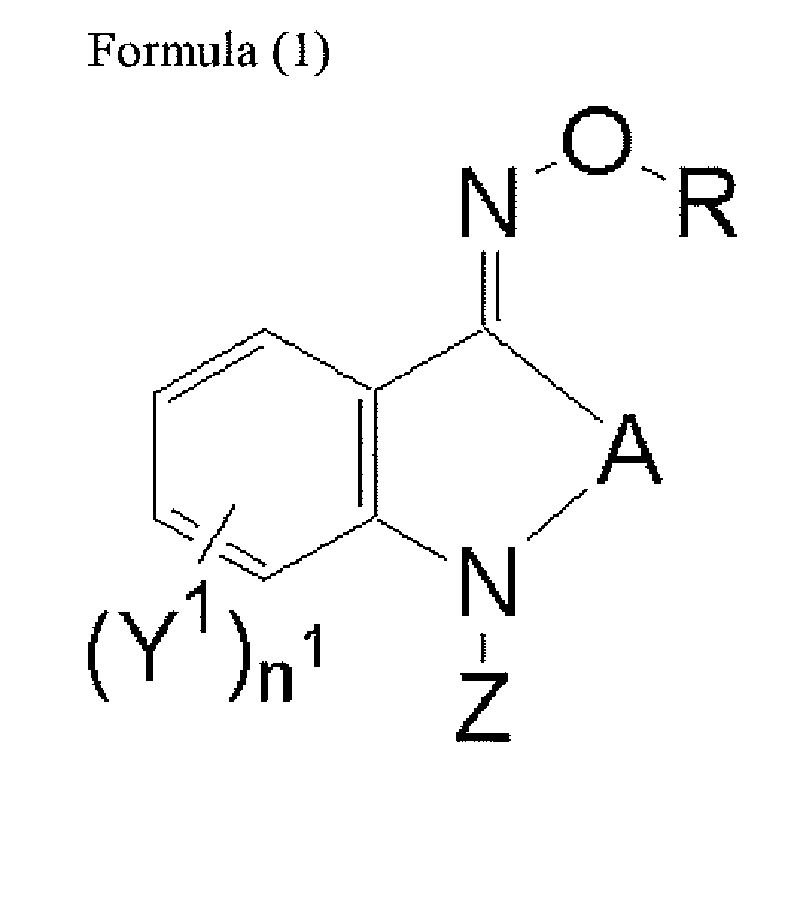
- wherein R, Y1 and Z independently represent a monovalent substituent, n1 represents an integer of 0 to 4, and A represents a divalent linking group.
- The monovalent substituent represented by R in Formula (1) is preferably a monovalent nonmetallic atomic group shown below.
The monovalent nonmetallic atomic group represented by R in Formula (1) includes an optionally substituted alkyl group, an optionally substituted aryl group, an optionally substituted alkenyl group, an optionally substituted alkynyl group, an optionally substituted alkylsulfinyl group, an optionally substituted arylsulfinyl group, an optionally substituted alkylsulfonyl group, an optionally substituted arylsulfonyl group, an optionally substituted acyl group, an optionally substituted alkoxycarbonyl group, an optionally substituted aryloxycarbonyl group, an optionally substituted phosphinoyl group, an optionally substituted heterocyclic group, an optionally substituted alkylthiocarbonyl group, an optionally substituted arylthiocarbonyl group, an optionally substituted dialkylaminocarbonyl group, and an optionally substituted dialkylaminothiocarbonyl group. - The optionally substituted alkyl group is preferably an alkyl group having 1 to 30 carbon atoms, and examples include a methyl group, an ethyl group, a propyl group, a butyl group, a hexyl group, an octyl group, a decyl group, a dodecyl group, an octadecyl grouop, an isopropyl group, an isobutyl group, a sec-butyl group, a tert-butyl group, a 1-ethylpentyl group, a cyclopentyl group, a cyclohexyl group, a trifluoromethyl grouop, a 2-ethylhexyl group, a phenacyl group, a 1-naphthoylmethyl group, a 2-naphthoylmethyl group, a 4-methylsulfanylphenacyl group, a 4-phenylsulfanylphenacyl group, a 4-dimethylaminophenacyl group, a 4-cyanophenacyl group, a 4-methylphenacyl group, a 2-methylphenacyl group, a 3-fluorophenacyl group, a 3-trifluoromethylphenacyl group, and a 3-nitrophenacyl group.
- The optionally substituted aryl group is preferably an aryl group having 6 to 30 carbon atoms, and examples include a phenyl group, a biphenyl group, a 1-naphthyl group, a 2-naphthyl group, a 9-anthryl group, a 9-phenanthryl group, a 1-pyrenyl group, a 5-naphthacenyl group, a 1-indenyl group, a 2-azulenyl group, a 9-fluorenyl group, a terphenyl group, a quarterphenyl group, an o-tolyl group, a m-tolyl group, a p-tolyl group, a xylyl group, an o-cumenyl group, a m-cumenyl group, a p-cumenyl group, a mesityl group, a pentalenyl group, a binaphthalenyl group, a ternaphthalenyl group, a quarternaphthalenyl group, a heptalenyl group, a biphenylenyl group, an indacenyl group, a fluoranthenyl group, an acenaphthylenyl group, an aceanthrylenyl group, a phenalenyl group, a fluorenyl group, an anthryl group, a bianthracenyl group, a teranthracenyl group, a quarteranthracenyl group, an anthraquinolyl group, a phenanthryl group, a triphenylenyl group, a pyrenyl group, a chrysenyl group, a naphthacenyl group, a pleiadenyl group, a picenyl group, a perylenyl group, a pentaphenyl group, a pentacenyl group, a tetraphenylenyl group, a hexaphenyl group, a hexacenyl group, a rubicenyl group, a coronenyl group, a trinaphthylenyl group, a heptaphenyl group, a heptacenyl group, a pyranthrenyl group, and an ovalenyl group.
- The optionally substituted alkenyl group is preferably an alkenyl group having 2 to 10 carbon atoms, and examples include a vinyl group, an allyl group and a styryl group.
- The optionally substituted alkynyl group is preferably an alkynyl group having 2 to 10 carbon atoms, and examples include an ethynyl group, a propynyl group and a propargyl group.
- The optionally substituted alkylsulfinyl group is preferably an alkylsulfinyl group having 1 to 20 carbon atoms, and examples include a methylsulfinyl group, an ethylsulfinyl group, a propylsulfinyl group, an isopropylsulfinyl group, a butylsulfinyl group, a hexylsulfinyl group, a cyclohexylsulfinyl group, an octylsulfinyl group, a 2-ethylhexylsulfinyl group, a decanoylsulfinyl group, a dodecanoylsulfinyl group, an octadecanoylsulfinyl group, a cyanomethylsulfinyl group, and a methoxymethylsulfinyl group.
- The optionally substituted arylsulfinyl group is preferably an arylsulfinyl group having 6 to 30 carbon atoms, and examples include a phenylsulfinyl group, a 1-naphthylsulfinyl group, a 2-naphthylsulfinyl group, a 2-chlorophenylsulfinyl group, a 2-methylphenylsulfinyl group, a 2-methoxyphenylsulfinyl group, a 2-butoxyphenylsulfinyl group, a 3-chlorophenylsulfinyl group, a 3-trifluoromethylphenylsulfinyl group, a 3-cyanophenylsulfinyl group, a 3-nitrophenylsulfinyl group, a 4-fluorophenylsulfinyl group, a 4-cyanophenylsulfinyl group, a 4-methoxyphenylsulfinyl group, a 4-methylsulfanylphenylsulfinyl group, a 4-phenylsulfanylphenylsulfinyl group, and a 4-dimethylaminophenylsulfinyl group.
- The optionally substituted alkylsulfonyl group is preferably an alkylsulfonyl group having 1 to 20 carbon atoms, and examples include a methylsulfonyl group, an ethylsulfonyl group, a propylsulfonyl group, an isopropylsulfonyl group, a butylsulfonyl group, a hexylsulfonyl group, a cyclohexylsulfonyl group, an octylsulfonyl group, a 2-ethylhexylsulfonyl group, a decanoylsulfonyl group, a dodecanoylsulfonyl group, an octadecanoylsulfonyl group, a cyanomethylsulfonyl group, a methoxymethylsulfonyl group, and a perfluoroalkylsulfonyl group.
- The optionally substituted arylsulfonyl group is preferably an arylsulfonyl group having 6 to 30 carbon atoms, and examples include a phenylsulfonyl group, a 1-naphthylsulfonyl group, a 2-naphthylsulfonyl group, a 2-chlorophenylsulfonyl group, a 2-methylphenylsulfonyl group, a 2-methoxyphenylsulfonyl group, a 2-butoxyphenylsulfonyl group, a 3-chlorophenylsulfonyl group, a 3-trifluoromethylphenylsulfonyl group, a 3-cyanophenylsulfonyl group, a 3-nitrophenylsulfonyl group, a 4-fluorophenylsulfonyl group, a 4-cyanophenylsulfonyl group, a 4-methoxyphenylsulfonyl group, a 4-methylsulfanylphenylsulfonyl group, a 4-phenylsulfanylphenylsulfonyl group, and a 4-dimethylaminophenylsulfonyl group.
- The optionally substituted acyl group is preferably an acyl group having 2 to 20 carbon atoms, and examples include an acetyl group, a propanoyl group, a butanoyl group, a trifluoromethylcarbonyl group, a pentanoyl group, a benzoyl group, a toluyl group, a 1-naphthyl group, a 2-naphthoyl group, a 4-methylsulfanylbenzoyl group, a 4-phenylsulfanylbenzoyl group, a 4-dimethylaminobenzoyl group, a 4-diethylaminobenzoyl group, a 2-chlorobenzoyl group, a 2-methylbenzoyl group, a 2-methoxybenzoyl group, a 2-butoxybenzoyl group, a 3-chlorobenzoyl group, a 3-trifluoromethylbenzoyl group, a 3-cyanobenzoyl group, a 3-nitrobenzoyl group, a 4-fluorobenzoyl group, a 4-cyanobenzoyl group, and a 4-methoxybenzoyl group.
- The optionally substituted alkoxycarbonyl group is preferably an alkoxycarbonyl group having 2 to 20 carbon atoms, and examples include a methoxycarbonyl group, an ethoxycarbonyl group, a propoxycarbonyl group, a butoxycarbonyl group, a hexyloxycarbonyl group, an octyloxycarbonyl group, a decyloxycarbonyl group, an octadecyloxycarbonyl group, and a trifluoromethyloxycarbonyl group.
- Examples of the optionally substituted aryloxycarbonyl group include a phenoxycarbonyl group, a 1-naphthyloxycarbonyl group, a 2-naphthyloxycarbonyl group, a 4-methylsulfanylphenyloxycarbonyl group, a 4-phenylsulfanylphenyloxycarbonyl group, a 4-dimethylaminophenyloxycarbonyl group, a 4-diethylaminophenyloxycarbonyl group, a 2-chlorophenyloxycarbonyl group, a 2-methylphenyloxycarbonyl group, a 2-methoxyphenyloxycarbonyl group, a 2-butoxyphenyloxycarbonyl group, a 3-chlorophenyloxycarbonyl group, a 3-trifluoromethylphenyloxycarbanyl group, a 3-cyanophenyloxycarbonyl group, a 3-nitrophenyloxycarbonyl group, a 4-fluorophenyloxycarbonyl group, a 4-cyanophenyloxycarbonyl group, and a 4-methoxyphenyloxycarbonyl group.
- The optionally substituted phosphinoyl group is preferably a phosphinoyl group having 2 to 50 carbon atoms in total, and examples include a dimethylphosphinoyl group, a diethylphosphinoyl group, a dipropylphosphinoyl group, a diphenylphosphinoyl group, a dimethoxyphosphinoyl group, a diethoxyphosphinoyl group, a dibenzoylphosphinoyl group, and a bis(2,4,6-trimethylphenyl)phosphinoyl group.
- The optionally substituted heterocyclic group is preferably an aromatic or aliphatic heterocyclic group containing at least one atom selected from nitrogen, oxygen, sulfur, and phosphorus atoms. Examples include a thienyl group, a benzo[b]thienyl group, a naphtho[2,3-b]thienyl group, a thianthrenyl group, a furyl group, a pyranyl group, an isobenzofuranyl group, a chromenyl group, a xanthenyl group, a phenoxathiinyl group, a 2H-pyrrolyl group, a pyrrolyl group, an imidazolyl group, a pyrazolyl group, a pyridyl group, a pyrazinyl group, a pyrimidinyl group, a pyridazinyl group, an indolizinyl group, an isoindolyl group, a 3H-indolyl group, an indolyl group, a 1H-indazolyl group, a purinyl group, a 4H-quinolizinyl group, an isoquinolyl group, a quinolyl group, a phthalazinyl group, a naphthyridinyl group, a quinoxalinyl group, a quinazolinyl group, a cinnolinyl group, a pteridinyl group, a 4aH-carbazolyl group, a carbazolyl group, a β-carbolinyl group, a phenanthridinyl group, an acridinyl group, a perimidinyl group, a phenanthrolinyl group, a phenazinyl group, a phenarsazinyl group, an isothiazolyl group, a phenothiazinyl group, an isoxazolyl group, a furazanyl group, a phenoxazinyl group, an isochromanyl group, a chromanyl group, a pyrrolidinyl group, a pyrrolinyl group, an imidazolidinyl group, an imidazolinyl group, a pyrazolidinyl group, a pyrazolinyl group, a piperidyl group, a piperazinyl group, an indolinyl group, an isoindolinyl group, a quinuclidinyl group, a morpholinyl group, and a thioxantholyl group.
- Examples of the optionally substituted alkylthiocarbonyl group include a methylthiocarbonyl group, a propylthiocarbonyl group, a butylthiocarbonyl group, a hexylthiocarbonyl group, an octylthiocarbonyl group, a decylthiocarbonyl group, an octadecylthiocarbonyl group, and a trifluoromethylthiocarbonyl group.
- Examples of the optionally substituted arylthiocarbonyl group include a 1-naphthylthiocarbonyl group, a 2-naphthylthiocarbonyl group, a 4-methylsulfanylphenylthiocarbonyl group, a 4-phenylsulfanylphenylthiocarbonyl group, a 4-dimethylaminophenylthiocarbonyl group, a 4-diethylaminophenylthiocarbonyl group, a 2-chlorophenylthiocarbonyl group, a 2-methylphenylthiocarbonyl group, a 2-methoxyphenylthiocarbonyl group, a 2-butoxyphenylthiocarbonyl group, a 3-chlorophenylthiocarbonyl group, a 3-trifluoromethylphenylthiocarbonyl group, a 3-cyanophenylthiocarbonyl group, a 3-nitrophenylthiocarbonyl group, a 4-fluorophenylthiocarbonyl group, a 4-cyanophenylthiocarbonyl group, and a 4-methoxyphenylthiocarbonyl group.
- Examples of the optionally substituted dialkylaminocarbonyl group include a dimethylaminocarbonyl group, a diethylaminocarbonyl group, a dipropylaminocarbonyl group, and a dibutylaminocarbonyl group.
- Examples of the optionally substituted dialkylaminothiocarbonyl group include a dimethylaminothiocarbonyl group, a dipropylaminothiocarbonyl group and a dibutylaminothiocarbonyl group.
- In particular, R is more preferably an acyl group from the viewpoint of higher sensitivity, and specifically, an acetyl group, an ethyloyl group, a propioyl group, a benzoyl group and a toluyl group are preferable.
- The monovalent substituent represented by Y1 in Formula (1) includes an optionally substituted alkyl group, an optionally substituted aryl group, an optionally substituted alkenyl group, an optionally substituted alkynyl group, an optionally substituted alkoxy group, an optionally substituted aryloxy group, an optionally substituted alkylthioxy group, an optionally substituted arylthioxy group, an optionally substituted acyloxy group, an optionally substituted alkylsulfanyl group, an optionally substituted arylsulfanyl group, an optionally substituted alkylsulfinyl group, an optionally substituted arylsulfinyl group, an optionally substituted alkylsulfonyl group, an optionally substituted arylsulfonyl group, an optionally substituted acyl group, an optionally substituted alkoxycarbonyl group, an optionally substituted aryloxycarbonyl group, an optionally substituted carbamoyl group, an optionally substituted sulfamoyl group, an optionally substituted amino group, an optionally substituted phosphinoyl group, an optionally substituted heterocyclic group, a halogen group, a hydrogen atom, a cyano group, a nitro group, a carboxylic acid group, a sulfonic acid group, and a sulfinic acid group.
- Among the monovalent substituents represented by Y1 in Formula (1), the optionally substituted alkyl group, optionally substituted aryl group, optionally substituted alkenyl group, optionally substituted alkynyl group, optionally substituted alkylsulfinyl group, optionally substituted arylsulfinyl group, optionally substituted alkylsulfonyl group, optionally substituted arylsulfonyl group, optionally substituted acyl group, optionally substituted alkoxycarbonyl group, optionally substituted aryloxycarbonyl group, optionally substituted phosphinoyl group, or optionally substituted heterocyclic group has the same meaning as that of the monovalent nonmetallic atomic group represented by R in Formula (1), and the number of carbon atoms is also the same as defined therein.
- The optionally substituted alkoxy group is preferably an alkoxy group having 1 to 30 carbon atoms, and examples include a methoxy group, an ethoxy group, a propyloxy group, an isopropyloxy group, a butoxy group, an isobutoxy group, a sec-butoxy group, a tert-butoxy group, a pentyloxy group, an isopentyloxy group, a hexyloxy group, a heptyloxy group, an octyloxy group, a 2-ethylhexyloxy group, a decyloxy group, a dodecyloxy group, an octadecyloxy group, an ethoxycarbonylmethyl group, a 2-ethylhexyloxycarbonylmethyloxy group, an aminocarbonylmethyloxy group, an N,N-dibutylaminocarbonylmethyloxy group, an N-methylaminocarbonylmethyloxy group, an N-ethylaminocarbonylmethyloxy group, an N-octylaminocarbonylmethyloxy group, an N-methyl-N-benzylaminocarbonylmethyloxy group, a benzyloxy group, and a cyanomethyloxy group.
- The optionally substituted aryloxy group is preferably an aryloxy group having 6 to 30 carbon atoms, and examples include a phenyloxy group, a 1-naphthyloxy group, a 2-naphthyloxy group, a 2-chlorophenyloxy group, a 2-methylphenyloxy group, a 2-methoxyphenyloxy group, a 2-butoxyphenyloxy group, a 3-chlorophenyloxy group, a 3-trifluoromethylphenyloxy group, a 3-cyanophenyloxy group, a 3-nitrophenyloxy group, a 4-fluorophenyloxy group, a 4-cyanophenyloxy group, a 4-methoxyphenyloxy group, a 4-dimethylaminophenyloxy group, a 4-methylsulfanylphenyloxy group, and a 4-phenylsulfanylphenyloxy group.
- The optionally substituted alkylthioxy group is preferably a thioalkoxy group having 1 to 30 carbon atoms, and examples include a methylthioxy group, an ethylthioxy group, a propylthioxy group, an isopropylthioxy group, a butylthioxy group, an isobutylthioxy group, a sec-butylthioxy group, a tert-butylthioxy group, a pentylthioxy group, an isopentylthioxy group, a hexylthioxy group, a heptylthioxy group, an octylthioxy group, a 2-ethylhexylthioxy group, a decylthioxy group, a dodecylthioxy group, an octadecylthioxy group, and a benzylthioxy group.
- The optionally substituted arylthioxy group is preferably an arylthioxy group having 6 to 30 carbon atoms, and examples include a phenylthioxy group, a 1-naphthylthioxy group, a 2-naphthylthioxy group, a 2-chlorophenylthioxy group, a 2-methylphenylthioxy group, a 2-methoxyphenylthioxy group, a 2-butoxyphenylthioxy group, a 3-chlorophenylthioxy group, a 3-trifluoromethylphenylthioxy group, a 3-cyanophenylthioxy group, a 3-nitrophenylthioxy group, a 4-fluorophenylthioxy group, a 4-cyanophenylthioxy group, a 4-methoxyphenylthioxy group, a 4-dimethylaminophenylthioxy group, a 4-methylsulfanylphenylthioxy group, and a 4-phenylsulfanylphenylthioxy group.
- The optionally substituted acyloxy group is preferably an acyloxy group having 2 to 20 carbon atoms, and examples include an acetyloxy group, a propanoyloxy group, a butanoyloxy group, a pentanoyloxy group, a trifluoromethylcarbonyloxy group, a benzoyloxy group, a 1-naphthylcarbonyloxy group, and a 2-naphthylcarbonyloxy group.
- The optionally substituted alkylsulfanyl group is preferably an alkylsulfanyl group having 1 to 20 carbon atoms, and examples include a methylsulfanyl group, an ethylsulfanyl group, a propylsulfanyl group, an isopropylsulfanyl group, a butylsulfanyl group, a hexylsulfanyl group, a cyclohexylsulfanyl group, an octylsulfanyl group, a 2-ethylhexylsulfanyl group, a decanoylsulfanyl group, a dodecanoylsulfanyl group, an octadecanoylsulfanyl group, a cyanomethylsulfanyl group, and a methoxymethylsulfanyl group.
- The optionally substituted arylsulfanyl group is preferably an arylsulfanyl group having 6 to 30 carbon atoms, and examples include a phenylsulfanyl group, a 1-naphthylsulfanyl group, a 2-naphthylsulfanyl group, a 2-chlorophenylsulfanyl group, a 2-methylphenylsulfanyl group, a 2-methoxyphenylsulfanyl group, a 2-butoxyphenylsulfanyl group, a 3-chlorophenylsulfanyl group, a 3-trifluoromethylphenylsulfanyl group, a 3-cyanophenylsulfanyl group, a 3-nitrophenylsulfanyl group, a 4-fluorophenylsulfanyl group, a 4-cyanophenylsulfanyl group, a 4-methoxyphenylsulfanyl group, a 4-methylsulfanylphenylsulfanyl group, a 4-phenylsulfanylphenylsulfanyl group, and a 4-dimethylaminophenylsulfanyl group.
- The optionally substituted carbamoyl group is preferably a carbamoyl group having 1 to 30 carbon atoms in total, and examples include a N-methylcarbamoyl group, an N-ethylcarbamoyl group, an N-propylcarbamoyl group, an N-butylcarbamoyl group, an N-hexylcarbamoyl group, an N-cyclohexylcarbamoyl group, an N-octylcarbamoyl group, an N-decylcarbamoyl group, an N-octadecylcarbamoyl group, an N-phenylcarbamoyl group, an N-2-methylphenylcarbamoyl group, an N-2-chlorophenylcarbamoyl group, an N-2-isopropoxyphenylearbamoyl group, an N-2-(2-ethylhexyl)phenylcarbamoyl group, an N-3-chlorophenylcarbamoyl group, an N-3-nitrophenylcarbamoyl group, an N-3-cyanophenylcarbamoyl group, an N-4-methoxyphenylcarbamoyl group, an N-4-cyanophenylcarbamoyl group, an N-4-methylsulfanylphenylcarbamoyl group, an N-4-phenylsulfanylphenylcarbamoyl group, an N-methyl-N-phenylcarbamoyl group, an N,N-dimethylcarbamoyl group, an N,N-dibutylcarbamoyl group, and an N,N-diphenylcarbamoyl group.
- The optionally substituted sulfamoyl group is preferably a sulfamoyl group having 0 to 30 carbon atoms in total, and examples include a sulfamoyl group, an N-alkylsulfamoyl group, an N-arylsulfamoyl group, an N,N-dialkylsulfamoyl group, an N,N-diarylsulfamoyl group, and an N-alkyl-N-arylsulfamoyl group. More specifically, examples include an N-methylsulfamoyl group, an N-ethylsulfamoyl group, an N-propylsulfamoyl group, an N-butylsulfamoyl group, an N-hexylsulfamoyl group, an N-cyclohexylsulfamoyl group, an N-octylsulfamoyl group, an N-2-ethylhexylsulfamoyl group, an N-decylsulfamoyl group, an N-octadecylsulfamoyl group, an N-phenylsulfamoyl group, an N-2-methylphenylsulfamoyl group, an N-2-chlorophenylsulfamoyl group, an N-2-methoxyphenylsulfamoyl group, an N-2-isopropoxyphenylsulfamoyl group, an N-3-chlorophenylsulfamoyl group, an N-3-nitrophenylsulfamoyl group, an N-3-cyanophenylsulfamoyl group, an N-4-methoxyphenylsulfamoyl group, an N-4-cyanophenylsulfamoyl group, an N-4-dimethylaminophenylsulfamoyl group, an N-4-methylsulfanylphenylsulfamoyl group, an N-4-phenylsulfanylphenylsulfamoyl group, an N-methyl-N-phenylsulfamoyl group, an N,N-dimethylsulfamoyl group, an N,N-dibutylsulfamoyl group, and an N,N-diphenylsulfamoyl group.
- The optionally substituted amino group is preferably an amino group having 0 to 50 carbon atoms in total, and examples include -NH2, an N-alkylamino group, an N-arylamino group, an N-acylamino group, an N-sulfonylamino group, an N,N-dialkylamino group, an N,N-diarylamino group, an N-alkyl-N-arylamino group, and an N,N-disulfonylamino group. More specifically, examples include an N-methylamino group, an N-ethylamino group, an N-propylamino group, an N-isopropylamino group, an N-butylamino group, an N-tert-butylamino group, an N-hexylamino group, an N-cyclohexylamino group, an N-octylamino group, an N-2-ethylhexylamino group, an N-decylamino group, an N-octadecylamino group, an N-benzylamino group, an N-phenylamino group, an N-2-methylphenylamino group, an N-2-chlorophenylamino group, an N-2-methoxyphenylamino group, an N-2-isopropoxyphenylamino group, an N-2-(2-ethylhexyl)phenylamino group, an N-3-chlorophenylamino group, an N-3-nitrophenylamino group, an N-3-cyanophenylamino group, an N-3-trifluoromethylphenylamino group, an N-4-methoxyphenylamino group, an N-4-cyanophenylamino group, an N-4-trifluoromethylphenylamino group, an N-4-methylsulfanylphenylamino group, an N-4-phenylsulfanylphenylamino group, an N-4-dimethylaminophenylamino group, an N-methyl-N-phenylamino group, an N,N-dimethylamino group, an N,N-diethylamino group, an N,N-dibutylamino group, an N,N-diphenylamino group, an N,N-diacetylamino group, an N,N-dibenzoylamino group, an N,N-(dibutylcarbonyl)amino group, an N,N-(dimethylsulfonyl)amino group, an N,N-(diethylsulfonyl)amino group, an N,N-(dibutylsulfonyl)amino group, an N,N-(diphenylsulfonyl)amino group, a morpholino group, a 3,5-dimethylmorpholino group, and a carbazole group.
- The halogen group may be a fluorine atom, a chlorine atom, a bromine atom, an iodine atom, or the like.
- The optionally substituted alkyl group, optionally substituted aryl group, optionally substituted alkenyl group, optionally substituted alkynyl group, optionally substituted alkoxy group, optionally substituted aryloxy group, optionally substituted alkylthioxy group, optionally substituted arylthioxy group, optionally substituted acyloxy group, optionally substituted alkylsulfanyl group, optionally substituted arylsulfanyl group, optionally substituted alkylsulfinyl group, optionally substituted arylsulfinyl group, optionally substituted alkylsulfonyl group, optionally substituted arylsulfonyl group, optionally substituted acyl group, optionally substituted alkoxycarbonyl group, optionally substituted carbamoyl group, optionally substituted sulfamoyl group, optionally substituted amino group, or optionally substituted heterocyclic group may themselves be further substituted by any other substituent.
- Examples of such a further substituent include a halogen group such as a fluorine, chlorine, bromine, or iodine atom; an alkoxy group such as a methoxy group, an ethoxy group, or a tert-butoxy group; an aryloxy group such as a phenoxy group or a p-tolyloxy group; an alkoxycarbonyl group such as a methoxycarbonyl group, a butoxycarbonyl group or a phenoxycarbonyl group; an acyloxy group such as an acetoxy group, a propionyloxy group or a benzoyloxy group; an acyl group such as an acetyl group, a benzoyl group, an isobutyryl group, an acryloyl group, a methacryloyl group, or a methoxalyl group; an alkylsulfanyl group such as a methylsulfanyl group or a tert-butylsulfanyl group; an arylsulfanyl group such as a phenylsulfanyl group or a p-tolylsulfanyl group; an alkylamino group such as a methylamino group or a cyclohexylamino group; a dialkylamino group such as a dimethylamino group, a diethylamino group, a morpholino group, or a piperidino group; an arylamino group such as a phenylamino group or a p-tolylamino group; an alkyl group such as a methyl group, an ethyl group, a tert-butyl group or a dodecyl group; an aryl group such as a phenyl group, a p-tolyl group, a xylyl group, a cumenyl group, a naphthyl group, an anthryl group, or a phenanthryl group; a hydroxyl group, a carboxyl group, a formyl group, a mercapto group, a sulfo group, a mesyl group, a p-toluenesulfonyl group, an amino group, a nitro group, a cyano group, a trifluoromethyl group, a trichloromethyl group, a trimethylsilyl group, a phosphinico group, a phosphono group, a trimethylammoniumyl group, a dimethylsulfoniumyl group, or a triphenylphenacylphosphoniumyl group.
- n1 in Formula (1) represents an integer of 0 to 4.
n1 is preferably 0 to 2, more preferably 2. When n1 is an integer of 2 or more, the respective Y's may be bound to one another to form an aliphatic or aromatic ring. The ring includes aliphatic or aromatic hydrocarbon rings or heteroatom-containing hetero rings. These rings may further be combined to form a polycyclic condensed ring. - The aliphatic or aromatic hydrocarbon ring includes 6-, 5- and 7-membered hydrocarbon rings, preferably 6- and 5-membered rings.
The hetero ring includes hetero rings having a sulfur, oxygen or nitrogen atom as a heteroatom, among which a hetero ring having a sulfur atom is more preferable. - When the aliphatic or aromatic hydrocarbon rings are further combined to form a polycyclic condensed ring, the polycyclic condensed ring includes a condensed ring formed by 1 to 4 benzene rings, a condensed ring formed by a benzene ring and a 5-membered unsaturated ring, etc. The heteroatom-containing hetero ring includes a condensed ring formed by a benzene ring and a 5-membered ring containing a sulfur, oxygen or nitrogen atom, a condensed ring formed by a benzene ring and a 6-membered ring containing a sulfur, oxygen or nitrogen atom, etc.
- Specific examples of rings, which may be formed by binding Y1's to one another, include a benzene ring, a naphthalene ring, an anthracene ring, a phenanthrene ring, a fluorene ring, a triphenylene ring, a naphthacene ring, a biphenyl ring, a pyrrole ring, a furan ring, a thiophene ring, a dithiolane ring, an oxirane ring, an dioxirane ring, a thirane ring, a pyrrolidine ring, a piperidine ring, an imidazole ring, an isoxazole ring, a benzodithiol ring, an oxazole ring, a thiazole ring, a benzothiazole ring, a benzimidazole ring, a benzoxazole ring, a pyridine ring, a pyrazine ring, a pyrimidine ring, a pyridazine ring, an indolizine ring, an indole ring, a benzofuran ring, a benzothiophene ring, a benzodithiol ring, an isobenzofuran ring, a quinolizine ring, a quinoline ring, a phthalazine ring, a naphthyridine ring, a quinoxaline ring, a quinazoline ring, an isoquinoline ring, a carbazole ring, a phenanthridine ring, an acridine ring, a phenanthroline ring, a thianthrene ring, a chromene ring, a xanthene ring, a phenoxathiine ring, a phenothiazine ring, and a phenazine ring.
- The monovalent substituent represented by Z in Formula (1) includes an optionally substituted alkyl group, an optionally substituted aryl group, an optionally substituted alkenyl group, an optionally substituted alkynyl group, an optionally substituted alkylsulfanyl group, an optionally substituted arylsulfanyl group, an optionally substituted alkylsulfinyl group, an optionally substituted arylsulfinyl group, an optionally substituted alkylsulfonyl group, an optionally substituted arylsulfonyl group, an optionally substituted acyl group, an optionally substituted alkoxycarbonyl group, an optionally substituted carbamoyl group, and a hydrogen atom.
Specific examples of the monovalent substituent represented by Z in Formula (1) and the range of preferable number of carbon atoms is the same as exemplified by the monovalent substituent represented by Y1 in Formula (1). - Y1 in Formula (1) and Z in Formula (1) may be bound to each other to form an aliphatic or aromatic ring. The ring includes aliphatic or aromatic hydrocarbon rings or heteroatom-containing hetero rings. These rings may further be combined to form a polycyclic condensed ring.
- The aliphatic or aromatic hydrocarbon ring includes 6-, 5- and 7-membered hydrocarbon rings and are preferably 6- and 5-membered rings, more preferably a 5-membered ring.
The hetero ring includes hetero rings having a sulfur, oxygen or nitrogen atom as a heteroatom, among which a hetero ring having a sulfur atom is more preferable. - When the aliphatic or aromatic hydrocarbon rings are further combined to form a polycyclic condensed ring, the polycyclic condensed ring includes a condensed ring formed by 1 to 4 benzene rings, a condensed ring formed by a benzene ring and a 5-membered unsaturated ring, etc. The heteroatom-containing hetero ring includes a condensed ring formed by a benzene ring and a 5-membered ring containing a sulfur, oxygen or nitrogen atom, a condensed ring formed by a benzene ring and a 6-membered ring containing a sulfur, oxygen or nitrogen atom, etc.
- Specific examples of the ring, which may be formed by binding Y1 in Formula (1) and Z in Formula (1) to each other, include a benzene ring, a naphthalene ring, an anthracene ring, a phenanthrene ring, a fluorene ring, a triphenylene ring, a naphthacene ring, a biphenyl ring, a pyrrole ring, a furan ring, a thiophene ring, a dithiolane ring, an oxirane ring, an dioxirane ring, a thirane ring, a pyrrolidine ring, a piperidine ring, an imidazole ring, an isoxazole ring, a benzodithiol ring, an oxazole ring, a thiazole ring, a benzothiazole ring, a benzimidazole ring, a benzoxazole ring, a pyridine ring, a pyrazine ring, a pyrimidine ring, a pyridazine ring, an indolizine ring, an indole ring, a benzofuran ring, a benzothiophene ring, a benzodithiol ring, an isobenzofuran ring, a quinolizine ring, a quinoline ring, a phthalazine ring, a naphthyridine ring, a quinoxaline ring, a quinoxazoline ring, an isoquinoline ring, a carbazole ring, a phenanthridine ring, an acridine ring, a phenanthroline ring, a thianthrene ring, a chromene ring, a xanthene ring, a phenoxathiine ring, a phenothiazine ring, and a phenazine ring.
- A in Formula (1) represents a divalent linking group.
Specific examples of A in Formula (1) include an optionally substituted alkylene group having 1 to 6 carbon atoms, an optionally substituted alkynylene group having 1 to 6 carbon atoms, etc.
The substituent includes, for example, a halogen atom such as a fluorine atom, a chlorine atom, a bromine atom, or an iodine atom, an alkoxy group such as a methoxy group, an ethoxy group, a tert-butoxy group, or an alkyleneoxide group, an aryloxy group such as a phenoxy group or a p-tolyloxy group, an alkoxycarbonyl group such as a methoxycarbonyl group, a butoxycarbonyl group, or a phenoxycarbonyl group, an acyloxy group such as an acetoxy group, a propionyloxy group, or a benzoyloxy group, an acyl group such as an acetyl group, a benzoyl group, an isobutyryl group, an acryloyl group, a methacryloyl group, a methoxalyl group, a benzoyl group, or a tolyl group, an alkylsulfanyl group such as a methylsulfanyl group or a tert-butylsulfanyl group, an arylsulfanyl group such as a phenylsulfanyl group or a p-tolylsulfanyl group, an alkylamino group such as a methylamino group or a cyclohexylamino group, a dialkylamino group such as a dimethylamino group, a diethylamino group, a morpholino group, or a piperidino group, an arylamino group such as a phenylamino group or a p-tolylamino group, an alkyl group such as a methyl group, an ethyl group, a tert-butyl group, or a dodecyl group, an alkenyl group such as an allyl group, a vinyl group, or a propenyl group, an aryl group such as a phenyl group, a p-tolyl group, a xylyl group, a cumenyl group, a naphthyl group, an anthryl group, or a phenanthryl group, a hydroxyl group, a carboxyl group, a formyl group, a mercapto group, a sulfo group, a mesyl group, a p-toluenesulfonyl group, an amino group, a nitro group, a cyano group, a trifluhaloalkyl group, a trialkylsilyl group, a phosphono group, an ammonium group, a sulfonium group, or a phosphonium group. - Preferable examples of A in Formula (1) include divalent linking groups represented by a partial structure shown below. In the following specific examples, one of two * symbols binds to the carbon atom (C) in a partial structure ">C=N-O-R" in Formula (1), and the other binds to the nitrogen atom (N) in a partial structure ">N-Z" in Formula (1).
-


-


-


-

- Among the specific examples (1) to (112), the examples (1) and (2) are preferable, and (1) is most preferable, from the viewpoint of attaining higher sensitivity.
In Formula (1), the combination of R, Y1, n1, Z and A is preferably a combination of preferable range of each R, Y1, n1, Z and A. - The specific oxime compound of the invention is preferably a compound represented by the following Formula (2):
-

- wherein R, Y2 and Y3 each independently represent a monovalent substituent, n2 and n3 independently represent an integer of 0 to 4, and A represents a divalent linking group.
- R in Formula (2) has the same meaning as defined in R in Formula (1), and preferable examples thereof are also the same as defined therein.
A in Formula (2) has the same meaning as defined in A in Formula (1), and preferable examples thereof are also the same as defined therein. - The monovalent substituent represented by Y2 or Y3 in Formula (2) has the same meaning as that of the monovalent substituent represented by Y1 in Formula (1), and preferable number of carbon atoms is also the same as defined therein.
In particular, Y2 in Formula (2) is preferably an alkyl group, an alkenyl group, an alkenyl group, an alkyloxy group, or a halogen atom and is preferably unsubstituted.
Y3 in Formula (2) is preferably an alkyl group, an alkenyl group, an alkynyl group, an alkyloxy group, a halogen atom, or an acyl group and is particularly preferably a substituent capable of representing the compound of Formula (3) below.
n2 and n3 independently represent 0 or 1, and more preferably n2 is 0 and n3 is 1. - In Formula (2), the combination ofR, Y2, n2, Y3, n3, Z and A is preferably a combination of preferable range of each R, Y2, n2, Y3, n3, Z and A.
- The specific oxime compound of the invention is preferably a compound represented by the following Formula (3):
-

- wherein R, Y4 and Y5 each independently represent a monovalent substituent, n4 and n5 independently represent an integer of 0 to 4, and A represents a divalent linking group.
- R in Formula (3) has the same meaning as defined in R in Formula (1), and preferable examples thereof are also the same as defined therein.
A in Formula (3) has the same meaning as defined in A in Formula (1), and preferable examples thereof are also the same as defined therein. - The monovalent substituent represented by Y4 or Y5 in Formula (3) has the same meaning as that of the monovalent substituent represented by Y1 in Formula (1), and the preferable number of carbon atoms is also the same as defined therein.
In particular, Y4 in Formula (3) is preferably an alkyl group, an alkenyl group, an alkynyl group, an alkyloxy group, or a halogen atom, and is more preferably unsubstituted.
Y5 in Formula (3) is preferably an alkyl group, an alkenyl group, an alkynyl group, an alkyloxy group, a halogen atom, an alkylthioxy group, an aryloxy group, or an arylthioxy group, more preferably an alkyl group.
n4 and n5 independently represent 0 or 1, and more preferably n4 is 0 and n5 is 1. - In Formula (3), the combination ofR, Y4, n4, Y5, n5, Z and A is preferably a combination of preferable range of each R, Y4, n4, Y5, n5, Z and A.
- Examples of the specific oxime compound of the invention are shown hereinafter, however, the invention is not limited thereto.
-


-


-


-


-


-


-
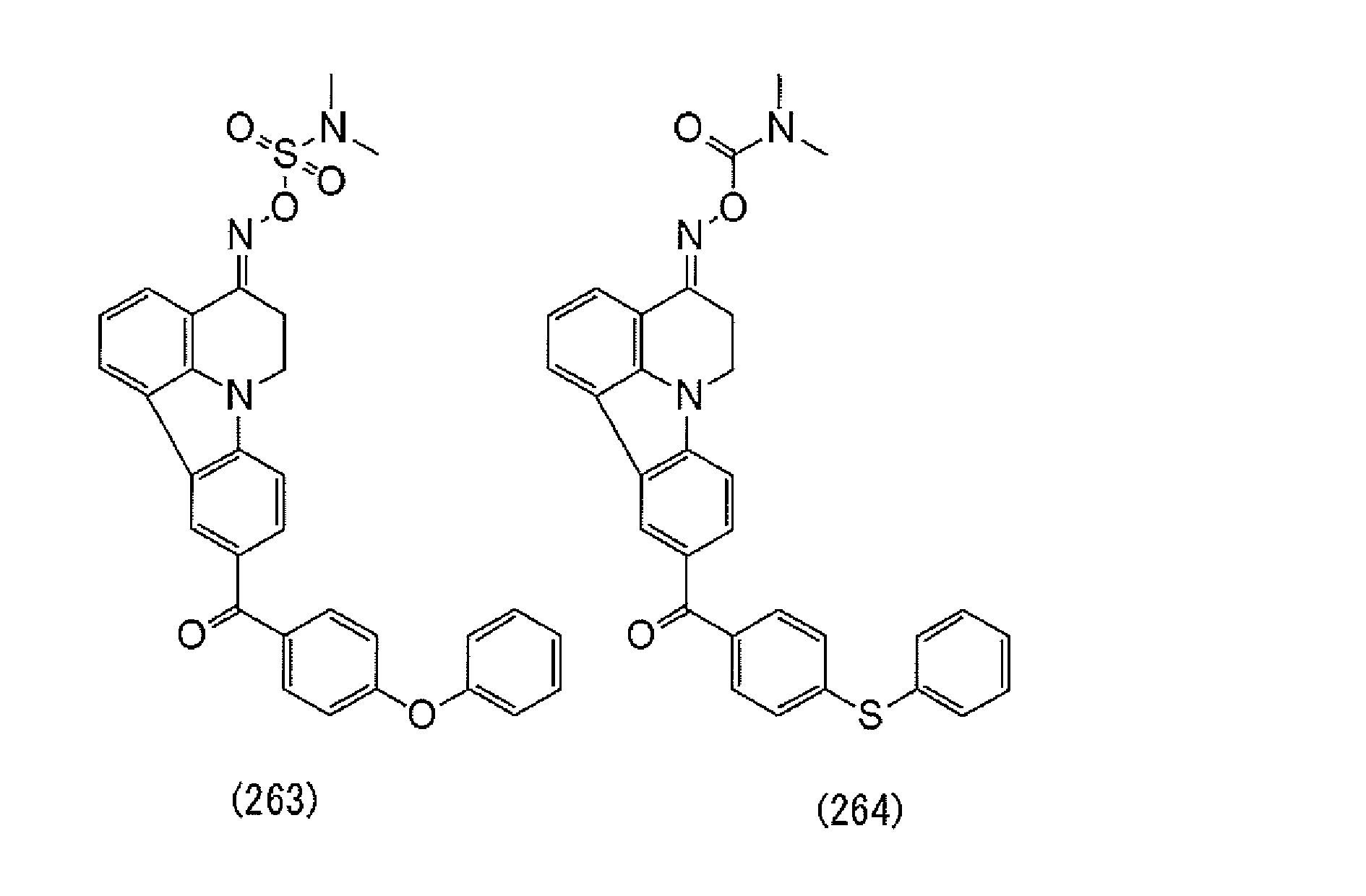

-

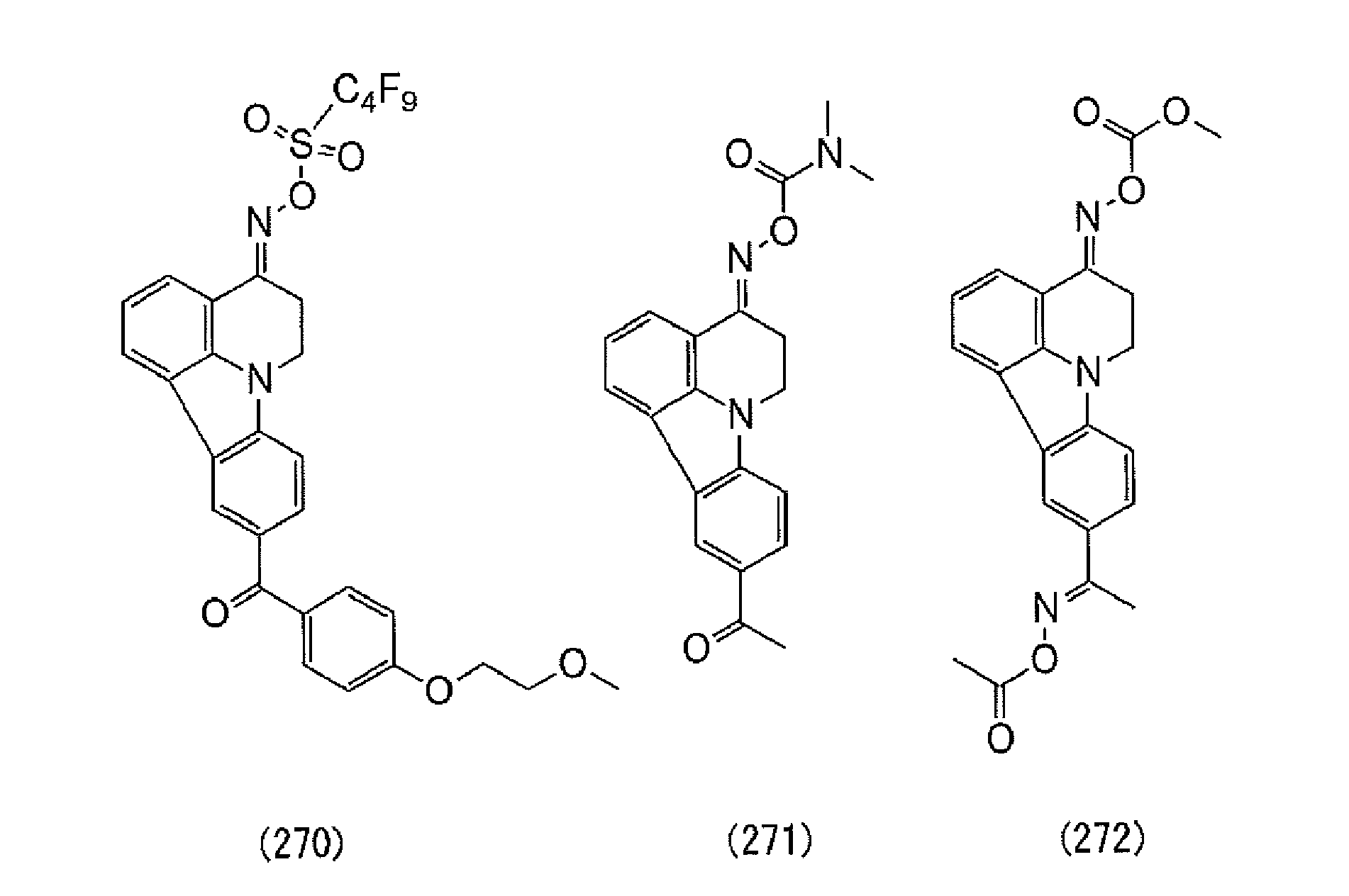
-


-


-


-


-


-
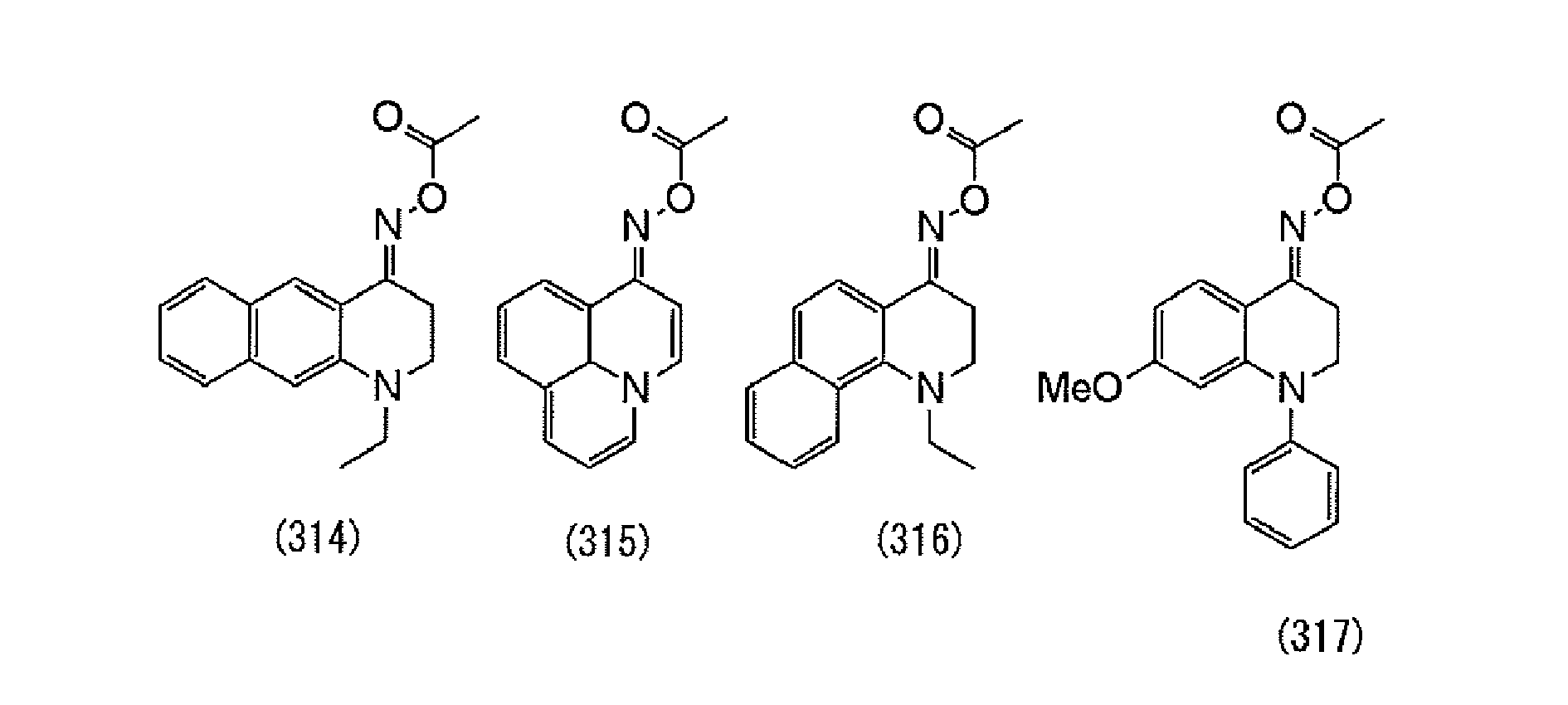


-


-
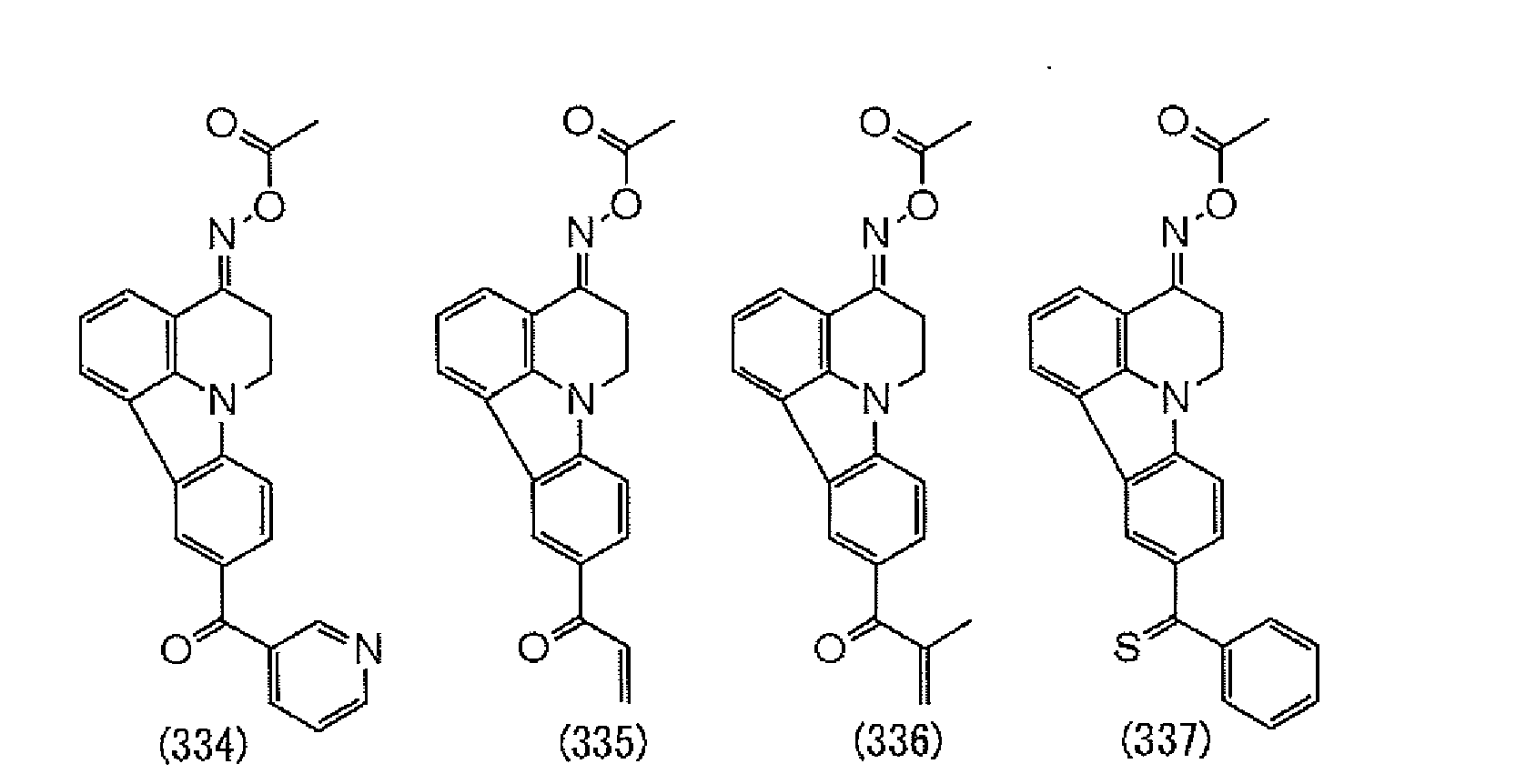


-


-


-


-


-


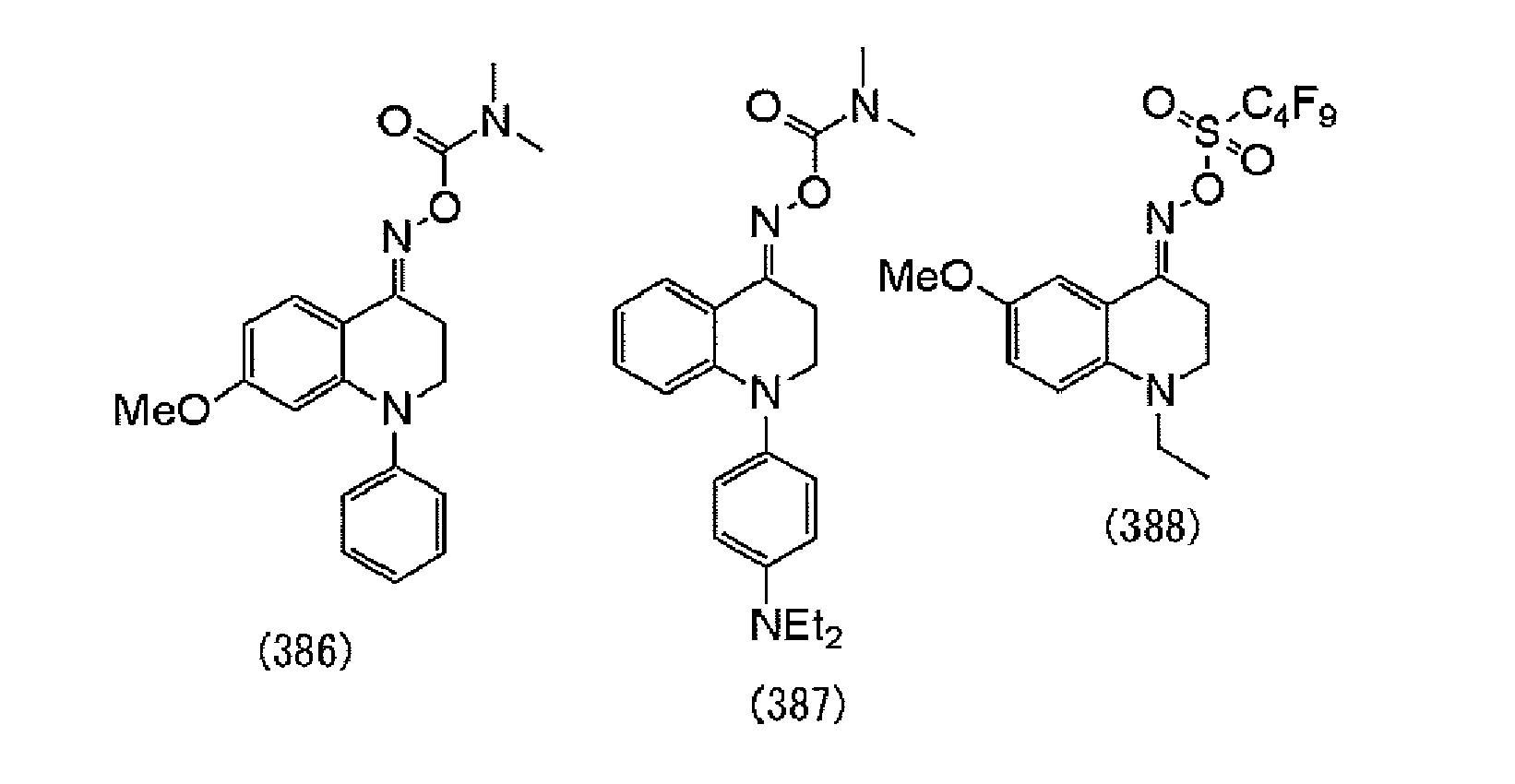
-


-

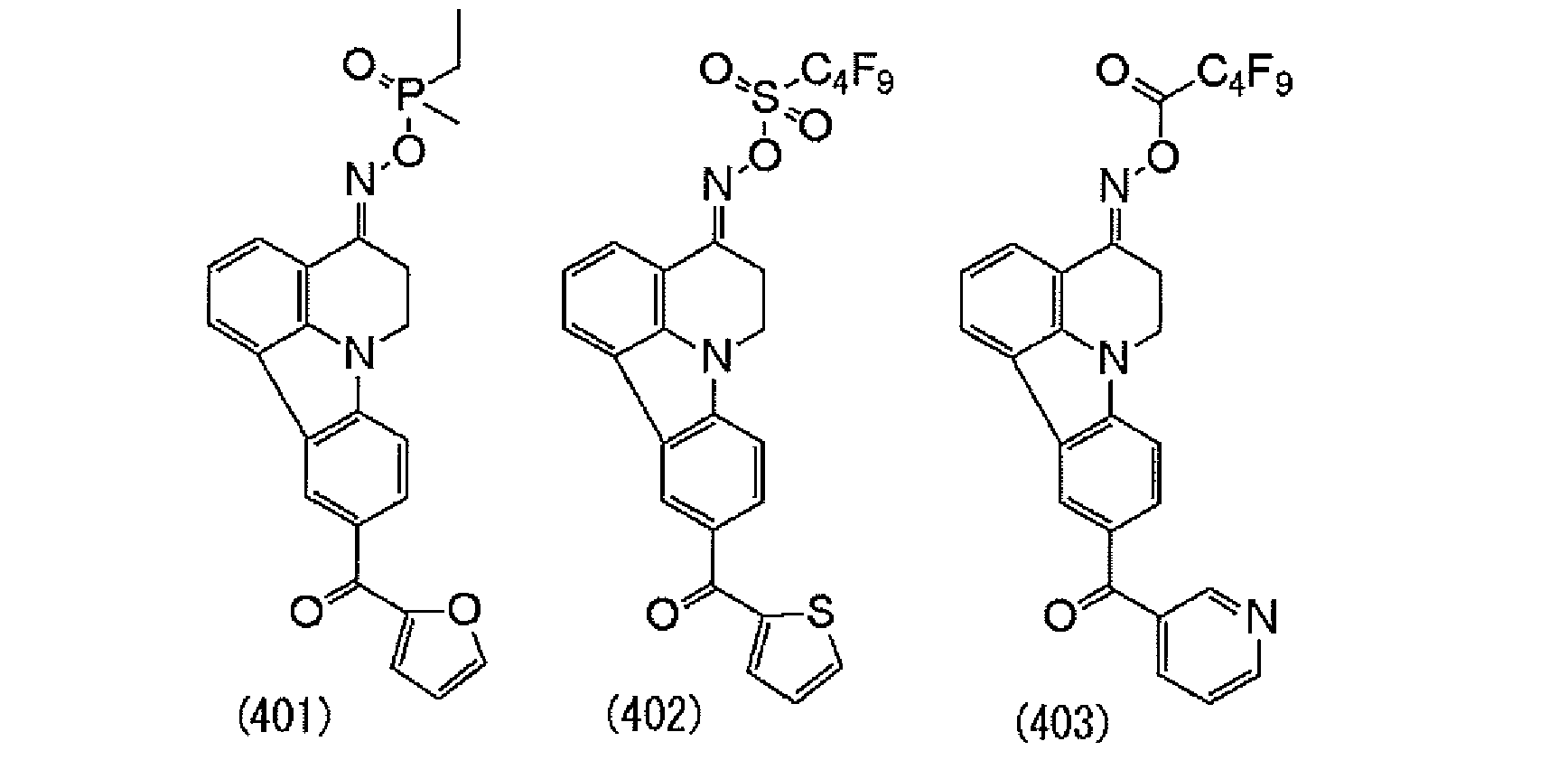

-


-


-


-


-
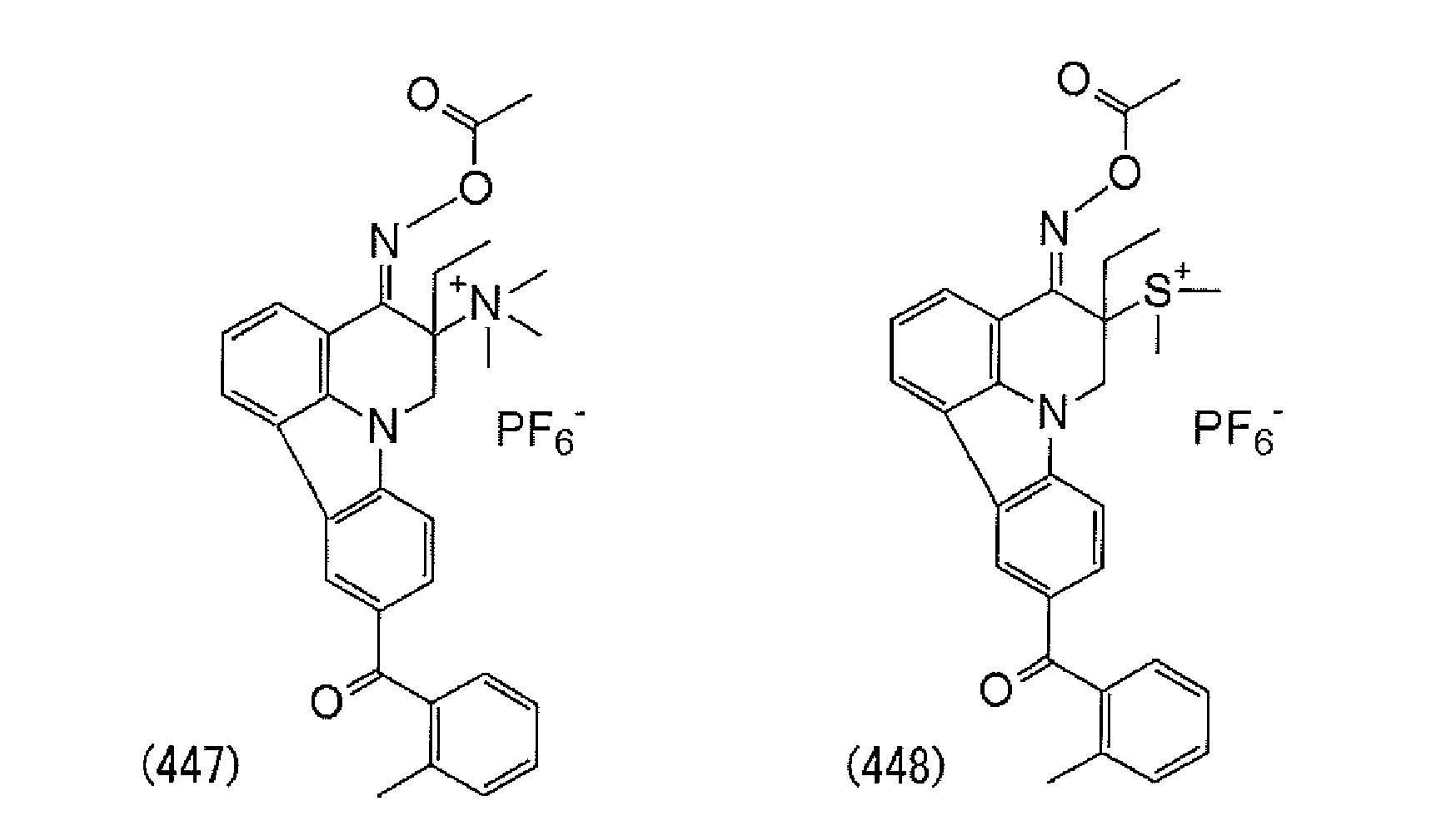

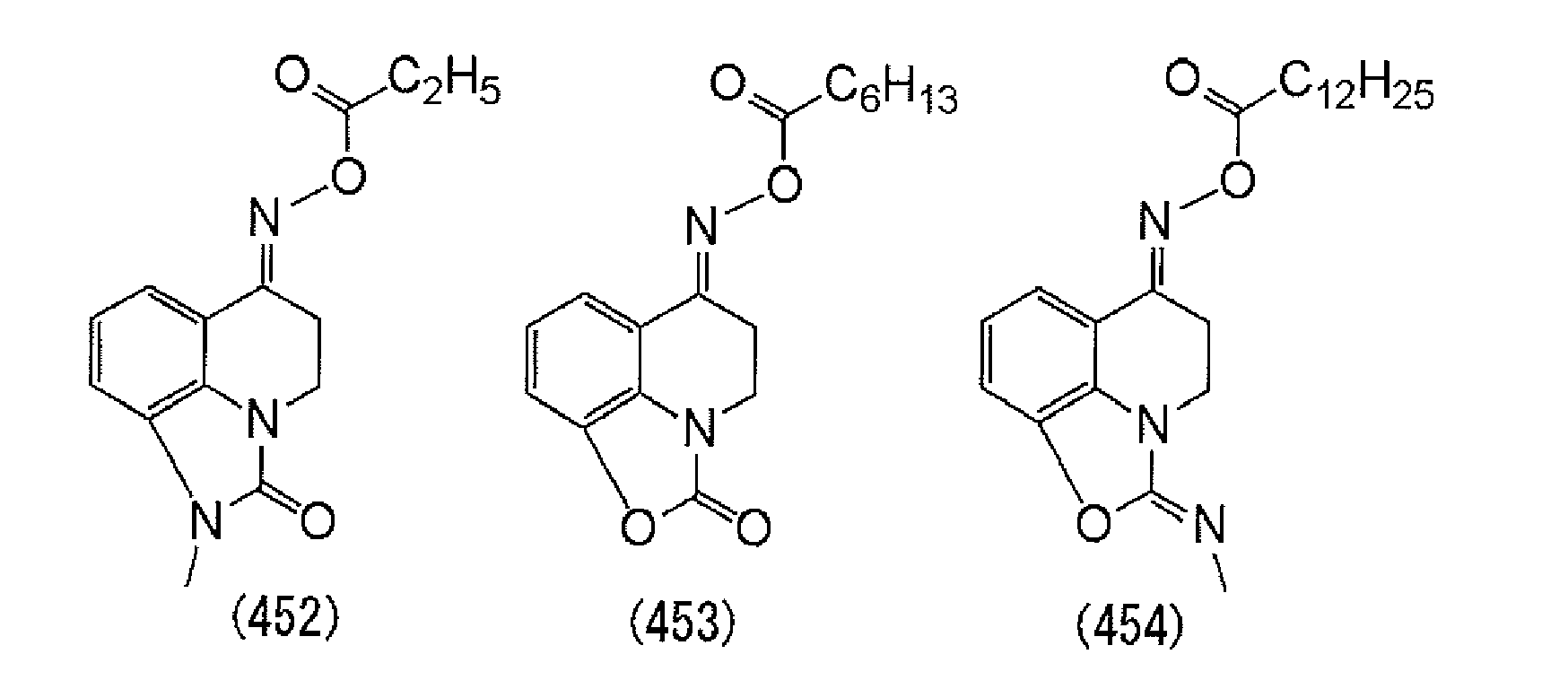
-


-


-


-


-


-


-


-
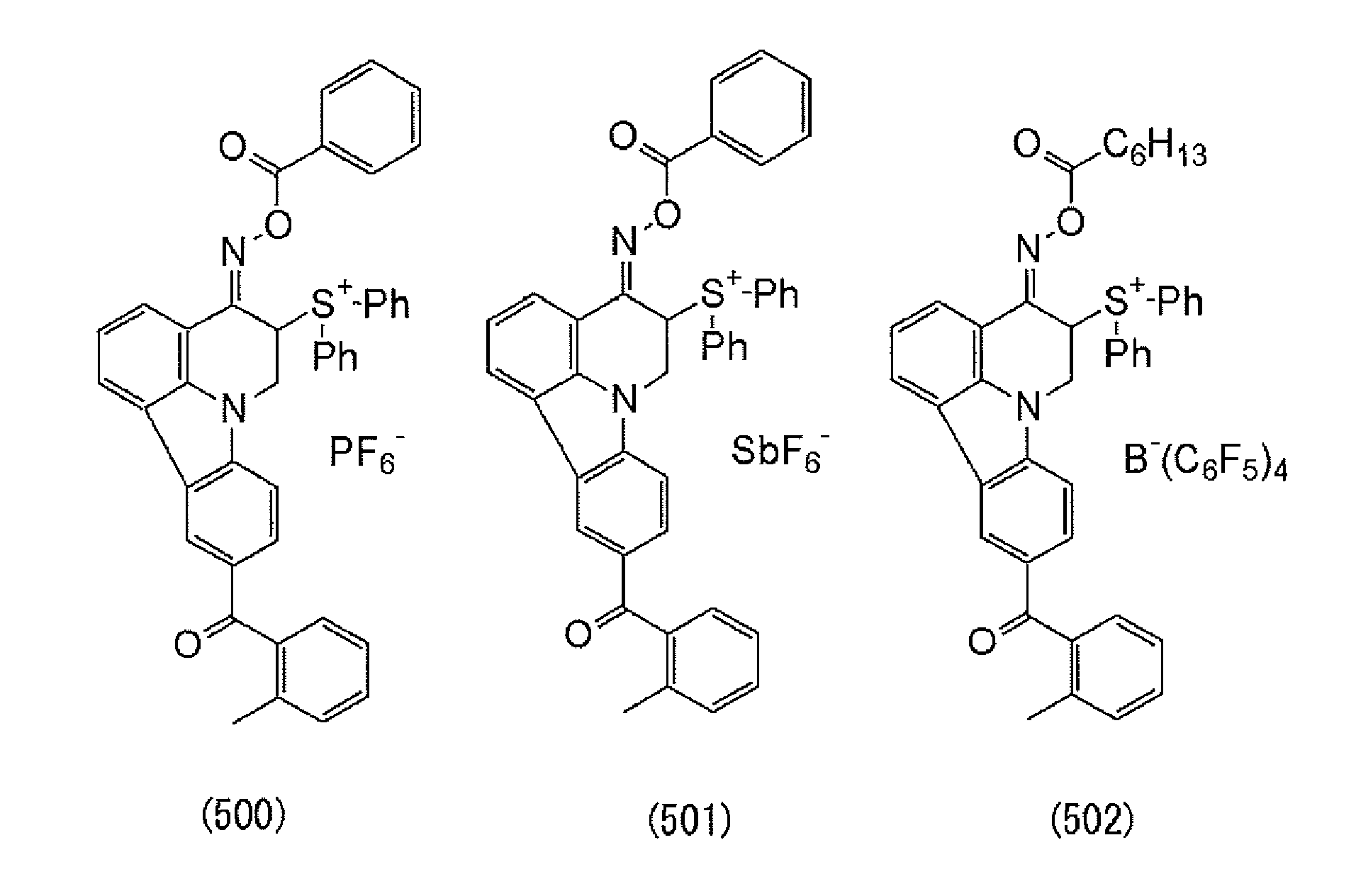

-


- Among the specific examples (201) to (511) above, the specific examples (211) to (237), (248) to (275), (287) to (313), (322) to (347), (357) to (382), (391) to (416), (426) to (448), (458) to (463), and (468) to (504) are preferable, (211) to (237), (322) to (347), (426) to (431), (436) to (448), and (484) to (486) are more preferable, and (221) to (234), (332) to (344), (347), (441) to (448), and (484) to (486) are most preferable, from the viewpoint of attaining higher sensitivity.
- The specific oxime compound of the invention has a maximum absorption wavelength in the wavelength range of 350 nm to 500 nm, more preferably has a maximum absorption wavelength in the range of 360 nm to 480 nm. In particular, the novel oxime compound preferably has a high absorbance at 365 nm and 455 nm. Therefore, the specific oxime compound has absorption in a longer wavelength region as compared with conventional oxime compounds, so that it can exhibit high sensitivity when exposed to light from a 365 nm or 405 nm light source.
- The specific oxime compound of the invention preferably has a molar absorption coefficient of 10,000 to 300,000, more preferably of 15,000 to 300,000, particularly preferably of 20,000 to 200,000 at 365 nm or 405 nm in view of sensitivity.
The molar absorption coefficient of the specific oxime compound was measured at a concentration of 0.01 g/L in a solvent of ethyl acetate with an ultraviolet-visible spectrophotometer (trade name: CARRY-5 Spectrophotometer, manufactured by Varian Inc.). - The specific oxime compound of the invention (compound represented by Formula (1)) may be synthesized by methods including, but not limited to, the following method. In the following synthesis scheme, Y1, Z, A, R, and n1 have the same meanings as defined in Y1, Z, A, R, and n1 in Formula (1).
-

- The specific oxime compound of the invention is decomposed by light and functions as a photopolymerization initiator that initiates and enhances the polymerization of polymerizable compounds. In particular, the specific oxime compound has high sensitivity to a 365 nm or 405 nm light source and thus can produce superior effects when used as a photopolymerization initiator in a photopolymerizable composition.
- The specific oxime compound of the invention may also be used for applications as described blow.
Examples of applications include printing inks such as screen printing inks, offset or flexographic printing inks, and UV-curable inks; white or color finishing of woods or metals; powder coatings, specifically coating materials for paper, wood, metal or plastics; building or road marking; graphic reproduction techniques; holographic recording materials; image recording techniques; manufacture of printing plate precursors developable with organic solvents or aqueous alkali; sunlight-curable coatings for use in manufacture of screen printing masks; dental filling compositions; adhesives; pressure-sensitive adhesives; lamination reins; etching resists for both wet and dry thin films; solder resists; electroplating or permanent resists; photo-forming dielectrics for printed circuit boards and electronic circuits; various displays; optical switches; optical grating (interference grating); manufacture of optical circuits; manufacture of three-dimensional products by large-scale curing (UV curing in a transparent mold) or stereo lithography techniques (for example, as described inU.S. Patent No. 4,575,330 ); manufacture of composite materials (such as styrene-based polyesters optionally containing glass fibers and/or other fibers and other aids) or other thick layer compositions; resists for coating or sealing of electronic components and integrated circuits; optical fibers or optical lenses such as coatings for use in manufacture of contact lenses or Fresnel lenses; manufactured of medical equipment, aids or implants; and manufacture of thermo-tropic gels as described in German Patent No.19,700,064 and European Patent No.678,534 - The specific oxime compound of the invention can also generate an acid when it is irradiated with an energy ray, particularly light. Therefore, it may be used for other applications where the generated acid is used as a catalyst. For example, it may be used for image forming techniques utilizing a color reaction of a pigment precursor in the presence of the generated acid serving as a catalyst, anti-counterfeit techniques, materials for detection of energy-ray dose, and positive resists for use in manufacture of semiconductors, TFTs, color filters, micromachine components, and the like utilizing a decomposition reaction in the presence of the generated acid serving as a catalyst.
- As described above, the specific oxime compound of the invention may be used as a photopolymerization initiator. Therefore, it may be preferably used in combination with a polymerizable compound to form a photopolymerizable composition (the photopolymerizable composition of the invention) that polymerizes and cures upon irradiation with light.
- The photopolymerizable composition of the invention includes (A) the specific oxime compound and (B) a polymerizable compound.
The photopolymerizable composition of the invention has high sensitivity to light with a wavelength of 365 nm or 405 nm and also has high stability over time. In addition, it can form a cured film in which coloration caused by heating over time can be suppressed. Although the detailed mechanism is not clear, the novel oxime compound has a structure that can inhibit radical recombination when cleaved by light absorption so that it can produce a relatively large amount of radicals to achieve high sensitivity. Since radical recombination is inhibited, it is considered that the reaction between the decomposition product molecules of the novel oxime compound can be suppressed during heating over time, thereby suppressing coloration caused by the reaction. - In the invention, a color difference ΔEab* may be used to evaluate the coloration of the cured film caused by heating over time. The color difference ΔEab* may be measured with MCPD-3000 manufactured by Otsuka Electronics Co., Ltd.
The conditions for the evaluation may be as follows. First, cured films are formed by exposing the photopolymerizable composition of the invention to light at different exposure amounts ranging from 10 mJ/cm2 to 2500 mJ/cm2 in an ultra-high pressure mercury lamp proximity-type exposure system (manufactured by Hitachi High-Tech Electronics Engineering Co., Ltd.) or an i-line stepper exposure system (trade name: FPA-3000i5, manufactured by Canon Inc.) (365 nm). The cured films are developed as needed and then heated at 200°C for 1 hour.
The color difference AEab* of the cured film between before and after the heating is measured so that the heat aging-induced coloration of the cured film can be evaluated.
The color difference ΔEab* between before and after the heating can be 5 or less, when the photopolymerizable composition of the invention is used. - The photopolymerization composition of the invention may be used for various applications such as molding resins, casting resins, photo-molding resins, sealing materials, dental polymerizing materials, printing inks, paints, photosensitive resins for printing plates, color proofs for printing, photopolymerizable compositions for color filters, resists for black matrices, resists for printed boards, resists for semiconductor processes, resists for microelectronics, resists for manufacture of micromachine components, insulating materials, hologram materials, waveguide materials, overcoat materials, adhesives, tackifiers, pressure-sensitive adhesives, and release coating agents.
- The photopolymerizable composition of the invention is described below using, as examples, a photopolymerizable composition (1) suitable for forming color filters and the like and a photopolymerizable composition (2) suitable for forming photosensitive layers of planographic printing plate precursors. However, it is not limited thereto.
- The specific oxime compound (A) in the photopolymerizable composition (1) may function as a polymerization initiator.
The content of the specific oxime compound in the photopolymerizable composition (1) is preferably from 0.5 to 40% by mass, more preferably from 1 to 35% by mass, even more preferably from 1.5 to 30% by mass, base on the mass of the total solids of the composition.
The specific oxime compound may used alone or in combination of two or more. - Any known photopolymerization initiator other than the novel oxime compound may also be used in the photopolymerizable composition (1), as long as the effects of the invention are not reduced. In this case, known photopolymerization initiator is used preferably in the range of 50% by mass or less with respect to the specific oxime compound.
The photopolymerization initiator that may be used in combination with the novel oxime compound is a compound that is decomposed by light to initiate and enhance the polymerization of the aftermentioned polymerizable compound. It preferably has absorption in the wavelength range of 300 to 500 nm. Examples of the photopolymerization initiator include organic halides, oxydiazole compounds, carbonyl compounds, ketal compounds, benzoin compounds, acridine compounds, organic peroxide compounds, azo compounds, coumarin compounds, azide compounds, metallocene compounds, biimidazole compounds, organic borate compounds, disulfonic acid compounds, oxime ester compounds, onium salt compounds, and acyl phosphine (oxide) compounds. - The polymerizable compound that may be used in the photopolymerizable composition (1) may be an addition-polymerizable compound having at least one ethylenic unsaturated double bond and may be selected from compounds each having at least one ethylenic unsaturated terminal bond, preferably two or more ethylenic unsaturated terminal bonds. Such a class of compounds is widely known in the relevant industrial field, and such compounds may be used in the invention without particular limitations. Such compounds may be in the chemical form of a monomer or a prepolymer, specifically a dimer, a trimer or an oligomer, or any mixture thereof or any copolymer thereof. Examples of monomers and copolymer thereof include unsaturated carboxylic acids (such as acrylic acid, methacrylic acid, itaconic acid, crotonic acid, isocrotonic acid, and maleic acid), esters thereof, and amides thereof. Esters of unsaturated carboxylic acids and aliphatic polyhydric alcohol compounds, or amides of unsaturated carboxylic acids and aliphatic polyamines, are preferably used. Also preferably used are addition reaction products of unsaturated carboxylic acid esters or amides having a nucleophilic substituent such as a hydroxyl group, an amino group or a mercapto group, with monofunctional or polyfunctional isocyanates or epoxy compounds, and dehydration condensation reaction products of such esters or amides with monofunctional or polyfunctional carboxylic acids. Also preferred are addition reaction products of unsaturated carboxylic acid esters or amides having an electrophilic substituent such as an isocyanate group or an epoxy group, with monofunctional or polyfunctional alcohols, amines or thiols, and substitution reaction products of unsaturated carboxylic acid esters or amides having a halogen group or a leaving substituent such as a tosyloxy group, with monofunctional or polyfunctional alcohols, amines, or thiols. Other examples of preferable compounds include compounds obtained by replacing the unsaturated carboxylic acid in the above examples by an unsaturated phosphonic acid, styrene, vinyl ether, or the like.
- Examples of the monomer of the ester of the aliphatic polyhydric alcohol compound and the unsaturated carboxylic acid include acrylates such as ethylene glycol diacrylate, triethylene glycol diacrylate, 1,3-butanediol diacrylate, tetramethylene glycol diacrylate, propylene glycol diacrylate, neopentyl glycol diacrylate, trimethylolpropane triacrylate, trimethylolpropane tri(acryloyloxypropyl)ether, trimethylolethane triacrylate, hexanediol diacrylate, 1,4-cyclohexanediol diacrylate, tetraethylene glycol diacrylate, pentaerythritol diacrylate, pentaerythritol triacrylate, pentaerythritol tetraacrylate, dipentaerythritol diacrylate, dipentaerythritol hexaacrylate, sorbitol triacrylate, sorbitol tetraacrylate, sorbitol pentaacrylate, sorbitol hexaacrylate, tri(acryloyloxyethyl)isocyanurate, polyester acrylate oligomers, and isocyanurate EO-modified triacrylate.
- Examples of the methacrylates include tetramethylene glycol dimethacrylate, triethylene glycol dimethacrylate, neopentyl glycol dimethacrylate, trimethylolpropane trimethacrylate, trimethylolethane trimethacrylate, ethylene glycol dimethacrylate, 1,3-butanediol dimethacrylate, hexanediol dimethacrylate, pentaerythritol dimethacrylate, pentaerythritol trimethacrylate, pentaerythritol tetramethacrylate, dipentaerythritol dimethacrylate, dipentaerythritol hexamethacrylate, sorbitol trimethacrylate, sorbitol tetramethacrylate, bis[p-(3-methacryloxy-2-hydroxypropoxy)phenyl]dimethylmethane, and bis[p-(methacryloxyethoxy)phenyl]dimethylmethane.
- Examples of itaconic acid esters include ethylene glycol diitaconate, propylene glycol diitaconate, 1,3-butanediol diitaconate, 1,4-butanediol diitaconate, tetramethylene glycol diitaconate, pentaerythritol diitaconate, and sorbitol tetraitaconate. Examples of crotonates include ethylene glycol dicrotonate, tetramethylene glycol dicrotonate, pentaerythritol dicrotonate, and sorbitol tetradicrotonate; isocrotonates such as ethylene glycol diisocrotonate, pentaerythritol diisocrotonate, and sorbitol tetraisocrotonate; and maleates such as ethylene glycol dimaleate, triethylene glycol dimaleate, pentaerythritol dimaleate, and sorbitol tetramaleate.
- Examples of other esters include the aliphatic alcohol esters described in Japanese Patent Application Publication (JP-B) No.
51-47334 JP-A No. 57-196231 JP-A Nos. 59-5240 59-5241 02-226149 JP-A No. 01-165613 - Examples of the monomer of the amide of the aliphatic polyamine compound and the unsaturated carboxylic acid include methylenebis-acrylamide, methylenebis-methacrylamide, 1,6-hexamethylenebis-acrylamide, 1,6-hexamethylenebis-methacrylamide, diethylenetriaminetrisacrylamide, xylylenebisacrylamide, and xylylenebismethacrylamide.
Examples of other preferred amide monomers include the cyclohexylene structure-containing compounds described inJP-B No. 54-21726 - Addition-polymerizable urethane compounds produced by an addition reaction of isocyanate with a hydroxyl group are also preferred, examples of which include the vinyl urethane compounds described in
JP-B No. 48-41708 -
CH2=C(R4)COOCH2CH(R5)OH (A)
In Formula (A), R4 and R5 each represent H or CH3. - Also preferred are the urethane acrylates described in
JP-A No. 51-37193 JP-B No. 02-32293 JP-B No. 02-16765 JP-B Nos. 58-49860 56-17654 62-39417 62-39418 JP-ANos. 63-277653 63-260909 01-105238 - Other examples include polyfunctional acrylates and methacrylates such as polyester acrylates and epoxy acrylates produced by a reaction of epoxy resins with (meth)acrylic acid (for example those disclosed in
JP-A No. 48-64183 JP-B No. 49-43191 JP-B No. 52-30490 JP-B Nos. 46-43946 01-40337 01-40336 JP-A No. 02-25493 JP-A No. 61-22048 - Details of how to use the addition-polymerizable compounds, such as what structure should be used, whether they should be used alone or in combination, or what amount should be added, may be freely determined depending on the final performance design of the curable composition. For example, they may be selected from the following viewpoints.
In view of sensitivity, a structure having a higher content of the unsaturated groups per molecule is preferable, and difunctional or higher functional structures are preferred in many cases. In order to increase the strength of the cured film, tri- or higher-functional structures are preferred. A method of using a combination of compounds having different numbers of functional groups and/or different types of polymerizable groups (for example, compounds selected from an acrylic ester, a methacrylic ester, a styrene compound, a vinyl ether compound) is also effective for controlling both of sensitivity and strength.
How to select and use the addition-polymerizable compound is also an important factor for the compatibility with or dispersibility to other components of the photopolymerizable composition (such as a photopolymerization initiator, a colorant (a pigment and/or a dye), and a binder polymer). For example, in some cases, the compatibility may be improved by using a low-purity compound or by using a combination of two or more compounds. A particular structure may also be selected in order to improve adhesion to the hard surface of a support or the like. - The photopolymerizable composition (1) may contain (C) a colorant. When the colorant is added, a colored photopolymerizable composition of a desired color may be obtained.
The photopolymerizable composition (1) contains (A) the specific oxime compound having excellent sensitivity to a short-wavelength light source such as a 365 nm or 406 nm light source. Therefore, the photopolymerizable composition (1) can be cured with high sensitivity, even when it contains a colorant at a high concentration. - The colorant used in the photopolymerizable composition (1) is not particularly limited. One of, or a mixture of two or more of, various known conventional dyes and pigments may be used, which may be appropriately selected depending on the use of the photopolymerizable composition. When the colored photopolymerizable composition of the invention is used for the production of a color filter, either of a colorant of a chromatic color such as R, G or B for forming color pixels of the color filter or a black colorant generally used for forming black matrices may be employed.
The photopolymerizable composition of the invention containing the specific oxime compound (A) may be cured with high sensitivity even with a lower amount of exposure light, and may thus be particularly preferably used in a photopolymerizable composition containing a black colorant hardly permeable with light. - Colorants applicable to the photopolymerizable composition (1) are described in detail below, by describing colorants suitable for color filters as examples.
Chromatic pigments to be used may be various known conventional inorganic or organic pigments. Higher transparency is preferable regardless of whether the pigment is inorganic or organic. From this point of view, pigment particles are preferably smaller. When also considering handleability, the average particle size of the pigments is preferably from 0.01 µm to 0.1 µm, more preferably from 0.01 µm to 0.05 µm. - Examples of the inorganic pigments include metal compounds, typical examples of which include metal oxides and metal complex salts. Specific examples include oxides of iron, cobalt, aluminum, cadmium, lead, copper, titanium, magnesium, chromium, zinc, antimony, or other metals, and complex oxides of the above metals.
- Examples of the organic pigments include:
- C.I. Pigment Yellow 11, 24, 31, 53, 83, 93, 99, 108, 109, 110, 138, 139, 147, 150, 151, 154, 155, 167, 180, 185, 199;
- C.I. Pigment Orange 36, 38, 43, 71;
- C.I. Pigment Red 81, 105, 122, 149, 150, 155, 171, 175, 176, 177, 209, 220, 224, 242, 254, 255, 264, 270;
- C.I. Pigment Violet 19, 23, 32, 39;
- C.I. Pigment Blue 1, 2, 15, 15:1, 15:3, 15:6, 16, 22, 60, 66;
- C.I. Pigment Green 7, 36, 37;
- C.I. Pigment Brown 25, 28;
- C.I. Pigment Black 1, 7; and
- carbon black.
- In the invention, pigments having a basic N atom in their structures are particularly preferably used. The basic N atom-containing pigments exhibit high dispersibility in the photopolymerizable composition (1) of the invention. Although the reason for that has not been clearly understood yet, it is suggested that high affinity between the photosensitive polymerizable component and the pigment may have an effect.
- In the invention, examples of pigments that are preferably used include, but are not limited to, the pigments listed below.
- C.I. Pigment Yellow 11, 24, 108, 109, 110, 138, 139, 150, 151, 154, 167, 180, 185;
C.I. Pigment Orange 36, 71;
C.I. Pigment Red 122, 150, 171, 175, 177, 209, 224, 242, 254, 255, 264;
C.I. Pigment Violet 19, 23, 32;
C.I. Pigment Blue 15:1, 15:3, 15:6, 16, 22, 60, 66; and
C.I. Pigment Black 1. - Only a single organic pigment may be used, or a combination of plural organic pigments may be used to heighten color purity. Some examples of the combination are described below. For example, a red pigment of one or more of an anthraquinone pigment, a perylene pigment and a diketopyrrolopyrrole pigment may be mixed with a disazo yellow pigment, an isoindolin yellow pigment, a quinophthalone yellow pigment, or a perylene red pigment. For example, the anthraquinone pigment may be C.I. Pigment Red 177, the perylene pigment may be C.I. Pigment Red 155 or C.I. Pigment Red 224, and the diketopyrrolopyrrole pigment may be C.I. Pigment Red 254. In view of color reproducibility, C.I. Pigment Yellow 139 is preferably used to form a mixture. The mass ratio of the yellow pigment to the red pigment (yellow pigment / red pigment) is preferably in the range of from 5/100 to 50/100. If the mass ratio is 4/100 or lower, it can be difficult to inhibit the light transmittance in the range of 400 nm to 500 nm, and color purity cannot be heightened in some cases. If the ratio is 51/100 or higher, the dominant wavelength can be shifted to the shorter wavelength side, so that a relatively large deviation from the NTSC target hue can be observed in some cases. In particular, the mass ratio is most preferably in the range of from 10/100 to 30/100. In the case of a combination of different red pigments, the mass ratio thereof may be adjusted depending on the hue.
- A green pigment of a halogenated phthalocyanine pigment may be used alone or in a form of a mixture with a disazo yellow pigment, a quinophthalone yellow pigment, an azomethine yellow pigment, or an isoindolin yellow pigment. For example, C.I. Pigment Green 7, 36 or 37 is preferably mixed with C.I. Pigment Yellow 83, C.I. Pigment Yellow 138, C.I. Pigment Yellow 139, C.I. Pigment Yellow 150, C.I. Pigment Yellow 180, or C.I. Pigment Yellow 185. The mass ratio of the yellow pigment to the green pigment (yellow pigment / green pigment) is preferably in the range of from 5/100 to 150/100. If the mass ratio is lower than 5/100, it can be difficult to inhibit the light transmittance in the range of 400 nm to 450 nm, so that color purity cannot be heightened in some cases. If the ratio is higher than 150/100, the dominant wavelength can be shifted to the longer wavelength side, so that a relatively large deviation from the NTSC target hue can be observed in some cases. In particular, the mass ratio is preferably in the range of from 30/100 to 120/100.
- A blue pigment of a phthalocyanine pigment may be used alone or in a form of a mixture with a dioxazine violet pigment. For example, C.I. Pigment Blue 15:6 is preferably mixed with C.I. Pigment Violet 23. The mass ratio of the violet pigment to the blue pigment (violet pigment / blue pigment) is preferably in the range of from 0/100 to 30/100, more preferably 10/100 or less.
- Carbon, titanium carbon, iron oxide, and titanium oxide may be used alone or in any combination thereof as a pigment for black matrices, and a combination of carbon and titanium carbon is preferred. The mass ratio of titanium carbon to carbon (titanium carbon / carbon) is preferably from 0/100 to 60/100. If the ratio is 61/100 or higher, the dispersibility can be reduced in some cases.
- In the photopolymerizable composition (1), when the colorant is a dye, a colored composition can be obtained in which the dye is uniformly dissolved.
Examples of the dye that may be used as the colorant in the photopolymerizable composition (1) include, but are not limited to, known dyes for conventional color filters. Examples of dyes that may be used include the dyes disclosed inJP-A Nos. 64-90403 64-91102 01-94301 06-11614 2592207 U.S. Patent Nos. 4,808,501 ,5,667,920 and5,059,500 , andJP-ANos. 05-333207 06-35183 06-51115 06-194828 08-211599 04-249549 10-123316 11-302283 07-286107 2001-4823 08-15522 08-29771 08-146215 11-343437 08-62416 2002-14220 2002-14221 2002-14222 2002-14223 08-302224 08-73758 08-179120 08-151531 - Concerning chemical structure, pyrazole azo dyes, anilino azo dyes, triphenylmethane dyes, anthraquinone dyes, anthrapyridone dyes, benzylidene dyes, oxonol dyes, pyrazolotriazole azo dyes, pyridone azo dyes, cyanine dyes, phenothiazine dyes, pyrrolopyrazole azomethine dyes, xanthene dyes, phthalocyanine dyes, benzopyran dyes, and indigo dyes may be used.
- In some resist systems involving water or alkali development, acid dyes and/or derivatives thereof may be preferably used in order to completely remove the binder and/or dye in an unirradiated portion by development.
Other dyes such as direct dyes, basic dyes, mordant dyes, acid mordant dyes, azoic dyes, disperse dyes, oil-soluble dyes, food dyes, and/or derivatives thereof may be effectively used. - Any acid dye having an acidic group such a sulfonic acid group or a carboxylic acid group may be used. The acid dye may be selected taking into account all the necessary properties such as solubility in an organic solvent or developer, ability to form a salt with a basic compound, absorbance, interaction with other components in the composition, light resistance, and heat resistance.
Examples of the acid dye include, but are not limited to, the following dyes: Acid Alizarin Violet N: Acid Black 1, 2, 24, 48; Acid Blue 1, 7, 9, 15, 18, 23, 25, 27, 29, 40 to 45, 62, 70, 74, 80, 83, 86, 87, 90, 92, 103, 112, 113, 120, 129, 13 8, 147, 158, 171, 182, 192, 243, 324:1; Acid Chrome Violet K; Acid Fuchsin; Acid Green 1, 3, 5, 9, 16, 25, 27, 50; Acid Orange 6, 7, 8, 10, 12, 50, 51, 52, 56, 63, 74, 95; Acid Red 1, 4, 8, 14, 17, 18, 26, 27, 29, 31, 34, 35, 37, 42, 44, 50, 51, 52, 57, 66, 73, 80, 87, 88, 91, 92, 94, 97, 103, 111, 114, 129, 133, 134, 138, 143, 145, 150, 151, 158, 176, 183, 198, 211, 215, 216, 217, 249, 252, 257, 260, 266, 274; Acid Violet 6B, 7, 9, 17, 19; Acid Yellow 1, 3, 7, 9, 11, 17, 23, 25, 29, 34, 36, 42, 54, 72, 73, 76, 79, 98, 99, 111, 112, 114, 116, 184, 243; Food Yellow 3; and derivatives of these dyes. - Particularly preferred examples of the acid dye include Acid Black 24; Acid Blue 23, 25, 29, 62, 80, 86, 87, 92, 138, 158, 182, 243, 324:1; Acid Orange 8, 51, 56, 63, 74; Acid Red 1, 4, 8, 34, 37, 42, 52, 57, 80, 97, 114, 143, 145, 151, 183, 217; Acid Violet 7; Acid Yellow 17, 25, 29, 34, 42, 72, 76, 99, 111, 112, 114, 116, 184, 243; Acid Green 25; and derivatives of these dyes.
Acid dyes such as azo, xanthene and phthalocyanine dyes other than the above are also preferred. Acid dyes such as C.I. Solvent Blue 44, 38, C.I. Solvent Orange 45, Rhodamine B, and Rhodamine 110, and derivatives of these acid dyes are also preferably used. - In particular, the colorant is preferably selected from triarylmethane dyes, anthraquinone dyes, azomethine dyes, benzylidene dyes, oxonol dyes, cyanine dyes, phenothiazine dyes, pyrrolopyrazole azomethine dyes, xanthene dyes, phthalocyanine dyes, benzopyran dyes, indigo dyes, pyrazole azo dyes, anilino azo dyes, pyrazolotriazole azo dyes, pyridone azo dyes, and anthrapyridone dyes.
- The colorant that may be used in the photopolymerizable composition (1) is preferably a pigment whose average particle size (unit: nm) satisfies the relation 20≤r≤300, more preferably 125≤r≤250, particularly preferably 30≤r≤200. Red and green pixels with high contrast ratio and high light transmittance can be obtained by using pigments with such an average particle size r. As used herein, the term "average particle size" refers to the average particle size of secondary particles formed by aggregation of primary particles (single fine crystals) of a pigment.
The particle size distribution of the secondary particles of the pigment for use in the invention (hereinafter, simply referred to as "particle size distribution") is preferably such that 70% by mass or more, more preferably 80% by mass or more, of the whole of the secondary particles fall within (the average particle size ± 100) nm. - The pigment with the average particle size and the particle size distribution described above may be prepared by a process including mixing and dispersing a commercially available pigment and another optional pigment (generally having an average particle size more than 300 nm), preferably as a pigment mixture liquid with a dispersing agent and a solvent, while grinding them with a grinding machine such as a bead mill or a roll mill. The resulting pigment is generally in the form of a pigment dispersion liquid.
- The content of the colorant contained in the photopolymerizable composition (1) is preferably 30 to 95% by mass, more preferably 40 to 90% by mass, even more preferably 50 to 80% by mass, based on the total solid content of the photopolymerizable composition.
When the content of the colorant is in the above range, a color filter prepared from the photopolymerizable composition (1) can attain suitable chromaticity. The photopolymerization of the photopolymerizable composition can sufficiently proceed to maintain the strength thereof as a film, and thus development latitude upon alkali development can be prevented from narrowing. That is, the specific oxime compound (A) used in the invention has high light absorption efficiency and thus significantly exhibits an effect of improving sensitivity even if the colorant is contained at high concentration in the photopolymerizable composition. - When the photopolymerizable composition (1) contains a pigment as the colorant, a pigment dispersing agent (D) is preferably added to the composition in order to improve the dispersibility of the pigment.
- Examples of pigment dispersing agents that may be used in the invention include polymeric dispersants (such as polyamide amines, salts thereof, polycarboxylic acids, salts thereof, high-molecular-weight unsaturated acid esters, modified polyurethanes, modified polyesters, modified poly(meth)acrylates, (meth)acrylic copolymers, and naphthalenesulfonic acid formalin condensates), and polyoxyethylene alkyl phosphates, polyoxyethylene alkylamines, alkanolamines, and pigment derivatives.
Polymeric dispersants may be further classified by structure into linear polymers, terminal-modified polymers, graft polymers, and block polymers. - The polymeric dispersant is adsorbed on the surface of the pigment and acts to prevent reaggregation. Therefore, terminal-modified polymers, graft polymers and block polymers having an anchor moiety to the surface of the pigment are preferred structures.
On the other hand, a pigment derivative has an effect of facilitating adsorption of a polymer dispersant by modifying the surface of a pigment. - Examples of pigment dispersing agents that may be used in the invention include DISPERBYK 101 (polyamide amine phosphate), 107 (carboxylic acid ester), 110 (acid group-containing copolymer), 130 (polyamide), 161, 162, 163, 164, 165, 166, and 170 (high-molecular-weight polymer), and BYK-P104 and P105 (high-molecular-weight unsaturated polycarboxylic acid) each manufactured by BYK Chemie; EFKA 4047, 4050 - 4010 - 4165 (polyurethane dispersants), EFKA 4330 - 4340 (block copolymer), 4400 - 4402 (modified polyacrylate), 5010 (polyester amide), 5765 (high-molecular-weight polycarboxylate), 6220 (fatty acid polyester), 6745 (phthalocyanine derivative), and 6750 (azo pigment derivative) each manufactured by EFKA; AJISPER PB821 and PB822 manufactured by Ajinomoto Fine-Techno Co., Inc.; FLOWLEN TG-710 (urethane oligomer) and POLYFLOW Nos. 50E and 300 (acrylic copolymer) each manufactured by Kyoeisha Chemical Co., Ltd.; DISPARLON KS-860, 873SN, 874, #2150 (aliphatic polycarboxylic acid), #7004 (polyether ester), DA-703-50, DA-705, and DA-725 each manufactured by Kusumoto Chemicals, Ltd.; DEMOL RN, N (naphthalenesulfonic acid formalin polycondensate), MS, C, SN-B (aromatic sulfonic acid formalin polycondensate), HOMOGENOL L-18 (high-molecular weight polycarboxylic acid), EMULGEN 920, 930, 935, and 985 (polyoxyethylene nonyl phenyl ether), and ACETAMIN 86 (stearylamine acetate) each manufactured by Kao Corporation; SOLSPERSE 5000 (phthalocyanine derivative), 22000 (azo pigment derivative), 13240 (polyester amine), 3000, 17000, 27000 (polymer having a functional part at a terminal), 24000, 28000, 32000, and 38500 (graft polymers) each manufactured by The Lubrizol Corporation; and NIKKOL T106 (polyoxyethylene sorbitan monooleate) and MYS-IEX (polyoxyethylene monostearate) each manufactured by Nikko Chemicals Co., Ltd.
- Only a single dispersing agent may be used, or two or more of dispersing agents may be used in combination. In the invention, it is particularly preferable to use a pigment derivative and a polymeric dispersant in combination.
- In the photopolymerizable composition (1), the content of the dispersing agent is preferably from 1 to 80% by mass, more preferably from 5 to 70% by mass, even more preferably from 10 to 60% by mass, based on the mass of the pigment.
For example, when a polymeric dispersant is used, the content thereof is preferably from 5 to 100% by mass, more preferably from 10 to 80% by mass of the pigment.
When a pigment derivative is used, the content thereof is preferably from 1 to 30% by mass, more preferably from 3 to 20% by mass, particularly preferably from 5 to 15% by mass of the pigment. - In the photopolymerizable composition (1), when a pigment as a colorant and a dispersing agent are used, the total content of the colorant and the dispersing agent is preferably from 30 to 90% by mass, more preferably from 40 to 85% by mass, even more preferably from 50 to 80% by mass, based on the mass of the total solids of the curable composition, in view of curing sensitivity and color density.
- If necessary, the photopolymerizable composition (1) may further contain any of the optional components described in detail below.
A description is given below of optional components that may be added to the photopolymerizable composition (1). - The photopolymerizable composition (1) may contain a sensitizer for the purpose of improving the radical generation efficiency of a radical initiator or making the photosensitive wavelength longer.
The sensitizer that may be used in the invention preferably heighten the sensitivity of (A) the specific oxime compound based on the electron-transfer mechanism or the energy-transfer mechanism. - The sensitizer for use in the photopolymerizable composition (1) may belong to any of the groups of compounds described below and may have an absorption wavelength in the range of 300 nm to 450 nm.
Examples include polynuclear aromatic compounds (such as phenanthrene, anthracene, pyrene, perylene, triphenylene, and 9,10-dialkoxyanthracene), xanthenes (such as fluorescein, eosin, erythrosine, rhodamine B, and rosebengal), thioxanthones (such as isopropylthioxanthone, diethylthioxanthone and chlorothioxanthone), cyanines (such as thiacarbocyanine and oxacarbocyanine), merocyanines (such as merocyanine and carbomerocyanine), phthalocyanines, thiazines (such as thionine, methylene blue and toluidine blue), acridines (such as acridine orange, chloroflavin and acriflavin), anthraquinones (such as anthraquinone), squaliums (such as squalium), acridine orange, coumarins (such as 7-diethylamino-4-methylcoumarin), ketocoumarin, phenothiazines, phenazines, styrylbenzenes, azo compounds, diphenylmethane, triphenylmethane, distyrylbenzenes, carbazoles, porphyrin, spiro compounds, quinacridone, indigo, styryl compounds, pyrylium compounds, pyrromethene compounds, pyrazolotriazole compounds, benzothiazole compounds, barbituric acid derivatives, thiobarbituric acid derivatives, aromatic ketone compounds such as acetophenone, benzophenone, thioxanthone, and Michler's ketone, and heterocyclic compounds such as N-aryloxazolidinone. - Examples of more preferred sensitizers include compounds represented by Formulae (e-1) to (e-4) below.
-

- In Formula (e-1), A1 represents a sulfur atom or NR50, R50 represents an alkyl group or an aryl group, L1 represents a nonmetallic atom group that forms a basic nuclear of the pigment together with A1 and the carbon atom adjacent to L1, R51 and R52 each independently represent a hydrogen atom or a monovalent nonmetallic atom group, and R51 and R52 may be bonded to each other to form an acidic nuclear of the pigment, and W represents an oxygen atom or a sulfur atom.
-

- In Formula (e-2), Ar1 and Ar2 each independently represent an aryl group and are linked to each other via -L2-, wherein -L2- represents -O- or -S-, and W has the same definition as in Formula (e-1).
-

- In Formula (e-3), A2 represents a sulfur atom or NR59; L3 represents a nonmetallic atom group that forms a basic nuclear of the pigment together with A2 and the carbon atom adjacent to L3; R53, R54, R55, R56, R57, and R58 each independently represent a monovalent nonmetallic atom group; and R59 represents an alkyl group or an aryl group.
-

- In Formula (e-4), A3 and A4 each independently represent -S- or -NR62; R62 represents a substituted or unsubstituted alkyl group or a substituted or unsubstituted aryl group; L4 and L5 each independently represent a nonmetallic atom group that forms a basic nuclear of the pigment together with adjacent A3 or A4 and the carbon atom adjacent to L4 or L5; and R60 and R61 each independently represent a monovalent nonmetallic atom group or may be bonded to each other to form an aliphatic or aromatic ring.
- The content of the sensitizer in the photopolymerizable composition (1) is preferably from 0.1 to 20% by mass, more preferably from 0.5 to 15% by mass, based on the mass of the solids, in view of the efficiency of light absorption efficiency at a deep portion or the efficiency of initiation decomposition.
A single sensitizer may be used, or two or more sensitizers may be used in combination. - The sensitizer that is preferably contained in the photopolymerizable composition (1) may be at least one selected from a compound represented by Formula (II) below and a compound represented by Formula (III) shown later other than above mentioned sensitizer.
A single compound selected from these sensitizers may be used, or two or more compounds selected from these sensitizers may be used in combination. -

- In Formula (II), R11 and R12 each independently represent a monovalent substituent, R13, R14, R15, and R16 each independently represent a hydrogen atom or a monovalent substituent, n represents an integer of 0 to 5, n' represents an integer of 0 to 5, and n and n' are not simultaneously 0. When n is 2 or greater, there are plural R11s, and they may be the same or different. When n' is 2 or greater, there are plural R12s, and they may be the same or different. Formula (II) may represent any of isomers caused by the presence of the double bonds.
- The compound represented by Formula (II) preferably has a molar absorption coefficient ε at a wavelength of 365 nm of 500 mol-1·L·cm-1 or more, more preferably of 3000 mor-1·L·cm-1 or more, most preferably of 20000 mol-1·L·cm-1 or more. If the molar absorption coefficient ε is in the above range at each wavelength, the sensitivity enhancing effect may be high in terms of light absorption efficiency, which is preferable.
- Preferred examples of the compound represented by Formula (II) include, but are not limited to, the compounds illustrated below.
In the description, some chemical formulae are simplified structural formulae in which solid lines represent hydrocarbon groups, unless elements and substituents are explicitly indicated. -


-

- In Formula (III), A represents an optionally substituted aromatic or heterocyclic group; X2 represents an oxygen atom, a sulfur atom or -N(R23)-; Y represents an oxygen atom, a sulfur atom or =N(R23); R21, R22 and R23 each independently represent a hydrogen atom or a monovalent nonmetallic atom group; and A, R21, R22, and R23 may be bonded to one another to form one or more aliphatic or aromatic rings.
- In Formula (III), R21, R22 and R23 each independently represent a hydrogen atom or a monovalent nonmetallic atom group. The monovalent nonmetallic atom group represented by R21, R22 or R23 is preferably a substituted or unsubstituted alkyl group, a substituted or unsubstituted aryl group, a substituted or unsubstituted alkenyl group, a substituted or unsubstituted aromatic heterocyclic residue, a substituted or unsubstituted alkoxy group, a substituted or unsubstituted alkylthio group, a hydroxyl group, or a halogen atom.
- In the compound represented by Formula (III), Y is preferably an oxygen atom or =N(R23) in terms of increasing the efficiency of decomposition of the photopolymerization initiator. R23 each independently represent a hydrogen atom or a monovalent nonmetallic atom group. Y is most preferably =N(R23).
- Preferred examples of the compound represented by Formula (III) include, but are not limited to. In the invention, the isomers caused by the presence of the double bond(s) between the acidic nuclear and the basic nuclear are not explicitly specified, and the structure is not limited to a particular isomer. Accordingly, any isomer may be used in the invention.
-


- The photopolymerizable composition (1) preferably further contains (F) a co-sensitizer.
In the invention, the co-sensitizer has effects of further improving the sensitivity to active radiation of (A) the specific oxime compound or (E) the sensitizer and/or an effect of suppressing inhibition of polymerization of (B) the polymerizable compound caused by oxygen. - Examples of the co-sensitizer include amines such as the compounds described in M. R. Sander et al., Journal of Polymer Society, Vol. 10, p. 3173 (1972),
JP-B No. 44-20189 JP-ANos. 51-82102 52-134692 59-138205 60-84305 62-18537 64-33104 - Other examples of the co-sensitizer include thiols and sulfides such as the thiol compounds described in
JP-A No. 53-702 JP-B No. 55-500806 JP-A No. 05-142772 JP-A No. 56-75643 - Other examples of the co-sensitizer also include amino acid compounds (such as N-phenylglycine), the organometallic compounds described in
JP-B No. 48-42965 JP-B No. 55-34414 JP-A No. 06-308727 - In order to increase the curing rate with a balance between polymer growth rate and chain transfer, the content of the co-sensitizer is preferably from 0.1 to 30% by mass, more preferably from 1 to 25% by mass, even more preferably from 1.5 to 20% by mass, based on the mass of the total solids of the photopolymerizable composition (1).
- The photopolymerizable composition (1) preferably contains a thiol compound as the co-sensitizer.
The thiol compound that may be contained in the photopolymerizable composition (1) is preferably a compound represented by Formula (IV) below. -

- In Formula (IV), X represents a sulfur atom, an oxygen atom or -N(R43)-; R43 represents a hydrogen atom, an alkyl group having 1 to 5 carbon atoms or an aryl group having 6 to 13 carbon atoms; R41 and R42 each independently represent a hydrogen atom, an alkyl group having 1 to 5 carbon atoms, a hydroxyalkyl group having 1 to 3 carbon atoms, a phenyl group optionally substituted by an alkoxy group having 1 to 8 carbon atoms, a nitro group, an alkoxycarbonyl group having an alkyl group having 1 to 8 carbon atoms, a phenoxycarbonyl group, an acetyl group, or a carboxyl group, or R41, R42 and the double bond therebetween together may form a benzene ring; and the double bond between R41 and R42 may be hydrogenated.
- The thiol compound may be, for example, selected from the compounds described in
JP-A No. 53-702 JP-B No. 55-500806 JP-A No. 05-142772 - In the invention, the thiol compound is preferably a compound represented by Formula (V) below.
-

- In Formula (V), R represents an alkyl group or an aryl group, and A represents an atom group that forms a heterocycle together with N=C-N.
- In Formula (V), R represents an alkyl group or an aryl group.
The alkyl group may be a linear, branched or cyclic alkyl group having 1 to 20 carbon atoms, more preferably a linear alkyl group having 1 to 12 carbon atoms, a branched alkyl group having 3 to 12 carbon atoms or a cyclic alkyl group having 5 to 10 carbon atoms.
Examples of the alkyl group include a methyl group, an ethyl group, a propyl group, a butyl group, a pentyl group, a hexyl group, a heptyl group, an octyl group, a nonyl group, a decyl group, an undecyl group, a dodecyl group, a tridecyl group, a hexadecyl group, an octadecyl group, an eicocyl group, an isopropyl group, an isobutyl group, a sec-butyl group, a tert-butyl group, an isopentyl group, a neopentyl group, a 1-methylbutyl group, an isohexyl group, a 2-ethylhexyl group, a 2-methylhexyl group, a cyclohexyl group, a cyclopentyl group, and a 2-norbornyl group. - The aryl group may have a monocyclic structure, structure having a condensed ring formed by condensation of 1 to 3 benzene rings, or a structure having a condensed ring formed by condensation of at least one benzene ring and at least one five-membered unsaturated ring. Examples thereof include a phenyl group, a naphthyl group, an anthryl group, a phenanthryl group, an indenyl group, an acenaphthenyl group, and a fluorenyl group. In particular, a phenyl group or a naphthyl group is more preferred.
- The alkyl group or the aryl group may further have at least one substituent. Examples of the substituent that may be introduced include a linear, branched or cyclic alkyl group having 1 to 20 carbon atoms, a linear group, a branched or cyclic alkenyl group having 2 to 20 carbon atoms, an alkynyl group having 2 to 20 carbon atoms, an aryl group having 6 to 20 carbon atoms, an acyloxy group having 1 to 20 carbon atoms, an alkoxycarbonyloxy group having 2 to 20 carbon atoms, an aryloxycarbonyloxy group having 7 to 20 carbon atoms, a carbamoyloxy group having 1 to 20 carbon atoms, a carbonamide group having 1 to 20 carbon atoms, a sulfonamide group having 1 to 20 carbon atoms, a carbamoyl group having 1 to 20 carbon atoms, a sulfamoyl group, a substituted sulfamoyl group having 1 to 20 carbon atoms, an alkoxy group having 1 to 20 carbon atoms, an aryloxy group having 6 to 20 carbon atoms, an aryloxycarbonyl group having 7 to 20 carbon atoms, an alkoxycarbonyl group having 2 to 20 carbon atoms, an N-acylsulfamoyl group having 1 to 20 carbon atoms, an N-sulfamoylcarbamoyl group having 1 to 20 carbon atoms, an alkylsulfonyl group having 1 to 20 carbon atoms, an arylsulfonyl group having 6 to 20 carbon atoms, an alkoxycarbonylamino group having 2 to 20 carbon atoms, an aryloxycarbonylamino group having 7 to 20 carbon atoms, an amino group, a substituted amino group having 1 to 20 carbon atoms, an imino group having 1 to 20 carbon atoms, an ammonio group having 3 to 20 carbon atoms, a carboxyl group, a sulfo group, an oxy group, a mercapto group, an alkylsulfinyl group having 1 to 20 carbon atoms, an arylsulfinyl group having 6 to 20 carbon atoms, an alkylthio group having 1 to 20 carbon atoms, an arylthio group having 6 to 20 carbon atoms, a ureide group having 1 to 20 carbon atoms, a heterocyclic group having 2 to 20 carbon atoms, an acyl group having 1 to 20 carbon atoms, a sulfamoylamino group, a substituted sulfamoylamino group having 1 to 2 carbon atoms, a silyl group having 2 to 20 carbon atoms, an isocyanate group, an isocyanide group, a halogen atom (such as a fluorine, chlorine or bromine atom), a cyano group, a nitro group, and an onium group.
- The at least one atom that forms the atom group may include atoms selected from carbon, nitrogen, hydrogen, sulfur, and selenium atoms.
The heterocycle formed by A and N=C-N may further have at least one substituent. Examples of introducible substituents may include the same substituents as those introducible into the above-mentioned alkyl group or aryl group. - In the photopolymerizable composition (1), the thiol compound is more preferably a compound represented by Formula (VI) or (VII) below.
-

- In Formula (VI), R1 represents an aryl group, and X represents a hydrogen atom, a halogen atom, an alkoxy group, an alkyl group, or an aryl group.
- In Formula (VII), R2 represents an alkyl group or an aryl group, and X represents a hydrogen atom, a halogen atom, an alkoxy group, an alkyl group, or an aryl group.
- In Formulae (VI) and (VII), the halogen atom is preferably a fluorine, chlorine, bromine, or iodine atom.
- In Formulae (VI) and (VII), the alkoxy group may be a methoxy group, an ethoxy group, a propyloxy group, an isopropyloxy group, a butyloxy group, a pentyloxy group, a hexyloxy group, a dodecyloxy group, a benzyloxy group, an allyloxy group, a phenethyloxy group, a carboxyethyloxy group, a methoxycarbonylethyloxy group, an ethoxycarbonylethyloxy group, a methoxyethoxy group, a phenoxyethoxy group, a methoxyethoxyethoxy group, an ethoxyethoxyethoxy group, a morpholinoethoxy group, a morpholinopropyloxy group, an allyloxyethoxyethoxy group, a phenoxy group, a tolyloxy group, a xylyloxy group, a mesityloxy group, a cumetyloxy group, a methoxyphenyloxy group, an ethoxyphenyloxy group, a chlorophenyloxy group, a bromophenyloxy group, an acetyloxy group, a benzoyloxy group, or a naphthyloxy group.
- In Formulae (VI) and (VII), the alkyl group has the same definition as the alkyl group represented by R in Formula (V), and their preferred ranges are also the same.
In Formulae (VI) and (VII), the aryl group has the same definition as the aryl group represented by R in Formula (V), and their preferred ranges are also the same. - In Formulae (VI) and (VII), each group may further have at least one substituent. Examples of the substituent include those mentioned above as substituents introducible to the alkyl or aryl group represented by R in Formula (R).
- In Formulae (VI) and (VII), X is preferably a hydrogen atom in view of solubility in PGMEA (propylene glycol monomethylether acetate) that is preferably used for preparation of the photopolymerizable composition.
In Formula (VI), R1 is most preferably a phenyl group in view of sensitivity and solubility in PGMEA.
In Formula (VII), R2 is more preferably a methyl group, an ethyl group, a phenyl group, or a benzyl group in view of sensitivity and solubility in PGMEA. - Among the compounds represented by Formulae (VI) and (VII), the compound represented by Formula (VII) is most preferred in terms of solubility in PGMEA.
- Preferred examples of the thiol compound that may be used in an embodiment of the invention include, but are not limited to, the compounds illustrated below together with solubility in PGMEA.
In the description, some chemical formulae are simplified structural formulae in which solid lines represent hydrocarbon groups, unless elements and substituents are explicitly indicated. In the examples below, Me represents a methyl group. -


-


- Further, examples of the thiol compound whose solubility in PGMEA is 20 g/L or less or less than 20 g/L are illustrated below.
-


- The solubility of these thiol compounds in PGMEA solvent is preferably 20 g/L or more, more preferably from 20 g/L to 50 g/L, even more preferably from 20 g/L to 40 g/L, in view of coating uniformity.
- In the description, the solubility of the thiol compound is defined as follows.
The specific thiol compound is added to 5 mL of propylene glycol monomethyl ether acetate (PGMEA) solvent and stirred at 25°C for one hour. In this process, the greatest amount of the specific thiol compound that can completely dissolve in the solvent is assumed as the solubility. - These thiol compounds may be synthesized by the method described in J. Appl. Chem., 34, 2203-2207 (1961).
- Only a single thiol compound may be used alone, or two or more thiol compounds may be used in combination.
When a combination of thiol compounds is used, the thiol compounds may include two or more compounds represented by any one of the abovem-described formulae, or may include compounds respectively represented by different formulae (in an embodiment, for example, at least one compound selected from the class of compounds represented by Formula (VI) may be used in combination with at least one compound selected from the class of compounds represented by Formula (VII)). - When the photopolymerizable composition (1) of the invention contains the thiol compound, the content of the thiol compound is preferably from 0.5 to 30% by mass, more preferably from 1 to 25% by mass, even more preferably from 3 to 20% by mass, based on the mass of the total solids of the photopolymerizable composition (1), in terms of increasing the curing rate with a balance between polymer growth rate and chain transfer.
- If necessary, a binder polymer may also be used in the photopolymerizable composition (1) of the invention for the purpose of improving film characteristics and the like. A linear organic polymer is preferably used as the binder. Any known "linear organic polymer" may be used. In order to enable development with water or a weakly alkaline aqueous solution, a linear organic polymer soluble or swellable in water or a weakly alkaline aqueous solution is preferably selected. The linear organic polymer may be selected and used as depending on applications not only as a film-forming agent but also in consideration of the developer such as water, a weakly alkaline aqueous solution or an organic solvent. For example, water development can be performed when a water-soluble organic polymer is used. Examples of such a linear organic polymer include radical polymerization products having a carboxylic acid group in a side chain, such as those described in
JP-A No. 59-44615 JP-B Nos. 54-34327 58-12577 54-25957 JP-A Nos. 54-92723 59-53836 59-71048
Examples also include acidic cellulose derivatives having carboxylic acid groups in side chains. Besides the above, a product of addition of a cyclic acid anhydride to a hydroxyl group-containing polymer is also useful. - When the alkali-soluble resin to be used is a copolymer, monomers other than the above monomers may also be used as the compounds to be copolymerized. Examples of other monomers include the following compounds of (1) to (12):
- (1) aliphatic hydroxyl group-containing acrylates and methacrylates such as 2-hydroxyethyl acrylate, 2-hydroxypropyl acrylate, 3-hydroxypropyl acrylate, 4-hydroxybutyl acrylate, 2-hydroxyethyl methacrylate, 2-hydroxypropyl methacrylate, 3-hydroxypropyl methacrylate, and 4-hydroxybutyl methacrylate;
- (2) alkyl acrylates such as methyl acrylate, ethyl acrylate, propyl acrylate, butyl acrylate, isobutyl acrylate, amyl acrylate, hexyl acrylate, 2-ethylhexyl acrylate, octyl acrylate, benzyl acrylate, 2-chloroethyl acrylate, glycidyl acrylate, 3,4-epoxycyclohexylmethyl acrylate, vinyl acrylate, 2-phenylviyl acrylate, 1-propenyl acrylate, allyl acrylate, 2-allyloxyethyl acrylate, and propargyl acrylate;
- (3) alkyl methacrylates such as methyl methacrylate, ethyl methacrylate, propyl methacrylate, butyl methacrylate, isobutyl methacrylate, amyl methacrylate, hexyl methacrylate, 2-ethylhexyl methacrylate, cyclohexyl methacrylate, benzyl methacrylate, 2-chloroethyl methacrylate, glycidyl methacrylate, 3,4-epoxycyclohexylmethyl methacrylate, vinyl methacrylate, 2-phenylvinyl methacrylate, 1-propenyl methacrylate, allyl methacrylate, 2-allyloxyethyl methacrylate, and propargyl methacrylate;
- (4) acrylamides and methacrylamides such as acrylamide, methacrylamide, N-methylolacrylamide, N-ethylacrylamide, N-hexylmethacrylamide, N-cyclohexylacrylamide, N-hydroxyethylacrylamide, N-phenylacrylamide, N-nitrophenylacrylamide, N-ethyl-N-phenylacrylamide, vinyl acrylamide, vinyl methacrylamide, N,N-diallylacrylamide, N,N-diallylmethacrylamide, allylacrylamide, and allylmethacrylamide;
- (5) vinyl ethers such as ethyl vinyl ether, 2-chloroethyl vinyl ether, hydroxyethyl vinyl ether, propyl vinyl ether, butyl vinyl ether, octyl vinyl ether, and phenyl vinyl ether;
- (6) vinyl esters such as vinyl acetate, vinyl chloroacetate, vinyl butyrate, and vinyl benzoate;
- (7) styrenes such as styrene, α-methylstyrene, methylstyrene, chloromethylstyrene, and p-acetoxystyrene;
- (8) vinyl ketones such as methyl vinyl ketone, ethyl vinyl ketone, propyl vinyl ketone, and phenyl vinyl ketone;
- (9) olefins such as ethylene, propylene, isobutylene, butadiene, and isoprene;
- (10) N-vinylpyrrolidone, acrylonitrile, methacrylonitrile, and the like;
- (11) unsaturated imides such as maleimide, N-acryloylacrylamide, N-acetylmethacrylamide, N-propionylmethacrytamide, and N-(p-chlorobenzoyl)methacrylamide; and
- (12) methacrylic acid monomers having a hetero atom at the α-position, such as the compounds described in Japanese Patent Application Nos.
2001-115595 2001-115598 - Particularly preferred are (meth)acrylic resins having an allyl or vinyl ester group and a carboxyl group in a side chain, the alkali-soluble resins having a double bond in a side chain described in
JP-A Nos. 2000-187322 2002-62698 JP-A No. 2001-242612 - The acid group-containing urethane binder polymers described in
JP-B Nos. 07-12004 07-120041 07-120042 08-12424 JP-A Nos. 63-287944 63-287947 01-271741 10-116232 JP-A No. 2002-107918
The acid group-containing, acetal-modified, polyvinyl alcohol binder polymers such as those described in European Patent Nos.993966 1204000 andJP-A No. 2001-318463
Useful water-soluble linear organic polymers also include polyvinyl pyrrolidone and polyethylene oxide. Alcohol-soluble nylon or polyether of 2,2-bis-(4-hydroxyphenyl)-propane and epichlorohydrin is also useful for increasing the strength of the cured film. - Binder polymers that may be used in the photopolymerizable composition (1) preferably have a weight average molecular weight of 5,000 or more, more preferably of 10,000 to 300,000, and preferably have a number average molecular weight of 1,000 or more, more preferably of 2,000 to 250,000. The polydispersity (weight average molecular weight/number average molecular weight) is preferably 1 or more, more preferably from 1.1 to 10.
These binder polymers may be any of random, block or graft polymers. - Binder polymers that may be used in the invention may be synthesized by known conventional methods. Examples of solvents that may be used for the synthesis include tetrahydrofuran, ethylene dichloride, cyclohexanone, methyl ethyl ketone, acetone, methanol, ethanol, ethylene glycol monomethyl ether, ethylene glycol monoethyl ether, 2-methoxyethyl acetate, diethylene glycol dimethyl ether, 1-methoxy-2-propanol, 1-methoxy-2-propyl acetate, N,N-dimethylformamide, N,N-dimethylacetamide, toluene, ethyl acetate, methyl lactate, ethyl lactate, dimethylsulfoxide, and water. Only one solvent may be used, or a mixture of two or more solvents may be used.
In the process of synthesizing binder polymers that may be used in the photopolymerizable composition (1), known compounds such as azo initiators and peroxide initiators may be used as radical-polymerization initiators. - In the photopolymerizable composition (1), a small amount of a thermal polymerization inhibitor is preferably added in order to inhibit unnecessary thermal polymerization of (B) the polymerizable compound during the production or storage of the curable composition.
Examples of the thermal polymerization inhibitor that may be used in the invention include hydroquinone, p-methoxyphenol, di-tert-butyl-p-cresol, pyrogallol, tert-butylcatechol, benzoquinone, 4,4'-thiobis(3-methyl-6-tert-butylphenol), 2,2'-methylenebis(4-methyl-6-tert-butylphenol), and cerous N-nitrosophenyl-hydroxylamine. - The content of the thermal polymerization inhibitor is preferably from about 0.01 to about 5% by mass, based on the mass of the total solids of the photopolymerizable composition (1).
If necessary, behenic acid or a higher fatty acid derivative such as behenic acid amide may be added to prevent oxygen-induced inhibition of polymerization and may be localized to the surface of a coating film during a drying process after coating. The content of the higher fatty acid derivative is preferably from about 0.5 to about 10% by mass based on the entire composition. - The photopolymerizable composition (1) may contain an adhesion improving agent for increasing adhesion to a hard surface, such as of a support. The adhesion improving agent may be a silane coupling agent, a titanium coupling agent or the like.
- Examples of the silane coupling agent include
γ-(2-aminoethyl)aminopropyltrimethoxysilane,
γ-(2-aminoethyl)aminopropyldimethoxysilane,
β-(3,4-epoxycyclohexyl)ethyltrimethoxysilane, γ-aminopropyltrimethoxysilane,
γ-aminopropyltriethoxysitane, γ-methactyloxypropyltrimethoxysilane,
γ-methacryloxypropyltriethoxysilane, γ-acryloxypropyltrimethoxysilane,
γ-acryloxypropyltriethoxysilane, γ-isocyanatopropyltrimethoxysilane,
γ-isocyanatopropyltriethoxysilane,
N-β-(N-vinylbenzylaminoethyl)-γ-aminopropyltrimethoxysilane hydrochloride,
γ-glycidoxypropyltrimethoxysilane, γ-glycidoxypropyltriethoxysilane, aminosilane,
γ-mercaptopropyltrimethoxysilane, γ-mercaptopropyltriethoxysilane, methyltrimethoxysilane, methyltriethoxysilane, vinyltriacetoxysilane,
γ-chloropropyltrimethoxysilane, hexamethyldisilazane, γ-anilinopropyltrimethoxysilane, vinyltrimethoxysilane, vinyltriethoxysilane, vinyltris(β-methoxyethoxy)silane, octadecyldimethyl[3-(trimetboxysilyl)propyl]ammonium chloride,
γ-chloropropylmethyldimethoxysilane, γ-mercaptopropylmethyldimethoxysilane, methyltrichlorosilane, dimethyldichlorosilane, trimethylchlorosilane, 2-(3,4-epoxycyclohexyl)ethyltrimethoxysilane, bisallyltrimethoxysilane, tetraethoxysilane, bis(trimethoxysilyl)hexane, phenyltrimethoxysilane,
N-(3-actyloxy-2-hydroxypropyl)-3-aminopropyltriethoxysilane,
N-(3-methacryloxy-2-hydroxypropyl)-3-aminopropyltriethoxysilane, (methacryloxymethyl)methyldiethoxysilane, and (acryloxymethyl)methyldimethoxysilane. - In particular, γ-methacryloxypropyltrimethoxysilane, γ-methacryloxypropyltriethoxysilane, γ-acryloxypropyltrimethoxysilane, γ-acryloxypropyltriethoxysilane, γ-mercaptopropyltrimethoxysilane, γ-aminopropyltriethoxysilane, and phenyltrimethoxysilane are preferred, and γ-methacryloxypropyltrimethoxysilane is most preferred.
- The content of the adhesion improving agent is preferably from 0.5 to 30% by mass, more preferably from 0.7 to 20% by mass, based on the mass of the total solids of the photopolymerizable composition (1).
- Any of various organic solvents may be used as a diluent for the photopolymerizable composition (1).
Examples of the organic solvent that may be used include acetone, methyl ethyl ketone, cyclohexane, ethyl acetate, ethylene dichloride, tetrahydrofuran, toluene, ethylene glycol monomethyl ether, ethylene glycol monoethyl ether, ethylene glycol dimethyl ether, propylene glycol monomethyl ether, propylene glycol monoethyl ether, acetyl acetone, cyclohexanone, diacetone alcohol, ethylene glycol monomethyl ether acetate, ethylene glycol ethyl ether acetate, ethylene glycol monoisopropyl ether, ethylene glycol monobutyl ether acetate, 3-methoxypropanol, methoxymethoxyethanol, diethylene glycol monomethyl ether, diethylene glycol monoethyl ether, diethylene glycol dimethyl ether, diethylene glycol diethyl ether, propylene glycol monomethyl ether acetate, propylene glycol monoethyl ether acetate, 3-methoxypropyl acetate, N,N-dimethylformamide, dimethylsulfoxide, γ-butyrolactone, methyl lactate, and ethyl lactate.
Only a single solvent may be used, or a mixture of two or more solvents may be used. The solids content relative to the organic solvent is preferably from 2 to 60% by mass. - In addition, known additives for modifying the physical properties of cured films, such as an inorganic filler, a plasticizer and a lipophilizing agent, may also be added to the photopolymerizable composition (1).
Examples of the plasticizer include dioctyl phthalate, didodecyl phthalate, triethylene glycol dicaprylate, dimethyl glycol phthalate, tricresyl phosphate, dioctyl adipate, dibutyl sebacate, and triacetylglycerol. When a binder is used, the plasticizer may be added in an amount of 10% by mass or less, based on the total mass of the polymerizable compound and the binder polymer. - As described above, the photopolymerizable composition (1) contains the specific oxime compound (A), and is thus capable of curing with high sensitivity, is excellent in storage stability, and is capable of preventing coloration with time during heating. The photopolymerizable composition (1), when applied onto the surface of a rigid material and cured thereon, shows high adhesiveness to the surface.
The photopolymerizable composition (1) containing the specific oxime compound (A), the polymerizable compound (B), and the colorant (C), is used preferably as a photopolymerizable composition for color filter (the photopolymerizable composition for color filter of the invention). - The specific oxime compound in the photopolymerizable composition (2) may function as a polymerization initiator.
The content of the specific oxime compound in the photopolymerizable composition (1) is preferably from 0.5 to 40% by mass, more preferably from 1 to 35% by mass, even more preferably from 1.5 to 30% by mass, base on the mass of the total solids of the composition.
The specific oxime compound may used alone or in combination of two or more. - Besides the specific oxime compound, another known polymerization initiator may also be used in the photopolymerizable composition (2) in such a range that the effect of the invention is not impaired.
Examples of another polymerization initiator include (a) aromatic ketones, (b) an aromatic onium salt compound, (c) an organic peroxide, (d) a thio compound, (e) a hexaarylbiimidazole compound, (f) a ketooxime ester compound, (g) a borate compound, (h) an azinium compound, (i) a metallocene compound, (j) an active ester compound, and (k) a compound having a carbon-halogen bond. More specific examples include polymerization initiators described in paragraphs [0081] to [0139] inJP-A No. 2006-78749 - Examples of (B) a polymerizable compound that may be contained in the photopolymerizable composition (2) include the addition-polymerizable compounds described above for the curable composition or the photopolymerizable composition (1).
- Details of how to use addition-polymerizable compounds, such as what structure should be used, whether they should be used alone or in combination, or what amount should be added, may be freely determined depending on the final performance design of the photosensitive material. For example, they may be selected from the following viewpoints. In view of photosensitive speed, a structure having a higher content of unsaturated group per molecule is preferable, and di- or higher-functional structures are preferred in many cases. In order to increase the strength of the image portion, namely the cured film, tri- or higher-functional structures are preferred. A method of using a combination of compounds having different numbers of functional groups and/or different types of polymerizable groups (for example, compounds selected from an acrylic ester, a methacrylic ester, a styrene compound, a vinyl ether compound) is also effective for controlling both of photosensitivity and strength. High-molecular-weight compounds or highly hydrophobic compounds can have high sensitive speed or form high-strength films but are not preferred in some cases in view of development speed or precipitation in a developing solution.
- How to select and use the addition-polymerizable compound is also an important factor for the compatibility with or dispersibility to other components of the photosensitive layer (such as the binder polymer, the initiator and the colorant). For example, in some cases, the compatibility may be improved by using a low-purity compound or by using a combination of two or more compounds. A particular structure may also be selected in order to improve adhesion to a support, an overcoat layer or the like. A higher content of the addition-polymerizable compound in the photosensitive layer is advantageous in terms of sensitivity. If the content is too high, however, undesirable phase separation, manufacturing process problems due to the tackiness of the photosensitive layer (such as manufacturing failures resulting from transfer or adhesion of the photosensitive material components), precipitation from a developing solution, and the like may occur.
- From these points of view, the content of the addition-polymerizable compound is preferably from 5 to 80% by mass, more preferably from 25 to 75% by mass, base on the mass of the total solids of the photopolymerizable composition (2).
Only a single addition-polymerizable compound may be used, or two or more addition-polymerizable compounds may be used in combination. Concerning how to use the addition-polymerizable compounds, an appropriate structure, composition or content may also be freely selected in consideration of the degree of inhibition of polymerization caused by oxygen, resolution, fogging properties, changes in refractive index, surface stickiness, or other points of view. In some cases, a layered structure or coating method using an undercoat or an overcoat may also be performed. - The photopolymerizable composition (2) preferably contains a binder polymer. The binder polymer may be contained in terms of improving film characteristics. Any binder polymer having the function of improving film characteristics may be used.
- A linear organic high-molecular weight polymer is preferably contained as the binder polymer. Such a linear organic high-molecular-weight polymer to be used is not particularly limited, and may be any linear organic polymer. In order to enable development with water or a weakly alkaline aqueous solution, a linear organic high-molecular-weight polymer soluble or swellable in water or a weakly alkaline aqueous solution is preferably selected. The linear organic high-molecular-weight polymer may be selected and used not only as a film-forming agent for the photopolymerizable composition but also in consideration of the specifications of the developer such as water, a weakly alkaline aqueous solution or an organic solvent. For example, water development can be performed when a water-soluble organic high-molecular-weight polymer is used.
Examples of such a linear organic high-molecular-weight polymer include addition polymerization products having a carboxylic acid group in a side chain, such as those described inJP-A No. 59-44615 JP-B Nos. 54-34327 58-12577 54-25957 JP-A Nos. 54-92723 59-53836 59-71048
Examples also include acidic cellulose derivatives having a carboxylic acid group in a side chain. Besides the above, a product of an addition of a cyclic acid anhydride to a hydroxyl group-containing addition polymer is also useful. - In particular, copolymers of benzyl (meth)acrylate and (meth)acrylic acid and optionally any other addition-polymerizable vinyl monomer; and copolymers of allyl (meth)acrylate and (meth)acrylic acid and optionally any other addition-polymerizable vinyl monomer are preferred, because they have an excellent balance between film strength, sensitivity and developability.
- An amide bond-containing binder polymer or urethane bond-containing binder polymer may also be contained. The amide bond- or urethane bond-containing binder polymer is preferably an amide bond- or urethane bond-containing linear organic high-molecular-weight polymer. Such an amide bond- or urethane bond-containing linear organic high-molecular-weight polymer may be of any type. In order to enable development with water or a weakly alkaline aqueous solution, an amide bond- or urethane bond-containing linear high-molecular-weight organic polymer soluble or swellable in water or a weakly alkaline aqueous solution is preferably selected. The amide bond- or urethane bond-containing linear organic high-molecular-weight polymer may be selected and used depending on applications not only as a film-forming agent but also in consideration of the developer such as water, a weakly alkaline aqueous solution or an organic solvent. For example, water development can be performed when a water-soluble high-molecular-weight organic polymer is used. The amide group-containing binder described in
JP-A No. 11-171907 - The acid group-containing urethane binder polymers described in
JP-B Nos. 07-120040 07-120041 07-120042 08-12424 JP-A Nos. 63-287944 63-287947 01-271741 10-116232 JP-A No. 11-171907 - Useful water-soluble linear organic high-molecular-weight polymers also include polyvinyl pyrrolidone and polyethylene oxide. Alcohol-soluble nylon or polyether of 2,2-bis-(4-hydroxyphenyl)-propane and epichlorohydrin is also useful for increasing the strength of cured films.
- Any amount of the binder polymer may be mixed into the photopolymerizable composition (2). In view of image strength or the like, the content of the binder polymer is preferably from 30 to 85% by mass, base on the mass of the total solids content of the photosensitive layer. The mass ratio of the addition-polymerizable compound to the binder polymer is preferably in the range of from 1/9 to 7/3.
- In a preferred exemplary embodiment, the binder polymer to be used is substantially water-insoluble but alkali-soluble. This can eliminate the use of an environmentally-unfriendly organic solvent for a developer or limit the used amount to a very low level. In such a method of use, the acid value (the acid content per g of polymer expressed in chemical equivalent numbers) and the molecular weight of the binder polymer may be appropriately selected in consideration of image strength and developability. The acid value is preferably from 0.4 to 3.0 meq/g, more preferably from 0.6 to 2.0 meq/g, and the molecular weight is preferably from 3,000 to 500,000, more preferably from 10,000 to 300,000.
- The photopolymerizable composition (2) preferably contains a sensitizer together with the specific oxime compound (A) or the like as a polymerization initiator. Examples of the sensitizer that may be used in the invention include spectral sensitizing dyes and pigments or dyes capable of interacting with polymerization initiators upon absorption of light from a light source.
- Examples of preferred spectral sensitizing dyes or pigments include polynuclear aromatic compounds (such as pyrene, perylene and triphenylene), xanthenes (such as fluorescein, eosin, erythrosine, rhodamine B, and rose bengal), cyanines (such as thiacarbocyanine and oxacarbocyanine), melocyanines (such as melocyanine and carbomelocyanine), thiazines (such as thionine, methylene blue and toluidine blue), acridines (such as acridine orange, chloroflavin, and acriflavin), phthalocyanines (such as phthalocyanine and metal phthalocyanine), porphyrins (such as tetraphenylporphyrin and center metal-substituted porphyrin), chlorophylls (such as chlorophyll, chlorophyllin and center metal-substituted chlorophyll), metal complexes (such as the compound shown below), anthraquinones (such as anthraquinone), and squaryliums (such as squarylium).
-
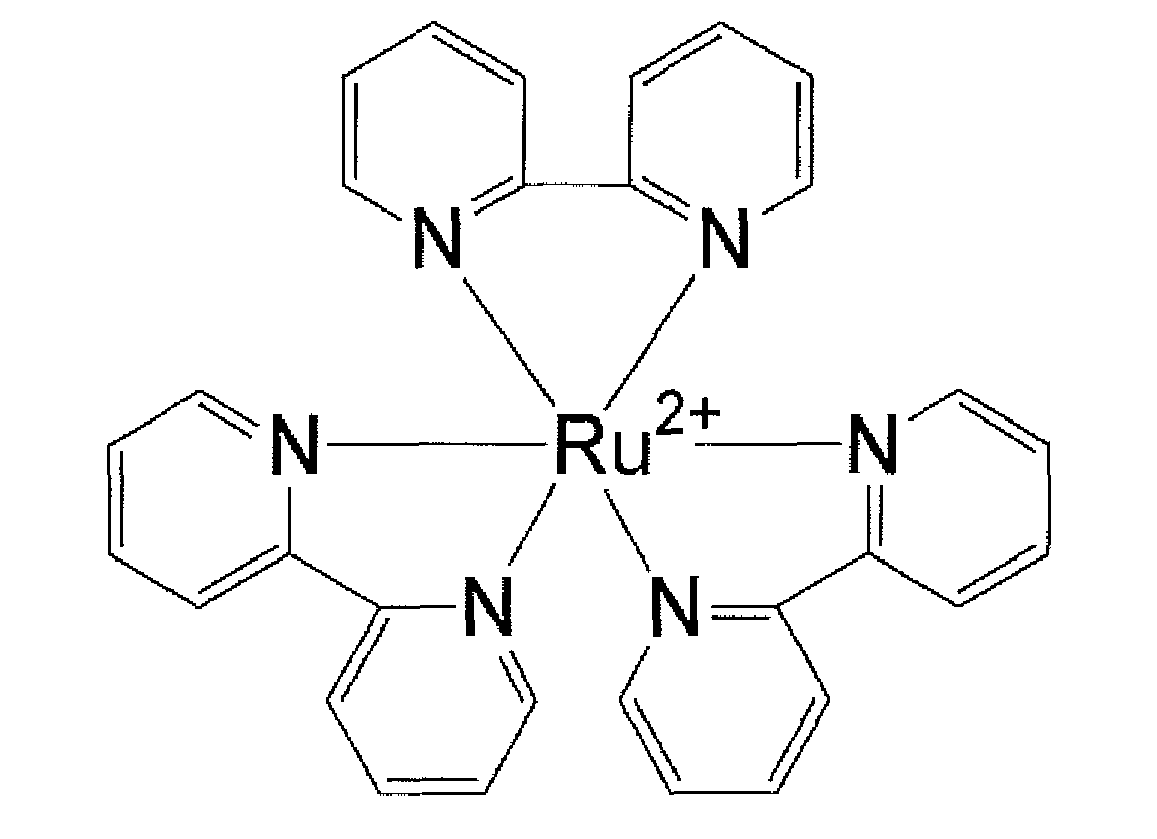
- Examples of more preferred spectral sensitizing dyes or pigments include the compounds described in Paragraphs [0144] to [0202] of
JP-A No. 2006-78749 - Examples of sensitizers that may be used for the photopolymerizable composition (2) also include those described above for the curable composition or the photopolymerizable composition (1).
- Only one sensitizer may be used, or two or more sensitizers may be used in combination. In the photopolymerizable composition (2), the molar ratio of all the polymerization initiator(s) to the sensitizing dye (all the polymerization initiator(s) : sensitizing dye) may be from 100:0 to 1:99, more preferably from 90:10 to 10:90, most preferably from 80:20 to 20:80.
- A known compound having the effect of further improving the sensitivity or the effect of suppressing inhibition of polymerization caused by oxygen may be added as a co-sensitizer to the photopolymerizable composition (2).
- Examples of the co-sensitizer also include those described above for the curable composition or the photopolymerizable composition (1). Other examples include the phosphorus compounds (diethyl phosphite and the like) described in
JP-A No. 06-250387 06-191605 - When the co-sensitizer is used, the amount of the co-sensitizer may appropriately be from 0.01 to 50 parts by mass, based on 1 part by mass of the polymerization initiator in the photopolymerizable composition (2).
- A small amount of a thermal polymerization inhibitor is preferably added to the photopolymerizable composition (2) in order to inhibit unnecessary thermal polymerization of the compound containing a polymerizable ethylenic unsaturated double bond during the production or storage of the composition. Examples of the thermal polymerization inhibitor include hydroquinone, p-methoxyphenol, di-tert-butyl-p-cresol, pyrogallol, tert-butylcatechol, benzoquinone, 4,4'-thiobis(3-methyl-6-tert-butylphenol), 2,2'-methylenebis(4-methyl-6-tert-butylphenol), and cerous N-nitrosophenyl-hydroxylamine.
- The content of the thermal polymerization inhibitor is preferably from about 0.01 to about 5% by mass, based on the mass of the composition.
If necessary, behenic acid or a higher fatty acid derivative such as behenic acid amide may be added to prevent oxygen-induced inhibition of polymerization and may be localized to the surface of the photosensitive layer in a drying process after coating. The content of the higher fatty acid derivative is preferably from about 0.5 to about 10% by mass of the entire composition. - In order to form a colored photosensitive layer, a dye or a pigment may be added to the composition. This allows an improvement in the so-called plate checking capability of a printing plate, such as the visibility of the photosensitive layer after plate making and suitability for measurements with image density measuring machines. Many dyes used as colorants can reduce the sensitivity of the photopolymerizable photosensitive layer. In particular, therefore, pigments are preferably used as colorants. Examples of colorants include pigments such as phthalocyanine pigments, azo pigments, carbon blacks, and titanium oxide; and dyes such as ethyl violet, crystal violet, azo dyes, anthraquinone dyes, and cyanine dyes. The content of the dye or the pigment is preferably from about 0.5 to about 5% by mass of the entire composition.
- In addition, known additives such as an inorganic filler or plasticizer for modifying the physical properties of the cured film, and lipophilizing agents capable of improving the fixation of inks on the surface of photosensitive layers, may also be added to the composition.
- Examples of the plasticizer include dioctyl phthalate, didodecyl phthalate, triethylene glycol dicaprylate, dimethyl glycol phthalate, tricresyl phosphate, dioctyl adipate, dibutyl sebacate, and triacetylglycerol. When a binder is used, the plasticizer may be added in an amount of 10% by mass or less, based on the total mass of the ethylenic unsaturated double bond-containing compound and the binder.
- In order to improve the film strength (printing durability), a UV initiator or a thermal crosslinking agent for enhancing the effect of heating and/or exposure after development may also be added to the composition.
- A description is given blow of the color filter and the method for producing a color filter according to the invention.
The color filter of the invention includes a colored pattern provided on a support, the colored pattern being produced by using the photopolymerizable composition for a color filter of the invention. - The color filter of the invention is described in detail below together with the method for production thereof includes applying the photopolymerizable composition (1) for a color filter of the invention to a support to form a colored photopolymerizable composition layer (hereinafter also simply referred to as "the colored photopolymerizable composition layer-forming step"); exposing the colored photopolymerizable composition layer to light through a mask (hereinafter also simply referred to as "the exposure step"); and developing the exposed composition layer to form a colored pattern (hereinafter also simply referred to as "the development step").
- Specifically, the photopolymerizable composition for a color filter of the invention is applied to a support (substrate) directly or with another layer interposed therebetween to form a photopolymerizable composition layer (the colored photopolymerizable composition layer-forming step); the coating film is exposed to light through a specific patterned mask to cure the irradiated portion of the coating film (the exposure step); and the coating film is developed with a developing solution to form a patterned film including pixels of the respective colors (three or four colors) so that a color filter of the invention is produced.
Each step of the method of the invention for producing a color filter is described below. - In the colored photopolymerizable composition layer forming step, the photopolymerizable composition for a color filter of the invention is applied to a support to form a colored photopolymerizable composition layer.
- Examples of the support that may be used in this step include soda glass substrates, PYREX (registered trademark) glass substrates, quartz glass substrates, and a substrate obtained by attaching a transparent electrically-conductive film onto any of the above glass substrates, which are for use in liquid crystal displays and the like, and photoelectric converting substrates for use in imaging devices, such as silicon substrates and complementary metal oxide film semiconductors (CMOS). In some cases, these substrates may have black stripes for separating pixels from one another.
If necessary, an undercoat layer may be formed on the support in order to improve adhesion to the upper layer, prevent the substance diffusion or flatten the substrate surface. - The photopolymerizable composition for a color filter of the invention may be applied to the support by various coating methods such as slit coating, inkjet method, spin coating, cast coating, roll coating, and screen printing.
- The thickness of the coating film of the photopolymerizable composition for a color filter is preferably from 0.1 µm to 10 µm, more preferably from 0.2 µm to 5 µm, even more preferably from 0.2 µm to 3 µm.
When producing a color filter for use in a solid-state imaging device, the thickness of the coating film of the photopolymerizable composition for a color filter is preferably from 0.35 µm to 1.5 µm, more preferably from 0.40 µm to 1.0 µm, in view of resolution and developability. - The coating of the photopolymerizable composition for a color filter on the support is generally dried under the conditions of 70 to 110°C for about 2 to 4 minutes to form a colored photopolymerizable composition layer.
- In the exposure step, the colored photopolymerizable composition layer formed in the colored photopolymerizable composition layer forming step is exposed to light through a mask so that only the irradiated portion of the coating film is cured.
The exposure is preferably performed by irradiation with a radiation. In particular, ultraviolet rays such as g-line or i-line is preferably used as the radiation for exposure, and high-pressure mercury lamps are more preferred. The irradiation intensity is preferably from 5 mJ/cm2 to 1500 mJ/cm2, more preferably from 10 mJ/cm2 to 1000 mJ/cm2, most preferably from 10 mJ/cm2 to 800 mJ/cm2. - After the exposure step, alkali development (the development step) may be performed so that the unexposed portion resulting from the exposure step can be dissolved in an aqueous alkali solution. In this step, only the photo-cured portion is left.
The developing solution is preferably an organic alkali developer that does not damage underlying circuits or the like. The development is generally performed at a temperature of 20°C to 30°C for a time period of 20 to 90 seconds. - Examples of the alkali for use in the developing solution include ammonia water and organic alkaline compounds such as ethylamine, diethylamine, dimethylethanolamine, tetramethylammonium hydroxide, tetraethylammonium hydroxide, choline, pyrrole, piperidine, and 1,8-diazabicyclo-[5,4,0]-7-undecene. An aqueous alkaline solution prepared by diluting the alkali with pure water to a concentration of 0.001 to 10% by mass, preferably of 0.01 to 1% by mass may be used. When a developing solution comprising such an aqueous alkaline solution is used, washing (rinsing) with pure water is generally performed after the development.
- If necessary, the method of the invention for producing a color filter may further include the step of curing the colored pattern by heating and/or exposure to light after the photopolymerizable composition layer-forming step, the exposure step and the development step have been conducted.
- The colored photopolymerizable composition layer-forming step, the exposure step and the development step (and optionally the curing step) may be repeated for the number of times corresponding to the number of the desired hues, whereby a color filter of the desired hues may be produced.
- The solid-state imaging device of the invention includes the color filter of the invention.
Because the color filter of the invention uses the photopolymerizable composition for color filter of the invention, a colored pattern formed therefrom exhibits high adhesiveness to a support (substrate), and the cured composition is excellent in resistance to development and is thus excellent in exposure sensitivity, is superior in adhesiveness to a substrate in exposed portions and may form a pattern of high resolution to give a desired sectional shape. Accordingly, the color filter of the invention may be used in a liquid crystal display device and a solid state imaging device such as CCD, and is particularly suitable for CCD devices and CMOS of high resolution of one million or more pixels. That is, the color filter of the invention is preferably applied to a solid imaging device.
The color filter of the invention may be used as a color filter arranged between a light-receiving part of each pixel and a light-collecting micro-lens, which constitutes CCD. - A description is given below of the planographic printing plate precursor of the invention.
The planographic printing plate precursor includes a support and a photosensitive layer that is placed on the support and contains the photopolymerizable composition of the invention.
If necessary, the planographic printing plate precursor may further include any other layer such as a protective layer and an intermediate layer. Since the planographic printing plate precursor contains the photopolymerizable composition of the invention in the photosensitive layer and thus have a high sensitivity, stability over time and printing durability. Each element of the planographic printing plate precursor of the invention is described below. - The photosensitive layer is a layer containing the photopolymerizable composition of the invention. Specifically, the photosensitive layer may be formed by a process that includes using the photopolymerizable composition (2) (a preferred example of the photopolymerizable composition of the invention) as a composition for forming a photosensitive layer (hereinafter also referred to as "the photosensitive layer-forming composition"), applying a coating liquid containing the composition to a support and dying the coating to form a photosensitive layer.
- For the application of the photosensitive layer-forming composition to the support, the respective components to be contained in the composition may be used in the form of solutions in various organic solvents. Examples of solvents that may be used in this process include acetone, methyl ethyl ketone, cyclohexane, ethyl acetate, ethylene dichloride, tetrahydrofuran, toluene, ethylene glycol monomethyl ether, ethylene glycol monoethyl ether, ethylene glycol dimethyl ether, propylene glycol monomethyl ether, propylene glycol monoethyl ether, acetyl acetone, cyclohexanone, diacetone alcohol, ethylene glycol monomethyl ether acetate, ethylene glycol ethyl ether acetate, ethylene glycol monoisopropyl ether, ethylene glycol monobutyl ether acetate, 3-methoxypropanol, methoxymethoxyethanol, diethylene glycol monomethyl ether, diethylene glycol monoethyl ether, diethylene glycol dimethyl ether, diethylene glycol diethyl ether, propylene glycol monomethyl ether acetate, propylene glycol monoethyl ether acetate, 3-methoxypropyl acetate, N,N-dimethylformamide, dimethylsulfoxide, γ-butyrolactone, methyl lactate, and ethyl lactate. Only a single solvent may be used, or a mixture of two or more solvents may be used. The coating solution appropriately has a solids content of 2 to 50% by mass.
- The coating amount of the photosensitive layer on the support is preferably selected as appropriate depending on applications, because it may have effects on the sensitivity and/or developability of the photosensitive layer and on the strength and/or printing durability of the exposed film. If the coating amount is too small, the printing durability may be insufficient. If the coating amount is too large, the sensitivity may be reduced so that the necessary exposure time may increase, and the development time may also undesirably increase. For a main object of the invention, namely for a planographic printing plate for scanning exposure, the coating amount in terms of the mass after drying may be appropriately from 0.1 g/m2 to 10 g/m2, more preferably from 0.5 g/m2 to 5 g/m2.
- In the planographic printing plate precursor of the invention, the support preferably has a hydrophilic surface. The hydrophilic support may be selected from known conventional hydrophilic supports used for planographic printing plates, without particular limitations.
The support is preferably a dimensionally stable plate-shaped material, examples of which include paper, paper laminated with plastic (such as polyethylene, polypropylene, or polystyrene), a metal plate (such as of an aluminum, zinc or cupper plate), a plastic film (such as a film of cellulose diacetate, cellulose triacetate, cellulose propionate, cellulose butyrate, cellulose acetate butyrate, cellulose nitrate, polyethylene terephthalate, polyethylene, polystyrene, polypropylene, polycarbonate, or polyvinyl acetal), and paper or a plastic film on which metal such as those listed above is laminated or vapor-deposited. If necessary, the surface of these materials may be subjected to an appropriate known physical and/or chemical treatment for the purpose of imparting hydrophilicity, improving strength or the like. - Paper, a polyester film or an aluminum plate is preferred as the support. The aluminum plate is particularly preferred, because it has excellent dimensional stability, is relatively inexpensive and can provide a highly hydrophilic or strong surface by being subjected to surface treatment that may be conducted as necessary. A composite sheet comprising a polyethylene terephthalate film and an aluminum sheet bonded thereto as described in
JP-B No. 48-18327 - Preferred examples of the aluminum plate include a pure aluminum plate and a plate of an aluminum alloy comprising aluminum as the main component and a small amount of other elements. A plastic film on which aluminum is laminated or vapor-deposited may also be used. Examples of such other elements to be contained in aluminum alloys include silicon, iron, manganese, copper, magnesium, chromium, zinc, bismuth, nickel, and titanium. The content of foreign elements in the alloy is at most 10% by mass or less. In the invention, pure aluminum is particularly preferred. However, it is difficult to produce completely pure aluminum in terms of refinement technology, and therefore, trace amounts of other elements may be contained. The aluminum plate for use in the invention is not limited to have a particular composition, and may be appropriately selected from aluminum plates of any known conventional material. The aluminum plate for use in the invention preferably may have a thickness of about 0.1 mm to about 0.6 mm, preferably of 0.15 mm to 0.4 mm, particularly preferably of 0.2 mm to 0.3mm.
- When the support has a metallic surface, specifically an aluminum surface, it preferably has undergone surface treatment such as surface roughening (graining), immersion into an aqueous solution of sodium silicate, potassium fluorozirconate, phosphate, or the like, or anodic oxidation.
- Surface roughening of the aluminum plate may be performed by various methods such as methods of mechanically roughening the surface, methods of electrochemically dissolving and roughening the surface, and methods of chemically and selectively dissolving the surface. The mechanical roughening may be a known mechanical method such as ball polishing, brush polishing, blast polishing, and buff polishing. Electrochemical surface roughening methods may be performed in an electrolytic solution of hydrochloric acid, nitric acid or the like under alternating or direct current. A combination of both methods may also be used in combination as disclose in
JP-A No. 54-63902 - An aluminum plate that has undergone immersion in an aqueous sodium silicate solution after surface roughening is preferably used. An aluminum plate that has undergone the processes of anodic oxidation of the aluminum plate and immersion in an aqueous alkali metal silicate solution as described in
JP-B No. 47-5125 - The silicate electrodeposition described in
U.S. No. 3,658,662 is also effective. - The surface treatment disclosed in
JP-B No. 46-27481 JP-ANos. 52-58602 52-30503 - In a preferred treatment, mechanical surface roughening, chemical etching, electrolytic graining, anodic oxidation, and sodium silicate treatment are sequentially performed as described in
JP-ANo. 56-28893 - After these treatments, undercoating may be preferably performed. The undercoating may include a water-soluble resin such as polyvinyl phosphonic acid, a polymer or copolymer having a sulfonic acid group in a side chain, or polyacrylic acid; a water-soluble metal salt (such as zinc borate); a yellow dye; or an amine salt.
- A sol-gel-treated substrate is also preferably used in which a functional group capable of undergoing a radical addition reaction is covalently bonded as disclosed in
JP-A No. 07-154983 - In another preferred example, a water-resistant hydrophilic layer may be formed as a surface layer on an arbitrary support. Examples of such a surface layer include a layer comprising an inorganic pigment and a binding agent as described in
U.S. Patent No. 3,055,295 andJP-ANo. 56-13168 JP-A No. 09-80744 08-507727 - These hydrophilizing treatments may be performed not only to hydrophilize the surface of the support but also to prevent an undesirable reaction of the photopolymerizable composition to be provided thereon and to improve adhesion of the photosensitive layer.
- The planographic printing plate precursor of the invention preferably further includes a protective layer on the photosensitive layer. The protective layer can prevent low-molecular compounds such as basic substances or oxygen in the air, which inhibits image-forming reaction in the photosensitive layer caused by exposure to light, from entering the photosensitive layer, and enables exposure in the air. Therefore, the protective layer preferably has such characteristics that the protective layer is less permeable to low-molecular compounds such as oxygen, does not substantially inhibit transmission of light for exposure, is excellent in adhesion property to the photosensitive layer, and is easily removable by a development process after exposure.
- Improvements of the protective layer have been made as described in detail in
U.S. Patent No. 3,458,311 andJP-A No. 55-49729 - Polyvinyl alcohol for use in the protective layer may be partially substituted by at least one of an ester, an ether and an acetal, as long as it has an unsubstituted vinyl alcohol unit for imparting necessary oxygen barrier characteristics and water solubility. In the same way, the polyvinyl alcohol may partially have at least one other copolymerization component. Specifically, the polyvinyl alcohol may be hydrolyzed to a degree of 71 to 100 mol% and may have a mass average molecular weight in the range of 300 to 2400. Examples of the polyvinyl alcohol include PVA-105, PVA-110, PVA-117, PVA-117H, PVA-120, PVA-124, PVA-124H, PVA-CS, PVA-CST, PVA-HC, PVA-203, PVA-204, PVA-205, PVA-210, PVA-217, PVA-220, PVA-224, PVA-217EE, PVA-217E, PVA-220E, PVA-224E, PVA-405, PVA-420, PVA-613, and L-8 manufactured by Kuraray Co., Ltd.
- The components (choice of PVAs, use of additives and the like), the coating amount and the like of the protective layer may be selected in consideration of on oxygen barrier characteristics, removability by development, fogging, adhesion property, or scratch resistance. In general, a higher rate of hydrolysis of the PVA to be used (a higher content of unsubstituted vinyl alcohol units in the protective layer) or a larger thickness of the film leads to a higher level of oxygen barrier characteristics, which is advantageous in terms of sensitivity. When oxygen barrier characteristics are increased excessively, problems may occur such as unnecessary polymerization reactions during manufacture or storage and unnecessary fogging or thickening of image lines during imagewise exposure. The adhesion to the image portion and the scratch resistance are also very important for the handleability of the printing plate. Methods for applying the protective layer are described in detail in, for example,
U.S. Patent No. 3,458,313 andJP-A No. 55-49729 - The protective layer may also have another function. For example, a colorant (such as a water-soluble dye) capable of efficiently transmitting light in the range of 350 nm to 450 nm to be used for exposure and efficiently absorbing light at 500 nm or more may be added to the protective layer so that safe light suitability can be further improved without a reduction in sensitivity.
- Other layers such as layers for improving adhesion between the photosensitive layer and the support and layers for improving the removability of the unexposed photosensitive layer by development may also be provided. For example, the adhesion or the printing durability may be improved by adding a diazonium structure-containing compound or a compound capable of relatively strongly interacting with the substrate, such as phosphonic compounds or by providing an undercoat layer of such a compound. On the other hand, the developability of the non-image portion or the antifouling properties may be improved by adding a hydrophilic polymer such as polyacrylic acid or polysulfonic acid or by providing an undercoat layer of such a polymer.
- In general, the planographic printing plate precursor is imagewise exposed to light and then the unexposed portion is removed by using a developing solution to form an image.
- Any known light exposure method may be applied to the planographic printing plate precursor of the invention, without limitations. The wavelength of the light source is preferably from 350 nm to 450 nm, and specifically InGaN semiconductor lasers are preferred. The exposure mechanism may be of any system such as an internal drum system, an external drum system or a flat bed system. A highly water-soluble component may be used for the photosensitive layer so that the layer can dissolved in neutral water or weakly alkaline water. The planographic printing plate having such a constitution may be subjected to on-press exposure and development after mounted on a printing machine.
- Available laser light sources in the range of 350 nm to 450 nm include the lasers described below.
- Gas lasers include Ar ion lasers (364 nm, 351 nm, 10 mW to 1 W), Kr ion lasers (356 nm, 351 nm, 10 mW to 1 W) and He-Cd lasers (441 nm, 325 nm, 1 to 100 mW); Solid-state lasers include a combination of Nd:YAG (YVO4) and SHG crystal (twice) (355 nm, 5 mW to 1 W) and a combination of Cr:LiSAF and SHG crystal (430 nm, 10 mW); Semiconductor lasers include KNbO3 ring resonators (430 nm, 30 mW), a combination of a waveguide type wavelength converting device and an AlGaAs or InGaAs semiconductor (380 to 450 nm, 5 to 100 mW), a combination of a waveguide type wavelength converting device and an AlGaInP or AlGaAs semiconductor (300 to 350 nm, 5 to 100 mW), and AlGaInN lasers (350 to 450 nm, 5 to 30 mW); Other lasers include pulsed lasers such as N2 lasers (337 nm, 0.1 to 10 mJ pulse) and XeF lasers (351 nm, 10 to 250 mJ pulse).
- Above all, AlGaInN semiconductor lasers (commercially available InGaN semiconductor lasers (400 to 410 nm, 5 to 30 mW)) are particularly preferred in view of wavelength characteristics and cost.
- For scanning exposure type planographic printing plate exposure systems, internal drum, external drum, or flat bed systems may be used as exposure mechanisms, and all of the light sources describe above, except for pulsed lasers, may be used as light sources. Practically, the exposure systems described below are particularly preferred in view of the relationship between the sensitivity of the material and plate making time.
- A single-beam exposure system of an internal drum system using a single gas or solid-state laser source;
A multi-beam exposure system of a flat bed system using a number of (ten or more) semiconductor lasers; and
A multi-beam exposure system of an external drum system using a number of (ten or more) semiconductor lasers. - For laser direct drawing type planographic printing plates as described above, the following equation (eq1) is generally established, wherein X (J/cm2) is the sensitivity of the photosensitive material, S (cm2) is the exposed area of the photosensitive material, q (W) is the power of one laser light source, n is the number of the laser light sources, and t (s) is the total exposure time.
-

- In the case of (i) the internal drum system (single beam), the following equation (eq2) is generally established, wherein f (radian/s) is the rotational frequency of the laser, Lx (cm) is the sub-scanning length of the photosensitive material, Z (dots/cm) is the resolution, and t (s) is the total exposure time.
-
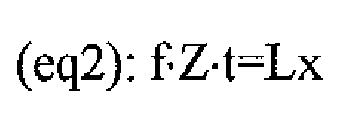
- In the case of (ii) the external drum system (multi-beam), the following equation (eq3) is generally established, wherein F (radian/s) is the rotational frequency of the drum, Lx (cm) is the sub-scanning length of the photosensitive material, Z (dots/cm) is the resolution, t (s) is the total exposure time, and n is the number of the beams.
-

- In the case of (iii) the flat bed system (multi-beam), the following equation (eq4) is generally established, wherein H (radian/s) is the rotational frequency of the polygon mirror, Lx (cm) is the sub-scanning length of the photosensitive material, Z (dots/cm) is the resolution, t (s) is the total exposure time, and n is the number of the beams.
-
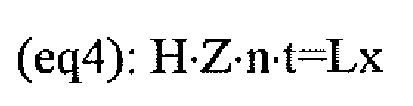
- Substitution of the resolution (2560 dpi) required of a practical printing plate, the size of the plate (A1/B1, 42 inches in sub-scanning length), the exposure condition of about 20 sheets per hour, and the photosensitive characteristics of the photopolymerizable composition of the invention (the photosensitive wavelength, and a sensitivity of about 0.1 mJ/cm2) into the equations suggests that the photosensitive material of the invention should preferably be used in combination with a semiconductor laser of a multi-beam exposure type. Also taking handleability and cost into account, it is suggested that the photosensitive material of the invention is most preferably used in combination with a semiconductor laser, multi-beam exposure system of an external drum system.
- Other examples of light sources that may be used for exposure include any of ultra-high pressure, high pressure, medium pressure, and low pressure mercury lamps, chemical lamps, carbon arc lamps, xenon lamps, metal halide lamps, a variety of visible and ultraviolet laser lamps, fluorescent lamps, tungsten lamps, and sunlight.
- Developing solutions suitable for the planographic printing plate precursor of the invention include the developers described in
JP-B No. 57-7427 - If necessary, the alkaline aqueous solution may contain a small amount of a surfactant or an organic solvent such as benzyl alcohol, 2-phenoxyethanol, or 2-butoxyethanol. Examples of such additives include those described in
U.S. Patent Nos. 3,375,171 and3,615,480 . - The developing solutions described in
JP-ANos. 50-26601 58-54341 JP-B Nos. 56-39464 56-42860 - The developing solution described in
JP-A No. 2002-202616 - Formula (α): A-W
- In Formula (α), A represents a hydrophobic organic group wherein log P of A-H is 1.5 or more, and W represents a nonionic hydrophilic organic group wherein log P of W-H is less than 1.0.
The log P is used generally as a hydrophobic parameter described in C. Hansch, A. Leo, "Substituent Constants for Correlation Analysis in Chemistry and Biology", J. Wile & Sons, 1979, and is defined as logarithm of equilibrium concentration ratio P calculated from proportion distributed in each layer in a 2-layer system of octanol/water of an objective molecule (A-H and W-H). The log P is used as an index for specifying groups A and W in the formula (α) and determined by calculation from known data based on a method described in A. K. Ghose, et al. J. Comput. Chem. 9, 80 (1988) with respect to A-H and W-H structures where a hydrogen atom is conveniently bound to each organic group of A and W.
Components in this developing solution are described in detail in paragraphs (0024) to (0067) inJP-A No. 2002-202616 - It is effective to add the nonionic compound represented by Formula (α) such that its concentration in the developing solution becomes 0.1 to 15% by mass, preferably of 1.0 to 8.0% by mass.
- If necessary, the process of making a printing plate from the planographic printing plate precursor may further include heating the whole surface before or during exposure or between exposure and development. Such heating can facilitate the image forming reaction in the photosensitive layer so that advantages such as an increase in sensitivity or printing durability and stabilization of sensitivity can be achieved. In addition, whole surface exposure or whole surface post heating may be effectively performed on the image after the development in order to improve the strength or printing durability of the image. In general, heating before the development is preferably performed under mild conditions at 150°C or lower. At 150°C or lower, the non-image portion can be free of the problem of fogging. Very strong conditions should be used for heating after the development. Such conditions are generally in the range of 200 to 500°C. At 200°C or higher, the image strengthening effect can be sufficiently obtained. At 500°C or lower, problems such as deterioration of the support and thermal decomposition of the image portion do not occur.
- The inventors made extensive study, and as a result, they found that an oxime compound having a novel structure may be used to attain excellent absorbance to light having a wavelength of 365 nm or 405 nm and excellent temporal stability. Specific means for solving the problems described above is shown below:
-


- wherein R, Y1 and Z each independently represent a monovalent substituent, n1 represents an integer of 0 to 4, Y1 and Z may be bound to each other to form a ring, and A represents a divalent linking group.
- <2> The compound of the above-mentioned <1>, which is represented by the following Formula (2):
-

- wherein R, Y2 and Y3 each independently represent a monovalent substituent, n2 and n3 independently represent an integer of 0 to 4, and A represents a divalent linking group.
- <3> The compound of the above-mentioned <1> or <2>, which is represented by the following Formula (3):
-

- wherein R, Y4 and Y5 each independently represent a monovalent substituent, n4 and n5 independently represent an integer of 0 to 4, and A represents a divalent linking group.
- <4> A photopolymerizable composition containing (A) the compound of any of the above-mentioned <1> to <3> and (B) a polymerizable compound.
- <5> The photopolymerizable composition of the above-mentioned <4>, which further contains (C) a colorant.
- <6> The photopolymerizable composition of the above-mentioned <5>, wherein the colorant (C) is a pigment, further containing (D) a pigment dispersant.
- <7> The photopolymerizable composition of the above-mentioned <5> or <6>, wherein the colorant (C) is a black colorant.
- <8> A photopolymerizable composition for color filter, which contains the photopolymerizable composition of any of the above-mentioned <5> to <7>.
- <9> A color filter having a colored pattern using the photopolymerizable composition for color filter of the above-mentioned <8> on a support.
- <10> A method for producing a color filter, including:
- applying the photopolymerizable composition for color filter of the above-mentioned <8> on a support to form a photopolymerizable composition layer,
- exposing the photopolymerizable composition layer via a mask to light, and
- developing the photopolymerizable composition layer after exposure to form a colored pattern.
- <11> A solid-state imaging device including the color filter of the above-mentioned <9>.
- <12> A planographic printing plate precursor having a photosensitive layer containing the photopolymerizable composition of the above-mentioned <4> on a support.
- Hereinafter, the invention will be described in more detail with reference to the Examples, but the invention is not limited to such examples unless the gist of the invention is exceeded. Unless otherwise specified, "part" is based on mass, and "%" and "wt%" refer to "% by mass".
- Details of the specific oxime compounds (Specific Compounds 1 to 9) and comparative compounds (Comparative Compounds 1 to 3) used in the Examples and Comparative Examples are shown below.
-
Compound No. Structure Specific Compound 1 
Specific Compound 2 
Specific Compound 3 
Specific Compound 4 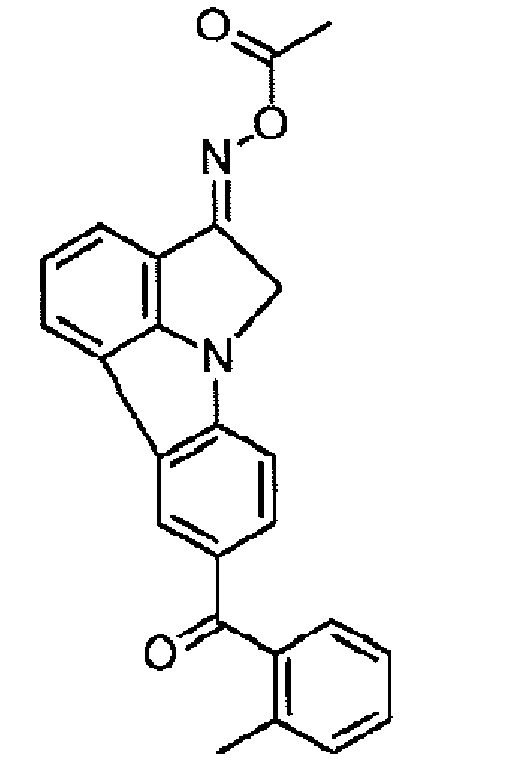
Specific Compound 5 
Specific Compound 6 
Specific Compound 7 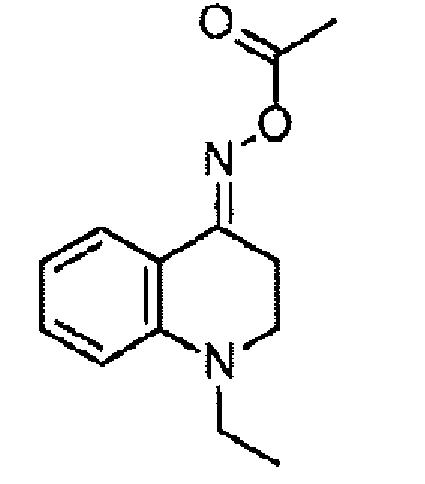
Specific Compound 8 
Specific Compound 9 
Comparative Compound 1 IRGACURE OXE01 (manufactured by Ciba Specialty Chemicals) Comparative Compound 2 IRGACURE OXE02 (manufactured by Ciba Specialty Chemicals) Comparative Compound 3 
- Specific Compounds 1 to 9 that are the specific oxime compounds listed above were synthesized by a method shown below.
- Compound A below (18.0 g, 76.2 mmol) was dissolved in 100 ml tetrahydrofuran, and triethylamine (9.25 g, 91.4 mmol) was added thereto. Then, the mixture was cooled to 0°C, and acetyl chloride (7.18 g, 91.4 mmol) was added dropwise over 20 minutes to the mixture which was then warmed to room temperature and stirred for 2 hours. The reaction solution was dropped into 150 ml distilled water cooled to 0°C, an organic layer was extracted with ethyl acetate and dried with magnesium sulfate, and the solvent was distilled away under reduced pressure. Precipitated crystals were washed with methanol to give Specific Compound 1 (recovery 19.5 g, yield 92%) having the following structure:
-

- The structure of the resulting specific compound 1 was identified by NMR.
(1H-NMR 400 MHz heavy acetone): 8.22 (d, 1H, J=7.8 Hz), 8.20 (d, 1H, J=7.8 Hz), 7.95 (d, 1H, J=7.6 Hz), 7.60 (d, 1H, J=8.0 Hz), 7.54-7.50 (m, 1H), 7.27 (t, 2H, 7.3 Hz), 4.45 (t, 2H, 6.8 Hz), 3.50 (t, 2H, 6.8 Hz), 2.29 (s, 3H). - Specific Compound B below (20.0 g, 56.4 mmol) was dissolved in 100 ml tetrahydrofuran, and triethylamine (6.85 g, 67.7 mmol) was added thereto. Then, the mixture was cooled to 0°C, and acetyl chloride (5.32 g, 67.7 mmol) was added dropwise over 20 minutes to the mixture which was then warmed to room temperature and stirred for 2 hours. The reaction solution was dropped into 150 ml distilled water cooled to 0°C, an organic layer was extracted with ethyl acetate and dried with magnesium sulfate, and the solvent was distilled away under reduced pressure. Precipitated crystals were washed with methanol to give Specific Compound 2 (recovery 19.0 g, yield 85%) having the following structure:
-

- The structure of the resulting specific compound 2 was identified by NMR. (1H-NMR 400 MHz heavy acetone): 8.62 (s, 1H), 8.29 (d, 1H, J=7.8 Hz), 8.02-7.98 (m, 2H), 7.71 (d, 1H, J=8.7 Hz), 7.49-7.32 (m, 1H), 7.40-7.32 (m, 4H), 4.57 (t, 2H, J=6.8 Hz), 3.53 (t, 2H, J=6.8 Hz), 2.30 (s, 3H), 2.29 (s, 3H).
- Specific Compounds 3 to 9 that are the specific oxime compounds listed above were synthesized in the same manner as in Synthesis Examples 1 to 2.
The structures of Comparative Compound 1 (IRGACURE OXE 01) and Comparative Compound 2 (IRGACURE OXE 02) shown in the above compound list are as follows: -


- Photopolymerizable Composition 1 was prepared in the following manner and evaluated for its sensitivity.
A uniform composition containing 0.08 mmol of Specific Compound 1 above as the specific oxime compound, 1 g of pentaerythritol tetraacrylate as a radical-polymerizable compound, 1 g ofpolymethyl methacrylate (molecular weight of ca. 996000, manufactured by Aldrich) as a binder resin, and 16 g of cyclohexanone as solvent was prepared. The resulting composition was used as a coating solution, applied to a glass plate by a spin coater, and dried at 40°C for 10 minutes to prepare a coating film of 1.5 µm in thickness. A 21√(2-step tablet (gray-scale film manufactured by Dainippon Screen Mfg. Co., Ltd.) was placed on this coating film which was then exposed via a heat-ray cut filter to light from a 500 mW high-pressure mercury lamp (manufactured by Ushio, Inc.) for 30 seconds, followed by development treatment by dipping it in toluene for 60 seconds. When the number of stages at which it was completely cured and insolubilized, corresponding to the step tablet, was evaluated as sensitivity, the sensitivity was 8 stages.
The greater the number of sensitivity stages, the higher the sensitivity. - Photopolymerizable Compositions 2 to 12 were prepared in the same manner as in Example 1-1 except that 0.08 mmol of the compounds listed above (Specific Compounds 2 to 9 and Comparative Compounds 1 to 3) were used respectively in place of Specific Compound 1 (0.08 mmol) used as the specific oxime compound in Example 1-1, and the respective compositions were evaluated for the number of sensitivity stages in the same manner as in Example 1-1.
The evaluation results of Examples 1-1 to 1-9 and Comparative Examples 1-1 to 1-3 are shown in Table 1 below. -
Table 1 Compound Photopolymerizable Composition Number of Sensitivity Stages Example 1-1 Specific Compound 1 1 8 Example 1-2 Specific Compound 2 2 9 Example 1-3 Specific Compound 3 3 9 Example 1-4 Specific Compound 4 9 Example 1-5 Specific Compound 5 5 9 Example 1-6 Specific Compound 6 6 9 Example 1-7 Specific Compound 7 7 7 Example 1-8 Specific Compound 8 8 9 Example 1-9 Specific Compound 9 9 8 Comparative example 1-1 Comparative Compound 1 10 5 Comparative example 1-2 Comparative Compound 2 11 5 Comparative example 1-3 Comparative Compound 3 12 5 - As a color filter-forming photopolymerizable composition, negative-type Colored Photopolymerizable Composition A-1 containing a colorant (pigment) was prepared and used to prepare a color filter.
- 40 Parts by mass of a 30/70 (mass ratio) mixture of C.I. Pigment Green 36 and C.I. Pigment Yellow 219 as pigments, 10 parts by mass (about 4.51 parts by mass in terms of solid content) of BYK2001 (Disperbyk, solid content 45.1% by mass, manufactured by BYK Chemie) as a dispersant, and 150 parts by mass of ethyl 3-ethoxypropionate as a solvent were mixed and dispersed for 15 hours with a beads mill to prepare a pigment dispersion (P1).
- The average particle size of the pigment in the resulting pigment dispersion (P1), as determined by dynamic light scattering method, was 200 nm.
- Components in Composition A-1 below were mixed and dissolved to prepare Colored Photopolymerizable Composition A-1.
-
- Pigment dispersion (P1) 600 parts by mass
- Alkali-soluble resin 200 parts by mass
(Benzyl methacrylate/methacrylic acid/hydroxyethyl methacrylate copolymer, molar ratio: 80/10/10, Mw: 10,000) - Multifunctional monomer: dipentaerythritol hexaacrylate 60 parts by mass
- Specific oxime compound: Specific Compound 1 60 parts by mass
- Solvent: propylene glycol monomethyl ether acetate 1,000 parts by mass
- Surfactant (trade name: Tetranik 150R1, manufactured by BASF) 1 part by mass
- γ-Methacryloxypropyltriethoxysilane 5 parts by mass
- A 550 mmx650 mm glass substrate was slit-coated with the thus obtained pigment-containing Colored Photopolymerizable Composition A-1 as a resist solution under the following conditions and then left for 10 minutes as it was, followed by vacuum drying and pre-baking (100°C, 80 seconds) to form a photopolymerizable composition coating film (photopolymerizable composition layer) thereon.
-
- Space of an opening at the top of a coating head: 50 µm
- Coating speed: 100 mm/sec
- Clearance between the substrate and the coating head: 150 µm
- Coating thickness (thickness after drying): 2 µm
- Coating temperature: 23°C
- Thereafter, the photopolymerizable composition layer was subjected to pattern exposure with a 2.5-kw ultrahigh pressure mercury lamp. After exposure, the whole area of the photopolymerizable composition layer was covered with 10% aqueous solution of an organic developing solution (trade name: CD, manufactured by Fuji Film Electronics Materials Co., Ltd) and left for 60 seconds as it was.
- Then, the photopolymerizable composition layer was sprayed with a shower of purified water to wash the developing solution away and then heated in an oven at 220°C for 1 hour (post-baking). In this manner, a color filter having a colored pattern on the glass substrate was obtained.
- The storage stability and exposure sensitivity of the colored photopolymerizable composition, the developability of the colored photopolymerizable composition upon formation of a colored pattern on a glass substrate, the coloration of the resulting colored pattern with time under heating, the adhesiveness of the pattern to the substrate, and the sectional shape of the pattern were evaluated in the following manner. The evaluation results were collectively shown in Table 2.
- The colored photopolymerizable composition was stored at room temperature for 1 month, and the degree of precipitation of foreign substances was evaluated visually under the following judgment criteria:
-
- A: No precipitation was recognized.
- B: Slight precipitation was recognized.
- C: Precipitation was recognized.
- The colored photopolymerizable composition was spin-coated on a glass substrate and dried to form a coating film of 1.0 µm in thickness. Spin coating was conducted at 300 rpm for 5 seconds and then at 800 rpm for 20 seconds, and drying was conducted at 100°C for 80 seconds. Then, the resulting coating film was exposed via a testing photomask with a line width of 2.0 µm to various amounts of light in the range of 10 to 1600 mJ/cm2 from a proximity-type exposure device provided with an ultrahigh pressure mercury lamp (manufactured by Hitachi High-Tech Electronics Engineering Co., Ltd.). Then, the coating film after exposure was developed under the condition of 25°C for 60 seconds with 60% CD-2000 developing solution (manufactured by Fuji Film Electronics Materials Co., Ltd). Thereafter, the coating film was rinsed with running water for 20 seconds and then spray-dried to complete patterning.
In evaluation of exposure sensitivity, the minimum light exposure at which the thickness of the coating film in the region exposed to light in the exposure step reached 95% or more based to the thickness (=100%) of the coating film before exposure was evaluated as exposure sensitivity. A smaller value of exposure sensitivity is indicative of higher sensitivity. - Developability, substrate adhesiveness, coloring change with time under forced heating, and pattern sectional shape were evaluated by confirming the substrate surface and sectional shape after post-baking in "2-3. Heat Treatment" by observation in a usual manner under an optical microscope and with SEM photographs. The detailed evaluation method is as follows.
- In the exposure step, the presence or absence of residues in the region not irradiated with light (unexposed region) was observed to evaluate developability. The evaluation criteria are as follows.
-
- A: No residue was observed in the unexposed region.
- B: Slight residues were observed in the unexposed region but at a practically unproblematic level.
- C: Significant residues were confirmed in the unexposed region.
- The photopolymerizable composition layer (colored pattern) after exposure and after development was heated on a hot plate at 200°C for 1 hour and then evaluated with MCPD-3000 (manufactured by Otsuka Electronic Co.) for its color difference ΔEab* before and after heating, under the following criteria:
-
- A: Δrab*≤5
- B: 5<µEab*<8
- C: µEabx≥8
- Substrate adhesiveness was evaluated by observing whether pattern defects had been generated or not under the following criteria:
-
- A: No pattern defect was observed.
- B: Pattern defects were seldom observed, but partial defects were observed.
- C: Quite a lot of pattern defects were observed.
- The sectional shape of the formed pattern was evaluated by observation. The sectional shape of the pattern is preferably a forward tapered shape, most preferably a rectangular shape. An inverse tapered shape is not preferable.
- The sectional shape of the pattern formed after post-baking in "2-3. Heat Treatment" was evaluated by observation. The sectional shape of the pattern is preferably a forward tapered shape, most preferably a rectangular shape. An inverse tapered shape is not preferable.
- Colored Photopolymerizable Compositions A-2 to A-17 and A'-1 to A'-3 were prepared in the same manner as in Example 2-1 except that the amounts of the respective compounds shown in Table 2 below were used in place of 60 parts by mass of Specific Compound 1 (specific oxime compound) in the composition A-1 used in preparing Colored Photopolymerizable Composition A-1 in Example 2-1, and the types and the amounts of the sensitizers and the co-sensitizers shown in Table 2 below were used in Examples 2-10 to 2-17, in order to obtain color filters. The same evaluation as in Example 2-1 was carried out. The results are shown in Table 2.
-
Table 2 Compound Sensitizer Co-sensitizer Storage stability Exposure sensitivity (mJ/cm2) Developability Coloring change with time under forced heating Substrate adhesiveness Pattern sectional shape Post-heating pattern sectional shape specific comparative content type content type content Example 2-1 1 - 60 - - - - A 100 A A A rectangular rectangular Example 2-2 2 - 60 - - - - A 90 A A A rectangular rectangular Example 2-3 3 - 60 - - - - A 90 A A A rectangular rectangular Example 2-4 4 - 60 - - - - A 90 A A A rectangular rectangular Example 2-5 5 - 60 - - - - A 90 A A A rectangular rectangular Example 2-6 6 - 60 - - - - A 90 A A A rectangular rectangular Example 2-7 7 - 60 - - - - A 120 A A A rectangular rectangular Example 2-8 8 - 60 - - - - A 90 A A A rectangular rectangular Example 2-9 9 - 60 - - - - A 100 A A A rectangular rectangular Example 2-10 2 - 50 A1 10 - - A 90 A A A rectangular rectangular Example 2-11 2 - 50 A2 10 - - A 90 A A A rectangular rectangular Example 2-12 2 - 50 A3 10 - - A 80 A A A rectangular rectangular Example 2-13 2 - 50 - - F1 10 A 90 A A A rectangular rectangular Example 2-14 2 - 40 A3 10 F1 10 A 80 A A A rectangular rectangular Example 2-15 2 - 40 A3 10 F2 10 A 80 A A A rectangular rectangular Example 2-16 2 - 40 A3 10 F3 10 A 70 A A A rectangular rectangular Example 2-17 2 - 40 A3 10 F3 5 A 70 A A A rectangular rectangular LD-5 5 Comparative example 2-1 - 1 60 - - - - A 150 A B B inverse taper forward taper Comparative example 2-2 2 60 - - - - A 140 A C B inverse taper forward taper Comparative example 2-3 - 3 60 - - - - A 140 A B B inverse taper forward taper - In Table 2 above, numerical 1 to 9 in column "specific" in column "Compound" refer to Specific Compounds 1 to 9 respectively, and numerical 1 to 3 in column "comparative" refer to Comparative Compounds 1 to 3 respectively. The "content" is expressed in parts by mass.
In Table 2 below, the types A1 to A3 of the sensitizer and the types F1 to F3 and LD-5 of the co-sensitizer refer to the following compounds: -
- A1: 4,4-Bisdiethylaminobenzophenone
- A2: Diethylthioxanthone
- A3:

- F1: 2-Mercaptobenzimidazole
- F2: 2-Mercaptobenzothiazole
- F3: N-Phenyl-2-mercaptobenzimidazole
- LD-5: 2,2'-Bis(o-chlorophenyl)-4,4',5,5'-tetraphenylbiimidazole
- From the results in Table 2, it may be seen that the colored photopolymerizable compositions in the Examples containing the specific oxime compounds (compounds 1 to 9) are excellent in storage stability (temporal stability). It may also be seen that these colored photopolymerizable compositions have high exposure sensitivity, are excellent in developability upon formation of colored patterns on color filters, are free of coloring in the resulting colored patterns with time under heating, and are excellent in both substrate adhesiveness and pattern sectional shape.
- Components in the following composition were mixed and dissolved to prepare a resist solution.
-
- Propylene glyol monoethyl ether acetate (PGMEA) 19.20 parts by mass
- Ethyl lactate 36.67 parts by mass
- Resin 30.51 parts by mass
(40% solution of a benzyl methacrylate/methacrylic acid/2-hydroxyethyl methacrylate copolymer (molar ratio = 60/22/18) in PGMEA) - Dipentaerythritol hexaacrylate (polymerizable compound) 12.20 parts by mass
- Polymerization inhibitor (p-methoxyphenol) 0.0061 part by mass
- Fluorochemical surfactant 0.83 part by mass
(trade name: F-475, manufactured by Dainippon Ink And Chemicals, Incorporated) - Photopolymerization initiator 0.586 part by mass
(trade name: TAZ-107, that is, a trihalomethyl triazine-based photopolymerization initiator, manufactured by Midori Kagaku Co., Ltd.) - A 6-inch silicon wafer was treated by heating in an oven at 200°C for 30 minutes. Then, the resist solution was applied onto this silicon wafer so as for its film thickness after drying to reach 2 µm, and then dried by heating in an oven at 220°C for 1 hour to form an undercoat layer to give a silicon wafer substrate with an undercoat layer.
- Components in Composition B-1 below were mixed and dissolved to prepare colorant (dye)-containing Colored Photopolymerizable Composition B-1.
-
- Cyclohexanone 80 parts by mass
- Colorant C.I. Acid Blue 108 7.5 parts by mass
- Colorant C.I. Solvent Yellow 162 2.5 parts by mass
- Radical-polymerizable monomer (polymerizable compound) 7.0 parts by mass
(a mixture of pentaerythritol triacrylate and dipentaerythritol hexaacrylate in a ratio of 3:7) - Specific Compound 1 (specific oxime compound) 2.5 parts by mass
- Glycerol propoxylate 0.5 part by mass
(number-average molecular weight Mn: 1,500, molar extinction coefficient ε = 0) - Colored Photopolymerizable Composition B-1 was stored at room temperature for 1 month, and the degree of precipitation of foreign substances was evaluated visually under the following judgment criteria. The results are shown in Table 3 below.
-
- A: No precipitation was recognized.
- B: Slight precipitation was recognized.
- C: Precipitation was recognized.
- Colored Polymerizable Composition B-1 prepared in item 3. above was applied onto the undercoat layer of the silicon wafer substrate with an undercoat layer obtained in item 2. above to form a photocurable coating film thereon. Then, the coating film was heat-treated (pre-baked) on a hot plate at 100°C for 120 seconds such that the coating film after drying became 0.9 µm in thickness.
Then, the coating film was exposed, via a 2-µm-square island pattern mask, to light with a wavelength of 365 nm at an exposure amount of 10 to 1600 mJ/cm2 from an i-line stepper exposure device FPA-3000i5+ (manufactured by Canon Co., Ltd.).
Thereafter, the silicon wafer substrate on which the irradiated coating film had been formed was placed on a horizontal rotating table of a spin shower developer (trade name: DW-30, manufactured by Chemitronics Co., Ltd.) and subjected to paddle development at 23°C for 60 seconds with CD-2000 (manufactured by Fuji Film Electronics Materials Co., Ltd) to form a colored pattern on the silicon wafer substrate. - The silicon wafer substrate having a colored pattern formed thereon was fixed to the horizontal rotating table by a vacuum chuck system, and the silicon wafer substrate was rotated at 50 rpm with a rotating device and simultaneously rinsed with a shower of purified water supplied via a spraying nozzle downwards to the rotating center of the substrate and then spray-dried.
A color filter having a colored pattern formed on a substrate was obtained in this manner. - The minimum light exposure at which the thickness of the coating film in the region exposed to light in the exposure step was 95% or more relative to the thickness (=100%) of the coating film before exposure was evaluated as exposure sensitivity. A smaller value of exposure sensitivity is indicative of higher sensitivity.
The size of the colored pattern was measured with a length measuring SEM (trade name: S-9260A, manufactured by Hitachi High-Technologies Corp.). A pattern size nearer 2 µm is indicative of higher sensitivity with sufficient curability.
The results are shown in Table 3 below. - Developability, coloring with time under heating, substrate adhesiveness, pattern sectional shape, and post-heating pattern sectional shape were evaluated by the evaluation method and evaluation criteria shown in Example 2-1. The results are shown in Table 3 below.
- Colored Photopolymerizable Compositions B-2 to B-17 and B'-1 to B'-3 were prepared in the same manner as in Example 3-1 except that the amounts of the respective compounds shown in Table 3 below were used in place of 2.5 parts by mass of Specific Compound 1 (specific oxime compound) in Composition B-1 used in preparing Colored Photopolymerizable Composition B-1 in Example 3-1, and the types and the amounts of the sensitizers and co-sensitizers shown in Table 3 below were used in Examples 3-10 to 3-17 respectively, in order to obtain color filters. Then, the same evaluation as in Example 3-1 was carried out. The results are shown in Table 3.
-


- In Table 3 above, numerical 1 to 9 in column "specific" in column "Compound" refer to Specific Compounds 1 to 9 respectively, and numerical 1 to 3 in column "comparative" refer to Comparative Compounds 1 to 3 respectively. The "content" is expressed in parts by mass.
In Table 3 above, the sensitizers A1 to A3 and the co-sensitizers F1 to F3 and LD-5 refer respectively to the compounds mentioned above. - Components in Composition C-1 below were mixed and dissolved to prepare colorant (pigment)-containing Colored Photopolymerizable Composition C-1.
-
- Ethyl 3-ethoxypropionate (solvent) 17.9 parts by mass
- Dispersion of Colorant C.I. Pigment Red 254 26.7 parts by mass
(solid content: 15% by mass, the solid content of the pigment: 60%) - Dispersion of Colorant C.I. Pigment Yellow 139 17.8 parts by mass
(solid content: 15% by mass, the solid content of the pigment: 60%) - Radical-polymerizable monomer (polymerizable compound) 3.5 parts by mass
(a mixture of pentaerythritol triacrylate and dipentaerythritol hexaacrylate in a ratio of 3:7) - Specific Compound 1 (specific oxime compound) 0.5 part by mass
- Benzyl methacrylate/methacrylic acid copolymer 2.0 parts by mass
(molar ratio = 70/30) - Colored Photopolymerizable Compositions C-2 to C-17 and C'-1 to C'-3 were prepared in the same manner as in Example 3-18 except that the amounts of the respective compounds shown in Table 4 below were used in place of 0.5 part by mass of Specific Compound 1 (specific oxime compound) in Composition C-1 used in preparing Colored Photopolymerizable Composition C-1 in Example 3-18, and the types and the amounts of the sensitizers and co-sensitizers shown in Table 4 below were used in Examples 3-27 to 3-34 respectively.
- The resulting colored photopolymerizable compositions were evaluated in the same manner as in Example 3-1. The results are shown in Table 4.
-


- In Table 4 above, numerical 1 to 9 in column "specific" in column "Compound" refer to Specific Compounds 1 to 9 respectively, and numerical 1 to 3 in column "comparative" refer to Comparative Compounds 1 to 3 respectively. The "content" is expressed in parts by mass.
In Table 4 above, the sensitizers A1 to A3 and the co-sensitizers F1 to F3 and LD-5 refer respectively to the compounds mentioned above. - Components in Composition D-1 below were mixed and dissolved to prepare colorant (pigment)-containing Colored Photopolymerizable Composition D-1.
-
- Ethyl 3-ethoxypropionate (solvent) 17.9 parts by mass
- Dispersion of Colorant C.I. Pigment Red 254 33.34 parts by mass
(solid content: 15% by mass, the solid content of the pigment: 60%) - Dispersion of Colorant C.I. Pigment Yellow 139 22.23 parts by mass
(solid content: 15% by mass, the solid content of the pigment: 60%) - Radical-polymerizable monomer (polymerizable compound) 2.5 parts by mass
(a mixture of pentaerythritol triacrylate and dipentaerythritol hexaacrylate in a ratio of 3:7) - Specific Compound 1 (specific oxime compound) 0.5 part by mass
- Benzyl methacrylate/methacrylic acid copolymer 2.0 parts by mass
(molar ratio = 70/30) - Colored Photopolymerizable Compositions D-2 to D-17 and D'-1 to D'-3 were prepared in the same manner as in Example 3-35 except that 0.5 part by mass of the respective compounds shown in Table 5 below were used respectively in place of 0.5 part by mass of Specific Compound 1 (specific oxime compound) in Composition D-1 used in preparing Colored Photopolymerizable Composition D-1 in Example 3-35.
- The resulting colored photopolymerizable compositions were evaluated in the same manner as in Example 3-1. The results are shown in Table 5.
-


- In Table 5 above, numerical 1 to 9 in column "specific" in column "Compound" refer to Specific Compounds 1 to 9 respectively, and numerical 1 to 3 in column "comparative" refer to Comparative Compounds 1 to 3 respectively. The "content" is expressed in parts by mass.
In Table 5 below, the sensitizers A1 to A3 and the co-sensitizers F1 to F3 and LD-5 refer respectively to the compounds mentioned above. - From the results in Tables 3 to 5, it may be seen that the colored photopolymerizable compositions in the Examples containing the specific oxime compounds (Compounds 1 to 9) are excellent in storage stability (temporal stability). It may also be seen that these colored photopolymerizable compositions have high exposure sensitivity, are excellent in developability upon formation of colored patterns on color filters, are free of coloring in the resulting colored patterns with time under heating, and are excellent in both substrate adhesiveness and pattern sectional shape.
As is also evident from Table 5, it may be seen that even if the content of the pigment is high, the compositions have excellent exposure sensitivity. - Components in Composition 1 below were dispersed with a twin roll to yield a dispersion having high viscosity. The viscosity of this dispersion was 70,000 mPa·s.
Thereafter, components in Composition 2 below were added to this dispersion and then stirred with a homogenizer under the condition of 3,000 rpm for 3 hours. The resulting mixed solution was finely dispersed for 4 hours with a dispersing machine (DISPER MAT, manufactured by GETZMANN) using 0.3 mm zirconia beads to prepare Carbon Black Dispersion A (referred to hereinafter as CB Dispersion A). The viscosity of this mixed solution was 37 mPa·s. -
- Carbon black (Pigment Black 7) having an average primary particle size of 15 nm 23 parts
- 45% Solution of benzyl methacrylate/methacrylic acid copolymer in propylene glycol monomethyl ether acetate 22 parts
(BzMA/MAA= 70/30, Mw: 30,000) - Solsperse 5000 (manufactured by Zeneca) 1.2 parts
-
- 45% Solution of benzyl methacrylate/methacrylic acid copolymer in propylene glycol monomethyl ether acetate 22 parts
(BzMA/MAA= 70/30, Mw: 30,000) - Propylene glycol monomethyl ether acetate 200 parts
- Components in Composition 3 below were dispersed with a twin roll to yield a dispersion having high viscosity. The viscosity of this dispersion was 40,000 mPa·s.
Before this dispersion treatment for yielding a highly viscous dispersion, the components may be kneaded with a kneader for 30 minutes. -
- Titan Black 13M-C having an average primary particle size of 75 nm 39 parts
(Pigment Black 35 manufactured by Mitsubishi Materials Corporation) - Solution of benzyl (meth)acrylate/(meth)acrylic acid copolymer in propylene glycol monomethyl ether acetate 8 parts
(BzMA/MAA= 70/30, Mw: 30,000, solid content: 40% by mass) - Solsperse 5000 (manufactured by Zeneca) 1 part
- Components in Composition 4 below were added to the resulting dispersion and then stirred with a homogenizer under the condition of 3,000 rpm for 3 hours. The resulting mixed solution was finely dispersed for 4 hours with a dispersing machine (DISPER MAT, manufactured by GETZMANN) using 0.3 mm zirconia beads to prepare Titan Black Dispersion A (referred to hereinafter as TB Dispersion A). The viscosity of this mixed solution was 7.0 mPa·s.
-
- Solution of benzyl (meth)acrylate/(meth)acrylic acid copolymer in propylene glycol monomethyl ether acetate 8 parts
(BzMA/MAA = 70/30, Mw 30,000, solid content 40% by mass) - Propylene glycol monomethyl ether acetate 200 parts
- Components in Composition E-a below were mixed by means of a stirrer to prepare Black Copolymerizable Compositions E-1 to E-18 and E'-1 to E'-6.
-
- Methacrylatelacrylic acid copolymer (alkali-soluble resin) 1.6 parts by mass
- Dipentaerythritol hexaacrylate 2.3 parts by mass
- Ethoxylated pentaerythritol tetraacrylate 0.8 part by mass
- CB Dispersion A or TB Dispersion A obtained above 24 parts by mass
- Propylene glycol monomethyl ether acetate 10 parts by mass
- Ethyl-3-ethoxy propionate 8 parts by mass
- Compound shown in Table 6 below: specific oxime compound, comparative compound or
LD-5 the amount shown in Table 6 - Co-sensitizer: the above-mentioned F3 not added or 0.1 part by mass
- Components in Composition E-b below were mixed by means of a stirrer to prepare Black Copolymerizable Compositions E-19 to E-38 and E'-7 to E'-12.
-
- Dipentaerythritol hexaacrylate 2.3 parts by mass
- CB Dispersion A or TB Dispersion A obtained above 24 parts by mass
- Propylene glycol monoethyl ether acetate 10 parts by mass
- Ethyl-3-ethoxy propionate 8 parts by mass
- Compound shown in Table 7 below: specific oxime compound, comparative compound or
LD-5 the amount shown in Table 7 - Co-sensitizer: the above-mentioned F3 not added or 0.1 part by mass
- Black Copolymerizable Compositions E-1 to E-38 and E'-1 to E'-12 obtained as described above were evaluated in the following manner. The results are shown collectively in Tables 6 and 7.
- The exposure sensitivity of each of Black Copolymerizable Compositions E-1 to E-38 and E'-1 to E'-12 obtained as described above was determined and evaluated by the following method.
- Each of Black Photopolymerizable Compositions E-1 to E-38 and E'-1 to E'-12 was applied uniformly onto a silicon wafer substrate at a number of spin-coating revolutions regulated such that a coating film after drying on a hot plate at 120°C for 120 seconds became 1.0 µm in thickness, thereby giving a 1.0 µm coating film.
Then, the coating film was exposed, via a pattern mask with 10-nm L&S (line and space), to light in the range of 100 to 5,100 mJ/cm2 varying in 100 mJ/cm2 increments from an i-line stepper FPA-3000iS+ (manufactured by Canon Co., Ltd.).
After irradiation, the coating film was subjected to paddle development at 23°C for 60 seconds with 0.3% aqueous solution of tetramethyl ammonium hydroxide (TMAH), then rinsed with a spin shower of purified water for 20 seconds and washed again with purified water. Thereafter, adhered water droplets were removed with a high-degree air, and the substrate was naturally dried, to give a black image pattern thereon.
Each colored image pattern thus obtained was evaluated with an optical microscope under the following criteria. - The minimum light exposure at which the thickness of the coating film in the region exposed to light in the exposure step was 95% or more relative to the thickness (=100%) of the coating film before exposure was evaluated as exposure sensitivity.
A smaller value of exposure sensitivity is indicative of higher sensitivity. - Black Photopolymerizable Compositions E-1 to E-38 and E'-1 to E'-12 obtained as described above were evaluated for their storage stability (temporal stability) by the following method.
That is, Black Photopolymerizable Compositions E-1 to E-38 and E'-1 to E'-12 were stored at room temperature for 1 month, and the degree of precipitation of foreign substances was evaluated visually under the following judgment criteria: -
- A: No precipitation was recognized.
- B: Slight precipitation was recognized.
- C: Precipitation was recognized.
- The developability of each of Black Copolymerizable Compositions E-1 to E-38 and E'-1 to E'-12 obtained as described above was evaluated by the following method.
That is, it was observed whether residues had occurred in the region not irradiated with light (unexposed region) in the exposure step for evaluation of sensitivity, thereby evaluating developability. The evaluation criteria are as follows. -
- A: No residue was observed in the unexposed region.
- B: Slight residues were observed in the unexposed region but at a practically unproblematic level.
- C: Significant residues were confirmed in the unexposed region.
-
Table 6 Composition Formulation Dispersion Compound Co-sensitizer Exposure sensitivity (mJ/cm2) Storage stability Developability specif ic comparative content type content Example 4-1 E-1 E-a CB Dispersion A 1 - 0.8 - - 100 A A Example 4-2 E-2 E-a CB Dispersion A 2 - 0.8 - - 100 A A Example 4-3 E-3 E-a CB Dispersion A 3 - 0.8 - - 100 A A Example 4-4 E-4 E-a CB Dispersion A 4 - 0.8 - - 100 A A Example 4-5 E-5 E-a CB Dispersion A 5 - 0.8 - - 100 A A Example 4-6 E-6 E-a CB Dispersion A 6 - 0.8 - - 100 A A Example 4-7 E-7 E-a CB Dispersion A 7 - 0.8 - - 300 A A Example 4-8 E-8 E-a CB Dispersion A 8 - 0.7 - - 100 A A Example 4-9 E-9 E-a CB Dispersion A 9 - 0.7 - - 100 A A Example 4-10 E-10 E-a CB Dispersion A 1 - 0.1 F3 0.1 80 A A Example 4-11 E-11 E-a TB Dispersion A 1 - 0.8 - - 200 A A Example 4-12 E-12 E-a TB Dispersion A 2 - 0.8 - - 200 A A Example 4-13 E-13 E-a TB Dispersion A 3 - 0.8 - - 200 A A Example 4-14 E-14 E-a TB Dispersion A 4 - 0.8 - - 200 A A Example 4-15 E-15 E-a TB Dispersion A 7 - 0.8 - - 400 A A Example 4-16 E-16 E-a TB Dispersion A 8 - 0.8 - - 200 A A Example 4-17 E-17 E-a TB Dispersion A 9 - 0.8 - - 200 A A Example 4-18 E-18 E-a TB Dispersion A 1 - 0.7 F3 0.1 150 A A Comparative example 4-1 E'-1 E-a CB Dispersion A - 1 0.8 - - 600 A A Comparative example 4-2 E'-2 E-a CB Dispersion A - 2 0.8 - - 500 A A Comparative example 4-3 E'-3 E-a CB Dispersion A - 3 0,8 - - 500 A A Comparative example 4-4 A E'-4 E-a TB Dispersion - 1 0.8 - - 800 A A Comparative example 4-5 E'-5 E-a TB Dispersion A - 2 0.8 - - 700 A A Comparative example 4-6 E'-6 E-a TB Dispersion A - 3 0.8 - - 700 A A -
Table 7 Composition Formulation Dispersion Compound Co-sensitizer Exposure sensitivity (mJ/cm2) Storage stability Developability specific comparative content type content Example 4-19 E-19 E-b CB Dispersion A 1 - 0.8 - - 500 A A Example 4-20 E-20 E-b CB Dispersion A 2 - 0.8 - - 400 A A Example 4-21 E-21 E-b CB Dispersion A 3 - 0.8 - - 400 A A Example 4-22 E-22 E-b CB Dispersion A 4 - 0.8 - - 400 A A Example 4-23 E-23 E-b CB Dispersion A 5 - 0.8 - - 400 A A Example 4-24 E-24 E-b CB Dispersion A 6 - 0.8 - - 400 A A Example 4-25 E-25 E-b CB Dispersion A 7 - 0.8 - - 700 A A Example 4-26 E-26 E-b CB Dispersion A 8 - 0.8 - - 400 A A Example 4-27 E-27 E-b CB Dispersion A 9 - 0.8 - - 400 A A Example 4-28 E-28 E-b CB Dispersion A 2 - 0.7 F3 0.1 300 A A Example 4-29 E-29 E-b TB Dispersion A 1 - 0.8 - - 300 A A Example 4-30 E-30 E-b TB Dispersion A 2 - 0.8 - - 200 A A Example 4-31 E-31 E-b TB Dispersion A 3 - 0.8 - - 200 A A Example 4-32 E-32 E-b TB Dispersion A 4 - 0.8 - - 200 A A Example 4-33 E-33 E-b TB Dispersion A 5 - 0.8 - - 200 A A Example 4-34 E-34 E-b TB Dispersion A 6 - 0.8 - - 200 A A Example 4-35 E-35 E-b TB Dispersion A 7 - 0.8 - - 400 A A Example 4-36 E-36 E-b TB Dispersion A 8 - 0.8 - - 200 A A Example 4-37 E-37 E-b TB Dispersion A 9 - 0.8 - - 200 A A Example 4-38 E-38 E-b TB Dispersion A 2 - 0.7 F3 0.1 150 A A Comparative example 4-7 E'-7 E-b CB Dispersion A - 1 0.8 - - 900 A B Comparative example 4-8 E'-8 E-b CB Dispersion A - 2 0.8 - - 800 A B Comparative example 4-9 E'-9 E-b CB Dispersion A - 3 0.8 - - 800 A A Comparative example 4-10 E'-10 E-b TB Dispersion A - 1 0.8 - - 600 A B Comparative example 4-11 E'-11 E-b TB Dispersion A - 2 0.8 - - 600 A B Comparative example 4-12 E'-12 E-b TB Dispersion A - 3 0.8 - - 600 A A - In Tables 6 and 7 above, numerical 1 to 9 in column "specific" in column "Compound" refer to Specific Compounds 1 to 9 respectively, and numerical 1 to 3 in column "comparative" refer to Comparative Compounds 1 to 3 respectively. The "content" is expressed in parts by mass.
- As is evident from Tables 6 and 7, it may be seen that the black copolymerizable compositions in the Examples containing the specific oxime compounds are excellent in storage stability (temporal stability). It may also be seen that because these black copolymerizable compositions are superior to those in the Comparative Examples in respect of exposure sensitivity and developability in the unexposed region, they are capable of forming a black pattern (colored pattern) with a lower amount of exposure light.
- The black image pattern prepared in Example 4-1 was used as a black matrix, and on the black matrix, a 1.6×1.6 µm green (G) colored pattern was prepared in the same manner as described in Example 2-1 by using Colored Photopolymerizable Composition A-1. Blue (B) and red (R) colored photopolymerizable compositions were prepared respectively in the same manner as in preparation of Colored Photopolymerizable Composition A-1 except that only the pigment (a mixture of C.I. Pigment Green 36 and C.I. Pigment Yellow 219 in a mass ratio of 30/70) was changed to a blue pigment (a mixture of C.I. Pigment Blue 15:6 and C.I. Pigment Violet 23 in a mass ratio of 30/70) and a red pigment (C.I. Pigment Red 254) respectively.
In the same manner as in formation of the green (G) pattern on the substrate by Green (G) Photopolymerizable Composition A-1, 1.6×1.6 µm blue (B) and red (R) patterns were formed successively on the substrate to prepare a color filter for solid-state imaging device. - When the resulting full-color color filter was evaluated for the black image pattern, the R, G and B colored patterns and the sectional shape and substrate adhesiveness of each pattern in the same manner as in Example 2-1, it was found that any patterns were rectangular, free of pattern defects and excellent in substrate adhesiveness.
- When the full-color color filter obtained in Example 5 was integrated in a solid-state imaging device, the solid-state imaging device was confirmed to be excellent in color separation with high resolution.
- After an aluminum plate of quality 1S having a thickness of 0.30 mm was surface-ground with No. 8 nylon brush and an aqueous suspension of 800 mesh pumice stone, the plate was sufficiently washed with water. Then, the aluminum plate was etched by immersing it in 10% sodium hydroxide at 70°C for 60 seconds, washed with running water, neutralized and washed with 20% HNO3 and washed with water. The aluminum plate was subjected to an electrolytic surface roughening treatment at the condition of electricity at the anode time of 300 coulomb/dm2 in 1% aqueous nitric acid solution at VA=12.7 V using a sinusoidal alternating waved current. The surface roughness of the plate was determined and it was found to be 0 to 45 µm (as expressed in terms ofRa unit). Subsequently, the aluminum plate was desmutted by immersing it in 30% H2SO4 aqueous solution at 55°C for 2 minutes, and then anodized at a current density of 5 A/dm2 in 20% H2SO4 aqueous solution at 33°C for 50 seconds with a cathode placed on the side of the grained surface of the aluminum plate. As a result, the thickness of the resulting anodized film was found to be 2.7 g/m2.
In this manner, Support A-1 for planographic printing plate precursor was obtained. - The resulting support was coated with a photosensitive layer coating solution with the following composition such that the amount of the coating solution after drying reached 1.4 g/m2, followed by drying at 95°C to form a photosensitive layer.
-
- Addition-polymerizable compound (M, N or O in Table 8) 0.80 part by mass
- Binder polymer (B1, B2 or B3 in Table 8) 0.90 part by mass
- Sensitizer (A1, A2 or A3 in Table 8) not added or 0.10 part by mass
- Compound shown in Table 8 below: specific oxime compound, comparative compound or LD-5 0.05 part by mass
- Co-sensitizer (the above-mentioned F2 or F3 in Table 8) not added or 0.25 part by mass
- Fluorochemical surfactant 0.02 part by mass
(MEGAFAC F-177, manufactured by Dainippon Ink And Chemicals, Inc.) - Heat polymerization inhibitor 0.03 part by mass
(N-nitrosohydroxylamine aluminum salt) - ε-Type copper phthalocyanine dispersion 0.2 part by mass
- Methyl ethyl ketone 16.0 parts by mass
- Propylene glycol monomethyl ether 16.0 parts by mass
- The resulting photosensitive layer was coated with 3 % by mass aqueous solution of polyvinyl alcohol (saponification degree 98 mol%, polymerization degree 550) such that the mass of the coating solution after drying reached 2 g/m2, followed by drying at 100°C for 2 minutes to form a protective layer.
- The planographic printing plate precursors in the Examples and the planographic printing plate precursors in the Comparative Examples were obtained in the manner described above.
- Each of the planographic printing plate precursors was subjected to the following exposure/development treatment.
- The planographic printing plate precursor was subjected to scanning exposure to 50 µJ/cm2 light from a violet LD with a wavelength of 405 nm (trade name: Violet Boxer, manufactured by FFEI) under the conditions of 175 lines/inch at 4,000 dpi to form a solid image and a 1 to 99% halftone dot image (in 1% increments) thereon.
- The exposed plate was subjected to standard treatment in an automatic developer (trade name: LP-850P2, manufactured by Fuji Photo Film Co., Ltd.) charged with the following developing solution 1 and a finishing gum liquid (trade name: FP-2W, manufactured by Fuji Photo Film Co., Ltd.) The preheat conditions were as follows: the temperature of the planographic printing plate precursor was 100°C, the developing solution temperature was 30°C and the dipping period in the developing solution was about 15 seconds.
- The developing solution 1 was composed of the following composition with pH 11.5 at 25°C and an electric conductivity of 5 mS/cm.
-
- Potassium hydroxide 0.15 g
- Polyoxyethylene phenyl ether (n = 13) 5.0 g
- Chelest 400 (chelating agent) 0.1 g
- Water 94.75 g
- The sensitivity and storage stability of the planographic printing plate precursor were evaluated by the following methods. The results are collectively shown in Table 8.
- The planographic printing plate precursor was exposed to light under the above conditions, and immediately developed under the above conditions to form an image, and 50% halftone dot area (%) was measured by a halftone dot area measuring instrument (Gretag Macbeth). The greater the number, the better the sensitivity.
- The planographic printing plate precursor was used in printing with an ink (GEOS-G (N), manufactured by Dainippon Ink and Chemicals, Inc.) in a printing machine (R201, manufactured by Roland Company). Solid image portions on printed matters were observed, and printing durability was examined by determining the number of printed matters until blurring of images thereon was initiated. The greater the number of printed matters, the better the printing durability.
- Each of the planographic printing plate precursors was measured for its halftone dot area in the same manner as described above in evaluation of sensitivity except that together with an interleaving paper, the precursor was sealed with an aluminum craft paper and left in such a state at 60°C for 4 days. Then, the difference between the halftone dot area of the precursor thus left at 60°C for 4 days and the halftone dot area of the precursor not left at 60°C for 4 days was determined to evaluate forced halftone change with time (Δ%). A smaller absolute value of this forced change with time is indicative of less influence of the forced change with time, that is, indicative of higher temporal stability.
-
Table 8 Support Photosensitive layer Sensitivity (%)(50% halftone dot area) Amount (%) of forced change with time Test of printing durability of image portion Compound Addition-polymerizable compound Binder polymer Sensitizer Co-sensitizer Coating amount (g/m2) specific comparative Example 7-1 A-1 1 - M B1 - - 1.4 47 2 60,000 Example 7-2 A-1 2 - M B1 - - 1.4 48 2 70,000 Example 7-3 A-1 3 - M B1 - - 1.4 48 2 70,000 Example 7-4 A-1 4 - M B1 - - 1.4 48 2 70,000 Example 7-5 A-1 5 - M B1 - - 1.4 48 2 70,000 Example 7-6 A-1 6 - M B1 - - 1.4 48 2 70,000 Example 7-7 A-1 7 - M B1 - - 1.4 46 2 55,000 Example 7-8 A-1 8 - M B1 - - 1.4 47 2 60,000 Example 7-9 A-1 9 - M B1 - - 1.4 47 2 60,000 Example 7-10 A-1 2 - M B1 A1 F2 1.4 47 2 70,000 Example 7-11 A-1 2 - N B2 A1 F2 1.4 47 2 70,000 Example 7-12 A-1 2 - O B3 A1 F2 1.4 47 2 100,000 Example 7-13 A-1 2 - O B3 A2 F2 1.4 49 2 100,000 Example 7-14 A-1 2 - O B3 A3 F3 1.4 50 2 100,000 Example 7-15 A-1 2 - O B3 A3 F3 1.4 51 2 100,000 Comparative example 7-1 A-1 - 1 M B1 - - 1.4 42 2 40,000 Comparative example 7-2 A-1 - 2 M B1 - - 1.4 43 2 40,000 Comparative example 7-3 A-1 - 3 M B1 - - 1.4 43 2 40,000 Comparative example 7-4 A-1 - LD-5 M B1 A1 F2 1.4 45 2 50,000 - In Table 8, details of M, N and O in the column "Addition-polymerizable compound" and B1, B2 and B3 in the column "Binder polymer" are as follows. B3 is a mixture (mixing ratio 50/50 (molar ratio)) of a MDI/HMDI copolymer (molar ratio 80/20) and a copolymer of DMPA/PPG (m = 3)/TEG (molar ratio 52/22/26) each having the following structure.
-


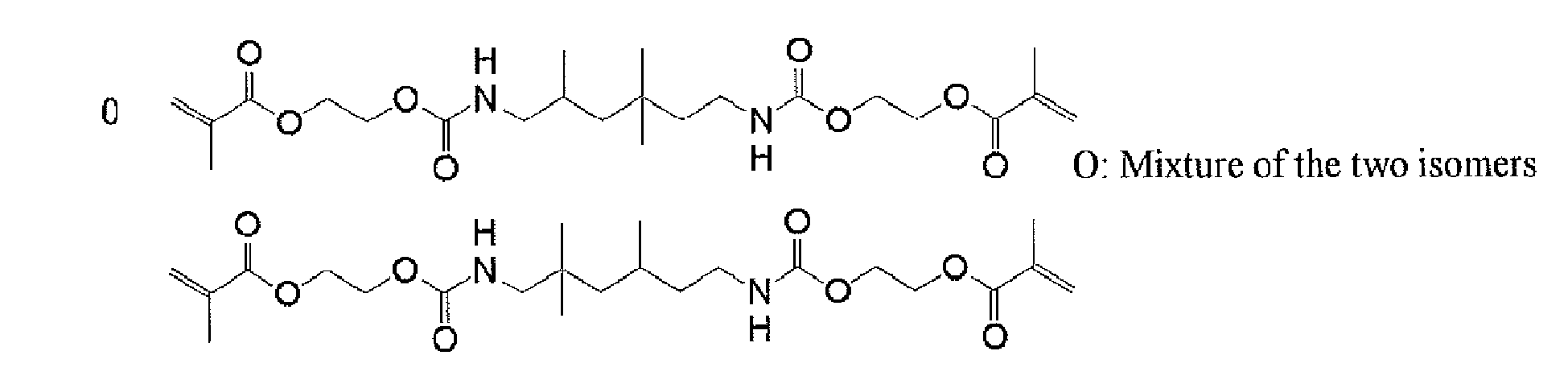


- As is evident from Table 8, it may be seen that the planographic printing plate precursors in Examples 7-1 to 7-15, containing the specific oxime compound of the invention in the photosensitive layer, have high sensitivity and are excellent in temporal stability and printing durability.
On the other hand, the planographic printing plate precursors in Comparative Examples 7-1 to 7-4 were inferior to those of the Examples in all items of sensitivity, temporal stability, and printing durability. - A first object of the invention is to provide a photopolymerizable composition which is highly sensitive to light with a wavelength of 365 nm or 405 nm, is excellent in temporal stability, and may form a cured film capable of preventing film physical properties from deteriorating under heating with time, as well as an oxime compound used preferably in the photopolymerizable composition.
A second object of the invention is to provide a photopolymerizable composition for color filter, which is excellent in temporal stability, is cured with high sensitivity, has excellent pattern formability, forms a colored pattern excellent in adhesiveness to a support, and has a pattern shape excellent in post-heating after development.
A third object of the invention is to provide a color filter manufactured using the photopolymerizable composition for color filter, which has an excellent pattern shape and is excellent in adhesiveness to a support, a production method capable of forming the color filter with high productivity, as well as a solid-state imaging device including the color filter.
Still another object of the invention is to provide a planographic printing plate precursor using the photopolymerizable composition. - According to the invention, there may be provided a photopolymerizable composition which is highly sensitive to light with a wavelength of 365 nm or 405 nm, is excellent in temporal stability, and may form a cured film capable of preventing film physical properties from deteriorating under heating with time, as well as an oxime compound used preferably in the photopolymerizable composition. There may also be provided a photopolymerizable composition for color filter, which is excellent in temporal stability, is cured with high sensitivity, has excellent pattern formability, forms a colored pattern excellent in adhesiveness to a support, and has a pattern shape excellent in post-heating after development. Further, there may be provided a color filter manufactured using the photopolymerizable composition for color filter, which has an excellent pattern shape and is excellent in adhesiveness to a support, a production method capable of forming the color filter with high productivity, as well as a solid-state imaging device including the color filter. Moreover, there may be provided a planographic printing plate precursor using the photopolymerizable composition.
Claims (10)
- A compound represented by the following Formula (1):

- The compound of claim 1, which is represented by the following Formula (2):

- The compound of claim 1 or 2, which is represented by the following Formula (3):

- A photopolymerizable composition comprising (A) the compound of any of claims 1 to 3 and (B) a polymerizable compound.
- The photopolymerizable composition of claim 4, which further comprises (C) a colorant.
- A photopolymerizable composition for color filter, which comprises the photopolymerizable composition of claim 5.
- A color filter having a colored pattern using the photopolymerizable composition for color filter of claim 6 on a support.
- A method for producing a color filter, comprising:applying the photopolymerizable composition for color filter of claim 6 on a support to form a photopolymerizable composition layer,exposing the photopolymerizable composition layer via a mask to light, anddeveloping the photopolymerizable composition layer after exposure to form a colored pattern.
- A solid-state imaging device including the color filter of claim 7.
- A planographic printing plate precursor having a photosensitive layer containing the photopolymerizable composition of claim 4 on a support.
Applications Claiming Priority (1)
| Application Number | Priority Date | Filing Date | Title |
|---|---|---|---|
| JP2008076553A JP5305704B2 (en) | 2008-03-24 | 2008-03-24 | Novel compound, photopolymerizable composition, photopolymerizable composition for color filter, color filter and method for producing the same, solid-state imaging device, and lithographic printing plate precursor |
Publications (1)
| Publication Number | Publication Date |
|---|---|
| EP2105443A1 true EP2105443A1 (en) | 2009-09-30 |
Family
ID=40849136
Family Applications (1)
| Application Number | Title | Priority Date | Filing Date |
|---|---|---|---|
| EP09154902A Withdrawn EP2105443A1 (en) | 2008-03-24 | 2009-03-11 | Oxime derivatives and their use in photopolymerizable compositions for colour filters |
Country Status (2)
| Country | Link |
|---|---|
| EP (1) | EP2105443A1 (en) |
| JP (1) | JP5305704B2 (en) |
Cited By (4)
| Publication number | Priority date | Publication date | Assignee | Title |
|---|---|---|---|---|
| EP2141206A1 (en) * | 2008-06-30 | 2010-01-06 | FUJIFILM Corporation | Novel compound, polymerizable composition, color filter and production method thereof, solid-state imaging device, and planographic printing plate precursor |
| EP2385072A4 (en) * | 2009-01-15 | 2012-10-17 | Fujifilm Corp | Novel compound, polymerizable composition, color filter and process for produciton thereof, solid-state imaging element, and lithographic printing original plate |
| US20150064623A1 (en) * | 2012-03-22 | 2015-03-05 | Adeka Corporation | Novel compound and photosensitive resin composition |
| TWI574947B (en) * | 2011-12-07 | 2017-03-21 | 巴地斯顏料化工廠 | Oxime ester photoinitiators |
Families Citing this family (3)
| Publication number | Priority date | Publication date | Assignee | Title |
|---|---|---|---|---|
| JP5317879B2 (en) * | 2009-07-31 | 2013-10-16 | 富士フイルム株式会社 | NOVEL COMPOUND, POLYMERIZABLE COMPOSITION, COLOR FILTER, COLOR FILTER MANUFACTURING METHOD, SOLID-STATE IMAGING ELEMENT, AND PLATE PRINTING PRINTING PLATE |
| JP5978670B2 (en) * | 2012-03-15 | 2016-08-24 | 住友化学株式会社 | Colored curable resin composition |
| KR102066287B1 (en) * | 2012-06-11 | 2020-01-14 | 스미또모 가가꾸 가부시키가이샤 | Colored photosensitive resin composition |
Citations (138)
| Publication number | Priority date | Publication date | Assignee | Title |
|---|---|---|---|---|
| US3055295A (en) | 1958-11-24 | 1962-09-25 | Oxford Paper Co | Planographic printing plates |
| US3375171A (en) | 1964-10-23 | 1968-03-26 | Asea Ab | Boiling heavy water reactor |
| US3458311A (en) | 1966-06-27 | 1969-07-29 | Du Pont | Photopolymerizable elements with solvent removable protective layers |
| US3458313A (en) | 1966-09-07 | 1969-07-29 | Nasa | High resolution developing of photosensitive resists |
| JPS4420189B1 (en) | 1965-06-03 | 1969-08-30 | ||
| JPS4627481B1 (en) | 1968-03-25 | 1971-08-10 | ||
| US3615480A (en) | 1969-02-24 | 1971-10-26 | Du Pont | Developer solutions for photopolymerized layers |
| JPS4643946B1 (en) | 1967-11-09 | 1971-12-27 | ||
| JPS475125B1 (en) | 1963-05-23 | 1972-02-14 | ||
| US3658662A (en) | 1969-01-21 | 1972-04-25 | Durolith Corp | Corrosion resistant metallic plates particularly useful as support members for photo-lithographic plates and the like |
| JPS4818327B1 (en) | 1969-10-09 | 1973-06-05 | ||
| JPS4841708B1 (en) | 1970-01-13 | 1973-12-07 | ||
| JPS4842965B1 (en) | 1968-04-02 | 1973-12-15 | ||
| US3813396A (en) * | 1971-08-13 | 1974-05-28 | Squibb & Sons Inc | 1,2-dihydroquinobenzoxazepine(piperazinylalkyl)oximes |
| US3838135A (en) * | 1972-10-18 | 1974-09-24 | Usv Pharma Corp | Oximo tetracyclic indoles |
| JPS4943191B1 (en) | 1969-07-11 | 1974-11-19 | ||
| JPS5026601A (en) | 1973-07-09 | 1975-03-19 | ||
| JPS5137193A (en) | 1974-09-25 | 1976-03-29 | Toyo Boseki | |
| JPS5182102A (en) | 1974-12-10 | 1976-07-19 | Basf Ag | Insatsuinki oyobi hifukuzairyonotameno hikarijugokanonaketsugozai |
| JPS5147334B1 (en) | 1970-11-02 | 1976-12-14 | ||
| JPS5230503A (en) | 1975-09-01 | 1977-03-08 | Mitsubishi Chem Ind | Method of making aluminium plate material for lithographic printing |
| JPS5258602A (en) | 1975-11-06 | 1977-05-14 | Nippon Keikinzoku Sougou Kenki | Method of producing aluminium roughened surfaced plate for offset printing |
| JPS5230490B2 (en) | 1972-03-21 | 1977-08-09 | ||
| JPS52134692A (en) | 1976-05-04 | 1977-11-11 | Fuji Photo Film Co Ltd | Photopolymerizable composition |
| JPS53702A (en) | 1975-12-23 | 1978-01-06 | Dynachem Corp | Adhesion promoting agent for polymerized film |
| JPS5463902A (en) | 1977-10-31 | 1979-05-23 | Fuji Photo Film Co Ltd | Method of making offset printing plate |
| JPS5492723A (en) | 1977-12-30 | 1979-07-23 | Somar Mfg | Photosensitive material and use |
| JPS5425957B2 (en) | 1974-10-04 | 1979-08-31 | ||
| JPS5434327B1 (en) | 1970-12-28 | 1979-10-26 | ||
| JPS5549729A (en) | 1978-10-06 | 1980-04-10 | Nec Corp | Data transfer system |
| JPS5534414B2 (en) | 1972-06-02 | 1980-09-06 | ||
| JPS55500806A (en) | 1978-10-19 | 1980-10-16 | ||
| JPS5613168A (en) | 1979-07-16 | 1981-02-09 | Tomoegawa Paper Co Ltd | Lithographic plate making method by laser beam |
| US4255513A (en) | 1978-08-25 | 1981-03-10 | Agfa-Gevaert N.V. | Photopolymerizable recording materials |
| JPS5617654B2 (en) | 1970-12-28 | 1981-04-23 | ||
| JPS5675643A (en) | 1979-11-07 | 1981-06-22 | Hoechst Ag | Photopolymerizable mixture and photopolymerizable copying material using same |
| JPS5639464B2 (en) | 1974-12-26 | 1981-09-12 | ||
| JPS5642860B2 (en) | 1976-10-01 | 1981-10-07 | ||
| JPS577427B2 (en) | 1978-08-08 | 1982-02-10 | ||
| JPS57196231A (en) | 1981-05-20 | 1982-12-02 | Hoechst Ag | Mixture able to be polymerized by radiation and copying material mainly composed thereof |
| JPS5812577B2 (en) | 1973-12-21 | 1983-03-09 | ヘキスト アクチエンゲゼルシヤフト | Photopolymerizable copying material |
| JPS5854341A (en) | 1981-09-28 | 1983-03-31 | Fuji Photo Film Co Ltd | Developing method and developing solution |
| JPS5849860B2 (en) | 1973-12-07 | 1983-11-07 | ヘキスト アクチェンゲゼルシャフト | Kouji Yugosei Fuchsia Yazairiyo |
| JPS595241A (en) | 1982-06-21 | 1984-01-12 | ヘキスト・アクチエンゲゼルシヤフト | Radiation polymerizable mixture |
| JPS595240A (en) | 1982-06-21 | 1984-01-12 | ヘキスト・アクチエンゲゼルシヤフト | Radiation polymerizable mixture |
| JPS5944615A (en) | 1982-09-07 | 1984-03-13 | Furuno Electric Co Ltd | Gyro device |
| JPS5953836A (en) | 1982-09-21 | 1984-03-28 | Fuji Photo Film Co Ltd | Photosensitive lithographic plate |
| JPS5971048A (en) | 1982-10-18 | 1984-04-21 | Mitsubishi Chem Ind Ltd | Photopolymerizable photosensitive composition |
| JPS59138205A (en) | 1983-01-20 | 1984-08-08 | チバ−ガイギ− アクチエンゲゼルシヤフト | Coating composition and curing method |
| JPS6084305A (en) | 1983-08-30 | 1985-05-13 | バスフ アクチェン ゲゼルシャフト | Photopolymerizable mixture |
| JPS6122048A (en) | 1984-06-08 | 1986-01-30 | ヘキスト・アクチエンゲゼルシヤフト | Polymerizable compound, manufacture and radiation sensitive copying layer |
| US4575330A (en) | 1984-08-08 | 1986-03-11 | Uvp, Inc. | Apparatus for production of three-dimensional objects by stereolithography |
| US4590145A (en) | 1985-06-28 | 1986-05-20 | Daicel Chemical Industries, Ltd. | Photopolymerization initiator comprised of thioxanthones and oxime esters |
| JPS6218537A (en) | 1985-07-16 | 1987-01-27 | ザ・ミ−ド・コ−ポレ−シヨン | Image forming material using photosensitive microcapsule containing third amine as coinitiator |
| JPS6239417B2 (en) | 1978-05-20 | 1987-08-22 | Hoechst Ag | |
| JPS6239418B2 (en) | 1978-05-20 | 1987-08-22 | Hoechst Ag | |
| JPS63260909A (en) | 1987-03-28 | 1988-10-27 | ヘキスト・アクチエンゲゼルシヤフト | Photopolymerizable mixture and recording material produced therefrom |
| JPS63277653A (en) | 1987-03-28 | 1988-11-15 | ヘキスト・アクチエンゲゼルシヤフト | Polymerizable compound, radiation polymerizable mixture and radiation polymerizable recording material |
| JPS63287947A (en) | 1987-05-21 | 1988-11-25 | Fuji Photo Film Co Ltd | Photosensitive composition |
| JPS63287944A (en) | 1987-05-21 | 1988-11-25 | Fuji Photo Film Co Ltd | Photosensitive composition |
| JPS6433104A (en) | 1987-06-25 | 1989-02-03 | Ciba Geigy Ag | Photopolymerizable composition |
| US4808501A (en) | 1985-10-15 | 1989-02-28 | Polaroid Corporation, Patent Dept. | Method for manufacturing an optical filter |
| JPS6490403A (en) | 1987-09-30 | 1989-04-06 | Konishiroku Photo Ind | Color mosaic filter |
| JPS6491102A (en) | 1987-10-01 | 1989-04-10 | Konishiroku Photo Ind | Color mosaic filter |
| JPH0194301A (en) | 1987-10-06 | 1989-04-13 | Konica Corp | Color mosaic filter |
| JPH01105238A (en) | 1987-03-28 | 1989-04-21 | Hoechst Ag | Photopolymerizable mixture and photopolymerizable material |
| JPH01165613A (en) | 1987-11-16 | 1989-06-29 | Hoechst Ag | Polymerizable compound, radiation polymerizable mixture thereof and radiation polymerized recording material |
| JPH0140337B2 (en) | 1979-12-29 | 1989-08-28 | Hoechst Ag | |
| JPH0140336B2 (en) | 1979-12-29 | 1989-08-28 | Hoechst Ag | |
| JPH01271741A (en) | 1988-04-25 | 1989-10-30 | Fuji Photo Film Co Ltd | Photosensitive composition |
| JPH0225493A (en) | 1988-05-21 | 1990-01-26 | Hoechst Ag | Alkenylphosphonic ester and alkenylphoshinic ester, production thereof, radiation polymerizable mixture containing the same and recording material |
| JPH0216765B2 (en) | 1980-09-29 | 1990-04-18 | Hoechst Ag | |
| JPH0232293B2 (en) | 1980-12-22 | 1990-07-19 | Hoechst Ag | |
| JPH02226149A (en) | 1988-12-22 | 1990-09-07 | Hoechst Ag | Photopolymerizing compound, photopolymerizing mixture containing the same and photopolymerizing copying material manufactured therefrom |
| US5059500A (en) | 1990-10-10 | 1991-10-22 | Polaroid Corporation | Process for forming a color filter |
| JPH04249549A (en) | 1990-12-28 | 1992-09-04 | Orient Chem Ind Ltd | Colored resin and related technique |
| JPH05142772A (en) | 1991-11-26 | 1993-06-11 | Fuji Photo Film Co Ltd | Photopolymerizable composition |
| JPH05333207A (en) | 1992-05-29 | 1993-12-17 | Nippon Kayaku Co Ltd | Color filter |
| JPH0611614A (en) | 1992-02-19 | 1994-01-21 | Eastman Kodak Co | Manufacture of color filter array having finished coat layer, which can be patternized |
| JPH0635183A (en) | 1992-07-20 | 1994-02-10 | Sumitomo Chem Co Ltd | Positive type resist composition and production of color filter using the same |
| JPH0651115A (en) | 1992-07-31 | 1994-02-25 | Sumitomo Chem Co Ltd | Dyestuff for color filter |
| JPH06191605A (en) | 1992-12-25 | 1994-07-12 | Iyo Tekko Kk | Box type pallet |
| JPH06194828A (en) | 1992-12-24 | 1994-07-15 | Sumitomo Chem Co Ltd | Resist composition for color filter |
| JPH06250387A (en) | 1993-03-01 | 1994-09-09 | Sumitomo Chem Co Ltd | Process for producing quinonediazide sulfonate and radiation-sensitive resin composition containing quinonediazide sulfonate obtained by the process |
| JPH06308727A (en) | 1993-04-19 | 1994-11-04 | Fuji Photo Film Co Ltd | Photopolymerizable composition |
| JPH0712004B2 (en) | 1988-10-19 | 1995-02-08 | 日本電装株式会社 | Bobbin for coil |
| JPH07154983A (en) | 1993-11-29 | 1995-06-16 | Sanyo Electric Co Ltd | Air conditioner |
| EP0678534A1 (en) | 1994-04-22 | 1995-10-25 | BASF Aktiengesellschaft | Gels having thermotropic properties |
| JPH07286107A (en) | 1994-04-20 | 1995-10-31 | Ricoh Co Ltd | Phthalocyanine compound |
| JPH07120041B2 (en) | 1987-05-21 | 1995-12-20 | 富士写真フイルム株式会社 | Photosensitive composition |
| JPH07120040B2 (en) | 1987-05-21 | 1995-12-20 | 富士写真フイルム株式会社 | Photosensitive composition |
| JPH07120042B2 (en) | 1987-05-21 | 1995-12-20 | 富士写真フイルム株式会社 | Photosensitive composition |
| JPH0815522A (en) | 1994-07-04 | 1996-01-19 | Canon Inc | Color filter, manufacturing method thereof, and liquid crystal panel having color filter |
| JPH0829771A (en) | 1994-07-15 | 1996-02-02 | Canon Inc | Color filter, manufacturing method thereof, and liquid crystal panel having color filter |
| JPH0812424B2 (en) | 1987-11-19 | 1996-02-07 | 富士写真フイルム株式会社 | Photosensitive composition |
| JPH0862416A (en) | 1994-08-22 | 1996-03-08 | Sony Corp | Dye for color filter and method for manufacturing color filter |
| JPH0873758A (en) | 1994-09-06 | 1996-03-19 | Nippon Kayaku Co Ltd | Anthraquinone compound and color filter using same |
| JPH08146215A (en) | 1994-09-21 | 1996-06-07 | Canon Inc | Color filter and its manufacturing method, liquid crystal panel, and information processing apparatus |
| JPH08151531A (en) | 1994-09-30 | 1996-06-11 | Nippon Shokubai Co Ltd | Quinizarin derivative compound, its production and use |
| JPH08179120A (en) | 1994-12-20 | 1996-07-12 | Nippon Kayaku Co Ltd | Pigment for color filter and color resist and color filter containing the pigment |
| JPH08211599A (en) | 1995-02-07 | 1996-08-20 | Hitachi Chem Co Ltd | Production of colored photosensitive resin composition, color image forming material and color filter, and color filter |
| JPH08507727A (en) | 1993-02-09 | 1996-08-20 | アグフア−ゲヴエルト・ナームローゼ・フエンノートシヤツプ | Heat mode recording material and method for producing lithographic printing plate using the same |
| JPH08302224A (en) | 1995-04-28 | 1996-11-19 | Yamamoto Chem Inc | Phthalocyanine compound, its intermediate, method for producing the phthalocyanine compound, color filter using the phthalocyanine compound and oil ink composition |
| JPH0980744A (en) | 1995-09-12 | 1997-03-28 | Toray Ind Inc | Photosensitive lithographic printing plate precursor |
| DE19700064A1 (en) | 1996-01-13 | 1997-07-17 | Basf Ag | Gel for thermotropic layers e.g. for energy-saving glazing |
| US5667920A (en) | 1996-03-11 | 1997-09-16 | Polaroid Corporation | Process for preparing a color filter |
| JPH10116232A (en) | 1996-10-09 | 1998-05-06 | Niigata Seimitsu Kk | Memory system |
| JPH10123316A (en) | 1996-10-16 | 1998-05-15 | Nippon Kayaku Co Ltd | Color filter and optical device |
| JPH11171907A (en) | 1997-12-15 | 1999-06-29 | Fuji Photo Film Co Ltd | Photopolymerizable composition |
| JPH11302283A (en) | 1998-04-17 | 1999-11-02 | Canon Inc | Phthalocyanine compound, ink, color filter, liquid crystal panel, computer, and method of manufacturing color filter |
| JPH11343437A (en) | 1998-03-31 | 1999-12-14 | Canon Inc | Ink, color filter, liquid crystal panel, computer, and method of manufacturing color filter |
| JP2000080068A (en) | 1998-06-26 | 2000-03-21 | Ciba Specialty Chem Holding Inc | New O-acyl oxime photoinitiator |
| EP0993966A1 (en) | 1998-10-13 | 2000-04-19 | Agfa-Gevaert AG | Negativ-working radiation-sensitive mixture for the production of a recording material which is imageable by heat or infrared laser beams |
| WO2000033834A1 (en) * | 1998-12-04 | 2000-06-15 | Neurosearch A/S | Use of isatin derivatives as ion channel activating agents |
| JP2000187322A (en) | 1998-10-15 | 2000-07-04 | Mitsubishi Chemicals Corp | Photosensitive composition, image forming material and image forming method using the same |
| JP2001004823A (en) | 1999-06-21 | 2001-01-12 | Nippon Kayaku Co Ltd | Color filter |
| JP2001115595A (en) | 1999-10-15 | 2001-04-24 | Tagawa Tadahiro | Light-emitting block |
| JP2001115598A (en) | 1999-10-14 | 2001-04-24 | Misawa Homes Co Ltd | Lattice panel |
| JP2001233842A (en) | 1999-12-15 | 2001-08-28 | Ciba Specialty Chem Holding Inc | Oxime ester photoinitiator |
| JP2001242612A (en) | 2000-03-01 | 2001-09-07 | Fuji Photo Film Co Ltd | Image recording material |
| JP2001318463A (en) | 2000-05-11 | 2001-11-16 | Fuji Photo Film Co Ltd | Negative type original plate of planographic printing plate |
| JP2002014221A (en) | 2000-06-30 | 2002-01-18 | Sumitomo Chem Co Ltd | Color filter array having green filter layer and method of manufacturing the same |
| JP2002014223A (en) | 2000-06-30 | 2002-01-18 | Sumitomo Chem Co Ltd | Color filter array having yellow filter layer and method of manufacturing the same |
| JP2002014220A (en) | 2000-06-30 | 2002-01-18 | Sumitomo Chem Co Ltd | Color filter array having red filter layer and method of manufacturing the same |
| JP2002014222A (en) | 2000-06-30 | 2002-01-18 | Sumitomo Chem Co Ltd | Color filter array having blue filter layer and method of manufacturing the same |
| JP2002062698A (en) | 2000-08-21 | 2002-02-28 | Kyocera Corp | Image forming machine |
| JP2002107918A (en) | 2000-10-03 | 2002-04-10 | Fuji Photo Film Co Ltd | Photosensitive planographic printing plate |
| EP1204000A1 (en) | 2000-11-06 | 2002-05-08 | Fuji Photo Film Co., Ltd. | Photosensitive lithographic printing plate |
| JP2002202616A (en) | 2000-07-14 | 2002-07-19 | Fuji Photo Film Co Ltd | Developing solution for photosensitive planographic printing plate, method for producing printing plate and photosensitive planographic printing plate |
| JP2005070767A (en) * | 2003-08-04 | 2005-03-17 | Fuji Photo Film Co Ltd | Photosensitive transfer sheet |
| JP2005202252A (en) | 2004-01-16 | 2005-07-28 | Dainippon Printing Co Ltd | Photosensitive coloring composition for solid-state image sensor color filter, solid-state image sensor color filter, solid-state image sensor, and solid-state image sensor color filter manufacturing method |
| EP1582520A1 (en) * | 2002-11-12 | 2005-10-05 | Mochida Pharmaceutical Co., Ltd. | Novel parp inhibitors |
| WO2006018405A1 (en) * | 2004-08-18 | 2006-02-23 | Ciba Specialty Chemicals Holding Inc. | Oxime ester photoinitiators |
| JP2006078749A (en) | 2004-09-09 | 2006-03-23 | Fuji Photo Film Co Ltd | Photosensitive composition and planographic original printing plate |
| US20060128689A1 (en) * | 2004-11-24 | 2006-06-15 | Arthur Gomtsyan | Chromanylurea compounds that inhibit vanilloid receptor subtype 1 (VR1) receptor and uses thereof |
| JP2006342166A (en) | 2001-06-11 | 2006-12-21 | Ciba Specialty Chem Holding Inc | Photoinitiators of oxime esters with combined structures |
| WO2007062963A1 (en) * | 2005-12-01 | 2007-06-07 | Ciba Holding Inc. | Oxime ester photoinitiators |
| JP2007231000A (en) | 2006-02-01 | 2007-09-13 | Fujifilm Corp | Oxime compound and photosensitive composition containing the same |
Family Cites Families (8)
| Publication number | Priority date | Publication date | Assignee | Title |
|---|---|---|---|---|
| JPS5728052A (en) * | 1980-07-28 | 1982-02-15 | Hodogaya Chem Co Ltd | Novel 4-hydroxyimino-1,2,3,4-tetrahydroquinoline derivative |
| JP2602037B2 (en) * | 1987-10-31 | 1997-04-23 | 持田製薬株式会社 | 1-acyl-2,3-dihydro-4 (1H) -quinolinone-4-oxime derivatives, process for preparing the same, and pharmaceutical compositions containing diuretic, antihypertensive, anti-edema and ascites removal based on them |
| TW304945B (en) * | 1992-06-27 | 1997-05-11 | Hoechst Ag | |
| GB9307527D0 (en) * | 1993-04-13 | 1993-06-02 | Fujisawa Pharmaceutical Co | New venzamide derivatives,processes for the preparation thereof and pharmaceutical composition comprising the same |
| FI972194A7 (en) * | 1994-11-24 | 1997-05-22 | Basilea Pharmaceutica Ag | New benzylpyrimidines |
| JP2004064039A (en) * | 2002-06-07 | 2004-02-26 | Fuji Photo Film Co Ltd | Pattern forming method and pattern forming apparatus |
| TW200528440A (en) * | 2003-10-31 | 2005-09-01 | Fujisawa Pharmaceutical Co | 2-cyanopyrrolidinecarboxamide compound |
| GT200500321A (en) * | 2004-11-09 | 2006-09-04 | COMPOUNDS AND COMPOSITIONS AS INHIBITORS OF PROTEIN KINASE. |
-
2008
- 2008-03-24 JP JP2008076553A patent/JP5305704B2/en active Active
-
2009
- 2009-03-11 EP EP09154902A patent/EP2105443A1/en not_active Withdrawn
Patent Citations (140)
| Publication number | Priority date | Publication date | Assignee | Title |
|---|---|---|---|---|
| US3055295A (en) | 1958-11-24 | 1962-09-25 | Oxford Paper Co | Planographic printing plates |
| JPS475125B1 (en) | 1963-05-23 | 1972-02-14 | ||
| US3375171A (en) | 1964-10-23 | 1968-03-26 | Asea Ab | Boiling heavy water reactor |
| JPS4420189B1 (en) | 1965-06-03 | 1969-08-30 | ||
| US3458311A (en) | 1966-06-27 | 1969-07-29 | Du Pont | Photopolymerizable elements with solvent removable protective layers |
| US3458313A (en) | 1966-09-07 | 1969-07-29 | Nasa | High resolution developing of photosensitive resists |
| JPS4643946B1 (en) | 1967-11-09 | 1971-12-27 | ||
| JPS4627481B1 (en) | 1968-03-25 | 1971-08-10 | ||
| JPS4842965B1 (en) | 1968-04-02 | 1973-12-15 | ||
| US3658662A (en) | 1969-01-21 | 1972-04-25 | Durolith Corp | Corrosion resistant metallic plates particularly useful as support members for photo-lithographic plates and the like |
| US3615480A (en) | 1969-02-24 | 1971-10-26 | Du Pont | Developer solutions for photopolymerized layers |
| JPS4943191B1 (en) | 1969-07-11 | 1974-11-19 | ||
| JPS4818327B1 (en) | 1969-10-09 | 1973-06-05 | ||
| JPS4841708B1 (en) | 1970-01-13 | 1973-12-07 | ||
| JPS5147334B1 (en) | 1970-11-02 | 1976-12-14 | ||
| JPS5617654B2 (en) | 1970-12-28 | 1981-04-23 | ||
| JPS5434327B1 (en) | 1970-12-28 | 1979-10-26 | ||
| US3813396A (en) * | 1971-08-13 | 1974-05-28 | Squibb & Sons Inc | 1,2-dihydroquinobenzoxazepine(piperazinylalkyl)oximes |
| JPS5230490B2 (en) | 1972-03-21 | 1977-08-09 | ||
| JPS5534414B2 (en) | 1972-06-02 | 1980-09-06 | ||
| US3838135A (en) * | 1972-10-18 | 1974-09-24 | Usv Pharma Corp | Oximo tetracyclic indoles |
| JPS5026601A (en) | 1973-07-09 | 1975-03-19 | ||
| JPS5849860B2 (en) | 1973-12-07 | 1983-11-07 | ヘキスト アクチェンゲゼルシャフト | Kouji Yugosei Fuchsia Yazairiyo |
| JPS5812577B2 (en) | 1973-12-21 | 1983-03-09 | ヘキスト アクチエンゲゼルシヤフト | Photopolymerizable copying material |
| JPS5137193A (en) | 1974-09-25 | 1976-03-29 | Toyo Boseki | |
| JPS5425957B2 (en) | 1974-10-04 | 1979-08-31 | ||
| JPS5182102A (en) | 1974-12-10 | 1976-07-19 | Basf Ag | Insatsuinki oyobi hifukuzairyonotameno hikarijugokanonaketsugozai |
| JPS5639464B2 (en) | 1974-12-26 | 1981-09-12 | ||
| JPS5230503A (en) | 1975-09-01 | 1977-03-08 | Mitsubishi Chem Ind | Method of making aluminium plate material for lithographic printing |
| JPS5258602A (en) | 1975-11-06 | 1977-05-14 | Nippon Keikinzoku Sougou Kenki | Method of producing aluminium roughened surfaced plate for offset printing |
| JPS53702A (en) | 1975-12-23 | 1978-01-06 | Dynachem Corp | Adhesion promoting agent for polymerized film |
| JPS52134692A (en) | 1976-05-04 | 1977-11-11 | Fuji Photo Film Co Ltd | Photopolymerizable composition |
| JPS5642860B2 (en) | 1976-10-01 | 1981-10-07 | ||
| JPS5463902A (en) | 1977-10-31 | 1979-05-23 | Fuji Photo Film Co Ltd | Method of making offset printing plate |
| JPS5492723A (en) | 1977-12-30 | 1979-07-23 | Somar Mfg | Photosensitive material and use |
| JPS6239418B2 (en) | 1978-05-20 | 1987-08-22 | Hoechst Ag | |
| JPS6239417B2 (en) | 1978-05-20 | 1987-08-22 | Hoechst Ag | |
| JPS577427B2 (en) | 1978-08-08 | 1982-02-10 | ||
| US4255513A (en) | 1978-08-25 | 1981-03-10 | Agfa-Gevaert N.V. | Photopolymerizable recording materials |
| JPS5549729A (en) | 1978-10-06 | 1980-04-10 | Nec Corp | Data transfer system |
| JPS55500806A (en) | 1978-10-19 | 1980-10-16 | ||
| JPS5613168A (en) | 1979-07-16 | 1981-02-09 | Tomoegawa Paper Co Ltd | Lithographic plate making method by laser beam |
| JPS5675643A (en) | 1979-11-07 | 1981-06-22 | Hoechst Ag | Photopolymerizable mixture and photopolymerizable copying material using same |
| JPH0140336B2 (en) | 1979-12-29 | 1989-08-28 | Hoechst Ag | |
| JPH0140337B2 (en) | 1979-12-29 | 1989-08-28 | Hoechst Ag | |
| JPH0216765B2 (en) | 1980-09-29 | 1990-04-18 | Hoechst Ag | |
| JPH0232293B2 (en) | 1980-12-22 | 1990-07-19 | Hoechst Ag | |
| JPS57196231A (en) | 1981-05-20 | 1982-12-02 | Hoechst Ag | Mixture able to be polymerized by radiation and copying material mainly composed thereof |
| JPS5854341A (en) | 1981-09-28 | 1983-03-31 | Fuji Photo Film Co Ltd | Developing method and developing solution |
| JPS595240A (en) | 1982-06-21 | 1984-01-12 | ヘキスト・アクチエンゲゼルシヤフト | Radiation polymerizable mixture |
| JPS595241A (en) | 1982-06-21 | 1984-01-12 | ヘキスト・アクチエンゲゼルシヤフト | Radiation polymerizable mixture |
| JPS5944615A (en) | 1982-09-07 | 1984-03-13 | Furuno Electric Co Ltd | Gyro device |
| JPS5953836A (en) | 1982-09-21 | 1984-03-28 | Fuji Photo Film Co Ltd | Photosensitive lithographic plate |
| JPS5971048A (en) | 1982-10-18 | 1984-04-21 | Mitsubishi Chem Ind Ltd | Photopolymerizable photosensitive composition |
| JPS59138205A (en) | 1983-01-20 | 1984-08-08 | チバ−ガイギ− アクチエンゲゼルシヤフト | Coating composition and curing method |
| JPS6084305A (en) | 1983-08-30 | 1985-05-13 | バスフ アクチェン ゲゼルシャフト | Photopolymerizable mixture |
| JPS6122048A (en) | 1984-06-08 | 1986-01-30 | ヘキスト・アクチエンゲゼルシヤフト | Polymerizable compound, manufacture and radiation sensitive copying layer |
| US4575330A (en) | 1984-08-08 | 1986-03-11 | Uvp, Inc. | Apparatus for production of three-dimensional objects by stereolithography |
| US4575330B1 (en) | 1984-08-08 | 1989-12-19 | ||
| US4590145A (en) | 1985-06-28 | 1986-05-20 | Daicel Chemical Industries, Ltd. | Photopolymerization initiator comprised of thioxanthones and oxime esters |
| JPS6218537A (en) | 1985-07-16 | 1987-01-27 | ザ・ミ−ド・コ−ポレ−シヨン | Image forming material using photosensitive microcapsule containing third amine as coinitiator |
| US4808501A (en) | 1985-10-15 | 1989-02-28 | Polaroid Corporation, Patent Dept. | Method for manufacturing an optical filter |
| JPS63260909A (en) | 1987-03-28 | 1988-10-27 | ヘキスト・アクチエンゲゼルシヤフト | Photopolymerizable mixture and recording material produced therefrom |
| JPH01105238A (en) | 1987-03-28 | 1989-04-21 | Hoechst Ag | Photopolymerizable mixture and photopolymerizable material |
| JPS63277653A (en) | 1987-03-28 | 1988-11-15 | ヘキスト・アクチエンゲゼルシヤフト | Polymerizable compound, radiation polymerizable mixture and radiation polymerizable recording material |
| JPS63287944A (en) | 1987-05-21 | 1988-11-25 | Fuji Photo Film Co Ltd | Photosensitive composition |
| JPS63287947A (en) | 1987-05-21 | 1988-11-25 | Fuji Photo Film Co Ltd | Photosensitive composition |
| JPH07120041B2 (en) | 1987-05-21 | 1995-12-20 | 富士写真フイルム株式会社 | Photosensitive composition |
| JPH07120042B2 (en) | 1987-05-21 | 1995-12-20 | 富士写真フイルム株式会社 | Photosensitive composition |
| JPH07120040B2 (en) | 1987-05-21 | 1995-12-20 | 富士写真フイルム株式会社 | Photosensitive composition |
| JPS6433104A (en) | 1987-06-25 | 1989-02-03 | Ciba Geigy Ag | Photopolymerizable composition |
| JPS6490403A (en) | 1987-09-30 | 1989-04-06 | Konishiroku Photo Ind | Color mosaic filter |
| JPS6491102A (en) | 1987-10-01 | 1989-04-10 | Konishiroku Photo Ind | Color mosaic filter |
| JPH0194301A (en) | 1987-10-06 | 1989-04-13 | Konica Corp | Color mosaic filter |
| JPH01165613A (en) | 1987-11-16 | 1989-06-29 | Hoechst Ag | Polymerizable compound, radiation polymerizable mixture thereof and radiation polymerized recording material |
| JPH0812424B2 (en) | 1987-11-19 | 1996-02-07 | 富士写真フイルム株式会社 | Photosensitive composition |
| JPH01271741A (en) | 1988-04-25 | 1989-10-30 | Fuji Photo Film Co Ltd | Photosensitive composition |
| JPH0225493A (en) | 1988-05-21 | 1990-01-26 | Hoechst Ag | Alkenylphosphonic ester and alkenylphoshinic ester, production thereof, radiation polymerizable mixture containing the same and recording material |
| JPH0712004B2 (en) | 1988-10-19 | 1995-02-08 | 日本電装株式会社 | Bobbin for coil |
| JPH02226149A (en) | 1988-12-22 | 1990-09-07 | Hoechst Ag | Photopolymerizing compound, photopolymerizing mixture containing the same and photopolymerizing copying material manufactured therefrom |
| US5059500A (en) | 1990-10-10 | 1991-10-22 | Polaroid Corporation | Process for forming a color filter |
| JPH04249549A (en) | 1990-12-28 | 1992-09-04 | Orient Chem Ind Ltd | Colored resin and related technique |
| JPH05142772A (en) | 1991-11-26 | 1993-06-11 | Fuji Photo Film Co Ltd | Photopolymerizable composition |
| JPH0611614A (en) | 1992-02-19 | 1994-01-21 | Eastman Kodak Co | Manufacture of color filter array having finished coat layer, which can be patternized |
| JP2592207B2 (en) | 1992-02-19 | 1997-03-19 | イーストマン コダック カンパニー | Method for producing color filter array element having patternable overcoat layer |
| JPH05333207A (en) | 1992-05-29 | 1993-12-17 | Nippon Kayaku Co Ltd | Color filter |
| JPH0635183A (en) | 1992-07-20 | 1994-02-10 | Sumitomo Chem Co Ltd | Positive type resist composition and production of color filter using the same |
| JPH0651115A (en) | 1992-07-31 | 1994-02-25 | Sumitomo Chem Co Ltd | Dyestuff for color filter |
| JPH06194828A (en) | 1992-12-24 | 1994-07-15 | Sumitomo Chem Co Ltd | Resist composition for color filter |
| JPH06191605A (en) | 1992-12-25 | 1994-07-12 | Iyo Tekko Kk | Box type pallet |
| JPH08507727A (en) | 1993-02-09 | 1996-08-20 | アグフア−ゲヴエルト・ナームローゼ・フエンノートシヤツプ | Heat mode recording material and method for producing lithographic printing plate using the same |
| JPH06250387A (en) | 1993-03-01 | 1994-09-09 | Sumitomo Chem Co Ltd | Process for producing quinonediazide sulfonate and radiation-sensitive resin composition containing quinonediazide sulfonate obtained by the process |
| JPH06308727A (en) | 1993-04-19 | 1994-11-04 | Fuji Photo Film Co Ltd | Photopolymerizable composition |
| JPH07154983A (en) | 1993-11-29 | 1995-06-16 | Sanyo Electric Co Ltd | Air conditioner |
| JPH07286107A (en) | 1994-04-20 | 1995-10-31 | Ricoh Co Ltd | Phthalocyanine compound |
| EP0678534A1 (en) | 1994-04-22 | 1995-10-25 | BASF Aktiengesellschaft | Gels having thermotropic properties |
| JPH0815522A (en) | 1994-07-04 | 1996-01-19 | Canon Inc | Color filter, manufacturing method thereof, and liquid crystal panel having color filter |
| JPH0829771A (en) | 1994-07-15 | 1996-02-02 | Canon Inc | Color filter, manufacturing method thereof, and liquid crystal panel having color filter |
| JPH0862416A (en) | 1994-08-22 | 1996-03-08 | Sony Corp | Dye for color filter and method for manufacturing color filter |
| JPH0873758A (en) | 1994-09-06 | 1996-03-19 | Nippon Kayaku Co Ltd | Anthraquinone compound and color filter using same |
| JPH08146215A (en) | 1994-09-21 | 1996-06-07 | Canon Inc | Color filter and its manufacturing method, liquid crystal panel, and information processing apparatus |
| JPH08151531A (en) | 1994-09-30 | 1996-06-11 | Nippon Shokubai Co Ltd | Quinizarin derivative compound, its production and use |
| JPH08179120A (en) | 1994-12-20 | 1996-07-12 | Nippon Kayaku Co Ltd | Pigment for color filter and color resist and color filter containing the pigment |
| JPH08211599A (en) | 1995-02-07 | 1996-08-20 | Hitachi Chem Co Ltd | Production of colored photosensitive resin composition, color image forming material and color filter, and color filter |
| JPH08302224A (en) | 1995-04-28 | 1996-11-19 | Yamamoto Chem Inc | Phthalocyanine compound, its intermediate, method for producing the phthalocyanine compound, color filter using the phthalocyanine compound and oil ink composition |
| JPH0980744A (en) | 1995-09-12 | 1997-03-28 | Toray Ind Inc | Photosensitive lithographic printing plate precursor |
| DE19700064A1 (en) | 1996-01-13 | 1997-07-17 | Basf Ag | Gel for thermotropic layers e.g. for energy-saving glazing |
| US5667920A (en) | 1996-03-11 | 1997-09-16 | Polaroid Corporation | Process for preparing a color filter |
| JPH10116232A (en) | 1996-10-09 | 1998-05-06 | Niigata Seimitsu Kk | Memory system |
| JPH10123316A (en) | 1996-10-16 | 1998-05-15 | Nippon Kayaku Co Ltd | Color filter and optical device |
| JPH11171907A (en) | 1997-12-15 | 1999-06-29 | Fuji Photo Film Co Ltd | Photopolymerizable composition |
| JPH11343437A (en) | 1998-03-31 | 1999-12-14 | Canon Inc | Ink, color filter, liquid crystal panel, computer, and method of manufacturing color filter |
| JPH11302283A (en) | 1998-04-17 | 1999-11-02 | Canon Inc | Phthalocyanine compound, ink, color filter, liquid crystal panel, computer, and method of manufacturing color filter |
| JP2000080068A (en) | 1998-06-26 | 2000-03-21 | Ciba Specialty Chem Holding Inc | New O-acyl oxime photoinitiator |
| EP0993966A1 (en) | 1998-10-13 | 2000-04-19 | Agfa-Gevaert AG | Negativ-working radiation-sensitive mixture for the production of a recording material which is imageable by heat or infrared laser beams |
| JP2000187322A (en) | 1998-10-15 | 2000-07-04 | Mitsubishi Chemicals Corp | Photosensitive composition, image forming material and image forming method using the same |
| WO2000033834A1 (en) * | 1998-12-04 | 2000-06-15 | Neurosearch A/S | Use of isatin derivatives as ion channel activating agents |
| JP2001004823A (en) | 1999-06-21 | 2001-01-12 | Nippon Kayaku Co Ltd | Color filter |
| JP2001115598A (en) | 1999-10-14 | 2001-04-24 | Misawa Homes Co Ltd | Lattice panel |
| JP2001115595A (en) | 1999-10-15 | 2001-04-24 | Tagawa Tadahiro | Light-emitting block |
| JP2001233842A (en) | 1999-12-15 | 2001-08-28 | Ciba Specialty Chem Holding Inc | Oxime ester photoinitiator |
| JP2001242612A (en) | 2000-03-01 | 2001-09-07 | Fuji Photo Film Co Ltd | Image recording material |
| JP2001318463A (en) | 2000-05-11 | 2001-11-16 | Fuji Photo Film Co Ltd | Negative type original plate of planographic printing plate |
| JP2002014223A (en) | 2000-06-30 | 2002-01-18 | Sumitomo Chem Co Ltd | Color filter array having yellow filter layer and method of manufacturing the same |
| JP2002014220A (en) | 2000-06-30 | 2002-01-18 | Sumitomo Chem Co Ltd | Color filter array having red filter layer and method of manufacturing the same |
| JP2002014222A (en) | 2000-06-30 | 2002-01-18 | Sumitomo Chem Co Ltd | Color filter array having blue filter layer and method of manufacturing the same |
| JP2002014221A (en) | 2000-06-30 | 2002-01-18 | Sumitomo Chem Co Ltd | Color filter array having green filter layer and method of manufacturing the same |
| JP2002202616A (en) | 2000-07-14 | 2002-07-19 | Fuji Photo Film Co Ltd | Developing solution for photosensitive planographic printing plate, method for producing printing plate and photosensitive planographic printing plate |
| JP2002062698A (en) | 2000-08-21 | 2002-02-28 | Kyocera Corp | Image forming machine |
| JP2002107918A (en) | 2000-10-03 | 2002-04-10 | Fuji Photo Film Co Ltd | Photosensitive planographic printing plate |
| EP1204000A1 (en) | 2000-11-06 | 2002-05-08 | Fuji Photo Film Co., Ltd. | Photosensitive lithographic printing plate |
| JP2006342166A (en) | 2001-06-11 | 2006-12-21 | Ciba Specialty Chem Holding Inc | Photoinitiators of oxime esters with combined structures |
| EP1582520A1 (en) * | 2002-11-12 | 2005-10-05 | Mochida Pharmaceutical Co., Ltd. | Novel parp inhibitors |
| JP2005070767A (en) * | 2003-08-04 | 2005-03-17 | Fuji Photo Film Co Ltd | Photosensitive transfer sheet |
| JP2005202252A (en) | 2004-01-16 | 2005-07-28 | Dainippon Printing Co Ltd | Photosensitive coloring composition for solid-state image sensor color filter, solid-state image sensor color filter, solid-state image sensor, and solid-state image sensor color filter manufacturing method |
| WO2006018405A1 (en) * | 2004-08-18 | 2006-02-23 | Ciba Specialty Chemicals Holding Inc. | Oxime ester photoinitiators |
| JP2006078749A (en) | 2004-09-09 | 2006-03-23 | Fuji Photo Film Co Ltd | Photosensitive composition and planographic original printing plate |
| US20060128689A1 (en) * | 2004-11-24 | 2006-06-15 | Arthur Gomtsyan | Chromanylurea compounds that inhibit vanilloid receptor subtype 1 (VR1) receptor and uses thereof |
| WO2007062963A1 (en) * | 2005-12-01 | 2007-06-07 | Ciba Holding Inc. | Oxime ester photoinitiators |
| JP2007231000A (en) | 2006-02-01 | 2007-09-13 | Fujifilm Corp | Oxime compound and photosensitive composition containing the same |
Non-Patent Citations (23)
| Title |
|---|
| A. K. GHOSE ET AL., J. COMPUT. CHEM., vol. 9, 1988, pages 80 |
| A. P. STANKEVECIUS ET AL.: "Synthesis of 3-aryl(hetaryl)-4-(2-cyanophenyl)-1,2,4-triazolin-5-ones", CHEMISTRY OF HETEROCYCLIC COMPOUNDS, vol. 39, no. 11, 2003, Plenum Publishing Corporation, pages 1525 - 1526, XP002537907 * |
| ANGEWANDTE CHEMIE, INTERNATIONAL EDITION, vol. 46, no. 33, 2007, pages 6325 - 6328 * |
| C. HANSCH; A. LEO: "Substituent Constants for Correlation Analysis in Chemistry and Biology", 1979, J. WILE & SONS |
| CHEMICAL AND PHARMACEUTICAL BULLETIN., vol. 17, no. 7, 1969, JPPHARMACEUTICAL SOCIETY OF JAPAN. TOKYO., pages 1346 - 1350 * |
| DATABASE BEILSTEIN BEILSTEIN INSTITUTE FOR ORGANIC CHEMISTRY, FRANKFURT-MAIN, DE; XP002537909 * |
| DATABASE BEILSTEIN BEILSTEIN INSTITUTE FOR ORGANIC CHEMISTRY, FRANKFURT-MAIN, DE; XP002537910 * |
| DATABASE BEILSTEIN BEILSTEIN INSTITUTE FOR ORGANIC CHEMISTRY, FRANKFURT-MAIN, DE; XP002537911 * |
| DATABASE BEILSTEIN BEILSTEIN INSTITUTE FOR ORGANIC CHEMISTRY, FRANKFURT-MAIN, DE; XP002537912 * |
| DATABASE BEILSTEIN BEILSTEIN INSTITUTE FOR ORGANIC CHEMISTRY, FRANKFURT-MAIN, DE; XP002537913 * |
| DATABASE BEILSTEIN BEILSTEIN INSTITUTE FOR ORGANIC CHEMISTRY, FRANKFURT-MAIN, DE; XP002537914 * |
| FARMACO., vol. 28, 1973, ITSOCIETA CHIMICA ITALIANA, PAVIA., pages 157 - 158 * |
| GERALD N. EVENSON ETAL.: "O-carbamoyl oximes as potential analgesics", JOURNAL OF HETEROCYCLIC CHEMISTRY, vol. 17, March 1980 (1980-03-01), USPROVO, UT, pages 351 - 352, XP002537904 * |
| HIROAKI OHNO ET AL.: "Heck-type cyclization of oxime ethers:", ANGEWANDTE CHEMIE. INTERNATIONAL EDITION., vol. 46, no. 33, 2007, DEVCH VERLAG, WEINHEIM., pages 6325 - 6328, XP002537908 * |
| J. APPL. CHEM., vol. 34, 1961, pages 2203 - 2207 |
| JOURNAL OF THE ADHESION SOCIETY OF JAPAN, vol. 20, no. 7, 1984, pages 300 - 308 |
| JOURNAL OF THE CHEMICAL SOCIETY, 1952, pages 3046 - 3049 * |
| M. R. SANDER ET AL., JOURNAL OF POLYMER SOCIETY, vol. 10, 1972, pages 3173 |
| MONATSHEFTE FUR CHEMIE., 1913, ATSPRINGER VERLAG. WIEN., pages 1743 * |
| NISHIJIMA K ET AL: "Synthesis and diuretic activity of 4,5-dihydro-6H-imidazo[4,5,1-ij]qu inoline-6-one 6-oxime-O-sulfonic acid derivatives", EUROPEAN JOURNAL OF MEDICINAL CHEMISTRY, EDITIONS SCIENTIFIQUE ELSEVIER, PARIS, FR, vol. 33, no. 10, 1 October 1998 (1998-10-01), pages 763 - 774, XP004160038, ISSN: 0223-5234 * |
| NISHIJIMA K ET AL: "Synthesis and diuretic...", EUROPEAN JOURNAL OF MEDICINAL CHEMISTRY, EDITIONS SCIENTIFIQUE ELSEVIER, PARIS, FR, vol. 33, 1 October 1998 (1998-10-01), EDITIONS SCIENTIFIQUE ELSEVIER, PARIS, FR, pages 267 - 277, XP002537906, ISSN: 0223-5234 * |
| P. CATSOULACOS ET AL.: "On the synthesis of 3-amino-2,3-dihydro-1H-pyrido(3,2,1-kl)- phenothiazine 5,5-dioxide and....", JOURNAL OF HETEROCYCLIC CHEMISTRY., vol. 28, 1991, USHETERO CORP., TAMPA, FL., pages 1437 - 1440, XP002537905 * |
| PHOSPHORUS, SULFUR AND SILICON AND THE RELATED ELEMENTS, vol. 166, 2000, pages 303 - 314 * |
Cited By (6)
| Publication number | Priority date | Publication date | Assignee | Title |
|---|---|---|---|---|
| EP2141206A1 (en) * | 2008-06-30 | 2010-01-06 | FUJIFILM Corporation | Novel compound, polymerizable composition, color filter and production method thereof, solid-state imaging device, and planographic printing plate precursor |
| EP2385072A4 (en) * | 2009-01-15 | 2012-10-17 | Fujifilm Corp | Novel compound, polymerizable composition, color filter and process for produciton thereof, solid-state imaging element, and lithographic printing original plate |
| US8846277B2 (en) | 2009-01-15 | 2014-09-30 | Fujifilm Corporation | Compound, polymerizable composition, color filter, and method of producing the same, solid-state imaging device, and planographic printing plate precursor |
| TWI574947B (en) * | 2011-12-07 | 2017-03-21 | 巴地斯顏料化工廠 | Oxime ester photoinitiators |
| US20150064623A1 (en) * | 2012-03-22 | 2015-03-05 | Adeka Corporation | Novel compound and photosensitive resin composition |
| US9594302B2 (en) * | 2012-03-22 | 2017-03-14 | Adeka Corporation | Compound and photosensitive resin composition |
Also Published As
| Publication number | Publication date |
|---|---|
| JP5305704B2 (en) | 2013-10-02 |
| JP2009227624A (en) | 2009-10-08 |
Similar Documents
| Publication | Publication Date | Title |
|---|---|---|
| EP2141206B1 (en) | Novel compound, polymerizable composition, color filter and production method thereof, solid-state imaging device, and planographic printing plate precursor | |
| EP2037323B1 (en) | Photosensitive compositions | |
| JP5646697B2 (en) | Photopolymerizable composition, photopolymerizable composition for color filter, color filter, method for producing the same, solid-state imaging device, and planographic printing plate precursor | |
| CN101349865B (en) | Photosensitive composition, curable composition, color filter and method for producing color filter | |
| US8846277B2 (en) | Compound, polymerizable composition, color filter, and method of producing the same, solid-state imaging device, and planographic printing plate precursor | |
| EP2055746B1 (en) | Colored curable composition, color filter, method of producing the same, and solid state image pickup device. | |
| EP2103966B1 (en) | Solid-state image sensor | |
| JP2009221334A (en) | Photopolymerization initiator, polymerizable composition, polymerizable composition for color filter, color filter, method for producing it, and, solid-state imaging device | |
| EP2479613A1 (en) | Photopolymerizable composition, color filter, method for producing same, solid-state image pickup element, liquid crystal display device, lithographic printing original plate, and novel compound | |
| JP5305704B2 (en) | Novel compound, photopolymerizable composition, photopolymerizable composition for color filter, color filter and method for producing the same, solid-state imaging device, and lithographic printing plate precursor | |
| JP5317879B2 (en) | NOVEL COMPOUND, POLYMERIZABLE COMPOSITION, COLOR FILTER, COLOR FILTER MANUFACTURING METHOD, SOLID-STATE IMAGING ELEMENT, AND PLATE PRINTING PRINTING PLATE | |
| JP2009109921A (en) | Photopolymerizable composition for color filter, color filter, method for producing the same, and solid-state imaging device | |
| KR101472869B1 (en) | Photopolymerizable composition, photopolymerizable composition for color filter, color filter, method of manufacturing the same, solid-state imaging device, and planographic printing plate precursors | |
| JP2011074042A (en) | New compound, photopolymerizable composition, color filter, method for producing the same, solid state image-taking element and original plate of lithographic printing | |
| JP2009020453A (en) | Photosensitive composition, curable composition, curable composition for color filter, color filter and method for producing the same, and lithographic printing plate precursor | |
| JP2010008780A (en) | Photopolymerizable composition, color filter and method for manufacturing the same, solid-state image pickup device and lithographic printing plate precursor | |
| JP2008165021A (en) | Photosensitive composition and photopolymerization initiator | |
| JP2010085468A (en) | Photocurable composition, photocurable composition for color filter, color filter and method for manufacturing the same, and solid-state imaging element |
Legal Events
| Date | Code | Title | Description |
|---|---|---|---|
| PUAI | Public reference made under article 153(3) epc to a published international application that has entered the european phase |
Free format text: ORIGINAL CODE: 0009012 |
|
| AK | Designated contracting states |
Kind code of ref document: A1 Designated state(s): AT BE BG CH CY CZ DE DK EE ES FI FR GB GR HR HU IE IS IT LI LT LU LV MC MK MT NL NO PL PT RO SE SI SK TR |
|
| AX | Request for extension of the european patent |
Extension state: AL BA RS |
|
| RIN1 | Information on inventor provided before grant (corrected) |
Inventor name: MAKINO, MASAOMI Inventor name: TSUCHIMURA, TOMOTAKA |
|
| 17P | Request for examination filed |
Effective date: 20100205 |
|
| AKX | Designation fees paid |
Designated state(s): AT BE BG CH CY CZ DE DK EE ES FI FR GB GR HR HU IE IS IT LI LT LU LV MC MK MT NL NO PL PT RO SE SI SK TR |
|
| 17Q | First examination report despatched |
Effective date: 20140115 |
|
| STAA | Information on the status of an ep patent application or granted ep patent |
Free format text: STATUS: THE APPLICATION IS DEEMED TO BE WITHDRAWN |
|
| 18D | Application deemed to be withdrawn |
Effective date: 20151001 |