EP2104674B1 - Thiophene analogues for the treatment or prevention of flavivirus infections - Google Patents
Thiophene analogues for the treatment or prevention of flavivirus infections Download PDFInfo
- Publication number
- EP2104674B1 EP2104674B1 EP07845534.2A EP07845534A EP2104674B1 EP 2104674 B1 EP2104674 B1 EP 2104674B1 EP 07845534 A EP07845534 A EP 07845534A EP 2104674 B1 EP2104674 B1 EP 2104674B1
- Authority
- EP
- European Patent Office
- Prior art keywords
- alkyl
- thiophene
- trans
- carboxylic acid
- amino
- Prior art date
- Legal status (The legal status is an assumption and is not a legal conclusion. Google has not performed a legal analysis and makes no representation as to the accuracy of the status listed.)
- Active
Links
- WPMJNLCLKAKMLA-UHFFFAOYSA-N CC(CC1)CCC1C(N(C(CC1)CCC1O)c1c(C(O)=O)[s]c(C#CC(C)(C)C)c1)=O Chemical compound CC(CC1)CCC1C(N(C(CC1)CCC1O)c1c(C(O)=O)[s]c(C#CC(C)(C)C)c1)=O WPMJNLCLKAKMLA-UHFFFAOYSA-N 0.000 description 2
- 0 CC1CCN(*)CC1 Chemical compound CC1CCN(*)CC1 0.000 description 2
Classifications
-
- C—CHEMISTRY; METALLURGY
- C07—ORGANIC CHEMISTRY
- C07F—ACYCLIC, CARBOCYCLIC OR HETEROCYCLIC COMPOUNDS CONTAINING ELEMENTS OTHER THAN CARBON, HYDROGEN, HALOGEN, OXYGEN, NITROGEN, SULFUR, SELENIUM OR TELLURIUM
- C07F7/00—Compounds containing elements of Groups 4 or 14 of the Periodic Table
- C07F7/02—Silicon compounds
- C07F7/08—Compounds having one or more C—Si linkages
- C07F7/0803—Compounds with Si-C or Si-Si linkages
- C07F7/081—Compounds with Si-C or Si-Si linkages comprising at least one atom selected from the elements N, O, halogen, S, Se or Te
- C07F7/0812—Compounds with Si-C or Si-Si linkages comprising at least one atom selected from the elements N, O, halogen, S, Se or Te comprising a heterocyclic ring
-
- A—HUMAN NECESSITIES
- A61—MEDICAL OR VETERINARY SCIENCE; HYGIENE
- A61K—PREPARATIONS FOR MEDICAL, DENTAL OR TOILETRY PURPOSES
- A61K31/00—Medicinal preparations containing organic active ingredients
- A61K31/33—Heterocyclic compounds
- A61K31/38—Heterocyclic compounds having sulfur as a ring hetero atom
- A61K31/381—Heterocyclic compounds having sulfur as a ring hetero atom having five-membered rings
-
- A—HUMAN NECESSITIES
- A61—MEDICAL OR VETERINARY SCIENCE; HYGIENE
- A61K—PREPARATIONS FOR MEDICAL, DENTAL OR TOILETRY PURPOSES
- A61K38/00—Medicinal preparations containing peptides
- A61K38/005—Enzyme inhibitors
-
- A—HUMAN NECESSITIES
- A61—MEDICAL OR VETERINARY SCIENCE; HYGIENE
- A61K—PREPARATIONS FOR MEDICAL, DENTAL OR TOILETRY PURPOSES
- A61K38/00—Medicinal preparations containing peptides
- A61K38/16—Peptides having more than 20 amino acids; Gastrins; Somatostatins; Melanotropins; Derivatives thereof
- A61K38/17—Peptides having more than 20 amino acids; Gastrins; Somatostatins; Melanotropins; Derivatives thereof from animals; from humans
- A61K38/19—Cytokines; Lymphokines; Interferons
- A61K38/21—Interferons [IFN]
-
- A—HUMAN NECESSITIES
- A61—MEDICAL OR VETERINARY SCIENCE; HYGIENE
- A61P—SPECIFIC THERAPEUTIC ACTIVITY OF CHEMICAL COMPOUNDS OR MEDICINAL PREPARATIONS
- A61P1/00—Drugs for disorders of the alimentary tract or the digestive system
- A61P1/16—Drugs for disorders of the alimentary tract or the digestive system for liver or gallbladder disorders, e.g. hepatoprotective agents, cholagogues, litholytics
-
- A—HUMAN NECESSITIES
- A61—MEDICAL OR VETERINARY SCIENCE; HYGIENE
- A61P—SPECIFIC THERAPEUTIC ACTIVITY OF CHEMICAL COMPOUNDS OR MEDICINAL PREPARATIONS
- A61P31/00—Antiinfectives, i.e. antibiotics, antiseptics, chemotherapeutics
-
- A—HUMAN NECESSITIES
- A61—MEDICAL OR VETERINARY SCIENCE; HYGIENE
- A61P—SPECIFIC THERAPEUTIC ACTIVITY OF CHEMICAL COMPOUNDS OR MEDICINAL PREPARATIONS
- A61P31/00—Antiinfectives, i.e. antibiotics, antiseptics, chemotherapeutics
- A61P31/04—Antibacterial agents
-
- A—HUMAN NECESSITIES
- A61—MEDICAL OR VETERINARY SCIENCE; HYGIENE
- A61P—SPECIFIC THERAPEUTIC ACTIVITY OF CHEMICAL COMPOUNDS OR MEDICINAL PREPARATIONS
- A61P31/00—Antiinfectives, i.e. antibiotics, antiseptics, chemotherapeutics
- A61P31/12—Antivirals
-
- A—HUMAN NECESSITIES
- A61—MEDICAL OR VETERINARY SCIENCE; HYGIENE
- A61P—SPECIFIC THERAPEUTIC ACTIVITY OF CHEMICAL COMPOUNDS OR MEDICINAL PREPARATIONS
- A61P31/00—Antiinfectives, i.e. antibiotics, antiseptics, chemotherapeutics
- A61P31/12—Antivirals
- A61P31/14—Antivirals for RNA viruses
-
- A—HUMAN NECESSITIES
- A61—MEDICAL OR VETERINARY SCIENCE; HYGIENE
- A61P—SPECIFIC THERAPEUTIC ACTIVITY OF CHEMICAL COMPOUNDS OR MEDICINAL PREPARATIONS
- A61P31/00—Antiinfectives, i.e. antibiotics, antiseptics, chemotherapeutics
- A61P31/12—Antivirals
- A61P31/20—Antivirals for DNA viruses
-
- A—HUMAN NECESSITIES
- A61—MEDICAL OR VETERINARY SCIENCE; HYGIENE
- A61P—SPECIFIC THERAPEUTIC ACTIVITY OF CHEMICAL COMPOUNDS OR MEDICINAL PREPARATIONS
- A61P37/00—Drugs for immunological or allergic disorders
- A61P37/02—Immunomodulators
-
- A—HUMAN NECESSITIES
- A61—MEDICAL OR VETERINARY SCIENCE; HYGIENE
- A61P—SPECIFIC THERAPEUTIC ACTIVITY OF CHEMICAL COMPOUNDS OR MEDICINAL PREPARATIONS
- A61P37/00—Drugs for immunological or allergic disorders
- A61P37/02—Immunomodulators
- A61P37/04—Immunostimulants
-
- A—HUMAN NECESSITIES
- A61—MEDICAL OR VETERINARY SCIENCE; HYGIENE
- A61P—SPECIFIC THERAPEUTIC ACTIVITY OF CHEMICAL COMPOUNDS OR MEDICINAL PREPARATIONS
- A61P39/00—General protective or antinoxious agents
- A61P39/06—Free radical scavengers or antioxidants
-
- A—HUMAN NECESSITIES
- A61—MEDICAL OR VETERINARY SCIENCE; HYGIENE
- A61P—SPECIFIC THERAPEUTIC ACTIVITY OF CHEMICAL COMPOUNDS OR MEDICINAL PREPARATIONS
- A61P43/00—Drugs for specific purposes, not provided for in groups A61P1/00-A61P41/00
-
- C—CHEMISTRY; METALLURGY
- C07—ORGANIC CHEMISTRY
- C07D—HETEROCYCLIC COMPOUNDS
- C07D333/00—Heterocyclic compounds containing five-membered rings having one sulfur atom as the only ring hetero atom
- C07D333/02—Heterocyclic compounds containing five-membered rings having one sulfur atom as the only ring hetero atom not condensed with other rings
- C07D333/04—Heterocyclic compounds containing five-membered rings having one sulfur atom as the only ring hetero atom not condensed with other rings not substituted on the ring sulphur atom
- C07D333/26—Heterocyclic compounds containing five-membered rings having one sulfur atom as the only ring hetero atom not condensed with other rings not substituted on the ring sulphur atom with hetero atoms or with carbon atoms having three bonds to hetero atoms with at the most one bond to halogen, e.g. ester or nitrile radicals, directly attached to ring carbon atoms
- C07D333/38—Carbon atoms having three bonds to hetero atoms with at the most one bond to halogen, e.g. ester or nitrile radicals
-
- C—CHEMISTRY; METALLURGY
- C07—ORGANIC CHEMISTRY
- C07D—HETEROCYCLIC COMPOUNDS
- C07D333/00—Heterocyclic compounds containing five-membered rings having one sulfur atom as the only ring hetero atom
- C07D333/02—Heterocyclic compounds containing five-membered rings having one sulfur atom as the only ring hetero atom not condensed with other rings
- C07D333/04—Heterocyclic compounds containing five-membered rings having one sulfur atom as the only ring hetero atom not condensed with other rings not substituted on the ring sulphur atom
- C07D333/26—Heterocyclic compounds containing five-membered rings having one sulfur atom as the only ring hetero atom not condensed with other rings not substituted on the ring sulphur atom with hetero atoms or with carbon atoms having three bonds to hetero atoms with at the most one bond to halogen, e.g. ester or nitrile radicals, directly attached to ring carbon atoms
- C07D333/38—Carbon atoms having three bonds to hetero atoms with at the most one bond to halogen, e.g. ester or nitrile radicals
- C07D333/40—Thiophene-2-carboxylic acid
-
- C—CHEMISTRY; METALLURGY
- C07—ORGANIC CHEMISTRY
- C07D—HETEROCYCLIC COMPOUNDS
- C07D409/00—Heterocyclic compounds containing two or more hetero rings, at least one ring having sulfur atoms as the only ring hetero atoms
- C07D409/02—Heterocyclic compounds containing two or more hetero rings, at least one ring having sulfur atoms as the only ring hetero atoms containing two hetero rings
- C07D409/12—Heterocyclic compounds containing two or more hetero rings, at least one ring having sulfur atoms as the only ring hetero atoms containing two hetero rings linked by a chain containing hetero atoms as chain links
Definitions
- the present invention relates to novel compounds and a method for the treatment or prevention of Flavivirus infections using novel compounds.
- Hepatitis is a disease occurring throughout the world. It is generally of viral nature, although there are other causes known. Viral hepatitis is by far the most common form of hepatitis. Nearly 750,000 Americans are affected by hepatitis each year, and out of those, more than 150,000 are infected with the hepatitis C virus ("HCV").
- HCV hepatitis C virus
- HCV is a positive-stranded RNA virus belonging to the Flaviviridae family and has closest relationship to the pestiviruses that include hog cholera virus and bovine viral diarrhea virus (BVDV). HCV is believed to replicate through the production of a complementary negative-strand RNA template. Due to the lack of efficient culture replication system for the virus, HCV particles were isolated from pooled human plasma and shown, by electron microscopy, to have a diameter of about 50-60 nm.
- the HCV genome is a single-stranded, positive-sense RNA of about 9,600 bp coding for a polyprotein of 3009-3030 amino-acids, which is cleaved co and post-translationally into mature viral proteins (core, E1, E2, p7, NS2, NS3, NS4A, NS4B, NS5A, NS5B). It is believed that the structural glycoproteins, E1 and E2, are embedded into a viral lipid envelope and form stable heterodimers. It is also believed that the structural core protein interacts with the viral RNA genome to form the nucleocapsid.
- the nonstructural proteins designated NS2 to NS5 include proteins with enzymatic functions involved in virus replication and protein processing including a polymerase, protease and helicase.
- the main source of contamination with HCV is blood.
- the magnitude of the HCV infection as a health problem is illustrated by the prevalence among high-risk groups. For example, 60% to 90% of hemophiliacs and more than 80% of intravenous drug abusers in western countries are chronically infected with HCV. For intravenous drug abusers, the prevalence varies from about 28% to 70% depending on the population studied. The proportion of new HCV infections associated with post-transfusion has been markedly reduced lately due to advances in diagnostic tools used to screen blood donors.
- Combination of pegylated interferon plus ribavirin is the treatment of choice for chronic HCV infection.
- This treatment does not provide sustained viral response (SVR) in a majority of patients infected with the most prevalent genotype (1a and 1b).
- SVR sustained viral response
- significant side effects prevent compliance to the current regimen and may require dose reduction or discontinuation in some patients.
- the present invention provides a compound of formula I: or pharmaceutically acceptable salts thereof; wherein,
- the compounds of the present invention are HCV polymerase inhibitors. Surprisingly, it has been found that the compounds according to the present invention and having a specific substitution pattern, exhibit improved properties relative to other thiophene HCV polymerase inhibitors. It is therefore believed that the compounds of the present invention have excellent potential for the treatment and prevention of hepatitis C infections.
- a method for treating or preventing a Flaviviridae viral infection in a patient comprising administering to the patient a therapeutically effective amount of a compound, composition or combination of the invention.
- composition comprising at least one compound of the invention and at least one pharmaceutically acceptable carrier or excipient.
- a combination comprising a compound of the invention and one or more additional agents chosen from viral serine protease inhibitors, viral polymerase inhibitors, viral helicase inhibitors, immunomudulating agents, antioxidant agents, antibacterial agents, therapeutic vaccines, hepatoprotectant agents, antisense agent, inhibitors of HCV NS2/3 protease and inhibitors of internal ribosome entry site (IRES).
- additional agents chosen from viral serine protease inhibitors, viral polymerase inhibitors, viral helicase inhibitors, immunomudulating agents, antioxidant agents, antibacterial agents, therapeutic vaccines, hepatoprotectant agents, antisense agent, inhibitors of HCV NS2/3 protease and inhibitors of internal ribosome entry site (IRES).
- compounds of the present invention comprise those wherein the following embodiments are present, either independently or in combination.
- the compounds of the present invention are represented by formula IA: or pharmaceutically acceptable salts thereof; wherein, each of X, Y and R 1 are as defined above.
- the compounds of the present invention are represented by formula IB: or pharmaceutically acceptable salts thereof; wherein each of X, Y, R 1 , R 5 , and R 6 are as defined above.
- R 1 in formulas I, IA, and IB is C 1-6 alkyl or C 3-6 cycloalkyl which are unsubstituted or substituted one or more times by -NH 2 , NHCH 3 , N(CH 3 ) 2 , or hydroxyl.
- R 1 in formulas I, IA, and IB is C 1-6 alkyl which is unsubstituted or substituted one or more times by -NH 2 NHCH 3 , N(CH 3 ) 2 , or hydroxyl.
- R 1 in formulas I, IA, and IB is C 1-6 alkyl.
- R 1 in formulas I, IA, and IB is R 1 is methyl, ethyl, propyl, isopropyl, butyl, sec.-butyl, or tert.-butyl.
- R 1 in formulas I, IA, and IB is cyclopropyl, cyclobutyl, cyclopentyl, or cyclohexyl.
- R 1 in formulas I, IA, and IB is phenyl
- Z in formula I is H, halogen, or C 1-6 alkyl which is unsubstituted or substituted one or more times by R 10 .
- Z in formula I is H, halogen, or C 1-4 alkyl which is unsubstituted or substituted one or more times by R 10 .
- Z in formula I is H or C 1-4 alkyl.
- Z in formula I is H or methyl.
- Y in formulas I, IA, and IB is COOR 7 , and R 7 is H, C 1-12 alkyl which is unsubstituted or substituted one or more times by R 10 , C 2-12 alkenyl which is unsubstituted or substituted one or more times by R 10 , C 2-12 alkynyl which is unsubstituted or substituted one or more times by R 10 , or C 6-4 aryl which is unsubstituted or substituted one or more times by R 11 .
- Y in formulas I, IA, and IB is COOR 7 , and R 7 is H, C 1-6 alkyl which is unsubstituted or substituted one or more times by R 10 , or C 6-4 aryl which is unsubstituted or substituted one or more times by R 11 .
- Y in formulas I, IA, and IB is COOR 7 , and R 7 is H, C 1-4 alkyl which is unsubstituted or substituted one or more times by R 10 , or phenyl which is unsubstituted or substituted one or more times by R 11 .
- Y in formulas I, IA, and IB is COOR 7 and R 7 is H, C 1-4 alkyl or phenyl.
- Y in formulas I, IA, and IB is COOR 7 and R 7 is H, methyl, or ethyl.
- Y in formulas I, IA, and IB is COOR 7 and R 7 is H.
- R 5 in formulas I, IA, and IB is cyclohexyl which is unsubstituted or substituted one or more times by OH, halogen, C 1-6 -alkyl, halogenated C 1-6 -alkyl, C 1-6 -alkoxy, halogenated C 1-6 -alkoxy, cyano, nitro, -NH 2 , -NH(C 1-4 alkyl), or -N(C 1-4 alkyl) 2 .
- R 5 in formulas I, IA, and IB is cyclohexyl which is substituted in the 4-position.
- X is -NR 6 -CO-R 5 and R 5 is cyclohexyl which is substituted in the 4-position and the 4-position substituent is in the trans position relative to the carbonyl.
- R 5 in formulas I, IA, and IB is cyclohexyl which is unsubstituted or substituted in the 4-position by OH, halogen, C 1-6 -alkyl, halogenated C 1-6 -alkyl, C 1-6 -alkoxy, halogenated C 1-6 -alkoxy, cyano, nitro, -NH 2 , -NH(C 1-4 alkyl), or -N(C 1-4 alkyl) 2 .
- X is -NR 6 -CO-R 5 and R 5 is cyclohexyl which is unsubstituted or substituted in the 4-position by OH, halogen, C 1-6 -alkyl, halogenated C 1-6 -alkyl, C 1-6 -alkoxy, halogenated C 1-6 -alkoxy, cyano, nitro, -NH 2 , -NH(C 1-4 alkyl), or -N(C 1-4 alkyl) 2 , wherein the 4-position substituent is in the trans position relative to the carbonyl group.
- R 6 in formulas I, IA, and IB is R 6 is cyclohexyl which is substituted one or more times by OH, halogen, C 1-6 -alkyl, or C 1-6 -alkoxy.
- R 6 in formulas I, IA, and IB is cyclohexyl which is substituted in the 4-position.
- R 6 in formulas I, IA, and IB is cyclohexyl which is substituted in the 4-position and the 4-position substituent is in the trans position relative to the amino group.
- R 6 in formulas I, IA, and IB is cyclohexyl which is substituted in the 4-position by OH or C 1-6 -alkoxy.
- R 6 in formulas I, IA, and IB is and R 14a is C 1-6 -alkyl, halogenated C 1-6 -alkyl, C 1-6 -alkyl-CO-,-S(O) 0-2 C 1-4 alkyl, heteroaryl or C 6-14 -aryl.
- R 6 in formulas I, IA, and IB is and R 14a is C 1-6 -alkyl, halogenated C 1-6 -alkyl, C 1-6 -alkyl-CO-,-S(O) 0-2 C 1-4 alkyl, heteroaryl or C 6-4 -aryl.
- R 6 in formulas I, IA, and IB is and R 14a is methyl, ethyl, propyl or isopropyl.
- R 6 is cyclohexyl which is substituted in the 4-position by OH, C 1-6 -alkyl, or C 1-6 -alkoxy wherein the 4-position substituent is in the trans position relative to the amino group.
- R 6 is cyclohexyl which is substituted in the 4-position by OH, C 1-6 -alkyl, or C 1-6 -alkoxy wherein the 4-position substituent is in the trans position relative to the amino group
- R 5 is cyclohexyl which is unsubstituted or substituted in the 4-position by OH, halogen, C 1-6 -alkyl, halogenated C 1-6 -alkyl, C 1-6 -alkoxy, halogenated C 1-6 -alkoxy, cyano, nitro, -NH 2 , -NH(C 1-4 alkyl), or -N(C 1-4 alkyl) 2 , wherein the 4-position substituent is in the trans position relative to the carbonyl group.
- the compounds of the present invention are selected from the compounds of formula (IB) and pharmaceutically acceptable salts thereof, wherein:
- the compounds of the present invention are selected from the compounds of formula (IB) and pharmaceutically acceptable salts thereof, wherein:
- the compounds of the present invention are selected from the compounds of formula (IB) and pharmaceutically acceptable salts thereof, wherein:
- the compounds of the present invention are selected from the compounds of formula (IB) and pharmaceutically acceptable salts thereof, wherein:
- the compounds of the present invention are selected from the compounds of formula (IB) and pharmaceutically acceptable salts thereof, wherein:
- the compounds of the present invention are selected from the compounds of formula (IB) and pharmaceutically acceptable salts thereof, wherein:
- the compounds of the present invention are selected from the compounds of formula (IB) and pharmaceutically acceptable salts thereof, wherein:
- the compounds of the present invention are selected from the compounds of formula (IB) and pharmaceutically acceptable salts thereof, wherein:
- the compounds of the present invention are selected from the compounds of formula (IB) and pharmaceutically acceptable salts thereof, wherein:
- the compounds of the present invention are selected from the compounds of formula (IB) and pharmaceutically acceptable salts thereof, wherein:
- the compounds of the present invention are selected from the compounds of formula (IB) and pharmaceutically acceptable salts thereof, wherein:
- the compounds of the present invention are selected from the compounds of formula (IB) and pharmaceutically acceptable salts thereof, wherein:
- the compounds of the present invention are selected from the compounds of formula (IB) and pharmaceutically acceptable salts thereof, wherein:
- the compounds of the present invention are selected from the compounds of formula (IB) and pharmaceutically acceptable salts thereof, wherein:
- the compounds of the present invention are selected from the compounds of formula (IB) and pharmaceutically acceptable salts thereof, wherein:
- the compounds of the present invention are selected from the compounds of formula (IB) and pharmaceutically acceptable salts thereof, wherein:
- the compounds of the present invention are selected from the compounds of formula (IB) and pharmaceutically acceptable salts thereof, wherein:
- the compounds of the present invention are selected from the compounds of formula (IB) and pharmaceutically acceptable salts thereof, wherein:
- the compounds of the present invention are selected from the compounds of formula (IB) and pharmaceutically acceptable salts thereof, wherein:
- the compounds of the present invention are selected from the compounds of formula (IB) and pharmaceutically acceptable salts thereof, wherein:
- the compounds of the invention are selected from:
- the present invention provides a pharmaceutical composition
- a pharmaceutical composition comprising at least one compound according to the invention described herein and at least one pharmaceutically acceptable carrier or excipient.
- the present invention provides a pharmaceutical composition
- a pharmaceutical composition comprising at least one compound according to the invention described herein and at least one compound according to the invention described herein, and further comprising administering at least one additional agent chosen from viral serine protease inhibitors, viral polymerase inhibitors, viral helicase inhibitors, immunomudulating agents, antioxidant agents, antibacterial agents, therapeutic vaccines, hepatoprotectant agents, antisense agents, inhibitors of HCV NS2/3 protease and inhibitors of internal ribosome entry site (IRES).
- at least one additional agent chosen from viral serine protease inhibitors, viral polymerase inhibitors, viral helicase inhibitors, immunomudulating agents, antioxidant agents, antibacterial agents, therapeutic vaccines, hepatoprotectant agents, antisense agents, inhibitors of HCV NS2/3 protease and inhibitors of internal ribosome entry site (IRES).
- a combination comprising a least one compound according to the invention described herein and one or more additional agents chosen from viral serine protease inhibitors, viral polymerase inhibitors, viral helicase inhibitors, immunomudulating agents, antioxidant agents, antibacterial agents, therapeutic vaccines, hepatoprotectant agents, antisense agent, inhibitors of HCV NS2/3 protease and inhibitors of internal ribosome entry site (IRES).
- additional agents chosen from viral serine protease inhibitors, viral polymerase inhibitors, viral helicase inhibitors, immunomudulating agents, antioxidant agents, antibacterial agents, therapeutic vaccines, hepatoprotectant agents, antisense agent, inhibitors of HCV NS2/3 protease and inhibitors of internal ribosome entry site (IRES).
- the compound and additional agent are administered sequentially.
- the compound and additional agent are administered simultaneously.
- compositions comprising a combination as defined above together with a pharmaceutically acceptable carrier therefore comprise a further aspect of the invention.
- compositions and combinations include, for example, ribavirin, amantadine, merimepodib, Levovirin, Viramidine, and maxamine.
- viral serine protease inhibitor means an agent that is effective to inhibit the function of the viral serine protease including HCV serine protease in a mammal.
- Inhibitors of HCV serine protease include, for example, those compounds described in WO 99/07733 (Boehringer Ingelheim), WO 99/07734 (Boehringer Ingelheim), WO 00/09558 (Boehringer Ingelheim), WO 00/09543 (Boehringer Ingelheim), WO 00/59929 (Boehringer Ingelheim), WO 02/060926 (BMS), WO 2006039488 (Vertex), WO 2005077969 (Vertex), WO 2005035525 (Vertex), WO 2005028502 (Vertex) WO 2005007681 (Vertex), WO 2004092162 (Vertex), WO 2004092161 (Vertex), WO 2003035060 (Vertex), of WO 03/087092 (
- viral polymerase inhibitors as used herein means an agent that is effective to inhibit the function of a viral polymerase including an HCV polymerase in a mammal.
- Inhibitors of HCV polymerase include non-nucleosides, for example, those compounds described in:
- WO 03/010140 Boehringer Ingelheim
- WO 03/026587 Bristol Myers Squibb
- WO 02/100846 A1 WO 02/100851 A2
- WO 01/85172 A1 GK
- WO 02/098424 A1 GK
- WO 00/06529 Merck
- WO 02/06246 A1 Merck
- EP 1 256 628 A2 Agouron
- inhibitors of HCV polymerase also include nucleoside analogs, for example, those compounds described in: WO 01 /90121 A2 (Idenix), WO 02/069903 A2 (Biocryst Pharmaceuticals Inc.), and WO 02/057287 A2 (Merck/Isis) and WO 02/057425 A2 (Merck/Isis).
- nucleoside inhibitors of an HCV polymerase include R1626/R1479 (Roche), R7128(Roche), MK-0608 (Merck), R1656, (Roche-Pharmasset) and Valopicitabine (Idenix).
- inhibitors of an HCV polymerase include JTK-002/003 and JTK-109 (Japan Tobacco), HCV-796 (Viropharma), GS-9190(Gilead), and PF-868,554 (Pfizer).
- viral helicase inhibitors as used herein means an agent that is effective to inhibit the function of a viral helicase including a Flaviviridae helicase in a mammal.
- Immunomodulatory agent as used herein means those agents that are effective to enhance or potentiate the immune system response in a mammal.
- Immunomodulatory agents include, for example, class I interferons (such as ⁇ -, ⁇ -, ⁇ - and ⁇ - interferons, ⁇ -interferons, consensus interferons and asialo-interferons), class II interferons (such as ⁇ -interferons) and pegylated interferons.
- class I interferon means an interferon selected from a group of interferons that all bind to receptor type 1. This includes both naturally and synthetically produced class I interferons. Examples of class I interferons include ⁇ -, ⁇ -, ⁇ - and ⁇ - interferons, ⁇ -interferons, consensus interferons and asialo-interferons.
- class II interferon means an interferon selected from a group of interferons that all bind to receptor type II. Examples of class II interferons include ⁇ -interferons.
- Antisense agents include, for example, ISIS-14803.
- inhibitors of HCV NS3 protease include BILN-2061 (Boehringer Ingelheim) SCH-6 and SCH-503034/Boceprevir(Schering-Plough), VX-950/telaprevir(Vertex) and ITMN-B (InterMune), GS9132 (Gilead), TMC-435350(Tibotec/Medivir), ITMN-191 (InterMune), MK-7009 (Merck).
- ISIS-14803 ISIS Pharmaceuticals
- PTC therapeutics PTC therapeutics
- the additional agent is interferon ⁇ , ribavirin, silybum marianum, interleukine-12, amantadine, ribozyme, thymosin, N-acetyl cysteine or cyclosporin.
- the additional agent is interferon ⁇ 1A, interferon ⁇ 1B, interferon ⁇ 2A, or interferon ⁇ 2B.
- Interferon is available in pegylated and non pegylated forms.
- Pegylated interferons include PEGASYS tm and Peg-intron tm .
- the recommended dose of PEGASYS tm monotherapy for chronic hepatitis C is 180 mg (1.0 mL vial or 0.5 mL prefilled syringe) once weekly for 48 weeks by subcutaneous administration in the abdomen or thigh.
- the recommended dose of PEGASYS tm when used in combination with ribavirin for chronic hepatitis C is 180 mg (1.0 mL vial or 0.5 mL prefilled syringe) once weekly.
- the daily dose of Ribavirin is 800 mg to 1200 mg administered orally in two divided doses.
- the dose should be individualized to the patient depending on baseline disease characteristics (e.g., genotype), response to therapy, and tolerability of the regimen.
- the recommended dose of PEG-Intron tm regimen is 1.0 mg/kg/week subcutaneously for one year.
- the dose should be administered on the same day of the week.
- the recommended dose of PEG-Intron is 1.5 micrograms/kg/week.
- viral serine protease inhibitor is a flaviviridae serine protease inhibitor.
- viral polymerase inhibitor is a flaviviridae polymerase inhibitor.
- viral helicase inhibitor is a flaviviridae helicase inhibitor.
- the present invention provides a method for treating or preventing a Flaviviridae viral infection in a host comprising administering to the host a therapeutically effective amount of at least one compound according to formula I.
- the viral infection is chosen from Flavivirus infections.
- the Flavivirus infection is Hepatitis C virus (HCV), bovine viral diarrhea virus (BVDV), hog cholera virus, dengue fever virus, Japanese encephalitis virus or yellow fever virus.
- HCV Hepatitis C virus
- BVDV bovine viral diarrhea virus
- hog cholera virus dengue fever virus
- Japanese encephalitis virus yellow fever virus.
- the Flaviviridea viral infection is hepatitis C viral infection (HCV).
- the present invention provides a method for treating or preventing a Flaviviridae viral infection in a host comprising administering to the host a therapeutically effective amount of at least one compound according to the invention described herein, and further comprising administering at least one additional agent chosen from viral serine protease inhibitors, viral polymerase inhibitors, viral helicase inhibitors, immunomudulating agents, antioxidant agents, antibacterial agents, therapeutic vaccines, hepatoprotectant agents, antisense agents, inhibitors of HCV NS2/3 protease and inhibitors of internal ribosome entry site (IRES).
- at least one additional agent chosen from viral serine protease inhibitors, viral polymerase inhibitors, viral helicase inhibitors, immunomudulating agents, antioxidant agents, antibacterial agents, therapeutic vaccines, hepatoprotectant agents, antisense agents, inhibitors of HCV NS2/3 protease and inhibitors of internal ribosome entry site (IRES).
- a method for inhibiting or reducing the activity of viral polymerase in a host comprising administering a therapeutically effective amount of a compound according to the invention described herein.
- a method for inhibiting or reducing the activity of viral polymerase in a host comprising administering a therapeutically effective amount of a compound according to the invention described herein and further comprising administering one or more viral polymerase inhibitors.
- viral polymerase is a Flaviviridae viral polymerase.
- viral polymerase is a RNA-dependant RNA-polymerase.
- viral polymerase is HCV polymerase.
- compositions comprising a combination as defined above together with a pharmaceutically acceptable carrier therefore comprise a further aspect of the invention.
- the individual components for use in the method of the present invention or combinations of the present invention may be administered either sequentially or simultaneously in separate or combined pharmaceutical formulations.
- the present invention provides the use of a compound according to the invention described herein for treating or preventing Flaviviridae viral infection in a host.
- the present invention provides the use of a compound according to the invention described herein for the manufacture of a medicament for treating or preventing a viral Flaviviridae infection in a host.
- the present invention provides the use of a compound according to the invention described herein for inhibiting or reducing the activity of viral polymerase in a host.
- stereoisomers for example, optical (+ and -), geometrical ( cis and trans ) and conformational isomers (axial and equatorial). All such stereoisomers are included in the scope of the present invention.
- the compounds in accordance with the present invention can contain a chiral center.
- the compounds of formula may thus exist in the form of two different optical isomers (i.e. (+) or (-) enantiomers). All such enantiomers and mixtures thereof including racemic mixtures are included within the scope of the invention.
- the single optical isomer or enantiomer can be obtained by method well known in the art, such as chiral HPLC, enzymatic resolution and chiral auxiliary.
- the compounds of the present invention are provided in the form of a single enantiomer at least 95%, at least 97% and at least 99% free of the corresponding enantiomer.
- the compound of the present invention are in the form of the (+) enantiomer at least 95% free of the corresponding (-) enantiomer.
- the compound of the present invention are in the form of the (+) enantiomer at least 97% free of the corresponding (-) enantiomer.
- the compound of the present invention are in the form of the (+) enantiomer at least 99% free of the corresponding (-) enantiomer.
- the compounds of the present invention are in the form of the (-) enantiomer at least 95% free of the corresponding (+) enantiomer.
- the compound of the present invention are in the form of the (-) enantiomer at least 97% free of the corresponding (+) enantiomer.
- the compound of the present invention are in the form of the (-) enantiomer at least 99% free of the corresponding (+) enantiomer.
- pharmaceutically acceptable salts of the compounds of the present invention are meant those derived from pharmaceutically acceptable inorganic and organic acids and bases.
- suitable acids include hydrochloric, hydrobromic, sulphuric, nitric, perchloric, fumaric, maleic, phosphoric, glycollic, lactic, salicylic, succinic, toleune-p-sulphonic, tartaric, acetic, trifluoroacetic, citric, methanesulphonic, formic, benzoic, malonic, naphthalene-2-sulphonic and benzenesulphonic acids.
- Other acids such as oxalic, while not themselves pharmaceutically acceptable, may be useful as intermediates in obtaining the compounds of the invention and their pharmaceutically acceptable acid addition salts.
- Salts derived from amino acids are also included (e.g. L-arginine, L-Lysine).
- Salts derived from appropriate bases include alkali metals (e.g. sodium, lithium, potassium), alkaline earth metals (e.g. calcium, magnesium), ammonium, NR 4 + (where R is C 1-4 alkyl) salts, choline and tromethamine.
- alkali metals e.g. sodium, lithium, potassium
- alkaline earth metals e.g. calcium, magnesium
- ammonium NR 4 + (where R is C 1-4 alkyl) salts
- choline and tromethamine include steline and tromethamine.
- a reference hereinafter to a compound according to the invention includes that compound and its pharmaceutically acceptable salts.
- the pharmaceutically acceptable salt is a sodium salt.
- the pharmaceutically acceptable salt is a lithium salt.
- the pharmaceutically acceptable salt is a potassium salt.
- the pharmaceutically acceptable salt is a tromethamine salt.
- the pharmaceutically acceptable salt is an L-arginine salt.
- polymorphism is an ability of a compound to crystallize as more than one distinct crystalline or "polymorphic" species.
- a polymorph is a solid crystalline phase of a compound with at least two different arrangements or polymorphic forms of that compound molecule in the solid state.
- Polymorphic forms of any given compound are defined by the same chemical formula or composition and are as distinct in chemical structure as crystalline structures of two different chemical compounds.
- the compounds in accordance with the present invention can exist in different solvate forms, for example hydrates.
- Solvates of the compounds of the invention may also form when solvent molecules are incorporated into the crystalline lattice structure of the compound molecule during the crystallization process.
- alkyl represents a linear, branched or cyclic hydrocarbon moiety.
- alkenyl and alkynyl represent a linear, branched or cyclic hydrocarbon moiety which has one or more double bonds or triple bonds in the chain.
- alkyl, alkenyl, and alkynyl groups include but are not limited to methyl, ethyl, propyl, isopropyl, butyl, isobutyl, sec-butyl, tert-butyl, pentyl, isopentyl, neopentyl, tert-pentyl, hexyl, isohexyl, neohexyl, allyl, vinyl, acetylenyl, ethylenyl, propenyl, isopropenyl, butenyl, isobutenyl, hexenyl, butadienyl, pentenyl, pentadienyl, hexenyl, hexadienyl, hexatrienyl, heptenyl, heptadienyl, heptatrienyl, octenyl, octadienyl
- alkyl alkenyl
- alkynyl can be optionally substituted such as in the case of haloalkyls in which one or more hydrogen atom is replaced by a halogen, e.g., an alkylhalide.
- haloalkyls include but are not limited to trifluoromethyl, difluoromethyl, fluoromethyl, trichloromethyl, dichloromethyl, chloromethyl, trifluoroethyl, difluoroethyl, fluoroethyl, trichloroethyl, dichloroethyl, chloroethyl, chlorofluoromethyl, chlorodifluoromethyl, dichlorofluoroethyl.
- cycloalkyl and “cycloalkenyl” represent a cyclic hydrocarbon alkyl or alkenyl, respectively, and are meant to include monocyclic (e.g., cyclohexyl), spiro (e.g., spiro [2.3]hexanyl), fused (e.g., bicyclo[4.4.0]decanyl), and bridged (e.g., bicyclo[2.2.1]heptanyl) hydrocarbon moieties.
- monocyclic e.g., cyclohexyl
- spiro e.g., spiro [2.3]hexanyl
- fused e.g., bicyclo[4.4.0]decanyl
- bridged e.g., bicyclo[2.2.1]heptanyl
- alkoxy represents an alkyl, alkenyl or alkynyl moiety, respectively, which is covalently bonded to the adjacent atom through an oxygen atom.
- alkenyl and alkynyl groups where indicated the alkoxy, alkenyloxy and alkynyloxy groups can also be optionally substituted.
- Examples include but are not limited to methoxy, ethoxy, propoxy, isopropoxy, butoxy, isobutoxy, sec-butoxy, tert-butoxy, pentyloxy, isopentyloxy, neopentyloxy, tert-pentyloxy, hexyloxy, isohexyloxy, trifluoromethoxy and neohexyloxy.
- aryl represents a carbocyclic moiety containing at least one benzenoid-type ring (i.e., may be monocyclic or polycyclic), and which where indicated may be optionally substituted with one or more substituents. Examples include but are not limited to phenyl, tolyl, dimethylphenyl, aminophenyl, anilinyl, naphthyl, anthryl, phenanthryl or biphenyl.
- aralkyl represents an aryl group attached to the adjacent atom by an alkyl, alkenyl or alkynyl. Like the aryl groups, where indicated the aralkyl groups can also be optionally substituted. Examples include but are not limited to benzyl, benzhydryl, trityl, phenethyl, 3-phenylpropyl, 2-phenylpropyl, 4-phenylbutyl and naphthylmethyl.
- heterocycle represents an optionally substituted, non aromatic, saturated or partially saturated wherein said cyclic moiety is interrupted by at least one heteroatom selected from oxygen (O), sulfur (S) or nitrogen (N).
- Heterocycles may be monocyclic or polycyclic rings. Examples include but are not limited to azetidinyl, dioxolanyl, morpholinyl, morpholino, oxetanyl, piperazinyl, piperidyl, piperidino, cyclopentapyrazolyl, cyclopentaoxazinyl, cyclopentafuranyl.
- heterocycle-alkyl represents an optionally substituted heterocycle group attached to the adjacent atom by an alkyl, alkenyl or alkynyl group. It is understood that in a 5-18 member heterocycle-alkyl moiety, the 5-18 member represent the atoms that are present in both the heterocycle moiety and the alkyl, alkenyl or alkynyl group. For example, the following groups are encompassed by a 7 member heterocycle-alkyl (* represents the attachment point):
- heteroaryl represents an optionally substituted aromatic cyclic moiety wherein said cyclic moiety is interrupted by at least one heteroatom selected from oxygen (O), sulfur (S) or nitrogen (N). Heteroaryls may be monocyclic or polycyclic rings.
- Examples include but are not limited to azepinyl, aziridinyl, azetyl, diazepinyl, dithiadiazinyl, dioxazepinyl, dithiazolyl, furanyl, isooxazolyl, isothiazolyl, imidazolyl, oxadiazolyl, oxiranyl, oxazinyl, oxazolyl, pyrazinyl, pyridazinyl, pyrimidinyl, pyridyl, pyranyl, pyrazolyl, pyrrolyl, pyrrolidinyl, thiatriazolyl, tetrazolyl, thiadiazolyl, triazolyl, thiazolyl, thienyl, tetrazinyl, thiadiazinyl, triazinyl, thiazinyl, thiopyranyl, furoisoxazolyl, imidazothiazoly
- heteroaralkyl represents an optionally substituted heteroaryl group attached to the adjacent atom by an alkyl, alkenyl or alkynyl group.
- the 6-18 member represents the atoms that are present in both the heterocycle moiety and the alkyl, alkenyl or alkynyl groups.
- the following groups are encompassed by a 7 member heteroaralkyl (* represents the attachment point):
- Halogen atom is specifically a fluorine atom, chlorine atom, bromine atom or iodine atom.
- R d , R e , R f and Rg are each independently selected from H, C 1-10 alkyl, C 2-10 alkenyl, C 2-10 alkynyl, C 6-12 aryl and C 7-12 aralkyl, or R f and R g are taken together with the nitrogen to which they are attached to form an optionally substituted 4 to 10 member heterocycle or an optionally substituted 5-12 member heteroaryl.
- amido represents -CONR d R e and -NR d COR e , wherein R d and R e are each independently selected from H, C 1-10 alkyl, C 2-10 alkenyl, C 2-10 alkynyl, C 6-12 aryl and C 7-12 aralkyl, or R d and R e are taken together with the nitrogen to which they are attached (or the nitrogen atom and CO group in the case of -NR d COR e ) to form an optionally substituted 4 to 10 member heterocycle or an optionally substituted 5-12 member heteroaryl.
- amino represents a derivative of ammonia obtained by substituting one or more hydrogen atom and includes -NR d R e , wherein R d and R e are each independently selected from H, C 1-10 alkyl, C 2-10 alkenyl, C 2-10 alkynyl, C 6-12 aryl and C 7-12 aralkyl, or R d and R e are taken together with the nitrogen to which they are attached to form an optionally substituted 4 to 10 member heterocycle or an optionally substituted 5-12 member heteroaryl.
- sulfonamido represents SO 2 NR d R e , and -NR d SO 2 R e , wherein R d and R e are each independently selected from H, C 1-10 alkyl, C 2-10 alkenyl, C 2-10 alkynyl, C 6-12 aryl and C 7-12 aralkyl, or R d and R e are taken together with the nitrogen to which they are attached to form an optionally substituted 4 to 10 member heterocycle or an optionally substituted 5-12 member heteroaryl.
- the sulfur atom can be at different oxidation levels, i.e., S, SO, or SO 2 . All such oxidation levels are within the scope of the present invention.
- host or "patient” mean human male or female, for example child, adolescent or adult.
- a suitable dose will be in the range of from about 0.1 to about 750 mg/kg of body weight per day, for example, in the range of 0.5 to 60 mg/kg/day, or, for example, in the range of 1 to 20 mg/kg/day.
- the desired dose may conveniently be presented in a single dose or as divided dose administered at appropriate intervals, for example as two, three, four or more doses per day.
- the compound is conveniently administered in unit dosage form; for example containing 10 to 1500 mg, conveniently 20 to 1000 mg, most conveniently 50 to 700 mg of active ingredient per unit dosage form.
- the active ingredient should be administered to achieve peak plasma concentrations of the active compound of from about 1 to about 75 ⁇ M, about 2 to 50 ⁇ M, about 3 to about 30 ⁇ M. This may be achieved, for example, by the intravenous injection of a 0.1 to 5% solution of the active ingredient, optionally in saline, or orally administered as a bolus containing about 1 to about 500 mg of the active ingredient. Desirable blood levels may be maintained by a continuous infusion to provide about 0.01 to about 5.0 mg/kg/hour or by intermittent infusions containing about 0.4 to about 15 mg/kg of the active ingredient.
- each compound may be either the same as or differ from that when the compound is used alone. Appropriate doses will be readily appreciated by those skilled in the art.
- a compound of the invention may be administered as the raw chemical it is preferable to present the active ingredient as a pharmaceutical composition.
- the invention thus further provides a pharmaceutical composition comprising compounds of the present invention or a pharmaceutically acceptable derivative thereof together with one or more pharmaceutically acceptable carriers therefore and, optionally, other therapeutic and/or prophylactic ingredients.
- the carrier(s) must be "acceptable" in the sense of being compatible with the other ingredients of the formulation and not deleterious to the recipient thereof.
- compositions include those suitable for oral, rectal, nasal, topical (including buccal and sub-lingual), transdermal, vaginal or parenteral (including intramuscular, sub-cutaneous and intravenous) administration or in a form suitable for administration by inhalation or insufflation.
- the formulations may, where appropriate, be conveniently presented in discrete dosage units and may be prepared by any of the methods well known in the art of pharmacy. All methods include the step of bringing into association the active compound with liquid carriers or finely divided solid carriers or both and then, if necessary, shaping the product into the desired formulation.
- compositions suitable for oral administration may conveniently be presented as discrete units such as capsules, cachets or tablets each containing a predetermined amount of the active ingredient; as a powder or granules; as a solution, a suspension or as an emulsion.
- the active ingredient may also be presented as a bolus, electuary or paste.
- Tablets and capsules for oral administration may contain conventional excipients such as binding agents, fillers, lubricants, disintegrants, or wetting agents.
- the tablets may be coated according to methods well known in the art.
- Oral liquid preparations may be in the form of, for example, aqueous or oily suspensions, solutions, emulsions, syrups or elixirs, or may be presented as a dry product for constitution with water or other suitable vehicle before use.
- Such liquid preparations may contain conventional additives such as suspending agents, emulsifying agents, non-aqueous vehicles (which may include edible oils), or preservatives.
- the compounds according to the invention may also be formulated for parenteral administration (e.g. by injection, for example bolus injection or continuous infusion) and may be presented in unit dose form in ampoules, pre-filled syringes, small volume infusion or in multi-dose containers with an added preservative.
- the compositions may take such forms as suspensions, solutions, or emulsions in oily or aqueous vehicles, and may contain formulatory agents such as suspending, stabilizing and/or dispersing agents.
- the active ingredient may be in powder form, obtained by aseptic isolation of sterile solid or by lyophilization from solution, for constitution with a suitable vehicle, e.g. sterile, pyrogen-free water, before use.
- the compounds according to the invention may be formulated as ointments, creams or lotions, or as a transdermal patch.
- transdermal patches may contain penetration enhancers such as linalool, carvacrol, thymol, citral, menthol and t-anethole.
- Ointments and creams may, for example, be formulated with an aqueous or oily base with the addition of suitable thickening and/or gelling agents.
- Lotions may be formulated with an aqueous or oily base and will in general also contain one or more emulsifying agents, stabilizing agents, dispersing agents, suspending agents, thickening agents, or colouring agents.
- compositions suitable for topical administration in the mouth include lozenges comprising active ingredient in a flavoured base, usually sucrose and acacia or tragacanth; pastilles comprising the active ingredient in an inert base such as gelatin and glycerin or sucrose and acacia; and mouthwashes comprising the active ingredient in a suitable liquid carrier.
- compositions suitable for rectal administration wherein the carrier is a solid are for example presented as unit dose suppositories.
- suitable carriers include cocoa butter and other materials commonly used in the art, and the suppositories may be conveniently formed by admixture of the active compound with the softened or melted carrier(s) followed by chilling and shaping in moulds.
- compositions suitable for vaginal administration may be presented as pessaries, tampons, creams, gels, pastes, foams or sprays containing in addition to the active ingredient such carriers as are known in the art to be appropriate.
- the compounds of the invention may be used as a liquid spray or dispersible powder or in the form of drops.
- Drops may be formulated with an aqueous or non-aqueous base also comprising one more dispersing agents, solubilizing agents or suspending agents.
- Liquid sprays are conveniently delivered from pressurized packs.
- the compounds according to the invention are conveniently delivered from an insufflator, nebulizer or a pressurized pack or other convenient means of delivering an aerosol spray.
- Pressurized packs may comprise a suitable propellant such as dichlorodifluoromethane, trichlorofluoromethane, dichlorotetrafluoroethane, carbon dioxide or other suitable gas.
- the dosage unit may be determined by providing a valve to deliver a metered amount.
- the compounds according to the invention may take the form of a dry powder composition, for example a powder mix of the compound and a suitable powder base such as lactose or starch.
- the powder composition may be presented in unit dosage form in, for example, capsules or cartridges or e.g. gelatin or blister packs from which the powder may be administered with the aid of an inhalator or insufflator.
- a compound of formula (I) may be prepared by reacting a compound of formula (II): with a compound of the formula: under conventional Sonogashira coupling conditions; wherein; X is as defined above, for example, -NR 6 -CO-R 5 , R 1 , R 6 and R 5 are as defined herein, Pg 1 is OH or a carboxyl protecting group, Hal is Cl, Br, or I (e.g., Br),
- Pg 1 is methoxy or tert-butoxy.
- Pg 1 is methoxy
- the Sonogashira coupling reaction is a well established method for producing acetylene containing compounds. Conditions for such coupling are well known in the art and can be found for example in the examples of the present application in Yamaguchi et al (Synlett 1999, No. 5, 549-550 ) or in Tykwinski et al, Angew. Chem. Int. Ed. 2003, 42, 1566-1568 .
- the present invention also includes intermediates that can be useful in the synthesis of the compounds of formula (I).
- Certain intermediates are represented by formula W wherein; R 2 , H or amino protecting group (e.g. Boc (tert-butoxycarbonyl), Cbz (benzyloxycarbonyl)) and Pg 1 is OH or a carboxyl protecting group
- Pg 1 is methoxy or tert-butoxy.
- Pg 1 is methoxy
- R2 is H.
- R2 is Boc
- Oxalyl chloride (2M in DCM, 117 mL) is added drop wise to a suspension of trans- 4-methylcyclohexyl carboxylic acid (16.6 g, 117 mmol) in DCM (33 mL) and DMF (0.1 mL), and the reaction mixture is stirred 3h at room temperature. DCM is removed under reduced pressure and the residue is co-evaporated with DCM. The residue is dissolved in toluene to make a 1M solution.
- the solid is purified by silica gel column chromatography using 20% EtOAc:hexane as eluent to furnish the final compound 5-bromo-3-[(1,4-dioxa-spiro[4.5]dec-8-yl)-( trans -4-methyl-cyclohexanecarbonyl)-amino]-thiophene-2-carboxylic acid methyl ester (10.5 g, 32%).
- reaction mixture is recuperated with water (25 mL) and extracted with EtOAC.
- organic phases are combined and dried over MgSO 4 and concentrated to dryness.
- the residue is purified by silica gel column chromatography using EtOAc:hexane (1:1) as eluent to obtain 5-bromo-3-[( trans -4-hydroxy-cyclohexyl)-( trans -4-methyl-cyclohexane-carbonyl)-amino]-thiophene-2-carboxylic acid methyl ester (4.5 g, 77% yield) as a solid.
- the water layer is acidified using 0.1 N HCl.
- the EtOAc layer is separated and dried over Na 2 SO 4 . Filtration and removal of the solvent under reduced pressure on a rotary evaporator followed by purification by column chromatography using methanol and dichloromethane (1:9) as eluent to obtain 5-(3,3-dimethyl-but-1-ynyl)-3-[( trans -4-hydroxy-cyclohexyl)-( trans -4-methyl-cyclohexanecarbonyl)-amino]-thiophene-2-carboxylic acid as a solid, 30 mg (30%).
- the mixture is stirred at 0°C for 1h 40 min, and it is quenched by addition of water and acidified with 2N HCl.
- the mixture is diluted with ethyl acetate and washed with brine.
- the organic layer is separated, dried over Na 2 SO 4 , concentrated under reduced pressure.
- 3-Amino-thiophene-2-carboxylic acid methyl ester (1 eq.) is dissolved in dichloromethane followed by 1,4-cyclohexanedione monoethylene acetal (2 eq.) to obtain a slightly yellow solution.
- This solution is added to the suspension of NaBH(OAc) 3 (2.2 eq.) in dichloromethane.
- Acetic acid (2.4 eq.) is added dropwise over a period of 15 min.
- the resulting suspension is stirred at 20-25°C under N 2 for 24h.
- the reaction is quenched by adding water and stirred for 1 h.
- Dichloromethane layer is separated, treated with water again and stirred for another 1 h.
- the dichloromethane layer is separated and added to a saturated NaHCO 3 solution, stirred at 20-25°C for 20 min. Some of the white residual solids are filtered and then the organic layer is separated, dried (Na 2 SO 4 ) and evaporated. Methanol is added to the residue and evaporated to dryness. The residue is taken in of methanol and stirred for 2 h at 0°C. The suspension is vacuum-filtered and the resulting filtered cake is washed with cold methanol. The white solid is dried under vacuum at 35-40°C for approximately 20h to afford the title compound.
- Oxalyl chloride (2M in dichloromethane, 17 mL) is added dropwise to a suspension of trans -4-methylcyclohexyl carboxylic acid (2.3 g, 16.2 mmol) in dichloromethane (5 mL) and DMF (0.1 mL). The reaction mixture is stirred for 3h at room temperature. The volatiles are removed under reduced pressure to obtain the crude acid chloride which is used directly for the next reaction.
- the white solid is filtered and washed with toluene.
- the filtrate is washed with 10 % citric acid, aq. NaHCO 3 , dried (Na 2 SO 4 ) and concentrated.
- the solid is purified by silica gel column chromatography using 20% EtOAc:hexane as eluent to obtain 3-[(1,4-dioxa-spiro[4.5]dec-8-yl)-( trans -4-methyl-cyclohexanecarbonyl)-amino]-thiophene-2-carboxylic acid methyl ester (2.3 g, 68%).
- n-BuLi (2 eq.) is added dropwise for 10 min to a cold (-40°C) solution of diisopropylamine (1 eq.) in dry THF.
- the reaction mixture is stirred at the same temperature for 30 min.
- a solution of 3-[(1,4-dioxa-spiro[4.5]dec-8-yl)-( trans -4-methyl-cyclohexane-carbonyl)-amino]-thiophene-2-carboxylic acid methyl ester (1 eq.) in THF is added dropwise (35 min) keeping the internal temperature around -40°C.
- reaction mixture is stirred for 30 min and a solution of iodine (2 eq.) in THF is added dropwise, stirred for 30 min at the same temperature before being added a sat. solution of NH 4 Cl.
- the reaction mixture is diluted with ethyl acetate and water.
- the organic layer is separated and washed with 5% sodium thiosulfate solution.
- the organic layer is separated, dried (Na 2 SO 4 ) and evaporated to a suspension and then added heptane.
- the reaction mixture is filtered on celite and washed with ethyl acetate.
- the solution is diluted with water and extracted 2 times with ethyl acetate.
- the organic phases are combined and washed 3 times with water.
- the organic layer is separated, dried (Na 2 SO 4 ), evaporated to about 2 mL and then 8 mL of heptane is added. It is evaporated to 2-4 mL and cooled in an ice bath.
- the formed white solid is filtered, washed with heptane and dried in oven to obtain 5-(3,3-dimethyl-but-1-ynyl)-3-[(1,4-dioxa-spiro[4.5]dec-8-yl)-( trans -4-methyl-cyclohexanecarbonyl)-amino]-thiophene-2-carboxylic acid methyl ester.
- step VI The same procedure as reported earlier (example 1, step VI) is followed to obtain 5-(3,3-dimethyl-but-1-ynyl)-3-[( trans -4-hydroxy-cyclohexyl)-( trans -4-methyl-cyclohexanecarbonyl)-amino]-thiophene-2-carboxylic acid. MS found (electrospray): (M-H): 444.3
- 5-(3,3-Dimethyl-but-1-ynyl)-3-(4-[1,2,4]triazol-1-yl-cyclohexylamino)-thiophene-2-carboxylic acid methyl ester (0.27 g, 0.70 mmol) is acylated with trans -4-methylcyclohexyl carboxylic acid chloride as previously described to give 5-(3,3-dimethyl-but-1-ynyl)-3-[( trans -4-methyl-cyclohexanecarbonyl)-(4-[1,2,4]triazol-1-yl-cyclohexyl)-amino]-thiophene-2-carboxylic acid methyl ester.
- Methanesulfonic acid 1,4-dioxa-spiro[4.5]dec-8-yl ester is prepared according to: Cheng, Chen Yu; Wu, Shou Chien; Hsin, Ling Wei; Tam, S. William. Coll. Med., Natl. Taiwan Univ., Taipei, Taiwan. Journal of Medicinal Chemistry (1992), 35(12), 2243-7 .
- the solid is purified by silica gel column chromatography using a gradient from 100% EtOAc to 5% MeOH:EtOAc as eluent to furnish the final compound 1-(1,4-dioxa-spiro[4.5]dec-8-yl)-1H-[1,2,4]triazole as a white solid.
- 1-(1,4-Dioxa-spiro[4.5]dec-8-yl)-1H-[1,2,4]triazole (379 mg, 1.81 mmol) is dissolved in a 1:1 mixture of THF and 3N HCl aqueous solution (9 mL). The resulting mixture is stirred at 40°C for 5h. Most of the THF is removed under vacuum then the remaining mixture is neutralized using a 3N NaOH aqueous solution until a basic pH is reached. It is extracted with 3 portions of 10 mL of dichloromethane. The organic portions are combined, dried over anhydrous Na 2 SO 4 and concentrated to afford 4-[1,2,4]triazol-1-yl-cyclohexanone as a white waxy solid.
- tert- butylacetylene (6.62 mL, 54.32 mmol) and BINAP (676 mg, 1.09 mmol) are added to the mixture, and it is heated at 60°C overnight under nitrogen.
- the mixture is diluted with CH 2 Cl 2 and filtered through celite washing with CH 2 Cl 2 .
- trans -4-Methylcyclohexyl carboxylic acid chloride (23.88 mmol) and pyridine (2.89 mL, 35.82 mmol) are added to a solution of 5-(3,3-dimethyl-but-1-ynyl)-3-(N- tert -butoxycarbonyl-piperidin-4-yl)amino-thiophene-2-carboxylic acid methyl ester from step III (5.142 g) in dry toluene (50 mL). The mixture is refluxed for 24 h, then it is brought to room temperature, and additional amount of pyridine (1.0 mL) and MeOH (5 mL) are added.
- step IV The product from step IV (5.198 g) is dissolved in 30 mL of CH 2 Cl 2 and treated with 20 mL of trifluoroacetic acid. The mixture is stirred at room temperature overnight, then it is evaporated to dryness, obtained residue is redissolved in CH 2 Cl 2 and washed with aqueous NaHCO 3 and brine. Organic fraction is separated, dried over Na 2 SO 4 , and concentrated to give 5.340 g of crude 5-(3,3-dimethyl-but-1-ynyl)-3-[( trans -4-methyl-cyclohexanecarbonyl)-(piperidin-4-yl)amino]-thiophene-2-carboxylic acid methyl ester.
- step V To a solution of the product from step V (5.340 g) in 1,2-dichloroethane (60 mL) is added formaldehyde (1.94 mL of 37% aqueous solution, 23.88 mmol), followed by sodium triacetoxyborohydride (2.403 g, 11.34 mmol) in portions over 20 min. The mixture is stirred at room temperature overnight, then water is added to the mixture, and it is extracted with CH 2 Cl 2 .
- Example 10 Evaluation of compounds in The HCV RNA-Dependent RNA Polymerase Assay
- HCV RNA-dependent RNA polymerase RNA-dependent RNA polymerase
- NS5Nhe5' 5'- GCTAGCGCTAGC TCAATGTCCTACACATGG-3'
- XhoNS53' 5'- CTCGAGCTCGAG CGTCCATCGGTTGGGGAG-3'
- NS5Nhe5' and XhoNS53' contain two Nhe I and Xho I sites (underlined sequences), respectively, at their 5' end.
- the amplified DNA fragment was cloned in the bacterial expression plasmid pET-21 b (Novagen) between the restriction sites Nhe I and Xho I, to generate the plasmid pET/NS5B.
- This plasmid was later used as template to PCR-amplify the NS5B coding region, using the primers NS5B-H9 (5'-ATACATATGGCTAGCATGTCAATGTCCTACACATGG-3') and NS5B-R4 (5'- GGATCCGGATCC CGTTCATCGGTTGGGGAG-3').
- NS5B-H9 spans a region of 15 nucleotides in the plasmid pET-21b followed by the translation initiation codon (ATG) and 8 nucleotides corresponding to the 5' end of the NS5B coding region (nt. 7590-7607 in the HCV sequence with the accession number M58335).
- NS5B-R4 contains two Bam HI sites (underlined) followed by 18 nucleotides corresponding to the region around the stop codon in the HCV genome (nt. 9365-9347).
- the amplified sequence of 1.8 kb, was digested with Nhe I and Bam HI and ligated to a predigested pBlueBacII plasmid (Invitrogen).
- the resulting recombinant plasmid was designated pBac/NS5B.
- Sf9 cells were co-transfected with 3 ⁇ g of pBac/NS5B, together with 1 ⁇ g of linearized baculovirus DNA (Invitrogen), as described in the manufacturer's protocol. Following two rounds of plaque purification, an NS5B-recombinant baculovirus, BacNS5B, was isolated.
- NS5B protein was determined by western blot analysis (Harlow and Lane, 1988) of BacNS5B-infected Sf9 cells, using a rabbit polyclonal antiserum (anti-NS5B) raised against a His-tagged version of the NS5B protein expressed in E. coli. Infections of Sf9 cells with this plaque purified virus were performed in one-liter spinner flasks at a cell density of 1.2 x 10 6 cells/ml and a multiplicity of infection of 5.
- Sf9 cells were infected as described above. Sixty hours post-infection, cells were harvested then washed twice with phosphate buffer saline (PBS). Total proteins were solubilized as described in Lohmann et al. (1997) with some modifications. In brief, proteins were extracted in three steps, S1, S2, S3, using lysis buffers (LB) I, LB II and LB III (Lohmann et al, 1997). The composition of LBII was modified to contain 0.1 % triton X-100 and 150 mM NaCl to reduce the amount of solubilized NS5B protein at this step. In addition, sonication of cell extracts was avoided throughout the protocol to preserve the integrity of the protein structure.
- PBS phosphate buffer saline
- Soluble NS5B protein in the S3 fraction was diluted to lower the NaCl concentration to 300 mM, then it incubated batchwise with DEAE sepharose beads (Amersham-Pharmacia) for 2 hrs at 4°C, as described by Behrens et al. (1996). Unbound material was cleared by centrifugation for 15 min at 4°C, at 25 000 rpm using a SW41 rotor (Beckman).
- the supernatant was further diluted to lower the NaCl concentration to 200 mM and subsequently loaded, with a flow rate of 1 ml/min, on a 5 ml HiTrap® heparin column (Amersham-Pharmacia) connected to an FPLC ® system (Amersham-Pharmacia).
- Bound proteins were eluted in 1 ml fractions, using a continuous NaCl gradient of 0.2 to 1 M, over a 25 ml volume.
- NS5B-containing fractions were identified by sodium dodecyl sulfate polyacrylamide gel electrophoresis (SDS-PAGE), followed by western blotting using the anti-NS5B antiserum at a dilution of 1:2000.
- proteins were visualized, following SDS-PAGE, by silver staining using the Silver Stain Plus kit (BioRad) as described by the manufacturer. Positive fractions were tested for RdRp activity (see below) and the most active ones were pooled, and stored as a 40 % glycerol solution at -70°C.
- This assay consists on measuring the incorporation of [ 3 H] radiolabelled UTP in a polyrA/ biotinylated-oligo dT template-primer, captured on the surface of streptavidin-coated scintillant-embeded microtiter Flashplates TM (NEN Life Science Products inc, MA, USA, SMP 103A).
- a 400 ng/ ⁇ l polyrA solution (Amersham Pharmacia Biotech) was mixed volume-to-volume with 5' biotin-oligo dT 15 at 20 pmol/ ⁇ l.
- the template and primers were denatured at 95 C for 5 minutes then incubated at 37 C for 10 minutes.
- Annealed template-primers were subsequently diluted in a Tris-HCl containing buffer and allowed to bind to streptavidin-coated flashplates overnight. Unbound material was discarded; compounds were added in a 10 ⁇ l solution followed by a 10 ⁇ l of a solution containing 50 mM MgCl 2 , 100 mM Tris-HCl pH 7.5, 250 mM NaCl and 5 mM DTT. The enzymatic reaction was initiated upon addition of a 30 ⁇ l solution containing the enzyme and substrate to obtain the following concentrations: 25 ⁇ M UTP, 1 ⁇ Ci [ 3 H] UTP and 100 nM recombinant HCV NS5B.
- RdRp reactions were allowed to proceed for 2 hrs at room temperature after which wells were washed three times with a 250 ⁇ L of 0.15 M NaCl solution, air dried at 37 C, and counted using a liquid scintillation counter (Wallac Microbeta Trilex, Perkin-Elmer, MA, USA).
- the compounds of the present invention are HCV polymerase inhibitors. Surprinsigly, it has been found that the compounds according to the present invention and having a specific substitution pattern, exhibit an improved therapeutic index relative to other thiophene analogues.
- Huh-7, 5.2 and ET which are derived from the Huh-7 hepatocarcinoma cell line were maintained in culture as generally described in Krieger, N; Lohmann, V; Bartenschlager, R. Enhancement of hepatitis C virus RNA replication by cell culture-adaptive mutations. J. Virol. 2001, 75, 4614-4624 .
- the Huh-7, 5.2 cells contain the highly cell culture-adapted replicon I 389 luc-ubi-neo/NS3-3'/5.1 construct that carries, in addition to the neomycin gene, an integrated copy to the firefly luciferase gene ( Krieger, N; Lohmann, V; Bartenschlager, R.
- Enhancement of hepatitis C virus RNA replication by cell culture-adaptive mutations J. Virol. 2001, 75, 4614-4624 .
- This cell line allows measurement of HCV RNA replication and translation by measuring luciferase activity. It has been previously shown that the luciferase activity tightly follows the replicon RNA level in these cells ( Krieger, N; Lohmann, V; Bartenschlager, R. Enhancement of hepatitis C virus RNA replication by cell culture-adaptive mutations. J. Virol. 2001, 75, 4614-4624 ).
- the Huh-7, ET cell line has the same features as those mentioned for Huh-7, 5.2 cell line, except that ET cells are more robust and contain an adaptative mutation in the HCV NS4B gene instead of NS5A. Both cell lines were maintained in cultures at a sub-confluent level ( ⁇ 85%) as the level of replicon RNA is highest in actively proliferating cells.
- the culture media used for cell passaging consist of DMEM (Gibco BRL Laboratories, Mississauga, ON, Canada) supplemented with 10% foetal bovine serum with 1% penicilin/streptomycin, 1% glutamine, 1% sodium pyruvate, 1% non-essential amino acids, and 350 ug/ml of G418 final concentration. Cells were incubated at 37°C, in an atmosphere of 5% CO 2 and passaged twice a week to maintain sub-confluence.
- the cell culture media used for the assay was the same as described above except that it contains no G418 and no phenol red. After an incubation period of 3-4 hours at 37° C in a 5% CO 2 incubator, compounds (100 ⁇ l) were added at various concentrations. Cells were then further incubated for 4 days at 37° C in a 5% CO 2 incubator. Thereafter, the culture media was removed and cells were lysed by the addition of 95 ⁇ L of the luciferase buffer (luciferin substrate in buffered detergent). Cell lysates were incubated at room temperature and protected from direct light for at least 10 minutes. Plates were read for luciferase counts using a luminometer (Wallac MicroBeta Trilux, Perkin EtherTM, MA, USA).
- IC 50 s 50% inhibitory concentrations for inhibitory effect were determined from dose response curves using eleven concentrations per compound in duplicate. Curves were fitted to data points using nonlinear regression analysis, and IC 50 s were interpolated from the resulting curve using GraphPad Prism software, version 2.0 (GraphPad Software Inc., San Diego, CA, USA).
- Example 12 Evaluation of compounds in 21 amino acid C-terminal truncated HCV NS5B genotype 1b strain BK enzyme Assay
- a recombinant soluble form representing a 21 amino acid C-terminal truncated HCV NS5B genotype 1b strain BK enzyme (Tomei et al, 1993) containing an N-terminal hexahistidine tag was cloned and expressed in Escherichia coli BL21 (DE3).
- the truncated enzyme was purified as described in Lesburg et al.(1999) and Ferrari et al.(1999) with minor modifications. Briefly, soluble bacterial lysates were loaded onto a HiTrap nickel chelating affinity column (GE Healthcare, Baie d'Urfe, QC, Canada). The bound enzyme was eluted using an imidazole gradient.
- Imidazole was then removed from the buffer of the pooled active fractions using PD-10 desalting columns (GE Healthcare, Baie d'Urfe, QC, Canada). Further purification was achieved by running the protein preparation through a cation exchange HiTrap SP sepharose column (GE Healthcare, Baie d'Urfe, QC, Canada) using a NaCl gradient for elution. Thereafter, buffer was changed to 10 mM Tris pH 7.5, 10% glycerol, 5 mM DTT, 600 mM NaCl using a PD-10 column. Positive fractions were tested for RNA-dependent polymerase activity and the most active fractions were pooled and stored at -70°C.
- Measurement of the inhibitory effect of compounds on HCV NS5B polymerization activity was performed by evaluating the amount of radiolabeled UTP incorporated by the enzyme in a newly synthesized RNA using a homopolymeric RNA template/primer. Briefly, a 15-mer 5' biotinylated DNA oligonucleotide (oligo dT) primer annealed to a homopolymeric poly rA RNA template is captured on the surface of streptavidin-coated bead (GE Healthcare, Baie d'Urfe, QC, Canada).
- oligo dT biotinylated DNA oligonucleotide
- the polymerization activity of the HCV NS5B enzyme is quantified by measuring the incorporation of radiolabeled [3H]UTP substrate onto the growing primer 3' end and detection is achieved by counting the signal using a liquid scintillation counter (Wallac MicroBeta Trilux, Perkin ElmerTM, MA, USA).
- a total of 1,000 - 2,000 cells/well are seeded in 96-well cluster dishes in a volume of 150 ⁇ l of DMEM (Life Technologies, Inc., Gaithersburg, Md.) supplemented with 10% FBS (HyClone Laboratories, Inc., Logan, Utah) and 2 mM glutamine (Life Technologies, Inc.). Penicillin and streptomycin (Life Technologies, Inc.) are added to 500 U/mL and 50 ⁇ g/mL final concentrations, respectively. After an incubation of 18 h at 37 °C in an atmosphere of 5% CO2, the medium iss removed and replaced with compounds diluted in culture medium. Six serial two-fold dilutions of drugs are tested in triplicate.
- the cell lines used are; Huh-7 ET (cells derived from the Huh-7 cell line (hepatocellular carcinoma, human) and containing a HCV sub-genomic replicon), Molt-4 (peripheral blood, acute lymphoblastic leukemia, human), DU-145 (prostate carcinoma, metastasis to brain, human), Hep-G2 (hepatocellular carcinoma, human), and SH-SY5Y (neuroblastoma, human) cells.
- Huh-7 ET cells derived from the Huh-7 cell line (hepatocellular carcinoma, human) and containing a HCV sub-genomic replicon
- Molt-4 peripheral blood, acute lymphoblastic leukemia, human
- DU-145 prostate carcinoma, metastasis to brain, human
- Hep-G2 hepatocellular carcinoma, human
- SH-SY5Y neuroblastoma, human
- cytotoxic concentrations for cell toxicity are determined from dose response curves using six to eight concentrations per compound in triplicate. Curves are fitted to data points using non-linear regression analysis, and IC50 values are interpolated from the resulting curve using GraphPad Prism software, version 2.0 (GraphPad Software Inc., San Diego, CA, USA).
- TI Ratio of CC50/IC50 in HCV replicon cells (Huh-7 ET cells) from example 12. When the compounds are tested more than once, the average of the TI is provided.
- Table 2 lists the therapeutic indexes (Tis) of selected compounds representative of the invention relative to other thiophene HCV poylymerase inhibitors.
- Table 2 Compound TI 1 ++++++ 2 +++ 3 ++++++ 4 ++++ 5 ++++++ 6 ++++++ 7 +++++ 8 ++++++++ 9 ++++++++ A ++ B ++ C + D ++++ E +++ F ++ G +++ H + I ++ TI +: ⁇ 100 ++: 100-1000 +++: 1000-2000 ++++: 2000-4000 +++++++: 4000-6000 ++++++++: >6000
- Example 13 Stability in Human and Rat Microsomes and Induction in cultured human hepatocytes
- Certain compounds according to the present invention and having a specific substitution pattern exhibit an improved microsome stability and/or Induction in human hepatocytes relative to other thiophene analogues.
- compounds 1 and 2 showed better microsome stability profile and induction profile relative to compound E.
- the induction is performed in cryopreserved or fresh cultured- human hepatocytes.
- the cells are cultured on collagen for 48 hours. Following this period, the cells are dosed with freshly spiked incubation media containing the test compound or the positive control inducer, rifampicin. Final concentrations of the test compounds in the incubations are 1, 10 and 100 mM while the positive control is tested at 10 mM.
- Negative controls consisted of incubating the cells with 0.1% DMSO final content. The cell treatment is pursued for a total of 48 hours with fresh incubation media spiked with test compound or control inducer replaced daily.
- the media containing the inducer is removed and cells are washed twice with 200 uL Krebs-Henseleit buffer containing 12 mM HEPES, pH 7.4 (KH buffer).
- KH buffer 200 uL Krebs-Henseleit buffer containing 12 mM HEPES, pH 7.4
- the induction of CYP3A4 is then measured by activity using testosterone as substrate and by mRNA levels.
- fresh KH buffer, spiked with the 200 mM testosterone is added and the cells are incubated for 30 minutes at 37 °C.
- the media is removed and analyzed by HPLC/MS for 6-beta-hydroxy testosterone determination.
- the maximal induction (100% induction) is determined with the 10 mM Rifampicin treatment.
- CYP3A Induction is described as a percentage of maximal induction obtained with the classic inducer.
- hepatocytes are harvested and total RNA is prepared using Qiagen RNeasy Purification Kit (Mississauga, ON) according to manufacturer's instructions.
- the cDNAs of the hepatocytes are synthesized from total RNA using M-MLV Reverse Transcriptase (Invitrogen, Carlbad, CA) with universal primer (Roche Diagnostic, Germany). Analysis of specific mRNA expression in total RNA samples is performed by quantitative real time PCR using Applied Biosystem's ABI Prism 7700 Sequence Detection System.
- Primers used for CYP3A4 are 5'-TCA GCC TGG TGC TCC TCT ATC TAT-3' as forward primer and 5'-AAG CCC TTA TGG TAG GAC AAA ATA TTT-3'as reverse primer.
- the probe used was 5'-/56-FAM/TCC AGG GCC CAC ACC TCT GCC T/36-TAMSp/ - 3'.
- the data are normalized to Ribosomal 18S mRNA (VIC) with real time detection. Data analysis and statistical tests are performed using Microsoft ⁇ Excel. Results can be reported as fold change gene expression compared to control group according to the following formula:
Landscapes
- Health & Medical Sciences (AREA)
- Chemical & Material Sciences (AREA)
- Organic Chemistry (AREA)
- Life Sciences & Earth Sciences (AREA)
- Veterinary Medicine (AREA)
- Public Health (AREA)
- General Health & Medical Sciences (AREA)
- Medicinal Chemistry (AREA)
- Animal Behavior & Ethology (AREA)
- Pharmacology & Pharmacy (AREA)
- Nuclear Medicine, Radiotherapy & Molecular Imaging (AREA)
- General Chemical & Material Sciences (AREA)
- Chemical Kinetics & Catalysis (AREA)
- Immunology (AREA)
- Engineering & Computer Science (AREA)
- Bioinformatics & Cheminformatics (AREA)
- Epidemiology (AREA)
- Communicable Diseases (AREA)
- Oncology (AREA)
- Virology (AREA)
- Proteomics, Peptides & Aminoacids (AREA)
- Gastroenterology & Hepatology (AREA)
- Molecular Biology (AREA)
- Zoology (AREA)
- Toxicology (AREA)
- Biotechnology (AREA)
- Biochemistry (AREA)
- Pharmaceuticals Containing Other Organic And Inorganic Compounds (AREA)
- Plural Heterocyclic Compounds (AREA)
- Medicines That Contain Protein Lipid Enzymes And Other Medicines (AREA)
- Heterocyclic Compounds Containing Sulfur Atoms (AREA)
Description
- The present invention relates to novel compounds and a method for the treatment or prevention of Flavivirus infections using novel compounds.
- Hepatitis is a disease occurring throughout the world. It is generally of viral nature, although there are other causes known. Viral hepatitis is by far the most common form of hepatitis. Nearly 750,000 Americans are affected by hepatitis each year, and out of those, more than 150,000 are infected with the hepatitis C virus ("HCV").
- HCV is a positive-stranded RNA virus belonging to the Flaviviridae family and has closest relationship to the pestiviruses that include hog cholera virus and bovine viral diarrhea virus (BVDV). HCV is believed to replicate through the production of a complementary negative-strand RNA template. Due to the lack of efficient culture replication system for the virus, HCV particles were isolated from pooled human plasma and shown, by electron microscopy, to have a diameter of about 50-60 nm. The HCV genome is a single-stranded, positive-sense RNA of about 9,600 bp coding for a polyprotein of 3009-3030 amino-acids, which is cleaved co and post-translationally into mature viral proteins (core, E1, E2, p7, NS2, NS3, NS4A, NS4B, NS5A, NS5B). It is believed that the structural glycoproteins, E1 and E2, are embedded into a viral lipid envelope and form stable heterodimers. It is also believed that the structural core protein interacts with the viral RNA genome to form the nucleocapsid. The nonstructural proteins designated NS2 to NS5 include proteins with enzymatic functions involved in virus replication and protein processing including a polymerase, protease and helicase.
- The main source of contamination with HCV is blood. The magnitude of the HCV infection as a health problem is illustrated by the prevalence among high-risk groups. For example, 60% to 90% of hemophiliacs and more than 80% of intravenous drug abusers in western countries are chronically infected with HCV. For intravenous drug abusers, the prevalence varies from about 28% to 70% depending on the population studied. The proportion of new HCV infections associated with post-transfusion has been markedly reduced lately due to advances in diagnostic tools used to screen blood donors.
- Combination of pegylated interferon plus ribavirin is the treatment of choice for chronic HCV infection. This treatment does not provide sustained viral response (SVR) in a majority of patients infected with the most prevalent genotype (1a and 1b). Furthermore, significant side effects prevent compliance to the current regimen and may require dose reduction or discontinuation in some patients.
- There is therefore a great need for the development of anti-viral agents for use in treating or preventing Flavivirus infections.
- In one aspect, the present invention provides a compound of formula I:

wherein, - R1
- is C1-6 alkyl, C3-6 cycloalkyl, or C6-14 aryl which is substituted one or more times by -NH(C1-4 alkyl), -N(C1-4 alkyl)2, hydroxyl, NH2, 3-12 member heterocycle, or NHSO2C6-18 aryl;
- Z
- is H, halogen, C1-6 alkyl which is unsubstituted or substituted one or more times by R10, C2-6 alkenyl which is unsubstituted or substituted one or more times by R10, or C2-6 alkynyl which is unsubstituted or substituted one or more times by R10;
- X
- is

- M
- is

- R5
- is cyclohexyl which is unsubstituted or substituted one or more times by R13;
- R6
- is

- Y
- is COOR7, COCOOR7, P(O)ORaORb, S(O)OR7, S(O)2OR7, tetrazole, CON(R7)CH(R7)COOR7, CONR8R9, CON(R7)-SO2-R7 , CONR7OH and halogen;
- R7, R8 and R9
- are each independently H, C1-12 alkyl which is unsubstituted or substituted one or more times by R10, C2-12 alkenyl which is unsubstituted or substituted one or more times by R10, C2-12 alkynyl which is unsubstituted or substituted one or more times by R10, C6-14 aryl which is unsubstituted or substituted one or more times by R11, C7-16 aralkyl which is unsubstituted or substituted one or more times by R11, 5-12 member heteroaryl which is unsubstituted or substituted one or more times by R11, 6-18 member heteroaralkyl which is unsubstituted or substituted one or more times by R11, 3-12 member heterocycle which is unsubstituted or substituted one or more times by R12, or 4-18 member heterocycle-alkyl which is unsubstituted or substituted one or more times by R12, or R8 and R9 are taken together with the nitrogen atom to form a 3 to 10 member heterocycle which is unsubstituted or substituted one or more times by R12 or a 5-12 member heteroaryl which is unsubstituted or substituted one or more times by R11; and
- Ra and Rb
- are each independently chosen from H, C1-12 alkyl which is unsubstituted or substituted one or more times by R10, C2-12 alkenyl which is unsubstituted or substituted one or more times by R10, C2-12 alkynyl which is unsubstituted or substituted one or more times by R10, C6-14 aryl which is unsubstituted or substituted one or more times by R11, C7-16 aralkyl which is unsubstituted or substituted one or more times by R11, 5-12 member heteroaryl which is unsubstituted or substituted one or more times by R11, 6-18 member heteroaralkyl which is unsubstituted or substituted one or more times by R11, 3-12 member heterocycle which is unsubstituted or substituted one or more times by R12, or 4-18 member heterocycle-alkyl which is unsubstituted or substituted one or more times by R12, or Ra and Rb are taken together with the oxygen atoms to form a 5 to 10 member heterocycle which is unsubstituted or substituted one or more times by R10or a 5-12 member heteroaryl which is unsubstituted or substituted one or more times by R11;
- R10
- is halogen, oxo, -NH2, -NH(C1-4 alkyl), -N(C1-4 alkyl)2, -CONH2, -CONH(C1-4 alkyl), -CON(C1-4 alkyl)2, -NHCOH, -N(C1-4 alkyl)COH, -N(C1-4 alkyl)COC1-4 alkyl, -NHCOC1-4 alkyl, -C(O)H, - C(O)C1-4 alkyl, carboxy, -C(O)O C1-4 alkyl, hydroxyl, C1-4 alkoxy, nitro, nitroso, azido, cyano, -S(O)0-2H, -S(O)0-2C1-4 alkyl, -SO2NH2, -SO2NH(C1-4 alkyl), -SO2N(C1-4 alkyl)2, - NHSO2H, -N(C1-4 alkyl)SO2H, -N(C1-4 alkyl)SO2C1-4 alkyl, or -NHSO2C1-4 alkyl;
- R11
- is halogen, C1-6 alkyl, halogenated C1-6 alkyl, C2-6 alkenyl, C2-6 alkynyl, C1-6 alkoxy, -NH2, -NH(C1-4 alkyl), -N(C1-4 alkyl)2, -CONH2, -CONH(C1-4 alkyl), -CON(C1-4 alkyl)2, -NHCOH, -N(C1-4 alkyl)COH, -N(C1-4 alkyl)COC1-4 alkyl, -NHCOC1-4 alkyl, -C(O)H, -C(O)C1-4 alkyl, carboxy, -C(O)O C1-4 alkyl, hydroxyl, C1-6 alkoxy, nitro, nitroso, azido, cyano, -S(O)0-2H, -S(O)0-2C1-4 alkyl, -SO2NH2, -SO2NH(C1-4 alkyl), -SO2N(C1-4 alkyl)2, -NHSO2H, -N(C1-4 alkyl)SO2H, - N(C1-4 alkyl)SO2C1-4 alkyl, or -NHSO2C1-4 alkyl;
- R12
- is halogen, oxo, C1-6 alkyl, halogenated C1-6 alkyl, C2-6 alkenyl, C2-6 alkynyl, -NH2, -NH(C1-4 alkyl), -N(C1-4 alkyl)2, -CONH2, -CONH(C1-4 alkyl), -CON(C1-4 alkyl)2, -NHCOH, -N(C1-4 alkyl)COH, -N(C1-4 alkyl)COC1-4 alkyl, -NHCOC1-4 alkyl, -C(O)H, -C(O)C1-4 alkyl, carboxy, -C(O)O C1-4 alkyl, hydroxyl, C1-6 alkoxy, nitro, nitroso, azido, cyano, -S(O)0-2H, -S(O)0-2C1-4alkyl, -SO2NH2, -SO2NH(C1-4 alkyl), -SO2N(C1-4 alkyl)2, -NHSO2H, -N(C1-4 alkyl)SO2H, - N(C1-4 alkyl)SO2C1-4 alkyl, or -NHSO2C1-4 alkyl;
- R13
- is OH, halogen, C1-6-alkyl, halogenated C1-6-alkyl, C1-6-alkoxy, halogenated C1-6-alkoxy, cyano, nitro, -NH2, -NH(C1-4 alkyl), -N(C1-4 alkyl)2, -CONH2, -CONH(C1-4 alkyl), -CON(C1-4 alkyl)2, -NHCOH, -N(C1-4 alkyl)COH, -N(C1-4 alkyl)COC1-4 alkyl, -NHCOC1-4 alkyl, -C(O)H, - C(O)C1-4 alkyl, carboxy, -C(O)O C1-4 alkyl, -5(O)0-2C1-4 alkyl, -SO2NH2, -SO2NH(C1-4 alkyl), -SO2N(C1-4 alkyl)2, -N(C1-4 alkyl)SO2H, -N(C1-4 alkyl)SO2C1-4 alkyl, -NHSO2C1-4 alkyl, C6-4-aryl, C6-4-aryloxy, or C6-14-aryloxy-C1-6-alkyl;
- R14
- is OH, halogen, C1-6-alkoxy, C1-6-alkyl, C1-6-alkyl-CO-NH-, C1-6-alkyl-CO-N(C1-6-alkyl)-, or 5 to 10 member heteroaryl; and
- R14a
- is C1-6-alkyl, C3-7-cycloalkyl, halogenated C1-6-alkyl, C1-6-alkyl-CO-, -S(O)0-2C1-4 alkyl, 5 to 10 member heteroaryl or C6-14-aryl.
- The compounds of the present invention are HCV polymerase inhibitors. Surprisingly, it has been found that the compounds according to the present invention and having a specific substitution pattern, exhibit improved properties relative to other thiophene HCV polymerase inhibitors. It is therefore believed that the compounds of the present invention have excellent potential for the treatment and prevention of hepatitis C infections.
- In another aspect, there is provided a method for treating or preventing a Flaviviridae viral infection in a patient comprising administering to the patient a therapeutically effective amount of a compound, composition or combination of the invention.
- In another aspect, there is provided a pharmaceutical composition comprising at least one compound of the invention and at least one pharmaceutically acceptable carrier or excipient.
- In another aspect, there is provided a combination comprising a compound of the invention and one or more additional agents chosen from viral serine protease inhibitors, viral polymerase inhibitors, viral helicase inhibitors, immunomudulating agents, antioxidant agents, antibacterial agents, therapeutic vaccines, hepatoprotectant agents, antisense agent, inhibitors of HCV NS2/3 protease and inhibitors of internal ribosome entry site (IRES).
- In a further aspect, there is provided the use of a compound, composition or combination of the invention for treating or preventing a Flaviviridae viral infection in a patient.
- In still another aspect, there is provided the use of a compound, composition or combination of the invention for inhibiting or reducing the activity of viral polymerase in a patient.
- In still another aspect, there is provided the use of a compound, composition or combination of the invention for the manufacture of a medicament for treating or preventing a viral Flaviviridae infection in a patient.
- In one embodiment, compounds of the present invention comprise those wherein the following embodiments are present, either independently or in combination.
- In accordance with a preferred compound or method aspect, the compounds of the present invention are represented by formula IA:

wherein, each of X, Y and R1 are as defined above. - In accordance with a further preferred compound or method aspect, the compounds of the present invention are represented by formula IB:

wherein each of X, Y, R1, R5, and R6 are as defined above. - According to a further embodiment, R1 in formulas I, IA, and IB is C1-6 alkyl or C3-6cycloalkyl which are unsubstituted or substituted one or more times by -NH2, NHCH3, N(CH3)2, or hydroxyl.
- According to a further embodiment, R1 in formulas I, IA, and IB is C1-6 alkyl which is unsubstituted or substituted one or more times by -NH2 NHCH3, N(CH3)2, or hydroxyl.
- According to a further embodiment, R1 in formulas I, IA, and IB is C1-6 alkyl.
- According to a further embodiment, R1 in formulas I, IA, and IB is R1 is methyl, ethyl, propyl, isopropyl, butyl, sec.-butyl, or tert.-butyl.
- According to a further embodiment, R1 in formulas I, IA, and IB is cyclopropyl, cyclobutyl, cyclopentyl, or cyclohexyl.
- According to a further embodiment, R1 in formulas I, IA, and IB is phenyl
- According to a further embodiment, Z in formula I is H, halogen, or C1-6 alkyl which is unsubstituted or substituted one or more times by R10.
- According to a further embodiment, Z in formula I is H, halogen, or C1-4 alkyl which is unsubstituted or substituted one or more times by R10.
- According to a further embodiment, Z in formula I is H or C1-4 alkyl.
- According to a further embodiment, Z in formula I is H or methyl.
- According to a further embodiment, Y in formulas I, IA, and IB, is COOR7, and R7 is H, C1-12 alkyl which is unsubstituted or substituted one or more times by R10, C2-12 alkenyl which is unsubstituted or substituted one or more times by R10, C2-12 alkynyl which is unsubstituted or substituted one or more times by R10, or C6-4 aryl which is unsubstituted or substituted one or more times by R11.
- According to a further embodiment, Y in formulas I, IA, and IB, is COOR7, and R7 is H, C1-6 alkyl which is unsubstituted or substituted one or more times by R10, or C6-4 aryl which is unsubstituted or substituted one or more times by R11.
- According to a further embodiment, Y in formulas I, IA, and IB, is COOR7, and R7 is H, C1-4 alkyl which is unsubstituted or substituted one or more times by R10, or phenyl which is unsubstituted or substituted one or more times by R11.
- According to a further embodiment, Y in formulas I, IA, and IB, is COOR7 and R7 is H, C1-4 alkyl or phenyl.
- According to a further embodiment, Y in formulas I, IA, and IB, is COOR7 and R7 is H, methyl, or ethyl.
- According to a further embodiment, Y in formulas I, IA, and IB, is COOR7 and R7 is H.
- According to further embodiment, R5 in formulas I, IA, and IB is cyclohexyl which is unsubstituted or substituted one or more times by OH, halogen, C1-6-alkyl, halogenated C1-6-alkyl, C1-6-alkoxy, halogenated C1-6-alkoxy, cyano, nitro, -NH2, -NH(C1-4 alkyl), or -N(C1-4 alkyl)2.
- According to further embodiment, R5 in formulas I, IA, and IB is cyclohexyl which is substituted in the 4-position.
- According to further embodiment, in formulas I, IA, and IB, X is -NR6-CO-R5 and R5 is cyclohexyl which is substituted in the 4-position and the 4-position substituent is in the trans position relative to the carbonyl.
- According to further embodiment, R5 in formulas I, IA, and IB is cyclohexyl which is unsubstituted or substituted in the 4-position by OH, halogen, C1-6-alkyl, halogenated C1-6-alkyl, C1-6-alkoxy, halogenated C1-6-alkoxy, cyano, nitro, -NH2, -NH(C1-4 alkyl), or -N(C1-4 alkyl)2.
- According to further embodiment, in formulas I, IA, and IB, X is -NR6-CO-R5 and R5 is cyclohexyl which is unsubstituted or substituted in the 4-position by OH, halogen, C1-6-alkyl, halogenated C1-6-alkyl, C1-6-alkoxy, halogenated C1-6-alkoxy, cyano, nitro, -NH2, -NH(C1-4 alkyl), or -N(C1-4 alkyl)2, wherein the 4-position substituent is in the trans position relative to the carbonyl group.
- According to further embodiment, R6 in formulas I, IA, and IB is R6 is cyclohexyl which is substituted one or more times by OH, halogen, C1-6-alkyl, or C1-6-alkoxy.
- According to further embodiment, R6 in formulas I, IA, and IB is cyclohexyl which is substituted in the 4-position.
- According to further embodiment, R6 in formulas I, IA, and IB is cyclohexyl which is substituted in the 4-position and the 4-position substituent is in the trans position relative to the amino group.
- According to further embodiment, R6 in formulas I, IA, and IB is cyclohexyl which is substituted in the 4-position by OH or C1-6-alkoxy.
- According to further embodiment, R6 in formulas I, IA, and IB is

- According to further embodiment, R6 in formulas I, IA, and IB is

C1-6-alkyl, halogenated C1-6-alkyl, C1-6-alkyl-CO-,-S(O)0-2C1-4 alkyl, heteroaryl or C6-4-aryl. - According to further embodiment, R6 in formulas I, IA, and IB is

- According to further embodiment, in formulas I, or IB, R6 is cyclohexyl which is substituted in the 4-position by OH, C1-6-alkyl, or C1-6-alkoxy wherein the 4-position substituent is in the trans position relative to the amino group.
- According to further embodiment, in formulas I, or IB, R6 is cyclohexyl which is substituted in the 4-position by OH, C1-6-alkyl, or C1-6-alkoxy wherein the 4-position substituent is in the trans position relative to the amino group, and R5 is cyclohexyl which is unsubstituted or substituted in the 4-position by OH, halogen, C1-6-alkyl, halogenated C1-6-alkyl, C1-6-alkoxy, halogenated C1-6-alkoxy, cyano, nitro, -NH2, -NH(C1-4 alkyl), or -N(C1-4 alkyl)2, wherein the 4-position substituent is in the trans position relative to the carbonyl group.
- In accordance with a preferred embodiment of the invention, the compounds of the present invention are selected from the compounds of formula (IB) and pharmaceutically acceptable salts thereof, wherein:
- R1 is C1-6 alkyl or C3-6 cycloalkyl which in each case is unsubstituted or substituted one or more times by -NH2, NHCH3, N(CH3)2, or hydroxyl;
- R5 is cyclohexyl which is unsubstituted or substituted one or more times by OH, C1-4-alkyl, and/or C1-4-alkoxy;
- R6 is cyclohexyl which is substituted one or more times by OH, Hal (e.g., F), C1-4-alkoxy, C1-4-alkyl, C1-4-alkyl-CO-NH-, C1-4-alkyl-CO-N(C1-4-alkyl)-, or triazolyl;
- Y is COOR7; and
- R7 is H, C1-12 alkyl or C6-14 aryl.
- In accordance with a preferred embodiment of the invention, the compounds of the present invention are selected from the compounds of formula (IB) and pharmaceutically acceptable salts thereof, wherein:
- R1 is C1-6 alkyl or C3-6 cycloalkyl;
- R5 is cyclohexyl which is unsubstituted or substituted one or more times by OH, C1-4-alkyl, and/or C1-4-alkoxy;
- R6 is cyclohexyl which is substituted one or more times by OH, Hal (e.g., F), C1-4-alkoxy, C1-4-alkyl, C1-4-alkyl-CO-NH-, C1-4-alkyl-CO-N(C1-4-alkyl)-, or triazolyl;
- Y is COOR7; and
- R7 is H, C1-12 alkyl or C6-4 aryl.
- In accordance with another preferred embodiment of the invention, the compounds of the present invention are selected from the compounds of formula (IB) and pharmaceutically acceptable salts thereof, wherein:
- R1 is C1-6 alkyl which is unsubstituted or substituted one or more times by -NH2, NHCH3, N(CH3)2, or hydroxyl;
- R5 is cyclohexyl which is unsubstituted or substituted in the 4-position by OH, C1-4-alkyl, and/or C1-4-alkoxy;
- R6 is cyclohexyl which is substituted in the 4-position by OH, Hal (e.g., F), C1-4-alkoxy, C1-4-alkyl, C1-4-alkyl-CO-NH-, C1-4-alkyl-CO-N(C1-4-alkyl)-, or triazolyl;
- Y is COOR7; and
- R7 is H, C1-12 alkyl or C6-14 aryl.
- In accordance with another preferred embodiment of the invention, the compounds of the present invention are selected from the compounds of formula (IB) and pharmaceutically acceptable salts thereof, wherein:
- R1 is C1-6 alkyl which is unsubstituted or substituted one or more times by -NH2, NHCH3, N(CH3)2, or hydroxyl;
- R5 is cyclohexyl which is unsubstituted or substituted in the 4-position by OH, C1-4-alkyl, and/or C1-4-alkoxy;
- R6 is cyclohexyl which is substituted in the 4-position by OH, Hal (e.g., F), C1-4-alkoxy, C1-4-alkyl, C1-4-alkyl-CO-NH-, C1-4-alkyl-CO-N(C1-4-alkyl)-, or triazolyl;
- Y is COOR7; and
- R7 is H, C1-12 alkyl or C6-14 aryl.
- In accordance with another preferred embodiment of the invention, the compounds of the present invention are selected from the compounds of formula (IB) and pharmaceutically acceptable salts thereof, wherein:
- R1 is C1-6 alkyl which is unsubstituted or substituted one or more times by -NH2, NHCH3, N(CH3)2, or hydroxyl;
- R5 is cyclohexyl which is unsubstituted or substituted one or more times by OH, C1-4-alkyl, or C1-4-alkoxy;
- R6 is cyclohexyl which is substituted one or more times by OH, F, C1-4-alkoxy, C1-4-alkyl, or halogenated C1-4-alkyl;
- Y is COOR7; and
- R7 is H or C1-4 alkyl.
- In accordance with another preferred embodiment of the invention, the compounds of the present invention are selected from the compounds of formula (IB) and pharmaceutically acceptable salts thereof, wherein:
- R1 is C1-6 alkyl;
- R5 is cyclohexyl which is unsubstituted or substituted one or more times by OH, C1-4-alkyl, or C1-4-alkoxy;
- R6 is cyclohexyl which is substituted one or more times by OH, F, C1-4-alkoxy, or C1-4-alkyl;
- Y is COOR7; and
- R7 is H or C1-4 alkyl.
- In accordance with another preferred embodiment of the invention, the compounds of the present invention are selected from the compounds of formula (IB) and pharmaceutically acceptable salts thereof, wherein:
- R1 is C1-6 alkyl or C3-6 cycloalkyl which in each case is unsubstituted or substituted one or more times by -NH2, NHCH3, N(CH3)2, or hydroxyl;
- R5 is cyclohexyl which is unsubstituted or substituted one or more times by OH, C1-4-alkyl, or C1-4-alkoxy;
- R6 is cyclohexyl which is substituted one or more times by OH, F, C1-4-alkoxy, or C1-4-alkyl;
- Y is COOR7; and
- R7 is H or C1-4 alkyl.
- In accordance with another preferred embodiment of the invention, the compounds of the present invention are selected from the compounds of formula (IB) and pharmaceutically acceptable salts thereof, wherein:
- R1 is C1-6 alkyl or C3-6 cycloalkyl;
- R5 is cyclohexyl which is unsubstituted or substituted one or more times by OH, C1-4-alkyl, or C1-4-alkoxy;
- R6 is cyclohexyl which is substituted one or more times by OH, F, C1-4-alkoxy, or C1-4-alkyl;
- Y is COOR7; and
- R7 is H or C1-4 alkyl.
- In accordance with another preferred embodiment of the invention, the compounds of the present invention are selected from the compounds of formula (IB) and pharmaceutically acceptable salts thereof, wherein:
- R1 is methyl, ethyl, propyl, isopropyl, butyl, sec.-butyl, tert.-butyl, cyclopropyl, cyclobutyl, cyclopentyl, or cyclohexyl which in each case is unsubstituted or substituted one or more times by -NH2, NHCH3, N(CH3)2, or hydroxyl;
- R5 is cyclohexyl which is unsubstituted or substituted one or more times by OH, C1-4-alkyl, or C1-4-alkoxy;
- R6 is cyclohexyl which is substituted one or more times by OH, F, C1-4-alkoxy, C1-4-alkyl, or halogenated C1-4-alkyl;
- Y is COOR7; and
- R7 is H or C1-4 alkyl.
- In accordance with another preferred embodiment of the invention, the compounds of the present invention are selected from the compounds of formula (IB) and pharmaceutically acceptable salts thereof, wherein:
- R1 is methyl, ethyl, propyl, isopropyl, butyl, sec.-butyl, tert.-butyl, cyclopropyl, cyclobutyl, cyclopentyl, or cyclohexyl;
- R5 is cyclohexyl which is unsubstituted or substituted one or more times by OH, C1-4-alkyl, or C1-4-alkoxy;
- R6 is cyclohexyl which is substituted one or more times by OH, F, C1-4-alkoxy, C1-4-alkyl, or halogenated C1-4-alkyl;
- Y is COOR7; and
- R7 is H or C1-4 alkyl.
- In accordance with another preferred embodiment of the invention, the compounds of the present invention are selected from the compounds of formula (IB) and pharmaceutically acceptable salts thereof, wherein:
- R1 is methyl, ethyl, propyl, isopropyl, butyl, sec.-butyl, tert.-butyl, cyclopropyl, cyclobutyl, cyclopentyl, or cyclohexyl which in each case is unsubstituted or substituted one or more times by -NH2, NHCH3, N(CH3)2, or hydroxyl -NH2, NHCH3, N(CH3)2, or hydroxyl;
- R5 is cyclohexyl which is unsubstituted or substituted one or more times by OH, C1-4-alkyl, or C1-4-alkoxy;
- R6 is cyclohexyl which is substituted one or more times by OH, F, C1-4-alkoxy, C1-4-alkyl, or halogenated C1-4-alkyl;
- Y is COOH.
- In accordance with another preferred embodiment of the invention, the compounds of the present invention are selected from the compounds of formula (IB) and pharmaceutically acceptable salts thereof, wherein:
- R1 is methyl, ethyl, propyl, isopropyl, butyl, sec.-butyl, tert.-butyl, cyclopropyl, cyclobutyl, cyclopentyl, or cyclohexyl;
- R5 is cyclohexyl which is unsubstituted or substituted one or more times by OH, C1-4-alkyl, or C1-4-alkoxy;
- R6 is cyclohexyl which is substituted one or more times by OH, F, C1-4-alkoxy, C1-4-alkyl, or halogenated C1-4-alkyl;
- Y is COOH.
- In accordance with another preferred embodiment of the invention, the compounds of the present invention are selected from the compounds of formula (IB) and pharmaceutically acceptable salts thereof, wherein:
- R1 is C1-6 alkyl or C1-6 cycloalkyl which in each case is unsubstituted or substituted one or more times by -NH2, NHCH3, N(CH3)2, or hydroxyl;
- R5 is cyclohexyl which is unsubstituted or substituted one or more times by OH, C1-4-alkyl, and/or C1-4-alkoxy;
- R6 is

- R14a is C1-6-alkyl, halogenated C1-6-alkyl, C1-6-alkyl-CO-,-S(O)0-2C1-4 alkyl, heteroaryl or C6-14-aryl;
- Y is COOR7; and
- R7 is H, C1-12 alkyl or C6-14 aryl.
- In accordance with another preferred embodiment of the invention, the compounds of the present invention are selected from the compounds of formula (IB) and pharmaceutically acceptable salts thereof, wherein:
- R1 is C1-6 alkyl or C3-6 cycloalkyl;
- R5 is cyclohexyl which is unsubstituted or substituted one or more times by OH, C1-4-alkyl, and/or C1-4-alkoxy;
- R6 is

- R14a is C1-6-alkyl, halogenated C1-6-alkyl, C1-6-alkyl-CO-,-S(O)0-2C1-4 alkyl, heteroaryl or C6-14-aryl;
- Y is COOR7; and
- R7 is H, C1-11 alkyl or C6-14 aryl.
- In accordance with another preferred embodiment of the invention, the compounds of the present invention are selected from the compounds of formula (IB) and pharmaceutically acceptable salts thereof, wherein:
- R1 is C1-6 alkyl or C3-6 cycloalkyl which in each case is unsubstituted or substituted one or more times by -NH2, NHCH3, N(CH3)2, or hydroxyl;
- R5 is cyclohexyl which is unsubstituted or substituted one or more times by OH, C1-4-alkyl, and/or C1-4-alkoxy;
- R6 is

- R14a is C1-6-alkyl or halogenated C1-6-alkyl;
- Y is COOR7; and
- R7 is H, C1-12 alkyl or C6-14 aryl.
- In accordance with another preferred embodiment of the invention, the compounds of the present invention are selected from the compounds of formula (IB) and pharmaceutically acceptable salts thereof, wherein:
- R1 is C1-6 alkyl or C3-6 cycloalkyl;
- R5 is cyclohexyl which is unsubstituted or substituted one or more times by OH, C1-4-alkyl, and/or C1-4-alkoxy;
- R6 is

- R14a is C1-6-alkyl or halogenated C1-6-alkyl;
- Y is COOR7; and
- R7 is H, C1-12 alkyl or C6-14 aryl.
- In accordance with another preferred embodiment of the invention, the compounds of the present invention are selected from the compounds of formula (IB) and pharmaceutically acceptable salts thereof, wherein:
- R1 is C1-6 alkyl or C3-6 cycloalkyl which in each case is unsubstituted or substituted one or more times by -NH2, NHCH3, N(CH3)2, or hydroxyl;
- R5 is cyclohexyl which is unsubstituted or substituted one or more times by OH, C1-4-alkyl, and/or C1-4-alkoxy;
- R6 is

- R14a is C1-6-alkyl;
- Y is COOR7; and
- R7 is H, C1-12 alkyl or C6-14 aryl.
- In accordance with another preferred embodiment of the invention, the compounds of the present invention are selected from the compounds of formula (IB) and pharmaceutically acceptable salts thereof, wherein:
- R1 is C1-6 alkyl or C3-6 cycloalkyl;
- R5 is cyclohexyl which is unsubstituted or substituted one or more times by OH, C1-4-alkyl, and/or C1-4-alkoxy;
- R6 is

- R14a is C1-6-alkyl;
- Y is COOR7; and
- R7 is H, C1-12 alkyl or C6-14 aryl.
- In accordance with another preferred embodiment of the invention, the compounds of the present invention are selected from the compounds of formula (IB) and pharmaceutically acceptable salts thereof, wherein:
- R1 is C1-6 alkyl or C3-6 cycloalkyl which in each case is unsubstituted or substituted one or more times by -NH2, NHCH3, N(CH3)2, or hydroxyl;
- R5 is cyclohexyl which is unsubstituted or substituted one or more times by OH, C1-4-alkyl, and/or C1-4-alkoxy;
- R6 is

- R14a is methyl, ethyl, propyl, isopropyl, butyl, sec.-butyl, tert.-butyl;
- Y is COOR7; and
- R7 is H, C1-12 alkyl or C6-14 aryl.
- In accordance with another preferred embodiment of the invention, the compounds of the present invention are selected from the compounds of formula (IB) and pharmaceutically acceptable salts thereof, wherein:
- R1 is C1-6 alkyl or C3-6 cycloalkyl;
- R5 is cyclohexyl which is unsubstituted or substituted one or more times by OH, C1-4-alkyl, and/or C1-4-alkoxy;
- R6 is

- R14a is methyl, ethyl, propyl, isopropyl, butyl, sec.-butyl, tert.-butyl;
- Y is COOR7; and
- R7 is H, C1-12 alkyl or C6-14 aryl.
- According to an aspect of the invention, the compounds of the invention are selected from:
- 5-(3,3-DIMETHYL-BUT-1 -YNYL)-3-[(TRANS-4-HYDROXY-CYCLOHEXYL)-(TRANS-4-METHYL-CYCLOHEXANECARBONYL)-AMINO]-THIOPHENE-2-CARBOXYLIC ACID;
- 5-(3,3-DIMETHYL-BUT-1-YNYL)-3-[(TRANS-4-METHOXY-CYCLOHEXYL)-(TRANS-4-METHYL-CYCLOHEXANECARBONYL)-AMINO]-THIOPHENE-2-CARBOXYLIC ACID;
- 5-(3,3-DIMETHYL-BUT-1-YNYL)-3-[(TRANS-4-METHYL-CYCLOHEXANECARBONYL)-(CIS-4-[1,2,4]TRIAZOL-1-YL-CYCLOHEXYL)-AMINO]-THIOPHENE-2-CARBOXYLIC ACID;
- 5-(3,3-DIMETHYL-BUT-1-YNYL)-3-[(TRANS-4-METHYL-CYCLOHEXANECARBONYL)-(TRANS4-[1,2,4]TRIAZOL-1-YL-CYCLOHEXYL)-AMINO]-THIOPHENE-2-CARBOXYLIC ACID;
- 5-(3,3-DIMETHYL-BUT-1-YNYL)-3-[(CIS-4-HYDROXY-CYCLOHEXYL)-(TRANS-4-METHYL-CYCLOHEXANECARBONYL)-AMINO]-THIOPHENE-2-CARBOXYLIC ACID;
- 5-(3,3-DIMETHYL-BUT-1-YNYL)-3-[(TRANS-4-METHYL-CYCLOHEXANECARBONYL)-(1-METHYL-PIPERIDIN-4-YL)-AMINO]-THIOPHENE-2-CARBOXYLIC ACID; HYDROCHLORIDE;
- 5-(3,3-DIMETHYL-BUT-1-YNYL)-3-[(TRANS-4-METHYL-CYCLOHEXANECARBONYL)-(4-CIS-[1,2,3]TRIAZOL-1-YL-CYCLOHEXYL)-AMINO]-THIOPHENE-2-CARBOXYLIC ACID 5-(3,3-DIMETHYL-BUT-1-YNYL)-3-[(TRANS-4-METHYL-CYCLOHEXANECARBONYL)-(TRANS-4-[1,2,3]TRIAZOL-1-YL-CYCLOHEXYL)-AMINO]-THIOPHENE-2-CARBOXYLIC ACID; and
- 5-(3,3-DIMETHYL-BUT-1-YNYL)-3-[(TRANS-4-FLUORO-CYCLOHEXYL)-(TRANS-4-METHYL-CYCLOHEXANECARBONYL)-AMINO]-THIOPHENE-2-CARBOXYLIC ACID.
- In one embodiment, the present invention provides a pharmaceutical composition comprising at least one compound according to the invention described herein and at least one pharmaceutically acceptable carrier or excipient.
- In one embodiment, the present invention provides a pharmaceutical composition comprising at least one compound according to the invention described herein and at least one compound according to the invention described herein, and further comprising administering at least one additional agent chosen from viral serine protease inhibitors, viral polymerase inhibitors, viral helicase inhibitors, immunomudulating agents, antioxidant agents, antibacterial agents, therapeutic vaccines, hepatoprotectant agents, antisense agents, inhibitors of HCV NS2/3 protease and inhibitors of internal ribosome entry site (IRES).
- In another embodiment, there is provided a combination comprising a least one compound according to the invention described herein and one or more additional agents chosen from viral serine protease inhibitors, viral polymerase inhibitors, viral helicase inhibitors, immunomudulating agents, antioxidant agents, antibacterial agents, therapeutic vaccines, hepatoprotectant agents, antisense agent, inhibitors of HCV NS2/3 protease and inhibitors of internal ribosome entry site (IRES).
- In one combination embodiment, the compound and additional agent are administered sequentially.
- In another combination embodiment, the compound and additional agent are administered simultaneously.
- The combinations referred to above may conveniently be presented for use in the form of a pharmaceutical formulation and thus pharmaceutical formulations comprising a combination as defined above together with a pharmaceutically acceptable carrier therefore comprise a further aspect of the invention.
- The additional agents for the compositions and combinations include, for example, ribavirin, amantadine, merimepodib, Levovirin, Viramidine, and maxamine.
- The term "viral serine protease inhibitor" as used herein means an agent that is effective to inhibit the function of the viral serine protease including HCV serine protease in a mammal. Inhibitors of HCV serine protease include, for example, those compounds described in
WO 99/07733 WO 99/07734 WO 00/09558 WO 00/09543 WO 00/59929 WO 02/060926 WO 2006039488 (Vertex),WO 2005077969 (Vertex),WO 2005035525 (Vertex),WO 2005028502 (Vertex)WO 2005007681 (Vertex),WO 2004092162 (Vertex),WO 2004092161 (Vertex),WO 2003035060 (Vertex), ofWO 03/087092 WO 02/18369 WO98/17679 - The term "viral polymerase inhibitors" as used herein means an agent that is effective to inhibit the function of a viral polymerase including an HCV polymerase in a mammal. Inhibitors of HCV polymerase include non-nucleosides, for example, those compounds described in:
-
WO 03/010140 WO 03/026587 WO 02/100846 A1 WO 02/100851 A2 WO 01/85172 A1 WO 02/098424 A1 WO 00/06529 WO 02/06246 A1 WO 01/47883 WO 03/000254 EP 1 256 628 A2 (Agouron). - Furthermore other inhibitors of HCV polymerase also include nucleoside analogs, for example, those compounds described in:
WO 01 /90121 A2 WO 02/069903 A2 WO 02/057287 A2 WO 02/057425 A2 - Specific examples of nucleoside inhibitors of an HCV polymerase, include R1626/R1479 (Roche), R7128(Roche), MK-0608 (Merck), R1656, (Roche-Pharmasset) and Valopicitabine (Idenix).
- Specific examples of inhibitors of an HCV polymerase, include JTK-002/003 and JTK-109 (Japan Tobacco), HCV-796 (Viropharma), GS-9190(Gilead), and PF-868,554 (Pfizer).
- The term "viral helicase inhibitors" as used herein means an agent that is effective to inhibit the function of a viral helicase including a Flaviviridae helicase in a mammal.
- "Immunomodulatory agent" as used herein means those agents that are effective to enhance or potentiate the immune system response in a mammal. Immunomodulatory agents include, for example, class I interferons (such as α-, β-,δ- and Ω- interferons, τ-interferons, consensus interferons and asialo-interferons), class II interferons (such as γ-interferons) and pegylated interferons.
- The term "class I interferon" as used herein means an interferon selected from a group of interferons that all bind to receptor type 1. This includes both naturally and synthetically produced class I interferons. Examples of class I interferons include α-, β-,δ- and Ω- interferons, τ-interferons, consensus interferons and asialo-interferons. The term "class II interferon" as used herein means an interferon selected from a group of interferons that all bind to receptor type II. Examples of class II interferons include γ-interferons.
- Antisense agents include, for example, ISIS-14803.
- Specific examples of inhibitors of HCV NS3 protease, include BILN-2061 (Boehringer Ingelheim) SCH-6 and SCH-503034/Boceprevir(Schering-Plough), VX-950/telaprevir(Vertex) and ITMN-B (InterMune), GS9132 (Gilead), TMC-435350(Tibotec/Medivir), ITMN-191 (InterMune), MK-7009 (Merck).
- Inhibitor internal ribosome entry site (IRES) include ISIS-14803 (ISIS Pharmaceuticals) and those compounds described in
WO 2006019831 (PTC therapeutics). - In one embodiment, the additional agent is interferon α, ribavirin, silybum marianum, interleukine-12, amantadine, ribozyme, thymosin, N-acetyl cysteine or cyclosporin.
- In one embodiment, the additional agent is interferon α 1A, interferon α 1B, interferon α 2A, or interferon α 2B.
- Interferon is available in pegylated and non pegylated forms. Pegylated interferons include PEGASYStm and Peg-introntm.
- The recommended dose of PEGASYStm monotherapy for chronic hepatitis C is 180 mg (1.0 mL vial or 0.5 mL prefilled syringe) once weekly for 48 weeks by subcutaneous administration in the abdomen or thigh.
- The recommended dose of PEGASYStm when used in combination with ribavirin for chronic hepatitis C is 180 mg (1.0 mL vial or 0.5 mL prefilled syringe) once weekly.
- The daily dose of Ribavirin is 800 mg to 1200 mg administered orally in two divided doses. The dose should be individualized to the patient depending on baseline disease characteristics (e.g., genotype), response to therapy, and tolerability of the regimen.
- The recommended dose of PEG-Introntm regimen is 1.0 mg/kg/week subcutaneously for one year. The dose should be administered on the same day of the week.
- When administered in combination with ribavirin, the recommended dose of PEG-Intron is 1.5 micrograms/kg/week.
- In one embodiment, viral serine protease inhibitor is a flaviviridae serine protease inhibitor.
- In one embodiment, viral polymerase inhibitor is a flaviviridae polymerase inhibitor.
- In one embodiment, viral helicase inhibitor is a flaviviridae helicase inhibitor.
- In further embodiments:
- viral serine protease inhibitor is HCV serine protease inhibitor;
- viral polymerase inhibitor is HCV polymerase inhibitor;
- viral helicase inhibitor is HCV helicase inhibitor.
- In one embodiment, the present invention provides a method for treating or preventing a Flaviviridae viral infection in a host comprising administering to the host a therapeutically effective amount of at least one compound according to formula I.
- In one embodiment, the viral infection is chosen from Flavivirus infections.
- In one embodiment, the Flavivirus infection is Hepatitis C virus (HCV), bovine viral diarrhea virus (BVDV), hog cholera virus, dengue fever virus, Japanese encephalitis virus or yellow fever virus.
- In one embodiment, the Flaviviridea viral infection is hepatitis C viral infection (HCV).
- In one embodiment, the present invention provides a method for treating or preventing a Flaviviridae viral infection in a host comprising administering to the host a therapeutically effective amount of at least one compound according to the invention described herein, and further comprising administering at least one additional agent chosen from viral serine protease inhibitors, viral polymerase inhibitors, viral helicase inhibitors, immunomudulating agents, antioxidant agents, antibacterial agents, therapeutic vaccines, hepatoprotectant agents, antisense agents, inhibitors of HCV NS2/3 protease and inhibitors of internal ribosome entry site (IRES).
- In one embodiment, there is provided a method for inhibiting or reducing the activity of viral polymerase in a host comprising administering a therapeutically effective amount of a compound according to the invention described herein.
- In one embodiment, there is provided a method for inhibiting or reducing the activity of viral polymerase in a host comprising administering a therapeutically effective amount of a compound according to the invention described herein and further comprising administering one or more viral polymerase inhibitors.
- In one embodiment, viral polymerase is a Flaviviridae viral polymerase.
- In one embodiment, viral polymerase is a RNA-dependant RNA-polymerase.
- In one embodiment, viral polymerase is HCV polymerase.
- The combinations referred to above may conveniently be presented for use in the form of a pharmaceutical formulation and thus pharmaceutical formulations comprising a combination as defined above together with a pharmaceutically acceptable carrier therefore comprise a further aspect of the invention.
- The individual components for use in the method of the present invention or combinations of the present invention may be administered either sequentially or simultaneously in separate or combined pharmaceutical formulations.
- In one embodiment, the present invention provides the use of a compound according to the invention described herein for treating or preventing Flaviviridae viral infection in a host.
- In one embodiment, the present invention provides the use of a compound according to the invention described herein for the manufacture of a medicament for treating or preventing a viral Flaviviridae infection in a host.
- In one embodiment, the present invention provides the use of a compound according to the invention described herein for inhibiting or reducing the activity of viral polymerase in a host.
- It will be appreciated by those skilled in the art that the compounds in accordance with the present invention can exists as stereoisomers (for example, optical (+ and -), geometrical (cis and trans) and conformational isomers (axial and equatorial). All such stereoisomers are included in the scope of the present invention.
- It will be appreciated by those skilled in the art that the compounds in accordance with the present invention can contain a chiral center. The compounds of formula may thus exist in the form of two different optical isomers (i.e. (+) or (-) enantiomers). All such enantiomers and mixtures thereof including racemic mixtures are included within the scope of the invention. The single optical isomer or enantiomer can be obtained by method well known in the art, such as chiral HPLC, enzymatic resolution and chiral auxiliary.
- In one embodiment, the compounds of the present invention are provided in the form of a single enantiomer at least 95%, at least 97% and at least 99% free of the corresponding enantiomer.
- In a further embodiment the compound of the present invention are in the form of the (+) enantiomer at least 95% free of the corresponding (-) enantiomer.
- In a further embodiment the compound of the present invention are in the form of the (+) enantiomer at least 97% free of the corresponding (-) enantiomer.
- In a further embodiment the compound of the present invention are in the form of the (+) enantiomer at least 99% free of the corresponding (-) enantiomer.
- In a further embodiment, the compounds of the present invention are in the form of the (-) enantiomer at least 95% free of the corresponding (+) enantiomer.
- In a further embodiment the compound of the present invention are in the form of the (-) enantiomer at least 97% free of the corresponding (+) enantiomer.
- In a further embodiment the compound of the present invention are in the form of the (-) enantiomer at least 99% free of the corresponding (+) enantiomer.
- There is also provided pharmaceutically acceptable salts of the compounds of the present invention. By the term pharmaceutically acceptable salts of compounds are meant those derived from pharmaceutically acceptable inorganic and organic acids and bases. Examples of suitable acids include hydrochloric, hydrobromic, sulphuric, nitric, perchloric, fumaric, maleic, phosphoric, glycollic, lactic, salicylic, succinic, toleune-p-sulphonic, tartaric, acetic, trifluoroacetic, citric, methanesulphonic, formic, benzoic, malonic, naphthalene-2-sulphonic and benzenesulphonic acids. Other acids such as oxalic, while not themselves pharmaceutically acceptable, may be useful as intermediates in obtaining the compounds of the invention and their pharmaceutically acceptable acid addition salts.
- Salts derived from amino acids are also included (e.g. L-arginine, L-Lysine).
- Salts derived from appropriate bases include alkali metals (e.g. sodium, lithium, potassium), alkaline earth metals (e.g. calcium, magnesium), ammonium, NR4+ (where R is C1-4 alkyl) salts, choline and tromethamine.
- A reference hereinafter to a compound according to the invention includes that compound and its pharmaceutically acceptable salts.
- In one embodiment of the invention, the pharmaceutically acceptable salt is a sodium salt.
- In one embodiment of the invention, the pharmaceutically acceptable salt is a lithium salt.
- In one embodiment of the invention, the pharmaceutically acceptable salt is a potassium salt.
- In one embodiment of the invention, the pharmaceutically acceptable salt is a tromethamine salt.
- In one embodiment of the invention, the pharmaceutically acceptable salt is an L-arginine salt.
- It will be appreciated by those skilled in the art that the compounds in accordance with the present invention can exist in different polymorphic forms. As known in the art, polymorphism is an ability of a compound to crystallize as more than one distinct crystalline or "polymorphic" species. A polymorph is a solid crystalline phase of a compound with at least two different arrangements or polymorphic forms of that compound molecule in the solid state. Polymorphic forms of any given compound are defined by the same chemical formula or composition and are as distinct in chemical structure as crystalline structures of two different chemical compounds.
- It will further be appreciated by those skilled in the art that the compounds in accordance with the present invention can exist in different solvate forms, for example hydrates. Solvates of the compounds of the invention may also form when solvent molecules are incorporated into the crystalline lattice structure of the compound molecule during the crystallization process.
- Unless otherwise defined, all technical and scientific terms used herein have the same meaning as commonly understood by one of ordinary skill in the art to which this invention belongs. In case of conflict, the present specification, including definitions, will control. In addition, the materials, methods, and examples are illustrative only and not intended to be limiting.
- The term "alkyl" represents a linear, branched or cyclic hydrocarbon moiety. The terms "alkenyl" and "alkynyl" represent a linear, branched or cyclic hydrocarbon moiety which has one or more double bonds or triple bonds in the chain. Examples of alkyl, alkenyl, and alkynyl groups include but are not limited to methyl, ethyl, propyl, isopropyl, butyl, isobutyl, sec-butyl, tert-butyl, pentyl, isopentyl, neopentyl, tert-pentyl, hexyl, isohexyl, neohexyl, allyl, vinyl, acetylenyl, ethylenyl, propenyl, isopropenyl, butenyl, isobutenyl, hexenyl, butadienyl, pentenyl, pentadienyl, hexenyl, hexadienyl, hexatrienyl, heptenyl, heptadienyl, heptatrienyl, octenyl, octadienyl, octatrienyl, octatetraenyl, propynyl, butynyl, pentynyl, hexynyl, cyclopropyl, cyclobutyl, cyclohexenyl, cyclohexdienyl and cyclohexyl. Where indicated the "alkyl," "alkenyl," and "alkynyl" can be optionally substituted such as in the case of haloalkyls in which one or more hydrogen atom is replaced by a halogen, e.g., an alkylhalide. Examples of haloalkyls include but are not limited to trifluoromethyl, difluoromethyl, fluoromethyl, trichloromethyl, dichloromethyl, chloromethyl, trifluoroethyl, difluoroethyl, fluoroethyl, trichloroethyl, dichloroethyl, chloroethyl, chlorofluoromethyl, chlorodifluoromethyl, dichlorofluoroethyl. Aside from halogens, where indicated, the alkyl, alkenyl or alkynyl groups can also be optionally substituted by, for example, oxo, -NRdRe, - CONRdRe, =NO-Re, NRdCORe, carboxy, -C(=NRd)NReRf, azido, cyano, C1-6 alkyloxy, C2-6 alkenyloxy, C2-6alkynyloxy, -N(Rd)C(=NRe)-NRfRg, hydroxyl, nitro, nitroso, -N(Rh)CONRiRj, S(O)0-2Ra, C(O)Ra, C(O)ORa, NRaC(O)Rb, SO2NRaRb, NRaSO2Rb, NRaSO2NRbRc, CRaN=ORb, and/or NRaCOORb, wherein Ra-Rj are each independently H, C1-4 alkyl, C2-4 alkenyl or C2-4 alkynyl.
- The terms "cycloalkyl", and "cycloalkenyl" represent a cyclic hydrocarbon alkyl or alkenyl, respectively, and are meant to include monocyclic (e.g., cyclohexyl), spiro (e.g., spiro [2.3]hexanyl), fused (e.g., bicyclo[4.4.0]decanyl), and bridged (e.g., bicyclo[2.2.1]heptanyl) hydrocarbon moieties.
- The terms "alkoxy," "alkenyloxy," and "alkynyloxy" represent an alkyl, alkenyl or alkynyl moiety, respectively, which is covalently bonded to the adjacent atom through an oxygen atom. Like the alkyl, alkenyl and alkynyl groups, where indicated the alkoxy, alkenyloxy and alkynyloxy groups can also be optionally substituted. Examples include but are not limited to methoxy, ethoxy, propoxy, isopropoxy, butoxy, isobutoxy, sec-butoxy, tert-butoxy, pentyloxy, isopentyloxy, neopentyloxy, tert-pentyloxy, hexyloxy, isohexyloxy, trifluoromethoxy and neohexyloxy. The alkoxy, alkenyloxy, and alkynyloxy groups can be optionally substituted by, for example, halogens, oxo, -NRdRe, -CONRdRe, -NRdCORe, carboxy, -C(=NRd)NReRf, azido, cyano, - N(Rd)C(=NRe)NRfRg, hydroxyl, nitro, nitroso, C1-6 alkyl, C2-6 alkenyl, C2-6 alkynyl, - N(Rh)CONRiRj, S(O)0-2Ra, C(O)Ra, C(O)ORa, =NO-Re, NRaC(O)Rb, SO2NRaRb, NRaSO2Rb, NRaSO2NRbRc, CRaN=ORb, and/or NRaCOORb, wherein Ra-Rj are each independently H, C1-4 alkyl, C2-4 alkenyl or C2-4 alkynyl.
- The term "aryl" represents a carbocyclic moiety containing at least one benzenoid-type ring (i.e., may be monocyclic or polycyclic), and which where indicated may be optionally substituted with one or more substituents. Examples include but are not limited to phenyl, tolyl, dimethylphenyl, aminophenyl, anilinyl, naphthyl, anthryl, phenanthryl or biphenyl. The aryl groups can be optionally substituted by, for example, halogens, -NRdRe, -CONRdRe, -NRdCORe, carboxy, -C(=NRd)NReRf, azido, cyano, - N(Rd)C(=NRe)NRfRg, hydroxyl, nitro, nitroso, -N(Rh)CONRiRj, C1-6 alkyl, C2-6 alkenyl, C2-6 alkynyl, C1-6alkyloxy, C2-6alkenyloxy, C2-6alkynyloxy, S(O)0-2Ra, optionally substituted 5-12 member heteroaryl, optionally substituted 6-18 member heteroaralkyl, optionally substituted 3-12 member heterocycle, optionally substituted 4-18 member heterocycle-alkyl, C(O)Ra, C(O)ORa, NRaC(O)Rb, SO2NRaRb, NRaSO2Rb, NRaSO2NRbRc, CRaN=ORb, and/or NRaCOORb, wherein Ra-Rj are each independently H, C1-4 alkyl, C2-4 alkenyl or C2-4 alkynyl.
- The term "aralkyl" represents an aryl group attached to the adjacent atom by an alkyl, alkenyl or alkynyl. Like the aryl groups, where indicated the aralkyl groups can also be optionally substituted. Examples include but are not limited to benzyl, benzhydryl, trityl, phenethyl, 3-phenylpropyl, 2-phenylpropyl, 4-phenylbutyl and naphthylmethyl. Where indicated, the aralkyl groups can be optionally substituted by, for example, halogens, -NRdRe, -CONRdRe, -NRdCORe, carboxy, -C(=NRd)NReRf, azido, cyano, -N(Rd)C(=NRe)NRfRg, hydroxyl, nitro, nitroso, -N(Rh)CONRiRj, C1-6alkyl, C1-6alkenyl, C2-6 alkynyl, C1-6 alkyloxy, C2-6 alkenyloxy, C2-6 alkynyloxy, S(O)0-2Ra, optionally substituted 5-12 member heteroaryl, optionally substituted 6-18 member heteroaralkyl, optionally substituted 3-12 member heterocycle, optionally substituted 4-18 member heterocycle-alkyl, C(O)Ra, C(O)ORa, NRaC(O)Rb, SO2NRaRb, NRaSO2Rb, NRaSO2NRbRc, CRaN=ORb, and/or NRaCOORb, wherein Ra-Rj are each independently H, C1-4 alkyl, C2-4 alkenyl or C2-4 alkynyl.
- The term "heterocycle" represents an optionally substituted, non aromatic, saturated or partially saturated wherein said cyclic moiety is interrupted by at least one heteroatom selected from oxygen (O), sulfur (S) or nitrogen (N). Heterocycles may be monocyclic or polycyclic rings. Examples include but are not limited to azetidinyl, dioxolanyl, morpholinyl, morpholino, oxetanyl, piperazinyl, piperidyl, piperidino, cyclopentapyrazolyl, cyclopentaoxazinyl, cyclopentafuranyl. Where indicated, the heterocyclic groups can be optionally substituted by, for example, halogens, oxo, - NRdRe, -CONRdRe, =NO-Re, -NRdCORe, carboxy, -C(=NRd)NReRf, azido, cyano, - N(Rd)C(=NRe)NRfRg, hydroxyl, nitro, nitroso, -N(Rh)CONRiRj, C1-6 alkyl, C2-6 alkenyl, C2-6 alkynyl, C7-12 aralkyl, C6-12 aryl, C1-6 alkyloxy, C2-6 alkenyloxy, C2-6 alkynyloxy, S(O)0-2Ra, C6-10 aryl, C6-10 aryloxy, C7-10 arylalkyl, C6-10 aryl-C1-10 alkyloxy, C(O)Ra, C(O)ORa, NRaC(O)Rb, SO2NRaRb, NRaSO2Rb, NRaSO2NRbRc, CRaN=ORb, and/or NRaCOORb, wherein Ra-Rj are each independently H, C1-4 alkyl, C2-4 alkenyl or C2-4 alkynyl.
- The term "heterocycle-alkyl" represents an optionally substituted heterocycle group attached to the adjacent atom by an alkyl, alkenyl or alkynyl group. It is understood that in a 5-18 member heterocycle-alkyl moiety, the 5-18 member represent the atoms that are present in both the heterocycle moiety and the alkyl, alkenyl or alkynyl group. For example, the following groups are encompassed by a 7 member heterocycle-alkyl (* represents the attachment point):

- Where indicated the heterocycle-alkyl groups can be optionally substituted by, for example, halogens, oxo, -NRdRe, -CONRdRe, -NRdCORe, carboxy, -C(=NRa)NReRf, azido, cyano, -N(Rd)C(=NRe)NRfRg, hydroxyl, nitro, nitroso, -N(Rh)CONRiRj, C1-6alkyl, C2-6 alkenyl, C2-6alkynyl, C1-6alkyloxy, C2-6alkenyloxy, C2-6alkynyloxy, S(O)0-2Ra, C6-10aryl, C6-10 aryloxy, C7-10 arylalkyl, C6-10 aryl-C1-10 alkyloxy, C(O)Ra, C(O)ORa, NRaC(O)Rb, =NO-Re, SO2NRaRb, NRaSO2Rb, NRaSO2NRbRc, CRaN=ORb, and/or NRaCOORb, wherein Ra-Rj are each independently H, C1-4 alkyl, C2-4 alkenyl or C2-4 alkynyl.
- The term "heteroaryl" represents an optionally substituted aromatic cyclic moiety wherein said cyclic moiety is interrupted by at least one heteroatom selected from oxygen (O), sulfur (S) or nitrogen (N). Heteroaryls may be monocyclic or polycyclic rings. Examples include but are not limited to azepinyl, aziridinyl, azetyl, diazepinyl, dithiadiazinyl, dioxazepinyl, dithiazolyl, furanyl, isooxazolyl, isothiazolyl, imidazolyl, oxadiazolyl, oxiranyl, oxazinyl, oxazolyl, pyrazinyl, pyridazinyl, pyrimidinyl, pyridyl, pyranyl, pyrazolyl, pyrrolyl, pyrrolidinyl, thiatriazolyl, tetrazolyl, thiadiazolyl, triazolyl, thiazolyl, thienyl, tetrazinyl, thiadiazinyl, triazinyl, thiazinyl, thiopyranyl, furoisoxazolyl, imidazothiazolyl, thienoisothiazolyl, thienothiazolyl, imidazopyrazolyl, pyrrolopyrrolyl, thienothienyl, thiadiazolopyrimidinyl, thiazolothiazinyl, thiazolopyrimidinyl, thiazolopyridinyl, oxazolopyrimidinyl, oxazolopyridyl, benzoxazolyl, benzisothiazolyl, benzothiazolyl, imidazopyrazinyl, purinyl, pyrazolopyrimidinyl, imidazopyridinyl, benzimidazolyl, indazolyl, benzoxathiolyl, benzodioxolyl, benzodithiolyl, indolizinyl, indolinyl, isoindolinyl, furopyrimidinyl, furopyridyl, benzofuranyl, isobenzofuranyl, thienopyrimidinyl, thienopyridyl, benzothienyl, benzoxazinyl, benzothiazinyl, quinazolinyl, naphthyridinyl, quinolinyl, isoquinotinyl, benzopyranyl, pyridopyridazinyl and pyridopyrimidinyl. Where indicated the heteroaryl groups can be optionally substituted by, for example, halogens, -NRdRe, - CONRdRe, -NRdCORe, carboxy, -C(=NRd)NReRf, azido, cyano, -N(Rd)C(=NRe)NRfRg, hydroxyl, nitro, nitroso, -N(Rh)CONRiRj, C1-6 alkyl, C2-6 alkenyl, C2-6 alkynyl, C1-6 alkyloxy, C2-6alkenyloxy, C1-6alkynyloxy, S(O)0-2Ra, C6-10aryl, C6-10aryloxy, C7-10arylalkyl, C6-10aryl-C1-10alkyloxy, C(O)Ra, C(O)ORa, NRaC(O)Rb, SO2NRaRb, NRaSO2Rb, NRaSO2NRbRc, CRaN=ORb, and/or NRaCOORb, wherein Ra-Rj are each independently H, C1-4 alkyl, C2-4 alkenyl or C2-4 alkynyl.
- The term "heteroaralkyl" represents an optionally substituted heteroaryl group attached to the adjacent atom by an alkyl, alkenyl or alkynyl group. Where indicated the heteroaralkyl groups can be optionally substituted by, for example, halogens,-NRdRe, -CONRdRe, -NRdCORe, carboxy, -C(=NRd)NReRf, azido, cyano, -N(Rd)C(=NRe)NRfRg, hydroxyl, nitro, nitroso, -N(Rh)CONRiRj, C1-6alkyl, C2-6alkenyl, C2-6alkynyl, C1-6alkyloxy, C2-6alkenyloxy, C1-6alkynyloxy, S(O)0-2Ra, C6-10aryl, C6-10aryloxy, C7-10arylalkyl, C6-10 aryl-C1-10alkyloxy, C(O)Ra, C(O)ORa, NRaC(O)Rb, SO2NRaRb, NRaSO2Rb, NRaSO2NRbRc, CRaN=ORb, and/or NRaCOORb, wherein Ra-Rj are each independently H, C1-4 alkyl, C2-4 alkenyl or C2-4 alkynyl. It is understood that in a 6-18 member heteroaralkyl moiety, the 6-18 member represents the atoms that are present in both the heterocycle moiety and the alkyl, alkenyl or alkynyl groups. For example, the following groups are encompassed by a 7 member heteroaralkyl (* represents the attachment point):

- "Halogen atom" is specifically a fluorine atom, chlorine atom, bromine atom or iodine atom.
- The term "amidino" represents -C(=NRd)NReRf wherein Rd, Re and Rf are each independently selected from H, C1-10 alkyl, C2-10 alkenyl, C2-10 alkynyl, C6-12 aryl and C7-12 aralkyl, or Re and Rf are taken together with the nitrogen to which they are attached to form an optionally substituted 4 to 10 member heterocycle or an optionally substituted 5-12 member heteroaryl.
- The term "guanidino" represents -N(Rd)C(=NRe)NRfRg wherein Rd, Re, Rf and Rg are each independently selected from H, C1-10 alkyl, C2-10 alkenyl, C2-10 alkynyl, C6-12 aryl and C7-12 aralkyl, or Rf and Rg are taken together with the nitrogen to which they are attached to form an optionally substituted 4 to 10 member heterocycle or an optionally substituted 5-12 member heteroaryl.
- The term "amido" represents -CONRdRe and -NRdCORe, wherein Rd and Re are each independently selected from H, C1-10 alkyl, C2-10 alkenyl, C2-10 alkynyl, C6-12 aryl and C7-12 aralkyl, or Rd and Re are taken together with the nitrogen to which they are attached (or the nitrogen atom and CO group in the case of -NRdCORe) to form an optionally substituted 4 to 10 member heterocycle or an optionally substituted 5-12 member heteroaryl.
- The term "amino" represents a derivative of ammonia obtained by substituting one or more hydrogen atom and includes -NRdRe, wherein Rd and Re are each independently selected from H, C1-10 alkyl, C2-10 alkenyl, C2-10 alkynyl, C6-12 aryl and C7-12 aralkyl, or Rd and Re are taken together with the nitrogen to which they are attached to form an optionally substituted 4 to 10 member heterocycle or an optionally substituted 5-12 member heteroaryl.
- The term "sulfonamido" represents SO2NRdRe, and -NRdSO2Re, wherein Rd and Re are each independently selected from H, C1-10 alkyl, C2-10 alkenyl, C2-10 alkynyl, C6-12 aryl and C7-12 aralkyl, or Rd and Re are taken together with the nitrogen to which they are attached to form an optionally substituted 4 to 10 member heterocycle or an optionally substituted 5-12 member heteroaryl.
- When there is a sulfur atom present, the sulfur atom can be at different oxidation levels, i.e., S, SO, or SO2. All such oxidation levels are within the scope of the present invention.
- The term "independently" means that a substituent can be the same or a different definition for each item.
- The terms "host" or "patient" mean human male or female, for example child, adolescent or adult.
- It will be appreciated that the amount of a compound of the invention required for use in treatment will vary not only with the particular compound selected but also with the route of administration, the nature of the condition for which treatment is required and the age and condition of the patient and will be ultimately at the discretion of the attendant physician or veterinarian. In general however a suitable dose will be in the range of from about 0.1 to about 750 mg/kg of body weight per day, for example, in the range of 0.5 to 60 mg/kg/day, or, for example, in the range of 1 to 20 mg/kg/day.
- The desired dose may conveniently be presented in a single dose or as divided dose administered at appropriate intervals, for example as two, three, four or more doses per day.
- The compound is conveniently administered in unit dosage form; for example containing 10 to 1500 mg, conveniently 20 to 1000 mg, most conveniently 50 to 700 mg of active ingredient per unit dosage form.
- Ideally the active ingredient should be administered to achieve peak plasma concentrations of the active compound of from about 1 to about 75µM, about 2 to 50 µM, about 3 to about 30 µM. This may be achieved, for example, by the intravenous injection of a 0.1 to 5% solution of the active ingredient, optionally in saline, or orally administered as a bolus containing about 1 to about 500 mg of the active ingredient. Desirable blood levels may be maintained by a continuous infusion to provide about 0.01 to about 5.0 mg/kg/hour or by intermittent infusions containing about 0.4 to about 15 mg/kg of the active ingredient.
- When the compounds of the present invention or a pharmaceutically acceptable salts thereof is used in combination with a second therapeutic agent active against the same virus the dose of each compound may be either the same as or differ from that when the compound is used alone. Appropriate doses will be readily appreciated by those skilled in the art.
- While it is possible that, for use in therapy, a compound of the invention may be administered as the raw chemical it is preferable to present the active ingredient as a pharmaceutical composition. The invention thus further provides a pharmaceutical composition comprising compounds of the present invention or a pharmaceutically acceptable derivative thereof together with one or more pharmaceutically acceptable carriers therefore and, optionally, other therapeutic and/or prophylactic ingredients. The carrier(s) must be "acceptable" in the sense of being compatible with the other ingredients of the formulation and not deleterious to the recipient thereof.
- Pharmaceutical compositions include those suitable for oral, rectal, nasal, topical (including buccal and sub-lingual), transdermal, vaginal or parenteral (including intramuscular, sub-cutaneous and intravenous) administration or in a form suitable for administration by inhalation or insufflation. The formulations may, where appropriate, be conveniently presented in discrete dosage units and may be prepared by any of the methods well known in the art of pharmacy. All methods include the step of bringing into association the active compound with liquid carriers or finely divided solid carriers or both and then, if necessary, shaping the product into the desired formulation.
- Pharmaceutical compositions suitable for oral administration may conveniently be presented as discrete units such as capsules, cachets or tablets each containing a predetermined amount of the active ingredient; as a powder or granules; as a solution, a suspension or as an emulsion. The active ingredient may also be presented as a bolus, electuary or paste. Tablets and capsules for oral administration may contain conventional excipients such as binding agents, fillers, lubricants, disintegrants, or wetting agents. The tablets may be coated according to methods well known in the art. Oral liquid preparations may be in the form of, for example, aqueous or oily suspensions, solutions, emulsions, syrups or elixirs, or may be presented as a dry product for constitution with water or other suitable vehicle before use. Such liquid preparations may contain conventional additives such as suspending agents, emulsifying agents, non-aqueous vehicles (which may include edible oils), or preservatives.
- The compounds according to the invention may also be formulated for parenteral administration (e.g. by injection, for example bolus injection or continuous infusion) and may be presented in unit dose form in ampoules, pre-filled syringes, small volume infusion or in multi-dose containers with an added preservative. The compositions may take such forms as suspensions, solutions, or emulsions in oily or aqueous vehicles, and may contain formulatory agents such as suspending, stabilizing and/or dispersing agents. Alternatively, the active ingredient may be in powder form, obtained by aseptic isolation of sterile solid or by lyophilization from solution, for constitution with a suitable vehicle, e.g. sterile, pyrogen-free water, before use.
- For topical administration to the epidermis, the compounds according to the invention may be formulated as ointments, creams or lotions, or as a transdermal patch. Such transdermal patches may contain penetration enhancers such as linalool, carvacrol, thymol, citral, menthol and t-anethole. Ointments and creams may, for example, be formulated with an aqueous or oily base with the addition of suitable thickening and/or gelling agents. Lotions may be formulated with an aqueous or oily base and will in general also contain one or more emulsifying agents, stabilizing agents, dispersing agents, suspending agents, thickening agents, or colouring agents.
- Compositions suitable for topical administration in the mouth include lozenges comprising active ingredient in a flavoured base, usually sucrose and acacia or tragacanth; pastilles comprising the active ingredient in an inert base such as gelatin and glycerin or sucrose and acacia; and mouthwashes comprising the active ingredient in a suitable liquid carrier.
- Pharmaceutical compositions suitable for rectal administration wherein the carrier is a solid are for example presented as unit dose suppositories. Suitable carriers include cocoa butter and other materials commonly used in the art, and the suppositories may be conveniently formed by admixture of the active compound with the softened or melted carrier(s) followed by chilling and shaping in moulds.
- Compositions suitable for vaginal administration may be presented as pessaries, tampons, creams, gels, pastes, foams or sprays containing in addition to the active ingredient such carriers as are known in the art to be appropriate.
- For intra-nasal administration the compounds of the invention may be used as a liquid spray or dispersible powder or in the form of drops. Drops may be formulated with an aqueous or non-aqueous base also comprising one more dispersing agents, solubilizing agents or suspending agents. Liquid sprays are conveniently delivered from pressurized packs.
- For administration by inhalation the compounds according to the invention are conveniently delivered from an insufflator, nebulizer or a pressurized pack or other convenient means of delivering an aerosol spray. Pressurized packs may comprise a suitable propellant such as dichlorodifluoromethane, trichlorofluoromethane, dichlorotetrafluoroethane, carbon dioxide or other suitable gas. In the case of a pressurized aerosol the dosage unit may be determined by providing a valve to deliver a metered amount.
- Alternatively, for administration by inhalation or insufflation, the compounds according to the invention may take the form of a dry powder composition, for example a powder mix of the compound and a suitable powder base such as lactose or starch. The powder composition may be presented in unit dosage form in, for example, capsules or cartridges or e.g. gelatin or blister packs from which the powder may be administered with the aid of an inhalator or insufflator.
- When desired the above described formulations adapted to give sustained release of the active ingredient may be employed.
- A compound of formula (I) may be prepared by reacting a compound of formula (II):


wherein;
X is as defined above, for example, -NR6-CO-R5,
R1, R6 and R5 are as defined herein, Pg1 is OH or a carboxyl protecting group, Hal is Cl, Br, or I (e.g., Br), - In a further embodiment, Pg1 is methoxy or tert-butoxy.
- In a further embodiment, Pg1 is methoxy.
- The Sonogashira coupling reaction is a well established method for producing acetylene containing compounds. Conditions for such coupling are well known in the art and can be found for example in the examples of the present application in Yamaguchi et al (Synlett 1999, No. 5, 549-550) or in Tykwinski et al, Angew. Chem. Int. Ed. 2003, 42, 1566-1568.
- The present invention also includes intermediates that can be useful in the synthesis of the compounds of formula (I). Certain intermediates are represented by formula W

R2, H or amino protecting group (e.g. Boc (tert-butoxycarbonyl), Cbz (benzyloxycarbonyl)) and Pg1 is OH or a carboxyl protecting group - In a further embodiment, Pg1 is methoxy or tert-butoxy.
- In a further embodiment, Pg1 is methoxy.
- In a further embodiment, R2 is H.
- In a further embodiment, R2 is Boc.
- Specific intermediates include but are not limited to compounds listed in Table A:
Table A Structure Name # 
3-[(1,4-dioxa-spiro[4.5]dec-8-yl)-(trans-4-methyl-cyclohexanecarbonyl)-amino]-5-iodo-thiophene-2-carboxylic acid methyl ester 3a 
5-(3,3-dimethyl-but-1-ynyl)-3-(4-[1,2,3]triazol-1-yl-cyclohexylamino)-thiophene-2-carboxylic acid methyl ester 4a 
5-(3,3-dimethyl-but-1-ynyl)-3-(4-[1,2,4]triazol-1-yl-cyclohexylamino)-thiophene-2-carboxylic acid methyl ester 5a 
5-(3,3-dimethyl-but-1-ynyl)-3-(tert-butoxycarbonyl)amino-thiophene-2-carboxylic acid methyl ester 9a 
5-(3,3-dimethyl-but-1-ynyl)-3-amino-thiophene-2-carboxylic acid methyl ester 9b 
3-[(trans-4-hydroxycyclohexyl)-(trans-4-methyl-cyclohexanecarbonyl)-amino]-5-iodo-thiophene-2-carboxylic acid methyl ester 10a 
3-[(trans-4-Hydroxycyclohexyl)-(trans-4-methyl-cyclohexanecarbonyl)-amino]-5-trimethyl-silanylethynyl-thiophene-2-carboxylic acid methyl ester 10b - According to a further aspect of this invention there is providing a process for the preparation of compounds of formula I wherein X is using an intermediate of formula 3a or 10a or 10b.

- According to a further aspect of this invention there is providing a process for the preparation of compounds of formula I wherein X is

- According to a further aspect of this invention there is providing a process for the preparation of compounds of formula I wherein R1 is 3,3-dimethyl-but-1-ynyl comprising using an intermediate of formula 9a or 9b.
- According to a further aspect of this invention there is providing a process for the preparation of compounds of formula I wherein R1 is 3,3-dimethyl-but-1-ynyl and R6 is 4-[1,2,3]triazol-1-yl-cyclohexyl comprising using an intermediate of formula 4a.
- According to a further aspect of this invention there is providing a process for the preparation of compounds of formula I wherein R1 is 3,3-dimethyl-but-1-ynyl and R6 is 4-[1,2,4]triazol-1-yl-cyclohexyl comprising using an intermediate of formula 5a.
- The following general schemes and examples are provided to illustrate various embodiments of the present invention and shall not be considered as limiting in scope. It will be appreciated by those of skill in the art that other compounds of the present invention can be obtained by substituting the generically or specifically described reactants and/or operating conditions used in the following examples. Synthesis methods to obtain thiophene compounds are also described in patent applications
US Patent No. 6,881,741 ,USSN 10/730,272 filed December 9 2003 USSN 11/042,442 filed January 26 2005 USSN 11/433,749 filed May 15 2006 WO02/100851 US 2004-0116509 ,W02004/052885 ,US 2005-0009804 ,WO2004/052879 andUS 2004-0192707 . Thiophene alkinyl compounds are also disclosed inWO 2006/072347 andWO 2006/072348 . - In the foregoing and in the following examples, all temperatures are set forth uncorrected in degrees Celsius; and, unless otherwise indicated, all parts and percentages are by weight.
- The following abbreviations may be used as follows:
- Boc
- tert-butoxycarbonyl
- DCC
- 1,3-dicyclohexylcarbodiimide
- DCE
- 1,2-dichloroethane
- DCM
- dichloromethane
- DIPEA
- N,N-diisopropylethylamine
- DMF
- N,N-dimethylformamide
- EToAc
- Ethyl acetate
- Hal
- halogen
- LAH
- lithium aluminium hydride
- MeOH
- Methanol
- TFA
- trifluoroacetic acid
- THF
- tetrahydrofuran
- LDA
- lithium diisopropylamide
- TLC
- thin layer choromatography
- RBO
- round bottom flask
- Purifications by HPLC were all performed using reverse phase C18 column packed with 5 µm particles. Column diameter was 19 mm and length was 100 mm. Eluent was an appropriate gradient of acetonitrile and water with a 3 mM HCl concentration.
-

- A suspension of 3-amino-5-bromo-thiophene-2-carboxylic acid methyl ester (17.0 g, 72.0 mmol) in dry THF (21 mL) is treated with 1,4-cyclohexanedione monoethylene ketal (11.3 mg, 72.0 mmol), followed by dibutyltin dichloride (1.098 g, 3.6 mmol). After 5 min, phenyl silane (9.74 mL, 79.2 mmol) is added and the reaction mixture is stirred over- night at room temperature. After concentration, the residue is dissolved in EtOAc washed with NaHCO3 then brine. The organic layer is separated, dried on Na2SO4, filtered and concentrated. The crude material is diluted in hexane (500 mL). After filtration, the mother liquor is evaporated to dryness to give 5-bromo-3-(1,4-dioxa-spiro[4.5]dec-8-ylamino)-thiophene-2-carboxylic acid methyl ester (24.79 g, 92% yield).
Ref:WO2004/052885 - Oxalyl chloride (2M in DCM, 117 mL) is added drop wise to a suspension of trans-4-methylcyclohexyl carboxylic acid (16.6 g, 117 mmol) in DCM (33 mL) and DMF (0.1 mL), and the reaction mixture is stirred 3h at room temperature. DCM is removed under reduced pressure and the residue is co-evaporated with DCM. The residue is dissolved in toluene to make a 1M solution.
- The 1M solution of trans-4-methylcyclohexyl carboxylic acid chloride is added to a solution of 5-bromo-3-(1,4-dioxa-spiro[4.5]dec-8-ylamino)-thiophene-2-carboxylic acid methyl ester (24.79 g, 65 mmol) in toluene(25 mL) followed by pyridine (5.78 mL, 71.5 mmol). The resulting mixture is then stirred for 16 h at reflux. The reaction mixture is diluted with toluene (60 mL) and cooled down to 5°C. After the addition of pyridine (12 mL) and MeOH (5.6 mL), the mixture is stirred 2h at 5°C. The white suspension is filtered off and the toluene is added to the mother liquor. The organic phase is washed with 10 % citric acid, aq. Sat NaHCO3, dried (Na2SO4) and concentrated. The residue is triturated in boiling hexane (1500 mL). The reaction mixture is allowed to cool down to room temperature. The reaction flask is immersed into ice bath, and stirred for 30 min; white solid is filtered off, and washed with cold hexane (225 mL). The solid is purified by silica gel column chromatography using 20% EtOAc:hexane as eluent to furnish the final compound 5-bromo-3-[(1,4-dioxa-spiro[4.5]dec-8-yl)-(trans-4-methyl-cyclohexanecarbonyl)-amino]-thiophene-2-carboxylic acid methyl ester (10.5 g, 32%).
- 5-Bromo-3-[(1,4-dioxa-spiro[4.5]dec-8-yl)-(trans-4-methylcyclohexane-carbonyl)-amino]-thiophene-2-carboxylic acid methyl ester (8.6 g, 17 mmol) is dissolved in tetrahydrofuran (100 mL) and treated with 3N HCl solution (50 mL). The reaction is stirred at 40°C for 3 h. The reaction mixture is evaporated under reduced pressure. The residue is dissolved in EtOAc and washed with aq. sat. NaHCO3 solution. The organic layer is separated, dried on Na2SO4, filtered and concentrated to give 5-bromo-3-[(trans-4-methyl-cyclohexanecarbonyl)-(4-oxo-cyclohexyl)-amino]-thiophene-2-carboxylic acid methyl ester as a solid (7.4 g, 95%).
- To a cold (0°C) solution of 5-bromo-3-[(trans-4-methyl-cyclohexanecarbonyl)-(4-oxo-cyclohexyl)-amino]-thiophene-2-carboxylic acid methyl ester (5.9 g, 12.9 mmol) in 50 mL of MeOH under a N2 atmosphere, NaBH4 (250 mg, 6.4 mmol) is added portion wise (approx. 30 min). After the addition is completed and checked for reaction completion by TLC (hexane:EtOAc 1:1), 10 mL of HCl 2% is added and stirred for 15 min. The reaction mixture is concentrated under vacuum to dryness. The reaction mixture is recuperated with water (25 mL) and extracted with EtOAC. The organic phases are combined and dried over MgSO4 and concentrated to dryness. The residue is purified by silica gel column chromatography using EtOAc:hexane (1:1) as eluent to obtain 5-bromo-3-[(trans-4-hydroxy-cyclohexyl)-(trans-4-methyl-cyclohexane-carbonyl)-amino]-thiophene-2-carboxylic acid methyl ester (4.5 g, 77% yield) as a solid.
- To a solution of compounds 5-bromo-3-[(trans-4-hydroxy-cyclohexyl)-(trans-4-methyl-cyclohexanecarbonyl)-amino]-thiophene-2-carboxylic acid methyl ester (500 mg, 1.09 mmol) and 3,3-Dimethyl-but-1-yne (385 mg, 4.69 mmol) in DMF (0.5 mL), triethylamine (1.06 mL) and tris(dibenzylideneacetone) dipalladium (0) (70 mg, 0.08 mmol) are added and the reaction mixture is stirred under reflux conditions for 16 h under a N2 atmosphere. DMF and triethylamine are removed under reduced pressure and the residue is partitioned between water and ethyl acetate. The organic layer is separated, dried (Na2SO4), concentrated and the residue is purified by column chromatography using ethyl acetate and hexane (1:2) as eluent to obtain 5-(3,3-dimethyl-but-1-ynyl)-3-[(trans-4-hydroxy-cyclohexyl)-(trans-4-methyl-cyclohexanecarbonyl)-amino]-thiophene-2-carboxylic acid methyl ester as a solid, 330 mg (66%).
- 5-(3,3-Dimethyl-but-1-ynyl)-3-[(trans-4-hydroxy-cyclohexyl)-(trans-4-methyl-cyclohexanecarbonyl)-amino]-thiophene-2-carboxylic acid methyl ester (0.10 g, 0.22 mmol) is dissolved in a 3:2:1 mixture of THF:methanol:H2O (5.0 mL) and treated with a 1N solution of LiOH.H2O (0.65 mL, 0.65 mmol). After 2 h of stirring at 60°C, the reaction mixture is concentrated under reduced pressure on a rotary evaporator. The mixture is partitioned between ethyl acetate and water. The water layer is acidified using 0.1 N HCl. The EtOAc layer is separated and dried over Na2SO4. Filtration and removal of the solvent under reduced pressure on a rotary evaporator followed by purification by column chromatography using methanol and dichloromethane (1:9) as eluent to obtain 5-(3,3-dimethyl-but-1-ynyl)-3-[(trans-4-hydroxy-cyclohexyl)-(trans-4-methyl-cyclohexanecarbonyl)-amino]-thiophene-2-carboxylic acid as a solid, 30 mg (30%). ESI- (M-H): 444.3.
-

- To a solution of 5-(3,3-dimethyl-but-1-ynyl)-3-[(trans-4-hydroxy-cyclohexyl)-(trans-4-methyl-cyclohexanecarbonyl)-amino]-thiophene-2-carboxylic acid methyl ester (0.200 g, 0.435 mmol) in dry DMF (2.0 mL) is added iodomethane (0.136 mL, 2.18 mmol), the mixture is cooled to 0°C, and NaH (60% suspension in oil, 35 mg, 0.87 mmol) is added in portions over 5 min. The mixture is stirred at 0°C for 1h 40 min, and it is quenched by addition of water and acidified with 2N HCl. The mixture is diluted with ethyl acetate and washed with brine. The organic layer is separated, dried over Na2SO4, concentrated under reduced pressure. The residue is purified by column chromatography on silica gel eluting with 0→50% ethyl acetate in hexane to give 5-(3,3-dimethyl-but-1-ynyl)-3-[(trans-4-methoxy-cyclohexyl)-(trans-4-methyl-cyclohexanecarbonyl)-amino]-thiophene-2-carboxylic acid methyl ester (65 mg, 32 %).
- 5-(3,3-Dimethyl-but-1-ynyl)-3-[(trans-4-methoxy-cyclohexyl)-(trans-4-methyl-cyclohexanecarbonyl)-amino]-thiophene-2-carboxylic acid methyl ester from step I is hydrolysed as previously described (Scheme 1, step VI) to give 5-(3,3-dimethyl-but-1-ynyl)-3-[(trans-4-methoxy-cyclohexyl)- (trans-4-methyl-cyclohexanecarbonyl)-amino]-thiophene-2-carboxylic acid as a solid (65 mg, 32 %). ESI- (M-H): 458.3.
-

- A suspension of 3-amino-thiophene-2-carboxylic acid methyl ester (5.0 g, 31.85 mmol) in dry THF (9 mL) is treated with 1,4-cyclohexanedione monoethylene ketal (5.0 g, 32.05 mmol), followed by dibutyltin dichloride (482 mg, 1.59 mmol). After 5 min, phenyl silane (4.3 mL, 34.96 mmol) is added and the reaction mixture is stirred overnight at room temperature. After concentration, the residue is dissolved in EtOAc and washed with NaHCO3 followed by brine. The organic layer is separated, dried (Na2SO4), filtered and concentrated. The residue is purified by column chromatography using 30% ethyl acetate in hexane as eluent to give 3-(1,4-dioxa-spiro[4.5]dec-8-ylamino)-thiophene-2-carboxylic acid methyl ester (4.5 g, 47% yield).
- 3-Amino-thiophene-2-carboxylic acid methyl ester (1 eq.) is dissolved in dichloromethane followed by 1,4-cyclohexanedione monoethylene acetal (2 eq.) to obtain a slightly yellow solution. This solution is added to the suspension of NaBH(OAc)3 (2.2 eq.) in dichloromethane. Acetic acid (2.4 eq.) is added dropwise over a period of 15 min. The resulting suspension is stirred at 20-25°C under N2 for 24h. The reaction is quenched by adding water and stirred for 1 h. Dichloromethane layer is separated, treated with water again and stirred for another 1 h. The dichloromethane layer is separated and added to a saturated NaHCO3 solution, stirred at 20-25°C for 20 min. Some of the white residual solids are filtered and then the organic layer is separated, dried (Na2SO4) and evaporated. Methanol is added to the residue and evaporated to dryness. The residue is taken in of methanol and stirred for 2 h at 0°C. The suspension is vacuum-filtered and the resulting filtered cake is washed with cold methanol. The white solid is dried under vacuum at 35-40°C for approximately 20h to afford the title compound.
- Oxalyl chloride (2M in dichloromethane, 17 mL) is added dropwise to a suspension of trans-4-methylcyclohexyl carboxylic acid (2.3 g, 16.2 mmol) in dichloromethane (5 mL) and DMF (0.1 mL). The reaction mixture is stirred for 3h at room temperature. The volatiles are removed under reduced pressure to obtain the crude acid chloride which is used directly for the next reaction.
- B- trans-4-Methylcyclohexyl carboxylic acid chloride is added to a solution of 3-(1,4-dioxa-spiro[4.5]dec-8-ylamino)-thiophene-2-carboxylic acid methyl ester (2.4 g, 8.08 mmol) in toluene (18 mL) followed by pyridine (0.7 mL). The resulting mixture is then stirred for 16 h at reflux. The reaction mixture is diluted with toluene (7 mL) and cooled to 5°C. After the addition of pyridine (1.5 mL) and MeOH (0.8 mL), the mixture is stirred 2h at 5°C. The white solid is filtered and washed with toluene. The filtrate is washed with 10 % citric acid, aq. NaHCO3, dried (Na2SO4) and concentrated. The solid is purified by silica gel column chromatography using 20% EtOAc:hexane as eluent to obtain 3-[(1,4-dioxa-spiro[4.5]dec-8-yl)-(trans-4-methyl-cyclohexanecarbonyl)-amino]-thiophene-2-carboxylic acid methyl ester (2.3 g, 68%).
- To a solution of trans-4-methylcyclohexyl carboxylic acid (1.8 eq.) in toluene under nitrogen is added anhydrous DMF. The reaction mixture is stirred and thionyl chloride (2.16 eq.) is added over 3-5 min. The mixture is then stirred for 3h at rt. When the reaction is completed, toluene is added to the reaction mixture. The solution is then evaporated under reduced nitrogen pressure to half of its volume. The solution is dissolved in toluene to obtain a 1 N acid chloride solution.
- 3-(1,4-Dioxa-spiro[4.5]dec-8-ylamino)-thiophene-2-carboxylic acid methyl ester (1 eq.) and pyridine (2 eq.) are added to the acid chloride (1N) solution. The reaction mixture is stirred at reflux for 15h. Once the reaction is completed, the reaction mixture is cooled to room temperature, and then methanol and toluene are added to it. The reaction mixture is stirred for 1h at rt and a saturated aqueous solution of NaHCO3 is added. The organic layer is separated, dried (Na2SO4) and evaporated to about 4 volumes of solvent. To the solution is added 4 volumes of heptane while stirring. The reaction flask is immersed into an ice bath and stirred for 120 min; a beige solid is filtered off and washed with cold heptane, then dried over night in the vacuum oven to obtain the title compound.
- n-BuLi (2 eq.) is added dropwise for 10 min to a cold (-40°C) solution of diisopropylamine (1 eq.) in dry THF. The reaction mixture is stirred at the same temperature for 30 min. Then a solution of 3-[(1,4-dioxa-spiro[4.5]dec-8-yl)-(trans-4-methyl-cyclohexane-carbonyl)-amino]-thiophene-2-carboxylic acid methyl ester (1 eq.) in THF is added dropwise (35 min) keeping the internal temperature around -40°C. The reaction mixture is stirred for 30 min and a solution of iodine (2 eq.) in THF is added dropwise, stirred for 30 min at the same temperature before being added a sat. solution of NH4Cl. The reaction mixture is diluted with ethyl acetate and water. The organic layer is separated and washed with 5% sodium thiosulfate solution. The organic layer is separated, dried (Na2SO4) and evaporated to a suspension and then added heptane. The suspension is stirred at 0°C for 30 min, filtered and washed with heptane to obtain 3-[(1,4-dioxa-spiro[4.5]dec-8-yl)-(trans-4-methyl-cyclohexanecarbonyl)-amino]-5-iodo-thiophene-2-carboxylic acid methyl ester.
MS found (electrospray): (M+H): 548.21 - To a 25 mL RBF under nitrogen, 3-[(1,4-dioxa-spiro[4.5]dec-8-yl)-(trans-4-methyl-cyclohexanecarbonyl)-amino]-5-iodo-thiophene-2-carboxylic acid methyl ester (1 eq.), copper iodide (0.025 eq.) and tris(dibenzylideneacetone) dipalladium (0) (0.01 eq.) are taken. DMF, triethylamine (2.5 eq.) and 3,3-dimethyl-but-1-yne (2 eq.) are added and the reaction mixture is stirred at 40°C for 2h under a N2 atmosphere. The reaction mixture is filtered on celite and washed with ethyl acetate. The solution is diluted with water and extracted 2 times with ethyl acetate. The organic phases are combined and washed 3 times with water. The organic layer is separated, dried (Na2SO4), evaporated to about 2 mL and then 8 mL of heptane is added. It is evaporated to 2-4 mL and cooled in an ice bath. The formed white solid is filtered, washed with heptane and dried in oven to obtain 5-(3,3-dimethyl-but-1-ynyl)-3-[(1,4-dioxa-spiro[4.5]dec-8-yl)-(trans-4-methyl-cyclohexanecarbonyl)-amino]-thiophene-2-carboxylic acid methyl ester.
- 5-(3,3-Dimethyl-but-1-ynyl)-3-[(1,4-dioxa-spiro[4.5]dec-8-yl)-(trans-4-methyl-cyclohexanecarbonyl)-amino]-thiophene-2-carboxylic acid methyl ester (1 eq.) is dissolved in tetrahydrofuran and treated with 3.6 N HCl solution. The reaction is stirred at 40°C for 5h. Water is then added and the reaction mixture is cooled to room temperature. The reaction mixture is extracted with ethyl acetate (2 × 50 mL). The combined extracts are washed with 25 mL of aqueous saturated NaHCO3 and 2 × 50 mL of water. The organic layer is concentrated to a thick oil and 50 mL of heptane is added to the mixture to precipitate the desired compound which is filtered to give of 5-(3,3-dimethyl-but-1-ynyl)-3-[(trans-4-methyl-cyclohexanecarbonyl)-(4-oxo-cyclohexyl)-amino]-thiophene-2-carboxylic acid methyl ester.
- 5-(3,3-Dimethyl-but-1-ynyl)-3-[(trans-4-methyl-cyclohexanecarbonyl)-(4-oxo-cyclohexyl)-amino]-thiophene-2-carboxylic acid methyl ester (1 eq.) is dissolved in THF. Water is added to the reaction mixture and cooled to -25°C. NaBH4 (0.5 eq.) is added portion wise maintaining the temperature below -20°C. The mixture is stirred for 2h at -25°C, 2N HCl is then added and the solution is warmed to room temperature. The phases are separated and the aqueous layer is washed with EtOAC. The organic phases are combined and washed with brine and dried over Na2SO4 and concentrated to dryness to give 5-(3,3-dimethyl-but-1-ynyl)-3-[(4-hydroxy-cyclohexyl)-(trans-4-methyl-cyclohexanecarbonyl)-amino]-thiophene-2-carboxylic acid methyl ester as a 93:7 mixture of isomers. The crude cis/trans mixture is recrystallized in methanol to obtain >99% the trans isomer.
- The same procedure as reported earlier (example 1, step VI) is followed to obtain 5-(3,3-dimethyl-but-1-ynyl)-3-[(trans-4-hydroxy-cyclohexyl)-(trans-4-methyl-cyclohexanecarbonyl)-amino]-thiophene-2-carboxylic acid.
MS found (electrospray): (M-H): 444.3 -

- To a solution of 3-amino-5-(3,3-dimethyl-but-1-ynyl)-thiophene-2-carboxylic acid methyl ester (example 9)(0.387 g, 1.6 mmol) and 4-[1,2,3]triazol-1-yl-cyclohexanone (0.27 g, 1.6 mmol) in dry THF is added dibutyltin dichloride (0.024 g, 0.080 mmol) followed by phenylsilane (0.276 ml, 2.2 mmol). The mixture is stirred overnight at room temperature. Solvent is evaporated under reduced pressure, and the residue is diluted with ethyl acetate. The organic layer is washed with water and brine, dried with sodium sulfate, filtered and concentrated under reduced pressure. The residue is purified by column chromatography on silica gel using gradient 50-100% ethyl acetate in hexane to afford 5-(3,3-dimethyl-but-1-ynyl)-3-(4-[1,2,3]triazol-1-yl-cyclohexylamino)-thiophene-2-carboxylic acid methyl ester.
- To a solution of 5-(3,3-dimethyl-but-1-ynyl)-3-(4-[1,2,3]triazol-1-yl-cyclohexylamino)-thiophene-2-carboxylic acid methyl ester (0.20 g, 0.50 mmol) in toluene (1 ml) is added a solution of trans-4-methylcyclohexyl carboxylic acid chloride 1 M (1.0 ml, 1.0 mmol) and pyridine (0.046 ml, 0.58 mmol). The mixture is stirred overnight at 105°C and diluted with ethyl acetate. The organic layer is washed with NaHCO3 sat (2 X) and brine. The organic layer is dried with sodium sulfate, filtered and concentrated under reduce pressure. The residue is purified by silica gel column chromatography (20% ethyl acetate/hexane to 100% ethyl acetate followed by 10% MeOH/ethyl acetate) to give 5-(3,3-dimethyl-but-1-ynyl)-3-[(trans-4-methyl-cyclohexanecarbonyl)-(4-[1,2,3]triazol-1-yl-cyclohexyl)-amino]-thiophene-2-carboxylic acid methyl ester.
- 5-(3,3-Dimethyl-but-1-ynyl)-3-[(trans-4-methyl-cyclohexanecarbonyl)-(4-[1,2,3]triazol-1-yl-cyclohexyl)-amino]-thiophene-2-carboxylic acid methyl ester (0.13 g, 0.25 mmol) is hydrolyzed with lithium hydroxide as previously described (example 1, step VI) to give after HPLC purification the pure isomer 5-(3,3-dimethyl-but-1-ynyl)-3-[(trans-4-methyl-cyclohexanecarbonyl)-(cis-4-[1,2,3]triazol-1-yl-cyclohexyl)-amino]-thiophene-2-carboxylic acid and 5-(3,3-dimethyl-but-1-ynyl)-3-[(trans-4-methyl-cyclohexanecarbonyl)-(trans-4-[1,2,3]triazol-1-yl-cyclohexyl)-amino]-thiophene-2-carboxylic acid.
MS found (electrospray): (M+H): 497.4 -
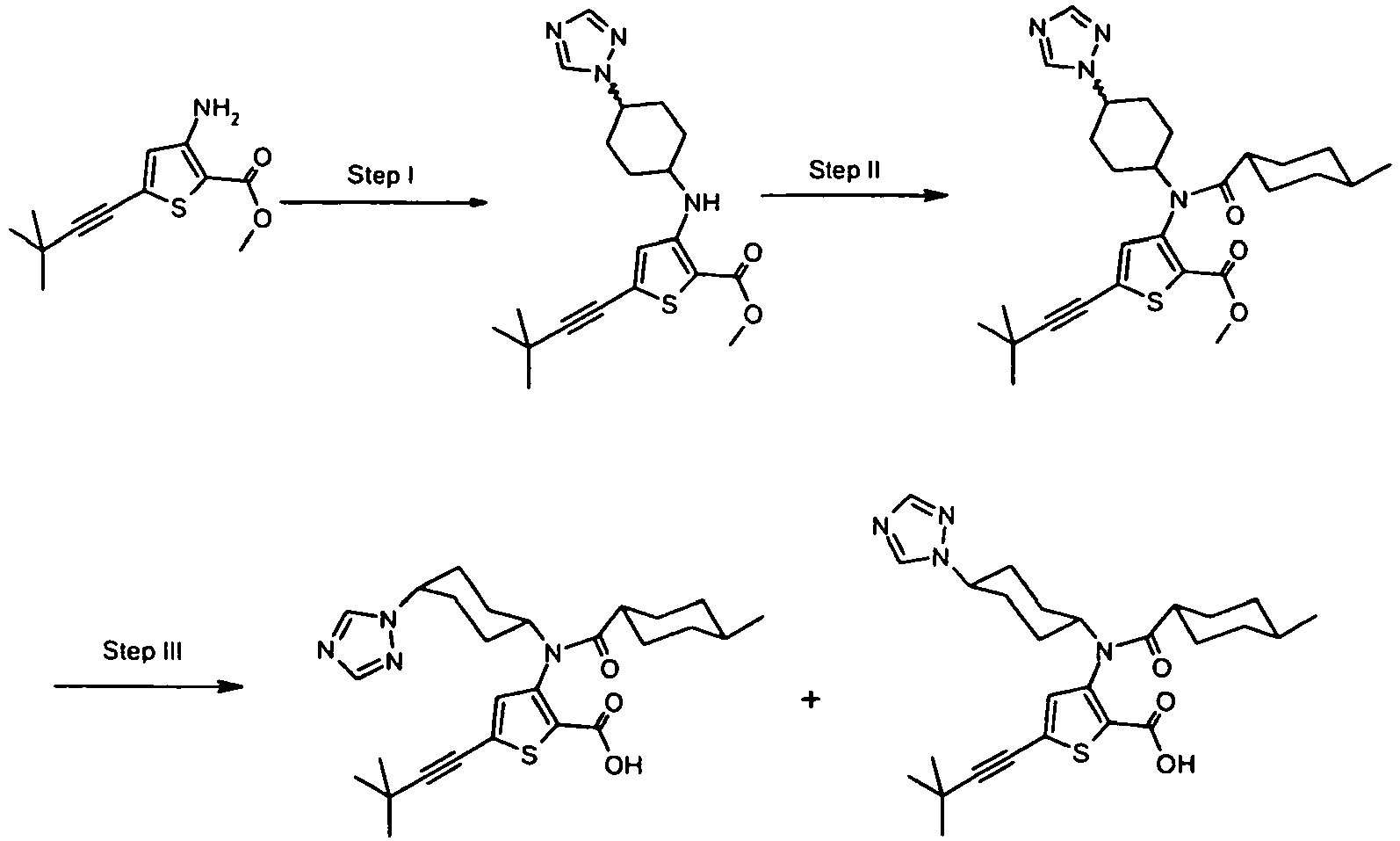
- Reductive amination of 3-amino-5-(3,3-dimethyl-but-1-ynyl)-thiophene-2-carboxylic acid methyl ester (0.237 g, 1.0 mmol) and 4-[1,2,4]triazol-1-yl-cyclohexanone (0.170 g, 1.0 mmol) is performed under the same conditions previously described using dibutyltin dichloride and phenylsilane to give 5-(3,3-dimethyl-but-1-ynyl)-3-(4-[1,2,4]triazol-1-yl-cyclohexylamino)-thiophene-2-carboxylic acid methyl ester.
- 5-(3,3-Dimethyl-but-1-ynyl)-3-(4-[1,2,4]triazol-1-yl-cyclohexylamino)-thiophene-2-carboxylic acid methyl ester (0.27 g, 0.70 mmol) is acylated with trans-4-methylcyclohexyl carboxylic acid chloride as previously described to give 5-(3,3-dimethyl-but-1-ynyl)-3-[(trans-4-methyl-cyclohexanecarbonyl)-(4-[1,2,4]triazol-1-yl-cyclohexyl)-amino]-thiophene-2-carboxylic acid methyl ester.
- 5-(3,3-Dimethyl-but-1-ynyl)-3-[(trans-4-methyl-cyclohexanecarbonyl)-(4-[1,2,4]triazol-1-yl-cyclohexyl)-amino]-thiophene-2-carboxylic acid methyl ester (0.244 g, 0.48 mmol) is hydrolysed with lithium hydroxide as previously described (example 1, step VI) to give after HPLC purification the pure isomer 5-(3,3-Dimethyl-but-1-ynyl)-3-[(trans-4-methyl-cyclohexanecarbonyl)-(cis-4-[1,2,4]triazol-1-yl-cyclohexyl)-amino]-thiophene-2-carboxylic acid and 5-(3,3-Dimethyl-but-1-ynyl)-3-[(trans-4-methyl-cyclohexanecarbonyl)-(trans-4-[1,2,4]triazol-1-yl-cyclohexyl)-amino]-thiophene-2-carboxylic acid.
MS found (electrospray): (M+H): 497.4 -

- Step I:
- To a solution of 5-(3,3-dimethyl-but-1-ynyl)-3-[(cis-4-hydroxy-cyclohexyl)-(trans-4-methyl-cyclohexanecarbonyl)-amino]-thiophene-2-carboxylic acid methyl ester (0.92 g, 2.0 mmol) in 10 ml of CH2Cl2 is added at 0°C methanesulfonyl chloride(0.31 mL, 4.0 mmol) followed by triethylamine (0.56 ml, 4.0 mmol). The reaction mixture is stirred at room temperature for 24h and treated with water. The aqueous layer is extracted 2 times with CH2Cl2. The organic layer is dried with sodium sulfate, filtered and concentrated under reduced pressure to give 5-(3,3-dimethyl-but-1-ynyl)-3-[(cis-4-methanesulfonyloxy-cyclohexyl)-(trans-4-methyl-cyclohexanecarbonyl)-amino]-thiophene-2-carboxylic acid methyl ester.
- To a solution of 5-(3,3-dimethyl-but-1-ynyl)-3-[(cis-4-methanesulfonyloxy-cyclohexyl)-(trans-4-methyl-cyclohexanecarbonyl)-amino]-thiophene-2-carboxylic acid methyl ester (1.16 g, 2.00 mmol) in 10 ml of DMF is added sodium azide (0.65 g, 10 mmol). The reaction mixture is stirred for 48h at 50°C. The mixture is diluted with ethyl acetate, washed 3 times with water and 1 time with brine. The organic layer is dried with sodium sulfate, filtered and concentrated under reduce pressure to give 3-[(trans-4-azido-cyclohexyl)-(trans-4-methyl-cyclohexanecarbonyl)-amino]-5-(3,3-dimethyl-but-1-ynyl)-thiophene-2-carboxylic acid methyl ester.
- A solution of 3-[(trans-4-azido-cyclohexyl)-(trans-4-methyl-cyclohexanecarbonyl)-amino]-5-(3,3-dimethyl-but-1-ynyl)-thiophene-2-carboxylic acid methyl ester (1.0 g, 2.0 mmol) in trimethylsilylacetylene (1.4 ml, 10 mmol) is treated in microwave at 120°C for 2h. The mixture is concentrated under reduced pressure and the residue is purified by silica gel column chromatography (5% ethyl acetate/hexane to 100% ethyl acetate) to afford 5-(3,3-dimethyl-but-1-ynyl)-3-{(trans-4-methyl-cyclohexanecarbonyl)-[trans-4-(4-trimethylsilanyl-[1,2,3]triazol-1-yl)-cyclohexyl]-amino}-thiophene-2-carboxylic acid methyl ester.
- To a solution of 5-(3,3-dimethyl-but-1-ynyl)-3-{(trans-4-methyl-cyclohexanecarbonyl)-[trans-4-(4-trimethylsilanyl-[1,2,3]triazol-1-yl)-cyclohexyl]-amino}-thiophene-2-carboxylic acid methyl ester (0.48 g, 0.82 mmol) in THF (2.0 ml) is added TBAF 1.0 M in THF (1.23 ml, 1.23 mmol). The reaction mixture is stirred for 24h and treated with water and saturated ammonium chloride solution. The aqueous layer is extracted with ethyl acetate. The organic layer is washed with brine, dried with sodium sulfate, filtered and concentrated under reduced pressure. The residue is purified by silica gel column chromatography (50% ethyl acetate/hexane to 100% ethyl acetate) to give 5-(3,3-dimethyl-but-1-ynyl)-3-[(trans-4-methyl-cyclohexanecarbonyl)-(trans-4-[1,2,3]triazol-1-yl-cyclohexyl)-amino]-thiophene-2-carboxylic acid methyl ester.
- 5-(3,3-Dimethyl-but-1-ynyl)-3-[(trans-4-methyl-cyclohexanecarbonyl)-(trans-4-[1,2,3]triazol-1-yl-cyclohexyl)-amino]-thiophene-2-carboxylic acid methyl ester (0.27 g, 0.52 mmol) is hydrolysed with lithium hydroxide as previously described (example 1, step VI) to give after HPLC purification 5-(3,3-dimethyl-but-1-ynyl)-3-[(trans-4-methyl-cyclohexanecarbonyl)-(trans-4-[1,2,3]triazol-1-yl-cyclohexyl)-amino]-thiophene-2-carboxylic acid.
MS found (electrospray): (M+H): 497.4 -

- A mixture of methanesulfonic acid 1,4-dioxa-spiro[4.5]dec-8-yl ester (2.80 g, 11.9 mmol) and sodium azide (3.86 g, 59.3 mmol) in 50 mL of dry DMF is stirred for 20h at 100°C under nitrogen. The final mixture is cooled to room temperature diluted with brine and extracted with three portions of ether. The organic portions are combined, dried over Na2SO4 and concentrated to give 8-azido-1,4-dioxa-spiro[4.5]decane.
- A mixture of 8-azido-1,4-dioxa-spiro[4.5]decane (1.00 g, 5.43 mmol) and 1-(trimethylsilyl)propyne (3,76 mL, 27.1 mmol) is submitted to microwave at 120°C for 2h. The mixture is concentrated under vacuum to remove the excess of 1-(trimethylsilyl)propyne and crude 1-(1,4-dioxa-spiro[4.5]dec-8-yl)-4-trimethylsilanyl-1H-[1,2,3]triazole is obtained.
- A solution of 1-(1,4-dioxa-spiro[4.5]dec-8-yl)-4-trimethylsilanyl-1H-[1,2,3]-triazole (1.60 g, 5.68) in 41 mL of dry THF is treated by a 1M solution of tetrabutylammonium fluoride in THF (9.0 mL, 9.0 mmol). The resulting mixture is stirred for 48h at room temperature under nitrogen. It is diluted with EtOAc, washed with saturated aqueous ammonium chloride, water and brine, dried over Na2SO4 and concentrated to give 1-(1,4-dioxa-spiro[4.5]dec-8-yl)-1H-[1,2,3]triazole.
- 1-(1,4-Dioxa-spiro[4.5]dec-8-yl)-1H-[1,2,3]triazole (1.06 g, 5.06 mmol) is submitted to the same procedure as for intermediate 1 step III to afford 4-[1,2,3]triazol-1-yl-cyclohexanone as a white solid.
-

- Methanesulfonic acid 1,4-dioxa-spiro[4.5]dec-8-yl ester is prepared according to: Cheng, Chen Yu; Wu, Shou Chien; Hsin, Ling Wei; Tam, S. William. Coll. Med., Natl. Taiwan Univ., Taipei, Taiwan. Journal of Medicinal Chemistry (1992), 35(12), 2243-7 .
- A solution of methanesulfonic acid 1,4-dioxa-spiro[4.5]dec-8-yl ester (567 mg, 2.40 mmol) and 1,2,4-triazole (232 mg, 3.36 mmol) in dry DMF (5.00 mL) is treated with sodium hydride 60% (125 mg, 3.12 mmol) at room temperature under nitrogen. The resulting mixture is stirred at 65°C for 72h. It is poured in ice water (75 mL), extracted 3 portions of 75 mL of EtOAc. The organic portions are combined, dried over anhydrous Na2SO4 and concentrated. The solid is purified by silica gel column chromatography using a gradient from 100% EtOAc to 5% MeOH:EtOAc as eluent to furnish the final compound 1-(1,4-dioxa-spiro[4.5]dec-8-yl)-1H-[1,2,4]triazole as a white solid.
- 1-(1,4-Dioxa-spiro[4.5]dec-8-yl)-1H-[1,2,4]triazole (379 mg, 1.81 mmol) is dissolved in a 1:1 mixture of THF and 3N HCl aqueous solution (9 mL). The resulting mixture is stirred at 40°C for 5h. Most of the THF is removed under vacuum then the remaining mixture is neutralized using a 3N NaOH aqueous solution until a basic pH is reached. It is extracted with 3 portions of 10 mL of dichloromethane. The organic portions are combined, dried over anhydrous Na2SO4 and concentrated to afford 4-[1,2,4]triazol-1-yl-cyclohexanone as a white waxy solid.
-

- To a suspension of 5-(3,3-dimethyl-but-1-ynyl)-3-[(cis-4-hydroxy-cyclohexyl)-(trans-4-methyl-cyclohexanecarbonyl)-amino]-thiophene-2-carboxylic acid (102 mg, 0.23 mmol) in dry CH2Cl2 (2 mL) is added DAST (Diethylaminosulphurtrifluoride) (90 µL, 0.69 mmol), and the mixture is stirred for 4h at room temperature. Then it is diluted with CH2Cl2, water is added to the mixture, and it is vigorously stirred for 20 min. Organic fraction is separated, dried over Na2SO4, concentrated, and the residue is purified by preparative HPLC to give 5-(3,3-dimethyl-but-1-ynyl)-3-[(trans-4-fluoro-cyclohexyl)-(trans-4-methyl-cyclohexanecarbonyl)-amino]-thiophene-2-carboxylic acid.
MS found (electrospray): [M+H]: 448.30 -

- To a solution of 3-(tert-butoxycarbonyl)amino-5-bromo-thiophene-2-carboxylic acid methyl ester (4.566 g, 13.58 mmol) in dry DMF (40 mL) are added copper (I) iodide (52 mg, 0.27 mmol), Pd2dba3 (622 mg, 0.68 mmol) and triethylamine (9.46 mL, 67.9 mmol), and the mixture is deoxygenated by bubbling nitrogen through solution for 10 min. Then tert-butylacetylene (6.62 mL, 54.32 mmol) and BINAP (676 mg, 1.09 mmol) are added to the mixture, and it is heated at 60°C overnight under nitrogen. The mixture is diluted with CH2Cl2 and filtered through celite washing with CH2Cl2. Filtrate is washed with brine, organic fraction is separated, dried over Na2SO4, concentrated, and the residue is purified by column chromatography on silica gel eluting with gradient of EtOAc in hexane to give of 5-(3,3-dimethyl-but-1-ynyl)-3-(tert-butoxycarbonyl)amino-thiophene-2-carboxylic acid methyl ester. 1H NMR (CDCl3) δ, ppm: 1.27 (s, 9H), 1.51 (s, 9H), 3.84 (s, 3H), 7.87 (s, 1H), 9.24 (br.s, 1H)
MS found (electrospray): [M+H] 338.17 - To a solution of 5-(3,3-dimethyl-but-1-ynyl)-3-(tert-butoxycarbonyl)amino-thiophene-2-carboxylic acid methyl ester (4.344 g, 9.58 mmol) in CH2Cl2 (30 mL) is added trifluoroacetic acid (30 mL), and the mixture is stirred at room temperature overnight. Then it is evaporated to dryness, obtained residue is redissolved in CH2Cl2 and washed with aqueous NaHCO3 and brine. Organic fraction is separated, dried over Na2SO4, and concentrated to give 3.135 g of crude 5-(3,3-dimethyl-but-1-ynyl)-3-amino-thiophene-2-carboxylic acid methyl ester.
1H NMR (CDCl3) δ, ppm: 1.28 (s, 9H), 3.80 (s, 3H), 5.36 (br.s, 2H), 6.49 (s, 1H)
MS found (electrospray): [M+H] 238.11 - To a solution of 5-(3,3-dimethyl-but-1-ynyl)-3-amino-thiophene-2-carboxylic acid methyl ester (1.512 g, 5.97 mmol) and N-tert-butoxycarbonyl-piperidin-4-one (1.189 g, 5.97 mmol) in 2 mL of dry THF is added dibutyltin dichloride (181 mg, 0.60 mmol), and the mixture is stirred for 10 min at room temperature under nitrogen. Then phenylsilane (810 µL, 6.57 mmol) is added, and the mixture is stirred for 24h at room temperature. Additional 595 mg of N-tert-butoxycarbonyl-piperidin-4-one, 90 mg of dibutyltin dichloride and 405 µL of phenylsilane are added, and the mixture is stirred for another 24h. Then the mixture is diluted with CH2Cl2, washed with brine, organic fraction is separated, dried over Na2SO4, and concentrated to give 5.142 g of crude 5-(3,3-dimethyl-but-1-ynyl)-3-(N-tert-butoxycarbonyl-piperidin-4-yl)amino-thiophene-2-carboxylic acid methyl ester.
- trans-4-Methylcyclohexyl carboxylic acid chloride (23.88 mmol) and pyridine (2.89 mL, 35.82 mmol) are added to a solution of 5-(3,3-dimethyl-but-1-ynyl)-3-(N-tert-butoxycarbonyl-piperidin-4-yl)amino-thiophene-2-carboxylic acid methyl ester from step III (5.142 g) in dry toluene (50 mL). The mixture is refluxed for 24 h, then it is brought to room temperature, and additional amount of pyridine (1.0 mL) and MeOH (5 mL) are added. Then the mixture is diluted with CH2Cl2, washed with brine, organic fraction is separated, dried over Na2SO4, and concentrated to give 5.198 g of crude 5-(3,3-dimethyl-but-1-ynyl)-3-[(trans-4-methyl-cyclohexanecarbonyl)-(N-tert-butoxycarbonyl-piperidin-4-yl)amino]-thiophene-2-carboxylic acid methyl ester containing variable amounts of 5-(3,3-dimethyl-but-1-ynyl)-3-[(trans-4-methyl-cyclohexanecarbonyl)-(piperidin-4-yl)-amino]-thiophene-2-carboxylic acid methyl ester.
- The product from step IV (5.198 g) is dissolved in 30 mL of CH2Cl2 and treated with 20 mL of trifluoroacetic acid. The mixture is stirred at room temperature overnight, then it is evaporated to dryness, obtained residue is redissolved in CH2Cl2 and washed with aqueous NaHCO3 and brine. Organic fraction is separated, dried over Na2SO4, and concentrated to give 5.340 g of crude 5-(3,3-dimethyl-but-1-ynyl)-3-[(trans-4-methyl-cyclohexanecarbonyl)-(piperidin-4-yl)amino]-thiophene-2-carboxylic acid methyl ester.
- To a solution of the product from step V (5.340 g) in 1,2-dichloroethane (60 mL) is added formaldehyde (1.94 mL of 37% aqueous solution, 23.88 mmol), followed by sodium triacetoxyborohydride (2.403 g, 11.34 mmol) in portions over 20 min. The mixture is stirred at room temperature overnight, then water is added to the mixture, and it is extracted with CH2Cl2. Organic fraction is washed with aqueous NaHCO3 and brine, dried over Na2SO4, concentrated and purified by column chromatography on silica gel eluting with 0-10% of MeOH in CH2Cl2 to give 5-(3,3-dimethyl-but-1-ynyl)-3-[(trans-4-methyl-cyclohexanecarbonyl)-(1-methyl-piperidin-4-yl)-amino]-thiophene-2-carboxylic acid methyl ester.
- The product from Step VI (281 mg, 0.61 mmol) is hydrolysed with lithium hydroxide as previously described (example 1, step VI) to give after HPLC purification 5-(3,3-dimethyl-but-1-ynyl)-3-[(trans-4-methyl-cyclohexanecarbonyl)-(1-methyl-piperidin-4-yl)-amino]-thiophene-2-carboxylic acid hydrochloride.
MS found (electrospray): [M+H]: 445.29 -

- 3-[(1,4-Dioxa-spiro[4.5]dec-8-yl)-(trans-4-methyl-cyclohexanecarbonyl)-amino ]-5-iodo-thiophene-2-carboxylic acid methyl ester (from example 3) is dissolved in tetrahydrofuran and treated with 3N HCl solution. The reaction is stirred at 40°C for 3 h. The reaction mixture is evaporated under reduced pressure. The mixture is dissolved in EtOAc and washed with aq. sat. NaHCO3 solution. The organic layer is separated, dried over Na2SO4, filtered and concentrated to obtain the title compound.
- To a cold (0°C) solution of 5-iodo-3-[(trans-4-methyl-cyclohexanecarbonyl)-(4-oxo-cyclohexyl)-amino]-thiophene-2-carboxylic acid methyl ester in MeOH under a N2 atmosphere, NaBH4 is added portion wise and is stirred. After the reaction is completed, 2% HCl is added and stirred for 15 min. The reaction mixture is concentrated under vacuum to dryness. The residue is partitioned between water and EtOAC. The organic layer is separated, dried over MgSO4 and concentrated to dryness. The residue is purified by silica gel column chromatography using EtOAc:hexane as eluent to obtain the title compound.
- To a solution of 3-[(trans-4-hydroxy-cyclohexyl)-(trans-4-methyl-cyclohexanecarbonyl)-amino]-5-iodo-thiophene-2-carboxylic acid methyl ester and ethynyl-trimethyl-silane in DMF, triethylamine and tris(dibenzylideneacetone) dipalladium (0) are added and the reaction mixture is stirred at 60°C for 16h under a N2 atmosphere. DMF and triethylamine are removed under reduced pressure and the residue is partitioned between water and ethyl acetate. The organic layer is separated, dried (Na2SO4), concentrated and the residue is purified by column chromatography using ethyl acetate and hexane (1:2) as eluent to obtain the title compound.
- 3-[(trans-4-Hydroxy-cyclohexyl)-(trans-4-methyl-cyclohexanecarbonyl)-amino]-5-trimethyl-silanylethynyl-thiophene-2-carboxylic acid methyl ester and 2-chloro-2-methylpropane are taken in dichloromethane and added freshly sublimed aluminium chloride at -78°C. The reaction mixture is stirred at the same temperature for 6h. The reaction mixture is poured into water, diluted with dichloromethane. The organic layer is separated, dried (Na2SO4) and concentrated. The residue is purified by column chromatography using ethyl acetate and hexane to obtain the title compound.
Ref.: J. Chem. Soc., Chem. Commun., 1982, 959-960. - 5-(3,3-Dimethyl-but-1-ynyl)-3-[(trans-4-hydroxy-cyclohexyl)-(trans-4-methyl-cyclohexanecarbonyl)-amino]-thiophene-2-carboxylic acid methyl ester is dissolved in a 3:2:1 mixture of THF:methanol:H2O and treated with a 1N solution of LiOH.H2O. After 2h of stirring at 60°C, the reaction mixture is concentrated under reduced pressure on a rotary evaporator. The mixture is partitioned between ethyl acetate and water. The water layer is acidified using 0.1 N HCl. The EtOAc layer is separated and dried over Na2SO4. The solvent is removed and the residue is purified by column chromatography using methanol and dichloromethane (1:9) as eluent to obtain the title compound.
Table 1 List of compounds in accordance with the present invention Structure Chemical Name Mass* 1 
5-(3,3-DIMETHYL-BUT-1-YNYL)-3-[(TRANS-4-HYDROXY-CYCLOHEXYL)-(TRANS-4-METHYL-CYCLOHEXANECARBONYL)-AMINO]-THIOPHENE-2-CARBOXYLIC ACID (M-H): 444.3 2 
5-(3,3-DIMETHYL-BUT-1-YNYL)-3-[(TRANS-4-METHOXY-CYCLOHEXYL)-(TRANS-4-METHYL-CYCLOHEXANECARBONYL)-AMINO]-THIOPHENE-2-CARBOXYLIC ACID (M-H): 458.3. 3 
5-(3,3-DIMETHYL-BUT-1-YNYL)-3-[(TRANS-4-METHYL-CYCLOHEXANECARBONYL)-(CIS-4-[1,2,4]TRIAZOL-1-YL-CYCLOHEXYL)-AMINO]-THIOPHENE-2-CARBOXYLIC ACID (M+H): 497.4 4 
5-(3,3-DIMETHYL-BUT-1-YNYL)-3-[(TRANS-4-METHYL-CYCLOHEXANECARBONYL)-(TRANS-4-[1,2,4]TRIAZOL-1-YL-CYCLOHEXYL)-AMINO]-THIOPHENE-2-CARBOXYLIC ACID (M+H): 497.4 5 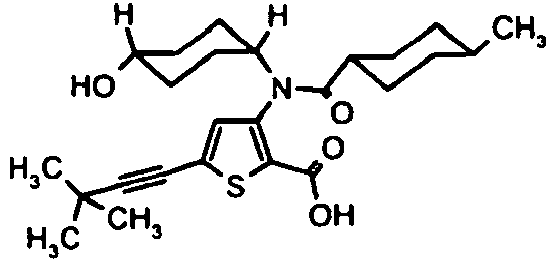
5-(3,3-DIMETHYL-BUT-1-YNYL)-3-[(CIS-4-HYDROXYCYCLOHEXYL)-(TRANS-4-METHYL-CYCLOHEXANECARBONYL)-AMINO]-THIOPHENE-2-CARBOXYLIC ACID (M-H): 444.52 Structure Chemical Name Mass* 6 
5-(3,3-DIMETHYL-BUT-1-YNYL)-3-[(TRANS-4-METHYL-CYCLOHEXANECARBONYL)-(1-METHYL-PIPERlDIN-4-YL)-AMINO]-THIOPHENE-2-CARBOXYLIC ACID; HYDROCHLORIDE (M+H): 445.29 7 
5-(3,3-DIMETHYL-BUT-1 - YNYL)-3-[(TRANS-4-METHYL-CYCLOHEXANECARBONYL)-(4-CIS-[1,2,3]TRIAZOL-1-YL-CYCLOHEXYL)-AMINO]-THIOPHENE-2-CARBOXYLIC ACID (M+H): 497.4 8 
5-(3,3-DIMETHYL-BUT-1-YNYL)-3-[(TRANS-4-METHYL-CYCLOHEXANECARBONYL)-(TRANS-4-[1,2,3]TRIAZOL-1-YL-CYCLOHEXYL)-AMINO]-THIOPHENE-2-CARBOXYLIC ACID (M+H): 497.4 9 
5-(3,3-DIMETHYL-BUT-1-YNYL)-3-[(TRANS-4-FLUORO-CYCLOHEXYL)-(TRANS-4-METHYL-CYCLOHEXANECARBONYL)-AMINO]-THIOPHENE-2-CARBOXYLIC ACID (M+H): 448.30 *mass spectral analyses are recorded using electrospray mass spectrometry. - The following references are cited
- 1. Behrens, S., Tomei, L., De Francesco, R. (1996) EMBO 15, 12-22
- 2. Harlow, E, and Lane, D. (1988) Antibodies: A Laboratory Manual. Cold Spring Harbord Laboratory. Cold Spring Harbord. NY.
- 3. Lohmann, V., Körner, F., Herian, U., and Bartenschlager, R. (1997) J. Virol. 71, 8416-8428
- 4. Tomei, L., Failla, C., Santolini, E., De Francesco, R., and La Monica, N. (1993) J Virol 67, 4017-4026
- Compounds are evaluated using an in vitro polymerase assay containing purified recombinant HCV RNA-dependent RNA polymerase (NS5B protein). HCV NS5B is expressed in insect cells using a recombinant baculovirus as vector. The experimental procedures used for the cloning, expression and purification of the HCV NS5B protein are described below. Follows, are details of the RNA-dependent RNA polymerase assays for testing the compounds.
- The cDNA encoding the entire NS5B protein of HCV-Bk strain, genotype 1b, was amplified by PCR using the primers NS5Nhe5' (5'-GCTAGCGCTAGCTCAATGTCCTACACATGG-3') and XhoNS53' (5'-CTCGAGCTCGAGCGTCCATCGGTTGGGGAG-3') and the plasmid pCD 3.8-9.4 as template (Tomei et al, 1993). NS5Nhe5' and XhoNS53' contain two NheI and XhoI sites (underlined sequences), respectively, at their 5' end. The amplified DNA fragment was cloned in the bacterial expression plasmid pET-21 b (Novagen) between the restriction sites NheI and XhoI, to generate the plasmid pET/NS5B. This plasmid was later used as template to PCR-amplify the NS5B coding region, using the primers NS5B-H9 (5'-ATACATATGGCTAGCATGTCAATGTCCTACACATGG-3') and NS5B-R4 (5'-GGATCCGGATCCCGTTCATCGGTTGGGGAG-3'). NS5B-H9 spans a region of 15 nucleotides in the plasmid pET-21b followed by the translation initiation codon (ATG) and 8 nucleotides corresponding to the 5' end of the NS5B coding region (nt. 7590-7607 in the HCV sequence with the accession number M58335). NS5B-R4 contains two BamHI sites (underlined) followed by 18 nucleotides corresponding to the region around the stop codon in the HCV genome (nt. 9365-9347). The amplified sequence, of 1.8 kb, was digested with NheI and BamHI and ligated to a predigested pBlueBacII plasmid (Invitrogen). The resulting recombinant plasmid was designated pBac/NS5B. Sf9 cells were co-transfected with 3 µg of pBac/NS5B, together with 1 µg of linearized baculovirus DNA (Invitrogen), as described in the manufacturer's protocol. Following two rounds of plaque purification, an NS5B-recombinant baculovirus, BacNS5B, was isolated. The presence of the recombinant NS5B protein was determined by western blot analysis (Harlow and Lane, 1988) of BacNS5B-infected Sf9 cells, using a rabbit polyclonal antiserum (anti-NS5B) raised against a His-tagged version of the NS5B protein expressed in E. coli. Infections of Sf9 cells with this plaque purified virus were performed in one-liter spinner flasks at a cell density of 1.2 x 10⁶ cells/ml and a multiplicity of infection of 5.
- Sf9 cells were infected as described above. Sixty hours post-infection, cells were harvested then washed twice with phosphate buffer saline (PBS). Total proteins were solubilized as described in Lohmann et al. (1997) with some modifications. In brief, proteins were extracted in three steps, S1, S2, S3, using lysis buffers (LB) I, LB II and LB III (Lohmann et al, 1997). The composition of LBII was modified to contain 0.1 % triton X-100 and 150 mM NaCl to reduce the amount of solubilized NS5B protein at this step. In addition, sonication of cell extracts was avoided throughout the protocol to preserve the integrity of the protein structure.
- Soluble NS5B protein in the S3 fraction was diluted to lower the NaCl concentration to 300 mM, then it incubated batchwise with DEAE sepharose beads (Amersham-Pharmacia) for 2 hrs at 4°C, as described by Behrens et al. (1996). Unbound material was cleared by centrifugation for 15 min at 4°C, at 25 000 rpm using a SW41 rotor (Beckman). The supernatant was further diluted to lower the NaCl concentration to 200 mM and subsequently loaded, with a flow rate of 1 ml/min, on a 5 ml HiTrap® heparin column (Amersham-Pharmacia) connected to an FPLC® system (Amersham-Pharmacia). Bound proteins were eluted in 1 ml fractions, using a continuous NaCl gradient of 0.2 to 1 M, over a 25 ml volume. NS5B-containing fractions were identified by sodium dodecyl sulfate polyacrylamide gel electrophoresis (SDS-PAGE), followed by western blotting using the anti-NS5B antiserum at a dilution of 1:2000. Positive fractions were pooled and the elution buffer was exchanged against a 50 mM NaPO4 pH 7.0, 20 % glycerol, 0.5 % triton X-100 and 10 mM DTT, using a PD-10 column (Amersham-Pharmacia). The sample was then loaded onto a 1 ml HiTrap® SP column (Amersham-Pharmacia), with a flow rate of 0.1 ml/min. Bound proteins were eluted using a continuous 0 to 1 M NaCl gradient over a 15 ml volume. Eluted fractions were analyzed by SDS-PAGE and western blotting. Alternatively, proteins were visualized, following SDS-PAGE, by silver staining using the Silver Stain Plus kit (BioRad) as described by the manufacturer. Positive fractions were tested for RdRp activity (see below) and the most active ones were pooled, and stored as a 40 % glycerol solution at -70°C.
- This assay consists on measuring the incorporation of [3H] radiolabelled UTP in a polyrA/ biotinylated-oligo dT template-primer, captured on the surface of streptavidin-coated scintillant-embeded microtiter Flashplates™ (NEN Life Science Products inc, MA, USA, SMP 103A). In brief, a 400 ng/µl polyrA solution (Amersham Pharmacia Biotech) was mixed volume-to-volume with 5' biotin-oligo dT15 at 20 pmol/µl. The template and primers were denatured at 95 C for 5 minutes then incubated at 37 C for 10 minutes. Annealed template-primers were subsequently diluted in a Tris-HCl containing buffer and allowed to bind to streptavidin-coated flashplates overnight. Unbound material was discarded; compounds were added in a 10 µl solution followed by a 10 µl of a solution containing 50 mM MgCl2, 100 mM Tris-HCl pH 7.5, 250 mM NaCl and 5 mM DTT. The enzymatic reaction was initiated upon addition of a 30 µl solution containing the enzyme and substrate to obtain the following concentrations: 25 µM UTP, 1 µCi [3H] UTP and 100 nM recombinant HCV NS5B. RdRp reactions were allowed to proceed for 2 hrs at room temperature after which wells were washed three times with a 250µL of 0.15 M NaCl solution, air dried at 37 C, and counted using a liquid scintillation counter (Wallac Microbeta Trilex, Perkin-Elmer, MA, USA).
- The compounds of the present invention are HCV polymerase inhibitors. Surprinsigly, it has been found that the compounds according to the present invention and having a specific substitution pattern, exhibit an improved therapeutic index relative to other thiophene analogues.
- Replicon cell lines Huh-7, 5.2 and ET which are derived from the Huh-7 hepatocarcinoma cell line were maintained in culture as generally described in Krieger, N; Lohmann, V; Bartenschlager, R. Enhancement of hepatitis C virus RNA replication by cell culture-adaptive mutations. J. Virol. 2001, 75, 4614-4624. The Huh-7, 5.2 cells contain the highly cell culture-adapted replicon I389luc-ubi-neo/NS3-3'/5.1 construct that carries, in addition to the neomycin gene, an integrated copy to the firefly luciferase gene (Krieger, N; Lohmann, V; Bartenschlager, R. Enhancement of hepatitis C virus RNA replication by cell culture-adaptive mutations. J. Virol. 2001, 75, 4614-4624). This cell line allows measurement of HCV RNA replication and translation by measuring luciferase activity. It has been previously shown that the luciferase activity tightly follows the replicon RNA level in these cells (Krieger, N; Lohmann, V; Bartenschlager, R. Enhancement of hepatitis C virus RNA replication by cell culture-adaptive mutations. J. Virol. 2001, 75, 4614-4624). The Huh-7, ET cell line has the same features as those mentioned for Huh-7, 5.2 cell line, except that ET cells are more robust and contain an adaptative mutation in the HCV NS4B gene instead of NS5A. Both cell lines were maintained in cultures at a sub-confluent level (<85%) as the level of replicon RNA is highest in actively proliferating cells. The culture media used for cell passaging consist of DMEM (Gibco BRL Laboratories, Mississauga, ON, Canada) supplemented with 10% foetal bovine serum with 1% penicilin/streptomycin, 1% glutamine, 1% sodium pyruvate, 1% non-essential amino acids, and 350 ug/ml of G418 final concentration. Cells were incubated at 37°C, in an atmosphere of 5% CO2 and passaged twice a week to maintain sub-confluence.
- Approximately 3000 viable Huh-7, 5.2 or ET cells (100 µl) were plated per well in a white opaque 96-well microtiter plate. The cell culture media used for the assay was the same as described above except that it contains no G418 and no phenol red. After an incubation period of 3-4 hours at 37° C in a 5% CO2 incubator, compounds (100 µl) were added at various concentrations. Cells were then further incubated for 4 days at 37° C in a 5% CO2 incubator. Thereafter, the culture media was removed and cells were lysed by the addition of 95 µL of the luciferase buffer (luciferin substrate in buffered detergent). Cell lysates were incubated at room temperature and protected from direct light for at least 10 minutes. Plates were read for luciferase counts using a luminometer (Wallac MicroBeta Trilux, Perkin Ether™, MA, USA).
- The 50% inhibitory concentrations (IC50s) for inhibitory effect were determined from dose response curves using eleven concentrations per compound in duplicate. Curves were fitted to data points using nonlinear regression analysis, and IC50s were interpolated from the resulting curve using GraphPad Prism software, version 2.0 (GraphPad Software Inc., San Diego, CA, USA).
- The following references are cited:
- o Tomei, L., Failla, C., Santolini, E., De Francesco, R., and La Monica, N. (1993) J Virol 67, 4017-4026
- o Lesburg, C. A. et al. Crystal structure of the RNA-dependent RNA polymerasefrom hepatitis C virus reveals a fully encircled active site. Nat. Struct. Biol. 6, 937-943 (1999).
- o Ferrari, E. et al. Characterization of soluble hepatitis C virus RNA-dependent RNA polymerase expressed in Escherichia coli. J. Virol. 73, 1649-1654 (1999).
- Compounds are evaluated using an in vitro polymerase assay containing purified recombinant HCV RNA-dependent RNA polymerase (NS5B protein) expressed in bacterial cells. The experimental procedures used for the cloning, expression and purification of the HCV NS5B protein are described below. Follows, are details of the RNA-dependent RNA polymerase assays for testing the compounds.
- A recombinant soluble form representing a 21 amino acid C-terminal truncated HCV NS5B genotype 1b strain BK enzyme (Tomei et al, 1993) containing an N-terminal hexahistidine tag was cloned and expressed in Escherichia coli BL21 (DE3). The truncated enzyme was purified as described in Lesburg et al.(1999) and Ferrari et al.(1999) with minor modifications. Briefly, soluble bacterial lysates were loaded onto a HiTrap nickel chelating affinity column (GE Healthcare, Baie d'Urfe, QC, Canada). The bound enzyme was eluted using an imidazole gradient. Imidazole was then removed from the buffer of the pooled active fractions using PD-10 desalting columns (GE Healthcare, Baie d'Urfe, QC, Canada). Further purification was achieved by running the protein preparation through a cation exchange HiTrap SP sepharose column (GE Healthcare, Baie d'Urfe, QC, Canada) using a NaCl gradient for elution. Thereafter, buffer was changed to 10 mM Tris pH 7.5, 10% glycerol, 5 mM DTT, 600 mM NaCl using a PD-10 column. Positive fractions were tested for RNA-dependent polymerase activity and the most active fractions were pooled and stored at -70°C.
- Measurement of the inhibitory effect of compounds on HCV NS5B polymerization activity was performed by evaluating the amount of radiolabeled UTP incorporated by the enzyme in a newly synthesized RNA using a homopolymeric RNA template/primer. Briefly, a 15-mer 5' biotinylated DNA oligonucleotide (oligo dT) primer annealed to a homopolymeric poly rA RNA template is captured on the surface of streptavidin-coated bead (GE Healthcare, Baie d'Urfe, QC, Canada). Essentially, compounds were tested at a variety of concentrations (0.005 to 200 µM) in a final volume of 50 µL reaction mixture consisting of 20 mM Tris-HCl pH 7.5, 5 mM MgCl2, 1 mM DTT, 50 mM NaCl, 50 nM purified NS5B enzyme, 250 ng of polyrA/oligodT15 (Invitrogen, Burlington, Ontario, Canada), 15-µM of nonradioactive UTP, and 1 µCi of [3H]UTP (3000 Ci/mmol; GE Healthcare., Baie d'Urfe, QC, Canada). The polymerization activity of the HCV NS5B enzyme is quantified by measuring the incorporation of radiolabeled [3H]UTP substrate onto the growing primer 3' end and detection is achieved by counting the signal using a liquid scintillation counter (Wallac MicroBeta Trilux, Perkin Elmer™, MA, USA).
- A total of 1,000 - 2,000 cells/well are seeded in 96-well cluster dishes in a volume of 150 µl of DMEM (Life Technologies, Inc., Gaithersburg, Md.) supplemented with 10% FBS (HyClone Laboratories, Inc., Logan, Utah) and 2 mM glutamine (Life Technologies, Inc.). Penicillin and streptomycin (Life Technologies, Inc.) are added to 500 U/mL and 50 µg/mL final concentrations, respectively. After an incubation of 18 h at 37 °C in an atmosphere of 5% CO2, the medium iss removed and replaced with compounds diluted in culture medium. Six serial two-fold dilutions of drugs are tested in triplicate. After further 72-h incubation, a volume of 50 µL of a 10 µCi/mL solution of [3H] methyl thymidine (Amersham Life Science, Inc., Arlington Heights, III.; 2 Ci/mmol) in culture medium is added and the plates are incubated for a further a 18 h at 37 °C. Cells are then washed with phosphate-buffered saline (PBS), trypsinized for 2 min, and collected onto a fiberglass filter using a Tomtec cell harvester (Tomtec, Orange, Conn.). Filters are dried at 37 °C for 1 h and placed into a bag with 4.5 mL of liquid scintillation cocktail (Wallac Oy, Turku, Finland). The accumulation of [3H] methyl thymidine, representing viable replicating cells, is measured using a liquid scintillation counter (1450-Microbeta; Wallac Oy). Ref. SOP: 265-162-03. For this experiment, the cell lines used are; Huh-7 ET (cells derived from the Huh-7 cell line (hepatocellular carcinoma, human) and containing a HCV sub-genomic replicon), Molt-4 (peripheral blood, acute lymphoblastic leukemia, human), DU-145 (prostate carcinoma, metastasis to brain, human), Hep-G2 (hepatocellular carcinoma, human), and SH-SY5Y (neuroblastoma, human) cells.
- The 50% cytotoxic concentrations (CC50s) for cell toxicity are determined from dose response curves using six to eight concentrations per compound in triplicate. Curves are fitted to data points using non-linear regression analysis, and IC50 values are interpolated from the resulting curve using GraphPad Prism software, version 2.0 (GraphPad Software Inc., San Diego, CA, USA).
- TI: Ratio of CC50/IC50 in HCV replicon cells (Huh-7 ET cells) from example 12. When the compounds are tested more than once, the average of the TI is provided.
- Table 2 lists the therapeutic indexes (Tis) of selected compounds representative of the invention relative to other thiophene HCV poylymerase inhibitors.
Table 2 Compound TI 1 ++++++ 2 +++ 3 ++++++ 4 ++++ 5 ++++++ 6 ++++++ 7 +++++ 8 ++++++ 9 ++++++ A ++ B ++ C + D ++++ E +++ F ++ G +++ H + I ++ TI
+: <100
++: 100-1000
+++: 1000-2000
++++: 2000-4000
+++++: 4000-6000
++++++: >6000
- Compounds A to I can be synthesized as described in
US Patent No. 6,881,741 ,WO02/100851 W02004/052885 , orWO 2006/072347 . - Certain compounds according to the present invention and having a specific substitution pattern, exhibit an improved microsome stability and/or Induction in human hepatocytes relative to other thiophene analogues. For example, compounds 1 and 2 showed better microsome stability profile and induction profile relative to compound E.
- Each compound is incubated in hepatic microsomes (1.6 mg/mL) at 37° under oxidative and glucuronidation conditions (1.5 mM NADPH and 1.5 mM UDPGA in phosphate buffer, pH = 7.4). Incubations containing no NADPH and no UDPGA are used as controls. The compounds are incubated at 50 uM for 0 and 60 minutes,. The reaction is stopped by the addition of an equal volume of acetonitrile. The mixture is centrifuged and the supernatant is analyzed by HPLC/UV or MS/MS. The percentage parent remaining corresponds to the area of the parent compound in the 60-minute incubation versus the area of the parent compound in a 0-minute incubation x100.
- The induction is performed in cryopreserved or fresh cultured- human hepatocytes. The cells are cultured on collagen for 48 hours. Following this period, the cells are dosed with freshly spiked incubation media containing the test compound or the positive control inducer, rifampicin. Final concentrations of the test compounds in the incubations are 1, 10 and 100 mM while the positive control is tested at 10 mM. Negative controls (NC) consisted of incubating the cells with 0.1% DMSO final content. The cell treatment is pursued for a total of 48 hours with fresh incubation media spiked with test compound or control inducer replaced daily. At the end of the induction period, the media containing the inducer is removed and cells are washed twice with 200 uL Krebs-Henseleit buffer containing 12 mM HEPES, pH 7.4 (KH buffer). The induction of CYP3A4 is then measured by activity using testosterone as substrate and by mRNA levels. For CYP3A4 activity, fresh KH buffer, spiked with the 200 mM testosterone is added and the cells are incubated for 30 minutes at 37 °C. At the end of the incubation period, the media is removed and analyzed by HPLC/MS for 6-beta-hydroxy testosterone determination. The maximal induction (100% induction) is determined with the 10 mM Rifampicin treatment. The potential for test compounds to cause CYP3A Induction is described as a percentage of maximal induction obtained with the classic inducer. For mRNA level determination, hepatocytes are harvested and total RNA is prepared using Qiagen RNeasy Purification Kit (Mississauga, ON) according to manufacturer's instructions. The cDNAs of the hepatocytes are synthesized from total RNA using M-MLV Reverse Transcriptase (Invitrogen, Carlbad, CA) with universal primer (Roche Diagnostic, Germany). Analysis of specific mRNA expression in total RNA samples is performed by quantitative real time PCR using Applied Biosystem's ABI Prism 7700 Sequence Detection System. Primers used for CYP3A4 are 5'-TCA GCC TGG TGC TCC TCT ATC TAT-3' as forward primer and 5'-AAG CCC TTA TGG TAG GAC AAA ATA TTT-3'as reverse primer. The probe used was 5'-/56-FAM/TCC AGG GCC CAC ACC TCT GCC T/36-TAMSp/ - 3'. The data are normalized to Ribosomal 18S mRNA (VIC) with real time detection. Data analysis and statistical tests are performed using MicrosoftÒ Excel. Results can be reported as fold change gene expression compared to control group according to the following formula:
- ΔCt = Ct FAM - Ct VIC
- ΔΔCt = ΔCt Drug Candidate - ΔCt Control
- Fold Induction: 2 -ΔΔCt
- The preceding examples can be repeated with similar success by substituting the generically or specifically described reactants and/or operating conditions of this invention for those used in the preceding examples.
- From the foregoing description, one skilled in the art can easily ascertain the essential characteristics of this invention and can make various changes and modifications of the invention within the scope of the appended claims.
-
- <110> Virochem Pharma Inc.
- <120> Thiophene analogues for the treatment or prevention of flavivirus infections
- <130> 134 805
- <150>
US 60/858,939
<151> 2006-11-15 - <160> 7
- <170> PatentIn version 3.4
- <210> 1
<211> 30
<212> DNA
<213> Artificial - <220>
<223> PCR primer NS5Nhe5' - <400> 1
gctagcgcta gctcaatgtc ctacacatgg 30 - <210> 2
<211> 30
<212> DNA
<213> Artificial - <220>
<223> PCR primer XhoNS53' - <400> 2
ctcgagctcg agcgtccatc ggttggggag 30 - <210> 3
<211> 36
<212> DNA
<213> Artificial - <220>
<223> PCR primer NS5B-H9 - <400> 3
atacatatgg ctagcatgtc aatgtcctac acatgg 36 - <210> 4
<211> 30
<212> DNA
<213> Artificial - <220>
<223> PCR primer NS5B-R4 - <400> 4
ggatccggat cccgttcatc ggttggggag 30 - <210> 5
<211> 24
<212> DNA
<213> Artificial - <220>
<223> PCR primer - <400> 5
tcagcctggt gctcctctat ctat 24 - <210> 6
<211> 27
<212> DNA
<213> Artificial - <220>
<223> PCR primer - <400> 6
aagcccttat ggtaggacaa aatattt 27 - <210> 7
<211> 22
<212> DNA
<213> Artificial - <220>
<223> Probe - <400> 7
tccagggccc acacctctgc ct 22
Claims (18)
- A compound

- A pharmaceutical composition comprising the compound according to claim 1 and at least one pharmaceutically acceptable carrier or excipient.
- A pharmaceutical combination comprising the compound according to claim 1 and at least one additional agent.
- A pharmaceutical combination according to claim 3, wherein said at least one additional agent is selected from viral serine protease inhibitors, viral polymerase inhibitors, viral helicase inhibitors, immunomodulating agents, antioxidant agents, antibacterial agents, therapeutic vaccines, hepatoprotectant agents, antisense agents, inhibitors of HCV NS2/3 protease and inhibitors of internal ribosome entry site (IRES).
- A pharmaceutical combination according to claim 4, wherein said at least one additional agent is selected from ribavirin and interferon-α.
- A pharmaceutical combination according to claim 4, wherein said at least one additional agent is selected from ribavirin and pegylated interferon-α.
- The compound according to claim 1 for use in a method of treating an Hepatitis C viral infection in a host.
- The compound for use according to claim 7, the method further comprising administering at least one additional agent.
- The compound for use according to claim 8, wherein said at least one additional agent is selected from viral serine protease inhibitors, viral polymerase inhibitors, viral helicase inhibitors, immunomodulating agents, antioxidant agents, antibacterial agents, therapeutic vaccines, hepatoprotectant agents, antisense agents, inhibitors of HCV NS2/3 protease and inhibitors of internal ribosome entry site (IRES).
- The compound for use according to claim 8, wherein said at least one additional agent is selected from ribavirin and interferon-α.
- The compound for use of claim 8, wherein said at least one additional agent is selected from ribavirin and pegylated interferon-α.
- The compound for use according to any one of claims 7 to 11 wherein said host is human.
- A compound chosen from:3-[(1,4-dioxa-spiro[4.5]dec-8-yl)-(trans-4-methyl-cyclo-hexanecarbonyl)-amino]-5-iodo-thiophene-2-carboxylic acid methyl ester;5-(3,3-dimethyl-but-1-ynyl)-3-(4-[1,2,3]triazol-1-yl-cyclohexylamino)-thiophene-2-carboxylic acid methyl ester;5-(3,3-dimethyl-but-1-ynyl)-3-(4-[1,2,4]triazol-1-yl-cyclohexylamino)-thiophene-2-carboxylic acid methyl ester;5-(3,3-dimethyl-but-1-ynyl)-3-(tert-butoxycarbonyl)amino-thiophene-2-carboxylic acid methyl ester;5-(3,3-dimethyl-but-1-ynyl)-3-amino-thiophene-2-carboxylic acid methyl ester;3-[(trans-4-hydroxy-cyclohexyl)-(trans-4-methyl-cyclohexanecarbonyl)-amino]-5-iodo-thiophene-2-carboxylic acid methyl ester; or3-[(trans-4-Hydroxy-cyclohexyl)-(trans-4-methyl-cyclohexanecarbonyl)-amino]-5-trimethyl-silanylethynyl-thiophene-2-carboxylic acid methyl ester.
- The use of a compound
3-[(1,4-dioxa-spiro[4.5]dec-8-yl)-(trans-4-methyl-cyclo-hexanecarbonyl)-amino]-5-iodo-thiophene-2-carboxylic acid methyl ester;
5-(3,3-dimethyl-but-1-ynyl)-3-(4-[1,2,3]triazol-1-yl-cyclohexylamino)-thiophene-2-carboxylic acid methyl ester;
5-(3,3-dimethyl-but-1-ynyl)-3-(4-[1,2,4]triazol-1-yl-cyclohexylamino)-thiophene-2-carboxylic acid methyl ester;
5-(3,3-dimethyl-but-1-ynyl)-3-(tert-butoxycarbonyl)amino-thiophene-2-carboxylic acid methyl ester;
5-(3,3-dimethyl-but-1-ynyl)-3-amino-thiophene-2-carboxylic acid methyl ester;
3-[(trans-4-hydroxy-cyclohexyl)-(trans-4-methyl-cyclohexanecarbonyl)-amino]-5-iodo-thiophene-2-carboxylic acid methyl ester; or 3-[(trans-4-Hydroxy-cyclohexyl)-(trans-4-methyl-cyclohexanecarbonyl)-amino]-5-trimethyl-silanylethynyl-thiophene-2-carboxylic acid methyl ester.
for the synthesis of a compound as defined in claim 1. - A pharmaceutically acceptable salt of the compound

- A compound

- A pharmaceutical combination comprisinga) the compound
 b) pegylated interferon-α; andc) ribavirin.
 - The pharmaceutical combination of claim 17 for use in a method for treating a Hepatitis C viral infection in a host.
Priority Applications (5)
| Application Number | Priority Date | Filing Date | Title |
|---|---|---|---|
| SI200731277T SI2104674T1 (en) | 2006-11-15 | 2007-11-15 | Thiophene analogues for the treatment or prevention of flavivirus infections |
| EP12181993A EP2559691A1 (en) | 2006-11-15 | 2007-11-15 | Thiophene analogues for the treatment or prevention of Flavivirus infections |
| PL07845534T PL2104674T3 (en) | 2006-11-15 | 2007-11-15 | Thiophene analogues for the treatment or prevention of flavivirus infections |
| EP12181998A EP2559692A1 (en) | 2006-11-15 | 2007-11-15 | Thiophene analogues for the treatment or prevention of Flavivirus infections |
| CY20131100617T CY1114162T1 (en) | 2006-11-15 | 2013-07-22 | THULIOPHEIN ANALOGS FOR THE TREATMENT OR PREVENTION OF FLAVIVIRUS INFECTIONS |
Applications Claiming Priority (2)
| Application Number | Priority Date | Filing Date | Title |
|---|---|---|---|
| US85893906P | 2006-11-15 | 2006-11-15 | |
| PCT/CA2007/002064 WO2008058393A1 (en) | 2006-11-15 | 2007-11-15 | Thiophene analogues for the treatment or prevention of flavivirus infections |
Related Child Applications (2)
| Application Number | Title | Priority Date | Filing Date |
|---|---|---|---|
| EP12181998.1 Division-Into | 2012-08-28 | ||
| EP12181993.2 Division-Into | 2012-08-28 |
Publications (4)
| Publication Number | Publication Date |
|---|---|
| EP2104674A1 EP2104674A1 (en) | 2009-09-30 |
| EP2104674A4 EP2104674A4 (en) | 2010-03-17 |
| EP2104674B1 true EP2104674B1 (en) | 2013-05-01 |
| EP2104674B8 EP2104674B8 (en) | 2013-10-02 |
Family
ID=39401287
Family Applications (3)
| Application Number | Title | Priority Date | Filing Date |
|---|---|---|---|
| EP12181998A Withdrawn EP2559692A1 (en) | 2006-11-15 | 2007-11-15 | Thiophene analogues for the treatment or prevention of Flavivirus infections |
| EP12181993A Withdrawn EP2559691A1 (en) | 2006-11-15 | 2007-11-15 | Thiophene analogues for the treatment or prevention of Flavivirus infections |
| EP07845534.2A Active EP2104674B8 (en) | 2006-11-15 | 2007-11-15 | Thiophene analogues for the treatment or prevention of flavivirus infections |
Family Applications Before (2)
| Application Number | Title | Priority Date | Filing Date |
|---|---|---|---|
| EP12181998A Withdrawn EP2559692A1 (en) | 2006-11-15 | 2007-11-15 | Thiophene analogues for the treatment or prevention of Flavivirus infections |
| EP12181993A Withdrawn EP2559691A1 (en) | 2006-11-15 | 2007-11-15 | Thiophene analogues for the treatment or prevention of Flavivirus infections |
Country Status (25)
| Country | Link |
|---|---|
| US (3) | US8003685B2 (en) |
| EP (3) | EP2559692A1 (en) |
| JP (2) | JP5290186B2 (en) |
| KR (1) | KR20090086081A (en) |
| CN (3) | CN102250074A (en) |
| AP (1) | AP2579A (en) |
| AU (1) | AU2007321677B2 (en) |
| BR (1) | BRPI0718915A2 (en) |
| CA (1) | CA2670260A1 (en) |
| CO (1) | CO6180430A2 (en) |
| DK (1) | DK2104674T3 (en) |
| EA (2) | EA201101492A1 (en) |
| EC (1) | ECSP099319A (en) |
| ES (1) | ES2423219T3 (en) |
| HR (1) | HRP20130658T1 (en) |
| IL (1) | IL198751A0 (en) |
| MX (1) | MX2009005185A (en) |
| NO (1) | NO20092038L (en) |
| NZ (2) | NZ576780A (en) |
| PL (1) | PL2104674T3 (en) |
| PT (1) | PT2104674E (en) |
| RS (1) | RS52874B (en) |
| SG (1) | SG176488A1 (en) |
| SI (1) | SI2104674T1 (en) |
| WO (1) | WO2008058393A1 (en) |
Families Citing this family (36)
| Publication number | Priority date | Publication date | Assignee | Title |
|---|---|---|---|---|
| CN101218224B (en) | 2005-05-13 | 2013-05-08 | Viro化学制药公司 | Compositions and methods for treating or preventing flavivirus infection |
| WO2010033226A1 (en) * | 2008-09-17 | 2010-03-25 | Nektar Therapeutics | Oligomer-protease inhibitor conjugates |
| EP2774927A1 (en) * | 2008-12-03 | 2014-09-10 | Presidio Pharmaceuticals, Inc. | Inhibitors of HCV NS5A |
| TW201116525A (en) * | 2009-07-21 | 2011-05-16 | Gilead Sciences Inc | Inhibitors of flaviviridae viruses |
| KR20120081123A (en) * | 2009-09-09 | 2012-07-18 | 길리애드 사이언시즈, 인코포레이티드 | Inhibitors of flaviviridae viruses |
| JP2013512247A (en) * | 2009-11-25 | 2013-04-11 | バーテックス ファーマシューティカルズ インコーポレイテッド | 5-Alkynyl-thiophene-2-carboxylic acid derivatives and their use for the treatment or prevention of flavivirus infections |
| BR112012014729A2 (en) * | 2009-12-18 | 2016-03-29 | Boehringer Ingelheim Int | hcv combination therapy |
| PE20130281A1 (en) | 2010-01-15 | 2013-03-08 | Gilead Sciences Inc | DERIVATIVES OF 5-ALKINYL-3-AMIDE-2-THIOPHENE-CARBOXYL ACID AS INHIBITORS OF FLAVIVIRIDAE VIRUS |
| KR20120123678A (en) | 2010-01-15 | 2012-11-09 | 길리애드 사이언시즈, 인코포레이티드 | Inhibitors of flaviviridae viruses |
| CN102844030A (en) | 2010-01-29 | 2012-12-26 | 沃泰克斯药物股份有限公司 | Therapies for treating hepatitis c virus infection |
| WO2011150243A1 (en) * | 2010-05-28 | 2011-12-01 | Presidio Pharmaceuticals, Inc. | Inhibitors of hcv ns5a |
| WO2011159826A2 (en) | 2010-06-15 | 2011-12-22 | Vertex Pharmaceuticals Incorporated | Hcv ns5b protease mutants |
| EP2585447A2 (en) | 2010-06-28 | 2013-05-01 | Vertex Pharmaceuticals Incorporated | Compounds and methods for the treatment or prevention of flavivirus infections |
| WO2012006070A1 (en) * | 2010-06-28 | 2012-01-12 | Vertex Pharmaceuticals Incorporated | Compounds and methods for the treatment or prevention of flavivirus infections |
| JP2013531011A (en) | 2010-06-28 | 2013-08-01 | バーテックス ファーマシューティカルズ インコーポレイテッド | Compounds and methods for the treatment or prevention of flavivirus infections |
| AU2011281546B2 (en) | 2010-07-22 | 2014-07-10 | Novartis Ag | 2,3,5-trisubstituted thiophene compounds and uses thereof |
| MX2013001869A (en) | 2010-08-17 | 2013-06-28 | Vertex Pharma | Compounds and methods for the treatment or prevention of flaviviridae viral infections. |
| WO2012040389A2 (en) | 2010-09-22 | 2012-03-29 | Presidio Pharmaceuticals, Inc. | Substituted bicyclic hcv inhibitors |
| WO2012083105A1 (en) * | 2010-12-17 | 2012-06-21 | Cocrystal Discovery, Inc. | Inhibitors of hepatitis c virus polymerase |
| WO2013009678A2 (en) * | 2011-07-08 | 2013-01-17 | Indiana University Research And Technology Corporation | Compositions and methods for the treatment of norovirus infection |
| EP2734515B1 (en) | 2011-07-13 | 2015-11-04 | Gilead Sciences, Inc. | Thiophen-2-carboxylic acid derivatives useful as inhibitors of flaviviridae viruses |
| AU2012286853A1 (en) | 2011-07-26 | 2013-05-02 | Vertex Pharmaceuticals Incorporated | Thiophene compounds |
| WO2013016499A1 (en) | 2011-07-26 | 2013-01-31 | Vertex Pharmaceuticals Incorporated | Methods for preparation of thiophene compounds |
| CA2811203C (en) | 2011-10-21 | 2015-05-05 | Abbvie Inc. | Methods for treating hcv |
| CN104023726A (en) | 2011-10-21 | 2014-09-03 | 艾伯维公司 | Combination therapy with one or more DAAs used to treat HCV (eg, with ABT-072 or ABT-333) |
| US8466159B2 (en) | 2011-10-21 | 2013-06-18 | Abbvie Inc. | Methods for treating HCV |
| US8492386B2 (en) | 2011-10-21 | 2013-07-23 | Abbvie Inc. | Methods for treating HCV |
| CN103087052A (en) * | 2011-10-31 | 2013-05-08 | 上海壹志医药科技有限公司 | Thiophene derivatives and medicinal use thereof |
| WO2014055142A1 (en) | 2012-06-20 | 2014-04-10 | Cocrystal Discovery, Inc. | Inhibitors of hepatitis c virus polymerase |
| US8927741B2 (en) | 2012-08-17 | 2015-01-06 | Gilead Sciences, Inc. | Synthesis of an antiviral compound |
| US8759544B2 (en) | 2012-08-17 | 2014-06-24 | Gilead Sciences, Inc. | Synthesis of an antiviral compound |
| US8841340B2 (en) | 2012-08-17 | 2014-09-23 | Gilead Sciences, Inc. | Solid forms of an antiviral compound |
| EP2762124A1 (en) | 2013-01-31 | 2014-08-06 | IP Gesellschaft für Management mbH | Packaging comprising administration units of polymorphs, amorphous forms or solvates |
| TWI731854B (en) | 2015-03-23 | 2021-07-01 | 美商共結晶製藥公司 | Inhibitors of hepatitis c virus polymerase |
| JP7129703B2 (en) | 2016-04-28 | 2022-09-02 | エモリー ユニバーシティー | Alkyne-Containing Nucleotide and Nucleoside Therapeutic Compositions and Uses Associated Therewith |
| CN112203652A (en) | 2018-05-09 | 2021-01-08 | 共晶制药公司 | Combination therapy for the treatment of HCV |
Family Cites Families (131)
| Publication number | Priority date | Publication date | Assignee | Title |
|---|---|---|---|---|
| US3076817A (en) * | 1963-02-05 | New j-amino-thiophene-z | ||
| DE1055007B (en) | 1957-08-29 | 1959-04-16 | Dr Hans Fiesselmann | Process for the preparation of 3-aminothiophene-2-carboxylic acid esters and the corresponding free carboxylic acids |
| US3470151A (en) * | 1966-05-17 | 1969-09-30 | Beecham Group Ltd | Furyl- and thienyl-penicillins and salts thereof |
| AU518216B2 (en) * | 1977-09-06 | 1981-09-17 | Hafslund Nycomed Pharma Aktiengesellschaft | Thienothiazine derivatives |
| US4244205A (en) | 1978-04-25 | 1981-01-13 | Wean United Inc. | Apparatus for aligning extrusion producing members of a press |
| DD146952A1 (en) | 1979-11-09 | 1981-03-11 | Karl Gewald | PROCESS FOR THE PREPARATION OF SUBSTITUTED 3-AMINO-4-CYAN-5-PHENYLTHIOPHENESE |
| JPS57116077A (en) | 1981-01-12 | 1982-07-19 | Kanebo Ltd | Thieno(3,2-b)pyridinecarboxylic acid derivative |
| GB8515207D0 (en) * | 1985-06-15 | 1985-07-17 | Boots Co Plc | Therapeutic agents |
| GB8627698D0 (en) | 1986-11-20 | 1986-12-17 | Boots Co Plc | Therapeutic agents |
| DD263055A1 (en) | 1987-07-28 | 1988-12-21 | Univ Dresden Tech | PROCESS FOR PRODUCING SUBSTITUTED 3-AMINO-5-PHENYL-THIOPHENE |
| DE4023048A1 (en) * | 1990-07-20 | 1992-01-23 | Basf Ag | Dicarboxylic acid imides, process for their preparation and their use as herbicides |
| JP2574085B2 (en) | 1991-10-28 | 1997-01-22 | 株式会社トクヤマ | Method for producing 3-amino-2-thiophenecarboxylic acid derivative |
| FR2689129B1 (en) | 1992-03-27 | 1995-05-12 | Atochem Elf Sa | New derivatives of 3-mercapto-2-thenoic acid and their preparation processes. |
| JPH0625221A (en) | 1992-07-10 | 1994-02-01 | Tokuyama Soda Co Ltd | Method for producing 3-amino-2-thiophenecarboxylic acid derivative |
| JPH0748360A (en) | 1993-05-31 | 1995-02-21 | Yoshitomi Pharmaceut Ind Ltd | Biphenyltetrazole derivative |
| EP0658559A1 (en) | 1993-12-14 | 1995-06-21 | Chemisch Pharmazeutische Forschungsgesellschaft m.b.H. | Thienothiazin derivatives, process for their preparation and their use as 5-dipoxygenase and cyclooxygenase inhibitors |
| DE19522603A1 (en) * | 1995-06-19 | 1997-01-09 | Siemens Ag | Protective device against overloading the switching contacts of a switching device |
| BR9606546A (en) * | 1995-08-02 | 1998-07-14 | Uriach & Cia Sa J | New carboxamides with fungicidal activity |
| CA2201477C (en) * | 1995-08-02 | 2005-05-03 | Javier Bartroli | New pyrimidone derivatives with antifungal activity |
| CZ298749B6 (en) | 1996-10-18 | 2008-01-16 | Vertex Pharmaceuticals Incorporated | Inhibitors of serine proteases and pharmaceutical compositions in which the inhibitors are comprised |
| JP4000608B2 (en) * | 1996-11-07 | 2007-10-31 | トヨタ自動車株式会社 | Hydrogen production filling device and electric vehicle |
| TW523506B (en) * | 1996-12-18 | 2003-03-11 | Ono Pharmaceutical Co | Sulfonamide or carbamide derivatives and drugs containing the same as active ingredients |
| WO1998046588A2 (en) * | 1997-04-11 | 1998-10-22 | Neorx Corporation | Compounds and therapies for the prevention of vascular and non-vascular pathologies |
| US5783705A (en) * | 1997-04-28 | 1998-07-21 | Texas Biotechnology Corporation | Process of preparing alkali metal salys of hydrophobic sulfonamides |
| US6432994B1 (en) * | 1997-04-28 | 2002-08-13 | Texas Biotechnology Corporation | Sulfonamides for treatment of endothelin-mediated disorders |
| US6344476B1 (en) * | 1997-05-23 | 2002-02-05 | Bayer Corporation | Inhibition of p38 kinase activity by aryl ureas |
| US6187799B1 (en) * | 1997-05-23 | 2001-02-13 | Onyx Pharmaceuticals | Inhibition of raf kinase activity using aryl ureas |
| EP1012180B1 (en) | 1997-08-11 | 2004-12-01 | Boehringer Ingelheim (Canada) Ltd. | Hepatitis c inhibitor peptide analogues |
| DE69829381T2 (en) | 1997-08-11 | 2006-04-13 | Boehringer Ingelheim (Canada) Ltd., Laval | HEPATITIS C INHIBITOR PEPTIDE |
| US6271225B1 (en) * | 1997-09-02 | 2001-08-07 | Welfide Corporation | Fused thiophene compounds and medicinal use thereof |
| US6140351A (en) * | 1997-12-19 | 2000-10-31 | Berlex Laboratories, Inc. | Ortho-anthranilamide derivatives as anti-coagulants |
| AU2003204708B2 (en) | 1997-12-22 | 2006-05-25 | Bayer Healthcare Llc | Inhibition of Raf Kinase using Substituted Heterocyclic Ureas |
| US7329670B1 (en) * | 1997-12-22 | 2008-02-12 | Bayer Pharmaceuticals Corporation | Inhibition of RAF kinase using aryl and heteroaryl substituted heterocyclic ureas |
| US6291514B1 (en) * | 1998-02-09 | 2001-09-18 | 3-Dimensional Pharmaceuticals, Inc. | Heteroaryl amidines, methylamidines and guanidines, preparation thereof, and use thereof as protease inhibitors |
| US20050119332A1 (en) * | 1998-03-12 | 2005-06-02 | Lone Jeppesen | Substituted thiophene compounds as modulators of protein tyrosine phosphatases (PTPases) |
| US6262044B1 (en) * | 1998-03-12 | 2001-07-17 | Novo Nordisk A/S | Modulators of protein tyrosine phosphatases (PTPASES) |
| US6214879B1 (en) * | 1998-03-24 | 2001-04-10 | Virginia Commonwealth University | Allosteric inhibitors of pyruvate kinase |
| US6689754B1 (en) * | 1998-04-10 | 2004-02-10 | G. D. Searle & Co. | Heterocyclic glycyl β-alanine derivatives |
| EP0957099B1 (en) * | 1998-04-15 | 2002-11-20 | Pfizer Products Inc. | Heterocyclic carboxamides |
| EP0960882A1 (en) * | 1998-05-19 | 1999-12-01 | Hoechst Marion Roussel Deutschland GmbH | Thienyl substituted acylguanidines as inhibitors of bone resorption and vitronectin receptor antagonists |
| US6858223B2 (en) * | 1998-06-23 | 2005-02-22 | Altana Pharma Ag | Compositions comprising phenylaminothiophenacetic acid derivatives for the treatment of acute or adult respiratory distress syndrome (ARDS) and infant respiratory distress syndrome (IRDS) |
| ATE253061T1 (en) * | 1998-06-29 | 2003-11-15 | Iaf Biochem Int | THIOPHENE AND FURAN-2,5-DICARBOXAMIDE USEFUL IN THE TREATMENT OF CANCER |
| ATE298317T1 (en) | 1998-07-27 | 2005-07-15 | Angeletti P Ist Richerche Bio | DIKETO ACID DERIVATIVES AS INHIBITORS OF POLYMERASES |
| AR022061A1 (en) | 1998-08-10 | 2002-09-04 | Boehringer Ingelheim Ca Ltd | INHIBITING PEPTIDES OF HEPATITIS C, A PHARMACEUTICAL COMPOSITION CONTAINING THEM, THE USE OF THE SAME TO PREPARE A PHARMACEUTICAL COMPOSITION, THE USE OF AN INTERMEDIATE PRODUCT FOR THE PREPARATION OF THESE PEPTIDES AND A PROCEDURE FOR THE PREPARATION OF ANOGRAPH . |
| US6323180B1 (en) | 1998-08-10 | 2001-11-27 | Boehringer Ingelheim (Canada) Ltd | Hepatitis C inhibitor tri-peptides |
| US7101878B1 (en) * | 1998-08-20 | 2006-09-05 | Agouron Pharmaceuticals, Inc. | Non-peptide GNRH agents, methods and intermediates for their preparation |
| DE19903398A1 (en) | 1999-01-29 | 2000-08-10 | Hassan Jomaa | Use of thiadiazole derivatives for the prophylactic and therapeutic treatment of infections |
| US6492403B1 (en) * | 1999-02-09 | 2002-12-10 | 3-Dimensional Pharmaceuticals, Inc. | Methods of treating C1s-mediated diseases and conditions and compositions thereof |
| EP1163236B1 (en) * | 1999-03-12 | 2005-11-09 | Boehringer Ingelheim Pharmaceuticals Inc. | Aromatic heterocyclic compounds as anti-inflammatory agents |
| HUP0202248A3 (en) * | 1999-03-12 | 2006-06-28 | Boehringer Ingelheim Pharma | Compounds useful as anti-inflammatory agents |
| UA74546C2 (en) | 1999-04-06 | 2006-01-16 | Boehringer Ingelheim Ca Ltd | Macrocyclic peptides having activity relative to hepatitis c virus, a pharmaceutical composition and use of the pharmaceutical composition |
| JP2001010957A (en) | 1999-04-28 | 2001-01-16 | Sankyo Co Ltd | Prophylactic or inhibitor for hepatopathy |
| DE19920247A1 (en) | 1999-05-03 | 2000-11-16 | Hassan Jomaa | Drugs containing compounds containing a nitrogen-oxygen heterocycle as an active ingredient and their use |
| HN2000000051A (en) * | 1999-05-19 | 2001-02-02 | Pfizer Prod Inc | USEFUL HETEROCICLIC DERIVATIVES AS ANTI-TARGET AGENTS |
| US6867217B1 (en) * | 1999-05-19 | 2005-03-15 | Pharmacia Corporation | Substituted polycyclic aryl and heteroaryl pyridones useful for selective inhibition of the coagulation cascade |
| GB9929552D0 (en) * | 1999-12-14 | 2000-02-09 | Proteus Molecular Design | Compounds |
| EP1229010A1 (en) | 1999-10-01 | 2002-08-07 | Japan Energy Corporation | Novel diarylamide derivatives and use thereof as medicines |
| BR0015909A (en) * | 1999-11-29 | 2002-08-06 | Novartis Ag | N-heteroaryl alpha-alkoxycarboxamides pesticides |
| EP1162196A4 (en) | 1999-12-27 | 2003-04-16 | Japan Tobacco Inc | Fused-ring compounds and use thereof as drugs |
| DE10002424A1 (en) * | 2000-01-20 | 2001-07-26 | Siemens Ag | Di (het) arylaminothiophene derivatives |
| GB0003154D0 (en) * | 2000-02-12 | 2000-04-05 | Astrazeneca Uk Ltd | Novel compounds |
| MY138097A (en) * | 2000-03-22 | 2009-04-30 | Du Pont | Insecticidal anthranilamides |
| WO2001085172A1 (en) | 2000-05-10 | 2001-11-15 | Smithkline Beecham Corporation | Novel anti-infectives |
| PY0111577A (en) | 2000-05-23 | 2017-01-02 | Idenix Cayman Ltd | METHODS AND COMPOSITIONS FOR THE TREATMENT OF HEPATITIS C VIRUS |
| JP2001354658A (en) | 2000-06-15 | 2001-12-25 | Taisho Pharmaceut Co Ltd | Hydroxyformamidine compounds and salts thereof and medicaments containing them |
| US6414013B1 (en) * | 2000-06-19 | 2002-07-02 | Pharmacia & Upjohn S.P.A. | Thiophene compounds, process for preparing the same, and pharmaceutical compositions containing the same background of the invention |
| GB0017676D0 (en) | 2000-07-19 | 2000-09-06 | Angeletti P Ist Richerche Bio | Inhibitors of viral polymerase |
| SV2003000617A (en) | 2000-08-31 | 2003-01-13 | Lilly Co Eli | INHIBITORS OF PROTEASA PEPTIDOMIMETICA REF. X-14912M |
| AR031295A1 (en) * | 2000-11-08 | 2003-09-17 | Syngenta Participations Ag | PIRROLCARBOXAMIDS AND PIRROLCARBOTIOXAMIDS |
| CA2429359A1 (en) | 2000-11-20 | 2002-08-08 | Bristol-Myers Squibb Company | Hepatitis c tripeptide inhibitors |
| US7015223B1 (en) * | 2000-11-20 | 2006-03-21 | Pharmacia Corporation | Substituted polycyclic aryl and heteroaryl 1,2,4-triazinones useful for selective inhibition of the coagulation cascade |
| US6892279B2 (en) * | 2000-11-30 | 2005-05-10 | Mosaid Technologies Incorporated | Method and apparatus for accelerating retrieval of data from a memory system with cache by reducing latency |
| DE10061876A1 (en) * | 2000-12-12 | 2002-06-20 | Aventis Pharma Gmbh | Arylated furan and thiophene carboxamides, processes for their preparation, their use as medicaments and pharmaceutical preparations containing them |
| SI1355916T1 (en) | 2001-01-22 | 2007-04-30 | Merck & Co Inc | Nucleoside derivatives as inhibitors of rna-dependent rna viral polymerase |
| US20030165873A1 (en) | 2001-03-02 | 2003-09-04 | Come Jon H. | Three hybrid assay system |
| US20040102324A1 (en) * | 2002-02-28 | 2004-05-27 | Annis Gary David | Heterocyclic diamide invertebrate pest control agents |
| WO2002069903A2 (en) | 2001-03-06 | 2002-09-12 | Biocryst Pharmaceuticals, Inc. | Nucleosides, preparation thereof and use as inhibitors of rna viral polymerases |
| US6734207B2 (en) * | 2001-04-20 | 2004-05-11 | Parker Hughes Institute | Cytotoxic compounds |
| EP1256628A3 (en) | 2001-05-10 | 2003-03-19 | Agouron Pharmaceuticals, Inc. | Hepatitis c virus (hcv) ns5b rna polymerase and mutants thereof |
| US6713638B2 (en) * | 2001-05-18 | 2004-03-30 | Joel M. Linden | 2-amino-3-aroyl-4,5 alkylthiophenes: agonist allosteric enhancers at human A1 adenosine receptors |
| AR036081A1 (en) | 2001-06-07 | 2004-08-11 | Smithkline Beecham Corp | COMPOSITE OF 1,2-DIHYDROQUINOLINE, ITS USE TO PREPARE A PHARMACEUTICAL COMPOSITION, METHODS TO PREPARE IT AND N-RENTED 2-AMINOBENZOIC ACID OF UTILITY AS INTERMEDIARY IN SUCH METHODS |
| AU2002344854B2 (en) | 2001-06-11 | 2008-11-06 | Vertex Pharmaceuticals (Canada) Incorporated | Thiophene derivatives as antiviral agents for flavivirus infection |
| CA2449999C (en) | 2001-06-11 | 2012-07-31 | Shire Biochem Inc. | Compounds and methods for the treatment or prevention of flavivirus infections |
| SE0102102D0 (en) * | 2001-06-13 | 2001-06-13 | Hoeganaes Ab | High density stainless steel products and method of preparation thereof |
| AR035543A1 (en) | 2001-06-26 | 2004-06-16 | Japan Tobacco Inc | THERAPEUTIC AGENT FOR HEPATITIS C THAT INCLUDES A CONDENSED RING COMPOUND, CONDENSED RING COMPOUND, PHARMACEUTICAL COMPOSITION THAT UNDERSTANDS, BENZIMIDAZOL, THIAZOL AND BIFENYL COMPOUNDS USED AS INTERMEDIARY COMPARTMENTS OF COMPARTMENTS |
| EP2335700A1 (en) | 2001-07-25 | 2011-06-22 | Boehringer Ingelheim (Canada) Ltd. | Hepatitis C virus polymerase inhibitors with a heterobicylic structure |
| SE0102616D0 (en) * | 2001-07-25 | 2001-07-25 | Astrazeneca Ab | Novel compounds |
| SE0102617D0 (en) * | 2001-07-25 | 2001-07-25 | Astrazeneca Ab | Novel compounds |
| US6689854B2 (en) | 2001-08-23 | 2004-02-10 | 3M Innovative Properties Company | Water and oil repellent masonry treatments |
| JP2003073357A (en) | 2001-09-03 | 2003-03-12 | Mitsubishi Pharma Corp | Rho kinase inhibitors containing amide compounds |
| US6924276B2 (en) * | 2001-09-10 | 2005-08-02 | Warner-Lambert Company | Diacid-substituted heteroaryl derivatives as matrix metalloproteinase inhibitors |
| US20030134853A1 (en) | 2001-09-26 | 2003-07-17 | Priestley Eldon Scott | Compounds useful for treating hepatitis C virus |
| EP1448545B1 (en) * | 2001-10-04 | 2008-11-19 | Smithkline Beecham Corporation | Nf-kb inhibitors |
| US7220777B2 (en) * | 2001-10-15 | 2007-05-22 | Smithkline Beecham P.L.C. | Lactam derivatives as antagonists for human 11cby receptors |
| US7285557B2 (en) * | 2001-10-15 | 2007-10-23 | Smithkline Beecham P.L.C. | Pyrimidinones as melanin concentrating hormone receptor 1 |
| NZ531681A (en) | 2001-10-24 | 2007-05-31 | Vertex Pharma | Inhibitors of serine protease, particularly hepatitis C virus NS3-NS4A protease, incorporating a fused ring system |
| TWI281916B (en) * | 2001-10-25 | 2007-06-01 | Lilly Co Eli | Antitumor compounds and methods |
| WO2003055479A1 (en) * | 2001-12-21 | 2003-07-10 | Consejo Superior De Investigaciones Cientificas | Compounds and their therapeutic use related to the phosphorylating activity of the enzyme gsk-3 |
| US6835745B2 (en) * | 2002-01-15 | 2004-12-28 | Wyeth | Phenyl substituted thiophenes as estrogenic agents |
| WO2003068223A1 (en) * | 2002-02-11 | 2003-08-21 | Bayer Corporation | Aryl ureas with raf kinase and angiogenesis inhibiting activity |
| JP2005535574A (en) | 2002-04-11 | 2005-11-24 | バーテックス ファーマシューティカルズ インコーポレイテッド | Inhibitors of serine proteases, particularly HCV NS3-NS4A protease |
| RU2359967C2 (en) * | 2002-05-28 | 2009-06-27 | Джонсон энд Джонсон Фамэсьютикэл Рисеч энд Дивелопмент, эЛ.эЛ.Си | Derivatives of thiophen and pharmaceutical composiiton (versions) |
| US7179836B2 (en) * | 2002-09-20 | 2007-02-20 | Smithkline Beecham Corporation | Chemical compounds |
| CN1155679C (en) | 2002-09-20 | 2004-06-30 | 华南理工大学 | Liquid crystal compound containing oligothiophene skeleton and its preparation method |
| US20040162285A1 (en) * | 2002-11-01 | 2004-08-19 | Pratt John K. | Anti-infective agents |
| US20040097492A1 (en) | 2002-11-01 | 2004-05-20 | Pratt John K | Anti-infective agents |
| WO2004041818A1 (en) | 2002-11-01 | 2004-05-21 | Abbott Laboratories | Anti-infective agents |
| US20050075331A1 (en) * | 2003-10-06 | 2005-04-07 | Pratt John K. | Anti-infective agents |
| US7902203B2 (en) * | 2002-11-01 | 2011-03-08 | Abbott Laboratories, Inc. | Anti-infective agents |
| DE10253220A1 (en) * | 2002-11-15 | 2004-05-27 | Boehringer Ingelheim Pharma Gmbh & Co. Kg | New 2-(N-phenylalkyl-amino)-1-phenyl-ethanol derivatives, are beta-adrenergic agents especially useful for treating inflammatory and obstructive respiratory diseases such as asthma or COPD |
| US20040192707A1 (en) | 2002-12-10 | 2004-09-30 | Laval Chan Chun Kong | Compounds and methods for the treatment or prevention of Flavivirus infections |
| MXPA05006196A (en) | 2002-12-10 | 2006-01-27 | Virochem Pharma Inc | Compounds and methods for the treatment or prevention of flavivirus. |
| CN100413861C (en) * | 2002-12-10 | 2008-08-27 | 维勒凯姆制药股份有限公司 | Compounds for use in the treatment or prevention of flavivirus infections |
| TW200418825A (en) * | 2002-12-16 | 2004-10-01 | Hoffmann La Roche | Novel (R)-and (S) enantiomers of thiophene hydroxamic acid derivatives |
| US7196114B2 (en) * | 2003-02-17 | 2007-03-27 | Sanofi-Aventis Deutschland Gmbh | Substituted 3-(benzoylureido) thiophene derivatives, processes for preparing them and their use |
| TW200510391A (en) | 2003-04-11 | 2005-03-16 | Vertex Pharma | Inhibitors of serine proteases, particularly HCV NS3-NS4A protease |
| ATE547412T1 (en) | 2003-04-11 | 2012-03-15 | Vertex Pharma | INHIBITORS OF SERINE PROTEASES, IN PARTICULAR HCV NS3-NS4A PROTEASE |
| BRPI0412761A (en) | 2003-07-18 | 2006-09-26 | Vertex Pharma | serine protease inhibitors, particularly vhc protease ns3-ns4a |
| PE20050374A1 (en) | 2003-09-05 | 2005-05-30 | Vertex Pharma | SERINE PROTEASE INHIBITORS, IN PARTICULAR HCV PROTEASE NS3-NS4A |
| CA2538791A1 (en) | 2003-09-18 | 2005-03-31 | Vertex Pharmaceuticals Incorporated | Inhibitors of serine proteases, particularly hcv ns3-ns4a protease |
| TW200512181A (en) * | 2003-09-26 | 2005-04-01 | Tanabe Seiyaku Co | Amide-type carboxamide derivatives |
| DE10359791A1 (en) * | 2003-12-19 | 2005-07-21 | Bayer Healthcare Ag | Substituted thiophenes |
| EP2311851A3 (en) | 2004-02-04 | 2011-05-25 | Vertex Pharmaceuticals Incorporated | Inhibitors of serine proteases, particularly HCV NS3-NS4A protease |
| US20070167507A1 (en) * | 2004-03-26 | 2007-07-19 | Glaxo Group Limited | 4-Carbox pyrazole derivatives useful as anti-viral agents |
| CN1989131A (en) * | 2004-03-30 | 2007-06-27 | 希龙公司 | Substituted thiophene derivatives as anti-cancer agents |
| EP1771169A1 (en) | 2004-07-14 | 2007-04-11 | PTC Therapeutics, Inc. | Methods for treating hepatitis c |
| CA2583472A1 (en) | 2004-10-01 | 2006-04-13 | Chao Lin | Hcv ns3-ns4a protease inhibition |
| DE102005028077A1 (en) * | 2004-12-22 | 2006-07-13 | Aicuris Gmbh & Co. Kg | Alkynyl-substituted thiophenes |
| DE102004061746A1 (en) | 2004-12-22 | 2006-07-06 | Bayer Healthcare Ag | Alkynyl-substituted thiophenes |
| CN101218224B (en) | 2005-05-13 | 2013-05-08 | Viro化学制药公司 | Compositions and methods for treating or preventing flavivirus infection |
| WO2007013691A1 (en) * | 2005-07-29 | 2007-02-01 | Takeda Pharmaceutical Company Limited | Spiro-cyclic compound |
-
2007
- 2007-11-15 PT PT78455342T patent/PT2104674E/en unknown
- 2007-11-15 EP EP12181998A patent/EP2559692A1/en not_active Withdrawn
- 2007-11-15 EP EP12181993A patent/EP2559691A1/en not_active Withdrawn
- 2007-11-15 EP EP07845534.2A patent/EP2104674B8/en active Active
- 2007-11-15 CA CA002670260A patent/CA2670260A1/en not_active Abandoned
- 2007-11-15 CN CN2011101311201A patent/CN102250074A/en active Pending
- 2007-11-15 JP JP2009536570A patent/JP5290186B2/en not_active Expired - Fee Related
- 2007-11-15 SI SI200731277T patent/SI2104674T1/en unknown
- 2007-11-15 BR BRPI0718915-0A patent/BRPI0718915A2/en not_active IP Right Cessation
- 2007-11-15 MX MX2009005185A patent/MX2009005185A/en active IP Right Grant
- 2007-11-15 EA EA201101492A patent/EA201101492A1/en unknown
- 2007-11-15 CN CN2012100812804A patent/CN102675279A/en active Pending
- 2007-11-15 DK DK07845534.2T patent/DK2104674T3/en active
- 2007-11-15 AP AP2009004859A patent/AP2579A/en active
- 2007-11-15 KR KR1020097010572A patent/KR20090086081A/en not_active Ceased
- 2007-11-15 NZ NZ576780A patent/NZ576780A/en not_active IP Right Cessation
- 2007-11-15 NZ NZ596922A patent/NZ596922A/en not_active IP Right Cessation
- 2007-11-15 WO PCT/CA2007/002064 patent/WO2008058393A1/en not_active Ceased
- 2007-11-15 EA EA200970478A patent/EA016457B1/en not_active IP Right Cessation
- 2007-11-15 HR HRP20130658TT patent/HRP20130658T1/en unknown
- 2007-11-15 AU AU2007321677A patent/AU2007321677B2/en not_active Ceased
- 2007-11-15 SG SG2011084498A patent/SG176488A1/en unknown
- 2007-11-15 ES ES07845534T patent/ES2423219T3/en active Active
- 2007-11-15 RS RS20130306A patent/RS52874B/en unknown
- 2007-11-15 CN CN200780048076XA patent/CN101568538B/en not_active Expired - Fee Related
- 2007-11-15 PL PL07845534T patent/PL2104674T3/en unknown
- 2007-11-15 US US11/984,330 patent/US8003685B2/en not_active Expired - Fee Related
-
2009
- 2009-05-11 EC EC2009009319A patent/ECSP099319A/en unknown
- 2009-05-14 IL IL198751A patent/IL198751A0/en unknown
- 2009-05-14 CO CO09049318A patent/CO6180430A2/en active IP Right Grant
- 2009-05-26 NO NO20092038A patent/NO20092038L/en not_active Application Discontinuation
-
2011
- 2011-06-29 US US13/172,477 patent/US8269014B2/en not_active Expired - Fee Related
- 2011-08-31 JP JP2011188667A patent/JP2012006966A/en active Pending
-
2012
- 2012-08-10 US US13/571,659 patent/US8658674B2/en not_active Expired - Fee Related
Also Published As
Similar Documents
| Publication | Publication Date | Title |
|---|---|---|
| US8003685B2 (en) | Thiophene analogues for the treatment or prevention of flavivirus infections | |
| US8674118B2 (en) | Compounds and methods for the treatment or prevention of flavivirus infections | |
| US8030309B2 (en) | Viral polymerase inhibitors | |
| HK1182385A (en) | Thiophene analogues for the treatment or prevention of flavivirus infections | |
| HK1136562B (en) | Thiophene analogues for the treatment or prevention of flavivirus infections | |
| HK1182386A (en) | Thiophene analogues for the treatment or prevention of flavivirus infections | |
| AU2013206705A1 (en) | Thiophene analogues for the treatment or prevention of flavivirus infections | |
| HK1164291A (en) | Thiophene analogues for the treatment or prevention of flavivirus infections | |
| HK1176356A (en) | Thiophene analogues for the treatment or prevention of flavivirus infections | |
| HK1138569B (en) | Thiophene analogues for the treatment or prevention of flavivirus infections |
Legal Events
| Date | Code | Title | Description |
|---|---|---|---|
| PUAI | Public reference made under article 153(3) epc to a published international application that has entered the european phase |
Free format text: ORIGINAL CODE: 0009012 |
|
| 17P | Request for examination filed |
Effective date: 20090615 |
|
| AK | Designated contracting states |
Kind code of ref document: A1 Designated state(s): AT BE BG CH CY CZ DE DK EE ES FI FR GB GR HU IE IS IT LI LT LU LV MC MT NL PL PT RO SE SI SK TR |
|
| AX | Request for extension of the european patent |
Extension state: AL BA HR MK RS |
|
| A4 | Supplementary search report drawn up and despatched |
Effective date: 20100211 |
|
| RIC1 | Information provided on ipc code assigned before grant |
Ipc: C07D 409/12 20060101ALI20100205BHEP Ipc: A61K 31/381 20060101ALI20100205BHEP Ipc: C07D 333/38 20060101ALI20100205BHEP Ipc: C07D 333/40 20060101AFI20100205BHEP Ipc: A61P 31/12 20060101ALI20100205BHEP |
|
| REG | Reference to a national code |
Ref country code: HK Ref legal event code: DE Ref document number: 1136562 Country of ref document: HK |
|
| 17Q | First examination report despatched |
Effective date: 20100819 |
|
| GRAP | Despatch of communication of intention to grant a patent |
Free format text: ORIGINAL CODE: EPIDOSNIGR1 |
|
| GRAS | Grant fee paid |
Free format text: ORIGINAL CODE: EPIDOSNIGR3 |
|
| GRAA | (expected) grant |
Free format text: ORIGINAL CODE: 0009210 |
|
| AK | Designated contracting states |
Kind code of ref document: B1 Designated state(s): AT BE BG CH CY CZ DE DK EE ES FI FR GB GR HU IE IS IT LI LT LU LV MC MT NL PL PT RO SE SI SK TR |
|
| AX | Request for extension of the european patent |
Extension state: AL BA HR MK RS |
|
| REG | Reference to a national code |
Ref country code: GB Ref legal event code: FG4D |
|
| RIN1 | Information on inventor provided before grant (corrected) |
Inventor name: CHAN CHUN KONG, LAVAL Inventor name: DENIS, REAL Inventor name: KUMAR DAS, SANJOY Inventor name: VAILLANCOURT, LOUIS Inventor name: POISSON, CARL Inventor name: YANNOPOULOS, CONSTANTIN G. Inventor name: FALARDEAU, GUY |
|
| REG | Reference to a national code |
Ref country code: AT Ref legal event code: REF Ref document number: 609883 Country of ref document: AT Kind code of ref document: T Effective date: 20130515 Ref country code: CH Ref legal event code: EP |
|
| REG | Reference to a national code |
Ref country code: IE Ref legal event code: FG4D |
|
| RAP2 | Party data changed (patent owner data changed or rights of a patent transferred) |
Owner name: VERTEX PHARMACEUTICALS (CANADA) INCORPORATED |
|
| REG | Reference to a national code |
Ref country code: DE Ref legal event code: R096 Ref document number: 602007030235 Country of ref document: DE Effective date: 20130627 |
|
| REG | Reference to a national code |
Ref country code: HR Ref legal event code: TUEP Ref document number: P20130658 Country of ref document: HR |
|
| REG | Reference to a national code |
Ref country code: DK Ref legal event code: T3 |
|
| REG | Reference to a national code |
Ref country code: RO Ref legal event code: EPE Ref country code: SE Ref legal event code: TRGR |
|
| REG | Reference to a national code |
Ref country code: PT Ref legal event code: SC4A Free format text: AVAILABILITY OF NATIONAL TRANSLATION Effective date: 20130719 |
|
| REG | Reference to a national code |
Ref country code: CH Ref legal event code: NV Representative=s name: BOVARD AG, CH |
|
| REG | Reference to a national code |
Ref country code: DE Ref legal event code: R081 Ref document number: 602007030235 Country of ref document: DE Owner name: VERTEX PHARMACEUTICALS (CANADA) INCORPORATED, CA Free format text: FORMER OWNER: VIROCHEM PHARMA INC., LAVAL, CA Effective date: 20130628 Ref country code: DE Ref legal event code: R081 Ref document number: 602007030235 Country of ref document: DE Owner name: VERTEX PHARMACEUTICALS (CANADA) INCORPORATED, , CA Free format text: FORMER OWNER: VIROCHEM PHARMA INC., LAVAL, QUEBEC, CA Effective date: 20130628 |
|
| REG | Reference to a national code |
Ref country code: NL Ref legal event code: T3 |
|
| REG | Reference to a national code |
Ref country code: AT Ref legal event code: HC Ref document number: 609883 Country of ref document: AT Kind code of ref document: T Owner name: VERTEX PHARMACEUTICALS (CANADA) INCORPORATED, CA Effective date: 20130805 |
|
| REG | Reference to a national code |
Ref country code: ES Ref legal event code: FG2A Ref document number: 2423219 Country of ref document: ES Kind code of ref document: T3 Effective date: 20130918 |
|
| REG | Reference to a national code |
Ref country code: HR Ref legal event code: T1PR Ref document number: P20130658 Country of ref document: HR |
|
| REG | Reference to a national code |
Ref country code: GR Ref legal event code: EP Ref document number: 20130401481 Country of ref document: GR Effective date: 20130829 |
|
| REG | Reference to a national code |
Ref country code: EE Ref legal event code: FG4A Ref document number: E008259 Country of ref document: EE Effective date: 20130731 |
|
| REG | Reference to a national code |
Ref country code: SK Ref legal event code: T3 Ref document number: E 14744 Country of ref document: SK |
|
| REG | Reference to a national code |
Ref country code: HK Ref legal event code: GR Ref document number: 1136562 Country of ref document: HK |
|
| REG | Reference to a national code |
Ref country code: PL Ref legal event code: T3 |
|
| PLBE | No opposition filed within time limit |
Free format text: ORIGINAL CODE: 0009261 |
|
| STAA | Information on the status of an ep patent application or granted ep patent |
Free format text: STATUS: NO OPPOSITION FILED WITHIN TIME LIMIT |
|
| 26N | No opposition filed |
Effective date: 20140204 |
|
| REG | Reference to a national code |
Ref country code: DE Ref legal event code: R097 Ref document number: 602007030235 Country of ref document: DE Effective date: 20140204 |
|
| REG | Reference to a national code |
Ref country code: HR Ref legal event code: PBON Ref document number: P20130658 Country of ref document: HR Effective date: 20131115 Ref country code: HU Ref legal event code: AG4A Ref document number: E019204 Country of ref document: HU |
|
| PGFP | Annual fee paid to national office [announced via postgrant information from national office to epo] |
Ref country code: PL Payment date: 20140219 Year of fee payment: 7 Ref country code: SI Payment date: 20140325 Year of fee payment: 7 |
|
| BERE | Be: lapsed |
Owner name: VERTEX PHARMACEUTICALS (CANADA)INCORPORATED Effective date: 20131130 |
|
| REG | Reference to a national code |
Ref country code: NL Ref legal event code: V1 Effective date: 20140601 |
|
| REG | Reference to a national code |
Ref country code: DK Ref legal event code: EBP Effective date: 20131130 |
|
| REG | Reference to a national code |
Ref country code: LT Ref legal event code: MM4D Effective date: 20131115 |
|
| REG | Reference to a national code |
Ref country code: SE Ref legal event code: EUG |
|
| PG25 | Lapsed in a contracting state [announced via postgrant information from national office to epo] |
Ref country code: EE Free format text: LAPSE BECAUSE OF NON-PAYMENT OF DUE FEES Effective date: 20131130 Ref country code: LT Free format text: LAPSE BECAUSE OF NON-PAYMENT OF DUE FEES Effective date: 20131115 Ref country code: IS Free format text: LAPSE BECAUSE OF FAILURE TO SUBMIT A TRANSLATION OF THE DESCRIPTION OR TO PAY THE FEE WITHIN THE PRESCRIBED TIME-LIMIT Effective date: 20140531 Ref country code: MC Free format text: LAPSE BECAUSE OF FAILURE TO SUBMIT A TRANSLATION OF THE DESCRIPTION OR TO PAY THE FEE WITHIN THE PRESCRIBED TIME-LIMIT Effective date: 20130501 |
|
| PGFP | Annual fee paid to national office [announced via postgrant information from national office to epo] |
Ref country code: GB Payment date: 20140425 Year of fee payment: 7 |
|
| REG | Reference to a national code |
Ref country code: GR Ref legal event code: ML Ref document number: 20130401481 Country of ref document: GR Effective date: 20140603 |
|
| REG | Reference to a national code |
Ref country code: SK Ref legal event code: MM4A Ref document number: E 14744 Country of ref document: SK Effective date: 20131115 |
|
| REG | Reference to a national code |
Ref country code: EE Ref legal event code: MM4A Ref document number: E008259 Country of ref document: EE Effective date: 20131130 |
|
| REG | Reference to a national code |
Ref country code: PT Ref legal event code: MM4A Free format text: LAPSE DUE TO NON-PAYMENT OF FEES Effective date: 20140818 |
|
| REG | Reference to a national code |
Ref country code: IE Ref legal event code: MM4A |
|
| PG25 | Lapsed in a contracting state [announced via postgrant information from national office to epo] |
Ref country code: RO Free format text: LAPSE BECAUSE OF NON-PAYMENT OF DUE FEES Effective date: 20130501 Ref country code: FI Free format text: LAPSE BECAUSE OF NON-PAYMENT OF DUE FEES Effective date: 20131115 Ref country code: GR Free format text: LAPSE BECAUSE OF NON-PAYMENT OF DUE FEES Effective date: 20140603 Ref country code: NL Free format text: LAPSE BECAUSE OF NON-PAYMENT OF DUE FEES Effective date: 20140601 Ref country code: IT Free format text: LAPSE BECAUSE OF NON-PAYMENT OF DUE FEES Effective date: 20131115 Ref country code: SE Free format text: LAPSE BECAUSE OF NON-PAYMENT OF DUE FEES Effective date: 20131116 Ref country code: SK Free format text: LAPSE BECAUSE OF NON-PAYMENT OF DUE FEES Effective date: 20131115 Ref country code: CZ Free format text: LAPSE BECAUSE OF NON-PAYMENT OF DUE FEES Effective date: 20131115 Ref country code: BG Free format text: LAPSE BECAUSE OF NON-PAYMENT OF DUE FEES Effective date: 20140630 Ref country code: CY Free format text: LAPSE BECAUSE OF NON-PAYMENT OF DUE FEES Effective date: 20131115 |
|
| PGFP | Annual fee paid to national office [announced via postgrant information from national office to epo] |
Ref country code: CH Payment date: 20140429 Year of fee payment: 7 Ref country code: DE Payment date: 20140513 Year of fee payment: 7 Ref country code: FR Payment date: 20140505 Year of fee payment: 7 |
|
| PG25 | Lapsed in a contracting state [announced via postgrant information from national office to epo] |
Ref country code: BG Free format text: LAPSE BECAUSE OF NON-PAYMENT OF DUE FEES Effective date: 20131130 Ref country code: BE Free format text: LAPSE BECAUSE OF NON-PAYMENT OF DUE FEES Effective date: 20131130 Ref country code: HU Free format text: LAPSE BECAUSE OF NON-PAYMENT OF DUE FEES Effective date: 20131116 Ref country code: LV Free format text: LAPSE BECAUSE OF NON-PAYMENT OF DUE FEES Effective date: 20131115 |
|
| PG25 | Lapsed in a contracting state [announced via postgrant information from national office to epo] |
Ref country code: DK Free format text: LAPSE BECAUSE OF NON-PAYMENT OF DUE FEES Effective date: 20131130 Ref country code: IE Free format text: LAPSE BECAUSE OF NON-PAYMENT OF DUE FEES Effective date: 20131115 Ref country code: BG Free format text: LAPSE BECAUSE OF NON-PAYMENT OF DUE FEES Effective date: 20140930 |
|
| PG25 | Lapsed in a contracting state [announced via postgrant information from national office to epo] |
Ref country code: PT Free format text: LAPSE BECAUSE OF NON-PAYMENT OF DUE FEES Effective date: 20140818 |
|
| REG | Reference to a national code |
Ref country code: AT Ref legal event code: MM01 Ref document number: 609883 Country of ref document: AT Kind code of ref document: T Effective date: 20131115 |
|
| PG25 | Lapsed in a contracting state [announced via postgrant information from national office to epo] |
Ref country code: AT Free format text: LAPSE BECAUSE OF NON-PAYMENT OF DUE FEES Effective date: 20131115 |
|
| REG | Reference to a national code |
Ref country code: DE Ref legal event code: R119 Ref document number: 602007030235 Country of ref document: DE |
|
| PG25 | Lapsed in a contracting state [announced via postgrant information from national office to epo] |
Ref country code: TR Free format text: LAPSE BECAUSE OF FAILURE TO SUBMIT A TRANSLATION OF THE DESCRIPTION OR TO PAY THE FEE WITHIN THE PRESCRIBED TIME-LIMIT Effective date: 20130501 |
|
| REG | Reference to a national code |
Ref country code: CH Ref legal event code: PL |
|
| REG | Reference to a national code |
Ref country code: ES Ref legal event code: FD2A Effective date: 20150715 |
|
| GBPC | Gb: european patent ceased through non-payment of renewal fee |
Effective date: 20141115 |
|
| PG25 | Lapsed in a contracting state [announced via postgrant information from national office to epo] |
Ref country code: LI Free format text: LAPSE BECAUSE OF NON-PAYMENT OF DUE FEES Effective date: 20141130 Ref country code: SI Free format text: LAPSE BECAUSE OF NON-PAYMENT OF DUE FEES Effective date: 20141116 Ref country code: CH Free format text: LAPSE BECAUSE OF NON-PAYMENT OF DUE FEES Effective date: 20141130 Ref country code: ES Free format text: LAPSE BECAUSE OF NON-PAYMENT OF DUE FEES Effective date: 20131116 Ref country code: LU Free format text: LAPSE BECAUSE OF NON-PAYMENT OF DUE FEES Effective date: 20131115 |
|
| REG | Reference to a national code |
Ref country code: FR Ref legal event code: ST Effective date: 20150731 |
|
| PG25 | Lapsed in a contracting state [announced via postgrant information from national office to epo] |
Ref country code: MT Free format text: LAPSE BECAUSE OF FAILURE TO SUBMIT A TRANSLATION OF THE DESCRIPTION OR TO PAY THE FEE WITHIN THE PRESCRIBED TIME-LIMIT Effective date: 20130501 |
|
| REG | Reference to a national code |
Ref country code: SI Ref legal event code: KO00 Effective date: 20150717 |
|
| PG25 | Lapsed in a contracting state [announced via postgrant information from national office to epo] |
Ref country code: GB Free format text: LAPSE BECAUSE OF NON-PAYMENT OF DUE FEES Effective date: 20141115 Ref country code: DE Free format text: LAPSE BECAUSE OF NON-PAYMENT OF DUE FEES Effective date: 20150602 |
|
| PG25 | Lapsed in a contracting state [announced via postgrant information from national office to epo] |
Ref country code: FR Free format text: LAPSE BECAUSE OF NON-PAYMENT OF DUE FEES Effective date: 20141201 |
|
| PG25 | Lapsed in a contracting state [announced via postgrant information from national office to epo] |
Ref country code: PL Free format text: LAPSE BECAUSE OF NON-PAYMENT OF DUE FEES Effective date: 20141115 |