EP2083837B1 - Utilisation therapeutique d'au moins une neurotoxine botulique dans le traitement de la douleur induite par au moins un agent anti-cancereux - Google Patents
Utilisation therapeutique d'au moins une neurotoxine botulique dans le traitement de la douleur induite par au moins un agent anti-cancereux Download PDFInfo
- Publication number
- EP2083837B1 EP2083837B1 EP07866446.3A EP07866446A EP2083837B1 EP 2083837 B1 EP2083837 B1 EP 2083837B1 EP 07866446 A EP07866446 A EP 07866446A EP 2083837 B1 EP2083837 B1 EP 2083837B1
- Authority
- EP
- European Patent Office
- Prior art keywords
- use according
- botulinum neurotoxin
- pains
- pain
- paclitaxel
- Prior art date
- Legal status (The legal status is an assumption and is not a legal conclusion. Google has not performed a legal analysis and makes no representation as to the accuracy of the status listed.)
- Not-in-force
Links
- 208000002193 Pain Diseases 0.000 title claims description 61
- 230000036407 pain Effects 0.000 title claims description 61
- 239000002246 antineoplastic agent Substances 0.000 title claims description 16
- 229940034982 antineoplastic agent Drugs 0.000 title claims 6
- 238000011282 treatment Methods 0.000 title description 16
- 101710138657 Neurotoxin Proteins 0.000 title 1
- 239000002581 neurotoxin Substances 0.000 title 1
- 231100000618 neurotoxin Toxicity 0.000 title 1
- 230000001225 therapeutic effect Effects 0.000 title 1
- 108030001720 Bontoxilysin Proteins 0.000 claims description 65
- 231100001103 botulinum neurotoxin Toxicity 0.000 claims description 37
- RCINICONZNJXQF-MZXODVADSA-N taxol Chemical compound O([C@@H]1[C@@]2(C[C@@H](C(C)=C(C2(C)C)[C@H](C([C@]2(C)[C@@H](O)C[C@H]3OC[C@]3([C@H]21)OC(C)=O)=O)OC(=O)C)OC(=O)[C@H](O)[C@@H](NC(=O)C=1C=CC=CC=1)C=1C=CC=CC=1)O)C(=O)C1=CC=CC=C1 RCINICONZNJXQF-MZXODVADSA-N 0.000 claims description 31
- 229930012538 Paclitaxel Natural products 0.000 claims description 29
- 229960001592 paclitaxel Drugs 0.000 claims description 29
- 229940053031 botulinum toxin Drugs 0.000 claims description 28
- 238000002512 chemotherapy Methods 0.000 claims description 17
- 150000003839 salts Chemical class 0.000 claims description 16
- 206010028980 Neoplasm Diseases 0.000 claims description 15
- 150000004676 glycans Chemical class 0.000 claims description 15
- 229920001282 polysaccharide Polymers 0.000 claims description 15
- 239000005017 polysaccharide Substances 0.000 claims description 15
- 239000000203 mixture Substances 0.000 claims description 14
- ZDZOTLJHXYCWBA-VCVYQWHSSA-N N-debenzoyl-N-(tert-butoxycarbonyl)-10-deacetyltaxol Chemical compound O([C@H]1[C@H]2[C@@](C([C@H](O)C3=C(C)[C@@H](OC(=O)[C@H](O)[C@@H](NC(=O)OC(C)(C)C)C=4C=CC=CC=4)C[C@]1(O)C3(C)C)=O)(C)[C@@H](O)C[C@H]1OC[C@]12OC(=O)C)C(=O)C1=CC=CC=C1 ZDZOTLJHXYCWBA-VCVYQWHSSA-N 0.000 claims description 12
- 229960003668 docetaxel Drugs 0.000 claims description 12
- 239000004094 surface-active agent Substances 0.000 claims description 11
- VSRXQHXAPYXROS-UHFFFAOYSA-N azanide;cyclobutane-1,1-dicarboxylic acid;platinum(2+) Chemical compound [NH2-].[NH2-].[Pt+2].OC(=O)C1(C(O)=O)CCC1 VSRXQHXAPYXROS-UHFFFAOYSA-N 0.000 claims description 10
- 229960004562 carboplatin Drugs 0.000 claims description 10
- 230000000694 effects Effects 0.000 claims description 10
- DQLATGHUWYMOKM-UHFFFAOYSA-L cisplatin Chemical compound N[Pt](N)(Cl)Cl DQLATGHUWYMOKM-UHFFFAOYSA-L 0.000 claims description 8
- 229960004316 cisplatin Drugs 0.000 claims description 8
- FRPJXPJMRWBBIH-RBRWEJTLSA-N estramustine Chemical compound ClCCN(CCCl)C(=O)OC1=CC=C2[C@H]3CC[C@](C)([C@H](CC4)O)[C@@H]4[C@@H]3CCC2=C1 FRPJXPJMRWBBIH-RBRWEJTLSA-N 0.000 claims description 8
- 229960001842 estramustine Drugs 0.000 claims description 8
- 239000003814 drug Substances 0.000 claims description 7
- 229920000136 polysorbate Polymers 0.000 claims description 7
- 239000002736 nonionic surfactant Substances 0.000 claims description 5
- UHDGCWIWMRVCDJ-CCXZUQQUSA-N Cytarabine Chemical compound O=C1N=C(N)C=CN1[C@H]1[C@@H](O)[C@H](O)[C@@H](CO)O1 UHDGCWIWMRVCDJ-CCXZUQQUSA-N 0.000 claims description 4
- AOJJSUZBOXZQNB-TZSSRYMLSA-N Doxorubicin Chemical compound O([C@H]1C[C@@](O)(CC=2C(O)=C3C(=O)C=4C=CC=C(C=4C(=O)C3=C(O)C=21)OC)C(=O)CO)[C@H]1C[C@H](N)[C@H](O)[C@H](C)O1 AOJJSUZBOXZQNB-TZSSRYMLSA-N 0.000 claims description 4
- JXLYSJRDGCGARV-WWYNWVTFSA-N Vinblastine Natural products O=C(O[C@H]1[C@](O)(C(=O)OC)[C@@H]2N(C)c3c(cc(c(OC)c3)[C@]3(C(=O)OC)c4[nH]c5c(c4CCN4C[C@](O)(CC)C[C@H](C3)C4)cccc5)[C@@]32[C@H]2[C@@]1(CC)C=CCN2CC3)C JXLYSJRDGCGARV-WWYNWVTFSA-N 0.000 claims description 4
- 150000001413 amino acids Chemical class 0.000 claims description 4
- VJJPUSNTGOMMGY-MRVIYFEKSA-N etoposide Chemical compound COC1=C(O)C(OC)=CC([C@@H]2C3=CC=4OCOC=4C=C3[C@@H](O[C@H]3[C@@H]([C@@H](O)[C@@H]4O[C@H](C)OC[C@H]4O3)O)[C@@H]3[C@@H]2C(OC3)=O)=C1 VJJPUSNTGOMMGY-MRVIYFEKSA-N 0.000 claims description 4
- 229960005420 etoposide Drugs 0.000 claims description 4
- SDUQYLNIPVEERB-QPPQHZFASA-N gemcitabine Chemical compound O=C1N=C(N)C=CN1[C@H]1C(F)(F)[C@H](O)[C@@H](CO)O1 SDUQYLNIPVEERB-QPPQHZFASA-N 0.000 claims description 4
- 229960005277 gemcitabine Drugs 0.000 claims description 4
- 229960003048 vinblastine Drugs 0.000 claims description 4
- JXLYSJRDGCGARV-XQKSVPLYSA-N vincaleukoblastine Chemical compound C([C@@H](C[C@]1(C(=O)OC)C=2C(=CC3=C([C@]45[C@H]([C@@]([C@H](OC(C)=O)[C@]6(CC)C=CCN([C@H]56)CC4)(O)C(=O)OC)N3C)C=2)OC)C[C@@](C2)(O)CC)N2CCC2=C1NC1=CC=CC=C21 JXLYSJRDGCGARV-XQKSVPLYSA-N 0.000 claims description 4
- GBABOYUKABKIAF-GHYRFKGUSA-N vinorelbine Chemical compound C1N(CC=2C3=CC=CC=C3NC=22)CC(CC)=C[C@H]1C[C@]2(C(=O)OC)C1=CC([C@]23[C@H]([C@]([C@H](OC(C)=O)[C@]4(CC)C=CCN([C@H]34)CC2)(O)C(=O)OC)N2C)=C2C=C1OC GBABOYUKABKIAF-GHYRFKGUSA-N 0.000 claims description 4
- 229960002066 vinorelbine Drugs 0.000 claims description 4
- 229940123237 Taxane Drugs 0.000 claims description 3
- 125000000129 anionic group Chemical group 0.000 claims description 3
- 239000003945 anionic surfactant Substances 0.000 claims description 3
- 125000002091 cationic group Chemical group 0.000 claims description 3
- 239000003093 cationic surfactant Substances 0.000 claims description 3
- 150000001875 compounds Chemical class 0.000 claims description 3
- 229940050526 hydroxyethylstarch Drugs 0.000 claims description 3
- 238000007918 intramuscular administration Methods 0.000 claims description 3
- 150000003057 platinum Chemical class 0.000 claims description 3
- 229940068965 polysorbates Drugs 0.000 claims description 3
- 125000000954 2-hydroxyethyl group Chemical group [H]C([*])([H])C([H])([H])O[H] 0.000 claims description 2
- GAGWJHPBXLXJQN-UORFTKCHSA-N Capecitabine Chemical compound C1=C(F)C(NC(=O)OCCCCC)=NC(=O)N1[C@H]1[C@H](O)[C@H](O)[C@@H](C)O1 GAGWJHPBXLXJQN-UORFTKCHSA-N 0.000 claims description 2
- GAGWJHPBXLXJQN-UHFFFAOYSA-N Capecitabine Natural products C1=C(F)C(NC(=O)OCCCCC)=NC(=O)N1C1C(O)C(O)C(C)O1 GAGWJHPBXLXJQN-UHFFFAOYSA-N 0.000 claims description 2
- 201000009030 Carcinoma Diseases 0.000 claims description 2
- CMSMOCZEIVJLDB-UHFFFAOYSA-N Cyclophosphamide Chemical compound ClCCN(CCCl)P1(=O)NCCCO1 CMSMOCZEIVJLDB-UHFFFAOYSA-N 0.000 claims description 2
- 208000007659 Fibroadenoma Diseases 0.000 claims description 2
- GHASVSINZRGABV-UHFFFAOYSA-N Fluorouracil Chemical compound FC1=CNC(=O)NC1=O GHASVSINZRGABV-UHFFFAOYSA-N 0.000 claims description 2
- 206010025323 Lymphomas Diseases 0.000 claims description 2
- 206010029260 Neuroblastoma Diseases 0.000 claims description 2
- 206010039491 Sarcoma Diseases 0.000 claims description 2
- OIRDTQYFTABQOQ-KQYNXXCUSA-N adenosine Chemical compound C1=NC=2C(N)=NC=NC=2N1[C@@H]1O[C@H](CO)[C@@H](O)[C@H]1O OIRDTQYFTABQOQ-KQYNXXCUSA-N 0.000 claims description 2
- 229940045799 anthracyclines and related substance Drugs 0.000 claims description 2
- 210000000988 bone and bone Anatomy 0.000 claims description 2
- 210000000481 breast Anatomy 0.000 claims description 2
- 229960004117 capecitabine Drugs 0.000 claims description 2
- 210000001072 colon Anatomy 0.000 claims description 2
- 229960004397 cyclophosphamide Drugs 0.000 claims description 2
- 229960000684 cytarabine Drugs 0.000 claims description 2
- 229960004679 doxorubicin Drugs 0.000 claims description 2
- 229960002949 fluorouracil Drugs 0.000 claims description 2
- 229960004768 irinotecan Drugs 0.000 claims description 2
- UWKQSNNFCGGAFS-XIFFEERXSA-N irinotecan Chemical compound C1=C2C(CC)=C3CN(C(C4=C([C@@](C(=O)OC4)(O)CC)C=4)=O)C=4C3=NC2=CC=C1OC(=O)N(CC1)CCC1N1CCCCC1 UWKQSNNFCGGAFS-XIFFEERXSA-N 0.000 claims description 2
- 210000003734 kidney Anatomy 0.000 claims description 2
- 208000032839 leukemia Diseases 0.000 claims description 2
- 210000004072 lung Anatomy 0.000 claims description 2
- 201000001441 melanoma Diseases 0.000 claims description 2
- 229960001756 oxaliplatin Drugs 0.000 claims description 2
- DWAFYCQODLXJNR-BNTLRKBRSA-L oxaliplatin Chemical compound O1C(=O)C(=O)O[Pt]11N[C@@H]2CCCC[C@H]2N1 DWAFYCQODLXJNR-BNTLRKBRSA-L 0.000 claims description 2
- 210000000496 pancreas Anatomy 0.000 claims description 2
- CPTBDICYNRMXFX-UHFFFAOYSA-N procarbazine Chemical compound CNNCC1=CC=C(C(=O)NC(C)C)C=C1 CPTBDICYNRMXFX-UHFFFAOYSA-N 0.000 claims description 2
- 229960000624 procarbazine Drugs 0.000 claims description 2
- 210000002307 prostate Anatomy 0.000 claims description 2
- 210000000664 rectum Anatomy 0.000 claims description 2
- 210000003491 skin Anatomy 0.000 claims description 2
- 210000000278 spinal cord Anatomy 0.000 claims description 2
- 238000007920 subcutaneous administration Methods 0.000 claims description 2
- NRUKOCRGYNPUPR-QBPJDGROSA-N teniposide Chemical compound COC1=C(O)C(OC)=CC([C@@H]2C3=CC=4OCOC=4C=C3[C@@H](O[C@H]3[C@@H]([C@@H](O)[C@@H]4O[C@@H](OC[C@H]4O3)C=3SC=CC=3)O)[C@@H]3[C@@H]2C(OC3)=O)=C1 NRUKOCRGYNPUPR-QBPJDGROSA-N 0.000 claims description 2
- 229960001278 teniposide Drugs 0.000 claims description 2
- 210000001550 testis Anatomy 0.000 claims description 2
- 229960000303 topotecan Drugs 0.000 claims description 2
- UCFGDBYHRUNTLO-QHCPKHFHSA-N topotecan Chemical compound C1=C(O)C(CN(C)C)=C2C=C(CN3C4=CC5=C(C3=O)COC(=O)[C@]5(O)CC)C4=NC2=C1 UCFGDBYHRUNTLO-QHCPKHFHSA-N 0.000 claims description 2
- 229960000575 trastuzumab Drugs 0.000 claims description 2
- 229960004528 vincristine Drugs 0.000 claims description 2
- OGWKCGZFUXNPDA-XQKSVPLYSA-N vincristine Chemical compound C([N@]1C[C@@H](C[C@]2(C(=O)OC)C=3C(=CC4=C([C@]56[C@H]([C@@]([C@H](OC(C)=O)[C@]7(CC)C=CCN([C@H]67)CC5)(O)C(=O)OC)N4C=O)C=3)OC)C[C@@](C1)(O)CC)CC1=C2NC2=CC=CC=C12 OGWKCGZFUXNPDA-XQKSVPLYSA-N 0.000 claims description 2
- OGWKCGZFUXNPDA-UHFFFAOYSA-N vincristine Natural products C1C(CC)(O)CC(CC2(C(=O)OC)C=3C(=CC4=C(C56C(C(C(OC(C)=O)C7(CC)C=CCN(C67)CC5)(O)C(=O)OC)N4C=O)C=3)OC)CN1CCC1=C2NC2=CC=CC=C12 OGWKCGZFUXNPDA-UHFFFAOYSA-N 0.000 claims description 2
- 210000001672 ovary Anatomy 0.000 claims 1
- 210000004291 uterus Anatomy 0.000 claims 1
- 241000700159 Rattus Species 0.000 description 22
- 108010079650 abobotulinumtoxinA Proteins 0.000 description 22
- 229940098753 dysport Drugs 0.000 description 22
- 238000002347 injection Methods 0.000 description 18
- 239000007924 injection Substances 0.000 description 18
- 108090000623 proteins and genes Proteins 0.000 description 15
- 102000004169 proteins and genes Human genes 0.000 description 15
- 208000033808 peripheral neuropathy Diseases 0.000 description 14
- 210000002683 foot Anatomy 0.000 description 12
- 201000001119 neuropathy Diseases 0.000 description 10
- 230000007823 neuropathy Effects 0.000 description 10
- FAPWRFPIFSIZLT-UHFFFAOYSA-M Sodium chloride Chemical compound [Na+].[Cl-] FAPWRFPIFSIZLT-UHFFFAOYSA-M 0.000 description 8
- 230000020341 sensory perception of pain Effects 0.000 description 8
- 208000037265 diseases, disorders, signs and symptoms Diseases 0.000 description 7
- 201000011510 cancer Diseases 0.000 description 6
- 230000003447 ipsilateral effect Effects 0.000 description 6
- 108090000765 processed proteins & peptides Proteins 0.000 description 6
- 241001465754 Metazoa Species 0.000 description 4
- 230000007423 decrease Effects 0.000 description 4
- 208000035475 disorder Diseases 0.000 description 4
- 238000005259 measurement Methods 0.000 description 4
- 229950008882 polysorbate Drugs 0.000 description 4
- 102000004196 processed proteins & peptides Human genes 0.000 description 4
- 239000003053 toxin Substances 0.000 description 4
- 231100000765 toxin Toxicity 0.000 description 4
- 101000794261 Clostridium botulinum Botulinum neurotoxin type A Proteins 0.000 description 3
- 231100000111 LD50 Toxicity 0.000 description 3
- KWYUFKZDYYNOTN-UHFFFAOYSA-M Potassium hydroxide Chemical compound [OH-].[K+] KWYUFKZDYYNOTN-UHFFFAOYSA-M 0.000 description 3
- 201000010099 disease Diseases 0.000 description 3
- 102000037865 fusion proteins Human genes 0.000 description 3
- 108020001507 fusion proteins Proteins 0.000 description 3
- 238000007912 intraperitoneal administration Methods 0.000 description 3
- 239000000178 monomer Substances 0.000 description 3
- 210000003205 muscle Anatomy 0.000 description 3
- 208000004296 neuralgia Diseases 0.000 description 3
- 208000021722 neuropathic pain Diseases 0.000 description 3
- 239000000244 polyoxyethylene sorbitan monooleate Substances 0.000 description 3
- 235000010482 polyoxyethylene sorbitan monooleate Nutrition 0.000 description 3
- 229920001184 polypeptide Polymers 0.000 description 3
- 229920000053 polysorbate 80 Polymers 0.000 description 3
- 229940068968 polysorbate 80 Drugs 0.000 description 3
- 230000009885 systemic effect Effects 0.000 description 3
- 238000012876 topography Methods 0.000 description 3
- QTBSBXVTEAMEQO-UHFFFAOYSA-M Acetate Chemical compound CC([O-])=O QTBSBXVTEAMEQO-UHFFFAOYSA-M 0.000 description 2
- 208000003508 Botulism Diseases 0.000 description 2
- 241000193155 Clostridium botulinum Species 0.000 description 2
- 229920001612 Hydroxyethyl starch Polymers 0.000 description 2
- 208000000114 Pain Threshold Diseases 0.000 description 2
- 108010057266 Type A Botulinum Toxins Proteins 0.000 description 2
- -1 alkoxy radicals Chemical group 0.000 description 2
- 230000000202 analgesic effect Effects 0.000 description 2
- 230000004071 biological effect Effects 0.000 description 2
- 229940089093 botox Drugs 0.000 description 2
- 150000001720 carbohydrates Chemical class 0.000 description 2
- 230000006378 damage Effects 0.000 description 2
- 206010012601 diabetes mellitus Diseases 0.000 description 2
- 210000003414 extremity Anatomy 0.000 description 2
- 235000013305 food Nutrition 0.000 description 2
- 230000003054 hormonal effect Effects 0.000 description 2
- 231100000636 lethal dose Toxicity 0.000 description 2
- 238000000034 method Methods 0.000 description 2
- BQJCRHHNABKAKU-KBQPJGBKSA-N morphine Chemical compound O([C@H]1[C@H](C=C[C@H]23)O)C4=C5[C@@]12CCN(C)[C@@H]3CC5=CC=C4O BQJCRHHNABKAKU-KBQPJGBKSA-N 0.000 description 2
- 230000002981 neuropathic effect Effects 0.000 description 2
- 230000037040 pain threshold Effects 0.000 description 2
- 230000001575 pathological effect Effects 0.000 description 2
- 230000002093 peripheral effect Effects 0.000 description 2
- 229920000642 polymer Polymers 0.000 description 2
- 230000035945 sensitivity Effects 0.000 description 2
- HEMHJVSKTPXQMS-UHFFFAOYSA-M sodium hydroxide Inorganic materials [OH-].[Na+] HEMHJVSKTPXQMS-UHFFFAOYSA-M 0.000 description 2
- 239000000126 substance Substances 0.000 description 2
- 208000024891 symptom Diseases 0.000 description 2
- VZCYOOQTPOCHFL-UHFFFAOYSA-N trans-butenedioic acid Natural products OC(=O)C=CC(O)=O VZCYOOQTPOCHFL-UHFFFAOYSA-N 0.000 description 2
- 108010087765 Antipain Proteins 0.000 description 1
- 208000018084 Bone neoplasm Diseases 0.000 description 1
- 101710117542 Botulinum neurotoxin type A Proteins 0.000 description 1
- KRKNYBCHXYNGOX-UHFFFAOYSA-K Citrate Chemical compound [O-]C(=O)CC(O)(CC([O-])=O)C([O-])=O KRKNYBCHXYNGOX-UHFFFAOYSA-K 0.000 description 1
- FEWJPZIEWOKRBE-JCYAYHJZSA-N Dextrotartaric acid Chemical compound OC(=O)[C@H](O)[C@@H](O)C(O)=O FEWJPZIEWOKRBE-JCYAYHJZSA-N 0.000 description 1
- VZCYOOQTPOCHFL-OWOJBTEDSA-N Fumaric acid Chemical compound OC(=O)\C=C\C(O)=O VZCYOOQTPOCHFL-OWOJBTEDSA-N 0.000 description 1
- WQZGKKKJIJFFOK-GASJEMHNSA-N Glucose Natural products OC[C@H]1OC(O)[C@H](O)[C@@H](O)[C@@H]1O WQZGKKKJIJFFOK-GASJEMHNSA-N 0.000 description 1
- 229930186217 Glycolipid Natural products 0.000 description 1
- 102000003886 Glycoproteins Human genes 0.000 description 1
- 108090000288 Glycoproteins Proteins 0.000 description 1
- 101710154606 Hemagglutinin Proteins 0.000 description 1
- VEXZGXHMUGYJMC-UHFFFAOYSA-N Hydrochloric acid Chemical compound Cl VEXZGXHMUGYJMC-UHFFFAOYSA-N 0.000 description 1
- CPELXLSAUQHCOX-UHFFFAOYSA-N Hydrogen bromide Chemical compound Br CPELXLSAUQHCOX-UHFFFAOYSA-N 0.000 description 1
- XQFRJNBWHJMXHO-RRKCRQDMSA-N IDUR Chemical compound C1[C@H](O)[C@@H](CO)O[C@H]1N1C(=O)NC(=O)C(I)=C1 XQFRJNBWHJMXHO-RRKCRQDMSA-N 0.000 description 1
- DGAQECJNVWCQMB-PUAWFVPOSA-M Ilexoside XXIX Chemical compound C[C@@H]1CC[C@@]2(CC[C@@]3(C(=CC[C@H]4[C@]3(CC[C@@H]5[C@@]4(CC[C@@H](C5(C)C)OS(=O)(=O)[O-])C)C)[C@@H]2[C@]1(C)O)C)C(=O)O[C@H]6[C@@H]([C@H]([C@@H]([C@H](O6)CO)O)O)O.[Na+] DGAQECJNVWCQMB-PUAWFVPOSA-M 0.000 description 1
- JVTAAEKCZFNVCJ-UHFFFAOYSA-M Lactate Chemical compound CC(O)C([O-])=O JVTAAEKCZFNVCJ-UHFFFAOYSA-M 0.000 description 1
- AFVFQIVMOAPDHO-UHFFFAOYSA-N Methanesulfonic acid Chemical compound CS(O)(=O)=O AFVFQIVMOAPDHO-UHFFFAOYSA-N 0.000 description 1
- 208000019695 Migraine disease Diseases 0.000 description 1
- 229920000881 Modified starch Polymers 0.000 description 1
- 208000008238 Muscle Spasticity Diseases 0.000 description 1
- 208000021642 Muscular disease Diseases 0.000 description 1
- 229910002651 NO3 Inorganic materials 0.000 description 1
- NHNBFGGVMKEFGY-UHFFFAOYSA-N Nitrate Chemical compound [O-][N+]([O-])=O NHNBFGGVMKEFGY-UHFFFAOYSA-N 0.000 description 1
- 239000008896 Opium Substances 0.000 description 1
- 101710093908 Outer capsid protein VP4 Proteins 0.000 description 1
- 101710135467 Outer capsid protein sigma-1 Proteins 0.000 description 1
- 229910019142 PO4 Inorganic materials 0.000 description 1
- 206010033799 Paralysis Diseases 0.000 description 1
- 239000002202 Polyethylene glycol Substances 0.000 description 1
- 229920001213 Polysorbate 20 Polymers 0.000 description 1
- 229920001219 Polysorbate 40 Polymers 0.000 description 1
- 229920001214 Polysorbate 60 Polymers 0.000 description 1
- 229920002642 Polysorbate 65 Polymers 0.000 description 1
- 229920002651 Polysorbate 85 Polymers 0.000 description 1
- 101710176177 Protein A56 Proteins 0.000 description 1
- 102000007056 Recombinant Fusion Proteins Human genes 0.000 description 1
- 108010008281 Recombinant Fusion Proteins Proteins 0.000 description 1
- 206010039424 Salivary hypersecretion Diseases 0.000 description 1
- 208000008630 Sialorrhea Diseases 0.000 description 1
- 208000005392 Spasm Diseases 0.000 description 1
- 229920002472 Starch Polymers 0.000 description 1
- QAOWNCQODCNURD-UHFFFAOYSA-L Sulfate Chemical compound [O-]S([O-])(=O)=O QAOWNCQODCNURD-UHFFFAOYSA-L 0.000 description 1
- 206010044074 Torticollis Diseases 0.000 description 1
- 208000027418 Wounds and injury Diseases 0.000 description 1
- OIPILFWXSMYKGL-UHFFFAOYSA-N acetylcholine Chemical compound CC(=O)OCC[N+](C)(C)C OIPILFWXSMYKGL-UHFFFAOYSA-N 0.000 description 1
- 229960004373 acetylcholine Drugs 0.000 description 1
- 125000003158 alcohol group Chemical group 0.000 description 1
- 125000000217 alkyl group Chemical group 0.000 description 1
- 229940035676 analgesics Drugs 0.000 description 1
- 239000000730 antalgic agent Substances 0.000 description 1
- 230000001430 anti-depressive effect Effects 0.000 description 1
- 238000011394 anticancer treatment Methods 0.000 description 1
- 229940125681 anticonvulsant agent Drugs 0.000 description 1
- 239000001961 anticonvulsive agent Substances 0.000 description 1
- 239000000935 antidepressant agent Substances 0.000 description 1
- 229940005513 antidepressants Drugs 0.000 description 1
- SDNYTAYICBFYFH-TUFLPTIASA-N antipain Chemical compound NC(N)=NCCC[C@@H](C=O)NC(=O)[C@H](C(C)C)NC(=O)[C@H](CCCN=C(N)N)NC(=O)N[C@H](C(O)=O)CC1=CC=CC=C1 SDNYTAYICBFYFH-TUFLPTIASA-N 0.000 description 1
- 206010005159 blepharospasm Diseases 0.000 description 1
- 230000000744 blepharospasm Effects 0.000 description 1
- 230000037396 body weight Effects 0.000 description 1
- 229940094657 botulinum toxin type a Drugs 0.000 description 1
- 235000014633 carbohydrates Nutrition 0.000 description 1
- 239000003795 chemical substances by application Substances 0.000 description 1
- 230000000536 complexating effect Effects 0.000 description 1
- 239000008139 complexing agent Substances 0.000 description 1
- 239000000470 constituent Substances 0.000 description 1
- 239000002537 cosmetic Substances 0.000 description 1
- 230000003247 decreasing effect Effects 0.000 description 1
- 238000011161 development Methods 0.000 description 1
- 239000001177 diphosphate Substances 0.000 description 1
- XPPKVPWEQAFLFU-UHFFFAOYSA-J diphosphate(4-) Chemical compound [O-]P([O-])(=O)OP([O-])([O-])=O XPPKVPWEQAFLFU-UHFFFAOYSA-J 0.000 description 1
- 235000011180 diphosphates Nutrition 0.000 description 1
- 150000002016 disaccharides Chemical class 0.000 description 1
- 229940079593 drug Drugs 0.000 description 1
- 230000002996 emotional effect Effects 0.000 description 1
- 239000003995 emulsifying agent Substances 0.000 description 1
- 230000028023 exocytosis Effects 0.000 description 1
- 238000002474 experimental method Methods 0.000 description 1
- 238000000855 fermentation Methods 0.000 description 1
- 230000004151 fermentation Effects 0.000 description 1
- 239000012634 fragment Substances 0.000 description 1
- 230000002068 genetic effect Effects 0.000 description 1
- 239000008103 glucose Substances 0.000 description 1
- 125000002791 glucosyl group Chemical group C1([C@H](O)[C@@H](O)[C@H](O)[C@H](O1)CO)* 0.000 description 1
- 230000036541 health Effects 0.000 description 1
- 239000000185 hemagglutinin Substances 0.000 description 1
- 210000000548 hind-foot Anatomy 0.000 description 1
- XMBWDFGMSWQBCA-UHFFFAOYSA-N hydrogen iodide Chemical compound I XMBWDFGMSWQBCA-UHFFFAOYSA-N 0.000 description 1
- 229960004716 idoxuridine Drugs 0.000 description 1
- 230000001900 immune effect Effects 0.000 description 1
- 238000001727 in vivo Methods 0.000 description 1
- 230000006698 induction Effects 0.000 description 1
- 208000015181 infectious disease Diseases 0.000 description 1
- 230000002757 inflammatory effect Effects 0.000 description 1
- 208000018197 inherited torticollis Diseases 0.000 description 1
- 208000014674 injury Diseases 0.000 description 1
- 150000002632 lipids Chemical class 0.000 description 1
- VZCYOOQTPOCHFL-UPHRSURJSA-N maleic acid Chemical compound OC(=O)\C=C/C(O)=O VZCYOOQTPOCHFL-UPHRSURJSA-N 0.000 description 1
- 235000013372 meat Nutrition 0.000 description 1
- 230000001394 metastastic effect Effects 0.000 description 1
- 206010061289 metastatic neoplasm Diseases 0.000 description 1
- 206010027599 migraine Diseases 0.000 description 1
- 150000007522 mineralic acids Chemical class 0.000 description 1
- 235000019426 modified starch Nutrition 0.000 description 1
- 229960005181 morphine Drugs 0.000 description 1
- 230000025743 negative regulation of exocytosis Effects 0.000 description 1
- 239000002858 neurotransmitter agent Substances 0.000 description 1
- 230000003040 nociceptive effect Effects 0.000 description 1
- 150000007523 nucleic acids Chemical class 0.000 description 1
- 102000039446 nucleic acids Human genes 0.000 description 1
- 108020004707 nucleic acids Proteins 0.000 description 1
- QIQXTHQIDYTFRH-UHFFFAOYSA-N octadecanoic acid Chemical compound CCCCCCCCCCCCCCCCCC(O)=O QIQXTHQIDYTFRH-UHFFFAOYSA-N 0.000 description 1
- 229940127240 opiate Drugs 0.000 description 1
- 229960001027 opium Drugs 0.000 description 1
- 150000007524 organic acids Chemical class 0.000 description 1
- 235000005985 organic acids Nutrition 0.000 description 1
- 230000008520 organization Effects 0.000 description 1
- 229940127084 other anti-cancer agent Drugs 0.000 description 1
- 230000002611 ovarian Effects 0.000 description 1
- 230000007170 pathology Effects 0.000 description 1
- 239000010452 phosphate Substances 0.000 description 1
- NBIIXXVUZAFLBC-UHFFFAOYSA-K phosphate Chemical compound [O-]P([O-])([O-])=O NBIIXXVUZAFLBC-UHFFFAOYSA-K 0.000 description 1
- 229920001223 polyethylene glycol Polymers 0.000 description 1
- 239000000256 polyoxyethylene sorbitan monolaurate Substances 0.000 description 1
- 235000010486 polyoxyethylene sorbitan monolaurate Nutrition 0.000 description 1
- 239000000249 polyoxyethylene sorbitan monopalmitate Substances 0.000 description 1
- 235000010483 polyoxyethylene sorbitan monopalmitate Nutrition 0.000 description 1
- 239000001818 polyoxyethylene sorbitan monostearate Substances 0.000 description 1
- 235000010989 polyoxyethylene sorbitan monostearate Nutrition 0.000 description 1
- 239000001816 polyoxyethylene sorbitan tristearate Substances 0.000 description 1
- 235000010988 polyoxyethylene sorbitan tristearate Nutrition 0.000 description 1
- 229940068977 polysorbate 20 Drugs 0.000 description 1
- 229940101027 polysorbate 40 Drugs 0.000 description 1
- 229940113124 polysorbate 60 Drugs 0.000 description 1
- 229940099511 polysorbate 65 Drugs 0.000 description 1
- 229940113171 polysorbate 85 Drugs 0.000 description 1
- 230000002265 prevention Effects 0.000 description 1
- 230000005180 public health Effects 0.000 description 1
- 238000000746 purification Methods 0.000 description 1
- 238000011160 research Methods 0.000 description 1
- 230000033764 rhythmic process Effects 0.000 description 1
- 230000001953 sensory effect Effects 0.000 description 1
- 206010041232 sneezing Diseases 0.000 description 1
- 239000002904 solvent Substances 0.000 description 1
- 208000018198 spasticity Diseases 0.000 description 1
- 230000002269 spontaneous effect Effects 0.000 description 1
- 238000013222 sprague-dawley male rat Methods 0.000 description 1
- 230000000087 stabilizing effect Effects 0.000 description 1
- 235000019698 starch Nutrition 0.000 description 1
- 239000008107 starch Substances 0.000 description 1
- 238000010254 subcutaneous injection Methods 0.000 description 1
- 239000007929 subcutaneous injection Substances 0.000 description 1
- KDYFGRWQOYBRFD-UHFFFAOYSA-L succinate(2-) Chemical compound [O-]C(=O)CCC([O-])=O KDYFGRWQOYBRFD-UHFFFAOYSA-L 0.000 description 1
- 238000001356 surgical procedure Methods 0.000 description 1
- 230000035900 sweating Effects 0.000 description 1
- 229940095064 tartrate Drugs 0.000 description 1
- RCINICONZNJXQF-XAZOAEDWSA-N taxol® Chemical compound O([C@@H]1[C@@]2(CC(C(C)=C(C2(C)C)[C@H](C([C@]2(C)[C@@H](O)C[C@H]3OC[C@]3(C21)OC(C)=O)=O)OC(=O)C)OC(=O)[C@H](O)[C@@H](NC(=O)C=1C=CC=CC=1)C=1C=CC=CC=1)O)C(=O)C1=CC=CC=C1 RCINICONZNJXQF-XAZOAEDWSA-N 0.000 description 1
- 238000012360 testing method Methods 0.000 description 1
- 230000000451 tissue damage Effects 0.000 description 1
- 231100000827 tissue damage Toxicity 0.000 description 1
- JOXIMZWYDAKGHI-UHFFFAOYSA-N toluene-4-sulfonic acid Chemical compound CC1=CC=C(S(O)(=O)=O)C=C1 JOXIMZWYDAKGHI-UHFFFAOYSA-N 0.000 description 1
- 230000000699 topical effect Effects 0.000 description 1
- 230000037303 wrinkles Effects 0.000 description 1
Images

Classifications
-
- A—HUMAN NECESSITIES
- A61—MEDICAL OR VETERINARY SCIENCE; HYGIENE
- A61K—PREPARATIONS FOR MEDICAL, DENTAL OR TOILETRY PURPOSES
- A61K38/00—Medicinal preparations containing peptides
- A61K38/16—Peptides having more than 20 amino acids; Gastrins; Somatostatins; Melanotropins; Derivatives thereof
- A61K38/43—Enzymes; Proenzymes; Derivatives thereof
- A61K38/46—Hydrolases (3)
- A61K38/48—Hydrolases (3) acting on peptide bonds (3.4)
- A61K38/4886—Metalloendopeptidases (3.4.24), e.g. collagenase
- A61K38/4893—Botulinum neurotoxin (3.4.24.69)
-
- A—HUMAN NECESSITIES
- A61—MEDICAL OR VETERINARY SCIENCE; HYGIENE
- A61P—SPECIFIC THERAPEUTIC ACTIVITY OF CHEMICAL COMPOUNDS OR MEDICINAL PREPARATIONS
- A61P25/00—Drugs for disorders of the nervous system
-
- A—HUMAN NECESSITIES
- A61—MEDICAL OR VETERINARY SCIENCE; HYGIENE
- A61P—SPECIFIC THERAPEUTIC ACTIVITY OF CHEMICAL COMPOUNDS OR MEDICINAL PREPARATIONS
- A61P25/00—Drugs for disorders of the nervous system
- A61P25/02—Drugs for disorders of the nervous system for peripheral neuropathies
-
- A—HUMAN NECESSITIES
- A61—MEDICAL OR VETERINARY SCIENCE; HYGIENE
- A61P—SPECIFIC THERAPEUTIC ACTIVITY OF CHEMICAL COMPOUNDS OR MEDICINAL PREPARATIONS
- A61P25/00—Drugs for disorders of the nervous system
- A61P25/04—Centrally acting analgesics, e.g. opioids
-
- A—HUMAN NECESSITIES
- A61—MEDICAL OR VETERINARY SCIENCE; HYGIENE
- A61P—SPECIFIC THERAPEUTIC ACTIVITY OF CHEMICAL COMPOUNDS OR MEDICINAL PREPARATIONS
- A61P29/00—Non-central analgesic, antipyretic or antiinflammatory agents, e.g. antirheumatic agents; Non-steroidal antiinflammatory drugs [NSAID]
-
- A—HUMAN NECESSITIES
- A61—MEDICAL OR VETERINARY SCIENCE; HYGIENE
- A61P—SPECIFIC THERAPEUTIC ACTIVITY OF CHEMICAL COMPOUNDS OR MEDICINAL PREPARATIONS
- A61P35/00—Antineoplastic agents
Definitions
- the present invention relates to the use of at least one botulinum neurotoxin for obtaining a medicament for treating or preventing the post-chemotherapy pain or pains associated with an anticancer treatment.
- Post-chemotherapy neuropathy is a pain caused by a chemical treatment to fight against cancer, still today a pathology difficult to relieve or heal. This type of pain is to be distinguished from the pain caused by the cancerous tumors themselves. Indeed post-chemotherapy neuropathy is induced by the anti-cancer agent administered to patients for the purpose of treating them.
- Post-chemotherapeutic neuropathic pain has particular semiological characteristics. In general, these pains are characterized, among other things, by a continuous pain, diffuse, without mechanical or inflammatory rhythm, of the burn type. On this continuous painful bottom, other symptoms may occur: spontaneous attacks such as sneezing, tingling, particularly tingling at the extremities of the limbs, or electric shocks.
- the topography of these symptoms corresponds to a distribution compatible with a peripheral or central systematization. In other words, the topography of these post-chemotherapeutic neuropathic pain is independent of the topography of the cancerous tumors.
- the problem to be solved by the invention is to find a new treatment of pain caused by treatment with an anti-cancer agent.
- botulinum neurotoxin has an analgesic effect in the treatment of pain caused by chemotherapy.
- the present invention provides the use of at least one botulinum neurotoxin for obtaining a medicament for treating or preventing post-chemotherapy pain or pains.
- the invention offers significant advantages, particularly that of avoiding or preventing pain following treatment with an anti-cancer agent and thus allow the increase of treatment doses without increasing the pain.
- the invention has the advantage of being implemented in all industries, including the pharmaceutical industry, veterinary, cosmetic.
- pain in the sense of the present invention is meant “any unpleasant emotional and sensory experience associated with present or potential tissue damage, or described by the patient in such terms”.
- botulinum neurotoxin is meant a botulinum toxin which is either a free protein (ie free of any protein complexing agent thereof) or a protein complex, said protein complex possibly comprising, for example, haemagglutinin (HA protein) associated with botulinum toxin, or a protein fragment.
- HA protein haemagglutinin
- botulinum toxin a molecule having the biological activity of botulinum toxin, which may be for example either a protein or a polypeptide, either a peptide, a fusion protein, a truncated protein, a chimeric protein, a mutated protein or a recombinant protein.
- biological activity of botulinum toxin means either muscle paralysis or inhibition of exocytosis, in particular exocytosis of acetylcholine or another neurotransmitter.
- protein, polypeptide or peptide is intended to mean a polymer of amino acids, natural or otherwise, levorotatory or otherwise, dextrorotatory or otherwise.
- chimeric protein means a protein obtained after combination of different types of molecules, for example after combination of lipids, glycolipids, peptides, polypeptides, proteins, glycoproteins, carbohydrates and polysaccharides. , nucleic acids, polyethylene glycol, etc.
- Botulinum toxin particularly botulinum toxin Type A1 (Dysport ® sold by Ipsen or Botox ® marketed by Allergan), has been used since the 80s in humans for the treatment of diseases / disorders diverse and varied.
- diseases / disorders that can be treated with botulinum toxin are, inter alia, muscular disorders (eg blepharospasm, adult or child spasticity or torticollis), migraine, pain of Muscle origin, diabetes, hyperhydrosis (or excessive sweating), hypersalivation or even wrinkles.
- WO 01/78760A describes treatment of pain by peripheral administration of botulinum toxin, including pain due to injury, surgery, infection, accident or illness, including cancer and diabetes, including Neuropathic disorders, where the pain is not primarily due to a spasm or hypertonic muscle condition.
- Botulinum neurotoxin, pure or almost pure can be obtained from a protein complex comprising botulinum toxin for example according to the method described in Current topics in Microbiology and Immunology (1995), 195, p. 151-154 .
- a botulinum neurotoxin, pure or almost pure can be obtained for example, by purification of a fermentation medium or broth containing a strain of Clostridium Botulinum, and enriched for example in meat or protein food.
- the present invention firstly relates to the use of at least one botulinum neurotoxin for obtaining a medicament for treating or preventing post-chemotherapy pain or pains by localized administration by the intramuscular, intradermal or subcutaneous to obtain a generalized effect, the pain or pain is not pain (s) induced by tumors.
- the present invention is not intended to treat cancers, tumors or pain induced by tumors, in particular pain associated with bone tumors.
- the use according to the invention of at least one botulinum neurotoxin for obtaining a medicament makes it possible to treat or prevent post-chemotherapy pain induced by an anti-cancer agent or its salts or derivatives.
- the anti-cancer agent or its salts or derivatives are selected from the following compounds or mixtures thereof: taxanes, platinum salts, or other anti-cancer agents.
- the anti-cancer agent or its salts or its derivatives are chosen from taxanes such as, for example, docetaxel, paclitaxel (taxol) or their mixtures.
- the anti-cancer agent or its salts or derivatives are chosen from platinum salts, for example cisplatin, oxaliplatin or carboplatin, or mixtures thereof.
- the anti-cancer agent or its salts or derivatives are chosen from vincristine, vinblastine, etoposide, teniposide, Ara-A (adenoside-arabinoside), Ara-C (cytarabine) , fluorouracil, procarbazine, vinorelbine, gemcitabine, or products or mixtures of products such as paclitaxel / carboplatin, paclitaxel / anthracyclines, paclitaxel / carboplatin / gemcitabine, paclitaxel / estramustine, docetaxel / cisplatin, docetaxel / doxorubicin, docetaxel / vinorelbine, docetaxel / trastuzumab, docetaxel / capecitabine or cisplatin / cyclophosphamide, cisplatin / irinotecan, carboplatin / topote
- salt is meant a pharmaceutically acceptable salt and in particular inorganic acid addition salts such as hydrochloride, hydrobromide, hydroiodide, sulfate, phosphate, diphosphate and nitrate or organic acids such as acetate, maleate, fumarate, tartrate, succinate, citrate, lactate, methanesulfonate, p-toluenesulfonate, pamoate and stearate.
- salts formed from bases such as sodium or potassium hydroxide.
- the botulinum neurotoxin makes it possible to obtain a systemic effect.
- systemic effect means a localized administration that makes it possible to obtain a generalized effect.
- the botulinum neurotoxin is administered intramuscularly, intradermally or subcutaneously.
- the botulinum neurotoxin used according to the invention is chosen from botulinum neurotoxins of type A, A1, A2, B, C, C1, D, E, F or G.
- Botulinum neurotoxin type A1 is in fact the classic botulinum toxin that is commonly referred to as botulinum toxin type A, regardless of the subtype. Botulinum neurotoxin type A1 is marketed under the name of DYSPORT ® or BOTOX ® .
- the botulinum neurotoxin type A1 may correspond either to a complex of botulinum toxin A1 and hemagglutinin, or to type A1 botulinum toxin free of any complexing proteins.
- Botulinum toxin type A2 was first isolated from cases of children with botulism around 1990 ( Sakaguchi et al., Int. J. Food Microbiol. (1990), 11, 231-242 ). This toxin is immunologically and biochemically different from botulinum toxin type A1.
- Botulinum toxin type A2 can be isolated from the following strains: Kyoto-F, Chiba-H, Y-8036, 7103-H, 7105-H, KZ1828, NCTC2012 or NCTC9837 ( Cordoba et al., System. Appl. Microbiol. (1995), 18, 13-22 ; Franciosa et al., Abstract Presented at 40th Interagency Botulism Research Coordinating Committee (IBRCC) Meeting, November 2003 ).
- botulinum neurotoxin used according to the invention is botulinum toxin type A1.
- the botulinum neurotoxin used according to the invention is botulinum toxin type A2 isolated from the strain Clostridium botulinum referenced and accessible under the number NCTC9837, from the National Collection of Type Cultures - Central Public Health Laboratory - London - UK.
- NCTC9837 is sometimes called the Mauritius 1955 strain.
- Botulinum toxin type A2 differs from toxin A1 by, among other things, its amino acid sequence, its molecular weight, its immunological and genetic characteristics ( Kubota et al., Biochem. Biophys. Res. Common. (1996), 224 (3), 843-848 ).
- the botulinum neurotoxin used according to the invention is a modified botulinum neurotoxin having at least one amino acid deleted, modified or replaced.
- the botulinum neurotoxin used according to the invention is associated with at least one polysaccharide or a mixture of several polysaccharides.
- polysaccharide in the sense of the present invention, a polymer comprising at least 2 monomers, the monomers being saccharides. This definition includes disaccharides.
- the polysaccharides may be ionic and / or nonionic.
- the composition comprises at least one polysaccharide comprising predominantly glucose units.
- starch As examples of suitable polysaccharides according to the use of the invention, mention may be made of starch, starch derivatives, hydroxyethyl starch, in particular 2-hydroxyethyl starch.
- polysaccharides suitable according to the present invention may be substituted, in particular may be substituted by alkyl or alkoxy radicals, or alternatively by alkyl radicals themselves substituted with alcohol functions.
- the amount of polysaccharide suitable according to the present invention is at least 1 ⁇ g of polysaccharide per 1 unit of botulinum toxin. Depending on the choice of polysaccharide, it is possible to use at least 0.5 ⁇ g of polysaccharide per 1 unit of botulinum toxin.
- the botulinum neurotoxin used according to the invention is associated with at least one surfactant or a mixture of several surfactants.
- surfactant in the sense of the invention an emulsifying agent or a solubilizing agent.
- the surfactants used may be chosen from cationic, anionic or nonionic surfactants.
- the botulinum neurotoxin used according to the invention is associated with at least one surfactant or a mixture of several surfactants, chosen from cationic, anionic or nonionic surfactants.
- botulinum neurotoxin used according to the invention is associated with at least one surfactant chosen from nonionic surfactants of the group of polysorbates.
- polysorbate 20 polysorbate 21, polysorbate 40, polysorbate 60, polysorbate 61, polysorbate 65, polysorbate 80, polysorbate 81, polysorbate 85, polysorbate 120, polysorbate 80 acetate.
- the preferred surfactant according to one variant of the invention is polysorbate 80.
- the botulinum neurotoxin used according to the invention may be administered preferably by injection, for example by intramuscular, intradermal or subcutaneous injection, or else by topical application, for example application of a patch.
- the botulinum neurotoxin may be associated with an injection-facilitating agent also called injection vehicle or injection vector.
- the dose of use according to the present invention of the botulinum neurotoxin, to be provided for the treatment or the prevention of the diseases or disorders mentioned above, varies according to the mode of administration, the age and the body weight of the subject to be treated. as well as the condition of the latter, and it will ultimately be decided by the attending physician or veterinarian. Such a quantity determined by the attending physician or veterinarian is referred to herein as a "therapeutically effective amount”.
- the botulinum neurotoxin used according to the invention is administered at a dose of between 0.01 U and 1500 U, preferably at a dose of between 0.01 U and 1000 U, more preferentially of 0.1 to 500 U, more particularly at a dose of between 0.1 and 100 U, more particularly at a dose of between 1 and 20 U, and this regardless of the type of botulinum toxin or whatever its origin.
- the toxin unit (U) is defined in the experimental part).
- the present invention relates to the use of the botulinum neurotoxin, described above, for obtaining a medicament for treating or preventing the post-chemotherapy pain or pains, that is to say the pain related to a cure for cancer.
- cancer means any type of cancer, ie invasive, non-invasive, infiltrating, hormonal, non-hormonal, localized or metastatic.
- DL 50 means the lethal dose or semi-lethal dose of a given substance. This is the dose (or quantity) that leads to the death of 50% of the animals tested in a group.
- One toxin unit (U) corresponds to the LD 50 in the mouse by intraperitoneal route.
- Dysport ® botulinum toxin type A1
- mice Male Sprague Dawley rats (Charles River) of about 160g are left in stables for 6 days under animal conditions. 4 groups consist of at least 10 animals.
- Neuropathy is induced by intraperitoneal (i.p.) injections of 2mg / kg paclitaxel on days 0, 2, 4 and 7.
- the rats are numbered and weighed and the nociception (pain threshold) is evaluated after a mechanical stimulus whose pressure is increasing: induction of an initial pressure (210 g / mm 2 ) on the two hind paws of the rats using an analgesia-meter according to the method of Randall and Selitto. These measurements make it possible to define the basal values before the development of neuropathy (J0).
- the decrease in the nociceptive threshold corresponding to the neuropathic damage is maximum between the 14 th and 24 th day after the first injection of paclitaxel.
- the nociception threshold of the two hind paws of rats is similarly decreased.
- the neuropathy studies will therefore be made between the 14 th and 24 th day of the 2 rear paws of rats. In the case described, the nociception measurements are made on D18 and D21.
- the rats are weighed, the nociception is measured and the animals that have not developed the neuropathy to-day (decrease of the nociception compared to the measurements on day 0) are excluded from the study.
- the Dysport is injected subplantar into the right hind paw (ipsilateral) of the rats and the nociception is measured on the 2 hind paws (ipsilateral and contralateral) 3 days and 6 days after its administration.
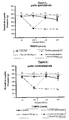
- the figure 1 represents the effect of Dysport (botulinum toxin type A1) on the right paw following its subplantar injection into the right (ipsilateral) paw in the paclitaxel-induced peripheral neuropathy model.
- Dysport botulinum toxin type A1
- the control indicates the threshold of pain tolerated by the rat when applying increasing pressure on its legs; this group was treated with the vehicle paclitaxel (3% montanox in 0.9% NaCl) intraperitoneally and the Dysport vehicle (0.9% NaCl) in subplantar. From D0 to D21, the nociception threshold is around 500 g / mm 2 .
- Pathological control indicates the threshold of pain tolerated by the rat when applying increasing pressure on its legs; this group was treated with paclitaxel intraperitoneally and by the vehicle of Dysport (0.9% NaCl) in subplantar. At day zero this threshold is 544 g / mm 2 then decreases to 232 g / mm 2 at day 15, 216 g / mm 2 at day 18 and 216 g / mm 2 at day 21.
- Dysport at a dose of 20U / kg subplantar in a group treated with the paclitaxel vehicle alone (montanox 3% in NaCl 0.9%) intraperitoneally, indicates that the threshold of pain tolerated by the rat is not significantly modified.
- the threshold of pain following a mechanical stimulus applied to the feet of the rats is from D0 to D21 at 590 g / mm 2 .
- Dysport at a dose of 20U / kg sp into a paclitaxel-treated group indicates that the pain threshold tolerated by the rat on his right leg is increasing.
- the threshold of pain following a mechanical stimulus applied on the legs of the rats is significantly increased to reach 500 g / mm 2 on day 18 (ie 3 days after the treatment with Dysport) and 480 g / mm 2 on D21 (ie 6 days after treatment with the Dysport) against 232 g / mm 2 at D15 (before Dysport).
- the figure 2 presents the effect of Dysport (botulinum toxin type A1) on the left (contralateral) paw following subplantar injection into the right (ipsilateral) paw in the peripheral neuropathy model induced by paclitaxel.
- Dysport botulinum toxin type A1
- the control indicates the threshold of pain tolerated by the rat when applying increasing pressure on its legs; this group was treated with the vehicle paclitaxel (3% montanox in 0.9% NaCl) intraperitoneally and the Dysport vehicle (0.9% NaCl) in subplantar. From D0 to D21, the nociception threshold is around 500 g / mm 2 .
- Pathological control indicates the threshold of pain tolerated by the rat when applying increasing pressure on its legs; this group was treated with paclitaxel intraperitoneally and with the Dysport vehicle (0.9% NaCl) in subplantar. At day zero this threshold is at 536 g / mm 2 then decreases to 228 g / mm 2 at day 15, 216 g / mm 2 at day 18 and 204 g / mm 2 at day 21.
- Dysport at a dose of 20U / kg subplantar in a group treated with the paclitaxel vehicle alone (montanox 3% in NaCl 0.9%) intraperitoneally, indicates that the threshold of pain tolerated by the rat is not significantly modified.
- the threshold of pain following a mechanical stimulus applied to the feet of the rats is from D0 to D21 to 610 g / mm 2 .
Landscapes
- Health & Medical Sciences (AREA)
- Life Sciences & Earth Sciences (AREA)
- Animal Behavior & Ethology (AREA)
- Chemical & Material Sciences (AREA)
- Veterinary Medicine (AREA)
- Public Health (AREA)
- Medicinal Chemistry (AREA)
- General Health & Medical Sciences (AREA)
- Pharmacology & Pharmacy (AREA)
- Organic Chemistry (AREA)
- Bioinformatics & Cheminformatics (AREA)
- General Chemical & Material Sciences (AREA)
- Chemical Kinetics & Catalysis (AREA)
- Nuclear Medicine, Radiotherapy & Molecular Imaging (AREA)
- Engineering & Computer Science (AREA)
- Neurosurgery (AREA)
- Biomedical Technology (AREA)
- Neurology (AREA)
- Pain & Pain Management (AREA)
- Gastroenterology & Hepatology (AREA)
- Immunology (AREA)
- Proteomics, Peptides & Aminoacids (AREA)
- Epidemiology (AREA)
- Rheumatology (AREA)
- Medicines That Contain Protein Lipid Enzymes And Other Medicines (AREA)
- Pharmaceuticals Containing Other Organic And Inorganic Compounds (AREA)
- Acyclic And Carbocyclic Compounds In Medicinal Compositions (AREA)
Description
- La présente invention a pour objet l'utilisation d'au moins une neurotoxine botulique pour l'obtention d'un médicament destiné à traiter ou prévenir la ou les douleurs post-chimiothérapiques associées à un traitement anti-cancéreux.
- La neuropathie post-chimiothérapique qui est une douleur provoquée par un traitement chimique pour lutter contre le cancer, reste encore aujourd'hui une pathologie difficile à soulager ou à guérir. Ce type de douleur est à distinguer de la douleur provoquée par les tumeurs cancéreuses elles-mêmes. En effet la neuropathie post-chimiothérapique est induite par l'agent anti-cancéreux administré aux patients aux fins de les soigner.
- Les douleurs neuropathiques post-chimiothérapiques ont des caractéristiques sémiologiques particulières. Généralement ces douleurs se caractérisent entre-autres par une douleur continue, diffuse, sans rythme mécanique ou inflammatoire, du type brûlure. Sur ce fond douloureux continu peuvent survenir d'autres symptômes : des accès spontanés du type élancements, picotements plus particulièrement des picotements au niveau des extrémités des membres, ou encore des décharges électriques. La topographie de ces symptômes correspond à une distribution compatible avec une systématisation périphérique ou centrale. En d'autres termes la topographie de ces douleurs neuropathiques post-chimiothérapiques est indépendante de la topographie des tumeurs cancéreuses.
- Parmi les traitements connus de cette douleur, on peut citer par exemple l'administration d'anticonvulsivants, d'anti-dépresseurs ou de composés opiacés tels que la morphine, qui a été isolée au tout début du XIXe siècle par un pharmacien allemand, Friedrich Sertürner, à partir de l'opium dont elle est le constituant principal.
- Par ailleurs l'Organisation Mondiale de la Santé préconise trois paliers de prescription des médicaments antalgiques, règle qui se révèle efficace chez 70 % des patients :
- Palier I : antalgiques non opioides pour des douleurs faibles à modérées
- Palier II : antalgiques opioides faibles associés aux non opioides pour des douleurs modérées à intenses.
- Palier III : antalgiques opioides forts pour des douleurs intenses à très intenses.
- Cependant l'usage des composés actuellement disponibles qui permettent de réduire la douleur provoquée par un traitement anti-cancéreux n'est pas satisfaisant car il nécessite l'emploi de doses élevées de composés, ou bien une ré-administration fréquente du composé avec un possible développement d'une résistance au composé ou accoutumance. De plus ces traitements anti-douleurs peuvent provoquer des effets secondaires, qui s'ajoutent à ceux déjà provoqués par le cancer.
- Il est donc devenu nécessaire de trouver un autre moyen pour traiter ces douleurs neuropathiques post-chimiothérapiques.
- Aussi le problème que se propose de résoudre l'invention est de trouver un nouveau traitement de la douleur provoquée par un traitement par un agent anti-cancéreux.
- De manière inattendue, les inventeurs ont mis en évidence que l'administration de neurotoxine botulique présente un effet analgésique dans le traitement de la douleur provoquée par la chimiothérapie.
- Dans ce but la présente invention propose l'utilisation d'au moins une neurotoxine botulique pour l'obtention d'un médicament destiné à traiter ou prévenir la ou les douleurs post-chimiothérapiques.
- L'invention offre des avantages déterminants, en particulier celui d'éviter ou de prévenir la douleur suite à un traitement par un agent anti-cancéreux et ainsi permettre l'augmentation des doses de traitement sans augmenter la douleur.
- Enfin l'invention a pour avantage de pouvoir être mise en oeuvre dans toutes industries, notamment l'industrie pharmaceutique, vétérinaire, cosmétique.
- D'autres avantages et caractéristiques de l'invention apparaîtront clairement à la lecture de la description et des exemples donnés à titre purement illustratifs et non limitatifs qui vont suivre.
- Par « douleur » au sens de la présente invention, il faut entendre « toute expérience désagréable émotionnelle et sensorielle associée à un dommage tissulaire présent ou potentiel, ou décrite par le patient en de tels termes ».
- Par l'expression neurotoxine botulique, on entend une toxine botulique qui est soit une protéine libre (i.e. libre de toute protéine la complexant), soit un complexe protéique, ledit complexe protéique pouvant comprendre par exemple de l'hémagglutinine (protéine HA) associée à de la toxine botulique, ou soit un fragment protéique.
- Par l'expression toxine botulique, on entend une molécule possédant l'activité biologique de la toxine botulique, qui peut être par exemple soit une protéine, soit un polypeptide, soit un peptide, soit une protéine de fusion, soit une protéine tronquée, soit une protéine chimérique, soit une protéine mutée ou une protéine recombinante.
- Par l'expression activité biologique de la toxine botulique, on entend au sens de la présente invention soit une paralysie musculaire soit une inhibition de l'exocytose, en particulier de l'exocytose de l'acétylcholine ou d'un autre neurotransmetteur.
- Par protéine, polypeptide ou peptide on entend au sens de la présente invention, un polymère d'acides aminés, naturels ou non, lévogyres ou non, dextrogyres ou non.
- Par protéine chimérique, on entend au sens de la présente invention une protéine obtenue après association de différents types de molécules, par exemple après association de lipides, de glycolipides, de peptides, de polypeptides, de protéines, de glycoprotéines, de carbohydrates, de polysaccharides, d'acides nucléiques, de polyéthylène glycol, etc.
- La toxine botulique, en particulier la toxine botulique de type A1 (Dysport® commercialisé par Ipsen ou Botox® commercialisé par Allergan), est utilisée depuis les années 80 chez l'homme pour le traitement de maladies / désordres divers et variés. Parmi les maladies / désordres pouvant être traités par la toxine botulique, on peut citer entre autres des désordres musculaires (par exemple le blépharospasme, la spasticité de l'adulte ou de l'enfant ou encore le torticolis), la migraine, la douleur d'origine musculaire, le diabète, l'hyperhydrose (ou transpiration excessive), l'hypersalivation ou même les rides.
-
WO 01/78760A - La neurotoxine botulique, pure ou quasiment pure, peut être obtenue à partir d'un complexe protéique comprenant de la toxine botulique par exemple selon la méthode décrite dans Current topics in Microbiology and Immunology (1995), 195, p. 151-154. Une neurotoxine botulique, pure ou quasiment pure, peut être obtenue par exemple, par purification d'un milieu de fermentation ou bouillon de culture contenant une souche de Clostridium Botulinum, et enrichi par exemple en viande ou en nourriture protéinée.
- La présente invention a tout d'abord pour objet l'utilisation d'au moins une neurotoxine botulique pour l'obtention d'un médicament destiné à traiter ou prévenir la ou les douleurs post-chimiothérapiques par administration localisée par voie intramusculaire, intra dermique ou sous-cutanée permettant d'obtenir un effet généralisé, la ou les douleurs n'étant pas de douleur(s) induite(s) par des tumeurs.
- De préférence, la présente invention n'a pas pour objet de traiter les cancers, ni les tumeurs, ni les douleurs induites par des tumeurs, en particulier les douleurs associées aux tumeurs osseuses.
- De préférence, l'utilisation selon l'invention d'au moins une neurotoxine botulique pour l'obtention d'un médicament permet de traiter ou de prévenir les douleurs post-chimiothérapiques induites par un agent anti-cancéreux ou ses sels ou ses dérivés.
- De préférence, l'agent anti-cancéreux ou ses sels ou ses dérivés sont choisis parmi les composés suivants ou leurs mélanges : les taxanes, les sels de platine, ou d'autres agents anti-cancéreux.
- De préférence, l'agent anti-cancéreux ou ses sels ou ses dérivés sont choisis parmi les taxanes comme par exemple le docetaxel, le paclitaxel (taxol) ou leurs mélanges.
- De préférence, l'agent anti-cancéreux ou ses sels ou ses dérivés sont choisis parmi les sels de platine comme par exemple le cisplatine, l'oxaliplatine ou le carboplatine ou leurs mélanges.
- De préférence, l'agent anti-cancéreux ou ses sels ou ses dérivés sont choisis parmi la vincristine, la vinblastine, l'étoposide, la teniposide, l'Ara-A (adenoside-arabinoside), l'Ara-C (cytarabine), le fluorouracil, la procarbazine, la vinorelbine, la gemcitabine, ou encore des produits ou mélanges de produits comme paclitaxel / carboplatine, paclitaxel / anthracyclines, paclitaxel / carboplatine / gemcitabine, paclitaxel / estramustine, docetaxel / cisplatine, docetaxel / doxorubicine, docetaxel / vinorelbine, docetaxel / trastuzumab, docetaxel / capecitabine ou cisplatine / cyclophosphamide, cisplatine / irinotecan, carboplatine / topotecan, carboplatine / estramustine, etoposide / estramustine, vinblastine / estramustine.
- Par sel, on entend un sel pharmaceutiquement acceptable et notamment des sels d'addition d'acides inorganiques tels que chlorhydrate, bromhydrate, iodhydrate, sulfate, phosphate, diphosphate et nitrate ou d'acides organiques tels que acétate, maléate, fumarate, tartrate, succinate, citrate, lactate, méthanesulfonate, p-toluènesulfonate, pamoate et stéarate. Entrent également dans le champ de la présente invention, lorsqu'ils sont utilisables, les sels formés à partir de bases telles que l'hydroxyde de sodium ou de potassium. Pour d'autres exemples de sels pharmaceutiquement acceptables, on peut se référer à "Salt selection for basic drugs", Int. J. Pharm. (1986), 33, 201-217.
- De manière préférentielle, la neurotoxine botulique permet d'obtenir un effet systémique.
- Par « effet systémique », on entend au sens de la présente invention une administration localisée permettant d'obtenir un effet généralisé.
- Selon une utilisation préférée de l'invention la neurotoxine botulique est administrée par voie intramusculaire, intra-dermique ou sous-cutanée.
- De préférence la neurotoxine botulique utilisée selon l'invention est choisie parmi les neurotoxines botuliques de type A, A1, A2, B, C, C1, D, E, F ou G.
- La neurotoxine botulique de type A1 correspond en fait à la toxine botulique classique qui est communément appelée toxine botulique de type A, sans distinction du sous-type. La neurotoxine botulique de type A1 est commercialisée sous le nom de DYSPORT® ou BOTOX®.
- Selon l'invention, la neurotoxine botulique de type A1 peut correspondre soit à un complexe de toxine botulique A1 et d'hémagglutinine, soit à la toxine botulique de type A1 libre de toutes protéines complexantes.
- La toxine botulique de type A2 a d'abord été isolée à partir de cas d'enfants atteints de botulisme vers 1990 (Sakaguchi et al., Int. J. Food Microbiol. (1990), 11, 231-242). Cette toxine est immunologiquement et biochimiquement différente de la toxine botulique de type A1.
- La toxine botulique de type A2 peut être isolée à partir des souches suivantes : Kyoto-F, Chiba-H, Y-8036, 7103-H, 7105-H, KZ1828, NCTC2012 ou NCTC9837 (Cordoba et al., System. Appl. Microbiol. (1995), 18, 13-22; Franciosa et al., abstract presented at 40th Interagency Botulism Research Coordinating Committee (IBRCC) Meeting, November 2003).
- De préférence la neurotoxine botulique utilisée selon l'invention est la toxine botulique de type A1.
- Selon une variante de l'invention, la neurotoxine botulique utilisée selon l'invention est la toxine botulique de type A2 isolée à partir de la souche Clostridium botulinum référencée et accessible sous le numéro NCTC9837, auprès de la National Collection of Type Cultures - Central Public Health Laboratory - London - UK. La souche NCTC9837 est parfois appelée souche Mauritius 1955.
- La toxine botulique de type A2 diffère de la toxine A1 par, entre autre, sa séquence en acides aminés, son poids moléculaire, ses caractéristiques immunologiques et génétiques (Kubota et al., Biochem. Biophys. Res. Commun. (1996), 224 (3), 843-848).
- Selon un mode préférentiel, la neurotoxine botulique utilisée selon l'invention est une neurotoxine botulique modifiée ayant au moins un acide aminé supprimé, modifié ou remplacé.
- De préférence la neurotoxine botulique utilisée selon l'invention est associée à au moins un polysaccharide ou un mélange de plusieurs polysaccharides.
- Par polysaccharide, on entend au sens de la présente invention, un polymère comprenant au moins 2 monomères, les monomères étant des saccharides. Cette définition inclut les disaccharides.
- Dans le cadre de l'invention, les polysaccharides peuvent être ioniques et/ou non ioniques.
- De préférence, la composition comprend au moins un polysaccharide comprenant majoritairement des unités de glucose. Le terme majoritairement signifiant que le glucose est majoritaire en nombre d'unités de monomère.
- Comme exemple de polysaccharides convenant selon l'utilisation de l'invention, on peut citer l'amidon, les dérivés d'amidon, l'hydroxyethyle amidon en particulier le 2-hydroxy-ethyl amidon.
- Les polysaccharides convenant selon la présente invention peuvent être substitués, en particulier peuvent être substitués par des radicaux alkyles, alcoxy, ou encore par des radicaux alkyles eux-mêmes substitués par des fonctions alcools.
- Selon une variante de l'invention, la quantité de polysaccharide convenant selon la présente invention est d'au moins 1 µg de polysaccharide pour 1 unité de toxine botulique. Selon le choix du polysaccharide, il est possible d'utiliser au moins 0,5 µg de polysaccharide pour 1 unité de toxine botulique.
- De préférence la neurotoxine botulique utilisée selon l'invention est associée à au moins un tensio-actif ou un mélange de plusieurs tensio-actifs.
- Par agent tensio-actif, on entend au sens de l'invention un agent émulsifiant ou un agent solubilisant.
- Dans le cadre de l'invention les tensio-actifs mis en oeuvre peuvent être choisis parmi les tensio-actifs cationiques, anioniques ou non-ioniques.
- De préférence la neurotoxine botulique utilisée selon l'invention est associée à au moins un tensio-actif ou un mélange de plusieurs tensio-actifs, choisi parmi les tensio-actifs cationiques, anioniques ou non-ioniques.
- De préférence la neurotoxine botulique utilisée selon l'invention est associée à au moins un tensio-actif choisi parmi les tensio-actifs non-ioniques du groupe des polysorbates.
- Parmi le groupe des polysorbates, on peut citer le polysorbate 20, le polysorbate 21, le polysorbate 40, le polysorbate 60, le polysorbate 61, le polysorbate 65, le polysorbate 80, le polysorbate 81, le polysorbate 85, le polysorbate 120, le polysorbate 80 acetate.
- Le tensio-actif préféré selon une variante de l'invention est le polysorbate 80.
- La neurotoxine botulique utilisée selon l'invention peut être administrée de préférence par injection comme par exemple par injection intramusculaire, intra-dermique ou sous-cutanée, ou encore par application topique par exemple application d'un patch.
- Dans le cas des injections selon l'invention, la neurotoxine botulique pourra être associée à un agent facilitant l'injection encore appelé véhicule d'injection ou vecteur d'injection.
- La dose d'utilisation selon la présente invention de la neurotoxine botulique, à prévoir pour le traitement ou la prévention des maladies ou troubles mentionnés ci-dessus, varie suivant le mode d'administration, l'âge et le poids corporel du sujet à traiter ainsi que l'état de ce dernier, et il en sera décidé en définitive par le médecin ou le vétérinaire traitant. Une telle quantité déterminée par le médecin ou le vétérinaire traitant est appelée ici "quantité thérapeutiquement efficace".
- De préférence, la neurotoxine botulique utilisée selon l'invention est administrée à une dose comprise entre 0,01 U et 1500 U, préférentiellement à une dose comprise entre 0,01 U et 1000 U, plus préférentiellement de 0,1 à 500 U, plus particulièrement à une dose comprise entre 0,1 et 100 U, encore plus particulièrement à une dose comprise entre 1 et 20 U, et ceci quel que soit le type de toxine botulique ou quelle que soit sa provenance. (L'unité de toxine (U) est définie dans la partie expérimentale).
- La présente invention a pour objet l'utilisation de la neurotoxine botulique, décrite ci-dessus, pour l'obtention d'un médicament destiné à traiter ou prévenir la ou les douleurs post-chimiothérapiques, c'est-à-dire les douleurs liées à un traitement contre le cancer.
- Par l'expression « cancer », on entend au sens de l'invention tout type de cancer, c'est dire invasif, non invasif, infiltrant, hormonal, non hormonal, localisé ou métastatique.
- Selon une utilisation préférée de l'invention la neurotoxine botulique permet de traiter ou prévenir la ou les douleurs post-chimiothérapiques chez des patients atteints par exemple de cancers du colon, du rectum, du sein, des poumons, du pancréas, des testicules, du rein, de l'utérus, de l'ovaire, de la prostate, de la peau, des os, de la moelle épinière ainsi que les patients atteints de sarcomes, de carcinomes, de fibroadénomes, de neuroblastomes, de leucémies, de lymphomes, ou de mélanomes.
- La
figure 1 présente l'effet de la toxine botulique de type A1 sur la patte droite suite à l'injection par voie sous-plantaire dans la patte droite (ipsilatérale) dans le modèle de neuropathie périphérique induite par le paclitaxel. - La
figure 2 présente l'effet de la toxine botulique de type A1 sur la patte gauche (contralatérale) suite à l'injection par voie sous-plantaire dans la patte droite (ipsilatérale) dans le modèle de neuropathie périphérique induite par le paclitaxel. - La
figure 3 présente le protocole d'injection. - Les exemples suivants illustrent l'invention sans en limiter la portée.
- La mesure de la quantité des neurotoxines botuliques utilisées selon l'invention a été réalisée par la mesure d'une dose létale DL50. Par DL50, on entend au sens de la présente invention la dose létale ou encore dose semi létale d'une substance donnée. Il s'agit de la dose (ou quantité) qui conduit à la mort de 50% des animaux testés d'un groupe. Une unité de toxine (U) correspond à la DL50 chez la souris par voie intra péritonéale.
- L'activité du Dysport® (toxine botulique de type A1) a été évaluée in vivo sur un modèle de neuropathie périphérique induite par administration d'un agent anti-cancéreux : le Paclitaxel (Taxol®).
- Des rats mâles Sprague Dawley (Charles River) de 160g environ sont laissés en stabulation pendant 6 jours dans les conditions d'animalerie. 4 groupes sont constitués d'au moins 10 animaux.
- La neuropathie est induite par injections intra-péritonéales (i.p.) de 2mg/kg de paclitaxel aux jours J0, J2, J4 et J7.
- Avant la première injection, les rats sont numérotés et pesés et la nociception (seuil de la douleur) est évaluée après un stimulus mécanique dont la pression est croissante : induction d'une pression initiale (210g/mm2) sur les deux pattes arrières des rats effectuée à l'aide d'un analgésie-mètre selon la méthode de Randall et Selitto. Ces mesures permettent de définir les valeurs basales avant le développement de la neuropathie (J0).
- La diminution du seuil nociceptif correspondant à l'atteinte neuropathique est maximale entre le 14éme et le 24éme jour après la première injection de paclitaxel. Le seuil de nociception des deux pattes arrières des rats est diminué semblablement. Les études de neuropathie seront donc effectuées entre le 14éme et le 24éme jour sur les 2 pattes arrières des rats. Dans le cas décrit, les mesures de nociception sont effectuées à J18 et J21.
- Le jour de l'expérience (J15), les rats sont pesés, la nociception est mesurée et les animaux n'ayant pas développé la neuropathie ce jour (diminution de la nociception par rapport aux mesures à J0) sont exclus de l'étude. Le Dysport est injecté en sous-plantaire dans la patte arrière droite (ipsilatérale) des rats et la nociception est mesurée sur les 2 pattes arrières (ipsilatérale et contralatérale) 3 jours et 6 jours après son administration.
- La
figure 1 représente l'effet du Dysport (de la toxine botulique de type A1) sur la patte droite suite à son injection par voie sous-plantaire dans la patte droite (ipsilatérale) dans le modèle de neuropathie périphérique induite par le paclitaxel. - Le contrôle indique le seuil de douleur toléré par le rat lorsque l'on applique une pression croissante sur ses pattes ; ce groupe a été traité par le véhicule du paclitaxel (montanox 3% dans NaCl 0,9%) par voie intra-péritonéale et par le véhicule du Dysport (NaCl 0,9%) en sous-plantaire. De J0 à J21, le seuil de nociception se situe vers 500 g/mm2.
- Le contrôle pathologique indique le seuil de douleur toléré par le rat lorsque l'on applique une pression croissante sur ses pattes ; ce groupe a été traité par le paclitaxel par voie intra-péritonéale et par le véhicule du Dysport (NaCl 0,9%) en sous-plantaire. Au jour zéro ce seuil se situe à 544 g/mm2 puis diminue pour atteindre 232 g/mm2 au jour 15, 216 g/mm2 au jour 18 et 216 g/mm2 au jour 21. Ces résultats indiquent qu'après injection i.p. de paclitaxel, la sensibilité des pattes des rats est augmentée suite à l'application d'une pression sur celles-ci.
- L'administration du Dysport à la dose de 20U/kg en sous-plantaire dans un groupe traité uniquement par le véhicule du paclitaxel (montanox 3% dans NaCl 0,9%) par voie intra-péritonéale, indique que le seuil de douleur toléré par le rat n'est pas significativement modifié. Le seuil de douleur suite à un stimulus mécanique appliqué sur les pattes des rats se situe de J0 à J21 vers 590 g/ mm2.
- L'administration du Dysport à la dose de 20U/kg s.p. dans un groupe traité par le paclitaxel indique que le seuil de douleur toléré par le rat sur sa patte droite augmente. Le seuil de douleur suite à un stimulus mécanique appliqué sur les pattes des rats, est significativement augmenté pour atteindre 500 g/mm2 à J18 (soit 3 jours après le traitement avec le Dysport) et 480 g/mm2 à J21 (soit 6 jours après le traitement avec le Dysport) contre 232 g/mm2 à J15 (avant Dysport).
- La
figure 2 présente l'effet du Dysport (toxine botulique de type A1) sur la patte gauche (contralatérale) suite à l'injection par voie sous-plantaire dans la patte droite (ipsilatérale) dans le modèle de neuropathie périphérique induite par le paclitaxel. - Le contrôle indique le seuil de douleur toléré par le rat lorsque l'on applique une pression croissante sur ses pattes ; ce groupe a été traité par le véhicule du paclitaxel (montanox 3% dans NaCl 0,9%) par voie intra-péritonéale et par le véhicule du Dysport (NaCl 0,9%) en sous-plantaire. De J0 à J21, le seuil de nociception se situe vers 500 g/mm2.
- Le contrôle pathologique indique le seuil de douleur toléré par le rat lorsque l'on applique une pression croissante sur ses pattes ; ce groupe a été traité par le paclitaxel par voie intra-péritonéale et par le véhicule du Dysport (NaCl 0,9%) en sous-plantaire. Au jour zéro ce seuil se situe à 536 g/mm2 puis diminue pour atteindre 228 g/mm2 au jour 15, 216 g/mm2 au jour 18 et 204 g/mm2 au jour 21. Ces résultats indiquent qu'après injection i.p. de paclitaxel, la sensibilité des pattes des rats est augmentée suite à l'application d'une pression sur celles-ci.
- L'administration du Dysport à la dose de 20U/kg en sous-plantaire dans un groupe traité uniquement par le véhicule du paclitaxel (montanox 3% dans NaCl 0,9%) par voie intra-péritonéale, indique que le seuil de douleur toléré par le rat n'est pas significativement modifié. Le seuil de douleur suite à un stimulus mécanique appliqué sur les pattes des rats se situe de J0 à J21 vers 610 g/mm2.
- L'administration dans la patte droite du Dysport à la dose de 20U/kg s.p. dans un groupe traité par le paclitaxel indique que le seuil de douleur toléré par le rat sur sa patte gauche augmente. Le seuil de douleur suite à un stimulus mécanique appliqué sur les pattes des rats, est significativement augmenté pour atteindre 540 g/mm2 à J18 (soit 3 jours après le traitement avec le Dysport) et 512 g/mm2 à J21 (soit 6 jours après le traitement avec le Dysport) contre 244 g/mm2 à J15 (avant Dysport).
- Ces résultats indiquent que l'administration de Dysport en sous-plantaire dans la patte droite des rats induit un effet analgésique, mesuré sur les deux pattes arrières des rats, dans ce test de neuropathie périphérique induite par quatre injections consécutives et systémiques de paclitaxel.
Claims (15)
- Utilisation d'au moins une neurotoxine botulique pour l'obtention d'un médicament destiné à traiter ou prévenir la ou les douleurs post-chimiothérapiques par administration localisée par voie intramusculaire, intra dermique ou sous-cutanée permettant d'obtenir un effet généralisé, la ou les douleurs n'étant pas de douleur(s) induite(s) par des tumeurs.
- Utilisation selon la revendication 1 caractérisé en ce que la ou les douleurs post-chimiothérapiques sont induites par un agent anti-cancéreux ou ses sels.
- Utilisation selon l'une des revendications précédentes caractérisée en ce que la ou les douleurs post-chimiothérapiques sont provoquées par un agent anti-cancéreux ou ses sels choisis parmi les composés suivants ou leurs mélanges : les taxanes ou les sels de platine.
- Utilisation selon l'une des revendications précédentes caractérisée en ce que la ou les douleurs post-chimiothérapiques sont provoquées par un agent anti-cancéreux ou ses sels choisis parmi le docetaxel, le paclitaxel (taxol) ou leurs mélanges.
- Utilisation selon la revendication 3 caractérisée en ce que la ou les douleurs post-chimiothérapiques sont provoquées par un agent anti-cancéreux ou ses sels choisis parmi le cisplatine, l'oxaliplatine ou le carboplatine ou leurs mélanges.
- Utilisation selon l'une des revendications précédentes caractérisée en ce que la ou les douleurs post-chimiothérapiques sont provoquées par un agent anti-cancéreux ou ses sels choisis parmi la vincristine, la vinblastine, l'étoposide, la teniposide, l'Ara-A (adenoside-arabinoside), l'Ara-C (cytarabine), le fluorouracil, la procarbazine, la vinorelbine, la gemcitabine, ou encore des produits ou mélanges de produits comme paclitaxel/ carboplatine, paclitaxel / anthracyclines, paclitaxel / carboplatine/gemcitabine, paclitaxel / estramustine, docetaxel / cisplatine, docetaxel / doxorubicine, docetaxel / vinorelbine, docetaxel / trastuzumab, docetaxel / capecitabine ou cisplatine / cyclophosphamide, cisplatine / irinotecan, carboplatine / topotecan, carboplatine / estramustine, etoposide / estramustine, vinblastine / estramustine.
- Utilisation selon l'une des revendications précédentes caractérisée en ce que la neurotoxine botulique est choisie parmi les neurotoxines botuliques de type A, A1, A2, B, C, C1, D, E, F ou G.
- Utilisation selon l'une des revendications précédentes caractérisée en ce que la neurotoxine botulique est la toxine botulique de type A1.
- Utilisation selon l'une des revendications précédentes caractérisée en ce que la neurotoxine botulique est associée à au moins un polysaccharide ou un mélange de plusieurs polysaccharides.
- Utilisation selon la revendication 9 caractérisée en ce que le polysaccharide est le 2-hydroxy-ethyl amidon.
- Utilisation selon l'une des revendications précédentes caractérisée en ce que la neurotoxine botulique est une neurotoxine botulique modifiée ayant au moins un acide aminé supprimé, modifié ou remplacé.
- Utilisation selon l'une des revendications précédentes caractérisée en ce que la neurotoxine botulique est associée à au moins un tensio-actif ou un mélange de plusieurs tensio-actifs, choisis parmi les tensio-actifs cationiques, anioniques ou non-ioniques.
- Utilisation selon l'une des revendications précédentes caractérisée en ce que la neurotoxine botulique est associée à au moins un tensio-actif choisi parmi les tensio-actifs non-ioniques du groupe des polysorbates.
- Utilisation selon l'une des revendications précédentes caractérisée en ce que la neurotoxine botulique est administrée à une dose comprise entre 0,01 U et 1500 U.
- Utilisation selon l'une des revendications précédentes caractérisée en ce que la ou les douleurs post-chimiothérapiques provient de patients atteints de cancers du colon, du rectum, du sein, des poumons, du pancréas, des testicules, du rein, de l'utérus, de l'ovaire, de la prostate, de la peau, des os, de la moelle épinière ainsi que les patients atteints de sarcomes, de carcinomes, de fibroadénomes, de neuroblastomes, de leucémies, de lymphomes, ou de mélanomes.
Priority Applications (1)
| Application Number | Priority Date | Filing Date | Title |
|---|---|---|---|
| PL07866446T PL2083837T3 (pl) | 2006-10-27 | 2007-10-26 | Terapeutyczne zastosowanie co najmniej jednej neurotoksyny botulinowej do leczenia bólu wywołanego co najmniej jednym środkiem przeciwnowotworowym |
Applications Claiming Priority (2)
| Application Number | Priority Date | Filing Date | Title |
|---|---|---|---|
| FR0609435A FR2907680B1 (fr) | 2006-10-27 | 2006-10-27 | Utilisation therapeutique d'au moins une neurotoxine botulique dans le traitement de la douleur induite par au moins un agent anti-cancereux |
| PCT/FR2007/001773 WO2008059126A1 (fr) | 2006-10-27 | 2007-10-26 | Utilisation therapeutique d'au moins une neurotoxine botulique dans le traitement de la douleur induite par au moins un agent anti-cancereux |
Publications (2)
| Publication Number | Publication Date |
|---|---|
| EP2083837A1 EP2083837A1 (fr) | 2009-08-05 |
| EP2083837B1 true EP2083837B1 (fr) | 2015-01-07 |
Family
ID=38109619
Family Applications (1)
| Application Number | Title | Priority Date | Filing Date |
|---|---|---|---|
| EP07866446.3A Not-in-force EP2083837B1 (fr) | 2006-10-27 | 2007-10-26 | Utilisation therapeutique d'au moins une neurotoxine botulique dans le traitement de la douleur induite par au moins un agent anti-cancereux |
Country Status (12)
| Country | Link |
|---|---|
| US (1) | US8273359B2 (fr) |
| EP (1) | EP2083837B1 (fr) |
| JP (1) | JP5386359B2 (fr) |
| CN (1) | CN101541336B (fr) |
| CA (1) | CA2667128C (fr) |
| DK (1) | DK2083837T3 (fr) |
| ES (1) | ES2532850T3 (fr) |
| FR (1) | FR2907680B1 (fr) |
| PL (1) | PL2083837T3 (fr) |
| PT (1) | PT2083837E (fr) |
| RU (1) | RU2483747C2 (fr) |
| WO (1) | WO2008059126A1 (fr) |
Families Citing this family (17)
| Publication number | Priority date | Publication date | Assignee | Title |
|---|---|---|---|---|
| US7780967B2 (en) * | 2000-02-08 | 2010-08-24 | Allergan, Inc. | Reduced toxicity Clostridial toxin pharmaceutical compositions |
| US9211248B2 (en) | 2004-03-03 | 2015-12-15 | Revance Therapeutics, Inc. | Compositions and methods for topical application and transdermal delivery of botulinum toxins |
| FR2889936B1 (fr) * | 2005-09-01 | 2007-12-21 | Sod Conseils Rech Applic | Methode pour quantifier une neurotoxine cholinergique dans un echantillon |
| FR2902341B1 (fr) * | 2006-06-16 | 2011-02-25 | Scras | Utilisation therapeutique simultanee, separee ou etalee dans le temps d'au moins une neurotoxine botulique, et d'au moins un derive opiace |
| EP2085093B1 (fr) * | 2006-10-27 | 2015-02-25 | The Chemo-Sero-Therapeutic Research Institute | Préparation contenant une toxine botulinique de type a hautement purifiée issue d'un pathogène du botulisme chez l'enfant |
| FR2907680B1 (fr) * | 2006-10-27 | 2012-12-28 | Scras | Utilisation therapeutique d'au moins une neurotoxine botulique dans le traitement de la douleur induite par au moins un agent anti-cancereux |
| FR2910327B1 (fr) * | 2006-12-22 | 2013-04-26 | Scras | Utilisation d'au moins une neurotoxine botulique pour traiter la douleur induite par les traitements therapeutiques du virus du sida. |
| FR2930447B1 (fr) * | 2008-04-25 | 2010-07-30 | Sod Conseils Rech Applic | Utilisation therapeutique d'au moins une neurotoxine botulique dans le traitement de la douleur dans le cas de la neuropathie diabetique |
| US20100332337A1 (en) * | 2009-06-25 | 2010-12-30 | Bullock Roddy Mckee | Universal one-click online payment method and system |
| PT2854840T (pt) | 2012-05-30 | 2018-03-02 | Harvard College | Neurotoxina botulínica geneticamente modificada |
| ES2642916T3 (es) * | 2014-06-06 | 2017-11-20 | Galit KLEINER-FISMAN | Toxina botulínica para su uso en el tratamiento de la paratonia |
| HK1248737A1 (zh) | 2015-03-26 | 2018-10-19 | 哈佛大学校长及研究员协会 | 工程改造的肉毒杆菌神经毒素 |
| AU2017221491B2 (en) | 2016-02-19 | 2019-06-27 | Avery Dennison Corporation | Two stage methods for processing adhesives and related compositions |
| EP3504226A1 (fr) | 2016-08-24 | 2019-07-03 | President and Fellows of Harvard College | Neurotoxine botulique manipulée |
| WO2018081268A1 (fr) | 2016-10-25 | 2018-05-03 | Avery Dennison Corporation | Polymères séquencés présentant des groupes photo-initiateurs dans le squelette et leur utilisation dans des compositions adhésives |
| EP3728361B1 (fr) | 2017-12-19 | 2023-01-18 | Avery Dennison Corporation | Fonctionnalisation post-polymérisation de groupes fonctionnels pendants |
| US20230165812A1 (en) * | 2020-02-27 | 2023-06-01 | President And Fellows Of Harvard College | Nociceptor neurons control cancer immunosurveillance |
Family Cites Families (28)
| Publication number | Priority date | Publication date | Assignee | Title |
|---|---|---|---|---|
| EP1488803B1 (fr) * | 1993-12-28 | 2008-03-26 | Allergan, Inc. | Composante neurotoxique de la toxine botulinique pour la traitement de la dystonie cervicale |
| DE19501266A1 (de) * | 1995-01-18 | 1996-07-25 | Madaus Ag | Verfahren zur Herstellung von Flavano-Lignan-Zubereitungen mit verbesserter Freisetzung und Resorbierbarkeit danach erhältliche Zubereitungen und deren Verwendung zur Herstellung von Arzneimitteln |
| SE9803239D0 (sv) * | 1998-09-24 | 1998-09-24 | Diabact Ab | Composition for the treatment of acute pain |
| US6113915A (en) * | 1999-10-12 | 2000-09-05 | Allergan Sales, Inc. | Methods for treating pain |
| US6139845A (en) * | 1999-12-07 | 2000-10-31 | Allergan Sales, Inc. | Method for treating cancer with a neurotoxin |
| JP2003522154A (ja) * | 2000-02-08 | 2003-07-22 | アラーガン、インコーポレイテッド | ボツリヌス毒素医薬組成物 |
| US20060269575A1 (en) * | 2000-02-08 | 2006-11-30 | Allergan, Inc. | Botulinum toxin pharmaceutical compositions formulated with recombinant albumin |
| US7780967B2 (en) * | 2000-02-08 | 2010-08-24 | Allergan, Inc. | Reduced toxicity Clostridial toxin pharmaceutical compositions |
| US6464986B1 (en) * | 2000-04-14 | 2002-10-15 | Allegan Sales, Inc. | Method for treating pain by peripheral administration of a neurotoxin |
| US20020192239A1 (en) * | 2001-01-09 | 2002-12-19 | Borodic Gary E. | Use of botulinum toxin for the treatment of chronic facial pain |
| KR20030018827A (ko) | 2001-08-31 | 2003-03-06 | 서구일 | A형 보툴리눔 독소를 유효성분으로 포함하는 신경차단제,및 이를 이용한 교감신경절 차단의 적응질환 치료제 |
| CA2369810C (fr) * | 2002-01-30 | 2007-08-07 | 1474791 Ontario Limited | Methode de traitement de la douleur |
| US20040009180A1 (en) * | 2002-07-11 | 2004-01-15 | Allergan, Inc. | Transdermal botulinum toxin compositions |
| US20050152905A1 (en) * | 2002-08-22 | 2005-07-14 | Omoigui Osemwota S. | Method of biochemical treatment of persistent pain |
| WO2004075832A2 (fr) * | 2003-02-27 | 2004-09-10 | Lucas John M | Methodes et compositions de traitement de douleurs chroniques au moyen de la dhea et de derives de celle-ci |
| US20040247623A1 (en) * | 2003-03-24 | 2004-12-09 | Roger Cady | Method and article for treatment of sensory neuron related disorders through transdermal application of botulinum toxin |
| US7270287B2 (en) * | 2004-01-06 | 2007-09-18 | Allergan, Inc. | Botulinum toxin treatment for kinesia |
| GB2417419A (en) | 2004-07-12 | 2006-03-01 | Ipsen Ltd | Therapeutic use of Botulinum toxin |
| GB2419526A (en) | 2004-10-28 | 2006-05-03 | Ipsen Ltd | Pharmaceutical composition containing botulinum neurotoxin |
| GB2416692A (en) | 2004-08-04 | 2006-02-08 | Ipsen Ltd | Pharmaceutical composition containing botulinum neurotoxin |
| EP1799264A2 (fr) * | 2004-10-08 | 2007-06-27 | Neuromolecular Pharmaceuticals Inc | Methodes et compositions de traitement de la douleur de migraine |
| WO2006094539A1 (fr) * | 2005-03-03 | 2006-09-14 | Université Catholique de Louvain | Methodes et preparations de traitement du cancer |
| US20090214466A1 (en) * | 2005-05-09 | 2009-08-27 | Levin Bruce H | Methods of Alleviating Disorders and Their Associated Pain |
| KR100726441B1 (ko) * | 2005-11-22 | 2007-06-11 | 삼성전자주식회사 | 현상장치 및 이를 이용한 화상형성장치 |
| FR2902341B1 (fr) | 2006-06-16 | 2011-02-25 | Scras | Utilisation therapeutique simultanee, separee ou etalee dans le temps d'au moins une neurotoxine botulique, et d'au moins un derive opiace |
| FR2907680B1 (fr) * | 2006-10-27 | 2012-12-28 | Scras | Utilisation therapeutique d'au moins une neurotoxine botulique dans le traitement de la douleur induite par au moins un agent anti-cancereux |
| FR2910327B1 (fr) * | 2006-12-22 | 2013-04-26 | Scras | Utilisation d'au moins une neurotoxine botulique pour traiter la douleur induite par les traitements therapeutiques du virus du sida. |
| FR2930447B1 (fr) * | 2008-04-25 | 2010-07-30 | Sod Conseils Rech Applic | Utilisation therapeutique d'au moins une neurotoxine botulique dans le traitement de la douleur dans le cas de la neuropathie diabetique |
-
2006
- 2006-10-27 FR FR0609435A patent/FR2907680B1/fr not_active Expired - Fee Related
-
2007
- 2007-10-26 JP JP2009533902A patent/JP5386359B2/ja not_active Expired - Fee Related
- 2007-10-26 CN CN2007800399471A patent/CN101541336B/zh not_active Expired - Fee Related
- 2007-10-26 EP EP07866446.3A patent/EP2083837B1/fr not_active Not-in-force
- 2007-10-26 PL PL07866446T patent/PL2083837T3/pl unknown
- 2007-10-26 PT PT07866446T patent/PT2083837E/pt unknown
- 2007-10-26 RU RU2009120021/15A patent/RU2483747C2/ru active
- 2007-10-26 CA CA2667128A patent/CA2667128C/fr not_active Expired - Fee Related
- 2007-10-26 ES ES07866446.3T patent/ES2532850T3/es active Active
- 2007-10-26 US US12/447,443 patent/US8273359B2/en not_active Expired - Fee Related
- 2007-10-26 DK DK07866446.3T patent/DK2083837T3/en active
- 2007-10-26 WO PCT/FR2007/001773 patent/WO2008059126A1/fr not_active Ceased
Non-Patent Citations (4)
| Title |
|---|
| CUI MINGLEI ET AL: "Subcutaneous administration of botulinum toxin A reduces formalin-induced pain", PAIN, ELSEVIER SCIENCE PUBLISHERS, AMSTERDAM, NL, vol. 107, no. 1-2, 1 January 2004 (2004-01-01), pages 125 - 133, XP002337053, ISSN: 0304-3959, DOI: 10.1016/J.PAIN.2003.10.008 * |
| JUAN P. CATA ET AL: "The effects of thalidomide and minocycline on taxol-induced hyperalgesia in rats", BRAIN RESEARCH, vol. 1229, 1 September 2008 (2008-09-01), pages 100 - 110, XP055130597, ISSN: 0006-8993, DOI: 10.1016/j.brainres.2008.07.001 * |
| JUDITH A PAICE: "Mechanisms and management of neuropathic pain in cancer", THE JOURNAL OF SUPPORTIVE ONCOLOGY, 1 July 2003 (2003-07-01), United States, pages 107, XP055130600, Retrieved from the Internet <URL:http://www.ncbi.nlm.nih.gov/pubmed/15352654> * |
| ROSEMARY C POLOMANO ET AL: "A painful peripheral neuropathy in the rat produced by the chemotherapeutic drug, paclitaxel", PAIN, vol. 94, no. 3, 1 December 2001 (2001-12-01), pages 293 - 304, XP055130591, ISSN: 0304-3959, DOI: 10.1016/S0304-3959(01)00363-3 * |
Also Published As
| Publication number | Publication date |
|---|---|
| HK1137352A1 (en) | 2010-07-30 |
| US20100068231A1 (en) | 2010-03-18 |
| PT2083837E (pt) | 2015-03-26 |
| CN101541336B (zh) | 2012-12-19 |
| CN101541336A (zh) | 2009-09-23 |
| JP2010507635A (ja) | 2010-03-11 |
| ES2532850T3 (es) | 2015-04-01 |
| RU2483747C2 (ru) | 2013-06-10 |
| CA2667128C (fr) | 2017-08-29 |
| FR2907680A1 (fr) | 2008-05-02 |
| WO2008059126A1 (fr) | 2008-05-22 |
| CA2667128A1 (fr) | 2008-05-22 |
| RU2009120021A (ru) | 2010-12-10 |
| JP5386359B2 (ja) | 2014-01-15 |
| FR2907680B1 (fr) | 2012-12-28 |
| US8273359B2 (en) | 2012-09-25 |
| DK2083837T3 (en) | 2015-03-23 |
| EP2083837A1 (fr) | 2009-08-05 |
| PL2083837T3 (pl) | 2015-06-30 |
Similar Documents
| Publication | Publication Date | Title |
|---|---|---|
| CA2667128C (fr) | Utilisation therapeutique d'au moins une neurotoxine botulique dans le traitement de la douleur induite par au moins un agent anti-cancereux | |
| EP2037956B1 (fr) | Utilisation therapeutique simultanee, separee ou etalee dans le temps d'au moins une neurotoxine botulique, et d'au moins un derive opiace | |
| Wahlman et al. | Chemotherapy-induced pain is promoted by enhanced spinal adenosine kinase levels through astrocyte-dependent mechanisms | |
| US20220387299A1 (en) | Nanoparticle compositions, formulations thereof, and uses therefor | |
| DK2667854T3 (en) | NANO PARTICLE FORMATIONS | |
| KR102080429B1 (ko) | 경피 운반 | |
| CA2643171C (fr) | Procede de traitement de la cellulite | |
| EP2104510B1 (fr) | Utilisation d'au moins une neurotoxine botulique pour traiter la douleur induite par les traitements therapeutiques du virus du sida | |
| FR2930447A1 (fr) | Utilisation therapeutique d'au moins une neurotoxine botulique dans le traitement de la douleur dans le cas de la neuropathie diabetique | |
| KR20110131187A (ko) | 여드름 및 기타 질환 치료용 비스파틴 치료제 | |
| KR101464208B1 (ko) | 당뇨성 신경병증에서 말초 신경의 형태기능의 복원을 위한 상피 성장인자의 용도 | |
| US8697090B2 (en) | Method of treating persistent genital arousal disorder with a neurotoxin | |
| WO2008127419A2 (fr) | Compositions et procédés pour augmenter l'effet d'un traitement neurotoxique | |
| KR20200113511A (ko) | Pat4를 포함하는 만성통증 질환 예방, 개선 또는 치료용 조성물 | |
| TW202406540A (zh) | 類黃酮化合物在對抗蛇毒誘發的毒性上的用途 | |
| AU2014285058A1 (en) | Reducing adverse side effects of a compound by a neurotoxin | |
| HK1137352B (en) | Therapeutic use of at least one botulic neurotoxin in the treatment of pain induced by at least one antineoplastic agent | |
| HK1192452A (en) | Nanoparticle compositions | |
| FR2971941A1 (fr) | Compositions pharmaceutiques administrables par voie cutanee et destinees au traitement local de la dermatite atopique canine |
Legal Events
| Date | Code | Title | Description |
|---|---|---|---|
| PUAI | Public reference made under article 153(3) epc to a published international application that has entered the european phase |
Free format text: ORIGINAL CODE: 0009012 |
|
| 17P | Request for examination filed |
Effective date: 20090527 |
|
| AK | Designated contracting states |
Kind code of ref document: A1 Designated state(s): AT BE BG CH CY CZ DE DK EE ES FI FR GB GR HU IE IS IT LI LT LU LV MC MT NL PL PT RO SE SI SK TR |
|
| 17Q | First examination report despatched |
Effective date: 20091019 |
|
| DAX | Request for extension of the european patent (deleted) | ||
| REG | Reference to a national code |
Ref country code: HK Ref legal event code: DE Ref document number: 1137352 Country of ref document: HK |
|
| GRAP | Despatch of communication of intention to grant a patent |
Free format text: ORIGINAL CODE: EPIDOSNIGR1 |
|
| INTG | Intention to grant announced |
Effective date: 20141006 |
|
| GRAS | Grant fee paid |
Free format text: ORIGINAL CODE: EPIDOSNIGR3 |
|
| GRAA | (expected) grant |
Free format text: ORIGINAL CODE: 0009210 |
|
| AK | Designated contracting states |
Kind code of ref document: B1 Designated state(s): AT BE BG CH CY CZ DE DK EE ES FI FR GB GR HU IE IS IT LI LT LU LV MC MT NL PL PT RO SE SI SK TR |
|
| REG | Reference to a national code |
Ref country code: GB Ref legal event code: FG4D Free format text: NOT ENGLISH |
|
| REG | Reference to a national code |
Ref country code: CH Ref legal event code: EP |
|
| REG | Reference to a national code |
Ref country code: IE Ref legal event code: FG4D Free format text: LANGUAGE OF EP DOCUMENT: FRENCH |
|
| REG | Reference to a national code |
Ref country code: AT Ref legal event code: REF Ref document number: 705217 Country of ref document: AT Kind code of ref document: T Effective date: 20150215 |
|
| REG | Reference to a national code |
Ref country code: DE Ref legal event code: R096 Ref document number: 602007040015 Country of ref document: DE Effective date: 20150226 |
|
| REG | Reference to a national code |
Ref country code: CH Ref legal event code: NV Representative=s name: MICHELI AND CIE SA, CH |
|
| REG | Reference to a national code |
Ref country code: RO Ref legal event code: EPE |
|
| REG | Reference to a national code |
Ref country code: NL Ref legal event code: T3 |
|
| REG | Reference to a national code |
Ref country code: DK Ref legal event code: T3 Effective date: 20150316 |
|
| REG | Reference to a national code |
Ref country code: PT Ref legal event code: SC4A Free format text: AVAILABILITY OF NATIONAL TRANSLATION Effective date: 20150313 |
|
| REG | Reference to a national code |
Ref country code: ES Ref legal event code: FG2A Ref document number: 2532850 Country of ref document: ES Kind code of ref document: T3 Effective date: 20150401 |
|
| REG | Reference to a national code |
Ref country code: SE Ref legal event code: TRGR |
|
| REG | Reference to a national code |
Ref country code: GR Ref legal event code: EP Ref document number: 20150400622 Country of ref document: GR Effective date: 20150421 |
|
| REG | Reference to a national code |
Ref country code: LT Ref legal event code: MG4D |
|
| REG | Reference to a national code |
Ref country code: PL Ref legal event code: T3 |
|
| PG25 | Lapsed in a contracting state [announced via postgrant information from national office to epo] |
Ref country code: LT Free format text: LAPSE BECAUSE OF FAILURE TO SUBMIT A TRANSLATION OF THE DESCRIPTION OR TO PAY THE FEE WITHIN THE PRESCRIBED TIME-LIMIT Effective date: 20150107 Ref country code: BG Free format text: LAPSE BECAUSE OF FAILURE TO SUBMIT A TRANSLATION OF THE DESCRIPTION OR TO PAY THE FEE WITHIN THE PRESCRIBED TIME-LIMIT Effective date: 20150407 |
|
| PG25 | Lapsed in a contracting state [announced via postgrant information from national office to epo] |
Ref country code: IS Free format text: LAPSE BECAUSE OF FAILURE TO SUBMIT A TRANSLATION OF THE DESCRIPTION OR TO PAY THE FEE WITHIN THE PRESCRIBED TIME-LIMIT Effective date: 20150507 Ref country code: LV Free format text: LAPSE BECAUSE OF FAILURE TO SUBMIT A TRANSLATION OF THE DESCRIPTION OR TO PAY THE FEE WITHIN THE PRESCRIBED TIME-LIMIT Effective date: 20150107 |
|
| REG | Reference to a national code |
Ref country code: HK Ref legal event code: GR Ref document number: 1137352 Country of ref document: HK |
|
| REG | Reference to a national code |
Ref country code: DE Ref legal event code: R097 Ref document number: 602007040015 Country of ref document: DE |
|
| PG25 | Lapsed in a contracting state [announced via postgrant information from national office to epo] |
Ref country code: SK Free format text: LAPSE BECAUSE OF FAILURE TO SUBMIT A TRANSLATION OF THE DESCRIPTION OR TO PAY THE FEE WITHIN THE PRESCRIBED TIME-LIMIT Effective date: 20150107 Ref country code: EE Free format text: LAPSE BECAUSE OF FAILURE TO SUBMIT A TRANSLATION OF THE DESCRIPTION OR TO PAY THE FEE WITHIN THE PRESCRIBED TIME-LIMIT Effective date: 20150107 |
|
| PLBE | No opposition filed within time limit |
Free format text: ORIGINAL CODE: 0009261 |
|
| STAA | Information on the status of an ep patent application or granted ep patent |
Free format text: STATUS: NO OPPOSITION FILED WITHIN TIME LIMIT |
|
| 26N | No opposition filed |
Effective date: 20151008 |
|
| REG | Reference to a national code |
Ref country code: HU Ref legal event code: AG4A Ref document number: E024815 Country of ref document: HU |
|
| REG | Reference to a national code |
Ref country code: FR Ref legal event code: PLFP Year of fee payment: 9 |
|
| REG | Reference to a national code |
Ref country code: AT Ref legal event code: UEP Ref document number: 705217 Country of ref document: AT Kind code of ref document: T Effective date: 20150107 |
|
| PG25 | Lapsed in a contracting state [announced via postgrant information from national office to epo] |
Ref country code: SI Free format text: LAPSE BECAUSE OF FAILURE TO SUBMIT A TRANSLATION OF THE DESCRIPTION OR TO PAY THE FEE WITHIN THE PRESCRIBED TIME-LIMIT Effective date: 20150107 |
|
| PG25 | Lapsed in a contracting state [announced via postgrant information from national office to epo] |
Ref country code: LU Free format text: LAPSE BECAUSE OF FAILURE TO SUBMIT A TRANSLATION OF THE DESCRIPTION OR TO PAY THE FEE WITHIN THE PRESCRIBED TIME-LIMIT Effective date: 20151026 |
|
| PG25 | Lapsed in a contracting state [announced via postgrant information from national office to epo] |
Ref country code: MC Free format text: LAPSE BECAUSE OF FAILURE TO SUBMIT A TRANSLATION OF THE DESCRIPTION OR TO PAY THE FEE WITHIN THE PRESCRIBED TIME-LIMIT Effective date: 20150107 |
|
| REG | Reference to a national code |
Ref country code: FR Ref legal event code: PLFP Year of fee payment: 10 |
|
| PG25 | Lapsed in a contracting state [announced via postgrant information from national office to epo] |
Ref country code: CY Free format text: LAPSE BECAUSE OF FAILURE TO SUBMIT A TRANSLATION OF THE DESCRIPTION OR TO PAY THE FEE WITHIN THE PRESCRIBED TIME-LIMIT Effective date: 20150107 |
|
| PG25 | Lapsed in a contracting state [announced via postgrant information from national office to epo] |
Ref country code: MT Free format text: LAPSE BECAUSE OF FAILURE TO SUBMIT A TRANSLATION OF THE DESCRIPTION OR TO PAY THE FEE WITHIN THE PRESCRIBED TIME-LIMIT Effective date: 20150107 |
|
| REG | Reference to a national code |
Ref country code: FR Ref legal event code: PLFP Year of fee payment: 11 |
|
| REG | Reference to a national code |
Ref country code: FR Ref legal event code: PLFP Year of fee payment: 12 |
|
| PGFP | Annual fee paid to national office [announced via postgrant information from national office to epo] |
Ref country code: FR Payment date: 20200918 Year of fee payment: 14 Ref country code: GR Payment date: 20200910 Year of fee payment: 14 |
|
| PGFP | Annual fee paid to national office [announced via postgrant information from national office to epo] |
Ref country code: PL Payment date: 20200915 Year of fee payment: 14 Ref country code: BE Payment date: 20200916 Year of fee payment: 14 |
|
| PGFP | Annual fee paid to national office [announced via postgrant information from national office to epo] |
Ref country code: TR Payment date: 20201021 Year of fee payment: 14 Ref country code: NL Payment date: 20201015 Year of fee payment: 14 |
|
| PGFP | Annual fee paid to national office [announced via postgrant information from national office to epo] |
Ref country code: CH Payment date: 20201015 Year of fee payment: 14 Ref country code: PT Payment date: 20201026 Year of fee payment: 14 Ref country code: DK Payment date: 20201012 Year of fee payment: 14 Ref country code: HU Payment date: 20200915 Year of fee payment: 14 Ref country code: CZ Payment date: 20201013 Year of fee payment: 14 Ref country code: GB Payment date: 20201014 Year of fee payment: 14 Ref country code: IT Payment date: 20200911 Year of fee payment: 14 Ref country code: SE Payment date: 20201012 Year of fee payment: 14 Ref country code: FI Payment date: 20201009 Year of fee payment: 14 Ref country code: DE Payment date: 20201013 Year of fee payment: 14 Ref country code: ES Payment date: 20201105 Year of fee payment: 14 Ref country code: IE Payment date: 20201009 Year of fee payment: 14 Ref country code: AT Payment date: 20200925 Year of fee payment: 14 Ref country code: RO Payment date: 20201005 Year of fee payment: 14 |
|
| REG | Reference to a national code |
Ref country code: DE Ref legal event code: R119 Ref document number: 602007040015 Country of ref document: DE |
|
| REG | Reference to a national code |
Ref country code: DK Ref legal event code: EBP Effective date: 20211031 |
|
| REG | Reference to a national code |
Ref country code: FI Ref legal event code: MAE |
|
| REG | Reference to a national code |
Ref country code: CH Ref legal event code: PL Ref country code: SE Ref legal event code: EUG |
|
| REG | Reference to a national code |
Ref country code: NL Ref legal event code: MM Effective date: 20211101 |
|
| REG | Reference to a national code |
Ref country code: AT Ref legal event code: MM01 Ref document number: 705217 Country of ref document: AT Kind code of ref document: T Effective date: 20211026 |
|
| REG | Reference to a national code |
Ref country code: BE Ref legal event code: MM Effective date: 20211031 |
|
| GBPC | Gb: european patent ceased through non-payment of renewal fee |
Effective date: 20211026 |
|
| PG25 | Lapsed in a contracting state [announced via postgrant information from national office to epo] |
Ref country code: SE Free format text: LAPSE BECAUSE OF NON-PAYMENT OF DUE FEES Effective date: 20211027 Ref country code: RO Free format text: LAPSE BECAUSE OF NON-PAYMENT OF DUE FEES Effective date: 20211026 Ref country code: PT Free format text: LAPSE BECAUSE OF NON-PAYMENT OF DUE FEES Effective date: 20220426 Ref country code: NL Free format text: LAPSE BECAUSE OF NON-PAYMENT OF DUE FEES Effective date: 20211101 Ref country code: HU Free format text: LAPSE BECAUSE OF NON-PAYMENT OF DUE FEES Effective date: 20211027 Ref country code: GB Free format text: LAPSE BECAUSE OF NON-PAYMENT OF DUE FEES Effective date: 20211026 Ref country code: DE Free format text: LAPSE BECAUSE OF NON-PAYMENT OF DUE FEES Effective date: 20220503 Ref country code: CZ Free format text: LAPSE BECAUSE OF NON-PAYMENT OF DUE FEES Effective date: 20211026 Ref country code: BE Free format text: LAPSE BECAUSE OF NON-PAYMENT OF DUE FEES Effective date: 20211031 |
|
| PG25 | Lapsed in a contracting state [announced via postgrant information from national office to epo] |
Ref country code: LI Free format text: LAPSE BECAUSE OF NON-PAYMENT OF DUE FEES Effective date: 20211031 Ref country code: GR Free format text: LAPSE BECAUSE OF NON-PAYMENT OF DUE FEES Effective date: 20220506 Ref country code: FI Free format text: LAPSE BECAUSE OF NON-PAYMENT OF DUE FEES Effective date: 20211026 Ref country code: CH Free format text: LAPSE BECAUSE OF NON-PAYMENT OF DUE FEES Effective date: 20211031 Ref country code: AT Free format text: LAPSE BECAUSE OF NON-PAYMENT OF DUE FEES Effective date: 20211026 |
|
| PG25 | Lapsed in a contracting state [announced via postgrant information from national office to epo] |
Ref country code: FR Free format text: LAPSE BECAUSE OF NON-PAYMENT OF DUE FEES Effective date: 20211031 |
|
| PG25 | Lapsed in a contracting state [announced via postgrant information from national office to epo] |
Ref country code: IT Free format text: LAPSE BECAUSE OF NON-PAYMENT OF DUE FEES Effective date: 20211026 Ref country code: IE Free format text: LAPSE BECAUSE OF NON-PAYMENT OF DUE FEES Effective date: 20211026 Ref country code: DK Free format text: LAPSE BECAUSE OF NON-PAYMENT OF DUE FEES Effective date: 20211031 |
|
| REG | Reference to a national code |
Ref country code: ES Ref legal event code: FD2A Effective date: 20230210 |
|
| PG25 | Lapsed in a contracting state [announced via postgrant information from national office to epo] |
Ref country code: ES Free format text: LAPSE BECAUSE OF NON-PAYMENT OF DUE FEES Effective date: 20211027 |
|
| PG25 | Lapsed in a contracting state [announced via postgrant information from national office to epo] |
Ref country code: PL Free format text: LAPSE BECAUSE OF NON-PAYMENT OF DUE FEES Effective date: 20211026 |
|
| PG25 | Lapsed in a contracting state [announced via postgrant information from national office to epo] |
Ref country code: TR Free format text: LAPSE BECAUSE OF NON-PAYMENT OF DUE FEES Effective date: 20211026 |