EP2075358A2 - Spinnmaschine - Google Patents
Spinnmaschine Download PDFInfo
- Publication number
- EP2075358A2 EP2075358A2 EP20080020013 EP08020013A EP2075358A2 EP 2075358 A2 EP2075358 A2 EP 2075358A2 EP 20080020013 EP20080020013 EP 20080020013 EP 08020013 A EP08020013 A EP 08020013A EP 2075358 A2 EP2075358 A2 EP 2075358A2
- Authority
- EP
- European Patent Office
- Prior art keywords
- yarn
- slack eliminating
- winding
- spinning
- spun
- Prior art date
- Legal status (The legal status is an assumption and is not a legal conclusion. Google has not performed a legal analysis and makes no representation as to the accuracy of the status listed.)
- Withdrawn
Links
- 238000009987 spinning Methods 0.000 title claims abstract description 108
- 238000004804 winding Methods 0.000 claims abstract description 119
- 235000013351 cheese Nutrition 0.000 claims description 8
- 238000004519 manufacturing process Methods 0.000 abstract description 2
- 238000011144 upstream manufacturing Methods 0.000 description 15
- 230000002093 peripheral effect Effects 0.000 description 8
- 230000007423 decrease Effects 0.000 description 7
- 230000007547 defect Effects 0.000 description 5
- 239000000835 fiber Substances 0.000 description 4
- 230000015572 biosynthetic process Effects 0.000 description 3
- 230000003247 decreasing effect Effects 0.000 description 3
- 238000005265 energy consumption Methods 0.000 description 3
- 238000001514 detection method Methods 0.000 description 2
- 238000000034 method Methods 0.000 description 2
- 238000002360 preparation method Methods 0.000 description 2
- 230000008569 process Effects 0.000 description 2
- 230000000087 stabilizing effect Effects 0.000 description 2
- 238000009825 accumulation Methods 0.000 description 1
- 238000005520 cutting process Methods 0.000 description 1
- 230000000694 effects Effects 0.000 description 1
- 230000002401 inhibitory effect Effects 0.000 description 1
- 239000000463 material Substances 0.000 description 1
- 230000007246 mechanism Effects 0.000 description 1
- 230000004048 modification Effects 0.000 description 1
- 238000012986 modification Methods 0.000 description 1
Images

Classifications
-
- D—TEXTILES; PAPER
- D01—NATURAL OR MAN-MADE THREADS OR FIBRES; SPINNING
- D01H—SPINNING OR TWISTING
- D01H4/00—Open-end spinning machines or arrangements for imparting twist to independently moving fibres separated from slivers; Piecing arrangements therefor; Covering endless core threads with fibres by open-end spinning techniques
- D01H4/48—Piecing arrangements; Control therefor
-
- B—PERFORMING OPERATIONS; TRANSPORTING
- B65—CONVEYING; PACKING; STORING; HANDLING THIN OR FILAMENTARY MATERIAL
- B65H—HANDLING THIN OR FILAMENTARY MATERIAL, e.g. SHEETS, WEBS, CABLES
- B65H51/00—Forwarding filamentary material
- B65H51/20—Devices for temporarily storing filamentary material during forwarding, e.g. for buffer storage
- B65H51/22—Reels or cages, e.g. cylindrical, with storing and forwarding surfaces provided by rollers or bars
-
- D—TEXTILES; PAPER
- D01—NATURAL OR MAN-MADE THREADS OR FIBRES; SPINNING
- D01H—SPINNING OR TWISTING
- D01H13/00—Other common constructional features, details or accessories
- D01H13/10—Tension devices
-
- D—TEXTILES; PAPER
- D01—NATURAL OR MAN-MADE THREADS OR FIBRES; SPINNING
- D01H—SPINNING OR TWISTING
- D01H13/00—Other common constructional features, details or accessories
- D01H13/10—Tension devices
- D01H13/104—Regulating tension by devices acting on running yarn and not associated with supply or take-up devices
-
- B—PERFORMING OPERATIONS; TRANSPORTING
- B65—CONVEYING; PACKING; STORING; HANDLING THIN OR FILAMENTARY MATERIAL
- B65H—HANDLING THIN OR FILAMENTARY MATERIAL, e.g. SHEETS, WEBS, CABLES
- B65H2701/00—Handled material; Storage means
- B65H2701/30—Handled filamentary material
- B65H2701/31—Textiles threads or artificial strands of filaments
Definitions
- the present invention relates to a spinning machine including a yarn slack eliminating device.
- a winding operation at the package side is stopped.
- the yarn is continuously fed from a spinning device.
- the yarn needs to be prevented from being slackened or detained.
- the Unexamined Japanese Patent Application Publication (Tokkai) No. 2006-306588 discloses a yarn slack eliminating device including a yarn slack eliminating roller rotationally driven by an electric motor and a yarn hooking member that is rotatable relative to the yarn slack eliminating roller.
- the yarn slack eliminating device uses a magnetic means to apply a relative rotation torque to the yarn hooking member.
- the yarn slack eliminating device is thus excellent in following a variation in yarn tension.
- the yarn slack eliminating device configured as described above can also be allowed to function as a kind of tension control device inhibiting a variation in yarn tension.
- the tension is likely to vary depending on a traverse position.
- the yarn slack eliminating device is effective for controlling the tension.
- the tension variation depending on the traverse position is insignificant, the necessity of the tension control is small. It is thus sufficient to be able to prevent the yarn from being detained.
- An object of the present invention is to provide a spinning machine that operates the yarn slack eliminating device only when required.
- a spinning machine includes a spinning device, a winding device, a yarn slack eliminating device, and a control section.
- the spinning device spins a yarn.
- the winding device winds the spun yarn to form a package.
- the yarn slack eliminating device has a yarn slack eliminating roller and a yarn hooking member.
- the control section controls operation of the yarn slack eliminating device.
- the control section can switch between a first mode in which the yarn slack eliminating device is switchably operated and stopped, and a second mode in which the yarn slack eliminating device is always operated. In the first mode, the yarn slack eliminating device is operated at least during an operation time for an operation of allowing the yarn spun by the spinning device to be wound by the winding device.
- the first mode and the second mode can be switched as required.
- This allows the yarn slack eliminating device to be operated only when required, enabling energy consumption to be saved.
- the durability of devices is improved to allow the devices to last longer.
- the yarn slack eliminating device is prevented from being unnecessarily operated, thus reducing the likelihood of the occurrence of the problem associated with the winding of the yarn around the yarn slack eliminating device.
- the spinning machine further includes a yarn splicing device.
- the control section performs control such that in the first mode, the yarn slack eliminating device is operated at least during a yarn splicing operation of the yarn splicing device.
- the yarn slack eliminating device is operated to enable the yarn to be prevented from being slackened, and the yarn splicing operation can therefore be smoothly performed.
- the spinning machine further includes a doffing device.
- the control section performs control such that in the first mode, the yarn slack eliminating device is operated at least during a doffing operation of the doffing device.
- the yarn slack eliminating device is operated to enable the yarn to be prevented from being slackened, and the doffing operation can therefore be smoothly performed.
- the winding device can preferably form a cheese winding package.
- the yarn slack eliminating device need not always be operated.
- operating the yarn slack eliminating device in the first mode is advantageous in terms of energy saving and durability.
- the winding device can preferably form a cone winding package.
- upstream and downstream refer to an upstream side and a downstream side, respectively, in a direction in which a yarn travels during spinning.
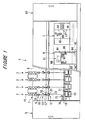
- a spinning machine 1 shown in Figure 1 includes a large number of spinning units 2 arranged in a line.
- the spinning machine 1 includes a yarn splicing vehicle 3, a doffing vehicle 4, a blower box 80, and a motor box 5.
- a housing 6 of the spinning machine 1 includes a rail 41 and a traveling route 86.
- the rail 41 and the traveling route 86 are arranged along a direction in which the spinning units 2 are arranged.
- the yarn splicing vehicle 3 can travel along the rail 41.
- the doffing vehicle 4 can travel along the traveling route 86.
- each of the spinning units 2 includes, as main components, a draft device 7, a spinning device 9, a yarn feeding device 11, a yarn slack eliminating device 12, and a winding device 13 arranged in this order from upstream to downstream.
- the draft device 7 is provided in the vicinity of an upper end of the housing 6 of the spinning machine 1.
- a fiber bundle 8 fed from the draft device 7 is spun by the spinning device 9.
- a spun yarn 10 discharged from the spinning device 9 is fed by the yarn feeding device 11, and the spun yarn 10 passes through a yarn clearer 52 described below and is then wound by the winding device 13.
- a package 45 is formed.
- the draft device 7 drafts a sliver 15 into a fiber bundle 8.
- the draft device 7 includes four rollers, that is, a back roller 16, a third roller 17, a middle roller 19, and a front roller 20.
- the middle roller 19 is provided with an apron belt 18.
- the configuration of the spinning device 9 is not illustrated in detail.
- the spinning machine 1 of the present embodiment adopts a pneumatic type that utilizes a whirling stream to generate the spun yarn 10 from the fiber bundle 8.
- the yarn feeding device 11 includes a delivery roller 39 and a nip roller 40.
- the delivery roller 39 is supported by the housing 6 of the spinning machine 1.
- the nip roller 40 is provided in contact with the delivery roller 39.
- the yarn feeding device 11 rotationally drives the delivery roller 39 using an electric motor (not shown in the drawings), with the spun yarn 10 discharged from the spinning device 9 sandwiched between the delivery roller 39 and the nip roller 40.
- the yarn feeding device 11 can thus feed the spun yarn 10 toward the winding device 13 side.
- a yarn clearer 52 is provided closer to a front surface side of the housing 6 of the spinning machine 1 and slightly downstream side of the yarn feeding device 11.
- the spun yarn 10 spun by the spinning device 9 passes through the yarn clearer 52 before being wound by the winding device 13.
- the yarn clearer 52 monitors the thickness of the traveling spun yarn 10. Upon detecting a yarn defect in the spun yarn 10, the yarn clearer 52 transmits a yarn defect detection signal to a unit controller (not shown in the drawings).
- the unit controller Upon receiving the yarn defect detection signal, the unit controller immediately cuts the spun yarn 10 using a cutter 57 and further stops the draft device 7, the spinning device 9, and the like. Furthermore, the unit controller sends a control signal to the yarn splicing vehicle 3 so that the yarn splicing vehicle 3 travels to the front of the appropriate spinning unit 2. The unit controller thereafter drives the spinning device 9 and the like again to allow the yarn spinning vehicle 3 to perform yarn splicing. Then, a spinning operation and a winding operation can be resumed.
- the yarn splicing vehicle 3 includes a splicer (splicing device) 43, a suction pipe 44, and a suction mouth 46.
- a splicer splicing device
- the suction pipe 44 sucks and catches a yarn end discharged from the spinning device 9, and guides the yarn end to the splicer 43.
- the suction mouth 46 sucks and catches a yarn end from a package 45 supported by the winding device 13, and guides the yarn end to the splicer 43.
- the splicer 43 splices the guided yarn ends together.
- the doffing vehicle 4 includes a doffing device 61.
- the doffing device 61 includes a cradle operating arm 90, a suction pipe 88, and a bunch winding arm 91.
- the cradle operating arm 90 is configured to be able to operate an arm 71 (described below) of the winding device 13.
- the suction pipe 88 is configured to be expandable.
- the suction pipe 88 is configured to suck and catch the yarn end discharged from the spinning device 9, and to guide the yarn end to an empty bobbin 48 installed on the winding device 13.
- the bunch winding arm 91 is configured to be able to fix the spun yarn 10 to the empty bobbin 48 by straight winding the yarn around the empty bobbin 48.
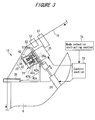
- the yarn slack eliminating device 12 is provided further downstream of the yarn clearer 52. As shown in Figure 3 , the yarn slack eliminating device 12 includes a yarn slack eliminating roller 21, a yarn hooking member 22, an upstream side guide 23, an air cylinder 24, an electric motor 25, a downstream side guide 26, and a control section 73.
- the yarn slack eliminating roller 21 includes a yarn slack eliminating roller main body 42 fixed to a motor shaft 25a of the electric motor 25.
- a side of the yarn slack eliminating roller main body 42 which has the yarn hooking member 22 is defined as a leading end, and a side thereof which is connected to the electric motor 25 is defined as a base end.
- an outer peripheral surface 42a of the yarn slack eliminating roller main body 42 includes a base end side taper portion 42b, a cylindrical portion 42c, and a leading end side taper portion 42d arranged in this order from the base end towards the leading end.
- the base end side taper portion 42b and the leading end side taper portion 42d are gently tapered such that an end surface side of each of the taper portions corresponds to a larger diameter side.
- the cylindrical portion 42c is shaped such that a leading end side thereof is slightly thinned.
- the cylindrical portion 42c is continuous with the taper portions 42b and 42c located on the opposite sides of the cylindrical portion 42c, with no step formed between the cylindrical portion 42c and each of the taper portions 42b and 42d.
- the yarn slack eliminating device 12 allows the yarn hooking member 22 to wind the spun yarn 10 from the spinning device 9 side, around an outer peripheral surface 42a of the yarn slack eliminating roller main body 42.
- the yarn slack eliminating device 12 allows the yarn hooking member 22 to unwind the spun yarn 10 wound and accumulated around the outer peripheral surface 42a, toward the winding device 13.
- the spun yarn 10 is wound around the yarn slack eliminating roller main body 42 for accumulation, the winding starts from the base end of the yarn slack eliminating roller main body 42.
- the unwinding starts from the leading end side of the yarn slack eliminating roller main body 42.
- the base end side taper portion 42b allows the supplied spun yarn 10 to smoothly move from a larger diameter portion to a smaller diameter portion of the outer peripheral surface 42a of the yarn slack eliminating roller main body 42 to reach the cylindrical portion 42c, located midway between the larger and smaller diameter portions.
- the spun yarn 10 can be orderly wound around the surface of the cylindrical portion 42c.
- the leading end side taper portion 42d has a function of preventing a slip-off phenomenon in which while the spun yarn 10 is being unwound, all of the wound spun yarn 10 slips off from the yarn slack eliminating roller main body 42 at one time.
- the leading end side taper portion 42d also has a function of winding back the spun yarn 10 from the smaller diameter portion towards the larger diameter portion on the end surface side of the yarn slack eliminating roller main body 42 to allow the spun yarn 10 to be smoothly drawn out.
- the yarn hooking member 22 located on the leading end side of the yarn slack eliminating roller 21, is located concentrically with the yarn slack eliminating roller 21. Moreover, the yarn hooking member 22 rotates integrally with or independently of the yarn slack eliminating roller 21 depending on conditions.
- the yarn hooking member 22 includes a flyer shaft 33 and a flyer 38.
- the flyer shaft 33 is supported so as to be rotatable relative to the yarn slack eliminating roller 21.
- the flyer 38 is secured to a leading end of the flyer shaft 33.
- a permanent magnet is attached to one of the flyer shaft 33 and the roller main body 42, whereas a magnetic hysteresis material is attached to the other. These magnetic means serve to generate a torque acting against the rotation of the yarn hooking member 22 relative to the yarn slack eliminating roller 21.
- the flyer 38 is configured to rotate integrally with the flyer shaft 33. Furthermore, the flyer 38 is shaped to be appropriately curved toward the outer peripheral surface 42a of the yarn slack eliminating roller main body 42. Thus, the flyer 38 can engage with the spun yarn 10 (can catch the spun yarn 10) to guide the spun yarn 10 to the outer peripheral surface of the yarn slack eliminating roller main body 42.
- the upstream side guide 23 is located slightly upstream side of the yarn slack eliminating roller 21.
- the upstream side guide 23 is provided so as to be movable between an advanced position and a retracted position by means of the air cylinder 24.
- the upstream side guide 23 is located at the advanced position (the position shown by a solid line in Figure 3 )
- the yarn path of the spun yarn 10 is held by the upstream side guide 23 so as to prevent the spun yarn 10 from being engaged with the yarn slack eliminating device 12.
- the yarn path is moved to a position where the spun yarn 10 engages with the yarn hooking member 22 of the yarn slack eliminating device 12 and is wound around the yarn slack eliminating roller 21.
- the winding device 13 includes a cradle arm 71 swingably supported around a support shaft 70.
- the cradle arm 71 can rotatably support the bobbin 48 so that the spun yarn 10 can be wound around the bobbin 48.
- the winding device 13 further includes a winding drum 72 and a traverse device 75.
- the winding drum 72 is configured to contact with and drive the bobbin 48 or an outer peripheral surface of the package 45 formed by winding the spun yarn 10 around the bobbin 48.
- the traverse device 75 includes a traverse guide 76 that can be engaged with the spun yarn 10. By driving the traverse guide 76 by a driving means (not illustrated in the drawings) to reciprocate the spun yarn 10 and driving the winding drum 72 by an electric motor (not illustrated in the drawings), the package 45 making contact with the winding drum 72 is rotated and the spun yarn 10 is wound while being traversed.
- Figure 1 shows that a cheese-shaped package is formed.
- the spinning machine 1 can form a cone-shaped package using the winding device 13.
- the yarn slack eliminating device 12 hooks the flyer 38 on the spun yarn 10 to wind the spun yarn 10 around the yarn slack eliminating roller 21.
- the yarn slack eliminating device 12 avoids slackening and detaining of the spun yarn 10, and adjusts winding tension.
- the yarn hooking member 22 is independently rotatable relative to the yarn slack eliminating roller 21, and the magnetic means applies the resistance torque acting in a direction in which the torque resists the rotation. Furthermore, the yarn slack eliminating roller 21 is rotated at a predetermined rotation speed by the electric motor 25.
- the yarn hooking member 22 rotates independently of the yarn slack eliminating roller 21 to unwind the spun yarn 10 from the yarn slack eliminating roller 21.
- the yarn hooking member 22 rotates integrally with the yarn slack eliminating roller 21 to wind the yarn around the yarn slack eliminating roller 21.
- the yarn slack eliminating device 12 operates to wind the spun yarn 10 when the tension of the spun yarn 10 decreases (when the spun yarn 10 is about to be slackened) and to unwind the spun yarn 10 when the tension of the spun yarn 10 increases.
- the yarn slack eliminating device 12 can thus avoid slackening of the spun yarn 10 to apply an appropriate tension to the spun yarn 10.
- the tension exerted on the spun yarn 10 is basically determined by a yarn feeding speed of the yarn feeding device 11 (a spinning speed of the spinning device 9) and a winding speed of the winding device 13. That is, when the winding speed is higher than the yarn feeding speed, a tension exerted on the spun yarn 10 increases. When the winding speed is lower than the yarn feeding speed, a tension exerted on the spun yarn 10 decreases. Since the yarn feeding device 11 normally feeds the spun yarn 10 at a constant yarn feeding speed (spinning speed), the tension exerted on the spun yarn 10 varies mainly depending on the winding speed of the winding device 13.
- the yarn slack eliminating device 12 also functions as a device which permits a variation in the winding speed which generates during the formation of the cone winding package and which stabilizes the winding tension.
- a feedback control is carried out on the cradle arm 71 in accordance with a signal from an accumulated yarn amount sensing means (not shown in the drawings).
- the rotation speed of the winding drum 72 is set such that for normal winding, in order to apply an appropriate winding tension to the spun yarn 10, the winding speed is slightly higher than the yarn feeding speed of the yarn feeding device 11 (a spinning speed of the spinning device 9).
- the spun yarn 10 wound around the yarn slack eliminating roller 21 is gradually unwound to reduce the amount of an accumulated yarn.
- the accumulated yarn amount sensing means is provided on the outer peripheral surface of the yarn slack eliminating roller 21.
- the unit controller of the spinning unit 2 controls a cradle lifter (not shown in the drawings) such that the cradle arm 71 is pivotably moved leftward in Figure 2 .
- the package 45 is thus separated from the winding drum 72. Consequently, the package 45 loses the driving force and continues inertial rotation. However, the winding speed of the package 45 decreases gradually.
- the unit controller pivotably moves the cradle arm 71 rightward in Figure 2 to contact the package 45 with the winding drum 72.
- the winding speed is recovered, and the spun yarn 10 is unwound from the yarn slack eliminating roller 21 as described above.
- the winding speed can thus be adjusted by using the cradle lifter to swing the cradle arm 71 to contact the package 45 with the winding drum 72 or separate the package 45 from the winding drum 72. Then, the winding speed is controlled while detecting the amount of yarn accumulated around the yarn slack eliminating roller 21 and carrying out the feedback control. As a result, at least a predetermined amount of spun yarn 10 can always be accumulated on the yarn slack eliminating roller 21.
- the above-described function of stabilizing the winding tension is not necessarily required, because in this case, variation in the winding speed depending on the traverse position is not significant. Rather, in view of a decrease in component lifetime and energy consumption associated with the operation of the electric motor 25 and the cradle lifter, it is preferable to avoid the yarn slack eliminating device 12 from being operated at all times.
- the spun yarn 10 is likely to be entangled with the rotating flyer 38. The spun yarn 10 entangled with the flyer 38 may damage the devices, or the entangled spun yarn 10 may be mix into the package to degrade the package quality. Therefore, also in this respect, it is preferable to avoid the yarn slack eliminating device 12 from being operated at all times.
- the yarn slack eliminating device 12 needs to be operated from the beginning of spinning by the spinning device 9 until the winding device 13 starts winding, in order to prevent the spun yarn 10 from being slackened or detained. Examples of such a case include yarn splicing and doffing.
- control section 73 of the spinning machine 1 is configured to be switchable between a first mode in which the yarn slack eliminating device 12 is switchably operated and stopped, and a second mode in which the yarn slack eliminating device 12 is always operated.
- the spinning machine 1 according to the present embodiment includes a mode selection instructing section 74 composed of, for example, a switch and a button. When an operator operates the mode selection instructing section 74, the mode of the control section 73 can be switched. However, the mode may be automatically selected by determining the package shape.
- the yarn slack eliminating device 12 operates to eliminate the slack of the spun yarn 10 at least during a winding preparation time (from the beginning of spinning by the spinning device 9 until the winding device 13 starts winding) but is not operated for the rest of the time.
- the yarn slack eliminating device 12 is operated all the time including the winding preparation time to uniformize the winding tension of the spun yarn 10.
- control section 73 of the spinning machine 1 controls the yarn slack eliminating device 12 to be operated during yarn splicing. This control will be described below in detail.
- the control section 73 controls the air cylinder 24 to move the upstream side guide 23 to the advanced position.
- the yarn path is thus held so that the spun yarn 10 does not engage with the yarn slack eliminating device 12.
- the control section 73 controls to stop the rotation of the electric motor 25.
- the yarn clearer 52 detects a yarn defect in the spun yarn 10 in a certain spinning unit 2 during spinning. Then, the unit controller of the spinning unit 2 immediately cuts the spun yarn 10 using the cutter 57. Almost simultaneously with the yarn cutting, the unit controller stops the spinning device 9 and further stops rotation of the back roller 16 and third roller 17 of the draft device 7. The fiber bundle 8 is tearingly cut between the stopped third roller 17 and the rotating middle roller 19, and a part of the spun yarn 10 located downstream from the cut portion is sucked and removed by suction means (not shown in the drawings). Furthermore, the control section 73 controls the cradle lifter to pivotably rotate the cradle arm 71 leftward in Figure 2 . The package 45 is thus separated from the winding drum 72 to stop rotation of the package 45.
- the unit controller controls the yarn splicing vehicle 3 to travel to a position where the yarn splicing vehicle 3 is positioned facing the spinning unit 2.
- the control section 73 then operates the electric motor 25 at an appropriate timing to start rotating the yarn slack eliminating roller 21.
- the yarn splicing vehicle 3 pivotably moves the suction pipe 44 upward, while pivotably moving the suction mouth 46 downward. Then, the yarn splicing vehicle 3 catches the yarn end from the spinning device 9 using the suction pipe 44, while catching the yarn end on the package 45 side using the suction mouth 46. The yarn splicing vehicle 3 then guides the respective yarn ends to the splicer 43 for yarn splicing.
- the above-descried series of operations allow the spun yarn 10 spun by the spinning device 9 to be wound by the winding device 13.
- the control section 73 controls the air cylinder 24 to move the upstream side guide 23 to the retracted position, and the yarn path of the spun yarn 10 is thus moved to a position where the yarn path of the spun yarn 10 can be engaged with the rotating flyer 38. Accordingly, the spun yarn 10 is wound around the continuously rotating yarn slack eliminating roller 21 to prevent the spun yarn 10 from being slackened or detained during a yarn splicing operation.
- the unit controller pivotably moves the cradle arm 71 rightward in Figure 2 , and the package 45 is thus contacted with the winding drum 72 to allow yarn winding to be resumed. Accordingly, the winding tension applies to the spun yarn 10, which is thus gradually unwound from the yarn slack eliminating roller 21.
- the control section 73 controls the air cylinder 24 to move the upstream side guide 23 to the advanced position again.
- the spun yarn 10 is thus prevented from being engaged with the flyer 38.
- the control section 73 controls rotation of the electric motor 25. Accordingly, energy efficiency is increased, and duration of the yarn slack eliminating device 12 increases. Additionally, the spun yarn 10 is prevented from traveling while rubbing against the flyer 38 to degrade the quality thereof.
- the yarn splicing operation is performed not only when the yarn clearer 52 detects a yarn defect and cuts the spun yarn 10 using the cutter 57 but also when the yarn clearer 52 detects that the spun yarn 10 has been broken (yarn breakage) for some reason. Even in the case of the yarn breakage, the control of the yarn slack eliminating device 12 in the first mode is performed in exactly the same manner as described above.
- control section 73 of the spinning machine 1 performs control such that the yarn slack eliminating device 12 is operated also during doffing. This control will be described below in detail.
- the unit controller stops the spinning device 9, and also stops the back roller 16 and third roller 17 of the draft device 7. Almost at the same time, the unit controller pivotably moves the cradle arm 71 of the winding device 13 leftward in Figure 2 to separate the full package 45 from the winding drum 72, and stops rotation of the winding drum 72.
- control section 73 controls the doffing vehicle 4 to travel to the front of the spinning unit 2.
- the control section 73 then operates the electric motor 25 at an appropriate timing to start rotating the yarn slack eliminating roller 21.
- the doffing vehicle 4 uses the cradle operating arm 90 to appropriately operate the cradle arm 71, and the doffing vehicle 4 then uses a package removing means (not shown in the drawings) to remove the full package 45 from the cradle arm 71.
- the removed full package 45 rolls down an inclined floor 94 formed in the doffing vehicle 4, and the full package 45 then falls onto a shelf 96 formed like a groove, where the full package 45 comes to rest.
- an empty bobbin supply means (not shown in the drawings) provided in the doffing vehicle 4 sets an empty bobbin 48 in the cradle arm 71.
- the unit controller of the spinning unit 2 resumes driving the draft device 7 and the spinning device 9. Furthermore, almost at the same time, the suction pipe 88 expands upward. The suction pipe 88 then sucks and catches the yarn end of the spun yarn 10 discharged from the spinning device 9. The suction pipe 88 thereafter guides the yarn end to the vicinity of the empty bobbin 48. Subsequently, a bunch winding arm 91 performs a bunch winding operation and attaches the yarn end to the empty bobbin 48. The above-described series of operations allows the spun yarn 10 spun by the spinning device 9 to be wound by the winding device 13.
- the control section 73 controls the air cylinder 24 to move the upstream side guide 23 to the retracted position.
- the spun yarn 10 is wound around the yarn slack eliminating roller 21 to prevent the spun yarn 10 from being slackened during a doffing operation.
- the doffing vehicle 4 uses the cradle operating arm 90 to pivotably move the cradle arm 71 rightward in Figure 2 , and the doffing vehicle 4 contacts the bobbin 48 subjected to the bunch winding with the winding drum 72 to start winding the spun yarn 10. This applies winding tension to the spun yarn 10, which is thus gradually unwound from the yarn slack eliminating roller 21.
- control section 73 controls the air cylinder 24 to move the upstream side guide 23 to the advanced position again.
- the spun yarn 10 is thus prevented from engaging with the flyer 38.
- control section 73 stops rotation of the electric motor 25.
- the control section 73 when the control section 73 operates in the first mode, the yarn slack eliminating device 12 operates only during the required period from the beginning of spinning until yarn winding is started. This is advantageous in terms of energy saving, the durability of the devices, production efficiency, and the like. Meanwhile, when the tension varies significantly depending on the traverse position as in the case of winding a cone winding package, the control section 73 is operated in the second mode to always operate the yarn slack eliminating device 12. The winding tension can thus be appropriately controlled to form the package 45 from which the yarn can be properly unwound.
- the spinning machine 1 includes the spinning device 9, the winding device 13, the yarn slack eliminating device 12, and the control section 73.
- the spinning device 9 spins the yarn.
- the winding device 13 winds the spun yarn to form the package.
- the yarn slack eliminating device 12 has the yarn slack eliminating roller 21 and the yarn hooking member 22.
- the control section 73 controls operation of the yarn slack eliminating device 12.
- the control section 73 can switch between a first mode in which the yarn slack eliminating device 12 is switchably operated and stopped, and a second mode in which the yarn slack eliminating device 12 is always operated.
- the yarn slack eliminating device 12 is operated, at least, during the operation time for the operation (for example, the yarn splicing operation or the doffing operation) of allowing the yarn spun by the spinning device 9 to be wound by the winding device 13.
- the first mode and the second mode can be switched as required.
- This allows the yarn slack eliminating device 12 to be operated only when required, enabling energy consumption to be saved. Furthermore, the durability of devices such as the yarn slack eliminating device 12 and the cradle lifter is improved to allow the devices to last longer. Additionally, the yarn slack eliminating device 12 is prevented from being unnecessarily operated, thus reducing the likelihood of the occurrence of the problem associated with the winding of the yarn around the flyer 38.
- the spinning machine 1 further includes the splicer 43.
- the control section 73 performs control such that in the first mode, the yarn slack eliminating device 12 is operated at least during a yarn splicing operation of the splicer 43.
- the yarn slack eliminating device 12 is operated to enable the spun yarn 10 to be prevented from being slackened.
- the yarn splicing operation can therefore be smoothly performed.
- the spinning machine 1 further includes the doffing device 61.
- the control section 73 performs control such that in the first mode, the yarn slack eliminating device 12 is operated at least during a doffing operation of the doffing device 61.
- the yarn slack eliminating device 12 is operated to enable the spun yarn 10 to be prevented from being slackened.
- the doffing operation can therefore be smoothly performed.
- the winding device 13 is configured to be able to form a cheese winding package.
- the yarn slack eliminating device 12 is not required to be operated at all times. Consequently, the operation in the first mode allows the device to be efficiently operated.
- the winding device 13 is configured to be able to form a cone winding package.
- the unit section 73 may be configured as a part of the function of the unit controller of the spinning unit 2.
- the means for generating the resistance torque which acts against the relative rotation between the yarn hooking member 22 and the yarn slack eliminating roller 21, may be, instead of the magnetic means, an electromagnetic means based on an electromagnet, a mechanical means based on a frictional force, or the like.
- an arrangement may be provided in which the splicer 43 is provided in each of the spinning units 2.
- an arrangement may be provided in which the doffing vehicle 4 includes the doffing device 61, an arrangement may be provided in which the doffing device is installed in each of the spinning units 2.
Landscapes
- Engineering & Computer Science (AREA)
- Textile Engineering (AREA)
- Mechanical Engineering (AREA)
- Spinning Or Twisting Of Yarns (AREA)
- Forwarding And Storing Of Filamentary Material (AREA)
Applications Claiming Priority (1)
| Application Number | Priority Date | Filing Date | Title |
|---|---|---|---|
| JP2007335166A JP2009155757A (ja) | 2007-12-26 | 2007-12-26 | 紡績機 |
Publications (1)
| Publication Number | Publication Date |
|---|---|
| EP2075358A2 true EP2075358A2 (de) | 2009-07-01 |
Family
ID=40352831
Family Applications (1)
| Application Number | Title | Priority Date | Filing Date |
|---|---|---|---|
| EP20080020013 Withdrawn EP2075358A2 (de) | 2007-12-26 | 2008-11-17 | Spinnmaschine |
Country Status (3)
| Country | Link |
|---|---|
| EP (1) | EP2075358A2 (de) |
| JP (1) | JP2009155757A (de) |
| CN (1) | CN101469468A (de) |
Cited By (3)
| Publication number | Priority date | Publication date | Assignee | Title |
|---|---|---|---|---|
| EP2284300A1 (de) * | 2009-08-06 | 2011-02-16 | Murata Machinery, Ltd. | Spinnmaschine und Garnentfernungsverfahren zum Entfernen von verbleibendem Garn auf der Garnzusammentragungsrolle |
| EP2075359A3 (de) * | 2007-12-27 | 2011-05-11 | Murata Machinery, Ltd. | Vorrichtung zur Beseitigung von Fadenlockerungen und Spinnmaschine |
| CZ303880B6 (cs) * | 2012-07-12 | 2013-06-05 | Rieter Cz S.R.O. | Bubnový mezizásobník príze na pracovním míste textilního stroje a zpusob jeho rízení |
Families Citing this family (7)
| Publication number | Priority date | Publication date | Assignee | Title |
|---|---|---|---|---|
| JP2011038225A (ja) * | 2009-08-17 | 2011-02-24 | Murata Machinery Ltd | 紡績機 |
| JP5526885B2 (ja) * | 2009-10-07 | 2014-06-18 | 村田機械株式会社 | 紡績ユニット |
| JP5599286B2 (ja) * | 2010-11-01 | 2014-10-01 | Tmtマシナリー株式会社 | 仮撚加工機 |
| CN102154741A (zh) * | 2010-12-14 | 2011-08-17 | 江苏华佳丝绸有限公司 | 一种强捻纱防捻缩装置 |
| JP2013067873A (ja) * | 2011-09-20 | 2013-04-18 | Murata Mach Ltd | 紡績ユニット及び紡績機 |
| JP2015193451A (ja) * | 2014-03-31 | 2015-11-05 | 村田機械株式会社 | 糸貯留ローラ及び糸巻取機 |
| JP2017065898A (ja) * | 2015-09-30 | 2017-04-06 | 村田機械株式会社 | 糸掛け部材、糸貯留装置、及び糸巻取機 |
Citations (1)
| Publication number | Priority date | Publication date | Assignee | Title |
|---|---|---|---|---|
| JP2006306588A (ja) | 2005-04-28 | 2006-11-09 | Murata Mach Ltd | 繊維機械における糸の弛み取り装置 |
-
2007
- 2007-12-26 JP JP2007335166A patent/JP2009155757A/ja active Pending
-
2008
- 2008-11-17 EP EP20080020013 patent/EP2075358A2/de not_active Withdrawn
- 2008-11-18 CN CNA200810181242XA patent/CN101469468A/zh active Pending
Patent Citations (1)
| Publication number | Priority date | Publication date | Assignee | Title |
|---|---|---|---|---|
| JP2006306588A (ja) | 2005-04-28 | 2006-11-09 | Murata Mach Ltd | 繊維機械における糸の弛み取り装置 |
Cited By (6)
| Publication number | Priority date | Publication date | Assignee | Title |
|---|---|---|---|---|
| EP2075359A3 (de) * | 2007-12-27 | 2011-05-11 | Murata Machinery, Ltd. | Vorrichtung zur Beseitigung von Fadenlockerungen und Spinnmaschine |
| EP2284300A1 (de) * | 2009-08-06 | 2011-02-16 | Murata Machinery, Ltd. | Spinnmaschine und Garnentfernungsverfahren zum Entfernen von verbleibendem Garn auf der Garnzusammentragungsrolle |
| CZ303880B6 (cs) * | 2012-07-12 | 2013-06-05 | Rieter Cz S.R.O. | Bubnový mezizásobník príze na pracovním míste textilního stroje a zpusob jeho rízení |
| EP2684827A2 (de) | 2012-07-12 | 2014-01-15 | Rieter CZ s.r.o. | Trommelzwischenlagerung von Garn an einer Betriebseinheit einer Textilmaschine und Steuerungsverfahren dafür |
| US9403656B2 (en) | 2012-07-12 | 2016-08-02 | Rieter Cz S.R.O. | Drum inter-storage of yarn at an operating unit of a textile machine and method of control for |
| US9957646B2 (en) | 2012-07-12 | 2018-05-01 | Rieter Cz S.R.O. | Drum inter-storage of yarn at an operating unit of a textile machine and method of control for |
Also Published As
| Publication number | Publication date |
|---|---|
| JP2009155757A (ja) | 2009-07-16 |
| CN101469468A (zh) | 2009-07-01 |
Similar Documents
| Publication | Publication Date | Title |
|---|---|---|
| EP2075358A2 (de) | Spinnmaschine | |
| EP2075359B1 (de) | Vorrichtung zur Beseitigung von Fadenlockerungen und Spinnmaschine | |
| EP2216432B1 (de) | Garnverarbeitungsverfahren und Spinnmaschine | |
| EP2169096B9 (de) | Spinnmaschine | |
| EP2377793B1 (de) | Garnwickelvorrichtung und automatischer Wickler | |
| EP2284300B1 (de) | Spinnmaschine und Garnentfernungsverfahren zum Entfernen von verbleibendem Garn auf der Garnzusammentragungsrolle | |
| EP2298971B1 (de) | Spinnmaschine mit Garnspeicher-Rolle | |
| EP3072840B1 (de) | Garnwickelmaschine und garnwickelverfahren | |
| EP2573217B1 (de) | Spinneinheit, Spinnmaschine und Garnverarbeitungsverfahren | |
| CN112672965B (zh) | 纱线卷取机 | |
| CN102574655B (zh) | 纱线卷绕装置 | |
| EP2977493B1 (de) | Spinnmaschine und spinnverfahren | |
| EP2573225B1 (de) | Spinneinheit und Spinnmaschine | |
| EP2700601A2 (de) | Garnwickeleinheit und Garnwickelmaschine | |
| JP3888318B2 (ja) | 紡績機 | |
| JP2004277949A (ja) | 紡績機 | |
| JP4082250B2 (ja) | 紡績機の糸弛み取り装置 | |
| JP2010076889A (ja) | 糸弛み取り装置及びこれを備える繊維機械 | |
| JP4019984B2 (ja) | 紡績機 | |
| JP2008024438A (ja) | 糸巻取装置 | |
| JPH08225249A (ja) | 糸の巻取方法および糸の巻取装置 | |
| JP3888320B2 (ja) | 紡績機 | |
| JP2004277947A (ja) | 糸継ぎ装置を備えた紡績機 | |
| JP2004339612A (ja) | 紡績機 | |
| CN117361231A (zh) | 纺纱机械、卷装的形成方法以及卷装 |
Legal Events
| Date | Code | Title | Description |
|---|---|---|---|
| PUAI | Public reference made under article 153(3) epc to a published international application that has entered the european phase |
Free format text: ORIGINAL CODE: 0009012 |
|
| AK | Designated contracting states |
Kind code of ref document: A2 Designated state(s): AT BE BG CH CY CZ DE DK EE ES FI FR GB GR HR HU IE IS IT LI LT LU LV MC MT NL NO PL PT RO SE SI SK TR |
|
| AX | Request for extension of the european patent |
Extension state: AL BA MK RS |
|
| RTI1 | Title (correction) |
Free format text: SPINNING MACHINE WITH YARN SLACK CONTROL |
|
| STAA | Information on the status of an ep patent application or granted ep patent |
Free format text: STATUS: THE APPLICATION HAS BEEN WITHDRAWN |
|
| 18W | Application withdrawn |
Effective date: 20100929 |