EP2073297A1 - Procédé d'utilisation d'une pile à combustible comportant une étape de régénération par abaissement de la température - Google Patents
Procédé d'utilisation d'une pile à combustible comportant une étape de régénération par abaissement de la température Download PDFInfo
- Publication number
- EP2073297A1 EP2073297A1 EP08354083A EP08354083A EP2073297A1 EP 2073297 A1 EP2073297 A1 EP 2073297A1 EP 08354083 A EP08354083 A EP 08354083A EP 08354083 A EP08354083 A EP 08354083A EP 2073297 A1 EP2073297 A1 EP 2073297A1
- Authority
- EP
- European Patent Office
- Prior art keywords
- temperature
- fuel cell
- battery
- lowering
- regeneration step
- Prior art date
- Legal status (The legal status is an assumption and is not a legal conclusion. Google has not performed a legal analysis and makes no representation as to the accuracy of the status listed.)
- Granted
Links
- 239000000446 fuel Substances 0.000 title claims abstract description 33
- 230000008929 regeneration Effects 0.000 title claims abstract description 22
- 238000011069 regeneration method Methods 0.000 title claims abstract description 22
- 238000000034 method Methods 0.000 title claims abstract description 14
- 230000001172 regenerating effect Effects 0.000 claims abstract description 3
- 230000001960 triggered effect Effects 0.000 abstract 1
- 230000007423 decrease Effects 0.000 description 10
- 239000012528 membrane Substances 0.000 description 9
- 238000001816 cooling Methods 0.000 description 5
- XLYOFNOQVPJJNP-UHFFFAOYSA-N water Substances O XLYOFNOQVPJJNP-UHFFFAOYSA-N 0.000 description 4
- UFHFLCQGNIYNRP-UHFFFAOYSA-N Hydrogen Chemical compound [H][H] UFHFLCQGNIYNRP-UHFFFAOYSA-N 0.000 description 3
- OKKJLVBELUTLKV-UHFFFAOYSA-N Methanol Chemical compound OC OKKJLVBELUTLKV-UHFFFAOYSA-N 0.000 description 3
- QVGXLLKOCUKJST-UHFFFAOYSA-N atomic oxygen Chemical compound [O] QVGXLLKOCUKJST-UHFFFAOYSA-N 0.000 description 3
- 239000007789 gas Substances 0.000 description 3
- 239000001257 hydrogen Substances 0.000 description 3
- 229910052739 hydrogen Inorganic materials 0.000 description 3
- 239000001301 oxygen Substances 0.000 description 3
- 229910052760 oxygen Inorganic materials 0.000 description 3
- IJGRMHOSHXDMSA-UHFFFAOYSA-N Atomic nitrogen Chemical compound N#N IJGRMHOSHXDMSA-UHFFFAOYSA-N 0.000 description 2
- 230000015556 catabolic process Effects 0.000 description 2
- 238000006731 degradation reaction Methods 0.000 description 2
- 238000006722 reduction reaction Methods 0.000 description 2
- 239000000126 substance Substances 0.000 description 2
- 238000010586 diagram Methods 0.000 description 1
- 230000005611 electricity Effects 0.000 description 1
- 238000002848 electrochemical method Methods 0.000 description 1
- 238000003487 electrochemical reaction Methods 0.000 description 1
- 238000010438 heat treatment Methods 0.000 description 1
- 230000000887 hydrating effect Effects 0.000 description 1
- 150000002431 hydrogen Chemical class 0.000 description 1
- 229910052757 nitrogen Inorganic materials 0.000 description 1
- 238000007254 oxidation reaction Methods 0.000 description 1
- 230000000737 periodic effect Effects 0.000 description 1
- 229920000642 polymer Polymers 0.000 description 1
Images

Classifications
-
- H—ELECTRICITY
- H01—ELECTRIC ELEMENTS
- H01M—PROCESSES OR MEANS, e.g. BATTERIES, FOR THE DIRECT CONVERSION OF CHEMICAL ENERGY INTO ELECTRICAL ENERGY
- H01M8/00—Fuel cells; Manufacture thereof
- H01M8/04—Auxiliary arrangements, e.g. for control of pressure or for circulation of fluids
- H01M8/04007—Auxiliary arrangements, e.g. for control of pressure or for circulation of fluids related to heat exchange
-
- H—ELECTRICITY
- H01—ELECTRIC ELEMENTS
- H01M—PROCESSES OR MEANS, e.g. BATTERIES, FOR THE DIRECT CONVERSION OF CHEMICAL ENERGY INTO ELECTRICAL ENERGY
- H01M8/00—Fuel cells; Manufacture thereof
- H01M8/04—Auxiliary arrangements, e.g. for control of pressure or for circulation of fluids
- H01M8/04223—Auxiliary arrangements, e.g. for control of pressure or for circulation of fluids during start-up or shut-down; Depolarisation or activation, e.g. purging; Means for short-circuiting defective fuel cells
- H01M8/04238—Depolarisation
-
- H—ELECTRICITY
- H01—ELECTRIC ELEMENTS
- H01M—PROCESSES OR MEANS, e.g. BATTERIES, FOR THE DIRECT CONVERSION OF CHEMICAL ENERGY INTO ELECTRICAL ENERGY
- H01M8/00—Fuel cells; Manufacture thereof
- H01M8/10—Fuel cells with solid electrolytes
- H01M2008/1095—Fuel cells with polymeric electrolytes
-
- Y—GENERAL TAGGING OF NEW TECHNOLOGICAL DEVELOPMENTS; GENERAL TAGGING OF CROSS-SECTIONAL TECHNOLOGIES SPANNING OVER SEVERAL SECTIONS OF THE IPC; TECHNICAL SUBJECTS COVERED BY FORMER USPC CROSS-REFERENCE ART COLLECTIONS [XRACs] AND DIGESTS
- Y02—TECHNOLOGIES OR APPLICATIONS FOR MITIGATION OR ADAPTATION AGAINST CLIMATE CHANGE
- Y02E—REDUCTION OF GREENHOUSE GAS [GHG] EMISSIONS, RELATED TO ENERGY GENERATION, TRANSMISSION OR DISTRIBUTION
- Y02E60/00—Enabling technologies; Technologies with a potential or indirect contribution to GHG emissions mitigation
- Y02E60/30—Hydrogen technology
- Y02E60/50—Fuel cells
Definitions
- the invention relates to a method of using a fuel cell, comprising at least one step of regenerating the performance of the battery.
- Fuel cells are electrochemical systems that convert chemical energy into electricity.
- the chemical energy is in the form of hydrogen gas.
- the fuel cell is then decomposed into two compartments (one supplied with hydrogen and the other supplied with oxygen) separated by a proton exchange membrane.
- the protons from the hydrogen oxidation reaction pass through the membrane while the electrons pass through an external electrical circuit to reach the cathode where the oxygen reduction reaction occurs.
- This decrease in performance is notably related to poor control of water management in a proton exchange membrane fuel cell.
- the subject of the invention is a method of using the battery which is easy to implement and which makes it possible to maintain high performances throughout the lifetime of the battery.
- the regeneration stage comprises, for a predefined duration, a lowering of the temperature of the fuel cell below a nominal operating temperature. , a charge remaining powered by the battery during the duration of lowering of the temperature
- At least one regeneration step is provided during the use of the fuel cell 1.
- This regeneration step consists in temporarily lowering the temperature of the fuel cell 1 to its nominal temperature. Operating.
- This regeneration step is performed without modifying the other operating parameters of the cell (nominal operating temperature, current density, flow rate, pressure, humidification of the reactive gases, etc.).
- the use of the fuel cell is not interrupted and the supply of an electric charge 2 (on the figure 2 ) by the stack is maintained during the regeneration step.
- the temperature of the fuel cell is reduced to its nominal value. For example, as illustrated in figure 2 a control circuit 4 is connected to a cooling system 3 of the battery.
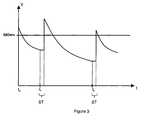
- the figure 3 illustrates the influence on the voltage of the battery of a regeneration step by temporary cooling of the battery, for example a duration of 4h.
- the performance of the fuel cell decreases, which translates, at constant current, by a decrease in the voltage at the terminals of the battery 1 to below its nominal voltage (680mV) in the example shown.
- the degradation is broken down into a rapid drop in voltage followed by a steady decline as a function of the operating time.
- the nominal operating temperature of the battery is, for example, 70 ° C.
- the control circuit 4 triggers a step of cooling the cell by means of the cooling system 3, for a duration ⁇ of 4h.
- the temperature of the battery 1 is lowered below its nominal operating temperature, for example at 30 ° C., at time t 1 . After this lowering temporary temperature, the return to the nominal temperature causes a rapid increase in the voltage across the battery 1, corresponding to an increase in its performance.
- the performance of fuel cell 1 decreases again and more significantly than between times t 0 and t 1 .
- the time between t 1 and t 2 being greater than that between t 0 and t 1
- the voltage at time t 2 is lower than at time t 1 .
- the temperature of the battery is temporarily lowered, for example to 50 ° C. This again causes an increase in the voltage across the fuel cell above its nominal operating voltage.
- the voltage across the fuel cell can be kept substantially constant over very long periods of use (1000 hours of operation), as illustrated by the curve B of the figure 1 .
- the regeneration step is advantageously carried out periodically, with a period preferably comprised between a few hours and several hundred hours, for example between 20h and 500h.
- the lowering of the temperature can also be achieved when the electric power demanded from the battery decreases, whether ad hoc or periodic.
- a natural decrease in the thermal power produced by the battery is used to achieve at this time, an additional lowering of the battery temperature which allows to regenerate the fuel cell outside periods of high use. It is then possible to trigger the lowering of the battery temperature if its operating temperature falls below a certain threshold.
- the lowering of the battery temperature can also take place if the performance of the fuel cell 1 is measured below a predetermined threshold, for example if the voltage at the terminals of the battery, which is significant for a fall in performance, is below a threshold.
- the criteria used for triggering a regeneration step (fixed periodicity, voltage or temperature) are used by the control circuit 4 which collects various quantities characteristic of the operation of the fuel cell 1 (V, I, temperature ... ).
- the control circuit 4 can then, for example, depending on the temperature of the fuel cell and / or the voltage at its terminals, control the operation and more particularly the power of the cooling system 3.
- the control circuit 4 can use other parameters of the stack 1 to trigger the regeneration step or trigger such a step at regular intervals. In this case, the control circuit 4 includes a clock.
- the nominal operating temperature of a fuel cell is generally between room temperature and about 120 ° C.
- the lowering of the temperature of the fuel cell is advantageously comprised between 10% and 60% of its nominal operating temperature, expressed in ° C.
- the regeneration temperature is between 30 ° C and 60 ° C.
- the temperature can be lowered to 20 ° C, a lowering to 50 ° C would be sufficient in practice.
- the duration of the regeneration step must be sufficient for the cell temperature to stabilize and be homogeneous, the duration is variable depending on the size of the battery.
- the regeneration time is preferably between about ten minutes and several hours, for example between ten minutes and twelve hours.
Landscapes
- Life Sciences & Earth Sciences (AREA)
- Engineering & Computer Science (AREA)
- Manufacturing & Machinery (AREA)
- Sustainable Development (AREA)
- Sustainable Energy (AREA)
- Chemical & Material Sciences (AREA)
- Chemical Kinetics & Catalysis (AREA)
- Electrochemistry (AREA)
- General Chemical & Material Sciences (AREA)
- Fuel Cell (AREA)
Abstract
Description
- L'invention est relative à un procédé d'utilisation d'une pile à combustible, comportant au moins une étape de régénération des performances de la pile.
- Les piles à combustible sont des systèmes électrochimiques qui permettent de convertir une énergie chimique en électricité. Pour les piles à combustible à membrane échangeuse de protons (« Proton Exchange Membrane Fuel Cell »), l'énergie chimique se présente sous la forme d'hydrogène gazeux. La pile à combustible se décompose alors en deux compartiments (l'un alimenté en hydrogène et l'autre alimenté en oxygène) séparés par une membrane échangeuse de protons. A l'anode, les protons provenant de la réaction d'oxydation de l'hydrogène traversent la membrane tandis que les électrons doivent passer dans un circuit électrique externe pour atteindre la cathode où se produit la réaction de réduction de l'oxygène.
- Ainsi, sous réserve d'alimenter la pile en hydrogène et en oxygène, il est possible d'obtenir un courant électrique directement proportionnel à la quantité de gaz consommé.
- Cependant, au cours de leur fonctionnement, les performances des piles à combustible diminuent lentement et d'une manière constante sur plusieurs centaines d'heures. Cette diminution est de l'ordre de 30 à 150µV/h pour un courant fixé sur une durée, par exemple, de 1500 heures. La diminution de la tension aux bornes de la pile à combustible, illustrée par la courbe A de la
figure 1 , est représentative de cette perte de performance. - Cette diminution des performances est notamment liée à une mauvaise maîtrise de la gestion de l'eau dans une pile à combustible à membrane échangeuse de protons.
- En effet, si la membrane s'assèche, sa résistance augmente et les performances de la pile vont décroître. Si un courant électrique important traverse la membrane, l'augmentation de la résistance de la membrane conduit à un échauffement par effet Joule, qui peut entraîner la dégradation du polymère de la membrane ou d'autres composants de la pile.
- Inversement, si trop d'eau s'accumule dans la pile, les gaz ne peuvent plus accéder aux sites actifs qui sont le siège des réactions électrochimiques. Les performances de la pile diminuent alors en conséquence.
- L'article de He et al « An Electrochemical Method to lmprove the Performance of Air Cathodes and Methanol Anodes » Electrochemical and Solid-State Letters, 5 (8) A181-183 (2002), indique qu'une fois le compartiment cathodique de la pile à combustible purgé sous azote, l'application d'un courant constant entre les électrodes de la pile permet de régénérer ses performances. Avec cette méthode, la gestion de l'eau est optimisée en hydratant au maximum la membrane et en expulsant l'eau en surabondance.
- Cependant, bien que l'alimentation en courant ou l'arrêt de la pile permette de maintenir des performances élevées de la pile, ces options sont inenvisageables pour des applications industrielles.
- L'invention a pour objet un procédé d'utilisation de la pile qui soit facile à mettre en oeuvre et qui permette de maintenir des performances élevées pendant toute la durée de vie de la pile.
- Le procédé selon l'invention est caractérisé par les revendications annexées et plus particulièrement par le fait que l'étape de régénération comporte, pendant une durée prédéfinie, un abaissement de la température de la pile à combustible en dessous d'une température nominale de fonctionnement, une charge restant alimentée par la pile pendant la durée d'abaissement de la température
- D'autres avantages et caractéristiques ressortiront plus clairement de la description qui va suivre d'un mode particulier de réalisation de l'invention donné à titre d'exemple non limitatif et représenté aux dessins annexés, dans lesquels :
- la
figure 1 représente l'évolution de la tension aux bornes d'une pile à combustible respectivement selon l'art antérieur (courbe A) et selon l'invention (courbe B), - la
figure 2 représente un schéma de montage d'une pile à combustible, - la
figure 3 illustre, schématiquement, l'évolution de la tension aux bornes de la pile suivant le procédé d'utilisation selon l'invention. - Afin que la pile à combustible conserve des performances optimales, au moins une étape de régénération est prévue pendant l'utilisation de la pile à combustible 1. Cette étape de régénération consiste à abaisser temporairement la température de la pile à combustible 1 sous sa température nominale de fonctionnement. Cette étape de régénération est réalisée sans modifier les autres paramètres de fonctionnement de la pile (température nominale de fonctionnement, densité de courant, débit, pression, humidification des gaz réactifs...). De plus, l'utilisation de la pile à combustible n'est pas interrompue et l'alimentation d'une charge électrique 2 (sur la
figure 2 ) par la pile est maintenue durant l'étape de régénération. Une fois l'étape de régénération terminée, la température de la pile à combustible est ramenée à sa valeur nominale. A titre d'exemple, comme illustré à lafigure 2 , un circuit de contrôle 4 est connecté à un système de refroidissement 3 de la pile. - A titre d'exemple, la
figure 3 illustre l'influence sur la tension de la pile d'une étape de régénération par refroidissement temporaire de la pile, par exemple une durée de 4h. A partir d'un instant t0 et au fur et à mesure de son utilisation, les performances de la pile à combustible décroissent, ce qui se traduit, à courant constant, par une diminution de la tension aux bornes de la pile 1 au-dessous de sa tension nominale (680mV) dans l'exemple représenté. De manière schématique, la dégradation se décompose en une chute rapide de la tension suivie d'une baisse régulière en fonction du temps de fonctionnement. Entre les instants t0 et t1, la température nominale de fonctionnement de la pile est, par exemple, de 70°C. A un instant t1, le circuit de contrôle 4 déclenche une étape de refroidissement de la pile au moyen du système de refroidissement 3, pendant une durée Δ de 4h. La température de la pile 1 est abaissée en dessous de sa température nominale de fonctionnement, par exemple à 30°C, à l'instant t1. Après cet abaissement temporaire de la température, le retour à la température nominale provoque une augmentation rapide de la tension aux bornes de la pile 1, correspondant à une augmentation de ses performances. - Dans l'exemple illustré, entre les instants t1 et t2, les performances de la pile à combustible 1 décroissent de nouveau et de façon plus importante qu'entre les instants t0 et t1. En effet, La durée entre t1 et t2 étant supérieure à celle entre t0 et t1, la tension à l'instant t2 est plus basse qu'à l'instant t1. A l'instant t2, la température de la pile est abaissée, temporairement, par exemple à 50°C. Ceci entraîne, de nouveau, une augmentation de la tension aux bornes de la pile à combustible au-dessus de sa tension nominale de fonctionnement.
- En utilisant de façon répétée cette étape de régénération, la tension aux bornes de la pile à combustible peut être maintenue sensiblement constante sur de très longues durées d'utilisation (1000h de fonctionnement), comme illustré par la courbe B de la
figure 1 . - L'étape de régénération est avantageusement réalisée périodiquement, avec une période comprise, de préférence, entre quelques heures et plusieurs centaines d'heures, par exemple entre 20h et 500h. Cependant, l'abaissement de la température peut également être réalisé lorsque la puissance électrique demandée à la pile diminue, que ce soit de façon ponctuelle ou périodique. Ainsi, une diminution naturelle de la puissance thermique produite par la pile est mise à profit pour réaliser à ce moment là, un abaissement supplémentaire de la température de la pile ce qui permet de régénérer la pile à combustible en dehors des périodes de forte utilisation. Il est alors possible de déclencher l'abaissement de la température de la pile si sa température de fonctionnement passe sous un certain seuil.
- L'abaissement de la température de la pile peut également avoir lieu si les performances de la pile à combustible 1 sont mesurées inférieures à un seuil prédéterminé, par exemple si la tension aux bornes de la pile, significative d'une chute des performances, est inférieure à un seuil. Les critères retenus pour le déclenchement d'une étape de régénération (périodicité fixe, tension ou température) sont utilisés par le circuit de contrôle 4 qui recueille diverses grandeurs caractéristiques du fonctionnement de la pile à combustible 1 (V, I, température...). Le circuit de contrôle 4 peut alors, par exemple, en fonction de la température de la pile à combustible et/ou de la tension à ses bornes, contrôler le fonctionnement et plus particulièrement la puissance du système de refroidissement 3. Le circuit de contrôle 4 peut utiliser d'autres paramètres de la pile 1 pour déclencher l'étape de régénération ou déclencher une telle étape à intervalle régulier. Dans ce cas, le circuit de contrôle 4 comporte une horloge.
- La température nominale de fonctionnement d'une pile à combustible est généralement comprise entre la température ambiante et environ 120°C. L'abaissement de la température de la pile à combustible est avantageusement compris, entre 10% et 60% de sa température nominale de fonctionnement, exprimée en °C. A titre d'exemple, pour une pile à combustible qui a une température nominale de fonctionnement de l'ordre de 70°C, la température de régénération est comprise entre 30°C et 60°C. Bien que la température puisse être abaissée jusqu'à 20°C, un abaissement à 50°C serait en pratique suffisant.
- La durée de l'étape de régénération doit être suffisante pour que la température de la pile se stabilise et soit homogène, la durée est donc variable suivant la taille de la pile. La durée de régénération est, de préférence, comprise entre une dizaine de minutes et plusieurs heures, par exemple entre dix minutes et douze heures.
Claims (7)
- Procédé d'utilisation d'une pile à combustible (1), comportant au moins une étape de régénération des performances de la pile (1), procédé caractérisé en ce que l'étape de régénération comporte, pendant une durée prédéfinie, un abaissement de la température de la pile à combustible (1) en dessous d'une température nominale de fonctionnement, une charge électrique restant alimentée par la pile (1) pendant la durée d'abaissement de la température.
- Procédé selon la revendication 1, caractérisé en ce que l'abaissement de la température est compris entre 10% et 60% de sa température nominale de fonctionnement en °C.
- Procédé selon l'une des revendications 1 et 2, caractérisé en ce que l'étape de régénération est répétée périodiquement.
- Procédé selon la revendication 3, caractérisé en ce que l'étape de régénération est répétée avec une période comprise entre quelques heures et quelques centaines d'heures.
- Procédé selon l'une quelconque des revendications 1 à 4, caractérisé en ce que l'étape de régénération est réalisée lorsqu'une tension aux bornes de la batterie est inférieure à un seuil prédéterminé.
- Procédé selon l'une quelconque des revendications 1 à 5, caractérisé en ce que l'étape de régénération est réalisée lorsque la température de la pile à combustible (1) est inférieure à un seuil prédéterminé.
- Procédé selon l'une quelconque des revendications 1 à 6, caractérisé en ce que la durée de l'étape de régénération est comprise entre 10 minutes et 12 heures.
Priority Applications (1)
| Application Number | Priority Date | Filing Date | Title |
|---|---|---|---|
| PL08354083T PL2073297T3 (pl) | 2007-12-18 | 2008-11-13 | Sposób zastosowania ogniwa paliwowego obejmujący etap regeneracji wskutek obniżenia temperatury |
Applications Claiming Priority (1)
| Application Number | Priority Date | Filing Date | Title |
|---|---|---|---|
| FR0708829A FR2925229B1 (fr) | 2007-12-18 | 2007-12-18 | Procede d'utilisation d'une pile a combustible comportant une etape de regeneration par abaissement de la temperature |
Publications (2)
| Publication Number | Publication Date |
|---|---|
| EP2073297A1 true EP2073297A1 (fr) | 2009-06-24 |
| EP2073297B1 EP2073297B1 (fr) | 2010-08-18 |
Family
ID=39616445
Family Applications (1)
| Application Number | Title | Priority Date | Filing Date |
|---|---|---|---|
| EP08354083A Not-in-force EP2073297B1 (fr) | 2007-12-18 | 2008-11-13 | Procédé d'utilisation d'une pile à combustible comportant une étape de régénération par abaissement de la température |
Country Status (8)
| Country | Link |
|---|---|
| US (1) | US8153323B2 (fr) |
| EP (1) | EP2073297B1 (fr) |
| JP (1) | JP2009170409A (fr) |
| AT (1) | ATE478444T1 (fr) |
| DE (1) | DE602008002209D1 (fr) |
| ES (1) | ES2350876T3 (fr) |
| FR (1) | FR2925229B1 (fr) |
| PL (1) | PL2073297T3 (fr) |
Families Citing this family (5)
| Publication number | Priority date | Publication date | Assignee | Title |
|---|---|---|---|---|
| FR2947957B1 (fr) | 2009-07-09 | 2011-08-12 | Commissariat Energie Atomique | Methode et dispositif pour augmenter la duree de vie d'une pile a combustible a membrane echangeuse de protons |
| FR2950739B1 (fr) * | 2009-09-25 | 2011-10-07 | Commissariat Energie Atomique | Procede d'alimentation a partir d'une pile a combustible tenant compte de la pollution par l'oxyde de soufre et dispositif d'alimentation |
| JP5817472B2 (ja) * | 2011-11-28 | 2015-11-18 | トヨタ自動車株式会社 | 燃料電池システムおよび燃料電池システムの制御方法 |
| JP5794197B2 (ja) * | 2012-05-10 | 2015-10-14 | トヨタ自動車株式会社 | 燃料電池システムおよびその制御方法 |
| CN104885277A (zh) * | 2012-12-26 | 2015-09-02 | 丰田自动车株式会社 | 燃料电池系统以及燃料电池系统中燃料电池的发电性能恢复方法 |
Citations (3)
| Publication number | Priority date | Publication date | Assignee | Title |
|---|---|---|---|---|
| US6524733B1 (en) * | 1999-02-23 | 2003-02-25 | Toyota Jidosha Kabushiki Kaisha | Fuel cell system with humidity determination |
| DE10328257A1 (de) * | 2003-06-24 | 2005-01-13 | Daimlerchrysler Ag | Verfahren zur Regeneration einer Membran-Elektroden-Anordnung einer PEM-Brennstoffzelle |
| WO2007088471A1 (fr) * | 2006-02-03 | 2007-08-09 | Nissan Motor Co., Ltd. | Système de pile à combustible à régénération d'activité d'électrode lors du démarrage ou de l'arrêt |
Family Cites Families (8)
| Publication number | Priority date | Publication date | Assignee | Title |
|---|---|---|---|---|
| JP3687530B2 (ja) * | 2000-11-24 | 2005-08-24 | 日産自動車株式会社 | 燃料電池システム及びその運転方法 |
| JP2002231283A (ja) * | 2001-01-31 | 2002-08-16 | Fuji Electric Co Ltd | 固体高分子電解質型燃料電池発電装置とその運転方法 |
| US6926979B2 (en) * | 2001-10-18 | 2005-08-09 | Yiding Cao | Waste heat recovery means for fuel cell power system |
| JP2004227938A (ja) * | 2003-01-23 | 2004-08-12 | Mitsubishi Electric Corp | 燃料電池 |
| KR20050111625A (ko) * | 2003-03-31 | 2005-11-25 | 가부시키가이샤 지에스 유아사 코포레이션 | 직접 메탄올형 연료전지 및 그 연료극의 용출방지방법,품질관리방법, 운전방법 |
| JP2005100873A (ja) * | 2003-09-26 | 2005-04-14 | Hitachi Home & Life Solutions Inc | 燃料電池システム |
| KR100724017B1 (ko) * | 2004-11-30 | 2007-05-31 | 산요덴키가부시키가이샤 | 연료 전지 시스템과 그의 운전 방법 |
| JP4839697B2 (ja) * | 2005-06-30 | 2011-12-21 | 株式会社エクォス・リサーチ | 燃料電池システム |
-
2007
- 2007-12-18 FR FR0708829A patent/FR2925229B1/fr not_active Expired - Fee Related
-
2008
- 2008-11-13 ES ES08354083T patent/ES2350876T3/es active Active
- 2008-11-13 DE DE602008002209T patent/DE602008002209D1/de active Active
- 2008-11-13 PL PL08354083T patent/PL2073297T3/pl unknown
- 2008-11-13 EP EP08354083A patent/EP2073297B1/fr not_active Not-in-force
- 2008-11-13 AT AT08354083T patent/ATE478444T1/de not_active IP Right Cessation
- 2008-11-17 US US12/292,322 patent/US8153323B2/en not_active Expired - Fee Related
- 2008-11-25 JP JP2008299973A patent/JP2009170409A/ja active Pending
Patent Citations (3)
| Publication number | Priority date | Publication date | Assignee | Title |
|---|---|---|---|---|
| US6524733B1 (en) * | 1999-02-23 | 2003-02-25 | Toyota Jidosha Kabushiki Kaisha | Fuel cell system with humidity determination |
| DE10328257A1 (de) * | 2003-06-24 | 2005-01-13 | Daimlerchrysler Ag | Verfahren zur Regeneration einer Membran-Elektroden-Anordnung einer PEM-Brennstoffzelle |
| WO2007088471A1 (fr) * | 2006-02-03 | 2007-08-09 | Nissan Motor Co., Ltd. | Système de pile à combustible à régénération d'activité d'électrode lors du démarrage ou de l'arrêt |
Non-Patent Citations (1)
| Title |
|---|
| HE ET AL.: "An Electrochemical Method to Improve the Performance of Air Cathodes and Methanol Anodes", ELECTROCHEMICAL AND SOLID-STATE LETTERS, vol. 5, no. 8, 2002, pages A181 - 183 |
Also Published As
| Publication number | Publication date |
|---|---|
| FR2925229B1 (fr) | 2010-01-01 |
| PL2073297T3 (pl) | 2011-03-31 |
| US20090155643A1 (en) | 2009-06-18 |
| ATE478444T1 (de) | 2010-09-15 |
| FR2925229A1 (fr) | 2009-06-19 |
| JP2009170409A (ja) | 2009-07-30 |
| DE602008002209D1 (de) | 2010-09-30 |
| US8153323B2 (en) | 2012-04-10 |
| EP2073297B1 (fr) | 2010-08-18 |
| ES2350876T3 (es) | 2011-01-27 |
Similar Documents
| Publication | Publication Date | Title |
|---|---|---|
| CA2685265C (fr) | Systeme de pile a combustible avec detection de gaz anodique insuffisant | |
| KR101033889B1 (ko) | 연료전지 가속 활성화 장치 및 방법 | |
| EP2073297B1 (fr) | Procédé d'utilisation d'une pile à combustible comportant une étape de régénération par abaissement de la température | |
| EP2686934A1 (fr) | Systeme d'alimentation electrique hybride autonome d'un equipement electrique et unite et procede de gestion du systeme | |
| EP3235032B1 (fr) | Procédé de pilotage de pile à combustible | |
| CN109792066B (zh) | 用于燃料电池系统的在冰点以下启动的方法 | |
| US20090284214A1 (en) | Power management method using feedback current bias for simultaneously controlling low cells and overall stack voltage | |
| EP3009531B2 (fr) | Procédé de pilotage d'un système d'électrolyse prenant en compte la température des modules électrolyseurs dudit système d'électrolyse | |
| JP5303419B2 (ja) | 燃料電池発電システムおよびその運転方法 | |
| US7887963B2 (en) | Mitigating fuel cell start up/shut down degradation | |
| WO2013007459A1 (fr) | Procede de depollution et de regeneration d'une electrode de pile a combustible empoisonnee par des composes soufres | |
| US20110129748A1 (en) | Operational method of fuel cell | |
| EP2481118B1 (fr) | Procédé d'alimentation à partir d'une pile à combustible tenant compte de la pollution par l'oxyde de soufre et dispositif d'alimentation | |
| CN112956059B (zh) | 具有改善的性能恢复的用于操作电化学燃料电池堆的方法和系统 | |
| KR20150107154A (ko) | Sofc 스택-가스터빈 하이브리드 발전시스템의 가압 운전 방법 | |
| EP2452388B1 (fr) | Méthode et dispositif pour augmenter la durée de vie d'une pile à combustible à membrane échangeuse de protons | |
| CN120879808B (zh) | 光储氢系统及其功率控制方法、装置和可读存储介质 | |
| FR3124896A1 (fr) | Procédé d’activation d’une pile à combustible | |
| FR2914504A1 (fr) | Generateur electrochimique | |
| EP1829152B1 (fr) | Procede pour maintenir un accumulateur au plomb charge | |
| FR2985611A1 (fr) | Procede d'interruption du fonctionnement d'une pile a combustible | |
| JP5252812B2 (ja) | 高分子電解質型燃料電池スタックの保存方法 | |
| FR2991507A1 (fr) | Methode d'optimisation de l'alimentation en combustible comprenant un compose carbonyle de l'electrode catalytique d'une pile a combustible |
Legal Events
| Date | Code | Title | Description |
|---|---|---|---|
| PUAI | Public reference made under article 153(3) epc to a published international application that has entered the european phase |
Free format text: ORIGINAL CODE: 0009012 |
|
| AK | Designated contracting states |
Kind code of ref document: A1 Designated state(s): AT BE BG CH CY CZ DE DK EE ES FI FR GB GR HR HU IE IS IT LI LT LU LV MC MT NL NO PL PT RO SE SI SK TR |
|
| AX | Request for extension of the european patent |
Extension state: AL BA MK RS |
|
| 17P | Request for examination filed |
Effective date: 20091204 |
|
| 17Q | First examination report despatched |
Effective date: 20090115 |
|
| AKX | Designation fees paid |
Designated state(s): AT BE BG CH CY CZ DE DK EE ES FI FR GB GR HR HU IE IS IT LI LT LU LV MC MT NL NO PL PT RO SE SI SK TR |
|
| R17C | First examination report despatched (corrected) |
Effective date: 20100115 |
|
| GRAP | Despatch of communication of intention to grant a patent |
Free format text: ORIGINAL CODE: EPIDOSNIGR1 |
|
| RAP1 | Party data changed (applicant data changed or rights of an application transferred) |
Owner name: COMMISSARIAT A L'ENERGIE ATOMIQUE ET AUX ENERGIES |
|
| GRAS | Grant fee paid |
Free format text: ORIGINAL CODE: EPIDOSNIGR3 |
|
| GRAA | (expected) grant |
Free format text: ORIGINAL CODE: 0009210 |
|
| AK | Designated contracting states |
Kind code of ref document: B1 Designated state(s): AT BE BG CH CY CZ DE DK EE ES FI FR GB GR HR HU IE IS IT LI LT LU LV MC MT NL NO PL PT RO SE SI SK TR |
|
| REG | Reference to a national code |
Ref country code: GB Ref legal event code: FG4D Free format text: NOT ENGLISH |
|
| REG | Reference to a national code |
Ref country code: CH Ref legal event code: EP |
|
| REG | Reference to a national code |
Ref country code: IE Ref legal event code: FG4D Free format text: LANGUAGE OF EP DOCUMENT: FRENCH |
|
| REF | Corresponds to: |
Ref document number: 602008002209 Country of ref document: DE Date of ref document: 20100930 Kind code of ref document: P |
|
| REG | Reference to a national code |
Ref country code: NL Ref legal event code: VDEP Effective date: 20100818 |
|
| LTIE | Lt: invalidation of european patent or patent extension |
Effective date: 20100818 |
|
| REG | Reference to a national code |
Ref country code: ES Ref legal event code: FG2A Effective date: 20110117 |
|
| PG25 | Lapsed in a contracting state [announced via postgrant information from national office to epo] |
Ref country code: FI Free format text: LAPSE BECAUSE OF FAILURE TO SUBMIT A TRANSLATION OF THE DESCRIPTION OR TO PAY THE FEE WITHIN THE PRESCRIBED TIME-LIMIT Effective date: 20100818 Ref country code: AT Free format text: LAPSE BECAUSE OF FAILURE TO SUBMIT A TRANSLATION OF THE DESCRIPTION OR TO PAY THE FEE WITHIN THE PRESCRIBED TIME-LIMIT Effective date: 20100818 Ref country code: NO Free format text: LAPSE BECAUSE OF FAILURE TO SUBMIT A TRANSLATION OF THE DESCRIPTION OR TO PAY THE FEE WITHIN THE PRESCRIBED TIME-LIMIT Effective date: 20101118 Ref country code: LT Free format text: LAPSE BECAUSE OF FAILURE TO SUBMIT A TRANSLATION OF THE DESCRIPTION OR TO PAY THE FEE WITHIN THE PRESCRIBED TIME-LIMIT Effective date: 20100818 |
|
| PG25 | Lapsed in a contracting state [announced via postgrant information from national office to epo] |
Ref country code: BG Free format text: LAPSE BECAUSE OF FAILURE TO SUBMIT A TRANSLATION OF THE DESCRIPTION OR TO PAY THE FEE WITHIN THE PRESCRIBED TIME-LIMIT Effective date: 20101118 Ref country code: CY Free format text: LAPSE BECAUSE OF FAILURE TO SUBMIT A TRANSLATION OF THE DESCRIPTION OR TO PAY THE FEE WITHIN THE PRESCRIBED TIME-LIMIT Effective date: 20100818 Ref country code: HR Free format text: LAPSE BECAUSE OF FAILURE TO SUBMIT A TRANSLATION OF THE DESCRIPTION OR TO PAY THE FEE WITHIN THE PRESCRIBED TIME-LIMIT Effective date: 20100818 Ref country code: IS Free format text: LAPSE BECAUSE OF FAILURE TO SUBMIT A TRANSLATION OF THE DESCRIPTION OR TO PAY THE FEE WITHIN THE PRESCRIBED TIME-LIMIT Effective date: 20101218 Ref country code: PL Free format text: LAPSE BECAUSE OF FAILURE TO SUBMIT A TRANSLATION OF THE DESCRIPTION OR TO PAY THE FEE WITHIN THE PRESCRIBED TIME-LIMIT Effective date: 20100818 Ref country code: SI Free format text: LAPSE BECAUSE OF FAILURE TO SUBMIT A TRANSLATION OF THE DESCRIPTION OR TO PAY THE FEE WITHIN THE PRESCRIBED TIME-LIMIT Effective date: 20100818 |
|
| REG | Reference to a national code |
Ref country code: IE Ref legal event code: FD4D |
|
| PG25 | Lapsed in a contracting state [announced via postgrant information from national office to epo] |
Ref country code: NL Free format text: LAPSE BECAUSE OF FAILURE TO SUBMIT A TRANSLATION OF THE DESCRIPTION OR TO PAY THE FEE WITHIN THE PRESCRIBED TIME-LIMIT Effective date: 20100818 Ref country code: GR Free format text: LAPSE BECAUSE OF FAILURE TO SUBMIT A TRANSLATION OF THE DESCRIPTION OR TO PAY THE FEE WITHIN THE PRESCRIBED TIME-LIMIT Effective date: 20101119 Ref country code: SE Free format text: LAPSE BECAUSE OF FAILURE TO SUBMIT A TRANSLATION OF THE DESCRIPTION OR TO PAY THE FEE WITHIN THE PRESCRIBED TIME-LIMIT Effective date: 20100818 Ref country code: LV Free format text: LAPSE BECAUSE OF FAILURE TO SUBMIT A TRANSLATION OF THE DESCRIPTION OR TO PAY THE FEE WITHIN THE PRESCRIBED TIME-LIMIT Effective date: 20100818 |
|
| REG | Reference to a national code |
Ref country code: PL Ref legal event code: T3 |
|
| PG25 | Lapsed in a contracting state [announced via postgrant information from national office to epo] |
Ref country code: IE Free format text: LAPSE BECAUSE OF FAILURE TO SUBMIT A TRANSLATION OF THE DESCRIPTION OR TO PAY THE FEE WITHIN THE PRESCRIBED TIME-LIMIT Effective date: 20100818 Ref country code: DK Free format text: LAPSE BECAUSE OF FAILURE TO SUBMIT A TRANSLATION OF THE DESCRIPTION OR TO PAY THE FEE WITHIN THE PRESCRIBED TIME-LIMIT Effective date: 20100818 |
|
| BERE | Be: lapsed |
Owner name: COMMISSARIAT A L'ENERGIE ATOMIQUE ET AUX ENERGIES Effective date: 20101130 |
|
| PG25 | Lapsed in a contracting state [announced via postgrant information from national office to epo] |
Ref country code: EE Free format text: LAPSE BECAUSE OF FAILURE TO SUBMIT A TRANSLATION OF THE DESCRIPTION OR TO PAY THE FEE WITHIN THE PRESCRIBED TIME-LIMIT Effective date: 20100818 Ref country code: SK Free format text: LAPSE BECAUSE OF FAILURE TO SUBMIT A TRANSLATION OF THE DESCRIPTION OR TO PAY THE FEE WITHIN THE PRESCRIBED TIME-LIMIT Effective date: 20100818 Ref country code: CZ Free format text: LAPSE BECAUSE OF FAILURE TO SUBMIT A TRANSLATION OF THE DESCRIPTION OR TO PAY THE FEE WITHIN THE PRESCRIBED TIME-LIMIT Effective date: 20100818 Ref country code: RO Free format text: LAPSE BECAUSE OF FAILURE TO SUBMIT A TRANSLATION OF THE DESCRIPTION OR TO PAY THE FEE WITHIN THE PRESCRIBED TIME-LIMIT Effective date: 20100818 |
|
| PLBE | No opposition filed within time limit |
Free format text: ORIGINAL CODE: 0009261 |
|
| STAA | Information on the status of an ep patent application or granted ep patent |
Free format text: STATUS: NO OPPOSITION FILED WITHIN TIME LIMIT |
|
| PG25 | Lapsed in a contracting state [announced via postgrant information from national office to epo] |
Ref country code: MC Free format text: LAPSE BECAUSE OF NON-PAYMENT OF DUE FEES Effective date: 20101130 |
|
| 26N | No opposition filed |
Effective date: 20110519 |
|
| PG25 | Lapsed in a contracting state [announced via postgrant information from national office to epo] |
Ref country code: BE Free format text: LAPSE BECAUSE OF NON-PAYMENT OF DUE FEES Effective date: 20101130 |
|
| REG | Reference to a national code |
Ref country code: DE Ref legal event code: R097 Ref document number: 602008002209 Country of ref document: DE Effective date: 20110519 |
|
| PG25 | Lapsed in a contracting state [announced via postgrant information from national office to epo] |
Ref country code: MT Free format text: LAPSE BECAUSE OF FAILURE TO SUBMIT A TRANSLATION OF THE DESCRIPTION OR TO PAY THE FEE WITHIN THE PRESCRIBED TIME-LIMIT Effective date: 20100818 |
|
| PG25 | Lapsed in a contracting state [announced via postgrant information from national office to epo] |
Ref country code: LU Free format text: LAPSE BECAUSE OF NON-PAYMENT OF DUE FEES Effective date: 20101113 Ref country code: HU Free format text: LAPSE BECAUSE OF FAILURE TO SUBMIT A TRANSLATION OF THE DESCRIPTION OR TO PAY THE FEE WITHIN THE PRESCRIBED TIME-LIMIT Effective date: 20110219 |
|
| PG25 | Lapsed in a contracting state [announced via postgrant information from national office to epo] |
Ref country code: TR Free format text: LAPSE BECAUSE OF FAILURE TO SUBMIT A TRANSLATION OF THE DESCRIPTION OR TO PAY THE FEE WITHIN THE PRESCRIBED TIME-LIMIT Effective date: 20100818 |
|
| REG | Reference to a national code |
Ref country code: CH Ref legal event code: PL |
|
| PG25 | Lapsed in a contracting state [announced via postgrant information from national office to epo] |
Ref country code: LI Free format text: LAPSE BECAUSE OF NON-PAYMENT OF DUE FEES Effective date: 20121130 Ref country code: PT Free format text: LAPSE BECAUSE OF NON-PAYMENT OF DUE FEES Effective date: 20100818 Ref country code: CH Free format text: LAPSE BECAUSE OF NON-PAYMENT OF DUE FEES Effective date: 20121130 |
|
| REG | Reference to a national code |
Ref country code: FR Ref legal event code: PLFP Year of fee payment: 8 |
|
| PGFP | Annual fee paid to national office [announced via postgrant information from national office to epo] |
Ref country code: IT Payment date: 20151118 Year of fee payment: 8 Ref country code: DE Payment date: 20151109 Year of fee payment: 8 Ref country code: GB Payment date: 20151116 Year of fee payment: 8 |
|
| PGFP | Annual fee paid to national office [announced via postgrant information from national office to epo] |
Ref country code: PL Payment date: 20151026 Year of fee payment: 8 Ref country code: FR Payment date: 20151130 Year of fee payment: 8 Ref country code: ES Payment date: 20151125 Year of fee payment: 8 |
|
| REG | Reference to a national code |
Ref country code: DE Ref legal event code: R119 Ref document number: 602008002209 Country of ref document: DE |
|
| GBPC | Gb: european patent ceased through non-payment of renewal fee |
Effective date: 20161113 |
|
| REG | Reference to a national code |
Ref country code: FR Ref legal event code: ST Effective date: 20170731 |
|
| PG25 | Lapsed in a contracting state [announced via postgrant information from national office to epo] |
Ref country code: FR Free format text: LAPSE BECAUSE OF NON-PAYMENT OF DUE FEES Effective date: 20161130 Ref country code: IT Free format text: LAPSE BECAUSE OF NON-PAYMENT OF DUE FEES Effective date: 20161113 |
|
| PG25 | Lapsed in a contracting state [announced via postgrant information from national office to epo] |
Ref country code: DE Free format text: LAPSE BECAUSE OF NON-PAYMENT OF DUE FEES Effective date: 20170601 Ref country code: GB Free format text: LAPSE BECAUSE OF NON-PAYMENT OF DUE FEES Effective date: 20161113 |
|
| PG25 | Lapsed in a contracting state [announced via postgrant information from national office to epo] |
Ref country code: PL Free format text: LAPSE BECAUSE OF NON-PAYMENT OF DUE FEES Effective date: 20161113 |
|
| PG25 | Lapsed in a contracting state [announced via postgrant information from national office to epo] |
Ref country code: ES Free format text: LAPSE BECAUSE OF NON-PAYMENT OF DUE FEES Effective date: 20161114 |
|
| REG | Reference to a national code |
Ref country code: ES Ref legal event code: FD2A Effective date: 20181121 |