EP2071571A1 - Information processing device, disc, information processing method, and program - Google Patents
Information processing device, disc, information processing method, and program Download PDFInfo
- Publication number
- EP2071571A1 EP2071571A1 EP08171470A EP08171470A EP2071571A1 EP 2071571 A1 EP2071571 A1 EP 2071571A1 EP 08171470 A EP08171470 A EP 08171470A EP 08171470 A EP08171470 A EP 08171470A EP 2071571 A1 EP2071571 A1 EP 2071571A1
- Authority
- EP
- European Patent Office
- Prior art keywords
- bca
- driver
- execution unit
- application
- api
- Prior art date
- Legal status (The legal status is an assumption and is not a legal conclusion. Google has not performed a legal analysis and makes no representation as to the accuracy of the status listed.)
- Withdrawn
Links
Images





Classifications
-
- G—PHYSICS
- G11—INFORMATION STORAGE
- G11B—INFORMATION STORAGE BASED ON RELATIVE MOVEMENT BETWEEN RECORD CARRIER AND TRANSDUCER
- G11B20/00—Signal processing not specific to the method of recording or reproducing; Circuits therefor
- G11B20/00086—Circuits for prevention of unauthorised reproduction or copying, e.g. piracy
-
- G—PHYSICS
- G11—INFORMATION STORAGE
- G11B—INFORMATION STORAGE BASED ON RELATIVE MOVEMENT BETWEEN RECORD CARRIER AND TRANSDUCER
- G11B20/00—Signal processing not specific to the method of recording or reproducing; Circuits therefor
- G11B20/00086—Circuits for prevention of unauthorised reproduction or copying, e.g. piracy
- G11B20/00094—Circuits for prevention of unauthorised reproduction or copying, e.g. piracy involving measures which result in a restriction to authorised record carriers
- G11B20/00115—Circuits for prevention of unauthorised reproduction or copying, e.g. piracy involving measures which result in a restriction to authorised record carriers wherein the record carrier stores a unique medium identifier
-
- G—PHYSICS
- G11—INFORMATION STORAGE
- G11B—INFORMATION STORAGE BASED ON RELATIVE MOVEMENT BETWEEN RECORD CARRIER AND TRANSDUCER
- G11B20/00—Signal processing not specific to the method of recording or reproducing; Circuits therefor
- G11B20/00086—Circuits for prevention of unauthorised reproduction or copying, e.g. piracy
- G11B20/0021—Circuits for prevention of unauthorised reproduction or copying, e.g. piracy involving encryption or decryption of contents recorded on or reproduced from a record carrier
-
- G—PHYSICS
- G11—INFORMATION STORAGE
- G11B—INFORMATION STORAGE BASED ON RELATIVE MOVEMENT BETWEEN RECORD CARRIER AND TRANSDUCER
- G11B20/00—Signal processing not specific to the method of recording or reproducing; Circuits therefor
- G11B20/00086—Circuits for prevention of unauthorised reproduction or copying, e.g. piracy
- G11B20/0021—Circuits for prevention of unauthorised reproduction or copying, e.g. piracy involving encryption or decryption of contents recorded on or reproduced from a record carrier
- G11B20/00217—Circuits for prevention of unauthorised reproduction or copying, e.g. piracy involving encryption or decryption of contents recorded on or reproduced from a record carrier the cryptographic key used for encryption and/or decryption of contents recorded on or reproduced from the record carrier being read from a specific source
- G11B20/00253—Circuits for prevention of unauthorised reproduction or copying, e.g. piracy involving encryption or decryption of contents recorded on or reproduced from a record carrier the cryptographic key used for encryption and/or decryption of contents recorded on or reproduced from the record carrier being read from a specific source wherein the key is stored on the record carrier
- G11B20/0026—Circuits for prevention of unauthorised reproduction or copying, e.g. piracy involving encryption or decryption of contents recorded on or reproduced from a record carrier the cryptographic key used for encryption and/or decryption of contents recorded on or reproduced from the record carrier being read from a specific source wherein the key is stored on the record carrier the key being stored as a barcode
- G11B20/00268—Circuits for prevention of unauthorised reproduction or copying, e.g. piracy involving encryption or decryption of contents recorded on or reproduced from a record carrier the cryptographic key used for encryption and/or decryption of contents recorded on or reproduced from the record carrier being read from a specific source wherein the key is stored on the record carrier the key being stored as a barcode said barcode being recorded in a burst cutting area [BCA]
-
- G—PHYSICS
- G11—INFORMATION STORAGE
- G11B—INFORMATION STORAGE BASED ON RELATIVE MOVEMENT BETWEEN RECORD CARRIER AND TRANSDUCER
- G11B20/00—Signal processing not specific to the method of recording or reproducing; Circuits therefor
- G11B20/00086—Circuits for prevention of unauthorised reproduction or copying, e.g. piracy
- G11B20/0021—Circuits for prevention of unauthorised reproduction or copying, e.g. piracy involving encryption or decryption of contents recorded on or reproduced from a record carrier
- G11B20/0042—Circuits for prevention of unauthorised reproduction or copying, e.g. piracy involving encryption or decryption of contents recorded on or reproduced from a record carrier the copy protection scheme being related to a specific access protection standard
- G11B20/00427—Circuits for prevention of unauthorised reproduction or copying, e.g. piracy involving encryption or decryption of contents recorded on or reproduced from a record carrier the copy protection scheme being related to a specific access protection standard advanced access content system [AACS]
-
- G—PHYSICS
- G11—INFORMATION STORAGE
- G11B—INFORMATION STORAGE BASED ON RELATIVE MOVEMENT BETWEEN RECORD CARRIER AND TRANSDUCER
- G11B20/00—Signal processing not specific to the method of recording or reproducing; Circuits therefor
- G11B20/00086—Circuits for prevention of unauthorised reproduction or copying, e.g. piracy
- G11B20/00855—Circuits for prevention of unauthorised reproduction or copying, e.g. piracy involving a step of exchanging information with a remote server
- G11B20/00862—Circuits for prevention of unauthorised reproduction or copying, e.g. piracy involving a step of exchanging information with a remote server wherein the remote server can grant the permission to use a content
-
- G—PHYSICS
- G11—INFORMATION STORAGE
- G11B—INFORMATION STORAGE BASED ON RELATIVE MOVEMENT BETWEEN RECORD CARRIER AND TRANSDUCER
- G11B20/00—Signal processing not specific to the method of recording or reproducing; Circuits therefor
- G11B20/10—Digital recording or reproducing
- G11B2020/10833—Copying or moving data from one record carrier to another
-
- G—PHYSICS
- G11—INFORMATION STORAGE
- G11B—INFORMATION STORAGE BASED ON RELATIVE MOVEMENT BETWEEN RECORD CARRIER AND TRANSDUCER
- G11B2220/00—Record carriers by type
- G11B2220/20—Disc-shaped record carriers
- G11B2220/25—Disc-shaped record carriers characterised in that the disc is based on a specific recording technology
- G11B2220/2537—Optical discs
Definitions
- the present invention contains subject matter related to Japanese Patent Application JP 2007-323510 filed in the Japanese Patent Office on December 14, 2007, the entire contents of which are incorporated herein by reference.
- the present Invention relates to an information processing device, a disc, an information processing method, and a program. More specifically, the invention relates to an information processing device, a disc, an information processing method, and a program that control access to the contents stored in an information recording medium.
- Discs such as a DVD (Digital Versatile Disc) and a Blu-ray Disc (registered trademark), are used as contents recording media.
- contents recording media For example, movie contents, and the like, are recorded in discs (for example, ROM discs) and provided for users. These disc recorded contents are mostly the contents whose copyright, distribution right, and the like, are owned by the creators or distributors. These contents are subjected to access control for preventing, for example, unauthorized copy (replication), and the like.
- AACS Advanced Access Content System
- AACS defines a copyright protection technology based on an advanced common key cryptography (AES cryptography).
- AES cryptography advanced common key cryptography
- the BCA area is different from a normal data recording area, and data are recorded by mechanical cutting, which is different from a normal data recording mode. Thus, it is difficult to rewrite recording data in the BCA area. In the reproducing process as well, a special reading process different from the normal data reproducing process may be necessary.
- FIG. 1 is a view that illustrates recording data in a disc (information recording medium) 100 in which contents are recorded.
- the disc 100 is, for example, a DVD (Digital Versatile Disc), a Blu-ray Disc (registered trademark), or the like, and contents, such as a movie, are recorded in a data recording area.
- DVD Digital Versatile Disc
- Blu-ray Disc registered trademark
- the disc 100 includes the data recording area 110 in which contents, or the like, are recorded, and a BCA area (burst cutting area) 120 in which a media ID (for example, PMSN: Pre-recorded Media Serial Number) 121, which is disc unique identification information, is recorded.
- a media ID for example, PMSN: Pre-recorded Media Serial Number
- the following data are recorded in the data recording area 110 of the disc 100.
- the recorded data for example, include contents 111 such as a movie, an application 112 which is a program applied to execute contents access control, such as a process of reproducing or copying the contents, and a BCA driver 113 which is a program for executing a process of reading a media ID from the BCA area 120.
- the BCA driver 113 executes an authentication process with a drive device that reads data from the disc to thereby verify the validity of the drive device, and only when the validity of the drive device is verified, instructs the drive device to read the media ID (PMSN).
- the BCA driver contains a secret key 114 that is utilized in the authentication process.
- a media ID (PMSN) 121 which is disc unique identification information, is recorded in the BCA area 120 of the disc 100.
- PMSN media ID
- the BCA area is different from the normal data recording area, and data are recorded by mechanical cutting, which is different from a normal data recording mode.
- a special reading process different from the normal data reproducing process may be necessary.
- the AACS when the contents 111 recorded in the disc recording area 110 are copied to another media, such as a hard disk or a portable device, it may be necessary to acquire copy permission information from an external management server. To acquire the copy permission information, it may be necessary to transmit the media ID 121 to the management server.
- the process of reaching the media ID 121 from the BCA area 120 may be executed only by the BCA driver 113 that complies with the AACS definition.
- the BCA driver 113 executes mutual authentication with the drive device loaded with the disc 100 in accordance with the AACS definition, verifies the validity of both the drive device and the BCA driver, reads the media ID 121, and then provides the acquired media ID to the application.
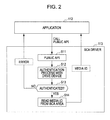
- FIG. 2 shows the application 112 and the BCA driver 113.
- An information processing device such as a PC or a reproducing device, that reproduces a disc reads and executes the application 112 and the BCA driver 113 from the disc 100.
- the BCA driver 113 is a program that is generated in accordance with the AACS definition, and executes an authentication process according to the AACS definition and reading of a media ID from the BCA area.
- the application 112 is a program that may be created by a third party at will.
- the application 112 may possibly be a malicious program, such as a program that is generated to fraudulently acquire media ID information.
- the application 112 calls an API (Application Programming Interface) from the BCA driver 113.
- the API includes functions for requesting the BCA driver to acquire a media ID.
- the API is public and is available to a third party.
- the BCA driver 113 in step S11, in response to the API call from the application 112, initiates a series of processes for the process of providing a media ID.
- the BCA driver 113 executes an authentication process with the drive device that reads data from the disc to check the validity of both the drive device and the BCA driver.
- the authentication process is executed in accordance with the AACS definition.
- step S13 when it is not authenticated and the validity of both is not verified, an error notification is transmitted to the application 112, and the process ends without reading a media ID.
- step S13 when it is authenticated and the validity of both is verified, in step S14, the drive device is instructed to read a media ID from the BCA area, and the read media ID is provided to the application 112.
- the application 112 transmits the media ID acquired from the BCA driver 113 to the management server, and then receives contents copy permission information or other service information.
- the application 112 is a program that may be created by a third party at will, and it may possibly be a malicious program, such as a program that is generated to fraudulently acquire media ID information.
- a malicious program such as a program that is generated to fraudulently acquire media ID information.
- it is easy to acquire a media ID from the BCA driver using the public API.
- a media ID may be fraudulently acquired or contents may be fraudulently used using the fraudulently acquired media ID.
- a first API Application Programming Interface
- the first API is a public API that is public to a third party
- the second API is a private API that is not public to the third party
- the BCA driver execution unit in response to a second API call from the application, executes an authentication process with the drive device, and when it is verified that the mutual validity of the BCA driver and the drive device, instructs the drive device to read the media ID.
- the BCA driver execution unit in response to a second API call from the application, executes a tampering check process on the BCA driver, and when it is verified that there is no tampering in the BCA driver, executes an authentication process with the drive device.
- the BCA driver execution unit executes a tampering check process on the BCA driver each time the BCA driver executes a step.
- the BCA driver execution unit executes a process of providing the application execution unit with data mixing a pointer to the second API and a dummy pointer.
- the application and the BCA driver are recorded in the disc, and the application execution unit and the BCA driver execution unit respectively read and execute the application and the BCA driver recorded in the disc.
- a BCA driver execution unit that executes a BCA driver, which is a program for instructing
- a BCA driver includes
- a first API Application Programming Interface
- a disc contains: contents; an application which is a program for utilizing the contents; a media ID recorded in a BCA (Burst Cutting Area) area provided in the disc; and a BCA driver that includes a program for instructing a drive device to execute a process of reading the media ID, tampering check data for the program, and an API to which the application is accessible, wherein in an information processing device that utilizes the contents, the BCA driver, in response to a first API (Application Programming Interface) call from the application, executes tampering check on the BCA driver to which the tampering check data are applied, and when it is verified that there is no tampering, executes a process of providing the application with a pointer to a second API for executing reading of the media ID.
- BCA Breast Cutting Area
- the first API is a public API that is public to a third party
- the second API is a private API that is not public to the third party
- an information processing method executed in an information processing device that utilizes contents recorded in a disc includes the steps of: executing an application, which is a program for utilizing the contents recorded in the disc, by an application execution unit; and executing a BCA driver, which is a program for instructing a drive device to execute a process of reading a media ID recorded in a BCA (Burst Cutting Area) area provided in the disc, by an BCA driver execution unit, wherein when the BCA driver is executed, in response to a first API (Application Programming Interface) call from the application execution unit, a tampering check process is executed on the BCA driver, and wherein when it is verified that there is no tampering in the BCA driver, a process of providing the application execution unit with a pointer to a second API for executing a process of reading the media ID is executed.
- a BCA driver which is a program for instructing a drive device to execute a process of reading a media ID recorded in a BCA (Burst Cutting
- the first API is a public API that is public to a third party
- the second API is a private API that is not public to the third party
- the BCA driver when executed, in response to a second API call from the application, an authentication process is executed with the drive device, and when it is verified that the mutual validity of the BCA driver and the drive device, the drive device is instructed to read the media ID.
- a tampering check process is executed on the BCA driver, and when it is verified that there is no tampering in the BCA driver, an authentication process is executed with the drive device.
- a tampering check process is executed on the BCA driver each time the BCA driver executes a step.
- an information processing method that is executed in an information processing device that utilizes contents recorded in a disc includes the steps of: executing an application, which is a program for utilizing the contents recorded in the disc, by an application execution unit; and executing a BCA driver, which is a program for instructing a drive device to execute a process of reading a media ID recorded in a BCA (Burst Cutting Area) area of the disc, by a BCA driver execution unit, wherein the BCA driver includes tampering check data, wherein when the BCA driver is executed, in response to a first API (Application Programming Interface) call from the application execution unit, a tampering check process is executed on the BCA driver by applying the tampering check data, and, when it is verified that there is no tampering in the BCA driver, a process of providing the application execution unit with a pointer to a second API for executing a process of reading a media ID is executed.
- a BCA driver which is a program for instruct
- an information processing method that is executed in an information processing device that utilizes contents recorded in a disc includes the steps of: executing an application, which is a program for utilizing the contents recorded in the disc, by an application execution unit; and executing a BCA driver, which is a program for instructing a drive device to execute a process of reading a media ID recorded in a BCA (Burst Cutting Area) area of the disc, by a BCA driver execution unit, wherein the BCA driver includes checksum data, as tampering check data, that are obtained by adding numeric values of data that constitute the BCA driver in predetermined units of data, wherein when the BCA driver is executed, in response to a first API (Application Programming Interface) call from the application execution unit, a tampering check process is executed on the BCA driver by applying the checksum data, and, when it is verified that there is no tampering in the BCA driver, a process of providing the application execution unit with a pointer to
- an information processing method that is executed in an information processing device that utilizes contents recorded in a disc includes the steps of: executing an application, which is a program for utilizing the contents recorded in the disc, by an application execution unit; and executing a BCA driver, which is a program for instructing a drive device to execute a process of reading a media ID recorded in a BCA (Burst Cutting Area) area of the disc, by a BCA driver execution unit, wherein the BCA driver includes tampering check data and a hash value for the tampering check data, wherein when the BCA driver is executed, in response to a first API (Application Programming Interface) call from the application execution unit, a tampering check process is executed on the BCA driver by applying the tampering check data and a tampering check process is executed on the tampering check data by applying the hash value, and, when it is verified that there is no tampering in
- an information processing method that is executed in an information processing device that uses contents recorded in a disc includes the steps of: executing an application, which is a program for utilizing the contents recorded in the disc, by an application execution unit; and executing a BCA driver, which is a program for instructing a drive device to execute a process of reading a media ID recorded in a BCA (Burst Cutting Area) area of the disc, by a BCA driver execution unit, wherein when the BCA driver is executed, in response to a first API (Application Programming Interface) call from the application execution unit, a process of providing the application execution unit with a pointer to a second API for executing a process of reading a media ID is executed.
- a first API Application Programming Interface
- a program for executing information processing in an information processing device that utilizes contents recorded in a disc includes the steps of: executing an application, which is a program for utilizing the contents recorded in the disc, by an application execution unit; and executing a BCA driver, which is a program for instructing a drive device to execute a process of reading a media ID recorded in a BCA (Burst Cutting Area) area provided in the disc, by an BCA driver execution unit, wherein when the BCA driver is executed, in response to a first API (Application Programming Interface) call from the application execution unit, a tampering check process is executed on the BCA driver, and when it is verified that there is no tampering in the BCA driver, a process of providing the application execution unit with a pointer to a second API for executing a process of reading the media ID is executed.
- a BCA driver which is a program for instructing a drive device to execute a process of reading a media ID recorded in a BCA (Burst
- the program according to the embodiments of the invention may be, for example, provided to a general-purpose system that is able to execute various program codes in a computer readable format through a recording medium or a communication medium.
- a general-purpose system that is able to execute various program codes in a computer readable format through a recording medium or a communication medium.
- system in the present specification is a logically integrated configuration of a plurality of devices, and is not limited to the one that a device of each configuration is placed in the same casing.
- PMSN Pre-recorded Media Serial Number
- PMSN Pre-recorded Media Serial Number
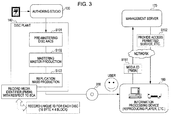
- Contents, such as a movie, to be recorded in a disc are initially created as authoring contents for disc recording in an authoring studio 130.
- a pre-mastering process (S101), which is a process of generating data for disc recording, such as a contents cryptography process according to the AACS definition, is executed.
- a mastering process (S102), which is a master producing process based on data recorded in a disc, is performed, and a large number of discs are produced using the produced master, that is, a replication process (S103) is executed.
- identification information that is unique to each disc that is, a media ID (PMSN)
- PMSN media ID
- a media ID formed of 16 bytes x 4 blocks, that is, 64 byte data is recorded in the BCA area of each disc.
- the BCA area is different from the normal data recording area, and data are recorded by mechanical cutting, which is different from a normal data recording mode.
- a special reading process different from the normal data reproducing process may be necessary.
- the disc 200 produced as in the above manner is purchased by the user, set in an information processing device 160, such as user's PC or reproducing device, and subjected to contents access processing, such as reproducing contents or copying contents.
- contents access processing such as reproducing contents or copying contents.
- contents access processing such as reproducing contents or copying contents.
- the media ID recorded in the disc is transmitted to a management server 170 (S151) and access permission information, such as copy permission information, is acquired from the management server 170 (S152).
- S151 management server 170
- access permission information such as copy permission information
- FIG. 4 is a view that illustrates data recorded in the disc (information recording medium) 200 in which contents are recorded.
- the disc 200 is, for example, a DVD (Digital Versatile Disc), a Blu-ray Disc (registered trademark), or the like, and contents, such as a movie, are recorded in a data recording area.
- the disc 200 includes the data recording area 210 in which contents, or the like, are recorded, and a BCA area (burst cutting area) 220 in which a media ID (for example, PMSN: Pre-recorded Media Serial Number) 221, which is disc unique identification information, is recorded.
- a media ID for example, PMSN: Pre-recorded Media Serial Number
- the following data are recorded in the data recording area 210 of the disc 200.
- the recorded data for example, include contents 211 such as a movie, an application 212 which is a program applied to execute contents access control, such as a process of reproducing or copying the contents, and a BCA driver 213 which is a program for executing a process of reading a media ID from the BCA area 220.
- the BCA driver 213 executes an authentication process with a drive device that reads data from the disc to thereby check the validity of the drive device, and only when the validity of the drive device is verified, instructs the drive device to read the media ID (PMSN).
- the BCA driver contains a secret key 214 that is utilized in the authentication process. Note that tampering check data are added to the BCA driver 213 recorded in the disc 200 according to the embodiment of the invention. The process of accessing the data will be described later.
- a media ID (PMSN) 221 which is disc unique identification information, is recorded in the BCA area 220 of the disc 200.
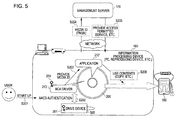
- step S201 starts up the information processing device 160, such as a PC or a reproducing device, in which the disc 200 is set, and runs the application 212 that executes a process of reproducing contents or a process of copying contents.
- the application 212 requests the BCA driver 213 to acquire a media ID.
- the BCA driver that has received the request for acquiring a media ID from the application 212 executes an authentication process with the drive device 300 in step S202.
- the drive device 300 may be formed integrally with the information processing device 160 or may be formed separately and connected to the information processing device 160 via a USB cable, or the like.
- the authentication process in step S202 is executed in accordance with the AACS definition.
- the authentication process utilizes a secret key 214 included in the BCA driver 213 and a secret key 301 included in the drive device 300. The detail of the process will be described later.
- the BCA driver 213 instructs the drive device 300 to read a media ID from the BCA area to thereby acquire the media ID.
- the BCA driver 213, in step S203, provides the media ID to the application 212.
- the application 212 transmits the media ID, received from the BCA driver 213, to the management server 170.
- the management server 170 in step S205, in response to the reception of the media ID, transmits access permission information, such as copy permission information, to the information processing device 160.
- the application 212 in step S206, may copy the contents stored in the disc 200 to an external device 350 conditionally on the reception of the copy permission information from the management server 170.
- FIG. 6 shows (1) application 212, (2) BCA driver 213, and (3) drive device 300.
- the application 212 and the BCA driver 213 are executed on the information processing device, such as a PC or a reproducing device.
- the BCA driver 213 includes an AACS authentication module 215 that executes an authentication process according to the AACS definition, and further includes the secret key 214 used in the authentication process.
- the drive device 300 also includes the secret key 302 used in the authentication process.
- step S301 the application 212 requests the BCA driver 213 for a media ID.
- step S302 the BCA driver 213 executes the authentication process with the drive device 300 using the AACS authentication module. The above authentication process is executed in the sequence according to the AACS definition.
- step S303 the drive device 300 reads a media ID from the BCA area of the disc 200, and in step S304, provides the read media ID to the BCA driver 213.
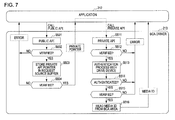
- FIG. 7 shows the application 212 and the BCA driver 213.
- the information processing device such as a PC or a reproducing device, that reproduces a disc reads the application 212 and the BCA driver 213 from the disc 200 and executes them in a program executing unit, such as a CPU.
- the application 212 and the BCA driver 213 are executed on an information processing device that includes a drive device in which a disc is loaded or on an information processing device connected to a drive device via, for example, a USB cable.
- the application 212 is executed in an application executing unit of the information processing device
- the BCA driver 213 is executed in a BCA executing unit of the information processing device.
- the process of reading the media ID (PMSN) from the BCA area of the disc is executable by the BCA driver according to the AACS definition.
- the BCA driver executes mutual authentication with the drive device loaded with the disc in accordance with the AACS definition, checks the validity of both the drive device and the BCA driver, reads the media ID, and then provides the media ID to the application.
- the BCA driver 213 is a program that is generated in accordance with the AACS definition, and executes an authentication process according to the AACS definition and reading of a media ID from the BCA area.
- the application 212 is a program that may be created by a third party at will.
- the application 112 may possibly be a malicious program, such as a program that is generated to fraudulently acquire media ID information.
- the application 212 calls an API (Application Programming Interface) to the BCA driver 213.
- the API is public and is available to a third party.
- the public API does not include functions for requesting the BCA driver to acquire a media ID but includes functions for requesting the BCA driver to acquire a pointer to a private API.
- the API that instructs the BCA driver to acquire a media ID is set as a private API.
- step S502 a process of verifying the BCA driver itself is executed using the verification data set in the BCA driver.
- FIG. 8 shows an example of the BCA driver 213 recorded in the disc 200 in accordance with the configuration according to the embodiment of the invention.
- tampering check data (checksum) 401 for all data of the BCA driver are set in advance in the BCA driver 213.
- the tampering check data (checksum) 401 are set as a total value that is obtained by, for example, adding up data byte by byte as numeric values from the starting address of an image of the BCA driver.
- step S502 in the flow shown in FIG. 7 the verification data (for example, tampering check data (checksum) 401 shown in FIG. 8 ) set in the BCA driver are used to execute a verification process for the BCA driver itself.
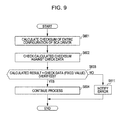
- the detailed sequence of the verification process will be described with reference to the flowchart shown in FIG. 9 .
- step S601 the checksum of all the configuration of the BCA driver is calculated. For example, a total value that is obtained by adding up data byte by byte as numeric values from the starting address of an image of the BCA driver is calculated.
- step S602 the calculated checksum is checked against the verification data.
- the verification data are the tampering check data (checksum) 401 shown in FIG. 8 .
- step S603 it is determined whether it is satisfied that the calculated result is equal to the verification data (fixed value). If it is satisfied, verification has been done, that is, it is determined that there is no tampering, and the process proceeds to step S604, after which the process continues. On the other hand, if it is not satisfied that the calculated result is equal to the verification data (fixed value), verification ends in failure, that is, it is determined that there is tampering, and the process proceeds to step S611, after which the process is interrupted and an error notice is provided to the application.
- step S502 the tampering check described with reference to FIG. 9 is executed on the BCA driver, and if it is determined that there is tampering, the process is interrupted and an error notice is provided to the application. If it is determined that there is no tampering, the process proceeds to step S503.
- a private API pointer that is, an API pointer that specifies a function for executing a process of reading a media ID from the BCA area of the disc, is stored in a buffer to which the application is accessible (request source buffer).
- the BCA driver executes tampering check on the BCA driver, that is, the process similar to step S502 and described with reference to FIG. 9 .
- the BCA driver is configured to execute tampering check on the BCA driver, described with reference to FIG. 9 , each time a process is executed. In this way, by sequentially determining continuation or interruption of the process by executing tampering check, it is possible to protect against various attacks from the outside.
- step S504 if it is determined that there is tampering, the process is interrupted, and an error notice is provided to the application. If it is determined that there is no tampering, the private API pointer is provided to the application 212 through the buffer.
- the application 212 uses the private API pointer received from the BCA driver through the buffer to call the private API.
- the BCA driver 213, in step S511, initiates a process according to the private API.
- the private API is applied to the process of acquiring a media ID.
- the process is interrupted, and an error notice is provided to the application. If it is determined that there is no tampering, the process proceeds to step S513, and an authentication process with the drive device that reads data from the disc is executed to thereby check the validity of both the drive device and the BCA driver.
- the authentication process is executed, for example, in accordance with the AACS definition.
- step S514 If authentication ends in failure in step S514, that is, if the validity of at least any one of the drive device and the BCA driver is not verified, an error notice is provided to the application 212, after which the process ends without reading a media ID.
- step S514 if authentication is done in step S514 and the validity of both the drive device and the BCA driver is verified, the BCA driver 213, in step S515, further executes tampering check on the BCA driver, that is, a process similar to step S502 and described with reference to FIG. 9 .
- the verification process in step S515 if it is determined that there is tampering, the process is interrupted, and an error notice is provided to the application. If it is determined that there is no tampering, the process proceeds to step S516 and instructs the drive device to read a media ID from the BCA area and, then, the read media ID is provided to the application 212.
- the application 212 transmits the media ID acquired from the BCA driver 213 to the management server, and then receives contents copy permission information or other service information.
- the BCA driver executes tampering check on the BCA driver, described with reference to FIG. 9 , each time a process is executed. In this way, by sequentially determining continuation or interruption of the process by executing tampering check, it is possible to protect against various attacks from the outside.
- tampering check data (checksum) 401 for all data of the BCA driver are set in advance in the BCA driver 213. The BCA driver sequentially executes tampering check using the above data.
- the verification data are recorded with the BCA driver as attached data, and in order to avoid modification of the checksum portion, it is desirable to embed a checksum with an exclusive tool for generating the BCA driver.
- the verification data are not limited to the configuration that the data are set as a total value that is obtained by adding up data byte by byte as numeric values from the starting address of an image of the BCA driver.
- the verification data may be set on the basis of core data not on the basis of the entire BCA driver.
- a verification data hash value 402 based on the verification data 401 is generated and recorded as data attached to the BCA driver 213.
- tampering verification of the verification data 401 itself is executed using the verification data hash value 402 in addition to tampering check of the BCA driver using the verification data 401.
- the application uses a public API to make it possible to execute a process of acquiring a pointer to a private API, and the application uses the acquired private API pointer to instruct the BCA driver to acquire a media ID.
- the private API pointer may be configured not to provide only one pointer to the application but to provide data mixing one right pointer and dummy pointers to the application.
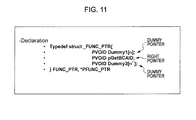
- FIG. 11 An example of a configuration of the pointer data is shown in FIG. 11 .
- previously generated data mixing dummy pointers and a right pointer is provided to the application. That is, PVOID Dummyl[n] and PVOID Dummy2[n'] are dummy pointers, and PVOID pGetBCAID is a right pointer.
- n and n' in the dummy pointers are numeric data.
- the private API has a structure such that a right pointer is sandwiched between dummy pointers as shown in FIG. 11 , and the sandwich structure is also private. Thus, it is possible to further protect against various attacks to the BCA driver.
- the application may be necessary to select a right pointer from among these plurality of pointers.
- pointer selection information or a pointer selection tool is provided to only a previously authorized application creator. Thus, it is possible to effectively exclude pointer acquisition that uses a malicious application.
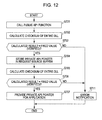
- FIG. 12 is a flow that illustrates a main processing sequence of the application and BCA driver according to the embodiment of the invention.
- the sequence is a flow that illustrates the process of steps S501 to S504 in the flow of FIG. 7 in greater detail.
- step S701 the application calls a public API function.
- the public API is an API for acquiring a pointer to the private API.
- step S702 a tampering check process is executed on the BCA driver. Specifically, the checksum of the entire DLL (Dynamic Linking Library) corresponding to the BCA driver is calculated. That is, the verification data (for example, tampering check data (checksum) 401 shown in FIG. 8 ) set in the BCA driver are used to execute a verification process on the BCA driver itself.
- DLL Dynamic Linking Library
- the checksum of the entire configuration of the BCA driver is calculated. For example, a total value that is obtained by adding up data byte by byte as numeric values from the starting address of an image of the BCA driver is calculated, and in step S703, the calculated checksum is checked against the verification data.
- the verification data are the tampering check data (checksum) 401 shown in FIG. 8 .
- step S703 if it is satisfied that the calculated result is equal to the verification data (fixed value), verification is done, that is, it is determined that there is no tampering, and the process proceeds to step S704, after which the process continues.
- step S711 After the process is interrupted and an error notice is provided to the application.
- a private API pointer that is, an API pointer that specifies a function for executing a process of reading a media ID from the BCA area of the disc, is stored in a buffer to which the application is accessible (request source buffer). Furthermore, in step S705, the BCA driver calculates the checksum of the entire DLL corresponding to the BCA driver. That is, the verification data (for example, tampering check data (checksum) 401 shown in FIG. 8 ) set in the BCA driver are used to execute a verification process on the BCA driver itself.
- the verification data for example, tampering check data (checksum) 401 shown in FIG. 8
- step S706 if it is determined that there is tampering in the BCA driver, the process proceeds to step S711 and is interrupted, after which an error notice is provided to the application. If it is determined that there is no tampering, the process proceeds to step S707. In step S707, the private API pointer is provided to the application 212 through the buffer.
- the application 212 uses the private API pointer received from the BCA driver through the buffer to call the private API.
- the following process will be the process following step S511 of FIG. 7 .
- an API for executing a process of acquiring a media ID is set as a private API
- a public API to which the application is accessible is set as a pointer to the private API for executing the process of acquiring the media ID
- the BCA driver execute tampering check on the BCA driver prior to the steps of executing the processes.
- a malicious application calls a public API to intend to acquire a media ID from the BCA driver
- the malicious application variously attacks the BCA driver, that is, tampers the BCA driver, before a private API is acquired
- the BCA driver is able to detect tampering in the tampering check, immediately interrupt the process and stop providing the private API to the malicious application.
- the series of processes described in the specification may be executed through hardware, software, or composite configuration of them.
- the process is executed through software, it is possible to execute a program that contains the process sequence, which is installed or copied into a memory inside a computer assembled to exclusive hardware, or to execute the program which is installed or copied into a general-purpose computer that is able to execute various processes.
- the program may be recorded in a recording medium in advance.
- the program may be not only installed or copied from a recording medium to the computer but also received through a network, such as a LAN (Local Area Network) or the Internet, and then installed or copied into a recording medium, such as an internal hard disk.
- LAN Local Area Network
- the file format of the BCA driver described in the above embodiment is not limited to a DLL file; it may be a format, such as an EXE file.
Landscapes
- Engineering & Computer Science (AREA)
- Computer Security & Cryptography (AREA)
- Signal Processing (AREA)
- Signal Processing For Digital Recording And Reproducing (AREA)
- Storage Device Security (AREA)
Applications Claiming Priority (1)
| Application Number | Priority Date | Filing Date | Title |
|---|---|---|---|
| JP2007323510A JP5034921B2 (ja) | 2007-12-14 | 2007-12-14 | 情報処理装置、ディスク、および情報処理方法、並びにプログラム |
Publications (1)
| Publication Number | Publication Date |
|---|---|
| EP2071571A1 true EP2071571A1 (en) | 2009-06-17 |
Family
ID=40347828
Family Applications (1)
| Application Number | Title | Priority Date | Filing Date |
|---|---|---|---|
| EP08171470A Withdrawn EP2071571A1 (en) | 2007-12-14 | 2008-12-12 | Information processing device, disc, information processing method, and program |
Country Status (4)
| Country | Link |
|---|---|
| US (1) | US8270275B2 (cg-RX-API-DMAC7.html) |
| EP (1) | EP2071571A1 (cg-RX-API-DMAC7.html) |
| JP (1) | JP5034921B2 (cg-RX-API-DMAC7.html) |
| CN (1) | CN101458946B (cg-RX-API-DMAC7.html) |
Families Citing this family (12)
| Publication number | Priority date | Publication date | Assignee | Title |
|---|---|---|---|---|
| US8984296B1 (en) * | 2009-03-29 | 2015-03-17 | Cypress Semiconductor Corporation | Device driver self authentication method and system |
| WO2010147211A1 (ja) | 2009-06-19 | 2010-12-23 | 日立建機株式会社 | 作業車両の制御装置 |
| JP5873671B2 (ja) * | 2011-09-16 | 2016-03-01 | 大和ハウス工業株式会社 | エネルギー管理システム |
| JP5958896B2 (ja) * | 2012-04-27 | 2016-08-02 | Kddi株式会社 | 情報処理装置およびプログラム |
| US10044716B2 (en) * | 2014-12-29 | 2018-08-07 | Visa International Service Association | Authorizing access to an application library |
| US20160253501A1 (en) * | 2015-02-26 | 2016-09-01 | Dell Products, Lp | Method for Detecting a Unified Extensible Firmware Interface Protocol Reload Attack and System Therefor |
| JP6255070B1 (ja) * | 2016-08-22 | 2017-12-27 | 株式会社 みずほ銀行 | 銀行サービスシステム及び銀行サービス方法 |
| WO2019032556A1 (en) * | 2017-08-10 | 2019-02-14 | Ctm Insights Llc | METHOD OF SECURING DATA USING MICROSHARD ™ FRAGMENTATION |
| CN107919960A (zh) * | 2017-12-04 | 2018-04-17 | 北京深思数盾科技股份有限公司 | 一种应用程序的认证方法和系统 |
| WO2019151013A1 (ja) | 2018-02-02 | 2019-08-08 | 日本電気株式会社 | 情報処理装置、情報処理方法及び記録媒体 |
| US10503566B2 (en) | 2018-04-16 | 2019-12-10 | Chicago Mercantile Exchange Inc. | Conservation of electronic communications resources and computing resources via selective processing of substantially continuously updated data |
| KR102428652B1 (ko) * | 2020-09-18 | 2022-08-04 | (재)예수병원유지재단 | 마이크로소프트 엑셀을 이용한 문자정보처리시스템 |
Citations (6)
| Publication number | Priority date | Publication date | Assignee | Title |
|---|---|---|---|---|
| US6665489B2 (en) * | 1999-04-21 | 2003-12-16 | Research Investment Network, Inc. | System, method and article of manufacturing for authorizing the use of electronic content utilizing a laser-centric medium and a network server |
| WO2005036404A2 (en) * | 2003-10-13 | 2005-04-21 | Koninklijke Philips Electronics N.V. | Storage allocation per application |
| EP1586988A2 (en) * | 2004-04-15 | 2005-10-19 | Sony Corporation | Information processing apparatus, information processing method, program and recording medium used therewith |
| US20070011746A1 (en) * | 2005-07-11 | 2007-01-11 | Microsoft Corporation | Per-user and system granular audit policy implementation |
| WO2007023420A1 (en) * | 2005-08-23 | 2007-03-01 | Koninklijke Philips Electronics N.V. | Information carrier authentication with a physical one-way function |
| JP2007323510A (ja) | 2006-06-02 | 2007-12-13 | Mitsubishi Heavy Ind Ltd | 流路網の計算方法 |
Family Cites Families (14)
| Publication number | Priority date | Publication date | Assignee | Title |
|---|---|---|---|---|
| US7191154B2 (en) * | 1995-10-09 | 2007-03-13 | Matsushita Electric Industrial Co., Ltd. | Apparatus for encrypting and recording received content information on a recording medium using both medium identification information and a cipher key for encryption |
| JP3521723B2 (ja) * | 1998-01-23 | 2004-04-19 | セイコーエプソン株式会社 | デジタルカメラおよびそれを用いた画像認証システム |
| JP2000251395A (ja) | 1999-02-26 | 2000-09-14 | Matsushita Electric Ind Co Ltd | 記録媒体、記録装置及び再生装置 |
| JP4177517B2 (ja) * | 1999-05-21 | 2008-11-05 | 株式会社東芝 | コンテンツ処理システムおよびコンテンツ保護方法 |
| JP2001216148A (ja) * | 2000-01-31 | 2001-08-10 | Fuji Magnedisk Kk | 不正に複製されたプログラムまたはデータがコンピュータで使用されるのを防止する記録媒体 |
| JP4548758B2 (ja) * | 2000-09-05 | 2010-09-22 | 大日本印刷株式会社 | 共有アクセス管理機能を備えた携帯可能な情報処理装置 |
| JP2003337629A (ja) * | 2002-05-18 | 2003-11-28 | Mitsuko Miyaji | プログラム難読化方法及び装置 |
| WO2004053699A2 (ja) * | 2002-12-06 | 2004-06-24 | Sony Corp | 記録再生装置、データ処理装置および記録再生処理システム |
| TWI366190B (en) * | 2003-01-23 | 2012-06-11 | Lg Electronics Inc | Recording medium with an intermittent or alternate wobbled pits and apparatus and methods for forming, recording, and reproducing the recording medium |
| JP2005276282A (ja) * | 2004-03-24 | 2005-10-06 | Sony Corp | 情報記録再生装置、コンテンツ管理方法およびコンテンツ管理プログラム |
| JP2007226277A (ja) * | 2004-04-02 | 2007-09-06 | Matsushita Electric Ind Co Ltd | 仮想マシン改ざん検査方法、および仮想マシン改ざん検査装置 |
| JP2006004376A (ja) * | 2004-06-21 | 2006-01-05 | Ricoh Co Ltd | 情報再生装置 |
| EP1769501B1 (en) * | 2004-07-22 | 2018-02-21 | Panasonic Intellectual Property Management Co., Ltd. | Playback apparatus and playback method |
| KR100603250B1 (ko) * | 2004-10-28 | 2006-07-24 | 삼성전자주식회사 | 광디스크의 bca 정보 독출방법 및 그 방법을 사용하는광디스크장치 |
-
2007
- 2007-12-14 JP JP2007323510A patent/JP5034921B2/ja not_active Expired - Fee Related
-
2008
- 2008-11-14 US US12/271,442 patent/US8270275B2/en not_active Expired - Fee Related
- 2008-12-11 CN CN2008101846303A patent/CN101458946B/zh not_active Expired - Fee Related
- 2008-12-12 EP EP08171470A patent/EP2071571A1/en not_active Withdrawn
Patent Citations (6)
| Publication number | Priority date | Publication date | Assignee | Title |
|---|---|---|---|---|
| US6665489B2 (en) * | 1999-04-21 | 2003-12-16 | Research Investment Network, Inc. | System, method and article of manufacturing for authorizing the use of electronic content utilizing a laser-centric medium and a network server |
| WO2005036404A2 (en) * | 2003-10-13 | 2005-04-21 | Koninklijke Philips Electronics N.V. | Storage allocation per application |
| EP1586988A2 (en) * | 2004-04-15 | 2005-10-19 | Sony Corporation | Information processing apparatus, information processing method, program and recording medium used therewith |
| US20070011746A1 (en) * | 2005-07-11 | 2007-01-11 | Microsoft Corporation | Per-user and system granular audit policy implementation |
| WO2007023420A1 (en) * | 2005-08-23 | 2007-03-01 | Koninklijke Philips Electronics N.V. | Information carrier authentication with a physical one-way function |
| JP2007323510A (ja) | 2006-06-02 | 2007-12-13 | Mitsubishi Heavy Ind Ltd | 流路網の計算方法 |
Non-Patent Citations (3)
| Title |
|---|
| "Advanced Access Content System (AACS) - HD DVD and DVD Pre-recorded Book, revision 0.912", INTERNET CITATION, 15 August 2006 (2006-08-15), XP002468445, Retrieved from the Internet <URL:http://www.aacsla.com/specifications/AACS_Spec_HD-DVD_and_DVD_Prerecorded_0_912.pdf> [retrieved on 20080206] * |
| "ADVANCED ACCESS CONTENT SYSTEM (AACS)", INTERNET CITATION, XP007900016, Retrieved from the Internet <URL:www.aacsla.com/specifications/specs091/AACS_Spec_BD_Prerecorded_0.91.pdf> [retrieved on 19000101] * |
| SFF COMMITTEE: "Mt. Fuji Commands for Multimedia Devices Version 7 Revision 0.9", INTERNET CITATION, 25 July 2007 (2007-07-25), pages 457 - 460, XP002504601, Retrieved from the Internet <URL:ftp://ftp.avc-pioneer.com/Mtfuji_7/Spec/Fuji7r09.pdf> [retrieved on 20081118] * |
Also Published As
| Publication number | Publication date |
|---|---|
| US8270275B2 (en) | 2012-09-18 |
| CN101458946B (zh) | 2011-09-07 |
| JP2009146199A (ja) | 2009-07-02 |
| JP5034921B2 (ja) | 2012-09-26 |
| US20090154314A1 (en) | 2009-06-18 |
| CN101458946A (zh) | 2009-06-17 |
Similar Documents
| Publication | Publication Date | Title |
|---|---|---|
| EP2071571A1 (en) | Information processing device, disc, information processing method, and program | |
| US7155743B2 (en) | Method and system for controlling use of a dynamically linked software library | |
| TWI294072B (en) | Method of communicating digital data, method of processing a data file and digital rights management module | |
| JP5302425B2 (ja) | 長期にリニューアル可能なセキュリティを提供するコンテンツセキュリティ方法、その装置およびコンピュータ読取可能記憶媒体 | |
| US6925342B2 (en) | System and method for protecting digital media | |
| KR100338397B1 (ko) | 자료파일내자료가진짜임을검증하기위한방법및그장치 | |
| US8850214B2 (en) | Methods and systems for encoding and protecting data using digital signature and watermarking techniques | |
| US8887308B2 (en) | Digital cloud access (PDMAS part III) | |
| US8533860B1 (en) | Personalized digital media access system—PDMAS part II | |
| KR100946042B1 (ko) | 탬퍼-레지스턴트 애플리케이션 구동 방법 및 시스템과 컴퓨터 판독 가능 저장 매체 | |
| CN101496020B (zh) | 控制数字内容的未授权使用的方法、系统和相关设备 | |
| US20100185868A1 (en) | Personilized digital media access system | |
| US20120151220A1 (en) | Personalized digital media access system (pdmas) | |
| JP2009504026A (ja) | デジタルコンテンツに関連付けられた検証用来歴データ | |
| JP2004532495A5 (cg-RX-API-DMAC7.html) | ||
| US20020152396A1 (en) | Method for secure restoration of a database stroring non-secure content | |
| US20060015860A1 (en) | System and method for storing attributes in a file for processing an operating system | |
| US7568102B2 (en) | System and method for authorizing the use of stored information in an operating system | |
| CN1748255A (zh) | 用于向合并的数字记录中插入中断的系统和方法 | |
| TWI222818B (en) | Software protection method and device | |
| JP2009252142A (ja) | データ処理装置 | |
| US7278020B2 (en) | Digital watermarking apparatus and application apparatus using the same | |
| JP4740925B2 (ja) | Drmコンテンツ再生方法及びその装置 |
Legal Events
| Date | Code | Title | Description |
|---|---|---|---|
| PUAI | Public reference made under article 153(3) epc to a published international application that has entered the european phase |
Free format text: ORIGINAL CODE: 0009012 |
|
| 17P | Request for examination filed |
Effective date: 20081212 |
|
| AK | Designated contracting states |
Kind code of ref document: A1 Designated state(s): AT BE BG CH CY CZ DE DK EE ES FI FR GB GR HR HU IE IS IT LI LT LU LV MC MT NL NO PL PT RO SE SI SK TR |
|
| AX | Request for extension of the european patent |
Extension state: AL BA MK RS |
|
| 17Q | First examination report despatched |
Effective date: 20090723 |
|
| AKX | Designation fees paid |
Designated state(s): DE FR GB |
|
| STAA | Information on the status of an ep patent application or granted ep patent |
Free format text: STATUS: THE APPLICATION IS DEEMED TO BE WITHDRAWN |
|
| 18D | Application deemed to be withdrawn |
Effective date: 20140701 |