EP2068552B1 - Videoverarbeitungsgerät und Videoverarbeitungsverfahren - Google Patents
Videoverarbeitungsgerät und Videoverarbeitungsverfahren Download PDFInfo
- Publication number
- EP2068552B1 EP2068552B1 EP08170014.8A EP08170014A EP2068552B1 EP 2068552 B1 EP2068552 B1 EP 2068552B1 EP 08170014 A EP08170014 A EP 08170014A EP 2068552 B1 EP2068552 B1 EP 2068552B1
- Authority
- EP
- European Patent Office
- Prior art keywords
- motion
- video processing
- respect
- video
- present
- Prior art date
- Legal status (The legal status is an assumption and is not a legal conclusion. Google has not performed a legal analysis and makes no representation as to the accuracy of the status listed.)
- Not-in-force
Links
Images



Classifications
-
- H—ELECTRICITY
- H04—ELECTRIC COMMUNICATION TECHNIQUE
- H04N—PICTORIAL COMMUNICATION, e.g. TELEVISION
- H04N19/00—Methods or arrangements for coding, decoding, compressing or decompressing digital video signals
- H04N19/50—Methods or arrangements for coding, decoding, compressing or decompressing digital video signals using predictive coding
- H04N19/503—Methods or arrangements for coding, decoding, compressing or decompressing digital video signals using predictive coding involving temporal prediction
- H04N19/51—Motion estimation or motion compensation
-
- H—ELECTRICITY
- H04—ELECTRIC COMMUNICATION TECHNIQUE
- H04N—PICTORIAL COMMUNICATION, e.g. TELEVISION
- H04N5/00—Details of television systems
- H04N5/14—Picture signal circuitry for video frequency region
- H04N5/144—Movement detection
-
- H—ELECTRICITY
- H04—ELECTRIC COMMUNICATION TECHNIQUE
- H04N—PICTORIAL COMMUNICATION, e.g. TELEVISION
- H04N19/00—Methods or arrangements for coding, decoding, compressing or decompressing digital video signals
- H04N19/50—Methods or arrangements for coding, decoding, compressing or decompressing digital video signals using predictive coding
- H04N19/503—Methods or arrangements for coding, decoding, compressing or decompressing digital video signals using predictive coding involving temporal prediction
- H04N19/51—Motion estimation or motion compensation
- H04N19/513—Processing of motion vectors
-
- H—ELECTRICITY
- H04—ELECTRIC COMMUNICATION TECHNIQUE
- H04N—PICTORIAL COMMUNICATION, e.g. TELEVISION
- H04N19/00—Methods or arrangements for coding, decoding, compressing or decompressing digital video signals
- H04N19/50—Methods or arrangements for coding, decoding, compressing or decompressing digital video signals using predictive coding
- H04N19/503—Methods or arrangements for coding, decoding, compressing or decompressing digital video signals using predictive coding involving temporal prediction
- H04N19/51—Motion estimation or motion compensation
- H04N19/513—Processing of motion vectors
- H04N19/521—Processing of motion vectors for estimating the reliability of the determined motion vectors or motion vector field, e.g. for smoothing the motion vector field or for correcting motion vectors
-
- H—ELECTRICITY
- H04—ELECTRIC COMMUNICATION TECHNIQUE
- H04N—PICTORIAL COMMUNICATION, e.g. TELEVISION
- H04N19/00—Methods or arrangements for coding, decoding, compressing or decompressing digital video signals
- H04N19/50—Methods or arrangements for coding, decoding, compressing or decompressing digital video signals using predictive coding
- H04N19/503—Methods or arrangements for coding, decoding, compressing or decompressing digital video signals using predictive coding involving temporal prediction
- H04N19/51—Motion estimation or motion compensation
- H04N19/55—Motion estimation with spatial constraints, e.g. at image or region borders
-
- H—ELECTRICITY
- H04—ELECTRIC COMMUNICATION TECHNIQUE
- H04N—PICTORIAL COMMUNICATION, e.g. TELEVISION
- H04N7/00—Television systems
- H04N7/01—Conversion of standards, e.g. involving analogue television standards or digital television standards processed at pixel level
-
- H—ELECTRICITY
- H04—ELECTRIC COMMUNICATION TECHNIQUE
- H04N—PICTORIAL COMMUNICATION, e.g. TELEVISION
- H04N7/00—Television systems
- H04N7/01—Conversion of standards, e.g. involving analogue television standards or digital television standards processed at pixel level
- H04N7/0127—Conversion of standards, e.g. involving analogue television standards or digital television standards processed at pixel level by changing the field or frame frequency of the incoming video signal, e.g. frame rate converter
-
- H—ELECTRICITY
- H04—ELECTRIC COMMUNICATION TECHNIQUE
- H04N—PICTORIAL COMMUNICATION, e.g. TELEVISION
- H04N7/00—Television systems
- H04N7/01—Conversion of standards, e.g. involving analogue television standards or digital television standards processed at pixel level
- H04N7/0135—Conversion of standards, e.g. involving analogue television standards or digital television standards processed at pixel level involving interpolation processes
- H04N7/014—Conversion of standards, e.g. involving analogue television standards or digital television standards processed at pixel level involving interpolation processes involving the use of motion vectors
Definitions
- the present invention relates to a video processing apparatus and a video processing method, and more particularly, to a video processing apparatus and method which performs motion correction for a video frame
- a video processing apparatus performs video processing for a video signal to output a displayable video.
- the video processing apparatus performs video processing for a video signal including a predetermined video received from a broadcasting station, or a video signal inputted from various video devices such as a DVD.
- the video processing apparatus sequentially displays a plurality of unit videos included in the video signal, that is, a plurality of frames.
- the video processing apparatus since the video processing apparatus has a limited number of frames to display per unit time, in the case that a video includes an object with a quick movement, a user may not perceive the movement of the object to be natural. Accordingly, the conventional video processing apparatus performs a Frame Rate Conversion (FRC) for converting a frame rate, a Movie Judder Cancellation (MJC) for dividing a frame into a predetermined unit of blocks and estimating a motion by using a motion vector of an adjacent block adjacent to an arbitrary block, and so on, to display a corrected frame.
- FRC Frame Rate Conversion
- MJC Movie Judder Cancellation
- a conventional video processing apparatus using the MJC algorithm has a problem in that motion correction cannot be accurately performed due to the lack of the number of adjacent blocks on side edges of a screen to cause a halo phenomenon around the object.
- the conventional video processing apparatus performs over-scanning so that side edges of a screen are not displayed, but there has been an increasing desire to watch full-scan video.
- US2001/004385 A1 describes a motion vector detection system for detecting a motion vector for motion compensation in moving picture compression.
- Another aspect of the present invention is to provide a video processing apparatus which can control the size of an area where the motion correction is performed by using the adjacent frame to thereby efficiently process a video, and a video processing method thereof.
- Still another aspect of the present invention is to provide a video processing apparatus which can filter a border between the areas where the motion correction is performed by different algorithms to thereby naturally display the border between the areas where the motion correction is performed, and a video processing method thereof.
- Yet another aspect of the present invention is to provide a video processing apparatus which can display an undistorted full-scan video, and a video processing method thereof.
- a video processing apparatus including: a first motion correcting part which divides a video frame into blocks of a predetermined unit, and corrects a motion with respect to at least some area of a present frame by using a motion vector of an adjacent block adjacent to the present block; a second motion correcting part which corrects the motion by using a motion vector of an adjacent frame adjacent to the present frame; and a controller which controls the first motion correcting part to correct the motion if the number of the adjacent blocks on which a video can be displayed is not smaller than a predetermined value, and controls the second motion correcting part to correct the motion if the number of the adjacent blocks on which the video can be displayed is smaller than the predetermined value.
- the second motion correcting part may perform a Motion Adaptive De-interlace (MAD) to correct the motion.
- MAD Motion Adaptive De-interlace
- the controller may control to perform the motion correction with respect to a block corresponding to a side edge of the present frame.
- the controller may control the second motion correcting part to correct the motion only with respect to a block of one side edge where a motion of an object begins.
- the size of the block may be controlled.
- the controller may perform filtering with respect to a border between an area where the motion correction is performed by the first motion correcting part and an area where the motion correction is performed by the second motion correcting part.
- At least one of the first motion correcting part and the second motion correcting part may correct the motion by a difference of absolute values of pixels on the same position inside the block.
- the controller may determine whether or not the video can be displayed with respect to eight blocks adjacent to the present block.
- the video displayed by the motion correction may be provided as a full-scan video.
- a video processing method of a video processing apparatus including: calculating the number of adjacent blocks on which a video can be displayed among blocks adjacent to a present block among blocks into which a video frame is divided; determining whether or not the number of the adjacent blocks on which the video can be displayed is smaller than a predetermined value; correcting a motion with respect to at least some area of a present frame by using a motion vector of the adjacent blocks if the number of the adjacent blocks on which the video can be displayed is not smaller than the predetermined value; and correcting the motion by using a motion vector of a frame adjacent to the present frame if the number of the adjacent blocks on which the video can be displayed is smaller than the predetermined value.
- the motion may be corrected with respect to the block corresponding to the brink of the present frame.
- the motion may be corrected only with respect to a block of one side edge where a motion of an object begins by using the motion vector of the adjacent frame.
- the size of the block may be controlled.
- the correcting the motion may include performing filtering with respect to a border between an area where the motion correction is performed by using the motion vector of the adjacent blocks and an area where the motion correction is performed by using the motion vector of the adjacent frame.
- the motion may be corrected by a difference of absolute values of pixels on the same position inside the block.
- the determining whether or not the number of the adjacent blocks on which the video can be displayed is smaller than the predetermined value, there may be determined whether or not the video can be displayed with respect to eight blocks adjacent to the present block.
- the video displayed by the motion correction may be provided as a full-scan video of an input video signal.
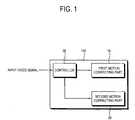
- a video processing apparatus 100 includes a first motion correcting part 10, a second motion correcting part 20, and a controller 30.
- the video processing apparatus 100 may be provided as a set-top box separated from a display module, but it may be provided in an integrated form in which a display part is included.
- the first motion correcting part 10 divides a video frame into blocks of a predetermined unit, and corrects a motion with respect to at least some area of the present frame by using a motion vector of an adjacent block adjacent to the present block.
- the first motion correcting part 10 performs an MJC algorithm for calculating a proper motion vector with respect to the present block on the basis of a motion vector obtained from eight blocks adjacent to the present block.
- the video processing apparatus 100 inputs a digital signal converted through an ADC (analog to digital converter) 11 into a frame buffer 12 if an analog signal is inputted.
- the frame buffer stores the inputted video signal.
- the digital signal is directly inputted into the frame buffer, and the MJC algorithm is performed in an MJC block 13 with respect to the video signal stored in the frame buffer.
- FIG. 2B is a drawing for illustrating the MJC algorithm.
- the MJC algorithm divides one frame into a predetermined size of blocks, and calculates a proper motion vector with the present block A on the basis of the motion vector obtained from the eight adjacent blocks (A') adjacent to the present block A to perform motion correction.
- the second motion correcting part 20 performs motion correction by using the motion vector of the adjacent frame adjacent to the present frame.
- the second motion correcting part 20 may generate a new frame with respect to an interlace signal on the basis of the present frame and the preceding frame prior to the present frame to perform an MAD algorithm for converting the new frame into a progressive signal.
- the second motion correcting part 20 performs a 3-D interlace with respect to a still image, and a 2-D interlace with respect to a video.
- the second motion correcting part 20 bypasses the input video signal by control of the controller 30 if the progressive signal is inputted.
- the first motion correcting part 10 and the second motion correcting part 20 estimate a motion vector with respect to a block of which the motion is to be estimated (hereinafter, referred to as "the present block") of the present frame and perform the motion correction according to the sum of an absolute difference (SAD) according to the result.
- the present block a block of which the motion is to be estimated
- the controller 30 controls the first motion correcting part 10 to correct the motion if the number of the adjacent blocks on which the video can be displayed among the adjacent blocks adjacent to the present block is not smaller than a predetermined value, and controls the second motion correcting part 20 to correct the motion if the number of the adjacent blocks on which the video can be displayed is smaller than the predetermined value.
- the controller 30 divides one frame into blocks in the size of 8 x 8, and calculates the number of blocks on which the video can be displayed with respect to eight blocks adjacent to the present block. Accordingly, if the number of the adjacent blocks on which the video can be displayed is three or five, for example, if the present block is located on the side edges of the screen, the controller 30 controls the second motion correcting part 20 to correct the motion by using the adjacent frame, and if the number of the adjacent blocks on which the video can be displayed is eight, the controller 30 controls the first motion correcting part 10 to correct the motion.
- the full-scan video for displaying the entire inputted video can be displayed without an error.
- the controller 30 may set the motion vector of the adjacent block as a zero vector, that is, zero (0,0) if the number of the adjacent blocks on which the video can be displayed is smaller than the predetermined value.
- FIG. 3 illustrates a process in which the controller 30 sets an area where the number of the adjacent blocks on which the video can be displayed is smaller than the predetermined value.
- the controller 30 controls the first motion correcting part 10 not to operate and controls the second motion correcting part 20 to perform motion correction, with respect to four areas of 3a, 3b, 3c and 3d.
- the controller 30 can control each size of the four areas 3a through 3d. Thus, errors which may be generated through the motion correction by the first motion correcting part 10 can be reduced.
- controller 30 may determine whether the first motion correcting part 10 will correct the motion or the second motion correcting part 20 will correct the motion with respect to the present block according to the motion of the object.
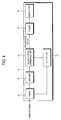
- FIG. 4 is a block diagram illustrating another exemplary embodiment of the video processing apparatus 101 according to the present invention.
- the video processing apparatus 101 may include a second motion correcting part 21, a controller 31, a tuner 40, a decoder 50, a scaler 60, and a display part 70.
- the tuner 40 receives a video signal having a frequency band corresponding to a predetermined channel selected by a user with respect to a broadcast video signal.
- the decoder 50 performs decoding for the received video signal according to a predetermined standard and extracts brightness information, color information, horizontal sync information, and vertical sync information, etc. of the video.
- the second motion correcting part 21 performs de-interlacing for converting the inputted interlace signal into a progressive signal, and may properly perform weaving and blending according to characteristics of the video.
- the scaler 60 performs video processing so that the video signal of which the motion has been corrected by the second motion correcting part 21 can be displayed in a proper size and position.
- the display part 70 displays a video on the basis of the signal processed by the scaler 60.
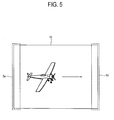
- the controller 30 (31) may control the second motion correcting part 20 (21) in place of the first motion correcting part 10 to correct the motion only with respect to an area 5a, that is, an area where the motion of the object begins if the object moves from left to right. That is because an area 5b where the motion of the object ends has no influence on the motion correction with respect to the block displayed on the screen even in the case that there is a lack of information on the adjacent blocks.
- controller 30 (31) may filter a border between the area where the first motion correcting part 10 corrects the motion and the area where the second motion correcting part 20 (21) corrects the motion so that the video can be naturally displayed.
- the controller 30 (31) may calculate the brightness of right-left pixels or up-down pixels of the border between the areas where the motion correction has been performed by the first motion correcting part 10 and the second motion correcting part 20 (21), calculate an average value of the calculated brightness, and set the brightness of the border pixels from the calculated average value, to thereby filter the border between the areas.
- FIG. 6 a video processing method according to the present invention will be described by referring to FIG. 6 .
- the controller 30 (31) calculates the number of adjacent blocks on which a video can be displayed, adjacent to the present block among blocks into which the video frame has been divided.
- the controller 30 (31) divides one frame into blocks in the size of 8 x 8, and calculates the number of the blocks on which the video can be displayed with respect to the eight blocks adjacent to the singular present block.
- the controller 30 (31) controls the first motion correcting part 10 to correct the motion with respect to at least some area of the present frame by using the motion vector of the adjacent blocks (S20).
- the controller 30 controls the second motion correcting part 20 (21) to correct the motion by using the motion vector of the frames adjacent to the present frame (S30).
- the motion is corrected by the MAD algorithm for generating a new frame on the basis of the present invention and the preceding frame prior to the present frame with respect to an interlace signal to convert the new frame into a progressive signal, and the second motion correcting part 20 (21) performs the 3-D interlace with respect to the still image and performs the 2-D interlace with respect to a video.
- the motion may be corrected with respect to the blocks corresponding to the side edges of the present frame.
- the motion may be corrected only with respect to blocks of one side edges where the motion of the object begins among the four side edges.
- the step S30 may further include performing filtering with respect to the border between the area where the motion correction is performed by using the motion vector of the adjacent blocks, that is, the area where the motion is corrected by the first motion correcting part 10 and the area where the motion is corrected by using the motion vector of the adjacent frame, that is, the area where the motion is corrected by the second motion correcting part 20 (21).
- the video processing apparatus and the video processing method according to exemplary embodiments of the present invention can perform motion correction with respect to areas with a small number of adjacent blocks by using an adjacent frame, to thereby display a video having an improved quality.
- the video processing apparatus and the video processing method according to exemplary embodiments of the present invention can control the size of an area where motion correction is performed by using an adjacent frame, to thereby efficiently process a video.
- the video processing apparatus and the video processing method according to exemplary embodiments of the present invention can filter a border between areas where motion correction is performed by different algorithms, to thereby naturally display the border.
- the video processing apparatus and the video processing method according to exemplary embodiments of the present invention can display an undistorted full-scan video.
Landscapes
- Engineering & Computer Science (AREA)
- Multimedia (AREA)
- Signal Processing (AREA)
- Television Systems (AREA)
- Controls And Circuits For Display Device (AREA)
Claims (15)
- Videoverarbeitungsgerät, umfassend:ein erstes Bewegungskorrekturteil zum Korrigieren von Bewegung in Bezug auf erste Bereiche eines gegenwärtigen Rahmens durch Verwendung eines Bewegungsvektors eines angrenzenden Blocks in dem gegenwärtigen Rahmen, der an einem jeweiligen gegenwärtigen Block des gegenwärtigen Rahmens angrenzend ist, wobei der gegenwärtige Rahmen in Blöcke einer im Voraus bestimmten Einheit aufgeteilt ist; undein zweites Bewegungskorrekturteil zum Korrigieren von Bewegung in Bezug auf zweite Bereiche des gegenwärtigen Rahmens durch Verwendung eines Bewegungsvektors eines angrenzenden Rahmens, der an dem gegenwärtigen Rahmen angrenzend ist; und dadurch gekennzeichnet, dass es Folgendes enthält:eine Steuerung zum Steuern des ersten Bewegungskorrekturteils zum Korrigieren der Bewegung in Bezug auf die ersten Bereiche des gegenwärtigen Rahmens, in dem eine Zahl von angrenzenden Blöcken in dem gegenwärtigen Rahmen nicht kleiner als acht ist, und zum Steuern des zweiten Bewegungskorrekturteils zum Korrigieren der Bewegung in Bezug auf die zweiten Bereiche des gegenwärtigen Rahmens, in dem die Zahl von angrenzenden Blöcken in dem gegenwärtigen Rahmen kleiner als acht ist.
- Videoverarbeitungsgerät nach Anspruch 1, wobei das zweite Bewegungskorrekturteil angeordnet ist, um ein bewegungsadaptives De-Interlacing (MAD) zum Korrigieren der Bewegung durchzuführen.
- Videoverarbeitungsgerät nach Anspruch 1, wobei die Steuerung angeordnet ist, um das zweite Bewegungskorrekturteil zum Durchführen der Bewegungskorrektur in Bezug auf einen Block, der mit einer Seitenkante des gegenwärtigen Rahmens korrespondiert, zu steuern.
- Videoverarbeitungsgerät nach Anspruch 3, wobei die Steuerung angeordnet ist, um das zweite Bewegungskorrekturteil zum Korrigieren der Bewegung nur in Bezug auf einen Block einer Seitenkante, an der eine Bewegung eines Objekts beginnt, zu steuern.
- Videoverarbeitungsgerät nach Anspruch 3 oder 4, wobei eine Größe des Blocks gesteuert werden kann.
- Videoverarbeitungsgerät nach einem der vorstehenden Ansprüche, wobei die Steuerung angeordnet ist, um Filtern in Bezug auf eine Grenze zwischen den ersten Bereichen, in denen die Bewegungskorrektur durch das erste Bewegungskorrekturteil durchgeführt wird, und den zweiten Bereichen, in denen die Bewegungskorrektur durch das zweite Bewegungskorrekturteil durchgeführt wird, durchzuführen.
- Videoverarbeitungsgerät nach einem der vorstehenden Ansprüche, wobei mindestens eines des ersten Bewegungskorrekturteils und des zweiten Bewegungskorrekturteils angeordnet ist, um Bewegung um eine Differenz von absoluten Werten von Bildpunkten an einer gleichen Position im Inneren des jeweiligen gegenwärtigen Blocks zu korrigieren.
- Videoverarbeitungsgerät nach einem der vorstehenden Ansprüche, wobei durch Bewegungskorrektur angezeigtes Video als ein Vollabtastungsvideo bereitgestellt wird.
- Verfahren zur Videoverarbeitung, das Verfahren umfassend:Berechnen einer Zahl von angrenzenden Blöcken in einem gegenwärtigen Videorahmen, wobei der gegenwärtige Videorahmen in Blöcke einer im Voraus bestimmten Einheit unterteilt wird, wobei die angrenzenden Blöcke Blöcke sind, die an einem jeweiligen gegenwärtigen Block in dem gegenwärtigen Videorahmen angrenzend sind;Bestimmen, ob die Zahl von angrenzenden Blöcken kleiner als acht ist oder nicht;Korrigieren jeweiliger Bewegung in Bezug auf erste Bereiche eines gegenwärtigen Rahmens, der mit dem jeweiligen gegenwärtigen Block assoziiert ist, durch Verwendung eines Bewegungsvektors der angrenzenden Blöcke, wenn die Zahl von angrenzenden Blöcken nicht kleiner als acht ist; undKorrigieren von Bewegung in Bezug auf zweite Bereiche des gegenwärtigen Rahmens durch Verwendung eines Bewegungsvektors eines Rahmens, der an dem gegenwärtigen Rahmen angrenzend ist, wenn die Zahl von angrenzenden Blöcken kleiner als acht ist.
- Videoverarbeitungsverfahren nach Anspruch 9, wobei Korrigieren der Bewegung in Bezug auf zweite Bereiche des gegenwärtigen Rahmens umfasst, ein bewegungsadaptives De-Interlacing (MAD) in Bezug auf den jeweiligen gegenwärtigen Block durchzuführen, in dem die Zahl der angrenzenden Blöcke kleiner als acht ist.
- Videoverarbeitungsverfahren nach Anspruch 9, wobei die Bewegung beim Korrigieren der Bewegung in Bezug auf die zweiten Bereiche des gegenwärtigen Rahmens in Bezug auf einen Block korrigiert wird, der mit einer Seitenkante des gegenwärtigen Rahmens korrespondiert.
- Videoverarbeitungsverfahren nach Anspruch 11, wobei die Bewegung beim Korrigieren der Bewegung in Bezug auf die zweiten Bereiche des gegenwärtigen Rahmens nur in Bezug auf einen Block einer Seitenkante, an der eine Bewegung eines Objekts beginnt, unter Verwendung des Bewegungsvektors des angrenzenden Rahmens korrigiert wird.
- Videoverarbeitungsverfahren nach einem der Ansprüche 9 bis 12, wobei Korrigieren der Bewegung umfasst, Filtern in Bezug auf eine Grenze zwischen den ersten Bereichen, in denen die Bewegungskorrektur durch Verwendung des Bewegungsvektors der angrenzenden Blöcke durchgeführt wird, und den zweiten Bereichen, in denen die Bewegungskorrektur durch Verwendung des Bewegungsvektors des angrenzenden Rahmens durchgeführt wird, durchzuführen.
- Videoverarbeitungsverfahren nach einem der Ansprüche 9 bis 13, wobei die Bewegung um eine Differenz von absoluten Werten von Bildpunkten an einer gleichen Position im Inneren des jeweiligen gegenwärtigen Blocks korrigiert wird.
- Videoverarbeitungsverfahren nach einem der Ansprüche 9 bis 14, umfassend, das durch die Bewegungskorrektur angezeigte Video als ein Vollabtastungsvideo bereitzustellen.
Applications Claiming Priority (1)
| Application Number | Priority Date | Filing Date | Title |
|---|---|---|---|
| KR1020070122234A KR101427115B1 (ko) | 2007-11-28 | 2007-11-28 | 영상처리장치 및 영상처리방법 |
Publications (2)
| Publication Number | Publication Date |
|---|---|
| EP2068552A1 EP2068552A1 (de) | 2009-06-10 |
| EP2068552B1 true EP2068552B1 (de) | 2013-04-17 |
Family
ID=40433919
Family Applications (1)
| Application Number | Title | Priority Date | Filing Date |
|---|---|---|---|
| EP08170014.8A Not-in-force EP2068552B1 (de) | 2007-11-28 | 2008-11-26 | Videoverarbeitungsgerät und Videoverarbeitungsverfahren |
Country Status (3)
| Country | Link |
|---|---|
| US (1) | US8090154B2 (de) |
| EP (1) | EP2068552B1 (de) |
| KR (1) | KR101427115B1 (de) |
Families Citing this family (3)
| Publication number | Priority date | Publication date | Assignee | Title |
|---|---|---|---|---|
| US8395709B2 (en) * | 2009-03-04 | 2013-03-12 | ATI Technology ULC | 3D video processing |
| KR102491176B1 (ko) * | 2016-10-10 | 2023-01-20 | 삼성전자주식회사 | 픽처 외곽선의 부호화 단위를 부호화 또는 복호화하는 방법 및 장치 |
| KR102664804B1 (ko) | 2018-10-10 | 2024-05-14 | 삼성디스플레이 주식회사 | 표시 장치 및 이를 이용한 표시 패널의 구동 방법 |
Family Cites Families (7)
| Publication number | Priority date | Publication date | Assignee | Title |
|---|---|---|---|---|
| CA2079434A1 (en) | 1991-09-30 | 1993-03-31 | Derek Andrew | Motion vector estimation, motion picture encoding and storage |
| EP1120976A4 (de) * | 1999-07-29 | 2006-03-29 | Mitsubishi Electric Corp | Verfahren zur bewegungsvektordetektion |
| JP3690259B2 (ja) * | 2000-09-27 | 2005-08-31 | 日本電気株式会社 | 動画像高速符号化装置及び動画像高速符号化方法 |
| KR100396558B1 (ko) * | 2001-10-25 | 2003-09-02 | 삼성전자주식회사 | 적응 움직임 보상형 프레임 및/또는 레이트 변환 장치 및그 방법 |
| KR100605746B1 (ko) * | 2003-06-16 | 2006-07-31 | 삼성전자주식회사 | 블럭 기반의 움직임 보상 장치 및 방법 |
| US7170561B2 (en) * | 2003-12-04 | 2007-01-30 | Lsi Logic Corporation | Method and apparatus for video and image deinterlacing and format conversion |
| KR100586882B1 (ko) | 2004-04-13 | 2006-06-08 | 삼성전자주식회사 | 모션 스케일러빌리티를 지원하는 코딩 방법 및 장치 |
-
2007
- 2007-11-28 KR KR1020070122234A patent/KR101427115B1/ko not_active Expired - Fee Related
-
2008
- 2008-07-28 US US12/180,833 patent/US8090154B2/en not_active Expired - Fee Related
- 2008-11-26 EP EP08170014.8A patent/EP2068552B1/de not_active Not-in-force
Also Published As
| Publication number | Publication date |
|---|---|
| US20090136151A1 (en) | 2009-05-28 |
| KR20090055353A (ko) | 2009-06-02 |
| EP2068552A1 (de) | 2009-06-10 |
| KR101427115B1 (ko) | 2014-08-08 |
| US8090154B2 (en) | 2012-01-03 |
Similar Documents
| Publication | Publication Date | Title |
|---|---|---|
| AU2003248047B2 (en) | Method and video processing unit for processing a video signal | |
| US8749703B2 (en) | Method and system for selecting interpolation as a means of trading off judder against interpolation artifacts | |
| US20080181312A1 (en) | Television receiver apparatus and a frame-rate converting method for the same | |
| US8355442B2 (en) | Method and system for automatically turning off motion compensation when motion vectors are inaccurate | |
| JP4119092B2 (ja) | 画像信号のフレーム数変換方法および装置 | |
| US8345148B2 (en) | Method and system for inverse telecine and scene change detection of progressive video | |
| US8154654B2 (en) | Frame interpolation device, frame interpolation method and image display device | |
| US20090153442A1 (en) | Plasma Display Apparatus | |
| JP4762343B2 (ja) | 画質調整装置および画質調整方法 | |
| JP3596521B2 (ja) | 画像信号処理装置及び方法 | |
| US8090154B2 (en) | Video processing apparatus and video processing method thereof | |
| JP2000259146A (ja) | 画像表示装置 | |
| JP2001292341A (ja) | 輪郭強調方法およびデジタル放送受信装置 | |
| KR101140442B1 (ko) | 이미지 상태 정보의 정정 방법, 움직임 보상 이미지 처리방법, 및 이미지 상태 정보 정정기 | |
| JP2013143646A (ja) | 表示装置、フレームレート変換装置、および表示方法 | |
| KR101018563B1 (ko) | 텔레비전 수상기 및 화상 처리 방법 | |
| JP5114274B2 (ja) | テレビジョン受信機及びそのフレームレート変換方法 | |
| JP2010147699A (ja) | 補間フレーム作成装置及び補間フレーム作成方法及び放送受信装置 | |
| US7466361B2 (en) | Method and system for supporting motion in a motion adaptive deinterlacer with 3:2 pulldown (MAD32) | |
| KR20080011026A (ko) | 영상처리장치 및 영상처리방법 | |
| KR20110080371A (ko) | 디지털 tv의 노이즈 감소 방법 | |
| RU123615U1 (ru) | Телевизионный приемник, устройство обработки изображений с адаптивной коррекцией движущихся изображений на основе технологии motion stream technology | |
| KR100703165B1 (ko) | 영상처리장치 및 영상처리방법 | |
| JP2010251897A (ja) | 放送信号受信装置、放送信号受信方法、及び放送信号受信プログラム | |
| KR20130021127A (ko) | 영상처리장치 및 그 제어방법 |
Legal Events
| Date | Code | Title | Description |
|---|---|---|---|
| PUAI | Public reference made under article 153(3) epc to a published international application that has entered the european phase |
Free format text: ORIGINAL CODE: 0009012 |
|
| AK | Designated contracting states |
Kind code of ref document: A1 Designated state(s): AT BE BG CH CY CZ DE DK EE ES FI FR GB GR HR HU IE IS IT LI LT LU LV MC MT NL NO PL PT RO SE SI SK TR |
|
| AX | Request for extension of the european patent |
Extension state: AL BA MK RS |
|
| 17P | Request for examination filed |
Effective date: 20091202 |
|
| AKX | Designation fees paid |
Designated state(s): DE GB NL |
|
| 17Q | First examination report despatched |
Effective date: 20110906 |
|
| RAP1 | Party data changed (applicant data changed or rights of an application transferred) |
Owner name: SAMSUNG ELECTRONICS CO., LTD. |
|
| GRAP | Despatch of communication of intention to grant a patent |
Free format text: ORIGINAL CODE: EPIDOSNIGR1 |
|
| RIN1 | Information on inventor provided before grant (corrected) |
Inventor name: CHO, HYEUNG-RAE |
|
| GRAS | Grant fee paid |
Free format text: ORIGINAL CODE: EPIDOSNIGR3 |
|
| GRAA | (expected) grant |
Free format text: ORIGINAL CODE: 0009210 |
|
| AK | Designated contracting states |
Kind code of ref document: B1 Designated state(s): DE GB NL |
|
| REG | Reference to a national code |
Ref country code: GB Ref legal event code: FG4D |
|
| REG | Reference to a national code |
Ref country code: DE Ref legal event code: R096 Ref document number: 602008023851 Country of ref document: DE Effective date: 20130613 |
|
| REG | Reference to a national code |
Ref country code: NL Ref legal event code: T3 |
|
| PLBE | No opposition filed within time limit |
Free format text: ORIGINAL CODE: 0009261 |
|
| STAA | Information on the status of an ep patent application or granted ep patent |
Free format text: STATUS: NO OPPOSITION FILED WITHIN TIME LIMIT |
|
| 26N | No opposition filed |
Effective date: 20140120 |
|
| REG | Reference to a national code |
Ref country code: DE Ref legal event code: R097 Ref document number: 602008023851 Country of ref document: DE Effective date: 20140120 |
|
| PGFP | Annual fee paid to national office [announced via postgrant information from national office to epo] |
Ref country code: DE Payment date: 20141021 Year of fee payment: 7 Ref country code: GB Payment date: 20141021 Year of fee payment: 7 |
|
| PGFP | Annual fee paid to national office [announced via postgrant information from national office to epo] |
Ref country code: NL Payment date: 20141021 Year of fee payment: 7 |
|
| REG | Reference to a national code |
Ref country code: DE Ref legal event code: R119 Ref document number: 602008023851 Country of ref document: DE |
|
| GBPC | Gb: european patent ceased through non-payment of renewal fee |
Effective date: 20151126 |
|
| REG | Reference to a national code |
Ref country code: NL Ref legal event code: MM Effective date: 20151201 |
|
| PG25 | Lapsed in a contracting state [announced via postgrant information from national office to epo] |
Ref country code: NL Free format text: LAPSE BECAUSE OF NON-PAYMENT OF DUE FEES Effective date: 20151201 |
|
| PG25 | Lapsed in a contracting state [announced via postgrant information from national office to epo] |
Ref country code: GB Free format text: LAPSE BECAUSE OF NON-PAYMENT OF DUE FEES Effective date: 20151126 Ref country code: DE Free format text: LAPSE BECAUSE OF NON-PAYMENT OF DUE FEES Effective date: 20160601 |