EP2068386A1 - Materiau oxyde et electrode pour pile a combustible le comprenant - Google Patents
Materiau oxyde et electrode pour pile a combustible le comprenant Download PDFInfo
- Publication number
- EP2068386A1 EP2068386A1 EP09154652A EP09154652A EP2068386A1 EP 2068386 A1 EP2068386 A1 EP 2068386A1 EP 09154652 A EP09154652 A EP 09154652A EP 09154652 A EP09154652 A EP 09154652A EP 2068386 A1 EP2068386 A1 EP 2068386A1
- Authority
- EP
- European Patent Office
- Prior art keywords
- group
- electrode
- nickel
- oxygen
- material according
- Prior art date
- Legal status (The legal status is an assumption and is not a legal conclusion. Google has not performed a legal analysis and makes no representation as to the accuracy of the status listed.)
- Granted
Links
Images

Classifications
-
- H—ELECTRICITY
- H01—ELECTRIC ELEMENTS
- H01M—PROCESSES OR MEANS, e.g. BATTERIES, FOR THE DIRECT CONVERSION OF CHEMICAL ENERGY INTO ELECTRICAL ENERGY
- H01M4/00—Electrodes
- H01M4/86—Inert electrodes with catalytic activity, e.g. for fuel cells
- H01M4/90—Selection of catalytic material
- H01M4/9016—Oxides, hydroxides or oxygenated metallic salts
- H01M4/9025—Oxides specially used in fuel cell operating at high temperature, e.g. SOFC
-
- C—CHEMISTRY; METALLURGY
- C01—INORGANIC CHEMISTRY
- C01G—COMPOUNDS CONTAINING METALS NOT COVERED BY SUBCLASSES C01D OR C01F
- C01G1/00—Methods of preparing compounds of metals not covered by subclasses C01B, C01C, C01D, or C01F, in general
-
- C—CHEMISTRY; METALLURGY
- C01—INORGANIC CHEMISTRY
- C01G—COMPOUNDS CONTAINING METALS NOT COVERED BY SUBCLASSES C01D OR C01F
- C01G3/00—Compounds of copper
- C01G3/006—Compounds containing copper, with or without oxygen or hydrogen, and containing two or more other elements
-
- C—CHEMISTRY; METALLURGY
- C01—INORGANIC CHEMISTRY
- C01G—COMPOUNDS CONTAINING METALS NOT COVERED BY SUBCLASSES C01D OR C01F
- C01G37/00—Compounds of chromium
- C01G37/006—Compounds containing chromium, with or without oxygen or hydrogen, and containing two or more other elements
-
- C—CHEMISTRY; METALLURGY
- C01—INORGANIC CHEMISTRY
- C01G—COMPOUNDS CONTAINING METALS NOT COVERED BY SUBCLASSES C01D OR C01F
- C01G45/00—Compounds of manganese
- C01G45/12—Complex oxides containing manganese and at least one other metal element
- C01G45/1221—Manganates or manganites with trivalent manganese, tetravalent manganese or mixtures thereof
- C01G45/125—Manganates or manganites with trivalent manganese, tetravalent manganese or mixtures thereof of the type (MnO3)n-, e.g. CaMnO3
- C01G45/1264—Manganates or manganites with trivalent manganese, tetravalent manganese or mixtures thereof of the type (MnO3)n-, e.g. CaMnO3 containing rare earths, e.g. (La1-xCax)MnO3 or LaMnO3
-
- C—CHEMISTRY; METALLURGY
- C01—INORGANIC CHEMISTRY
- C01G—COMPOUNDS CONTAINING METALS NOT COVERED BY SUBCLASSES C01D OR C01F
- C01G49/00—Compounds of iron
- C01G49/0018—Mixed oxides or hydroxides
- C01G49/0054—Mixed oxides or hydroxides containing one rare earth metal, yttrium or scandium
-
- C—CHEMISTRY; METALLURGY
- C01—INORGANIC CHEMISTRY
- C01G—COMPOUNDS CONTAINING METALS NOT COVERED BY SUBCLASSES C01D OR C01F
- C01G51/00—Compounds of cobalt
- C01G51/40—Complex oxides containing cobalt and at least one other metal element
-
- C—CHEMISTRY; METALLURGY
- C01—INORGANIC CHEMISTRY
- C01G—COMPOUNDS CONTAINING METALS NOT COVERED BY SUBCLASSES C01D OR C01F
- C01G51/00—Compounds of cobalt
- C01G51/40—Complex oxides containing cobalt and at least one other metal element
- C01G51/70—Complex oxides containing cobalt and at least one other metal element containing rare earths, e.g. LaCoO3
-
- C—CHEMISTRY; METALLURGY
- C01—INORGANIC CHEMISTRY
- C01G—COMPOUNDS CONTAINING METALS NOT COVERED BY SUBCLASSES C01D OR C01F
- C01G53/00—Compounds of nickel
- C01G53/40—Complex oxides containing nickel and at least one other metal element
-
- C—CHEMISTRY; METALLURGY
- C01—INORGANIC CHEMISTRY
- C01G—COMPOUNDS CONTAINING METALS NOT COVERED BY SUBCLASSES C01D OR C01F
- C01G53/00—Compounds of nickel
- C01G53/40—Complex oxides containing nickel and at least one other metal element
- C01G53/70—Complex oxides containing nickel and at least one other metal element containing rare earths, e.g. LaNiO3
-
- H—ELECTRICITY
- H01—ELECTRIC ELEMENTS
- H01M—PROCESSES OR MEANS, e.g. BATTERIES, FOR THE DIRECT CONVERSION OF CHEMICAL ENERGY INTO ELECTRICAL ENERGY
- H01M4/00—Electrodes
- H01M4/86—Inert electrodes with catalytic activity, e.g. for fuel cells
- H01M4/90—Selection of catalytic material
- H01M4/9016—Oxides, hydroxides or oxygenated metallic salts
-
- C—CHEMISTRY; METALLURGY
- C01—INORGANIC CHEMISTRY
- C01P—INDEXING SCHEME RELATING TO STRUCTURAL AND PHYSICAL ASPECTS OF SOLID INORGANIC COMPOUNDS
- C01P2006/00—Physical properties of inorganic compounds
- C01P2006/40—Electric properties
-
- H—ELECTRICITY
- H01—ELECTRIC ELEMENTS
- H01M—PROCESSES OR MEANS, e.g. BATTERIES, FOR THE DIRECT CONVERSION OF CHEMICAL ENERGY INTO ELECTRICAL ENERGY
- H01M8/00—Fuel cells; Manufacture thereof
- H01M8/10—Fuel cells with solid electrolytes
- H01M8/12—Fuel cells with solid electrolytes operating at high temperature, e.g. with stabilised ZrO2 electrolyte
- H01M2008/1293—Fuel cells with solid oxide electrolytes
-
- Y—GENERAL TAGGING OF NEW TECHNOLOGICAL DEVELOPMENTS; GENERAL TAGGING OF CROSS-SECTIONAL TECHNOLOGIES SPANNING OVER SEVERAL SECTIONS OF THE IPC; TECHNICAL SUBJECTS COVERED BY FORMER USPC CROSS-REFERENCE ART COLLECTIONS [XRACs] AND DIGESTS
- Y02—TECHNOLOGIES OR APPLICATIONS FOR MITIGATION OR ADAPTATION AGAINST CLIMATE CHANGE
- Y02E—REDUCTION OF GREENHOUSE GAS [GHG] EMISSIONS, RELATED TO ENERGY GENERATION, TRANSMISSION OR DISTRIBUTION
- Y02E60/00—Enabling technologies; Technologies with a potential or indirect contribution to GHG emissions mitigation
- Y02E60/30—Hydrogen technology
- Y02E60/50—Fuel cells
Definitions
- the invention relates to a novel oxide material.
- the invention also relates to an electrode comprising such a material.
- the invention finally relates to a device for producing electric energy of fuel cell type comprising at least one electrochemical cell comprising a cathode which is such an electrode.
- a battery, or secondary battery such as electrochemical cell converts chemical energy into electrical energy.
- hydrogen from, for example, any carbon-based fuel such as gas, a petroleum-based petroleum product, or methanol, is combined with oxygen drawn from the air to produce to produce electricity, water and heat by means of an electrochemical reaction.
- the heart of the fuel cell consists of an anode, a cathode, and an electrolyte that is solid and ceramic-based. The oxygen ions flow through the electrolyte and the electrical current from the cathode to the anode.
- SOFC Solid Oxid Fuel Cell
- SOFC Solid Oxid Fuel Cell
- stationary power systems of high power (250 kW) and low power (from 1 to 50 kW). They are potentially interesting by their high electrical efficiency, (usually around 50 to 70%), and by using the heat they produce.
- the solid electrolyte most commonly used is yttrium-stabilized zirconia or YZZ (acronym for "Yttria Stabilized Zirconia”).
- the anode which is in particular the seat of the reaction between H 2 and the O 2 anions originating from the electrolyte, is most commonly a cermet (ceramic) of the nickel type dispersed in stabilized zirconia (YSZ). optionally doped with ruthenium Ru.
- the cathode which collects the charges and which is the seat of the reduction of oxygen then diffusing in the state of O 2 anion through the electrolyte is most commonly based on perovskite oxide structure such as the Lanthanum manganite doped with strontium (La, Sr) MnO 3 ⁇ ⁇ .
- bipolar plates, or interconnectors are present, generally two in number, and their role is to collect the charges at the anode and at the cathode, and to separate the two gases, fuel (H 2 ) and oxidant ( O 2 ).
- the electrolyte that has been considered to replace YSZ is ceria doped with gadolinium oxide, CeO 2 :: Gd 2 O 3 (Ce 0.9 Gd 0.1 O 1.95 ) with a fluorine structure, or substituted LaGaO 3 perovskite ( 0.9 Sr 0.1 Ga 0, 8 Mg 0.2 O 2.85 ).
- the anode could be based on vanadium chromite.
- various materials have been studied including perovskites of ABO 3 type, and in particular LaMnO 3 doped for a question of good mechanical strength, deficient or not on the site A, and especially perovskites deficient in oxygen ABO 3 ⁇ such that (La, Sr) CoO 3- ⁇ .
- perovskites of ABO 3 type and in particular LaMnO 3 doped for a question of good mechanical strength, deficient or not on the site A, and especially perovskites deficient in oxygen ABO 3 ⁇ such that (La, Sr) CoO 3- ⁇ .
- the preceding formula thus includes the case where x is equal to 0 or 2, that is to say the case of the presence of a single metal cation, and also, independently or not of the previous case, the case where z is equal to 0 or 1, that is to say the case of the presence of a single metal.
- M and M ' are of mixed valence, that is to say that advantageously such metals contribute to the electronic conductivity of the material.
- such materials according to the invention have good thermal stability in composition. This has been shown by ATG measurement (thermogravimetric analysis under air), and verified by X-ray diffraction in temperature, on two materials according to the invention which are Nd 1.95 NiO 4 + ⁇ and Nd 1.90 NiO 4 + ⁇ . Indeed, the measurement of the coefficient ⁇ of over-stoichiometry in oxygen with respect to the temperature, over a range from ambient temperature, ie about 20 ° C, to 1000 ° C, shows no accident and verifies that the loss of mass is directly and solely proportional to the variation of the oxygen content of the material.
- the gaps A are distributed in statistical distribution, since electron diffraction patterns obtained by transmission electron microscopy of the material according to the invention, Nd 1.90 NiO 4 + ⁇ , do not show any difference. extension or drag of the main spots (0,0,1), which reveals a perfect order along the axis c and the absence of Ruddlesden-Popper intergrowths within the stacks A 2 MO 4 + ⁇ , thus confirming such a statistical distribution of neodymium gaps.
- lanthanide is meant according to the invention lanthanum La or an element of the group of lanthanides such as Ce, Pr, Nd, Pm, Sm, Eu, Gd, Tb, Dy, Ho, Er, Tm, Yb or Lu and Y
- alkali is meant according to the invention an element out of Group 1 hydrogen (IUPAC version) of the periodic table of elements.
- Alkaline earth means, according to the invention, an element of group 2 (IUPAC version) of the periodic table of elements.
- transition metal is meant according to the invention an element of groups 3 to 14 (IUPAC version) of the periodic table of elements, including the elements of period 4 such as titanium Ti or Gallium Ga, the elements of the period such as zirconium Zr or tin Sn, and the elements of period 6 such as Tantalum Ta or Mercury Hg. according to the invention the transition metal is an element of the period 4.
- the material according to the invention is advantageously characterized by very fine measurements of ratio (s) (A and / or A ') / (M and / or M') by a Castaing microprobe (or EPMA acronym for "Electron Probe Micro Analysis”). "), which make it possible to highlight the lacunary structure in cation of said material.
- the material has a crystallographic structure of K 2 NiF 4 type , as represented for example in " Inorganic Crystal Structures, p 30, by BG Hyde and S. Anderson, Wiley Interscience Publication (1988) ).
- the structure is thus formed of layers of oxygenated octahedra MO 6 displaced relative to each other by 1 ⁇ 2 1 ⁇ 2 1 ⁇ 2, A atoms ensuring the cohesion between the layers and additional oxygen Oi can be inserted between these layers in interstitial sites vacant.
- the material according to the invention has a surface exchange coefficient of oxygen, k, greater than 1.10 -8 cm.s -1 at 500 ° C. and 2.10 -6 cm. -1 at 900 ° C for oxygen.
- the variation of said coefficient follows an Arrhenius law, which makes it easy to calculate this coefficient for another temperature in the temperature range of interest to the invention. This value is usually hardly achieved by existing materials used in fuel cells.
- the material according to the invention has an electronic conductivity ⁇ e of at least 70 S.cm -1 , preferably at least 80 S.cm - 1 , even more preferably greater than 90 S.cm -1 at 700 ° C.
- the material according to the invention has an oxygen diffusion coefficient greater than 1.10 -9 cm 2 .s -1 at 500 ° C. and 1.10 -7 cm. 2 .s -1 at 900 ° C.
- the variation of said coefficient follows an Arrhenius law, which makes it easy to calculate this coefficient for another temperature in the temperature range of interest to the invention. This value is generally unattainable by existing materials used in fuel cells.
- the material according to the invention has a surface exchange coefficient of oxygen, k, greater than 1.10 -8 cm.s -1 at 500 ° C. and 2.10 -6 cm. -1 to 900 ° C for oxygen, an electronic conductivity ⁇ e at least equal to 70 S.cm -1 , preferably at least equal to 80 S.cm -1 , even more preferably greater than 90 S. cm -1 , at 700 ° C, and an oxygen diffusion coefficient greater than 1.10 -9 cm 2 . s -1 at 500 ° C and 1.10 -7 cm 2 .s -1 at 900 ° C.
- the invention also relates to an electrode comprising at least one material according to the invention.
- the invention finally relates to a device for producing fuel cell type electrical energy comprising at least one electrochemical cell comprising a solid electrolyte, a anode, and a cathode which is an electrode according to the invention.
- Said device also often includes two anodic and cathodic interconnectors. Apart from the cathode, all the other parts of said device are elements known to those skilled in the art.
- the device according to the invention allows with the use of the cathode according to the invention with both good electronic conductivity and good ionic conductivity, as well as good thermal stability, and a sufficient efficiency from the point of view industrial.
- the invention finally relates to any method of implementing such a device.
- the invention also relates to the use of the electrode according to the invention as an oxygen pump electrode for the purification of gas.
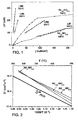
- the figure 1 is a graph showing, for different materials (a material according to the invention, two comparative materials), at different temperatures, the cathode overvoltage ⁇ V in mV as a function of j (mA / cm 2 ).
- the figure 2 is a graph showing, for different materials (two materials according to the invention, a comparative material), the diffusion coefficient of oxygen D * (cm 2 .s -1 ) as a function of 1000 / T (K -1 ), where T is the temperature.
- the figure 3 is a graph showing, for different materials (a material according to the invention, two comparative materials (two materials according to the invention, a comparative material), the exchange coefficient of oxygen surface, k (cm.s -1 ), as a function of 1000 / T (K -1 ), where T is the temperature.
- Nd 1.95 NiO 4 + ⁇ and Nd 1.90 NiO 4 + ⁇ were synthesized: Nd 1.95 NiO 4 + ⁇ and Nd 1.90 NiO 4 + ⁇ , respectively having a value of y equal to 0.05 and 0.10.
- ⁇ e is measured at 700 ° C. and is equal to 100 S.cm -1 and 80 S.cm -1, respectively .
- Their surface exchange coefficient for oxygen k is respectively 5,5.10 -8 cm s -1 and at 1.7.10 -8 cm s -1 at 500 ° C, and respectively 5,5.10 - 6 cm.s -1 and at 1.7 ⁇ 10 -6 cm.s -1 at 900 ° C.
- Their oxygen diffusion coefficient is respectively equal to 3,2.10 5,2.10 -9 -9 cm 2 .s -1 at 500 ° C and 3.5.10 and 2.5.10 -7 -7 cm2.s - 1 at 900 ° C.
- the electrochemical properties of these two materials according to the invention were evaluated in a three-electrode assembly in a half-cell of the electrode material / YSZ / electrode material type, where the counter electrode and the working electrode are symmetrical, deposited by painting on the electrolyte and annealed at 1100 ° C for 2 hours.
- the platinum reference electrode is placed away from the other two electrodes.
- the behavior of this material was analyzed under conditions close to those of an SOFC cell, that is to say under current and in a temperature range of 500 to 800 ° C.
- the measured cathode overvoltages should be as small as possible. It appears, not surprisingly, that they decrease sharply with temperature.
- the figure 1 is a graph showing, for different materials (a material according to the invention, two comparative materials), at different temperatures, the cathode overvoltage ⁇ V in mV as a function of j (mA / cm 2 ).
- the cathodic overvoltage of the material according to the invention of particular composition Nd 1.95 NiO 4 + ⁇ was then compared to cathodic overvoltages of traditional materials (LSM) 0.7 Sr 0.3 MnO 3 , and LSF (La 0, 7 Sr 0.3 FeO 3 ), from data from the literature ( Krumpelt et al, Proceedings European SOFC Forum (Lucerne 2002), Ed. J. Huilsmans, vol. 1, p.215 .
- the figure 1 presents curves indicating, for the materials tested, at various temperatures, the cathodic overvoltage in mV in function the current density j (mA / cm 2 ) passing through the cell. It is seen that very advantageously the performance of the material according to the invention Nd 1.95 NiO 9 + ⁇ are better than those of these materials used.
- the figure 2 is a graph showing, for different materials (two materials according to the invention, a comparative material), the diffusion coefficient of oxygen D * (cm 2 .s -1 ) as a function of 1000 / T (K -1 ), where T is the temperature. Each curve is a straight line.
- the two materials according to the invention are Nd 1.95 NiO 4 + ⁇ and Nd 1.90 NiO 4 + ⁇ .
- the comparative material is Nd 2 NiO 4 + ⁇ , that is to say a material with an oxygen stoichiometry but without cationic deficiency. It can be seen that in the temperature range of interest for the invention, the materials according to the invention generally have, to the nearest measurement error, a higher coefficient D *, and therefore more interesting.
- the figure 2 also represents the straight line indicating the minimum D *, or D * min , according to the invention.
- the figure 3 is a graph showing, for different materials (two materials according to the invention, a comparative material), the surface exchange coefficient of oxygen, k (cm.s -1 ) as a function of 1000 / T (K - 1 ), where T is the temperature. Each curve is a straight line.
- the two materials according to the invention are Nd 1.95 NiO 4 + ⁇ and Nd 1.90 NiO 4 + ⁇ .
- the comparative material is Nd 2 NiO 4 + ⁇ , that is to say a material with an oxygen stoichiometry but without cationic deficiency. We see that in the temperature range of interest for the invention, the materials according to the invention have a higher coefficient k, and therefore more interesting.
- the figure 3 also represents the straight line indicating the minimum D *, or D * min , according to the invention.
Landscapes
- Chemical & Material Sciences (AREA)
- Organic Chemistry (AREA)
- Inorganic Chemistry (AREA)
- Life Sciences & Earth Sciences (AREA)
- General Life Sciences & Earth Sciences (AREA)
- Geology (AREA)
- Engineering & Computer Science (AREA)
- Materials Engineering (AREA)
- Chemical Kinetics & Catalysis (AREA)
- Electrochemistry (AREA)
- General Chemical & Material Sciences (AREA)
- Inert Electrodes (AREA)
- Fuel Cell (AREA)
Abstract
Description
- L'invention concerne un nouveau matériau oxyde. L'invention concerne aussi une électrode comprenant un tel matériau. L'invention concerne enfin un dispositif de production d'énergie électrique de type pile à combustible comprenant au moins une cellule électrochimique comprenant une cathode qui est une telle électrode.
- Une pile, ou batterie secondaire telle que cellule électrochimique, convertit de l'énergie chimique en énergie électrique. Dans une pile à combustible, de l'hydrogène issu par exemple de tout combustible à base de carbone tel que du gaz, un produit pétrolier à base du pétrole, ou du méthanol, est combiné avec de l'oxygène puisé dans l'air pour produire de l'électricité, de l'eau et de la chaleur au moyen d'une réaction électrochimique. Le coeur de la pile à combustible se compose d'une anode, d'une cathode, et d'un électrolyte qui est solide et à base de céramique. Les ions d'oxygène circulent à travers l'électrolyte et le courant électrique de la cathode vers l'anode.
- Les SOFC, acronyme de« Solid Oxid Fuel Cell » en anglais pour « pile à oxyde solide », sont des piles à combustible fonctionnant le plus souvent à haute température, de l'ordre de 650 à 1000°C. Elles peuvent êtres utilisées dans des systèmes d'alimentation stationnaires de grande puissance (250 kW) et de faible puissance (de 1 à 50 kW). Elles sont potentiellement intéressantes par leur rendement électrique élevé, (généralement de l'ordre de 50 à 70%), et par l'utilisation de la chaleur qu'elles produisent.
- Les matériaux actuels des SOFC fonctionnent à des températures d'environ 900 à 1000°C. Ils sont explicités ci-après. L'électrolyte solide le plus communément utilisé est la zircone stabilisée à l'yttrium ou Y SZ (acronyme de « Yttria Stabilized Zirconia » en anglais). L'anode, qui est notamment le siège de la réaction entre H2 et les anions O2- provenant de l'électrolyte, est le plus couramment un cermet (céramique métallique) du type nickel dispersé dans de la zircone stabilisée (YSZ), éventuellement dopé avec du ruthénium Ru. La cathode qui collecte les charges et qui est le siège de la réduction d'oxygène diffusant ensuite à l'état d'anion O2- à travers l'électrolyte, est le plus couramment à base d'oxyde de structure perovskite tel que le manganite de lanthane dopé au strontium (La, Sr) MnO3±δ. Enfin des plaques bipolaires, ou interconnecteurs, sont présentes, en général au nombre de deux, et ont pour rôle de collecter les charges à l'anode et à la cathode, et de séparer les deux gaz, combustible (H2) et comburant (O2).
- Or le fonctionnement de la pile à une température aussi élevée entraîne de nombreux problèmes, notamment le coût des interconnecteurs et les tenues chimique et surtout mécanique des matériaux en température. C'est pourquoi il a été envisagé de diminuer la température de fonctionnement de la pile autour de 600 - 800°C, ce qui permettrait d'utiliser comme interconnecteurs de l'inconel@ (alliage résistant à la chaleur à base de Ni, Cr et Fe) ou des aciers inoxydables. L'électrolyte qui a été envisagé pour remplacer l'YSZ est la cérine dopée à l'oxyde de gadolinium, CeO2 : :Gd2O3(Ce0,9Gd0,1O1,95) de structure fluorine, ou la perovskite LaGaO3 substituée (La0,9Sr0,1Ga0,8Mg0,2O2,85). L'anode pourrait être à base de chromite de vanadium. Quant à la cathode, divers matériaux ont été étudiés dont les perovskites de type ABO3, et en particulier LaMnO3 dopé pour une question de bonne tenue mécanique, déficitaires ou non sur le site A, et surtout les perovskites déficitaires en oxygène ABO3-δ telle que (La,Sr)CoO3-δ. Il reste qu'il n'existe pas à l'heure actuelle de matériau permettant d'utiliser la cathode avec à la fois une bonne conductivité électronique et une bonne conductivité ionique, ainsi qu'une bonne stabilité thermique, et un rendement suffisant au point de vue industriel.
- C'est pour résoudre ces problèmes de l'art antérieur qu'un autre type de matériau oxyde devait être trouvé. C'est ce que réalise le matériau selon l'invention.
- Le matériau selon l'invention est un matériau oxyde de formule générale suivante :
(1) A2-x-yA'xA"yM1-zM'zO4+δ,
où : - A est un cation métallique appartenant au groupe formé par les lanthanides et/ou les alcalins et/ou les alcalino-terreux,
- A' est au moins un cation métallique appartenant au groupe formé par les lanthanides et/ou les alcalins et/ou les alcalino-terreux,
- A" est une lacune cationique, c'est-à-dire une vacance de cations A et/ou A',
- M est un métal appartenant au groupe formé par les métaux des éléments de transition,
- M' est au moins un métal appartenant au groupe formé par les métaux des éléments de transition,
- ledit matériau étant tel que
- 0<y<0,30, de préférence 0<y≤0,20 ;
- 0<δ<0,25, de préférence 0<δ<0,10 ;
- 0≤x≤2 ; et
- 0≤z≤1.
- La formule précédente englobe donc le cas où x est égal à 0 ou à 2, c'est-à-dire le cas de la présence d'un seul cation métallique, et aussi, indépendamment ou non du cas précédent, le cas où z est égal à 0 ou à 1, c'est-à-dire le cas de la présence d'un seul métal.
- A' peut représenter plusieurs cations métalliques, et M' peut aussi, indépendamment, représenter plusieurs métaux ; l'homme du métier sait réécrire la formule (1) en fonction du nombre de composants.
- La présence d'un coefficient δ de sur stoechiométrie en oxygène de valeur strictement supérieure à 0 contribue avantageusement à la conductivité ionique du matériau.
- Selon un mode de réalisation particulièrement préféré de l'invention, M et M' sont de valence mixte, c'est-à-dire qu'avantageusement de tels métaux contribuent à la conductivité électronique du matériau.
- Avantageusement, de tels matériaux selon l'invention présentent une bonne stabilité thermique en composition. Ceci a été montré par mesure ATG (analyse thermogravimétrique sous air), et vérifié par diffraction des rayons X en température, sur deux matériaux selon l'invention qui sont Nd1,95NiO4+δ et Nd1,90NiO4+δ. En effet, la mesure du coefficient δ de sur-stoechiométrie en oxygène par rapport à la température, sur une plage allant de la température ambiante, soit environ 20°C, à 1000°C, ne montre pas d'accident et vérifie que la perte de masse est directement et uniquement proportionnelle à la variation de la teneur en oxygène du matériau.
- De façon avantageuse, les lacunes A" sont réparties en distribution statistique. En effet, des clichés de diffraction électronique obtenus par microscopie électronique à transmission du matériau selon l'invention qu'est Nd1,90NiO4+δ ne permettent de relever aucun allongement ou traînée des principales taches (0,0,1), ce qui révèle un ordre parfait selon l'axe c et l'absence d'intercroissances de type Ruddlesden-Popper au sein des empilements A2MO4+δ, confirmant ainsi une telle distribution statistique des lacunes de néodyme.
- Par lanthanide, on entend selon l'invention le lanthane La ou un élément du groupe des lanthanides tel que Ce, Pr, Nd, Pm, Sm, Eu, Gd, Tb, Dy, Ho, Er, Tm, Yb ou Lu et Y. Par alcalin, on entend selon l'invention un élément hors l'hydrogène du groupe 1 (version IUPAC) de la classification périodique des éléments. Par alcalino-terreux, on entend selon l'invention un élément du groupe 2 (version IUPAC) de la classification périodique des éléments. Par métal de transition, on entend selon l'invention un élément des groupes 3 à 14 (version IUPAC) de la classification périodique des éléments, dont bien sûr les éléments de la période 4 tel que le titane Ti ou le Gallium Ga, les éléments de la période 5 tel que le zirconium Zr ou l'Etain Sn, et les éléments de la période 6 tel que le Tantale Ta ou le Mercure Hg. De préférence selon l'invention le métal de transition est un élément de la période 4.
- Le matériau selon l'invention se caractérise avantageusement par des mesures très fines de rapport(s) (A et/ou A') / (M et/ou M') par microsonde de Castaing (ou EPMA acronyme de « Electron Probe Micro Analysis »), qui permettent de mettre en valeur la structure lacunaire en cation dudit matériau.
- Dans un mode de réalisation préféré de l'invention, ledit matériau est tel que :
- A et A' sont indépendamment choisis dans le groupe formé par le lanthane La, le praséodyme Pr, le strontium Sr, le calcium Ca, et le néodyme Nd, de façon préférée le néodyme Nd, le strontium Sr et le calcium Ca, de façon encore plus préférée le néodyme Nd, et tel que :
- M et M' sont indépendamment choisis dans le groupe formé par le chrome Cr, le manganèse Mn, le fer Fe, le cobalt Co, le nickel Ni et le cuivre Cu, de préférence le nickel Ni et le cuivre Cu, de façon encore plus préférée le nickel Ni.
- Dans les cas particuliers selon l'invention où x n'est pas égal à 0 ou à 2, et z n'est pas égal à 0 ou à 1, le nombre de cations de type A est d'au moins deux : A et A', et le nombre de cations de type M est d'au moins deux : M et M'.
- Dans un tel cas, de préférence:
- A est choisi dans le groupe formé par le lanthane La, le praséodyme Pr et le néodyme Nd, de façon préférée le néodyme Nd,
- A' est choisi dans le groupe formé par le strontium Sr et le calcium Ca, de façon préférée le calcium Ca,
- M est choisi dans le groupe formé par le chrome Cr, le manganèse Mn, le fer Fe, le cobalt Co, le nickel Ni et le cuivre Cu, de préférence le nickel Ni, et
- M' est choisi dans le groupe formé par le manganèse Mn, le fer Fe, le cuivre Cu ou le cobalt Co, de préférence le cuivre Cu ou le manganèse Mn.
- Dans un mode de réalisation particulièrement préféré selon l'invention, le matériau a une structure cristallographique de type K2NiF4, comme représenté par exemple dans "Inorganic Crystal Structures", p 30, de B.G. Hyde et S. Anderson, Wiley Interscience Publication (1988). La structure est ainsi formée de couches d'octaèdres oxygénés MO6 déplacées les unes par rapport aux autres de ½ ½ ½, des atomes A assurant la cohésion entre les couches et des oxygènes additionnels Oi pouvant s'insérer entre ces couches dans des sites interstitiels vacants.
- Dans un mode de réalisation préféré, le matériau selon l'invention possède un coefficient d'échange de surface de l'oxygène, k, supérieur à 1.10-8 cm.s-1 à 500 °C et à 2.10-6 cm.s-1 à 900 °C pour l'oxygène. La variation dudit coefficient suit une loi d'Arrhénius, ce qui rend aisé le calcul de ce coefficient pour une autre température de la plage de températures qui intéresse l'invention. Cette valeur est généralement difficilement atteinte par les matériaux existants utilisés en pile à combustible.
- Dans un mode de réalisation préféré, indépendamment ou non du mode de réalisation précédent, le matériau selon l'invention possède une conductivité électronique σe au moins égale à 70 S.cm-1, de préférence au moins égale à 80 S.cm-1, de façon encore plus préférée supérieure à 90 S.cm-1, à 700°C.
- Dans un mode de réalisation préféré, indépendamment ou non du mode de réalisation précédent, le matériau selon l'invention possède un coefficient de diffusion d'oxygène supérieur à 1.10-9 cm2.s-1 à 500 °C et 1.10-7 cm2.s-1 à 900 °C. La variation dudit coefficient suit une loi d'Arrhénius, ce qui rend aisé le calcul de ce coefficient pour une autre température de la plage de températures qui intéresse l'invention. Cette valeur est généralement inatteignable par les matériaux existants utilisés en pile à combustible.
- Dans un mode de réalisation préféré, le matériau selon l'invention possède un coefficient d'échange de surface de l'oxygène, k, supérieur à 1.10-8 cm.s-1 à 500 °C et à 2.10-6 cm.s-1 à 900 °C pour l'oxygène, une conductivité électronique σe au moins égale à 70 S.cm-1, de préférence au moins égale à 80 S.cm-1, de façon encore plus préférée supérieure à 90 S.cm-1, à 700°C, et un coefficient de diffusion d'oxygène supérieur à 1.10-9 cm2. s-1 à 500 °C et 1.10-7 cm2.s-1 à 900 °C.
- L'invention concerne aussi une électrode comprenant au moins un matériau selon l'invention.
- L'invention concerne enfin un dispositif des production d'énergie électrique de type pile à combustible comprenant au moins une cellule électrochimique comprenant un électrolyte solide, une anode, et une cathode qui est une électrode selon l'invention. Ledit dispositif comprend aussi le plus souvent deux interconnecteurs anodique et cathodique. En dehors de la cathode, toutes les autres pièces dudit dispositif sont des éléments connus de l'homme du métier.
- Avantageusement, le dispositif selon l'invention permet avec l'utilisation de la cathode selon l'invention avec à la fois une bonne conductivité électronique et une bonne conductivité ionique, ainsi qu'une bonne stabilité thermique, et un rendement suffisant au point de vue industriel.
- L'invention concerne enfin tout procédé de mise en oeuvre d'un tel dispositif.
- L'invention concerne aussi l'utilisation de l'électrode selon l'invention en tant qu'électrode de pompe à oxygène servant à la purification de gaz.
- Les
figures 1 à 3 servent à illustrer l'invention, de manière non limitative, dans des graphes comparatifs. - La
figure 1 est un graphe montrant, pour différents matériaux (un matériau selon l'invention, deux matériaux comparatifs), à différentes températures, la surtension cathodique ΔV en mV en fonction de j (mA/cm2). - La
figure 2 est un graphe montrant, pour différents matériaux (deux matériaux selon l'invention, un matériau comparatif), le coefficient de diffusion d'oxygène D* (cm2.s-1) en fonction de 1000/T (K-1), où T est la température. - La
figure 3 est un graphe montrant, pour différents matériaux (un matériau selon l'invention, deux matériaux comparatifs(deux matériaux selon l'invention, un matériau comparatif), le coefficient d'échange de surface de l'oxygène, k (cm.s-1), en fonction de 1000/T (K-1), où T est la température. - Les exemples qui suivent illustrent l'invention sans pour autant en limiter la portée.
- Deux matériaux selon l'invention ont été synthétisés : Nd1,95NiO4+δ et Nd1,90NiO4+δ, ayant respectivement une valeur de y égale à 0,05 et 0,10. Ces matériaux sont synthétisés par réaction à l'état solide des oxydes Nd2O3 et NiO à 1100 °C ou par des voies de chimie douce ou de sol-gel à partir par exemple des nitrates de néodyme et nickel en solution. Leur valeur de sur-stoechiométrie est égale respectivement à δ = 0,15 et à δ = 0,06, déterminé par analyse chimique du Ni3+ (iodométrie).
- On mesure à 700°C leur conductivité électronique σe égale respectivement à 100 S.cm-1 et 80 S.cm-1. Leur coefficient d'échange de surface pour l'oxygène k est égal respectivement à 5,5.10-8 cm.s-1 et à 1,7.10-8 cm.s-1 à 500 °C, et respectivement à 5,5.10-6 cm.s-1 et à 1,7.10-6 cm.s-1 à 900°C. Leur coefficient de diffusion de l'oxygène est égal respectivement à 3,2.10-9 et 5,2.10-9 cm2.s-1 à 500 °C et à 3,5.10-7 et 2,5.10-7 cm2.s-1 à 900°C. Le pourcentage de cations Ni3+ à 700°C, déterminé par ATG (analyse thermogravimétrique sous air), est égal respectivement à 35% et à 28%. La variation de stoechiométrie en oxygène dans ce domaine de température, auquel appartient la température de fonctionnement d'une pile à combustible, est faible et n'a pas d'influence sur le coefficient de dilation thermique qui reste constant et égal à 12.7.10-6 K-1 .
- Les propriétés électrochimiques de ces deux matériaux selon l'invention ont été évaluées dans un montage à trois électrodes dans une demi-pile du type matériau d'électrode /YSZ/ matériau d'électrode, où la contre électrode et l'électrode de travail sont symétriques, déposées par peinture sur l'électrolyte et recuites à 1100°C pendant 2 heures. L'électrode de référence en platine est placée loin des deux autres électrodes. Le comportement de ce matériau a été analysé dans des conditions proches de celles d'une pile SOFC, c'est-à-dire sous courant et dans une gamme de température de 500 à 800°C. Les surtensions cathodiques mesurées doivent être les plus faibles possibles. Il apparaît, ce qui n'est pas surprenant, qu'elles diminuent fortement avec la température.
- La
figure 1 est un graphe montrant, pour différents matériaux (un matériau selon l'invention, deux matériaux comparatifs), à différentes températures, la surtension cathodique ΔV en mV en fonction de j (mA/cm2). - La surtension cathodique du matériau selon l'invention de composition particulière Nd1,95NiO4+δ a été alors comparée aux surtensions cathodiques de matériaux traditionnels (LSM) La0,7Sr0,3MnO3, et LSF (La0,7Sr0,3FeO3), à partir de données issues de la littérature (M. Krumpelt et al, Proceedings European SOFC Forum (Lucerne 2002), Ed. J. Huilsmans, vol. 1, p.215. La
figure 1 présente des courbes indiquant, pour les matériaux testés, à diverses températures, la surtension cathodique en mV en fonction de la densité de courant j (mA/cm2) passant à travers de la cellule. On y voit que de façon très avantageuse les performances du matériau selon l'invention Nd1,95NiO9+δ sont meilleures que celles de ces matériaux utilisés. - La
figure 2 est un graphe montrant, pour différents matériaux (deux matériaux selon l'invention, un matériau comparatif), le coefficient de diffusion d'oxygène D* (cm2.s-1) en fonction de 1000/T (K-1), où T est la température. Chaque courbe est une droite. Les deux matériaux selon l'invention sont Nd1,95NiO4+δ et Nd1,90NiO4+δ. Le matériau comparatif est Nd2NiO4+δ, c'est-à-dire un matériau avec une sur stoechiométrie en oxygène mais sans lacune cationique. On voit que dans la plage de températures intéressante pour l'invention, les matériaux selon l'invention ont généralement, à l'erreur de mesure près, un coefficient D* plus élevé, et donc plus intéressant. Lafigure 2 représente aussi la droite indiquant le D* minimum, ou D*min, selon l'invention. - La
figure 3 est un graphe montrant, pour différents matériaux (deux matériaux selon l'invention, un matériau comparatif), le coefficient d'échange de surface de l'oxygène, k (cm.s-1) en fonction de 1000/T (K-1), où T est la température. Chaque courbe est une droite. Les deux matériaux selon l'invention sont Nd1,95NiO4+δ et Nd1,90NiO4+δ. Le matériau comparatif est Nd2NiO4+δ, c'est-à-dire un matériau avec une sur stoechiométrie en oxygène mais sans lacune cationique. On voit que dans la plage de températures intéressante pour l'invention, les matériaux selon l'invention ont un coefficient k plus élevé, et donc plus intéressant. Lafigure 3 représente aussi la droite indiquant le D* minimum, ou D*min, selon l'invention.
Claims (9)
- Matériau oxyde de formule générale suivante :
(1) A2-x-yA'xA"yM1-zM'zO4+δ,
où :A et A' sont indépendamment choisis dans le groupe formé par le lanthane La, le praséodyme Pr, le strontium Sr, le calcium Ca, et le néodyme Nd, de façon préférée le néodyme Nd, le strontium Sr et le calcium Ca, de façon encore plus préférée le néodyme Nd,A'' est une lacune cationique, c'est-à-dire une vacance de cations A et/ou A',M et M' sont indépendamment choisis dans le groupe formé par le chrome Cr, le manganèse Mn, le fer Fe, le cobalt Co, le nickel Ni et le cuivre Cu, de préférence le nickel Ni et le cuivre Cu, de façon encore plus préférée le nickel Ni,ledit matériau étant tel que0<y<0,30, de préférence 0<y≤0,20 ;0<δ<0,25, de préférence 0<δ<0,10 ;0≤x≤1 ; et0≤z≤1. - Matériau oxyde selon l'une des revendications précédentes tel que :A est choisi dans le groupe formé par le lanthane La, le praséodyme Pr et le néodyme Nd, de façon préférée le néodyme Nd, etA' est choisi dans le groupe formé par le strontium Sr et le calcium Ca, de façon préférée le calcium Ca,et tel que :M est choisi dans le groupe formé par le chrome Cr, le manganèse Mn, le fer Fe, le cobalt Co, le nickel Ni et le cuivre Cu, de préférence le nickel Ni, etM' est choisi dans le groupe formé par le manganèse Mn, le fer Fe, le cuivre Cu ou le cobalt Co, de préférence le cuivre Cu ou le manganèse Mn.
- Matériau selon l'une des revendications précédentes ayant une structure cristallographique de type K2NiF4.
- Matériau selon l'une des revendications précédentes possédant un coefficient d'échange de surface de l'oxygène, k, supérieur à 1.10-8 cm.s-1 à 500 °C et à 2.10-6 cm.s-1 à 900 °C pour l'oxygène.
- Matériau selon l'une des revendications précédentes possédant une conductivité électronique σe au moins égale à 70 S.cm-1, de préférence au moins égale à 80 S.cm-1, de façon encore plus préférée supérieure à 90 S.cm-1, à 700°C.
- Matériau selon l'une des revendications précédentes possédant un coefficient de diffusion d'oxygène supérieur à 1.10-9 cm2.s-1 à 500 °C et 1.10-7 cm2.s-1 à 900 °C.
- Electrode comprenant au moins un matériau selon l'une des revendications précédentes.
- Dispositif de production d'énergie électrique de type pile à combustible comprenant au moins une cellule électrochimique comprenant un électrolyte solide, une anode, et une cathode qui est une électrode telle que définie à la revendication précédente.
- Utilisation d'une électrode telle que définie à la revendication 7 en tant qu'électrode de pompe à oxygène servant à la purification de gaz.
Applications Claiming Priority (2)
| Application Number | Priority Date | Filing Date | Title |
|---|---|---|---|
| FR0403036A FR2868211B1 (fr) | 2004-03-24 | 2004-03-24 | Materiau oxyde et electrode pour pile a combustible le comprenant |
| EP05742641A EP1733444A1 (fr) | 2004-03-24 | 2005-03-21 | Materiau oxyde et electrode pour pile a combustible le comprenant |
Related Parent Applications (2)
| Application Number | Title | Priority Date | Filing Date |
|---|---|---|---|
| EP05742641A Division EP1733444A1 (fr) | 2004-03-24 | 2005-03-21 | Materiau oxyde et electrode pour pile a combustible le comprenant |
| EP05742641.3 Division | 2005-03-21 |
Publications (2)
| Publication Number | Publication Date |
|---|---|
| EP2068386A1 true EP2068386A1 (fr) | 2009-06-10 |
| EP2068386B1 EP2068386B1 (fr) | 2011-09-28 |
Family
ID=34944380
Family Applications (2)
| Application Number | Title | Priority Date | Filing Date |
|---|---|---|---|
| EP05742641A Withdrawn EP1733444A1 (fr) | 2004-03-24 | 2005-03-21 | Materiau oxyde et electrode pour pile a combustible le comprenant |
| EP09154652A Expired - Lifetime EP2068386B1 (fr) | 2004-03-24 | 2005-03-21 | Materiau oxyde et electrode pour pile a combustible le comprenant |
Family Applications Before (1)
| Application Number | Title | Priority Date | Filing Date |
|---|---|---|---|
| EP05742641A Withdrawn EP1733444A1 (fr) | 2004-03-24 | 2005-03-21 | Materiau oxyde et electrode pour pile a combustible le comprenant |
Country Status (5)
| Country | Link |
|---|---|
| US (1) | US7572532B2 (fr) |
| EP (2) | EP1733444A1 (fr) |
| ES (1) | ES2374681T3 (fr) |
| FR (1) | FR2868211B1 (fr) |
| WO (1) | WO2005099003A1 (fr) |
Families Citing this family (7)
| Publication number | Priority date | Publication date | Assignee | Title |
|---|---|---|---|---|
| FR2872174B1 (fr) * | 2004-06-23 | 2007-06-15 | Electricite De France | Procede et dispositif d'electrolyse de l'eau comprenant un materiau oxyde d'electrode particulier |
| FR2910720B1 (fr) * | 2006-12-22 | 2009-03-06 | Univ Toulouse | Electrode a gaz,procede de fabrication et applications. |
| WO2014143957A1 (fr) | 2013-03-15 | 2014-09-18 | Lg Fuel Cell Systems, Inc. | Système de pile à combustible configuré pour capturer du chrome |
| JP6100050B2 (ja) * | 2013-03-25 | 2017-03-22 | 日本碍子株式会社 | 燃料電池用空気極 |
| EP3172788A1 (fr) | 2014-07-21 | 2017-05-31 | LG Fuel Cell Systems Inc. | Composition pour électrode de pile à combustible |
| US10115974B2 (en) | 2015-10-28 | 2018-10-30 | Lg Fuel Cell Systems Inc. | Composition of a nickelate composite cathode for a fuel cell |
| CN109761594A (zh) * | 2018-12-28 | 2019-05-17 | 中山大学 | 一种含钙无钴的耐co2的双相混合导体透氧膜材料及其制备方法 |
Citations (1)
| Publication number | Priority date | Publication date | Assignee | Title |
|---|---|---|---|---|
| WO2003075377A2 (fr) | 2002-03-01 | 2003-09-12 | Forschungszentrum Jülich GmbH | Cathode pour utilisation a haute temperature |
Family Cites Families (11)
| Publication number | Priority date | Publication date | Assignee | Title |
|---|---|---|---|---|
| US3138490A (en) * | 1961-02-28 | 1964-06-23 | Gen Electric | Fuel cell |
| US3281273A (en) * | 1961-05-05 | 1966-10-25 | Isomet Corp | Fuel cell |
| US5037525A (en) * | 1985-10-29 | 1991-08-06 | Commonwealth Scientific And Industrial Research Organisation | Composite electrodes for use in solid electrolyte devices |
| US5591315A (en) * | 1987-03-13 | 1997-01-07 | The Standard Oil Company | Solid-component membranes electrochemical reactor components electrochemical reactors use of membranes reactor components and reactor for oxidation reactions |
| CN1275682C (zh) * | 1998-05-05 | 2006-09-20 | 南京工业大学 | 镍氟酸钾型无机致密透氧膜材料 |
| JP3743230B2 (ja) * | 1999-08-30 | 2006-02-08 | 日産自動車株式会社 | 固体電解質焼結体、その製造方法、並びに該固体電解質焼結体を用いた燃料電池 |
| RU2262379C2 (ru) * | 2000-09-08 | 2005-10-20 | Ниппон Стил Корпорейшн | Металлокерамический составной блок, составная структура для переноса оксидных ионов и составной блок, обладающий свойством уплотнения |
| US6632554B2 (en) * | 2001-04-10 | 2003-10-14 | Hybrid Power Generation Systems, Llc | High performance cathodes for solid oxide fuel cells |
| JP3968418B2 (ja) * | 2002-03-22 | 2007-08-29 | 独立行政法人産業技術総合研究所 | n型熱電特性を有する複合酸化物 |
| US20050201919A1 (en) * | 2004-03-11 | 2005-09-15 | National Cheng Kung University | Materials for cathode in solid oxide fuel cells |
| US7208044B2 (en) * | 2004-11-24 | 2007-04-24 | Mark A. Zurbuchen | Topotactic anion exchange oxide films and method of producing the same |
-
2004
- 2004-03-24 FR FR0403036A patent/FR2868211B1/fr not_active Expired - Fee Related
-
2005
- 2005-03-21 EP EP05742641A patent/EP1733444A1/fr not_active Withdrawn
- 2005-03-21 ES ES09154652T patent/ES2374681T3/es not_active Expired - Lifetime
- 2005-03-21 EP EP09154652A patent/EP2068386B1/fr not_active Expired - Lifetime
- 2005-03-21 US US10/599,132 patent/US7572532B2/en not_active Expired - Lifetime
- 2005-03-21 WO PCT/FR2005/000683 patent/WO2005099003A1/fr not_active Ceased
Patent Citations (1)
| Publication number | Priority date | Publication date | Assignee | Title |
|---|---|---|---|---|
| WO2003075377A2 (fr) | 2002-03-01 | 2003-09-12 | Forschungszentrum Jülich GmbH | Cathode pour utilisation a haute temperature |
Non-Patent Citations (4)
| Title |
|---|
| KHARTON ET AL., SOLID STATE IONICS, vol. 166, 2004, pages 327 - 337 |
| KHARTON V V ET AL: "Surface-limited oxygen transport and electrode properties of La2Ni0.8Cu0.2O4+delta", SOLID STATE IONICS, NORTH HOLLAND PUB. COMPANY. AMSTERDAM, NL, vol. 166, no. 3-4, 30 January 2004 (2004-01-30), pages 327 - 337, XP004494049, ISSN: 0167-2738 * |
| KULICHENKO ET AL., CHEMISTRY JOURNAL, vol. 62, no. 3, 1996, pages 5 - 7 |
| V. A. KULICHENKO, S. A. NEDIL'KO AND A. G. DZYAZ'KO, UKRANIAN CHEMISTRY JOURNAL, vol. 62, no. 3, 1996, pages 5 - 7, XP009115899 * |
Also Published As
| Publication number | Publication date |
|---|---|
| US7572532B2 (en) | 2009-08-11 |
| WO2005099003A1 (fr) | 2005-10-20 |
| FR2868211A1 (fr) | 2005-09-30 |
| US20070207919A1 (en) | 2007-09-06 |
| ES2374681T3 (es) | 2012-02-21 |
| EP1733444A1 (fr) | 2006-12-20 |
| FR2868211B1 (fr) | 2009-02-13 |
| EP2068386B1 (fr) | 2011-09-28 |
Similar Documents
| Publication | Publication Date | Title |
|---|---|---|
| Wan et al. | A-site bismuth doping, a new strategy to improve the electrocatalytic performances of lanthanum chromate anodes for solid oxide fuel cells | |
| Lashtabeg et al. | Solid oxide fuel cells—a challenge for materials chemists? | |
| Tian et al. | Enhanced performance of symmetrical solid oxide fuel cells using a doped ceria buffer layer | |
| Li et al. | Electrode properties of Sr doped La2CuO4 as new cathode material for intermediate-temperature SOFCs | |
| Eguchi | Ceramic materials containing rare earth oxides for solid oxide fuel cell | |
| Ralph et al. | Materials for lower temperature solid oxide fuel cells | |
| Ling et al. | Investigation of cobalt-free cathode material Sm0. 5Sr0. 5Fe0. 8Cu0. 2O3− δ for intermediate temperature solid oxide fuel cell | |
| Patra et al. | Thermal, electrical and electrochemical characteristics of Ba1− xSrxCo0. 8Fe0. 2O3− δ cathode material for intermediate temperature solid oxide fuel cells | |
| Nadeem et al. | Effect of NiO addition on oxygen reduction reaction at lanthanum strontium cobalt ferrite cathode for solid oxide fuel cell | |
| Lv et al. | SrCo0. 4Fe0. 4Zr0. 1Y0. 1O3-δ, A new CO2 tolerant cathode for proton-conducting solid oxide fuel cells | |
| Cui et al. | Electrode properties of a spinel family, AFe2O4 (A= Co, Ni, Cu), as new cathode for solid oxide fuel cells | |
| Guo et al. | Highly electrocatalytic active and durable Fe-based perovskite oxygen reduction electrode for solid oxide fuel cells | |
| Xiaokaiti et al. | Effects of cobalt and iron proportions in Pr0. 4Sr0. 6Co0. 9-xFexNb0. 1O3-δ electrode material for symmetric solid oxide fuel cells | |
| Ishihara et al. | Nanomaterials for advanced electrode of low temperature solid oxide fuel cells (SOFCs) | |
| KR20130099704A (ko) | 고체산화물 연료전지용 기능층 소재, 및 상기 소재를 이용하여 제조된 기능층과 상기 기능층을 포함하는 고체산화물 연료전지 | |
| EP1774061B1 (fr) | Procede et dispositif d'electrolyse de l'eau comprenant un materiau oxyde d'electrode particulier | |
| JP2007515745A (ja) | 固体酸化物燃料電池 | |
| Wu et al. | Enhanced oxygen evolution rate and anti-interfacial delamination property of the SrCo0. 9Ta0. 1O3-δ@ La0. 6Sr0. 4Co0. 2Fe0. 8O3-δ oxygen-electrode for solid oxide electrolysis cells | |
| Amira et al. | La1. 5Nd0. 3Pr0. 2NiO4. 16: a new cathode material for IT-solid oxide fuel cells | |
| KR102105056B1 (ko) | 삼중도핑 안정화 산화비스무트계 전해질 및 그 제조 방법 | |
| EP2068386B1 (fr) | Materiau oxyde et electrode pour pile a combustible le comprenant | |
| Cao et al. | The improvement of barium-containing anode for ceria-based electrolyte with electron-blocking layer | |
| Du et al. | High-entropy perovskite cathode (LaSrBaNdSm) 0.2 Fe1-xCoxO3-δ: altering B-site cobalt for enhanced ORR activity and CO2 tolerance | |
| Gao et al. | Preparation and characterization of La1− xSrxNiyFe1− yO3− δ cathodes for low-temperature solid oxide fuel cells | |
| US20030124412A1 (en) | Fuel-flexible anodes for solid oxide fuel cells |
Legal Events
| Date | Code | Title | Description |
|---|---|---|---|
| PUAI | Public reference made under article 153(3) epc to a published international application that has entered the european phase |
Free format text: ORIGINAL CODE: 0009012 |
|
| AC | Divisional application: reference to earlier application |
Ref document number: 1733444 Country of ref document: EP Kind code of ref document: P |
|
| AK | Designated contracting states |
Kind code of ref document: A1 Designated state(s): AT BE BG CH CY CZ DE DK EE ES FI FR GB GR HU IE IS IT LI LT LU MC NL PL PT RO SE SI SK TR |
|
| 17P | Request for examination filed |
Effective date: 20091119 |
|
| 17Q | First examination report despatched |
Effective date: 20091215 |
|
| AKX | Designation fees paid |
Designated state(s): DE ES FR GB IT |
|
| GRAP | Despatch of communication of intention to grant a patent |
Free format text: ORIGINAL CODE: EPIDOSNIGR1 |
|
| GRAS | Grant fee paid |
Free format text: ORIGINAL CODE: EPIDOSNIGR3 |
|
| GRAA | (expected) grant |
Free format text: ORIGINAL CODE: 0009210 |
|
| AC | Divisional application: reference to earlier application |
Ref document number: 1733444 Country of ref document: EP Kind code of ref document: P |
|
| AK | Designated contracting states |
Kind code of ref document: B1 Designated state(s): DE ES FR GB IT |
|
| REG | Reference to a national code |
Ref country code: GB Ref legal event code: FG4D Free format text: NOT ENGLISH |
|
| REG | Reference to a national code |
Ref country code: DE Ref legal event code: R096 Ref document number: 602005030300 Country of ref document: DE Effective date: 20111201 |
|
| REG | Reference to a national code |
Ref country code: ES Ref legal event code: FG2A Ref document number: 2374681 Country of ref document: ES Kind code of ref document: T3 Effective date: 20120221 |
|
| PLBE | No opposition filed within time limit |
Free format text: ORIGINAL CODE: 0009261 |
|
| STAA | Information on the status of an ep patent application or granted ep patent |
Free format text: STATUS: NO OPPOSITION FILED WITHIN TIME LIMIT |
|
| 26N | No opposition filed |
Effective date: 20120629 |
|
| REG | Reference to a national code |
Ref country code: DE Ref legal event code: R097 Ref document number: 602005030300 Country of ref document: DE Effective date: 20120629 |
|
| REG | Reference to a national code |
Ref country code: FR Ref legal event code: PLFP Year of fee payment: 11 |
|
| REG | Reference to a national code |
Ref country code: FR Ref legal event code: PLFP Year of fee payment: 12 |
|
| REG | Reference to a national code |
Ref country code: FR Ref legal event code: PLFP Year of fee payment: 13 |
|
| REG | Reference to a national code |
Ref country code: FR Ref legal event code: PLFP Year of fee payment: 14 |
|
| PGFP | Annual fee paid to national office [announced via postgrant information from national office to epo] |
Ref country code: GB Payment date: 20220316 Year of fee payment: 18 Ref country code: DE Payment date: 20220307 Year of fee payment: 18 |
|
| PGFP | Annual fee paid to national office [announced via postgrant information from national office to epo] |
Ref country code: IT Payment date: 20220308 Year of fee payment: 18 Ref country code: FR Payment date: 20220301 Year of fee payment: 18 |
|
| PGFP | Annual fee paid to national office [announced via postgrant information from national office to epo] |
Ref country code: ES Payment date: 20220404 Year of fee payment: 18 |
|
| REG | Reference to a national code |
Ref country code: DE Ref legal event code: R119 Ref document number: 602005030300 Country of ref document: DE |
|
| GBPC | Gb: european patent ceased through non-payment of renewal fee |
Effective date: 20230321 |
|
| PG25 | Lapsed in a contracting state [announced via postgrant information from national office to epo] |
Ref country code: GB Free format text: LAPSE BECAUSE OF NON-PAYMENT OF DUE FEES Effective date: 20230321 |
|
| PG25 | Lapsed in a contracting state [announced via postgrant information from national office to epo] |
Ref country code: GB Free format text: LAPSE BECAUSE OF NON-PAYMENT OF DUE FEES Effective date: 20230321 Ref country code: FR Free format text: LAPSE BECAUSE OF NON-PAYMENT OF DUE FEES Effective date: 20230331 Ref country code: DE Free format text: LAPSE BECAUSE OF NON-PAYMENT OF DUE FEES Effective date: 20231003 |
|
| PG25 | Lapsed in a contracting state [announced via postgrant information from national office to epo] |
Ref country code: IT Free format text: LAPSE BECAUSE OF NON-PAYMENT OF DUE FEES Effective date: 20230321 |
|
| REG | Reference to a national code |
Ref country code: ES Ref legal event code: FD2A Effective date: 20240503 |
|
| PG25 | Lapsed in a contracting state [announced via postgrant information from national office to epo] |
Ref country code: ES Free format text: LAPSE BECAUSE OF NON-PAYMENT OF DUE FEES Effective date: 20230322 |
|
| PG25 | Lapsed in a contracting state [announced via postgrant information from national office to epo] |
Ref country code: ES Free format text: LAPSE BECAUSE OF NON-PAYMENT OF DUE FEES Effective date: 20230322 |