EP2065905A1 - Procede et dispositif de fermeture de porte coupe-feu - Google Patents
Procede et dispositif de fermeture de porte coupe-feu Download PDFInfo
- Publication number
- EP2065905A1 EP2065905A1 EP08020697A EP08020697A EP2065905A1 EP 2065905 A1 EP2065905 A1 EP 2065905A1 EP 08020697 A EP08020697 A EP 08020697A EP 08020697 A EP08020697 A EP 08020697A EP 2065905 A1 EP2065905 A1 EP 2065905A1
- Authority
- EP
- European Patent Office
- Prior art keywords
- electromagnet
- door
- voltage
- increasing
- duration
- Prior art date
- Legal status (The legal status is an assumption and is not a legal conclusion. Google has not performed a legal analysis and makes no representation as to the accuracy of the status listed.)
- Granted
Links
- 238000000034 method Methods 0.000 title claims abstract description 19
- 239000002184 metal Substances 0.000 claims description 13
- 238000001514 detection method Methods 0.000 claims description 4
- 239000003990 capacitor Substances 0.000 abstract 1
- 238000010586 diagram Methods 0.000 description 3
- 230000000694 effects Effects 0.000 description 2
- 230000000750 progressive effect Effects 0.000 description 2
- 230000006378 damage Effects 0.000 description 1
- 230000007423 decrease Effects 0.000 description 1
- 238000013461 design Methods 0.000 description 1
- 230000001066 destructive effect Effects 0.000 description 1
- 230000005672 electromagnetic field Effects 0.000 description 1
- 239000003517 fume Substances 0.000 description 1
- 230000017525 heat dissipation Effects 0.000 description 1
- 230000006698 induction Effects 0.000 description 1
- 230000001939 inductive effect Effects 0.000 description 1
- 238000012423 maintenance Methods 0.000 description 1
- 238000005259 measurement Methods 0.000 description 1
- 238000012986 modification Methods 0.000 description 1
- 230000004048 modification Effects 0.000 description 1
- 210000000056 organ Anatomy 0.000 description 1
- 230000003071 parasitic effect Effects 0.000 description 1
- 239000004065 semiconductor Substances 0.000 description 1
- 238000012360 testing method Methods 0.000 description 1
Images


Classifications
-
- H—ELECTRICITY
- H01—ELECTRIC ELEMENTS
- H01F—MAGNETS; INDUCTANCES; TRANSFORMERS; SELECTION OF MATERIALS FOR THEIR MAGNETIC PROPERTIES
- H01F7/00—Magnets
- H01F7/06—Electromagnets; Actuators including electromagnets
- H01F7/08—Electromagnets; Actuators including electromagnets with armatures
- H01F7/18—Circuit arrangements for obtaining desired operating characteristics, e.g. for slow operation, for sequential energisation of windings, for high-speed energisation of windings
-
- A—HUMAN NECESSITIES
- A62—LIFE-SAVING; FIRE-FIGHTING
- A62C—FIRE-FIGHTING
- A62C2/00—Fire prevention or containment
- A62C2/06—Physical fire-barriers
- A62C2/24—Operating or controlling mechanisms
- A62C2/246—Operating or controlling mechanisms having non-mechanical actuators
- A62C2/247—Operating or controlling mechanisms having non-mechanical actuators electric
-
- E—FIXED CONSTRUCTIONS
- E06—DOORS, WINDOWS, SHUTTERS, OR ROLLER BLINDS IN GENERAL; LADDERS
- E06B—FIXED OR MOVABLE CLOSURES FOR OPENINGS IN BUILDINGS, VEHICLES, FENCES OR LIKE ENCLOSURES IN GENERAL, e.g. DOORS, WINDOWS, BLINDS, GATES
- E06B9/00—Screening or protective devices for wall or similar openings, with or without operating or securing mechanisms; Closures of similar construction
- E06B9/56—Operating, guiding or securing devices or arrangements for roll-type closures; Spring drums; Tape drums; Counterweighting arrangements therefor
- E06B9/68—Operating devices or mechanisms, e.g. with electric drive
-
- E—FIXED CONSTRUCTIONS
- E05—LOCKS; KEYS; WINDOW OR DOOR FITTINGS; SAFES
- E05C—BOLTS OR FASTENING DEVICES FOR WINGS, SPECIALLY FOR DOORS OR WINDOWS
- E05C19/00—Other devices specially designed for securing wings, e.g. with suction cups
- E05C19/16—Devices holding the wing by magnetic or electromagnetic attraction
- E05C19/166—Devices holding the wing by magnetic or electromagnetic attraction electromagnetic
-
- H—ELECTRICITY
- H01—ELECTRIC ELEMENTS
- H01F—MAGNETS; INDUCTANCES; TRANSFORMERS; SELECTION OF MATERIALS FOR THEIR MAGNETIC PROPERTIES
- H01F7/00—Magnets
- H01F7/06—Electromagnets; Actuators including electromagnets
- H01F7/08—Electromagnets; Actuators including electromagnets with armatures
- H01F7/18—Circuit arrangements for obtaining desired operating characteristics, e.g. for slow operation, for sequential energisation of windings, for high-speed energisation of windings
- H01F7/1805—Circuit arrangements for holding the operation of electromagnets or for holding the armature in attracted position with reduced energising current
- H01F7/1811—Circuit arrangements for holding the operation of electromagnets or for holding the armature in attracted position with reduced energising current demagnetising upon switching off, removing residual magnetism
Definitions
- the present invention relates to a method and a device for closing a fire door.
- Fire doors are doors intended to hinder the spread of fire or fumes, by their thermal design and by the fact that they close automatically as soon as a fire is detected.
- an electromagnetic sucker is used, also called an "electromagnet".
- This suction cup is placed in such a way that, if a user wishes to block the door in the open position, it is sufficient for him to open this door and apply it against this sucker. This prevents the user from using other means to hold the door open.
- a spring recalls the door in the closed position with a torque equal to that applied by the suction cup so that the door remains open as long as the suction pad is operating or the door is not manually forced to release from the suction cup.
- Electromagnetic vacuum pads have coils and are of two types.
- the central electronic systems control the electromagnets forming part of the safety devices of the buildings by the so-called "rupture" systems: a voltage is permanently maintained on a power line that feeds a solenoid which creates an electromagnetic field constituting an electromagnet which holds a metal plate attached to a fire door.
- the electrical controls are made by sudden changes in tension, manifested by a very brutal front of change that triggers, in the solenoids, against electromotive forces (also called FCEM). These forces are destructive for the electronic cards of the central organs and the "grill". Also, it is generally provided to provide protection by installing a diode called “freewheel” between the terminals of the input son of the coil, so as to circulate, via the diode, the current induced by the force against electromotive so that it does not flow on the control wire to the electronic circuits of the central systems.
- FCEM electromotive forces
- the present invention aims to remedy these disadvantages.
- the present invention is directed to a device comprising at least one electromagnet facing a metal plate, characterized in that it further comprises means for increasing the duration of the variation of the voltage at the terminals of each electromagnet, with respect to the duration corresponding to a power line break.
- the present invention aims a fire door closing device comprising at least one electromagnet facing a metal plate integral with said door, characterized in that it further comprises a means for increasing the voltage drop time at the terminals of each electromagnet, compared to the duration corresponding to a power line break.
- the present invention aims at a fire door closing device, comprising at least one electromagnet facing a metal plate integral with said door, characterized in that it further comprises a means for increasing the voltage rise time at the terminals of each electromagnet, with respect to the duration corresponding to the voltage rise with an all-or-nothing signal.
- the duration increase means comprises a power transistor and a means for controlling said transistor to apply a voltage ramp.
- the switching is done gradually so as to avoid the production of induction currents.
- control means consists of a simple RC network.
- the power transistor is a MOSFET transistor.
- the present invention aims a method of controlling an electromagnet facing a metal plate, said method comprising a step of controlling the electromagnet to maintain the electromagnet in a first state where it applies a magnetic field, characterized in that it further comprises a step of increasing the duration of variation of the voltage across each electromagnet, with respect to the duration corresponding to a command with an all or nothing signal.
- the present invention aims a fire door closing method comprising at least one electromagnet facing a metal plate integral with said door, said method comprising a step of controlling the electromagnet to keep the door open in the absence of fire detection, characterized in that it further comprises a step of increasing the voltage drop time at the terminals of each electromagnet, with respect to the duration corresponding to a power line break.
- the present invention aims a fire door closing method comprising at least one electromagnet facing a metal plate integral with said door, said method comprising a step of controlling the electromagnet to keep the door open in the absence of fire detection, characterized in that it further comprises a step of increasing the voltage rise time at the terminals of each electromagnet, relative to the duration corresponding to the voltage rise with an all or nothing signal.
- a power transistor and a network are used during the step of increasing. RC applying to said power transistor a voltage ramp.
- the application of the present invention has been presented to a fire door controlled by a positive safety electromagnet.
- the present invention is not limited to this type of electromagnet and this type of application, but extends to all applications of electromagnets, positive security or current emission.
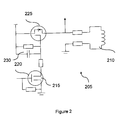
- the modifications to be made to the diagram represented in figure 2 are within the reach of the skilled person.
- a solenoid 110 is mounted, in parallel with a diode 115, to the terminals of a control power supply provided with a relay whose coil is marked at 120 and whose contact is located at 125, and a diode 130.
- the coil 120 is controlled by a transistor 135 from an on-off command signal from a central alarm or fire detector.
- the diode 130 protects the transistor 135 from the overvoltage induced by the coil 120 of the relay when opening the transistor 135.
- 140 represents the equivalent impedance of the cable which connects the contact 125 to the electromagnet 110.
- the signal 150 represented at the bottom of the figure 1 shows that the free wheel diode 115 limits the amplitude of the overvoltage peak at break.
- the device 205 object of the present invention comprises, connected across the terminals of a solenoid 210, a control power supply 220 comprising a Mosfet transistor (or other power semiconductor) 225.
- the transistor 215 makes it possible to adapt the control level between the logic level at the input of the power supply (typically 0-3 v or 0-5 v.) At the control level of the gate of the Mosfet transistor 225.
- the current is established / interrupted gradually using an RC 230 network installed on the control, which limits the time derivative of the intensity ("di / dt") in the electromagnet, thus the effect of electromotive counter-electromotive force, thus eliminating the need to place a freewheeling diode across the coil.
- the network RC 230 thus makes it possible to induce the progressive control ramp, which limits the time derivative of the intensity (di / dt) and thus reduces the overvoltage by an inductive effect.
- the duration of the ramp remains rather short so that the Mosfet control transistor 225 does not dissipate too much during the decay of the output voltage. Indeed, its internal resistance, called Rds-on) is worth practically 0 Ohms when it is controlled and believes when the difference of tension between its control gate and its source, difference of potentials called VGs) decreases, which causes of the heat dissipation by Joule effect, because of the current flowing in the circuit. This avoids the need to provide a large Mosfet transistor 225 and / or an associated heat sink.
Landscapes
- Engineering & Computer Science (AREA)
- Structural Engineering (AREA)
- Electromagnetism (AREA)
- Physics & Mathematics (AREA)
- Civil Engineering (AREA)
- Architecture (AREA)
- Power Engineering (AREA)
- Health & Medical Sciences (AREA)
- Public Health (AREA)
- Business, Economics & Management (AREA)
- Emergency Management (AREA)
- Power-Operated Mechanisms For Wings (AREA)
- Special Wing (AREA)
Abstract
Description
- La présente invention concerne un procédé et un dispositif de fermeture de porte coupe-feu. Les portes coupe-feu sont des portes destinées à gêner la propagation du feu ou des fumées, par leur conception thermique et par le fait qu'elles se ferment automatiquement dès qu'un incendie est détecté.
- Pour que cette fermeture automatique se produise, on met, par exemple, en oeuvre une ventouse électromagnétique, aussi appelée « électro-aimant ». Cette ventouse est placée de telle manière que, si un utilisateur souhaite bloquer la porte en position ouverte, il lui suffit d'ouvrir cette porte et de l'appliquer contre cette ventouse. On évite ainsi que l'utilisateur n'utilise d'autres moyens pour retenir la porte en position ouverte. Un ressort rappelle la porte en position fermée avec un couple égal à celui appliqué par la ventouse de sorte que la porte reste ouverte tant que la ventouse fonctionne ou qu'on ne force pas manuellement la porte à se libérer de la ventouse.
- Les ventouses électromagnétiques sont dotées de bobines et sont de deux types.
- Dans le premier type, à sécurité positive, lorsque le courant passe dans ces bobines, les ventouses retiennent la porte. En revanche, lorsque le courant ne passe plus, les ventouses relâchent la porte et le ressort provoque la fermeture de la porte.
- Les systèmes centraux électroniques contrôlent les électro-aimants faisant partie des organes de sécurité des bâtiments par les systèmes dit "à rupture" : une tension est maintenue en permanence sur une ligne électrique qui aliment un solénoïde qui crée un champ électromagnétique constituant un électro-aimant, lequel tient une plaque métallique fixée sur une porte coupe-feu.
- En cas d'alarme incendie, la mise en sécurité du bâtiment prévoit que ces portes coupe-feu se ferment. Le système central coupe donc la tension d'alimentation de l'électro-aimant, ce qui réduit l'intensité du champ magnétique et relâche la porte. Cette dernière se ferme alors en position de sécurité.
- Cependant, les commandes électriques se font par des changements brutaux de tensions, manifestés par un front très brutal de changement qui enclenche, dans les solénoïdes, des forces contre électromotrices (aussi appelées FCEM). Ces forces sont destructrices pour les cartes électroniques des organes centraux et les "grillent ". Aussi, il est généralement prévu de réaliser une protection en installant une diode dite « de roue libre » entre les bornes des fils d'entrée de la bobine, de façon à faire circuler, via la diode, le courant induit par la force contre électromotrice de manière à ce qu'il ne circule pas sur le fil de commande jusqu'aux circuits électroniques des systèmes centraux.
- Cependant, ces diodes coûtent cher, sont délicates à implanter et compliquent les schémas électroniques mis en oeuvre.
- Dans le deuxième type d'électro-aimant, à émission de courant, en veille, il n'y a pas de tension appliquée à l'électro-aimant et on lui envoie une tension pour le commander afin qu'il relâche la porte coupe-feu. Dans ce cas aussi, une surtension apparaissant en fin du signal de commande, lorsque l'on arrête d'envoyer une tension, nécessite l'utilisation d'une diode de roue-libre, avec les inconvénients mentionnés ci-dessus.
- Plus généralement, ce problème se pose pour tout électro-aimant, quel qu'en soit l'application.
- La présente invention vise à remédier à ces inconvénients.
- A cet effet, selon un premier aspect, la présente invention vise un dispositif comportant au moins un électro-aimant en regard d'une plaque métallique, caractérisé en ce qu'il comporte, en outre, un moyen d'augmentation de la durée de variation de la tension aux bornes de chaque électro-aimant, par rapport à la durée correspondant à une coupure de ligne électrique.
- Selon un deuxième aspect, la présente invention vise un dispositif de fermeture de porte coupe-feu, comportant au moins un électro-aimant en regard d'une plaque métallique solidaire de ladite porte, caractérisé en ce qu'il comporte, en outre, un moyen d'augmentation de la durée de baisse de la tension aux bornes de chaque électro-aimant, par rapport à la durée correspondant à une coupure de ligne électrique.
- Selon un troisième aspect, la présente invention vise un dispositif de fermeture de porte coupe-feu, comportant au moins un électro-aimant en regard d'une plaque métallique solidaire de ladite porte, caractérisé en ce qu'il comporte, en outre, un moyen d'augmentation de la durée d'élévation de la tension aux bornes de chaque électro-aimant, par rapport à la durée correspondant à l'élévation de tension avec un signal tout ou rien.
- Ainsi, dans chacun de ces aspects, en réalisant une rampe progressive de variation de la tension aux bornes de l'électro-aimant, on réduite la force contre électromotrice et on élimine le besoin d'une diode de roue libre connectée aux bornes de l'électro-aimant. On économise ainsi du temps de réalisation et un composant ainsi que la logistique, les tests et la maintenance associés et le risque d'erreur de placement ou de sens de branchement de la diode.
- Selon des caractéristiques particulières, le moyen d'augmentation de durée comporte un transistor de puissance et un moyen de commande dudit transistor pour lui appliquer une rampe de tension.
- Ainsi, la commutation se fait de façon progressive de façon à éviter la production de courants d'induction.
- Selon des caractéristiques particulières, le moyen de commande est constitué d'un simple réseau RC.
- Selon des caractéristiques particulières, le transistor de puissance est un transistor MOSFET.
- Selon un quatrième aspect, la présente invention vise un procédé de commande d'un électro-aimant en regard d'une plaque métallique, ledit procédé comportant une étape de commande de l'électro-aimant pour maintenir l'électro-aimant dans un premier état où il applique un champ magnétique, caractérisé en ce qu'il comporte, en outre, une étape d'augmentation de la durée de variation de la tension aux bornes de chaque électro-aimant, par rapport à la durée correspondant à une commande avec un signal tout ou rien.
- Selon un cinquième aspect, la présente invention vise un procédé de fermeture de porte coupe-feu comportant au moins un électro-aimant en regard d'une plaque métallique solidaire de ladite porte, ledit procédé comportant une étape de commande de l'électro-aimant pour maintenir la porte ouverte en l'absence de détection d'incendie, caractérisé en ce qu'il comporte, en outre, une étape d'augmentation de la durée de baisse de la tension aux bornes de chaque électro-aimant, par rapport à la durée correspondant à une coupure de ligne électrique.
- Selon un sixième aspect, la présente invention vise un procédé de fermeture de porte coupe-feu comportant au moins un électro-aimant en regard d'une plaque métallique solidaire de ladite porte, ledit procédé comportant une étape de commande de l'électro-aimant pour maintenir la porte ouverte en l'absence de détection d'incendie, caractérisé en ce qu'il comporte, en outre, une étape d'augmentation de la durée d'élévation de la tension aux bornes de chaque électro-aimant, par rapport à la durée correspondant à l'élévation de tension avec un signal tout ou rien.
- Selon des caractéristiques particulière, dans procédé objet de la présente invention, tel que succinctement exposé ci-dessus, dans chacun des quatrième à sixième aspects, au cours de l'étape d'augmentation, on met en oeuvre un transistor de puissance et un réseau RC appliquant audit transistor de puissance une rampe de tension.
- Les avantages, buts et caractéristiques de ces procédés étant similaires à ceux du dispositif tel que succinctement exposé ci-dessus, ils ne sont pas rappelés ici.
- D'autres avantages, buts et caractéristiques de la présente invention ressortiront de la description qui va suivre, faite, dans un but explicatif et nullement limitatif en regard des dessins annexés, dans lesquels :
- la
figure 1 représente le schéma électrique d'un dispositif de l'art antérieur, - la
figure 2 représente le schéma électrique d'un premier mode de réalisation du dispositif objet de la présente invention et - les
figures 3 et 4 représentent l'évolution de signaux au cours du temps. - Dans la description qui suit, on a présenté l'application de la présente invention à une porte coupe-feu commandée par un électro-aimant à sécurité positive. Cependant, la présente invention ne se limite pas à ce type d'électro-aimant et à ce type d'application, mais s'étend à toutes les applications des électro-aimants, à sécurité positive ou à émission de courant. Pour ce dernier type d'électro-aimants, les modifications à apporter au schéma représenté en
figure 2 sont à la portée de l'homme du métier. - On observe, en
figure 1 , que, dans un dispositif 105 de l'art antérieur, un solénoïde 110 est monté, en parallèle avec une diode 115, aux bornes d'une alimentation de commande munie d'un relais dont la bobine est repérée en 120 et dont le contact est repéré en 125, et d'une diode 130. La bobine 120 est commandée par un transistor 135 à partir d'un signal de commande tout ou rien provenant d'une centrale d'alarme ou d'un détecteur d'incendie. La diode 130 protège le transistor 135 de la surtension induite par la bobine 120 du relais lors de l'ouverture du transistor 135. 140 représente l'impédance équivalente du câble qui relie le contact 125 à l'électro-aimant 110. - L'utilisation d'une diode de roue libre 115 sur l'électro-aimant 110 est nécessaire pour limiter la surtension d'auto-induction selfique. Sans cette diode 115, il y a un risque de destruction du contact de relais et de propagation de la surtension dans le reste du circuit lorsque la porte est relâchée. On note ici que sans l'impédance 140, c'est-à-dire s'il n'y avait pas de câble de liaison entre le contact 125 et l'électro-aimant 110, on pourrait mettre la diode de roue-libre 115 dans l'alimentation de commande, pour simplifier le câblage. Cependant, la présence du câble de liaison interdit cette solution et la diode de roue-libre 115 au plus près de l'électro-aimant 110.
- Le signal 150 représenté en bas de la
figure 1 montre que la diode de roue-libre 115 limite l'amplitude du pic de surtension à la rupture. - On observe, en
figure 2 , que, dans un mode de réalisation, le dispositif 205 objet de la présente invention comporte, relié aux bornes d'un solénoïde 210, une alimentation de commande 220 comportant un transistor Mosfet (ou autre semi-conducteur de puissance) 225. Le transistor 215 permet d'adapter le niveau de commande entre le niveau logique en entrée de l'alimentation (typiquement 0-3 v. ou 0-5 v.) au niveau de commande de la grille du transistor Mosfet 225. On note que, préférentiellement, on utilise un transistor Mosfet 225 de type canal P, ce qui permet d'interrompre l'alimentation positive de l'électro-aimant 210, de façon à ne pas induire d'impédance parasite dans le potentiel de référence (masse à 0 v.), ce qui pourrait avoir des conséquences sur les performances du dispositif, en termes de compatibilité électromagnétique. - Dans ce dispositif 205, lors de la commande de la ventouse (marche ou arrêt), le courant est établi/interrompu de manière progressive à l'aide d'un réseau RC 230 implanté sur la commande, ce qui limite la dérivée temporelle de l'intensité (« di/dt ») dans l'électro-aimant, donc l'effet de force contre-électromotrice selfique, supprimant ainsi la nécessité de placer une diode de roue libre aux bornes de la bobine. Le réseau RC 230 permet ainsi d'induire la rampe de commande progressive, ce qui limite la dérivée temporelle de l'intensité (di/dt) et donc diminue la surtension par effet selfique.
- La durée de la rampe reste cependant assez courte de sorte que le transistor de commande Mosfet 225 ne dissipe pas trop pendant la décroissance de la tension de sortie. En effet, sa résistance interne, appelée Rds-on) vaut pratiquement 0 Ohms lorsqu'il est commandé et croit lorsque la différence de tension entre sa grille de commande et sa source, différence de potentiels appelée VGs) diminue, ce qui provoque de la dissipation thermique par effet Joule, à cause du courant circulant dans le circuit. On évite ainsi d'avoir à prévoir un transistor Mosfet 225 de taille importante et/ou un dissipateur thermique associé.
- Les
figures 3 et 4 , schématisant des relevés fait à l'oscilloscope, montrent la forme de l'évolution temporelle de la tension à la sortie de la partie du transistor Mosfet 225 pour : - une commande, en
figure 3 , courbe 305 et - une coupure, en
figure 4 , courbe 310, lorsque l'électro-aimant 210 relâche la porte coupe-feu. - On observe, dans ces
figures 3 et 4 , qu'aucun des signaux aux bornes de l'électro-aimant n'effectue de variation brutale, à la différence de l'art antérieur comme illustré par le signal 150 représenté en bas de lafigure 1 .
Claims (10)
- Dispositif (205) comportant au moins un électro-aimant (210) en regard d'une plaque métallique, caractérisé en ce qu'il comporte, en outre, un moyen (215 à 230) d'augmentation de la durée de variation de la tension aux bornes de chaque électro-aimant, par rapport à la durée correspondant à une commande avec un signal tout ou rien.
- Dispositif (205) de fermeture de porte coupe-feu, comportant au moins un électro-aimant (210) en regard d'une plaque métallique solidaire de ladite porte, caractérisé en ce qu'il comporte, en outre, un moyen (215 à 230) d'augmentation de la durée de baisse de la tension aux bornes de chaque électro-aimant, par rapport à la durée correspondant à une coupure de ligne électrique.
- Dispositif (205) de fermeture de porte coupe-feu, comportant au moins un électro-aimant (210) en regard d'une plaque métallique solidaire de ladite porte, caractérisé en ce qu'il comporte, en outre, un moyen (215 à 230) d'augmentation de la durée d'élévation de la tension aux bornes de chaque électro-aimant, par rapport à la durée correspondant à l'élévation de tension avec un signal tout ou rien.
- Dispositif selon l'une quelconque des revendications 1 à 3, caractérisé en ce que le moyen (215 à 230) d'augmentation de durée comporte un transistor de puissance (225) et un moyen de commande (215, 230) dudit transistor pour lui appliquer une rampe de tension.
- Dispositif selon la revendication 4, caractérisé en ce que le moyen de commande est constitué d'un simple réseau RC (230).
- Dispositif selon l'une quelconque des revendications 4 ou 5, caractérisé en ce que le transistor de puissance (225) est un transistor MOSFET.
- Procédé de commande d'un électro-aimant (210) en regard d'une plaque métallique, ledit procédé comportant une étape de commande de l'électro-aimant pour maintenir l'électro-aimant dans un premier état où il applique un champ magnétique, caractérisé en ce qu'il comporte, en outre, une étape d'augmentation de la durée de variation de la tension aux bornes de chaque électro-aimant, par rapport à la durée correspondant à une commande avec un signal tout ou rien.
- Procédé de fermeture de porte coupe-feu comportant au moins un électro-aimant (210) en regard d'une plaque métallique solidaire de ladite porte, ledit procédé comportant une étape de commande de l'électro-aimant pour maintenir la porte ouverte en l'absence de détection d'incendie, caractérisé en ce qu'il comporte, en outre, une étape d'augmentation de la durée de baisse de la tension aux bornes de chaque électro-aimant, par rapport à la durée correspondant à une coupure de ligne électrique.
- Procédé de fermeture de porte coupe-feu comportant au moins un électro-aimant (210) en regard d'une plaque métallique solidaire de ladite porte, ledit procédé comportant une étape de commande de l'électro-aimant pour maintenir la porte ouverte en l'absence de détection d'incendie, caractérisé en ce qu'il comporte, en outre, une étape d'augmentation de la durée d'élévation de la tension aux bornes de chaque électro-aimant, par rapport à la durée correspondant à l'élévation de tension avec un signal tout ou rien.
- Procédé selon l'une quelconque des revendications 7 à 9, caractérisé en ce que, au cours de l'étape d'augmentation, on met en oeuvre un transistor de puissance (225) et un réseau RC (230) appliquant audit transistor de puissance une rampe de tension.
Applications Claiming Priority (1)
| Application Number | Priority Date | Filing Date | Title |
|---|---|---|---|
| FR0708415A FR2924527A1 (fr) | 2007-11-29 | 2007-11-29 | Procede et dispositif de fermeture de porte coupe-feu |
Publications (2)
| Publication Number | Publication Date |
|---|---|
| EP2065905A1 true EP2065905A1 (fr) | 2009-06-03 |
| EP2065905B1 EP2065905B1 (fr) | 2012-09-19 |
Family
ID=39540646
Family Applications (1)
| Application Number | Title | Priority Date | Filing Date |
|---|---|---|---|
| EP20080020697 Not-in-force EP2065905B1 (fr) | 2007-11-29 | 2008-11-28 | Procede et dispositif de fermeture de porte coupe-feu |
Country Status (3)
| Country | Link |
|---|---|
| EP (1) | EP2065905B1 (fr) |
| ES (1) | ES2395985T3 (fr) |
| FR (1) | FR2924527A1 (fr) |
Cited By (1)
| Publication number | Priority date | Publication date | Assignee | Title |
|---|---|---|---|---|
| FR3009883A1 (fr) * | 2013-08-21 | 2015-02-27 | Rf Technologies | Mecanisme de declenchement pour fermer une lame mobile d'un clapet coupe-feu et coupe-feu comprenant un tel mecanisme |
Families Citing this family (1)
| Publication number | Priority date | Publication date | Assignee | Title |
|---|---|---|---|---|
| CN112915428B (zh) * | 2021-03-30 | 2022-03-29 | 郑州轻工业大学 | 一种变压器灭火防护装置 |
Citations (4)
| Publication number | Priority date | Publication date | Assignee | Title |
|---|---|---|---|---|
| US4318155A (en) | 1980-06-20 | 1982-03-02 | General Motors Corporation | Residual magnetism reversing circuit for an electromagnetic clutch |
| FR2511806A1 (fr) | 1981-08-18 | 1983-02-25 | Karjalainen Vaino | Procede pour l'alimentation et la demagnetisation d'electro-aimants a courant continu de grande puissance |
| US4682801A (en) | 1984-08-31 | 1987-07-28 | Securitron-Magnalock Corp. | Electromagnet access control circuit |
| DE102005032085A1 (de) | 2005-07-08 | 2007-01-18 | Siemens Ag | Vorrichtung zur Leistungsverringerung beim Betrieb einer induktiven Last |
-
2007
- 2007-11-29 FR FR0708415A patent/FR2924527A1/fr not_active Withdrawn
-
2008
- 2008-11-28 EP EP20080020697 patent/EP2065905B1/fr not_active Not-in-force
- 2008-11-28 ES ES08020697T patent/ES2395985T3/es active Active
Patent Citations (4)
| Publication number | Priority date | Publication date | Assignee | Title |
|---|---|---|---|---|
| US4318155A (en) | 1980-06-20 | 1982-03-02 | General Motors Corporation | Residual magnetism reversing circuit for an electromagnetic clutch |
| FR2511806A1 (fr) | 1981-08-18 | 1983-02-25 | Karjalainen Vaino | Procede pour l'alimentation et la demagnetisation d'electro-aimants a courant continu de grande puissance |
| US4682801A (en) | 1984-08-31 | 1987-07-28 | Securitron-Magnalock Corp. | Electromagnet access control circuit |
| DE102005032085A1 (de) | 2005-07-08 | 2007-01-18 | Siemens Ag | Vorrichtung zur Leistungsverringerung beim Betrieb einer induktiven Last |
Cited By (1)
| Publication number | Priority date | Publication date | Assignee | Title |
|---|---|---|---|---|
| FR3009883A1 (fr) * | 2013-08-21 | 2015-02-27 | Rf Technologies | Mecanisme de declenchement pour fermer une lame mobile d'un clapet coupe-feu et coupe-feu comprenant un tel mecanisme |
Also Published As
| Publication number | Publication date |
|---|---|
| ES2395985T3 (es) | 2013-02-18 |
| FR2924527A1 (fr) | 2009-06-05 |
| EP2065905B1 (fr) | 2012-09-19 |
Similar Documents
| Publication | Publication Date | Title |
|---|---|---|
| FR2632117A1 (fr) | Ensemble auxiliaire pour disjoncteur en boitier moule | |
| EP2019396B1 (fr) | Actionneur électromagnétique à au moins deux bobinages | |
| EP2406802B1 (fr) | Circuit de commande d'un actionneur electromagnetique pour un interrupteur a vide | |
| EP2124310B1 (fr) | Dispositif de protection d'un circuit électrique contre les surtensions | |
| WO2000075947A1 (fr) | Relais electromecanique assiste a la commutation par semi-conducteur | |
| EP1681694B1 (fr) | Dispositif de commutation avec limiteur électronique de courant | |
| EP2065905B1 (fr) | Procede et dispositif de fermeture de porte coupe-feu | |
| EP0204624B1 (fr) | Dispositif de surveillance d'état d'un commutateur électrique et relais électrique comportant application | |
| CA1118833A (fr) | Circuit electrique pour l'allumage d'un detonateur | |
| EP1225673A1 (fr) | Dispositif de distribution électrique, installation comportant un tel dispositif, et procédé de protection électrique | |
| FR3016914A1 (fr) | Dispositif anti-remanence pour serrure electromagnetique | |
| FR2722348A1 (fr) | Dispositif electronique de connexion a protection contre les inversions de polarite | |
| FR3021167B1 (fr) | Circuit de derivation d'energie et procede de mise en fonctionnement de ce circuit | |
| EP3845978B1 (fr) | Dispositif de commande sécurisée, contacteur comportant un tel dispositif et procédé de traitement sécurisé d'un signal de commande | |
| EP0093804B1 (fr) | Circuit électronique perfectionné pour l'allumage d'un détonateur | |
| WO2012146876A1 (fr) | Actionneur électromagnétique à générateur magnétique | |
| FR2501899A1 (fr) | Circuit de commande du fonctionnement d'un dispositif electromagnetique comportant un solenoide et un induit | |
| EP0180487A1 (fr) | Circuit de puissance et dispositif de déclenchement le comportant | |
| EP4139946B1 (fr) | Disjoncteur a commande de declenchement electronique | |
| EP0895671A1 (fr) | Relais statique avec detection d'etat | |
| BE1005313A5 (fr) | Dispositif de decrochage de tension minimale. | |
| CH623276A5 (fr) | ||
| FR3078603A1 (fr) | Electrificateur de cloture electrique et son procede de commande | |
| EP0834975A1 (fr) | Dispositif de distribution électrique terminale à bloc limiteur hybride | |
| FR2615676A1 (fr) | Dispositif de commutation electrique statique limiteur de courant |
Legal Events
| Date | Code | Title | Description |
|---|---|---|---|
| PUAI | Public reference made under article 153(3) epc to a published international application that has entered the european phase |
Free format text: ORIGINAL CODE: 0009012 |
|
| AK | Designated contracting states |
Kind code of ref document: A1 Designated state(s): AT BE BG CH CY CZ DE DK EE ES FI FR GB GR HR HU IE IS IT LI LT LU LV MC MT NL NO PL PT RO SE SI SK TR |
|
| AX | Request for extension of the european patent |
Extension state: AL BA MK RS |
|
| 17P | Request for examination filed |
Effective date: 20091125 |
|
| 17Q | First examination report despatched |
Effective date: 20091223 |
|
| AKX | Designation fees paid |
Designated state(s): AT BE BG CH CY CZ DE DK EE ES FI FR GB GR HR HU IE IS IT LI LT LU LV MC MT NL NO PL PT RO SE SI SK TR |
|
| RBV | Designated contracting states (corrected) |
Designated state(s): AT BE BG CH CY CZ DE DK EE ES FI FR GB GR HR HU IE IS IT LI LT LU LV MC MT NL NO PL PT RO SE SI SK TR |
|
| GRAP | Despatch of communication of intention to grant a patent |
Free format text: ORIGINAL CODE: EPIDOSNIGR1 |
|
| RIC1 | Information provided on ipc code assigned before grant |
Ipc: H01F 7/18 20060101AFI20120213BHEP Ipc: E06B 9/68 20060101ALI20120213BHEP Ipc: A62C 2/24 20060101ALI20120213BHEP |
|
| GRAJ | Information related to disapproval of communication of intention to grant by the applicant or resumption of examination proceedings by the epo deleted |
Free format text: ORIGINAL CODE: EPIDOSDIGR1 |
|
| GRAP | Despatch of communication of intention to grant a patent |
Free format text: ORIGINAL CODE: EPIDOSNIGR1 |
|
| RAP3 | Party data changed (applicant data changed or rights of an application transferred) |
Owner name: FINSECUR |
|
| GRAS | Grant fee paid |
Free format text: ORIGINAL CODE: EPIDOSNIGR3 |
|
| GRAA | (expected) grant |
Free format text: ORIGINAL CODE: 0009210 |
|
| AK | Designated contracting states |
Kind code of ref document: B1 Designated state(s): AT BE BG CH CY CZ DE DK EE ES FI FR GB GR HR HU IE IS IT LI LT LU LV MC MT NL NO PL PT RO SE SI SK TR |
|
| REG | Reference to a national code |
Ref country code: GB Ref legal event code: FG4D Free format text: NOT ENGLISH |
|
| REG | Reference to a national code |
Ref country code: CH Ref legal event code: EP |
|
| REG | Reference to a national code |
Ref country code: IE Ref legal event code: FG4D Free format text: LANGUAGE OF EP DOCUMENT: FRENCH |
|
| REG | Reference to a national code |
Ref country code: AT Ref legal event code: REF Ref document number: 576370 Country of ref document: AT Kind code of ref document: T Effective date: 20121015 |
|
| REG | Reference to a national code |
Ref country code: DE Ref legal event code: R096 Ref document number: 602008018831 Country of ref document: DE Effective date: 20121115 |
|
| REG | Reference to a national code |
Ref country code: SE Ref legal event code: TRGR |
|
| REG | Reference to a national code |
Ref country code: NL Ref legal event code: T3 |
|
| PG25 | Lapsed in a contracting state [announced via postgrant information from national office to epo] |
Ref country code: FI Free format text: LAPSE BECAUSE OF FAILURE TO SUBMIT A TRANSLATION OF THE DESCRIPTION OR TO PAY THE FEE WITHIN THE PRESCRIBED TIME-LIMIT Effective date: 20120919 Ref country code: CY Free format text: LAPSE BECAUSE OF FAILURE TO SUBMIT A TRANSLATION OF THE DESCRIPTION OR TO PAY THE FEE WITHIN THE PRESCRIBED TIME-LIMIT Effective date: 20120919 Ref country code: LT Free format text: LAPSE BECAUSE OF FAILURE TO SUBMIT A TRANSLATION OF THE DESCRIPTION OR TO PAY THE FEE WITHIN THE PRESCRIBED TIME-LIMIT Effective date: 20120919 Ref country code: NO Free format text: LAPSE BECAUSE OF FAILURE TO SUBMIT A TRANSLATION OF THE DESCRIPTION OR TO PAY THE FEE WITHIN THE PRESCRIBED TIME-LIMIT Effective date: 20121219 Ref country code: HR Free format text: LAPSE BECAUSE OF FAILURE TO SUBMIT A TRANSLATION OF THE DESCRIPTION OR TO PAY THE FEE WITHIN THE PRESCRIBED TIME-LIMIT Effective date: 20120919 |
|
| REG | Reference to a national code |
Ref country code: AT Ref legal event code: MK05 Ref document number: 576370 Country of ref document: AT Kind code of ref document: T Effective date: 20120919 |
|
| REG | Reference to a national code |
Ref country code: ES Ref legal event code: FG2A Ref document number: 2395985 Country of ref document: ES Kind code of ref document: T3 Effective date: 20130218 |
|
| REG | Reference to a national code |
Ref country code: LT Ref legal event code: MG4D Effective date: 20120926 |
|
| PG25 | Lapsed in a contracting state [announced via postgrant information from national office to epo] |
Ref country code: LV Free format text: LAPSE BECAUSE OF FAILURE TO SUBMIT A TRANSLATION OF THE DESCRIPTION OR TO PAY THE FEE WITHIN THE PRESCRIBED TIME-LIMIT Effective date: 20120919 Ref country code: SI Free format text: LAPSE BECAUSE OF FAILURE TO SUBMIT A TRANSLATION OF THE DESCRIPTION OR TO PAY THE FEE WITHIN THE PRESCRIBED TIME-LIMIT Effective date: 20120919 Ref country code: GR Free format text: LAPSE BECAUSE OF FAILURE TO SUBMIT A TRANSLATION OF THE DESCRIPTION OR TO PAY THE FEE WITHIN THE PRESCRIBED TIME-LIMIT Effective date: 20121220 |
|
| PG25 | Lapsed in a contracting state [announced via postgrant information from national office to epo] |
Ref country code: CZ Free format text: LAPSE BECAUSE OF FAILURE TO SUBMIT A TRANSLATION OF THE DESCRIPTION OR TO PAY THE FEE WITHIN THE PRESCRIBED TIME-LIMIT Effective date: 20120919 Ref country code: EE Free format text: LAPSE BECAUSE OF FAILURE TO SUBMIT A TRANSLATION OF THE DESCRIPTION OR TO PAY THE FEE WITHIN THE PRESCRIBED TIME-LIMIT Effective date: 20120919 Ref country code: RO Free format text: LAPSE BECAUSE OF FAILURE TO SUBMIT A TRANSLATION OF THE DESCRIPTION OR TO PAY THE FEE WITHIN THE PRESCRIBED TIME-LIMIT Effective date: 20120919 Ref country code: IS Free format text: LAPSE BECAUSE OF FAILURE TO SUBMIT A TRANSLATION OF THE DESCRIPTION OR TO PAY THE FEE WITHIN THE PRESCRIBED TIME-LIMIT Effective date: 20130119 |
|
| PG25 | Lapsed in a contracting state [announced via postgrant information from national office to epo] |
Ref country code: PT Free format text: LAPSE BECAUSE OF FAILURE TO SUBMIT A TRANSLATION OF THE DESCRIPTION OR TO PAY THE FEE WITHIN THE PRESCRIBED TIME-LIMIT Effective date: 20130121 Ref country code: PL Free format text: LAPSE BECAUSE OF FAILURE TO SUBMIT A TRANSLATION OF THE DESCRIPTION OR TO PAY THE FEE WITHIN THE PRESCRIBED TIME-LIMIT Effective date: 20120919 Ref country code: SK Free format text: LAPSE BECAUSE OF FAILURE TO SUBMIT A TRANSLATION OF THE DESCRIPTION OR TO PAY THE FEE WITHIN THE PRESCRIBED TIME-LIMIT Effective date: 20120919 |
|
| PG25 | Lapsed in a contracting state [announced via postgrant information from national office to epo] |
Ref country code: AT Free format text: LAPSE BECAUSE OF FAILURE TO SUBMIT A TRANSLATION OF THE DESCRIPTION OR TO PAY THE FEE WITHIN THE PRESCRIBED TIME-LIMIT Effective date: 20120919 |
|
| REG | Reference to a national code |
Ref country code: CH Ref legal event code: PL |
|
| PLBE | No opposition filed within time limit |
Free format text: ORIGINAL CODE: 0009261 |
|
| STAA | Information on the status of an ep patent application or granted ep patent |
Free format text: STATUS: NO OPPOSITION FILED WITHIN TIME LIMIT |
|
| PG25 | Lapsed in a contracting state [announced via postgrant information from national office to epo] |
Ref country code: LI Free format text: LAPSE BECAUSE OF NON-PAYMENT OF DUE FEES Effective date: 20121130 Ref country code: BG Free format text: LAPSE BECAUSE OF FAILURE TO SUBMIT A TRANSLATION OF THE DESCRIPTION OR TO PAY THE FEE WITHIN THE PRESCRIBED TIME-LIMIT Effective date: 20121219 Ref country code: DK Free format text: LAPSE BECAUSE OF FAILURE TO SUBMIT A TRANSLATION OF THE DESCRIPTION OR TO PAY THE FEE WITHIN THE PRESCRIBED TIME-LIMIT Effective date: 20120919 Ref country code: CH Free format text: LAPSE BECAUSE OF NON-PAYMENT OF DUE FEES Effective date: 20121130 |
|
| 26N | No opposition filed |
Effective date: 20130620 |
|
| REG | Reference to a national code |
Ref country code: IE Ref legal event code: MM4A |
|
| REG | Reference to a national code |
Ref country code: DE Ref legal event code: R097 Ref document number: 602008018831 Country of ref document: DE Effective date: 20130620 |
|
| PG25 | Lapsed in a contracting state [announced via postgrant information from national office to epo] |
Ref country code: IE Free format text: LAPSE BECAUSE OF NON-PAYMENT OF DUE FEES Effective date: 20121128 |
|
| PG25 | Lapsed in a contracting state [announced via postgrant information from national office to epo] |
Ref country code: MT Free format text: LAPSE BECAUSE OF FAILURE TO SUBMIT A TRANSLATION OF THE DESCRIPTION OR TO PAY THE FEE WITHIN THE PRESCRIBED TIME-LIMIT Effective date: 20120919 |
|
| PG25 | Lapsed in a contracting state [announced via postgrant information from national office to epo] |
Ref country code: MC Free format text: LAPSE BECAUSE OF NON-PAYMENT OF DUE FEES Effective date: 20121130 Ref country code: TR Free format text: LAPSE BECAUSE OF FAILURE TO SUBMIT A TRANSLATION OF THE DESCRIPTION OR TO PAY THE FEE WITHIN THE PRESCRIBED TIME-LIMIT Effective date: 20120919 |
|
| PG25 | Lapsed in a contracting state [announced via postgrant information from national office to epo] |
Ref country code: LU Free format text: LAPSE BECAUSE OF NON-PAYMENT OF DUE FEES Effective date: 20121128 |
|
| PG25 | Lapsed in a contracting state [announced via postgrant information from national office to epo] |
Ref country code: HU Free format text: LAPSE BECAUSE OF FAILURE TO SUBMIT A TRANSLATION OF THE DESCRIPTION OR TO PAY THE FEE WITHIN THE PRESCRIBED TIME-LIMIT Effective date: 20081128 |
|
| REG | Reference to a national code |
Ref country code: FR Ref legal event code: PLFP Year of fee payment: 8 |
|
| REG | Reference to a national code |
Ref country code: FR Ref legal event code: PLFP Year of fee payment: 9 |
|
| PGFP | Annual fee paid to national office [announced via postgrant information from national office to epo] |
Ref country code: NL Payment date: 20161126 Year of fee payment: 9 Ref country code: FR Payment date: 20161028 Year of fee payment: 9 Ref country code: GB Payment date: 20161128 Year of fee payment: 9 Ref country code: DE Payment date: 20161123 Year of fee payment: 9 |
|
| PGFP | Annual fee paid to national office [announced via postgrant information from national office to epo] |
Ref country code: IT Payment date: 20161124 Year of fee payment: 9 Ref country code: ES Payment date: 20161128 Year of fee payment: 9 Ref country code: BE Payment date: 20161128 Year of fee payment: 9 Ref country code: SE Payment date: 20161125 Year of fee payment: 9 |
|
| REG | Reference to a national code |
Ref country code: DE Ref legal event code: R119 Ref document number: 602008018831 Country of ref document: DE |
|
| REG | Reference to a national code |
Ref country code: SE Ref legal event code: EUG |
|
| REG | Reference to a national code |
Ref country code: NL Ref legal event code: MM Effective date: 20171201 |
|
| GBPC | Gb: european patent ceased through non-payment of renewal fee |
Effective date: 20171128 |
|
| PG25 | Lapsed in a contracting state [announced via postgrant information from national office to epo] |
Ref country code: SE Free format text: LAPSE BECAUSE OF NON-PAYMENT OF DUE FEES Effective date: 20171129 |
|
| REG | Reference to a national code |
Ref country code: FR Ref legal event code: ST Effective date: 20180731 Ref country code: BE Ref legal event code: MM Effective date: 20171130 |
|
| PG25 | Lapsed in a contracting state [announced via postgrant information from national office to epo] |
Ref country code: NL Free format text: LAPSE BECAUSE OF NON-PAYMENT OF DUE FEES Effective date: 20171201 Ref country code: FR Free format text: LAPSE BECAUSE OF NON-PAYMENT OF DUE FEES Effective date: 20171130 Ref country code: IT Free format text: LAPSE BECAUSE OF NON-PAYMENT OF DUE FEES Effective date: 20171128 Ref country code: DE Free format text: LAPSE BECAUSE OF NON-PAYMENT OF DUE FEES Effective date: 20180602 |
|
| PG25 | Lapsed in a contracting state [announced via postgrant information from national office to epo] |
Ref country code: GB Free format text: LAPSE BECAUSE OF NON-PAYMENT OF DUE FEES Effective date: 20171128 Ref country code: BE Free format text: LAPSE BECAUSE OF NON-PAYMENT OF DUE FEES Effective date: 20171130 |
|
| REG | Reference to a national code |
Ref country code: ES Ref legal event code: FD2A Effective date: 20190103 |
|
| PG25 | Lapsed in a contracting state [announced via postgrant information from national office to epo] |
Ref country code: ES Free format text: LAPSE BECAUSE OF NON-PAYMENT OF DUE FEES Effective date: 20171129 |