EP2055746A2 - Colored curable composition, color filter, method of producing the same, and solid state image pickup device. - Google Patents
Colored curable composition, color filter, method of producing the same, and solid state image pickup device. Download PDFInfo
- Publication number
- EP2055746A2 EP2055746A2 EP08168088A EP08168088A EP2055746A2 EP 2055746 A2 EP2055746 A2 EP 2055746A2 EP 08168088 A EP08168088 A EP 08168088A EP 08168088 A EP08168088 A EP 08168088A EP 2055746 A2 EP2055746 A2 EP 2055746A2
- Authority
- EP
- European Patent Office
- Prior art keywords
- group
- mass
- substituent
- compound
- curable composition
- Prior art date
- Legal status (The legal status is an assumption and is not a legal conclusion. Google has not performed a legal analysis and makes no representation as to the accuracy of the status listed.)
- Granted
Links
- 0 *ON=CC(C1C=C*C=CC1)=O Chemical compound *ON=CC(C1C=C*C=CC1)=O 0.000 description 34
- YTEQWBYSIMJECU-UHFFFAOYSA-N C#Cc1ccc(CN=O)cc1 Chemical compound C#Cc1ccc(CN=O)cc1 YTEQWBYSIMJECU-UHFFFAOYSA-N 0.000 description 1
- UDWTUNBBAXETTD-UHFFFAOYSA-N C=CC(OCCN=O)=O Chemical compound C=CC(OCCN=O)=O UDWTUNBBAXETTD-UHFFFAOYSA-N 0.000 description 1
- ZBESFZYUVBZOSK-UHFFFAOYSA-N CC(CCC(CCc1ccccc1)=O)=C Chemical compound CC(CCC(CCc1ccccc1)=O)=C ZBESFZYUVBZOSK-UHFFFAOYSA-N 0.000 description 1
- SUXUWSUSXONHKZ-GZSJNFHUSA-N CC([C@@H](CC(/C(/N1)=C\c(cc2OC)cc(OC)c2OC)=O)C2CCCCC2)/C1=N\C1CCCCC1 Chemical compound CC([C@@H](CC(/C(/N1)=C\c(cc2OC)cc(OC)c2OC)=O)C2CCCCC2)/C1=N\C1CCCCC1 SUXUWSUSXONHKZ-GZSJNFHUSA-N 0.000 description 1
- XMWINMVFKPHMJB-UHFFFAOYSA-N CC1=CCCC=C1 Chemical compound CC1=CCCC=C1 XMWINMVFKPHMJB-UHFFFAOYSA-N 0.000 description 1
- GDOPTJXRTPNYNR-UHFFFAOYSA-N CC1CCCC1 Chemical compound CC1CCCC1 GDOPTJXRTPNYNR-UHFFFAOYSA-N 0.000 description 1
- MJUMRGZYVYYGLG-LEIZATBGSA-N CCC/C(/C(/C1=C/C/C(/C=C(\C)/C(CC2=C(C)C=CCC=C2)=O)=C(/C=C)\N(CC)C/C=C1)=O)=N\OS=O Chemical compound CCC/C(/C(/C1=C/C/C(/C=C(\C)/C(CC2=C(C)C=CCC=C2)=O)=C(/C=C)\N(CC)C/C=C1)=O)=N\OS=O MJUMRGZYVYYGLG-LEIZATBGSA-N 0.000 description 1
- VOYOEXPARVMFBA-CHJNDSEFSA-N CCN(c1ccc(C(c2ccccc2)O)cc1)c(cc1)c(C)cc1C(/C(/CCSc1ccc(C)cc1)=N/OS(c1ccccc1)(=O)=O)=O Chemical compound CCN(c1ccc(C(c2ccccc2)O)cc1)c(cc1)c(C)cc1C(/C(/CCSc1ccc(C)cc1)=N/OS(c1ccccc1)(=O)=O)=O VOYOEXPARVMFBA-CHJNDSEFSA-N 0.000 description 1
- AJZWWISFJROBKQ-UXBLZVDNSA-N CSc(ccc(CC/C=C/c1ccccc1)c1)c1SC Chemical compound CSc(ccc(CC/C=C/c1ccccc1)c1)c1SC AJZWWISFJROBKQ-UXBLZVDNSA-N 0.000 description 1
- BTFQKIATRPGRBS-UHFFFAOYSA-N Cc1c(C=O)cccc1 Chemical compound Cc1c(C=O)cccc1 BTFQKIATRPGRBS-UHFFFAOYSA-N 0.000 description 1
Images

Classifications
-
- H—ELECTRICITY
- H10—SEMICONDUCTOR DEVICES; ELECTRIC SOLID-STATE DEVICES NOT OTHERWISE PROVIDED FOR
- H10F—INORGANIC SEMICONDUCTOR DEVICES SENSITIVE TO INFRARED RADIATION, LIGHT, ELECTROMAGNETIC RADIATION OF SHORTER WAVELENGTH OR CORPUSCULAR RADIATION
- H10F39/00—Integrated devices, or assemblies of multiple devices, comprising at least one element covered by group H10F30/00, e.g. radiation detectors comprising photodiode arrays
- H10F39/80—Constructional details of image sensors
- H10F39/805—Coatings
- H10F39/8053—Colour filters
-
- C—CHEMISTRY; METALLURGY
- C08—ORGANIC MACROMOLECULAR COMPOUNDS; THEIR PREPARATION OR CHEMICAL WORKING-UP; COMPOSITIONS BASED THEREON
- C08F—MACROMOLECULAR COMPOUNDS OBTAINED BY REACTIONS ONLY INVOLVING CARBON-TO-CARBON UNSATURATED BONDS
- C08F2/00—Processes of polymerisation
- C08F2/46—Polymerisation initiated by wave energy or particle radiation
- C08F2/48—Polymerisation initiated by wave energy or particle radiation by ultraviolet or visible light
- C08F2/50—Polymerisation initiated by wave energy or particle radiation by ultraviolet or visible light with sensitising agents
-
- C—CHEMISTRY; METALLURGY
- C08—ORGANIC MACROMOLECULAR COMPOUNDS; THEIR PREPARATION OR CHEMICAL WORKING-UP; COMPOSITIONS BASED THEREON
- C08F—MACROMOLECULAR COMPOUNDS OBTAINED BY REACTIONS ONLY INVOLVING CARBON-TO-CARBON UNSATURATED BONDS
- C08F22/00—Homopolymers and copolymers of compounds having one or more unsaturated aliphatic radicals each having only one carbon-to-carbon double bond, and at least one being terminated by a carboxyl radical and containing at least one other carboxyl radical in the molecule; Salts, anhydrides, esters, amides, imides or nitriles thereof
- C08F22/10—Esters
- C08F22/1006—Esters of polyhydric alcohols or polyhydric phenols, e.g. ethylene glycol dimethacrylate
-
- G—PHYSICS
- G03—PHOTOGRAPHY; CINEMATOGRAPHY; ANALOGOUS TECHNIQUES USING WAVES OTHER THAN OPTICAL WAVES; ELECTROGRAPHY; HOLOGRAPHY
- G03F—PHOTOMECHANICAL PRODUCTION OF TEXTURED OR PATTERNED SURFACES, e.g. FOR PRINTING, FOR PROCESSING OF SEMICONDUCTOR DEVICES; MATERIALS THEREFOR; ORIGINALS THEREFOR; APPARATUS SPECIALLY ADAPTED THEREFOR
- G03F7/00—Photomechanical, e.g. photolithographic, production of textured or patterned surfaces, e.g. printing surfaces; Materials therefor, e.g. comprising photoresists; Apparatus specially adapted therefor
- G03F7/0005—Production of optical devices or components in so far as characterised by the lithographic processes or materials used therefor
- G03F7/0007—Filters, e.g. additive colour filters; Components for display devices
-
- G—PHYSICS
- G03—PHOTOGRAPHY; CINEMATOGRAPHY; ANALOGOUS TECHNIQUES USING WAVES OTHER THAN OPTICAL WAVES; ELECTROGRAPHY; HOLOGRAPHY
- G03F—PHOTOMECHANICAL PRODUCTION OF TEXTURED OR PATTERNED SURFACES, e.g. FOR PRINTING, FOR PROCESSING OF SEMICONDUCTOR DEVICES; MATERIALS THEREFOR; ORIGINALS THEREFOR; APPARATUS SPECIALLY ADAPTED THEREFOR
- G03F7/00—Photomechanical, e.g. photolithographic, production of textured or patterned surfaces, e.g. printing surfaces; Materials therefor, e.g. comprising photoresists; Apparatus specially adapted therefor
- G03F7/004—Photosensitive materials
- G03F7/027—Non-macromolecular photopolymerisable compounds having carbon-to-carbon double bonds, e.g. ethylenic compounds
- G03F7/028—Non-macromolecular photopolymerisable compounds having carbon-to-carbon double bonds, e.g. ethylenic compounds with photosensitivity-increasing substances, e.g. photoinitiators
- G03F7/031—Organic compounds not covered by group G03F7/029
-
- G—PHYSICS
- G03—PHOTOGRAPHY; CINEMATOGRAPHY; ANALOGOUS TECHNIQUES USING WAVES OTHER THAN OPTICAL WAVES; ELECTROGRAPHY; HOLOGRAPHY
- G03F—PHOTOMECHANICAL PRODUCTION OF TEXTURED OR PATTERNED SURFACES, e.g. FOR PRINTING, FOR PROCESSING OF SEMICONDUCTOR DEVICES; MATERIALS THEREFOR; ORIGINALS THEREFOR; APPARATUS SPECIALLY ADAPTED THEREFOR
- G03F7/00—Photomechanical, e.g. photolithographic, production of textured or patterned surfaces, e.g. printing surfaces; Materials therefor, e.g. comprising photoresists; Apparatus specially adapted therefor
- G03F7/004—Photosensitive materials
- G03F7/027—Non-macromolecular photopolymerisable compounds having carbon-to-carbon double bonds, e.g. ethylenic compounds
- G03F7/032—Non-macromolecular photopolymerisable compounds having carbon-to-carbon double bonds, e.g. ethylenic compounds with binders
- G03F7/033—Non-macromolecular photopolymerisable compounds having carbon-to-carbon double bonds, e.g. ethylenic compounds with binders the binders being polymers obtained by reactions only involving carbon-to-carbon unsaturated bonds, e.g. vinyl polymers
-
- H—ELECTRICITY
- H10—SEMICONDUCTOR DEVICES; ELECTRIC SOLID-STATE DEVICES NOT OTHERWISE PROVIDED FOR
- H10F—INORGANIC SEMICONDUCTOR DEVICES SENSITIVE TO INFRARED RADIATION, LIGHT, ELECTROMAGNETIC RADIATION OF SHORTER WAVELENGTH OR CORPUSCULAR RADIATION
- H10F39/00—Integrated devices, or assemblies of multiple devices, comprising at least one element covered by group H10F30/00, e.g. radiation detectors comprising photodiode arrays
- H10F39/011—Manufacture or treatment of image sensors covered by group H10F39/12
- H10F39/024—Manufacture or treatment of image sensors covered by group H10F39/12 of coatings or optical elements
Definitions
- the present invention relates to a colored curable composition, a color filter, a method of producing the same, and a solid state image pickup device.
- a staining method As a method of producing a color filter for use in a liquid crystal display element or a solid state image pickup device, a staining method, a printing method, an electrodeposition method, and a pigment dispersion method are known.
- the pigment dispersion method refers to a method of producing a color filter by a photolithography method using a colored curable composition in which a pigment has been dispersed in various photosensitive compositions.
- the pigment dispersion method has an advantage of being stable against light, heat, etc. Since patterning is performed by the photolithography method, the accuracy of position is high.
- the pigment dispersion method has been widely used as a method suitable for producing a color filter for high-definition color displays having a big screen.
- a color filter is produced by the pigment dispersion method as follows: a photosensitive composition is applied to a glass substrate by a spin coater, a roll coater, or the like, and dried to form a coating film; the coating film is subjected to pattern exposure and developed to form a colored pixel; and then the process is repeated for every color to obtain a color filter.
- a photosensitive composition is applied to a glass substrate by a spin coater, a roll coater, or the like, and dried to form a coating film; the coating film is subjected to pattern exposure and developed to form a colored pixel; and then the process is repeated for every color to obtain a color filter.
- a negative photosensitive composition has been described in which a photopolymerizable monomer and a photoinitiator are used in combination with an alkali-soluble resin (e.g., Japanese Patent Application Laid-Open (JP-A) No. 2-199403 ).
- the color filter for use in a solid state image pickup device has been desired to have a higher definition and a further reduced thickness.
- a technique for forming a thin film in which spectral properties are maintained a technique is disclosed (e.g., JP-A No. 2006-276878 or Japanese Patent No. 3823579 ) which involves increasing the content of a colorant with respect to the total solid content of a colored curable composition and improving pattern formation properties by a resin.
- the photocurable composition mainly for use in a color filter has been desired to have a high curing sensitivity even when a colorant is contained at a high concentration, in view of the necessity to obtain favorable pattern formation properties.
- an embodiment is mentioned in which the addition amount of a polymerization initiator contained in a photocurable composition is increased.
- the addition amount of a polymerization initiator increases, removability of an uncured portion decreases.
- a Bayer pattern having a pattern size of 1.5 ⁇ m or lower is formed, a problem arises in that considerable residues are formed in a region where no colored pattern is formed.
- an embodiment may be mentioned in which a photocurable compound having a hydrophilic group is applied. In such an embodiment, however, there has been a problem of reduction in sensitivity.
- an object of the present invention is to provide a colored curable composition which is cured with high sensitivity, which has favorable pattern formation properties, and which is excellent in properties of removing an uncured portion, even when a colorant is contained at a high concentration.
- Another object of the present invention is to provide a color filter having a colored pattern with a favorable shape in which the formation of a residue in a region where no colored pattern is formed is suppressed; a method capable of producing the color filter at high productivity; and a solid state image pickup device equipped with the color filter.
- a first aspect of the present invention provides a colored curable composition, containing:
- R and B each independently represent a monovalent organic group;
- X represents a monovalent substituent;
- Y 1 and Y 2 each independently represent a hydrogen atom or a monovalent substituent; and
- n 1 represents an integer of from 0 to 4.
- a second aspect of the invention provides a colored curable composition according to the first aspect, wherein the photopolymerization initiator is represented by Formula (II).
- R, B, and Q each independently represent a monovalent organic group; Z represents a monovalent substituent; and n 2 represents an integer of from 0 to 5.
- a third aspect of the invention provides colored curable composition according to the first or second aspect, further containing (D) an alkali-soluble resin having at least one unsaturated double bond.
- a fourth aspect of the invention provides a colored curable composition according to any one of the first to third aspects, wherein the alkali-soluble resin includes at least one structural unit represented by any one of the following Formulae (1) to (3) and a structural unit represented by the following Formula (4).
- a 1 , A 2 and A 3 each independently represent an oxygen atom, a sulfur atom, or -N(R 21 )-;
- R 21 represents an alkyl group which may have a substituent;
- G 1 , G 2 and G 3 each independently represent a divalent organic group;
- X and Z each independently represent an oxygen atom, a sulfur atom, or -N(R 22 )-;
- R 22 represents an alkyl group which may have a substituent;
- Y represents an oxygen atom, a sulfur atom, a phenylene group which may have a substituent, or -N(R 23 )-;
- R 23 represents an alkyl group which may have a substituent; and
- R 1 to R 20 each independently represent a hydrogen atom or a monovalent substituent.
- R A represents hydrogen or an alkyl group having 1 to 6 carbon atoms; and
- R B represents a divalent connecting group.
- a fifth aspect of the invention provides a colored curable composition according to any one of the first to fourth aspects, wherein the content of the colorant is from 50 mass% to 90 mass% with respect to the total solid content of the colored curable composition.
- a sixth aspect of the invention provides a color filter, containing a colored pattern formed from the colored curable composition according to any one of the first to fifth aspects.
- a seventh aspect of the invention provides a method of producing a color filter, including:
- a colored curable composition may be provided which is cured with high sensitivity and which has favorable pattern formation properties and excellent removability of an uncured portion even when a colorant is contained at a high concentration.
- a color filter may be provided which has a colored pattern with a favorable shape wherein, in the color filter, a residue in a region where no colored pattern is formed is reduced. Further a method capable of producing the color filter at a high productivity and a solid state image pickup device equipped with the color filter are also provided.
- Fig. 1 is a view illustrating a classification of the degree of development residue generation.
- a colored curable composition of the invention contains at least a (A) photopolymerization initiator represented by Formula (1) and having a molar extinction coefficient at a wavelength of 365 nm of from 12,000 to 500,000 (hereinafter, also referred to as a "specific photopolymerization initiator"), (B) a polymerizable compound; and (C) a colorant.
- a photopolymerization initiator represented by Formula (1) having a molar extinction coefficient at a wavelength of 365 nm of from 12,000 to 500,000 (hereinafter, also referred to as a "specific photopolymerization initiator"
- B a polymerizable compound
- C a colorant
- the specific photopolymerization initiator is a compound that has a molar extinction coefficient at a wavelength of 365 nm of from 12,000 to 500,000 and that is represented by Formula (I).
- the molar extinction coefficient at a wavelength of 365 nm is from 12,000 to 500,000, the polymerizable compound can be polymerized with high sensitivity even when a colorant is contained at a high concentration in a coloring composition.
- the molar extinction coefficient at a wavelength of 365 nm is preferably from 12,000 to 300,000, more preferably from 13,000 to 300,000, and particularly preferably from 14,000 to 200,000.
- the molar extinction coefficient mentioned herein refers to a value measured at a concentration of 0.01 g/L in an ethyl acetate solvent for spectral analysis with an UV-Vis spectrophotometer (Carry-5 (trade name) spectrophotometer manufactured by Varian).
- R and B each independently represent a monovalent organic group;
- X represents a monovalent substituent;
- Y 1 and Y 2 each independently represent a hydrogen atom or a monovalent substituent; and
- n 1 represents an integer of from 0 to 4.
- Examples of the monovalent organic group represented by R include an alkyl group which may have a substituent, an aryl group which may have a substituent, an alkenyl group which may have a substituent, an alkynyl group which may have a substituent, an alkylsulfinyl group which may have a substituent, an arylsulfinyl group which may have a substituent, an alkylsulfonyl group which may have a substituent, an arylsulfonyl group which may have a substituent, an acyl group which may have a substituent, an alkoxycarbonyl group which may have a substituent, an aryloxycarbonyl group which may have a substituent, a phosphinoyl group which may have a substituent, a heterocyclic group which may have a substituent, an alkylthiocarbonyl group which may have a substituent, an arylthiocarbonyl group which may have a substitu
- the alkyl which may have a substituent is preferably an alkyl group having 1 to 30 carbon atoms, and examples include a methyl group, an ethyl group, a propyl group, a butyl group, a hexyl group, an octyl group, a decyl group, a dodecyl group, an octadecyl grouop, an isopropyl group, an isobutyl group, a sec-butyl group, a tert-butyl group, a 1-ethylpentyl group, a cyclopentyl group, a cyclohexyl group, a trifluoromethyl grouop, a 2-ethylhexyl group, a phenacyl group, a 1-naphthoylmethyl group, a 2-naphthoylmethyl group, a 4-methylsulfanylphenacyl
- the aryl group which may have a substituent is preferably an aryl group having 6 to 30 carbon atoms, and examples include a phenyl group, a biphenyl group, a 1-naphthyl group, a 2-naphthyl group, a 9-anthryl group, a 9-phenanthryl group, a 1-pyrenyl group, a 5-naphthacenyl group, a 1-indenyl group, a 2-azulenyl group, a 9-fluorenyl group, a terphenyl group, a quarterphenyl group, an o-tolyl group, a m-tolyl group, a p-tolyl group, a xylyl group, an o-cumenyl group, a m-cumenyl group, a p-cumenyl group, a mesityl group, a pentalenyl group, a binaphthal
- the alkenyl group which may have a substituent is preferably an alkenyl group having 2 to 10 carbon atoms, and examples include a vinyl group, an allyl group and a styryl group.
- the alkynyl group which may have a substituent is preferably an alkynyl group having 2 to 10 carbon atoms, and examples include an ethynyl group, a propynyl group and a propargyl group.
- the alkylsulfinyl group which may have a substituent is preferably an alkylsulfinyl group having 1 to 20 carbon atoms, and examples include a methylsulfinyl group, an ethylsulfinyl group, a propylsulfinyl group, an isopropylsulfinyl group, a butylsulfinyl group, a hexylsulfinyl group, a cyclohexylsulfinyl group, an octylsulfinyl group, a 2-ethylhexylsulfinyl group, a decanoylsulfinyl group, a dodecanoylsulfinyl group, an octadecanoylsulfinyl group, a cyanomethylsulfinyl group, and a methoxymethylsulfinyl group
- the arylsulfinyl group which may have a substituent is preferably an arylsulfinyl group having 6 to 30 carbon atoms, and examples include a phenylsulfinyl group, a 1-naphthylsulfinyl group, a 2-naphthylsulfinyl group, a 2-chlorophenylsulfinyl group, a 2-methylphenylsulfinyl group, a 2-methoxyplienylsulfinyl group, a 2-butoxyphenylsulfinyl group, a 3-chlorophenylsulfinyl group, a 3-trifluoromethylphenylsulfinyl group, a 3-cyanophenylsulfinyl group, a 3-nitrophenylsulfinyl group, a 4-fluorophenylsulfinyl group, a 4-cyanophenylsul
- the alkylsulfonyl group which may have a substituent is preferably an alkylsulfonyl group having 1 to 20 carbon atoms, and examples include a methylsulfonyl group, an ethylsulfonyl group, a propylsulfonyl group, an isopropylsulfonyl group, a butylsulfonyl group, a hexylsulfonyl group, a cyclohexylsulfonyl group, an octylsulfonyl group, a 2-ethylhexylsulfonyl group, a decanoylsulfonyl group, a dodecanoylsulfonyl group, an octadecanoylsulfonyl group, a cyanomethylsulfonyl group, a methoxymethylsulfonyl group,
- the arylsulfonyl group which may have a substituent is preferably an arylsulfonyl group having 6 to 30 carbon atoms, and examples include a phenylsulfonyl group, a 1-naphthylsulfonyl group, a 2-naphthylsulfonyl group, a 2-chlorophenylsulfonyl group, a 2-naethylphenylsulfonyl group, a 2-methoxyphenylsulfonyl group, a 2-butoxyphenylsulfonyl group, a 3-chlorophenylsulfonyl group, a 3-trifluoromethylphenylsulfonyl group, a 3-cyanophenylsulfonyl group, a 3-nitrophenylsulfouyl group, a 4-fluorophenylsulfonyl group, a 4-cyanophen
- the acyl group which may have a substituent is preferably an acyl group having 2 to 20 carbon atoms, and examples include an acetyl group, a propanoyl group, a butanoyl group, a trifluoromethylcarbonyl group, a pentanoyl group, a benzoyl group, a 1-naphthoyl group, a 2-naphthoyl group, a 4-methylsulfanylbenzoyl group, a 4-phenylsulfanylbenzoyl group, a 4-dimethylaminobenzoyl group, a 4-diethylaminobenzoyl group, a 2-chlorobenzoyl group, a 2-methylbenzoyl group, a 2-methoxybenzoyl group, a 2-butoxybenzoyl group, a 3-chlorobenzoyl group, a 3-trifluoromethylbenzoyl group, a 3-cyanobenzo
- the alkoxycarbonyl group which may have a substituent is preferably an alkoxycarbonyl group having 2 to 20 carbon atoms, and examples include a methoxycarbonyl group, an ethoxycarbonyl group, a propoxycarbonyl group, a butoxycarbonyl group, a hexyloxycarbonyl group, an octyloxycarbonyl group, a decyloxycarbonyl group, an octadecyloxycarbonyl group, and a trifluoromethyloxycarbonyl group.
- the phosphinoyl group which may have a substituent is preferably a phosphinoyl group having 2 to 50 carbon atoms in total, and examples include a dimethylphosphinoyl group, a diethylphosphinoyl group, a dipropylphosphinoyl group, a diphenylphosphinoyl group, a dimethoxyphosphinoyl group, a diethoxyphosphinoyl group, a dibenzoylphosphinoyl group, and a bis(2,4,6-trimethylphenyl)phosphinoyl group.
- the heterocyclic group which may have a substituent is preferably an aromatic or aliphatic heterocyclic group containing at least one heteroatom selected from nitrogen, oxygen, sulfur, and phosphorus atoms.
- Examples include a thienyl group, a benzo[b]thienyl group, a naphtho[2,3-b]thienyl group, a thianthrenyl group, a furyl group, a pyranyl group, an isobenzofuranyl group, a chromenyl group, a xanthenyl group, a phenoxathiinyl group, a 2H-pyrrolyl group, a pyrrolyl group, an imidazolyl group, a pyrazolyl group, a pyridyl group, a pyrazinyl group, a pyrimidinyl group, a pyridazinyl group, an indolizinyl group, an isoindolyl
- alkylthiocarbonyl group which may have a substituent include a methylthiocarbonyl group, a propylthiocarbonyl group, a butylthiocarbonyl group, a hexylthiocarbonyl group, an octylthiocarbonyl group, a decylthiocarbonyl group, an octadecylthiocarbonyl group, and a trifluoromethylthiocarbonyl group.
- dialkylaminocarbonyl group which may have a substituent include a dimethylaminocarbonyl group, a diethylaminocarbonyl group, a dipropylaminocarbonyl group, and a dibutylaminocarbonyl group.
- dialkylaminothiocarbonyl group which may have a substituent include a dimethylaminothiocarbonyl group, a dipropylaminothiocarbonyl group, and a dibutylaminothiocarbonyl group.
- the acyl group is more preferable as the monovalent organic group of represented by R. Specifically, an acetyl group, a propionyl group, a benzoyl, and a toluyl group are preferable.
- Examples of the monovalent organic group represented by B include a phenyl group (which may be substituted by at least one of an alkyl group having 1 to 6 carbon atoms, a phenyl group, a halogen atom, -OR 8 ; -SR 9 , or -N (R 10 ) (R 11 )); an alkyl group having 1 to 20 carbon atoms (wherein, when the number of the carbon atoms of the alkyl group is from 2 to 20, the alkyl group may have at least one oxygen atom and/or at least one S atom between carbon atoms in the main chain, and the alkyl group may be substituted by at least one hydroxy group); an alkenyl group having 1 to 20 carbon atoms (wherein, when the number of the carbon atoms of the alkenyl group is from 2 to 20, the alkenyl group may have at least one oxygen atom and/or at least one S atom between carbon atoms in the main chain, and the alkenyl group may be
- R 8 represents a hydrogen atom, an alkyl group having 1 to 12 carbon atoms, a substituted alkyl group having 2 to 6 carbon atoms ⁇ wherein the substituent contains at least one of a hydroxy group, a mercapto group, a cyano group, an alkoxyl group having 1 to 4 carbon atoms, an alkenyloxy group having 3 to 6 carbon atoms, a 2-cyanoethoxy group, or a 2-(alkoxycarbonyl)ethoxy group having 4 to 7 carbon atoms, an alkylcarbonyloxy group having 2 to 5 carbon atoms, a phenyl carbonyloxy group, a carboxyl group, or an alkoxycarbonyl group having 2 to 5 carbon atoms ⁇ , an alkyl group having 2 to 6 carbon atoms which has at least one oxygen atom between carbon atoms in the main chain, an alkanoyl group having 2 to 8 carbon atoms, -(CH 2 CH 2 O) nH (
- R 9 represents a hydrogen atom, an alkyl group having 1 to 12 carbon atoms, an alkenyl group having 3 to 12 carbon atoms, a cyclohexyl group, a substituted alkyl group having 2 to 6 carbon atoms ⁇ wherein the substituent contains at least one of a hydroxy group, a mercapto group, a cyano group, an alkoxyl group having 1 to 4 carbon atoms, an alkenyloxy group having 3 to 6 carbon atoms, a 2-cyanoethoxy group, a 2-(alkoxycarbonyl) ethoxy group having 4 to 7 carbon atoms, an alkylcarbonyloxy group having 2 to 5 carbon atoms, a phenyl carbonyloxy group, a carboxyl group, or an alkoxycarbonyl group having 2 to 5 carbon atoms ⁇ , an alkyl group having 2 to 12 carbon atoms having at least one oxygen atom and/or at least one sulfur atom between carbon atoms
- Examples of the monovalent substituent represented by X, Y 1 , or Y 2 include an alkyl group which may have a substituent, an aryl group which may have a substituent, an alkenyl group which may have a substituent, an alkynyl group which may have a substituent, an alkylsulfinyl group which may have a substituent, an arylsulfinyl group which may have a substituent, an alkylsulfonyl group which may have a substituent, an arylsulfonyl group which may have a substituent, an acyl group which may have a substituent, an alkoxycarbonyl group which may have a substituent, an aryloxycarbonyl group which may have a substituent, a phosphinoyl group which may have a substituent, a heterocyclic group which may have a substituent, an alkylthioxy group which may have a substituent, an arylthioxy group which
- a hydrogen atom, an alkoxycarbonyl group, a cyano group, and a phenyl group are preferable from the viewpoint of the improvement in the sensitivity and stability over time of the composition.
- Y 1 and Y 2 each preferably represent independently a hydrogen atom, an alkoxycarbonyl group, a cyano group, or a phenyl group from the viewpoint of the improvement in the sensitivity and stability over time of the composition.
- Two substituents selected from the monovalent substituents represented by X, Y 1 , and Y 2 may be combined to each other to form a ring structure.
- n 1 represents an integer of from 0 to 4, preferably an integer of from 0 to 2, and more preferably 1.
- n 1 represents an integer of from 2 to 4, there are plural Xs, which may represent the same substituent as each other or different substituents from each other.
- the following partial structure (III) is a partial structure to be connected to the carbonyl carbon in Formula (I).
- Examples of the partial structure (III) include, but are not limited to, the following partial structures.
- the details of X, Y 1 , Y 2 , and n 1 in the following partial structure (III) are as described above in the description of Formula (I).
- the specific photopolymerization initiator is more preferably represented by Formula (II).
- R, B, and Q each independently represent a monovalent organic group; Z represents a monovalent substituent; and n 2 represents an integer of from 0 to 5.
- B in Formula (II) has the same definition and preferable range as those ofB in Formula (I)
- Q in Formula (II) has the same definition as that of B in Formula (I).
- Examples of the group represented by Q include those described as examples of B.
- the group represented by Q is preferably an alkyl group having 1 to 20 carbon atoms, and is most preferably an ethyl group.
- R in Formula (II) has the same definition and preferable range as those of R in Formula (I).
- Examples of the monovalent substituent represented by Z include a halogen group, such as a fluorine atom, a chlorine atom, a bromine atom, or an iodine atom; an alkoxy group, such as a methoxy group, an ethoxy group, or a tert-butoxy group; an aryloxy group, such as a phenoxy group or a p-tolyloxy group; an alkoxycarbonyl group, such a methoxycarbonyl group, a butoxycarbonyl group, or a phenoxycarbonyl group; an acyloxy group, such as an acetoxy group, a propionyloxy group, or a benzoyloxy group; an acyl group, such as an acetyl group, a benzoyl group, an isobutyryl group, an acryloyl group, a methacryloyl group, or a methoxalyl group; an alkylsul
- n 2 represents an integer of from 0 to 5, preferably an integer of from 0 to 3, and more preferably 0 or 1.
- n 2 represents an integer of from 2 to 5
- Examples thereof include structures included in the scope of the partial structure (IV) among the structures mentioned above as examples of the partial structure (III). More specifically, examples of the following partial structure (IV) include, but are not limited to, the following structures among the structures mentioned above as examples of the partial structure (III). It should be noted that the details of Z and n 2 in the following partial structure (IV) are as described above in the description of Formula (II).
- Specific examples of the compound (specific photopolymerization initiator) represented by Formula (I) include, but are not limited to, those shown below.
- the compound represented by Formula (I) has a molar extinction coefficient at 365 nm of from 12,000 to 500,000. In particular, when the structure represented by Formula (II) is employed, the molar extinction coefficient tends to be higher.
- Each specific example shown below has a molar extinction coefficient in the range of from 12,000 to 500,000.
- the specific photopolymerization initiator represented by Formula (I) can be synthesized by a method shown below, for example, but a method of synthesizing the specific photopolymerization initiator represented by Formula (I) is not limited thereto.
- the details of B, R, X, Y 1 , Y 2 , and n 1 are as described above in the description of Formula (I). More specifically, the specific photopolymerization initiator represented by Formula (I) can be synthesized by a method described below, for example.
- reaction solution is diluted with acetone, and then an aqueous 0.1N hydrochloric acid solution that has been cooled to 0°C is added dropwise.
- the precipitated solid is collected by suction filtration, washed with distilled water, and recrystallized from acetonitrile to obtain Compound B having the following structure.
- the compound B is dissolved in N-methylpyrrolidone, and then triethylamine is added thereto.
- acetyl chloride is added dropwise over 20 minutes.
- the temperature of the reaction solution is increased to room temperature, and the reaction solution is stirred for 2 hours.
- the reaction solution is added dropwise to distilled water that has been cooled to 0°C.
- the precipitated solid is collected by suction filtration, washed with isopropyl alcohol that has been cooled to 0°C, and then dried to obtain the specific photopolymerization initiator.
- a desired specific photopolymerization initiator represented by Formula (I) can be obtained in a similar manner to the synthesis example described above, by changing, as necessary, ethylcarbazole, o-tolylchloride, and 4-chlorobutyrylchloride to other compounds such that the structure of the desired specific photopolymerization initiator can be obtained.
- the structure of the obtained specific photopolymerization initiator can be identified by NMR.
- the specific photopolymerization initiator represented by Formula (I) has a maximum absorption wavelength in a wavelength region at or around 365 nm, and is a compound that shows high absorption efficiency for light having a wavelength of 365 nm.
- the specific photopolymerization initiator represented by Formula (I) may be used singly or in combination of two or more thereof.
- the colored curable composition of the present invention may additionally contain a known photopolymerization initiator other than the specific photopolymerization initiator insofar as the effects of the present invention are not impaired,
- the photopolymerization initiator which can be used additionally is a compound which is decomposed by light to thereby initiate and promote the polymerization of the polymerizable compound described later.
- the additional photopolymerization initiator preferably has absorption in a wavelength region of from 300 to 500 nm.
- an organic halide compound an oxydiazole compound, a carbonyl compound, a ketal compound, a benzoin compound, an acridine compound, an organic peroxide compound, an azo compound, a coumarin compound, an azide compound, a metallocene compound, a biimidazole compound, an organic boric acid compound, a disulfonic acid compound, an oxime ester compound, an onium salt compound, and an acylphosphine (oxide) compound.
- the content ratio of the specific photopolymerization initiator to the known photopolymerization initiator is preferably in the range of from 80:20 to 20:80, more preferably from 75:25 to 30:70, and still more preferably from 70:30 to 40:60 in terms of increasing the sensitivity.
- the content of the specific photopolymerization initiator represented by Formula (I) is preferably from 1 to 40 mass%, more preferably from 1.5 to 30 mass%, and particularly preferably from 2.0 to 25 mass%, with respect to the total solid content of the colored curable composition from the viewpoint of increasing the sensitivity and reducing the amount of a residue that remains after development.
- the colored curable composition of the invention contains (B) a polymerizable compound.
- the polymerizable compound that can be used in the colored curable composition of the invention may be an addition-polymerizable compound having at least one ethylenic unsaturated double bond and may be selected from compounds each having at least one ethylenic unsaturated terminal bond, preferably two or more ethylenic unsaturated terminal bonds.
- Such a class of compounds is widely known in the relevant industrial field, and such compounds may be used in the invention without particular limitations.
- Such compounds may be in the chemical form of a monomer or a prepolymer, specifically a dimer, a trimer or an oligomer, or any mixture thereof or any copolymer thereof.
- Examples of monomers and copolymers thereof include unsaturated carboxylic acids (such as acrylic acid, methacrylic acid, itaconic acid, crotonic acid, isocrotonic acid, and maleic acid), esters thereof, and amides thereof.
- unsaturated carboxylic acids such as acrylic acid, methacrylic acid, itaconic acid, crotonic acid, isocrotonic acid, and maleic acid
- esters thereof and amides thereof.
- Esters of unsaturated carboxylic acids and aliphatic polyhydric alcohol compounds, or amides of unsaturated carboxylic acids and aliphatic polyamines are preferably used.
- Other examples include compounds obtained by replacing the unsaturated carboxylic acid in the above examples by an unsaturated phosphonic acid, styrene, vinyl ether, or the like.
- Examples of the monomer of the ester of an aliphatic polyhydric alcohol compound and an unsaturated carboxylic acid include acrylic esters such as ethyleneglycol diacrylate, triethyleneglycol diacrylate, 1,3-butanediol diacrylate, tetramethyleneglycol diacrylate, propyleneglycol diacrylate, neopentylglycol diacrylate, trimethylolpropane triacrylate, trimethylolpropane tri(acryloyloxypropyl)ether, trimethylolethane triacrylate, hexanediol diacrylate, 1,4-cyclohexanediol diacrylate, tetraethyleneglycol diacrylate, pentaerythritol diacrylate, pentaerythritol triacrylate, pentaerythritol tetraacrylate, dipentaerythritol diacrylate, dipentaerythritol hex
- Examples of the monomer of the ester also include methacrylic esters such as tetramethyleneglycol dimethacrylate, triethyleneglycol dimethacrylate, neopentylglycol dimethacrylate, trimethylolpropane trimethacrylate, trimethylolethane trimethacrylate, ethyleneglycol dimethacrylate, 1,3-butanediol dimethacrylate, hexanediol dimethacrylate, pentaerythritol dimethacrylate, pentaerythritol trimethacrylate, pentaerythritol tetramethacrylate, dipentaerythritol dimethacrylate, dipentaerythritol hexamethacrylate, sorbitol trimethacrylate, sorbitol tetramethacrylate, bis[p-(3-methacryloxy-2-hydroxypropoxy)phenyl
- Examples of the monomer of the ester also include itaconic esters such as ethyleneglycol diitaconate, propyleneglycol diitaconate, 1,3-butanediol diitaconate, 1,4-butanediol diitaconate, tetramethylene glycol diitaconate, pentaerythritol diitaconate, and sorbitol tetraitaconate; crotonic esters such as ethyleneglycol dicrotonate, tetramethylene glycol dicrotonate, pentaerythritol dicrotonate, and sorbitol tetradicrotonate; isocrotonic esters such as ethyleneglycol diisocrotonate, pentaerythritol diisocrotonate, and sorbitol tetraisocrotonate; and maleic esters such as ethyleneglycol dimaleate, tri
- esters examples include the aliphatic alcohol esters described in Japanese Patent Publication (JP-B) No. 51-47334 and JP-A No. 57-196231 , the aromatic skeleton-containing compounds described in JP-A Nos. 59-5240 , 59-5241 and 02-226149 , and the amino group-containing compounds described in JP-A No. 01-165613 .
- a mixtures of monomers selected from the ester monomers described above may also be used.
- Examples of the monomer of the amide of an aliphatic polyamine compound and an unsaturated carboxylic acid include methylenebis-acrylamide, methylenebis-methacrylamide, 1,6-hexamethylenebis-acrylamide, 1,6-hexamethylenebis-methacrylamide, diethylenetriaminetrisacrylamide, xylylenebisacrylamide, and xylylenebismethacrylamide.
- Examples of other preferred amide monomers include the cyclohexylene structure-containing compounds described in JP-B No. 54-21726 .
- Addition-polymerizable urethane compounds produced by an addition reaction of isocyanate with a hydroxyl group are also preferred, examples of which include the vinyl urethane compounds described in JP-B No. 48-41708 , which have two or more polymerizable vinyl groups within a molecule and are produced by adding a hydroxyl group-containing vinyl monomer represented by Formula ( ⁇ ) below to a polyisocyanate compound having two or more isocyanate groups within a molecule.
- R 4 and R 5 each represent H or CH 3 .
- urethane acrylates disclosed in JP-A No. 51-37193 and JP-B Nos. 2-32293 and 2-16765 and urethane compounds having an ethylene oxide skeleton disclosed in JP-B Nos. 58-49860 , 56-17654 , 62-39417 , and 62-39418 are preferable.
- addition-polymerizable compounds having an amino structure and/or a sulfide structure in the molecule which are disclosed in JP-A Nos. 63-277653 , 63-260909 , and 1-105238 , are used, a colored curable composition that is remarkably excellent in photoreactive speed can be obtained.
- polyfunctional acrylates and methacrylates such as polyester acrylates and methacrylates and epoxy (meth)acrylates obtained by reacting an epoxy resin and (meth)acrylic acid, such as those disclosed in JP-A No. 48-64183 and JP-B Nos. 49-43191 and 52-30490 ; specific unsaturated compounds disclosed in JP-B Nos. 46-43946 , 1-40337 , and 1-40336 , and vinyl phosphonic acid compounds disclosed in JP-A No. 2-25493 .
- a structure containing a perfluoroalkyl group disclosed in JP-A No. 61-22048 is suitably used.
- addition-polymerizable compounds such as what structure should be used, whether they should be used alone or in combination, or what amount should be added, may be freely determined depending on the final performance design of the colored curable composition. For example, they may be selected from the following viewpoints. In view of sensitivity, a structure having a higher content of the unsaturated groups per molecule is preferable, and difunctional or higher functional structures are preferred in many cases. In order to increase the strength of the cured film, tri- or higher-functional structures are preferred.
- a method of using a combination of compounds having different numbers of functional groups and/or different types of polymerizable groups is also effective for controlling both of sensitivity and strength.
- How to select and use the addition-polymerizable compound is also an important factor for the compatibility with or dispersibility to the specific photopolymerization initiator, the colorant (pigment and/or dye), and other components contained in the colored curable composition of the invention (such as a binder polymer).
- the compatibility may be improved by using a low-purity compound or by using a combination of two or more compounds.
- a particular structure may also be selected in order to improve adhesion to a hard surface of a support or the like.
- the content of the polymerizable compound is preferably from 50 to 5 mass%, more preferably from 45 to 10 mass%, and still more preferably from 40 to 15 mass% with respect to the total solid content of the colored curable composition of the present invention.
- the colored curable composition of the present invention contains (C) a colorant. Since the colored curable composition of the present invention contains the specific photopolymerization initiator having excellent sensitivity to a 365 nm light source, which is a short wavelength light source, the colored curable composition of the present invention can be cured with high sensitivity even when a colorant is contained at a high concentration.
- the colorant used in the colored curable composition of the present invention is not limited. Conventional various dyes and pigments can be used singly or as a mixture of two or more thereof, and can be suitably selected according to the application of the colored curable composition.
- the colorant may be either a chromatic color colorants, such as R, G, or B, which form a color pixel of a color filter or a black colorant generally used for forming a black matrix.
- a colorant that can be used in the colored curable composition of the present invention will be described in detail, taking a colorant suitable for a color filter as an example.
- a chromatic color pigment conventional various inorganic pigments or organic pigments can be used.
- the pigment to be used preferably has a particle diameter that is as small as possible.
- the average particle diameter of the pigment is preferably from 0.01 ⁇ m to 0.1 ⁇ m, and more preferably from 0.01 ⁇ m to 0.05 ⁇ m.
- the inorganic pigment examples include metallic compounds, such as metal oxides and metal complexes. Specific examples thereof include metal oxides, such as an oxide of iron, cobalt, aluminum, cadmium, lead, copper, titanium, magnesium, chromium, zinc, or antimony, and complex oxides of the above-mentioned metals.
- Examples of the organic pigment include C. I. Pigment Yellow 11, 24, 31, 53, 83, 93, 99, 108, 109, 110, 138, 139, 147, 150, 151, 154, 155, 167, 180, 185, 199; C. I. Pigment Orange 36, 38, 43, 71; C. I. Pigment Red 81, 105, 122, 149, 150, 155, 171, 175, 176, 177, 209, 220, 224, 242, 254, 255, 264, 270; C. I. Pigment Violet 19,23, 32, 39; C. I. Pigment Blue 1, 2, 15, 15:1, 15:3, 15:6, 16, 22, 60, 66; C. I. Pigment Green 7, 36, 37; C. I. Pigment Brown 25, 28; C. I. Pigment Black 1, 7; and carbon black.
- pigments having a basic N atom in the structural formula thereof can be preferably used.
- the pigments having a basic N atom exhibit favorable dispersibility in a colored curable composition. Although the reason therefor is not fully understood, excellent affinity between a photosensitive polymerization component and a pigment is presumed to exert some influence.
- Pigments which can be preferably used in the present invention include, but are not limited to, the following.
- Examples of the pigments include C. I. Pigment Yellow 11, 24, 108, 109, 110, 138, 139, 150, 151, 154, 167, 180, 185; C.I. Pigment Orange 36, 71; C. I. Pigment Red 122, 150, 171, 175, 177, 209, 224, 242, 254, 255, 264; C.I. Pigment Violet 19, 23, 32; C. I. Pigment Blue 15:1, 15:3, 15:6, 16, 22, 60, 66; and C. I. Pigment Black 1.
- a red pigment may be an anthraquinone pigment, a perylene pigment, or a diketopyrrolopyrrole pigment, or a mixture of at least one thereof and a disazo yellow pigment, isoindoline yellow pigment, quinophthalone yellow pigment, or perylene red pigment.
- anthraquinone pigment include C.I. Pigment Red 177.
- the perylene pigment include C.I. Pigment Red 155 and C.I. Pigment Red 224.
- the diketopyrrolopyrrole pigment include C.I. Pigment Red 254.
- the mass ratio of the yellow pigment to the red pigment is preferably in the range of from 5/100 to 50/100.
- the mass ratio is 4/100 or lower, it may be difficult to reduce transmittance to light having a wavelength of from 400 to 500 nm, and the color purity may not be increased.
- the mass ratio is 51/100 or higher, the main absorption wavelength shifts to a shorter wavelength, and the deviation from the NTSC target color may be large.
- the mass ratio in the range of from 10/100 to 30/100 is most preferable.
- the mass ratio thereof may be adjusted in accordance with the chromaticity.
- a phthalocyanine halide pigment can be used singly, or a mixture of a phthalocyanine halide pigment and a disazo yellow pigment, a quinophthalone yellow pigment, an azomethine yellow pigment, or an isoindoline yellow pigment can be used.
- a mixture of C. I. Pigment Green 7, 36, or 37 and C.I. Pigment Yellow 83, C.I. Pigment Yellow 138, C.I. Pigment Yellow 139, C.I. Pigment Yellow 150, C.I. Pigment Yellow 180, or C.I. Pigment Yellow 185 is preferable.
- the mass ratio of the yellow pigment to the green pigment is preferably from 5/100 to 150/100.
- the mass ratio is lower than 5/100, it is difficult to reduce the transmittance to light having a wavelength of from 400 to 450 nm, and the color purity may not be increased.
- the mass ratio is higher than 150/100, the main absorption wavelength shifts to a longer wavelength, and the deviation from the NTSC target color may be large.
- the mass ratio in the range of from 30/100 to 120/100 is particularly preferable.
- a blue pigment a phthalocyamine pigment can be used singly, or a mixture of a phthalocyanine pigment and a dioxazine violet pigment can be used.
- a mixture of C.I. Pigment Blue 15:6 and C.I. Pigment Violet 23 is preferable.
- the mass ratio of the violet pigment to the blue pigment is preferably from 0/100 to 30/100, and more preferably 10/100 or lower.
- titanium carbon As a pigment for a black matrix, carbon, titanium carbon, an iron oxide, a titanium oxide can be used singly, or a mixture thereof can be used. A combination of carbon and titanium carbon is preferable.
- the mass ratio of titanium carbon to carbon is preferably in the range of from 0/100 to 60/100. When the mass ratio is 60/100 or higher, the dispersion stability may decrease.
- the colorant when the colorant is a dye, a colored composition in which the dye is uniformly dissolved can be obtained.
- the dyes which can be used as the colorant to be contained in the colored curable composition of the present invention and conventional dyes for color filters can be used.
- coloring materials disclosed in the following documents may be used, for example: JP-A Nos. 64-90403 , 64-91102 , 1-94301 , and 6-11614 , Japanese Patent No. 2592207 , U.S. Pat, No. 4,808,501 , U.S. Pat. No. 5,667,920 , U.S. Pat. No. 5,059,500 , JP-A Nos.
- the following dyes may be used: a pyrazole azo dye, an anilino azo dye, a triphenylmethane dye, an anthraquinone dye, an anthrapyridone dye, a benzylidene dye, an oxonol dye, a pyrazolotriazole azo dye, a pyridone azo dye, a cyanine dye, a phenothiazine dye, a pyrrolopyrazole azomethine dye, a xanthene dye, a phthalocyanine dye, a benzopyrane dye, and an indigo dye.
- a pyrazole azo dye an anilino azo dye, a triphenylmethane dye, an anthraquinone dye, an anthrapyridone dye, a benzylidene dye, an oxonol dye, a pyrazolotriazole azo dye, a
- an acid dye and/or a derivative thereof can be preferably used from the viewpoint of thoroughly removing a binder and/or dye in a non-irradiated region by development.
- a direct dye, a basic dye, a mordant dye, an acid mordant dye, an azoic dye, a disperse dye, an oil-soluble dye, a food dye and/or derivatives thereof, for example, are also usable.
- the acid dye insofar as the dye has an acidic group such as a sulfonic acid group or a carboxylic acid group.
- the acid dye may be selected in consideration of all of the required properties, such as solubility in an organic solvent or a developer, salt-forming properties with a basic compound, absorbance, interaction with other components in a composition, light-fastness, and heat resistance.
- the acid dye include, but are not limited to, the following: acid alizarin violet N; acid black 1, 2, 24, 48; acid blue 1,7,9,15,18,23,25,27,29,40,45, 62, 70, 74, 80, 83, 86, 87, 90, 92, 103, 112, 113, 120, 129, 138, 147, 158, 171, 182, 192, 243, 324:1; acid chrome violet K; acid Fuchsin; acid green 1, 3, 5, 9, 16, 25, 27, 50; acid orange 6, 7, 8, 10, 12, 50, 51, 52, 56, 63, 74, 95; acid red 1, 4, 8, 14, 17, 18, 26, 27, 29, 31, 34, 35, 37, 42, 44, 50, 51, 52, 57, 66, 73, 80, 87, 88, 91, 92, 94, 97, 103, 111, 114, 129, 133, 134, 138, 143, 145, 150, 151, 158, 176,
- the following dyes and derivatives thereof are preferable as the acid dye: acid black 24; acid blue 23, 25, 29, 62, 80, 86, 87, 92, 138, 158, 182, 243, 324:1; acid orange 8, 51, 56, 63, 74; acid red 1, 4, 8, 34, 37, 42, 52, 57, 80, 97, 114, 143, 145, 151, 183, 217; acid violet 7; acid yellow 17, 25, 29, 34, 42, 72, 76, 99, 111, 112, 114, 116, 184, 243; acid green 25; and derivatives of these dyes.
- an azo acid dye, a xanthene acid dye, and a phthalocyanine acid dye are also preferable besides the above dyes.
- Acid dyes such as C.I. Solvent Blue 44, 38; C.I. Solvent Orange 45; Rhodamine B; and Rhodamine 110, and derivatives of these dyes are also used preferably.
- the colorant is preferably selected from a triallyl methane colorant, an anthraquinone colorant, an azomethine colorant, a benzylidene colorant, an oxonol colorant, a cyanine colorant, a phenothiazine colorant, a pyrrolopyrazole azomethine colorant, a xanthene colorant, a phthalocyanine colorant, a benzopyran colorant, an indigo colorant, a pyrazole azo colorant, an anilino azo colorant, a pyrazolotriazole azo colorant, a pyridone azo colorant, and an anthrapyridone colorant.
- the colorant that can be used in the colored curable composition of the present invention is preferably a dye or a pigment whose average particle diameter r (unit: nm) satisfies the relationship, 20 ⁇ r ⁇ 300, more preferably, 125 ⁇ r ⁇ 250, and particularly preferably, 30 ⁇ r ⁇ 200.
- average particle diameter refers to an average particle diameter of secondary particles in which primary particles (single microcrystals) of a pigment are aggregated.
- the secondary particles having a diameter within the range of (average particle diameter - 100 nm) to (average particle diameter + 100 nm) be more than 70 mass%, and preferably 80 mass%, with respect to all the secondary particles.
- the pigment having the above-mentioned average particle diameter and particle diameter distribution can be prepared by grinding, mixing and dispersing a commercially-available pigment and one or more other optional pigments, which are preferably in the form of a pigment mixed liquid in which the pigment(s) are mixed with a dispersant and a solvent, using a grinder such as a bead mill and a roll mill.
- the average particle diameter of the optional pigments generally exceeds 300 nm.
- the pigment thus obtained generally takes a form of a pigment dispersion liquid.
- the content of the colorant contained in the colored curable composition of the present invention is preferably from 50 mass% to 90 mass%, more preferably from 55 mass% to 85 mass%, and still more preferably from 60 mass% to 80 mass%, with respect to the total solid content of the colored curable composition, from the viewpoint of improving the color valency and reducing a residue formed at the time of development.
- An excessively low content of the colorant may prevent a color filter produced using the colored curable composition of the present invention from having an adequate chromaticity.
- an excessively high content of the colorant may lead to reduction in the film strength due to insufficient progression of the photo-curing reaction, and may narrow the development latitude at the time of alkaline development.
- the specific photopolymerization initiator used in the present invention shows remarkable effect in improving the sensitivity due to its high light absorption efficiency, even when the colorant is contained at a high concentration in the colored curable composition.
- pigment dispersant examples include high-molecular-weight dispersants [e.g., polyamideamine and salts thereof, polycarboxylic acid and salts thereof, high-molecular-weight unsaturated acid esters, modified polyurethanes, modified polyesters, modified poly(meth)acrylates, (meth)acrylic copolymers, naphthalene sulfonic acid formalin condensates], polyoxyethylene alkyl phosphate, polyoxyethylene alkylamine, alkanolamine, and pigment derivatives.
- the high-molecular-weight dispersants can be further classified into straight-chain polymers, terminal-modified polymers, graft polymers, and block polymers according to their structures.
- the high molecular weight dispersant adsorbs to the surface of a pigment and functions to prevent re-aggregation. Therefore, a terminal-modified polymer, a graft polymer, and a block polymer that have an anchor moiety to a pigment surface can be mentioned as a preferable structure.
- a pigment derivative has a property to promote adsorption of a high-molecular-weight dispersant, which is imparted by modification on the pigment surface.
- pigment dispersant usable in the present invention include Disperbyk-101 (tradename: polyamideamine phosphate), 107 (carboxylic ester), 110 (copolymer containing an acid group), 130 (polyamide),161, 162, 163, 164, 165, 166, 170 (high molecular weight copolymer) and BYK-P104, P105 (tradename: high-molecular-weight unsaturated polycarboxylic acid) manufactured by BYK Chemie; EFKA 4047, 4050, 4010, 4165 (tradename: polyurethane type), EFKA 4330, 4340 (tradename: block copolymer), 4400, 4402 (modified polyacrylate), 5010 (polyester amide), 5765 (high-molecular-weight polycarboxylic acid salt), 6220 (fatty acid polyester), 6745 (phthalocyanine derivative), and 6750 (azo pigment derivative) manufactured by by EFKA; Ajisper PB821, PB822 (
- the dispersant may be used singly or in combination of two or more thereof.
- the content of the dispersant in the colored curable composition of the present invention is preferably from 1 to 80 mass%, more preferably from 5 to 70 mass%, and still more preferably from 10 to 60 mass%, with respect to the mass of the pigment.
- the amount thereof is preferably in the range of from 5 to 100 mass%, and more preferably in the range of from 10 to 80 mass%, with respect to the mass of the pigment.
- the amount thereof is preferably in the range of from 1 to 30 mass%, more preferably in the range of from 3 to 20 mass%, and particularly preferably in the range of from 5 to 15 mass%, with respect to the mass of the pigment.
- the total content of the colorant and dispersant is preferably from 30 mass% to 90 mass%, more preferably from 40 mass% to 85 mass%, and still more preferably from 50 mass% to 80 mass%, with respect to the total solid content of the colored curable composition from the viewpoint of curing sensitivity and color density.
- the colored curable composition of the present invention prefferably contains (D) an alkali-soluble resin having at least one unsaturated double bond (hereinafter, also referred to as a "specific alkali-soluble resin").
- the alkali-soluble resin functions as a binder component.
- the specific alkali-soluble resin used in the present invention may have, in its structure, an acid group for imparting alkali-solublility to the resin and at least one unsaturated double bond.
- the structure having an unsaturated double bond include a structure having, at a side chain or side chains, at least one selected from the groups represented by the following partial structures (a) to (c).
- the specific alkali-soluble resin which is soluble in an aqueous alkaline solution and usable as a binder resin of a negative image recording material, may have, at a side chain or side chains, at least one of a group represented by partial structure (a), a group represented by partial structure (b), and a group represented by partial structure (c). It is a matter of course that the specific alkali-soluble resin may have two or more of a group represented by partial structure (a), a group represented by partial structure (b), and a group represented by partial structure (c), and the specific alkali-soluble resin may have all of a group represented by partial structure (a), a group represented by partial structure (b), and a group represented by partial structure (c) in the same resin.
- side chains represented by the partial structures (a) to (c) will be described in detail.
- R 4 to R 6 , R 10 to R 12 , and R 16 to R 20 each independently represent a hydrogen atom or a monovalent substituent.
- X and Z each independently represent an oxygen atom, a sulfur atom, or -N(R 22 )-, and R 22 represents a hydrogen atom or a monovalent organic group.
- Y represents an oxygen atom, a sulfur atom, a phenylene group which may have a substituent, or -N(R 23 )- and R 23 represents a hydrogen atom or a monovalent organic group.
- R 4 to R 6 each independently represent a monovalent substituent.
- R 4 is preferably a hydrogen atom or an alkyl group which may have a substituent and more preferably a hydrogen atom or a methyl group in terms of high radical reactivity.
- R 5 and R 6 each independently represent a hydrogen atom, a halogen atom, an amino group, a carboxyl group, an alkoxycarbonyl group, a sulfo group, a nitro group, a cyano group, an alkyl group which may have a substituent, an aryl group which may have a substituent, an alkoxy group which may have a substituent, an aryloxy group which may have a substituent, an alkylamino group which may have a substituent, an arylamino group which may have a substituent, an alkylsulfonyl group which may have a substituent, and an arylsulfonyl group which may have a substituent.
- a hydrogen atom, a carboxyl group, an alkoxycarbonyl group, an alkyl group which may have a substituent, and an aryl group which may have a substituent are preferable.
- X represents an oxygen atom, a sulfur atom, or -N(R 22 )-
- R 22 represents a hydrogen atom or a monovalent organic group.
- R 22 may be an alkyl group which may have a substituent. Especially, in terms of high radical reactivity, a hydrogen atom, a methyl group, an ethyl group, and an isopropyl group are preferable.
- examples of introducible substituents include an alkyl group, an alkenyl group, an alkynyl group, an aryl group, an alkoxy group, an aryloxy group, a halogen atom, an amino group, an alkylamino group, an arylamino group, a carboxyl group, an alkoxycarbonyl group, a sulfo group, a nitro group, a cyano group, an amide group, an alkylsulfonyl group, and an arylsulfonyl group.
- R 10 is preferably a hydrogen atom or an alkyl group which may have a substituent.
- a hydrogen atom and a methyl group are preferable.
- R 11 and R 12 each independently represent a hydrogen atom, a halogen atom, an amino group, a dialkylamino group, a carboxyl group, an alkoxycarbonyl group, a sulfo group, a nitro group, a cyano group, an alkyl group which may have a substituent, an aryl group which may have a substituent, an alkoxy group which may have a substituent, an aryloxy group which may have a substituent, an alkylamino group which may have a substituent, an arylamino group which may have a substituent, an alkylsulfonyl group which may have a substituent, or an arylsulfonyl group which may have a substituent.
- a hydrogen atom, a carboxyl group, an alkoxycarbonyl group, an alkyl group which may have a substituent, and an aryl group which may have a substituent arc preferable.
- introducible substituents include the groups mentioned as introducible substituents in the description of the partial structure (a).
- Y represents an oxygen atom, a sulfur atom, a phenylene group which may have a substituent, or -N(R 23 )-.
- R 23 may be an alkyl group which may have a substituent.
- a hydrogen atom, a methyl group, an ethyl group, and an isopropyl group are preferable.
- R 16 to R 20 each independently represent a hydrogen atom or a monovalent substituent.
- R 16 to R 20 include a hydrogen atom, a halogen atom, an amino group, a dialkylamino group, a carboxyl group, an alkoxycarbonyl group, a sulfo group, a nitro group, a cyano group, an alkyl group which may have a substituent, an aryl group which may have a substituent, an alkoxy group which may have a substituent, an aryloxy group which may have a substituent, an alkylamino group which may have a substituent, an arylamino group which may have a substituent, an alkylsulfonyl group which may have a substituent, and an arylsulfonyl group which may have a substituent.
- introducible substituents include the groups mentioned as introducible substituents in the description of the partial structure (a).
- Z represents an oxygen atom, a sulfur atom, or -N(R 22 )-, R 22 has the same definition and preferable range as those of R 22 in the partial structure (a).
- the specific alkali-soluble resin used in the colored curable composition of the present invention has ,in its structure, an acid group so as to improve various properties such as removability of a non-image portion. It is preferable for the specific alkali-soluble resin to contain, as a copolymer component, a radical polymerizable compound having an acid group.
- the acid group examples include a carboxylic acid group, a sulfonic acid group, a phosphoric acid group, and a phenolic hydroxyl group, with a carboxylic acid group being particularly preferable.
- the specific alkali-soluble resin may have one kind of, or two or more kinds of, the above-mentioned acid groups.
- the content of the copolymer components having acid groups is preferably from 5 to 50 mol%, and particularly preferably from 10 to 40 mol%, from the viewpoint of preventing the image strength from being damaged by development with alkaline water.
- the specific alkali-soluble resin of the present invention may preferably further contain one or more other radical polymerizable compounds as copolymer components in addition to the radical polymerizable compound having a specific functional group, insofar as the effects of the present invention are not impaired.
- acrylic esters such as alkyl acrylates (preferably, the number of the carbon atoms of the alkyl group is from 1 to 20, and specific examples include benzyl acrylate, 4-biphenyl acrylate, butyl acrylate, sec-butyl acrylate, t-butyl acrylate, 4-t-butylphenyl acrylate, 4-chlorophenyl acrylate, pentachlorophenyl acrylate, 4-cyanobenzyl acrylate, cyano methyl acrylate, cyclohexyl acrylate, 2-ethoxyethyl acrylate, ethyl acrylate, 2-ethylhexyl acrylate, heptyl acrylate, hexyl acrylate, isoboronyl acrylate, isopropyl acrylate, methyl acrylate, 3,5-dimethyl adamanthyl acrylate, 2-naphthyl acrylate, 2-
- methacrylic esters such as alkyl methacrylates (preferably, the number of the carbon atoms of the alkyl group is from 1 to 20, and specific examples include benzyl methacrylate, 4-biphenyl methacrylate, butyl methacrylate, sec-butyl methacrylate, t-butyl methacrylate, 4-t-butylphenyl methacrylate, 4-chlorophenyl methacrylate, pentachlorophenyl methacrylate, 4-cyanophenyl methacrylate, cyanomethyl methacrylate, cyclohexyl methacrylate, 2-ethoxyethyl methacrylate, ethyl methacrylate, 2-ethylhexyl methacrylate, heptyl methacrylate, hexyl methacrylate, isoboronyl methacrylate, isopropyl methacrylate, methyl methacrylate, 3,5-dimethyl adam
- styrenes such as styrene and alkylstyrenes (e.g., methylstyrene, dimethylstyrene, trimethylstyrene, ethylstyrene, diethylstyrene, isopropylstyrene, butylstyrene, hexylstyrene, cyclohexylstyrene, decylstyrene, benzylstyrene, chloromethylstyrene, trifluoromethylstyrene, ethoxymethylstyrene, and acetoxymethylstyrene); alkoxystyrene (e.g., methoxystyrene, 4-methoxy-3-methyl styrene, and dimethoxystyrene); halogenstyrene (e.g., chlorostyrene, dichlorostyren
- methacrylic esters, acrylamides, methacrylamides, and styrenes are preferably used.
- Paricularly preferable are benzyl methacrylate, t-butyl methacrylate, 4-t-butylphenyl methacrylate, pentachlorophenyl methacrylate, 4-cyanophenyl methacrylate, cyclohexyl methacrylate, ethyl methacrylate, 2-ethylhexyl methacrylate, isoboronyl methacrylate, isopropyl methacrylate, methyl methacrylate, 3,5-dimethyl adamantyl methacrylate, 2-naphthyl methacrylate, neopentyl methacrylate, phenyl methacrylate, tetrahydrofurfuryl methacrylate, 2-hydroxyethyl methacrylate, 3-hydroxypropy
- acrylamide N-methyl acrylamide, N-isopropylacrylamide, morphoryl acrylamide, piperidyl acrylamide, N-t-butylacrylamide, N-cyclohexylacrylamide, N-phenylacrylamide, N-naphthyl acrylamide, N-hydroxymethyl acrylamide, N-hydroxyethyl acrylamide, N-allylacrylamide, 4-hydroxyphenyl acrylamide, 2-hydroxyphenyl acrylamide, N,N-dimethylacrylamide, N,N-diisopropylacrylamide, N,N-di-t-butylacrylamide, N,N-dicyclohexyl acrylamide, N,N-phenylacrylamide, N,N-dihydroxyethyl acrylamide, N,N-diallylacrylamide,
- styrene methylstyrene, dimethylstyrene, trimethylstyrene, isopropylstyrene, butylstyrene, cyclohexylstyrene, chloromethylstyrene, trifluoromethylstyrene, ethoxymethylstyrene, acetoxymethylstyrene, methoxystyrene, 4-methoxy-3-methylstyrene, chlorostyrene, dichlorostyrene, trichlorostyrene, tetrachlorostyrene, pentachlorostyrene, bromostyrene, dibromostyrene, iodostyrene, fluorostyrene, trifluorostyrene, 2-bromo-4-trifluoromethylstyrene, and 4-fluoro-3-trifluoromethylstyrene.
- the content of the additional copolymer component(s) in the specific alkali-soluble resin is preferably from 0 to 90 mol%, and particularly preferably from 0 to 60 mol%. When the content thereof is in the above-mentioned range, sufficient pattern forming property is obtained.
- Examples of a solvent used when synthesizing such a high-molecular-weight compound include ethylene dichloride, cyclohexanone, methyl ethyl ketone, acetone, methanol, ethanol, propanol, butanol, ethyleneglycol monomethyl ether, ethyleneglycol monoethyl ether, 2-methoxyethyl acetate, 1-methoxy-2-propanol, 1-methoxy-2-propyl acetate, N,N-dimethylformamide, N,N-dimethylacetamide, dimethylsulfoxide, toluene, ethyl acetate, methyl lactate, and ethyl lactate.
- the solvent may be used singly, or a mixture of two or more thereof may be used.
- Specific examples of the specific alkali-soluble resin include the following Exemplary Compounds 1 to 31. In the following Tables, "Ex. Comp.” represents “Exemplary Compound”.
- the specific alkali-soluble resin is preferably a resin having a structural unit represented by the following Formula (4) and at least one structural unit selected from the group consisting of structural units represented by the following Formulae (1) to (3).
- a 1 , A 2 , and A 3 each independently represent an oxygen atom, a sulfur atom, or -N(R 21 )-, and R 21 represents an alkyl group which may have a substituent, G 1 , G 2 , and G 3 each independently represent a divalent organic group.
- X and Z each independently represent an oxygen atom, a sulfur atom, or -N(R 22 )-, and R 22 represents an alkyl group which may have a substituent.
- Y represents an oxygen atom, a sulfur atom, a phenylene group which may have a substituent, or -N(R 23 )-, and R 23 represents an alkyl group which may have a substituent.
- R 1 to R 20 each independently represent a hydrogen atom or a monovalent substituent.
- R 1 to R 3 each independently represent a hydrogen atom or a monovalent substituent, and may independently represent a hydrogen atom or an alkyl group which may itself has a substituent.
- R 1 and R 2 each preferably represent a hydrogen atom and R 3 preferably represent a hydrogen atom or a methyl group.
- R 4 to R 6 in Formula (1) each independently represent a hydrogen atom or a monovalent substituent.
- R 4 preferably represent a hydrogen atom or an alkyl group which may itself have a substituent.
- a hydrogen atom, a methyl group, and an ethyl group are preferable.
- R 5 and R 6 in Formula (1) each independently represent a hydrogen atom, a halogen atom, an alkoxycarbonyl group, a sulfo group, a nitro group, a cyano group, an alkyl group which may itself have a substituent, an aryl group which may itself have a substituent, an alkoxy group which may itself have a substituent, an aryloxy group which may itself have a substituent, an alkylsulfonyl group which may itself have a substituent, or an arylsulfonyl group which may itself have a substituent.
- a hydrogen atom, an alkoxycarbonyl group, and an alkyl group which may itself have a substituent, and an aryl group which may itself have a substituent are preferable.
- the optional substituents in the above groups include a methoxycarbonyl group, an ethoxycarbonyl group, an isopropyloxycarbonyl group, a methyl group, an ethyl group, and a phenyl group.
- a 1 represents an oxygen atom, a sulfur atom, or -N(R 21 )-
- X represents an oxygen atom, a sulfur atom, or -N(R 22 )-
- R 21 and R 22 each may be an alkyl group which may have a substituent.
- G 1 in Formula (1) represents a divalent organic group, and an alkylene group which may have a substituent is preferable. More preferable examples include an alkylene group having 1 to 20 carbon atoms which may have a substituent, a cycloalkylene group having 3 to 20 carbon atoms which may have a substituent, and an aromatic group having 6 to 20 carbon atoms which may have a substituent.
- a straight or branched alkylene group having 1 to 10 carbon atoms which may have a substituent a cycloalkylene group having 3 to 10 carbon atoms which may have a substituent, and an aromatic group having 6 to 12 carbon atoms which may have a substituent are preferable in terms of properties such as resin strength and developability.
- a substituent in G 1 include a hydroxyl group and a substituent other than substituents having a hetero atom to which a hydrogen atom is bonded (e.g., an amino group, a thiol group, and a carboxy group).
- a 1 represent an oxygen atom, a sulfur atom, or -N(R 21 )-;
- X represent an oxygen atom, a sulfur atom, or -N(R 22 )-;
- G 1 represent an alkylene group which may have a substituent;
- R 1 and R 2 each represent a hydrogen atom;
- R 3 represent a hydrogen atom or a methyl group;
- R 4 represent a hydrogen atom or an alkyl group;
- R 5 and R 6 each independently represent a hydrogen atom, an alkoxycarbonyl group, an alkyl group, or an aryl group;
- R 21 and R 22 each independently represent an alkyl group.
- R 7 to R 9 each independently represent a hydrogen atom or a monovalent substituent, and each may represent a hydrogen atom or an alkyl group which may itself have a substituent.
- R 7 and R 8 each preferably represent a hydrogen atom
- R 9 preferably represents a hydrogen atom or a methyl group.
- R 10 to R 12 in Formula (2) each independently represent a hydrogen atom or a monovalent substituent.
- substituents include a hydrogen atom, a halogen atom, a dialkylamino group, an alkoxycarbonyl group, a sulfo group, a nitro group, a cyano group, an alkyl group which may itself have a substituent, an aryl group which may itself have a substituent, an alkoxy group which may itself have a substituent, an aryloxy group which may itself have a substituent, an alkylsulfonyl group which may itself have a substituent, and an arylsulfonyl group which may itself have a substituent.
- a hydrogen atom, an alkoxycarbonyl group, an alkyl group which may itself have a substituent, and an aryl group which may itself have a substituent are preferable.
- examples of the optional substituents in the above groups include those mentioned as examples of the optional substituents in the description of Formula (1).
- a 2 in Formula (2) represents an oxygen atom, a sulfur atom, or -N(R 21 )-.
- R 21 may be a hydrogen atom or an alkyl group which may have a substituent.
- G 2 in Formula (2) represents a divalent organic group, and preferably represents an alkylene group which may have a substituent.
- Preferable examples include an alkylene group having 1 to 20 carbon atoms which may have a substituent, a cycloalkylene group having 3 to 20 carbon atoms which may have a substituent, and an aromatic group having 6 to 20 carbon atoms which may have a substituent.
- a straight or branched alkylene group having 1 to 10 carbon atoms which may have a substituent a cycloalkylene group having 3 to 10 carbon atoms which may have a substituent, and an aromatic group having 6 to 12 carbon atoms which may have a substituent are preferable in terms of properties such as resin strength and developability.
- a substituent in G 2 include a hydroxyl group and a substituent other than substituents having a hetero atom to which a hydrogen atom is bonded (e.g., an amino group, a thiol group, and a carboxy group).
- G 2 in Formula (2) has a substituent that has a hetero atom to which a hydrogen atom is bonded and that is not a hydroxyl group
- storage stability may decrease when used in combination with an onium salt compound as the initiator described below.
- Y in Formula (2) represents an oxygen atom, a sulfur atom, -N(R 23 )-, or a phenylene group which may have a substituent.
- R 23 may represent a hydrogen atom or an alkyl group which may have a substituent.
- R 10 represent a hydrogen atom or an alkyl group
- R 11 and R 12 each independently represent a hydrogen atom, an alkaxycarbonyl group, an alkyl group, or an aryl group
- R 7 and R 8 each represent a hydrogen atom
- R 9 represent a hydrogen atom or a methyl group
- a 2 represent an oxygen atom, a sulfur atom, or -N(R 21 )-
- G 2 represent a straight or branched alkylene group having 1 to 10 carbon atoms which may have a substituent, a cycloalkylene group having 3 to 10 carbon atoms which may have a substituent, or an aromatic group having 6 to 12 carbon atoms which may have a substituent
- Y represent an oxygen atom, a sulfur atom, -N(R 23 )-, or a phenylene group which may have a substituent
- R 21 and R 23 each independently represent a hydrogen atom or an alkyl group
- R 11 and R 12 each
- R 13 to R 15 each independently represent a hydrogen atom or a monovalent substituent, and may independently represent a hydrogen atom or an alkyl group which may itself have a substituent. Especially, as R 13 and R 14 , a hydrogen atom is preferable, and, as R 15 , a hydrogen atom or a methyl group is preferable.
- R 16 to R 20 in Formula (3) each independently represent a hydrogen atom or a monovalent substituent.
- R 16 to R 20 examples include a hydrogen atom, a halogen atom, a dialkylamino group, an alkoxycarbonyl group, a sulfo group, a nitro group, a cyano group, an alkyl group which may itself have a substituent, an aryl group which may itself have a substituent, an alkoxy group which may itself have a substituent, an aryloxy group which may itself have a substituent, an alkylsulfonyl group which may itself have a substituent, and an arylsulfonyl group which may itself have a substituent.
- a hydrogen atom, an alkoxycarbonyl group, an alkyl group which may itself have a substituent, and an aryl group which may itself have a substituent are preferable.
- the optional substituents in the above groups include those mentioned as optional substituents in the description of Formulae (1).
- a 3 represents an oxygen atom, a sulfur atom, or -N(R 21 )-
- Z represents an oxygen atom, a sulfur atom, or -N(R 22 )-.
- R 21 and R 22 include those mentioned in the description of Formula (1).
- G 3 in Formula (3) represents a divalent organic group, and an alkylene group which may have a substituent is preferable.
- Preferable examples include an alkylene group having 1 to 20 carbon atoms which may have a substituent, a cycloalkylene group having 3 to 20 carbon atoms which may have a substituent, and an aromatic group having 6 to 20 carbon atoms which may have a substituent.
- a straight or branched alkylene group having 1 to 10 carbon atoms which may have a substituent, a cycloalkylene group having 3 to 10 carbon atoms which may have a substituent, and an aromatic group having 6 to 12 carbon atoms which may have a substituent are preferable in terms of properties such as resin strength and developability.
- Examples of a substituent in G 3 include a hydroxyl group and a substituent other than substituents having a hetero atom to which a hydrogen atom is bonded (e.g., an amino group, a thiol group, and a carboxy group).
- R 13 and R 14 each represent a hydrogen atom
- R 15 represent a hydrogen atom or a methyl group
- R 16 to R 20 each represent a hydrogen atom, an alkoxycarbonyl group, an alkyl group which may have a substituent, or an aryl group which may have a substituent
- a 3 represent an oxygen atom, a sulfur atom, or -N(R 21 )-
- Z represent an oxygen atom, a sulfur atom, or -N(R 22 )-
- R 21 and R 22 each independently be selected from those mentioned in the description af R 21 and R 22 in Formula (1)
- G 3 represent a straight or branched alkylene group having 1 to 10 carbon atoms which may have a substituent, a cycloalkylene group having 3 to 10 carbon atoms which may have a substituent, or an aromatic group having 6 to 12 carbon atoms which may have a substituent.
- the specific alkali-soluble resin in the present invention preferably contains at least one structural unit selected from the structural units represented by Formulae (1) to (3) in an amount that is at least 1.5 times (in terms of a molar ratio) the content of the structural unit represented by Formula (4) for the purpose of suppressing heat sagging in postbaking.
- the content of the at least one structural unit selected from the structural units represented by Formulae (1) to (3) is more preferably at least 2.0 times (in terms of a molar ratio) the content of the structural unit represented by Formula (4), and most preferably at least 3.0 times (in terms of a molar ratio) the content of the structural unit represented by Formula (4).
- the specific alkali-soluble resin preferably contains, in a molecule, at least one structural unit selected from the structural units represented by Formulae (1) to (3) in a ratio of not less than 35 mol% but less than 95 mol%.
- the ratio is more preferably from 37 to 90 mol%, still more preferably not less than 40 mol% but less than 85 mol%.
- a resin containing a structural unit represented by Formula (1) in a ratio of not less than 40 mol% but less than 85 mol% is most preferable.
- Synthesis of a polymer compound having at least one structural unit selected from the structural units represented by Formulae (1) to (3) above can be performed according to a synthesis method described in Paragraphs [0027] to [0057] of JP-A No. 2003-262958 . Especially, it is preferable to perform the synthesis by the synthesis method 1) in JP-A No. 2003-262958 .
- the specific alkali-soluble resin is preferably a resin obtained by the following synthesis method (1) or (2).
- Synthesis method (1) This synthesis method include extracting, by an action of a base, a proton from a polymer synthesized using a compound represented by the following Formula (5) as a copolymer component, so as to eliminate L and so as to obtain a desired polymer compound having a structure represented by Formula (1) described above.
- L represents an anionic elimination group, and preferably represents a halogen atom, an alkyl group, or an arylsulfonyloxy group.
- R 3 to R 6 , A 1 , G 1 , and X have the same definitions and preferable ranges as in Formula (1).
- the base used for causing an elimination reaction either of an inorganic compound or an organic compound may be used. The details and preferable examples of the method are disclosed in Paragraphs [0028] to [0033] of JP-A No. 2003-262958 .
- an inorganic compound base include sodium hydroxide, potassium hydroxide, sodium carbonate, sodium hydrogen carbonate, potassium carbonate, and potassium hydrogen carbonate.
- organic compound base include metal alkoxides, such as sodium methoxide, sodium ethoxide, and potassium t-butoxide; and organic amine compounds, such as triethylamine, pyridine, and diisopropylethylamine.
- the synthesis method (2) includes performing base treatment on a polymer synthesized using a compound represented by the following Formula (6) as a copolymer component so as to cause an elimination reaction at a specific functional group and so as to remove X 1 , whereby a radical reactive group is obtained.
- a 1 represents an oxygen atom, a sulfur atom, or -N(R 27 )-;
- a 5 represents an oxygen atom, a sulfur atom, or -NR 28 -;
- R 24 , R 25 , R 26 , R 29 , R 30 , and R 31 each independently represent hydrogen or a monovalent organic group;
- X 1 represents a group to be removed by an elimination reaction;
- G 4 represents an organic connecting group; and
- n represents an integer of from 1 to 10.
- a 4 preferably represent an oxygen atom in the present invention. It is preferable that R 24 represent a methyl group; R 25 , R 26 , R 29 , and R 30 each represent a hydrogen atom, and R 31 represent a methyl group or a hydrogen atom.
- X 1 preferably represents a bromine atom and G 4 preferably represents methylene.
- the resin obtained by the synthesis method (2) may be a high-molecular-weight compound disclosed in JP-A No, 2003-335814 .
- Specific preferable examples include (i) a high-molecular-weight polyvinyl compound, (ii) a high-molecular-weight polyurethane compound, (iii) a high-molecular-weight polyurea compound, (iv) a high-molecular-weight poly (urethane-urea) compound, (v) a high-molecular-weight polyester compound, (vi) a high-molecular-weight polyamide compound. (vii) a high-molecular-weight acetal-modified polyvinyl alcohol compound, and specific compounds thereof disclosed in the above document.
- Specific examples of the compound represented by Formula (5) include, but are not limited to, the following compounds (M-1) to (M-12).
- Examples of the compound represented by Formula (6) include, but are not limited to, the following compounds (i-1) to (i-50).
- the specific alkali-soluble resin in the present invention preferably contains a structural unit represented by the following Formula (4).
- R A represents hydrogen or an alkyl group having 1 to 6 carbon atoms
- R B represents a divalent connecting group.
- R A represents preferably a hydrogen atom or a methyl group.
- R B may represent a divalent connecting group, examples of which include an alkylene group having 1 to 12 carbon atoms which may be substituted; - U-R C -V- (in which U and V each independently represent a direct bond or an alkylene group having 1 to 3 carbon atoms and R C represents a cyclohexyl ring, a benzene ring, or a naphthalene ring, each of which may be substituted.); and -R D -X-R E - (in which, R D and R E each independently represents an alkylene group having 1 to 10 carbon atoms which may be substituted, or a benzene or naphthalene ring which may be substituted, and X represents an ester bond, an amide bond, a urethane
- the acid value of the specific alkali-soluble resin in the present invention is preferably in the range of from 5.0 to 110 mgKOH/g, more preferably in the range of from 5.5 to 75 mgKOH/g, and still more preferably in the range of from 6.0 to 70 mgKOH/g.
- the acid value is 110 mgKOH/g or lower, peeling off of a pattern at the time of development is prevented.
- the acid value is 5.0 mgKOH/g or more, alkaline developability is excellent.
- the acid value of the specific alkali-soluble resin (D) can be calculated from the average content of an acid group in a resin molecule, for example.
- a resin having a desired acid value can be obtained by changing the content of a monomer unit containing an acid group in the specific alkali-soluble resin.
- the weight average molecular weight of the specific alkali-soluble resin (D) in the present invention is preferably from 30,000 to 300,000, more preferably from 35,000 to 250,000, still more preferably from 40,000 to 200,000, and particularly preferably from 45,000 to 100,000 from the viewpoint of preventing peeling of a pattern at the time of development and obtaining excellent developability. It should be noted that the weight average molecular weight of the specific alkali-soluble resin can be measured by GPC, for example.
- the content of the specific alkali-soluble resin with respect to the total solid content of the colored curable composition of the present invention is preferably from 0.1 to 7.0 mass% in terms of polymerizability and alkali developability. From the viewpoint of achieving both the prevention of pattern peeling and the prevention of a development residue, the content of the specific alkali-soluble resin with respect to the total solid content of the colored curable composition is more preferably from 0.3 to 6.0 mass%, and still more preferably from 1.0 to 5.0 mass%.
- the colored curable composition of the present invention may further contain, as required, optional components described below in detail.
- optional components which may be contained in the colored curable composition of the present invention will be described.
- urethane binder polymers containing acid groups disclosed in JP-B Nos. 7-12004 , 7-120041 , 7-120042 , and 8-12424 , JP-A Nos. 63-287944 , 63-287947 , and 1-271741 and Japanese Patent Application No. 10-116232 and urethane binder polymers having acid groups and double bonds at side chains disclosed in JP-A No. 2002-107918 are excellent in strength, and thus are advantageous in respect of low exposure suitability.
- 2001-318463 are excellent in the balance between film strength and developability, and thus are preferable. Further, polyvinyl pyrrolidone and polyethylene oxide, for example, are also useful as water-soluble linear organic polymers. In view of increasing the strength of a cured film, alcoholic soluble nylon and polyether of 2,2-bis-(4-hydroxyphenyl)-propane and epichlorohydrin, for example, are useful.
- the weight average molecular weight of a binder polymer which can be used in the colored curable composition of the present invention is preferably 5,000 or more, and more preferably in the range of from 10,000 to 300,000.
- the number average molecular weight thereof is preferably 1,000 or more, and more preferably in the range of from 2, 000 to 250,000.
- the degree of polydispersity (weight average molecular weight/number average molecular weight) is preferably 1 or more, and more preferably in the range of from 1.1 to 10.
- the binder polymer may be any one of a random polymer, a block polymer, and a graft polymer.
- Binder polymers usable in the present invention can be synthesized by conventional methods.
- a solvent used in the synthesis include tetrahydrofuran, ethylene dichloride, cyclohexanone, methyl ethyl ketone, acetone, methanol, ethanol, ethyleneglycol monoethyl ether, ethyleneglycol monoethyl ether, 2-methoxyethyl acetate, diethyleneglycol dimethyl ether, 1-methoxy-2-propanol, l-methoxy-2-propyl acetate, N,N-dimethylformamide, N,N-dimethylacetamide, toluene, ethyl acetate, methyl lactate, ethyl lactate, dimethyl sulfoxide, and water.
- the solvent may be used singly or a mixture of two or more thereof may be used.
- a radical polymerization initiator used when the binder polymer which can be used in the colored curable composition of the present invention is synthesized include known compounds, such as an azo initiator and a peroxide initiator.
- Examples of the sensitizer used for the colored curable composition of the present invention include substances belonging to any of the classes of compounds described below and having an absorption wavelength in a wavelength region of from 300 nm to 450 nm.
- examples thereof include polynuclear aromatic compounds (e.g., phenanthrene, anthracene, pyrene, perylene, triphenylene, and 9,10-dialkoxy anthracene), xanthenes (e.g., fluorescein, eosine, erythrosine, rhodamine B, and rose bengal), thioxanthones (isopropylthioxanthone, diethyithioxanthone, chlorothioxanthone), cyanines (e.g., thiacarbocyanine and oxacarbocyanine), merocyanines (e.g., merocyanine and carbomerocyanine), phthalocyanines, thia
- sensitizer in the colored curable composition of the present invention include compounds represented by the following Formulae (e-1) to (e-4).
- a 1 represents a sulfur atom or NR 50 ;
- R 50 represents an alkyl group or an aryl group;
- L 1 represents a non-metallic atomic group forming, together with A 1 adjacent to L 1 and the adjacent carbon atom, a basic nucleus of a dye;
- R 51 and R 52 each independently represent a hydrogen atom or a monovalent non-metallic atomic group;
- R 51 and R 52 may be combined with each other to form an acidic nucleus of a dye;
- W represents an oxygen atom or a sulfur atom.
- Ar 1 and Ar 2 each independently represent an aryl group, and Ar 1 and Ar 2 are connected by -L 2 -; L 2 represents -O- or -S-; and W has the same definition as in Formula (e-1).
- a 2 represents a sulfur atom or NR 59 ;
- L 3 represents a non-metallic atomic group forming, together with A 2 adjacent to L 3 and the adjacent carbon atom, a basic nucleus of a dye;
- R 53 , R 54 , R 55 , R 56 , R 57 , and R 58 each independently represent a monovalent group of a non-metallic atomic group;
- R 59 represents an alkyl group or an aryl group.
- a 3 and A 4 each independently represent -S- or -NR 62 ;
- R 62 represents a substituted or unsubstituted alkyl group or a substituted or unsubstituted aryl group;
- L 4 represents a non-metallic atomic group forming, together with A 3 adjacent to L 4 and the adjacent carbon atom, a basic nucleus of a dye;
- L 5 represents a non-metallic atomic group forming, together with A 4 adjacent to L 5 and the adjacent carbon atom, a basic nucleus of a dye;
- R 60 and R 61 each independently represent a monovalent non-metallic atomic group or can be combined with each other to form an aliphatic ring or an aromatic ring.
- examples of a preferable sensitizer which can be contained in the colored curable composition of the present invention include, in addition to the above-mentioned sensitizers, at least one selected from a compound represented by Formula (12) shown below and a compound represented by Formula (13) shown below.
- R 11 and R 12 each independently represent a monovalent substituent
- R 13 , R 14 , R 15 , and R 16 each independently represent a hydrogen atom or a monovalent substituent
- n represents an integer of from 0 to 5
- n' represents an integer of from 0 to 5 with the proviso that both n and n' are not 0 simultaneously
- when n' is 2 or more, two or more R 12 s may represent the same substituent as each other or may represent different substituents from each other
- the geometry at each double bond is not limited to either geometry, and the scope of the compound represented by Formula (12) includes geometric isomers thereof.
- the molar extinction coefficient ⁇ of the compound represented by Formula (12) at a wavelength of 365 nm is preferably 500 mol -1 ⁇ L ⁇ cm -1 or higher, more preferably 3,000 mol -1 ⁇ L ⁇ cm -1 or higher; and most preferably 20,000 mol -1 ⁇ L ⁇ cm -1 or higher.
- the sensitivity is significantly improved, which is preferable from the viewpoint of the light absorption efficiency.
- Preferable specific examples of the compound represented by Formula (12) include, but are not limited to, those shown below. It should be noted that, in this specification, chemical formulae are shown as simple structural formulae in some cases, and the solid lines represent hydrocarbon groups unless elements or substituents are indicated. In the following specific examples, Me represents a methyl group, Et represents an ethyl group, Bu represents a butyl group, n-Bu represents an n-butyl group, and Ph represents a phenyl group.
- A represents an aromatic ring or a heterocycle, each of which may have a substituent;
- X 2 represents an oxygen atom, a sulfur atom, or -N(R 23 )-; and
- Y represents an oxygen atom, a sulfur atom, or -N(R 23 )-.
- R 21 , R 22 , and R 23 each independently represent a hydrogen atom or a monovalent non-metallic atomic group, and two or more of A, R 21 , R 22 , and R 23 may be combined, in any combination, with each other to form an aliphatic ring or an aromatic ring.
- R 21 , R 22 , and R 23 each independently represent a hydrogen atom or a monovalent non-metallic atomic group.
- the monovalent non-metallic atomic group is preferably a substituted or unsubstituted alkyl group, a substituted or unsubstituted aryl group, a substituted or unsubstituted alkenyl group, a substituted or unsubstituted aromatic heterocyclic residue, a substituted or unsubstituted alkoxy group, a substituted or unsubstituted alkylthio group, a hydroxyl, or a halogen atom.
- Y is preferably an oxygen atom or -N(R 23 )- from the viewpoint of improving the decomposition efficiency of a photopolymerization initiator.
- R 23 represents a hydrogen atom or a monovalent non-metallic atomic group. When there are plural R 23 s, each of them may independently represent a hydrogen atom or a monovalent non-metallic atomic group.
- Y is most preferably -N(R 23 )-.
- Preferable of the compound represented by Formula (13) include, but are not limited to, specific examples (VI1) to (VI124) shown below.
- the geometry at the double bond connecting the acidic nucleus and the basic nucleus is not limited to either geometry, and the scope of the compound represented by Formula (13) includes geometric isomers with respect to the double bond.
- the content of the sensitizer in the colored curable composition of the present invention is preferably from 0.1 to 20 mass%, and more preferably from 0.5 to 15 mass%, in terms of the solid content.
- the sensitizer may be used singly or in combination of two or more thereof.
- the colored curable composition may contain one compound selected from a compound represented by Formula (12) and a compound represented by Formula (13), or may contain two or more thereof in combination.
- Examples of such a co-sensitizer include amines, e.g., compounds disclosed in M. R. Sander et al., Journal of Polymer Society Vol. 10, pp. 3173 (1972 ), JP-B No. 44-20189 and JP-A Nos. 51-82102 , 52-134692 , 59-138205 , 60-84305 , 62-18537 , and 64-33104 , and Research Disclosure No. 33825.
- Specific examples include triethanolamine, ethyl p-dimethylaminobenzoate, p-formyldimethylaniline, and p-methylthiodimethylaniline.
- co-sensitizers include thiols and sulfides, such as thiol compounds disclosed in JP-A No. 53-702 , JP-B No. 55-500806 , and JP-A No. 5-142772 , and disulfide compounds disclosed in JP-A No. 56-75643 .
- Specific examples include 2-mercaptobenzothiazole, 2-mercaptobenzoxazole, 2-mercaptobenzimidazole, 2-mercapto-4(3H)-quinazoline, and ⁇ -mercaptonaphthalene.
- co-sensitizer examples include amino acid compounds (e.g., N-phenylglycine), organometallic compounds disclosed in JP-B No. 48-42965 (e.g., tributyltin acetate), a hydrogen donor disclosed in JP-B No. 55-34414 , sulfur compounds (e.g., trithiane) disclosed in JP-A No. 6-308727 .
- amino acid compounds e.g., N-phenylglycine
- organometallic compounds disclosed in JP-B No. 48-42965 e.g., tributyltin acetate
- a hydrogen donor disclosed in JP-B No. 55-34414
- sulfur compounds e.g., trithiane
- the content of the co-sensitize is preferably in the range of from 0.1 to 30 mass%, more preferably in the range of from 1 to 25 mass%, and still more preferably in the range of from 0.5 to 20 mass%, with respect to the mass of the total solid content of the colored curable composition of the present invention from the viewpoint of increasing the curing rate by improving the balance between the polymerization growth rate and the chain transfer.
- the colored curable composition of the present invention preferably contains a thiol compound as a co-sensitizer.
- the thiol compound which can be contained in the colored curable composition of the present invention is preferably a compound represented by the following Formula (14).
- X represents a sulfur atom, an oxygen atom, or -N(R 43 )-
- R 43 represents a hydrogen atom, an alkyl group having 1 to 5 carbon atoms, or an aryl group having 6 to 13 carbon atoms.
- R 41 and R 42 each independently represent a hydrogen atom, an alkyl group having 1 to 5 carbon atoms, a hydroxyalkyl group having 1 to 3 carbon atoms, a phenyl group which may be substituted by an alkoxy group having 1 to 8 carbon atoms, a nitro group, an alkoxycarbonyl group having an alkyl group having 1 to 8 carbon atoms, a phenoxy carbonyl group, an acetyl group, or a carboxy group.
- R 41 , R 42 , and the carbon atoms adjacent thereto that form a double bond therebetween may together form a benzene ring, and the double bond that the carbon atoms adjacent to R 41 and R 42 form may be hydrogenated.
- thiol compounds include compounds disclosed as thiol compounds in, for example, JP-A No. 53-702 , JP-B No. 55-500806 , and JP-A No. 5-142772 .
- thiol compounds suitable for the colored curable composition of the present invention are preferably represented by the following Formula (15).
- R represents an alkyl group or an aryl group.
- the alkyl group may be a linear, branched or cyclic alkyl group having 1 to 20 carbon atoms, more preferably a linear alkyl group having 1 to 12 carbon atoms, a branched alkyl group having 3 to 12 carbon atoms or a cyclic alkyl group having 5 to 10 carbon atoms.
- alkyl group examples include a methyl group, an ethyl group, a propyl group, a butyl group, a pentyl group, a hexyl group, a heptyl group, an octyl group, a nonyl group, a decyl group, an undecyl group, a dodecyl group, a tridecyl group, a hexadecyl group, an octadecyl group, an eicocyl group, an isopropyl group, an isobutyl group, a sec-butyl group, a tert-butyl group, an isopentyl group, a neopentyl group, a 1-methylbutyl group, an isohexyl group, a 2-ethylhexyl group, a 2-methylhexyl group, a cyclohexyl group, a cyclo
- the aryl group may have a monocyclic structure, structure having a condensed ring formed by condensation of 1 to 3 benzene rings, or a structure having a condensed ring formed by condensation of at least one benzene ring and at least one five-membered unsaturated ring, Examples thereof include a phenyl group, a naphthyl group, an anthryl group, a phenanthryl group, an indenyl group, an acenaphthenyl group, and a fluorenyl group. In particular, a phenyl group or a naphthyl group is more preferred.
- the alkyl group or aryl group may further have at least one substituent.
- substituents that may be introduced include a linear, branched or cyclic alkyl group having 1 to 20 carbon atoms, a linear, branched or cyclic alkenyl group having 2 to 20 carbon atoms, an alkynyl group having 2 to 20 carbon atoms, an aryl group having 6 to 20 carbon atoms, an acyloxy group having 1 to 20 carbon atoms, an alkoxycarbonyloxy group having 2 to 20 carbon atoms, an aryloxycarbonyloxy group having 7 to 20 carbon atoms, a carbamoyloxy group having 1 to 20 carbon atoms, a carbonamide group having 1 to 20 carbon atoms, a sulfonamide group having 1 to 20 carbon atoms, a carbamoyl group having 1 to 20 carbon atoms, a sulfamoyl group, a substituted sulfamoyl group having 1
- the at least one atom that forms the atomic group may include atoms selected from carbon, nitrogen, hydrogen, sulfur, and selenium atoms.
- a thiol compound suitable for the colored curable composition of the invention is more preferably a compound represented by Formula (16) or (17) below.
- R 1 represents an aryl group
- X represents a hydrogen atom, a halogen atom, an alkoxy group, an alkyl group, or an aryl group.
- R 2 represents an alkyl group or an aryl group
- X represents a hydrogen atom, a halogen atom, an alkoxy group, an alkyl group, or an aryl group.
- the halogen atom is preferably a fluorine, chlorine, bromine, or iodine atom.
- the alkoxy group may be a methoxy group, an ethoxy group, a propyloxy group, an isopropyloxy group, a butyloxy group, a pentyloxy group, a hexyloxy group, a dodecyloxy group, a benzyloxy group, an allyloxy group, a phenethyloxy group, a carboxyethyloxy group, a methoxycarbonylethyloxy group, an ethoxycarbonylethyloxy group, a methoxyethoxy group, a phenoxyethoxy group, a methoxyethoxyethoxy group, an ethoxyethoxyethoxy group, a morpholinoethoxy group, a morpholinopropyloxy group, an allyloxyethoxyethoxy group, a phenoxy group, a tolyloxy group, a xylyloxy group
- Examples and preferable range of the alkyl group in Formulae (16) and (17) are the same as the examples and preferable range of the alkyl group represented by R of Formula (15). Moreover, examples and preferable range of the aryl group in Formulae (16) and (17) are the same as the examples and preferable range of the aryl group represented by R of Formulae (15).
- Each group in Formulae (16) and (17) may further have a substituent.
- the substituent may be selected from those described above as substituents introducible to the alkyl group or aryl group represented by R of Formula (15).
- X represents more preferably a hydrogen atom from the viewpoint of PGMEA solubility.
- R 1 represents most preferably a phenyl group in terms of the sensitivity and PGMEA solubility.
- R 2 represents more preferably a methyl group, an ethyl group, a phenyl group, or a benzyl group in terms of the sensitivity and PGMEA solubility.
- the solubility of these thiol compounds in PGMEA solvent is preferably 20g/L or more, more preferably from 20g/L to 50g/L, and still more preferably from 20g/L to 40g/L from the viewpoint of uniformity of the formed film.
- the thiol compounds can be synthesized according to the method described in J. Appl. Chem., 34, 2203-2207 (1961 ).
- the thiol compound may be used singly or in combination of two or more thereof.
- the two or more thiol compounds may be all represented by any one of Formulae described above or may be a combination of thiol compounds represented by different Formulae (e.g., a compound represented by Formula (16) and a compound represented by Formula (17) may be used in combination).
- the content thereof is preferably in the range of from 0.5 to 30 mass%, more preferably in the range of from 1 to 25 mass%, and still more preferably in the range of from 3 to 20 mass%, with respect to the mass of the total solid content of the colored curable composition from the viewpoint of increasing the curing rate by improving the balance between the polymerization growth rate and the chain transfer.
- the addition amount of the thermal polymerization inhibitor is preferably from about 0.01 to about 5 mass% with respect to the total solid content of the colored curable composition of the present invention.
- a higher fatty acid derivative such as behenic acid or behenic acid amide, may be optionally added such that the higher fatty acid derivative is unevenly distributed at the surface of the coating film during a drying process after coating.
- the addition amount of the higher fatty acid derivative is preferably from about 0.5 to about 10 mass% with respect to the total composition.
- silane coupling agent examples include ⁇ -(2-aminoethyl)aminopropyltrimethoxysilane, ⁇ -(2-aminoethyl)aminopropyldimethoxysilane, ⁇ -(3,4-epoxycyclohexyl)ethyltrimethoxysilane, ⁇ -aminopropyltrimethoxysilane, ⁇ -aminopropyltriethoxysilane, ⁇ -methacryloxypropyltrimethoxysilane, ⁇ -methacryloxypropyltriethoxysilane, ⁇ -acryloxypropyltrimethoxysilane, ⁇ -acryloxypropyltriethoxysilane, ⁇ -acryloxypropyltrimethoxysilane, ⁇ -acryloxypropyltriethoxysilane, ⁇ -isoryanatepropyltimethoxysilane, ⁇ -isocyanatepropyltrie
- ⁇ -methacryloxypropyltrimethoxysilane, ⁇ -inethacryloxypropyltriethoxysilane, ⁇ -acryloxypropyltrimethoxysilane, ⁇ -acryloxypropyltriethoxysilane, ⁇ -mercapropropyltrimethoxysilane, ⁇ -aminopropyltriethoxysilane, and phenyltrimethoxysilane are preferable, and ⁇ -methacryloxypropyl trimethoxysilane is most preferable.
- the addition amount of the adhesion improver is preferably from 0.5 to 30 mass%, and more preferably from 0.7 to 20 mass%, with respect to the total solid content of the colored curable composition of the present invention.
- the color filter of the present invention has, on a support, a colored pattern formed from the colored curable composition of the present invention.
- the color filter of the present invention will be described in detail with reference to a method of producing the same (method of the present invention for producing a color filter).
- the method of the present invention for producing a color filter includes a step of applying the colored curable composition of the present invention onto a support to form a colored curable composition layer (hereinafter, sometimes referred to as a "colored curable composition layer formation step”); a step of exposing the colored curable composition layer to radiation through a mask (hereinafter sometimes referred to as an "exposure step"), and a step of developing the exposed colored curable composition layer to form a colored pattern (hereinafter sometimes referred to as a "developing step”).
- the colored curable composition of the present invention is applied directly onto a support (substrate) or onto another layer provided on the support (substrate) to form a colored curable composition layer (colored curable composition layer formation step); the colored curable composition layer is exposed to radiation through a given mask pattern to cure only an irradiated portion of the coating film (colored curable composition layer) (exposure step); and the coating film is developed with a developer (developing step) to thereby form a patterned film having pixels of the respective colors (three colors or four colors), whereby the color filter of the present invention can be produced.
- a developer developing step
- the colored curable composition of the present invention is applied onto a support to form a colored curable composition layer.
- Examples of the support that can be used in this step include soda glass substrates, PYREX (registered trademark) glass substrates, quartz glass substrates, and a substrate obtained by attaching a transparent electrically-conductive film onto any of the above glass substrates, which are for use in liquid crystal displays and the like, and photoelectric converting substrates for use in image-pickup devices, such as silicon substrates and complementary metal oxide film semiconductors (CMOS).
- CMOS complementary metal oxide film semiconductors
- these substrates may have black stripes that separate pixels from one another.
- an undercoat layer may be formed on the support in order to improve adhesion to the upper layer, prevent the substance diffusion or flatten the substrate surface.
- a photopolymerizable composition of the present invention for a color filter can be applied onto the support by various coating methods, such as slit coating, an ink-jet method, spin coating, cast coating, roll coating, and screen printing.
- the coating thickness of the colored curable composition of the present invention is preferably from 0.1 ⁇ m to 10 ⁇ m, more preferably from 0.2 ⁇ m to 5 ⁇ m, and still more preferably from 0.2 ⁇ m to 3 ⁇ m.
- the coating thickness of the colored curable composition of the present invention is preferably from 0.35 ⁇ m to 1.5 ⁇ m, and more preferably from 0.40 ⁇ m to 1.0 ⁇ m, from the viewpoint of resolution and developability.
- the colored curable composition applied onto the support may be dried generally at a temperature of from 70°C to 110°C for 2 to 4 minutes to form a colored curable composition layer.
- the colored curable composition layer formed in the colored curable composition layer formation step is exposed to radiation through a mask to cure only an irradiated portion of the coating film. It is preferable to perform exposure by emitting radiation.
- the radiation for exposure ultraviolet rays, particularly g line or i line, are preferable, and a high pressure mercury lamp is more preferable.
- the irradiation intensity is preferably from 5 mJ/cm 2 to 1,500 mJ/cm 2 , more preferably from 10 mJ/cm 2 to 1,000 mJ/cm 2 , and most preferably from 10 mJ/cm 2 to 300 mJ/cm 2 .
- alkali development treatment (developing step) is performed to dissolve, in an alkaline water solution, only a region that has not been irradiated with radiation in the exposure step, whereby only the photo-cured portion remains.
- the developer is preferably an organic alkali developer is preferable which does not damage an underlying circuit or the like.
- the development temperature is generally from 20°C to 30°C and the development time is generally from 20 to 90 seconds.
- the alkali used in the developer may be an organic alkaline compound, such as aqueous ammonia, ethylamine, diethylamine, dimethylethanolamine, tetramethylammonium hydroxide, tetraethylammonium hydroxide, choline, pyrrole, piperidine, or 1,8-diazabicyclo-[5,4,0]-7-undecene, each of which may be diluted with pure water to form an aqueous alkaline solution having a concentration of from 0.001 to 10 mass%, preferably from 0.01 to 1 mass%. It should be noted that when a developer containing such an alkaline aqueous solution is used, cleaning (rinsing) with pure water may be generally performed after development.
- an organic alkaline compound such as aqueous ammonia, ethylamine, diethylamine, dimethylethanolamine, tetramethylammonium hydroxide, tetraethylammonium
- a curing step of curing the formed colored pattern by heating and/or exposure to radiation may be optionally performed.
- a color filter having a desired colors may be produced by repeating the colored curable composition layer formation step, exposure step, and development step (and, optionally, the curing step) for the number of times corresponding to the number of the desired colors.
- the color filter of the present invention uses the colored curable composition of the present invention, the formed colored pattern exhibits a strong adhesion to a support substrate and the cured composition is excellent in development resistance. Therefore a high-resolution pattern can be formed with excellent exposure sensitivity, the pattern showing favorable adhesion to the substrate at an exposed portion and providing a desired cross-sectional shape.
- the color filter of the present invention can be preferably used for solid state image pickup devices, such as a liquid crystal display element and CCD, and is suitable particularly for CCD elements, CMOS, or the like that have a high resolution having, for example, over 1 million pixels. More specifically, the color filter of the present invention is preferably applied to solid state image pickup devices.
- the color filter of the present invention can be used, for example, as a color filter disposed between the light receiving portions of the respective pixels of a CCD and a micro lens for condensing light.
- the color filter of the present invention can be used for solid state image pickup devices, such as liquid crystal display elements and CCD, and is suitable particularly for CCD elements, CMOS, or the like that have a high resolution having, for example, over 1 million pixels. More specifically, the color filter of the present invention is preferably applied to solid state image pickup devices.
- the color filter of the present invention can be used, for example, as a color filter disposed between the light receiving portions of the respective pixels of a CCD and a micro lens for condensing light.
- reaction solution was cooled to 0°C, aluminum chloride (75.1 g, 0.563 mol) was added thereto.
- 4-chlorobutyryl chloride (79.4 g, 0.563 mol) was added dropwise over 40 minutes, the temperature of the reaction solution was increased to room temperature, and the reaction solution was stirred for 3 hours.
- a mixed solution of 156 ml of an aqueous 35wt% hydrochloric acid solution and 392 ml of distilled water was cooled to 0°C, and then the reaction solution was added dropwise.
- Specific Compound 4 having a molar absorption coefficient of 15,000 or more at 365 nm
- Specific Compound 5 having a molar absorption coefficient of 15,000 or more at 365 nm
- Specific Compound 6 having a molar absorption coefficient of 15,000 or more at 365 nm
- Example 1-1 ⁇ 1.
- a colored curable composition a negative colored curable composition A-1 containing a colorant (pigment) was prepared, and a color filter of Example 1-1 was produced using the same.
- pigment dispersion liquid (P1) 40 parts by mass of a mixture of C.I. pigment Green 36 and C.I. pigment yellow 219 in a mass ratio of 30/70 as a pigment, 10 parts by mass (about 4.51 parts by mass in terms of the solid content) of BYK2001 (Disperbyk: tradename, manufactured by BYK-Chemie, Solid content of 45.1 mass%) as a dispersant; and 150 parts by mass of ethyl 3-ethoxypropionate as a solvent was mixed to form a mixed liquid, and dispersed for 15 hours by a bead mill to thereby prepare a pigment dispersion liquid (P1).
- the average particle diameter of the pigment in the obtained pigment dispersion liquid (P1) was measured by a dynamic light scattering method, and was found to be 200 nm.
- Colored Curable Composition A-1 (Coating Liquid) Components of the following composition A-1 were mixed and dissolved to thereby prepare a colored curable composition A-1.
- the photosensitive composition layer was patternwise exposed to radiation using a 2.5 kW ultrahigh pressure mercury lamp.
- the entire surface of the photosensitive composition layer after exposure was coated with a 10% aqueous solution of an organic developer (Tradename: CD, manufactured by Fuji Photo Film Electronics Materials), and was allowed to stand still for 60 seconds.
- the colored curable composition A-1 was spin coated on a glass substrate, and dried to form a coating film having a thicknesses of 1.0 ⁇ m. Specifically, the spin coating was performed at 300 rpm for 5 seconds, and then at 800 rpm for 20 seconds, and the drying was performed at 100°C for 80 seconds. Next, the obtained coating film was exposed at various exposure amounts in the range of from 10 mJ/cm 2 to 1,600 mJ/cm 2 using a photomask for a test having a line width of 2.0 ⁇ m and a proxymity exposure device having an ultrahigh pressure mercury lamp (manufactured by Hitachi High-tech Electronics Engineering Co., Ltd.).
- the coating film after exposure was developed under the conditions of a temperature of 25°C and a development time of 60 seconds. Thereafter, the resultant was rinsed for 20 seconds with running water, and spray-dried to complete patterning.
- the minimum exposure amount at which the post-development thickness of the region that was irradiated with light in the exposure step became 95% or more of the thickness (100 %) of the film before the exposure was evaluated as the exposure requirement amount. A smaller exposure requirement amount indicates a higher sensitivity.
- Examples 1-2 to 1-23 and Comparative Examples 1-1 to 1-8 Colored curable compositions A-2 to A-23 for Examples and colored curable compositions A'-1 to A'-8 for Comparative Examples were prepared and color filters of Examples 1-2 to 1-23 and Comparative Examples 1-1 to 1-8 were obtained in the same manner as in Example 1-1, except that (i) 60 paris by mass of the specific compound 1 (Specific photopolymerization initiator) in the composition A-1 used for the preparation of the colored curable composition A-1 in Example 1-1 was replaced by the respective compounds in the respective amounts shown in Tables 1 to 2, and, (ii) in each of Examples 1-12 to 1-20, a sensitizer and/or a co-sensitizer of the kinds and amounts shown in Tables 1 to 2 was further added.
- the specific compound 1 Specific photopolymerization initiator
- Example Composition Initiator Sensitizer Co-sensitizer Alkali-soluble Resin Storage Stability Exposure Requirement Amount (mJ/cm 2 ) Developability Pattern Cross-sectional Shape
- Example 1-1 A-1 Specific compound 1 (60 parts by mass) Not Added Not Added Exemplary Compound (101) A 220 A Rectangular Example 1-2 A-2 Specific compound 1 (60 parts by mass) Not Added Not Added Exemplary Compound (103) A 200 A Forward tapered Example 1-3 A-3 Specific compound 1 (60 parts by mass) Not Added Not Added Exemplary Compound (104) A 200 A Forward tapered Example 1-4 A-4 Specific compound 1 (60 parts by mass) Not Added Not Added Exemplary Compound (106) A 200 A Forward tapered Example 1-5 A-5 Specific compound 1 (60 parts by mass) Not Added Not Added Exemplary Compound (110) A 210 A Forward tapered Example 1-6 A-6 Specific compound 1 (60 parts by mass) Not
- Sensitizers A1 to A3 and co-sensitizer F1 to F3 shown in Tables 1 and Table 2 are compounds shown below. The same applies to Tables 4 to 9.
- Example 2-1 Preparation of resist liquid> Components in the following composition were mixed and dissolved to prepare a resist liquid.
- the silicon wafer substrate having the irradiated coating film thereon was placed on a horizontal rotary table of a spin-shower developing machine (Model DW-30 (tradename); manufactured by Chemitronics Co.) and subjected to paddle development at 23°C for 60 seconds using a CD-2000 (tradename: manufactured by Fuji Film Materials Co., Ltd.) to thereby form a colored pattern on the silicon wafer substrate.
- a spin-shower developing machine Model DW-30 (tradename); manufactured by Chemitronics Co.
- CD-2000 tradename: manufactured by Fuji Film Materials Co., Ltd.
- the silicon wafer substrate on which the colored pattern was formed was fixed to the horizontal rotary table by using a vacuum chuck system. While rotating the silicon wafer substrate by using a rotational device at a rotation speed of 50 rpm, rinsing treatment was performed by supplying purified water in shower form from above the rotational center thereof using an ejection nozzle, and then the substrate was spray-dried. Thus a color filter in which a colored pattern was formed on a substrate was obtained.
- Type-A Type-B Type-C Residual at pixel periphery Not observed Not observed Significantly observed Residual at a portion between pixels Not observed Slightly observed Significantly observed
- Examples 2-2 to 2-25 and Comparative Examples 2-1 to 2-4 and 2-6 to 2-8 Colored curable compositions B-2 to B-25 for Examples and colored curable compositions B'3-1 to B'3-4 and B'3-6 to B'3-8 for Comparative Examples were prepared and color filters of Examples 2-2 to 2-25 and Comparative Examples 2-1 to 2-4 and 2-6 to 2-8 were obtained in the same manner as in Example 2-1, except that (i) 2.5 parts by mass of the specific compound 1 (Specific photopolymerization initiator) in the composition B-1 used for the preparation of the colored curable composition B-1 in Example 2-1 was replaced by the respective compounds in the respective amounts shown in Tables 4 and 5, and (ii) in each of Examples 2-12 to 2-22, a sensitizer and/or a co-sensitizer of the kind and amount shown in Tables 4 and 5 was further added. Furthermore the same evaluation as in Example 2-1 was performed. The results are shown in Tables 4 and 5.
- Example 3-1 A compound having the following composition C-1 was mixed and dissolved to thereby prepare a colored curable composition C-1 containing a colorant (pigment).
- Example 3-1 ⁇ Production of color filter using colored curable composition C-1 and evaluation thereof> A color filter of Example 3-1 was produced in the same manner as in Example 2-1, except that the colored curable composition B-1 was replaced by the colored curable composition C-1. Then the same evaluation as in Example 2-1 was performed on the color filter of Example 3-1. The results are shown in Table 6.
- Examples 3-2 to 3-23 and Comparative Examples 3-1 to 3-4 and 3-6 to 3-8 Colored curable compositions C-2 to C-23 for Examples and colored curable compositions C'3-1 to C'3-4 and C'3-6 to C'3-8 for Comparative Examples were prepared and color filters of Examples 3-2 to 3-23 and Comparative Examples 3-1 to 3-4 and 3-6 to 3-8 were obtained in the same manner as in Example 3-1, except that (i) 2.5 parts by mass of the specific compound 1 (Specific photopolymerization initiator) in the composition C-1 used for the preparation of the colored curable composition C-1 in Example 3-1 was replaced by the respective compounds in the respective amounts shown in Tables 6 and 7, and (ii) in each of Examples 3-12 to 3-20, a sensitizer and/or a co-sensitizer of the kind and amount shown in Tables 6 and 7 was further added. Furthermore the same evaluation as in Example 3-1 was performed. The results are shown in Tables 6 and 7.
- Example 4-1 A compound having the following composition D-1 was mixed and dissolved to thereby prepare a colored curable composition D-1 containing a colorant (pigment).
- Example 4-1 ⁇ Production of color filter using colored curable composition D-1 and evaluation thereof> A color filter of Example 4-1 was produced in the same manner as in Example 2-1, except that the colored curable composition B-1 was replaced by the colored curable composition D-1. Then the same evaluation as in Example 2-1 was performed on the color filter of Example 4-1. The results are shown in Table 8.
- Example 4-2 to 4-23 and Comparative Examples 4-1 to 4-4 and 4-6 to 4-8 Colored curable compositions D-2 to D-23 for Examples and colored curable compositions D'3-1 to D'3-4 and D'3-6 to D'3-8 for Comparative Examples were prepared and color filters of Examples 4-2 to 4-23 and Comparative Examples 4-1 to 4-4 and 4-6 to 4-8 were obtained in the same manner as in Example 4-1, except that (i) 2.5 parts by mass of the specific compound 1 (Specific photopolymerization initiator) in the composition D-1 used for the preparation of the colored curable composition D-1 in Example 4-1 was replaced by the respective compounds in the respective amounts shown in Tables 8 and 9, and (ii) in each of Examples 4-12 to 4-20, a sensitizer and/or a co-sensitizer of the kind and amount shown in Tables 8 and 9 was further added. Furthermore, the same evaluation as in Example 4-1 was performed. The results are shown in Tables 8 and 9.
Landscapes
- Physics & Mathematics (AREA)
- Chemical & Material Sciences (AREA)
- Chemical Kinetics & Catalysis (AREA)
- General Physics & Mathematics (AREA)
- Medicinal Chemistry (AREA)
- Organic Chemistry (AREA)
- Polymers & Plastics (AREA)
- Spectroscopy & Molecular Physics (AREA)
- Health & Medical Sciences (AREA)
- Materials For Photolithography (AREA)
- Optical Filters (AREA)
- Addition Polymer Or Copolymer, Post-Treatments, Or Chemical Modifications (AREA)
- Polymerisation Methods In General (AREA)
Abstract

Description
- The present invention relates to a colored curable composition, a color filter, a method of producing the same, and a solid state image pickup device.
- As a method of producing a color filter for use in a liquid crystal display element or a solid state image pickup device, a staining method, a printing method, an electrodeposition method, and a pigment dispersion method are known.
- Among the above, the pigment dispersion method refers to a method of producing a color filter by a photolithography method using a colored curable composition in which a pigment has been dispersed in various photosensitive compositions. By the use of a pigment, the pigment dispersion method has an advantage of being stable against light, heat, etc. Since patterning is performed by the photolithography method, the accuracy of position is high. Thus, the pigment dispersion method has been widely used as a method suitable for producing a color filter for high-definition color displays having a big screen.
- A color filter is produced by the pigment dispersion method as follows: a photosensitive composition is applied to a glass substrate by a spin coater, a roll coater, or the like, and dried to form a coating film; the coating film is subjected to pattern exposure and developed to form a colored pixel; and then the process is repeated for every color to obtain a color filter. As the pigment dispersion method, a negative photosensitive composition has been described in which a photopolymerizable monomer and a photoinitiator are used in combination with an alkali-soluble resin (e.g., Japanese Patent Application Laid-Open (JP-A) No.
2-199403 - In contrast, recently, the color filter for use in a solid state image pickup device has been desired to have a higher definition and a further reduced thickness. For example, as a technique for forming a thin film in which spectral properties are maintained, a technique is disclosed (e.g.,
JP-A No. 2006-276878 3823579 - However, when the content of a colorant is further increased while maintaining the formulation disclosed in
JP-A No. 2006-276878 3823579 - In order when a large amount of colorant is added to a photocurable composition for use in pixel pattern formation in order to achieve a high color concentration of a color filter, the sensitivity becomes insufficient for faithfully reproducing the shape of a fine pixel pattern of, for example, 2.5 µm or lower, whereby pattern missing frequently occurs as a whole.
- Thus, under the present circumstances, the photocurable composition mainly for use in a color filter has been desired to have a high curing sensitivity even when a colorant is contained at a high concentration, in view of the necessity to obtain favorable pattern formation properties. From the viewpoint of improvement in curing sensitivity, an embodiment is mentioned in which the addition amount of a polymerization initiator contained in a photocurable composition is increased. However, when the addition amount of a polymerization initiator increases, removability of an uncured portion decreases. In particular, when a Bayer pattern having a pattern size of 1.5 µm or lower is formed, a problem arises in that considerable residues are formed in a region where no colored pattern is formed. As a countermeasure to the problem of the residue formation, for example, an embodiment may be mentioned in which a photocurable compound having a hydrophilic group is applied. In such an embodiment, however, there has been a problem of reduction in sensitivity.
- The present invention has been made in view of the above-described circumstances, and provides the following.
More specifically, an object of the present invention is to provide a colored curable composition which is cured with high sensitivity, which has favorable pattern formation properties, and which is excellent in properties of removing an uncured portion, even when a colorant is contained at a high concentration.
Another object of the present invention is to provide a color filter having a colored pattern with a favorable shape in which the formation of a residue in a region where no colored pattern is formed is suppressed; a method capable of producing the color filter at high productivity; and a solid state image pickup device equipped with the color filter. - The present inventors have conducted extensive researches. As a result, the present inventors has found that it is possible to obtain a colored curable composition can be obtained which is cured with high sensitivity and which has favorable pattern formation properties and excellent removability of an uncured portion by using a specific oxime photopolymerization initiator having a high absorption efficiency at a wavelength of 365 nm, even when a colorant is contained at a high concentration.
A first aspect of the present invention provides a colored curable composition, containing: - (A) a photopolymerization initiator represented by Formula (I) and having a molar extinction coefficient at a wavelength of 365 nm of from 12,000 to 500,000;
- (B) a polymerizable compound; and
- (C) a colorant.
-

- In Formula (I), R and B each independently represent a monovalent organic group; X represents a monovalent substituent; Y1 and Y2 each independently represent a hydrogen atom or a monovalent substituent; and n1 represents an integer of from 0 to 4.
- A second aspect of the invention provides a colored curable composition according to the first aspect, wherein the photopolymerization initiator is represented by Formula (II).
-

- In Formulae (II), R, B, and Q each independently represent a monovalent organic group; Z represents a monovalent substituent; and n2 represents an integer of from 0 to 5.
- A third aspect of the invention provides colored curable composition according to the first or second aspect, further containing (D) an alkali-soluble resin having at least one unsaturated double bond.
- A fourth aspect of the invention provides a colored curable composition according to any one of the first to third aspects, wherein the alkali-soluble resin includes at least one structural unit represented by any one of the following Formulae (1) to (3) and a structural unit represented by the following Formula (4).
-

-
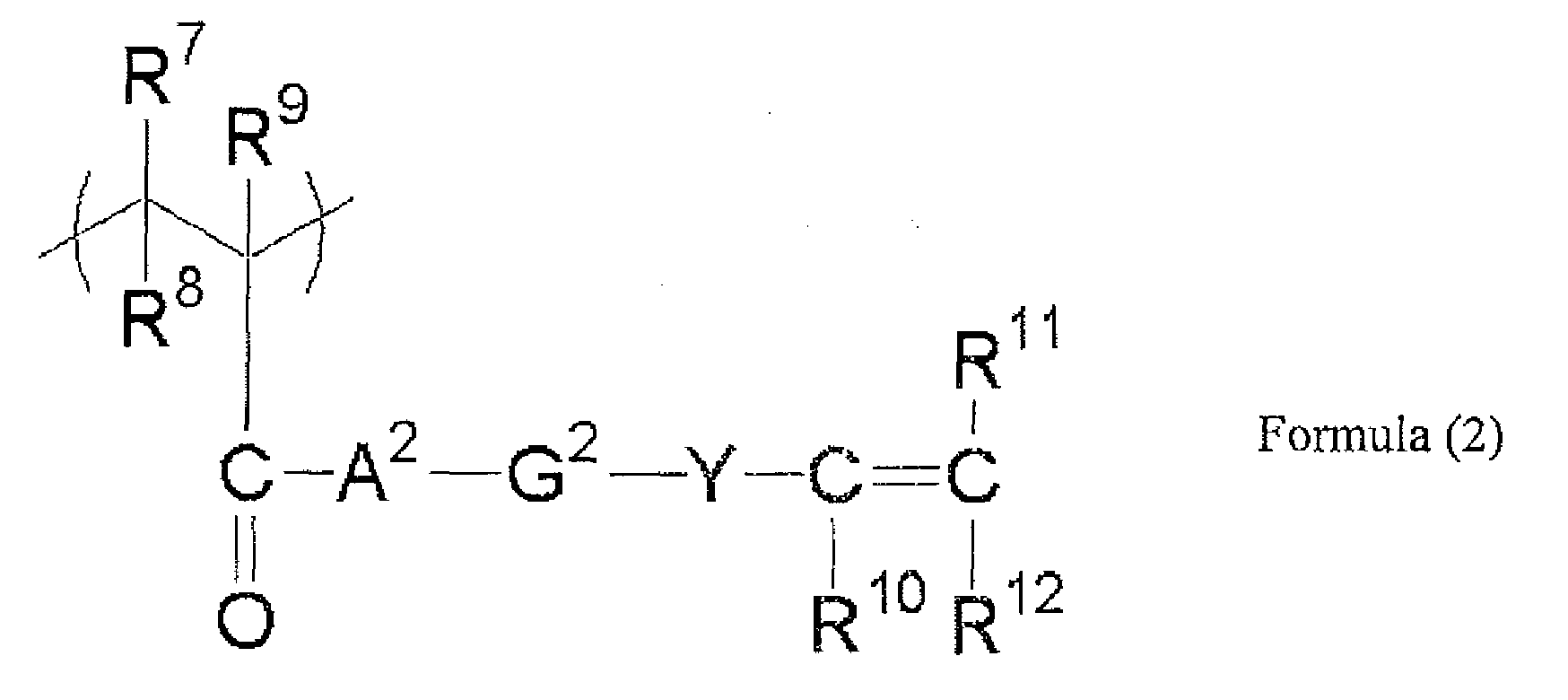
-

-

- In Formulae (1) to (3), A1, A2 and A3 each independently represent an oxygen atom, a sulfur atom, or -N(R21)-; R21 represents an alkyl group which may have a substituent; G1, G2 and G3 each independently represent a divalent organic group; X and Z each independently represent an oxygen atom, a sulfur atom, or -N(R22)-; R22 represents an alkyl group which may have a substituent; Y represents an oxygen atom, a sulfur atom, a phenylene group which may have a substituent, or -N(R23)-; R23 represents an alkyl group which may have a substituent; and R1 to R20 each independently represent a hydrogen atom or a monovalent substituent. In Formula (4), RA represents hydrogen or an alkyl group having 1 to 6 carbon atoms; and RB represents a divalent connecting group.
- A fifth aspect of the invention provides a colored curable composition according to any one of the first to fourth aspects, wherein the content of the colorant is from 50 mass% to 90 mass% with respect to the total solid content of the colored curable composition.
- A sixth aspect of the invention provides a color filter, containing a colored pattern formed from the colored curable composition according to any one of the first to fifth aspects.
- A seventh aspect of the invention provides a method of producing a color filter, including:
- applying the colored curable composition according to any one of the first to fifth aspects onto a support to form a colored curable composition layer;
- exposing the colored curable composition layer through a mask; and
- developing the colored curable composition layer after exposure to form a colored pattern.
- According to the present invention, a colored curable composition may be provided which is cured with high sensitivity and which has favorable pattern formation properties and excellent removability of an uncured portion even when a colorant is contained at a high concentration. Moreover, a color filter may be provided which has a colored pattern with a favorable shape wherein, in the color filter, a residue in a region where no colored pattern is formed is reduced. Further a method capable of producing the color filter at a high productivity and a solid state image pickup device equipped with the color filter are also provided.
-
Fig. 1 is a view illustrating a classification of the degree of development residue generation. - A colored curable composition of the invention contains at least a (A) photopolymerization initiator represented by Formula (1) and having a molar extinction coefficient at a wavelength of 365 nm of from 12,000 to 500,000 (hereinafter, also referred to as a "specific photopolymerization initiator"), (B) a polymerizable compound; and (C) a colorant.
- The specific photopolymerization initiator is a compound that has a molar extinction coefficient at a wavelength of 365 nm of from 12,000 to 500,000 and that is represented by Formula (I). When the molar extinction coefficient at a wavelength of 365 nm is from 12,000 to 500,000, the polymerizable compound can be polymerized with high sensitivity even when a colorant is contained at a high concentration in a coloring composition.
From the viewpoint of sensitivity, the molar extinction coefficient at a wavelength of 365 nm is preferably from 12,000 to 300,000, more preferably from 13,000 to 300,000, and particularly preferably from 14,000 to 200,000.
The molar extinction coefficient mentioned herein refers to a value measured at a concentration of 0.01 g/L in an ethyl acetate solvent for spectral analysis with an UV-Vis spectrophotometer (Carry-5 (trade name) spectrophotometer manufactured by Varian). - Hereinafter, Formula (I) will be described.

- In Formula (I), R and B each independently represent a monovalent organic group; X represents a monovalent substituent; Y1 and Y2 each independently represent a hydrogen atom or a monovalent substituent; and n1 represents an integer of from 0 to 4.
- The specific photopolymerization initiator represented by Formula (I) will be described in detail.
- Examples of the monovalent organic group represented by R include an alkyl group which may have a substituent, an aryl group which may have a substituent, an alkenyl group which may have a substituent, an alkynyl group which may have a substituent, an alkylsulfinyl group which may have a substituent, an arylsulfinyl group which may have a substituent, an alkylsulfonyl group which may have a substituent, an arylsulfonyl group which may have a substituent, an acyl group which may have a substituent, an alkoxycarbonyl group which may have a substituent, an aryloxycarbonyl group which may have a substituent, a phosphinoyl group which may have a substituent, a heterocyclic group which may have a substituent, an alkylthiocarbonyl group which may have a substituent, an arylthiocarbonyl group which may have a substituent, a dialkylaminocarbonyl group which may have a substituent, and a dialkylaminothiocarbonyl group which may have a substituent.
- The alkyl which may have a substituent is preferably an alkyl group having 1 to 30 carbon atoms, and examples include a methyl group, an ethyl group, a propyl group, a butyl group, a hexyl group, an octyl group, a decyl group, a dodecyl group, an octadecyl grouop, an isopropyl group, an isobutyl group, a sec-butyl group, a tert-butyl group, a 1-ethylpentyl group, a cyclopentyl group, a cyclohexyl group, a trifluoromethyl grouop, a 2-ethylhexyl group, a phenacyl group, a 1-naphthoylmethyl group, a 2-naphthoylmethyl group, a 4-methylsulfanylphenacyl group, a 4-phenylsulfanylphenacyl group, a 4-dimethylaminophenacyl group, a 4-cyanophenacyl group, a 4-methylphenacyl group, a 2-methylphenacyl group, a 3-fluorophenacyl group, a 3-trifluoromethylphenacyl group, and a 3-nitrophenacyl group.
- The aryl group which may have a substituent is preferably an aryl group having 6 to 30 carbon atoms, and examples include a phenyl group, a biphenyl group, a 1-naphthyl group, a 2-naphthyl group, a 9-anthryl group, a 9-phenanthryl group, a 1-pyrenyl group, a 5-naphthacenyl group, a 1-indenyl group, a 2-azulenyl group, a 9-fluorenyl group, a terphenyl group, a quarterphenyl group, an o-tolyl group, a m-tolyl group, a p-tolyl group, a xylyl group, an o-cumenyl group, a m-cumenyl group, a p-cumenyl group, a mesityl group, a pentalenyl group, a binaphthalenyl group, a temaphthalenyl group, a quarternaphthalenyl group, a heptalenyl group, a biphenylenyl group, an indacenyl group, a fluoranthenyl group, an acenaphthylenyl group, an aceanthrylenyl group, a phenalenyl group, a fluorenyl group, an anthryl group, a bianthracenyl group, a teranthracenyl group, a quarteranthracenyl group, an anthraquinonyl group, a phenanthryl group, a triphenylenyl group, a pyrenyl group, a chrysenyl group, a naphthacenyl group, a pleiadenyl group, a picenyl group, a perylenyl group, a pentaphenyl group, a pentacenyl group, a tetraphenylenyl group, a hexaphenyl group, a hexacenyl group, a rubicenyl group, a coronenyl group, a trinaphthylenyl group, a heptaphenyl group, a heptacenyl group, a pyranthrenyl group, and an ovalenyl group.
- The alkenyl group which may have a substituent is preferably an alkenyl group having 2 to 10 carbon atoms, and examples include a vinyl group, an allyl group and a styryl group.
- The alkynyl group which may have a substituent is preferably an alkynyl group having 2 to 10 carbon atoms, and examples include an ethynyl group, a propynyl group and a propargyl group.
- The alkylsulfinyl group which may have a substituent is preferably an alkylsulfinyl group having 1 to 20 carbon atoms, and examples include a methylsulfinyl group, an ethylsulfinyl group, a propylsulfinyl group, an isopropylsulfinyl group, a butylsulfinyl group, a hexylsulfinyl group, a cyclohexylsulfinyl group, an octylsulfinyl group, a 2-ethylhexylsulfinyl group, a decanoylsulfinyl group, a dodecanoylsulfinyl group, an octadecanoylsulfinyl group, a cyanomethylsulfinyl group, and a methoxymethylsulfinyl group.
- The arylsulfinyl group which may have a substituent is preferably an arylsulfinyl group having 6 to 30 carbon atoms, and examples include a phenylsulfinyl group, a 1-naphthylsulfinyl group, a 2-naphthylsulfinyl group, a 2-chlorophenylsulfinyl group, a 2-methylphenylsulfinyl group, a 2-methoxyplienylsulfinyl group, a 2-butoxyphenylsulfinyl group, a 3-chlorophenylsulfinyl group, a 3-trifluoromethylphenylsulfinyl group, a 3-cyanophenylsulfinyl group, a 3-nitrophenylsulfinyl group, a 4-fluorophenylsulfinyl group, a 4-cyanophenylsulfinyl group, a 4-methoxyphenylsulfinyl group, a 4-methylsulfanylphenylsulfinyl group, a 4-phenylsulfanylphenylsulfinyl group, and a 4-dimethylaminophenylsulfinyl group.
- The alkylsulfonyl group which may have a substituent is preferably an alkylsulfonyl group having 1 to 20 carbon atoms, and examples include a methylsulfonyl group, an ethylsulfonyl group, a propylsulfonyl group, an isopropylsulfonyl group, a butylsulfonyl group, a hexylsulfonyl group, a cyclohexylsulfonyl group, an octylsulfonyl group, a 2-ethylhexylsulfonyl group, a decanoylsulfonyl group, a dodecanoylsulfonyl group, an octadecanoylsulfonyl group, a cyanomethylsulfonyl group, a methoxymethylsulfonyl group, and a perfluoroalkylsulfonyl group.
- The arylsulfonyl group which may have a substituent is preferably an arylsulfonyl group having 6 to 30 carbon atoms, and examples include a phenylsulfonyl group, a 1-naphthylsulfonyl group, a 2-naphthylsulfonyl group, a 2-chlorophenylsulfonyl group, a 2-naethylphenylsulfonyl group, a 2-methoxyphenylsulfonyl group, a 2-butoxyphenylsulfonyl group, a 3-chlorophenylsulfonyl group, a 3-trifluoromethylphenylsulfonyl group, a 3-cyanophenylsulfonyl group, a 3-nitrophenylsulfouyl group, a 4-fluorophenylsulfonyl group, a 4-cyanophenylsulfonyl group, a 4-methoxypheuylsulfonyl group, a 4-methylsulfanylphenylsulfonyl group, a 4-phonylsulfanylphenylsulfonyl group, and a 4-dimethylaminophenylsulfonyl group.
- The acyl group which may have a substituent is preferably an acyl group having 2 to 20 carbon atoms, and examples include an acetyl group, a propanoyl group, a butanoyl group, a trifluoromethylcarbonyl group, a pentanoyl group, a benzoyl group, a 1-naphthoyl group, a 2-naphthoyl group, a 4-methylsulfanylbenzoyl group, a 4-phenylsulfanylbenzoyl group, a 4-dimethylaminobenzoyl group, a 4-diethylaminobenzoyl group, a 2-chlorobenzoyl group, a 2-methylbenzoyl group, a 2-methoxybenzoyl group, a 2-butoxybenzoyl group, a 3-chlorobenzoyl group, a 3-trifluoromethylbenzoyl group, a 3-cyanobenzoyl group, a 3-nitrobenzoyl group, a 4-fluorobenzoyl group, a 4-cyanobenzoyl group, and a 4-methoxybenzoyl group.
- The alkoxycarbonyl group which may have a substituent is preferably an alkoxycarbonyl group having 2 to 20 carbon atoms, and examples include a methoxycarbonyl group, an ethoxycarbonyl group, a propoxycarbonyl group, a butoxycarbonyl group, a hexyloxycarbonyl group, an octyloxycarbonyl group, a decyloxycarbonyl group, an octadecyloxycarbonyl group, and a trifluoromethyloxycarbonyl group.
- Examples of the aryloxycarbonyl group which may have a substituent include a phenoxycarbonyl group, a 1-naphthyloxycarbonyl group, a 2-naphthyloxycarbonyl group, a 4-methylsulfanylphenyloxycarbonyl group, a 4-phenylsulfanylphenyloxycarbonyl group, a 4-dimethylaminophenyloxycarbonyl group, a 4-diethylaminophenyloxycarbonyl group, a 2-chlorophenyloxycarbonyl group, a 2-methylphenyloxycarbonyl group, a 2-methoxyphenyloxycarbonyl group, a 2-butoxyphenyloxycarbonyl group, a 3-chlorophenyloxycarbonyl group, a 3-trifluoromethylphenyloxycarbonyl group, a 3-cyanophenyloxycarbonyl group, a 3-nitrophenyloxycarbonyl group, a 4-fluorophenyloxycarbonyl group, a 4-cyanophenyloxycarbonyl group, and a 4-methoxyphenyloxycarbonyl group.
- The phosphinoyl group which may have a substituent is preferably a phosphinoyl group having 2 to 50 carbon atoms in total, and examples include a dimethylphosphinoyl group, a diethylphosphinoyl group, a dipropylphosphinoyl group, a diphenylphosphinoyl group, a dimethoxyphosphinoyl group, a diethoxyphosphinoyl group, a dibenzoylphosphinoyl group, and a bis(2,4,6-trimethylphenyl)phosphinoyl group.
- The heterocyclic group which may have a substituent is preferably an aromatic or aliphatic heterocyclic group containing at least one heteroatom selected from nitrogen, oxygen, sulfur, and phosphorus atoms. Examples include a thienyl group, a benzo[b]thienyl group, a naphtho[2,3-b]thienyl group, a thianthrenyl group, a furyl group, a pyranyl group, an isobenzofuranyl group, a chromenyl group, a xanthenyl group, a phenoxathiinyl group, a 2H-pyrrolyl group, a pyrrolyl group, an imidazolyl group, a pyrazolyl group, a pyridyl group, a pyrazinyl group, a pyrimidinyl group, a pyridazinyl group, an indolizinyl group, an isoindolyl group, a 3H-indolyl group, an indolyl group, a 1H-indazolyl group, a purinyl group, a 4H-quinolizinyl group, an isoquinolyl group, a quinolyl group, a phthalazinyl group, a naphthyridinyl group, a quinoxalinyl group, a quinazolinyl group, a cinnolinyl group, a pteridinyl group, a 4aH-carbazolyl group, a carbazolyl group, a β-carbolinyl group, a phenanthridinyl group, an acrindinyl group, a perimidinyl group, a phenanthrolinyl group, a phenazinyl group, a phenarsazinyl group, an isothiazolyl group, a phenothiazinyl group, an isoxazolyl group, a furazanyl group, a phenoxazinyl group, an isochromanyl group, a chromanyl group, a pyrrolidinyl group, a pyrrolinyl group, an imidazolidinyl group, an imidazolinyl group, a pyrazolidinyl group, a pyrazolinyl group, a piperidyl group, a piperazinyl group, an indolinyl group, an isoindolinyl group, a quinuclidinyl group, a morpholinyl group, and a thioxanthonyl group.
- Examples of the alkylthiocarbonyl group which may have a substituent include a methylthiocarbonyl group, a propylthiocarbonyl group, a butylthiocarbonyl group, a hexylthiocarbonyl group, an octylthiocarbonyl group, a decylthiocarbonyl group, an octadecylthiocarbonyl group, and a trifluoromethylthiocarbonyl group.
- Examples of the aryl thiocarbonyl group which may have a substituent include a 1-naphthylthiocarbonyl group, a 2-naphthylthiocarbonyl group, a 4-methylsulfanylphenylthiocarbonyl group, a 4-phenylsulfanylphenylthiocarbonyl group, a 4-dimethylaminophenylthiocarbonyl group, a 4-diethylaminophenylthiocarbonyl group, a 2-chlorophenylthiocarbonyl group, a 2-methylphenylthiocarbonyl group, a 2-methoxyphenythiocarbonyl group, a 2-butoxyphenylthiocarbonyl group, a 3-chlorophenylthiocarbonyl group, a 3-trifluoromethylphenylthiocarbonyl group, a 3-cyanophenylthiocarbonyl group, a 3-nitrophenylthiocarbonyl group, a 4-fluorophenylthiocarbonyl group, a 4-cyanophenylthiocarbonyl group, and a 4-methoxyphenylthiocarbonyl group.
- Examples of the dialkylaminocarbonyl group which may have a substituent include a dimethylaminocarbonyl group, a diethylaminocarbonyl group, a dipropylaminocarbonyl group, and a dibutylaminocarbonyl group.
- Examples of the dialkylaminothiocarbonyl group which may have a substituent include a dimethylaminothiocarbonyl group, a dipropylaminothiocarbonyl group, and a dibutylaminothiocarbonyl group.
- Among the above, from the viewpoint of increasing the sensitivity, the acyl group is more preferable as the monovalent organic group of represented by R. Specifically, an acetyl group, a propionyl group, a benzoyl, and a toluyl group are preferable.
- As to specific examples of the monovalent organic group represented by R in Formula (I), the following are preferable from the viewpoint of obtaining higher sensitivity.
-


- Examples of the monovalent organic group represented by B include a phenyl group (which may be substituted by at least one of an alkyl group having 1 to 6 carbon atoms, a phenyl group, a halogen atom, -OR8; -SR9, or -N (R10) (R11)); an alkyl group having 1 to 20 carbon atoms (wherein, when the number of the carbon atoms of the alkyl group is from 2 to 20, the alkyl group may have at least one oxygen atom and/or at least one S atom between carbon atoms in the main chain, and the alkyl group may be substituted by at least one hydroxy group); an alkenyl group having 1 to 20 carbon atoms (wherein, when the number of the carbon atoms of the alkenyl group is from 2 to 20, the alkenyl group may have at least one oxygen atom and/or at least one S atom between carbon atoms in the main chain, and the alkenyl group may be substituted by at least one hydroxy group); an alkynyl group having 1 to 20 carbon atoms (wherein, when the number of carbon atoms of an alkynyl group is from 2 to 20, the alkynyl group may have at least one oxygen atom and/or at least one S atom between carbon atoms in the main chain, and the alkynyl group may be substituted by at least one hydroxy group); a cycloalkyl group having 5 to 8 carbon atoms; an alkanoyl group having 2 to 20 carbon atoms; a benzoyl group (which may be substituted by at least one of an alkyl group having 1 to 6 carbon atoms, a phenyl group, -OR8, -SR9; or -N (R10) (R11)); an alkoxycarbonyl group having 2 to 12 carbon atoms (wherein, when the number of carbon atoms of the alkoxyl group is from 2 to 11, the alkoxyl group may have at least one oxygen atom between carbon atoms in the main chain, and the alkoxyl group may be substituted by at least one hydroxy group); a phenoxy carbonyl group (which may be substituted by at least one of an alkyl group having 1 to 6 carbon atoms, a phenyl group, halogen atom, -OR8, or -N (R10) (R11)); a cyano group; a nitro group; -CON (R10) (R11); a haloalkyl group having 1 to 4 carbon atoms; - S (O) m-R12 (wherein R12 represents an alkyl group having 1 to 6 carbon atoms and m is an integer of from 0 to 2); -S (O) m-R13 (wherein R13 represents an aryl group having 6 to 12 carbon atoms and may be substituted by an alkyl group having 1 to 12 carbon atoms, and m is an integer of from 0 to 2); an alkoxysulfonyl group having 1 to 6 carbon atoms; an aryloxysulfonyl group having 6 to 10 carbon atoms; or a diphenylphosphinoyl group.
- R8 represents a hydrogen atom, an alkyl group having 1 to 12 carbon atoms, a substituted alkyl group having 2 to 6 carbon atoms {wherein the substituent contains at least one of a hydroxy group, a mercapto group, a cyano group, an alkoxyl group having 1 to 4 carbon atoms, an alkenyloxy group having 3 to 6 carbon atoms, a 2-cyanoethoxy group, or a 2-(alkoxycarbonyl)ethoxy group having 4 to 7 carbon atoms, an alkylcarbonyloxy group having 2 to 5 carbon atoms, a phenyl carbonyloxy group, a carboxyl group, or an alkoxycarbonyl group having 2 to 5 carbon atoms}, an alkyl group having 2 to 6 carbon atoms which has at least one oxygen atom between carbon atoms in the main chain, an alkanoyl group having 2 to 8 carbon atoms, -(CH2CH2O) nH (wherein, n is an integer of from 1 to 20); an alkenyl group having 3 to 12 carbon atoms, an alkenoyl group having 3 to 6 carbon atoms, a cyclohexyl group, a phenyl group (which may be substituted by a halogen atom, an alkyl group having 1 to 12 carbon atoms, or an alkoxyl group having 1 to 4 carbon atoms), a phenylalkyl group having 7 to 9 carbon atoms, or -Si(R14) r (R15)3-r (wherein R14 represents an alkyl group having 1 to 8 carbon atoms, R15 represents a phenyl group, and r is an integer of from 1 to 3).
- R9 represents a hydrogen atom, an alkyl group having 1 to 12 carbon atoms, an alkenyl group having 3 to 12 carbon atoms, a cyclohexyl group, a substituted alkyl group having 2 to 6 carbon atoms {wherein the substituent contains at least one of a hydroxy group, a mercapto group, a cyano group, an alkoxyl group having 1 to 4 carbon atoms, an alkenyloxy group having 3 to 6 carbon atoms, a 2-cyanoethoxy group, a 2-(alkoxycarbonyl) ethoxy group having 4 to 7 carbon atoms, an alkylcarbonyloxy group having 2 to 5 carbon atoms, a phenyl carbonyloxy group, a carboxyl group, or an alkoxycarbonyl group having 2 to 5 carbon atoms}, an alkyl group having 2 to 12 carbon atoms having at least one oxygen atom and/or at least one sulfur atom between carbon atoms in the main chain, a phenyl group (which may be substituted by a halogen atom, an alkyl group having 1 to 12 carbon atoms, or an alkoxyl group having 1 to 4 carbon atoms), or a phenylalkyl group having 7 to 9 carbon atoms.
- Examples of the monovalent substituent represented by X, Y1, or Y2 include an alkyl group which may have a substituent, an aryl group which may have a substituent, an alkenyl group which may have a substituent, an alkynyl group which may have a substituent, an alkylsulfinyl group which may have a substituent, an arylsulfinyl group which may have a substituent, an alkylsulfonyl group which may have a substituent, an arylsulfonyl group which may have a substituent, an acyl group which may have a substituent, an alkoxycarbonyl group which may have a substituent, an aryloxycarbonyl group which may have a substituent, a phosphinoyl group which may have a substituent, a heterocyclic group which may have a substituent, an alkylthioxy group which may have a substituent, an arylthioxy group which may have a substituent, an alkyloxy group which may have a substituent, an aryloxy group which may have a substituent, an alkylthiocarbonyl group which may have a substituent, an arylthiocarbonyl group which may have a substituent, a dialkylamino carbonyl group which may have a substituent, a dialkylaminothiocarbonyl group which may have a substituent, a carboxylic acid group, a sulfonic acid group, a cyano group, a halogen atom, an amino group which may have a substituent, and a substituent obtained by combining two or more of the above-described monovalent substituents.
- Among the above, as the monovalent substituent represented by X, Y1, or Y2, a hydrogen atom, an alkoxycarbonyl group, a cyano group, and a phenyl group are preferable from the viewpoint of the improvement in the sensitivity and stability over time of the composition. Y1 and Y2 each preferably represent independently a hydrogen atom, an alkoxycarbonyl group, a cyano group, or a phenyl group from the viewpoint of the improvement in the sensitivity and stability over time of the composition.
- Two substituents selected from the monovalent substituents represented by X, Y1, and Y2 may be combined to each other to form a ring structure.
- n1 represents an integer of from 0 to 4, preferably an integer of from 0 to 2, and more preferably 1. When n1 represents an integer of from 2 to 4, there are plural Xs, which may represent the same substituent as each other or different substituents from each other.
- The following partial structure (III) is a partial structure to be connected to the carbonyl carbon in Formula (I). Examples of the partial structure (III) include, but are not limited to, the following partial structures. The details of X, Y1, Y2, and n1 in the following partial structure (III) are as described above in the description of Formula (I).
-

-


-

- The specific photopolymerization initiator is more preferably represented by Formula (II).
-

- In Formula (II), R, B, and Q each independently represent a monovalent organic group; Z represents a monovalent substituent; and n2 represents an integer of from 0 to 5.
- B in Formula (II) has the same definition and preferable range as those ofB in Formula (I),
Q in Formula (II) has the same definition as that of B in Formula (I). Examples of the group represented by Q include those described as examples of B. The group represented by Q is preferably an alkyl group having 1 to 20 carbon atoms, and is most preferably an ethyl group. R in Formula (II) has the same definition and preferable range as those of R in Formula (I). - Examples of the monovalent substituent represented by Z include a halogen group, such as a fluorine atom, a chlorine atom, a bromine atom, or an iodine atom; an alkoxy group, such as a methoxy group, an ethoxy group, or a tert-butoxy group; an aryloxy group, such as a phenoxy group or a p-tolyloxy group; an alkoxycarbonyl group, such a methoxycarbonyl group, a butoxycarbonyl group, or a phenoxycarbonyl group; an acyloxy group, such as an acetoxy group, a propionyloxy group, or a benzoyloxy group; an acyl group, such as an acetyl group, a benzoyl group, an isobutyryl group, an acryloyl group, a methacryloyl group, or a methoxalyl group; an alkylsulfanyl group, such as a methylsulfanyl group or a tert-butylsulfanyl group; an arylsulfanyl group, such as a phenylsulfanyl group or a p-tolylsulfanyl group; an alkylamino group, such as a methylamino group or a cyclohexylamino group; a dialkylamino group, such as a dimethylamino group, a diethylamino group, a morpholino group, a piperidino group, or ajulolidine group; an arylamino group, such as a phenylamino group or a p-tolylamino group; an alkyl group, such as a methyl group, an ethyl group, a tert-butyl group, or a dodecyl group; an aryl group, such as a phenyl group, a p-tolyl group, a xylyl group, a cumenyl group, a naphthyl group, an anthryl group, or a phenanthryl group; a hydroxy group; a carboxy group; a formyl group; a mercapto group; a sulfo group; a mesyl group; a p-toluenesulfonyl group; an amino group; a nitro group; a cyano group; a trifluoromethyl group; a trichloromethyl group; a trimethylsilyl group; a phosphinico group; a phosphono group; a trimethylammoniumyl group; a dimethylsulfoniumyl group; a triphenylphenacylphosphoniumyl group; and a cyano group.
- n2 represents an integer of from 0 to 5, preferably an integer of from 0 to 3, and more preferably 0 or 1.
When n2 represents an integer of from 2 to 5, there are plural Zs, which may represent the same substituent as each other or different substituents from each other. - The following partial structure (IV), which is a partial structure to be connected to the carbonyl carbon in Formula (II), is a more preferable embodiment of the partial structure (III). Examples thereof include structures included in the scope of the partial structure (IV) among the structures mentioned above as examples of the partial structure (III). More specifically, examples of the following partial structure (IV) include, but are not limited to, the following structures among the structures mentioned above as examples of the partial structure (III).
It should be noted that the details of Z and n2 in the following partial structure (IV) are as described above in the description of Formula (II). -

-

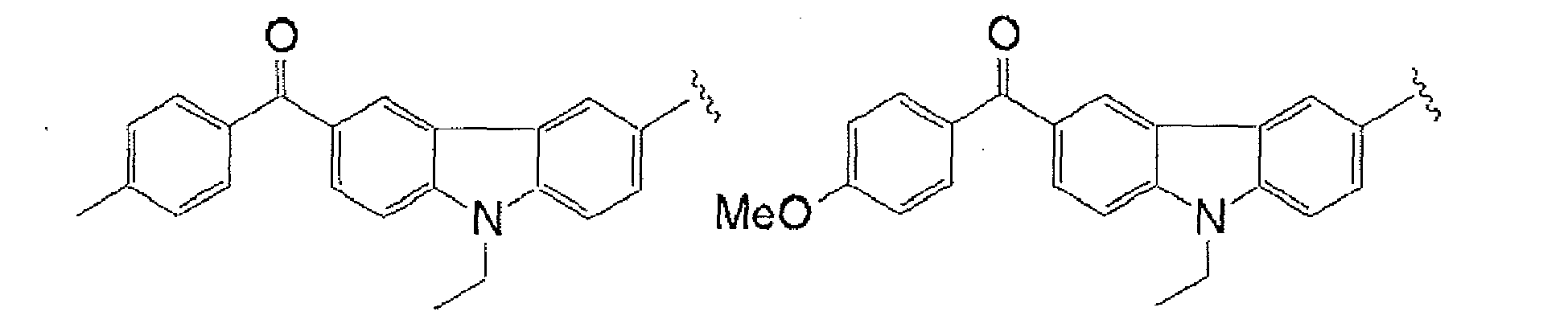


- Specific examples of the compound (specific photopolymerization initiator) represented by Formula (I) include, but are not limited to, those shown below.
The compound represented by Formula (I) has a molar extinction coefficient at 365 nm of from 12,000 to 500,000. In particular, when the structure represented by Formula (II) is employed, the molar extinction coefficient tends to be higher. Each specific example shown below has a molar extinction coefficient in the range of from 12,000 to 500,000. -


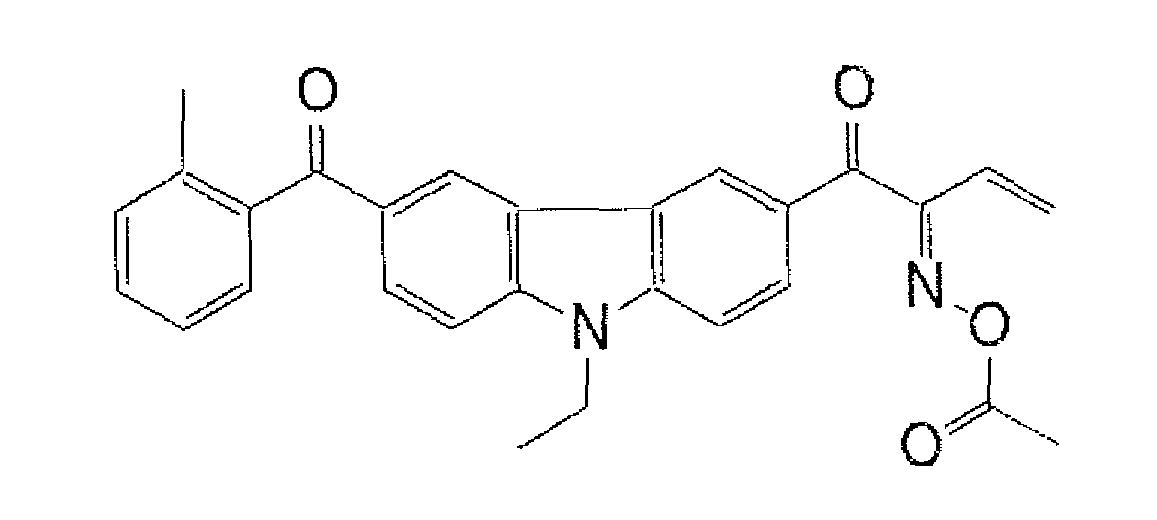

-


-


-


-


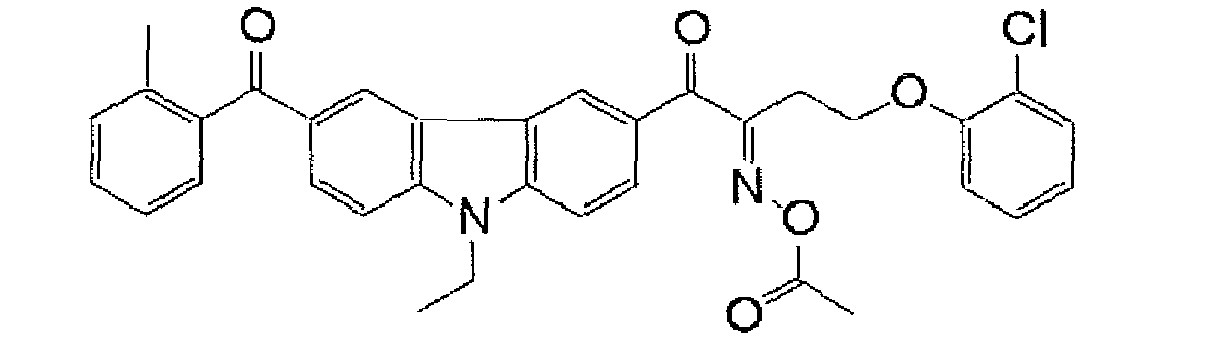


-


-


-


-


-

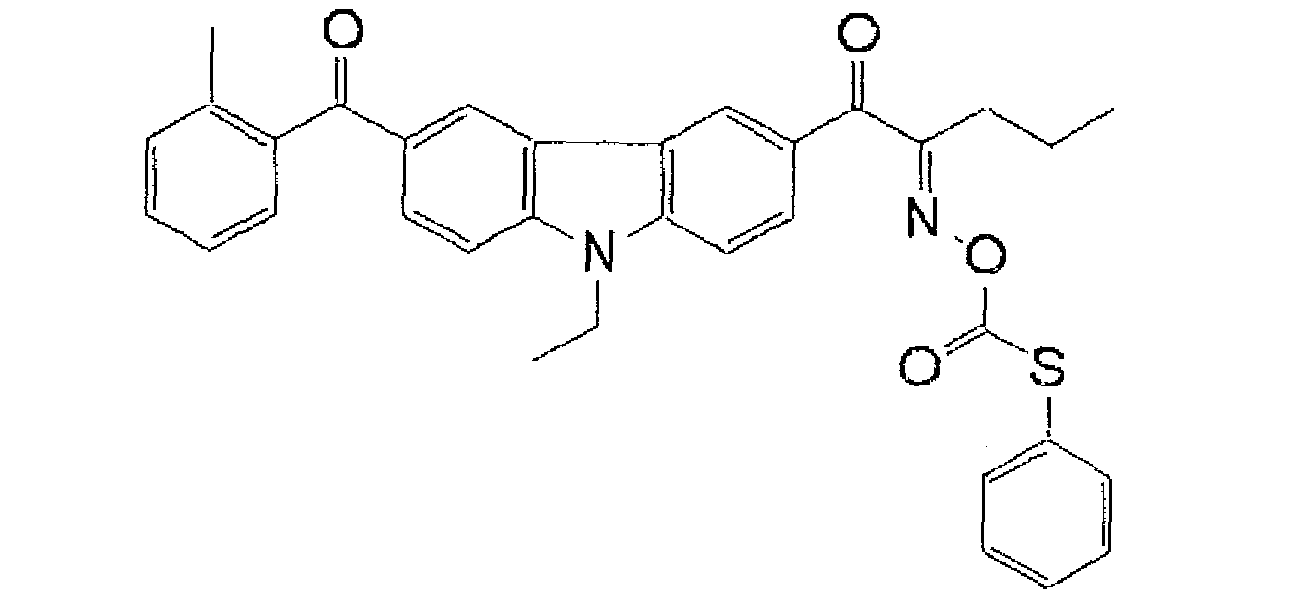


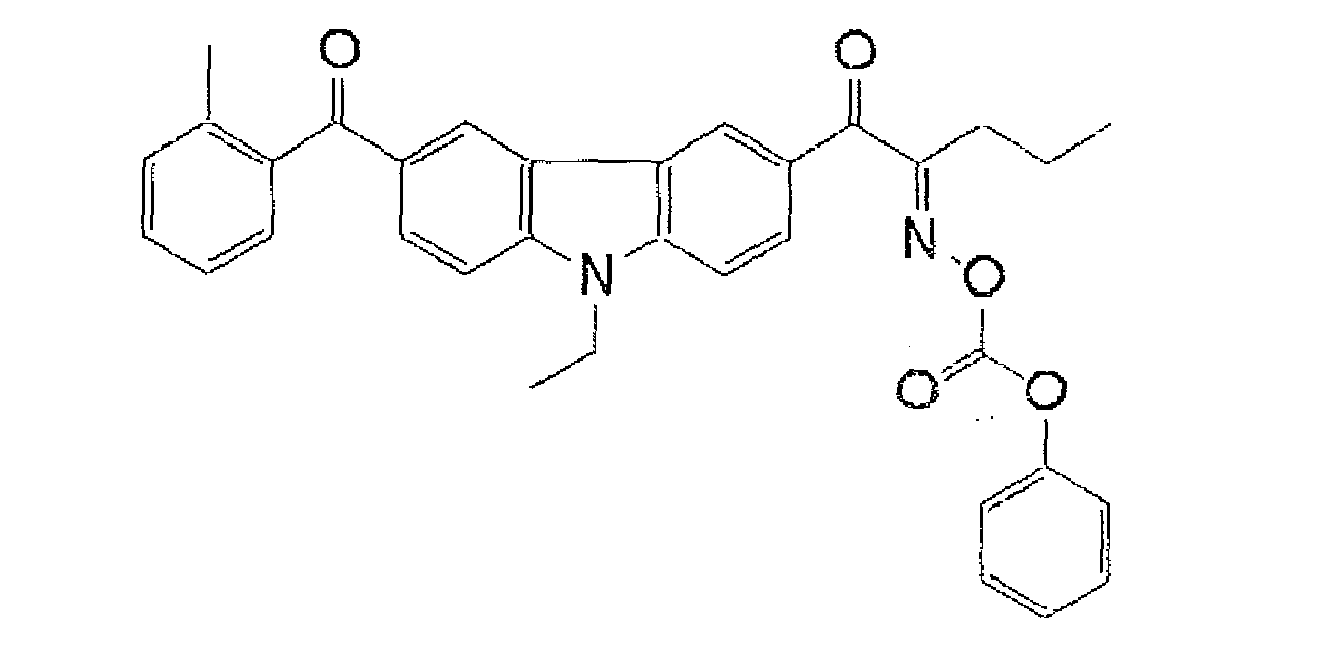
-


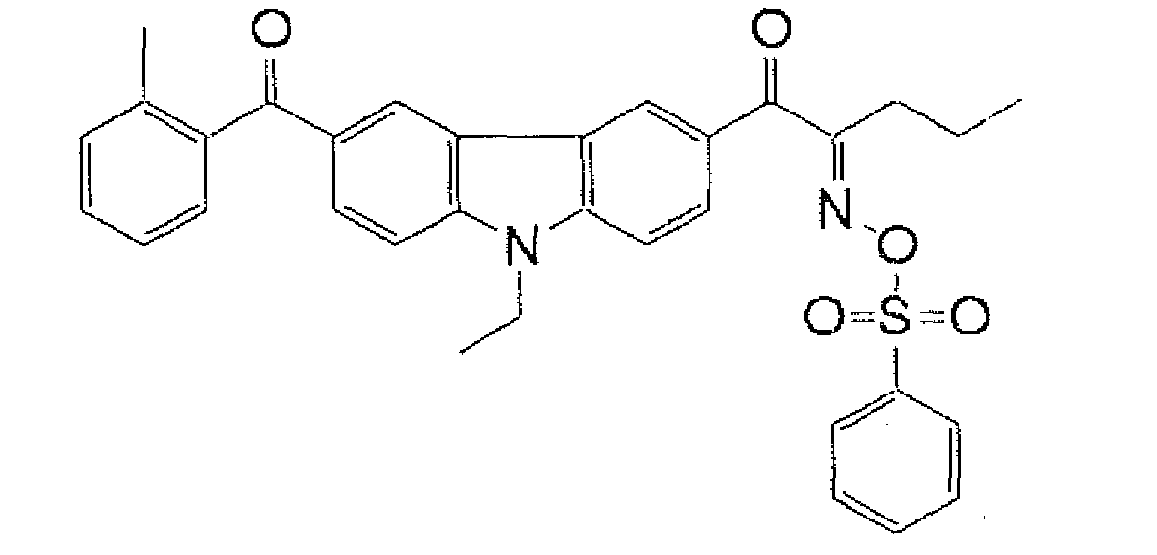


-


-


-


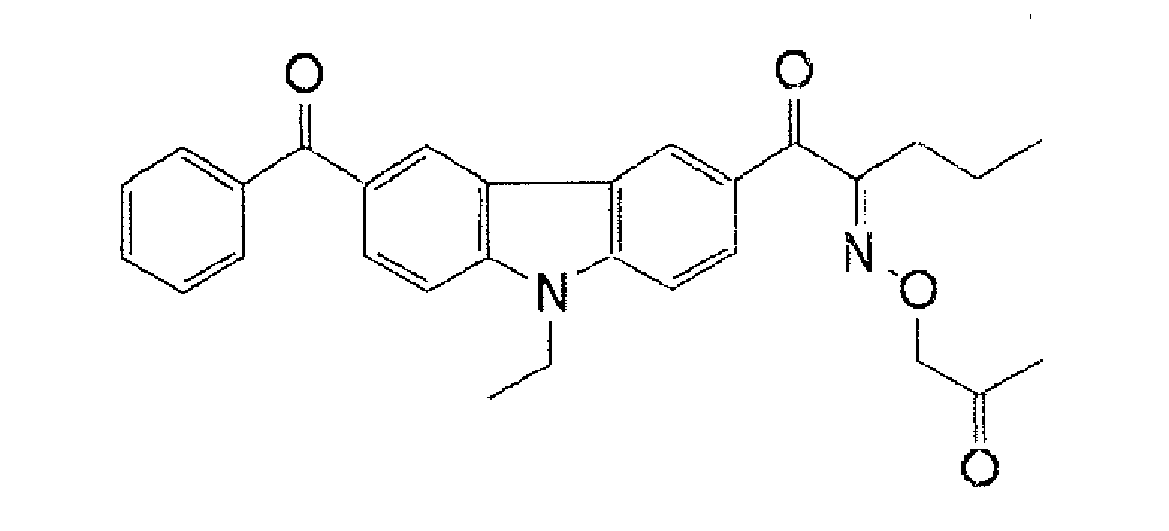
-


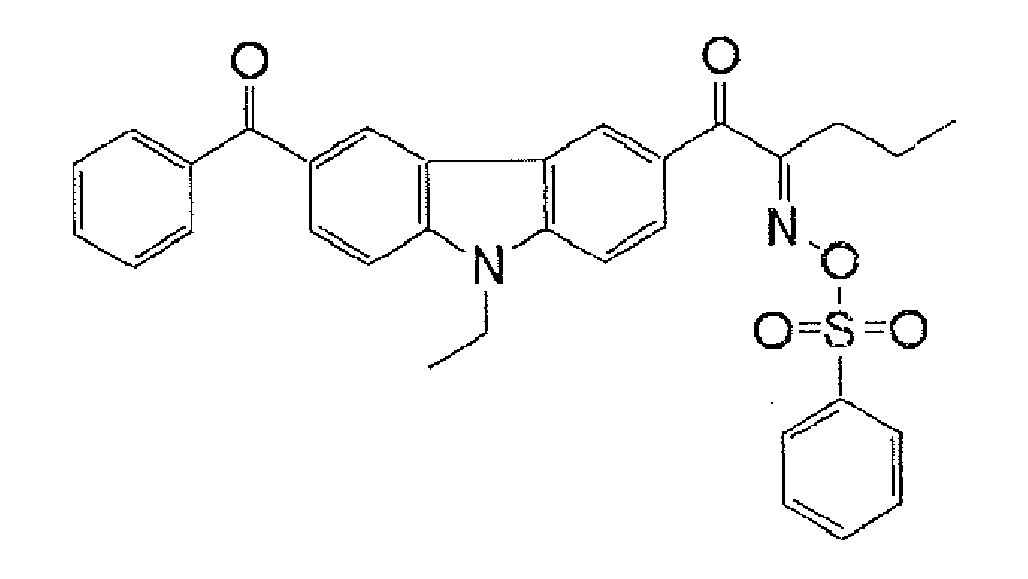
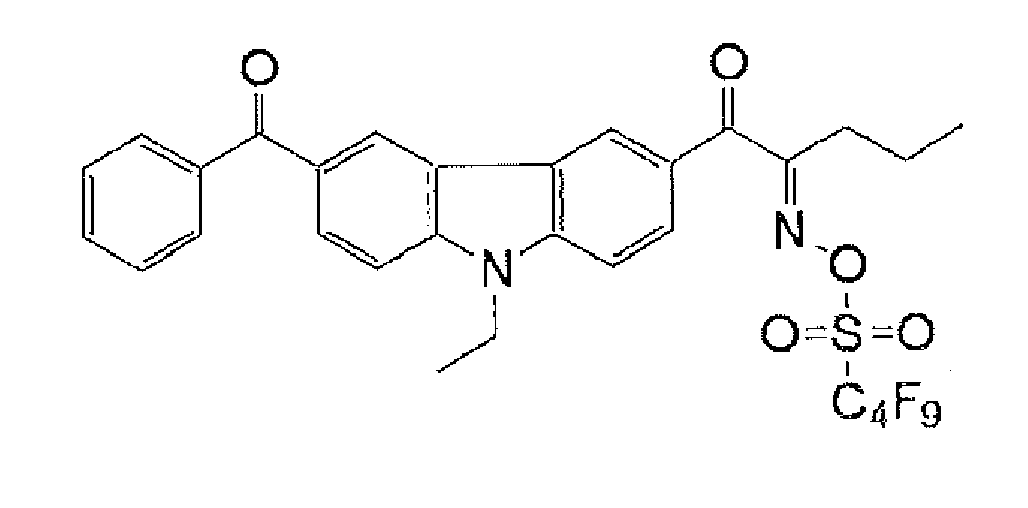
-


-


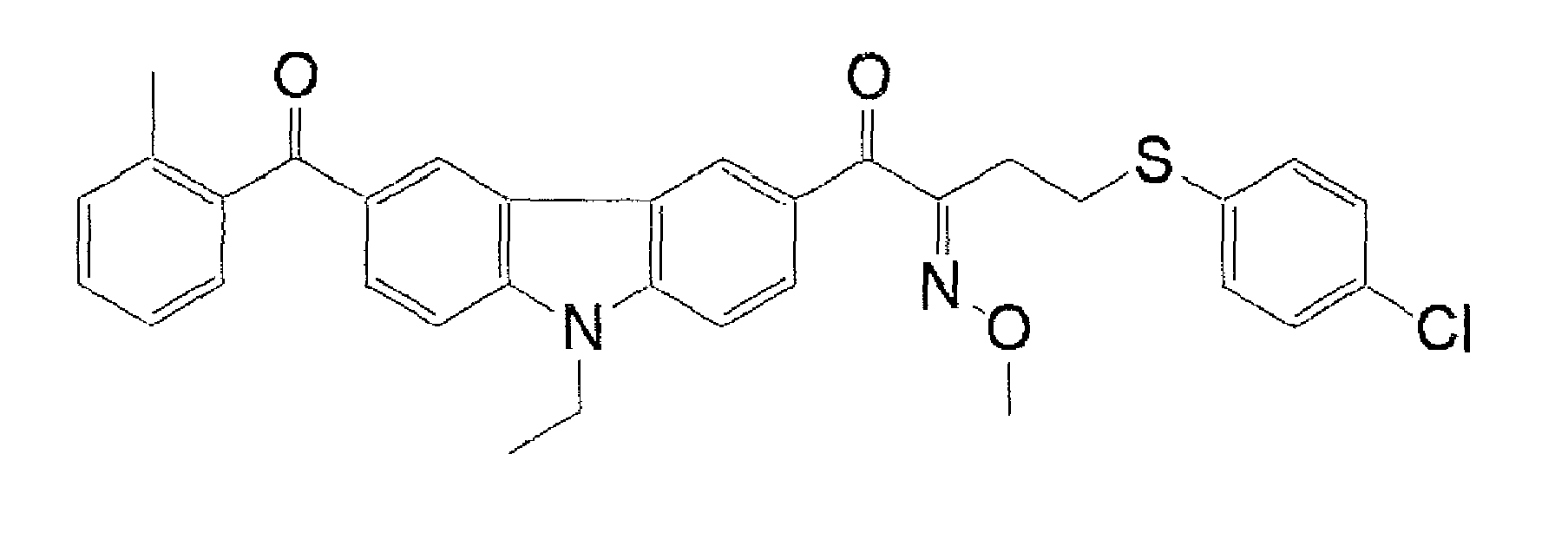
-
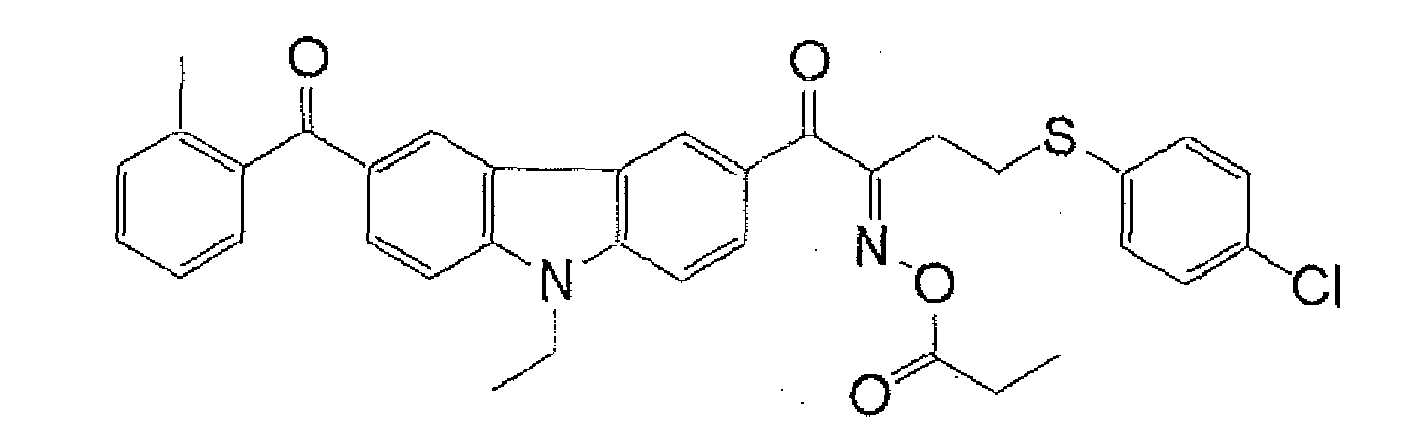


-

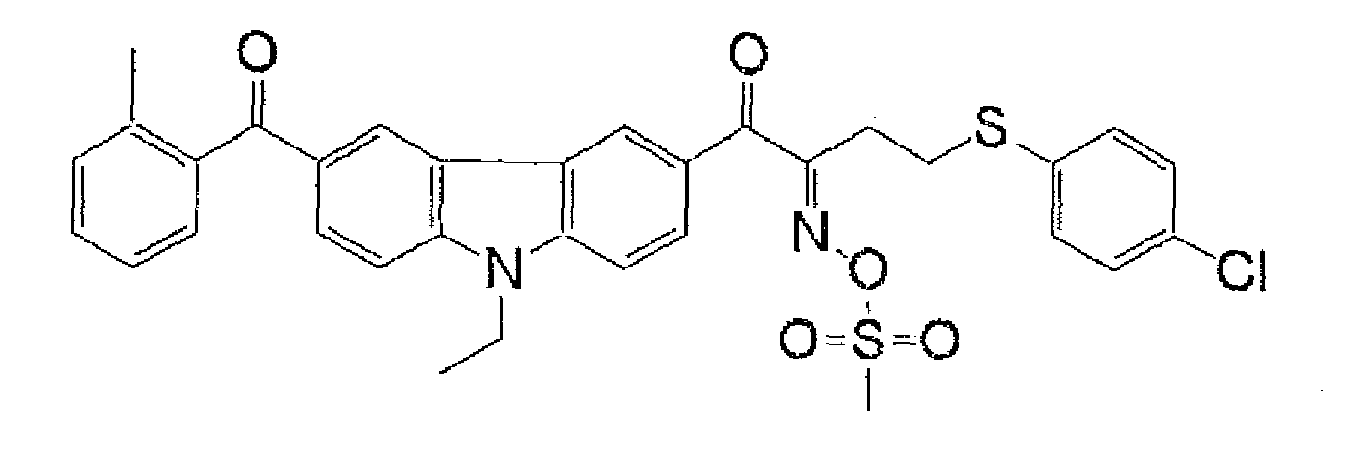


-


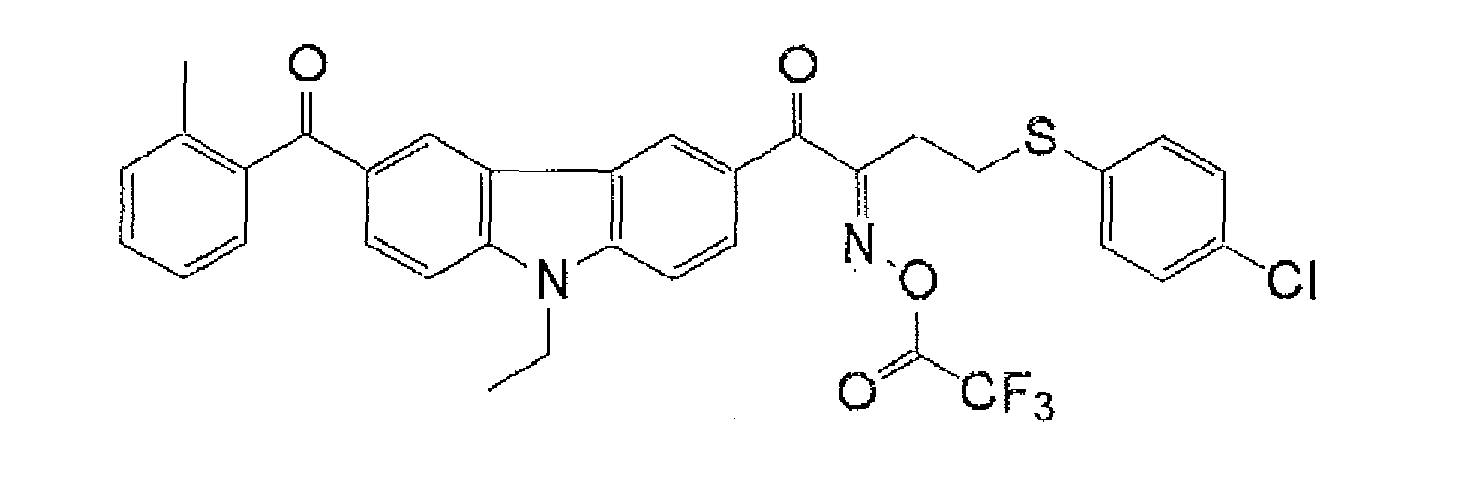
-


-


-


-

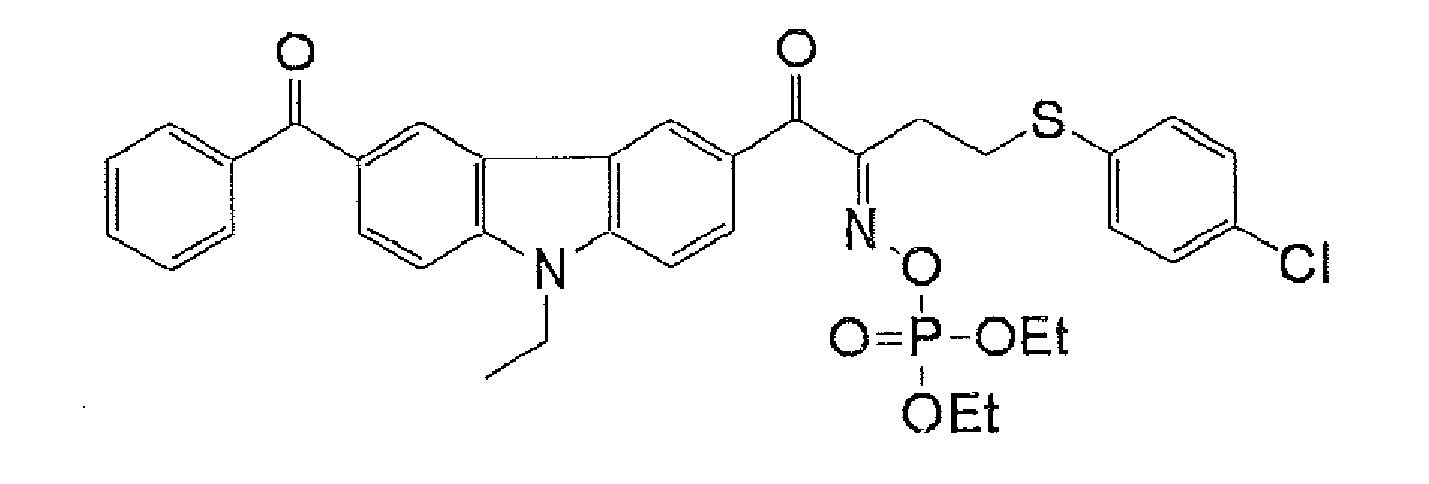


- The specific photopolymerization initiator represented by Formula (I) can be synthesized by a method shown below, for example, but a method of synthesizing the specific photopolymerization initiator represented by Formula (I) is not limited thereto.
-
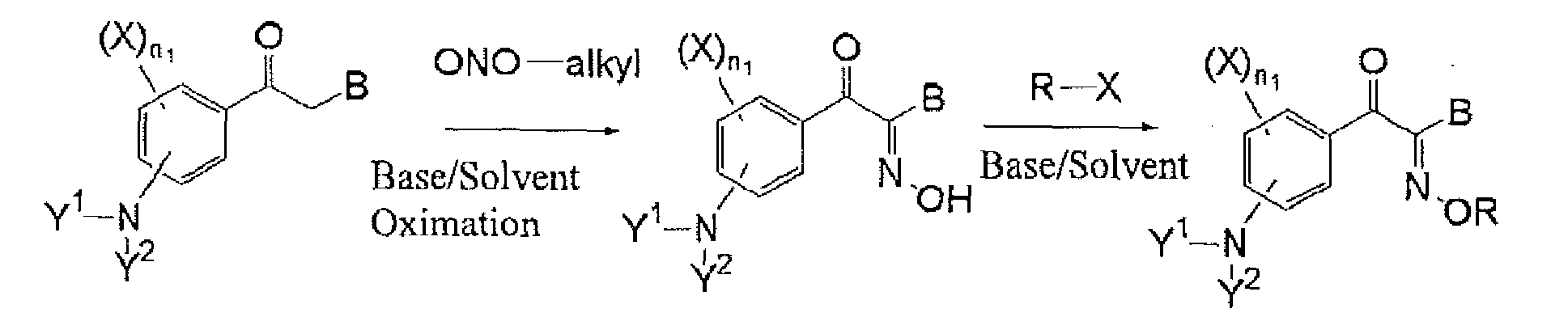
- In the method of synthesizing the specific photopolymerization initiator represented by Formula (I), the details of B, R, X, Y1, Y2, and n1 are as described above in the description of Formula (I).
More specifically, the specific photopolymerization initiator represented by Formula (I) can be synthesized by a method described below, for example. -
- Synthesis Example of specific photopolymerization initiator-Ethylcarbazole is dissolved in chlorobenzene. After the solution is cooled to 0°C, aluminum chloride is added thereto. Subsequently o-tolylchloride is added dropwise thereto over 40 minutes. The temperature of the reaction solution is increased to room temperature, and then the reaction solution is stirred for 3 hours. After the reaction solution is cooled to 0°C, aluminum chloride is added thereto. Then 4-chlorobutyrylchloride is added thereto dropwise over 40 minutes, the temperature of the reaction solution is increased to room temperature, and then the reaction solution is stirred for 3 hours. A mixed solution of an aqueous 35 wt% hydrochloric acid solution and distilled water is cooled to 0°C, and the reaction solution is added dropwise to the mixed solution. The precipitated solid is collected by suction filtration, washed with distilled water and methanol, and recrystallized from acetonitrile to obtain Compound A having the following structure.
-

- Next, Compound A is dissolved in THF, and 4-chlorobenzenethiol and sodium iodide are added thereto. Subsequently, sodium hydroxide is added to the reaction solution, and the reaction solution is refluxed for 2 hours. Furthermore, after the reaction solution is cooled to 0°C, SM-28 is added dropwise over 20 minutes. The temperature of the reaction solution is increased to room temperature, and then the reaction solution is stirred for 2 hours. Next, after the reaction solution is cooled to 0°C, isopentyl nitrite is added dropwise over 20 minutes. The temperature of the reaction solution is increased to room temperature, and then the reaction solution is stirred for 3 hours. The reaction solution is diluted with acetone, and then an aqueous 0.1N hydrochloric acid solution that has been cooled to 0°C is added dropwise. The precipitated solid is collected by suction filtration, washed with distilled water, and recrystallized from acetonitrile to obtain Compound B having the following structure.
-

- The compound B is dissolved in N-methylpyrrolidone, and then triethylamine is added thereto. Next, after the reaction solution is cooled to 0°C, acetyl chloride is added dropwise over 20 minutes. The temperature of the reaction solution is increased to room temperature, and the reaction solution is stirred for 2 hours. The reaction solution is added dropwise to distilled water that has been cooled to 0°C. The precipitated solid is collected by suction filtration, washed with isopropyl alcohol that has been cooled to 0°C, and then dried to obtain the specific photopolymerization initiator.
-

- A desired specific photopolymerization initiator represented by Formula (I) can be obtained in a similar manner to the synthesis example described above, by changing, as necessary, ethylcarbazole, o-tolylchloride, and 4-chlorobutyrylchloride to other compounds such that the structure of the desired specific photopolymerization initiator can be obtained.
The structure of the obtained specific photopolymerization initiator can be identified by NMR. - The specific photopolymerization initiator represented by Formula (I) has a maximum absorption wavelength in a wavelength region at or around 365 nm, and is a compound that shows high absorption efficiency for light having a wavelength of 365 nm.
- The specific photopolymerization initiator represented by Formula (I) may be used singly or in combination of two or more thereof.
- The colored curable composition of the present invention may additionally contain a known photopolymerization initiator other than the specific photopolymerization initiator insofar as the effects of the present invention are not impaired,
The photopolymerization initiator which can be used additionally is a compound which is decomposed by light to thereby initiate and promote the polymerization of the polymerizable compound described later. The additional photopolymerization initiator preferably has absorption in a wavelength region of from 300 to 500 nm. Specific examples thereof include an organic halide compound, an oxydiazole compound, a carbonyl compound, a ketal compound, a benzoin compound, an acridine compound, an organic peroxide compound, an azo compound, a coumarin compound, an azide compound, a metallocene compound, a biimidazole compound, an organic boric acid compound, a disulfonic acid compound, an oxime ester compound, an onium salt compound, and an acylphosphine (oxide) compound.
When a known photopolymerization initiator is used as the additional photopolymerization initiator, the content ratio of the specific photopolymerization initiator to the known photopolymerization initiator (the specific photopolymerization initiator : known photopolymerization initiator) is preferably in the range of from 80:20 to 20:80, more preferably from 75:25 to 30:70, and still more preferably from 70:30 to 40:60 in terms of increasing the sensitivity. - The content of the specific photopolymerization initiator represented by Formula (I) is preferably from 1 to 40 mass%, more preferably from 1.5 to 30 mass%, and particularly preferably from 2.0 to 25 mass%, with respect to the total solid content of the colored curable composition from the viewpoint of increasing the sensitivity and reducing the amount of a residue that remains after development.
- The colored curable composition of the invention contains (B) a polymerizable compound. The polymerizable compound that can be used in the colored curable composition of the invention may be an addition-polymerizable compound having at least one ethylenic unsaturated double bond and may be selected from compounds each having at least one ethylenic unsaturated terminal bond, preferably two or more ethylenic unsaturated terminal bonds. Such a class of compounds is widely known in the relevant industrial field, and such compounds may be used in the invention without particular limitations. Such compounds may be in the chemical form of a monomer or a prepolymer, specifically a dimer, a trimer or an oligomer, or any mixture thereof or any copolymer thereof. Examples of monomers and copolymers thereof include unsaturated carboxylic acids (such as acrylic acid, methacrylic acid, itaconic acid, crotonic acid, isocrotonic acid, and maleic acid), esters thereof, and amides thereof. Esters of unsaturated carboxylic acids and aliphatic polyhydric alcohol compounds, or amides of unsaturated carboxylic acids and aliphatic polyamines, are preferably used. Also preferably used are addition reaction products of unsaturated carboxylic acid esters or amides having a nucleophilic substituent such as a hydroxyl group, an amino group or a mercapto group, with monofunctional or polyfunctional isocyanates or epoxy compounds, and dehydration condensation reaction products of such esters or amides with monofunctional or polyfunctional carboxylic acids. Also preferred are addition reaction products of unsaturated carboxylic acid esters or amides having an electrophilic substituent such as an isocyanate group or an epoxy group, with monofunctional or polyfunctional alcohols, amines or thiols, and substitution reaction products of unsaturated carboxylic acid esters or amides having a halogen group or a leaving substituent such as a tosyloxy group, with monofunctional or polyfunctional alcohols, amines, or thiols. Other examples include compounds obtained by replacing the unsaturated carboxylic acid in the above examples by an unsaturated phosphonic acid, styrene, vinyl ether, or the like.
- Examples of the monomer of the ester of an aliphatic polyhydric alcohol compound and an unsaturated carboxylic acid include acrylic esters such as ethyleneglycol diacrylate, triethyleneglycol diacrylate, 1,3-butanediol diacrylate, tetramethyleneglycol diacrylate, propyleneglycol diacrylate, neopentylglycol diacrylate, trimethylolpropane triacrylate, trimethylolpropane tri(acryloyloxypropyl)ether, trimethylolethane triacrylate, hexanediol diacrylate, 1,4-cyclohexanediol diacrylate, tetraethyleneglycol diacrylate, pentaerythritol diacrylate, pentaerythritol triacrylate, pentaerythritol tetraacrylate, dipentaerythritol diacrylate, dipentaerythritol hexaacrylate, sorbitol triacrylate, sorbitol tetraacrylate, sorbitol pentaacrylate, sorbitol hexaacrylate, tri(acryloyloxyethyl)isocyanurate, polyester acrylate oligomers, and isocyanuric acid EO-modified triacrylate.
- Examples of the monomer of the ester also include methacrylic esters such as tetramethyleneglycol dimethacrylate, triethyleneglycol dimethacrylate, neopentylglycol dimethacrylate, trimethylolpropane trimethacrylate, trimethylolethane trimethacrylate, ethyleneglycol dimethacrylate, 1,3-butanediol dimethacrylate, hexanediol dimethacrylate, pentaerythritol dimethacrylate, pentaerythritol trimethacrylate, pentaerythritol tetramethacrylate, dipentaerythritol dimethacrylate, dipentaerythritol hexamethacrylate, sorbitol trimethacrylate, sorbitol tetramethacrylate, bis[p-(3-methacryloxy-2-hydroxypropoxy)phenyl]dimethylmethane, and bis[p-(methacryloxyethoxy)phenyl]dimethylmethane.
- Examples of the monomer of the ester also include itaconic esters such as ethyleneglycol diitaconate, propyleneglycol diitaconate, 1,3-butanediol diitaconate, 1,4-butanediol diitaconate, tetramethylene glycol diitaconate, pentaerythritol diitaconate, and sorbitol tetraitaconate; crotonic esters such as ethyleneglycol dicrotonate, tetramethylene glycol dicrotonate, pentaerythritol dicrotonate, and sorbitol tetradicrotonate; isocrotonic esters such as ethyleneglycol diisocrotonate, pentaerythritol diisocrotonate, and sorbitol tetraisocrotonate; and maleic esters such as ethyleneglycol dimaleate, triethyleneglycol dimaleate, pentaerythritol dimaleate, and sorbitol tetramaleate.
- Examples of other esters include the aliphatic alcohol esters described in Japanese Patent Publication (JP-B) No.
51-47334 JP-A No. 57-196231 JP-A Nos. 59-5240 59-5241 02-226149 JP-A No. 01-165613 - Examples of the monomer of the amide of an aliphatic polyamine compound and an unsaturated carboxylic acid include methylenebis-acrylamide, methylenebis-methacrylamide, 1,6-hexamethylenebis-acrylamide, 1,6-hexamethylenebis-methacrylamide, diethylenetriaminetrisacrylamide, xylylenebisacrylamide, and xylylenebismethacrylamide.
Examples of other preferred amide monomers include the cyclohexylene structure-containing compounds described inJP-B No. 54-21726 - Addition-polymerizable urethane compounds produced by an addition reaction of isocyanate with a hydroxyl group are also preferred, examples of which include the vinyl urethane compounds described in
JP-B No. 48-41708 -
CH2 = C(R4) COOCH2CH (R5) OH (α)
In Formula (α) R4 and R5 each represent H or CH3. - Moreover, urethane acrylates disclosed in
JP-A No. 51-37193 JP-B Nos. 2-32293 2-16765 JP-B Nos. 58-49860 56-17654 62-39417 62-39418 JP-A Nos. 63-277653 63-260909 1-105238 - Other examples include polyfunctional acrylates and methacrylates, such as polyester acrylates and methacrylates and epoxy (meth)acrylates obtained by reacting an epoxy resin and (meth)acrylic acid, such as those disclosed in
JP-A No. 48-64183 JP-B Nos. 49-43191 52-30490 JP-B Nos. 46-43946 1-40337 1-40336 JP-A No. 2-25493 JP-A No. 61-22048 - Details of how to use the addition-polymerizable compounds, such as what structure should be used, whether they should be used alone or in combination, or what amount should be added, may be freely determined depending on the final performance design of the colored curable composition. For example, they may be selected from the following viewpoints.
In view of sensitivity, a structure having a higher content of the unsaturated groups per molecule is preferable, and difunctional or higher functional structures are preferred in many cases. In order to increase the strength of the cured film, tri- or higher-functional structures are preferred. A method of using a combination of compounds having different numbers of functional groups and/or different types of polymerizable groups (for example, compounds selected from an acrylic ester, a methacrylic ester, a styrene compound, a vinyl ether compound) is also effective for controlling both of sensitivity and strength.
How to select and use the addition-polymerizable compound is also an important factor for the compatibility with or dispersibility to the specific photopolymerization initiator, the colorant (pigment and/or dye), and other components contained in the colored curable composition of the invention (such as a binder polymer). For example, in some cases, the compatibility may be improved by using a low-purity compound or by using a combination of two or more compounds. A particular structure may also be selected in order to improve adhesion to a hard surface of a support or the like. - From the viewpoint of the balance between the curing sensitivity and the formation of a residue, the content of the polymerizable compound is preferably from 50 to 5 mass%, more preferably from 45 to 10 mass%, and still more preferably from 40 to 15 mass% with respect to the total solid content of the colored curable composition of the present invention.
- The colored curable composition of the present invention contains (C) a colorant.
Since the colored curable composition of the present invention contains the specific photopolymerization initiator having excellent sensitivity to a 365 nm light source, which is a short wavelength light source, the colored curable composition of the present invention can be cured with high sensitivity even when a colorant is contained at a high concentration. - The colorant used in the colored curable composition of the present invention is not limited. Conventional various dyes and pigments can be used singly or as a mixture of two or more thereof, and can be suitably selected according to the application of the colored curable composition. When the colored curable composition of the present invention is used for producing a color filter, the colorant may be either a chromatic color colorants, such as R, G, or B, which form a color pixel of a color filter or a black colorant generally used for forming a black matrix.
- Hereinafter, a colorant that can be used in the colored curable composition of the present invention will be described in detail, taking a colorant suitable for a color filter as an example.
As a chromatic color pigment, conventional various inorganic pigments or organic pigments can be used. Considering that a pigment having a high transmittance are preferable irrespective of whether the pigment is an inorganic pigment or an organic pigment, the pigment to be used preferably has a particle diameter that is as small as possible. Also considering handling properties, the average particle diameter of the pigment is preferably from 0.01 µm to 0.1 µm, and more preferably from 0.01 µm to 0.05 µm. - Examples of the inorganic pigment include metallic compounds, such as metal oxides and metal complexes. Specific examples thereof include metal oxides, such as an oxide of iron, cobalt, aluminum, cadmium, lead, copper, titanium, magnesium, chromium, zinc, or antimony, and complex oxides of the above-mentioned metals.
- Examples of the organic pigment include C. I. Pigment Yellow 11, 24, 31, 53, 83, 93, 99, 108, 109, 110, 138, 139, 147, 150, 151, 154, 155, 167, 180, 185, 199; C. I. Pigment Orange 36, 38, 43, 71; C. I. Pigment Red 81, 105, 122, 149, 150, 155, 171, 175, 176, 177, 209, 220, 224, 242, 254, 255, 264, 270; C. I. Pigment Violet 19,23, 32, 39; C. I. Pigment Blue 1, 2, 15, 15:1, 15:3, 15:6, 16, 22, 60, 66; C. I. Pigment Green 7, 36, 37; C. I. Pigment Brown 25, 28; C. I. Pigment Black 1, 7; and carbon black.
- In particular, in the present invention, pigments having a basic N atom in the structural formula thereof can be preferably used. The pigments having a basic N atom exhibit favorable dispersibility in a colored curable composition. Although the reason therefor is not fully understood, excellent affinity between a photosensitive polymerization component and a pigment is presumed to exert some influence.
- Pigments which can be preferably used in the present invention include, but are not limited to, the following.
- Examples of the pigments include C. I. Pigment Yellow 11, 24, 108, 109, 110, 138, 139, 150, 151, 154, 167, 180, 185; C.I. Pigment Orange 36, 71; C. I. Pigment Red 122, 150, 171, 175, 177, 209, 224, 242, 254, 255, 264; C.I. Pigment Violet 19, 23, 32; C. I. Pigment Blue 15:1, 15:3, 15:6, 16, 22, 60, 66; and C. I. Pigment Black 1.
- The organic pigment can be used singly or in combination of two or more thereof so as to increase color purity. Specific examples of the combination will be described below. For example, a red pigment may be an anthraquinone pigment, a perylene pigment, or a diketopyrrolopyrrole pigment, or a mixture of at least one thereof and a disazo yellow pigment, isoindoline yellow pigment, quinophthalone yellow pigment, or perylene red pigment. Examples of the anthraquinone pigment include C.I. Pigment Red 177.
Examples of the perylene pigment include C.I. Pigment Red 155 and C.I. Pigment Red 224. Examples of the diketopyrrolopyrrole pigment include C.I. Pigment Red 254. In terms of color reproduction properties, it is preferable to mix such a pigment with C.I. Pigment Yellow 139. The mass ratio of the yellow pigment to the red pigment (yellow pigment/red pigment) is preferably in the range of from 5/100 to 50/100. When the mass ratio is 4/100 or lower, it may be difficult to reduce transmittance to light having a wavelength of from 400 to 500 nm, and the color purity may not be increased. When the mass ratio is 51/100 or higher, the main absorption wavelength shifts to a shorter wavelength, and the deviation from the NTSC target color may be large. In particular, the mass ratio in the range of from 10/100 to 30/100 is most preferable. In the case of a combination of red pigments, the mass ratio thereof may be adjusted in accordance with the chromaticity. - Moreover, as a green pigment, a phthalocyanine halide pigment can be used singly, or a mixture of a phthalocyanine halide pigment and a disazo yellow pigment, a quinophthalone yellow pigment, an azomethine yellow pigment, or an isoindoline yellow pigment can be used. As an example of the combination, a mixture of C. I. Pigment Green 7, 36, or 37 and C.I. Pigment Yellow 83, C.I. Pigment Yellow 138, C.I. Pigment Yellow 139, C.I. Pigment Yellow 150, C.I. Pigment Yellow 180, or C.I. Pigment Yellow 185 is preferable. The mass ratio of the yellow pigment to the green pigment (yellow pigment/green pigment) is preferably from 5/100 to 150/100. When the mass ratio is lower than 5/100, it is difficult to reduce the transmittance to light having a wavelength of from 400 to 450 nm, and the color purity may not be increased. When the mass ratio is higher than 150/100, the main absorption wavelength shifts to a longer wavelength, and the deviation from the NTSC target color may be large. The mass ratio in the range of from 30/100 to 120/100 is particularly preferable.
- As a blue pigment, a phthalocyamine pigment can be used singly, or a mixture of a phthalocyanine pigment and a dioxazine violet pigment can be used. For example, a mixture of C.I. Pigment Blue 15:6 and C.I. Pigment Violet 23 is preferable. The mass ratio of the violet pigment to the blue pigment (violet pigment/blue pigment) is preferably from 0/100 to 30/100, and more preferably 10/100 or lower.
- As a pigment for a black matrix, carbon, titanium carbon, an iron oxide, a titanium oxide can be used singly, or a mixture thereof can be used. A combination of carbon and titanium carbon is preferable. The mass ratio of titanium carbon to carbon (titanium carbon/carbon) is preferably in the range of from 0/100 to 60/100. When the mass ratio is 60/100 or higher, the dispersion stability may decrease.
- In the colored curable composition of the present invention, when the colorant is a dye, a colored composition in which the dye is uniformly dissolved can be obtained.
There is no limitation on the dyes which can be used as the colorant to be contained in the colored curable composition of the present invention, and conventional dyes for color filters can be used. For example, coloring materials disclosed in the following documents may be used, for example:JP-A Nos. 64-90403 64-91102 1-94301 6-11614 2592207 U.S. Pat, No. 4,808,501 ,U.S. Pat. No. 5,667,920 ,U.S. Pat. No. 5,059,500 ,JP-A Nos. 5-333207 6-35183 6-51115 6-194828 8-211599 4-249549 10-123316 11-302283 7-286107 2001-4823 8-15522, 8-29771 8-146215 11-343437 8-62416 2002-14220 2002-14221 2002-14222 2002-14223 8-302224 8-73758 8-179120 8-151531 - In terms of a chemical structure, for example, the following dyes may be used: a pyrazole azo dye, an anilino azo dye, a triphenylmethane dye, an anthraquinone dye, an anthrapyridone dye, a benzylidene dye, an oxonol dye, a pyrazolotriazole azo dye, a pyridone azo dye, a cyanine dye, a phenothiazine dye, a pyrrolopyrazole azomethine dye, a xanthene dye, a phthalocyanine dye, a benzopyrane dye, and an indigo dye.
- Moreover, in the case of resists to be developed with water or alkali, there are cases in which an acid dye and/or a derivative thereof can be preferably used from the viewpoint of thoroughly removing a binder and/or dye in a non-irradiated region by development.
Further, a direct dye, a basic dye, a mordant dye, an acid mordant dye, an azoic dye, a disperse dye, an oil-soluble dye, a food dye and/or derivatives thereof, for example, are also usable. - There is no limitation on the acid dye insofar as the dye has an acidic group such as a sulfonic acid group or a carboxylic acid group. The acid dye may be selected in consideration of all of the required properties, such as solubility in an organic solvent or a developer, salt-forming properties with a basic compound, absorbance, interaction with other components in a composition, light-fastness, and heat resistance.
Specific examples of the acid dye include, but are not limited to, the following: acid alizarin violet N; acid black 1, 2, 24, 48; acid blue 1,7,9,15,18,23,25,27,29,40,45, 62, 70, 74, 80, 83, 86, 87, 90, 92, 103, 112, 113, 120, 129, 138, 147, 158, 171, 182, 192, 243, 324:1; acid chrome violet K; acid Fuchsin; acid green 1, 3, 5, 9, 16, 25, 27, 50; acid orange 6, 7, 8, 10, 12, 50, 51, 52, 56, 63, 74, 95; acid red 1, 4, 8, 14, 17, 18, 26, 27, 29, 31, 34, 35, 37, 42, 44, 50, 51, 52, 57, 66, 73, 80, 87, 88, 91, 92, 94, 97, 103, 111, 114, 129, 133, 134, 138, 143, 145, 150, 151, 158, 176, 183, 198, 211, 215, 216, 217, 249, 252, 257, 260, 266, 274; acid violet 6B, 7, 9, 17, 19; acid yellow 1, 3, 7, 9, 11, 17, 23, 25, 29, 34, 36, 42, 54, 72, 73, 76, 79, 98, 99, 111, 112, 114, 116, 184, 243; Food Yellow 3; and derivatives of these dyes. - Among the above, the following dyes and derivatives thereof are preferable as the acid dye: acid black 24; acid blue 23, 25, 29, 62, 80, 86, 87, 92, 138, 158, 182, 243, 324:1; acid orange 8, 51, 56, 63, 74; acid red 1, 4, 8, 34, 37, 42, 52, 57, 80, 97, 114, 143, 145, 151, 183, 217; acid violet 7; acid yellow 17, 25, 29, 34, 42, 72, 76, 99, 111, 112, 114, 116, 184, 243; acid green 25; and derivatives of these dyes.
Moreover, an azo acid dye, a xanthene acid dye, and a phthalocyanine acid dye are also preferable besides the above dyes. Acid dyes, such as C.I. Solvent Blue 44, 38; C.I. Solvent Orange 45; Rhodamine B; and Rhodamine 110, and derivatives of these dyes are also used preferably. - In particular, the colorant is preferably selected from a triallyl methane colorant, an anthraquinone colorant, an azomethine colorant, a benzylidene colorant, an oxonol colorant, a cyanine colorant, a phenothiazine colorant, a pyrrolopyrazole azomethine colorant, a xanthene colorant, a phthalocyanine colorant, a benzopyran colorant, an indigo colorant, a pyrazole azo colorant, an anilino azo colorant, a pyrazolotriazole azo colorant, a pyridone azo colorant, and an anthrapyridone colorant.
- The colorant that can be used in the colored curable composition of the present invention is preferably a dye or a pigment whose average particle diameter r (unit: nm) satisfies the relationship, 20 ≤ r ≤ 300, more preferably, 125 ≤ r ≤ 250, and particularly preferably, 30 ≤ r ≤ 200. By the use of a pigment having such an average particle diameter r, red pixels and green pixels that have a high contrast ratio and a high light transmittance can be obtained. The "average particle diameter" as used herein refers to an average particle diameter of secondary particles in which primary particles (single microcrystals) of a pigment are aggregated.
With respect to the particle diameter distribution of the secondary particles of the pigment that can be used in the present invention (hereinafter simply referred to as a "particle diameter distribution"), it is preferable that the secondary particles having a diameter within the range of (average particle diameter - 100 nm) to (average particle diameter + 100 nm) be more than 70 mass%, and preferably 80 mass%, with respect to all the secondary particles. - The pigment having the above-mentioned average particle diameter and particle diameter distribution can be prepared by grinding, mixing and dispersing a commercially-available pigment and one or more other optional pigments, which are preferably in the form of a pigment mixed liquid in which the pigment(s) are mixed with a dispersant and a solvent, using a grinder such as a bead mill and a roll mill. The average particle diameter of the optional pigments generally exceeds 300 nm. The pigment thus obtained generally takes a form of a pigment dispersion liquid.
- The content of the colorant contained in the colored curable composition of the present invention is preferably from 50 mass% to 90 mass%, more preferably from 55 mass% to 85 mass%, and still more preferably from 60 mass% to 80 mass%, with respect to the total solid content of the colored curable composition, from the viewpoint of improving the color valency and reducing a residue formed at the time of development.
An excessively low content of the colorant may prevent a color filter produced using the colored curable composition of the present invention from having an adequate chromaticity. In contrast, an excessively high content of the colorant may lead to reduction in the film strength due to insufficient progression of the photo-curing reaction, and may narrow the development latitude at the time of alkaline development. However, the specific photopolymerization initiator used in the present invention shows remarkable effect in improving the sensitivity due to its high light absorption efficiency, even when the colorant is contained at a high concentration in the colored curable composition. -
- Pigment dispersant-
When the colored curable composition of the present invention contains a pigment as the colorant, it is preferable to add a pigment dispersant from the viewpoint of increasing the dispersibility of the pigment. - Examples of the pigment dispersant that can be used in the present invention include high-molecular-weight dispersants [e.g., polyamideamine and salts thereof, polycarboxylic acid and salts thereof, high-molecular-weight unsaturated acid esters, modified polyurethanes, modified polyesters, modified poly(meth)acrylates, (meth)acrylic copolymers, naphthalene sulfonic acid formalin condensates], polyoxyethylene alkyl phosphate, polyoxyethylene alkylamine, alkanolamine, and pigment derivatives.
The high-molecular-weight dispersants can be further classified into straight-chain polymers, terminal-modified polymers, graft polymers, and block polymers according to their structures. - The high molecular weight dispersant adsorbs to the surface of a pigment and functions to prevent re-aggregation. Therefore, a terminal-modified polymer, a graft polymer, and a block polymer that have an anchor moiety to a pigment surface can be mentioned as a preferable structure.
On the other hand, a pigment derivative has a property to promote adsorption of a high-molecular-weight dispersant, which is imparted by modification on the pigment surface. - Specific examples of the pigment dispersant usable in the present invention include Disperbyk-101 (tradename: polyamideamine phosphate), 107 (carboxylic ester), 110 (copolymer containing an acid group), 130 (polyamide),161, 162, 163, 164, 165, 166, 170 (high molecular weight copolymer) and BYK-P104, P105 (tradename: high-molecular-weight unsaturated polycarboxylic acid) manufactured by BYK Chemie; EFKA 4047, 4050, 4010, 4165 (tradename: polyurethane type), EFKA 4330, 4340 (tradename: block copolymer), 4400, 4402 (modified polyacrylate), 5010 (polyester amide), 5765 (high-molecular-weight polycarboxylic acid salt), 6220 (fatty acid polyester), 6745 (phthalocyanine derivative), and 6750 (azo pigment derivative) manufactured by by EFKA; Ajisper PB821, PB822 (tradename) manufactured by Ajinomoto Fine-Techno Co., Ltd.; FLOWLEN TG-710 (tradename: urethane oligomer) and POLYFLOW No. 50E, No. 300 (tradename: acrylic copolymer) manufactured by Kyoeisha Chemical Co., Ltd.; DISPARLON KS-860, 873SN, 874, #2150 (tradename: aliphatic polycarboxylic acid), #7004 (polyether ester), DA-703-50, DA-705, DA-725 manufactured by Kusumoto Chemicals, Ltd.; Demol RN, N (tradename: naphthalenesulfonic acid formalin polycondensate), MS, C, SN-B (tradename: aromatic sulfonic acid formalin polycondensate), HOMOGENOL L-18 (tradename: high molecular weight polycarboxylic acid), Emulgen 920, 930, 935, 985 (tradename: polyoxyethylene nonylphenyl ether), and ACETAMIN 86 (tradename: stearylamine acetate) manufactured by Kao K.K.; Solsperse 5000 (tradename: phthalocyanine derivative), 22000 (azo pigment derivative), 13240 (polyesteramine), 3000, 17000, 27000 (polymer having a function part at a terminal part), 24000, 28000, 32000, 38500 (graft polymer) manufactured by Lubrizol Corporation; and NIKKOL T 106 (tradename: polyoxyethylene sorbitan monooleate), and MYS-IEX (tradename: polyoxyethylene monostearate) manufactured by Nikko Chemicals.
- The dispersant may be used singly or in combination of two or more thereof. In the present invention, it is preferable to use a pigment derivative and a high molecular weight dispersant in combination.
- The content of the dispersant in the colored curable composition of the present invention is preferably from 1 to 80 mass%, more preferably from 5 to 70 mass%, and still more preferably from 10 to 60 mass%, with respect to the mass of the pigment.
Specifically, when a high-molecular-weight dispersant is used, the amount thereof is preferably in the range of from 5 to 100 mass%, and more preferably in the range of from 10 to 80 mass%, with respect to the mass of the pigment.
When a pigment derivative is used, the amount thereof is preferably in the range of from 1 to 30 mass%, more preferably in the range of from 3 to 20 mass%, and particularly preferably in the range of from 5 to 15 mass%, with respect to the mass of the pigment. - When a pigment as a colorant and a dispersant are used in the colored curable composition of the present invention, the total content of the colorant and dispersant is preferably from 30 mass% to 90 mass%, more preferably from 40 mass% to 85 mass%, and still more preferably from 50 mass% to 80 mass%, with respect to the total solid content of the colored curable composition from the viewpoint of curing sensitivity and color density.
- <(D) Alkali-soluble resin having at least one unsaturated double bond>
It is preferable for the colored curable composition of the present invention to further contain (D) an alkali-soluble resin having at least one unsaturated double bond (hereinafter, also referred to as a "specific alkali-soluble resin"). The alkali-soluble resin functions as a binder component. When the specific alkali-soluble resin is contained, both curability of an exposed portion and alkali-developability of an unexposed portion can be increased, in particular. - In order to improve various properties such as removability of a non-image portion, the specific alkali-soluble resin used in the present invention may have, in its structure, an acid group for imparting alkali-solublility to the resin and at least one unsaturated double bond. Preferable examples of the structure having an unsaturated double bond include a structure having, at a side chain or side chains, at least one selected from the groups represented by the following partial structures (a) to (c). The specific alkali-soluble resin, which is soluble in an aqueous alkaline solution and usable as a binder resin of a negative image recording material, may have, at a side chain or side chains, at least one of a group represented by partial structure (a), a group represented by partial structure (b), and a group represented by partial structure (c). It is a matter of course that the specific alkali-soluble resin may have two or more of a group represented by partial structure (a), a group represented by partial structure (b), and a group represented by partial structure (c), and the specific alkali-soluble resin may have all of a group represented by partial structure (a), a group represented by partial structure (b), and a group represented by partial structure (c) in the same resin.
Hereinafter, side chains represented by the partial structures (a) to (c) will be described in detail. -

- In the partial structures (a) to (c), R4 to R6, R10 to R12, and R16 to R20 each independently represent a hydrogen atom or a monovalent substituent. X and Z each independently represent an oxygen atom, a sulfur atom, or -N(R22)-, and R22 represents a hydrogen atom or a monovalent organic group. Y represents an oxygen atom, a sulfur atom, a phenylene group which may have a substituent, or -N(R23)- and R23 represents a hydrogen atom or a monovalent organic group.
-

- In the partial structure (a), R4 to R6 each independently represent a monovalent substituent. R4 is preferably a hydrogen atom or an alkyl group which may have a substituent and more preferably a hydrogen atom or a methyl group in terms of high radical reactivity. R5 and R6 each independently represent a hydrogen atom, a halogen atom, an amino group, a carboxyl group, an alkoxycarbonyl group, a sulfo group, a nitro group, a cyano group, an alkyl group which may have a substituent, an aryl group which may have a substituent, an alkoxy group which may have a substituent, an aryloxy group which may have a substituent, an alkylamino group which may have a substituent, an arylamino group which may have a substituent, an alkylsulfonyl group which may have a substituent, and an arylsulfonyl group which may have a substituent. Among the above, in terms of a high radical reactivity, a hydrogen atom, a carboxyl group, an alkoxycarbonyl group, an alkyl group which may have a substituent, and an aryl group which may have a substituent are preferable.
- X represents an oxygen atom, a sulfur atom, or -N(R22)-, and R22 represents a hydrogen atom or a monovalent organic group. R22 may be an alkyl group which may have a substituent. Especially, in terms of high radical reactivity, a hydrogen atom, a methyl group, an ethyl group, and an isopropyl group are preferable.
- Here, examples of introducible substituents include an alkyl group, an alkenyl group, an alkynyl group, an aryl group, an alkoxy group, an aryloxy group, a halogen atom, an amino group, an alkylamino group, an arylamino group, a carboxyl group, an alkoxycarbonyl group, a sulfo group, a nitro group, a cyano group, an amide group, an alkylsulfonyl group, and an arylsulfonyl group.
-

- In the partial structure (b) above, R10 is preferably a hydrogen atom or an alkyl group which may have a substituent. Especially, in terms of high radical reactivity, a hydrogen atom and a methyl group are preferable. R11 and R12 each independently represent a hydrogen atom, a halogen atom, an amino group, a dialkylamino group, a carboxyl group, an alkoxycarbonyl group, a sulfo group, a nitro group, a cyano group, an alkyl group which may have a substituent, an aryl group which may have a substituent, an alkoxy group which may have a substituent, an aryloxy group which may have a substituent, an alkylamino group which may have a substituent, an arylamino group which may have a substituent, an alkylsulfonyl group which may have a substituent, or an arylsulfonyl group which may have a substituent. Among the above, in terms of high radical reactivity, a hydrogen atom, a carboxyl group, an alkoxycarbonyl group, an alkyl group which may have a substituent, and an aryl group which may have a substituent arc preferable.
- Here, examples of introducible substituents include the groups mentioned as introducible substituents in the description of the partial structure (a). Y represents an oxygen atom, a sulfur atom, a phenylene group which may have a substituent, or -N(R23)-. R23 may be an alkyl group which may have a substituent. Especially, in terms of high radical reactivity, a hydrogen atom, a methyl group, an ethyl group, and an isopropyl group are preferable.
-

- In the partial structure (c), R16 to R20 each independently represent a hydrogen atom or a monovalent substituent. Preferable examples of R16 to R20 include a hydrogen atom, a halogen atom, an amino group, a dialkylamino group, a carboxyl group, an alkoxycarbonyl group, a sulfo group, a nitro group, a cyano group, an alkyl group which may have a substituent, an aryl group which may have a substituent, an alkoxy group which may have a substituent, an aryloxy group which may have a substituent, an alkylamino group which may have a substituent, an arylamino group which may have a substituent, an alkylsulfonyl group which may have a substituent, and an arylsulfonyl group which may have a substituent. Among the above, a hydrogen atom, a carboxyl group, an alkoxycarbonyl group, an alkyl group which may have a substituent, and an aryl group which may have a substituent are preferable.
- Examples of introducible substituents include the groups mentioned as introducible substituents in the description of the partial structure (a). Z represents an oxygen atom, a sulfur atom, or -N(R22)-, R22 has the same definition and preferable range as those of R22 in the partial structure (a).
- Moreover, the specific alkali-soluble resin used in the colored curable composition of the present invention has ,in its structure, an acid group so as to improve various properties such as removability of a non-image portion. It is preferable for the specific alkali-soluble resin to contain, as a copolymer component, a radical polymerizable compound having an acid group.
- Examples of the acid group include a carboxylic acid group, a sulfonic acid group, a phosphoric acid group, and a phenolic hydroxyl group, with a carboxylic acid group being particularly preferable. The specific alkali-soluble resin may have one kind of, or two or more kinds of, the above-mentioned acid groups. The content of the copolymer components having acid groups is preferably from 5 to 50 mol%, and particularly preferably from 10 to 40 mol%, from the viewpoint of preventing the image strength from being damaged by development with alkaline water.
- For the purpose of improving various properties such as image strength, the specific alkali-soluble resin of the present invention may preferably further contain one or more other radical polymerizable compounds as copolymer components in addition to the radical polymerizable compound having a specific functional group, insofar as the effects of the present invention are not impaired.
- Examples of radical polymerizable compounds that can be copolymerized in the specific alkali-soluble resin of the present invention include radical polymerizable compounds selected from acrylic esters, methacrylic esters, styrenes, acrylonitriles, and methacrylonitriles.
- Specific examples include acrylic esters, such as alkyl acrylates (preferably, the number of the carbon atoms of the alkyl group is from 1 to 20, and specific examples include benzyl acrylate, 4-biphenyl acrylate, butyl acrylate, sec-butyl acrylate, t-butyl acrylate, 4-t-butylphenyl acrylate, 4-chlorophenyl acrylate, pentachlorophenyl acrylate, 4-cyanobenzyl acrylate, cyano methyl acrylate, cyclohexyl acrylate, 2-ethoxyethyl acrylate, ethyl acrylate, 2-ethylhexyl acrylate, heptyl acrylate, hexyl acrylate, isoboronyl acrylate, isopropyl acrylate, methyl acrylate, 3,5-dimethyl adamanthyl acrylate, 2-naphthyl acrylate, neopentyl acrylate, octyl acrylate, phenethyl acrylate, phenyl acrylate, propylacrylate, tolyl acrylate, amyl acrylate, tetrahydrofurfuryl acrylate, 2-hydroxyethyl acrylate, 3-hydroxypropyl acrylate, 2-hydroxypropyl acrylate, 4-hydroxybutyl acrylate, 5-hydroxypentyl acrylate, allyl acrylate, 2-allyloxyethyl acrylate, and a propargyl acrylate);
- methacrylic esters, such as alkyl methacrylates (preferably, the number of the carbon atoms of the alkyl group is from 1 to 20, and specific examples include benzyl methacrylate, 4-biphenyl methacrylate, butyl methacrylate, sec-butyl methacrylate, t-butyl methacrylate, 4-t-butylphenyl methacrylate, 4-chlorophenyl methacrylate, pentachlorophenyl methacrylate, 4-cyanophenyl methacrylate, cyanomethyl methacrylate, cyclohexyl methacrylate, 2-ethoxyethyl methacrylate, ethyl methacrylate, 2-ethylhexyl methacrylate, heptyl methacrylate, hexyl methacrylate, isoboronyl methacrylate, isopropyl methacrylate, methyl methacrylate, 3,5-dimethyl adamantyl methacrylate, 2-naphthyl methacrylate, neopentyl methacrylate, octyl methacrylate, phenethyl methacrylate, phenyl methacrylate, propyl methacrylate, tolyl methacrylate, amyl methacrylate, tetrahydrofurfuryl methacrylate, 2-hydroxyethyl methacrylate, 3-hydroxypropyl methacrylate, 2-hydroxypropyl methacrylate, 4-hydroxybutyl methacrylate, 5-hydroxypentyl methacrylate, allyl methacrylate, 2-allyloxyethyl methacrylate, and propargyl methacrylate);
- styrenes, such as styrene and alkylstyrenes (e.g., methylstyrene, dimethylstyrene, trimethylstyrene, ethylstyrene, diethylstyrene, isopropylstyrene, butylstyrene, hexylstyrene, cyclohexylstyrene, decylstyrene, benzylstyrene, chloromethylstyrene, trifluoromethylstyrene, ethoxymethylstyrene, and acetoxymethylstyrene); alkoxystyrene (e.g., methoxystyrene, 4-methoxy-3-methyl styrene, and dimethoxystyrene); halogenstyrene (e.g., chlorostyrene, dichlorostyrene, trichlorostyrene, tetrachlorostyrene, pentachlorostyrene, bromestylene, dibromestylene, iodostyrene, fluorostyrene, trifluorostyrene, 2-brome-4-trifluoromethylstyrene, and 4-fluoro-3-trifluoromethylstyrene); acrylonitrile, and methacrylonitrile.
- Among the above-mentioned radical polymerizable compounds, methacrylic esters, acrylamides, methacrylamides, and styrenes are preferably used. Paricularly preferable are benzyl methacrylate, t-butyl methacrylate, 4-t-butylphenyl methacrylate, pentachlorophenyl methacrylate, 4-cyanophenyl methacrylate, cyclohexyl methacrylate, ethyl methacrylate, 2-ethylhexyl methacrylate, isoboronyl methacrylate, isopropyl methacrylate, methyl methacrylate, 3,5-dimethyl adamantyl methacrylate, 2-naphthyl methacrylate, neopentyl methacrylate, phenyl methacrylate, tetrahydrofurfuryl methacrylate, 2-hydroxyethyl methacrylate, 3-hydroxypropyl methacrylate, 2-hydroxypropyl methacrylate, allyl methacrylate,
- acrylamide, N-methyl acrylamide, N-isopropylacrylamide, morphoryl acrylamide, piperidyl acrylamide, N-t-butylacrylamide, N-cyclohexylacrylamide, N-phenylacrylamide, N-naphthyl acrylamide, N-hydroxymethyl acrylamide, N-hydroxyethyl acrylamide, N-allylacrylamide, 4-hydroxyphenyl acrylamide, 2-hydroxyphenyl acrylamide, N,N-dimethylacrylamide, N,N-diisopropylacrylamide, N,N-di-t-butylacrylamide, N,N-dicyclohexyl acrylamide, N,N-phenylacrylamide, N,N-dihydroxyethyl acrylamide, N,N-diallylacrylamide,
- methacrylamide, N-methylmethacrylamide, N-isopropylmethacrylamide, morphoryl methacrylamide, piperidyl methacrylamide, N-t-butylmethacrylamide, N-cyclohexylmethaczylamide, N-phenylmethacrylamide, N-naphthylmethacrylamide, N-hydroxymethylmethacrylamide, N-hydroxyethylmethacrylamide, N-allylmethacrylamide, 4-hydroxyphenyl methacrylamide, 2-hydroxyphenyl methacrylamide, N,N-dimethylmethacrylamide, N,N-diisopropylmethacrylamide, N,N-di-t-butylmethacrylamide, N,N-dicyclohexylmethacrylamide, N,N-phenylmethacrylamide, N,N-dihydroxyethylmethacrylamide, N,N-diallylmethacrylamide,
- styrene, methylstyrene, dimethylstyrene, trimethylstyrene, isopropylstyrene, butylstyrene, cyclohexylstyrene, chloromethylstyrene, trifluoromethylstyrene, ethoxymethylstyrene, acetoxymethylstyrene, methoxystyrene, 4-methoxy-3-methylstyrene, chlorostyrene, dichlorostyrene, trichlorostyrene, tetrachlorostyrene, pentachlorostyrene, bromostyrene, dibromostyrene, iodostyrene, fluorostyrene, trifluorostyrene, 2-bromo-4-trifluoromethylstyrene, and 4-fluoro-3-trifluoromethylstyrene.
- One of, or two or more of, these additional radical polymerizable compounds may be used. The content of the additional copolymer component(s) in the specific alkali-soluble resin is preferably from 0 to 90 mol%, and particularly preferably from 0 to 60 mol%. When the content thereof is in the above-mentioned range, sufficient pattern forming property is obtained.
- Examples of a solvent used when synthesizing such a high-molecular-weight compound include ethylene dichloride, cyclohexanone, methyl ethyl ketone, acetone, methanol, ethanol, propanol, butanol, ethyleneglycol monomethyl ether, ethyleneglycol monoethyl ether, 2-methoxyethyl acetate, 1-methoxy-2-propanol, 1-methoxy-2-propyl acetate, N,N-dimethylformamide, N,N-dimethylacetamide, dimethylsulfoxide, toluene, ethyl acetate, methyl lactate, and ethyl lactate. The solvent may be used singly, or a mixture of two or more thereof may be used.
- Specific examples of the specific alkali-soluble resin include the following Exemplary Compounds 1 to 31. In the following Tables, "Ex. Comp." represents "Exemplary Compound".
-
Ex. Comp. Composition (mol%) Mw(×104) Tg (°C) Acid Value (mgKOH/g) 1 
5 108 64 2 
8.5 91 46 3 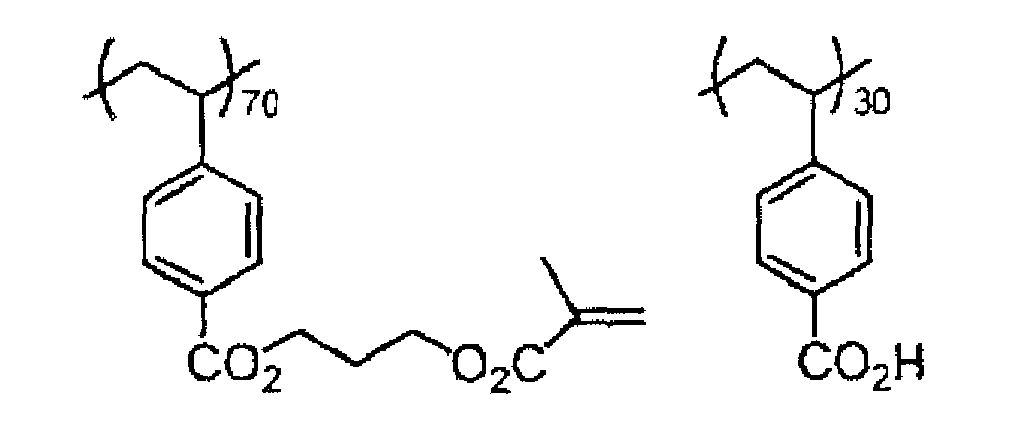
9.0 105 67 4 
8.8 110 62 5 
9.9 110 79 6 
8.9 116 67 7 
11.4 108 62 8 
10.5 110 73 9 
7.5 105 67 10 
97000 70 11 
128000 59 12 
135000 59 13 
132000 56 14 
103000 74 15 
97000 73 16 

107000 51 17 

114000 77 18 

136000 69 19 
100000 93 20 
9000 103 21 
14000 30 22 
50000 72 23 
50000 70 24 
30000 70 25 
145000 64 26 
120000 57 27 
133000 54 28 
111000 55 29 
103000 77 30 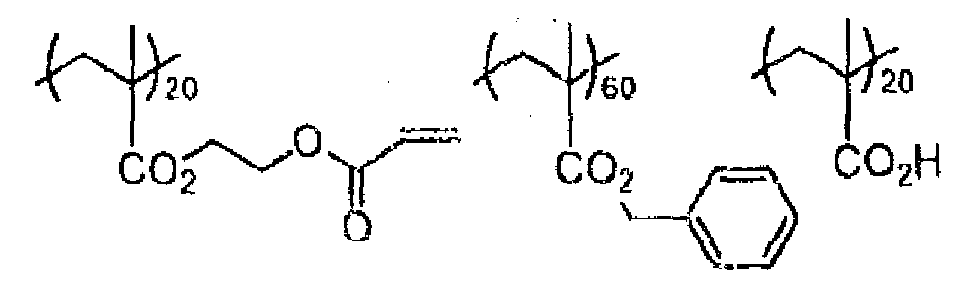
58000 70 31 
52000 57 - In terms of polymerizability and alkali-developability, the specific alkali-soluble resin is preferably a resin having a structural unit represented by the following Formula (4) and at least one structural unit selected from the group consisting of structural units represented by the following Formulae (1) to (3).


-

- In Formulae (1) to (3), A1, A2, and A3 each independently represent an oxygen atom, a sulfur atom, or -N(R21)-, and R21 represents an alkyl group which may have a substituent, G1, G2, and G3 each independently represent a divalent organic group. X and Z each independently represent an oxygen atom, a sulfur atom, or -N(R22)-, and R22 represents an alkyl group which may have a substituent. Y represents an oxygen atom, a sulfur atom, a phenylene group which may have a substituent, or -N(R23)-, and R23 represents an alkyl group which may have a substituent. R1 to R20 each independently represent a hydrogen atom or a monovalent substituent.
- In Formula (1), R1 to R3 each independently represent a hydrogen atom or a monovalent substituent, and may independently represent a hydrogen atom or an alkyl group which may itself has a substituent. Especially, R1 and R2 each preferably represent a hydrogen atom and R3 preferably represent a hydrogen atom or a methyl group.
R4 to R6 in Formula (1) each independently represent a hydrogen atom or a monovalent substituent. R4 preferably represent a hydrogen atom or an alkyl group which may itself have a substituent. Especially, a hydrogen atom, a methyl group, and an ethyl group are preferable. R5 and R6 in Formula (1) each independently represent a hydrogen atom, a halogen atom, an alkoxycarbonyl group, a sulfo group, a nitro group, a cyano group, an alkyl group which may itself have a substituent, an aryl group which may itself have a substituent, an alkoxy group which may itself have a substituent, an aryloxy group which may itself have a substituent, an alkylsulfonyl group which may itself have a substituent, or an arylsulfonyl group which may itself have a substituent. Among the above, a hydrogen atom, an alkoxycarbonyl group, and an alkyl group which may itself have a substituent, and an aryl group which may itself have a substituent are preferable.
Here, examples of the optional substituents in the above groups include a methoxycarbonyl group, an ethoxycarbonyl group, an isopropyloxycarbonyl group, a methyl group, an ethyl group, and a phenyl group. - In Formula (1), A1 represents an oxygen atom, a sulfur atom, or -N(R21)-, and X represents an oxygen atom, a sulfur atom, or -N(R22)-. Here, R21 and R22 each may be an alkyl group which may have a substituent.
G1 in Formula (1) represents a divalent organic group, and an alkylene group which may have a substituent is preferable. More preferable examples include an alkylene group having 1 to 20 carbon atoms which may have a substituent, a cycloalkylene group having 3 to 20 carbon atoms which may have a substituent, and an aromatic group having 6 to 20 carbon atoms which may have a substituent. Especially, a straight or branched alkylene group having 1 to 10 carbon atoms which may have a substituent, a cycloalkylene group having 3 to 10 carbon atoms which may have a substituent, and an aromatic group having 6 to 12 carbon atoms which may have a substituent are preferable in terms of properties such as resin strength and developability. - Here, preferable examples of a substituent in G1 include a hydroxyl group and a substituent other than substituents having a hetero atom to which a hydrogen atom is bonded (e.g., an amino group, a thiol group, and a carboxy group).
- It is preferable that, in the structural unit represented by Formula (1) in the present invention, A1 represent an oxygen atom, a sulfur atom, or -N(R21)-; X represent an oxygen atom, a sulfur atom, or -N(R22)-; G1 represent an alkylene group which may have a substituent; R1 and R2 each represent a hydrogen atom; R3 represent a hydrogen atom or a methyl group; R4 represent a hydrogen atom or an alkyl group; R5 and R6 each independently represent a hydrogen atom, an alkoxycarbonyl group, an alkyl group, or an aryl group; and R21 and R22 each independently represent an alkyl group.
- In Formula (2), R7 to R9 each independently represent a hydrogen atom or a monovalent substituent, and each may represent a hydrogen atom or an alkyl group which may itself have a substituent. Especially, R7 and R8 each preferably represent a hydrogen atom, and R9 preferably represents a hydrogen atom or a methyl group.
R10 to R12 in Formula (2) each independently represent a hydrogen atom or a monovalent substituent. Specific examples of the substituent include a hydrogen atom, a halogen atom, a dialkylamino group, an alkoxycarbonyl group, a sulfo group, a nitro group, a cyano group, an alkyl group which may itself have a substituent, an aryl group which may itself have a substituent, an alkoxy group which may itself have a substituent, an aryloxy group which may itself have a substituent, an alkylsulfonyl group which may itself have a substituent, and an arylsulfonyl group which may itself have a substituent. Among the above, a hydrogen atom, an alkoxycarbonyl group, an alkyl group which may itself have a substituent, and an aryl group which may itself have a substituent are preferable.
Here, examples of the optional substituents in the above groups include those mentioned as examples of the optional substituents in the description of Formula (1). - A2 in Formula (2) represents an oxygen atom, a sulfur atom, or -N(R21)-. Here, R21 may be a hydrogen atom or an alkyl group which may have a substituent.
G2 in Formula (2) represents a divalent organic group, and preferably represents an alkylene group which may have a substituent. Preferable examples include an alkylene group having 1 to 20 carbon atoms which may have a substituent, a cycloalkylene group having 3 to 20 carbon atoms which may have a substituent, and an aromatic group having 6 to 20 carbon atoms which may have a substituent. Especially, a straight or branched alkylene group having 1 to 10 carbon atoms which may have a substituent, a cycloalkylene group having 3 to 10 carbon atoms which may have a substituent, and an aromatic group having 6 to 12 carbon atoms which may have a substituent are preferable in terms of properties such as resin strength and developability.
Here, preferable examples of a substituent in G2 include a hydroxyl group and a substituent other than substituents having a hetero atom to which a hydrogen atom is bonded (e.g., an amino group, a thiol group, and a carboxy group).
When G2 in Formula (2) has a substituent that has a hetero atom to which a hydrogen atom is bonded and that is not a hydroxyl group, storage stability may decrease when used in combination with an onium salt compound as the initiator described below.
Y in Formula (2) represents an oxygen atom, a sulfur atom, -N(R23)-, or a phenylene group which may have a substituent. Here, R23 may represent a hydrogen atom or an alkyl group which may have a substituent. - It is preferable that, in the structural unit represented by Formula (2) in the present invention, R10 represent a hydrogen atom or an alkyl group; R11 and R12 each independently represent a hydrogen atom, an alkaxycarbonyl group, an alkyl group, or an aryl group; R7 and R8 each represent a hydrogen atom; R9 represent a hydrogen atom or a methyl group; A2 represent an oxygen atom, a sulfur atom, or -N(R21)-; G2 represent a straight or branched alkylene group having 1 to 10 carbon atoms which may have a substituent, a cycloalkylene group having 3 to 10 carbon atoms which may have a substituent, or an aromatic group having 6 to 12 carbon atoms which may have a substituent; Y represent an oxygen atom, a sulfur atom, -N(R23)-, or a phenylene group which may have a substituent; and R21 and R23 each independently represent a hydrogen atom or an alkyl group which may have a substituent.
- In Formula (3), R13 to R15 each independently represent a hydrogen atom or a monovalent substituent, and may independently represent a hydrogen atom or an alkyl group which may itself have a substituent. Especially, as R13 and R14, a hydrogen atom is preferable, and, as R15, a hydrogen atom or a methyl group is preferable.
R16 to R20 in Formula (3) each independently represent a hydrogen atom or a monovalent substituent. Examples of R16 to R20 include a hydrogen atom, a halogen atom, a dialkylamino group, an alkoxycarbonyl group, a sulfo group, a nitro group, a cyano group, an alkyl group which may itself have a substituent, an aryl group which may itself have a substituent, an alkoxy group which may itself have a substituent, an aryloxy group which may itself have a substituent, an alkylsulfonyl group which may itself have a substituent, and an arylsulfonyl group which may itself have a substituent. Especially, a hydrogen atom, an alkoxycarbonyl group, an alkyl group which may itself have a substituent, and an aryl group which may itself have a substituent are preferable. Examples of the optional substituents in the above groups include those mentioned as optional substituents in the description of Formulae (1).
In Formulae (3), A3 represents an oxygen atom, a sulfur atom, or -N(R21)-, and Z represents an oxygen atom, a sulfur atom, or -N(R22)-. Examples of R21 and R22 include those mentioned in the description of Formula (1). - G3 in Formula (3) represents a divalent organic group, and an alkylene group which may have a substituent is preferable. Preferable examples include an alkylene group having 1 to 20 carbon atoms which may have a substituent, a cycloalkylene group having 3 to 20 carbon atoms which may have a substituent, and an aromatic group having 6 to 20 carbon atoms which may have a substituent. Especially, a straight or branched alkylene group having 1 to 10 carbon atoms which may have a substituent, a cycloalkylene group having 3 to 10 carbon atoms which may have a substituent, and an aromatic group having 6 to 12 carbon atoms which may have a substituent are preferable in terms of properties such as resin strength and developability.
Here, Examples of a substituent in G3 include a hydroxyl group and a substituent other than substituents having a hetero atom to which a hydrogen atom is bonded (e.g., an amino group, a thiol group, and a carboxy group). - It is preferable that, in the structural unit represented by Formula (3) in the present invention, R13 and R14 each represent a hydrogen atom; R15 represent a hydrogen atom or a methyl group; R16 to R20 each represent a hydrogen atom, an alkoxycarbonyl group, an alkyl group which may have a substituent, or an aryl group which may have a substituent; A3 represent an oxygen atom, a sulfur atom, or -N(R21)-; Z represent an oxygen atom, a sulfur atom, or -N(R22)-; R21 and R22 each independently be selected from those mentioned in the description af R21 and R22 in Formula (1); and G3 represent a straight or branched alkylene group having 1 to 10 carbon atoms which may have a substituent, a cycloalkylene group having 3 to 10 carbon atoms which may have a substituent, or an aromatic group having 6 to 12 carbon atoms which may have a substituent.
- The specific alkali-soluble resin in the present invention preferably contains at least one structural unit selected from the structural units represented by Formulae (1) to (3) in an amount that is at least 1.5 times (in terms of a molar ratio) the content of the structural unit represented by Formula (4) for the purpose of suppressing heat sagging in postbaking. From the viewpoint of curability, the content of the at least one structural unit selected from the structural units represented by Formulae (1) to (3) is more preferably at least 2.0 times (in terms of a molar ratio) the content of the structural unit represented by Formula (4), and most preferably at least 3.0 times (in terms of a molar ratio) the content of the structural unit represented by Formula (4).
Moreover, from the viewpoint of improving the curing properties and reducing the post-development residue, the specific alkali-soluble resin preferably contains, in a molecule, at least one structural unit selected from the structural units represented by Formulae (1) to (3) in a ratio of not less than 35 mol% but less than 95 mol%. The ratio is more preferably from 37 to 90 mol%, still more preferably not less than 40 mol% but less than 85 mol%.
Especially, from the viewpoint of curability, a resin containing a structural unit represented by Formula (1) in a ratio of not less than 40 mol% but less than 85 mol% is most preferable. - Synthesis of a polymer compound having at least one structural unit selected from the structural units represented by Formulae (1) to (3) above can be performed according to a synthesis method described in Paragraphs [0027] to [0057] of
JP-A No. 2003-262958 JP-A No. 2003-262958 - The specific alkali-soluble resin is preferably a resin obtained by the following synthesis method (1) or (2).
- Synthesis method (1)
This synthesis method include extracting, by an action of a base, a proton from a polymer synthesized using a compound represented by the following Formula (5) as a copolymer component, so as to eliminate L and so as to obtain a desired polymer compound having a structure represented by Formula (1) described above. -

- In Formula (5), L represents an anionic elimination group, and preferably represents a halogen atom, an alkyl group, or an arylsulfonyloxy group. R3 to R6, A1, G1, and X have the same definitions and preferable ranges as in Formula (1).
As the base used for causing an elimination reaction, either of an inorganic compound or an organic compound may be used. The details and preferable examples of the method are disclosed in Paragraphs [0028] to [0033] ofJP-A No. 2003-262958 - Preferable examples of an inorganic compound base include sodium hydroxide, potassium hydroxide, sodium carbonate, sodium hydrogen carbonate, potassium carbonate, and potassium hydrogen carbonate. Examples of an organic compound base include metal alkoxides, such as sodium methoxide, sodium ethoxide, and potassium t-butoxide; and organic amine compounds, such as triethylamine, pyridine, and diisopropylethylamine.
- Synthesis method (2)
The synthesis method (2) includes performing base treatment on a polymer synthesized using a compound represented by the following Formula (6) as a copolymer component so as to cause an elimination reaction at a specific functional group and so as to remove X1, whereby a radical reactive group is obtained. -

- In Formula (6), A1 represents an oxygen atom, a sulfur atom, or -N(R27)-; A5 represents an oxygen atom, a sulfur atom, or -NR28-; R24, R25, R26, R29, R30, and R 31 each independently represent hydrogen or a monovalent organic group; X1 represents a group to be removed by an elimination reaction; G4 represents an organic connecting group; and n represents an integer of from 1 to 10.
- Especially, A4 preferably represent an oxygen atom in the present invention. It is preferable that R24 represent a methyl group; R25, R26, R29, and R30 each represent a hydrogen atom, and R31 represent a methyl group or a hydrogen atom. X1 preferably represents a bromine atom and G4 preferably represents methylene.
- The details and preferable examples of the method are disclosed in
JP-A No. 2003-335814 - The resin obtained by the synthesis method (2) may be a high-molecular-weight compound disclosed in
JP-A No, 2003-335814 - Specific examples of the compound represented by Formula (5) include, but are not limited to, the following compounds (M-1) to (M-12).
-


-


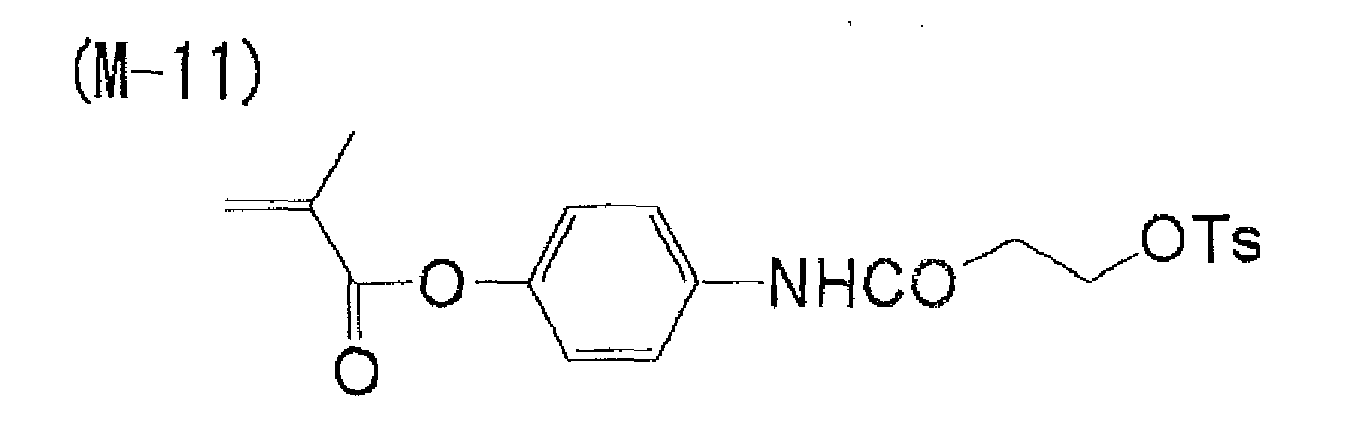

- Examples of the compound represented by Formula (6) include, but are not limited to, the following compounds (i-1) to (i-50).
-


-


-


-


-


-
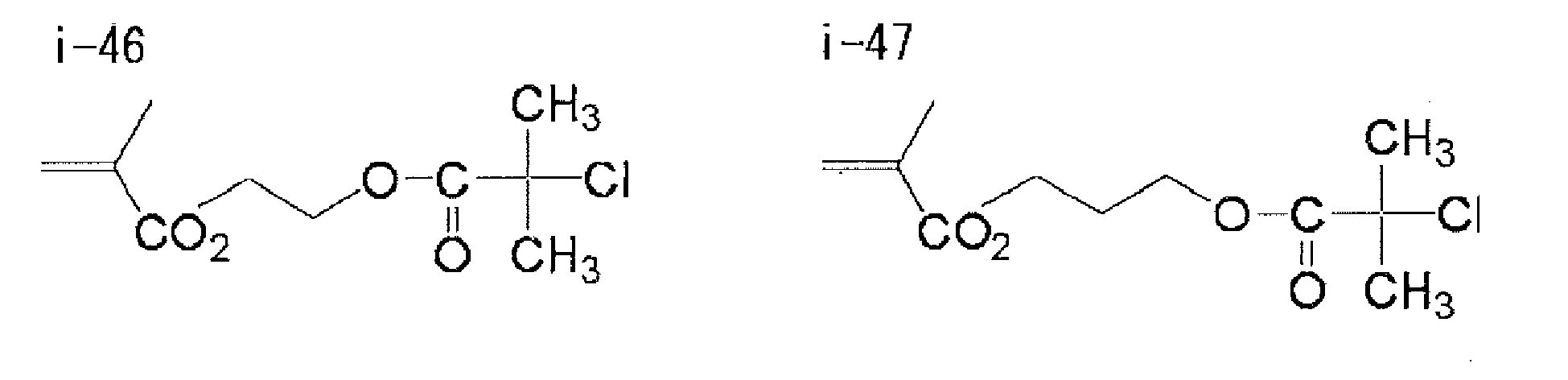

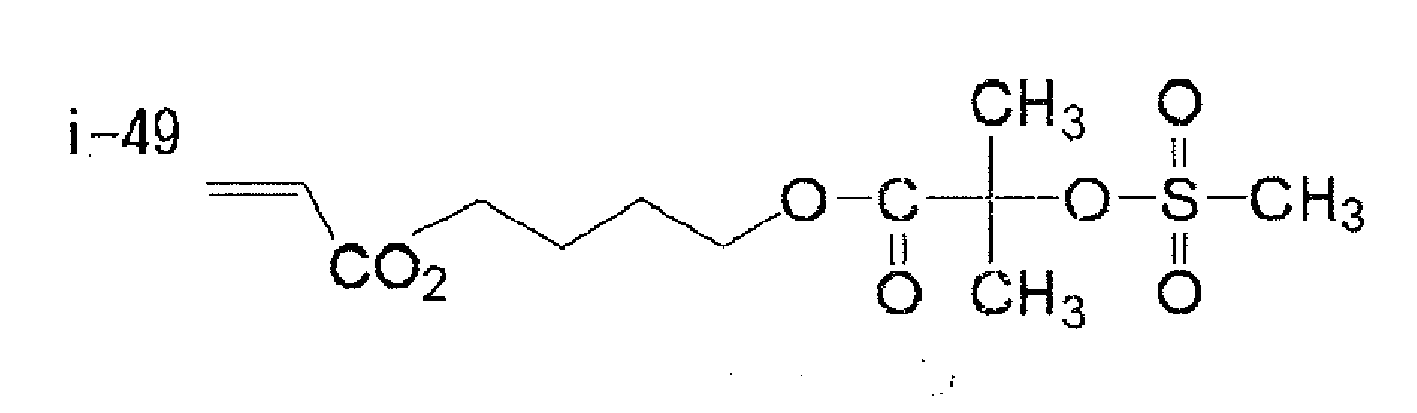

- The specific alkali-soluble resin in the present invention preferably contains a structural unit represented by the following Formula (4).
-

- In Formula (4), RA represents hydrogen or an alkyl group having 1 to 6 carbon atoms, and RB represents a divalent connecting group.
RA represents preferably a hydrogen atom or a methyl group.
RB may represent a divalent connecting group, examples of which include an alkylene group having 1 to 12 carbon atoms which may be substituted; - U-RC-V- (in which U and V each independently represent a direct bond or an alkylene group having 1 to 3 carbon atoms and RC represents a cyclohexyl ring, a benzene ring, or a naphthalene ring, each of which may be substituted.); and -RD-X-RE- (in which, RD and RE each independently represents an alkylene group having 1 to 10 carbon atoms which may be substituted, or a benzene or naphthalene ring which may be substituted, and X represents an ester bond, an amide bond, a urethane bond, an ether bond, a thioether bond, a carbonate bond, a urea bond, or an imide bond). Especially, RB represents preferably a divalent connecting group having 1 to 6 carbon atoms. - Among the alkali-soluble resins according to the present invention, specific compound examples of a resin having a structural unit represented by Formula (4) and at least one structural unit selected from the group consisting of structural units represented by Formulae (1) to (3) include Exemplary Compounds 101 to 121 shown in the following tables. In the following Tables, "Ex. Comp." represents "Exemplary Compound".
-
Ex. Comp. Composition (mol%) Acid Value (mgKOH/g) Mw 101 
54 85000 102 
49 36000 103 
34 62000 104 
44 30000 105 
43 31000 106 
31 23000 107 
40 10000 0 108 
36 63000 109 
42 55000 110 
16 36000 111 
30 22000 112 
47 28000 113 
16 53000 114 
32 33000 115 
15 30000. 116 
6.0 61000 117 
45 48000 118 
58 27000 119 
47 90000 120 
30 14000 121 
34 50000 - The acid value of the specific alkali-soluble resin in the present invention is preferably in the range of from 5.0 to 110 mgKOH/g, more preferably in the range of from 5.5 to 75 mgKOH/g, and still more preferably in the range of from 6.0 to 70 mgKOH/g. When the acid value is 110 mgKOH/g or lower, peeling off of a pattern at the time of development is prevented. When the acid value is 5.0 mgKOH/g or more, alkaline developability is excellent.
- In the present invention, the acid value of the specific alkali-soluble resin (D) can be calculated from the average content of an acid group in a resin molecule, for example. A resin having a desired acid value can be obtained by changing the content of a monomer unit containing an acid group in the specific alkali-soluble resin.
- The weight average molecular weight of the specific alkali-soluble resin (D) in the present invention is preferably from 30,000 to 300,000, more preferably from 35,000 to 250,000, still more preferably from 40,000 to 200,000, and particularly preferably from 45,000 to 100,000 from the viewpoint of preventing peeling of a pattern at the time of development and obtaining excellent developability.
It should be noted that the weight average molecular weight of the specific alkali-soluble resin can be measured by GPC, for example. - The content of the specific alkali-soluble resin with respect to the total solid content of the colored curable composition of the present invention is preferably from 0.1 to 7.0 mass% in terms of polymerizability and alkali developability. From the viewpoint of achieving both the prevention of pattern peeling and the prevention of a development residue, the content of the specific alkali-soluble resin with respect to the total solid content of the colored curable composition is more preferably from 0.3 to 6.0 mass%, and still more preferably from 1.0 to 5.0 mass%.
- The colored curable composition of the present invention may further contain, as required, optional components described below in detail.
Hereinafter, the optional components which may be contained in the colored curable composition of the present invention will be described. -
- Binder polymer-
In the colored curable composition of the present invention, a common binder polymer may be used, as required, in addition to the specific alkali-soluble resin for the purpose of improving film properties and the like. It is preferable to use a linear organic polymer as the binder. The linear organic polymer may be known linear organic polymer. In order to realize development with water or weakly alkaline water, the linear organic polymer is preferably soluble or swellable in water or weakly alkaline water. The linear organic polymer may be selected and used in consideration of the function as a film forming agent as well as the developer to be used (a water developer, an weakly alkaline water developer, or an organic solvent developer, for example). For example, use of a water-soluble organic polymer realizes development with water. Such a linear organic polymer may be a radical polymer that has a carboxylic acid group at a side chain, and examples there of include those disclosed in, for example,JP-A No. 59-44615 JP-B Nos. 54-34327 58-12577 54-25957 JP-A Nos. 54-92723 59-53836 59-71048 - Moreover, urethane binder polymers containing acid groups disclosed in
JP-B Nos. 7-12004 7-120041 7-120042 8-12424 JP-A Nos. 63-287944 63-287947 1-271741 10-116232 JP-A No. 2002-107918
Moreover, acetal-modified polyvinyl alcohol binder polymers having acid groups disclosed, for example, in European Patent Nos.993966 1204000 ,JP-A No. 2001-318463
Further, polyvinyl pyrrolidone and polyethylene oxide, for example, are also useful as water-soluble linear organic polymers. In view of increasing the strength of a cured film, alcoholic soluble nylon and polyether of 2,2-bis-(4-hydroxyphenyl)-propane and epichlorohydrin, for example, are useful. - The weight average molecular weight of a binder polymer which can be used in the colored curable composition of the present invention is preferably 5,000 or more, and more preferably in the range of from 10,000 to 300,000. The number average molecular weight thereof is preferably 1,000 or more, and more preferably in the range of from 2, 000 to 250,000. The degree of polydispersity (weight average molecular weight/number average molecular weight) is preferably 1 or more, and more preferably in the range of from 1.1 to 10.
The binder polymer may be any one of a random polymer, a block polymer, and a graft polymer. - Binder polymers usable in the present invention can be synthesized by conventional methods. Examples of a solvent used in the synthesis include tetrahydrofuran, ethylene dichloride, cyclohexanone, methyl ethyl ketone, acetone, methanol, ethanol, ethyleneglycol monoethyl ether, ethyleneglycol monoethyl ether, 2-methoxyethyl acetate, diethyleneglycol dimethyl ether, 1-methoxy-2-propanol, l-methoxy-2-propyl acetate, N,N-dimethylformamide, N,N-dimethylacetamide, toluene, ethyl acetate, methyl lactate, ethyl lactate, dimethyl sulfoxide, and water. The solvent may be used singly or a mixture of two or more thereof may be used.
Examples of a radical polymerization initiator used when the binder polymer which can be used in the colored curable composition of the present invention is synthesized include known compounds, such as an azo initiator and a peroxide initiator. -
- Sensitizer -
The colored curable composition of the present invention may contain a sensitizer for the purpose of improving the radical generation efficiency of a radical initiator and making the composition sensitive to a longer wavelength.
As a sensitizer which can be used in the present invention, a substance which sensitizes the specific photopolymerization initiator through an electronic transition mechanism or an energy transfer mechanism. - Examples of the sensitizer used for the colored curable composition of the present invention include substances belonging to any of the classes of compounds described below and having an absorption wavelength in a wavelength region of from 300 nm to 450 nm.
Specifically, examples thereof include polynuclear aromatic compounds (e.g., phenanthrene, anthracene, pyrene, perylene, triphenylene, and 9,10-dialkoxy anthracene), xanthenes (e.g., fluorescein, eosine, erythrosine, rhodamine B, and rose bengal), thioxanthones (isopropylthioxanthone, diethyithioxanthone, chlorothioxanthone), cyanines (e.g., thiacarbocyanine and oxacarbocyanine), merocyanines (e.g., merocyanine and carbomerocyanine), phthalocyanines, thiazines (e.g., thionine, methylene blue, and toluidine blue), acridines (e.g., acridine orange, chloroflavin, and acriflavine), anthraquinones (e.g., anthraquinone), squaryliums (e.g., squarylium), acridine orange, coumarins (e.g., 7-diethylamino-4-methylcoumarin), ketocoumarin, phenothiazins, phenazines, styryl benzens, azo compounds, diphenylmethane, triphenylmethane, distyryl benzens, carbazoles, porphyrin, spiro compounds, quinacridone, indigo, styryl, pyrylium compounds, pyrromethene compounds, pyrazolotriazole compounds, benzothiazole compounds, barbituric acid derivatives, thiobarbituric acid derivatives, acetophenone, benzophenone, thioxanthone, aromatic ketone compounds such as Michler's ketone, and heterocyclic compounds such as N-aryl oxazolidinone. - More preferable examples of the sensitizer in the colored curable composition of the present invention include compounds represented by the following Formulae (e-1) to (e-4).
-

- In Formula (e-1), A1 represents a sulfur atom or NR50; R50 represents an alkyl group or an aryl group; L1 represents a non-metallic atomic group forming, together with A1 adjacent to L1 and the adjacent carbon atom, a basic nucleus of a dye; R51 and R52 each independently represent a hydrogen atom or a monovalent non-metallic atomic group; R51 and R52 may be combined with each other to form an acidic nucleus of a dye; and W represents an oxygen atom or a sulfur atom.
-

- In Formula (e-2), Ar1 and Ar2 each independently represent an aryl group, and Ar1 and Ar2 are connected by -L2-; L2 represents -O- or -S-; and W has the same definition as in Formula (e-1).
-

- In Fomula (e-3), A2 represents a sulfur atom or NR59; L3 represents a non-metallic atomic group forming, together with A2 adjacent to L3 and the adjacent carbon atom, a basic nucleus of a dye; R53, R54, R55, R56, R57, and R58 each independently represent a monovalent group of a non-metallic atomic group; and R59 represents an alkyl group or an aryl group.
-

- In Formula (e-4), A3 and A4 each independently represent -S- or -NR62 ; R62 represents a substituted or unsubstituted alkyl group or a substituted or unsubstituted aryl group; L4 represents a non-metallic atomic group forming, together with A3 adjacent to L4 and the adjacent carbon atom, a basic nucleus of a dye; L5 represents a non-metallic atomic group forming, together with A4 adjacent to L5 and the adjacent carbon atom, a basic nucleus of a dye; and R60 and R61 each independently represent a monovalent non-metallic atomic group or can be combined with each other to form an aliphatic ring or an aromatic ring.
- Moreover, examples of a preferable sensitizer which can be contained in the colored curable composition of the present invention include, in addition to the above-mentioned sensitizers, at least one selected from a compound represented by Formula (12) shown below and a compound represented by Formula (13) shown below.
-

- In Formula (12), R11 and R12 each independently represent a monovalent substituent; R13, R14, R15, and R16, each independently represent a hydrogen atom or a monovalent substituent; n represents an integer of from 0 to 5; n' represents an integer of from 0 to 5 with the proviso that both n and n' are not 0 simultaneously; when n is 2 or more, two or more R11s may represent the same substituent as each other or may represent different substituents from each other; when n' is 2 or more, two or more R12s may represent the same substituent as each other or may represent different substituents from each other; and in the compound represented by Formula (12), the geometry at each double bond is not limited to either geometry, and the scope of the compound represented by Formula (12) includes geometric isomers thereof.
- The molar extinction coefficient ε of the compound represented by Formula (12) at a wavelength of 365 nm is preferably 500 mol-1·L·cm-1 or higher, more preferably 3,000 mol-1·L· cm-1 or higher; and most preferably 20,000 mol-1·L·cm-1 or higher. When the value of the molar extinction coefficient ε at the wavelength is in the above-mentioned range, the sensitivity is significantly improved, which is preferable from the viewpoint of the light absorption efficiency.
- Preferable specific examples of the compound represented by Formula (12) include, but are not limited to, those shown below.
It should be noted that, in this specification, chemical formulae are shown as simple structural formulae in some cases, and the solid lines represent hydrocarbon groups unless elements or substituents are indicated. In the following specific examples, Me represents a methyl group, Et represents an ethyl group, Bu represents a butyl group, n-Bu represents an n-butyl group, and Ph represents a phenyl group. -


-

-


-


-


-



-


-


-


-


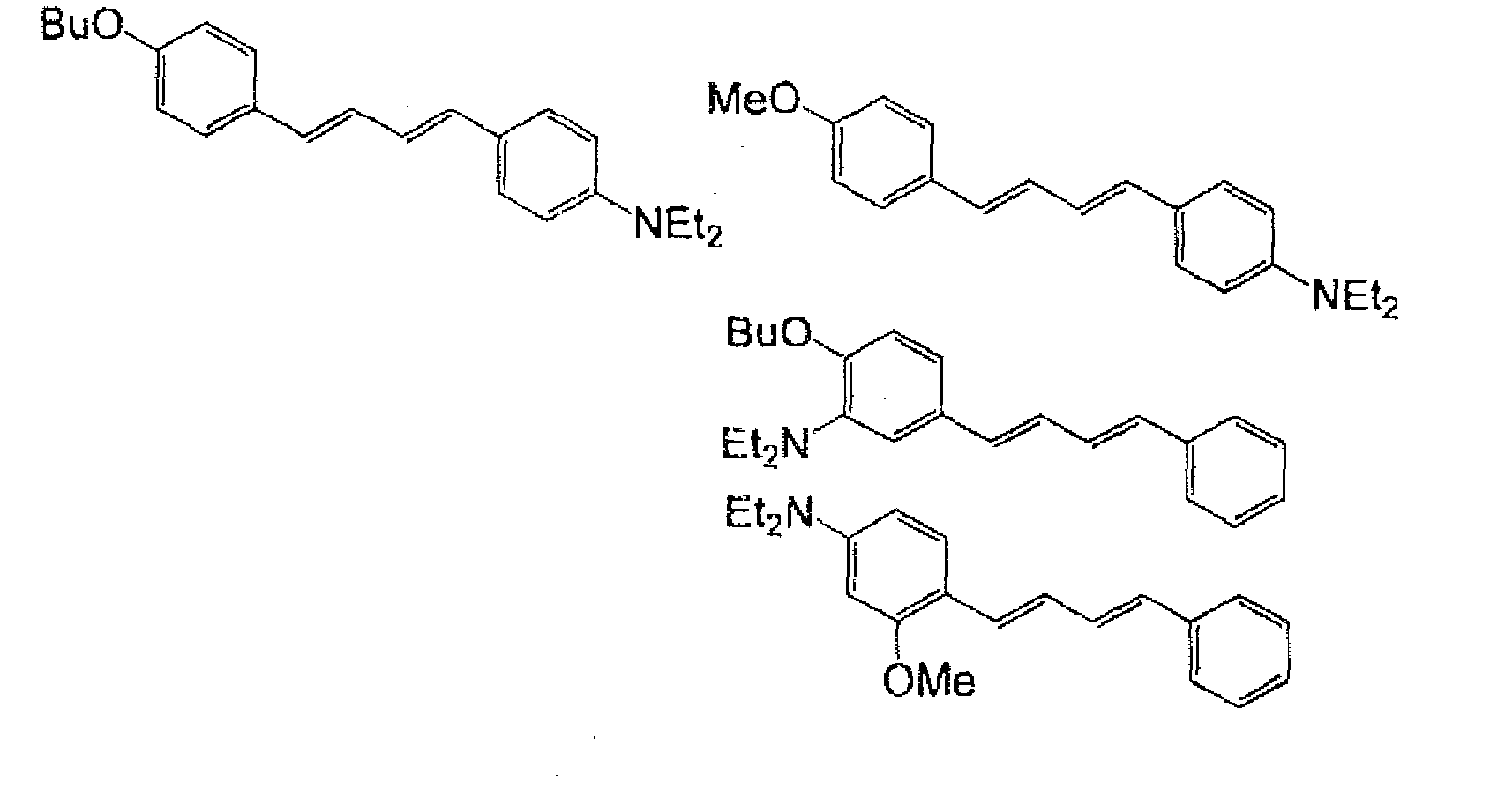
-


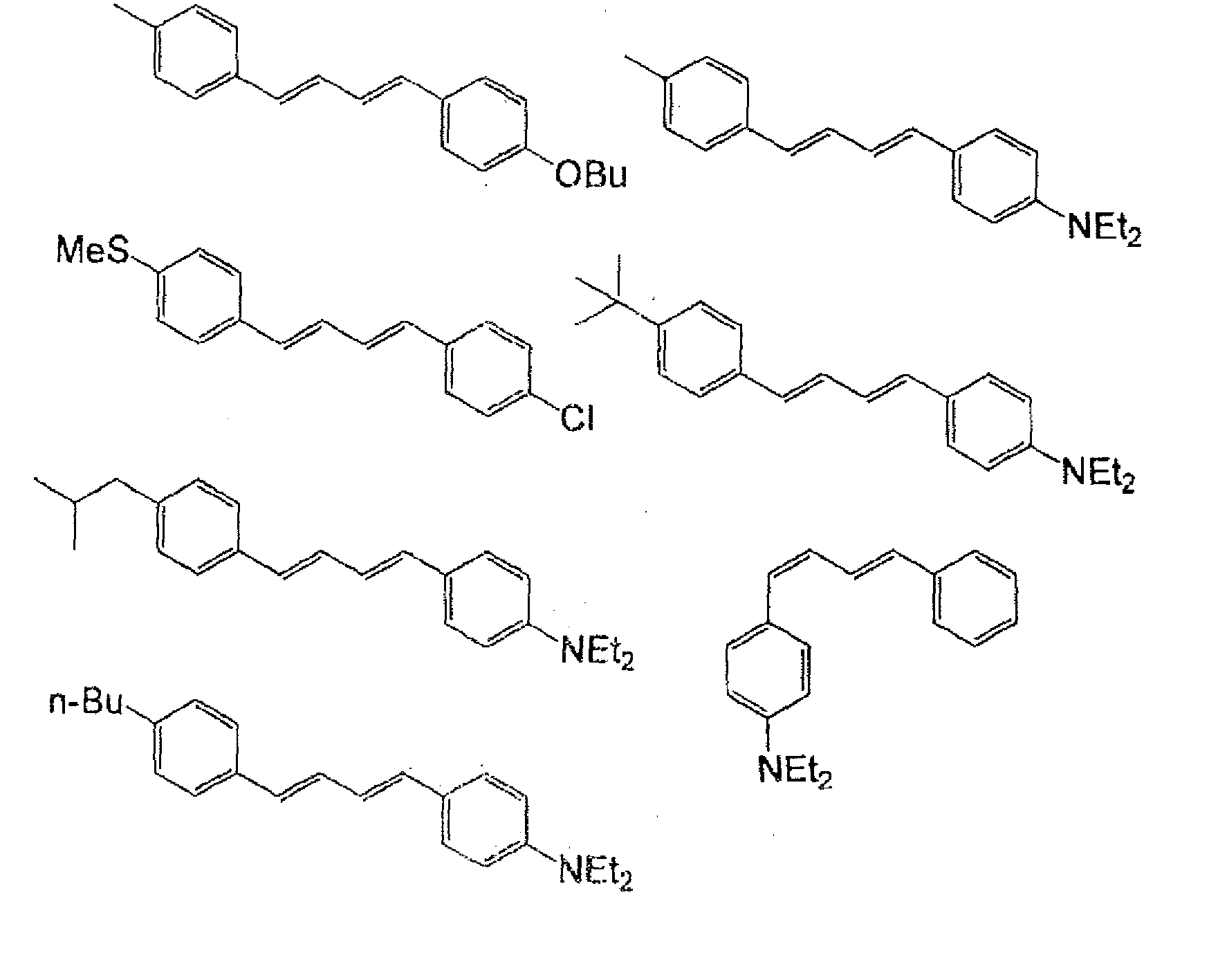
-

- In Formula (13), A represents an aromatic ring or a heterocycle, each of which may have a substituent; X2 represents an oxygen atom, a sulfur atom, or -N(R23)-; and Y represents an oxygen atom, a sulfur atom, or -N(R23)-. R21, R22 , and R23 each independently represent a hydrogen atom or a monovalent non-metallic atomic group, and two or more of A, R21, R22, and R23 may be combined, in any combination, with each other to form an aliphatic ring or an aromatic ring.
- In Formula (13), R21, R22, and R23 each independently represent a hydrogen atom or a monovalent non-metallic atomic group. When R21, R22, or R23 represents a monovalent non-metallic atomic group, the monovalent non-metallic atomic group is preferably a substituted or unsubstituted alkyl group, a substituted or unsubstituted aryl group, a substituted or unsubstituted alkenyl group, a substituted or unsubstituted aromatic heterocyclic residue, a substituted or unsubstituted alkoxy group, a substituted or unsubstituted alkylthio group, a hydroxyl, or a halogen atom.
- In the compound represented by Formula (13), Y is preferably an oxygen atom or -N(R23)- from the viewpoint of improving the decomposition efficiency of a photopolymerization initiator. R23 represents a hydrogen atom or a monovalent non-metallic atomic group. When there are plural R23s, each of them may independently represent a hydrogen atom or a monovalent non-metallic atomic group. Y is most preferably -N(R23)-.
- Preferable of the compound represented by Formula (13) include, but are not limited to, specific examples (VI1) to (VI124) shown below. Moreover, the geometry at the double bond connecting the acidic nucleus and the basic nucleus is not limited to either geometry, and the scope of the compound represented by Formula (13) includes geometric isomers with respect to the double bond.
-


-


-

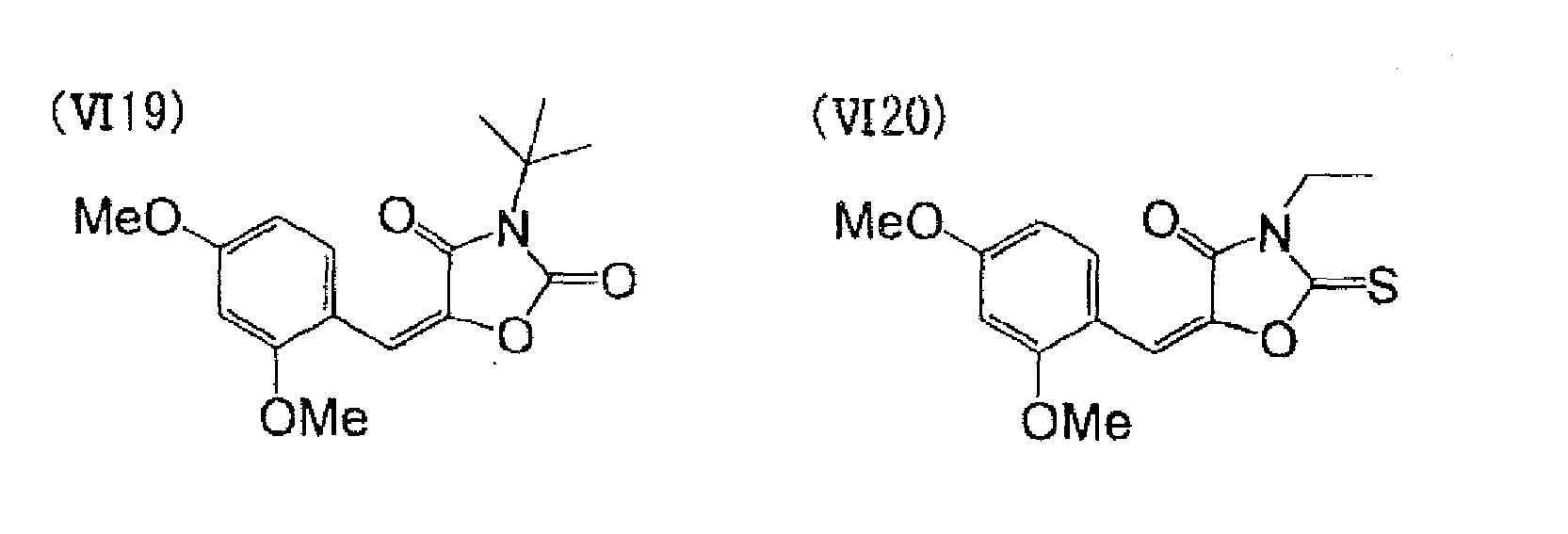


-


-


-


-


-


-


-


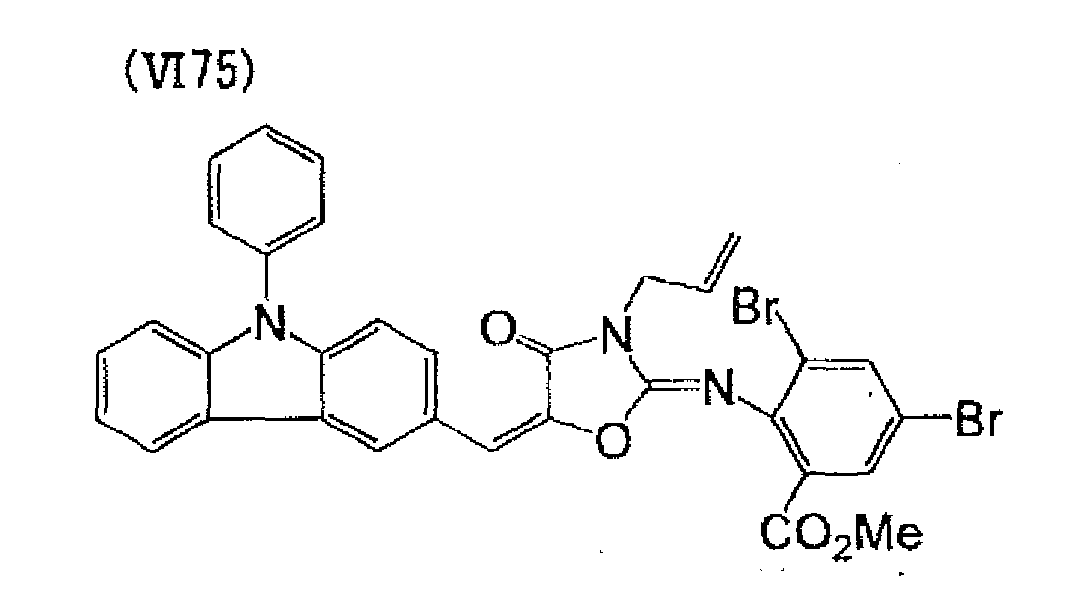

-


-


-


-


-


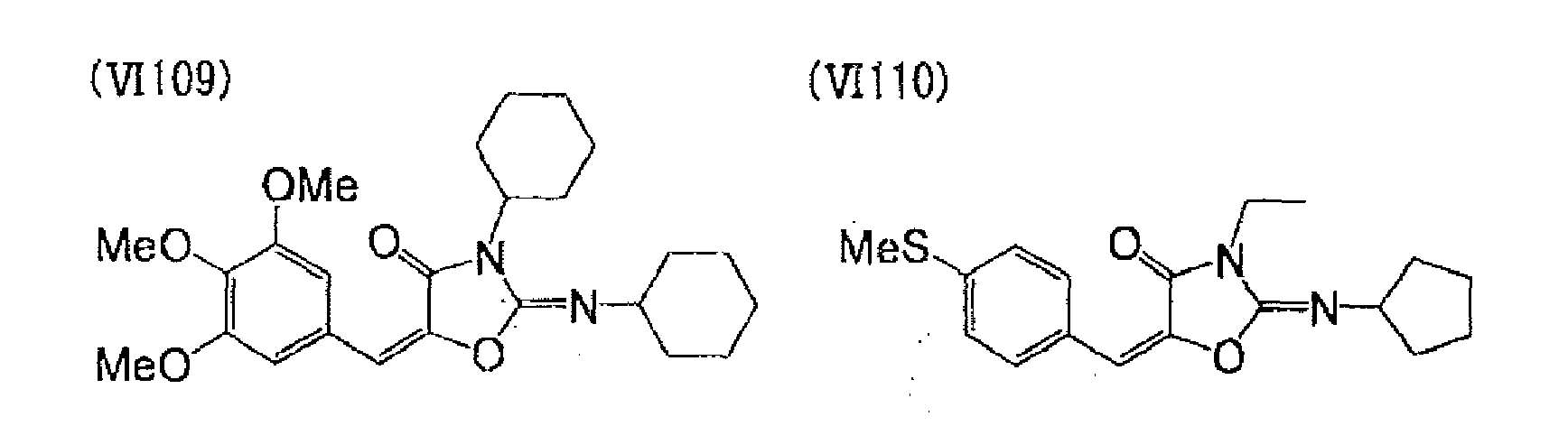


-

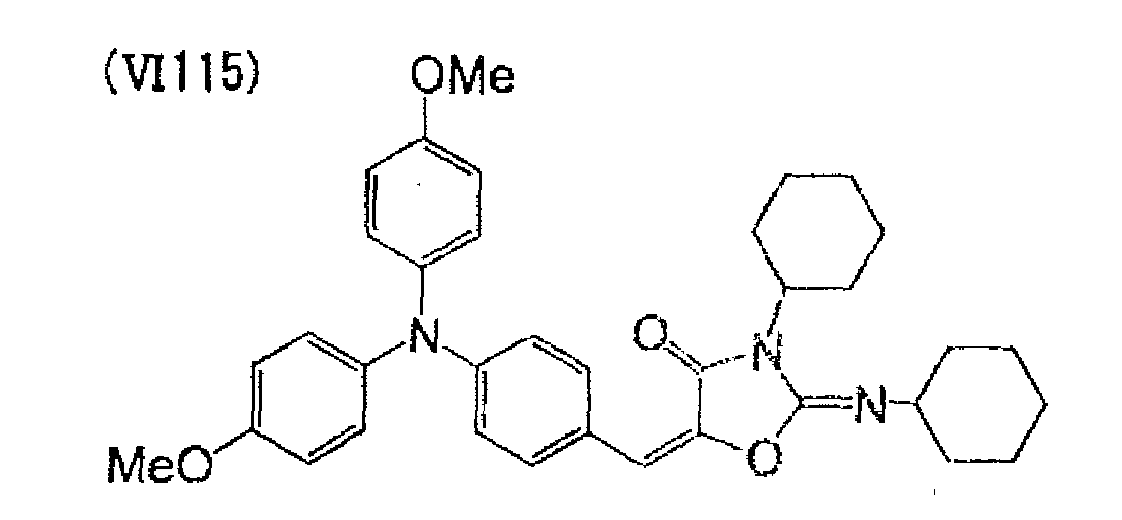


-


-

- From the viewpoint of the light absorption efficiency to a deep portion and initiation decomposition efficiency, the content of the sensitizer in the colored curable composition of the present invention is preferably from 0.1 to 20 mass%, and more preferably from 0.5 to 15 mass%, in terms of the solid content.
The sensitizer may be used singly or in combination of two or more thereof.
The colored curable composition may contain one compound selected from a compound represented by Formula (12) and a compound represented by Formula (13), or may contain two or more thereof in combination. -
- Co-sensitizer-
The colored curable composition of the present invention preferably further contain a co-sensitizer.
In the present invention, the co-sensitizer has, for example, a function of further improving the sensitivity of the specific photopolymerization initiator or sensitizer to active radiation and/or a function of preventing inhibition of the polymerization of the polymerizable compound due to oxygen. - Examples of such a co-sensitizer include amines, e.g., compounds disclosed in M. R. Sander et al., Journal of Polymer Society Vol. 10, pp. 3173 (1972),
JP-B No. 44-20189 JP-A Nos. 51-82102 52-134692 59-138205 60-84305 62-18537 64-33104 - Other examples of co-sensitizers include thiols and sulfides, such as thiol compounds disclosed in
JP-A No. 53-702 JP-B No. 55-500806 JP-A No. 5-142772 JP-A No. 56-75643 - Moreover, other examples of the co-sensitizer include amino acid compounds (e.g., N-phenylglycine), organometallic compounds disclosed in
JP-B No. 48-42965 JP-B No. 55-34414 JP-A No. 6-308727 - The content of the co-sensitize is preferably in the range of from 0.1 to 30 mass%, more preferably in the range of from 1 to 25 mass%, and still more preferably in the range of from 0.5 to 20 mass%, with respect to the mass of the total solid content of the colored curable composition of the present invention from the viewpoint of increasing the curing rate by improving the balance between the polymerization growth rate and the chain transfer.
- Moreover, the colored curable composition of the present invention preferably contains a thiol compound as a co-sensitizer.
The thiol compound which can be contained in the colored curable composition of the present invention is preferably a compound represented by the following Formula (14). -

- In Formula (14), X represents a sulfur atom, an oxygen atom, or -N(R43)-, and R43 represents a hydrogen atom, an alkyl group having 1 to 5 carbon atoms, or an aryl group having 6 to 13 carbon atoms. R41 and R42 each independently represent a hydrogen atom, an alkyl group having 1 to 5 carbon atoms, a hydroxyalkyl group having 1 to 3 carbon atoms, a phenyl group which may be substituted by an alkoxy group having 1 to 8 carbon atoms, a nitro group, an alkoxycarbonyl group having an alkyl group having 1 to 8 carbon atoms, a phenoxy carbonyl group, an acetyl group, or a carboxy group. Moreover, R41, R42, and the carbon atoms adjacent thereto that form a double bond therebetween may together form a benzene ring, and the double bond that the carbon atoms adjacent to R41 and R42 form may be hydrogenated.
- Examples of thiol compounds include compounds disclosed as thiol compounds in, for example,
JP-A No. 53-702 JP-B No. 55-500806 JP-A No. 5-142772 - Furthermore, the thiol compounds suitable for the colored curable composition of the present invention are preferably represented by the following Formula (15).
-

- In Formula (15), R represents an alkyl group or an aryl group; and A represents an atomic group forming a heterocycle with N=C-N.
- In Formula (15), R represents an alkyl group or an aryl group.
The alkyl group may be a linear, branched or cyclic alkyl group having 1 to 20 carbon atoms, more preferably a linear alkyl group having 1 to 12 carbon atoms, a branched alkyl group having 3 to 12 carbon atoms or a cyclic alkyl group having 5 to 10 carbon atoms.
Examples of the alkyl group include a methyl group, an ethyl group, a propyl group, a butyl group, a pentyl group, a hexyl group, a heptyl group, an octyl group, a nonyl group, a decyl group, an undecyl group, a dodecyl group, a tridecyl group, a hexadecyl group, an octadecyl group, an eicocyl group, an isopropyl group, an isobutyl group, a sec-butyl group, a tert-butyl group, an isopentyl group, a neopentyl group, a 1-methylbutyl group, an isohexyl group, a 2-ethylhexyl group, a 2-methylhexyl group, a cyclohexyl group, a cyclopentyl group, and a 2-norbomyl group. - The aryl group may have a monocyclic structure, structure having a condensed ring formed by condensation of 1 to 3 benzene rings, or a structure having a condensed ring formed by condensation of at least one benzene ring and at least one five-membered unsaturated ring, Examples thereof include a phenyl group, a naphthyl group, an anthryl group, a phenanthryl group, an indenyl group, an acenaphthenyl group, and a fluorenyl group. In particular, a phenyl group or a naphthyl group is more preferred.
- The alkyl group or aryl group may further have at least one substituent. Examples of the substituent that may be introduced include a linear, branched or cyclic alkyl group having 1 to 20 carbon atoms, a linear, branched or cyclic alkenyl group having 2 to 20 carbon atoms, an alkynyl group having 2 to 20 carbon atoms, an aryl group having 6 to 20 carbon atoms, an acyloxy group having 1 to 20 carbon atoms, an alkoxycarbonyloxy group having 2 to 20 carbon atoms, an aryloxycarbonyloxy group having 7 to 20 carbon atoms, a carbamoyloxy group having 1 to 20 carbon atoms, a carbonamide group having 1 to 20 carbon atoms, a sulfonamide group having 1 to 20 carbon atoms, a carbamoyl group having 1 to 20 carbon atoms, a sulfamoyl group, a substituted sulfamoyl group having 1 to 20 carbon atoms, an alkoxy group having 1 to 20 carbon atoms, an aryloxy group having 6 to 20 carbon atoms, an aryloxycarbonyl group having 7 to 20 carbon atoms, an alkoxycarbonyl group having 2 to 20 carbon atoms, an N-acylsulfamoyl group having 1 to 20 carbon atoms, an N-sulfamoylcarbamoyl group having 1 to 20 carbon atoms, an alkylsulfonyl group having 1 to 20 carbon atoms, an arylsulfonyl group having 6 to 20 carbon atoms, an alkoxycarbonylamino group having 2 to 20 carbon atoms, an aryloxycarbonylamino group having 7 to 20 carbon atoms, an amino group, a substituted amino group having 1 to 20 carbon atoms, an imino group having 1 to 20 carbon atoms, an ammonio group having 3 to 20 carbon atoms, a carboxyl group, a sulfo group, an oxy group, a mercapto group, an alkylsulfinyl group having 1 to 20 carbon atoms, an arylsulfinyl group having 6 to 20 carbon atoms, an alkylthio group having 1 to 20 carbon atoms, an arylthio group having 6 to 20 carbon atoms, a ureide group having 1 to 20 carbon atoms, a heterocyclic group having 2 to 20 carbon atoms, an acyl group having 1 to 20 carbon atoms, a sulfamoylamino group, a substituted sulfamoylamino group having 1 to 2 carbon atoms, a silyl group having 2 to 20 carbon atoms, an isocyanate group, an isocyanide group, a halogen atom (such as a fluorine, chlorine or bromine atom), a cyano group, a nitro group, and an onium group.
- In Formula (15), A represents an atomic group that forms a heterocycle together with N=C-N.
The at least one atom that forms the atomic group may include atoms selected from carbon, nitrogen, hydrogen, sulfur, and selenium atoms.
The heterocycle formed by A and N=C-N may further have at least one substituent. Examples of introducible substituents include those described above as substituents introducible into the alkyl group or aryl group. - A thiol compound suitable for the colored curable composition of the invention is more preferably a compound represented by Formula (16) or (17) below.
-
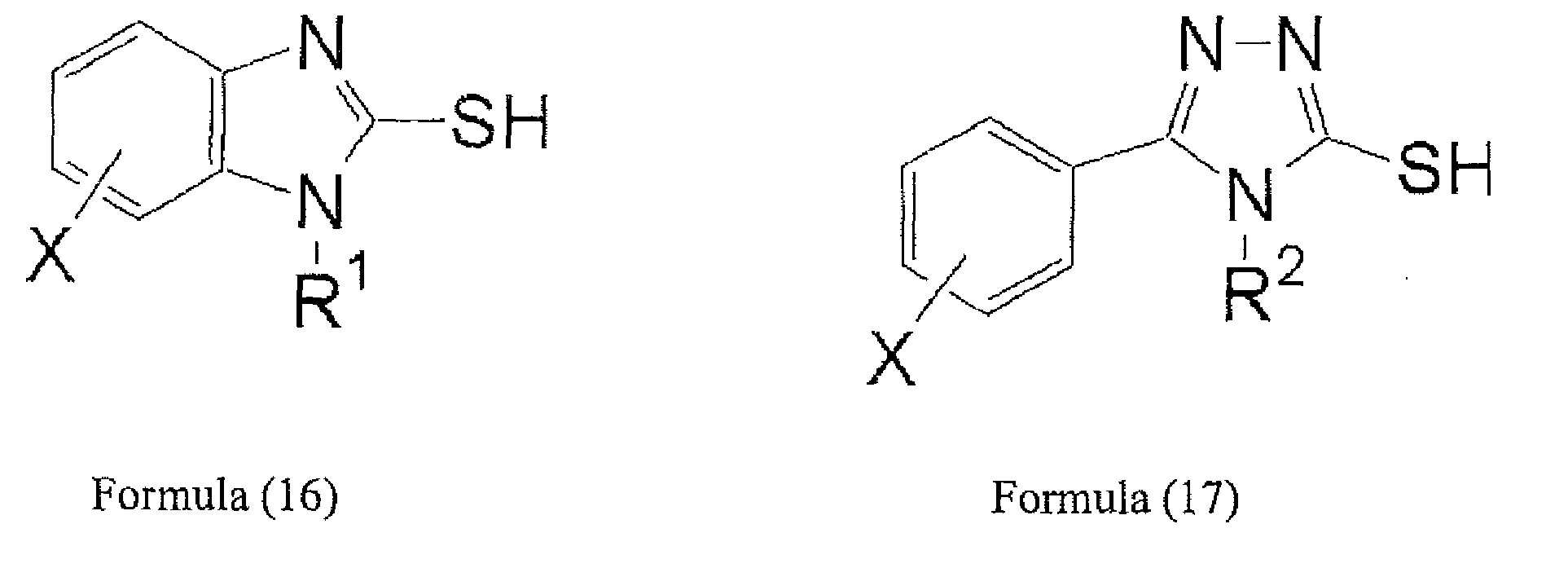
- In Formula (16), R1 represents an aryl group, and X represents a hydrogen atom, a halogen atom, an alkoxy group, an alkyl group, or an aryl group.
- In Formula (17), R2 represents an alkyl group or an aryl group, and X represents a hydrogen atom, a halogen atom, an alkoxy group, an alkyl group, or an aryl group.
- In Formulae (16) and (17), the halogen atom is preferably a fluorine, chlorine, bromine, or iodine atom.
- In Formulae (16) and (17), the alkoxy group may be a methoxy group, an ethoxy group, a propyloxy group, an isopropyloxy group, a butyloxy group, a pentyloxy group, a hexyloxy group, a dodecyloxy group, a benzyloxy group, an allyloxy group, a phenethyloxy group, a carboxyethyloxy group, a methoxycarbonylethyloxy group, an ethoxycarbonylethyloxy group, a methoxyethoxy group, a phenoxyethoxy group, a methoxyethoxyethoxy group, an ethoxyethoxyethoxy group, a morpholinoethoxy group, a morpholinopropyloxy group, an allyloxyethoxyethoxy group, a phenoxy group, a tolyloxy group, a xylyloxy group, a mesityloxy group, a methoxyphenyloxy group, an ethoxyphenyloxy group, a chlorophenyloxy group, a bromophenyloxy group, an acetyloxy group, a benzoyloxy group, or a naphthyloxy group.
- Examples and preferable range of the alkyl group in Formulae (16) and (17) are the same as the examples and preferable range of the alkyl group represented by R of Formula (15).
Moreover, examples and preferable range of the aryl group in Formulae (16) and (17) are the same as the examples and preferable range of the aryl group represented by R of Formulae (15). - Each group in Formulae (16) and (17) may further have a substituent. The substituent may be selected from those described above as substituents introducible to the alkyl group or aryl group represented by R of Formula (15).
- In Formulae (16) and (17), X represents more preferably a hydrogen atom from the viewpoint of PGMEA solubility.
In Formula (16), R1 represents most preferably a phenyl group in terms of the sensitivity and PGMEA solubility.
In Formula (17), R2 represents more preferably a methyl group, an ethyl group, a phenyl group, or a benzyl group in terms of the sensitivity and PGMEA solubility. - Among Formulae (16) and (17), compounds represented by Formula (17) are more preferable in terms of PGMEA solubility.
- Hereinafter, preferable specific examples of thiol compounds which can be used in the present invention include, but are not limited to, those shown below.
It should be noted that, in this specification, chemical formulae are shown as simple structural formulae in some cases, and the solid lines represent hydrocarbon groups unless elements or substituents are indicated. In the following specific examples, Me represents a methyl group. -


-


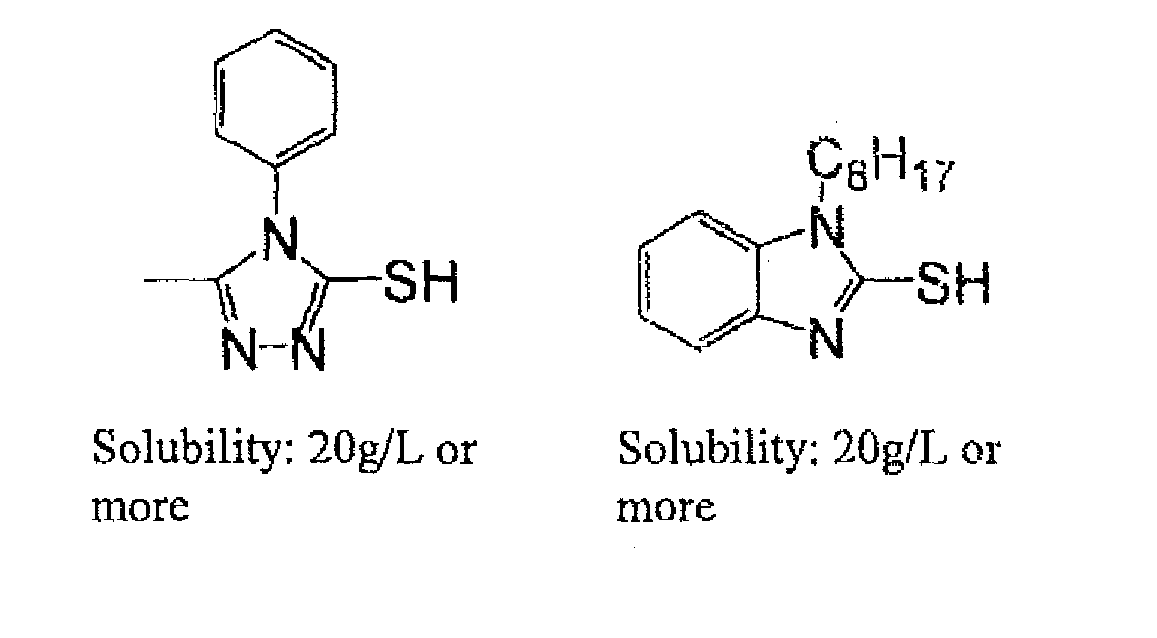
-

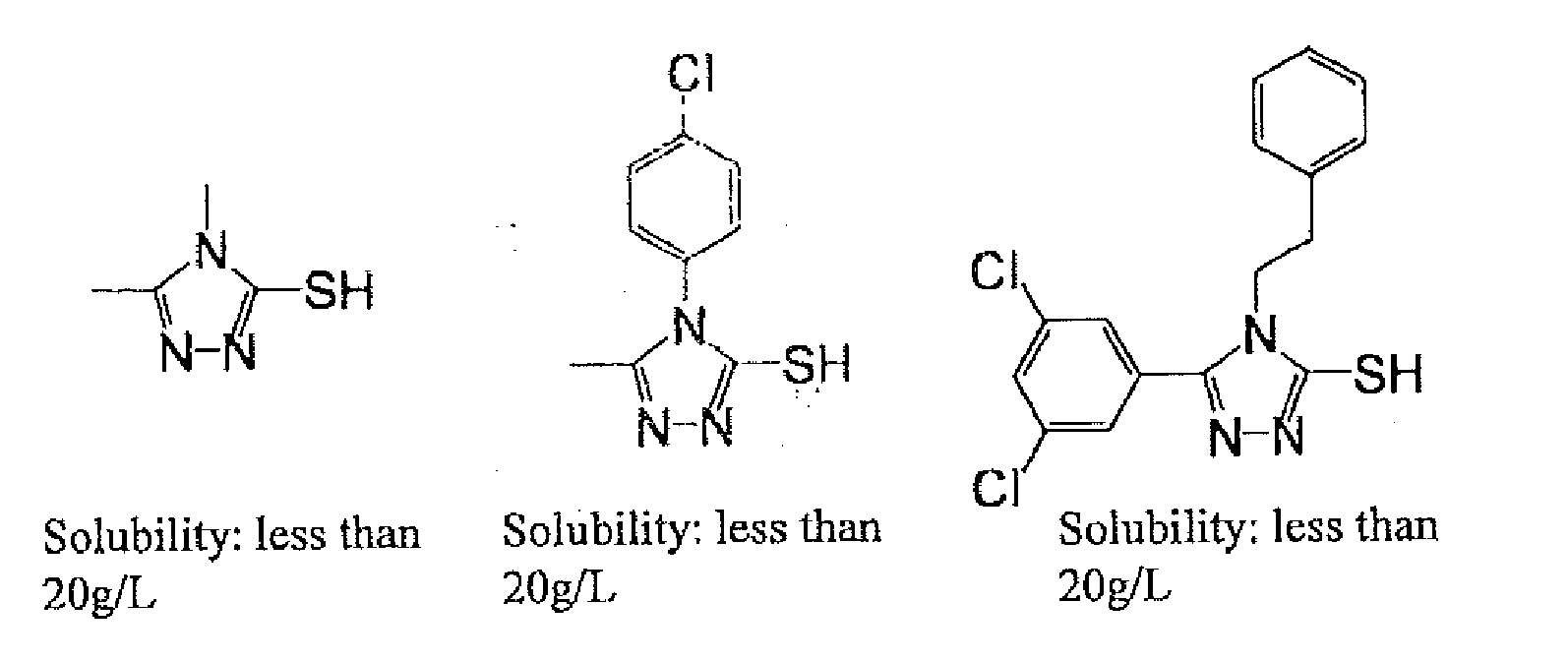


- The solubility of these thiol compounds in PGMEA solvent is preferably 20g/L or more, more preferably from 20g/L to 50g/L, and still more preferably from 20g/L to 40g/L from the viewpoint of uniformity of the formed film.
-
- Solubility measurement method-
In this specification, the solubility of a thiol compound is defined as follows.
A thiol compound to be measured is added to 5 mL of propyleneglycol monomethyl ether acetate (PGMEA) solvent, and stirred at 25°C for 1 hour. The maximum amount of the thiol compound that completely dissolves after the stirring is defined as solubility. - The thiol compounds can be synthesized according to the method described in J. Appl. Chem., 34, 2203-2207 (1961).
- The thiol compound may be used singly or in combination of two or more thereof.
When two or more thiol compounds are used in combination, the two or more thiol compounds may be all represented by any one of Formulae described above or may be a combination of thiol compounds represented by different Formulae (e.g., a compound represented by Formula (16) and a compound represented by Formula (17) may be used in combination). - When the colored curable composition of the present invention contains a thiol compound, the content thereof is preferably in the range of from 0.5 to 30 mass%, more preferably in the range of from 1 to 25 mass%, and still more preferably in the range of from 3 to 20 mass%, with respect to the mass of the total solid content of the colored curable composition from the viewpoint of increasing the curing rate by improving the balance between the polymerization growth rate and the chain transfer.
-
- Polymerization inhibitor-
The colored curable composition of the present invention preferably contains a small amount of thermal polymerization inhibitor so as to prevent unnecessary thermal polymerization of the polymerizable compound during the production or storage of a photopolymerizable composition.
Examples of thermal polymerization inhibitors that can be used in the present invention include hydroquinone, p-methoxyphenol, di-t-butyl-p-cresol, pyrogallol, t-butylcatechol, benzoquinone, 4,4'-thiobis(3-methyl-6-t-butylphenol), 2,2'-methylenebis(4-methyl-6-t-butylphenol), and N-nitrosophenylhydroxyamine cerous salt. - The addition amount of the thermal polymerization inhibitor is preferably from about 0.01 to about 5 mass% with respect to the total solid content of the colored curable composition of the present invention.
Further, in order to prevent the polymerization inhibition due to oxygen, a higher fatty acid derivative, such as behenic acid or behenic acid amide, may be optionally added such that the higher fatty acid derivative is unevenly distributed at the surface of the coating film during a drying process after coating. The addition amount of the higher fatty acid derivative is preferably from about 0.5 to about 10 mass% with respect to the total composition. -
- Adhesion improver-
The colored curable composition of the present invention may contain an adhesion improver so as to improve the adhesion to a hard surface, such as a surface of a support. Examples of the adhesion improver include a silane coupling agent and a titanium coupling agent. - Examples of the silane coupling agent include γ-(2-aminoethyl)aminopropyltrimethoxysilane, γ-(2-aminoethyl)aminopropyldimethoxysilane, β-(3,4-epoxycyclohexyl)ethyltrimethoxysilane, γ-aminopropyltrimethoxysilane, γ-aminopropyltriethoxysilane, γ-methacryloxypropyltrimethoxysilane, γ-methacryloxypropyltriethoxysilane, γ-acryloxypropyltrimethoxysilane, γ-acryloxypropyltriethoxysilane, γ-isoryanatepropyltimethoxysilane, γ-isocyanatepropyltriethoxysilane, N-β-(N-vinylbenzylaminoethyl)-y-aminopropyltrimethoxysilane · hydrochloride, γ-glycidoxypropyltrimetoxysilane, γ-glycidoxypropyltriethoxysilane, aminosilane, γ-mercaptopropyltrimethoxysilane, γ-mercaptopropyltriethoxysilane, methyltrimethoxysilane, methyltriethoxysilane, vinyltriacetoxysilane, γ-chloropropyltrimetoxysilane, hexamethyldisilazane, γ-anilinopropyltrimethoxysilane, vinyltrimelhoxysilane, vinyltriethoxysilane, vinyltris(β-methoxyethoxy)silane, octadecyldimethyl[3-(trimethoxysilyl)propyl]ammonium chloride, γ-chloropropylmethyldimethoxysilane, γ-mercaptopropylmethyl dimethoxysilane, methyltrichlorosilane, dimethyldichlorosilane, trimethylchlorosilane, 2-(3,4-epoxycyclohexyl)ethyltrimethoxysilane, bisallyltrimethoxysilane, tetraethoxysilane, bis(trimethoxysilyl)hexane, phenyltrimethoxysilane, N-(3-acryloxy-2-hydroxypropyl)-3-aminopropyltriethoxysilane, N-(3-methacryloxy-2-hydroxypropyl)-3-aminopropyltriethoxysilane, (methacryloxymethyl)methyldiethoxysilane, and (acryloxymethyl)methyl dimethoxysilane.
Among the above, γ-methacryloxypropyltrimethoxysilane, γ-inethacryloxypropyltriethoxysilane, γ-acryloxypropyltrimethoxysilane, γ-acryloxypropyltriethoxysilane, γ-mercapropropyltrimethoxysilane, γ-aminopropyltriethoxysilane, and phenyltrimethoxysilane are preferable, and γ-methacryloxypropyl trimethoxysilane is most preferable. - The addition amount of the adhesion improver is preferably from 0.5 to 30 mass%, and more preferably from 0.7 to 20 mass%, with respect to the total solid content of the colored curable composition of the present invention.
-
- Diluent-
In the colored curable composition of the present invention, various organic solvents may be used as diluents.
Examples of the organic solvents include acetone, methyl ethyl ketone, cyclohexane, ethyl acetate, ethylene dichloride, tetrahydrofuran, toluene, ethyleneglycol monomethyl ether, ethyleneglycol monoethyl ether, ethyleneglycol dimethyl ether, propyleneglycol monomethyl ether, propyleneglycol monoethyl ether, acetylacetone, cyclohexanone, diacetone alcohol, ethyleneglycol monomethyl ether acetate, ethyleneglycol ethyl ether acetate, ethyleneglycol monoisopropyl ether, ethyleneglycol monobutyl ether acetate, 3-methoxypropanol, methoxymethoxyethanol, diethylene glycol monomethyl ether, diethyleneglycol monoethyl ether, diethyleneglycol dimethyl ether, diethyleneglycol diethyl ether, propyleneglycol monomethyl ether acetate, propyleneglycol monoethyl ether acetate, 3-methoxypropyl acetate, N,N dimethylformamide, dimethyl sulfoxide, γ-butyrolactone, methyl lactate, and ethyl lactate.
The solvent may be used singly or a mixture of two or more thereof may be used. The concentration of the solid content relative to the organic solvent is preferably from 2 to 60 mass%. -
- Other additives-
Furthermore, to the colored curable composition of the present invention, known additives, such as an inorganic filler, a plasticizer, and a lypophilizing agent, may be added so as to improve the physical properties of the cured film.
Examples of the plasticizer include dioctyl phthalate, didodecyl phthalate, triethylene glycol dicaprylate, dimethylglycol phthalate, tricresyl phosphate, dioctyl adipate, dibutyl sebacate, and triacetyl glycerol. When a binder is used, the plasticizer may be added in a ratio of 10 mass% or lower relative to the total mass of the polymerizable compound and the binder polymer. - Next, a color filter of the present invention and a method of producing the same will be described.
The color filter of the present invention has, on a support, a colored pattern formed from the colored curable composition of the present invention.
Hereinafter, the color filter of the present invention will be described in detail with reference to a method of producing the same (method of the present invention for producing a color filter). - The method of the present invention for producing a color filter includes a step of applying the colored curable composition of the present invention onto a support to form a colored curable composition layer (hereinafter, sometimes referred to as a "colored curable composition layer formation step"); a step of exposing the colored curable composition layer to radiation through a mask (hereinafter sometimes referred to as an "exposure step"), and a step of developing the exposed colored curable composition layer to form a colored pattern (hereinafter sometimes referred to as a "developing step").
- Specifically, the colored curable composition of the present invention is applied directly onto a support (substrate) or onto another layer provided on the support (substrate) to form a colored curable composition layer (colored curable composition layer formation step); the colored curable composition layer is exposed to radiation through a given mask pattern to cure only an irradiated portion of the coating film (colored curable composition layer) (exposure step); and the coating film is developed with a developer (developing step) to thereby form a patterned film having pixels of the respective colors (three colors or four colors), whereby the color filter of the present invention can be produced.
Hereinafter, each step in the method of the present invention for producing a color filter will be described. - In the colored curable composition layer formation step, the colored curable composition of the present invention is applied onto a support to form a colored curable composition layer.
- Examples of the support that can be used in this step include soda glass substrates, PYREX (registered trademark) glass substrates, quartz glass substrates, and a substrate obtained by attaching a transparent electrically-conductive film onto any of the above glass substrates, which are for use in liquid crystal displays and the like, and photoelectric converting substrates for use in image-pickup devices, such as silicon substrates and complementary metal oxide film semiconductors (CMOS). In some cases, these substrates may have black stripes that separate pixels from one another.
If necessary, an undercoat layer may be formed on the support in order to improve adhesion to the upper layer, prevent the substance diffusion or flatten the substrate surface. - A photopolymerizable composition of the present invention for a color filter can be applied onto the support by various coating methods, such as slit coating, an ink-jet method, spin coating, cast coating, roll coating, and screen printing.
- The coating thickness of the colored curable composition of the present invention is preferably from 0.1 µm to 10 µm, more preferably from 0.2 µm to 5 µm, and still more preferably from 0.2 µm to 3 µm.
When a color filter for a solid state image pickup device is produced, the coating thickness of the colored curable composition of the present invention is preferably from 0.35 µm to 1.5 µm, and more preferably from 0.40 µm to 1.0 µm, from the viewpoint of resolution and developability. - The colored curable composition applied onto the support may be dried generally at a temperature of from 70°C to 110°C for 2 to 4 minutes to form a colored curable composition layer.
- [Exposure step]
In an exposure step, the colored curable composition layer formed in the colored curable composition layer formation step is exposed to radiation through a mask to cure only an irradiated portion of the coating film. It is preferable to perform exposure by emitting radiation. As the radiation for exposure, ultraviolet rays, particularly g line or i line, are preferable, and a high pressure mercury lamp is more preferable. The irradiation intensity is preferably from 5 mJ/cm2 to 1,500 mJ/cm2, more preferably from 10 mJ/cm2 to 1,000 mJ/cm2, and most preferably from 10 mJ/cm2 to 300 mJ/cm2. - [Development step]
Following the exposure step, alkali development treatment (developing step) is performed to dissolve, in an alkaline water solution, only a region that has not been irradiated with radiation in the exposure step, whereby only the photo-cured portion remains.
The developer is preferably an organic alkali developer is preferable which does not damage an underlying circuit or the like. The development temperature is generally from 20°C to 30°C and the development time is generally from 20 to 90 seconds. - The alkali used in the developer may be an organic alkaline compound, such as aqueous ammonia, ethylamine, diethylamine, dimethylethanolamine, tetramethylammonium hydroxide, tetraethylammonium hydroxide, choline, pyrrole, piperidine, or 1,8-diazabicyclo-[5,4,0]-7-undecene, each of which may be diluted with pure water to form an aqueous alkaline solution having a concentration of from 0.001 to 10 mass%, preferably from 0.01 to 1 mass%. It should be noted that when a developer containing such an alkaline aqueous solution is used, cleaning (rinsing) with pure water may be generally performed after development.
- It should be noted that, in the method of the present invention for producing a color filter, after performing the colored curable composition layer formation step, exposure step, and development step, a curing step of curing the formed colored pattern by heating and/or exposure to radiation may be optionally performed.
- A color filter having a desired colors may be produced by repeating the colored curable composition layer formation step, exposure step, and development step (and, optionally, the curing step) for the number of times corresponding to the number of the desired colors.
- Since the color filter of the present invention uses the colored curable composition of the present invention, the formed colored pattern exhibits a strong adhesion to a support substrate and the cured composition is excellent in development resistance. Therefore a high-resolution pattern can be formed with excellent exposure sensitivity, the pattern showing favorable adhesion to the substrate at an exposed portion and providing a desired cross-sectional shape. Accordingly the color filter of the present invention can be preferably used for solid state image pickup devices, such as a liquid crystal display element and CCD, and is suitable particularly for CCD elements, CMOS, or the like that have a high resolution having, for example, over 1 million pixels. More specifically, the color filter of the present invention is preferably applied to solid state image pickup devices.
The color filter of the present invention can be used, for example, as a color filter disposed between the light receiving portions of the respective pixels of a CCD and a micro lens for condensing light. - <Solid state image pickup device>
The color filter of the present invention can be used for solid state image pickup devices, such as liquid crystal display elements and CCD, and is suitable particularly for CCD elements, CMOS, or the like that have a high resolution having, for example, over 1 million pixels. More specifically, the color filter of the present invention is preferably applied to solid state image pickup devices.
The color filter of the present invention can be used, for example, as a color filter disposed between the light receiving portions of the respective pixels of a CCD and a micro lens for condensing light. - Hereinafter, the present invention will be described more specifically with reference to examples. However the examples should not be construed as limiting the invention, and the invention is capable of numerous rearrangements, modifications and substitution of parts and elements without departing from the spirit of the invention. Unless otherwise specified, "part", "%", and "wt%" are based on mass.
- <Synthesis of specific photopolymerization initiator>
(Synthesis Example 1: Synthesis of specific compound 1, which is a specific photopolymerization initiator)
Ethylcarbazole (100.0 g, 0.512 mol) was dissolved in 260 ml of chlorobenzene. The mixture was cooled to 0°C, and then aluminum chloride (70.3 g, 0.527 mol) was added thereto. Subsequently, o-tolyl chloride (81.5 g, 0.527 mol) was added dropwise over 40 minutes, the temperature of the reaction solution was increased to room temperature, and then the reaction solution was stirred for 3 hours. Next, after the reaction solution was cooled to 0°C, aluminum chloride (75.1 g, 0.563 mol) was added thereto. 4-chlorobutyryl chloride (79.4 g, 0.563 mol) was added dropwise over 40 minutes, the temperature of the reaction solution was increased to room temperature, and the reaction solution was stirred for 3 hours. A mixed solution of 156 ml of an aqueous 35wt% hydrochloric acid solution and 392 ml of distilled water was cooled to 0°C, and then the reaction solution was added dropwise. The precipitated solid was subjected to suction filtration, washed with distilled water and methanol, and recrystallized from acetonitrile to thereby obtain Compound A having the following structure (Obtained amount: 164.4 g, Yield: 77%). -

- Compound A (20.0 g, 47.9 mmol) was dissolved in 64 ml of THF, and 4-chlorobenzene thiol (7.27 g, 50.2 mmol) and sodium iodide (0.7 g, 4.79 mmol) were added thereto. Subsequently, sodium hydroxide (2.0 g, 50.2 mmol) was added to the reaction solution, and the reaction solution was refluxed for 2 hours. After the reaction solution was cooled to 0°C, SM-28 (11.1 g, 57.4 mmol) was added dropwise over 20 minutes, the temperature of the reaction solution was increased to room temperature, and then the reaction solution was stirred for 2 hours. After the reaction solution was cooled to 0°C, isopentyl nitrite (6.73 g, 57.4 mmol) was added dropwise over 20 minutes, the temperature of the reaction solution was increased to room temperature, and then the reaction solution was stirred for 3 hours. The reaction solution was diluted in 120 ml of acetone, and was added dropwise to an aqueous 0.1N hydrochloric acid solution that had been cooled to 0°C. The precipitated solid was collected by to suction filtration, and washed with distilled water. Subsequently, recrystallization from acetonitrile was conducted to thereby obtain Compound B having the following structure (Obtained amount: 17.0 g, Yield: 64%).
-

- Compound B (18.0 g, 32.4 mmol) was dissolved in 90 ml of N-methylpyrrolidone, and then triethylamine (3.94 g, 38.9 mmol) was added thereto. After the reaction solution was cooled to 0°C, acetyl chloride (3.05 g, 38.9 mmol) was added dropwise over 20 minutes, the temperature of the reaction solution was increased to room temperature, and the reaction solution was stirred for 2 hours. The reaction solution was added dropwise to 150 ml of distilled water which had been cooled to 0°C. The precipitated solid was collected by suction filtration, washed with 200 ml of isopropyl alcohol which had been cooled to 0°C, and dried to thereby obtain Specific Compound 1 (Obtained amount: 19.5g, Yield: 99%).
-

- The structure of the obtained Specific Compound 1 was identified by NMR. (1H-NMR 400MHz CDCl3): 8.86 (s, 1H), 8.60 (s, 1H), 8.31 (d, 1H, J= 8.0Hz), 8.81 (d, 1H, J= 8.0Hz), 7.51-7.24 (m. 10H), 7.36 (q, 2H, 7.4Hz), 3.24-3.13 (m, 4H), 2.36 (s, 3H), 2.21 (s, 3H), 1.50 (t, 3H, 7.4Hz).
- (Synthesis Example 2: Synthesis of a specific compound 2, which is a specific photopolymerization initiator)
An oxime compound (17.6 g, 32.4 mmol) was dissolved in 90 ml of N-methylpyrrolidone, and triethylamine (3.94 g, 38.9 mmol) was added thereto. After the reaction solution was cooled to 0°C, acetyl chloride (3.05 g, 38.9 mmol) was added dropwise over 20 minutes, the temperature of the reaction solution was increased to room temperature, and the reaction solution was stirred for 2 hours. The reaction solution was added dropwise to 150 ml of distilled water which had been cooled to 0°C. The precipitated solid was collected by suction filtration, washed with 200 ml of isopropyl alcohol which had been cooled to 0°C, and dried to thereby obtain Specific Compound 2 (Obtained amount: 17.5 g, Yield: 92%). -

- Compound C (18.0 g, 41.2 mmol) was dissolved in 90 ml of N-methylpyrrolidone, and triethylamine (4.59 g, 45.3 mmol) was added thereto. After the reaction solution was cooled to 0°C, acetyl chloride (3.56 g, 45.3 mmol) was added dropwise over 20 minutes, the temperature of the reaction solution was increased to room temperature, and the reaction solution was stirred for 2 hours. The reaction solution was added dropwise to 150 ml of distilled water which had been cooled to 0°C. The precipitated solid was collected by suction filtration, washed with 200 ml of isopropyl alcohol which had been cooled to 0°C, and dried to thereby obtain Specific Compound 3 (Obtained amount: 18.7 g, Yield: 95%).
-

- (Synthesis Example 4: Synthesis of Comparative Compound 4)
An oxime compound E (17.7 g, 32.4 mmol) having the following structure was dissolved in 90 ml of N-methylpyrrolidone, and then triethylamine (3.94 g, 38.9 mmol) was added thereto. After the reaction solution was cooled to 0°C, acetyl chloride (3.05 g, 38.9 mmol) was added dropwise over 20 minutes, the temperature of the reaction solution was increased to room temperature, and the reaction solution was stirred for 2 hours. The reaction solution was added dropwise to 150 ml of distilled water which had been cooled to - Compound 4 (Obtained amount: 17.5 g, Yield: 92%).
-

- The structure of the obtained Comparative Compound 4 was identified by NMR. (1H-NMR 400MHz CDCl3): 8.05 (d, 1H, J=8.8Hz), 7.78(d, 1H, J=8.8Hz), 7.47 (d, 1H, J=8.0Hz), 7.42-7.26(m, 10H), 3.19-3.08 (m, 4H), 2.35 (s, 3H), 2.17(s,3H)
- The thus obtained specific photopolymerization initiators (Specific Compounds 1 to 3) and Comparative Compounds 1 to 4, and the molar absorption coefficient at 365 nm of each compound are shown in the following.
-
Initiator Structure Molar absorption coefficient at 365 nm Specific compound 1 
16658 Specific compound 2 
15348 Specific compound 3 
12530 Comparative compound 1 IRGACURE OXE 01 (manufactured by Ciba Specialty Chemicals Co., Ltd. 5226 Comparative compound 2 IRGACURE OXE 02 (manufactured by Ciba Specialty Chemicals Co., Ltd. 2140 Comparative compound 3 IRGACURE OXE 369 (manufactured by Ciba Specialty Chemicals Co., Ltd. 982 Comparative compound 4 
4813 - The following Specific Compounds 4 to 6 were synthesized in a manner similar to the synthesis examples described above.
-


- The molar extinction coefficient at 365 nm of each of the obtained Specific Compounds 1 to 6 and Comparative Compounds 1 to 4 was measured at a concentration of 0.01 g/L using an ethyl acetate solvent for spectral analysis and Carry-5 spectrophotometer manufactured by Varian. The structure of each of Comparative Compounds 1 to 3 is as shown below.
-


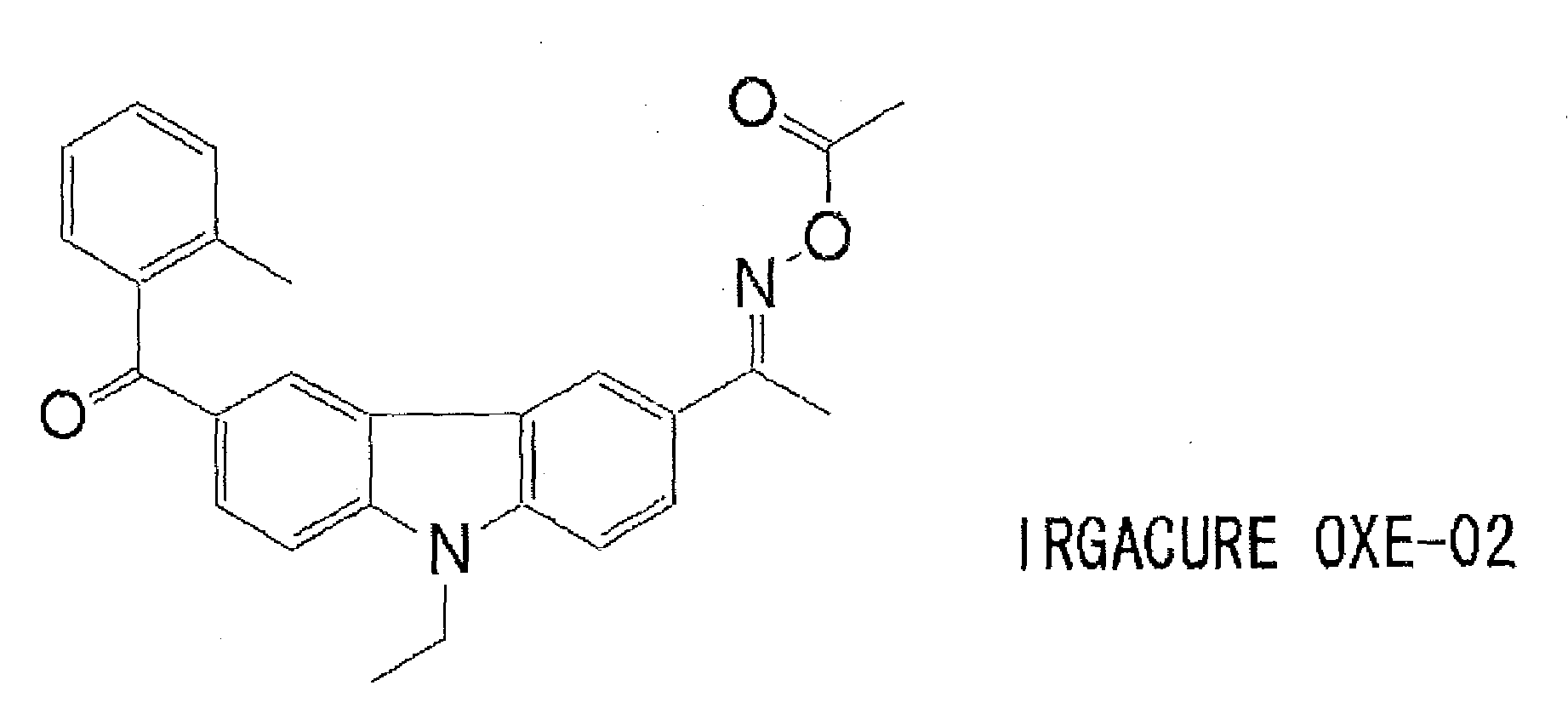
- [Example 1-1]
<1. Preparation of colored curable composition A-1>
As a colored curable composition, a negative colored curable composition A-1 containing a colorant (pigment) was prepared, and a color filter of Example 1-1 was produced using the same. - 1-1. Preparation of pigment dispersion liquid (P1)
40 parts by mass of a mixture of C.I. pigment Green 36 and C.I. pigment yellow 219 in a mass ratio of 30/70 as a pigment, 10 parts by mass (about 4.51 parts by mass in terms of the solid content) of BYK2001 (Disperbyk: tradename, manufactured by BYK-Chemie, Solid content of 45.1 mass%) as a dispersant; and 150 parts by mass of ethyl 3-ethoxypropionate as a solvent was mixed to form a mixed liquid, and dispersed for 15 hours by a bead mill to thereby prepare a pigment dispersion liquid (P1).
The average particle diameter of the pigment in the obtained pigment dispersion liquid (P1) was measured by a dynamic light scattering method, and was found to be 200 nm. - 1-2. Preparation of Colored Curable Composition A-1 (Coating Liquid)
Components of the following composition A-1 were mixed and dissolved to thereby prepare a colored curable composition A-1. -
- Composition A-1-
- Pigment dispersion liquid (P1) 700 parts by mass
- Alkali-soluble resin (Exemplary Compound (101)) 100 parts by mass
- Polyfunctional monomer [Mixture of pentaerythritol triacrylate and dipentaerythritol hexaacrylate (3:7)] 60 parts by mass
- Specific photopolymerization initiator (Specific compound 1) 60 parts by mass
- Solvent (propyleneglycol monomethylether acetate) 1,000 parts by mass
- Surfactant (Tradename: Tetranick 150R1, product of BASF A.G.) 1 part by mass
- γ-methacryloxypropyl triethoxysilane 5 parts by mass
- <2. Production of color filter>
2-1. Formation of photosensitive composition layer
The colored curable composition A-1 containing the pigment obtained above was slit-coated, as a resist solution, on a 550 mm × 650 mm glass substrate under the following conditions. The resultant was held as was for 10 minutes, and subjected to vacuum drying and prebaking (100°C for 80 seconds) to form a photosensitive composition coating film (photosensitive composition layer). - (Slit coating conditions)
Size of an opening at the top of the coating head: 50 µm Coating speed: 100 mm/second Clearance between the substrate and the coating head: 150 µm Coating thickness (dry thickness): 2 µm Coating temperature: 23 °C - 2-2. Exposure, Development
Thereafter, the photosensitive composition layer was patternwise exposed to radiation using a 2.5 kW ultrahigh pressure mercury lamp. The entire surface of the photosensitive composition layer after exposure was coated with a 10% aqueous solution of an organic developer (Tradename: CD, manufactured by Fuji Photo Film Electronics Materials), and was allowed to stand still for 60 seconds. - 2-3. Heat-treatment
Thereafter, pure water was sprayed in shower form to the photosensitive composition layer to wash away the developer, and the resultant was then heated in a 220°C oven for 1 hour (postbaking). Thus a color filter in which a colored pattern was formed on a glass substrate was obtained. - <3. Performance evaluation>
The storage stability and exposure sensitivity of the colored curable composition A-1, development properties when a colored pattern was formed on a glass substrate using the colored curable composition, adhesion of the obtained colored pattern to substrate and the cross-sectional shape of the pattern were evaluated as follows. The results are shown in Table 1. - 3-1. Storage stability of colored curable composition
The colored curable composition A-1 was stored for one month at room temperature, and then the precipitation degree was visually evaluated according to the following criteria.
(Criteria)
A : No precipitation was observed.
B : Precipitation was slightly observed.
C : Precipitation was observed. - 3-2. Exposure sensitivity of colored curable composition
The colored curable composition A-1 was spin coated on a glass substrate, and dried to form a coating film having a thicknesses of 1.0 µm. Specifically, the spin coating was performed at 300 rpm for 5 seconds, and then at 800 rpm for 20 seconds, and the drying was performed at 100°C for 80 seconds. Next, the obtained coating film was exposed at various exposure amounts in the range of from 10 mJ/cm2 to 1,600 mJ/cm2 using a photomask for a test having a line width of 2.0 µm and a proxymity exposure device having an ultrahigh pressure mercury lamp (manufactured by Hitachi High-tech Electronics Engineering Co., Ltd.). Then, using a 60% CD-2000 developer (tradename, manufactured by Fuji Photo Film Electronics Materials), the coating film after exposure was developed under the conditions of a temperature of 25°C and a development time of 60 seconds. Thereafter, the resultant was rinsed for 20 seconds with running water, and spray-dried to complete patterning.
Regarding the evaluation of exposure sensitivity, the minimum exposure amount at which the post-development thickness of the region that was irradiated with light in the exposure step became 95% or more of the thickness (100 %) of the film before the exposure was evaluated as the exposure requirement amount. A smaller exposure requirement amount indicates a higher sensitivity. - 3-3. Developability and Pattern cross-sectional shape
The developability and pattern cross-sectional shape were evaluated by confirming the substrate surface and cross-sectional shape after postbaking was conducted in "2-3. Heat Treatment". The observation of the substrate surface and cross-sectional shape was performed according to a usual method through observation under an optical microscope and by observation of SEM photographs. The details of the evaluation method are as follows. -
- Developability-
In the exposure step, the presence or absence of a residue in a region (unexposed region) which had not been irradiated with light was observed to evaluate the developability. The results are shown in Table 1.
(Criteria)
A : No residue was observed in the unexposed region.
B: Residues were slightly observed in the unexposed region, but was practically acceptable.
C: Significant residues were observed in the unexposed part. -
- Pattern cross-sectional shape-
The cross-sectional shape of the formed pattern was observed and evaluated. As the cross-sectional shape of the pattern, a forward tapered shape is the most preferable and a rectangular shape is the next preferable shape. An inversely tapered shape is unfavorable. The results are shown in Table 1. - [Examples 1-2 to 1-23 and Comparative Examples 1-1 to 1-8]
Colored curable compositions A-2 to A-23 for Examples and colored curable compositions A'-1 to A'-8 for Comparative Examples were prepared and color filters of Examples 1-2 to 1-23 and Comparative Examples 1-1 to 1-8 were obtained in the same manner as in Example 1-1, except that (i) 60 paris by mass of the specific compound 1 (Specific photopolymerization initiator) in the composition A-1 used for the preparation of the colored curable composition A-1 in Example 1-1 was replaced by the respective compounds in the respective amounts shown in Tables 1 to 2, and, (ii) in each of Examples 1-12 to 1-20, a sensitizer and/or a co-sensitizer of the kinds and amounts shown in Tables 1 to 2 was further added. Furthermore, the same evaluation as in Example 1-1 was performed. The results are shown in Tables 1 to 2.Table 1 Example Composition Initiator Sensitizer Co-sensitizer Alkali-soluble Resin Storage Stability Exposure Requirement Amount (mJ/cm2) Developability Pattern Cross-sectional Shape Example 1-1 A-1 Specific compound 1 (60 parts by mass) Not Added Not Added Exemplary Compound (101) A 220 A Rectangular Example 1-2 A-2 Specific compound 1 (60 parts by mass) Not Added Not Added Exemplary Compound (103) A 200 A Forward tapered Example 1-3 A-3 Specific compound 1 (60 parts by mass) Not Added Not Added Exemplary Compound (104) A 200 A Forward tapered Example 1-4 A-4 Specific compound 1 (60 parts by mass) Not Added Not Added Exemplary Compound (106) A 200 A Forward tapered Example 1-5 A-5 Specific compound 1 (60 parts by mass) Not Added Not Added Exemplary Compound (110) A 210 A Forward tapered Example 1-6 A-6 Specific compound 1 (60 parts by mass) Not Added Not Added Exemplary Compound (116) A 200 B Forward tapered Example 1-7 A-7 Specific compound 1 (60 parts by mass) Not Added Not Added Exemplary Compound (119) A 200 B Rectangular Example 1-8 A-8 Specific compound 1 (60 parts by mass) Not Added Not Added Exemplary Compound (120) A 200 B Rectangular Example 1-9 A-9 Specific compound 1 (60 parts by mass) Not Added Not Added Exemplary Compound (121) A 200 B Rectangular Example 1-10 A-10 Specific compound 2 (60 parts by mass) Not Added Not Added Exemplary Compound (104) A 200 A Forward tapered Example 1-11 A-11 Specific compound 3 (60 parts by mass) Not Added Not Added Exemplary Compound (104) A 250 A Rectangular Example 1-12 A-12 Specific compound 1 (50 parts by mass) A1 (10 parts by mass) Not Added Exemplary Compound (104) A 190 A Forward tapered Examples 1-13 A-13 Specific compound 1 (50 parts by mass) A2 (10 parts by mass) Not Added Exemplary Compound (104) A 180 A Forward tapered Example 1-14 A-14 Specific compound 1 (50 parts by mass) A3 (10 parts by mass) Not Added Exemplary Compound (104) A 180 A Forward tapered Example 1-15 A-15 Specific compound 1 (50 parts by mass) Not Added F1(10 parts by mass) Exemplary Compound (104) A 190 A Forward tapered Example 1-16 A-16 Specific compound 1 (50 parts by mass) Not Added F2 (10 parts by mass) Exemplary Compound (104) A 190 A Forward tapered Example 1-17 A-17 Specific compound 1 (50 parts by mass) Not Added F3 (10 parts by mass) Exemplary Compound (104) A 180 A Forward tapered -
Table 2 Example Composition Initiator Sensitizer Co-sensitizer Alkali-soluble Resin Storage Stability Exposure Requirement Amount (mJ/cm2) Developability Pattern Cross-sectional Shape Example 1-17 A-17 Specific compound 1 (50 parts by mass) Not Added F3 (10 parts by mass) Exemplary Compound (104) A 180 A Forward tapered Example 1-18 A-18 Specific compound 1 (40 parts by mass) A2 (10 parts by mass) F1 (10 parts by mass) Exemplary Compound (104) A 180 A Forward tapered Example 1-19 A-19 Specific compound 1 (40 parts by mass) A2 (10 parts by mass) F2 (10 parts by mass) Exemplary Compound (104) A 180 A Forward tapered Example 1-20 A-20 Specific compound 1 (40 parts by mass) A2 (10 parts by mass) F3 (10 parts by mass) Exemplary Compound (104) A 170 A Forward tapered Example 1-21 A-21 Specific compound 4 (60 parts by mass) Not Added Not Added Exemplary Compound (104) A 230 A Forward tapered Example 1-22 A-22' Specific compound 5 (60 parts by mass) Not Added Not Added Exemplary Compound (104) A 240 A Forward tapered Example 1-23 A-23 Specific compound 6 (60 parts by mass) Not Added Not Added Exemplary Compound (104) A 240 A Forward tapered Comparative Example 1 A'-1 Comparative compound 1 (60 parts by mass) Not Added Not Added Benzyl methacrylate/methacrylic acid/ hydroxyethyl methacrylate copolymer (molar ratio: 80/10/10, Mw: 10000) A 500 C Inversely tapered Comparative Example 2 A'-2 Comparative compound 1 (60 parts by mass) Not Added Not Added Benzyl methacrylate/methacrylic acid copolymer (molar ratio: 70/30, Mw: 10000) A 500 B Inversely tapered Comparative Example 3 A'-3 Comparative compound 2 (60 parts by mass) Not Added Not Added Benzyl methacrylate/methacrylic acid/ hydroxyethyl methacrylate copolymer (molar ratio: 80/10/10, Mw: 10000) A 500 C Inversely tapered Comparative Example 4 A'-4 Comparative compound 3 (60 parts by mass) Not Added Not Added Benzyl methacrylate/metbacrylic acid/ hydroxyethyl methacrylate copolymer (molar ratio: 80/10/10, Mw: 10000) A 950 B Inversely tapered Comparative Example 5 A'-5 Comparative compound 4 (60 parts by mass) Not Added Not Added Benzyl methacrylate/methacrylic acid/ hydroxyethyl methacrylate copolymer (molar ratio: 80/10/10, Mw: 10000) A 500 C Rectangular Comparative Example 6 A'-6 Comparative compound 1 (60 parts by mass) Not Added Not Added Exemplary Compound (104) A 300 A Inversely tapered Comparative Example 7 A'-7 Comparative compound 2 (60 parts by mass) Not Added Not Added Exemplary Compound (120) A 300 B Inversely tapered Comparative Example 8 A'-8 Comparative compound 1 (60 parts by mass) Not Added Not Added Exemplary Compound (119) A 300 B Inversely tapered - Sensitizers A1 to A3 and co-sensitizer F1 to F3 shown in Tables 1 and Table 2 are compounds shown below. The same applies to Tables 4 to 9.
- A1: 4,4-bisdiethylamino benzophene
- A2: diethylthioxanthone
- A3:

- F1: 2-mercaptobenzimidazol
- F2: 2-mercaptobenzothiazol
- F3: N-phenyl-2-mercaptobenzimidazol
- The results shown in Tables 1 and 2 demonstrate that the colored curable composition of each Example containing the specific photopolymerization initiator (specific compounds 1 to 6) has a high exposure sensitivity, excellent developability when it is used for forming a colored pattern of a color filter (prevention of a development residue), and provides a colored pattern having an excellent cross-sectional shape. Moreover, it is revealed that the colored curable composition of each Example has excellent storage stability (stability with time),
- [Example 2-1]
<1. Preparation of resist liquid>
Components in the following composition were mixed and dissolved to prepare a
resist liquid. - Composition of Resist Liquid-
- Propyleneglycol monomethyl ether acetate (PGMEA) 19.20 parts by mass
- Ethyl lactate 36.67 parts by mass
- Resin [40%PGMEA solution of benzyl methacrylate / methacrylic acid / 2-hydroxyethyl methacrylate copolymer (molar ratio = 60/22/18)] 30.51 parts by mass
- Dipentaerythritol hexaacrylate (polymerizable compound) 12.20 parts by mass
- Polymerization inhibitor (p-methoxyphenol) 0.0061 part by mass
- Fluorochemical surfactant [F-475 (tradename), manufactured by Dainippon Ink & Chemicals, Inc.] 0.83 part by mass
- Photoinitiator [TAZ-107 (tradename: trihalomethyltriazine-based photopolymerization initiator, manufactured by Midori Kagaku K.K.)] 0.586 part by mass
- <2. Production of silicon wafer substrate having an undercoat layer>
A 6-inch silicon wafer was heat-treated in an oven at 200°C for 30 minutes. Subsequently, the resist liquid was applied onto the silicon wafer such that the dry film thickness became 2 µm, and heated in a 220°C oven for 1 hour to form an undercoat layer to thereby obtain a silicon wafer substrate having an undercoat layer. - <3. Preparation of colored curable composition B-1>
Compounds in the following composition B-1 were mixed and dissolved to prepare a colored curable composition B-1 containing a colorant (dye). - -Composition B-1-
- Cyclohexanone 80 parts by mass
- - Colorant (C.I. Acid Blue 108) 7.5 parts by mass
- - Colorant (C.I. solvent Yellow 162) 2.5 parts by mass
- - Polyfunctional monomer [Mixture of pentaerythritol triacrylate and dipentaerythritol hexaacrylate (3:7)] 3.0 parts by mass
- - Alkali-soluble resin (Exemplary Compound (101)) 4,5 parts by mass
- - Specific compound 1 [Specific photopolymerization initiator] 2.5 parts by mass
- <4. Evaluation of storage stability of colored curable composition B-1 (coating liquid)>
The colored curable composition B-1 was stored at room temperature for one month, and then was visually evaluated for the precipitation degree according to the following criteria. The results are shown in Table 4.
(Criteria)
A : No precipitation was observed.
B : Precipitation was slightly observed.
C : Precipitation was observed. - <5. Production of color filter using colored curable composition B-1 and evaluation thereof>
The colored curable composition B-1 prepared in item 3-B above was applied onto the undercoat layer of the silicon wafer substrate obtained in item 2 above to form a photosensitive coating film. The coating film was heat-treated (prebaked) for 120 seconds using a 100°C hot plate in such that the dry film thickness of the coating film became 0.9 µm.
Subsequently, the coating film was irradiated by using an i-ray stepper exposure apparatus FPA-3000 i 5+ (tradename: manufactured by Canon Co.) at a wavelength of 365 nm through an Island pattern mask having a 2 µm square pattern at an exposure amount of from 10 to 1,600 mJ/cm2.
Then the silicon wafer substrate having the irradiated coating film thereon was placed on a horizontal rotary table of a spin-shower developing machine (Model DW-30 (tradename); manufactured by Chemitronics Co.) and subjected to paddle development at 23°C for 60 seconds using a CD-2000 (tradename: manufactured by Fuji Film Materials Co., Ltd.) to thereby form a colored pattern on the silicon wafer substrate. - The silicon wafer substrate on which the colored pattern was formed was fixed to the horizontal rotary table by using a vacuum chuck system. While rotating the silicon wafer substrate by using a rotational device at a rotation speed of 50 rpm, rinsing treatment was performed by supplying purified water in shower form from above the rotational center thereof using an ejection nozzle, and then the substrate was spray-dried.
Thus a color filter in which a colored pattern was formed on a substrate was obtained. -
- Exposure sensitivity-
Regarding the evaluation of exposure sensitivity, the minimum exposure amount at which the post-development thickness of the region that was irradiated with light in the exposure step became 95% or more of the thickness (100 %) of the film before the exposure was evaluated as the exposure requirement amount. A smaller exposure requirement amount indicates a higher sensitivity. The size of the colored pattern was also measured using a length measurement SEM "S-9260A" (tradename: manufactured by Hitachi
High-Technologies Corp.) at that time. A pattern size closer to 2 µm indicates a sufficient curing property and more favorable sensitivity.
The measurement and evaluation results are shown in Table 4. -
- Pattern cross-sectional shape-
The evaluation of the pattern cross-sectional shape was performed according to the evaluation method and evaluation criteria employed in Example 1-1. The measurement and evaluation results are shown in Table 4. -
- Confirmation of development residue-
A 1.5 µm square pixel pattern was formed with an exposure amount of 7,000 J/cm2 using a length measurement SEM (Hitachi S-9260S (tradename)). The periphery of pixels and a portion between pixels are observed to confirm the degree of generation of development residue such as adhering matter and undissolved residue.
The observation results were classified, for evaluation, into three ranks of Type-A, Type-B, and Type-C in the order from better results to worse results (i.e., in the order from more prevention of development residue to less prevention of development residue). The classification method is shown in Table 3 andFig. 1 . Moreover the measurement and evaluation results are shown in Table 4.
Among the above-mentioned ranks, Type-A, Type-B, and Type-C, the Type-A and Type-B are within a permissible range (practically acceptable), with Type-A being more preferable. -
Type-A Type-B Type-C Residual at pixel periphery Not observed Not observed Significantly observed Residual at a portion between pixels Not observed Slightly observed Significantly observed - [Examples 2-2 to 2-25 and Comparative Examples 2-1 to 2-4 and 2-6 to 2-8]
Colored curable compositions B-2 to B-25 for Examples and colored curable compositions B'3-1 to B'3-4 and B'3-6 to B'3-8 for Comparative Examples were prepared and color filters of Examples 2-2 to 2-25 and Comparative Examples 2-1 to 2-4 and 2-6 to 2-8 were obtained in the same manner as in Example 2-1, except that (i) 2.5 parts by mass of the specific compound 1 (Specific photopolymerization initiator) in the composition B-1 used for the preparation of the colored curable composition B-1 in Example 2-1 was replaced by the respective compounds in the respective amounts shown in Tables 4 and 5, and (ii) in each of Examples 2-12 to 2-22, a sensitizer and/or a co-sensitizer of the kind and amount shown in Tables 4 and 5 was further added. Furthermore the same evaluation as in Example 2-1 was performed. The results are shown in Tables 4 and 5. - [Example 3-1]
A compound having the following composition C-1 was mixed and dissolved to thereby prepare a colored curable composition C-1 containing a colorant (pigment). -
- Composition C-1-
- Ethyl 3-ethoxypropionate [solvent] 17.9 parts by mass
- Colorant: Pigment dispersion liquid of C.I. Pigment Red 254 [Solid content: 15%, Pigment content in the solid content: 60%] 26.7 parts by mass
- Colorant: Pigment dispersion liquid of C.I. Pigment Yellow 139 [Solid content: 15%, Pigment content in the solid content: 60%] 1 7.8 parts by mass
- Polyfunctional monomer [Mixture of pentaerythritol triacrylate and dipentaerythritol hexaacrylate (3:7)] 3.5 parts by mass
- Specific compound 1 [Specific photopolymerization initiator] 0.5 part by mass
- Alkali-soluble resin (Exemplary Compound (101) 2.0 parts by mass
- <Evaluation of Storage Stability of Colored Curable Composition C-1 (coating liquid)>
The storage stability of the colored curable composition C-1 (coating liquid) was evaluated in the same manner as in Example 2-1, except that the colored curable composition B-1 was replaced by the colored curable composition C-1. The results are shown in Table 6. - <Production of color filter using colored curable composition C-1 and evaluation thereof>
A color filter of Example 3-1 was produced in the same manner as in Example 2-1, except that the colored curable composition B-1 was replaced by the colored curable composition C-1. Then the same evaluation as in Example 2-1 was performed on the color filter of Example 3-1. The results are shown in Table 6. - [Examples 3-2 to 3-23 and Comparative Examples 3-1 to 3-4 and 3-6 to 3-8]
Colored curable compositions C-2 to C-23 for Examples and colored curable compositions C'3-1 to C'3-4 and C'3-6 to C'3-8 for Comparative Examples were prepared and color filters of Examples 3-2 to 3-23 and Comparative Examples 3-1 to 3-4 and 3-6 to 3-8 were obtained in the same manner as in Example 3-1, except that (i) 2.5 parts by mass of the specific compound 1 (Specific photopolymerization initiator) in the composition C-1 used for the preparation of the colored curable composition C-1 in Example 3-1 was replaced by the respective compounds in the respective amounts shown in Tables 6 and 7, and (ii) in each of Examples 3-12 to 3-20, a sensitizer and/or a co-sensitizer of the kind and amount shown in Tables 6 and 7 was further added. Furthermore the same evaluation as in Example 3-1 was performed. The results are shown in Tables 6 and 7. - [Example 4-1]
A compound having the following composition D-1 was mixed and dissolved to thereby prepare a colored curable composition D-1 containing a colorant (pigment). -
- Composition D-1 (High pigment concentration)-
- Ethyl 3-ethoxypropionate [solvent] 17.9 parts by mass
- Colorant: Pigment dispersion liquid of C.I. Pigment Red 254 [Solid content: 15%, Pigment content in the solid content: 60%] 33.34 parts by mass
- Colorant: Pigment dispersion liquid of C.I. Pigment Yellow 139 [Solid content: 15%, Pigment content in the solid content: 60%] 22.23 parts by mass
- Polyfunctional monomer 2.5 parts by mass
- Specific compound 1 [Specific photopolymerization initiator] 0.5 part by mass
- Alkali-soluble resin (Exemplary Compound (101)) 2.0 parts by mass
- <Evaluation of storage stability of colored curable composition D-1 (coating liquid)>
The storage stability of the colored curable composition D-1 (coating liquid) was evaluated in the same manner as in Example 2-1, except that the colored curable composition B-1 was replaced by the colored curable composition D-1. The results are shown in Table 8. - <Production of color filter using colored curable composition D-1 and evaluation thereof>
A color filter of Example 4-1 was produced in the same manner as in Example 2-1, except that the colored curable composition B-1 was replaced by the colored curable composition D-1. Then the same evaluation as in Example 2-1 was performed on the color filter of Example 4-1. The results are shown in Table 8. - [Examples 4-2 to 4-23 and Comparative Examples 4-1 to 4-4 and 4-6 to 4-8]
Colored curable compositions D-2 to D-23 for Examples and colored curable compositions D'3-1 to D'3-4 and D'3-6 to D'3-8 for Comparative Examples were prepared and color filters of Examples 4-2 to 4-23 and Comparative Examples 4-1 to 4-4 and 4-6 to 4-8 were obtained in the same manner as in Example 4-1, except that (i) 2.5 parts by mass of the specific compound 1 (Specific photopolymerization initiator) in the composition D-1 used for the preparation of the colored curable composition D-1 in Example 4-1 was replaced by the respective compounds in the respective amounts shown in Tables 8 and 9, and (ii) in each of Examples 4-12 to 4-20, a sensitizer and/or a co-sensitizer of the kind and amount shown in Tables 8 and 9 was further added. Furthermore, the same evaluation as in Example 4-1 was performed. The results are shown in Tables 8 and 9. -
Table 4 Composition Initiator Sensitizer Co-sensitizer Alkali-soluble Resin Exposure Requirement Amount (mJ/cm2) Pattern size A (µm) Stability with Time Residue Geneartion Example 2-1 B-1 Specific compound 1 (2.5 parts by mass) Not Added Not Added Exemplary Compound (101) 1000 1.95 A A Example 2-2 B-2 Specific compound 1 (2.5 parts by mass) Not Added Not Added Exemplary Compound (103) 1000 1.95 A A Example 2-3 B-3 Specific compound 1 (2.5 parts by mass) Not Added Not Added Exemplary Compound (104) 1000 1.95 A A Example 2-4 B-4 Specific compound 1 (2.5 parts by mass) Not Added Not Added Exemplary Compound (105) 1000 1.95 A A Example 2-5 B-5 Specific compound 1 (2.5 parts by mass) Not Added Not Added Exemplary Compound (110) 1100 1.95 A A Example 2-6 B-6 Specific compound 1 (2.5 parts by mass) Not Added Not Added Exemplary Compound (116) 1100 1.95 A B Example 2-7 B-7 Specific compound 1 (2.5 parts by mass) Not Added Not Added Exemplary Compound (119) 1000 1.94 A B Example 2-8 B-8 Specific compound 1 (2.5 parts by mass) Not Added Not Added Exemplary Compound (120) 1000 1.94 A B Example 2-9 B-9 Specific compound 1 (2.5 parts by mass) Not Added Not Added Exemplary Compound (121) 1000 1.94 A B Example 2-10 B-10 Specific compound 2 (2.5 parts by mass) Not Added Not Added Exemplary Compound (104) 1000 1.95 A A Example 2-11 B-11 Specific compound 3 (2.5 parts by mass) Not Added Not Added Exemplary Compound (104) 1500 1.93 A A Example 2-12 B-12 Specific compound 1 (2.0 parts by mass) A1 (0.5 parts by mass) Not Added Exemplary Compound (104) 900 1.96 A A Example 2-13 B-13 Specific compound 1 (2.0 parts by mass) A2 (0.5 parts by mass) Not Added Exemplary Compound (104) 900 1.96 A A Example 2-14 B-14 Specific compound 1 (2.0 parts by mass) A3 (0.5 parts by mass) Not Added Exemplary Compound (104) 800 1.96 A A Example 2-15 B-15 Specific compound 1 (2.0 parts by mass) Not Added F1 (0.5 parts by mass) Exemplary Compound (104) 900 1.96 A A Example 2-16 B-16 Specific compound I (2.0 parts by mass) Not Added F2 (0.5 parts by mass) Exemplary Compound (104) 900 1.96 A A Example 2-17 B-17 Specific compound 1 (2.0 parts by mass) Not Added F3 (0.5 parts by mass) Exemplary Compound (104) 800 1.96 A A -
Table 5 Composition Initiator Sensitizer Co-sensitizer Alkali-soluble Resin Exposure Requirement Amount (mJ/cm2) Pattern size A (µm) Stability with Time Residue Geneartion Example 2-18 B-18 Specific compound 1 (2.0 parts by mass) Not Added F3 (0.5 parts by mass) Exemplary Compound (104) 800 1.97 A A Example 2-19 B-19 Specific compound 1 (2.0 parts by mass) Not Added F3 (0.5 parts by mass) Exemplary Compound (104) 700 1.97 A A Example 2-20 B-20 Specific compound 1 (1.5 parts by mass) A2 (0.5 parts by mass) F1 (0.5 parts by mass) Exemplary Compound (104) 800 1.97 A A Example 2-21 B-21 Specific compound 1 (1.0 parts by mass) A2 (0.5 parts bypass) F2 (0.5 parts by mass) Exemplary Compound (104) 800 1.97 A A Example 2-22 B-22 Specific compound 1 (1.0 parts by mass) A2 (0.5 parts by mass) F3 (0.5 parts by mass) Exemplary Compound (104) 600 1.97 A A Example 2-23 B-23 Specific compound 4 (2.0 parts by mass) Not Added Not Added Exemplary Compound (104) 1300 1.94 A A Example 2-24 B-24 Specific compound 5 1400 (2.0 parts by mass) Not Added Not Added Exemplary Compound (104) 1.93 A A Example 2-25 B-25 Specific compound 6 . 1400 (2.0 parts by mass) Not Added Not Added Exemplary Compound (104) 1.93 A A Comparative Example 2-1 B'-1 Comparative compound 1 (2.5 parts by mass) Not Added Not Added Benzyl methaerylate/methacrylic acid/ hydroxyethyl methacrylate copolymer (molar ratio: 80/10/10, Mw: 10000) 2000 1.92 A C Comparative Example 2-2 B'-2 Comparative compound 2 (2.5 parts by mass) Not Added Not Added Benzyl methacrylate/methacrylic acid copolymer (molar ratio: 70/30, Mw:10000) 2000 1.92 A C Comparative Example 2-3 B'-3 Comparative compound 3 (2.5 parts by mass) Not Added Not Added Benzyl methacrylate/methacrylic acid/ hydroxyethyl methacrylate copolymer (molar ratio: 80/10/10, Mw: 10000) 2500 1.88 A C Comparative Example 2-4 B'-4 Comparative compound 4 (2.5 parts by mass) Not Added Not Added Benzyl methacrylate/methacrylic acid/ hydroxyethyl methacrylate copolymer (molar ratio: 80/10/10, Mw: 10000) 2000 1.92 A C Comparative Example 2-6 B'-6 Comparative compound 1 (2.5 parts by mass) Not Added Not Added Exemplary Compound (104) 1800 1.93 A A Comparative Example 2-7 B'-7 Comparative compound 1 (2.5 parts by mass) Not Added Not Added Exemplary Compound (120) 1800 1.92 A B Comparative Example 2-8 B'-8 Comparative compound 1(2.5 parts by mass) Not Added Not Added Exemplary Compound (119) 1800 1.92 A B -
Table 6 Composition Initiator Sensitizer Co-sensitizer Alkali-soluble Resin Exposure Requirement Amount (mJ/cm2) Pattern size A (µm) Stability with Time Residue Geneartion Example 3-1 C-1 Specific compound 1 (0.5 parts by mass) Not Added Not Added Exemplary Compound (101) 1000 1.95 A A Example 3-2 C-2 Specific compound 1 (0.5 parts by mass) Not Added Not Added Exemplary Compound (103) 1000 1.95 A A Example 3-3 C-3 Specific compound 1 (0.5 parts by mass) Not Added Not Added Exemplary Compound (104) 1000 1.95 A A Example 3-4 C-4 Specific compound 1 (0.5 parts by mass) Not Added Not Added Exemplary Compound (106) 1000 1.95 A A Example 3-5 C-5 Specific compound 1 (0.5 parts by mass) Not Added Not Added Exemplary Compound (110) 1100 1.94 A A Example 3-6 C-6 specific compound 1 (0.5 parts by mass) Not Added Not Added Exemplary Compound (116) 1100 1.94 A B Example 3-7 C-7 Specific compound 1 (0.5 parts by mass) Not Added Not Added Exemplary Compound (119) 1100 1.95 A B Example 3-8 C-8 Specific compound 1 (0.5 parts by mass) Not Added Not Added Exemplary Compound (120) 1100 1.95 A B Example 3-9 C-9 Specific compound 1 (0.5 parts by mass) Not Added Not Added Exemplary Compound (121) 1100 1.95 A B Example 3-10 C-10 Specific compound 2 (0.5 parts by mass) Not Added Not Added Exemplary Compound (104) 1000 1.95 A A Example 3-11 C-11 Specific compound 3 (0.5 parts by mass) Not Added Not Added Exemplary Compound (104) 1500 1.92 A A Example 3-12 C-12 Specific compound 1 (0.4 parts by mass) A1 (0.1 parts by mass) Not Added Exemplary Compound (104) 900 1.96 A A Example 3-13 C-13 Specific compound 1 (0.4 parts by mass) A2 (0.1 parts by mass) Not Added Exemplary Compound (104) 900 1.96 A A Example 3-14 C-14 Specific compound 1 (0.4 parts by mass) A3 (0.1 parts by mass) Not Added Exemplary Compound (104) 800 1.96 A A Example 3-15 C-15 Specific compound 1 (0.4 parts by mass) Not Added F (0.1 parts by mass) Exemplary Compound (104) 900 1.96 A A Example 3-16 C-16 Specific compound 1 (0.4 parts by mass) Not Added F2 (0.1 parts by mass) Exemplary Compound (104) 900 1.96 A A Example 3-17 C-17 Specific compound 1 (0.4 parts by mass) Not Added F3 (0.1 parts by mass) Exemplary Compound (104) 800 1.96 A A -
Table 7 Composition Initiator Sensitizer Co-sensitizer Alkali-soluble Resin Exposure Requirement Amount (mJ/cm2) Pattern size A (µm) Stability with Time Residue Geneartion Example 3-18 C-18 Specific compound 1 (0.3 parts by mass) A2 (0.1 parts by mass) F1 (0.1 parts by mass) Exemplary Compound (104) 800 1.97 A A Example 3-19 C-19 Specific compound 1 (0.3 parts by mass) A2 (0.1 parts by mass) F2 (0.1 parts by mass) Exemplary Compound (104) 800 1.97 A A Example 3-20 C-20 Specific compound 1 (0.3 parts by mass) A2 (0.1 parts by mass) F3 (0.1 parts by mass) Exemplary Compound (104) 700 1.97 A A Example 3-21 C-21 Specific ccmpound 4 (0.5 parts by mass) Not Added Not Added Exemplary Compound (104) 1300 1.94 A A Example 3-22 C-22 Specific compound 5 (0.5 parts by mass) Not Added Not Added Exemplary Compound (104) 1400 1.93 A A Example 3-23 C-23 Specific compound 6 (0.5 parts by mass) Not Added Not Added Exemplary Compound (104) 1400 1.93 A A Comparative Example 3-1 C'-1 Comparative compound 1 (0.5 parts by mass) Not Added Not Added Benzyl methacrylate/methacrylic acid/ hydroxyethyl methacrylate copolymer (molar ratio: 80/10/10, Mw: 10000) 2000 1.92 A C Comparative Example 3-2 C'-2 Comparative compound 2 (0.5 parts by mass) Not Added Not Added Benzyl methacrylate/methacrylic acid copolymer (molar ratio: 70/30, Mw:10000) 2000 1.92 A C Comparative Example 3-3 C'-3 Comparative compound 3 (0.5 parts by mass) Not Added Not Added Benzyl methacrylate/methacrylic acid copolymer (molar ratio: 70/30, Mw:10000) 2500 1.88 A C Comparative Example 3-4 C'-4 Comparative compound 4 (0.5 parts by mass) Not Added Not Added Benzyl methacrylate/methacrylic acid copolymer (molar ratio: 70/30, Mw:10000) 2000 1.92 A C Comparative Example 3-6 C'-6 Comparative compound 1 (0.5 parts by mass) Not Added Not Added Exemplary Compound (104) 1800 1.93 A A Comparative Example 3-7 C'-7 Comparative compound 1 (0.5 parts by mass) Not Added Not Added Exemplary Compound (120) 1800 1.92 A B Comparative Example 3-8 C'-8 Comparative compound 1 (0.5 parts by mass) Not Added Not Added Exemplary Compound (119) 1800 1.92 A B -
Table 8 Composition Initiator Sensitizer Co-sensitizer Alkali-soluble Resin Exposure Requirement Amount (mJ/cm2) Pattern size A (µm) Stability with Time Residue Geneartion Example 4-1 D-1 Specific compound 1 (0.5 parts by mass) Not Added Not Added Exemplary Compound (101) 1500 1.92 A A Example 4-2 D-2 Specific compound I (0.5 parts by mass) Not Added Not Added Exemplary Compound (103) 1500 1.92 A A Example 4-3 D-3 Specific compound I (0.5 parts by mass) Not Added Not Added Exemplary Compound (104) 1500 1.92 A A Example 4-4 D-4 Specific compound 1 (0.5 parts by mass) Not Added Not Added Exemplary Compound (106) 1500 1.92 A A Example 4-5 D-5 Specific compound 1 (0.5 parts by mass) Not Added Not Added Exemplary Compound (110) 1600 1.91 A A Example 4-6 D-6 Specific compound 1 (0.5 parts by mass) Not Added Not Added Exemplary Compound (116) 1500 1.92 A B Example 4-7 D-7 Specific compound 1 (0.5 parts by mass) Not Added Not Added Exemplary Compound (119) 1600 1.92 A B Example 4-8 D-8 Specific compound 1 (0.5 parts by mass) Not Added Not Added Exemplary Compound (120) 1600 1.92 A B Example 4-9 D-9 Specific compound 1 (0.5 parts by mass) Not Added . Not Added Exemplary Compound (121) 1600 1.92 A B Example 4-10 D-10 Specific compound 2 (0.5 parts by mass) Not Added Not Added Exemplary Compound (104) 1500 1.92 A A Example 4-11 D-11 Specific compound 3 (0.5 parts by mass) Not Added Not Added Exemplary Compound (104) 1700 1.90 A A Example 4-12 D-12 Specific compound 1 (0.5 parts by mass) A1 (0.5 parts by mass) Not Added Exemplary Compound (104) 1400 1.93 A A Example 4-13 D-13 Specific compound 1 (0.5 parts by mass) A2 (0.5 parts by mass) Not Added Exemplary Compound (104) 1400 1.93 A A Example 4-14 D-14 Specific compound 1 (0.5 parts by mass) A3 (0.5 parts by mass) Not Added Exemplary Compound (104) 1300 1.94 A A Example 4-15 D-15 Specific compound 1 (0.5 parts by mass) Not Added F1 (0.5 parts by mass) Exemplary Compound (104) 1400 1.93 A A Example 4-16 D-16 Specific compound 1 (0.5 parts by mass) Not Added F2 (0.5 parts by mass) Exemplary Compound (104) 1400 1.93 A A -
Table 9 Composition Initiator Sensitizer Co-sensitizer Alkali-soluble Resin Exposure Requirement Amount (mJ/cm2) Pattern size A (µm) Stability with Time Residue Geneartion Example 4-17 D-17 Specific compound 1 (0.5 parts by mass) Not Added F3 (0.5 parts by mass) Exemplary Compound (104) 1300 1.94 A A Example 4-18 D-18 Specific compound 1 (0.3 parts by mass) A2 (0.1 parts by mass) F (0.1 parts by mass) Exemplary Compound (104) 1100 1.95 A A Example 4-19 D-19 Specific compound 1 (0.3 parts by mass) A2 (0.1 parts by mass) F2 (0.1 parts by mass) Exemplary Compound (104) 1100 1.95 A A Example 4-20 D-20 Specific compound 1 (0.3 parts by mass) A2 (0.1 parts by mass) F3 (0.1 parts by mass) Exemplary Compound (104) 1100 1.96 A A Example 4-21 D-21 Specific compound 4 (0.5 parts by mass) Not Added Not Added Exemplary Compound (104) 1600 1.91 A A Example 4-22 D-22 Specific compound 5 (0.5 parts by mass) Not Added Not Added Exemplary Compound (104) 1600 1.91 A A Example 4-23 D-23 Specific compound 6 (0.5 parts by mass) Not Added Not Added Exemplary Compound (104) 1600 1.91 A A Comparative Example 4-1 D-1 Comparative compound 1 (0.5 parts by mass) Not Added Not Added Benzyl methacrylate/methacrylic acid/ hydroxyethyl methacrylate copolymer (molar ratio: 80/10/10, Mw: 10000) 2500 1.89 A C Comparative Example 4-2 D'-2 Comparative compound 2 (0.5 parts by mass) Not Added Not Added Benzyl methacrylate/methacrylic acid copolymer (molar ratio: 70/30, Mw:10000) 2500 1.89 A C Comparative Example 4-3 D'-3 Comparative compound 3 (0.5 parts by mass) Not Added Not Added Benzyl methacrylate/methacrylic acid copolymer (molar ratio: 70/30, Mw:10000) 3000 1.87 A C Comparative Example 4-4 D'-4 Comparative compound 4 (0.5 parts by mass) Not Added Not Added Benzyl methacrylate/methacrylic acid copolymer (molar ratio: 70/30, Mw:10000) 2500 1.89 A C Comparative Example 4-6 D'-6 Comparative compound 1 (0.5 parts by mass) Not Added Not Added Exemplary Compound (104) 2000 1.90 A A Comparative Example 4-7 D'-7 Comparative compound 1 (0.5 parts by mass) Not Added Not Added Exemplary Compound (120) 2000 1.90 A C Comparative Example 4-8 D'-8 Comparative compound 1 (0.5 parts by mass) Not Added Not Added Exemplary Compound (119) 2000 1.90 A C - The results shown in Tables 4 to 9 demonstrate that the colored curable composition containing the specific photopolymerization initiator (Specific compound 1, 2, 3, 4, 5 or 6) of each Example has high exposure sensitivity, the generation of a development residue when the colored curable composition is used for forming a colored pattern of a color filter is suppressed, and the cross-sectional shape of the pattern of the obtained colored pattern is excellent. Moreover, it is also revealed that the colored curable compositions have excellent storage stability (stability with time).
Claims (8)
- A colored curable composition, comprising:a photopolymerization initiator represented by the following Formula (I) and having a molar extinction coefficient at a wavelength of 365 nm of from 12,000 to 500,000;a polymerizable compound; anda colorant:wherein, in Formula (I), R and B each independently represent a monovalent organic group; X represents a monovalent substituent, Y1 and Y2 each independently represent a hydrogen atom or a monovalent substituent; and n1 represents an integer of from 0 to 4.

- The colored curable composition according to claim 1, wherein the photopolymerization initiator is a photopolymerization initiator represented by the following Formula (II):

- The colored curable composition according to claim 1 or 2, further comprising an alkali-soluble resin having at least one unsaturated double bond.
- The colored curable composition according to any one of claims 1 to 3, wherein the alkali-soluble resin includes at least one structural unit represented by any one of the following Formulae (1) to (3) and a structural unit represented by the following Formula (4):


- The colored curable composition according to any one of claims 1 to 4, wherein the content of the colorant is from 50 mass% to 90 mass% with respect to the total solid content of the colored curable composition.
- A color filter, comprising a colored pattern formed from the colored curable composition according to any one of claims 1 to 5.
- A method of producing a color filter, comprising:applying the colored curable composition according to any one of claims 1 to 5 onto a support to form a colored curable composition layer;exposing the colored curable composition layer through a mask; anddeveloping the colored curable composition layer after exposure to form a colored pattern.
- A solid state image pickup device, comprising the color filter according to claim 6.
Applications Claiming Priority (1)
| Application Number | Priority Date | Filing Date | Title |
|---|---|---|---|
| JP2007284474 | 2007-10-31 |
Publications (3)
| Publication Number | Publication Date |
|---|---|
| EP2055746A2 true EP2055746A2 (en) | 2009-05-06 |
| EP2055746A3 EP2055746A3 (en) | 2009-12-09 |
| EP2055746B1 EP2055746B1 (en) | 2011-09-28 |
Family
ID=40343630
Family Applications (1)
| Application Number | Title | Priority Date | Filing Date |
|---|---|---|---|
| EP08168088A Not-in-force EP2055746B1 (en) | 2007-10-31 | 2008-10-31 | Colored curable composition, color filter, method of producing the same, and solid state image pickup device. |
Country Status (3)
| Country | Link |
|---|---|
| EP (1) | EP2055746B1 (en) |
| JP (1) | JP5448416B2 (en) |
| AT (1) | ATE526366T1 (en) |
Cited By (6)
| Publication number | Priority date | Publication date | Assignee | Title |
|---|---|---|---|---|
| CN101625526A (en) * | 2008-07-07 | 2010-01-13 | 富士胶片株式会社 | Coloring light-sensitive resin composition for ultraviolet ray laser, method for forming patterns, optical filter and production method thereof and display device |
| WO2010133077A1 (en) * | 2009-05-19 | 2010-11-25 | 常州强力电子新材料有限公司 | Ketoxime ester photoinitiator |
| JP2010282180A (en) * | 2009-05-08 | 2010-12-16 | Fujifilm Corp | Radiation-sensitive resin composition for spacer formation, spacer, spacer formation method, and liquid crystal display element |
| CN101923287A (en) * | 2010-08-31 | 2010-12-22 | 常州强力电子新材料有限公司 | A photosensitive composition containing diphenyl sulfide ketoxime ester photoinitiator and its application |
| CN103034057A (en) * | 2011-09-28 | 2013-04-10 | Jsr株式会社 | Coloring composition, color filter and display device |
| US9051397B2 (en) | 2010-10-05 | 2015-06-09 | Basf Se | Oxime ester |
Families Citing this family (13)
| Publication number | Priority date | Publication date | Assignee | Title |
|---|---|---|---|---|
| JP5441352B2 (en) * | 2008-04-25 | 2014-03-12 | 富士フイルム株式会社 | Polymerizable composition, light-shielding color filter, and solid-state imaging device |
| JP2010164964A (en) * | 2008-12-19 | 2010-07-29 | Fujifilm Corp | Photosensitive composition, color filter, and liquid crystal display |
| JP5317809B2 (en) * | 2009-04-20 | 2013-10-16 | 富士フイルム株式会社 | Colored curable composition, colored pattern forming method, color filter, and liquid crystal display device |
| JP2013117645A (en) * | 2011-12-02 | 2013-06-13 | Toppan Printing Co Ltd | Photosensitive coloring composition for color filter used in solid state imaging device and color filter |
| KR101649394B1 (en) | 2011-12-22 | 2016-08-19 | 도쿄 오카 고교 가부시키가이샤 | Photosensitive resin composition, color filter, liquid crystal display device, oxime ester, and photopolymerization initiator |
| JP5890297B2 (en) | 2011-12-22 | 2016-03-22 | 東京応化工業株式会社 | Photosensitive resin composition, color filter and display device using the same, oxime ester compound, and photopolymerization initiator |
| KR101225695B1 (en) * | 2012-01-20 | 2013-02-05 | (주)휴넷플러스 | New high sensitive a-ketoximester photo compounds and photosensitive composition comprising the same |
| JP6015481B2 (en) * | 2012-03-28 | 2016-10-26 | Jsr株式会社 | Color filter, organic EL display element, and coloring composition |
| JP2014208815A (en) * | 2013-03-28 | 2014-11-06 | 三菱化学株式会社 | Colored resin composition, color filter, liquid crystal display device, and organic el display device |
| CN106536647B (en) * | 2014-08-01 | 2019-05-07 | 日产化学工业株式会社 | Resin composition for cured film formation |
| JP6195645B2 (en) | 2015-07-21 | 2017-09-13 | 東京応化工業株式会社 | Colored photosensitive composition |
| JP7122819B2 (en) * | 2017-12-06 | 2022-08-22 | 富士フイルム株式会社 | Photosensitive composition, transfer film, cured film, touch panel and manufacturing method thereof |
| JP7392226B2 (en) | 2021-12-17 | 2023-12-06 | 東洋インキScホールディングス株式会社 | Photosensitive coloring composition for blue color filter, color filter, solid-state image sensor and liquid crystal display device using the same |
Citations (89)
| Publication number | Priority date | Publication date | Assignee | Title |
|---|---|---|---|---|
| JPS4643946B1 (en) | 1967-11-09 | 1971-12-27 | ||
| JPS4864183A (en) | 1971-12-09 | 1973-09-05 | ||
| JPS4841708B1 (en) | 1970-01-13 | 1973-12-07 | ||
| JPS4842965B1 (en) | 1968-04-02 | 1973-12-15 | ||
| JPS4943191B1 (en) | 1969-07-11 | 1974-11-19 | ||
| JPS5137193A (en) | 1974-09-25 | 1976-03-29 | Toyo Boseki | |
| JPS5182102A (en) | 1974-12-10 | 1976-07-19 | Basf Ag | Insatsuinki oyobi hifukuzairyonotameno hikarijugokanonaketsugozai |
| JPS5147334B1 (en) | 1970-11-02 | 1976-12-14 | ||
| JPS5230490B2 (en) | 1972-03-21 | 1977-08-09 | ||
| JPS52134692A (en) | 1976-05-04 | 1977-11-11 | Fuji Photo Film Co Ltd | Photopolymerizable composition |
| JPS53702A (en) | 1975-12-23 | 1978-01-06 | Dynachem Corp | Adhesion promoting agent for polymerized film |
| JPS5492723A (en) | 1977-12-30 | 1979-07-23 | Somar Mfg | Photosensitive material and use |
| JPS5421726B2 (en) | 1970-12-31 | 1979-08-01 | ||
| JPS5425957B2 (en) | 1974-10-04 | 1979-08-31 | ||
| JPS5434327B1 (en) | 1970-12-28 | 1979-10-26 | ||
| JPS5534414B2 (en) | 1972-06-02 | 1980-09-06 | ||
| JPS5617654B2 (en) | 1970-12-28 | 1981-04-23 | ||
| JPS5675643A (en) | 1979-11-07 | 1981-06-22 | Hoechst Ag | Photopolymerizable mixture and photopolymerizable copying material using same |
| JPS57196231A (en) | 1981-05-20 | 1982-12-02 | Hoechst Ag | Mixture able to be polymerized by radiation and copying material mainly composed thereof |
| JPS5812577B2 (en) | 1973-12-21 | 1983-03-09 | ヘキスト アクチエンゲゼルシヤフト | Photopolymerizable copying material |
| JPS5849860B2 (en) | 1973-12-07 | 1983-11-07 | ヘキスト アクチェンゲゼルシャフト | Kouji Yugosei Fuchsia Yazairiyo |
| JPS595240A (en) | 1982-06-21 | 1984-01-12 | ヘキスト・アクチエンゲゼルシヤフト | Radiation polymerizable mixture |
| JPS595241A (en) | 1982-06-21 | 1984-01-12 | ヘキスト・アクチエンゲゼルシヤフト | Radiation polymerizable mixture |
| JPS5944615A (en) | 1982-09-07 | 1984-03-13 | Furuno Electric Co Ltd | Gyro device |
| JPS5953836A (en) | 1982-09-21 | 1984-03-28 | Fuji Photo Film Co Ltd | Photosensitive lithographic plate |
| JPS5971048A (en) | 1982-10-18 | 1984-04-21 | Mitsubishi Chem Ind Ltd | Photopolymerizable photosensitive composition |
| JPS59138205A (en) | 1983-01-20 | 1984-08-08 | チバ−ガイギ− アクチエンゲゼルシヤフト | Coating composition and curing method |
| JPS6084305A (en) | 1983-08-30 | 1985-05-13 | バスフ アクチェン ゲゼルシャフト | Photopolymerizable mixture |
| JPS6122048A (en) | 1984-06-08 | 1986-01-30 | ヘキスト・アクチエンゲゼルシヤフト | Polymerizable compound, manufacture and radiation sensitive copying layer |
| JPS6218537A (en) | 1985-07-16 | 1987-01-27 | ザ・ミ−ド・コ−ポレ−シヨン | Image forming material using photosensitive microcapsule containing third amine as coinitiator |
| JPS6239418B2 (en) | 1978-05-20 | 1987-08-22 | Hoechst Ag | |
| JPS6239417B2 (en) | 1978-05-20 | 1987-08-22 | Hoechst Ag | |
| JPS63260909A (en) | 1987-03-28 | 1988-10-27 | ヘキスト・アクチエンゲゼルシヤフト | Photopolymerizable mixture and recording material produced therefrom |
| JPS63277653A (en) | 1987-03-28 | 1988-11-15 | ヘキスト・アクチエンゲゼルシヤフト | Polymerizable compound, radiation polymerizable mixture and radiation polymerizable recording material |
| JPS63287947A (en) | 1987-05-21 | 1988-11-25 | Fuji Photo Film Co Ltd | Photosensitive composition |
| JPS63287944A (en) | 1987-05-21 | 1988-11-25 | Fuji Photo Film Co Ltd | Photosensitive composition |
| US4808501A (en) | 1985-10-15 | 1989-02-28 | Polaroid Corporation, Patent Dept. | Method for manufacturing an optical filter |
| JPH0194301A (en) | 1987-10-06 | 1989-04-13 | Konica Corp | Color mosaic filter |
| JPH01105238A (en) | 1987-03-28 | 1989-04-21 | Hoechst Ag | Photopolymerizable mixture and photopolymerizable material |
| JPH01165613A (en) | 1987-11-16 | 1989-06-29 | Hoechst Ag | Polymerizable compound, radiation polymerizable mixture thereof and radiation polymerized recording material |
| JPH0140336B2 (en) | 1979-12-29 | 1989-08-28 | Hoechst Ag | |
| JPH0140337B2 (en) | 1979-12-29 | 1989-08-28 | Hoechst Ag | |
| JPH01271741A (en) | 1988-04-25 | 1989-10-30 | Fuji Photo Film Co Ltd | Photosensitive composition |
| JPH0225493A (en) | 1988-05-21 | 1990-01-26 | Hoechst Ag | Alkenylphosphonic ester and alkenylphoshinic ester, production thereof, radiation polymerizable mixture containing the same and recording material |
| JPH0216765B2 (en) | 1980-09-29 | 1990-04-18 | Hoechst Ag | |
| JPH0232293B2 (en) | 1980-12-22 | 1990-07-19 | Hoechst Ag | |
| JPH02199403A (en) | 1989-01-30 | 1990-08-07 | Toppan Printing Co Ltd | Color filter and its production |
| JPH02226149A (en) | 1988-12-22 | 1990-09-07 | Hoechst Ag | Photopolymerizing compound, photopolymerizing mixture containing the same and photopolymerizing copying material manufactured therefrom |
| US5059500A (en) | 1990-10-10 | 1991-10-22 | Polaroid Corporation | Process for forming a color filter |
| JPH04249549A (en) | 1990-12-28 | 1992-09-04 | Orient Chem Ind Ltd | Colored resin and related technique |
| JPH05142772A (en) | 1991-11-26 | 1993-06-11 | Fuji Photo Film Co Ltd | Photopolymerizable composition |
| JPH05333207A (en) | 1992-05-29 | 1993-12-17 | Nippon Kayaku Co Ltd | Color filter |
| JPH0611614A (en) | 1992-02-19 | 1994-01-21 | Eastman Kodak Co | Manufacture of color filter array having finished coat layer, which can be patternized |
| JPH0635183A (en) | 1992-07-20 | 1994-02-10 | Sumitomo Chem Co Ltd | Positive type resist composition and production of color filter using the same |
| JPH0651115A (en) | 1992-07-31 | 1994-02-25 | Sumitomo Chem Co Ltd | Dyestuff for color filter |
| JPH06194828A (en) | 1992-12-24 | 1994-07-15 | Sumitomo Chem Co Ltd | Resist composition for color filter |
| JPH06308727A (en) | 1993-04-19 | 1994-11-04 | Fuji Photo Film Co Ltd | Photopolymerizable composition |
| JPH0712004B2 (en) | 1988-10-19 | 1995-02-08 | 日本電装株式会社 | Bobbin for coil |
| JPH07286107A (en) | 1994-04-20 | 1995-10-31 | Ricoh Co Ltd | Phthalocyanine compound |
| JPH07120041B2 (en) | 1987-05-21 | 1995-12-20 | 富士写真フイルム株式会社 | Photosensitive composition |
| JPH07120042B2 (en) | 1987-05-21 | 1995-12-20 | 富士写真フイルム株式会社 | Photosensitive composition |
| JPH0815522A (en) | 1994-07-04 | 1996-01-19 | Canon Inc | Color filter, manufacturing method thereof, and liquid crystal panel having color filter |
| JPH0829771A (en) | 1994-07-15 | 1996-02-02 | Canon Inc | Color filter, manufacturing method thereof, and liquid crystal panel having color filter |
| JPH0812424B2 (en) | 1987-11-19 | 1996-02-07 | 富士写真フイルム株式会社 | Photosensitive composition |
| JPH0862416A (en) | 1994-08-22 | 1996-03-08 | Sony Corp | Dye for color filter and method for manufacturing color filter |
| JPH0873758A (en) | 1994-09-06 | 1996-03-19 | Nippon Kayaku Co Ltd | Anthraquinone compound and color filter using same |
| JPH08146215A (en) | 1994-09-21 | 1996-06-07 | Canon Inc | Color filter and its manufacturing method, liquid crystal panel, and information processing apparatus |
| JPH08151531A (en) | 1994-09-30 | 1996-06-11 | Nippon Shokubai Co Ltd | Quinizarin derivative compound, its production and use |
| JPH08179120A (en) | 1994-12-20 | 1996-07-12 | Nippon Kayaku Co Ltd | Pigment for color filter and color resist and color filter containing the pigment |
| JPH08211599A (en) | 1995-02-07 | 1996-08-20 | Hitachi Chem Co Ltd | Production of colored photosensitive resin composition, color image forming material and color filter, and color filter |
| JPH08302224A (en) | 1995-04-28 | 1996-11-19 | Yamamoto Chem Inc | Phthalocyanine compound, its intermediate, method for producing the phthalocyanine compound, color filter using the phthalocyanine compound and oil ink composition |
| US5667920A (en) | 1996-03-11 | 1997-09-16 | Polaroid Corporation | Process for preparing a color filter |
| JPH10116232A (en) | 1996-10-09 | 1998-05-06 | Niigata Seimitsu Kk | Memory system |
| JPH10123316A (en) | 1996-10-16 | 1998-05-15 | Nippon Kayaku Co Ltd | Color filter and optical device |
| JPH11302283A (en) | 1998-04-17 | 1999-11-02 | Canon Inc | Phthalocyanine compound, ink, color filter, liquid crystal panel, computer, and method of manufacturing color filter |
| JPH11343437A (en) | 1998-03-31 | 1999-12-14 | Canon Inc | Ink, color filter, liquid crystal panel, computer, and method of manufacturing color filter |
| EP0993966A1 (en) | 1998-10-13 | 2000-04-19 | Agfa-Gevaert AG | Negativ-working radiation-sensitive mixture for the production of a recording material which is imageable by heat or infrared laser beams |
| JP2001004823A (en) | 1999-06-21 | 2001-01-12 | Nippon Kayaku Co Ltd | Color filter |
| JP2001318463A (en) | 2000-05-11 | 2001-11-16 | Fuji Photo Film Co Ltd | Negative type original plate of planographic printing plate |
| JP2002014223A (en) | 2000-06-30 | 2002-01-18 | Sumitomo Chem Co Ltd | Color filter array having yellow filter layer and method of manufacturing the same |
| JP2002014220A (en) | 2000-06-30 | 2002-01-18 | Sumitomo Chem Co Ltd | Color filter array having red filter layer and method of manufacturing the same |
| JP2002014221A (en) | 2000-06-30 | 2002-01-18 | Sumitomo Chem Co Ltd | Color filter array having green filter layer and method of manufacturing the same |
| JP2002014222A (en) | 2000-06-30 | 2002-01-18 | Sumitomo Chem Co Ltd | Color filter array having blue filter layer and method of manufacturing the same |
| JP2002107918A (en) | 2000-10-03 | 2002-04-10 | Fuji Photo Film Co Ltd | Photosensitive planographic printing plate |
| EP1204000A1 (en) | 2000-11-06 | 2002-05-08 | Fuji Photo Film Co., Ltd. | Photosensitive lithographic printing plate |
| JP2003262958A (en) | 2002-03-11 | 2003-09-19 | Fuji Photo Film Co Ltd | Image recording material |
| JP2003335814A (en) | 2002-03-11 | 2003-11-28 | Fuji Photo Film Co Ltd | Method for producing polymeric compound |
| JP3823579B2 (en) | 1999-02-05 | 2006-09-20 | 三菱化学株式会社 | Photopolymerizable coloring composition for color filter and color filter |
| JP2006276878A (en) | 2006-05-25 | 2006-10-12 | Mitsubishi Chemicals Corp | Photopolymerizable composition for color filter and color filter |
Family Cites Families (12)
| Publication number | Priority date | Publication date | Assignee | Title |
|---|---|---|---|---|
| EP1395615B1 (en) * | 2001-06-11 | 2009-10-21 | Basf Se | Oxime ester photoinitiators having a combined structure |
| JP4291638B2 (en) * | 2003-07-29 | 2009-07-08 | 富士フイルム株式会社 | Alkali-soluble polymer and planographic printing plate precursor using the same |
| JP5140903B2 (en) * | 2004-07-02 | 2013-02-13 | 三菱化学株式会社 | Colored resin composition, color filter, and liquid crystal display device |
| CA2575046A1 (en) * | 2004-08-18 | 2006-02-23 | Ciba Specialty Chemicals Holding Inc. | Oxime ester photoinitiators |
| JP4505353B2 (en) * | 2005-03-01 | 2010-07-21 | 富士フイルム株式会社 | Dye-containing negative curable composition, color filter and method for producing the same |
| JP4932414B2 (en) * | 2005-11-01 | 2012-05-16 | 富士フイルム株式会社 | Negative dye-containing radiation-sensitive curable composition, color filter, and method for producing the same |
| TWI407250B (en) * | 2005-11-01 | 2013-09-01 | Fujifilm Corp | Negative dye-containing curable composition, color filter and method of producing thereof |
| JP4007399B2 (en) * | 2006-01-13 | 2007-11-14 | 東洋インキ製造株式会社 | Oxime ester compound, radical polymerization initiator and polymerizable composition |
| US8614037B2 (en) * | 2006-01-17 | 2013-12-24 | Fujifilm Corporation | Dye-containing negative working curable composition, color filter and method of producing thereof |
| TWI406840B (en) * | 2006-02-24 | 2013-09-01 | Fujifilm Corp | Oxime derivative, photopolymerizable composition, color filter, and process for producing the same |
| JP2008107683A (en) * | 2006-10-27 | 2008-05-08 | Toyo Ink Mfg Co Ltd | Photosensitive coloring composition and color filter |
| JP4890388B2 (en) * | 2007-08-22 | 2012-03-07 | 富士フイルム株式会社 | Colored photosensitive composition, color filter and method for producing the same |
-
2008
- 2008-10-31 AT AT08168088T patent/ATE526366T1/en not_active IP Right Cessation
- 2008-10-31 JP JP2008282018A patent/JP5448416B2/en active Active
- 2008-10-31 EP EP08168088A patent/EP2055746B1/en not_active Not-in-force
Patent Citations (90)
| Publication number | Priority date | Publication date | Assignee | Title |
|---|---|---|---|---|
| JPS4643946B1 (en) | 1967-11-09 | 1971-12-27 | ||
| JPS4842965B1 (en) | 1968-04-02 | 1973-12-15 | ||
| JPS4943191B1 (en) | 1969-07-11 | 1974-11-19 | ||
| JPS4841708B1 (en) | 1970-01-13 | 1973-12-07 | ||
| JPS5147334B1 (en) | 1970-11-02 | 1976-12-14 | ||
| JPS5617654B2 (en) | 1970-12-28 | 1981-04-23 | ||
| JPS5434327B1 (en) | 1970-12-28 | 1979-10-26 | ||
| JPS5421726B2 (en) | 1970-12-31 | 1979-08-01 | ||
| JPS4864183A (en) | 1971-12-09 | 1973-09-05 | ||
| JPS5230490B2 (en) | 1972-03-21 | 1977-08-09 | ||
| JPS5534414B2 (en) | 1972-06-02 | 1980-09-06 | ||
| JPS5849860B2 (en) | 1973-12-07 | 1983-11-07 | ヘキスト アクチェンゲゼルシャフト | Kouji Yugosei Fuchsia Yazairiyo |
| JPS5812577B2 (en) | 1973-12-21 | 1983-03-09 | ヘキスト アクチエンゲゼルシヤフト | Photopolymerizable copying material |
| JPS5137193A (en) | 1974-09-25 | 1976-03-29 | Toyo Boseki | |
| JPS5425957B2 (en) | 1974-10-04 | 1979-08-31 | ||
| JPS5182102A (en) | 1974-12-10 | 1976-07-19 | Basf Ag | Insatsuinki oyobi hifukuzairyonotameno hikarijugokanonaketsugozai |
| JPS53702A (en) | 1975-12-23 | 1978-01-06 | Dynachem Corp | Adhesion promoting agent for polymerized film |
| JPS52134692A (en) | 1976-05-04 | 1977-11-11 | Fuji Photo Film Co Ltd | Photopolymerizable composition |
| JPS5492723A (en) | 1977-12-30 | 1979-07-23 | Somar Mfg | Photosensitive material and use |
| JPS6239418B2 (en) | 1978-05-20 | 1987-08-22 | Hoechst Ag | |
| JPS6239417B2 (en) | 1978-05-20 | 1987-08-22 | Hoechst Ag | |
| JPS5675643A (en) | 1979-11-07 | 1981-06-22 | Hoechst Ag | Photopolymerizable mixture and photopolymerizable copying material using same |
| JPH0140337B2 (en) | 1979-12-29 | 1989-08-28 | Hoechst Ag | |
| JPH0140336B2 (en) | 1979-12-29 | 1989-08-28 | Hoechst Ag | |
| JPH0216765B2 (en) | 1980-09-29 | 1990-04-18 | Hoechst Ag | |
| JPH0232293B2 (en) | 1980-12-22 | 1990-07-19 | Hoechst Ag | |
| JPS57196231A (en) | 1981-05-20 | 1982-12-02 | Hoechst Ag | Mixture able to be polymerized by radiation and copying material mainly composed thereof |
| JPS595241A (en) | 1982-06-21 | 1984-01-12 | ヘキスト・アクチエンゲゼルシヤフト | Radiation polymerizable mixture |
| JPS595240A (en) | 1982-06-21 | 1984-01-12 | ヘキスト・アクチエンゲゼルシヤフト | Radiation polymerizable mixture |
| JPS5944615A (en) | 1982-09-07 | 1984-03-13 | Furuno Electric Co Ltd | Gyro device |
| JPS5953836A (en) | 1982-09-21 | 1984-03-28 | Fuji Photo Film Co Ltd | Photosensitive lithographic plate |
| JPS5971048A (en) | 1982-10-18 | 1984-04-21 | Mitsubishi Chem Ind Ltd | Photopolymerizable photosensitive composition |
| JPS59138205A (en) | 1983-01-20 | 1984-08-08 | チバ−ガイギ− アクチエンゲゼルシヤフト | Coating composition and curing method |
| JPS6084305A (en) | 1983-08-30 | 1985-05-13 | バスフ アクチェン ゲゼルシャフト | Photopolymerizable mixture |
| JPS6122048A (en) | 1984-06-08 | 1986-01-30 | ヘキスト・アクチエンゲゼルシヤフト | Polymerizable compound, manufacture and radiation sensitive copying layer |
| JPS6218537A (en) | 1985-07-16 | 1987-01-27 | ザ・ミ−ド・コ−ポレ−シヨン | Image forming material using photosensitive microcapsule containing third amine as coinitiator |
| US4808501A (en) | 1985-10-15 | 1989-02-28 | Polaroid Corporation, Patent Dept. | Method for manufacturing an optical filter |
| JPH01105238A (en) | 1987-03-28 | 1989-04-21 | Hoechst Ag | Photopolymerizable mixture and photopolymerizable material |
| JPS63277653A (en) | 1987-03-28 | 1988-11-15 | ヘキスト・アクチエンゲゼルシヤフト | Polymerizable compound, radiation polymerizable mixture and radiation polymerizable recording material |
| JPS63260909A (en) | 1987-03-28 | 1988-10-27 | ヘキスト・アクチエンゲゼルシヤフト | Photopolymerizable mixture and recording material produced therefrom |
| JPS63287944A (en) | 1987-05-21 | 1988-11-25 | Fuji Photo Film Co Ltd | Photosensitive composition |
| JPS63287947A (en) | 1987-05-21 | 1988-11-25 | Fuji Photo Film Co Ltd | Photosensitive composition |
| JPH07120042B2 (en) | 1987-05-21 | 1995-12-20 | 富士写真フイルム株式会社 | Photosensitive composition |
| JPH07120041B2 (en) | 1987-05-21 | 1995-12-20 | 富士写真フイルム株式会社 | Photosensitive composition |
| JPH0194301A (en) | 1987-10-06 | 1989-04-13 | Konica Corp | Color mosaic filter |
| JPH01165613A (en) | 1987-11-16 | 1989-06-29 | Hoechst Ag | Polymerizable compound, radiation polymerizable mixture thereof and radiation polymerized recording material |
| JPH0812424B2 (en) | 1987-11-19 | 1996-02-07 | 富士写真フイルム株式会社 | Photosensitive composition |
| JPH01271741A (en) | 1988-04-25 | 1989-10-30 | Fuji Photo Film Co Ltd | Photosensitive composition |
| JPH0225493A (en) | 1988-05-21 | 1990-01-26 | Hoechst Ag | Alkenylphosphonic ester and alkenylphoshinic ester, production thereof, radiation polymerizable mixture containing the same and recording material |
| JPH0712004B2 (en) | 1988-10-19 | 1995-02-08 | 日本電装株式会社 | Bobbin for coil |
| JPH02226149A (en) | 1988-12-22 | 1990-09-07 | Hoechst Ag | Photopolymerizing compound, photopolymerizing mixture containing the same and photopolymerizing copying material manufactured therefrom |
| JPH02199403A (en) | 1989-01-30 | 1990-08-07 | Toppan Printing Co Ltd | Color filter and its production |
| US5059500A (en) | 1990-10-10 | 1991-10-22 | Polaroid Corporation | Process for forming a color filter |
| JPH04249549A (en) | 1990-12-28 | 1992-09-04 | Orient Chem Ind Ltd | Colored resin and related technique |
| JPH05142772A (en) | 1991-11-26 | 1993-06-11 | Fuji Photo Film Co Ltd | Photopolymerizable composition |
| JPH0611614A (en) | 1992-02-19 | 1994-01-21 | Eastman Kodak Co | Manufacture of color filter array having finished coat layer, which can be patternized |
| JP2592207B2 (en) | 1992-02-19 | 1997-03-19 | イーストマン コダック カンパニー | Method for producing color filter array element having patternable overcoat layer |
| JPH05333207A (en) | 1992-05-29 | 1993-12-17 | Nippon Kayaku Co Ltd | Color filter |
| JPH0635183A (en) | 1992-07-20 | 1994-02-10 | Sumitomo Chem Co Ltd | Positive type resist composition and production of color filter using the same |
| JPH0651115A (en) | 1992-07-31 | 1994-02-25 | Sumitomo Chem Co Ltd | Dyestuff for color filter |
| JPH06194828A (en) | 1992-12-24 | 1994-07-15 | Sumitomo Chem Co Ltd | Resist composition for color filter |
| JPH06308727A (en) | 1993-04-19 | 1994-11-04 | Fuji Photo Film Co Ltd | Photopolymerizable composition |
| JPH07286107A (en) | 1994-04-20 | 1995-10-31 | Ricoh Co Ltd | Phthalocyanine compound |
| JPH0815522A (en) | 1994-07-04 | 1996-01-19 | Canon Inc | Color filter, manufacturing method thereof, and liquid crystal panel having color filter |
| JPH0829771A (en) | 1994-07-15 | 1996-02-02 | Canon Inc | Color filter, manufacturing method thereof, and liquid crystal panel having color filter |
| JPH0862416A (en) | 1994-08-22 | 1996-03-08 | Sony Corp | Dye for color filter and method for manufacturing color filter |
| JPH0873758A (en) | 1994-09-06 | 1996-03-19 | Nippon Kayaku Co Ltd | Anthraquinone compound and color filter using same |
| JPH08146215A (en) | 1994-09-21 | 1996-06-07 | Canon Inc | Color filter and its manufacturing method, liquid crystal panel, and information processing apparatus |
| JPH08151531A (en) | 1994-09-30 | 1996-06-11 | Nippon Shokubai Co Ltd | Quinizarin derivative compound, its production and use |
| JPH08179120A (en) | 1994-12-20 | 1996-07-12 | Nippon Kayaku Co Ltd | Pigment for color filter and color resist and color filter containing the pigment |
| JPH08211599A (en) | 1995-02-07 | 1996-08-20 | Hitachi Chem Co Ltd | Production of colored photosensitive resin composition, color image forming material and color filter, and color filter |
| JPH08302224A (en) | 1995-04-28 | 1996-11-19 | Yamamoto Chem Inc | Phthalocyanine compound, its intermediate, method for producing the phthalocyanine compound, color filter using the phthalocyanine compound and oil ink composition |
| US5667920A (en) | 1996-03-11 | 1997-09-16 | Polaroid Corporation | Process for preparing a color filter |
| JPH10116232A (en) | 1996-10-09 | 1998-05-06 | Niigata Seimitsu Kk | Memory system |
| JPH10123316A (en) | 1996-10-16 | 1998-05-15 | Nippon Kayaku Co Ltd | Color filter and optical device |
| JPH11343437A (en) | 1998-03-31 | 1999-12-14 | Canon Inc | Ink, color filter, liquid crystal panel, computer, and method of manufacturing color filter |
| JPH11302283A (en) | 1998-04-17 | 1999-11-02 | Canon Inc | Phthalocyanine compound, ink, color filter, liquid crystal panel, computer, and method of manufacturing color filter |
| EP0993966A1 (en) | 1998-10-13 | 2000-04-19 | Agfa-Gevaert AG | Negativ-working radiation-sensitive mixture for the production of a recording material which is imageable by heat or infrared laser beams |
| JP3823579B2 (en) | 1999-02-05 | 2006-09-20 | 三菱化学株式会社 | Photopolymerizable coloring composition for color filter and color filter |
| JP2001004823A (en) | 1999-06-21 | 2001-01-12 | Nippon Kayaku Co Ltd | Color filter |
| JP2001318463A (en) | 2000-05-11 | 2001-11-16 | Fuji Photo Film Co Ltd | Negative type original plate of planographic printing plate |
| JP2002014223A (en) | 2000-06-30 | 2002-01-18 | Sumitomo Chem Co Ltd | Color filter array having yellow filter layer and method of manufacturing the same |
| JP2002014221A (en) | 2000-06-30 | 2002-01-18 | Sumitomo Chem Co Ltd | Color filter array having green filter layer and method of manufacturing the same |
| JP2002014222A (en) | 2000-06-30 | 2002-01-18 | Sumitomo Chem Co Ltd | Color filter array having blue filter layer and method of manufacturing the same |
| JP2002014220A (en) | 2000-06-30 | 2002-01-18 | Sumitomo Chem Co Ltd | Color filter array having red filter layer and method of manufacturing the same |
| JP2002107918A (en) | 2000-10-03 | 2002-04-10 | Fuji Photo Film Co Ltd | Photosensitive planographic printing plate |
| EP1204000A1 (en) | 2000-11-06 | 2002-05-08 | Fuji Photo Film Co., Ltd. | Photosensitive lithographic printing plate |
| JP2003262958A (en) | 2002-03-11 | 2003-09-19 | Fuji Photo Film Co Ltd | Image recording material |
| JP2003335814A (en) | 2002-03-11 | 2003-11-28 | Fuji Photo Film Co Ltd | Method for producing polymeric compound |
| JP2006276878A (en) | 2006-05-25 | 2006-10-12 | Mitsubishi Chemicals Corp | Photopolymerizable composition for color filter and color filter |
Non-Patent Citations (3)
| Title |
|---|
| J. APPL, CHEM., vol. 34, 1961, pages 2203 - 2207 |
| M. R. SANDER ET AL., JOURNAL OF POLYMER SOCIETY, vol. 10, 1972, pages 3173 |
| NIHON SECCHAKU KYOUKAI-SHI, vol. 20, no. 7, 1984, pages 300 - 308 |
Cited By (9)
| Publication number | Priority date | Publication date | Assignee | Title |
|---|---|---|---|---|
| CN101625526A (en) * | 2008-07-07 | 2010-01-13 | 富士胶片株式会社 | Coloring light-sensitive resin composition for ultraviolet ray laser, method for forming patterns, optical filter and production method thereof and display device |
| CN101625526B (en) * | 2008-07-07 | 2013-03-27 | 富士胶片株式会社 | Coloring light-sensitive resin composition for ultraviolet ray laser, method for forming patterns, optical filter and production method thereof and display device |
| JP2010282180A (en) * | 2009-05-08 | 2010-12-16 | Fujifilm Corp | Radiation-sensitive resin composition for spacer formation, spacer, spacer formation method, and liquid crystal display element |
| WO2010133077A1 (en) * | 2009-05-19 | 2010-11-25 | 常州强力电子新材料有限公司 | Ketoxime ester photoinitiator |
| CN101565472B (en) * | 2009-05-19 | 2011-05-04 | 常州强力电子新材料有限公司 | Ketoxime ester photoinitiator |
| CN101923287A (en) * | 2010-08-31 | 2010-12-22 | 常州强力电子新材料有限公司 | A photosensitive composition containing diphenyl sulfide ketoxime ester photoinitiator and its application |
| CN101923287B (en) * | 2010-08-31 | 2011-11-30 | 常州强力电子新材料有限公司 | Photosensitive composition containing photoinitiator of diphenyl sulfide based ketoxime esters and application thereof |
| US9051397B2 (en) | 2010-10-05 | 2015-06-09 | Basf Se | Oxime ester |
| CN103034057A (en) * | 2011-09-28 | 2013-04-10 | Jsr株式会社 | Coloring composition, color filter and display device |
Also Published As
| Publication number | Publication date |
|---|---|
| JP2009134289A (en) | 2009-06-18 |
| JP5448416B2 (en) | 2014-03-19 |
| EP2055746B1 (en) | 2011-09-28 |
| EP2055746A3 (en) | 2009-12-09 |
| ATE526366T1 (en) | 2011-10-15 |
Similar Documents
| Publication | Publication Date | Title |
|---|---|---|
| EP2055746B1 (en) | Colored curable composition, color filter, method of producing the same, and solid state image pickup device. | |
| EP2037323B1 (en) | Photosensitive compositions | |
| JP5274132B2 (en) | Curable composition, curable composition for color filter, pattern forming method, color filter, and production method thereof | |
| JP5646697B2 (en) | Photopolymerizable composition, photopolymerizable composition for color filter, color filter, method for producing the same, solid-state imaging device, and planographic printing plate precursor | |
| KR101260712B1 (en) | Novel compound, polymerizable composition, color filter and production method thereof, solid-state imaging device, and planographic printing plate precursor | |
| US8846277B2 (en) | Compound, polymerizable composition, color filter, and method of producing the same, solid-state imaging device, and planographic printing plate precursor | |
| EP2103966B1 (en) | Solid-state image sensor | |
| WO2010038836A1 (en) | Dispersed composition, polymerizable composition, light shielding color filter, solid-state imaging element, liquid crystal display device, wafer-level lens, and imaging unit | |
| JP2009221334A (en) | Photopolymerization initiator, polymerizable composition, polymerizable composition for color filter, color filter, method for producing it, and, solid-state imaging device | |
| US8872099B2 (en) | Solid-state image sensor including a light-shielding color filter formed from a photosensitive resin composition, photosensitive resin composition and method of producing a light-shielding color filter | |
| EP2112182B1 (en) | Polymerizable composition, light-shielding color filter, black curable composition, light-shielding color filter for solid-state image pickup device and method of producing the same, and solid-state image pickup device | |
| JP2009109921A (en) | Photopolymerizable composition for color filter, color filter, method for producing the same, and solid-state imaging device | |
| JP5305704B2 (en) | Novel compound, photopolymerizable composition, photopolymerizable composition for color filter, color filter and method for producing the same, solid-state imaging device, and lithographic printing plate precursor | |
| JP2010138251A (en) | Dispersion composition, polymerizable composition, light shielding color filter, solid-state image sensor, and liquid crystal display device | |
| JP5441352B2 (en) | Polymerizable composition, light-shielding color filter, and solid-state imaging device | |
| JP2008165021A (en) | Photosensitive composition and photopolymerization initiator | |
| JP2010085468A (en) | Photocurable composition, photocurable composition for color filter, color filter and method for manufacturing the same, and solid-state imaging element |
Legal Events
| Date | Code | Title | Description |
|---|---|---|---|
| PUAI | Public reference made under article 153(3) epc to a published international application that has entered the european phase |
Free format text: ORIGINAL CODE: 0009012 |
|
| AK | Designated contracting states |
Kind code of ref document: A2 Designated state(s): AT BE BG CH CY CZ DE DK EE ES FI FR GB GR HR HU IE IS IT LI LT LU LV MC MT NL NO PL PT RO SE SI SK TR |
|
| AX | Request for extension of the european patent |
Extension state: AL BA MK RS |
|
| PUAL | Search report despatched |
Free format text: ORIGINAL CODE: 0009013 |
|
| AK | Designated contracting states |
Kind code of ref document: A3 Designated state(s): AT BE BG CH CY CZ DE DK EE ES FI FR GB GR HR HU IE IS IT LI LT LU LV MC MT NL NO PL PT RO SE SI SK TR |
|
| AX | Request for extension of the european patent |
Extension state: AL BA MK RS |
|
| 17P | Request for examination filed |
Effective date: 20100513 |
|
| AKX | Designation fees paid |
Designated state(s): AT BE BG CH CY CZ DE DK EE ES FI FR GB GR HR HU IE IS IT LI LT LU LV MC MT NL NO PL PT RO SE SI SK TR |
|
| 17Q | First examination report despatched |
Effective date: 20100929 |
|
| RIC1 | Information provided on ipc code assigned before grant |
Ipc: C08F 22/10 20060101ALN20110111BHEP Ipc: C08F 2/50 20060101ALN20110111BHEP Ipc: C08L 33/08 20060101ALN20110111BHEP Ipc: G03B 33/16 20060101ALI20110111BHEP Ipc: C08L 101/00 20060101AFI20110111BHEP Ipc: B41M 3/00 20060101ALI20110111BHEP Ipc: B41C 1/10 20060101ALI20110111BHEP Ipc: H05K 3/28 20060101ALI20110111BHEP Ipc: H05K 3/00 20060101ALI20110111BHEP Ipc: H01L 27/146 20060101ALI20110111BHEP |
|
| GRAP | Despatch of communication of intention to grant a patent |
Free format text: ORIGINAL CODE: EPIDOSNIGR1 |
|
| GRAS | Grant fee paid |
Free format text: ORIGINAL CODE: EPIDOSNIGR3 |
|
| GRAA | (expected) grant |
Free format text: ORIGINAL CODE: 0009210 |
|
| AK | Designated contracting states |
Kind code of ref document: B1 Designated state(s): AT BE BG CH CY CZ DE DK EE ES FI FR GB GR HR HU IE IS IT LI LT LU LV MC MT NL NO PL PT RO SE SI SK TR |
|
| REG | Reference to a national code |
Ref country code: GB Ref legal event code: FG4D |
|
| REG | Reference to a national code |
Ref country code: CH Ref legal event code: EP |
|
| REG | Reference to a national code |
Ref country code: IE Ref legal event code: FG4D |
|
| REG | Reference to a national code |
Ref country code: DE Ref legal event code: R096 Ref document number: 602008010103 Country of ref document: DE Effective date: 20111124 |
|
| REG | Reference to a national code |
Ref country code: NL Ref legal event code: VDEP Effective date: 20110928 |
|
| PG25 | Lapsed in a contracting state [announced via postgrant information from national office to epo] |
Ref country code: FI Free format text: LAPSE BECAUSE OF FAILURE TO SUBMIT A TRANSLATION OF THE DESCRIPTION OR TO PAY THE FEE WITHIN THE PRESCRIBED TIME-LIMIT Effective date: 20110928 Ref country code: SE Free format text: LAPSE BECAUSE OF FAILURE TO SUBMIT A TRANSLATION OF THE DESCRIPTION OR TO PAY THE FEE WITHIN THE PRESCRIBED TIME-LIMIT Effective date: 20110928 Ref country code: NO Free format text: LAPSE BECAUSE OF FAILURE TO SUBMIT A TRANSLATION OF THE DESCRIPTION OR TO PAY THE FEE WITHIN THE PRESCRIBED TIME-LIMIT Effective date: 20111228 Ref country code: LT Free format text: LAPSE BECAUSE OF FAILURE TO SUBMIT A TRANSLATION OF THE DESCRIPTION OR TO PAY THE FEE WITHIN THE PRESCRIBED TIME-LIMIT Effective date: 20110928 Ref country code: HR Free format text: LAPSE BECAUSE OF FAILURE TO SUBMIT A TRANSLATION OF THE DESCRIPTION OR TO PAY THE FEE WITHIN THE PRESCRIBED TIME-LIMIT Effective date: 20110928 |
|
| LTIE | Lt: invalidation of european patent or patent extension |
Effective date: 20110928 |
|
| PG25 | Lapsed in a contracting state [announced via postgrant information from national office to epo] |
Ref country code: CY Free format text: LAPSE BECAUSE OF FAILURE TO SUBMIT A TRANSLATION OF THE DESCRIPTION OR TO PAY THE FEE WITHIN THE PRESCRIBED TIME-LIMIT Effective date: 20110928 Ref country code: AT Free format text: LAPSE BECAUSE OF FAILURE TO SUBMIT A TRANSLATION OF THE DESCRIPTION OR TO PAY THE FEE WITHIN THE PRESCRIBED TIME-LIMIT Effective date: 20110928 Ref country code: SI Free format text: LAPSE BECAUSE OF FAILURE TO SUBMIT A TRANSLATION OF THE DESCRIPTION OR TO PAY THE FEE WITHIN THE PRESCRIBED TIME-LIMIT Effective date: 20110928 Ref country code: LV Free format text: LAPSE BECAUSE OF FAILURE TO SUBMIT A TRANSLATION OF THE DESCRIPTION OR TO PAY THE FEE WITHIN THE PRESCRIBED TIME-LIMIT Effective date: 20110928 Ref country code: GR Free format text: LAPSE BECAUSE OF FAILURE TO SUBMIT A TRANSLATION OF THE DESCRIPTION OR TO PAY THE FEE WITHIN THE PRESCRIBED TIME-LIMIT Effective date: 20111229 |
|
| REG | Reference to a national code |
Ref country code: AT Ref legal event code: MK05 Ref document number: 526366 Country of ref document: AT Kind code of ref document: T Effective date: 20110928 |
|
| PG25 | Lapsed in a contracting state [announced via postgrant information from national office to epo] |
Ref country code: CZ Free format text: LAPSE BECAUSE OF FAILURE TO SUBMIT A TRANSLATION OF THE DESCRIPTION OR TO PAY THE FEE WITHIN THE PRESCRIBED TIME-LIMIT Effective date: 20110928 Ref country code: SK Free format text: LAPSE BECAUSE OF FAILURE TO SUBMIT A TRANSLATION OF THE DESCRIPTION OR TO PAY THE FEE WITHIN THE PRESCRIBED TIME-LIMIT Effective date: 20110928 Ref country code: IS Free format text: LAPSE BECAUSE OF FAILURE TO SUBMIT A TRANSLATION OF THE DESCRIPTION OR TO PAY THE FEE WITHIN THE PRESCRIBED TIME-LIMIT Effective date: 20120128 |
|
| PG25 | Lapsed in a contracting state [announced via postgrant information from national office to epo] |
Ref country code: PT Free format text: LAPSE BECAUSE OF FAILURE TO SUBMIT A TRANSLATION OF THE DESCRIPTION OR TO PAY THE FEE WITHIN THE PRESCRIBED TIME-LIMIT Effective date: 20120130 Ref country code: RO Free format text: LAPSE BECAUSE OF FAILURE TO SUBMIT A TRANSLATION OF THE DESCRIPTION OR TO PAY THE FEE WITHIN THE PRESCRIBED TIME-LIMIT Effective date: 20110928 Ref country code: MC Free format text: LAPSE BECAUSE OF NON-PAYMENT OF DUE FEES Effective date: 20111031 Ref country code: NL Free format text: LAPSE BECAUSE OF FAILURE TO SUBMIT A TRANSLATION OF THE DESCRIPTION OR TO PAY THE FEE WITHIN THE PRESCRIBED TIME-LIMIT Effective date: 20110928 Ref country code: EE Free format text: LAPSE BECAUSE OF FAILURE TO SUBMIT A TRANSLATION OF THE DESCRIPTION OR TO PAY THE FEE WITHIN THE PRESCRIBED TIME-LIMIT Effective date: 20110928 |
|
| PG25 | Lapsed in a contracting state [announced via postgrant information from national office to epo] |
Ref country code: DE Free format text: LAPSE BECAUSE OF NON-PAYMENT OF DUE FEES Effective date: 20120501 Ref country code: DK Free format text: LAPSE BECAUSE OF FAILURE TO SUBMIT A TRANSLATION OF THE DESCRIPTION OR TO PAY THE FEE WITHIN THE PRESCRIBED TIME-LIMIT Effective date: 20110928 |
|
| REG | Reference to a national code |
Ref country code: IE Ref legal event code: MM4A |
|
| PLBE | No opposition filed within time limit |
Free format text: ORIGINAL CODE: 0009261 |
|
| STAA | Information on the status of an ep patent application or granted ep patent |
Free format text: STATUS: NO OPPOSITION FILED WITHIN TIME LIMIT |
|
| REG | Reference to a national code |
Ref country code: DE Ref legal event code: R119 Ref document number: 602008010103 Country of ref document: DE Effective date: 20120501 |
|
| PG25 | Lapsed in a contracting state [announced via postgrant information from national office to epo] |
Ref country code: PL Free format text: LAPSE BECAUSE OF FAILURE TO SUBMIT A TRANSLATION OF THE DESCRIPTION OR TO PAY THE FEE WITHIN THE PRESCRIBED TIME-LIMIT Effective date: 20110928 |
|
| 26N | No opposition filed |
Effective date: 20120629 |
|
| PG25 | Lapsed in a contracting state [announced via postgrant information from national office to epo] |
Ref country code: IE Free format text: LAPSE BECAUSE OF NON-PAYMENT OF DUE FEES Effective date: 20111031 |
|
| PG25 | Lapsed in a contracting state [announced via postgrant information from national office to epo] |
Ref country code: MT Free format text: LAPSE BECAUSE OF FAILURE TO SUBMIT A TRANSLATION OF THE DESCRIPTION OR TO PAY THE FEE WITHIN THE PRESCRIBED TIME-LIMIT Effective date: 20110928 |
|
| PG25 | Lapsed in a contracting state [announced via postgrant information from national office to epo] |
Ref country code: ES Free format text: LAPSE BECAUSE OF FAILURE TO SUBMIT A TRANSLATION OF THE DESCRIPTION OR TO PAY THE FEE WITHIN THE PRESCRIBED TIME-LIMIT Effective date: 20120108 |
|
| PG25 | Lapsed in a contracting state [announced via postgrant information from national office to epo] |
Ref country code: LU Free format text: LAPSE BECAUSE OF NON-PAYMENT OF DUE FEES Effective date: 20111031 |
|
| REG | Reference to a national code |
Ref country code: CH Ref legal event code: PL |
|
| GBPC | Gb: european patent ceased through non-payment of renewal fee |
Effective date: 20121031 |
|
| PG25 | Lapsed in a contracting state [announced via postgrant information from national office to epo] |
Ref country code: BG Free format text: LAPSE BECAUSE OF FAILURE TO SUBMIT A TRANSLATION OF THE DESCRIPTION OR TO PAY THE FEE WITHIN THE PRESCRIBED TIME-LIMIT Effective date: 20111228 |
|
| PG25 | Lapsed in a contracting state [announced via postgrant information from national office to epo] |
Ref country code: LI Free format text: LAPSE BECAUSE OF NON-PAYMENT OF DUE FEES Effective date: 20121031 Ref country code: GB Free format text: LAPSE BECAUSE OF NON-PAYMENT OF DUE FEES Effective date: 20121031 Ref country code: CH Free format text: LAPSE BECAUSE OF NON-PAYMENT OF DUE FEES Effective date: 20121031 |
|
| PG25 | Lapsed in a contracting state [announced via postgrant information from national office to epo] |
Ref country code: TR Free format text: LAPSE BECAUSE OF FAILURE TO SUBMIT A TRANSLATION OF THE DESCRIPTION OR TO PAY THE FEE WITHIN THE PRESCRIBED TIME-LIMIT Effective date: 20110928 |
|
| PG25 | Lapsed in a contracting state [announced via postgrant information from national office to epo] |
Ref country code: HU Free format text: LAPSE BECAUSE OF FAILURE TO SUBMIT A TRANSLATION OF THE DESCRIPTION OR TO PAY THE FEE WITHIN THE PRESCRIBED TIME-LIMIT Effective date: 20110928 |
|
| REG | Reference to a national code |
Ref country code: FR Ref legal event code: PLFP Year of fee payment: 9 |
|
| REG | Reference to a national code |
Ref country code: FR Ref legal event code: PLFP Year of fee payment: 10 |
|
| REG | Reference to a national code |
Ref country code: FR Ref legal event code: PLFP Year of fee payment: 11 |
|
| PGFP | Annual fee paid to national office [announced via postgrant information from national office to epo] |
Ref country code: BE Payment date: 20190917 Year of fee payment: 12 |
|
| PGFP | Annual fee paid to national office [announced via postgrant information from national office to epo] |
Ref country code: IT Payment date: 20191009 Year of fee payment: 12 |
|
| REG | Reference to a national code |
Ref country code: BE Ref legal event code: MM Effective date: 20201031 |
|
| PG25 | Lapsed in a contracting state [announced via postgrant information from national office to epo] |
Ref country code: BE Free format text: LAPSE BECAUSE OF NON-PAYMENT OF DUE FEES Effective date: 20201031 |
|
| PG25 | Lapsed in a contracting state [announced via postgrant information from national office to epo] |
Ref country code: IT Free format text: LAPSE BECAUSE OF NON-PAYMENT OF DUE FEES Effective date: 20201031 |
|
| P01 | Opt-out of the competence of the unified patent court (upc) registered |
Effective date: 20230515 |
|
| PGFP | Annual fee paid to national office [announced via postgrant information from national office to epo] |
Ref country code: FR Payment date: 20230911 Year of fee payment: 16 |
|
| PG25 | Lapsed in a contracting state [announced via postgrant information from national office to epo] |
Ref country code: FR Free format text: LAPSE BECAUSE OF NON-PAYMENT OF DUE FEES Effective date: 20241031 |