EP2052236B1 - Système et méthode de détection optique pour la discrimination des plantes - Google Patents
Système et méthode de détection optique pour la discrimination des plantes Download PDFInfo
- Publication number
- EP2052236B1 EP2052236B1 EP07784717A EP07784717A EP2052236B1 EP 2052236 B1 EP2052236 B1 EP 2052236B1 EP 07784717 A EP07784717 A EP 07784717A EP 07784717 A EP07784717 A EP 07784717A EP 2052236 B1 EP2052236 B1 EP 2052236B1
- Authority
- EP
- European Patent Office
- Prior art keywords
- wavelengths
- light
- plant matter
- laser
- combined
- Prior art date
- Legal status (The legal status is an assumption and is not a legal conclusion. Google has not performed a legal analysis and makes no representation as to the accuracy of the status listed.)
- Active
Links
Images

Classifications
-
- G—PHYSICS
- G01—MEASURING; TESTING
- G01N—INVESTIGATING OR ANALYSING MATERIALS BY DETERMINING THEIR CHEMICAL OR PHYSICAL PROPERTIES
- G01N21/00—Investigating or analysing materials by the use of optical means, i.e. using sub-millimetre waves, infrared, visible or ultraviolet light
- G01N21/17—Systems in which incident light is modified in accordance with the properties of the material investigated
- G01N21/25—Colour; Spectral properties, i.e. comparison of effect of material on the light at two or more different wavelengths or wavelength bands
- G01N21/255—Details, e.g. use of specially adapted sources, lighting or optical systems
-
- A—HUMAN NECESSITIES
- A01—AGRICULTURE; FORESTRY; ANIMAL HUSBANDRY; HUNTING; TRAPPING; FISHING
- A01M—CATCHING, TRAPPING OR SCARING OF ANIMALS; APPARATUS FOR THE DESTRUCTION OF NOXIOUS ANIMALS OR NOXIOUS PLANTS
- A01M21/00—Apparatus for the destruction of unwanted vegetation, e.g. weeds
-
- G—PHYSICS
- G01—MEASURING; TESTING
- G01N—INVESTIGATING OR ANALYSING MATERIALS BY DETERMINING THEIR CHEMICAL OR PHYSICAL PROPERTIES
- G01N21/00—Investigating or analysing materials by the use of optical means, i.e. using sub-millimetre waves, infrared, visible or ultraviolet light
- G01N21/17—Systems in which incident light is modified in accordance with the properties of the material investigated
- G01N2021/1793—Remote sensing
- G01N2021/1797—Remote sensing in landscape, e.g. crops
-
- G—PHYSICS
- G01—MEASURING; TESTING
- G01N—INVESTIGATING OR ANALYSING MATERIALS BY DETERMINING THEIR CHEMICAL OR PHYSICAL PROPERTIES
- G01N21/00—Investigating or analysing materials by the use of optical means, i.e. using sub-millimetre waves, infrared, visible or ultraviolet light
- G01N21/84—Systems specially adapted for particular applications
- G01N2021/8466—Investigation of vegetal material, e.g. leaves, plants, fruits
-
- G—PHYSICS
- G01—MEASURING; TESTING
- G01N—INVESTIGATING OR ANALYSING MATERIALS BY DETERMINING THEIR CHEMICAL OR PHYSICAL PROPERTIES
- G01N2201/00—Features of devices classified in G01N21/00
- G01N2201/06—Illumination; Optics
- G01N2201/069—Supply of sources
- G01N2201/0691—Modulated (not pulsed supply)
-
- G—PHYSICS
- G01—MEASURING; TESTING
- G01N—INVESTIGATING OR ANALYSING MATERIALS BY DETERMINING THEIR CHEMICAL OR PHYSICAL PROPERTIES
- G01N2201/00—Features of devices classified in G01N21/00
- G01N2201/06—Illumination; Optics
- G01N2201/069—Supply of sources
- G01N2201/0696—Pulsed
Definitions
- the present invention relates to optical devices and use of optical devices in a sensor for identifying objects.
- Such discrimination can be, for example, plant discrimination for horticultural purposes, foreign object detection in industrial processes and in classification systems, to name just a few.
- Pests may include insects or weeds.
- weed control it is common practice to spray herbicides at different times in the cultivation cycle of a crop.
- Environmental concerns and increased farm costs have led to critical evaluation of the use of chemicals in agriculture.
- Some farming practices have emerged which enable site specific application of chemicals such as herbicide, hence limiting the use of agro-chemicals.
- the ability to accurately identify and/or differentiate plants in real time and at common operating speeds of farm equipment is regarded as an unmet desire in agriculture.
- the Patchen Weed Seeker discriminates by measuring the vegetation index (VI) defined as the ratio of reflection at near infrared wavelengths (at around 800nm) to reflection at red wavelengths (around 650nm).
- VI vegetation index
- This system still has numerous problems including focusing of light from its LED light sources when the target object varies in distance from the LEDs and its ability to discriminate between different green plants with any reliability.
- US 5673113 A1 discloses an analysis device for the automatic grading of fruits or vegetables with respect to quality and to coloration - with regard to the details of the processing performed by the processing unit US 5673113 refers to explicitly to FR 2703932 A1 .
- the device according to US 5673113 comprises a first assembly having a multi-line laser source 4 whose beam is delivered by means of a deviation mirror 5 towards a polarising cube 6 (for distinguishing outgoing and incoming beams) and collection means 7 described in FR2703932 which include a detector.
- the device further comprises a second assembly having a laser source 8 composed of an infrared collimated laser diode whose beam is delivered via a deviation mirror 9 towards polarising cube 10 - collection means at 11 similar to collection means 7 are also provided.
- the device further comprises a third assembly composed of a collimated infrared laser diode 12 whose beam is delivered via a deviation mirror 13 towards a polarising cube 14 - collection chain 15 including a detector are also provided.
- the device also comprises dichroic blades 16-18 proximate respectively to each of the three light sources 4, 8 and 12 for deflecting respectively wavelengths of less than 700 nanometres, wavelengths of less than 800 nanometres and wavelengths of less than 1 micron to generate a superimposed beam which is delivered towards a rotating polygon 19 and an assembly of mirrors 20-29 for subsequent sweeping of the composite beam over the samples vegetables or fruit which are transported on two conveying lines 2, 3.
- the reflected light is detected by the respective detectors in the collection means 7, 11, 15 whose output signals are input to a processing unit detailed in FR2703932 comprising analog/numeric conversion means and calculation means suited to calculating, on the basis of pre-defined programmed criteria, usable items of grading information whereby the generated colorimetric data is used in the automatic colorimetric sorting of the fruits or vegetables (in addition a pre-processing is performed in which the detection of a concave concave-shaped discontinuity in the reflected light at all wavelengths results in the colorimetric analysis not being carried out for such points).
- the colorimetric processing algorithm consists of storing, initially, for each wavelength, the values of the gray levels (0 to 255) of all the points. The subsequent steps depend on the fruit to be graded and the predominant colors in the latter, and can be adapted to each type of fruit e.g. for apples, the colorimetric spectra between green and blue and between red and green are calculated for each point.
- the present invention comprises a sensing system as defined in appended claim 1.
- the present invention comprises a method of identification of plant matter as defined in appended claim 10.
- collimated is used to mean a narrow beam with minimal divergence over the useful length of the beam when used in applications suitable for the present invention.
- wavelength is used to define a characteristic of light.
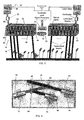
- Figure 1 shows a sensing and spraying system 10 which comprises a sensing component 12, a controller 22 and a controllable spray unit 24.
- the system 10 is typically attached to a boom of a piece of farm machinery (such as a tractor) and travels over a crop in a field being cultivated. The direction of travel would be right to left of the diagram.
- the field has plants 28 of the crop which grow from the ground 30 and unwanted plants, hereafter referred to as weeds 26.
- the system 10 needs to be able to distinguish not only the ground 30 from the crop 28, but in particular needs to distinguish the weeds 26 from the crop 28.
- the system may be designed to detect other pests such as insects.
- the system 10 operates by producing at least one beam of light 16 from a light source 14 of the sensing component 12.
- the light beam 16 is directed at objects within a field of view as it moves over the field.
- the transmitted beam 16 is reflected off objects, and in this case a weed 26, to produce a reflected beam 18.
- a sensor unit 20 of the sensing component 12 detects the reflected beam 18.
- Measured reflectance data from the sensor unit 20 is sent to the controller 22, which processes the data to identify the object being scanned by the beam 16.
- the controller 22 is further arranged to control the spray unit 24 so that at the time the spray unit 24 passes over the weed 26, a valve in the spray unit 24 can be operated so as to spray the weed 26 with a suitable chemical, thereby only using the chemical as required.
- the identification process undertaken by the controller 22 is described below.
- the vegetation index is defined as the ratio of reflection at near infrared wavelength (around 800nm) to the reflection at red wavelengths (around 650nm). It has been discovered by the inventor that the use of additional wavelengths provides additional ability to discriminate not only plants from soil but also the ability to discriminate between different types of green plant, for which the prior art vegetation index is not reliable.
- the present invention achieves this by the light source 14 producing light at three or more different wavelengths. It is desirable to use lasers as the source of light as they are well suited to producing light having very narrow bandwidths. A laser can be regarded as producing light at only the desired wavelength. Each individual laser will produce light at each individual wavelength in an individual beam. In the past complex optics have been used to try to aim light (whether from a laser or not) at a single point having a varying distance from the light source. The inventor has overcome this problem by combining the individual beams into a single combined beam. An example achieves this by use of a collimator described further below.
- the light source 14 comprises a laser array 30, a WDM combiner, a collimator 32, which respectively combine and collimate the laser beams from each laser into a single combined, collimated beam 48 and a beam splitter 34 which splits the combined, collimated beam 48 into a plurality of parallel beams 16 directed at objects in the field of view.
- An alternative to use of the beam splitter is to scan the beam 16 across a path by moving a reflector so as to direct the beam across the path.
- the beam 16 may be pulsed so as to illuminate spots as it traverses the path or it may be continuous.
- laser array comprises three AC-driven laser diodes, each producing light at a different wavelength (630nm, 670nm and 780nm).
- the laser diodes are individually controllable by the controller 22 via a control circuit.
- the intensity of the beam emitted by each laser can be controlled by a trim-pot.
- the WDM beams are overlapped by the WDM combiner and collimated by the collimator 32.
- the combined, collimated beam 48 has a diameter of 5mm.
- the beam 16 will usually be pulsed/modulated so that upon demodulation the intensity of the reflected beam 18 can distinguished from any background light.
- the beam splitter 34 comprises an elongate optical cavity 40, formed of a suitable material, such as glass or clear plastics.
- the optical cavity 40 could also be formed of a hollow inside of a prism.
- the cavity 40 has a rectangular prism shape with opposite ends 44 and 46, and parallel, opposite longitudinal sides 36 and 38. It also has an optical inlet 42 into which the combined beam 48 can enter the cavity 40.
- the inlet 42 is positioned at or near the end 44.
- a highly reflective coating is applied to the surface of the side 36, which ideally has a reflectance greater than 99%.
- a partially reflective coating is applied to the second side 38, which reflects approximately 90% of light and transmits approximately 10% of light striking it. This enables the majority of the beam 48 striking the coating to be reflected while allowing some of it to be transmitted.
- the incoming combined beam 48 Due to the angle of incidence of the incoming combined beam 48 it reflects between the surface coatings of sides 36 and 38, while at the same time producing a series of parallel beams 16, which are emitted from the side 38.
- the reflectivity of the coating on the side 38 in this embodiment is constant, but due to the intensity being progressively degraded by each beam transmitted, the internally reflected beam intensity will progressively decrease as it propagates along the length of the cavity 40. This in turn will produce progressively less intense beams 16 further away from the inlet 42 towards the second end 46.
- the reflectivity/transmissibility of the coating of side 38 need not be constant along the length of the cavity 40 and need not be 90%/10%.
- An angle of incidence of the combined beam 48 into the cavity will determined the number of times the beam will be reflected down the length of the cavity 40, which in turn will determine the spacing between each output beam 16.
- the splitter 34 comprises an optical cavity which is a single glass substrate in the shape of a rectangular prism of dimensions 199mm x 29mm x 14mm, approximately.
- the ends may be uncoated (clear) so that one can perform as the optical inlet 42.
- an angle of incidence of about 19 degrees will produce a beam spacing of about 1cm.
- a reasonable practical range of angles of incidence is between 1 and 45 degrees and preferably between 10 and 30 degrees, although any angle between (non inclusive) 0 and 90 degrees may be appropriate depending on the application.
- the shape of one or both of the sides 36 and 38 may be varied. For example by making the side 36 concave in shape the beams 16 would diverge, or by making the side 38 concave in shape the beams would converge.
- each beam 16 strikes an object a dot/spot will be illuminated. On a flat surface the beams 16 would form a straight line of dots. The reflection of the illumination, from the point of view of the sensor unit 20, will appear as a reflected beam 18.
- the sensor unit 20 is placed substantially in line with the spots, although it may be offset.
- the sensor unit 20 comprises a one-dimensional imager 50 and an imaging lens 52.
- the lens 52 focuses each of the points associated with each of the beams onto a sensing element of the imager 50.
- This one-dimensional image is passed to a precursor signal processor and then onto the controller 22.
- the precursor signal processor may demodulate the signal and/or correlate the timing of a pulse control signal sent to a particular laser source with the received intensity data in order to match the intensity data with a particular wavelength.
- imager 50 comprises two stacked rows of 1024 pixels, each pixel being 14x14 micrometers in size.
- the lens 52 has an adjustable iris, zoom and focus to properly capture spots produced by the parallel beams 16 striking objects in the field of view.
- the lens can have its tilt calibrated in X and Y dimensions so complete spot capture is achieved.
- the imager 50 is connected to a virtual serial port using a CAT 5 Ethernet cable to a PC (the controller 22) where it is driven using a programmable graphical use interface. Through this interface the sensor's imaging settings can be modified. A series of frames are captured, with each frame including the intensity data. The intensity data of each spot can be measured on a 12-bit intensity scale ranging from 0 to 4096 arbitrary units.
- the viewing angle of the sensor unit 20 to each spot will sequentially increase, which in turn will produce a sequential reduction in the perceived intensity in the reflected beam 18. This can be substantially compensated for by the sequential increase in the intensity of the incident beams 16 by placing the sensor unit closest to the light beam 16 of weakest intensity thereby providing it with a viewing angle closest to 0 degrees.
- a complementary sensing system 14' can be positioned on the other side of the sensor unit 20.
- the sensor unit 20 is placed adjacent the end 46 of the splitter 34 so that it is aligned with the line of parallel beam 16.
- Output of the beams 16 of the system 14 and of the beams from the system 14' can be timed so that the sensor unit 20 can be multiplexed with reflectance readings of the systems 14 and 14'. Indeed the output of each wavelength can be time division multiplexed so that the imager is only reading one wavelength at a time.
- the laser array 30 comprises first laser 60 producing light of wavelength of about 630nm, a second laser 62 producing light at 670nm, and a third laser 64 producing light at a wavelength of 780nm.
- the collimator 32 comprises a first reflector 66 and a second reflector 68.
- Reflectors 66 and 68 comprise thin film optic filters that transmit a particular wavelength incident from one side of the filter and reflect all other wavelengths incident from the other side. In the case of reflector 66 light beam from laser 62 is transmitted whereas the beam from laser 60 is reflected.
- the lasers 60 and 62 and reflector 66 are aligned so that the reflected beam from laser 60 is aligned and overlaps (is collimated) with the beam from laser 62.
- the reflector 68 comprises a thin film which allows light from laser 62 to pass therethrough but reflects the combined beam from lasers 60 and 62.
- the laser 64 and reflector 68 are aligned with reflector 66 such that reflected beams from lasers 60 and 62 are collimated with the beam from laser 64 after it is transmitted through reflector 68.
- the resultant beam 48 is collimated from the three different lasers.
- Each laser 60, 62 and 64 has a respective mounting 70, 72 and 74 which allow the laser to be rotated about its longitudinal axis. If a polarising filter is placed in the beam 48 each laser can be rotated so that the beam 48 has the same polarisation at each of the wavelengths. For example the first laser 60 is rotated so that light does not pass through the polarising filter. Then in turn lasers 62 and 64 can be rotated so that again light from those lasers also does not transmit through the polarising filter. The polarisation of each of the lasers will then be the same. It is desirable for the beam 48 to have the same polarisation, as different polarisation can be a detrimental factor in reading the intensity of the reflected beam 18.
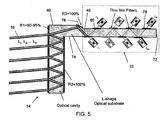
- an L-shaped optical substrate formed of glass comprises the optical cavity 40 of the splitter 34 (as the base of the L), a section 72 which comprises a collimator section 72, and section 74, which connects the collimator section 72 to the optical cavity 40. Sections 72 and 74 form the back of the L.
- the collimator section 72 is formed in a similar arrangement to that shown in Figure 4 with a plurality of laser sources each producing a different wavelength ⁇ 1 , ⁇ 2 ...
- Filter 78 transmits light at wavelength ⁇ N .
- the lasers and filters 78 and 80 are arranged with respect to the section 72 such that the resultant laser beam 48 is collimated.
- the collimated beam 48 strikes a reflector 76, which has approximately 100% reflection.
- Reflector 76 is oriented to send the beam 48 into the optical cavity 82 at an angle suitable to produce the desired number of combined output parallel beams 16 due to its reflected propagation from side to side down the length of the splitter 34.
- System 10 is mounted for operation such that objects to be identified travel though the beams 16.
- the system 10 will be mounted on a boom of an agricultural vehicle, which can travel over the crop at a height of about 1 to 2m.
- the system 10 of Figure 3 can cover 1 to 3m along the length of the boom and if need be other systems 10 can be placed in parallel on the boom to complete the entire width of the boom.
- the system 10 may be stationary and the objects being identified will move by, such as on a conveyer belt.
- the light beams 16 strike one or more objects producing a series of illuminated spots.
- the light may be visible or may be outside the visible spectrum.
- the 630 nm laser light is visible as red.
- the 670 nm and 780 nm laser light are in the (near) infrared spectrum and are not visible to the human eye.
- Other wavelengths may be used in other applications. In the weed control application more wavelengths will produce greater accuracy in discrimination, up to about 10 to 15 different wavelengths.
- the reflected light 18 is captured by the sensor unit 20 and a reading of the intensity of each spot is taken.
- the readings are provided to the controller 22.
- the controller 22 runs a computer program that normalises the readings, stores the readings and calculates a ratio between each of the normalised intensities.
- the normalised intensity ratios are compared to a database of intensity ratios to find a match or best match. In the event a match is found an object classification associated with the matching ratios is used to identify the object.
- the location and even a dimension of the identified object can be determined. This may be combined with GPS information on the location of the vehicle for recording and later analysis. Based on the determined location in the line of dots (and thus the location relative to the boom), the distance between the sensing component 12 and controllable spray unit 24, and the speed of travel of the vehicle, operation of the spray unit 24 can be timed to only dispense the chemical on to the object when it is identified as a weed 26. Usually a line of spray units 24 will be positioned on the boom (or a second trailing boom). By knowing the position of the weed in the line of spots the appropriate spray unit is activated. In the event that the system was configured to detect insects, when an insect is detected it could be sprayed with an insecticide. Likewise in other applications once the object is identified by its ratios of spectral response appropriate action (if any) can be taken.
- the database of ratios is constructed by taking sample readings from possible candidate objects.
- the ratios of intensity of keys wavelengths is recorded in the database along with a classification of the candidate objects for matching against.
- the green leaf in Figure 2 has a set of ratios of (about) 10.2:10:60.
- ratios of intensities is to use the gradient between adjacent wavelength intensity pairs.
- the ratios can in fact be used to derive the gradients and vice versa.
- ratios or gradients provides considerably better matching results for identifying objects in the database than the prior method of using a VI because a larger portion of the reflectance spectrum is able to be used in making the match.
- the collimator 32 can be used in other applications. It operates by receiving light from laser 60 (or some other source of collimated light) and reflecting it off of reflector 66. At the same time it receives light from laser 62 (or another collimated light source). The light from laser 62 is transmitted though the reflector 66 and aligns with the reflected light from laser 60. The light from laser 60 and laser 62 is then collimated. This collimated light can then be reflected off reflector 68. At the same time the collimator 32 receives light from laser 64 (or another collimated light source). The light from laser 64 is transmitted though the reflector 68 and aligns with the reflected light from laser 60 and laser 62. The resulting output beam 48 is an alignment (collimation) of light from lasers 60, 62 and 64. It is readily apparent that further laser of different wavelengths can be added with appropriate reflectors.
- the splitter 40 can be used in other applications. It operates by receiving light 48 through the optical inlet 42. The light refracts according to the angle of incidence and is partly transmitted through the coating of side 38 to form a first beam 16. It is also reflected by the coating of side 38 and strikes the coating of side 36 further along the length of the cavity towards end 46, whereupon it is again reflected to again strike the coating of side 38. This light is partly transmitted through the coating on side 38 to form a second beam parallel to the first beam. It is also reflected by the coating of side 38 to again strike the coating of side 36 further along the length of the cavity towards end 46.
Landscapes
- Life Sciences & Earth Sciences (AREA)
- Physics & Mathematics (AREA)
- Chemical & Material Sciences (AREA)
- Analytical Chemistry (AREA)
- Wood Science & Technology (AREA)
- Zoology (AREA)
- Environmental Sciences (AREA)
- Insects & Arthropods (AREA)
- Spectroscopy & Molecular Physics (AREA)
- Health & Medical Sciences (AREA)
- Engineering & Computer Science (AREA)
- Pest Control & Pesticides (AREA)
- Biochemistry (AREA)
- General Health & Medical Sciences (AREA)
- General Physics & Mathematics (AREA)
- Immunology (AREA)
- Pathology (AREA)
- Investigating Or Analysing Materials By Optical Means (AREA)
- Geophysics And Detection Of Objects (AREA)
- Cultivation Of Plants (AREA)
Claims (12)
- Système de détection permettant de discriminer des matières végétales comprenant :une source de lumière comprenant trois lasers ou plus, chaque laser étant agencé pour produire un faisceau laser pulsé d'une longueur d'onde différente ;un combinateur par multiplexage par répartition en longueur d'onde, un collimateur et un multiplexeur par répartition dans le temps permettant de combiner les faisceaux de lumière laser pulsée provenant des trois lasers ou plus en un faisceau de lumière combiné, collimaté et multiplexé par répartition dans le temps ;un séparateur permettant de séparer le faisceau de lumière combiné, collimaté et multiplexé par répartition dans le temps en une pluralité de faisceaux de lumière qui ont chacun des longueurs d'onde différentes de sorte que les faisceaux de lumière sont dirigés vers des zones distinctes de non-chevauchement dans un champ de vision ;un capteur permettant de mesurer distinctement la réflectance de chacune des zones distinctes de non-chevauchement à chacune des longueurs d'onde distinctes ; etun identifiant permettant d'identifier au moins un type de plante dans le champ de vision à partir de la réflectance mesurée à chacune des longueurs d'onde au niveau de chacune des zones distinctes de non-chevauchement.
- Système de détection selon la revendication 1, dans lequel l'identifiant identifie le au moins un type de plante en déterminant un rapport entre les réflectances mesurées à chacune des longueurs d'onde et en comparant le rapport déterminé avec une base de données de rapports de référence de matières végétales connues de façon à identifier la matière végétale observée au niveau de chacune des zones distinctes de non-chevauchement.
- Système de détection selon la revendication 1, dans lequel l'identifiant identifie le au moins un type de plante en déterminant des gradients entre les réflectances mesurées à chacune des longueurs d'onde et en comparant les gradients déterminés avec une base de données de gradients de référence de matières végétales connues de façon à identifier la matière végétale observée au niveau de chacune des zones distinctes de non-chevauchement.
- Système de détection selon l'une quelconque des revendications précédentes, dans lequel le séparateur est configuré de sorte que l'intensité de chaque faisceau de lumière laser pulsée diminue progressivement et le capteur est positionné de sorte qu'un faisceau de lumière le plus intense soit le plus éloigné du capteur.
- Système de détection selon l'une quelconque des revendications précédentes, dans lequel le collimateur comprend :un premier réflecteur configuré pour réfléchir la lumière à une première des longueurs d'onde et également configuré pour faire passer la lumière à une deuxième des longueurs d'onde, dans lequel le premier réflecteur, un premier des lasers et un deuxième des lasers sont agencés de sorte qu'un premier faisceau laser émanant du premier laser est réfléchi par le premier réflecteur de façon à être combiné et collimaté avec un deuxième faisceau laser émanant du deuxième laser qui passe à travers le premier réflecteur ;un second réflecteur configuré pour réfléchir les faisceaux laser collimatés aux première et deuxième longueurs d'onde et également configuré pour faire passer un faisceau laser à une troisième des longueurs d'onde, dans lequel un troisième des lasers, le premier réflecteur et le second réflecteur sont agencés de sorte que les faisceaux laser combinés émanant des premier et deuxième lasers sont réfléchis par le deuxième réflecteur de façon à être combinés et collimatés avec un troisième faisceau laser émanant du troisième laser qui passe à travers le second réflecteur.
- Système de détection selon l'une quelconque des revendications précédentes, dans lequel le séparateur comprend :une cavité optique allongée comportant une première extrémité et une seconde extrémité, un premier côté longitudinal et un second côté longitudinal opposé ;une couche réflectrice sur le premier côté longitudinal qui réfléchit la lumière à l'intérieur de la cavité optique ;une couche partiellement réflectrice sur le second côté longitudinal de sorte qu'une partie du faisceau de lumière laser combiné dans la cavité optique qui frappe la couche partiellement réflectrice sera réfléchie et une partie sera transmise hors de la cavité optique ; etune entrée optique vers la cavité dans la première extrémité ou adjacente à celle-ci de sorte que le faisceau de lumière laser combiné peut pénétrer la cavité et être réfléchi entre les côtés longitudinaux vers la seconde extrémité, avec une partie du faisceau laser combiné sortant de la cavité via le second côté longitudinal de sorte que le faisceau de lumière laser combiné est transformé en une pluralité de faisceaux de lumière laser espacés émanant du second côté longitudinal de façon à illuminer la pluralité de zones distinctes de non-chevauchement dans le champ de vision.
- Système de détection selon la revendication 2, dans lequel l'identifiant comprend :un stockage pour une base de données de caractéristiques de référence de matières végétales d'intensité réfléchie, ou dérivées de celle-ci, de lumière frappant chaque matière végétale candidate à trois longueurs d'onde différentes spécifiées ou plus ; etun processeur permettant de déterminer le rapport de la réflectance mesurée au niveau de chacune des zones distinctes de non-chevauchement et de comparer le rapport déterminé avec les caractéristiques de référence dans la base de données afin d'identifier le type de plante.
- Système de détection selon la revendication 3, dans lequel l'identifiant comprend :un stockage pour une base de données de caractéristiques de référence de matières végétales d'intensité réfléchie, ou dérivées de celle-ci, de lumière frappant chaque matière végétale candidate à trois longueurs d'onde différentes spécifiées ou plus ; etun processeur permettant de déterminer un gradient des réflectances mesurées au niveau de chacune des zones distinctes de non-chevauchement et de comparer le gradient déterminé aux caractéristiques de référence dans la base de données afin d'identifier le type de plante.
- Système de détection selon l'une quelconque des revendications précédentes, dans lequel une orientation de chacun des lasers est telle que la polarisation des faisceaux de lumière laser combinés provenant du combinateur est alignée aux trois longueurs d'onde ou plus.
- Procédé d'identification de matière végétale comprenant :la production de trois faisceaux de lumière laser pulsée ou plus, chacun ayant une longueur d'onde différente ;la combinaison par multiplexage par répartition en longueur d'onde, le collimatage et le multiplexage par répartition dans le temps des trois faisceaux de lumière laser pulsée ou plus en un faisceau de lumière combiné, collimaté et multiplexé par répartition dans le temps,la séparation du faisceau de lumière combiné, collimaté et multiplexé par répartition dans le temps en une pluralité de faisceaux espacés de sorte que les faisceaux de lumière sont dirigés vers des zones distinctes de non-chevauchement dans un champ de vision ;la mesure de la réflectance à chacune des longueurs d'onde distinctes et depuis chacune des zones distinctes de non-chevauchement ; etl'identification d'au moins un type de plante dans le champ de vision à partir de la réflectance mesurée au niveau de chacune des zones distinctes de non-chevauchement.
- Procédé selon la revendication 10, dans lequel l'identification de matière végétale comprend :la fourniture d'une base de données de caractéristiques de référence de matière végétale candidate, chaque caractéristique de référence comprenant des rapports d'intensité de réflectance provenant de la lumière frappant chaque matière végétale candidate à trois longueurs d'onde différentes spécifiées ou plus ;la détermination d'un rapport d'intensités de réflectance à trois longueurs d'onde différentes spécifiées ou plus ; etla comparaison des rapports déterminés avec les caractéristiques de référence afin d'identifier la matière végétale.
- Procédé selon la revendication 10 ou la revendication 11, dans lequel l'identification de matière végétale comprend :la fourniture d'une base de données de caractéristiques de référence d'une matière végétale candidate, chaque caractéristique de référence comprenant des gradients entre des intensités de réflectance différentes provenant de la lumière frappant chaque matière végétale candidate à trois longueurs d'onde différentes spécifiées ou plus ;la détermination de gradients entre des intensités de réflectance différentes à trois longueurs d'onde différentes spécifiées ou plus ; etla comparaison des gradients déterminés avec les caractéristiques de référence afin d'identifier la matière végétale.
Priority Applications (1)
| Application Number | Priority Date | Filing Date | Title |
|---|---|---|---|
| PL07784717T PL2052236T3 (pl) | 2006-08-01 | 2007-08-01 | Układ optycznego wykrywania oraz sposób rozróżniania substancji roślinnej |
Applications Claiming Priority (2)
| Application Number | Priority Date | Filing Date | Title |
|---|---|---|---|
| AU2006904147A AU2006904147A0 (en) | 2006-08-01 | Optical sensing system and optical devices therefor | |
| PCT/AU2007/001075 WO2008014553A1 (fr) | 2006-08-01 | 2007-08-01 | Système de détection optique et dispositifs optiques pour un tel système |
Publications (3)
| Publication Number | Publication Date |
|---|---|
| EP2052236A1 EP2052236A1 (fr) | 2009-04-29 |
| EP2052236A4 EP2052236A4 (fr) | 2009-08-19 |
| EP2052236B1 true EP2052236B1 (fr) | 2012-03-28 |
Family
ID=38996782
Family Applications (1)
| Application Number | Title | Priority Date | Filing Date |
|---|---|---|---|
| EP07784717A Active EP2052236B1 (fr) | 2006-08-01 | 2007-08-01 | Système et méthode de détection optique pour la discrimination des plantes |
Country Status (10)
| Country | Link |
|---|---|
| US (1) | US8179533B2 (fr) |
| EP (1) | EP2052236B1 (fr) |
| AT (1) | ATE551597T1 (fr) |
| AU (1) | AU2007281027B2 (fr) |
| CA (1) | CA2659522C (fr) |
| DK (1) | DK2052236T3 (fr) |
| ES (1) | ES2395062T3 (fr) |
| PL (1) | PL2052236T3 (fr) |
| WO (1) | WO2008014553A1 (fr) |
| ZA (1) | ZA200901433B (fr) |
Cited By (1)
| Publication number | Priority date | Publication date | Assignee | Title |
|---|---|---|---|---|
| LV15655A (lv) * | 2021-01-13 | 2022-07-20 | Weedbot, Sia | Ierīce aizsardzībai no koncentrēta optiskā starojuma |
Families Citing this family (26)
| Publication number | Priority date | Publication date | Assignee | Title |
|---|---|---|---|---|
| EP2194368B1 (fr) * | 2008-12-03 | 2019-07-17 | Grundfos Management A/S | Système de détection destiné à détecter et spécifier des particules individuelles dans un fluide |
| CA2799649C (fr) | 2010-05-18 | 2018-11-27 | Photonic Detection Systems Pty Ltd | Dispositif de selection d'une substance specifique |
| DE102010034603B4 (de) * | 2010-08-13 | 2013-01-31 | Franke Gmbh | Sensorsystem und Verfahren zur Bestimmung einer optischen Eigenschaft einer Pflanze |
| CA2815524A1 (fr) | 2010-11-04 | 2012-05-10 | Dow Agrosciences Llc | Procede et appareil pour le traitement de plantes ciblees |
| US8902413B2 (en) * | 2012-02-21 | 2014-12-02 | Trimble Navigation Limited | Cell phone NDVI sensor |
| WO2014195952A1 (fr) * | 2013-06-06 | 2014-12-11 | Flora Fotonica Ltd | Système et procédé permettant de fournir un éclairage à des plantes |
| US9609859B2 (en) * | 2013-09-13 | 2017-04-04 | Palo Alto Research Center Incorporated | Unwanted plant removal system having a stabilization system |
| US9565848B2 (en) | 2013-09-13 | 2017-02-14 | Palo Alto Research Center Incorporated | Unwanted plant removal system |
| US9609858B2 (en) * | 2013-09-13 | 2017-04-04 | Palo Alto Research Center Incorporated | Unwanted plant removal system having variable optics |
| EP2887053A1 (fr) | 2013-12-18 | 2015-06-24 | Basf Se | Détermination d'une infection fongique d'une plante par fluorescence de chlorophylle induite par longueurs d'onde d'excitation différentes |
| WO2016191825A1 (fr) | 2015-06-05 | 2016-12-08 | The University Of Sydney | Système de reconnaissance automatique et de gestion de cible |
| CN105352893B (zh) * | 2015-07-15 | 2018-02-06 | 电子科技大学 | 一种适用于植被稀疏区的叶绿素反演方法 |
| US10178856B2 (en) * | 2015-09-01 | 2019-01-15 | Isca Technologies, Inc. | Systems and methods for classifying flying insects |
| US20170295323A1 (en) * | 2016-04-08 | 2017-10-12 | Empire Technology Development Llc | Sub-surface emr transmission for scanning produce |
| US11266054B2 (en) | 2017-01-24 | 2022-03-08 | Cnh Industrial America Llc | System and method for automatically estimating and adjusting crop residue parameters as a tillage operation is being performed |
| EP3367054B1 (fr) * | 2017-02-28 | 2020-05-06 | Phenospex B.V. | Système de détection optique d'objets |
| CN107543802A (zh) * | 2017-08-31 | 2018-01-05 | 维沃移动通信有限公司 | 一种有害生物的清理方法及系统 |
| JP7009126B2 (ja) * | 2017-09-07 | 2022-01-25 | 株式会社トプコン | 測定装置 |
| RU2664757C1 (ru) * | 2017-11-29 | 2018-08-22 | федеральное государственное бюджетное образовательное учреждение высшего образования "Московский государственный технический университет имени Н.Э. Баумана (национальный исследовательский университет)" (МГТУ им. Н.Э. Баумана) | Дистанционный способ обнаружения растительности, находящейся в неблагоприятных для развития условиях |
| US11761886B2 (en) | 2018-07-17 | 2023-09-19 | Photonic Detection Systems Pty Ltd | Detection system for detecting matter and distinguishing specific matter from other matter |
| EP3824282A4 (fr) * | 2018-07-17 | 2022-03-23 | Photonic Detection Systems Pty Ltd | Système de détection pour détecter une matière et distinguer une matière spécifique vis-à-vis d'une autre matière |
| CN109937999B (zh) * | 2019-03-21 | 2022-08-12 | 中国科学院合肥物质科学研究院 | 一种激光灭杀毒品原植物的装置 |
| RU2763438C2 (ru) * | 2019-06-20 | 2021-12-29 | ФГБОУ ВО "Оренбургский государственный аграрный университет" | Стенд для настройки бесконтактных датчиков |
| WO2020262640A1 (fr) * | 2019-06-27 | 2020-12-30 | 株式会社堀場製作所 | Dispositif d'analyse |
| CN113640254B (zh) * | 2021-08-11 | 2023-10-24 | 淮阴师范学院 | 一种可保持自平衡的作物生长信息传感器 |
| US12315311B2 (en) | 2022-11-30 | 2025-05-27 | Cnh Industrial America Llc | Systems and methods for monitoring implement performance during an agricultural operation |
Family Cites Families (21)
| Publication number | Priority date | Publication date | Assignee | Title |
|---|---|---|---|---|
| US3910701A (en) * | 1973-07-30 | 1975-10-07 | George R Henderson | Method and apparatus for measuring light reflectance absorption and or transmission |
| US4035070A (en) * | 1975-12-18 | 1977-07-12 | Xerox Corporation | Apparatus and method for optical generation of a structured charge-discharge pattern on a photoreceptor |
| JPS63304222A (ja) | 1987-06-04 | 1988-12-12 | Minolta Camera Co Ltd | レ−ザ光源装置 |
| US5132538A (en) | 1991-05-24 | 1992-07-21 | Nirsystems Incorporated | Measuring percentage of protein in whole grain samples |
| US5296702A (en) | 1992-07-28 | 1994-03-22 | Patchen California | Structure and method for differentiating one object from another object |
| US5793035A (en) * | 1992-07-28 | 1998-08-11 | Patchen, Inc. | Apparatus and method for spraying herbicide on weeds in a cotton field |
| US5585626A (en) * | 1992-07-28 | 1996-12-17 | Patchen, Inc. | Apparatus and method for determining a distance to an object in a field for the controlled release of chemicals on plants, weeds, trees or soil and/or guidance of farm vehicles |
| FR2703932B1 (fr) | 1993-04-16 | 1995-07-07 | Materiel Arboriculture | Procede et dispositif de tri automatique de produits, notamment de fruits et legumes. |
| FR2708998B1 (fr) | 1993-08-13 | 1996-06-14 | Bp France Sa | Appareil spectrophotométrique à dispositif multiplex et procédé utilisant l'appareil. |
| US5507115A (en) | 1994-02-04 | 1996-04-16 | Canadian Space Agency | Selective applications of weed control chemicals |
| US5480354A (en) * | 1994-11-03 | 1996-01-02 | Loral Corporation | Smart crop yield monitor |
| US5900634A (en) | 1994-11-14 | 1999-05-04 | Soloman; Sabrie | Real-time on-line analysis of organic and non-organic compounds for food, fertilizers, and pharmaceutical products |
| FR2732626B1 (fr) * | 1995-04-06 | 1997-07-04 | Materiel Arboriculture | Dispositif d'analyse en vue du tri automatique de produits, notamment de fruits ou legumes |
| US5789741A (en) * | 1996-10-31 | 1998-08-04 | Patchen, Inc. | Detecting plants in a field by detecting a change in slope in a reflectance characteristic |
| US6160902A (en) * | 1997-10-10 | 2000-12-12 | Case Corporation | Method for monitoring nitrogen status using a multi-spectral imaging system |
| US6563976B1 (en) | 2000-05-09 | 2003-05-13 | Blaze Network Products, Inc. | Cost-effective wavelength division multiplexer and demultiplexer |
| AUPR457401A0 (en) | 2001-04-26 | 2001-05-24 | Weed Control Australia Pty Ltd | Selective weed discrimination |
| US6596996B1 (en) * | 2001-07-24 | 2003-07-22 | The Board Of Regents For Oklahoma State University | Optical spectral reflectance sensor and controller |
| US7106446B2 (en) * | 2002-06-21 | 2006-09-12 | Therma-Wave, Inc. | Modulated reflectance measurement system with multiple wavelengths |
| US7408145B2 (en) | 2003-09-23 | 2008-08-05 | Kyle Holland | Light sensing instrument with modulated polychromatic source |
| US7417744B2 (en) * | 2006-02-27 | 2008-08-26 | Los Alamos National Security, Llc | Coherent hybrid electromagnetic field imaging |
-
2007
- 2007-08-01 ES ES07784717T patent/ES2395062T3/es active Active
- 2007-08-01 US US12/375,933 patent/US8179533B2/en active Active
- 2007-08-01 ZA ZA200901433A patent/ZA200901433B/xx unknown
- 2007-08-01 PL PL07784717T patent/PL2052236T3/pl unknown
- 2007-08-01 AT AT07784717T patent/ATE551597T1/de active
- 2007-08-01 AU AU2007281027A patent/AU2007281027B2/en not_active Ceased
- 2007-08-01 CA CA2659522A patent/CA2659522C/fr active Active
- 2007-08-01 EP EP07784717A patent/EP2052236B1/fr active Active
- 2007-08-01 DK DK07784717.6T patent/DK2052236T3/da active
- 2007-08-01 WO PCT/AU2007/001075 patent/WO2008014553A1/fr not_active Ceased
Cited By (1)
| Publication number | Priority date | Publication date | Assignee | Title |
|---|---|---|---|---|
| LV15655A (lv) * | 2021-01-13 | 2022-07-20 | Weedbot, Sia | Ierīce aizsardzībai no koncentrēta optiskā starojuma |
Also Published As
| Publication number | Publication date |
|---|---|
| CA2659522C (fr) | 2017-08-29 |
| ATE551597T1 (de) | 2012-04-15 |
| ZA200901433B (en) | 2010-05-26 |
| WO2008014553A1 (fr) | 2008-02-07 |
| AU2007281027B2 (en) | 2013-02-07 |
| EP2052236A4 (fr) | 2009-08-19 |
| DK2052236T3 (da) | 2012-07-16 |
| US8179533B2 (en) | 2012-05-15 |
| CA2659522A1 (fr) | 2008-02-07 |
| PL2052236T3 (pl) | 2012-10-31 |
| US20100014096A1 (en) | 2010-01-21 |
| AU2007281027A1 (en) | 2008-02-07 |
| ES2395062T3 (es) | 2013-02-07 |
| EP2052236A1 (fr) | 2009-04-29 |
Similar Documents
| Publication | Publication Date | Title |
|---|---|---|
| US8179533B2 (en) | Sensing system and method for discriminating plant matter | |
| US9565848B2 (en) | Unwanted plant removal system | |
| US7099004B2 (en) | Digital spectral identifier-controller and related methods | |
| CA2445802C (fr) | Discrimination selective de plantes | |
| US9609859B2 (en) | Unwanted plant removal system having a stabilization system | |
| CA2454827C (fr) | Capteur et dispositif de commande de reflectance spectrale optique | |
| US9609858B2 (en) | Unwanted plant removal system having variable optics | |
| US6443365B1 (en) | Discriminating ground vegetation in agriculture | |
| CA2688260A1 (fr) | Appareil d'analyse de vegetaux sur le terrain, procede de suivi de l'etat ou de l'evolution d'une culture et procede de gestion d'un traitement de vegetaux | |
| Symonds et al. | A real-time plant discrimination system utilising discrete reflectance spectroscopy | |
| Askraba et al. | Laser-stabilized real-time plant discrimination sensor for precision agriculture | |
| US20250199125A1 (en) | Remote sensing device with duplex optical element and related methods | |
| AU2011256115B2 (en) | A device for selecting specific matter | |
| Hilton | Laser-induced fluorescence for discrimination of crops and weeds | |
| Askraba et al. | Design of laser multi-beam generator for plant discrimination | |
| AU2002249005B2 (en) | Selective plant discrimination | |
| RO138315A0 (ro) | Identificarea timpurie a integrităţii frunzei viţei de vie folosind senzori spectrali | |
| Sahba et al. | Photonics-based Spectral Reflectance Sensor for Plant Discrimination | |
| Paap et al. | Evaluation of an optical image sensor for use in the microphotonic real-time vegetation discrimination system | |
| Jayasekara | Design and validation for laser based scanning reflectometer |
Legal Events
| Date | Code | Title | Description |
|---|---|---|---|
| PUAI | Public reference made under article 153(3) epc to a published international application that has entered the european phase |
Free format text: ORIGINAL CODE: 0009012 |
|
| 17P | Request for examination filed |
Effective date: 20090227 |
|
| AK | Designated contracting states |
Kind code of ref document: A1 Designated state(s): AT BE BG CH CY CZ DE DK EE ES FI FR GB GR HU IE IS IT LI LT LU LV MC MT NL PL PT RO SE SI SK TR |
|
| AX | Request for extension of the european patent |
Extension state: AL BA HR MK RS |
|
| A4 | Supplementary search report drawn up and despatched |
Effective date: 20090717 |
|
| RIC1 | Information provided on ipc code assigned before grant |
Ipc: A01M 7/00 20060101ALI20090713BHEP Ipc: B07C 5/342 20060101ALI20090713BHEP Ipc: G01N 21/39 20060101ALI20090713BHEP Ipc: G01N 21/25 20060101ALI20090713BHEP Ipc: A01M 21/04 20060101ALI20090713BHEP Ipc: G01N 21/35 20060101ALI20090713BHEP Ipc: G01N 21/55 20060101AFI20080328BHEP |
|
| 17Q | First examination report despatched |
Effective date: 20090929 |
|
| GRAP | Despatch of communication of intention to grant a patent |
Free format text: ORIGINAL CODE: EPIDOSNIGR1 |
|
| RIC1 | Information provided on ipc code assigned before grant |
Ipc: A01M 21/00 20060101ALI20110831BHEP Ipc: A01M 7/00 20060101ALI20110831BHEP Ipc: G01N 21/35 20060101ALI20110831BHEP Ipc: G01N 21/55 20060101AFI20110831BHEP Ipc: G01N 21/25 20060101ALI20110831BHEP Ipc: B07C 5/342 20060101ALI20110831BHEP Ipc: A01M 21/04 20060101ALI20110831BHEP Ipc: G01N 21/39 20060101ALI20110831BHEP |
|
| RTI1 | Title (correction) |
Free format text: OPTICAL SENSING SYSTEM AND METHOD FOR DISCRIMINATING PLANT MATTER |
|
| DAX | Request for extension of the european patent (deleted) | ||
| GRAS | Grant fee paid |
Free format text: ORIGINAL CODE: EPIDOSNIGR3 |
|
| GRAA | (expected) grant |
Free format text: ORIGINAL CODE: 0009210 |
|
| AK | Designated contracting states |
Kind code of ref document: B1 Designated state(s): AT BE BG CH CY CZ DE DK EE ES FI FR GB GR HU IE IS IT LI LT LU LV MC MT NL PL PT RO SE SI SK TR |
|
| REG | Reference to a national code |
Ref country code: GB Ref legal event code: FG4D |
|
| REG | Reference to a national code |
Ref country code: CH Ref legal event code: EP |
|
| REG | Reference to a national code |
Ref country code: AT Ref legal event code: REF Ref document number: 551597 Country of ref document: AT Kind code of ref document: T Effective date: 20120415 |
|
| REG | Reference to a national code |
Ref country code: IE Ref legal event code: FG4D |
|
| REG | Reference to a national code |
Ref country code: DE Ref legal event code: R096 Ref document number: 602007021640 Country of ref document: DE Effective date: 20120524 |
|
| REG | Reference to a national code |
Ref country code: RO Ref legal event code: EPE |
|
| REG | Reference to a national code |
Ref country code: DK Ref legal event code: T3 |
|
| REG | Reference to a national code |
Ref country code: SE Ref legal event code: TRGR |
|
| REG | Reference to a national code |
Ref country code: NL Ref legal event code: VDEP Effective date: 20120328 |
|
| PG25 | Lapsed in a contracting state [announced via postgrant information from national office to epo] |
Ref country code: LT Free format text: LAPSE BECAUSE OF FAILURE TO SUBMIT A TRANSLATION OF THE DESCRIPTION OR TO PAY THE FEE WITHIN THE PRESCRIBED TIME-LIMIT Effective date: 20120328 |
|
| LTIE | Lt: invalidation of european patent or patent extension |
Effective date: 20120328 |
|
| PG25 | Lapsed in a contracting state [announced via postgrant information from national office to epo] |
Ref country code: FI Free format text: LAPSE BECAUSE OF FAILURE TO SUBMIT A TRANSLATION OF THE DESCRIPTION OR TO PAY THE FEE WITHIN THE PRESCRIBED TIME-LIMIT Effective date: 20120328 Ref country code: LV Free format text: LAPSE BECAUSE OF FAILURE TO SUBMIT A TRANSLATION OF THE DESCRIPTION OR TO PAY THE FEE WITHIN THE PRESCRIBED TIME-LIMIT Effective date: 20120328 Ref country code: GR Free format text: LAPSE BECAUSE OF FAILURE TO SUBMIT A TRANSLATION OF THE DESCRIPTION OR TO PAY THE FEE WITHIN THE PRESCRIBED TIME-LIMIT Effective date: 20120629 |
|
| REG | Reference to a national code |
Ref country code: AT Ref legal event code: MK05 Ref document number: 551597 Country of ref document: AT Kind code of ref document: T Effective date: 20120328 |
|
| PG25 | Lapsed in a contracting state [announced via postgrant information from national office to epo] |
Ref country code: CY Free format text: LAPSE BECAUSE OF FAILURE TO SUBMIT A TRANSLATION OF THE DESCRIPTION OR TO PAY THE FEE WITHIN THE PRESCRIBED TIME-LIMIT Effective date: 20120328 |
|
| PG25 | Lapsed in a contracting state [announced via postgrant information from national office to epo] |
Ref country code: SI Free format text: LAPSE BECAUSE OF FAILURE TO SUBMIT A TRANSLATION OF THE DESCRIPTION OR TO PAY THE FEE WITHIN THE PRESCRIBED TIME-LIMIT Effective date: 20120328 Ref country code: CZ Free format text: LAPSE BECAUSE OF FAILURE TO SUBMIT A TRANSLATION OF THE DESCRIPTION OR TO PAY THE FEE WITHIN THE PRESCRIBED TIME-LIMIT Effective date: 20120328 Ref country code: BE Free format text: LAPSE BECAUSE OF FAILURE TO SUBMIT A TRANSLATION OF THE DESCRIPTION OR TO PAY THE FEE WITHIN THE PRESCRIBED TIME-LIMIT Effective date: 20120328 Ref country code: EE Free format text: LAPSE BECAUSE OF FAILURE TO SUBMIT A TRANSLATION OF THE DESCRIPTION OR TO PAY THE FEE WITHIN THE PRESCRIBED TIME-LIMIT Effective date: 20120328 Ref country code: IS Free format text: LAPSE BECAUSE OF FAILURE TO SUBMIT A TRANSLATION OF THE DESCRIPTION OR TO PAY THE FEE WITHIN THE PRESCRIBED TIME-LIMIT Effective date: 20120728 |
|
| REG | Reference to a national code |
Ref country code: PL Ref legal event code: T3 |
|
| PG25 | Lapsed in a contracting state [announced via postgrant information from national office to epo] |
Ref country code: PT Free format text: LAPSE BECAUSE OF FAILURE TO SUBMIT A TRANSLATION OF THE DESCRIPTION OR TO PAY THE FEE WITHIN THE PRESCRIBED TIME-LIMIT Effective date: 20120730 Ref country code: SK Free format text: LAPSE BECAUSE OF FAILURE TO SUBMIT A TRANSLATION OF THE DESCRIPTION OR TO PAY THE FEE WITHIN THE PRESCRIBED TIME-LIMIT Effective date: 20120328 |
|
| PG25 | Lapsed in a contracting state [announced via postgrant information from national office to epo] |
Ref country code: AT Free format text: LAPSE BECAUSE OF FAILURE TO SUBMIT A TRANSLATION OF THE DESCRIPTION OR TO PAY THE FEE WITHIN THE PRESCRIBED TIME-LIMIT Effective date: 20120328 Ref country code: NL Free format text: LAPSE BECAUSE OF FAILURE TO SUBMIT A TRANSLATION OF THE DESCRIPTION OR TO PAY THE FEE WITHIN THE PRESCRIBED TIME-LIMIT Effective date: 20120328 |
|
| PLBE | No opposition filed within time limit |
Free format text: ORIGINAL CODE: 0009261 |
|
| STAA | Information on the status of an ep patent application or granted ep patent |
Free format text: STATUS: NO OPPOSITION FILED WITHIN TIME LIMIT |
|
| REG | Reference to a national code |
Ref country code: ES Ref legal event code: FG2A Ref document number: 2395062 Country of ref document: ES Kind code of ref document: T3 Effective date: 20130207 |
|
| 26N | No opposition filed |
Effective date: 20130103 |
|
| REG | Reference to a national code |
Ref country code: CH Ref legal event code: PL |
|
| PG25 | Lapsed in a contracting state [announced via postgrant information from national office to epo] |
Ref country code: MC Free format text: LAPSE BECAUSE OF NON-PAYMENT OF DUE FEES Effective date: 20120831 |
|
| REG | Reference to a national code |
Ref country code: DE Ref legal event code: R097 Ref document number: 602007021640 Country of ref document: DE Effective date: 20130103 |
|
| PG25 | Lapsed in a contracting state [announced via postgrant information from national office to epo] |
Ref country code: CH Free format text: LAPSE BECAUSE OF NON-PAYMENT OF DUE FEES Effective date: 20120831 Ref country code: LI Free format text: LAPSE BECAUSE OF NON-PAYMENT OF DUE FEES Effective date: 20120831 |
|
| REG | Reference to a national code |
Ref country code: IE Ref legal event code: MM4A |
|
| PG25 | Lapsed in a contracting state [announced via postgrant information from national office to epo] |
Ref country code: BG Free format text: LAPSE BECAUSE OF FAILURE TO SUBMIT A TRANSLATION OF THE DESCRIPTION OR TO PAY THE FEE WITHIN THE PRESCRIBED TIME-LIMIT Effective date: 20120628 Ref country code: IE Free format text: LAPSE BECAUSE OF NON-PAYMENT OF DUE FEES Effective date: 20120801 |
|
| PG25 | Lapsed in a contracting state [announced via postgrant information from national office to epo] |
Ref country code: MT Free format text: LAPSE BECAUSE OF FAILURE TO SUBMIT A TRANSLATION OF THE DESCRIPTION OR TO PAY THE FEE WITHIN THE PRESCRIBED TIME-LIMIT Effective date: 20120328 |
|
| PG25 | Lapsed in a contracting state [announced via postgrant information from national office to epo] |
Ref country code: TR Free format text: LAPSE BECAUSE OF FAILURE TO SUBMIT A TRANSLATION OF THE DESCRIPTION OR TO PAY THE FEE WITHIN THE PRESCRIBED TIME-LIMIT Effective date: 20120328 |
|
| PG25 | Lapsed in a contracting state [announced via postgrant information from national office to epo] |
Ref country code: LU Free format text: LAPSE BECAUSE OF NON-PAYMENT OF DUE FEES Effective date: 20120801 |
|
| PG25 | Lapsed in a contracting state [announced via postgrant information from national office to epo] |
Ref country code: HU Free format text: LAPSE BECAUSE OF FAILURE TO SUBMIT A TRANSLATION OF THE DESCRIPTION OR TO PAY THE FEE WITHIN THE PRESCRIBED TIME-LIMIT Effective date: 20070801 |
|
| REG | Reference to a national code |
Ref country code: FR Ref legal event code: PLFP Year of fee payment: 10 |
|
| REG | Reference to a national code |
Ref country code: FR Ref legal event code: PLFP Year of fee payment: 11 |
|
| REG | Reference to a national code |
Ref country code: DE Ref legal event code: R082 Ref document number: 602007021640 Country of ref document: DE Representative=s name: FLACH BAUER & PARTNER PATENTANWAELTE MBB, DE Ref country code: DE Ref legal event code: R082 Ref document number: 602007021640 Country of ref document: DE Representative=s name: FLACH BAUER STAHL PATENTANWAELTE PARTNERSCHAFT, DE |
|
| REG | Reference to a national code |
Ref country code: FR Ref legal event code: PLFP Year of fee payment: 12 |
|
| P01 | Opt-out of the competence of the unified patent court (upc) registered |
Effective date: 20230626 |
|
| PGFP | Annual fee paid to national office [announced via postgrant information from national office to epo] |
Ref country code: DE Payment date: 20240821 Year of fee payment: 18 |
|
| PGFP | Annual fee paid to national office [announced via postgrant information from national office to epo] |
Ref country code: DK Payment date: 20240829 Year of fee payment: 18 |
|
| PGFP | Annual fee paid to national office [announced via postgrant information from national office to epo] |
Ref country code: GB Payment date: 20240823 Year of fee payment: 18 |
|
| PGFP | Annual fee paid to national office [announced via postgrant information from national office to epo] |
Ref country code: FR Payment date: 20240828 Year of fee payment: 18 |
|
| PGFP | Annual fee paid to national office [announced via postgrant information from national office to epo] |
Ref country code: ES Payment date: 20240927 Year of fee payment: 18 |
|
| PGFP | Annual fee paid to national office [announced via postgrant information from national office to epo] |
Ref country code: PL Payment date: 20240718 Year of fee payment: 18 |
|
| PGFP | Annual fee paid to national office [announced via postgrant information from national office to epo] |
Ref country code: RO Payment date: 20240724 Year of fee payment: 18 Ref country code: IT Payment date: 20240827 Year of fee payment: 18 Ref country code: SE Payment date: 20240821 Year of fee payment: 18 |
|
| REG | Reference to a national code |
Ref country code: DE Ref legal event code: R119 Ref document number: 602007021640 Country of ref document: DE |
|
| REG | Reference to a national code |
Ref country code: DK Ref legal event code: EBP Effective date: 20250831 |
|
| PG25 | Lapsed in a contracting state [announced via postgrant information from national office to epo] |
Ref country code: RO Free format text: LAPSE BECAUSE OF NON-PAYMENT OF DUE FEES Effective date: 20250801 |
|
| GBPC | Gb: european patent ceased through non-payment of renewal fee |
Effective date: 20250801 |
|
| PG25 | Lapsed in a contracting state [announced via postgrant information from national office to epo] |
Ref country code: GB Free format text: LAPSE BECAUSE OF NON-PAYMENT OF DUE FEES Effective date: 20250801 Ref country code: DK Free format text: LAPSE BECAUSE OF NON-PAYMENT OF DUE FEES Effective date: 20250831 |
|
| PG25 | Lapsed in a contracting state [announced via postgrant information from national office to epo] |
Ref country code: IT Free format text: LAPSE BECAUSE OF NON-PAYMENT OF DUE FEES Effective date: 20250801 |
|
| PG25 | Lapsed in a contracting state [announced via postgrant information from national office to epo] |
Ref country code: DE Free format text: LAPSE BECAUSE OF NON-PAYMENT OF DUE FEES Effective date: 20260303 |
|
| PG25 | Lapsed in a contracting state [announced via postgrant information from national office to epo] |
Ref country code: FR Free format text: LAPSE BECAUSE OF NON-PAYMENT OF DUE FEES Effective date: 20250831 |
|
| PG25 | Lapsed in a contracting state [announced via postgrant information from national office to epo] |
Ref country code: SE Free format text: LAPSE BECAUSE OF NON-PAYMENT OF DUE FEES Effective date: 20250802 |