EP2051992B1 - Verfahren zur herstellung von kondensationsprodukten aus n-substituierten glycinderivaten (peptoide) über sequentielle ugi-mehrkomponentenreaktionen - Google Patents
Verfahren zur herstellung von kondensationsprodukten aus n-substituierten glycinderivaten (peptoide) über sequentielle ugi-mehrkomponentenreaktionen Download PDFInfo
- Publication number
- EP2051992B1 EP2051992B1 EP07786713A EP07786713A EP2051992B1 EP 2051992 B1 EP2051992 B1 EP 2051992B1 EP 07786713 A EP07786713 A EP 07786713A EP 07786713 A EP07786713 A EP 07786713A EP 2051992 B1 EP2051992 B1 EP 2051992B1
- Authority
- EP
- European Patent Office
- Prior art keywords
- residues
- component
- peptoid
- process according
- mmol
- Prior art date
- Legal status (The legal status is an assumption and is not a legal conclusion. Google has not performed a legal analysis and makes no representation as to the accuracy of the status listed.)
- Not-in-force
Links
- 108010043958 Peptoids Proteins 0.000 title claims abstract description 41
- 150000002332 glycine derivatives Chemical class 0.000 title claims abstract description 11
- 108010049175 N-substituted Glycines Proteins 0.000 title claims abstract description 9
- 238000006452 multicomponent reaction Methods 0.000 title claims abstract description 9
- 239000007859 condensation product Substances 0.000 title claims description 6
- 238000004519 manufacturing process Methods 0.000 title description 2
- 238000000034 method Methods 0.000 claims abstract description 37
- 150000001875 compounds Chemical class 0.000 claims abstract description 25
- 230000008569 process Effects 0.000 claims abstract description 20
- 210000002421 cell wall Anatomy 0.000 claims abstract description 6
- 239000003242 anti bacterial agent Substances 0.000 claims abstract description 5
- 229940088710 antibiotic agent Drugs 0.000 claims abstract description 5
- 230000000144 pharmacologic effect Effects 0.000 claims abstract description 5
- 229960005475 antiinfective agent Drugs 0.000 claims abstract description 4
- 230000004807 localization Effects 0.000 claims abstract description 3
- 230000035699 permeability Effects 0.000 claims abstract description 3
- -1 oxo compound Chemical class 0.000 claims description 25
- 125000006239 protecting group Chemical group 0.000 claims description 21
- 125000003118 aryl group Chemical group 0.000 claims description 17
- 239000000460 chlorine Substances 0.000 claims description 17
- 125000000217 alkyl group Chemical group 0.000 claims description 14
- 238000006243 chemical reaction Methods 0.000 claims description 13
- 150000002527 isonitriles Chemical class 0.000 claims description 13
- 239000000047 product Substances 0.000 claims description 12
- FUOOLUPWFVMBKG-UHFFFAOYSA-N 2-Aminoisobutyric acid Chemical compound CC(C)(N)C(O)=O FUOOLUPWFVMBKG-UHFFFAOYSA-N 0.000 claims description 11
- 229930040373 Paraformaldehyde Natural products 0.000 claims description 10
- 125000002877 alkyl aryl group Chemical group 0.000 claims description 10
- 229920002866 paraformaldehyde Polymers 0.000 claims description 10
- 125000003545 alkoxy group Chemical group 0.000 claims description 8
- 125000000753 cycloalkyl group Chemical group 0.000 claims description 8
- 125000003342 alkenyl group Chemical group 0.000 claims description 7
- 229910052757 nitrogen Inorganic materials 0.000 claims description 7
- 229910052760 oxygen Inorganic materials 0.000 claims description 7
- 150000001732 carboxylic acid derivatives Chemical class 0.000 claims description 6
- 125000005647 linker group Chemical group 0.000 claims description 6
- 125000002924 primary amino group Chemical group [H]N([H])* 0.000 claims description 6
- 239000007790 solid phase Substances 0.000 claims description 6
- 229910052717 sulfur Inorganic materials 0.000 claims description 6
- 125000004185 ester group Chemical group 0.000 claims description 5
- 125000005842 heteroatom Chemical group 0.000 claims description 5
- 229910052698 phosphorus Inorganic materials 0.000 claims description 5
- 229910052710 silicon Inorganic materials 0.000 claims description 5
- 125000000304 alkynyl group Chemical group 0.000 claims description 4
- 229910052796 boron Inorganic materials 0.000 claims description 4
- 150000002148 esters Chemical class 0.000 claims description 4
- 125000001072 heteroaryl group Chemical group 0.000 claims description 4
- 239000008194 pharmaceutical composition Substances 0.000 claims description 4
- 229920001223 polyethylene glycol Polymers 0.000 claims description 4
- 239000002202 Polyethylene glycol Substances 0.000 claims description 3
- 125000003368 amide group Chemical group 0.000 claims description 3
- 239000004599 antimicrobial Substances 0.000 claims description 3
- 150000001602 bicycloalkyls Chemical group 0.000 claims description 3
- 125000006244 carboxylic acid protecting group Chemical group 0.000 claims description 3
- 125000001495 ethyl group Chemical group [H]C([H])([H])C([H])([H])* 0.000 claims description 3
- 125000002496 methyl group Chemical group [H]C([H])([H])* 0.000 claims description 3
- 150000003141 primary amines Chemical class 0.000 claims description 3
- 125000004642 (C1-C12) alkoxy group Chemical group 0.000 claims description 2
- 125000004400 (C1-C12) alkyl group Chemical group 0.000 claims description 2
- 239000013543 active substance Substances 0.000 claims description 2
- 125000004453 alkoxycarbonyl group Chemical group 0.000 claims description 2
- 125000003282 alkyl amino group Chemical group 0.000 claims description 2
- 125000004647 alkyl sulfenyl group Chemical group 0.000 claims description 2
- 125000004390 alkyl sulfonyl group Chemical group 0.000 claims description 2
- 125000005332 alkyl sulfoxy group Chemical group 0.000 claims description 2
- 125000004414 alkyl thio group Chemical group 0.000 claims description 2
- 125000004103 aminoalkyl group Chemical group 0.000 claims description 2
- 125000004397 aminosulfonyl group Chemical group NS(=O)(=O)* 0.000 claims description 2
- 125000003435 aroyl group Chemical group 0.000 claims description 2
- 125000004104 aryloxy group Chemical group 0.000 claims description 2
- 125000003917 carbamoyl group Chemical group [H]N([H])C(*)=O 0.000 claims description 2
- 125000001589 carboacyl group Chemical group 0.000 claims description 2
- 125000003178 carboxy group Chemical group [H]OC(*)=O 0.000 claims description 2
- 150000007942 carboxylates Chemical group 0.000 claims description 2
- 125000004356 hydroxy functional group Chemical group O* 0.000 claims description 2
- 125000002349 hydroxyamino group Chemical group [H]ON([H])[*] 0.000 claims description 2
- 238000007127 saponification reaction Methods 0.000 claims description 2
- 125000004665 trialkylsilyl group Chemical group 0.000 claims description 2
- 125000005106 triarylsilyl group Chemical group 0.000 claims description 2
- WKBOTKDWSSQWDR-UHFFFAOYSA-N Bromine atom Chemical compound [Br] WKBOTKDWSSQWDR-UHFFFAOYSA-N 0.000 claims 1
- ZAMOUSCENKQFHK-UHFFFAOYSA-N Chlorine atom Chemical compound [Cl] ZAMOUSCENKQFHK-UHFFFAOYSA-N 0.000 claims 1
- PXGOKWXKJXAPGV-UHFFFAOYSA-N Fluorine Chemical compound FF PXGOKWXKJXAPGV-UHFFFAOYSA-N 0.000 claims 1
- DHMQDGOQFOQNFH-UHFFFAOYSA-N Glycine Natural products NCC(O)=O DHMQDGOQFOQNFH-UHFFFAOYSA-N 0.000 claims 1
- 239000004471 Glycine Substances 0.000 claims 1
- 239000004698 Polyethylene Substances 0.000 claims 1
- GDTBXPJZTBHREO-UHFFFAOYSA-N bromine Substances BrBr GDTBXPJZTBHREO-UHFFFAOYSA-N 0.000 claims 1
- 229910052794 bromium Inorganic materials 0.000 claims 1
- 229910052801 chlorine Inorganic materials 0.000 claims 1
- 229910052731 fluorine Inorganic materials 0.000 claims 1
- 239000011737 fluorine Substances 0.000 claims 1
- 229920000573 polyethylene Polymers 0.000 claims 1
- 238000002360 preparation method Methods 0.000 abstract description 7
- 230000002924 anti-infective effect Effects 0.000 abstract 1
- OKKJLVBELUTLKV-UHFFFAOYSA-N Methanol Chemical compound OC OKKJLVBELUTLKV-UHFFFAOYSA-N 0.000 description 66
- 239000011734 sodium Substances 0.000 description 24
- 150000003254 radicals Chemical class 0.000 description 18
- WMFOQBRAJBCJND-UHFFFAOYSA-M Lithium hydroxide Chemical compound [Li+].[OH-] WMFOQBRAJBCJND-UHFFFAOYSA-M 0.000 description 12
- 238000003786 synthesis reaction Methods 0.000 description 11
- 238000002330 electrospray ionisation mass spectrometry Methods 0.000 description 9
- KDSNLYIMUZNERS-UHFFFAOYSA-N 2-methylpropanamine Chemical compound CC(C)CN KDSNLYIMUZNERS-UHFFFAOYSA-N 0.000 description 8
- 239000000203 mixture Substances 0.000 description 8
- 150000003839 salts Chemical class 0.000 description 8
- 230000015572 biosynthetic process Effects 0.000 description 7
- 239000003921 oil Substances 0.000 description 7
- 235000019198 oils Nutrition 0.000 description 7
- 108090000765 processed proteins & peptides Proteins 0.000 description 7
- QTBSBXVTEAMEQO-UHFFFAOYSA-N Acetic acid Chemical compound CC(O)=O QTBSBXVTEAMEQO-UHFFFAOYSA-N 0.000 description 6
- 0 CC(*)(C(C(*)(*)*)=O)N Chemical compound CC(*)(C(C(*)(*)*)=O)N 0.000 description 6
- 239000002253 acid Substances 0.000 description 6
- 238000003818 flash chromatography Methods 0.000 description 6
- 239000000243 solution Substances 0.000 description 6
- XEKOWRVHYACXOJ-UHFFFAOYSA-N Ethyl acetate Chemical compound CCOC(C)=O XEKOWRVHYACXOJ-UHFFFAOYSA-N 0.000 description 5
- VEXZGXHMUGYJMC-UHFFFAOYSA-N Hydrochloric acid Chemical compound Cl VEXZGXHMUGYJMC-UHFFFAOYSA-N 0.000 description 5
- 239000003814 drug Substances 0.000 description 5
- 238000004895 liquid chromatography mass spectrometry Methods 0.000 description 5
- 238000000746 purification Methods 0.000 description 5
- 239000007787 solid Substances 0.000 description 5
- 239000002904 solvent Substances 0.000 description 5
- 238000010626 work up procedure Methods 0.000 description 5
- LFQSCWFLJHTTHZ-UHFFFAOYSA-N Ethanol Chemical compound CCO LFQSCWFLJHTTHZ-UHFFFAOYSA-N 0.000 description 4
- VYPSYNLAJGMNEJ-UHFFFAOYSA-N Silicium dioxide Chemical compound O=[Si]=O VYPSYNLAJGMNEJ-UHFFFAOYSA-N 0.000 description 4
- 238000010511 deprotection reaction Methods 0.000 description 4
- FPULFENIJDPZBX-UHFFFAOYSA-N ethyl 2-isocyanoacetate Chemical compound CCOC(=O)C[N+]#[C-] FPULFENIJDPZBX-UHFFFAOYSA-N 0.000 description 4
- 150000002466 imines Chemical class 0.000 description 4
- 239000003208 petroleum Substances 0.000 description 4
- 102000004196 processed proteins & peptides Human genes 0.000 description 4
- 239000011541 reaction mixture Substances 0.000 description 4
- 239000000741 silica gel Substances 0.000 description 4
- 229910002027 silica gel Inorganic materials 0.000 description 4
- 238000006467 substitution reaction Methods 0.000 description 4
- PEDCQBHIVMGVHV-UHFFFAOYSA-N Glycerine Chemical compound OCC(O)CO PEDCQBHIVMGVHV-UHFFFAOYSA-N 0.000 description 3
- 239000000654 additive Substances 0.000 description 3
- 150000001413 amino acids Chemical group 0.000 description 3
- 125000005427 anthranyl group Chemical group 0.000 description 3
- 239000003795 chemical substances by application Substances 0.000 description 3
- KRKNYBCHXYNGOX-UHFFFAOYSA-N citric acid Chemical compound OC(=O)CC(O)(C(O)=O)CC(O)=O KRKNYBCHXYNGOX-UHFFFAOYSA-N 0.000 description 3
- 238000009472 formulation Methods 0.000 description 3
- 125000001624 naphthyl group Chemical group 0.000 description 3
- 239000000546 pharmaceutical excipient Substances 0.000 description 3
- 125000001997 phenyl group Chemical group [H]C1=C([H])C([H])=C(*)C([H])=C1[H] 0.000 description 3
- 229920005862 polyol Polymers 0.000 description 3
- 150000003077 polyols Chemical class 0.000 description 3
- 229940002612 prodrug Drugs 0.000 description 3
- 239000000651 prodrug Substances 0.000 description 3
- 230000003252 repetitive effect Effects 0.000 description 3
- FSYKKLYZXJSNPZ-UHFFFAOYSA-N sarcosine Chemical compound C[NH2+]CC([O-])=O FSYKKLYZXJSNPZ-UHFFFAOYSA-N 0.000 description 3
- 238000003756 stirring Methods 0.000 description 3
- 235000015112 vegetable and seed oil Nutrition 0.000 description 3
- 239000008158 vegetable oil Substances 0.000 description 3
- XLYOFNOQVPJJNP-UHFFFAOYSA-N water Substances O XLYOFNOQVPJJNP-UHFFFAOYSA-N 0.000 description 3
- MTCFGRXMJLQNBG-REOHCLBHSA-N (2S)-2-Amino-3-hydroxypropansäure Chemical compound OC[C@H](N)C(O)=O MTCFGRXMJLQNBG-REOHCLBHSA-N 0.000 description 2
- IJGRMHOSHXDMSA-UHFFFAOYSA-N Atomic nitrogen Chemical compound N#N IJGRMHOSHXDMSA-UHFFFAOYSA-N 0.000 description 2
- CURLTUGMZLYLDI-UHFFFAOYSA-N Carbon dioxide Chemical compound O=C=O CURLTUGMZLYLDI-UHFFFAOYSA-N 0.000 description 2
- RTZKZFJDLAIYFH-UHFFFAOYSA-N Diethyl ether Chemical compound CCOCC RTZKZFJDLAIYFH-UHFFFAOYSA-N 0.000 description 2
- 102000004190 Enzymes Human genes 0.000 description 2
- 108090000790 Enzymes Proteins 0.000 description 2
- VZCYOOQTPOCHFL-OWOJBTEDSA-N Fumaric acid Chemical compound OC(=O)\C=C\C(O)=O VZCYOOQTPOCHFL-OWOJBTEDSA-N 0.000 description 2
- WQZGKKKJIJFFOK-GASJEMHNSA-N Glucose Natural products OC[C@H]1OC(O)[C@H](O)[C@@H](O)[C@@H]1O WQZGKKKJIJFFOK-GASJEMHNSA-N 0.000 description 2
- XUJNEKJLAYXESH-REOHCLBHSA-N L-Cysteine Chemical compound SC[C@H](N)C(O)=O XUJNEKJLAYXESH-REOHCLBHSA-N 0.000 description 2
- 239000002841 Lewis acid Substances 0.000 description 2
- AFVFQIVMOAPDHO-UHFFFAOYSA-N Methanesulfonic acid Chemical compound CS(O)(=O)=O AFVFQIVMOAPDHO-UHFFFAOYSA-N 0.000 description 2
- BAVYZALUXZFZLV-UHFFFAOYSA-N Methylamine Chemical compound NC BAVYZALUXZFZLV-UHFFFAOYSA-N 0.000 description 2
- 108091005804 Peptidases Proteins 0.000 description 2
- NBIIXXVUZAFLBC-UHFFFAOYSA-N Phosphoric acid Chemical compound OP(O)(O)=O NBIIXXVUZAFLBC-UHFFFAOYSA-N 0.000 description 2
- 239000004365 Protease Substances 0.000 description 2
- 102100037486 Reverse transcriptase/ribonuclease H Human genes 0.000 description 2
- MTCFGRXMJLQNBG-UHFFFAOYSA-N Serine Natural products OCC(N)C(O)=O MTCFGRXMJLQNBG-UHFFFAOYSA-N 0.000 description 2
- QAOWNCQODCNURD-UHFFFAOYSA-N Sulfuric acid Chemical compound OS(O)(=O)=O QAOWNCQODCNURD-UHFFFAOYSA-N 0.000 description 2
- DTQVDTLACAAQTR-UHFFFAOYSA-N Trifluoroacetic acid Chemical compound OC(=O)C(F)(F)F DTQVDTLACAAQTR-UHFFFAOYSA-N 0.000 description 2
- RHQDFWAXVIIEBN-UHFFFAOYSA-N Trifluoroethanol Chemical compound OCC(F)(F)F RHQDFWAXVIIEBN-UHFFFAOYSA-N 0.000 description 2
- 150000007513 acids Chemical class 0.000 description 2
- 230000009471 action Effects 0.000 description 2
- 125000006193 alkinyl group Chemical group 0.000 description 2
- 235000008206 alpha-amino acids Nutrition 0.000 description 2
- 150000001412 amines Chemical class 0.000 description 2
- WGQKYBSKWIADBV-UHFFFAOYSA-N benzylamine Chemical compound NCC1=CC=CC=C1 WGQKYBSKWIADBV-UHFFFAOYSA-N 0.000 description 2
- WQZGKKKJIJFFOK-VFUOTHLCSA-N beta-D-glucose Chemical compound OC[C@H]1O[C@@H](O)[C@H](O)[C@@H](O)[C@@H]1O WQZGKKKJIJFFOK-VFUOTHLCSA-N 0.000 description 2
- 230000001588 bifunctional effect Effects 0.000 description 2
- 230000002210 biocatalytic effect Effects 0.000 description 2
- 150000001735 carboxylic acids Chemical class 0.000 description 2
- 210000000170 cell membrane Anatomy 0.000 description 2
- 239000012230 colorless oil Substances 0.000 description 2
- XUJNEKJLAYXESH-UHFFFAOYSA-N cysteine Natural products SCC(N)C(O)=O XUJNEKJLAYXESH-UHFFFAOYSA-N 0.000 description 2
- 235000018417 cysteine Nutrition 0.000 description 2
- 239000000539 dimer Substances 0.000 description 2
- 239000008298 dragée Substances 0.000 description 2
- 229940079593 drug Drugs 0.000 description 2
- 235000019439 ethyl acetate Nutrition 0.000 description 2
- 238000001914 filtration Methods 0.000 description 2
- 208000015181 infectious disease Diseases 0.000 description 2
- 229910052500 inorganic mineral Inorganic materials 0.000 description 2
- JVTAAEKCZFNVCJ-UHFFFAOYSA-N lactic acid Chemical compound CC(O)C(O)=O JVTAAEKCZFNVCJ-UHFFFAOYSA-N 0.000 description 2
- 150000007517 lewis acids Chemical class 0.000 description 2
- 230000002503 metabolic effect Effects 0.000 description 2
- 239000011707 mineral Substances 0.000 description 2
- 239000006187 pill Substances 0.000 description 2
- 230000009257 reactivity Effects 0.000 description 2
- 230000002829 reductive effect Effects 0.000 description 2
- YGSDEFSMJLZEOE-UHFFFAOYSA-N salicylic acid Chemical compound OC(=O)C1=CC=CC=C1O YGSDEFSMJLZEOE-UHFFFAOYSA-N 0.000 description 2
- 239000007901 soft capsule Substances 0.000 description 2
- 239000000829 suppository Substances 0.000 description 2
- 239000000725 suspension Substances 0.000 description 2
- 125000000999 tert-butyl group Chemical group [H]C([H])([H])C(*)(C([H])([H])[H])C([H])([H])[H] 0.000 description 2
- 230000001225 therapeutic effect Effects 0.000 description 2
- JOXIMZWYDAKGHI-UHFFFAOYSA-N toluene-4-sulfonic acid Chemical compound CC1=CC=C(S(O)(=O)=O)C=C1 JOXIMZWYDAKGHI-UHFFFAOYSA-N 0.000 description 2
- VZCYOOQTPOCHFL-UHFFFAOYSA-N trans-butenedioic acid Natural products OC(=O)C=CC(O)=O VZCYOOQTPOCHFL-UHFFFAOYSA-N 0.000 description 2
- IHWDSEPNZDYMNF-UHFFFAOYSA-N 1H-indol-2-amine Chemical class C1=CC=C2NC(N)=CC2=C1 IHWDSEPNZDYMNF-UHFFFAOYSA-N 0.000 description 1
- PKHNPGREWOIJLE-UHFFFAOYSA-N 2-(benzoyloxycarbonylamino)acetic acid Chemical compound OC(=O)CNC(=O)OC(=O)C1=CC=CC=C1 PKHNPGREWOIJLE-UHFFFAOYSA-N 0.000 description 1
- QHAXVGSIGHPVIP-UHFFFAOYSA-N 2-[[2-[2-methylpropyl-[2-(phenylmethoxycarbonylamino)acetyl]amino]acetyl]amino]acetic acid Chemical compound OC(=O)CNC(=O)CN(CC(C)C)C(=O)CNC(=O)OCC1=CC=CC=C1 QHAXVGSIGHPVIP-UHFFFAOYSA-N 0.000 description 1
- NNZXRJMVOLLBPM-UHFFFAOYSA-N 2-[[2-[2-methylpropyl-[2-[[2-[2-methylpropyl-[2-(phenylmethoxycarbonylamino)acetyl]amino]acetyl]amino]acetyl]amino]acetyl]amino]acetic acid Chemical compound OC(=O)CNC(=O)CN(CC(C)C)C(=O)CNC(=O)CN(CC(C)C)C(=O)CNC(=O)OCC1=CC=CC=C1 NNZXRJMVOLLBPM-UHFFFAOYSA-N 0.000 description 1
- AAWHOFVDQSOBIE-UHFFFAOYSA-N 2-[[2-[2-methylpropyl-[2-[[2-[2-methylpropyl-[2-[[2-[2-methylpropyl-[2-(phenylmethoxycarbonylamino)acetyl]amino]acetyl]amino]acetyl]amino]acetyl]amino]acetyl]amino]acetyl]amino]acetic acid Chemical compound OC(=O)CNC(=O)CN(CC(C)C)C(=O)CNC(=O)CN(CC(C)C)C(=O)CNC(=O)CN(CC(C)C)C(=O)CNC(=O)OCC1=CC=CC=C1 AAWHOFVDQSOBIE-UHFFFAOYSA-N 0.000 description 1
- DMNJPRXPHVXCGF-UHFFFAOYSA-N 2-[[2-[2-methylpropyl-[2-[[2-[2-methylpropyl-[2-[[2-[2-methylpropyl-[2-[[2-[2-methylpropyl-[2-(phenylmethoxycarbonylamino)acetyl]amino]acetyl]amino]acetyl]amino]acetyl]amino]acetyl]amino]acetyl]amino]acetyl]amino]acetyl]amino]acetic acid Chemical compound OC(=O)CNC(=O)CN(CC(C)C)C(=O)CNC(=O)CN(CC(C)C)C(=O)CNC(=O)CN(CC(C)C)C(=O)CNC(=O)CN(CC(C)C)C(=O)CNC(=O)OCC1=CC=CC=C1 DMNJPRXPHVXCGF-UHFFFAOYSA-N 0.000 description 1
- DZQLQEYLEYWJIB-UHFFFAOYSA-N 4-aminobutanal Chemical compound NCCCC=O DZQLQEYLEYWJIB-UHFFFAOYSA-N 0.000 description 1
- HBAQYPYDRFILMT-UHFFFAOYSA-N 8-[3-(1-cyclopropylpyrazol-4-yl)-1H-pyrazolo[4,3-d]pyrimidin-5-yl]-3-methyl-3,8-diazabicyclo[3.2.1]octan-2-one Chemical class C1(CC1)N1N=CC(=C1)C1=NNC2=C1N=C(N=C2)N1C2C(N(CC1CC2)C)=O HBAQYPYDRFILMT-UHFFFAOYSA-N 0.000 description 1
- 241000607620 Aliivibrio fischeri Species 0.000 description 1
- GUBGYTABKSRVRQ-XLOQQCSPSA-N Alpha-Lactose Chemical compound O[C@@H]1[C@@H](O)[C@@H](O)[C@@H](CO)O[C@H]1O[C@@H]1[C@@H](CO)O[C@H](O)[C@H](O)[C@H]1O GUBGYTABKSRVRQ-XLOQQCSPSA-N 0.000 description 1
- 244000063299 Bacillus subtilis Species 0.000 description 1
- 235000014469 Bacillus subtilis Nutrition 0.000 description 1
- 241000894006 Bacteria Species 0.000 description 1
- KXDHJXZQYSOELW-UHFFFAOYSA-M Carbamate Chemical compound NC([O-])=O KXDHJXZQYSOELW-UHFFFAOYSA-M 0.000 description 1
- IAZDPXIOMUYVGZ-UHFFFAOYSA-N DMSO Substances CS(C)=O IAZDPXIOMUYVGZ-UHFFFAOYSA-N 0.000 description 1
- BWGNESOTFCXPMA-UHFFFAOYSA-N Dihydrogen disulfide Chemical group SS BWGNESOTFCXPMA-UHFFFAOYSA-N 0.000 description 1
- 108010010803 Gelatin Proteins 0.000 description 1
- GUBGYTABKSRVRQ-QKKXKWKRSA-N Lactose Natural products OC[C@H]1O[C@@H](O[C@H]2[C@H](O)[C@@H](O)C(O)O[C@@H]2CO)[C@H](O)[C@@H](O)[C@H]1O GUBGYTABKSRVRQ-QKKXKWKRSA-N 0.000 description 1
- GXCLVBGFBYZDAG-UHFFFAOYSA-N N-[2-(1H-indol-3-yl)ethyl]-N-methylprop-2-en-1-amine Chemical compound CN(CCC1=CNC2=C1C=CC=C2)CC=C GXCLVBGFBYZDAG-UHFFFAOYSA-N 0.000 description 1
- 206010028980 Neoplasm Diseases 0.000 description 1
- 239000004952 Polyamide Substances 0.000 description 1
- 239000004721 Polyphenylene oxide Chemical group 0.000 description 1
- OFOBLEOULBTSOW-UHFFFAOYSA-N Propanedioic acid Natural products OC(=O)CC(O)=O OFOBLEOULBTSOW-UHFFFAOYSA-N 0.000 description 1
- 108010077895 Sarcosine Proteins 0.000 description 1
- PMZURENOXWZQFD-UHFFFAOYSA-L Sodium Sulfate Chemical compound [Na+].[Na+].[O-]S([O-])(=O)=O PMZURENOXWZQFD-UHFFFAOYSA-L 0.000 description 1
- FAPWRFPIFSIZLT-UHFFFAOYSA-M Sodium chloride Chemical compound [Na+].[Cl-] FAPWRFPIFSIZLT-UHFFFAOYSA-M 0.000 description 1
- 229920002472 Starch Polymers 0.000 description 1
- 235000021355 Stearic acid Nutrition 0.000 description 1
- KDYFGRWQOYBRFD-UHFFFAOYSA-N Succinic acid Natural products OC(=O)CCC(O)=O KDYFGRWQOYBRFD-UHFFFAOYSA-N 0.000 description 1
- CZMRCDWAGMRECN-UGDNZRGBSA-N Sucrose Chemical compound O[C@H]1[C@H](O)[C@@H](CO)O[C@@]1(CO)O[C@@H]1[C@H](O)[C@@H](O)[C@H](O)[C@@H](CO)O1 CZMRCDWAGMRECN-UGDNZRGBSA-N 0.000 description 1
- 229930006000 Sucrose Natural products 0.000 description 1
- DHKHKXVYLBGOIT-UHFFFAOYSA-N acetaldehyde Diethyl Acetal Natural products CCOC(C)OCC DHKHKXVYLBGOIT-UHFFFAOYSA-N 0.000 description 1
- 150000001241 acetals Chemical class 0.000 description 1
- 125000003668 acetyloxy group Chemical group [H]C([H])([H])C(=O)O[*] 0.000 description 1
- 230000002378 acidificating effect Effects 0.000 description 1
- 239000004480 active ingredient Substances 0.000 description 1
- 230000009056 active transport Effects 0.000 description 1
- 125000002252 acyl group Chemical group 0.000 description 1
- 125000004423 acyloxy group Chemical group 0.000 description 1
- 230000000996 additive effect Effects 0.000 description 1
- 239000002671 adjuvant Substances 0.000 description 1
- 239000000443 aerosol Substances 0.000 description 1
- 150000001298 alcohols Chemical class 0.000 description 1
- 150000001299 aldehydes Chemical class 0.000 description 1
- 125000001118 alkylidene group Chemical group 0.000 description 1
- 229910000147 aluminium phosphate Inorganic materials 0.000 description 1
- 150000001408 amides Chemical class 0.000 description 1
- 239000000043 antiallergic agent Substances 0.000 description 1
- 239000003963 antioxidant agent Substances 0.000 description 1
- 235000006708 antioxidants Nutrition 0.000 description 1
- 125000002102 aryl alkyloxo group Chemical group 0.000 description 1
- 150000005840 aryl radicals Chemical class 0.000 description 1
- 238000003556 assay Methods 0.000 description 1
- QVGXLLKOCUKJST-UHFFFAOYSA-N atomic oxygen Chemical compound [O] QVGXLLKOCUKJST-UHFFFAOYSA-N 0.000 description 1
- 150000001540 azides Chemical class 0.000 description 1
- 125000001797 benzyl group Chemical group [H]C1=C([H])C([H])=C(C([H])=C1[H])C([H])([H])* 0.000 description 1
- 239000011942 biocatalyst Substances 0.000 description 1
- 239000003139 biocide Substances 0.000 description 1
- 229940049580 biozide Drugs 0.000 description 1
- 230000037396 body weight Effects 0.000 description 1
- 239000000872 buffer Substances 0.000 description 1
- KDYFGRWQOYBRFD-NUQCWPJISA-N butanedioic acid Chemical compound O[14C](=O)CC[14C](O)=O KDYFGRWQOYBRFD-NUQCWPJISA-N 0.000 description 1
- 239000006227 byproduct Substances 0.000 description 1
- 125000004432 carbon atom Chemical group C* 0.000 description 1
- 239000001569 carbon dioxide Substances 0.000 description 1
- 229910002092 carbon dioxide Inorganic materials 0.000 description 1
- 239000000969 carrier Substances 0.000 description 1
- 239000003054 catalyst Substances 0.000 description 1
- 230000003197 catalytic effect Effects 0.000 description 1
- 125000003636 chemical group Chemical group 0.000 description 1
- 238000003776 cleavage reaction Methods 0.000 description 1
- 239000011248 coating agent Substances 0.000 description 1
- 238000000576 coating method Methods 0.000 description 1
- 239000012141 concentrate Substances 0.000 description 1
- 235000008504 concentrate Nutrition 0.000 description 1
- 238000006482 condensation reaction Methods 0.000 description 1
- 238000002425 crystallisation Methods 0.000 description 1
- 230000008025 crystallization Effects 0.000 description 1
- 239000008121 dextrose Substances 0.000 description 1
- 229940039227 diagnostic agent Drugs 0.000 description 1
- 239000000032 diagnostic agent Substances 0.000 description 1
- 125000000118 dimethyl group Chemical group [H]C([H])([H])* 0.000 description 1
- 238000007876 drug discovery Methods 0.000 description 1
- 239000000975 dye Substances 0.000 description 1
- 230000000694 effects Effects 0.000 description 1
- 239000003480 eluent Substances 0.000 description 1
- 239000003995 emulsifying agent Substances 0.000 description 1
- 239000000839 emulsion Substances 0.000 description 1
- 238000010931 ester hydrolysis Methods 0.000 description 1
- IAVALZNJAQHOOR-UHFFFAOYSA-N ethyl 2-[[2-[2-methylpropyl-[2-(phenylmethoxycarbonylamino)acetyl]amino]acetyl]amino]acetate Chemical compound CCOC(=O)CNC(=O)CN(CC(C)C)C(=O)CNC(=O)OCC1=CC=CC=C1 IAVALZNJAQHOOR-UHFFFAOYSA-N 0.000 description 1
- IJEHKAZUMSWVMT-UHFFFAOYSA-N ethyl 2-[[2-[2-methylpropyl-[2-[[2-[2-methylpropyl-[2-(phenylmethoxycarbonylamino)acetyl]amino]acetyl]amino]acetyl]amino]acetyl]amino]acetate Chemical compound CCOC(=O)CNC(=O)CN(CC(C)C)C(=O)CNC(=O)CN(CC(C)C)C(=O)CNC(=O)OCC1=CC=CC=C1 IJEHKAZUMSWVMT-UHFFFAOYSA-N 0.000 description 1
- RRBBHGWACXSRFU-UHFFFAOYSA-N ethyl 2-[[2-[2-methylpropyl-[2-[[2-[2-methylpropyl-[2-[[2-[2-methylpropyl-[2-(phenylmethoxycarbonylamino)acetyl]amino]acetyl]amino]acetyl]amino]acetyl]amino]acetyl]amino]acetyl]amino]acetate Chemical compound CCOC(=O)CNC(=O)CN(CC(C)C)C(=O)CNC(=O)CN(CC(C)C)C(=O)CNC(=O)CN(CC(C)C)C(=O)CNC(=O)OCC1=CC=CC=C1 RRBBHGWACXSRFU-UHFFFAOYSA-N 0.000 description 1
- HBQSPLXUSIHUOG-UHFFFAOYSA-N ethyl 2-[[2-[2-methylpropyl-[2-[[2-[2-methylpropyl-[2-[[2-[2-methylpropyl-[2-[[2-[2-methylpropyl-[2-(phenylmethoxycarbonylamino)acetyl]amino]acetyl]amino]acetyl]amino]acetyl]amino]acetyl]amino]acetyl]amino]acetyl]amino]acetyl]amino]acetate Chemical compound CCOC(=O)CNC(=O)CN(CC(C)C)C(=O)CNC(=O)CN(CC(C)C)C(=O)CNC(=O)CN(CC(C)C)C(=O)CNC(=O)CN(CC(C)C)C(=O)CNC(=O)OCC1=CC=CC=C1 HBQSPLXUSIHUOG-UHFFFAOYSA-N 0.000 description 1
- 238000002474 experimental method Methods 0.000 description 1
- 239000000796 flavoring agent Substances 0.000 description 1
- 125000001153 fluoro group Chemical group F* 0.000 description 1
- 235000013355 food flavoring agent Nutrition 0.000 description 1
- 235000003599 food sweetener Nutrition 0.000 description 1
- 238000004508 fractional distillation Methods 0.000 description 1
- 239000001530 fumaric acid Substances 0.000 description 1
- 125000000524 functional group Chemical group 0.000 description 1
- 150000002240 furans Chemical group 0.000 description 1
- 239000007789 gas Substances 0.000 description 1
- 239000008273 gelatin Substances 0.000 description 1
- 229920000159 gelatin Polymers 0.000 description 1
- 239000007903 gelatin capsule Substances 0.000 description 1
- 235000019322 gelatine Nutrition 0.000 description 1
- 235000011852 gelatine desserts Nutrition 0.000 description 1
- 239000008103 glucose Substances 0.000 description 1
- 125000003827 glycol group Chemical group 0.000 description 1
- 150000002357 guanidines Chemical class 0.000 description 1
- 239000007902 hard capsule Substances 0.000 description 1
- 125000000623 heterocyclic group Chemical group 0.000 description 1
- 238000004128 high performance liquid chromatography Methods 0.000 description 1
- 150000004677 hydrates Chemical class 0.000 description 1
- 230000036571 hydration Effects 0.000 description 1
- 238000006703 hydration reaction Methods 0.000 description 1
- 229910052739 hydrogen Inorganic materials 0.000 description 1
- 239000001257 hydrogen Substances 0.000 description 1
- 150000002460 imidazoles Chemical group 0.000 description 1
- 229940102223 injectable solution Drugs 0.000 description 1
- 239000008011 inorganic excipient Substances 0.000 description 1
- 230000003993 interaction Effects 0.000 description 1
- 150000002576 ketones Chemical class 0.000 description 1
- 239000004310 lactic acid Substances 0.000 description 1
- 235000014655 lactic acid Nutrition 0.000 description 1
- 239000008101 lactose Substances 0.000 description 1
- 230000000670 limiting effect Effects 0.000 description 1
- 239000006193 liquid solution Substances 0.000 description 1
- VZCYOOQTPOCHFL-UPHRSURJSA-N maleic acid Chemical compound OC(=O)\C=C/C(O)=O VZCYOOQTPOCHFL-UPHRSURJSA-N 0.000 description 1
- 239000011976 maleic acid Substances 0.000 description 1
- 239000011159 matrix material Substances 0.000 description 1
- 229910052751 metal Inorganic materials 0.000 description 1
- 239000002184 metal Substances 0.000 description 1
- 229940098779 methanesulfonic acid Drugs 0.000 description 1
- 229930014626 natural product Natural products 0.000 description 1
- 238000006386 neutralization reaction Methods 0.000 description 1
- 229910052756 noble gas Inorganic materials 0.000 description 1
- 150000002835 noble gases Chemical class 0.000 description 1
- QIQXTHQIDYTFRH-UHFFFAOYSA-N octadecanoic acid Chemical compound CCCCCCCCCCCCCCCCCC(O)=O QIQXTHQIDYTFRH-UHFFFAOYSA-N 0.000 description 1
- OQCDKBAXFALNLD-UHFFFAOYSA-N octadecanoic acid Natural products CCCCCCCC(C)CCCCCCCCC(O)=O OQCDKBAXFALNLD-UHFFFAOYSA-N 0.000 description 1
- 150000007524 organic acids Chemical class 0.000 description 1
- 235000005985 organic acids Nutrition 0.000 description 1
- 239000008012 organic excipient Substances 0.000 description 1
- 230000003204 osmotic effect Effects 0.000 description 1
- 239000001301 oxygen Substances 0.000 description 1
- FJKROLUGYXJWQN-UHFFFAOYSA-N papa-hydroxy-benzoic acid Natural products OC(=O)C1=CC=C(O)C=C1 FJKROLUGYXJWQN-UHFFFAOYSA-N 0.000 description 1
- 230000036961 partial effect Effects 0.000 description 1
- 230000009057 passive transport Effects 0.000 description 1
- 238000010647 peptide synthesis reaction Methods 0.000 description 1
- 125000005010 perfluoroalkyl group Chemical group 0.000 description 1
- 239000012071 phase Substances 0.000 description 1
- 230000004962 physiological condition Effects 0.000 description 1
- 229920002647 polyamide Polymers 0.000 description 1
- 229920000570 polyether Chemical group 0.000 description 1
- 108010094020 polyglycine Proteins 0.000 description 1
- 229920000232 polyglycine polymer Polymers 0.000 description 1
- 239000000843 powder Substances 0.000 description 1
- 239000002244 precipitate Substances 0.000 description 1
- 239000003755 preservative agent Substances 0.000 description 1
- 230000002335 preservative effect Effects 0.000 description 1
- 229930182852 proteinogenic amino acid Natural products 0.000 description 1
- 150000003216 pyrazines Chemical group 0.000 description 1
- 150000003222 pyridines Chemical group 0.000 description 1
- 150000003230 pyrimidines Chemical group 0.000 description 1
- 150000003233 pyrroles Chemical group 0.000 description 1
- 229960004889 salicylic acid Drugs 0.000 description 1
- 229940043230 sarcosine Drugs 0.000 description 1
- 230000007017 scission Effects 0.000 description 1
- 238000012216 screening Methods 0.000 description 1
- 238000000926 separation method Methods 0.000 description 1
- 235000020183 skimmed milk Nutrition 0.000 description 1
- 239000011780 sodium chloride Substances 0.000 description 1
- 229910052938 sodium sulfate Inorganic materials 0.000 description 1
- 235000011152 sodium sulphate Nutrition 0.000 description 1
- 238000010532 solid phase synthesis reaction Methods 0.000 description 1
- 239000012453 solvate Substances 0.000 description 1
- 230000009870 specific binding Effects 0.000 description 1
- 239000007921 spray Substances 0.000 description 1
- 239000003381 stabilizer Substances 0.000 description 1
- 238000010561 standard procedure Methods 0.000 description 1
- 239000008107 starch Substances 0.000 description 1
- 235000019698 starch Nutrition 0.000 description 1
- 239000007858 starting material Substances 0.000 description 1
- 239000008117 stearic acid Substances 0.000 description 1
- 125000001424 substituent group Chemical group 0.000 description 1
- 239000005720 sucrose Substances 0.000 description 1
- 239000003765 sweetening agent Substances 0.000 description 1
- 238000001308 synthesis method Methods 0.000 description 1
- 239000006188 syrup Substances 0.000 description 1
- 235000020357 syrup Nutrition 0.000 description 1
- 239000000454 talc Substances 0.000 description 1
- 229910052623 talc Inorganic materials 0.000 description 1
- 229940124597 therapeutic agent Drugs 0.000 description 1
- 229930192474 thiophene Chemical group 0.000 description 1
- 150000003577 thiophenes Chemical group 0.000 description 1
- 230000032258 transport Effects 0.000 description 1
Classifications
-
- C—CHEMISTRY; METALLURGY
- C07—ORGANIC CHEMISTRY
- C07K—PEPTIDES
- C07K7/00—Peptides having 5 to 20 amino acids in a fully defined sequence; Derivatives thereof
- C07K7/04—Linear peptides containing only normal peptide links
- C07K7/06—Linear peptides containing only normal peptide links having 5 to 11 amino acids
-
- A—HUMAN NECESSITIES
- A61—MEDICAL OR VETERINARY SCIENCE; HYGIENE
- A61P—SPECIFIC THERAPEUTIC ACTIVITY OF CHEMICAL COMPOUNDS OR MEDICINAL PREPARATIONS
- A61P31/00—Antiinfectives, i.e. antibiotics, antiseptics, chemotherapeutics
Definitions
- the present invention relates to a process for the preparation of condensation products (peptoids) from N-substituted glycine derivatives via sequential Ugi multicomponent reactions, compounds prepared in this way and their use as pharmaceutically acceptable products, especially as antibiotics, anti-infective agents and for all the need for cell wall permeability or cell wall localization coupled pharmacological applications.
- Condensation products of N-substituted glycines are distinguished by improved metabolic stability compared to their related natural products, the peptides. Their often comparable biological or pharmacological action makes them interesting compounds; see. for example YES patch; Pseudo-peptides in drug discovery; (PE Nielsen, ed.) WILEY-VCH, Weinheim, 2004 ,
- Peptoids can be prepared by the so-called "sub-monomeric" method. It was prepared by RN Zuckermann (cf., for example US 2002/115612 ) and have since been taken up in a large number of works. Both applications are described which are carried out on a solid phase or limited in solution. In all cases, however, these are multi-level sequences that require the use of protected building blocks. This produces salts as by-products. In addition, the synthesis of peptoids, which do not have polyglycine as their base, often fails or is impossible. For example, the submonomer method fails to yield ⁇ , ⁇ -disubstituted glycine derivatives such as aminoisobutyric acid (Aib).
- the present invention has for its object to provide a simple and efficient access to such peptoids, wherein such Synthesis method to ensure a wide variety in the substitution pattern.
- the inventive method makes it possible by means of repetitive (iterative) or consecutive multicomponent reaction in a simple manner and in a reasonable yield such condensation products of N-substituted glycines (peptoids), ie peptide-like poly-N-substituted peptides, with alternating peptide (-CO -NH-) and peptoid (-CO-NR-) units.
- Peptoids are characterized by a high metabolic (protease) stability. However, they have only H-acceptor, no structure-forming H-donor properties in the peptide backbone.
- Peptides allow better interactions and secondary structure formation of the polyamide backbone with the amide groups than hydrogen bond donors, but they are often rapidly metabolized.
- the invention available compounds (combination products) thus combine increased protease stability with H-donor elements from peptides.
- the process of the invention contemplates the use of isonitriles as bifunctional elongation elements derived from glycine esters or from other ⁇ -amino acid esters (D, L-configured or racemic, wherein R, R 2 ' and R 3' are as defined above) (Acid elongation strategy, Scheme 1).
- This requires deprotection or conversion of the ester functionality into the carboxylic acid necessary for the consecutive Ugi multicomponent reaction.
- Conventional saponification methods, but also metal-catalyzed and biocatalytic methods well known to a person skilled in the art, can be used for the deprotection or conversion.
- solid phase-bound carboxylic acids preferably glycine derivatives, which provide the initial carboxylate functionality for the Ugi multicomponent reaction is provided.
- catalysts for improving the reactions and the cleavage of the oligomeric or polymeric products from the matrix, if the solid-phase-bound synthesis is selected can also be provided.
- the method of the invention also includes the use of microwave assisted, biocatalytic and automated synthesis in each of the reaction steps.
- R 1 , R 2, 2 ', and R 3, 3', 3 are each independently H, straight or branched chain (C 1-12 ) alkyl, straight or branched (C 1-12 ) Alkoxy, straight chain or branched (C 1-12 ) trialkylsilyl, (C 6-12 ) triarylsilyl, (C 3-8 ) cycloalkyl, (C 2-12 ) alkenyl, (C 2-12 ) alkynyl, (C 5-12 Aryl or heteroaryl radicals, (C 6-12 ) alkaryl or alkheteroaryl radicals, where the alkyl or aryl radicals are each substituted by one or more of hydroxy, alkoxy, aryloxy, alkanoyl, aroyl, carboxy, alkoxycarbonyl, amino, alkylamino, aminoalkyl, Hydroxyamino, amido, carbamoyl, ureido, amidino, guanidino
- aryl group as used herein is not particularly limited and includes any chemical groups having an aromatic skeleton such as a phenyl, naphthyl or anthranyl group. In accordance with the present invention, the term “aryl” includes both unsubstituted and substituted aromatic groups.
- alkaryl as used in the present invention includes all such compounds which are substituted with at least one alkyl group are such as benzyl or ethylphenyl groups. In this case, the “alkaryl” may be both unsubstituted and substituted on one or more alkyl groups and / or the aromatic backbone.
- heteroaryl radical as used herein is not particularly limited and includes all aromatic groups whose backbone contains one or more heteroatoms, such as a pyridyl radical. Such groups may include derivatives of 5-rings such as pyrroles, furans, thiophenes or imidazoles, or derivatives of 6-rings such as pyrazines, pyridines or pyrimidines.
- alkheteroaryl as used herein is not particularly limited and includes all compounds containing an aromatic skeleton having at least one heteroatom and at least one alkyl group.
- alkheteroaryl radicals are, for example, picolinyl radicals.
- radicals R 1 , R 2,2 ', 2 " and R 3,3', 3" in each cycle can differ from one another and thereby also in the products from each other and correspond to the above definitions for the substitution pattern , Only in the case of a completely repetitive reaction procedure are the radicals R 1 , R 2, 2 ', 2 " and R 3, 3', 3" in the products identical.
- R 1 , R 2, 2 ', 2 ", and R 3,3', 3" are or contain substituents which are proteinaceous amino acid side chains, such as CH 2 -OH and CH, in size and functionality 2 SH for serine and cysteine, are comparable or in particular are characterized by N-containing and lipophilic alkyl chains, or are large lipophilic radicals such as tert-butyl, phenyl, naphthyl or anthranyl.
- R 1 , R 2, 2 ', and R 3, 3', 3 " in particular one or more of R 2, 2 ', and R 3 , 3 ', 3 " , methyl groups ( ⁇ dimethyl substitution analog aminoisobutyric acid as a building block).
- R 3 is H and R 2 is an amino acid-analogous side chain, eg proteinogenic amino acid side chains such as CH 2 -OH and CH 2 SH for serine and cysteine, or N-containing and lipophilic alkyl chains or large lipophilic radicals such as tert-butyl , Phenyl, naphthyl or anthranyl, all in racemic or chiral, non-racemic form.
- the oxo component can also be used protected as acetal, if an acidic reaction is carried out in the presence of water.
- the radical R is H or a conventional, cleavable ester group (protecting group of the carboxylic acid functionality of component (D)), in particular alkyl, aryl, cycloalkyl, Cylcoaryl, heterocycles and alkyl heterocycles containing one or more of O, N, S, P Si or B, preferably straight-chain or branched-chain (C 1-12 ) alkyl radicals, (C 3-8 ) cycloalkyl radicals, (C 5-12 ) aryl or heteroaryl radicals, (C 6-12 ) alkaryl or alkheteroaryl radicals.
- a conventional, cleavable ester group protecting group of the carboxylic acid functionality of component (D)
- alkyl, aryl, cycloalkyl, Cylcoaryl, heterocycles and alkyl heterocycles containing one or more of O, N, S, P Si or B preferably straight-chain or branched-chain (C 1-12 ) al
- cleavable ester protecting group is suitable as a cleavable ester protecting group, also photocleavable protecting groups.
- cleavable ester groups which can be used as the radical R in the process according to the invention are methyl and ethyl.
- the radical R 4 is a common amino-protecting functionality ( Wuts-Greene, Protective groups in Organic Synthesis, Wiley, 2006 ; Kocienski, Protecting groups, Thieme, 1994 ) or a linked via a linker polymeric phase, which are used for solid phase synthesis ( S. Miertus, CRC, 2006 ; AW Czarnik, CRC, 2002 ), preferably those which are also used in peptide chemistry.
- Exemplary amino-protecting groups which may be used as R 4 in the process of this invention are carbamate-containing such as CBz (benzoyloxycarbonyl), activated amides (eg indolyl amides) or azides.
- Preferred peptoid derivatives which have the structure according to formula (I) above are as follows according to the invention:
- the compounds obtainable according to the invention can also be provided as pharmaceutical or pharmacological preparations or compositions.
- pharmacologically acceptable salts of the compounds of the formula (I) obtainable according to the invention are salts (or mixed salts) of physiologically tolerated mineral acids such as hydrochloric acid, sulfuric acid and phosphoric acid or salts of organic acids such as methanesulfonic acid, p-toluenesulfonic acid, lactic acid, acetic acid, trifluoroacetic acid, citric acid, succinic acid, fumaric acid, maleic acid and salicylic acid.
- Compounds of formula (I) may be solvated, in particular hydrated.
- hydration may occur during the manufacturing process or as a result of the hygroscopic nature of the initially anhydrous compounds of formula (I).
- the compounds of formula (I) may exist either as achiral compounds, diastereomeric mixtures, mixtures of enantiomers or as optically pure compounds.
- all cis / trans isomers of the compounds of the general formula (I) and mixtures thereof are also included.
- compositions which comprise at least one compound of general formula (I) as active ingredient usually further contain one or more pharmacologically acceptable carriers and / or adjuvants.
- the present invention also relates to corresponding prodrugs of the compounds of general formula (I).
- the prodrugs of the compounds consist of a compound of formula (I) and at least one pharmacologically acceptable protective group which is cleaved under physiological conditions, for example an alkoxy, aralkyloxy, acyl or acyloxy group, such as an ethoxy, benzyloxy, acetyl or acetyloxy -Group.
- Conjugates analogously consist of compounds of the formula (I), a physiologically cleavable linker (bifunctional analogous to the abovementioned prodrug protective groups) or stable linkers, for example alkylidene and polyether linker, in particular PEG linker.
- Another object of the present invention relates to the therapeutic or diagnostic use of the compounds of formula (I), their pharmacologically acceptable salts or solvates and hydrates and formulations and pharmaceutical compositions, in particular the use of these drugs for the preparation of medicaments for the treatment of infections and for diagnostics.
- compounds of formula (I) will be administered using the known and acceptable modes, either alone or in combination with any other therapeutic agent.
- Such therapeutically useful agents may be administered by one of the following routes: orally, eg as dragees, coated tablets, pills, semi-solids, soft or hard capsules, solutions, emulsions or suspensions; parenteral, eg as an injectable solution; rectally as suppositories; by inhalation, eg as a powder formulation or spray, transdermally or intranasally.
- the therapeutically useful product may be mixed with one or more pharmacologically inert, inorganic or organic excipients, for example lactose, sucrose, glucose, gelatin, malt, silica gel, starch or derivatives thereof, talc, stearic acid or its salts, dry skimmed milk, etc .
- pharmacologically inert inorganic or organic excipients
- lactose sucrose, glucose, gelatin, malt, silica gel, starch or derivatives thereof, talc, stearic acid or its salts, dry skimmed milk, etc .
- drug excipients such as vegetable oils, petroleum, animal or synthetic oils, wax, fat, polyols can be used.
- excipients such as water, alcohols, aqueous saline, aqueous dextrose, polyols, glycerol, vegetable oils, petroleum, animal or synthetic oils may be used.
- excipients such as vegetable oils, petroleum, animal or synthetic oils, wax, fat and polyols may be used.
- compressed gases suitable for this purpose such as oxygen, nitrogen, noble gases and carbon dioxide, may be used.
- the pharmaceutically acceptable agents may also contain preservative additives, stabilizers, emulsifiers, sweeteners, flavoring agents, osmotic pressure modifying salts, buffers, coating additives and anti-oxidants.
- Combinations with other therapeutic and / or diagnostic agents may include other agents that are commonly used to treat infections or to diagnose or reduce the effects (eg, antiallergic agents) involved.
- the dose of the biologically or diagnostically active compound of the invention may vary within wide limits and may be adjusted to individual needs. In general, a dose of 1 ⁇ g to 1000 mg / kg of body weight per day is suitable, with a preferred dose of 10 ⁇ g to 25 mg / kg per day. In appropriate cases, the dose may also be below or above the above values.
Landscapes
- Chemical & Material Sciences (AREA)
- Health & Medical Sciences (AREA)
- Organic Chemistry (AREA)
- General Health & Medical Sciences (AREA)
- Medicinal Chemistry (AREA)
- Life Sciences & Earth Sciences (AREA)
- Biophysics (AREA)
- Biochemistry (AREA)
- Genetics & Genomics (AREA)
- Molecular Biology (AREA)
- Proteomics, Peptides & Aminoacids (AREA)
- Oncology (AREA)
- Communicable Diseases (AREA)
- Chemical Kinetics & Catalysis (AREA)
- General Chemical & Material Sciences (AREA)
- Nuclear Medicine, Radiotherapy & Molecular Imaging (AREA)
- Pharmacology & Pharmacy (AREA)
- Animal Behavior & Ethology (AREA)
- Public Health (AREA)
- Veterinary Medicine (AREA)
- Organic Low-Molecular-Weight Compounds And Preparation Thereof (AREA)
- Peptides Or Proteins (AREA)
- Medicines That Contain Protein Lipid Enzymes And Other Medicines (AREA)
Description
- Die vorliegende Erfindung betrifft ein Verfahren zur Herstellung von Kondensationsprodukten (Peptoiden) aus N-substituierten Glycinderivaten über sequentielle Ugi-Mehrkomponentenreaktionen, derart hergestellte Verbindungen sowie deren Verwendung als pharmazeutisch verwendbare Produkte, insbesondere als Antibiotika, Antiinfektiva und für alle an die Notwendigkeit zur Zellwandpermeabilität oder Zellwandlokalisation gekoppelten pharmakologischen Anwendungen.
- Kondensationsprodukte aus N-substituierten Glycinen (im folgenden Peptoide genannt) zeichnen sich im Vergleich zu ihren verwandten natürlichen Produkten, den Peptiden, durch eine verbesserte metabolische Stabilität aus. Ihre aber häufig vergleichbare biologische bzw. pharmakologische Wirkung macht sie zu interessanten Verbindungen; vgl. beispielsweise J. A. Patch; Pseudo-Peptides in Drug Discovery; (P. E. Nielsen, ed.) WILEY-VCH, Weinheim, 2004.
- Peptoide können nach der sog. "sub-monomer"-Methode hergestellt werden. Sie wurde von R. N. Zuckermann ausgearbeitet (vgl. beispielsweise
US 2002/115612 ) und mittlerweile in einer Vielzahl von Arbeiten aufgegriffen Es sind sowohl Applikationen beschrieben, die an fester Phase bzw. eingeschränkt in Lösung durchgeführt werden. Es handelt sich in allen Fällen aber um vielstufige Sequenzen, die den Einsatz geschützter Bausteine notwendig macht. Dabei entstehen Salze als Nebenprodukte. Zudem scheitert häufig die Synthese von Peptoiden, die nicht Polyglycin als Basis haben, oder ist gar unmöglich. So scheitert beispielsweise das Submonomerverfahren zu α,α-disubstituierten Glycinderivaten wie Aminoisobuttersäure (Aib). - Somit liegt der vorliegenden Erfindung die Aufgabe zugrunde, einen einfachen und effizienten Zugang zu derartigen Peptoiden zu ermöglichen, wobei ein solches Syntheseverfahren eine große Vielfalt im Substitutionsmuster gewährleisten soll.
- Diese Aufgabe wird durch die in den Ansprüchen gekennzeichneten Ausführungsformen gelöst.
- Insbesondere wird ein Verfahren zur Herstellung von Kondensationsprodukten aus N-substituierten Glycinderivaten (Peptoiden) über sequentielle Ugi-Mehrkomponentenreaktionen ("Ugi-4CR") gemäß nachstehendem Schema 1 bereitgestellt:


- n eine ganze Zahl von 2 bis 100, vorzugsweise 2 bis 50, ist,
- die Reste R1, R2,2',2" und R3,3',3" jeweils unabhängig voneinander H, ein substituierter oder unsubstituierter Alkyl-, Alkoxy-, Aryl-, Cycloalkyl-, Bicycloalkyl-, Tricycloalkyl-, Alkenyl-, Alkinyl-, Alkaryl-, Heteroaryl- mit einem oder mehreren Heteroatomen, ausgewählt aus O, N, S, P, Si oder B, oder Alkheteroarylrest sind, mit der Maßgabe, dass R1 nicht H ist,
- der Rest R4 H oder eine abspaltbare Aminoschutzgruppe ist, und der Rest R H oder eine abspaltbare Estergruppe bzw. Carbonsäureschutzgruppe ist.
- Das erfindungsgemäße Verfahren gestattet es, mittels repetitiver (iterativer) bzw. konsekutiver Multikomponentenreaktion in einfacher Art und Weise und in vernünftiger Ausbeute derartige Kondensationsprodukte aus N-substituierten Glycinen (Peptoide), d.h. peptidähnliche Poly-N-substituierte Peptide, mit alternierenden Peptid (-CO-NH-) und Peptoid (-CO-NR-) Einheiten herzustellen. Peptoide zeichnen sich durch eine hohe metabolische (Proteasen) Stabilität aus. Sie weisen im Peptidrückgrat aber nur H-Akzeptor-, keine strukturbildenden H-Donor-Eigenschaften auf. Peptide erlauben dagegen bessere Interaktionen und Sekundärstrukturbildung des Polyamidrückgrats mit den Amidgruppen als Wasserstoffbrückendonoren, sie werden aber oft schnell metabolisiert. Die erfindungsgemäß erhältlichen Verbindungen (Kombinationsprodukte) vereinen somit eine erhöhte Proteasestabilität mit H-Donor-Elementen aus Peptiden.
- Das erfindungsgemäße Verfahren sieht die Verwendung von Isonitrilen als bifunktionelle Elongationselemente, die sich von Glycinestern oder von anderen α-Aminosäureestern (D-, L-konfiguriert oder racemisch, wobei die Reste R, R2' und R3' wie vorstehend definiert sind) ableiten (Säureelongationsstrategie, Schema 1), vor. Dies bedingt eine Entschützung bzw. Konvertierung der Esterfunktionalität in die für die konsekutive Ugi-Mehrkomponentenreaktion notwendige Carbonsäure. Es können für die Entschützung bzw. Konvertierung klassische Verseifungsmethodiken, aber auch metallkatalysierte und biokatalytische Verfahren verwendet werden, wie sie einem Fachmann wohlbekannt sind.
- Im Rahmen des erfindungsgemäßen Syntheseverfahrens ist eine hohe Variabilität der Seitenketten in den Produkten zugänglich. Die gesamte Reaktionsführung ist so gestaltet, dass die Synthese sowohl in Lösung als auch an fester Phase durchgeführt werden kann. Die dadurch zwangsläufig gegebene Erweiterung auf einen hohen Automatisierungsgrad ist eine wesentliche Charakteristik des erfindungsgemäßen Verfahrens.
- In einer bevorzugten Ausführungsform wird die Verwendung von festphasengebundenen Carbonsäuren, vorzugsweise Glycinderivaten, die für die Ugi-Mehrkomponentenreaktion die initiale Carboxylatfunktionalität zur Verfügung stellen, vorgesehen.
- In jedem Zyklus des erfindungsgemäßen Verfahrens werden unter repetitiver Reaktionsführung mit Säure-Elongationsstrategie dabei zwei Aminosäureeinheiten (Dimereinheiten) hinzugefügt, eine als Peptidbindung, die andere als Peptoidbindung. Möglich wären aber auch zwei Peptidbindungen. Die Reste R1, R2,2', R3,3' können dabei unabhängig von denen vorheriger Zyklen gestaltet werden. Bei "Ugireaktiven" Resten sind in den meisten Fällen übliche Schutzgruppen (s. Wuts-Greene, Protective groups in Organic Synthesis, Wiley, 2006; oder Kocienski, Protecting groups, Thieme, 1994) zu verwenden. Dabei ist auf Orthogonalität zur Schutzgruppe R zu achten, was aber einem Fachmann wohlbekannt ist. Eine Ausnahme kann im letzten anzuknüpfenden Dimerelement eintreten, wonach ein komplettes oder partielles Entschützen ermöglicht wird.
- Im Rahmen der vorliegenden Erfindung kann auch die Verwendung von Katalysatoren zur Verbesserung der Reaktionen und der Abspaltung der oligomeren bzw. polymeren Produkte von der Matrix, falls die festphasengebundene Synthese gewählt wird, vorgesehen werden. Dieses beinhaltet sowohl die Verwendung von Metall- als auch Biokatalysatoren (Enzymen), wie sie einem Fachmann bekannt sind.
- Für das erfindungsgemäße Verfahren können alle herkömmlichen Lösungsmittel, auch Wasser, gegebenenfalls als katalytischer Zusatz auch Mineralsäuren, Lewissäuren und/oder Lewissäurekomplexe, auch chiral und nicht-racemisch, zum Einsatz kommen. Die Synthesereaktionen werden bevorzugt - und abhängig vom Substitutionsmuster - im Bereich von -80 °C - + 200 °C, besonders bevorzugt im Bereich von 0 °C - +50 °C durchgeführt.
- Das erfindungsgemäße Verfahren schließt ebenfalls die Verwendung von mikrowellenunterstützter, biokatalytischer und automatisierter Synthese in jedem der Reaktionsschritte ein.
- Ein Gegenstand der vorliegenden Erfindung sind somit Peptoidderivate, welche die folgende Struktur gemäß nachstehender Formel (I) aufweisen:

- n eine ganze Zahl von 2 bis 100, vorzugsweise 2 bis 50, ist,
- die Reste R1, R2,2',2" und R3,3',3" jeweils unabhängig voneinander H, ein substituierter oder unsubstituierter Alkyl-, Alkoxy-, Aryl-, Cycloalkyl-, Bicycloalkyl-, Tricycloalkyl-, Alkenyl-, Alkinyl-, Alkaryl-, Heteroaryl- mit einem oder mehreren Heteroatomen, ausgewählt aus O, N, S, P, Si oder B, oder Alkheteroarylrest sind, mit der Maßgabe, dass R1 nicht H ist,
- der Rest R4 H oder eine abspaltbare Aminoschutzgruppe ist, und der Rest R H oder eine abspaltbare Estergruppe bzw. Carbonsäureschutzgruppe ist.
- Vorzugsweise sind die Reste R1, R2,2',2" und R3,3',3" jeweils unabhängig voneinander aus H, geradkettigen oder verzweigtkettigen (C1-12) Alkylresten, geradkettigen oder verzweigtkettigen (C1-12) Alkoxyresten, geradkettigen oder verzweigtkettigen (C1-12) Trialkylsilylresten, (C6-12) Triarylsilylresten, (C3-8) Cycloalkylresten, (C2-12) Alkenylresten, (C2-12) Alkinylresten, (C5-12) Aryl- oder Heteroarylresten, (C6-12) Alkaryl- oder Alkheteroarylresten ausgewählt, wobei die Alkyl- oder Arylreste jeweils mit einem oder mehreren von Hydroxy, Alkoxy, Aryloxy, Alkanoyl, Aroyl, Carboxy, Alkoxycarbonyl, Amino, Alkylamino, Aminoalkyl, Hydroxyamino, Amido, Carbamoyl, Ureido, Amidino, Guanidino, Cyano, Azido, Mercapto, Alkylthio, Alkylsulfoxy, Alkylsulfonyl, Alkylsulfenyl, Aminosulfonyl, Sulfhydrylalkyl, Dialkenyldisulfid, Fluor, Chlor, Brom, lod, Alkyl, Perfluoralkyl, Heteroaryl, Polyethylenglycolethyl mit Kettenlänge von 1 bis 40 und Polyethylenglycolmonoether mit Kettenlänge von 1 bis 40 substituiert sein können.
- Der hierin verwendete Begriff "Arylrest" unterliegt keiner besonderen Einschränkung und schließt alle chemischen Reste ein, welche ein aromatische Grundgerüst aufweisen, wie beispielsweise eine Phenyl-, Naphthyl- oder Anthranylgruppe. Gemäß der vorliegenden Erfindung schließt der Begriff "Arylrest" sowohl unsubstituierte als auch substituierte aromatische Gruppen ein.
- Der Begriff "Alkarylrest", wie in der vorliegenden Erfindung verwendet, schließt all solche Verbindungen ein, welche mit mindestens einer Alkylgruppe substituiert sind, wie beispielsweise Benzyl- oder Ethylphenylgruppen. Dabei kann der "Alkarylrest" sowohl unsubstituiert als auch an einer oder mehreren Alkylgruppen und/oder dem aromatischen Grundgerüst substituiert sein.
- Der hierin verwendete Begriff "Heteroarylrest" unterliegt keiner besonderen Beschränkung und schließt alle aromatischen Gruppen ein, deren Grundgerüst ein oder mehrere Heteroatome enthält, wie beispielsweise ein Pyridylrest. Solche Gruppen können unter anderem Derivate von 5-Ringen, wie Pyrrolen, Furanen, Thiophenen oder Imidazolen, oder Derivate von 6-Ringen wie Pyrazinen, Pyridinen oder Pyrimidinen sein.
- Der hierin verwendete Begriff "Alkheteroarylrest" unterliegt keiner besonderen Einschränkung und schließt alle Verbindungen ein, welche ein aromatisches Grundgerüst mit mindestens einem Heteroatom und mindestens einer Alkylgruppe enthalten. Beispiel für Alkheteroarylreste sind beispielsweise Picolinylreste.
- Durch den konsekutiven Charakter der Reaktionsführung können sich die Reste R1, R2,2',2" und R3,3',3" in jedem Zyklus voneinander und dadurch auch in den Produkten voneinander unterscheiden und entsprechen den vorstehenden Definitionen für das Substitutionsmuster. Lediglich bei einer vollständig repetitiven Reaktionsführung sind die Reste R1, R2,2',2" und R3,3',3" in den Produkten identisch.
- In einer bevorzugten Ausführungsform sind oder enthalten ein oder mehrere der Reste R1, R2,2',2" und R3,3',3" Substituenten, die in Größe und Funktionalität proteinogenen Aminosäureseitenketten, wie beispielsweise CH2-OH und CH2SH für Serin und Cystein, vergleichbar sind bzw. insbesondere durch N-haltige und lipophile Alkylketten gekennzeichnet sind, oder große lipophile Reste wie tert.-Butyl, Phenyl, Naphthyl bzw. Anthranyl sind. In einer weiteren Ausführungsform der vorliegenden Erfindung sind ein oder mehrere der Reste R1, R2,2',2" und R3,3',3", insbesondere ein oder mehrere von R2,2',2" und R3,3',3", Methylgruppen (→ Dimethylsubstitution analog Aminoisobuttersäure als Baustein).
- Besonders bevorzugt sind in der Oxokomponente R2 = R3 =H (d.h. Komponente (C) ist Paraformaldehyd). In einer anderen Ausführungsform ist R3 H und R2 eine aminosäureanaloge Seitenkette, z.B. proteinogene Aminosäureseitenketten wie beispielsweise CH2-OH und CH2SH für Serin und Cystein, bzw. N-haltige und lipophile Alkylketten oder große lipophile Reste wie tert.-Butyl, Phenyl, Naphthyl bzw. Anthranyl, alle in racemischer bzw. chiraler, nicht-racemischer Form. Im Rahmen des erfindungsgemäßen Verfahrens kann die Oxokomponente auch als Acetal geschützt eingesetzt werden, wenn eine saure Reaktionsführung in Gegenwart von Wasser erfolgt.
- Alle vorstehend aufgeführten Reste, die funktionelle Gruppen mit Ugi-Reaktivität besitzen, insbesondere primäre Amine, Carbonsäuren, Aldehyde, je nach Reaktivität ggf. auch Ketone, und Guanidine, müssen gemäß üblicher Verfahren (Wuts-Greene, Protective Groups in Organic Synthesis, Wiley, 2006; oder Kocienski, Protecting groups) geschützt werden. Die Schutzgruppen sind dabei so zu wählen, dass sie im Verlaufe der Elongation (insbesondere der Esterentschützung) nicht ungewollt freigesetzt werden (Auswahl orthogonaler Schutzgruppen), z.B. in Analogie zu den bekannten Verfahren der Festphasenpeptidsynthese.
- Der Rest R steht für H oder eine übliche, abspaltbare Estergruppe (Schutzgruppe der Carbonsäurefunktionalität der Komponente (D)), insbesondere Alkyl, Aryl, Cycloalkyl, Cylcoaryl, Heterozyklen und Alkylheterocyclen, enthaltend eines oder mehrere von O, N, S, P Si oder B, vorzugsweise für geradkettige oder verzweigtkettige (C1-12) Alkylreste, (C3-8) Cycloalkylreste, (C5-12) Aryl- oder Heteroarylreste, (C6-12) Alkaryl- oder Alkheteroarylreste. Bevorzugt ist ein Rest der gemäß Wuts-Greene, Protective Groups in Organic Synthesis, Wiley, 2006; oder Kocienski, Protecting groups, Thieme, 1994, als spaltbare Esterschutzgruppe geeignet ist, auch photospaltbare Schutzgruppen. Beispielhafte abspaltbare Estergruppen, die als Rest R in dem erfindungsgemäßen Verfahren verwendet werden können, sind Methyl und Ethyl.
- Der Rest R4 ist eine gebräuchliche Aminoschutzfunktionalität (Wuts-Greene, Protective groups in OrganicSynthesis, Wiley, 2006; Kocienski, Protecting groups, Thieme, 1994) oder aber eine über einen Linker verknüpfte polymere Phase, die für Festphasensynthesen eingesetzt werden (S. Miertus, CRC, 2006; A. W. Czarnik, CRC, 2002), bevorzugt solche, die auch in der Peptidchemie Anwendung finden. Beispielhafte Aminoschutzgruppen, die als Rest R4 in dem erfindungsgemäßen Verfahren verwendet werden können, sind Carbamat-enthaltend wie z.B. CBz (Benzoyloxycarbonyl), aktivierte Amide (z.B. Indolyl-Amide) oder Azide.
- Bevorzugte Peptoidderivate, welche die Struktur gemäß vorstehender Formel (I) aufweisen, sind erfindungsgemäß wie folgt:


- Weitere bevorzugte Peptoidderivate weisen folgende Struktur auf:


- Im Rahmen der vorliegenden Erfindung wurde festgestellt, dass die durch das erfindungsgemäße Verfahren erhältlichen Verbindungen in folgenden Indikationsfeldern eingesetzt werden können:
- als Biozide, besonders als Antibiotika und Antiinfektiva, insbesondere als Antibiotika mit ungewöhnlichem oder individuell angepaßtem Wirkprofil (z.B. selektiv für gramnegative Bakterien).
- als Konjugate mit bekannten Wirkstoffen oder Indikator- oder Reportereinheiten (Farbstoffe, Spinlabel etc.) zum Zweck des aktiven und passiven Transports durch Zellmembranen oder zum spezifischen Binden in Zellmembranen.
- Die erfindungsgemäß erhältlichen Verbindungen können auch als pharmazeutische bzw. pharmakologische Präparationen bzw. Zusammensetzungen vorgesehen werden. Beispiele für pharmakologisch akzeptable Salze der erfindungsgemäß erhältlichen Verbindungen der Formel (I) sind Salze (oder Mischsalze) von physiologisch verträglichen Mineralsäuren wie Salzsäure, Schwefelsäure und Phosphorsäure oder Salze von organischen Säuren wie Methansulfonsäure, p-Toluolsulfonsäure, Milchsäure, Essigsäure, Trifluoressigsäure, Zitronensäure, Bernsteinsäure, Fumarsäure, Maleinsäure und Salicylsäure. Verbindungen der Formel (I) können solvatisiert, insbesondere hydratisiert sein. Die Hydratisierung kann z.B. während des Herstellungsverfahrens oder als Folge der hygroskopischen Natur der anfänglich wasserfreien Verbindungen der Formel (I) auftreten. Wenn die Verbindungen der Formel (I) asymmetrische C-Atome enthalten, können sie entweder als achirale Verbindungen, Diastereomeren-Gemische, Gemische von Enantiomeren oder als optisch reine Verbindungen vorliegen. Im Rahmen der vorliegenden Erfindung sind auch alle cis/trans-Isomeren der Verbindungen der allgemeinen Formel (I) sowie Gemische davon umfasst.
- Solche pharmazeutischen Zusammensetzungen, die mindestens eine Verbindung der allgemeinen Formel (I) als Wirkstoff aufweisen, enthalten üblicherweise weiter ein oder mehrere pharmakologisch verträgliche Trägerstoffe und/oder Adjuvantien.
- Die vorliegende Erfindung betrifft auch entsprechende Pro-Drugs der Verbindungen der allgemeinen Formel (I). Die Pro-Drugs der Verbindungen (siehe beispielsweise R. B. Silverman, Medizinische Chemie, VCH Weinheim, 1995, Kapitel 8, S. 361ff) bestehen aus einer Verbindung der Formel (I) und mindestens einer pharmakologisch akzeptablen Schutzgruppe, die unter physiologischen Bedingungen abgespalten wird, z.B. einer Alkoxy-, Aralkyloxy-, Acyl- oder AcyloxyGruppe, wie z.B. einer Ethoxy-, Benzyloxy-, Acetyl- oder Acetyloxy-Gruppe. Konjugate bestehen analog aus Verbindungen der Formel (I), einem physiologisch spaltbaren Linker (bifunktionell analog der vorgenannten Prodrug-Schutzgruppen) oder stabilen Linkern, z.B. Alkyliden und Polyetherlinker, insbesondere PEG-Linker.
- Ein weiterer Gegenstand der vorliegenden Erfindung betrifft die therapeutische oder diagnostische Verwendung der Verbindungen der Formel (I), ihrer pharmakologisch verträglichen Salze bzw. Solvate und Hydrate sowie Formulierungen und pharmazeutischen Zusammensetzungen, insbesondere die Verwendung dieser Wirkstoffe zur Herstellung von Arzneimitteln zur Behandlung von Infektionen und zur Diagnostik. Im allgemeinen werden Verbindungen der Formel (I) unter Anwendung der bekannten und akzeptablen Modi, entweder einzeln oder in Kombination mit einem beliebigen anderen therapeutischen Mittel verabreicht. Solche therapeutisch nützlichen Mittel können auf einem der folgenden Wege verabreicht werden: oral, z.B. als Dragees, überzogene Tabletten, Pillen, Halbfeststoffe, weiche oder harte Kapseln, Lösungen, Emulsionen oder Suspensionen; parenteral, z.B. als injizierbare Lösung; rektal als Suppositorien; durch Inhalation, z.B. als Pulverformulierung oder Spray, transdermal oder intranasal. Zur Herstellung solcher Tabletten, Pillen, Halbfeststoffe, überzogenen Tabletten, Dragees und harten Gelatinekapseln kann das therapeutisch verwendbare Produkt mit einem oder mehreren pharmakologisch inerten, anorganischen oder organischen Arzneimittelträgersubstanzen vermischt werden, z.B. mit Lactose, Sucrose, Glucose, Gelatine, Malz, Silicagel, Stärke oder Derivaten derselben, Talkum, Stearinsäure oder ihren Salzen, Trockenmagermilch, etc.. Zur Herstellung von weichen Kapseln können Arzneimittelträgerstoffe wie z.B. pflanzliche Öle, Petroleum, tierische oder synthetische Öle, Wachs, Fett, Polyole eingesetzt werden. Zur Herstellung von flüssigen Lösungen und Sirups können Arzneimittelträgerstoffe wie z.B. Wasser, Alkohole, wäßrige Salzlösung, wäßrige Dextrose, Polyole, Glycerin, pflanzliche Öle, Petroleum, tierische oder synthetische Öle verwendet werden. Für Suppositorien können Arzneimittelträgerstoffe wie z.B. pflanzliche Öle, Petroleum, tierische oder synthetische Öle, Wachs, Fett und Polyole verwendet werden. Für Aerosol-Formulierungen können komprimierte Gase, die für diesen Zweck geeignet sind, wie z.B. Sauerstoff, Stickstoff, Edelgase und Kohlendioxid, eingesetzt werden. Die pharmazeutisch verwendbaren Mittel können auch Zusatzstoffe zur Konservierung, Stabilisierung, Emulgatoren, Süßstoffe, Aromastoffe, Salze zur Veränderung des osmotischen Drucks, Puffer, Umhüllungszusatzstoffe und Anti-oxidantien enthalten.
- Kombinationen mit anderen therapeutischen und/oder diagnostischen Mitteln können weitere Wirkstoffe beinhalten, die gewöhnlich zur Behandlung von Infektionen oder zur Diagnostik oder Minderung von dabei auftretenden Effekten (z. B. Antiallergika) eingesetzt werden.
- Zur Behandlung von Krebserkrankungen kann die Dosis der erfindungsgemäßen, biologisch oder diagnostisch aktiven Verbindung innerhalb breiter Grenzen variieren und kann auf den individuellen Bedarf eingestellt werden. Im allgemeinen ist eine Dosis von 1 µg bis 1000 mg/kg Körpergewicht pro Tag geeignet, wobei eine bevorzugte Dosis 10 µg bis 25 mg/kg pro Tag ist. In geeigneten Fällen kann die Dosis auch unter oder über den oben angegebenen Werten liegen.
- Die folgenden Beispiele dienen dazu, die vorliegende Erfindung weiter zu veranschaulichen, ohne diese in irgendeiner Weise einzuschränken.
- Allgemeine Arbeitsvorschrift
- Paraformaldhyd (2 mmol), Amin (2 mmol) und Natriumsulfat in 25 ml Alkohol (genaure Angaben im spezifischen Experiment) werden bei Raumtemperatur gemischt und für 2,5 h gerührt. Nach dem Zugeben der Säure (1 mmol) wird die Reaktionsmischung für weitere 30 min bei Raumtemperatur belassen. Nach Zugabe des Isonitrils (1 mmol) wird bei Raumtemperatur ein bis drei Tage gerührt. Nach Filtration der Suspension wird im Vakuum eingeengt und der Rückstand durch Flash Chromatographie an Kieselgel (Laufmittel CH2Cl2 mit 1 - 5% Methanol).
-
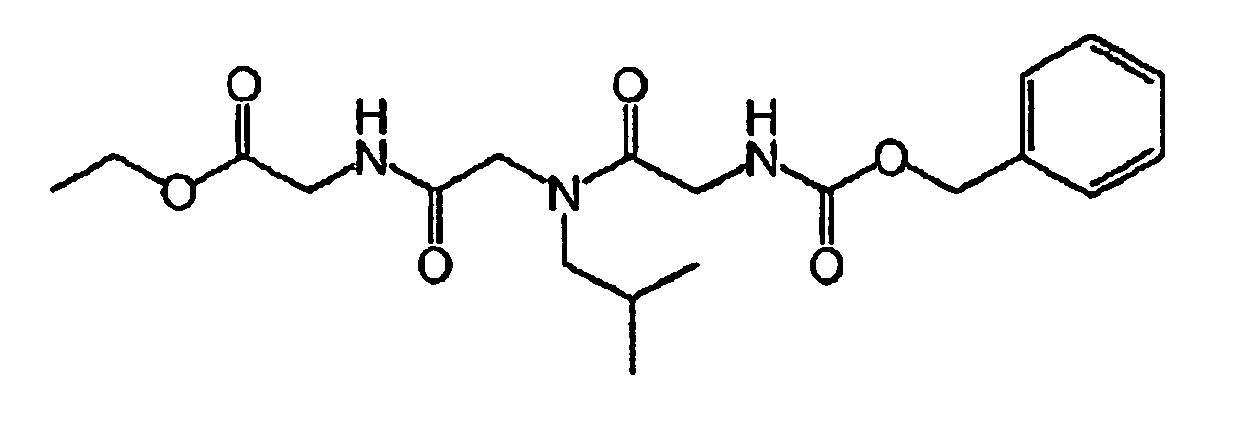
- Allgemeine Arbeitsvorschrift a, eingesetzte Mengen: Isobutylamin (2.0 g, 23.6 mmol), Paraformaldehyd (0,82 g, 23,6 mmol), N-Benzoyloxycarbonyl-glycin (2,84 g, 13,6 mmol) und Isocyanoessigsäureethylester (1,53 g, 13,6 mmol) in Methanol (100 ml). Nach 24 h wurde die Reaktion aufgearbeitet und durch Flashchromatographie gereinigt (3,5 x 30 cm, CH2Cl2/MeOH 97 : 3).
Ausbeute 3,32 g (8,2 mmol, 60 %), farbloses Öl.
Rf: 0,30 (CH2Cl2/MeOH 9 : 1).
MS (ESI-MS): m/z (%) = 430 (100) [M+Na]+, 408,6 (15) [M+H]+.
HRMS-ESI ber. C20H29N3O6Na [M+Na]+: 430,4215, gef. 430,4213. -

- Peptoid 37 (3,74 g, 9,2 mmol) wird mit LiOH x H2O (0.96 g, 23 mmol) in THF/H2O (30 ml, 2 : 1 v/v) bei Raumtemperatur versetzt. Nach der Neutralisation und Filtration wird das Produkt durch Kristallistisation (EtOAc/Petrolether 3 : 2) gereinigt und getrocknet.
Ausbeute: 3,14 g (8,3 mmol, 90 %), weißer Feststoff.
Rf 0,25 (CH2Cl2/MeOH 8 : 2).
Smp 102 - 104 °C.
MS (ESI-MS): m/z (%) = 402 (100) [M+Na]+, 380,2 (2) [M+H]+.
HRMS-ESI ber. C18H25N3O6Na [M+Na]+: 402,1635, gef. 402,1627. -

- Allgemeine Arbeitsvorschrift a, eingesetzte Mengen: Isobutylamin (0,79 g, 10,8 mmol), Paraformaldehyd (0,82 g, 23,6 mmol), Peptoid 38 (2,05 g, 5,4 mmol), Isocyanoessigsäureethylester (0,61 g, 5,4 mmol) in Methanol (250 ml). Aufarbeitung nach 48 h, Aufreinigung durch Flashchromatographie (2,5 x 30 cm, CH2Cl2/MeOH 95 : 5).
Ausbeute 2,1 g (3,6 mmol, 67 %), farbloser Feststoff Rf 0,25 (CH2Cl2/MeOH 95 : 5). Smp 98 - 102 °C.
HRMS-ESI ber. C28H43N5O5Na [M+Na]+: 600,3003, gef. 600,2999. -

- Vorschrift: analog Peptoid 38, eingesetzte Mengen: Peptoid 39 (0,2 g, 0,34 mmol), LiOH x H2O (0,036 g, 0,86 mmol) in THF/H2O (3 ml, 2 : 1 v/v).
Ausbeute 0,19 g (0.34 mmol, 96 %), farbloser Feststoff Rf 0,28 (CH2Cl2/MeOH 8 : 2). Smp 87 - 90 °C.
HRMS-ESI ber. C26H39N5O8Na [M+Na]+: 572,2690, gef. 572,2688. -

- Allgemeine Arbeitsvorschrift a, eingesetzte Mengen: Isobutylamin (0,53 g, 7,28 mmol), Paraformaldehyd (0,21 g, 7,28 mmol), Peptoid 40 (2,0 g, 3,64 mmol), Isocyanoessigsäureethylester (0,41 g, 3,64 mmol) in Trifluorethanol (50 ml). Aufarbeitung nach 48 h, Aufreinigung durch Flashchromatographie (3,5 x 30 cm, CH2Cl2/MeOH 95 : 5).
Ausbeute 1,73 g (2,3 mmol, 64 %), gelbliches Öl.
MS (ESI-MS): m/z (%) = 770,4 (100) [M+Na]+, 748,4 (10) [M+H]+.
HRMS-ESI ber. C36H57N7O10Na [M+Na]+: 770,4059, gef. 770,4034. -

- Vorschrift: analog Peptoid 38, eingesetzte Mengen: Peptoid 41 (0,38 g, 0,51 mmol), LiOH x H2O (0,054 g, 1.27 mmol) in THF/H2O (15 ml, 2:1 v/v). Aufreinigung durch Flashchromatographie an Kieselgel (2,5 x 30 cm, CH2Cl2/MeOH 7 : 3).
Ausbeute 0,30 g (0,43 mmol, 85 %), gelbliches Öl
Rf 0,35 (CH2Cl2/MeOH 6 : 4).
MS (ESI-MS): m/z (%) = 742,7 (80) [M+Na]+.
HRMS-ESI ber. C34H53N7O10Na [M+Na]+: 742,3746, gef. 742,3735. -

- Allgemeine Arbeitsvorschrift a, eingesetzte Mengen: Isobutylamin (0,04 g, 0,55 mmol), Paraformaldehyd (0,016 g, 0,55 mmol), Peptoid 42 (0,2 g, 0,28 mmol), Isocyanoessigsäureethylester (0,03 g, 0,28 mmol) in Ethanol (5 ml). Aufarbeitung nach 72 h, Aufreinigung durch HPLC RP18 (Lösungsmittel A: H2O; Lösungsmittel B: CH3CN, Gradient 20 - 60 %, Flussrate 20 ml/min).
Ausbeute 0,13 g (0,15 mmol, 52 %), gelbliches Öl. Rf 0,35 (CH2Cl2/MeOH 9 : 1).
HRMS-ESI ber. C44H71N9O12Na [M+Na]+: 940,5114, gef. 940,5097. -

- Vorschrift: analog Peptoid 38, eingesetzte Mengen: Peptoid 43 (0,03 g, 0,032 mmol), LiOH x H2O (3,4 mg, 0,08 mmol) in THF/H2O (4 ml, 2 : 1 v/v). Aufreinigung durch Flashchromatographie an Kieselgel (2,0 x 20 cm, CH2Cl2/MeOH 6 : 4).
Ausbeute 27 mg (0,032 mmol, 94 %), gelbliches Öl. Rf 0,30 (CH2Cl2/MeOH 6 : 4).
HRMS-ESI ber. C42H67N9O12Na [M+Na]+: 912,4801, gef. 912,4790. - Biologisches Screening: Die vorstehend angeführten, erfindungsgemäß hergestellten Derivate wiesen bis > 1000 µM keinen nennenswerten Einfluß auf das Wachstum des grampositiven Keims Bacillus subtilis. Gramnegatives Vibrio fischeri (Bioluminiszenzassay) war gegen die vorstehend angeführten, erfindungsgemäß hergestellten Derivate dagegen empfindlich, insbesondere gegen folgendes Peptid-Peptoid (mit IC-50 ca. 10 µM).

-

- Allgemeine Arbeitsvorschrift a, eingesetzte Mengen: Benzylamin (1,07g, 10 mmol), Paraformaldehyd (0,33g, 11 mmol), AIB-Isonitril 45 (1,4g, 10 mmol) und Essigsäure (0,6g, 10 mmol) 2 ml CH2Cl2 und 1 ml MeOH. Nach 20 h (TLC-Kontrolle Rf prod= 0,2 (CHCl3: MeOH = 20:1)) wurde das Reaktionsgemisch aufgearbeitet. Der Rückstand wurde in MeOH (20 ml) und 5M LiOH (10 ml) aufgenommen und 3 h gerührt. Nach Einengen der Lösung unter vermindertem Druck wurde 1 N HCI zugegeben und bei 4 °C gekühlt. Der Niederschlag wurde filtriert und getrocknet. Die Ausbeute an 46 beträgt 1,8 g (62%).
1H NMR (D6-DMSO) (s-cis/s-trans Isomere, 2:1) δ (ppm) = 1,32, 1,33 (s,s, 6H, (CH3)2), 2,01, 2,06 (s, s, 3H, CH3), 3,85 (s, 2H, CH2), 4,42, 4,53 (s,s, 2H, CH2Ph), 7,29 (m, 5H, Ph), 8,06, 8,27 (s,s, 1H, NH). - Für die Elongation allgemeine Arbeitsvorschrift a, eingesetzte Mengen: Säure 46, Amin (1 eq.), Paraformaldehyd (1,5 eq.) und Isonitril 45 (1 eq.) in MeOH. Die Reaktionsmischung wird für 24 h gerührt. Nach Kontrolle der Reaktionsmischung mittels LCMS wird nach dem Standardverfahren aufgearbeitet. Aufgrund der cis/trans Isomeren sind die NMR-Signale mehrfach aufgespalten.
LCMS 47: M+H+ m/z = 507,3 (R = H)
M+H+ m/z = 621,4 (R = TBS).
- Allgemeine Arbeitsvorschrift a, eingesetzte Mengen: Methylamin (33 %, 740 mg), Paraformaldehyd (237 mg, 7,90 mmol) in MeOH/CH2Cl2 (6 ml, 1:2), Bocgeschütztes Sarcosin 48 (1,5 g, 7,9 mmol) in MeOH (2 ml) und Isonitril 45 (1,1 g, 7,8 mmol). Nach 12 h Rühren bei Raumtemperatur wird unter vermindertem Druck eingeengt und das verbleibende Gemisch in MeOH (40 ml) aufgenommen.
Nach Zugabe von 5 M LiOH (7,0 ml) wird noch 3 h bei Raumtemperatur gerührt (LCMS-Kontrolle), um dann die Aufarbeitung durch Einengen des Lösungsmittels vorzunehmen. Lösen in 1 N HCl und Extraktion mit Essigester führt zu 49 in 70 % Ausbeute (1,90 g). Die NMR-Signale sind aufgrund der cis/trans Isomerie sehr stark aufgespalten.
LCMS 49: M+H+ = 346
M-H- = 344 (M = 345). Reinheit > 95%. - Im Handel erhältlicher 4-Aminobutyraldehyd (12 g) wird mit 2 M HCl (75 ml) für 2 h bei 0 °C gerührt, bevor langsam 2,67 M K2CO3-Lösung (225 ml) hinzugegeben wird. Nach Rühren für 1 h bei Raumtemperatur wird mit CH2Cl2 (3 x 200 ml) extrahiert, Einengen des Lösungsmittels ergab ein farbloses Öl (9,1 g), das nach fraktionierter Destillation das Imin 50 ergab.
- Zu einer Lösung des Imins 50 (1 eq.) in Trifluorethanol (ca. 10 ml/g) werden anschließend die Carbonsäure 49 und das Isonitril 45 (1 eq.) gegeben. Rühren für 20 h bei 90 °C (LCMS-Kontrolle), Aufarbeitung und Abtrennung von nicht reagiertem Startmaterial ergab das Tetrapeptoid 51.
ESI-MS 51: m/z = 556,3 (M+H)
Claims (15)
- Verfahren zur Herstellung von Kondensationsprodukten aus N-substituierten Glycinderivaten (Peptoiden) über sequentielle Ugi-Mehrkomponentenreaktionen gemäß nachstehendem Schema 1:

 n eine ganze Zahl von 2 bis 100 ist,die Reste R1, R2,2',2" und R3,3',3" jeweils unabhängig voneinander H, ein substituierter oder unsubstituierter Alkyl-, Alkoxy-, Aryl-, Cycloalkyl-, Bicycloalkyl-, Tricycloalkyl-, Alkenyl-, Alkinyl-, Alkaryl-, Heteroaryl- mit einem oder mehreren Heteroatomen, ausgewählt aus O, N, S, P, Si oder B, oder Alkheteroarylrest sind, mit der Maßgabe, dass R1 nicht H ist,der Rest R4 H oder eine abspaltbare Aminoschutzgruppe ist, undder Rest R H oder eine abspaltbare Estergruppe bzw. Carbonsäureschutzgruppe ist.
 - Verfahren gemäß Anspruch 1, worin die Komponente (D) ein von Glycinester oder Aminoisobuttersäureester abgeleitetes Isonitril ist.
- Verfahren gemäß Anspruch 1 oder 2, worin die Komponente (B) Paraformaldehyd ist.
- Verfahren gemäß einem der Ansprüche 1 bis 3, wobei als Komponente (A) eine festphasengebundene Carbonsäure, die für die Ugi-Mehrkomponentenreaktion die initiale Carboxylatfunktionalität zur Verfügung stellen, eingesetzt wird.
- Verfahren gemäß einem der Ansprüche 1 bis 4, wobei die Reste R1, R2,2',2" und R3,3',3" jeweils unabhängig voneinander aus H, geradkettigen oder verzweigtkettigen (C1-12) Alkylresten, geradkettigen oder verzweigtkettigen (C1-12) Alkoxyresten, geradkettigen oder verzweigtkettigen (C1-12) Trialkylsilylresten, (C6-12) Triarylsilylresten, (C3-8) Cycloalkylresten, (C2-12) Alkenylresten, (C2-12) Alkinylresten, (C5-12) Aryl- oder Heteroarylresten, (C6-12) Alkaryl- oder Alkheteroarylresten ausgewählt sind, wobei die Alkyl- oder Aryl-Reste jeweils mit einem oder mehreren von Hydroxy, Alkoxy, Aryloxy, Alkanoyl, Aroyl, Carboxy, Alkoxycarbonyl, Amino, Alkylamino, Aminoalkyl, Hydroxyamino, Amido, Carbamoyl, Ureido, Amidino, Guanidino, Cyano, Azido, Mercapto, Alkylthio, Alkylsulfoxy, Alkylsulfonyl, Alkylsulfenyl, Aminosulfonyl, Sulfhydrylalkyl, Dialkenyldisulfid, Fluor, Chlor, Brom, lod, Alkyl, Perfluoralkyl, Heteroaryl, Polyethylenglycolethyl mit Kettenlänge von 1 bis 40 und Polyethylenglycolmonoether mit Kettenlänge von 1 bis 40 substituiert sein können.
- Verfahren gemäß einem der Ansprüche 1 bis 5, wobei die Reste R Methyl oder Ethyl ist.
- Verfahren gemäß einem der Ansprüche 1 bis 6, wobei der Rest R4 Benzoyloxycarbonyl ist.
- Verfahren gemäß einem der Ansprüche 1 bis 7, wobei die Umsetzung im Bereich von -80 °C - + 200 °C , besonders bevorzugt im Bereich von 0 °C - +50 °C durchgeführt wird.
- Peptoidderivate, welche die Struktur gemäß nachstehender Formel (I) aufweisen:
 n, R1, R2,2',2", R3,3',3", R4 und R wie vorstehend definiert sind.
 - Peptoidderivat gemäß Anspruch 9 mit folgender Struktur:


- Peptoidderivat gemäß Anspruch 9 mit folgender Struktur:

- Peptoidderivat gemäß Anspruch 9 mit folgender Struktur:

- Peptoidderivat gemäß einem der Ansprüche 9 bis 12 in der Form eines Konjugats mit einem Wirkstoff oder einer Reportereinheit, verbunden über lipophile oder hydrophile Linkereinheiten.
- Pharmazeutische Zusammensetzung, umfassend ein Peptoidderivat gemäß einem der Ansprüche 9 bis 13.
- Peptoidderivats gemäß einem der Ansprüche 9 bis 13 oder pharmazeutische Zusammensetzung gemäß Anspruch 14 zur Verwendung als Antibiotika, Antiinfektiva oder für alle an die Notwendigkeit zur Zellwandpermeabilität oder Zellwandlokalisation gekoppelten pharmakologischen Anwendungen.
Applications Claiming Priority (2)
| Application Number | Priority Date | Filing Date | Title |
|---|---|---|---|
| DE102006039615A DE102006039615A1 (de) | 2006-08-24 | 2006-08-24 | Esterelongationsverfahren zum sequenzgesteuerten Aufbau alternierender Peptid-Peptoid-Polymere (Peptid-Peptoid-Polymere) |
| PCT/EP2007/007458 WO2008022800A1 (de) | 2006-08-24 | 2007-08-24 | Verfahren zur herstellung von kondensationsprodukten aus n-substituierten glycinderivaten (peptoide) über sequentielle ugi-mehrkomponentenreaktionen |
Publications (2)
| Publication Number | Publication Date |
|---|---|
| EP2051992A1 EP2051992A1 (de) | 2009-04-29 |
| EP2051992B1 true EP2051992B1 (de) | 2010-08-04 |
Family
ID=38704781
Family Applications (1)
| Application Number | Title | Priority Date | Filing Date |
|---|---|---|---|
| EP07786713A Not-in-force EP2051992B1 (de) | 2006-08-24 | 2007-08-24 | Verfahren zur herstellung von kondensationsprodukten aus n-substituierten glycinderivaten (peptoide) über sequentielle ugi-mehrkomponentenreaktionen |
Country Status (5)
| Country | Link |
|---|---|
| US (1) | US20100222548A1 (de) |
| EP (1) | EP2051992B1 (de) |
| AT (1) | ATE476442T1 (de) |
| DE (2) | DE102006039615A1 (de) |
| WO (1) | WO2008022800A1 (de) |
Families Citing this family (5)
| Publication number | Priority date | Publication date | Assignee | Title |
|---|---|---|---|---|
| US9364449B2 (en) * | 2010-06-09 | 2016-06-14 | New York University | Peptoid and synthetic oligomers, pharmaceutical compositions and methods of using same |
| US20170226159A1 (en) * | 2014-09-26 | 2017-08-10 | Kaneka Corporation | Method for producing hydrophobic peptide |
| CA3001065A1 (en) | 2015-10-14 | 2017-04-20 | Xiaoxi WEI | Compositions and methods for reducing ice crystal formation |
| EP3925963A1 (de) * | 2020-06-18 | 2021-12-22 | Helmholtz-Zentrum für Infektionsforschung GmbH | Phytosphingosinderivate als adjuvantien bei der immunstimulation |
| WO2025179288A1 (en) * | 2024-02-24 | 2025-08-28 | Cornell University | Methods for manufacture of sequence-defined, stochastic-controlled polymeric euv photoresists |
Family Cites Families (9)
| Publication number | Priority date | Publication date | Assignee | Title |
|---|---|---|---|---|
| DE2061009A1 (de) * | 1969-12-18 | 1971-06-24 | Exploaterings Ab Tbf | Verfahren zur Fixierung von Polymeren |
| IE66205B1 (en) * | 1990-06-14 | 1995-12-13 | Paul A Bartlett | Polypeptide analogs |
| HUT72614A (en) * | 1992-09-24 | 1996-05-28 | Chiron Corp | Synthesis of n-substituted oligomers |
| DE4331012A1 (de) * | 1993-09-13 | 1995-03-16 | Bayer Ag | Nukleinsäuren-bindende Oligomere mit N-Verzweigung für Therapie und Diagnostik |
| US5990277A (en) * | 1996-09-03 | 1999-11-23 | Yissum Research Development Company Of The Herbrew University Of Jerusalem | Semipeptoid farnesyl protein transferase inhibitors and analogs thereof |
| WO1998051697A2 (de) * | 1997-05-14 | 1998-11-19 | Morphochem Ag | Verfahren zur herstellung von polymeren, die nucleobasen als seitengruppen aufweisen |
| GB9724859D0 (en) * | 1997-11-26 | 1998-01-21 | Univ Nottingham | Compounds and their use as antibacterial agents |
| US20020019013A1 (en) * | 1999-03-08 | 2002-02-14 | Boliang Lou | Combined resin method for high-speed synthesis of combinatorial libraries |
| DE10023743A1 (de) * | 2000-05-15 | 2001-11-29 | Max Planck Gesellschaft | Peptidsubstrate zur direkten Messung enzymatischer Aktivitäten |
-
2006
- 2006-08-24 DE DE102006039615A patent/DE102006039615A1/de not_active Withdrawn
-
2007
- 2007-08-24 AT AT07786713T patent/ATE476442T1/de active
- 2007-08-24 US US12/310,376 patent/US20100222548A1/en not_active Abandoned
- 2007-08-24 EP EP07786713A patent/EP2051992B1/de not_active Not-in-force
- 2007-08-24 DE DE502007004665T patent/DE502007004665D1/de active Active
- 2007-08-24 WO PCT/EP2007/007458 patent/WO2008022800A1/de not_active Ceased
Also Published As
| Publication number | Publication date |
|---|---|
| ATE476442T1 (de) | 2010-08-15 |
| DE502007004665D1 (de) | 2010-09-16 |
| DE102006039615A1 (de) | 2008-03-13 |
| US20100222548A1 (en) | 2010-09-02 |
| EP2051992A1 (de) | 2009-04-29 |
| WO2008022800A1 (de) | 2008-02-28 |
Similar Documents
| Publication | Publication Date | Title |
|---|---|---|
| DE69434136T2 (de) | Dolastatin-derivate | |
| DE69400798T2 (de) | Urethane und Urea zur Induktion der Cytokin-Produktion | |
| EP0871653B1 (de) | Neue aminosäurederivate, verfahren zu ihrer herstellung und diese verbindungen enthaltende pharmazeutische zusammensetzungen | |
| EP0688789B1 (de) | Lipopeptid-Derivate, Verfahren zu ihrer Herstellung und ihre Verwendung | |
| EP0939765B1 (de) | Glycokonjugate von modifizierten camptothecin-derivaten(a- oder b-ring-verknüpfung) | |
| CH677672A5 (de) | ||
| EP0111266A2 (de) | Substituierte Tetrapeptide | |
| EP0934329A1 (de) | Glycokonjugate von modifizierten camptothecin-derivaten (20-o-verknüpfung) | |
| DE69518857T2 (de) | Pyridin- und pyrazindicarbonsäurederivate als zellwachstumsregulatoren | |
| EP0688314B1 (de) | Prodrug-derivate von enzyminhibitoren mit hydroxylgruppen, verfahren zu deren herstellung und ihre verwendung | |
| EP0981542B1 (de) | Glycokonjugate von 20(s)-camptothecin | |
| WO2008022800A1 (de) | Verfahren zur herstellung von kondensationsprodukten aus n-substituierten glycinderivaten (peptoide) über sequentielle ugi-mehrkomponentenreaktionen | |
| DE68927630T2 (de) | Analoge von Peptrolsubstraten | |
| EP0929570A1 (de) | Modifizierte cytostatika | |
| DE1811518B2 (de) | Daunorubicinderivale, Verfahren zu ihrer Herstellung und diese enthaltende pharmazeutische Zusammensetzungen | |
| DE3200662C2 (de) | Nitrosoharnstoffderivate, Verfahren zu deren Herstellung und Arzneimittel diese enthaltend | |
| DE4308095A1 (de) | Prodrug-Derivate von Arzneimittelwirkstoffen mit Hydroxylgruppen, Verfahren zu deren Herstellung und ihre Verwendung | |
| EP0403828A1 (de) | Renininhibitorische Peptide, Verfahren zur ihrer Herstellung und ihre Verwendung in Arzneimitteln | |
| DE19909979A1 (de) | Verfahren zur Herstellung von Glycokonjugaten von 20(S)-Camptothecin | |
| DE69406441T2 (de) | Syntetische aglukodalbaheptid-antibiotika | |
| DE68906086T2 (de) | Von spergualin abgeleitete verbindungen, verfahren zu ihrer herstellung und ihre verwendung. | |
| DE1958383C3 (de) | Leupeptine, Verfahren zu ihrer Herstellung und diese enthaltende Arzneimittel | |
| DE2537071A1 (de) | Amid | |
| AT286495B (de) | Verfahren zur Herstellung von neuen Estern des α-Amino-benzylpenicillins | |
| DE69013101T2 (de) | 2-(N-acyl)amino-6,7-dimethoxytetraline, Verfahren zu deren Herstellung und pharmazeutische Zusammensetzungen mit antihypertensiver Wirkung, die diese enthalten. |
Legal Events
| Date | Code | Title | Description |
|---|---|---|---|
| PUAI | Public reference made under article 153(3) epc to a published international application that has entered the european phase |
Free format text: ORIGINAL CODE: 0009012 |
|
| 17P | Request for examination filed |
Effective date: 20090305 |
|
| AK | Designated contracting states |
Kind code of ref document: A1 Designated state(s): AT BE BG CH CY CZ DE DK EE ES FI FR GB GR HU IE IS IT LI LT LU LV MC MT NL PL PT RO SE SI SK TR |
|
| AX | Request for extension of the european patent |
Extension state: AL BA HR MK RS |
|
| GRAP | Despatch of communication of intention to grant a patent |
Free format text: ORIGINAL CODE: EPIDOSNIGR1 |
|
| GRAC | Information related to communication of intention to grant a patent modified |
Free format text: ORIGINAL CODE: EPIDOSCIGR1 |
|
| GRAS | Grant fee paid |
Free format text: ORIGINAL CODE: EPIDOSNIGR3 |
|
| GRAA | (expected) grant |
Free format text: ORIGINAL CODE: 0009210 |
|
| AK | Designated contracting states |
Kind code of ref document: B1 Designated state(s): AT BE BG CH CY CZ DE DK EE ES FI FR GB GR HU IE IS IT LI LT LU LV MC MT NL PL PT RO SE SI SK TR |
|
| REG | Reference to a national code |
Ref country code: GB Ref legal event code: FG4D Free format text: NOT ENGLISH |
|
| REG | Reference to a national code |
Ref country code: CH Ref legal event code: EP Ref country code: CH Ref legal event code: NV Representative=s name: KATZAROV S.A. |
|
| REG | Reference to a national code |
Ref country code: IE Ref legal event code: FG4D Free format text: LANGUAGE OF EP DOCUMENT: GERMAN |
|
| REF | Corresponds to: |
Ref document number: 502007004665 Country of ref document: DE Date of ref document: 20100916 Kind code of ref document: P |
|
| PGFP | Annual fee paid to national office [announced via postgrant information from national office to epo] |
Ref country code: NL Payment date: 20100827 Year of fee payment: 4 |
|
| REG | Reference to a national code |
Ref country code: NL Ref legal event code: T3 |
|
| LTIE | Lt: invalidation of european patent or patent extension |
Effective date: 20100804 |
|
| PG25 | Lapsed in a contracting state [announced via postgrant information from national office to epo] |
Ref country code: FI Free format text: LAPSE BECAUSE OF FAILURE TO SUBMIT A TRANSLATION OF THE DESCRIPTION OR TO PAY THE FEE WITHIN THE PRESCRIBED TIME-LIMIT Effective date: 20100804 Ref country code: LT Free format text: LAPSE BECAUSE OF FAILURE TO SUBMIT A TRANSLATION OF THE DESCRIPTION OR TO PAY THE FEE WITHIN THE PRESCRIBED TIME-LIMIT Effective date: 20100804 |
|
| BERE | Be: lapsed |
Owner name: LEIBNIZ-INSTITUT FUR PFLANZENBIOCHEMIE (IPB) Effective date: 20100831 |
|
| PG25 | Lapsed in a contracting state [announced via postgrant information from national office to epo] |
Ref country code: SI Free format text: LAPSE BECAUSE OF FAILURE TO SUBMIT A TRANSLATION OF THE DESCRIPTION OR TO PAY THE FEE WITHIN THE PRESCRIBED TIME-LIMIT Effective date: 20100804 Ref country code: BG Free format text: LAPSE BECAUSE OF FAILURE TO SUBMIT A TRANSLATION OF THE DESCRIPTION OR TO PAY THE FEE WITHIN THE PRESCRIBED TIME-LIMIT Effective date: 20101104 Ref country code: CY Free format text: LAPSE BECAUSE OF FAILURE TO SUBMIT A TRANSLATION OF THE DESCRIPTION OR TO PAY THE FEE WITHIN THE PRESCRIBED TIME-LIMIT Effective date: 20100804 Ref country code: IS Free format text: LAPSE BECAUSE OF FAILURE TO SUBMIT A TRANSLATION OF THE DESCRIPTION OR TO PAY THE FEE WITHIN THE PRESCRIBED TIME-LIMIT Effective date: 20101204 Ref country code: PL Free format text: LAPSE BECAUSE OF FAILURE TO SUBMIT A TRANSLATION OF THE DESCRIPTION OR TO PAY THE FEE WITHIN THE PRESCRIBED TIME-LIMIT Effective date: 20100804 Ref country code: PT Free format text: LAPSE BECAUSE OF FAILURE TO SUBMIT A TRANSLATION OF THE DESCRIPTION OR TO PAY THE FEE WITHIN THE PRESCRIBED TIME-LIMIT Effective date: 20101206 |
|
| REG | Reference to a national code |
Ref country code: IE Ref legal event code: FD4D |
|
| PG25 | Lapsed in a contracting state [announced via postgrant information from national office to epo] |
Ref country code: GR Free format text: LAPSE BECAUSE OF FAILURE TO SUBMIT A TRANSLATION OF THE DESCRIPTION OR TO PAY THE FEE WITHIN THE PRESCRIBED TIME-LIMIT Effective date: 20101105 Ref country code: MC Free format text: LAPSE BECAUSE OF NON-PAYMENT OF DUE FEES Effective date: 20100831 Ref country code: LV Free format text: LAPSE BECAUSE OF FAILURE TO SUBMIT A TRANSLATION OF THE DESCRIPTION OR TO PAY THE FEE WITHIN THE PRESCRIBED TIME-LIMIT Effective date: 20100804 Ref country code: SE Free format text: LAPSE BECAUSE OF FAILURE TO SUBMIT A TRANSLATION OF THE DESCRIPTION OR TO PAY THE FEE WITHIN THE PRESCRIBED TIME-LIMIT Effective date: 20100804 |
|
| PG25 | Lapsed in a contracting state [announced via postgrant information from national office to epo] |
Ref country code: DK Free format text: LAPSE BECAUSE OF FAILURE TO SUBMIT A TRANSLATION OF THE DESCRIPTION OR TO PAY THE FEE WITHIN THE PRESCRIBED TIME-LIMIT Effective date: 20100804 Ref country code: IE Free format text: LAPSE BECAUSE OF FAILURE TO SUBMIT A TRANSLATION OF THE DESCRIPTION OR TO PAY THE FEE WITHIN THE PRESCRIBED TIME-LIMIT Effective date: 20100804 |
|
| PG25 | Lapsed in a contracting state [announced via postgrant information from national office to epo] |
Ref country code: IT Free format text: LAPSE BECAUSE OF FAILURE TO SUBMIT A TRANSLATION OF THE DESCRIPTION OR TO PAY THE FEE WITHIN THE PRESCRIBED TIME-LIMIT Effective date: 20100804 Ref country code: RO Free format text: LAPSE BECAUSE OF FAILURE TO SUBMIT A TRANSLATION OF THE DESCRIPTION OR TO PAY THE FEE WITHIN THE PRESCRIBED TIME-LIMIT Effective date: 20100804 Ref country code: EE Free format text: LAPSE BECAUSE OF FAILURE TO SUBMIT A TRANSLATION OF THE DESCRIPTION OR TO PAY THE FEE WITHIN THE PRESCRIBED TIME-LIMIT Effective date: 20100804 Ref country code: SK Free format text: LAPSE BECAUSE OF FAILURE TO SUBMIT A TRANSLATION OF THE DESCRIPTION OR TO PAY THE FEE WITHIN THE PRESCRIBED TIME-LIMIT Effective date: 20100804 Ref country code: CZ Free format text: LAPSE BECAUSE OF FAILURE TO SUBMIT A TRANSLATION OF THE DESCRIPTION OR TO PAY THE FEE WITHIN THE PRESCRIBED TIME-LIMIT Effective date: 20100804 |
|
| PLBE | No opposition filed within time limit |
Free format text: ORIGINAL CODE: 0009261 |
|
| STAA | Information on the status of an ep patent application or granted ep patent |
Free format text: STATUS: NO OPPOSITION FILED WITHIN TIME LIMIT |
|
| PG25 | Lapsed in a contracting state [announced via postgrant information from national office to epo] |
Ref country code: ES Free format text: LAPSE BECAUSE OF FAILURE TO SUBMIT A TRANSLATION OF THE DESCRIPTION OR TO PAY THE FEE WITHIN THE PRESCRIBED TIME-LIMIT Effective date: 20101115 |
|
| 26N | No opposition filed |
Effective date: 20110506 |
|
| PG25 | Lapsed in a contracting state [announced via postgrant information from national office to epo] |
Ref country code: BE Free format text: LAPSE BECAUSE OF NON-PAYMENT OF DUE FEES Effective date: 20100831 |
|
| REG | Reference to a national code |
Ref country code: DE Ref legal event code: R097 Ref document number: 502007004665 Country of ref document: DE Effective date: 20110506 |
|
| PG25 | Lapsed in a contracting state [announced via postgrant information from national office to epo] |
Ref country code: MT Free format text: LAPSE BECAUSE OF FAILURE TO SUBMIT A TRANSLATION OF THE DESCRIPTION OR TO PAY THE FEE WITHIN THE PRESCRIBED TIME-LIMIT Effective date: 20100804 |
|
| REG | Reference to a national code |
Ref country code: NL Ref legal event code: V1 Effective date: 20120301 |
|
| REG | Reference to a national code |
Ref country code: CH Ref legal event code: PL |
|
| PG25 | Lapsed in a contracting state [announced via postgrant information from national office to epo] |
Ref country code: CH Free format text: LAPSE BECAUSE OF NON-PAYMENT OF DUE FEES Effective date: 20110831 Ref country code: LI Free format text: LAPSE BECAUSE OF NON-PAYMENT OF DUE FEES Effective date: 20110831 |
|
| PG25 | Lapsed in a contracting state [announced via postgrant information from national office to epo] |
Ref country code: NL Free format text: LAPSE BECAUSE OF NON-PAYMENT OF DUE FEES Effective date: 20120301 |
|
| PG25 | Lapsed in a contracting state [announced via postgrant information from national office to epo] |
Ref country code: LU Free format text: LAPSE BECAUSE OF NON-PAYMENT OF DUE FEES Effective date: 20100824 Ref country code: HU Free format text: LAPSE BECAUSE OF FAILURE TO SUBMIT A TRANSLATION OF THE DESCRIPTION OR TO PAY THE FEE WITHIN THE PRESCRIBED TIME-LIMIT Effective date: 20110205 |
|
| PG25 | Lapsed in a contracting state [announced via postgrant information from national office to epo] |
Ref country code: TR Free format text: LAPSE BECAUSE OF FAILURE TO SUBMIT A TRANSLATION OF THE DESCRIPTION OR TO PAY THE FEE WITHIN THE PRESCRIBED TIME-LIMIT Effective date: 20100804 |
|
| REG | Reference to a national code |
Ref country code: AT Ref legal event code: MM01 Ref document number: 476442 Country of ref document: AT Kind code of ref document: T Effective date: 20120831 |
|
| PG25 | Lapsed in a contracting state [announced via postgrant information from national office to epo] |
Ref country code: AT Free format text: LAPSE BECAUSE OF NON-PAYMENT OF DUE FEES Effective date: 20120831 |
|
| PGFP | Annual fee paid to national office [announced via postgrant information from national office to epo] |
Ref country code: FR Payment date: 20130724 Year of fee payment: 7 |
|
| REG | Reference to a national code |
Ref country code: FR Ref legal event code: ST Effective date: 20150430 |
|
| PG25 | Lapsed in a contracting state [announced via postgrant information from national office to epo] |
Ref country code: FR Free format text: LAPSE BECAUSE OF NON-PAYMENT OF DUE FEES Effective date: 20140901 |
|
| PGFP | Annual fee paid to national office [announced via postgrant information from national office to epo] |
Ref country code: DE Payment date: 20190829 Year of fee payment: 13 |
|
| PGFP | Annual fee paid to national office [announced via postgrant information from national office to epo] |
Ref country code: GB Payment date: 20190715 Year of fee payment: 13 |
|
| REG | Reference to a national code |
Ref country code: DE Ref legal event code: R119 Ref document number: 502007004665 Country of ref document: DE |
|
| GBPC | Gb: european patent ceased through non-payment of renewal fee |
Effective date: 20200824 |
|
| PG25 | Lapsed in a contracting state [announced via postgrant information from national office to epo] |
Ref country code: DE Free format text: LAPSE BECAUSE OF NON-PAYMENT OF DUE FEES Effective date: 20210302 |
|
| PG25 | Lapsed in a contracting state [announced via postgrant information from national office to epo] |
Ref country code: GB Free format text: LAPSE BECAUSE OF NON-PAYMENT OF DUE FEES Effective date: 20200824 |